WO2010016545A1 - 電極材料前駆体の製造方法及び得られた電極材料前駆体を用いる電極材料の製造方法 - Google Patents
電極材料前駆体の製造方法及び得られた電極材料前駆体を用いる電極材料の製造方法 Download PDFInfo
- Publication number
- WO2010016545A1 WO2010016545A1 PCT/JP2009/063945 JP2009063945W WO2010016545A1 WO 2010016545 A1 WO2010016545 A1 WO 2010016545A1 JP 2009063945 W JP2009063945 W JP 2009063945W WO 2010016545 A1 WO2010016545 A1 WO 2010016545A1
- Authority
- WO
- WIPO (PCT)
- Prior art keywords
- electrode material
- core
- active material
- precursor
- producing
- Prior art date
- Legal status (The legal status is an assumption and is not a legal conclusion. Google has not performed a legal analysis and makes no representation as to the accuracy of the status listed.)
- Ceased
Links
Images



Classifications
-
- H—ELECTRICITY
- H01—ELECTRIC ELEMENTS
- H01M—PROCESSES OR MEANS, e.g. BATTERIES, FOR THE DIRECT CONVERSION OF CHEMICAL ENERGY INTO ELECTRICAL ENERGY
- H01M4/00—Electrodes
- H01M4/02—Electrodes composed of, or comprising, active material
- H01M4/36—Selection of substances as active materials, active masses, active liquids
- H01M4/58—Selection of substances as active materials, active masses, active liquids of inorganic compounds other than oxides or hydroxides, e.g. sulfides, selenides, tellurides, halogenides or LiCoFy; of polyanionic structures, e.g. phosphates, silicates or borates
- H01M4/5825—Oxygenated metallic salts or polyanionic structures, e.g. borates, phosphates, silicates, olivines
-
- H—ELECTRICITY
- H01—ELECTRIC ELEMENTS
- H01M—PROCESSES OR MEANS, e.g. BATTERIES, FOR THE DIRECT CONVERSION OF CHEMICAL ENERGY INTO ELECTRICAL ENERGY
- H01M4/00—Electrodes
- H01M4/02—Electrodes composed of, or comprising, active material
- H01M4/04—Processes of manufacture in general
-
- B—PERFORMING OPERATIONS; TRANSPORTING
- B82—NANOTECHNOLOGY
- B82Y—SPECIFIC USES OR APPLICATIONS OF NANOSTRUCTURES; MEASUREMENT OR ANALYSIS OF NANOSTRUCTURES; MANUFACTURE OR TREATMENT OF NANOSTRUCTURES
- B82Y30/00—Nanotechnology for materials or surface science, e.g. nanocomposites
-
- C—CHEMISTRY; METALLURGY
- C01—INORGANIC CHEMISTRY
- C01B—NON-METALLIC ELEMENTS; COMPOUNDS THEREOF; METALLOIDS OR COMPOUNDS THEREOF NOT COVERED BY SUBCLASS C01C
- C01B25/00—Phosphorus; Compounds thereof
- C01B25/16—Oxyacids of phosphorus; Salts thereof
- C01B25/26—Phosphates
- C01B25/37—Phosphates of heavy metals
- C01B25/375—Phosphates of heavy metals of iron
-
- C—CHEMISTRY; METALLURGY
- C01—INORGANIC CHEMISTRY
- C01B—NON-METALLIC ELEMENTS; COMPOUNDS THEREOF; METALLOIDS OR COMPOUNDS THEREOF NOT COVERED BY SUBCLASS C01C
- C01B25/00—Phosphorus; Compounds thereof
- C01B25/16—Oxyacids of phosphorus; Salts thereof
- C01B25/26—Phosphates
- C01B25/45—Phosphates containing plural metal, or metal and ammonium
-
- C—CHEMISTRY; METALLURGY
- C01—INORGANIC CHEMISTRY
- C01G—COMPOUNDS CONTAINING METALS NOT COVERED BY SUBCLASSES C01D OR C01F
- C01G23/00—Compounds of titanium
- C01G23/003—Titanates
- C01G23/005—Alkali titanates
-
- C—CHEMISTRY; METALLURGY
- C01—INORGANIC CHEMISTRY
- C01G—COMPOUNDS CONTAINING METALS NOT COVERED BY SUBCLASSES C01D OR C01F
- C01G23/00—Compounds of titanium
- C01G23/04—Oxides; Hydroxides
- C01G23/047—Titanium dioxide
- C01G23/053—Producing by wet processes, e.g. hydrolysing titanium salts
-
- C—CHEMISTRY; METALLURGY
- C01—INORGANIC CHEMISTRY
- C01G—COMPOUNDS CONTAINING METALS NOT COVERED BY SUBCLASSES C01D OR C01F
- C01G45/00—Compounds of manganese
- C01G45/02—Oxides
-
- H—ELECTRICITY
- H01—ELECTRIC ELEMENTS
- H01M—PROCESSES OR MEANS, e.g. BATTERIES, FOR THE DIRECT CONVERSION OF CHEMICAL ENERGY INTO ELECTRICAL ENERGY
- H01M4/00—Electrodes
- H01M4/02—Electrodes composed of, or comprising, active material
- H01M4/04—Processes of manufacture in general
- H01M4/0471—Processes of manufacture in general involving thermal treatment, e.g. firing, sintering, backing particulate active material, thermal decomposition, pyrolysis
-
- H—ELECTRICITY
- H01—ELECTRIC ELEMENTS
- H01M—PROCESSES OR MEANS, e.g. BATTERIES, FOR THE DIRECT CONVERSION OF CHEMICAL ENERGY INTO ELECTRICAL ENERGY
- H01M4/00—Electrodes
- H01M4/02—Electrodes composed of, or comprising, active material
- H01M4/13—Electrodes for accumulators with non-aqueous electrolyte, e.g. for lithium-accumulators; Processes of manufacture thereof
- H01M4/139—Processes of manufacture
- H01M4/1391—Processes of manufacture of electrodes based on mixed oxides or hydroxides, or on mixtures of oxides or hydroxides, e.g. LiCoOx
-
- H—ELECTRICITY
- H01—ELECTRIC ELEMENTS
- H01M—PROCESSES OR MEANS, e.g. BATTERIES, FOR THE DIRECT CONVERSION OF CHEMICAL ENERGY INTO ELECTRICAL ENERGY
- H01M4/00—Electrodes
- H01M4/02—Electrodes composed of, or comprising, active material
- H01M4/13—Electrodes for accumulators with non-aqueous electrolyte, e.g. for lithium-accumulators; Processes of manufacture thereof
- H01M4/139—Processes of manufacture
- H01M4/1397—Processes of manufacture of electrodes based on inorganic compounds other than oxides or hydroxides, e.g. sulfides, selenides, tellurides, halogenides or LiCoFy
-
- H—ELECTRICITY
- H01—ELECTRIC ELEMENTS
- H01M—PROCESSES OR MEANS, e.g. BATTERIES, FOR THE DIRECT CONVERSION OF CHEMICAL ENERGY INTO ELECTRICAL ENERGY
- H01M4/00—Electrodes
- H01M4/02—Electrodes composed of, or comprising, active material
- H01M4/36—Selection of substances as active materials, active masses, active liquids
- H01M4/362—Composites
- H01M4/366—Composites as layered products
-
- H—ELECTRICITY
- H01—ELECTRIC ELEMENTS
- H01M—PROCESSES OR MEANS, e.g. BATTERIES, FOR THE DIRECT CONVERSION OF CHEMICAL ENERGY INTO ELECTRICAL ENERGY
- H01M4/00—Electrodes
- H01M4/02—Electrodes composed of, or comprising, active material
- H01M4/36—Selection of substances as active materials, active masses, active liquids
- H01M4/48—Selection of substances as active materials, active masses, active liquids of inorganic oxides or hydroxides
- H01M4/485—Selection of substances as active materials, active masses, active liquids of inorganic oxides or hydroxides of mixed oxides or hydroxides for inserting or intercalating light metals, e.g. LiTi2O4 or LiTi2OxFy
-
- H—ELECTRICITY
- H01—ELECTRIC ELEMENTS
- H01M—PROCESSES OR MEANS, e.g. BATTERIES, FOR THE DIRECT CONVERSION OF CHEMICAL ENERGY INTO ELECTRICAL ENERGY
- H01M4/00—Electrodes
- H01M4/02—Electrodes composed of, or comprising, active material
- H01M4/36—Selection of substances as active materials, active masses, active liquids
- H01M4/58—Selection of substances as active materials, active masses, active liquids of inorganic compounds other than oxides or hydroxides, e.g. sulfides, selenides, tellurides, halogenides or LiCoFy; of polyanionic structures, e.g. phosphates, silicates or borates
-
- H—ELECTRICITY
- H01—ELECTRIC ELEMENTS
- H01M—PROCESSES OR MEANS, e.g. BATTERIES, FOR THE DIRECT CONVERSION OF CHEMICAL ENERGY INTO ELECTRICAL ENERGY
- H01M4/00—Electrodes
- H01M4/02—Electrodes composed of, or comprising, active material
- H01M4/62—Selection of inactive substances as ingredients for active masses, e.g. binders, fillers
-
- H—ELECTRICITY
- H01—ELECTRIC ELEMENTS
- H01M—PROCESSES OR MEANS, e.g. BATTERIES, FOR THE DIRECT CONVERSION OF CHEMICAL ENERGY INTO ELECTRICAL ENERGY
- H01M4/00—Electrodes
- H01M4/02—Electrodes composed of, or comprising, active material
- H01M4/62—Selection of inactive substances as ingredients for active masses, e.g. binders, fillers
- H01M4/624—Electric conductive fillers
- H01M4/625—Carbon or graphite
-
- C—CHEMISTRY; METALLURGY
- C01—INORGANIC CHEMISTRY
- C01P—INDEXING SCHEME RELATING TO STRUCTURAL AND PHYSICAL ASPECTS OF SOLID INORGANIC COMPOUNDS
- C01P2002/00—Crystal-structural characteristics
- C01P2002/30—Three-dimensional structures
- C01P2002/32—Three-dimensional structures spinel-type (AB2O4)
-
- C—CHEMISTRY; METALLURGY
- C01—INORGANIC CHEMISTRY
- C01P—INDEXING SCHEME RELATING TO STRUCTURAL AND PHYSICAL ASPECTS OF SOLID INORGANIC COMPOUNDS
- C01P2002/00—Crystal-structural characteristics
- C01P2002/70—Crystal-structural characteristics defined by measured X-ray, neutron or electron diffraction data
- C01P2002/72—Crystal-structural characteristics defined by measured X-ray, neutron or electron diffraction data by d-values or two theta-values, e.g. as X-ray diagram
-
- C—CHEMISTRY; METALLURGY
- C01—INORGANIC CHEMISTRY
- C01P—INDEXING SCHEME RELATING TO STRUCTURAL AND PHYSICAL ASPECTS OF SOLID INORGANIC COMPOUNDS
- C01P2004/00—Particle morphology
- C01P2004/01—Particle morphology depicted by an image
- C01P2004/04—Particle morphology depicted by an image obtained by TEM, STEM, STM or AFM
-
- C—CHEMISTRY; METALLURGY
- C01—INORGANIC CHEMISTRY
- C01P—INDEXING SCHEME RELATING TO STRUCTURAL AND PHYSICAL ASPECTS OF SOLID INORGANIC COMPOUNDS
- C01P2004/00—Particle morphology
- C01P2004/60—Particles characterised by their size
- C01P2004/62—Submicrometer sized, i.e. from 0.1-1 micrometer
-
- C—CHEMISTRY; METALLURGY
- C01—INORGANIC CHEMISTRY
- C01P—INDEXING SCHEME RELATING TO STRUCTURAL AND PHYSICAL ASPECTS OF SOLID INORGANIC COMPOUNDS
- C01P2004/00—Particle morphology
- C01P2004/60—Particles characterised by their size
- C01P2004/64—Nanometer sized, i.e. from 1-100 nanometer
-
- H—ELECTRICITY
- H01—ELECTRIC ELEMENTS
- H01M—PROCESSES OR MEANS, e.g. BATTERIES, FOR THE DIRECT CONVERSION OF CHEMICAL ENERGY INTO ELECTRICAL ENERGY
- H01M10/00—Secondary cells; Manufacture thereof
- H01M10/05—Accumulators with non-aqueous electrolyte
- H01M10/052—Li-accumulators
- H01M10/0525—Rocking-chair batteries, i.e. batteries with lithium insertion or intercalation in both electrodes; Lithium-ion batteries
-
- H—ELECTRICITY
- H01—ELECTRIC ELEMENTS
- H01M—PROCESSES OR MEANS, e.g. BATTERIES, FOR THE DIRECT CONVERSION OF CHEMICAL ENERGY INTO ELECTRICAL ENERGY
- H01M4/00—Electrodes
- H01M4/02—Electrodes composed of, or comprising, active material
- H01M4/13—Electrodes for accumulators with non-aqueous electrolyte, e.g. for lithium-accumulators; Processes of manufacture thereof
- H01M4/131—Electrodes based on mixed oxides or hydroxides, or on mixtures of oxides or hydroxides, e.g. LiCoOx
-
- H—ELECTRICITY
- H01—ELECTRIC ELEMENTS
- H01M—PROCESSES OR MEANS, e.g. BATTERIES, FOR THE DIRECT CONVERSION OF CHEMICAL ENERGY INTO ELECTRICAL ENERGY
- H01M4/00—Electrodes
- H01M4/02—Electrodes composed of, or comprising, active material
- H01M4/13—Electrodes for accumulators with non-aqueous electrolyte, e.g. for lithium-accumulators; Processes of manufacture thereof
- H01M4/136—Electrodes based on inorganic compounds other than oxides or hydroxides, e.g. sulfides, selenides, tellurides, halogenides or LiCoFy
-
- Y—GENERAL TAGGING OF NEW TECHNOLOGICAL DEVELOPMENTS; GENERAL TAGGING OF CROSS-SECTIONAL TECHNOLOGIES SPANNING OVER SEVERAL SECTIONS OF THE IPC; TECHNICAL SUBJECTS COVERED BY FORMER USPC CROSS-REFERENCE ART COLLECTIONS [XRACs] AND DIGESTS
- Y02—TECHNOLOGIES OR APPLICATIONS FOR MITIGATION OR ADAPTATION AGAINST CLIMATE CHANGE
- Y02E—REDUCTION OF GREENHOUSE GAS [GHG] EMISSIONS, RELATED TO ENERGY GENERATION, TRANSMISSION OR DISTRIBUTION
- Y02E60/00—Enabling technologies; Technologies with a potential or indirect contribution to GHG emissions mitigation
- Y02E60/10—Energy storage using batteries
Definitions
- the present invention relates to a method for producing an electrode material precursor having a core / shell structure used for a lithium secondary battery and the like, and a method for producing an electrode material using the obtained electrode material precursor.
- an electrode material used for various secondary batteries such as lithium secondary batteries
- Various electrode materials having a structure have been proposed. It is also known to produce an electrode material coated with a polymer such as polyaniline by polymerizing a polymerizable compound on the surface of the active material core particles as a film made of a conductive material. (For example, see Patent Documents 1 to 3)
- the present invention eliminates these problems of the prior art, and uses a method for producing an electrode material precursor having a core-shell structure in which the particle size is extremely small and the particle size is uniform, and the obtained precursor is used.
- An object of the present invention is to provide an efficient method for producing an electrode material.
- An active material core coated with polyaniline is characterized in that an active material core is polymerized on the surface of the fine particle by adding an oxidizing agent to a solution containing aniline and an active material raw material to generate active material fine particles.
- an electrode material precursor whose active material core is FePO 4 iron phosphate (III) is obtained.
- Ti (OC n H 2n + 1 ) 4 is used as the active material raw material (wherein n represents an integer of 1 to 5), and (NH 4 ) 2 S 2 O 8 or trivalent iron is used as the oxidizing agent.
- the electrode material precursor according to 1 or 2 wherein an electrode material precursor having an active material core of MnO 2 is obtained by adding an aqueous solution of permanganate to an organic solvent solution containing aniline. Production method.
- the active material core is coated with carbon, characterized in that the electrode material precursor obtained by the production method described in any one of 6.1 to 5 is heat-treated at 300 to 900 ° C. in a reducing atmosphere.
- a method for producing an electrode material having a core / shell structure. 7). 7 The method for producing an electrode material according to 6, wherein the heat treatment is performed in a reducing atmosphere containing 0.1 to 10% (volume%) of hydrogen.
- the electrode material obtained by the production method described in 8.3 is heat-treated in the reducing atmosphere in the presence of a lithium salt and sugar to obtain an electrode material having an active material core of LiFePO 4.
- the method for producing an electrode material according to 6 or 7, The electrode material obtained by the manufacturing method described in 9.4 is heat-treated in the reducing atmosphere in the presence of a lithium salt to obtain an electrode material whose active material core is Li 4 Ti 5 O 12
- the method for producing an electrode material according to 6 or 7, wherein: 6 or 7, wherein the electrode material obtained by the production method described in 10.5 is heat-treated in the reducing atmosphere to obtain an electrode material having an active material core of Mn 3 O 4
- 11. 11 The method for producing an electrode material according to any one of 6 to 10, wherein the electrode material has an average particle diameter of 5 to 1,000 nm.
- the active material core fine particles are generated in the solution using a solution in which the raw material of the active material core is dissolved. Since the polyaniline film is formed by polymerizing aniline, the growth and aggregation of the active material core fine particles are suppressed, and the electrode material precursor having a core-shell structure in which the particle size is extremely small and the particle size is uniform is efficiently obtained. Obtainable.
- the obtained electrode material precursor having a core / shell structure coated with polyaniline is heat-treated in a reducing atmosphere at 300 to 900 ° C., so that the size of the particles in which the active material core is coated with carbon is extremely small.
- an electrode material having a core / shell structure with a uniform particle size and excellent electrode characteristics can be efficiently produced.
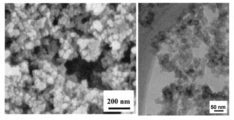
- FIG. 2 is a transmission electron microscope image of the electrode material precursor obtained in Example 1.
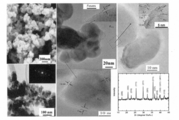
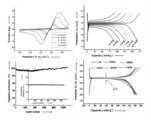
- FIG. It is the image by an electron microscope of the electrode material obtained in Example 2, and an X-ray-diffraction figure. It is a figure which shows the electrode characteristic of the electrode material obtained in Example 2.
- FIG. It is the image by the transmission electron microscope of the electrode material obtained in Example 4.
- FIG. It is the image by the transmission electron microscope of the electrode material obtained in Example 6.
- an active material core is coated with polyaniline by adding an oxidizing agent to a solution containing aniline and an active material raw material to produce active material fine particles and polymerizing aniline on the surface of the fine particles.
- -An electrode material precursor having a shell structure is manufactured.
- the obtained electrode material precursor is heat-treated at 300 to 900 ° C. in a reducing atmosphere to carbonize the polyaniline coating, thereby obtaining an electrode material having a core-shell structure in which the active material core is coated with carbon.
- the active material core is FePO 4 iron (III) phosphate, and a thin polyaniline.
- An electrode material precursor having the following coating (shell) is obtained.
- the phosphate used as the active material material include monoammonium phosphate (NH 4 H 2 PO 4 ), diammonium phosphate ((NH 4 ) 2 HPO 4 ), and triammonium phosphate ((NH 4 ) 3 PO 4 ).
- the trivalent iron salt serving as an oxidizing agent include FeCl 3 , Fe (NO) 3 , Fe (CH 3 COO) 3 , and the like.
- an aqueous solution containing a trivalent iron salt is dropped while stirring an aqueous solution containing a phosphate and aniline.
- the reaction proceeds according to the following chemical formulas (1) and (2), but since the reaction rate of the formula (1) is faster than the reaction rate of the formula (2), FePO 4 first precipitates as fine particles. Then, the oxidative polymerization of aniline proceeds on the surface of the generated FePO 4 fine particles.
- the salt of trivalent iron acts as a precipitating agent in formula (1) and an oxidizing agent in formula (2).
- Fe 3+ + PO 4 3 ⁇ ⁇ FePO 4 precipitates as fine particles
- the polyaniline coating formed on the surface of the FePO 4 fine particles effectively suppresses the growth or aggregation of the fine particles, so that a core-shell structure with a very small particle size and a uniform particle size can be obtained.
- the electrode material precursor which has can be obtained efficiently.
- An electrode material precursor having a core / shell structure, in which a polyaniline film is formed on the surface of the obtained FePO 4 fine particles, is subjected to, for example, lithium in a reducing atmosphere containing 0.1 to 10% (volume%) of hydrogen.
- a heat treatment at a temperature of about 300 to 900 ° C. in the presence of salt and sugar, an electrode material having a core / shell structure in which the active material core is LiFePO 4 and is coated with carbon can be obtained. Since this electrode material has a core-shell structure in which the particle size is extremely small and the particle size is uniform, it exhibits extremely excellent properties as an electrode material constituting a lithium secondary battery.
- Example 1 While stirring an aqueous solution obtained by dissolving 2.62 g of NH 4 H 2 PO 4 and 1 ml of aniline in 200 ml of distilled water, an aqueous solution obtained by dissolving 3.7 g of FeCl 3 in 100 ml of distilled water was gradually added to the aqueous solution at room temperature. Stir for 5 hours.
- An image of the obtained FePO 4 (core) / PANI (shell) electrode material precursor by a transmission electron microscope is shown in FIG.
- Example 2 The FePO 4 (core) / PANI (shell) electrode material precursor obtained in Example 1 above was mixed with FePO 4 in an equimolar amount of CH 3 COOLi and about 25 wt% sugar of these raw materials. Time milling was performed to make uniform. Next, moisture is removed by heating at 400 ° C. for 4 hours in an Ar atmosphere containing 5% by volume of hydrogen, and further by heat treatment at 700 ° C. for 15 hours in an Ar atmosphere containing 5% by volume of hydrogen. Thus, an electrode material having an average particle diameter of 20 to 40 nm, an active material core of LiFePO 4 and a core / shell structure coated with carbon was obtained.
- FIG. 3a An image and an X-ray diffraction diagram of the obtained electrode material taken with an electron microscope are shown in FIG. 3a is an image of a scanning electron microscope (SEM), b to d of FIG. 3 are images of a transmission electron microscope (TEM), and e of FIG. 3 is an X-ray diffraction pattern.
- FIG. 3a shows a structure in which a large number of primary particles are aggregated. According to b and c of the figure, the particle diameter of these primary particles was 20 to 40 nm, and it was found that each primary particle was completely covered with a carbon film formed by carbonization of polyaniline. . 2 and FIG. 3, the active material core of Example 2 obtained by heat-treating the electrode material precursor obtained in Example 1 was LiFePO 4 and coated with carbon. It can be seen that in the electrode material having the shell structure, the growth of LiFePO 4 is effectively suppressed.
- Electrode characteristics of electrode material The electrode characteristics of the electrode material obtained in Example 2 were measured as follows.
- a lithium ion battery was manufactured using EC / DMC (1/1 volume ratio) as an electrolyte and metallic lithium as a negative electrode. The results of evaluating the performance of the obtained battery are shown in FIG. As shown in Fig.
- Ti (OC n H 2n + 1 ) 4 is used as an active material material (wherein n represents an integer of 1 to 5), and (NH 4 ) 2 S 2 is used as an oxidizing agent.
- an electrode material precursor whose active material core is TiO 2 is obtained.
- Ti (OC 3 H 7 ) 4 can be cited.
- preferred oxidizing agents including but (NH 4) 2 S 2 O 8, may be used trivalent salt of iron used in the first embodiment.
- Example 3 While stirring an aqueous solution obtained by dissolving 2.0 g of Ti (OC 3 H 7 ) 4 and 1 ml of aniline in 200 ml of distilled water, 2.3 g of (NH 4 ) 2 S 2 O 8 was dissolved in 100 ml of distilled water. The resulting aqueous solution was gradually added and stirred at 60 ° C. for 6 hours.
- a composite material having a core / shell structure in which a polyaniline (PANI) film is formed on the surface of the obtained TiO 2 fine particles is filtered, washed several times with distilled water, and an electrode material precursor having an average particle size of 20 to 80 nm. Got the body.
- PANI polyaniline
- Example 4 The TiO 2 (core) / PANI (shell) electrode material precursor obtained in Example 3 was mixed with TiO 2 and an equimolar amount of CH 3 COOLi, and homogenized by milling for 1 hour. Subsequently, moisture is removed by heating at 400 ° C. for 4 hours in an Ar atmosphere containing 5% by volume of hydrogen, and further by heat treatment at 850 ° C. for 24 hours in an Ar atmosphere containing 5% by volume of hydrogen. Thus, an electrode material having an average particle diameter of 20 to 40 nm, an active material core of Li 4 Ti 5 O 12 and a core / shell structure coated with carbon was obtained.
- FIG. 5 shows a transmission electron microscope image of the obtained Li 4 Ti 5 O 12 (core) / PANI (shell) electrode material.
- an electrode material precursor having an active material core of MnO 2 is obtained by adding an aqueous solution of permanganate to a CCl 4 organic solvent solution containing aniline.
- Example 5 While stirring a solution of 2 ml of aniline dissolved in 100 ml of CCl 4 and adding an aqueous solution of 0.1 g of KMnO 4 dissolved in 100 ml of distilled water, MnO 2 fine particles are generated at the interface between CCl 4 and water, Composite particles having a core / shell structure in which a polyaniline film was formed on the surface of the fine particles were obtained. The composite particles were filtered and washed with distilled water to obtain an electrode material precursor having an average particle size of 20 to 40 nm.
- Example 6 By heating the MnO 2 (core) / PANI (shell) electrode material precursor obtained in Example 5 above at 400 ° C. for 1 hour in an Ar atmosphere, the average particle diameter is 20 to 40 nm, and the active material core is An electrode material having a core-shell structure of Mn 3 O 4 and coated with carbon was obtained. An image obtained by a transmission electron microscope of the obtained Mn 3 O 4 (core) / C (shell) electrode material is shown in FIG.
Landscapes
- Chemical & Material Sciences (AREA)
- Organic Chemistry (AREA)
- Chemical Kinetics & Catalysis (AREA)
- Electrochemistry (AREA)
- General Chemical & Material Sciences (AREA)
- Inorganic Chemistry (AREA)
- Engineering & Computer Science (AREA)
- Manufacturing & Machinery (AREA)
- Composite Materials (AREA)
- Materials Engineering (AREA)
- Life Sciences & Earth Sciences (AREA)
- Nanotechnology (AREA)
- Crystallography & Structural Chemistry (AREA)
- Environmental & Geological Engineering (AREA)
- General Life Sciences & Earth Sciences (AREA)
- Geology (AREA)
- Physics & Mathematics (AREA)
- Condensed Matter Physics & Semiconductors (AREA)
- General Physics & Mathematics (AREA)
- Battery Electrode And Active Subsutance (AREA)
Abstract
Description
すなわち、本発明ではつぎの1~11の構成を採用する。
1.アニリンと活物質原料を含有する溶液に、酸化剤を加えて活物質微粒子を生成させるとともに、該微粒子の表面でアニリンを重合させることを特徴とする、活物質コアがポリアニリンで被覆されたコア・シェル構造を有する電極材料前駆体の製造方法。
2.前記電極材料前駆体の平均粒径が5~1,000nmであることを特徴とする1に記載の電極材料前駆体の製造方法。
3.前記活物質原料として燐酸塩を使用し、前記酸化剤として三価の鉄の塩を使用することにより、活物質コアがFePO4燐酸鉄(III)である電極材料前駆体を得ることを特徴とする1又は2に記載の電極材料前駆体の製造方法。
4.前記活物質原料としてTi(OCnH2n+1)4を使用し(式中、n=1~5の整数を表す)、前記酸化剤として(NH4)2S2O8又は三価の鉄の塩を使用することにより、活物質コアがTiO2である電極材料前駆体を得ることを特徴とする1又は2に記載の電極材料前駆体の製造方法。
5.アニリンを含有する有機溶媒溶液に、過マンガン酸塩の水溶液を加えることにより、活物質コアがMnO2である電極材料前駆体を得ることを特徴とする1又は2に記載の電極材料前駆体の製造方法。
6.1~5のいずれか1項に記載された製造方法で得られた電極材料前駆体を、還元雰囲気中300~900℃で熱処理することを特徴とする、活物質コアが炭素で被覆されたコア・シェル構造を有する電極材料の製造方法。
7.前記熱処理を、0.1~10%(容量%)の水素を含有する還元雰囲気中で行うことを特徴とする6に記載の電極材料の製造方法。
8.3に記載された製造方法で得られた電極材料を、リチウム塩及び砂糖の存在下に、前記還元雰囲気中で熱処理することにより、活物質コアがLiFePO4である電極材料を得ることを特徴とする6又は7に記載の電極材料の製造方法。
9.4に記載された製造方法で得られた電極材料を、リチウム塩の存在下に、前記還元雰囲気中で熱処理することにより、活物質コアがLi4Ti5O12である電極材料を得ることを特徴とする6又は7に記載の電極材料の製造方法。
10.5に記載された製造方法で得られた電極材料を、前記還元雰囲気中で熱処理することにより、活物質コアがMn3O4である電極材料を得ることを特徴とする6又は7に記載の電極材料の製造方法。
11.前記電極材料の平均粒径が5~1,000nmであることを特徴とする6~10のいずれか1項に記載の電極材料の製造方法。
(1)活物質コアを分散させた液体を用いるのではなく、活物質コアの原料物質を溶解した溶液を用いて、活物質コア微粒子を溶液中で生成させると同時に得られた微粒子の表面でアニリンを重合させることによりポリアニリン被膜を形成するので、活物質コア微粒子の成長や凝集が抑制され、粒子のサイズが極めて小さくしかも粒径が揃ったコア・シェル構造を有する電極材料前駆体を効率よく得ることができる。
(2)得られたポリアニリンで被覆されたコア・シェル構造を有する電極材料前駆体を還元雰囲気中300~900℃で熱処理することによって、活物質コアが炭素で被覆された粒子のサイズが極めて小さくしかも粒径が揃ったコア・シェル構造を有する電極特性が優れた電極材料を、効率よく製造することができる。
ついで、得られた電極材料前駆体を、還元雰囲気中300~900℃で熱処理することによってポリアニリン被膜を炭化させて、活物質コアが炭素で被覆されたコア・シェル構造を有する電極材料を得る。
(第1の実施形態)
本発明の第1の実施形態では、活物質原料として燐酸塩を使用し、酸化剤として三価の鉄の塩を使用することにより、活物質コアがFePO4燐酸鉄(III)で、薄いポリアニリンの被膜(シェル)を有する電極材料前駆体を得る。
活物質原料となる燐酸塩としては、例えば燐酸一アンモニウム(NH4H2PO4)、燐酸二アンモニウム((NH4)2HPO4)、燐酸三アンモニウム((NH4)3PO4)等が挙げられる。また、酸化剤となる三価の鉄の塩としては、例えばFeCl3、Fe(NO)3、Fe(CH3COO)3、等が挙げられる。
Fe3++PO4 3- → FePO4(微粒子として沈殿) (1)
FePO4(コア)Fe3++(アニリン)n → FePO4(コア)ポリアニリン(シェル)(2)
FePO4微粒子の表面に形成されたポリアニリン被膜は、該微粒子のサイズが成長子、或いは凝集するのを効果的に抑制するので、粒子のサイズが極めて小さくしかも粒径が揃ったコア・シェル構造を有する電極材料前駆体を効率よく得ることができる。
(実施例1)
NH4H2PO42.62g及びアニリン1mlを200mlの蒸留水に溶解した水溶液を攪拌しながら、この水溶液にFeCl33.7gを100mlの蒸留水に溶解した水溶液を徐々に加え、室温で5時間攪拌した。得られたFePO4微粒子の表面にポリアニリン(PANI)被膜が形成された、コア・シェル構造を有する複合粒子を濾過し、蒸留水で7回洗浄して平均粒子径が20~40nmの電極材料前駆体を得た。得られたFePO4(コア)/PANI(シェル)電極材料前駆体の透過電子顕微鏡による映像を図2に示す。
上記実施例1で得られたFePO4(コア)/PANI(シェル)電極材料前駆体を、FePO4と等モル量のCH3COOLi及びこれらの原料の約25重量%の砂糖と混合し、1時間ミリングを行って均一化した。ついで、5容量%の水素を含有するAr雰囲気中400℃で4時間加熱することによって水分を除去し、さらに5容量%の水素を含有するAr雰囲気中700℃で15時間加熱処理をすることによって、平均粒子径が20~40nmで、活物質コアがLiFePO4であり炭素で被覆されたコア・シェル構造を有する電極材料を得た。
図3のaは走査型電子顕微鏡(SEM)の映像、同図のb~dは透過型電子顕微鏡(TEM)の映像、そして同図のeはX線回折図である。
図3のaは、1次粒子が多数凝集した構造を示す。同図のb及びcによれば、これらの1次粒子の粒子径は20~40nmであり、各1次粒子はポリアニリンの炭化により形成された炭素被膜によって完全に覆われていることが判明した。
また、図2と図3を対比すれば、実施例1で得られた電極材料前駆体を熱処理して得られた、実施例2の活物質コアがLiFePO4であり炭素で被覆されたコア・シェル構造を有する電極材料では、LiFePO4の成長が効果的に抑制されていることが判る。
上記実施例2で得られた電極材料の電極特性をつぎのようにして測定した。
上記実施例2で得られたコアがLiFePO4であり炭素で被覆されたコア・シェル構造を有する電極材料を導電助剤アセチレンブラック(Acetylene Black)12%、バインダ(PTFE=Polytetrafluoroethylene)5%と混合して、リチウムイオン電池の正極として、EC/DMC(1/1 volume ratio)を電解液として、金属リチウムを負極として、リチウムイオン電池を作製した。得られた電池の性能を評価した結果を図4に示す。
図4に示しているように、0.1A/g(0.6Cに相当)の電流で放電すると、ほぼ理論容量値168mAh/gの容量が得られた、また、被覆しているカーボンシェルのお陰で、10A/g(60Cに相当)の大電流で放電しても、90mAh/gの容量が得られた、これは、今まで、世界でLiFePO4の最高のレート特性である。更に、SOC・DOD(充電・放電深度)ほぼ100%で、1100充電・放電サイクルしても、容量の劣化がほとんど観察されない。
本発明の第2の実施形態では、活物質原料としてTi(OCnH2n+1)4を使用し(式中、n=1~5の整数を表す)、酸化剤として(NH4)2S2O8又は三価の鉄の塩を使用することにより、活物質コアがTiO2である電極材料前駆体を得る。
好ましい活物質原料としては、例えばTi(OC3H7)4が挙げられる。また、好ましい酸化剤としては(NH4)2S2O8が挙げられるが、上記第1の実施形態で用いる三価の鉄の塩を使用してもよい。
(実施例3)
Ti(OC3H7)42.0g及びアニリン1mlを200mlの蒸留水に溶解した水溶液を攪拌しながら、この水溶液に(NH4)2S2O82.3gを100mlの蒸留水に溶解した水溶液を徐々に加え、60℃で6時間攪拌した。得られたTiO2微粒子の表面にポリアニリン(PANI)被膜が形成された、コア・シェル構造を有する複合粒子を濾過し、蒸留水で数回洗浄して平均粒子径が20~80nmの電極材料前駆体を得た。
上記実施例3で得られたTiO2(コア)/PANI(シェル)電極材料前駆体を、TiO2と等モル量のCH3COOLiと混合し、1時間ミリングを行って均一化した。ついで、5容量%の水素を含有するAr雰囲気中400℃で4時間加熱することによって水分を除去し、さらに5容量%の水素を含有するAr雰囲気中850℃で24時間加熱処理をすることによって、平均粒子径が20~40nmで、活物質コアがLi4Ti5O12であり炭素で被覆されたコア・シェル構造を有する電極材料を得た。得られたLi4Ti5O12(コア)/PANI(シェル)電極材料の透過電子顕微鏡による映像を図5に示す。
本発明の第3の実施形態では、アニリンを含有するCCl4有機溶媒溶液に、過マンガン酸塩の水溶液を加えることにより、活物質コアがMnO2である電極材料前駆体を得る。
(実施例5)
アニリン2mlを100mlのCCl4に溶解した溶液を攪拌しながら、0.1gのKMnO4を100mlの蒸留水に溶解した水溶液を加えると、CCl4と水の界面でMnO2微粒子が生成するとともに、該微粒子の表面にポリアニリン被膜が形成された、コア・シェル構造を有する複合粒子が得られた。この複合粒子を濾過し、蒸留水で洗浄して平均粒子径が20~40nmの電極材料前駆体を得た。
上記実施例5で得られたMnO2(コア)/PANI(シェル)電極材料前駆体を、Ar雰囲気中400℃で1時間加熱することによって、平均粒子径が20~40nmで、活物質コアがMn3O4であり炭素で被覆されたコア・シェル構造を有する電極材料を得た。
得られたMn3O4(コア)/C(シェル)電極材料の透過電子顕微鏡による映像を図6に示す。
Claims (11)
- アニリンと活物質原料を含有する溶液に、酸化剤を加えて活物質微粒子を生成させるとともに、該微粒子の表面でアニリンを重合させることを特徴とする、活物質コアがポリアニリンで被覆されたコア・シェル構造を有する電極材料前駆体の製造方法。
- 前記電極材料前駆体の平均粒径が5~1,000nmであることを特徴とする請求項1に記載の電極材料前駆体の製造方法。
- 前記活物質原料として燐酸塩を使用し、前記酸化剤として三価の鉄の塩を使用することにより、コアがFePO4燐酸鉄(III)である電極材料前駆体を得ることを特徴とする請求項1又は2に記載の電極材料前駆体の製造方法。
- 前記活物質原料としてTi(OCnH2n+1)4を使用し(式中、n=1~5の整数を表す)、前記酸化剤として(NH4)2S2O8又は三価の鉄の塩を使用することにより、コアがTiO2である電極材料前駆体を得ることを特徴とする請求項1又は2に記載の電極材料前駆体の製造方法。
- アニリンを含有する有機溶媒溶液に、過マンガン酸塩の水溶液を加えることにより、活物質コアがMnO2である電極材料前駆体を得ることを特徴とする請求項1又は2に記載の電極材料前駆体の製造方法。
- 請求項1~5のいずれか1項に記載された製造方法で得られた電極材料前駆体を、還元雰囲気中300~900℃で熱処理することを特徴とする、活物質コアが炭素で被覆されたコア・シェル構造を有する電極材料の製造方法。
- 前記熱処理を、0.1~10%(容量%)の水素を含有する還元雰囲気中で行うことを特徴とする請求項6に記載の電極材料の製造方法。
- 請求項3に記載された製造方法で得られた電極材料を、リチウム塩及び砂糖の存在下に、前記還元雰囲気中で熱処理することにより、活物質コアがLiFePO4である電極材料を得ることを特徴とする請求項6又は7に記載の電極材料の製造方法。
- 請求項4に記載された製造方法で得られた電極材料を、リチウム塩の存在下に、前記還元雰囲気中で熱処理することにより、活物質コアがLi4Ti5O12である電極材料を得ることを特徴とする請求項6又は7に記載の電極材料の製造方法。
- 請求項5に記載された製造方法で得られた電極材料を、前記還元雰囲気中で熱処理することにより、活物質コアがMn3O4である電極材料を得ることを特徴とする請求項6又は7に記載の電極材料の製造方法。
- 前記電極材料の平均粒径が5~1,000nmであることを特徴とする請求項6~10のいずれか1項に記載の電極材料の製造方法。
Priority Applications (5)
| Application Number | Priority Date | Filing Date | Title |
|---|---|---|---|
| US13/057,281 US8568617B2 (en) | 2008-08-06 | 2009-08-06 | Method of producing electrode material precursor and electrode material using the electrode material precursor |
| EP09805028.9A EP2309573B1 (en) | 2008-08-06 | 2009-08-06 | Method for manufacturing electrode material precursor and method for manufacturing electrode material using the obtained electrode material precursor |
| CN2009801305292A CN102113152B (zh) | 2008-08-06 | 2009-08-06 | 电极材料前体的制造方法以及使用所得到的电极材料前体的电极材料的制造方法 |
| KR1020117002734A KR101194623B1 (ko) | 2008-08-06 | 2009-08-06 | 전극 재료 전구체의 제조 방법 및 얻어진 전극 재료 전구체를 사용하는 전극 재료의 제조 방법 |
| CA2732244A CA2732244A1 (en) | 2008-08-06 | 2009-08-06 | Method of producing electrode material precursor and electrode material using the electrode material precursor |
Applications Claiming Priority (2)
| Application Number | Priority Date | Filing Date | Title |
|---|---|---|---|
| JP2008-202754 | 2008-08-06 | ||
| JP2008202754A JP5196555B2 (ja) | 2008-08-06 | 2008-08-06 | 電極材料前駆体の製造方法及び得られた電極材料前駆体を用いる電極材料の製造方法 |
Publications (1)
| Publication Number | Publication Date |
|---|---|
| WO2010016545A1 true WO2010016545A1 (ja) | 2010-02-11 |
Family
ID=41663759
Family Applications (1)
| Application Number | Title | Priority Date | Filing Date |
|---|---|---|---|
| PCT/JP2009/063945 Ceased WO2010016545A1 (ja) | 2008-08-06 | 2009-08-06 | 電極材料前駆体の製造方法及び得られた電極材料前駆体を用いる電極材料の製造方法 |
Country Status (7)
| Country | Link |
|---|---|
| US (1) | US8568617B2 (ja) |
| EP (1) | EP2309573B1 (ja) |
| JP (1) | JP5196555B2 (ja) |
| KR (1) | KR101194623B1 (ja) |
| CN (1) | CN102113152B (ja) |
| CA (1) | CA2732244A1 (ja) |
| WO (1) | WO2010016545A1 (ja) |
Cited By (8)
| Publication number | Priority date | Publication date | Assignee | Title |
|---|---|---|---|---|
| CN102169980A (zh) * | 2010-02-27 | 2011-08-31 | 比亚迪股份有限公司 | 一种负极活性材料的制备方法 |
| CN102832383A (zh) * | 2012-09-17 | 2012-12-19 | 广东电网公司电力科学研究院 | 高振实密度球形钛酸锂材料的制备方法 |
| US8709654B2 (en) | 2011-08-31 | 2014-04-29 | Semiconductor Energy Laboratory Co., Ltd. | Power storage device and method for manufacturing the same |
| US9490474B2 (en) | 2010-10-08 | 2016-11-08 | Semiconductor Energy Laboratory Co., Ltd. | Method for manufacturing positive electrode active material for energy storage device and energy storage device |
| JP2017059545A (ja) * | 2010-07-02 | 2017-03-23 | 株式会社半導体エネルギー研究所 | 蓄電装置 |
| CN109065877A (zh) * | 2018-10-09 | 2018-12-21 | 湖南雅城新材料有限公司 | 一种纳米级磷酸铁的制备方法 |
| US10644315B2 (en) | 2011-06-03 | 2020-05-05 | Semiconductor Energy Laboratory Co., Ltd. | Single-layer and multilayer graphene, method of manufacturing the same, object including the same, and electric device including the same |
| US11296322B2 (en) | 2011-06-03 | 2022-04-05 | Semiconductor Energy Laboratory Co., Ltd. | Single-layer and multilayer graphene, method of manufacturing the same, object including the same, and electric device including the same |
Families Citing this family (26)
| Publication number | Priority date | Publication date | Assignee | Title |
|---|---|---|---|---|
| JP5589338B2 (ja) * | 2009-10-09 | 2014-09-17 | 東洋インキScホールディングス株式会社 | リチウム二次電池用正極活物質材料の製造方法、及びそれを用いたリチウム二次電池 |
| WO2012005180A1 (ja) * | 2010-07-05 | 2012-01-12 | 独立行政法人産業技術総合研究所 | 電極材料およびそれを含む電極、電池、ならびに電極材料前駆体の製造方法およびそれを用いた電極材料の製造方法 |
| KR101384881B1 (ko) | 2010-11-02 | 2014-04-15 | 한국전자통신연구원 | 리튬 이차전지 |
| JP5851707B2 (ja) * | 2011-04-01 | 2016-02-03 | 三井造船株式会社 | リン酸鉄リチウム正極材料およびその製造方法 |
| WO2013027561A1 (en) | 2011-08-19 | 2013-02-28 | Semiconductor Energy Laboratory Co., Ltd. | Method for manufacturing graphene-coated object, negative electrode of secondary battery including graphene-coated object, and secondary battery including the negative electrode |
| JP6025284B2 (ja) | 2011-08-19 | 2016-11-16 | 株式会社半導体エネルギー研究所 | 蓄電装置用の電極及び蓄電装置 |
| US9401247B2 (en) | 2011-09-21 | 2016-07-26 | Semiconductor Energy Laboratory Co., Ltd. | Negative electrode for power storage device and power storage device |
| CN102408562B (zh) * | 2011-09-23 | 2013-04-03 | 西南交通大学 | 一种具有核-壳结构的聚苯胺/四氧化三铁复合物的制备方法 |
| JP6218349B2 (ja) | 2011-09-30 | 2017-10-25 | 株式会社半導体エネルギー研究所 | 蓄電装置 |
| CN102683695A (zh) * | 2011-12-30 | 2012-09-19 | 南昌大学 | 一种前驱体原位聚合-碳热还原法制备LiFePO4/C复合正极材料的方法 |
| CN103208626B (zh) * | 2012-01-17 | 2016-03-02 | 深圳市沃特玛电池有限公司 | 一种采用苯胺制备磷酸铁锂/碳复合材料的方法 |
| DE102012202968A1 (de) * | 2012-02-28 | 2013-08-29 | Sgl Carbon Se | Verfahren zur Herstellung von beschichteten Aktivmaterialien und deren Verwendung für Batterien |
| KR101973052B1 (ko) | 2012-08-10 | 2019-04-26 | 삼성에스디아이 주식회사 | 리튬 금속인산화물의 제조방법 |
| CN102769134B (zh) * | 2012-08-15 | 2014-09-10 | 吉林大学 | 一种锂离子电池正极复合材料LiFePO4/C的制备方法 |
| JP5838934B2 (ja) * | 2012-08-30 | 2016-01-06 | 株式会社デンソー | 非水電解質二次電池用正極活物質の製造方法 |
| JP5949798B2 (ja) * | 2013-03-25 | 2016-07-13 | 住友大阪セメント株式会社 | 電極材料、電極材料の製造方法及び電極並びにリチウムイオン電池 |
| GB201308654D0 (en) | 2013-05-14 | 2013-06-26 | Faradion Ltd | Metal-containing compounds |
| CN103346297A (zh) * | 2013-05-31 | 2013-10-09 | 青岛科技大学 | 一种碳包覆复合金属氧化物电极材料的制备方法 |
| CN107403928A (zh) * | 2017-07-18 | 2017-11-28 | 武汉理工大学 | 一种棒状核壳结构的四氧化三锰/碳复合材料及其制备方法和应用 |
| CN108539174A (zh) * | 2018-04-20 | 2018-09-14 | 中南大学 | 一种磷酸亚铁锂/碳复合材料的制备方法 |
| CN110828795B (zh) * | 2019-10-29 | 2022-06-03 | 陈璞 | 锌锰氧正极材料及其制备方法和应用 |
| US20230050890A1 (en) | 2020-01-27 | 2023-02-16 | Toray Industries, Inc. | Active material for secondary battery electrodes and secondary battery using same |
| JP7082737B1 (ja) * | 2021-07-14 | 2022-06-09 | Cpエナジー株式会社 | 非水電解質二次電池用正極材及びその製造方法 |
| CN114808025B (zh) * | 2022-02-10 | 2023-08-18 | 上海应用技术大学 | 一种三维纳米棒状复合析氧电极材料及制备方法 |
| CN117425983A (zh) * | 2022-03-31 | 2024-01-19 | 宁德时代新能源科技股份有限公司 | 一种正极极片、二次电池、电池模块、电池包和用电装置 |
| CN116014138A (zh) * | 2023-02-01 | 2023-04-25 | 宜春天赐高新材料有限公司 | 一种纳米磷酸铁锂及其制备方法与应用 |
Citations (6)
| Publication number | Priority date | Publication date | Assignee | Title |
|---|---|---|---|---|
| JP2001118570A (ja) | 1999-10-19 | 2001-04-27 | Nec Corp | ポリマー二次電池用電極の製造方法 |
| JP2002358959A (ja) | 2001-03-27 | 2002-12-13 | Showa Denko Kk | 正極活物質、その製造方法、該正極活物質を用いたペースト、正極及び非水電解質二次電池 |
| JP2003292309A (ja) * | 2002-01-31 | 2003-10-15 | Nippon Chem Ind Co Ltd | リチウム鉄リン系複合酸化物炭素複合体、その製造方法、リチウム二次電池正極活物質及びリチウム二次電池 |
| JP2004509447A (ja) * | 2000-09-26 | 2004-03-25 | ハイドロ−ケベック | 制御されたサイズを持つ炭素によって被覆された、酸化還元物質の合成方法 |
| JP2005530676A (ja) * | 2002-06-21 | 2005-10-13 | ユミコア | カーボン被覆Li含有粉末及びその製造方法 |
| JP2007522619A (ja) | 2004-02-07 | 2007-08-09 | エルジー・ケム・リミテッド | 導電性物質で被覆した電極添加剤、及びそれを含んでなるリチウム二次電池 |
Family Cites Families (4)
| Publication number | Priority date | Publication date | Assignee | Title |
|---|---|---|---|---|
| CA2327370A1 (fr) * | 2000-12-05 | 2002-06-05 | Hydro-Quebec | Nouvelle methode de fabrication de li4ti5o12 pur a partir du compose ternaire tix-liy-carbone: effet du carbone sur la synthese et la conductivite de l'electrode |
| JP2005353330A (ja) * | 2004-06-09 | 2005-12-22 | Japan Storage Battery Co Ltd | 非水電解質電気化学セル |
| US7524529B2 (en) * | 2005-09-09 | 2009-04-28 | Aquire Energy Co., Ltd. | Method for making a lithium mixed metal compound having an olivine structure |
| US9136533B2 (en) * | 2006-01-20 | 2015-09-15 | Jx Nippon Mining & Metals Corporation | Lithium nickel manganese cobalt composite oxide and lithium rechargeable battery |
-
2008
- 2008-08-06 JP JP2008202754A patent/JP5196555B2/ja not_active Expired - Fee Related
-
2009
- 2009-08-06 CA CA2732244A patent/CA2732244A1/en not_active Abandoned
- 2009-08-06 KR KR1020117002734A patent/KR101194623B1/ko not_active Expired - Fee Related
- 2009-08-06 EP EP09805028.9A patent/EP2309573B1/en not_active Not-in-force
- 2009-08-06 WO PCT/JP2009/063945 patent/WO2010016545A1/ja not_active Ceased
- 2009-08-06 CN CN2009801305292A patent/CN102113152B/zh not_active Expired - Fee Related
- 2009-08-06 US US13/057,281 patent/US8568617B2/en not_active Expired - Fee Related
Patent Citations (6)
| Publication number | Priority date | Publication date | Assignee | Title |
|---|---|---|---|---|
| JP2001118570A (ja) | 1999-10-19 | 2001-04-27 | Nec Corp | ポリマー二次電池用電極の製造方法 |
| JP2004509447A (ja) * | 2000-09-26 | 2004-03-25 | ハイドロ−ケベック | 制御されたサイズを持つ炭素によって被覆された、酸化還元物質の合成方法 |
| JP2002358959A (ja) | 2001-03-27 | 2002-12-13 | Showa Denko Kk | 正極活物質、その製造方法、該正極活物質を用いたペースト、正極及び非水電解質二次電池 |
| JP2003292309A (ja) * | 2002-01-31 | 2003-10-15 | Nippon Chem Ind Co Ltd | リチウム鉄リン系複合酸化物炭素複合体、その製造方法、リチウム二次電池正極活物質及びリチウム二次電池 |
| JP2005530676A (ja) * | 2002-06-21 | 2005-10-13 | ユミコア | カーボン被覆Li含有粉末及びその製造方法 |
| JP2007522619A (ja) | 2004-02-07 | 2007-08-09 | エルジー・ケム・リミテッド | 導電性物質で被覆した電極添加剤、及びそれを含んでなるリチウム二次電池 |
Non-Patent Citations (2)
| Title |
|---|
| "Dai 48 Kai Battery Symposium in Japan Koen Yoshishu", 13 November 2007, article KATSUTOSHI ABIKO ET AL.: "Suiyoekiho ni yoru Olivine-gata LiFeP04 no Gosei to Tanso Hifuku Koka", pages: 56 - 57, XP008141245 * |
| See also references of EP2309573A4 |
Cited By (13)
| Publication number | Priority date | Publication date | Assignee | Title |
|---|---|---|---|---|
| CN102169980A (zh) * | 2010-02-27 | 2011-08-31 | 比亚迪股份有限公司 | 一种负极活性材料的制备方法 |
| JP2017059545A (ja) * | 2010-07-02 | 2017-03-23 | 株式会社半導体エネルギー研究所 | 蓄電装置 |
| US10256467B2 (en) | 2010-07-02 | 2019-04-09 | Semiconductor Energy Laboratory Co., Ltd. | Electrode material and method for forming electrode material |
| US10164243B2 (en) | 2010-10-08 | 2018-12-25 | Semiconductor Energy Laboratory Co., Ltd. | Method for manufacturing positive electrode active material for energy storage device and energy storage device |
| US9490474B2 (en) | 2010-10-08 | 2016-11-08 | Semiconductor Energy Laboratory Co., Ltd. | Method for manufacturing positive electrode active material for energy storage device and energy storage device |
| US10644315B2 (en) | 2011-06-03 | 2020-05-05 | Semiconductor Energy Laboratory Co., Ltd. | Single-layer and multilayer graphene, method of manufacturing the same, object including the same, and electric device including the same |
| US11296322B2 (en) | 2011-06-03 | 2022-04-05 | Semiconductor Energy Laboratory Co., Ltd. | Single-layer and multilayer graphene, method of manufacturing the same, object including the same, and electric device including the same |
| US11699790B2 (en) | 2011-06-03 | 2023-07-11 | Semiconductor Energy Laboratory Co., Ltd. | Single-layer and multilayer graphene, method of manufacturing the same, object including the same, and electric device including the same |
| US12300820B2 (en) | 2011-06-03 | 2025-05-13 | Semiconductor Energy Laboratory Co., Ltd. | Single-layer and multilayer graphene, method of manufacturing the same, object including the same, and electric device including the same |
| US8709654B2 (en) | 2011-08-31 | 2014-04-29 | Semiconductor Energy Laboratory Co., Ltd. | Power storage device and method for manufacturing the same |
| CN102832383A (zh) * | 2012-09-17 | 2012-12-19 | 广东电网公司电力科学研究院 | 高振实密度球形钛酸锂材料的制备方法 |
| CN109065877A (zh) * | 2018-10-09 | 2018-12-21 | 湖南雅城新材料有限公司 | 一种纳米级磷酸铁的制备方法 |
| CN109065877B (zh) * | 2018-10-09 | 2021-11-12 | 湖南雅城新材料有限公司 | 一种纳米级磷酸铁的制备方法 |
Also Published As
| Publication number | Publication date |
|---|---|
| CN102113152A (zh) | 2011-06-29 |
| JP5196555B2 (ja) | 2013-05-15 |
| EP2309573A1 (en) | 2011-04-13 |
| KR20110043646A (ko) | 2011-04-27 |
| EP2309573B1 (en) | 2017-09-27 |
| US20110133131A1 (en) | 2011-06-09 |
| KR101194623B1 (ko) | 2012-10-29 |
| EP2309573A4 (en) | 2013-10-09 |
| US8568617B2 (en) | 2013-10-29 |
| CN102113152B (zh) | 2013-11-06 |
| CA2732244A1 (en) | 2010-02-11 |
| JP2010040357A (ja) | 2010-02-18 |
Similar Documents
| Publication | Publication Date | Title |
|---|---|---|
| JP5196555B2 (ja) | 電極材料前駆体の製造方法及び得られた電極材料前駆体を用いる電極材料の製造方法 | |
| US7524529B2 (en) | Method for making a lithium mixed metal compound having an olivine structure | |
| CN102300811B (zh) | 硅酸锂系化合物的制造方法 | |
| EP2795701B1 (en) | Electrode-forming composition | |
| JP5013622B2 (ja) | リチウムボレート系化合物の製造方法 | |
| US20060257307A1 (en) | Method for making a lithium mixed metal compound | |
| JP5116177B2 (ja) | リチウムシリケート系化合物の製造方法 | |
| WO2011057646A1 (en) | Hydrothermal process for the production of lifepo4 powder | |
| CN103403932A (zh) | 电极活性物质及其制造方法 | |
| WO2013073561A1 (ja) | 複合粒子、その製造方法、二次電池用電極材料及び二次電池 | |
| Yang et al. | Developing a diamine-assisted polymerization method to synthesize nano-LiMnPO4 with n-doped carbon from polyamides for high-performance Li-Ion batteries | |
| EP1955392A1 (en) | Method for synthesizing electrode material using polyol process | |
| JP2010238603A (ja) | フッ化リン酸鉄リチウム固溶体正極活物質粉末、及び製造方法、並びにリチウムイオン二次電池 | |
| US10384942B2 (en) | Halogen doped phosphorus nanoparticles and manufacturing method thereof | |
| JP2017182974A (ja) | リチウムイオン二次電池用電極材料およびその製造方法、リチウムイオン二次電池 | |
| JP2020033244A (ja) | グラフェン−Si複合体の製造方法 | |
| KR101685460B1 (ko) | 카르복실산을 이용하여 탄소 코팅층을 형성하는 리튬이차전지용 양극활물질의 제조방법, 이에 따라 제조된 양극활물질 및 상기 양극활물질을 포함하는 리튬이차전지 | |
| TWI420730B (zh) | 正極複合材料及其製備方法,以及鋰離子電池 | |
| JP2018056037A (ja) | リチウムイオン二次電池用電極材料、リチウムイオン二次電池用電極、リチウムイオン二次電池 | |
| Rajagopalan | Nasicon based materials for high voltage lithium-ion and sodium-ion batteries | |
| JP5686378B2 (ja) | 水素含有リチウムシリケート系化合物及びその製造方法、並びに非水電解質二次電池用正極活物質、非水電解質二次電池用正極、非水電解質二次電池及び車両 | |
| KR20250120551A (ko) | 아연 도핑된 lmfp 양극활물질 | |
| WO2014155408A1 (ja) | 水素含有リチウムシリケート系化合物及びその製造方法、並びに非水電解質二次電池用正極活物質、非水電解質二次電池用正極、及び非水電解質二次電池 | |
| JP5819782B2 (ja) | リチウム二次電池用正極材料の製造方法 | |
| CN118538888A (zh) | 一种双离子电池正极材料的改性方法 |
Legal Events
| Date | Code | Title | Description |
|---|---|---|---|
| WWE | Wipo information: entry into national phase |
Ref document number: 200980130529.2 Country of ref document: CN |
|
| 121 | Ep: the epo has been informed by wipo that ep was designated in this application |
Ref document number: 09805028 Country of ref document: EP Kind code of ref document: A1 |
|
| ENP | Entry into the national phase |
Ref document number: 2732244 Country of ref document: CA |
|
| REEP | Request for entry into the european phase |
Ref document number: 2009805028 Country of ref document: EP |
|
| WWE | Wipo information: entry into national phase |
Ref document number: 2009805028 Country of ref document: EP |
|
| ENP | Entry into the national phase |
Ref document number: 20117002734 Country of ref document: KR Kind code of ref document: A |
|
| NENP | Non-entry into the national phase |
Ref country code: DE |
|
| WWE | Wipo information: entry into national phase |
Ref document number: 13057281 Country of ref document: US |