WO2010052979A1 - Dispositif de traitement d'informations, procédé de traitement d'informations, et programme - Google Patents
Dispositif de traitement d'informations, procédé de traitement d'informations, et programme Download PDFInfo
- Publication number
- WO2010052979A1 WO2010052979A1 PCT/JP2009/067099 JP2009067099W WO2010052979A1 WO 2010052979 A1 WO2010052979 A1 WO 2010052979A1 JP 2009067099 W JP2009067099 W JP 2009067099W WO 2010052979 A1 WO2010052979 A1 WO 2010052979A1
- Authority
- WO
- WIPO (PCT)
- Prior art keywords
- application program
- information
- program
- library
- application
- Prior art date
- Legal status (The legal status is an assumption and is not a legal conclusion. Google has not performed a legal analysis and makes no representation as to the accuracy of the status listed.)
- Ceased
Links
Images



Classifications
-
- H—ELECTRICITY
- H04—ELECTRIC COMMUNICATION TECHNIQUE
- H04N—PICTORIAL COMMUNICATION, e.g. TELEVISION
- H04N21/00—Selective content distribution, e.g. interactive television or video on demand [VOD]
- H04N21/40—Client devices specifically adapted for the reception of or interaction with content, e.g. set-top-box [STB]; Operations thereof
- H04N21/43—Processing of content or additional data, e.g. demultiplexing additional data from a digital video stream; Elementary client operations, e.g. monitoring of home network or synchronising decoder's clock; Client middleware
- H04N21/443—OS processes, e.g. booting an STB, implementing a Java virtual machine in an STB or power management in an STB
- H04N21/4437—Implementing a Virtual Machine [VM]
-
- G—PHYSICS
- G06—COMPUTING OR CALCULATING; COUNTING
- G06F—ELECTRIC DIGITAL DATA PROCESSING
- G06F9/00—Arrangements for program control, e.g. control units
- G06F9/06—Arrangements for program control, e.g. control units using stored programs, i.e. using an internal store of processing equipment to receive or retain programs
- G06F9/44—Arrangements for executing specific programs
- G06F9/445—Program loading or initiating
- G06F9/44552—Conflict resolution, i.e. enabling coexistence of conflicting executables
-
- G—PHYSICS
- G11—INFORMATION STORAGE
- G11B—INFORMATION STORAGE BASED ON RELATIVE MOVEMENT BETWEEN RECORD CARRIER AND TRANSDUCER
- G11B27/00—Editing; Indexing; Addressing; Timing or synchronising; Monitoring; Measuring tape travel
- G11B27/10—Indexing; Addressing; Timing or synchronising; Measuring tape travel
- G11B27/102—Programmed access in sequence to addressed parts of tracks of operating record carriers
- G11B27/105—Programmed access in sequence to addressed parts of tracks of operating record carriers of operating discs
-
- H—ELECTRICITY
- H04—ELECTRIC COMMUNICATION TECHNIQUE
- H04N—PICTORIAL COMMUNICATION, e.g. TELEVISION
- H04N21/00—Selective content distribution, e.g. interactive television or video on demand [VOD]
- H04N21/40—Client devices specifically adapted for the reception of or interaction with content, e.g. set-top-box [STB]; Operations thereof
- H04N21/41—Structure of client; Structure of client peripherals
- H04N21/426—Internal components of the client ; Characteristics thereof
-
- G—PHYSICS
- G06—COMPUTING OR CALCULATING; COUNTING
- G06F—ELECTRIC DIGITAL DATA PROCESSING
- G06F9/00—Arrangements for program control, e.g. control units
- G06F9/06—Arrangements for program control, e.g. control units using stored programs, i.e. using an internal store of processing equipment to receive or retain programs
- G06F9/44—Arrangements for executing specific programs
- G06F9/455—Emulation; Interpretation; Software simulation, e.g. virtualisation or emulation of application or operating system execution engines
- G06F9/45504—Abstract machines for programme code execution, e.g. Java virtual machine [JVM], interpreters, emulators
-
- G—PHYSICS
- G11—INFORMATION STORAGE
- G11B—INFORMATION STORAGE BASED ON RELATIVE MOVEMENT BETWEEN RECORD CARRIER AND TRANSDUCER
- G11B2220/00—Record carriers by type
- G11B2220/20—Disc-shaped record carriers
- G11B2220/25—Disc-shaped record carriers characterised in that the disc is based on a specific recording technology
- G11B2220/2537—Optical discs
- G11B2220/2541—Blu-ray discs; Blue laser DVR discs
-
- H—ELECTRICITY
- H04—ELECTRIC COMMUNICATION TECHNIQUE
- H04L—TRANSMISSION OF DIGITAL INFORMATION, e.g. TELEGRAPHIC COMMUNICATION
- H04L65/00—Network arrangements, protocols or services for supporting real-time applications in data packet communication
- H04L65/60—Network streaming of media packets
- H04L65/61—Network streaming of media packets for supporting one-way streaming services, e.g. Internet radio
- H04L65/611—Network streaming of media packets for supporting one-way streaming services, e.g. Internet radio for multicast or broadcast
Definitions
- the present invention relates to an information processing apparatus, an information processing method, and a program.
- IPTV Internet Protocol Television
- next-generation optical discs it is required to enhance a user interaction function (interactive function).
- a program for realizing the interactive function is included in the content.
- a program for realizing the interactive function is included in the broadcast content
- an optical disc a program for realizing the interactive function is included in the content recorded on the optical disc.
- the execution environment of these programs can be broadly divided into two types: 1) declaration type and 2) procedure execution type.
- the declarative type the device is loaded with a program that interprets and presents a declarative program.
- procedure execution type procedure processing corresponding to a program is operated in a programming environment on a virtual machine that is an execution environment (see, for example, Patent Document 1). JP-T 2007-524297 (FIG. 3)
- the built-in library is a bridge between a device and a program used for procedural processing, and is built in the device in advance.
- the procedure processing can be called and used as if the functions of these libraries are described in the program.
- a C language printf function or the like is not defined anywhere in the program, but can be called in the program.
- Such an embedded library is generally unique. In other words, if a plurality of the above-described printf functions are defined on the device, the program does not know which one to call.
- a typical example of a program execution content program environment is a Java (registered trademark) language developed by Sun Micro System.
- the Java (registered trademark) language has a built-in library called a package, and a Java (registered trademark) .net package including a network function and a Java (registered trademark) .io package for performing input / output are widely used. ing.
- package names do not overlap, but there are cases where they overlap (clash) for several reasons.
- MHP Multimedia
- the Java (registered trademark) TV function using the MHP embedded library makes the same call as the Java (registered trademark) TV function used in the BD-J embedded library in the Blu-ray (registered trademark) disk system. Operation is different while holding. In this case, even if the virtual machine tries to call the built-in library, it cannot be determined which one should be called because the package names conflict.
- an object of the present invention is to provide an information processing that can appropriately execute an application program in one program execution environment even when an embedded library includes a plurality of libraries having the same library name.
- An apparatus, an information processing method, and a program are provided.
- the present invention is an information processing apparatus that acquires and executes the application program from a plurality of distribution sources that distribute the application program, and includes a first storage unit, an acquisition unit, and a generation Means and setting means.
- the first storage unit stores, in a directory structure, a plurality of library files that can be called using a library name by an application program.
- the acquisition unit acquires the application program and table information including identification information for identifying the application program and management information for managing execution of the application program.
- the generating means generates second table information that identifies the distribution source of the acquired table information and indicates the relationship between the identification information of the application program and the distribution source of the application program.
- the setting means determines a distribution source corresponding to the identification information of the selected application program from the second table information, and the selected application according to the distribution source Sets the path of the library file that is called during program execution.
- the generating means generates second table information that identifies the distribution source of the acquired table information and indicates the relationship between the identification information of the application program and the distribution source of the application program.
- the setting unit determines a distribution source corresponding to the identification information of the selected application program from the second table information, and executes the selected application program according to the distribution source.
- the path of the library file read by the application program can be switched according to the distribution source when the application program is executed. Accordingly, even if there are a plurality of library files having the same library name, different library files can be read based on the distribution source, so that the application program can be appropriately executed in one program execution environment.
- the generation unit may identify a distribution source of the application program based on a name included in the table information. Thereby, the distribution source of the application program can be identified based on the name.
- the library file of the path set by the setting means when executing the application program can be used.
- the acquisition unit may acquire the application program and table information through a transmission medium.
- the information processing apparatus can acquire the application program and the table information through the transmission medium.
- An information processing method is an information processing method for acquiring and executing the application program from a plurality of distribution sources that distribute the application program, and a plurality of libraries that can be called using the library name by the application program Including storing files in a directory structure.
- the application program is acquired, and table information including identification information for identifying the application program and management information for managing execution of the application is acquired.
- the distribution source of the acquired table information is identified, and second table information indicating the relationship between the acquired identification information of the application program and the distribution source of the application program is generated.
- a distribution source corresponding to the identification information of the selected application program is determined from the second table information, and during execution of the selected application program according to the distribution source
- the library file path to be called is set.
- the program according to the present invention is a program for operating a computer to acquire and execute the application program from a plurality of distributors that distribute the application program, and can be called by the application program using a library name.
- the library file is stored in a directory structure, the application program is acquired, and table information including identification information for identifying the application program and management information for managing the execution of the application program is acquired.
- the distribution source of the acquired table information is identified to generate second table information indicating the relationship between the identification information of the application program and the distribution source of the application program, and When the application program to be selected is selected, the distribution source corresponding to the identification information of the selected application program is determined from the second table information, and is called during the execution of the selected application program according to the distribution source.
- the computer is operated to set the library file path to be set.
- an application program can be appropriately executed in one program execution environment.
- FIG. 1 is a block diagram showing a configuration of an information processing apparatus according to an embodiment of the present invention.
- the information processing apparatus 1 executes a tuner / OFDM (Orthogonal Frequency Division Multiplexing) demodulator 2, demultiplexer 3, video decoder 4, audio decoder 5, Java (registered trademark) virtual machine (JVM: registered virtual machine).
- a pre-processing unit 6, a GUI (Graphical user interface) display unit 7, a video output interface 8, an audio output interface 9, a disk reading unit 10, an IP (Internet Protocol) stack 11, and a JVM execution processing unit 12 are provided.
- the tuner / OFDM demodulator 2 functions as a tuner module that receives broadcast program data of digital TV broadcasting.
- MPEG2 Motion Picture Experts Group2
- the tuner / OFDM demodulator 2 receives a broadcast signal of a specific channel from the input TV broadcast signal, and extracts a transport stream (TS) from the received TV broadcast signal.
- the transport stream (TS) is a stream obtained by multiplexing a plurality of broadcast program data that have been compression-encoded.
- a plurality of programs are multiplexed for each channel (physical channel).
- the demultiplexer 3 separates the decoded transport stream into TS packets including video data, TS packets including audio data, and TS packets including Java (registered trademark) application programs and data related thereto.
- the video decoder 4 decodes (decompresses) the video data.
- the decoded video data is processed by the GUI display unit 7 and output to the external display device via the video output interface 8.
- the audio decoder 5 decodes (decompresses) the audio data.
- the decoded audio data is output from a speaker (not shown) via an audio output interface.
- the disk reading unit 10 is detachable from a Blu-ray (registered trademark) disk (optical disk) (not shown), and reads information on a Blu-ray (registered trademark) disk mounted on the information processing apparatus 1.
- the disk reading unit 10 outputs the read video data to the video decoder 4, outputs the read audio data to the audio decoder 5, and outputs the read Java (registered trademark) application program to the JVM execution preprocessing unit 6.
- the IP stack 11 stores data of broadcast programs broadcast by IP (Internet Protocol) broadcast.
- the IP stack 11 outputs a transport stream including the video data and audio data of the stored broadcast program to the demultiplexer 3.
- the IP stack 11 may output the stored broadcast program video data to the video decoder 4 and may output the stored broadcast program audio data to the audio decoder 5.
- a Java (registered trademark) application program related to a broadcast program stored in the IP stack 11 may be directly called by the JVM execution pre-processing unit 6.
- the JVM execution pre-processing unit 6 performs pre-processing that is performed before a JVM (Java (registered trademark) Virtual Machine) execution process, which will be described later.
- This pre-processing includes, for example, processing for generating a type data table to be described later and setting a path to be described later for the built-in library.
- the JVM execution processing unit 12 performs a JVM execution process (to be described later) in the JVM environment, and outputs data to the GUI display unit 7.
- the GUI display unit 7 acquires this data and outputs information to a display device (not shown) via the video output interface 8.
- the transport stream decoded by the tuner / OFDM demodulator 2 is not directly transferred to the JVM execution environment (JVM execution preprocessing unit 6 or the like).
- the data acquired by the information processing apparatus 1 via a Blu-ray (registered trademark) disc or IP broadcast may be a Java (registered trademark) program (Jar file) itself.
- Blu-ray (registered trademark) disks and data via IP broadcasts may be directly called from the disk reading unit 10 and the IP stack 11 to the JVM execution pre-processing unit 6.
- video data and audio data may be input to the video decoder 4 and the audio decoder 5 without going through the demultiplexer 3.
- FIG. 2 is a diagram illustrating a more detailed configuration of the hardware of the information processing apparatus 1.
- a CPU Central Processing Unit
- ROM Read Only Memory
- RAM Random Access Memory
- a storage unit 412 including a display unit 407, a network connection unit 408, a decoding unit 409, a broadcast receiving unit 411, a hard disk drive (HDD), a media interface unit 413, a flash ROM 414, an optical communication unit 415, and the like are connected.
- the broadcast receiving unit 411 corresponds to, for example, the tuner / OFDM demodulator 2 shown in FIG.
- the ROM 403 and the flash ROM 414 store programs executed by the CPU 401 and various data.
- the flash ROM 414 can store various data.
- the RAM 404 is used as a temporary work area for the CPU 401 and an area for temporarily storing data.
- the input operation unit 405 includes various keys and processes commands input for various operations from the user.
- a command input from the input operation unit 405 is sent to the CPU 401 through the system bus 402.
- the optical communication unit 415 is an interface that performs communication with the remote controller 105. Similar to the input operation unit 405, the remote controller 105 includes various keys and the like, processes input of commands for various operations from the user, converts them into optical signals, and transmits them.
- the optical communication unit 415 receives the optical signal transmitted from the remote controller 105, converts it into an electrical signal, and outputs it to the CPU 401 through the system bus 402.
- the display unit 407 includes, for example, a display device such as an LCD (Liquid Crystal Display) and a display control circuit that drives the display device. For example, the display unit 407 displays commands and data input from the user, various statuses, and the like. .
- the network connection unit 408 is an interface that processes connection with the network 101 such as the Internet or a home network connected to the Internet via a router.
- the network connection unit 408 corresponds to, for example, the IP stack 11 illustrated in FIG.
- the AV interface 406 processes input / output of video signals and audio signals to / from an external AV device 104 such as a television connected to the information processing apparatus 1.
- the broadcast receiving unit 411 receives broadcast waves from the broadcast station 200 such as terrestrial analog television broadcast, terrestrial digital television broadcast, CS digital broadcast, BS digital broadcast, and terrestrial digital television broadcast for portable devices, and receives video signals and Demodulate the audio signal.
- the broadcast station 200 such as terrestrial analog television broadcast, terrestrial digital television broadcast, CS digital broadcast, BS digital broadcast, and terrestrial digital television broadcast for portable devices, and receives video signals and Demodulate the audio signal.
- the decoding unit 409 decodes the program data compressed and encoded for transmission and recording. Video data, audio data, and the like restored by the decoding by the decoding unit 409 are output to the external AV device 104 such as a television through the AV interface 406.
- the storage unit 412 includes, for example, an HDD, and stores a broadcast station 200, a program distribution server 300, a Java (registered trademark) application program acquired from a Blu-ray (registered trademark) disk, program data, an application information table, and an application management table.
- a removable media 102 such as a DVD (Digital Versatile Disc), a Blu-ray (registered trademark) disk, or a flash memory can be attached to and detached from the media interface unit 413.
- the media interface unit 413 is an interface that can write and read program data to and from the attached removable medium 102.
- the media interface unit 413 corresponds to the disc reading unit 10, for example.
- FIG. 3 is a diagram showing a software configuration of the information processing apparatus 1 shown in FIG.
- the information processing apparatus 1 includes an operation system 21, a Java (registered trademark) VM 22, a basic library 23, a BD (Blu-ray disc) library 24, a DTV (Digital Television) library 25, and the like as software.
- Java (registered trademark) VM 22 is software that converts a Java (registered trademark) bytecode into a native code of the platform and executes it.
- the basic library 23 is a program in which basic functions are converted into parts so that they can be used by other programs, and a plurality of program parts are collected into one file.
- the BD library 24 is called when a Java (registered trademark) application program using BD-J (Blu-rayraDisc Java (registered trademark)) is executed, and a program having a function used at the time of executing the program is integrated. It is a single file.
- BD-J Blu-ray Disc Java (registered trademark)
- a plurality of library files are stored in the storage unit 412 or the like in a directory structure.
- the DTV library 25 is a program that is called when a Java (registered trademark) application program is executed and the like and that has a function that is used when the program is executed.
- a plurality of library files are stored in the storage unit 412 or the like in a directory structure.
- the information processing apparatus 1 can receive a Java (registered trademark) application program 26 from a broadcasting station 200, which is one of distribution sources, via a broadcast wave.
- the distributor here is actually a broadcaster. Broadcast station 200 is operated by the broadcaster.
- the information processing apparatus 1 can acquire the Java (registered trademark) application program 27 from the program distribution server 300, which is another distribution source, via IP broadcasting.
- the distributor here is actually a program distributor.
- the program distribution server 300 is operated under the program distribution company.
- the information processing apparatus 1 can acquire the Java (registered trademark) application program 28 via a Blu-ray (registered trademark) disk which is still another distribution source.
- the distributor here is actually the producer of the Blu-ray (registered trademark) disc.
- the information processing apparatus 1 can acquire a Java (registered trademark) application program 29 recorded on a Blu-ray (registered trademark) disk from a broadcasting station 200 via a broadcast wave.
- the Java (registered trademark) application program 26 is a program for processing a GUI or the like necessary for viewing a digital broadcast.
- the Java (registered trademark) application program 27 is a program for processing a GUI or the like necessary for viewing an IP broadcast.
- the Java (registered trademark) application program 28 is a program for processing a GUI and the like necessary for viewing ROM contents such as a Blu-ray (registered trademark) disc.
- the Java (registered trademark) application program 29 is a program for processing a GUI or the like necessary for viewing content stored on a Blu-ray (registered trademark) disk or the like.
- Broadcast station 200 which is one of the distribution sources, distributes Java (registered trademark) application program 26 via broadcast waves.
- the program distribution server 300 which is one of the distribution sources, distributes the Java (registered trademark) application program 27 via IP broadcasting.
- the broadcast station 200 and the program distribution server 300 distribute an application information table AIT (Application Information Table).
- the information processing apparatus 1 can acquire this application information table AIT.
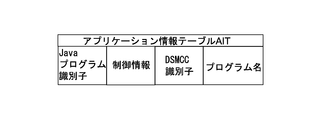
- FIG. 4 shows the data structure of the application information table AIT.
- Application information table AIT is a table showing application information.
- the application information table AIT includes a Java (registered trademark) program identifier, control information, a DSMCC (Digital Storage Media Command and Control) identifier, and program name information.
- the control information and the DSMCC identifier are information for managing application programs.
- the Java (registered trademark) program identifier and program name information are identification information for identifying an application program.
- the Java (registered trademark) program identifier is an identifier for identifying the Java (registered trademark) program.
- the control information is control information of a Java (registered trademark) program.
- the control information includes “autostart”, “present”, “kill”, and the like. “autostart” means that the information processing apparatus 1 automatically executes this program immediately, “present” means that the program is not automatically executed, and “kill” means that the program is stopped.
- the DSMCC identifier is an identifier for extracting a packet ID including a Java (registered trademark) program in the DSMCC format.
- the program name is the name of the Java (registered trademark) program.
- the program name is an identifier for identifying a Java (registered trademark) program.
- the DVB-MHP Digital Video Broadcasting-Multiple Home Platform
- the DVB-MHP standard is a popular interactive digital program standard.
- MHP Multimedia Home Platform
- DVB Digital Video Broadcasting
- Java registered trademark
- the DVB-MHP standard defines an application information table (AIT: Application Information Table) in a private section in order to provide information related to the application.
- the application information table AIT has a name for identifying itself, and this name corresponds to both the broadcaster and the program distributor that are the distribution source of the application program, and the information processing apparatus 1 has both distribution sources. It is used as identification information for identifying.
- an application management table AMT Application Management Table
- Blu-ray registered trademark
- FIG. 5 shows the data structure of the application management table AMT.
- the application management table AMT includes various types of information such as “life_cycle (life cycle)”, “app_id_ref (application identifier)”, “run_attribute (startup attribute)”, “run_priority (startup priority)” regarding the application program. “life_cycle (life cycle)”, “run_attribute (activation attribute)”, and “run_priority (activation priority)” are management information for managing application programs. “app_id_ref (application identifier)” is identification information for identifying an application program.
- the application management table AMT has a name for identifying itself, and this name corresponds to the distribution source of the application program (the producer of the Blu-ray (registered trademark) disk), and the information processing apparatus 1 identifies the distribution source. It is used as identification information.
- Life_cycle indicates the “life cycle” of the application program.
- Java registered trademark
- App_id_ref is an application identifier for identifying an application program.
- the application identifier indicates which application program has a life cycle by describing a reference value.
- the application identifier is represented by a 5-digit numerical value zzzzz given as a file name in a Java (registered trademark) archive file.
- “Run_attribute” describes the “activation attribute” of the application program in the life cycle.
- the activation attribute includes types such as AutoRun, Present, and Suspended.
- “Run_priority” describes the “starting priority” of the application program in the life cycle.
- the information processing apparatus 1 uses these pieces of information to control the behavior of the application program.
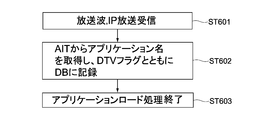
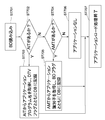
- FIG. 6 is a flowchart of an operation when the Java (registered trademark) application program 26 or 27 is loaded by the JVM execution preprocessing unit 6.
- Tuner / OFDM demodulator 2 receives a broadcast wave, or IP stack 11 receives IP broadcast data (ST601).
- the information processing apparatus 1 receives an application information table AIT as shown in FIG. 4 via a broadcast wave or IP broadcast.
- the JVM pre-processing unit 6 determines the distribution source of the Java (registered trademark) application program based on the information (AIT) of the name (table name) of the application information table AIT shown in FIG. In this case, since the AIT corresponds to both the broadcast station 200 and the program distribution server 300, it is determined that the distribution source is the broadcast station 200 or the program distribution server 300.
- the JVM execution pre-processing unit 6 acquires the application program name from the application information table AIT.
- the JVM pre-execution processing unit 6 registers the acquired application program name in, for example, the type data table stored in the storage unit 412, and registers the DTV flag as type data in the type data table in association with the application program name ( ST602).
- the DTV flag is a flag generated by the JVM pre-processing unit 6 based on the presence of the application information table AIT.
- This DTV flag is a flag indicating that the Java (registered trademark) application program 26 or 27 is provided by either the broadcast station 200 or the program distribution server 300.
- a BD flag is generated as type data and registered in the type data table as will be described later.
- the JVM pre-execution processing unit 6 terminates the Java (registered trademark) application loading process (ST603).
- the distribution source of the application program is identified based on the “name”.
- the distribution source of the application program can also be identified by the organization_id included in application_identifier () described in AIT / AMT (see MHP 10.5 Application Identification).
- FIG. 7 is a flowchart showing an operation when the Java (registered trademark) application program 28 or 29 is loaded by the JVM execution preprocessing unit 6.
- the disk reading unit 10 reads the Java (registered trademark) application program 28 from the Blu-ray (registered trademark) disk (ST701). In this case, the application management table AMT is also read.
- the disk reading unit 10 reads the Java (registered trademark) application program 29 recorded on the Blu-ray (registered trademark) disk via a broadcast wave or IP broadcast (ST701). In this case, the application information table AIT is also read.
- the JVM pre-processing unit 6 determines whether or not the application information table AIT exists (ST702). At this time, the JVM pre-execution processing unit 6 determines this by, for example, determining whether there is a file whose name is “AIT”.
- the JVM pre-processing unit 6 determines the distribution source of the Java (registered trademark) application program based on the name (AIT). In this case, since the AIT corresponds to both the broadcast station 200 and the program distribution server 300, it is determined that the distribution source is the broadcast station 200 or the program distribution server 300.
- the JVM execution pre-processing unit 6 acquires the application program name from the application information table AIT.
- the JVM pre-execution processing unit 6 registers the acquired application program name in, for example, a type data table (to be described later) stored in the storage unit 412 or the like, and registers the DTV flag in the type data table in association with the application program name ( ST703). Thereafter, the JVM pre-execution processing unit 6 ends the application program loading process (ST707).
- the JVM execution pre-processing unit 6 determines whether or not the application management table AMT exists (ST704). At this time, the JVM pre-processing unit 6 determines this by, for example, determining whether a file with the name “AMT” exists.
- the JVM pre-processing unit 6 determines the distribution source of the Java (registered trademark) application program based on the name (AMT). In this case, since AMT corresponds to a Blu-ray (registered trademark) disc, it is determined that the distribution source is a Blu-ray (registered trademark) disc.
- the JVM pre-processing unit 6 acquires an application identifier from the application management table AMT.
- the JVM pre-execution processing unit 6 registers the acquired application identifier in a type data table (to be described later) stored in the storage unit 412, for example, and registers a BD flag in the type data table in association with the application identifier (ST705). . Thereafter, the JVM pre-execution processing unit 6 ends the application program loading process (ST707).
- the JVM pre-execution processing unit 6 determines that there is no application program (ST706), and ends the application program processing (ST707).
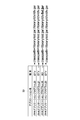
- FIG. 8 is a diagram showing a data configuration of the type data table 30 generated by the processing shown in FIGS.
- the type data table 30 is a table in which an application program name, which is identification information for identifying an application program, and a type indicating a distribution source are stored in association with each other. That is, in the example of FIG. 8, the application programs 26, 27 and 29 indicating the application program name are associated with the type data “DTV”, and the application program 28 indicating the application program name is associated with the type data “BD”. It has been.
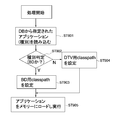
- FIG. 9 is a flowchart of Java (registered trademark) application program execution processing by the JVM execution processing unit 12.
- the JVM execution processing unit 12 determines the selected Java (registered trademark) application program name when an application to be executed is selected by a user or the like. Next, the JVM execution processing unit 12 reads the corresponding type data from the type data table 30 using the application program name as a key (ST901).
- the JVM execution processing unit 12 sets a path of a library to be incorporated into the Java (registered trademark) application program based on the read type data.
- the JVM execution processing unit 12 sets a BD path (class path) when the type of the Java (registered trademark) application program is “BD” (ST903), and when the type is “DTV”, the DTV path. (Class path) is set (ST904).
- the path is set as follows.
- FIG. 10 is a diagram showing the relationship between types and class paths.
- the JVM execution processing unit 12 incorporates a user-defined class loader.
- the class loader the relationship between the type data and the path of the built-in library is defined in advance. That is, as shown in FIG. 10, “/library/std.jar:/library/dtv/dtv.jar” is defined as a path for the “DTV” type data, and a path for the “BD” type data. "/Library/std.jar:/library/dtv.bd.jar” is defined as
- the JVM execution processing unit 12 changes the path of the library to be incorporated by the above class loader to “/library/std.jar:/library/dtv”. .bd.jar "(ST903).
- a function for dynamically switching the path of an embedded library is provided.
- the execution processing unit 12 is provided.
- the JVM execution processing unit 12 sets the path of the library to be incorporated by the above class loader to “/library/std.jar:/library/dtv/”. dtv.jar "is set (ST904).
- the JVM execution processing unit 12 loads the Java (registered trademark) application program into the RAM 404 and executes it (ST905).
- a Java (registered trademark) application program 28 used for viewing a ROM content such as a Blu-ray (registered trademark) disc, “std.jar” and “dtv /” according to the path setting content by the JVM execution processing unit 12. Call each library file of "bd.jar”.
- Java (registered trademark) application programs 26, 27, and 29 used for viewing and recording of broadcast waves and IP broadcasts are “std.jar” and “dtv / dtv” according to the path setting contents by the JVM execution processing unit 12. Call each library file of ".jar”.
- the JVM execution processing unit 12 When executing the Java (registered trademark) application program selected by the user, the JVM execution processing unit 12 can switch the path of the library file to be read according to the type data indicating the distribution source. Therefore, even if there are a plurality of library files having the same library name, each built-in library file can be read in a distinguishable manner, so that an application can be appropriately realized in the same virtual machine execution environment.
- a virtual machine for executing a Java (registered trademark) application program received by digital broadcasting and a Java (registered trademark) application program read from a Blu-ray (registered trademark) disk are executed. It is possible to avoid starting up a virtual machine. Therefore, the memory space required for the information processing apparatus 1 can be reduced.
- memory efficiency at the time of execution can be improved by optimizing the embedded library.
- the relationship between the embedded library and the Java (registered trademark) application program is uniquely determined. For this reason, it is possible to avoid restarting the JVM due to an erroneous call. Since restarting the virtual machine environment is not necessary, it is possible to speed up the activation of the interactive function.
- the path is "/library/std.jar:/library/dtv/dtv.jar” as shown in FIG. Set two.
- the Java (registered trademark) application program 28 type is BD
- two paths are set as “/library/std.jar:/library/dtv.bd.jar”.
- a path different from the path shown in FIG. 10 may be set according to a different embedded library for each application.
- FIG. 1 It is a block diagram which shows the structure of the information processing apparatus which concerns on one Embodiment of this invention. It is a figure which shows the more detailed structure of the hardware of information processing apparatus. It is a figure which shows the software structure of the information processing apparatus shown in FIG. It is a figure which shows the data structure of the application information table AIT. It is a figure which shows the data structure of the application management table AMT. It is a figure which shows the flowchart of operation
- AIT application information table AMT application management table 1 Information processing device 2 OFDM demodulator 3 Demultiplexer 4 Video decoder 5 Audio decoder 6 JVM execution pre-processing unit 10 Disk reading unit 11 IP stack 12 JVM execution processing unit 22 JVM 23 Basic Library 24 BD Library 25 DTV Library 26-29 Java (registered trademark) Application Program 30 Type Data Table
Landscapes
- Engineering & Computer Science (AREA)
- Software Systems (AREA)
- Multimedia (AREA)
- Signal Processing (AREA)
- Theoretical Computer Science (AREA)
- Physics & Mathematics (AREA)
- General Engineering & Computer Science (AREA)
- General Physics & Mathematics (AREA)
- Stored Programmes (AREA)
- Two-Way Televisions, Distribution Of Moving Picture Or The Like (AREA)
Abstract
Priority Applications (5)
| Application Number | Priority Date | Filing Date | Title |
|---|---|---|---|
| EP09824679A EP2352091A4 (fr) | 2008-11-05 | 2009-09-30 | Dispositif de traitement d'informations, procédé de traitement d'informations, et programme |
| RU2011117318/08A RU2483345C2 (ru) | 2008-11-05 | 2009-09-30 | Устройство обработки информации, способ обработки информации и программа |
| CN2009801430983A CN102197379A (zh) | 2008-11-05 | 2009-09-30 | 信息处理装置、信息处理方法及程序 |
| BRPI0920014A BRPI0920014A2 (pt) | 2008-11-05 | 2009-09-30 | aparelho e método de processamento de informação, e, programa |
| US13/127,974 US20110219047A1 (en) | 2008-11-05 | 2009-09-30 | Information processing apparatus, information processing method, and program |
Applications Claiming Priority (2)
| Application Number | Priority Date | Filing Date | Title |
|---|---|---|---|
| JP2008284645A JP5396821B2 (ja) | 2008-11-05 | 2008-11-05 | 情報処理装置、情報処理方法及びプログラム |
| JP2008-284645 | 2008-11-05 |
Publications (1)
| Publication Number | Publication Date |
|---|---|
| WO2010052979A1 true WO2010052979A1 (fr) | 2010-05-14 |
Family
ID=42152789
Family Applications (1)
| Application Number | Title | Priority Date | Filing Date |
|---|---|---|---|
| PCT/JP2009/067099 Ceased WO2010052979A1 (fr) | 2008-11-05 | 2009-09-30 | Dispositif de traitement d'informations, procédé de traitement d'informations, et programme |
Country Status (7)
| Country | Link |
|---|---|
| US (1) | US20110219047A1 (fr) |
| EP (1) | EP2352091A4 (fr) |
| JP (1) | JP5396821B2 (fr) |
| CN (1) | CN102197379A (fr) |
| BR (1) | BRPI0920014A2 (fr) |
| RU (1) | RU2483345C2 (fr) |
| WO (1) | WO2010052979A1 (fr) |
Cited By (3)
| Publication number | Priority date | Publication date | Assignee | Title |
|---|---|---|---|---|
| CN102938703A (zh) * | 2011-08-15 | 2013-02-20 | 联想(北京)有限公司 | 一种应用管理方法及设备 |
| WO2013023440A1 (fr) * | 2011-08-15 | 2013-02-21 | 联想(北京)有限公司 | Procédé et dispositif de gestion d'applications |
| CN105630615A (zh) * | 2015-12-28 | 2016-06-01 | 北京元心科技有限公司 | 跨系统的应用控制方法和智能终端 |
Families Citing this family (8)
| Publication number | Priority date | Publication date | Assignee | Title |
|---|---|---|---|---|
| JP2012257224A (ja) * | 2011-05-19 | 2012-12-27 | Nippon Hoso Kyokai <Nhk> | 受信機 |
| JP6018796B2 (ja) * | 2011-05-19 | 2016-11-02 | 日本放送協会 | 受信機 |
| CN102833586B (zh) * | 2012-07-25 | 2015-12-09 | 深圳市同洲电子股份有限公司 | 数字电视中处理应用的方法、终端及系统 |
| JP6102136B2 (ja) * | 2012-09-20 | 2017-03-29 | 日本電気株式会社 | モジュール管理装置、モジュール管理システム及びモジュール管理方法 |
| KR20140039504A (ko) * | 2012-09-24 | 2014-04-02 | 삼성전자주식회사 | 블루레이 디스크 재생 장치 및 블루레이 디스크 로딩 방법 |
| WO2015045324A1 (fr) * | 2013-09-30 | 2015-04-02 | ソニー株式会社 | Dispositif récepteur, dispositif de diffusion, dispositif serveur et procédé de réception |
| JP5725235B1 (ja) * | 2014-04-22 | 2015-05-27 | ソニー株式会社 | 受信装置及び受信方法、並びに、送信装置及び送信方法 |
| JP6409514B2 (ja) * | 2014-11-10 | 2018-10-24 | 日本電気株式会社 | 情報処理装置およびライブラリロード方法、並びにコンピュータ・プログラム |
Citations (4)
| Publication number | Priority date | Publication date | Assignee | Title |
|---|---|---|---|---|
| JP2002175187A (ja) * | 2000-12-05 | 2002-06-21 | Nippon Telegr & Teleph Corp <Ntt> | コンテンツカプセルの実行管理方法、コンピュータシステム及びコンテンツカプセルを記録した記録媒体 |
| JP2007524297A (ja) * | 2004-01-28 | 2007-08-23 | コーニンクレッカ フィリップス エレクトロニクス エヌ ヴィ | デジタル放送端末 |
| JP2008059482A (ja) * | 2006-09-01 | 2008-03-13 | Canon Inc | 情報処理装置、情報処理方法 |
| JP2008525876A (ja) * | 2004-12-27 | 2008-07-17 | コーニンクレッカ フィリップス エレクトロニクス エヌ ヴィ | アプリケーションがofaプログラムと協動するのを可能にする方法及び装置 |
Family Cites Families (19)
| Publication number | Priority date | Publication date | Assignee | Title |
|---|---|---|---|---|
| US6832366B2 (en) * | 2001-05-17 | 2004-12-14 | Simdesk Technologies, Inc. | Application generator |
| US20030217369A1 (en) * | 2002-05-17 | 2003-11-20 | Heredia Edwin Arturo | Flexible application information formulation |
| JP4243571B2 (ja) * | 2003-08-05 | 2009-03-25 | パナソニック株式会社 | 放送受信装置 |
| CN1898956B (zh) * | 2003-12-18 | 2012-02-22 | 松下电器产业株式会社 | 验证和运行应用程序的方法 |
| JP4466148B2 (ja) * | 2004-03-25 | 2010-05-26 | 株式会社日立製作所 | ネットワーク転送対応コンテンツ利用管理方法、及びプログラム、コンテンツ転送システム |
| KR20060046333A (ko) * | 2004-11-03 | 2006-05-17 | 엘지전자 주식회사 | 데이터 방송 정보 데이터 구조, 데이터 방송 구분 방법그리고, 데이터 방송 송수신 시스템 |
| CA2594982A1 (fr) * | 2005-02-10 | 2006-08-17 | Matsushita Electric Industrial Co., Ltd. | Appareil d'enregistrement d'emissions |
| KR20080078838A (ko) * | 2005-12-20 | 2008-08-28 | 마쯔시다덴기산교 가부시키가이샤 | 데이터 출력 장치, 기기 제어 장치 및 멀티미디어 배포시스템 |
| JP2007180899A (ja) * | 2005-12-28 | 2007-07-12 | Orion Denki Kk | コンテンツ受信記録再生装置及びコンテンツ配信システム |
| JP4881023B2 (ja) * | 2006-02-01 | 2012-02-22 | キヤノン株式会社 | 情報処理装置及び当該装置におけるオブジェクト指向プログラムの実行方法とそのプログラム |
| JP5087903B2 (ja) * | 2006-06-30 | 2012-12-05 | ソニー株式会社 | 情報処理装置および情報処理方法、記録媒体、並びに、プログラム |
| CN101187899B (zh) * | 2006-11-17 | 2010-05-12 | 中兴通讯股份有限公司 | 嵌入式系统存储空间的优化方法 |
| KR100781534B1 (ko) * | 2006-12-08 | 2007-12-03 | 삼성전자주식회사 | 방송 수신 장치에 적합한 애플리케이션의 기능을 구성하고실행하는 장치 및 방법 |
| KR20080060818A (ko) * | 2006-12-27 | 2008-07-02 | 엘지전자 주식회사 | 데이터 방송 신호 수신 장치 및 데이터 방송 신호를처리하는 방법 |
| US20090106801A1 (en) * | 2007-10-18 | 2009-04-23 | Panasonic Corporation | Content processing device and content processing method |
| US20090172784A1 (en) * | 2007-12-28 | 2009-07-02 | Lg. Electronics, Inc. | Apparatus and method for processing data broadcast signal |
| JP5581309B2 (ja) * | 2008-03-24 | 2014-08-27 | スー カン,ミン | 放送サービスシステムの情報処理方法、その情報処理方法を実施する放送サービスシステム及びその情報処理方法に関する記録媒体 |
| KR101485461B1 (ko) * | 2008-10-23 | 2015-01-22 | 삼성전자주식회사 | Ait를 이용한 애플리케이션의 제공 방법 및 그 장치 |
| US8588580B2 (en) * | 2010-06-10 | 2013-11-19 | Panasonic Corporation | Playback device, recording medium, playback method and program |
-
2008
- 2008-11-05 JP JP2008284645A patent/JP5396821B2/ja not_active Expired - Fee Related
-
2009
- 2009-09-30 US US13/127,974 patent/US20110219047A1/en not_active Abandoned
- 2009-09-30 BR BRPI0920014A patent/BRPI0920014A2/pt not_active IP Right Cessation
- 2009-09-30 CN CN2009801430983A patent/CN102197379A/zh active Pending
- 2009-09-30 WO PCT/JP2009/067099 patent/WO2010052979A1/fr not_active Ceased
- 2009-09-30 RU RU2011117318/08A patent/RU2483345C2/ru not_active IP Right Cessation
- 2009-09-30 EP EP09824679A patent/EP2352091A4/fr not_active Withdrawn
Patent Citations (4)
| Publication number | Priority date | Publication date | Assignee | Title |
|---|---|---|---|---|
| JP2002175187A (ja) * | 2000-12-05 | 2002-06-21 | Nippon Telegr & Teleph Corp <Ntt> | コンテンツカプセルの実行管理方法、コンピュータシステム及びコンテンツカプセルを記録した記録媒体 |
| JP2007524297A (ja) * | 2004-01-28 | 2007-08-23 | コーニンクレッカ フィリップス エレクトロニクス エヌ ヴィ | デジタル放送端末 |
| JP2008525876A (ja) * | 2004-12-27 | 2008-07-17 | コーニンクレッカ フィリップス エレクトロニクス エヌ ヴィ | アプリケーションがofaプログラムと協動するのを可能にする方法及び装置 |
| JP2008059482A (ja) * | 2006-09-01 | 2008-03-13 | Canon Inc | 情報処理装置、情報処理方法 |
Non-Patent Citations (1)
| Title |
|---|
| See also references of EP2352091A4 * |
Cited By (5)
| Publication number | Priority date | Publication date | Assignee | Title |
|---|---|---|---|---|
| CN102938703A (zh) * | 2011-08-15 | 2013-02-20 | 联想(北京)有限公司 | 一种应用管理方法及设备 |
| WO2013023440A1 (fr) * | 2011-08-15 | 2013-02-21 | 联想(北京)有限公司 | Procédé et dispositif de gestion d'applications |
| US9779106B2 (en) | 2011-08-15 | 2017-10-03 | Lenovo (Beijing) Co., Ltd. | Application management method and device |
| CN105630615A (zh) * | 2015-12-28 | 2016-06-01 | 北京元心科技有限公司 | 跨系统的应用控制方法和智能终端 |
| CN105630615B (zh) * | 2015-12-28 | 2019-05-07 | 北京元心科技有限公司 | 跨系统的应用控制方法和智能终端 |
Also Published As
| Publication number | Publication date |
|---|---|
| US20110219047A1 (en) | 2011-09-08 |
| CN102197379A (zh) | 2011-09-21 |
| JP2010113474A (ja) | 2010-05-20 |
| EP2352091A1 (fr) | 2011-08-03 |
| JP5396821B2 (ja) | 2014-01-22 |
| EP2352091A4 (fr) | 2012-04-18 |
| RU2011117318A (ru) | 2012-11-10 |
| RU2483345C2 (ru) | 2013-05-27 |
| BRPI0920014A2 (pt) | 2015-12-15 |
Similar Documents
| Publication | Publication Date | Title |
|---|---|---|
| JP5396821B2 (ja) | 情報処理装置、情報処理方法及びプログラム | |
| US8290343B2 (en) | Electronic apparatus, reproducing method and program | |
| CN102369577B (zh) | 回放设备、记录方法和回放方法 | |
| US7962001B2 (en) | Content reproduction apparatus | |
| US7950039B2 (en) | Multimedia data transmitting apparatus and multimedia data receiving apparatus | |
| WO2005052940A1 (fr) | Dispositif de reproduction, procede de reproduction, programme de reproduction et support d'enregistrement | |
| US20080141327A1 (en) | Apparatus and method for configuring and executing function of application appropriate to broadcast-receiving device | |
| CN1788490A (zh) | 音视频重放 | |
| US20080231750A1 (en) | Broadcast Reception Device | |
| US20070140651A1 (en) | Recording apparatus | |
| JP2008546221A (ja) | 放送録画再生装置および方法 | |
| US7950043B2 (en) | Digital broadcast system, receiving apparatus and transmitting apparatus | |
| US20070022208A1 (en) | Recording and reproduction apparatus | |
| JPWO2007072680A1 (ja) | データ出力装置、機器制御装置およびマルチメディア配信システム | |
| CN101552905A (zh) | 信息切换驱动装置、信息切换装置、遥控设备和机顶盒 | |
| CN1656793A (zh) | Dvd虚拟机 | |
| CN101406058A (zh) | 数据输出装置、设备控制装置以及多媒体通信系统 | |
| JP5284466B2 (ja) | 装置固有のデータアプリケーションの提供システム、装置固有のデータアプリケーションの提供方法及びこれを実現する機能を実行するプログラムを有するコンピュータで読み取り可能な媒体 | |
| WO2006129236A2 (fr) | Procede et dispositif permettant d'enregistrer un programme de television numerique interactive et de lui appliquer des fonctions speciales | |
| MX2007016502A (es) | Aparato de grabacion y reproduccion. | |
| WO2007011351A1 (fr) | Systeme et dispositif de conversion de contenu dvd en contenu vod | |
| JP2011151753A (ja) | 記録再生装置及び記録再生方法 | |
| MXPA06010536A (es) | Dispositivo de recepcion de difusion |
Legal Events
| Date | Code | Title | Description |
|---|---|---|---|
| WWE | Wipo information: entry into national phase |
Ref document number: 200980143098.3 Country of ref document: CN |
|
| 121 | Ep: the epo has been informed by wipo that ep was designated in this application |
Ref document number: 09824679 Country of ref document: EP Kind code of ref document: A1 |
|
| WWE | Wipo information: entry into national phase |
Ref document number: 2009824679 Country of ref document: EP |
|
| WWE | Wipo information: entry into national phase |
Ref document number: 2011117318 Country of ref document: RU |
|
| NENP | Non-entry into the national phase |
Ref country code: DE |
|
| WWE | Wipo information: entry into national phase |
Ref document number: 13127974 Country of ref document: US |
|
| ENP | Entry into the national phase |
Ref document number: PI0920014 Country of ref document: BR Kind code of ref document: A2 Effective date: 20110428 |