WO2010055558A1 - Dispositif d’extraction de zone de caractères, dispositif d’acquisition d’images doté d’une fonction d’extraction de zone de caractères et programme d’extraction de zone de caractères - Google Patents
Dispositif d’extraction de zone de caractères, dispositif d’acquisition d’images doté d’une fonction d’extraction de zone de caractères et programme d’extraction de zone de caractères Download PDFInfo
- Publication number
- WO2010055558A1 WO2010055558A1 PCT/JP2008/070602 JP2008070602W WO2010055558A1 WO 2010055558 A1 WO2010055558 A1 WO 2010055558A1 JP 2008070602 W JP2008070602 W JP 2008070602W WO 2010055558 A1 WO2010055558 A1 WO 2010055558A1
- Authority
- WO
- WIPO (PCT)
- Prior art keywords
- area
- character
- region
- reflective
- reflection
- Prior art date
- Legal status (The legal status is an assumption and is not a legal conclusion. Google has not performed a legal analysis and makes no representation as to the accuracy of the status listed.)
- Ceased
Links
Images





Classifications
-
- G—PHYSICS
- G06—COMPUTING OR CALCULATING; COUNTING
- G06V—IMAGE OR VIDEO RECOGNITION OR UNDERSTANDING
- G06V30/00—Character recognition; Recognising digital ink; Document-oriented image-based pattern recognition
- G06V30/40—Document-oriented image-based pattern recognition
- G06V30/41—Analysis of document content
- G06V30/413—Classification of content, e.g. text, photographs or tables
-
- G—PHYSICS
- G06—COMPUTING OR CALCULATING; COUNTING
- G06V—IMAGE OR VIDEO RECOGNITION OR UNDERSTANDING
- G06V30/00—Character recognition; Recognising digital ink; Document-oriented image-based pattern recognition
- G06V30/10—Character recognition
- G06V30/16—Image preprocessing
- G06V30/162—Quantising the image signal
-
- G—PHYSICS
- G06—COMPUTING OR CALCULATING; COUNTING
- G06V—IMAGE OR VIDEO RECOGNITION OR UNDERSTANDING
- G06V30/00—Character recognition; Recognising digital ink; Document-oriented image-based pattern recognition
- G06V30/40—Document-oriented image-based pattern recognition
- G06V30/41—Analysis of document content
- G06V30/414—Extracting the geometrical structure, e.g. layout tree; Block segmentation, e.g. bounding boxes for graphics or text
-
- G—PHYSICS
- G06—COMPUTING OR CALCULATING; COUNTING
- G06V—IMAGE OR VIDEO RECOGNITION OR UNDERSTANDING
- G06V30/00—Character recognition; Recognising digital ink; Document-oriented image-based pattern recognition
- G06V30/10—Character recognition
Definitions
- the present invention relates to a process for extracting a character area from image data. More specifically, since binary image data to be subjected to character recognition processing is acquired from image data obtained by imaging a subject, a character region can be accurately extracted even from image data in which reflection due to reflection of ambient light occurs. It relates to processing that can be extracted.
- the character area is a pixel area classified into character pixels.
- One or a plurality of character regions arranged on the same base line are called “lines”.
- the target image data for conventional character recognition processing was obtained in a shooting environment without disturbance because the subject is imaged using a fixed device such as a scanner.
- Patent Document 1 and Patent Document 2 are disclosed. Are known.
- Patent Document 1 separates a character and a background region based on local edge strength, and corrects the character and background using the background color and the character color estimated from the pixels belonging to each region according to shading. And are separated.
- Patent Document 2 estimates a background color from a gray level histogram of an input image and separates a character from a background color.
- a region having a gray value higher than the background color is used as a reflection region portion, and the background in the reflection region is determined.
- the color is estimated from the gray level distribution histogram, and the character area of the entire image including the reflection area is obtained by separating the character and the background based on the estimation result.
- Patent Document 2 cannot detect an appropriate threshold for separation processing on a histogram when the gray values of pixels belonging to a character area and a background area are not uniform within each area.
- threshold evaluation and correction based on the evaluation are not performed, it is possible that the separation accuracy between the character region and the background region is lowered, and the accuracy of character region extraction, and thus the recognition accuracy in character recognition processing, may be lowered. .
- the present invention provides a character area extraction device, a character area, and a character area that can separate a character area with high accuracy from image data in which an area having a tendency different from the gray value tendency of the entire image data is generated, such as a reflection area.
- An object is to provide an imaging device having an extraction function and a character area extraction program.
- a character area extraction device inputs image data to be processed, and binarizes the entire image data using a first threshold value determined based on the gray value of the entire image data. , It is separated into a reflective region where the pixel value is saturated and a non-reflective region where the pixel value is non-saturated.
- each of the reflective area and the non-reflective area is binarized using individual threshold values (second threshold value, third threshold value) to separate the character area and the background area.
- the character areas separated in each of the reflection area and the non-reflection area are integrated, the character area of the entire image data is obtained, and the position information of the character area is extracted.
- the separation process of the reflection area and the non-reflection area and the separation process of the character area and the background area in the reflection area and the non-reflection area, respectively. Processing accuracy decreases. For example, when character areas are integrated, there is a problem that character strokes are discontinuous or partially missing. For this reason, the first to third threshold values used in the binarization process are evaluated using the separation results in the reflection area and the non-reflection area. If it is determined from the predetermined evaluation condition that the separation result is not appropriate, the threshold related to the separation result is adjusted, and the binarization separation process is performed again.
- an image input unit that receives image data obtained by imaging a subject, the image data is binarized with a first threshold value, and the image data has a pixel value.
- the image data is binarized by separating the saturated reflective area and the non-reflective area where the pixel value is non-saturated and changing the first threshold value when the first threshold value is evaluated as inappropriate.
- the reflective area separating unit and the reflective area of the image data are binarized with the second threshold, the reflective area is separated into the character area and the background area, and the second threshold is evaluated as inappropriate
- a reflection area binarization unit that binarizes the reflection area by changing the second threshold value, and binarizes the non-reflection area of the image data with a third threshold value, thereby converting the non-reflection area into a character area and a background area.
- the image data obtained by imaging the subject is binarized based on the feature amount of each pixel to perform separation processing into a reflection area and a non-reflection area, and a reflection area as a separation result.
- binarization processing can be further performed using the pixel feature amount to separate the character area and the background area. For this reason, a character region can be extracted by binarization processing in accordance with regions having different feature amounts, and a character position in image data can be obtained with higher accuracy.
- the threshold value of the binarization process is evaluated using the separation result in the reflection area and the non-reflection area, and the evaluation is reflected in the binarization process and further binarization process is performed. Therefore, the character position can be extracted from the image data with higher accuracy.
- the character area extraction device as a separation result used for evaluation of the threshold values (first threshold value to third threshold value) of the binarization process, for example, a contour where the character areas separated in the reflective area and the non-reflective area touch each other. Difference in length (number of contour pixels), ratio of area (number of pixels) of a region classified as a character region in a non-reflective region and its contour length (number of contour pixels), reflection / non-reflection region The length (contour pixel length) of the portion where the contour line of the reflection region obtained by the binarization process and the contour line of the low gray value region in the binarization process in the reflection region contact each other can be used.
- the character area extraction device may include a character recognition unit that extracts and recognizes characters from the character area of the image data based on the position information of the character area specified by the line extraction unit.
- a character recognition evaluation unit that evaluates the first threshold value to the third threshold value of the binarization process based on the character recognition result may be provided.
- Another aspect of the present invention is an imaging apparatus having a character area extraction function that can be processed by the character area extraction apparatus.
- Another aspect of the present invention is a character area extraction program for causing a computer to function as the character area extraction device.
- the disclosed character area extraction device binarizes image data that is affected by disturbances during shooting with a first threshold value to separate the reflection area and the non-reflection area, and separates the reflection area and the non-reflection area separately. Since the binarization is performed with the threshold values (second and third threshold values) to separate the character area and the background area, and the separated character areas are combined to extract the position information of the character area in the image data, The position of the character region can be specified with higher accuracy than conventional separation processing including separation processing using a single threshold and separation processing using edges.
- the disclosed character area extraction apparatus evaluates each threshold value used in the separation process of the reflection area / non-reflection area, and the binarization process of the character / background in each of the reflection area and the non-reflection area. Since the evaluation of the threshold value can be reflected in the value processing, the position of the character area can be specified with higher accuracy.
- FIG. 1 is a diagram illustrating a configuration example of functional blocks of a character area extraction device 1 according to an embodiment of the present invention.
- the character region extraction device 1 includes an image storage unit 10, an image input unit 11, a reflection / non-reflection region separation unit 12, a reflection region binarization unit 13, a non-reflection region binarization unit 14, and a reflection region binarization evaluation unit. 15, a non-reflective region binarization evaluation unit 16, a reflection / non-reflection region separation evaluation unit 17, and a row extraction unit 18.
- the character area extraction device 1 further includes a character segmentation / character recognition unit 20 and a character recognition evaluation unit 21 for additionally realizing a character recognition function.
- the image storage unit 10 stores image data 3 obtained by photographing the subject.
- the image input unit 11 receives the image data 3 obtained by photographing the subject with a digital camera or the like and stores it in the image storage unit 10.
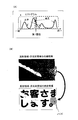
- FIG. 2A is a diagram showing an example of the image data 3.
- the fluorescent lamp illumination is reflected and reflected across the character area (line) on the left and right sides of the lower part of the screen.
- the contrast between the background and the character is lowered.
- FIG. 2B is a schematic diagram in which the character “o” portion of the image data 3 is enlarged.
- Ii Reflection occurs in the portion of the character “O” in the image data 3 in FIG.
- the reflection area is represented within a dotted frame.
- the character area is represented by a black pixel area, and the background area is represented by an ash pixel area.
- the reflection / non-reflection region separation unit 12 binarizes the image data 3 with a first threshold value, and separates the image data 3 into a reflection region where the pixel value is saturated and a non-reflection region where the pixel value is non-saturated. .
- the reflection / non-reflection region separation unit 12 performs binarization processing on the image data 3 by changing the first threshold when the first threshold is not evaluated as appropriate.
- the reflection area binarization unit 13 binarizes the reflection area of the image data 3 with the second threshold value, and separates the reflection area into a character area of pixels darker than the second threshold value and other background areas. In addition, the reflection area binarization unit 13 performs the binarization process on the reflection area of the image data 3 by changing the second threshold when the second threshold is not evaluated as appropriate.
- the non-reflective region binarization unit 14 binarizes the non-reflective region of the image data 3 with the third threshold value, and separates the non-reflective region into a character region of pixels darker than the third threshold value and other background regions.
- the non-reflective area binarization unit 14 performs binarization processing on the non-reflective area of the image data 3 by changing the third threshold when the third threshold is not evaluated as appropriate.
- the reflection region binarization evaluation unit 15 obtains the contour line length (contour pixel length) of the portion where the contour of the reflection region of the image data 3 is in contact with the contour of the background region classified as a low gray value region in the reflection region.
- the first threshold value is evaluated by determining the relationship between the contour pixel length and a predetermined evaluation value.
- the reflection area binarization evaluation unit 15 calculates the number of pixels where the outline of the reflection area and the outline of the background area in the reflection area are in contact, and the obtained number of pixels is a predetermined evaluation value (first value). Threshold evaluation value) or less, and when the obtained number of pixels is less than or equal to the first threshold evaluation value, the first threshold used in the binarization process was evaluated as appropriate and found When the number of pixels exceeds the first threshold evaluation value, the first threshold is evaluated as inappropriate.
- the reflection area binarization evaluation unit 15 evaluates whether the second threshold value is an appropriate value using the separation result of the character area and the background area in the reflection area.
- the non-reflective area binarization evaluation unit 16 evaluates whether the third threshold value is an appropriate value using the separation result of the character area and the background area in the non-reflective area.
- the reflection area binarization evaluation unit 15 obtains the area (number of pixels of the character area) and the outline length (number of outline pixels of the character area) of the character area separated by the reflection area of the image data 3,
- the second threshold value is evaluated by determining the relationship between the ratio of the number of contour pixels to the number of pixels in the character area and a predetermined evaluation value.
- the non-reflective region binarization evaluation unit 16 obtains the area (number of pixels of the character region) and the contour length (number of contour pixels of the character region) of the character region separated by the non-reflective region of the image data 3,
- the third threshold value is evaluated by determining the relationship between the ratio of the number of contour pixels to the number of pixels in the character area and a predetermined evaluation value.
- the third threshold value is not an appropriate value in the binarization process of the non-reflective area binarization unit 14, noise may occur in an image separated as a character area in the separation result. In the separation result of the non-reflective region with an inappropriate threshold value, noise generation increases compared to the separation result with an appropriate threshold value.
- the non-reflective region binarization evaluation unit 16 calculates the ratio of the number of contour pixels (contour length) to the number of pixels (area) in the character region.
- the third threshold value used in the binarization process when it is determined whether the calculated ratio is equal to or less than a predetermined evaluation value (third threshold evaluation value) and the calculated ratio is equal to or less than the third threshold evaluation value. Is evaluated as being appropriate, and the third threshold used in the binarization process is evaluated as being inappropriate when the obtained ratio exceeds the third threshold evaluation value.
- the reflection region binarization evaluation unit 15 also performs the same processing as the non-reflection region binarization evaluation unit 16 and evaluates the second threshold value.
- the reflection / non-reflection area separation evaluation unit 17 evaluates whether the first threshold value to the third threshold value are appropriate using the separation result in the reflection area and the separation result in the non-reflection area.
- the reflection / non-reflection area separation evaluation unit 17 integrates the character area separated in the non-reflection area of the image data 3 and the character area separated in the reflection area, and the reflection area and the non-reflection area of the integrated character area.
- the first threshold value to the third threshold value are determined to be appropriate values by determining the number of contour pixels of each character area at the joint portion with and determining the relationship between the difference in the number of contour pixels at the joint portion and a predetermined evaluation condition. It is evaluated whether it is.
- the character area straddling the boundary between the reflective area and the non-reflective area is It is expected that the width of the region does not change greatly on both sides (the reflective region side and the non-reflective region side), that is, the contour width at the part where the character regions contact each other is substantially the same.
- the character area may not be connected.
- the second threshold value and the third threshold value of the character / background separation processing in the reflective region and the non-reflective region are not appropriate values, the difference in the contour width becomes large.
- the reflection / non-reflection area separation evaluation unit 17 calculates and obtains the difference between the reflection side outline length (number of outline pixels) and the non-reflection side outline length (number of outline pixels) of the combined character area. If the determined difference is within a predetermined evaluation value range (first separation evaluation range) and the obtained difference is a value within the first separation evaluation range, the first threshold is appropriate. The first threshold value is evaluated as inappropriate when the difference obtained is evaluated and the obtained difference is not within the first separation evaluation value range.
- the reflection / non-reflection area separation evaluation unit 17 determines that the difference between the reflection side outline length (number of outline pixels) and the non-reflection side outline length (number of outline pixels) of the combined character area is the first separation evaluation. Although it is within the range, it is determined whether it is within the predetermined second separation evaluation range, and the second threshold value and the third threshold value are appropriate when the obtained difference is a value within the second separation evaluation range. If the obtained difference is not within the second separation evaluation range, it is evaluated that the second threshold value or the third threshold value or both are not appropriate.
- the line extraction unit 18 integrates the character area separated in the reflection area of the image data 3 and the character area separated in the non-reflection area, and extracts the position information of the character area in the image data 3.
- the reflective / non-reflective region separation unit 12, the reflective region binarization unit 13, and the non-reflective region binarization unit 14 are used when a plurality of evaluations are performed on the separation result obtained by the same binarization process.
- the threshold value of the binarization process (first threshold value to third threshold value) can be changed based on a combination of a plurality of evaluations, and the binarization process can be performed using the changed threshold value.
- the binarization process can be further performed by reflecting the evaluation of each binarization process, and more accurate reflection / non-reflection and character / background separation results can be obtained.
- the reflective / non-reflective region separation unit 12, the reflective region binarization unit 13, and the non-reflective region binarization unit 14 use two or more gray values as threshold values (first threshold value to third threshold value) used in their own processing.
- the separation result of binarization processing with multiple gray values is held, and when the separation result of each of the multiple gray values is evaluated, the most appropriate gray value separation result can be selected. .
- the reflection region binarization unit 13, the non-reflection region binarization unit 14, and the reflection / non-reflection region separation evaluation unit 17 By performing binarization processing with a plurality of threshold values in advance and holding the separation results, the reflection region binarization unit 13, the non-reflection region binarization unit 14, and the reflection / non-reflection region separation evaluation unit 17 once It is possible to obtain a plurality of separation results and to evaluate each separation result.
- the separation result with one threshold value is evaluated, and the binarization process is performed again with the threshold value changed by this evaluation result, the separation result with the appropriate threshold value is more efficient. Therefore, overall processing efficiency can be improved.
- the character cutout / character recognition unit 20 cuts out a character from the character region of the image data 3 based on the position information of the character region specified by the line extraction unit 18 and performs character recognition processing of the cut out character.
- the character recognition evaluation unit 21 evaluates the character recognition accuracy of the character segmentation / character recognition unit 20.
- the character recognition evaluation unit 21 calculates the recognition rate of character recognition in each of the reflective region and the non-reflective region. If the recognition rate in the reflective region is lower than a predetermined evaluation value, the second threshold is not an appropriate value. When the recognition rate in the non-reflective area is lower than a predetermined evaluation value, it is evaluated that the third threshold value is not an appropriate value. Further, when the recognition rate is low in both the reflective area and the non-reflective area, it is evaluated that the first threshold value is not an appropriate value.
- the reflection / non-reflection region separation unit 12, the reflection region binarization unit 13, or the non-reflection region binarization unit 14 can change the threshold value of the binarization process. . By performing the binarization process using the changed threshold value, it is possible to specify a character region with higher accuracy, thereby improving the accuracy of character recognition.
- the character area extraction apparatus 1 has the above-described processing means, so that the image data can be separated into two stages (reflection / non-reflection area separation and character / background area separation), and the results of the separation. Since the evaluation process can be executed recursively, a highly accurate character region (line) extraction result can be obtained.
- FIG. 3 is a diagram showing an outline of processing of the character area extraction apparatus 1 in this embodiment.
- the image input unit 11 of the character area extraction device 1 receives the image data 3 obtained by photographing the subject and stores it in the image storage unit 10 (step S1).
- the reflection / non-reflection region separation unit 12 binarizes the image data 3 in the image storage unit 10 with the first threshold value, and separates it into a reflection region and a non-reflection region (step S2).
- the reflection area binarization unit 13 binarizes the reflection area of the image data 3 with the second threshold
- the non-reflection area binarization unit 14 binarizes the non-reflection area of the image data 3 with the third threshold.
- the reflective area and the non-reflective area are separated into a character area and a background area (step S3).
- the reflection region binarization evaluation unit 15, the non-reflection region binarization evaluation unit 16, and the reflection / non-reflection region separation evaluation unit 17 include the reflection region binarization unit 13 and the non-reflection region binarization unit 14, respectively. It is determined whether the first threshold value, the second threshold value, and the third threshold value of the binarization process are appropriate by determining whether the performed separation result satisfies a predetermined evaluation condition (step S4).
- the line extraction unit 18 integrates the character region separated in the reflective region and the character region separated in the non-reflective region, and specifies and outputs position information in the image data 3 of the integrated character region. (Step S5).
- the character cutout / character recognition unit 20 cuts out the character based on the position information of the character area and performs character recognition of the cut out character.
- the character recognition evaluation unit 21 evaluates the character recognition accuracy of the character segmentation / character recognition unit 20.
- the character recognition evaluation unit 21 executes a known character recognition process. For example, the extracted character string is recognized to determine the certainty factor of each character string, and the character component included in the character string having the certainty factor equal to or higher than a predetermined threshold value is determined as a true character component, and the threshold value is satisfied.
- a character string having no certainty is determined not to be a character component, a set of true character components is extracted, and a ratio of the set of true character components to all character components is used as a recognition rate (see Japanese Patent No. 3913985). .
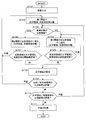
- FIG. 4 is a process flowchart of the character area extraction process.
- the image input unit 11 receives the input of the image data 3 shown in FIG. 2A and stores it in the image storage unit 10 (step S101).
- the reflective / non-reflective region separation unit 12 performs binarization processing on the image data 3 based on the pixel gray value set as the first threshold value in order to separate the reflective region and the non-reflective region (step S102).
- the reflective / non-reflective region separation unit 12 determines a pixel gray value as a first threshold value from the whole pixel gray value of the image data 3 as preparation for the binarization process.
- the first threshold value the mode value of the gray value, the average value of the gray value, and the like can be used, but are not limited to these values.
- the reflective / non-reflective region separation unit 12 classifies the pixels of the entire image data as either a reflective region or a non-reflective region according to the first threshold value. After classification, the area (number of pixels) and contour length (number of contour pixels) of each of the reflective region and the non-reflective region are obtained.
- step S104 if the processing target is not the reflection area (NO in step S103), the process of step S104 is performed. If the processing target is the reflection area (YES in step S103), the process of step S106 is performed.
- the non-reflective area binarization unit 14 binarizes the image data of the non-reflective area separated from the image data 3 by the third threshold, and classifies the pixels into character areas and background areas.
- the third threshold value is a gray value different from the first threshold value, and is determined from the pixel gray value in the non-reflective area of the image data 3.
- the minimum value of the gradation value histogram and the mode value of the gradation value can be applied, but are not limited thereto.
- the non-reflective region binarization unit 14 obtains the area (number of pixels) and the contour length (number of contour pixels) of the character region after classifying the pixels of the non-reflective region of the image data 3.
- the non-reflective region binarization evaluation unit 16 uses the separation result of the non-reflective region binarization unit 14 as an evaluation condition “the number of contour pixels of the black pixel region as a candidate character region in the non-reflective region (contour Whether or not the third threshold value is an appropriate value is evaluated by determining whether the ratio of “length” and area (number of pixels) is equal to or smaller than a predetermined value is satisfied (step S105).
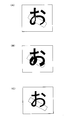
- FIG. 5 shows an example of the separation result of the character area and the background area in the non-reflective area of the image data 3.
- FIG. 5A shows an example of character and background separation results based on an appropriate third threshold
- FIG. 5B shows an example (part) of results of separation based on an inappropriate third threshold.
- the third threshold value is not an appropriate value
- the pixel to be classified as the background area is mistakenly classified as the character area, and the character area image in the non-reflective area is displayed. Appears as noise.
- the area (number of pixels) and contour length (number of contour pixels) of the character area increase.
- the characteristics of noise generation in the background a large number of minute character regions are generated, so that the increase rate of the contour length is higher than the increase rate of the area of the region, and the contour length (number of contour pixels)
- the ratio of the area (number of pixels) tends to increase greatly at a threshold at which noise starts to occur.
- the non-reflective region binarization evaluation unit 16 determines whether the ratio between the number of contour pixels in the non-reflective region and the number of pixels in the character region is equal to or less than a predetermined evaluation value.
- step S105 When this ratio is equal to or less than the evaluation value, that is, when the evaluation condition is satisfied (“appropriate” in step S105), the third threshold is evaluated to be an appropriate value, and the process proceeds to step S108.
- step S105 when the separation result does not satisfy the evaluation condition (“unsuitable” in step S105), the process returns to step S104.
- the non-reflective area binarization unit 14 corrects the third threshold to a value in a direction in which the character area becomes smaller because the third threshold is evaluated as “unsuitable”, and the non-reflective area is corrected by the corrected third threshold. To separate the character area from the background area.
- the reflection area binarization unit 13 binarizes the image data of the reflection area separated from the image data 3 by the second threshold value, and classifies the pixels into the character area and the background area.
- the second threshold value is a gray value different from the first threshold value, and is determined from the pixel gray value in the non-reflective area of the image data 3.
- the minimum value of the gray value histogram and the mode value of the gray value can be applied, but are not limited thereto.
- the reflection region binarization evaluation unit 15 uses the separation result of the reflection region binarization unit 13 and the separation result of the reflection / non-reflection region separation unit 12 to evaluate the evaluation condition “the outline of the reflection region and the reflection region.
- the first threshold value is an appropriate value by determining whether the length (number of contour pixels) of the part of the background area (low gray value area) in contact with the outline (the number of contour pixels) is equal to or smaller than a predetermined value is satisfied. Is evaluated (step S107).
- FIG. 6 is a diagram showing a separation result when the first threshold value is not an appropriate value.
- the first threshold is lower than the appropriate value, the low gray value area in the reflection area of the image data 3 increases. Then, at the same time, the length (number of contour pixels) of the portion where the contours of the low gray value region are in contact with each other increases. Therefore, whether or not the first threshold value is an appropriate value is determined by determining whether or not the number of contour pixels in a portion where the contours of these regions are in contact is equal to or less than a predetermined evaluation value.
- step S107 When the contour pixel length is equal to or smaller than the evaluation value, that is, when the evaluation condition is satisfied (“appropriate” in step S107), the first threshold is evaluated as an appropriate value, and the process proceeds to step S108.
- step S107 if the separation result does not satisfy the evaluation condition (“unsuitable” in step S107), the process returns to step S102.
- the reflective / non-reflective region separation unit 12 corrects the first threshold value to a higher value, and the reflected first region and the non-reflective region of the image data 3 by the corrected first threshold value. Separation from area.
- the reflection / non-reflection area separation evaluation unit 17 integrates the separation results (binarization results) in the reflection area and the non-reflection area, and generates a character area and a background area as the entire image data 3. (Step S108).
- FIG. 7 is a diagram for explaining processing from integration of the reflective area and the non-reflective area to generation of the character area and the background area. As shown in FIG. 7A, in the image data 3, it is assumed that there is a black character stroke on a gray background pixel and a reflection area is generated across the character stroke.
- the image data 3 in FIG. 7A is reflected by the reflection / non-reflection region separating unit 12 from the reflection region (center portion) of the image data 3 shown in FIG. 7B and the image data 3 shown in FIG. Are separated into non-reflective regions (peripheral portions). Note that the region represented by the horizontal line of the image data 3 in FIGS. 7B and 7C is a masking region at the time of integration processing.
- the reflective area binarization unit 13 and the non-reflective area binarization unit 14 in the reflective area shown in FIG. 7D and the non-reflective area shown in FIG. Are separated.
- the background area of the reflection area is represented by white pixels
- the character area is represented by black pixels.
- the reflection / non-reflection area separation evaluation unit 17 evaluates the first threshold value to the third threshold value using the integration result of the character areas separated in the reflection / non-reflection area (steps S109 and S110).
- the difference in the number of contour pixels in each character area at the joint between the character area in the reflective area and the character area in the non-reflective area is compared to the result of integrating the character areas in the reflective area and the non-reflective area. Is used.
- the number of pixels of each of the reflection area and the non-reflection area at the joint portion of the character area is obtained. If the difference between the obtained number of pixels exceeds a predetermined evaluation value, the first threshold value is not an appropriate value. Evaluate not.
- the second threshold value and the third threshold value are not appropriate values.
- FIG. 8 is a diagram showing an example of the result of integrating the character areas of the reflective area and the non-reflective area.
- the character stroke is interrupted at the boundary between the reflective area and the non-reflective area.
- the reflection / non-reflection area separation evaluation unit 17 has a very large difference in the number of pixels between the reflection area and the non-reflection area at the joined portion of the character area. If the predetermined evaluation value range (first separation evaluation range) is exceeded, the first threshold value is evaluated to be not an appropriate value (“unsuitable” in step S109), and the process returns to step S102.
- step S102 the first threshold value is corrected, and the reflection / non-reflection area separation process is executed again.
- step S110 when the difference in the number of contour pixels between the two character areas exceeds a predetermined evaluation value range (second separation evaluation range), the second threshold value and the third threshold value are set. Evaluation is not appropriate (“inappropriate” in step S110), and the process returns to step S103.
- a predetermined evaluation value range second separation evaluation range
- step S103 the processing target is determined, the second threshold value is corrected for the reflective area, the character / background area separation process is executed again (step S106), and the third threshold value is corrected for the non-reflective area. Then, the character / background region separation process is executed again (step S104).
- the row extraction unit 18 integrates the image data 3
- the position information of the designated character area is specified, and the position information is output (step S111).
- the line extraction unit 18 performs a known line extraction process and outputs the position of the obtained character string as a line extraction result.
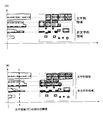
- 9 and 10 are diagrams for explaining the row extraction processing of the row extraction unit 18.
- an edge is extracted in order to obtain a character element, and an edge circumscribed rectangle is obtained as shown in FIG. 9B.
- a distribution curve is generated by projecting the horizontal length (character width) of the circumscribed rectangle in the horizontal direction, and a portion higher than a predetermined threshold is set as a character string region, and a portion below the threshold is set as a background region.
- the value on the distribution curve that is, the sum of the edge circumscribed rectangle width and the character string length are close to each other.
- the character string length tends to be longer than the sum of the edge circumscribed rectangle widths. Therefore, as shown in FIG. Since the difference in height between the character string area and the non-character string area becomes large, the character area that is a noise can be determined and removed by a predetermined character area determination threshold. it can.
- the series of processes in steps S102 to S110 repeatedly repeats the correction of the first to third threshold values based on the evaluation result of the separation process and the binarization process using the corrected threshold value.
- a recursive process such as executing and ending the separation process when a predetermined evaluation condition is satisfied is also possible.
- the character area extraction apparatus 1 has an image input unit, a reflection / non-reflection region separation unit, a reflection region binarization unit, a non-reflection region binarization unit, a reflection region by reading and executing a program by a computer.
- This program can be stored in an appropriate recording medium such as a portable medium memory, semiconductor memory, or hard disk, which can be read by a computer, provided by being recorded on these recording media, or via a communication interface. It may be provided by transmission / reception using various communication networks.
Landscapes
- Engineering & Computer Science (AREA)
- Computer Vision & Pattern Recognition (AREA)
- Physics & Mathematics (AREA)
- General Physics & Mathematics (AREA)
- Multimedia (AREA)
- Theoretical Computer Science (AREA)
- Artificial Intelligence (AREA)
- Computer Graphics (AREA)
- Geometry (AREA)
- Character Input (AREA)
- Image Analysis (AREA)
- Facsimile Image Signal Circuits (AREA)
Abstract
Priority Applications (4)
| Application Number | Priority Date | Filing Date | Title |
|---|---|---|---|
| CN2008801319430A CN102209969B (zh) | 2008-11-12 | 2008-11-12 | 字符区域提取装置、具备字符区域提取功能的摄像装置以及字符区域提取程序 |
| JP2010537627A JP5229328B2 (ja) | 2008-11-12 | 2008-11-12 | 文字領域抽出装置,文字領域抽出機能を備えた撮像装置,および文字領域抽出プログラム |
| PCT/JP2008/070602 WO2010055558A1 (fr) | 2008-11-12 | 2008-11-12 | Dispositif d’extraction de zone de caractères, dispositif d’acquisition d’images doté d’une fonction d’extraction de zone de caractères et programme d’extraction de zone de caractères |
| US13/067,133 US8447113B2 (en) | 2008-11-12 | 2011-05-11 | Character area extracting device, imaging device having character area extracting function, recording medium saving character area extracting programs, and character area extracting method |
Applications Claiming Priority (1)
| Application Number | Priority Date | Filing Date | Title |
|---|---|---|---|
| PCT/JP2008/070602 WO2010055558A1 (fr) | 2008-11-12 | 2008-11-12 | Dispositif d’extraction de zone de caractères, dispositif d’acquisition d’images doté d’une fonction d’extraction de zone de caractères et programme d’extraction de zone de caractères |
Related Child Applications (1)
| Application Number | Title | Priority Date | Filing Date |
|---|---|---|---|
| US13/067,133 Continuation US8447113B2 (en) | 2008-11-12 | 2011-05-11 | Character area extracting device, imaging device having character area extracting function, recording medium saving character area extracting programs, and character area extracting method |
Publications (1)
| Publication Number | Publication Date |
|---|---|
| WO2010055558A1 true WO2010055558A1 (fr) | 2010-05-20 |
Family
ID=42169707
Family Applications (1)
| Application Number | Title | Priority Date | Filing Date |
|---|---|---|---|
| PCT/JP2008/070602 Ceased WO2010055558A1 (fr) | 2008-11-12 | 2008-11-12 | Dispositif d’extraction de zone de caractères, dispositif d’acquisition d’images doté d’une fonction d’extraction de zone de caractères et programme d’extraction de zone de caractères |
Country Status (4)
| Country | Link |
|---|---|
| US (1) | US8447113B2 (fr) |
| JP (1) | JP5229328B2 (fr) |
| CN (1) | CN102209969B (fr) |
| WO (1) | WO2010055558A1 (fr) |
Cited By (2)
| Publication number | Priority date | Publication date | Assignee | Title |
|---|---|---|---|---|
| JP2022108130A (ja) * | 2021-01-12 | 2022-07-25 | 大日本印刷株式会社 | 情報処理装置及びコンピュータプログラム |
| JP2024004672A (ja) * | 2022-06-29 | 2024-01-17 | 三菱電機株式会社 | 読取装置、読取方法、及び読取プログラム |
Families Citing this family (9)
| Publication number | Priority date | Publication date | Assignee | Title |
|---|---|---|---|---|
| AU2012287302B2 (en) * | 2011-07-22 | 2015-02-19 | Roche Diagnostics Hematology, Inc. | Sample applicator sensing and positioning |
| JP5974589B2 (ja) * | 2012-03-30 | 2016-08-23 | ブラザー工業株式会社 | 画像処理装置およびプログラム |
| CA2878419A1 (fr) * | 2012-07-13 | 2014-01-16 | Roche Diagnostics Hematology, Inc. | Distribution regulee d'echantillons sur des substrats |
| CN102999752A (zh) * | 2012-11-15 | 2013-03-27 | 广东欧珀移动通信有限公司 | 对图片中局部字符进行快速识别的方法、装置及终端 |
| CN109902687B (zh) * | 2013-09-05 | 2023-12-08 | 华为终端有限公司 | 一种图像识别方法及用户终端 |
| CN105913418B (zh) * | 2016-04-06 | 2018-08-24 | 重庆大学 | 一种基于多阈值的瞳孔分割方法 |
| JP6903966B2 (ja) * | 2017-03-16 | 2021-07-14 | 富士フイルムビジネスイノベーション株式会社 | 情報処理装置、情報処理システム及びプログラム |
| CN112381089B (zh) * | 2020-11-20 | 2024-06-07 | 山西同方知网数字出版技术有限公司 | 一种复杂环境下的自反馈文本分离方法及系统 |
| CN114387592B (zh) * | 2022-03-22 | 2022-07-22 | 佛山沧科智能科技有限公司 | 一种复杂背景下字符定位和识别方法 |
Citations (2)
| Publication number | Priority date | Publication date | Assignee | Title |
|---|---|---|---|---|
| JP2008079258A (ja) * | 2006-09-25 | 2008-04-03 | Casio Comput Co Ltd | 画像処理装置、画像処理方法、画像処理プログラム |
| JP2008113446A (ja) * | 2002-09-05 | 2008-05-15 | Ricoh Co Ltd | 画像処理装置、画像処理プログラムおよび記録媒体 |
Family Cites Families (6)
| Publication number | Priority date | Publication date | Assignee | Title |
|---|---|---|---|---|
| US6366699B1 (en) * | 1997-12-04 | 2002-04-02 | Nippon Telegraph And Telephone Corporation | Scheme for extractions and recognitions of telop characters from video data |
| JP3913985B2 (ja) | 1999-04-14 | 2007-05-09 | 富士通株式会社 | 文書画像中の基本成分に基づく文字列抽出装置および方法 |
| JP4603807B2 (ja) * | 2004-03-10 | 2010-12-22 | 富士通株式会社 | 文字認識装置,文字認識方法,媒体処理方法,文字認識プログラムおよび文字認識プログラムを記録したコンピュータ読取可能な記録媒体 |
| JP4557843B2 (ja) * | 2005-08-31 | 2010-10-06 | キヤノン株式会社 | 画像処理装置及びその方法 |
| JP2008236204A (ja) * | 2007-03-19 | 2008-10-02 | Kyocera Mita Corp | 画像処理装置 |
| JP2009190347A (ja) * | 2008-02-18 | 2009-08-27 | Seiko Epson Corp | インク量データ生成方法、インク量データ生成装置、およびプログラム |
-
2008
- 2008-11-12 WO PCT/JP2008/070602 patent/WO2010055558A1/fr not_active Ceased
- 2008-11-12 CN CN2008801319430A patent/CN102209969B/zh not_active Expired - Fee Related
- 2008-11-12 JP JP2010537627A patent/JP5229328B2/ja not_active Expired - Fee Related
-
2011
- 2011-05-11 US US13/067,133 patent/US8447113B2/en not_active Expired - Fee Related
Patent Citations (2)
| Publication number | Priority date | Publication date | Assignee | Title |
|---|---|---|---|---|
| JP2008113446A (ja) * | 2002-09-05 | 2008-05-15 | Ricoh Co Ltd | 画像処理装置、画像処理プログラムおよび記録媒体 |
| JP2008079258A (ja) * | 2006-09-25 | 2008-04-03 | Casio Comput Co Ltd | 画像処理装置、画像処理方法、画像処理プログラム |
Cited By (3)
| Publication number | Priority date | Publication date | Assignee | Title |
|---|---|---|---|---|
| JP2022108130A (ja) * | 2021-01-12 | 2022-07-25 | 大日本印刷株式会社 | 情報処理装置及びコンピュータプログラム |
| JP7615688B2 (ja) | 2021-01-12 | 2025-01-17 | 大日本印刷株式会社 | 情報処理装置及びコンピュータプログラム |
| JP2024004672A (ja) * | 2022-06-29 | 2024-01-17 | 三菱電機株式会社 | 読取装置、読取方法、及び読取プログラム |
Also Published As
| Publication number | Publication date |
|---|---|
| US20110255785A1 (en) | 2011-10-20 |
| US8447113B2 (en) | 2013-05-21 |
| JPWO2010055558A1 (ja) | 2012-04-05 |
| JP5229328B2 (ja) | 2013-07-03 |
| CN102209969B (zh) | 2013-05-01 |
| CN102209969A (zh) | 2011-10-05 |
Similar Documents
| Publication | Publication Date | Title |
|---|---|---|
| JP5229328B2 (ja) | 文字領域抽出装置,文字領域抽出機能を備えた撮像装置,および文字領域抽出プログラム | |
| US9530069B2 (en) | Method and system for detecting and recognizing text in images | |
| CN110008954B (zh) | 一种基于多阈值融合的复杂背景文本图像提取方法及系统 | |
| JP5265708B2 (ja) | 統合されたバーコード・スキャニングを備えた画像キャプチャ・デバイス | |
| US7379594B2 (en) | Methods and systems for automatic detection of continuous-tone regions in document images | |
| US7369712B2 (en) | Automated statistical self-calibrating detection and removal of blemishes in digital images based on multiple occurrences of dust in images | |
| US7764835B2 (en) | Method and apparatus for recognizing code | |
| JP3768052B2 (ja) | カラー画像処理方法、カラー画像処理装置、及びそのための記録媒体 | |
| US7454040B2 (en) | Systems and methods of detecting and correcting redeye in an image suitable for embedded applications | |
| US7206461B2 (en) | Digital image acquisition and processing system | |
| US7315658B2 (en) | Digital camera | |
| US7310450B2 (en) | Method of detecting and correcting dust in digital images based on aura and shadow region analysis | |
| US9171224B2 (en) | Method of improving contrast for text extraction and recognition applications | |
| US20080055433A1 (en) | Detection and Removal of Blemishes in Digital Images Utilizing Original Images of Defocused Scenes | |
| US10395393B2 (en) | Method for assessing the quality of an image of a document | |
| US9807269B2 (en) | System and method for low light document capture and binarization with multiple flash images | |
| US7333656B2 (en) | Image processing method and image processing apparatus | |
| US8538191B2 (en) | Image correction apparatus and method for eliminating lighting component | |
| US8442348B2 (en) | Image noise reduction for digital images using Gaussian blurring | |
| JP3906221B2 (ja) | 画像処理方法及び画像処理装置 | |
| JP2010186246A (ja) | 画像処理装置、方法、及び、プログラム | |
| US20040052428A1 (en) | Image processing system | |
| US7280253B2 (en) | System for identifying low-frequency halftone screens in image data | |
| Dutta et al. | Segmentation of meaningful text-regions from camera captured document images | |
| JP3830350B2 (ja) | カラー画像処理方法、カラー画像処理装置、プログラム、及び記録媒体 |
Legal Events
| Date | Code | Title | Description |
|---|---|---|---|
| WWE | Wipo information: entry into national phase |
Ref document number: 200880131943.0 Country of ref document: CN |
|
| 121 | Ep: the epo has been informed by wipo that ep was designated in this application |
Ref document number: 08878104 Country of ref document: EP Kind code of ref document: A1 |
|
| ENP | Entry into the national phase |
Ref document number: 2010537627 Country of ref document: JP Kind code of ref document: A |
|
| NENP | Non-entry into the national phase |
Ref country code: DE |
|
| 122 | Ep: pct application non-entry in european phase |
Ref document number: 08878104 Country of ref document: EP Kind code of ref document: A1 |