WO2010058580A1 - 航空燃料油基材の製造方法 - Google Patents
航空燃料油基材の製造方法 Download PDFInfo
- Publication number
- WO2010058580A1 WO2010058580A1 PCT/JP2009/006224 JP2009006224W WO2010058580A1 WO 2010058580 A1 WO2010058580 A1 WO 2010058580A1 JP 2009006224 W JP2009006224 W JP 2009006224W WO 2010058580 A1 WO2010058580 A1 WO 2010058580A1
- Authority
- WO
- WIPO (PCT)
- Prior art keywords
- oil
- hydrogen
- aviation fuel
- base material
- producing
- Prior art date
- Legal status (The legal status is an assumption and is not a legal conclusion. Google has not performed a legal analysis and makes no representation as to the accuracy of the status listed.)
- Ceased
Links
Classifications
-
- C—CHEMISTRY; METALLURGY
- C10—PETROLEUM, GAS OR COKE INDUSTRIES; TECHNICAL GASES CONTAINING CARBON MONOXIDE; FUELS; LUBRICANTS; PEAT
- C10L—FUELS NOT OTHERWISE PROVIDED FOR; NATURAL GAS; SYNTHETIC NATURAL GAS OBTAINED BY PROCESSES NOT COVERED BY SUBCLASSES C10G OR C10K; LIQUIFIED PETROLEUM GAS; USE OF ADDITIVES TO FUELS OR FIRES; FIRE-LIGHTERS
- C10L1/00—Liquid carbonaceous fuels
- C10L1/04—Liquid carbonaceous fuels essentially based on blends of hydrocarbons
-
- C—CHEMISTRY; METALLURGY
- C10—PETROLEUM, GAS OR COKE INDUSTRIES; TECHNICAL GASES CONTAINING CARBON MONOXIDE; FUELS; LUBRICANTS; PEAT
- C10G—CRACKING HYDROCARBON OILS; PRODUCTION OF LIQUID HYDROCARBON MIXTURES, e.g. BY DESTRUCTIVE HYDROGENATION, OLIGOMERISATION, POLYMERISATION; RECOVERY OF HYDROCARBON OILS FROM OIL-SHALE, OIL-SAND, OR GASES; REFINING MIXTURES MAINLY CONSISTING OF HYDROCARBONS; REFORMING OF NAPHTHA; MINERAL WAXES
- C10G3/00—Production of liquid hydrocarbon mixtures from oxygen-containing organic materials, e.g. fatty oils, fatty acids
-
- C—CHEMISTRY; METALLURGY
- C10—PETROLEUM, GAS OR COKE INDUSTRIES; TECHNICAL GASES CONTAINING CARBON MONOXIDE; FUELS; LUBRICANTS; PEAT
- C10G—CRACKING HYDROCARBON OILS; PRODUCTION OF LIQUID HYDROCARBON MIXTURES, e.g. BY DESTRUCTIVE HYDROGENATION, OLIGOMERISATION, POLYMERISATION; RECOVERY OF HYDROCARBON OILS FROM OIL-SHALE, OIL-SAND, OR GASES; REFINING MIXTURES MAINLY CONSISTING OF HYDROCARBONS; REFORMING OF NAPHTHA; MINERAL WAXES
- C10G45/00—Refining of hydrocarbon oils using hydrogen or hydrogen-generating compounds
- C10G45/02—Refining of hydrocarbon oils using hydrogen or hydrogen-generating compounds to eliminate hetero atoms without changing the skeleton of the hydrocarbon involved and without cracking into lower boiling hydrocarbons; Hydrofinishing
- C10G45/04—Refining of hydrocarbon oils using hydrogen or hydrogen-generating compounds to eliminate hetero atoms without changing the skeleton of the hydrocarbon involved and without cracking into lower boiling hydrocarbons; Hydrofinishing characterised by the catalyst used
- C10G45/06—Refining of hydrocarbon oils using hydrogen or hydrogen-generating compounds to eliminate hetero atoms without changing the skeleton of the hydrocarbon involved and without cracking into lower boiling hydrocarbons; Hydrofinishing characterised by the catalyst used containing nickel or cobalt metal, or compounds thereof
- C10G45/08—Refining of hydrocarbon oils using hydrogen or hydrogen-generating compounds to eliminate hetero atoms without changing the skeleton of the hydrocarbon involved and without cracking into lower boiling hydrocarbons; Hydrofinishing characterised by the catalyst used containing nickel or cobalt metal, or compounds thereof in combination with chromium, molybdenum, or tungsten metals, or compounds thereof
-
- C—CHEMISTRY; METALLURGY
- C10—PETROLEUM, GAS OR COKE INDUSTRIES; TECHNICAL GASES CONTAINING CARBON MONOXIDE; FUELS; LUBRICANTS; PEAT
- C10L—FUELS NOT OTHERWISE PROVIDED FOR; NATURAL GAS; SYNTHETIC NATURAL GAS OBTAINED BY PROCESSES NOT COVERED BY SUBCLASSES C10G OR C10K; LIQUIFIED PETROLEUM GAS; USE OF ADDITIVES TO FUELS OR FIRES; FIRE-LIGHTERS
- C10L1/00—Liquid carbonaceous fuels
- C10L1/10—Liquid carbonaceous fuels containing additives
- C10L1/14—Organic compounds
-
- C—CHEMISTRY; METALLURGY
- C11—ANIMAL OR VEGETABLE OILS, FATS, FATTY SUBSTANCES OR WAXES; FATTY ACIDS THEREFROM; DETERGENTS; CANDLES
- C11C—FATTY ACIDS FROM FATS, OILS OR WAXES; CANDLES; FATS, OILS OR FATTY ACIDS BY CHEMICAL MODIFICATION OF FATS, OILS, OR FATTY ACIDS OBTAINED THEREFROM
- C11C3/00—Fats, oils, or fatty acids by chemical modification of fats, oils, or fatty acids obtained therefrom
- C11C3/12—Fats, oils, or fatty acids by chemical modification of fats, oils, or fatty acids obtained therefrom by hydrogenation
-
- C—CHEMISTRY; METALLURGY
- C10—PETROLEUM, GAS OR COKE INDUSTRIES; TECHNICAL GASES CONTAINING CARBON MONOXIDE; FUELS; LUBRICANTS; PEAT
- C10G—CRACKING HYDROCARBON OILS; PRODUCTION OF LIQUID HYDROCARBON MIXTURES, e.g. BY DESTRUCTIVE HYDROGENATION, OLIGOMERISATION, POLYMERISATION; RECOVERY OF HYDROCARBON OILS FROM OIL-SHALE, OIL-SAND, OR GASES; REFINING MIXTURES MAINLY CONSISTING OF HYDROCARBONS; REFORMING OF NAPHTHA; MINERAL WAXES
- C10G2300/00—Aspects relating to hydrocarbon processing covered by groups C10G1/00 - C10G99/00
- C10G2300/10—Feedstock materials
- C10G2300/1011—Biomass
- C10G2300/1014—Biomass of vegetal origin
-
- C—CHEMISTRY; METALLURGY
- C10—PETROLEUM, GAS OR COKE INDUSTRIES; TECHNICAL GASES CONTAINING CARBON MONOXIDE; FUELS; LUBRICANTS; PEAT
- C10G—CRACKING HYDROCARBON OILS; PRODUCTION OF LIQUID HYDROCARBON MIXTURES, e.g. BY DESTRUCTIVE HYDROGENATION, OLIGOMERISATION, POLYMERISATION; RECOVERY OF HYDROCARBON OILS FROM OIL-SHALE, OIL-SAND, OR GASES; REFINING MIXTURES MAINLY CONSISTING OF HYDROCARBONS; REFORMING OF NAPHTHA; MINERAL WAXES
- C10G2300/00—Aspects relating to hydrocarbon processing covered by groups C10G1/00 - C10G99/00
- C10G2300/10—Feedstock materials
- C10G2300/1011—Biomass
- C10G2300/1018—Biomass of animal origin
-
- C—CHEMISTRY; METALLURGY
- C10—PETROLEUM, GAS OR COKE INDUSTRIES; TECHNICAL GASES CONTAINING CARBON MONOXIDE; FUELS; LUBRICANTS; PEAT
- C10G—CRACKING HYDROCARBON OILS; PRODUCTION OF LIQUID HYDROCARBON MIXTURES, e.g. BY DESTRUCTIVE HYDROGENATION, OLIGOMERISATION, POLYMERISATION; RECOVERY OF HYDROCARBON OILS FROM OIL-SHALE, OIL-SAND, OR GASES; REFINING MIXTURES MAINLY CONSISTING OF HYDROCARBONS; REFORMING OF NAPHTHA; MINERAL WAXES
- C10G2300/00—Aspects relating to hydrocarbon processing covered by groups C10G1/00 - C10G99/00
- C10G2300/20—Characteristics of the feedstock or the products
- C10G2300/201—Impurities
- C10G2300/202—Heteroatoms content, i.e. S, N, O, P
-
- C—CHEMISTRY; METALLURGY
- C10—PETROLEUM, GAS OR COKE INDUSTRIES; TECHNICAL GASES CONTAINING CARBON MONOXIDE; FUELS; LUBRICANTS; PEAT
- C10G—CRACKING HYDROCARBON OILS; PRODUCTION OF LIQUID HYDROCARBON MIXTURES, e.g. BY DESTRUCTIVE HYDROGENATION, OLIGOMERISATION, POLYMERISATION; RECOVERY OF HYDROCARBON OILS FROM OIL-SHALE, OIL-SAND, OR GASES; REFINING MIXTURES MAINLY CONSISTING OF HYDROCARBONS; REFORMING OF NAPHTHA; MINERAL WAXES
- C10G2300/00—Aspects relating to hydrocarbon processing covered by groups C10G1/00 - C10G99/00
- C10G2300/20—Characteristics of the feedstock or the products
- C10G2300/30—Physical properties of feedstocks or products
-
- C—CHEMISTRY; METALLURGY
- C10—PETROLEUM, GAS OR COKE INDUSTRIES; TECHNICAL GASES CONTAINING CARBON MONOXIDE; FUELS; LUBRICANTS; PEAT
- C10G—CRACKING HYDROCARBON OILS; PRODUCTION OF LIQUID HYDROCARBON MIXTURES, e.g. BY DESTRUCTIVE HYDROGENATION, OLIGOMERISATION, POLYMERISATION; RECOVERY OF HYDROCARBON OILS FROM OIL-SHALE, OIL-SAND, OR GASES; REFINING MIXTURES MAINLY CONSISTING OF HYDROCARBONS; REFORMING OF NAPHTHA; MINERAL WAXES
- C10G2400/00—Products obtained by processes covered by groups C10G9/00 - C10G69/14
- C10G2400/08—Jet fuel
-
- Y—GENERAL TAGGING OF NEW TECHNOLOGICAL DEVELOPMENTS; GENERAL TAGGING OF CROSS-SECTIONAL TECHNOLOGIES SPANNING OVER SEVERAL SECTIONS OF THE IPC; TECHNICAL SUBJECTS COVERED BY FORMER USPC CROSS-REFERENCE ART COLLECTIONS [XRACs] AND DIGESTS
- Y02—TECHNOLOGIES OR APPLICATIONS FOR MITIGATION OR ADAPTATION AGAINST CLIMATE CHANGE
- Y02P—CLIMATE CHANGE MITIGATION TECHNOLOGIES IN THE PRODUCTION OR PROCESSING OF GOODS
- Y02P30/00—Technologies relating to oil refining and petrochemical industry
- Y02P30/20—Technologies relating to oil refining and petrochemical industry using bio-feedstock
Definitions
- the present invention relates to a method for producing an aviation fuel oil base material.
- biomass energy derived from plants can effectively use carbon immobilized from carbon dioxide in the atmosphere by photosynthesis during the growth process of plants, so it does not lead to an increase in carbon dioxide in the atmosphere from the viewpoint of the life cycle, so-called It has the property of being carbon neutral.
- Biomass fuel is also very promising as an alternative energy for oil from the viewpoint of depletion of petroleum resources and rising crude oil prices.
- FAME fatty acid methyl ester oils
- triglyceride which is a general structure of animal and vegetable oils
- This FAME is considered to be used not only for diesel fuel but also for aviation fuel oil, so-called jet fuel.
- Airplanes are heavily fueled and have been greatly affected by the recent rise in crude oil prices. Under such circumstances, biomass fuel is attracting attention as an important item that plays a role as an alternative to petroleum as well as preventing global warming.
- biomass fuel is attracting attention as an important item that plays a role as an alternative to petroleum as well as preventing global warming.
- airlines are experimenting with the use of mixed FAMEs in petroleum-based jet fuel.
- FAME also has concerns about low temperature performance and oxidation stability.
- aviation fuel is exposed to extremely low temperatures when flying at high altitudes, so extremely strict low-temperature performance standards are established.
- FAME is mixed with petroleum-based JET fuel.
- oxidation stability the addition of antioxidants is stipulated in the aviation fuel standard, but considering the stability as a base material, the mixing ratio must be limited to a low concentration as well as low temperature performance. I don't get it.
- the present invention solves the above-described problems, and an object thereof is to provide a method for producing an aviation fuel base material having excellent combustibility and oxidation stability and excellent life cycle characteristics.
- the present invention provides a aviation fuel oil base material characterized by hydrotreating an oxygen-containing hydrocarbon compound derived from animal and plant oils and fats and a feed oil containing a sulfur-containing hydrocarbon compound in the presence of hydrogen. It is about the method.
- the present invention relates to the above-described method for producing an aviation fuel oil base material, wherein the raw material oil contains a petroleum base material obtained by refining crude oil or the like.
- the present invention provides the aviation fuel oil base according to any one of the above, wherein the sum of each fatty acid composition having a fatty acid carbon chain of 10 to 14 carbon atoms is 60% by mass or more in the animal and vegetable fats and oils
- the present invention relates to a method for manufacturing a material.
- the present invention provides the support comprising the porous inorganic oxide in which the hydrogenation treatment includes two or more elements selected from aluminum, silicon, zirconium, boron, titanium, and magnesium in the presence of hydrogen.
- the hydrogenation treatment includes two or more elements selected from aluminum, silicon, zirconium, boron, titanium, and magnesium in the presence of hydrogen.
- a catalyst supporting one or more metals selected from Group 6A and Group 8 elements of the periodic table hydrogen pressure of 2 to 13 MPa, liquid space velocity of 0.1 to 3.0 h ⁇ 1 , hydrogen /
- the method for producing an aviation fuel base material according to any one of the above, comprising a step of hydrotreating the raw material oil under conditions of an oil ratio of 150 to 1500 NL / L and a reaction temperature of 150 to 480 ° C. Is.
- the hydrotreating oil obtained in the hydrotreating step is further selected from aluminum, silicon, zirconium, boron, titanium, magnesium and zeolite in the presence of hydrogen.
- a catalyst comprising a support made of a porous inorganic oxide comprising a metal selected from Group 8 elements of the periodic table, a hydrogen pressure of 2 to 13 MPa, a liquid space velocity of 0.1 to 3.0 h -1 , production of an aviation fuel base material according to any one of the above, further comprising a isomerization treatment under the conditions of a hydrogen / oil ratio of 250 to 1500 NL / L and a reaction temperature of 150 to 380 ° C. It is about the method.
- the present invention relates to a method for producing an aviation fuel oil base material characterized by blending and producing the aviation fuel oil base material described above and an aviation fuel oil base material refined from crude oil or the like. Is.
- the manufacturing method of the environmentally low load type aviation fuel oil base material which has the life cycle characteristic excellent from combustibility, oxidation stability, and its carbon neutral characteristic, and contributes to primary energy diversification is provided.
- a raw material oil containing an oxygen-containing hydrocarbon compound derived from animal and vegetable oils and fats and a sulfur-containing hydrocarbon compound is used.
- animal and vegetable oils examples include beef tallow, rapeseed oil, soybean oil, and palm oil.
- any oil or fat may be used as the animal or vegetable oil or fat, and waste oil after using these oils or fats may be used.
- vegetable oils and fats are preferred from the viewpoint of carbon neutral, and from the viewpoint of kerosene fraction yield after hydrogenation treatment, the composition ratio (fatty acid composition) of each fatty acid group having 10 to 14 carbon atoms in the fatty acid carbon chain. A sum of 60% by mass or more is preferable, and coconut oil and palm kernel oil are preferable as vegetable oils and fats considered from this viewpoint.
- the fatty acid composition means methyl oil prepared according to the standard oil analysis method (established by the Japan Oil Chemists' Society) (1991) “2.4.20.2-91 Preparation of fatty acid methyl ester (boron trifluoride-methanol method)”. Establish the ester oil analysis test method (established by the Japan Oil Chemists' Society) (1993) “2.4.21.3-77 fatty acid composition (FID temperature rising gas romatograph) using a temperature rising gas chromatograph equipped with a flame ionization detector (FID). It is a value obtained according to “method)” and indicates the constituent ratio (% by mass) of each fatty acid group constituting the oil or fat.
- Oxygenated hydrocarbon compounds derived from animal and vegetable oils and fats are generally compounds having a fatty acid triglyceride structure, but may contain other oxygenated hydrocarbon compounds processed into ester bodies such as fatty acids and fatty acid methyl esters. .
- ester bodies such as fatty acids and fatty acid methyl esters.
- components having a triglyceride structure are mainly used as animal and vegetable oils and fats from the viewpoint of reducing carbon dioxide emissions.
- the proportion of the compound having a triglyceride structure in the oxygenated hydrocarbon compound contained in the raw oil is preferably 90 mol% or more, more preferably 92 mol% or more, and 95 mol% or more. More preferably.
- the feedstock oil may contain a petroleum base material obtained by refining crude oil or the like.
- a petroleum base material obtained by refining crude oil or the like is obtained by a reaction such as a fraction obtained by atmospheric distillation or vacuum distillation of crude oil, hydrodesulfurization, hydrocracking, fluid catalytic cracking, catalytic reforming, etc. Such as fractions.
- the mixing amount of these fractions can be arbitrarily set as long as the sulfur content contained in the feedstock satisfies a predetermined concentration range described later.
- the content of the petroleum-based base material obtained by refining crude oil or the like in the raw material oil is not particularly limited, but is preferably 20 to 70% by volume, more preferably 30 to 60% by volume.
- the sulfur-containing hydrocarbon compound contained in the raw material oil is not particularly limited, and specific examples include sulfides, disulfides, polysulfides, thiols, thiophenes, benzothiophenes, dibenzothiophenes, and derivatives thereof.
- the sulfur-containing hydrocarbon compound contained in the feedstock oil may be a single compound or a mixture of two or more. Further, a petroleum hydrocarbon fraction containing a sulfur content may be used as the sulfur-containing hydrocarbon compound.
- the sulfur content contained in the raw material oil is preferably 1 to 50 mass ppm, more preferably 5 to 30 mass ppm, still more preferably 10 to 20 mass ppm in terms of sulfur atoms, based on the total amount of the raw material oil. .
- the sulfur content in the present invention means the mass content of the sulfur content measured according to the method described in JIS K2541 “Sulfur content test method” or ASTM-5453.
- the sulfur-containing hydrocarbon compound contained in the raw material oil may be mixed in advance with the oxygen-containing hydrocarbon compound derived from the animal and plant oil and fat, and the mixture may be introduced into the reactor of the hydrorefining device, or derived from the animal and vegetable oil and fat.
- the oxygen-containing hydrocarbon compound to be introduced into the reactor it may be supplied before the reactor.
- the present invention is to produce an environmentally low-load aviation fuel oil base material by subjecting the raw material oil to a hydrogenation treatment.
- the hydrotreatment preferably includes the following hydrotreatment steps.
- the hydrotreating conditions are as follows: the hydrogen pressure is 2 to 13 MPa, the liquid space velocity is 0.1 to 3.0 h ⁇ 1 , and the hydrogen / oil ratio is 150 to 1500 NL / L.
- the hydrogen pressure is 2 to 13 MPa
- the liquid space velocity is 0.1 to 3.0 h ⁇ 1
- the hydrogen / oil ratio is 150 to 1500 NL / L
- the hydrogen pressure is 3
- Even more desirable are conditions of ⁇ 10.5 MPa, liquid hourly space velocity of 0.25 ⁇ 1.0 h ⁇ 1 , and hydrogen / oil ratio of 300 ⁇ 1000 NL / L. All of these conditions are factors that influence the reaction activity. For example, when the hydrogen pressure and the hydrogen / oil ratio are less than the lower limit values, there is a risk of causing a decrease in reactivity or a rapid decrease in activity. When the pressure and the hydrogen / oil ratio exceed the upper limit values, there is a possibility that excessive equipment investment such as a compressor may be required. The lower the liquid space velocity, the more advantageous the reaction. However, if the liquid space velocity is less than the lower limit, a very large reaction tower volume is required, which tends to result in excessive capital investment. Tend not to progress sufficiently.
- the reaction temperature can be arbitrarily set in order to obtain the target decomposition rate of the raw material heavy oil fraction or the target fraction yield.
- the average temperature of the entire reactor is generally preferably in the range of 150 to 480 ° C., desirably 200 to 400 ° C., and more desirably 260 to 360 ° C.
- the reaction temperature is lower than 150 ° C, the reaction may not proceed sufficiently.
- the reaction temperature exceeds 480 ° C, the decomposition proceeds excessively, and the liquid product yield tends to decrease.
- a support made of a porous inorganic oxide containing two or more elements selected from aluminum, silicon, zirconium, boron, titanium and magnesium is used as a catalyst for the hydrogenation treatment.
- a catalyst carrying a metal selected from these elements is used as a catalyst for the hydrogenation treatment.
- a porous inorganic oxide composed of two or more elements selected from aluminum, silicon, zirconium, boron, titanium and magnesium is used.
- it is a porous inorganic oxide containing alumina, and other carrier constituents include silica, zirconia, boria, titania, magnesia and the like.
- it is a complex oxide containing at least one selected from alumina and other constituent components.
- phosphorus may be included as another component.
- the total content of components other than alumina is preferably 1 to 20% by weight, more preferably 2 to 15% by weight.
- the total content of components other than alumina is less than 1% by weight, a sufficient catalyst surface area cannot be obtained and the activity may be lowered.
- the content exceeds 20% by weight the acid content of the carrier Properties may increase, leading to a decrease in activity due to coke formation.
- phosphorus is included as a carrier constituent, its content is preferably 1 to 5% by weight, more preferably 2 to 3.5% by weight in terms of oxide.
- the raw material to be a precursor of silica, zirconia, boria, titania, and magnesia, which are carrier components other than alumina, is not particularly limited, and a solution containing general silicon, zirconium, boron, titanium, or magnesium can be used.
- magnesium magnesium nitrate or the like can be used.
- phosphorus phosphoric acid or an alkali metal salt of phosphoric acid can be used.
- the raw materials for the carrier constituents other than alumina be added in any step prior to the firing of the carrier.
- it may be added to an aluminum aqueous solution in advance and then an aluminum hydroxide gel containing these components, may be added to a prepared aluminum hydroxide gel, or water or an acidic aqueous solution may be added to a commercially available alumina intermediate or boehmite powder.
- a method of coexisting at the stage of preparing aluminum hydroxide gel is more desirable.
- the active metal of the hydrotreating catalyst contains at least one metal selected from Group 6A and Group 8 metals of the periodic table, preferably two or more metals selected from Groups 6A and 8 Contains.
- metals selected from Groups 6A and 8 Contains For example, Co—Mo, Ni—Mo, Ni—Co—Mo, Ni—W and the like can be mentioned. In the hydrogenation treatment, these metals are converted into sulfides and used.
- the content of the active metal is, for example, the total supported amount of W and Mo is preferably 12 to 35% by weight, more preferably 15 to 30% by weight based on the catalyst weight in terms of oxide. If the total supported amount of W and Mo is less than 12% by weight, the activity may decrease due to a decrease in the number of active points. If it exceeds 35% by weight, the metal is not effectively dispersed and is similarly active. May lead to a decrease in The total supported amount of Co and Ni is preferably 1.5 to 10% by weight, more preferably 2 to 8% by weight based on the catalyst weight in terms of oxide. If the total supported amount of Co and Ni is less than 1.5% by weight, a sufficient cocatalyst effect may not be obtained and the activity may be reduced. If it is more than 10% by weight, the metal is effective. In the same manner, there is a possibility of causing activity.
- the method for supporting the active metal on the carrier is not particularly limited, and a known method applied when producing a normal desulfurization catalyst can be used.
- a method of impregnating a catalyst carrier with a solution containing a salt of an active metal is preferably employed.
- an equilibrium adsorption method, a pore-filling method, an incident-wetness method, and the like are preferably employed.
- the pore-filling method is a method in which the pore volume of the support is measured in advance and impregnated with the same volume of the metal salt solution, but the impregnation method is not particularly limited, and the amount of metal supported Further, it can be impregnated by an appropriate method depending on the physical properties of the catalyst support.
- the reactor type of the hydrogenation process may be a fixed bed system. That is, hydrogen can take either a countercurrent or a cocurrent flow with respect to the raw material oil, or a combination of countercurrent and cocurrent flow having a plurality of reaction towers. As a general format, it is a down flow, and a gas-liquid twin parallel flow format can be adopted.
- the reactors may be used singly or in combination, and a structure in which one reactor is divided into a plurality of catalyst beds may be adopted.
- the hydrotreated oil hydrotreated in the reactor is fractionated into predetermined fractions through a gas-liquid separation process, a rectification process, and the like.
- gas-liquid separation equipment and other by-products are formed between the reactors and in the product recovery process.
- a gas removal device may be installed.
- a high-pressure separator or the like can be preferably exemplified.
- hydrogen gas is introduced from the inlet of the first reactor before or after passing through the heating furnace, but separately from this, the temperature in the reactor is controlled and the reactor is as much as possible. It may be introduced between the catalyst beds or between a plurality of reactors in order to maintain the hydrogen pressure throughout.
- the hydrogen thus introduced is referred to as quench hydrogen.
- the ratio of quench hydrogen to hydrogen introduced accompanying the feedstock is preferably 10 to 60% by volume, more preferably 15 to 50% by volume. When the ratio of quench hydrogen is less than 10%, the reaction at the subsequent reaction site may not proceed sufficiently, and when it exceeds 60% by volume, the reaction near the reactor inlet may not proceed sufficiently.
- the raw material oil when hydrotreating the raw material oil, in order to suppress the heat generation amount in the hydrotreating reactor, the raw material oil may contain a specific amount of recycled oil. it can.
- the content of the recycled oil is preferably 0.5 to 5 times by mass with respect to the oxygenated hydrocarbon compound derived from animal and plant oils and fats, and the ratio is appropriately set within the above range according to the maximum use temperature of the hydrotreating reactor. Can be determined. Assuming that the specific heat of both is the same, if the two are mixed one-on-one, the temperature rise is half that of the case where the substance derived from animal and vegetable fats and oils is reacted alone. If it exists, it is because the reaction heat can fully be reduced.
- the content of recycled oil is more than 5 times the mass of the oxygen-containing hydrocarbon compound, the concentration of the oxygen-containing hydrocarbon compound decreases and the reactivity decreases, and the flow rate of piping etc. increases and the load is increased. Increase.
- the content of the recycled oil is less than 0.5 times the mass of the oxygen-containing hydrocarbon compound, the temperature rise cannot be sufficiently suppressed.
- the mixing method of the raw material oil and the recycled oil is not particularly limited.
- the raw material oil may be mixed in advance and the mixture may be introduced into the reactor of the hydrotreating apparatus, or when the raw material oil is introduced into the reactor, the reactor You may supply in the front
- a plurality of reactors can be connected in series and introduced between the reactors, or the catalyst layer can be divided and introduced between the catalyst layers in a single reactor.
- Recycled oil may contain a portion of hydrotreated oil obtained by removing by-product water, carbon monoxide, carbon dioxide, hydrogen sulfide, etc. after hydrotreating the feedstock oil. preferable.
- the hydrotreatment of the present invention may include a step of further isomerizing the hydrotreated oil obtained in the hydrotreating step.
- the sulfur content contained in the hydrotreated oil that is the raw material oil for the isomerization treatment is preferably 1 mass ppm or less, and more preferably 0.5 mass ppm or less. If the sulfur content exceeds 1 ppm by mass, the progress of hydroisomerization may be hindered. In addition, for the same reason, the reaction gas containing hydrogen introduced together with the hydrotreated oil needs to have a sufficiently low sulfur concentration, and is preferably 1 ppm by volume or less, and 0.5 volume. More preferably, it is ppm or less.
- the isomerization treatment step is preferably performed in the presence of hydrogen under the conditions of a hydrogen pressure of 2 to 13 MPa, a liquid space velocity of 0.1 to 3.0 h ⁇ 1 , and a hydrogen / oil ratio of 250 to 1500 NL / L. More preferably, the hydrogen pressure is 2.5 to 10 MPa, the liquid space velocity is 0.5 to 2.0 h ⁇ 1 , and the hydrogen / oil ratio is 380 to 1200 NL / L. It is more desirable to carry out under the conditions of 8 MPa, the liquid space velocity is 0.8 to 1.8 h ⁇ 1 , and the hydrogen / oil ratio is 350 to 1000 NL / L. All of these conditions are factors that influence the reaction activity.
- the hydrogen pressure and the hydrogen / oil ratio are less than the lower limit values, there is a risk of causing a decrease in reactivity or a rapid decrease in activity.
- the hydrogen / oil ratio exceeds the upper limit, excessive equipment investment such as a compressor may be required.
- the lower the liquid space velocity the more advantageous the reaction.
- a very large reaction tower volume is required, which tends to result in excessive capital investment. Tend not to progress sufficiently.
- the reaction temperature in the isomerization treatment step can be arbitrarily set in order to obtain the desired decomposition rate or the desired fraction yield of the heavy oil feed fraction, but it should be in the range of 150 to 380 ° C. Is preferable, the range of 240 to 380 ° C. is more preferable, and the range of 250 to 365 ° C. is particularly preferable.
- the reaction temperature is lower than 150 ° C., sufficient hydroisomerization reaction may not proceed.
- the reaction temperature is higher than 380 ° C., excessive decomposition or other side reaction proceeds, resulting in a liquid product yield. There is a risk of lowering.
- a metal selected from elements of Group 8 of the periodic table on a carrier made of a porous inorganic oxide composed of a material selected from aluminum, silicon, zirconium, boron, titanium, magnesium and zeolite A catalyst in which one or more of these are supported is used.
- the porous inorganic oxide used as the support for the isomerization catalyst include alumina, titania, zirconia, boria, silica, and zeolite. In the present invention, among these, among titania, zirconia, boria, silica, and zeolite. What consists of at least 1 type and an alumina is preferable.
- the production method is not particularly limited, but any preparation method can be employed using raw materials in various sols, salt compounds, and the like corresponding to each element.
- the composite hydroxide or composite oxide such as silica alumina, silica zirconia, alumina titania, silica titania, and alumina boria
- the ratio of alumina to other oxides can be any ratio with respect to the support, but preferably alumina is 90% by mass or less, more preferably 60% by mass or less, more preferably 40% by mass or less, preferably Is 10% by mass or more, more preferably 20% by mass or more.
- Zeolite is a crystalline aluminosilicate, such as faujasite, pentasil, mordenite, etc., which is ultra-stabilized by a predetermined hydrothermal treatment and / or acid treatment, or one whose alumina content in the zeolite is adjusted is used. be able to.
- faujasite and mordenite particularly preferably Y type and beta type are used.
- the Y type is preferably ultra-stabilized, and the zeolite that has been super-stabilized by hydrothermal treatment forms new pores in the range of 20 to 100 mm in addition to the original pore structure called micropores of 20 mm or less.
- Known conditions can be used for the hydrothermal treatment conditions.
- the active metal of the isomerization catalyst one or more metals selected from Group 8 elements of the periodic table are used.
- these metals it is preferable to use one or more metals selected from Pd, Pt, Rh, Ir, Au, and Ni, and it is more preferable to use them in combination.
- Suitable combinations include, for example, Pd—Pt, Pd—Ir, Pd—Rh, Pd—Au, Pd—Ni, Pt—Rh, Pt—Ir, Pt—Au, Pt—Ni, Rh—Ir, Rh— Examples thereof include Au, Rh—Ni, Ir—Au, Ir—Ni, Au—Ni, Pd—Pt—Rh, Pd—Pt—Ir, and Pt—Pd—Ni.
- the total content of active metals based on the catalyst mass is preferably 0.1 to 2% by mass, more preferably 0.2 to 1.5% by mass, and 0.5 to 1.3% by mass as the metal. Even more preferred. If the total supported amount of the metal is less than 0.1% by mass, the active sites tend to decrease and sufficient activity cannot be obtained. On the other hand, if it exceeds 2% by mass, the metal is not effectively dispersed and sufficient activity tends not to be obtained.
- the method for supporting the active metal on the support is not particularly limited, and a known method applied when producing a normal desulfurization catalyst can be used.
- a method of impregnating a catalyst carrier with a solution containing a salt of an active metal is preferably employed.
- an equilibrium adsorption method, a pore-filling method, an incident-wetness method, and the like are preferably employed.
- the pore-filling method is a method in which the pore volume of the support is measured in advance and impregnated with the same volume of the metal salt solution, but the impregnation method is not particularly limited, and the amount of metal supported Further, it can be impregnated by an appropriate method depending on the physical properties of the catalyst support.
- the isomerization catalyst used in the present invention is preferably subjected to a reduction treatment of active metal contained in the catalyst before being subjected to the reaction.
- the reduction conditions are not particularly limited, but the reduction is performed by treatment at a temperature of 200 to 400 ° C. in a hydrogen stream.
- the treatment is preferably performed in the range of 240 to 380 ° C.
- the reduction temperature is less than 200 ° C., the reduction of the active metal does not proceed sufficiently and the hydrodeoxygenation and hydroisomerization activity may not be exhibited. Further, when the reduction temperature exceeds 400 ° C., the aggregation of the active metal proceeds, and there is a possibility that the activity cannot be exhibited similarly.
- the reactor type for the isomerization treatment may be a fixed bed system. That is, hydrogen can take either a countercurrent or a cocurrent flow with respect to the raw material oil, or a combination of countercurrent and cocurrent flow having a plurality of reaction towers. As a general format, it is a down flow, and a gas-liquid twin parallel flow format can be adopted.
- the reactors may be used singly or in combination, and a structure in which one reactor is divided into a plurality of catalyst beds may be adopted.
- hydrogen gas is introduced from the inlet of the first reactor before or after passing through the heating furnace, but separately from this, the temperature in the reactor is controlled and the reactor is as much as possible. It may be introduced between the catalyst beds or between a plurality of reactors in order to maintain the hydrogen pressure throughout.
- the hydrogen thus introduced is referred to as quench hydrogen.
- the ratio of quench hydrogen to hydrogen introduced accompanying the feedstock is preferably 10 to 60% by volume, more preferably 15 to 50% by volume. When the ratio of quench hydrogen is less than 10% by volume, the reaction at the subsequent reaction site may not proceed sufficiently, and when it exceeds 60% by volume, the reaction near the reactor inlet may not proceed sufficiently.
- the isomerized oil obtained after the isomerization process may be fractionated into a plurality of fractions in a rectifying column as necessary.
- it may be fractionated into light fractions such as gas and naphtha fractions, middle fractions such as kerosene and diesel oil fractions, and heavy fractions such as residues.
- the cut temperature of the light fraction and the middle fraction is preferably 100 to 200 ° C, more preferably 120 to 180 ° C, further preferably 120 to 160 ° C, and still more preferably 130 to 150 ° C.
- the cut temperature of the middle fraction and the heavy fraction is preferably 250 to 360 ° C, more preferably 250 to 320 ° C, further preferably 250 to 300 ° C, and still more preferably 250 to 280 ° C.
- Hydrogen can be produced by reforming a part of the light hydrocarbon fraction produced in a steam reformer.
- the hydrogen produced in this way has a characteristic of carbon neutral because the raw material used for steam reforming is a biomass-derived hydrocarbon, and can reduce the burden on the environment.
- the middle fraction obtained by fractionating isomerized oil can be suitably used as an aviation fuel oil base material.
- the aviation fuel base material produced by the method of the present invention may be used alone or in combination with an aviation fuel base material obtained by refining crude oil or the like.
- the aviation fuel oil base material obtained by refining crude oil, etc. includes the aviation fuel oil fraction obtained in the general oil refining process, the synthesis gas composed of hydrogen and carbon monoxide, and the Fischer-Tropsch reaction.
- a well-known method can be used as a manufacturing method of synthesis gas, and it is not specifically limited.
- the obtained kneaded material was extruded into a shape of a cylinder having a diameter of 1.5 mm by an extrusion molding machine, dried at 110 ° C. for 1 hour, and then fired at 550 ° C. to obtain a molded carrier.
- 50 g of the obtained shaped carrier was put into an eggplant-shaped flask, and while degassing with a rotary evaporator, 17.3 g of molybdenum trioxide, 13.2 g of nickel nitrate (II) hexahydrate, 3.9 g of phosphoric acid (concentration 85%) And an impregnation solution containing 4.0 g of malic acid was poured into the flask.
- Catalyst A The impregnated sample was dried at 120 ° C. for 1 hour and then calcined at 550 ° C. to obtain Catalyst A.
- Table 1 shows the physical properties of Catalyst A.
- the impregnated sample was dried at 110 ° C. and then calcined at 350 ° C. to obtain Catalyst B.
- the amount of platinum supported on catalyst B was 0.5% by mass based on the total amount of catalyst.
- Table 1 shows the physical properties of Catalyst B.
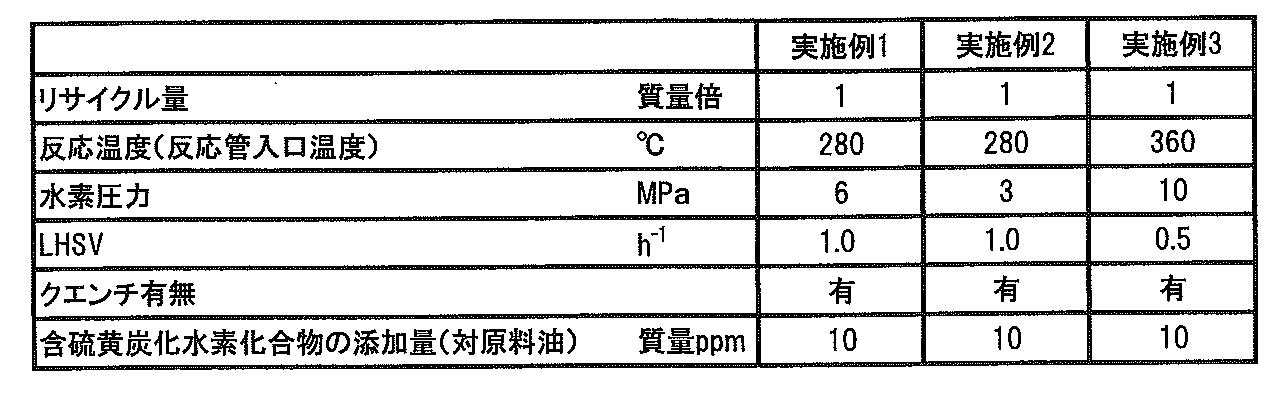
- Example 1 A reaction tube (inner diameter 20 mm) filled with catalyst A (100 ml) was attached to the fixed bed flow reactor in countercurrent. Thereafter, using straight-run gas oil (sulfur content: 3% by mass) to which dimethyl disulfide has been added, the catalyst layer average temperature is 300 ° C., the hydrogen partial pressure is 6 MPa, the liquid space velocity is 1 h ⁇ 1 , and the hydrogen / oil ratio is 200 NL / L. The catalyst was presulfided for 4 hours.
- straight-run gas oil sulfur content: 3% by mass
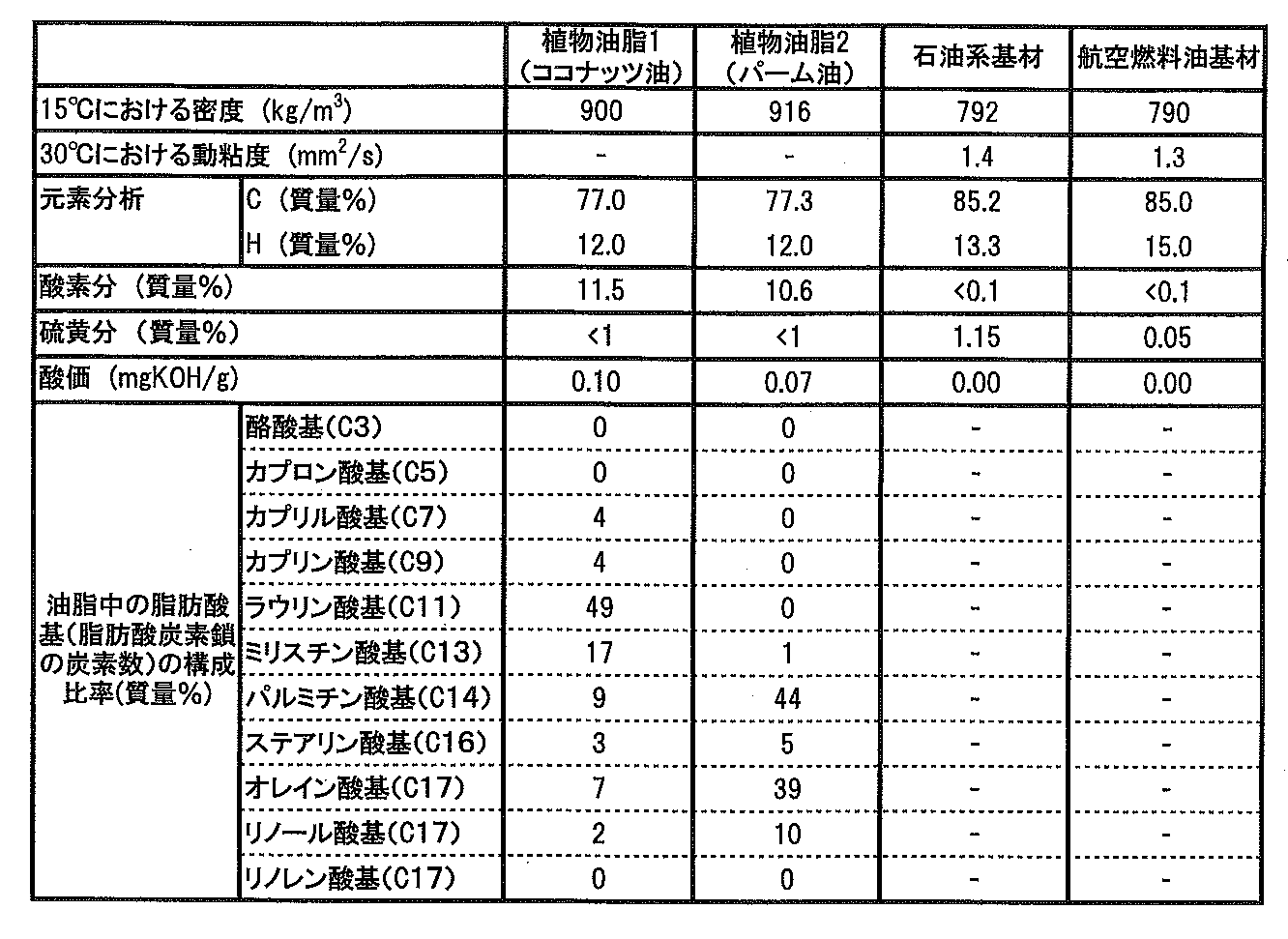
- part of the hydrotreated oil after introduction of the high-pressure separator described later is added to vegetable oil 1 having the properties shown in Table 2 (ratio of the compound having a triglyceride structure in the oxygen-containing hydrocarbon compound: 98 mol%).
- the amount of 1 mass times with respect to the vegetable oil 1 was recycled, and dimethyl sulfide was added to adjust the raw material oil so that the sulfur content relative to the raw material oil was 10 mass ppm.
- hydrogenation treatment was performed using the raw material oil.
- the 15 ° C. density of the raw material oil was 0.900 g / ml, and the oxygen content was 11.5% by mass.
- the conditions for the hydrotreating were as follows: the reaction tube inlet temperature was 280 ° C., the hydrogen pressure was 6.0 MPa, the liquid space velocity was 1.0 h ⁇ 1 , and the hydrogen / oil ratio was 510 NL / L.
- the treated oil after the hydrotreatment was introduced into a high pressure separator, and hydrogen, hydrogen sulfide, carbon dioxide and water were removed from the treated oil.
- Part of the hydrotreated oil after introduction of the high-pressure separator is cooled to 40 ° C. with cooling water, recycled to the vegetable oil 1 as the raw material oil as described above, and the remaining hydrotreated oil is recycled to the catalyst B.
- the reaction tube (inner diameter 20 mm) filled with (150 ml) was introduced into a fixed bed flow type reaction apparatus (isomerization apparatus) to carry out isomerization treatment.
- the catalyst B is subjected to a reduction treatment for 6 hours under conditions of an average catalyst layer temperature of 320 ° C., a hydrogen pressure of 5 MPa, and a hydrogen gas amount of 83 ml / min.
- the isomerized oil after the isomerization treatment was guided to a rectification column, and fractionated into a light fraction having a boiling point range of less than 140 ° C, an intermediate fraction having a boiling point of 140 to 280 ° C, and a heavy fraction having a temperature exceeding 280 ° C.
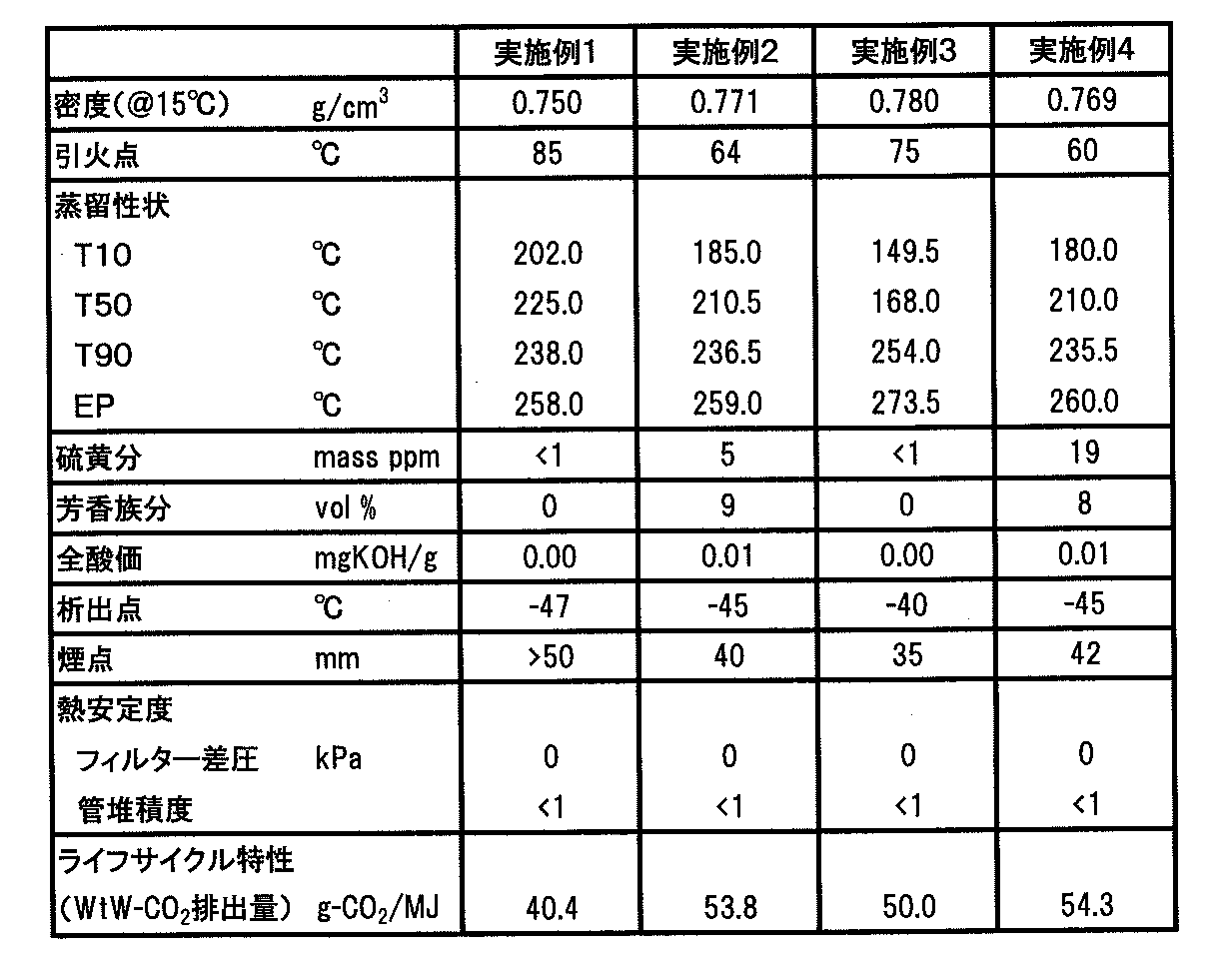
- This middle distillate is used as the aviation fuel base material.
- Table 3 shows the hydrotreating conditions
- Table 4 shows the properties of the obtained aviation fuel base material.
- Example 2 The hydrotreatment and isomerization treatment were performed in the same manner as in Example 1 except that the feedstock contained 50% by volume of the petroleum base material having the properties shown in Table 2 and the hydrogen pressure in the hydrotreatment was 3 MPa. Aviation fuel oil base material was obtained.
- the petroleum base material contained in the feedstock is a straight-run kerosene fraction obtained by fractional distillation at a boiling point range of 140 ° C. to 270 ° C. among fractions obtained by treating crude oil with an atmospheric distillation apparatus.
- Table 3 shows the hydrotreating conditions
- Table 4 shows the properties of the obtained aviation fuel base material.
- Example 3 The plant fats and oils 1 contained in the raw material oil were changed to vegetable fats and oils 2 and the hydrogenation treatment was carried out except that the reaction tube inlet temperature was 360 ° C., the hydrogen pressure was 10 MPa, and the liquid space velocity was 0.5 h ⁇ 1. Hydrogenation and isomerization were performed in the same manner as in Example 1. Table 3 shows the hydrotreating conditions, and Table 4 shows the properties of the obtained aviation fuel base material.
- Example 4 Of the fractions obtained by treating 50% by volume of the aviation fuel base material obtained in Example 1 and crude oil with an atmospheric distillation unit, the fractions fractionated in the boiling range of 140 ° C to 270 ° C are further hydrogenated.
- the aviation fuel oil base material shown in Table 4 was manufactured by blending 50% by volume of the aviation fuel oil base material having the properties shown in Table 2 subjected to desulfurization treatment.
- the general properties of base oil and aviation fuel oil base material shown in Tables 2 and 4 are values measured by the following methods.
- the density at 15 ° C. means a value measured according to JIS K2249 “Crude oil and petroleum products—Density test method and density / mass / capacity conversion table”.
- the kinematic viscosity at 30 ° C. means a value measured by JIS K2283 “Crude oil and petroleum products—Kinematic viscosity test method and viscosity index calculation method”.
- Elemental analysis C (mass%) and H (mass%) mean values measured by the method defined in ASTM D 5291 “Standard Test Methods for Instrumental Determination of Carbon, Hydrogen, and Nitrogen in Petroleum Products and Lubricants”.
- the oxygen content means a value measured by a method such as UOP649-74 “Total Oxygen in Organic Materials by Pyrolysis-Gas Chromatographic Technique”.
- the sulfur content means a value measured according to JIS K2541 “Crude oil and petroleum product sulfur content test method”.
- the acid value means a value measured by the method of JIS K2501 “Petroleum products and lubricants—neutralization number test method”.
- the composition ratio of fatty acid groups in fats and oils is a value obtained according to the above-mentioned standard fat analysis method (established by the Japan Oil Chemists' Society) (1993) "2.4.21.3-77 Fatty acid composition (FID temperature rising gas chromatograph method)" Point to.
- Flash point means the value obtained in JIS K2265 “Crude oil and petroleum products-Flash point test method-Tag closed flash point test method”. Distillation properties are measured in JIS K2254 “Petroleum product-Distillation test method”. Mean value.
- the aromatic content means a value measured by JIS K2536 “Test method for fuel oil hydrocarbon components (fluorescence indicator adsorption method)”.
- the total acid value means a value measured according to JIS K2276 “Petroleum products—Aeronautical fuel oil test method—Total acid value test method”.
- the precipitation point means a value measured according to JIS K2276 “Petroleum products—Aeronautical fuel oil test method—Precipitation point test method”.
- the smoke point means a value measured by JIS K2537 “Fuel oil smoke point test method”.
- the thermal stability means a value measured according to JIS K2276 “Petroleum products—Aeronautical fuel oil test method—Thermal stability test method A method, B method”.
- the life cycle characteristics (life cycle CO 2 calculation) described in this example were calculated by the following method.
- the life cycle CO 2 was calculated as CO 2 generated from raw material mining to fuel refueling in fuel production.
- CO 2 generated from mining to refueling fuel tanks (hereinafter referred to as “Well to Tank CO 2 ”) is a series of operations from mining, transportation, processing, distribution, and refueling of raw materials and crude oil sources. Calculated as the sum of CO 2 emissions in the flow.
- Well to Tank CO 2 calculation was performed in consideration of the carbon dioxide emission shown in the following (1B) to (5B). As data necessary for such calculation, refinery operation performance data possessed by the present inventors was used.
- the aviation fuel oil base material produced by the methods described in Examples 1 to 4 using raw materials derived from animal and plant oils and fats has excellent quality as an aviation fuel oil base material, and It is a new aviation fuel base material for oil substitutes that contributes to the prevention of chemical conversion.
Landscapes
- Chemical & Material Sciences (AREA)
- Oil, Petroleum & Natural Gas (AREA)
- Engineering & Computer Science (AREA)
- Chemical Kinetics & Catalysis (AREA)
- General Chemical & Material Sciences (AREA)
- Organic Chemistry (AREA)
- Life Sciences & Earth Sciences (AREA)
- Wood Science & Technology (AREA)
- Production Of Liquid Hydrocarbon Mixture For Refining Petroleum (AREA)
- Liquid Carbonaceous Fuels (AREA)
Abstract
Description
また、FAMEは低温性能や酸化安定性に懸念点を有している。特に航空燃料においては高い高度での飛行時に極低温に曝されることから、非常に厳しい低温性能規格が設けられており、FAMEを利用使用とする場合には、石油系JET燃料への混合利用を余儀なくされ、且つその混合量も低濃度にせざるを得ないのが実状である。また、酸化安定性についても、航空燃料規格として酸化防止剤の添加が定められてはいるものの、基材としての安定性を考えると、低温性能同様、その混合割合は低濃度に限定せざるを得ない。
すなわち、本発明は、水素の存在下、動植物油脂に由来する含酸素炭化水素化合物、及び含硫黄炭化水素化合物を含有する原料油を水素化処理することを特徴とする航空燃料油基材の製造方法に関するものである。
原料油中の原油等を精製して得られる石油系基材の含有割合は特に限定されないが、20~70容量%が好ましく、より好ましくは30~60容量%である。
水素化処理は、以下の水素化処理工程を含むことが好ましい。本発明に係る水素化処理工程では、水素化処理条件として、水素圧力が2~13MPa、液空間速度が0.1~3.0h-1、水素/油比が150~1500NL/Lである条件下で行われることが望ましく、水素圧力が2~13MPa、液空間速度が0.1~3.0h-1、水素/油比が150~1500NL/Lである条件がより望ましく、水素圧力が3~10.5MPa、液空間速度が0.25~1.0h-1、水素/油比が300~1000NL/Lである条件がさらにより望ましい。
これらの条件はいずれも反応活性を左右する因子であり、例えば、水素圧力および水素/油比が前記下限値に満たない場合には反応性の低下や急速な活性低下を招く恐れがあり、水素圧力および水素/油比が前記上限値を超える場合には圧縮機等の過大な設備投資を要する恐れがある。液空間速度は低いほど反応に有利な傾向にあるが、前記下限未満の場合は極めて大きな反応塔容積が必要となり過大な設備投資となる傾向にあり、他方、前記上限を超えている場合は反応が十分進行しなくなる傾向にある。
また、リサイクル油は、原料油の水素化処理を行った後、副生する水、一酸化炭素、二酸化炭素、硫化水素などを除去して得られる水素化処理油の一部を含有することが好ましい。さらに、水素化処理油から分留された軽質留分、中間留分若しくは重質留分のそれぞれについて異性化処理したものの一部、あるいは、水素化処理油をさらに異性化処理したものから分留される中間留分の一部を含有することが好ましい。
これらの条件はいずれも反応活性を左右する因子であり、例えば水素圧力および水素/油比が前記下限値に満たない場合には反応性の低下や急速な活性低下を招く恐れがあり、水素圧力および水素/油比が前記上限値を超える場合には圧縮機等の過大な設備投資を要する恐れがある。液空間速度は低いほど反応に有利な傾向にあるが、前記下限未満の場合は極めて大きな反応塔容積が必要となり過大な設備投資となる傾向にあり、他方、前記上限を超えている場合は反応が十分進行しなくなる傾向にある。
異性化処理触媒の担体として用いられる多孔性の無機酸化物としては、アルミナ、チタニア、ジルコニア、ボリア、シリカ、あるいはゼオライトが挙げられ、本発明ではこのうちチタニア、ジルコニア、ボリア、シリカおよびゼオライトのうち少なくとも1種類とアルミナによって構成されているものが好ましい。その製造法は特に限定されないが、各元素に対応した各種ゾル、塩化合物などの状態の原料を用いて任意の調製法を採用することができる。さらには一旦シリカアルミナ、シリカジルコニア、アルミナチタニア、シリカチタニア、アルミナボリアなどの複合水酸化物あるいは複合酸化物を調製した後に、アルミナゲルやその他水酸化物の状態あるいは適当な溶液の状態で調製工程の任意の工程で添加して調製してもよい。アルミナと他の酸化物との比率は担体に対して任意の割合を取り得るが、好ましくはアルミナが90質量%以下、さらに好ましくは60質量%以下、より好ましくは40質量%以下であり、好ましくは10質量%以上、より好ましくは20質量%以上である。
<触媒A>
濃度5質量%のアルミン酸ナトリウム水溶液3000gに水ガラス3号18.0gを加え、65℃に保温した容器に入れた。他方、65℃に保温した別の容器において濃度2.5質量%の硫酸アルミニウム水溶液3000gにリン酸(濃度85%)6.0gを加えた溶液を調製し、これに前述のアルミン酸ナトリウムを含む水溶液を滴下した。混合溶液のpHが7.0になる時点を終点とし、得られたスラリー状の生成物をフィルターに通して濾取し、ケーキ状のスラリーを得た。
このケーキ状のスラリーを還流冷却器を取り付けた容器に移し、蒸留水150mlと27%アンモニア水溶液10gを加え、75℃で20時間加熱攪拌した。該スラリーを混練装置に入れ、80℃以上に加熱し水分を除去しながら混練し、粘土状の混練物を得た。得られた混練物を押出し成形機によって直径1.5mmシリンダーの形状に押し出し、110℃で1時間乾燥した後550℃で焼成し、成形担体を得た。
得られた成形担体50gをナス型フラスコに入れ、ロータリーエバポレーターで脱気しながら三酸化モリブデン17.3g、硝酸ニッケル(II)6水和物13.2g、リン酸(濃度85%)3.9g及びリンゴ酸4.0gを含む含浸溶液をフラスコ内に注入した。含浸した試料は120℃で1時間乾燥した後、550℃で焼成し、触媒Aを得た。触媒Aの物性を表1に示す。
<触媒B>
市販のシリカアルミナ担体(日揮化学社製N632HN)50gをナス型フラスコに入れ、ロータリーエバポレーターで脱気しながらテトラアンミン白金(II)クロライド水溶液をフラスコ内に注入した。含浸した試料は110℃で乾燥した後、350℃で焼成し、触媒Bを得た。触媒Bにおける白金の担持量は、触媒全量を基準として0.5質量%であった。触媒Bの物性を表1に示す。
触媒A(100ml)を充填した反応管(内径20mm)を固定床流通式反応装置に向流に取り付けた。その後、ジメチルジサルファイドを加えた直留軽油(硫黄分3質量%)を用いて触媒層平均温度300℃、水素分圧6MPa、液空間速度1h-1、水素/油比200NL/Lの条件下で、4時間触媒の予備硫化を行った。
予備硫化後、表2に示す性状を有する植物油脂1(含酸素炭化水素化合物に占めるトリグリセリド構造を有する化合物の割合:98モル%)に後述の高圧セパレータ導入後の水素化処理油の一部を植物油脂1に対して1質量倍となる量をリサイクルし、原料油に対する硫黄分含有量(硫黄原子換算)が10質量ppmになるようにジメチルサルファイドを添加して原料油の調整を行った。その後、原料油を用いて、水素化処理を行った。原料油の15℃密度は0.900g/ml、酸素分含有量は11.5質量%であった。また、水素化処理の条件は、反応管入り口温度を280℃、水素圧力を6.0MPa、液空間速度を1.0h-1、水素/油比を510NL/Lとした。水素化処理後の処理油を高圧セパレータに導入し、処理油から水素、硫化水素、二酸化炭素および水の除去を行った。高圧セパレータ導入後の水素化処理油の一部は、冷却水で40℃まで冷却して、前述の通り原料油である植物油脂1にリサイクルし、リサイクルした残りの水素化処理油を、触媒B(150ml)を充填した反応管(内径20mm)を固定床流通式反応装置(異性化装置)に導入し、異性化処理を行った。まず、触媒Bに対して、触媒層平均温度320℃、水素圧力5MPa、水素ガス量83ml/minの条件化で6時間、還元処理を行い、次に、触媒層平均温度を330℃、水素圧力を3MPa、液空間速度を1h-1、水素/油比を500NL/Lの条件で異性化処理を行った。異性化処理後の異性化処理油は精留塔に導かれ、沸点範囲140℃未満の軽質留分、140~280℃の中間留分、280℃を超える重質留分に分留した。この中間留分を航空燃料油基材に用いる。水素化処理条件を表3に、得られた航空燃料油基材の性状を表4に示す。
原料油が表2の性状を有する石油系基材を50容量%含有すること、水素化処理における水素圧力を3MPaとした以外は、実施例1と同様にして水素化処理および異性化処理を行い、航空燃料油基材を得た。原料油に含有される石油系基材は、原油を常圧蒸留装置で処理して得られる留分のうち、沸点範囲140℃~270℃で分留した直留灯油留分である。水素化処理条件を表3に、得られた航空燃料油基材の性状を表4に示す。
原料油に含有される植物油脂1を植物油脂2に変更し、水素化処理において、反応管入り口温度を360℃、水素圧力を10MPa、液空間速度を0.5h-1とした以外は、実施例1と同様にして水素化処理および異性化処理を行った。水素化処理条件を表3に、得られた航空燃料油基材の性状を表4に示す。
実施例1で得られた航空燃料油基材50容量%と原油を常圧蒸留装置で処理して得られる留分のうち、沸点範囲140℃~270℃で分留した留分を更に水素化脱硫処理した表2の性状を有する航空燃料油基材50容量%とをブレンドすることにより、表4に示す航空燃料油基材を製造した。
表2、表4に示す原料油および航空燃料油基材の一般性状は以下の方法により測定された値をいう。
15℃における密度(密度@15℃)は、JIS K2249「原油及び石油製品-密度試験方法並びに密度・質量・容量換算表」で測定される値を意味する。
30℃における動粘度は、JIS K2283「原油及び石油製品-動粘度試験方法及び粘度指数算出方法」で測定される値を意味する。
元素分析C(質量%)、H(質量%)は、ASTM D 5291 “Standard Test Methods for Instrumental Determination of Carbon, Hydrogen, and Nitrogen in Petroleum Products and Lubricants” で定められる方法で測定される値を意味する。
酸素分は、UOP649-74 “Total Oxygen in Organic Materials by Pyrolysis-Gas Chromatographic Technique” 等の方法で測定される値を意味する。
硫黄分は、JIS K2541「原油及び石油製品硫黄分試験方法」で測定される値を意味する。
酸価は、JIS K2501「石油製品及び潤滑油-中和価試験方法」の方法で測定される値を意味する。
油脂中の脂肪酸基の構成比率は、前述の基準油脂分析試験法(日本油化学会制定)(1993)「2.4.21.3-77脂肪酸組成(FID昇温ガスロマトグラフ法)」に準じて求められる値を指す。
引火点は、JIS K2265「原油及び石油製品-引火点試験方法‐タグ密閉式引火点試験方法」で求めた値を意味する
蒸留性状は、JIS K2254「石油製品-蒸留試験方法」で測定される値を意味する。
芳香族分は、JIS K2536「燃料油炭化水素成分試験方法(けい光指示薬吸着法)」で測定される値を意味する。
全酸価は、JIS K2276「石油製品-航空燃料油試験方法-全酸価試験方法」で測定される値を意味する。
析出点は、JIS K2276「石油製品-航空燃料油試験方法-析出点試験方法」により測定された値を意味する。
煙点は、JIS K2537「燃料油煙点試験方法」で測定される値を意味する。
熱安定度は、JIS K2276「石油製品-航空燃料油試験方法-熱安定度試験方法A法、B法」により測定された値を意味する。
本実施例で記載するライフサイクル特性(ライフサイクルCO2算出)は以下の手法によって計算した。
ライフサイクルCO2は、燃料製造における原料採掘から燃料給油までに発生したCO2として算出した。
採掘から燃料タンクへの燃料給油までに発生したCO2(以下、「Well to Tank CO2」という。)は、原料及び原油ソースの採掘、輸送、加工、配送、車両への給油までの一連の流れにおけるCO2排出量の総和として算出した。なお、「Well to Tank CO2」の算出にあたっては、下記(1B)~(5B)に示す二酸化炭素の排出量を加味して演算を行った。かかる演算に必要となるデータとしては、本発明者らが有する製油所運転実績データを用いた。
(2B)水素を使用する処理においては、水素製造装置における改質反応に伴う二酸化炭素の排出量。
(3B)接触分解装置等の連続触媒再生を伴う装置を経由する場合は、触媒再生に伴う二酸化炭素の排出量。
(4B)航空燃料組成物を、横浜で製造又は陸揚げし、横浜から仙台まで配送し、仙台で燃焼機器に給油したときの二酸化炭素の排出量。
(5B)動植物油脂および動植物油脂由来の成分は原産地をマレーシアおよびその周辺地域とし、製造を横浜で行うとした際の二酸化炭素の排出量。

Claims (6)
- 水素の存在下、動植物油脂に由来する含酸素炭化水素化合物、及び含硫黄炭化水素化合物を含有する原料油を水素化処理することを特徴とする航空燃料油基材の製造方法。
- 前記原料油が原油等を精製して得られる石油系基材を含有することを特徴とする請求項1に記載の航空燃料油基材の製造方法。
- 前記動植物油脂において、脂肪酸炭素鎖が炭素数10~14である各脂肪酸組成の和が60質量%以上であることを特徴とする請求項1または2に記載の航空燃料油基材の製造方法。
- 前記水素化処理が、水素の存在下、アルミニウム、ケイ素、ジルコニウム、ホウ素、チタン及びマグネシウムから選ばれる2種以上の元素を含んで構成される多孔性無機酸化物からなる担体に周期表第6A族及び第8族の元素から選ばれる1種以上の金属を担持してなる触媒を用い、水素圧力2~13MPa、液空間速度0.1~3.0h-1、水素/油比150~1500NL/L、反応温度150~480℃の条件下で前記原料油を水素化処理する工程を含むことを特徴とする請求項1~3のいずれかに記載の航空燃料油基材の製造方法。
- 前記水素化処理が、前記水素化処理工程で得られた水素化処理油を、さらに、水素存在下、アルミニウム、ケイ素、ジルコニウム、ホウ素、チタン、マグネシウム及びゼオライトから選ばれる物質より構成される多孔性無機酸化物からなる担体に周期表第8族の元素から選ばれる金属を担持してなる触媒を用いて、水素圧力2~13MPa、液空間速度0.1~3.0h-1、水素/油比250~1500NL/L、反応温度150~380℃の条件下でさらに異性化処理する工程を含むことを特徴とする請求項1~4のいずれかに記載の航空燃料油基材の製造方法。
- 請求項1~5のいずれかに記載の航空燃料油基材と原油等から精製される航空燃料油基材をブレンドして製造することを特徴とする航空燃料油基材の製造方法。
Priority Applications (5)
| Application Number | Priority Date | Filing Date | Title |
|---|---|---|---|
| EP09827361A EP2351817A4 (en) | 2008-11-20 | 2009-11-19 | METHOD FOR PRODUCING AN OIL BASE FOR A PLANE FUEL |
| CN2009801529679A CN102264869A (zh) | 2008-11-20 | 2009-11-19 | 航空燃料基础油的制造方法 |
| US13/130,172 US9464250B2 (en) | 2008-11-20 | 2009-11-19 | Process for producing aviation fuel base oil |
| AU2009318697A AU2009318697B2 (en) | 2008-11-20 | 2009-11-19 | Process for producing aviation fuel oil base |
| BRPI0921944A BRPI0921944A2 (pt) | 2008-11-20 | 2009-11-19 | processo para a produção de um óleo base de combustível para aviação |
Applications Claiming Priority (2)
| Application Number | Priority Date | Filing Date | Title |
|---|---|---|---|
| JP2008297117A JP5317644B2 (ja) | 2008-11-20 | 2008-11-20 | 航空燃料油基材の製造方法 |
| JP2008-297117 | 2008-11-20 |
Publications (1)
| Publication Number | Publication Date |
|---|---|
| WO2010058580A1 true WO2010058580A1 (ja) | 2010-05-27 |
Family
ID=42198023
Family Applications (1)
| Application Number | Title | Priority Date | Filing Date |
|---|---|---|---|
| PCT/JP2009/006224 Ceased WO2010058580A1 (ja) | 2008-11-20 | 2009-11-19 | 航空燃料油基材の製造方法 |
Country Status (9)
| Country | Link |
|---|---|
| US (1) | US9464250B2 (ja) |
| EP (1) | EP2351817A4 (ja) |
| JP (1) | JP5317644B2 (ja) |
| KR (1) | KR20110099249A (ja) |
| CN (1) | CN102264869A (ja) |
| AU (1) | AU2009318697B2 (ja) |
| BR (1) | BRPI0921944A2 (ja) |
| MY (1) | MY155295A (ja) |
| WO (1) | WO2010058580A1 (ja) |
Cited By (7)
| Publication number | Priority date | Publication date | Assignee | Title |
|---|---|---|---|---|
| WO2014149117A2 (en) | 2012-12-28 | 2014-09-25 | Exxonmobil Research And Engineering Company | Blending of dewaxed biofuels with mineral-based kero(jet) distillate cuts to provide on-spec jet fuels |
| JP2014177631A (ja) * | 2009-04-07 | 2014-09-25 | Gas Technology Inst | 高品質液体燃料を製造するためのバイオマスの水素化熱分解 |
| US9447328B2 (en) | 2009-04-07 | 2016-09-20 | Gas Technology Institute | Hydropyrolysis of biomass for producing high quality liquid fuels |
| US10392566B2 (en) | 2015-04-27 | 2019-08-27 | Gas Technology Institute | Co-processing for control of hydropyrolysis processes and products thereof |
| US10647933B2 (en) | 2015-11-12 | 2020-05-12 | Gas Technology Institute | Activated carbon as a high value product of hydropyrolysis |
| CN111978987A (zh) * | 2020-08-25 | 2020-11-24 | 西北大学 | 一种航空煤油及生物质油与煤焦油联合生产航空煤油的方法 |
| WO2026023592A1 (ja) * | 2024-07-26 | 2026-01-29 | Eneos株式会社 | 水素化精製油の製造方法および燃料の製造方法 |
Families Citing this family (12)
| Publication number | Priority date | Publication date | Assignee | Title |
|---|---|---|---|---|
| JP5339863B2 (ja) * | 2008-11-20 | 2013-11-13 | Jx日鉱日石エネルギー株式会社 | 航空燃料油組成物の製造方法 |
| AU2011352020A1 (en) * | 2010-12-30 | 2013-06-27 | Kior Inc. | Production of renewable biofuels |
| CN103374412B (zh) * | 2012-04-29 | 2015-05-13 | 中国石油化工股份有限公司 | 一种加氢法生产优质煤油的组合方法 |
| CN103374409B (zh) * | 2012-04-29 | 2016-01-06 | 中国石油化工股份有限公司 | 生产优质煤油的加氢组合方法 |
| KR101578459B1 (ko) | 2014-10-10 | 2015-12-17 | 한국화학연구원 | 식물성오일로부터 바이오 항공유분의 선택적 제조를 위한 백금 담지 실리카-알루미나 촉매 |
| CN105754634A (zh) * | 2014-12-16 | 2016-07-13 | 中国科学院大连化学物理研究所 | 一种由生物质制取烃类生物柴油的方法 |
| CN105754633A (zh) * | 2014-12-16 | 2016-07-13 | 中国科学院大连化学物理研究所 | 一种由生物质制取生物航空煤油的方法 |
| CN106701145B (zh) * | 2015-11-18 | 2019-03-19 | 中国科学院大连化学物理研究所 | 一种航空煤油或柴油的制备方法 |
| SG11202103331WA (en) | 2018-10-24 | 2021-05-28 | Haldor Topsoe As | Method for production of aviation fuel |
| KR102454175B1 (ko) * | 2020-06-24 | 2022-10-14 | 한국화학연구원 | 바이오오일로부터 항공유분을 제조하기 위한 원 포트 수첨 반응용 고활성 복합촉매 |
| US20260159771A1 (en) * | 2021-11-09 | 2026-06-11 | National University Corporation Tokyo University Of Agriculture And Technology | Bio-jet fuel production method and bio-jet fuel production catalyst used in said method |
| CN118995260B (zh) * | 2024-10-24 | 2025-03-11 | 洛阳恒玖生物能源有限公司 | 一种生物航煤的生产方法 |
Citations (4)
| Publication number | Priority date | Publication date | Assignee | Title |
|---|---|---|---|---|
| JP2005154647A (ja) | 2003-11-27 | 2005-06-16 | Rebo International:Kk | 油脂からのデイーゼル燃料油製造プロセス |
| JP2007308569A (ja) * | 2006-05-17 | 2007-11-29 | Nippon Oil Corp | A重油組成物 |
| JP2007332360A (ja) * | 2006-05-17 | 2007-12-27 | Nippon Oil Corp | ガソリン組成物 |
| JP2008239876A (ja) * | 2007-03-28 | 2008-10-09 | Nippon Oil Corp | 軽油組成物 |
Family Cites Families (14)
| Publication number | Priority date | Publication date | Assignee | Title |
|---|---|---|---|---|
| DE3141646C2 (de) * | 1981-02-09 | 1994-04-21 | Hydrocarbon Research Inc | Verfahren zur Aufbereitung von Schweröl |
| JPH0959652A (ja) | 1995-08-21 | 1997-03-04 | Nippon Oil Co Ltd | 重油基材の製造方法 |
| US7232935B2 (en) * | 2002-09-06 | 2007-06-19 | Fortum Oyj | Process for producing a hydrocarbon component of biological origin |
| WO2005026297A1 (en) | 2003-09-17 | 2005-03-24 | Shell Internationale Research Maatschappij B.V. | Petroleum- and fischer-tropsch- derived kerosene blend |
| US7692049B2 (en) * | 2005-01-31 | 2010-04-06 | Exxonmobil Chemical Patents Inc. | Hydrocarbon compositions useful for producing fuels and methods of producing the same |
| KR20090025241A (ko) | 2006-05-17 | 2009-03-10 | 니폰 오일 코포레이션 (신 니혼 세키유 가부시키 가이샤) | 수소화 처리방법, 환경친화형 가솔린 기재 및 무연 가솔린 조성물 |
| US9206367B2 (en) * | 2006-06-30 | 2015-12-08 | University Of North Dakota | Method for cold stable biojet fuel |
| US7897824B2 (en) * | 2006-08-16 | 2011-03-01 | Energy & Environmental Research Center Foundation | Optimal energy pathway to renewable domestic and other fuels |
| FR2910484B1 (fr) * | 2006-12-22 | 2009-03-06 | Inst Francais Du Petrole | Procedes d'hydrotraitement d'un melange constitue d'huiles d'origine vegetale ou animale et de coupes petrolieres avec injection des huiles en trempe sur le dernier lit catalytique |
| FR2910485B1 (fr) * | 2006-12-22 | 2009-03-06 | Inst Francais Du Petrole | Procedes d'hydrotraitement d'un melange constitue d'huiles d'origine animale ou vegetale et de coupes petrolieres avec stripage intermediaire |
| CN101675148A (zh) * | 2007-03-28 | 2010-03-17 | 新日本石油株式会社 | 粗柴油组合物 |
| WO2008124607A1 (en) * | 2007-04-06 | 2008-10-16 | Syntroleum Corporation | Process for co-producing jet fuel and lpg from renewable sources |
| US9005429B2 (en) * | 2008-07-01 | 2015-04-14 | Neste Oil Oyj | Process for the manufacture of hydrocarbon components |
| JP5339863B2 (ja) * | 2008-11-20 | 2013-11-13 | Jx日鉱日石エネルギー株式会社 | 航空燃料油組成物の製造方法 |
-
2008
- 2008-11-20 JP JP2008297117A patent/JP5317644B2/ja not_active Expired - Fee Related
-
2009
- 2009-11-19 AU AU2009318697A patent/AU2009318697B2/en not_active Ceased
- 2009-11-19 MY MYPI2011002267A patent/MY155295A/en unknown
- 2009-11-19 KR KR1020117014090A patent/KR20110099249A/ko not_active Ceased
- 2009-11-19 BR BRPI0921944A patent/BRPI0921944A2/pt not_active Application Discontinuation
- 2009-11-19 CN CN2009801529679A patent/CN102264869A/zh active Pending
- 2009-11-19 US US13/130,172 patent/US9464250B2/en active Active
- 2009-11-19 WO PCT/JP2009/006224 patent/WO2010058580A1/ja not_active Ceased
- 2009-11-19 EP EP09827361A patent/EP2351817A4/en not_active Withdrawn
Patent Citations (4)
| Publication number | Priority date | Publication date | Assignee | Title |
|---|---|---|---|---|
| JP2005154647A (ja) | 2003-11-27 | 2005-06-16 | Rebo International:Kk | 油脂からのデイーゼル燃料油製造プロセス |
| JP2007308569A (ja) * | 2006-05-17 | 2007-11-29 | Nippon Oil Corp | A重油組成物 |
| JP2007332360A (ja) * | 2006-05-17 | 2007-12-27 | Nippon Oil Corp | ガソリン組成物 |
| JP2008239876A (ja) * | 2007-03-28 | 2008-10-09 | Nippon Oil Corp | 軽油組成物 |
Non-Patent Citations (4)
| Title |
|---|
| "The Path to a Jet Fuel Alternative: Airbus Initiatives and the Steps Ahead", ICAO JOURNAL, vol. 63, no. 4, 2008, pages 22, 24, XP008139975 * |
| See also references of EP2351817A4 * |
| TADAHIDE SONE: "Suisoka Bio Keiyu (BHD) no Seizo Gijutsu", MATERIAL STAGE, vol. 7, no. 11, 2008, pages 73 - 78, XP008140460 * |
| YUTA ODA: "Koku Nenryo no Kiso Chishiki", AVIATION ENGINEERING, no. 501, 1996, pages 17 - 23, XP008140455 * |
Cited By (8)
| Publication number | Priority date | Publication date | Assignee | Title |
|---|---|---|---|---|
| JP2014177631A (ja) * | 2009-04-07 | 2014-09-25 | Gas Technology Inst | 高品質液体燃料を製造するためのバイオマスの水素化熱分解 |
| US9447328B2 (en) | 2009-04-07 | 2016-09-20 | Gas Technology Institute | Hydropyrolysis of biomass for producing high quality liquid fuels |
| WO2014149117A2 (en) | 2012-12-28 | 2014-09-25 | Exxonmobil Research And Engineering Company | Blending of dewaxed biofuels with mineral-based kero(jet) distillate cuts to provide on-spec jet fuels |
| US10392566B2 (en) | 2015-04-27 | 2019-08-27 | Gas Technology Institute | Co-processing for control of hydropyrolysis processes and products thereof |
| US10647933B2 (en) | 2015-11-12 | 2020-05-12 | Gas Technology Institute | Activated carbon as a high value product of hydropyrolysis |
| CN111978987A (zh) * | 2020-08-25 | 2020-11-24 | 西北大学 | 一种航空煤油及生物质油与煤焦油联合生产航空煤油的方法 |
| CN111978987B (zh) * | 2020-08-25 | 2022-02-15 | 西北大学 | 一种航空煤油及生物质油与煤焦油联合生产航空煤油的方法 |
| WO2026023592A1 (ja) * | 2024-07-26 | 2026-01-29 | Eneos株式会社 | 水素化精製油の製造方法および燃料の製造方法 |
Also Published As
| Publication number | Publication date |
|---|---|
| US9464250B2 (en) | 2016-10-11 |
| AU2009318697B2 (en) | 2013-08-29 |
| BRPI0921944A2 (pt) | 2016-01-05 |
| EP2351817A4 (en) | 2012-05-02 |
| EP2351817A1 (en) | 2011-08-03 |
| KR20110099249A (ko) | 2011-09-07 |
| AU2009318697A1 (en) | 2010-05-27 |
| CN102264869A (zh) | 2011-11-30 |
| JP2010121072A (ja) | 2010-06-03 |
| JP5317644B2 (ja) | 2013-10-16 |
| MY155295A (en) | 2015-09-30 |
| US20110219677A1 (en) | 2011-09-15 |
Similar Documents
| Publication | Publication Date | Title |
|---|---|---|
| JP5317644B2 (ja) | 航空燃料油基材の製造方法 | |
| JP5525786B2 (ja) | 航空燃料油基材の製造方法及び航空燃料油組成物の製造方法 | |
| JP5339863B2 (ja) | 航空燃料油組成物の製造方法 | |
| JP5330935B2 (ja) | 航空燃料油基材の製造方法及び航空燃料油組成物 | |
| JP4832871B2 (ja) | 水素化精製方法 | |
| JP5530134B2 (ja) | 航空燃料油組成物 | |
| JP5022117B2 (ja) | 炭化水素油の製造方法 | |
| WO2007132843A1 (ja) | 水素化精製方法 | |
| JP2007308565A (ja) | 水素化精製方法 | |
| JP5349213B2 (ja) | 航空燃料油基材の製造方法および航空燃料油組成物 | |
| JP2007308567A (ja) | 水素化精製方法及び環境低負荷型ガソリン基材 | |
| JP5089457B2 (ja) | 灯油組成物の製造方法 | |
| WO2009139313A1 (ja) | 炭化水素油の製造方法 |
Legal Events
| Date | Code | Title | Description |
|---|---|---|---|
| WWE | Wipo information: entry into national phase |
Ref document number: 200980152967.9 Country of ref document: CN |
|
| 121 | Ep: the epo has been informed by wipo that ep was designated in this application |
Ref document number: 09827361 Country of ref document: EP Kind code of ref document: A1 |
|
| WWE | Wipo information: entry into national phase |
Ref document number: 2009318697 Country of ref document: AU Ref document number: 3428/CHENP/2011 Country of ref document: IN |
|
| WWE | Wipo information: entry into national phase |
Ref document number: 13130172 Country of ref document: US Ref document number: 12011500973 Country of ref document: PH Ref document number: 2009827361 Country of ref document: EP |
|
| NENP | Non-entry into the national phase |
Ref country code: DE |
|
| ENP | Entry into the national phase |
Ref document number: 2009318697 Country of ref document: AU Date of ref document: 20091119 Kind code of ref document: A |
|
| ENP | Entry into the national phase |
Ref document number: 20117014090 Country of ref document: KR Kind code of ref document: A |
|
| ENP | Entry into the national phase |
Ref document number: PI0921944 Country of ref document: BR Kind code of ref document: A2 Effective date: 20110519 |