WO2010063382A2 - Verwendung bestimmter enaminocarbonylverbindungen zur selektiven bekämpfung von insekten - Google Patents

Verwendung bestimmter enaminocarbonylverbindungen zur selektiven bekämpfung von insekten Download PDF

Info

Publication number
WO2010063382A2
WO2010063382A2 PCT/EP2009/008300 EP2009008300W WO2010063382A2 WO 2010063382 A2 WO2010063382 A2 WO 2010063382A2 EP 2009008300 W EP2009008300 W EP 2009008300W WO 2010063382 A2 WO2010063382 A2 WO 2010063382A2
Authority
WO
WIPO (PCT)
Prior art keywords
spp
application
compounds
bees
days
Prior art date
Legal status (The legal status is an assumption and is not a legal conclusion. Google has not performed a legal analysis and makes no representation as to the accuracy of the status listed.)
Ceased
Application number
PCT/EP2009/008300
Other languages
English (en)
French (fr)
Other versions
WO2010063382A3 (de
Inventor
Peter Jeschke
Robert Velten
Hans-Jürgen Schnorbach
Peter Meisner
Matthias Haas
Hartwig Dauck
Leonardo PITTÁ
Markus Ebeling
Current Assignee (The listed assignees may be inaccurate. Google has not performed a legal analysis and makes no representation or warranty as to the accuracy of the list.)
Bayer CropScience AG
Original Assignee
Bayer CropScience AG
Priority date (The priority date is an assumption and is not a legal conclusion. Google has not performed a legal analysis and makes no representation as to the accuracy of the date listed.)
Filing date
Publication date
Application filed by Bayer CropScience AG filed Critical Bayer CropScience AG
Priority to MX2011005493A priority Critical patent/MX2011005493A/es
Priority to AU2009321817A priority patent/AU2009321817A1/en
Publication of WO2010063382A2 publication Critical patent/WO2010063382A2/de
Publication of WO2010063382A3 publication Critical patent/WO2010063382A3/de
Anticipated expiration legal-status Critical
Ceased legal-status Critical Current

Links

Classifications

    • AHUMAN NECESSITIES
    • A01AGRICULTURE; FORESTRY; ANIMAL HUSBANDRY; HUNTING; TRAPPING; FISHING
    • A01NPRESERVATION OF BODIES OF HUMANS OR ANIMALS OR PLANTS OR PARTS THEREOF; BIOCIDES, e.g. AS DISINFECTANTS, AS PESTICIDES OR AS HERBICIDES; PEST REPELLANTS OR ATTRACTANTS; PLANT GROWTH REGULATORS
    • A01N43/00Biocides, pest repellants or attractants, or plant growth regulators containing heterocyclic compounds
    • A01N43/34Biocides, pest repellants or attractants, or plant growth regulators containing heterocyclic compounds having rings with one nitrogen atom as the only ring hetero atom
    • A01N43/40Biocides, pest repellants or attractants, or plant growth regulators containing heterocyclic compounds having rings with one nitrogen atom as the only ring hetero atom six-membered rings
    • AHUMAN NECESSITIES
    • A01AGRICULTURE; FORESTRY; ANIMAL HUSBANDRY; HUNTING; TRAPPING; FISHING
    • A01NPRESERVATION OF BODIES OF HUMANS OR ANIMALS OR PLANTS OR PARTS THEREOF; BIOCIDES, e.g. AS DISINFECTANTS, AS PESTICIDES OR AS HERBICIDES; PEST REPELLANTS OR ATTRACTANTS; PLANT GROWTH REGULATORS
    • A01N43/00Biocides, pest repellants or attractants, or plant growth regulators containing heterocyclic compounds
    • A01N43/72Biocides, pest repellants or attractants, or plant growth regulators containing heterocyclic compounds having rings with nitrogen atoms and oxygen or sulfur atoms as ring hetero atoms
    • A01N43/74Biocides, pest repellants or attractants, or plant growth regulators containing heterocyclic compounds having rings with nitrogen atoms and oxygen or sulfur atoms as ring hetero atoms five-membered rings with one nitrogen atom and either one oxygen atom or one sulfur atom in positions 1,3
    • A01N43/781,3-Thiazoles; Hydrogenated 1,3-thiazoles

Definitions

  • the present invention relates to the use of certain enaminocarbonyl compounds for the selective control of animal pests, characterized in that pollinating insects are not damaged on contact with the compounds.
  • the invention relates to a method of protecting pollinating insects, which is characterized in that certain enaminocarbonyl compounds are used for pest control.
  • insecticidally active compounds in plant protection basically entails the risk that these compounds also act against useful insects or their brood development. Neither the structure nor the mechanism of action of an insecticide makes it possible to predict whether the insecticide has a damaging effect on or is harmless to useful insects.
  • useful insects include in particular the pollinating insects such as bees or bumblebees.
  • pollinating insects such as bees or bumblebees.
  • fertilization or fecundation or pollination by pollinating insects the control of animal pests has a decisive influence on the yield of agricultural plants, which is why one can not avoid the use of insecticides. If such unwanted toxicity is detected, the use of these insecticides is severely regulated or prohibited. Examples of insecticides currently classified as toxic to pollinating insects are fenoxycarb and thiamethoxam.
  • the toxicity to pollinating insects may affect in different ways and at different stages of the development of the insects and different toxicity endpoints can be determined.
  • honeybee for example, the mortality of worker bees, drones or pupae, the foraging activity or the development of the colony, judged, for example, from the storage of honey and pollen, the colony strength (measured on the occupied area of the honeycomb), effects the brood development (eggs, larvae and pupae) or the weight of the hive, are determined as toxicity endpoints.
  • bumblebees for example, flight and pollination activity and yield may be determined as toxicity endpoints.
  • the specific compounds of the present invention are 4 - ⁇ [(6-chloropyrid-3-yl) methyl] (2,2-difluoroethyl) amino ⁇ furan-2 (5H) -one (Compound (1-5)) whose insecticidal activity is first in WO 2007/115644; 4 - ⁇ [(6-Chloro-pyrid-3-yl) -methyl] (cyclopropyl) -amino ⁇ -furan-2 (5H) -one (Compound (1-9)) and 4 - ⁇ [(6-chloro-pyrid-3-yl) methyl] (methyl) amino ⁇ furan-2 (5H) -one (compound (1-10)) whose insecticidal activity is described for the first time in EP-A-0 539 588.
  • the compounds can be prepared by the processes described in WO2007 / 115644 and EP-A-0539588 and have the following structure:
  • the selective activity of the compounds according to the invention ie the killing of undesired insects (animal pests), and the "sparing" of the pollinating insects can be derived neither from the structure of the compounds nor from their action against animal pests. Rather, finding the selective Surprising effect, in particular because the compounds of the invention against a variety of animal pests of different orders and families act and it was not expected that the compounds of the invention pollinating insects, especially those from the superfamily of sanctiondea, do not harm.
  • pollinating insects are not harmed can be recognized inter alia from the fact that when they come into contact with the compounds according to the invention their mortality and that of their stages of development is not increased, the activity of foraging and pollination and their flight activity is unchanged and the brood development of pollinating insects, as measured by the proportion of eggs, larvae and pupae on the assignment of the honeycomb cells, is unchanged.
  • the present invention is therefore also a method for protecting pollinating insects, in particular for the protection of insects from the family Apidae, for example Apini (honeybees, Apis) or Bombini (bumblebees, Bombus) and digging wasps (Spheciformes)), characterized in that at least one compound of the formula (1-5), (1-9) or (1-10) is used for controlling animal pests.
  • Apidae for example Apini (honeybees, Apis) or Bombini (bumblebees, Bombus) and digging wasps (Spheciformes)
  • the use of the compounds of the invention to control animal pests can be used as foliar application (eg, spraying, spraying, wetting, dipping, vaporizing, nebulizing, brushing or injecting), soil application (eg, casting, spraying, spraying, dripping, soil injection or spreading (e.g. Powder or soil granules)).
  • the compounds of the invention may be seeded (e.g., by dipping, spraying, vaporizing, nebulizing, spreading, brushing, injecting, or by single or multi-layer coating).
  • Applications preferred according to the invention are foliar application and seed treatment.
  • the protection of pollinating insects is particularly great when the compounds according to the invention are used for controlling animal pests on flowering plants or in the vicinity of flowering plants or on or in the vicinity of plants which are pollinated by pollinating insects.
  • Pollinating insects may come into contact with the compounds of the invention or other insecticides by spraying flowers previously sprayed or cast with compounds of the invention or other insecticides, or by pollinating insects on the paths of the experimental area, between the plants or via the respiratory air , come into contact with the compounds of the invention or other insecticides.
  • the term "in the vicinity” encompasses the circumference around a region treated with at least one of the compounds according to the invention in which this compound is still detectable.
  • the present invention also provides the use of at least one compound according to the invention of the formulas (1-5), (1-9) and (I-10) for the selective control of animal pests, wherein pollinating insects are not damaged on contact with the compounds according to the invention ,
  • the present invention furthermore relates to the use of at least one compound according to the invention of the formulas (1-5), (1-9) and (I-10) for the selective control of animal pests without damaging pollinating insects, the mortality of pollinating insects and from their stages of development is not increased, the activity of foraging and pollination and the flight activity of pollinating insects are unchanged and the breeding development of pollinating insects, measured as the proportion of eggs, larvae and pupae in the allocation of honeycomb cells, is unchanged.
  • the present invention furthermore relates to the use of at least one compound according to the invention of the formulas (1-5), (1-9) and (1-10) for the selective control of animal diseases.
  • pests without damage to pollinating insects wherein the pollinating insects are selected from the superfamily astadea, for example bees (Apiformes) and the digger wasps (Spheciformes).
  • the present invention furthermore relates to the use of at least one compound according to the invention of the formulas (1-5), (1-9) and (I-10) for the selective control of animal pests without damage to pollinating insects, the compounds according to the invention being used as foliar application, soil application or seed treatment.
  • the present invention furthermore relates to the use of at least one compound of the formulas (1-5), (1-9) and (1-10) according to the invention for the selective control of animal pests without damage to pollinating insects, the compounds according to the invention being based on flowering plants Plants or near flowering plants or on or in the vicinity of plants that are flown by pollinating insects are applied.
  • the above-mentioned animal pests include:
  • Anoplura e.g. Damalinia spp., Haematopinus spp., Ligognathus spp., Pediculus spp., Trichodectes spp.
  • Arachnids e.g. Acarus spp., Aceria sheldoni, Aculops spp., Aculus spp., Amblyomma spp., Amphitetranychus viennensis, Argas spp., Boophilus spp., Brevipalpus spp., Bryobia praetiosa, Chorioptes spp., Dermanyssus gallinae, Eotetranychus spp., Epitrimerus pyri , Eutetranychus spp., Eriophyes spp., Halotydeus destructor, Hemitarsonemus spp., Hyalomma spp., Ixodes spp., Latrodectus mactans, Metatetranychus spp., Nuphersa spp., Oligonychus spp., Ornithodoros
  • Lissorhoptrus oryzophilus Lixus spp., Luperodes spp., Lyctus spp., Megascelis spp., Melanotus spp., Meligethes aeneus, Melolontha spp., Migdolus spp., Monochamus spp., Naupactus xanthographus, Niptus hololeucus, Oryctes rhinoceros, Ory- zaephilus surinamensis, Oryzaphagus oryzae, Otiorrhynchus spp., Oxycetonia jucunda, Phaedon cochleariae, Phyllophaga spp., Phyllotreta spp., Popillia japonica, Premnotrypes spp., Psylliodes spp., Ptinus spp., Rhizobius ventral
  • Hyppobosca spp. Hypoderma spp., Liriomyza spp. Lucilia spp., Musca spp., Nezara spp., Oestrus spp., Oscinella frit, Pegomyia spp., Phorbia spp., Prodiplosis spp., Psila rosae, Rhagoletis spp. Stomoxys spp., Tabanus spp., Tannia spp., Tetanops spp., Tipula spp.
  • Gastropoda e.g. Arion spp., Biomphalaria spp., Bulinus spp., Deroceras spp., Galba spp., Lymnaea spp., Oncomelania spp., Pomacea spp., Succinea spp.
  • helminths from the class of helminths, for example, Ancylostoma duodenale, Ancylostoma ceylanicum, Acyostoma braziliensis, Ancylostoma spp., Ascaris lubricoides, Ascaris spp., Brugia malayi, Brugia timori, Bunostomum spp., Chabertia spp., Clonorchis spp., Cooperia spp.
  • Dicrocoelium spp Dictyocaulus filaria, Diphyllobothrium latum, Dracunculus medinensis, Echinococcus granulosus, Echinococcus multilocularis, Enterobius vermicularis, Faciola spp., Haemonchus spp., Heterakis spp., Hymenolepis nana, Hyostrongulus spp., Loa Loa, Nematodirus spp., Oesophagostomum spp., Opisthorchis spp., Onchocerca volvulus, Ostertagia spp., Paragonimus spp., Schistosomes Spp., Strongyloides fuelleborni, Strongyloides stercoralis, Stronyloides spp., Taenia saginata, Taeonia solium, Trichinella spiralis, Trichinella nativa
  • protozoa such as Eimeria
  • Eimeria protozoa
  • Eurygaster spp. Heliopeltis spp., Horcias nobilellus, Leptocorisa spp., Leptoglossus phyllopus, Lygus spp., Macropes excavatus, Miridae, Monalonion atratum, Nezara spp., Oebalus spp., Pentomidae, Piesma quadrata, Piezodorus spp., Psallus Spp., Pseudacysta persea, Rhodnius spp., Sahlbergella singularis, Scaptocoris castanea, Scotinophora spp., Stephanitis nashi, Tibraca spp., Triatoma spp.
  • Drosicha spp. Drosicha spp., Dysaphis spp., Dysmicoccus spp., Empoasca spp., Eriosoma spp., Erythroneura spp., Euscelis bilobatus, Ferrisia spp., Geococcus coffeae, Hieroglyphus spp., Homalodisca coagulata, Hyalopterus arundinis, Icerya spp.
  • Pinnaspis aspidistrae Planococcus spp., Protopulvinaria pyriformis, Pseudaulacaspis pentagona, Pseudococcus spp., Psylla spp., Pteromalus spp., Pyrilla spp., Quadraspidiotus spp., Quesada giogas, Rastrococcus spp., Rhopalosiphum spp., Saissetia spp.
  • Cydia spp. Dalaca nocutuides, Diaphania spp., Diatraea saccharalis, Earias spp., Ecdytolopha aurantium, Elasmopalpus lignosellus, Eidana saccharina, Ephestia kuehniella, Epinotia spp., Epiphyas postvittana, Etiella spp., Eulia spp., Eupoecilia ambiguella , Euproctis spp., Euxoa spp., Feltia spp., Galleria mellonella Ia, Gracillaria spp., Grapholitha spp., Hedylepta spp., Helicoverpa spp., Heliothis spp., Hofmannophila pseudospretella, Homoeosoma spp., Homona spp.
  • Orthoptera e.g. Acheta domesticus, Blatta orientalis, Blattella germanica, Dichroplus spp., Gryllotalpa spp., Leucophaea maderae, Locusta spp., Melanoplus spp., Periplaneta americana, Schistocerca gregaria.
  • siphonaptera e.g. Ceratophyllus spp., Xenopsylla cheopis.
  • Thysanura e.g. Lepisma saccharina.
  • the plant parasitic nematodes include e.g. Aphelenchoides spp., Bursaphelenchus spp., Ditylenchus spp., Globodera spp., Heterodera spp., Longidorus spp., Meloidogyne spp., Pratylenchus spp., Radopholus similis, Trichodorus spp., Tylenchulus semipenetrans, Xiphinema spp.
  • the active compounds of the formula (I) not only act against plant, hygiene and storage pests, but also in the veterinary sector against animal parasites (ectoparas and endoparasites) such as ticks, leather ticks, mange mites, running mites, flies (stinging and licking ), parasitic fly larvae, lice, hair pieces, featherlings and fleas.
  • animal parasites ectoparas and endoparasites
  • ticks such as ticks, leather ticks, mange mites, running mites, flies (stinging and licking ), parasitic fly larvae, lice, hair pieces, featherlings and fleas.
  • parasites include:
  • Anoplurida e.g. Haematopinus spp., Linognathus spp., Pediculus spp., Phytus spp., Solenopotes spp.
  • Trimenopon spp. Menopon spp., Trinoton spp., Bovicola spp., Werneckiella spp., Lepikentron spp., Damalina spp., Trichodectes spp., Felicola spp.
  • Nematocerina and Brachycerina e.g. Aedes spp., Anopheles spp., Culex spp., Simulium spp., Eusimulium spp., Phlebotomus spp., Lutzomyia spp., Culicoides spp., Chrysops spp., Hybomitra spp., Atylotus spp., Tabanus spp., Haematopota spp , Philipomyia spp., Braula spp., Musca spp., Hydrotaea spp., Stomoxys spp., Haematobia spp., Morellia spp., Fannia spp., Glossina spp., Calliphora spp., Glossina spp., Chrysomyia spppp
  • siphonaptrida e.g. Pulex spp., Ctenocephalides spp., Xenopsylla spp., Ceratophyllus spp.
  • heteropterid e.g. Cimex spp., Triatoma spp., Rhodnius spp., Panstrongylus spp.
  • Actinedida Prostigmata
  • Acaridida e.g. Acarapis spp., Cheyletiella spp., Ornitrocheyletia spp., Myobia spp., Psorergates spp., Demodex spp., Trombicula spp., Listrophorus spp., Acarus spp., Tyrophagus spp., Caloglyphus spp., Hypodectes spp., Pterolichus spp , Psoroptes spp., Chorioptes spp., Otodectes spp., Sarcoptes spp., Notoedres spp., Knemidocoptes spp., Cytodites spp., Laminosioptes spp.
  • the application rates of the compounds according to the invention can be varied within a relatively wide range, depending on the type of application.
  • the rate of application of the compounds of the invention is in the treatment of parts of plants, e.g. Leaves from 0.1 to 10,000 g / ha, preferably from 1 to 1,000 g / ha, particularly preferably from 10 to 300 g / ha (when applied by pouring or drop, the amount of application can even be reduced, especially if inert substrates such as Rockwool or perlite are used).
  • These application rates are given by way of example only and not by way of limitation within the meaning of the invention.
  • the compounds of the invention are used to protect plants within a certain period of time after treatment against the infestation by said animal pests.
  • the period of time within which protection is afforded generally ranges from 1 to 28 days, preferably from 1 to 14 days, more preferably from 1 to 10 days, most preferably from 1 to 7 days after treatment of the plants with the active ingredient ,
  • the compounds according to the invention can be impregnated in the customary formulations, such as solutions, emulsions, wettable powders, water- and oil-based suspensions, powders, dusts, pastes, soluble powders, soluble granules, scattering granules, suspension-emulsion concentrates, active substance-impregnated natural substances, active ingredient-impregnated synthetic substances, fertilizers and microencapsulations in polymeric substances.
  • customary formulations such as solutions, emulsions, wettable powders, water- and oil-based suspensions, powders, dusts, pastes, soluble powders, soluble granules, scattering granules, suspension-emulsion concentrates, active substance-impregnated natural substances, active ingredient-impregnated synthetic substances, fertilizers and microencapsulations in polymeric substances.
  • formulations are prepared in a known manner, for example by mixing the active substances with extenders, ie liquid solvents and / or solid carriers, if appropriate using surface-active agents, ie emulsifiers and / or dispersants. greases and / or foaming agents.
  • extenders ie liquid solvents and / or solid carriers
  • surface-active agents ie emulsifiers and / or dispersants.
  • greases and / or foaming agents The preparation of the formulations is carried out either in suitable systems or before or during use.
  • Excipients which can be used are those which are suitable for imparting particular properties to the composition itself and / or preparations derived therefrom (for example spray liquors, seed stains), such as certain technical properties and / or special biological properties.
  • Typical auxiliaries are: extenders, solvents and carriers.
  • polar and non-polar organic chemical liquids e.g. from the classes of aromatic and non-aromatic hydrocarbons (such as paraffins, alkylbenzenes, alkylnaphthalenes, chlorobenzenes), alcohols and polyols (which may also be substituted, etherified and / or esterified), ketones (such as acetone, cyclohexanone), Esters (including fats and oils) and (poly) ethers, simple and substituted amines, amides, lactams (such as N-alkylpyrrolidones) and lactones, sulfones and sulfoxides (such as dimethylsulfoxide).
  • aromatic and non-aromatic hydrocarbons such as paraffins, alkylbenzenes, alkylnaphthalenes, chlorobenzenes
  • alcohols and polyols which may also be substituted, etherified and / or esterified
  • ketones such as
  • Suitable liquid solvents are essentially: aromatics, such as xylene, toluene, or alkylnaphthalenes, chlorinated aromatic hydrocarbons and chlorinated aliphatic hydrocarbons, such as chlorobenzenes, chloroethylenes or methylene chloride, aliphatic hydrocarbons, such as cyclohexane or paraffins, e.g.
  • Petroleum fractions mineral and vegetable oils, alcohols such as butanol or glycol and their ethers and esters, ketones such as acetone, methyl ethyl ketone, methyl isobutyl ketone or cyclohexanone, strongly polar solvents such as dimethyl sulfoxide, and water.
  • the carrier means a natural or synthetic, organic or inorganic substance, which may be solid or liquid, with which the active ingredients for better applicability, in particular for application to plants or plant parts or seeds, are mixed or connected.
  • the solid or liquid carrier is generally inert and should be useful in agriculture.
  • Suitable solid or liquid carriers are:
  • ammonium salts and ground natural minerals such as kaolins, clays, talc, chalk, quartz, attapulgite, montmorillonite or diatomaceous earth and synthetic minerals, such as finely divided silica, alumina and silicates, as solid carriers for granules in question: eg broken and fractionated natural rocks such Calcite, marble, pumice, sepiolite, dolomite and synthetic granules of inorganic and organic such as granules of organic material such as paper, sawdust, coconut shells, corncobs and tobacco stems;
  • suitable emulsifiers and / or foam formers are: for example nonionic and anionic emulsifiers, such as polyoxyethylene fatty acid esters, polyoxyethylene fatty alcohol ethers, for example alkylaryl polyglycol ethers, alkylsulfonates, alkyl sulfates, arylsulfonates and protein hydrolysates; Suitable
  • POE ethers fatty and / or POP POE adducts, POE and / or POP polyol derivatives, POE and / or POP sorbitan or sugar adducts, alkyl or aryl sulfates, sulfonates and phosphates or the corresponding PO-ether adducts.
  • Further suitable oligo- or polymers for example starting from vinylic monomers, from acrylic acid, from EO and / or PO alone or in combination with, for example, (poly) alcohols or (poly) amines. It is also possible to use lignin and its sulfonic acid derivatives, simple and modified celluloses, aromatic and / or aliphatic sulfonic acids and also adducts thereof with formaldehyde.
  • Adhesives such as carboxymethylcellulose, natural and synthetic powders, granules or latexes such as gum arabic, polyvinyl alcohol, polyvinyl acetate and natural phospholipids such as cephalins and lecithins and synthetic phospholipids may be used in the formulations.
  • Dyes such as inorganic pigments, e.g. Iron oxide, titanium oxide, ferrocyan blue and organic dyes such as alizarin, azo and metal phthalocyanine dyes and trace nutrients such as salts of iron, manganese, boron, copper, cobalt, molybdenum and zinc.
  • inorganic pigments e.g. Iron oxide, titanium oxide, ferrocyan blue and organic dyes such as alizarin, azo and metal phthalocyanine dyes and trace nutrients such as salts of iron, manganese, boron, copper, cobalt, molybdenum and zinc.
  • additives may be fragrances, mineral or vegetable optionally modified oils, waxes and nutrients (also trace nutrients), such as salts of iron, manganese, boron, copper, cobalt, molybdenum and zinc.
  • Stabilizers such as cold stabilizers, preservatives, antioxidants, light stabilizers or other chemical and / or physical stability-improving agents may also be present.
  • the active substance content of the application forms prepared from the commercial formulations can vary within wide ranges.
  • the total active ingredient concentration or the active ingredient concentration of the individual active substances of the use forms is within the range of
  • 0.00000001 to 97% by weight of active ingredient preferably in the range of 0.0000001 to 97% by weight, particularly preferably in the range of 0.000001 to 83 wt .-% or 0.000001 to 5 wt .-% and most preferably in the range of 0.0001 to 1 wt.%.
  • the application is done in a custom forms adapted to the application forms.
  • plants are understood as meaning all plants and plant populations, such as desired and undesired wild plants or crop plants (including naturally occurring crop plants).
  • Crop plants can be plants which can be obtained by conventional breeding and optimization methods or by biotechnological and genetic engineering methods or combinations of these methods, including the transgenic plants and including the plant varieties which can or can not be protected by plant breeders' rights.
  • Plant parts are to be understood as meaning all aboveground and underground parts and organs of the plants, such as shoot, leaf, flower and root, by way of example leaves, needles, stems, stems, flowers, fruiting bodies, fruits and seeds and roots, tubers and rhizomes.
  • the plant parts also include crops and vegetative and generative propagation material, for example fruits, seeds, cuttings, tubers, rhizomes, offshoots, seeds, bulbs, sinkers and shoots. It is also possible to treat wild species or plant species obtained by conventional biological breeding methods, such as cross-breeding or protoplast fusion, and plant varieties and parts thereof.
  • transgenic plants and plant cultivars which have been obtained by genetic engineering methods, such as, for example, antisense or cosuppression technology, RNA interference RNAi technology, if appropriate in combination with conventional methods (genetically modified organisms) and their Parts treated.
  • Figure 4.1 Tunnel test / spray application / bees, brood development, 1 day before application
  • Figure 4.2 Tunnel test / spray application / bees, brood development, 6 days after application
  • Figure 4.4 Tunnel test / spray application / bees, brood development, 27 days after application
  • Figure 7 Tent test / casting application / bumblebees, flight activity on the floor, DAA: time before or after application in days
  • FIG. 8 Tent test / casting application / bumblebees, pollination activity 13 and 22 days after application
  • FIG. 9 Greenhouse test / residue test / bees, leaf removal 1 day after application
  • FIG. 10 Greenhouse test / residue test / bees, leaf removal 3 days after application
  • FIG. 11 Greenhouse test / residue test / bees, leaf removal 6 days after application
  • FIG. 12 Greenhouse test / residue test / bees, leaf removal 13 days after application
  • the mortality of worker bees in front of the hive is determined by means of a trap for dead bees (dead bee trap).
  • the trap consists of wire mesh and is placed in front of the hive. Single, live bees can pass the mesh of the wire, transporting dead bees through the mesh is not possible, and therefore dead bees accumulate in the trap. Table 1 (see also FIG. 1)
  • Thiamethoxam causes a pronounced mortality of worker bees in front of the hive.
  • Compound 1-5 causes no mortality of worker bees in front of the hive.
  • Fenoxycarb causes 1 to 18 days after application mortality of pupae in front of the hive.
  • Compound 1-5 causes no mortality of pupae in front of the hive.
  • bees are counted in a delimited area of 2 x 1 m 2 , which settle on flowers.
  • honeycombs of a hive are used to determine the proportion of cells that are occupied by pollen, nectar, eggs, larvae or pupae or that are empty.
  • Fenoxycarb causes a large decrease in the number of larvae 6 days after application.
  • Compound 1-5 does not change the brood development.
  • Table 4.3 (see also Figure 4.3) 14 days after application
  • Fenoxycarb causes a large decrease in the number of pupae 14 days after application.
  • the compound 1-5 does not change the brood development.
  • Thiamethoxam causes a pronounced mortality of worker bees in front of the hive.
  • the compound 1-5 causes no mortality.
  • the number of bumblebees that have flown or left the floor within 10 minutes has been determined.
  • connection 1-5 does not change the flight activity of the bumblebees.
  • Compound 1-5 does not change the pollination activity of bumblebees.
  • the tomato plants were treated in the greenhouse with the test compounds or the reference substance (spray application, 3-fold repetition). 1, 3, 6 and 13 days after treatment (DAA) leaves were taken (5 leaf samples per treatment) and placed in boxes. Ten bees were transferred to each box and the boxes were kept under controlled conditions, feeding the bees with sugar solution. 24, 48 and 72 hours after transfer of the bees their mortality was determined. Table 9 (see also FIG. 9)

Landscapes

  • Life Sciences & Earth Sciences (AREA)
  • Agronomy & Crop Science (AREA)
  • Pest Control & Pesticides (AREA)
  • Plant Pathology (AREA)
  • Health & Medical Sciences (AREA)
  • Engineering & Computer Science (AREA)
  • Dentistry (AREA)
  • General Health & Medical Sciences (AREA)
  • Wood Science & Technology (AREA)
  • Zoology (AREA)
  • Environmental Sciences (AREA)
  • Agricultural Chemicals And Associated Chemicals (AREA)
  • Organic Low-Molecular-Weight Compounds And Preparation Thereof (AREA)
  • Pharmaceuticals Containing Other Organic And Inorganic Compounds (AREA)
  • Plural Heterocyclic Compounds (AREA)

Abstract

Die vorliegende Erfindung betrifft die Verwendung bestimmter Enaminocarbonylverbindungen zur selektiven Bekämpfung tierischer Schädlinge, dadurch gekennzeichnet, dass bestäubende Insekten bei Kontakt mit den Verbindungen nicht geschädigt werden.

Description

Verwendung bestimmter Enaminocarbonylverbindungen zur selektiven Bekämpfung von Insekten
Die vorliegende Erfindung betrifft die Verwendung bestimmter Enaminocarbonylverbindungen zur selektiven Bekämpfung tierischer Schädlinge, dadurch gekennzeichnet, dass bestäubende Insekten bei Kontakt mit den Verbindungen nicht geschädigt werden. Gleichzeitig betrifft die Erfindung ein Verfahren zum Schutz bestäubender Insekten, das dadurch gekennzeichnet ist, dass bestimmte Enaminocarbonylverbindungen zur Schädlingsbekämpfung verwendet werden.
Es ist bekannt, Enaminocarbonylverbindungen als Pflanzenschutzmittel zur Bekämpfung von Insekten und Akariden zu verwenden. Bestimmte substituierte 4-Aminobut-2-enolid-Verbindungen sind bereits als insektizid wirksame Verbindungen in EP-A-O 539 588 und WO 2007/115644, WO 2007/115643 und WO 2007/115646 beschrieben.
Die Verwendung insektizid wirksamer Verbindungen im Pflanzenschutz birgt grundsätzlich das Risiko, dass diese Verbindungen auch gegen nützliche Insekten oder auf deren Brutentwicklung wirken. Es ist weder aus der Struktur noch aus dem Wirkmechanismus eines Insektizids möglich, vorherzusagen, ob das Insektizid eine schädigende Wirkung auf nützliche Insekten hat oder für diese unbedenklich ist. Zu den nützlichen Insekten zählen insbesondere die bestäubenden Insekten wie Bienen oder Hummeln. Neben der Befruchtung oder Fekundation oder Pollinisation durch bestäubende Insekten hat auch die Bekämpfung tierischer Schädlinge einen entscheidenden Ein- fluss auf den Ertrag von Agrarpflanzen, weshalb man auf den Einsatz von Insektiziden nicht ver- ziehten kann. Wird eine solche ungewünschte Toxizität festgestellt, so wird der Einsatz dieser Insektizide stark reglementiert oder verboten. Beispiele für derzeit als toxisch gegenüber bestäubenden Insekten eingestufte Insektizide sind Fenoxycarb und Thiamethoxam.
Die Toxizität gegenüber bestäubenden Insekten kann sich auf unterschiedliche Weise und in verschiedenen Entwicklungsstadien der Insekten auswirken und es können unterschiedliche Toxizi- täts-Endpunkte bestimmt werden. Im Falle der Honigbiene können beispielweise die Mortalität von Arbeiterbienen, Drohnen oder Puppen, die Aktivität der Futtersuche oder die Entwicklung der Kolonie, beurteilt beispielsweise an der Speicherung von Honig und Pollen, der Koloniestärke (gemessen an der besetzten Fläche der Wabe), der Effekte auf die Brutentwicklung (Eier, Larven und Puppen) oder dem Gewicht des Bienenstocks, als Toxizitäts-Endpunkte bestimmt werden. Im Falle der Hummel können beispielsweise die Flug- und die Bestäubungsaktivität und der Ertrag als Toxizitäts-Endpunkte bestimmt werden. Bienen bestäuben Pflanzen und tragen so erheblich zum Ernteerfolg in der Landwirtschaft bei. Sie übernehmen wichtige Funktionen im Ökosystem, denn ohne die Bestäubungsleistung der Bienen fehlten anderen Tierarten ein Teil ihrer Nahrungs- und Lebensgrundlage.
Rund ein Drittel der globalen Lebensmittelproduktion und wahrscheinlich zwei Drittel der wich- tigsten Nahrungspflanzen sind von bestäubenden Insekten, und dabei insbesondere von Bienen, abhängig. Dem Faktor "Vielzahl der verschiedenen Arten" kommt hierbei eine besondere Bedeutung zu. Auch unsere einheimischen Wildbienen und Hummeln sind unverzichtbar für die Bestäubung.
Überraschenderweise wurde in der vorliegenden Erfindung festgestellt, dass bestimmte 4-Amino- 2-butenolid-Verbindungen eine selektive Wirkung besitzen und deshalb bestäubende Insekten nicht schädigen.
Die bestimmten erfindungsgemäßen Verbindungen sind 4-{[(6-Chlorpyrid-3-yl)methyl](2,2- difluorethyl)amino}furan-2(5H)-on (Verbindung (1-5)), dessen insektizide Wirkung erstmals in WO 2007/115644 beschrieben ist; 4-{[(6-Chlθφyrid-3-yl)methyl](cyclopropyl)amino}furan- 2(5H)-on (Verbindung (1-9)) und 4-{[(6-Chloφyrid-3-yl)methyl](methyl)amino}furan-2(5H)-on (Verbindung (1-10)) deren insektizide Wirkung erstmals in EP-A-O 539 588 beschrieben ist. Die Verbindungen lassen sich nach den in WO2007/115644 und EP-A-0539588 beschriebenen Verfahren herstellen und sie besitzen die folgende Struktur:
Figure imgf000003_0001
(1-5) (1-9) (1-10)
Die selektive Wirksamkeit der erfindungsgemäßen Verbindungen, d.h. die Abtötung von unerwünschten Insekten (tierischen Schädlingen), und das "verschonen" der bestäubenden Insekten kann, wie bereits erwähnt, weder aus der Struktur der Verbindungen, noch aus deren Wirkung gegenüber tierischen Schädlingen abgeleitet werden. Vielmehr ist das Auffinden der selektiven Wirksamkeit überraschend, insbesondere deshalb, weil die erfindungsgemäßen Verbindungen gegen eine Vielzahl von tierischen Schädlingen verschiedener Ordnungen und Familien wirken und es nicht zu erwarten war, dass die erfindungsgemäßen Verbindungen bestäubende Insekten, insbesondere solche aus der Superfamilie der Apoidea, nicht schädigen.
Dass bestäubende Insekten nicht geschädigt werden lässt sich unter anderem daran erkennen, dass, wenn sie mit den erfindungsgemäßen Verbindungen in Kontakt kommen, ihre Mortalität und die von deren Entwicklungsstadien nicht gesteigert ist, dass die Aktivität von Nahrungssuche und Bestäubung sowie ihre Flugaktivität unverändert ist und dass die Brutentwicklung bestäubender Insekten, gemessen am Anteil von Eiern, Larven und Puppen an der Belegung der Wabenzellen, unverändert ist.
Gegenstand der vorliegenden Erfindung ist deshalb auch ein Verfahren zum Schutz bestäubender Insekten, insbesondere zum Schutz der Insekten aus der Familie der Apidae, beispielsweise Apini (Honigbienen, Apis) oder Bombini (Hummeln, Bombus) und Grabwespen (Spheciformes)), dadurch gekennzeichnet, dass mindestens eine Verbindung der Formel (1-5), (1-9) oder (1-10) zur Bekämpfung tierischer Schädlinge eingesetzt wird.
Der Einsatz der erfindungsgemäßen Verbindungen zur Bekämpfung der tierischen Schädlinge kann als Blattanwendung (z.B. Sprühen, Spritzen, Benetzen, Tauchen, Verdampfen, Vernebeln, Aufstreichen oder Injizieren), Bodenanwendung (z.B. Gießen, Sprühen, Spritzen, Tropfen, Bodeninjektion oder Streuen (z. B. Pulver oder Bodengranulat)) erfolgen. Gleichfalls können die erfin- dungsgemäßen Verbindungen auf Saatgut aufgebracht sein (z.B. durch Tauchen, Sprühen, Verdampfen, Vernebeln, Streuen, Aufstreichen, Injizieren oder durch ein- oder mehrschichtiges Umhüllen). Erfindungsgemäß bevorzugte Anwendungen sind Blattanwendung und Saatgutbehandlung.
Der Schutz der bestäubenden Insekten ist besonders groß, wenn die erfindungsgemäßen Verbin- düngen zur Bekämpfung tierischer Schädlinge auf blühende Pflanzen oder in der Nähe blühender Pflanzen oder auf oder in der Nähe von Pflanzen, die von bestäubenden Insekten beflogen werden, verwendet werden.
Da viele bekannte Insektizide neben den Schädlingen oftmals auch einen mehr oder weniger ausgeprägten Effekt gegen bestäubende Insekten aufweisen, ist der Anwender generell gehalten, das Insektizid nicht auf oder in der Nähe von blühenden Pflanzen, oder gegebenenfalls erst nach Sonnenuntergang, d.h. nach Ende des Bienenflugs anzuwenden, um so den Kontakt der bestäubenden Insekten mit den Insektiziden zu minimieren. Gleichzeit wurde es als problematisch angesehen, dass sich ein über Saatgutbehandlung aufgebrachtes systemisches Insektizid in den Pollen einer Pflanze anreichern kann und so bestäubende Insekten zu schädigen vermag.
Überraschenderweise wurde festgestellt, dass beim Einsatz der erfindungsgemäßen Verbindungen zur Bekämpfung tierischer Schädlinge entsprechende Schutz- oder Vorsichtsmaßnahmen zur Ver- meidung der vorgenannten schädigenden Wirkungen nicht eingehalten werden müssen, denn bestäubende Insekten werden bei Kontakt mit den erfindungsgemäßen Verbindungen nicht geschädigt. Es wurde festgestellt, dass selbst durch oralen, topischen oder tarsalen Kontakt (d.h. Kontakt, der über die Gliedmaßen erfolgt) bei den in der Landwirtschaft und Forsten üblichen Aufwandmengen die bestäubenden Insekten nicht geschädigt werden. Gleiches wurde für die Brut festge- stellt, die durch Fütterung mit Pollen oder Nektar, der von Pflanzen stammt, die zuvor mit den erfindungsgemäßen Verbindungen behandelt wurden, nicht geschädigt wird.
Bestäubende Insekten können mit den erfindungsgemäßen Verbindungen oder anderen Insektiziden in Kontakt kommen, indem dass sie Blüten befliegen, die zuvor mit erfindungsgemäßen Verbindungen oder anderen Insektiziden besprüht oder gegossen wurden oder indem dass bestäubende Insekten auf den Wegen des Versuchsbereichs, zwischen den Pflanzen oder über die Atemluft, mit den erfindungsgemäßen Verbindungen oder anderen Insektiziden in Kontakt kommen.
Im Sinne der vorliegenden Erfindung umfasst der Begriff „in der Nähe" den Umkreis um einen mit mindestens einer der erfindungsgemäßen Verbindungen behandelten Bereich, in dem diese Verbindung noch nachweisbar ist.
Gegenstand der vorliegenden Erfindung ist auch die Verwendung von mindestens einer erfindungsgemäßen Verbindung der Formeln (1-5), (1-9) und (I- 10) zur selektiven Bekämpfung tierischer Schädlinge, wobei bestäubende Insekten bei Kontakt mit den erfindungsgemäßen Verbindungen nicht geschädigt werden.
Gegenstand der vorliegenden Erfindung ist ferner die Verwendung von mindestens einer erfin- dungsgemäßen Verbindung der Formeln (1-5), (1-9) und (I- 10) zur selektiven Bekämpfung tierischer Schädlinge ohne Schädigung bestäubender Insekten, wobei die Mortalität bestäubender Insekten und von deren Entwicklungsstadien nicht gesteigert ist, die Aktivität von Nahrungssuche und Bestäubung und die Flugaktivität bestäubender Insekten unverändert sind und die Brutentwicklung bestäubender Insekten, gemessen z.B. am Anteil von Eiern, Larven und Puppen an der Belegung der Wabenzellen, unverändert ist.
Gegenstand der vorliegenden Erfindung ist ferner die Verwendung von mindestens einer erfindungsgemäßen Verbindung der Formeln (1-5), (1-9) und (1-10) zur selektiven Bekämpfung tieri- scher Schädlinge ohne Schädigung bestäubender Insekten, wobei die bestäubenden Insekten ausgewählt sind aus der Superfamilie der Apoidea, beispielsweise der Bienen (Apiformes) und der Grabwespen (Spheciformes). Bevorzugt sind die bestäubenden Insekten ausgewählt aus der Familie der Apidae, beispielsweise Apini (Honigbienen, Apis) oder Bombini (Hummeln, Bombus).
Gegenstand der vorliegenden Erfindung ist weiterhin die Verwendung von mindestens einer erfindungsgemäßen Verbindung der Formeln (1-5), (1-9) und (I- 10) zur selektiven Bekämpfung tierischer Schädlinge ohne Schädigung bestäubender Insekten, wobei die erfindungsgemäßen Verbindungen als Blattanwendung, Bodenanwendung oder Saatgutbehandlung aufgebracht werden.
Gegenstand der vorliegenden Erfindung ist weiterhin die Verwendung von mindestens einer erfin- dungsgemäßen Verbindung der Formeln (1-5), (1-9) und (1-10) zur selektiven Bekämpfung tierischer Schädlinge ohne Schädigung bestäubender Insekten, wobei die erfindungsgemäßen Verbindungen auf blühende Pflanzen oder in der Nähe blühender Pflanzen oder auf oder in der Nähe von Pflanzen, die von bestäubenden Insekten beflogen werden, aufgebracht werden.
Zu den oben genannten tierischen Schädlingen gehören:
Aus der Ordnung der Anoplura (Phthiraptera) z.B. Damalinia spp., Haematopinus spp., Li- nognathus spp., Pediculus spp., Trichodectes spp..
Aus der Klasse der Arachnida z.B. Acarus spp., Aceria sheldoni, Aculops spp., Aculus spp., Amblyomma spp., Amphitetranychus viennensis, Argas spp., Boophilus spp., Brevipalpus spp., Bryobia praetiosa, Chorioptes spp., Dermanyssus gallinae, Eotetranychus spp., Epitrimerus pyri, Eutetranychus spp., Eriophyes spp., Halotydeus destructor, Hemitarsonemus spp., Hyalomma spp., Ixodes spp., Latrodectus mactans, Metatetranychus spp., Nuphersa spp., Oligonychus spp., Orni- thodoros spp., Panonychus spp., Phyllocoptruta oleivora, Polyphagotarsonemus latus, Psoroptes spp., Rhipicephalus spp., Rhizoglyphus spp., Sarcoptes spp., Scorpio maurus, Stenotarsonemus spp., Tarsonemus spp., Tetranychus spp., Vasates lycopersici.
Aus der Klasse der Bivalva z.B. Dreissena spp..
Aus der Ordnung der Chilopoda z.B. Geophilus spp., Scutigera spp..
Aus der Ordnung der Coleoptera z.B. Acalymma vittatum, Acanthoscelides obtectus, Adoretus spp., Agelastica alni, Agriotes spp., Amphimallon solstitialis, Anobium punctatum, Anoplophora spp., Anthonomus spp., Anthrenus spp., Apion spp., Apogonia spp., Atomaria spp., Attagenus spp., Bruchidius obtectus, Bruchus spp., Cassida spp., Cerotoma trifurcata, Ceutorrhynchus spp., Chaetocnema spp., Cleonus mendicus, Conoderus spp., Cosmopolites spp., Costelytra zealandica, Ctenicera spp., Curculio spp., Cryptorhynchus lapathi, Cylindrocopturus spp., Dermestes spp., Diabrotica spp., Dichocrocis spp., Diloboderus spp., Epilachna spp., Epitrix spp., Faustinus spp., Gibbium psylloides, Hellula undalis, Heteronychus arator, Heteronyx spp., Hylamoφha elegans, Hylotrupes bajulus, Hypera postica, Hypothenemus spp., Lachnosterna consanguinea, Lema spp., Leptinotarsa decemlineata, Leucoptera spp., Lissorhoptrus oryzophilus, Lixus spp., Luperodes spp., Lyctus spp., Megascelis spp., Melanotus spp., Meligethes aeneus, Melolontha spp., Migdolus spp., Monochamus spp., Naupactus xanthographus, Niptus hololeucus, Oryctes rhinoceros, Ory- zaephilus surinamensis, Oryzaphagus oryzae, Otiorrhynchus spp., Oxycetonia jucunda, Phaedon cochleariae, Phyllophaga spp., Phyllotreta spp., Popillia japonica, Premnotrypes spp., Psylliodes spp., Ptinus spp., Rhizobius ventralis, Rhizopertha dominica, Sitophilus spp., Sphenophorus spp., Stemechus spp., Symphyletes spp., Tanymecus spp., Tenebrio molitor, Tribolium spp., Trogo- derma spp., Tychius spp., Xylotrechus spp., Zabrus spp..
Aus der Ordnung der Collembola z.B. Onychiurus armatus.
Aus der Ordnung der Diplopoda z.B. Blaniulus guttulatus.
Aus der Ordnung der Diptera z.B. Aedes spp., Agromyza spp., Anastrepha spp., Anopheles spp., Asphondylia spp., Bactrocera spp., Bibio hortulanus, Calliphora erythrocephala, Ceratitis capitata, Chironomus spp., Chrysomyia spp., Cochliomyia spp., Contarinia spp., Cordylobia anthropophaga, Culex spp., Cuterebra spp., Dacus oleae, Dasyneura spp., Delia spp., Dermatobia hominis, Droso- phila spp., Echinocnemus spp., Fannia spp., Gastrophilus spp., Hydrellia spp., Hylemyia spp., Hyppobosca spp., Hypoderma spp., Liriomyza spp.. Lucilia spp., Musca spp., Nezara spp., Oestrus spp., Oscinella frit, Pegomyia spp., Phorbia spp., Prodiplosis spp., Psila rosae, Rhagoletis spp., Stomoxys spp., Tabanus spp., Tannia spp., Tetanops spp., Tipula spp..
Aus der Klasse der Gastropoda z.B. Arion spp., Biomphalaria spp., Bulinus spp., Deroceras spp., Galba spp., Lymnaea spp., Oncomelania spp., Pomacea spp., Succinea spp..
Aus der Klasse der Helminthen z.B. Ancylostoma duodenale, Ancylostoma ceylanicum, Acy- lostoma braziliensis, Ancylostoma spp., Ascaris lubricoides, Ascaris spp., Brugia malayi, Brugia timori, Bunostomum spp., Chabertia spp., Clonorchis spp., Cooperia spp., Dicrocoelium spp, Dic- tyocaulus filaria, Diphyllobothrium latum, Dracunculus medinensis, Echinococcus granulosus, Echinococcus multilocularis, Enterobius vermicularis, Faciola spp., Haemonchus spp., Heterakis spp., Hymenolepis nana, Hyostrongulus spp., Loa Loa, Nematodirus spp., Oesophagostomum spp., Opisthorchis spp., Onchocerca volvulus, Ostertagia spp., Paragonimus spp., Schistosomen spp, Strongyloides fuelleborni, Strongyloides stercoralis, Stronyloides spp., Taenia saginata, Tae- nia solium, Trichinella spiralis, Trichinella nativa, Trichinella britovi, Trichinella nelsoni, Trichinella pseudopsiralis, Trichostrongulus spp., Trichuris trichuria, Wuchereria bancrofti.
Weiterhin lassen sich Protozoen, wie Eimeria, bekämpfen.
Aus der Ordnung der Heteroptera z.B. Anasa tristis, Antestiopsis spp., Blissus spp., Calocoris spp., Campylomma livida, Cavelerius spp., Cimex spp., Collaria spp., Creontiades dilutus, Dasynus piperis, Dichelops furcatus, Diconocoris hewetti, Dysdercus spp., Euschistus spp., Eurygaster spp., Heliopeltis spp., Horcias nobilellus, Leptocorisa spp., Leptoglossus phyllopus, Lygus spp., Macro- pes excavatus, Miridae, Monalonion atratum, Nezara spp., Oebalus spp., Pentomidae, Piesma quadrata, Piezodorus spp., Psallus spp., Pseudacysta persea, Rhodnius spp., Sahlbergella singula- ris, Scaptocoris castanea, Scotinophora spp., Stephanitis nashi, Tibraca spp., Triatoma spp.
Aus der Ordnung der Homoptera z.B. Acyrthosipon spp., Acrogonia spp., Aeneolamia spp., Ago- noscena spp., Aleurodes spp., Aleurolobus barodensis, Aleurothrixus spp., Amrasca spp., Anu- raphis cardui, Aonidiella spp., Aphanostigma piri, Aphis spp., Arboridia apicalis, Aspidiella spp., Aspidiotus spp., Atanus spp., Aulacorthum solani, Bemisia spp., Brachycaudus helichrysii, Bra- chycolus spp., Brevicoryne brassicae, Calligypona marginata, Carneocephala fulgida, Ceratovacu- na lanigera, Cercopidae, Ceroplastes spp., Chaetosiphon fragaefolii, Chionaspis tegalensis, Chlorita onukii, Chromaphis juglandicola, Chrysomphalus ficus, Cicadulina mbila, Coccomytilus halli, Coccus spp., Cryptomyzus ribis, Dalbulus spp., Dialeurodes spp., Diaphorina spp., Diaspis spp., Drosicha spp., Dysaphis spp., Dysmicoccus spp., Empoasca spp., Eriosoma spp., Erythroneura spp., Euscelis bilobatus, Ferrisia spp., Geococcus coffeae, Hieroglyphus spp., Homalodisca coagu- lata, Hyalopterus arundinis, Icerya spp., Idiocerus spp., Idioscopus spp., Laodelphax striatellus, Lecanium spp., Lepidosaphes spp., Lipaphis erysimi, Macrosiphum spp., Mahanarva spp., MeIa- naphis sacchari, Metcalfϊella spp., Metopolophium dirhodum, Monellia costalis, Monelliopsis pecanis, Myzus spp., Nasonovia ribisnigri, Nephotettix spp., Nilaparvata lugens, Oncometopia spp., Orthezia praelonga, Parabemisia myricae, Paratrioza spp., Parlatoria spp., Pemphigus spp., Peregrinus maidis, Phenacoccus spp., Phloeomyzus passerinii, Phorodon humuli, Phylloxera spp., Pinnaspis aspidistrae, Planococcus spp., Protopulvinaria pyriformis, Pseudaulacaspis pentagona, Pseudococcus spp., Psylla spp., Pteromalus spp., Pyrilla spp., Quadraspidiotus spp., Quesada gi- gas, Rastrococcus spp., Rhopalosiphum spp., Saissetia spp., Scaphoides titanus, Schizaphis grami- num, Selenaspidus articulatus, Sogata spp., Sogatella furcifera, Sogatodes spp., Stictocephala festina, Tenalaphara malayensis, Tinocallis caryaefoliae, Tomaspis spp., Toxoptera spp., Tri- aleurodes spp., Trioza spp., Typhlocyba spp., Unaspis spp., Viteus vitifolii, Zygina spp.. Aus der Ordnung der Hymenoptera z.B. Athalia spp., Diprion spp., Hoplocampa spp., Lasius spp., Monomorium pharaonis, Vespa spp..
Aus der Ordnung der Isopoda z.B. Armadillidium vulgäre, Oniscus asellus, Porcellio scaber.
Aus der Ordnung der Isoptera z.B. Acromyrmex spp., Atta spp., Cornitermes cumulans, Microter- mes obesi, Odontotermes spp., Reticulitermes spp,
Aus der Ordnung der Lepidoptera z.B. Acronicta major, Adoxophyes spp., Aedia leucomelas, Agrotis spp., Alabama spp., Amyelois transitella, Anarsia spp., Anticarsia spp., Argyroploce spp., Barathra brassicae, Borbo cinnara, Bucculatrix thurberiella, Bupalus piniarius, Busseola spp., Ca- coecia spp., Caloptilia theivora, Capua reticulana, Carpocapsa pomonella, Caφosina niponensis, Cheimatobia brumata, Chilo spp., Choristoneura spp., Clysia ambiguella, Cnaphalocerus spp., Cnephasia spp., Conopomorpha spp., Conotrachelus spp., Copitarsia spp., Cydia spp., Dalaca noc- tuides, Diaphania spp., Diatraea saccharalis, Earias spp., Ecdytolopha aurantium, Elasmopalpus lignosellus, Eidana saccharina, Ephestia kuehniella, Epinotia spp., Epiphyas postvittana, Etiella spp., Eulia spp., Eupoecilia ambiguella, Euproctis spp., Euxoa spp., Feltia spp., Galleria mellonel- Ia, Gracillaria spp., Grapholitha spp., Hedylepta spp., Helicoverpa spp., Heliothis spp., Hofmanno- phila pseudospretella, Homoeosoma spp., Homona spp., Hyponomeuta padella, Kakivoria flavo- fasciata, Laphygma spp., Laspeyresia molesta, Leucinodes orbonalis, Leucoptera spp., Litho- colletis spp., Lithophane antennata, Lobesia spp., Loxagrotis albicosta, Lymantria spp., Lyonetia spp., Malacosoma neustria, Maruca testulalis, Mamestra brassicae, Mocis spp., Mythimna separa- ta, Nymphula spp., Oiketicus spp., Oria spp., Orthaga spp., Ostrinia spp., Oulema oryzae, Panolis flammea, Parnara spp., Pectinophora spp., Perileucoptera spp., Phthorimaea spp., Phyllocnistis citrella, Phyllonorycter spp., Pieris spp., Platynota stultana, Plusia spp., Plutella xylostella, Prays spp., Prodenia spp., Protoparce spp., Pseudaletia spp., Pseudoplusia includens, Pyrausta nubilalis, Rachiplusia nu, Schoenobius spp., Scirpophaga spp., Scotia segetum, Sesamia spp., Sparganothis spp., Spodoptera spp., Stathmopoda spp., Stomopteryx subsecivella, Synanthedon spp., Tecia sola- nivora, Thermesia gemmatalis, Tinea pellionella, Tineola bisselliella, Tortrix spp., Trichoplusia spp., Tuta absoluta, Virachola spp..
Aus der Ordnung der Orthoptera z.B. Acheta domesticus, Blatta orientalis, Blattella germanica, Dichroplus spp., Gryllotalpa spp., Leucophaea maderae, Locusta spp., Melanoplus spp., Peripla- neta americana, Schistocerca gregaria.
Aus der Ordnung der Siphonaptera z.B. Ceratophyllus spp., Xenopsylla cheopis.
Aus der Ordnung der Symphyla z.B. Scutigerella spp.. Aus der Ordnung der Thysanoptera z.B. Anaphothrips obscurus, Baliothrips biformis, Drepa- nothris reuteri, Enneothrips flavens, Frankliniella spp., Heliothrips spp., Hercinothrips femoralis, Rhipiphorothrips cruentatus, Scirtothrips spp., Taeniothrips cardamoni, Thrips spp..
Aus der Ordnung der Thysanura z.B. Lepisma saccharina.
Zu den pflanzenparasitären Nematoden gehören z.B. Aphelenchoides spp., Bursaphelenchus spp., Ditylenchus spp., Globodera spp., Heterodera spp., Longidorus spp., Meloidogyne spp., Pratylen- chus spp., Radopholus similis, Trichodorus spp., Tylenchulus semipenetrans, Xiphinema spp..
Die Wirkstoffe der Formel (I) wirken nicht nur gegen Pflanzen-, Hygiene- und Vorratsschädlinge, sondern auch auf dem veterinärmedizinischen Sektor gegen tierische Parasiten (Ekto- und Endopa- rasiten) wie Schildzecken, Lederzecken, Räudemilben, Laufmilben, Fliegen (stechend und leckend), parasitierende Fliegenlarven, Läuse, Haarlinge, Federlinge und Flöhe. Zu diesen Parasiten gehören:
Aus der Ordnung der Anoplurida z.B. Haematopinus spp., Linognathus spp., Pediculus spp., Phti- rus spp., Solenopotes spp..
Aus der Ordnung der Mallophagida und den Unterordnungen Amblycerina sowie Ischnocerina z.B. Trimenopon spp., Menopon spp., Trinoton spp., Bovicola spp., Werneckiella spp., Lepikentron spp., Damalina spp., Trichodectes spp., Felicola spp..
Aus der Ordnung Diptera und den Unterordnungen Nematocerina sowie Brachycerina z.B. Aedes spp., Anopheles spp., Culex spp., Simulium spp., Eusimulium spp., Phlebotomus spp., Lutzomyia spp., Culicoides spp., Chrysops spp., Hybomitra spp., Atylotus spp., Tabanus spp., Haematopota spp., Philipomyia spp., Braula spp., Musca spp., Hydrotaea spp., Stomoxys spp., Haematobia spp., Morellia spp., Fannia spp., Glossina spp., Calliphora spp., Lucilia spp., Chrysomyia spp., Wohl- fahrtia spp., Sarcophaga spp., Oestrus spp., Hypoderma spp., Gasterophilus spp., Hippobosca spp., Lipoptena spp., Melophagus spp..
Aus der Ordnung der Siphonapterida z.B. Pulex spp., Ctenocephalides spp., Xenopsylla spp., Cera- tophyllus spp..
Aus der Ordnung der Heteropterida z.B. Cimex spp., Triatoma spp., Rhodnius spp., Panstrongylus spp..
Aus der Ordnung der Blattarida z.B. Blatta orientalis, Periplaneta americana, Blattela germanica, Supella spp.. Aus der Unterklasse der Acari (Acarina) und den Ordnungen der Meta- sowie Mesostigmata z.B. Argas spp., Ornithodorus spp., Otobius spp., Ixodes spp., Amblyomma spp., Boophilus spp., Dermacentor spp., Haemophysalis spp., Hyalomma spp., Rhipicephalus spp., Dermanyssus spp., Raillietia spp., Pneumonyssus spp., Sternostoma spp., Varroa spp..
Aus der Ordnung der Actinedida (Prostigmata) und Acaridida (Astigmata) z.B. Acarapis spp., Cheyletiella spp., Ornithocheyletia spp., Myobia spp., Psorergates spp., Demodex spp., Trombicula spp., Listrophorus spp., Acarus spp., Tyrophagus spp., Caloglyphus spp., Hypodectes spp., Pterolichus spp., Psoroptes spp., Chorioptes spp., Otodectes spp., Sarcoptes spp., Notoedres spp., Knemidocoptes spp., Cytodites spp., Laminosioptes spp..
Beim Einsatz für das erfindungsgemäße Verfahren können die Aufwandmengen der erfindungsgemäßen Verbindungen je nach Anwendungsart innerhalb eines größeren Bereiches variiert werden. Die Aufwandmenge der erfindungsgemäßen Verbindungen beträgt bei der Behandlung von Pflanzenteilen, z.B. Blättern von 0,1 bis 10.000 g/ha, bevorzugt von 1 bis 1.000 g/ha, besonders bevorzugt von 10 bis 300g/ha (bei Anwendung durch Gießen oder Tropfen kann die Aufwand- menge sogar verringert werden, vor allem wenn inerte Substrate wie Steinwolle oder Perlit verwendet werden). Diese Aufwandmengen seien nur beispielhaft und nicht limitierend im Sinne der Erfindung genannt.
Zur Bekämpfung von Schädlingen werden die erfindungsgemäßen Verbindungen eingesetzt, um Pflanzen innerhalb eines gewissen Zeitraumes nach der Behandlung gegen den Befall durch die genannten tierischen Schädlinge zu schützen. Der Zeitraum, innerhalb dessen Schutz herbeigeführt wird, erstreckt sich im Allgemeinen auf 1 bis 28 Tage, bevorzugt auf 1 bis 14 Tage, besonders bevorzugt auf 1 bis 10 Tage, ganz besonders bevorzugt auf 1 bis 7 Tage nach der Behandlung der Pflanzen mit dem Wirkstoff.
Die erfindungsgemäßen Verbindungen können in den üblichen Formulierungen, wie Lösungen, Emulsionen, Spritzpulver, wasser- und ölbasierte Suspensionen, Pulver, Stäubemittel, Pasten, lösliche Pulver, lösliche Granulate, Streugranulate, Suspensions-Emulsions-Konzentrate, Wirkstoff- imprägnierte Naturstoffe, Wirkstoff-imprägnierte synthetische Stoffe, Düngemittel sowie Feinst- verkapselungen in polymeren Stoffen vorliegen.
Diese Formulierungen werden in bekannter Weise hergestellt, z.B. durch Vermischen der Wirk- Stoffe mit Streckmitteln, also flüssigen Lösungsmitteln und/oder festen Trägerstoffen, gegebenenfalls unter Verwendung von oberflächenaktiven Mitteln, also Emulgiermitteln und/oder Disper- giermitteln und/oder schaumerzeugenden Mitteln. Die Herstellung der Formulierungen erfolgt entweder in geeigneten Anlagen oder auch vor oder während der Anwendung.
Als Hilfsstoffe können solche Stoffe Verwendung finden, die geeignet sind, dem Mittel selbst und/oder davon abgeleitete Zubereitungen (z.B. Spritzbrühen, Saatgutbeizen) besondere Eigen- schatten zu verleihen, wie bestimmte technische Eigenschaften und/oder auch besondere biologische Eigenschaften. Als typische Hilfsmittel kommen in Frage: Streckmittel, Lösemittel und Trägerstoffe.
Als Streckmittel eignen sich z.B. Wasser, polare und unpolare organische chemische Flüssigkeiten z.B. aus den Klassen der aromatischen und nicht-aromatischen Kohlenwasserstoffe (wie Paraffine, Alkylbenzole, Alkylnaphthaline, Chlorbenzole), der Alkohole und Polyole (die ggf. auch substituiert, verethert und/oder verestert sein können), der Ketone (wie Aceton, Cyclohexanon), Ester (auch Fette und Öle) und (poly-)Ether, der einfachen und substituierten Amine, Amide, Lactame (wie N-Alkylpyrrolidone) und Lactone, der Sulfone und Sulfoxide (wie Dimethylsulfoxid).
Im Falle der Benutzung von Wasser als Streckmittel können z.B. auch organische Lösemittel als Hilfslösungsmittel verwendet werden. Als flüssige Lösemittel kommen im wesentlichen in Frage: Aromaten, wie Xylol, Toluol, oder Alkylnaphthaline, chlorierte aromatische Kohlenwasserstoffe und chlorierte aliphatische Kohlenwasserstoffe, wie Chlorbenzole, Chlorethylene oder Methylenchlorid, aliphatische Kohlenwasserstoffe, wie Cyclohexan oder Paraffine, z.B. Erdölfraktionen, mineralische und pflanzliche Öle, Alkohole, wie Butanol oder Glykol sowie deren Ether und Ester, Ketone wie Aceton, Methylethylketon, Methylisobutylketon oder Cyclohexanon, stark polare Lösungsmittel, wie Dimethylsulfoxid, sowie Wasser.
Erfindungsgemäß bedeutet Trägerstoff eine natürliche oder synthetische, organische oder anorganische Substanz, welcher fest oder flüssig sein kann, mit welchen die Wirkstoffe zur besseren Anwendbarkeit, insbesondere zum Aufbringen auf pflanzen oder Pflanzenteile oder Saatgut, gemischt oder verbunden sind. Der feste oder flüssige Trägerstoff ist im Allgemeinen inert und sollte in der Landwirtschaft verwendbar sein.
Als feste oder flüssige Trägerstoffe kommen in Frage:
z.B. Ammoniumsalze und natürliche Gesteinsmehle, wie Kaoline, Tonerden, Talkum, Kreide, Quarz, Attapulgit, Montmorillonit oder Diatomeenerde und synthetische Gesteinsmehle, wie hochdisperse Kieselsäure, Aluminiumoxid und Silikate, als feste Trägerstoffe für Granulate kommen in Frage: z.B. gebrochene und fraktionierte natürliche Gesteine wie Calcit, Marmor, Bims, Sepiolith, Dolomit sowie synthetische Granulate aus anorganischen und organischen Mehlen so- wie Granulate aus organischem Material wie Papier, Sägemehl, Kokosnussschalen, Maiskolben und Tabakstängeln; als Emulgier- und/oder schaumerzeugende Mittel kommen in Frage: z.B. nich- tionogene und anionische Emulgatoren, wie Polyoxyethylen-Fettsäure-Ester, Polyoxyethylen- Fettalkohol-Ether, z.B. Alkylaryl-polyglykolether, Alkylsulfonate, Alkylsulfate, Arylsulfonate sowie Eiweißhydrolysate; als Dispergiermittel kommen in Frage nicht-ionische und/oder ionische Stoffe, z.B. aus den Klassen der Alkohol-POE- und/oder POP-Ether, Säure- und/oder POP- POE- Ester, Alkyl-Aryl- und/oder POP- POE-Ether, Fett- und/oder POP- POE-Addukte, POE- und/oder POP-Polyol Derivate, POE- und/oder POP-Sorbitan- oder Zucker-Addukte, Alky- oder Aryl- Sulfate, Sulfonate und Phosphate oder die entsprechenden PO-Ether-Addukte. Ferner geeignete Oligo- oder Polymere, z.B. ausgehend von vinylischen Monomeren, von Acrylsäure, aus EO und/oder PO allein oder in Verbindung mit z.B. (poly-) Alkoholen oder (poly-) Aminen. Ferner können Einsatz finden Lignin und seine Sulfonsäure-Derivate, einfache und modifizierte Cellulo- sen, aromatische und/oder aliphatische Sulfonsäuren sowie deren Addukte mit Formaldehyd.
Es können in den Formulierungen Haftmittel wie Carboxymethylcellulose, natürliche und syntheti- sehe pulvrige, körnige oder latexförmige Polymere verwendet werden, wie Gummiarabicum, PoIy- vinylalkohol, Polyvinylacetat, sowie natürliche Phospholipide, wie Kephaline und Lecithine und synthetische Phospholipide.
Es können Farbstoffe wie anorganische Pigmente, z.B. Eisenoxid, Titanoxid, Ferrocyanblau und organische Farbstoffe, wie Alizarin-, Azo- und Metallphthalocyaninfarbstoffe und Spuren- nährstoffe wie Salze von Eisen, Mangan, Bor, Kupfer, Kobalt, Molybdän und Zink verwendet werden.
Weitere Additive können Duftstoffe, mineralische oder vegetabile gegebenenfalls modifizierte Öle, Wachse und Nährstoffe (auch Spurennährstoffe), wie Salze von Eisen, Mangan, Bor, Kupfer, Kobalt, Molybdän und Zink sein.
Weiterhin enthalten sein können Stabilisatoren wie Kältestabilisatoren, Konservierungsmittel, Oxidationsschutzmittel, Lichtschutzmittel oder andere die chemische und/oder physikalische Stabilität verbessernde Mittel.
Der Wirkstoffgehalt der aus den handelsüblichen Formulierungen bereiteten Anwendungsformen kann in weiten Bereichen variieren. Die Gesamtwirkstoffkonzentration oder die Wirkstoffkonzentartion der Einzelwirkstoffe der Anwendungsformen liegt im Bereich von
0,00000001 bis 97 Gew.-% Wirkstoff, vorzugsweise im Bereich von 0,0000001 bis 97 Gew.-%, besonders bevorzugt im Bereich von 0,000001 bis 83 Gew.-% oder 0,000001 bis 5 Gew.-% und ganz besonders bevorzugt im Bereich von 0,0001 bis 1 Gew. %.
Die Anwendung geschieht in einer den Anwendungsformen angepassten üblichen Weise.
Erfindungsgemäß können alle Pflanzen und Pflanzenteile behandelt werden. Unter Pflanzen wer- den hierbei alle Pflanzen und Pflanzenpopulationen verstanden, wie erwünschte und unerwünschte Wildpflanzen oder Kulturpflanzen (einschließlich natürlich vorkommender Kulturpflanzen). Kulturpflanzen können Pflanzen sein, die durch konventionelle Züchtungs- und Optimierungsmethoden oder durch biotechnologische und gentechnologische Methoden oder Kombinationen dieser Methoden erhalten werden können, einschließlich der transgenen Pflanzen und einschließlich der durch Sortenschutzrechte schützbaren oder nicht schützbaren Pflanzensorten. Unter Pflanzenteilen sollen alle oberirdischen und unterirdischen Teile und Organe der Pflanzen, wie Sproß, Blatt, Blüte und Wurzel verstanden werden, wobei beispielhaft Blätter, Nadeln, Stengel, Stämme, Blüten, Fruchtkörper, Früchte und Saatgut sowie Wurzeln, Knollen und Rhizome aufgeführt werden. Zu den Pflanzenteilen gehört auch Erntegut sowie vegetatives und generatives Vermehrungsmaterial, beispielsweise Früchte, Samen, Stecklinge, Knollen, Rhizome, Ableger, Saatgut, Brutzwiebeln, Absenker und Ausläufer. Gleichfalls können wild vorkommende oder durch konventionelle biologische Zuchtmethoden, wie Kreuzung oder Protoplastenfusion erhaltenen Pflanzenarten und Pflanzensorten sowie deren Teile behandelt werden. In einer Variante der Erfindung werden transgene Pflanzen und Pflanzensorten, die durch gentechnologische Methoden, wie beispielsweise Anti- sense- oder Cosuppressions-Technologie, RNA-Interferenz - RNAi - Technologie, gegebenenfalls in Kombination mit konventionellen Methoden erhalten wurden (Genetically Modified Organisms) und deren Teile behandelt.
Beschreibung der Figuren:
Figur 1 : Tunneltest / Sprühapplikation / Bienen, akute Mortalität von Arbeiterbienen vor dem Bienenstock, DAA: Zeit vor bzw. nach Applikation in Tagen, 0 DAA a = 9:30, b =
15:15, c = 17:15 Uhr
Figur 2: Tunneltest / Sprühapplikation / Bienen, akute Mortalität von Puppen vor dem Bienenstock, DAA: Zeit vor bzw. nach Applikation in Tagen, 0 DAA a = 09:30, b = 15:15, c = 17:15 Uhr
Figur 3: Tunneltest / Sprühapplikation / Bienen, Aktivität der Nahrungssuche, DAA: Zeit vor bzw. nach Applikation in Tagen, 0 DAA a = 09:30, b = 13:00, c = 14:15, d = 15:15, e = 17:15 Uhr, 1 DAA a = 12:00, b = 15:30 Uhr Figur 4.1 : Tunneltest / Sprühapplikation / Bienen, Brutentwicklung, 1 Tag vor Applikation
Figur 4.2: Tunneltest / Sprühapplikation / Bienen, Brutentwicklung, 6 Tage nach Applikation
Figur 4.3: Tunneltest / Sprühapplikation / Bienen, Brutentwicklung, 14 Tage nach Applikation
Figur 4.4: Tunneltest / Sprühapplikation / Bienen, Brutentwicklung, 27 Tage nach Applikation
Figur 5: Zelttest / Gießapplikation / Bienen, Akute Mortalität von Arbeiterbienen vor dem Bienenstock, DAA: Zeit nach Applikation in Tagen, 6 DAA a = 9:30, b = 14:30 Uhr
Figur 6: Zelttest / Gießapplikation / Bienen, Aktivität der Nahrungssuche, DAA: Zeit nach Applikation in Tagen, 6 DAA a = 9:30, b = 14:30
Figur 7: Zelttest / Gießapplikation / Hummeln, Flugaktivität am Stock, DAA: Zeit vor bzw. nach Applikation in Tagen
Figur 8: Zelttest / Gießapplikation / Hummeln, Bestäubungsaktivität 13 und 22 Tage nach Applikation
Figur 9: Gewächshaustest / Rückstandstest / Bienen, Blattentnahme 1 Tag nach Applikation
Figur 10: Gewächshaustest / Rückstandstest / Bienen, Blattentnahme 3 Tage nach Applikation
Figur 11 : Gewächshaustest / Rückstandstest / Bienen, Blattentnahme 6 Tage nach Applikation
Figur 12: Gewächshaustest / Rückstandstest / Bienen, Blattentnahme 13 Tage nach Applikation
Die Erfindung wird durch die nachfolgenden Beispiele erläutert, ohne sie zu beschränken.
Beispiel 1
Tunneltest / Spray-Applikation / Bienen
Der Test wurde gemäß EPPO (European Plant Protection Organisation) Leitlinie 170 wie folgt durchgeführt:
Figure imgf000016_0001
Beispiel 1.1
Akute Mortalität von Arbeiterbienen vor dem Bienenstock
Die Mortalität von Arbeiterbienen vor dem Bienenstock wird mittels einer Falle für tote Bienen (dead bee trap) bestimmt. Die Falle besteht aus Maschendraht und ist vor dem Bienenstock ange- bracht. Einzelne, lebende Bienen können die Maschen des Drahts passieren, der Transport toter Bienen durch die Maschen ist nicht möglich, weswegen tote Bienen sich in der Falle ansammeln. Tabelle 1 (siehe auch Figur 1)
Figure imgf000017_0001
DAA: Zeit vor bzw. nach Applikation in Tagen
O DAA b = 15:15, c = 17:15 Uhr
Thiamethoxam bewirkt eine ausgeprägte Mortalität von Arbeiterbienen vor dem Bienenstock. Die Verbindung 1-5 bewirkt keine Mortalität von Arbeiterbienen vor dem Bienenstock.
Beispiel 1.2
Akute Mortalität von Puppen vor dem Bienenstock
Tabelle 2 (siehe auch Figur 2)
Figure imgf000018_0001
DAA: Zeit vor bzw. nach Applikation in Tagen
O DAA c = 17:15 Uhr
Fenoxycarb bewirkt 1 1-18 Tage nach Applikation eine Mortalität von Puppen vor dem Bienenstock. Die Verbindung 1-5 bewirkt keine Mortalität von Puppen vor dem Bienenstock.
Beispiel 1.3
Aktivität der Nahrungssuche
Während einer Minute werden in einem abgegrenzten Bereich von 2 x 1 m2 die Bienen gezählt, die auf Blüten absitzen.
Tabelle 3 (siehe auch Figur 3)
Figure imgf000019_0001
DAA: Zeit vor bzw. nach Applikation in Tagen
0 DAA a = 09:30, c = 14:15, e = 17:15 Uhr
1 DAA b = 15:30 Uhr
Direkt nach Applikation von Thiamethoxam zeigt sich eine fast vollständige Einstellung der Aktivität der Nahrungssuche der Bienen. Der leichte Anstieg 6 Tage nach Applikation ist nicht auf nahrungssuchende Bienen zurückzuführen. Die Verbindung 1-5 bewirkt keine Änderung der Aktivität der Nahrungssuche. Beispiel 1.4
Brutentwicklung
Über alle Waben eines Bienenstocks wird der jeweilige Anteil an Zellen bestimmt, der durch Pollen, Nektar, Eier, Larven oder Puppen belegt ist bzw. leer ist.
Tabelle 4.1 (siehe auch Figur 4.1) 1 Tag vor Applikation
Figure imgf000020_0001
Tabelle 4.2 (siehe auch Figur 4.2) 6 Tage nach Applikation
Figure imgf000020_0002
Fenoxycarb bewirkt 6 Tage nach Applikation eine starke Abnahme der Zahl der Larven. Die Ver- bindung 1-5 bewirkt keine Änderung der Brutentwicklung. Tabelle 4.3 (siehe auch Figur 4.3) 14 Tage nach Applikation
Figure imgf000021_0001
Fenoxycarb bewirkt 14 Tage nach Applikation eine starke Abnahme der Zahl der Puppen. Die Verbindung 1-5 bewirkt keine Änderung der Brutentwicklung.
Tabelle 4.4 (siehe auch Figur 4.4) 27 Tage nach Applikation
Figure imgf000021_0002
Thiamethoxam bewirkt 27 Tage nach Applikation eine Verdoppelung der leeren Wabenzellen und eine starke Abnahme der Zahl der Larven. Die Verbindung 1-5 bewirkt keine Änderung der Brutentwicklung. Beispiel 2
Zelttest / Gießapplikation / Bienen
Der Test wurde wie folgt durchgeführt:
Figure imgf000022_0001
Beispiel 2.1
Akute Mortalität von Arbeiterbienen vor dem Bienenstock
Tabelle 5 (siehe auch Figur 5)
Figure imgf000022_0002
DAA: Zeit, nach Applikation in Tagen
6 DAA a = 9:30, b = 14:30 Uhr
Thiamethoxam bewirkt eine ausgeprägte Mortalität von Arbeiterbienen vor dem Bienenstock. Die Verbindung 1-5 bewirkt keine Mortalität.
Beispiel 2.2.
Aktivität der Nahrungssuche
Tabelle 6 (siehe auch Figur 6)
Figure imgf000023_0001
DAA: Zeit nach Applikation in Tagen
6 DAA b = 14:30 Uhr
13 Tage nach Applikation von Thiamethoxam zeigt sich eine fast vollständige Einstellung der Aktivität der Nahrungssuche der Bienen. Die Verbindung 1-5 bewirkt keine Änderung der Aktivität der Nahrungssuche.
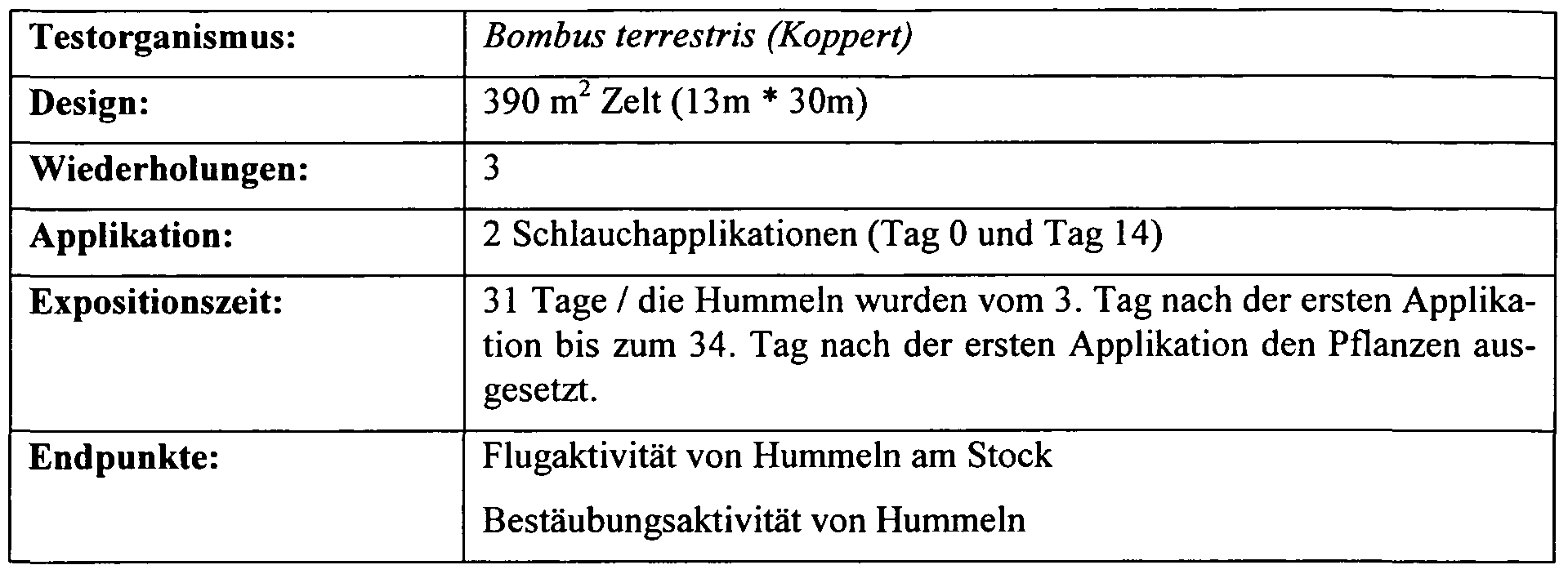
Beispiel 3
Zelttest / Gießapplikation / Hummeln
Der Versuch wurde wie folgt durchgeführt:
Figure imgf000023_0002
Figure imgf000024_0001
Beispiel 3.1
Flugaktivität von Hummeln am Stock
Die Zahl der Hummeln, die im Zeitraum von 10 min in den Stock geflogen sind oder diesen verlas- sen haben wurde bestimmt.
Tabelle 7 (siehe auch Figur 7)
Figure imgf000024_0002
DAA: Zeit nach erster Applikation in Tagen
Die Verbindung 1-5 bewirkt keine Änderung der Flugaktivität der Hummeln.
Beispiel 3.2
Bestäubungsaktivität von Hummeln
Bei Tomaten kommt es durch den Besuch von Hummeln zu einer Farbveränderung der Staubgefäße (markierte Blüten). Es wurde die Zahl offener und markierter Blüten bestimmt. Tabelle 8 (siehe auch Figur 8)
Figure imgf000025_0001
DAA: Zeit nach erster Applikation in Tagen
Die Verbindung 1-5 bewirkt keine Änderung der Bestäubungsaktivität der Hummeln.
Beispiel 4
Gewächshaustest / Rückstandstest / Bienen
Der Versuch wurde wie folgt durchgeführt:
Figure imgf000025_0002
Die Tomatenpflanzen wurden im Gewächshaus mit den Testverbindungen bzw. der Referenzsubstanz behandelt (Spritzappliaktion, 3 fache Wiederholung). 1, 3, 6 und 13 Tage nach Behandlung (DAA) wurden Blätter entnommen (je 5 Blattproben pro Behandlung) und in Boxen gegeben. In jede Box wurden 10 Bienen transferiert und die Boxen wurden unter kontrollierten Bedingungen aufbewahrt, wobei die Bienen mit Zuckerlösung gefüttert wurden. 24, 48 und 72 Stunden nach Transfer der Bienen wurde deren Mortalität bestimmt. Tabelle 9 (siehe auch Figur 9)
Figure imgf000026_0001
Mortalität von Bienen in %, nachdem sie für unterschiedliche Zeiten Kontakt mit Tomatenblättern hatten, die 1 Tag nach Behandlung der Tomatenpflanzen mit den Testverbindungen oder der Refe- renzsubstanz entnommen wurden.
Tabelle 10 (siehe auch Figur 10)
Figure imgf000026_0002
Mortalität von Bienen in %, nachdem sie für unterschiedliche Zeiten Kontakt mit Tomatenblättern hatten, die 3 Tage nach Behandlung der Tomatenpflanzen mit den Testverbindungen oder der Re- ferenzsubstanz entnommen wurden. Tabelle 11 (siehe auch Figur 11)
Figure imgf000027_0001
Mortalität von Bienen in %, nachdem sie für unterschiedliche Zeiten Kontakt mit Tomatenblättern hatten, die 6 Tage nach Behandlung der Tomatenpflanzen mit den Testverbindungen oder der Re- ferenzsubstanz entnommen wurden.
Tabelle 12 (siehe auch Figur 12)
Figure imgf000027_0002
Mortalität von Bienen in %, nachdem sie für unterschiedliche Zeiten Kontakt mit Tomatenblättern hatten, die 13 Tage nach Behandlung der Tomatenpflanzen mit den Testverbindungen oder der Referenzsubstanz entnommen wurden.

Claims

Patentansprüche
1. Verwendung von mindestens einer der Verbindungen ausgewählt unter 4-{[(6-Chloφyrid- 3-yl)methyl](2,2-difiuorethyl)amino}furan-2(5H)-on, 4-{[(6-Chlorpyrid-3- yl)methyl](cyclopropyl)amino}furan-2(5H)-on oder 4-{[(6-Chlθφyrid-3- yl)methyl](methyl)amino}furan-2(5H)-on zur selektiven Bekämpfung tierischer Schädlinge, dadurch gekennzeichnet, dass bestäubende Insekten bei Kontakt mit den Verbindungen nicht geschädigt werden.
2. Verfahren zum Schutz bestäubender Insekten, dadurch gekennzeichnet, dass mindestens eine der Verbindungen ausgewählt unter 4-{[(6-Chlorpyrid-3-yl)methyl](2,2-difluorethyl)- amino}furan-2(5H)-on, 4-{[(6-Chloφyrid-3-yl)methyl](cyclopropyl)amino}furan-2(5H)- on oder 4-{[(6-Chloφyrid-3-yl)methyl](methyl)amino}furan-2(5H)-on zur selektiven Bekämpfung tierischer Schädlinge verwendet wird.
3. Verfahren nach Anspruch 2, wobei die bestäubenden Insekten, Insekten der Superfamilie der Apoidea sind.
4. Verfahren nach Anspruch 2 oder 3, dadurch gekennzeichnet, dass die Verbindungen als Blattanwendung, Bodenanwendung oder Saatgutbehandlung aufgebracht werden.
5. Verfahren nach einem der Ansprüche 2 bis 4, dadurch gekennzeichnet, dass die Verbindungen auf blühende Pflanzen oder in der Nähe blühender Pflanzen oder auf oder in der Nähe von Pflanzen, die von den bestäubenden Insekten beflogen werden, aufgebracht wer- den.
PCT/EP2009/008300 2008-12-05 2009-11-21 Verwendung bestimmter enaminocarbonylverbindungen zur selektiven bekämpfung von insekten Ceased WO2010063382A2 (de)

Priority Applications (2)

Application Number Priority Date Filing Date Title
MX2011005493A MX2011005493A (es) 2008-12-05 2009-11-21 Uso de determinados compuestos de enaminocarbonillo para el combate selectivo de insectos.
AU2009321817A AU2009321817A1 (en) 2008-12-05 2009-11-21 Use of particular enamino carbonyl compounds for selectively controlling insects

Applications Claiming Priority (2)

Application Number Priority Date Filing Date Title
EP08170793.7 2008-12-05
EP08170793A EP2193713A1 (de) 2008-12-05 2008-12-05 Verfahren zur Bekämpfung tierischer Schädlinge ohne Schädigung bestäubender Insekten

Publications (2)

Publication Number Publication Date
WO2010063382A2 true WO2010063382A2 (de) 2010-06-10
WO2010063382A3 WO2010063382A3 (de) 2010-07-29

Family

ID=40766052

Family Applications (1)

Application Number Title Priority Date Filing Date
PCT/EP2009/008300 Ceased WO2010063382A2 (de) 2008-12-05 2009-11-21 Verwendung bestimmter enaminocarbonylverbindungen zur selektiven bekämpfung von insekten

Country Status (6)

Country Link
EP (1) EP2193713A1 (de)
AR (1) AR075658A1 (de)
AU (1) AU2009321817A1 (de)
MX (1) MX2011005493A (de)
TW (1) TW201033199A (de)
WO (1) WO2010063382A2 (de)

Cited By (1)

* Cited by examiner, † Cited by third party
Publication number Priority date Publication date Assignee Title
WO2012171914A1 (en) * 2011-06-14 2012-12-20 Bayer Intellectual Property Gmbh Use of an enaminocarbonyl compound in combination with a biological control agent

Families Citing this family (1)

* Cited by examiner, † Cited by third party
Publication number Priority date Publication date Assignee Title
CN116114517A (zh) * 2023-02-10 2023-05-16 河南职业技术学院 一种榆瘿蚜的绿色防治方法

Family Cites Families (13)

* Cited by examiner, † Cited by third party
Publication number Priority date Publication date Assignee Title
US4272417A (en) 1979-05-22 1981-06-09 Cargill, Incorporated Stable protective seed coating
US4245432A (en) 1979-07-25 1981-01-20 Eastman Kodak Company Seed coatings
US4808430A (en) 1987-02-27 1989-02-28 Yazaki Corporation Method of applying gel coating to plant seeds
EP0539588A1 (de) 1990-07-05 1993-05-05 Nippon Soda Co., Ltd. Aminderivat
US5876739A (en) 1996-06-13 1999-03-02 Novartis Ag Insecticidal seed coating
US6503904B2 (en) 1998-11-16 2003-01-07 Syngenta Crop Protection, Inc. Pesticidal composition for seed treatment
US6660690B2 (en) 2000-10-06 2003-12-09 Monsanto Technology, L.L.C. Seed treatment with combinations of insecticides
US20020134012A1 (en) 2001-03-21 2002-09-26 Monsanto Technology, L.L.C. Method of controlling the release of agricultural active ingredients from treated plant seeds
DE102004047922A1 (de) 2004-10-01 2006-04-06 Bayer Cropscience Ag Wirkstoffe für die Saatgutbehandlung
DE102005059468A1 (de) 2005-12-13 2007-06-14 Bayer Cropscience Ag Insektizide Zusammensetzungen mit verbesserter Wirkung
DE102006015468A1 (de) 2006-03-31 2007-10-04 Bayer Cropscience Ag Substituierte Enaminocarbonylverbindungen
DE102006015470A1 (de) 2006-03-31 2007-10-04 Bayer Cropscience Ag Substituierte Enaminocarbonylverbindungen
DE102006015467A1 (de) 2006-03-31 2007-10-04 Bayer Cropscience Ag Substituierte Enaminocarbonylverbindungen

Cited By (2)

* Cited by examiner, † Cited by third party
Publication number Priority date Publication date Assignee Title
WO2012171914A1 (en) * 2011-06-14 2012-12-20 Bayer Intellectual Property Gmbh Use of an enaminocarbonyl compound in combination with a biological control agent
US9241493B2 (en) 2011-06-14 2016-01-26 Bayer Intellectual Property Gmbh Use of an enaminocarbonyl compound in combination with a biological control agent

Also Published As

Publication number Publication date
AU2009321817A1 (en) 2011-06-23
TW201033199A (en) 2010-09-16
EP2193713A1 (de) 2010-06-09
AR075658A1 (es) 2011-04-20
WO2010063382A3 (de) 2010-07-29
MX2011005493A (es) 2011-06-06

Similar Documents

Publication Publication Date Title
ES2619566T3 (es) Combinaciones de principios activos con propiedades insecticidas y acaricidas
EP3146841B1 (de) Wirkstoffkombinationen enthaltend penflufen und sulfoxaflor
US8420608B2 (en) Active substance combinations with insecticides and acaricide properties
RU2565081C2 (ru) Комбинации активных соединений
KR20120100896A (ko) 살해충제로서의 아미드 및 티오아미드
WO2012010525A2 (de) Verwendung von anthranilsäureamidderivaten zur bekämpfung von insekten und spinnmilben durch angiessen, bodenmischung, furchenbehandlung, tröpfchenapplikation, boden-, stamm- oder blüteninjektion, in hydroponischen systemen, durch pflanzlochbehandlung oder tauchapplikation, floating- oder saatboxapplikation oder durch behandlung von saatgut, sowie zur steigerung der stresstoleranz in pflanzen gegenüber abiotischem stress
EP2533641B1 (de) Hydrazin-substituierte anthranilsäurederivate
WO2010127787A2 (de) Wirkstoffkombinationen mit insektiziden und akariziden eigenschaften
EP2446742A1 (de) Insektizide oder akarizide Zusammensetzungen enthaltend Mono- oder Disacchariden als Wirkungsverstärker
EP2531030B1 (de) Wirkstoffkombinationen enthaltend azadirachtin und eine substituierte enaminocarbonylverbindung
WO2012028583A1 (de) Deltamethrin enthaltende formulierungen
WO2010063382A2 (de) Verwendung bestimmter enaminocarbonylverbindungen zur selektiven bekämpfung von insekten
DE102009028001A1 (de) Wirkstoffkombinationen mit insektiziden und akariziden Eigenschaften

Legal Events

Date Code Title Description
121 Ep: the epo has been informed by wipo that ep was designated in this application

Ref document number: 09759891

Country of ref document: EP

Kind code of ref document: A2

WWE Wipo information: entry into national phase

Ref document number: MX/A/2011/005493

Country of ref document: MX

WWE Wipo information: entry into national phase

Ref document number: 593219

Country of ref document: NZ

NENP Non-entry into the national phase

Ref country code: DE

ENP Entry into the national phase

Ref document number: 2009321817

Country of ref document: AU

Date of ref document: 20091121

Kind code of ref document: A

122 Ep: pct application non-entry in european phase

Ref document number: 09759891

Country of ref document: EP

Kind code of ref document: A2