WO2010072370A1 - Flüssigkristallines medium - Google Patents
Flüssigkristallines medium Download PDFInfo
- Publication number
- WO2010072370A1 WO2010072370A1 PCT/EP2009/009079 EP2009009079W WO2010072370A1 WO 2010072370 A1 WO2010072370 A1 WO 2010072370A1 EP 2009009079 W EP2009009079 W EP 2009009079W WO 2010072370 A1 WO2010072370 A1 WO 2010072370A1
- Authority
- WO
- WIPO (PCT)
- Prior art keywords
- compounds
- liquid
- medium according
- crystalline medium
- formula
- Prior art date
- Legal status (The legal status is an assumption and is not a legal conclusion. Google has not performed a legal analysis and makes no representation as to the accuracy of the status listed.)
- Ceased
Links
- 0 *C1CCC(*c2ccc(*)c(F)c2F)CC1 Chemical compound *C1CCC(*c2ccc(*)c(F)c2F)CC1 0.000 description 13
- BMUFJMIIXDLYRF-UHFFFAOYSA-N CC(C(Oc(cc1)ccc1-c1ccc(C)cc1)=O)=C Chemical compound CC(C(Oc(cc1)ccc1-c1ccc(C)cc1)=O)=C BMUFJMIIXDLYRF-UHFFFAOYSA-N 0.000 description 1
- DBNJHALFULGNPI-UHFFFAOYSA-N CC(CC1)CC=C1c(ccc(C1=CCC(C)CC1)c1F)c1F Chemical compound CC(CC1)CC=C1c(ccc(C1=CCC(C)CC1)c1F)c1F DBNJHALFULGNPI-UHFFFAOYSA-N 0.000 description 1
- LZFRFDYREUPVHA-VAWYXSNFSA-N CC(CC1)CCC1/C=C/C1CCC(C)CC1 Chemical compound CC(CC1)CCC1/C=C/C1CCC(C)CC1 LZFRFDYREUPVHA-VAWYXSNFSA-N 0.000 description 1
- PYNUENONPMFSGI-UHFFFAOYSA-N CC(CC1)CCC1C(CC1)CCC1(C1CCC(C)CC1)C#N Chemical compound CC(CC1)CCC1C(CC1)CCC1(C1CCC(C)CC1)C#N PYNUENONPMFSGI-UHFFFAOYSA-N 0.000 description 1
- KNNWENQALDQCQE-ONEGZZNKSA-N CC(CC1)CCC1C(CC1)CCC1/C=C/C Chemical compound CC(CC1)CCC1C(CC1)CCC1/C=C/C KNNWENQALDQCQE-ONEGZZNKSA-N 0.000 description 1
- MMAROKFFQBGROW-UHFFFAOYSA-N CC(CC1)CCC1C(CC1)CCC1c(ccc(C)c1N)c1N Chemical compound CC(CC1)CCC1C(CC1)CCC1c(ccc(C)c1N)c1N MMAROKFFQBGROW-UHFFFAOYSA-N 0.000 description 1
- BMCJRUXRQBFCLS-UHFFFAOYSA-N CC(CC1)OCC1C(Cc(c1c2F)ccc2F)C1(F)F Chemical compound CC(CC1)OCC1C(Cc(c1c2F)ccc2F)C1(F)F BMCJRUXRQBFCLS-UHFFFAOYSA-N 0.000 description 1
- XPZUUGMAQRROAU-UHFFFAOYSA-N CC(COc(cc1)cc(ccc2c3)c1c2ccc3OC(C(C)=C)=O)=C Chemical compound CC(COc(cc1)cc(ccc2c3)c1c2ccc3OC(C(C)=C)=O)=C XPZUUGMAQRROAU-UHFFFAOYSA-N 0.000 description 1
- NVYIUITYVMVHJM-UHFFFAOYSA-N Cc(ccc(O)c1F)c1F Chemical compound Cc(ccc(O)c1F)c1F NVYIUITYVMVHJM-UHFFFAOYSA-N 0.000 description 1
- HDUGGETUFJTGKV-UHFFFAOYSA-N Oc(ccc(-c1ccc2OI)c3OCc1c2F)c3F Chemical compound Oc(ccc(-c1ccc2OI)c3OCc1c2F)c3F HDUGGETUFJTGKV-UHFFFAOYSA-N 0.000 description 1
Classifications
-
- C—CHEMISTRY; METALLURGY
- C09—DYES; PAINTS; POLISHES; NATURAL RESINS; ADHESIVES; COMPOSITIONS NOT OTHERWISE PROVIDED FOR; APPLICATIONS OF MATERIALS NOT OTHERWISE PROVIDED FOR
- C09K—MATERIALS FOR MISCELLANEOUS APPLICATIONS, NOT PROVIDED FOR ELSEWHERE
- C09K19/00—Liquid crystal materials
- C09K19/04—Liquid crystal materials characterised by the chemical structure of the liquid crystal components, e.g. by a specific unit
- C09K19/06—Non-steroidal liquid crystal compounds
- C09K19/08—Non-steroidal liquid crystal compounds containing at least two non-condensed rings
- C09K19/30—Non-steroidal liquid crystal compounds containing at least two non-condensed rings containing saturated or unsaturated non-aromatic rings, e.g. cyclohexane rings
- C09K19/3001—Cyclohexane rings
- C09K19/3003—Compounds containing at least two rings in which the different rings are directly linked (covalent bond)
-
- C—CHEMISTRY; METALLURGY
- C09—DYES; PAINTS; POLISHES; NATURAL RESINS; ADHESIVES; COMPOSITIONS NOT OTHERWISE PROVIDED FOR; APPLICATIONS OF MATERIALS NOT OTHERWISE PROVIDED FOR
- C09K—MATERIALS FOR MISCELLANEOUS APPLICATIONS, NOT PROVIDED FOR ELSEWHERE
- C09K19/00—Liquid crystal materials
- C09K19/04—Liquid crystal materials characterised by the chemical structure of the liquid crystal components, e.g. by a specific unit
- C09K19/06—Non-steroidal liquid crystal compounds
- C09K19/08—Non-steroidal liquid crystal compounds containing at least two non-condensed rings
- C09K19/10—Non-steroidal liquid crystal compounds containing at least two non-condensed rings containing at least two benzene rings
- C09K19/12—Non-steroidal liquid crystal compounds containing at least two non-condensed rings containing at least two benzene rings at least two benzene rings directly linked, e.g. biphenyls
-
- C—CHEMISTRY; METALLURGY
- C09—DYES; PAINTS; POLISHES; NATURAL RESINS; ADHESIVES; COMPOSITIONS NOT OTHERWISE PROVIDED FOR; APPLICATIONS OF MATERIALS NOT OTHERWISE PROVIDED FOR
- C09K—MATERIALS FOR MISCELLANEOUS APPLICATIONS, NOT PROVIDED FOR ELSEWHERE
- C09K19/00—Liquid crystal materials
- C09K19/04—Liquid crystal materials characterised by the chemical structure of the liquid crystal components, e.g. by a specific unit
- C09K19/06—Non-steroidal liquid crystal compounds
- C09K19/08—Non-steroidal liquid crystal compounds containing at least two non-condensed rings
- C09K19/30—Non-steroidal liquid crystal compounds containing at least two non-condensed rings containing saturated or unsaturated non-aromatic rings, e.g. cyclohexane rings
- C09K19/3001—Cyclohexane rings
-
- C—CHEMISTRY; METALLURGY
- C09—DYES; PAINTS; POLISHES; NATURAL RESINS; ADHESIVES; COMPOSITIONS NOT OTHERWISE PROVIDED FOR; APPLICATIONS OF MATERIALS NOT OTHERWISE PROVIDED FOR
- C09K—MATERIALS FOR MISCELLANEOUS APPLICATIONS, NOT PROVIDED FOR ELSEWHERE
- C09K19/00—Liquid crystal materials
- C09K19/04—Liquid crystal materials characterised by the chemical structure of the liquid crystal components, e.g. by a specific unit
- C09K19/06—Non-steroidal liquid crystal compounds
- C09K19/32—Non-steroidal liquid crystal compounds containing condensed ring systems, i.e. fused, bridged or spiro ring systems
-
- C—CHEMISTRY; METALLURGY
- C09—DYES; PAINTS; POLISHES; NATURAL RESINS; ADHESIVES; COMPOSITIONS NOT OTHERWISE PROVIDED FOR; APPLICATIONS OF MATERIALS NOT OTHERWISE PROVIDED FOR
- C09K—MATERIALS FOR MISCELLANEOUS APPLICATIONS, NOT PROVIDED FOR ELSEWHERE
- C09K19/00—Liquid crystal materials
- C09K19/04—Liquid crystal materials characterised by the chemical structure of the liquid crystal components, e.g. by a specific unit
- C09K19/42—Mixtures of liquid crystal compounds covered by two or more of the preceding groups C09K19/06 - C09K19/40
- C09K19/44—Mixtures of liquid crystal compounds covered by two or more of the preceding groups C09K19/06 - C09K19/40 containing compounds with benzene rings directly linked
-
- C—CHEMISTRY; METALLURGY
- C09—DYES; PAINTS; POLISHES; NATURAL RESINS; ADHESIVES; COMPOSITIONS NOT OTHERWISE PROVIDED FOR; APPLICATIONS OF MATERIALS NOT OTHERWISE PROVIDED FOR
- C09K—MATERIALS FOR MISCELLANEOUS APPLICATIONS, NOT PROVIDED FOR ELSEWHERE
- C09K19/00—Liquid crystal materials
- C09K19/04—Liquid crystal materials characterised by the chemical structure of the liquid crystal components, e.g. by a specific unit
- C09K19/0403—Liquid crystal materials characterised by the chemical structure of the liquid crystal components, e.g. by a specific unit the structure containing one or more specific, optionally substituted ring or ring systems
- C09K2019/0407—Liquid crystal materials characterised by the chemical structure of the liquid crystal components, e.g. by a specific unit the structure containing one or more specific, optionally substituted ring or ring systems containing a carbocyclic ring, e.g. dicyano-benzene, chlorofluoro-benzene or cyclohexanone
-
- C—CHEMISTRY; METALLURGY
- C09—DYES; PAINTS; POLISHES; NATURAL RESINS; ADHESIVES; COMPOSITIONS NOT OTHERWISE PROVIDED FOR; APPLICATIONS OF MATERIALS NOT OTHERWISE PROVIDED FOR
- C09K—MATERIALS FOR MISCELLANEOUS APPLICATIONS, NOT PROVIDED FOR ELSEWHERE
- C09K19/00—Liquid crystal materials
- C09K19/04—Liquid crystal materials characterised by the chemical structure of the liquid crystal components, e.g. by a specific unit
- C09K19/0403—Liquid crystal materials characterised by the chemical structure of the liquid crystal components, e.g. by a specific unit the structure containing one or more specific, optionally substituted ring or ring systems
- C09K2019/0411—Liquid crystal materials characterised by the chemical structure of the liquid crystal components, e.g. by a specific unit the structure containing one or more specific, optionally substituted ring or ring systems containing a chlorofluoro-benzene, e.g. 2-chloro-3-fluoro-phenylene-1,4-diyl
-
- C—CHEMISTRY; METALLURGY
- C09—DYES; PAINTS; POLISHES; NATURAL RESINS; ADHESIVES; COMPOSITIONS NOT OTHERWISE PROVIDED FOR; APPLICATIONS OF MATERIALS NOT OTHERWISE PROVIDED FOR
- C09K—MATERIALS FOR MISCELLANEOUS APPLICATIONS, NOT PROVIDED FOR ELSEWHERE
- C09K19/00—Liquid crystal materials
- C09K19/04—Liquid crystal materials characterised by the chemical structure of the liquid crystal components, e.g. by a specific unit
- C09K2019/0444—Liquid crystal materials characterised by the chemical structure of the liquid crystal components, e.g. by a specific unit characterized by a linking chain between rings or ring systems, a bridging chain between extensive mesogenic moieties or an end chain group
- C09K2019/0448—Liquid crystal materials characterised by the chemical structure of the liquid crystal components, e.g. by a specific unit characterized by a linking chain between rings or ring systems, a bridging chain between extensive mesogenic moieties or an end chain group the end chain group being a polymerizable end group, e.g. -Sp-P or acrylate
-
- C—CHEMISTRY; METALLURGY
- C09—DYES; PAINTS; POLISHES; NATURAL RESINS; ADHESIVES; COMPOSITIONS NOT OTHERWISE PROVIDED FOR; APPLICATIONS OF MATERIALS NOT OTHERWISE PROVIDED FOR
- C09K—MATERIALS FOR MISCELLANEOUS APPLICATIONS, NOT PROVIDED FOR ELSEWHERE
- C09K19/00—Liquid crystal materials
- C09K19/04—Liquid crystal materials characterised by the chemical structure of the liquid crystal components, e.g. by a specific unit
- C09K19/06—Non-steroidal liquid crystal compounds
- C09K19/08—Non-steroidal liquid crystal compounds containing at least two non-condensed rings
- C09K19/30—Non-steroidal liquid crystal compounds containing at least two non-condensed rings containing saturated or unsaturated non-aromatic rings, e.g. cyclohexane rings
- C09K19/3001—Cyclohexane rings
- C09K19/3003—Compounds containing at least two rings in which the different rings are directly linked (covalent bond)
- C09K2019/3004—Cy-Cy
-
- C—CHEMISTRY; METALLURGY
- C09—DYES; PAINTS; POLISHES; NATURAL RESINS; ADHESIVES; COMPOSITIONS NOT OTHERWISE PROVIDED FOR; APPLICATIONS OF MATERIALS NOT OTHERWISE PROVIDED FOR
- C09K—MATERIALS FOR MISCELLANEOUS APPLICATIONS, NOT PROVIDED FOR ELSEWHERE
- C09K19/00—Liquid crystal materials
- C09K19/04—Liquid crystal materials characterised by the chemical structure of the liquid crystal components, e.g. by a specific unit
- C09K19/06—Non-steroidal liquid crystal compounds
- C09K19/08—Non-steroidal liquid crystal compounds containing at least two non-condensed rings
- C09K19/30—Non-steroidal liquid crystal compounds containing at least two non-condensed rings containing saturated or unsaturated non-aromatic rings, e.g. cyclohexane rings
- C09K19/3001—Cyclohexane rings
- C09K19/3003—Compounds containing at least two rings in which the different rings are directly linked (covalent bond)
- C09K2019/301—Cy-Cy-Ph
-
- C—CHEMISTRY; METALLURGY
- C09—DYES; PAINTS; POLISHES; NATURAL RESINS; ADHESIVES; COMPOSITIONS NOT OTHERWISE PROVIDED FOR; APPLICATIONS OF MATERIALS NOT OTHERWISE PROVIDED FOR
- C09K—MATERIALS FOR MISCELLANEOUS APPLICATIONS, NOT PROVIDED FOR ELSEWHERE
- C09K19/00—Liquid crystal materials
- C09K19/04—Liquid crystal materials characterised by the chemical structure of the liquid crystal components, e.g. by a specific unit
- C09K19/06—Non-steroidal liquid crystal compounds
- C09K19/08—Non-steroidal liquid crystal compounds containing at least two non-condensed rings
- C09K19/30—Non-steroidal liquid crystal compounds containing at least two non-condensed rings containing saturated or unsaturated non-aromatic rings, e.g. cyclohexane rings
- C09K19/3001—Cyclohexane rings
- C09K19/3003—Compounds containing at least two rings in which the different rings are directly linked (covalent bond)
- C09K2019/3016—Cy-Ph-Ph
-
- C—CHEMISTRY; METALLURGY
- C09—DYES; PAINTS; POLISHES; NATURAL RESINS; ADHESIVES; COMPOSITIONS NOT OTHERWISE PROVIDED FOR; APPLICATIONS OF MATERIALS NOT OTHERWISE PROVIDED FOR
- C09K—MATERIALS FOR MISCELLANEOUS APPLICATIONS, NOT PROVIDED FOR ELSEWHERE
- C09K19/00—Liquid crystal materials
- C09K19/04—Liquid crystal materials characterised by the chemical structure of the liquid crystal components, e.g. by a specific unit
- C09K19/06—Non-steroidal liquid crystal compounds
- C09K19/08—Non-steroidal liquid crystal compounds containing at least two non-condensed rings
- C09K19/30—Non-steroidal liquid crystal compounds containing at least two non-condensed rings containing saturated or unsaturated non-aromatic rings, e.g. cyclohexane rings
- C09K19/3001—Cyclohexane rings
- C09K19/3003—Compounds containing at least two rings in which the different rings are directly linked (covalent bond)
- C09K2019/3027—Compounds comprising 1,4-cyclohexylene and 2,3-difluoro-1,4-phenylene
-
- C—CHEMISTRY; METALLURGY
- C09—DYES; PAINTS; POLISHES; NATURAL RESINS; ADHESIVES; COMPOSITIONS NOT OTHERWISE PROVIDED FOR; APPLICATIONS OF MATERIALS NOT OTHERWISE PROVIDED FOR
- C09K—MATERIALS FOR MISCELLANEOUS APPLICATIONS, NOT PROVIDED FOR ELSEWHERE
- C09K19/00—Liquid crystal materials
- C09K19/04—Liquid crystal materials characterised by the chemical structure of the liquid crystal components, e.g. by a specific unit
- C09K19/06—Non-steroidal liquid crystal compounds
- C09K19/34—Non-steroidal liquid crystal compounds containing at least one heterocyclic ring
- C09K19/3402—Non-steroidal liquid crystal compounds containing at least one heterocyclic ring having oxygen as hetero atom
- C09K19/3405—Non-steroidal liquid crystal compounds containing at least one heterocyclic ring having oxygen as hetero atom the heterocyclic ring being a five-membered ring
- C09K2019/3408—Five-membered ring with oxygen(s) in fused, bridged or spiro ring systems
-
- C—CHEMISTRY; METALLURGY
- C09—DYES; PAINTS; POLISHES; NATURAL RESINS; ADHESIVES; COMPOSITIONS NOT OTHERWISE PROVIDED FOR; APPLICATIONS OF MATERIALS NOT OTHERWISE PROVIDED FOR
- C09K—MATERIALS FOR MISCELLANEOUS APPLICATIONS, NOT PROVIDED FOR ELSEWHERE
- C09K19/00—Liquid crystal materials
- C09K19/04—Liquid crystal materials characterised by the chemical structure of the liquid crystal components, e.g. by a specific unit
- C09K19/06—Non-steroidal liquid crystal compounds
- C09K19/34—Non-steroidal liquid crystal compounds containing at least one heterocyclic ring
- C09K19/3402—Non-steroidal liquid crystal compounds containing at least one heterocyclic ring having oxygen as hetero atom
- C09K2019/3422—Non-steroidal liquid crystal compounds containing at least one heterocyclic ring having oxygen as hetero atom the heterocyclic ring being a six-membered ring
- C09K2019/3425—Six-membered ring with oxygen(s) in fused, bridged or spiro ring systems
-
- C—CHEMISTRY; METALLURGY
- C09—DYES; PAINTS; POLISHES; NATURAL RESINS; ADHESIVES; COMPOSITIONS NOT OTHERWISE PROVIDED FOR; APPLICATIONS OF MATERIALS NOT OTHERWISE PROVIDED FOR
- C09K—MATERIALS FOR MISCELLANEOUS APPLICATIONS, NOT PROVIDED FOR ELSEWHERE
- C09K2323/00—Functional layers of liquid crystal optical display excluding electroactive liquid crystal layer characterised by chemical composition
Definitions
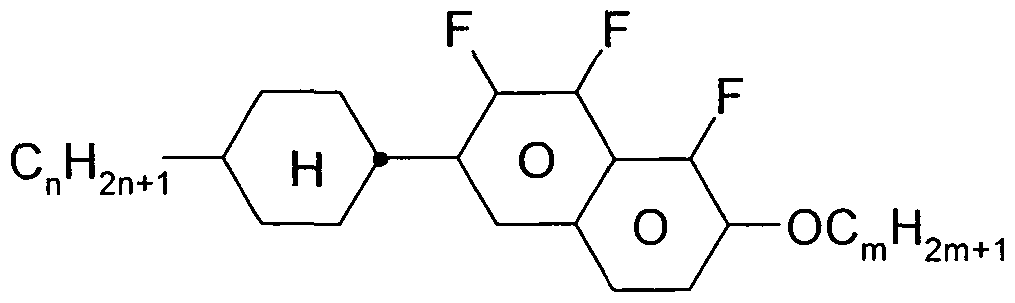
- the invention relates to a liquid-crystalline medium having negative dielectric anisotropy, which comprises at least one compound of the formula I 1
- R 1 and R 1 * each independently represent an alkyl radical with 1-6 C-,
- Such media are to be used in particular for electro-optical displays with an active matrix addressing based on the ECB effect as well as for IPS-5 displays (in-plane switching) or FFS displays (fringe field switching).
- liquid-crystalline phases have high values for the ratio of the elastic constants K 3 / K 1 , high values for the optical anisotropy ⁇ n and values for the dielectric anisotropy of ⁇ ⁇ -0.5 must be in order for highly informative
- VA technology Vertical Aligned
- VAN Very Aligned hJematic displays
- MVA Multi-Domain Vertical Alignment, eg: Yoshide, H. et al., Lecture 3.1: "MVA LCD for Notebook or Mobile PCs ... ", SID 2004 International Symposium, Digest of Technical Papers, XXXV, Book I, pp. 6-9 and Liu, CT et al., Lecture 15.1: 11 A 46-inch TFT-LCD HDTV Technnology ... ", SID 2004 International Symposium, Digest of Technical Papers, XXXV, Book II, pp. 750-753), PVA (Patterned Vertical Alignment, eg: Yoshide, H. et al., Lecture 3.1: "MVA LCD for Notebook or Mobile PCs ... ", SID 2004 International Symposium, Digest of Technical Papers, XXXV, Book I, pp. 6-9 and Liu, CT et al., Lecture 15.1: 11 A 46-inch TFT-LCD HDTV Technn
- FK phases are needed, which must meet a variety of requirements. Particularly important here are the chemical resistance to moisture, air and physical influences such as heat, radiation in the infrared, visible and ultraviolet range and electrical alternating and alternating fields.
- LC phases require a liquid-crystalline mesophase in a suitable temperature range and a low viscosity.
- Matrix liquid crystal displays are known.
- active elements i.e., transistors
- non-linear elements for individual switching of the individual pixels.
- active matrix whereby one can distinguish two types:
- MOS Metal Oxide Semiconductor
- TFT Thin-film transistors
- Type 1 typically uses dynamic scattering or guest-host effect as the electro-optic effect.
- the use of monocrystalline silicon as a substrate material limits the display size, since the modular composition of different partial displays on the joints leads to problems.
- the TN effect is usually used as the electro-optic effect.
- TFTs made of compound semiconductors, such as e.g. CdSe or TFTs based on polycrystalline or amorphous silicon.
- CdSe compound semiconductors
- TFTs based on polycrystalline or amorphous silicon The latter technology is being worked on worldwide with great intensity.
- the TFT matrix is applied on the inside of one glass plate of the display, while the other glass plate on the inside carries the transparent counter electrode. Compared to the size of the pixel electrode, the TFT is very small and practically does not disturb the image.
- This technology can also be extended to fully color-capable image representations, wherein a mosaic of red, green and blue filters is arranged such that each one filter element is opposite to a switchable image element.
- the previously known TFT displays usually work as TN cells with crossed polaristors in transmission and are backlit.
- MFK displays here includes any matrix display with integrated nonlinear elements, i.
- Such MFK displays are particularly suitable for TV applications (eg pocket TV) or for high-information displays in automotive or aircraft.
- the contrast and the switching times result in MFK displays difficulties due to a not sufficiently high resistivity of the liquid crystal mixtures [TOGASHI, S., SEKIGUCHI, K., TANABE 1 H., YAMAMOTO, E., SORIMACHI, K., TAJIMA, E .,
- the disadvantage of the previously known MFK TN displays is their comparatively low contrast, the relatively high viewing angle dependence and the difficulty in generating gray scale in these displays.
- dielectrically neutral compounds in ECB or VA applications are referred to as dielectrically neutral compounds in ECB or VA applications, in particular compounds of the formulas
- R 1 H or CH 3
- the object of the invention is to provide liquid crystal mixtures, in particular for monitor and TV applications, which are based on the ECB or on the IPS or FFS effect, which do not have the disadvantages mentioned above or only to a lesser extent , In particular, it must be ensured for monitors and TVs that they also work at extremely high and extremely low temperatures and at the same time have low switching times and at the same time have improved reliability behavior, in particular no or significantly reduced image sticking after long runtimes.
- R 1 and R 1 are each independently an alkyl radical having 1 to 6 carbon atoms
- the invention thus relates to a liquid-crystalline medium which contains at least one compound of the formula I.
- the mixtures according to the invention preferably exhibit very broad nematic phase ranges with clearing points> 60 0 C 1 preferably> 65 0 C, in particular> 70 0 C, very favorable values for the capacitive threshold, relatively high values for the holding ratio and at the same time very good low-temperature stabilities at - 30 0 C and -40 0 C and very low rotational viscosities and low switching times.
- the mixtures according to the invention are further distinguished by the fact that in addition to improving the rotational viscosity y ⁇ an increase in the elastic
- Constants K 33 is observed to improve the switching times, and they show improved reliability behavior.
- R 1 and R 1 * in the formula I is straight-chain alkyl, in particular C 2 H 5 , nC 3 H 7 , nC 4 H 9 , furthermore n-CsHn, nC 6 Hi 3 . More preferably R1 is nC 3 H 7 and R 1 'is CH 3 , C 2 H 5 or nC 3 H 7 .
- liquid-crystalline medium which contains one, two, three, four or more, preferably one, two or three, compounds of the formula I,
- liquid-crystalline medium wherein the proportion of compounds of formula I in the total mixture ⁇ 3, preferably ⁇ 10 wt.%, Particularly preferably> 15 wt.%, Is. Particular preference is given to liquid-crystalline media which contain 3-50%, preferably 25-35%, of one or more compounds of the formula I.
- Preferred compounds of the formula I are the compounds of the formulas 1-1 to I-6,
- Mixtures of the invention preferably contain the compounds of formula 1-1 and / or I-2, preferably in amounts of 5-30%.
- the medium according to the invention particularly preferably contains the trinuclear compounds of the formula I-1 and / or of the formula I-2 in combination with one or more dinuclear compounds of the formulas 13 to 16.
- the total amount of the compounds of the formula I is preferably 1-1 and / or I-2 in combination with one or more compounds selected from the binuclear compounds of formulas I-3 to I-6 5-40%, most preferably 15-35%.
- Very particularly preferred mixtures contain the compounds 1-1 and I-3:
- the compounds 1-1 and I-3 are preferably present in the mixture in a concentration of 15-35%, more preferably 15-25% and especially preferably 18-22%, based on the total mixture.
- Very particularly preferred mixtures contain the compounds I-2 and I-3:
- the compounds I-2 and I-3 are preferably present in the mixture in a concentration of 15-35%, particularly preferably 15-25% and particularly preferably 18-22%, based on the total mixture.
- Very particularly preferred mixtures contain the following three compounds:
- the compounds 1-1, I-2 and I-3 are present in the mixture in a concentration of 15-35%, more preferably 15-25% and most preferably 18-22% of the total mixture.
- Liquid-crystalline medium which additionally contains one or more compounds selected from the group of the compounds of the formulas IIA, IIB and HC,
- R 2A , R 2B and R 2C are each independently H, an unsubstituted, an alkyl radical which is monosubstituted by CN or CF 3 or at least monosubstituted by halogen and has up to 15 C atoms, one or more of which also being present in these radicals
- -CF 2 O-, -OCF 2 -, -OC-O- or -O-CO- can be replaced so that O atoms are not directly linked to each other
- q 0 or 1
- Z 2 may have the same or different meanings.
- Z 2 and Z 2 may have the same or different meanings.
- R 2A , R 2B and R are each preferably alkyl having 1-6 C atoms, in particular CH 3 , C 2 H 5 , nC 3 H 7 , nC 4 H 9 , nC 5 hn.
- Z 2 and Z 2 'in the formulas IIA and IIB preferably each independently of one another a single bond, furthermore a -C 2 H 4 -bridge.
- Z 2 -C 2 H 4 -
- (O) C v H 2v + 1 preferably denotes OC v H 2 v + i, furthermore CvH 2v + i.
- Compounds of the formula HC is (O) C v H 2v + 1, preferably C v H 2v + i.
- L 3 and L 4 are preferably in each case F.
- alkyl and alkyl * each independently represent a straight-chain alkyl radical having 1-6 C atoms.
- Particularly preferred mixtures according to the invention comprise one or more compounds of the formulas IIA-2, IIA-8, IIA-14, HA-29, IIA-35, IIB-2, IIB-11, IIB-16 and IIC-1.
- the proportion of compounds of the formulas IIA and / or IIB in the total mixture is preferably at least 20% by weight.
- Particularly preferred media according to the invention contain a compound of the formula IIC-1,
- alkyl and alkyl * have the meanings given above, preferably in amounts of> 3% by weight, in particular> 5% by weight and particularly preferably from 5 to 25% by weight.
- Liquid-crystalline medium which additionally contains one or more compounds of the formula III
- R 31 and R 32 each independently represent a straight-chain alkyl, alkoxyalkyl or alkoxy radical having up to 12 C atoms, and
- Alkyl and alkyl * each independently represent a straight-chain alkyl radical having 1-6 C atoms.
- the medium according to the invention preferably contains at least one compound of the formula IIIa and / or formula IIIb.
- the proportion of compounds of the formula III in the total mixture is preferably at least 5% by weight.
- Liquid-crystalline medium additionally containing a compound of the formula and or preferably in total amounts of ⁇ 20% by weight, in particular of ⁇ 10% by weight.
- Liquid-crystalline medium which additionally contains one or more four-nucleus compounds of the formulas,
- R, 7-10 are each independently of one another as defined in claim 2 for R, 2A, and
- w and x are each independently 1 to 6
- Liquid-crystalline medium which additionally contains one or more compounds of the formulas Y-1 to Y-6
- R 14 -R 19 each independently represent an alkyl or alkoxy radical having 1-6 C atoms; z and m are each independently 1-6; x is O, 1, 2 or 3.
- the medium according to the invention particularly preferably contains one or more compounds of the formula Y-1, preferably in amounts of> 5% by weight.
- Liquid-crystalline medium additionally containing one or more fluorinated terphenyls of the formulas T-1 to T-20,
- R represents straight-chain alkyl or alkoxy radical having 1-7 C atoms, and m is 1-6,
- R is methyl, ethyl, propyl, butyl, pentyl, hexyl, methoxy, ethoxy, propoxy, butoxy, pentoxy.
- the medium according to the invention contains the terphenyls of the formulas T-1 to T-20, preferably in amounts of from 2 to 30% by weight, in particular from 5 to 20% by weight.
- R preferably denotes alkyl, furthermore alkoxy in each case with 1-5 C atoms.
- the terphenyls are preferably used in the mixtures according to the invention if the ⁇ n value of the mixture is to be> 0.1.
- Preferred mixtures contain 2-20 wt.% Of one or more terphenyl compounds selected from the group of
- Liquid-crystalline medium additionally containing one or more
- Alkyl and alkyl * each independently a straight-chain alkyl radical having 1-6 C atoms
- Alkenyl and alkenyl * each independently a straight-chain alkenyl radical having 2-6 C atoms
- the proportion of the biphenyls of the formulas B-1 to B-3 in the overall mixture is preferably at least 3% by weight, in particular
- the compounds of the formula B-2 are particularly preferred.
- alkyl * is an alkyl radical having 1-6 C atoms.
- the medium according to the invention contains one or more compounds of the formulas B-1a and / or B-2c.
- Liquid-crystalline medium containing at least one compound of the formulas Z-1 to Z-7,
- R and alkyl have the meanings given above.
- Liquid-crystalline medium containing at least one compound of the formulas 0-1 to 0-18,
- R 1 and R 2 have the meanings given for R 2A .
- R 1 and R 2 each independently represent straight-chain alkyl.
- Preferred media contain one or more compounds of formulas 0-1, 0-3, 0-4, 0-9, 0-13, 0-14, 0-15, 0-16, 0-17 and / or 0-18 ,
- Preferred liquid crystalline media according to the present invention contain one or more substances having a tetrahydronaphthyl or naphthyl moiety, e.g. the compounds of the formulas
- R 1 N and R 2N each independently of one another have the meanings given for R 2A , preferably straight-chain alkyl, straight-chain alkoxy or straight-chain alkenyl, and
- Z 1 and Z 2 are each independently
- Preferred mixtures contain one or more compounds selected from the group of difluorodibenzochroman compounds of the formula BC, chromans of the formulas CR, fluorinated phenanthrenes of the formulas PH-1 and PH-2, fluorinated dibenzofurans of the formulas BF,
- R B I R B2 (R C R RI _ CR2 R i ⁇ R 2 Jewe j
- the mixtures according to the invention preferably contain the compounds of the formulas BC, CR, PH-1, PH-2 and / or BF in amounts of from 3 to 20% by weight, in particular in amounts of from 3 to 15% by weight.
- Particularly preferred compounds of the formulas BC and CR are the compounds BC-1 to BC-7 and CR-1 to CR-5,
- Alkyl and alkyl * each independently represent a straight-chain alkyl radical having 1-6 C atoms
- Alkenyl and alkenyl * each independently of one another a straight-chain alkenyl radical having 2-6 C atoms
- Preferred mixtures contain one or more indane compounds of the formulas In,
- R 11 , R 12 , R 13 each independently represent a straight-chain alkyl, or alkoxy, alkoxyalkyl, alkenyl radical having 1-6 C atoms,
- R 12 and R 13 additionally halogen, preferably F,
- Preferred compounds of the formula In are the following compounds of the formulas ln-1 to ln-16,
- the compounds of formulas In and sub-formulas ln-1 to ln-16 are preferably in concentrations> 5% by weight, in particular 5-30 wt.% And most preferably 5-25 wt.% Used in the mixtures according to the invention.
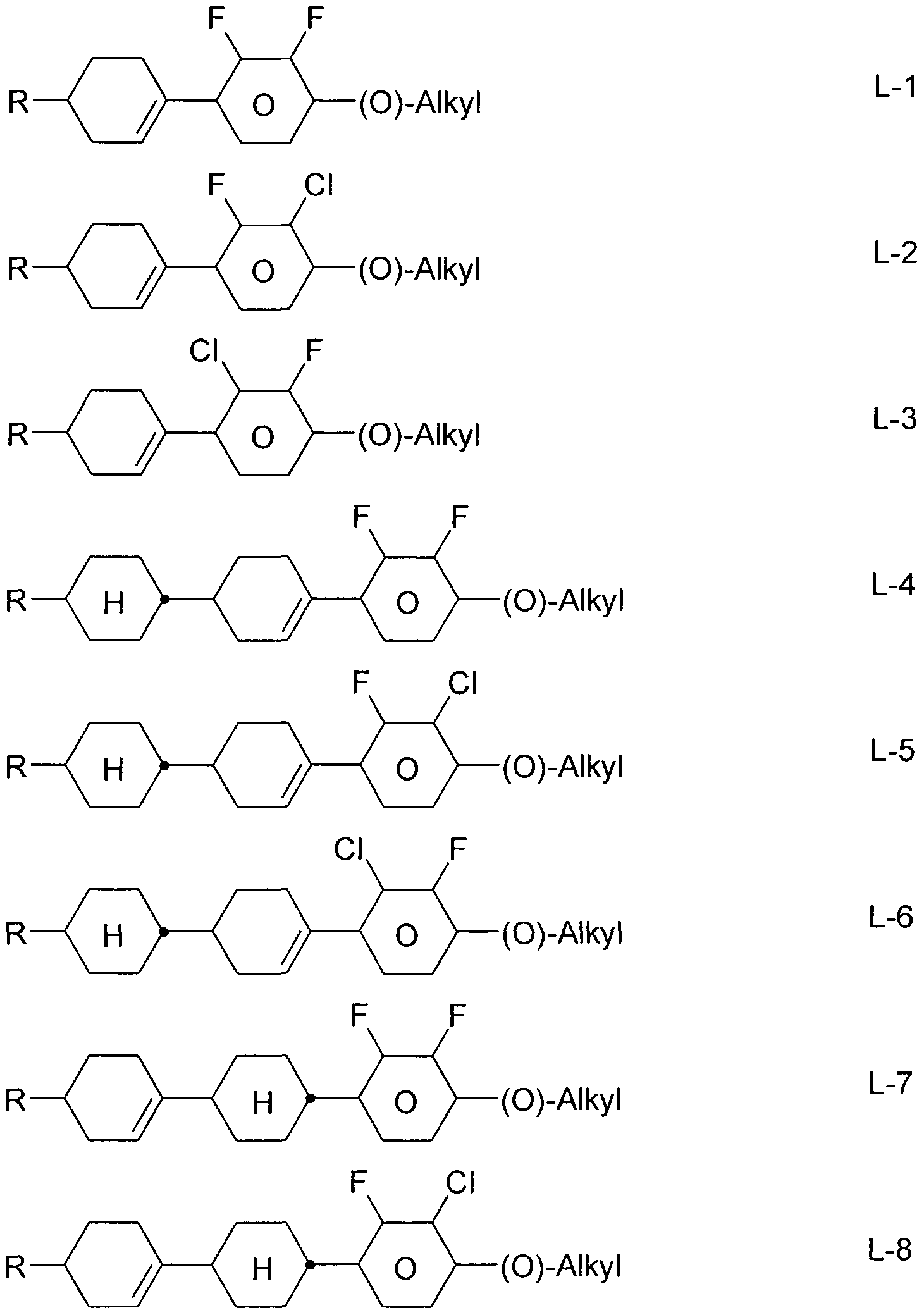
- Preferred mixtures additionally contain one or more
- R, R 1 and R 2 each independently of one another have the meanings given for R 2A in claim 2 and alkyl is an alkyl radical having 1-6 C atoms, s is 1 or 2.
- the compounds of the formulas L-1 to L-1 1 are preferably used in concentrations of 5 to 50% by weight, in particular 5 to 40% by weight and very particularly preferably 10 to 40% by weight.
- the medium according to the invention contains at least three compounds selected from the group of the compounds of the formulas 1-1 to I-6,
- the medium according to the invention contains the compounds of the formula I-1 and / or I-2
- mixtures according to the invention preferably contain
- CPY-n-Om in particular CPY-2-02, CPY-3-02 and / or CPY-5-O2, preferably in concentrations of> 5%, in particular 10-30%, based on the total mixture,
- CY-n-Om preferably CY-3-02, CY-3-04, CY-5-02 and / or CY-5-04, preferably in concentrations> 5%, in particular 15-50%, based on the total mixture,
- CCY-n-Om preferably CCY-4-02, CCY-3-O2, CCY-3-03 and / or CCY-5-02, preferably in concentrations> 5%, in particular 10-30%, based on the total mixture,
- CLY-n-Om preferably CLY-2-04, CLY-3-02 and / or CLY-3-03, preferably in concentrations> 5%, in particular 10-30%, based on the total mixture,
- CK-n-F preferably CK-3-F, CK-4-F and / or CK-5-F, preferably> 5%, in particular 5-25%, based on the total mixture
- mixtures according to the invention which contain the following mixture concepts: (n and m each independently of one another denote 1-6).
- CPY-n-Om and CY-n-Om preferably in concentrations of 10-80% relative to the total mixture
- CPY-n-Om and CK-n-F preferably in concentrations of 10-70% relative to the total mixture
- Another object of the invention is an electro-optical display with an active matrix addressing based on the ECB, IPS or FFS effect, characterized in that it is a liquid-crystalline medium as a dielectric according to one or more of claims 1 to
- the liquid-crystalline medium according to the invention preferably has a nematic phase of ⁇ -20 0 C to> 70 0 C, particularly preferably from ⁇ -30 0 C to> 80 0 C, most preferably from ⁇ -40 0 C to> 90 0 C. ,
- the term "having a nematic phase" on the one hand means that no smectic phase and no crystallization is observed at low temperatures at the corresponding temperature and, on the other hand, that no clarification occurs during heating from the nematic phase.
- the investigation at low temperatures is carried out in a flow viscometer at the appropriate temperature and checked by storage in test cells of a corresponding electro-optical layer thickness for at least 100 hours.
- the storage stability at a temperature of -20 0 C in a corresponding test cell is 1000 h or more, the medium as at this temperature is called stable.
- the corresponding times are 500 h or 250 h.
- the clearing point is measured in capillaries by conventional methods.
- the liquid crystal mixture on a nematic phase range of at least 60 K and a flow viscosity of a maximum of 20 v 30 mm 2 • s "1 at 20 0 C.
- the values of the birefringence ⁇ n in the liquid-crystal mixture are generally between 0.07 and 0.16, preferably between 0.08 and 0.12.
- the liquid-crystal mixture according to the invention has a ⁇ of -0.5 to -8.0, in particular of -3.0 to -6.0, where ⁇ is the dielectric Anisotropy means.
- the rotational viscosity ⁇ i at 20 0 C is preferably ⁇ 165 mPa-s, in particular ⁇ 140 mPas.
- the liquid-crystal media according to the invention have relatively small values for the threshold voltage (V 0 ). Preferably, they are in the range of 1.7V to 3.0V, more preferably ⁇ 2.75V and most preferably ⁇ 2.4V.
- threshold voltage refers to the present invention
- liquid-crystal media according to the invention have high values for the voltage holding ratio, in particular after exposure to display backlights, in liquid-crystal cells.
- liquid crystal media with a low drive voltage or threshold voltage show a lower voltage 2Q holding ratio than those with a larger drive voltage or threshold voltage and vice versa.
- dielectrically positive compounds mean those compounds having a ⁇ > 1, 5, "dielectrically positive compounds"
- OC neutral compounds "those with -1, 5 ⁇ ⁇ 1, 5 and" dielectrically negative “compounds those with ⁇ ⁇ -1, 5.
- the dielectric anisotropy of the compounds is determined by dissolving 10% of the compounds in a liquid crystal host and from the resulting mixture, the capacity in at least one test cell with 20 microns
- O Q layer thickness is determined with homeotropic and with homogeneous surface orientation at 1 kHz.
- the measuring voltage is typically 0.5 V to 1.0 V, but it is always lower than the capacitive threshold of the liquid crystal mixture in question.
- thermosenor temperatures for the present invention are in 0 C.
- the mixtures according to the invention are suitable for all VA TFT applications, such as, for example, VAN, MVA, (S) -PVE, ASV. Furthermore, they are suitable for IPS Qn ⁇ -switching) and FFS (fringe field switching) with negative ⁇ .
- the nematic liquid-crystal mixtures in the displays according to the invention generally contain two components A and B, which in turn consist of one or more individual compounds.
- Component A has a markedly negative dielectric anisotropy and gives the nematic phase a dielectric anisotropy of ⁇ -0.5. It preferably contains, in addition to one or more compounds of the formula I, the compounds of the formulas IIA, IIB and / or HC, and also compounds of the formulas III.
- the proportion of component A is preferably between 45 and 100%, in particular between 60 and 100%.
- one (or more) individual compound (s) is preferably selected which have a value of ⁇ ⁇ -0.8. This value must be the more negative the smaller the proportion A of the total mixture is.
- the component B has a pronounced nematogeneity and a flow viscosity of not more than 30 mm 2 s "1 , preferably not more than 25 mm 2 s " 1 , at 20 0 C.
- Particularly preferred individual compounds of component B are extremely low-viscosity nematic liquid crystals having a flow viscosity of not more than 18, preferably not more than 12 mm 2 s -1 , at 20 ° C.
- Component B is monotropic or enantiotropic nematic, has no smectic phases and can prevent the occurrence of smectic phases up to very low temperatures in liquid-crystal mixtures. If, for example, a smectic liquid-crystal mixture is mixed with respectively different materials with high nematogeneity, then the degree of suppression of smectic phases compared the immutability of these materials.
- these liquid crystal phases may also contain more than 18 components, preferably 18 to 25 components.
- the phases preferably contain 4 to 15, in particular 5 to 12, and particularly preferably ⁇ 10, compounds of the formulas IIA, IIB and / or MC and optionally III.
- constituents may also be present, eg. B. in an amount of up to 45% of the total mixture, but preferably up to 35%, in particular up to 10%.
- the other constituents are preferably selected from the nematic or nematogenic substances, in particular the known substances, from the classes of the azoxybenzenes, benzylideneanilines, biphenyls, terphenyls, phenyl or cyclohexyl benzoates, cyclohexane-carboxylic acid phenyl or cyclohexyl esters, phenylcyclohexanes , Cyclohexylbiphenyls, cyclohexylcyclohexanes, cyclohexylnaphthalenes, 1,4-biscyclohexylbiphenyls or cyclohexylpyrimidines, phenyl- or cyclohexyldioxanes, optionally halogenated stilbenes, benzylphenyl ethers, tolans and substituted cinnamic acid esters.
- L and E are each a carbo- or heterocyclic ring system of the 1,4-disubstituted benzene and cyclohexane rings, 4,4'-disubstituted biphenyl, phenylcyclohexane and cyclohexylcyclohexane systems, 2,5-disubstituted pyrimidine and 1,3 Dioxane rings, 2,6-disubstituted naphthalene, di- and tetrahydronaphthalene, quinazoline and tetrahydroquinazoline,
- Q is halogen, preferably chlorine or -CN
- R 20 and R 21 are each alkyl, alkenyl, alkoxy, alkoxyalkyl or alkoxycarbonyloxy having up to 18, preferably up to 8 carbon atoms, or one of these radicals also CN , NC, NO 2 , NCS, CF 3 , SF 5 , OCF 3 , F, Cl or Br.
- R 20 and R 21 are different, one of these radicals usually being an alkyl or alkoxy group.
- Other variants of the proposed substituents are in use. Many such substances or mixtures thereof are commercially available. All these substances can be prepared by literature methods.
- VA, IPS or FFS mixture according to the invention can also contain compounds in which, for example, H, N, O, Cl, F have been replaced by the corresponding isotopes.
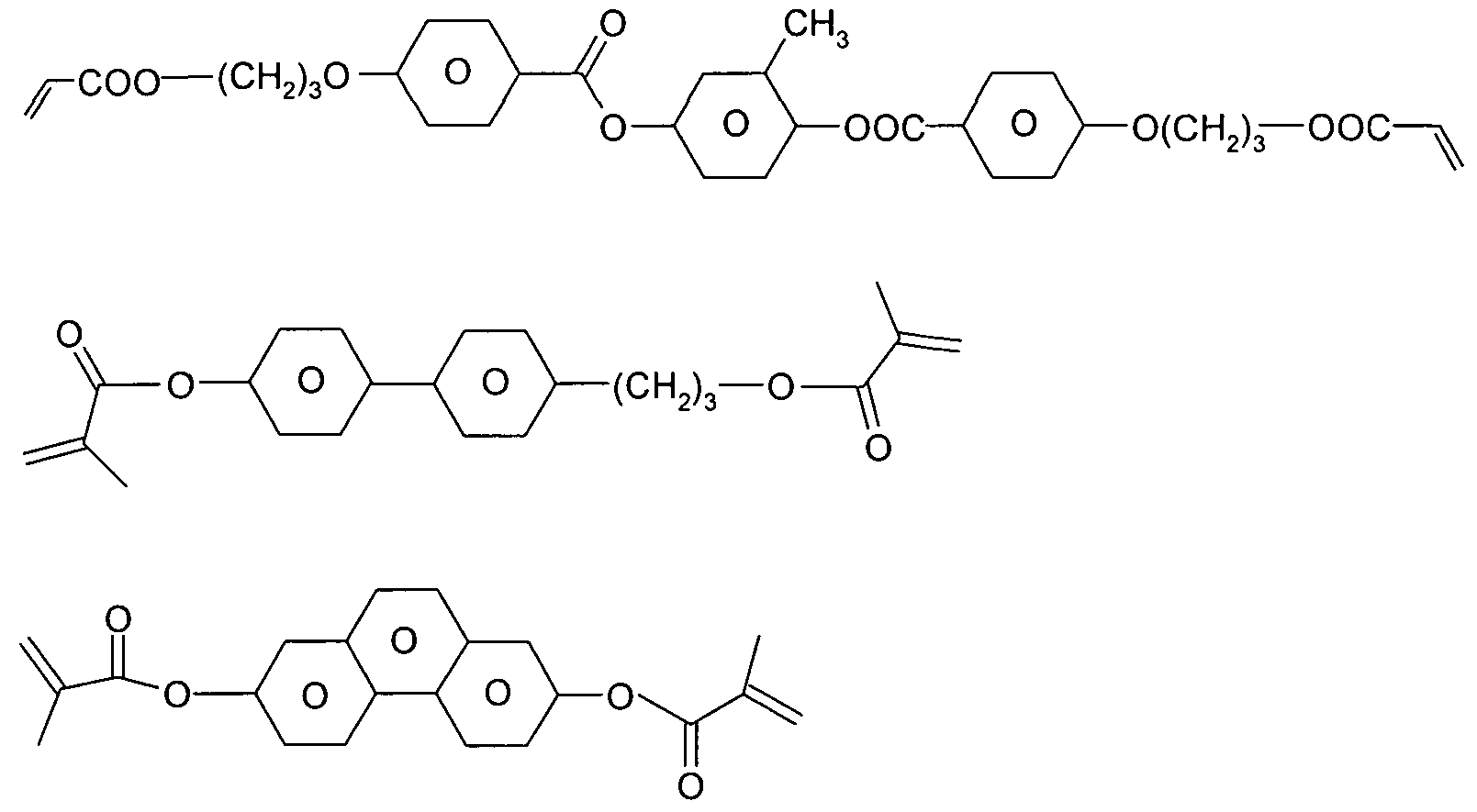
- the mixtures according to the invention may further comprise polymerizable compounds, so-called reactive mesogens (RMs) 1, for example in US Pat. No. 6,861,107, in concentrations of preferably 0.12-5% by weight, more preferably 0.2-2%, based on the mixture.
- RMs reactive mesogens
- these mixtures can also contain an initiator, as described, for example, in US Pat. No. 6,781,665.
- Initiator e.g. Irganox-1076 from Ciba
- Irganox-1076 from Ciba
- Such mixtures can be used for so-called polymer stabilized VA modes (PS-VA), in which a polymerization of the reactive mesogens in the liquid-crystalline mixture is to take place.
- PS-VA polymer stabilized VA modes
- Suitable polymerizable compounds are listed, for example, in Table D.
- the mixtures according to the invention may further contain conventional additives or additives, e.g. Stabilizers, antioxidants, UV absorbers, nanoparticles, microparticles, etc.
- additives or additives e.g. Stabilizers, antioxidants, UV absorbers, nanoparticles, microparticles, etc.
- the structure of the liquid crystal displays according to the invention corresponds to the usual geometry, as e.g. in EP-OS 0 240 379, is described.
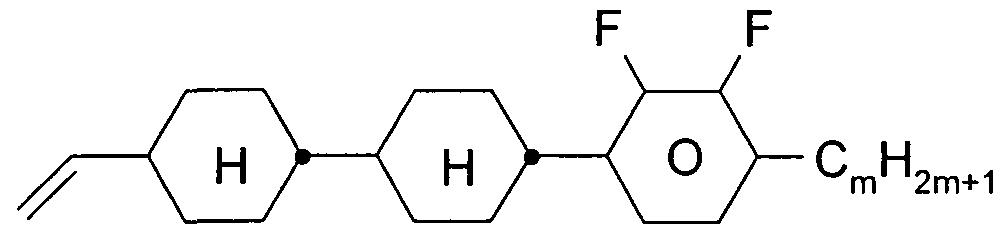
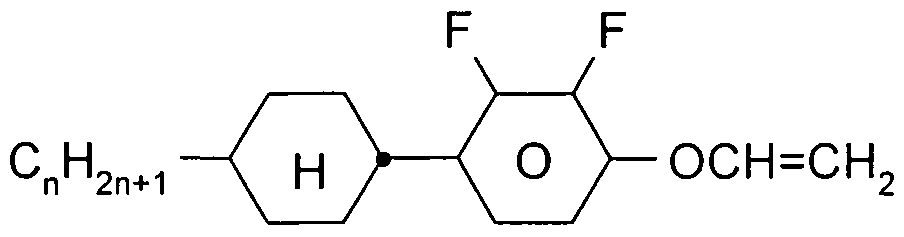
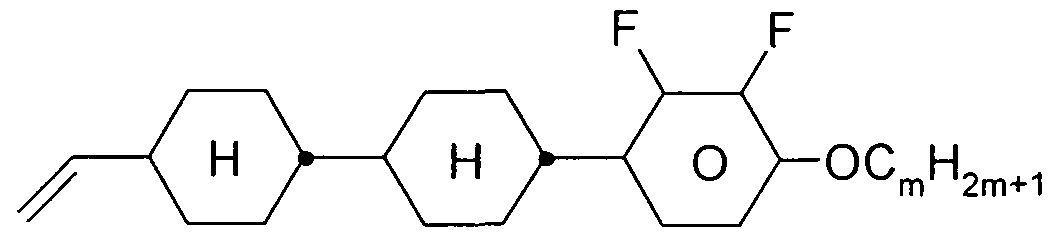
- one or more compounds of the formula I preferably contain one or more compounds of the compounds of Table A below.
- the preparation of the liquid crystal mixtures used in the invention takes place in a conventional manner.
- the desired amount of the components used in lesser amount is dissolved in the constituent of the main component, expediently at elevated temperature.
- solutions of the components in an organic solvent e.g. in acetone, chloroform or methanol, and to remove the solvent again after thorough mixing, for example by distillation.
- liquid crystal phases according to the invention can be modified such that they can be used in any type of z.
- B. ECB, VAN, IPS, GH or ASM-VA LCD display can be used.
- the dielectrics may also other, known in the art and described in the literature additives such.
- UV absorbers antioxidants, nanoparticles, radical scavengers included.
- 0-15% pleochroic dyes, stabilizers or chiral dopants may be added.
- Suitable stabilizers for the mixtures according to the invention are in particular those listed in Table B.
- pleochroic dyes may be added, furthermore conductive salts, preferably ethyldimethyldodecylammonium-4-hexoxybenzoate, tetrabutylammonium tetraphenylboranate or complex salts of crown ethers (cf., for example, Haller et al., Mol
- Table B lists possible dopants which can be added to the mixtures according to the invention. If the mixtures contain a dopant, it is used in amounts of 0.01-4% by weight, preferably 0.1-1.0% by weight.
- Stabilizers for example, the inventive mixtures in amounts of up to 10 wt.%, Based on the total amount of the mixture, preferably 0.01 to 6 wt.%, In particular 0.1 to 3 wt.%, Can be added hereinafter referred to in Table C.
- Preferred stabilizers are in particular BHT derivatives, e.g. 2,6-di-tert-butyl-4-alkylphenols) and Tinuvin 770.
- n 1, 2, 3, 4, 5, 6 or 7
- the display used for measuring the threshold voltage has two plane-parallel support plates at a distance of 20 microns and electrode layers with overlying orientation layers of SE-1211 (Nissan Chemicals) on the inner sides of the carrier plates, which cause a homeotropic orientation of the liquid crystals.
Landscapes
- Chemical & Material Sciences (AREA)
- Crystallography & Structural Chemistry (AREA)
- Engineering & Computer Science (AREA)
- Materials Engineering (AREA)
- Organic Chemistry (AREA)
- Liquid Crystal Substances (AREA)
- Heterocyclic Carbon Compounds Containing A Hetero Ring Having Oxygen Or Sulfur (AREA)
- Liquid Crystal (AREA)
Abstract
Description

















Claims


Priority Applications (13)
| Application Number | Priority Date | Filing Date | Title |
|---|---|---|---|
| KR1020197019052A KR102163585B1 (ko) | 2008-12-22 | 2009-12-17 | 액정 매질 |
| KR1020117017009A KR101765955B1 (ko) | 2008-12-22 | 2009-12-17 | 액정 매질 |
| KR1020187002975A KR101997160B1 (ko) | 2008-12-22 | 2009-12-17 | 액정 매질 |
| US13/141,132 US8399073B2 (en) | 2008-12-22 | 2009-12-17 | Liquid-crystal medium |
| KR1020167025759A KR101825715B1 (ko) | 2008-12-22 | 2009-12-17 | 액정 매질 |
| KR1020167025757A KR101825865B1 (ko) | 2008-12-22 | 2009-12-17 | 액정 매질 |
| EP09801939.1A EP2361291B1 (de) | 2008-12-22 | 2009-12-17 | Flüssigkristallines medium |
| CN200980151733.2A CN102264867B (zh) | 2008-12-22 | 2009-12-17 | 液晶介质 |
| KR1020167025758A KR101825717B1 (ko) | 2008-12-22 | 2009-12-17 | 액정 매질 |
| KR1020187002972A KR101991641B1 (ko) | 2008-12-22 | 2009-12-17 | 액정 매질 |
| JP2011541215A JP5931444B2 (ja) | 2008-12-22 | 2009-12-17 | 液晶媒体 |
| EP17170889.4A EP3246375B1 (de) | 2008-12-22 | 2009-12-17 | Flüssigkristallines medium |
| KR1020167025756A KR101825864B1 (ko) | 2008-12-22 | 2009-12-17 | 액정 매질 |
Applications Claiming Priority (2)
| Application Number | Priority Date | Filing Date | Title |
|---|---|---|---|
| DE102008064171.5 | 2008-12-22 | ||
| DE102008064171A DE102008064171A1 (de) | 2008-12-22 | 2008-12-22 | Flüssigkristallines Medium |
Publications (1)
| Publication Number | Publication Date |
|---|---|
| WO2010072370A1 true WO2010072370A1 (de) | 2010-07-01 |
Family
ID=41716284
Family Applications (1)
| Application Number | Title | Priority Date | Filing Date |
|---|---|---|---|
| PCT/EP2009/009079 Ceased WO2010072370A1 (de) | 2008-12-22 | 2009-12-17 | Flüssigkristallines medium |
Country Status (8)
| Country | Link |
|---|---|
| US (1) | US8399073B2 (de) |
| EP (4) | EP3246375B1 (de) |
| JP (12) | JP5931444B2 (de) |
| KR (8) | KR101765955B1 (de) |
| CN (3) | CN103980910B (de) |
| DE (1) | DE102008064171A1 (de) |
| TW (8) | TWI640607B (de) |
| WO (1) | WO2010072370A1 (de) |
Cited By (14)
| Publication number | Priority date | Publication date | Assignee | Title |
|---|---|---|---|---|
| WO2011132451A1 (ja) * | 2010-04-22 | 2011-10-27 | Jnc株式会社 | 液晶組成物および液晶表示素子 |
| WO2011148928A1 (ja) * | 2010-05-28 | 2011-12-01 | Jnc株式会社 | 液晶組成物および液晶表示素子 |
| WO2011152494A1 (ja) * | 2010-06-03 | 2011-12-08 | Jnc株式会社 | 液晶組成物および液晶表示素子 |
| EP2607451A1 (de) * | 2011-12-20 | 2013-06-26 | Merck Patent GmbH | Flüssigkristallines Medium |
| US20130258071A1 (en) * | 2010-12-07 | 2013-10-03 | Merck Patent Gmbh | Liquid crystal medium and liquid crystal display |
| US20130258268A1 (en) * | 2010-12-10 | 2013-10-03 | Merck Patent Gmbh | Liquid-crystalline medium and electro-optical display |
| WO2013183683A1 (ja) * | 2012-06-06 | 2013-12-12 | Dic株式会社 | 液晶組成物 |
| KR20140022037A (ko) * | 2011-03-29 | 2014-02-21 | 메르크 파텐트 게엠베하 | 액정 매질 |
| KR20140045535A (ko) * | 2011-07-07 | 2014-04-16 | 메르크 파텐트 게엠베하 | 액정 매질 |
| JP2015525258A (ja) * | 2012-06-02 | 2015-09-03 | メルク パテント ゲゼルシャフト ミット ベシュレンクテル ハフツングMerck Patent Gesellschaft mit beschraenkter Haftung | 液晶媒体 |
| EP2677018B1 (de) | 2008-12-22 | 2016-11-23 | Merck Patent GmbH | Flüssigkristallines medium |
| US9809747B2 (en) | 2012-10-12 | 2017-11-07 | Dic Corporation | Liquid crystal composition and liquid crystal display element using the same |
| US9963636B2 (en) | 2013-02-12 | 2018-05-08 | Dic Corporation | Liquid crystal composition and liquid crystal display device using same |
| EP3301141B1 (de) | 2009-01-22 | 2019-12-11 | JNC Corporation | Flüssigkristallzusammensetzung und flüssigkristallanzeigevorrichtung |
Families Citing this family (49)
| Publication number | Priority date | Publication date | Assignee | Title |
|---|---|---|---|---|
| ATE480608T1 (de) | 2004-07-02 | 2010-09-15 | Merck Patent Gmbh | Flüssigkristallines medium |
| KR101808888B1 (ko) * | 2010-10-04 | 2017-12-13 | 제이엔씨 주식회사 | 액정 조성물 및 액정 표시 소자 |
| WO2012079710A1 (de) * | 2010-12-17 | 2012-06-21 | Merck Patent Gmbh | Flüssigkristallines medium |
| DE102012003796A1 (de) | 2011-03-18 | 2012-09-20 | Merck Patent Gmbh | Flüssigkristallines Medium |
| CN103459552B (zh) * | 2011-04-06 | 2015-02-25 | Dic株式会社 | 向列液晶组合物和使用其的液晶显示元件 |
| KR101738906B1 (ko) * | 2011-12-21 | 2017-05-23 | 디아이씨 가부시끼가이샤 | 네마틱 액정 조성물 및 이것을 사용한 액정 표시 소자 |
| CN104136576B (zh) * | 2012-02-22 | 2020-10-16 | 默克专利股份有限公司 | 液晶介质 |
| TWI452122B (zh) | 2012-02-24 | 2014-09-11 | Dainippon Ink & Chemicals | 液晶組成物 |
| KR101316708B1 (ko) * | 2012-04-26 | 2013-10-10 | 디아이씨 가부시끼가이샤 | 네마틱 액정 조성물 및 이를 사용한 액정 표시 소자 |
| US9115308B2 (en) * | 2012-07-20 | 2015-08-25 | Shenzhen China Star Optoelectronics Technology Co., Ltd | Liquid crystal medium composition of liquid crystal display |
| CN102965122A (zh) * | 2012-11-21 | 2013-03-13 | 深圳市华星光电技术有限公司 | 液晶面板的液晶介质 |
| JP5598742B1 (ja) * | 2013-01-31 | 2014-10-01 | Dic株式会社 | 液晶組成物及びそれを使用した液晶表示素子 |
| TWI504731B (zh) * | 2013-02-06 | 2015-10-21 | Dainippon Ink & Chemicals | A liquid crystal composition, and a liquid crystal display device using the liquid crystal display device |
| WO2014136315A1 (ja) | 2013-03-06 | 2014-09-12 | Dic株式会社 | ネマチック液晶組成物及びこれを用いた液晶表示素子 |
| CN104797687B (zh) * | 2013-03-21 | 2016-07-13 | Dic株式会社 | 液晶组合物和使用其的液晶显示元件 |
| US9938463B2 (en) | 2013-03-26 | 2018-04-10 | Dic Corporation | Liquid crystal composition and liquid crystal display device using the same |
| JP6202309B2 (ja) * | 2013-08-23 | 2017-09-27 | Dic株式会社 | 液晶組成物およびそれを使用した液晶表示素子 |
| US10437107B2 (en) | 2013-10-30 | 2019-10-08 | Dic Corporation | Liquid-crystal display element |
| WO2015064629A1 (ja) | 2013-10-30 | 2015-05-07 | Dic株式会社 | 液晶表示素子 |
| US20160272889A1 (en) * | 2013-11-12 | 2016-09-22 | Dic Corporation | Liquid crystal display device |
| US10047289B2 (en) | 2013-11-12 | 2018-08-14 | Dic Corporation | Liquid crystal display device |
| DE102013021683A1 (de) * | 2013-12-19 | 2015-06-25 | Merck Patent Gmbh | Flüssigkristallines Medium |
| EP3327011B1 (de) * | 2014-03-17 | 2020-03-25 | Merck Patent GmbH | 4,6-difluor-dibenzofuran-derivate |
| KR20150109543A (ko) * | 2014-03-19 | 2015-10-02 | 삼성디스플레이 주식회사 | 액정 조성물 및 이를 포함하는 액정 표시 장치 |
| KR102186565B1 (ko) * | 2014-05-09 | 2020-12-04 | 삼성디스플레이 주식회사 | 액정 표시 장치 |
| CN106537242B (zh) | 2014-07-29 | 2020-06-05 | Dic株式会社 | 液晶显示元件 |
| WO2016017521A1 (ja) | 2014-07-29 | 2016-02-04 | Dic株式会社 | 液晶表示素子 |
| JP2015025129A (ja) * | 2014-08-04 | 2015-02-05 | Dic株式会社 | 液晶組成物及びそれを使用した液晶表示素子 |
| EP2990460B1 (de) * | 2014-08-22 | 2019-04-03 | Merck Patent GmbH | Flüssigkristallines medium |
| CN105368464B (zh) * | 2014-09-02 | 2020-09-08 | 江苏和成显示科技有限公司 | 具有负的介电各向异性的液晶组合物及其显示器件 |
| TWI828910B (zh) * | 2014-11-25 | 2024-01-11 | 德商馬克專利公司 | 液晶介質 |
| JP6662306B2 (ja) | 2015-02-06 | 2020-03-11 | 日産化学株式会社 | 液晶配向剤、液晶表示素子及び液晶表示素子の製造方法 |
| JP6702299B2 (ja) * | 2015-02-24 | 2020-06-03 | Jnc株式会社 | 液晶組成物および液晶表示素子 |
| CN107667160A (zh) * | 2015-05-20 | 2018-02-06 | 默克专利股份有限公司 | 液晶介质 |
| KR102041815B1 (ko) * | 2015-06-30 | 2019-11-07 | 주식회사 엘지화학 | 액정 소자 및 이의 용도 |
| TW201723153A (zh) * | 2015-11-11 | 2017-07-01 | Dainippon Ink & Chemicals | 組成物及使用其之液晶顯示元件 |
| KR20170062593A (ko) * | 2015-11-27 | 2017-06-08 | 삼성디스플레이 주식회사 | 액정 조성물 및 이를 포함하는 액정표시장치 |
| JP6565648B2 (ja) * | 2015-12-07 | 2019-08-28 | Dic株式会社 | 液晶表示素子 |
| CN107880900B (zh) * | 2016-09-29 | 2021-01-15 | 石家庄诚志永华显示材料有限公司 | 含有2,3,4-三取代苯的液晶化合物及其组合物 |
| JP6409920B2 (ja) * | 2016-10-28 | 2018-10-24 | Jnc株式会社 | 液晶表示素子、表示装置 |
| CN108728116B (zh) * | 2017-04-18 | 2024-06-04 | 江苏和成显示科技有限公司 | 一种液晶组合物及其显示器件 |
| CN108728117B (zh) * | 2017-04-18 | 2024-05-07 | 江苏和成显示科技有限公司 | 一种液晶组合物及其显示器件 |
| CN108728112A (zh) * | 2017-04-19 | 2018-11-02 | 北京八亿时空液晶科技股份有限公司 | 一种负介电各向异性的液晶化合物及其制备方法与应用 |
| CN108949190A (zh) * | 2017-05-17 | 2018-12-07 | 北京八亿时空液晶科技股份有限公司 | 一种含有环己烯结构化合物的液晶组合物及其应用 |
| CN111527730A (zh) * | 2018-03-31 | 2020-08-11 | 英特尔公司 | 用于具有多路访问边缘计算的内容传递网络的技术 |
| WO2021085503A1 (ja) * | 2019-10-31 | 2021-05-06 | 日立建機株式会社 | 作業機械 |
| KR102809435B1 (ko) * | 2019-11-22 | 2025-05-19 | 삼성디스플레이 주식회사 | 액정 조성물 및 이를 포함하는 표시 장치 |
| CN112920810B (zh) * | 2019-12-30 | 2023-04-07 | 石家庄诚志永华显示材料有限公司 | 液晶组合物、液晶显示元件、液晶显示器 |
| WO2025190813A1 (en) * | 2024-03-11 | 2025-09-18 | Merck Patent Gmbh | Liquid-crystal medium |
Citations (20)
| Publication number | Priority date | Publication date | Assignee | Title |
|---|---|---|---|---|
| DE2209127A1 (de) | 1972-02-26 | 1973-09-06 | Merck Patent Gmbh | Modifizierte nematische phasen |
| DE2338281A1 (de) | 1972-08-03 | 1974-02-21 | Ibm | Verfahren zur gesteuerten veraenderung der elektrischen eigenschaften von nematischen fluessigkeiten und dotierungsmittel hierfuer |
| DE2240864A1 (de) | 1972-08-19 | 1974-02-28 | Merck Patent Gmbh | Nematische ester und ihre verwendung zur beeinflussung der elektrooptischen eigenschaften nematischer phasen |
| DE2321632A1 (de) | 1973-04-28 | 1974-11-21 | Merck Patent Gmbh | Modifizierte nematische gemische mit positiver dielektrischer anisotropie |
| DE2450088A1 (de) | 1974-10-22 | 1976-04-29 | Merck Patent Gmbh | Biphenylester |
| DE2637430A1 (de) | 1976-08-20 | 1978-02-23 | Merck Patent Gmbh | Fluessigkristallines dielektrikum |
| DE2853728A1 (de) | 1978-12-13 | 1980-07-17 | Merck Patent Gmbh | Fluessigkristalline carbonsaeureester, verfahren zu ihrer herstellung, diese enthaltende dielektrika und elektrooptisches anzeigeelement |
| EP0240379A1 (de) | 1986-02-28 | 1987-10-07 | Commissariat A L'energie Atomique | Doppelschicht-Flüssigkristallzelle mit elektrisch gesteuerter Doppelbrechung |
| EP0474062A2 (de) * | 1990-09-04 | 1992-03-11 | MERCK PATENT GmbH | Matrix-Flüssigkristallanzeige |
| JPH11228966A (ja) | 1997-11-17 | 1999-08-24 | Merck Patent Gmbh | 液晶媒体 |
| JPH11236567A (ja) | 1997-11-17 | 1999-08-31 | Merck Patent Gmbh | 液晶媒体 |
| US6066268A (en) | 1997-08-29 | 2000-05-23 | Merck Patent Gesellschaft Mit Beschrankter Haftung | Liquid-crystalline medium |
| EP1106671A2 (de) * | 1999-12-08 | 2001-06-13 | MERCK PATENT GmbH | Flüssigkristallines Medium |
| US6861107B2 (en) | 2002-07-06 | 2005-03-01 | Merck Patent Gmbh | Liquid-crystalline medium |
| US20050230661A1 (en) | 2004-04-14 | 2005-10-20 | Chisso Corporation | Liquid crystal composition and liquid crystal display element |
| US20060198968A1 (en) * | 2005-03-03 | 2006-09-07 | Yasuyuki Goto | Chlorofluorobenzene liquid crystal compound, liquid crystal composition, and liquid crystal display device |
| US20060198967A1 (en) * | 2005-03-01 | 2006-09-07 | Chisso Corporation And Chisso Petrochemical Corporation | Liquid crystal composition and liquid crystal display device |
| US20080011984A1 (en) * | 2006-06-29 | 2008-01-17 | Chisso Corporation | Liquid crystal composition and liquid crystal display device |
| EP1958999A1 (de) * | 2007-02-13 | 2008-08-20 | MERCK PATENT GmbH | Flüssigkristallines Medium |
| US20080273160A1 (en) * | 2007-05-02 | 2008-11-06 | Samsung Electronics Co., Ltd. | Liquid crystal composition and liquid crystal display apparatus using the same |
Family Cites Families (52)
| Publication number | Priority date | Publication date | Assignee | Title |
|---|---|---|---|---|
| WO1995004789A1 (en) * | 1993-08-11 | 1995-02-16 | Merck Patent Gmbh | Supertwist liquid-crystal display |
| JP3537265B2 (ja) * | 1996-05-08 | 2004-06-14 | チッソ株式会社 | 液晶組成物および液晶表示素子 |
| US6348244B1 (en) * | 1997-10-24 | 2002-02-19 | Chisso Corporation | Liquid-crystal compounds having large negative value of permittivity anisotropy, liquid-crystal composition, and liquid-crystal display element |
| JP4320824B2 (ja) * | 1998-06-02 | 2009-08-26 | チッソ株式会社 | Δεが負の値を有するアルケニル化合物、液晶組成物および液晶表示素子 |
| JP4742207B2 (ja) * | 1999-08-31 | 2011-08-10 | Jnc株式会社 | 負の誘電率異方性を有する2,3−ジフルオロフェニル誘導体、液晶組成物および液晶表示素子 |
| JP3800051B2 (ja) * | 2000-08-10 | 2006-07-19 | チッソ株式会社 | ジフルオロプロピレンオキシ基を結合基とする液晶性化合物、液晶組成物および液晶表示素子 |
| JP4244556B2 (ja) * | 2001-03-30 | 2009-03-25 | チッソ株式会社 | ビス(トリフルオロメチル)フェニル環を持つ液晶性化合物、液晶組成物および液晶表示素子 |
| TWI250353B (en) | 2002-02-04 | 2006-03-01 | Sharp Kk | Liquid crystal display and method of manufacturing the same |
| DE10216197B4 (de) * | 2002-04-12 | 2013-02-07 | Merck Patent Gmbh | Flüssigkristallmedium und und seine Verwendung in einer elektrooptischen Anzeige |
| CN100372913C (zh) * | 2002-11-22 | 2008-03-05 | 默克专利股份有限公司 | 液晶介质 |
| JP2004256791A (ja) * | 2003-02-03 | 2004-09-16 | Chisso Corp | 液晶組成物および液晶表示素子 |
| JP4835021B2 (ja) * | 2004-04-09 | 2011-12-14 | Jnc株式会社 | 液晶組成物および液晶表示素子 |
| US7291368B2 (en) * | 2004-04-09 | 2007-11-06 | Chisso Corporation | Liquid crystal composition and liquid crystal display device |
| ATE480608T1 (de) * | 2004-07-02 | 2010-09-15 | Merck Patent Gmbh | Flüssigkristallines medium |
| KR20060059192A (ko) * | 2004-11-26 | 2006-06-01 | 메르크 파텐트 게엠베하 | 액정 매질 |
| JP4892847B2 (ja) | 2005-03-17 | 2012-03-07 | Dic株式会社 | 高分子分散型液晶表示素子用組成物及び高分子分散型液晶表示素子 |
| ATE437211T1 (de) * | 2005-05-21 | 2009-08-15 | Merck Patent Gmbh | Flüssigkristallines medium |
| DE102006036894A1 (de) * | 2005-08-09 | 2007-03-22 | Merck Patent Gmbh | Flüssigkristallines Medium |
| JP4899564B2 (ja) * | 2006-03-23 | 2012-03-21 | Jnc株式会社 | 液晶組成物および液晶表示素子 |
| JP5391528B2 (ja) * | 2006-06-29 | 2014-01-15 | Jnc株式会社 | 液晶組成物および液晶表示素子 |
| KR101547359B1 (ko) | 2006-07-19 | 2015-08-25 | 메르크 파텐트 게엠베하 | 액정 매질 |
| EP1889894B1 (de) | 2006-07-25 | 2009-10-21 | MERCK PATENT GmbH | Flüssigkristallines Medium |
| US7803436B2 (en) | 2006-08-07 | 2010-09-28 | Chisso Corporation | Liquid crystal composition and liquid crystal display device |
| JP5098250B2 (ja) * | 2006-08-10 | 2012-12-12 | Jnc株式会社 | 液晶組成物および液晶表示素子 |
| EP1897928B1 (de) * | 2006-09-06 | 2010-10-27 | Chisso Corporation | Chlorfluorbenzol-Flüssigkristallverbindung, Flüssigkristallzusammensetzung und Flüssigkristallanzeigevorrichtung |
| JP5163018B2 (ja) * | 2006-09-06 | 2013-03-13 | Jnc株式会社 | クロロフルオロベンゼン系液晶性化合物、液晶組成物および液晶表示素子 |
| EP1911828B1 (de) | 2006-10-12 | 2010-09-01 | Merck Patent GmbH | Flüssigkristallanzeige |
| KR20080046039A (ko) * | 2006-11-21 | 2008-05-26 | 삼성전자주식회사 | 액정조성물과 이를 포함하는 액정표시장치 |
| KR101373734B1 (ko) * | 2006-12-11 | 2014-03-14 | 삼성디스플레이 주식회사 | 액정 조성물 및 이를 포함하는 액정 표시 장치 |
| EP1959000B1 (de) * | 2007-02-19 | 2010-07-07 | MERCK PATENT GmbH | Flüssigkristallines Medium |
| US7767278B2 (en) * | 2007-03-20 | 2010-08-03 | Chisso Corporation | Liquid crystal composition and liquid crystal display device |
| US7767279B2 (en) * | 2007-03-22 | 2010-08-03 | Chisso Petrochemical Corporation | Liquid crystal composition and liquid crystal display device |
| TWI349029B (en) * | 2007-03-30 | 2011-09-21 | Au Optronics Corp | Liquid crystalline medium, liquid crystal display panel using the same, and method for manufacturing liquid crystal display panel |
| JP5374904B2 (ja) * | 2007-04-06 | 2013-12-25 | Jnc株式会社 | アルカジエニル基を有する化合物およびこれを用いた液晶組成物 |
| CN101045866B (zh) | 2007-04-23 | 2010-07-07 | 友达光电股份有限公司 | 液晶材料及液晶面板的制造方法 |
| WO2009021671A1 (de) * | 2007-08-15 | 2009-02-19 | Merck Patent Gmbh | Flüssigkristallines medium |
| JP5309789B2 (ja) * | 2007-09-12 | 2013-10-09 | Jnc株式会社 | 液晶組成物および液晶表示素子 |
| JP5560521B2 (ja) * | 2007-09-28 | 2014-07-30 | Dic株式会社 | ネマチック液晶組成物 |
| US8114310B2 (en) * | 2007-10-22 | 2012-02-14 | Merck Patent Gmbh | Liquid-crystal display |
| CN102057016B (zh) * | 2008-06-16 | 2014-04-16 | Jnc株式会社 | 液晶组成物以及液晶显示元件 |
| JP5228682B2 (ja) * | 2008-08-05 | 2013-07-03 | Jnc株式会社 | 液晶組成物および液晶表示素子 |
| JP5470783B2 (ja) * | 2008-09-09 | 2014-04-16 | Jnc株式会社 | 液晶組成物および液晶表示素子 |
| CN102144017A (zh) * | 2008-09-09 | 2011-08-03 | 智索株式会社 | 液晶组成物以及液晶显示元件 |
| US8158219B2 (en) * | 2008-09-22 | 2012-04-17 | Jnc Corporation | Liquid crystal composition and liquid crystal display device |
| JP5609647B2 (ja) * | 2008-10-21 | 2014-10-22 | Jnc株式会社 | 液晶組成物および液晶表示素子 |
| EP2360228A4 (de) * | 2008-12-10 | 2015-02-25 | Jnc Corp | Flüssigkristallzusammensetzung und flüssigkristallanzeigeelement |
| JP5609650B2 (ja) * | 2008-12-18 | 2014-10-22 | Jnc株式会社 | 液晶組成物および液晶表示素子 |
| US8545720B2 (en) | 2008-12-22 | 2013-10-01 | Merck Patent Gmbh | Liquid-crystal display |
| DE102008064171A1 (de) | 2008-12-22 | 2010-07-01 | Merck Patent Gmbh | Flüssigkristallines Medium |
| EP2380947B1 (de) | 2009-01-22 | 2015-08-12 | JNC Corporation | Flüssigkristallzusammensetzung und flüssigkristallanzeigeelement |
| EP2420548B1 (de) | 2009-04-14 | 2018-07-04 | DIC Corporation | Flüssigkristallzusammensetzung mit einer polymerisierbaren verbindung und flüssigkristallanzeigeelement damit |
| EP2292720A1 (de) | 2009-09-08 | 2011-03-09 | Merck Patent GmbH | Flüssigkristallanzeige |
-
2008
- 2008-12-22 DE DE102008064171A patent/DE102008064171A1/de not_active Withdrawn
-
2009
- 2009-12-17 EP EP17170889.4A patent/EP3246375B1/de active Active
- 2009-12-17 KR KR1020117017009A patent/KR101765955B1/ko active Active
- 2009-12-17 JP JP2011541215A patent/JP5931444B2/ja active Active
- 2009-12-17 KR KR1020187002972A patent/KR101991641B1/ko active Active
- 2009-12-17 KR KR1020167025758A patent/KR101825717B1/ko active Active
- 2009-12-17 US US13/141,132 patent/US8399073B2/en active Active
- 2009-12-17 EP EP13004562.8A patent/EP2677019B1/de active Active
- 2009-12-17 EP EP09801939.1A patent/EP2361291B1/de active Active
- 2009-12-17 CN CN201410149349.1A patent/CN103980910B/zh active Active
- 2009-12-17 CN CN200980151733.2A patent/CN102264867B/zh active Active
- 2009-12-17 CN CN201410149433.3A patent/CN103980909B/zh active Active
- 2009-12-17 WO PCT/EP2009/009079 patent/WO2010072370A1/de not_active Ceased
- 2009-12-17 KR KR1020167025759A patent/KR101825715B1/ko active Active
- 2009-12-17 KR KR1020167025757A patent/KR101825865B1/ko active Active
- 2009-12-17 EP EP13004561.0A patent/EP2677018B1/de active Active
- 2009-12-17 KR KR1020197019052A patent/KR102163585B1/ko active Active
- 2009-12-17 KR KR1020187002975A patent/KR101997160B1/ko active Active
- 2009-12-17 KR KR1020167025756A patent/KR101825864B1/ko active Active
- 2009-12-22 TW TW105131985A patent/TWI640607B/zh active
- 2009-12-22 TW TW105131987A patent/TWI640608B/zh active
- 2009-12-22 TW TW104105725A patent/TWI560262B/zh active
- 2009-12-22 TW TW105131986A patent/TWI649407B/zh active
- 2009-12-22 TW TW098144226A patent/TWI580765B/zh active
- 2009-12-22 TW TW104105726A patent/TWI560263B/zh active
- 2009-12-22 TW TW106122155A patent/TWI633174B/zh active
- 2009-12-22 TW TW105124226A patent/TWI596194B/zh active
-
2014
- 2014-06-20 JP JP2014126788A patent/JP5955894B2/ja active Active
- 2014-06-20 JP JP2014126789A patent/JP5886368B2/ja active Active
-
2015
- 2015-12-21 JP JP2015249081A patent/JP6140798B2/ja active Active
-
2016
- 2016-02-05 JP JP2016020361A patent/JP2016128578A/ja active Pending
- 2016-02-05 JP JP2016020363A patent/JP2016156003A/ja active Pending
-
2017
- 2017-05-30 JP JP2017106709A patent/JP2017149989A/ja active Pending
- 2017-05-30 JP JP2017106689A patent/JP2017201023A/ja active Pending
- 2017-12-12 JP JP2017237334A patent/JP6788569B2/ja active Active
-
2019
- 2019-01-30 JP JP2019013728A patent/JP2019108545A/ja active Pending
- 2019-10-03 JP JP2019182636A patent/JP6901538B2/ja active Active
- 2019-10-03 JP JP2019182630A patent/JP6908669B2/ja active Active
Patent Citations (22)
| Publication number | Priority date | Publication date | Assignee | Title |
|---|---|---|---|---|
| DE2209127A1 (de) | 1972-02-26 | 1973-09-06 | Merck Patent Gmbh | Modifizierte nematische phasen |
| DE2338281A1 (de) | 1972-08-03 | 1974-02-21 | Ibm | Verfahren zur gesteuerten veraenderung der elektrischen eigenschaften von nematischen fluessigkeiten und dotierungsmittel hierfuer |
| DE2240864A1 (de) | 1972-08-19 | 1974-02-28 | Merck Patent Gmbh | Nematische ester und ihre verwendung zur beeinflussung der elektrooptischen eigenschaften nematischer phasen |
| DE2321632A1 (de) | 1973-04-28 | 1974-11-21 | Merck Patent Gmbh | Modifizierte nematische gemische mit positiver dielektrischer anisotropie |
| DE2450088A1 (de) | 1974-10-22 | 1976-04-29 | Merck Patent Gmbh | Biphenylester |
| DE2637430A1 (de) | 1976-08-20 | 1978-02-23 | Merck Patent Gmbh | Fluessigkristallines dielektrikum |
| DE2853728A1 (de) | 1978-12-13 | 1980-07-17 | Merck Patent Gmbh | Fluessigkristalline carbonsaeureester, verfahren zu ihrer herstellung, diese enthaltende dielektrika und elektrooptisches anzeigeelement |
| EP0240379A1 (de) | 1986-02-28 | 1987-10-07 | Commissariat A L'energie Atomique | Doppelschicht-Flüssigkristallzelle mit elektrisch gesteuerter Doppelbrechung |
| EP0474062A2 (de) * | 1990-09-04 | 1992-03-11 | MERCK PATENT GmbH | Matrix-Flüssigkristallanzeige |
| EP0474062B1 (de) | 1990-09-04 | 1995-12-13 | MERCK PATENT GmbH | Matrix-Flüssigkristallanzeige |
| US6066268A (en) | 1997-08-29 | 2000-05-23 | Merck Patent Gesellschaft Mit Beschrankter Haftung | Liquid-crystalline medium |
| JPH11228966A (ja) | 1997-11-17 | 1999-08-24 | Merck Patent Gmbh | 液晶媒体 |
| JPH11236567A (ja) | 1997-11-17 | 1999-08-31 | Merck Patent Gmbh | 液晶媒体 |
| EP1106671A2 (de) * | 1999-12-08 | 2001-06-13 | MERCK PATENT GmbH | Flüssigkristallines Medium |
| EP1106671B1 (de) | 1999-12-08 | 2004-01-21 | MERCK PATENT GmbH | Flüssigkristallines Medium |
| US6861107B2 (en) | 2002-07-06 | 2005-03-01 | Merck Patent Gmbh | Liquid-crystalline medium |
| US20050230661A1 (en) | 2004-04-14 | 2005-10-20 | Chisso Corporation | Liquid crystal composition and liquid crystal display element |
| US20060198967A1 (en) * | 2005-03-01 | 2006-09-07 | Chisso Corporation And Chisso Petrochemical Corporation | Liquid crystal composition and liquid crystal display device |
| US20060198968A1 (en) * | 2005-03-03 | 2006-09-07 | Yasuyuki Goto | Chlorofluorobenzene liquid crystal compound, liquid crystal composition, and liquid crystal display device |
| US20080011984A1 (en) * | 2006-06-29 | 2008-01-17 | Chisso Corporation | Liquid crystal composition and liquid crystal display device |
| EP1958999A1 (de) * | 2007-02-13 | 2008-08-20 | MERCK PATENT GmbH | Flüssigkristallines Medium |
| US20080273160A1 (en) * | 2007-05-02 | 2008-11-06 | Samsung Electronics Co., Ltd. | Liquid crystal composition and liquid crystal display apparatus using the same |
Non-Patent Citations (18)
| Title |
|---|
| "Merck Liquid Crystals, Physical Properties of Liquid Crystals", November 1997, MERCK KGAA |
| G. LABRUNIE; J. ROBERT, J. APPL. PHYS., vol. 44, 1973, pages 4869 |
| H. SCHAD, SID 82 DIGEST TECHN. PAPERS, 1982, pages 244 |
| HALLER ET AL., MOL. CRYST. LIQ. CRYST., vol. 24, 1973, pages 249 - 258 |
| HYEON KYEONG ET AL.: "A 57-in. Wide UXGA TFT-LCD for HDTV Application", SID 2004 INTERNATIONAL SYMPOSIUM, DIGEST OF TECHNICAL PAPERS, vol. XXXV, pages 106 - 109, XP007011809 |
| J. DUCHENE, DISPLAYS, vol. 7, 1986, pages 3 |
| J. ROBERT; F. CLERC, SID 80 DIGEST TECHN. PAPERS, 1980, pages 30 |
| J.F. KAHN, APPL. PHYS. LETT., vol. 20, 1972, pages 1193 |
| KIM, SANG SOO: "Super PVA Sets New State-of-the-Art for LCD-TV", SID 2004 INTERNATIONAL SYMPOSIUM, DIGEST OF TECHNICAL PAPERS, vol. XXXV, pages 760 - 763, XP007011838 |
| LIU, C.T. ET AL.: "A 46-inch TFT-LCD HDTV Technnology ...", SID 2004 INTERNATIONAL SYMPOSIUM, DIGEST OF TECHNICAL PAPERS, vol. XXXV, pages 750 - 753, XP007011835 |
| M.F. SCHIECKEL; K. FAHRENSCHON: "Deformation of nematic liquid crystals with vertical orientation in electrical fields", APPL. PHYS. LETT., vol. 19, 1971, pages 3912 |
| MILLER, LAN: "LCD-Television", SEMINAR LECTURE NOTES, 2004 |
| SHIGETA, MITZUHIRO; FUKUOKA, HIROFUMI: "Development of High Quality LCDTV", SID 2004 INTERNATIONAL SYMPOSIUM, DIGEST OF TECHNICAL PAPERS, vol. XXXV, pages 754 - 757 |
| SOUK, JUN: "Recent Advances in LCD Technology", SEMINAR LECTURE NOTES, 2004, pages M-6,1 - M-6,26 |
| STROMER, M.: "Design of Thin Film Transistors for Matrix Adressing of Television Liquid Crystal Displays", PROC. EURODISPLAY, vol. 84, September 1984 (1984-09-01), pages 145 FF |
| WATANABE, H.; SHIMIZU, H.: "A 210-288 Matrix LCD Controlled by Double Stage Diode Rings", PROC. EURODISPLAY, vol. 84, September 1984 (1984-09-01), pages 141 FF |
| YEO, S.D.: "A LC Display for the TV Application", SID 2004 INTERNATIONAL SYMPOSIUM, DIGEST OF TECHNICAL PAPERS, vol. XXXV, pages 758 - 759, XP007011837 |
| YOSHIDE, H. ET AL.: "MVA LCD for Notebook or Mobile PCs ...", SID 2004 INTERNATIONAL SYMPOSIUM, DIGEST OF TECHNICAL PAPERS, vol. XXXV, pages 6 - 9, XP007011786 |
Cited By (49)
| Publication number | Priority date | Publication date | Assignee | Title |
|---|---|---|---|---|
| EP2677018B1 (de) | 2008-12-22 | 2016-11-23 | Merck Patent GmbH | Flüssigkristallines medium |
| EP3301141B1 (de) | 2009-01-22 | 2019-12-11 | JNC Corporation | Flüssigkristallzusammensetzung und flüssigkristallanzeigevorrichtung |
| WO2011132451A1 (ja) * | 2010-04-22 | 2011-10-27 | Jnc株式会社 | 液晶組成物および液晶表示素子 |
| US8795553B2 (en) | 2010-04-22 | 2014-08-05 | Jnc Corporation | Liquid crystal composition and liquid crystal display device |
| US8728590B2 (en) | 2010-05-28 | 2014-05-20 | Jnc Corporation | Liquid crystal composition and liquid crystal display device |
| JPWO2011148928A1 (ja) * | 2010-05-28 | 2013-07-25 | Jnc株式会社 | 液晶組成物および液晶表示素子 |
| USRE48467E1 (en) | 2010-05-28 | 2021-03-16 | Jnc Corporation | Liquid crystal composition and liquid crystal display device |
| WO2011148928A1 (ja) * | 2010-05-28 | 2011-12-01 | Jnc株式会社 | 液晶組成物および液晶表示素子 |
| WO2011152494A1 (ja) * | 2010-06-03 | 2011-12-08 | Jnc株式会社 | 液晶組成物および液晶表示素子 |
| US8932484B2 (en) | 2010-06-03 | 2015-01-13 | Jnc Corporation | Liquid crystal composition and liquid crystal display device |
| US20130258071A1 (en) * | 2010-12-07 | 2013-10-03 | Merck Patent Gmbh | Liquid crystal medium and liquid crystal display |
| KR101969179B1 (ko) | 2010-12-07 | 2019-04-15 | 메르크 파텐트 게엠베하 | 액정 매질 및 액정 디스플레이 |
| KR20140011310A (ko) * | 2010-12-07 | 2014-01-28 | 메르크 파텐트 게엠베하 | 액정 매질 및 액정 디스플레이 |
| US9914877B2 (en) * | 2010-12-07 | 2018-03-13 | Merck Patent Gmbh | Liquid crystal medium and liquid crystal display |
| US20130258268A1 (en) * | 2010-12-10 | 2013-10-03 | Merck Patent Gmbh | Liquid-crystalline medium and electro-optical display |
| KR101846042B1 (ko) | 2010-12-10 | 2018-04-05 | 메르크 파텐트 게엠베하 | 액정 매질 및 전기 광학 디스플레이 |
| US9873834B2 (en) * | 2010-12-10 | 2018-01-23 | Merck Patent Gmbh | Liquid-crystalline medium and electro-optical display |
| JP2017031420A (ja) * | 2011-03-29 | 2017-02-09 | メルク パテント ゲゼルシャフト ミット ベシュレンクテル ハフツングMerck Patent Gesellschaft mit beschraenkter Haftung | 液晶媒体 |
| CN105441086B (zh) * | 2011-03-29 | 2022-01-11 | 默克专利股份有限公司 | 液晶介质 |
| KR20200028044A (ko) * | 2011-03-29 | 2020-03-13 | 메르크 파텐트 게엠베하 | 액정 매질 |
| CN105441086A (zh) * | 2011-03-29 | 2016-03-30 | 默克专利股份有限公司 | 液晶介质 |
| KR102088166B1 (ko) * | 2011-03-29 | 2020-03-12 | 메르크 파텐트 게엠베하 | 액정 매질 |
| JP2016216747A (ja) * | 2011-03-29 | 2016-12-22 | メルク パテント ゲゼルシャフト ミット ベシュレンクテル ハフツングMerck Patent Gesellschaft mit beschraenkter Haftung | 液晶媒体 |
| JP2016216746A (ja) * | 2011-03-29 | 2016-12-22 | メルク パテント ゲゼルシャフト ミット ベシュレンクテル ハフツングMerck Patent Gesellschaft mit beschraenkter Haftung | 液晶媒体 |
| CN104893743A (zh) * | 2011-03-29 | 2015-09-09 | 默克专利股份有限公司 | 液晶介质 |
| JP2017048394A (ja) * | 2011-03-29 | 2017-03-09 | メルク パテント ゲゼルシャフト ミット ベシュレンクテル ハフツングMerck Patent Gesellschaft mit beschraenkter Haftung | 液晶媒体 |
| CN106635050A (zh) * | 2011-03-29 | 2017-05-10 | 默克专利股份有限公司 | 液晶介质 |
| KR102250082B1 (ko) * | 2011-03-29 | 2021-05-11 | 메르크 파텐트 게엠베하 | 액정 매질 |
| KR20140022037A (ko) * | 2011-03-29 | 2014-02-21 | 메르크 파텐트 게엠베하 | 액정 매질 |
| JP2014516366A (ja) * | 2011-03-29 | 2014-07-10 | メルク パテント ゲゼルシャフト ミット ベシュレンクテル ハフツング | 液晶媒体 |
| JP2014524951A (ja) * | 2011-07-07 | 2014-09-25 | メルク パテント ゲゼルシャフト ミット ベシュレンクテル ハフツング | 液晶媒体 |
| CN107083243A (zh) * | 2011-07-07 | 2017-08-22 | 默克专利股份有限公司 | 液晶介质 |
| KR102082361B1 (ko) * | 2011-07-07 | 2020-04-14 | 메르크 파텐트 게엠베하 | 액정 매질 |
| JP2017193716A (ja) * | 2011-07-07 | 2017-10-26 | メルク パテント ゲゼルシャフト ミット ベシュレンクテル ハフツングMerck Patent Gesellschaft mit beschraenkter Haftung | 液晶媒体 |
| KR20140045535A (ko) * | 2011-07-07 | 2014-04-16 | 메르크 파텐트 게엠베하 | 액정 매질 |
| US9982194B2 (en) | 2011-12-20 | 2018-05-29 | Mereck Patent Gmbh | Liquid-crystalline media |
| JP2017160436A (ja) * | 2011-12-20 | 2017-09-14 | メルク パテント ゲゼルシャフト ミット ベシュレンクテル ハフツングMerck Patent Gesellschaft mit beschraenkter Haftung | 液晶媒体 |
| JP2017160435A (ja) * | 2011-12-20 | 2017-09-14 | メルク パテント ゲゼルシャフト ミット ベシュレンクテル ハフツングMerck Patent Gesellschaft mit beschraenkter Haftung | 液晶媒体 |
| US10072209B2 (en) | 2011-12-20 | 2018-09-11 | Merck Patent Gmbh | Liquid-crystalline media |
| EP2607451A1 (de) * | 2011-12-20 | 2013-06-26 | Merck Patent GmbH | Flüssigkristallines Medium |
| JP2019163472A (ja) * | 2011-12-20 | 2019-09-26 | メルク パテント ゲゼルシャフト ミット ベシュレンクテル ハフツングMerck Patent Gesellschaft mit beschraenkter Haftung | 液晶媒体 |
| JP2013144796A (ja) * | 2011-12-20 | 2013-07-25 | Merck Patent Gmbh | 液晶媒体 |
| US11377596B2 (en) | 2011-12-20 | 2022-07-05 | Merck Patent Gmbh | Liquid-crystalline media |
| JP2017171911A (ja) * | 2011-12-20 | 2017-09-28 | メルク パテント ゲゼルシャフト ミット ベシュレンクテル ハフツングMerck Patent Gesellschaft mit beschraenkter Haftung | 液晶媒体 |
| JP2015525258A (ja) * | 2012-06-02 | 2015-09-03 | メルク パテント ゲゼルシャフト ミット ベシュレンクテル ハフツングMerck Patent Gesellschaft mit beschraenkter Haftung | 液晶媒体 |
| WO2013183683A1 (ja) * | 2012-06-06 | 2013-12-12 | Dic株式会社 | 液晶組成物 |
| JP2016027165A (ja) * | 2012-06-06 | 2016-02-18 | Dic株式会社 | 液晶組成物 |
| US9809747B2 (en) | 2012-10-12 | 2017-11-07 | Dic Corporation | Liquid crystal composition and liquid crystal display element using the same |
| US9963636B2 (en) | 2013-02-12 | 2018-05-08 | Dic Corporation | Liquid crystal composition and liquid crystal display device using same |
Also Published As
Similar Documents
| Publication | Publication Date | Title |
|---|---|---|
| EP2677019B1 (de) | Flüssigkristallines medium | |
| EP1958999B1 (de) | Flüssigkristallines Medium | |
| EP2176376B1 (de) | Flüssigkristallines medium | |
| EP2886627B1 (de) | Flüssigkristallines Medium | |
| EP2031040B1 (de) | Flüssigkristallines Medium | |
| EP3224331B1 (de) | Flüssigkristallines medium | |
| EP2534223B1 (de) | Flüssigkristallines medium | |
| EP1913114B1 (de) | Flüssigkristallines medium | |
| EP2937401B1 (de) | Flüssigkristallines medium | |
| EP2542647B1 (de) | Flüssigkristallines medium | |
| EP1959000B1 (de) | Flüssigkristallines Medium | |
| WO2009115186A1 (de) | Flüssigkristallines medium | |
| EP2652088A1 (de) | Flüssigkristallines medium | |
| DE102017002925A1 (de) | Flüssigkristallines Medium | |
| EP3149110B1 (de) | Flüssigkristallines medium | |
| DE102006036894A1 (de) | Flüssigkristallines Medium |
Legal Events
| Date | Code | Title | Description |
|---|---|---|---|
| WWE | Wipo information: entry into national phase |
Ref document number: 200980151733.2 Country of ref document: CN |
|
| 121 | Ep: the epo has been informed by wipo that ep was designated in this application |
Ref document number: 09801939 Country of ref document: EP Kind code of ref document: A1 |
|
| WWE | Wipo information: entry into national phase |
Ref document number: 2009801939 Country of ref document: EP |
|
| WWE | Wipo information: entry into national phase |
Ref document number: 13141132 Country of ref document: US Ref document number: 2011541215 Country of ref document: JP |
|
| NENP | Non-entry into the national phase |
Ref country code: DE |
|
| ENP | Entry into the national phase |
Ref document number: 20117017009 Country of ref document: KR Kind code of ref document: A |