WO2010092996A1 - Procédé de production de matériaux de type diamant - Google Patents
Procédé de production de matériaux de type diamant Download PDFInfo
- Publication number
- WO2010092996A1 WO2010092996A1 PCT/JP2010/052000 JP2010052000W WO2010092996A1 WO 2010092996 A1 WO2010092996 A1 WO 2010092996A1 JP 2010052000 W JP2010052000 W JP 2010052000W WO 2010092996 A1 WO2010092996 A1 WO 2010092996A1
- Authority
- WO
- WIPO (PCT)
- Prior art keywords
- diamond
- carbon material
- hydrogen
- hot isostatic
- carbon
- Prior art date
- Legal status (The legal status is an assumption and is not a legal conclusion. Google has not performed a legal analysis and makes no representation as to the accuracy of the status listed.)
- Ceased
Links
Images




Classifications
-
- C—CHEMISTRY; METALLURGY
- C01—INORGANIC CHEMISTRY
- C01B—NON-METALLIC ELEMENTS; COMPOUNDS THEREOF; METALLOIDS OR COMPOUNDS THEREOF NOT COVERED BY SUBCLASS C01C
- C01B32/00—Carbon; Compounds thereof
- C01B32/25—Diamond
- C01B32/26—Preparation
Definitions
- the present invention relates to an electrodeposition grindstone, a polishing / processing related member such as a polishing slurry, a high temperature semiconductor, a high voltage semiconductor, a high frequency semiconductor, a power semiconductor, an electron emission device such as a panel display, a light emitting element, a laser element, a light detecting element,
- the present invention relates to a method for producing a diamond material that can be suitably used for strain detection elements, pressure detection elements, temperature detection elements, magnetic field detection elements, heat sinks, sensor electrodes, battery electrodes, various devices, and the like.
- Carbon is a liquid at 4000 ° C and 15 GPa or more, but when it is cooled to about 3000 ° C while maintaining pressure, it changes from a liquid state to solid diamond. Therefore, extremely high temperature and high pressure conditions were necessary to produce diamond from molten carbon. Natural diamonds are presumed to have been reduced in the presence of a catalyst, such as carbonate melts moving and concentrated in the mantle.
- shock method A method of synthesizing diamond with explosive pressure has also been implemented.
- an explosive is used to generate a blast of 4000 to 5000 m / sec, and the metal tube is made to collide with a metal tube filled with a material mixed with carbon, iron, or copper metal powder at a speed of about 2000 m / sec. .
- This generates a shock wave in the material, and part of the carbon is converted to diamond.
- a pressure of 10 GPa or more and a temperature of about 3000 ° C. are instantaneously applied, and it is applied to the manufacture of fine diamond powder for polishing.
- a method of producing a large-scale explosion in an inert atmosphere such as underwater explosion, ice, nitrogen, carbon dioxide, etc. has also been implemented.
- Thermal excitation method One of the vapor phase growth methods is the hot filament method and the combustion flame method.
- the combustion flame method hydrocarbons thermally excited to about 3000 ° C. in a reducing flame of acetylene and oxygen combustion flame are deposited on a cooled substrate.
- the hot filament method methane and hydrogen are thermally excited to about 2000 ° C. by a hot filament on the top of the substrate, and diamond is deposited on the substrate at a low temperature. Used for coating diamond tools.
- Hydrocarbon and fluorine, alcohol and fluorine are passed through a reaction tube heated to about 900 ° C., and diamond is deposited on a substrate maintained at a temperature lower by about 200 ° C. Compared to the thermal excitation method, it can be manufactured at a low temperature, but the diamond formation rate is extremely low.
- Plasma excitation method In this method, plasma is generated by microwaves, high frequency, DC voltage, etc. and excited.
- the reaction gas methane or hydrogen is generally used, and diamond is deposited in a thin film at a substrate temperature of 300 to 1000 ° C.
- the pressure is in the range of about 0.1 to 200 Torr, and the substrate is silicon, tantalum, tungsten, molybdenum, gold, copper, aluminum, graphite, silica glass, sapphire, tungsten carbide, titanium carbide, silicon carbide, magnesium oxide, etc. in use.
- Electrodeposition grindstones, polishing and processing related materials such as polishing slurries, high temperature semiconductors, high voltage semiconductors, high frequency semiconductors, power semiconductors, electron emission devices such as panel displays, light emitting elements, laser elements, light detection elements, strain detection elements,
- Conventional methods for manufacturing artificial diamond used for pressure sensing elements, temperature sensing elements, magnetic field sensing elements, heat sinks, sensor electrodes, battery electrodes, and other devices, as well as ornaments, are low in productivity and high in cost. There was a problem.
- Diamond thin film has thermal conductivity, dielectric strength, heat resistance, corrosion resistance, strong radiation resistance, X-ray absorption characteristics similar to the human body, affinity for biological substances, inertness to chemical substances, excellent electrical characteristics, high mobility It has excellent characteristics such as dielectric breakdown electric field and small dielectric constant, and is expected to be applied to ideal heat sink, radiation, X-ray monitor, biosensor, chemical electrode, power device, high frequency device, etc.
- the growth rate was slow, from several microns to several tens of microns, making it difficult to stably manufacture large shapes.
- the production equipment and conditions are individually designed according to the shape of the diamond to be produced, that is, the shape of a thin film, block, etc., the crystal orientation of 100, 111, etc., the crystal form of polycrystal, single crystal, homoepitaxial, heteroepitaxial, etc. Therefore, it was difficult to manufacture many types of crystal forms at once using a single reaction vessel.
- diamond is extremely hard and difficult to machine, and the particles could not be sintered by holding them at a high temperature, making them spherical, rod-like, needle-like, sheet-like, columnar, There was a further problem that it was difficult to obtain a different shape.
- hydrogen and hydrocarbons generated from a carbon material are thermally excited by hot isostatic pressing of the carbon material in which hydrogen remains. It is characterized by depositing, generating and growing diamond material.
- it is not necessary to supply a source gas as in the conventional vapor phase growth method, and vapor phase growth is performed by hydrogen and hydrocarbons generated from a carbon material as a base material. That is, since hydrogen generation, etching of carbon material as a base material with hydrogen, hydrocarbon generation, diamond precipitation, and hydrogen generation occur repeatedly and continuously, the present invention is based on the carbon material itself as a raw material. It has the characteristic advantage that precipitation, generation and growth are efficiently performed at a high growth rate.
- the present invention also provides a material characterized by containing diamond or the like as a production aid serving as a nucleus of growth and accelerating diamond growth by subsequent hot isostatic pressing. Specifically, the carbon material having hydrogen remaining accelerates the above-described diamond precipitation, generation and growth around a generation auxiliary agent serving as a nucleus during hot isostatic pressing.
- Production aids include diamond, tungsten, molybdenum, tantalum, copper, gold, platinum, silicon, nickel, cobalt, iridium, glassy carbon, graphite, silicon oxide, sapphire and other oxides, silicon carbide, tungsten carbide, titanium carbide Carbide such as boron nitride, nitride such as aluminum nitride, carbonate inorganic material such as magnesium carbonate, sulfate inorganic material such as calcium sulfate, etc. can be suitably used.
- the temperature for pre-firing the carbon material is set to an appropriate condition in order to appropriately set the residual hydrogen amount before the hot isostatic pressing process of the carbon material.
- the pre-calcination temperature is high, the amount of residual hydrogen is insufficient, so that hydrogen and hydrocarbons are not generated stably in order to precipitate and generate diamond in the subsequent hot isostatic pressing process. .
- the present invention is also characterized in that a carbon material containing the above-mentioned production aid such as diamond also functions as a reaction vessel.
- a carbon material containing the above-mentioned production aid such as diamond also functions as a reaction vessel.
- a carbon material containing the above-mentioned production aid such as diamond also functions as a reaction vessel.
- the carbon material and a predetermined shape such as a plate, a sphere, a cylinder, and a vertical column with an appropriate generation aid held inside or on the surface Or the organic polymer material used as a precursor is shape
- molded when producing diamonds of a desired size and shape, the carbon material and a predetermined shape such as a plate, a sphere, a cylinder, and a vertical column with an appropriate generation aid held inside or on the surface Or the organic polymer material used as a precursor is shape
- molded is shape
- a DLC film containing hydrogen by high-frequency plasma CVD, an amorphous carbon film, or the like can be used in addition to a polymer organic material in which hydrogen remains after firing.
- the substrate-like formation aid or the substrate on which the production aid is placed and the carbon material are laminated, and if necessary, the entire surface is covered with the carbon material. It is characterized by hot isostatic pressing. In this case as well, since hot isostatic pressing with argon, nitrogen, etc. is performed, the concentration gradient of hydrogen and hydrocarbons is maintained around the substrate material and carbon material in an isotropic gas atmosphere. Generation and growth are promoted.
- a space having a predetermined shape such as a columnar shape, a conical shape, a vertical column shape, a vertical cone shape, a plate shape, a spherical thin film shape, or the like is preliminarily installed on the inside or surface of the carbon material, and hot hydrostatic pressure is applied.
- a material characterized by forming diamond material by depositing, generating and growing diamond in the installed space by pressure treatment is also provided.
- a general-purpose hot isostatic pressing apparatus using a general-purpose hot isostatic pressing apparatus, granular, powdery and massive diamonds can be produced with high productivity even at a low pressure of about 0.2 GPa.
- the carbon material to be used is a raw material and a reaction vessel, a large number of treatments and diamond formations of various shapes, sizes, and crystal forms can be mixed and combined into a single hot isostatic pressing process. Can be implemented.
- a large-sized reaction vessel having an inner diameter of 800 mm and a height of 3500 mm can be manufactured, so that a large number of various types of products can be manufactured in a short period of time and at a low cost with a minimum necessary capital investment.
- the present invention it is possible to form a diamond thin film in a state in which a large number of substrates are laminated, so that it is possible to manufacture with extremely high productivity. For this reason, it is possible to put it into practical use for diamond thin films that have excellent characteristics but are difficult to put to practical use industrially, and ideal heat sinks, radiation, X-ray monitors, biosensors, chemical electrodes, power devices, and high-frequency devices. Promoted.
- the carbon material when the carbon material is previously provided with a cylindrical shape, a conical shape, a vertical column shape, a vertical cone shape, a plate shape, a spherical shape, a thin film shape, etc., the column shape, the conical shape, It is possible to mold diamond materials such as vertical columns, vertical cones, plates, spheres, and thin films.
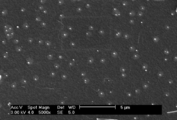
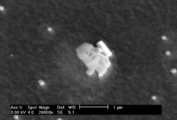
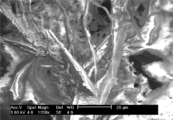
- FIG. 1 is a drawing-substituting photograph showing an electron microscopic image of Example 12 (sample of Example 1).
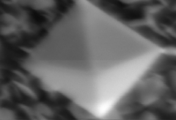
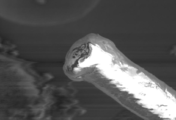
- FIG. 2 is a drawing-substituting photograph showing an electron microscope image of Example 12 (sample of Example 2).
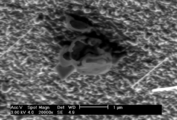
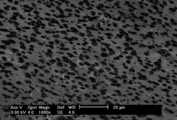
- FIG. 3 is a drawing-substituting photograph showing an electron microscope image of Example 12 (sample of Example 4).
- FIG. 4 shows the X-ray spectroscopic spectrum of Example 12 (sample of Example 4), which shows the presence of oxygen in the functional group terminated at the SP3 bond on the surface of diamond.
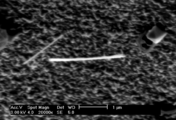
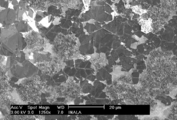
- FIG. 5 is a drawing-substituting photograph showing an electron microscope image of Example 12 (sample of Example 5).
- FIG. 5 is a drawing-substituting photograph showing an electron microscope image of Example 12 (sample of Example 5).
- FIG. 6 is a drawing-substituting photograph showing an electron microscopic image of Example 12 (sample of Example 6).
- FIG. 7 is a drawing-substituting photograph showing an electron microscopic image of Example 12 (sample of Example 7).
- FIG. 8 is a drawing-substituting photograph showing an electron microscopic image of Example 12 (sample of Example 8).
- FIG. 9 is a drawing-substituting photograph showing an electron microscopic image of Example 12 (sample of Example 9).
- FIG. 10 is a drawing-substituting photograph showing an electron microscopic image of Example 12 (sample of Example 10).
- FIG. 11 is a drawing-substituting photograph showing an electron microscopic image of Example 12 (sample of Example 11).
- FIG. 12 shows an electron microscopic image of Example 13.
- FIG. 13 is an enlarged view of the electron microscope image of the dendritic diamond shown in FIG.
- Organic polymer materials such as thermosetting resins and thermoplastic resins that carbonize after firing, and mixing aids as necessary, are mixed into thin plates, thick plates, discs, spheres, vertical columns, cylinders, cones, pyramids, etc. Mold into a predetermined shape. Any organic polymer material can be used as long as carbon becomes a residue after firing, but phenolic resin, furan resin, melamine resin, xylene resin, aniline resin, petroleum pitch. Coal pitch, PAN resin, epoxy resin, polyethylene, polystyrene, polypropylene, etc. can be suitably used.
- an appropriate method is selected according to the diamond material to be manufactured, such as compression-press molding using a mold, injection molding, casting, printing, spraying, rolling.
- a molded body of organic polymer material containing diamond processed into a predetermined shape is carbonized and fired at a predetermined maximum temperature in an inert gas such as nitrogen at a predetermined temperature increase rate.
- the maximum temperature reached during carbonization and firing is determined by the hydrogen content remaining in the material after carbonization and firing.
- thermosetting resins such as phenol resins
- hydrogen and hydrocarbons are generated from the CnHm functional group in the carbon skeleton in the temperature range of 800 ° C to 1500 ° C, causing carbonization and graphitization while causing material shrinkage. Go.
- the material after carbonization firing is inserted into a holding vessel such as a graphite crucible, and isotropic hot isostatic pressing with gas pressure is performed in an inert gas such as argon or nitrogen.
- an inert gas such as argon or nitrogen.
- hydrogen is generated from a temperature range of 800 ° C. or higher, preferably 1000 ° C. or higher, and when heated to about 1800 ° C. to 2000 ° C., hydrogen generated from the carbon material
- Thermal excitation becomes active and diamond deposition and growth reactions are promoted on the surface of the diamond material. Since hydrogen generation, hydrocarbon generation, and diamond deposition from the carbon material occur repeatedly, diamond grows while consuming the surrounding carbon material.
- the processing temperature for hot isostatic pressing may be in the temperature range where hydrogen is generated from the carbon material. However, since the generated hydrogen needs to be sufficiently thermally excited, for example, 800 ° C. or higher, preferably 1000 From the viewpoint of productivity, 1800 ° C. or higher, more preferably 2000 ° C. or higher, and 2100 ° C. or higher are more preferable.
- the upper limit of the treatment temperature is not particularly limited, but when a hot isostatic press is used, the upper limit is usually determined automatically from the performance of the apparatus. Such an upper limit is obvious to those skilled in the art and is usually about 2500 ° C., especially about 3000 ° C. for high performance values.
- a preferable processing temperature range can be appropriately selected from the above, and examples thereof include about 1800 ° C.
- the treatment pressure when performing the hot isostatic pressing about 0.05 GPa or more, more preferably about 0.1 GPa or more, and more preferably about 0.19 GPa or more can be mentioned.
- the upper limit value of the processing pressure is not particularly limited. However, when a hot isostatic pressure apparatus is used, the upper limit value is usually determined from the performance of the apparatus. Such an upper limit is obvious to those skilled in the art and is usually about 0.2 GPa, especially about 0.3 GPa for high performance devices. A preferable processing pressure range can be appropriately selected from the above.
- the processing pattern such as the processing pressure, the pressure increase rate, the simultaneous temperature increasing pressure increasing pattern, the pressure increasing preceding processing pattern, and the temperature increasing preceding pattern during the hot isostatic pressing process is appropriately selected according to the shape and crystal state of the diamond to be manufactured.
- the pressure increasing preceding pattern is preferable.
- the processing pressure is sufficiently increased before the processing temperature reaches the maximum temperature at the time of carbonization baking (preliminary baking).
- the value of the sufficiently increased processing pressure for example, in the case of the processing conditions listed in the examples, about 0.15 GPa can be mentioned.
- the amount of hydrogen contained in the carbon material is preferably in the range of about 0.01 wt% to about 6 wt% of the carbon material, more preferably in the range of about 0.05 wt% to about 6 wt%. More preferably, it is in the range of 0.2 wt% to 6 wt%.
- Production aids include diamond, tungsten, molybdenum, tantalum, niobium, gallium, copper, gold, platinum, silicon, nickel, cobalt, iridium, glassy carbon, graphite, silicon oxide, oxides such as sapphire, silicon carbide, Carbides such as tungsten carbide and titanium carbide, nitrides such as boron nitride and aluminum nitride, inorganic carbonate materials such as magnesium carbonate, and inorganic sulfate materials such as calcium sulfate can be preferably used.
- Various methods can be selected as a method of constructing the carbon material and / or the production aid before the hot isostatic pressing treatment. It is also possible to use a carbon material containing hydrogen without using an organic polymer material. Hydrogen is contained using various methods such as thermal CVD using hydrocarbon gas, plasma CVD, sputtering using carbon target material, reactive sputtering, ion-assisted sputtering, ion-assisted CVD, ion plating, etc. The same production can be suitably carried out by configuring the carbon material in the vicinity of the production assistant.
- Unitika phenol formaldehyde resin (UA) powder was hot-pressed at a temperature of 170 ° C. and molded into a shape having an outer diameter of 50 mm and a thickness of 5 mm.
- the molded resin substrate was sandwiched between artificial graphite shelf plates, and carbonized and fired at a maximum temperature of 450 ° C. at a firing rate of 2 ° C. per hour in a nitrogen stream.
- EMGA621 manufactured by Horiba 6 wt% of hydrogen remained.
- Unitika phenol formaldehyde resin (UA) powder was hot-pressed at a temperature of 170 ° C. and molded into a shape having an outer diameter of 50 mm and a thickness of 5 mm.
- the molded resin substrate was sandwiched between artificial graphite shelf plates and carbonized and fired at a maximum temperature of 1000 ° C. at a firing rate of 2 ° C. per hour in a nitrogen stream.
- EMGA621 manufactured by Horiba
- Unitika phenol formaldehyde resin (UA) powder was hot-pressed at a temperature of 170 ° C. and molded into a shape having an outer diameter of 50 mm and a thickness of 5 mm.
- the molded resin substrate was sandwiched between artificial graphite shelf plates and carbonized and fired in a nitrogen stream at a firing rate of 2 ° C. per hour up to 1000 ° C. and at a maximum firing temperature of 1800 ° C. at a firing rate of 5 ° C. per hour.
- EMGA621 manufactured by Horiba
- Unitika phenolformaldehyde resin (UA) powder 99 wt% and diamond powder 1 wt% with a particle size of 3 microns were mixed and hot pressed at a temperature of 170 ° C. to form an outer diameter of 50 mm and a thickness of 5 mm.
- the molded resin substrate was sandwiched between artificial graphite shelf plates and carbonized and fired at a maximum temperature of 1000 ° C. at a firing rate of 2 ° C. per hour in a nitrogen stream.
- Unitika phenolformaldehyde resin (UA) powder 99 wt% and diamond powder 1 wt% with a particle size of 3 microns were mixed and hot pressed at a temperature of 170 ° C. to form an outer diameter of 50 mm and a thickness of 5 mm.
- the molded resin substrate was sandwiched between artificial graphite shelf plates and carbonized and fired at a maximum temperature of 1000 ° C. at a firing rate of 5 ° C. per hour in a nitrogen stream. In order to increase the temperature rising rate during the carbonization firing, a large number of pores were introduced into the sample after the carbonization firing.
- the molded resin substrate was sandwiched between artificial graphite shelf plates and carbonized and fired at a maximum temperature of 1000 ° C. at a firing rate of 3 ° C. per hour in a nitrogen stream.
- a mixture of 99 wt% of phenolic formaldehyde resin (UA) powder manufactured by Unitika and 1 wt% of a mixture of niobium and gallium was hot-pressed at a temperature of 170 ° C. to form a shape having an outer diameter of 50 mm and a thickness of 5 mm.
- the molded resin substrate was sandwiched between artificial graphite shelf plates and carbonized and fired at a maximum temperature of 1000 ° C. at a firing rate of 3 ° C. per hour in a nitrogen stream.
- the molded resin substrate was sandwiched between artificial graphite shelf plates and carbonized and fired at a maximum temperature of 1000 ° C. at a firing rate of 3 ° C. per hour in a nitrogen stream.
- Unitica phenolformaldehyde resin (UA) 99 wt% and copper / calcium sulfate 1 wt% mixture were hot-pressed at a temperature of 170 ° C. to form an outer diameter of 50 mm and a thickness of 5 mm. .
- the molded resin substrate was sandwiched between artificial graphite shelf plates and carbonized and fired at a maximum temperature of 1000 ° C. at a firing rate of 3 ° C. per hour in a nitrogen stream.
- a carbon thin film with a thickness of 5 microns is formed on the surface of a single crystal silicon carbide wafer having an outer diameter of 50 mm and a plate thickness of 0.3 mm by using a plasma ion implantation film forming apparatus to form a laminate of silicon carbide and a carbon film. did.
- the film forming conditions were adjusted so that the amount of residual hydrogen in the carbon thin film was 3 wt%.
- the both surfaces of the sample prepared in Example 2 were lapped and polished to finish a mirror surface with a surface roughness of Ra 5 angstroms.
- the outer diameters of the sample and the single crystal silicon carbide wafer were adjusted to 40 mm, and the flatness of each sample was adjusted.
- Example 1 The samples of Examples 1 to 11 were loaded into a graphite crucible, set in a reaction vessel of a hot isostatic press, and processed at a processing temperature of 2300 ° C. and a pressure of 0.19 GPa using argon gas. The time was maintained and hot isostatic pressing was performed. Table 1 summarizes the occurrence of diamond after the treatment.
- Unitika phenolformaldehyde resin (UA) 99 wt% and diamond powder 1 wt% with a particle size of 30 microns were mixed and hot-pressed at a temperature of 170 ° C. to form an outer diameter of 50 mm and a thickness of 5 mm.
- the molded resin substrate was sandwiched between artificial graphite shelf plates and carbonized and fired at a maximum temperature of 800 ° C. at a firing rate of 2 ° C. per hour in a nitrogen stream.
- the sample obtained above was loaded into a graphite crucible, set in a reaction vessel of a hot isostatic press, and treated with argon gas at a processing temperature of 2300 ° C. and a pressure of 0.19 GPa for 1 hour. It was held and subjected to hot isostatic pressing. After the treatment, dendritic diamond was formed (FIGS. 12 and 13).
- Diamond materials can be manufactured even at low pressures of about 0.2 GPa using a general-purpose hot isostatic pressing device, so the practical use of diamond materials with excellent characteristics will expand.
Landscapes
- Chemical & Material Sciences (AREA)
- Organic Chemistry (AREA)
- Life Sciences & Earth Sciences (AREA)
- General Life Sciences & Earth Sciences (AREA)
- Geology (AREA)
- Inorganic Chemistry (AREA)
- Carbon And Carbon Compounds (AREA)
- Crystals, And After-Treatments Of Crystals (AREA)
Abstract
Des matériaux de type diamant et, en particulier, des diamants de toutes formes, peuvent être produits à bas coût en traitant en même temps un grand nombre de matières premières de divers types dans un réacteur de grande taille. Ces matériaux de type diamant sont déposés, se forment et se développent suite à l'application à des matériaux carbonés contenant de l'hydrogène d'une compression isostatique à chaud. Lesdits matériaux carbonés peuvent contenir, le cas échéant, des additifs contribuant à la formation du diamant se présentant sous diverses formes. Ces matériaux carbonés eux-mêmes fonctionnent en tant que réacteurs et que source d'hydrogène et d'hydrocarbure et c'est ainsi que des diamants peuvent être produits au moyen d'un équipement polyvalent de compression isostatique à chaud même à une pression ne dépassant pas environ 0,2 GPa.
Priority Applications (1)
| Application Number | Priority Date | Filing Date | Title |
|---|---|---|---|
| JP2010550547A JPWO2010092996A1 (ja) | 2009-02-13 | 2010-02-10 | ダイヤモンド材料の製造方法 |
Applications Claiming Priority (2)
| Application Number | Priority Date | Filing Date | Title |
|---|---|---|---|
| JP2009-032066 | 2009-02-13 | ||
| JP2009032066 | 2009-02-13 |
Publications (1)
| Publication Number | Publication Date |
|---|---|
| WO2010092996A1 true WO2010092996A1 (fr) | 2010-08-19 |
Family
ID=42561836
Family Applications (1)
| Application Number | Title | Priority Date | Filing Date |
|---|---|---|---|
| PCT/JP2010/052000 Ceased WO2010092996A1 (fr) | 2009-02-13 | 2010-02-10 | Procédé de production de matériaux de type diamant |
Country Status (2)
| Country | Link |
|---|---|
| JP (1) | JPWO2010092996A1 (fr) |
| WO (1) | WO2010092996A1 (fr) |
Cited By (4)
| Publication number | Priority date | Publication date | Assignee | Title |
|---|---|---|---|---|
| CN103303914A (zh) * | 2013-07-01 | 2013-09-18 | 中南钻石股份有限公司 | 一种金刚石提纯工艺 |
| TWI485105B (zh) * | 2010-11-25 | 2015-05-21 | Incubation Alliance Inc | 碳奈米管及其製造方法 |
| JP2016539072A (ja) * | 2014-10-11 | 2016-12-15 | ヘナン フェイマス ダイヤモンド インダストリアル カンパニー リミテッド | 表面の粗いダイヤモンドの合成方法 |
| CN116747852A (zh) * | 2023-06-07 | 2023-09-15 | 南方科技大学 | 一种硼掺杂金刚石、制备方法及应用 |
Citations (6)
| Publication number | Priority date | Publication date | Assignee | Title |
|---|---|---|---|---|
| JPH05208805A (ja) * | 1992-01-29 | 1993-08-20 | Kobe Steel Ltd | 塊状カーボン成形体およびその集合体並びにそれらの製法 |
| JPH0753205A (ja) * | 1993-08-12 | 1995-02-28 | Agency Of Ind Science & Technol | 被覆ダイヤモンド準微粒子、並びに被覆ダイヤモンド準微粒子焼結体及びその製造法 |
| JP2005290403A (ja) * | 2004-03-31 | 2005-10-20 | Kurita Water Ind Ltd | 導電性ダイヤモンド粒子による電解方法及び導電性ダイヤモンド粒子の製造方法 |
| JP2007531681A (ja) * | 2004-03-01 | 2007-11-08 | チエン−ミン ソン, | 結晶種の制御された配置を伴う超研磨粒子の合成 |
| JP2008036631A (ja) * | 2007-08-03 | 2008-02-21 | Toyo Tanso Kk | 流動床用導電性ダイヤモンド粒状体、流動床電解処理装置用の流動床、流動床電解処理装置、工業用又は家庭用廃水の処理方法、及び、金属を含む溶液の処理方法 |
| JP2009502705A (ja) * | 2005-07-21 | 2009-01-29 | アポロ ダイヤモンド,インク | ダイヤモンド種モザイクからの成長ダイヤモンドの分離 |
-
2010
- 2010-02-10 WO PCT/JP2010/052000 patent/WO2010092996A1/fr not_active Ceased
- 2010-02-10 JP JP2010550547A patent/JPWO2010092996A1/ja active Pending
Patent Citations (6)
| Publication number | Priority date | Publication date | Assignee | Title |
|---|---|---|---|---|
| JPH05208805A (ja) * | 1992-01-29 | 1993-08-20 | Kobe Steel Ltd | 塊状カーボン成形体およびその集合体並びにそれらの製法 |
| JPH0753205A (ja) * | 1993-08-12 | 1995-02-28 | Agency Of Ind Science & Technol | 被覆ダイヤモンド準微粒子、並びに被覆ダイヤモンド準微粒子焼結体及びその製造法 |
| JP2007531681A (ja) * | 2004-03-01 | 2007-11-08 | チエン−ミン ソン, | 結晶種の制御された配置を伴う超研磨粒子の合成 |
| JP2005290403A (ja) * | 2004-03-31 | 2005-10-20 | Kurita Water Ind Ltd | 導電性ダイヤモンド粒子による電解方法及び導電性ダイヤモンド粒子の製造方法 |
| JP2009502705A (ja) * | 2005-07-21 | 2009-01-29 | アポロ ダイヤモンド,インク | ダイヤモンド種モザイクからの成長ダイヤモンドの分離 |
| JP2008036631A (ja) * | 2007-08-03 | 2008-02-21 | Toyo Tanso Kk | 流動床用導電性ダイヤモンド粒状体、流動床電解処理装置用の流動床、流動床電解処理装置、工業用又は家庭用廃水の処理方法、及び、金属を含む溶液の処理方法 |
Cited By (5)
| Publication number | Priority date | Publication date | Assignee | Title |
|---|---|---|---|---|
| TWI485105B (zh) * | 2010-11-25 | 2015-05-21 | Incubation Alliance Inc | 碳奈米管及其製造方法 |
| US9403683B2 (en) | 2010-11-25 | 2016-08-02 | Incubation Alliance, Inc. | Carbon nanotube and production method therefor |
| CN103303914A (zh) * | 2013-07-01 | 2013-09-18 | 中南钻石股份有限公司 | 一种金刚石提纯工艺 |
| JP2016539072A (ja) * | 2014-10-11 | 2016-12-15 | ヘナン フェイマス ダイヤモンド インダストリアル カンパニー リミテッド | 表面の粗いダイヤモンドの合成方法 |
| CN116747852A (zh) * | 2023-06-07 | 2023-09-15 | 南方科技大学 | 一种硼掺杂金刚石、制备方法及应用 |
Also Published As
| Publication number | Publication date |
|---|---|
| JPWO2010092996A1 (ja) | 2012-08-16 |
Similar Documents
| Publication | Publication Date | Title |
|---|---|---|
| KR102198330B1 (ko) | 다이아몬드층 및 다이아몬드와 탄화규소 및 선택적으로 실리콘의 복합체층을 포함하는 기판 | |
| US5130111A (en) | Synthetic diamond articles and their method of manufacture | |
| Butler et al. | Developments in CVD-diamond synthesis during the past decade | |
| JP2014166958A (ja) | 合成ダイヤモンド製造のためのマイクロ波プラズマ反応器及び基板 | |
| TW201821656A (zh) | 使用得自聚合物之高純度碳化矽之氣相沉積設備與技術 | |
| US5147687A (en) | Hot filament CVD of thick, adherent and coherent polycrystalline diamond films | |
| CN116926668A (zh) | 制造多个单晶cvd合成金刚石的方法 | |
| US20150353363A1 (en) | Method and System to Produce Large Size Diamonds | |
| US20090286352A1 (en) | Diamond Bodies Grown on SIC Substrates and Associated Methods | |
| Mallik et al. | Large area deposition of polycrystalline diamond coatings by microwave plasma CVD | |
| WO2010092996A1 (fr) | Procédé de production de matériaux de type diamant | |
| US5071708A (en) | Composite diamond grain | |
| EP0437830B1 (fr) | Eléments d'anneau recouverts, en phase vapeur, de diamant et leur procédé de fabrication | |
| Choudhary et al. | Manufacture of gem quality diamonds: a review | |
| KR102133963B1 (ko) | 다음극 직류전원 플라즈마 화학 증착 장치를 이용한 다이아몬드 단결정 성장 방법 | |
| US7435296B1 (en) | Diamond bodies grown on SiC substrates and associated methods | |
| US5268201A (en) | Composite diamond grain and method for production thereof | |
| CN111892056B (zh) | 具有碳化硅/硅涂层的炭/陶反应器内衬层及其制备方法 | |
| CN108505018B (zh) | 一种生长高质量金刚石颗粒及金刚石薄膜的方法 | |
| Schreck | Growth of single crystal diamond wafers for future device applications | |
| CN120437891B (zh) | 一种高品质合成金刚石制备工艺 | |
| JPS61201698A (ja) | ダイヤモンド膜およびその製造法 | |
| TWI840846B (zh) | 一種單晶鑽石晶圓及單晶鑽石的製造方法 | |
| TW202517843A (zh) | 製造碳化矽錠的方法 | |
| CN117286572A (zh) | 一种单晶钻石晶圆及单晶钻石的制造方法 |
Legal Events
| Date | Code | Title | Description |
|---|---|---|---|
| 121 | Ep: the epo has been informed by wipo that ep was designated in this application |
Ref document number: 10741273 Country of ref document: EP Kind code of ref document: A1 |
|
| WWE | Wipo information: entry into national phase |
Ref document number: 2010550547 Country of ref document: JP |
|
| NENP | Non-entry into the national phase |
Ref country code: DE |
|
| 122 | Ep: pct application non-entry in european phase |
Ref document number: 10741273 Country of ref document: EP Kind code of ref document: A1 |