WO2010107132A1 - プレス成形性に優れた二相ステンレス鋼板 - Google Patents
プレス成形性に優れた二相ステンレス鋼板 Download PDFInfo
- Publication number
- WO2010107132A1 WO2010107132A1 PCT/JP2010/055147 JP2010055147W WO2010107132A1 WO 2010107132 A1 WO2010107132 A1 WO 2010107132A1 JP 2010055147 W JP2010055147 W JP 2010055147W WO 2010107132 A1 WO2010107132 A1 WO 2010107132A1
- Authority
- WO
- WIPO (PCT)
- Prior art keywords
- less
- stainless steel
- phase
- duplex stainless
- press formability
- Prior art date
- Legal status (The legal status is an assumption and is not a legal conclusion. Google has not performed a legal analysis and makes no representation as to the accuracy of the status listed.)
- Ceased
Links
Images
Classifications
-
- C—CHEMISTRY; METALLURGY
- C22—METALLURGY; FERROUS OR NON-FERROUS ALLOYS; TREATMENT OF ALLOYS OR NON-FERROUS METALS
- C22C—ALLOYS
- C22C38/00—Ferrous alloys, e.g. steel alloys
- C22C38/18—Ferrous alloys, e.g. steel alloys containing chromium
- C22C38/40—Ferrous alloys, e.g. steel alloys containing chromium with nickel
- C22C38/58—Ferrous alloys, e.g. steel alloys containing chromium with nickel with more than 1.5% by weight of manganese
-
- C—CHEMISTRY; METALLURGY
- C21—METALLURGY OF IRON
- C21D—MODIFYING THE PHYSICAL STRUCTURE OF FERROUS METALS; GENERAL DEVICES FOR HEAT TREATMENT OF FERROUS OR NON-FERROUS METALS OR ALLOYS; MAKING METAL MALLEABLE, e.g. BY DECARBURISATION OR TEMPERING
- C21D6/00—Heat treatment of ferrous alloys
- C21D6/004—Heat treatment of ferrous alloys containing Cr and Ni
-
- C—CHEMISTRY; METALLURGY
- C21—METALLURGY OF IRON
- C21D—MODIFYING THE PHYSICAL STRUCTURE OF FERROUS METALS; GENERAL DEVICES FOR HEAT TREATMENT OF FERROUS OR NON-FERROUS METALS OR ALLOYS; MAKING METAL MALLEABLE, e.g. BY DECARBURISATION OR TEMPERING
- C21D8/00—Modifying the physical properties of ferrous metals or ferrous alloys by deformation combined with, or followed by, heat treatment
- C21D8/02—Modifying the physical properties of ferrous metals or ferrous alloys by deformation combined with, or followed by, heat treatment during manufacturing of plates or strips
- C21D8/0221—Modifying the physical properties of ferrous metals or ferrous alloys by deformation combined with, or followed by, heat treatment during manufacturing of plates or strips characterised by the working steps
- C21D8/0236—Cold rolling
-
- C—CHEMISTRY; METALLURGY
- C21—METALLURGY OF IRON
- C21D—MODIFYING THE PHYSICAL STRUCTURE OF FERROUS METALS; GENERAL DEVICES FOR HEAT TREATMENT OF FERROUS OR NON-FERROUS METALS OR ALLOYS; MAKING METAL MALLEABLE, e.g. BY DECARBURISATION OR TEMPERING
- C21D9/00—Heat treatment, e.g. annealing, hardening, quenching or tempering, adapted for particular articles; Furnaces therefor
- C21D9/46—Heat treatment, e.g. annealing, hardening, quenching or tempering, adapted for particular articles; Furnaces therefor for sheet metals
-
- C—CHEMISTRY; METALLURGY
- C22—METALLURGY; FERROUS OR NON-FERROUS ALLOYS; TREATMENT OF ALLOYS OR NON-FERROUS METALS
- C22C—ALLOYS
- C22C38/00—Ferrous alloys, e.g. steel alloys
- C22C38/001—Ferrous alloys, e.g. steel alloys containing N
-
- C—CHEMISTRY; METALLURGY
- C22—METALLURGY; FERROUS OR NON-FERROUS ALLOYS; TREATMENT OF ALLOYS OR NON-FERROUS METALS
- C22C—ALLOYS
- C22C38/00—Ferrous alloys, e.g. steel alloys
- C22C38/008—Ferrous alloys, e.g. steel alloys containing tin
-
- C—CHEMISTRY; METALLURGY
- C22—METALLURGY; FERROUS OR NON-FERROUS ALLOYS; TREATMENT OF ALLOYS OR NON-FERROUS METALS
- C22C—ALLOYS
- C22C38/00—Ferrous alloys, e.g. steel alloys
- C22C38/18—Ferrous alloys, e.g. steel alloys containing chromium
- C22C38/34—Ferrous alloys, e.g. steel alloys containing chromium with more than 1.5% by weight of silicon
-
- C—CHEMISTRY; METALLURGY
- C22—METALLURGY; FERROUS OR NON-FERROUS ALLOYS; TREATMENT OF ALLOYS OR NON-FERROUS METALS
- C22C—ALLOYS
- C22C38/00—Ferrous alloys, e.g. steel alloys
- C22C38/18—Ferrous alloys, e.g. steel alloys containing chromium
- C22C38/40—Ferrous alloys, e.g. steel alloys containing chromium with nickel
- C22C38/42—Ferrous alloys, e.g. steel alloys containing chromium with nickel with copper
-
- C—CHEMISTRY; METALLURGY
- C22—METALLURGY; FERROUS OR NON-FERROUS ALLOYS; TREATMENT OF ALLOYS OR NON-FERROUS METALS
- C22C—ALLOYS
- C22C38/00—Ferrous alloys, e.g. steel alloys
- C22C38/60—Ferrous alloys, e.g. steel alloys containing lead, selenium, tellurium, or antimony, or more than 0.04% by weight of sulfur
-
- C—CHEMISTRY; METALLURGY
- C21—METALLURGY OF IRON
- C21D—MODIFYING THE PHYSICAL STRUCTURE OF FERROUS METALS; GENERAL DEVICES FOR HEAT TREATMENT OF FERROUS OR NON-FERROUS METALS OR ALLOYS; MAKING METAL MALLEABLE, e.g. BY DECARBURISATION OR TEMPERING
- C21D2211/00—Microstructure comprising significant phases
- C21D2211/001—Austenite
-
- C—CHEMISTRY; METALLURGY
- C21—METALLURGY OF IRON
- C21D—MODIFYING THE PHYSICAL STRUCTURE OF FERROUS METALS; GENERAL DEVICES FOR HEAT TREATMENT OF FERROUS OR NON-FERROUS METALS OR ALLOYS; MAKING METAL MALLEABLE, e.g. BY DECARBURISATION OR TEMPERING
- C21D2211/00—Microstructure comprising significant phases
- C21D2211/005—Ferrite
-
- Y—GENERAL TAGGING OF NEW TECHNOLOGICAL DEVELOPMENTS; GENERAL TAGGING OF CROSS-SECTIONAL TECHNOLOGIES SPANNING OVER SEVERAL SECTIONS OF THE IPC; TECHNICAL SUBJECTS COVERED BY FORMER USPC CROSS-REFERENCE ART COLLECTIONS [XRACs] AND DIGESTS
- Y10—TECHNICAL SUBJECTS COVERED BY FORMER USPC
- Y10T—TECHNICAL SUBJECTS COVERED BY FORMER US CLASSIFICATION
- Y10T428/00—Stock material or miscellaneous articles
- Y10T428/12—All metal or with adjacent metals
- Y10T428/12229—Intermediate article [e.g., blank, etc.]
Definitions
- the present invention relates to a duplex stainless steel sheet excellent in press formability represented by overhang workability.
- Austenitic stainless steel represented by SUS304 is used in a wide range of processing applications such as kitchen equipment, home appliances, and electronic equipment because of its excellent balance between corrosion resistance and workability.
- austenitic stainless steel has an extremely high elongation at break compared to ferritic stainless steel and duplex stainless steel, and is excellent in stretch workability, and is often preferred for press forming of steel sheets.
- austenitic stainless steel contains a large amount of rare and expensive Ni, there is a problem in the spread and economy in the future. For a long time, a duplex stainless steel saving the amount of Ni has been known as an alternative to austenitic stainless steel.
- Patent Documents 1 to 3 Ni: 1 to 7%, Si: more than 1 to 5%, N: 0.04 to 2%, Cr: 17 to 22%, and Mn, Cu, etc. are added and Ni balance value
- a high-strength duplex stainless steel for vehicles is disclosed in which the Young's modulus is increased by adjusting.
- These duplex stainless steels are characterized by high Si and low Ni, and 0.2% proof stress combines high strength exceeding 500 MPa and high elongation.
- an austenitic ferritic stainless steel having high ductility in which the Ni content is further reduced and a relatively large amount of N is added has been reported.
- Patent Document 4 and Patent Document 5 disclose austenitic and ferritic stainless steels that are excellent in formability and have high ductility by regulating the amount of Ni to 3% or less and adjusting the C + N and component balance in the austenite phase. Yes.
- Patent Document 6 states that the Ni content is defined as 1% or less, the Mn content is defined as 2% or less, and the N form is added in the range of 0.05 to 0.6%.
- An austenitic ferritic stainless steel having excellent crevice corrosion resistance is disclosed. In the examples of the above publication, at least 0.08% or more of N is added in order to reduce the amount of Ni.
- Patent Document 7 discloses a ferritic / austenitic stainless steel excellent in corrosion resistance and workability directed to lowering Ni by limiting the upper limit of N content to 0.15%. These stainless steels have Cr + 3Mo + 10N-Mn ⁇ 18% from the viewpoint of corrosion resistance, and define the austenite grain size, aspect ratio, and interparticle distance from the viewpoint of workability.
- the steel disclosed in the above publication has an austenite phase of less than 50% and a ferrite phase as a main phase.
- the steels disclosed in the above-mentioned patent documents utilize not less than N for saving Ni and increasing strength. There are many studies on the influence of N on the mechanical properties of stainless steel and other steel materials, and the influence of N addition on the increase in 0.2% proof stress is large.
- Non-Patent Document 1 when more than 0.1% N is added to an Fe-Cr-Ni-Mn alloy, the 0.2% yield strength at room temperature far exceeds 400 MPa. In fact, the 0.2% proof stress of the steels disclosed in Patent Documents 1 to 3 is over 500 MPa. In Patent Documents 4 to 7, although 0.2% proof stress is not described, it is easily estimated from Non-Patent Document 1 to exceed 400 MPa. As described above, when the 0.2% proof stress exceeds 400 MPa, it is generally higher than 100 MPa as compared with austenitic stainless steel such as SUS304. Therefore, in the press formability of the steel plate, there are concerns about problems such as wear and damage of the mold, which are difficult to process due to insufficient power in the existing press machine. In other words, in the duplex stainless steel with reduced Ni, the present situation is that the steel plate that can be press-molded inferior to the austenitic stainless steel plate such as SUS304 is not clarified.
- the present invention is a two-phase excellent in press formability having 0.2% proof stress and Erichsen value equivalent to austenitic stainless steel such as SUS304 by controlling the steel components, Ni balance and austenite phase ratio. It aims at providing a stainless steel plate.
- the present inventors conducted intensive research on the effects of components, Ni balance, and austenite phase ratio on 0.2% proof stress and Erichsen value of Ni-saving duplex stainless steel, The present invention has been completed.
- the gist of the present invention is as follows. (1) In mass% C: 0.05% or less, Si: 0.5 to 3%, Mn: 1-5% Cr: 16-21%, Ni: 1-6%, Cu: 0.5 to 3%, N: Ni-bal. Containing 0.07% or less and given by the following formula ⁇ 1>.
- Duplex stainless steel sheet with excellent formability. Ni-bal. 30 (C + N) + Ni + 0.5Mn + 0.3Cu -1.1 (Cr + 1.5Si) +8.2 ...
- the steel is further in mass%, Mo: 1% or less, Nb: 0.5% or less, V: 0.5% or less, Ti: 0.5% or less, Sn: 1% or less, Sb: 1% or less, W: 1% or less, Al: A duplex stainless steel sheet excellent in press formability as described in (1) above, containing one or more of 0.1% or less.
- the steel is further in mass%, B: 0.01% or less, Ca: 0.01% or less, Mg: 0.01% or less, La: 0.3% or less, Ce: 0.3% or less, Zr: 0.3% or less, Y: 0.3% or less, The duplex stainless steel sheet having excellent press formability as described in (1) or (2) above, wherein one or more of the above are contained.
- duplex stainless steel sheet having excellent press formability according to the above (1) or (2) wherein the 0.2% proof stress in a tensile test is less than 400 MPa and the elongation at break is 35% or more.
- the steel has 0.2% proof stress and Erichsen value equivalent to austenitic stainless steel such as SUS304, and has excellent press formability.
- a duplex stainless steel sheet can be provided.
- the duplex stainless steel sheet of the present invention can be press-molded in the same manner as an austenitic stainless steel sheet such as SUS304, and has the remarkable effect that Ni can be saved.
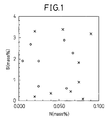
- FIG. 1 is a diagram illustrating the relationship between Erichsen values and components.
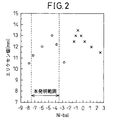
- FIG. 2 is a diagram showing the relationship between the Erichsen value and the Ni balance.
- Table 1 shows typical test steel components.
- the duplex stainless steel having such components was melted in vacuum to produce a hot rolled sheet having a thickness of 5 mm.
- Hot-rolled sheet annealing was performed at 1050 ° C. and pickled to produce a cold-rolled sheet having a thickness of 0.6 mm.
- Cold-rolled sheet annealing was performed at 1050 ° C.
- the cold-rolled annealed plate was subjected to austenite ( ⁇ ) phase ratio measurement, JIS 13B tensile test, and Erichsen test.
- the ⁇ phase ratio was determined by measuring a phase map that identifies the crystal structure of fcc and bcc by the EBSP method on the plate cross section.
- JIS 13B tensile test a tensile specimen was taken from the rolling direction, the tensile speed was 10 mm / min (range specified by JIS Z 2241), 0.2% proof stress (0.2% PS), and tensile strength (TS ), Elongation at break (EL) was measured.
- the Eriksen test was conducted by collecting 90 mm square test pieces and performing the method B according to JIS Z 2247 (wrinkle pressure 1 ton), and measuring the molding height (Erichsen value) when the crack penetrated the plate thickness.
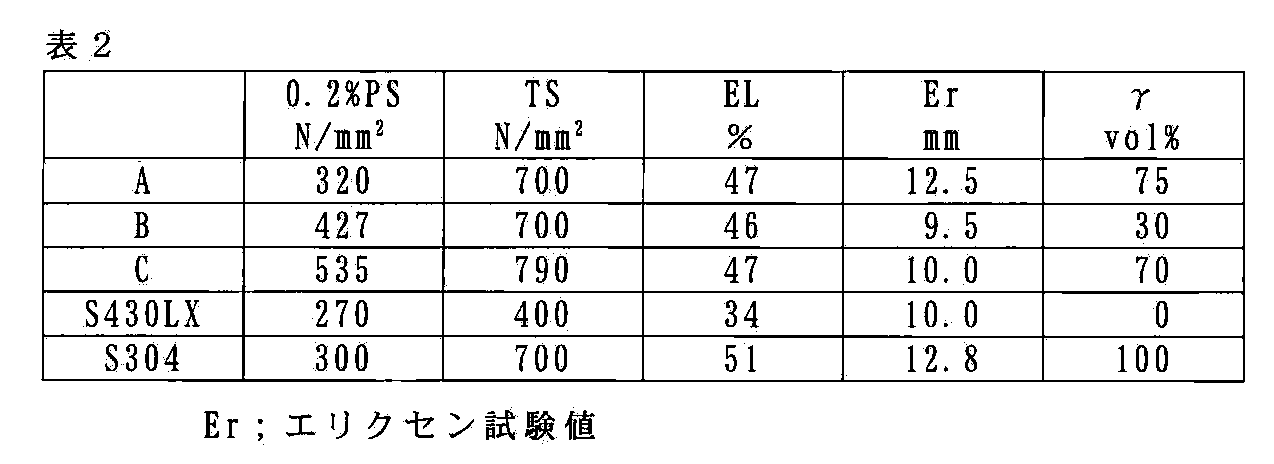
- Table 2 shows the mechanical properties, Erichsen value (Er), and ⁇ phase ratio ( ⁇ ) obtained from the plates of typical test steel components compared with SUS430LX and SUS304 steels of ferrite ( ⁇ ) and ⁇ single phase. As shown. As is clear from Table 2, Steel A has an Erichsen value comparable to SUS304.
- the 0.2% proof stress is significantly higher than that of SUS304, and the Erichsen value is equal to or less than that of ⁇ -type SUS430LX. . It is generally known that the Erichsen value increases in proportion to the elongation at break of the material.
- the high-strength duplex stainless steel to which N is added does not necessarily have an Erichsen value commensurate with high elongation. That is, the steels B and C to which N is added may not be able to obtain high workability in a deformation mode assuming press forming different from the tensile test.
- the component of steel A has a feature of low N ⁇ Si addition. By reducing N, the strength and work hardening of the ⁇ phase are lowered. Si selectively dissolves in the ⁇ phase to increase the strength and work hardening of the ⁇ phase.
- the Erichsen value of 11 mm is difficult to reach with ⁇ -type stainless steel and is set to a threshold value close to that of ⁇ -type stainless steel.
- a high Erichsen value of 11 mm or more can be obtained when N is 0.07% or less and Si is added in the range of 0.5 to 3%.
- FIG. 2 shows the result of the arrangement.
- Ni-bal. 30 (C + N) + Ni + 0.5Mn + 0.3Cu-1.1 (Cr + 1.5Si) +8.2.
- Ni-bal. Is often used as an index for the generation of ⁇ and ⁇ phases.
- the inventors have found novel findings obtained in the range of ⁇ 7.5 to ⁇ 3.5, more preferably in the range of ⁇ 6 to ⁇ 4.
- the present inventions (1) to (4) have been completed based on the findings [a] to [g].
- “%" display of the content of each element means “mass%”.
- A The reason for limitation of a component is demonstrated below. C increases the ⁇ phase rate and also concentrates in the ⁇ phase to increase the stability of the ⁇ phase. Therefore, Ni-bal. Is effectively acted on the expression of the press formability that is the object of the present invention. In order to acquire the said effect, containing 0.001% or more is preferable.
- the upper limit is made 0.05%.
- Si is selectively dissolved in the ⁇ phase to increase the strength and work hardening of the ⁇ phase, reduce the strength difference between the ⁇ phase and the ⁇ phase, and express the press formability targeted by the present invention. It is an essential additive element. Furthermore, it has the effect of increasing the stability of the ⁇ phase and suppressing martensitic transformation in the cooling process after annealing. When martensitic transformation is performed, the ⁇ phase becomes a hard phase, which significantly impairs workability.
- the upper limit is 3%.
- a preferred range is 1.5 to 2.5%.
- Mn increases the ⁇ phase rate and also concentrates in the ⁇ phase to increase the stability of the ⁇ phase. Therefore, Ni-bal. Is effectively acted on the expression of the press formability that is the object of the present invention.
- 1% or more is added. However, if it exceeds 5%, in addition to the decrease in corrosion resistance, the strength of the ⁇ phase increases and the press formability decreases. Therefore, the upper limit is 5%.
- the preferred range is 2 to 4.5%. More preferably, it is 3 to 4%.
- Cr is a constituent element of the ⁇ phase, and also has an effect of ensuring the corrosion resistance and adjusting the stability of the ⁇ phase to express the press formability intended by the present invention. Cr, like Si, suppresses the ⁇ -phase martensitic transformation in the cooling process after annealing. Therefore, in order to ensure the effect on the stability and corrosion resistance of the ⁇ phase, the content is made 16% or more. However, if it exceeds 21%, it becomes difficult to make the ⁇ phase as the main phase, which leads to a decrease in the workability targeted by the present invention. Therefore, the upper limit is 21% or less.
- the preferred range is 16.5 to 18.5%.
- Ni is an effective ⁇ -phase-forming element, and Ni-bal. Is effectively acted on the expression of the press formability that is the object of the present invention. In order to obtain the above effect, 1% or more is added. However, if it exceeds 6%, it cannot be said that Ni is saved, and the raw material cost is increased. Therefore, the upper limit is 6%. From the viewpoint of workability and cost, the preferred range is 2 to 5%. More preferably, it is 2.5 to 4.5%.
- Cu is an effective ⁇ -phase-forming element like Ni and Mn, and Ni-bal. Is effectively acted on the expression of the press formability that is the object of the present invention.
- N is an effective ⁇ -phase-forming element as in C and Ni, and Ni-bal. Is effectively acted on the expression of the press formability that is the object of the present invention. Therefore, it is preferable to contain 0.001% or more. On the other hand, it has the effect of increasing the strength and work hardening of the ⁇ phase and expanding the strength difference between the ⁇ phase and the ⁇ phase.
- the press formability targeted by the present invention is reduced. Accordingly, as shown in FIG. 1, the upper limit is 0.07%. From the viewpoint of the workability targeted by the present invention, the preferred range is 0.02 to 0.06%.
- Mo may be added in a timely manner in order to improve the corrosion resistance. In order to obtain the effect of improving the corrosion resistance, it is preferable to add 0.1% or more. However, if it exceeds 1%, the economy may be impaired. Therefore, when adding, it shall be 1% or less. From the viewpoint of corrosion resistance and economy, the preferred range when added is 0.2 to 0.8%. Nb, V, and Ti exhibit the same effect as Si and improved corrosion resistance.
- solid solution strengthening in the ⁇ phase reduces the strength difference between the ⁇ phase and the ⁇ phase to improve press formability, and suppresses the martensitic transformation of the ⁇ phase in the cooling process after annealing.
- the economy may be impaired. Therefore, when adding, it is 0.5% or less respectively.
- the preferred range for addition is 0.1 to 0.3%.
- Sn, Sb, and W may be added at appropriate times in order to improve the corrosion resistance. In order to obtain the effect of improving the corrosion resistance, it is preferable to add 0.01% or more respectively.
- the productivity such as hot workability may be impaired. Therefore, when adding, it is 1% or less respectively.
- the preferred range for addition is 0.1 to 0.6%.
- Al is a strong deoxidizer and may be added as needed. In order to acquire the said effect, adding 0.001% or more is preferable. However, if it exceeds 0.1%, nitrides may be formed, leading to a decrease in surface defects and corrosion resistance. Therefore, when adding, it shall be 0.1% or less. From the viewpoint of the above effects and manufacturability, the preferred range when added is 0.005 to 0.05%.
- B, Ca, and Mg may be added in a timely manner in order to improve hot workability.
- the corrosion resistance may be significantly reduced. Therefore, when adding, it is 0.01% or less respectively.
- the preferred range for addition is 0.0005 to 0.01%.
- Rare earth elements (REM) such as La, Ce, Zr, and Y also have the effect of improving hot workability in the same manner as B, Ca, and Mg. Therefore, you may add timely.
- adding 0.001% or more of each is preferable. However, if it exceeds 0.3%, economic efficiency may be impaired. Therefore, when adding, it shall be 0.3% or less, respectively.
- P, S, and O oxygen
- P, S, and O are elements harmful to hot workability and corrosion resistance.
- P is preferably 0.1% or less. More preferably, it is 0.05% or less.
- S is preferably 0.01% or less. More preferably, it is 0.005% or less, More preferably, it is less than 0.002%.
- O is preferably 0.01% or less. More preferably, it is 0.005% or less, More preferably, it is less than 0.002%.
- Ni-bal Ni-bal.
- ⁇ 1> is calculated from the amounts of C, N, Ni, Mn, Cu, Cr, and Si.
- the index relating to the generation of the ⁇ phase and the ⁇ phase defined in (1) defines the range in order to obtain the press formability targeted by the present invention.
- the Erichsen value as an index of press formability is calculated from Ni-bal. In the range of ⁇ 7.5 to ⁇ 3.5, the target value of the Erichsen value of 11 mm of the present invention is achieved. Therefore, Ni-bal.
- the range of ⁇ 6 to ⁇ 4 in which the Erichsen value is a maximum value is obtained from the examination result of FIG. 2 described above.
- the duplex stainless steel sheet of the present invention comprises the components described in the section (A) and Ni-bal.
- the ⁇ phase ratio is defined.
- the ⁇ phase ratio is Ni-bal. Is generally correlated. That is, the ⁇ phase ratio is Ni-bal. It tends to increase with the rise of.
- the ⁇ production ability in the finish annealing temperature region described later is Ni-bal. It does not necessarily correspond uniquely to the coefficient of each element. Therefore, in order to obtain the press formability targeted by the present invention, Ni-bal.
- the ⁇ phase ratio can be obtained by the EBSP method.
- the EBSP method is described in, for example, a microscope; Seiichi Suzuki, Vol. 39, no. 2, 121-124, crystal system data of ⁇ phase (fcc) and ⁇ phase (bcc) is designated and a phase distribution map colored for each phase is displayed.
- the ⁇ phase ratio can be obtained, and the dispersion form of the ⁇ phase and the ⁇ phase can also be grasped.
- the sample is a cross section in the plate thickness direction, and the measurement magnification is 500.
- the lower limit of the ⁇ phase ratio is 50% in order to ensure the press formability that is the object of the present invention.
- Non-Patent Document 2 reports the microstructure of duplex stainless steel characterized by high Si and low Ni related to the development of Patent Documents 1 to 3. As described in the background art, these steels aim to increase 0.2% proof stress in order to secure the strength for vehicles.
- the 0.2% yield strength of the ⁇ phase is smaller than that of the ⁇ phase. Therefore, in order to increase the 0.2% yield strength, it is preferable that the ⁇ phase is the main phase in the two-phase structure.
- the metal structure shown in Non-Patent Document 2 has a ⁇ phase as a main phase (53.3 to 75.0% ⁇ ) in a duplex stainless steel having a Cr content exceeding 17%. Accordingly, the metal structure of the present invention aimed at improving the press formability of the steel sheet is different from the metal structure of steel disclosed in Patent Documents 1 to 3.
- the duplex stainless steel sheet according to the present invention has the ⁇ phase as the main phase and the remainder as the ⁇ phase.
- the ⁇ phase may undergo martensitic transformation in the cooling process after annealing.
- the martensite phase may be inevitably mixed as long as the target press formability is not impaired in the present invention.
- the dispersion form of the ⁇ phase when ⁇ is the main phase is not particularly specified.
- the ⁇ phase is preferably finely dispersed. Specifically, it is preferable that ⁇ phases of less than 50 ⁇ m are dispersed in the form of fibers or particles in the thickness direction.
- C Mechanical properties and Erichsen value will be described below.
- the duplex stainless steel sheet of the present invention comprises the components described in the section (A) and Ni-bal.
- the ⁇ phase ratio described in the item (B) is specified.
- the mechanical properties and Erichsen value of the steel sheet satisfying such regulations are preferably the following values so that press forming can be performed in the same manner as austenitic stainless steel sheets such as SUS304.
- the 0.2% proof stress is preferably less than 400 MPa so as to be comparable to austenitic stainless steel such as SUS304.
- 400 MPa or more when an actual press is assumed, there is a concern about insufficient power of the press and wear / damage of the mold. More preferably, it is 350 MPa or less.
- the lower limit is not particularly specified, but a more preferable range is 250 to 350 MPa in consideration of the amount of C + N and the amount of alloy to be added.
- the elongation at break is preferably 35% or more in order to obtain a high Erichsen value, as described in the explanation of the test steels A, B and C in Table 2 and [g]. More preferably, it is 40% or more, More preferably, it is 45% or more.
- the Eriksen value is important as an index of press formability represented by overhang processability. As described in the test method and [f], in order to obtain press formability comparable to the target austenitic stainless steel in the present invention, it is preferably 11 mm or more. More preferably, it is set to 12 mm or more. Although the upper limit is not particularly provided, it is difficult to exceed 15 mm under the conditions specified in JIS Z 2241 Method B (wrinkle pressure 1 ton).
- the manufacturing method will be described below.
- the components described in the section (A) and Ni-bal. And the production method is not particularly limited as long as the ⁇ phase ratio described in the item (B) is satisfied.
- the finish cold rolling and finish annealing conditions affect the ⁇ phase ratio and the structure dispersion.
- the rolling reduction in cold rolling is preferably 40% or more from the viewpoint of fine dispersion of the ⁇ phase that is the second phase.
- the cooling after annealing is preferably performed at a cooling rate of air cooling or higher (approximately 3 ° C./second or higher) in order to suppress the martensitic transformation of the ⁇ phase.
- a duplex stainless steel having the components shown in Table 3 was melted and hot rolled to produce a hot rolled sheet having a thickness of 4.0 to 5.0 mm.
- Steel No. 1 ⁇ Steel No. 22 is a component defined in the present invention and Ni-bal. It is what has. Steel No. 23 and 24 have components specified in the present invention, but Ni-bal. Is outside the scope of the present invention.
- Steel No. Nos. 25 to 27 are Ni-bal. However, the component range is outside the scope of the present invention.
- After these hot-rolled sheets were annealed and pickled, they were cold-rolled to a thickness of 0.7 mm and finish-annealed at 1050 ° C.
- the Erichsen value is higher than that of SUS430LX and is comparable to or higher than ⁇ -based stainless steel such as SUS304.
- the elongation was less than 35% or the ⁇ phase ratio was less than 50%, and the Erichsen value of 11 mm or more, which was the target of the present invention, was not reached. From this, it can be seen that even if the component defined in the present invention is satisfied, if the Ni-bal range is out, the target Erichsen value of the present invention is not reached. No. Nos.
Landscapes
- Chemical & Material Sciences (AREA)
- Engineering & Computer Science (AREA)
- Materials Engineering (AREA)
- Mechanical Engineering (AREA)
- Metallurgy (AREA)
- Organic Chemistry (AREA)
- Physics & Mathematics (AREA)
- Thermal Sciences (AREA)
- Crystallography & Structural Chemistry (AREA)
- Heat Treatment Of Sheet Steel (AREA)
- Heat Treatment Of Steel (AREA)
Abstract
Description
古くから、オーステナイト系ステンレス鋼の代替として、Ni量を節約した二相ステンレス鋼が知られている。特許文献1~3には、Ni:1~7%、Si:1超~5%、N:0.04~2%、Cr:17~22%でMnやCuなどを添加してNiバランス値を調整してヤング率を高めた車両用高強度二相ステンレス鋼が開示されている。これら二相ステンレス鋼は、高Si・低Niを特徴とし、0.2%耐力は500MPa超の高強度と高い伸びを兼備している。
近年、Ni含有量をさらに節減してNを比較的多量に添加した高延性を有するオーステナイト・フェライト系ステンレス鋼が報告されている。特許文献4と特許文献5には、Ni量を3%以下に規制し、オーステナイト相中のC+Nと成分バランスを調整して高延性を有する成形性に優れるオーステナイト・フェライト系ステンレス鋼が開示されている。これに関連するものとして、特許文献6には、Ni量を1%以下、Mn量を2%以下に規定し、N量を0.05~0.6%の範囲で添加した張り出し成形性と耐隙間腐食性に優れるオーステナイト・フェライト系ステンレス鋼が開示されている。上記公報の実施例では、Ni量を節減するために、N量を少なくとも0.08%以上添加している。
最近、特許文献7には、N量の上限を0.15%に制限し低Ni化を指向した耐食性と加工性に優れたフェライト・オーステナイト系ステンレス鋼が開示されている。これらステンレス鋼は、耐食性の視点からCr+3Mo+10N−Mn≧18%とし、加工性の観点からオーステナイト粒の粒径とアスペクト比、粒子間距離を規定している。上記公報に開示された鋼は、オーステナイト相を50%未満とし、フェライト相を主相としている。
上述した特許文献に開示された鋼は、Ni節減や高強度化のために少なからずNを活用している。ステンレス鋼をはじめ鉄鋼材料の機械的性質に及ぼすNの影響については多くの研究があり、0.2%耐力の上昇に対するN添加の影響は大きい。例えば、非特許文献1では、Fe−Cr−Ni−Mn合金へ0.1%超のNを添加すると、常温で0.2%耐力は400MPaをはるかに超える。実際、特許文献1~3に開示された鋼の0.2%耐力は500MPa超である。特許文献4~7では0.2%耐力の記載がないものの、非特許文献1から400MPaを超えることが容易に推測される。
上述したように、0.2%耐力は400MPaを超える場合、SUS304等のオーステナイト系ステンレス鋼と比較すると、一般的に100MPa超高い値である。そのため、鋼板のプレス成形性において、現有のプレス機ではパワ−不足のため加工が困難となる、金型の磨耗・損傷等の問題が危惧される。言い換えると、Niを節減した二相ステンレス鋼において、SUS304等のオーステナイト系ステンレス鋼板と遜色なくプレス成形可能な鋼板については明らかにされていないのが現状である。
本発明の要旨は、次の通りである。
(1) 質量%にて、
C:0.05%以下、
Si:0.5~3%、
Mn:1~5%、
Cr:16~21%、
Ni:1~6%、
Cu:0.5~3%、
N:0.07%以下
を含有し、下記<1>式で与えられるNi−bal.値が−7.5以上、−3.5以下を満たし、残部がFeおよび不可避的不純物からなり、オーステナイト相率が50%以上、95%以下で残部がフェライト相であることを特徴とするプレス成形性に優れた二相ステンレス鋼板。
Ni−bal.=30(C+N)+Ni+0.5Mn+0.3Cu
−1.1(Cr+1.5Si)+8.2
・・・<1>式
(2) 前記鋼が、さらに質量%にて、
Mo:1%以下、
Nb:0.5%以下、
V:0.5%以下、
Ti:0.5%以下、
Sn:1%以下、
Sb:1%以下、
W:1%以下、
Al:0.1%以下
の1種または2種以上含有していることを特徴とする上記(1)に記載のプレス成形性に優れた二相ステンレス鋼板。
(3) 前記鋼が、さらに質量%にて、
B:0.01%以下、
Ca:0.01%以下、
Mg:0.01%以下、
La:0.3%以下、
Ce:0.3%以下、
Zr:0.3%以下、
Y:0.3%以下、
の1種または2種以上含有していることを特徴とする上記(1)または(2)に記載のプレス成形性に優れた二相ステンレス鋼板。
(4) 引張試験における0.2%耐力が400MPa未満、破断伸びが35%以上であることを特徴とする上記(1)または(2)に記載のプレス成形性に優れた二相ステンレス鋼板。
(5) 引張試験における0.2%耐力が400MPa未満、破断伸びが35%以上であることを特徴とする上記(3)に記載のプレス成形性に優れた二相ステンレス鋼板。
(6) エリクセン試験で求められる成形高さ(エリクセン値)が11mm以上であることを特徴とする上記(1)または(2)に記載のプレス成形性に優れた二相ステンレス鋼板。
(7) エリクセン試験で求められる成形高さ(エリクセン値)が11mm以上であることを特徴とする上記(3)に記載のプレス成形性に優れた二相ステンレス鋼板。
(8) エリクセン試験で求められる成形高さ(エリクセン値)が11mm以上であることを特徴とする上記(4)に記載のプレス成形性に優れた二相ステンレス鋼板。
(9) エリクセン試験で求められる成形高さ(エリクセン値)が11mm以上であることを特徴とする上記(5)に記載のプレス成形性に優れた二相ステンレス鋼板。
以下の説明で、上記(1)~(9)の鋼に係わる発明をそれぞれ本発明という。また、(1)~(9)の発明を合わせて、本発明ということがある。
図2は、エリクセン値とNiバランスの関係を示す図である。
表1には代表的な供試鋼成分を示している。このような成分の二相ステンレス鋼を真空溶解し、5mm厚の熱延板を製造した。熱延板焼鈍は1050℃で行い、酸洗して0.6mm厚の冷延板を作製した。冷延板焼鈍は1050℃で実施した。冷延焼鈍板は、オーステナイト(γ)相率の測定、JIS13B号引張試験、エリクセン試験に供した。
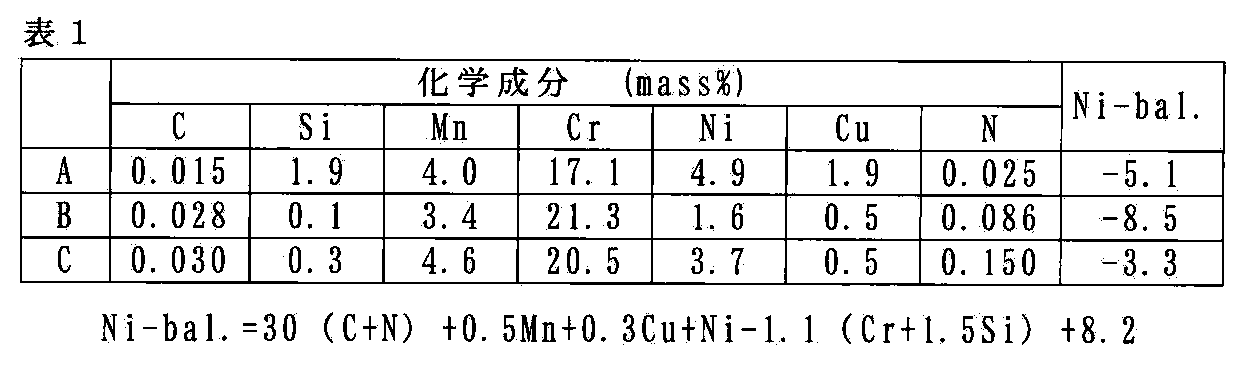
表2には、代表的な供試鋼成分の板から得られた機械的性質とエリクセン値(Er)、γ相率(γ)をフェライト(α)およびγ単相のSUS430LXとSUS304鋼と比較して示している。表2から明らかなように、鋼AはSUS304と遜色ないエリクセン値を有している。一方、Nを添加した鋼BおよびCは高い伸びを有しても、0.2%耐力はSUS304と比較して大幅に高く、エリクセン値はα系のSUS430LXと同等あるいはそれを下回る値である。
〔a〕引張試験後の破断部は、すべて板厚減少を伴ったくびれを生じた。他方、エリクセン試験後では、エリクセン値の低かった鋼B、Cは殆どくびれずに破断に至っていた。
〔b〕鋼BとCのエリクセン試験後の破断部近傍では、γ/αの異相界面付近から多数の微小ボイドが発生した。このような微小ボイドを起点として割れがα相あるいはγ/α相界面を進展していく様子が観察された。
〔c〕Nはγ相に濃化して強度と加工硬化を高める。そのため、Nを添加すると、γ相とα相の強度差は加工度とともに広がることが容易に予測できる。上記〔b〕の観察結果はα相とγ相の強度差に由来していると考えられる。
〔d〕エリクセン値の高い鋼Aは、α/γ界面からの微小ボイドの発生が大幅に抑制されるとともに、α相は変形能の大きいγ相に追従することで引張試験と同様に大きなくびれを伴って破断に至っていることを確認した。
〔e〕鋼Aの成分は、低N・Si添加の特徴を有する。Nを低減することでγ相の強度と加工硬化は低下する。Siは、α相へ選択的に固溶し、α相の強度と加工硬化を高める。このようにして、α相とγ相の強度差を低減し、変形能の高いγ相を主相とすることにより良好なエリクセン値が得られたと考えられる。
〔f〕前記した〔e〕の考え方に基づいて、N量とSi量に着目して高いエリクセン値が得られる成分範囲を詳細に調べた。Cr、Ni、Mn、CuはNiバランスで−9から−2の範囲に入るように調整した。図1に結果を示す。図中には、エリクセン値が11mm以上を○、11mm未満を×と表記した。エリクセン値11mmは、α系ステンレスでは到達困難であり、γ系ステンレスに近いしきい値とした。図1から分かるように、11mm以上の高いエリクセン値は、Nを0.07%以下とし、Siを0.5~3%の範囲で添加した場合に得られることが分かった。
〔g〕図1のエリクセン値について、Ni−bal.で整理した結果を図2に示す。ここで、Ni−bal.=30(C+N)+Ni+0.5Mn+0.3Cu−1.1(Cr+1.5Si)+8.2 と定義する。Ni−bal.はγ相とα相の生成に係る指数としてよく用いられる。図2には、同指数でγ系ステンレス鋼のエリクセン値を併記した。γ系ステンレス鋼では、良好なエリクセン値を与える成分範囲が存在する。この理由は、γ相の加工誘起マルテンサイト変態による伸びの上昇(変態誘起塑性:TRIP)に基づく。本検討により、〔e〕および〔f〕で記した成分範囲において、γ系ステンレス鋼と同様なTRIP現象に基づく伸びとエリクセン値の両者が効果的に上昇する成分バランス(Ni−balの範囲)を見出した。すなわち、高いエリクセン値は、Ni−bal.=−7.5~−3.5の範囲、より好ましくは−6から−4の範囲において得られる新規な知見を見出した。
前記(1)~(4)の本発明は、上記〔a〕~〔g〕の知見に基づいて完成されたものである。
以下、本発明の各要件について詳しく説明する。なお、各元素の含有量の「%」表示は「質量%」を意味する。
(A)成分の限定理由を以下に説明する。
Cは、γ相率を高めると共に、γ相中に濃化して、γ相の安定度を高める。従って、Ni−bal.を調整して本発明の目的とするプレス成形性の発現に対して有効に作用する。上記効果を得るためには、0.001%以上含有することが好ましい。しかし、0.05%を超えると、γ相の強度が上昇するとともに、炭化物の粒界析出による鋭敏化を生じやすく耐食性の低下に繋がる。そのため、上限は0.05%とする。好ましくは0.03%以下である。
Siは、α相へ選択的に固溶し、α相の強度と加工硬化を高めて、α相とγ相の強度差を低減して本発明の目的とするプレス成形性を発現させるために必須の添加元素である。さらに、α相の安定度を高めて、焼鈍後の冷却過程でのマルテンサイト変態を抑制する作用も持つ。マルテンサイト変態するとα相は硬質相となり、加工性を著しく阻害する。本発明の目的とする加工性への効果を得るためには、図1でも示したように0.5%以上添加する。しかし、3%超の添加は、α相の硬質化と加工性の低下を招く。そのため、上限は3%とする。好ましい範囲は1.5~2.5%である。
Mnは、γ相率を高めると共に、γ相中に濃化して、γ相の安定度を高める。従って、Ni−bal.を調整して本発明の目的とするプレス成形性の発現に対して有効に作用する。上記効果を得るためには、1%以上添加する。しかし、5%を超えると、耐食性の低下に加えて、γ相の強度が上昇してプレス成形性の低下を招く。そのため、上限は5%とする。加工性と耐食性の点から、好ましい範囲は2~4.5%である。より好ましくは3~4%である。
Crは、α相の構成元素であるとともに、耐食性の確保とγ相の安定度を調整して本発明の目的とするプレス成形性を発現させる作用もある。また、CrはSiと同様に、焼鈍後の冷却過程でα相のマルテンサイト変態を抑制する。従って、α相の安定度と耐食性等への作用を確保するためには16%以上とする。しかし、21%を超えると、γ相を主相とすることが困難となり、本発明の目的とする加工性の低下を招く。そのため、上限は21%以下とする。加工性と耐食性の点から、好ましい範囲は16.5~18.5%である。
Niは、有効なγ相の生成元素であり、Ni−bal.を調整して本発明の目的とするプレス成形性の発現に対して有効に作用する。上記効果を得るためには、1%以上添加する。しかし、6%を超えると、Ni節減とは言えず原料コストの上昇を招く。そのため、上限は6%とする。加工性とコストの点から、好ましい範囲は2~5%である。より好ましくは2.5~4.5%である。
Cuは、NiやMnと同様に有効なγ相の生成元素であり、Ni−bal.を調整して本発明の目的とするプレス成形性の発現に対して有効に作用する。さらに、Niと複合添加することで耐食性の向上にも有効な元素である。上記効果を得るためには、0.5%以上添加する。しかし、3%を超えると、製造性や原料コストの上昇を招く。そのため、上限は3%とする。性能と製造性の点から、好ましい範囲は1.5~2.5%である。
Nは、CやNiと同様に有効なγ相の生成元素であり、Ni−bal.を調整して本発明の目的とするプレス成形性の発現に対して有効に作用する。そのため、0.001%以上含有することが好ましい。他方、γ相の強度と加工硬化を高め、γ相とα相の強度差を拡大させる作用を持つ。そのため、前記したようにNを積極的に活用した場合、本発明の目的とするプレス成形性の低下に繋がる。従って、図1でも示したように、上限は0.07%とする。本発明の目的とする加工性の点から、好ましい範囲は0.02~0.06%である。
次いで、本発明の選択成分について説明する。
Moは、耐食性を向上させるために適時添加してもよい。耐食性の向上効果を得るためには、0.1%以上添加することが好ましい。しかし、1%を超えると、経済性を損なう恐れがある。そのため、添加する場合は1%以下とする。耐食性と経済性の点から、添加する場合の好ましい範囲は0.2~0.8%である。
Nb、V、Tiは、耐食性の向上とSiと同様な効果を発現する。すなわち、α相への固溶強化により、α相とγ相の強度差を低減してプレス成形性を向上させる、焼鈍後の冷却過程でα相のマルテンサイト変態を抑制する。上記効果を得るために適時添加してもよい。添加する場合はそれぞれ0.05%以上とすることが好ましい。しかし、0.5%を超えると、経済性を損なう恐れがある。そのため、添加する場合はそれぞれ0.5%以下とする。上記効果と経済性の点から、添加する場合の好ましい範囲はそれぞれ0.1~0.3%である。
Sn、Sb、Wは、耐食性を向上させるために適時添加してもよい。耐食性の向上効果を得るためには、それぞれ0.01%以上添加することが好ましい。しかし、1%を超えると、熱間加工性など製造性を損なう恐れがある。そのため、添加する場合はそれぞれ1%以下とする。耐食性と製造性の点から、添加する場合の好ましい範囲はそれぞれ0.1~0.6%である。
Alは、強力な脱酸剤であり、適時添加してもよい。上記効果を得るためには0.001%以上添加することが好ましい。しかし、0.1%を超えると、窒化物を形成して表面疵や耐食性の低下を招く恐れがある。そのため、添加する場合は0.1%以下とする。上記効果と製造性の点から、添加する場合の好ましい範囲は0.005~0.05%である。
B、Ca、Mgは、熱間加工性を向上させるために適時添加してもよい。上記効果を得るためにはそれぞれ0.0002%以上添加することが好ましい。しかし、0.01%を超えると、耐食性が著しく低下する場合がある。そのため、添加する場合はそれぞれ0.01%以下とする。上記効果と製造性の点から、添加する場合の好ましい範囲はそれぞれ0.0005~0.01%である。
La、Ce、Zr、Y等の希土類元素(REM)も、B、Ca、Mgと同様に熱間加工性を向上させる作用を持つ。そのため、適時添加してもよい。上記効果を得るためにはそれぞれ0.001%以上添加することが好ましい。しかし、0.3%を超えると、経済性を損なう場合がある。そのため、添加する場合はそれぞれ0.3%以下とする。上記効果と経済性の点から、添加する場合の好ましい範囲はそれぞれ0.002~0.1%である。
さらに、上記の成分以外に、不可避的不純物の一部としてP、S、O(酸素)を含んでもよい。P、S、Oは熱間加工性や耐食性に有害な元素である。Pは0.1%以下とするのが好ましい。より好ましくは0.05%以下である。Sは0.01%以下とするのが好ましい。より好ましくは0.005%以下、さらに好ましくは0.002%未満である。Oは0.01%以下とするのが好ましい。より好ましくは0.005%以下、さらに好ましくは0.002%未満である。
上述の成分範囲に加えて、C、N、Ni、Mn、Cu、Cr、Si量から下記<1>式のNi−bal.で定義されるγ相とα相の生成に係る指数は、本発明の目的とするプレス成形性を得るためにその範囲を規定する。プレス成形性の指標としたエリクセン値は、前記した図2の結果から、Ni−bal.=−7.5~−3.5の範囲において、本発明のエリクセン値11mmの目標値を達成する。そのため、Ni−bal.=−7.5~−3.5の範囲となるように各元素の含有量を調整する。好ましくは、前記した図2の検討結果から、エリクセン値が極大値となる−6~−4の範囲とする。
Ni−bal.=30(C+N)+Ni+0.5Mn+0.3Cu
−1.1(Cr+1.5Si)+8.2
・・・<1>
(B)金属組織について以下に説明する。
本発明の二相ステンレス鋼板は、(A)項で述べた成分とNi−bal.を有し、プレス成形性を向上させるためにγ相率を規定する。γ相率はNi−bal.と概ね相関を持つ。すなわち、γ相率はNi−bal.の上昇とともに増加する傾向にある。しかしながら、後述する仕上げ焼鈍温度領域におけるγ生成能は、Ni−bal.の各元素の係数と必ずしも一義的に対応するものでない。そのため、本発明の目標とするプレス成形性を得るためにNi−bal.とγ相率の両者を規定する必要がある。
γ相率は、前述のように、EBSP法により求めることができる。EBSP法は、例えば、顕微鏡;鈴木清一、Vol.39、No.2、121~124に記載されているように、γ相(fcc)とα相(bcc)の結晶系データを指定し、相毎に色づけした相分布マップを表示する。これにより、γ相率を求めることが可能であり、さらにγ相やα相の分散形態も把握することが出来る。例えば、試料は板厚方向の断面、測定倍率は500とする。
γ相率の下限は、本発明の目的とするプレス成形性を確保するために50%とする。0.2%耐力を小さくしてプレス成形性を効果的に発現させるために、好ましくは60%以上である。一方、γ相率が95%超となる場合は、多量のNi、Mn、Cuの添加を必要とし、Ni節減・経済性の視点から問題がある。さらに、γ系ステンレスとの分別も容易でない。そのため、上限は95%とする。Ni節減・経済性の視点から、好ましい範囲は60~80%である。
非特許文献2には、特許文献1~3の開発に関連した高Si・低Niを特徴とする二相ステンレス鋼の金属組織が報告されている。これらの鋼は、背景技術に記述した通り、車両用としての強度を確保するために0.2%耐力の上昇を目的としている。一般に、γ相の0.2%耐力はα相よりも小さい。そのため、0.2%耐力を上昇させるには、二相組織においてα相を主相とすることが好ましい。非特許文献2で示された金属組織は、Cr量17%超の二相ステンレス鋼において、α相を主相(53.3~75.0%α)としている。従って、鋼板のプレス成形性の向上を目的とした本発明の金属組織は、特許文献1~3に開示された鋼の金属組織とは異なるものである。
前記したように、本発明の二相ステンレス鋼板は、γ相を主相とし、残部はα相とする。Cr量やSi量が低い場合、α相は焼鈍後の冷却過程においてマルテンサイト変態する場合がある。本発明で目的とするプレス成形性を阻害しない程度において、マルテンサイト相を不可避的に混入しても構わない。
γを主相とした場合のα相の分散形態は、特に規定するものではない。プレス成形性の観点から、α相は微細分散していることが好ましい。具体的には、板厚方向に50μm未満のα相が繊維状ないし粒子状に分散していることが好ましい。
(C)機械的性質、エリクセン値について以下に説明する。
本発明の二相ステンレス鋼板は、(A)項で述べた成分とNi−bal.を有し、プレス成形性を向上させるために(B)項で述べたγ相率を規定している。このような規定を満足した鋼板の機械的性質とエリクセン値は、SUS304等のオーステナイト系ステンレス鋼板と遜色なくプレス成形が可能となるように、以下の値であることが好ましい。
0.2%耐力は、SUS304等のオーステナイト系ステンレス鋼と遜色ない程度とするために400MPa未満とすることが好ましい。400MPa以上の場合は、実プレスを想定した場合、プレス機のパワ−不足や金型の磨耗・損傷が懸念される。より好ましくは350MPa以下とする。下限は特に規定するものでないが、C+N量や添加する合金量を考慮して、より好ましい範囲は、250~350MPaである。
破断伸びは、表2での供試鋼A、B、Cの説明および〔g〕で述べたように、高いエリクセン値を得るために、35%以上であることが好ましい。より好ましくは40%以上、さらに好ましくは45%以上である。
エリクセン値は、張り出し加工性に代表されるプレス成形性の指標として重要である。試験方法及び〔f〕で述べたように、本発明で目標とするオーステナイト系ステンレスと遜色ない程度のプレス成形性を得るには、11mm以上であることが好ましい。より好ましくは12mm以上とする。上限は特に設けるものではないが、JIS Z 2241のB法(しわ押さえ圧1トン)に規定する条件下で15mmを超えることは困難である。
(D)製造方法に関して以下に説明する。
(A)項で述べた成分およびNi−bal.と(B)項で述べたγ相率を満足すれば製造方法は特に限定するものではない。
仕上げの冷間圧延と仕上げ焼鈍条件は、γ相率や組織の分散形態に影響する。冷間圧延の圧下率は、第2相であるα相の微細分散という視点から、40%以上であることが好ましい。仕上げ焼鈍は、γ相を主相とするために950~1150℃の範囲に加熱することが好ましい。1150℃超の場合は、α相の生成量が増加するとともに組織の粗大化も懸念される。950℃未満の場合は、γ相の再結晶・軟質化が不十分となる恐れもある。焼鈍後の冷却は、Cr量やSi量が少ない場合、α相のマルテンサイト変態を抑制するために空冷以上(およそ3℃/秒以上)の冷却速度とすることが好ましい。
表3に示す成分を有する二相ステンレス鋼を溶製し、熱間圧延を行い、板厚4.0~5.0mmの熱延板を製造した。鋼No.1~鋼No.22は、本発明で規定する成分とNi−bal.を有するものである。鋼No.23、24は、本発明で規定する成分を有するものの、Ni−bal.が本発明から外れるものである。鋼No.25~27は、本発明で規定するNi−bal.を有するものの、成分範囲が本発明から外れるものである。これら熱延板を焼鈍・酸洗した後、0.7mm厚に冷間圧延し、1050℃で仕上げ焼鈍を行った。


No.23、24は、伸びが35%未満、あるいはγ相率が50%未満となり本発明の目標とする11mm以上のエリクセン値に到達しなかった。これより、本発明で規定する成分を満たしても、Ni−bal範囲が外れる場合は本発明の目標とするエリクセン値に到達しないことが分かる。
No.25~27は、0.2%耐力が400MPa超、あるいはγ相率が50%未満となり本発明の目標とする11mm以上のエリクセン値に到達しなかった。これより、本発明で規定するNi−bal範囲を満たしても、成分範囲が外れる場合は本発明の目標とするエリクセン値に到達しないことが分かる。
Claims (9)
- 質量%にて、
C:0.05%以下、
Si:0.5~3%、
Mn:1~5%、
Cr:16~21%、
Ni:1~6%、
Cu:0.5~3%、
N:0.07%以下
を含有し、下記<1>式で与えられるNi−bal.値が−7.5以上、−3.5以下を満たし、残部がFeおよび不可避的不純物からなり、オーステナイト相率が50%以上、95%以下で残部がフェライト相であることを特徴とするプレス成形性に優れた二相ステンレス鋼板。
Ni−bal.=30(C+N)+Ni+0.5Mn+0.3Cu
−1.1(Cr+1.5Si)+8.2
・・・<1>式 - 前記鋼が、さらに質量%にて、
Mo:1%以下、
Nb:0.5%以下、
V:0.5%以下、
Ti:0.5%以下、
Sn:1%以下、
Sb:1%以下、
W:1%以下、
Al:0.1%以下
の1種または2種以上含有していることを特徴とする請求項1に記載のプレス成形性に優れた二相ステンレス鋼板。 - 前記鋼が、さらに質量%にて、
B:0.01%以下、
Ca:0.01%以下、
Mg:0.01%以下、
La:0.3%以下、
Ce:0.3%以下、
Zr:0.3%以下、
Y:0.3%以下、
の1種または2種以上含有していることを特徴とする請求項1または2に記載のプレス成形性に優れた二相ステンレス鋼板。 - 引張試験における0.2%耐力が400MPa未満、破断伸びが35%以上であることを特徴とする請求項1または2に記載のプレス成形性に優れた二相ステンレス鋼板。
- 引張試験における0.2%耐力が400MPa未満、破断伸びが35%以上であることを特徴とする請求項3に記載のプレス成形性に優れた二相ステンレス鋼板。
- エリクセン試験で求められる成形高さ(エリクセン値)が11mm以上であることを特徴とする請求項1または2に記載のプレス成形性に優れた二相ステンレス鋼板。
- エリクセン試験で求められる成形高さ(エリクセン値)が11mm以上であることを特徴とする請求項3に記載のプレス成形性に優れた二相ステンレス鋼板。
- エリクセン試験で求められる成形高さ(エリクセン値)が11mm以上であることを特徴とする請求項4に記載のプレス成形性に優れた二相ステンレス鋼板。
- エリクセン試験で求められる成形高さ(エリクセン値)が11mm以上であることを特徴とする請求項5に記載のプレス成形性に優れた二相ステンレス鋼板。
Priority Applications (5)
| Application Number | Priority Date | Filing Date | Title |
|---|---|---|---|
| EP10753622.9A EP2410068B1 (en) | 2009-03-19 | 2010-03-17 | Duplex stainless steel plate having excellent press moldability |
| US13/256,977 US20120009433A1 (en) | 2009-03-19 | 2010-03-17 | Duplex stainless steel sheet with excellent press-formability |
| ES10753622T ES2720184T3 (es) | 2009-03-19 | 2010-03-17 | Chapa de acero inoxidable dúplex con excelente aptitud para la conformación en prensa |
| CN201080012544XA CN102356173B (zh) | 2009-03-19 | 2010-03-17 | 冲压成形性优良的双相不锈钢板 |
| KR1020147021833A KR101538750B1 (ko) | 2009-03-19 | 2010-03-17 | 프레스 성형성이 우수한 2상 스테인리스 강판 |
Applications Claiming Priority (2)
| Application Number | Priority Date | Filing Date | Title |
|---|---|---|---|
| JP2009067767A JP5335503B2 (ja) | 2009-03-19 | 2009-03-19 | プレス成形性に優れた二相ステンレス鋼板 |
| JP2009-067767 | 2009-03-19 |
Publications (1)
| Publication Number | Publication Date |
|---|---|
| WO2010107132A1 true WO2010107132A1 (ja) | 2010-09-23 |
Family
ID=42739787
Family Applications (1)
| Application Number | Title | Priority Date | Filing Date |
|---|---|---|---|
| PCT/JP2010/055147 Ceased WO2010107132A1 (ja) | 2009-03-19 | 2010-03-17 | プレス成形性に優れた二相ステンレス鋼板 |
Country Status (7)
| Country | Link |
|---|---|
| US (1) | US20120009433A1 (ja) |
| EP (1) | EP2410068B1 (ja) |
| JP (1) | JP5335503B2 (ja) |
| KR (2) | KR20110123772A (ja) |
| CN (1) | CN102356173B (ja) |
| ES (1) | ES2720184T3 (ja) |
| WO (1) | WO2010107132A1 (ja) |
Cited By (1)
| Publication number | Priority date | Publication date | Assignee | Title |
|---|---|---|---|---|
| JP2019501286A (ja) * | 2015-12-23 | 2019-01-17 | ポスコPosco | 耐食性および加工性が向上したリーン二相ステンレス鋼およびその製造方法 |
Families Citing this family (14)
| Publication number | Priority date | Publication date | Assignee | Title |
|---|---|---|---|---|
| US9862168B2 (en) | 2011-01-27 | 2018-01-09 | Nippon Steel & Sumikin Stainless Steel Corporation | Alloying element-saving hot rolled duplex stainless steel material, clad steel plate having duplex stainless steel as cladding material therefor, and production method for same |
| KR101632516B1 (ko) | 2011-10-21 | 2016-06-21 | 닛폰 스틸 앤드 스미킨 스테인레스 스틸 코포레이션 | 2상 스테인리스강, 2상 스테인리스강 주조편 및 2상 스테인리스강 강재 |
| JP5887179B2 (ja) * | 2012-03-29 | 2016-03-16 | 新日鐵住金ステンレス株式会社 | 張り出し加工性に優れる2相ステンレス鋼およびその製造方法 |
| CN103540864B (zh) * | 2013-10-31 | 2015-05-27 | 万宝力不锈钢制品(东莞)有限公司 | 一种耐腐蚀不锈钢咖啡壶材料及其制备方法 |
| CN103938115A (zh) * | 2014-03-03 | 2014-07-23 | 黄忠波 | 一种双相不锈钢合金材料 |
| CN103938116A (zh) * | 2014-03-03 | 2014-07-23 | 黄忠波 | 一种双相不锈钢合金材料及其制备方法 |
| CN104451455A (zh) * | 2014-11-15 | 2015-03-25 | 柳州市潮林机械有限公司 | 一种双相不锈钢管材 |
| KR101647210B1 (ko) | 2014-12-11 | 2016-08-10 | 주식회사 포스코 | 개재물이 저감된 듀플렉스 스테인리스 강판의 제조 방법 |
| JP6530923B2 (ja) * | 2015-02-17 | 2019-06-12 | 日鉄日新製鋼株式会社 | 耐食性に優れたステンレス鋼板およびその製造方法 |
| CN105420626A (zh) * | 2015-11-25 | 2016-03-23 | 铜陵市经纬流体科技有限公司 | 一种高耐腐蚀抗磨损的不锈钢泵阀铸件及其制备方法 |
| CN108690939B (zh) * | 2017-04-10 | 2021-02-19 | 宝钢德盛不锈钢有限公司 | 一种高成形含氮奥氏体不锈钢及其制造方法 |
| CN109972060B (zh) * | 2019-05-07 | 2020-10-09 | 四川维珍高新材料有限公司 | 一种低镍高强度双相不锈钢材料及其制备方法 |
| WO2021205943A1 (ja) * | 2020-04-07 | 2021-10-14 | 日本製鉄株式会社 | 鋼板 |
| CN111763893A (zh) * | 2020-07-13 | 2020-10-13 | 南阳师范学院 | 一种耐腐蚀复合金属材料及其制备方法 |
Citations (3)
| Publication number | Priority date | Publication date | Assignee | Title |
|---|---|---|---|---|
| JPH01225754A (ja) * | 1988-02-04 | 1989-09-08 | Armco Advanced Materials Corp | 二重溶解高マンガンステンレス鋼 |
| JP2006265662A (ja) * | 2005-03-24 | 2006-10-05 | Nisshin Steel Co Ltd | 無段変速機ベルトの製造法 |
| JP2007063632A (ja) * | 2005-08-31 | 2007-03-15 | Nippon Metal Ind Co Ltd | オーステナイト系ステンレス鋼 |
Family Cites Families (8)
| Publication number | Priority date | Publication date | Assignee | Title |
|---|---|---|---|---|
| SE451465B (sv) * | 1984-03-30 | 1987-10-12 | Sandvik Steel Ab | Ferrit-austenitiskt rostfritt stal mikrolegerat med molybden och koppar och anvendning av stalet |
| KR100957664B1 (ko) * | 2004-01-29 | 2010-05-12 | 제이에프이 스틸 가부시키가이샤 | 오스테나이트·페라이트계 스테인레스 강판 |
| JP4757681B2 (ja) * | 2006-03-28 | 2011-08-24 | 新日鐵住金ステンレス株式会社 | 熱間圧延線材 |
| JP5072285B2 (ja) * | 2006-08-08 | 2012-11-14 | 新日鐵住金ステンレス株式会社 | 二相ステンレス鋼 |
| JP5355905B2 (ja) * | 2007-04-10 | 2013-11-27 | 新日鐵住金ステンレス株式会社 | 衝撃吸収特性、形状凍結性及びフランジ部切断性に優れた、自動車、二輪車または鉄道車両用構造部材並びにその製造方法 |
| EP2172574B1 (en) * | 2007-08-02 | 2019-01-23 | Nippon Steel & Sumikin Stainless Steel Corporation | Ferritic-austenitic stainless steel excellent in corrosion resistance and workability and process for manufacturing the same |
| JP5156293B2 (ja) * | 2007-08-02 | 2013-03-06 | 新日鐵住金ステンレス株式会社 | 耐食性と加工性に優れたフェライト・オーステナイト系ステンレス鋼およびその製造方法 |
| TWI394848B (zh) * | 2007-10-10 | 2013-05-01 | 新日鐵住金不銹鋼股份有限公司 | 雙相不銹鋼線材、鋼線及螺釘以及其製造方法 |
-
2009
- 2009-03-19 JP JP2009067767A patent/JP5335503B2/ja active Active
-
2010
- 2010-03-17 US US13/256,977 patent/US20120009433A1/en not_active Abandoned
- 2010-03-17 WO PCT/JP2010/055147 patent/WO2010107132A1/ja not_active Ceased
- 2010-03-17 ES ES10753622T patent/ES2720184T3/es active Active
- 2010-03-17 KR KR1020117021742A patent/KR20110123772A/ko not_active Ceased
- 2010-03-17 CN CN201080012544XA patent/CN102356173B/zh active Active
- 2010-03-17 KR KR1020147021833A patent/KR101538750B1/ko active Active
- 2010-03-17 EP EP10753622.9A patent/EP2410068B1/en active Active
Patent Citations (3)
| Publication number | Priority date | Publication date | Assignee | Title |
|---|---|---|---|---|
| JPH01225754A (ja) * | 1988-02-04 | 1989-09-08 | Armco Advanced Materials Corp | 二重溶解高マンガンステンレス鋼 |
| JP2006265662A (ja) * | 2005-03-24 | 2006-10-05 | Nisshin Steel Co Ltd | 無段変速機ベルトの製造法 |
| JP2007063632A (ja) * | 2005-08-31 | 2007-03-15 | Nippon Metal Ind Co Ltd | オーステナイト系ステンレス鋼 |
Cited By (1)
| Publication number | Priority date | Publication date | Assignee | Title |
|---|---|---|---|---|
| JP2019501286A (ja) * | 2015-12-23 | 2019-01-17 | ポスコPosco | 耐食性および加工性が向上したリーン二相ステンレス鋼およびその製造方法 |
Also Published As
| Publication number | Publication date |
|---|---|
| EP2410068A4 (en) | 2017-05-03 |
| ES2720184T3 (es) | 2019-07-18 |
| KR20110123772A (ko) | 2011-11-15 |
| JP2010222593A (ja) | 2010-10-07 |
| US20120009433A1 (en) | 2012-01-12 |
| KR20140102326A (ko) | 2014-08-21 |
| CN102356173B (zh) | 2013-11-13 |
| EP2410068A1 (en) | 2012-01-25 |
| CN102356173A (zh) | 2012-02-15 |
| EP2410068B1 (en) | 2019-02-20 |
| JP5335503B2 (ja) | 2013-11-06 |
| KR101538750B1 (ko) | 2015-07-27 |
Similar Documents
| Publication | Publication Date | Title |
|---|---|---|
| JP5335503B2 (ja) | プレス成形性に優れた二相ステンレス鋼板 | |
| CN102753717B (zh) | 耐应力腐蚀裂纹性和加工性优异的细粒度奥氏体系不锈钢板及其制造方法 | |
| KR101806340B1 (ko) | 후육 고인성 고장력 강판 및 그의 제조 방법 | |
| KR101287331B1 (ko) | 연성이 우수한 고장력 강판 및 그 제조 방법 | |
| JP5308726B2 (ja) | 微細粒組織を有するプレス成形用オーステナイト系ステンレス鋼板およびその製造方法 | |
| JP5363922B2 (ja) | 伸びと伸びフランジ性のバランスに優れた高強度冷延鋼板 | |
| JP4324226B1 (ja) | 降伏応力と伸びと伸びフランジ性に優れた高強度冷延鋼板 | |
| JP5850090B2 (ja) | 成形加工性に優れたフェライト系ステンレス鋼板 | |
| JP2018538441A (ja) | 剪断加工性に優れた高強度冷延鋼板及びその製造方法 | |
| JP5887179B2 (ja) | 張り出し加工性に優れる2相ステンレス鋼およびその製造方法 | |
| CN106661695B (zh) | 铁素体系不锈钢板 | |
| KR101279051B1 (ko) | 페라이트계 스테인레스강 및 그 제조방법 | |
| KR20100124774A (ko) | 높은 기계적 특성을 갖는 오스테나이트계 스테인리스강 판의 제조 방법 및 이 방법에 의해 제조된 판 | |
| JP4715530B2 (ja) | 高温強度と靱性に優れたCr含有鋼板の製造方法およびCr含有鋼板 | |
| KR20110075408A (ko) | 페라이트계 스테인레스강 및 그 제조방법 | |
| JP4498912B2 (ja) | 張り出し成型性に優れたオーステナイト系ステンレス鋼板およびその製造方法 | |
| WO2024172023A1 (ja) | フェライト・オーステナイト系二相ステンレス鋼板 |
Legal Events
| Date | Code | Title | Description |
|---|---|---|---|
| WWE | Wipo information: entry into national phase |
Ref document number: 201080012544.X Country of ref document: CN |
|
| 121 | Ep: the epo has been informed by wipo that ep was designated in this application |
Ref document number: 10753622 Country of ref document: EP Kind code of ref document: A1 |
|
| ENP | Entry into the national phase |
Ref document number: 20117021742 Country of ref document: KR Kind code of ref document: A |
|
| WWE | Wipo information: entry into national phase |
Ref document number: 13256977 Country of ref document: US Ref document number: 2010753622 Country of ref document: EP |
|
| NENP | Non-entry into the national phase |
Ref country code: DE |