WO2010122968A1 - ジアシルエチレンジアミン化合物 - Google Patents
ジアシルエチレンジアミン化合物 Download PDFInfo
- Publication number
- WO2010122968A1 WO2010122968A1 PCT/JP2010/056901 JP2010056901W WO2010122968A1 WO 2010122968 A1 WO2010122968 A1 WO 2010122968A1 JP 2010056901 W JP2010056901 W JP 2010056901W WO 2010122968 A1 WO2010122968 A1 WO 2010122968A1
- Authority
- WO
- WIPO (PCT)
- Prior art keywords
- ethyl
- optionally substituted
- compound
- added
- cis
- Prior art date
- Legal status (The legal status is an assumption and is not a legal conclusion. Google has not performed a legal analysis and makes no representation as to the accuracy of the status listed.)
- Ceased
Links
- 0 *C(C=C1C(NCCNC(C2=CC=CC=CC=CC=C2)=O)=O)N(*)*1=C Chemical compound *C(C=C1C(NCCNC(C2=CC=CC=CC=CC=C2)=O)=O)N(*)*1=C 0.000 description 3
Classifications
-
- C—CHEMISTRY; METALLURGY
- C07—ORGANIC CHEMISTRY
- C07D—HETEROCYCLIC COMPOUNDS
- C07D207/00—Heterocyclic compounds containing five-membered rings not condensed with other rings, with one nitrogen atom as the only ring hetero atom
- C07D207/02—Heterocyclic compounds containing five-membered rings not condensed with other rings, with one nitrogen atom as the only ring hetero atom with only hydrogen or carbon atoms directly attached to the ring nitrogen atom
- C07D207/04—Heterocyclic compounds containing five-membered rings not condensed with other rings, with one nitrogen atom as the only ring hetero atom with only hydrogen or carbon atoms directly attached to the ring nitrogen atom having no double bonds between ring members or between ring members and non-ring members
- C07D207/06—Heterocyclic compounds containing five-membered rings not condensed with other rings, with one nitrogen atom as the only ring hetero atom with only hydrogen or carbon atoms directly attached to the ring nitrogen atom having no double bonds between ring members or between ring members and non-ring members with radicals, containing only hydrogen and carbon atoms, attached to ring carbon atoms
-
- A—HUMAN NECESSITIES
- A61—MEDICAL OR VETERINARY SCIENCE; HYGIENE
- A61K—PREPARATIONS FOR MEDICAL, DENTAL OR TOILETRY PURPOSES
- A61K31/00—Medicinal preparations containing organic active ingredients
- A61K31/33—Heterocyclic compounds
- A61K31/335—Heterocyclic compounds having oxygen as the only ring hetero atom, e.g. fungichromin
- A61K31/34—Heterocyclic compounds having oxygen as the only ring hetero atom, e.g. fungichromin having five-membered rings with one oxygen as the only ring hetero atom, e.g. isosorbide
- A61K31/343—Heterocyclic compounds having oxygen as the only ring hetero atom, e.g. fungichromin having five-membered rings with one oxygen as the only ring hetero atom, e.g. isosorbide condensed with a carbocyclic ring, e.g. coumaran, bufuralol, befunolol, clobenfurol, amiodarone
-
- A—HUMAN NECESSITIES
- A61—MEDICAL OR VETERINARY SCIENCE; HYGIENE
- A61P—SPECIFIC THERAPEUTIC ACTIVITY OF CHEMICAL COMPOUNDS OR MEDICINAL PREPARATIONS
- A61P1/00—Drugs for disorders of the alimentary tract or the digestive system
- A61P1/16—Drugs for disorders of the alimentary tract or the digestive system for liver or gallbladder disorders, e.g. hepatoprotective agents, cholagogues, litholytics
-
- A—HUMAN NECESSITIES
- A61—MEDICAL OR VETERINARY SCIENCE; HYGIENE
- A61P—SPECIFIC THERAPEUTIC ACTIVITY OF CHEMICAL COMPOUNDS OR MEDICINAL PREPARATIONS
- A61P3/00—Drugs for disorders of the metabolism
- A61P3/04—Anorexiants; Antiobesity agents
-
- A—HUMAN NECESSITIES
- A61—MEDICAL OR VETERINARY SCIENCE; HYGIENE
- A61P—SPECIFIC THERAPEUTIC ACTIVITY OF CHEMICAL COMPOUNDS OR MEDICINAL PREPARATIONS
- A61P3/00—Drugs for disorders of the metabolism
- A61P3/08—Drugs for disorders of the metabolism for glucose homeostasis
- A61P3/10—Drugs for disorders of the metabolism for glucose homeostasis for hyperglycaemia, e.g. antidiabetics
-
- A—HUMAN NECESSITIES
- A61—MEDICAL OR VETERINARY SCIENCE; HYGIENE
- A61P—SPECIFIC THERAPEUTIC ACTIVITY OF CHEMICAL COMPOUNDS OR MEDICINAL PREPARATIONS
- A61P43/00—Drugs for specific purposes, not provided for in groups A61P1/00-A61P41/00
-
- C—CHEMISTRY; METALLURGY
- C07—ORGANIC CHEMISTRY
- C07C—ACYCLIC OR CARBOCYCLIC COMPOUNDS
- C07C233/00—Carboxylic acid amides
- C07C233/57—Carboxylic acid amides having carbon atoms of carboxamide groups bound to carbon atoms of rings other than six-membered aromatic rings
- C07C233/62—Carboxylic acid amides having carbon atoms of carboxamide groups bound to carbon atoms of rings other than six-membered aromatic rings having the nitrogen atom of at least one of the carboxamide groups bound to a carbon atom of a hydrocarbon radical substituted by amino groups
-
- C—CHEMISTRY; METALLURGY
- C07—ORGANIC CHEMISTRY
- C07C—ACYCLIC OR CARBOCYCLIC COMPOUNDS
- C07C235/00—Carboxylic acid amides, the carbon skeleton of the acid part being further substituted by oxygen atoms
- C07C235/42—Carboxylic acid amides, the carbon skeleton of the acid part being further substituted by oxygen atoms having carbon atoms of carboxamide groups bound to carbon atoms of six-membered aromatic rings and singly-bound oxygen atoms bound to the same carbon skeleton
- C07C235/44—Carboxylic acid amides, the carbon skeleton of the acid part being further substituted by oxygen atoms having carbon atoms of carboxamide groups bound to carbon atoms of six-membered aromatic rings and singly-bound oxygen atoms bound to the same carbon skeleton with carbon atoms of carboxamide groups and singly-bound oxygen atoms bound to carbon atoms of the same non-condensed six-membered aromatic ring
- C07C235/46—Carboxylic acid amides, the carbon skeleton of the acid part being further substituted by oxygen atoms having carbon atoms of carboxamide groups bound to carbon atoms of six-membered aromatic rings and singly-bound oxygen atoms bound to the same carbon skeleton with carbon atoms of carboxamide groups and singly-bound oxygen atoms bound to carbon atoms of the same non-condensed six-membered aromatic ring having the nitrogen atoms of the carboxamide groups bound to hydrogen atoms or to acyclic carbon atoms
-
- C—CHEMISTRY; METALLURGY
- C07—ORGANIC CHEMISTRY
- C07C—ACYCLIC OR CARBOCYCLIC COMPOUNDS
- C07C235/00—Carboxylic acid amides, the carbon skeleton of the acid part being further substituted by oxygen atoms
- C07C235/42—Carboxylic acid amides, the carbon skeleton of the acid part being further substituted by oxygen atoms having carbon atoms of carboxamide groups bound to carbon atoms of six-membered aromatic rings and singly-bound oxygen atoms bound to the same carbon skeleton
- C07C235/44—Carboxylic acid amides, the carbon skeleton of the acid part being further substituted by oxygen atoms having carbon atoms of carboxamide groups bound to carbon atoms of six-membered aromatic rings and singly-bound oxygen atoms bound to the same carbon skeleton with carbon atoms of carboxamide groups and singly-bound oxygen atoms bound to carbon atoms of the same non-condensed six-membered aromatic ring
- C07C235/50—Carboxylic acid amides, the carbon skeleton of the acid part being further substituted by oxygen atoms having carbon atoms of carboxamide groups bound to carbon atoms of six-membered aromatic rings and singly-bound oxygen atoms bound to the same carbon skeleton with carbon atoms of carboxamide groups and singly-bound oxygen atoms bound to carbon atoms of the same non-condensed six-membered aromatic ring having the nitrogen atom of at least one of the carboxamide groups bound to an acyclic carbon atom of a hydrocarbon radical substituted by nitrogen atoms not being part of nitro or nitroso groups
-
- C—CHEMISTRY; METALLURGY
- C07—ORGANIC CHEMISTRY
- C07C—ACYCLIC OR CARBOCYCLIC COMPOUNDS
- C07C235/00—Carboxylic acid amides, the carbon skeleton of the acid part being further substituted by oxygen atoms
- C07C235/70—Carboxylic acid amides, the carbon skeleton of the acid part being further substituted by oxygen atoms having carbon atoms of carboxamide groups and doubly-bound oxygen atoms bound to the same carbon skeleton
- C07C235/84—Carboxylic acid amides, the carbon skeleton of the acid part being further substituted by oxygen atoms having carbon atoms of carboxamide groups and doubly-bound oxygen atoms bound to the same carbon skeleton with the carbon atom of at least one of the carboxamide groups bound to a carbon atom of a six-membered aromatic ring
-
- C—CHEMISTRY; METALLURGY
- C07—ORGANIC CHEMISTRY
- C07C—ACYCLIC OR CARBOCYCLIC COMPOUNDS
- C07C237/00—Carboxylic acid amides, the carbon skeleton of the acid part being further substituted by amino groups
- C07C237/28—Carboxylic acid amides, the carbon skeleton of the acid part being further substituted by amino groups having the carbon atom of at least one of the carboxamide groups bound to a carbon atom of a non-condensed six-membered aromatic ring of the carbon skeleton
- C07C237/34—Carboxylic acid amides, the carbon skeleton of the acid part being further substituted by amino groups having the carbon atom of at least one of the carboxamide groups bound to a carbon atom of a non-condensed six-membered aromatic ring of the carbon skeleton having the nitrogen atom of the carboxamide group bound to an acyclic carbon atom of a hydrocarbon radical substituted by nitrogen atoms not being part of nitro or nitroso groups
-
- C—CHEMISTRY; METALLURGY
- C07—ORGANIC CHEMISTRY
- C07C—ACYCLIC OR CARBOCYCLIC COMPOUNDS
- C07C255/00—Carboxylic acid nitriles
- C07C255/45—Carboxylic acid nitriles having cyano groups bound to carbon atoms of rings other than six-membered aromatic rings
- C07C255/46—Carboxylic acid nitriles having cyano groups bound to carbon atoms of rings other than six-membered aromatic rings to carbon atoms of non-condensed rings
-
- C—CHEMISTRY; METALLURGY
- C07—ORGANIC CHEMISTRY
- C07C—ACYCLIC OR CARBOCYCLIC COMPOUNDS
- C07C271/00—Derivatives of carbamic acids, i.e. compounds containing any of the groups, the nitrogen atom not being part of nitro or nitroso groups
- C07C271/06—Esters of carbamic acids
- C07C271/08—Esters of carbamic acids having oxygen atoms of carbamate groups bound to acyclic carbon atoms
- C07C271/10—Esters of carbamic acids having oxygen atoms of carbamate groups bound to acyclic carbon atoms with the nitrogen atoms of the carbamate groups bound to hydrogen atoms or to acyclic carbon atoms
- C07C271/20—Esters of carbamic acids having oxygen atoms of carbamate groups bound to acyclic carbon atoms with the nitrogen atoms of the carbamate groups bound to hydrogen atoms or to acyclic carbon atoms to carbon atoms of hydrocarbon radicals substituted by nitrogen atoms not being part of nitro or nitroso groups
-
- C—CHEMISTRY; METALLURGY
- C07—ORGANIC CHEMISTRY
- C07C—ACYCLIC OR CARBOCYCLIC COMPOUNDS
- C07C275/00—Derivatives of urea, i.e. compounds containing any of the groups, the nitrogen atoms not being part of nitro or nitroso groups
- C07C275/26—Derivatives of urea, i.e. compounds containing any of the groups, the nitrogen atoms not being part of nitro or nitroso groups having nitrogen atoms of urea groups bound to carbon atoms of rings other than six-membered aromatic rings
-
- C—CHEMISTRY; METALLURGY
- C07—ORGANIC CHEMISTRY
- C07C—ACYCLIC OR CARBOCYCLIC COMPOUNDS
- C07C275/00—Derivatives of urea, i.e. compounds containing any of the groups, the nitrogen atoms not being part of nitro or nitroso groups
- C07C275/28—Derivatives of urea, i.e. compounds containing any of the groups, the nitrogen atoms not being part of nitro or nitroso groups having nitrogen atoms of urea groups bound to carbon atoms of six-membered aromatic rings of a carbon skeleton
-
- C—CHEMISTRY; METALLURGY
- C07—ORGANIC CHEMISTRY
- C07C—ACYCLIC OR CARBOCYCLIC COMPOUNDS
- C07C307/00—Amides of sulfuric acids, i.e. compounds having singly-bound oxygen atoms of sulfate groups replaced by nitrogen atoms, not being part of nitro or nitroso groups
- C07C307/04—Diamides of sulfuric acids
- C07C307/06—Diamides of sulfuric acids having nitrogen atoms of the sulfamide groups bound to acyclic carbon atoms
-
- C—CHEMISTRY; METALLURGY
- C07—ORGANIC CHEMISTRY
- C07C—ACYCLIC OR CARBOCYCLIC COMPOUNDS
- C07C311/00—Amides of sulfonic acids, i.e. compounds having singly-bound oxygen atoms of sulfo groups replaced by nitrogen atoms, not being part of nitro or nitroso groups
- C07C311/50—Compounds containing any of the groups, X being a hetero atom, Y being any atom
- C07C311/51—Y being a hydrogen or a carbon atom
-
- C—CHEMISTRY; METALLURGY
- C07—ORGANIC CHEMISTRY
- C07C—ACYCLIC OR CARBOCYCLIC COMPOUNDS
- C07C317/00—Sulfones; Sulfoxides
- C07C317/44—Sulfones; Sulfoxides having sulfone or sulfoxide groups and carboxyl groups bound to the same carbon skeleton
-
- C—CHEMISTRY; METALLURGY
- C07—ORGANIC CHEMISTRY
- C07C—ACYCLIC OR CARBOCYCLIC COMPOUNDS
- C07C323/00—Thiols, sulfides, hydropolysulfides or polysulfides substituted by halogen, oxygen or nitrogen atoms, or by sulfur atoms not being part of thio groups
- C07C323/50—Thiols, sulfides, hydropolysulfides or polysulfides substituted by halogen, oxygen or nitrogen atoms, or by sulfur atoms not being part of thio groups containing thio groups and carboxyl groups bound to the same carbon skeleton
- C07C323/62—Thiols, sulfides, hydropolysulfides or polysulfides substituted by halogen, oxygen or nitrogen atoms, or by sulfur atoms not being part of thio groups containing thio groups and carboxyl groups bound to the same carbon skeleton having the sulfur atom of at least one of the thio groups bound to a carbon atom of a six-membered aromatic ring of the carbon skeleton
-
- C—CHEMISTRY; METALLURGY
- C07—ORGANIC CHEMISTRY
- C07D—HETEROCYCLIC COMPOUNDS
- C07D209/00—Heterocyclic compounds containing five-membered rings, condensed with other rings, with one nitrogen atom as the only ring hetero atom
- C07D209/02—Heterocyclic compounds containing five-membered rings, condensed with other rings, with one nitrogen atom as the only ring hetero atom condensed with one carbocyclic ring
- C07D209/04—Indoles; Hydrogenated indoles
- C07D209/08—Indoles; Hydrogenated indoles with only hydrogen atoms or radicals containing only hydrogen and carbon atoms, directly attached to carbon atoms of the hetero ring
-
- C—CHEMISTRY; METALLURGY
- C07—ORGANIC CHEMISTRY
- C07D—HETEROCYCLIC COMPOUNDS
- C07D209/00—Heterocyclic compounds containing five-membered rings, condensed with other rings, with one nitrogen atom as the only ring hetero atom
- C07D209/02—Heterocyclic compounds containing five-membered rings, condensed with other rings, with one nitrogen atom as the only ring hetero atom condensed with one carbocyclic ring
- C07D209/04—Indoles; Hydrogenated indoles
- C07D209/30—Indoles; Hydrogenated indoles with hetero atoms or with carbon atoms having three bonds to hetero atoms with at the most one bond to halogen, directly attached to carbon atoms of the hetero ring
- C07D209/42—Carbon atoms having three bonds to hetero atoms with at the most one bond to halogen, e.g. ester or nitrile radicals
-
- C—CHEMISTRY; METALLURGY
- C07—ORGANIC CHEMISTRY
- C07D—HETEROCYCLIC COMPOUNDS
- C07D209/00—Heterocyclic compounds containing five-membered rings, condensed with other rings, with one nitrogen atom as the only ring hetero atom
- C07D209/02—Heterocyclic compounds containing five-membered rings, condensed with other rings, with one nitrogen atom as the only ring hetero atom condensed with one carbocyclic ring
- C07D209/44—Iso-indoles; Hydrogenated iso-indoles
-
- C—CHEMISTRY; METALLURGY
- C07—ORGANIC CHEMISTRY
- C07D—HETEROCYCLIC COMPOUNDS
- C07D211/00—Heterocyclic compounds containing hydrogenated pyridine rings, not condensed with other rings
- C07D211/04—Heterocyclic compounds containing hydrogenated pyridine rings, not condensed with other rings with only hydrogen or carbon atoms directly attached to the ring nitrogen atom
- C07D211/06—Heterocyclic compounds containing hydrogenated pyridine rings, not condensed with other rings with only hydrogen or carbon atoms directly attached to the ring nitrogen atom having no double bonds between ring members or between ring members and non-ring members
- C07D211/08—Heterocyclic compounds containing hydrogenated pyridine rings, not condensed with other rings with only hydrogen or carbon atoms directly attached to the ring nitrogen atom having no double bonds between ring members or between ring members and non-ring members with hydrocarbon or substituted hydrocarbon radicals directly attached to ring carbon atoms
- C07D211/10—Heterocyclic compounds containing hydrogenated pyridine rings, not condensed with other rings with only hydrogen or carbon atoms directly attached to the ring nitrogen atom having no double bonds between ring members or between ring members and non-ring members with hydrocarbon or substituted hydrocarbon radicals directly attached to ring carbon atoms with radicals containing only carbon and hydrogen atoms attached to ring carbon atoms
- C07D211/16—Heterocyclic compounds containing hydrogenated pyridine rings, not condensed with other rings with only hydrogen or carbon atoms directly attached to the ring nitrogen atom having no double bonds between ring members or between ring members and non-ring members with hydrocarbon or substituted hydrocarbon radicals directly attached to ring carbon atoms with radicals containing only carbon and hydrogen atoms attached to ring carbon atoms with acylated ring nitrogen atom
-
- C—CHEMISTRY; METALLURGY
- C07—ORGANIC CHEMISTRY
- C07D—HETEROCYCLIC COMPOUNDS
- C07D211/00—Heterocyclic compounds containing hydrogenated pyridine rings, not condensed with other rings
- C07D211/04—Heterocyclic compounds containing hydrogenated pyridine rings, not condensed with other rings with only hydrogen or carbon atoms directly attached to the ring nitrogen atom
- C07D211/06—Heterocyclic compounds containing hydrogenated pyridine rings, not condensed with other rings with only hydrogen or carbon atoms directly attached to the ring nitrogen atom having no double bonds between ring members or between ring members and non-ring members
- C07D211/08—Heterocyclic compounds containing hydrogenated pyridine rings, not condensed with other rings with only hydrogen or carbon atoms directly attached to the ring nitrogen atom having no double bonds between ring members or between ring members and non-ring members with hydrocarbon or substituted hydrocarbon radicals directly attached to ring carbon atoms
- C07D211/18—Heterocyclic compounds containing hydrogenated pyridine rings, not condensed with other rings with only hydrogen or carbon atoms directly attached to the ring nitrogen atom having no double bonds between ring members or between ring members and non-ring members with hydrocarbon or substituted hydrocarbon radicals directly attached to ring carbon atoms with substituted hydrocarbon radicals attached to ring carbon atoms
-
- C—CHEMISTRY; METALLURGY
- C07—ORGANIC CHEMISTRY
- C07D—HETEROCYCLIC COMPOUNDS
- C07D211/00—Heterocyclic compounds containing hydrogenated pyridine rings, not condensed with other rings
- C07D211/04—Heterocyclic compounds containing hydrogenated pyridine rings, not condensed with other rings with only hydrogen or carbon atoms directly attached to the ring nitrogen atom
- C07D211/06—Heterocyclic compounds containing hydrogenated pyridine rings, not condensed with other rings with only hydrogen or carbon atoms directly attached to the ring nitrogen atom having no double bonds between ring members or between ring members and non-ring members
- C07D211/08—Heterocyclic compounds containing hydrogenated pyridine rings, not condensed with other rings with only hydrogen or carbon atoms directly attached to the ring nitrogen atom having no double bonds between ring members or between ring members and non-ring members with hydrocarbon or substituted hydrocarbon radicals directly attached to ring carbon atoms
- C07D211/18—Heterocyclic compounds containing hydrogenated pyridine rings, not condensed with other rings with only hydrogen or carbon atoms directly attached to the ring nitrogen atom having no double bonds between ring members or between ring members and non-ring members with hydrocarbon or substituted hydrocarbon radicals directly attached to ring carbon atoms with substituted hydrocarbon radicals attached to ring carbon atoms
- C07D211/30—Heterocyclic compounds containing hydrogenated pyridine rings, not condensed with other rings with only hydrogen or carbon atoms directly attached to the ring nitrogen atom having no double bonds between ring members or between ring members and non-ring members with hydrocarbon or substituted hydrocarbon radicals directly attached to ring carbon atoms with substituted hydrocarbon radicals attached to ring carbon atoms with hydrocarbon radicals, substituted by doubly bound oxygen or sulfur atoms or by two oxygen or sulfur atoms singly bound to the same carbon atom
- C07D211/32—Heterocyclic compounds containing hydrogenated pyridine rings, not condensed with other rings with only hydrogen or carbon atoms directly attached to the ring nitrogen atom having no double bonds between ring members or between ring members and non-ring members with hydrocarbon or substituted hydrocarbon radicals directly attached to ring carbon atoms with substituted hydrocarbon radicals attached to ring carbon atoms with hydrocarbon radicals, substituted by doubly bound oxygen or sulfur atoms or by two oxygen or sulfur atoms singly bound to the same carbon atom by oxygen atoms
-
- C—CHEMISTRY; METALLURGY
- C07—ORGANIC CHEMISTRY
- C07D—HETEROCYCLIC COMPOUNDS
- C07D211/00—Heterocyclic compounds containing hydrogenated pyridine rings, not condensed with other rings
- C07D211/04—Heterocyclic compounds containing hydrogenated pyridine rings, not condensed with other rings with only hydrogen or carbon atoms directly attached to the ring nitrogen atom
- C07D211/06—Heterocyclic compounds containing hydrogenated pyridine rings, not condensed with other rings with only hydrogen or carbon atoms directly attached to the ring nitrogen atom having no double bonds between ring members or between ring members and non-ring members
- C07D211/08—Heterocyclic compounds containing hydrogenated pyridine rings, not condensed with other rings with only hydrogen or carbon atoms directly attached to the ring nitrogen atom having no double bonds between ring members or between ring members and non-ring members with hydrocarbon or substituted hydrocarbon radicals directly attached to ring carbon atoms
- C07D211/18—Heterocyclic compounds containing hydrogenated pyridine rings, not condensed with other rings with only hydrogen or carbon atoms directly attached to the ring nitrogen atom having no double bonds between ring members or between ring members and non-ring members with hydrocarbon or substituted hydrocarbon radicals directly attached to ring carbon atoms with substituted hydrocarbon radicals attached to ring carbon atoms
- C07D211/34—Heterocyclic compounds containing hydrogenated pyridine rings, not condensed with other rings with only hydrogen or carbon atoms directly attached to the ring nitrogen atom having no double bonds between ring members or between ring members and non-ring members with hydrocarbon or substituted hydrocarbon radicals directly attached to ring carbon atoms with substituted hydrocarbon radicals attached to ring carbon atoms with hydrocarbon radicals, substituted by carbon atoms having three bonds to hetero atoms with at the most one bond to halogen, e.g. ester or nitrile radicals
-
- C—CHEMISTRY; METALLURGY
- C07—ORGANIC CHEMISTRY
- C07D—HETEROCYCLIC COMPOUNDS
- C07D211/00—Heterocyclic compounds containing hydrogenated pyridine rings, not condensed with other rings
- C07D211/04—Heterocyclic compounds containing hydrogenated pyridine rings, not condensed with other rings with only hydrogen or carbon atoms directly attached to the ring nitrogen atom
- C07D211/06—Heterocyclic compounds containing hydrogenated pyridine rings, not condensed with other rings with only hydrogen or carbon atoms directly attached to the ring nitrogen atom having no double bonds between ring members or between ring members and non-ring members
- C07D211/36—Heterocyclic compounds containing hydrogenated pyridine rings, not condensed with other rings with only hydrogen or carbon atoms directly attached to the ring nitrogen atom having no double bonds between ring members or between ring members and non-ring members with hetero atoms or with carbon atoms having three bonds to hetero atoms with at the most one bond to halogen, e.g. ester or nitrile radicals, directly attached to ring carbon atoms
- C07D211/38—Halogen atoms or nitro radicals
-
- C—CHEMISTRY; METALLURGY
- C07—ORGANIC CHEMISTRY
- C07D—HETEROCYCLIC COMPOUNDS
- C07D211/00—Heterocyclic compounds containing hydrogenated pyridine rings, not condensed with other rings
- C07D211/04—Heterocyclic compounds containing hydrogenated pyridine rings, not condensed with other rings with only hydrogen or carbon atoms directly attached to the ring nitrogen atom
- C07D211/06—Heterocyclic compounds containing hydrogenated pyridine rings, not condensed with other rings with only hydrogen or carbon atoms directly attached to the ring nitrogen atom having no double bonds between ring members or between ring members and non-ring members
- C07D211/36—Heterocyclic compounds containing hydrogenated pyridine rings, not condensed with other rings with only hydrogen or carbon atoms directly attached to the ring nitrogen atom having no double bonds between ring members or between ring members and non-ring members with hetero atoms or with carbon atoms having three bonds to hetero atoms with at the most one bond to halogen, e.g. ester or nitrile radicals, directly attached to ring carbon atoms
- C07D211/40—Oxygen atoms
- C07D211/44—Oxygen atoms attached in position 4
-
- C—CHEMISTRY; METALLURGY
- C07—ORGANIC CHEMISTRY
- C07D—HETEROCYCLIC COMPOUNDS
- C07D211/00—Heterocyclic compounds containing hydrogenated pyridine rings, not condensed with other rings
- C07D211/04—Heterocyclic compounds containing hydrogenated pyridine rings, not condensed with other rings with only hydrogen or carbon atoms directly attached to the ring nitrogen atom
- C07D211/06—Heterocyclic compounds containing hydrogenated pyridine rings, not condensed with other rings with only hydrogen or carbon atoms directly attached to the ring nitrogen atom having no double bonds between ring members or between ring members and non-ring members
- C07D211/36—Heterocyclic compounds containing hydrogenated pyridine rings, not condensed with other rings with only hydrogen or carbon atoms directly attached to the ring nitrogen atom having no double bonds between ring members or between ring members and non-ring members with hetero atoms or with carbon atoms having three bonds to hetero atoms with at the most one bond to halogen, e.g. ester or nitrile radicals, directly attached to ring carbon atoms
- C07D211/40—Oxygen atoms
- C07D211/44—Oxygen atoms attached in position 4
- C07D211/46—Oxygen atoms attached in position 4 having a hydrogen atom as the second substituent in position 4
-
- C—CHEMISTRY; METALLURGY
- C07—ORGANIC CHEMISTRY
- C07D—HETEROCYCLIC COMPOUNDS
- C07D211/00—Heterocyclic compounds containing hydrogenated pyridine rings, not condensed with other rings
- C07D211/04—Heterocyclic compounds containing hydrogenated pyridine rings, not condensed with other rings with only hydrogen or carbon atoms directly attached to the ring nitrogen atom
- C07D211/06—Heterocyclic compounds containing hydrogenated pyridine rings, not condensed with other rings with only hydrogen or carbon atoms directly attached to the ring nitrogen atom having no double bonds between ring members or between ring members and non-ring members
- C07D211/36—Heterocyclic compounds containing hydrogenated pyridine rings, not condensed with other rings with only hydrogen or carbon atoms directly attached to the ring nitrogen atom having no double bonds between ring members or between ring members and non-ring members with hetero atoms or with carbon atoms having three bonds to hetero atoms with at the most one bond to halogen, e.g. ester or nitrile radicals, directly attached to ring carbon atoms
- C07D211/40—Oxygen atoms
- C07D211/44—Oxygen atoms attached in position 4
- C07D211/52—Oxygen atoms attached in position 4 having an aryl radical as the second substituent in position 4
-
- C—CHEMISTRY; METALLURGY
- C07—ORGANIC CHEMISTRY
- C07D—HETEROCYCLIC COMPOUNDS
- C07D211/00—Heterocyclic compounds containing hydrogenated pyridine rings, not condensed with other rings
- C07D211/04—Heterocyclic compounds containing hydrogenated pyridine rings, not condensed with other rings with only hydrogen or carbon atoms directly attached to the ring nitrogen atom
- C07D211/06—Heterocyclic compounds containing hydrogenated pyridine rings, not condensed with other rings with only hydrogen or carbon atoms directly attached to the ring nitrogen atom having no double bonds between ring members or between ring members and non-ring members
- C07D211/36—Heterocyclic compounds containing hydrogenated pyridine rings, not condensed with other rings with only hydrogen or carbon atoms directly attached to the ring nitrogen atom having no double bonds between ring members or between ring members and non-ring members with hetero atoms or with carbon atoms having three bonds to hetero atoms with at the most one bond to halogen, e.g. ester or nitrile radicals, directly attached to ring carbon atoms
- C07D211/60—Carbon atoms having three bonds to hetero atoms with at the most one bond to halogen, e.g. ester or nitrile radicals
-
- C—CHEMISTRY; METALLURGY
- C07—ORGANIC CHEMISTRY
- C07D—HETEROCYCLIC COMPOUNDS
- C07D211/00—Heterocyclic compounds containing hydrogenated pyridine rings, not condensed with other rings
- C07D211/04—Heterocyclic compounds containing hydrogenated pyridine rings, not condensed with other rings with only hydrogen or carbon atoms directly attached to the ring nitrogen atom
- C07D211/06—Heterocyclic compounds containing hydrogenated pyridine rings, not condensed with other rings with only hydrogen or carbon atoms directly attached to the ring nitrogen atom having no double bonds between ring members or between ring members and non-ring members
- C07D211/36—Heterocyclic compounds containing hydrogenated pyridine rings, not condensed with other rings with only hydrogen or carbon atoms directly attached to the ring nitrogen atom having no double bonds between ring members or between ring members and non-ring members with hetero atoms or with carbon atoms having three bonds to hetero atoms with at the most one bond to halogen, e.g. ester or nitrile radicals, directly attached to ring carbon atoms
- C07D211/60—Carbon atoms having three bonds to hetero atoms with at the most one bond to halogen, e.g. ester or nitrile radicals
- C07D211/62—Carbon atoms having three bonds to hetero atoms with at the most one bond to halogen, e.g. ester or nitrile radicals attached in position 4
-
- C—CHEMISTRY; METALLURGY
- C07—ORGANIC CHEMISTRY
- C07D—HETEROCYCLIC COMPOUNDS
- C07D213/00—Heterocyclic compounds containing six-membered rings, not condensed with other rings, with one nitrogen atom as the only ring hetero atom and three or more double bonds between ring members or between ring members and non-ring members
- C07D213/02—Heterocyclic compounds containing six-membered rings, not condensed with other rings, with one nitrogen atom as the only ring hetero atom and three or more double bonds between ring members or between ring members and non-ring members having three double bonds between ring members or between ring members and non-ring members
- C07D213/04—Heterocyclic compounds containing six-membered rings, not condensed with other rings, with one nitrogen atom as the only ring hetero atom and three or more double bonds between ring members or between ring members and non-ring members having three double bonds between ring members or between ring members and non-ring members having no bond between the ring nitrogen atom and a non-ring member or having only hydrogen or carbon atoms directly attached to the ring nitrogen atom
- C07D213/60—Heterocyclic compounds containing six-membered rings, not condensed with other rings, with one nitrogen atom as the only ring hetero atom and three or more double bonds between ring members or between ring members and non-ring members having three double bonds between ring members or between ring members and non-ring members having no bond between the ring nitrogen atom and a non-ring member or having only hydrogen or carbon atoms directly attached to the ring nitrogen atom with hetero atoms or with carbon atoms having three bonds to hetero atoms with at the most one bond to halogen, e.g. ester or nitrile radicals, directly attached to ring carbon atoms
- C07D213/62—Oxygen or sulfur atoms
- C07D213/63—One oxygen atom
- C07D213/64—One oxygen atom attached in position 2 or 6
-
- C—CHEMISTRY; METALLURGY
- C07—ORGANIC CHEMISTRY
- C07D—HETEROCYCLIC COMPOUNDS
- C07D213/00—Heterocyclic compounds containing six-membered rings, not condensed with other rings, with one nitrogen atom as the only ring hetero atom and three or more double bonds between ring members or between ring members and non-ring members
- C07D213/02—Heterocyclic compounds containing six-membered rings, not condensed with other rings, with one nitrogen atom as the only ring hetero atom and three or more double bonds between ring members or between ring members and non-ring members having three double bonds between ring members or between ring members and non-ring members
- C07D213/04—Heterocyclic compounds containing six-membered rings, not condensed with other rings, with one nitrogen atom as the only ring hetero atom and three or more double bonds between ring members or between ring members and non-ring members having three double bonds between ring members or between ring members and non-ring members having no bond between the ring nitrogen atom and a non-ring member or having only hydrogen or carbon atoms directly attached to the ring nitrogen atom
- C07D213/60—Heterocyclic compounds containing six-membered rings, not condensed with other rings, with one nitrogen atom as the only ring hetero atom and three or more double bonds between ring members or between ring members and non-ring members having three double bonds between ring members or between ring members and non-ring members having no bond between the ring nitrogen atom and a non-ring member or having only hydrogen or carbon atoms directly attached to the ring nitrogen atom with hetero atoms or with carbon atoms having three bonds to hetero atoms with at the most one bond to halogen, e.g. ester or nitrile radicals, directly attached to ring carbon atoms
- C07D213/78—Carbon atoms having three bonds to hetero atoms, with at the most one bond to halogen, e.g. ester or nitrile radicals
- C07D213/81—Amides; Imides
-
- C—CHEMISTRY; METALLURGY
- C07—ORGANIC CHEMISTRY
- C07D—HETEROCYCLIC COMPOUNDS
- C07D213/00—Heterocyclic compounds containing six-membered rings, not condensed with other rings, with one nitrogen atom as the only ring hetero atom and three or more double bonds between ring members or between ring members and non-ring members
- C07D213/02—Heterocyclic compounds containing six-membered rings, not condensed with other rings, with one nitrogen atom as the only ring hetero atom and three or more double bonds between ring members or between ring members and non-ring members having three double bonds between ring members or between ring members and non-ring members
- C07D213/04—Heterocyclic compounds containing six-membered rings, not condensed with other rings, with one nitrogen atom as the only ring hetero atom and three or more double bonds between ring members or between ring members and non-ring members having three double bonds between ring members or between ring members and non-ring members having no bond between the ring nitrogen atom and a non-ring member or having only hydrogen or carbon atoms directly attached to the ring nitrogen atom
- C07D213/60—Heterocyclic compounds containing six-membered rings, not condensed with other rings, with one nitrogen atom as the only ring hetero atom and three or more double bonds between ring members or between ring members and non-ring members having three double bonds between ring members or between ring members and non-ring members having no bond between the ring nitrogen atom and a non-ring member or having only hydrogen or carbon atoms directly attached to the ring nitrogen atom with hetero atoms or with carbon atoms having three bonds to hetero atoms with at the most one bond to halogen, e.g. ester or nitrile radicals, directly attached to ring carbon atoms
- C07D213/78—Carbon atoms having three bonds to hetero atoms, with at the most one bond to halogen, e.g. ester or nitrile radicals
- C07D213/81—Amides; Imides
- C07D213/82—Amides; Imides in position 3
-
- C—CHEMISTRY; METALLURGY
- C07—ORGANIC CHEMISTRY
- C07D—HETEROCYCLIC COMPOUNDS
- C07D215/00—Heterocyclic compounds containing quinoline or hydrogenated quinoline ring systems
- C07D215/02—Heterocyclic compounds containing quinoline or hydrogenated quinoline ring systems having no bond between the ring nitrogen atom and a non-ring member or having only hydrogen atoms or carbon atoms directly attached to the ring nitrogen atom
- C07D215/16—Heterocyclic compounds containing quinoline or hydrogenated quinoline ring systems having no bond between the ring nitrogen atom and a non-ring member or having only hydrogen atoms or carbon atoms directly attached to the ring nitrogen atom with hetero atoms or with carbon atoms having three bonds to hetero atoms with at the most one bond to halogen, e.g. ester or nitrile radicals, directly attached to ring carbon atoms
- C07D215/48—Carbon atoms having three bonds to hetero atoms with at the most one bond to halogen
-
- C—CHEMISTRY; METALLURGY
- C07—ORGANIC CHEMISTRY
- C07D—HETEROCYCLIC COMPOUNDS
- C07D215/00—Heterocyclic compounds containing quinoline or hydrogenated quinoline ring systems
- C07D215/02—Heterocyclic compounds containing quinoline or hydrogenated quinoline ring systems having no bond between the ring nitrogen atom and a non-ring member or having only hydrogen atoms or carbon atoms directly attached to the ring nitrogen atom
- C07D215/16—Heterocyclic compounds containing quinoline or hydrogenated quinoline ring systems having no bond between the ring nitrogen atom and a non-ring member or having only hydrogen atoms or carbon atoms directly attached to the ring nitrogen atom with hetero atoms or with carbon atoms having three bonds to hetero atoms with at the most one bond to halogen, e.g. ester or nitrile radicals, directly attached to ring carbon atoms
- C07D215/48—Carbon atoms having three bonds to hetero atoms with at the most one bond to halogen
- C07D215/54—Carbon atoms having three bonds to hetero atoms with at the most one bond to halogen attached in position 3
-
- C—CHEMISTRY; METALLURGY
- C07—ORGANIC CHEMISTRY
- C07D—HETEROCYCLIC COMPOUNDS
- C07D217/00—Heterocyclic compounds containing isoquinoline or hydrogenated isoquinoline ring systems
- C07D217/02—Heterocyclic compounds containing isoquinoline or hydrogenated isoquinoline ring systems with only hydrogen atoms or radicals containing only carbon and hydrogen atoms, directly attached to carbon atoms of the nitrogen-containing ring; Alkylene-bis-isoquinolines
-
- C—CHEMISTRY; METALLURGY
- C07—ORGANIC CHEMISTRY
- C07D—HETEROCYCLIC COMPOUNDS
- C07D217/00—Heterocyclic compounds containing isoquinoline or hydrogenated isoquinoline ring systems
- C07D217/02—Heterocyclic compounds containing isoquinoline or hydrogenated isoquinoline ring systems with only hydrogen atoms or radicals containing only carbon and hydrogen atoms, directly attached to carbon atoms of the nitrogen-containing ring; Alkylene-bis-isoquinolines
- C07D217/06—Heterocyclic compounds containing isoquinoline or hydrogenated isoquinoline ring systems with only hydrogen atoms or radicals containing only carbon and hydrogen atoms, directly attached to carbon atoms of the nitrogen-containing ring; Alkylene-bis-isoquinolines with the ring nitrogen atom acylated by carboxylic or carbonic acids, or with sulfur or nitrogen analogues thereof, e.g. carbamates
-
- C—CHEMISTRY; METALLURGY
- C07—ORGANIC CHEMISTRY
- C07D—HETEROCYCLIC COMPOUNDS
- C07D217/00—Heterocyclic compounds containing isoquinoline or hydrogenated isoquinoline ring systems
- C07D217/22—Heterocyclic compounds containing isoquinoline or hydrogenated isoquinoline ring systems with hetero atoms or with carbon atoms having three bonds to hetero atoms with at the most one bond to halogen, e.g. ester or nitrile radicals, directly attached to carbon atoms of the nitrogen-containing ring
- C07D217/26—Carbon atoms having three bonds to hetero atoms with at the most one bond to halogen
-
- C—CHEMISTRY; METALLURGY
- C07—ORGANIC CHEMISTRY
- C07D—HETEROCYCLIC COMPOUNDS
- C07D231/00—Heterocyclic compounds containing 1,2-diazole or hydrogenated 1,2-diazole rings
- C07D231/02—Heterocyclic compounds containing 1,2-diazole or hydrogenated 1,2-diazole rings not condensed with other rings
- C07D231/10—Heterocyclic compounds containing 1,2-diazole or hydrogenated 1,2-diazole rings not condensed with other rings having two or three double bonds between ring members or between ring members and non-ring members
- C07D231/14—Heterocyclic compounds containing 1,2-diazole or hydrogenated 1,2-diazole rings not condensed with other rings having two or three double bonds between ring members or between ring members and non-ring members with hetero atoms or with carbon atoms having three bonds to hetero atoms with at the most one bond to halogen, e.g. ester or nitrile radicals, directly attached to ring carbon atoms
-
- C—CHEMISTRY; METALLURGY
- C07—ORGANIC CHEMISTRY
- C07D—HETEROCYCLIC COMPOUNDS
- C07D231/00—Heterocyclic compounds containing 1,2-diazole or hydrogenated 1,2-diazole rings
- C07D231/02—Heterocyclic compounds containing 1,2-diazole or hydrogenated 1,2-diazole rings not condensed with other rings
- C07D231/10—Heterocyclic compounds containing 1,2-diazole or hydrogenated 1,2-diazole rings not condensed with other rings having two or three double bonds between ring members or between ring members and non-ring members
- C07D231/14—Heterocyclic compounds containing 1,2-diazole or hydrogenated 1,2-diazole rings not condensed with other rings having two or three double bonds between ring members or between ring members and non-ring members with hetero atoms or with carbon atoms having three bonds to hetero atoms with at the most one bond to halogen, e.g. ester or nitrile radicals, directly attached to ring carbon atoms
- C07D231/18—One oxygen or sulfur atom
- C07D231/20—One oxygen atom attached in position 3 or 5
- C07D231/22—One oxygen atom attached in position 3 or 5 with aryl radicals attached to ring nitrogen atoms
-
- C—CHEMISTRY; METALLURGY
- C07—ORGANIC CHEMISTRY
- C07D—HETEROCYCLIC COMPOUNDS
- C07D239/00—Heterocyclic compounds containing 1,3-diazine or hydrogenated 1,3-diazine rings
- C07D239/02—Heterocyclic compounds containing 1,3-diazine or hydrogenated 1,3-diazine rings not condensed with other rings
- C07D239/24—Heterocyclic compounds containing 1,3-diazine or hydrogenated 1,3-diazine rings not condensed with other rings having three or more double bonds between ring members or between ring members and non-ring members
- C07D239/28—Heterocyclic compounds containing 1,3-diazine or hydrogenated 1,3-diazine rings not condensed with other rings having three or more double bonds between ring members or between ring members and non-ring members with hetero atoms or with carbon atoms having three bonds to hetero atoms with at the most one bond to halogen, directly attached to ring carbon atoms
-
- C—CHEMISTRY; METALLURGY
- C07—ORGANIC CHEMISTRY
- C07D—HETEROCYCLIC COMPOUNDS
- C07D239/00—Heterocyclic compounds containing 1,3-diazine or hydrogenated 1,3-diazine rings
- C07D239/02—Heterocyclic compounds containing 1,3-diazine or hydrogenated 1,3-diazine rings not condensed with other rings
- C07D239/24—Heterocyclic compounds containing 1,3-diazine or hydrogenated 1,3-diazine rings not condensed with other rings having three or more double bonds between ring members or between ring members and non-ring members
- C07D239/28—Heterocyclic compounds containing 1,3-diazine or hydrogenated 1,3-diazine rings not condensed with other rings having three or more double bonds between ring members or between ring members and non-ring members with hetero atoms or with carbon atoms having three bonds to hetero atoms with at the most one bond to halogen, directly attached to ring carbon atoms
- C07D239/32—One oxygen, sulfur or nitrogen atom
- C07D239/42—One nitrogen atom
-
- C—CHEMISTRY; METALLURGY
- C07—ORGANIC CHEMISTRY
- C07D—HETEROCYCLIC COMPOUNDS
- C07D241/00—Heterocyclic compounds containing 1,4-diazine or hydrogenated 1,4-diazine rings
- C07D241/02—Heterocyclic compounds containing 1,4-diazine or hydrogenated 1,4-diazine rings not condensed with other rings
- C07D241/04—Heterocyclic compounds containing 1,4-diazine or hydrogenated 1,4-diazine rings not condensed with other rings having no double bonds between ring members or between ring members and non-ring members
-
- C—CHEMISTRY; METALLURGY
- C07—ORGANIC CHEMISTRY
- C07D—HETEROCYCLIC COMPOUNDS
- C07D241/00—Heterocyclic compounds containing 1,4-diazine or hydrogenated 1,4-diazine rings
- C07D241/36—Heterocyclic compounds containing 1,4-diazine or hydrogenated 1,4-diazine rings condensed with carbocyclic rings or ring systems
- C07D241/38—Heterocyclic compounds containing 1,4-diazine or hydrogenated 1,4-diazine rings condensed with carbocyclic rings or ring systems with only hydrogen or carbon atoms directly attached to the ring nitrogen atoms
- C07D241/40—Benzopyrazines
- C07D241/42—Benzopyrazines with only hydrogen atoms, hydrocarbon or substituted hydrocarbon radicals, directly attached to carbon atoms of the hetero ring
-
- C—CHEMISTRY; METALLURGY
- C07—ORGANIC CHEMISTRY
- C07D—HETEROCYCLIC COMPOUNDS
- C07D257/00—Heterocyclic compounds containing rings having four nitrogen atoms as the only ring hetero atoms
- C07D257/02—Heterocyclic compounds containing rings having four nitrogen atoms as the only ring hetero atoms not condensed with other rings
- C07D257/04—Five-membered rings
-
- C—CHEMISTRY; METALLURGY
- C07—ORGANIC CHEMISTRY
- C07D—HETEROCYCLIC COMPOUNDS
- C07D263/00—Heterocyclic compounds containing 1,3-oxazole or hydrogenated 1,3-oxazole rings
- C07D263/02—Heterocyclic compounds containing 1,3-oxazole or hydrogenated 1,3-oxazole rings not condensed with other rings
- C07D263/30—Heterocyclic compounds containing 1,3-oxazole or hydrogenated 1,3-oxazole rings not condensed with other rings having two or three double bonds between ring members or between ring members and non-ring members
- C07D263/32—Heterocyclic compounds containing 1,3-oxazole or hydrogenated 1,3-oxazole rings not condensed with other rings having two or three double bonds between ring members or between ring members and non-ring members with only hydrogen atoms, hydrocarbon or substituted hydrocarbon radicals, directly attached to ring carbon atoms
-
- C—CHEMISTRY; METALLURGY
- C07—ORGANIC CHEMISTRY
- C07D—HETEROCYCLIC COMPOUNDS
- C07D263/00—Heterocyclic compounds containing 1,3-oxazole or hydrogenated 1,3-oxazole rings
- C07D263/02—Heterocyclic compounds containing 1,3-oxazole or hydrogenated 1,3-oxazole rings not condensed with other rings
- C07D263/30—Heterocyclic compounds containing 1,3-oxazole or hydrogenated 1,3-oxazole rings not condensed with other rings having two or three double bonds between ring members or between ring members and non-ring members
- C07D263/34—Heterocyclic compounds containing 1,3-oxazole or hydrogenated 1,3-oxazole rings not condensed with other rings having two or three double bonds between ring members or between ring members and non-ring members with hetero atoms or with carbon atoms having three bonds to hetero atoms with at the most one bond to halogen, e.g. ester or nitrile radicals, directly attached to ring carbon atoms
-
- C—CHEMISTRY; METALLURGY
- C07—ORGANIC CHEMISTRY
- C07D—HETEROCYCLIC COMPOUNDS
- C07D263/00—Heterocyclic compounds containing 1,3-oxazole or hydrogenated 1,3-oxazole rings
- C07D263/02—Heterocyclic compounds containing 1,3-oxazole or hydrogenated 1,3-oxazole rings not condensed with other rings
- C07D263/30—Heterocyclic compounds containing 1,3-oxazole or hydrogenated 1,3-oxazole rings not condensed with other rings having two or three double bonds between ring members or between ring members and non-ring members
- C07D263/34—Heterocyclic compounds containing 1,3-oxazole or hydrogenated 1,3-oxazole rings not condensed with other rings having two or three double bonds between ring members or between ring members and non-ring members with hetero atoms or with carbon atoms having three bonds to hetero atoms with at the most one bond to halogen, e.g. ester or nitrile radicals, directly attached to ring carbon atoms
- C07D263/48—Nitrogen atoms not forming part of a nitro radical
-
- C—CHEMISTRY; METALLURGY
- C07—ORGANIC CHEMISTRY
- C07D—HETEROCYCLIC COMPOUNDS
- C07D271/00—Heterocyclic compounds containing five-membered rings having two nitrogen atoms and one oxygen atom as the only ring hetero atoms
- C07D271/02—Heterocyclic compounds containing five-membered rings having two nitrogen atoms and one oxygen atom as the only ring hetero atoms not condensed with other rings
- C07D271/06—1,2,4-Oxadiazoles; Hydrogenated 1,2,4-oxadiazoles
-
- C—CHEMISTRY; METALLURGY
- C07—ORGANIC CHEMISTRY
- C07D—HETEROCYCLIC COMPOUNDS
- C07D271/00—Heterocyclic compounds containing five-membered rings having two nitrogen atoms and one oxygen atom as the only ring hetero atoms
- C07D271/02—Heterocyclic compounds containing five-membered rings having two nitrogen atoms and one oxygen atom as the only ring hetero atoms not condensed with other rings
- C07D271/10—1,3,4-Oxadiazoles; Hydrogenated 1,3,4-oxadiazoles
-
- C—CHEMISTRY; METALLURGY
- C07—ORGANIC CHEMISTRY
- C07D—HETEROCYCLIC COMPOUNDS
- C07D275/00—Heterocyclic compounds containing 1,2-thiazole or hydrogenated 1,2-thiazole rings
- C07D275/02—Heterocyclic compounds containing 1,2-thiazole or hydrogenated 1,2-thiazole rings not condensed with other rings
-
- C—CHEMISTRY; METALLURGY
- C07—ORGANIC CHEMISTRY
- C07D—HETEROCYCLIC COMPOUNDS
- C07D277/00—Heterocyclic compounds containing 1,3-thiazole or hydrogenated 1,3-thiazole rings
- C07D277/02—Heterocyclic compounds containing 1,3-thiazole or hydrogenated 1,3-thiazole rings not condensed with other rings
- C07D277/20—Heterocyclic compounds containing 1,3-thiazole or hydrogenated 1,3-thiazole rings not condensed with other rings having two or three double bonds between ring members or between ring members and non-ring members
-
- C—CHEMISTRY; METALLURGY
- C07—ORGANIC CHEMISTRY
- C07D—HETEROCYCLIC COMPOUNDS
- C07D277/00—Heterocyclic compounds containing 1,3-thiazole or hydrogenated 1,3-thiazole rings
- C07D277/02—Heterocyclic compounds containing 1,3-thiazole or hydrogenated 1,3-thiazole rings not condensed with other rings
- C07D277/20—Heterocyclic compounds containing 1,3-thiazole or hydrogenated 1,3-thiazole rings not condensed with other rings having two or three double bonds between ring members or between ring members and non-ring members
- C07D277/32—Heterocyclic compounds containing 1,3-thiazole or hydrogenated 1,3-thiazole rings not condensed with other rings having two or three double bonds between ring members or between ring members and non-ring members with hetero atoms or with carbon atoms having three bonds to hetero atoms with at the most one bond to halogen, e.g. ester or nitrile radicals, directly attached to ring carbon atoms
- C07D277/56—Carbon atoms having three bonds to hetero atoms with at the most one bond to halogen
-
- C—CHEMISTRY; METALLURGY
- C07—ORGANIC CHEMISTRY
- C07D—HETEROCYCLIC COMPOUNDS
- C07D277/00—Heterocyclic compounds containing 1,3-thiazole or hydrogenated 1,3-thiazole rings
- C07D277/60—Heterocyclic compounds containing 1,3-thiazole or hydrogenated 1,3-thiazole rings condensed with carbocyclic rings or ring systems
- C07D277/62—Benzothiazoles
- C07D277/68—Benzothiazoles with hetero atoms or with carbon atoms having three bonds to hetero atoms with at the most one bond to halogen, e.g. ester or nitrile radicals, directly attached in position 2
-
- C—CHEMISTRY; METALLURGY
- C07—ORGANIC CHEMISTRY
- C07D—HETEROCYCLIC COMPOUNDS
- C07D295/00—Heterocyclic compounds containing polymethylene-imine rings with at least five ring members, 3-azabicyclo [3.2.2] nonane, piperazine, morpholine or thiomorpholine rings, having only hydrogen atoms directly attached to the ring carbon atoms
- C07D295/04—Heterocyclic compounds containing polymethylene-imine rings with at least five ring members, 3-azabicyclo [3.2.2] nonane, piperazine, morpholine or thiomorpholine rings, having only hydrogen atoms directly attached to the ring carbon atoms with substituted hydrocarbon radicals attached to ring nitrogen atoms
- C07D295/14—Heterocyclic compounds containing polymethylene-imine rings with at least five ring members, 3-azabicyclo [3.2.2] nonane, piperazine, morpholine or thiomorpholine rings, having only hydrogen atoms directly attached to the ring carbon atoms with substituted hydrocarbon radicals attached to ring nitrogen atoms substituted by carbon atoms having three bonds to hetero atoms with at the most one bond to halogen, e.g. ester or nitrile radicals
-
- C—CHEMISTRY; METALLURGY
- C07—ORGANIC CHEMISTRY
- C07D—HETEROCYCLIC COMPOUNDS
- C07D295/00—Heterocyclic compounds containing polymethylene-imine rings with at least five ring members, 3-azabicyclo [3.2.2] nonane, piperazine, morpholine or thiomorpholine rings, having only hydrogen atoms directly attached to the ring carbon atoms
- C07D295/04—Heterocyclic compounds containing polymethylene-imine rings with at least five ring members, 3-azabicyclo [3.2.2] nonane, piperazine, morpholine or thiomorpholine rings, having only hydrogen atoms directly attached to the ring carbon atoms with substituted hydrocarbon radicals attached to ring nitrogen atoms
- C07D295/14—Heterocyclic compounds containing polymethylene-imine rings with at least five ring members, 3-azabicyclo [3.2.2] nonane, piperazine, morpholine or thiomorpholine rings, having only hydrogen atoms directly attached to the ring carbon atoms with substituted hydrocarbon radicals attached to ring nitrogen atoms substituted by carbon atoms having three bonds to hetero atoms with at the most one bond to halogen, e.g. ester or nitrile radicals
- C07D295/155—Heterocyclic compounds containing polymethylene-imine rings with at least five ring members, 3-azabicyclo [3.2.2] nonane, piperazine, morpholine or thiomorpholine rings, having only hydrogen atoms directly attached to the ring carbon atoms with substituted hydrocarbon radicals attached to ring nitrogen atoms substituted by carbon atoms having three bonds to hetero atoms with at the most one bond to halogen, e.g. ester or nitrile radicals with the ring nitrogen atoms and the carbon atoms with three bonds to hetero atoms separated by carbocyclic rings or by carbon chains interrupted by carbocyclic rings
-
- C—CHEMISTRY; METALLURGY
- C07—ORGANIC CHEMISTRY
- C07D—HETEROCYCLIC COMPOUNDS
- C07D295/00—Heterocyclic compounds containing polymethylene-imine rings with at least five ring members, 3-azabicyclo [3.2.2] nonane, piperazine, morpholine or thiomorpholine rings, having only hydrogen atoms directly attached to the ring carbon atoms
- C07D295/16—Heterocyclic compounds containing polymethylene-imine rings with at least five ring members, 3-azabicyclo [3.2.2] nonane, piperazine, morpholine or thiomorpholine rings, having only hydrogen atoms directly attached to the ring carbon atoms acylated on ring nitrogen atoms
- C07D295/18—Heterocyclic compounds containing polymethylene-imine rings with at least five ring members, 3-azabicyclo [3.2.2] nonane, piperazine, morpholine or thiomorpholine rings, having only hydrogen atoms directly attached to the ring carbon atoms acylated on ring nitrogen atoms by radicals derived from carboxylic acids, or sulfur or nitrogen analogues thereof
-
- C—CHEMISTRY; METALLURGY
- C07—ORGANIC CHEMISTRY
- C07D—HETEROCYCLIC COMPOUNDS
- C07D295/00—Heterocyclic compounds containing polymethylene-imine rings with at least five ring members, 3-azabicyclo [3.2.2] nonane, piperazine, morpholine or thiomorpholine rings, having only hydrogen atoms directly attached to the ring carbon atoms
- C07D295/16—Heterocyclic compounds containing polymethylene-imine rings with at least five ring members, 3-azabicyclo [3.2.2] nonane, piperazine, morpholine or thiomorpholine rings, having only hydrogen atoms directly attached to the ring carbon atoms acylated on ring nitrogen atoms
- C07D295/20—Heterocyclic compounds containing polymethylene-imine rings with at least five ring members, 3-azabicyclo [3.2.2] nonane, piperazine, morpholine or thiomorpholine rings, having only hydrogen atoms directly attached to the ring carbon atoms acylated on ring nitrogen atoms by radicals derived from carbonic acid, or sulfur or nitrogen analogues thereof
-
- C—CHEMISTRY; METALLURGY
- C07—ORGANIC CHEMISTRY
- C07D—HETEROCYCLIC COMPOUNDS
- C07D295/00—Heterocyclic compounds containing polymethylene-imine rings with at least five ring members, 3-azabicyclo [3.2.2] nonane, piperazine, morpholine or thiomorpholine rings, having only hydrogen atoms directly attached to the ring carbon atoms
- C07D295/16—Heterocyclic compounds containing polymethylene-imine rings with at least five ring members, 3-azabicyclo [3.2.2] nonane, piperazine, morpholine or thiomorpholine rings, having only hydrogen atoms directly attached to the ring carbon atoms acylated on ring nitrogen atoms
- C07D295/20—Heterocyclic compounds containing polymethylene-imine rings with at least five ring members, 3-azabicyclo [3.2.2] nonane, piperazine, morpholine or thiomorpholine rings, having only hydrogen atoms directly attached to the ring carbon atoms acylated on ring nitrogen atoms by radicals derived from carbonic acid, or sulfur or nitrogen analogues thereof
- C07D295/205—Radicals derived from carbonic acid
-
- C—CHEMISTRY; METALLURGY
- C07—ORGANIC CHEMISTRY
- C07D—HETEROCYCLIC COMPOUNDS
- C07D307/00—Heterocyclic compounds containing five-membered rings having one oxygen atom as the only ring hetero atom
- C07D307/77—Heterocyclic compounds containing five-membered rings having one oxygen atom as the only ring hetero atom ortho- or peri-condensed with carbocyclic rings or ring systems
- C07D307/78—Benzo [b] furans; Hydrogenated benzo [b] furans
- C07D307/79—Benzo [b] furans; Hydrogenated benzo [b] furans with only hydrogen atoms, hydrocarbon or substituted hydrocarbon radicals, directly attached to carbon atoms of the hetero ring
-
- C—CHEMISTRY; METALLURGY
- C07—ORGANIC CHEMISTRY
- C07D—HETEROCYCLIC COMPOUNDS
- C07D309/00—Heterocyclic compounds containing six-membered rings having one oxygen atom as the only ring hetero atom, not condensed with other rings
- C07D309/02—Heterocyclic compounds containing six-membered rings having one oxygen atom as the only ring hetero atom, not condensed with other rings having no double bonds between ring members or between ring members and non-ring members
- C07D309/04—Heterocyclic compounds containing six-membered rings having one oxygen atom as the only ring hetero atom, not condensed with other rings having no double bonds between ring members or between ring members and non-ring members with only hydrogen atoms, hydrocarbon or substituted hydrocarbon radicals, directly attached to ring carbon atoms
- C07D309/06—Radicals substituted by oxygen atoms
-
- C—CHEMISTRY; METALLURGY
- C07—ORGANIC CHEMISTRY
- C07D—HETEROCYCLIC COMPOUNDS
- C07D317/00—Heterocyclic compounds containing five-membered rings having two oxygen atoms as the only ring hetero atoms
- C07D317/08—Heterocyclic compounds containing five-membered rings having two oxygen atoms as the only ring hetero atoms having the hetero atoms in positions 1 and 3
- C07D317/44—Heterocyclic compounds containing five-membered rings having two oxygen atoms as the only ring hetero atoms having the hetero atoms in positions 1 and 3 ortho- or peri-condensed with carbocyclic rings or ring systems
- C07D317/46—Heterocyclic compounds containing five-membered rings having two oxygen atoms as the only ring hetero atoms having the hetero atoms in positions 1 and 3 ortho- or peri-condensed with carbocyclic rings or ring systems condensed with one six-membered ring
-
- C—CHEMISTRY; METALLURGY
- C07—ORGANIC CHEMISTRY
- C07D—HETEROCYCLIC COMPOUNDS
- C07D317/00—Heterocyclic compounds containing five-membered rings having two oxygen atoms as the only ring hetero atoms
- C07D317/08—Heterocyclic compounds containing five-membered rings having two oxygen atoms as the only ring hetero atoms having the hetero atoms in positions 1 and 3
- C07D317/72—Heterocyclic compounds containing five-membered rings having two oxygen atoms as the only ring hetero atoms having the hetero atoms in positions 1 and 3 spiro-condensed with carbocyclic rings
-
- C—CHEMISTRY; METALLURGY
- C07—ORGANIC CHEMISTRY
- C07D—HETEROCYCLIC COMPOUNDS
- C07D319/00—Heterocyclic compounds containing six-membered rings having two oxygen atoms as the only ring hetero atoms
- C07D319/10—1,4-Dioxanes; Hydrogenated 1,4-dioxanes
- C07D319/14—1,4-Dioxanes; Hydrogenated 1,4-dioxanes condensed with carbocyclic rings or ring systems
- C07D319/16—1,4-Dioxanes; Hydrogenated 1,4-dioxanes condensed with carbocyclic rings or ring systems condensed with one six-membered ring
- C07D319/18—Ethylenedioxybenzenes, not substituted on the hetero ring
-
- C—CHEMISTRY; METALLURGY
- C07—ORGANIC CHEMISTRY
- C07D—HETEROCYCLIC COMPOUNDS
- C07D333/00—Heterocyclic compounds containing five-membered rings having one sulfur atom as the only ring hetero atom
- C07D333/02—Heterocyclic compounds containing five-membered rings having one sulfur atom as the only ring hetero atom not condensed with other rings
- C07D333/04—Heterocyclic compounds containing five-membered rings having one sulfur atom as the only ring hetero atom not condensed with other rings not substituted on the ring sulphur atom
- C07D333/26—Heterocyclic compounds containing five-membered rings having one sulfur atom as the only ring hetero atom not condensed with other rings not substituted on the ring sulphur atom with hetero atoms or with carbon atoms having three bonds to hetero atoms with at the most one bond to halogen, e.g. ester or nitrile radicals, directly attached to ring carbon atoms
- C07D333/38—Carbon atoms having three bonds to hetero atoms with at the most one bond to halogen, e.g. ester or nitrile radicals
-
- C—CHEMISTRY; METALLURGY
- C07—ORGANIC CHEMISTRY
- C07D—HETEROCYCLIC COMPOUNDS
- C07D333/00—Heterocyclic compounds containing five-membered rings having one sulfur atom as the only ring hetero atom
- C07D333/50—Heterocyclic compounds containing five-membered rings having one sulfur atom as the only ring hetero atom condensed with carbocyclic rings or ring systems
- C07D333/52—Benzo[b]thiophenes; Hydrogenated benzo[b]thiophenes
- C07D333/54—Benzo[b]thiophenes; Hydrogenated benzo[b]thiophenes with only hydrogen atoms, hydrocarbon or substituted hydrocarbon radicals, directly attached to carbon atoms of the hetero ring
-
- C—CHEMISTRY; METALLURGY
- C07—ORGANIC CHEMISTRY
- C07D—HETEROCYCLIC COMPOUNDS
- C07D333/00—Heterocyclic compounds containing five-membered rings having one sulfur atom as the only ring hetero atom
- C07D333/50—Heterocyclic compounds containing five-membered rings having one sulfur atom as the only ring hetero atom condensed with carbocyclic rings or ring systems
- C07D333/52—Benzo[b]thiophenes; Hydrogenated benzo[b]thiophenes
- C07D333/62—Benzo[b]thiophenes; Hydrogenated benzo[b]thiophenes with hetero atoms or with carbon atoms having three bonds to hetero atoms with at the most one bond to halogen, e.g. ester or nitrile radicals, directly attached to carbon atoms of the hetero ring
- C07D333/68—Carbon atoms having three bonds to hetero atoms with at the most one bond to halogen
-
- C—CHEMISTRY; METALLURGY
- C07—ORGANIC CHEMISTRY
- C07D—HETEROCYCLIC COMPOUNDS
- C07D333/00—Heterocyclic compounds containing five-membered rings having one sulfur atom as the only ring hetero atom
- C07D333/50—Heterocyclic compounds containing five-membered rings having one sulfur atom as the only ring hetero atom condensed with carbocyclic rings or ring systems
- C07D333/52—Benzo[b]thiophenes; Hydrogenated benzo[b]thiophenes
- C07D333/62—Benzo[b]thiophenes; Hydrogenated benzo[b]thiophenes with hetero atoms or with carbon atoms having three bonds to hetero atoms with at the most one bond to halogen, e.g. ester or nitrile radicals, directly attached to carbon atoms of the hetero ring
- C07D333/68—Carbon atoms having three bonds to hetero atoms with at the most one bond to halogen
- C07D333/70—Carbon atoms having three bonds to hetero atoms with at the most one bond to halogen attached in position 2
-
- C—CHEMISTRY; METALLURGY
- C07—ORGANIC CHEMISTRY
- C07D—HETEROCYCLIC COMPOUNDS
- C07D409/00—Heterocyclic compounds containing two or more hetero rings, at least one ring having sulfur atoms as the only ring hetero atoms
- C07D409/02—Heterocyclic compounds containing two or more hetero rings, at least one ring having sulfur atoms as the only ring hetero atoms containing two hetero rings
- C07D409/12—Heterocyclic compounds containing two or more hetero rings, at least one ring having sulfur atoms as the only ring hetero atoms containing two hetero rings linked by a chain containing hetero atoms as chain links
-
- C—CHEMISTRY; METALLURGY
- C07—ORGANIC CHEMISTRY
- C07D—HETEROCYCLIC COMPOUNDS
- C07D451/00—Heterocyclic compounds containing 8-azabicyclo [3.2.1] octane, 9-azabicyclo [3.3.1] nonane, or 3-oxa-9-azatricyclo [3.3.1.0<2,4>] nonane ring systems, e.g. tropane or granatane alkaloids, scopolamine; Cyclic acetals thereof
- C07D451/02—Heterocyclic compounds containing 8-azabicyclo [3.2.1] octane, 9-azabicyclo [3.3.1] nonane, or 3-oxa-9-azatricyclo [3.3.1.0<2,4>] nonane ring systems, e.g. tropane or granatane alkaloids, scopolamine; Cyclic acetals thereof containing not further condensed 8-azabicyclo [3.2.1] octane or 3-oxa-9-azatricyclo [3.3.1.0<2,4>] nonane ring systems, e.g. tropane; Cyclic acetals thereof
-
- C—CHEMISTRY; METALLURGY
- C07—ORGANIC CHEMISTRY
- C07D—HETEROCYCLIC COMPOUNDS
- C07D495/00—Heterocyclic compounds containing in the condensed system at least one hetero ring having sulfur atoms as the only ring hetero atoms
- C07D495/02—Heterocyclic compounds containing in the condensed system at least one hetero ring having sulfur atoms as the only ring hetero atoms in which the condensed system contains two hetero rings
- C07D495/04—Ortho-condensed systems
-
- C—CHEMISTRY; METALLURGY
- C07—ORGANIC CHEMISTRY
- C07B—GENERAL METHODS OF ORGANIC CHEMISTRY; APPARATUS THEREFOR
- C07B2200/00—Indexing scheme relating to specific properties of organic compounds
- C07B2200/05—Isotopically modified compounds, e.g. labelled
-
- C—CHEMISTRY; METALLURGY
- C07—ORGANIC CHEMISTRY
- C07C—ACYCLIC OR CARBOCYCLIC COMPOUNDS
- C07C2601/00—Systems containing only non-condensed rings
- C07C2601/02—Systems containing only non-condensed rings with a three-membered ring
-
- C—CHEMISTRY; METALLURGY
- C07—ORGANIC CHEMISTRY
- C07C—ACYCLIC OR CARBOCYCLIC COMPOUNDS
- C07C2601/00—Systems containing only non-condensed rings
- C07C2601/04—Systems containing only non-condensed rings with a four-membered ring
-
- C—CHEMISTRY; METALLURGY
- C07—ORGANIC CHEMISTRY
- C07C—ACYCLIC OR CARBOCYCLIC COMPOUNDS
- C07C2601/00—Systems containing only non-condensed rings
- C07C2601/06—Systems containing only non-condensed rings with a five-membered ring
- C07C2601/08—Systems containing only non-condensed rings with a five-membered ring the ring being saturated
-
- C—CHEMISTRY; METALLURGY
- C07—ORGANIC CHEMISTRY
- C07C—ACYCLIC OR CARBOCYCLIC COMPOUNDS
- C07C2601/00—Systems containing only non-condensed rings
- C07C2601/12—Systems containing only non-condensed rings with a six-membered ring
- C07C2601/14—The ring being saturated
-
- C—CHEMISTRY; METALLURGY
- C07—ORGANIC CHEMISTRY
- C07C—ACYCLIC OR CARBOCYCLIC COMPOUNDS
- C07C2602/00—Systems containing two condensed rings
- C07C2602/02—Systems containing two condensed rings the rings having only two atoms in common
- C07C2602/04—One of the condensed rings being a six-membered aromatic ring
- C07C2602/08—One of the condensed rings being a six-membered aromatic ring the other ring being five-membered, e.g. indane
-
- C—CHEMISTRY; METALLURGY
- C07—ORGANIC CHEMISTRY
- C07C—ACYCLIC OR CARBOCYCLIC COMPOUNDS
- C07C2602/00—Systems containing two condensed rings
- C07C2602/02—Systems containing two condensed rings the rings having only two atoms in common
- C07C2602/04—One of the condensed rings being a six-membered aromatic ring
- C07C2602/10—One of the condensed rings being a six-membered aromatic ring the other ring being six-membered, e.g. tetraline
-
- C—CHEMISTRY; METALLURGY
- C07—ORGANIC CHEMISTRY
- C07C—ACYCLIC OR CARBOCYCLIC COMPOUNDS
- C07C2602/00—Systems containing two condensed rings
- C07C2602/02—Systems containing two condensed rings the rings having only two atoms in common
- C07C2602/14—All rings being cycloaliphatic
- C07C2602/18—All rings being cycloaliphatic the ring system containing six carbon atoms
-
- C—CHEMISTRY; METALLURGY
- C07—ORGANIC CHEMISTRY
- C07C—ACYCLIC OR CARBOCYCLIC COMPOUNDS
- C07C2602/00—Systems containing two condensed rings
- C07C2602/36—Systems containing two condensed rings the rings having more than two atoms in common
- C07C2602/42—Systems containing two condensed rings the rings having more than two atoms in common the bicyclo ring system containing seven carbon atoms
-
- C—CHEMISTRY; METALLURGY
- C07—ORGANIC CHEMISTRY
- C07C—ACYCLIC OR CARBOCYCLIC COMPOUNDS
- C07C2602/00—Systems containing two condensed rings
- C07C2602/36—Systems containing two condensed rings the rings having more than two atoms in common
- C07C2602/44—Systems containing two condensed rings the rings having more than two atoms in common the bicyclo ring system containing eight carbon atoms
Definitions
- the present invention relates to a diacylethylenediamine compound useful as an active ingredient of a pharmaceutical composition, for example, a pharmaceutical composition for treating obesity.
- Obesity is a condition in which the balance between energy intake and energy consumption is lost in the living body, and excess energy accumulates excessively in the adipose tissue as neutral fat, mainly triglycerides. Insulin resistance, diabetes, arteriosclerosis, non-alcoholic fatty He is deeply involved in the onset and progression of diseases such as hepatitis or hypertension. It is also known that accumulation of excess triglycerides in the liver, muscle and the like other than adipose tissue causes dysfunction in those tissues. In recent years, the number of obese patients has increased with changes in lifestyle habits, but the treatment methods for them are limited, and the development of new anti-obesity drugs is desired.
- DGAT is an enzyme involved in the final stage of the triglyceride biosynthetic pathway, that is, a reaction for generating triglyceride from diacylglycerol and fatty acyl CoA, and subtypes of DGAT1 and DGAT2 have been reported.
- DGAT1 has low amino acid sequence homology with DGAT2 and is known to have high homology with ACAT (Proc. Nat. Acad. Sci. 95: 13018-13023, 1998; J. Biol. Chem. 276: 38870 -38876, 2001).
- DGAT1 knockout mice As a phenotype of DGAT1 knockout mice, resistance to obesity induced by high-fat diet, improved insulin resistance, increased leptin sensitivity, decreased liver fat mass, increased energy consumption, etc. have been reported (Nature Genetics 25: 87-90, 2000; J. Clin. Invest. 109: 1049-1055, 2002).
- DGAT1 hetero knockout mice show an intermediate phenotype between wild-type and homo-deficient mice (Arterioscler. Thromb. Vasc. Biol. 25; 482-486, 2005), so DGAT1 inhibition is obesity, type II diabetes It is considered promising as a target for drug treatment of fatty liver and peripheral diseases caused by them.
- Patent Document 1 a compound represented by the following formula has a DGAT1 inhibitory action
- Patent Document 2 a compound represented by the following formula has a DGAT1 inhibitory action
- Patent Document 3 a compound represented by the following formula has a DGAT1 inhibitory action
- Patent Document 4 Patent Document 5
- Patent Document 6 Patent Document 6
- Patent Document 8 Non-Patent Document 1
- a diacylethylenediamine compound useful as an active ingredient of a pharmaceutical composition, for example, a pharmaceutical composition for treating obesity.
- the present inventors have found that the diacylethylenediamine compound of the present invention has a DGAT1 inhibitory action, thereby completing the present invention.
- the present invention relates to a pharmaceutical composition containing a compound of formula (I) or a salt thereof, and a compound of formula (I) or a salt thereof, and a pharmaceutically acceptable excipient.
- A represents an optionally substituted aryl, an optionally substituted cycloalkyl, an optionally substituted aromatic heterocycle, an optionally substituted non-aromatic heterocycle, or a group represented by the formula (II) Group
- R 11 and R 12 are the same or different and are —H, C 1-6 alkyl, optionally substituted aryl, optionally substituted C 3-8 cycloalkyl, provided that R 11 and R 12 12 will not be -H at the same time,
- R 11 and R 12 together with the nitrogen atom to which they are bonded may form a cyclic amino which may be substituted together
- Ring B 1 is —OH, C 1-6 alkyl optionally substituted with one or more halogens, —OC 1-6 alkyl optionally substituted with one or
- Y is a bond, C 1-6 alkylene, or —OC 1-6 alkylene
- Z is selected from the group consisting of —CO 2 H or a biological equivalent thereof
- the present invention also relates to a pharmaceutical composition for preventing or treating obesity comprising a compound of formula (I) or a salt thereof.
- This pharmaceutical composition includes a prophylactic or therapeutic agent for obesity containing the compound of formula (I) or a salt thereof.
- the present invention also relates to the use of a compound of formula (I) or a salt thereof for the manufacture of a pharmaceutical composition for the prevention or treatment of obesity, a compound of formula (I) for use in the prevention or treatment of obesity or the
- the present invention relates to a method for preventing or treating obesity, comprising administering a salt, and an effective amount of a compound of formula (I) or a salt thereof to a subject.
- the “subject” is a human or other animal that needs the prevention or treatment, and as a certain aspect, it is a human that needs the prevention or treatment.
- the compound of formula (I) or a salt thereof has a DGAT1 inhibitory action and can be used as an agent for preventing and / or treating obesity.
- alkyl includes linear alkyl and branched alkyl.
- C 1-6 alkyl is linear or branched alkyl having 1 to 6 carbon atoms, such as methyl, ethyl, propyl, isopropyl, butyl, tert-butyl, pentyl, hexyl and the like.
- methyl, ethyl, propyl, and isopropyl are used.
- methyl and ethyl are used.
- methyl is used.
- Alkylene is a divalent group formed by removing any one hydrogen atom of the above “alkyl”.
- C 1-6 alkylene is a linear or branched alkylene having 1 to 6 carbon atoms, such as methylene, ethylene, trimethylene, tetramethylene, pentamethylene, hexamethylene, methylmethylene, dimethyl. Examples include methylene, ethylmethylene, methylethylene, dimethylethylene, and ethylethylene. In another embodiment, methylene and ethylene are used, and in another embodiment, methylene is used.
- Aryl is a monocyclic to tricyclic aromatic hydrocarbon ring group having 6 to 14 carbon atoms. Specifically, for example, phenyl and naphthyl, another embodiment is phenyl, and still another embodiment is naphthyl.
- Cycloalkyl is a saturated hydrocarbon ring group having 3 to 8 ring members, and the cycloalkyl may have a bridge, may be condensed with a benzene ring, and some of the bonds are not bonded. It may be saturated.
- the “bridged ring” is a divalent group of a saturated hydrocarbon ring having a bridge having 6 to 10 ring members. Specifically, for example, bicyclo [3.1.0] hexane, norbornane, bicyclo [2.2.2] octane, bicyclo [3.1.1] heptane, bicyclo [4.1.0] heptane, bicyclo [3.2.1] octane, adamantane, etc. Of the divalent group.
- the “aromatic heterocycle” is an aromatic heterocyclic group having 5 to 6 ring members and containing one or more heteroatoms selected from O, N, and S as ring-constituting atoms.
- the ring may be condensed with a benzene ring or a thiophene ring.
- non-aromatic heterocycle is a non-aromatic heterocyclic group having 3 to 7 ring members and containing one or more heteroatoms selected from O, N, and S as ring-constituting atoms.
- the aromatic heterocycle may be condensed with a benzene ring, a thiophene ring or a cyclohexane ring, and a part of the bonds may be unsaturated.
- the sulfur atom which is a ring-constituting atom may be oxidized.
- Cyclic amino is a group having a nitrogen atom among the above “non-aromatic heterocycle”, and is a non-aromatic heterocyclic group having a bond on the nitrogen atom, specifically, For example, pyrrolidin-1-yl, piperidin-1-yl, azepan-1-yl, oxazolidine-3-yl, thiazolidin-3-yl, 1,1-dioxide thiazolidin-3-yl, isoxazolidine-2-yl, Isothiazolidine-2-yl, 1,1-dioxide isothiazolidine-2-yl, piperazin-1-yl, morpholin-4-yl, thiomorpholin-4-yl, 1,1-dioxidethiomorpholine-4- Yl, indoline-1-yl, isoindoline-2-yl, 1,2,3,4-tetrahydroquinolin-1-yl, 1,2,3,4-tetrahydr
- Halogen means —F, —Cl, —Br, —I. In another embodiment, it is —F, —Cl, —Br, and in another embodiment, it is —F, —Cl. In still another embodiment, -F.
- phenylene is 1,4-phenylene
- pyridinediyl is pyridine-2,5-diyl or pyridine-3,6-diyl
- naphthalenediyl is 1,2,3,4-tetrahydronaphthalenediyl
- 1,2,3, 4-tetrahydronaphthalene-2,6-diyl or 1,2,3,4-tetrahydronaphthalene-3,7-diyl 1,4-phenylene
- pyridinediyl is pyridine-2,5-diyl or pyridine-3,6-diyl
- naphthalenediyl As one embodiment of the present invention, naphthalene-2,6-diyl or naphthalene-3,7-diyl, and as one embodiment of “1,2,3,4-tetrahydronaphthalenediyl”, 1,2,3, 4-tetrahydronaphthalene-2,6-diyl or 1,2,3,4-
- cyclohexanediyl cyclohexane-1,4-diyl
- Cyclopentanediyl '' is cyclopentane-1,3-diyl
- piperidinediyl '' is piperidine-1,4-diyl
- octane diyl 8-Azabicyclo [3.2.1] octane-3,8-diyl.
- optionally substituted means unsubstituted or having 1 to 5 substituents.
- those substituents may be the same, or may mutually differ.
- aryl “Optionally substituted aryl”, “optionally substituted cycloalkyl”, “optionally substituted aromatic heterocycle”, and “optionally substituted non-substituted” in A of formula (I)
- substituent allowed in the “aromatic heterocycle” (1) halogen, (2) optionally substituted by one or more groups selected from the group consisting of halogen, aryl, —OH, —OC 1-6 alkyl, —O-aryl, C 3-8 cycloalkyl, and oxo C 1-6 alkyl, (3) selected from the group consisting of halogen, C 3-8 cycloalkyl, —OC 1-6 alkyl, aryl (wherein the aryl may be substituted with one or more halogens), and a non-aromatic heterocycle -OC 1-6 alkyl or -SC 1-6 alkyl, each optionally substituted by one or more groups (4) Halogen, C 1-6 alkyl (the C 1-6 alkyl may be
- C 1-6 alkyl each optionally substituted C 3-8 cycloalkyl or —OC 3-8 cycloalkyl
- C 1-6 alkyl (wherein the C 1-6 alkyl may be substituted with one or more aryl) and one or more groups selected from the group consisting of aryl,
- Examples of an acceptable substituent in “optionally substituted aryl”, “optionally substituted cycloalkyl”, and “optionally substituted cyclic amino” in R 11 or R 12 of formula (I) include , (1) halogen, (2) optionally substituted by one or more groups selected from the group consisting of halogen, aryl, —OH, —OC 1-6 alkyl, —O-aryl, C 3-8 cycloalkyl, and oxo C 1-6 alkyl, (3) selected from the group consisting of halogen, C 3-8 cycloalkyl, —OC 1-6 alkyl, aryl (wherein the aryl may be substituted with one or more halogens), and a non-aromatic heterocycle -OC 1-6 alkyl or -SC 1-6 alkyl, each optionally substituted by one or more groups (4) Halogen, C 1-6 alkyl (the C 1-6 alkyl may be substituted with one or more halogens), —OC 1-6
- A may be substituted aryl, optionally substituted cycloalkyl, optionally substituted aromatic heterocycle, optionally substituted non-aromatic heterocycle, or formula (II)
- R 11 and R 12 are the same or different and are —H, optionally substituted aryl, or optionally substituted C 3-8 cycloalkyl, provided that R 11 and R 12 12 is not simultaneously —H, wherein R 11 and R 12 together with the nitrogen atom to which they are bonded together may form a cyclic amino which may be substituted or a salt thereof.
- Yet another embodiment is a compound or a salt thereof, wherein A is thienyl optionally substituted with halogen.
- Ring B 1 is a group represented by the formula (III), X 1 is N or CR 3 , X 2 is N or CR 4 and R 1 , R 2 , R 3 and R 4 are the same or different and are substituted with —H, —OH, or one or more halogens it is C 1-6 alkyl optionally, one or more halogens which may be substituted with -OC 1-6 alkyl, C 3-8 compound or a salt cycloalkyl or halogen.
- the compound or a salt thereof, wherein ring B 1 is 1,4-phenylene optionally substituted with one or more halogens.
- the compound or a salt thereof, wherein ring B 1 is 1,4-phenylene optionally substituted with one or two fluoro.
- a compound or a salt thereof, wherein Y is a bond or C 1-6 alkylene.
- the compound or a salt thereof, wherein Y is a bond or methylene.
- Yet another embodiment is a compound or a salt thereof, wherein Y is a bond.
- the compound or a salt thereof, wherein Y is methylene.
- a compound or a salt thereof which is a combination of two or more of the groups described in (1) to (6) above.
- the present invention includes a compound or a salt thereof which is a combination of two or more groups described in (1) to (6) as described in (7) above. Specific examples thereof include the following: An embodiment is also mentioned.
- A may be substituted aryl, optionally substituted cycloalkyl, optionally substituted aromatic heterocycle, optionally substituted non-aromatic heterocycle, or formula (II)
- R 11 and R 12 are the same or different and are —H, optionally substituted aryl, or optionally substituted C 3-8 cycloalkyl, provided that R 11 and R 12 12 is not simultaneously -H, wherein R 11 and R 12 together with the nitrogen atom to which they are bonded may form an optionally substituted cyclic amino
- ring B 1 is A group represented by formula (III), X 1 is N or CR 3 , X 2 is N or CR 4 , and R 1 , R 2 , R 3 and R 4 are the same or different, and —H , —OH, C 1-6 alkyl optionally substituted with one or more halogens, —OC 1-6 alkyl optionally substituted with one or more halogens, C 3- 8 cycloalkyl or halogen, W
- Ring B 1 is 1,4-phenylene optionally substituted with one or more halogens, W is —O—, Ring B 2 is cyclohexane-1,4-diyl, Y Or a salt thereof, wherein is a bond or methylene, and Z is —CO 2 H.
- Examples of specific compounds included in the compound of formula (I) or a salt thereof include the following compounds.
- tautomers and geometric isomers may exist depending on the type of substituent.
- the compound of the formula (I) may be described in only one form of an isomer, but the present invention also includes other isomers, separated isomers, or those And mixtures thereof.
- the compound of formula (I) may have an asymmetric carbon atom or axial asymmetry, and optical isomers based on this may exist.
- the present invention also includes separated optical isomers of the compound of formula (I) or a mixture thereof.
- the present invention includes a pharmaceutically acceptable prodrug of the compound represented by the formula (I).
- a pharmaceutically acceptable prodrug is a compound having a group that can be converted to an amino group, a hydroxyl group, a carboxyl group, or the like by solvolysis or under physiological conditions.
- groups that form prodrugs include those described in Prog. Med., 5, 2157-2161 (1985) and “Development of pharmaceuticals” (Yodogawa Shoten, 1990), Volume 7, Molecular Design 163-198. Is mentioned.
- the salt of the compound of the formula (I) is a pharmaceutically acceptable salt of the compound of the formula (I), and may form an acid addition salt or a salt with a base depending on the type of substituent. is there.
- inorganic acids such as hydrochloric acid, hydrobromic acid, hydroiodic acid, sulfuric acid, nitric acid, phosphoric acid, formic acid, acetic acid, propionic acid, oxalic acid, malonic acid, succinic acid, fumaric acid, maleic acid Acid addition with organic acids such as lactic acid, malic acid, mandelic acid, tartaric acid, dibenzoyl tartaric acid, ditoluoyl tartaric acid, citric acid, methanesulfonic acid, ethanesulfonic acid, benzenesulfonic acid, p-toluenesulfonic acid, aspartic acid, glutamic acid Salts, salts with inorganic bases such as sodium, potassium, magnesium, calcium and
- the present invention also includes various hydrates and solvates of the compound of formula (I) and salts thereof, and crystalline polymorphic substances.
- the present invention also includes compounds labeled with various radioactive or non-radioactive isotopes.
- the compound of the formula (I) and a salt thereof can be produced by applying various known synthesis methods utilizing characteristics based on the basic structure or the type of substituent. At that time, depending on the type of functional group, it is effective in terms of production technology to replace the functional group with an appropriate protective group (a group that can be easily converted into the functional group) at the stage from the raw material to the intermediate. There is a case.
- protecting groups include protecting groups described in “Greene's Protective Groups in Organic Synthesis (4th edition, 2006)” by PGM Wuts and TW Greene. These may be appropriately selected according to the reaction conditions. In such a method, a desired compound can be obtained by introducing the protecting group and carrying out the reaction, and then removing the protecting group as necessary.
- the prodrug of the compound of the formula (I) introduces a specific group at the stage from the raw material to the intermediate, or reacts further using the obtained compound of the formula (I) in the same manner as the protecting group.
- the reaction can be carried out by applying a method known to those skilled in the art, such as ordinary esterification, amidation, dehydration and the like.
- —CO 2 R represents an ester group such as alkyl ester or benzyl ester (for example, methoxycarbonyl, ethoxycarbonyl, tert-butoxycarbonyl, benzyloxycarbonyl, etc.).
- This production method is a method for producing compound (Ia) which is a compound of the present invention by hydrolyzing compound 1a.
- the hydrolysis reaction can be carried out with reference to the aforementioned “Greene's Protective Groups in Organic Synthesis (4th edition, 2006)”.
- This production method is a step of converting the carboxyl group of the compound (Ia) of the present invention produced by the first production method into a carboxamide or a biological equivalent of a carboxyl group.
- Z 1 is —CO—NH—SO 2 —C 1-6 alkyl or —CO—NH—SO 2 —N (C 1-6 alkyl) 2
- Z 1 when Z 1 is —CONH 2 , it can be produced by a condensation reaction using ammonium chloride, ammonium hydroxide, aqueous ammonia solution, etc.
- Z 1 is tetrazolyl Can be produced by derivatizing to carboxamide, then dehydrating and derivatizing to nitrile by a conventional method, and reacting with sodium azide.
- a carboxyl group can be converted to its biological equivalent by methods obvious to those skilled in the art.
- each A 1 represents an optionally substituted aryl, cycloalkyl, aromatic heterocyclic ring, or non-aromatic heterocyclic ring.
- This production method is a method for producing compound 2c in which A is an optionally substituted aryl, cycloalkyl, aromatic heterocycle, or non-aromatic heterocycle among compound 1a that is a raw material compound of the first production method It is.
- This step is a step of adding ethylenediamine to compound 2a produced by the method described in International Publication No. WO 2007/115935 or a method similar thereto.
- Compound 2b can be produced, for example, by condensing ethylenediamine in which one amino group is protected with compound 2a to remove the protecting group of the amino group.
- equimolar amount of compound 2a and one of the amino group-protected ethylenediamines or an excess of one of them is used, and the mixture is heated in a solvent inert to the reaction from under cooling to heating in the presence of a condensing agent.
- the stirring can be performed at ⁇ 20 ° C.
- solvent used here include, but are not limited to, aromatic hydrocarbons such as benzene, toluene, and xylene, halogenated hydrocarbons such as dichloromethane, 1,2-dichloroethane, and chloroform, diethyl ether, and tetrahydrofuran. (THF), ethers such as dioxane, dimethoxyethane, N, N-dimethylformamide (DMF), dimethyl sulfoxide (DMSO), ethyl acetate, acetonitrile, water, or a mixture thereof.
- aromatic hydrocarbons such as benzene, toluene, and xylene
- halogenated hydrocarbons such as dichloromethane, 1,2-dichloroethane, and chloroform
- diethyl ether diethyl ether
- tetrahydrofuran. THF
- ethers such as dioxane, dimethoxyethane
- condensing agents examples include 1- (3-dimethylaminopropyl) -3-ethylcarbodiimide, dicyclohexylcarbodiimide, 1,1′-carbonyldiimidazole, diphenylphosphoric acid azide, phosphorus oxychloride, and the like. It is not limited. It may be preferable to use an additive such as 1-hydroxybenzotriazole for the progress of the reaction. In some cases, it is preferable to use an organic base such as triethylamine, N, N-diisopropylethylamine or N-methylmorpholine, or an inorganic base such as potassium carbonate, sodium carbonate or potassium hydroxide for the progress of the reaction.
- the removal reaction of the protecting group of the amino group can be carried out with reference to the aforementioned “Greene's Protective Groups in Organic Synthesis (4th edition, 2006)”.
- This step is a step of acylating compound 2b.
- Acylation can be performed by using the carboxylic acid (A 1 -CO 2 H) corresponding to compound 2b and using the method in the first stage of this production method, or converting the corresponding carboxylic acid into a reactive derivative. It can also be reacted with compound 2b later.
- reactive derivatives of carboxylic acids include acid halides obtained by reacting with halogenating agents such as phosphorus oxychloride and thionyl chloride, mixed acid anhydrides obtained by reacting with isobutyl chloroformate, 1-hydroxy
- Examples include active esters obtained by condensation with benzotriazole and the like.
- reaction of these reactive derivatives with compound 2b can be carried out in a solvent inert to the reaction under cooling to heating, preferably at -20 ° C. to 60 ° C., usually with stirring for 0.1 hour to 5 days.
- solvent inert to the reaction under cooling to heating, preferably at -20 ° C. to 60 ° C., usually with stirring for 0.1 hour to 5 days.
- the solvent used here are not particularly limited, but include halogenated hydrocarbons, ethers, aromatic hydrocarbons, or a mixture thereof.
- This production method is a method for producing compound 3a in which A is a group represented by the formula (II) among compound 1a which is a raw material compound of the first production method.
- This production method is a method for producing compound 3c by adding an aminocarbonyl group to compound 2b.
- an amine HN (—R 11 ) (— R 12 )
- 1,1′-carbonyldiimidazole, phosgene, triphosgene and the like can be used as the carbonyl source.
- compound 2b, the corresponding amine and the carbonyl source are used in an equimolar amount or any one of them, and a mixture thereof is cooled to heated in a solvent inert to the reaction, preferably at room temperature to reflux.
- stirring can be performed for 0.1 hour to 5 days.
- solvent used here examples include, but are not limited to, ethers, halogenated hydrocarbons, N, N-dimethylformamide, N, N-dimethylacetamide, dimethyl sulfoxide, or a mixture thereof.
- a base such as triethylamine, N, N-diisopropylethylamine, N-methylmorpholine, or pyridine may be preferable for the progress of the reaction.
- compound 2b and the corresponding isocyanate are used in equimolar amounts or in excess, and these mixtures are usually used in a reaction inert solvent under cooling to heating, preferably under heating or heating under reflux.
- the stirring can be performed for 0.1 hour to 5 days.
- the solvent used here include, but are not limited to, ethers, halogenated hydrocarbons, N, N-dimethylformamide, N, N-dimethylacetamide, dimethyl sulfoxide, or a mixture thereof.
- isocyanate can also be produced
- This production method is a method for producing a compound 4e in which W is —O— among the compound 1a which is a raw material compound of the first production method.
- This step is a step of condensing compound 4b with compound 4a produced by the method described in Journal of Medicinal Chemistry, 1993, Vol. 36, No. 24, pages 3968-3970 or a method analogous thereto.
- the condensation reaction can be performed using the method described in the first stage of the raw material synthesis 1 first step or the method described in the second step.
- This step is a step of condensing compound 4c and compound 4d.
- Mitsunobu reaction usually used by those skilled in the art can be used.
- Mitsunobu reaction uses equimolar amounts of compound 4c and compound 4d or an excess of one of them, a mixture thereof, a phosphorus compound such as tributylphosphine or triphenylphosphine, ethyl azodicarboxylate, 1,1 ′-(azodi Activating agents prepared from azodicarbonyl compounds such as carbonyl) dipiperidine, or reagents such as cyanomethylenetributylphosphorane, using a reaction inert solvent, from cooling to heating, preferably from room temperature to heating Below, it can be carried out usually with stirring for 0.1 hour to 5 days.
- Examples of the solvent used here are not particularly limited, but include halogenated hydrocarbons, ethers, aromatic hydrocarbons, or a mixture thereof.
- an alkylation reaction can also be employed.
- the hydroxyl group of compound 4c or compound 4d is removed by a leaving group, for example, halogen such as chloro, bromo or iodo, or methanesulfonyloxy, ethanesulfonyloxy, benzenesulfonyloxy, 4-methylbenzene.
- the compounds of formula (I) are isolated and purified as free compounds, their salts, hydrates, solvates or polymorphic substances.
- the salt of the compound of the formula (I) can be produced by subjecting it to a conventional salt formation reaction. Isolation and purification are carried out by applying ordinary chemical operations such as extraction, fractional crystallization, and various fractional chromatography.
- Various isomers can be produced by selecting an appropriate raw material compound, or can be separated by utilizing a difference in physicochemical properties between isomers.
- optical isomers can be obtained by general optical resolution of racemates (for example, fractional crystallization leading to diastereomeric salts with optically active bases or acids, chromatography using chiral columns, etc.). Further, it can also be produced from a suitable optically active raw material compound.
- DGAT1 Inhibitory Activity Test (1) Preparation of Bacmid-hDGAT1 The base sequence encoding human DGAT1 (hDGAT1) (1467 bases of CDS in Genbank Accession No. NM_012079) was cloned and ligated to pFastBac TM 1 (Invitrogen). PFastBac1-hDGAT1 was prepared. From this plasmid, a recombinant baculovirus solution (Bacmid-hDGAT1) was prepared using Bac-to-Bac (registered trademark) Baculovirus Expression System (Invitrogen).
- Sf9 cell-derived DGAT1-expressing microsomal fraction Sf9 cells were seeded on 225 cm 2 Flask Angled Neck (CORNING) to 80% confluency, and EX-CELL TM 420 INSECT SERUM-FREE MEDIUM (SAFC Biosciences) was used for static culture in a constant temperature incubator at 27 ° C. 24 hours later, the culture solution was removed, and 1.67 mL of recombinant baculovirus solution (Bacmid-hDGAT1) diluted with EX-CELL TM 420 INSECT SERUM-FREE MEDIUM 3.33 mL was added. Cultured with shaking for 1 hour.
- EX-CELL TM 420 INSECT SERUM-FREE MEDIUM was added and cultured at 27 ° C. for 72 hours in a constant temperature incubator.
- Infected cells were collected and suspended in 1.5 mL of Buffer A (100 mM Sucrose, 40 mM phosphate buffer (pH 7.2) containing 50 mM KCl) containing Complete Protease Inhibitor Cocktail (Roche Diagnostics KK), and SONIFER 250 (BRANSON) ) was used for sonication. This suspension was centrifuged at 10,000 ⁇ g for 5 minutes, and the supernatant was recovered.
- Buffer A 100 mM Sucrose, 40 mM phosphate buffer (pH 7.2) containing 50 mM KCl) containing Complete Protease Inhibitor Cocktail (Roche Diagnostics KK), and SONIFER 250 (BRANSON)
- the supernatant obtained by centrifuging the supernatant at 100,000 ⁇ g for 60 minutes was dissolved in 600 ⁇ L of buffer A, and sonicated again to prepare a suspension. This suspension was used as hDGAT1-expressing Sf9 cell microsomes.
- DGAT1 activity is 100 mM Tris-HCl (pH 8.0), 2 mM MgCl 2 , 0.01% BSA, a test substance dissolved in dimethyl sulfoxide (DMSO) (DMSO final concentration 2%), and hDGAT1-expressing Sf9 cell microsomes, 200 ⁇ M dioleoylglycerol or dipalmitoylglycerol, 8.9 ⁇ M [ 14 C] oleoyl-CoA, 1.68% acetone were added to phospholipid FlashPlate (PerkiElmer Life Science). After carrying out the reaction at 30 ° C.
- DMSO dimethyl sulfoxide
- Inhibition rate (%) (TG when the test substance is added-Blank TG) ⁇ (TG when DMSO is added-Blank TG) x 100
- the DGAT1 inhibition rate was calculated when the concentration of the test substance in the reaction solution was 1, 10, 100, or 1000 nM. Using the obtained inhibition rate, linear regression was performed, and the test substance concentration (IC 50 ) required to inhibit DGAT1 activity by 50% was determined using SAS 8.2 software package (SAS Institute Japan, Ltd., Tokyo, Japan). Calculated.
- Test Example 2 Inhibition of plasma triglyceride (TG) elevation by fat administration
- triglyceride E test Wako Wako (Wako Pure Chemical Industries, Ltd.) was used, and the plasma TG increase value by fat administration was calculated.
- the plasma TG elevation value was used as a control to determine the TG elevation inhibition rate when the test substance was administered.
- Example 79 was 79% at a dose of 0.3 mg / kg
- the compound of Example 169 was 75% at a dose of 0.3 mg / kg
- the compound of Example 454 was a dose.
- the compound of Example 469 showed a suppression rate of TG elevation of 0.3% at 0.3 mg / kg, 109% of the compound of Example 469 at a dose of 0.3 mg / kg, and the compound of Example 490 of 92% at a dose of 0.3 mg / kg.
- Test Example 3 Anti-obesity effect in DIO mice
- a high-fat diet (Research Diet D12492, 60 kcal% fat) was given to 9-week-old male C57BL / 6J mice. From the 4th week, the solvent used in the test was administered for the purpose of acclimatization of mice. From the 5th week, the test substance was orally administered once or twice a day. The test substance was suspended in a 0.5% methylcellulose solution and administered. Repeated administration was performed for 2 weeks or 4 weeks, and the body weight change due to administration of the test substance was observed. The weight gain inhibition rate of the test substance was calculated with the weight gain of the solvent administration group within the test period as 100%.
- the compound of Example 454 was administered once a day, the administration period was 2 weeks, and the dose was 1 mg / kg, 93%, and the compound of Example 490 was administered once a day. Once, the administration period was 2 weeks, and the body weight gain was suppressed by 98% at a dose of 1 mg / kg.
- the compound of formula (I) was confirmed to have an anti-obesity action in a dietary obesity model, and can be used for the prevention and / or treatment of obesity, type II diabetes, fatty liver and the like.
- a pharmaceutical composition containing one or more compounds of the formula (I) or a salt thereof as an active ingredient is an excipient usually used in the art, that is, a pharmaceutical excipient, a pharmaceutical carrier, etc. Can be prepared by a commonly used method. Administration is orally by tablets, pills, capsules, granules, powders, solutions, etc., or injections such as intra-articular, intravenous, intramuscular, suppositories, eye drops, ophthalmic ointments, transdermal solutions, Any form of parenteral administration such as an ointment, a transdermal patch, a transmucosal liquid, a transmucosal patch, and an inhalant may be used.
- a solid composition for oral administration tablets, powders, granules and the like are used.
- one or more active ingredients are mixed with at least one inert excipient.
- the composition may contain an inert additive such as a lubricant, a disintegrant, a stabilizer and a solubilizing agent according to a conventional method. If necessary, tablets or pills may be coated with a sugar coating or a film of a gastric or enteric substance.
- Liquid compositions for oral administration include pharmaceutically acceptable emulsions, solutions, suspensions, syrups or elixirs and the like, and commonly used inert diluents such as purified water. Or ethanol (EtOH) is included.
- the liquid composition may contain solubilizers, wetting agents, auxiliaries such as suspending agents, sweeteners, flavors, fragrances, and preservatives.
- the injection for parenteral administration contains a sterile aqueous or non-aqueous solution, suspension or emulsion.
- aqueous solvent include distilled water for injection or physiological saline.
- Non-aqueous solvents include alcohols such as ethanol.
- Such compositions may further contain isotonic agents, preservatives, wetting agents, emulsifiers, dispersants, stabilizers, or solubilizing agents. These are sterilized by, for example, filtration through a bacteria-retaining filter, blending with a bactericide or irradiation. These can also be used by producing a sterile solid composition and dissolving or suspending it in sterile water or a sterile solvent for injection before use.
- External preparations include ointments, plasters, creams, jellies, poultices, sprays, lotions, eye drops, eye ointments and the like.
- ointment bases commonly used ointment bases, lotion bases, aqueous or non-aqueous solutions, suspensions, emulsions, and the like.
- a transmucosal agent such as an inhalant or a nasal agent is used in a solid, liquid, or semi-solid state, and can be produced according to a conventionally known method.
- known excipients, and further pH adjusters, preservatives, surfactants, lubricants, stabilizers, thickeners and the like may be appropriately added.
- an appropriate device for inhalation or insufflation can be used.
- a known device such as a metered dose inhalation device or a nebulizer
- the compound is administered alone or as a powder in a formulated mixture or as a solution or suspension in combination with a pharmaceutically acceptable carrier. be able to.
- the dry powder inhaler or the like may be for single or multiple administration, and a dry powder or a powder-containing capsule can be used. Alternatively, it may be in the form of a pressurized aerosol spray using a suitable propellant, for example, a suitable gas such as chlorofluoroalkane, hydrofluoroalkane or carbon dioxide.
- a suitable propellant for example, a suitable gas such as chlorofluoroalkane, hydrofluoroalkane or carbon dioxide.
- the appropriate daily dose is about 0.001 to 100 mg / kg, preferably 0.1 to 30 mg / kg, more preferably 0.1 to 10 mg / kg per body weight. Or in 2 to 4 divided doses.
- the appropriate daily dose is about 0.0001 to 10 mg / kg per body weight, and is administered once to several times a day.
- a transmucosal agent about 0.001 to 100 mg / kg per body weight is administered once to several times a day. The dose is appropriately determined according to individual cases in consideration of symptoms, age, sex, and the like.
- the pharmaceutical composition of the present invention is 0.01 to 100% by weight, and in one embodiment, 0.01 to 50% by weight of the active ingredient, although it varies depending on the administration route, dosage form, administration site, excipient and additive type. Contains one or more compounds of formula (I) or salts thereof.
- the compound of the formula (I) or a salt thereof can be used in combination with various therapeutic agents or preventive agents for diseases for which the compound of the formula (I) or a salt thereof is considered to be effective.
- the combination may be administered simultaneously, separately separately, or at desired time intervals. Even if the simultaneous administration preparation is formulated separately, the above-mentioned compound of the formula (I) or a salt thereof is considered to be effective, and various therapeutic or preventive agents for the disease and the compound of the formula (I) or The pharmaceutical composition containing the salt may be sufficient.
- the manufacturing method of the compound of Formula (I) or its salt is demonstrated in detail.
- this invention is not limited to the compound as described in the following Example.
- the manufacturing method of a raw material compound is shown in a manufacture example.
- the production method of the compound of the formula (I) is not limited to the production methods of the specific examples shown below, and the compound of the formula (I) may be a combination of these production methods or a person skilled in the art. It can also be produced by methods that are self-evident.
- Pr Production Example Number
- a production example compound having “/ Cl” written after the production example number indicates that the production example compound was isolated as a hydrochloride, and “/ TF” is written.
- the production example compound indicates that the production example compound was isolated as a trifluoroacetate salt, and the compound having the production example number marked with “*” indicates that the compound is an optically active substance.
- Example number (note that a compound with “*” attached to the example number indicates that the compound is an optically active substance)
- PSy production method (indicates that the compound was produced by the same production method as the compound of the production example number described in the column),
- Data physical data (the following data of the compound)
- EI EI-MS
- ESP ESI-MS (Pos)
- ESN ESI-MS (Neg)
- FP FAB-MS (Pos)
- FN FAB-MS (Neg)
- NMR1 DMSO-d ⁇ (ppm) of the characteristic peak in 1 H-NMR in 6 ;
- NMR 2 ⁇ (ppm) of the characteristic peak in 1 H-NMR in CDCl 3 ).
- reaction mixture was concentrated under reduced pressure, and the residue was washed with diisopropyl ether to obtain 4.55 g of colorless solid ethyl cis-4- ⁇ 4-[(2-aminoethyl) carbamoyl] phenoxy ⁇ cyclohexanecarboxylate hydrochloride .
- the reaction mixture was concentrated under reduced pressure and diluted with ethyl acetate, and then the mixture was washed successively with saturated aqueous sodium hydrogen carbonate solution and saturated aqueous sodium chloride solution, dried over anhydrous magnesium sulfate, and concentrated under reduced pressure.
- reaction mixture was filtered, and the solid was collected by filtration and washed with diisopropyl ether to obtain 7.7 g of colorless solid N- (2-aminoethyl) -2-naphthamide hydrochloride.
- the organic layer was washed successively with water and a saturated aqueous sodium chloride solution, dried over anhydrous magnesium sulfate, and concentrated under reduced pressure.
- 10% palladium on activated carbon 500 mg was added to a mixture of the residue and THF (80 ml), and the mixture was stirred at room temperature for 2 hours under a hydrogen atmosphere (balloon pressure).
- the reaction mixture was filtered through Celite, washed with THF, and the obtained filtrate was concentrated under reduced pressure.
- Example 1 A mixture of ethyl trans-4- (4- ⁇ [2- (benzoylamino) ethyl] carbamoyl ⁇ phenoxy) cyclohexanecarboxylate (102 mg), EtOH (3 ml), THF (3 ml) was added to a 1 M aqueous sodium hydroxide solution at room temperature ( 0.9 ml) was added and stirred at room temperature for 5 hours.
- Example 2 Ethyl cis-4- ⁇ 4-[(2-aminoethyl) carbamoyl] phenoxy ⁇ cyclohexanecarboxylate To a mixture of hydrochloride (100 mg), chloroform (1 ml), triethylamine (0.11 ml), trans-2-phenylcyclopropyl isocyanate Nate (45 mg) was added and stirred at room temperature for 3 hours, and then the reaction mixture was concentrated under reduced pressure to give a residue. EtOH (3 ml) and THF (3 ml) were added to the residue, 1M aqueous sodium hydroxide solution (0.5 ml) was added, and the mixture was stirred at room temperature overnight.
- Example 3 Ethyl cis-4- ⁇ 4-[(2-aminoethyl) carbamoyl] phenoxy ⁇ cyclohexanecarboxylate hydrochloride (100 mg), 1-benzofuran-5-carboxylic acid (53 mg), 1-ethyl-3- (3-dimethyl Triethylamine (0.12 ml) was added to a mixture of aminopropyl) carbodiimide monohydrochloride (65 mg), 1-hydroxybenzotriazole monohydrate (45 mg) and DMF (2 ml), and the mixture was stirred at room temperature for 6 hours.
- Example 4 Ethyl cis-4- ⁇ 4-[(2-aminoethyl) carbamoyl] -2-fluorophenoxy ⁇ cyclohexanecarboxylate To a mixture of hydrochloride (52 mg), methylene chloride (2 ml), triethylamine (0.05 ml) at 0 ° C. 3-Fluoro-4- (trifluoromethyl) benzoyl chloride (0.027 ml) was added and stirred at room temperature overnight. The reaction mixture was concentrated under reduced pressure, water was added, and the solid that appeared was collected by filtration.
- Example 5 Ethyl cis-4- ⁇ 4-[(2-aminoethyl) carbamoyl] phenoxy ⁇ cyclohexanecarboxylate To a mixture of hydrochloride (100 mg), methylene chloride (5 ml), triethylamine (0.045 ml) at 0 ° C. carbonyldiimidazole ( 48 mg) was added, and the mixture was stirred at 0 ° C. for 10 minutes, 1-phenylpiperazine (0.049 ml) was added, and the mixture was stirred overnight at room temperature.
- Example 7 To a mixture of cis-4- [4-( ⁇ 2-[(4-chlorobenzoyl) amino] ethyl ⁇ carbamoyl) phenoxy] cyclohexanecarboxylic acid (100 mg), THF (4 ml), DMF (1 ml) was added carbonyldiimidazole ( After stirring at 60 ° C. for 40 minutes, methanesulfonamide (40 mg) and 1,8-diazabicyclo [5.4.0] undec-7-ene (0.045 ml) were added under ice cooling, and the mixture was stirred at room temperature for 3 minutes. Stir for days.
- Example 8 Cis-4- [4-( ⁇ 2-[(4-chlorobenzoyl) amino] ethyl ⁇ carbamoyl) phenoxy] cyclohexanecarboxylic acid (400 mg), ammonium chloride (60 mg), 1-ethyl-3- (3-dimethylamino A mixture of propyl) carbodiimide monohydrochloride (225 mg), 1-hydroxybenzotriazole monohydrate (160 mg), DMF (5 ml), triethylamine (0.16 ml) was stirred at room temperature for 5 hours.
- Example 9 4-chloro-N- [2-( ⁇ 4-[(cis-4-cyanocyclohexyl) oxy] benzoyl ⁇ amino) ethyl] benzamide (298 mg), sodium azide (220 mg), triethylamine hydrochloride (480 mg), 1
- Example 200 N- (2-aminoethyl) -4-chlorobenzamide hydrochloride (32 mg), 4- ⁇ [cis-4- (ethoxycarbonyl) cyclohexyl] oxy ⁇ -2-methoxybenzoic acid (58 mg), 1-ethyl-3
- a mixture of-(3-dimethylaminopropyl) carbodiimide monohydrochloride (35 mg), 1-hydroxybenzotriazole monohydrate (30 mg), THF (3 ml), triethylamine (0.075 ml) was stirred at room temperature for 16 hours. Water was added to the reaction mixture, and liquid separation was performed using ethyl acetate.
- Example 201 N- ⁇ 2-[(4-hydroxybenzoyl) amino] ethyl ⁇ -2-naphthamide (170 mg), methyl (trans-4-hydroxycyclohexyl) acetate (80 mg), triphenylphosphine (140 mg), THF (2 ml) To the mixture was added 2.2 M diethyl azodicarboxylate toluene solution (0.24 ml) at room temperature, and the mixture was stirred at room temperature overnight. The reaction mixture was added to a saturated aqueous sodium hydrogen carbonate solution, and a liquid separation operation was performed using chloroform.
- Example 202 Ethyl cis-4- (4- ⁇ [2- (2-naphthoylamino) ethyl] carbamoyl ⁇ phenoxy) cyclohexanecarboxylate (100 mg) and methylene chloride (3 ml) were mixed with 1.0 M diisobutyl hydride under ice cooling. An aluminum toluene solution (0.5 ml) was added, and the mixture was stirred at the same temperature for 45 minutes.
- Example 203 Cis-4- (4- ⁇ [2- (2-naphthoylamino) ethyl] carbamoyl ⁇ phenoxy) cyclohexanecarboxylic acid (50 mg), methanamine hydrochloride (10 mg), 1-ethyl-3- (3-dimethylaminopropyl) )
- methanamine hydrochloride 10 mg
- a mixture of carbodiimide monohydrochloride (30 mg), 1-hydroxybenzotriazole monohydrate (22 mg), DMF (1 ml), triethylamine (0.05 ml) was stirred at room temperature overnight.
- Example 204 Cis-4- (4- ⁇ [2- (2-naphthoylamino) ethyl] carbamoyl ⁇ phenoxy) cyclohexanecarboxylic acid (50 mg), tert-butyl (2-aminoethyl) carbamate (20 mg), 1-ethyl-3
- a mixture of-(3-dimethylaminopropyl) carbodiimide monohydrochloride (30 mg), 1-hydroxybenzotriazole monohydrate (22 mg), DMF (1 ml), triethylamine (0.04 ml) was stirred at room temperature overnight. Water was added to the reaction mixture, and the solid that appeared was collected by filtration.
- Example 205 Cis-4- (4- ⁇ [2- (2-naphthoylamino) ethyl] carbamoyl ⁇ phenoxy) cyclohexanecarboxylic acid (50 mg), glycine ethyl ester hydrochloride (18 mg), 1-ethyl-3- (3-dimethyl
- a mixture of aminopropyl) carbodiimide monohydrochloride (30 mg), 1-hydroxybenzotriazole monohydrate (22 mg), DMF (1 ml), triethylamine (0.05 ml) was stirred at room temperature overnight. Water was added to the reaction mixture, and the solid that appeared was collected by filtration.
- Example 206 Cis-4- (4- ⁇ [2- (2-naphthoylamino) ethyl] carbamoyl ⁇ phenoxy) cyclohexanecarboxylic acid (50 mg), 3-hydroxybutan-2-one (14 mg), 1-ethyl-3- ( A mixture of 3-dimethylaminopropyl) carbodiimide monohydrochloride (30 mg), 1-hydroxybenzotriazole monohydrate (22 mg), DMF (1 ml), triethylamine (0.04 ml) was stirred at room temperature overnight. Water was added to the reaction mixture, and the solid that appeared was collected by filtration.
- Acetic acid (2 ml) and ammonium acetate (50 mg) were added to the solid, and the mixture was heated to reflux overnight.
- Water and a saturated aqueous sodium hydrogen carbonate solution were added to the reaction mixture, and a liquid separation operation was performed using chloroform.
- the organic layer was washed with a saturated aqueous sodium chloride solution, dried over anhydrous magnesium sulfate, and concentrated under reduced pressure.
- Example 207 To a mixture of N- [2-( ⁇ 4-[(4-oxocyclohexyl) oxy] benzoyl ⁇ amino) ethyl] -2-naphthamide (100 mg), methanol (10 ml), sodium borohydride (9 mg) at 0 ° C. And stirred for 0.5 hour. The reaction mixture was concentrated under reduced pressure, 1M hydrochloric acid was added, and liquid separation was performed using chloroform. The organic layer was dried over anhydrous magnesium sulfate and concentrated under reduced pressure.
- Example 208 To a mixture of N- [2-( ⁇ 4-[(4-oxocyclohexyl) oxy] benzoyl ⁇ amino) ethyl] -2-naphthamide (100 mg), ether (10 ml), 3.0 M methylmagnesium bromide ether at 0 ° C. The solution (0.4 ml) was added and stirred for 0.5 hour. The reaction mixture was concentrated under reduced pressure, 1M hydrochloric acid was added, and liquid separation was performed using chloroform. The organic layer was dried over anhydrous magnesium sulfate and concentrated under reduced pressure.
- Example 210 N- [2-( ⁇ 4-[(cis-4-aminocyclohexyl) oxy] benzoyl ⁇ amino) ethyl] -2-naphthamide Hydrochloride (70 mg), methylene chloride (3 ml) in a mixture of triethylamine (0.065 ml) Acetyl chloride (0.016 ml) was added, and the mixture was stirred at room temperature for 3 hours. Thereafter, the solvent was distilled off, and water was added to the residue.
- Tables 2 to 42 below show the chemical structural formulas of the production example compounds.
- Tables 43 to 133 below show chemical structural formulas of the example compounds.
- Tables 134 to 144 below show the production methods and physical data of the production example compounds.
- Tables 145 to 169 below show the production methods and physical data of Example compounds.
- the compound of the formula (I) or a salt thereof has a DGAT1 inhibitory action and can be used as an agent for preventing and / or treating obesity, type II diabetes, fatty liver, and their peripheral diseases.
Landscapes
- Chemical & Material Sciences (AREA)
- Organic Chemistry (AREA)
- Health & Medical Sciences (AREA)
- Medicinal Chemistry (AREA)
- General Health & Medical Sciences (AREA)
- Veterinary Medicine (AREA)
- Public Health (AREA)
- Animal Behavior & Ethology (AREA)
- Life Sciences & Earth Sciences (AREA)
- Pharmacology & Pharmacy (AREA)
- Engineering & Computer Science (AREA)
- General Chemical & Material Sciences (AREA)
- Nuclear Medicine, Radiotherapy & Molecular Imaging (AREA)
- Chemical Kinetics & Catalysis (AREA)
- Bioinformatics & Cheminformatics (AREA)
- Diabetes (AREA)
- Obesity (AREA)
- Hematology (AREA)
- Child & Adolescent Psychology (AREA)
- Endocrinology (AREA)
- Emergency Medicine (AREA)
- Gastroenterology & Hepatology (AREA)
- Epidemiology (AREA)
- Pharmaceuticals Containing Other Organic And Inorganic Compounds (AREA)
- Acyclic And Carbocyclic Compounds In Medicinal Compositions (AREA)
- Quinoline Compounds (AREA)
- Heterocyclic Compounds That Contain Two Or More Ring Oxygen Atoms (AREA)
- Organic Low-Molecular-Weight Compounds And Preparation Thereof (AREA)
- Heterocyclic Compounds Containing Sulfur Atoms (AREA)
- Furan Compounds (AREA)
- Hydrogenated Pyridines (AREA)
- Nitrogen Condensed Heterocyclic Rings (AREA)
- Pyridine Compounds (AREA)
- Thiazole And Isothizaole Compounds (AREA)
- Heterocyclic Carbon Compounds Containing A Hetero Ring Having Nitrogen And Oxygen As The Only Ring Hetero Atoms (AREA)
- Pyrane Compounds (AREA)
- Pyrrole Compounds (AREA)
- Heterocyclic Carbon Compounds Containing A Hetero Ring Having Oxygen Or Sulfur (AREA)
- Indole Compounds (AREA)
- Other In-Based Heterocyclic Compounds (AREA)
Abstract
Description
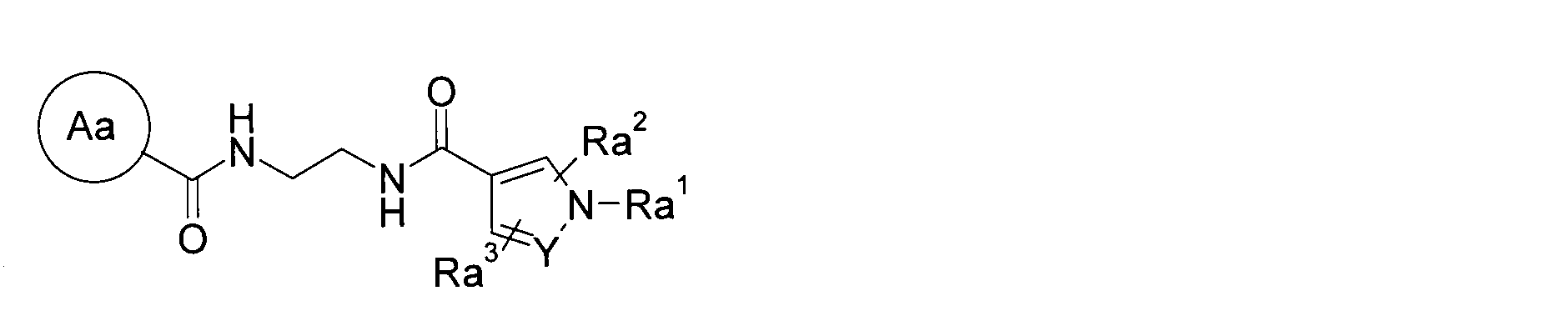
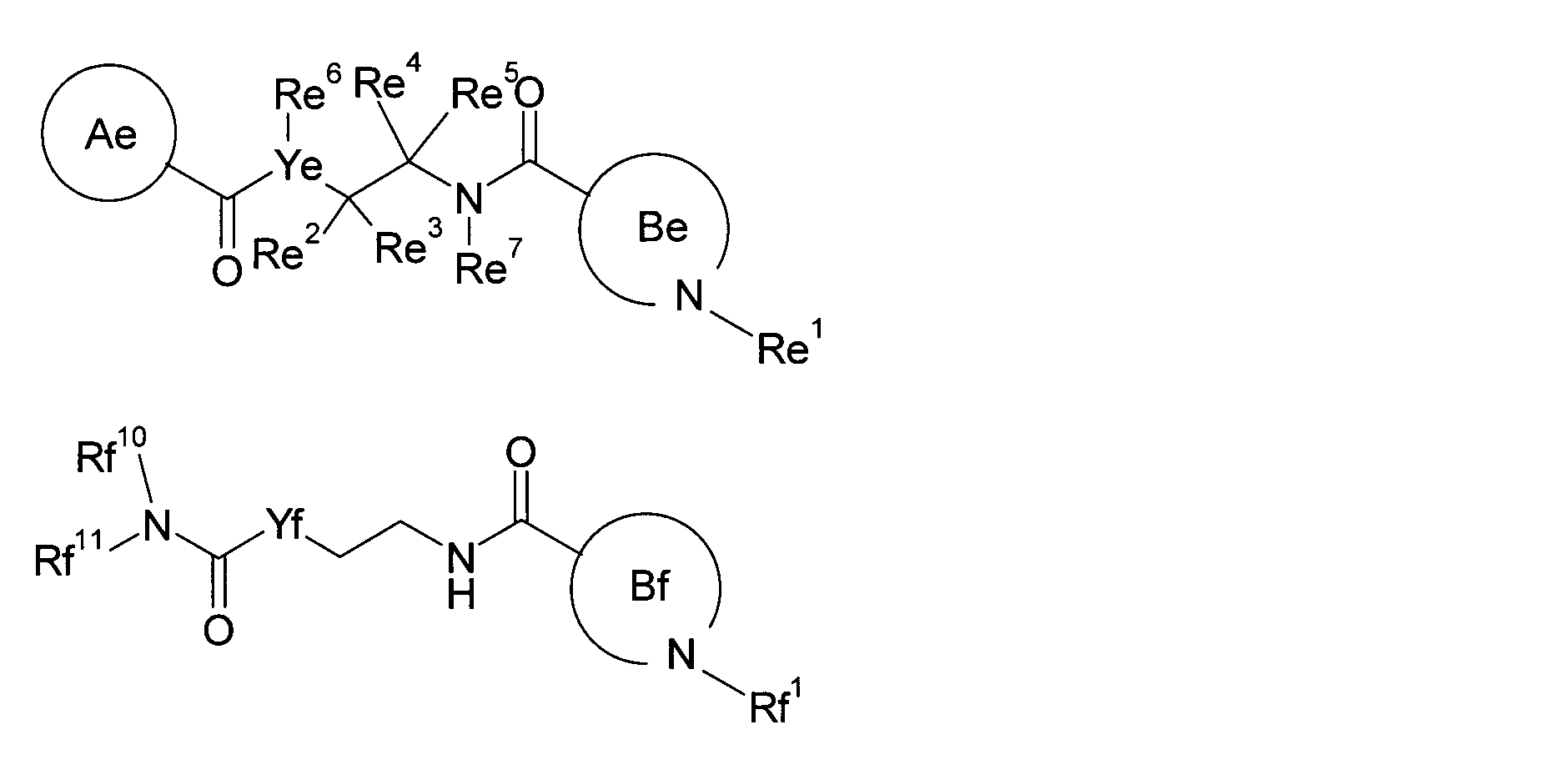
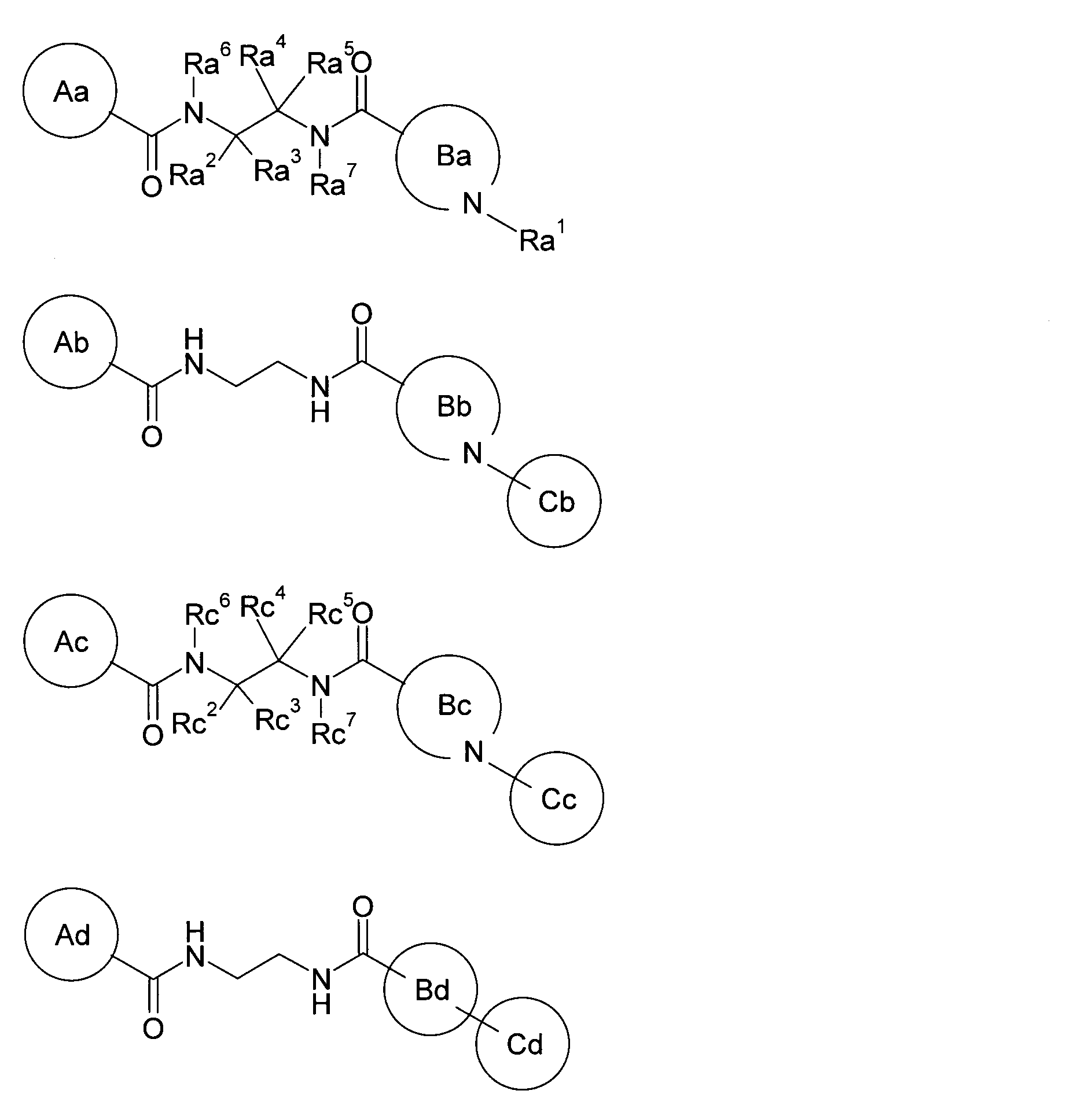

Aは、置換されていてもよいアリール、置換されていてもよいシクロアルキル、置換されていてもよい芳香族ヘテロ環、置換されていてもよい非芳香族ヘテロ環、又は式(II)で示される基であり、

ここで、R11とR12は結合している窒素原子と共に一体となって置換されていてもよい環状アミノを形成してもよく、
環B1は、-OH、1つ以上のハロゲンで置換されていてもよいC1-6アルキル、1つ以上のハロゲンで置換されていてもよい-O-C1-6アルキル、C3-8シクロアルキル及びハロゲンからなる群より選択される1つ以上の基でそれぞれ置換されていてもよい、フェニレン、ピリジンジイル、ナフタレンジイル、又は1,2,3,4-テトラヒドロナフタレンジイルであり、
Wは、-O-、結合、-O-C1-6アルキレン、-NH-、又はC1-6アルキレンであり、
環B2は、C1-6アルキルでそれぞれ置換されていてもよい、シクロヘキサンジイル、シクロペンタンジイル、又は架橋環であって、Wが結合である場合、ピペリジンジイル、若しくは8-アザビシクロ[3.2.1]オクタンジイルであってもよく、
Yは、結合、C1-6アルキレン、又は-O-C1-6アルキレンであり、
Zは、-CO2H若しくはその生物学的等価体;C1-6アルキル(当該C1-6アルキルはアミノ若しくはカルボキシルで置換されていてもよい)、フェニル及びベンジルからなる群より選択される1つ若しくは2つの基で置換されていてもよいカルバモイル;-CO-(1つ若しくは2つのC1-6アルキルで置換されていてもよい環状アミノ);-OH;1つ若しくは2つのC1-6アルキルで置換されていてもよいアミノ;-NH-C(=O)-C1-6アルキル;又は、-NH-C(=O)-C3-8シクロアルキルである。)
また、本発明は、肥満の予防又は治療用医薬組成物の製造のための式(I)の化合物又はその塩の使用、肥満の予防又は治療に使用するための式(I)の化合物又はその塩、並びに、式(I)の化合物又はその塩の有効量を対象に投与することからなる肥満の予防又は治療方法に関する。なお、「対象」とは、その予防又は治療を必要とするヒト又はその他の動物であり、ある態様としては、その予防又は治療を必要とするヒトである。
「アルキレン」とは、上記「アルキル」の任意の水素原子1個を除去してなる二価基である。従って、「C1-6アルキレン」とは、直鎖又は分枝状の炭素数が1~6のアルキレンであり、例えばメチレン、エチレン、トリメチレン、テトラメチレン、ペンタメチレン、ヘキサメチレン、メチルメチレン、ジメチルメチレン、エチルメチレン、メチルエチレン、ジメチルエチレン、エチルエチレン等であり、別の態様としてはメチレン、エチレンであり、さらに別の態様としてはメチレンである。
(1)ハロゲン、
(2)ハロゲン、アリール、-OH、-O-C1-6アルキル、-O-アリール、C3-8シクロアルキル、及びオキソからなる群より選択される1つ以上の基で置換されていてもよいC1-6アルキル、
(3)ハロゲン、C3-8シクロアルキル、-O-C1-6アルキル、アリール(当該アリールは1つ以上のハロゲンで置換されていてもよい)、及び非芳香族ヘテロ環からなる群より選択される1つ以上の基で、それぞれ置換されていてもよい-O-C1-6アルキル若しくは-S-C1-6アルキル、
(4)ハロゲン、C1-6アルキル(当該C1-6アルキルは1つ以上のハロゲンで置換されていてもよい)、-O-C1-6アルキル(当該C1-6アルキルは1つ以上のハロゲンで置換されていてもよい)、C3-8シクロアルキル、及びシアノからなる群より選択される1つ以上の基で、それぞれ置換されていてもよいアリール若しくは-O-アリール、
(5)1つ以上のC1-6アルキルで、それぞれ置換されていてもよいC3-8シクロアルキル若しくは-O-C3-8シクロアルキル、
(6)ハロゲン、C1-6アルキル、及びC3-8シクロアルキルからなる群より選択される1つ以上の基で、それぞれ置換されていてもよい芳香族ヘテロ環若しくは-O-芳香族ヘテロ環、
(7)C1-6アルキル(当該C1-6アルキルは1つ以上のアリールで置換されていてもよい)、及びアリールからなる群より選択される1つ以上の基で、それぞれ置換されていてもよいアミノ若しくは環状アミノ、
(8)1つ以上のハロゲンでそれぞれ置換されていてもよい-CO-C1-6アルキル若しくは-SO2-C1-6アルキル、
(9)-OH、
を挙げることができる。
(1)ハロゲン、
(2)ハロゲン、アリール、-OH、-O-C1-6アルキル、-O-アリール、C3-8シクロアルキル、及びオキソからなる群より選択される1つ以上の基で置換されていてもよいC1-6アルキル、
(3)ハロゲン、C3-8シクロアルキル、-O-C1-6アルキル、アリール(当該アリールは1つ以上のハロゲンで置換されていてもよい)、及び非芳香族ヘテロ環からなる群より選択される1つ以上の基で、それぞれ置換されていてもよい-O-C1-6アルキル若しくは-S-C1-6アルキル、
(4)ハロゲン、C1-6アルキル(当該C1-6アルキルは1つ以上のハロゲンで置換されていてもよい)、-O-C1-6アルキル(当該C1-6アルキルは1つ以上のハロゲンで置換されていてもよい)、C3-8シクロアルキル、及びシアノからなる群より選択される1つ以上の基で、それぞれ置換されていてもよいアリール若しくは-O-アリール、
(5)1つ以上のC1-6アルキルで、それぞれ置換されていてもよいC3-8シクロアルキル若しくは-O-C3-8シクロアルキル、
を挙げることができる。
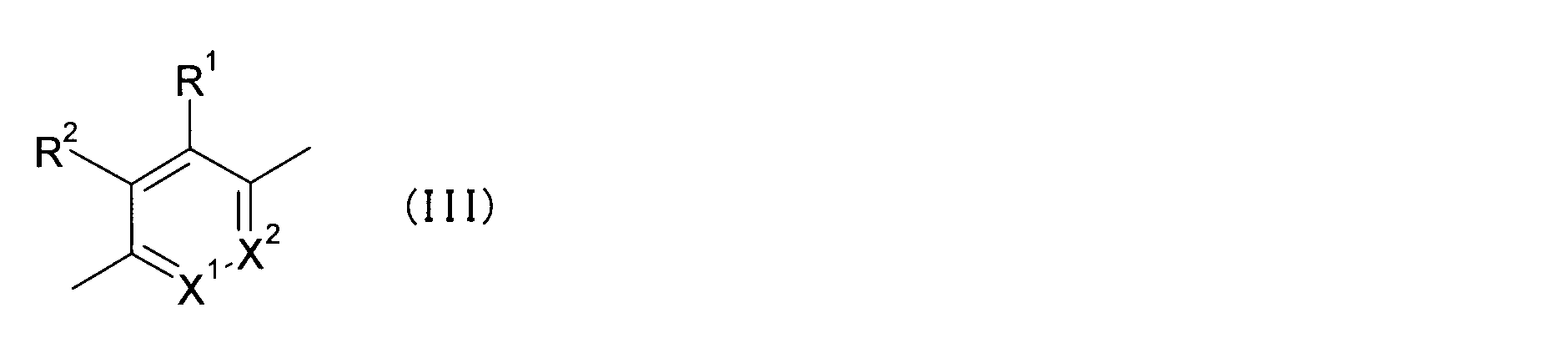
シス-4-[4-({2-[(4-シクロプロピルベンゾイル)アミノ]エチル}カルバモイル)フェノキシ]シクロヘキサンカルボン酸、
シス-4-(4-{[2-(2-ナフトイルアミノ)エチル]カルバモイル}フェノキシ)シクロヘキサンカルボン酸、
シス-4-[4-({2-[(4-クロロ-3-メチルベンゾイル)アミノ]エチル}カルバモイル)フェノキシ]シクロヘキサンカルボン酸、
シス-4-(3-フルオロ-4-{[2-(2-ナフトイルアミノ)エチル]カルバモイル}フェノキシ)シクロヘキサンカルボン酸、
シス-4-(3,5-ジフルオロ-4-{[2-(2-ナフトイルアミノ)エチル]カルバモイル}フェノキシ)シクロヘキサンカルボン酸、
シス-4-(2,3-ジフルオロ-4-{[2-(2-ナフトイルアミノ)エチル]カルバモイル}フェノキシ)シクロヘキサンカルボン酸、
シス-4-(2,5-ジフルオロ-4-{[2-(2-ナフトイルアミノ)エチル]カルバモイル}フェノキシ)シクロヘキサンカルボン酸、
シス-4-{4-[(2-{[(3-クロロ-1-ベンゾチオフェン-2-イル)カルボニル]アミノ}エチル)カルバモイル]フェノキシ}シクロヘキサンカルボン酸、
シス-4-{4-[(2-{[(5-クロロチオフェン-2-イル)カルボニル]アミノ}エチル)カルバモイル]-2,3-ジフルオロフェノキシ}シクロヘキサンカルボン酸、
シス-4-{3-フルオロ-4-[(2-{[(5-フルオロ-1-ベンゾチオフェン-2-イル)カルボニル]アミノ}エチル)カルバモイル]フェノキシ}シクロヘキサンカルボン酸、
[シス-4-(2,5-ジフルオロ-4-{[2-(2-ナフトイルアミノ)エチル]カルバモイル}フェノキシ)シクロヘキシル]酢酸、
及びこれらの塩。
また、式(I)の化合物には、不斉炭素原子や軸不斉を有する場合があり、これに基づく光学異性体が存在しうる。本発明は、式(I)の化合物の光学異性体の分離されたもの、あるいはそれらの混合物も包含する。
式(I)の化合物及びその塩は、その基本構造あるいは置換基の種類に基づく特徴を利用し、種々の公知の合成法を適用して製造することができる。その際、官能基の種類によっては、当該官能基を原料から中間体へ至る段階で適当な保護基(容易に当該官能基に転化可能な基)に置き換えておくことが製造技術上効果的な場合がある。このような保護基としては、例えば、ウッツ(P. G. M. Wuts)及びグリーン(T. W. Greene)著、「Greene’s Protective Groups in Organic Synthesis(第4版、2006年)」に記載の保護基等を挙げることができ、これらの反応条件に応じて適宜選択して用いればよい。このような方法では、当該保護基を導入して反応を行ったあと、必要に応じて保護基を除去することにより、所望の化合物を得ることができる。
また、式(I)の化合物のプロドラッグは、上記保護基と同様、原料から中間体へ至る段階で特定の基を導入、あるいは得られた式(I)の化合物を用いてさらに反応を行うことで製造できる。反応は通常のエステル化、アミド化、脱水等、当業者に公知の方法を適用することにより行うことができる。
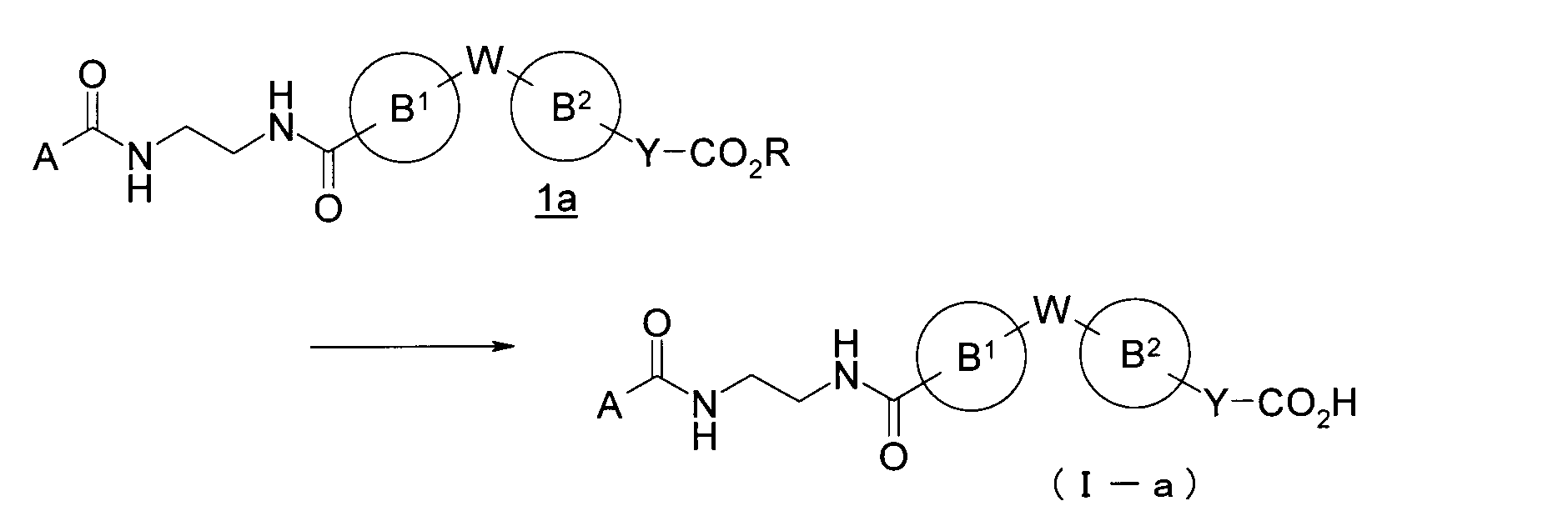
加水分解反応は、前述の「Greene’s Protective Groups in Organic Synthesis(第4版、2006年)」を参照して実施することができる。
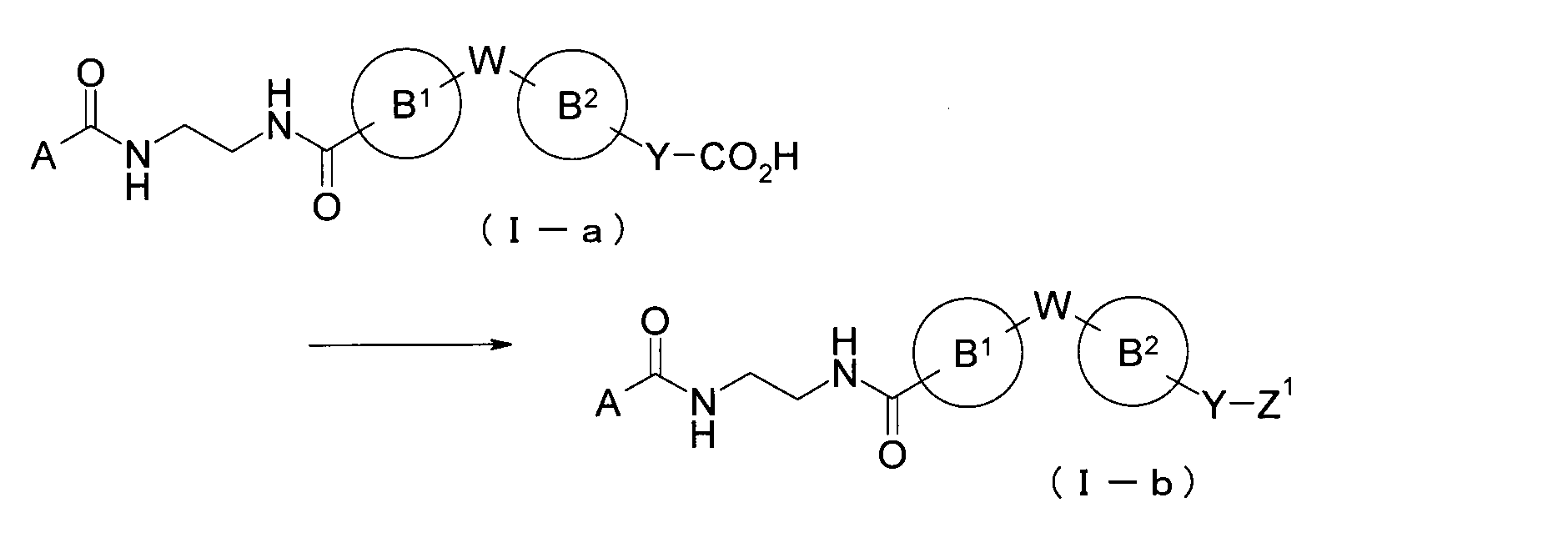
例えばZ1が-CO-NH-SO2-C1-6アルキル若しくは-CO-NH-SO2-N(C1-6アルキル)2である場合には、対応するスルホンアミド等との縮合反応により製造することができ、例えばZ1が-CONH2である場合には、塩化アンモニウム、水酸化アンモニウム、アンモニア水溶液等を用いた縮合反応により製造することができ、例えばZ1がテトラゾリルの場合には、カルボキサミドへ誘導した後、常法により脱水してニトリルへ誘導し、アジ化ナトリウムを作用させて製造することができる。その他、当業者に自明の方法によりカルボキシル基をその生物学的等価体へ変換することができる。
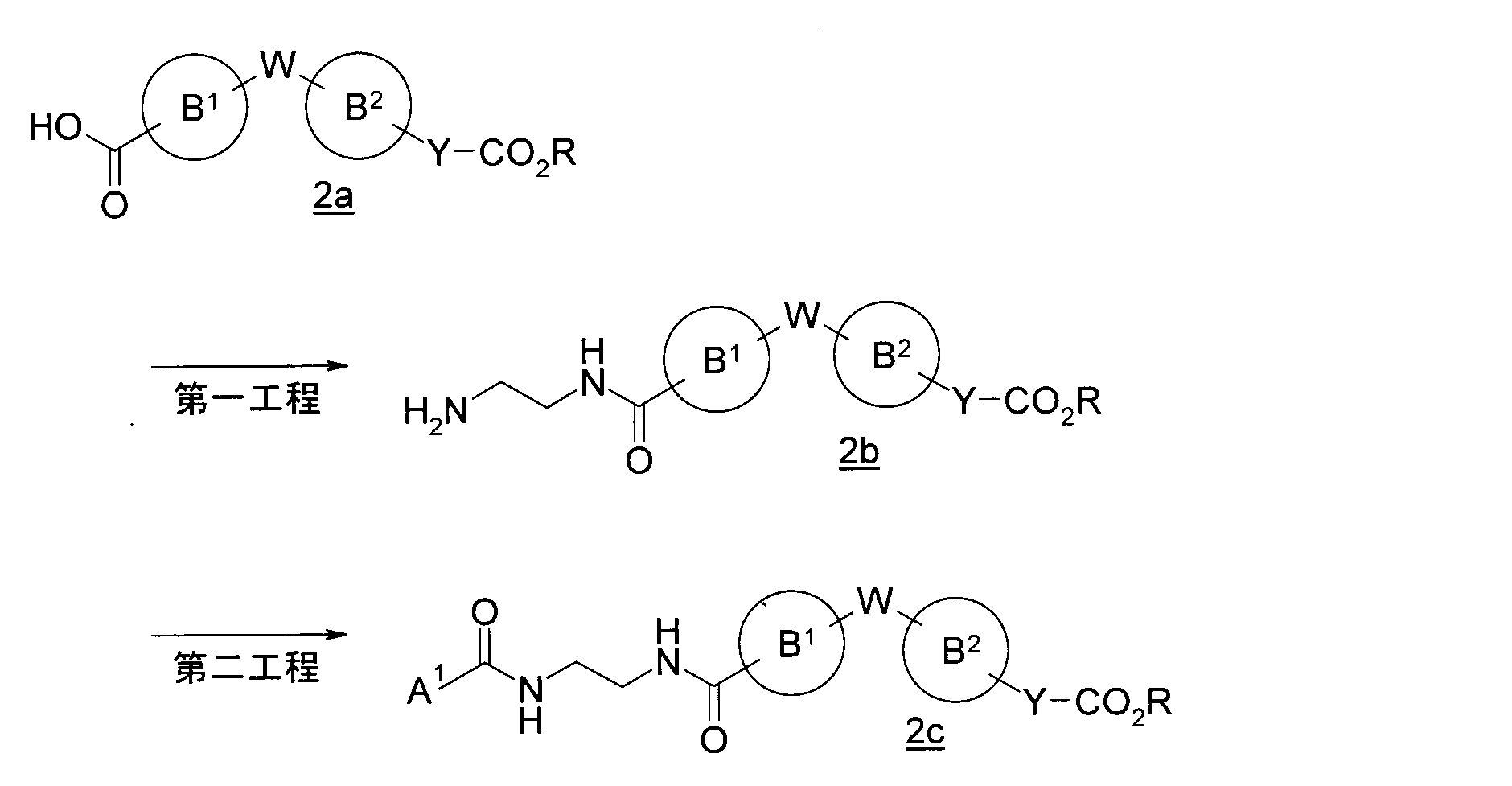
本工程は、国際公開第WO 2007/115935号パンフレットに記載の方法若しくはそれに準じた方法で製造した化合物2aにエチレンジアミンを付加する工程である。化合物2bは、例えば、一方のアミノ基が保護されたエチレンジアミンを化合物2aと縮合し、アミノ基の保護基を除去することで製造することができる。
縮合反応は、化合物2aと一方のアミノ基が保護されたエチレンジアミンとを等モル若しくは一方を過剰量用い、これらの混合物を縮合剤の存在下、反応に不活性な溶媒中、冷却下から加熱下、好ましくは-20℃~60℃において、通常0.1時間~5日間攪拌して行うことができる。ここで用いられる溶媒の例としては、特に限定はされないが、ベンゼン、トルエン、キシレン等の芳香族炭化水素類、ジクロロメタン、1,2-ジクロロエタン、クロロホルム等のハロゲン化炭化水素類、ジエチルエーテル、テトラヒドロフラン(THF)、ジオキサン、ジメトキシエタン等のエーテル類、N,N-ジメチルホルムアミド(DMF)、ジメチルスルホキシド(DMSO)、酢酸エチル、アセトニトリル、水、あるいはこれらの混合物が挙げられる。縮合剤の例としては、1-(3-ジメチルアミノプロピル)-3-エチルカルボジイミド、ジシクロヘキシルカルボジイミド、1,1’-カルボニルジイミダゾール、ジフェニルリン酸アジド、オキシ塩化リン等が挙げられるが、これらに限定されるものではない。1-ヒドロキシベンゾトリアゾール等の添加剤を用いることが反応の進行に好ましい場合もある。また、トリエチルアミン、N,N-ジイソプロピルエチルアミン、N-メチルモルホリン等の有機塩基、又は炭酸カリウム、炭酸ナトリウム、水酸化カリウム等の無機塩基を用いることが反応の進行に好ましい場合もある。
アミノ基の保護基の除去反応は、前述の「Greene’s Protective Groups in Organic Synthesis(第4版、2006年)」を参照して実施することができる。
本工程は、化合物2bをアシル化する工程である。
アシル化は、化合物2bと対応するカルボン酸(A1-CO2H)を用いて、本製法第一工程前段の方法を用いることもできる他、当該対応するカルボン酸を反応性誘導体へ変換した後に化合物2bと反応させることもできる。カルボン酸の反応性誘導体の例としては、オキシ塩化リン、塩化チオニル等のハロゲン化剤と反応して得られる酸ハロゲン化物、クロロギ酸イソブチル等と反応して得られる混合酸無水物、1-ヒドロキシベンゾトリアゾール等と縮合して得られる活性エステル等が挙げられる。これらの反応性誘導体と化合物2bとの反応は、反応に不活性な溶媒中、冷却下~加熱下、好ましくは-20℃~60℃において、通常0.1時間~5日間攪拌して行うことができる。ここで用いられる溶媒の例としては、特に限定はされないが、ハロゲン化炭化水素類、エーテル類、芳香族炭化水素類、あるいはこれらの混合物が挙げられる。

アミン(HN(-R11)(-R12))を用いる場合、カルボニル源として1,1’-カルボニルジイミダゾール、ホスゲン、トリホスゲン等を用いることができる。この反応は、化合物2b、対応するアミン及びカルボニル源を等モル若しくはいずれかを過剰量用い、これらの混合物を反応に不活性な溶媒中、冷却下から加熱下、好ましくは室温~還流下において、通常0.1時間~5日間攪拌して行うことができる。ここで用いられる溶媒の例としては、特に限定はされないが、エーテル類、ハロゲン化炭化水素類、N,N-ジメチルホルムアミド、N,N-ジメチルアセトアミド、ジメチルスルホキシド、あるいはこれらの混合物が挙げられる。トリエチルアミン、N,N-ジイソプロピルエチルアミン、N-メチルモルホリン、ピリジン等の塩基を用いることが反応の進行に好ましい場合がある。

本工程は、Journal of Medicinal Chemistry、1993年、第36巻、第24号、3968-3970ページに記載の方法若しくはそれに準じた方法で製造した化合物4aに、化合物4bを縮合させる工程である。
縮合反応は、原料合成1第一工程前段に記載の方法、若しくは第二工程に記載の方法を用いて行うことができる。
本工程は、化合物4cと化合物4dとを縮合させる工程である。
縮合反応には、当業者が通常用いる光延反応を用いることができる。光延反応は、化合物4cと化合物4dとを等モル若しくは一方を過剰量用い、これらの混合物と、トリブチルホスフィン、トリフェニルホスフィン等のリン化合物と、アゾジカルボン酸エチル、1,1’-(アゾジカルボニル)ジピペリジン等のアゾジカルボニル化合物とから調整される活性化剤、若しくはシアノメチレントリブチルホスホラン等の試薬を用いて、反応に不活性な溶媒中、冷却下から加熱下、好ましくは室温~加熱下において、通常0.1時間~5日間攪拌して行うことができる。ここで用いられる溶媒の例としては、特に限定はされないが、ハロゲン化炭化水素類、エーテル類、芳香族炭化水素類、あるいはこれらの混合物が挙げられる。
また、本工程に際して、アルキル化反応を採用することもできる。アルキル化反応を行なう際には、化合物4c若しくは化合物4dの水酸基を脱離基、例えば、クロロ、ブロモ、ヨード等のハロゲン、又は、メタンスルホニルオキシ、エタンスルホニルオキシ、ベンゼンスルホニルオキシ、4-メチルベンゼンスルホニルオキシ、トリフルオロメタンスルホニルオキシ等のスルホニルオキシに変換し、適当な塩基の存在下、反応に不活性な溶媒中、冷却下から加熱下、好ましくは室温~加熱下において、通常0.1時間~5日間攪拌して行うことができる。
単離、精製は、抽出、分別結晶化、各種分画クロマトグラフィー等、通常の化学操作を適用して行われる。
各種の異性体は、適当な原料化合物を選択することにより製造でき、あるいは異性体間の物理化学的性質の差を利用して分離することができる。例えば、光学異性体は、ラセミ体の一般的な光学分割法(例えば、光学活性な塩基又は酸とのジアステレオマー塩に導く分別結晶化や、キラルカラム等を用いたクロマトグラフィー等)により得られ、また、適当な光学活性な原料化合物から製造することもできる。
(1)Bacmid-hDGAT1の作成
ヒトDGAT1(hDGAT1)をコードする塩基配列(Genbank Accession No.NM_012079におけるCDSの1467塩基)をクローニングし、pFastBacTM1(Invitrogen社)にライゲーションし、pFastBac1-hDGAT1を作成した。このプラスミドから、Bac-to-Bac(登録商標) Baculovirus Expression System(Invitrogen社)を用いて組換えバキュロウイルス液(Bacmid-hDGAT1)を調製した。
Sf9細胞を80% confluencyになるよう225cm2 Flask Angled Neck(CORNING社)に播種し、EX-CELLTM 420 INSECT SERUM-FREE MEDIUM(SAFC Biosciences社)を用いて27℃恒温培養器にて静置培養した。24時間後に培養液を抜き、組換えバキュロウイルス液(Bacmid-hDGAT1)1.67mLをEX-CELLTM 420 INSECT SERUM-FREE MEDIUM3.33mLにて希釈した液を添加し、恒温培養器で27℃にて1時間振とう培養した。その後、EX-CELLTM 420 INSECT SERUM-FREE MEDIUMを25mL添加し、恒温培養器で27℃にて72時間培養した。感染細胞を回収し、Complete Protease Inhibitor Cocktail(Roche Diagnostics K.K.)を含む緩衝液A(100mM Sucrose、50mM KClを含む40mMリン酸緩衝液(pH7.2))1.5mLに懸濁し、SONIFER 250(BRANSON社)を用いてソニケーションを行った。この懸濁液を10000×gで5分間遠心分離し上清を回収した。この上清を100000×gで60分間遠心分離して得た沈殿を600μLの緩衝液Aに溶解し、再びソニケーションを行い、懸濁液を調製した。この懸濁液をhDGAT1発現Sf9細胞マイクロソームとした。
DGAT1活性は100 mM Tris-HCl(pH8.0), 2 mM MgCl2, 0.01 % BSA、ジメチルスルホキシド(DMSO)に溶解させた被検物質(DMSO最終濃度2%)、及びhDGAT1発現Sf9細胞マイクロソーム、200μM ジオレオイルグリセロール若しくはジパルミトイルグリセロール、8.9μM [14C]oleoyl-CoA、1.68%アセトンをphospholipid FlashPlate (PerkiElmer Life Science)に加えた。反応を30℃で60分行った後、反応液の2倍量(100μL)のイソプロピルアルコール:0.1 M 炭酸緩衝液(pH 9.0)=1:1を添加し反応を停止させた。翌日、トップカウントマイクロプレートシンチレーションカウンター(PerkinElmer Life Science)によりカウントを測定した。
被検物質非添加の際のカウントを対照(DMSO添加時TG)とした。被検物質、及びマイクロソームを非添加の際のカウントをブランクTGとした。被検物質のDGAT1阻害率を次の計算式により算出した。
阻害率(%)=(被検物質添加時TG-ブランクTG)÷(DMSO添加時TG-ブランクTG)×100
被検物質は反応液中の濃度が1、10、100、1000 nMの際のDGAT1阻害率を算出した。得られた阻害率を用いて線形回帰を行い、DGAT1活性を50%阻害するのに必要な被検物質濃度(IC50)をSAS 8.2 software package (SAS Institute Japan, Ltd., Tokyo, Japan)により算出した。

8-15週齢の雄性C57BL/6Jマウスを4時間絶食し、被検物質を経口投与した。被検物質は0.5%メチルセルロース液に懸濁させ投与した。20時間後に脂肪(イントラリピッド20%、テルモ(フレゼニウス)、10mL/kg)を経口投与した。脂肪投与直前、及び2時間後に尾静脈より採血を行い、血漿を得た。血漿中TGの測定は、トリグリセリドEテストワコー(和光純薬)を用い、脂肪投与による血漿中TG上昇値を算出した。0.5%メチルセルロース投与群の血漿中TG上昇値を対照とし、被検物質を投与した際のTG上昇抑制率を求めた。
9週齢の雄性C57BL/6Jマウスに高脂肪食(リサーチダイエットD12492、60 kcal% fat)を与えた。マウスの馴化を目的として4週間目より試験に用いる溶媒の投与を行った。5週間目より被検物質を1日1回あるいは2回経口投与した。被検物質は0.5%メチルセルロース液に懸濁させ投与した。2週間若しくは4週間反復投与を行い、被検物質投与による体重変動を観察した。試験期間内の溶媒投与群の体重増加量を100%として被験物質の体重増加抑制率を算出した。
投与は錠剤、丸剤、カプセル剤、顆粒剤、散剤、液剤等による経口投与、又は、関節内、静脈内、筋肉内等の注射剤、坐剤、点眼剤、眼軟膏、経皮用液剤、軟膏剤、経皮用貼付剤、経粘膜液剤、経粘膜貼付剤、吸入剤等による非経口投与のいずれの形態であってもよい。
経口投与のための液体組成物は、薬剤的に許容される乳濁剤、溶液剤、懸濁剤、シロップ剤又はエリキシル剤等を含み、一般的に用いられる不活性な希釈剤、例えば精製水又はエタノール(EtOH)を含む。当該液体組成物は不活性な希釈剤以外に可溶化剤、湿潤剤、懸濁剤のような補助剤、甘味剤、風味剤、芳香剤、防腐剤を含有していてもよい。
Pr:製造例番号(なお、製造例番号の後に「/Cl」の記載がある製造例化合物は、その製造例化合物が塩酸塩として単離されたことを示し、「/TF」の記載がある製造例化合物は、その製造例化合物がトリフルオロ酢酸塩として単離されたことを示す。また、製造例番号に「*」が付された化合物は、その化合物が光学活性体であることを示す。)、Ex:実施例番号(なお、実施例番号に「*」が付された化合物は、その化合物が光学活性体であることを示す。)、No:化合物番号、Structure:化学構造式(Me:メチル、Et:エチル、iPr:イソプロピル、tBu:tert-ブチル、nPen:ノルマルペンチル、Ph:フェ二ル、Bn:ベンジル)、Syn:製造方法(当該化合物が、その欄に記載されている実施例番号の化合物と同様の製造法により製造されたことを示す。)、PSy:製造方法(当該化合物が、その欄に記載されている製造例番号の化合物と同様の製造法により製造されたことを示す。)、Data:物理学的データ(当該化合物の以下のデータを示す。EI:EI-MS; ESP:ESI-MS(Pos); ESN:ESI-MS(Neg); FP:FAB-MS(Pos); FN:FAB-MS(Neg); NMR1:DMSO-d6中の1H-NMRにおける特徴的なピークのδ(ppm); NMR2:CDCl3中の1H-NMRにおける特徴的なピークのδ(ppm))。
エチル トランス-4-ヒドロキシシクロヘキサンカルボキシラート(8g)、ベンジル 4-ヒドロキシベンゾアート(11.69g)、1,1’-(アゾジカルボニル)ジピペリジン(15.24g)、THF(150ml)の混合物に、氷冷下でトリブチルホスフィン(14.9ml)を滴下し、室温で2時間攪拌した後、60℃で10時間攪拌した。反応混合物を室温に戻した後、ろ過し、THFで洗浄後、ろ液を減圧下で濃縮した。得られた残渣をシリカゲルカラムクロマトグラフィー(ヘキサン:酢酸エチル=85:15)で精製し、無色油状物のベンジル 4-{[シス-4-(エトキシカルボニル)シクロヘキシル]オキシ}ベンゾアートを8.55g得た。
ベンジル 4-{[シス-4-(エトキシカルボニル)シクロヘキシル]オキシ}ベンゾアート(8.5g)とEtOH(150ml)の混合物に、10% パラジウム担持活性炭(850mg)を加え、水素雰囲気下(風船圧)にて室温で4時間攪拌した。反応混合物をセライトろ過し、EtOHで洗浄後、得られた濾液を減圧下で濃縮して、無色固体の4-{[シス-4-(エトキシカルボニル)シクロヘキシル]オキシ}安息香酸を5.8g得た。
4-{[シス-4-(エトキシカルボニル)シクロヘキシル]オキシ}安息香酸(4g)、1-エチル-3-(3-ジメチルアミノプロピル)カルボジイミド 一塩酸塩(3.4g)、1-ヒドロキシベンゾトリアゾール 一水和物(2.7g)、トリエチルアミン(2.9ml)、DMF(60ml)の混合物に、tert-ブチル (2-アミノエチル)カルバマート(2.6ml)を加え、室温で14時間攪拌した。反応混合物に、水を加え、出てきた固体をろ取した後、ジイソプロピルエーテルで洗浄して、無色固体のエチル シス-4-[4-({2-[(tert-ブトキシカルボニル)アミノ]エチル}カルバモイル)フェノキシ]シクロヘキサンカルボキシラートを5.34g得た。
エチル シス-4-[4-({2-[(tert-ブトキシカルボニル)アミノ]エチル}カルバモイル)フェノキシ]シクロヘキサンカルボキシラート(5.34g)、ジオキサン(80ml)の混合物に、4M 塩化水素/ジオキサン(40ml)を加えて、室温で3時間撹拌した。反応混合物を減圧下で濃縮し、残渣をジイソプロピルエーテルで洗浄して、無色固体のエチル シス-4-{4-[(2-アミノエチル)カルバモイル]フェノキシ}シクロヘキサンカルボキシラート 塩酸塩を4.55g得た。
エチル 4-{4-[(2-アミノエチル)カルバモイル]フェノキシ}シクロヘキサンカルボキシラート 塩酸塩(150mg)、クロロホルム(5ml)、トリエチルアミン(0.17ml)の混合物に、イソシアン酸フェニル(0.053ml)を加え、室温で1時間撹拌した。反応混合物に飽和炭酸水素ナトリウム水溶液を加え、分液操作を行い、有機層を飽和塩化ナトリウム水溶液で洗浄した後、無水硫酸マグネシウムで乾燥後、減圧濃縮した。残渣をシリカゲルカラムクロマトグラフィー(クロロホルム:メタノール(MeOH)=90:10)にて精製して、無色固体のエチル 4-[4-({2-[(アニリノカルボニル)アミノ]エチル}カルバモイル)フェノキシ]シクロヘキサンカルボキシラートを164mg得た。
エチル シス-4-{4-[(2-アミノエチル)カルバモイル]フェノキシ}シクロヘキサンカルボキシラート 塩酸塩(200mg)、トリエチルアミン(0.08ml)、塩化メチレン(10ml)の混合物に、0℃でカルボニルジイミダゾール(100mg)を加え、0℃で10分間攪拌した後、4-フェニルピペリジン(110mg)を加えて室温で3日間攪拌した。反応混合物に水を加え、クロロホルムを用いて分液操作を行い、有機層を飽和塩化ナトリウム水溶液で洗浄した後、無水硫酸マグネシウムで乾燥後、減圧濃縮した。残渣をシリカゲルカラムクロマトグラフィー(クロロホルム:MeOH=100:0~95:5)にて精製して、無色固体のエチル シス-4-{4-[(2-{[(4-フェニルピペリジン-1-イル)カルボニル]アミノ}エチル)カルバモイル]フェノキシ}シクロヘキサンカルボキシラートを288mg得た。
エチル 4-{4-[(2-アミノエチル)カルバモイル]フェノキシ}シクロヘキサンカルボキシラート 塩酸塩(100mg)、4-フェニルシクロヘキサンカルボン酸(66mg)、1-エチル-3-(3-ジメチルアミノプロピル)カルボジイミド 一塩酸塩(67mg)、1-ヒドロキシベンゾトリアゾール 一水和物(54mg)、THF(1.5ml)の混合物を室温で9時間攪拌した。反応混合物に飽和炭酸水素ナトリウム水溶液を加え、クロロホルムを用いて分液操作を行い、有機層を飽和塩化ナトリウム水溶液で洗浄した後、無水硫酸マグネシウムで乾燥後、減圧濃縮した。残渣をシリカゲルカラムクロマトグラフィー(クロロホルム)にて精製して、無色固体のエチル 4-{4-[(2-{[(4-フェニルシクロヘキシル)カルボニル]アミノ}エチル)カルバモイル]フェノキシ}シクロヘキサンカルボキシラートを123mg得た。
エチル トランス-4-{4-[(2-アミノエチル)カルバモイル]フェノキシ}シクロヘキサンカルボキシラート 塩酸塩(100mg)、クロロホルム(10ml)、トリエチルアミン(0.14ml)の混合物に、0℃でベンゾイルクロリド(0.038ml)を加え、0℃で1時間撹拌した。反応混合物を飽和炭酸水素ナトリウム水溶液に加え、クロロホルムを用いて分液操作を行い、有機層を飽和塩化ナトリウム水溶液で洗浄し、無水硫酸マグネシウムで乾燥後、減圧濃縮した。残渣をジイソプロピルエーテルで洗浄して、無色固体のエチル トランス-4-(4-{[2-(ベンゾイルアミノ)エチル]カルバモイル}フェノキシ)シクロヘキサンカルボキシラートを118mg得た。
N-(2-アミノエチル)-4-クロロベンズアミド 塩酸塩(400mg)、2-フルオロ-4-ヒドロキシ安息香酸(320mg)、1-エチル-3-(3-ジメチルアミノプロピル)カルボジイミド 一塩酸塩(500mg)、1-ヒドロキシベンゾトリアゾール 一水和物(400mg)、トリエチルアミン(0.4ml)、DMF(10ml)の混合物を室温で終夜攪拌した。反応混合物に水を加え、クロロホルムを用いて分液操作を行い、有機層を飽和塩化ナトリウム水溶液で洗浄し、無水硫酸マグネシウムで乾燥後、減圧濃縮した。残渣をシリカゲルカラムクロマトグラフィー(クロロホルム:MeOH=100:0~95:5)にて精製して、無色固体のN-{2-[(4-クロロベンゾイル)アミノ]エチル}-2-フルオロ-4-ヒドロキシベンズアミドを410mg得た。
N-{2-[(4-クロロベンゾイル)アミノ]エチル}-2-フルオロ-4-ヒドロキシベンズアミド(400mg)、エチル トランス-4-ヒドロキシシクロヘキサンカルボキシラート(220mg)、トリフェニルホスフィン(350mg)、THF(4ml)の混合物に、室温で2.2M アゾジカルボン酸ジエチル トルエン溶液(0.58ml)を加え、60℃で終夜攪拌した。反応混合物に水を加え、酢酸エチルを用いて分液操作を行い、有機層を飽和塩化ナトリウム水溶液で洗浄し、無水硫酸マグネシウムで乾燥後、減圧濃縮した。残渣をシリカゲルカラムクロマトグラフィー(クロロホルム:MeOH=100:0~95:5)にて精製して、無色固体のエチル シス-4-[4-({2-[(4-クロロベンゾイル)アミノ]エチル}カルバモイル)-3-フルオロフェノキシ]シクロヘキサンカルボキシラートを457mg得た。
エチル シス-4-ヒドロキシシクロヘキサンカルボキシラート(800mg)、トリフェニルホスフィン(1.34g)、THF(15ml)、4-フルオロフェノール(521mg)の混合物に、氷冷下で2.2M アゾジカルボン酸ジエチル トルエン溶液(2.3ml)を10分かけて滴下した後、60℃で4時間撹拌した。反応混合物を飽和炭酸水素ナトリウム水溶液に加え、酢酸エチルを用いて分液操作を行った。その後、有機層を飽和塩化ナトリウム水溶液で洗浄し、無水硫酸マグネシウムで乾燥後、減圧下で濃縮した。残渣をシリカゲルカラムクロマトグラフィー(ヘキサン:酢酸エチル=85:15)で粗精製した。この粗生成物(685mg)とTHF(5ml)、EtOH(5ml)の混合物に、1M水酸化ナトリウム水溶液を加え、室温で14時間攪拌した。溶媒を減圧留去した後、残渣に水を加え、酢酸エチルを用いて分液操作を行った後、水層に1M 塩酸を加えてpH3とし、酢酸エチルを用いて分液操作を行った。有機層を無水硫酸マグネシウムで乾燥後、減圧濃縮して、無色固体のトランス-4-(4-フルオロフェノキシ)シクロヘキサンカルボン酸を242mg得た。
3-フルオロ-4-ヒドロキシ安息香酸(5g)、臭化ベンジル(4.19ml)、DMF(33ml)、炭酸カリウム(4.9g)の混合物を40℃で6時間攪拌した。反応混合物を放冷後、酢酸エチルで希釈し、水で洗浄した後、無水硫酸マグネシウムで乾燥後、減圧下で濃縮した。残渣をシリカゲルカラムクロマトグラフィー(クロロホルム:酢酸エチル=100:0~50:50)で精製して、無色固体のベンジル 3-フルオロ-4-ヒドロキシベンゾアートを1.7g得た。
4-[(シス-4-カルバモイルシクロヘキシル)オキシ]-N-{2-[(4-クロロベンゾイル)アミノ]エチル}ベンズアミド(330mg)、THF(20ml)の混合物に、無水トリフルオロ酢酸(0.29ml)を加え、室温で30分攪拌した後、無水トリフルオロ酢酸(0.07ml)を追加し10分攪拌した。反応混合物に飽和炭酸水素ナトリウム水溶液を加え、酢酸エチルを用いて分液操作を行った。その後、有機層を飽和塩化ナトリウム水溶液で洗浄し、無水硫酸マグネシウムで乾燥後、減圧下で濃縮した。得られた残渣にジイソプロピルエーテルとEtOHを加えた後、固体をろ取し、EtOHで洗浄し、無色固体の4-クロロ-N-[2-({4-[(シス-4-シアノシクロヘキシル)オキシ]ベンゾイル}アミノ)エチル]ベンズアミドを168mg得た。
メチル 4-(4-オキソシクロヘキシル)ベンゾエート(1.3g)、トルエン(10ml)の混合物に、(tert-ブトキシカルボニルメチレン)トリフェニルホスホラン(2.5g)を加え、105℃で24時間攪拌した。反応混合物に酢酸エチルと水を加え、分液操作を行い、有機層を飽和塩化ナトリウム水溶液で洗浄し、無水硫酸マグネシウムで乾燥後、減圧下で濃縮した。残渣をシリカゲルカラムクロマトグラフィー(ヘキサン:酢酸エチル=100:0~90:10)で精製して、無色固体のメチル 4-[4-(2-tert-ブトキシ-2-オキソエチリデン)シクロヘキシル]ベンゾアートを1.35g得た。
メチル 4-[4-(2-tert-ブトキシ-2-オキソエチリデン)シクロヘキシル]ベンゾアート(1.3g)、MeOH(20ml)、THF(6ml)の混合物に、10% パラジウム担持活性炭(130mg)を加え、水素雰囲気下(3気圧)にて室温で4時間攪拌した。反応混合物をセライトろ過し、MeOHで洗浄後、得られた濾液を減圧下で濃縮して、無色固体の{4-[4-(メトキシカルボニル)フェニル]シクロヘキシル}酢酸を1.11g得た
{4-[4-(メトキシカルボニル)フェニル]シクロヘキシル}酢酸(1.1g)、塩化メチレン(15ml)の混合物に、0℃でシュウ酸クロリド(0.7ml)を加え、室温で3時間攪拌した。この反応混合物を減圧濃縮した後、tert-ブタノール(15ml)とジイソプロピルエチルアミン(1.4ml)を加え、室温で終夜攪拌した。反応混合物を減圧濃縮し、酢酸エチルで希釈した後、この混合物を飽和炭酸水素ナトリウム水溶液、飽和塩化ナトリウム水溶液で順次洗浄し、無水硫酸マグネシウムで乾燥後、減圧下で濃縮した。残渣をシリカゲルカラムクロマトグラフィー(ヘキサン:酢酸エチル=100:0~80:20)で精製して、無色固体のメチル 4-[4-(2-tert-ブトキシ-2-オキソエチル)シクロヘキシル]ベンゾアートを1.14g得た。
メチル 4-[4-(2-tert-ブトキシ-2-オキソエチル)シクロヘキシル]ベンゾアート(1.1g)、THF(11ml)、MeOH(11ml)の混合物に、室温で1M 水酸化ナトリウム水溶液(5ml)を加え、室温で5時間、その後50℃で1時間攪拌した。反応混合物を室温に戻した後、減圧濃縮し、水を加えた後、10% クエン酸水溶液をpH5になるまで加え、出てきた固体をろ取して、無色固体の4-[4-(2-tert-ブトキシ-2-オキソエチル)シクロヘキシル]安息香酸を835mg得た。
エチル 3-クロロ-4-ヒドロキシベンゾアート(2g)、ヨウ化カリウム(165mg)、臭化メチルシクロブタン(1.7ml)、炭酸カリウム(2.8g)、DMF(50ml)の混合物を60℃で5時間撹拌した。反応混合物を放冷後、酢酸エチルで希釈し、水と飽和塩化ナトリウム水溶液で順次洗浄し、無水硫酸マグネシウムで乾燥後、減圧下で濃縮して、油状物を得た。この油状物とTHF(20ml)、MeOH(20ml)の混合物に、1M 水酸化ナトリウム水溶液(20ml)を加え、終夜攪拌した。反応混合物に、1M 塩酸(20ml)を加えた後、減圧濃縮して有機溶媒を留去し、出てきた固体をろ取して、無色固体の3-クロロ-4-(シクロブチルメトキシ)安息香酸を1.31g得た。
4-フルオロ-3-ヒドロキシ安息香酸(2g)、ヨウ化カリウム(250mg)、臭化メチルシクロプロパン(3.7ml)、炭酸カリウム(5.3g)、DMF(27ml)の混合物をを60℃で終夜撹拌した。反応混合物に酢酸エチルを加えた後、水と飽和塩化ナトリウム水溶液で順次洗浄し、無水硫酸マグネシウムで乾燥後、減圧下で濃縮して、油状物を得た。この油状物とTHF(30ml)、MeOH(30ml)の混合物に、1M 水酸化ナトリウム水溶液(30ml)を加え、5時間攪拌した。反応混合物に、1M 塩酸(30ml)を加えた後、減圧濃縮して有機溶媒を留去し、出てきた固体をろ取して、無色固体の3-(シクロプロピルメトキシ)-4-フルオロ安息香酸を2.55g得た。
エチル 4-ブロモ-3-フルオロベンゾアート(1g)、シクロプロピルボロン酸 一水和物(643mg)、テトラキストリフェニルホスフィンパラジウム(235mg)、リン酸カリウム(3.1g)、トルエン(10ml)、水(1ml)の混合物を110℃で終夜激しく撹拌した。反応混合物に水を加え、酢酸エチルを用いて分液操作を行い、有機層を飽和塩化ナトリウム水溶液で洗浄し、無水硫酸マグネシウムで乾燥後、減圧下で濃縮した。残渣をシリカゲルカラムクロマトグラフィー(ヘキサン:酢酸エチル=85:15)で粗精製した後、この粗生成物とTHF(20ml)、MeOH(20ml)の混合物に、1M 水酸化ナトリウム水溶液(20ml)を加え、室温で終夜攪拌した。反応混合物に、1M 塩酸(20ml)を加えた後、減圧濃縮して有機溶媒を留去し、出てきた固体をろ取して、無色固体の4-シクロプロピル-3-フルオロ安息香酸を600mg得た。
エチル 4-ブロモ-3-クロロベンゾアート(1g)、シクロプロピルボロン酸 一水和物(602mg)、テトラキストリフェニルホスフィンパラジウム(220mg)、リン酸カリウム(2.8g)、トルエン(10ml)、水(1ml)の混合物を加熱還流させ、終夜撹拌した。反応混合物に水を加え、酢酸エチルを用いて分液操作を行い、有機層を飽和塩化ナトリウム水溶液で洗浄し、無水硫酸マグネシウムで乾燥後、減圧下で濃縮した。残渣をシリカゲルカラムクロマトグラフィー(ヘキサン:酢酸エチル=100:0~90:10)で精製して、無色油状物のエチル 3-クロロ-4-シクロプロピルベンゾアートを770mg得た。
エチル 3-クロロ-4-シクロプロピルベンゾアート(760mg)、THF(10ml)、EtOH(10ml)の混合物に、1M 水酸化ナトリウム水溶液(10ml)を加え、室温で終夜攪拌した。反応混合物を減圧濃縮し、水で希釈した。その後、1M 塩酸(20ml)を加えpH2とし、出てきた固体をろ取して、無色固体の3-クロロ-4-シクロプロピル安息香酸を666mg得た。
3-フルオロフェノール(400mg)、エチル シス-4-ヒドロキシシクロヘキサンカルボキシラート(770mg)、トリフェニルホスフィン(1.4g)、THF(5ml)の混合物に、氷冷下2.2M アゾジカルボン酸ジエチル トルエン溶液(2ml)を加え、室温で終夜攪拌した。反応混合物に、酢酸エチル(20ml)、飽和塩化ナトリウム水溶液(20ml)を加え、分液操作を行い、有機層を無水硫酸マグネシウムで乾燥後、減圧下で濃縮した。残渣にヘキサン(16ml)、酢酸エチル(4ml)を加え、沈殿物を濾別後、得られたろ液を減圧下濃縮した。残渣をシリカゲルカラムクロマトグラフィー(ヘキサン:酢酸エチル=100:0~93:7)で精製して、無色油状物のエチル トランス-4-(3-フルオロフェノキシ)シクロヘキサンカルボキシラートを357mg得た。
エチル トランス-4-(3-フルオロフェノキシ)シクロヘキサンカルボキシラート(350mg)、THF(4ml)、EtOH(4ml)の混合物に、1M 水酸化ナトリウム水溶液(4ml)を加え、室温で終夜攪拌した。反応混合物を減圧濃縮して有機溶媒を留去した後、1M 塩酸(5ml)を加え、暫く攪拌し、出てきた固体をろ取して、無色固体のトランス 4-(3-フルオロフェノキシ)シクロヘキサンカルボン酸を278mg得た。
6-ヒドロキシニコチン酸(1.5g)、1-エチル-3-(3-ジメチルアミノプロピル)カルボジイミド 一塩酸塩(2.5g)、1-ヒドロキシベンゾトリアゾール 一水和物(2.0g)、トリエチルアミン(2.5ml)、tert-ブチル (2-アミノエチル)カルバマート(1.8ml)、DMF(30ml)の混合物を室温で終夜攪拌した。反応混合物に水を加え、クロロホルムとイソプロパノールの混合溶媒(3:1)を用いて分液操作を行い、有機層を無水硫酸マグネシウムで乾燥後、減圧下で濃縮した。残渣をシリカゲルカラムクロマトグラフィー(クロロホルム:MeOH=100:0~90:10)にて精製し、得られた生成物にヘキサン-酢酸エチル(=1:1)を加え固化させた後、固体をろ取、洗浄して、無色固体のtert-ブチル (2-{[(6-ヒドロキシピリジン-3-イル)カルボニル]アミノ}エチル)カルバマートを1.91g得た。
tert-ブチル (2-{[(6-ヒドロキシピリジン-3-イル)カルボニル]アミノ}エチル)カルバマート(1.9g)、エチル トランス-4-ヒドロキシシクロヘキサンカルボキシラート(1.3g)、トリフェニルホスフィン(2.7g)、THF(50ml)の混合物に、0℃で2.2M アゾジカルボン酸ジエチル トルエン溶液(3.7ml)を加え、室温で終夜攪拌した。反応混合物に水を加え、クロロホルムを用いて分液操作を行い、有機層を飽和塩化ナトリウム水溶液で洗浄した後、無水硫酸マグネシウムで乾燥後、減圧下で濃縮した。残渣をシリカゲルカラムクロマトグラフィー(クロロホルム:MeOH=100:0~95:5)にて精製して、無色固体のエチル シス-4-{[5-({2-[(tert-ブトキシカルボニル)アミノ]エチル}カルバモイル)ピリジン-2-イル]オキシ}シクロヘキサンカルボキシラートを1.41g得た。
ベンジル 4-{[シス-4-(エトキシカルボニル)シクロヘキシル]オキシ}-2-ヒドロキシベンゾアート(530mg)、ヨードメタン(0.4ml)、炭酸カリウム(220mg)、DMF(5ml)の混合物を室温で3.5時間攪拌した後、45℃で1時間攪拌した。その後、炭酸カリウム(175mg)を加え、室温で終夜攪拌した。反応混合物に水(20ml)を加え、酢酸エチルを用いて分液操作を行い、有機層を飽和塩化ナトリウム水溶液で洗浄した後、無水硫酸マグネシウムで乾燥後、減圧下で濃縮し、褐色油状物のベンジル 4-{[シス-4-(エトキシカルボニル)シクロヘキシル]オキシ}-2-メトキシベンゾアートを605mg得た。
ベンジル 2-クロロ-4-{[シス-4-(エトキシカルボニル)シクロヘキシル]オキシ}ベンゾアート(500mg)、シクロプロピルボロン酸 一水和物(190mg)、テトラキストリフェニルホスフィンパラジウム(70mg)、リン酸カリウム(894mg)、トルエン(5ml)、水(0.5ml)の混合物を加熱還流させ、終夜撹拌した。反応混合物に水を加え、酢酸エチルを用いて分液操作を行い、有機層を無水硫酸マグネシウムで乾燥後、減圧下で濃縮した。残渣をシリカゲルカラムクロマトグラフィー(ヘキサン:酢酸エチル=90:10)で精製して、無色油状物のベンジル 2-シクロプロピル-4-{[シス-4-(エトキシカルボニル)シクロヘキシル]オキシ}ベンゾアートを320mg得た。
ベンジル 4-フルオロ-2-(トリフルオロメチル)ベンゾアート(4.1g)、2-(メチルスルホニル)エタノール(2.53g)、DMF(50ml)の混合物に、氷冷下でカリウム tert-ブトキシド(4.67g)を加え、室温で3時間攪拌した。反応混合物に1M 塩酸と水を加え、酢酸エチルを用いて分液操作を行い、有機層を水、飽和塩化ナトリウム水溶液で洗浄した後、無水硫酸マグネシウムで乾燥後、減圧下で濃縮した。残渣をシリカゲルカラムクロマトグラフィー(ヘキサン:酢酸エチル=90:10~80:20)で精製して、淡黄色油状物のベンジル 4-ヒドロキシ-2-(トリフルオロメチル)ベンゾアートを1.19g得た。
2-クロロ-4-{[シス-4-(エトキシカルボニル)シクロヘキシル]オキシ}安息香酸(1.8g)、1-エチル-3-(3-ジメチルアミノプロピル)カルボジイミド 一塩酸塩(1.37g)、1-ヒドロキシベンゾトリアゾール 一水和物(1.10g)、トリエチルアミン(1.15ml)、DMF(50ml)の混合物に、tert-ブチル (2-アミノエチル)カルバマート(0.96ml)を加え、室温で終夜攪拌した。反応混合物に、水(200ml)を加え、出てきた固体をろ取した。この固体とジオキサン(30ml)の混合物に、4M 塩化水素/ジオキサン(15ml)を加えて、室温で5時間撹拌した。反応混合物を減圧下で濃縮し、残渣をヘキサン-ジイソプロピルエーテルの混合溶媒で洗浄して、無色固体のエチル シス-4-{4-[(2-アミノエチル)カルバモイル]-3-クロロフェノキシ}シクロヘキサンカルボキシラート 塩酸塩を2.09g得た。
メチル [トランス-4-(4-ヒドロキシフェニル)シクロヘキシル]アセタート(1.25g)、塩化メチレン(25ml)、N-エチル-N-イソプロピルプロパン-2-アミン(1.05ml)の混合物に、0℃で塩化トリフルオロメタンスルホニル(0.636ml)を加え、室温で終夜攪拌した。反応混合物に飽和炭酸水素ナトリウム水溶液を加え、クロロホルムを用いて分液操作を行い、有機層を飽和塩化ナトリウム水溶液で洗浄した後、無水硫酸マグネシウムで乾燥後、減圧下で濃縮した。残渣をシリカゲルカラムクロマトグラフィー(ヘキサン:酢酸エチル=100:0~50:50)で精製して、無色固体のメチル [トランス-4-(4-{[(トリフルオロメチル)スルホニル]オキシ}フェニル)シクロヘキシル]アセタートを1.38g得た。
メチル [トランス-4-(4-{[(トリフルオロメチル)スルホニル]オキシ}フェニル)シクロヘキシル]アセタート(200mg)、DMF(10ml)、N-(2-アミノエチル-4-クロロ-3-メチルベンズアミド 塩酸塩(200mg)、1,1'-ビス(ジフェニルホスフィノ)フェロセン-パラジウム(II)ジクロリド-ジクロロメタン錯体(90mg)、トリエチルアミン(0.2ml)の混合物を、一酸化炭素1気圧下90℃で18時間攪拌した。反応混合物を室温に戻した後、水(50ml)を加え、出てきた固体をろ取した。この固体をシリカゲルカラムクロマトグラフィー(クロロホルム:MeOH=100:0~95:5~90:10)で精製して、褐色固体のメチル {トランス-4-[4-({2-[(4-クロロ-3-メチルベンゾイル)アミノ]エチル}カルバモイル)フェニル]シクロヘキシル}アセタートを96mg得た。
シス-4-(ヒドロキシメチル)シクロヘキサンカルボン酸(5g)、エタノール(50ml)の混合物に、室温で濃硫酸(0.3ml)を加え、8時間加熱還流した。反応混合物を室温に戻し、減圧下で濃縮した。残渣を飽和炭酸水素ナトリウム水溶液に加え、クロロホルムを用いて分液操作を行い、有機層を無水硫酸マグネシウムで乾燥後、減圧下で濃縮して、無色油状物のエチル シス-4-(ヒドロキシメチル)シクロヘキサンカルボキシラートを5.8g得た。
エチル 1-メチル-4-オキソシクロヘキサンカルボキシラート(3g)、エタノール(30ml)の混合物に、0℃で水素化ホウ素ナトリウム(616mg)を加え2時間攪拌した。反応混合物に水と酢酸エチルを加え、酢酸エチルを用いて分液操作を行い、有機層を飽和炭酸水素ナトリウム水溶液、飽和塩化ナトリウム水溶液で順次洗浄した後、無水硫酸マグネシウムで乾燥後、減圧下で濃縮した。残渣をシリカゲルカラムクロマトグラフィー(ヘキサン:酢酸エチル=100:0~90:10~80:20)で精製して、無色油状物のエチル シス-4-ヒドロキシ-1-メチルシクロヘキサンカルボキシラートを1.27g得た。
エチル シス-4-[4-({2-[(4-ヒドロキシベンゾイル)アミノ]エチル}カルバモイル)フェノキシ]シクロヘキサンカルボキシラート(50mg)、DMF(2ml)、炭酸カリウム(30mg)、2-クロロベンジルブロミド(0.019ml)の混合物を、60℃で終夜攪拌した。反応混合物に水を加え、クロロホルムを用いて分液操作を行い、有機層を飽和塩化ナトリウム水溶液で洗浄した後、無水硫酸マグネシウムで乾燥後、減圧下で濃縮した。残渣をシリカゲルカラムクロマトグラフィー(クロロホルム:MeOH=100:0~95:5)にて精製した後、得られた固体をジイソプロピルエーテルで洗浄して、無色固体のエチル シス-4-(4-{[2-({4-[(2-クロロベンジル)オキシ]ベンゾイル}アミノ)エチル]カルバモイル}フェノキシ)シクロヘキサンカルボキシラートを53mg得た。
ベンジル 4-フルオロベンゾアート(1.5g)、DMSO(10ml)、メチル ピペリジン-4-イルアセタート 塩酸塩(1.26g)、炭酸カリウム(1.81mg)の混合物を、100℃で20時間攪拌した。反応混合物を水に加え、酢酸エチルを用いて分液操作を行い、有機層を飽和塩化ナトリウム水溶液で洗浄した後、無水硫酸マグネシウムで乾燥後、減圧下で濃縮した。残渣をシリカゲルカラムクロマトグラフィー(ヘキサン:酢酸エチル=80:20)で精製して、無色固体のベンジル 4-[4-(2-メトキシ-2-オキソエチル)ピペリジン-1-イル]ベンゾアートを1.475g得た。
tert-ブチル 4-{[シス-4-(エトキシカルボニル)シクロヘキシル]オキシ}-2,5-ジフルオロベンゾアート(4g)、ジオキサン(40ml)の混合物に、4M 塩化水素 ジオキサン溶液(60ml)を加えて、室温で1時間撹拌した後、60℃で5時間攪拌した。反応混合物を減圧下で濃縮し、残渣をジイソプロピルエーテルで洗浄して、無色固体の4-{[シス-4-(エトキシカルボニル)シクロヘキシル]オキシ}-2,5-ジフルオロ安息香酸を3.36g得た。
tert-ブチル 4-(ベンジルオキシ)-2,5-ジフルオロベンゾアート(7.47g)とTHF(101ml)の混合物に、10% パラジウム担持活性炭(747mg)を加え、水素雰囲気下(風船圧)にて室温で5時間攪拌した。反応混合物をセライトろ過し、エタノールで洗浄後、得られた濾液を減圧下で濃縮した。残渣をシリカゲルカラムクロマトグラフィー(クロロホルム:酢酸エチル=98:2~50:50)で精製して、無色固体のtert-ブチル 2,5-ジフルオロ-4-ヒドロキシベンゾアートを4g得た。
tert-ブチル (2-アミノエチル)カルバマート(4.88ml)、トリエチルアミン(4.49ml)、DMF(100ml)の混合物に、2-ナフトイルクロリド(5.59g)を加え、室温で2時間攪拌した。反応混合物を減圧下で濃縮した後、水(200ml)を加え、出てきた固体をろ取した。この固体とジオキサン(200ml)の混合物に、4M 塩化水素 ジオキサン溶液(100ml)を加えて、室温で終夜撹拌した。反応混合物をろ過し、固体をろ取した後、ジイソプロピルエーテルで洗浄して、無色固体のN-(2-アミノエチル)-2-ナフタミド 塩酸塩を7.7g得た。
tert-ブチル (2-アミノエチル)カルバマート(4.34ml)、トリエチルアミン(4.5ml)、塩化メチレン(50ml)の混合物に、2-クロロフェニルイソシアナート(3.8g)を加え、室温で2時間攪拌した。反応混合物を減圧下で濃縮した後、水(200ml)を加え、出てきた固体をろ取した。この固体とジオキサン(20ml)の混合物に、4M 塩化水素 ジオキサン溶液(50ml)を加えて、室温で5時間撹拌した。反応混合物を減圧下で濃縮し、残渣をジイソプロピルエーテルで洗浄して、無色固体の1-(2-アミノエチル)-3-(2-クロロフェニル)ウレア 塩酸塩を5.89g得た。
ベンジルアルコール(2.23ml)、THF(30ml)の混合物に、5℃でカリウム tert-ブトキシド(4.67g)を加え0.5時間攪拌した。この反応混合物を-65℃で、tert-ブチル 3,4,5-トリフルオロベンゾアート(5g)とTHF(50ml)の混合物に加え、-65℃で1時間攪拌した後、室温で5時間攪拌した。反応混合物に水(150ml)を加え、エーテルを用いて分液操作を行い、有機層を水、飽和塩化ナトリウム水溶液で順次洗浄した後、無水硫酸マグネシウムで乾燥後、減圧下で濃縮した。この残渣とTHF(80ml)の混合物に、10% パラジウム担持活性炭(500mg)を加え、水素雰囲気下(風船圧)にて室温で2時間攪拌した。反応混合物をセライトろ過し、THFで洗浄後、得られた濾液を減圧下で濃縮した。残渣をシリカゲルカラムクロマトグラフィー(クロロホルム:酢酸エチル=98:2~50:50)で精製して、無色固体のtert-ブチル 3,5-ジフルオロ-4-ヒドロキシベンゾアートを3.22g得た。
ジイソプロピルアミン(0.94ml)、THF(10ml)の混合物に、-55℃で1.6M n-ブチルリチウム ヘキサン溶液(4.4ml)を5分かけて加えた後、-68℃で2-クロロ-3-シクロプロピルチオフェン(960mg)のTHF溶液(5ml)を10分かけて加え50分間攪拌した。その後、反応混合物にドライアイスを加え、室温に戻した。反応混合物に水(30ml)と1M 水酸化ナトリウム水溶液(10ml)を加えた後、ヘキサンで水層を洗浄した。水層に1M 塩酸(30ml)を加え、酢酸エチルを用いて分液操作を行い、有機層を飽和塩化ナトリウム水溶液で洗浄した後、無水硫酸マグネシウムで乾燥後、減圧下で濃縮して、淡黄色固体の5-クロロ-4-シクロプロピルチオフェン-2-カルボン酸を765mg得た。
メチル 4-クロロ-3-ヒドロキシベンゾアート(500mg)、5-クロロ-2,3-ジフルオロピリジン(801mg)、DMF(10ml)の混合物に、炭酸カリウム(1.48g)を加え、80℃で16時間攪拌した。反応混合物を室温に戻し、水を加え、酢酸エチルを用いて分液操作を行い、有機層を水、飽和塩化ナトリウム水溶液で順次洗浄した後、無水硫酸マグネシウムで乾燥後、減圧下で濃縮した。残渣をシリカゲルカラムクロマトグラフィー(ヘキサン:酢酸エチル=100:0~90:10)で精製して、無色固体のメチル 4-クロロ-3-[(5-クロロ-3-フルオロピリジン-2-イル)オキシ]ベンゾアートを521mg得た。
エチル 3-クロロ-4-(トリフルオロメチル)ベンゾアート(1g)、ポタシウム シクロプロピルトリフルオロボラート(644mg)、2-ジクロロヘキシルホスフィノ-2',4',6'-トリイソプロピルビフェニル(189mg)、炭酸カリウム(1.64g)、酢酸パラジウム(II)(44mg)、THF(12ml)、水(1.2ml)の混合物をマイクロウェーブ反応装置を用いて100℃で12時間撹拌した。反応混合物に水を加え、酢酸エチルを用いて分液操作を行い、有機層を無水硫酸マグネシウムで乾燥後、減圧下で濃縮した。残渣をシリカゲルカラムクロマトグラフィー(ヘキサン:酢酸エチル=95:5)で粗精製し、油状物を得た。この油状物を用いて同操作を行った後、得られた油状物にMeOH(15ml)、EtOH(15ml)、1M 水酸化ナトリウム水溶液(15ml)を加え、室温で終夜攪拌した。反応混合物に、1M 塩酸(15ml)を加え、減圧濃縮して有機溶媒を留去し、出てきた固体をろ取して、無色固体の3-シクロプロピル-4-(トリフルオロメチル)安息香酸を120mg得た。
N-{2-[(4-アミノベンゾイル)アミノ]エチル}-2-ナフタミド 塩酸塩(200mg)、4-シクロヘキサノンカルボン酸エチル(108mg)、酢酸ナトリウム(50mg)、塩化メチレン(5ml)の混合物に、酢酸(0.05ml)を加え、室温で1時間攪拌した後、トリアセトキシ水素化ホウ素ナトリウム(180mg)を加えて2時間攪拌した。その後、DMF(2ml)を加え、終夜攪拌した。反応混合物に飽和炭酸水素ナトリウム水溶液を加え、酢酸エチルを用いて分液操作を行い、有機層を飽和塩化ナトリウム水溶液で洗浄した後、無水硫酸マグネシウムで乾燥後、減圧下で濃縮した。残渣をシリカゲルカラムクロマトグラフィー(クロロホルム:MeOH=100:0~95:5)で精製して、無色油状物のエチル 4-[(4-{[2-(2-ナフトイルアミノ)エチル]カルバモイル}フェニル)アミノ]シクロヘキサンカルボキシラートを96mg得た。
ベンジル 4-[(4-ヒドロキシシクロヘキシル)オキシ]ベンゾアート(800mg)、tert-ブチル ブロモアセタート(726mg)、THF(10ml)の混合物に、60%油性水素化ナトリウム(110mg)を加え、室温で16時間攪拌した。反応混合物に飽和塩化アンモニウム水溶液を加え、酢酸エチルを用いて分液操作を行い、有機層を飽和塩化ナトリウム水溶液で洗浄した後、無水硫酸マグネシウムで乾燥後、減圧下で濃縮した。残渣をシリカゲルカラムクロマトグラフィー(ヘキサン:酢酸エチル=95:5~75:25)で精製して、無色油状物のベンジル 4-{[4-(2-tert-ブトキシ-2-オキソエトキシ)シクロヘキシル]オキシ}ベンゾアートを272mg得た。
ベンジル 4-(1,4-ジオキサスピロ[4.5]デカン-8-イルオキシ)ベンゾアート(3.0g)、1M 塩酸(20ml)、THF(20ml)、EtOH(20ml)の混合物を、室温で終夜攪拌した後、45℃で40分攪拌した。反応混合物を室温まで放冷した後、1M 塩酸(7.5ml)を加え、室温で4.5時間攪拌した。反応混合物を減圧下で濃縮してEtOHとTHFを留去した後、酢酸エチルを用いて分液操作を行い、有機層を飽和塩化ナトリウム水溶液で洗浄した後、無水硫酸マグネシウムで乾燥後、減圧下で濃縮した。残渣をシリカゲルカラムクロマトグラフィー(ヘキサン:酢酸エチル=95:5~65:35)で精製して、無色油状物のベンジル 4-[(4-オキソシクロヘキシル)オキシ]ベンゾアートを2.5g得た。
ベンジル 4-[(ジメトキシホスホリル)メチル]ベンゾアート(1.44g)、THF(6.8ml)の混合物に、氷冷下でカリウム tert-ブトキシド(448mg)を加え、0℃で1時間攪拌した後、エチル 4-オキソシクロヘキサンカルボキシラート(680mg)を加え、0℃で3時間攪拌した。反応混合物に酢酸エチルと水を加えた後、酢酸エチルを用いて分液操作を行い、有機層を水、飽和塩化ナトリウム水溶液で順次洗浄した後、無水硫酸マグネシウムで乾燥後、減圧下で濃縮した。残渣をシリカゲルカラムクロマトグラフィー(ヘキサン:酢酸エチル=90:10)で精製して、油状物を得た。この油状物とTHF(10ml)の混合物に、10% パラジウム担持活性炭(5mg)を加え、水素雰囲気下(風船圧)にて室温で3時間攪拌した。反応混合物をセライトろ過し、THFで洗浄後、得られた濾液を減圧下で濃縮した。得られた残渣に、ヘキサン(5ml)を加え、出てきた固体をろ取して、無色固体の4-{[4-(エトキシカルボニル)シクロヘキシル]メチル}安息香酸を10mg得た。
N-(2-{[4-(1,4-ジオキサスピロ[4.5]デカン-8-イルオキシ)ベンゾイル]アミノ}エチル)-2-ナフタミド(2.0g)、水(20ml)、酢酸(100ml)の混合物を、65℃で0.5時間撹拌した。反応混合物を減圧下で濃縮した後、水を加え、出てきた固体をろ取し、ジイソプロピルエーテルで洗浄して、無色固体のN-[2-({4-[(4-オキソシクロヘキシル)オキシ]ベンゾイル}アミノ)エチル]-2-ナフタミドを1.8g得た。
エチル トランス-4-(4-{[2-(ベンゾイルアミノ)エチル]カルバモイル}フェノキシ)シクロヘキサンカルボキシラート(102mg)、EtOH(3ml)、THF(3ml)の混合物に、室温で1M 水酸化ナトリウム水溶液(0.9ml)を加え、室温で5時間攪拌した。反応混合物を減圧濃縮し、水を加えた後、1M 塩酸をpH3になるまで加え、出てきた固体をろ取して、無色固体のトランス-4-(4-{[2-(ベンゾイルアミノ)エチル]カルバモイル}フェノキシ)シクロヘキサンカルボン酸を85mg得た。
エチル シス-4-{4-[(2-アミノエチル)カルバモイル]フェノキシ}シクロヘキサンカルボキシラート 塩酸塩(100mg)、クロロホルム(1ml)、トリエチルアミン(0.11ml)の混合物に、トランス-2-フェニルシクロプロピル イソシアナート(45mg)を加え、室温で3時間攪拌した後、反応混合物を減圧濃縮し、残渣を得た。この残渣にEtOH(3ml)、THF(3ml)を加えた後、1M 水酸化ナトリウム水溶液(0.5ml)を加え、室温で終夜攪拌した。反応混合物に1M 塩酸(2.5ml)を加え撹拌し、出てきた固体をろ取して、無色固体のrel-シス-4-(4-{[2-({[(1R,2S)-2-フェニルシクロプロピル]カルバモイル}アミノ)エチル]カルバモイル}フェノキシ)シクロヘキサンカルボン酸を110mg得た。
エチル シス-4-{4-[(2-アミノエチル)カルバモイル]フェノキシ}シクロヘキサンカルボキシラート 塩酸塩(100mg)、1-ベンゾフラン-5-カルボン酸(53mg)、1-エチル-3-(3-ジメチルアミノプロピル)カルボジイミド 一塩酸塩(65mg)、1-ヒドロキシベンゾトリアゾール 一水和物(45mg)、DMF(2ml)の混合物に、トリエチルアミン(0.12ml)を加え、室温で6時間攪拌した。反応混合物に水(8ml)を加え攪拌した後、出てきた固体をろ取し、乾燥させ、無色の固体を得た。この固体にEtOH(3ml)、THF(3ml)を加えた後、1M 水酸化ナトリウム水溶液(1ml)を加え、室温で終夜攪拌した。反応混合物に1M 塩酸(1.1ml)を加え撹拌した後、減圧濃縮してEtOHとTHFを留去し、出てきた固体をろ取し、水で洗浄して、無色固体のシス-4-[4-({2-[(1-ベンゾフラン-5-イルカルボニル)アミノ]エチル}カルバモイル)フェノキシ]シクロヘキサンカルボン酸を105mg得た。
エチル シス-4-{4-[(2-アミノエチル)カルバモイル]-2-フルオロフェノキシ}シクロヘキサンカルボキシラート 塩酸塩(52mg)、塩化メチレン(2ml)、トリエチルアミン(0.05ml)の混合物に、0℃で3-フルオロ-4-(トリフルオロメチル)ベンゾイルクロリド(0.027ml)を加え、室温で終夜攪拌した。反応混合物を減圧濃縮した後、水を加え、出てきた固体をろ取した。この固体にMeOH(2ml)、THF(2ml)を加えた後、1M 水酸化ナトリウム水溶液(2ml)を加え、50℃で2時間攪拌した。反応混合物に1M 塩酸(2ml)を加え、減圧濃縮して溶媒を留去し、出てきた固体をろ取して、無色固体のシス-4-{2-フルオロ-4-[(2-{[3-フルオロ-4-(トリフルオロメチル)ベンゾイル]アミノ}エチル)カルバモイル]フェノキシ}シクロヘキサンカルボン酸を58mg得た。
エチル シス-4-{4-[(2-アミノエチル)カルバモイル]フェノキシ}シクロヘキサンカルボキシラート 塩酸塩(100mg)、塩化メチレン(5ml)、トリエチルアミン(0.045ml)の混合物に、0℃でカルボニルジイミダゾール(48mg)を加え、0℃で10分間攪拌した後、1-フェニルピペラジン(0.049ml)を加え、室温で終夜攪拌した。反応混合物を減圧濃縮することで得られた残渣をシリカゲルカラムクロマトグラフィー(クロロホルム:MeOH=97.5:2.5)にて精製し、無色の固体を得た。この固体にEtOH(3ml)、THF(3ml)を加えた後、1M 水酸化ナトリウム水溶液(3ml)を加え、室温で6時間攪拌した。反応混合物に1M 塩酸(3ml)を加え、減圧濃縮してEtOHとTHFを留去し、出てきた固体をろ取し、無色固体のシス-4-{4-[(2-{[(4-フェニルピペラジン-1-イル)カルボニル]アミノ}エチル)カルバモイル]フェノキシ}シクロヘキサンカルボン酸を70mg得た。
tert-ブチル {4-[4-({2-[(4-クロロベンゾイル)アミノ]エチル}カルバモイル)フェニル]シクロヘキシル}アセタート(197mg)、塩化メチレン(3ml)の混合物に、0℃でトリフルオロ酢酸(1ml)を加え、室温で3時間攪拌した。反応混合物を減圧濃縮した後、水を加え、出てきた固体をろ取し、無色固体の{4-[4-({2-[(4-クロロベンゾイル)アミノ]エチル}カルバモイル)フェニル]シクロヘキシル}酢酸を140mg得た。
シス-4-[4-({2-[(4-クロロベンゾイル)アミノ]エチル}カルバモイル)フェノキシ]シクロヘキサンカルボン酸(100mg)、THF(4ml)、DMF(1ml)の混合物に、カルボニルジイミダゾール(55mg)を加え、60℃で40分間攪拌した後、氷冷下でメタンスルホンアミド(40mg)、1,8-ジアザビシクロ[5.4.0]ウンデカ-7-エン(0.045ml)を加え、室温で3日間攪拌した。反応混合物に1M 塩酸(10ml)と酢酸エチル(10ml)を加え、不溶物をろ取し、無色固体の4-クロロ-N-(2-{[4-({シス-4-[(メチルスルホニル)カルバモイル]シクロヘキシル}オキシ)ベンゾイル]アミノ}エチル)ベンズアミドを41mg得た。
シス-4-[4-({2-[(4-クロロベンゾイル)アミノ]エチル}カルバモイル)フェノキシ]シクロヘキサンカルボン酸(400mg)、塩化アンモニウム(60mg)、1-エチル-3-(3-ジメチルアミノプロピル)カルボジイミド 一塩酸塩(225mg)、1-ヒドロキシベンゾトリアゾール 一水和物(160mg)、DMF(5ml)、トリエチルアミン(0.16ml)の混合物を、室温で5時間攪拌した。反応混合物に水(10ml)を加え、固体をろ取し、水で洗浄して、無色固体の4-[(シス-4-カルバモイルシクロヘキシル)オキシ]-N-{2-[(4-クロロベンゾイル)アミノ]エチル}ベンズアミドを372mg得た。
4-クロロ-N-[2-({4-[(シス-4-シアノシクロヘキシル)オキシ]ベンゾイル}アミノ)エチル]ベンズアミド(298mg)、アジ化ナトリウム(220mg)、トリエチルアミン 塩酸塩(480mg)、1-メチル-2-ピロリジノン(3ml)の混合物を、140℃で11時間攪拌した。反応混合物に水、クロロホルムを加え、不溶物をろ取し、この固体をシリカゲルカラムクロマトグラフィー(クロロホルム:MeOH=95:5~80:20)にて精製した後、得られた固体を酢酸エチルで洗浄して、褐色固体の4-クロロ-N-{2-[(4-{[シス-4-(1H-テトラゾール-5-イル)シクロヘキシル]オキシ}ベンゾイル)アミノ]エチル}ベンズアミドを16mg得た。
N-(2-アミノエチル)-4-クロロベンズアミド 塩酸塩(32mg)、4-{[シス-4-(エトキシカルボニル)シクロヘキシル]オキシ}-2-メトキシ安息香酸(58mg)、1-エチル-3-(3-ジメチルアミノプロピル)カルボジイミド 一塩酸塩(35mg)、1-ヒドロキシベンゾトリアゾール 一水和物(30mg)、THF(3ml)、トリエチルアミン(0.075ml)の混合物を室温で16時間攪拌した。反応混合物に水を加え、酢酸エチルを用いて分液操作を行い、有機層を飽和炭酸水素ナトリウム水溶液、1M 塩酸、飽和塩化ナトリウム水溶液で順次洗浄した後、無水硫酸マグネシウムで乾燥後、減圧濃縮した。残渣にEtOH(2ml)、THF(2ml)、1M 水酸化ナトリウム水溶液(0.6ml)を加え、45℃で3時間攪拌した。反応混合物に1M 塩酸(0.6ml)、水(5ml)を加え撹拌した後、減圧濃縮してEtOHとTHFを留去した。残渣を酢酸エチルを用いて分液操作を行い、有機層を飽和塩化ナトリウム水溶液で洗浄した後、無水硫酸マグネシウムで乾燥後、減圧濃縮した。残渣に酢酸エチルとヘキサンを加え、出てきた固体をろ取し、水で洗浄して、無色固体のシス-4-[4-({2-[(4-クロロベンゾイル)アミノ]エチル}カルバモイル)-3-メトキシフェノキシ]シクロヘキサンカルボン酸を46mg得た。
N-{2-[(4-ヒドロキシベンゾイル)アミノ]エチル}-2-ナフタミド(170mg)、メチル (トランス-4-ヒドロキシシクロヘキシル)アセテート(80mg)、トリフェニルホスフィン(140mg)、THF(2ml)の混合物に、室温で2.2M アゾジカルボン酸ジエチル トルエン溶液(0.24ml)を加え、室温で終夜攪拌した。反応混合物を飽和炭酸水素ナトリウム水溶液に加え、クロロホルムを用いて分液操作を行い、有機層を飽和塩化ナトリウム水溶液で洗浄し、無水硫酸マグネシウムで乾燥後、減圧濃縮した。残渣をシリカゲルカラムクロマトグラフィー(クロロホルム:MeOH=100:0~95:5)にて精製し、得られた生成物にEtOH(5ml)、THF(5ml)、1M 水酸化ナトリウム水溶液(2ml)を加え、室温で終夜攪拌した。反応混合物を減圧濃縮してEtOHとTHFを留去した。残渣に水を加えた後、10% クエン酸水溶液をpH4になるまで加え、出てきた固体をろ取した。この固体をシリカゲルカラムクロマトグラフィー(クロロホルム:MeOH=100:0~90:10)にて精製し、無色固体の[シス-4-(4-{[2-(2-ナフトイルアミノ)エチル]カルバモイル}フェノキシ)シクロヘキシル]酢酸を20mg得た。
エチル シス-4-(4-{[2-(2-ナフトイルアミノ)エチル]カルバモイル}フェノキシ)シクロヘキサンカルボキシラート(100mg)、塩化メチレン(3ml)の混合物に、氷冷下で1.0M水素化ジイソブチルアルミニウム トルエン溶液(0.5ml)を加え、同温で45分攪拌した。その後、1.0M水素化ジイソブチルアルミニウム トルエン溶液(0.5ml)を追加し、15分攪拌した後、再び1.0M 水素化ジイソブチルアルミニウム トルエン溶液(0.5ml)を追加し、1時間攪拌した。反応混合物に1M 塩酸(5ml)と飽和酒石酸カリウムナトリウム水溶液(5ml)を加え、酢酸エチルを用いて分液操作を行い、有機層を飽和塩化ナトリウム水溶液で洗浄した後、無水硫酸マグネシウムで乾燥後、減圧濃縮した。残渣をシリカゲルカラムクロマトグラフィー(クロロホルム:MeOH=98:2~90:10)にて精製し、得られた生成物に酢酸エチルとヘキサンを加え、出てきた固体をろ取し、無色固体のN-{2-[(4-{[シス-4-(ヒドロキシメチル)シクロヘキシル]オキシ}ベンゾイル)アミノ]エチル}-2-ナフタミドを20mg得た。
シス-4-(4-{[2-(2-ナフトイルアミノ)エチル]カルバモイル}フェノキシ)シクロヘキサンカルボン酸(50mg)、メタンアミン 塩酸塩(10mg)、1-エチル-3-(3-ジメチルアミノプロピル)カルボジイミド 一塩酸塩(30mg)、1-ヒドロキシベンゾトリアゾール 一水和物(22mg)、DMF(1ml)、トリエチルアミン(0.05ml)の混合物を、室温で終夜攪拌した。反応混合物に水を加え、出てきた固体をろ取し、無色固体のN-{2-[(4-{[シス-4-(メチルカルバモイル)シクロヘキシル]オキシ}ベンゾイル)アミノ]エチル}-2-ナフタミドを48mg得た。
シス-4-(4-{[2-(2-ナフトイルアミノ)エチル]カルバモイル}フェノキシ)シクロヘキサンカルボン酸(50mg)、tert-ブチル (2-アミノエチル)カルバマート(20mg)、1-エチル-3-(3-ジメチルアミノプロピル)カルボジイミド 一塩酸塩(30mg)、1-ヒドロキシベンゾトリアゾール 一水和物(22mg)、DMF(1ml)、トリエチルアミン(0.04ml)の混合物を、室温で終夜攪拌した。反応混合物に水を加え、出てきた固体をろ取した。この固体にジオキサン(1ml)と4M 塩酸/酢酸エチル(1ml)を加えて、室温で4時間撹拌した。反応混合物を減圧下で濃縮し、残渣をジイソプロピルエーテルで固化、洗浄して、無色固体のN-(2-{[4-({シス-4-[(2-アミノエチル)カルバモイル]シクロヘキシル}オキシ)ベンゾイル]アミノ}エチル)-2-ナフタミド 塩酸塩を28mg得た。
シス-4-(4-{[2-(2-ナフトイルアミノ)エチル]カルバモイル}フェノキシ)シクロヘキサンカルボン酸(50mg)、グリシンエチルエステル 塩酸塩(18mg)、1-エチル-3-(3-ジメチルアミノプロピル)カルボジイミド 一塩酸塩(30mg)、1-ヒドロキシベンゾトリアゾール 一水和物(22mg)、DMF(1ml)、トリエチルアミン(0.05ml)の混合物を、室温で終夜攪拌した。反応混合物に水を加え、出てきた固体をろ取した。この固体にEtOH(2ml)、THF(2ml)、1M 水酸化ナトリウム水溶液(0.5ml)を加え、50℃で4時間攪拌した。反応混合物を減圧濃縮してEtOHとTHFを留去し、残渣に水を加えた後、10% クエン酸水溶液をpH4になるまで加え、出てきた固体をろ取して、無色固体のN-{[シス-4-(4-{[2-(2-ナフトイルアミノ)エチル]カルバモイル}フェノキシ)シクロヘキシル]カルボニル}グリシンを34mg得た。
シス-4-(4-{[2-(2-ナフトイルアミノ)エチル]カルバモイル}フェノキシ)シクロヘキサンカルボン酸(50mg)、3-ヒドロキシブタン-2-オン(14mg)、1-エチル-3-(3-ジメチルアミノプロピル)カルボジイミド 一塩酸塩(30mg)、1-ヒドロキシベンゾトリアゾール 一水和物(22mg)、DMF(1ml)、トリエチルアミン(0.04ml)の混合物を、室温で終夜攪拌した。反応混合物に水を加え、出てきた固体をろ取した。この固体に酢酸(2ml)と酢酸アンモニウム(50mg)を加え、終夜加熱還流した。反応混合物に水と飽和炭酸水素ナトリウム水溶液を加え、クロロホルムを用いて分液操作を行い、有機層を飽和塩化ナトリウム水溶液で洗浄した後、無水硫酸マグネシウムで乾燥後、減圧濃縮した。残渣をシリカゲルカラムクロマトグラフィー(クロロホルム:MeOH=100:0~90:10)にて精製し、無色固体のN-{2-[(4-{[シス-4-(4,5-ジメチル-1,3-オキサゾール-2-イル)シクロヘキシル]オキシ}ベンゾイル)アミノ]エチル}-2-ナフタミドを4mg得た。
N-[2-({4-[(4-オキソシクロヘキシル)オキシ]ベンゾイル}アミノ)エチル]-2-ナフタミド(100mg)、メタノール(10ml)の混合物に、0℃で水素化ホウ素ナトリウム(9mg)を加え0.5時間攪拌した。反応混合物を減圧下で濃縮した後、1M 塩酸を加え、クロロホルムを用いて分液操作を行い、有機層を無水硫酸マグネシウムで乾燥後、減圧下で濃縮した。残渣をジイソプロピルエーテルで洗浄して、無色固体のN-[2-({4-[(4-ヒドロキシシクロヘキシル)オキシ]ベンゾイル}アミノ)エチル]-2-ナフタミドを48mg得た。
N-[2-({4-[(4-オキソシクロヘキシル)オキシ]ベンゾイル}アミノ)エチル]-2-ナフタミド(100mg)、エーテル(10ml)の混合物に、0℃で3.0M 臭化メチルマグネシウム エーテル溶液(0.4ml)を加え0.5時間攪拌した。反応混合物を減圧下で濃縮した後、1M 塩酸を加え、クロロホルムを用いて分液操作を行い、有機層を無水硫酸マグネシウムで乾燥後、減圧下で濃縮した。残渣をジイソプロピルエーテルで洗浄して、無色固体のN-[2-({4-[(4-ヒドロキシ-4-メチルシクロヘキシル)オキシ]ベンゾイル}アミノ)エチル]-2-ナフタミドを56mg得た。
tert-ブチル [シス-4-(4-{[2-(2-ナフトイルアミノ)エチル]カルバモイル}フェノキシ)シクロヘキシル]カルバマート(623mg)、4M 塩化水素/酢酸エチル(7ml)の混合物を、室温で終夜撹拌した。反応混合物を減圧下で濃縮し、得られた残渣に100℃で酢酸エチル、エタノール、水を加えて溶液とした後、室温で放冷した。その後、出てきた固体をろ取し、無色固体のN-[2-({4-[(シス-4-アミノシクロヘキシル)オキシ]ベンゾイル}アミノ)エチル]-2-ナフタミド 塩酸塩を368mg得た。
N-[2-({4-[(シス-4-アミノシクロヘキシル)オキシ]ベンゾイル}アミノ)エチル]-2-ナフタミド 塩酸塩(70mg)、塩化メチレン(3ml)の混合物に、トリエチルアミン(0.065ml)、塩化アセチル(0.016ml)を加え、室温で3時間攪拌した。その後、溶媒を留去し、残渣に水を加え暫く攪拌した後、固体をろ取し、無色固体のN-[2-({4-[(シス-4-アセタミドシクロヘキシル)オキシ]ベンゾイル}アミノ)エチル]-2-ナフタミドを69mg得た。
また、以下の表134~表144に製造例化合物の製造方法及び物理学的データを示す。また、以下の表145~表169に実施例化合物の製造方法及び物理学的データを示す。


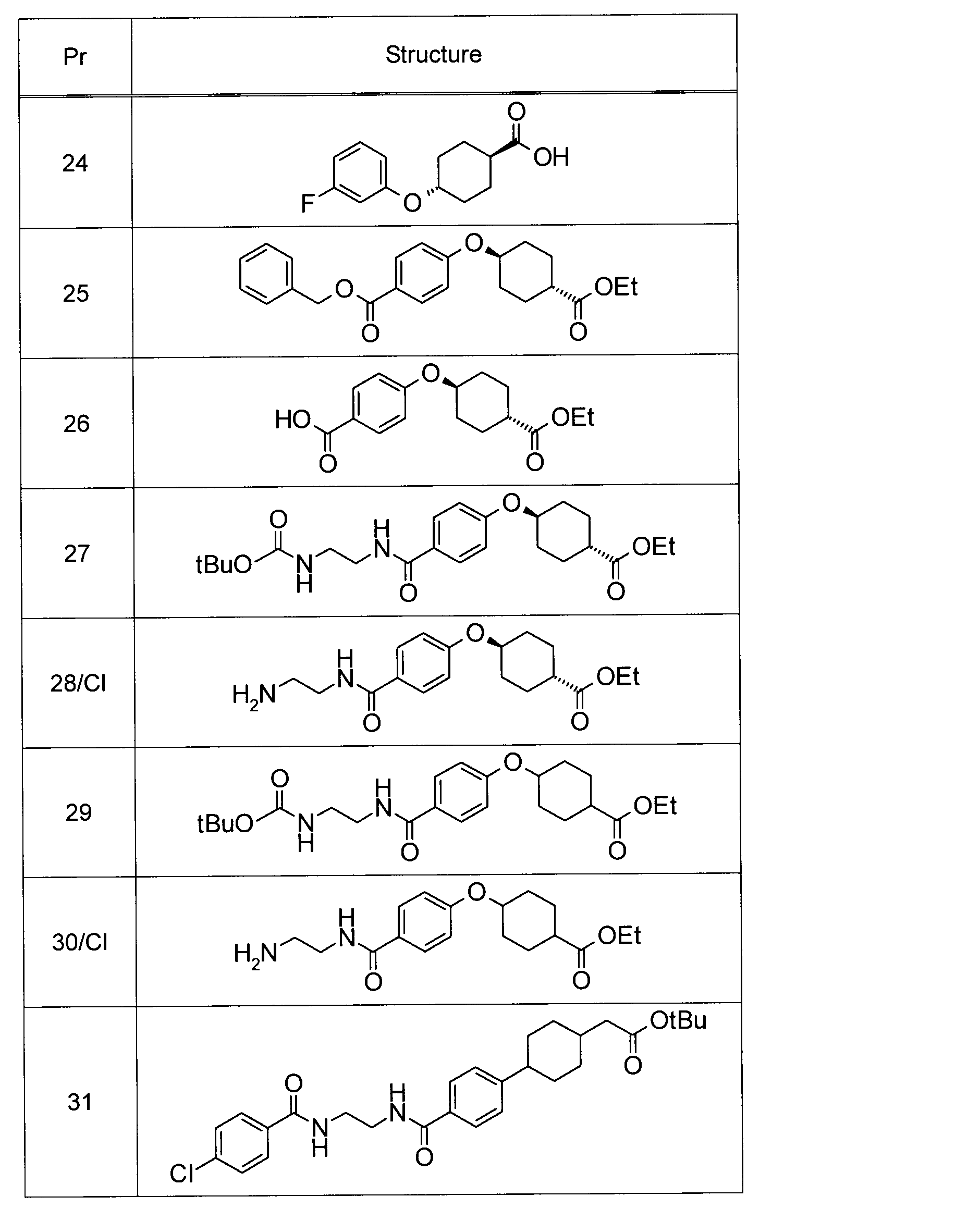

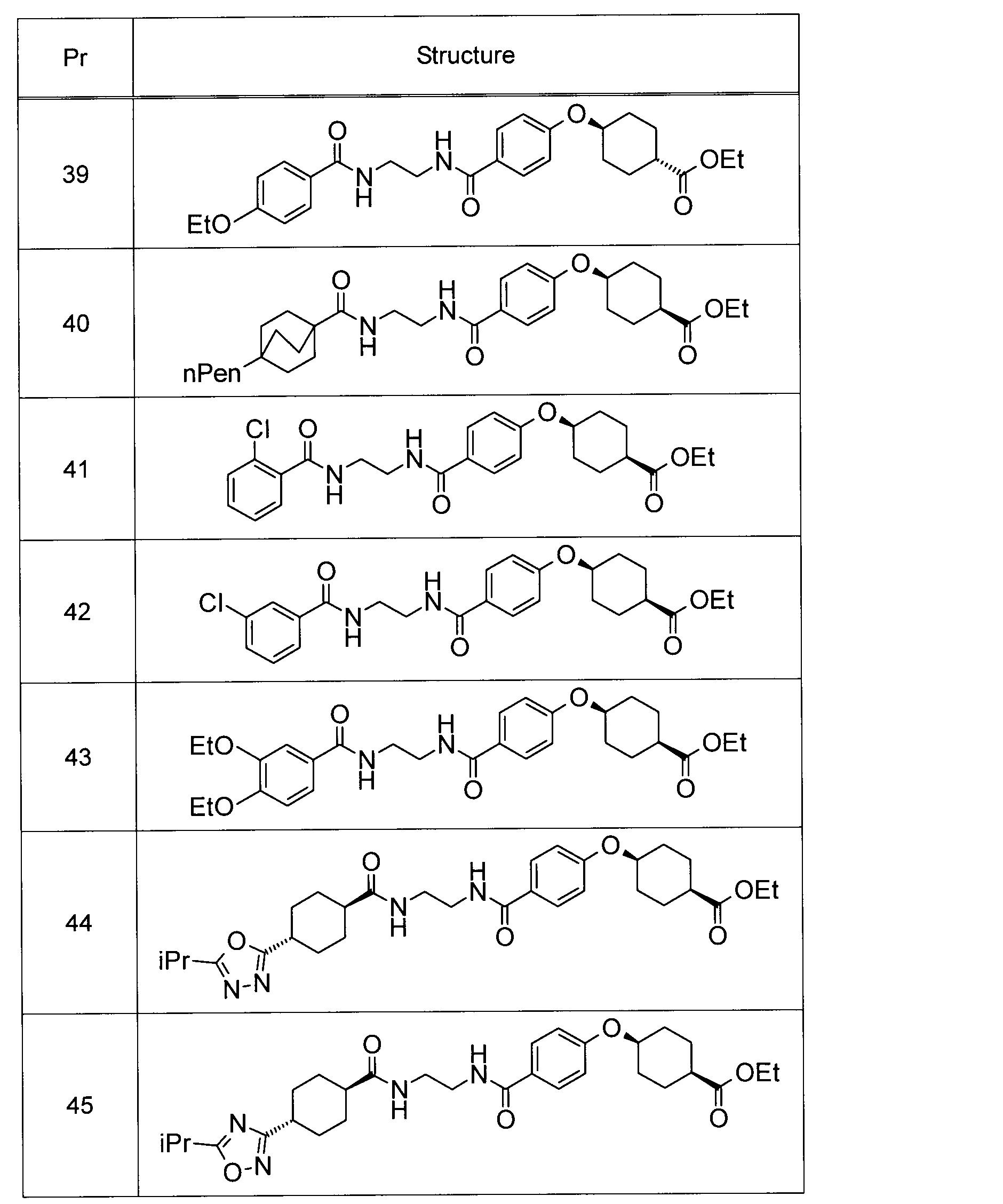
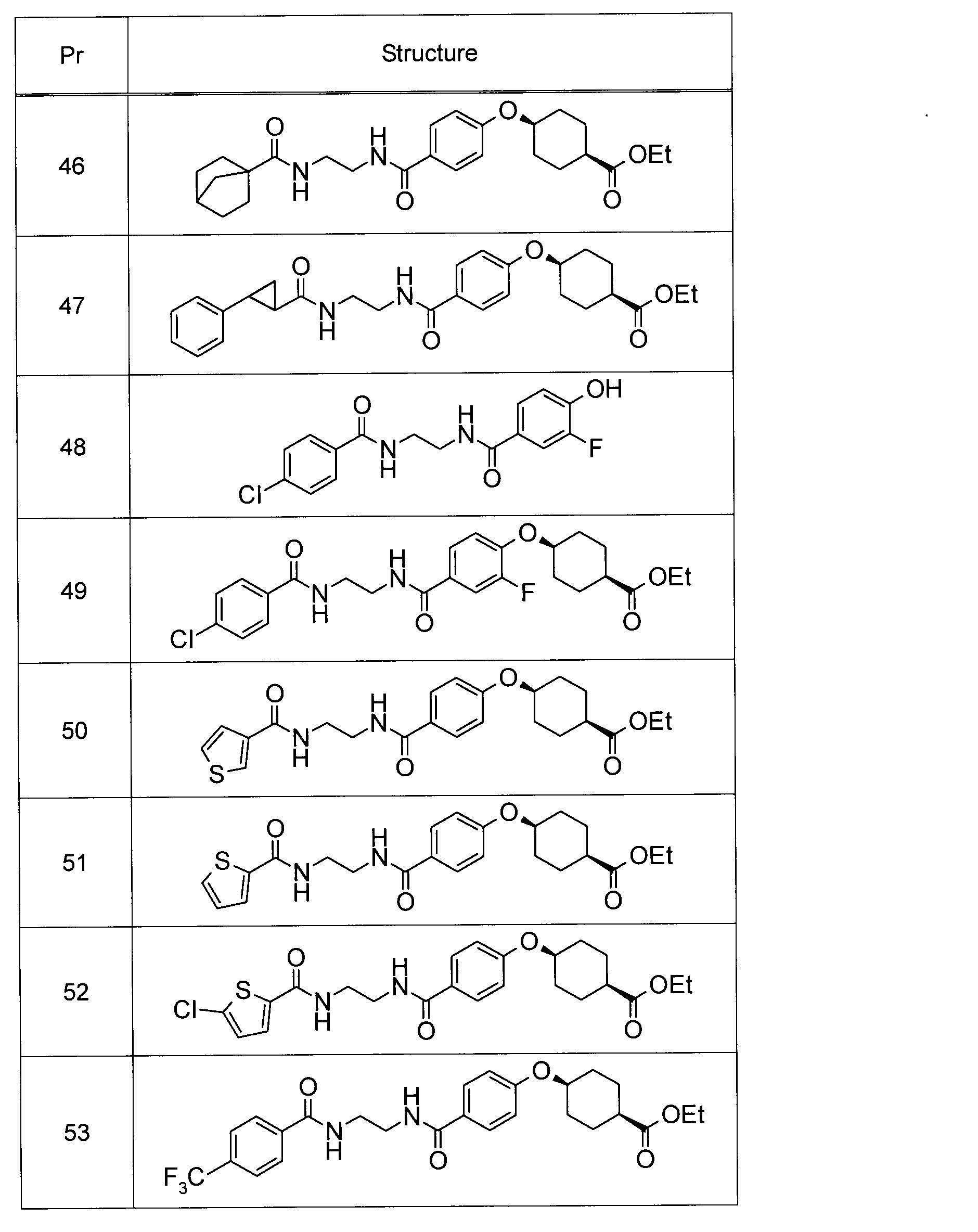


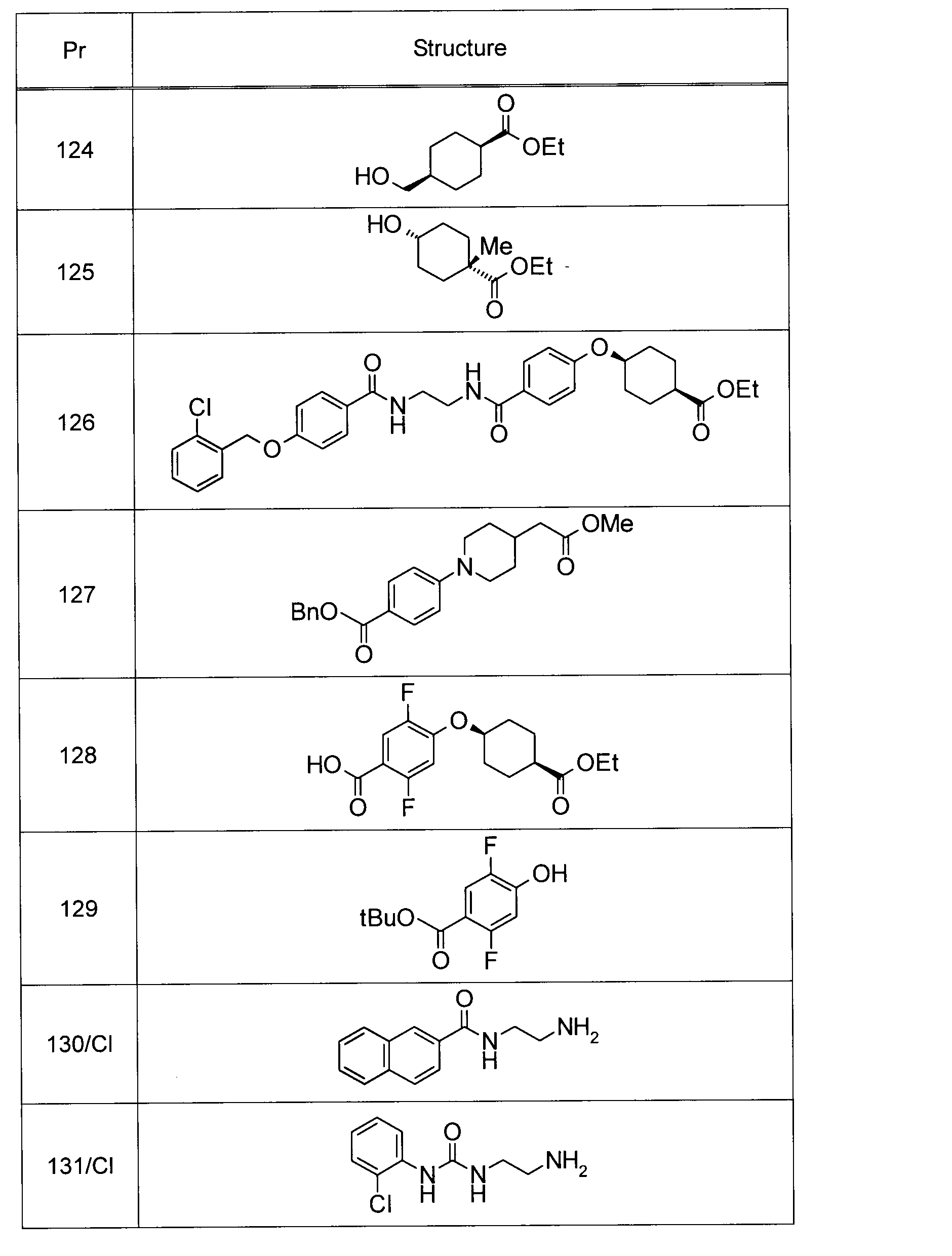

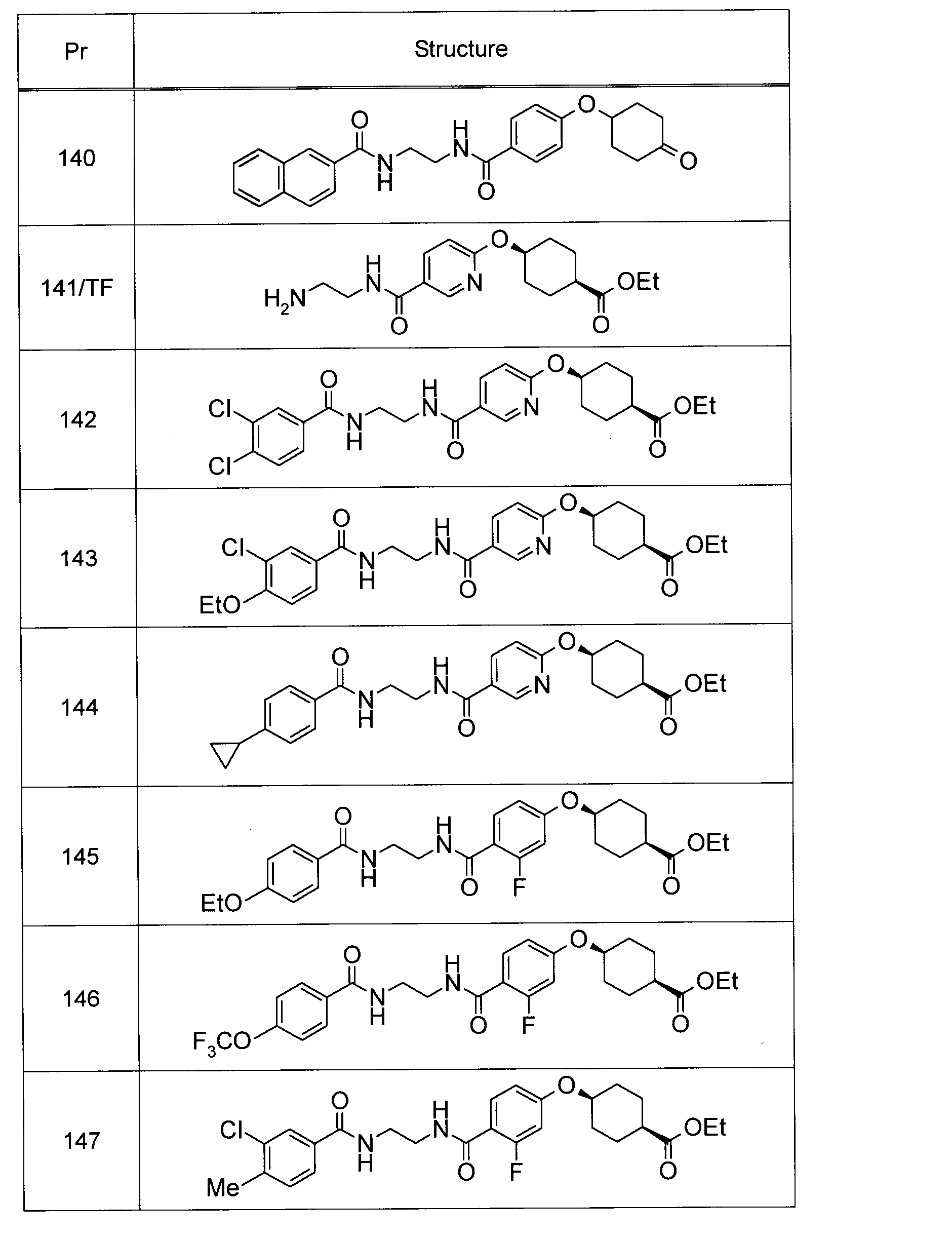
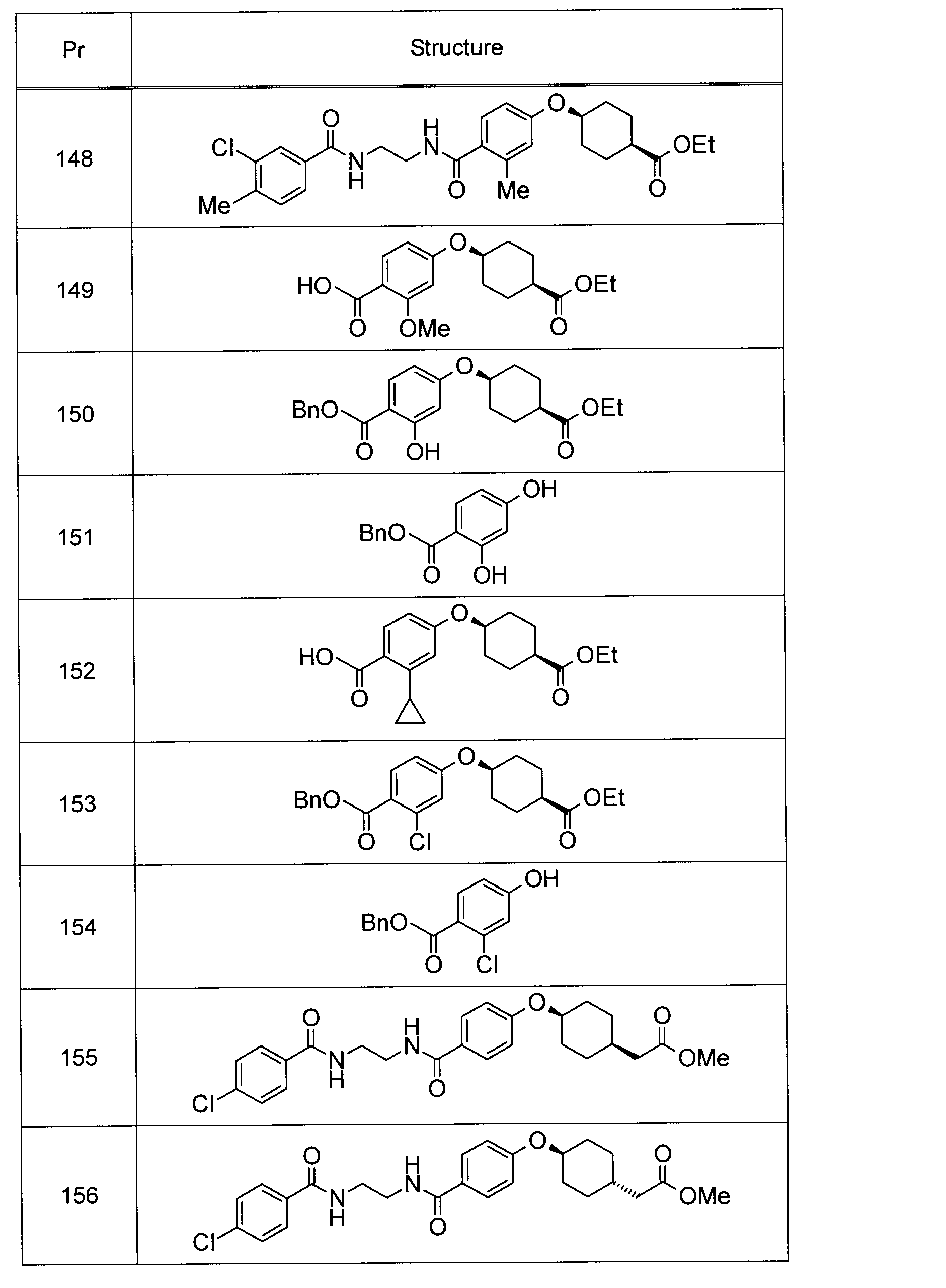
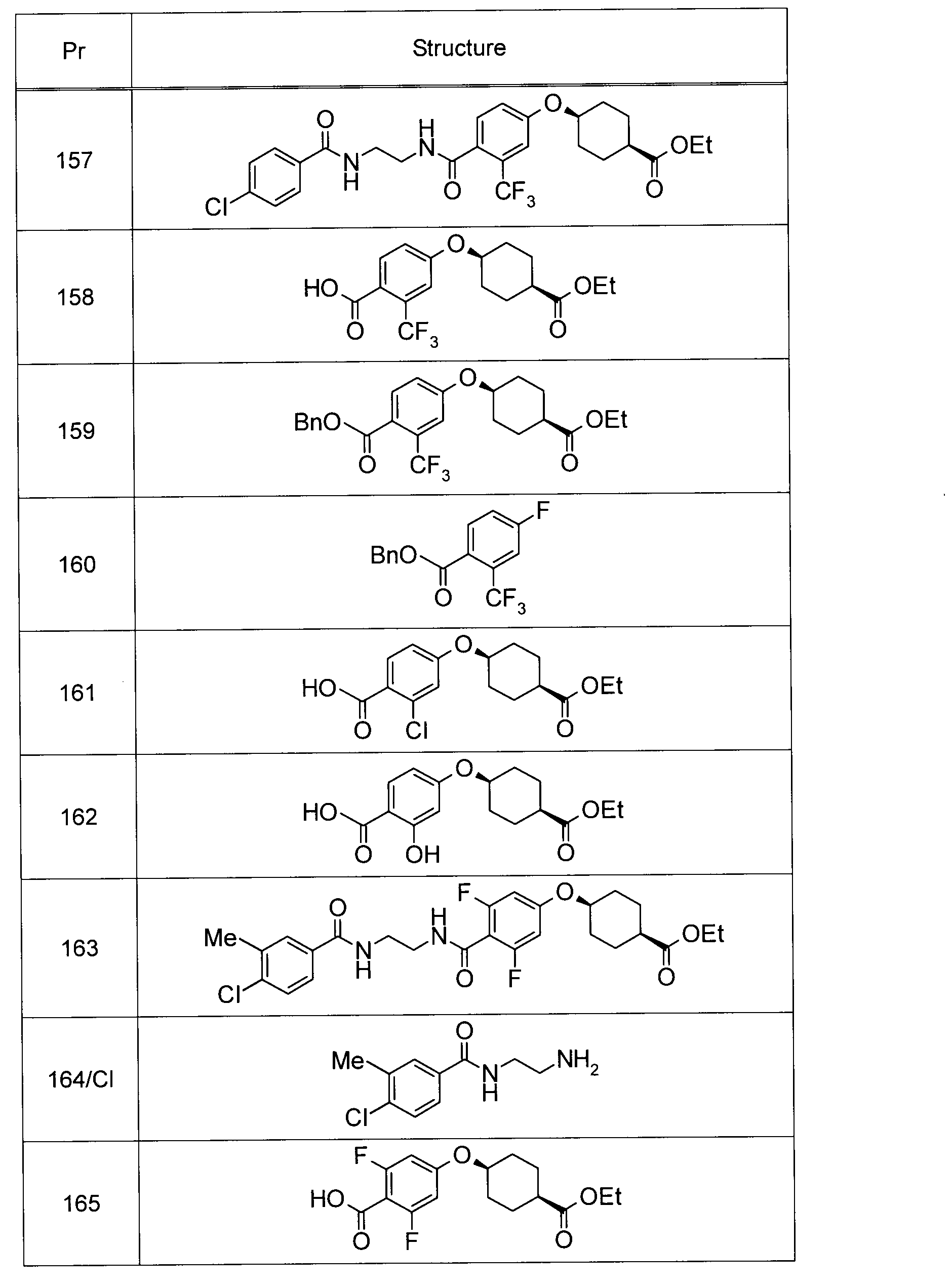


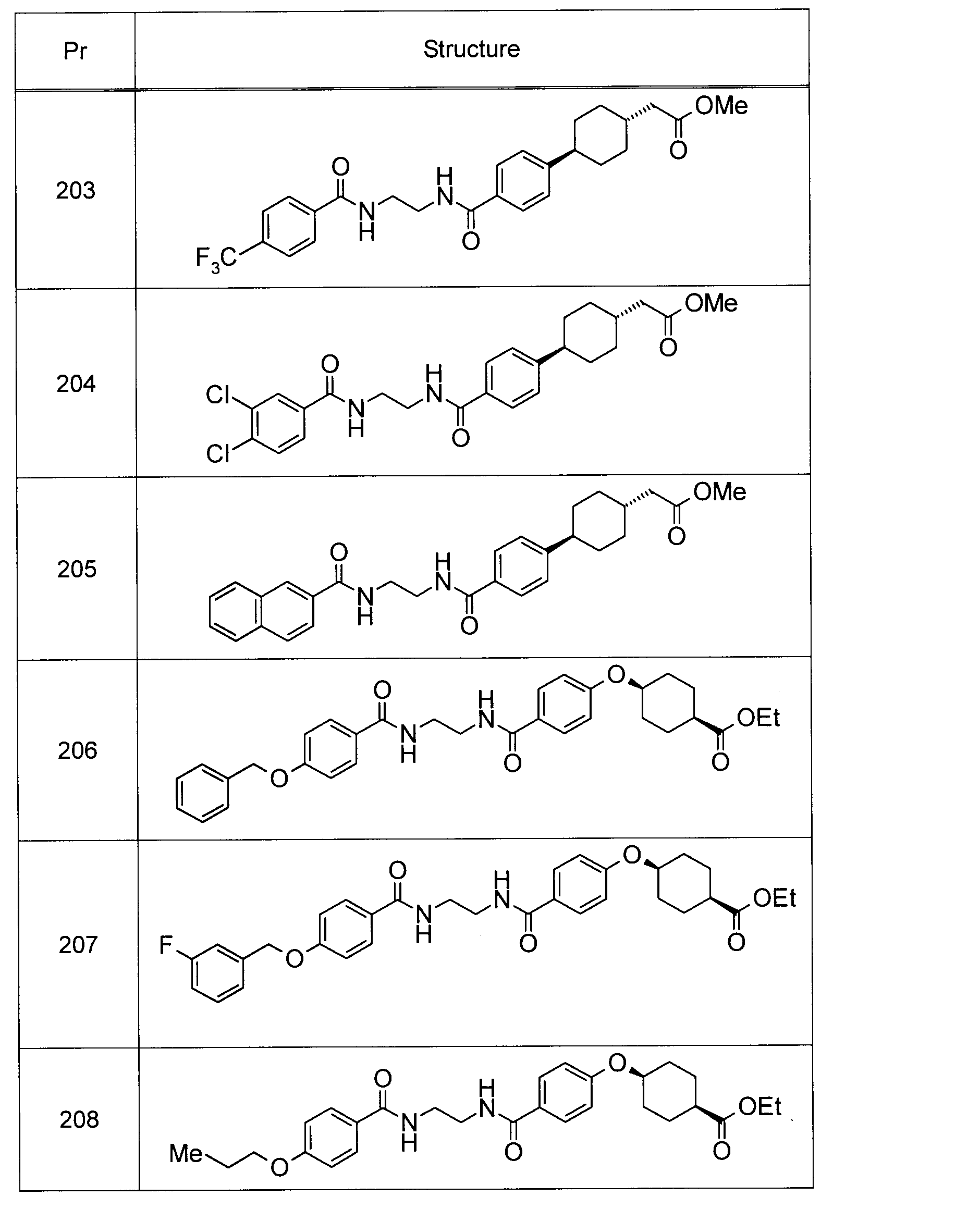
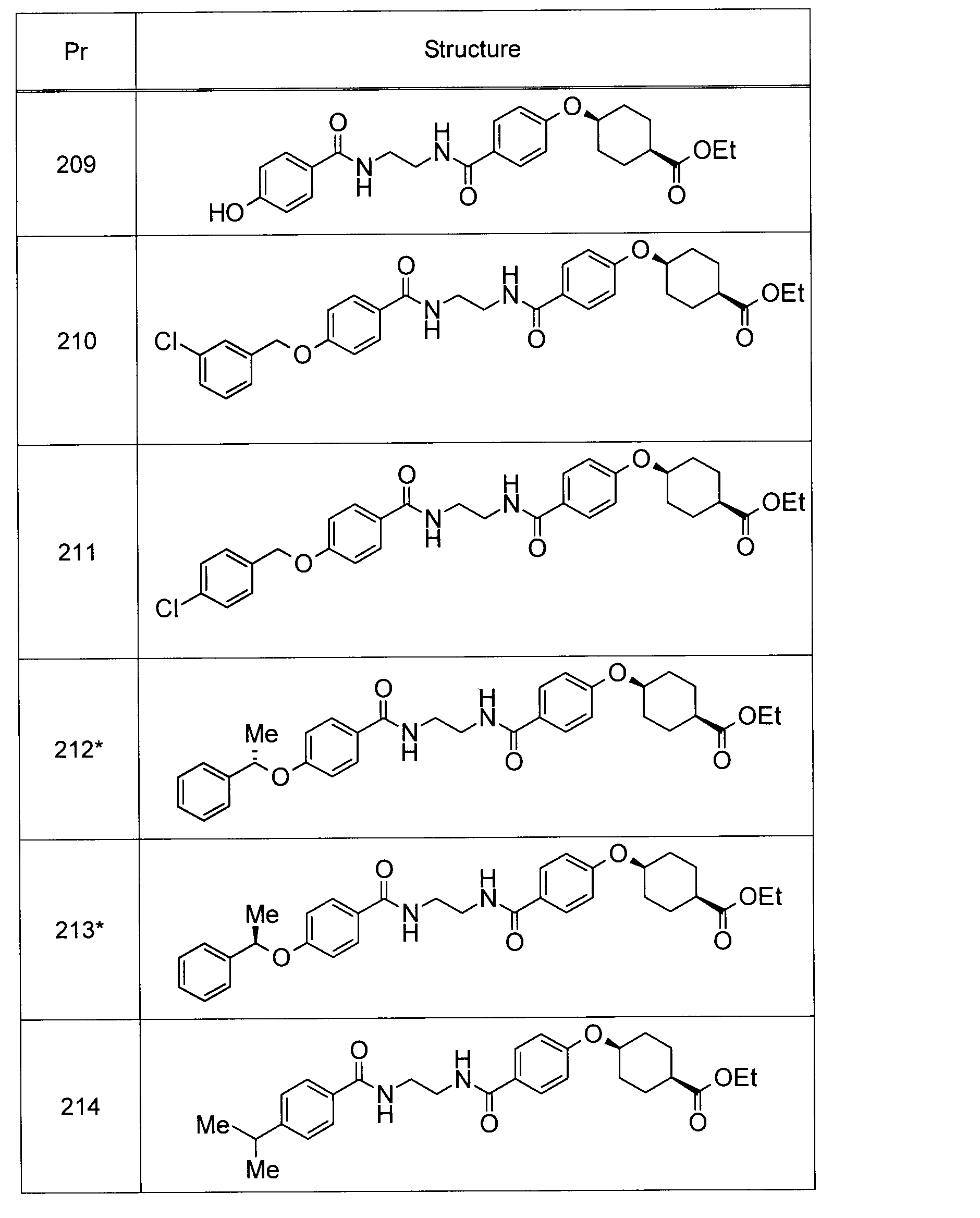
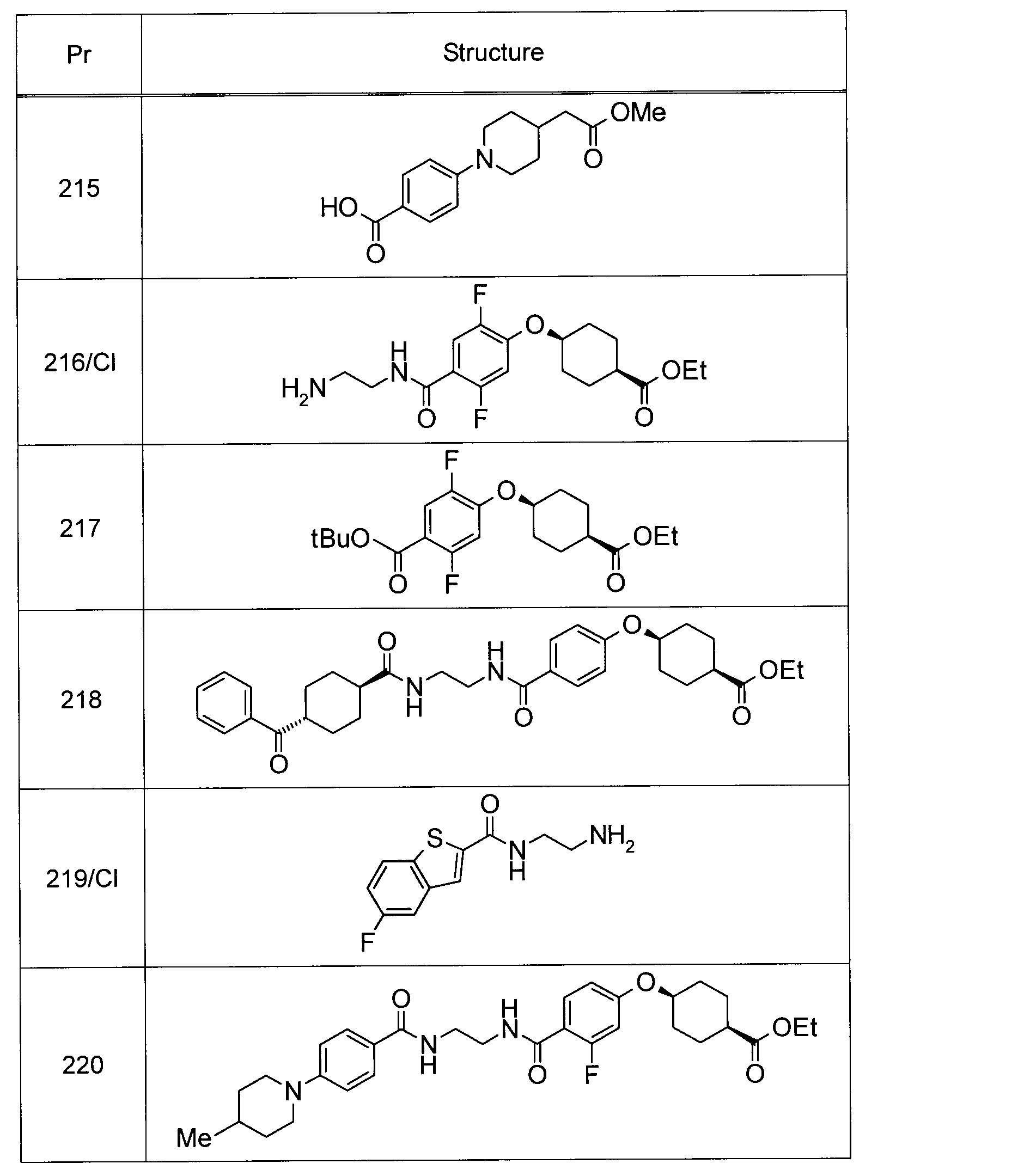
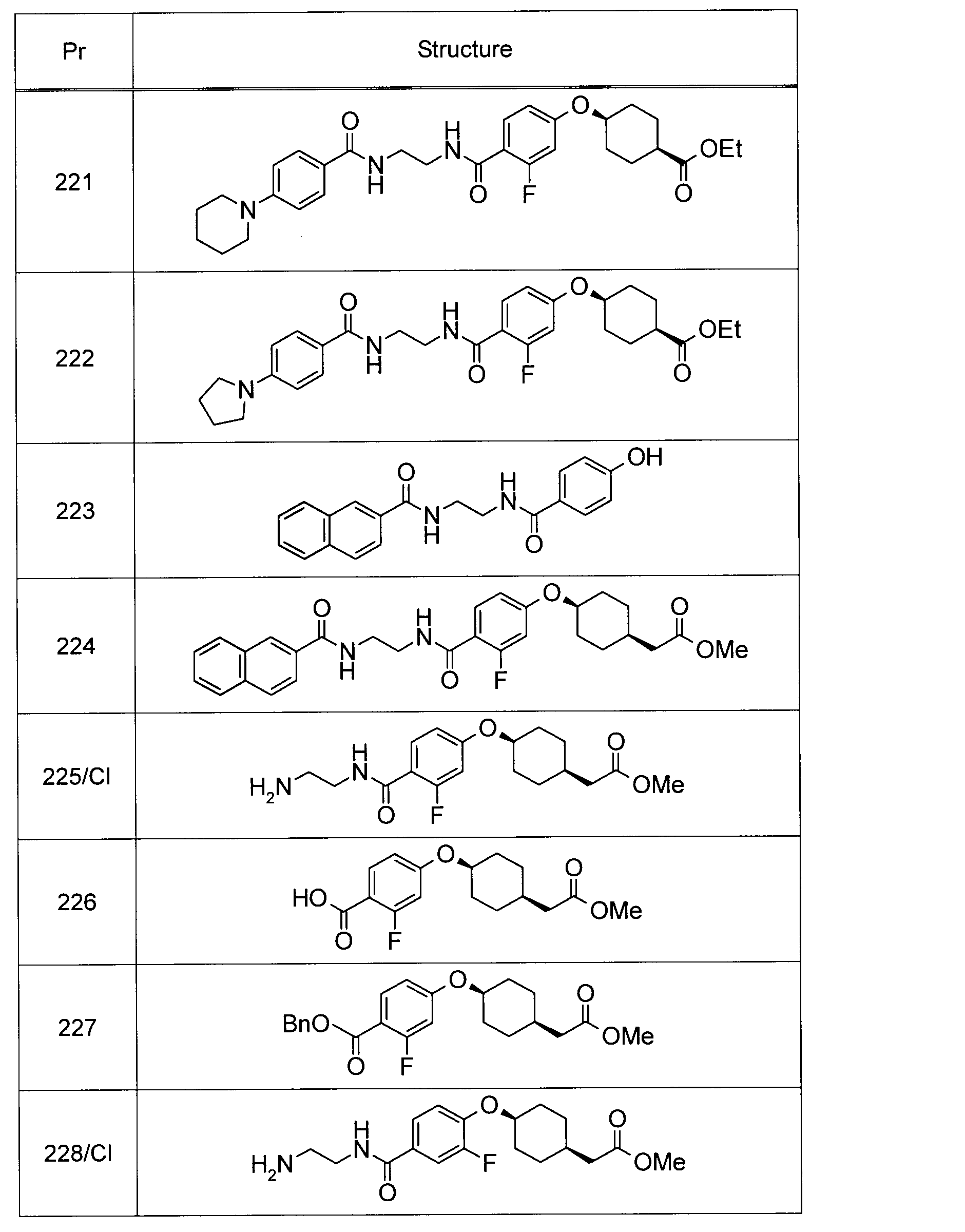
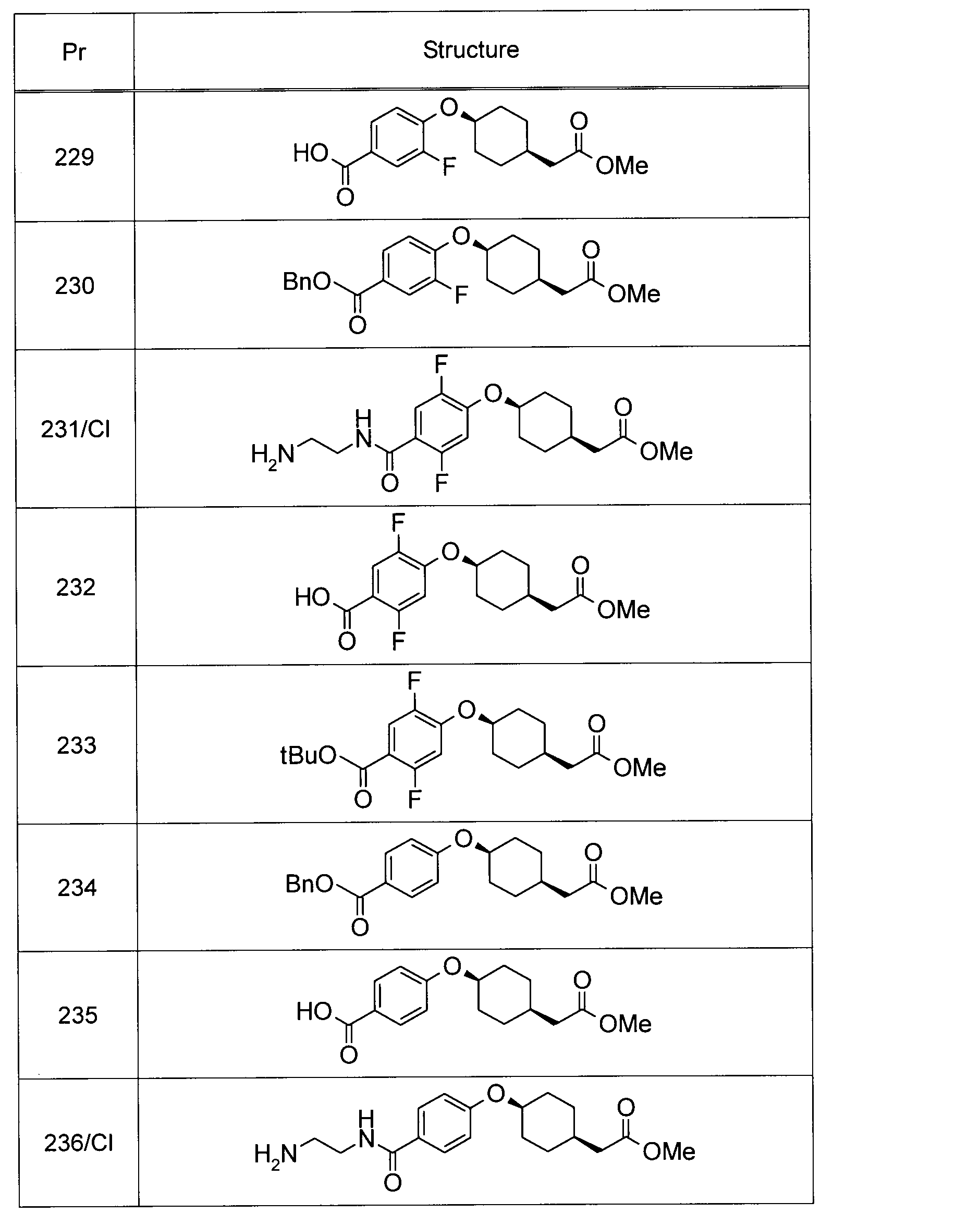
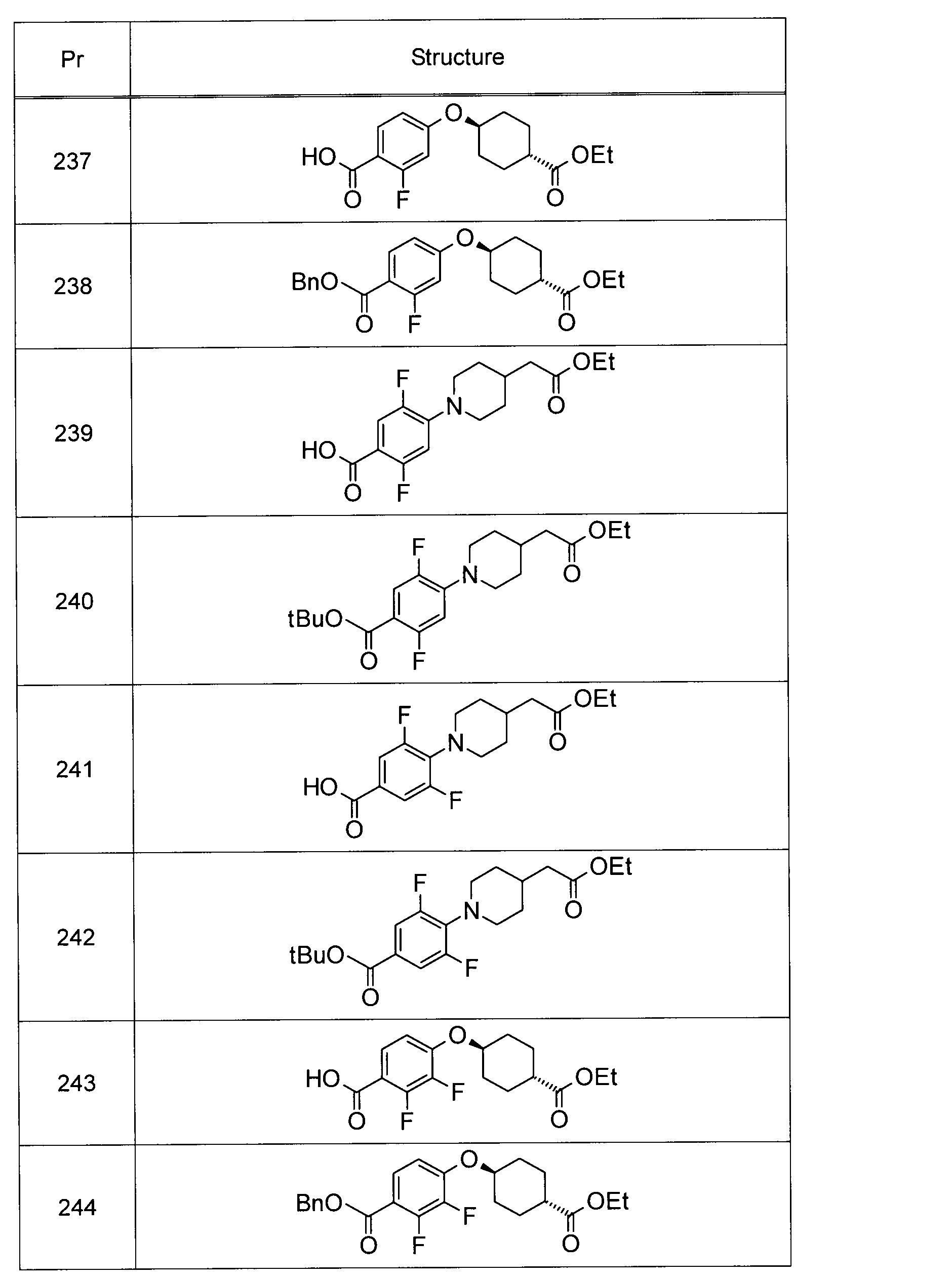
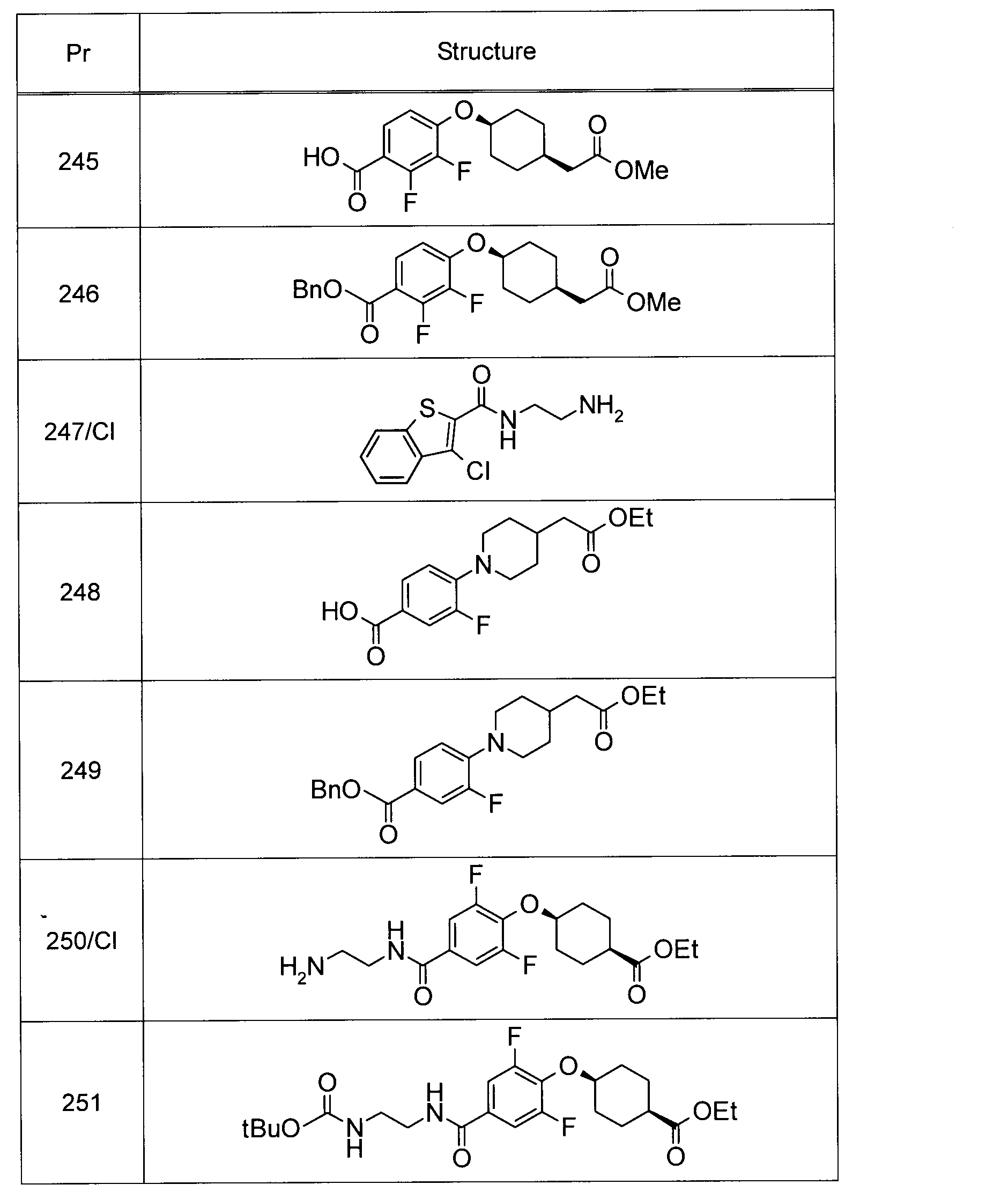
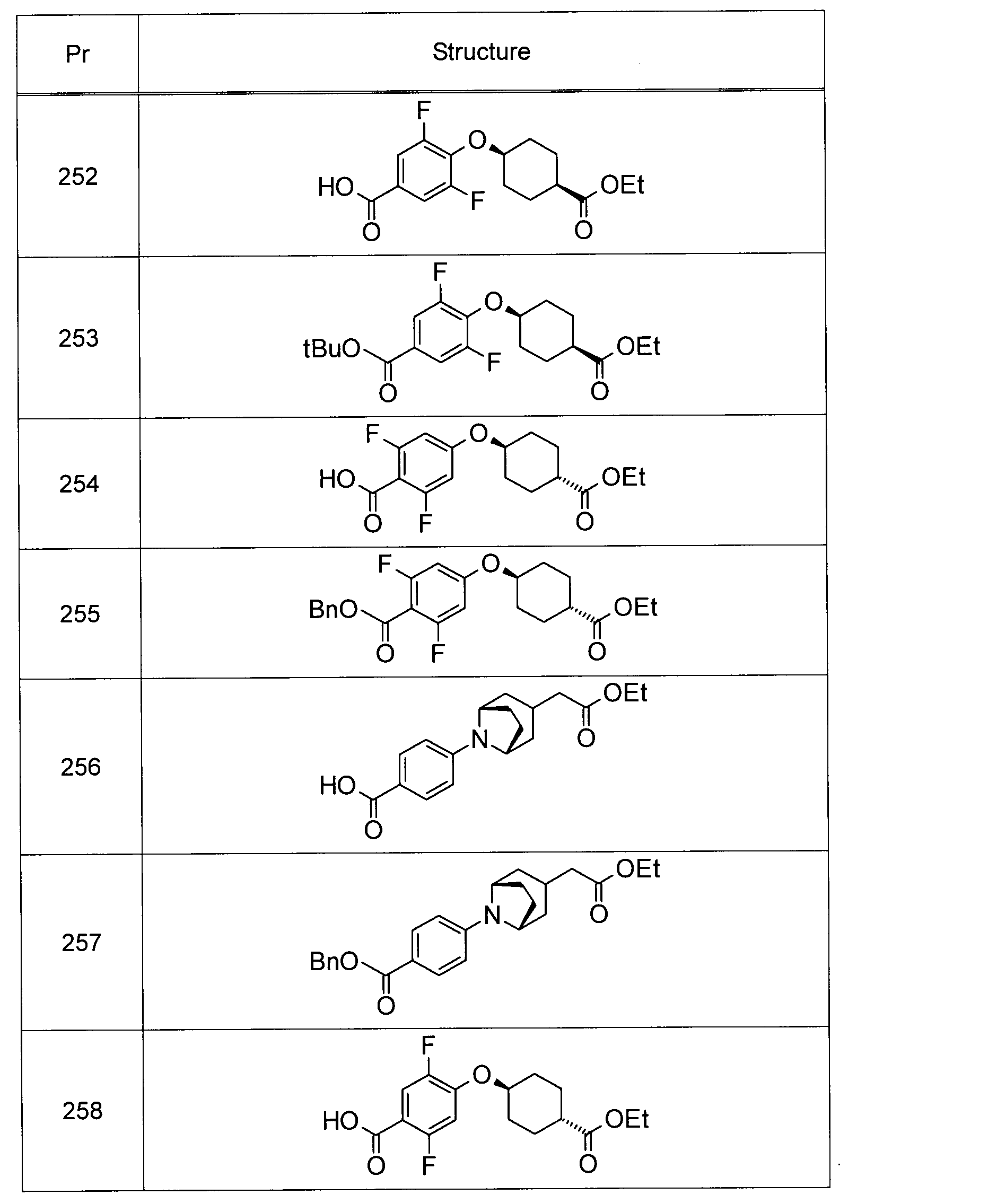
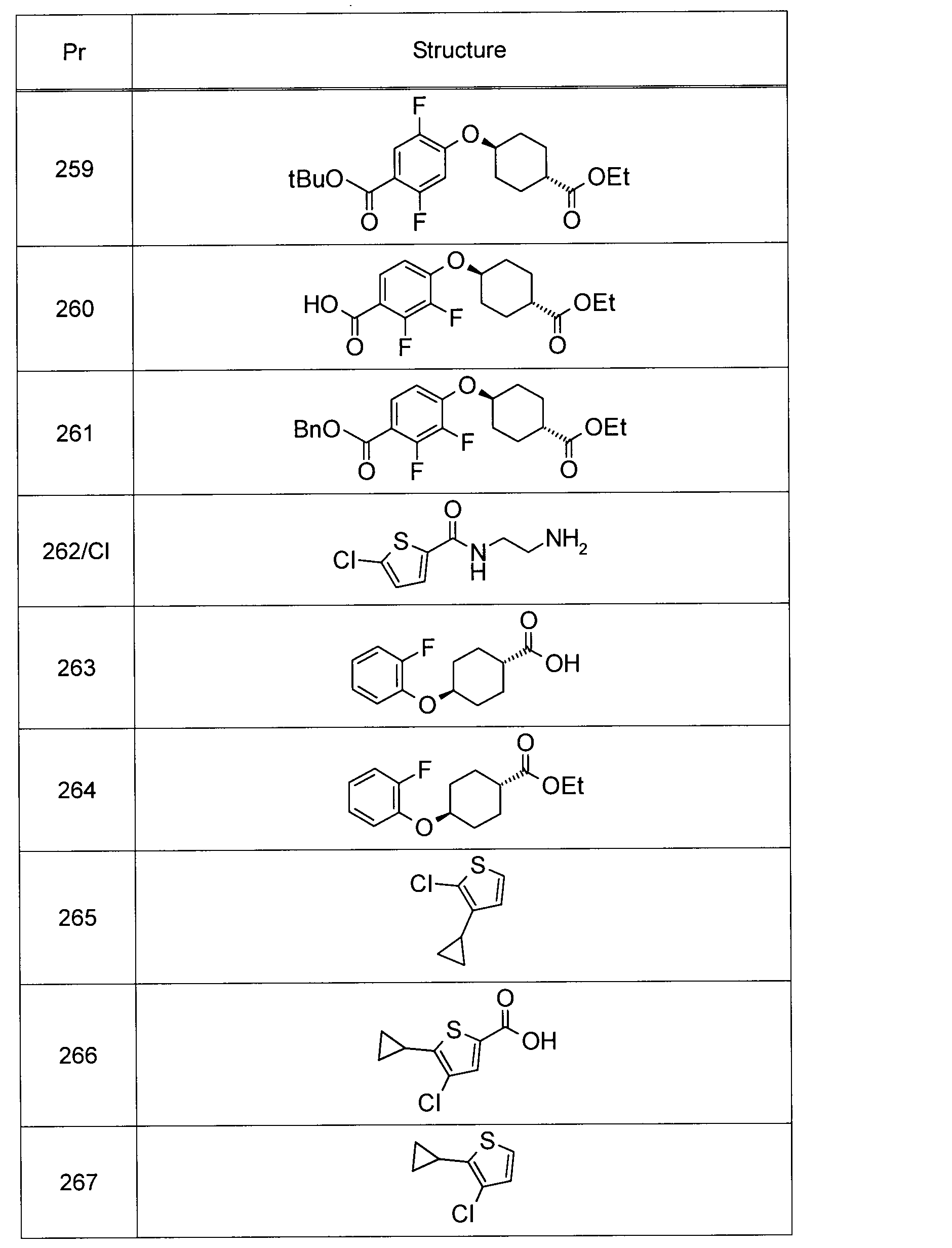


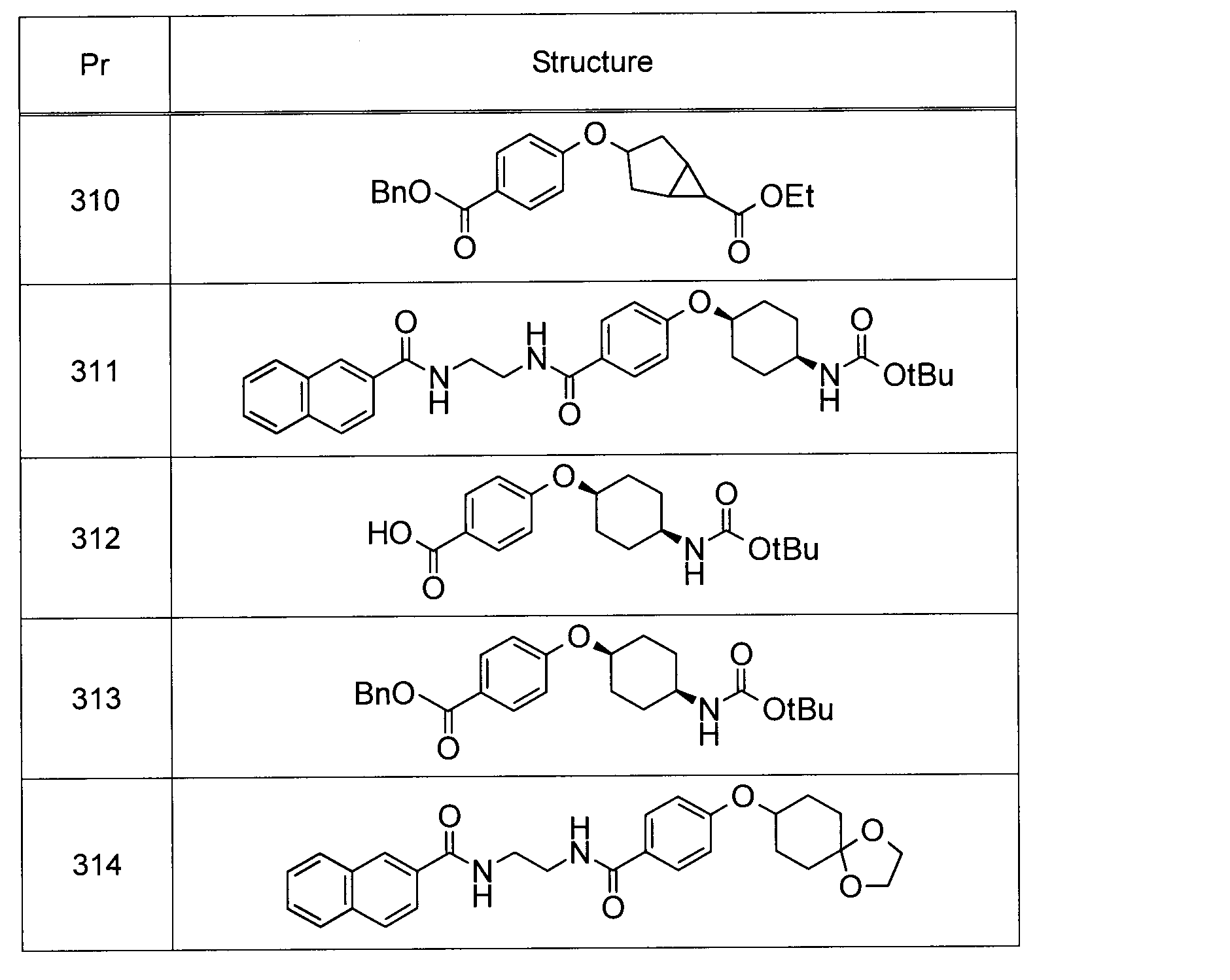

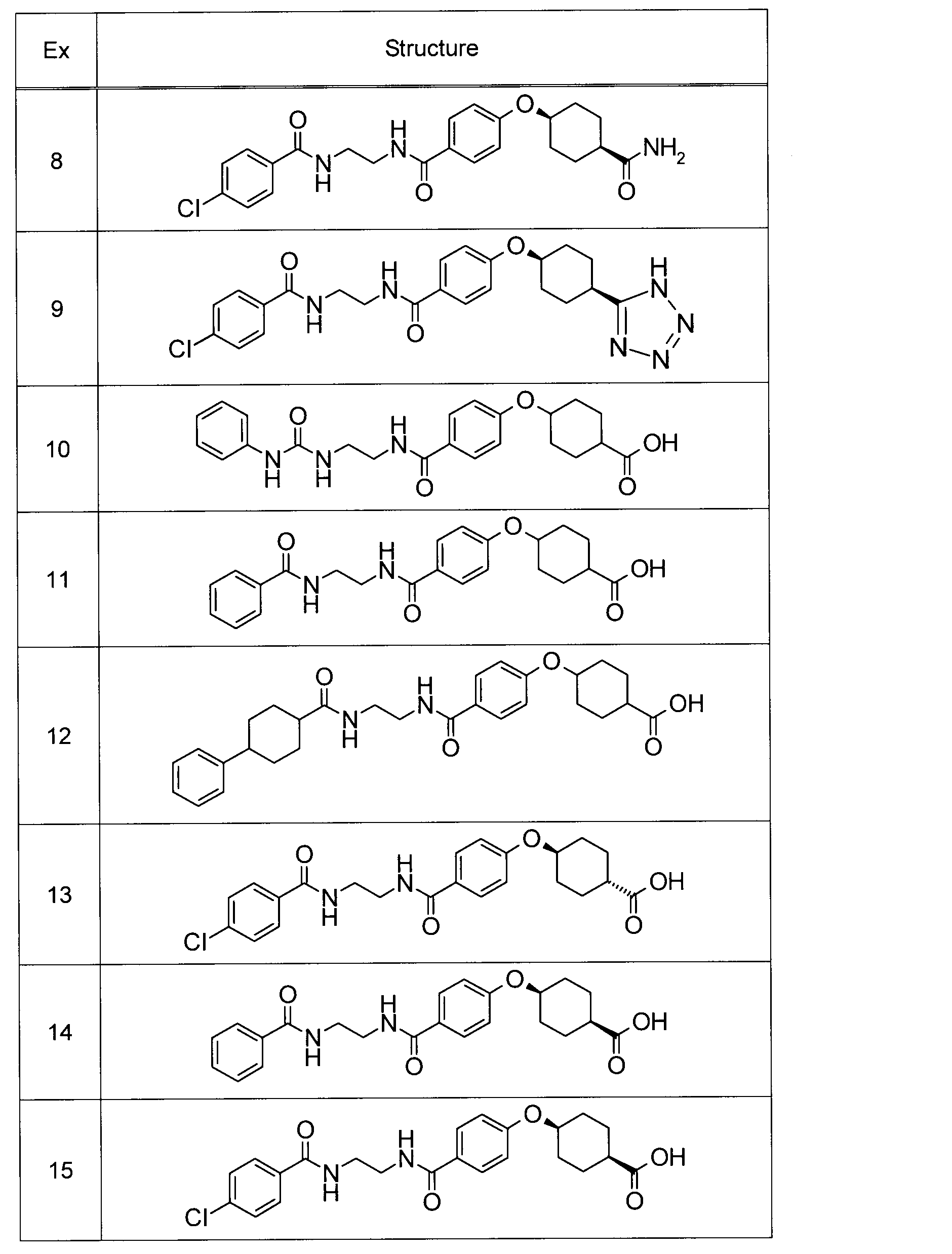
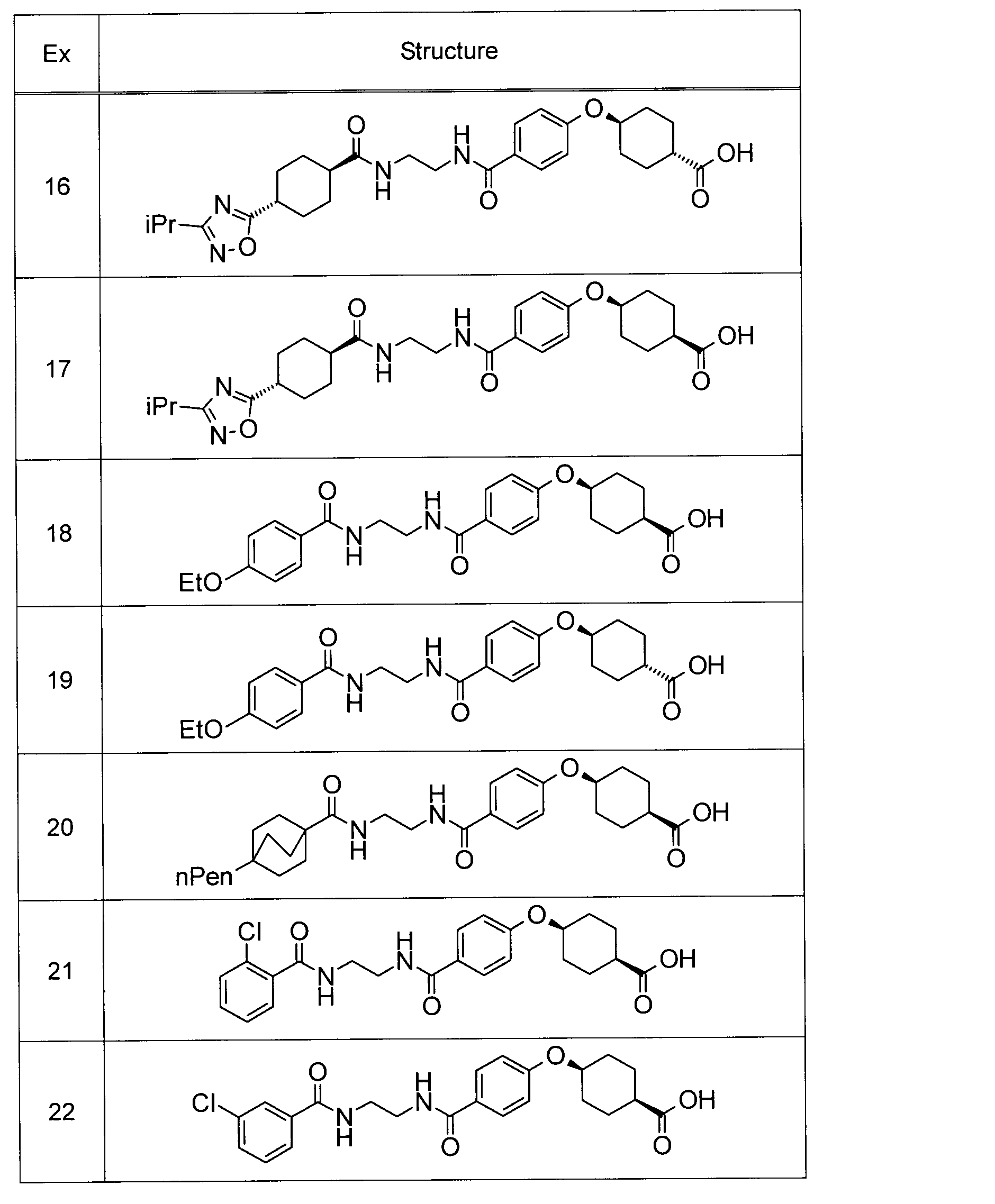

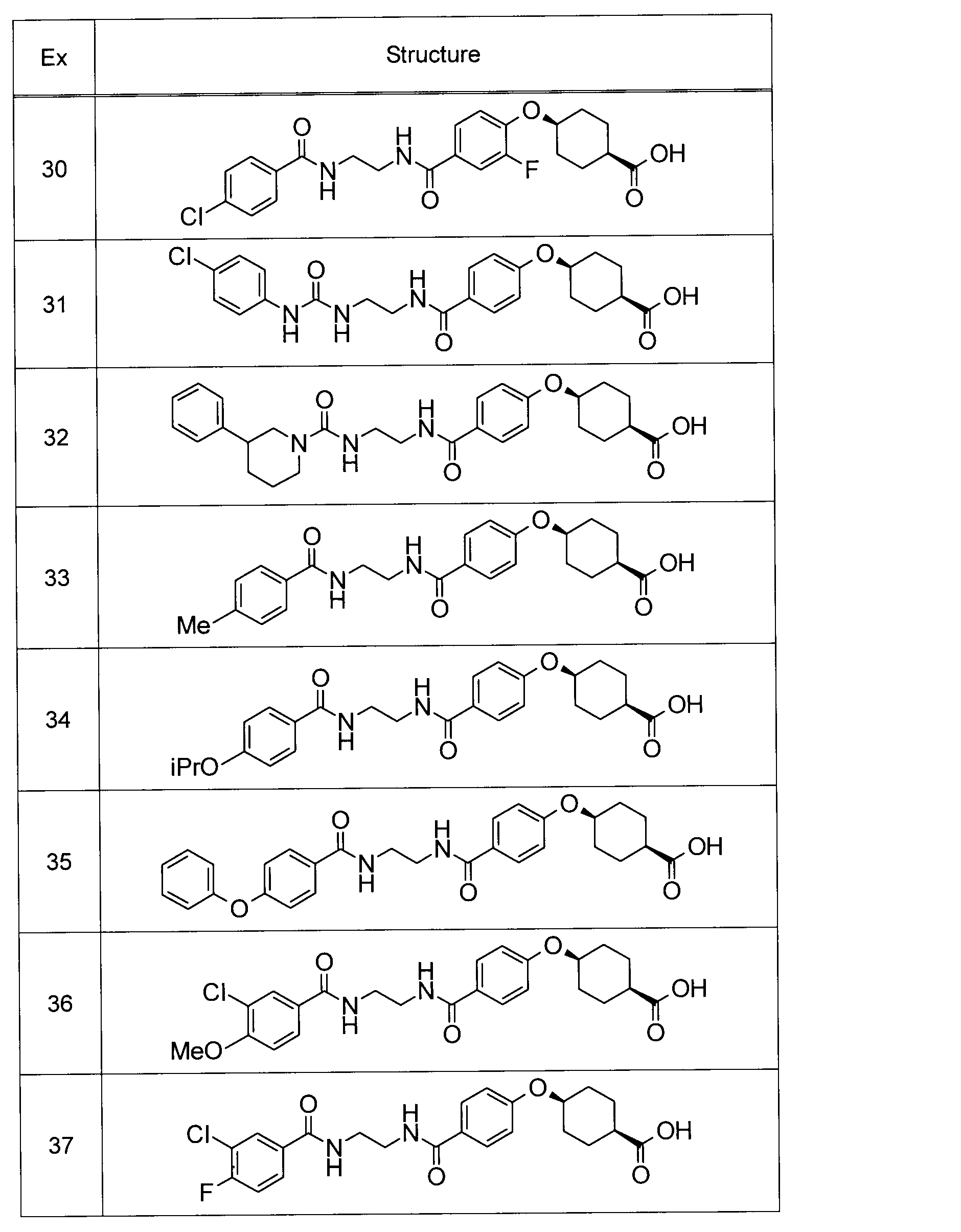

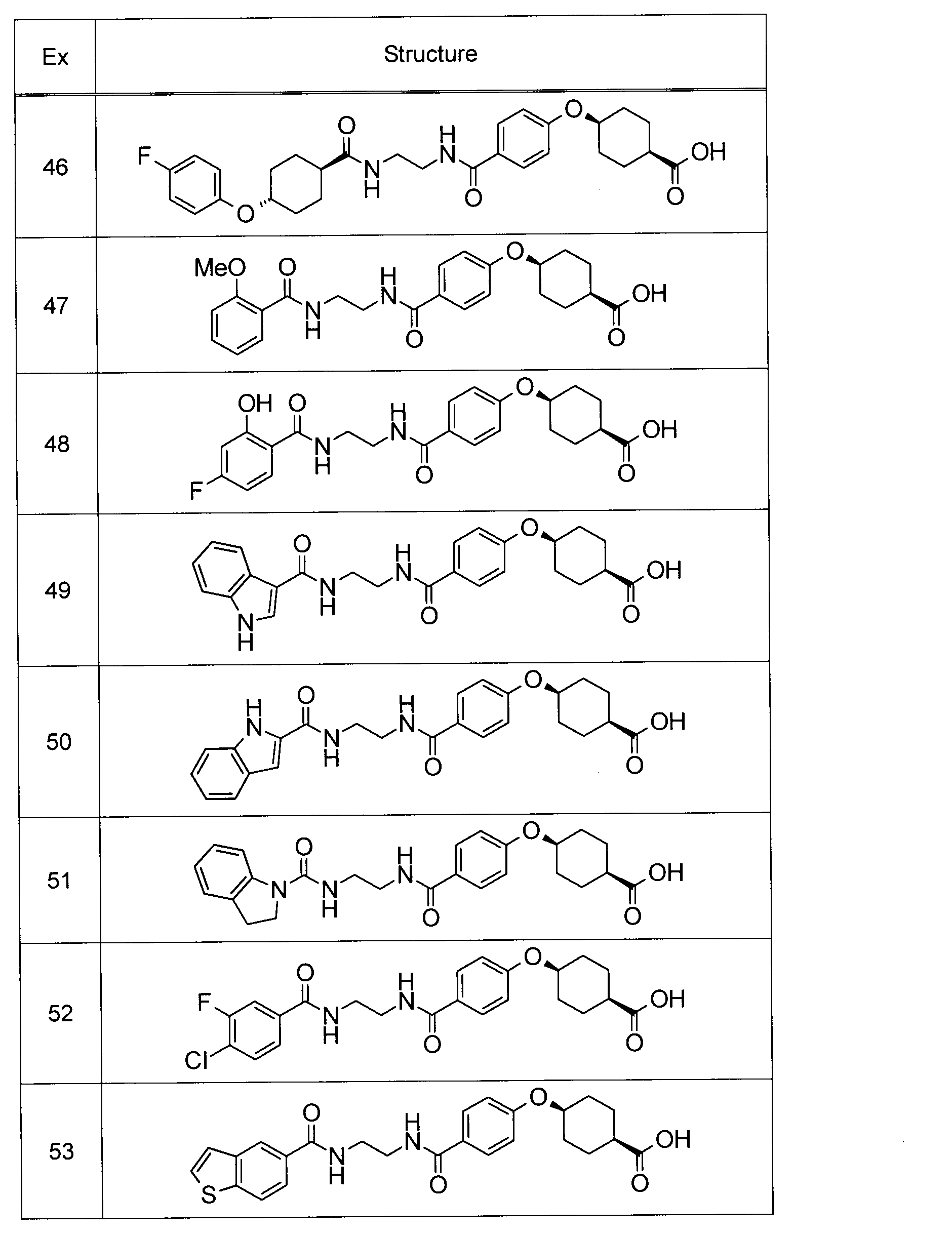
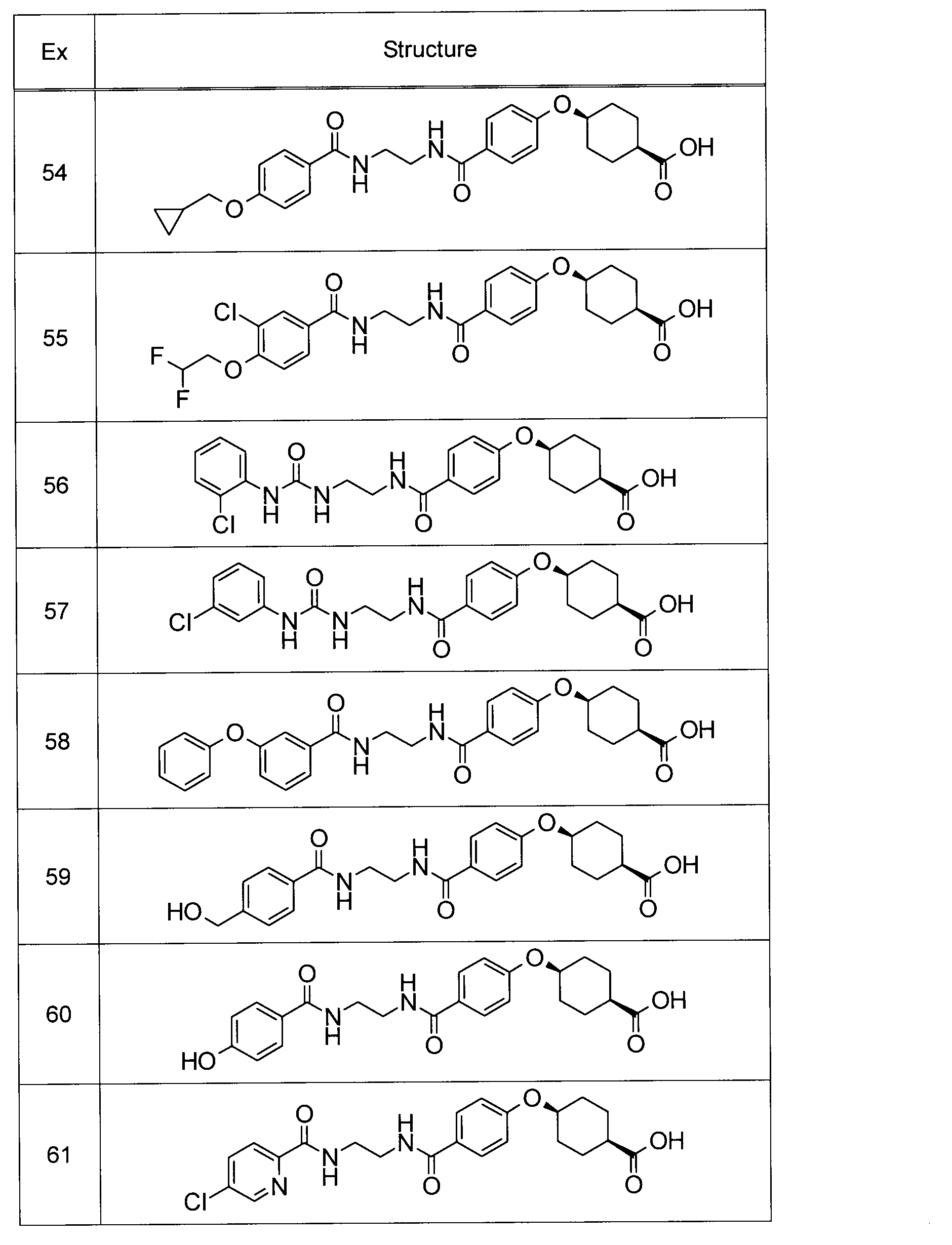
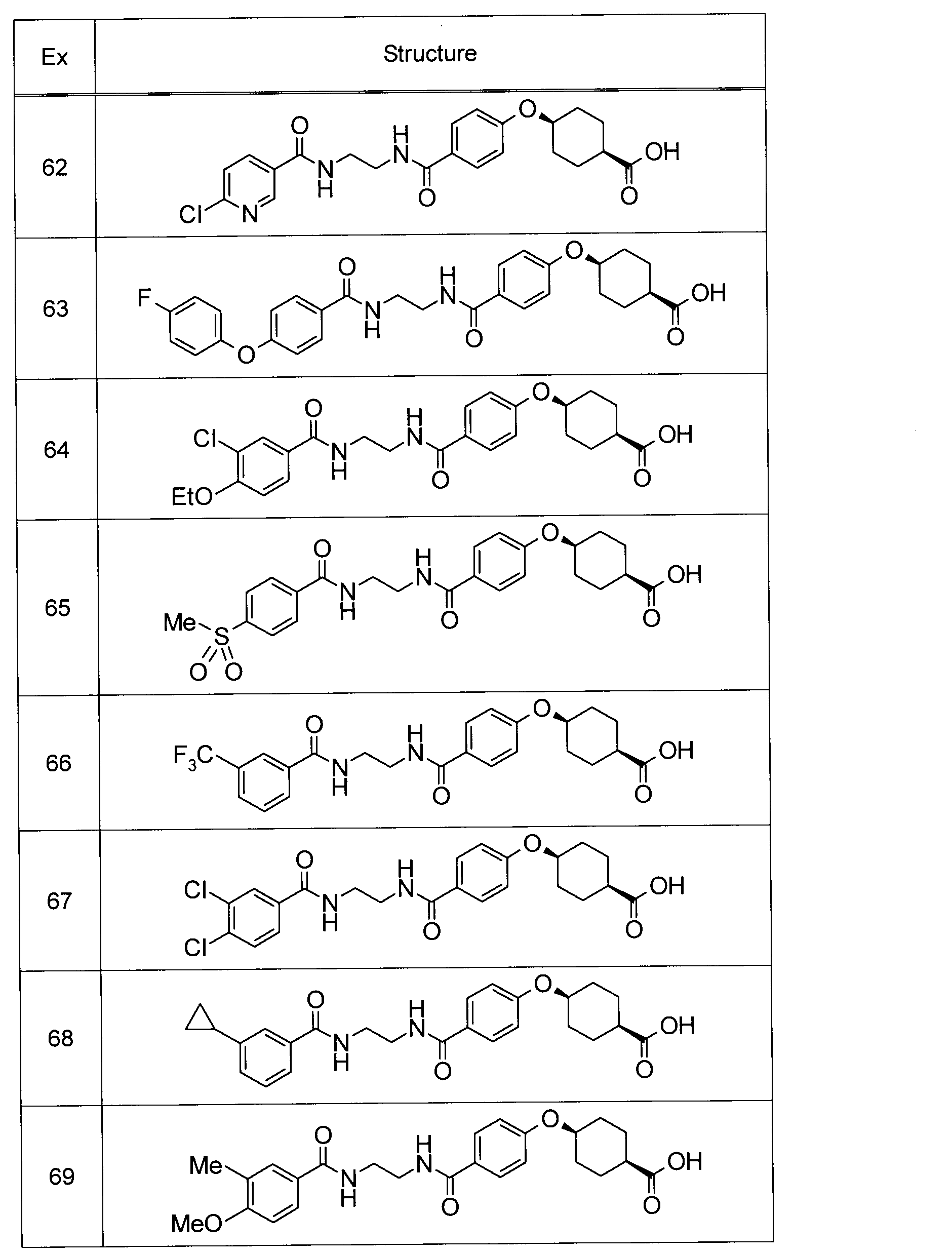
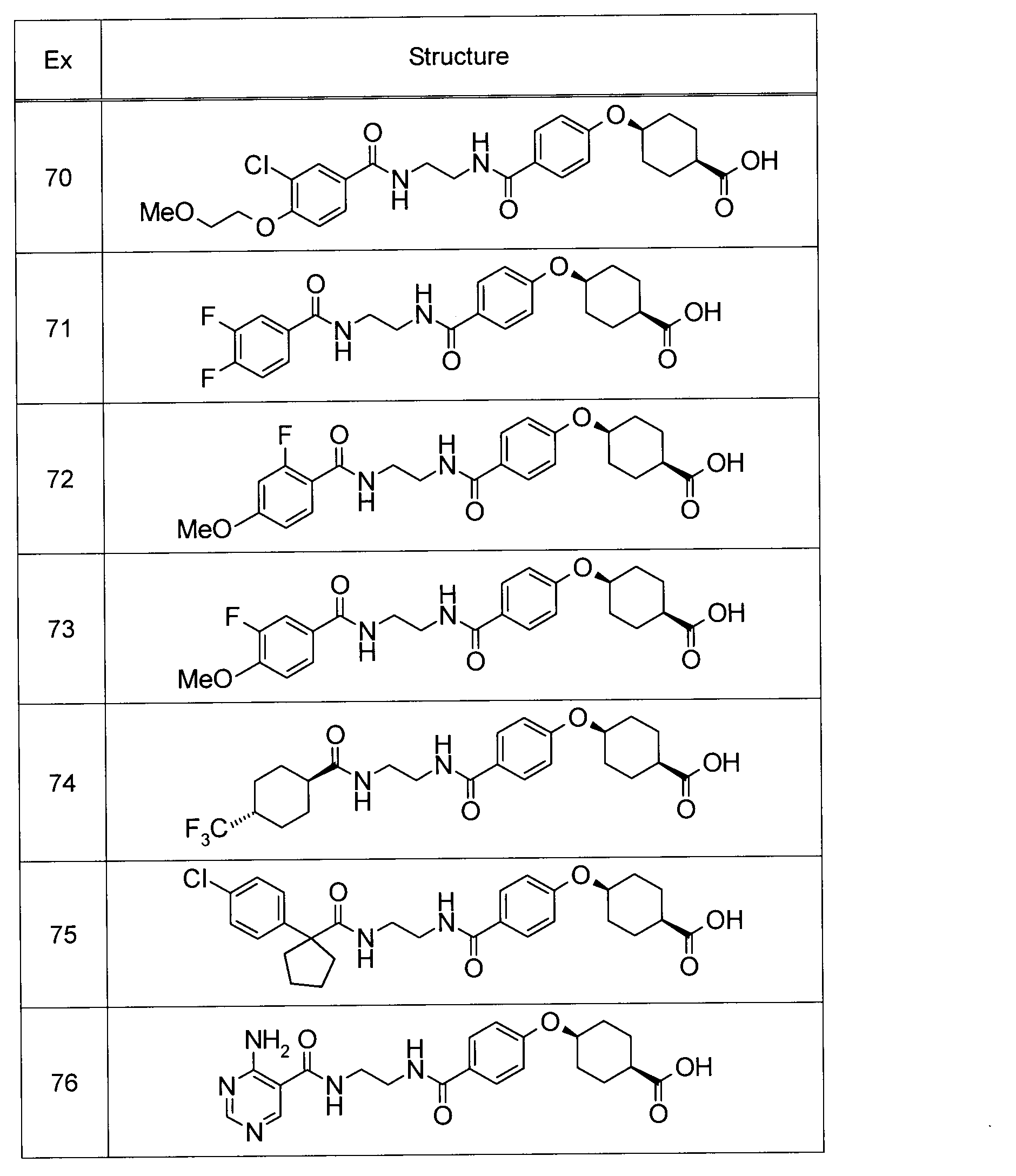
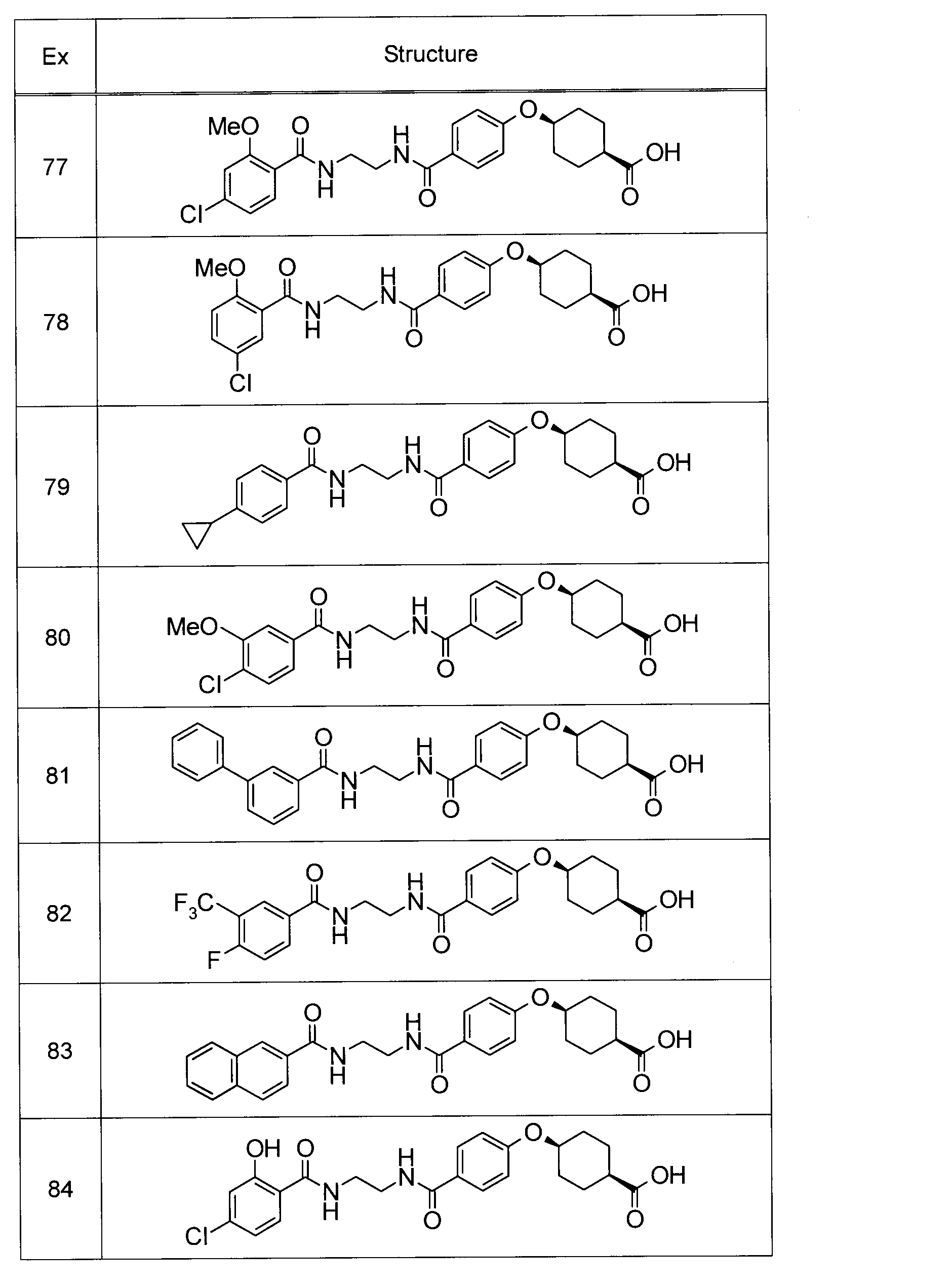


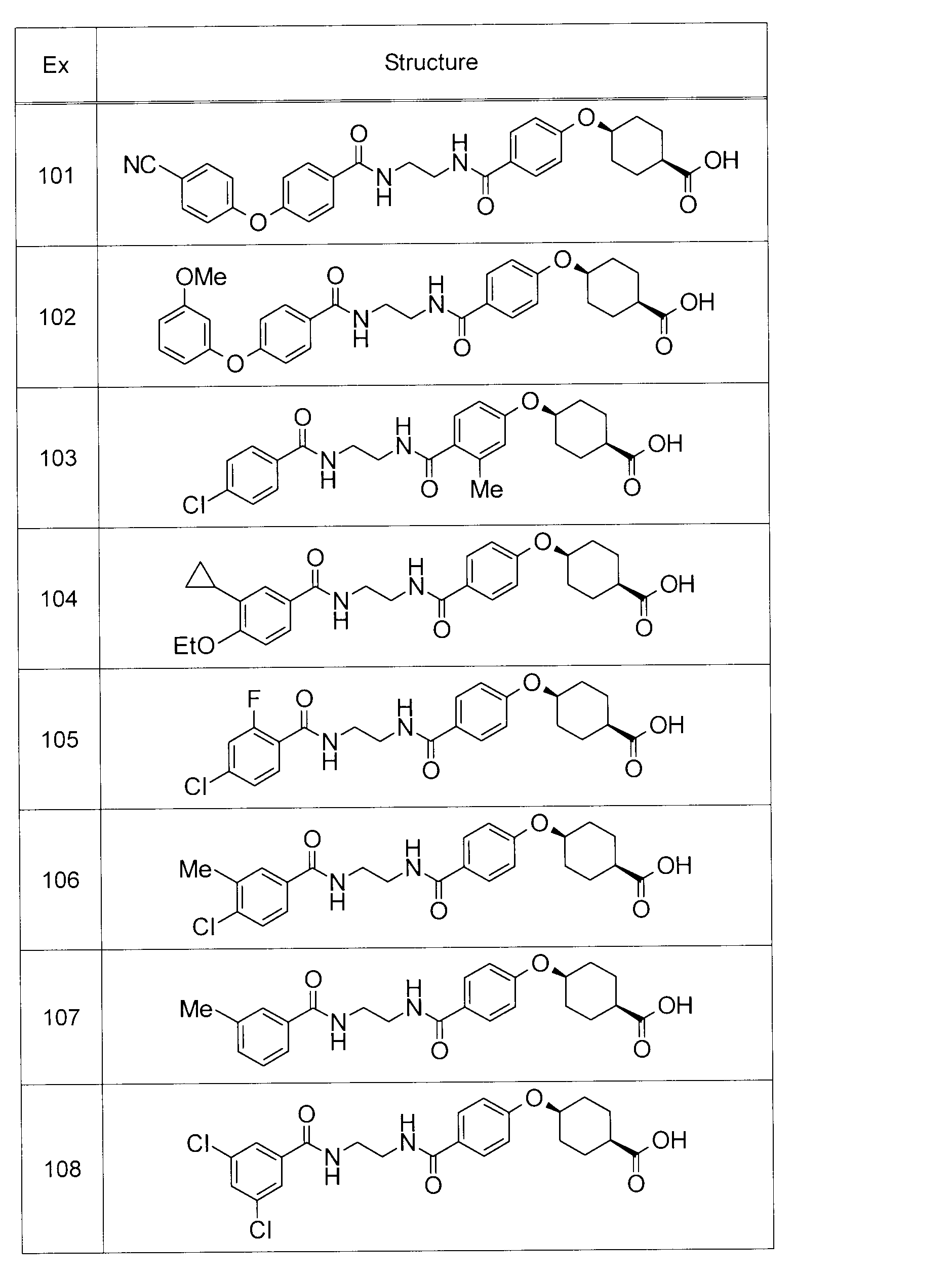

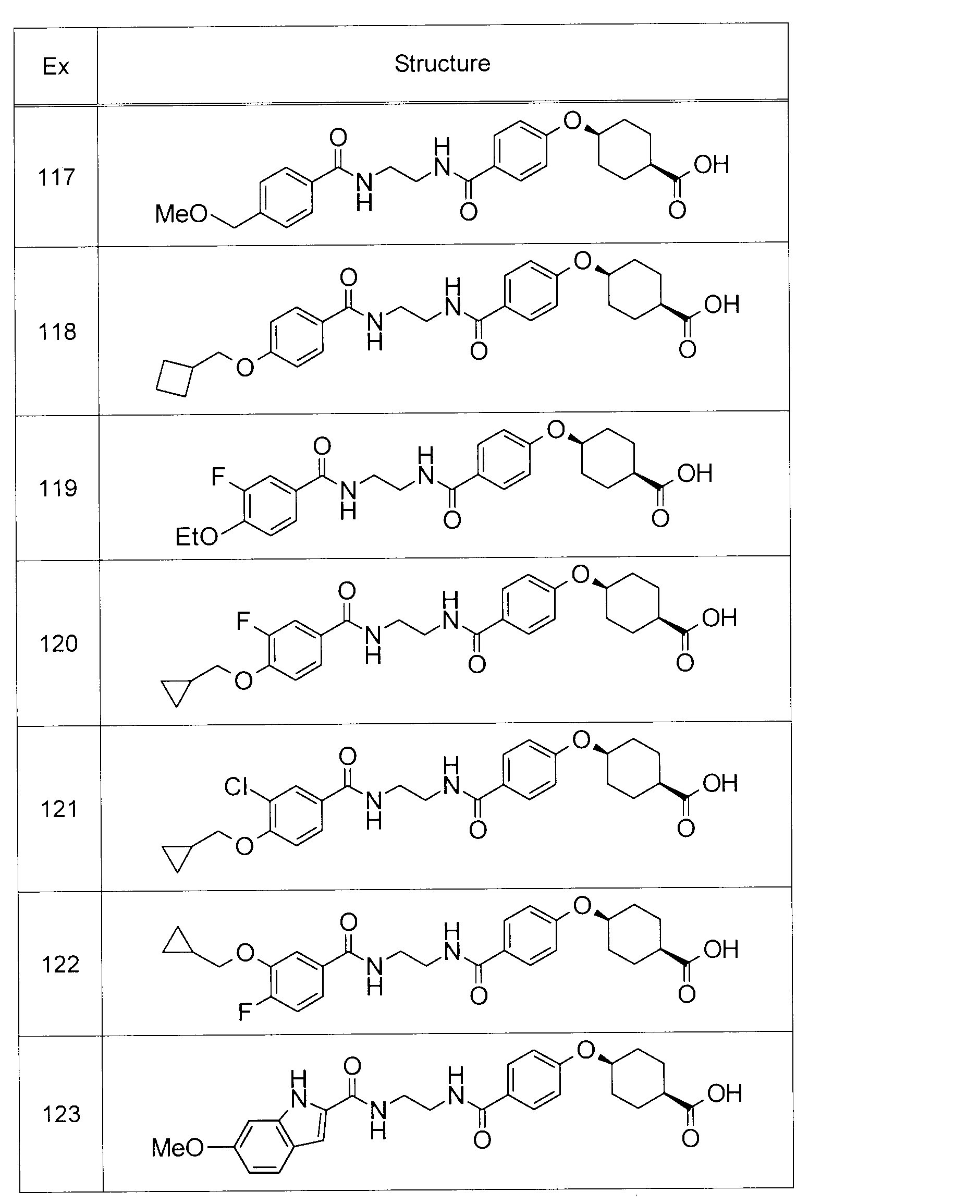
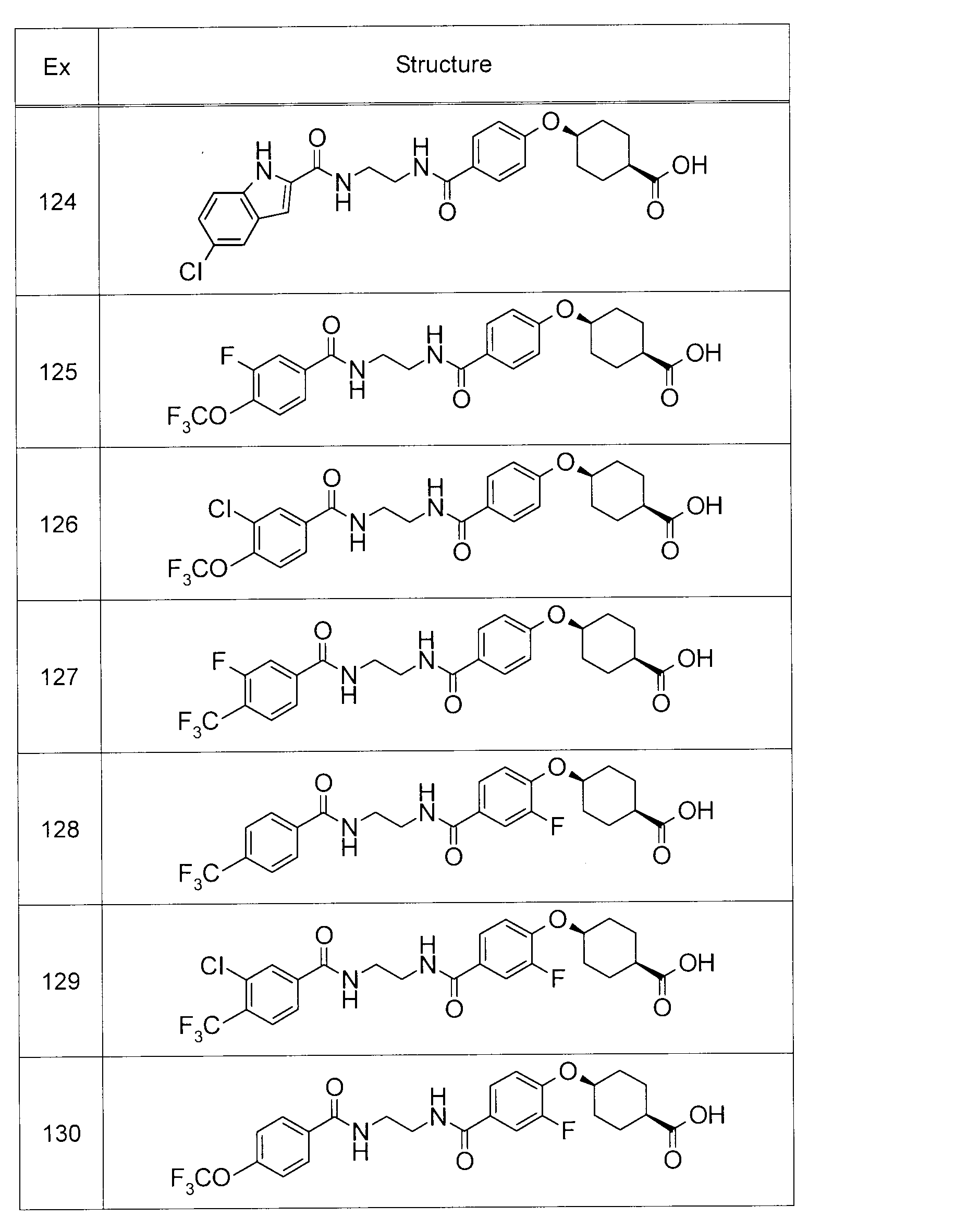
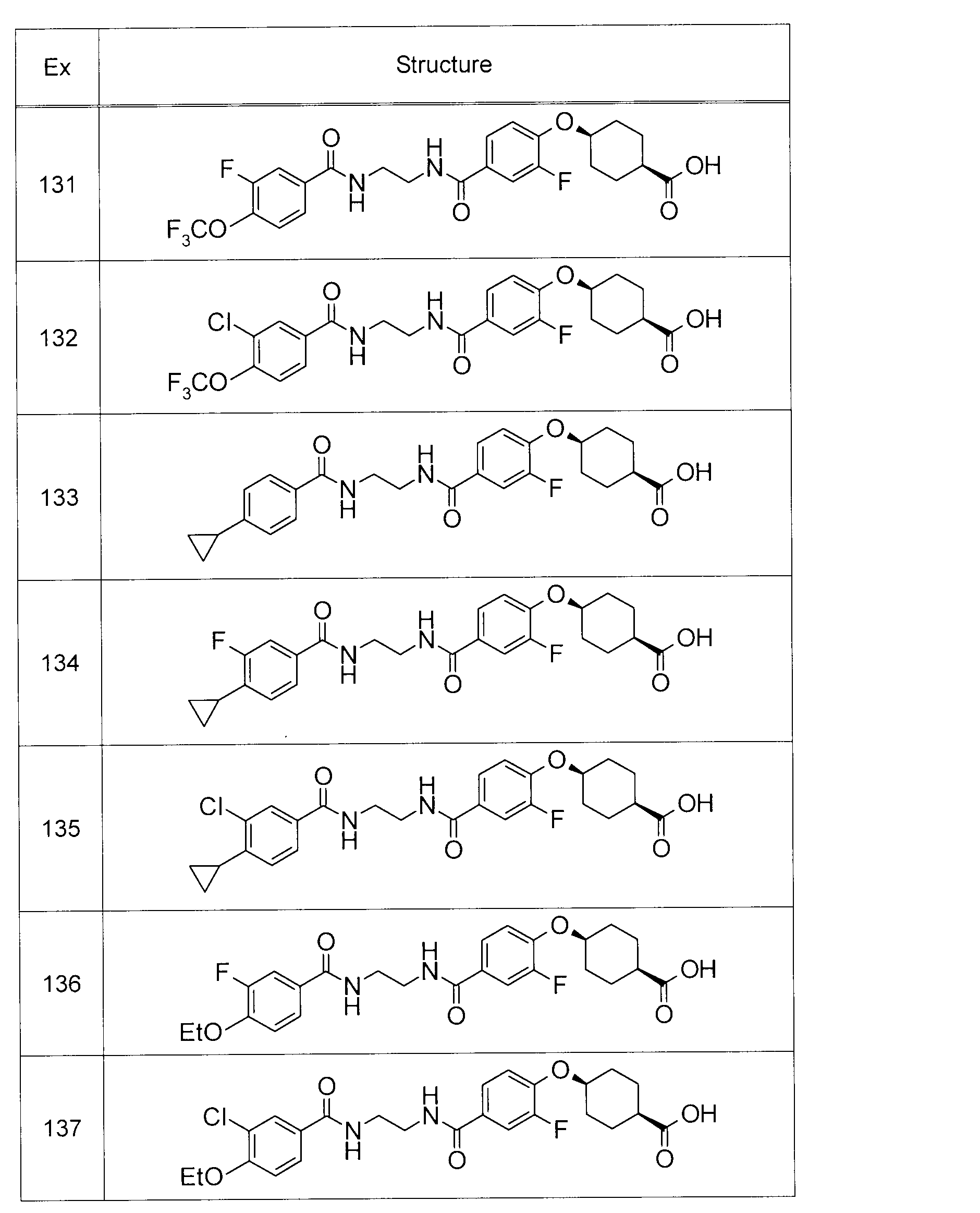
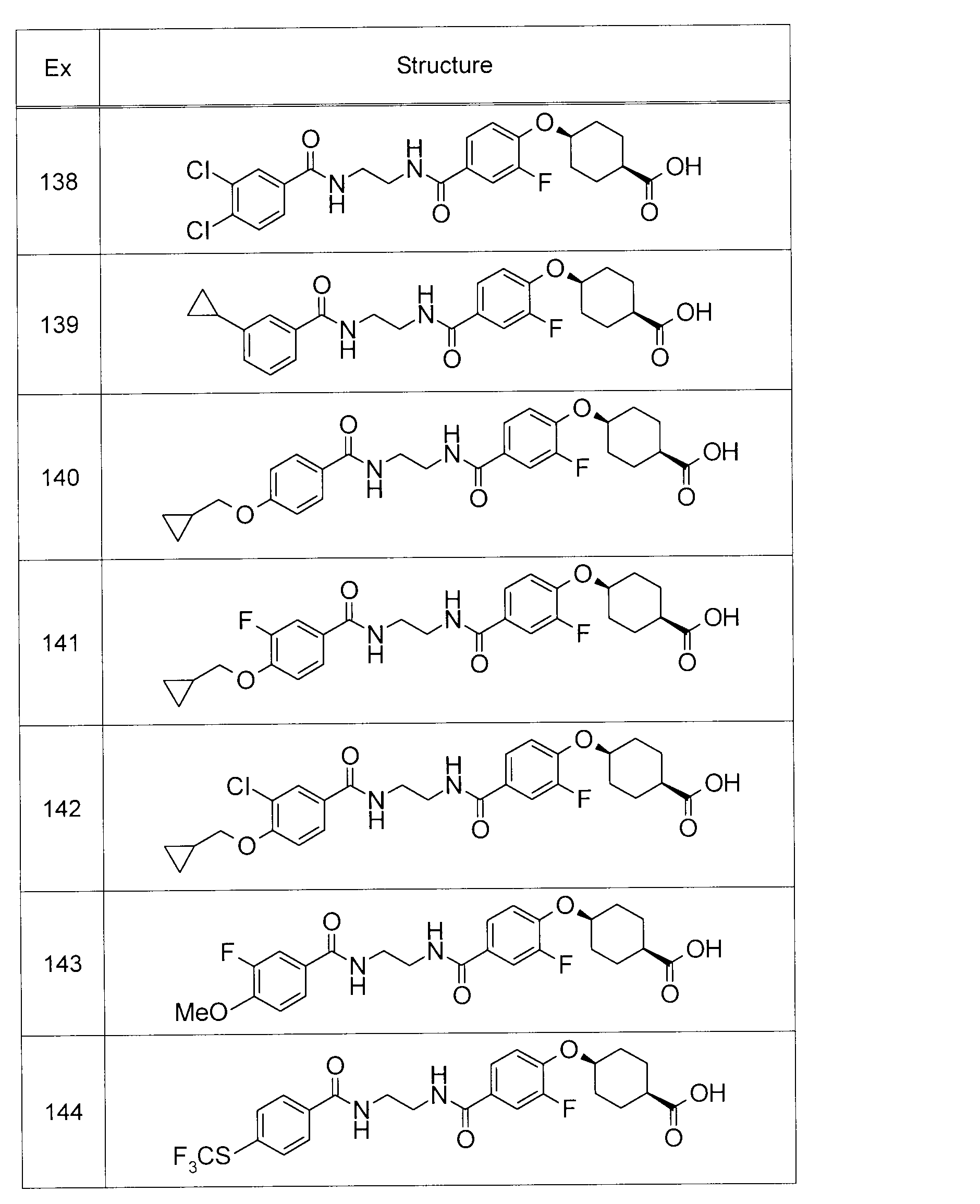
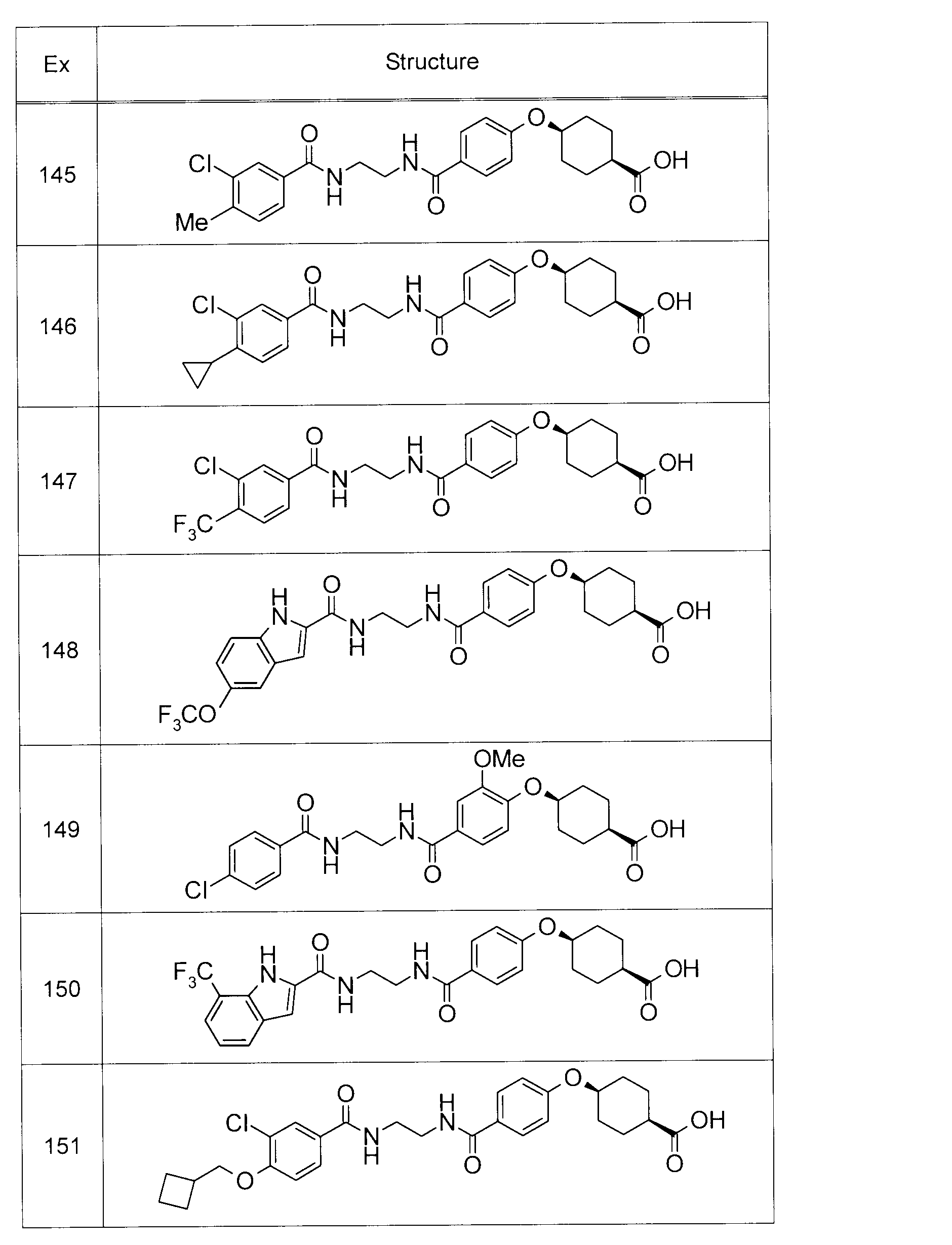

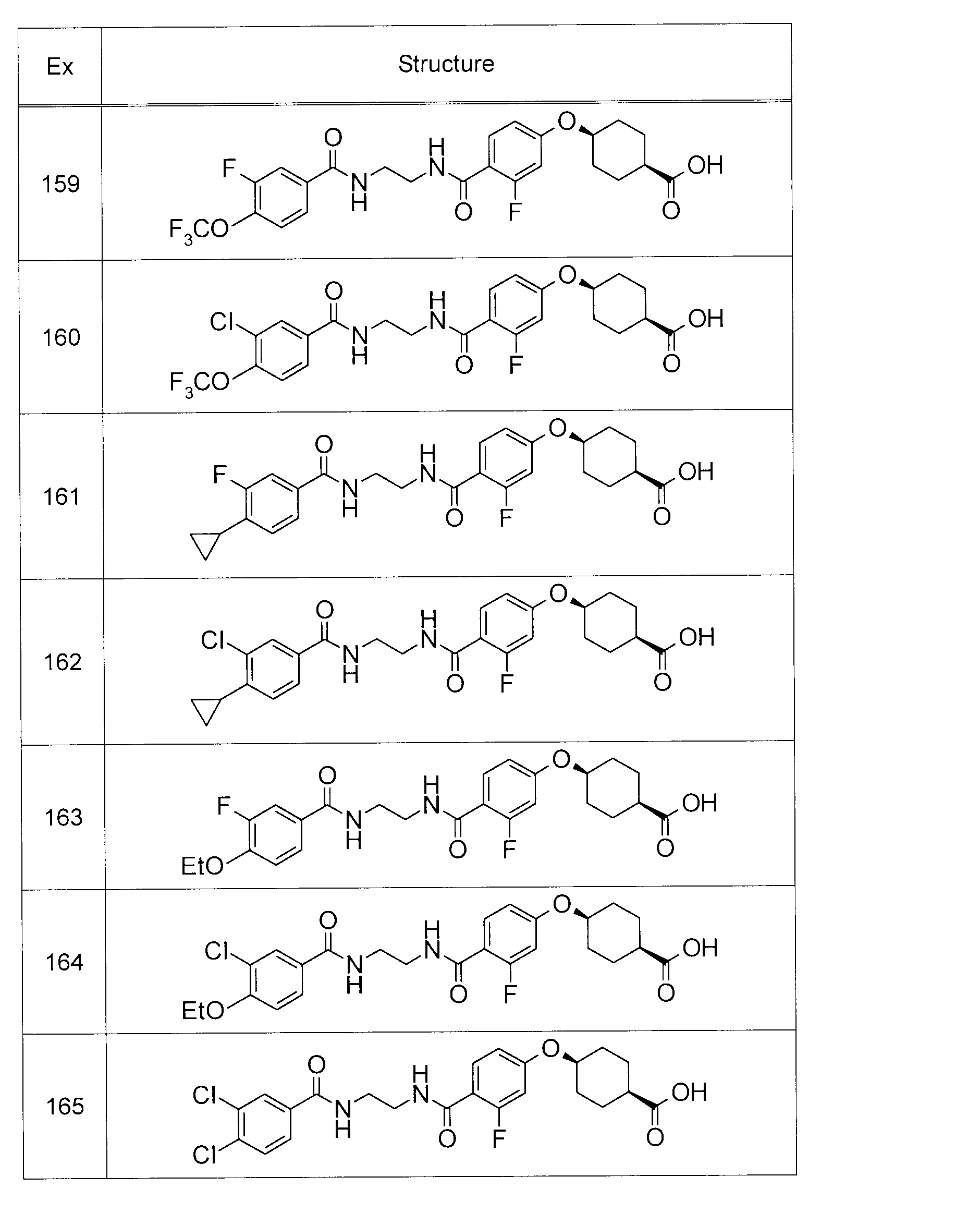
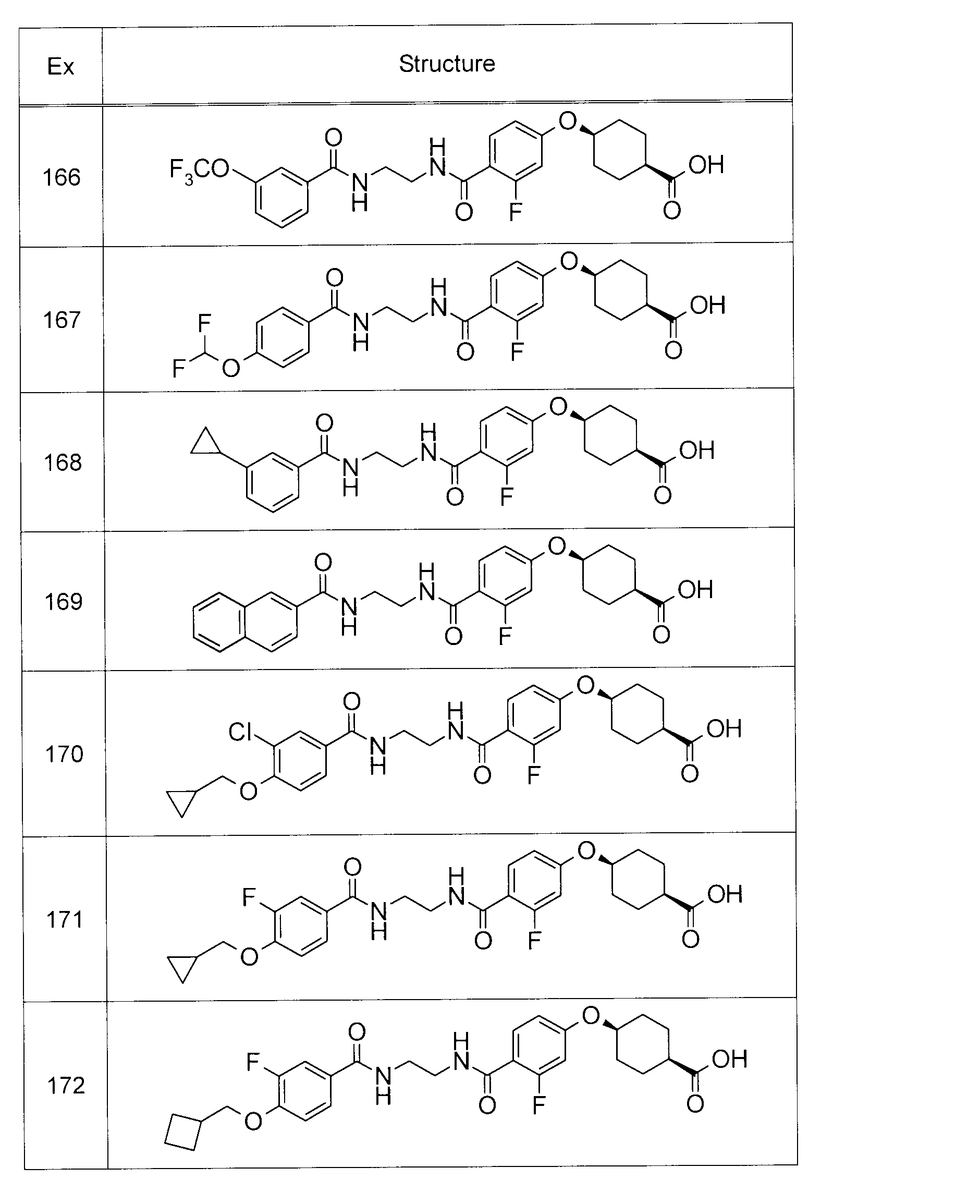
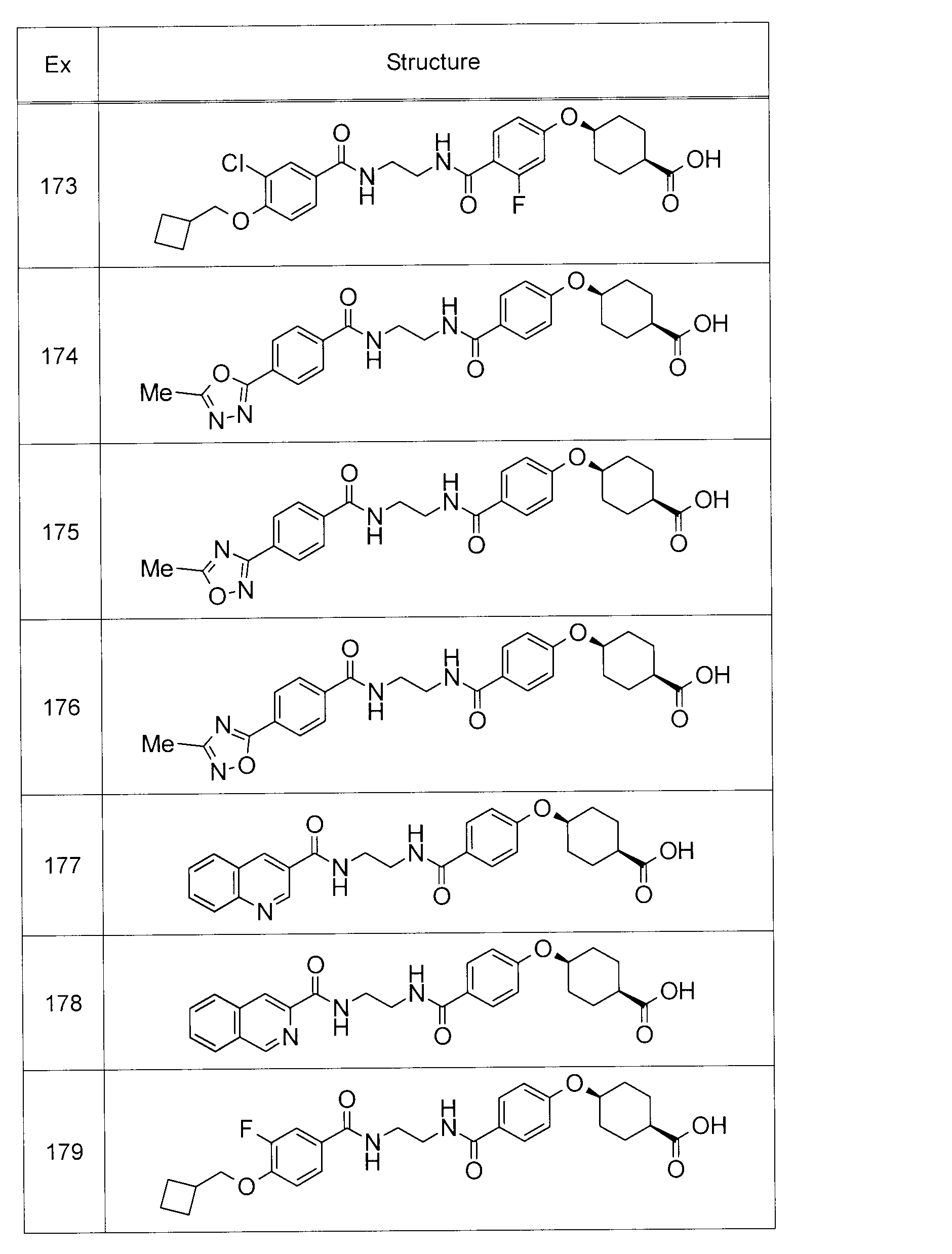


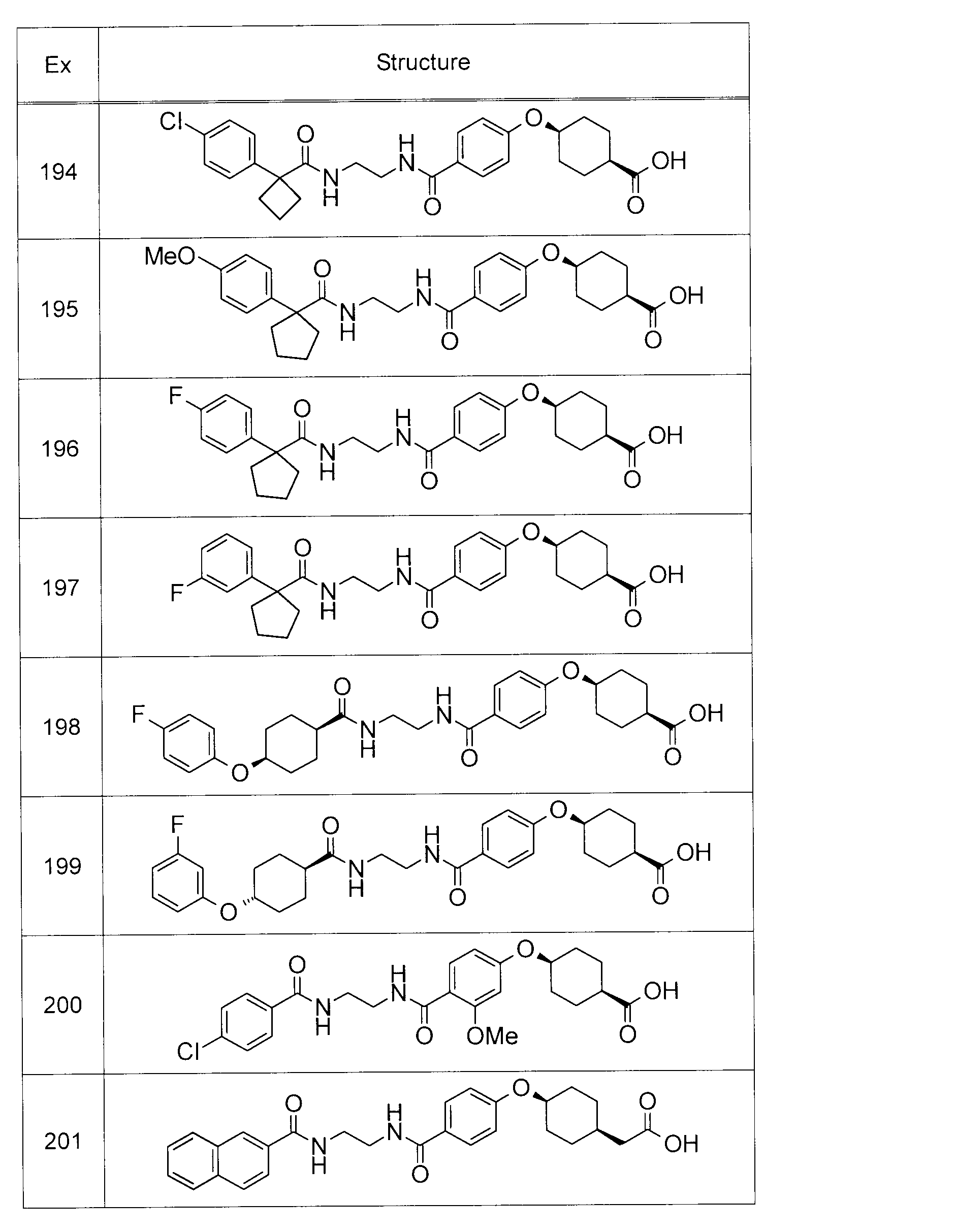

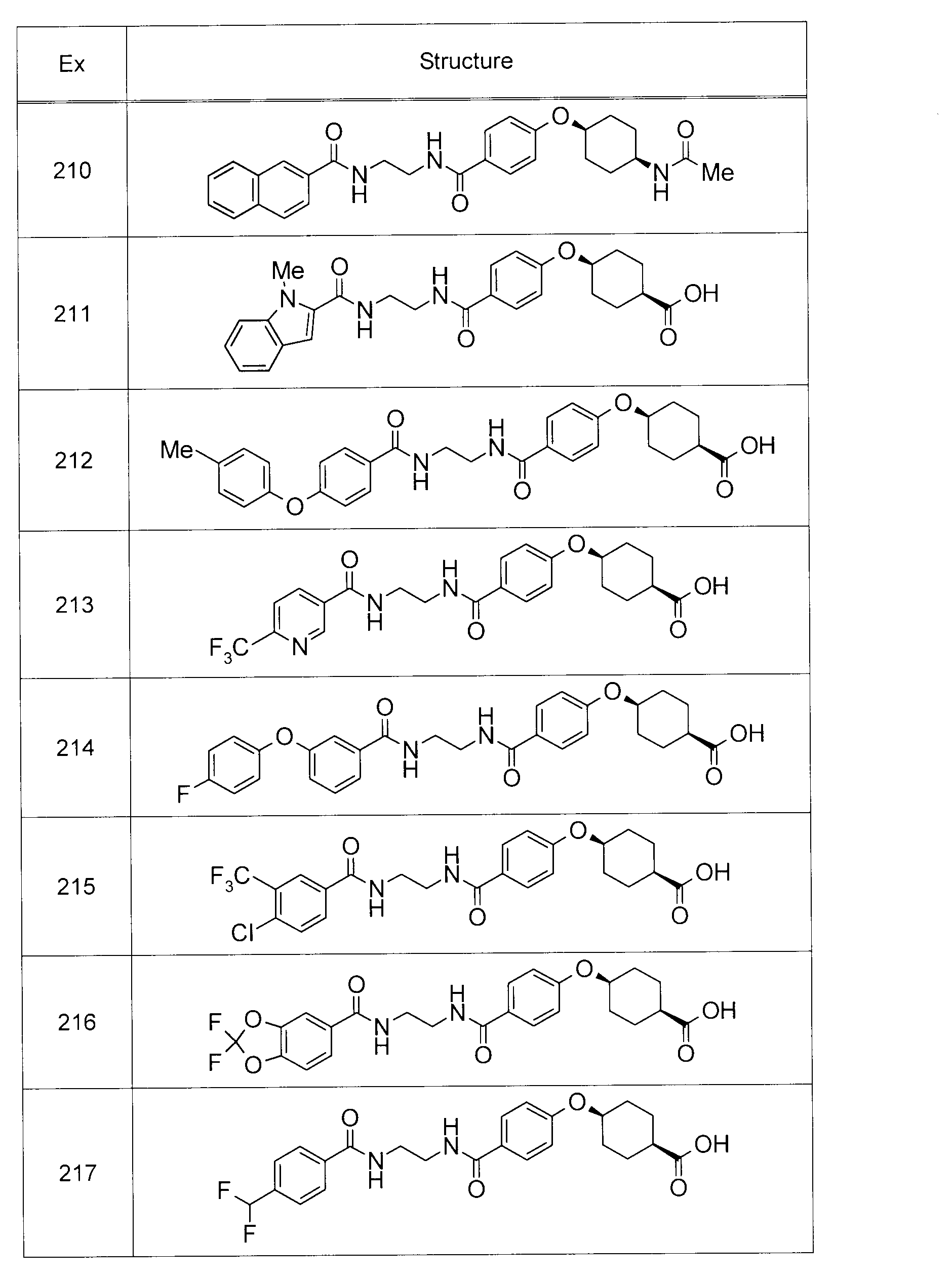


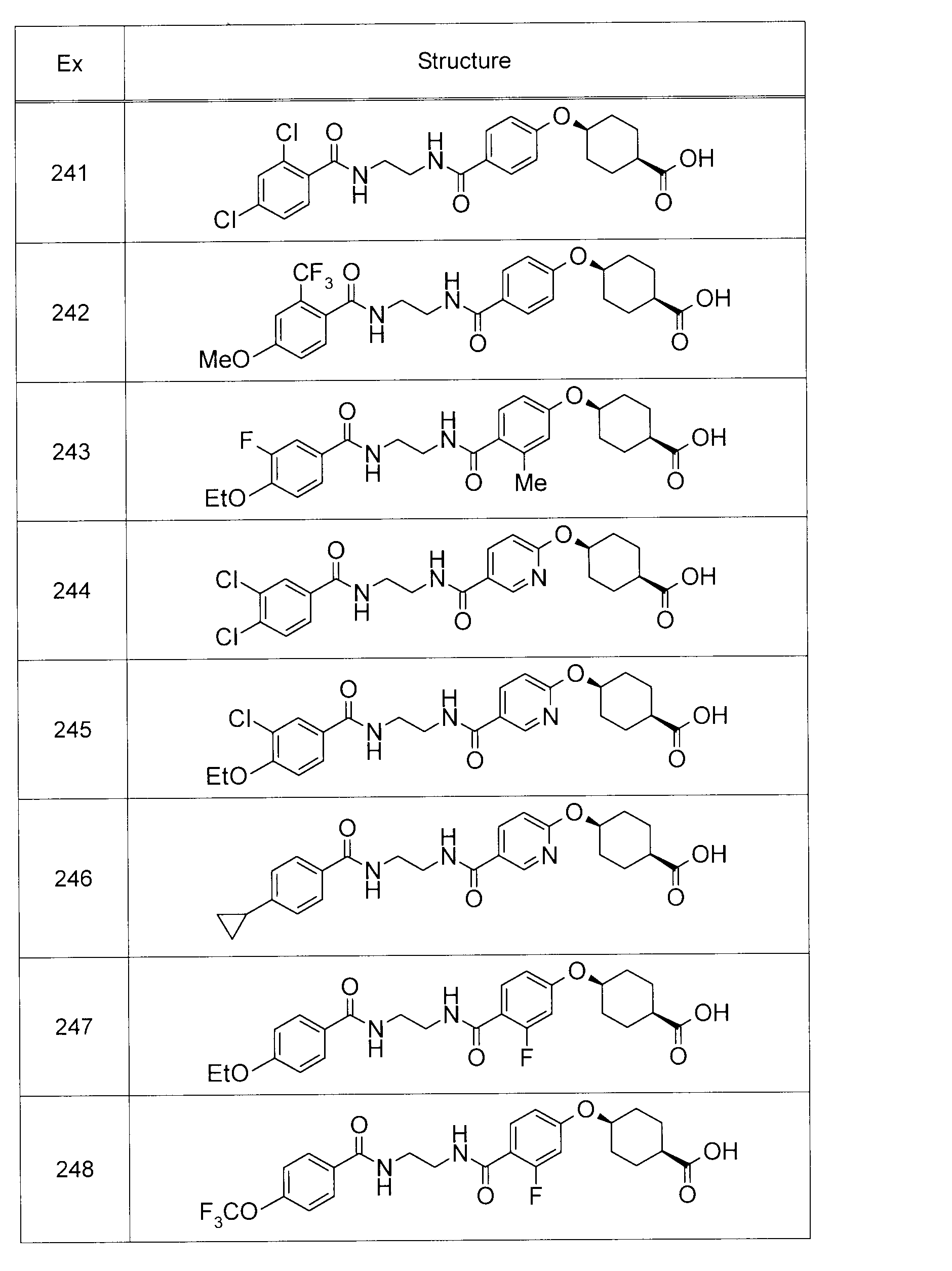
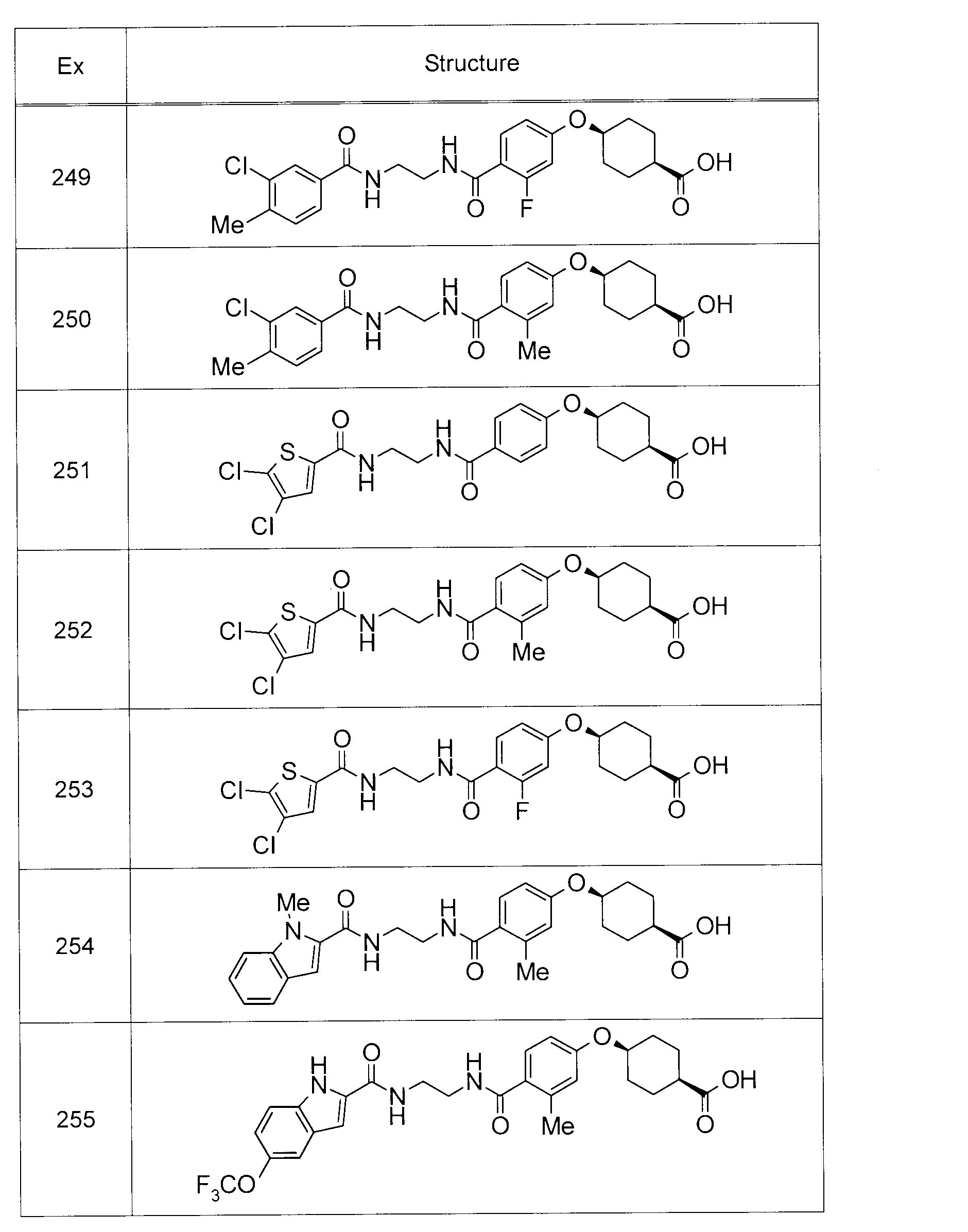
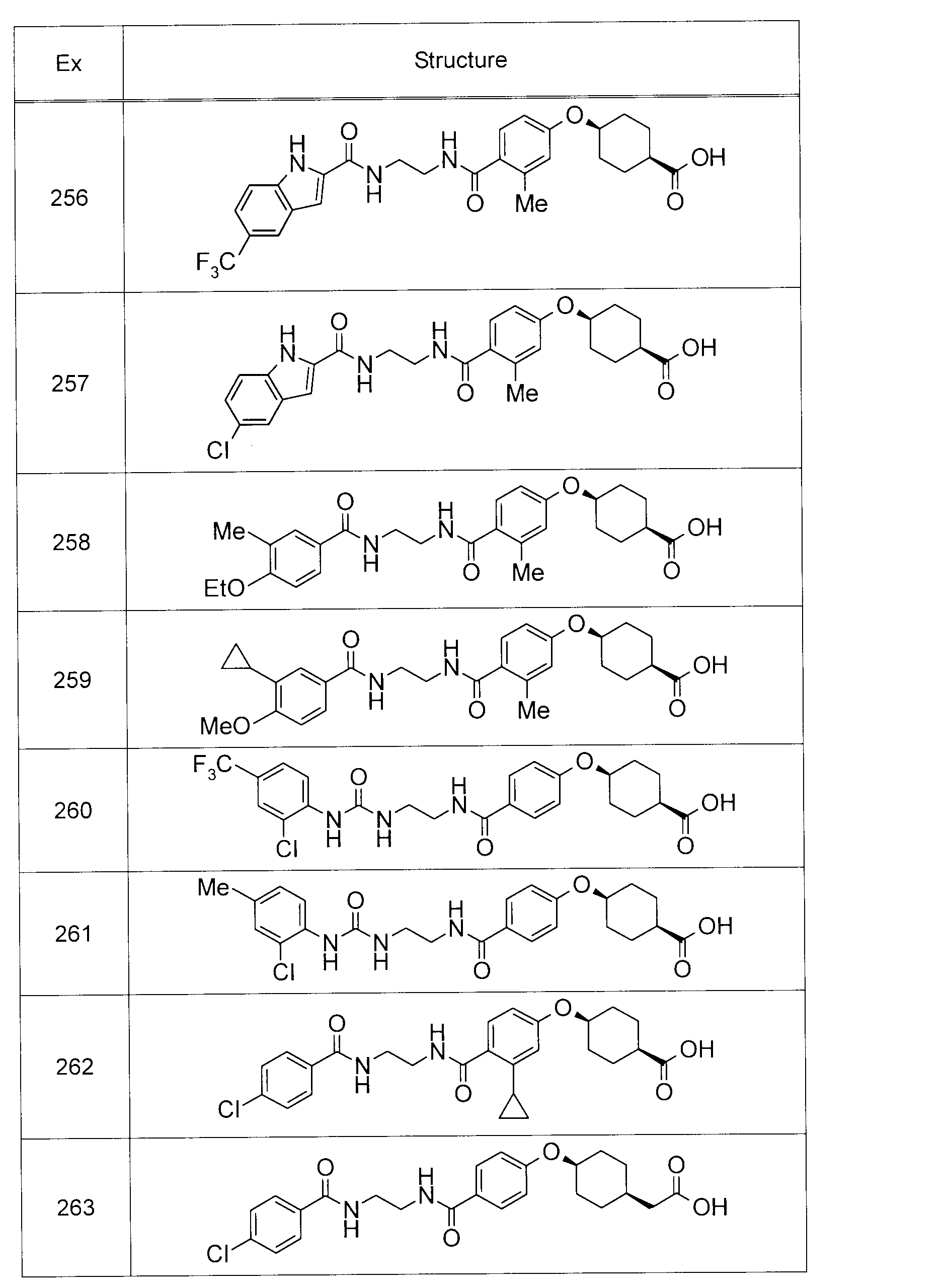


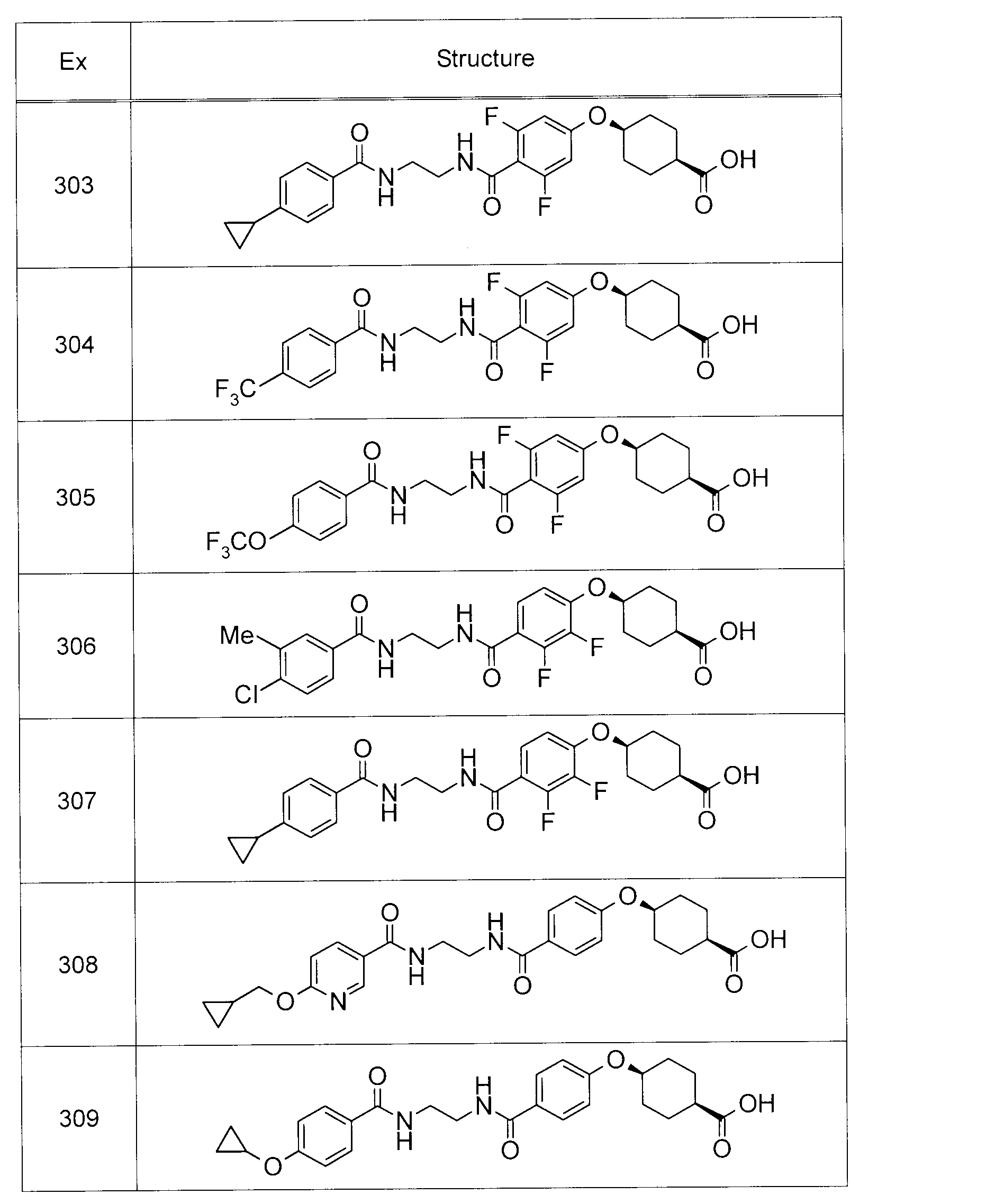
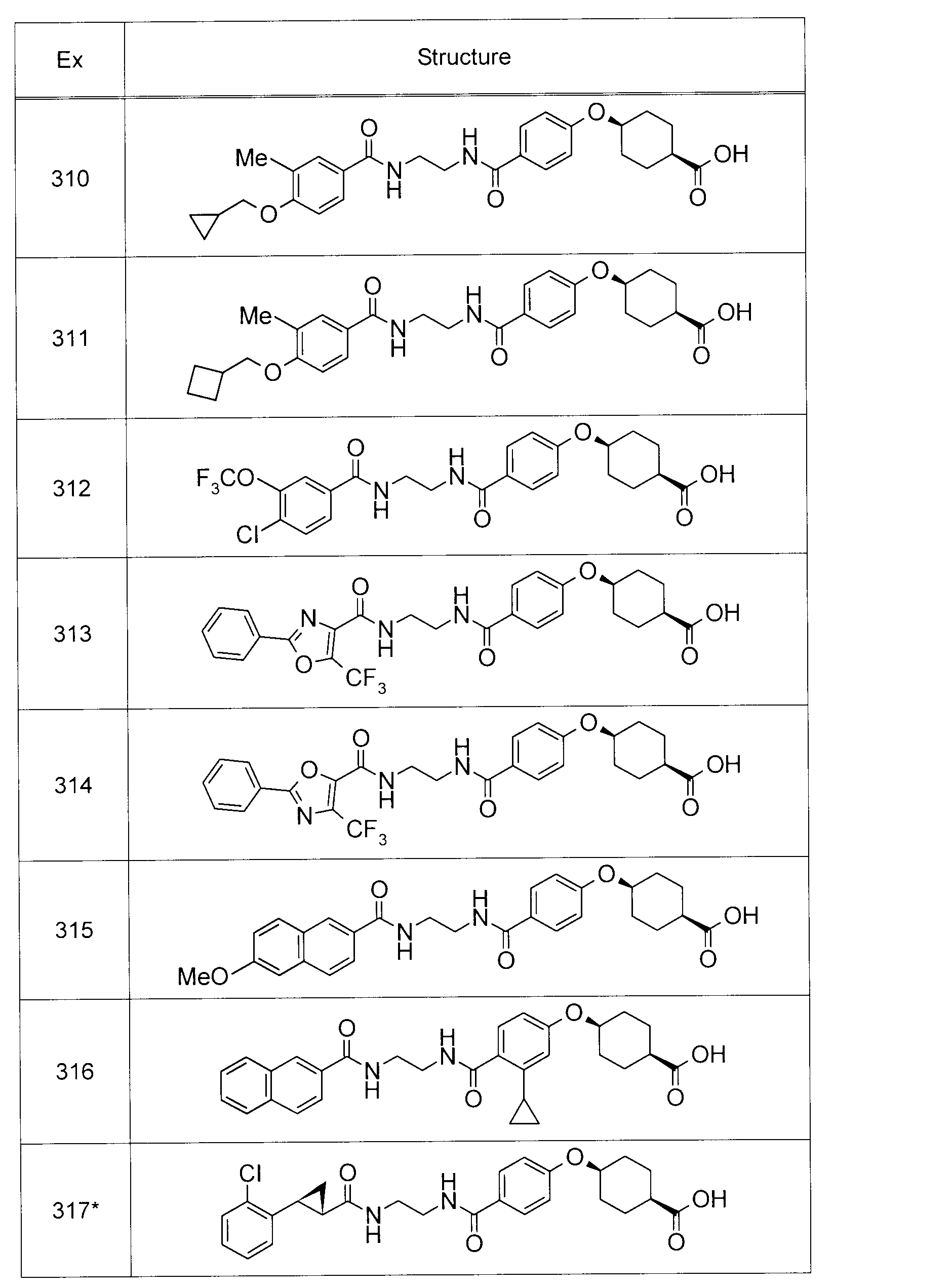


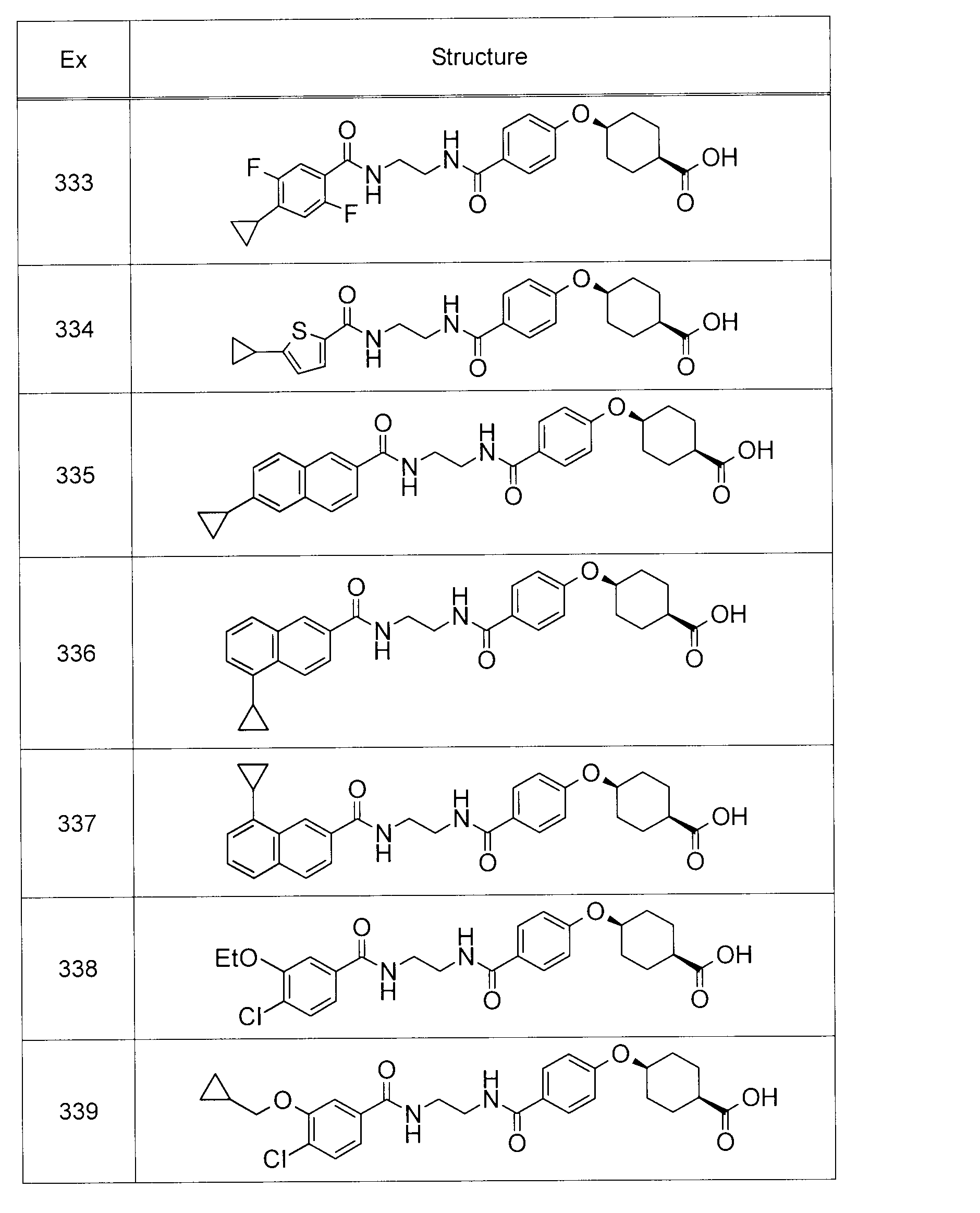

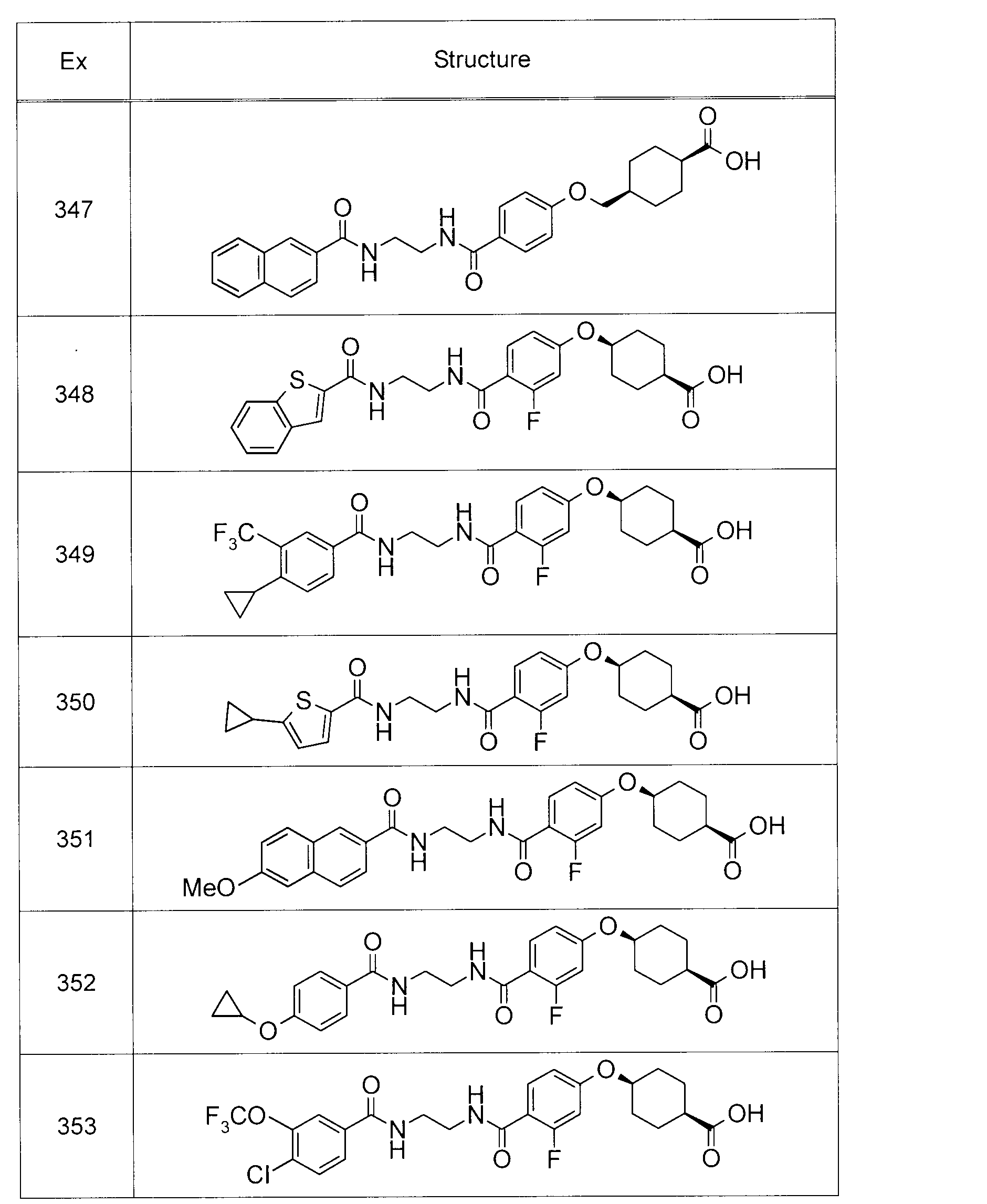
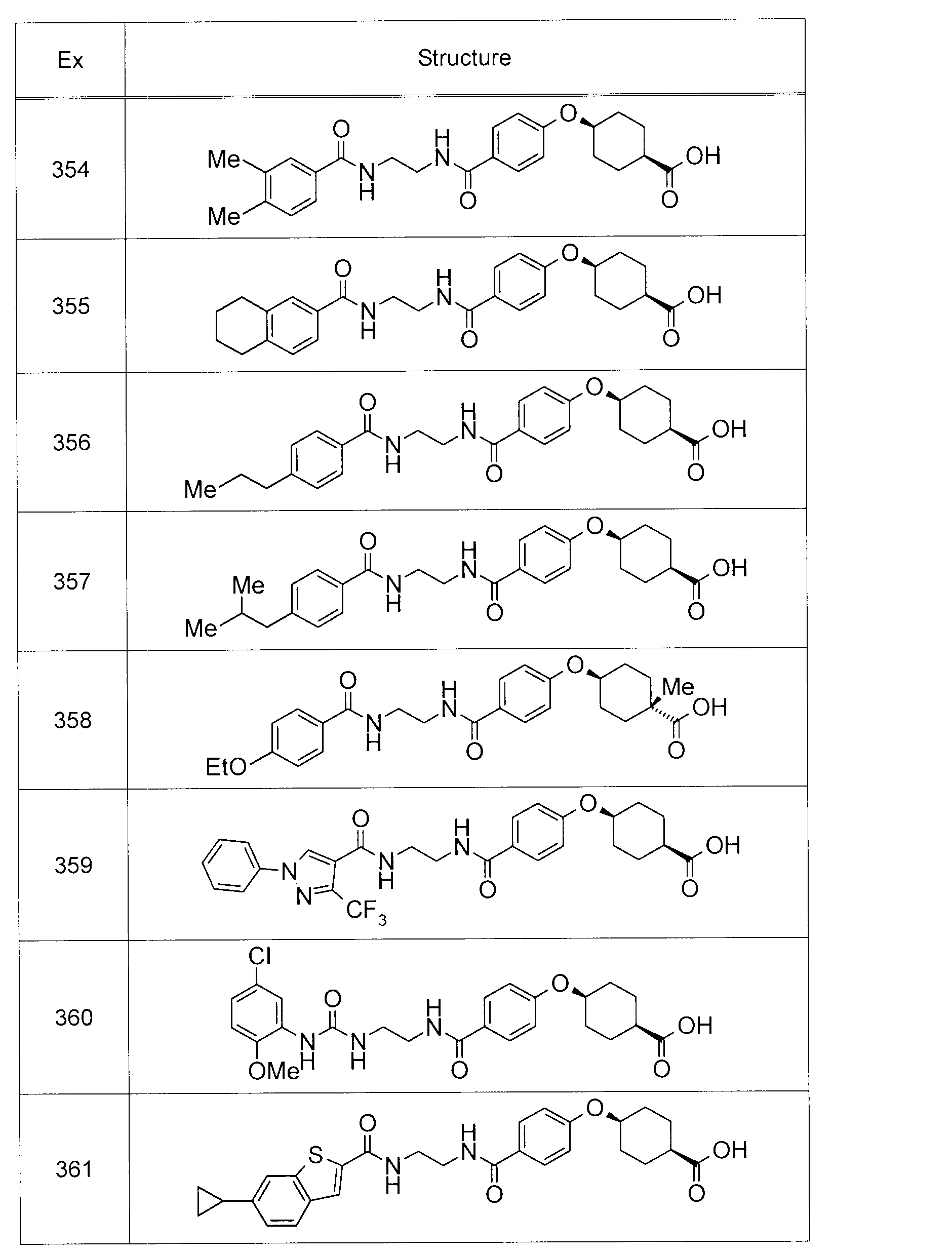
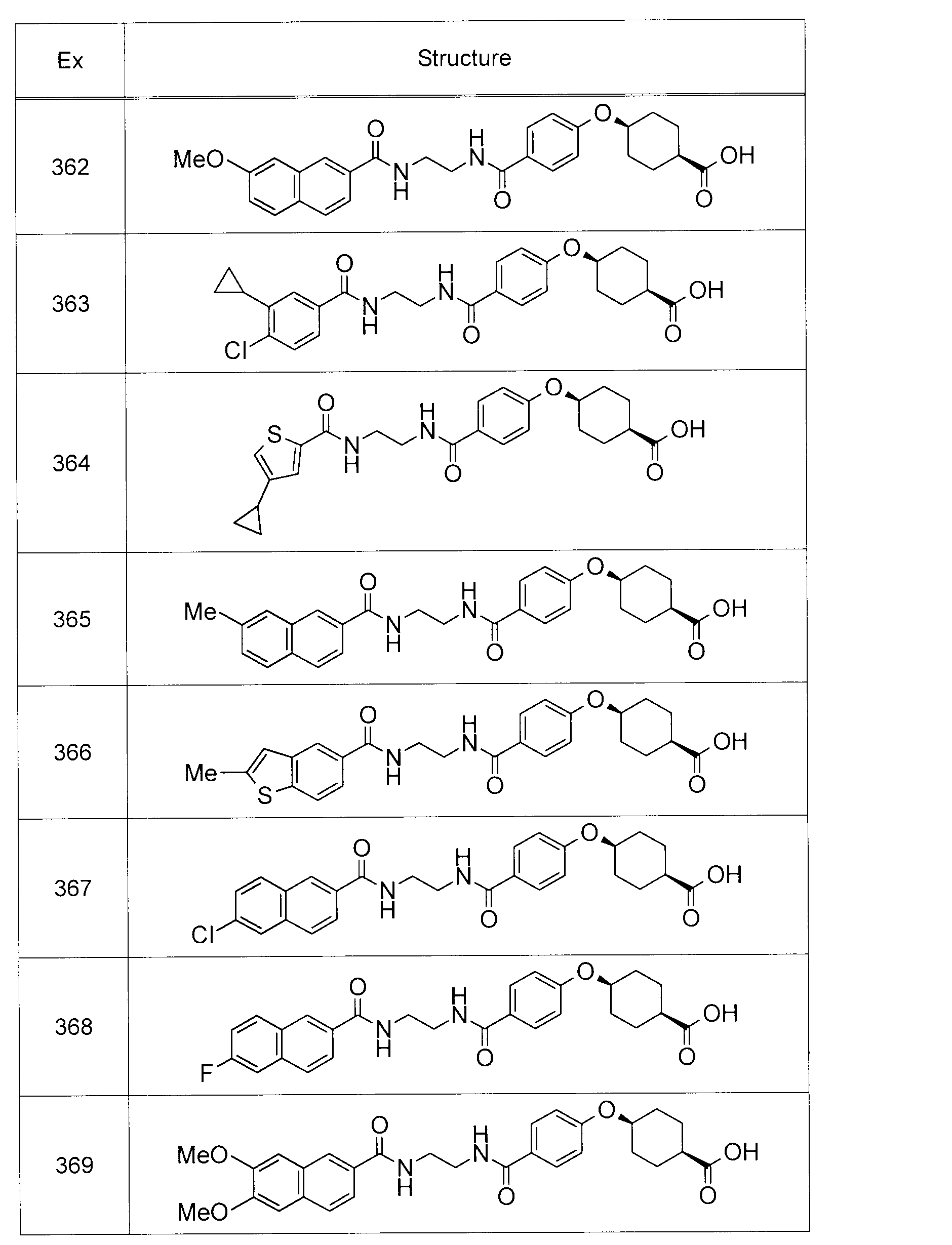

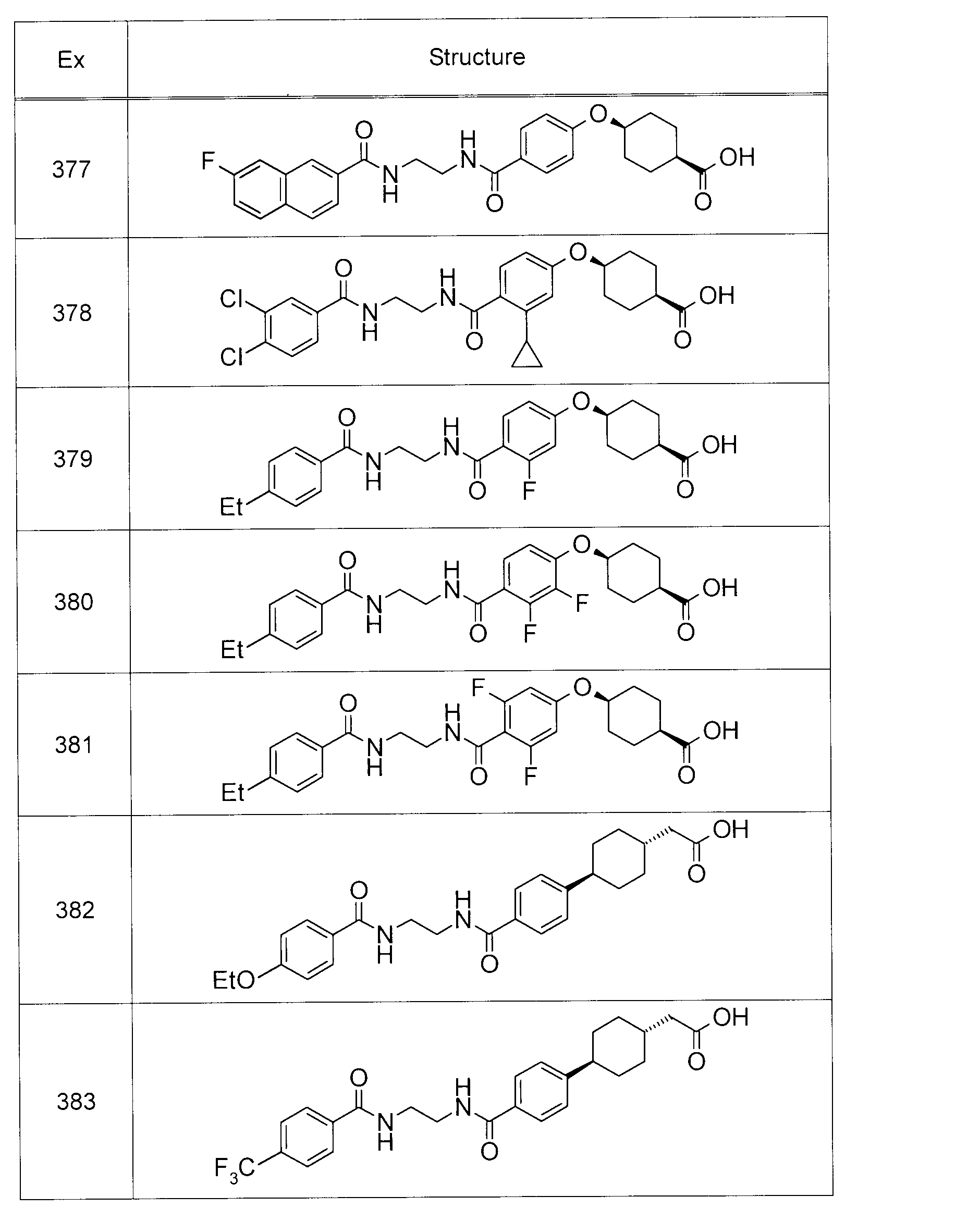

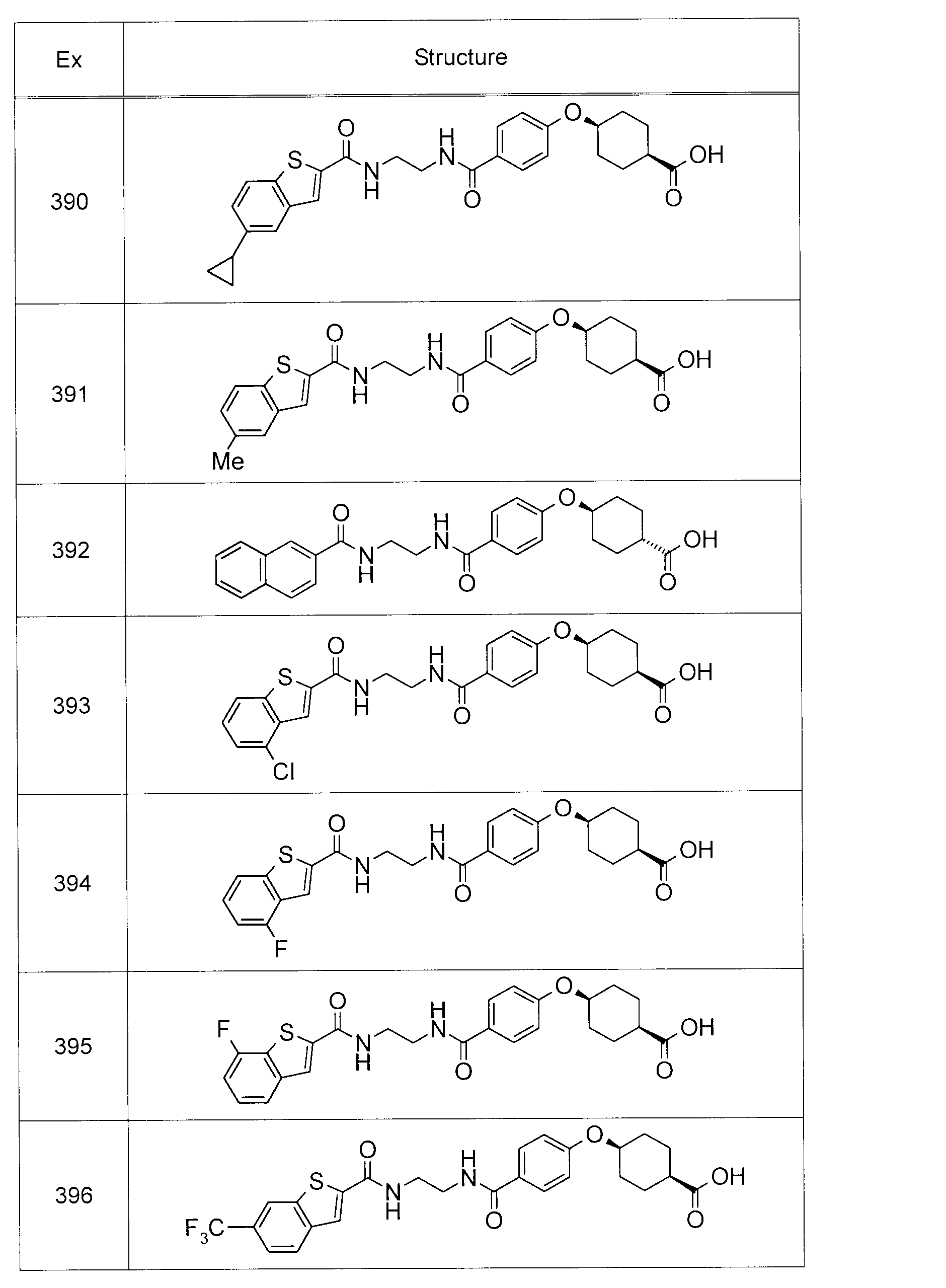
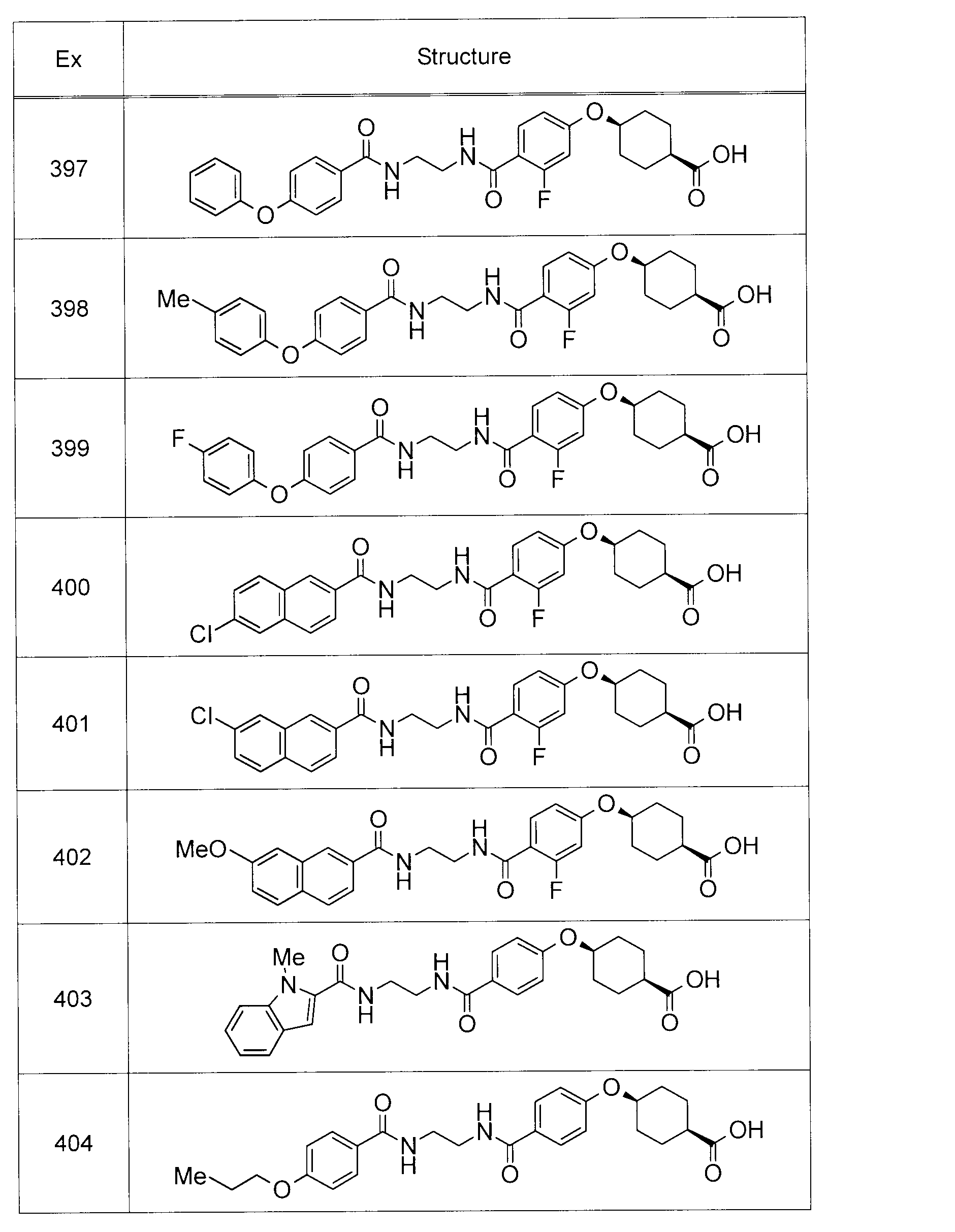
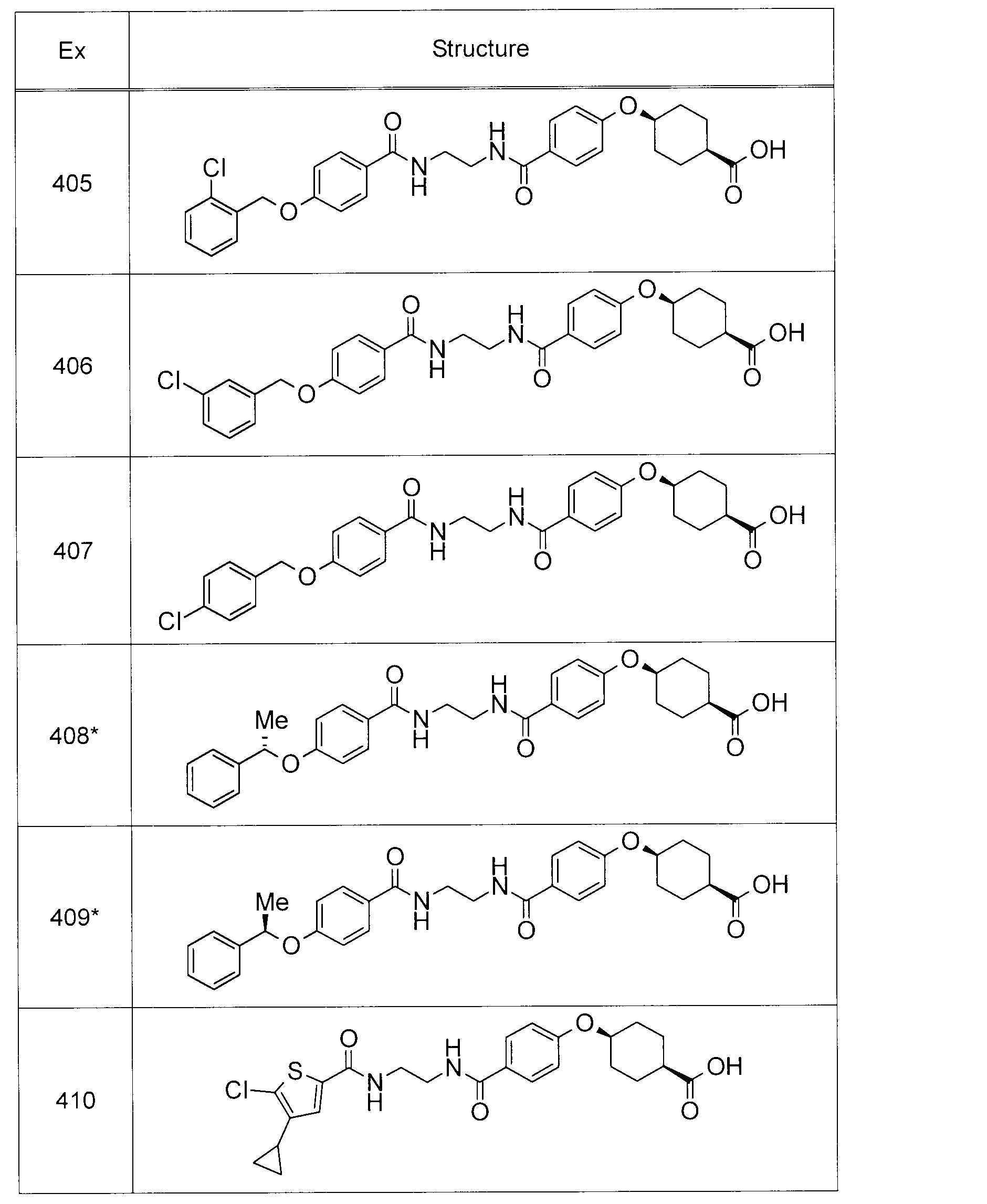
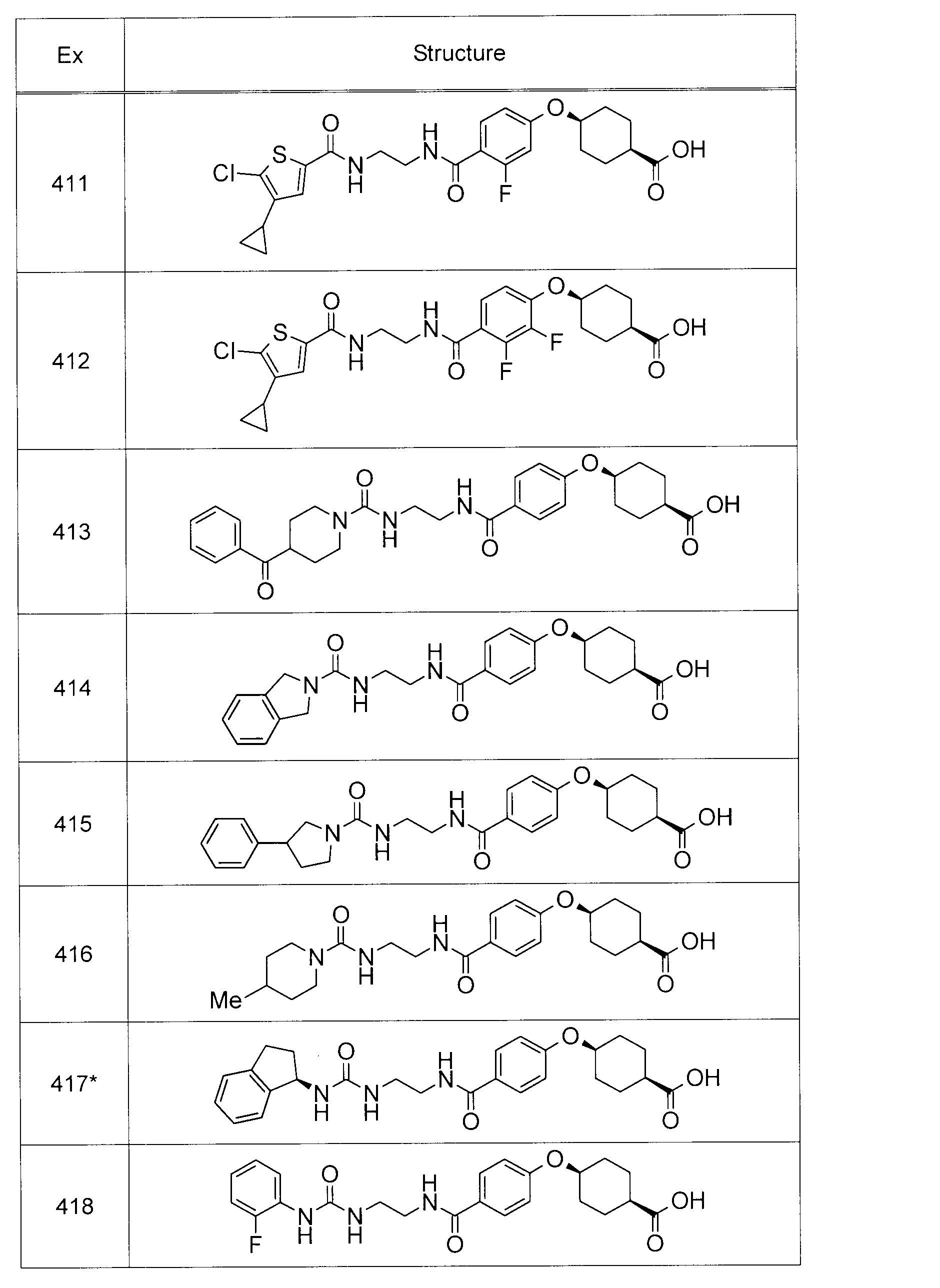
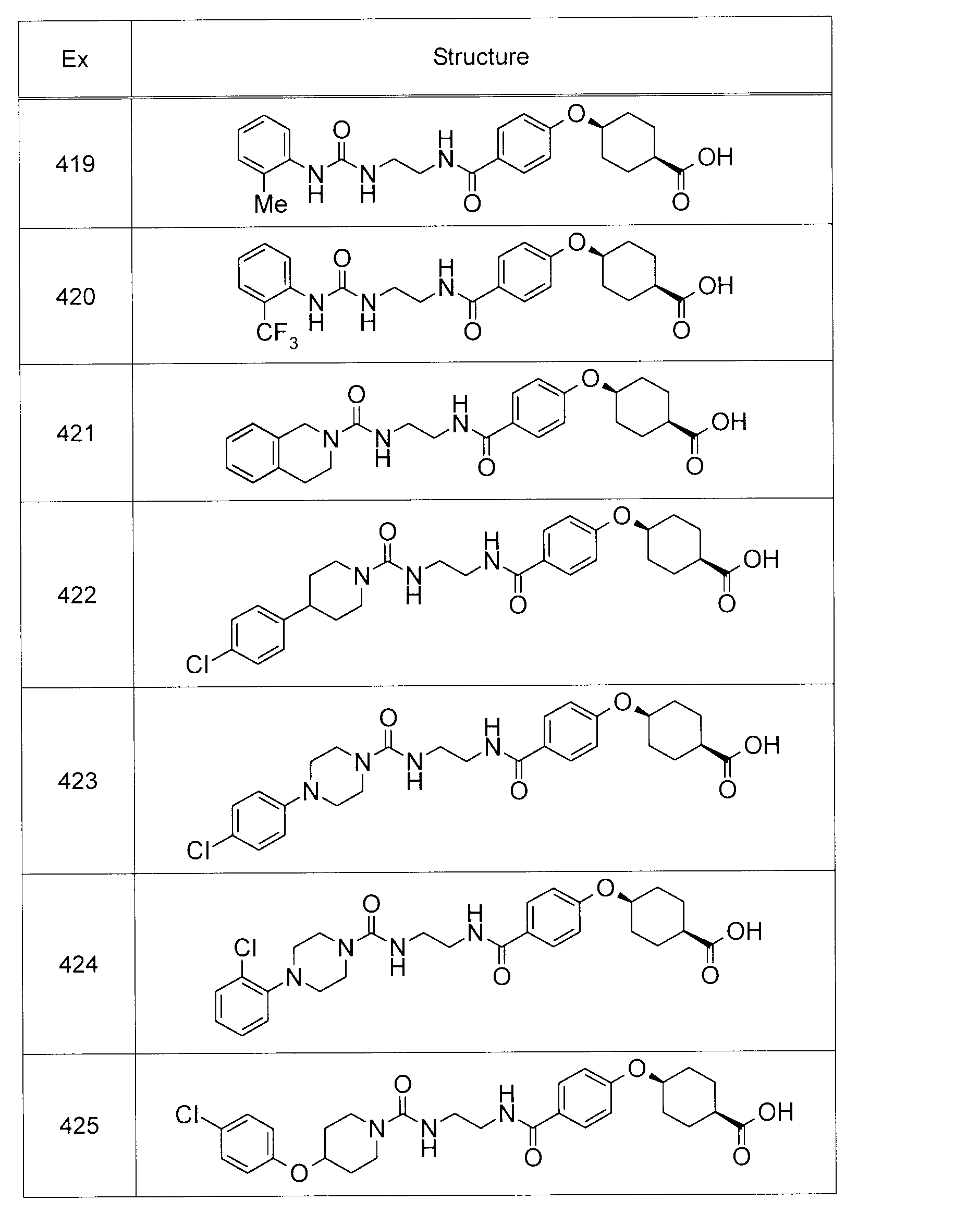


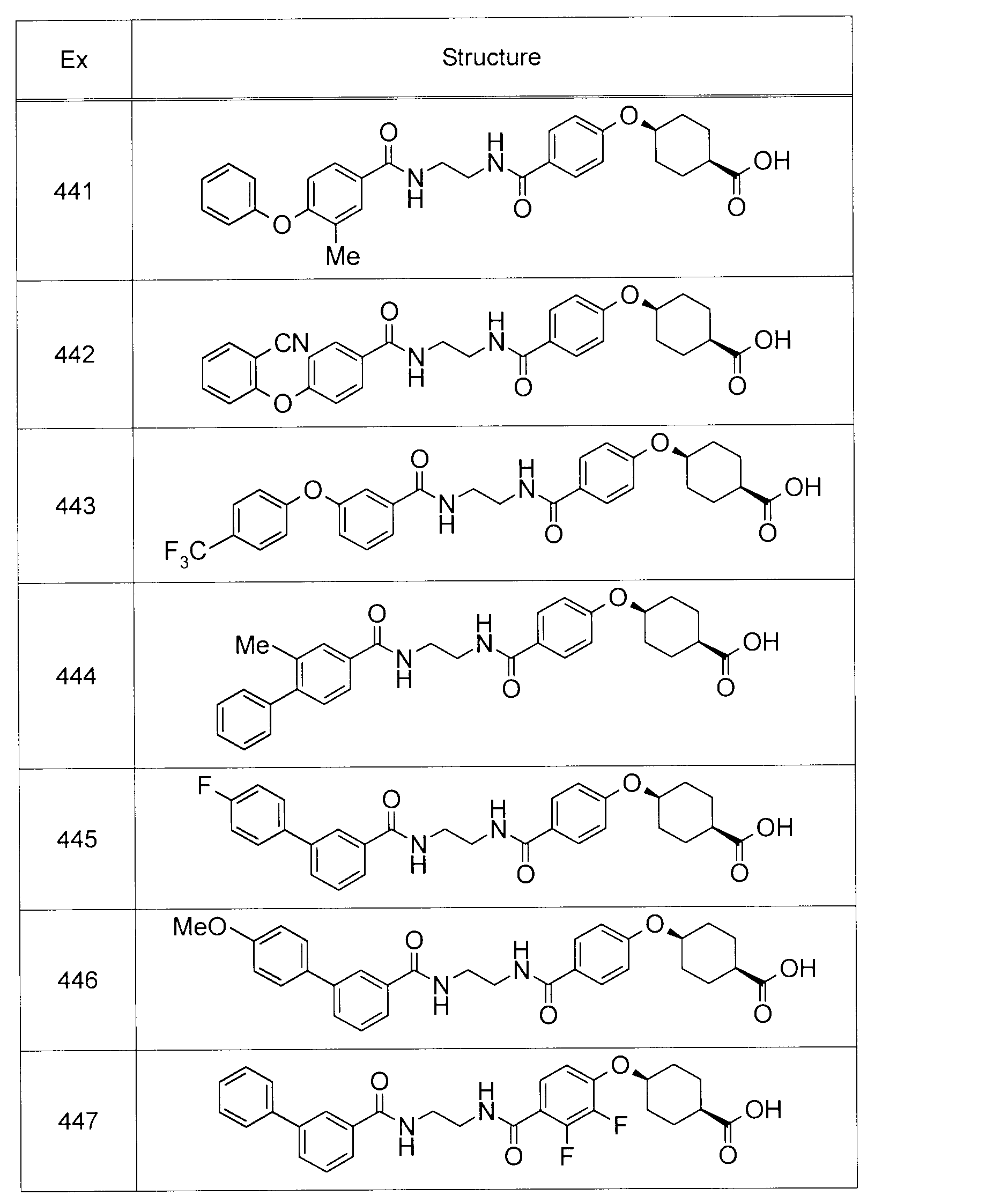

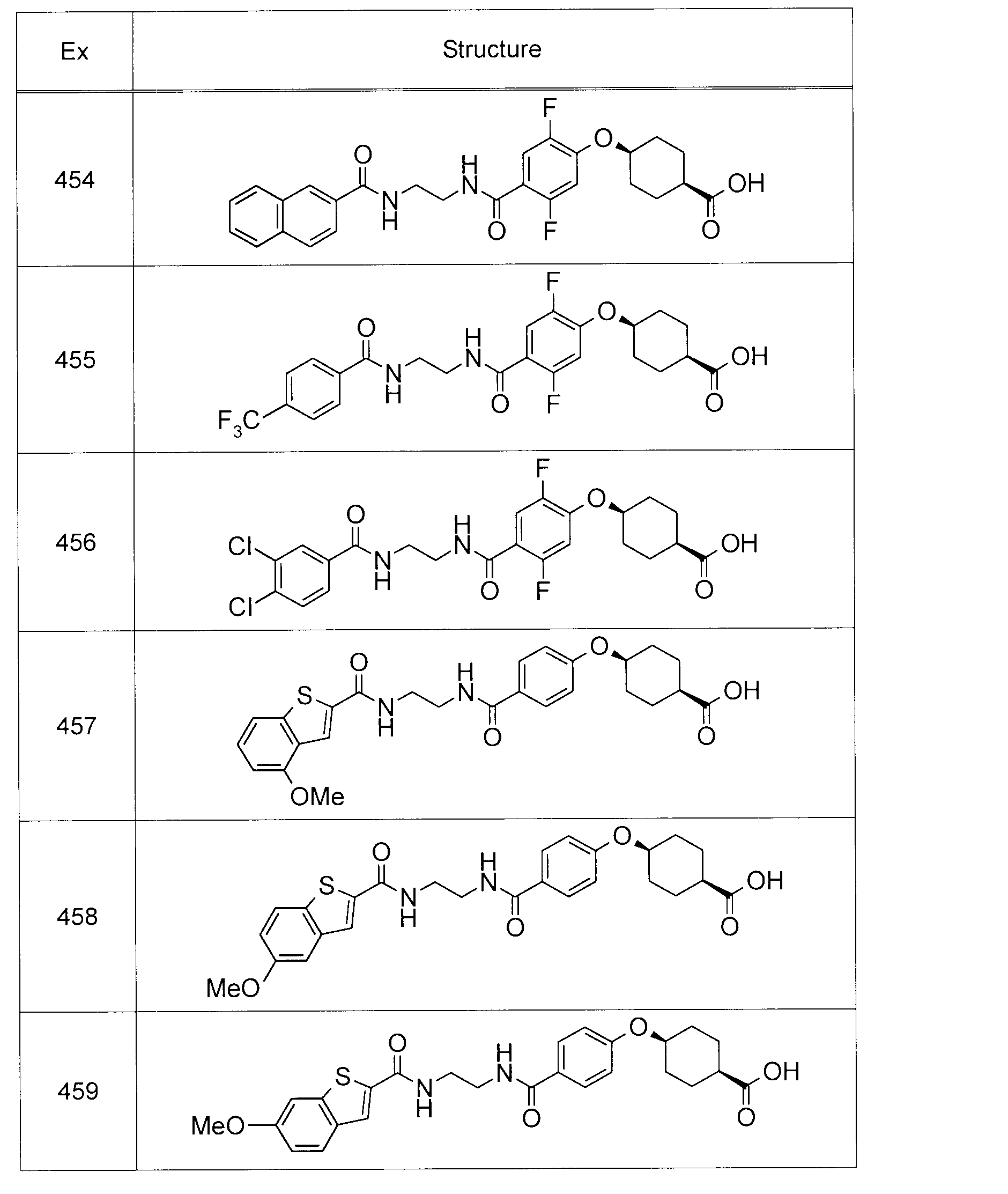
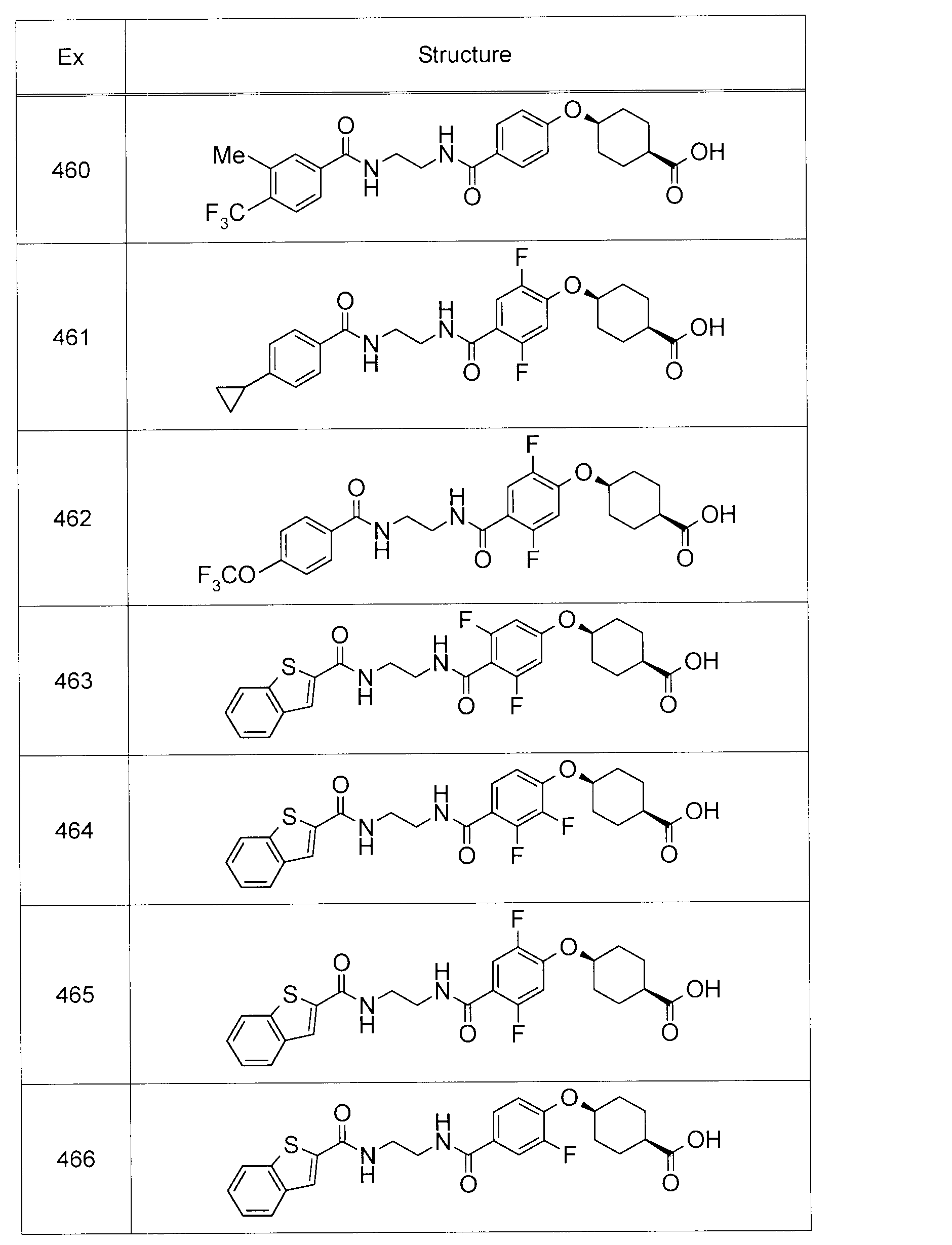


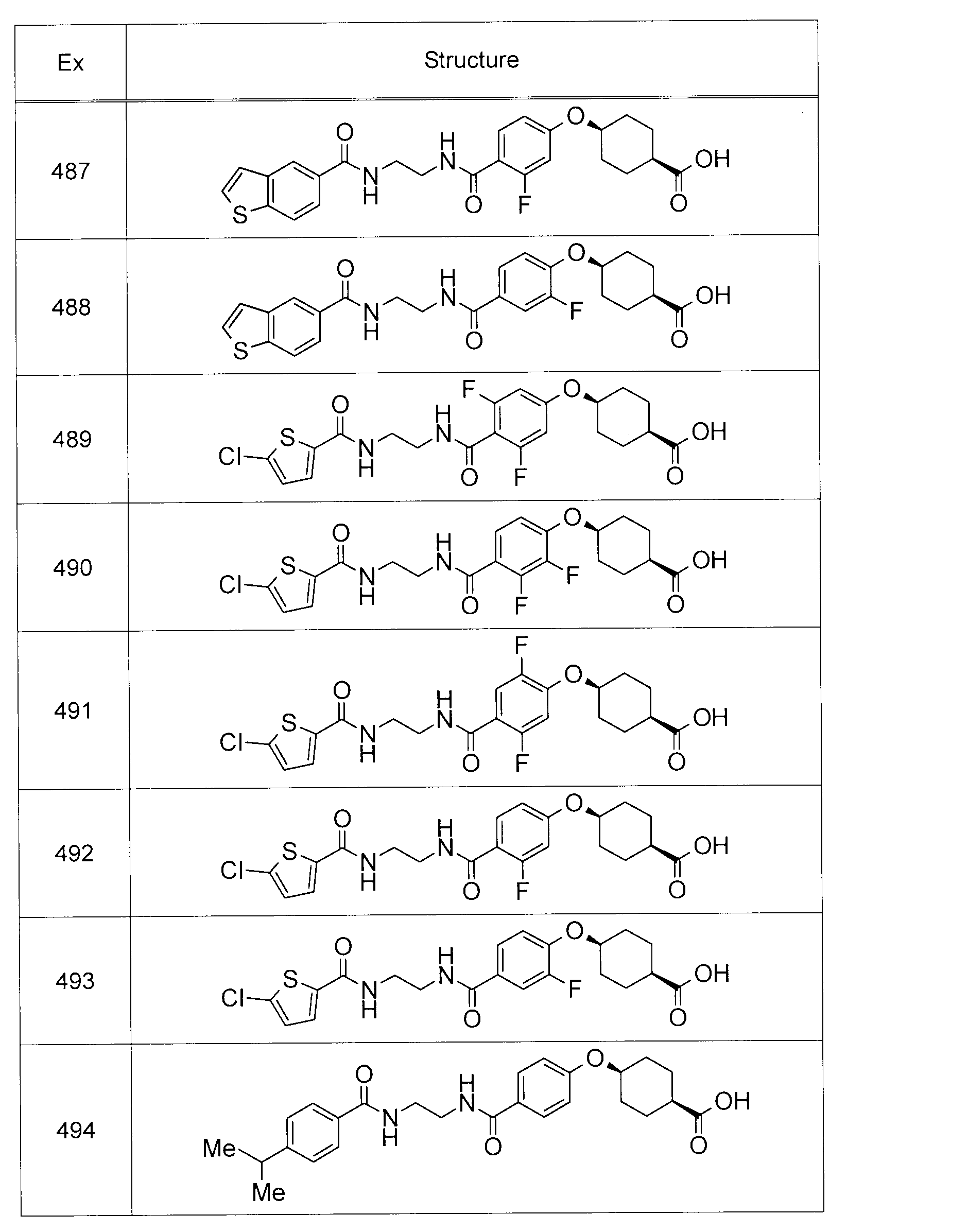
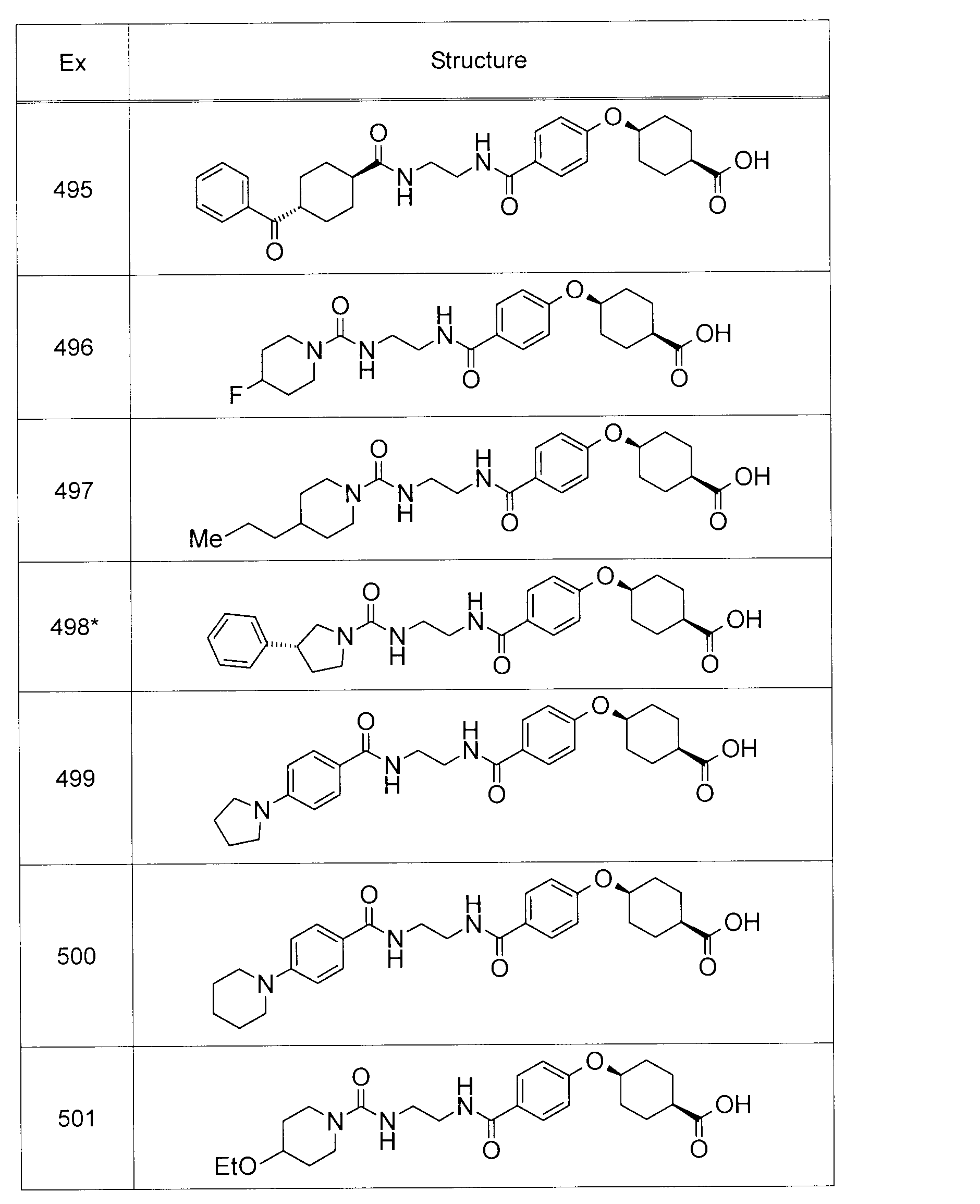
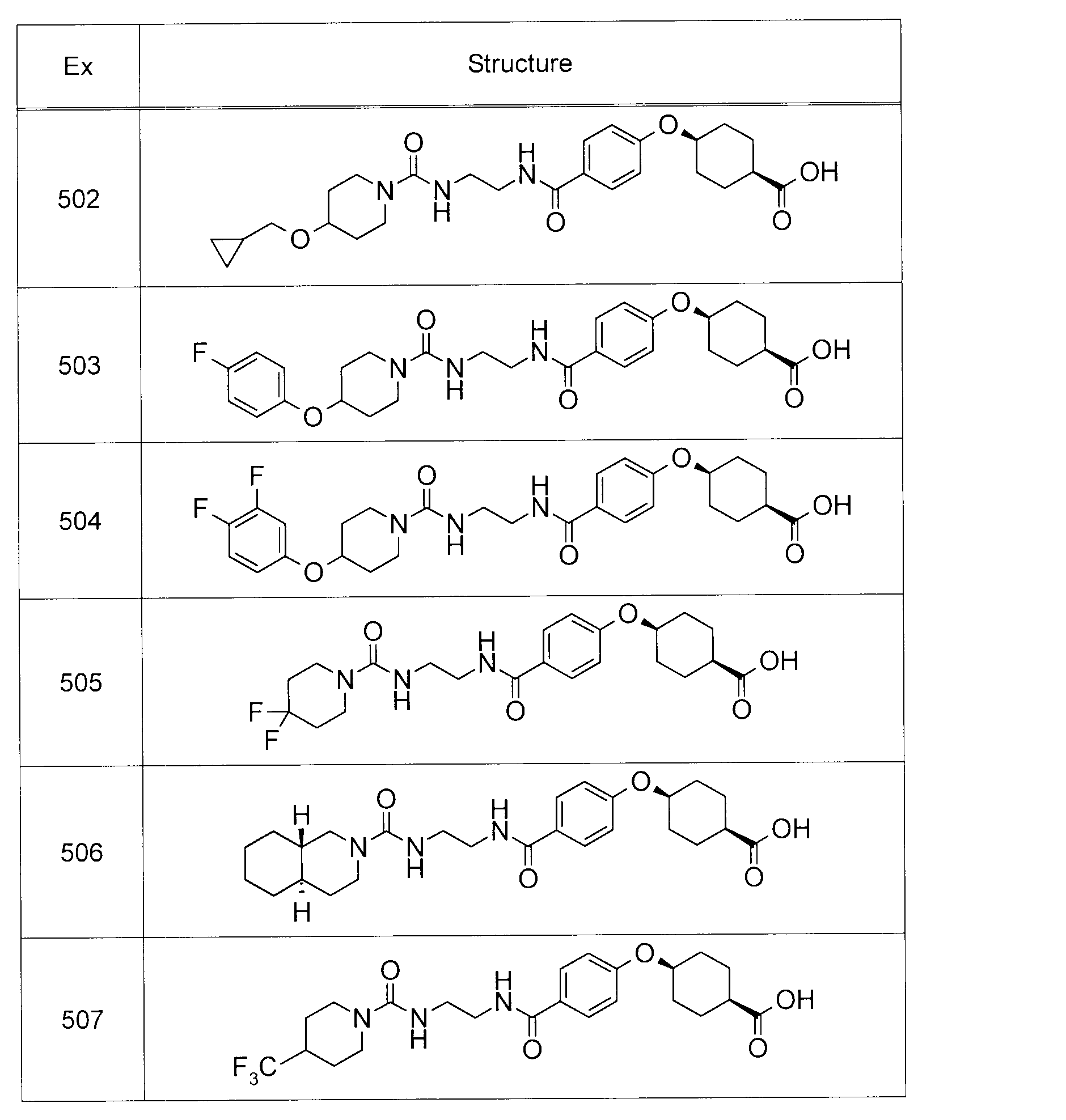

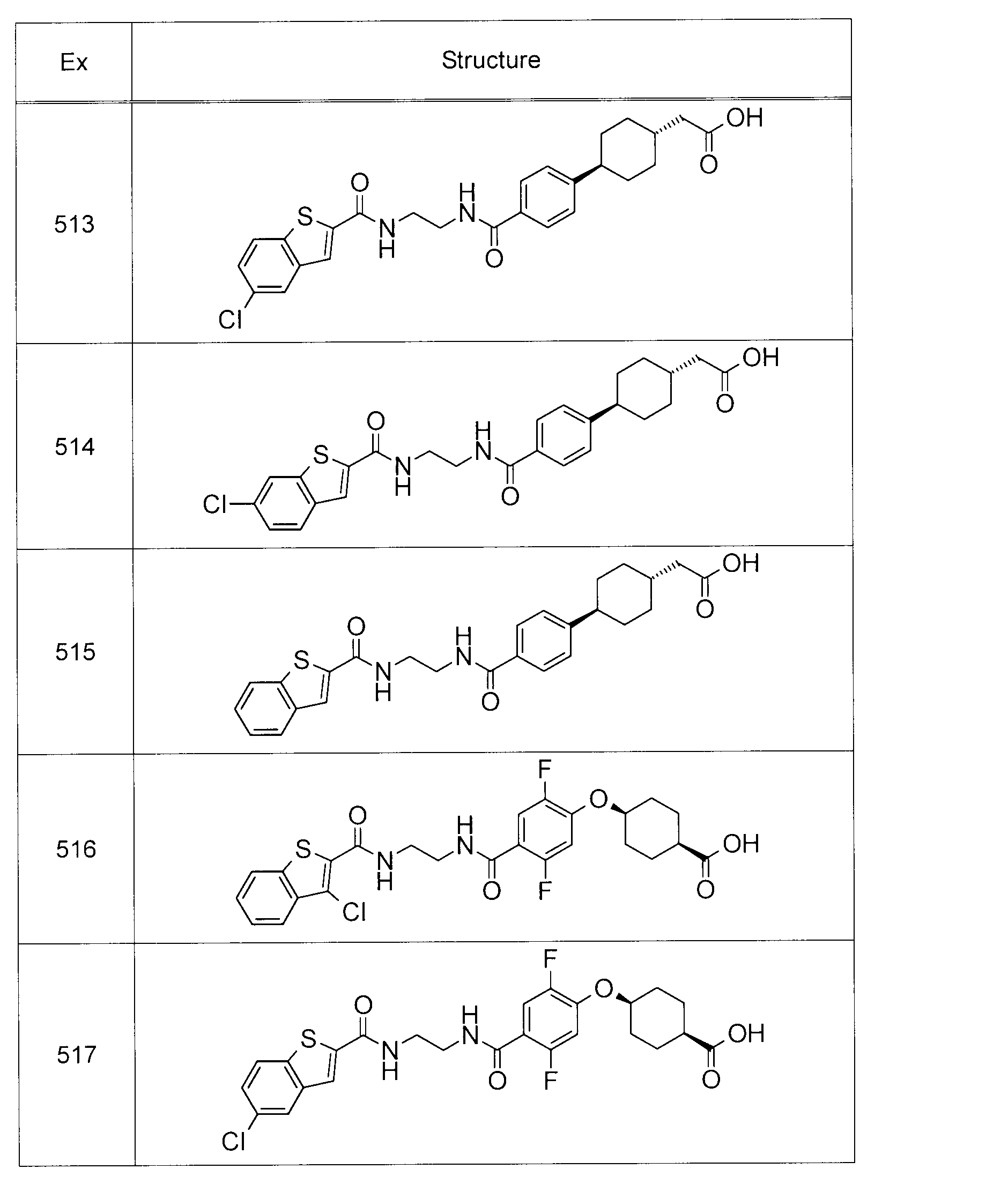

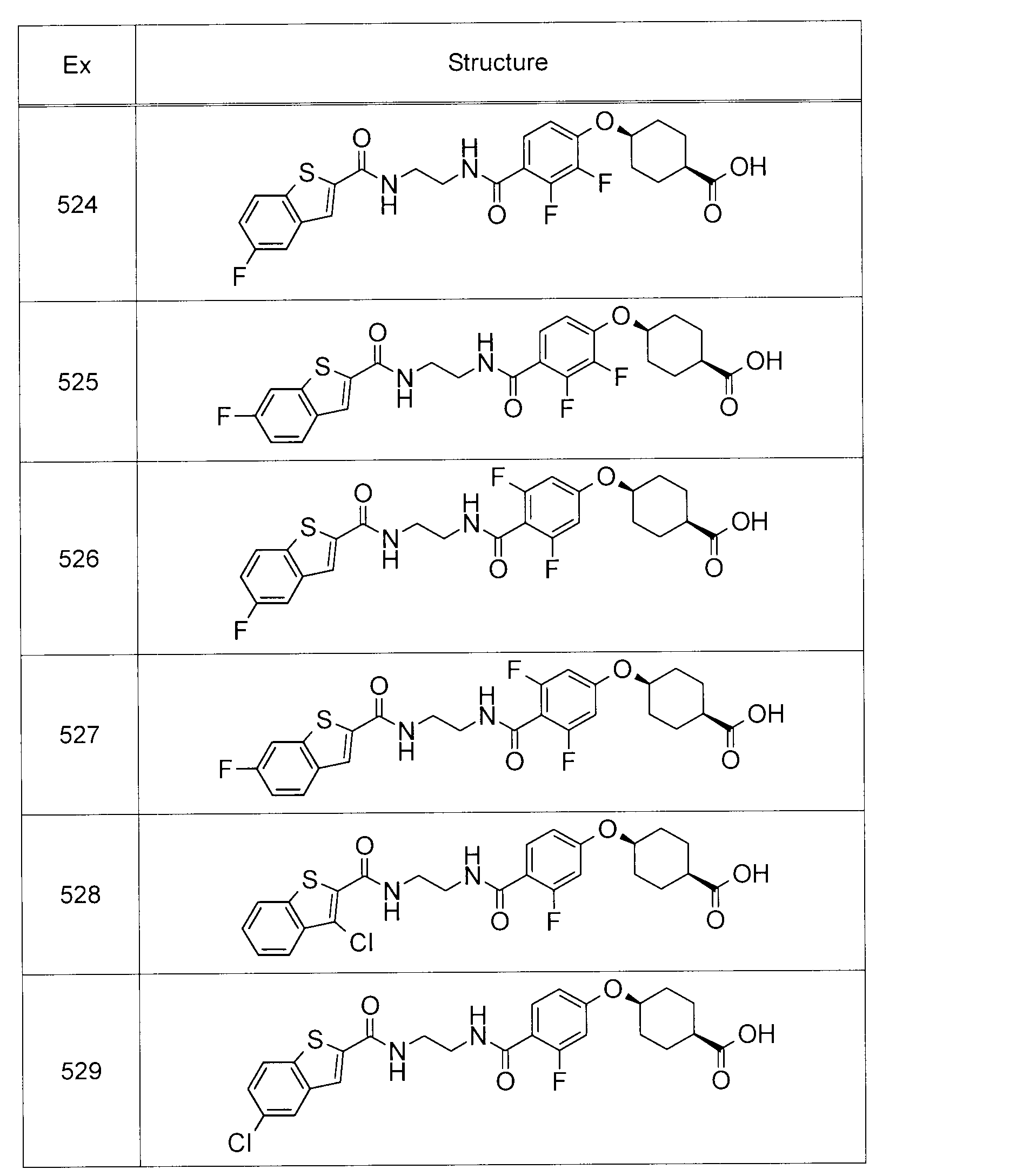
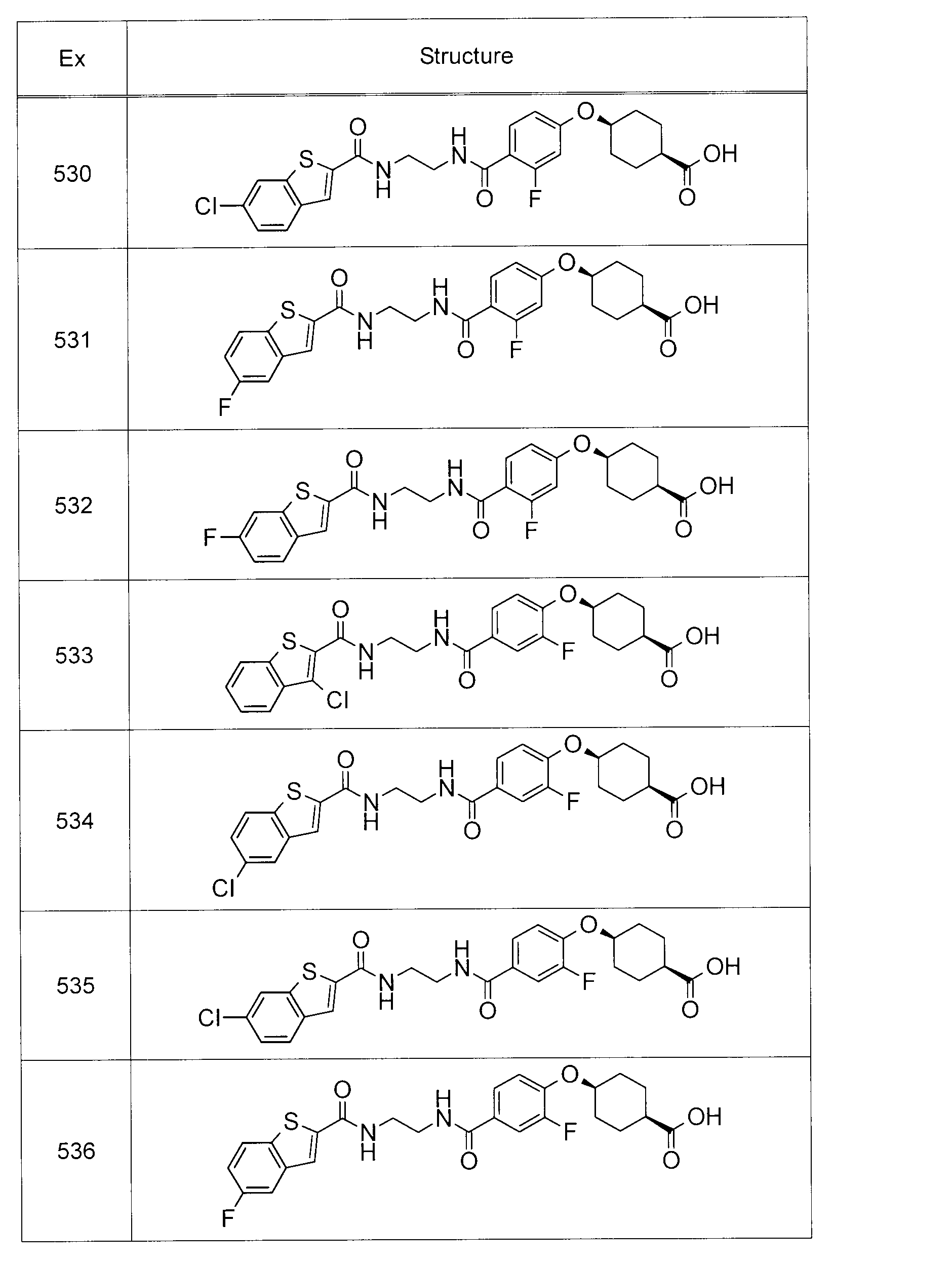
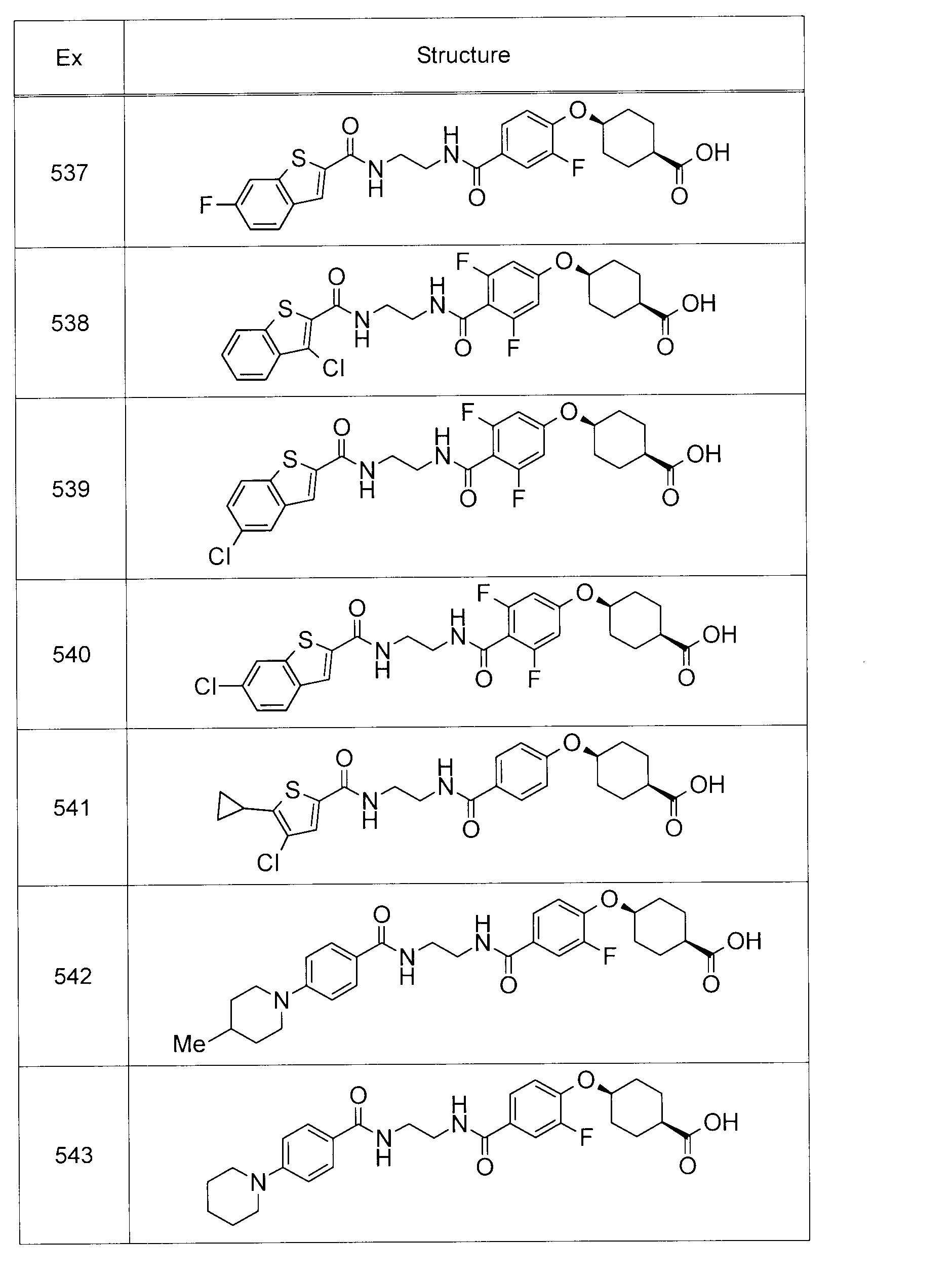
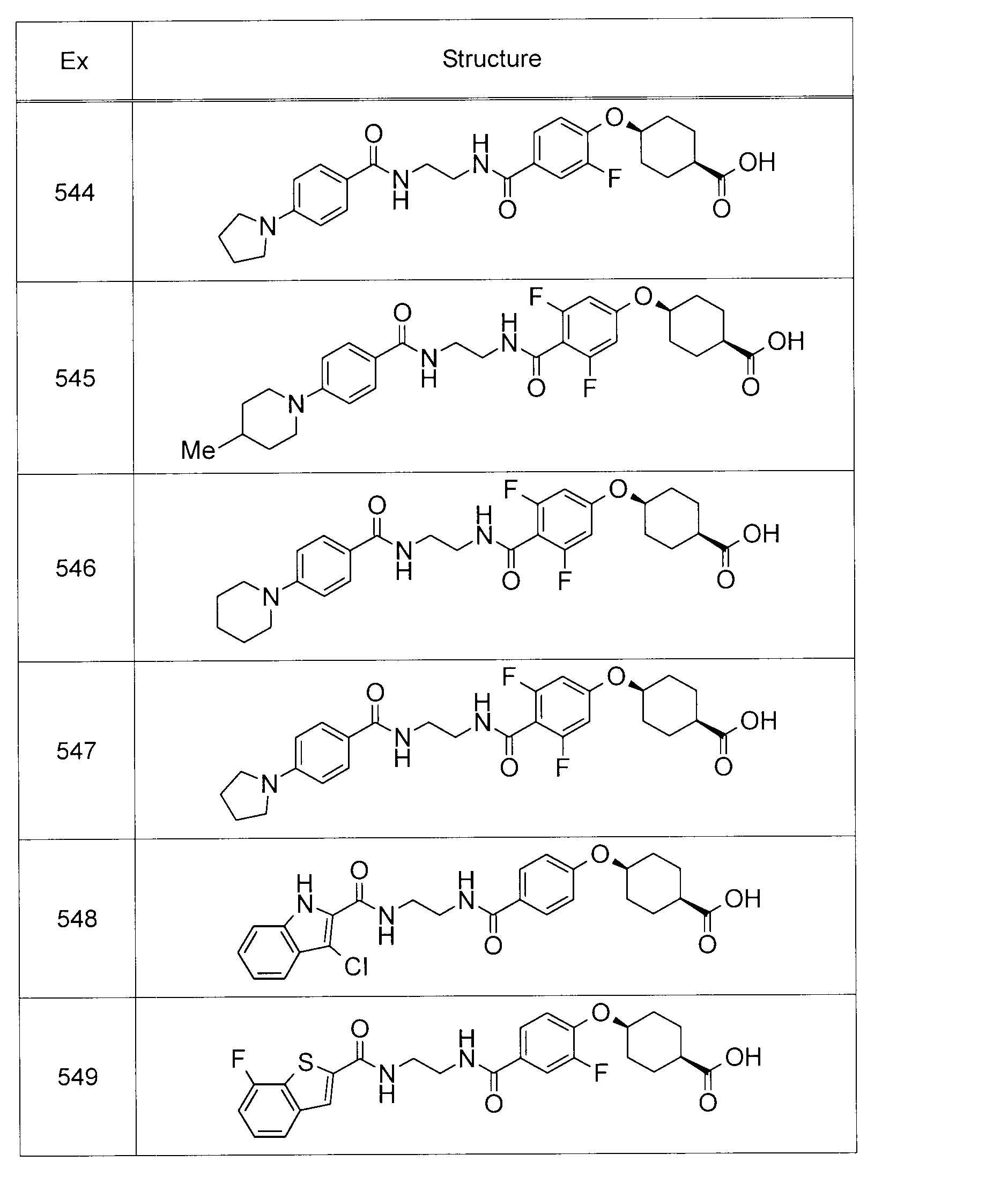

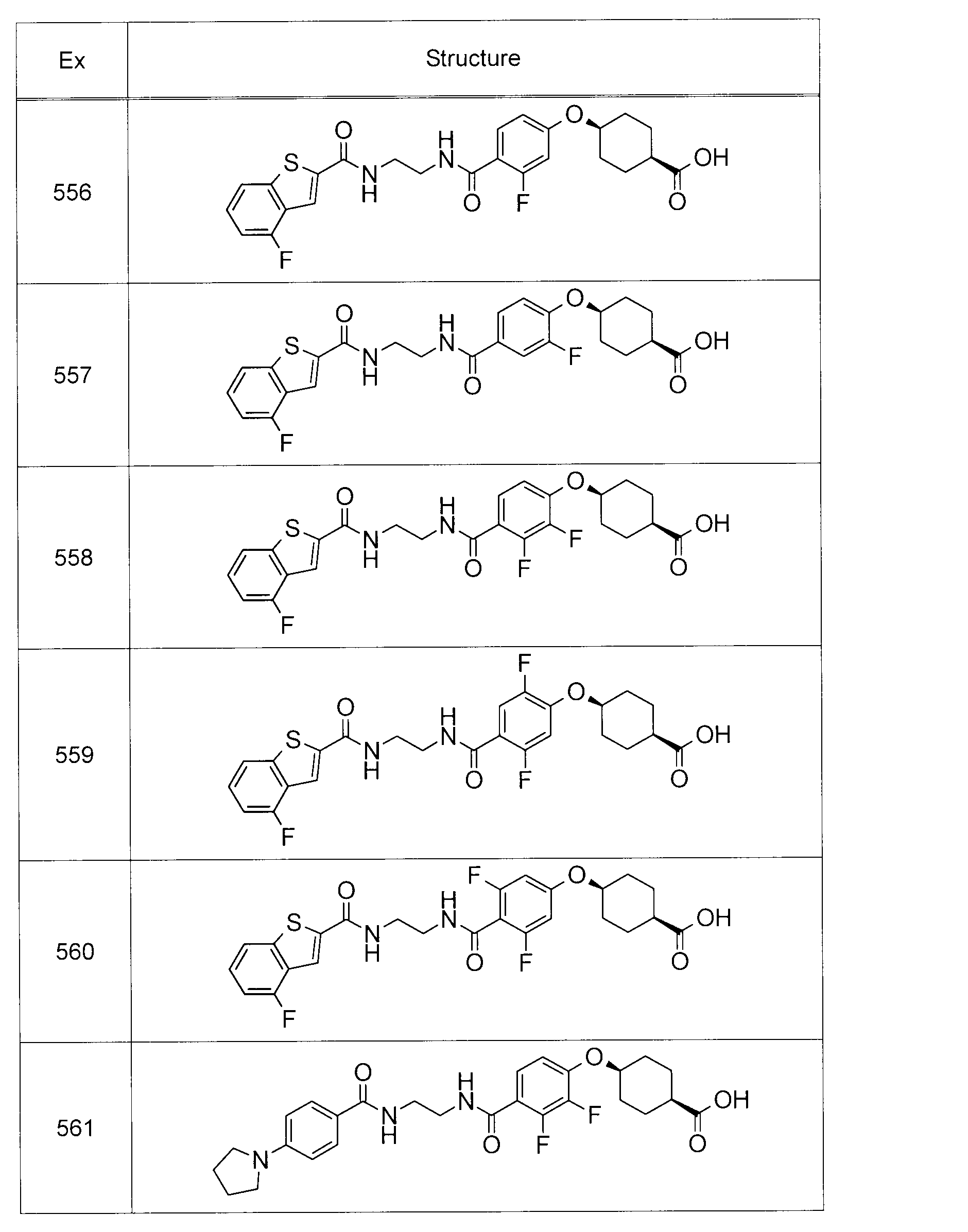


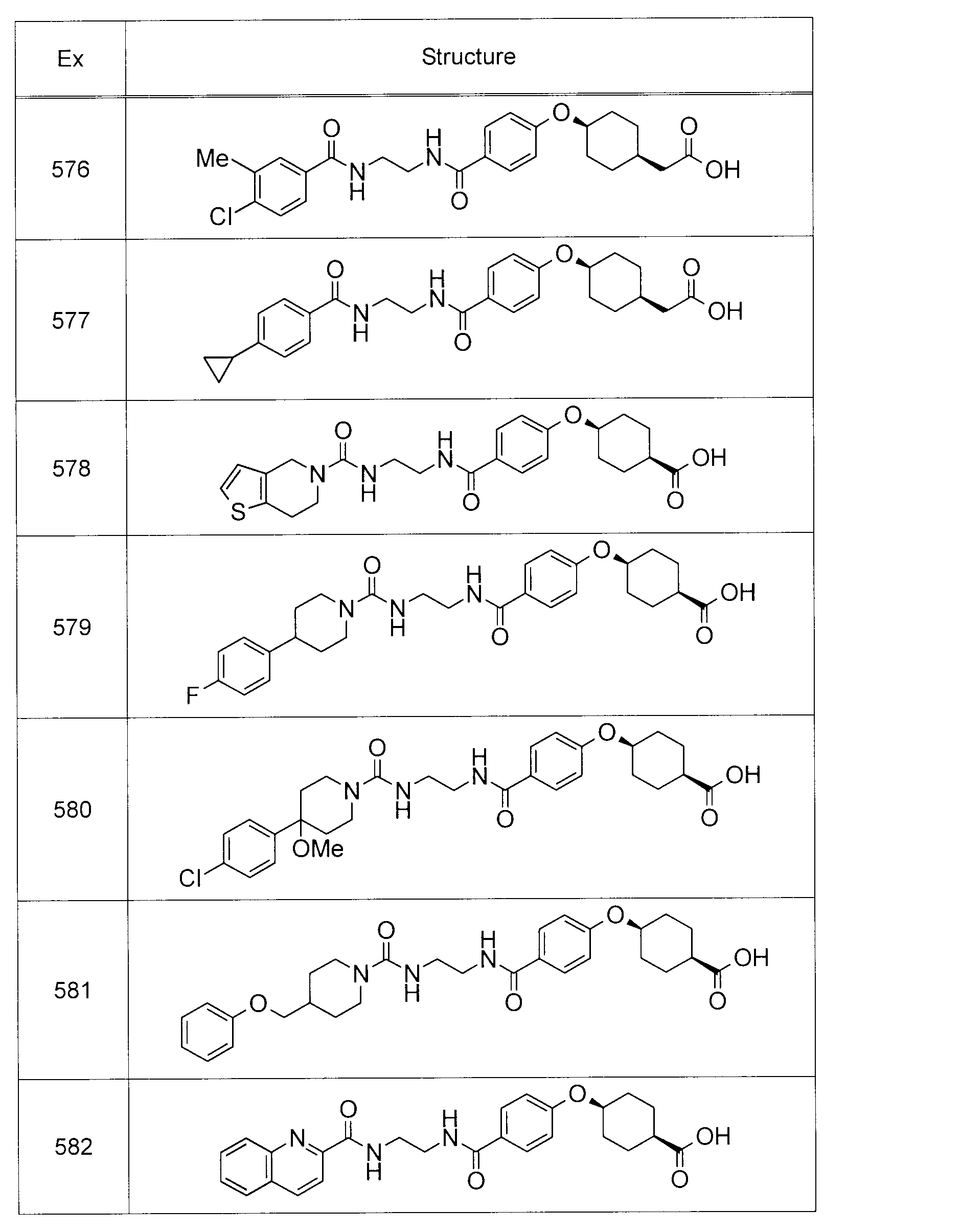


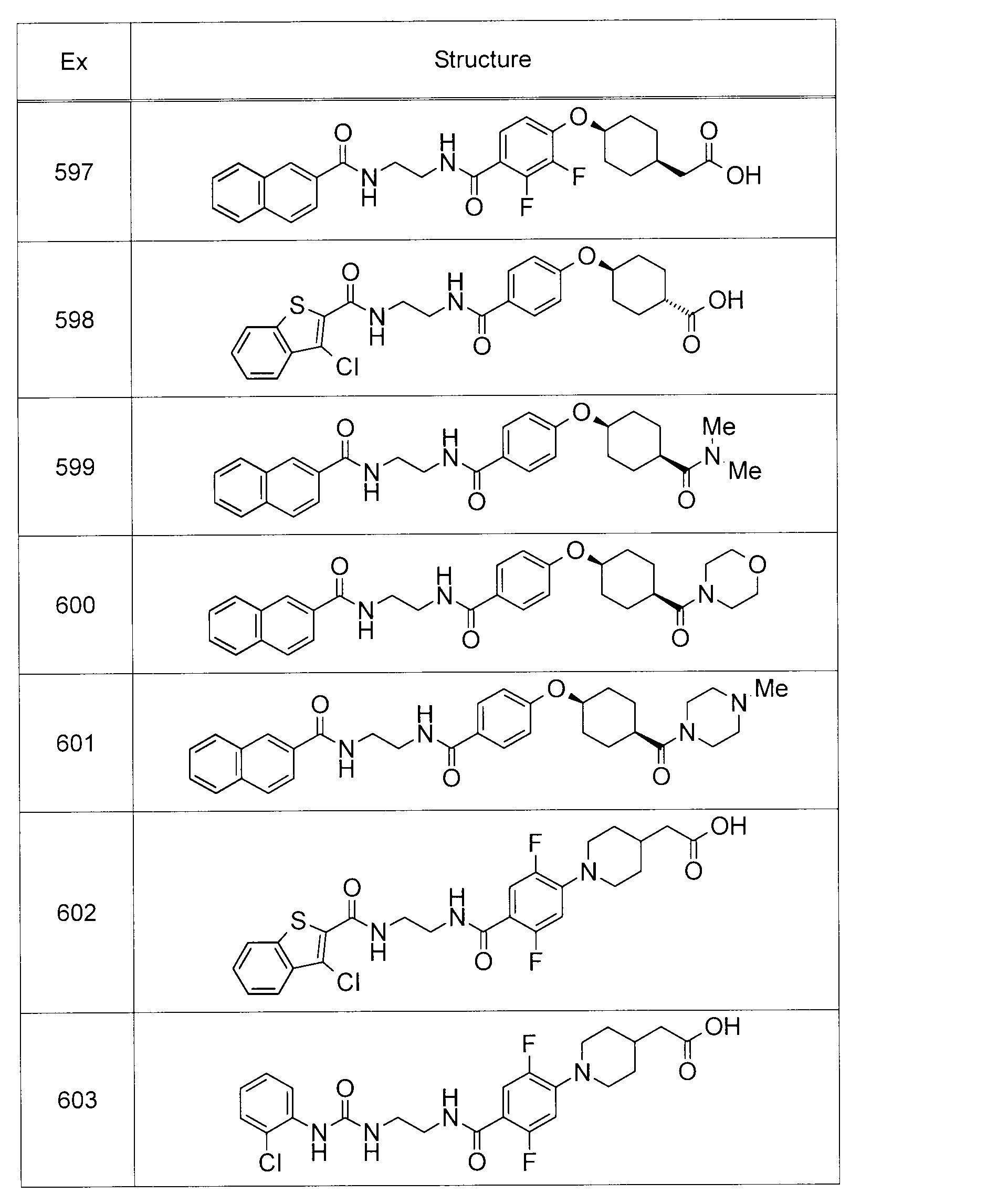
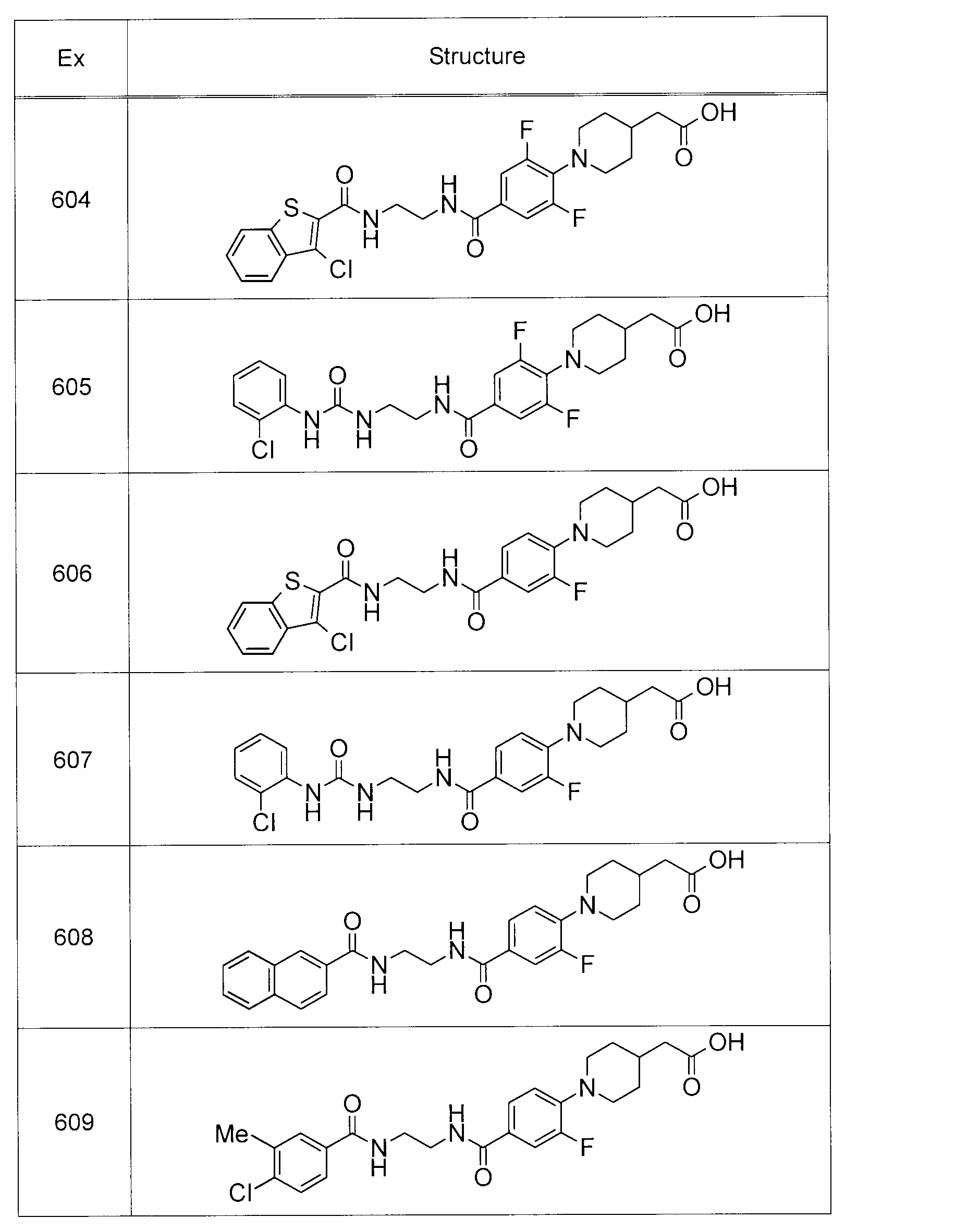
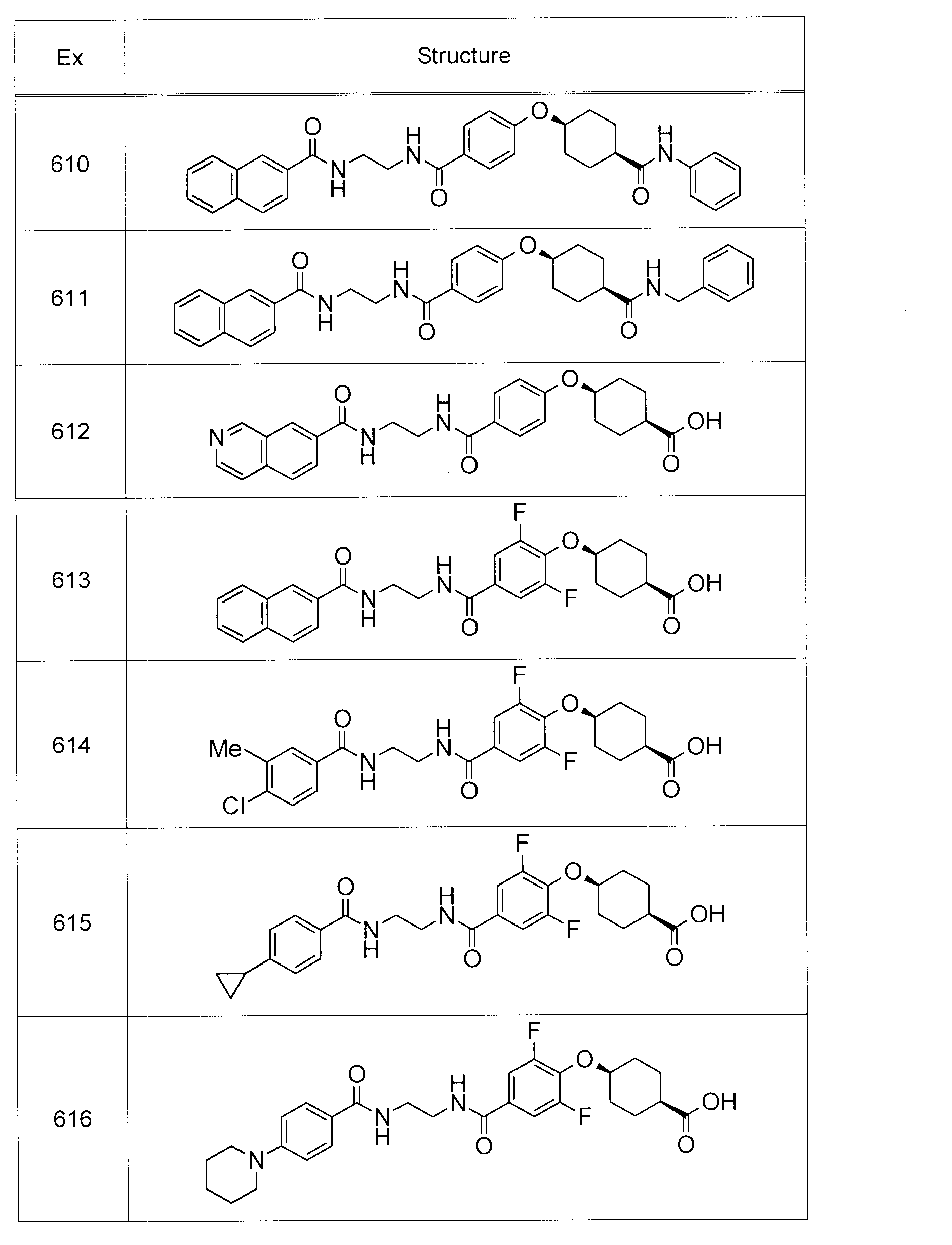


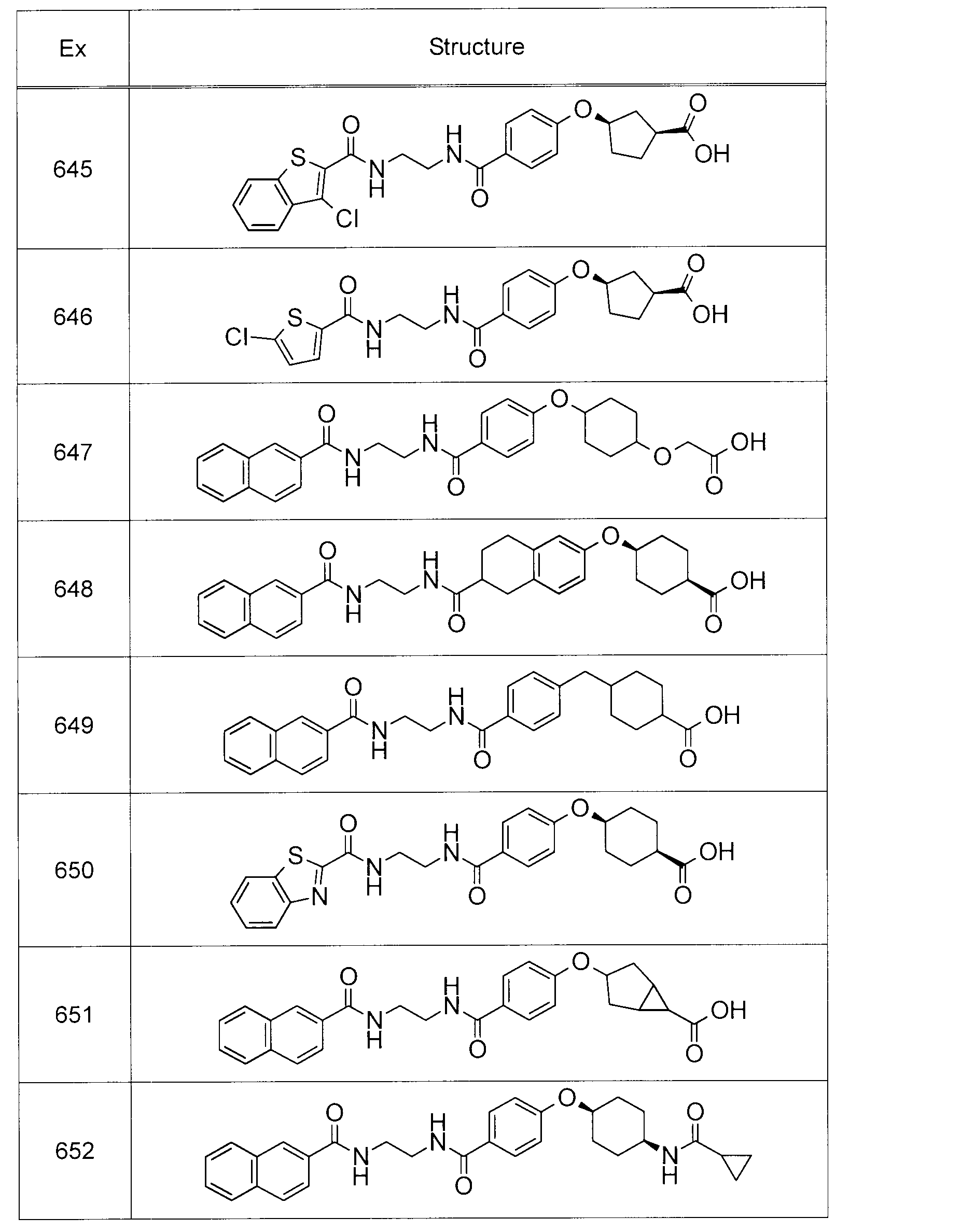

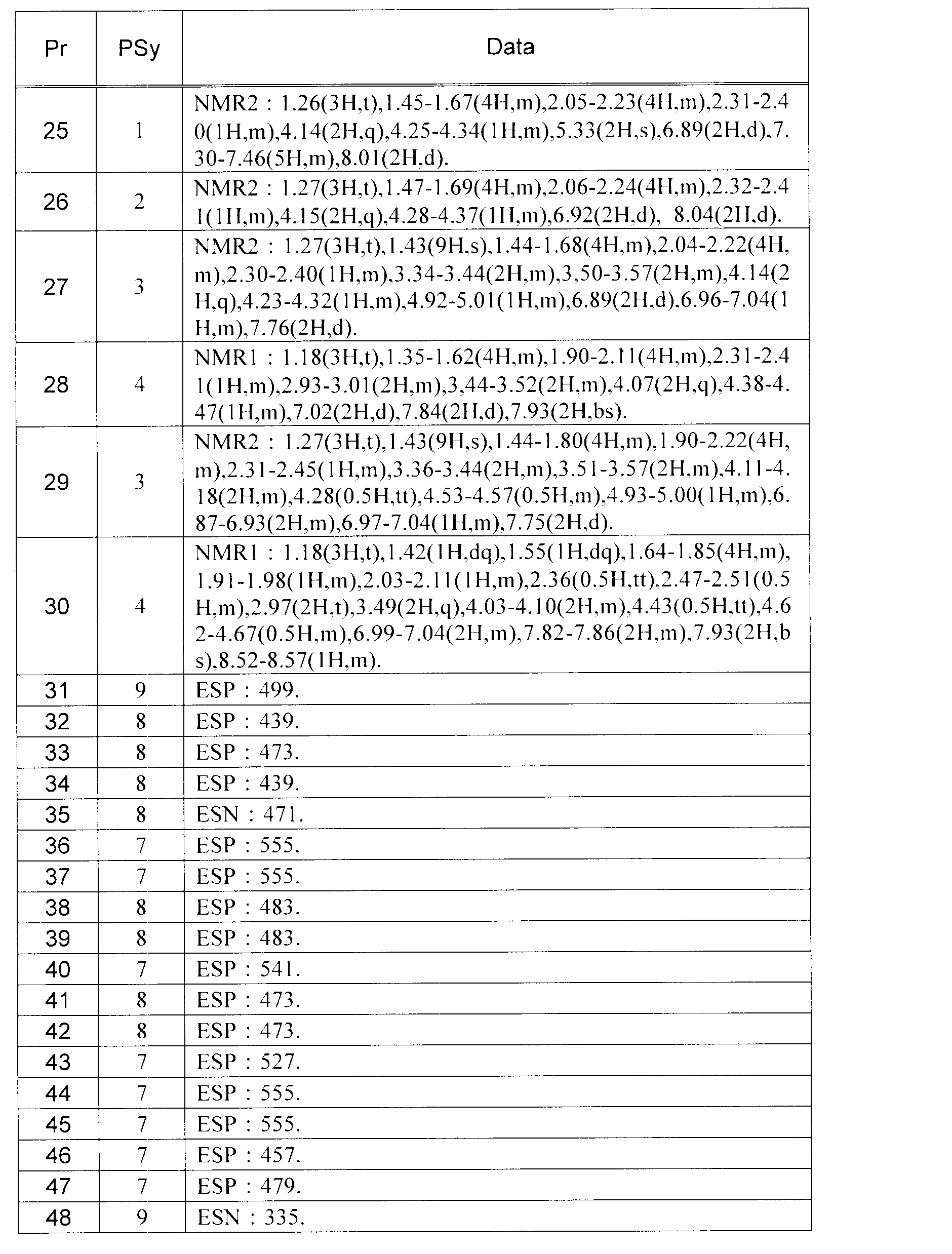

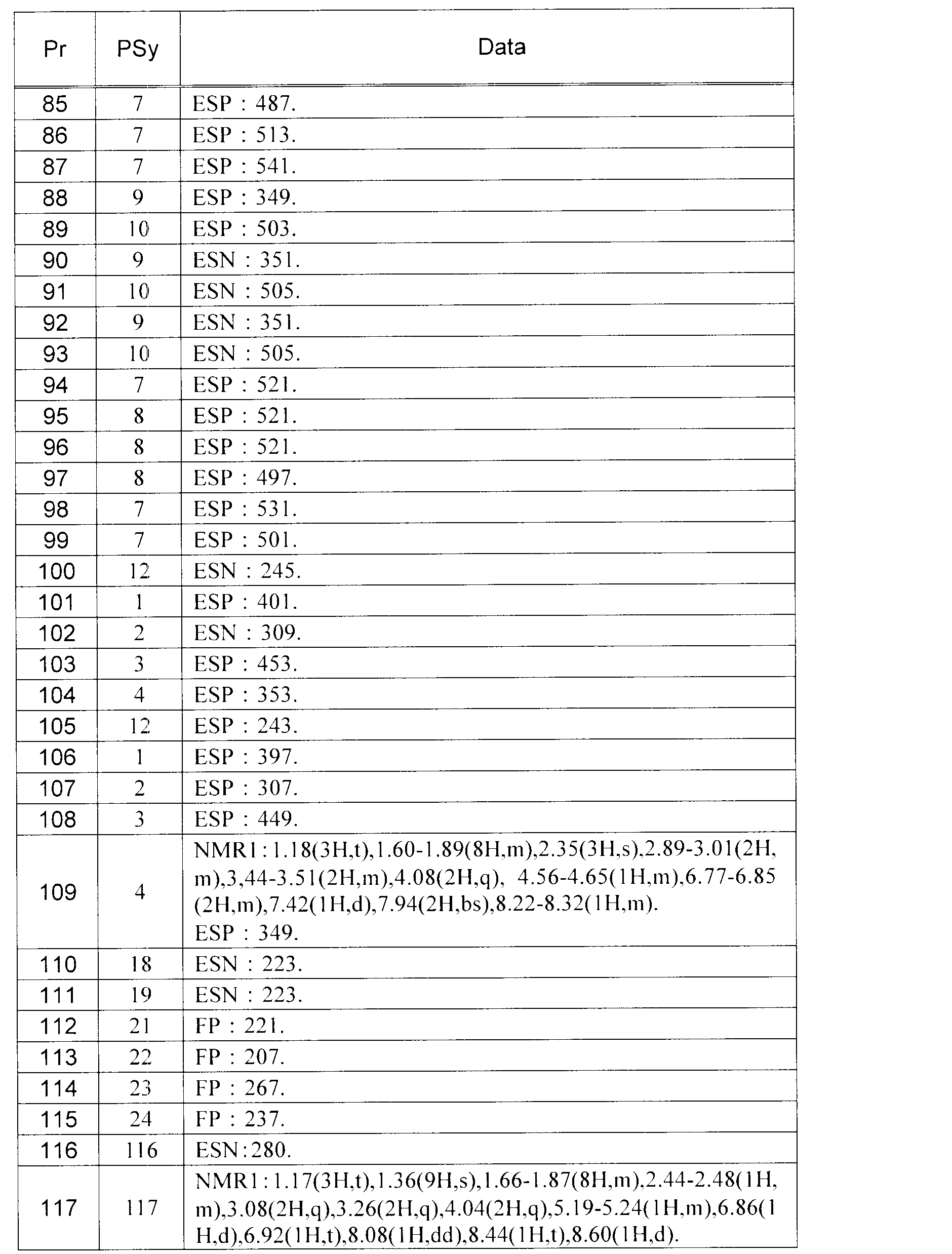

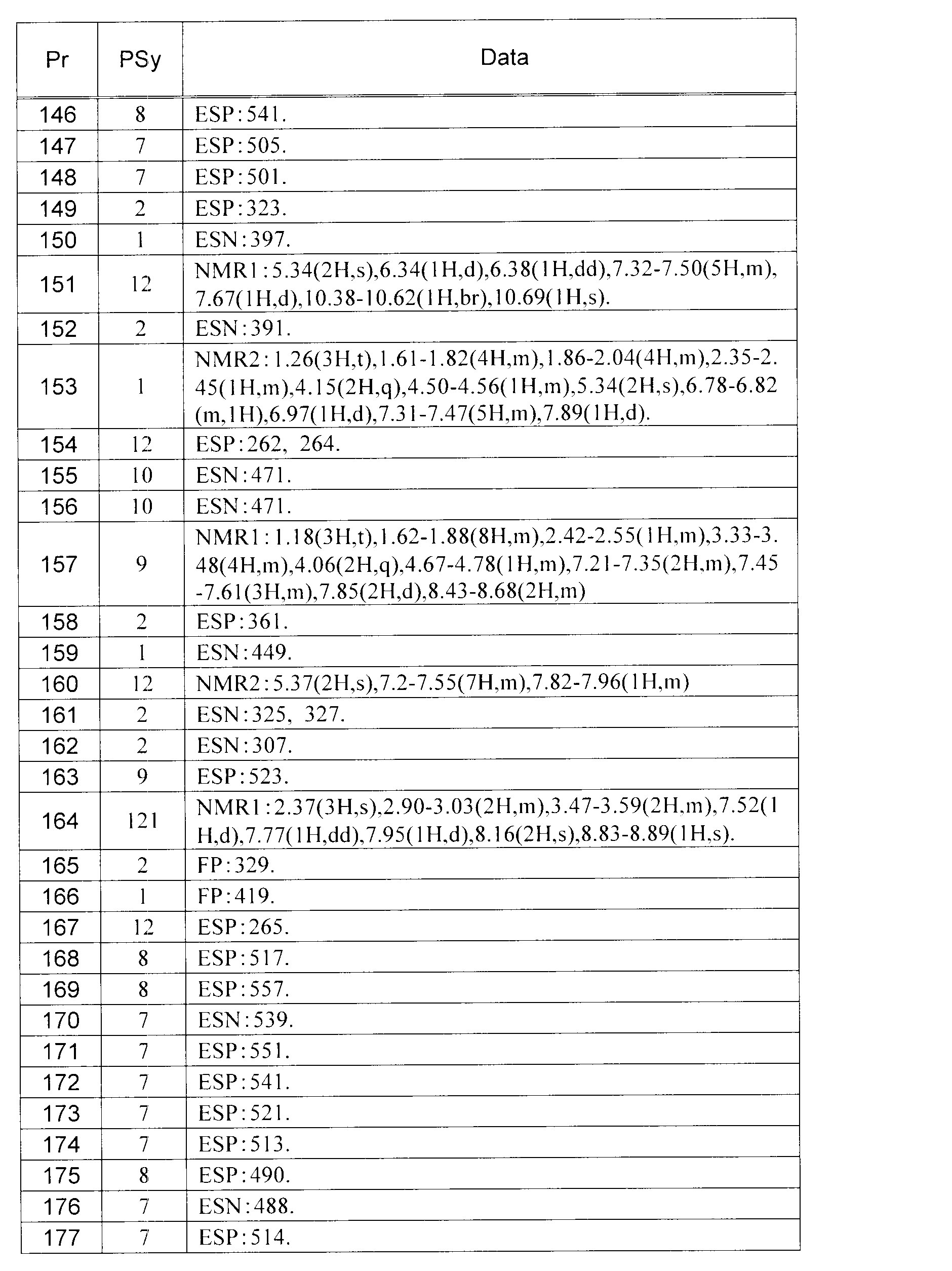
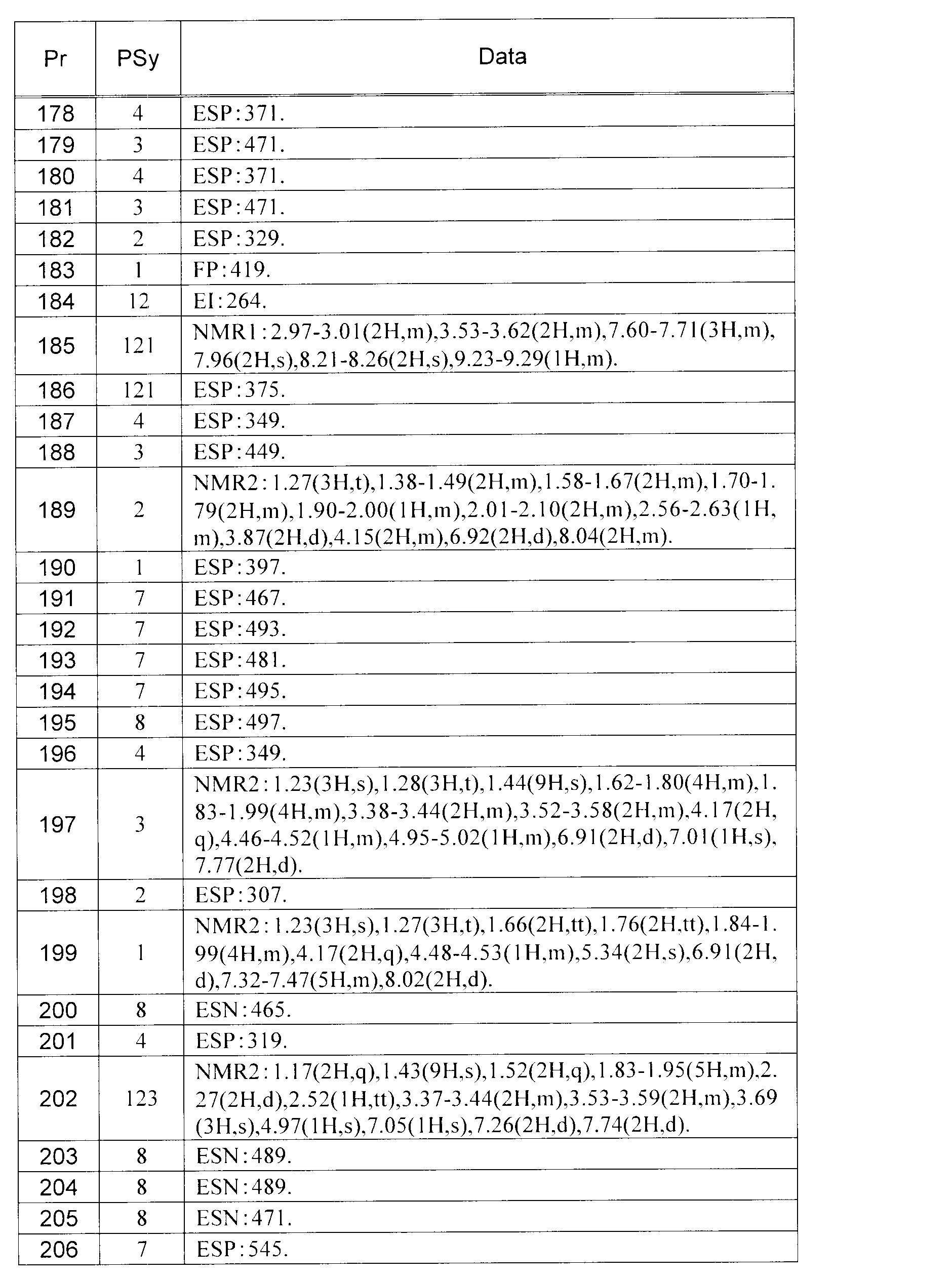
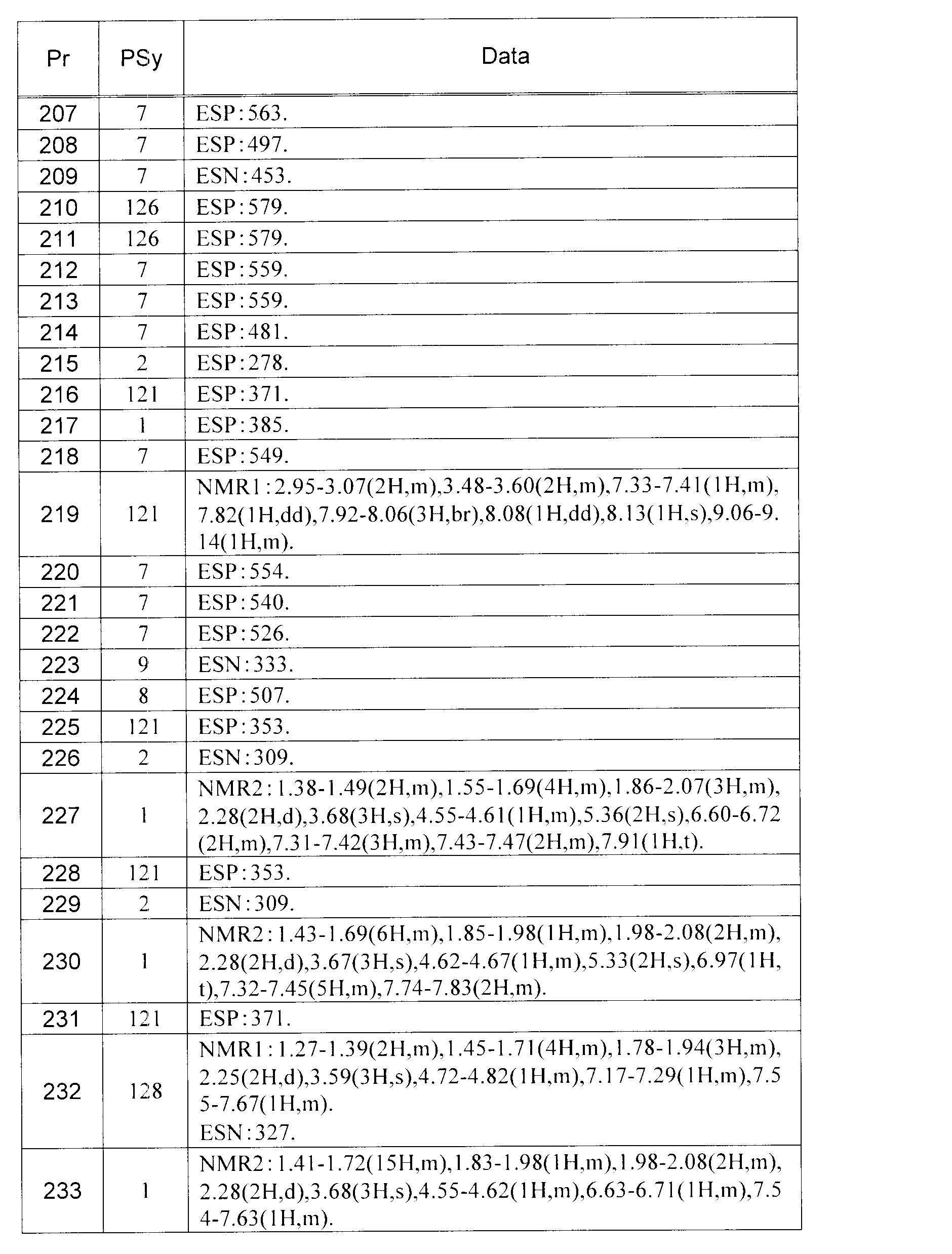
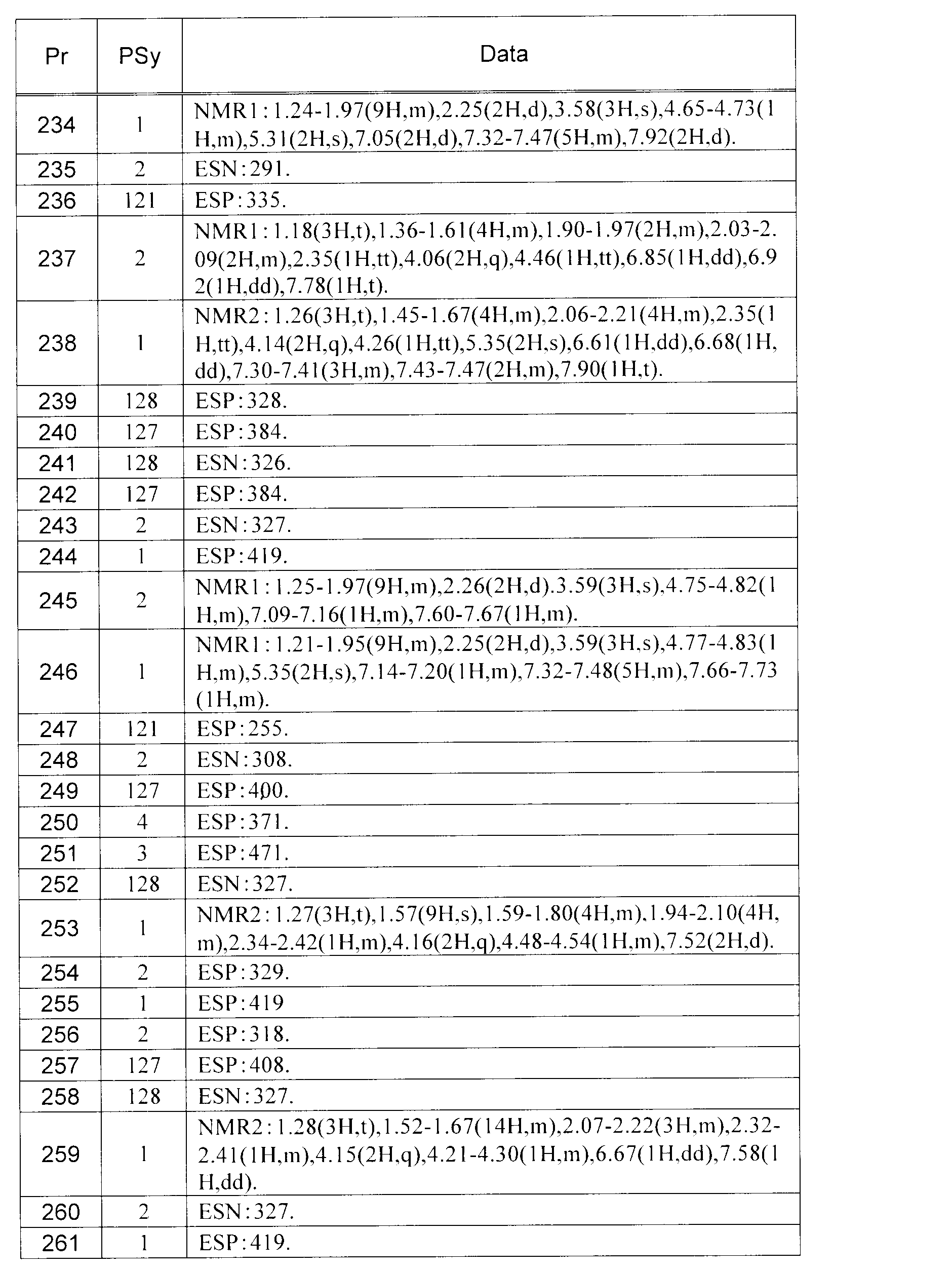
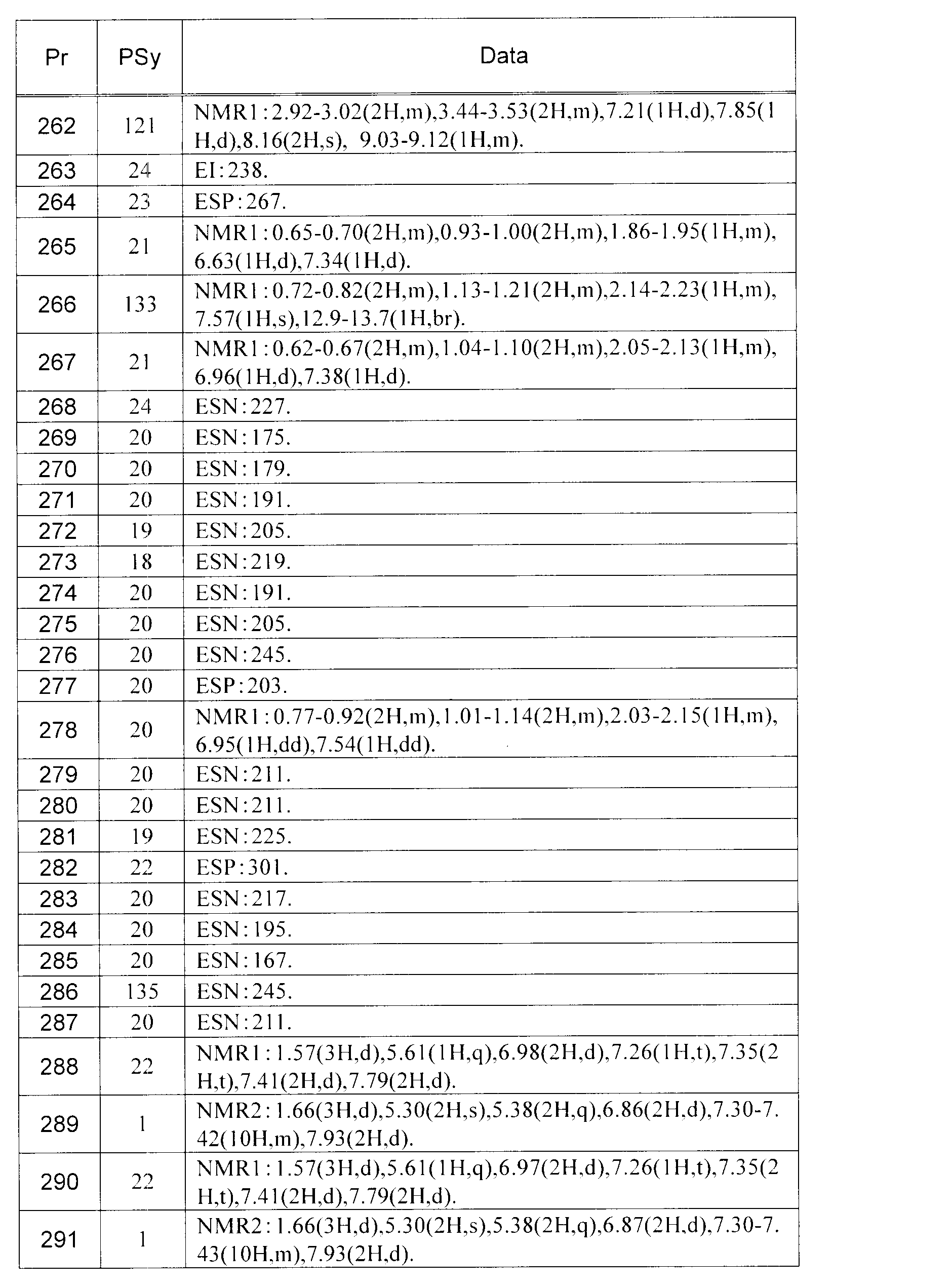


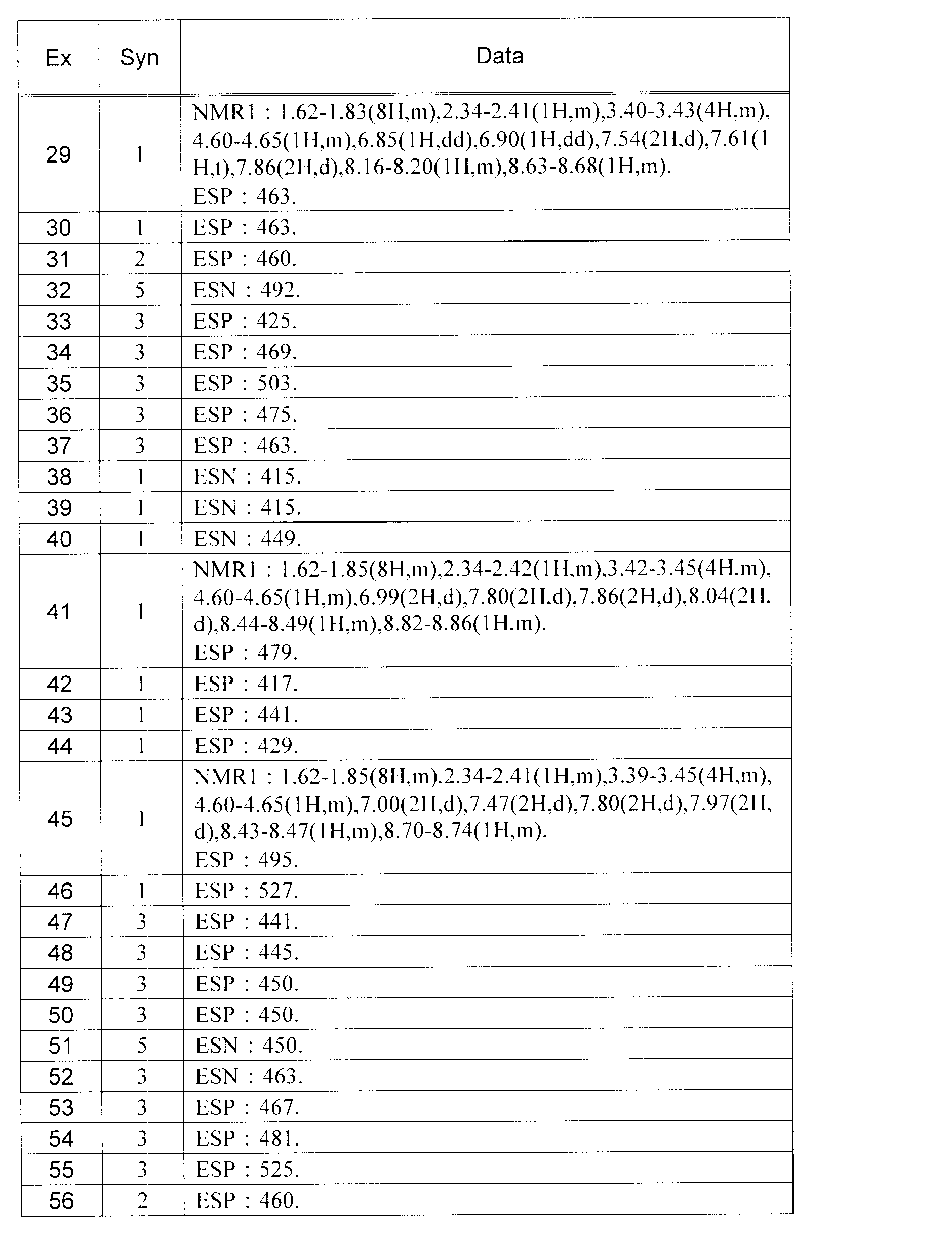

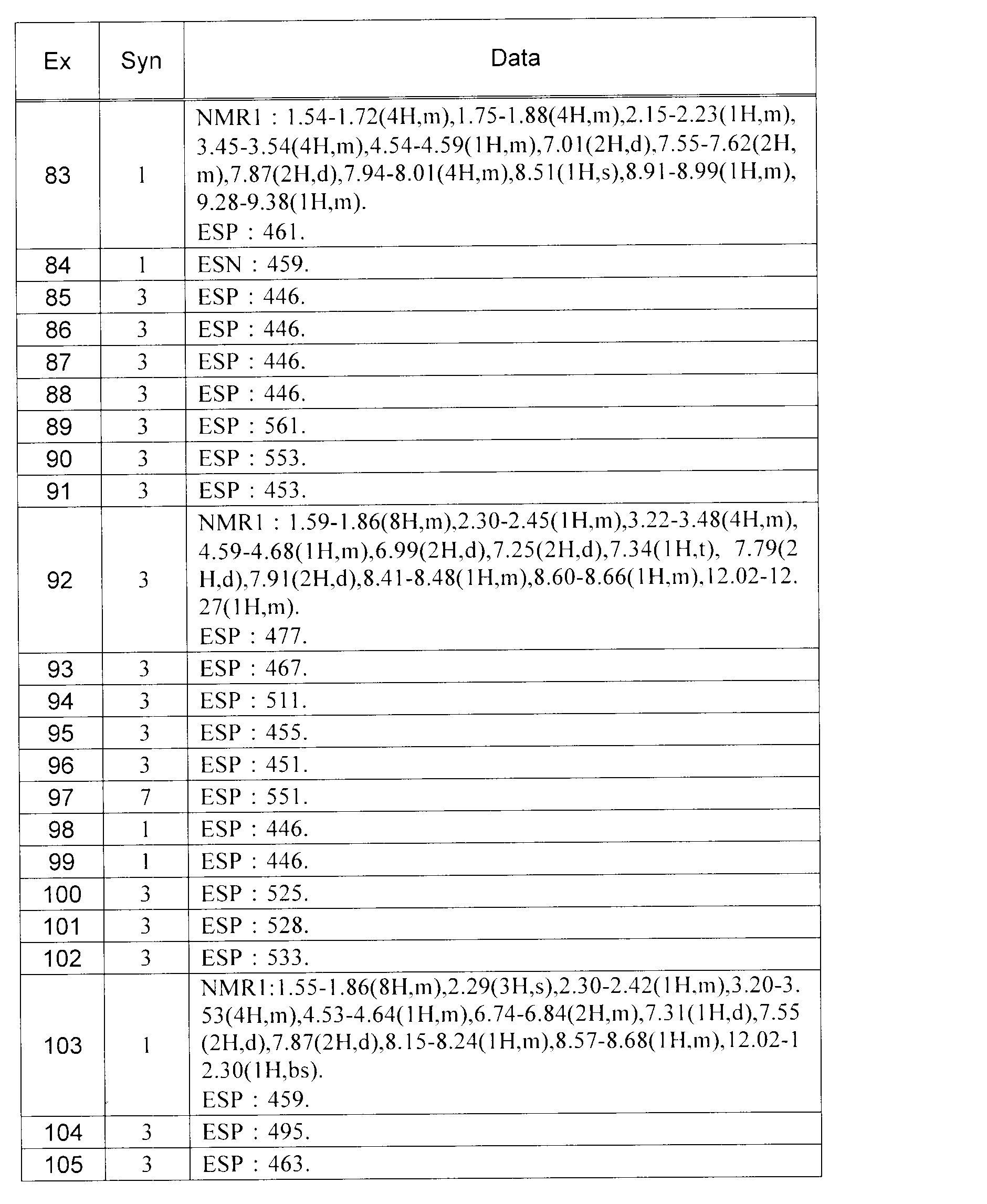
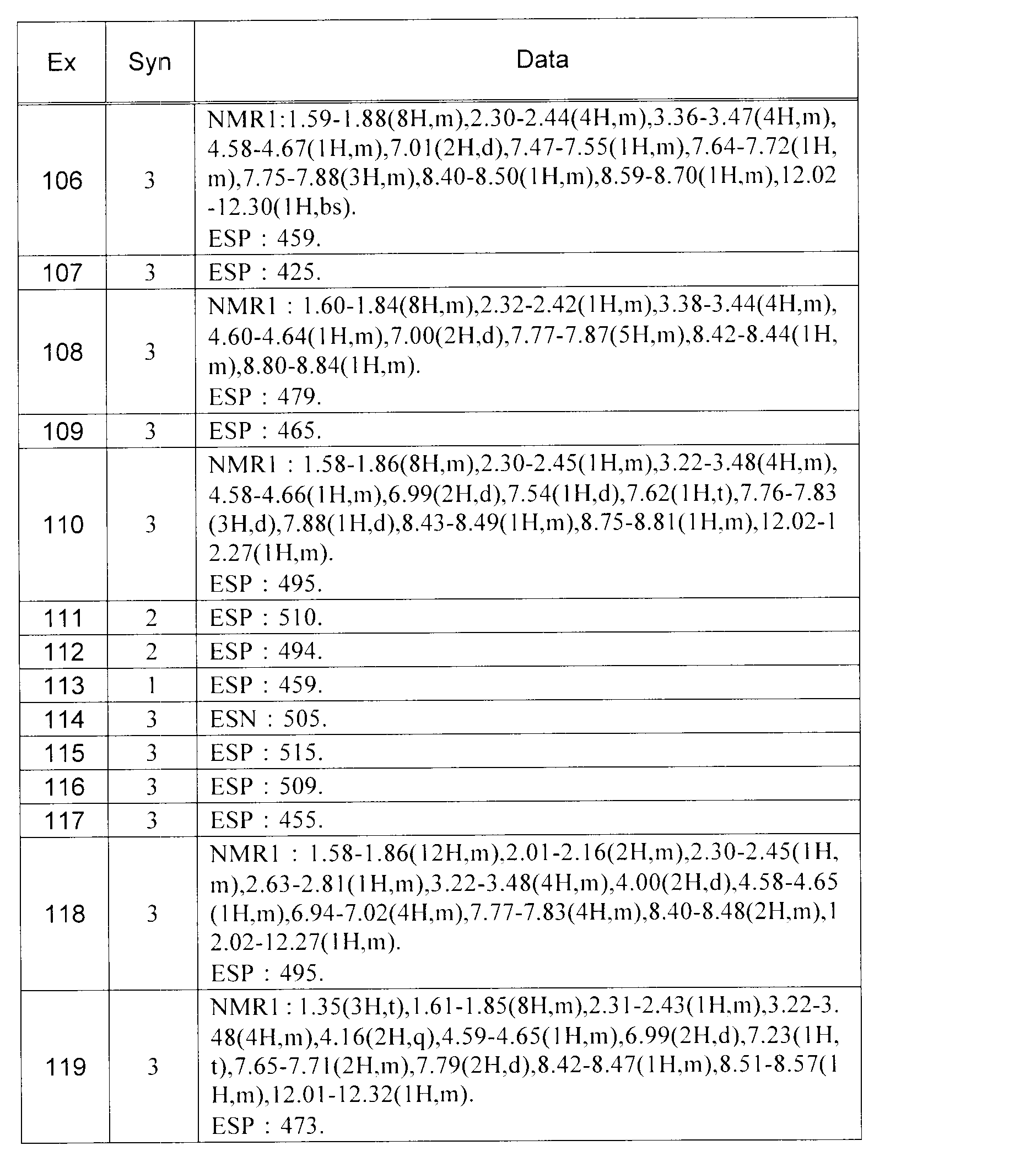


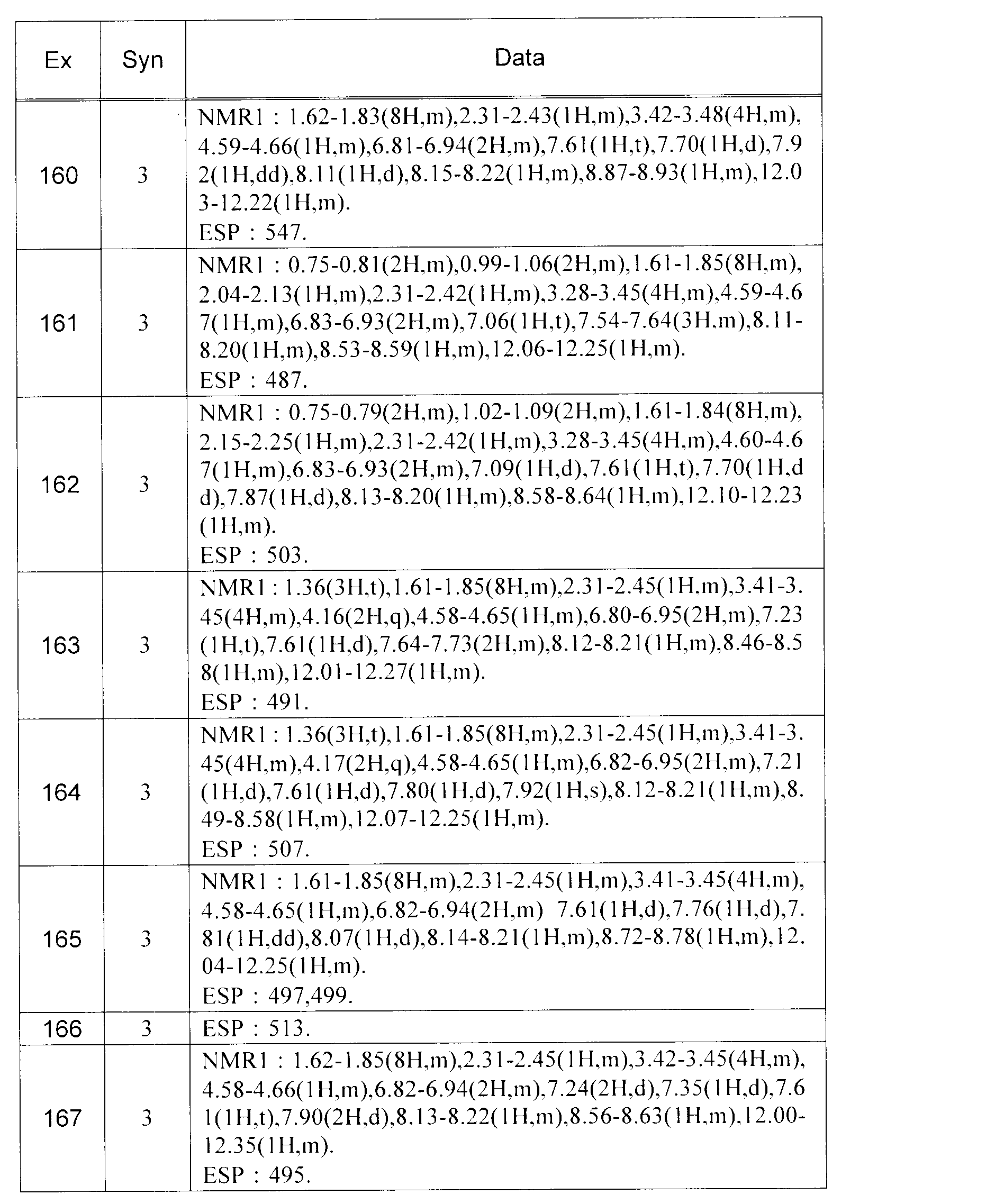

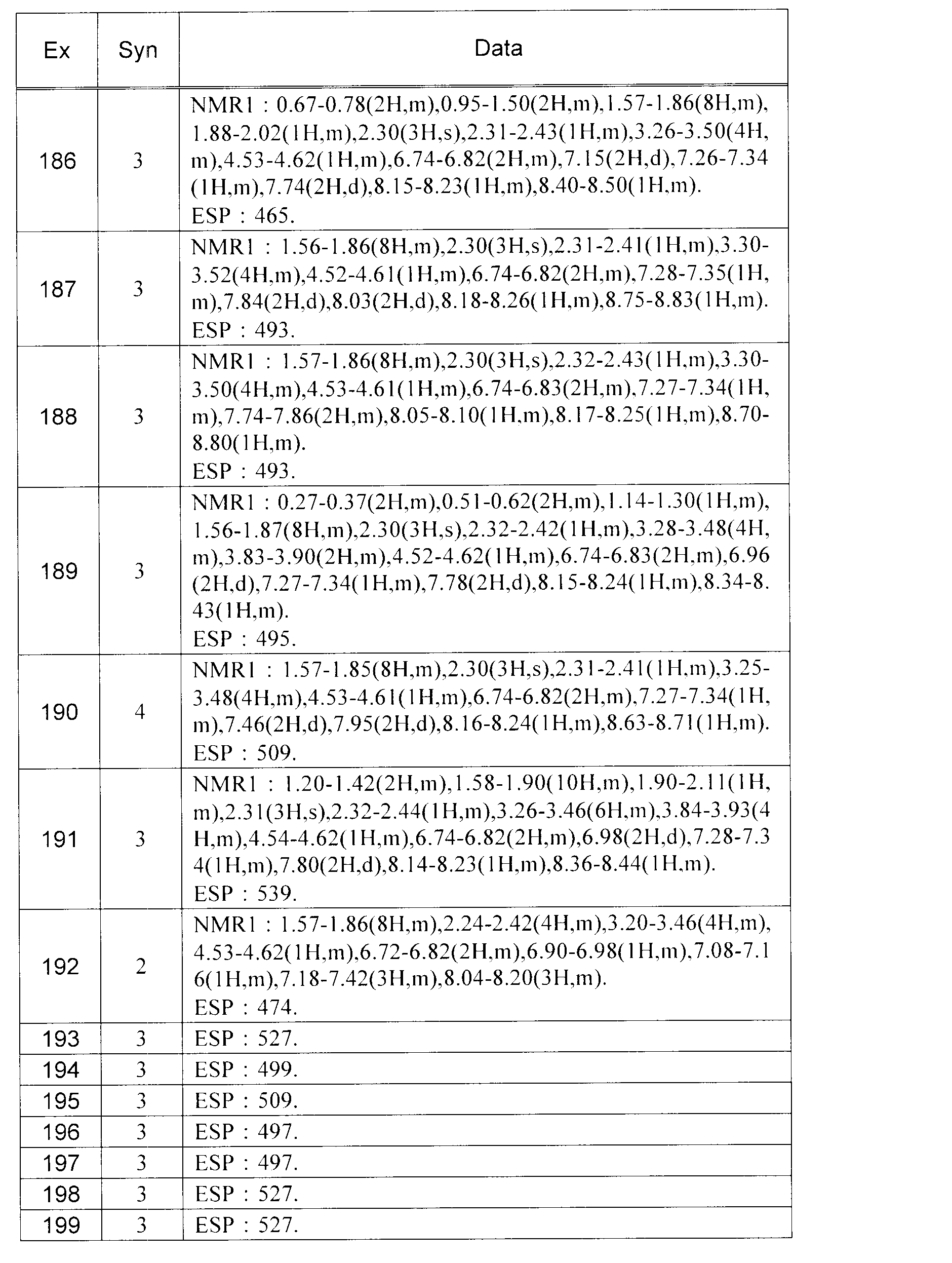
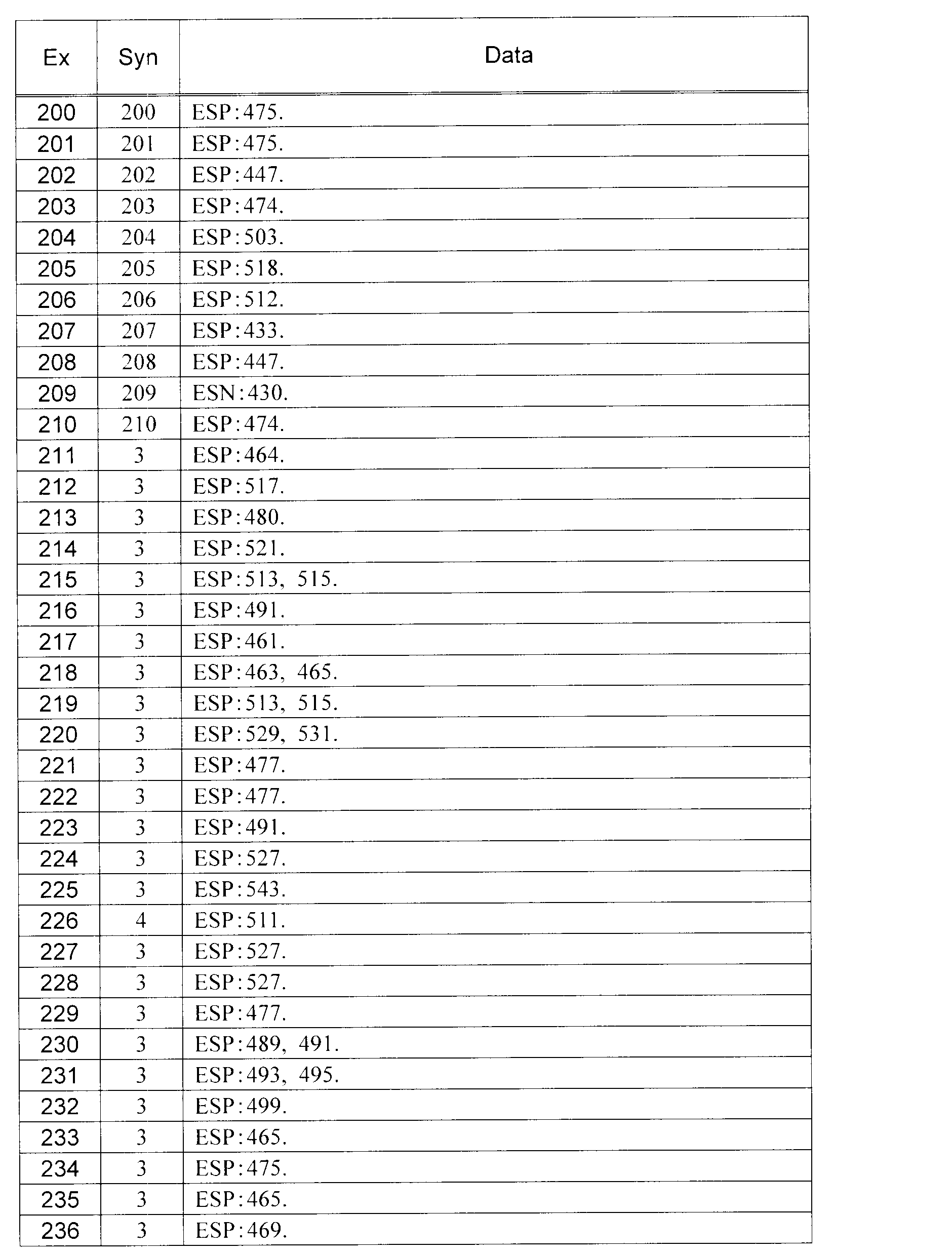
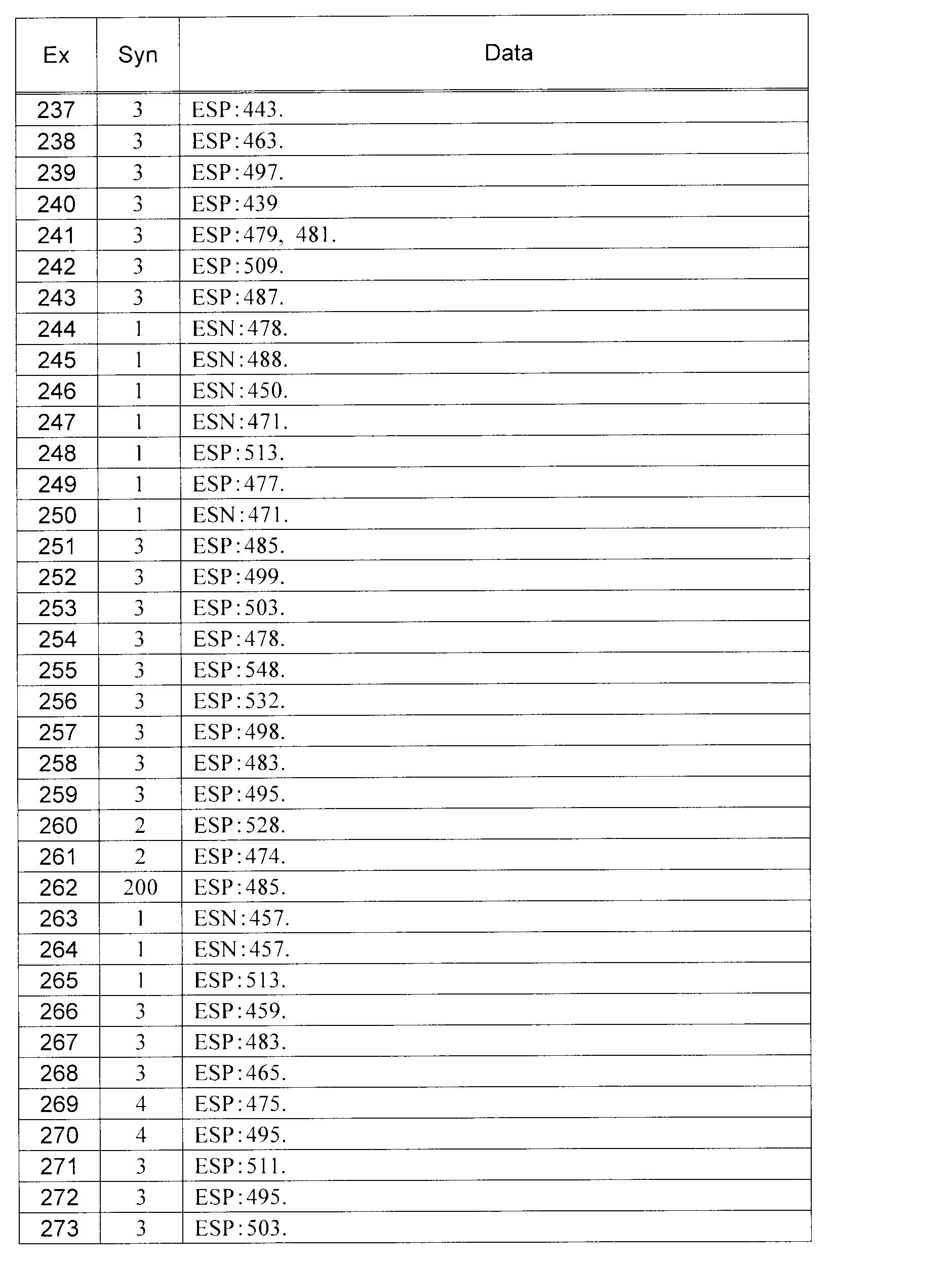

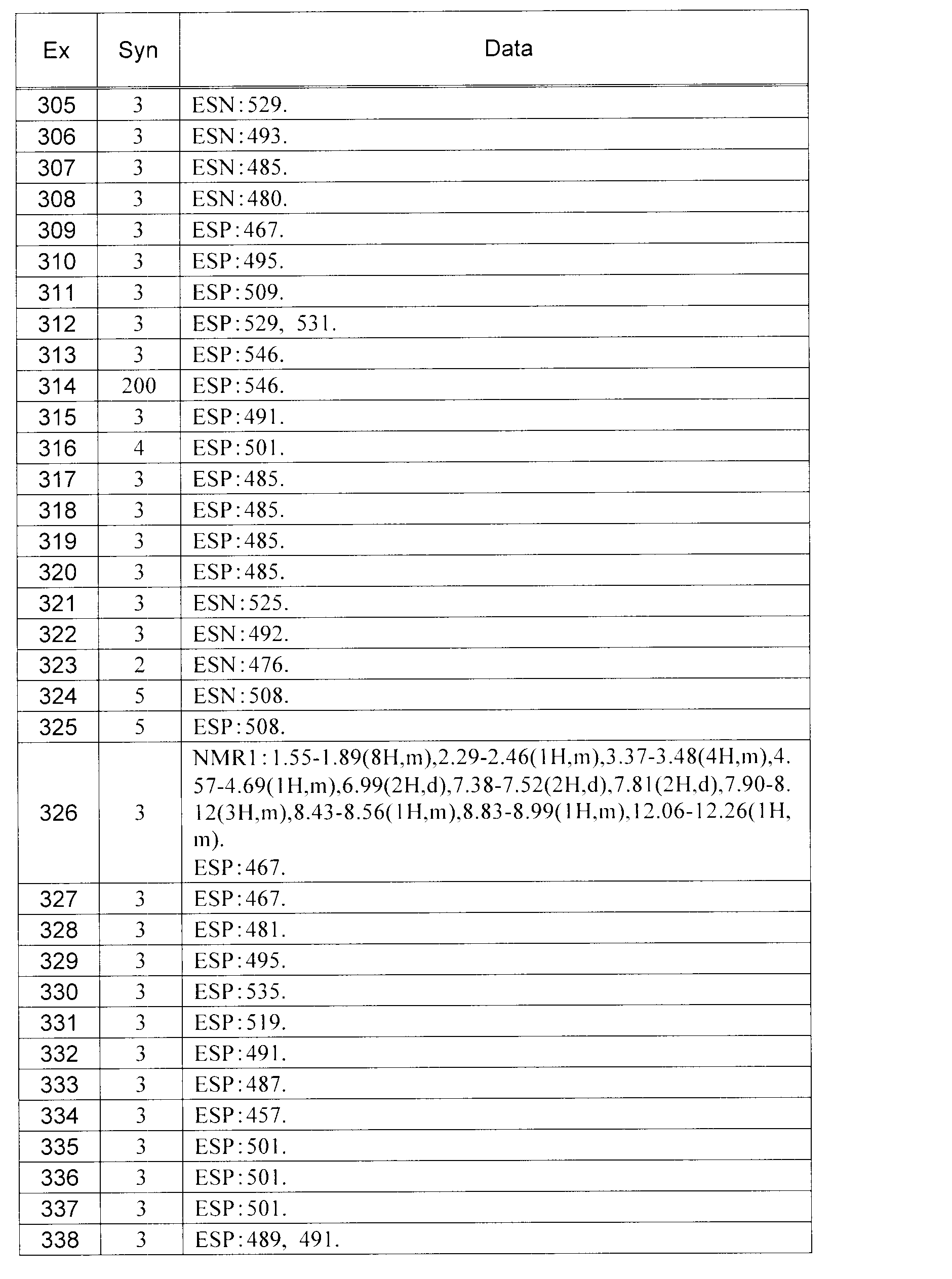

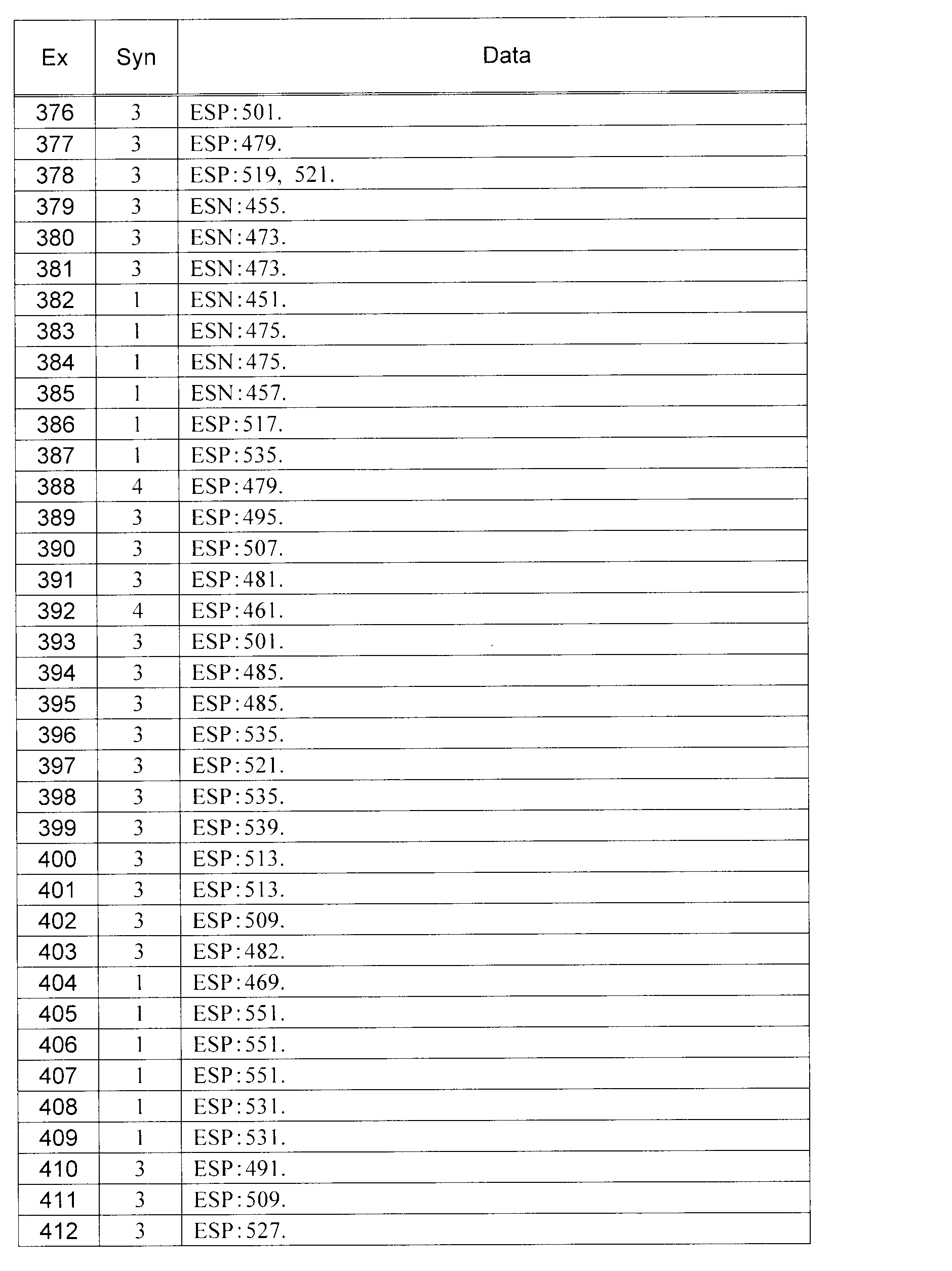
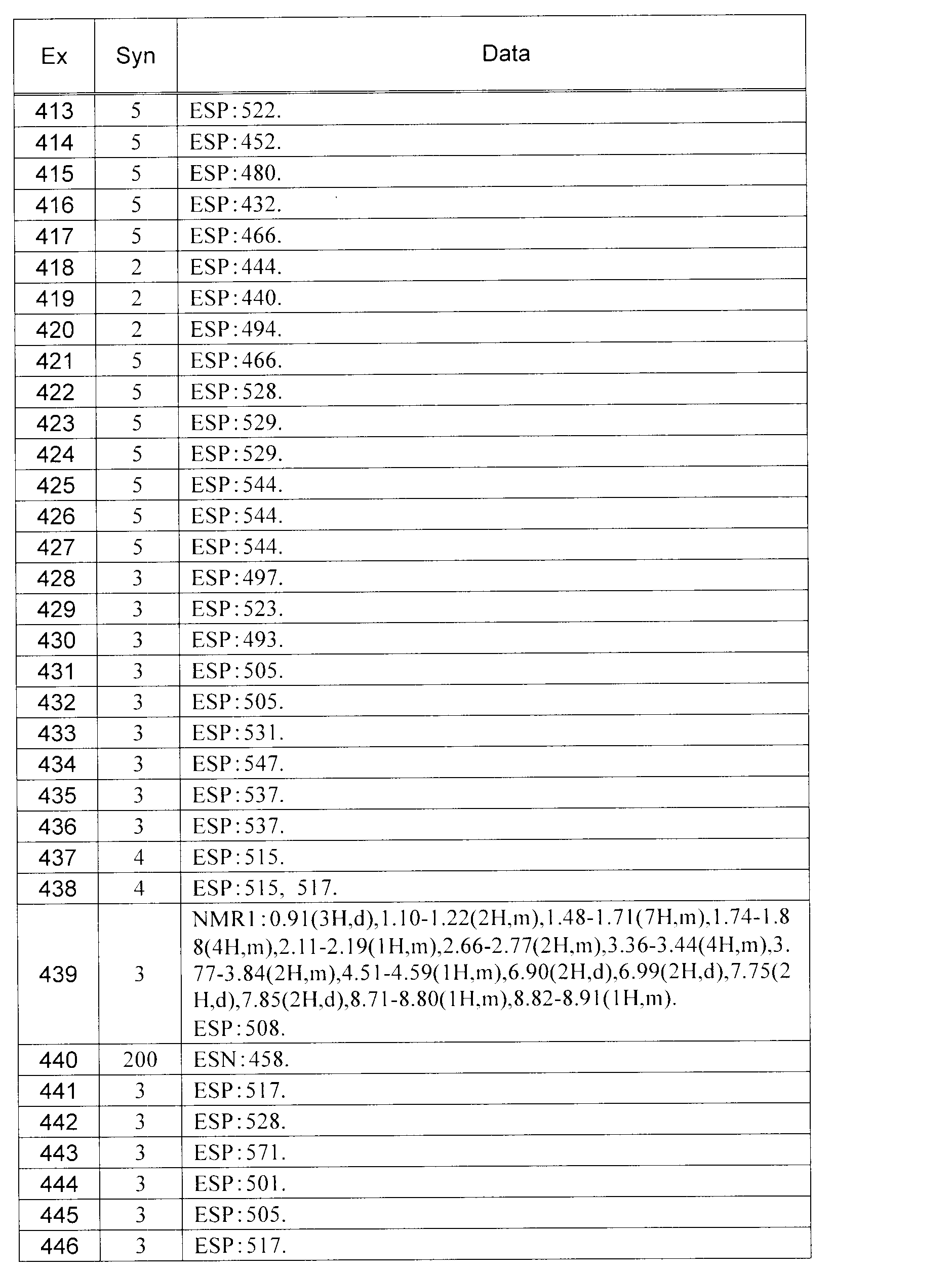
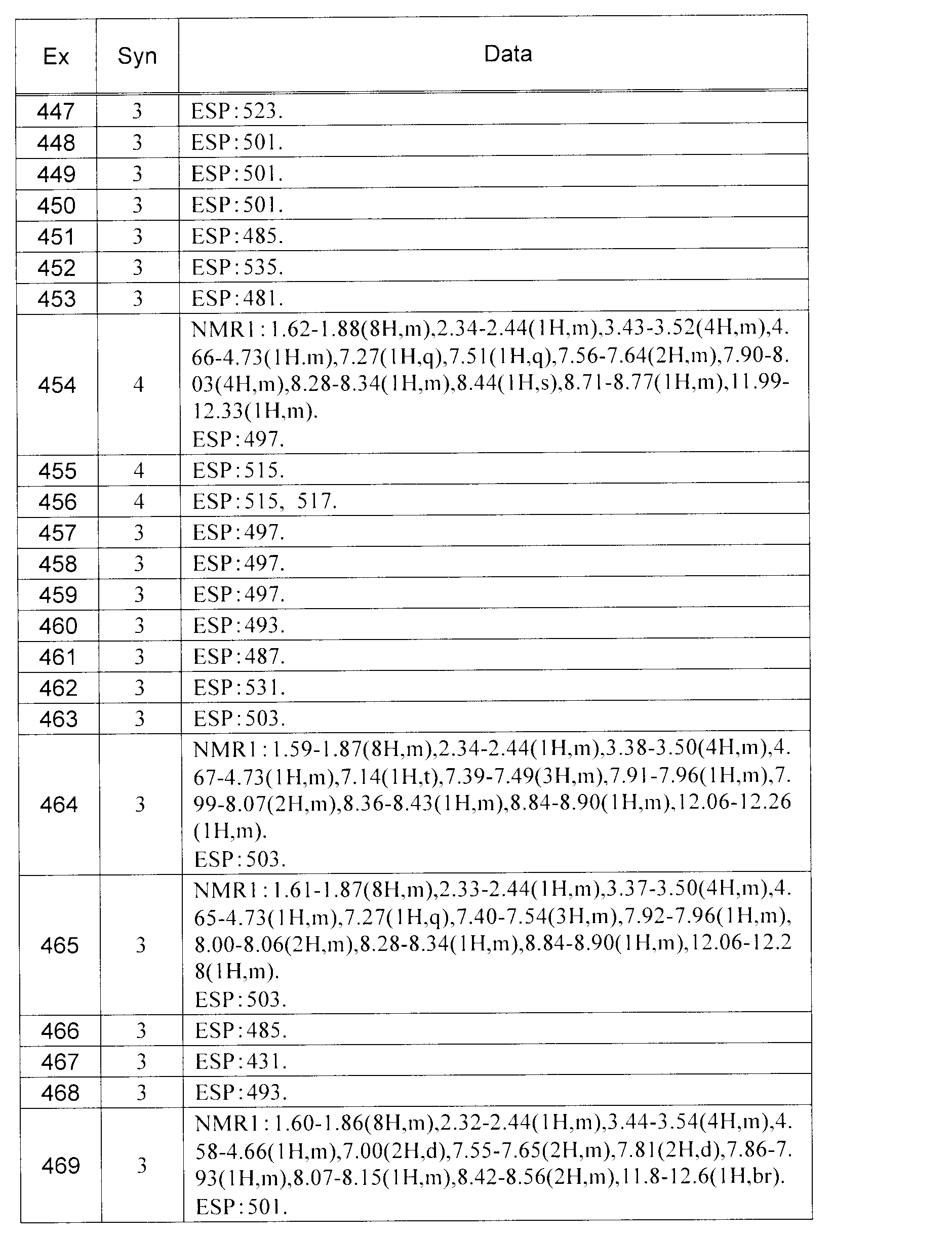
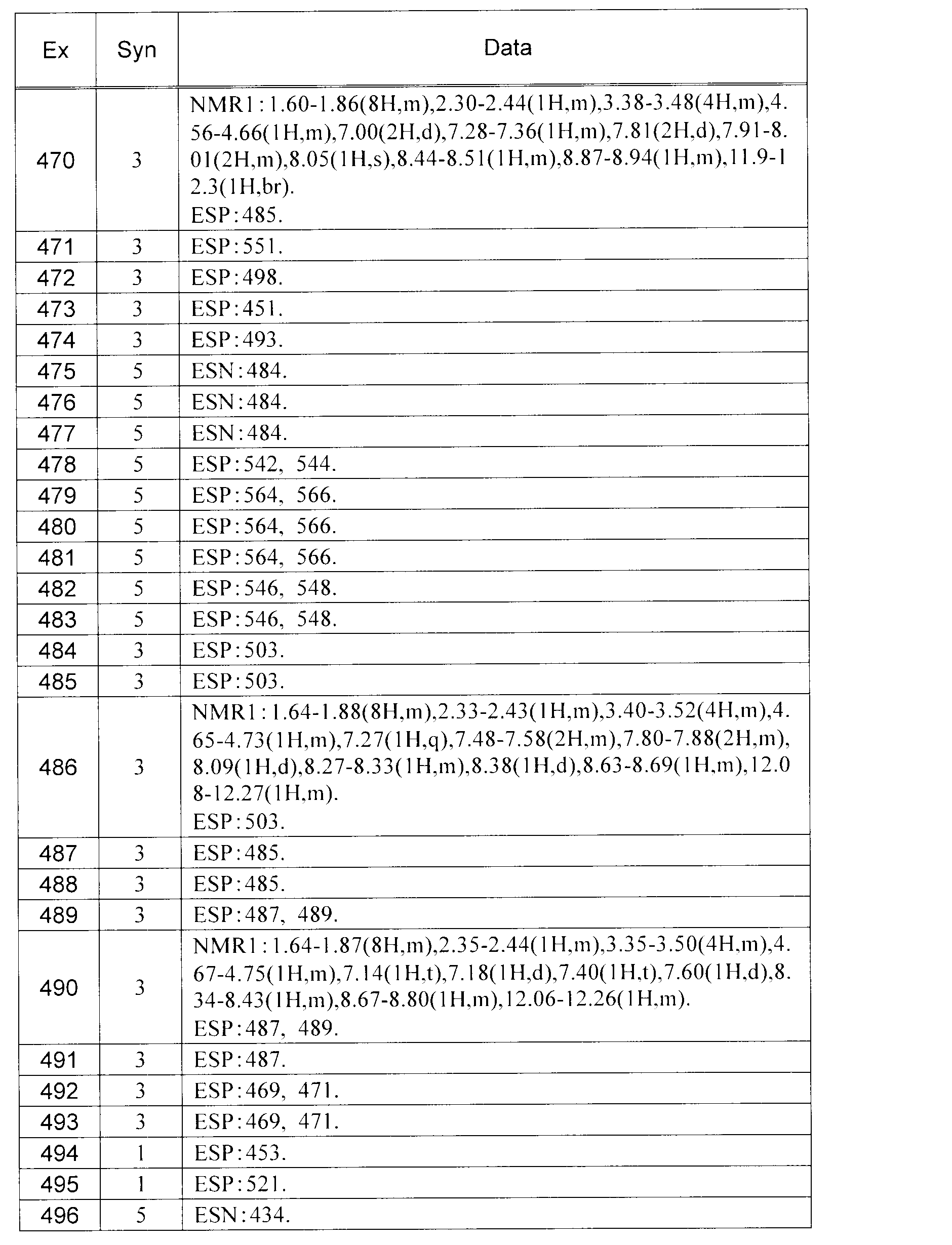
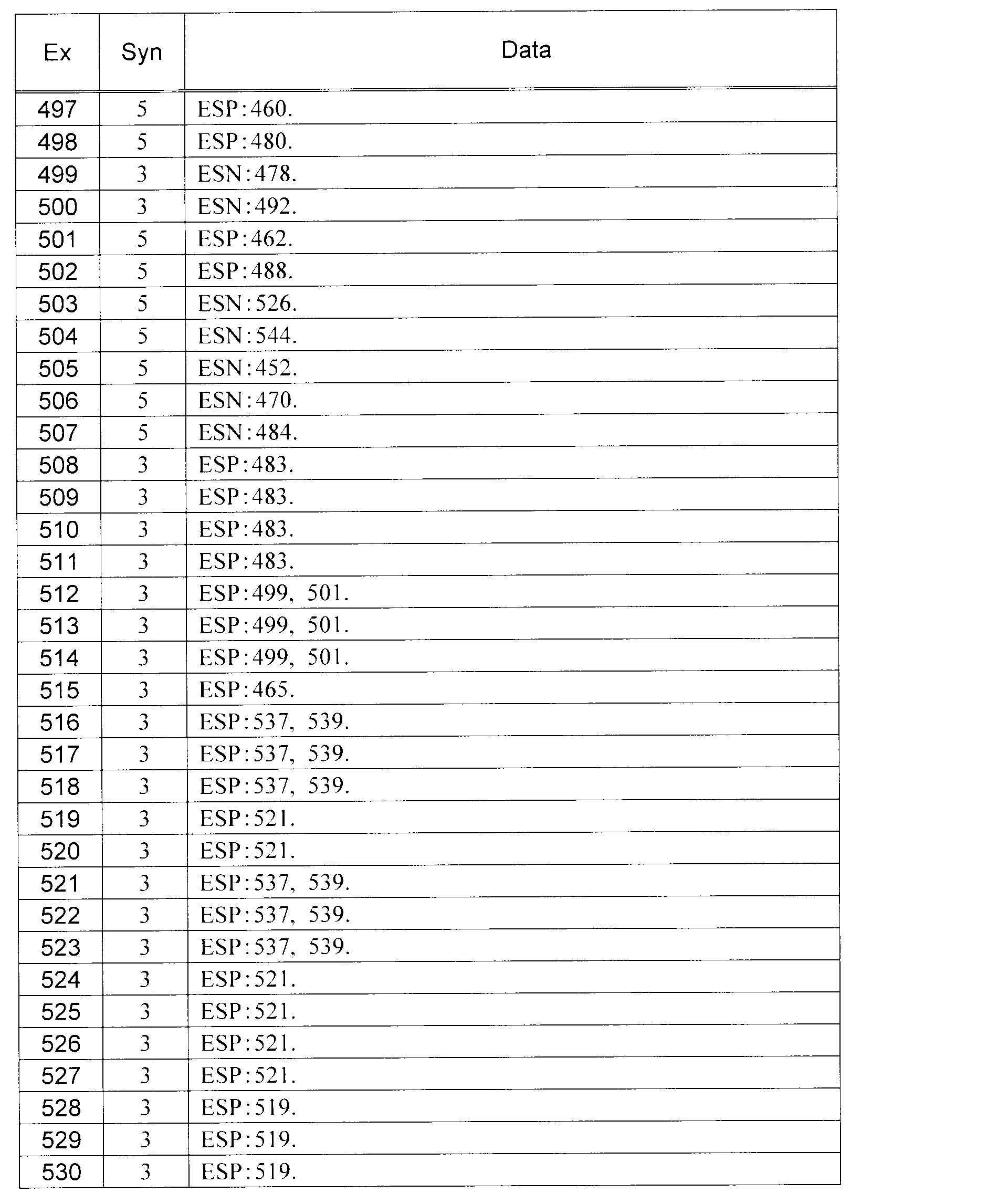
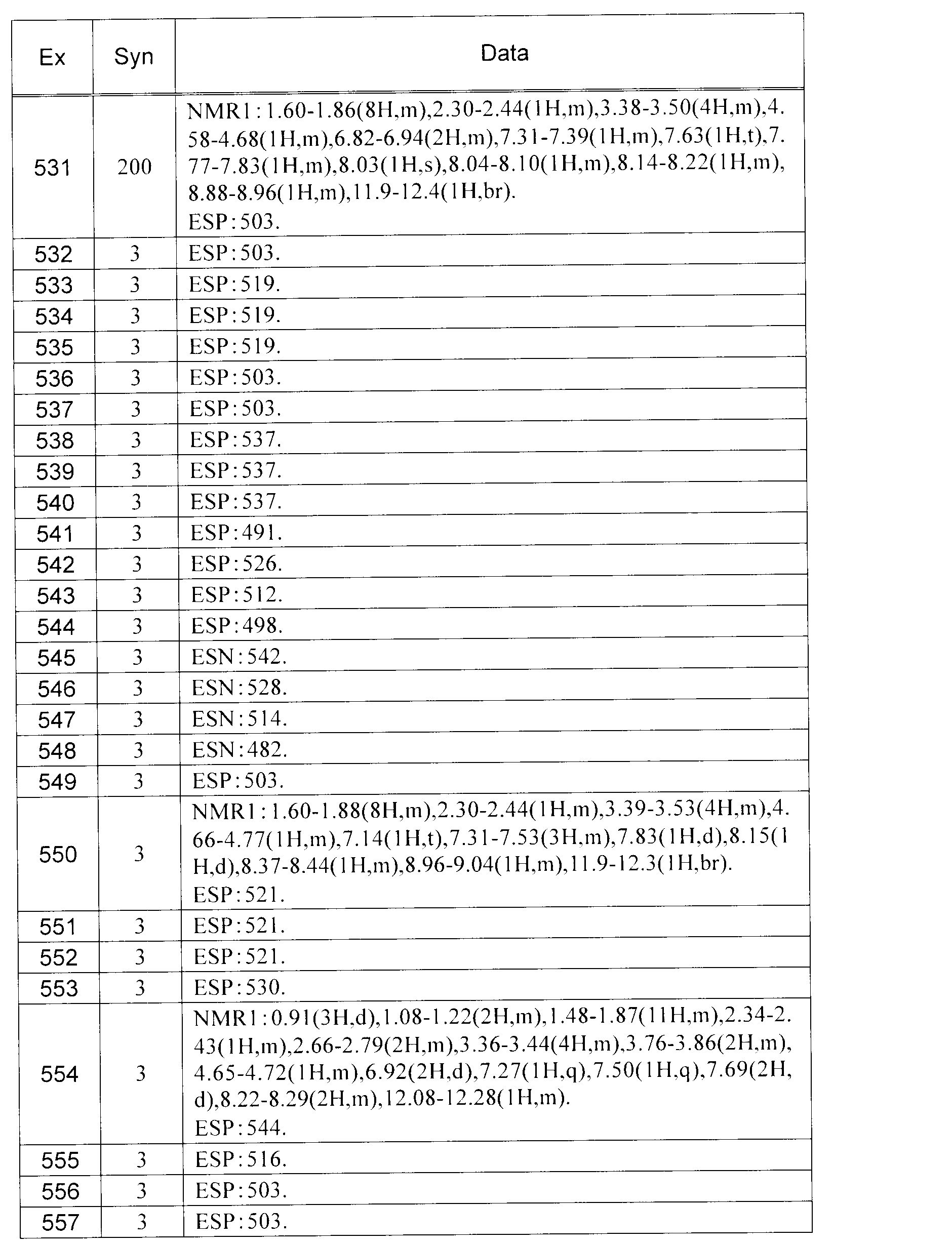


Claims (11)
- 式(I)の化合物又はその塩。

Aは、置換されていてもよいアリール、置換されていてもよいシクロアルキル、置換されていてもよい芳香族ヘテロ環、置換されていてもよい非芳香族ヘテロ環、又は式(II)で示される基であり、

ここで、R11とR12は結合している窒素原子と共に一体となって置換されていてもよい環状アミノを形成してもよく、
環B1は、-OH、1つ以上のハロゲンで置換されていてもよいC1-6アルキル、1つ以上のハロゲンで置換されていてもよい-O-C1-6アルキル、C3-8シクロアルキル及びハロゲンからなる群より選択される1つ以上の基でそれぞれ置換されていてもよい、フェニレン、ピリジンジイル、ナフタレンジイル、又は1,2,3,4-テトラヒドロナフタレンジイルであり、
Wは、-O-、結合、-O-C1-6アルキレン、-NH-、又はC1-6アルキレンであり、
環B2は、C1-6アルキルでそれぞれ置換されていてもよい、シクロヘキサンジイル、シクロペンタンジイル、又は架橋環であって、Wが結合である場合、ピペリジンジイル、若しくは8-アザビシクロ[3.2.1]オクタンジイルであってもよく、
Yは、結合、C1-6アルキレン、又は-O-C1-6アルキレンであり、
Zは、-CO2H若しくはその生物学的等価体;C1-6アルキル(当該C1-6アルキルはアミノ若しくはカルボキシルで置換されていてもよい)、フェニル及びベンジルからなる群より選択される1つ若しくは2つの基で置換されていてもよいカルバモイル;-CO-(1つ若しくは2つのC1-6アルキルで置換されていてもよい環状アミノ);-OH;1つ若しくは2つのC1-6アルキルで置換されていてもよいアミノ;-NH-C(=O)-C1-6アルキル;又は、-NH-C(=O)-C3-8シクロアルキルである。) - Aが置換されていてもよいアリール、置換されていてもよいシクロアルキル、置換されていてもよい芳香族ヘテロ環、置換されていてもよい非芳香族ヘテロ環、又は式(II)で示される基であり、R11及びR12が同一又は異なって、-H、置換されていてもよいアリール、置換されていてもよいC3-8シクロアルキルであり、但し、R11とR12が同時に-Hとなることはなく、ここで、R11とR12は結合している窒素原子と共に一体となって置換されていてもよい環状アミノを形成してもよく、環B1が式(III)で示される基であり、

- 環B1が1つ以上のハロゲンで置換されていてもよい1,4-フェニレンであり、Wが-O-であり、環B2がシクロヘキサン-1,4-ジイルであり、Yが結合若しくはメチレンであり、Zが-CO2Hである、請求項1に記載の化合物又はその塩。
- 環B1が1つ又は2つのフルオロで置換されていてもよい1,4-フェニレンである、請求項3に記載の化合物又はその塩。
- Yが結合である、請求項4に記載の化合物又はその塩。
- シス-4-[4-({2-[(4-シクロプロピルベンゾイル)アミノ]エチル}カルバモイル)フェノキシ]シクロヘキサンカルボン酸、
シス-4-(4-{[2-(2-ナフトイルアミノ)エチル]カルバモイル}フェノキシ)シクロヘキサンカルボン酸、
シス-4-[4-({2-[(4-クロロ-3-メチルベンゾイル)アミノ]エチル}カルバモイル)フェノキシ]シクロヘキサンカルボン酸、
シス-4-(3-フルオロ-4-{[2-(2-ナフトイルアミノ)エチル]カルバモイル}フェノキシ)シクロヘキサンカルボン酸、
シス-4-(3,5-ジフルオロ-4-{[2-(2-ナフトイルアミノ)エチル]カルバモイル}フェノキシ)シクロヘキサンカルボン酸、
シス-4-(2,3-ジフルオロ-4-{[2-(2-ナフトイルアミノ)エチル]カルバモイル}フェノキシ)シクロヘキサンカルボン酸、
シス-4-(2,5-ジフルオロ-4-{[2-(2-ナフトイルアミノ)エチル]カルバモイル}フェノキシ)シクロヘキサンカルボン酸、
シス-4-{4-[(2-{[(3-クロロ-1-ベンゾチオフェン-2-イル)カルボニル]アミノ}エチル)カルバモイル]フェノキシ}シクロヘキサンカルボン酸、
シス-4-{4-[(2-{[(5-クロロチオフェン-2-イル)カルボニル]アミノ}エチル)カルバモイル]-2,3-ジフルオロフェノキシ}シクロヘキサンカルボン酸、
シス-4-{3-フルオロ-4-[(2-{[(5-フルオロ-1-ベンゾチオフェン-2-イル)カルボニル]アミノ}エチル)カルバモイル]フェノキシ}シクロヘキサンカルボン酸、若しくは、
[シス-4-(2,5-ジフルオロ-4-{[2-(2-ナフトイルアミノ)エチル]カルバモイル}フェノキシ)シクロヘキシル]酢酸、又はその塩である、請求項1に記載の化合物又はその塩。 - 請求項1に記載の化合物又はその塩、及び製薬学的に許容される賦形剤を含有する医薬組成物。
- 請求項1に記載の化合物又はその塩を含有する肥満の予防又は治療用医薬組成物。
- 肥満の予防又は治療用医薬組成物の製造のための、請求項1に記載の化合物又はその塩の使用。
- 肥満の予防又は治療に使用するための、請求項1に記載の化合物又はその塩。
- 請求項1に記載の化合物又はその塩の有効量を対象に投与することからなる、肥満の予防若しくは治療方法。
Priority Applications (7)
| Application Number | Priority Date | Filing Date | Title |
|---|---|---|---|
| BRPI1013868A BRPI1013868A2 (pt) | 2009-04-21 | 2010-04-19 | composto diaciletilenodiamina |
| US13/263,258 US20120046292A1 (en) | 2009-04-21 | 2010-04-19 | Diacylethylenediamine compound |
| CN2010800174268A CN102405209A (zh) | 2009-04-21 | 2010-04-19 | 二酰基乙二胺化合物 |
| CA2759264A CA2759264A1 (en) | 2009-04-21 | 2010-04-19 | Diacylethylenediamine compound |
| EP10767025A EP2423182A4 (en) | 2009-04-21 | 2010-04-19 | DIACYLETHYLENEDIAMINE COMPOUND |
| JP2011510309A JPWO2010122968A1 (ja) | 2009-04-21 | 2010-04-19 | ジアシルエチレンジアミン化合物 |
| MX2011011178A MX2011011178A (es) | 2009-04-21 | 2010-04-19 | Compuesto de diaciletilendiamina. |
Applications Claiming Priority (4)
| Application Number | Priority Date | Filing Date | Title |
|---|---|---|---|
| JP2009-102832 | 2009-04-21 | ||
| JP2009102832 | 2009-04-21 | ||
| JP2009-246264 | 2009-10-27 | ||
| JP2009246264 | 2009-10-27 |
Publications (1)
| Publication Number | Publication Date |
|---|---|
| WO2010122968A1 true WO2010122968A1 (ja) | 2010-10-28 |
Family
ID=43011085
Family Applications (1)
| Application Number | Title | Priority Date | Filing Date |
|---|---|---|---|
| PCT/JP2010/056901 Ceased WO2010122968A1 (ja) | 2009-04-21 | 2010-04-19 | ジアシルエチレンジアミン化合物 |
Country Status (10)
| Country | Link |
|---|---|
| US (1) | US20120046292A1 (ja) |
| EP (1) | EP2423182A4 (ja) |
| JP (1) | JPWO2010122968A1 (ja) |
| KR (1) | KR20120006014A (ja) |
| CN (1) | CN102405209A (ja) |
| BR (1) | BRPI1013868A2 (ja) |
| CA (1) | CA2759264A1 (ja) |
| MX (1) | MX2011011178A (ja) |
| TW (1) | TW201039814A (ja) |
| WO (1) | WO2010122968A1 (ja) |
Cited By (8)
| Publication number | Priority date | Publication date | Assignee | Title |
|---|---|---|---|---|
| CN102617339A (zh) * | 2012-03-05 | 2012-08-01 | 山西仟源制药股份有限公司 | 3-环丙基甲氧基-4-卤代苯甲酸或其衍生物及应用 |
| JP2012528836A (ja) * | 2009-06-04 | 2012-11-15 | ラボラトリオス・サルヴァト・ソシエダッド・アノニマ | 11−β−ヒドロキシステロイドデヒドロゲナーゼ1型の阻害化合物 |
| WO2013102195A1 (en) * | 2011-12-30 | 2013-07-04 | Reviva Pharmaceuticals, Inc. | Compositions, synthesis, and methods of using phenylcycloalkylmethylamine derivatives |
| JP2015520136A (ja) * | 2012-04-25 | 2015-07-16 | コリア リサーチ インスティチュート オブ ケミカル テクノロジーKorea Research Institute Of Chemicaltechnology | 新規なベータアラニン誘導体、薬学的に許容される塩、及びそれを有効成分として含有する医薬組成物 |
| US9296681B2 (en) | 2006-09-15 | 2016-03-29 | Reviva Pharmaceuticals, Inc. | Cycloalkylmethylamines |
| US9302981B2 (en) | 2006-09-15 | 2016-04-05 | Reviva Pharmaceuticals, Inc. | Synthesis, methods of using, and compositions of cycloalkylmethylamines |
| US9302989B2 (en) | 2010-11-15 | 2016-04-05 | Abbvie Inc. | NAMPT and rock inhibitors |
| JP2016216433A (ja) * | 2015-05-15 | 2016-12-22 | Dic株式会社 | カルボン酸化合物、その製造方法、その化合物を使用した液晶組成物 |
Families Citing this family (15)
| Publication number | Priority date | Publication date | Assignee | Title |
|---|---|---|---|---|
| CN104610187B (zh) * | 2015-02-10 | 2016-04-06 | 佛山市赛维斯医药科技有限公司 | 一类含脒结构的烷氧苯基噻唑羧酸酰胺类双靶点抑制剂、其制备方法及用途 |
| CN104592148A (zh) * | 2015-02-10 | 2015-05-06 | 佛山市赛维斯医药科技有限公司 | 一类含环丙基脒结构的硝基苯噻唑羧酸酰胺类化合物及用途 |
| CN104592151A (zh) * | 2015-02-10 | 2015-05-06 | 佛山市赛维斯医药科技有限公司 | 一类含叔丁基脒结构sglt2/sglt1双靶点抑制剂及用途 |
| CN104672166A (zh) * | 2015-02-10 | 2015-06-03 | 佛山市赛维斯医药科技有限公司 | 一种含脒结构的腈基苯基噻唑羧酸酰胺类双靶点抑制剂、其制备方法及用途 |
| CN104610189A (zh) * | 2015-02-10 | 2015-05-13 | 佛山市赛维斯医药科技有限公司 | 一类含环丙基脒结构sglt2/sglt1双靶点抑制剂及用途 |
| CN104592150A (zh) * | 2015-02-10 | 2015-05-06 | 佛山市赛维斯医药科技有限公司 | 一类含环丙基脒结构的腈基苯噻唑羧酸酰胺类化合物及用途 |
| CN104557765A (zh) * | 2015-02-10 | 2015-04-29 | 佛山市赛维斯医药科技有限公司 | 一类含脒结构的卤代苯基噻唑羧酸酰胺类双靶点抑制剂、其制备方法及用途 |
| CN104557766A (zh) * | 2015-02-10 | 2015-04-29 | 佛山市赛维斯医药科技有限公司 | 一类含叔丁基脒结构的硝基苯噻唑羧酸酰胺类化合物及用途 |
| CN104672164A (zh) * | 2015-02-10 | 2015-06-03 | 佛山市赛维斯医药科技有限公司 | 一类含苯基脒结构的sglt2/sglt1双靶点抑制剂、其制备方法及用途 |
| CN104592149A (zh) * | 2015-02-10 | 2015-05-06 | 佛山市赛维斯医药科技有限公司 | 一类含叔丁基脒结构的烷氧苯基噻唑羧酸酰胺类双靶点抑制剂、其制备方法及用途 |
| CN104592152A (zh) * | 2015-02-10 | 2015-05-06 | 佛山市赛维斯医药科技有限公司 | 一种含脒结构的硝基苯基噻唑羧酸酰胺类双靶点抑制剂、其制备方法及用途 |
| JP2020506895A (ja) | 2017-01-17 | 2020-03-05 | ボード オブ レジェンツ, ザ ユニバーシティ オブ テキサス システムBoard Of Regents, The University Of Texas System | インドールアミン2,3−ジオキシゲナーゼおよび/またはトリプトファンジオキシゲナーゼの阻害剤として有用な化合物 |
| WO2020018670A1 (en) | 2018-07-17 | 2020-01-23 | Board Of Regents, The University Of Texas System | Compounds useful as inhibitors of indoleamine 2,3-dioxygenase and/or tryptophan dioxygenase |
| CN117069673B (zh) * | 2022-05-16 | 2025-09-05 | 沈阳化工大学 | 一种噁二唑类化合物及其用途 |
| CN115160341B (zh) * | 2022-07-18 | 2023-07-18 | 中国医学科学院医学实验动物研究所 | 苯并噁嗪类化合物及其药物用途 |
Citations (10)
| Publication number | Priority date | Publication date | Assignee | Title |
|---|---|---|---|---|
| JPH0377881A (ja) * | 1989-08-21 | 1991-04-03 | Yoshitomi Pharmaceut Ind Ltd | ニコチン酸アミド化合物 |
| WO2006064189A1 (en) | 2004-12-14 | 2006-06-22 | Astrazeneca Ab | Oxadiazole derivatives as dgat inhibitors |
| WO2006082952A1 (ja) | 2005-02-01 | 2006-08-10 | Takeda Pharmaceutical Company Limited | アミド化合物 |
| WO2007115935A1 (en) | 2006-04-07 | 2007-10-18 | High Point Pharmaceuticals, Llc | 11β-HYDROXYSTEROID DEHYDROGENASE TYPE 1 ACTIVE COMPOUNDS |
| WO2007138311A1 (en) | 2006-05-30 | 2007-12-06 | Astrazeneca Ab | Substituted 5- phenylamino- 1, 3, 4-oxadiaz0l-2-ylcarbonylamino-4-phenoxy-cyclohexane carboxylic acid as inhibitors of acetyl coenzyme a diacylglycerol acyltransferase |
| WO2007138304A1 (en) | 2006-05-30 | 2007-12-06 | Astrazeneca Ab | 1, 3, 4 -oxadiazole derivatives as dgat1 inhibitors |
| WO2007141517A1 (en) | 2006-06-08 | 2007-12-13 | Astrazeneca Ab | Benzimidazoles and their use for the treatemnt of diabetes |
| WO2008011131A2 (en) | 2006-07-21 | 2008-01-24 | Takeda Pharmaceutical Company Limited | Amide compounds |
| WO2008011130A2 (en) | 2006-07-21 | 2008-01-24 | Takeda Pharmaceutical Company Limited | Amide compounds |
| WO2009076618A2 (en) | 2007-12-12 | 2009-06-18 | Cernofina, Llc | Generation of combinatorial synthetic libraries and screening for novel proadhesins and nonadhesins |
-
2010
- 2010-04-19 BR BRPI1013868A patent/BRPI1013868A2/pt not_active Application Discontinuation
- 2010-04-19 CA CA2759264A patent/CA2759264A1/en not_active Abandoned
- 2010-04-19 JP JP2011510309A patent/JPWO2010122968A1/ja not_active Withdrawn
- 2010-04-19 US US13/263,258 patent/US20120046292A1/en not_active Abandoned
- 2010-04-19 KR KR1020117022962A patent/KR20120006014A/ko not_active Withdrawn
- 2010-04-19 WO PCT/JP2010/056901 patent/WO2010122968A1/ja not_active Ceased
- 2010-04-19 MX MX2011011178A patent/MX2011011178A/es not_active Application Discontinuation
- 2010-04-19 EP EP10767025A patent/EP2423182A4/en not_active Withdrawn
- 2010-04-19 CN CN2010800174268A patent/CN102405209A/zh active Pending
- 2010-04-21 TW TW099112479A patent/TW201039814A/zh unknown
Patent Citations (10)
| Publication number | Priority date | Publication date | Assignee | Title |
|---|---|---|---|---|
| JPH0377881A (ja) * | 1989-08-21 | 1991-04-03 | Yoshitomi Pharmaceut Ind Ltd | ニコチン酸アミド化合物 |
| WO2006064189A1 (en) | 2004-12-14 | 2006-06-22 | Astrazeneca Ab | Oxadiazole derivatives as dgat inhibitors |
| WO2006082952A1 (ja) | 2005-02-01 | 2006-08-10 | Takeda Pharmaceutical Company Limited | アミド化合物 |
| WO2007115935A1 (en) | 2006-04-07 | 2007-10-18 | High Point Pharmaceuticals, Llc | 11β-HYDROXYSTEROID DEHYDROGENASE TYPE 1 ACTIVE COMPOUNDS |
| WO2007138311A1 (en) | 2006-05-30 | 2007-12-06 | Astrazeneca Ab | Substituted 5- phenylamino- 1, 3, 4-oxadiaz0l-2-ylcarbonylamino-4-phenoxy-cyclohexane carboxylic acid as inhibitors of acetyl coenzyme a diacylglycerol acyltransferase |
| WO2007138304A1 (en) | 2006-05-30 | 2007-12-06 | Astrazeneca Ab | 1, 3, 4 -oxadiazole derivatives as dgat1 inhibitors |
| WO2007141517A1 (en) | 2006-06-08 | 2007-12-13 | Astrazeneca Ab | Benzimidazoles and their use for the treatemnt of diabetes |
| WO2008011131A2 (en) | 2006-07-21 | 2008-01-24 | Takeda Pharmaceutical Company Limited | Amide compounds |
| WO2008011130A2 (en) | 2006-07-21 | 2008-01-24 | Takeda Pharmaceutical Company Limited | Amide compounds |
| WO2009076618A2 (en) | 2007-12-12 | 2009-06-18 | Cernofina, Llc | Generation of combinatorial synthetic libraries and screening for novel proadhesins and nonadhesins |
Non-Patent Citations (12)
| Title |
|---|
| "Drug Design", vol. 7, 1990, HIROKAWA PUBLISHING COMPANY, article "Pharmaceutical Research and Development", pages: 163 - 198 |
| "Greene's Protective Groups in Organic Synthesis", 2006 |
| ARTERIOSCLER. THROMB. VASE. BIOL., vol. 25, 2005, pages 482 - 486 |
| CHEMICAL RESEARCH IN CHINESE UNIVERSITIES, vol. 25, no. 2, 2009, pages 178 - 182 |
| J. BIOL. CHEM., vol. 276, 2001, pages 38870 - 38876 |
| J. CLIN. INVEST., vol. 109, 2002, pages 1049 - 1055 |
| JOURNAL OF MEDICINAL CHEMISTRY, vol. 36, no. 24, 1993, pages 3968 - 3970 |
| NATURE GENETICS, vol. 25, 2000, pages 87 - 90 |
| P. G. M. WUTS; T. W. GREENE: "Greene's Protective Groups in Organic Synthesis", 2006 |
| PROC. NAT. ACAD. SCI., vol. 95, 1998, pages 13018 - 13023 |
| PROG. MED., vol. 5, 1985, pages 2157 - 2161 |
| See also references of EP2423182A4 * |
Cited By (15)
| Publication number | Priority date | Publication date | Assignee | Title |
|---|---|---|---|---|
| US9296681B2 (en) | 2006-09-15 | 2016-03-29 | Reviva Pharmaceuticals, Inc. | Cycloalkylmethylamines |
| US9302981B2 (en) | 2006-09-15 | 2016-04-05 | Reviva Pharmaceuticals, Inc. | Synthesis, methods of using, and compositions of cycloalkylmethylamines |
| JP2012528836A (ja) * | 2009-06-04 | 2012-11-15 | ラボラトリオス・サルヴァト・ソシエダッド・アノニマ | 11−β−ヒドロキシステロイドデヒドロゲナーゼ1型の阻害化合物 |
| US10093624B2 (en) | 2010-11-15 | 2018-10-09 | Abbvie Inc. | NAMPT and ROCK inhibitors |
| US9302989B2 (en) | 2010-11-15 | 2016-04-05 | Abbvie Inc. | NAMPT and rock inhibitors |
| CN104039753A (zh) * | 2011-12-30 | 2014-09-10 | 雷维瓦药品公司 | 苯基环烷基甲胺衍生物的组合物、合成以及使用方法 |
| US9238625B2 (en) | 2011-12-30 | 2016-01-19 | Reviva Pharmaceuticals, Inc. | Compositions, synthesis, and methods of using phenylcycloalkylmethylamine derivatives |
| CN104039753B (zh) * | 2011-12-30 | 2016-09-14 | 雷维瓦药品公司 | 苯基环烷基甲胺衍生物的组合物、合成以及使用方法 |
| US9695116B2 (en) | 2011-12-30 | 2017-07-04 | Reviva Pharmaceuticals, Inc. | Compositions, synthesis, and methods of using phenylcycloalkylmethylamine derivatives |
| RU2642074C2 (ru) * | 2011-12-30 | 2018-01-24 | Ревива Фармасьютикалс, Инк. | Композиции, синтез и способы применения производных фенилциклоалкилметиламина |
| US10035761B2 (en) | 2011-12-30 | 2018-07-31 | Revivia Pharmaceuticals, Inc. | Compositions, synthesis, and methods of using phenylcycloalkylmethylamine derivatives |
| WO2013102195A1 (en) * | 2011-12-30 | 2013-07-04 | Reviva Pharmaceuticals, Inc. | Compositions, synthesis, and methods of using phenylcycloalkylmethylamine derivatives |
| CN102617339A (zh) * | 2012-03-05 | 2012-08-01 | 山西仟源制药股份有限公司 | 3-环丙基甲氧基-4-卤代苯甲酸或其衍生物及应用 |
| JP2015520136A (ja) * | 2012-04-25 | 2015-07-16 | コリア リサーチ インスティチュート オブ ケミカル テクノロジーKorea Research Institute Of Chemicaltechnology | 新規なベータアラニン誘導体、薬学的に許容される塩、及びそれを有効成分として含有する医薬組成物 |
| JP2016216433A (ja) * | 2015-05-15 | 2016-12-22 | Dic株式会社 | カルボン酸化合物、その製造方法、その化合物を使用した液晶組成物 |
Also Published As
| Publication number | Publication date |
|---|---|
| KR20120006014A (ko) | 2012-01-17 |
| US20120046292A1 (en) | 2012-02-23 |
| MX2011011178A (es) | 2011-12-06 |
| CA2759264A1 (en) | 2010-10-28 |
| TW201039814A (en) | 2010-11-16 |
| CN102405209A (zh) | 2012-04-04 |
| BRPI1013868A2 (pt) | 2016-04-05 |
| EP2423182A4 (en) | 2012-11-07 |
| JPWO2010122968A1 (ja) | 2012-10-25 |
| EP2423182A1 (en) | 2012-02-29 |
Similar Documents
| Publication | Publication Date | Title |
|---|---|---|
| JPWO2010122968A1 (ja) | ジアシルエチレンジアミン化合物 | |
| RU2128644C1 (ru) | Производные антраниловой кислоты или их фармакологически приемлемые соли, промежуточные продукты для их получения и лекарственный препарат на их основе | |
| CA2896554C (en) | Novel antiviral agents against hbv infection | |
| AU2013226013B2 (en) | Inhibitors of Hepatitis B Virus Covalently Closed Circular DNA Formation and Their Method of Use | |
| US9708267B2 (en) | Activators of human pyruvate kinase | |
| JP6014154B2 (ja) | ベンゼンスルホンアミド化合物および治療剤としてのそれらの使用 | |
| JP5309991B2 (ja) | オキサジアゾリジンジオン化合物 | |
| JP5617919B2 (ja) | テトラヒドロベンゾチオフェン化合物 | |
| JP5640983B2 (ja) | グリシン化合物 | |
| US8367702B2 (en) | Quinolone derivative | |
| WO2010123017A1 (ja) | テトラゾール化合物 | |
| JP2007261945A (ja) | チアゾール誘導体 | |
| JP6319436B2 (ja) | 2−アシルアミノチアゾール誘導体またはその塩 | |
| WO2006012227A2 (en) | Amido compounds and their use as pharmaceuticals | |
| JP2013047189A (ja) | 新規パラバン酸誘導体及びそれらを有効成分とする医薬 | |
| BR112012011427B1 (pt) | moduladores seletivos de receptor de esfingosina 1 fosfato, seu uso, e composição | |
| JP2010132590A (ja) | オキサジアゾール化合物 | |
| US8791106B2 (en) | Fused ring pyridine compound | |
| WO1999027965A1 (en) | Antihyperlipemic agents | |
| JP2011088826A (ja) | 芳香族カルボン酸化合物 | |
| WO2010090304A1 (ja) | アシルグアニジン誘導体 | |
| JPWO2006070878A1 (ja) | カルボン酸誘導体またはその塩 | |
| WO2014092514A1 (ko) | 신규한 화합물, 이의 약학적으로 허용가능한 염 또는 이의 광학 이성질체, 이의 제조방법 및 이를 유효성분으로 함유하는 바이러스성 질환의 예방 또는 치료용 약학적 조성물 | |
| JP6314978B2 (ja) | ベンゾチオフェン化合物 | |
| ES2575370T3 (es) | Derivados de 5-carbamoil-adamantan-2-il amida, sales farmacéuticamente aceptables de los mismos y procesos de preparación de los mismos |
Legal Events
| Date | Code | Title | Description |
|---|---|---|---|
| WWE | Wipo information: entry into national phase |
Ref document number: 201080017426.8 Country of ref document: CN |
|
| 121 | Ep: the epo has been informed by wipo that ep was designated in this application |
Ref document number: 10767025 Country of ref document: EP Kind code of ref document: A1 |
|
| WWE | Wipo information: entry into national phase |
Ref document number: 2011510309 Country of ref document: JP |
|
| ENP | Entry into the national phase |
Ref document number: 20117022962 Country of ref document: KR Kind code of ref document: A |
|
| WWE | Wipo information: entry into national phase |
Ref document number: 13263258 Country of ref document: US |
|
| WWE | Wipo information: entry into national phase |
Ref document number: 2759264 Country of ref document: CA |
|
| WWE | Wipo information: entry into national phase |
Ref document number: 7651/CHENP/2011 Country of ref document: IN |
|
| NENP | Non-entry into the national phase |
Ref country code: DE |
|
| WWE | Wipo information: entry into national phase |
Ref document number: MX/A/2011/011178 Country of ref document: MX |
|
| WWE | Wipo information: entry into national phase |
Ref document number: 2010767025 Country of ref document: EP |
|
| REG | Reference to national code |
Ref country code: BR Ref legal event code: B01A Ref document number: PI1013868 Country of ref document: BR |
|
| ENP | Entry into the national phase |
Ref document number: PI1013868 Country of ref document: BR Kind code of ref document: A2 Effective date: 20111020 |