WO2010131585A1 - 有機溶媒の精製方法 - Google Patents
有機溶媒の精製方法 Download PDFInfo
- Publication number
- WO2010131585A1 WO2010131585A1 PCT/JP2010/057663 JP2010057663W WO2010131585A1 WO 2010131585 A1 WO2010131585 A1 WO 2010131585A1 JP 2010057663 W JP2010057663 W JP 2010057663W WO 2010131585 A1 WO2010131585 A1 WO 2010131585A1
- Authority
- WO
- WIPO (PCT)
- Prior art keywords
- raw material
- zeolite
- ozone
- ozone gas
- treatment
- Prior art date
- Legal status (The legal status is an assumption and is not a legal conclusion. Google has not performed a legal analysis and makes no representation as to the accuracy of the status listed.)
- Ceased
Links
Images

Classifications
-
- C—CHEMISTRY; METALLURGY
- C07—ORGANIC CHEMISTRY
- C07C—ACYCLIC OR CARBOCYCLIC COMPOUNDS
- C07C7/00—Purification; Separation; Use of additives
- C07C7/148—Purification; Separation; Use of additives by treatment giving rise to a chemical modification of at least one compound
- C07C7/14808—Purification; Separation; Use of additives by treatment giving rise to a chemical modification of at least one compound with non-metals as element
- C07C7/14816—Purification; Separation; Use of additives by treatment giving rise to a chemical modification of at least one compound with non-metals as element oxygen; ozone
-
- C—CHEMISTRY; METALLURGY
- C07—ORGANIC CHEMISTRY
- C07C—ACYCLIC OR CARBOCYCLIC COMPOUNDS
- C07C17/00—Preparation of halogenated hydrocarbons
- C07C17/38—Separation; Purification; Stabilisation; Use of additives
- C07C17/389—Separation; Purification; Stabilisation; Use of additives by adsorption on solids
-
- C—CHEMISTRY; METALLURGY
- C07—ORGANIC CHEMISTRY
- C07C—ACYCLIC OR CARBOCYCLIC COMPOUNDS
- C07C17/00—Preparation of halogenated hydrocarbons
- C07C17/38—Separation; Purification; Stabilisation; Use of additives
- C07C17/395—Separation; Purification; Stabilisation; Use of additives by treatment giving rise to a chemical modification of at least one compound
-
- C—CHEMISTRY; METALLURGY
- C07—ORGANIC CHEMISTRY
- C07C—ACYCLIC OR CARBOCYCLIC COMPOUNDS
- C07C7/00—Purification; Separation; Use of additives
- C07C7/005—Processes comprising at least two steps in series
-
- C—CHEMISTRY; METALLURGY
- C07—ORGANIC CHEMISTRY
- C07C—ACYCLIC OR CARBOCYCLIC COMPOUNDS
- C07C7/00—Purification; Separation; Use of additives
- C07C7/12—Purification; Separation; Use of additives by adsorption, i.e. purification or separation of hydrocarbons with the aid of solids, e.g. with ion-exchangers
- C07C7/13—Purification; Separation; Use of additives by adsorption, i.e. purification or separation of hydrocarbons with the aid of solids, e.g. with ion-exchangers by molecular-sieve technique
-
- C—CHEMISTRY; METALLURGY
- C10—PETROLEUM, GAS OR COKE INDUSTRIES; TECHNICAL GASES CONTAINING CARBON MONOXIDE; FUELS; LUBRICANTS; PEAT
- C10G—CRACKING HYDROCARBON OILS; PRODUCTION OF LIQUID HYDROCARBON MIXTURES, e.g. BY DESTRUCTIVE HYDROGENATION, OLIGOMERISATION, POLYMERISATION; RECOVERY OF HYDROCARBON OILS FROM OIL-SHALE, OIL-SAND, OR GASES; REFINING MIXTURES MAINLY CONSISTING OF HYDROCARBONS; REFORMING OF NAPHTHA; MINERAL WAXES
- C10G2300/00—Aspects relating to hydrocarbon processing covered by groups C10G1/00 - C10G99/00
- C10G2300/20—Characteristics of the feedstock or the products
- C10G2300/201—Impurities
-
- C—CHEMISTRY; METALLURGY
- C10—PETROLEUM, GAS OR COKE INDUSTRIES; TECHNICAL GASES CONTAINING CARBON MONOXIDE; FUELS; LUBRICANTS; PEAT
- C10G—CRACKING HYDROCARBON OILS; PRODUCTION OF LIQUID HYDROCARBON MIXTURES, e.g. BY DESTRUCTIVE HYDROGENATION, OLIGOMERISATION, POLYMERISATION; RECOVERY OF HYDROCARBON OILS FROM OIL-SHALE, OIL-SAND, OR GASES; REFINING MIXTURES MAINLY CONSISTING OF HYDROCARBONS; REFORMING OF NAPHTHA; MINERAL WAXES
- C10G2400/00—Products obtained by processes covered by groups C10G9/00 - C10G69/14
- C10G2400/18—Solvents
Definitions
- the present invention relates to a novel method for purifying an organic solvent.
- An aromatic compound such as trichlorobenzene used as a mobile phase solvent in high performance liquid chromatography (HPLC) is desired to have a high purity that does not contain impurities that affect subsequent measurements.
- aromatic compounds often contain fluorescent impurities such as chlorophenol and dichlorophenol, and conventionally, a treatment for removing the fluorescent material using an adsorbent such as zeolite has been performed.
- this method requires the use of a large amount of zeolite.
- trichlorobenzene may contain harmful substances such as polychlorinated biphenyl (PCB) in addition to fluorescent substances.
- PCB polychlorinated biphenyl
- Distillation is also known as a method for removing impurities such as fluorescent substances from aromatic compounds.
- a complicated operation such as distillation under reduced pressure is required.
- the distillation pot may be contaminated by the compound.
- special equipment is required to carry out the purification method by distillation, and there is a problem in terms of cost performance.
- organic solvents other than aromatic compounds may contain impurities such as fluorescent substances and substances having ultraviolet absorption, and the following purification methods are known.
- a crude acetonitrile obtained by pretreating acetonitrile obtained as a by-product in producing acrylonitrile by reacting propylene or isobutylene in the presence of a catalyst to produce acrylonitrile and further reducing impurities, and a gas containing ozone A method for purifying acetonitrile by contacting and then neutralizing with a basic substance, followed by distillation (Patent Document 3)
- Acetonitrile obtained as a by-product in the production of acrylonitrile by reacting propylene or isobutylene in the presence of a catalyst with sulfuric acid, and then separating sulfuric acid, and then containing ozone-containing gas A method of purifying acetonitrile (Patent Document 4), which is distilled after being contacted, (3) The crude acetonitrile is brought into contact with na
- Patent Document 5 a method for purifying crude acetonitrile, which separates and removes the permanganate-reducing substance produced by the ozone treatment, and further separates and removes low-boiling compounds and high-boiling compounds by distillation or membrane separation.
- the method (2) also requires an operation of further distilling the by-produced crude acetonitrile after contacting it with sulfuric acid and then with ozone.
- the purified by-product cannot be removed only by contacting the ozone-treated crude acetonitrile with a basic substance, an adsorbent or the like. Therefore, a process for separating and removing the permanganate-reducing substance and a process for separating and removing the low boiling point compound and the high boiling point compound by a distillation method or a membrane separation method are required.
- n-heptane is currently purified by treatment with zeolite F-9 column followed by sulfuric acid treatment, after distillation, and further treatment with zeolite F-9 column.
- problems such as complicated operation, generation of a large amount of washing waste liquid, and quality varies from lot to lot.
- each of the conventionally known methods has a problem that a complicated purification process has to be performed, and special equipment is required for purification.
- kerosene is expected to be used as a fuel for household fuel cells.
- commercially available kerosene contains a very small amount of a sulfur compound, which reduces the performance of the fuel cell catalyst. Therefore, a method for efficiently removing sulfur compounds in kerosene is also desired.
- the present invention provides a method for purifying an organic solvent capable of purifying an organic solvent containing impurities such as an ultraviolet absorbing substance, a fluorescent substance, and a sulfur compound with high purity and reducing the amount of zeolite used for the purification. Is to establish.
- the present inventors brought the organic solvent into contact with ozone gas before the treatment with zeolite, which is one of the conventional methods for purifying organic solvents, It has been found that impurities in an organic solvent can be efficiently removed and the amount of zeolite used can be drastically reduced to obtain a high-purity organic solvent, and the present invention has been completed.
- the present invention provides “a compound represented by the following general formula [1] or [2]”.
- R represents a halogen atom or a lower alkyl group having 1 to 3 carbon atoms.
- N represents an integer of 1 to 5)
- P and q each independently represent an integer of 0 to 4, provided that at least one of p and q is not 0).
- impurities contained in a compound selected from saturated aliphatic hydrocarbons having no substituent are removed by a first step of contacting with ozone gas, and then a second step of contacting with a zeolite or a basic adsorbent.
- a method for purifying the compound characterized in that Is.
- an organic solvent containing impurities such as an ultraviolet absorbing substance, a fluorescent substance, and a sulfur compound can be purified with high purity without requiring further distillation operation.
- the amount of zeolite used can be made much smaller than the conventional amount by the purification method of the present invention.
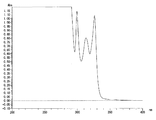
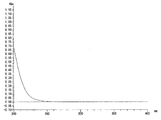
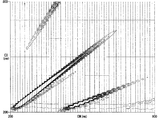
- 9 is an ultraviolet absorption spectrum of simulated kerosene obtained in Example 8. 6 is an ultraviolet absorption spectrum of a refined kerosene product obtained in Example 8. 9 is a three-dimensional fluorescence spectrum of simulated kerosene obtained in Example 8. 9 is a three-dimensional fluorescence spectrum of a refined kerosene product obtained in Example 8.
- the subject of purification in the purification method of the present invention is an organic solvent that does not react with the ozone gas used in the first step and is liquid at room temperature (any temperature between 0 ° C. and 40 ° C.). Specifically, it is a compound represented by the above general formula [1] or general formula [2] according to the present invention and a saturated aliphatic hydrocarbon having no substituent.
- examples of the halogen atom represented by R include a fluorine atom, a chlorine atom, a bromine atom, and an iodine atom.
- examples of the lower alkyl group having 1 to 3 carbon atoms represented by R include a methyl group, an ethyl group, and an n-propyl group.
- Specific examples of the compound represented by the general formula [1] according to the present invention include trichlorobenzene, Examples include chlorobenzene and ethylbenzene. Of these, trichlorobenzene is preferred.
- Specific examples of the compound represented by the general formula [2] according to the present invention include 1-chloronaphthalene, 1-methylnaphthalene, 2-methylnaphthalene and the like. Of these, 1-chloronaphthalene and 1-methylnaphthalene are preferable.
- saturated aliphatic hydrocarbons having no substituent according to the present invention include all those that are liquid at normal temperature (any temperature from 0 ° C. to 40 ° C.), and are linear, branched, cyclic Any of them may be used, and examples thereof include those having 4 to 20 carbon atoms, preferably 4 to 15 carbon atoms, and more preferably 4 to 12 carbon atoms.
- 2,2,4-trimethylpentane, cyclohexane, n-hexane, n-heptane, n-nonane, n-decane and n-undecane are preferred.
- 2,2,4-trimethylpentane or n-heptane is preferred.
- kerosene may be mentioned as an example of the saturated aliphatic hydrocarbon according to the present invention. Kerosene may be anything that is generally sold.
- the main component is a mixture of a plurality of saturated aliphatic hydrocarbons (having about 9 to 15 carbon atoms) described above.
- the first step in the purification method according to the present invention is “contacting the compound represented by the general formula [1] or [2] according to the present invention, a saturated aliphatic hydrocarbon having no substituent or kerosene with ozone gas”.
- Process. for example, an impurity having a double bond is decomposed by contact with ozone gas and converted into a compound that is easily separated and removed in the subsequent steps.
- the “compound represented by the general formula [1] or [2] according to the present invention, a saturated aliphatic hydrocarbon or a kerosene having no substituent” according to the present invention ”attached to the first step is hereinafter referred to as“the raw material according to the present invention. May be written.
- the ozone gas used in the first step may be a pure ozone gas.
- a gas such as nitrogen, argon, helium, carbon dioxide gas or air. You can also.
- the term “ozone gas” may include both pure ozone gas and pure gas and ozone gas diluted with a gas other than ozone as described above.
- Ozone gas is obtained by supplying air, oxygen, or an oxygen-containing gas to an ozone generator.
- the ozone generator is not particularly limited, and one having a preferable specification (size, etc.) may be appropriately selected and used according to the environment in which the first step is performed. Various commercially available ozone generators may be appropriately used. Use it.
- the supply amount of ozone gas to the raw material according to the present invention is equal to or greater than the amount of ozone gas required for the impurities contained in the raw material according to the present invention to disappear to such an extent that they can be completely removed in the next second step. It is hoped that. That is, it is 1 to 5 times, preferably 1.5 to 3 times the amount of ozone gas required for the impurities contained in the raw material according to the present invention to disappear to such an extent that it can be completely removed in the subsequent second step. .
- Whether or not the impurities contained in the raw material according to the present invention have disappeared to such an extent that they can be completely removed in the next second step is determined by, for example, contacting the raw material according to the present invention with ozone gas, This can be determined by analyzing the ozone concentration in the exhaust gas discharged. Specifically, when the ozone concentration in the exhaust gas is 80% or more, preferably 90% or more of the ozone concentration in the gas to be supplied, “a quantity that allows impurities to be completely removed in the second step” It can be judged that it has disappeared.
- the analysis of the ozone concentration in the exhaust gas may be performed by a conventional method such as an iodine titration method, an ultraviolet absorption method, chemiluminescence, or the like. Actually, the analysis may be performed using a continuous analyzer using these methods.
- the raw material according to the present invention is sampled at regular intervals, and the predetermined fluorescence intensity or the absorbance at a predetermined wavelength of the raw material according to the present invention becomes a predetermined value or less. In this case, it can also be determined that “the impurities have disappeared to such an extent that they can be completely removed in the second step”.
- the ozone ventilation rate (as O 3 ) with respect to the raw material according to the present invention differs depending on the raw material according to the present invention.
- the amount is about 0.001 to 1.0 g, preferably about 0.002 to 0.20 g, and about 200 to 200 g, preferably about 0.4 to 40 g as ozone with respect to 200 L of the raw material according to the present invention.
- the concentration of ozone in the ozone gas is 0.01 to 5.0% by volume (about 0.2 to 107.1g / Nm 3 : the amount of ozone (g) in 1m 3 of ozone gas), preferably 0.05 to 2.0% by volume. (About 1.1 to 42.8 g / Nm 3 ). If the ozone concentration is too low, the time required for the contact between the raw material according to the present invention and the ozone gas becomes long, and it is not effective because the reaction vessel becomes large.
- the supply time of the ozone gas may be equal to or longer than “the time required for the impurities contained in the raw material according to the present invention to disappear to such an amount that they can be completely removed in the second step” as described above. Alternatively, it may be not less than “the time required for the predetermined fluorescence intensity or the absorbance at a predetermined wavelength of the raw material according to the present invention to become a predetermined value or less” as described above.
- the temperature when the raw material according to the present invention is brought into contact with ozone gas is about ⁇ 40 to 80 ° C., preferably about 5 to 60 ° C., more preferably about 10 to 40 ° C. If the temperature is too low, there are problems such as a slow reaction rate or precipitation of trace components, and if the temperature is too high, excessive reaction proceeds, which may reduce the yield of the raw material according to the present invention. Therefore, room temperature (20 ° C.) is sufficient.
- the pressure at which the raw material according to the present invention is brought into contact with ozone gas may be any of reduced pressure, normal pressure, and increased pressure, and may be set appropriately according to the supply conditions of ozone gas and the like.
- the method of bringing the raw material according to the present invention into contact with ozone gas may be a batch method (batch method) or a continuous method (distribution method).
- the batch method is preferable in consideration of the convenience of work.
- ozone gas at a predetermined concentration may be continuously vented into a reaction vessel containing an appropriate amount of the raw material according to the present invention while controlling the temperature and pressure as necessary, and reacted for a predetermined time.
- the contact of the raw material according to the present invention with ozone gas in a batch system is preferably performed by supplying the above amount of ozone gas over 1 to 600 minutes, preferably 5 to 300 minutes, more preferably 10 to 120 minutes. If the supply time is too short, there is a problem that the reaction between ozone and impurities is insufficient, or the raw material according to the present invention is scattered due to a large gas flow rate, resulting in a large loss. Further, if the supply time is too long, there is no merit in terms of productivity, and an excessive oxidation reaction proceeds.
- the exhaust gas after ozone gas treatment that has contacted the raw material according to the present invention may be exhausted through an ozone decomposition layer such as activated carbon as appropriate.
- contacting” the raw material according to the present invention with ozone gas may be referred to as “treating” the raw material according to the present invention with ozone gas.
- the second step in the purification method according to the present invention is the raw material according to the present invention that has undergone the first step (hereinafter, sometimes referred to as “the crude product according to the present invention” or simply “the crude product”).
- the crude product according to the present invention or simply “the crude product”.
- a step of contacting with zeolite or a basic adsorbent In this step, one type of zeolite or basic adsorbent may be used, or a plurality of types of zeolite, a plurality of types of basic adsorbent, or one or more types of zeolite and one or more types of basic adsorbents may be used. May be.
- zeolite it is more preferable to use zeolite in terms of easy handling.
- the zeolite according to the present invention used in the second step may be either natural zeolite or synthetic zeolite.
- natural zeolite for example, X-type zeolite, A-type zeolite, Y-type zeolite and the like can be mentioned.
- Zeolite has various commercial products, so it can be used.
- Commercially available zeolites used in the second step include synthetic zeolite F-9 (X-type zeolite), synthetic zeolite A-3 (A-type zeolite), synthetic zeolite A-4 (A-type zeolite), synthetic Zeolite HS-320 (Y-type zeolite), Molecular Sieves 5A (A-type zeolite) (sold by Wako Pure Chemical Industries, Ltd.) and the like. Of these, synthetic zeolite F-9 is preferred.
- the shape of the zeolite used in the present invention may be any of powder, granule, and granule, and may be appropriately selected according to the amount of raw material to be processed, the processing scale, and the like.
- Examples of the basic adsorbent according to the present invention used in the second step include an anion exchange resin, an alkali metal hydroxide, a carbonate or hydrogen carbonate, an alkaline earth metal oxide, a hydroxide, or Examples thereof include a carbonate, a solid base that is a mixture of different metal oxides, and a substance in which an alkali metal or alkaline earth metal compound is supported on a carrier.
- basic adsorbents also have various commercial products, which can be used.
- Examples of commercially available basic adsorbents include basic activated alumina that is also used in affinity chromatography.
- the method for bringing the crude product according to the present invention into contact with zeolite or a basic adsorbent may be a batch method (batch method) or a continuous method (distribution method). In order to carry out industrially, it is preferable to carry out by a continuous system.
- Each method is described as follows, for example.
- (1) Batch method (batch method)
- the crude product obtained in the first step is mixed with the zeolite or basic adsorbent according to the present invention and shaken. By this operation, only impurities in the crude product are adsorbed on the zeolite or the basic adsorbent. Subsequently, if the obtained purified product is separated from the zeolite or the basic adsorbent, only impurities are removed from the purified product, and a purified product can be obtained.
- an appropriate method such as filtration or decantation may be used.
- the crude product may be treated with one kind of zeolite or basic adsorbent, a mixture of plural kinds of zeolite, a mixture of plural kinds of basic adsorbents, or one kind or plural kinds of zeolite and one kind. Or you may process with the mixture of multiple types of basic adsorbents.
- the use amount ratio of the zeolite or basic adsorbent according to the present invention to the crude product is 1: 5 to 1: 10000, preferably 1:10 to 1: 1000. Any degree is acceptable.
- the ratio may be any of a weight ratio (W / W), a capacity ratio (V / V), and a capacity / weight ratio (V / W).
- the amount of zeolite used may be 1 to 5 kg per 200 L of raw material.
- the time for bringing the crude product into contact with the zeolite or the basic adsorbent according to the present invention may be sufficient as long as the impurities in the crude product are adsorbed on the zeolite or the basic adsorbent. For example, 0.1 to 1000 minutes, preferably 1 to 300 minutes.
- a column filled with one kind of zeolite or basic adsorbent may be used, a column in which plural kinds of zeolite are laminated, a column in which plural kinds of basic adsorbent are laminated, or one or more kinds of zeolite. And a column in which one or a plurality of basic adsorbents are stacked can be used.
- the column method may be performed as follows, for example.
- the crude product obtained in the first step is passed through a column (packed tower) packed with the zeolite or basic adsorbent according to the present invention.
- impurities such as ultraviolet absorbing substances, fluorescent substances, sulfur compounds, etc. in the crude product or only oxides thereof are adsorbed on the zeolite or the filler.
- the refined product which does not contain an impurity elutes from a column. What is necessary is just to collect this eluate.
- the size of the column to be used is not particularly limited, and may be appropriately selected according to the amount of the crude product to be processed. What is necessary is just to use the column normally used for the cleanup process of the sample for dioxins analysis, and the sample for PCBs analysis.
- a column having an inner diameter ( ⁇ ) of 5 to 1000 mm, preferably 10 to 600 mm, and a length of 30 to 5000 mm, preferably 100 to 3000 mm can be mentioned.
- the packed tower used in the purification method of the present invention can be obtained by packing the zeolite or basic adsorbent according to the present invention in a column according to a conventional method such as a wet or dry packing method.
- the amount of the zeolite or basic adsorbent according to the present invention to be packed in the column is the same as that in the case of performing batch processing, and the use amount ratio between the zeolite or basic adsorbent according to the present invention and the crude product according to the present invention.
- the ratio may be about 1: 5 to 1: 10000, preferably about 1:10 to 1: 1000.
- the ratio may be any of a weight ratio (W / W), a capacity ratio (V / V), and a capacity / weight ratio (V / W).
- the amount of zeolite used may be 1 to 5 kg per 200 L of raw material.
- the temperature at which the crude product in the second step of the present invention is brought into contact with the zeolite or basic adsorbent according to the present invention is ⁇ 40 to 80 ° C., preferably 5 to 60 ° C., more preferably 10 to 40 ° C. It is.
- the rough purified product according to the present invention is “contacted” with the zeolite or the basic adsorbent according to the present invention, and the crude purified product according to the present invention is referred to as the zeolite or basic adsorbent according to the present invention.
- “treat” with an agent is “treat” with an agent.
- the eluate obtained in the second step is a refined raw material according to the present invention and does not require further treatment such as distillation.
- a raw material of 1,2,4-trichlorobenzene has a high fluorescence intensity at an excitation wavelength of 365 nm according to a fluorescence test and is unsuitable for use as a mobile phase for liquid chromatography.
- zeolite of about 40 to 50 kg per 200 L of the raw material.
- 1,2,4-trichlorobenzene has a problem in that about 0.1 to 0.5 ppm of PCB may be mixed.
- the amount of zeolite required for the subsequent zeolite treatment can be made much smaller by bringing ozone gas into contact with the raw material before the zeolite treatment.
- the purification method of the present invention only requires that the raw material according to the present invention is substantially subjected to treatment with ozone gas and treatment with zeolite or basic adsorbent according to the present invention, and it is necessary to separately carry out purification treatment such as distillation. There is no.
- a purified product suitable for use as a mobile phase for liquid chromatography can be obtained only by the purification method of the present invention.
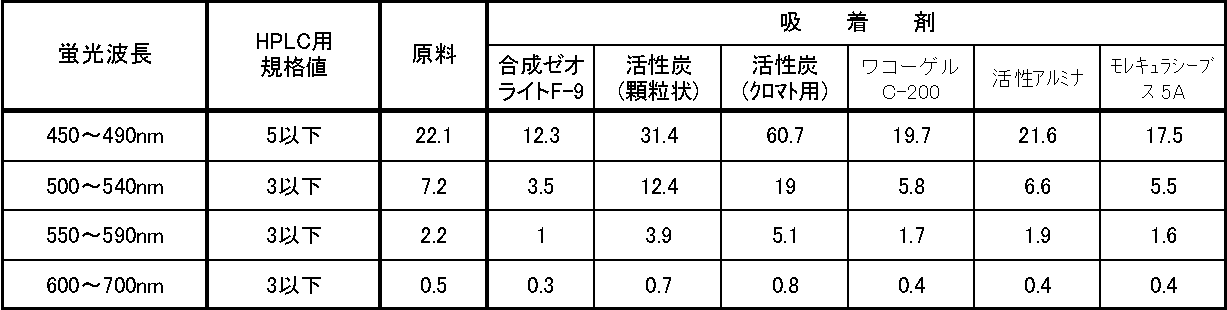
- Results are shown in Table 1 below.
- the numerical values in Table 1 are the values obtained by converting the fluorescence intensity of the raw material treated with each adsorbent at an excitation wavelength of 365 nm and a fluorescence wavelength of 450 to 700 nm into quinine sulfate (10 ⁇ g / L quinine sulfate solution (0.1 N sulfuric acid acid)).
- the value of the fluorescence intensity peak near excitation wavelength 365 nm / fluorescence wavelength 450 nm is a value converted to relative intensity (Relative fluorescence intensity: RFI) as 10 QSU (Quinine sulfate unit).
- the fluorescent material is present in the raw material before the treatment with the adsorbent, and the fluorescence intensity is higher than the standard value of the fluorescent material required for high performance liquid chromatography (HPLC). It was.
- Example 1 A purification method in which ozone gas treatment was added to the treatment method using synthetic zeolite F-9, which was confirmed to have a high fluorescent substance removal effect in Experimental Example 1, was examined.
- Ozone ventilation condition normal pressure
- Ozone gas generation amount 0.3 g / hr
- Gas flow rate 1L / min
- Processing temperature 20 ° C
- Processing time 10min (Ozone aeration rate 0.05g / 100mL raw material)
- the ozone concentration in the ozone gas when aerated is about 0.2335 vol% (about 5 g / Nm 3 ). A portion of the crude product after ozone gas treatment was sampled.
- the absorbance of ultraviolet rays at a wavelength of 200 to 400 nm was also measured using a spectrophotometer (U-3310 manufactured by Hitachi High-Technologies Corporation).
- the light absorbency measurement value of an ultraviolet-ray is a value which measured the light absorbency in each wavelength using distilled water as a control
- the fluorescence intensity was measured in the same manner for the eluate obtained by performing only the above zeolite treatment without treating with ozone gas.
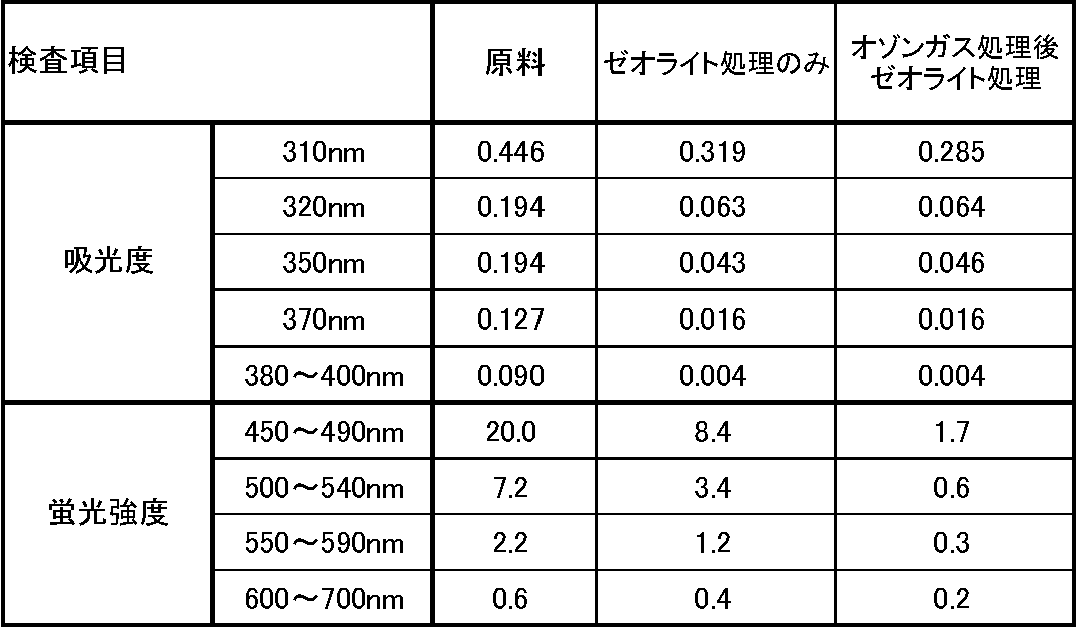
- Results Table 2 shows the results obtained.
- the absorbance at 380 to 400 nm indicates the maximum absorbance at 380 to 400 nm.
- the fluorescence intensity indicates the maximum value of fluorescence intensity at each fluorescence wavelength in terms of quinine sulfate.
- Example 2 The optimum conditions for ozone gas treatment and adsorbent treatment were investigated.
- Raw material 1,2,4-trichlorobenzene (industrial raw material)
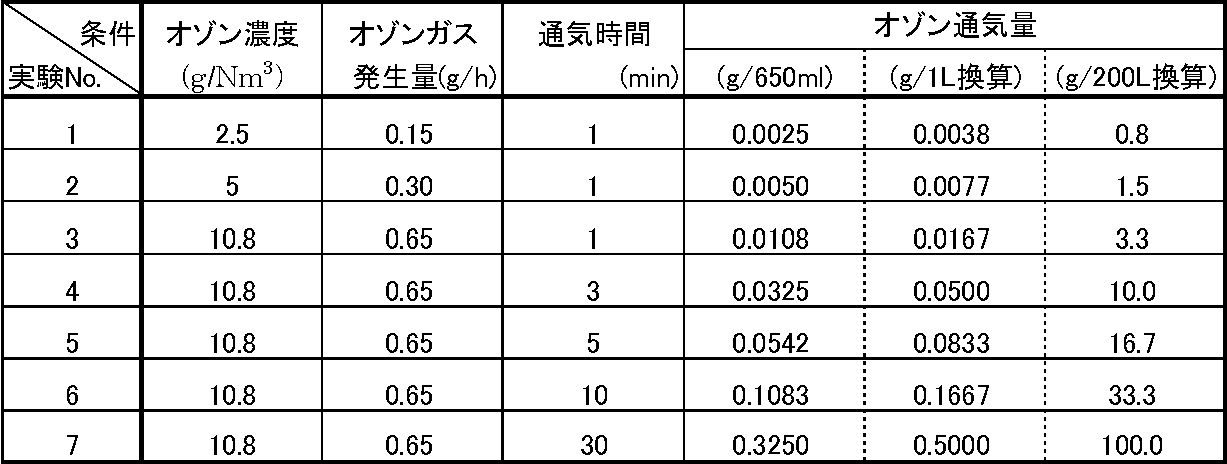
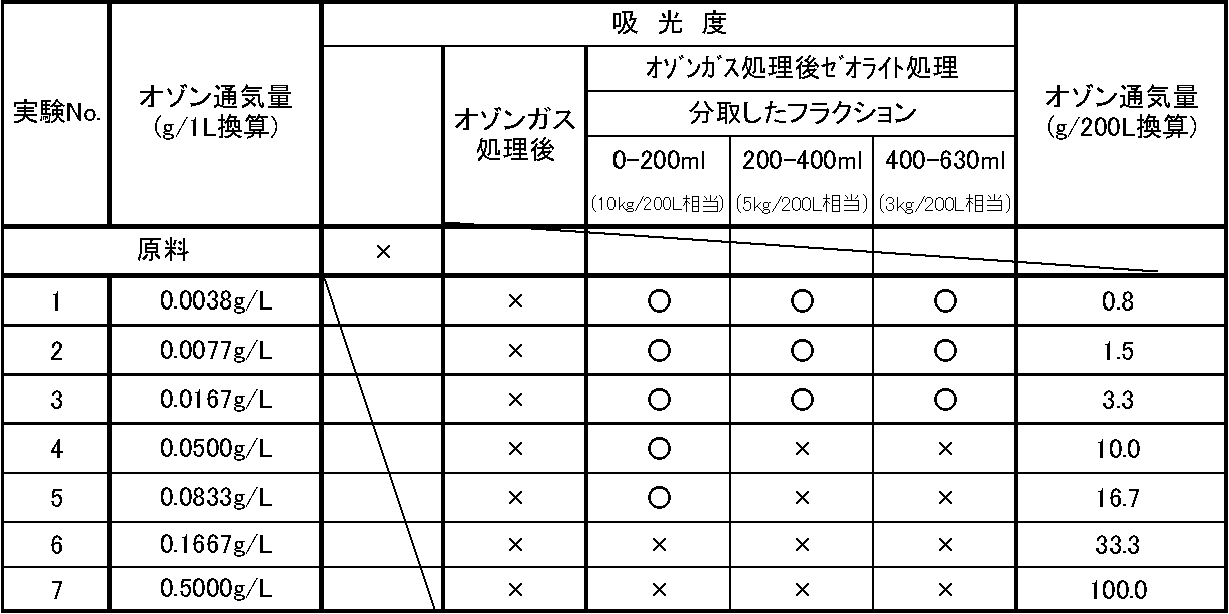
- Ozone aeration means the amount of ozone (as O 3 ) aerated in 650 mL of raw material in each experiment as the amount of ozone (as O 3 ) per 1 L of raw material. The converted value is shown, and the “ozone aeration amount (g / 200 L conversion)” shows a value converted as the aeration amount of ozone (as O 3 ) with respect to the raw material 200 L.
- Results Table 4 shows the results.
- the fluorescence intensity indicates the maximum value of fluorescence intensity under the above measurement conditions in terms of quinine sulfate. In any case of Experiment Nos. 1 to 5, the maximum value of the fluorescence intensity appeared at a fluorescence wavelength of 450 to 490 nm. In any of Experiment Nos. 1 to 5, the fluorescence intensity was all less than 3 in the fluorescence wavelength range of 500 to 700 nm.
- Table 5 shows the measurement results of absorbance.
- the case where the absorbance was in conformity with the HPLC standard the case where the absorbance of 350 nm ultraviolet light was 0.05 or less
- the effluent flowing out from the zeolite column was sampled in three portions, but 200 mL of the first sampling solution was treated with 10 g of zeolite.
- the second sampling liquid corresponds to a case where 400 mL of raw material is treated with 10 g of zeolite, and in terms of actual production scale, it corresponds to a case where 200 L of raw material is treated with about 5 kg of zeolite.
- the third sampling solution corresponds to a case where 630 mL of raw material is treated with 10 g of zeolite, and corresponds to a case where 200 L of raw material is treated with about 3 kg of zeolite in terms of actual production scale. Therefore, when comparing the measurement results of fluorescence intensity and absorbance of Experiment Nos. 1 to 3 in Tables 4 and 5 with the ozone aeration amount (converted to g / 200L), the 200L raw material was converted to an ozone amount of 1 to 3g / It can be seen that if it is treated at about 200 L, the zeolite can be refined at a subsequent use of about 3 kg / 200 L (raw material).
- the amount of zeolite used can be significantly reduced by treating the raw material with ozone gas after the method of the present invention and then treating with zeolite. It was suggested.
- Example 3 The purification method according to the present invention was carried out on an actual production scale.
- Raw material 1,2,4-trichlorobenzene (industrial raw material)
- Ozone ventilation condition normal pressure
- Ozone gas generation rate 1 g / hr
- Gas flow rate about 2L / min
- Processing temperature 20 ° C
- the ozone concentration in the ozone gas when aerated is about 0.38761 vol% (about 8.3 g / Nm 3 ).
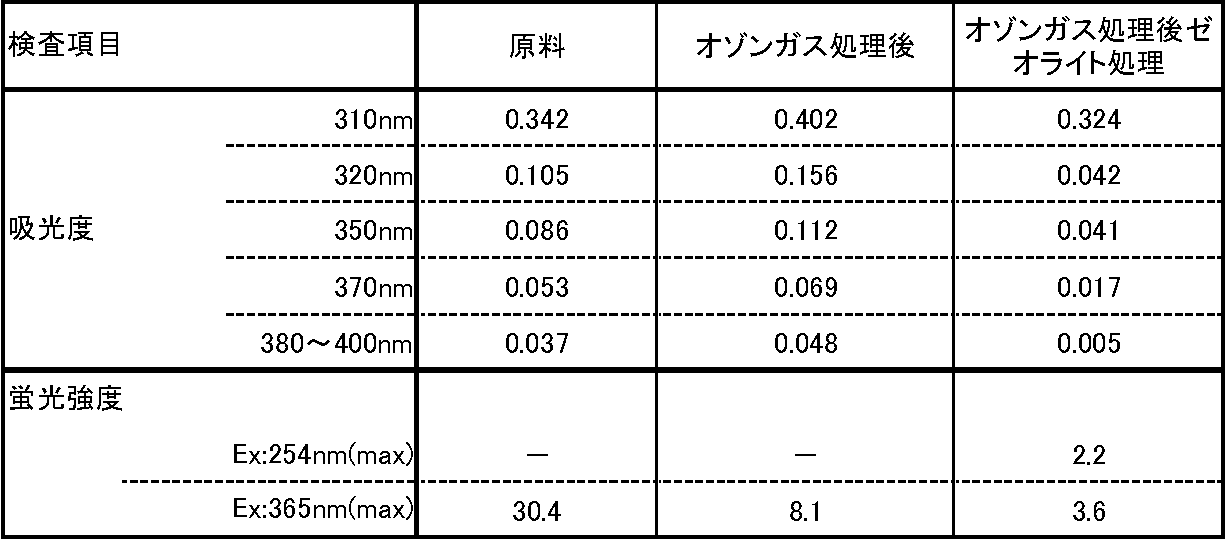
- the maximum value of the fluorescence intensity appeared at a fluorescence wavelength of 450 to 490 nm. Further, in the range of the fluorescence wavelength of 500 to 700 nm, the fluorescence intensity was all less than 3.
- the purified material suitable for use as a mobile phase for HPLC can be obtained by subjecting the raw material to ozone gas treatment and then zeolite treatment, without further purification such as distillation.
- zeolite treatment without further purification such as distillation.
- the purification treatment can be performed with a much smaller amount of zeolite used (about 5 kg) than in the past.
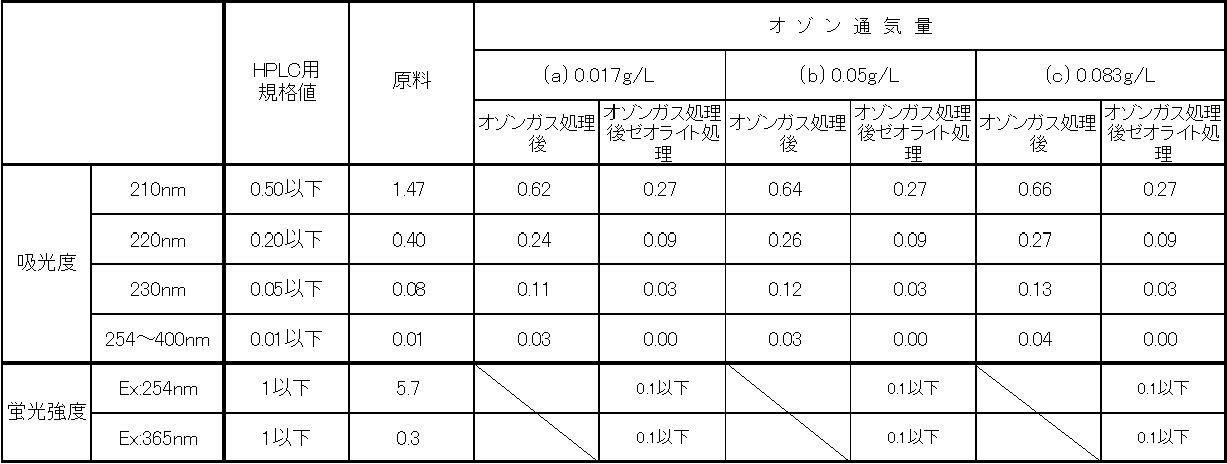
- Ozone ventilation condition (normal pressure) Ozone gas generation amount: 0.4 g / hr Gas flow rate: about 1L / min Processing temperature: about 20 ° C (room temperature) Treatment time: (a) 1 minute (b) 3 minutes (c) 5 minutes
- the ozone concentration in the ozone gas when aerated under the above aeration conditions is about 0.31289 vol% (about 6.7 g / Nm 3 ).
- Embodiment 5 FIG. (1) Raw material: 1,2,4-trichlorobenzene (industrial raw material)
- Ozone ventilation condition normal pressure
- Ozone gas generation amount 0.3 g / hr
- Gas flow rate 1L / min
- Processing temperature 20 ° C
- Processing time 2 min (Ozone aeration rate 0.01g / 650mL raw material)
- the ozone concentration in the ozone gas when aerated is about 0.2335 vol% (about 5 g / Nm 3 ). A portion of the crude product after ozone gas treatment was sampled.
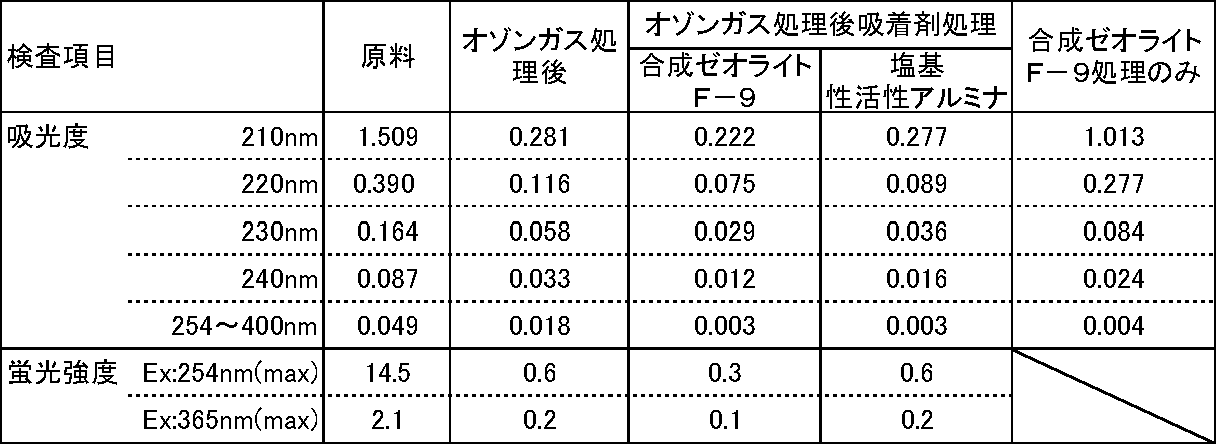
- Results Table 8 shows the results obtained.
- the absorbance at 380 to 400 nm shows the maximum value of absorbance at 380 to 400 nm.
- the fluorescence intensity indicates the maximum value of fluorescence intensity at each fluorescence wavelength in terms of quinine sulfate.
- Example 6 Raw material: n-heptane (industrial raw material)
- Ozone ventilation condition normal pressure
- Ozone gas generation amount 0.3 g / hr
- Gas flow rate 1L / min
- Processing temperature 20 ° C
- Processing time 2min (Ozone ventilation rate 0.01g / 200mL raw material)
- the ozone concentration in the ozone gas at the time of aeration under the above aeration conditions is about 0.2335 vol% (about 5 g / Nm 3 ). A portion of the crude product after ozone gas treatment was sampled.
- Results Table 9 shows the results obtained.
- the absorbance at 254 to 400 nm indicates the maximum absorbance at 254 to 400 nm.
- the fluorescence intensity indicates the maximum value of fluorescence intensity under the above measurement conditions in terms of quinine sulfate.
- Example 7 Raw material: 2,2,4-trimethylpentane (industrial raw material)
- Ozone ventilation condition normal pressure
- Ozone gas generation amount 0.3 g / hr
- Gas flow rate 1L / min
- Processing temperature 20 ° C
- Processing time 2min (Ozone ventilation rate 0.01g / 200mL raw material)
- the ozone concentration in the ozone gas at the time of aeration under the above aeration conditions is about 0.2335 vol% (about 5 g / Nm 3 ).
- the absorbance of ultraviolet rays was measured in the same manner for the eluate obtained by performing only the adsorbent treatment without treating with ozone gas.
- Results Table 10 shows the results obtained.
- the absorbance at 254 to 400 nm indicates the maximum absorbance at 380 to 400 nm.
- Example 8 Study of purification method of the present invention using simulated kerosene Kerosene is expected to be used as a fuel for household fuel cells, but sulfur compounds mixed in trace amounts in commercial kerosene are fuel cell catalysts. It is known to reduce the performance of
- sulfur compounds examples include dibenzothiophene, 4,6-dimethylbenzothiophene, and 3-methylbenzothiophene.
- a simulated kerosene was prepared by adding the above three kinds of sulfur compounds to undecane, which is one of the main components of kerosene (C9-15 hydrocarbons), and the simulated kerosene was purified by the purification method of the present invention.
- Ozone ventilation condition (normal pressure) Ozone gas generation amount: 0.3 g / hr Gas flow rate: 1L / min Processing temperature: 20 ° C Processing time: 4 min (Ozone aeration rate 0.02g / 200mL raw material)
- the ozone concentration in the ozone gas at the time of aeration under the above aeration conditions is about 0.2335 vol% (about 5 g / Nm 3 ).
- Measurement condition Measurement mode: 3D Measurement excitation wavelength: 200nm to 800nm Measurement fluorescence wavelength: 200nm to 800nm Scanning speed: 2400nm / min
- FIGS. 1 and 2 show ultraviolet absorption spectra at 200 to 400 nm.
- 1 shows the ultraviolet absorption spectrum of the raw simulated kerosene.
- FIG. 2 shows an ultraviolet absorption spectrum of a purified product of simulated kerosene. 1 and 2, the horizontal axis represents the measurement wavelength (nm) and the vertical axis represents the absorbance (Ab).
- FIGS. 3 and 4 show a three-dimensional fluorescence spectrum of a purified product of simulated kerosene. 3 and 4, the horizontal axis represents the fluorescence wavelength (EM (nm)), and the vertical axis represents the excitation wavelength (EX (nm)).
- the purification method of the present invention is very effective for removing sulfur compounds in kerosene.
- the amount of zeolite used can be made much smaller than before, so that, for example, if 1,2,4-trichlorobenzene contaminated with PCB is treated by the purification method of the present invention, the PCB produced by the purification is obtained.
- the amount of contaminated zeolite can be drastically reduced.
- the purified product obtained by the purification method of the present invention does not need to be further subjected to a treatment such as distillation, a purified product with higher purity can be obtained more simply than before.
Landscapes
- Chemical & Material Sciences (AREA)
- Organic Chemistry (AREA)
- Engineering & Computer Science (AREA)
- Analytical Chemistry (AREA)
- Oil, Petroleum & Natural Gas (AREA)
- Water Supply & Treatment (AREA)
- Chemical Kinetics & Catalysis (AREA)
- General Chemical & Material Sciences (AREA)
- Health & Medical Sciences (AREA)
- Emergency Medicine (AREA)
- Organic Low-Molecular-Weight Compounds And Preparation Thereof (AREA)
Abstract
Description
(1)芳香族ニトロ化合物に含まれる微量硫黄化合物をオゾン処理により酸化分解した後アルカリ水洗除去する、芳香族ニトロ化合物の精製方法(特許文献1)、
(2)ベンゼン等の芳香族化合物に含まれる微量硫黄化合物をオゾン接触により酸化分解した後、アルカリ水洗除去する、芳香族化合物中からの硫黄化合物の除去方法(特許文献2)、
がある。しかしながら、上記の方法は、いずれも原料をオゾン処理した後アルカリ水洗除去するという、液-液法による精製操作を行うため、攪拌、分液等を行うための設備が必要であり、且つ精製物の回収率も高くないという問題がある。
(1)プロピレン又はイソブチレンを触媒の存在下にアンモニオキシデーション反応せしめてアクリロニトリルを製造する際の副生物として得られるアセトニトリルを前処理して不純物を低減せしめた粗アセトニトリルを、更にオゾンを含むガスと接触させ、次いで塩基性物質で中和した後、蒸留するアセトニトリルの精製方法(特許文献3)
(2)プロピレン又はイソブチレンを触媒の存在下にアンモニオキシデーション反応せしめてアクリロニトリルを製造する際の副生物として得られるアセトニトリルを硫酸と接触させた後、硫酸分を分離し、次いでオゾンを含むガスと接触させた後、蒸留する、アセトニトリルの精製方法(特許文献4)、
(3)粗アセトニトリルを発生期の酸素(オゾン)と接触させ、次いで塩基性物質、吸着剤等と接触させる。次いで、オゾン処理で生成した過マンガン酸還元性物質を分離除去し、更に低沸点化合物および高沸点化合物を蒸留法や膜分離法により分離除去する、粗アセトニトリルの精製方法(特許文献5)。
等が知られている。
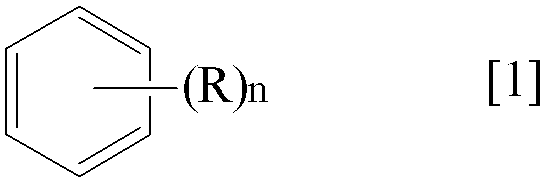
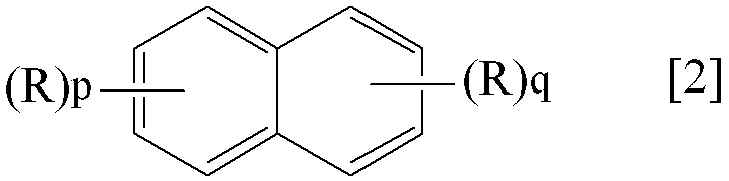
又は置換基を持たない飽和脂肪族炭化水素から選択される化合物に含有される不純物を、オゾンガスと接触させる第1の工程、次いでゼオライト又は塩基性吸着剤と接触させる第2の工程により除去することを特徴とする、該化合物の精製方法。」である。
クロロベンゼン、エチルベンゼン等が挙げられる。中でもトリクロロベンゼンが好ましい。
(1)回分方式(バッチ法)
例えば、適当量の本発明に係る原料の入った反応容器中へ、要すれば温度、圧力を制御しながら、所定濃度のオゾンガスを連続的に通気し、所定時間反応させればよい。また、該工程は、本発明に係る原料とオゾンガスとの接触を良くするために、攪拌装置がある反応容器で行うことが望ましい。更に、気液の接触を良くするために、オゾンガスは1ヶ所以上のノズルから本発明に係る原料中へ小さな気泡として供給すること(いわゆるバブリング)が好ましい。
例えば、連続的に供給されるオゾンガスに対し、本発明に係る原料を連続的に加えて所定時間接触させた後に処理されて当該原料を連続的に系外に取り出すという方法などが挙げられる。
(1)回分方式(バッチ法)
第1の工程で得られた粗精製品を、本発明に係るゼオライト又は塩基性吸着剤と混合させ、振盪処理する。この操作により粗精製品中の不純物のみがゼオライト又は塩基性性吸着剤に吸着される。次いで、得られた精製品とゼオライト又は塩基性吸着剤とを分離すれば、精製品から不純物のみが除去され、精製品を得ることができる。また、精製品とゼオライト又は吸着剤とを分離するには、例えば濾過、デカント等の適当な方法を用いればよい。
本発明に係るゼオライト又は塩基性吸着剤を充填したカラム(充填塔)に、第1の工程で得られた粗精製品を負荷(apply)する手段(カラム法)等が挙げられる。また、カラム法に於いては、一般の液体クロマトグラフィー法で十分である。この方法は、一度に大量の試料を処理できる点で、工業上有利である。
原料として1,2,4-トリクロロベンゼンを用い、該原料をバッチ処理によって各種吸着剤と接触させ、各吸着剤による、1,2,4-トリクロロベンゼンからの蛍光物質の除去効果を検討した。
・合成ゼオライト F-9(和光純薬工業(株)販売)
・活性炭(顆粒状)(和光特級、和光純薬工業(株)製)
・活性炭(カラムクロマトグラフ用、和光純薬工業(株)製)
・ワコーゲルC-200(カラムクロマトグラフ用、和光純薬工業(株)製)
・活性アルミナ(カラムクロマトグラフ用、和光純薬工業(株)製)
・モレキュラーシーブス5A(和光純薬工業(株)販売)
原料500mLを100mL三角フラスコに入れ、上記(2)の何れかの吸着剤1gを添加し、5時間攪拌した。その後処理液をメンブレンフィルター(0.45μm)で濾過した。
蛍光分光光度計((株)日立ハイテクノロジーズ製F-4500)を用い、上記(3)で得られた濾液の励起波長365nm、蛍光波長450~700nmにおける蛍光強度を測定した。
得られた結果を下記表1に示す。表1の数値は、各吸着剤を用いて処理した原料の、励起波長365nm、蛍光波長450~700nmにおける蛍光強度を硫酸キニーネ換算した値(10μg/Lの硫酸キニーネ溶液(0.1N硫酸酸性)の励起波長365nm/蛍光波長450nm付近の蛍光強度ピークの値を10 Q.S.U(Quinine sulfate unit)として相対強度(Relative fluorescence intensity: R.F.I.)に換算した値)である。
実験例1で蛍光物質の除去効果が高いことが確認された合成ゼオライト F-9を用いた処理方法にオゾンガス処理を加えた精製方法を検討した。
1)オゾン発生装置
実験用オゾン発生装置 コフロックPZ-1A (コフロック(株)製)
2)処理方法
原料100mLを、オゾン発生装置に接続したオゾンガス通気管と排出ガス排気管を設置した200mL容ガラス容器に入れ、オゾン発生装置を用い、原料攪拌下、下記の条件で原料にオゾンガスをバブリングした。
オゾンガス発生量:0.3g/hr
ガス流量:1L/min
処理温度:20℃
処理時間:10min(オゾン通気量0.05g/100mL原料)
オゾンガス処理後の粗精製品を、一部サンプリングした。
φ2cmガラスカラムに10gの合成ゼオライト F-9を充填したカラムに、オゾンガス処理した粗精製品をアプライし、処理速度1.2mL/min(空間速度SV=5.0(H-1))で、通液した。初流を5mLカット後、溶出液を回収した。
回収した溶出液、及びサンプリングしたオゾンガス処理後の粗精製品について、実験例1(4)と同じ装置及び方法で、励起波長365nm、蛍光波長450~700nmにおける蛍光強度を測定した。
得られた結果を表2に示す。表2において、380~400nmにおける吸光度は、380~400nmでの吸光度の最大値を示す。また、蛍光強度は、各蛍光波長における蛍光強度の最大値を、硫酸キニーネ換算値で示す。
オゾンガス処理と吸着剤処理の最適条件の検討を行った。
(1)原料:1,2,4-トリクロロベンゼン(工業用原料)
1)オゾン発生装置 実施例1で使用したものと同じ。
2)処理方法
原料650mLを、オゾン発生装置に接続したオゾンガス通気管と排出ガス排気管を設置した1L容ガラス容器に入れ、オゾン発生装置を用い、原料を攪拌下に、下記表3に記載の各条件(常圧)で、原料にオゾンガスをバブリングした。
φ2cmガラスカラムに10gの合成ゼオライト F-9を充填したカラムに、オゾンガス処理した粗精製品の各全量をアプライし、処理速度1.2mL/min(SV=5.0(H-1))で、通液した。初流を5mLカット後、溶出液を200mL×2フラクション分取し、次いで第3フラクションのみ230mL分取した。
回収した各フラクションの溶出液、及びサンプリングしたオゾンガス処理後の粗精製品について、実験例1(4)と同じ装置及び方法で、励起波長365nm、蛍光波長450~700nmにおける蛍光強度を測定した。また、分光光度計を用いて、波長350nmにおける紫外線の吸光度を測定した。
結果を表4に示す。表4において、蛍光強度は、上記測定条件における蛍光強度の最大値を、硫酸キニーネ換算値で示す。尚、実験No.1~5のいずれの場合も、蛍光強度の最大値は、蛍光波長450~490nmのところに出現した。また、実験No.1~5のいずれの場合も、蛍光波長500~700nmの範囲では、蛍光強度はすべて3未満であった。

実製造規模で、本発明に係る精製方法を実施した。
(1)原料:1,2,4-トリクロロベンゼン(工業用原料)
1)オゾン発生装置 実施例1で使用したものと同じ。
2)処理方法
原料200Lを、オゾン発生装置に接続したオゾンガス通気ノズルと排出ガス排気管を設置したドラムに入れた。原料を攪拌下に、下記の条件で、ドラム内底部に設置したオゾンガス通気バブルより、オゾンガスを細かい気泡で、原料にバブリングした。
オゾンガス発生量:1g/hr
ガス流量:約2L/min
処理温度:20℃
以上の通気条件における、通気させる際のオゾンガス中のオゾン濃度は約0.38761 vol%(約8.3g/Nm3)である。
φ30cmガラスカラムに5kgの合成ゼオライト F-9を充填したカラムに、オゾンガス処理した粗精製品の各全量をアプライし、処理速度33L/hr(SV=4.6(H-1))で、通液した。初流を3Lカット後、溶出液を回収した。
回収した溶出液、及びサンプリングしたオゾンガス処理後の粗精製品について、実験例1(4)と同じ装置及び方法で、励起波長254nm、蛍光波長450~700nm、及び励起波長365nm、蛍光波長450~700nmにおける蛍光強度を測定した。また、分光光度計を用いて波長200~400nmにおける紫外線の吸光度も測定した。
結果を下記表6に示す。表6において、380~400nmにおける吸光度は、380~400nmでの吸光度の最大値を示す。また、蛍光強度は、上記測定条件における蛍光強度の最大値を、硫酸キニーネ換算値で示す。
(1)原料:2,2,4-トリメチルペンタン(工業用原料)
1)オゾン発生装置 実施例1で使用したものと同じ。
2)処理方法
原料400mLを、オゾン発生装置に接続したオゾンガス通気管と排出ガス排気管を設置した1L容ガラス容器に入れ、原料を攪拌下に、下記の条件で、オゾンガスを原料にバブリングした。
オゾンガス発生量:0.4g/hr
ガス流量:約1L/min
処理温度:約20℃(室温)
処理時間:(a)1分間
(b)3分間
(c)5分間
以上の通気条件における、通気させる際のオゾンガス中のオゾン濃度は約0.31289 vol%(約6.7g/Nm3)である。
φ2cmガラスカラムに10gの合成ゼオライト F-9を充填したカラムに、オゾンガス処理した粗精製品350mLをアプライし、処理速度1mL/min(SV=4.2(H-1))で、通液した。初流を10mLカット後、溶出液を回収した。
回収した溶出液、及びサンプリングしたオゾンガス処理後の粗精製品について、実験例1(4)で使用したと同じ装置及び方法で、励起波長254nm、蛍光波長450~700nm、及び励起波長365nm、蛍光波長450~700nmにおける蛍光強度を測定した。また、分光光度計を用いて波長200~400nmにおける紫外線の吸光度も測定した。
結果を下記表7に示す。表7において、254~400nmにおける吸光度は、254~400nmでの吸光度の最大値を示す。また、蛍光強度は、上記測定条件における蛍光強度の最大値を、硫酸キニーネ換算値で示す。
(1)原料:1,2,4-トリクロロベンゼン(工業用原料)
1)オゾン発生装置 実施例1で使用したものと同じ。
2)処理方法
原料650mLを、オゾン発生装置に接続したオゾンガス通気管と排出ガス排気管を設置した1L容ガラス容器に入れ、オゾン発生装置を用い、原料を攪拌下に、下記の条件で原料にオゾンガスをバブリングした。
オゾンガス発生量:0.3g/hr
ガス流量:1L/min
処理温度:20℃
処理時間:2min(オゾン通気量0.01g/650mL原料)
オゾンガス処理後の粗精製品を、一部サンプリングした。
1)吸着剤
・合成ゼオライト F-9(和光純薬工業(株)販売)
・合成ゼオライトHS-320(Y型ゼオライト、和光純薬工業(株)製)
・塩基性活性アルミナ(カラムクロマトグラフ用、和光純薬工業(株)製)
2)処理方法
φ2cmガラスカラムに上記1)の何れかの吸着剤10gを充填したカラムに、オゾンガス処理した粗精製品の200mLをアプライし、処理速度1.2mL/min(空間速度SV=5.0(H-1))で、通液した。初流を5mLカット後、溶出液を回収した。
回収した溶出液、及びサンプリングしたオゾンガス処理後の粗精製品について、実験例1(4)と同じ装置及び方法で、励起波長365nm、蛍光波長450~700nmにおける蛍光強度を測定した。また、分光光度計を用いて波長200~400nmにおける紫外線の吸光度も測定した。
得られた結果を表8に示す。表8において、380~400nmにおける吸光度は、380~400nmでの吸光度の最大値を示す。また、蛍光強度は、各蛍光波長における蛍光強度の最大値を、硫酸キニーネ換算値で示す。

(1)原料:n-ヘプタン(工業用原料)
1)オゾン発生装置 実施例1で使用したものと同じ。
2)処理方法
原料200mLを、オゾン発生装置に接続したオゾンガス通気管と排出ガス排気管を設置した1L容ガラス容器に入れ、オゾン発生装置を用い、原料攪拌下、下記の条件で原料にオゾンガスをバブリングした。
オゾンガス発生量:0.3g/hr
ガス流量:1L/min
処理温度:20℃
処理時間:2min(オゾン通気量0.01g/200mL原料)
以上の通気条件における通気させる際のオゾンガス中のオゾン濃度は約0.2335 vol%(約5g/Nm3)である。
オゾンガス処理後の粗精製品を、一部サンプリングした。
1)吸着剤
・合成ゼオライト F-9(和光純薬工業(株)販売)
・塩基性活性アルミナ(カラムクロマトグラフ用、和光純薬工業(株)製)
2)処理方法
φ2cmガラスカラムに上記1)の何れかの吸着剤10gを充填したカラムに、オゾンガス処理した粗精製品の200mLをアプライし、処理速度1.2mL/min(空間速度SV=5.0(H-1))で、通液した。初流を5mLカット後、溶出液を回収した。
回収した溶出液、及びサンプリングしたオゾンガス処理後の粗精製品について、実験例1(4)と同じ装置及び方法で、励起波長254nm、蛍光波長450~700nm、及び励起波長365nm、蛍光波長450~700nmにおける蛍光強度を測定した。また、分光光度計を用いて波長200~400nmにおける紫外線の吸光度も測定した。
得られた結果を表9に示す。表9において、254~400nmにおける吸光度は、254~400nmでの吸光度の最大値を示す。また、蛍光強度は、上記測定条件における蛍光強度の最大値を、硫酸キニーネ換算値で示す。
(1)原料:2,2,4-トリメチルペンタン(工業用原料)
1)オゾン発生装置 実施例1で使用したものと同じ。
2)処理方法
原料200mLを、オゾン発生装置に接続したオゾンガス通気管と排出ガス排気管を設置した1L容ガラス容器に入れ、オゾン発生装置を用い、原料攪拌下、下記の条件で原料にオゾンガスをバブリングした。
オゾンガス発生量:0.3g/hr
ガス流量:1L/min
処理温度:20℃
処理時間:2min(オゾン通気量0.01g/200mL原料)
以上の通気条件における通気させる際のオゾンガス中のオゾン濃度は約0.2335 vol%(約5g/Nm3)である。
φ2cmガラスカラムに10gの合成ゼオライト F-9を充填したカラムに、オゾンガス処理した粗精製品の200mLをアプライし、処理速度1.2mL/min(空間速度SV=5.0(H-1))で、通液した。初流を5mLカット後、溶出液を回収した。
回収した溶出液について、実験例1(4)と同じ装置及び方法で、波長200~400nmにおける紫外線の吸光度を測定した。
得られた結果を表10に示す。表10において、254~400nmにおける吸光度は、380~400nmでの吸光度の最大値を示す。

灯油は、家庭用燃料電池の燃料としての利用が期待されているが、市販の灯油中に微量に混入している硫黄化合物が燃料電池の触媒の性能を低下させることが知られている。
特級n-ウンデカン(和光純薬工業(株)製)に、ジベンゾチオフェン、4,6-ジメチルベンゾチオフェン、3-メチルベンゾチオフェン(すべて和光純薬工業(株)製)を、それぞれ30mg/Lになるように添加した模擬灯油(硫黄濃度として約0.0022w/w%)を調製した。
1)オゾン発生装置 実施例1で使用したものと同じ。
2)処理方法
原料200mLを、オゾン発生装置に接続したオゾンガス通気管と排出ガス排気管を設置した1L容ガラス容器に入れ、オゾン発生装置を用い、模擬灯油を攪拌下に、下記の条件で原料にオゾンガスをバブリングした。
オゾンガス発生量:0.3g/hr
ガス流量:1L/min
処理温度:20℃
処理時間:4min(オゾン通気量0.02g/200mL原料)
以上の通気条件における通気させる際のオゾンガス中のオゾン濃度は約0.2335 vol%(約5g/Nm3)である。
φ2cmガラスカラムに10gの合成ゼオライト F-9を充填したカラムに、オゾンガス処理した粗精製品の200mLをアプライし、処理速度1.2mL/min(空間速度SV=5.0(H-1))で、通液した。初流を5mLカット後、溶出液を回収した。
回収した溶出液について、実験例1(4)と同じ装置及び方法で、波長200~400nmにおける紫外線の吸光度を測定した。
測定条件:
測定モード:三次元
測定励起波長:200nm~800nm
測定蛍光波長:200nm~800nm
スキャンスピード:2400nm/min
1)吸光度測定結果
吸光度の測定結果を表11に示す。

200~400nmにおける紫外線吸収スペクトルを図1及び図2に示す。1は、原料の模擬灯油の紫外吸収スペクトルを示す。図2は、模擬灯油の精製品の紫外吸収スペクトルを示す。また、図1及び図2に於いて、横軸は測定波長(nm)を、縦軸は吸光度(Ab)を夫々示す。
三次元蛍光スペクトルによる評価結果を図3及び図4に示す。図3は、模擬灯油の三次元蛍光スペクトルを示す。図4は、模擬灯油の精製品の三次元蛍光スペクトルを示す。また、図3及び図4に於いて、横軸は蛍光波長(EM(nm))を、縦軸は励起波長(EX(nm))を夫々示す。
Claims (6)
- 下記一般式[1]若しくは[2]で表される化合物
(Rはハロゲン原子又は炭素数1~3の低級アルキル基を表す。nは1~5の整数を表す。)、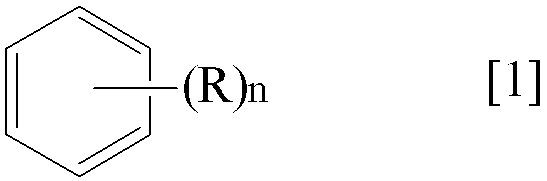
(Rは前記と同じ。p及びqは夫々独立して0~4の整数を表す。但し、pとqの少なくとも一方は0ではない。)、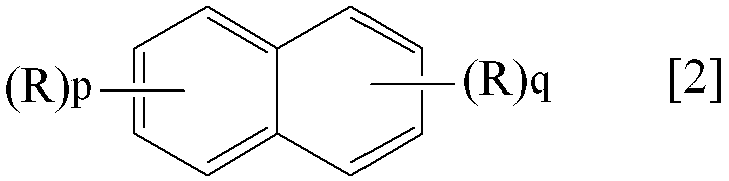
置換基を持たない飽和脂肪族炭化水素、又は灯油から選択される化合物に含有される不純物を、オゾンガスと接触させる第1の工程、次いでゼオライト又は塩基性吸着剤から選択される吸着剤と接触させる第2の工程により除去することを特徴とする、該化合物の精製方法。 - 第1の工程と第2の工程のみからなる、請求項1に記載の精製方法。
- 第2の工程がゼオライトと接触させる工程である、請求項1又は2に記載の精製方法。
- 一般式[1]で表される化合物がトリクロロベンゼン、クロロベンゼン又はエチルベンゼンであり、一般式[2]で表される化合物が1-クロロナフタレン、1-メチルナフタレン、2-メチルナフタレンであり、置換基を持たない飽和脂肪族炭化水素が2,2,4-トリメチルペンタン、シクロヘキサン、n-ヘキサン、n-ヘプタン、n-ノナン又はn-デカンである、請求項1~3のいずれかに記載の精製方法。
- 一般式[1]で表される化合物が1,2,4-トリクロロベンゼンである、請求項1~3のいずれかに記載の精製方法。
- 置換基を持たない飽和脂肪族炭化水素が2,2,4-トリメチルペンタン又はn-ヘプタンである、請求項1~3のいずれかに記載の精製方法。
Priority Applications (3)
| Application Number | Priority Date | Filing Date | Title |
|---|---|---|---|
| EP10774843A EP2436664A4 (en) | 2009-05-12 | 2010-04-30 | PROCESS FOR PURIFYING AN ORGANIC SOLVENT |
| JP2011513309A JP5655778B2 (ja) | 2009-05-12 | 2010-04-30 | 有機溶媒の精製方法 |
| US13/320,124 US20120059204A1 (en) | 2009-05-12 | 2010-04-30 | Method for purifying organic solvent |
Applications Claiming Priority (2)
| Application Number | Priority Date | Filing Date | Title |
|---|---|---|---|
| JP2009115856 | 2009-05-12 | ||
| JP2009-115856 | 2009-05-12 |
Publications (1)
| Publication Number | Publication Date |
|---|---|
| WO2010131585A1 true WO2010131585A1 (ja) | 2010-11-18 |
Family
ID=43084958
Family Applications (1)
| Application Number | Title | Priority Date | Filing Date |
|---|---|---|---|
| PCT/JP2010/057663 Ceased WO2010131585A1 (ja) | 2009-05-12 | 2010-04-30 | 有機溶媒の精製方法 |
Country Status (5)
| Country | Link |
|---|---|
| US (1) | US20120059204A1 (ja) |
| EP (1) | EP2436664A4 (ja) |
| JP (1) | JP5655778B2 (ja) |
| TW (1) | TW201043599A (ja) |
| WO (1) | WO2010131585A1 (ja) |
Cited By (1)
| Publication number | Priority date | Publication date | Assignee | Title |
|---|---|---|---|---|
| CN102531820A (zh) * | 2011-12-26 | 2012-07-04 | 天津市康科德科技有限公司 | 一种色谱级有机溶剂2,2,4-三甲基戊烷的提纯方法 |
Families Citing this family (2)
| Publication number | Priority date | Publication date | Assignee | Title |
|---|---|---|---|---|
| JP6934586B2 (ja) * | 2016-01-19 | 2021-09-15 | 株式会社Joled | 有機el用インクの製造方法および有機el装置の製造方法 |
| CN118359476A (zh) * | 2024-04-25 | 2024-07-19 | 南京化学试剂股份有限公司 | 一种高纯甲基环己烷的工艺纯化方法 |
Citations (11)
| Publication number | Priority date | Publication date | Assignee | Title |
|---|---|---|---|---|
| JPS5110174A (en) * | 1974-07-15 | 1976-01-27 | Sumitomo Chemical Co | Haigasuchuno harogenkafuhowatankasuisono jokyoho |
| JPS59221386A (ja) * | 1983-06-01 | 1984-12-12 | Jiyunkatsuyu Kyokai | 潤滑油留分の精製法 |
| JPS6411626A (en) | 1987-07-02 | 1989-01-17 | Electric Power Dev Co | Treatment of flue-gas and equipment thereof |
| JPH031020B2 (ja) | 1986-08-19 | 1991-01-09 | Masao Okano | |
| JPH0472387A (ja) * | 1990-05-30 | 1992-03-06 | Tetsuo Aida | 燃料油から硫黄分を除去する方法 |
| JPH05286869A (ja) * | 1992-04-06 | 1993-11-02 | Funakoshi Izumi | 液状油中から有機硫黄化合物を回収する方法 |
| JPH0618791A (ja) | 1992-02-25 | 1994-01-28 | Hewlett Packard Co <Hp> | 光減衰器 |
| JP2989477B2 (ja) | 1994-06-27 | 1999-12-13 | 旭化成工業株式会社 | 超高純度アセトニトリルおよび粗アセトニトリルの精製方法 |
| JP3104312B2 (ja) | 1991-07-16 | 2000-10-30 | 旭化成工業株式会社 | アセトニトリルの精製方法 |
| JP2001322953A (ja) * | 2000-05-12 | 2001-11-20 | Nippon Zeon Co Ltd | 有機硫黄化合物の除去方法 |
| JP2004505936A (ja) * | 2000-08-10 | 2004-02-26 | ソルヴェイ | 精製されたヒドロフルオロアルカンの取得方法 |
Family Cites Families (2)
| Publication number | Priority date | Publication date | Assignee | Title |
|---|---|---|---|---|
| US3394200A (en) * | 1966-02-18 | 1968-07-23 | Atlantic Richfield Co | Method for removing olefins and corrosion bodies from organic compounds |
| JP3096753B2 (ja) * | 1993-02-25 | 2000-10-10 | 株式会社荏原製作所 | ドライクリーニング装置の溶剤再生方法 |
-
2010
- 2010-04-30 JP JP2011513309A patent/JP5655778B2/ja active Active
- 2010-04-30 EP EP10774843A patent/EP2436664A4/en not_active Withdrawn
- 2010-04-30 US US13/320,124 patent/US20120059204A1/en not_active Abandoned
- 2010-04-30 WO PCT/JP2010/057663 patent/WO2010131585A1/ja not_active Ceased
- 2010-05-07 TW TW099114601A patent/TW201043599A/zh unknown
Patent Citations (11)
| Publication number | Priority date | Publication date | Assignee | Title |
|---|---|---|---|---|
| JPS5110174A (en) * | 1974-07-15 | 1976-01-27 | Sumitomo Chemical Co | Haigasuchuno harogenkafuhowatankasuisono jokyoho |
| JPS59221386A (ja) * | 1983-06-01 | 1984-12-12 | Jiyunkatsuyu Kyokai | 潤滑油留分の精製法 |
| JPH031020B2 (ja) | 1986-08-19 | 1991-01-09 | Masao Okano | |
| JPS6411626A (en) | 1987-07-02 | 1989-01-17 | Electric Power Dev Co | Treatment of flue-gas and equipment thereof |
| JPH0472387A (ja) * | 1990-05-30 | 1992-03-06 | Tetsuo Aida | 燃料油から硫黄分を除去する方法 |
| JP3104312B2 (ja) | 1991-07-16 | 2000-10-30 | 旭化成工業株式会社 | アセトニトリルの精製方法 |
| JPH0618791A (ja) | 1992-02-25 | 1994-01-28 | Hewlett Packard Co <Hp> | 光減衰器 |
| JPH05286869A (ja) * | 1992-04-06 | 1993-11-02 | Funakoshi Izumi | 液状油中から有機硫黄化合物を回収する方法 |
| JP2989477B2 (ja) | 1994-06-27 | 1999-12-13 | 旭化成工業株式会社 | 超高純度アセトニトリルおよび粗アセトニトリルの精製方法 |
| JP2001322953A (ja) * | 2000-05-12 | 2001-11-20 | Nippon Zeon Co Ltd | 有機硫黄化合物の除去方法 |
| JP2004505936A (ja) * | 2000-08-10 | 2004-02-26 | ソルヴェイ | 精製されたヒドロフルオロアルカンの取得方法 |
Non-Patent Citations (1)
| Title |
|---|
| See also references of EP2436664A4 * |
Cited By (1)
| Publication number | Priority date | Publication date | Assignee | Title |
|---|---|---|---|---|
| CN102531820A (zh) * | 2011-12-26 | 2012-07-04 | 天津市康科德科技有限公司 | 一种色谱级有机溶剂2,2,4-三甲基戊烷的提纯方法 |
Also Published As
| Publication number | Publication date |
|---|---|
| EP2436664A1 (en) | 2012-04-04 |
| EP2436664A4 (en) | 2012-10-31 |
| JP5655778B2 (ja) | 2015-01-21 |
| TW201043599A (en) | 2010-12-16 |
| US20120059204A1 (en) | 2012-03-08 |
| JPWO2010131585A1 (ja) | 2012-11-01 |
Similar Documents
| Publication | Publication Date | Title |
|---|---|---|
| EP2053116A1 (en) | Apparatus for removing mercury in liquid hydrocarbon | |
| Rocha et al. | Nitrogen-doped carbon xerogels as catalysts for advanced oxidation processes | |
| AU2023202835B2 (en) | Process, method and system for removing heavy metals from fluids | |
| EP4423217A1 (en) | Process for purifying a pyrolysis oil | |
| EP1085075A1 (en) | Treatment of hydrogen sulfide-containing gaseous compositions | |
| JP5655778B2 (ja) | 有機溶媒の精製方法 | |
| WO2023094629A1 (en) | A method for the removal of impurities from a pyrolysis oil | |
| BRPI0806342A2 (pt) | processo para a produção de dióxido de cloro | |
| US6464951B1 (en) | Method, catalyst, and photocatalyst for the destruction of phosgene | |
| CN106477525B (zh) | 一种氯代反应尾气氯化氢脱氯气净化方法 | |
| CN109603437B (zh) | 一种从含氯化氢的混合气体中分离氯化氢的方法及分离回收氯化氢的方法和应用 | |
| TWI537214B (zh) | 藉由連續或半連續製程製造高純度鍺烷的方法 | |
| JPH0361715B2 (ja) | ||
| CN110975424A (zh) | 一种氯化石蜡尾气净化方法及其应用 | |
| WO2013035200A1 (ja) | 超低硫黄燃料油の製造方法 | |
| EP4389856A1 (en) | Pyrolysis oil purification | |
| CA2231657A1 (en) | Extraction method | |
| CN1942407A (zh) | 从有机液体中催化去除溶解氧的方法 | |
| Mohamed et al. | A design for photochemical desulfurization and solvent extraction for light oil | |
| EP2883834A1 (en) | Hydrogen sulfide conversion | |
| JP6648980B2 (ja) | 液体炭化水素油中の硫化カルボニルを除去する方法 | |
| US20180251688A1 (en) | Liquid-phase decomposition of particulate mercury from hydrocarbon streams | |
| JP2007291281A (ja) | プラスチックの処理方法 | |
| KR100374577B1 (ko) | 탄화수소분획중의미량금속의흡착제거방법 | |
| EP4389855A1 (en) | Pyrolysis oil purification |
Legal Events
| Date | Code | Title | Description |
|---|---|---|---|
| 121 | Ep: the epo has been informed by wipo that ep was designated in this application |
Ref document number: 10774843 Country of ref document: EP Kind code of ref document: A1 |
|
| ENP | Entry into the national phase |
Ref document number: 2011513309 Country of ref document: JP Kind code of ref document: A |
|
| WWE | Wipo information: entry into national phase |
Ref document number: 2010774843 Country of ref document: EP |
|
| WWE | Wipo information: entry into national phase |
Ref document number: 13320124 Country of ref document: US |
|
| NENP | Non-entry into the national phase |
Ref country code: DE |