WO2010141494A2 - Synthesis of ezetimibe - Google Patents
Synthesis of ezetimibe Download PDFInfo
- Publication number
- WO2010141494A2 WO2010141494A2 PCT/US2010/036938 US2010036938W WO2010141494A2 WO 2010141494 A2 WO2010141494 A2 WO 2010141494A2 US 2010036938 W US2010036938 W US 2010036938W WO 2010141494 A2 WO2010141494 A2 WO 2010141494A2
- Authority
- WO
- WIPO (PCT)
- Prior art keywords
- formula
- compound
- alkyl
- substituted
- imine
- Prior art date
- Legal status (The legal status is an assumption and is not a legal conclusion. Google has not performed a legal analysis and makes no representation as to the accuracy of the status listed.)
- Ceased
Links
- 0 *C(CCCC(N([C@](CO1)c2ccccc2)C1=O)=O)c(cc1)ccc1F Chemical compound *C(CCCC(N([C@](CO1)c2ccccc2)C1=O)=O)c(cc1)ccc1F 0.000 description 17
- DGJAVKQKXBVCOH-LPYMAVHISA-N CC1(C)OB(c2ccc(/C=N/c(cc3)ccc3F)cc2)OC1(C)C Chemical compound CC1(C)OB(c2ccc(/C=N/c(cc3)ccc3F)cc2)OC1(C)C DGJAVKQKXBVCOH-LPYMAVHISA-N 0.000 description 2
- KRZCOLNOCZKSDF-UHFFFAOYSA-N Nc(cc1)ccc1F Chemical compound Nc(cc1)ccc1F KRZCOLNOCZKSDF-UHFFFAOYSA-N 0.000 description 2
- KGTCTXBFDQDBMN-LZYBPNLTSA-N Oc1ccc(/C=N/c(cc2)cc(Br)c2F)cc1 Chemical compound Oc1ccc(/C=N/c(cc2)cc(Br)c2F)cc1 KGTCTXBFDQDBMN-LZYBPNLTSA-N 0.000 description 2
- CUOYZOTVVNHRBQ-LZYBPNLTSA-N Oc1ccc(/C=N/c(cc2)ccc2F)cc1Br Chemical compound Oc1ccc(/C=N/c(cc2)ccc2F)cc1Br CUOYZOTVVNHRBQ-LZYBPNLTSA-N 0.000 description 2
- DMBMXJJGPXADPO-UHFFFAOYSA-N CC1(C)OB(c2ccc(C=O)cc2)OC1(C)C Chemical compound CC1(C)OB(c2ccc(C=O)cc2)OC1(C)C DMBMXJJGPXADPO-UHFFFAOYSA-N 0.000 description 1
- KOWPUNQBGWIERF-UHFFFAOYSA-N Nc(cc1)cc(Br)c1F Chemical compound Nc(cc1)cc(Br)c1F KOWPUNQBGWIERF-UHFFFAOYSA-N 0.000 description 1
- VLVCDUSVTXIWGW-UHFFFAOYSA-N Nc(cc1)ccc1I Chemical compound Nc(cc1)ccc1I VLVCDUSVTXIWGW-UHFFFAOYSA-N 0.000 description 1
- HSYDBZRLGPRZIK-IXDOHACOSA-N O[C@@H](CC[C@H]([C@@H](c(cc1)ccc1O)N1c(cc2)ccc2F)C1=O)I Chemical compound O[C@@H](CC[C@H]([C@@H](c(cc1)ccc1O)N1c(cc2)ccc2F)C1=O)I HSYDBZRLGPRZIK-IXDOHACOSA-N 0.000 description 1
- OLNTVTPDXPETLC-XPWALMASSA-N O[C@@H](CC[C@H]([C@@H](c(cc1)ccc1O)N1c(cc2)ccc2F)C1=O)c(cc1)ccc1F Chemical compound O[C@@H](CC[C@H]([C@@H](c(cc1)ccc1O)N1c(cc2)ccc2F)C1=O)c(cc1)ccc1F OLNTVTPDXPETLC-XPWALMASSA-N 0.000 description 1
- UOTMHAOCAJROQF-UHFFFAOYSA-N Oc(ccc(C=O)c1)c1Br Chemical compound Oc(ccc(C=O)c1)c1Br UOTMHAOCAJROQF-UHFFFAOYSA-N 0.000 description 1
- AJFIZFSOPGUXNB-LZYBPNLTSA-N Oc1ccc(/C=N/c(c(Br)c2)ccc2F)cc1 Chemical compound Oc1ccc(/C=N/c(c(Br)c2)ccc2F)cc1 AJFIZFSOPGUXNB-LZYBPNLTSA-N 0.000 description 1
- RGHHSNMVTDWUBI-UHFFFAOYSA-N Oc1ccc(C=O)cc1 Chemical compound Oc1ccc(C=O)cc1 RGHHSNMVTDWUBI-UHFFFAOYSA-N 0.000 description 1
Classifications
-
- C—CHEMISTRY; METALLURGY
- C07—ORGANIC CHEMISTRY
- C07D—HETEROCYCLIC COMPOUNDS
- C07D205/00—Heterocyclic compounds containing four-membered rings with one nitrogen atom as the only ring hetero atom
- C07D205/02—Heterocyclic compounds containing four-membered rings with one nitrogen atom as the only ring hetero atom not condensed with other rings
- C07D205/06—Heterocyclic compounds containing four-membered rings with one nitrogen atom as the only ring hetero atom not condensed with other rings having one double bond between ring members or between a ring member and a non-ring member
- C07D205/08—Heterocyclic compounds containing four-membered rings with one nitrogen atom as the only ring hetero atom not condensed with other rings having one double bond between ring members or between a ring member and a non-ring member with one oxygen atom directly attached in position 2, e.g. beta-lactams
-
- A—HUMAN NECESSITIES
- A61—MEDICAL OR VETERINARY SCIENCE; HYGIENE
- A61P—SPECIFIC THERAPEUTIC ACTIVITY OF CHEMICAL COMPOUNDS OR MEDICINAL PREPARATIONS
- A61P9/00—Drugs for disorders of the cardiovascular system
- A61P9/10—Drugs for disorders of the cardiovascular system for treating ischaemic or atherosclerotic diseases, e.g. antianginal drugs, coronary vasodilators, drugs for myocardial infarction, retinopathy, cerebrovascula insufficiency, renal arteriosclerosis
-
- C—CHEMISTRY; METALLURGY
- C07—ORGANIC CHEMISTRY
- C07C—ACYCLIC OR CARBOCYCLIC COMPOUNDS
- C07C251/00—Compounds containing nitrogen atoms doubly-bound to a carbon skeleton
- C07C251/02—Compounds containing nitrogen atoms doubly-bound to a carbon skeleton containing imino groups
- C07C251/24—Compounds containing nitrogen atoms doubly-bound to a carbon skeleton containing imino groups having carbon atoms of imino groups bound to carbon atoms of six-membered aromatic rings
-
- C—CHEMISTRY; METALLURGY
- C07—ORGANIC CHEMISTRY
- C07D—HETEROCYCLIC COMPOUNDS
- C07D263/00—Heterocyclic compounds containing 1,3-oxazole or hydrogenated 1,3-oxazole rings
- C07D263/02—Heterocyclic compounds containing 1,3-oxazole or hydrogenated 1,3-oxazole rings not condensed with other rings
- C07D263/08—Heterocyclic compounds containing 1,3-oxazole or hydrogenated 1,3-oxazole rings not condensed with other rings having one double bond between ring members or between a ring member and a non-ring member
- C07D263/16—Heterocyclic compounds containing 1,3-oxazole or hydrogenated 1,3-oxazole rings not condensed with other rings having one double bond between ring members or between a ring member and a non-ring member with hetero atoms or with carbon atoms having three bonds to hetero atoms with at the most one bond to halogen, e.g. ester or nitrile radicals, directly attached to ring carbon atoms
- C07D263/18—Oxygen atoms
- C07D263/20—Oxygen atoms attached in position 2
- C07D263/24—Oxygen atoms attached in position 2 with hydrocarbon radicals, substituted by oxygen atoms, attached to other ring carbon atoms
-
- C—CHEMISTRY; METALLURGY
- C07—ORGANIC CHEMISTRY
- C07F—ACYCLIC, CARBOCYCLIC OR HETEROCYCLIC COMPOUNDS CONTAINING ELEMENTS OTHER THAN CARBON, HYDROGEN, HALOGEN, OXYGEN, NITROGEN, SULFUR, SELENIUM OR TELLURIUM
- C07F5/00—Compounds containing elements of Groups 3 or 13 of the Periodic Table
- C07F5/02—Boron compounds
- C07F5/025—Boronic and borinic acid compounds
Definitions
- the present disclosure relates to an improved process for the preparation of Ezetimibe (l-(4- fluorophenyl)-3(R)-[3-(4-fluorophenyl)-3(S)-hydroxypropyl]-4(S)-(4-hydroxyphenyl)-2-azetidinone) and Ezetimibe derivatives.
- Ezetimibe l-(4- fluorophenyl)-3(R)-[3-(4-fluorophenyl)-3(S)-hydroxypropyl]-4(S)-(4-hydroxyphenyl)-2-azetidinone
- Such compounds are useful as hypocholesterolemic agents in the prevention and treatment of atherosclerosis.
- Ezetimibe is the active ingredient in ZETIA ® , manufactured by Merck/Schering-Plough Pharmaceuticals, and is approved by the United States Food and Drug Administration for use in patients with high cholesterol to reduce LDL cholesterol and total cholesterol (see e.g., US 6,207,822). Ezetimibe lowers high levels of blood cholesterol by selectively inhibiting the intestinal absorption of cholesterol and related phytosterols. Ezetimibe is commercially available in combination with simvastatin in the VYTORINTM formulation from MSP Pharmaceuticals, Inc.
- WO 2008/151324 discloses a method of using a ketoreductase enzyme to create ezetimibe from the corresponding alcohol. This "late reduction" scheme delays the reduction of the alcohol to the carbonyl to the last step of the reaction.
- US 6,133,001 and WO 2000/060107 also disclose a microbial late reduction process done under whole cell fermentation conditions.
- the present disclosure provides a process for preparing azetidinines and azetidinones, or pharmaceutically acceptable salts, solvates, and prodrugs thereof.
- R 1 is H, substituted or unsubstituted Ci- C 6 alkyl, substituted or unsubstituted C3-C7 cycloalkyl, substituted or unsubstituted phenyl, substituted or unsubstituted naphthyl, or substituted or unsubstituted heteroaryl;
- Y is O or S;
- X is O, S, or N(Ci- C 6 alkyl);
- R 3 is C 3 -C 6 alkyl, phenyl, naphthyl, substituted phenyl, substituted naphthyl, C 3 -C 6 alkoxycarbonyl or benzyl, wherein the substituents on phenyl and naphthyl are 1 -3 substituents selected from the group consisting Of Ci-C 6 alkyl, phenyl and benzyl;
- R 4 is a hydroxyl protecting group;
- R 5 is NH 2 , OR a
- R 1 is a substituted or unsubstituted phenyl group. In some embodiments R 1 is para- fluorophenyl. In some embodiments, when R 5 is OR a , then at least one of R 7 and R 8 is NH 2 or Z, where Z is Cl, Br, or I. In some embodiments, Z is Cl or Br. In some embodiments, R 5 is not Z. In some embodiments, X and Y are both independently O. In some embodiments, R 3 is phenyl. In some embodiments, R f is trimethylsilyl (TMS). In some embodiments, R a is trimethylsilyl (TMS). In some embodiments, R 4 is trimethylsilyl (TMS).
- the group B(OR b )(OR c ) is a group of Formula Bl or B2:
- one or more of the compounds of Formulas IV and V produced in Scheme 1 are substantially chirally pure compounds. In certain embodiments, one or more of the compounds of Formulas IV and V produced in Scheme 1 are chirally pure.
- the disclosure provides the process of Scheme 2, in which the chiral alcohol of Formula Hf and an imine of Formula IHf are condensed to form a ⁇ -(substituted- amino)amide of Formula IVf.
- the ⁇ -(substituted-amino)amide of Formula IVf is cyclized with a silylating agent and a cyclizing agent to form a compound of Formula Vf.
- the hydroxy protecting group is then removed from the compound of Formula Vf to afford a compound of Formula Vh, which is then oxidized to the final compound of Formula If.
- Ph is phenyl
- R 4 is a hydroxyl protecting group.
- R 4 is TMS.
- one or more of the compounds of Formulas IVf, Vf, VIf, and If produced in Scheme 2 are substantially chirally pure compounds. In certain embodiments, one or more of the compounds of Formulas IVf, Vf, VIf, and If produced in Scheme 2 are chirally pure.
- the disclosure provides the process of Scheme 3, in which the chiral alcohol of Formula lib and an imine of Formula IX are condensed to form a ⁇ -(substituted- amino)amide of Formula X.
- the ⁇ -(substituted-amino)amide of Formula X is cyclized with a silylating agent and a cyclizing agent to form a compound of Formula VIII.
- R 4 is a hydroxyl protecting group
- R 14 and R 15 are each independently H, OR S , Z, or OCH 3 , where Z is F, Cl, Br, or I and R s is a hydroxyl protecting group
- R 16 is H, or OR h , where R h is a hydroxyl protecting group
- R b and R c are independently H, Ci-C 6 alkyl, or R b and R c together form a 5-6 membered ring
- Y is O or S
- X is O, S, or N(Ci-C 6 alkyl)
- R 3 is C 3 -C 6 alkyl, phenyl, naphthyl, substituted phenyl, substituted naphthyl, C 3 -C 6 alkoxycarbonyl or benzyl, wherein the substituents on phenyl and naphthyl are 1 -3 substituents selected from the group consisting Of Ci-C 6 al
- Z is F, Cl, or Br. In some embodiments, Z is Cl or Br. In some embodiments, R 14 is F. In some embodiments, R 15 is F. In some embodiments, R h is TMS. In some embodiments, R s is TMS.
- one or more of the compounds of Formulas X, and VIII produced in Scheme 3 are substantially chirally pure compounds. In certain embodiments, one or more of the compounds of Formulas X and VIII produced in Scheme 3 are chirally pure. [0019] In a further aspect, the disclosure provides the process of Scheme 4, in which the chiral alcohol of Formula Hc and an imine of Formula IXa are condensed to form a ⁇ -(substituted- amino)amide of Formula Xa. The ⁇ -(substituted-amino)amide of Formula Xa is cyclized with a silylating agent and a cyclizing agent to form a compound of Formula XIa.
- R 4 is a hydroxyl protecting group
- R 15 is H, OR S , Z, or OCH 3 , where Z is F, Cl, Br, or I, and R s is a hydroxyl protecting group
- R 16 is H, or OR h , where R h is a hydroxyl protecting group.
- R s is TMS. In some embodiments R h is TMS. In some embodiments, Z is F, Cl, or Br. In some embodiments, Z is F.
- one or more of the compounds of Formulas Xa and XIa produced in Scheme 4 are substantially chirally pure compounds. In certain embodiments, one or more of the compounds of Formulas Xa, and XIa produced in Scheme 4 are chirally pure. [0023] In addition to the novel processes described in Schemes 1-4, the disclosure also provides intermediate compounds and product compounds associated with the synthesis of ezetimibe and other azetidinones.
- the disclosure provides imine derivatives for use in the described processes.
- the imine has the structure of Formula VI
- R 9 is OH, OR a , NH 2 , Si(R d ) 3 , or Si(OR e ) 3 , where R a is a hydroxyl protecting group;
- R b and R c are independently H, Ci-Ce alkyl, alkenyl, or aryl, or R b and R c together form a 5-6 membered ring;
- R d is Ci-Cg alkyl, cycloalkyl, alkenyl, aryl, or a halogen, and
- R e is Ci-Cg alkyl, alkenyl, or aryl; or
- R 9 is Si(R m ) 2 (R n ), Si(OR n ) 3 , or Si(R m ) 2 (OR n ), where R m is Ci-C 8 alkyl, cycloalkyl, alkenyl, aryl, or a halogen, or optionally two R m , taken
- R a and R s are TMS.
- Z is Cl or Br.
- R 7 and R 8 are not simultaneously Z.
- the disclosure provides imines having the structures of Formulas Via, VIb, VIc, or VId:
- R 8 is Z, where Z is Cl, Br, or I, and R 9 and R 10 is as defined above for Formula VI. In some embodiments, Z is Cl or Br.
- the disclosure provides imines having the specific structures of Formulas VIh and VIi:
- the compounds of the disclosure relate to various intermediates produced using the imines described herein.
- the compounds have the structure of Formula IV: wherein Y is O or S; X is O, S, OrN(Ci-C 6 alkyl); R 1 is H, substituted or unsubstituted Ci-C 6 alkyl, substituted or unsubstituted C 4 -C 7 cycloalkyl, or substituted or unsubstituted phenyl; R 3 is C 3 -C 6 alkyl, phenyl, naphthyl, substituted phenyl, substituted naphthyl, C 3 -C 6 alkoxycarbonyl or benzyl, wherein the substituents on phenyl and naphthyl are 1-3 substituents selected from the group consisting of Ci- C 6 alkyl, phenyl and benzyl; R 4 is a hydroxyl protecting group; R 5 is NH 2 , 0
- R 5 when R 5 is OR a , then at least one of R 7 and R 8 is NH 2 , or Z, where Z is Cl, Br, or I. In some embodiments, Z is Cl or Br. In some embodiments, R 5 is not Z. In some embodiments, X and Y are both independently O. In some embodiments R 3 is phenyl. In some embodiments R 4 is trimethylsilyl. In some embodiments R a is trimethylsilyl. In some embodiments R f is trimethylsilyl.
- the disclosure provides intermediate compounds that relate to the compounds of Formulas IVc and IVd: wherein X, Y, R a , R 1 , R 3 , R 4 , R 6 , and R 7 are as defined above for Formula IV. [0031] In some embodiments, the disclosure provides compounds of Formula IVg:
- the compounds of Formulas IV, IVc, IVd, and IVg are substantially chirally pure compounds. In some embodiments the compounds of Formulas IV, IVc, IVd, and IVg are chirally pure compounds.
- the disclosure provides compounds of Formula VII:
- R 1 is H, substituted or unsubstituted Ci-Ce alkyl, substituted or unsubstituted C 4 -C7 cycloalkyl, or substituted or unsubstituted phenyl;
- R 7 and R 8 are independently H, NH 2 , or Z, wherein Z is Cl, Br, or I;
- R 11 is a H or a hydroxyl protecting group;
- R 12 is OH, 0R a , NH 2 , B(0R b ) (OR C ), B(R d ) 2 , Si(R d ) 3 , or Si(OR e ) 3 , where R a is a hydroxyl protecting group;
- R b and R c are independently H, Ci-C 6 alkyl, alkenyl, or aryl, or R b and R c together form a 5-6 membered ring;
- R d is Ci-C 8 alkyl, cycloalkyl
- R 7 and R 8 are Z, where Z is Cl, Br, or I. In some embodiments, Z is Br or Cl. In some embodiments R a and R 11 are trimethylsilyl.
- the compound of Formula VII has the structure of Formula Vila or Formula VIIb
- the compound of Formula VII has the structure of Formula VIIc or Formula VIId
- R a , R 7 and R 11 are as defined above for Formula VII.
- the compound of Formula VII has the structure of Formula VIIe or Formula VIIf
- R a , R 8 , R 11 and R 13 are as defined above for Formula VII.
- the compounds of Formulas VII, VIIc, VIId, VIIe, and VIIf are substantially chirally pure compounds. In some embodiments the compounds of Formulas VII, VIIc, VIId, VIIe, and VIIf are chirally pure compounds.
- the disclosure provides compounds of Formula XII wherein TMS is trimethylsilane:
- TMS refers to interchangeably to trimethylsilane and trimethylsilyl
- TMSCl refers to Chlorotrimethylsilane.
- DIPEA N,N'-Diisopropylethylamine
- BSA N,O-Bis(trimethylsilyl)acetamide
- TBAF refers to tetra-n-butylammonium fluoride.
- IPA refers to isopropylalcohol.
- Ph refers to a phenyl
- API refers to Active Pharmaceutical Ingredient.
- halo and halogen are used interchangeably herein to refer to fluorine, chlorine, bromine or iodine.
- substituted when used to modify a specified group or radical, means that one or more hydrogen atoms of the specified group or radical are each, independently of one another, replaced with the same or different substituent(s).
- Typical substituents also referred to herein as “substituent groups,” “functional groups,” or “groups" are well known in the art and include, but are not limited to heteroatoms or halo groups (e.g., -F, -Cl, -Br, -I), straight-chain, branched, or cyclic alkyls, straight-chain, branched, or cyclic alkenyls, heteroatom substituted alkyls or alkenyls (e.g., -O- alkyl, -S-alkyl), aryl or heteroaryl, and other functional groups with or without heteroatoms (e.g., - OH, -NH 2 , -CF 3 , -CN, -OCN,
- first substituent group When a first substituent group is "substituted with one or more" second groups, one or more hydrogen atoms of the first group are replaced with a corresponding number of second groups. When the number of second groups is two or greater, each second group can be the same or different.
- alkyl refers to straight or branched chain hydrocarbon groups. When numbers appear in subscript after the symbol "C", the subscript defines with more specificity the number of carbon atoms that a particular group can contain. For example, "Ci-Ce alkyl” refers to straight and branched chain alkyl groups with one to six carbon atoms, such as methyl, ethyl, n-propyl, isopropyl, n-butyl, t-butyl, n-pentyl, and so forth. Alkyl groups may be optionally substituted with one or more substituent groups.
- Ci-Cg alkyl refers to a straight chain or branched non-cyclic hydrocarbon having from 1 to 8 carbon atoms.
- Representative straight chain -Ci-Cg alkyls include methyl, ethyl, n-propyl, n-butyl, n-pentyl, n-hexyl, n-heptyl, n-octyl.
- a branched alkyl means that one or more straight chain alkyl groups, such as methyl, ethyl or propyl, replace one or both hydrogens in a -CH 2 - group of a straight chain alkyl.
- Ci-Cg alkyls include -iso-propyl, -sec -butyl, -iso- butyl, -tert-butyl, -iso-pentyl, -neopentyl, - 1 -methylbutyl, -2-methylbutyl, -3-methylbutyl, - 1 , 1 -dimethylpropyl, - 1 ,2-dimethylpropyl, - 1 -methylpentyl, -2-methylpentyl, -3-methylpentyl, - 4-methylpentyl, - 1 -ethylbutyl, -2-ethylbutyl, -3-ethylbutyl, - 1 , 1 -dimethylbutyl, - 1 ,2-dimethylbutyl, - 1,3-dimethylbutyl, -2,2-dimethylbutyl, -2,3-dimethylbutyl,
- Ci -C ⁇ alkyl refers to a straight chain or branched non-cyclic hydrocarbon having from 1 to 6 carbon atoms.
- Representative straight chain -(Ci-C6)alkyls include methyl, ethyl, -n- propyl, -n-butyl, -n-pentyl, and -n-hexyl.
- Ci-C 6 alkyls include -iso-propyl, -sec -butyl, -iso-butyl, -tert-butyl, -iso-pentyl, -neopentyl, - 1 -methylbutyl, -2-methylbutyl, -3- methylbutyl, - 1 , 1 -dimethylpropyl, - 1 ,2-dimethylpropyl, -1-methylpentyl, -2-methylpentyl, -3- methylpentyl, -4-methylpentyl, - 1 -ethylbutyl, -2-ethylbutyl, -3-ethylbutyl, - 1 , 1 -dimethtylbutyl, - 1,2-dimethylbutyl, -1,3-dimethylbutyl, -2,2-dimethylbutyl, -2,3-dimethylmethylbuty
- C3-C6 alkyl refers to a straight chain or branched non-cyclic hydrocarbon having from 3 to 6 carbon atoms.
- Representative straight chain C 3 -C 6 alkyls include -n-propyl, -n butyl, -n pentyl, and -n hexyl.
- Representative branched C 3 -C 6 alkyls include -iso-propyl, -sec-butyl, -iso- butyl, -tert-butyl, -iso-pentyl, -neopentyl, - 1 -methylbutyl, -2-methylbutyl, -3 -methylbutyl, -1,1- dimethylpropyl, - 1 ,2-dimethylpropyl, -1-methylpentyl, -2-methylpentyl, -3-methylpentyl, A- methylpentyl, - 1 -ethylbutyl, -2-ethylbutyl, -3-ethylbutyl, -1,1 -dimethtylbutyl, -1,2-dimethylbutyl, -1,3-dimethylbutyl, -2,2-dimethylbutyl, -2,3-dimethylbutyl, and
- cycloalkyl refers to a saturated carbon ring of at least three carbon atoms, wherein the points of attachment to other groups include all positional isomers. Alternatively, the number of carbon atoms may be specified. Thus, “C 3 -C 6 cycloalkyl” means saturated carbon rings of 3 to 6 carbon atoms. C 3 -C 6 cycloalkyl groups may be optionally substituted with one or more substituent groups.
- silacycloalkyl refers to a saturated carbon ring of at least three atoms, in which one of the carbon atoms is replaced by Si.
- silacycloalkyl groups include silacyclobutane (siletane), silacyclopentane (silolane), and silcyclohexane (silinane)
- C 3 -C 7 cycloalkyl refers to a saturated monocyclic hydrocarbon having from 3 to 7 carbon atoms.
- Representative C 3 -C 7 cycloalkyls include cyclopropyl, cyclobutyl, cyclopentyl, cyclohexyl, and cycloheptyl.
- C 3 -C 7 cycloalkyl groups may be optionally substituted with one or more substituent groups.
- C 3 -C 6 alkoxycarbonyl refers to an -C(O)-O-alkyl group, in which the alkyl group is as previously described for C 3 -C 6 alkyl groups.
- Representative C 3 -C 6 alkoxycarbonyls include methoxycarbonyl, ethoxycarbonyl, and the like.
- C 3 -C 6 alkoxycarbonyl groups may be optionally substituted with one or more substituent groups.
- alkenyl refers to straight or branched chain hydrocarbon groups having at least one double bond.
- C When numbers appear in subscript after the symbol "C", the subscript defines with more specificity the number of carbon atoms that a particular group can contain.
- Ci-Ce alkenyl refers to straight and branched chain alkyl groups with one to six carbon atoms that include at least one double bond.
- Typical alkenyl groups include are well known in the art, and include, but are not limited to: ethenyl, 1 -methyl- ethenyl, 1- or 2-propenyl, 1-methyl-l-propenyl, l-methyl-2- propenyl, 1 , 1 -dimethyl-2propenyl, 2-methyl-2-propenyl, 1-, 2- or 3-butenyl, 1 -methyl- 1-butenyl, 2- methyl-1-butenyl, 3 -methyl- 1-butenyl, 3,3-dimethyl-l-butenyl, 2,3-dimethyl-l-butenyl, l-methyl-2- butenyl, l,l-dimethyl-2-butenyl, 2-methyl-2butenyl, 3-methyl-2-butenyl, 1,3-butadienyl, 1,3- dimethyll,3-butadienyl, 1-, 2-, 3- or 4-pentenyl, and so forth.
- aryl refers to a monovalent aromatic hydrocarbon radical of 6 to about 20 carbon atoms derived by the removal of one hydrogen atom from a single carbon atom of a parent aromatic ring system.
- Typical aryl groups include, but are not limited to, radicals derived from benzene, naphthalene, anthracene, biphenyl, and the like.
- Aryl groups may be optionally substituted with one or more substituent groups.
- heteroaryl refers to an aryl group in which one or more of the carbon atoms of the parent aromatic ring system are replaced by a heteroatom.
- Typical heteroaryl groups include, but are not limited to, radicals derived from e.g., pyridyl, pyrimidinyl, thienyl, furanyl, pyrrole, and indolyl ring systems.
- tautomer refers to isomers that change into one another with great ease so that they can exist together in equilibrium.
- stereoisomer stereoisomer
- stereoisomeric form and the like are used interchangeably herein to refer to all isomers of individual molecules that differ only in the orientation of their atoms in space. In includes enantiomers and isomers of compounds with more than one chiral center that are not mirror images of one another ("diastereomers").
- chiral center refers to a carbon atom to which four different groups are attached.
- enantiomer or “enantiomeric” refers to a molecule that is nonsuperimposable on its mirror image and hence optically active where the enantiomer rotates the plane of polarized light in one direction and its mirror image rotates the plane of polarized light in the opposite direction.
- a composition that is "enriched" in a particular chiral compound, enantiomer, or diastereomer comprises greater than 50% and typically comprises at least about 60%, 70%, 80%, 90%, or even more of that particular chiral compound, enantiomer, or diastereomer.
- the amount of enrichment can be determined using conventional analytical methods routinely used by those of ordinary skill in the art, including but not limited to, NMR spectroscopy in the presence of chiral shift reagents, gas chromatographic analysis using chiral columns, and high pressure liquid chromatographic analysis using chiral columns.
- a single chiral compound, enantiomer, or diastereomer will be substantially free of other corresponding chiral compound, enantiomer, or diastereomers.
- Chirally enantiomerically, or diastereomerically enriched compositions that contain at least about 95% of a specified chiral compound, enantiomer, or diastereomer are referred to herein as "substantially chirally pure,” “substantially enantiomerically pure” and “substantially diastereomerically pure,” respectively.
- compositions that contain at least about 99% of a specified chiral compound, enantiomer, or diastereomer are referred to herein as “chirally pure,” “enantiomerically pure,” and “diastereomerically pure,” respectively.
- compound refers to any compounds encompassed by the identified structural Formula and/or chemical name associated with the compound as disclosed herein.
- Compounds may be identified either by their chemical structure and/or chemical name. When the chemical structure and chemical name conflict, the chemical structure is determinative of the identity of the compound.
- Each compound identified by structural formulae and/or chemical name disclosed herein may contain one or more chiral centers and/or double bonds, and therefore, may exist as more than one stereoisomer, such as double-bond isomers (i.e., geometric isomers), enantiomer, or diastereomer.
- the chemical structures depicted herein encompass all possible enantiomers and stereoisomers of the illustrated compounds including the stereoisomerically pure form (e.g., geometrically pure, enantiomerically pure or diastereomerically pure) and enantiomeric and stereoisomeric mixtures.
- Enantiomeric and stereoisomeric mixtures can be resolved into their component enantiomers or stereoisomers using separation techniques or chiral synthesis techniques well known to the skilled artisan.
- the compounds may also exist in several tautomeric forms including the enol form, the keto form and mixtures thereof. Accordingly, the chemical structures depicted herein encompass all possible tautomeric forms of the illustrated compounds.
- the compounds described also include all isotopically labeled versions of the compounds where one or more atoms have an atomic mass different from the atomic mass conventionally found in nature.
- isotopes that may be incorporated into the compounds of the disclosure include, but are not limited to, 2 H, 3 H, 13 C, 14 C, 15 N, 18 0, 17 O, etc.
- Compounds may exist in unsolvated forms as well as solvated forms, including hydrated forms and as N-oxides. In general, compounds may be hydrated, solvated or N-oxides. Certain compounds may exist in multiple crystalline or amorphous forms. In general, all physical forms are equivalent for the uses contemplated herein and are intended to be within the scope of the present disclosure. Further, it should be understood, when partial structures of the compounds are illustrated, that brackets indicate the point of attachment of the partial structure to the rest of the molecule.
- suitable inert solvents or “inert solvent” refers to any organic solvent or combination of solvents that is unreactive in the reaction being conducted and is a solvent for the reactants.
- Typical inert solvents include, but are not limited to: hydrocarbons, such as hexane, petroleum ether, benzene, toluene or xylene; chlorinated hydrocarbons, such as trichloroethylene, 1,2- dichloroethane, carbon tetrachloride, trifluoromethylbenzene, chloroform or methylene chloride; alcohols, such as methanol, ethanol, isopropanol, n-propanol n-butanol or tert-butanol; ethers, such as diethyl ether, diisopropyl ether, tetrahydrofuran (THF) or dioxane; glycol ethers, such as ethylene glycol monomethyl or monoethylene
- Lewis acid refers to a compound capable of accepting a pair of electrons from a Lewis base, and includes but is not limited to compounds such as BF 3 -etherate, AlCl 3 , Ti(OiPr) 4 , TiCl 4 , ZrCl 4 , InCl 3 , and metal triflates (e.g., Sc, In, Zn, Y, Yb).
- a protecting group refers to a group that is used to mask a functionality during a process step in which it would otherwise react, but in which reaction is undesirable.
- the protecting group prevents reaction at that step, but may be subsequently removed to expose the original functionality.
- the removal or "deprotection” occurs after the completion of the reaction or reactions in which the functionality would interfere.
- protecting group refers to a group of atoms that, when attached to a reactive functional group in a molecule, will mask, reduce or prevent the reactivity of the functional group. Typically, a protecting group may be selectively removed as desired during the course of a synthesis. Examples of protecting groups useful with the embodiments of the present disclosure can be found in P.G.M. Wuts and T. W. Greene, “Greene's Protective Groups in Organic Synthesis - Fourth Edition," John Wiley and Sons, New York, N.Y., 2007, Chapter 7 (“Greene”).
- Representative amino protecting groups include, but are not limited to, formyl, acetyl, trifluoroacetyl, benzyl, benzyloxycarbonyl (“CBZ”), tert-butoxycarbonyl (“Boc”), trimethylsilyl (“TMS”), 2-trimethylsilyl-ethanesulfonyl (“SES”), trityl and substituted trityl groups, allyloxycarbonyl, 9-fluorenylmethyloxycarbonyl (“FMOC”), nitro-veratryloxycarbonyl (“NVOC”) and the like.
- hydroxyl protecting groups include, but are not limited to, those where the hydroxyl group is either acylated (e.g., methyl and ethyl esters, acetate or propionate groups or glycol esters) or alkylated such as benzyl and trityl ethers, as well as alkyl ethers, tetrahydropyranyl ethers, trialkylsilyl ethers (e.g., TMS or TIPPS groups) and allyl ethers.
- Silyl groups can be used to "mask" the para position of a phenyl ring so as to allow a selective reaction under mild conditions to afford the "unmasked" para phenol.
- siletanyl, siloxane, and silatrane protecting groups include siletanyl ligands such as 1 -methylsiletan- 1 -yl; siloxane groups such as Si(OR 21 )(R 22 ) 2 , where R 21 is alkyl or aryl and R 22 is alkyl, aryl, or allyl; and silatrane groups such as 2,8,9-trioxa-5-aza-l-silabicyclo[3.3.3]undecan-l-yl. Examples of these groups attached to a phenyl ring are shown below:
- R 21 alkyl
- aryl alkyl
- aryl allyl
- the present disclosure provides processes for the production of l-(4-3(R)[3(S)-(4- fluorophenyl)-3-hydroxypropyl]-4(S)-(4-hydroxyphenyl)-2-azetidinone (ezetimibe) and related azetidines.
- This disclosure also provides reactants, intermediates, and products of the synthetic process.
- the processes herein employ different imine derivatives, the general structure of which is further described below, that can be used to produce different intermediates, and therefore different process pathways for synthesis of the desired azetidine, such as the ezetimibe of Formula If:
- the disclosure provides the process of Scheme 1, which uses a protected chiral alcohol of Formula II and an imine of general Formula III.
- the chiral alcohol of Formula II and the imine of Formula III are condensed to form a ⁇ -(substituted- amino)amide of Formula IV.
- the ⁇ -(substituted-amino)amide of Formula IV can then be cyclized to form a compound of Formula V.
- the compound of Formula V is subject to one or more additional process step to generate the ezetimibe or azetidine derivative.
- R 1 is H, substituted or unsubstituted Ci-C 6 alkyl, substituted or unsubstituted C 4 -C 7 cycloalkyl, or substituted or unsubstituted phenyl, substituted or unsubstituted naphthyl, or substituted or unsubstituted heteroaryl;
- R is H or OH; where the process can comprise at least the step of reacting a chiral alcohol of Formula II:
- R 1 is defined as above;
- Y is O or S
- X is O, S, or N(Ci-C 6 alkyl);
- R is C3-C 6 alkyl, substituted or unsubstituted phenyl, substituted or unsubstituted naphthyl, C 3 -C 6 alkoxycarbonyl or benzyl, wherein the substitutions on phenyl and naphthyl are 1 -3 substituents selected from the group consisting Of Ci-C 6 alkyl, phenyl and benzyl; R 4 is a hydroxyl protecting group, with an imine of Formula III,
- R 5 is NH 2 , OR a , B(OR b )(OR c ), B(R d ) 2 , Si(R d ) 3 , or Si(OR e ) 3 , where R a is a hydroxyl protecting group; R b and R c are independently H, Ci-C 6 alkyl, alkenyl, or aryl, or R b and R c together form a 5-6 membered ring; R d is Ci-Cg alkyl, cycloalkyl, alkenyl, aryl, or a halogen, and R e is Ci-Cg alkyl, alkenyl, or aryl; or
- R 5 is Si(R m ) 2 (R n ), Si(OR n ) 3 , or Si(R m ) 2 (OR n ), where R m is Ci-C 8 alkyl, cycloalkyl, alkenyl, aryl, or a halogen, or optionally two R m , taken together with the Si to which they are bonded, may form a silacycloalkyl ring structure having 4-8 atoms; and R n is Ci-Cg alkyl, alkenyl, aryl, or C 2 -C 4 alkyl- amines, or optionally three OR n taken together with the Si to which they are bonded, may form a tricyclic silatrane ring structure; R 6 is H or OR f , where R f is a hydroxyl protecting group;
- R 7 and R 8 are independently H, NH 2 , or Z, where Z is Cl, Br, or I; and condensing the protected chiral alcohol of Formula II and the imine of Formula III to form a ⁇ - (substituted-amino)amide of Formula IV;
- R 7 and R 8 are H;
- the hydroxyl protecting group can be any suitable protecting group, such trimethylsilyl (TMS).
- TMS trimethylsilyl
- the condensation can be done with a Lewis acid, such as TiCU, in the presence of a tertiary amine, for example diisopropylmethylamine (DIPEA).
- DIPEA diisopropylmethylamine
- R 1 groups include, among others, phenyl and substituted phenyl. In some embodiments R 1 is para- fluorophenyl.
- R 5 when R 5 is OR a , then at least one of R 7 and R 8 is NH 2 , or Z, where Z is Cl, Br, or I. In some embodiments, Z is Cl or Br.
- X and Y are both independently O.
- R is phenyl.
- the process can further comprise a step of cyclizing the ⁇ - (substituted-amino)amide of Formula IV in presence of a silylating agent and a cyclizing agent to form a compound of Formula V:
- an exemplary silylating agent is N,O-Bis-(trimethylsilyl)acetamide (BSA) while an exemplary cyclizing agent is tetra-n-butylammonium (TBAF) (which may be used in either its anhydrous or trihydrate form).
- BSA N,O-Bis-(trimethylsilyl)acetamide
- TBAF tetra-n-butylammonium
- the cyclization may also be carried out using a base, including, among others, metal hydrides, such as sodium hydride, potassium hydride, and lithium hydride.
- metal hydrides such as sodium hydride, potassium hydride, and lithium hydride.
- the protecting groups are cleaved under appropriate conditions to generate the corresponding free hydroxyl group, e.g., free phenol or free alcohol.
- the deprotected compound is subject to one or additional processing steps to form the compound of Formula I.
- one or more of the compounds of Formulas IV and V produced in Scheme 1 are substantially chirally pure compounds. In certain embodiments, one or more of the compounds of Formulas IV and V produced in Scheme 1 are chirally pure. [0091] As noted above, the substituents on the imine of Formula III can be varied to provide different processes for the synthesis of the compound of Formula I. In some embodiments, R 5 on the imine of Formula III is boryl group B(OR b ) (OR C ), as defined above. Exemplary boryl groups are those of Formula Bl and B2:
- the disclosure provides a process as depicted in Scheme Ia for the preparation of the compound of Formula I.
- the process of preparing the compound of Formula I can comprise at least the step of reacting the protected alcohol of Formula II with an imine of Formula II, where the imine has the specific structure of Formula Ha:
- the ⁇ -(substituted-amino)amide of Formula IVa can be cyclized with a silylating agent and a cyclizing agent to form a compound of Formula Va.
- Boryl groups can be selectively oxidized to a hydroxyl using a suitable oxidizing agent, such as H 2 O 2 , as described in more detail herein.
- one or more of the compounds of Formulas IVa, Va, Via, and I produced in Scheme Ia are substantially chirally pure compounds. In certain embodiments, one or more of the compounds of Formulas IVa, Va, Via, and I produced in Scheme Ia are chirally pure.
- the imine of Formula III in Scheme 1 has the specific structure of Formula IHe:
- the process of preparing the compound of Formula I can comprise at least the step of reacting the protected alcohol of Formula II with an imine of Formula IHe to form a ⁇ -(substituted-amino)amide of Formula IVe:
- the process as illustrated in Scheme 1 e can further comprise a step of cyclizing the ⁇ - (substituted-amino)amide of Formula IVa in presence of a silylating agent and a cyclizing agent to form a compound of Formula Ve:
- the hydroxyl protecting group R 4 on the compound of Formula Ve is removed and the resulting deprotected compound of Formula VIe is oxidized to form the compound of Formula I.
- the oxidization step can use oxidants suitable for oxidation of the boryl group described above.
- one or more of the compounds of Formulas IVe, Ve, VIe, and I produced in Scheme Ie are substantially chirally pure compounds. In certain embodiments, one or more of the compounds of Formulas IVe, Ve, VIe, and I produced in Scheme Ie are chirally pure.
- the imine of Formula III in Scheme 1 has the specific structure of Formula HIb: where R 8 is Z, where Z is Cl, Br, or I, and R a is a hydroxyl protecting group. In some embodiments, R 8 is Br or Cl.
- Scheme Ib The process using the imine of Formula HIb is illustrated in Scheme Ib:
- the process comprises at least the step of reacting the imine of Formula IHb with the protected alcohol of Formula II to form the ⁇ -(substituted-amino)amide of Formula IVb:
- the process can further comprise a step of cyclizing the ⁇ -(substituted-amino)amide of Formula IVb in the presence of a silylating agent and a cyclizing agent to form a compound of Formula Vb:
- the process for preparing the compound of Formula I from Formula Vb comprises removing the hydroxyl protecting group R 4 to form compound VIb, and converting the compound of Formula VIb to the compound of Formula I by removal of the halide.
- the removal of the halide is conveniently done by hydrogenation using H 2 /Pd.
- one or more of the compounds of Formulas IVb, Vb, VIb, and I produced in Scheme Ib are substantially chirally pure compounds. In certain embodiments, one or more of the compounds of Formulas IVb, Vb, VIb, and I produced in Scheme Ib are chirally pure.
- the process for the preparation of the compound of Formula I can comprise at least a step in which the imine of Formula IHc and the protected alcohol of Formula II are reacted and condensed to form the ⁇ -(substituted-amino)amide of Formula IVc:
- the process can further comprise a step of cyclizing the ⁇ -(substituted-amino)amide of Formula IVc in the presence of a silylating agent and a cyclizing agent to form a compound of Formula Vc.
- the process for preparing the compound of Formula I from Formula Vc comprises removing the hydroxyl protecting group R 4 to form the compound of Formula VIc, and converting the compound of Formula VIc to that of Formula I by removal of the halide, in the same manner as described for the imine of Formula IHb.
- one or more of the compounds of Formulas IVc, Vc, and VIc, produced in Scheme Ic are substantially chirally pure compounds. In certain embodiments, one or more of the compounds of Formulas IVc, Vc, VIc, and I produced in Scheme Ic are chirally pure.
- the imine compound of Formula III in Scheme 1 has the specific structure of Formula IHd:
- R 5 is NH 2 , Si(R d ) 3 , or Si(OR e ) 3 , where R a is a hydroxyl protecting group; R b and R c are independently H, Ci-Ce alkyl, alkenyl, or aryl, or R b and R c together form a 5-6 membered ring; R d is Ci-Cg alkyl, cycloalkyl, alkenyl, aryl, or a halogen, and R e is Ci-Cg alkyl, alkenyl, or aryl; or R 5 is Si(R m ) 2 (R n ), Si(OR n ) 3 , or Si(R m ) 2 (OR n ), where R m is Ci-C 8 alkyl, cycloalkyl, alkenyl, aryl, or a halogen, or optionally two R m , taken together with the Si to which they are bonded, may
- the process for the preparation of the compound of Formula I can comprise at least a step in which the imine of Formula IHd and the protected alcohol of Formula II are reacted and condensed to form the ⁇ -(substituted-amino)amide of Formula IVd:
- the process can further comprise a step of cyclizing the ⁇ -(substituted-amino)amide of Formula IVd with a silylating agent and a cyclizing agent to form a compound of Formula Vd.
- the compound of Formula I can be prepared from that of Formula Vd by removing the hydroxyl protecting group R 4 to form the compound of Formula VId and oxidizing the Si(R d ) 3 , Si(OR e ) 3 , Si(R m ) 2 (R n ), Si(OR n ) 3 , or Si(R m ) 2 (OR n ), group R 5 to form the compound of Formula I.
- the removal of the hydroxyl protecting group R 4 from the compound of Formula Vd to form a compound of Formula VId, and the oxidation of the compound of Formula VId to form the compound of Formula I can be combined into a single step.
- one or more of the compounds of Formulas IVd, Vd, VId, and I produced in Scheme Id are substantially chirally pure compounds. In certain embodiments, one or more of the compounds of Formulas IVd, Vd, VId, and I produced in Scheme Id are chirally pure.
- the imine has the structure represented by Formula HIk:
- the process of Scheme If comprises (a) reacting a protected chiral alcohol of Formula II with the imine of IHk, where Z is defined above, and condensing the protected alcohol and imine to form a ⁇ -(substituted-amino)amide of Formula IVk; (b) cyclizing ⁇ -(substituted- amino)amide of Formula IVk with a silylating agent and a cyclizing agent to form a compound of Formula Vk; (c); removing the hydroxy protecting group to afford a compound of Formula VIk; and then (d) converting the compound of Formula VIk to the final compound of Formula If.
- step (d) can be accomplished by via a Pd catalyzed coupling with sodium or potassium hydroxides to yield the phenol.
- Pd catalyzed coupling with sodium or potassium hydroxides to yield the phenol.
- Ph is phenyl
- R 4 is a hydroxyl protecting group; with an imine of Formula IHk, above; and condensing the protected chiral alcohol and imine to form a ⁇ -(substituted-amino)amide of Formula IVk:
- one or more of the compounds of Formulas IVk, Vk, VIk, and If produced in Scheme If are substantially chirally pure compounds. In certain embodiments, one or more of the compounds of Formulas IVk, Vk, VIk, and If produced in Scheme If are chirally pure.
- the imine has the structure represented by Formula XXI:
- the process using an imine of Formula XXI comprises (a) reacting the protected chiral alcohol of Formula Hf with an imine of Formula XXI and condensing the chiral alcohol and imine to form a ⁇ -(substituted-amino)amide of Formula XXII; (b) oxidizing the ⁇ -(substituted-amino)amide of Formula XXII to the compound of Formula XXIII; (c) cyclizing compound of Formula XXIII with a silylating agent and a cyclizing agent to form a compound of Formula XXIV; (d) removing the hydroxy protecting group to afford a compound of Formula XXV; and (e) oxidizing compound of Formula XXV to the final compound of Formula If.
- R 4 is a hydroxyl protecting group
- R 17 is Ci-C 6 alkyl
- Ph is phenyl.
- R 17 is methyl.
- one or more of the compounds of Formulas XXII, XXIII, XXIV, and XXV produced in Scheme 4 are substantially chirally pure compounds. In certain embodiments, one or more of the compounds of Formulas XXII, XXIII, XXIV, and XXV produced in Scheme 4 are chirally pure.
- the process for synthesis of the ezetimibe comprises: (a) reacting a chiral alcohol of Formula Hf and an imine of Formula IHf and condensing the chiral alcohol and imine to form a ⁇ -(substituted-amino)amide of Formula IVf; (b) cyclizing the ⁇ -(substituted- amino)amide of Formula IVf with a silylating agent and a cyclizing agent to form a compound of Formula Vf; (c) removing the hydroxy protecting group from the compound of Formula Vf to afford a compound of Formula VIf; and (d) oxidizing the compound of Formula VIf to the final compound of Formula If.
- the removal of the hydroxyl protecting group R 4 from the compound of Formula Vf to form a compound of Formula VIf, and the oxidation of the compound of Formula VIf to form the compound of Formula If, can be combined into a single step.
- Ph is phenyl; and R 4 is a hydroxyl protecting group.
- R 4 is trimethylsilyl.
- one or more of the compounds of Formulas IVf, Vf, VIf, and If produced in Scheme 2 are substantially chirally pure compounds. In certain embodiments, one or more of the compounds of Formulas IVf, Vf, VIf, and If produced in Scheme 2 are chirally pure.
- the imine-based process can be used to prepare intermediates useful for synthesis of other azetidine compounds.
- a useful intermediate is an azetidine containing a boryl group, as provided in Scheme 3 :
- the boryl group can be used for the introduction of biphenyl groups, as described in WO2006122216. As such, a process for preparing a compound of Formula VIII: wherein
- R 4 is a hydroxyl protecting group
- R 14 and R 15 are each independently H, OR S , Z, or OCH 3 , where Z is F, Cl, Br, or I, and where R s is a hydroxyl protecting group;
- R 16 is H, OR h , where R h is a hydroxyl protecting group
- R b and R c are independently H, Ci-C 6 alkyl, or R b and R c together form a 5-6 membered ring; can comprise: (a) reacting a protected chiral alcohol of Formula lib:
- Y is O or S
- X is O, S, or N(Ci-C 6 alkyl);
- R 3 is C 3 -C 6 alkyl, substituted or unsubstituted phenyl, substituted or unsubstituted naphthyl, C 3 -C 6 alkoxycarbonyl or benzyl, wherein the substitutions on phenyl and naphthyl are 1 -3 substituents selected from the group consisting Of Ci-C 6 alkyl, phenyl and benzyl; with an imine of Formula IX,
- R and R . 16 are as defined above; R b and R c are as defined above; and condensing the protected chiral alcohol and the imine to form a ⁇ -(substituted-amino)amide of Formula X;
- one or more of the compounds of Formulas X, and VIII produced in Scheme 3 are substantially chirally pure compounds. In certain embodiments, one or more of the compounds of Formulas X and VIII produced in Scheme 3 are chirally pure.
- the boryl group containing azetidine intermediate can be the compound of Formula XIa, as provided in the process of Scheme 4: Scheme 4
- R 4 is a hydroxyl protecting group
- R 15 is H, OR S , Z, or OCH 3 , where Z is F, Cl, Br, or I and R s is a hydroxyl protecting group
- R 16 is H, or OR ⁇ , where R ⁇ is a hydroxyl protecting group.
- R s is TMS.
- R h is TMS.
- Z is F, Cl, or Br.
- Z is F.
- one or more of the compounds of Formulas Xa, and XIa produced in Scheme 4 are substantially chirally pure compounds. In certain embodiments, one or more of the compounds of Formulas Xa, and XIa produced in Scheme 4 are chirally pure.
- the compounds relate to imine derivatives for use in the described processes.
- the imine has the structure of Formula VI
- R 9 is OH, OR a , NH 2 , Si(R d ) 3 , or Si(OR e ) 3 , where R a is a hydroxyl protecting group; R b and R c are independently H, Ci-C 6 alkyl, alkenyl, or aryl, or R b and R c together form a 5-6 membered ring; R d is Ci-Cg alkyl, cycloalkyl, alkenyl, aryl, or a halogen, and R e is Ci-Cg alkyl, alkenyl, or aryl; or R 9 is Si(R m ) 2 (R n ), Si(OR n ) 3 , or Si(R m ) 2 (OR n ), where R m is Ci-C 8 alkyl, cycloalkyl, alkenyl, aryl, or a halogen, or optionally two R m , taken together with the Si to which they are
- R 7 and R 8 are independently H, NH 2 , or Z, wherein Z is Br, Cl, or I;
- R 10 is H, OH, OR S , where R s is a hydroxyl protecting group; with the proviso that
- R a and R s are TMS.
- Z is Cl or Br.
- R 7 and R 8 are not simultaneously NH 2 , or Z.
- R 9 is OH or OR a .
- an imine has the structure of Formula Via
- R 8 is Z, where Z is Cl, Br, or I, and R 9 and R 10 is as defined above for Formula VI. In some embodiments, Z is Cl or Br.
- R 9 is B(OR b )(OR c ), or B(R d ) 2 , wherein R b and R c are independently H, Ci-C 6 alkyl, alkenyl, or aryl, or R b and R c together form a 5-6 membered ring; and R d is Ci-C 8 alkyl, cycloalkyl, alkenyl, aryl, or a halogen.
- R 9 is a group of Formula Bl or B2:
- the disclosure provides the imines of Formula BBl and BB2
- Z is F, Cl, Br, or I.
- Z is F.
- an imine has the structure of Formula VIb:
- R 8 is Z, where Z is Cl, Br, or I, and R 9 is as defined above for Formula VI. In some embodiments, Z is Cl or Br. [0145] In some embodiments the disclosure provides an imine of Formula VIc:
- R 7 is NH 2 , or Z, where Z is Cl, Br, or I, and R 9 and R 10 are as defined above for Formula VI. In some embodiments, Z is Cl or Br.
- the disclosure provides an imine of Formula VId
- R 7 is Z, where Z is Cl, Br, or I, and R 9 is as defined above for Formula VI. In some embodiments, Z is Cl or Br.
- the imines have the specific structure of Formulas VIh and VIi:
- the compounds of the disclosure relate to various intermediates produced using the imines described herein.
- the compound has the structure of Formula IV:
- Y is O or S
- X is O, S, or N(Ci-C 6 alkyl);
- R 1 is H, substituted or unsubstituted Ci-C 6 alkyl, substituted or unsubstituted C 4 -C7 cycloalkyl, or substituted or unsubstituted phenyl;
- R is C 3 -C 6 alkyl, phenyl, naphthyl, substituted phenyl, substituted naphthyl, Cs-C 6 alkoxycarbonyl or benzyl, wherein the substituents on phenyl and naphthyl are 1 -3 substituents selected from the group consisting Of Ci-C 6 alkyl, phenyl and benzyl;
- R 4 is a hydroxyl protecting group
- R 5 is NH 2 , 0R a , B(0R b )(0R c ), B(R d ) 2 , Si(R d ) 3 , or Si(OR e ) 3 , where R a is a hydroxyl protecting group; R b and R c are independently H, Ci-C 6 alkyl, alkenyl, or aryl, or R b and R c together form a 5-6 membered ring; R d is Ci-Cg alkyl, cycloalkyl, alkenyl, aryl, or a halogen, and R e is Ci-Cg alkyl, alkenyl, or aryl; or
- R 5 is Si(R m ) 2 (R n ), Si(OR n ) 3 , or Si(R m ) 2 (OR n ), where R m is Ci-C 8 alkyl, cycloalkyl, alkenyl, aryl, or a halogen, or optionally two R m , taken together with the Si to which they are bonded, may form a silacycloalkyl ring structure having 4-8 atoms; and R n is Ci-Cg alkyl, alkenyl, aryl, or C 2 -C 4 alkyl- amines, or optionally three 0R n taken together with the Si to which they are bonded, may form a tricyclic silatrane ring structure;
- R 6 is H or 0R f , where R f is a hydroxyl protecting group
- R 7 and R 8 are independently H, NH 2 , or Z, wherein Z is Cl, Br, or I; with the proviso that
- R 7 and R 8 are H;
- R 5 when R 5 is OR a , then at least one of R 7 and R 8 is Z, where Z is Cl, Br, or I. In some embodiments, Z is Cl or Br. [0150] In some embodiments, R 5 is not Z. In some embodiments, X and Y are both independently O. In some embodiments R 3 is phenyl. In some embodiments R 4 is trimethylsilyl. In some embodiments R a is trimethylsilyl. In some embodiments R f is trimethylsilyl.
- the intermediate compounds relate to the compounds of Formulas IVc and IVd:
- R a , R 1 , R 3 , R 4 , R 6 , and R 7 are as defined above for Formula IV.
- the compounds relate to those of Formula IVg:
- R a , R 1 , R 3 , R 4 , R 6 , and R 7 are as defined above for Formula IV.
- the compounds of Formulas IV, IVc, IVd, and IVg are substantially chirally pure compounds. In some embodiments the compounds of Formulas IV, IVc, IVd, and IVg are chirally pure compounds.
- the disclosure provides compounds of Formula VII: wherein
- R 1 is H, substituted or unsubstituted Ci-Ce alkyl, substituted or unsubstituted C 4 -C7 cycloalkyl, or substituted or unsubstituted phenyl;
- R 7 and R 8 are independently H, NH 2 , or Z, wherein Z is Cl, Br, or I;
- R 11 is a H or a hydroxyl protecting group
- R 12 is OH, NH 2 , 0R a , B(0R b ) (OR C ), B(R d ) 2 , Si(R d ) 3 , or Si(OR e ) 3 , where R a is a hydroxyl protecting group; R b and R c are independently H, Ci-C 6 alkyl, alkenyl, or aryl, or R b and R c together form a 5-6 membered ring; R d is Ci-C 8 alkyl, cycloalkyl, alkenyl, aryl, or a halogen, and R e is Ci-C 8 alkyl, alkenyl, or aryl; or
- R 12 is Si(R m ) 2 (R n ), Si(OR n ) 3 , or Si(R m ) 2 (OR n ), where R m is Ci-C 8 alkyl, cycloalkyl, alkenyl, aryl, or a halogen, or optionally two R m , taken together with the Si to which they are bonded, may form a silacycloalkyl ring structure having 4-8 atoms; and R n is Ci-C 8 alkyl, alkenyl, aryl, or C 2 -C 4 alkyl- amines, or optionally three OR n taken together with the Si to which they are bonded, may form a tricyclic silatrane ring structure;
- R 13 is H, OH, or 0R a , wherein R a is a hydroxyl protecting group; with the provisos that
- R 7 and R 8 are H;
- R 7 and R 8 are Z, where Z is Cl, Br, or I. In some embodiments, Z is Br or Cl. In some embodiments R 9 and R 11 are trimethylsilyl.
- the compound of Formula VII has the Formula Vila or VIIb
- the compounds of Formula VII have the specific structures of Formula VIIc and VIId
- the compound of Formula VII has the specific structures of Formula VIIe and VIIf
- the compounds of Formulas VII, VIIc, VIId, VIIe, and VIIf are substantially chirally pure compounds. In some embodiments the compounds of Formulas VII, VIIc, VIId, VIIe, and VIIf are chirally pure compounds.
- the disclosure provides compounds of Formula XII wherein TMS is trimethylsilane:
- the protected starting compounds used in the methods of the present disclosure i.e., the protected chiral alcohols (e.g., compounds of Formula II) and the protected imines (e.g., compounds of Formula III), can be made with a suitable hydroxy-protecting group.
- the hydroxy-protecting group is a silyl protecting group such as that derived from the silylating agents chlorotrimethylsilane (TMSCl) or t-butyldimethyl-silyl chloride (TBDMSCl), preferably TMSCl.
- chiral alcohol and 1 -3 equivalents of imine are added to an anhydrous solvent such as CH 2 Cl 2 (DCM) at about -10° to 150 0 C, and a tertiary amine base such as DIPEA is added along with sufficient silylating agent to react with the alcohol and imine is added (e.g., 2-4 equivalents) to afford the protected products.
- anhydrous solvent such as CH 2 Cl 2 (DCM) at about -10° to 150 0 C
- DIPEA tertiary amine base
- sufficient silylating agent to react with the alcohol and imine is added (e.g., 2-4 equivalents) to afford the protected products.
- condensation of the chiral alcohol and imine to form the ⁇ -(substituted-amino)amide can be achieved by reacting at about -10° C to -50° C, preferably about -25° C to -35° C with at least 1 equivalent of a Lewis acid (e.g., TiCU), in the presence of a tertiary amine base (preferably 2-4 equivalents), preferably DIPEA for 2-4 hours.
- a Lewis acid e.g., TiCU
- a tertiary amine base preferably 2-4 equivalents
- further silylation (of the substituted amino group) and cyclization to form the protected API precursor can be effected by first reacting the ⁇ - (substituted-amino)amide starting material with a silyl-enol ether silylating agent, followed by reaction with a fluoride ion generating cyclizing agent.
- Suitable silyl-enol ether silylating agents for this reaction include bistrimethylsilyl acetamide (BSA), N-methyl-O-trimethylsilyl acetamide or iso-propenyloxy trimethylsilane, preferably BSA, provided in a suitable inert organic solvent (e.g., t-BuOMe, DMC, THF, or toluene).
- BSA bistrimethylsilyl acetamide
- DMC N-methyl-O-trimethylsilyl acetamide or iso-propenyloxy trimethylsilane
- a suitable inert organic solvent e.g., t-BuOMe, DMC, THF, or toluene.
- the silylation can be carried out, preferably in a dry, inert atmosphere, at -20 0 C to 110 0 C, preferably at about 0° to 50° C, more preferably at about 40 0 C, for about 0.5 to about 6 hours,
- Suitable cyclizing agents generate fluoride ion to catalyze the intra-molecular cyclization reaction.
- the fluoride ion can be in the form of a quaternary alkyl-, aryl-alkyl- or arylalkyl-alkyl- ammonium fluoride salt or a hydrate thereof, or a mixture thereof, or is an alkali metal fluoride salt or a hydrate thereof, such as cesium fluoride or potassium fluoride.
- arylalkyl-alkyl- ammonium groups are benzyltriethyl-ammonium and benzyltrimethyl-ammonium.
- arylalkyl- ammonium examples include phenyltriethyl-ammonium and phenyltrimethyl-ammonium.
- Typical alkylammonium groups contain alkyl groups of 1-6 carbon atoms, e.g., tetra n-butyl-ammonium.
- the reagent can be added in a catalytic amount, i.e., about 0.1 to about 20 mole percent, preferably about 0.5 to 5 mole percent, and when an anhydrous quaternary ammonium fluoride salt is used, it can be added in a catalytic up to a stoichiometric amount.
- an alkali metal fluoride salt When used, it is added in catalytic amount up to a stoichiometric amount compared to the starting ⁇ -amino compound, depending on the solubility of the reagent in the solvent used (higher solubility requires less reagent).
- a preferred fluoride ion catalyst cyclizing agent is tetrabutylammonium fluoride trihydrate (TBAF).
- the ⁇ -(substituted-amino)amide can first be reacted with the silyl-enol ether silylating agent and then reacted with the cyclizing agent, or the ⁇ -(substituted-amino)amide can be added to a mixture of the silylating agent and the cyclizing agent.
- the silylating agent is reacted with the starting material first and the silylation reaction is allowed to continue for up to about two hours.
- the cyclization step also can be carried out immediately after silylation. If added to the reaction mixture after the silylation agent, the fluoride reagent is added directly to the reaction mixture resulting from silylation, and is reacted at about -20 0 C to 110 0 C, preferably at about 0° to 50° C, or more preferably at about 40 0 C, for about 0.5 to about 6 hours, preferably about 2 hours.
- the silylating agent and the cyclizing agent can be added simultaneously.
- the ⁇ -(substituted-amino)amides formed by condensation are then silylated by reaction with a silyl-enol ether silylating agent such as bistrimethylsilyl acetamide (BSA), N-methyl-O-trimethylsilylacetamide or iso-propenyloxy trimethylsilane, preferably BSA, in a suitable inert organic solvent, preferably toluene.
- BSA bistrimethylsilyl acetamide
- a suitable inert organic solvent preferably toluene
- the silylated and cyclized compound is deprotected to afford Ezetimibe API depending on the combination of protecting groups remaining on the chiral alcohol and phenol groups.
- a first step of deprotection can be carried using preferably, 2N H 2 SO 4 in isopropylalcohol (IPA) under N 2 , at about 25°C for 1 hour.
- IPA isopropylalcohol
- Oxidative deprotection of the silylated alcohol and/or phenol can also be effected using a fluoride source (e.g., KF, TBAF, CsF) and an oxidant (e.g., H 2 O 2 , metachloroperbenzoic acid (mCPBA), oxone, magnesium monoperoxyphthalate (MMPP)).
- a fluoride source e.g., KF, TBAF, CsF
- an oxidant e.g., H 2 O 2 , metachloroperbenzoic acid (mCPBA), oxone, magnesium monoperoxyphthalate (MMPP)
- Silyl groups e.g., groups of the formulas Si(R d ) 3 , Si(OR e ) 3 , Si(R m ) 2 (R n ), Si(OR n ) 3 , or Si(R m ) 2 (OR n ) as described herein
- Silyl groups are also used to mask the para position so as to allow selective reaction under mild conditions to afford the "unmasked" para phenol.
- Exemplary siletanyl, siloxane, and silatrane protecting groups include:
- R 21 alkyl
- aryl alkyl
- aryl allyl
- boryl groups e.g., B(OR b ) (OR C ), B(R d ) 2
- the unmasking can be effected by any suitable oxidizing agent, such as any peroxide, for example 79% H 2 O 2 .
- suitable oxidizing agents allowing selective boryl group reaction to product the para phenol include e.g.,_mCPBA, oxone, MMPP.
- Boryl group deprotection from the phenol position typically is carried out after the deprotection of any silyl protecting group on the chiral alcohol.
- reaction can be accomplished via diazotization with tert-butyl nitrite and treatment with hypophosphorus acid (see e.g., Ek et al., J.Org. Chem, 2002, 67, 6376; and Giumanini et al., Tetrahedron, 1996, 52, 7137) or via reductive deamination of the aniline (see e.g., March's Advanced Organic Chemistry: Reaction, Mechanisms and Structure, 6 th Edition, by Michael B. Smith and Jerry March , Wiley, 2007 at p. 1847, section 19.69).
- the reaction can be accomplished by hydrogenation reaction using H 2 and a palladium catalyst.
- conditions can be 40 mg 10% Pd/C under hydrogen atmosphere (see e.g., Example 2).
- reaction of the masking halide can be carried out via a Pd catalyzed coupling with sodium or potassium hydroxides to yield the corresponding phenol.
- Pd 2 dba 3 Tris(dibenzylideneacetone)dipalladium(0)
- Pd 2 dba 3 Tris(dibenzylideneacetone)dipalladium(0)
- substituted biphenyl ligand catalyst systems for direct Pd-catalyzed synthesis of phenols from aryl halides are provided in e.g., Anderson et al., "The Selective Reaction of Aryl Halides with KOH: Synthesis of Phenols, Aromatic Ethers and Benzofurans," J. Am. Chem. Soc. 2006, 128, 10695-10695.
- Pd catalysts with hindered biaryl monophosphines e.g., XPhos and SPhos
- KOH can be used to effect phenol synthesis from aryl halides.
- imines can be prepared by reaction of the reagents in IPA at 50 0 C as illustrated below:
- reaction conditions for synthesis of the selected imines are presented in the Examples. Additional examples of reaction conditions for generating imines are described in US 6,207,822, WO2006122020, and WO2006122216.
- Imine compound IHf 1.04 g (3.2 mmol) was weighed into a 25 mL oven dried RB Flask and dissolved in 7.5 mL anhydrous DCM prior to dropwise addition over 30 min into the preformed enolate at -30 0 C. After 4 hours, the reaction mixture was quenched by slow addition of IPA (6.4 mL) followed by DCM (15 mL) at -25 to -30 0 C and slowly warmed to 0 0 C. The reaction mixture was then poured into disodium tartrate buffer (0.2 M aq. solution, 25 mL maintained at 0 0 C) and stirred for 15-20 min while it was warmed to room temperature.
- Imines VIh and VIi were synthesized following the procedure for imine IHf. 3-bromo-4-hydroxybenzaldehyde was used in t h e s ynthesis of imine VIh and 3-bromo-4-fluoroaniline was used for the synthesis of imine VIi.
- the aqueous layer was extracted with ethyl acetate (10 mL x 2).
- the combined organics were concentrated in vacuo and the oily residue was redissolved in IPA (4 mL) and 2N H 2 SO 4 (102 ⁇ L) and stirred for 30 min for deprotection of the TMS protected alcohol. Reaction completion was confirmed by TLC.
- the reaction was quenched with 20 mL saturated NaHCO3 solution.
- the aqueous layer was extracted with ethyl acetate (10 mL x 2).
- the combined organics were concentrated in vacuo yielding an oily residue that was redissolved in methanol (5 mL).
- LC/MS analysis was performed using Agilent 1200 HPLC with DAD (Diode Array Detector) in series with ABI QTrap 3200 Mass Spectrometer.
- the mass-spectrometer is a hybrid triple quadrupole/LIT (Linear Ion Trap) system which is capable to perform LC/MS, LC/MS/MS and LC/MS 3 analysis.
- a negative electrospray ionization mode was selected to run in Enhanced Mass Scan (EMS).
- EMS scan utilizes the Linear Ion Trap capability that traps all the ions in the Q3 quadrupole region and scanned out to produce full spectrum data.
- reaction mixtures used in the Pd/C hydrogenolysis reaction were only partially purified and contained amounts of the undesired diastereoisomer. After hydrogenolysis, this leads to the presence of both Ezetimibe API (If) and its diastereoisomer. The presence of this diastereomer resulted in the observation of two peaks of identical molecular weight in the LC/MS analysis. The additional peak for hydrogenolysis reaction of intermediate IVn was at 11.19 minutes, and the reaction of intermediate IVo resulted in a shouldered peak of identical molecular weight at 11.13 minutes. It is expected that optimized crystallization of the intermediates prior to Pd/C hydrogenolysis can result in diastereomerically pure Ezetimibe API via this process.
- EMS Enhanced MS
- the para position where the phenol resides in Ezetimibe API is "masked" during formation of intermediate XXIIb with an acetyl group and subsequently deprotected by Bayer- Villiger oxidation followed by hydrolysis to yield the desired phenol as shown in Scheme 9.
- acetyl masked phenol can be used to make the imine compound XXI, and this compound can be used to make intermediate XXIIb.
- This intermediate is oxidized via the Bayer-Villiger oxidation to compound XXIIIb, followed by the silylation and cyclization under the conditions described previously in Example 1 and elsewhere herein.
- Final deprotection of the TMS protecting group and hydrolysis of the acetyl group generates the Ezetimibe API of Formula If.
- intermediate DD The imine compound CC is used in a Ti-mediated Mannich reaction to afford intermediate DD.
- Intermediate compound DD is silylated and cyclized under the standard conditions described above to yield intermediate EE.
- Final removal of the aniline group from EE is achieved via diazotization with tert-butyl nitrite and hydrolysis in the presence of water to generate If. See e.g., F. Ek; O. Axelsson; L-G. Wistrand; T. Frejd, J.Org. Chem, 2002, 67, 6376; and A.G. Giumanini; G. Verardo; P. Geatti; P. Strazzolini, Tetrahedron, 1996, 52, 7137.
- a removable aniline group attached to the aldehyde portion of the imine can be used in the Mannich reaction and subsequently be removed via the Sandmeyer type reaction with tert-butyl nitrite followed by treatment with hypophosphorus acid to yield Ezetimibe API as shown in Scheme 12 below:
- intermediate GG is silylated and cyclized under conditions described previously to yield intermediate HH.
- Final removal of the aniline group from HH is achieved via diazotization with tert-butyl nitrite and treatment with hypophosphorus acid to generate the Ezetimibe API (If).
Landscapes
- Chemical & Material Sciences (AREA)
- Organic Chemistry (AREA)
- Health & Medical Sciences (AREA)
- Engineering & Computer Science (AREA)
- Bioinformatics & Cheminformatics (AREA)
- Urology & Nephrology (AREA)
- Vascular Medicine (AREA)
- Cardiology (AREA)
- Heart & Thoracic Surgery (AREA)
- Chemical Kinetics & Catalysis (AREA)
- General Chemical & Material Sciences (AREA)
- Medicinal Chemistry (AREA)
- Nuclear Medicine, Radiotherapy & Molecular Imaging (AREA)
- Pharmacology & Pharmacy (AREA)
- Life Sciences & Earth Sciences (AREA)
- Animal Behavior & Ethology (AREA)
- General Health & Medical Sciences (AREA)
- Public Health (AREA)
- Veterinary Medicine (AREA)
- Pharmaceuticals Containing Other Organic And Inorganic Compounds (AREA)
- Plural Heterocyclic Compounds (AREA)
Abstract
The present disclosure relates to processes for the preparation of Ezetimibe (1-(4-fluorophenyl)-3(R)-[3-(4-fluorophenyl)-3(S)-hydroxypropyl]-4(S)-(4-hydroxyphenyl)-2-azetidinone) and related azetidine compounds.
Description
SYNTHESIS OF EZETIMIBE
1. BACKGROUND
[0001] The present disclosure relates to an improved process for the preparation of Ezetimibe (l-(4- fluorophenyl)-3(R)-[3-(4-fluorophenyl)-3(S)-hydroxypropyl]-4(S)-(4-hydroxyphenyl)-2-azetidinone) and Ezetimibe derivatives. Such compounds are useful as hypocholesterolemic agents in the prevention and treatment of atherosclerosis.

[0002] Ezetimibe is the active ingredient in ZETIA®, manufactured by Merck/Schering-Plough Pharmaceuticals, and is approved by the United States Food and Drug Administration for use in patients with high cholesterol to reduce LDL cholesterol and total cholesterol (see e.g., US 6,207,822). Ezetimibe lowers high levels of blood cholesterol by selectively inhibiting the intestinal absorption of cholesterol and related phytosterols. Ezetimibe is commercially available in combination with simvastatin in the VYTORIN™ formulation from MSP Pharmaceuticals, Inc.
[0003] Other synthetic processes for the production of ezetimibe and ezetimibe derivatives have been previously disclosed. WO 2008/151324 discloses a method of using a ketoreductase enzyme to create ezetimibe from the corresponding alcohol. This "late reduction" scheme delays the reduction of the alcohol to the carbonyl to the last step of the reaction. US 6,133,001 and WO 2000/060107 also disclose a microbial late reduction process done under whole cell fermentation conditions.
[0004] A variety of publications have disclosed chemical synthesis using the late reduction strategy: US 5,886,171, US 5,738,321, WO 2005/0066120, WO 2007/030721, WO 2007/120824, WO 2007/119106, WO 2007/072088, WO 2007/030721, and WO 2007/120824.
2. SUMMARY
[0005] In one aspect, the present disclosure provides a process for preparing azetidinines and azetidinones, or pharmaceutically acceptable salts, solvates, and prodrugs thereof.
[0006] This disclosure provides a novel, industrially and economically viable process comprising only a few steps, and including some new intermediates, for the production of l-(4-3(R)[3(S)-(4- fluorophenyl)-3-hydroxypropyl]-4(S)-(4-hydroxyphenyl)-2-azetidinone (ezetimibe) according to the following reaction Scheme 1 below:
Scheme 1


[0007] According to the process disclosed in Scheme 1, the chiral alcohol of Formula II and an imine of Formula III are condensed to form a β-(substituted-amino)amide of Formula IV. The β- (substituted-amino)amide of Formula IV is cyclized with a silylating agent and a cyclizing agent to form a compound of Formula V.
[0008] With respect to the compounds depicted in Scheme 1, R1 is H, substituted or unsubstituted Ci- C6 alkyl, substituted or unsubstituted C3-C7 cycloalkyl, substituted or unsubstituted phenyl, substituted or unsubstituted naphthyl, or substituted or unsubstituted heteroaryl; Y is O or S; X is O, S, or N(Ci- C6 alkyl); R3 is C3-C6 alkyl, phenyl, naphthyl, substituted phenyl, substituted naphthyl, C3-C6 alkoxycarbonyl or benzyl, wherein the substituents on phenyl and naphthyl are 1 -3 substituents selected from the group consisting Of Ci-C6 alkyl, phenyl and benzyl; R4 is a hydroxyl protecting group; R5 is NH2, ORa, B(ORb)(ORc), B(Rd)2, Si(Rd)3, or Si(ORe)3, where Ra is a hydroxyl protecting group; Rb and Rc are independently H, Ci-C6 alkyl, alkenyl, or aryl, or Rb and Rc together form a 5-6 membered ring; Rd is Ci-Cg alkyl, cycloalkyl, alkenyl, aryl, or a halogen, and Re is Ci-Cg alkyl, alkenyl, or aryl; or R5 is Si(Rm)2(Rn), Si(ORn)3, or Si(Rm)2(ORn), where Rm is Ci-C8 alkyl, cycloalkyl, alkenyl, aryl, or a halogen, or optionally two Rm, taken together with the Si to which they are bonded,
may form a silacycloalkyl ring structure having 4-8 atoms; and Rn is Ci-Cg alkyl, alkenyl, aryl, or C2- C4 alkyl-amines, or optionally three ORn taken together with the Si to which they are bonded, may form a tricyclic silatrane ring structure; R6 is H or ORf, where Rf is a hydroxyl protecting group; and R7 and R8 are independently H, NH2, or Z, where Z is Cl, Br, or I, with the provisos that (i) when R5 is NH2, B(ORb)(ORc), B(Rd)2, Si(Rd)3, Si(ORe)3, Si(Rm)2(Rn), Si(ORn)3, or Si(Rm)2(ORn), then R7 and R8 are H; (ii) when R5 is ORa, then R6, R7, and R8 are not simultaneously H; and (iii) when R5 is C(=O)CH3 then R6, R7, and R8 are H.
[0009] In some embodiments R1 is a substituted or unsubstituted phenyl group. In some embodiments R1 is para- fluorophenyl. In some embodiments, when R5 is ORa, then at least one of R7 and R8 is NH2 or Z, where Z is Cl, Br, or I. In some embodiments, Z is Cl or Br. In some embodiments, R5 is not Z. In some embodiments, X and Y are both independently O. In some embodiments, R3 is phenyl. In some embodiments, Rf is trimethylsilyl (TMS). In some embodiments, Ra is trimethylsilyl (TMS). In some embodiments, R4 is trimethylsilyl (TMS).
[0010] In some embodiments, the group B(ORb)(ORc) is a group of Formula Bl or B2:

B1 B2
[0011] In some embodiments, one or more of the compounds of Formulas IV and V produced in Scheme 1 are substantially chirally pure compounds. In certain embodiments, one or more of the compounds of Formulas IV and V produced in Scheme 1 are chirally pure.
[0012] In a further aspect, the disclosure provides the process of Scheme 2, in which the chiral alcohol of Formula Hf and an imine of Formula IHf are condensed to form a β-(substituted- amino)amide of Formula IVf. The β-(substituted-amino)amide of Formula IVf is cyclized with a silylating agent and a cyclizing agent to form a compound of Formula Vf. The hydroxy protecting group is then removed from the compound of Formula Vf to afford a compound of Formula Vh, which is then oxidized to the final compound of Formula If.
Scheme 2


[0013] With respect to the compounds depicted in Scheme 2, Ph is phenyl, and R4 is a hydroxyl protecting group. In some embodiments, R4 is TMS.
[0014] In some embodiments, one or more of the compounds of Formulas IVf, Vf, VIf, and If produced in Scheme 2 are substantially chirally pure compounds. In certain embodiments, one or more of the compounds of Formulas IVf, Vf, VIf, and If produced in Scheme 2 are chirally pure.
[0015] In a further aspect, the disclosure provides the process of Scheme 3, in which the chiral alcohol of Formula lib and an imine of Formula IX are condensed to form a β-(substituted- amino)amide of Formula X. The β-(substituted-amino)amide of Formula X is cyclized with a silylating agent and a cyclizing agent to form a compound of Formula VIII.
Scheme 3


VIII
[0016] With respect to the compounds depicted in Scheme 3, R4 is a hydroxyl protecting group; R14 and R15 are each independently H, ORS, Z, or OCH3, where Z is F, Cl, Br, or I and Rs is a hydroxyl protecting group; R16 is H, or ORh, where Rh is a hydroxyl protecting group; and Rb and Rc are independently H, Ci-C6 alkyl, or Rb and Rc together form a 5-6 membered ring; Y is O or S; X is O, S, or N(Ci-C6 alkyl); R3 is C3-C6 alkyl, phenyl, naphthyl, substituted phenyl, substituted naphthyl, C3-C6 alkoxycarbonyl or benzyl, wherein the substituents on phenyl and naphthyl are 1 -3 substituents selected from the group consisting Of Ci-C6 alkyl, phenyl and benzyl; R15 and R16 are as defined above; Rb and Rc are as defined above.
[0017] In some embodiments, Z is F, Cl, or Br. In some embodiments, Z is Cl or Br. In some embodiments, R14 is F. In some embodiments, R15 is F. In some embodiments, Rh is TMS. In some embodiments, Rs is TMS.
[0018] In some embodiments, one or more of the compounds of Formulas X, and VIII produced in Scheme 3 are substantially chirally pure compounds. In certain embodiments, one or more of the compounds of Formulas X and VIII produced in Scheme 3 are chirally pure.
[0019] In a further aspect, the disclosure provides the process of Scheme 4, in which the chiral alcohol of Formula Hc and an imine of Formula IXa are condensed to form a β-(substituted- amino)amide of Formula Xa. The β-(substituted-amino)amide of Formula Xa is cyclized with a silylating agent and a cyclizing agent to form a compound of Formula XIa.
Scheme 4


[0020] With respect to the compounds depicted in Scheme 4, R4 is a hydroxyl protecting group; R15 is H, ORS, Z, or OCH3, where Z is F, Cl, Br, or I, and Rs is a hydroxyl protecting group; R16 is H, or ORh, where Rh is a hydroxyl protecting group.
[0021] In some embodiments Rs is TMS. In some embodiments Rh is TMS. In some embodiments, Z is F, Cl, or Br. In some embodiments, Z is F.
[0022] In some embodiments, one or more of the compounds of Formulas Xa and XIa produced in Scheme 4 are substantially chirally pure compounds. In certain embodiments, one or more of the compounds of Formulas Xa, and XIa produced in Scheme 4 are chirally pure.
[0023] In addition to the novel processes described in Schemes 1-4, the disclosure also provides intermediate compounds and product compounds associated with the synthesis of ezetimibe and other azetidinones.
[0024] In some embodiments, the disclosure provides imine derivatives for use in the described processes. In some embodiments, the imine has the structure of Formula VI

[0025] In some embodiments, Ra and Rs are TMS. In some embodiments, Z is Cl or Br. In some embodiments of the imine of Formula VI, R7 and R8 are not simultaneously Z.
[0026] In some embodiments, the disclosure provides imines having the structures of Formulas Via, VIb, VIc, or VId:

wherein R8 is Z, where Z is Cl, Br, or I, and R9 and R10 is as defined above for Formula VI. In some embodiments, Z is Cl or Br.
[0027] In some embodiments, the disclosure provides imines having the specific structures of Formulas VIh and VIi:

VIi
[0028] In some embodiments, the compounds of the disclosure relate to various intermediates produced using the imines described herein. In some embodiments, the compounds have the structure of Formula IV:
 wherein Y is O or S; X is O, S, OrN(Ci-C6 alkyl); R1 is H, substituted or unsubstituted Ci-C6 alkyl, substituted or unsubstituted C4-C7 cycloalkyl, or substituted or unsubstituted phenyl; R3 is C3-C6 alkyl, phenyl, naphthyl, substituted phenyl, substituted naphthyl, C3-C6 alkoxycarbonyl or benzyl, wherein the substituents on phenyl and naphthyl are 1-3 substituents selected from the group consisting of Ci- C6 alkyl, phenyl and benzyl; R4 is a hydroxyl protecting group; R5 is NH2, 0Ra, B(0Rb)(0Rc), B(Rd)2, Si(Rd)3, or Si(ORe)3, where Ra is a hydroxyl protecting group; Rb and Rc are independently H, Ci-C6 alkyl, alkenyl, or aryl, or Rb and Rc together form a 5-6 membered ring; Rd is Ci-C8 alkyl, cycloalkyl, alkenyl, aryl, or a halogen, and Re is Q-C8 alkyl, alkenyl, or aryl; or R5 is Si(Rm)2(Rn), Si(ORn)3, or Si(Rm)2(ORn), where Rm is Q-C8 alkyl, cycloalkyl, alkenyl, aryl, or a halogen, or optionally two Rm, taken together with the Si to which they are bonded, may form a silacycloalkyl ring structure having 4-8 atoms; and Rn is Ci-C8 alkyl, alkenyl, aryl, or C2-C4 alkyl-amines, or optionally three 0Rn taken together with the Si to which they are bonded, may form a tricyclic silatrane ring structure; R6 is H or 0Rf, where Rf is a hydroxyl protecting group; R7 and R8 are independently H, NH2, or Z, wherein Z is Cl, Br, or I; with the proviso that (i) when R5 is NH2, B(0Rb) (ORC), Si(Rd)3, Si(ORe)3, Si(Rm)2(Rn), Si(ORn)3, or Si(Rm)2(ORn), then R7 and R8 are H; and (ii) when R5 is 0Ra, then R6, R7, and R8 are not simultaneously H.
[0029] In some embodiments of the compounds of Formula IV, when R5 is ORa, then at least one of R7 and R8 is NH2, or Z, where Z is Cl, Br, or I. In some embodiments, Z is Cl or Br. In some embodiments, R5 is not Z. In some embodiments, X and Y are both independently O. In some embodiments R3 is phenyl. In some embodiments R4 is trimethylsilyl. In some embodiments Ra is trimethylsilyl. In some embodiments Rf is trimethylsilyl.
[0030] In some embodiments, the disclosure provides intermediate compounds that relate to the compounds of Formulas IVc and IVd:
 wherein X, Y, Ra, R1, R3, R4, R6, and R7 are as defined above for Formula IV. [0031] In some embodiments, the disclosure provides compounds of Formula IVg:

[0032] In some embodiments the compounds of Formulas IV, IVc, IVd, and IVg are substantially chirally pure compounds. In some embodiments the compounds of Formulas IV, IVc, IVd, and IVg are chirally pure compounds.
[0033] In some embodiments, the disclosure provides compounds of Formula VII:

[0034] In some embodiments of the compounds of Formula VII, at least one of R7 and R8 is Z, where Z is Cl, Br, or I. In some embodiments, Z is Br or Cl. In some embodiments Ra and R11 are trimethylsilyl.
[0035] In some embodiments the compound of Formula VII has the structure of Formula Vila or Formula VIIb

[0036] In some embodiments, the compound of Formula VII has the structure of Formula VIIc or Formula VIId

[0037] In some embodiments, the compound of Formula VII has the structure of Formula VIIe or Formula VIIf

[0038] In some embodiments the compounds of Formulas VII, VIIc, VIId, VIIe, and VIIf are substantially chirally pure compounds. In some embodiments the compounds of Formulas VII, VIIc, VIId, VIIe, and VIIf are chirally pure compounds.
[0039] In some embodiments, the disclosure provides compounds of Formula XII wherein TMS is trimethylsilane:

3. DETAILED DESCRIPTION
[0041] Other than in the operating examples, or where otherwise indicated, all numbers expressing quantities of ingredients, reaction conditions, and so forth used in the specification and claims are to be understood as being modified in all instances by the term "about."
[0042] In this disclosure, the use of the singular includes the plural (and vice versa) unless specifically stated otherwise. Also, the use of "or" means "and/or" unless stated otherwise. Similarly, "comprise," "comprises," "comprising" "include," "includes," and "including" are interchangeable and not intended to be limiting.
[0043] It is to be further understood that where descriptions of various embodiments use the term "comprising," those skilled in the art would understand that in some specific instances, an embodiment can be alternatively described using language "consisting essentially of or "consisting of."
[0044] It is to be understood that both the foregoing general description, including the drawings, and the following detailed description are exemplary and explanatory only and are not restrictive of this disclosure.
[0045] The section headings used herein are for organizational purposes only and not to be construed as limiting the subject matter described.
3.1. Definitions [0046] As used herein, the following terms are intended to have the following meanings:
[0047] "TMS" refers to interchangeably to trimethylsilane and trimethylsilyl
[0048] "TMSCl" refers to Chlorotrimethylsilane.
[0049] "DIPEA" refers to N,N'-Diisopropylethylamine.
[0050] "BSA" refers to N,O-Bis(trimethylsilyl)acetamide.
[0051] "TBAF" refers to tetra-n-butylammonium fluoride.
[0052] "IPA" refers to isopropylalcohol.
[0053] "Ph" refers to a phenyl.
[0054] "API" refers to Active Pharmaceutical Ingredient.
[0055] The terms "halo" and "halogen" are used interchangeably herein to refer to fluorine, chlorine, bromine or iodine.
[0056] The term "substituted" when used to modify a specified group or radical, means that one or more hydrogen atoms of the specified group or radical are each, independently of one another, replaced with the same or different substituent(s). Typical substituents (also referred to herein as "substituent groups," "functional groups," or "groups") are well known in the art and include, but are not limited to heteroatoms or halo groups (e.g., -F, -Cl, -Br, -I), straight-chain, branched, or cyclic alkyls, straight-chain, branched, or cyclic alkenyls, heteroatom substituted alkyls or alkenyls (e.g., -O- alkyl, -S-alkyl), aryl or heteroaryl, and other functional groups with or without heteroatoms (e.g., - OH, -NH2, -CF3, -CN, -OCN, -SCN, -NO, and -NO2). When a first substituent group is "substituted with one or more" second groups, one or more hydrogen atoms of the first group are replaced with a corresponding number of second groups. When the number of second groups is two or greater, each second group can be the same or different.
[0057] The term "alkyl" refers to straight or branched chain hydrocarbon groups. When numbers appear in subscript after the symbol "C", the subscript defines with more specificity the number of carbon atoms that a particular group can contain. For example, "Ci-Ce alkyl" refers to straight and branched chain alkyl groups with one to six carbon atoms, such as methyl, ethyl, n-propyl, isopropyl, n-butyl, t-butyl, n-pentyl, and so forth. Alkyl groups may be optionally substituted with one or more substituent groups.
[0058] The term "Ci-Cg alkyl" refers to a straight chain or branched non-cyclic hydrocarbon having from 1 to 8 carbon atoms. Representative straight chain -Ci-Cg alkyls include methyl, ethyl, n-propyl, n-butyl, n-pentyl, n-hexyl, n-heptyl, n-octyl. A branched alkyl means that one or more straight chain alkyl groups, such as methyl, ethyl or propyl, replace one or both hydrogens in a -CH2- group of a straight chain alkyl. Representative branched Ci-Cg alkyls include -iso-propyl, -sec -butyl, -iso- butyl, -tert-butyl, -iso-pentyl, -neopentyl, - 1 -methylbutyl, -2-methylbutyl, -3-methylbutyl, - 1 , 1 -dimethylpropyl, - 1 ,2-dimethylpropyl, - 1 -methylpentyl, -2-methylpentyl, -3-methylpentyl, - 4-methylpentyl, - 1 -ethylbutyl, -2-ethylbutyl, -3-ethylbutyl, - 1 , 1 -dimethylbutyl, - 1 ,2-dimethylbutyl, - 1,3-dimethylbutyl, -2,2-dimethylbutyl, -2,3-dimethylbutyl, -3,3-dimethylbutyl, - 1 -methylhexyl, -2- methylhexyl, -3 -methylhexyl, -4-methylhexyl, -5-methylhexyl, - 1 ,2-dimethylpentyl, -1,3- dimethylpentyl, - 1 ,2-dimethylhexyl, -1,3-dimethylhexyl, -3,3-dimethylhexyl. Ci-Cg alkyl groups may be optionally substituted with one or more substituent groups.
[0059] The term "Ci -Cβ alkyl" refers to a straight chain or branched non-cyclic hydrocarbon having from 1 to 6 carbon atoms. Representative straight chain -(Ci-C6)alkyls include methyl, ethyl, -n- propyl, -n-butyl, -n-pentyl, and -n-hexyl. Representative branched Ci-C6 alkyls include -iso-propyl, -sec -butyl, -iso-butyl, -tert-butyl, -iso-pentyl, -neopentyl, - 1 -methylbutyl, -2-methylbutyl, -3-
methylbutyl, - 1 , 1 -dimethylpropyl, - 1 ,2-dimethylpropyl, -1-methylpentyl, -2-methylpentyl, -3- methylpentyl, -4-methylpentyl, - 1 -ethylbutyl, -2-ethylbutyl, -3-ethylbutyl, - 1 , 1 -dimethtylbutyl, - 1,2-dimethylbutyl, -1,3-dimethylbutyl, -2,2-dimethylbutyl, -2,3-dimethylbutyl, and - 3,3-dimethylbutyl. Ci-C6 alkyl groups may be optionally substituted with one or more substituent groups.
[0060] The term "C3-C6 alkyl" refers to a straight chain or branched non-cyclic hydrocarbon having from 3 to 6 carbon atoms. Representative straight chain C3-C6 alkyls include -n-propyl, -n butyl, -n pentyl, and -n hexyl. Representative branched C3-C6 alkyls include -iso-propyl, -sec-butyl, -iso- butyl, -tert-butyl, -iso-pentyl, -neopentyl, - 1 -methylbutyl, -2-methylbutyl, -3 -methylbutyl, -1,1- dimethylpropyl, - 1 ,2-dimethylpropyl, -1-methylpentyl, -2-methylpentyl, -3-methylpentyl, A- methylpentyl, - 1 -ethylbutyl, -2-ethylbutyl, -3-ethylbutyl, -1,1 -dimethtylbutyl, -1,2-dimethylbutyl, -1,3-dimethylbutyl, -2,2-dimethylbutyl, -2,3-dimethylbutyl, and -3,3-dimethylbutyl. C3-C6 alkyl groups may be optionally substituted with one or more substituent groups.
[0061] The term "cycloalkyl" refers to a saturated carbon ring of at least three carbon atoms, wherein the points of attachment to other groups include all positional isomers. Alternatively, the number of carbon atoms may be specified. Thus, "C3-C6 cycloalkyl" means saturated carbon rings of 3 to 6 carbon atoms. C3-C6 cycloalkyl groups may be optionally substituted with one or more substituent groups.
[0062] The term "silacycloalkyl" refers to a saturated carbon ring of at least three atoms, in which one of the carbon atoms is replaced by Si. Examples of silacycloalkyl groups include silacyclobutane (siletane), silacyclopentane (silolane), and silcyclohexane (silinane)
[0063] The term "C3-C7 cycloalkyl" refers to a saturated monocyclic hydrocarbon having from 3 to 7 carbon atoms. Representative C3-C7 cycloalkyls include cyclopropyl, cyclobutyl, cyclopentyl, cyclohexyl, and cycloheptyl. C3-C7 cycloalkyl groups may be optionally substituted with one or more substituent groups.
[0064] The term "C3-C6 alkoxycarbonyl" refers to an -C(O)-O-alkyl group, in which the alkyl group is as previously described for C3-C6 alkyl groups. Representative C3-C6 alkoxycarbonyls include methoxycarbonyl, ethoxycarbonyl, and the like. C3-C6 alkoxycarbonyl groups may be optionally substituted with one or more substituent groups.
[0065] The term "alkenyl" refers to straight or branched chain hydrocarbon groups having at least one double bond. When numbers appear in subscript after the symbol "C", the subscript defines with more specificity the number of carbon atoms that a particular group can contain. For example, "Ci-Ce alkenyl" refers to straight and branched chain alkyl groups with one to six carbon atoms that include at least one double bond. Typical alkenyl groups include are well known in the art, and include, but
are not limited to: ethenyl, 1 -methyl- ethenyl, 1- or 2-propenyl, 1-methyl-l-propenyl, l-methyl-2- propenyl, 1 , 1 -dimethyl-2propenyl, 2-methyl-2-propenyl, 1-, 2- or 3-butenyl, 1 -methyl- 1-butenyl, 2- methyl-1-butenyl, 3 -methyl- 1-butenyl, 3,3-dimethyl-l-butenyl, 2,3-dimethyl-l-butenyl, l-methyl-2- butenyl, l,l-dimethyl-2-butenyl, 2-methyl-2butenyl, 3-methyl-2-butenyl, 1,3-butadienyl, 1,3- dimethyll,3-butadienyl, 1-, 2-, 3- or 4-pentenyl, and so forth. Alkenyl groups may be optionally substituted with one or more substituent groups.
[0066] The term "aryl" refers to a monovalent aromatic hydrocarbon radical of 6 to about 20 carbon atoms derived by the removal of one hydrogen atom from a single carbon atom of a parent aromatic ring system. Typical aryl groups include, but are not limited to, radicals derived from benzene, naphthalene, anthracene, biphenyl, and the like. Aryl groups may be optionally substituted with one or more substituent groups.
[0067] The term "heteroaryl" refers to an aryl group in which one or more of the carbon atoms of the parent aromatic ring system are replaced by a heteroatom. Typical heteroaryl groups include, but are not limited to, radicals derived from e.g., pyridyl, pyrimidinyl, thienyl, furanyl, pyrrole, and indolyl ring systems.
[0068] The term "tautomer" as used herein refers to isomers that change into one another with great ease so that they can exist together in equilibrium.
[0069] The terms "stereoisomer," "stereoisomeric form," and the like are used interchangeably herein to refer to all isomers of individual molecules that differ only in the orientation of their atoms in space. In includes enantiomers and isomers of compounds with more than one chiral center that are not mirror images of one another ("diastereomers").
[0070] The term "chiral center" refers to a carbon atom to which four different groups are attached.
[0071] The term "enantiomer" or "enantiomeric" refers to a molecule that is nonsuperimposable on its mirror image and hence optically active where the enantiomer rotates the plane of polarized light in one direction and its mirror image rotates the plane of polarized light in the opposite direction.
[0072] As used herein, a composition that is "enriched" in a particular chiral compound, enantiomer, or diastereomer comprises greater than 50% and typically comprises at least about 60%, 70%, 80%, 90%, or even more of that particular chiral compound, enantiomer, or diastereomer. The amount of enrichment can be determined using conventional analytical methods routinely used by those of ordinary skill in the art, including but not limited to, NMR spectroscopy in the presence of chiral shift reagents, gas chromatographic analysis using chiral columns, and high pressure liquid chromatographic analysis using chiral columns. In some embodiments a single chiral compound, enantiomer, or diastereomer will be substantially free of other corresponding chiral compound, enantiomer, or diastereomers. Chirally enantiomerically, or diastereomerically enriched compositions
that contain at least about 95% of a specified chiral compound, enantiomer, or diastereomer are referred to herein as "substantially chirally pure," "substantially enantiomerically pure" and "substantially diastereomerically pure," respectively. Compositions that contain at least about 99% of a specified chiral compound, enantiomer, or diastereomer are referred to herein as "chirally pure," "enantiomerically pure," and "diastereomerically pure," respectively.
[0073] The term "compound" as used herein refers to any compounds encompassed by the identified structural Formula and/or chemical name associated with the compound as disclosed herein. Compounds may be identified either by their chemical structure and/or chemical name. When the chemical structure and chemical name conflict, the chemical structure is determinative of the identity of the compound. Each compound identified by structural formulae and/or chemical name disclosed herein may contain one or more chiral centers and/or double bonds, and therefore, may exist as more than one stereoisomer, such as double-bond isomers (i.e., geometric isomers), enantiomer, or diastereomer. Accordingly, unless specifically depicted or noted otherwise, the chemical structures depicted herein encompass all possible enantiomers and stereoisomers of the illustrated compounds including the stereoisomerically pure form (e.g., geometrically pure, enantiomerically pure or diastereomerically pure) and enantiomeric and stereoisomeric mixtures. Enantiomeric and stereoisomeric mixtures can be resolved into their component enantiomers or stereoisomers using separation techniques or chiral synthesis techniques well known to the skilled artisan. The compounds may also exist in several tautomeric forms including the enol form, the keto form and mixtures thereof. Accordingly, the chemical structures depicted herein encompass all possible tautomeric forms of the illustrated compounds. Similarly, the compounds described also include all isotopically labeled versions of the compounds where one or more atoms have an atomic mass different from the atomic mass conventionally found in nature. Examples of isotopes that may be incorporated into the compounds of the disclosure include, but are not limited to, 2H, 3H, 13C, 14C, 15N, 180, 17O, etc. Compounds may exist in unsolvated forms as well as solvated forms, including hydrated forms and as N-oxides. In general, compounds may be hydrated, solvated or N-oxides. Certain compounds may exist in multiple crystalline or amorphous forms. In general, all physical forms are equivalent for the uses contemplated herein and are intended to be within the scope of the present disclosure. Further, it should be understood, when partial structures of the compounds are illustrated, that brackets indicate the point of attachment of the partial structure to the rest of the molecule.
[0074] The terms "suitable inert solvents" or "inert solvent" refers to any organic solvent or combination of solvents that is unreactive in the reaction being conducted and is a solvent for the reactants. Typical inert solvents include, but are not limited to: hydrocarbons, such as hexane, petroleum ether, benzene, toluene or xylene; chlorinated hydrocarbons, such as trichloroethylene, 1,2- dichloroethane, carbon tetrachloride, trifluoromethylbenzene, chloroform or methylene chloride;
alcohols, such as methanol, ethanol, isopropanol, n-propanol n-butanol or tert-butanol; ethers, such as diethyl ether, diisopropyl ether, tetrahydrofuran (THF) or dioxane; glycol ethers, such as ethylene glycol monomethyl or monoethyl ether(methylglycol or ethylglycol) or ethylene glycol dimethyl ether (diglyme); ketones, such as acetone or butanone; amides, such as acetamide, dimethylacetamide, N- methylpyrrolidone (NMP) or dimethylformamide (DMF); nitriles, such as acetonitrile; sulfoxides, such as dimethylsulfoxide (DMSO); carbon disulfide; carboxylic acids, such as formic acid or acetic acid; nitro compounds, such as nitromethane or nitrobenzene; esters, such as ethyl acetate, or mixtures of the solvents mentioned. Preferred inert organic solvents are CH2Cl2 and toluene.
[0075] The term "Lewis acid" refers to a compound capable of accepting a pair of electrons from a Lewis base, and includes but is not limited to compounds such as BF3-etherate, AlCl3, Ti(OiPr)4, TiCl4, ZrCl4, InCl3, and metal triflates (e.g., Sc, In, Zn, Y, Yb).
[0076] Terminology related to "protecting", "deprotecting" and "protected" functionalities occurs throughout this application. Such terminology is well understood by persons of skill in the art and is used in the context of processes which involve sequential treatment with a series of reagents. In that context, a protecting group refers to a group that is used to mask a functionality during a process step in which it would otherwise react, but in which reaction is undesirable. The protecting group prevents reaction at that step, but may be subsequently removed to expose the original functionality. The removal or "deprotection" occurs after the completion of the reaction or reactions in which the functionality would interfere. Thus, when a sequence of reagents is specified, as it is in the processes of the disclosure, the person of ordinary skill can readily envision those groups that would be suitable as "protecting groups".
[0077] The term "protecting group" refers to a group of atoms that, when attached to a reactive functional group in a molecule, will mask, reduce or prevent the reactivity of the functional group. Typically, a protecting group may be selectively removed as desired during the course of a synthesis. Examples of protecting groups useful with the embodiments of the present disclosure can be found in P.G.M. Wuts and T. W. Greene, "Greene's Protective Groups in Organic Synthesis - Fourth Edition," John Wiley and Sons, New York, N.Y., 2007, Chapter 7 ("Greene"). Representative amino protecting groups include, but are not limited to, formyl, acetyl, trifluoroacetyl, benzyl, benzyloxycarbonyl ("CBZ"), tert-butoxycarbonyl ("Boc"), trimethylsilyl ("TMS"), 2-trimethylsilyl-ethanesulfonyl ("SES"), trityl and substituted trityl groups, allyloxycarbonyl, 9-fluorenylmethyloxycarbonyl ("FMOC"), nitro-veratryloxycarbonyl ("NVOC") and the like. Representative hydroxyl protecting groups include, but are not limited to, those where the hydroxyl group is either acylated (e.g., methyl and ethyl esters, acetate or propionate groups or glycol esters) or alkylated such as benzyl and trityl ethers, as well as alkyl ethers, tetrahydropyranyl ethers, trialkylsilyl ethers (e.g., TMS or TIPPS groups) and allyl ethers.
[0078] Silyl groups can be used to "mask" the para position of a phenyl ring so as to allow a selective reaction under mild conditions to afford the "unmasked" para phenol. Exemplary siletanyl, siloxane, and silatrane protecting groups include siletanyl ligands such as 1 -methylsiletan- 1 -yl; siloxane groups such as Si(OR21)(R22)2, where R21 is alkyl or aryl and R22 is alkyl, aryl, or allyl; and silatrane groups such as 2,8,9-trioxa-5-aza-l-silabicyclo[3.3.3]undecan-l-yl. Examples of these groups attached to a phenyl ring are shown below:

R21 = alkyl, aryl R22 = alkyl, aryl, allyl
[0079] Illustrative reaction conditions for preparing and using silane, siloxane, siletanyl and silatrane groups to mask the para position of phenyl rings and thereafter generating phenols are described in e.g., Lam et al., Tetrahedron Letters 46(2005) 3283-3285; House et al., J. Org. Chem. 2006, 71, 420- 422; Bashiardes et al., Chem. Commun., 2004, 122-123.
3.2. Processes for the Synthesis of Ezetimibe and Related Azetidines [0080] The present disclosure provides processes for the production of l-(4-3(R)[3(S)-(4- fluorophenyl)-3-hydroxypropyl]-4(S)-(4-hydroxyphenyl)-2-azetidinone (ezetimibe) and related azetidines. This disclosure also provides reactants, intermediates, and products of the synthetic process. The processes herein employ different imine derivatives, the general structure of which is further described below, that can be used to produce different intermediates, and therefore different process pathways for synthesis of the desired azetidine, such as the ezetimibe of Formula If:

[0081] In one aspect, the disclosure provides the process of Scheme 1, which uses a protected chiral alcohol of Formula II and an imine of general Formula III. In the illustrated Scheme 1, the chiral alcohol of Formula II and the imine of Formula III are condensed to form a β-(substituted- amino)amide of Formula IV. The β-(substituted-amino)amide of Formula IV can then be cyclized to
form a compound of Formula V. Depending on the type of imine used, the compound of Formula V is subject to one or more additional process step to generate the ezetimibe or azetidine derivative.
[0082] Each of the steps in Scheme 1 will be illustrated as follows. It is to be understood, however, that each step described herein can be practiced separately, or as part of the whole process illustrated in the schemes described herein. It is also to be understood that some reaction steps may be combined such that two or more reactions can be carried out in a single step, and may also occur in the same reaction vessel. Accordingly, in some embodiments, the disclosure provides a process for preparing a compound of Formula I:

wherein
R1 is H, substituted or unsubstituted Ci-C6 alkyl, substituted or unsubstituted C4-C7 cycloalkyl, or substituted or unsubstituted phenyl, substituted or unsubstituted naphthyl, or substituted or unsubstituted heteroaryl; and
R is H or OH; where the process can comprise at least the step of reacting a chiral alcohol of Formula II:

wherein
R1 is defined as above;
Y is O or S;
X is O, S, or N(Ci-C6 alkyl);
R is C3-C6 alkyl, substituted or unsubstituted phenyl, substituted or unsubstituted naphthyl, C3-C6 alkoxycarbonyl or benzyl, wherein the substitutions on phenyl and naphthyl are 1 -3 substituents selected from the group consisting Of Ci-C6 alkyl, phenyl and benzyl;
R4 is a hydroxyl protecting group, with an imine of Formula III,

III
wherein
R5 is NH2, ORa, B(ORb)(ORc), B(Rd)2, Si(Rd)3, or Si(ORe)3, where Ra is a hydroxyl protecting group; Rb and Rc are independently H, Ci-C6 alkyl, alkenyl, or aryl, or Rb and Rc together form a 5-6 membered ring; Rd is Ci-Cg alkyl, cycloalkyl, alkenyl, aryl, or a halogen, and Re is Ci-Cg alkyl, alkenyl, or aryl; or
R5 is Si(Rm)2(Rn), Si(ORn)3, or Si(Rm)2(ORn), where Rm is Ci-C8 alkyl, cycloalkyl, alkenyl, aryl, or a halogen, or optionally two Rm, taken together with the Si to which they are bonded, may form a silacycloalkyl ring structure having 4-8 atoms; and Rn is Ci-Cg alkyl, alkenyl, aryl, or C2-C4 alkyl- amines, or optionally three ORn taken together with the Si to which they are bonded, may form a tricyclic silatrane ring structure; R6 is H or ORf, where Rf is a hydroxyl protecting group;
R7 and R8 are independently H, NH2, or Z, where Z is Cl, Br, or I; and condensing the protected chiral alcohol of Formula II and the imine of Formula III to form a β- (substituted-amino)amide of Formula IV;

with the provisos that
(i) when R5 is NH2, B(0Rb) (ORC), B(Rd)2, Si(Rd)3, Si(ORe)3, Si(Rm)2(Rn), Si(ORn)3, or Si(Rm)2(ORn), then R7 and R8 are H; and
(ii) when R is ORa, then R > 6 , π R7 , and R are not simultaneously H.
[0083] As further described in more detail below, the hydroxyl protecting group can be any suitable protecting group, such trimethylsilyl (TMS). The condensation can be done with a Lewis acid, such as TiCU, in the presence of a tertiary amine, for example diisopropylmethylamine (DIPEA).
[0084] Exemplary R1 groups include, among others, phenyl and substituted phenyl. In some embodiments R1 is para- fluorophenyl.
[0085] In some embodiments, when R5 is ORa, then at least one of R7 and R8 is NH2, or Z, where Z is Cl, Br, or I. In some embodiments, Z is Cl or Br.
[0086] In some embodiments, X and Y are both independently O. In some embodiments R is phenyl.
[0087] As illustrated in Scheme 1, the process can further comprise a step of cyclizing the β- (substituted-amino)amide of Formula IV in presence of a silylating agent and a cyclizing agent to form a compound of Formula V:

[0088] For the cyclization step, an exemplary silylating agent is N,O-Bis-(trimethylsilyl)acetamide (BSA) while an exemplary cyclizing agent is tetra-n-butylammonium (TBAF) (which may be used in either its anhydrous or trihydrate form). The cyclization may also be carried out using a base, including, among others, metal hydrides, such as sodium hydride, potassium hydride, and lithium hydride. Other suitable silylating and cyclizing agents for the cyclization step are described in more detail below.
[0089] To prepare the compound of Formula I, the protecting groups are cleaved under appropriate conditions to generate the corresponding free hydroxyl group, e.g., free phenol or free alcohol. Depending on the imine used, the deprotected compound is subject to one or additional processing steps to form the compound of Formula I.
[0090] In some embodiments, one or more of the compounds of Formulas IV and V produced in Scheme 1 are substantially chirally pure compounds. In certain embodiments, one or more of the compounds of Formulas IV and V produced in Scheme 1 are chirally pure.
[0091] As noted above, the substituents on the imine of Formula III can be varied to provide different processes for the synthesis of the compound of Formula I. In some embodiments, R5 on the imine of Formula III is boryl group B(ORb) (ORC), as defined above. Exemplary boryl groups are those of Formula Bl and B2:

B1 B2
[0092] Accordingly, in some embodiments, the disclosure provides a process as depicted in Scheme Ia for the preparation of the compound of Formula I.
Scheme 1 a

[0093] As illustrated in Scheme Ia, the process of preparing the compound of Formula I can comprise at least the step of reacting the protected alcohol of Formula II with an imine of Formula II, where the imine has the specific structure of Formula Ha:

to form a β-(substituted-amino)amide of Formula IVe:

[0094] As in Scheme 1 a, the β-(substituted-amino)amide of Formula IVa can be cyclized with a silylating agent and a cyclizing agent to form a compound of Formula Va.
[0095] To prepare the compound of Formula I from Formula IVa, the hydroxyl protecting group is removed from the compound of Formula Va to afford a compound of Formula Via:

which is then oxidized to the final compound of Formula I. In some embodiments the removal of the hydroxyl protecting group from the compound of Formula Va to afford a compound of Formula Via and the oxidation of the compound of Formula Via to afford the final compound of Formula I can be done together in a single step. Boryl groups can be selectively oxidized to a hydroxyl using a suitable oxidizing agent, such as H2O2, as described in more detail herein.
[0096] In some embodiments, one or more of the compounds of Formulas IVa, Va, Via, and I produced in Scheme Ia are substantially chirally pure compounds. In certain embodiments, one or more of the compounds of Formulas IVa, Va, Via, and I produced in Scheme Ia are chirally pure.
[0097] In some embodiments, the imine of Formula III in Scheme 1 has the specific structure of Formula IHe:

and the process using the imine of Formula IIIe for preparation of the compound of Formula I is illustrated in Scheme Ie:
Scheme 1e


[0099] The process as illustrated in Scheme 1 e can further comprise a step of cyclizing the β- (substituted-amino)amide of Formula IVa in presence of a silylating agent and a cyclizing agent to form a compound of Formula Ve:

[0100] To prepare the compound of Formula I, the hydroxyl protecting group R4 on the compound of Formula Ve is removed and the resulting deprotected compound of Formula VIe is oxidized to form the compound of Formula I. The oxidization step can use oxidants suitable for oxidation of the boryl group described above.
[0101] In some embodiments, one or more of the compounds of Formulas IVe, Ve, VIe, and I produced in Scheme Ie are substantially chirally pure compounds. In certain embodiments, one or more of the compounds of Formulas IVe, Ve, VIe, and I produced in Scheme Ie are chirally pure.
[0102] In some embodiments, the imine of Formula III in Scheme 1 has the specific structure of Formula HIb:
 where R8 is Z, where Z is Cl, Br, or I, and Ra is a hydroxyl protecting group. In some embodiments, R8 is Br or Cl. The process using the imine of Formula HIb is illustrated in Scheme Ib:
Scheme 1 b


[0104] The process can further comprise a step of cyclizing the β-(substituted-amino)amide of Formula IVb in the presence of a silylating agent and a cyclizing agent to form a compound of Formula Vb:

[0105] The process for preparing the compound of Formula I from Formula Vb comprises removing the hydroxyl protecting group R4 to form compound VIb, and converting the compound of Formula VIb to the compound of Formula I by removal of the halide. In some embodiments, the removal of the halide is conveniently done by hydrogenation using H2/Pd.
[0106] In some embodiments, one or more of the compounds of Formulas IVb, Vb, VIb, and I produced in Scheme Ib are substantially chirally pure compounds. In certain embodiments, one or more of the compounds of Formulas IVb, Vb, VIb, and I produced in Scheme Ib are chirally pure.
[0107] As an alternative to the imine of Formula IHb, an imine with a halide on the phenolic ring as represented by Formula IIIc can be used,

Scheme 1 c


[0108] Thus, in some embodiments, the process for the preparation of the compound of Formula I can comprise at least a step in which the imine of Formula IHc and the protected alcohol of Formula II are reacted and condensed to form the β-(substituted-amino)amide of Formula IVc:

[0109] The process can further comprise a step of cyclizing the β-(substituted-amino)amide of Formula IVc in the presence of a silylating agent and a cyclizing agent to form a compound of Formula Vc.

[0110] The process for preparing the compound of Formula I from Formula Vc comprises removing the hydroxyl protecting group R4 to form the compound of Formula VIc, and converting the compound of Formula VIc to that of Formula I by removal of the halide, in the same manner as described for the imine of Formula IHb.
[0111] In some embodiments, one or more of the compounds of Formulas IVc, Vc, and VIc, produced in Scheme Ic are substantially chirally pure compounds. In certain embodiments, one or more of the compounds of Formulas IVc, Vc, VIc, and I produced in Scheme Ic are chirally pure.
[0112] In some embodiments, the imine compound of Formula III in Scheme 1 has the specific structure of Formula IHd:

HId wherein R5 is NH2, Si(Rd)3, or Si(ORe)3, where Ra is a hydroxyl protecting group; Rb and Rc are independently H, Ci-Ce alkyl, alkenyl, or aryl, or Rb and Rc together form a 5-6 membered ring; Rd is Ci-Cg alkyl, cycloalkyl, alkenyl, aryl, or a halogen, and Re is Ci-Cg alkyl, alkenyl, or aryl; or
R5 is Si(Rm)2(Rn), Si(ORn)3, or Si(Rm)2(ORn), where Rm is Ci-C8 alkyl, cycloalkyl, alkenyl, aryl, or a halogen, or optionally two Rm, taken together with the Si to which they are bonded, may form a silacycloalkyl ring structure having 4-8 atoms; and Rn is Ci-Cg alkyl, alkenyl, aryl, or C2-C4 alkyl- amines, or optionally three ORn taken together with the Si to which they are bonded, may form a tricyclic silatrane ring structure. The process for preparing the compound of Formula I using the imine of Formula IHd is illustrated in Scheme 1 d:
Scheme 1 d


[0113] Accordingly, in some embodiments, the process for the preparation of the compound of Formula I can comprise at least a step in which the imine of Formula IHd and the protected alcohol of Formula II are reacted and condensed to form the β-(substituted-amino)amide of Formula IVd:

[0114] The process can further comprise a step of cyclizing the β-(substituted-amino)amide of Formula IVd with a silylating agent and a cyclizing agent to form a compound of Formula Vd.

[0115] The compound of Formula I can be prepared from that of Formula Vd by removing the hydroxyl protecting group R4 to form the compound of Formula VId and oxidizing the Si(Rd)3, Si(ORe)3, Si(Rm)2(Rn), Si(ORn)3, or Si(Rm)2(ORn), group R5 to form the compound of Formula I. In some embodiments the removal of the hydroxyl protecting group R4 from the compound of Formula Vd to form a compound of Formula VId, and the oxidation of the compound of Formula VId to form the compound of Formula I, can be combined into a single step.
[0116] In some embodiments, one or more of the compounds of Formulas IVd, Vd, VId, and I produced in Scheme Id are substantially chirally pure compounds. In certain embodiments, one or more of the compounds of Formulas IVd, Vd, VId, and I produced in Scheme Id are chirally pure.
[0117] While the processes described above use an imine of general Formula III, the general approach using imines carrying a substituent that can be converted to or replaced by an hydroxyl group can be used in the preparation of the compounds of Formula I, including ezetimibe. In some embodiments, the imine has the structure represented by Formula HIk:


[0118] Generally, the process of Scheme If comprises (a) reacting a protected chiral alcohol of Formula II with the imine of IHk, where Z is defined above, and condensing the protected alcohol and imine to form a β-(substituted-amino)amide of Formula IVk; (b) cyclizing β-(substituted- amino)amide of Formula IVk with a silylating agent and a cyclizing agent to form a compound of Formula Vk; (c); removing the hydroxy protecting group to afford a compound of Formula VIk; and then (d) converting the compound of Formula VIk to the final compound of Formula If. The conversion in step (d) can be accomplished by via a Pd catalyzed coupling with sodium or potassium hydroxides to yield the phenol. (See e.g., Anderson et al., "The Selective Reaction of Aryl Halides
with KOH: Synthesis of Phenols, Aromatic Ethers and Benzofurans," J. Am. Chem. Soc. 2006, 128, 10695-10695.)
[0119] For the synthesis of ezetimibe, the process according to Scheme If can comprise the following steps:
(a) reacting a protected chiral alcohol of Formula Hf:

Ph is phenyl; and
R4 is a hydroxyl protecting group; with an imine of Formula IHk, above; and condensing the protected chiral alcohol and imine to form a β-(substituted-amino)amide of Formula IVk:

(b) cyclizing the β-(substituted-amino)amide of Formula IVk in presence of a silylating agent and a cyclizing agent to form a compound of Formula Vk:

(c) removing the hydroxyl protecting group R4 from the compound of Formula Vk to form a compound of Formula VIk:
 and
and
(d) converting the compound of Formula VIk to the compound of Formula If;

[0120] In some embodiments, one or more of the compounds of Formulas IVk, Vk, VIk, and If produced in Scheme If are substantially chirally pure compounds. In certain embodiments, one or more of the compounds of Formulas IVk, Vk, VIk, and If produced in Scheme If are chirally pure.
[0121] In some embodiments, the imine has the structure represented by Formula XXI:

XXI wherein R17 is a (Ci-C6)alkyl or cycloalkyl, and the process for preparing ezetimibe using the imine of XXI is illustrated in Scheme 5.
Scheme 5


[0122] The process using an imine of Formula XXI comprises (a) reacting the protected chiral alcohol of Formula Hf with an imine of Formula XXI and condensing the chiral alcohol and imine to form a β-(substituted-amino)amide of Formula XXII; (b) oxidizing the β-(substituted-amino)amide of Formula XXII to the compound of Formula XXIII; (c) cyclizing compound of Formula XXIII with a silylating agent and a cyclizing agent to form a compound of Formula XXIV; (d) removing the hydroxy protecting group to afford a compound of Formula XXV; and (e) oxidizing compound of Formula XXV to the final compound of Formula If. With respect to the compounds depicted in Scheme 5, R4 is a hydroxyl protecting group, R17 is Ci-C6 alkyl, and Ph is phenyl. In some embodiments, R17 is methyl.
[0123] In the process of Scheme 5, the oxidation of the ketone of XXII to the corresponding ester XXII can be carried out via the Bayer- Villiger oxidation. Hydrolysis of compound of Formula XXV to the final ezetimibe is done using standard chemistry using a suitable base.
[0124] In some embodiments, one or more of the compounds of Formulas XXII, XXIII, XXIV, and XXV produced in Scheme 4 are substantially chirally pure compounds. In certain embodiments, one or more of the compounds of Formulas XXII, XXIII, XXIV, and XXV produced in Scheme 4 are chirally pure.
[0125] The foregoing description illustrates the use of derivatized imines for preparing azetidines, including ezetimibe. In some embodiments, a specific process for preparing ezetimibe can use the process of Scheme 2.
Scheme 2


[0126] As illustrated above, the process for synthesis of the ezetimibe (Formula If) comprises: (a) reacting a chiral alcohol of Formula Hf and an imine of Formula IHf and condensing the chiral alcohol and imine to form a β-(substituted-amino)amide of Formula IVf; (b) cyclizing the β-(substituted- amino)amide of Formula IVf with a silylating agent and a cyclizing agent to form a compound of Formula Vf; (c) removing the hydroxy protecting group from the compound of Formula Vf to afford a compound of Formula VIf; and (d) oxidizing the compound of Formula VIf to the final compound of Formula If. In some embodiments the removal of the hydroxyl protecting group R4 from the compound of Formula Vf to form a compound of Formula VIf, and the oxidation of the compound of Formula VIf to form the compound of Formula If, can be combined into a single step.
[0127] With respect to the compounds depicted in Scheme 2, Ph is phenyl; and R4 is a hydroxyl protecting group. In some embodiments R4 is trimethylsilyl.
[0128] In some embodiments, one or more of the compounds of Formulas IVf, Vf, VIf, and If produced in Scheme 2 are substantially chirally pure compounds. In certain embodiments, one or more of the compounds of Formulas IVf, Vf, VIf, and If produced in Scheme 2 are chirally pure.
[0129] In some embodiments, the imine-based process can be used to prepare intermediates useful for synthesis of other azetidine compounds. A useful intermediate is an azetidine containing a boryl group, as provided in Scheme 3 :
Scheme 3


VIII
[0130] The boryl group can be used for the introduction of biphenyl groups, as described in WO2006122216. As such, a process for preparing a compound of Formula VIII:
 wherein
R4 is a hydroxyl protecting group;
R14 and R15 are each independently H, ORS, Z, or OCH3, where Z is F, Cl, Br, or I, and where Rs is a hydroxyl protecting group;
R16 is H, ORh, where Rh is a hydroxyl protecting group; and
Rb and Rc are independently H, Ci-C6 alkyl, or Rb and Rc together form a 5-6 membered ring; can comprise: (a) reacting a protected chiral alcohol of Formula lib:

Y is O or S;
X is O, S, or N(Ci-C6 alkyl);
R3 is C3-C6 alkyl, substituted or unsubstituted phenyl, substituted or unsubstituted naphthyl, C3-C6 alkoxycarbonyl or benzyl, wherein the substitutions on phenyl and naphthyl are 1 -3 substituents selected from the group consisting Of Ci-C6 alkyl, phenyl and benzyl; with an imine of Formula IX,

IX wherein
R and R . 16 are as defined above;
Rb and Rc are as defined above; and condensing the protected chiral alcohol and the imine to form a β-(substituted-amino)amide of Formula X;

(b) cyclizing the β-(substituted-amino)amide of Formula X in presence of a silylating agent and a cyclizing agent to form a compound of Formula XI:

XI
[0131] With respect to Scheme 3, the hydroxyl protecting groups described for Scheme 1 are applicable for the protecting groups in Scheme 3.
[0132] In some embodiments, one or more of the compounds of Formulas X, and VIII produced in Scheme 3 are substantially chirally pure compounds. In certain embodiments, one or more of the compounds of Formulas X and VIII produced in Scheme 3 are chirally pure.
[0133] In some embodiments, the boryl group containing azetidine intermediate can be the compound of Formula XIa, as provided in the process of Scheme 4:
Scheme 4


IXa where, R , 1166 and R17 have been defined above. In the process of Scheme 4, the imine is reacted with the protected chiral alcohol of Formula Hc and the imine and chiral alcohol condensed to form a β- (substituted-amino)amide of Formula Xa, which is then is cyclized in presence of a silylating agent and a cyclizing agent to form a compound of Formula XIa:
[0134] With respect to the compounds depicted in Scheme 4, R4 is a hydroxyl protecting group; R15 is H, ORS, Z, or OCH3, where Z is F, Cl, Br, or I and Rs is a hydroxyl protecting group; R16 is H, or
ORή, where Rή is a hydroxyl protecting group. In some embodiments Rs is TMS. In some embodiments Rh is TMS. In some embodiments, Z is F, Cl, or Br. In some embodiments Z is F.
[0135] In some embodiments, one or more of the compounds of Formulas Xa, and XIa produced in Scheme 4 are substantially chirally pure compounds. In certain embodiments, one or more of the compounds of Formulas Xa, and XIa produced in Scheme 4 are chirally pure.
3.3. Reactants, Intermediates, and Products
[0136] In addition to the novel processes described in Schemes 1-4, the disclosure also provides reactants, intermediates, and products associated with the synthesis of ezetimibe and other azetidine compounds.
[0137] In some embodiments, the compounds relate to imine derivatives for use in the described processes. In some embodiments, the imine has the structure of Formula VI

R9 is OH, ORa, NH2, Si(Rd)3, or Si(ORe)3, where Ra is a hydroxyl protecting group; Rb and Rc are independently H, Ci-C6 alkyl, alkenyl, or aryl, or Rb and Rc together form a 5-6 membered ring; Rd is Ci-Cg alkyl, cycloalkyl, alkenyl, aryl, or a halogen, and Re is Ci-Cg alkyl, alkenyl, or aryl; or R9 is Si(Rm)2(Rn), Si(ORn)3, or Si(Rm)2(ORn), where Rm is Ci-C8 alkyl, cycloalkyl, alkenyl, aryl, or a halogen, or optionally two Rm, taken together with the Si to which they are bonded, may form a silacycloalkyl ring structure having 4-8 atoms; and Rn is Ci-Cg alkyl, alkenyl, aryl, or C2-C4 alkyl- amines, or optionally three ORn taken together with the Si to which they are bonded, may form a tricyclic silatrane ring structure;
R7 and R8 are independently H, NH2, or Z, wherein Z is Br, Cl, or I; and
R10 is H, OH, ORS, where Rs is a hydroxyl protecting group; with the proviso that
(i) when R9 is NH2, Si(Rd)3, Si(ORe)3, Si(Rm)2(Rn), Si(ORn)3, or Si(Rm)2(ORn),then R7 and R8 are H; and
(ii) when R9 is OH or ORa, then R7, R8, and R10 are not simultaneously H.
[0138] In some embodiments, Ra and Rs are TMS. In some embodiments, Z is Cl or Br.
[0139] In some embodiments of the imine of Formula VI, R7 and R8 are not simultaneously NH2, or Z.
[0140] In some embodiments when either R7 or R8 is Z, R9 is OH or ORa.
[0141] In some embodiments, an imine has the structure of Formula Via

R8 is Z, where Z is Cl, Br, or I, and R9 and R10 is as defined above for Formula VI. In some embodiments, Z is Cl or Br.
[0142] In some embodiments R9 is B(ORb)(ORc), or B(Rd)2,, wherein Rb and Rc are independently H, Ci-C6 alkyl, alkenyl, or aryl, or Rb and Rc together form a 5-6 membered ring; and Rd is Ci-C8 alkyl, cycloalkyl, alkenyl, aryl, or a halogen. In some embodiments R9 is a group of Formula Bl or B2:
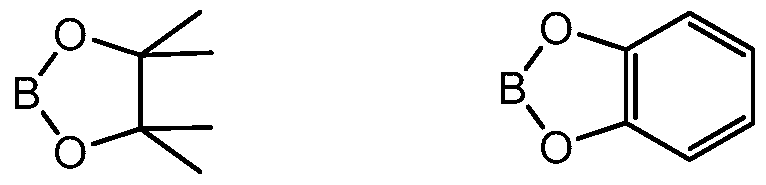
B1 B2
[0143] In some embodiments the disclosure provides the imines of Formula BBl and BB2

[0144] In some embodiments, an imine has the structure of Formula VIb:

R8 is Z, where Z is Cl, Br, or I, and R9 is as defined above for Formula VI. In some embodiments, Z is Cl or Br.
[0145] In some embodiments the disclosure provides an imine of Formula VIc:

R7 is NH2, or Z, where Z is Cl, Br, or I, and R9 and R10 are as defined above for Formula VI. In some embodiments, Z is Cl or Br.
[0146] In some embodiments the disclosure provides an imine of Formula VId

R7 is Z, where Z is Cl, Br, or I, and R9 is as defined above for Formula VI. In some embodiments, Z is Cl or Br.
[0147] In some embodiments, the imines have the specific structure of Formulas VIh and VIi:

VIi
[0148] In some embodiments, the compounds of the disclosure relate to various intermediates produced using the imines described herein. In some embodiments, the compound has the structure of Formula IV:

Y is O or S;
X is O, S, or N(Ci-C6 alkyl);
R1 is H, substituted or unsubstituted Ci-C6 alkyl, substituted or unsubstituted C4-C7 cycloalkyl, or substituted or unsubstituted phenyl;
R is C3-C6 alkyl, phenyl, naphthyl, substituted phenyl, substituted naphthyl, Cs-C6 alkoxycarbonyl or benzyl, wherein the substituents on phenyl and naphthyl are 1 -3 substituents selected from the group consisting Of Ci-C6 alkyl, phenyl and benzyl;
R4 is a hydroxyl protecting group;
R5 is NH2, 0Ra, B(0Rb)(0Rc), B(Rd)2, Si(Rd)3, or Si(ORe)3, where Ra is a hydroxyl protecting group; Rb and Rc are independently H, Ci-C6 alkyl, alkenyl, or aryl, or Rb and Rc together form a 5-6 membered ring; Rd is Ci-Cg alkyl, cycloalkyl, alkenyl, aryl, or a halogen, and Re is Ci-Cg alkyl, alkenyl, or aryl; or
R5 is Si(Rm)2(Rn), Si(ORn)3, or Si(Rm)2(ORn), where Rm is Ci-C8 alkyl, cycloalkyl, alkenyl, aryl, or a halogen, or optionally two Rm, taken together with the Si to which they are bonded, may form a silacycloalkyl ring structure having 4-8 atoms; and Rn is Ci-Cg alkyl, alkenyl, aryl, or C2-C4 alkyl- amines, or optionally three 0Rn taken together with the Si to which they are bonded, may form a tricyclic silatrane ring structure;
R6 is H or 0Rf, where Rf is a hydroxyl protecting group;
R7 and R8 are independently H, NH2, or Z, wherein Z is Cl, Br, or I; with the proviso that
(i) when R5 is NH2, B(0Rb) (ORC), B(Rd)2, Si(Rd)3, Si(ORe)3, Si(Rm)2(Rn), Si(ORn)3, or Si(Rm)2(ORn). then R7 and R8 are H; and
(ii) when R5 is 0Ra, then R6, R7, and R8 are not simultaneously H.
[0149] In some embodiments of the compounds of Formula IV, when R5 is ORa, then at least one of R7 and R8 is Z, where Z is Cl, Br, or I. In some embodiments, Z is Cl or Br.
[0150] In some embodiments, R5 is not Z. In some embodiments, X and Y are both independently O. In some embodiments R3 is phenyl. In some embodiments R4 is trimethylsilyl. In some embodiments Ra is trimethylsilyl. In some embodiments Rf is trimethylsilyl.
[0151] In some embodiments, the intermediate compounds relate to the compounds of Formulas IVc and IVd:

[0152] In some embodiments, the compounds relate to those of Formula IVg:

[0153] In some embodiments the compounds of Formulas IV, IVc, IVd, and IVg are substantially chirally pure compounds. In some embodiments the compounds of Formulas IV, IVc, IVd, and IVg are chirally pure compounds.
[0154] In some embodiments, the disclosure provides compounds of Formula VII:
 wherein
R1 is H, substituted or unsubstituted Ci-Ce alkyl, substituted or unsubstituted C4-C7 cycloalkyl, or substituted or unsubstituted phenyl;
R7 and R8 are independently H, NH2, or Z, wherein Z is Cl, Br, or I;
R11 is a H or a hydroxyl protecting group;
R12 is OH, NH2, 0Ra, B(0Rb) (ORC), B(Rd)2, Si(Rd)3, or Si(ORe)3, where Ra is a hydroxyl protecting group; Rb and Rc are independently H, Ci-C6 alkyl, alkenyl, or aryl, or Rb and Rc together form a 5-6 membered ring; Rd is Ci-C8 alkyl, cycloalkyl, alkenyl, aryl, or a halogen, and Re is Ci-C8 alkyl, alkenyl, or aryl; or
R12 is Si(Rm)2(Rn), Si(ORn)3, or Si(Rm)2(ORn), where Rm is Ci-C8 alkyl, cycloalkyl, alkenyl, aryl, or a halogen, or optionally two Rm, taken together with the Si to which they are bonded, may form a silacycloalkyl ring structure having 4-8 atoms; and Rn is Ci-C8 alkyl, alkenyl, aryl, or C2-C4 alkyl- amines, or optionally three ORn taken together with the Si to which they are bonded, may form a tricyclic silatrane ring structure;
R13 is H, OH, or 0Ra, wherein Ra is a hydroxyl protecting group; with the provisos that
(i) when R12 is B(0Rb) (ORC), NH2, or Z, then R7, R8 and R13 are H;
(ii) when R12 is B(Rd)2, Si(Rd)3, Si(ORe)3, Si(Rm)2(Rn), Si(ORn)3, or Si(Rm)2(ORn), then R7 and R8 are H; and
(iii) when R12 is OH or 0Ra, then R7, R8, and R13 are not simultaneously H.
[0155] In some embodiments of the compounds of Formula VII, at least one of R7 and R8 is Z, where Z is Cl, Br, or I. In some embodiments, Z is Br or Cl. In some embodiments R9 and R11 are trimethylsilyl.
[0156] In some embodiments the compound of Formula VII has the Formula Vila or VIIb

[0157] In some embodiments, the compounds of Formula VII have the specific structures of Formula VIIc and VIId

[0158] In some embodiments, the compound of Formula VII has the specific structures of Formula VIIe and VIIf

[0159] In some embodiments the compounds of Formulas VII, VIIc, VIId, VIIe, and VIIf are substantially chirally pure compounds. In some embodiments the compounds of Formulas VII, VIIc, VIId, VIIe, and VIIf are chirally pure compounds.
[0160] In some embodiments, the disclosure provides compounds of Formula XII wherein TMS is trimethylsilane:

3.4. Reagents and Reaction Conditions
[0161] For the processes illustrated by the various Schemes described herein, standard reagents and conditions for the various reaction steps that are known in the art can be used. For example, reagents and conditions for the synthesis of Ezetimibe API from chiral alcohol and imine reagents useful in the processes of the present disclosure are described in US 6,207,822, which is hereby incorporated by reference herein. Additionally, standard reagents and conditions useful with the methods herein are described WO2006122020, and WO2006122216, each of which is hereby incorporated by reference herein.
For example, the protected starting compounds used in the methods of the present disclosure, i.e., the protected chiral alcohols (e.g., compounds of Formula II) and the protected imines (e.g., compounds of Formula III), can be made with a suitable hydroxy-protecting group. In some embodiments, the hydroxy-protecting group is a silyl protecting group such as that derived from the silylating agents chlorotrimethylsilane (TMSCl) or t-butyldimethyl-silyl chloride (TBDMSCl), preferably TMSCl. For example, 1 equivalent of chiral alcohol and 1 -3 equivalents of imine are added to an anhydrous solvent such as CH2Cl2 (DCM) at about -10° to 1500C, and a tertiary amine base such as DIPEA is added along with sufficient silylating agent to react with the alcohol and imine is added (e.g., 2-4 equivalents) to afford the protected products. After protection is complete, condensation of the chiral alcohol and imine to form the β-(substituted-amino)amide (e.g., compounds of Formula IV) can be achieved by reacting at about -10° C to -50° C, preferably about -25° C to -35° C with at least 1 equivalent of a Lewis acid (e.g., TiCU), in the presence of a tertiary amine base (preferably 2-4 equivalents), preferably DIPEA for 2-4 hours.
[0162] After condensation, further silylation (of the substituted amino group) and cyclization to form the protected API precursor (e.g., compounds of Formula V) can be effected by first reacting the β- (substituted-amino)amide starting material with a silyl-enol ether silylating agent, followed by reaction with a fluoride ion generating cyclizing agent.
[0163] Suitable silyl-enol ether silylating agents for this reaction include bistrimethylsilyl acetamide (BSA), N-methyl-O-trimethylsilyl acetamide or iso-propenyloxy trimethylsilane, preferably BSA, provided in a suitable inert organic solvent (e.g., t-BuOMe, DMC, THF, or toluene). The silylation can be carried out, preferably in a dry, inert atmosphere, at -20 0C to 110 0C, preferably at about 0° to 50° C, more preferably at about 40 0C, for about 0.5 to about 6 hours, preferably about 2 hours.
[0164] Suitable cyclizing agents generate fluoride ion to catalyze the intra-molecular cyclization reaction. The fluoride ion can be in the form of a quaternary alkyl-, aryl-alkyl- or arylalkyl-alkyl- ammonium fluoride salt or a hydrate thereof, or a mixture thereof, or is an alkali metal fluoride salt or a hydrate thereof, such as cesium fluoride or potassium fluoride. Examples of arylalkyl-alkyl- ammonium groups are benzyltriethyl-ammonium and benzyltrimethyl-ammonium. Examples of arylalkyl- ammonium are phenyltriethyl-ammonium and phenyltrimethyl-ammonium. Typical alkylammonium groups contain alkyl groups of 1-6 carbon atoms, e.g., tetra n-butyl-ammonium. When a hydrated quaternary ammonium fluoride salt is used, the reagent can be added in a catalytic amount, i.e., about 0.1 to about 20 mole percent, preferably about 0.5 to 5 mole percent, and when an anhydrous quaternary ammonium fluoride salt is used, it can be added in a catalytic up to a stoichiometric amount. When an alkali metal fluoride salt is used, it is added in catalytic amount up to a stoichiometric amount compared to the starting β-amino compound, depending on the solubility of the reagent in the solvent used (higher solubility requires less reagent). A preferred fluoride ion catalyst cyclizing agent is tetrabutylammonium fluoride trihydrate (TBAF). The addition of the silylating and cyclizing agents in the above-described process can be sequential or simultaneous. For example, the β-(substituted-amino)amide can first be reacted with the silyl-enol ether silylating agent and then reacted with the cyclizing agent, or the β-(substituted-amino)amide can be added to a mixture of the silylating agent and the cyclizing agent.
[0165] When the silylation and cyclization reactions are done sequentially, typically the silylating agent is reacted with the starting material first and the silylation reaction is allowed to continue for up to about two hours. However, the cyclization step also can be carried out immediately after silylation. If added to the reaction mixture after the silylation agent, the fluoride reagent is added directly to the reaction mixture resulting from silylation, and is reacted at about -20 0C to 110 0C, preferably at about 0° to 50° C, or more preferably at about 40 0C, for about 0.5 to about 6 hours, preferably about 2 hours.
[0166] Alternatively, the silylating agent and the cyclizing agent can be added simultaneously. The β-(substituted-amino)amides formed by condensation are then silylated by reaction with a silyl-enol ether silylating agent such as bistrimethylsilyl acetamide (BSA), N-methyl-O-trimethylsilylacetamide or iso-propenyloxy trimethylsilane, preferably BSA, in a suitable inert organic solvent, preferably toluene. When the silylation reagent and the fluoride reagent are added simultaneously, the reaction is conducted under conditions similar to the sequential reaction conditions described above.
[0167] The silylated and cyclized compound is deprotected to afford Ezetimibe API depending on the combination of protecting groups remaining on the chiral alcohol and phenol groups. For example, where a TMS protecting group remains on at least the chiral alcohol and optionally, the phenol group (e.g., as in Schemes 7 and 8), a first step of deprotection can be carried using preferably, 2N H2SO4 in isopropylalcohol (IPA) under N2, at about 25°C for 1 hour. Oxidative deprotection of the silylated alcohol and/or phenol can also can be effected using a fluoride source (e.g., KF, TBAF, CsF) and an oxidant (e.g., H2O2, metachloroperbenzoic acid (mCPBA), oxone, magnesium monoperoxyphthalate (MMPP)).
[0168] Silyl groups (e.g., groups of the formulas Si(Rd)3, Si(ORe)3, Si(Rm)2(Rn), Si(ORn)3, or Si(Rm)2(ORn) as described herein) are also used to mask the para position so as to allow selective reaction under mild conditions to afford the "unmasked" para phenol. Exemplary siletanyl, siloxane, and silatrane protecting groups include:

R21 = alkyl, aryl R22 = alkyl, aryl, allyl
[0169] Illustrative reaction conditions for preparing and using silane, siloxane, siletanyl and silatrane groups to mask the para position and thereafter generate phenols are described in e.g., Lam et al., Tetrahedron Letters 46(2005) 3283-3285; House et al., J. Org. Chem. 2006, 71, 420-422; Bashiardes et al., Chem. Commun., 2004, 122-123.
[0170] Where boryl groups, e.g., B(ORb) (ORC), B(Rd)2, are used to mask the para position so as to allow a selective reaction (i.e., "unmasking") to generate of a para phenol (e.g., as in Schemes 2, 3, 4), the unmasking can be effected by any suitable oxidizing agent, such as any peroxide, for example 79% H2O2. Other suitable oxidizing agents allowing selective boryl group reaction to product the para phenol include e.g.,_mCPBA, oxone, MMPP. Boryl group deprotection from the phenol position typically is carried out after the deprotection of any silyl protecting group on the chiral alcohol.
[0171] Where an amino group is used to mask the para position ("p-aniline mask") so as to allow a selective unmasking reaction to generate of a para phenol (e.g., as in Example 5, Scheme 11, or Scheme Id, where R5 is NH2) the reaction can be accomplished via a Sandmeyer type reaction with tert-butyl nitrite and then optionally copper oxide under neutral conditions (see e.g., March's
Advanced Organic Chemistry: Reaction, Mechanisms and Structure, 6th Edition, by Michael B. Smith and Jerry March , Wiley, 2007 at p. 919, section 13-20).
[0172] Where selective removal of amino group is carried out after deprotection of the para phenol (e.g., as in Example 6, Scheme 12, or Scheme 1) the reaction can be accomplished via diazotization with tert-butyl nitrite and treatment with hypophosphorus acid (see e.g., Ek et al., J.Org. Chem, 2002, 67, 6376; and Giumanini et al., Tetrahedron, 1996, 52, 7137) or via reductive deamination of the aniline (see e.g., March's Advanced Organic Chemistry: Reaction, Mechanisms and Structure, 6th Edition, by Michael B. Smith and Jerry March , Wiley, 2007 at p. 1847, section 19.69).
[0173] Where the selective removal of a Br, Cl, or I, is carried out before or after deprotection of the phenol (e.g., as in Schemes Ib and Ic, 7, and 8), the reaction can be accomplished by hydrogenation reaction using H2 and a palladium catalyst. In a typical reaction, conditions can be 40 mg 10% Pd/C under hydrogen atmosphere (see e.g., Example 2).
[0174] Where the halides Br or Cl are used to mask the para position so as to allow a selective reaction to produce a para phenol, (e.g., as illustrated in Scheme If), reaction of the masking halide can be carried out via a Pd catalyzed coupling with sodium or potassium hydroxides to yield the corresponding phenol. For example, specific reaction conditions involving Tris(dibenzylideneacetone)dipalladium(0) ("Pd2dba3") and substituted biphenyl ligand catalyst systems for direct Pd-catalyzed synthesis of phenols from aryl halides are provided in e.g., Anderson et al., "The Selective Reaction of Aryl Halides with KOH: Synthesis of Phenols, Aromatic Ethers and Benzofurans," J. Am. Chem. Soc. 2006, 128, 10695-10695. Additionally, use of Pd catalysts with hindered biaryl monophosphines (e.g., XPhos and SPhos) and KOH can be used to effect phenol synthesis from aryl halides.
[0175] The synthesis of the various imines disclosed herein can be carried out using standard chemistries. For example, imines can be prepared by reaction of the reagents in IPA at 500C as illustrated below:


[0176] Specific reaction conditions for synthesis of the selected imines are presented in the Examples. Additional examples of reaction conditions for generating imines are described in US 6,207,822, WO2006122020, and WO2006122216.
4. EXAMPLES
[0177] Various features and embodiments of the disclosure are illustrated in the following representative examples, which are intended to be illustrative, and not limiting.
Example 1: Synthesis of Ezetimibe via Boronic Ester.
[0178] The synthesis of Ezetimibe using boronic ester protection of the para position phenol is illustrated in this example and is shown in Scheme 6 below.
Scheme 6

[0179] Synthesis of Imine IHf: To a 25 mL 1-neck RB flask fitted with reflux condenser, was added 3.0 g (12.9 mmol) of 4-(4,4,5,5-tetramethyl-l,3,2-dioxaborolan-2-yl)benzaldehyde and 5 mL of anhydrous IPA. The mixture was then heated at 50 0C and 4-fluoroaniline 1.46 g (13.14 mmol) was added dropwise. The mixture was heated at 50 0C for 1 hour and cooled to room temperature. The pale yellow crystalline solid was filtered, washed with 10 mL cold IPA and dried under vacuum at ambient temperature for 12 h, to give the product in 88% yield (desired compound IHf was confirmed by NMR).
[0180] Synthesis of Intermediate IVm: To a 50 mL oven-dried RB flask was charged with compound Hm 1.09 g (3.05 mmol) followed by 7.5 mL of anhydrous DCM. The mixture was cooled to -10 0C, DIPEA 0.8 mL (4.57 mmol) was slowly added followed by TMSCl 0.465 mL (3.66 mmol) while maintaining the temperature below -10 0C for 1.5 hour. (The formation of TMS protected compound Hm was confirmed by TLC.) The mixture was cooled to -30 0C and IM TiCl4 in DCM 3.6 mL (3.6 mmol) was added dropwise over 15 min and stirred for an additional 15 min at that temperature.
DIPEA 0.8 mL (4.57 mmol) was added dropwise over 15 min and stirred for an additional hour at -30
0C.
[0181] Imine compound IHf: 1.04 g (3.2 mmol) was weighed into a 25 mL oven dried RB Flask and dissolved in 7.5 mL anhydrous DCM prior to dropwise addition over 30 min into the preformed enolate at -30 0C. After 4 hours, the reaction mixture was quenched by slow addition of IPA (6.4 mL) followed by DCM (15 mL) at -25 to -30 0C and slowly warmed to 0 0C. The reaction mixture was then poured into disodium tartrate buffer (0.2 M aq. solution, 25 mL maintained at 0 0C) and stirred for 15-20 min while it was warmed to room temperature. The organic layer was separated and the aqueous layer was extracted twice with DCM. The combined organics were washed with water, dried over anhydrous Na2SO4 and concentrated in vacuo to afford crude β-(substituted amino) amide compound IVm which was immediately taken to the next step. The crude IVm was dissolved in anhydrous DCM followed by addition of BSA 0.9 mL (3.66 mmol) and stirred at 40 0C for 1 h. The crude mixture was cooled to ambient temperature and concentrated to dryness prior to recrystallization with MTBE and EA to afford the desired isomer IVm in 54 % yield (desired compound IVm was confirmed by NMR).
[0182] Synthesis of Ezetimibe API (If) from intermediate IVm: To an oven dried 100 mL RB flask was charged with 0.87 g (1.16 mmol) of IVm and BSA 1.7 mL (6.96 mmol) in 40 mL of anhydrous toluene. The mixture was heated at 60 0C for 1 hour. The mixture was cooled to room temperature and 36 mg (0.116 mmol) TBAF.3H2O was added and reheated to 90 0C. After 15 min, the cyclization reaction was completed (confirmed by TLC). Acetic acid (41 μL) was added to the reaction mixture prior to concentration to dryness. The resulting oily residue was redissolved in IPA (4 mL) and 2N H2SO4 (410 μL) and stirred for 30 min for deprotection of the TMS protected alcohol. Reaction completion was confirmed by TLC. Aqueous H2O2 (1.5 mL, 35%) was added to the mixture and stirred for 30 min at room temperature. Complete oxidation of boronic ester to phenol was confirmed by TLC. The crude mixture was concentrated in vacuo and recrystallized from toluene and THF to afford Ezetimibe API (If) in 79% yield (desired compound If was confirmed by NMR).
Example 2: Synthesis of Ezetimibe Halide Substituted Intermediates IVn and IVo.
[0183] The syntheses of Ezetimibe via the halide substituted intermediates IVn and IVo illustrated in this example is shown in Schemes 7 and 8 below.
Scheme 7

i) VIh, TMSCI,
,


i)

Scheme 8

i) VIi, TMSCI, t


i)

[0184] Synthesis of Imines VIh and VIi: Imines VIh and VIi were synthesized following the procedure for imine IHf. 3-bromo-4-hydroxybenzaldehyde was used in the synthesis of imine VIh and 3-bromo-4-fluoroaniline was used for the synthesis of imine VIi.
[0185] Synthesis of Intermediates IVn and IVo: These intermediate compounds were synthesized via the reaction of Hm with imine VIh or VIi following the same reaction procedure for making intermediate IVm described in Example 1. Yield of intermediate IVn partially purified by recrystallization was 37%. Yield of intermediate IVo partially purified by recrystallization was 56%.
[0186] Synthesis of Ezetimibe API from Intermediate IVn or IVo: To an oven dried 100ml RB flask was charged with 0.2 g (0.2513 mmol) of IVn and BSA 0.368 mL (1.50 mmol) in 8 mL of anhydrous toluene. The mixture was heated at 60 oC for 1 hour. The mixture was cooled to room temperature and 7.9 mg (0.025 mmol) TBAF.3H2O was added and reheated to 90 oC. After 15 min, the cyclization reaction was completed (confirmed by TLC). The reaction was quenched with 20 mL saturated NH4C1 solution. The aqueous layer was extracted with ethyl acetate (10 mL x 2). The combined organics were concentrated in vacuo and the oily residue was redissolved in IPA (4 mL) and 2N H2SO4 (102 μL) and stirred for 30 min for deprotection of the TMS protected alcohol. Reaction completion was confirmed by TLC. The reaction was quenched with 20 mL saturated
NaHCO3 solution. The aqueous layer was extracted with ethyl acetate (10 mL x 2). The combined organics were concentrated in vacuo yielding an oily residue that was redissolved in methanol (5 mL). Hydrogenation was carried out with 40 mg 10% Pd/C under hydrogen atmosphere resulting in removal of the bromine and formation of compound If. Ezetimibe API (If) formation was confirmed by liquid-chromatography/mass-spectrometry (LC/MS) as explained in detail below. The same procedure was followed for the conversion of intermediate IVo to the Ezetimibe API (If).
[0187] LC/MS analysis: LC/MS was performed using Agilent 1200 HPLC with DAD (Diode Array Detector) in series with ABI QTrap 3200 Mass Spectrometer. The mass-spectrometer is a hybrid triple quadrupole/LIT (Linear Ion Trap) system which is capable to perform LC/MS, LC/MS/MS and LC/MS3 analysis. In this experiment, a negative electrospray ionization mode was selected to run in Enhanced Mass Scan (EMS). The EMS scan utilizes the Linear Ion Trap capability that traps all the ions in the Q3 quadrupole region and scanned out to produce full spectrum data. As many spectra are rapidly collected in a short period of time, the spectra collected are more intense than those collected from normal Q 1 quadrupole region. An authentic Ezetimibe API was run and observed to have a retention time of 11.13 min on both the TIC and UV chromatograms. Its mass spectrum showed a parent mass of 408.4 [M-H]" and predominate mass fragment of 271.3. The two samples synthesized from intermediate IVn and IVo were run under the same LC/MS parameters and found to elute at the same retention time and have the same spectra profile. An additional peak observed at 11.64 min on UV and TIC chromatogram was due to the present to the brominated Ezetimibe derivative of compound C3:

C3
[0188] It should also be noted that reaction mixtures used in the Pd/C hydrogenolysis reaction were only partially purified and contained amounts of the undesired diastereoisomer. After hydrogenolysis, this leads to the presence of both Ezetimibe API (If) and its diastereoisomer. The presence of this diastereomer resulted in the observation of two peaks of identical molecular weight in the LC/MS analysis. The additional peak for hydrogenolysis reaction of intermediate IVn was at 11.19 minutes, and the reaction of intermediate IVo resulted in a shouldered peak of identical molecular weight at
11.13 minutes. It is expected that optimized crystallization of the intermediates prior to Pd/C hydrogenolysis can result in diastereomerically pure Ezetimibe API via this process.
[0189] LC/MS conditions were as follows:
[0190] LC conditions (in Agilent 1200/DAD HPLC system): Column: Mightysil Aqua C18 4.6 x 250mm (5μm); Flowrate = 1000 μL/min; eluent A: H2O; eluent B: CH3CN; run-time: 12min; gradient (%A + %B = 100%): 95% -> 5% A from 0 to 10 min, 5% ^95% A from 10.0 to 10.5 minutes, 95% -> 95% A from 10.5 to 12.0 minutes. Wavelength: 254 nm; Temperature: ambient; Injection Volume: 5 μL.
[0191] MS conditions in ABI QTrap 3200: TurbolonSpray source; negative polarity (ES-); Scan Type: Enhanced MS (EMS); CUR = 10 psi; IS = -4500.0V; TEM = 6000C; GSl = 50 psi; GS2= 50 psi; Ihe: On; CAD: Medium; DP = -85 V; EP = -6.0 V; CE = -10.0 V; Ql unit resolution; Q3 unit resolution; Dynamic fill time.
Example 3: Synthesis of Ezetimibe with Acetyl-Masked Phenol.
[0192] The example illustrates a process using the acetyl protecting group to mask the para position of the ring that becomes the phenol as shown in Scheme 9:
Scheme 9

Example 4: Synthesis of Ezetimibe with Halide-masked Phenol.
[0194] The example illustrates a process using a halide to mask the para position of the ring that becomes the phenol as shown in Scheme 10 below:
Scheme 10

[0195] The para position where the phenol is desired is masked with a halide and subsequently deprotected (i.e., "unmasked") via a Pd catalyzed coupling with sodium or potassium hydroxides to yield the desired phenol of the Ezetimibe API as shown in Scheme 10 above. In this approach, the halo-aldehyde is used to make the imine compound AA, and this compound is used for the synthesis of intermediate BB. This intermediate is cyclized under conditions described previously. The final
Pd catalyzed coupling with sodium or potassium hydroxide generates the Ezetimibe API of Formula If.
Example 5: Synthesis of Ezetimibe with an Aniline-masked Phenol.
[0196] In this example, the para position of the ring that becomes the phenol is masked as an aniline group and subsequently converted to a phenolic group via a Sandmeyer type reaction with tert-butyl nitrite and then optionally copper oxide under neutral conditions to yield Ezetimibe API (compound of Formula If) as shown in Scheme 11 below:
Scheme 11


Example 6: Synthesis of Ezetimibe with an Aniline-masked Phenol.
[0198] In another embodiment, a removable aniline group attached to the aldehyde portion of the imine can be used in the Mannich reaction and subsequently be removed via the Sandmeyer type reaction with tert-butyl nitrite followed by treatment with hypophosphorus acid to yield Ezetimibe API as shown in Scheme 12 below:
Scheme 12


[0199] In this approach imine FF is used in a Ti-mediated Mannich reaction to afford intermediate GG. Intermediate compound GG is silylated and cyclized under conditions described previously to yield intermediate HH. Final removal of the aniline group from HH is achieved via diazotization with tert-butyl nitrite and treatment with hypophosphorus acid to generate the Ezetimibe API (If).
[0200] All publications, patents, patent applications and other documents cited in this application are hereby incorporated by reference in their entireties for all purposes to the same extent as if each individual publication, patent, patent application or other document were individually indicated to be incorporated by reference for all purposes.
[0201] While various specific embodiments have been illustrated and described, it will be appreciated that various changes can be made without departing from the spirit and scope of the invention(s).
Claims
1. A process for preparing a compound of Formula I

R1 is H, substituted or unsubstituted Ci-Ce alkyl, substituted or unsubstituted C3-C7 cycloalkyl, substituted or unsubstituted phenyl, substituted or unsubstituted naphthyl, or substituted or unsubstituted heteroaryl; and
R2 is H or OH; the process comprising at least the step of reacting a chiral alcohol of Formula II

R1 is defined as above;
Y is O or S;
X is O, S, or N(Ci-C6 alkyl);
R3 is C3-C6 alkyl, substituted or unsubstituted phenyl, substituted or unsubstituted naphthyl, C3-C6 alkoxycarbonyl or benzyl, wherein the substitutions on phenyl and naphthyl are 1 -3 substituents selected from the group consisting Of Ci-C6 alkyl, phenyl and benzyl;
R4 is a hydroxyl protecting group with an imine of Formula III

III wherein
R5 is NH2, ORa, B(ORb)(ORc), B(Rd)2, Si(Rd)3, or Si(ORe)3, where Ra is a hydroxyl protecting group; Rb and Rc are independently H, Ci-Ce alkyl, alkenyl, or aryl, or Rb and Rc together form a 5-6 membered ring; Rd is Ci-C8 alkyl, cycloalkyl, alkenyl, aryl, or a halogen, and Re is Ci-C8 alkyl, alkenyl, or aryl; or
R5 is Si(Rm)2(Rn), Si(ORn)3,or Si(Rm)2(ORn), where Rm is Ci-C8 alkyl, cycloalkyl, alkenyl, aryl, or a halogen, or optionally two Rm, taken together with the Si to which they are bonded, may form a silacycloalkyl ring structure having 4-8 atoms; and Rn is Ci-C8 alkyl, alkenyl, aryl, or C2-C4 alkyl-amines, or optionally three ORn taken together with the Si to which they are bonded, may form a tricyclic silatrane ring structure;
R6 is H or ORf, where Rf is a hydroxyl protecting group;
R7 and R8 are independently H, NH2, or Z, where Z is Cl, Br, or I; and condensing the protected chiral alcohol of Formula II and the imine of Formula III to form a β- (substituted-amino)amide of Formula IV

(i) when R5 is NH2, B(0Rb) (ORC), B(Rd)2, Si(Rd)3, Si(ORe)3, Si(Rm)2(Rn), Si(ORn)3, or Si(Rm)2(ORn), then R7 and R8 are H; and
(ii) when R5 is 0Ra, then R6, R7, and R8 are not simultaneously H.
2. The process of claim 1 wherein the hydroxyl protecting group is trimethylsilyl (TMS) and the condensation is done with a Lewis acid in the presence of a tertiary amine.
3. The process of claim 2 wherein the Lewis acid is TiCU, and the tertiary amine is diisopropylmethylamine (DIPEA).
4. The process of claim 1, wherein R1 is para- fluorophenyl.
5. The process of claim 1, wherein when R5 is ORa, then at least one of R7 and R8 is NH2, or Z, where Z is Cl, Br, or I.
6. The process of claim 1, further comprising a step of cyclizing the β-(substituted- amino)amide of Formula IV in presence of a silylating agent and a cyclizing agent to form a compound of Formula V

7. The process of claim 6, wherein the silylating agent is N,O-Bis- (trimethylsilyl)acetamide (BSA) and the cyclizing agent is tetra-n-butylammonium (TBAF).
8. The process of claim 1, wherein the imine of Formula III is Ilia

and the imine is reacted with the protected chiral alcohol of Formula II to form a β-(substituted- amino)amide of Formula IVa

9. The process of claim 8, further comprising a step of cyclizing the β-(substituted- amino)amide of Formula IVa in presence of a silylating agent and a cyclizing agent to form a compound of Formula Va 
10. The process of claim 9, further comprising removing the hydroxyl protecting group from the compound of Formula Va to form a compound of Formula Via


11. The process of claim 10, in which the removal of the hydroxyl protecting group from the compound of Formula Va to form a compound of Formula Via, and the oxidation of the compound of Formula Via to form the compound of Formula I, are combined into a single step.
12. The process of claim 1, wherein the imine of Formula III is IHe 
and the imine is reacted with the protected chiral alcohol of Formula II to form a β-(substituted- amino)amide of Formula IVe

13. The process of claim 12, further comprising a step of cyclizing the β-(substituted- amino)amide of Formula IVe in presence of a silylating agent and a cyclizing agent to form a compound of Formula Ve

14. The process of claim 13, further comprising removing the hydroxyl protecting group from the compound of Formula Ve to form a compound of Formula VIe


15. The process of claim 5, wherein the imine of Formula III is IHb

R8 is Z, where Z is Cl, Br, or I; and the imine is reacted with the protected chiral alcohol of Formula II to form a β-(substituted- amino)amide of Formula IVb
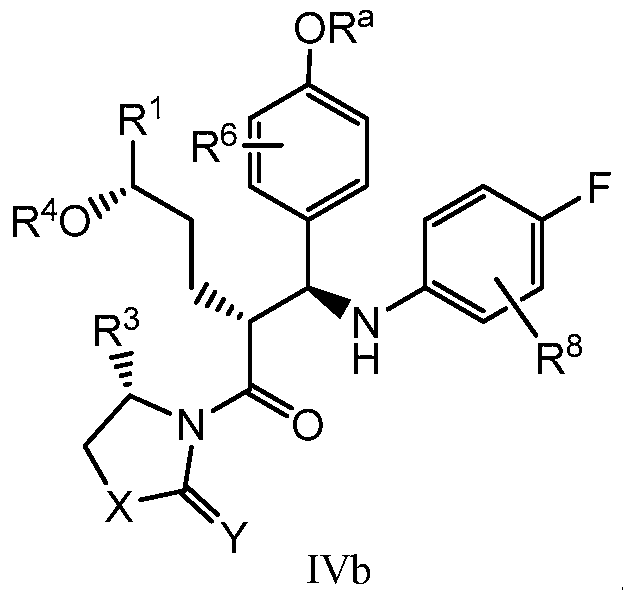
16. The process of claim 15, further comprising a step of cyclizing the β-(substituted- amino)amide of Formula IVb in presence of a silylating agent and a cyclizing agent to form a compound of Formula Vb

Vb
17. The process of claim 16, further comprising removing the hydroxyl protecting group from the compound of Formula Vb to form a compound of Formula VIb


18. The process of claim 5, wherein the imine of Formula III is UIc

R7 is Z, where Z is Cl, Br, or I; and the imine is reacted with the protected chiral alcohol of Formula II to form a β-(substituted- amino)amide of Formula IVc

19. The process of claim 18, further comprising a step of cyclizing the β-(substituted- amino)amide of Formula IVc in presence of a silylating agent and a cyclizing agent to form a compound of Formula Vc

20. The process of claim 19, further comprising removing the hydroxyl protecting group from the compound of Formula Vc to form a compound of Formula VIc
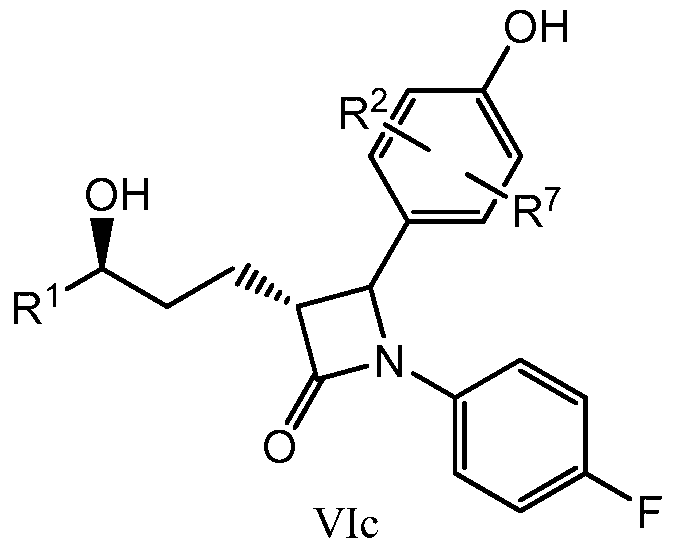
and converting the compound of Formula VIc to the compound of Formula I

21. The process of claim 1 , wherein the imine of Formula III is IHd

HId wherein
R5 is NH2, Si(Rd)3, or Si(ORe)3, where Ra is a hydroxyl protecting group; Rb and Rc are independently H, Ci-Ce alkyl, alkenyl, or aryl, or Rb and Rc together form a 5-6 membered ring; Rd is Ci-Cg alkyl, cycloalkyl, alkenyl, aryl, or a halogen; and Re is Ci-Cg alkyl, alkenyl, or aryl; or
R5 is Si(Rm)2(Rn), Si(ORn)3, or Si(Rm)2(ORn), where Rm is Ci-C8 alkyl, cycloalkyl, alkenyl, aryl, or a halogen, or optionally two Rm, taken together with the Si to which they are bonded, may form a silacycloalkyl ring structure having 4-8 atoms; and Rn is Ci-Cg alkyl, alkenyl, aryl, or C2-C4 alkyl-amines, or optionally three ORn taken together with the Si to which they are bonded, may form a tricyclic silatrane ring structure; and the imine of Formula HId is reacted with the protected chiral alcohol of Formula II to form a β- (substituted-amino)amide of Formula IVd

22. The process of claim 21, further comprising a step of cyclizing the β-(substituted- amino)amide of Formula IVd in presence of a silylating agent and a cyclizing agent to form a compound of Formula Vd

23. The process of claim 22, further comprising removing the hydroxyl protecting group from the compound of Formula Vd to form the compound of Formula VId


24. The process of claim 23, in which the removal of the hydroxyl protecting group from the compound of Formula Vd to form a compound of Formula VId, and oxidation of the compound of Formula VId to form the compound of Formula I are combined into a single step.
25. A process for preparing a compound of Formula If  the process comprising:
(a) reacting a protected chiral alcohol of Formula Hf

Ph is phenyl; and
R4 is a hydroxyl protecting group; with an imine of Formula IHk

Z is Br, Cl, or I, to form a β-(substituted-amino)amide of Formula IVk

(b) cyclizing the β-(substituted-amino)amide of Formula IVk in the presence of a silylating agent and a cyclizing agent to form a compound of Formula Vk

(c) removing the hydroxyl protecting group from the compound of Formula Vk to form a compound of Formula VIk

(d) converting the compound of Formula VIk to the compound of Formula If

26. A process for preparing a compound of Formula If

(a) reacting a protected chiral alcohol of Formula Hf:

Ph is phenyl; and
R4 is a hydroxyl protecting group; with an imine of Formula IHf
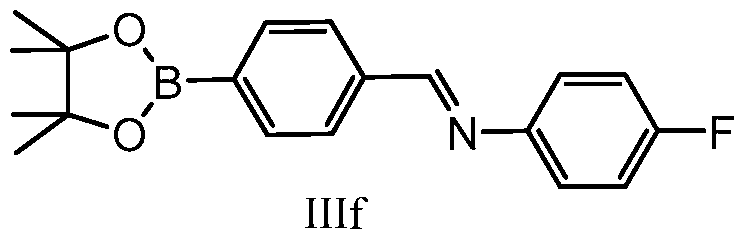
and condensing the protected chiral alcohol and the imine to form a β-(substituted-amino)amide of Formula IVf

(b) cyclizing the β-(substituted-amino)amide of Formula IVf in presence of a silylating agent and a cyclizing agent to form a compound of Formula Vf

(c) removing the hydroxyl protecting group from the compound of Formula Vf to form a compound of Formula VIf

(d) oxidizing the compound of Formula VIf to form the compound of Formula If

27. The process of claim 26, in which the removal of the hydroxyl protecting group from the compound of Formula Vf to form a compound of Formula VIf, and the oxidation of the compound of Formula VIf to form the compound of Formula If, are combined into a single step.
28. A process for preparing a compound of Formula If: 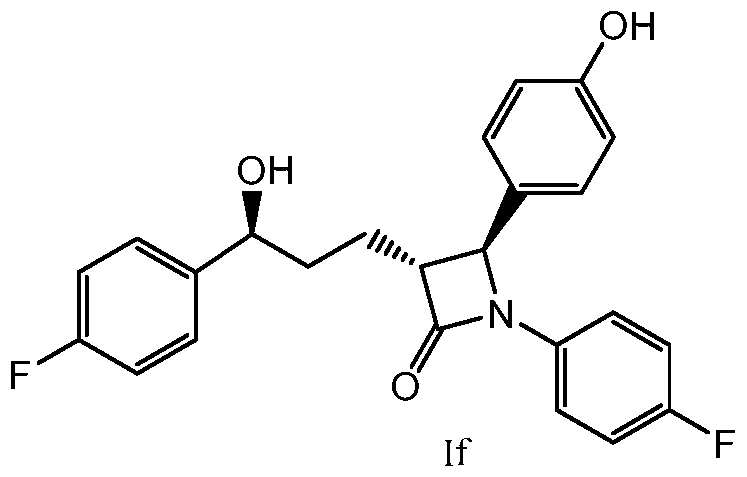 the process comprising:
(a) reacting a protected chiral alcohol of Formula Hf

Ph is phenyl; and
R4 is a hydroxyl protecting group; with an imine of Formula XXI

wherein  and condensing the protected chiral alcohol and the imine to form a β-(substituted-amino)amide of Formula XXII


(b) cyclizing the β-(substituted-amino)amide of Formula XXIII in presence of a silylating agent and a cyclizing agent to form a compound of Formula XXIV

(c) removing the hydroxyl protecting group from the compound of Formula XXIV to form a compound of Formula XXV

(d) hydro lyzing the compound of Formula XXV to form the compound of Formula If

29. A process for preparing a compound of Formula VIII

R4 is a hydroxyl protecting group;
R14 and R15 are each independently H, ORS, Z, or OCH3, where Z is F, Cl, Br, or I, and where Rs is a hydroxyl protecting group;
R16 is H, ORh, where Rh is a hydroxyl protecting group; and
Rb and Rc are independently H, Ci-Ce alkyl, or Rb and Rc together form a 5-6 membered ring; the process comprising: (a) reacting a protected chiral alcohol of Formula lib

Y is O or S;
X is O, S, or N(Ci-C6 alkyl);
R3 is C3-C6 alkyl, substituted or unsubstituted phenyl, substituted or unsubstituted naphthyl, C3-C6 alkoxycarbonyl or benzyl, wherein the substitutions on phenyl and naphthyl are 1 -3 substituents selected from the group consisting Of Ci-C6 alkyl, phenyl and benzyl; with an imine of Formula IX 
IX wherein
R and R are as defined above;
Rb and Rc are as defined above; and condensing the protected chiral alcohol and the imine to form a β-(substituted-amino)amide of Formula X

(b) cyclizing the β-(substituted-amino)amide of Formula X in presence of a silylating agent and a cyclizing agent to form a compound of Formula XI:

Xl
30. The process of claim 29, wherein the imine of Formula IX is IXa: 
IXa and the protected chiral alcohol of Formula lib is Hc


31. An imine compound of Formula VI 
VI wherein,
R7 and R8 are independently H, NH2, or Z, wherein Z is Br, Cl, or I;
R9 is OH, ORa, NH2, Si(Rd)3, or Si(ORe)3, where Ra is a hydroxyl protecting group; Rb and Rc are independently H, Ci-C6 alkyl, alkenyl, or aryl, or Rb and Rc together form a 5-6 membered ring; Rd is Ci-C8 alkyl, cycloalkyl, alkenyl, aryl, or a halogen, and Re is Ci-C8 alkyl, alkenyl, or aryl; or
R9 is Si(Rm)2(Rn), Si(ORn)3, or Si(Rm)2(ORn), where Rm is Ci-C8 alkyl, cycloalkyl, alkenyl, aryl, or a halogen, or optionally two Rm, taken together with the Si to which they are bonded, may form a silacycloalkyl ring structure having 4-8 atoms; and Rn is Ci-C8 alkyl, alkenyl, aryl, or C2-C4 alkyl-amines, or optionally three ORn taken together with the Si to which they are bonded, may form a tricyclic silatrane ring structure;_and
R10 is H, OH, ORS, where Rs is a hydroxyl protecting group; with the provisos that
(i) when R9 is Si(Rd)3, Si(ORe)3, Si(Rm)2(Rn), Si(ORn)3, or Si(Rm)2(ORn) then R7 and R8 are H; and
(ii) when R9 is OH or 0Ra, then R7, R8, and R10 are not simultaneously H.
32. The imine compound of claim 31, wherein R7 and R8 are not simultaneously Z, where Z is Cl, Br, or I.
33. The imine compound of claim 32, wherein the imine of Formula VI is Via

34. The imine compound of claim 32, wherein the imine of Formula VI is VIb

35. The imine compound of claim 32, wherein the imine of Formula VI is VIc

36. The imine compound of claim 32, wherein the imine of Formula IV is VId

37. A compound of Formula IV

Y is O or S;
X is O, S, or N(C1-C6 alkyl);
R1 is H, substituted or unsubstituted Ci-C6 alkyl, substituted or unsubstituted C4-C7 cycloalkyl, or substituted or unsubstituted phenyl;
R is C3-C6 alkyl, Cs-C6 alkoxycarbonyl or benzyl, substituted or unsubstituted phenyl, substituted or unsubstituted naphthyl, wherein the substitution on phenyl and naphthyl are 1 -3 substituents selected from the group consisting Of Ci-C6 alkyl, phenyl and benzyl;
R4 is a hydroxyl protecting group;
R5 is NH2, 0Ra, B(0Rb)(0Rc), B(Rd)2, Si(Rd)3, or Si(ORe)3, where Ra is a hydroxyl protecting group; Rb and Rc are independently H, Ci-C6 alkyl, alkenyl, or aryl, or Rb and Rc together form a 5-6 membered ring; Rd is Ci-Cg alkyl, cycloalkyl, alkenyl, aryl, or a halogen, and Re is Ci-Cg alkyl, alkenyl, or aryl; or
R5 is Si(Rm)2(Rn), Si(ORn)3, or Si(Rm)2(ORn) where Rm is CrCg alkyl, cycloalkyl, alkenyl, aryl, or a halogen, or optionally two Rm, taken together with the Si to which they are bonded, may form a silacycloalkyl ring structure having 4-8 atoms; and Rn is Ci-C8 alkyl, alkenyl, aryl, or C2-C4 alkyl-amines, or optionally three ORn taken together with the Si to which they are bonded, may form a tricyclic silatrane ring structure;
R6 is H or ORf, where Rf is a hydroxyl protecting group;
R7 and R8 are independently H, NH2, or Z, wherein Z is Cl, Br, or I; with the proviso that
(i) when R5 is NH2, B(ORb) (ORC), B(Rd)2, Si(Rd)3, Si(ORe)3, Si(Rm)2(Rn), Si(ORn)3, or Si(Rm)2(ORn) ,then R7 and R8 are H; and
(ii) when R5 is ORa, then R6, R7, and R8 are not simultaneously H.
38. The compound of claim 37, wherein when R5 is ORa, then at least one of R7 and R8 is NH2 or Z.
39. The compound of claim 37 which has the Formula IVc

40. The compound of claim 37 which has the Formula IVg

41. The compound of claim 37 which has Formula IVd

42. A compound of Formula VII:

R1 is H, substituted or unsubstituted Ci-C6 alkyl, substituted or unsubstituted C4-C7 cycloalkyl, or substituted or unsubstituted phenyl;
R7 and R8 are independently H, NH2, or Z, wherein Z is Cl, Br, or I;
R11 is a H or a hydroxyl protecting group
R12 is OH, NH2, 0Ra, B(0Rb) (ORC), B(Rd)2, Si(Rd)3, or Si(ORe)3, where Ra is a hydroxyl protecting group; Rb and Rc are independently H, Ci-C6 alkyl, alkenyl, or aryl, or Rb and Rc together form a 5-6 membered ring; Rd is Ci-Cg alkyl, cycloalkyl, alkenyl, aryl, or a halogen, and Re is Ci-Cg alkyl, alkenyl, or aryl; or
R12 is Si(Rm)2(Rn), Si(ORn)3, or Si(Rm)2(ORn), where Rm is Ci-C8 alkyl, cycloalkyl, alkenyl, aryl, or a halogen, or optionally two Rm, taken together with the Si to which they are bonded, may form a silacycloalkyl ring structure having 4-8 atoms; and Rn is Ci-C8 alkyl, alkenyl, aryl, or C2-C4 alkyl-amines, or optionally three ORn taken together with the Si to which they are bonded, may form a tricyclic silatrane ring structure;
R13 is H, OH, or ORa, wherein Ra is a hydroxyl protecting group; and with the provisos that
(i) when R12 is B(0Rb) (ORC), NH2, or Z, then R7, R8 and R13 are H;
(ii) when R12 is B(Rd)2, Si(Rd)3, Si(ORe)3, Si(Rm)2(Rn), Si(ORn)3, or Si(Rm)2(ORn), then R7 and R8 are H; and
(iii) when R12 is OH or 0Ra, then R7, R8, and R13 are not simultaneously H.
43. The compound of claim 42, wherein at least one of R7 and R8 is Z, where Z is Cl, Br, or I.
44. The compound of claim 42 which has the Formula Vila

45. The compound of claim 42 which has the Formula VIIb

46. The compound of claim 42 which has the Formula VIIc

47. The compound of claim 42 which has the Formula VIId

VIId
48. The compound of claim 42 which has the Formula VIIe

49. The compound of claim 42 which has the Formula VIIf

50. The compound of Formula XII

TMS is trimethylsilane and Ph is phenyl.
Applications Claiming Priority (2)
| Application Number | Priority Date | Filing Date | Title |
|---|---|---|---|
| US18307709P | 2009-06-02 | 2009-06-02 | |
| US61/183,077 | 2009-06-02 |
Publications (2)
| Publication Number | Publication Date |
|---|---|
| WO2010141494A2 true WO2010141494A2 (en) | 2010-12-09 |
| WO2010141494A3 WO2010141494A3 (en) | 2011-04-21 |
Family
ID=43298448
Family Applications (1)
| Application Number | Title | Priority Date | Filing Date |
|---|---|---|---|
| PCT/US2010/036938 Ceased WO2010141494A2 (en) | 2009-06-02 | 2010-06-01 | Synthesis of ezetimibe |
Country Status (1)
| Country | Link |
|---|---|
| WO (1) | WO2010141494A2 (en) |
Cited By (5)
| Publication number | Priority date | Publication date | Assignee | Title |
|---|---|---|---|---|
| WO2012004382A1 (en) * | 2010-07-09 | 2012-01-12 | Moehs Iberica S.L. | New method for preparing ezetimibe |
| CN104402790A (en) * | 2014-12-28 | 2015-03-11 | 严白双 | Improved method for preparing ezetimibe |
| WO2015158191A1 (en) * | 2014-04-18 | 2015-10-22 | 上海方楠生物科技有限公司 | Method for stereoselectively synthesizing hypolipidemic drug ezetimibe |
| US9388440B2 (en) | 2009-04-01 | 2016-07-12 | Mylan Laboratories Limited | Enzymatic process for the preparation of (S)-5-(4-fluoro-phenyl)-5-hydroxy-1morpholin-4-yl-pentan-1-one, an intermediate of Ezetimibe and further conversion to Ezetimibe |
| CN107677753A (en) * | 2017-11-24 | 2018-02-09 | 中山奕安泰医药科技有限公司 | A kind of detection method of ezetimibe intermediate |
Family Cites Families (4)
| Publication number | Priority date | Publication date | Assignee | Title |
|---|---|---|---|---|
| US6207822B1 (en) * | 1998-12-07 | 2001-03-27 | Schering Corporation | Process for the synthesis of azetidinones |
| EP1137634B1 (en) * | 1998-12-07 | 2005-06-15 | Schering Corporation | Process for the synthesis of azetidinones |
| EP1831162B1 (en) * | 2004-12-20 | 2012-10-31 | Merck Sharp & Dohme Corp. | Process for the synthesis of azetidinones |
| WO2007017705A1 (en) * | 2005-08-09 | 2007-02-15 | Glenmark Pharmaceuticals Limited | Process for the preparation of azetidinones |
-
2010
- 2010-06-01 WO PCT/US2010/036938 patent/WO2010141494A2/en not_active Ceased
Cited By (7)
| Publication number | Priority date | Publication date | Assignee | Title |
|---|---|---|---|---|
| US9388440B2 (en) | 2009-04-01 | 2016-07-12 | Mylan Laboratories Limited | Enzymatic process for the preparation of (S)-5-(4-fluoro-phenyl)-5-hydroxy-1morpholin-4-yl-pentan-1-one, an intermediate of Ezetimibe and further conversion to Ezetimibe |
| WO2012004382A1 (en) * | 2010-07-09 | 2012-01-12 | Moehs Iberica S.L. | New method for preparing ezetimibe |
| WO2015158191A1 (en) * | 2014-04-18 | 2015-10-22 | 上海方楠生物科技有限公司 | Method for stereoselectively synthesizing hypolipidemic drug ezetimibe |
| CN104402790A (en) * | 2014-12-28 | 2015-03-11 | 严白双 | Improved method for preparing ezetimibe |
| CN104402790B (en) * | 2014-12-28 | 2016-09-28 | 严白双 | A kind of improvement technique preparing Ezetimibe |
| CN107677753A (en) * | 2017-11-24 | 2018-02-09 | 中山奕安泰医药科技有限公司 | A kind of detection method of ezetimibe intermediate |
| CN107677753B (en) * | 2017-11-24 | 2021-03-16 | 中山奕安泰医药科技有限公司 | A kind of detection method of etimibe intermediate |
Also Published As
| Publication number | Publication date |
|---|---|
| WO2010141494A3 (en) | 2011-04-21 |
Similar Documents
| Publication | Publication Date | Title |
|---|---|---|
| Carruthers | Cycloaddition reactions in organic synthesis | |
| Szcześniak et al. | Sugar-derived cyclic imines: one-pot synthesis and direct functionalization | |
| Livingston et al. | 1, 3‐Diethynylallenes: Carbon‐Rich Modules for Three‐Dimensional Acetylenic Scaffolding | |
| WO2010141494A2 (en) | Synthesis of ezetimibe | |
| Norman et al. | Photoredox-catalyzed indirect acyl radical generation from thioesters | |
| Weymann et al. | Enantioselective syntheses of 2-alkyl-, 2, 6-dialkylpiperidines and indolizidine alkaloids through diastereoselective Mannich-Michael reactions | |
| WO2014012372A1 (en) | Process for synthesis of ezetimibe and intermediates used in said process | |
| Palmieri | Synthesis of Enantiopure o‐Hydroxybenzylamines by Stereoselective Reduction of 2‐Imidoylphenols: Application in the Catalytic Enantioselective Addition of Diethylzinc to Aldehydes | |
| CN103384659B (en) | Thioamide compound and produce the method for this compound, [(4R, 6R)-6-aminoethyl-1,3-dioxane-4-yl] acetic ester derivative and atorvastatin | |
| EA001392B1 (en) | Synthesis of bisindolylmalimides | |
| Alves et al. | Diels–Alder cycloaddition of electrophilic 2H-azirines with 3-(3-(tert-butyldimethylsilyloxy) buta-1, 3-dienyl) oxazolidin-2-ones. Treatment of the cycloadducts under acidic conditions | |
| Chowdhury et al. | Organocatalytic Michael addition of aldehydes to a β-silylmethylene malonate to form intermediates for the enantioselective synthesis of hydroxylated valerolactones and piperidines | |
| Golliher et al. | The synthesis and use of γ-chloro-enamides for the subsequent construction of novel enamide-containing small molecules | |
| Ueda et al. | Enantioselective synthesis of 2, 4, 5-trisubstituted tetrahydropyrans via peptide-catalyzed Michael addition followed by Kishi’s reductive cyclization | |
| Teo et al. | Confirmation of the structure of (±)-preisomide by total synthesis | |
| CN107614496B (en) | Method for preparing aminotetrahydropyran compound | |
| US7705161B2 (en) | Process for producing nitrogenous 5-membered cyclic compound | |
| KR102677962B1 (en) | Improved method of preparing rucaparib | |
| Koulocheri et al. | Transformation of D-glucal to (2S)-hydroxymethyl-dihydropyridones as intermediates to piperidine alkaloids | |
| Periasamy et al. | Synthesis of enynones from alkynes, alkynyl ketones and aromatic aldehydes using the TiCl4/Et3N reagent system | |
| JP5986872B2 (en) | Compound, method for producing compound, method for producing acetate derivative, method for producing atorvastatin, and method for recovering asymmetric ligand | |
| WO2004103966A1 (en) | Chiral 2-azetidinone compounds, process and use thereof | |
| JP2026513909A (en) | Method for producing (1R,2S,5R)-1-amino-5-[2-(dihydroxyboranyl)ethyl]-2-[(dimethylamino)methyl]cyclohexane-1-carboxylic acid | |
| HK1187892B (en) | Thioamide compound, and method for producing the compound,[(4r,6r)-6-aminoethyl-1,3-dioxane-4-yl]acetate derivative and atorvastatin | |
| Hanessian et al. | Stereocontrolled synthesis of all-syn 3, 4-disubstituted L-prolines: studies of the reductive rearrangement of unactivated tertiary allylic alcohols |
Legal Events
| Date | Code | Title | Description |
|---|---|---|---|
| 121 | Ep: the epo has been informed by wipo that ep was designated in this application |
Ref document number: 10783944 Country of ref document: EP Kind code of ref document: A2 |
|
| NENP | Non-entry into the national phase |
Ref country code: DE |
|
| 122 | Ep: pct application non-entry in european phase |
Ref document number: 10783944 Country of ref document: EP Kind code of ref document: A2 |