WO2010143323A1 - Nouvelles souches produisant de l'acide d-lactique et procédé de production d'acide d-lactique - Google Patents
Nouvelles souches produisant de l'acide d-lactique et procédé de production d'acide d-lactique Download PDFInfo
- Publication number
- WO2010143323A1 WO2010143323A1 PCT/JP2009/070410 JP2009070410W WO2010143323A1 WO 2010143323 A1 WO2010143323 A1 WO 2010143323A1 JP 2009070410 W JP2009070410 W JP 2009070410W WO 2010143323 A1 WO2010143323 A1 WO 2010143323A1
- Authority
- WO
- WIPO (PCT)
- Prior art keywords
- lactic acid
- strain
- glucose
- lactobacillus
- nucleotide sequence
- Prior art date
- Legal status (The legal status is an assumption and is not a legal conclusion. Google has not performed a legal analysis and makes no representation as to the accuracy of the status listed.)
- Ceased
Links
Images






Classifications
-
- C—CHEMISTRY; METALLURGY
- C12—BIOCHEMISTRY; BEER; SPIRITS; WINE; VINEGAR; MICROBIOLOGY; ENZYMOLOGY; MUTATION OR GENETIC ENGINEERING
- C12P—FERMENTATION OR ENZYME-USING PROCESSES TO SYNTHESISE A DESIRED CHEMICAL COMPOUND OR COMPOSITION OR TO SEPARATE OPTICAL ISOMERS FROM A RACEMIC MIXTURE
- C12P7/00—Preparation of oxygen-containing organic compounds
- C12P7/40—Preparation of oxygen-containing organic compounds containing a carboxyl group including Peroxycarboxylic acids
- C12P7/56—Lactic acid
-
- C—CHEMISTRY; METALLURGY
- C12—BIOCHEMISTRY; BEER; SPIRITS; WINE; VINEGAR; MICROBIOLOGY; ENZYMOLOGY; MUTATION OR GENETIC ENGINEERING
- C12N—MICROORGANISMS OR ENZYMES; COMPOSITIONS THEREOF; PROPAGATING, PRESERVING, OR MAINTAINING MICROORGANISMS; MUTATION OR GENETIC ENGINEERING; CULTURE MEDIA
- C12N1/00—Microorganisms; Compositions thereof; Processes of propagating, maintaining or preserving microorganisms or compositions thereof; Processes of preparing or isolating a composition containing a microorganism; Culture media therefor
- C12N1/20—Bacteria; Culture media therefor
- C12N1/205—Bacterial isolates
-
- C—CHEMISTRY; METALLURGY
- C12—BIOCHEMISTRY; BEER; SPIRITS; WINE; VINEGAR; MICROBIOLOGY; ENZYMOLOGY; MUTATION OR GENETIC ENGINEERING
- C12R—INDEXING SCHEME ASSOCIATED WITH SUBCLASSES C12C - C12Q, RELATING TO MICROORGANISMS
- C12R2001/00—Microorganisms ; Processes using microorganisms
- C12R2001/01—Bacteria or Actinomycetales ; using bacteria or Actinomycetales
- C12R2001/225—Lactobacillus
Definitions
- the present invention relates to a novel D-lactic acid-producing bacterium, and in particular, to a Lactobacillus delbrueckii QU41 strain. Furthermore, the present invention relates to a method for producing D-lactic acid using the D-lactic acid-producing bacterium.
- poly L-lactic acid a biodegradable plastic made from plant biomass
- Poly-L-lactic acid has the same advantage as plastics, which have a tensile strength and the like, and has the advantages of being transparent while being crystalline, and thus can be used as an alternative to polypropylene and polystyrene.
- poly-L-lactic acid its properties such as strength and heat resistance depend greatly on the optical purity of the L-lactic acid monomer, which is a raw material. It becomes.
- poly L-lactic acid has the advantages of high strength and biodegradability, but its low heat resistance of 170 ° C. hinders its widespread use.
- a stereocomplex polylactic acid that can blend poly L-lactic acid and poly D-lactic acid and improve heat resistance up to 220 ° C. has attracted attention.
- Lactic acid bacteria are gram-positive cocci or bacilli and are defined as bacteria that are catalase negative, assimilate saccharides, produce lactic acid in a yield of 50% or more, and do not form spores.
- JP-A-62-44188 reports that D-lactic acid is produced using Sport Lactobacillus inulinus ATCC 15538 strain.
- the Sport Lactobacillus inulinus ATCC 15538 strain was cultured at 37 ° C. for 40 hours in the presence of 100 g / L glucose, resulting in an optical purity of about 99.5%. Yields 101 g / L of D-lactic acid.
- JP-A-2-76592 reports that L-lactic acid is produced using Lactobacillus lactis ATCC 12314 strain. Lactobacillus lactis ATCC 12314 strain produces 123.3 g / L D-lactic acid by culturing at 40 ° C. for 45 hours in a medium neutralized with calcium carbonate using a amylase degradation product of wheat starch as a carbon source. To do.
- JP 2007-215427 A it is reported that D-lactic acid is produced using Lactobacillus delbricki IFO 3202 strain. Lactobacillus delbricki IFO 3202 strain in a medium at pH 7 produces 106.9 g / L D-lactic acid by culturing at 37 ° C. for 96 hours in the presence of 100 g / L glucose.
- Ammonia is added to control pH after 24 hours from the start of culture. Therefore, in the method of Japanese Patent Application Laid-Open No. 2007-215427, two-stage culture is performed, which includes a first stage in which pH adjustment is not performed and a second stage in which pH adjustment is performed.
- An object of the present invention is to provide a novel D-lactic acid-producing bacterium and a method for efficiently producing high optical purity D-lactic acid using the D-lactic acid-producing bacterium in order to obtain D-lactic acid. To do.
- the present inventors have isolated and obtained a novel D-lactic acid-producing bacterium, in particular, Lactobacillus delbricki QUI41 strain, and completed the present invention. Highly pure D-lactic acid can be efficiently produced using the D-lactic acid-producing bacterium of the present invention.
- the present invention provides the following: 1) (1) D-lactic acid can be produced with an optical purity of 99% or more using glucose as a substrate, And (2) when the glucose concentration starts at 20 g / L and pH 6.0 and is cultured at a temperature of 43 ° C. for 12 hours, it is 12.0 g / L or more, preferably 16.0 g / L or more, more preferably Can produce 20.0 g / L or more of D-lactic acid, Lactic acid bacteria belonging to Lactobacillus del Bricky. 2) Furthermore, (3) The lactic acid bacterium according to 1), which can produce D-lactic acid at a temperature of 49 ° C. 3) Lactic acid bacteria according to 1) or 2) having the following mycological properties: 1.
- D-lactic acid is produced by homolactic fermentation using glucose as a substrate, and Glucose, fructose, mannose, N-acetylglucosamine, maltose, lactose, sucrose and trehalose can be assimilated, and xylose and arabinose cannot be assimilated.
- the lactic acid bacterium according to any one of 1) to 4 which is a Lactobacillus delbricki QUA41 strain deposited under the NITE BP-679 accession number.
- a method for producing lactic acid comprising the step of culturing the lactic acid bacterium according to any one of 1) to 5).
- the production method according to 6 wherein the lactic acid contains D-lactic acid with an optical purity of 99% or more.
- Lactobacillus delbricky QU41 strain, QU42 strain, and QU43 strain which are novel D-lactic acid producing bacteria, are provided.
- the microbial strain of the present invention enables efficient production of D-lactic acid.
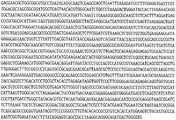
- FIG. 1 is a view showing the nucleotide sequence of 16S rRNA gene of QUI41 strain.
- FIG. 2 is a view showing the nucleotide sequence of the 16S rRNA gene of the QU42 strain.
- FIG. 3 is a diagram showing the nucleotide sequence of the 16S rRNA gene of QUI41 strain.
- FIG. 4 is a graph showing the results of test tube culture of Lactobacillus delbricky QU41 strain, QU42 strain, and QU43 strain.
- FIG. 5 is a graph showing the influence of the culture temperature on the D-lactic acid producing ability of the QUI41 strain.
- FIG. 6 is a graph showing the effect of culture pH on the D-lactic acid producing ability of the QUI41 strain.
- FIG. 7 is a graph showing the effect of the initial glucose concentration on the D-lactic acid producing ability of the QUI41 strain.
- FIG. 8 is a graph comparing the D-lactic acid producing ability in the QUI41 strain, the JCM1166 strain, and the JCM1246 strain.
- FIG. 9 is a graph comparing the influence of the neutralizing agent of the medium between when NaOH is used and when NH 4 OH is used.
- the lactic acid bacteria of the present invention have an initial glucose concentration of 20 g / L, pH 6.0, and glucose as a substrate at an optimal temperature (specifically, 43 ° C.) for 8 to 12 hours. When cultured, 12.0 g / L or more of D-lactic acid can be produced with an optical purity of 99% or more. Lactic acid bacteria having the above-mentioned properties and genetically belonging to Lactobacillus delbrick are within the scope of the present invention.
- the lactic acid bacterium of the present invention can produce D-lactic acid of preferably 16.0 g / L or more, more preferably 20.0 g / L or more under the above conditions.
- Such lactic acid bacteria are suitable for the purpose of efficiently producing high optical purity D-lactic acid.
- the lactic acid bacterium of the present invention can produce D-lactic acid with an optical purity of 99% or higher, preferably 99.5% or higher, more preferably 99.9% or higher.
- Lactic acid bacteria of the present invention are 10 g of peptone, 8 g of beef extract, 4 g of yeast extract, 20 g of glucose, 1 g of Tween 80, 2 g of K 2 HPO 4 and 5 g of sodium acetate trihydrate in 1 L of distilled water.
- citric acid diammonium hydrogen 2g, the MgSO 4 ⁇ H 2 O 0.2g, MnSO 4 ⁇ nH to 2 O in MRS- glucose medium containing 0.05 g stand at a temperature ranging from at least 30 ° C. of 49 ° C. By culturing, it can be cultured well.
- the medium used for culturing the lactic acid bacterium of the present invention is not limited to the MRS-glucose medium, and the MRS-glucose medium can be modified as appropriate, and the bacterium can grow well and produce D-lactic acid.
- a medium having any composition may be used as long as it is produced.
- Lactobacillus delbrikkii QU41 strain isolated from the drainage channel on the campus of Kyushu University.
- Lactobacillus delbricky QUI41 strain is a novel strain, and it was established as NITE BP-679 in January 2009 at the National Institute of Technology and Evaluation of Microorganisms (2-5-8, Kazusa Kamashichi, Kisarazu City, Chiba Prefecture). Deposited on the 19th.
- Lactobacillus delbricki QP41 The mycological properties of Lactobacillus delbricki QP41 are as follows. 1. Form: Neisseria gonorrhoeae. 2. Biochemical properties: Catalase negative. 3. Motility: None Oxygen demand: It is facultative anaerobic. 5). D-lactic acid is produced by homolactic fermentation using glucose as a substrate. 6). Glucose, fructose, mannose, N-acetylglucosamine, maltose, lactose, sucrose and trehalose can be assimilated, and xylose and arabinose cannot be assimilated.
- the lactic acid bacteria of the present invention also include lactic acid bacteria belonging to Lactobacillus delbricky and having the same bacteriological properties as the QU41 strain.
- suitable strains of the present invention there can be mentioned Lactobacillus delbriquie QU42 strain and Lactobacillus delbrixi QU43 strain.
- Lactobacillus delbricki QU42 strain and QU43 strain are also novel strains and can produce D-lactic acid with high efficiency.
- the strain of the present invention is not limited to Lactobacillus delbrickey QU41 strain, QU42 strain, and QU43 strain, and is capable of producing D-lactic acid with an optical purity of 99% or more using glucose as a substrate, and the glucose concentration. Is within the scope of the present invention as long as it can produce 1-2.0 g / L or more of D-lactic acid when cultured at 43 ° C. for 12 hours under the conditions of 20 g / L and pH 6.0. .
- the nucleotide sequences of the 16S rRNA genes of Lactobacillus delbrikkii QU41 strain, QU42 strain and QU43 strain are shown in SEQ ID NO: 1, SEQ ID NO: 2 and SEQ ID NO: 3, respectively.
- Lactobacillus delbrikkii QU41 strain, QU42 strain, and QU43 strain showed high identity.
- the present invention provides a Lactobacillus delbrickey having a 16S rRNA gene comprising a sequence having 99.5% or more identity with the sequence shown in SEQ ID NO: 1 in the table consisting of any of the following sequences: (A) a nucleotide sequence represented by SEQ ID NO: 1 in the sequence listing, or a nucleotide sequence having 99.7% or more identity thereto; (B) a nucleotide sequence represented by SEQ ID NO: 2 in the sequence listing, or a nucleotide sequence having 99.75% or more identity thereto; or (c) a nucleotide sequence represented by SEQ ID NO: 3 in the sequence listing; or A nucleotide sequence having an identity of 99.8% or more.
- the identity of a nucleic acid sequence can be determined using, for example, a widely used program such as BLAST, but is not limited thereto, and the identity of a nucleic acid sequence is determined using another program. You can also
- Lactobacillus delbrikkii strains QU41, QU42 and QU43 are very similar in their genetic and biochemical properties, so these three strains are different strains. However, many properties including the ability to produce D-lactic acid are expected to be similar or identical.
- the lactic acid bacteria of the present invention can grow and produce D-lactic acid at a temperature in the range of at least 30 ° C. to 49 ° C.
- a preferable temperature for growth of the strain and production of D-lactic acid is 37 ° C to 43 ° C, and a particularly preferable temperature is 43 ° C.
- the lactic acid bacterium of the present invention can produce D-lactic acid even at 49 ° C. 49 ° C. is a considerably high temperature for lactic acid bacteria. Lactic acid fermentation at 49 ° C. can reduce contamination by various bacteria, and can reduce the need for cooling by fermentation heat.
- lactic acid can be produced it means that D-lactic acid can be produced at an industrially effective level. It was started under the conditions of a glucose concentration of 20 g / L and pH 6.0, and cultured for 12 hours. Sometimes, if it can produce 1-2.0 g / L or more of D-lactic acid, it can be said that “production is possible”.
- the lactic acid bacterium of the present invention can produce about 100 g / L of D-lactic acid from 100 g / L of glucose even in high-temperature culture at 49 ° C.
- the Lactobacillus delbricky QUI41 strain of the present invention can grow and produce D-lactic acid in a pH range of at least 5.5 to 6.5.
- a particularly preferred pH for the growth of the strain and the production of D-lactic acid is 6.0.
- Lactobacillus delbricky QUI41 of the present invention increases as the initial glucose concentration in the medium increases, and the productivity of D-lactic acid increases.
- a decrease in the maximum cell growth rate accompanying an increase in the initial glucose concentration and a decrease in the lactic acid production rate in the long-term culture occur. For this reason, batch culture is not suitable when D-lactic acid is efficiently produced using the strain.
- a method for producing D-lactic acid and a method for producing lactic acid by culturing the Lactobacillus delbrikkii strain of the present invention are also within the scope of the present invention.
- a medium in which the Lactobacillus delbrickey strain of the present invention can grow and produce lactic acid such as MRS-glucose medium
- the strain is grown under conditions suitable for its growth and lactic acid production (temperature and pH). Lactic acid can be produced by culturing in the above.
- D-lactic acid can be produced with high optical purity.
- D-lactic acid can be produced with an optical purity of 99% or more, preferably 99.5% or more, and more preferably 99.9% or more. it can.
- the concentration of lactic acid obtained by the present invention can be measured by a technique generally known in this technical field.
- the culture solution of the Lactobacillus delbricki strain of the present invention is centrifuged to obtain a supernatant, and the supernatant is filtered through a filter and then subjected to column chromatography (for example, a shodex Sugar S series etc.
- the amount of lactic acid can be measured with an exchange column, and the concentration of produced lactic acid can be measured by detecting lactic acid with a suggestive refractometer.
- the concentration of L-lactic acid can be measured by a biosensor (for example, enzyme electrode type biosensor BF-5), and the optical value of D-lactic acid is determined from the measured L-lactic acid concentration and total lactic acid concentration value. Purity can be calculated.
- the optical purity of D-lactic acid means a value calculated by the following formula, unless otherwise specified.
- the method for producing lactic acid of the present invention is preferably performed by subjecting the Lactobacillus delbrikkii strain of the present invention to pH 5.5 to pH 6.5 at a temperature of 37 ° C. to 43 ° C. for 12 hours in a medium containing glucose. For 72 hours to prepare a culture solution, and a step of centrifuging the culture solution and collecting a supernatant.
- a suitable medium for culturing the Lactobacillus delbrikkii strain of the present invention is not limited thereto, but is preferably the MRS-glucose medium described above. However, the medium used in the method of the present invention is not limited thereto, and can be appropriately modified.
- the conditions such as the pH of the medium, the culture temperature, and the culture time can also be appropriately modified as long as the Lactobacillus delbriqui strain of the present invention can grow and produce D-lactic acid.
- the most preferred strain used in the method of the present invention is Lactobacillus delbrikkii QU41 strain.
- the method of the present invention can also be carried out using Lactobacillus delbricky QU42 strain and QU43 strain.
- D-lactic acid produced by using the method of the present invention can be used as a raw material for producing a stereocomplex of poly-L-lactic acid and poly-D-lactic acid, for example.
- the stereocomplex of poly L-lactic acid and poly D-lactic acid can be a biodegradable plastic having high heat resistance.
- the use of D-lactic acid is not limited to a stereocomplex with poly L-lactic acid.
- D-lactic acid is known to be used as an agricultural intermediate.
- Example 1 Isolation and Identification of New D-Lactic Acid-Producing Bacteria
- MRS-glucose medium and MRS-glucose agar medium from 137 sources such as plants, animals, soil, and insects
- D-lactic acid-producing bacteria were isolated.
- enrichment culture was performed before plating.
- prokaryote preferentially sodium azide and cycloheximide that inhibit the growth of eukaryotes were added to the accumulation medium.
- This enrichment culture medium was prepared by adding MRS-glucose medium having the composition described above, 100 ppm sodium azide, 100 ppm cycloheximide, dissolving in distilled water, adjusting the pH to 5.5 and 6.5, and causing brown reaction. In order to prevent this, autoclaving was performed at 115 ° C. for 15 minutes.
- the MRS-glucose agar medium is 1.5% agar and 0.5% CaCO 2 added to the enrichment culture medium, dissolved in distilled water, adjusted to pH 6.5, and autoclaved at 115 ° C for 15 minutes. After performing, it poured into a sterilization petri dish and produced.
- the culture conditions for isolation are temperatures of 30 ° C., 37 ° C., and 43 ° C., and initial pH values of 5.5 and 6.5. Under these conditions, the bacteria were anaerobically cultured and isolated, and again cultured in the MRS medium. Then, the supernatant was analyzed, and the bacteria producing high optical purity D-lactic acid were isolated by homofermentation.
- the nucleotide sequence of the 16S rRNA gene of the QUI41 strain is shown in SEQ ID NO: 1 in the sequence listing and FIG.
- the nucleotide sequence of the 16S rRNA gene of the QU42 strain is shown in SEQ ID NO: 2 in the sequence listing and FIG.
- the nucleotide sequence of the 16S rRNA gene of the QU43 strain is shown in SEQ ID NO: 3 in the sequence listing and FIG.
- Table 1 shows the results of the saccharide utilization test using the API50CH kit. For comparison, Lactobacillus delbrueckii subsp. Described in the API50CH kit. delbrueckii, Lactobacillus delbrueckii subsp. bulgaricus, Lactobacillus delbrueckii subsp. The saccharide utilization pattern of lactis is also shown in Table 1.
- each number indicates the proportion of strains having the ability to assimilate among strains held by BioMerieux. Even for the same species, Lactobacillus delbrueckii subsp. Some have grouped saccharide utilization properties, such as lactis 1 and 2.
- the QU41 strain, the QU42 strain, and the QU43 strain showed the same sugar fermentability pattern. That is, these strains assimilated glucose, fructose, mannose, N-acetylglucosamine, maltose, lactose, sucrose, and trehalose, but not pentoses such as xylose and arabinose. Lactobacillus delbrueckii ssp lactis was most consistent with the sugar fermentability pattern.
- FIG. 4 (a) shows the results of the study with the QUI41 strain
- FIG. 4 (b) shows the results of the study with the QUI41 strain
- FIG. 4 (c) shows the results of the study with the QUI41 strain.
- the left vertical axis indicates the concentrations of glucose, lactic acid, and acetic acid
- the right axis indicates OD
- the horizontal axis indicates time.
- the black circle is the glucose concentration
- the white circle is the lactic acid concentration
- the white triangle is the OD.
- the three strains of the QU41 strain, the QU42 strain, and the QU43 strain showed similar fermentation behaviors when cultured in the MRS medium.
- the QUI41 strain showed the highest value of D-lactic acid production at 16.8 g / L at 72 hours.
- Lactobacillus delbricky QUI41 strain, QUI42 strain, and QUI43 strain showed very similar fermentation characteristics in terms of yield, production rate, etc.
- the optimum conditions for D-lactic acid production described below were examined.
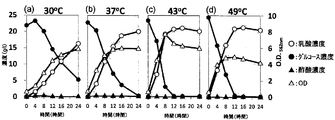
- Example 2 Examination of Optimal Conditions (1) Examination of Optimal Temperature With regard to QUI41 strain, the ability to produce D-lactic acid at 30 ° C., 37 ° C., 43 ° C., and 49 ° C. was examined using 20 g / L glucose MRS medium. . The pH was adjusted to 5.5 with 10 N NaOH and the experiment was conducted in an anaerobic state by nitrogen gas replacement. The culture was performed for 6 hours on a 40 ml scale and 12 hours on a 400 ml scale for main culture.
- FIG. 5 (a) shows the result of the examination at 30 ° C.
- FIG. 5 (b) shows the result of the examination at 37 ° C.
- FIG. 5 (c) shows the result of the examination at 43 ° C.
- FIG. 5 (d) shows the result of examination at 49 ° C.
- the left vertical axis indicates glucose, lactic acid, and acetic acid concentrations
- the right vertical axis indicates OD
- the horizontal axis indicates time.
- the black circle is the glucose concentration
- the white circle is the lactic acid concentration
- the black triangle is the acetic acid concentration
- the white triangle is the OD.
- Table 3 The values of the culture parameters obtained from this result are shown in Table 3 below.
- Table 3 from the left, values of maximum cell growth rate, D-lactic acid production, maximum yield, maximum production, and D-lactic acid optical purity are shown.
- the highest maximum growth rate and the maximum production rate were exhibited at 43 ° C., and the optimum temperature for growth and D-lactic acid production of the QUI41 strain was 43 ° C.
- the QUI41 strain was able to grow and produce D-lactic acid even at 55 ° C.
- FIG. 6 (a) shows the results of investigation at pH 5.0
- FIG. 6 (b) shows the results of examination at pH 5.5
- FIG. 6 (c) shows the results at pH 6.0
- FIG. 6 (d) shows the results of investigation at pH 6.5.
- the left vertical axis indicates glucose, lactic acid, and acetic acid concentrations
- the right vertical axis indicates OD
- the horizontal axis indicates time.
- the black circle is the glucose concentration
- the white circle is the lactic acid concentration
- the black triangle is the acetic acid concentration
- the white triangle is the OD.
- Table 4 The values of the culture parameters obtained from this result are shown in Table 4 below.
- Table 4 From the left, the maximum cell growth rate, D-lactic acid production amount, maximum yield, maximum production amount, and D-lactic acid optical purity values are shown. Since the cultivation was completed in 12 hours at pH 6.0 and the maximum cell growth rate and lactic acid production were shown, the optimum pH was 6.0.
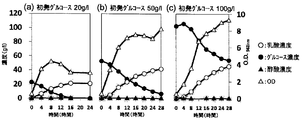
- Example 3 Examination of Influence of Initial Glucose Concentration Under the conditions of a temperature of 43 ° C. and pH 6.0, the influence of the glucose concentration on the D-lactic acid production ability of QUI41 strain was examined. The experiment was performed under the same conditions as those for the optimum temperature and optimum pH except that the pH was changed.
- FIG. 7 shows the results of investigations with the concentration of glucose added at the start of culture, that is, the initial glucose concentration set to 20, 50, and 100 g / L.
- FIG. 7A shows data with an initial glucose concentration of 20 g / L
- FIG. 7B shows data with an initial glucose concentration of 50 g / L (b)
- FIG. 7C shows the initial glucose concentration.
- the data is 100 g / L.
- the left vertical axis indicates glucose, lactic acid, and acetic acid concentrations
- the right vertical axis indicates OD
- the horizontal axis indicates time.
- the black circle is the glucose concentration
- the white circle is the lactic acid concentration
- the black triangle is the acetic acid concentration
- the white triangle is the OD.
- the values of the culture parameters obtained from this result are shown in Table 5 below.
- Table 5 the maximum cell growth rate, D-lactic acid production amount, maximum yield, maximum production amount, and D-lactic acid optical purity values are shown from the left.
- the maximum cell growth rate decreased and the lactic acid production rate also decreased with the lapse of culture time. From these results, it was found that QUI41 is inhibited by high concentrations of glucose and lactic acid, so that D-lactic acid cannot be efficiently produced by batch culture affected by changes in the medium environment accompanying bacterial growth.
- Example 4 Comparison of Lactobacillus delbrikkii QUA41 strain and existing D-lactic acid producing bacteria Comparison of D-lactic acid production between Lactobacillus delbrikkii QUI41 strain and existing D-lactic acid producing bacteria JCM1166 and JCM1248 It was. The results are shown in FIG. 8A shows data measured at 37 ° C., FIG. 8B shows data measured at 43 ° C., and FIG. 8C shows data measured at 50 ° C. In FIG. 8, the left vertical axis indicates the concentration of lactic acid, the right vertical axis indicates OD, and the horizontal axis indicates time.
- Lactobacillus del Bricky QU41 strain was also measured at 55 ° C. as shown in FIG.
- the right column shows the amount of D-lactic acid produced 24 hours after culturing, and the left column shows the amount of D-lactic acid produced 48 hours after culturing.
- Table 6 shows the values of D-lactic acid production of the three strains obtained from the results.
- Example 5 Examination of Neutralizing Agent for Medium As a neutralizing agent for the medium used for culturing QUA41 strain, a comparison was made between the case of using NaOH and the case of using NH 4 OH. The results are shown in FIG. FIG. 9A shows data when NaOH is used as a neutralizing agent, and FIG. 9B shows data when NH 4 OH is used as a neutralizing agent.
- the left vertical axis indicates the concentration of lactic acid
- the right vertical axis indicates OD
- the horizontal axis indicates time.
- the black circle is the glucose concentration
- the white circle is the lactic acid concentration
- the black triangle is the acetic acid concentration
- the white triangle is the OD.
- Table 7 The values of the culture parameters obtained from this result are shown in Table 7 below.
- Table 7 the maximum cell growth rate, D-lactic acid production amount, maximum yield, maximum production amount, and D-lactic acid optical purity values are shown from the left.
- the results were similar when NH 4 OH was used and when NaOH was used.
- the amount of D-lactic acid produced and the maximum D-lactic acid production rate were higher when NH 4 OH was used than when NaOH was used at 8 hours after culturing.
Landscapes
- Chemical & Material Sciences (AREA)
- Organic Chemistry (AREA)
- Engineering & Computer Science (AREA)
- Life Sciences & Earth Sciences (AREA)
- Health & Medical Sciences (AREA)
- Zoology (AREA)
- Wood Science & Technology (AREA)
- Genetics & Genomics (AREA)
- Bioinformatics & Cheminformatics (AREA)
- Biotechnology (AREA)
- General Health & Medical Sciences (AREA)
- Biochemistry (AREA)
- General Engineering & Computer Science (AREA)
- Microbiology (AREA)
- Chemical Kinetics & Catalysis (AREA)
- General Chemical & Material Sciences (AREA)
- Medicinal Chemistry (AREA)
- Tropical Medicine & Parasitology (AREA)
- Virology (AREA)
- Biomedical Technology (AREA)
- Preparation Of Compounds By Using Micro-Organisms (AREA)
- Micro-Organisms Or Cultivation Processes Thereof (AREA)
Abstract
L'invention porte sur une nouvelle souche produisant de l'acide D-lactique et sur un procédé de production d'acide D-lactique à l'aide de la souche produisant de l'acide D-lactique. L'invention porte sur les souches de Lactobacillus delbrueckii QU41, QU42 et QU43 qui sont de nouvelles souches produisant de l'acide D-lactique. Ces souches microbiennes permettent une production efficace d'acide D-lactique ayant une pureté optique élevée.
Applications Claiming Priority (2)
| Application Number | Priority Date | Filing Date | Title |
|---|---|---|---|
| JP2009-137375 | 2009-06-08 | ||
| JP2009137375A JP2010279332A (ja) | 2009-06-08 | 2009-06-08 | 新規なd−乳酸生産菌及びd−乳酸を生産する方法 |
Publications (1)
| Publication Number | Publication Date |
|---|---|
| WO2010143323A1 true WO2010143323A1 (fr) | 2010-12-16 |
Family
ID=43308587
Family Applications (1)
| Application Number | Title | Priority Date | Filing Date |
|---|---|---|---|
| PCT/JP2009/070410 Ceased WO2010143323A1 (fr) | 2009-06-08 | 2009-12-04 | Nouvelles souches produisant de l'acide d-lactique et procédé de production d'acide d-lactique |
Country Status (2)
| Country | Link |
|---|---|
| JP (1) | JP2010279332A (fr) |
| WO (1) | WO2010143323A1 (fr) |
Cited By (5)
| Publication number | Priority date | Publication date | Assignee | Title |
|---|---|---|---|---|
| CN103589668A (zh) * | 2013-10-24 | 2014-02-19 | 天津大学 | 一株发酵甘蔗糖蜜生产d-乳酸菌株及其发酵方法 |
| CN103787561A (zh) * | 2014-01-23 | 2014-05-14 | 杭州师范大学 | 海藻糖在厌氧氨氧化颗粒污泥保存中的应用 |
| WO2021032896A1 (fr) * | 2019-08-22 | 2021-02-25 | Brainboost Solutions | Produit alimentaire, précurseurs alimentaires ou boissons comprenant de l'acide d-lactique et/ou un sel associé et leur procédé de production |
| CN114381393A (zh) * | 2021-12-21 | 2022-04-22 | 西藏安琪生物科技有限公司 | 德氏乳杆菌乳亚种菌株及其应用 |
| CN118599735A (zh) * | 2024-07-12 | 2024-09-06 | 南京工业大学 | 一种耐低pH生产D-乳酸的乳酸菌及其应用 |
Families Citing this family (3)
| Publication number | Priority date | Publication date | Assignee | Title |
|---|---|---|---|---|
| KR101764095B1 (ko) * | 2011-04-11 | 2017-08-14 | 동국대학교 산학협력단 | 유산균 분말의 제조방법 |
| JP2015080430A (ja) * | 2013-10-22 | 2015-04-27 | 王子ホールディングス株式会社 | D−乳酸の製造方法 |
| JP6331327B2 (ja) * | 2013-10-22 | 2018-05-30 | 王子ホールディングス株式会社 | D−乳酸の製造方法 |
Citations (3)
| Publication number | Priority date | Publication date | Assignee | Title |
|---|---|---|---|---|
| JPS61181389A (ja) * | 1985-02-08 | 1986-08-14 | Daicel Chem Ind Ltd | D−乳酸の製造方法 |
| JP2007215428A (ja) * | 2006-02-14 | 2007-08-30 | Musashino Chemical Laboratory Ltd | 乳酸の製造方法 |
| JP2007215427A (ja) * | 2006-02-14 | 2007-08-30 | Musashino Chemical Laboratory Ltd | 乳酸の製造方法 |
-
2009
- 2009-06-08 JP JP2009137375A patent/JP2010279332A/ja not_active Withdrawn
- 2009-12-04 WO PCT/JP2009/070410 patent/WO2010143323A1/fr not_active Ceased
Patent Citations (3)
| Publication number | Priority date | Publication date | Assignee | Title |
|---|---|---|---|---|
| JPS61181389A (ja) * | 1985-02-08 | 1986-08-14 | Daicel Chem Ind Ltd | D−乳酸の製造方法 |
| JP2007215428A (ja) * | 2006-02-14 | 2007-08-30 | Musashino Chemical Laboratory Ltd | 乳酸の製造方法 |
| JP2007215427A (ja) * | 2006-02-14 | 2007-08-30 | Musashino Chemical Laboratory Ltd | 乳酸の製造方法 |
Non-Patent Citations (2)
| Title |
|---|
| CALABIA, B.P. ET AL.: "Production of D-lactic acid from sugarcane molasses, sugarcane juice and sugar beet juice by Lactobacillus delbrueckii", BIOTECHNOL LETT, vol. 29, no. 9, 2007, pages 1329 - 1332, XP019523948, DOI: doi:10.1007/s10529-007-9408-4 * |
| WATARU KANEKO ET AL.: "Shinki D-nyusan Seisankin no Bunri to Hakko Tokusei", NIPPON NOGEI KAGAKUKAI TAIKAI KOEN YOSHISHU, vol. 2009, 2009, pages 109 * |
Cited By (7)
| Publication number | Priority date | Publication date | Assignee | Title |
|---|---|---|---|---|
| CN103589668A (zh) * | 2013-10-24 | 2014-02-19 | 天津大学 | 一株发酵甘蔗糖蜜生产d-乳酸菌株及其发酵方法 |
| CN103787561A (zh) * | 2014-01-23 | 2014-05-14 | 杭州师范大学 | 海藻糖在厌氧氨氧化颗粒污泥保存中的应用 |
| CN103787561B (zh) * | 2014-01-23 | 2016-04-20 | 杭州师范大学 | 海藻糖在厌氧氨氧化颗粒污泥保存中的应用 |
| WO2021032896A1 (fr) * | 2019-08-22 | 2021-02-25 | Brainboost Solutions | Produit alimentaire, précurseurs alimentaires ou boissons comprenant de l'acide d-lactique et/ou un sel associé et leur procédé de production |
| CN114381393A (zh) * | 2021-12-21 | 2022-04-22 | 西藏安琪生物科技有限公司 | 德氏乳杆菌乳亚种菌株及其应用 |
| CN114381393B (zh) * | 2021-12-21 | 2024-03-29 | 西藏安琪生物科技有限公司 | 德氏乳杆菌乳亚种菌株及其应用 |
| CN118599735A (zh) * | 2024-07-12 | 2024-09-06 | 南京工业大学 | 一种耐低pH生产D-乳酸的乳酸菌及其应用 |
Also Published As
| Publication number | Publication date |
|---|---|
| JP2010279332A (ja) | 2010-12-16 |
Similar Documents
| Publication | Publication Date | Title |
|---|---|---|
| Nguyen et al. | Production of L-lactic acid from a green microalga, Hydrodictyon reticulum, by Lactobacillus paracasei LA104 isolated from the traditional Korean food, makgeolli | |
| Moon et al. | A novel lactic acid bacterium for the production of high purity L-lactic acid, Lactobacillus paracasei subsp. paracasei CHB2121 | |
| JP2010279332A (ja) | 新規なd−乳酸生産菌及びd−乳酸を生産する方法 | |
| JP6521243B2 (ja) | 3−ヒドロキシ酪酸又はその塩の好気的生産方法 | |
| CN109504630B (zh) | 一种重组d-乳酸生产植物乳杆菌菌株及利用该菌株生产d-乳酸的方法 | |
| KR101778436B1 (ko) | 우수한 초산 생성능을 가지는 신규한 아세토박터속 slv-7 균주 및 이의 용도 | |
| KR101686899B1 (ko) | 신규한 클루이베로마이세스 막시아누스 mj1 및 이의 용도 | |
| CN106536717A (zh) | 用于依赖蔗糖改善精细化学品产生的基因修饰微生物 | |
| Mondragón-Parada et al. | Lactic acid bacteria production from whey | |
| JP4067970B2 (ja) | 発酵性の糖およびその混合物からl(+)−ラクテートを生産するための好熱性微生物バチルス・コアグランスsim−tdsm14043株 | |
| WO2008043368A2 (fr) | Procédé d'obtention d'endospores de souches de micro-organismes sporogènes thermophiles fermentables et utilisation des endospores pour obtenir une fermentation par inoculation | |
| CN106164249A (zh) | 用于基于蔗糖的改善精细化学品产生的修饰微生物 | |
| CN106164252A (zh) | 用于琥珀酸产生的改进微生物 | |
| KR101689004B1 (ko) | 젖산 분해 경로가 봉쇄된 클루이베로마이세스 막시아누스 및 이의 용도 | |
| EP3625337B1 (fr) | Procédé de production d'acide succinique | |
| EP3535384A1 (fr) | Procédé de fermentation pour la production d'acide d-lactique ou de ses sels | |
| JP5721162B2 (ja) | 高純度乳酸の製造方法 | |
| JP2014064477A (ja) | 酢酸生産能が向上した酢酸菌の育種方法 | |
| JP6558767B2 (ja) | ハロモナス菌を用いたピルビン酸の製造方法 | |
| KR101686337B1 (ko) | 글리세롤을 탄소원으로 젖산을 생산하는 미생물 및 이를 이용한 젖산 생산 방법 | |
| KR20100008715A (ko) | 잔탄검 생합성 관련 돌연변이 유전자와 이를 포함하는잔탄검 생합성 균주 및 돌연변이 균주를 이용한 잔탄검의제조방법 | |
| Abdel-Rahman et al. | Effective production of lactic acid by a newly isolated alkaliphilic Psychrobacter maritimus BoMAir 5 strain | |
| CN109072259B (zh) | 用于由各种碳源产生l-乳酸或及其盐的嗜氧乳酸芽孢杆菌 | |
| US20230002796A1 (en) | Method for inducing microbial mutagenesis to produce lactic acid | |
| KR100481942B1 (ko) | 대사공학적으로 개량한 대장균 및 신규의포스포에놀피루베이트에이 유전자를 이용한 사과산의 생산방법 |
Legal Events
| Date | Code | Title | Description |
|---|---|---|---|
| 121 | Ep: the epo has been informed by wipo that ep was designated in this application |
Ref document number: 09845845 Country of ref document: EP Kind code of ref document: A1 |
|
| NENP | Non-entry into the national phase |
Ref country code: DE |
|
| 122 | Ep: pct application non-entry in european phase |
Ref document number: 09845845 Country of ref document: EP Kind code of ref document: A1 |