WO2010143484A1 - 毛髪処理剤及び毛髪処理剤用原料 - Google Patents
毛髪処理剤及び毛髪処理剤用原料 Download PDFInfo
- Publication number
- WO2010143484A1 WO2010143484A1 PCT/JP2010/057724 JP2010057724W WO2010143484A1 WO 2010143484 A1 WO2010143484 A1 WO 2010143484A1 JP 2010057724 W JP2010057724 W JP 2010057724W WO 2010143484 A1 WO2010143484 A1 WO 2010143484A1
- Authority
- WO
- WIPO (PCT)
- Prior art keywords
- hair
- hair treatment
- treatment agent
- mass
- peptide
- Prior art date
- Legal status (The legal status is an assumption and is not a legal conclusion. Google has not performed a legal analysis and makes no representation as to the accuracy of the status listed.)
- Ceased
Links
Images


Classifications
-
- A—HUMAN NECESSITIES
- A61—MEDICAL OR VETERINARY SCIENCE; HYGIENE
- A61K—PREPARATIONS FOR MEDICAL, DENTAL OR TOILETRY PURPOSES
- A61K8/00—Cosmetics or similar toiletry preparations
- A61K8/18—Cosmetics or similar toiletry preparations characterised by the composition
- A61K8/30—Cosmetics or similar toiletry preparations characterised by the composition containing organic compounds
- A61K8/64—Proteins; Peptides; Derivatives or degradation products thereof
-
- A—HUMAN NECESSITIES
- A61—MEDICAL OR VETERINARY SCIENCE; HYGIENE
- A61Q—SPECIFIC USE OF COSMETICS OR SIMILAR TOILETRY PREPARATIONS
- A61Q5/00—Preparations for care of the hair
Definitions
- the present invention relates to a hair treatment agent used in hair care treatment, perm treatment, coloring treatment, bleach treatment and the like of hair, and a raw material for hair treatment agent used in the production of this hair treatment agent.
- ⁇ Physical treatments such as brushing, hand dryers, hot iron, etc., and chemical treatments such as coloring and permanent treatment damage hair. Damaged hair has worse hair properties, such as hair feel (for example, beam, strain, softness), appearance (for example, gloss, cohesion), strength (for example, tensile strength) compared to before being damaged. Will be.
- hair feel for example, beam, strain, softness
- appearance for example, gloss, cohesion
- strength for example, tensile strength
- JP-A-7-126296 discloses a kind of modified peptide, in which the modified peptide has a disulfide group (—S—S—) as a carboxymethyl disulfide group (—S—S—CH 2). Water-soluble one obtained by conversion to (COOH).
- Japanese Patent Application Laid-Open No. 7-126296 discloses forming a film from the modified peptide as a specific embodiment of the modified peptide, but does not intend a hair treatment agent.
- an object of the present invention is to provide a hair treatment agent and a raw material thereof that can improve the initial elastic modulus of damaged hair or suppress the deterioration of the initial elastic modulus of hair.
- the present inventor improves the initial elastic modulus of the hair by treating the hair with water containing a peptide having a predetermined side chain group. Obtained knowledge. Based on this finding, the present invention has been completed.
- the hair treatment agent according to the present invention is characterized by blending a peptide having a group having a unit represented by the following formula (I) as a side chain group.
- —SS— (CH 2 ) n COO— (I) (In the formula (I), n is 1 or 2.)
- the “peptide” in the present invention is a peptide in which two or more amino acids are bonded by peptide bonds, and proteins such as keratin protein and collagen protein also correspond to peptides.
- the side chain group in the peptide may be one or more selected from carboxymethyl disulfide group, carboxymethyl disulfide group salt, carboxyethyl disulfide group and carboxyethyl disulfide group salt.
- the molecular weight range of the peptide is preferably less than 40000, more preferably 20000 or less. If the peptide in the present invention has a molecular weight range of less than 40000, it is advantageous not only for improving or suppressing the initial elastic modulus of hair, but also for improving or suppressing the breaking strength of hair.
- the peptide preferably has hair permeability. If it is a peptide which has this hair permeability, the improvement or the deterioration inhibitory effect of the initial elastic modulus and breaking strength of hair will become more favorable.
- the molecular weight range of the high molecular weight is, for example, 40,000 to 67,000, and may be 49000 to 64,000. Even if a peptide having such a molecular weight range is blended, the above-described improvement in the initial elastic modulus of hair or suppression of deterioration can be effectively achieved.
- the hair treatment agent according to the present invention is used as a hair care agent, a permanent agent, a coloring agent, a bleaching agent or a styling agent.
- the hair treatment agent according to the present invention is produced, for example, using a raw material for a hair treatment agent obtained by dissolving a peptide having a group having a unit represented by the following formula (I) as a side chain group in a solvent such as water.
- a raw material for a hair treatment agent obtained by dissolving a peptide having a group having a unit represented by the following formula (I) as a side chain group in a solvent such as water.
- the —SS— (CH 2 ) n COO— (I) In the formula (I), n is 1 or 2.
- the initial elastic modulus of hair can be improved or the deterioration can be suppressed.
- the hair treatment agent according to this embodiment is obtained by blending a peptide having a predetermined side chain group (hereinafter, “peptide having a predetermined side chain group” is referred to as “CAD peptide”).
- the CAD peptide has a main chain formed by peptide bonds of a plurality of amino acids and a side chain group bonded to the main chain.
- the main chain of the CAD peptide is not particularly limited. Examples of this main chain include the same main chain of peptides having cysteine as one of the constituent amino acids. Examples of peptides having cysteine as one of the constituent amino acids include keratin and casein. This keratin is known to have a high cysteine ratio among peptides derived from natural products, and is a raw material from which the CAD peptide can be obtained efficiently. From this point of view, the same main chain of CAD peptide as that of keratin is preferable.
- the side chain group of the CAD peptide is a group having a unit represented by the following formula (I), and in this side chain group, the disulfide group is arranged on the main chain side of the CAD peptide. It is preferable that a plurality of side chain groups exist in the CAD peptide.
- the group represented by the following formula (I) is dissociated (ionized) into a carboxylate anion, it is called a carboxylatoalkyl disulfide group.
- —SS— (CH 2 ) n COO— (I) In the formula (I), n is 1 or 2.
- Suitable as the chemical structural unit of the side chain group is a carboxymethyl disulfide group represented by the following formula (IA), a salt of a carboxymethyl disulfide group represented by the following formula (IB) or (IC), It is 1 type, or 2 or more types selected from the salt of the carboxyethyl disulfide group represented by Formula (IIA), and the carboxyethyl disulfide group represented by the following formula (IIB) or (IIC).
- a preferable group as the side chain group is one or more selected from the following formulas (Ia), (Ib), (Ic), (IIa), (IIb), and (IIc) (in the following formula R 1 , M 1 , R 2 and M 2 are the same as above.)
- a hair treatment agent containing a CAD peptide having two or more side chain groups it is considered that the mercapto groups constituting the hair are cross-linked via the CAD peptide.
- the mercapto groups constituting the hair are cross-linked via the CAD peptide.
- only one side chain group in the CAD peptide reacts with the mercapto group of the hair, or only one side chain group reacts with the mercapto group of the hair and another CAD peptide.
- a polymerization reaction with a peptide or a polymerization reaction between CAD peptides in hair is also conceivable.
- the cross-linking mechanism between mercapto groups in hair via CAD peptides is represented as follows by taking, as an example, a CAD peptide having two —CH 2 —SS—CH 2 COOH as side chain groups.
- a cross-linking mechanism through a CAD peptide between a pair of mercapto groups in hair is represented by using a CAD peptide having two —CH 2 —SS—CH 2 CH 2 COOH as side chain groups as an example, It is as follows.
- the molecular weight of the CAD peptide in this embodiment is not particularly limited. If the CAD peptide is roughly classified based on the molecular weight range, it can be divided into a CAD peptide having a molecular weight range of less than 40000 and a CAD peptide having a molecular weight range of 40,000 to 67,000.
- the initial elastic modulus and breaking strength of damaged hair can be improved or suppressed. Since the smaller the molecular weight of the CAD peptide, the more advantageous is the improvement of the initial elastic modulus and breaking strength of the hair, or the suppression of deterioration. Therefore, the molecular weight range of the CAD peptide in this embodiment is preferably 20000 or less, more preferably 10,000 or less, and 5000 or less. Further preferred. Although the lower limit of the molecular weight range of CAD peptide is not specifically limited, For example, it is 500.
- the molecular weight range of the CAD peptide is less than 40,000. This is because the m / z peak by time-of-flight mass spectrometry (TOFMS) employing matrix-assisted laser desorption / ionization (MALDI method) is regarded as the molecular weight of the CAD peptide. It can be confirmed from the range.
- TOFMS time-of-flight mass spectrometry
- MALDI method matrix-assisted laser desorption / ionization
- the peak having the highest intensity in the TOFMS result is preferably confirmed at m / z 20000 or less, more preferably confirmed at m / z 10,000 or less, and m / z 5000 or less. What is confirmed is particularly preferred.
- the lower limit value of the highest intensity peak is not particularly limited, but is, for example, m / z 500.
- the CAD peptide in the present embodiment has the hair penetrability because the above-mentioned crosslinking and the like inside the hair are performed. Those are preferred.
- the CAD peptide has hair permeability according to the following procedures (1) to (4).
- the FTSC-MES is prepared as follows. A MES aqueous solution having a pH of 5.5 was added dropwise to a solution obtained by dissolving 1.065 parts by mass of 2- (N-Morpholino) ethanesulfide Acid (MES) in 40 parts by mass of water by adding 0.2 M NaOH aqueous solution dropwise.
- MES 2- (N-Morpholino) ethanesulfide Acid
- FTSC-MES Fluorescein-5-thiosemicabazide
- FIG. 1 is a fluorescence microscopic observation photograph according to the procedures (1) to (4) above, and the fluorescence inside the hair, that is, the hair permeability of the CAD peptide can be confirmed.
- FIG. 2 shows fluorescence microscopic photographs obtained by performing the above steps (1) to (4) without adding a CAD peptide. Since the fluorescence, that is, no CAD peptide is added to the hair surface layer, the hair penetrates. Can be confirmed. This is because the fluorescence inside the fluorescence micrograph shown in FIG. 2 could not confirm the fluorescence inside the hair because even if only the fluorescent substance penetrates the inside of the virgin hair, there is no chemical damage inside the virgin hair. In addition, the fluorescent substance flows out of the virgin hair in the subsequent water washing.
- the initial elastic modulus of damaged hair can be improved or suppressed.
- the molecular weight range of the CAD peptide may be 49000 or more and 64000 or less.
- the molecular weight range of the CAD peptide is 40000 or more and 67,000 or less, which means that the molecular weight calculated from the relative distance between the band of the CAD peptide and the band of the molecular weight marker by Sodium Dodecyl Sulfate-polyacrylamide gel electrophoresis (SDS-PAGE method).
- SDS-PAGE method Sodium Dodecyl Sulfate-polyacrylamide gel electrophoresis
- the lower limit of the CAD peptide content in the hair treatment agent according to this embodiment is not particularly limited, but is preferably 0.01% by mass, preferably 0.05% by mass, and more preferably 0.10% by mass.
- the upper limit of the blending amount of the CAD peptide is not particularly limited, but is preferably 15% by weight, preferably 10% by weight, more preferably 5% by weight, and further 3% by weight from the viewpoint of suppressing an increase in cost due to blending in a large amount. preferable.
- a CAD peptide having a molecular weight range of less than 40000 is blended with the hair treatment agent, a CAD peptide other than a CAD peptide having a molecular weight range of less than 40000, for example, a CAD peptide having a molecular weight range of 40000 to 67000 may be further blended.
- a CAD peptide having a molecular weight range of 40,000 or more and 67,000 or less is blended, a CAD peptide having a molecular weight range other than 40,000 or more and 67,000 or less, for example, a CAD peptide having a molecular weight range of less than 40,000 may be further blended.
- Method for producing CAD peptide having a molecular weight range of less than 40000 examples include production methods (A), (B), and (C) described below.
- the production method (A) includes a reduction step of converting a protein disulfide group into a mercapto group; a mercapto group generated in a protein molecule in the reduction step, a mercapto group of a mercaptoalkylcarboxylic acid, and / or a mercaptoalkylcarboxylate mercapto
- the disulfide group (—S—S—) contained in the protein is reduced to two mercapto groups (—SH HS—) by mixing the production raw material containing the protein, water, and a reducing agent.
- Production raw materials include wool (merino wool, lincoln wool, etc.), human hair, animal hair, feathers, nails and the like containing keratin as a constituent protein. Among them, it is preferable to use wool as a raw material in order to obtain it inexpensively and stably. About a manufacturing raw material, it is good to process beforehand combining sterilization, degreasing, washing
- the amount of water is not particularly limited.
- the amount of water is preferably 20 parts by mass or more and 200 parts by mass or less with respect to 1 part by mass of the production raw material. By setting the amount of water in the above range, the reduction reaction is favorably performed.
- a mercapto group is generated by reducing a disulfide bond in the protein with one or more reducing agents in an alkaline solution.
- Such a compound (alkaline compound) for making the reaction system in the reduction of the disulfide bond alkaline is made alkaline by adding it to water.
- the alkaline compound include lithium hydroxide, sodium hydroxide, potassium hydroxide, barium hydroxide, sodium carbonate, potassium carbonate, ammonia and the like, and other basic compounds such as monoethanolamine, diethanolamine, arginine, and lysine. Amino acids, sodium bicarbonate, ammonium bicarbonate and the like are also included. Of these, sodium hydroxide and potassium hydroxide are preferred, and sodium hydroxide is particularly preferred from the viewpoint of reducing protein efficiently at low cost.
- One or two or more alkaline compounds are used.
- the mixing amount of the alkaline compound is not particularly limited, but it may be blended so that the pH of the reduction reaction system is adjusted to the following range.
- As the lower limit of the pH 9 is preferable and 10 is particularly preferable.
- As an upper limit of pH 13 is good, 12 is preferable, and 11 is particularly preferable.
- Protein can be reduced efficiently by adjusting the pH to be equal to or higher than the above lower limit.
- the main chain cleavage of the protein molecule can be suppressed by adjusting the pH to be not more than the above upper limit.
- mercaptoalkylcarboxylic acid and / or a salt thereof is used as the reducing agent.
- any other compound may be used as the reducing agent.
- examples of such an optional reducing agent include thiolactic acid and / or a salt thereof, dithiothreitol, 2-mercaptoethanol, glutathione, thiourea and the like. These optional reducing agents can be used alone or in combination of two or more.
- the mercaptoalkylcarboxylic acid and / or salt thereof also serves as a modifying agent that forms the unit represented by the above formula (I) in the modification step.
- a modifying agent that forms the unit represented by the above formula (I) in the modification step.
- the mercaptoalkylcarboxylic acid and / or salt thereof one or more selected from thioglycolic acid, thioglycolate, 3-mercaptopropionic acid, and 3-mercaptopropionic acid are used.
- the thioglycolate include sodium thioglycolate, potassium thioglycolate, lithium thioglycolate, and ammonium thioglycolate.
- sodium thioglycolate and potassium thioglycolate are preferable, and sodium thioglycolate is more preferable from the viewpoint that the carboxylatomethyl disulfide group can be efficiently formed.
- 3-mercaptopropionate include sodium 3-mercaptopropionate, potassium 3-mercaptopropionate, lithium 3-mercaptopropionate, and ammonium 3-mercaptopropionate. Of these, sodium 3-mercaptopropionate and potassium 3-mercaptopropionate are preferred, and sodium 3-mercaptopropionate is more preferred from the viewpoint of efficiently forming a carboxylatoethyl disulfide group.
- the amount of the mercaptoalkylcarboxylic acid and its salt used is preferably 0.0050 mol or more and 0.02 mol or less, particularly preferably 0.0075 mol or more and 0.01 mol or less, based on 1 g of the production raw material. Further, the amount used is preferably 0.10 mol / L or more and 0.40 mol / L or less, particularly 0.15 mol / L or more and 0.25 mol / L or less, based on the total capacity of the production raw material, water and the reducing agent. preferable. By making the usage-amount of this mercaptoalkylcarboxylic acid and its salt into the said range, progress of a protein reduction reaction will become favorable.
- the upper temperature limit is preferably 60 ° C.
- the reduction time for converting the disulfide group of the protein into a mercapto group becomes long, and there is a possibility that sufficient reduction cannot be performed.
- the temperature upper limit is exceeded, the main chain of the protein molecule may be cleaved.
- the set time of the reduction reaction system is set longer as the temperature is lower, and is set shorter as the temperature is higher. The set time is, for example, 20 minutes to 120 minutes.
- the unit represented by the above formula (I) is introduced into the protein by mixing an acid and an oxidizing agent with the liquid obtained in the reducing step.
- the acid may be mixed before the oxidant is mixed, after the oxidant is mixed, or at the same time as the oxidant is mixed.
- Acid is used for lowering the pH of the reaction system in the denaturation step and sufficiently introducing the unit represented by the above formula (I) into the protein.
- One or two or more of these acids are used.
- the acid examples include organic acids such as citric acid, lactic acid, succinic acid, and acetic acid; and inorganic acids such as hydrochloric acid. If acetic acid is used, the specific odor from CAD peptide may be a problem, but if citric acid or the like is used, the specific odor can be suppressed.
- the amount of acid mixed is not particularly limited, but it may be blended so that the pH of the reaction system in the denaturation step is adjusted to the following range.
- the final pH is preferably from 5 to 9, and particularly preferably from 6 to 8.
- introduction of the unit represented by the above formula (I) into the protein can be promoted, and at the same time, disulfide group generation by the mercapto groups of the protein can occur. Can be suppressed.
- the temperature in the reaction system when mixing the acid is preferably 10 ° C. or more and 60 ° C. or less, and particularly preferably 20 ° C. or more and 40 ° C. or less. By controlling within this temperature range, the production of by-products such as cystine monooxide can be suppressed.
- the standing time after the mixing of the acid is completed is, for example, 1 hour to 48 hours. With this standing time, the introduction of the unit represented by the above formula (I) is sufficient.
- the oxidizing agent is used to promote the introduction of the unit represented by the above formula (I) into the protein.
- One or more oxidizing agents may be used.
- oxidizing agent examples include sodium bromate, potassium bromate, sodium perborate, hydrogen peroxide, and the like.
- the amount of the oxidizing agent used is not particularly limited, but is preferably 0.001 mol or more and 0.02 mol or less based on 1 g of the manufacturing raw material, and 0.02 mol / L based on the volume of the liquid in which the oxidizing agent is mixed.
- the amount is preferably 1 mol / L or less.
- the amount of the oxidizing agent used is larger than the above upper limit, by-products such as cystine monooxide, cystine dioxide and cysteic acid may be produced.
- the amount of the oxidizing agent used is less than the above lower limit, the introduction of the unit represented by the formula (I) may be insufficient.
- an oxidizing agent aqueous solution of about 1 mol / L to 5 mol / L is gradually mixed over, for example, 30 minutes to 6 hours. Good.
- the temperature at the time of mixing an oxidizing agent is not specifically limited, For example, it sets below the temperature in a reduction process.
- the unit represented by the above formula (I) is introduced into the protein.
- the mechanism by which a carboxymethyl disulfide group, which is a type of unit represented by the above formula (I), is introduced into a protein molecule is as follows. It is as follows.
- the protein into which the unit represented by the above formula (I) is introduced by the treatment in the denaturation step includes a protein that is soluble in water and a protein that is insoluble in water. About the liquid containing these proteins, it is good to perform desalting etc. by ion exchange, electrodialysis, etc. as needed.
- the protein dissolved in water and the protein insoluble in water into which the unit represented by the above formula (I) obtained by the treatment in the denaturation step is introduced are hydrolyzed.
- hydrolysis there are known hydrolysis methods such as (a1) enzyme hydrolysis, (a2) acid hydrolysis, and (a3) alkali hydrolysis.
- the hydrolysis method with alkali (a3) the ⁇ elimination reaction of the unit represented by the above formula (I) introduced into the protein may proceed, so among the hydrolysis methods (a1) to (a3), Hydrolysis with an enzyme or acid is preferred, and an enzymatic method is more preferred.
- (A1) Hydrolysis by enzyme examples include acidic proteolytic enzymes such as pepsin, protease A, and protease B; neutral proteolytic enzymes such as papain, promelain, thermolysin, pronase, trypsin, and chymotrypsin. .
- acidic proteolytic enzymes such as pepsin, protease A, and protease B
- neutral proteolytic enzymes such as papain, promelain, thermolysin, pronase, trypsin, and chymotrypsin.
- Examples of commercially available proteolytic enzymes include “Proteerizer A” manufactured by Daiwa Chemical Industry Co., Ltd.
- the pH at the time of hydrolysis may be adjusted to 1 or more and 3 or less in the case of acidic proteolytic enzymes, and may be adjusted to 5 or more and 9 or less in the case of neutral proteolytic enzymes.
- the reaction temperature at the time of hydrolysis is preferably
- reaction time is preferably 10 minutes or more and 24 hours or less (the longer the reaction time, the lower the CAD peptide can be produced).
- (A2) Hydrolysis with acid examples include inorganic acids such as hydrochloric acid, sulfuric acid, phosphoric acid, nitric acid, and hydrobromic acid; and organic acids such as formic acid and oxalic acid.
- the hydrolysis conditions are, for example, pH 4 or lower, reaction temperature 40 ° C. or higher and 100 ° C. or lower, and reaction time 2 hours or longer and within 24 hours (the longer the reaction time, the lower the CAD peptide can be produced). .
- alkali examples include sodium hydroxide, potassium hydroxide, lithium hydroxide, barium hydroxide, sodium carbonate, potassium carbonate, lithium carbonate, sodium silicate, sodium borate and the like.
- the hydrolysis conditions are, for example, alkali 1% by mass or more and 20% by mass or less, reaction temperature 15 ° C. or more and 100 ° C. or less, reaction time 30 minutes or more and 24 hours or less with respect to the total mass of the reaction system (reaction time). The longer CAD is, the smaller the CAD peptide can be produced.
- a solution in which CAD peptide having a molecular weight range of less than 40000 is dissolved is obtained.
- the solid content may be separated by a known solid-liquid separation means such as filtration, centrifugal separation, squeezing separation, sedimentation separation, and flotation separation.
- a CAD peptide having a molecular weight range of less than 40000 (1) freeze drying of the CAD peptide solution, (2) spray drying of the CAD peptide solution, and (3) the pH of the CAD peptide solution.
- a method such as the formation of a CAD peptide precipitate by adding an acid so that the concentration is from 2.5 to 4.0 (the smaller the molecular weight of the CAD peptide, the more the CAD peptide It is difficult to produce a precipitate.)
- the production method (B) is a method in which the water-insoluble protein obtained in the same reduction step and denaturation step as in the production method (A) is separated and treated in the hydrolysis step.
- the protein insoluble in water can be recovered by a known solid-liquid separation means, and the hydrolysis step in the production method (B) is the same as the hydrolysis step in the production method (A).
- the means of the production method (A) may be employed as a means for obtaining a solid CAD peptide.
- the hydrolysis step in the production method (B) is mainly performed with the water-soluble protein derived from microfibrils as the hydrolysis target.
- the insoluble protein derived from the matrix is the main hydrolysis target. That is, the production method (B) is suitable for producing a CAD peptide having a high sulfur content.
- the production method (C) is a method in which the protein dissolved in water obtained in the same reduction step and denaturation step as in the production method (A) is separated and treated in the hydrolysis step. Proteins dissolved in water can be recovered by known solid-liquid separation means, and the hydrolysis step in the production method (C) is the same as the hydrolysis step in the production method (A). Moreover, as a means for obtaining a solid CAD peptide, the means of the production method (A) may be employed.
- Method for producing CAD peptide having a molecular weight range of 40,000 to 67,000 examples include a method in which the hydrolysis step of the production method (C) is omitted.
- the hair treatment agent according to this embodiment is not particularly limited, and is a hair care agent, a permanent agent, a coloring agent, a bleaching agent, a styling agent, or the like.
- Hair care agent is a hair treatment agent used for the care and care of hair.
- Hair care agents include, for example, shampoos, rinses, conditioners, treatments (for example, non-washing treatments, flushing treatments, combined hair treatments, a component of multi-drug treatments, treatments for pre-treatment of perms, post-treatments of perms.
- a “perm agent” is a hair treatment agent that is used to change the hair shape using a chemical reaction such as a reduction reaction or an oxidation reaction.
- the permanent agent examples include a wave agent for forming the hair into a wave shape, and a straight agent for bringing the wave-like hair close to straight hair, and a reducing agent for a one-component permanent agent and a two-component permanent agent.
- Both of the first agent formulated with and the second agent formulated with the oxidizing agent of the two-part permanent agent correspond to the hair treatment agent according to this embodiment.
- the “coloring agent” is a hair treatment agent used for coloring hair. Examples of coloring agents include hair dyes containing direct dyes, hair dyes containing reactive dyes that require a reaction when hair is dyed, and hair colorants that temporarily color hair. Can be mentioned.
- the “bleaching agent” is a hair treatment agent used for decolorizing hair pigments.
- a “styling agent” is a hair treatment agent used to temporarily hold a hairstyle.
- the dosage form at the time of using the hair treatment agent is not particularly limited, and examples thereof include liquid, emulsion, lotion, cream, wax, gel, solid, foam (foam), and mist.
- CAD peptide is mix
- blended it corresponds to the hair treatment agent of this embodiment.
- the hair treatment agent in which CAD peptide is blended as an additional blending raw material for known hair treatment agents, and the hair treatment agent in which CAD peptide is blended as an alternative raw material for blending known hair treatment agents are the hair treatment of this embodiment. It corresponds to the agent.
- a known raw material appropriately selected according to the use of the hair treatment agent can be employed as a raw material other than the peptide blended in the hair treatment agent.
- the known hair treatment raw materials include anionic surfactants, cationic surfactants, amphoteric surfactants, nonionic surfactants, alcohols, polyhydric alcohols, sugars, fats and oils, ester oils, fatty acids, hydrocarbons, waxes, There are silicones, synthetic polymer compounds, semi-synthetic polymer compounds, and natural polymer compounds.
- hair treatment materials include proteins, amino acids, animal and plant extracts, microorganism-derived materials, inorganic compounds, fragrances, preservatives, sequestering agents, ultraviolet absorbers, dyes, reducing agents, oxidizing agents, Dyes, pigments, etc.
- anionic surfactant examples include fatty acid salts, alkyl ether carboxylates, fatty acid amide ether carboxylates, fatty acid amide ether carboxylic acids, acyl lactates, alkane sulfonates, ⁇ -olefin sulfonates, ⁇ -sulfo fatty acids.
- Methyl ester salt acyl isethionate, alkyl glycidyl ether sulfonate, alkyl sulfosuccinate, alkyl sulfoacetate, alkyl benzene sulfonate, alkyl naphthalene sulfonate, N-acyl methyl taurate, alkyl sulfate, alkyl ether sulfate Salt, alkyl aryl ether sulfate, fatty acid alkanolamide sulfate, fatty acid monoglyceride sulfate, alkyl phosphate, polyoxyethylene alkyl ether phosphate, alkyl aryl ether phosphate, Fatty acid amide ether phosphate is mentioned.
- the compounding concentration of the anionic surfactant is appropriately set according to the use of the hair treatment agent, and is, for example, 0.1% by mass or more and 20% by mass or less.
- cationic surfactants include alkylamine salts, fatty acid amide amine salts, ester-containing tertiary amine salts, arkol-type tertiary amine salts, long-chain alkyltrimethylammonium salts, di-long-chain alkyldimethylammonium salts, and tri-long-chain alkylmonomethyls. Examples thereof include ammonium salts, benzalkonium-type quaternary ammonium salts, and monoalkyl ether-type quaternary ammonium salts.
- the blending concentration of the cationic surfactant is appropriately set according to the use of the hair treatment agent, and is, for example, 0.1% by mass or more and 20% by mass or less.
- amphoteric surfactants include alkyl glycine salts, carboxymethyl glycine salts, N-acylaminoethyl-N-2-hydroxyethyl glycine salts, alkyl polyaminopolycarboxyglycine salts, alkylaminopropionate salts, alkyliminodipropionic acid.
- N-acylaminoethyl-N-2-hydroxyethylpropionate alkyldimethylaminoacetic acid betaine, fatty acid amidopropyldimethylaminoacetic acid betaine, alkyldihydroxyethylaminoacetic acid betaine, N-alkyl-N, N-dimethylammonium N-propylsulfonate, N-alkyl-N, N-dimethylammonium-N- (2-hydroxypropyl) sulfonate, N-fatty acid amidopropyl-N, N-dimethylammonium-N- (2-H Rokishipuropiru) sulfonate.
- the compounding concentration of the amphoteric surfactant is appropriately set according to the use of the hair treatment agent, and is, for example, from 0.1% by mass to 10% by mass.
- Nonionic surfactants include, for example, polyoxyethylene alkyl ether, polyoxyethylene polyoxypropylene alkyl ether, polyoxyethylene fatty acid ester, polyoxyethylene sorbitan fatty acid ester, polyoxyethylene sorbitol tetra fatty acid ester, glycerin fatty acid ester, sorbitan Examples include fatty acid esters, polyglycerin fatty acid esters, and sucrose fatty acid esters.
- the blending concentration of the nonionic surfactant is appropriately set according to the use of the hair treatment agent, and is, for example, 0.1% by mass or more and 20% by mass or less.
- Examples of the alcohol include butyl alcohol, lauryl alcohol, myristyl alcohol, cetanol, stearyl alcohol, behenyl alcohol, oleyl alcohol, isopropanol, octyldodecanol, isostearyl alcohol, hexyl decanol, benzyl alcohol, cholesterol, and phytosterol.
- the blending concentration of alcohol is appropriately set according to the use of the hair treatment agent, and is, for example, 1% by mass or more and 50% by mass or less.
- polyhydric alcohol examples include ethylene glycol, diethylene glycol, triethylene glycol, propylene glycol, dipropylene glycol, glycerin, diglycerin, and butylene glycol.
- the blending concentration of the polyhydric alcohol is appropriately set according to the use of the hair treatment agent, and is, for example, 1% by mass or more and 50% by mass or less.
- saccharide examples include sorbitol, mannitol, glucose, fructose, xylitol, lactose, maltose, maltitol, and trehalose.
- the blending concentration of the saccharide is appropriately set according to the use of the hair treatment agent, and is, for example, 0.1% by mass or more and 10% by mass or less.
- fats and oils examples include almond oil, avocado oil, olive oil, shea fat oil, evening primrose oil, camellia oil, peanut oil, and rosehip oil.
- the blending concentration of fats and oils is appropriately set according to the use of the hair treatment agent, and is, for example, 0.1% by mass or more and 10% by mass or less.
- ester oils include ethyl oleate, isopropyl myristate, isopropyl palmitate, butyl stearate, cetyl palmitate, myristyl myristate, octyldodecyl myristate, isopropyl isostearate, ethyl isostearate, cetyl 2-ethylhexanoate Hexyl isostearate, ethylene glycol di-2-ethylhexanoate, ethylene glycol dioleate, propylene glycol di (capryl / capric acid), propylene glycol dioleate, trimethylolpropane triisostearate, pentaerythritol tetra2-ethylhexanoate Isocetyl isostearate, 2-octyldodecyl dimethyloctanoate, myristyl lactate, trioctyldodecyl
- fatty acid examples include isostearic acid, oleic acid, capric acid, stearic acid, palmitic acid, hydroxystearic acid, behenic acid, myristic acid, lauric acid, lanolin fatty acid, and linoleic acid.
- the blending concentration of the fatty acid is appropriately set according to the use of the hair treatment agent, and is, for example, 0.1% by mass or more and 10% by mass or less.
- hydrocarbons examples include liquid paraffin, squalane, pristane, ozokerite, paraffin, ceresin, petrolatum, and microcrystalline wax.
- the blending concentration of the hydrocarbon is appropriately set according to the use of the hair treatment agent, and is, for example, 0.1% by mass or more and 20% by mass or less.
- the wax examples include beeswax, mole, candelilla wax, and carnauba wax.
- the blending concentration of the wax is appropriately set according to the use of the hair treatment agent, and is, for example, 0.1% by mass or more and 20% by mass or less.
- silicone examples include dimethyl silicone, methylphenyl silicone, cyclic dimethyl silicone, alcohol-modified silicone, alkyl-modified silicone, and amino-modified silicone.
- the compounding concentration of silicone is appropriately set according to the use of the hair treatment agent, and is, for example, 0.1% by mass or more and 50% by mass or less.
- Examples of the synthetic polymer compound include carboxyvinyl polymer, polyvinyl alcohol, polyvinyl pyrrolidone, polyacrylic acid, methacryloylethylbetaine / methacrylic acid ester copolymer.
- Examples of the semi-synthetic polymer compound include methyl cellulose, hydroxyethyl cellulose, hydroxypropyl cellulose, carboxymethyl cellulose, and soluble starch.
- Examples of natural polymers include sodium alginate, guar gum, glucan, cellulose, and sodium hyaluronate.
- the compounding concentration of the synthetic polymer compound, the semi-synthetic polymer compound and the natural polymer compound is appropriately set according to the use of the hair treatment agent, and is, for example, 0.1% by mass or more and 15% by mass or less. .
- the hair treatment agent of this embodiment can be blended with a CAD peptide and a known hair treatment agent material appropriately selected.
- Examples of combinations of raw materials blended with CAD peptides are as follows.
- Examples of combinations of raw materials for hair care agents include surfactants, silicones, polymer compounds (synthetic polymer compounds, semi-synthetic polymer compounds or natural polymer compounds), alcohols, sequestering agents, and water.
- Examples of combinations of raw materials for permanent agents include, for example, reducing agents (thioglycolic acid, cysteine, acetylcysteine, cysteamine, etc.) and alkaline agents (ammonia, monoethanolamine, ammonium hydrogen carbonate, arginine) blended in the first permanent agent.
- coloring agent raw materials include dyes, alcohols, polymer compounds (synthetic polymer compounds, semi-synthetic polymer compounds, or natural polymer compounds) and water.
- combinations of the raw materials for the bleaching agent include hydrogen peroxide, a surfactant, an alkali agent, and water.
- combinations of styling agent raw materials include styling raw materials (oils and fats, ester oils, hydrocarbons, waxes, synthetic polymer compounds, semi-synthetic polymer compounds, natural polymer compounds, etc.), surfactants, and alcohols.
- the solvent is not particularly limited, and for example, water, ethanol or the like is used. Moreover, it is although it does not specifically limit as content of the said peptide in the said raw material for hair treatment agents, For example, it is 0.1 to 10.0 mass%.
- the peptides dissolved in the above-mentioned solvent are, for example, those having a molecular weight range of less than 40000 and a molecular weight range of 40000 to 67000.
- CAD peptides (1a), (1b), (2a) and (2b) having a molecular weight range of less than 40,000 and the CAD peptide (3) having a molecular weight range of 40000 to 67,000 used in the hair treatment agent of the examples are as follows: is there. CAD peptides (1a), (1b), (2a) and (2b) have hair permeability, but CAD peptide (3) is considered not to have hair permeability.
- CAD peptide (1a) was produced according to the following reduction, denaturation and hydrolysis steps.
- [Hydrolysis step] 100 parts by mass of the solid part filtered and separated from the mixed solution after the treatment in the denaturation step, 1 part by mass of a 3% by mass proteolytic enzyme aqueous solution (“Proteerizer A” manufactured by Yamato Chemical Co., Ltd.), and the pH is 8.0 to 8.5.
- the amount of sodium hydrogen carbonate and water set in the above were mixed, and the hydrolysis reaction was allowed to proceed in water at 50 ° C. for 20 minutes. Thereafter, the proteolytic enzyme was inactivated at 80 ° C. for 5 minutes. After the deactivation, an aqueous solution of CAD peptide (1a) was obtained by filtration.
- CAD peptide (1a) As a result of analyzing the molecular weight of the CAD peptide (1a), it was in the range of about 1000 to 3600 (1 kDa to 3.6 kDa).
- AXIMA Performance manufactured by Shimadzu Corporation was used as a laser ionization time-of-flight mass spectrometer (MALDI-TOFMS), the extraction voltage of analysis conditions was 20 kV, and the flight mode was Linear and detection ion were set to Positive.
- FIG. 3 is a chart showing the results of MALDI-TOFMS analysis of CAD peptide (1a), the upper chart is a chart containing only the matrix, and the lower chart is a chart when CAD peptide (1a) is included in the matrix. It can be confirmed that the molecular weight of the CAD peptide (1a) was generally in the range of 1000 to 3600 (1 kDa to 3.6 kDa) as shown in FIG.
- CAD peptide (1b) A CAD peptide (1b) having a molecular weight smaller than that of the CAD peptide (1a) was produced in the same manner as in the production of the CAD peptide (1a) except that the hydrolysis step was changed.
- the hydrolysis step in the production of CAD peptide (1b) was as follows.
- [Hydrolysis step] 100 parts by mass of the solid part filtered and separated from the mixed solution after the treatment in the denaturation step, 1 part by mass of a 3% by mass proteolytic enzyme aqueous solution (“Proteerizer A” manufactured by Yamato Chemical Co., Ltd.), and the pH is 8.0 to 8.5.
- the amount of sodium hydrogen carbonate and water set in the above were mixed, and the hydrolysis reaction was allowed to proceed for 20 minutes in water at 50 ° C. Thereafter, the proteolytic enzyme was inactivated at 80 ° C. for 5 minutes.
- a 3% by mass aqueous protease solution (“Proteizer A” manufactured by Daiwa Chemical Co., Ltd.) is mixed and subjected to a hydrolysis reaction at 50 ° C. for 20 minutes, and then at 80 ° C. for 5 minutes. Proteolytic enzyme was inactivated under conditions. Thereafter, an aqueous solution of CAD peptide (1b) was obtained by filtration.
- CAD peptide (2a) A CAD peptide (2a) having a molecular weight equivalent to that of the CAD peptide (1a) was produced in the same manner as the CAD peptide (1a) except that the denaturation step was changed.
- the denaturation step in the production of CAD peptide (2a) was as follows.
- CAD peptide (2b) A CAD peptide aqueous solution was obtained in the same manner as CAD peptide (1b) except that the denaturation step in the production of CAD peptide (2a) was employed as the denaturation step. And this aqueous solution used the semipermeable membrane, and obtained the aqueous solution of CAD peptide (2b) of the molecular weight range 1000 or less.
- the semipermeable membrane used for obtaining the CAD peptide (2b) is “spectra / poor” manufactured by Spectrum having a molecular weight cut-off of 1000, a plane width of 10 mm, and a diameter of 6.4 mm.
- CAD peptide (3) A liquid part filtered and separated from the mixed solution after the denaturation step treatment in the production of CAD peptide (1a) was obtained as an aqueous solution of CAD peptide (3).
- the molecular weight of this CAD peptide (3) was confirmed by the sodium dodecyl sulfate-polyacrylamide gel electrophoresis (SDS-PAGE) method using “Protein Molecular Weight Marker (Low)” manufactured by Takara Bio Inc. as a molecular weight marker.
- the molecular weight range of (3) was confirmed to be 40000 to 67000 (40 kDa to 67 kDa).
- the molecular weight of the CAD peptide (3) was confirmed by sodium dodecyl sulfate-polyacrylamide gel electrophoresis (SDS-PAGE method).
- the molecular weight band confirmation method by this Sodium Dodecyl Sulfate-polyacrylamide gel electrophoresis method (SDS-PAGE method) will be described in detail below.
- Phosphorylase B molecular weight 97200
- Serum Albumin molecular weight 66409
- Ovalbumin molecular weight 44287
- Carbonic anhydrase molecular weight 29000
- Trypsin inhibitor molecular weight 20100
- Sample solution CAD peptide or standard substance 1 part by mass Bromophenol blue appropriate amount Sample solvent 1 mass Parts (sample solvent: sodium dodecyl sulfate 1 mass%, 2-mercaptoethanol 1 mass%, tris hydrochloride (pH 6.8) 10 mM, glycerol 10 mass%) (4) Electrophoretic conditions 40 mA, 30 minutes (5) Electrophoresis tank buffer BioRed's “10 ⁇ (Tris / Glycine / SDS) Buffer” 10-fold diluted aqueous solution (6) Staining conditions 1 hour with Coomassie brilliant blue solution After staining, decolorization with decoloring solution for about 6 hours (7) Analysis results Fig.
- FIG. 4 shows an electrophoretic gel photograph of CAD peptide (3) and molecular weight marker that had been subjected to treatment under the conditions (1) to (6) above.
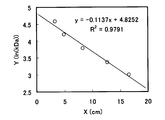
- FIG. 5 is a graph showing the relationship between the band distance X (cm) of the molecular weight marker based on the predetermined position and the logarithm Y (ln [kDa]) of the molecular weight based on the electrophoresis gel photograph.
- the molecular weight of the CAD peptide (3) was confirmed to be in the range of 40000 to 67000 (40 kDa to 67 kDa), more specifically 49000 (49 kDa) to 64000 (64 kDa).
- hair was treated according to hair treatment 1 using the hair treatment agent of Example 1a or the hair treatment agent of Example 1b.
- the initial elastic modulus and breaking strength of the untreated hair and the treated hair were measured.
- Example 1a A 3% by weight aqueous solution of CAD peptide (1a) was prepared as the hair treatment agent of Example 1a.
- Example 1b A 3% by weight aqueous solution of CAD peptide (3) was prepared as the hair treatment agent of Example 1b.
- the hair sample 1 in the present hair treatment 1 is obtained by treating straight black hair as follows.
- Straight hair black hair was processed by the procedures of bleaching, perm treatment, color treatment, hair washing treatment, color treatment, hair washing treatment, perm treatment, color treatment, hair washing treatment, color treatment, hair washing treatment, and drying treatment.
- the first agent and the second agent of “Promatis Flavor-Ad” manufactured by Milbon were mixed in a ratio of about 1 part by mass: 2 parts by mass, and this was applied to the hair.
- the coating amount was twice the hair mass.
- the coated hair was covered with a film, washed with shampoo after 15 minutes, and dried with warm air.
- hair wound around a perm rod with a diameter of 12 mm is dipped in the first agent of “Pre-Cum C / T” manufactured by Milbon for 10 minutes, washed with water, and then second of “Pre-Cum C / T”. It was immersed in the agent for 10 minutes and washed with water. Thereafter, the hair was dried with warm air.
- the first agent and the second agent of “Oldive” manufactured by Milbon were mixed in a ratio of 1 part by mass: 1 part by mass, and this was applied to the hair.
- the coating amount was 10 times the mass of the hair, and was allowed to stand for 10 minutes after coating.
- Table 1 below shows the initial elastic modulus and breaking strength results for hair treated according to hair treatment 1 and untreated hair.
- Measured average value is an average value of 5 times of measurement
- “Change rate” is based on untreated hair.
- Example 1a in which the CAD peptide (1a) having a molecular weight range of 1000 to 3600 was blended, the initial elastic modulus and the rate of change in breaking strength showed positive values, and the CAD peptide (1a) Can be confirmed to be suitable for improving the initial elastic modulus and breaking strength of hair that has been greatly damaged.
- Example 1b in which the CAD peptide (3) having a molecular weight range of 40,000 to 67,000 was blended, the change rate of the initial elastic modulus showed a positive value, and the CAD peptide (3) is suitable for improving the initial elastic modulus. I can confirm that.
- the initial elastic modulus result of Example 1a and Example 1b shows that the CAD peptide is suitable for improvement or suppression of deterioration of the initial elastic modulus of hair.
- Example 2a A 5% by weight aqueous solution of CAD peptide (2a) was prepared as the hair treatment agent of Example 2a.
- Example 2b A 5% by weight aqueous solution of CAD peptide (2b) was prepared as the hair treatment agent of Example 2b.
- the hair was treated according to the hair treatment 2a described later. Moreover, about the untreated hair and the hair after a process, the initial elastic modulus, breaking strength, and elongation were measured, and the distance between microfibrils (IF: intermediate filament) was also calculated.
- IF intermediate filament
- Camera length Approximately 2000mm Detector pixel size: 140.8 ⁇ m / pixel ⁇ 140.8 ⁇ m / pixel Image size: 1344 pixels ⁇ 1024 pixels
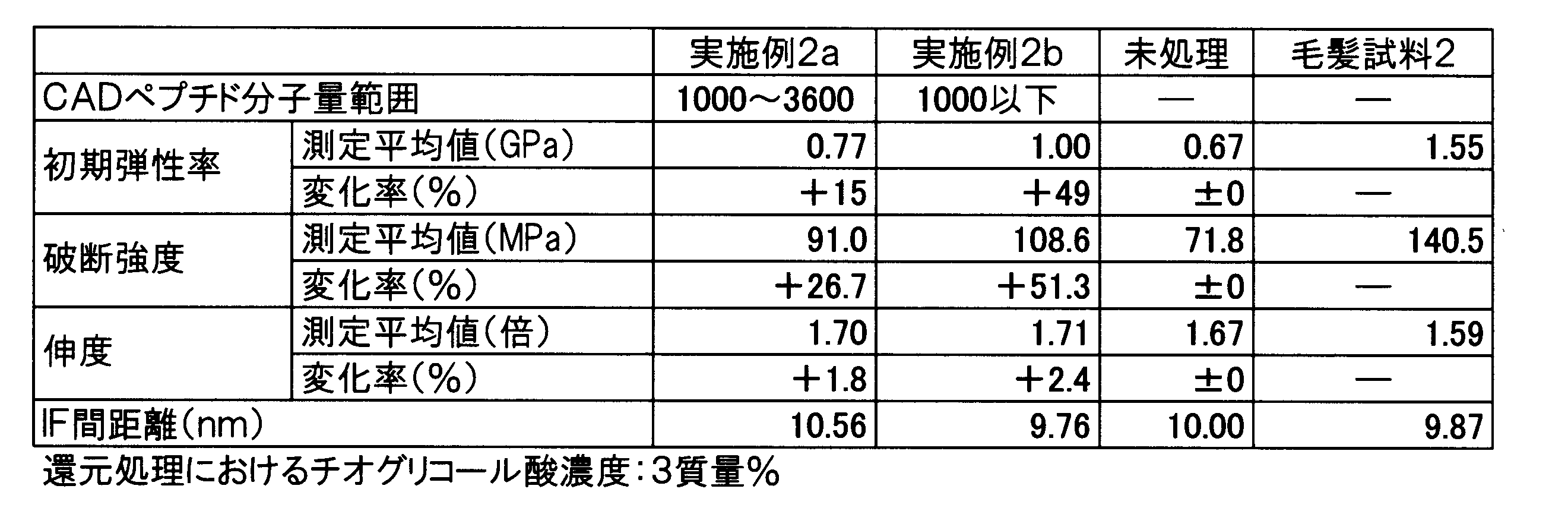
- Table 2a shows the initial elastic modulus of the hair after the hair treatment 2a.
- “Measurement average value” is an average value of 10 measurements
- “Change rate” is based on untreated hair.
- “Untreated” in Table 2a means that the cation treatment and the treatment with the hair treatment agent of Example 2a or Example 2b were omitted.
- the “inter-IF distance” is an average value of 800 samples.
- Example 2a In Table 2a, it can be confirmed that both Example 2a and Example 2b were superior in initial elastic modulus and breaking strength compared to untreated. Moreover, the inter-IF distance in Example 2a is longer than the untreated inter-IF distance, and it is expected that CAD peptide (2a) was deposited in the hair after hair treatment 2a.
- Example 2a Using the hair treatment agent of Example 2a or Example 2b, the hair was treated according to the hair treatment 2b described later. In addition, the initial elastic modulus, breaking strength, and elongation of untreated hair and treated hair were measured.
- hair treatment 2b The same treatment as the hair treatment 2a was designated as the hair treatment 2b except that only the reduction treatment of the hair treatment 2a was different in the following points.
- an aqueous solution containing 9% by mass of thioglycolic acid and 2% by mass of dithioglycolic acid (adjusted to pH 9.3 with monoethanolamine) is used instead of the 3% by mass thioglycolic acid aqueous solution. did.
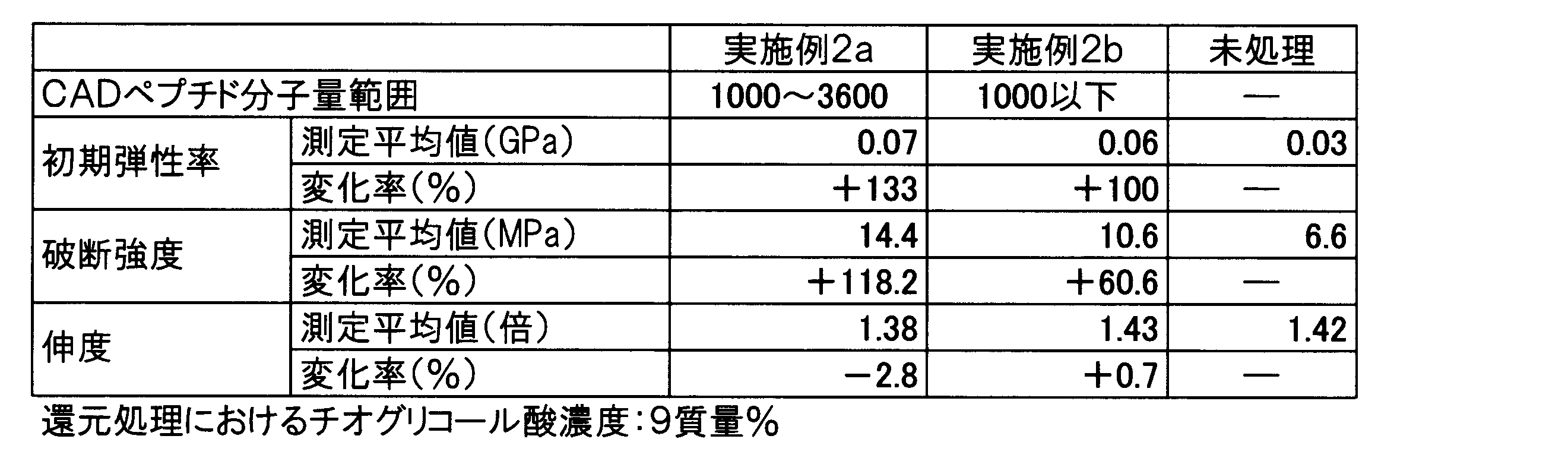
- Table 2b shows the initial elastic modulus and the like of the hair after the hair treatment 2b. “Measured average value”, “change rate”, and “untreated” in Table 2b have the same meaning as described in Table 2a.
- Example 3a As described below, the shampoos of Example 3a, Example 3b and Comparative Example 3 were prepared, and the hair was treated according to Hair Treatment 3.
- Example 3a The hair treatment agent of Example 3a was prepared by blending CAD peptide (1a) with “Death Shampoo S” manufactured by Milbon in an amount of 2% by mass.
- Example 3b The hair treatment agent of Example 3b was prepared by blending CAD peptide (3) to 2% by mass with “Death Shampoo S” manufactured by Milbon.
- Comparative Example 3 The hair treatment agent of Comparative Example 3 was “Death Shampoo S” manufactured by Milbon.
- a professional evaluator evaluated the feel of the hair bundle treated according to Hair Treatment 3.
- the hair bundle treated with the hair treatment agent of Example 3a and Example 3b was smoother than the hair bundle treated with the hair treatment agent of Comparative Example 3.
- the hair bundle processed with the hair treatment agent of Example 3b had a feeling of thickness rather than the hair bundle processed with the hair treatment agent of the comparative example.
- the “thickness” means a feeling that a substance is coated on the hair surface, and the meaning is the same in the following examples.
- the hair treatment agents of Example 4a, Example 4b, Example 4c and Comparative Example 4 were prepared as follows, and the hair was treated according to hair treatment 4.
- Example 4a A 0.2% by mass aqueous solution of CAD peptide (1a) was prepared as the hair treatment agent of Example 4a.
- Example 4b A 0.2% by mass aqueous solution of CAD peptide (1b) was prepared as the hair treatment agent of Example 4b.
- Example 4c A 0.2 mass% aqueous solution of CAD peptide (3) was prepared as the hair treatment agent of Example 4c.
- a professional evaluator evaluated the feel of the hair bundle treated according to the hair treatment 4.
- the hair bundle treated with the hair treatment agent of Example 4c was thicker than the hair bundle treated with the hair treatment agent of Comparative Example 4.
- the hair bundle treated with the hair treatment agent of Example 4a and Example 4b was smoother and softer than the hair bundle treated with the hair treatment agent of Example 4c.
- Example 5 A shampoo containing 0.2% by mass of CAD peptide (3) in the hair treatment agent of Comparative Example 5 described later was used as the hair treatment agent of Example 5.
- Hair treatment 5 A plurality of hair bundles obtained by combining 3 g of the bleached hair were prepared and used as evaluation hair bundles.
- the hair bundle was treated by the procedures of application of the hair treatment agent of Example 5, Comparative Example 5 or Reference Example 5, washing with water, application of treatment (hair treatment agent of Comparative Example 6 described later), washing with water and drying with warm air.
- a professional evaluator evaluated the feel of the hair bundle treated according to the hair treatment 5 on the basis of the hair treatment agent of Comparative Example 5. The evaluation results are shown in Table 3 (Evaluation “-” in the table indicates that no evaluation was performed).
- Example 6 A treatment comprising 0.2% by mass of CAD peptide (3) in the hair treatment agent of Comparative Example 6 described later was used as the hair treatment agent of Example 6.
- Hair treatment 6 A plurality of hair bundles obtained by combining 3 g of the bleached hair were prepared and used as evaluation hair bundles. The hair bundle was treated by applying shampoo (hair treatment agent of Comparative Example 5), washing with water, applying the hair treatment agent of Example 6, Comparative Example 6 or Reference Example 6, washing with water, and drying with warm air.
- a professional evaluator evaluated the feel of the hair bundle treated according to the hair treatment 6 on the basis of the hair treatment agent of Comparative Example 6. The evaluation results are shown in Table 4 (Evaluation “-” in the table indicates that no evaluation was performed).
- Example 7 A non-washing-out cream treatment in which 0.2% by mass of CAD peptide (3) was added to the hair treatment agent of Comparative Example 7 described later was used as the hair treatment agent of Example 7.
- a 4% by mass aqueous solution of CAD peptide (3) adjusted to pH 8.72 using arginine was used.
- Table 5 shows the evaluation results of the feeling of thickness. From the results in Table 5, it can be seen that the cream of Example 7 formulated with CAD peptide (3) has a greater sense of thickness compared to the cream of Comparative Example 7 that did not incorporate CAD peptide (3) or keratin. It was.
- Example 8 The hair treatment agent of Example 8 was prepared by applying a cream treatment containing 2% by mass of CAD peptide (3), 2% by mass of cetyltrimethylammonium bromide, 1% by mass of ethanol, 3% by mass of cetanol and 2% by mass of stearyl alcohol in water. It was.
- a professional evaluator evaluated the feel of the hair bundles treated according to the hair treatment 8a and the hair treatment 8b. The evaluation results are shown in Table 6.
- Example 9 10 parts by weight of 1% by weight of CAD peptide (3) added to Milbon's “Licente 1st Agent / 9-AB”, 10 parts by weight of Milbon's “Licente 2nd Agent (Oxidane 3.0)”
- the hair dye obtained by mixing the above was used as the hair treatment agent of Example 9.
- a professional evaluator evaluated the feel of the hair bundle treated according to the hair treatment 9. As a result of the evaluation, the hair bundle treated with the hair treatment agent of Example 9 was good according to the finger when the hair was washed.
- Example 10 The hair treatment agent of Example 10 was obtained by adding 0.5% by mass of the CAD peptide (3) to “Presume C / T First Agent” manufactured by Milbon (first agent of a two-agent perm agent). .
- Comparative Example 10 The hair treatment agent of Comparative Example 10 was obtained by adding the CAD peptide (3) of Example 10 without addition, that is, “Presume C / T First Agent” alone from Milbon.
- Example 10 (Hair treatment 10) The hair treatment agent of Example 10 or Comparative Example 10 was applied to the hair bundle, allowed to stand for 15 minutes, washed with water, and wiped with a towel. Next, apply “Presume C / T 2nd Agent” manufactured by Milbon and let it stand for 5 minutes, then wash with water, apply “Diess Neu Willowlux Treatment” manufactured by Milbon, rinse with water, The bundle was dried with warm air.
- a professional evaluator evaluated the feel of the hair bundle treated according to the hair treatment 10. As a result of the evaluation, the hair bundle treated with the hair treatment agent of Example 10 had a feeling of thickness rather than the hair bundle treated with the hair treatment agent of Comparative Example 10.
- the hair treatment agent of the present invention is effective for improving or suppressing the deterioration of the initial elastic modulus and breaking strength of damaged hair, and is therefore suitably used for commercial or household hair treatment. Is done.
Landscapes
- Health & Medical Sciences (AREA)
- Life Sciences & Earth Sciences (AREA)
- Animal Behavior & Ethology (AREA)
- General Health & Medical Sciences (AREA)
- Public Health (AREA)
- Veterinary Medicine (AREA)
- Birds (AREA)
- Epidemiology (AREA)
- Cosmetics (AREA)
- Peptides Or Proteins (AREA)
Abstract
Description
-S-S-(CH2)nCOO- (I)
(式(I)中、nは1又は2である。)
-S-S-(CH2)nCOO- (I)
(式(I)中、nは1又は2である。)
本実施形態に係る毛髪処理剤は、所定の側鎖基を備えるペプチド(以下、「所定の側鎖基を備えるペプチド」を「CADペプチド」と称する。)を配合したものである。
CADペプチドは、複数のアミノ酸のペプチド結合によって形成された主鎖と、この主鎖に結合する側鎖基を有する。
-S-S-(CH2)nCOO- (I)
(式(I)中、nは1又は2である。)
-S-S-CH2COOR1 (IB)
(R1は、NH4などのアンモニウムを表す。)
-S-S-CH2COOM1 (IC)
(M1は、Na、Kなどの金属原子を表す。)
-S-S-CH2CH2COOH (IIA)
-S-S-CH2CH2COOR2 (IIB)
(R2は、NH4などのアンモニウムを表す。)
-S-S-CH2CH2COOM2 (IIC)
(M2は、Na、Kなどの金属原子を表す。)
-CH2-S-S-CH2COOR1 (Ib)
-CH2-S-S-CH2COOM1 (Ic)
-CH2-S-S-CH2CH2COOH (IIa)
-CH2-S-S-CH2CH2COOR2 (IIb)
-CH2-S-S-CH2CH2COOM2 (IIc)
(1)毛髪の初期弾性率の向上又は悪化抑制。
(2)毛髪の初期弾性率の向上又は悪化抑制と、毛髪の破断強度の向上又は悪化抑制。
上記(1)及び(2)が示すのは、CADペプチドを配合した毛髪処理剤を、損傷を受けることでメルカプト基が増加した毛髪に対して用いるのが好適とのことである。


分子量範囲40000未満のCADペプチドを製造するための方法としては、例えば、以下に説明する製造方法(A)、(B)及び(C)が挙げられる。
製造方法(A)は、蛋白質のジスルフィド基をメルカプト基に変換する還元工程;その還元工程で蛋白質分子に生じたメルカプト基と、メルカプトアルキルカルボン酸のメルカプト基及び/又はメルカプトアルキルカルボン酸塩のメルカプト基とで、上記式(I)で表される単位を形成させる変性工程;変性工程での処理で得られた上記式(I)で表される単位が導入された蛋白質を加水分解する加水分解工程;を備える。


酵素としては、例えば、ペプシン、プロテアーゼA、プロテアーゼBなどの酸性蛋白質分解酵素;パパイン、プロメライン、サーモライシン、プロナーゼ、トリプシン、キモトリプシンなどの中性蛋白質分解酵素等が挙げられる。また、市販されている蛋白質分解酵素としては、例えば、大和化学工業社製の「プロテライザーA」が挙げられる。加水分解時のpHは、酸性蛋白質分解酵素の場合には1以上3以下に調整すると良く、中性蛋白質分解酵素の場合には5以上9以下に調整すると良い。加水分解時の反応温度は30℃以上60℃以下が良く、反応時間は10分以上24時間以内が良い(反応時間を長くするほど、より低分子のCADペプチドを製造できる。)。加水分解を停止させるには、温度を70℃以上にして酵素を失活させると良い。
酸としては、例えば塩酸、硫酸、リン酸、硝酸、臭化水素酸等の無機酸;及び蟻酸、シュウ酸等の有機酸が挙げられる。この加水分解の条件は、例えば、pH4以下、反応温度40℃以上100℃以下、反応時間2時間以上24時間以内である(反応時間を長くするほど、より低分子のCADペプチドを製造できる。)。
アルカリとしては、例えば水酸化ナトリウム、水酸化カリウム、水酸化リチウム、水酸化バリウム、炭酸ナトリウム、炭酸カリウム、炭酸リチウム、ケイ酸ナトリウム、ホウ酸ナトリウム等が挙げられる。この加水分解の条件は、例えば、反応系の全質量に対して、アルカリ1質量%以上20質量%以下、反応温度15℃以上100℃以下、反応時間30分以上24時間以内である(反応時間を長くするほど、より低分子のCADペプチドを製造できる。)。
製造方法(B)は、製造方法(A)と同様の還元工程及び変性工程で得られた水に不溶の蛋白質を、分離し、加水分解工程で処理する方法である。水に不溶の蛋白質は、公知の固液分離手段で回収でき、製造方法(B)における加水分解工程は、製造方法(A)における加水分解工程と同じである。また、固形状のCADペプチドを得る手段は、製造方法(A)の手段を採用すると良い。
製造方法(C)は、製造方法(A)と同様の還元工程及び変性工程で得られた水に溶解する蛋白質を、分離し、加水分解工程で処理する方法である。水に溶解する蛋白質は、公知の固液分離手段で回収でき、製造方法(C)における加水分解工程は、製造方法(A)における加水分解工程と同じである。また、固形状のCADペプチドを得る手段は、製造方法(A)の手段を採用すると良い。
分子量範囲40000以上67000以下のCADペプチドを製造するための方法としては、例えば、上記製造方法(C)の加水分解工程を省略した方法が挙げられる。
本実施形態に係る毛髪処理剤は、特に限定されず、ヘアケア剤、パーマ剤、カラーリング剤、ブリーチ剤、スタイリング剤等である。
-S-S-(CH2)nCOO- (I)
(式(I)中、nは1又は2である。)
以下に示す還元工程、変性工程、加水分解工程に従ってCADペプチド(1a)を製造した。
中性洗剤で洗浄、乾燥させたメリノ種羊毛を、約5mmに切断した。この羊毛5.0質量部、30質量%チオグリコール酸ナトリウム水溶液15.4質量部及び6mol/L水酸化ナトリウム水溶液8.5質量部を混合し、さらに水を混合して全量150質量部、pH11の混合液を調製した。この混合液を、45℃、1時間の条件で攪拌した。次いで、さらに水を混合して全量を200質量部とし、45℃、2時間の条件で放置し、その後、液温が常温になるまで自然冷却した。
還元工程後の混合液を攪拌しながら、当該混合液に、臭素酸ナトリウム2.05質量部を配合した水溶液25質量部を約60分かけて混合した。その後、混合液の攪拌を終始継続し、この混合液に、クエン酸7.08質量部を配合した水溶液100質量部を約85分かけて混合した。クエン酸混合後の液のpHは7であった。
変性工程での処理後の混合液からろ過分離した固体部100質量部、3質量%蛋白質分解酵素水溶液(大和化学社製「プロテライザーA」)1質量部、pHを8.0~8.5に設定する量の炭酸水素ナトリウム及び水を混合し、50℃の水中で加水分解反応を20分間進行させた。その後、80℃、5分の条件で蛋白質分解酵素を失活させた。その失活後、ろ過によりCADペプチド(1a)の水溶液を得た。
加水分解工程を変更した以外はCADペプチド(1a)の製造と同様にして、CADペプチド(1a)よりも分子量が小さいCADペプチド(1b)を製造した。CADペプチド(1b)の製造における加水分解工程は、次の通りとした。
変性工程での処理後の混合液からろ過分離した固体部100質量部、3質量%蛋白質分解酵素水溶液(大和化学社製「プロテライザーA」)1質量部、pHを8.0~8.5に設定する量の炭酸水素ナトリウム及び水を混合し、50℃の水中で加水分解反応を20分間進行させた。その後、80℃、5分の条件で蛋白質分解酵素を失活させた。次に、3質量%蛋白質分解酵素水溶液(大和化学社製「プロテライザーA」)1質量部を混合し、50℃、20分の条件で加水分解反応をさせた後、80℃、5分の条件で蛋白質分解酵素を失活させた。その後、ろ過によりCADペプチド(1b)の水溶液を得た。
変性工程を変更した以外はCADペプチド(1a)の製造と同様にして、分子量がCADペプチド(1a)と同等のCADペプチド(2a)を製造した。CADペプチド(2a)の製造における変性工程は、次の通りとした。
還元工程後の混合液を攪拌しながら、酢酸水溶液(酢酸を7質量部配合した165質量部の水溶液)を混合することでケラチン混合液のpHが漸次11から10になるように調整した。過酸化水素の混合については、35質量%過酸化水素水を3質量部配合した水溶液36質量部を攪拌しながら約30分かけて行った。過酸化水素の混合開始後、混合液を常時攪拌すると共に、pHが10以上11以下に保持されるように、酢酸水溶液を混合した。また、過酸化水素の混合終了後、酢酸水溶液約10質量部を約5分にわたって徐々に混合して、混合液のpHが漸次10から7になるように調整した。
変性工程としてCADペプチド(2a)の製造における変性工程を採用した以外はCADペプチド(1b)と同様にして、CADペプチド水溶液を得た。そして、この水溶液を半透膜を使用して、分子量範囲1000以下のCADペプチド(2b)の水溶液を得た。なお、CADペプチド(2b)を得るために使用した半透膜は、分画分子量1000、平面幅10mm、直径6.4mmのspectrum社製「spectra/por」である。
CADペプチド(1a)製造における変性工程処理後の混合液からろ過分離した液体部を、CADペプチド(3)の水溶液として得た。このCADペプチド(3)の分子量を、タカラバイオ社製「Protein Molecular Weight Marker(Low)」を分子量マーカーとし、Sodium Dodecyl Sulfate-ポリアクリルアミドゲル電気泳動(SDS-PAGE)法により確認した結果、CADペプチド(3)の分子量範囲は、40000から67000(40kDaから67kDa)であると確認された。
(1)分子量マーカー
タカラバイオ社製「Protein Molecular Weight Marker(Low)」
基準物質の詳細は、Phosphorylase B(分子量97200)、Serum Albumin(分子量66409)、Ovalbumin(分子量44287)、Carbonic anhydrase(分子量29000)、Trypsin inhibitor(分子量20100)、Lysozyme(分子量14300)の以上6物質
(2)ポリアクリルアミドゲル
濃縮ゲル濃度4.5質量%、分離ゲル濃度10.0質量%となるように調製したもの
(3)試料溶液
CADペプチド又は基準物質 1質量部
ブロモフェノールブルー 適量
試料溶媒 1質量部
(試料溶媒:ドデシル硫酸ナトリウム1質量%、2-メルカプトエタノール1質量%、塩酸トリス(pH6.8)10mM、グリセロール10質量%)
(4)泳動条件
40mA、30分間
(5)泳動槽用緩衝液
BioRed社製「10×(Tris/Glycine/SDS)Buffer」の10倍希釈水溶液
(6)染色条件
クマジーブリリアントブルー溶液で1時間染色後、脱色液で約6時間脱色処理
(7)分析結果
上記(1)~(6)を条件とした処理を行ったCADペプチド(3)と分子量マーカーの電気泳動ゲル写真を図4に示す。この電気泳動ゲル写真に基づき、所定位置を基準とする分子量マーカーのバンド距離X(cm)と分子量の対数Y(ln[kDa])との関係をグラフを図5に示す。このグラフの分子量マーカースポットから図5に示すような検量線を算出し、この検量線からCADペプチド(3)のバンドの所定位置からの距離に基づく分子量を算出すると、50000(50kDa)と63000(63kDa)となり、CADペプチド(3)の分子量は40000から67000(40kDaから67kDa)の範囲内、より詳細には49000(49kDa)から64000(64kDa)のものであると確認された。
CADペプチド(1a)の3質量%水溶液を、実施例1aの毛髪処理剤として調製した。
CADペプチド(3)の3質量%水溶液を、実施例1bの毛髪処理剤として調製した。
後記の損傷を大きく受けた毛髪を毛髪試料1とし、実施例1a又は実施例1bの毛髪処理剤に毛髪試料1を10分間浸漬し、水洗後、温風乾燥させた。
オリエンテック社製「TENSILON UTM-II-20」を使用し、単位断面積当たりの初期弾性率と破断強度を測定した。測定条件は、測定前に毛髪試料1を水に24時間浸漬、測定時に毛髪試料1を水中浸漬、温度25℃、引張り速度2mm/分、毛髪試料1の引張り間隔20mmとした。

CADペプチド(2a)の5質量%水溶液を、実施例2aの毛髪処理剤として調製した。
CADペプチド(2b)の5質量%水溶液を、実施例2bの毛髪処理剤として調製した。
20代女性から黒髪を採取し、3質量%ラウリル硫酸ナトリウム水溶液に3分間浸漬後、水洗し、水分を拭き取り、乾燥させたものを、毛髪試料2とした。毛髪試料2の1質量部を、以下の還元処理、カチオン処理、実施例2a又は実施例2bの毛髪処理剤による処理、及び酸化処理を続けて行った。還元処理では、1質量部の毛髪試料2を、30質量部の3質量%チオグリコール酸水溶液(モノエタノールアミンでpH9.3に調整したもの)に45℃、10分間の条件で浸漬した後、温水で1分間洗浄し、水分を拭き取った。カチオン処理では、1質量部の毛髪試料2を、30質量部の塩化ジメチルジアリルアンモニウム・アクリル酸共重合体(ナルコジャパン社製「MERQUAT 550」)0.1質量%水溶液に10分間浸漬した後、毛髪試料2の表面水分を拭き取った。実施例2a又は実施例2bの毛髪処理剤による処理では、1質量部の毛髪試料2を、30質量部の実施例2aの毛髪処理剤又は実施例2bの毛髪処理剤に10分間浸漬した後、毛髪試料2の表面水分を拭き取った。また、酸化処理では、1質量部の毛髪試料2を、30質量部の臭素酸ナトリウム7質量%水溶液(リン酸系緩衝液でpH7.2に調整したもの)に10分間浸漬した後、毛髪試料2を水洗し、水分を拭き取り、乾燥させた。
初期弾性率及び破断強度の測定は、上記と同様にして行った。また、伸度については、破断強度の測定と同時に測定した。
大型放射光施設SPring-8のビームラインBL40XUを使用し、毛髪試料2の軸に垂直にX線マイクロビームを照射し、毛髪試料2外周部から半径方向にステップさせ、約9nm付近の赤道反射強度を相対湿度60%雰囲気で測定し、直接IF間距離を求めた。測定条件の詳細は、次の通りである。
X線波長:0.083nm(E=15keV)
カメラ長:約2000mm
検出器ピクセルサイズ:140.8μm/ピクセル×140.8μm/ピクセル
画像サイズ:1344ピクセル×1024ピクセル
ベヘン酸銀周期:5.838nm(1次)でキャリブレーションを行なった。
ビームサイズ:約5μm
1stピンホール:5μm
2ndピンホール:200μm
ビームストップ:φ8mm
検出器:イメージインテンシファイア
毛髪処理2aの還元処理のみが以下の点で異なる以外は毛髪処理2aと同じ処理を、毛髪処理2bとした。毛髪処理2bの還元処理では、3質量%チオグリコール酸水溶液に換えて、チオグリコール酸9質量%及びジチオグリコール酸2質量%を含む水溶液(モノエタノールアミンでpH9.3に調整したもの)を使用した。
ミルボン社製「ディーセスシャンプーS」にCADペプチド(1a)を2質量%となるように配合したものを、実施例3aの毛髪処理剤とした。
ミルボン社製「ディーセスシャンプーS」にCADペプチド(3)を2質量%となるように配合したものを、実施例3bの毛髪処理剤とした。
ミルボン社製「ディーセスシャンプーS」を、比較例3の毛髪処理剤とした。
実施例3a、実施例3b又は比較例3の毛髪処理剤により、毛束をシャンプー処理した。続けて、ミルボン社製「ディーセストリートメントSF」により毛束をトリートメント処理し、毛束を温風乾燥させた。
CADペプチド(1a)の0.2質量%水溶液を、実施例4aの毛髪処理剤として調製した。
CADペプチド(1b)の0.2質量%水溶液を、実施例4bの毛髪処理剤として調製した。
CADペプチド(3)の0.2質量%水溶液を、実施例4cの毛髪処理剤として調製した。
水を、比較例4の毛髪処理剤とした。
実施例4a、実施例4b、実施例4c又は比較例4の毛髪処理剤を毛束に噴霧し、毛束を温風乾燥させた。
後記比較例5の毛髪処理剤にCADペプチド(3)を0.2質量%配合したシャンプーを、実施例5の毛髪処理剤とした。
ポリオキシエチレンラウリルエーテル硫酸ナトリウム5質量%、ラウリル硫酸トリエタノールアミン4質量%、ポリオキシエチレンラウリルエーテル酢酸ナトリウム2質量%、ラウロイルメチル-β-アラニンナトリウム0.9質量%、ラウリン酸アミドプロピルベタイン4質量%、ヤシ油脂肪酸ジエタノールアミド3質量%、ヤシ油脂肪酸モノエタノールアミド0.1質量%、1,3-ブチレングリコール0.2質量%、塩化o-[2-ヒドロキシ-3-(トリメチルアンモニオ)プロピル]ヒドロキシエチルセルロース0.4質量%、キレート剤0.3質量%、防腐剤0.3質量%、酸化防止剤0.1質量%及び香料0.2質量%を水に配合して調製したシャンプーを、比較例5の毛髪処理剤とした。
比較例5の毛髪処理剤に市販ケラチンを0.2質量%配合したシャンプーを、参考例5の毛髪処理剤とした。ここでの市販ケラチン配合では、ケラチン5質量%含有水溶液(クローダジャパン株式会社製の「ケラテックIFP-HMW」)を用いた。
ブリーチ処理した毛髪3gを纏めて1つの毛束としたものを複数用意し、これを評価用毛束とした。実施例5、比較例5又は参考例5の毛髪処理剤の塗布、水洗、トリートメント(後記比較例6の毛髪処理剤)の塗布、水洗、温風乾燥の手順で、毛束を処理した。

後記比較例6の毛髪処理剤にCADペプチド(3)を0.2質量%配合したトリートメントを、実施例6の毛髪処理剤とした。
臭化セチルトリメチルアンモニウム2質量%、塩化アルキルトリメチルアンモニウム3質量%、エタノール0.8質量%、イソプロパノール0.7質量%、セタノール5質量%、ステアリルアルコール2質量%、濃グリセリン4質量%、ポリオキシエチレンステアリルエーテル0.5質量%、2-エチルヘキサン酸セチル1質量%、ジペンタエリトリット脂肪酸エステル0.8質量%、スクワラン0.3質量%、高重合メチルポリシロキサン0.3質量%、ジメチルシロキサン・メチルステアロキシシロキサン共重合体0.2質量%、防腐剤0.2質量%及び香料0.3質量%を水に配合して調製したトリートメントを、比較例6の毛髪処理剤とした。
比較例6の毛髪処理剤に市販ケラチンを0.2質量%配合したトリートメントを、参考例6の毛髪処理剤とした。ここでの市販ケラチン配合では、ケラチン5質量%含有水溶液(クローダジャパン株式会社製の「ケラテックIFP-HMW」)を用いた。
ブリーチ処理した毛髪3gを纏めて1つの毛束としたものを複数用意し、これを評価用毛束とした。シャンプー(上記比較例5の毛髪処理剤)の塗布、水洗、実施例6、比較例6又は参考例6の毛髪処理剤の塗布、水洗、温風乾燥の手順で、毛束を処理した。

後記比較例7の毛髪処理剤にCADペプチド(3)を0.2質量%配合した洗い流さないクリーム状トリートメントを、実施例7の毛髪処理剤とした。ここでのCADペプチド(3)の配合では、アルギニンを用いてpHを8.72に調整したCADペプチド(3)の4質量%水溶液を用いた。
塩化ステアリルトリメチルアンモニウム0.8質量%、イソプロパノール0.2質量%、セタノール3質量%、ベヘニルアルコール0.8質量%、プロピレングリコール0.02質量%、ジプロピレングリコール2質量%、軟質ラノリン脂肪酸コレステリル0.4質量%、シア脂2質量%、ヒドロキシエチルセルロース0.06質量%、タマリンドシードガム0.2質量%、ジメチコノール1質量%、デカメチルシクロペンタシロキサン16質量%、メチルポリシロキサン2質量%、架橋型メチルポリシロキサン0.2質量%、アミノ変性シリコーン2質量%、高重合ジメチルシロキサン・メチル(アミノプロピル)シロキサン共重合体0.1質量%、コカミドプロピルジメチルアンモニオヒドロキシプロピルオキシプロピルシロキサン・メチルポリシロキサン共重合体酢酸塩0.5質量%、アクリルアミド・2-(アクリロイルオキシ)エチルトリメチルアンモニウムクロリド共重合物0.03質量%、酸化防止剤0.05質量%、防腐剤0.2質量%及び香料0.2質量%を水に配合することによって調製した洗い流さないクリーム状トリートメントを、比較例7の毛髪処理剤とした。
比較例7の毛髪処理剤に市販ケラチンを0.2質量%配合した洗い流さないクリーム状トリートメントを、参考例7の毛髪処理剤とした。ここでの市販ケラチン配合では、ケラチン5質量%含有水溶液(クローダジャパン株式会社製の「ケラテックIFP-HMW」)を用いた。
実施例7、比較例7又は参考例7の毛髪処理剤を人頭毛髪に塗布した後、厚み感の順位についての官能評価を実施した(厚み感が最も良かったものを1位、最も劣っていたものを3位とした)。また、ウィッグの毛髪にも塗布し、同様の評価を行った。

CADペプチド(3)2質量%、臭化セチルトリメチルアンモニウム2質量%、エタノール1質量%、セタノール3質量%及びステアリルアルコール2質量%を水に配合したクリーム状トリートメントを、実施例8の毛髪処理剤とした。
臭化セチルトリメチルアンモニウム2質量%、塩化ステアリルトリメチルアンモニウム0.05質量%、塩化ジココイルジメチルアンモニウム0.08質量%、ポリオキシエチレンセチルエーテル(20E.O.)0.01質量%、エタノール1質量%、セタノール6質量%、高重合ジメチルシロキサン2質量%、アミノエチルアミノプロピルシロキサン・ジメチルシロキサン共重合体1質量%、エチル硫酸ラノリン脂肪酸アミノプロピルエチルジメチルアンモニウム(2)0.01質量%、アミノ酸0.2質量%、防腐剤0.3質量%及び香料0.3質量%を水に配合したクリーム状トリートメントを、参考例8の毛髪処理剤とした。
実施例8又は参考例8の毛髪処理剤を毛束に塗布し、水洗し温風乾燥させた。
実施例8の毛髪処理剤を毛束に塗布し、この毛束に参考例8の毛髪処理剤を重ねて塗布した。その後、毛束を水洗し温風乾燥させた。

ミルボン社製「リセンテ第1剤・9-AB」にCADペプチド(3)を1質量%添加したもの10質量部と、ミルボン社製「リセンテ第2剤(オキシダン3.0)」10質量部と、を混合した染毛剤を、実施例9の毛髪処理剤とした。
実施例9の毛髪処理剤により、毛束を処理した。
ミルボン社製「プレジュームC/T第1剤」にCADペプチド(3)を0.5質量%添加したもの(2剤式パーマ剤の第1剤)を、実施例10の毛髪処理剤とした。
実施例10のCADペプチド(3)を無添加にしたもの、つまりミルボン社製「プレジュームC/T第1剤」単体を、比較例10の毛髪処理剤とした。
実施例10又は比較例10の毛髪処理剤を毛束に塗布し、15分間放置した後、水洗し、タオルで水分を拭き取った。次いで、ミルボン社製「プレジュームC/T第2剤」を塗布し、5分間放置した後、水洗し、更にミルボン社製「ディーセス・ノイ・ウィローリュクス・トリートメント」を塗布し、水洗後、毛束を温風乾燥させた。
Claims (13)
- 下記式(I)で表される単位を有する基を側鎖基として備えるペプチドを配合したことを特徴とする毛髪処理剤。
-S-S-(CH2)nCOO- (I)
(式(I)中、nは1又は2である。) - 前記側鎖基が、カルボキシメチルジスルフィド基、カルボキシメチルジスルフィド基の塩、カルボキシエチルジスルフィド基及びカルボキシエチルジスルフィド基の塩から選択された一種又は二種以上である請求項1に記載の毛髪処理剤。
- 前記ペプチドの分子量範囲が、40000未満である請求項2に記載の毛髪処理剤。
- 前記ペプチドの分子量範囲が、20000以下である請求項2に記載の毛髪処理剤。
- 前記ペプチドが、毛髪浸透性を有する請求項2に記載の毛髪処理剤。
- 前記ペプチドの分子量範囲が、40000以上67000以下である請求項2に記載の毛髪処理剤。
- 前記ペプチドの分子量範囲が、49000以上64000以下である請求項2に記載の毛髪処理剤。
- ヘアケア剤、パーマ剤、カラーリング剤、ブリーチ剤又はスタイリング剤である請求項1から請求項7のいずれか1項に記載の毛髪処理剤。
- 下記式(I)で表される単位を有する基を側鎖基として備えるペプチドを溶媒に溶解させた毛髪処理剤用原料。
-S-S-(CH2)nCOO- (I)
(式(I)中、nは1又は2である。) - 前記ペプチドの分子量範囲が、40000未満である請求項9に記載の毛髪処理剤用原料。
- 前記ペプチドの分子量範囲が、20000以下である請求項9に記載の毛髪処理剤用原料。
- 前記ペプチドが、毛髪浸透性を有する請求項9に記載の毛髪処理剤用原料。
- 前記ペプチドの分子量範囲が、40000以上67000以下である請求項9に記載の毛髪処理剤用原料。
Priority Applications (2)
| Application Number | Priority Date | Filing Date | Title |
|---|---|---|---|
| KR1020117029136A KR101951923B1 (ko) | 2009-06-12 | 2010-04-30 | 모발처리제 및 모발처리제용 원료 |
| CN201080024869XA CN102458352A (zh) | 2009-06-12 | 2010-04-30 | 毛发处理剂及毛发处理剂用原料 |
Applications Claiming Priority (6)
| Application Number | Priority Date | Filing Date | Title |
|---|---|---|---|
| JP2009141704A JP5558034B2 (ja) | 2009-06-12 | 2009-06-12 | ヘアケア剤及び毛髪の処理方法 |
| JP2009-141704 | 2009-06-12 | ||
| JP2010005356A JP5611603B2 (ja) | 2010-01-13 | 2010-01-13 | 毛髪処理剤及び毛髪処理剤用原料 |
| JP2010005357A JP2011144127A (ja) | 2010-01-13 | 2010-01-13 | 毛髪処理剤及び毛髪処理剤用原料 |
| JP2010-005356 | 2010-01-13 | ||
| JP2010-005357 | 2010-01-13 |
Publications (1)
| Publication Number | Publication Date |
|---|---|
| WO2010143484A1 true WO2010143484A1 (ja) | 2010-12-16 |
Family
ID=43308744
Family Applications (1)
| Application Number | Title | Priority Date | Filing Date |
|---|---|---|---|
| PCT/JP2010/057724 Ceased WO2010143484A1 (ja) | 2009-06-12 | 2010-04-30 | 毛髪処理剤及び毛髪処理剤用原料 |
Country Status (4)
| Country | Link |
|---|---|
| KR (1) | KR101951923B1 (ja) |
| CN (1) | CN102458352A (ja) |
| TW (1) | TWI523664B (ja) |
| WO (1) | WO2010143484A1 (ja) |
Cited By (1)
| Publication number | Priority date | Publication date | Assignee | Title |
|---|---|---|---|---|
| JP2012224573A (ja) * | 2011-04-19 | 2012-11-15 | Milbon Co Ltd | 毛髪処理剤 |
Families Citing this family (1)
| Publication number | Priority date | Publication date | Assignee | Title |
|---|---|---|---|---|
| TWI806100B (zh) * | 2021-07-16 | 2023-06-21 | 財團法人工業技術研究院 | 生物性毛髮形狀改變組成物與套組以及改變毛髮形狀之方法 |
Citations (5)
| Publication number | Priority date | Publication date | Assignee | Title |
|---|---|---|---|---|
| JPH07126296A (ja) * | 1993-05-24 | 1995-05-16 | Kao Corp | 可溶化蛋白質 |
| JPH09169800A (ja) * | 1995-10-20 | 1997-06-30 | Kanebo Ltd | 毛上皮特異蛋白質又はその誘導体及びそれらの製造方法並びに毛髪処理剤 |
| WO2009153923A1 (ja) * | 2008-06-16 | 2009-12-23 | 茨城県 | 可溶性羽毛ケラチン蛋白質の製造方法 |
| JP2010132595A (ja) * | 2008-12-04 | 2010-06-17 | Nicca Chemical Co Ltd | 毛髪の保護、損傷防止、及び修復効果を有する毛髪用処理剤 |
| JP2010155823A (ja) * | 2008-12-03 | 2010-07-15 | Milbon Co Ltd | 毛髪処理方法及び毛髪処理剤 |
-
2010
- 2010-04-30 CN CN201080024869XA patent/CN102458352A/zh active Pending
- 2010-04-30 WO PCT/JP2010/057724 patent/WO2010143484A1/ja not_active Ceased
- 2010-04-30 KR KR1020117029136A patent/KR101951923B1/ko active Active
- 2010-04-30 TW TW099114015A patent/TWI523664B/zh active
Patent Citations (5)
| Publication number | Priority date | Publication date | Assignee | Title |
|---|---|---|---|---|
| JPH07126296A (ja) * | 1993-05-24 | 1995-05-16 | Kao Corp | 可溶化蛋白質 |
| JPH09169800A (ja) * | 1995-10-20 | 1997-06-30 | Kanebo Ltd | 毛上皮特異蛋白質又はその誘導体及びそれらの製造方法並びに毛髪処理剤 |
| WO2009153923A1 (ja) * | 2008-06-16 | 2009-12-23 | 茨城県 | 可溶性羽毛ケラチン蛋白質の製造方法 |
| JP2010155823A (ja) * | 2008-12-03 | 2010-07-15 | Milbon Co Ltd | 毛髪処理方法及び毛髪処理剤 |
| JP2010132595A (ja) * | 2008-12-04 | 2010-06-17 | Nicca Chemical Co Ltd | 毛髪の保護、損傷防止、及び修復効果を有する毛髪用処理剤 |
Non-Patent Citations (1)
| Title |
|---|
| RYOTA HATAKEYAMA ET AL.: "Kayosei Yomo Keratin de Shori shita Mohatsu no Characterization", THE SOCIETY OF FIBER SCIENCE AND TECHNOLOGY, vol. 64, no. 1, 10 June 2009 (2009-06-10), JAPAN YOKOSHU, pages 67 * |
Cited By (1)
| Publication number | Priority date | Publication date | Assignee | Title |
|---|---|---|---|---|
| JP2012224573A (ja) * | 2011-04-19 | 2012-11-15 | Milbon Co Ltd | 毛髪処理剤 |
Also Published As
| Publication number | Publication date |
|---|---|
| CN102458352A (zh) | 2012-05-16 |
| TWI523664B (zh) | 2016-03-01 |
| TW201105355A (en) | 2011-02-16 |
| KR20120046108A (ko) | 2012-05-09 |
| KR101951923B1 (ko) | 2019-02-25 |
Similar Documents
| Publication | Publication Date | Title |
|---|---|---|
| JP5301584B2 (ja) | 毛髪処理剤 | |
| JP2010241833A (ja) | 毛髪処理剤 | |
| JP5558034B2 (ja) | ヘアケア剤及び毛髪の処理方法 | |
| JP2022168056A (ja) | 毛髪強化剤 | |
| CN113166370A (zh) | 用于处理基于氨基酸的纤维状基质、尤其是头发的多元羧酸化合物 | |
| JP5826538B2 (ja) | 毛髪処理剤 | |
| JP5738143B2 (ja) | 毛髪処理剤及び毛髪処理方法 | |
| JPH01502982A (ja) | 毛髪のパーマネント加工ないしは除毛用の薬剤 | |
| KR20210100098A (ko) | 섬유성 아미노산 기반 기재, 특히, 모발의 처리를 위한 폴리카르복시산 화합물의 용도 | |
| JP6346399B2 (ja) | 毛髪変形用処理剤および毛髪変形処理方法 | |
| WO2010143484A1 (ja) | 毛髪処理剤及び毛髪処理剤用原料 | |
| JP5611603B2 (ja) | 毛髪処理剤及び毛髪処理剤用原料 | |
| KR20020021141A (ko) | 퍼머용 조성물 및 이를 이용한 퍼머 방법 | |
| JP2009120563A (ja) | パーマ方法及びパーマ用キット | |
| JP5950697B2 (ja) | 毛髪処理剤、及び毛髪処理方法 | |
| JP2003300836A (ja) | 毛髪前処理剤及び毛髪前処理方法 | |
| JP6005021B2 (ja) | 毛髪処理方法 | |
| JP5864885B2 (ja) | 多剤式毛髪処理剤 | |
| JP2011144127A (ja) | 毛髪処理剤及び毛髪処理剤用原料 | |
| JP2021528501A (ja) | 酵素系、毛細血管線維の治療のための化粧品組成物、毛細血管線維の化粧品処理の方法、毛細血管タンパク質のペプチドリンクのクリッピングのための方法、および全身の使用。 | |
| BRPI0620529B1 (pt) | composição de alisamento do cabelo | |
| JP5726435B2 (ja) | 変性ペプチドの製造方法及び変性ペプチド | |
| JP6190796B2 (ja) | 毛髪処理用第二剤、及び当該毛髪処理用第二剤を使用した毛髪処理方法 | |
| JP4936380B2 (ja) | 毛髪保護剤および毛髪の処理方法 | |
| WO2026014543A1 (ja) | 再生コラーゲン繊維を含む頭飾製品用繊維の処理方法 |
Legal Events
| Date | Code | Title | Description |
|---|---|---|---|
| WWE | Wipo information: entry into national phase |
Ref document number: 201080024869.X Country of ref document: CN |
|
| 121 | Ep: the epo has been informed by wipo that ep was designated in this application |
Ref document number: 10786015 Country of ref document: EP Kind code of ref document: A1 |
|
| DPE1 | Request for preliminary examination filed after expiration of 19th month from priority date (pct application filed from 20040101) | ||
| ENP | Entry into the national phase |
Ref document number: 20117029136 Country of ref document: KR Kind code of ref document: A |
|
| NENP | Non-entry into the national phase |
Ref country code: DE |
|
| 122 | Ep: pct application non-entry in european phase |
Ref document number: 10786015 Country of ref document: EP Kind code of ref document: A1 |