WO2010143723A1 - Savon et son procédé de fabrication - Google Patents
Savon et son procédé de fabrication Download PDFInfo
- Publication number
- WO2010143723A1 WO2010143723A1 PCT/JP2010/059985 JP2010059985W WO2010143723A1 WO 2010143723 A1 WO2010143723 A1 WO 2010143723A1 JP 2010059985 W JP2010059985 W JP 2010059985W WO 2010143723 A1 WO2010143723 A1 WO 2010143723A1
- Authority
- WO
- WIPO (PCT)
- Prior art keywords
- oil
- soap
- component
- mixing
- alkali
- Prior art date
- Legal status (The legal status is an assumption and is not a legal conclusion. Google has not performed a legal analysis and makes no representation as to the accuracy of the status listed.)
- Ceased
Links
Images

Classifications
-
- C—CHEMISTRY; METALLURGY
- C11—ANIMAL OR VEGETABLE OILS, FATS, FATTY SUBSTANCES OR WAXES; FATTY ACIDS THEREFROM; DETERGENTS; CANDLES
- C11D—DETERGENT COMPOSITIONS; USE OF SINGLE SUBSTANCES AS DETERGENTS; SOAP OR SOAP-MAKING; RESIN SOAPS; RECOVERY OF GLYCEROL
- C11D9/00—Compositions of detergents based essentially on soap
- C11D9/02—Compositions of detergents based essentially on soap on alkali or ammonium soaps
-
- A—HUMAN NECESSITIES
- A61—MEDICAL OR VETERINARY SCIENCE; HYGIENE
- A61K—PREPARATIONS FOR MEDICAL, DENTAL OR TOILETRY PURPOSES
- A61K8/00—Cosmetics or similar toiletry preparations
- A61K8/18—Cosmetics or similar toiletry preparations characterised by the composition
- A61K8/30—Cosmetics or similar toiletry preparations characterised by the composition containing organic compounds
- A61K8/33—Cosmetics or similar toiletry preparations characterised by the composition containing organic compounds containing oxygen
- A61K8/36—Carboxylic acids; Salts or anhydrides thereof
- A61K8/361—Carboxylic acids having more than seven carbon atoms in an unbroken chain; Salts or anhydrides thereof
-
- A—HUMAN NECESSITIES
- A61—MEDICAL OR VETERINARY SCIENCE; HYGIENE
- A61K—PREPARATIONS FOR MEDICAL, DENTAL OR TOILETRY PURPOSES
- A61K8/00—Cosmetics or similar toiletry preparations
- A61K8/18—Cosmetics or similar toiletry preparations characterised by the composition
- A61K8/92—Oils, fats or waxes; Derivatives thereof, e.g. hydrogenation products thereof
- A61K8/922—Oils, fats or waxes; Derivatives thereof, e.g. hydrogenation products thereof of vegetable origin
-
- A—HUMAN NECESSITIES
- A61—MEDICAL OR VETERINARY SCIENCE; HYGIENE
- A61Q—SPECIFIC USE OF COSMETICS OR SIMILAR TOILETRY PREPARATIONS
- A61Q19/00—Preparations for care of the skin
- A61Q19/10—Washing or bathing preparations
-
- C—CHEMISTRY; METALLURGY
- C11—ANIMAL OR VEGETABLE OILS, FATS, FATTY SUBSTANCES OR WAXES; FATTY ACIDS THEREFROM; DETERGENTS; CANDLES
- C11D—DETERGENT COMPOSITIONS; USE OF SINGLE SUBSTANCES AS DETERGENTS; SOAP OR SOAP-MAKING; RESIN SOAPS; RECOVERY OF GLYCEROL
- C11D3/00—Other compounding ingredients of detergent compositions covered in group C11D1/00
- C11D3/48—Medical, disinfecting agents, disinfecting, antibacterial, germicidal or antimicrobial compositions
Definitions
- the present invention relates to a soap and a method for producing the same, and more particularly to a solid soap with reduced skin irritation, particularly a soap that can be used as a facial soap or a cosmetic soap and a method for producing the same.
- Patent Document 1 Japanese Patent Application Laid-Open No. 2004-99851
- Solid soaps containing 10% by weight, olive oil 0.5-5% by weight and turmeric 0.1-3% by weight have been proposed.
- Patent Document 2 Japanese Patent Application Laid-Open No. 2005-2641278 has the effect of preventing the occurrence of acne and pimples, the use of those with atopic diseases and eczema, and the effect of suppressing body odor, as well as the prevention of the occurrence of spots and freckles
- a whitening soap manufacturing method has been proposed in which whitening whitening effect is noticeable.
- grape seed oil is the main raw material, and olive oil, coconut oil and palm oil are used as appropriate. It has been proposed to mix in proportions.
- Patent Document 3 Japanese Patent Application Laid-Open No. 2007-56174 discloses photosynthetic bacteria, lactic acid bacteria, and yeast as ingredients in order to provide soap that contributes to the improvement of symptoms of athlete's foot and beetles without contaminating socks and the like. Soaps containing a large amount of useful microorganisms such as fungi, actinomycetes and bacilli have been proposed.
- a useful microorganism group is mixed in a liquid composed of other soap components (oil and fat, sodium hydroxide and starch), and then placed in a mold and left for about 2 months. Only the timing of the saponification reaction and the addition of useful microorganisms is not taken into consideration.
- salad oil (3 liters) is used as fat.
- soaps that can be used for reducing skin irritation and atopic diseases have been proposed, and a group of useful microorganisms (hereinafter referred to as EM fungi) to improve symptoms of athlete's foot and beetles. )) has also been proposed.
- EM fungi a group of useful microorganisms
- the first object of the present invention is to provide a soap that improves the feeling of use after use while pursuing low irritation to the skin, and can effectively remove the soap even if it remains after washing.
- the present invention reconfirms the method for producing soap, and a method for producing soap that can effectively use useful microorganisms is a second problem.
- the present inventor is a soap formed using vegetable oil, especially olive oil, and blends microbial components such as useful microorganisms with such vegetable oils and fats.
- the present invention has been completed by finding that it has a good synergistic effect on the skin during and after use.
- the present invention is olive oil, castor oil, palm oil, palm kernel oil, palm stearic acid, coconut oil, rice bran oil, safflower oil, sesame oil, camellia oil,
- One or two or more vegetable oil components selected from vegetable oils including corn oil, cottonseed oil, soybean oil, sunflower oil, an alkaline component that reacts with the vegetable oil components to produce soap, and the above plant properties
- a soap comprising a microbial component blended in an amount of 0.5 to 6 parts by volume with respect to 100 parts by volume of an active ingredient comprising an oil and fat component and an alkali component.
- Such soaps are further used as auxiliary components such as soil release polymers, polymer dispersants, polysaccharides, abrasives, bactericides, anti-fogging agents, builders, enzymes, opacifiers, dyes, fragrances, thickeners, antioxidants. , At least one selected from the group consisting of processing aids, other soap foaming enhancers, buffers, antifungal agents or mold control agents, insect repellents, rust preventive aids, and chelating agents You can also However, the blending amount is desirably within a range that does not deviate from the requirement of low irritation to the skin. Rather, it is desirable not to add these additives in order to reduce irritation to the skin.
- the soap according to the present invention is formed with only vegetable oil components, alkaline components, and useful microorganisms. Note that when starch is added as a nutrient for microbial components, the quality change of the component during storage must be taken into account, and it may be possible to increase irritation to the skin. Then it is desirable not to blend.
- the soap according to the present invention it is preferable to use a vegetable oil derived from fruits represented by olive oil, as the vegetable oil component.
- a vegetable oil derived from fruits represented by olive oil is preferable, and among them, the free acidity is preferably 2 g or less per 100 g in terms of oleic acid (that is, extra virgin olive oil and virgin olive oil).
- alkaline component that can be used in the manufacture of the soap according to the present invention
- various alkaline components used in the manufacture of soap such as potassium hydroxide and sodium hydroxide can be used.
- sodium hydroxide is used when manufacturing a soap bar
- potassium hydroxide is used when manufacturing a liquid soap.
- the alkali component used for saponification is preferably sodium hydroxide, and thus solid It is desirable to be a soap.
- the soap according to the present invention is desirably solid and appropriately formed into a three-dimensional shape.
- This three-dimensional shape means a fluid (that is, a liquid state) is excluded, and may be a powder, and is preferably a shape having a certain size.
- the shape includes various shapes such as a sphere, a vertical body, a column, a shape combining a spherical surface and a plane, and other shapes such as a star shape, a heart shape, and a character shape. There is no particular problem with the size as long as it is suitable for use.
- the soap according to the present invention further contains a microbial component comprising a useful microorganism group in a volume ratio of 0.5 to 6%, preferably in a volume ratio with respect to an active ingredient comprising a vegetable oil component and an alkaline component. Containing 0.5 to 4%. If the amount is less than 0.5 with respect to 100 parts by volume of the active ingredient of soap, the effect based on this useful microorganism group cannot be sufficiently obtained. This is because materials (particularly microbial components) are wasted.
- the group of useful microorganisms constituting such a microbial component includes a plurality of useful microorganisms that are anaerobic and microaerobic from lactic acid bacteria group, yeast group, photosynthetic bacteria group, fermentation filamentous fungus group, gram-positive actinomycetes group) It is an aggregate that coexists with each other, and is a symbiotic microbial material.
- the microorganism used for the microorganism component is a safe type used for food processing, such as yeast and lactic acid bacteria.
- the useful microorganism group used as such microbial components for example, trade names “EM1 to 3”, “EMW”, “EMX” and the like provided by EM Research Institute, Inc. and Sanko Sangyo Co., Ltd. may be used. it can.
- the above-mentioned useful microorganism group has strong anti-oxidant power, so it can be blended with soap to prevent oxidative degradation of organic substances by (oxidizing) microorganisms in the oxygen-rich atmosphere, and further biodegradation such as fermentation and resuscitation. It is thought that it can be changed to a good cycle of type.
- the decomposition of the surfactant that is a soap maintenance component is promoted, and even if the soap component remains on the skin, The effect on the skin can be reduced. Furthermore, the action of promoting the decomposition of the surfactant by the useful microorganism group also promotes the decomposition of the surfactant in the waste water generated during the cleaning, and thus can contribute to environmental conservation.
- vegetable oil and fat particularly oil derived from olive oil is used as the main component of the soap, so that metal and other inorganic substances do not remain on the skin due to decomposition by the useful microorganism group. Disassembled. And since the useful microorganisms adhering to the skin at the time of use of soap are hold
- the present invention provides a method for producing a soap that can make a useful microorganism group effectively exist in the soap.
- a method for producing a soap containing the above useful microorganism group (A) an alkali component creating step for creating an alkali component which is the property of an aqueous solution; (B) a first mixing step of mixing the vegetable oil component and the alkali component; (C) comprising a second mixing step of mixing and mixing microbial components in a mixed suspension of vegetable oil and fat components and alkali components,
- the second mixing step is a method for producing soap performed at less than 60 degrees Celsius.
- an alkali component which may be 60 degrees Celsius or more. If a microbial component is mixed in such a temperature environment, the microorganism may be killed. Therefore, in the present invention, an alkali component is first prepared, and the temperature of the suspension is lowered by mixing and stirring the vegetable oil in the first mixing step, which is less than 60 degrees Celsius, preferably 40 degrees Celsius or less. At this stage, the microbial component is mixed in the suspension in the second mixing step and further mixed.
- the saponification of the alkali component and the vegetable oil / fat component is performed at a high temperature by the heat generated in the alkali component preparation step, so that the saponification reaction is sufficiently accelerated.
- the soap produced by the method for producing a soap according to the present invention has a large number of microorganism components that are not inactivated therein, and therefore can effectively generate enzymes in the skin at body temperature. .
- the solid soap according to the present embodiment is manufactured by using olive oil as a vegetable oil component and using sodium hydroxide as an alkaline component and reacting (saponifying) the two.
- this soap bar 4000 cc of olive oil and 560 cc of sodium hydroxide are used, and 100 cc of microbial components consisting of useful microorganisms are used.
- a saponification reaction product is poured into a mold, cooled, dried and aged, and if necessary, it is molded after demolding.
- alkali component creation step a This alkaline component preparation process is an exothermic reaction and may exceed 60 degrees Celsius, depending on the environment in which it is carried out.
- microbial component 40 sold under the name of EM (Effective Microorganisms: useful microorganism group) is put into this suspension mixed solution, and this is stirred and mixed for about 5 minutes (second mixing step c).
- EM Effective Microorganisms: useful microorganism group
- this solution 50 is poured into a molding die 80 (molding step D), ripened for 2 days or 1 week after being put in the die, and demolded.
- the stirring step in this manufacturing method is not required to be so rigorous with respect to the stirring speed or the like, and may be performed manually, depending on the amount to be manufactured.
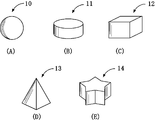
- FIGS. 2A to 2E show the overall shape of the soap bar according to the present embodiment. That is, the entire shape of the soap formed by molding is shown.
- the soap bar according to the present embodiment can be formed in various shapes as having a certain area and thickness.
- the size of the soap is, for example, when it is formed into a spherical solid soap 10 as shown in FIG. Has a diameter of about 15-40 mm.
- the cylindrical soap bar 11 is formed as shown in FIG. 1B, the diameter is about 20 mm and the axial length is 10 to 30 mm.
- a prismatic solid soap 12 as shown in FIG.
- all side lengths are set to 15 to 30 mm.
- all side lengths are set to 20 to 40 mm.
- It can also be formed as a solid soap 14 having various designs such as a star shape as shown in FIG. 1E, and preferably has a volume of about 60 cc.
- the solid soap produced as described above washing with slightly warm water of about 35 degrees Celsius activates the useful microorganism group and can suppress the propagation of various bacteria. Even when the soap component remains, the solid soap according to the present embodiment is formed using olive oil, and no extra components such as other fluorescent paints are blended. Has been reduced. Furthermore, this soap contains a microbial component consisting of useful microorganisms, and the excess soap component is decomposed by this useful microorganisms activated at body temperature, so that the irritation to the skin is greatly increased. Has been reduced. Furthermore, since the microbial component is blended, environmental pollution due to water after rinsing is reduced.
- a microorganism component that has been approved for oral administration can be used for mouth washing, for example, and by the action of useful microorganisms, periodontal disease bacteria that cause alveolar pyorrhea can be used. Removal can also be performed.
- the following soap was prepared for comparison with the soap prepared in the above embodiment (hereinafter referred to as “the present soap”).
- the soap prepared in the above embodiment is obtained by mixing 560 cc of sodium hydroxide with 560 cc of water (making a sodium hydroxide solution of about 20 to 25%), and adding olive oil as a vegetable oil component to this. Saponification is performed by mixing 4000 cc. After that, when the suspended solution reaches 40 degrees Celsius, 100 cc of microbial components consisting of a group of useful microorganisms sold under the name of EM are added and mixed, molded, cooled, dried and aged. Forming.
- Comparative soap 1 In the production of the soap, Comparative Soap 1 was prepared in the same manner except that 4000 cc of olive oil as a vegetable oil component was used instead of 4000 cc of mixed fat of beef tallow, coconut oil and palm oil. As a result of using this comparative soap 1, it was confirmed that the skin was washed up as if a film was stretched on the skin. In addition, there was a person who developed a rash with the feeling that the pores were clogged.
- Comparative soap 2 In the production of the soap, a microbial component consisting of a group of useful microorganisms was added immediately after the alkali component preparation step, and then a vegetable oil / fat component was blended and saponified to prepare comparative soap 2. As a result of using this comparative soap 2, as for the feeling of washing, the same effect as that of this soap was obtained, but the improvement effect for those having skin diseases such as athlete's foot was not obtained. In this regard, when this soap was used, itching of skin patients after washing was reduced over a long period of time.
- Comparative soap 3 In the production of the soap, comparative soap 3 was prepared without blending microbial components consisting of useful microorganisms. As a result of using this comparative soap 3, as in the comparative soap 2, the same effect as that of the soap was obtained with respect to the feeling of washing, but the improvement effect for those having skin diseases such as athlete's foot was obtained. There wasn't.
Landscapes
- Health & Medical Sciences (AREA)
- Life Sciences & Earth Sciences (AREA)
- Chemical & Material Sciences (AREA)
- Public Health (AREA)
- Oil, Petroleum & Natural Gas (AREA)
- Veterinary Medicine (AREA)
- Animal Behavior & Ethology (AREA)
- General Health & Medical Sciences (AREA)
- Engineering & Computer Science (AREA)
- Epidemiology (AREA)
- Birds (AREA)
- Chemical Kinetics & Catalysis (AREA)
- Wood Science & Technology (AREA)
- Organic Chemistry (AREA)
- Dermatology (AREA)
- Emergency Medicine (AREA)
- Cosmetics (AREA)
- Detergent Compositions (AREA)
Abstract
L'invention porte sur un savon qui est formulé de façon à être doux pour la peau, tout en laissant simultanément une sensation améliorée après utilisation; le savon proposé peut aussi être aisément enlevé, s'il en reste un peu après le lavage. Ce savon comprend : un ou plusieurs composants de type huile végétale, choisis parmi les huiles végétales comprenant l'huile d'olive, l'huile de ricin, l'huile de palme, l'huile de palmiste, l'acide palme-stéarique, l'huile de noix de coco, l'huile de son de riz, l'huile de carthame, l'huile de sésame, l'huile de camélia, l'huile de maïs, l'huile de graines de coton, l'huile de soja et l'huile de tournesol; un composant alcalin qui réagit avec le ou les composants de type huile végétale pour produire un savon; et 0,5 à 4 parties en volume d'un composant microbien pour 100 parties en volume des matières actives, lesdites matières actives comprenant le ou les composants de type huile végétale et le composant alcalin mentionnés ci-dessus.
Applications Claiming Priority (2)
| Application Number | Priority Date | Filing Date | Title |
|---|---|---|---|
| JP2009141719A JP2010285566A (ja) | 2009-06-13 | 2009-06-13 | 石鹸及びその製造方法 |
| JP2009-141719 | 2009-06-13 |
Publications (1)
| Publication Number | Publication Date |
|---|---|
| WO2010143723A1 true WO2010143723A1 (fr) | 2010-12-16 |
Family
ID=43308978
Family Applications (1)
| Application Number | Title | Priority Date | Filing Date |
|---|---|---|---|
| PCT/JP2010/059985 Ceased WO2010143723A1 (fr) | 2009-06-13 | 2010-06-12 | Savon et son procédé de fabrication |
Country Status (2)
| Country | Link |
|---|---|
| JP (1) | JP2010285566A (fr) |
| WO (1) | WO2010143723A1 (fr) |
Cited By (1)
| Publication number | Priority date | Publication date | Assignee | Title |
|---|---|---|---|---|
| EP4400293A1 (fr) | 2023-01-12 | 2024-07-17 | L'air Liquide, Société Anonyme Pour L'Étude Et L'exploitation Des Procédés Georges Claude | Procédé de fabrication d'un réservoir composite en fibres et réservoir composite en fibres fabriqué selon ce procédé |
Families Citing this family (2)
| Publication number | Priority date | Publication date | Assignee | Title |
|---|---|---|---|---|
| KR101250545B1 (ko) * | 2011-02-28 | 2013-04-03 | 최만득 | 기능성 화장비누의 제조 방법 |
| JP6335143B2 (ja) * | 2015-06-29 | 2018-05-30 | 敏京 李 | ペット洗浄用化粧材の製造方法 |
Citations (4)
| Publication number | Priority date | Publication date | Assignee | Title |
|---|---|---|---|---|
| JP2006225429A (ja) * | 2005-02-15 | 2006-08-31 | ▲吉▼田 和昭 | コールドプロセスによる石けんの製造方法 |
| JP2007056174A (ja) * | 2005-08-26 | 2007-03-08 | Kanzai:Kk | 石けん |
| JP2009249581A (ja) * | 2008-04-10 | 2009-10-29 | Ozeki Koichi | 洗濯用固形石鹸およびこれを用いた洗濯方法 |
| JP2010090195A (ja) * | 2008-10-03 | 2010-04-22 | Mohan Sharad | 固形石鹸及びこれを用いた送達方法 |
Family Cites Families (4)
| Publication number | Priority date | Publication date | Assignee | Title |
|---|---|---|---|---|
| JPS6172789A (ja) * | 1984-09-18 | 1986-04-14 | Takeda Chem Ind Ltd | 7−ホルミルアミノ−セフエム化合物およびその製造法 |
| JP2004099851A (ja) * | 2002-09-10 | 2004-04-02 | Kanae Shibata | 化粧石けん |
| JP4482631B2 (ja) * | 2004-02-20 | 2010-06-16 | 株式会社Em研究機構 | 発酵技術を応用した洗浄剤及びその製造方法 |
| JP2006076999A (ja) * | 2004-08-09 | 2006-03-23 | Yamano Shoji Kk | 皮膚用洗浄剤組成物 |
-
2009
- 2009-06-13 JP JP2009141719A patent/JP2010285566A/ja active Pending
-
2010
- 2010-06-12 WO PCT/JP2010/059985 patent/WO2010143723A1/fr not_active Ceased
Patent Citations (4)
| Publication number | Priority date | Publication date | Assignee | Title |
|---|---|---|---|---|
| JP2006225429A (ja) * | 2005-02-15 | 2006-08-31 | ▲吉▼田 和昭 | コールドプロセスによる石けんの製造方法 |
| JP2007056174A (ja) * | 2005-08-26 | 2007-03-08 | Kanzai:Kk | 石けん |
| JP2009249581A (ja) * | 2008-04-10 | 2009-10-29 | Ozeki Koichi | 洗濯用固形石鹸およびこれを用いた洗濯方法 |
| JP2010090195A (ja) * | 2008-10-03 | 2010-04-22 | Mohan Sharad | 固形石鹸及びこれを用いた送達方法 |
Cited By (1)
| Publication number | Priority date | Publication date | Assignee | Title |
|---|---|---|---|---|
| EP4400293A1 (fr) | 2023-01-12 | 2024-07-17 | L'air Liquide, Société Anonyme Pour L'Étude Et L'exploitation Des Procédés Georges Claude | Procédé de fabrication d'un réservoir composite en fibres et réservoir composite en fibres fabriqué selon ce procédé |
Also Published As
| Publication number | Publication date |
|---|---|
| JP2010285566A (ja) | 2010-12-24 |
Similar Documents
| Publication | Publication Date | Title |
|---|---|---|
| GB2537649A (en) | Composition | |
| KR101085957B1 (ko) | 발효기술을 응용한 세정제 및 그 제조방법 | |
| KR20150014742A (ko) | 비누화 용액의 조성물 및 아토피개선 비누의 제조방법 | |
| CN106822725A (zh) | 一种来源天然的除螨手工皂及其制备方法 | |
| CN105567480A (zh) | 一种酵素香皂及其制备方法 | |
| CN103351962B (zh) | 一种黄花蒿保健香皂 | |
| JP2010285566A (ja) | 石鹸及びその製造方法 | |
| KR101250545B1 (ko) | 기능성 화장비누의 제조 방법 | |
| KR101300632B1 (ko) | 천연세제조성물 및 그 제조방법 | |
| CN106398922A (zh) | 抗菌香皂及其制备方法 | |
| CN105542973A (zh) | 一种含有无患子皂苷的香皂及其制备方法 | |
| JP2005264128A (ja) | 美白石鹸 | |
| CN106619285A (zh) | 一种青梅水果酵素沐浴露 | |
| CN107164118A (zh) | 一种抗菌抑菌保健香皂及其制备方法 | |
| JP5632741B2 (ja) | ムース状油脂組成物及びその製造方法 | |
| KR20160102739A (ko) | 탱자비누 및 그 제조방법 | |
| CN102824298A (zh) | 女士卫生湿巾 | |
| CN102226135A (zh) | 杀菌去污除臭洗鞋液及其制备方法 | |
| CN1928047A (zh) | 灭菌液体香皂液 | |
| JP2004123585A (ja) | 発酵パパイア石鹸及びその製造方法 | |
| JP3213379U (ja) | 乳酸菌の付いた米のとぎ汁にem菌本体と植物油を混合し組み合わせた石鹸 | |
| CN106635482A (zh) | 一种酵素香皂及其制备方法 | |
| CN106520414A (zh) | 一种用茶皂素和蜂蜡生产天然绿色香皂的方法 | |
| KR20120021342A (ko) | 비누화 용액 및 그 제조방법 | |
| CN118256313A (zh) | 一种天然山茶油手工皂 |
Legal Events
| Date | Code | Title | Description |
|---|---|---|---|
| 121 | Ep: the epo has been informed by wipo that ep was designated in this application |
Ref document number: 10786254 Country of ref document: EP Kind code of ref document: A1 |
|
| NENP | Non-entry into the national phase |
Ref country code: DE |
|
| 122 | Ep: pct application non-entry in european phase |
Ref document number: 10786254 Country of ref document: EP Kind code of ref document: A1 |