WO2010143743A1 - 作物植物の栽培方法 - Google Patents
作物植物の栽培方法 Download PDFInfo
- Publication number
- WO2010143743A1 WO2010143743A1 PCT/JP2010/060154 JP2010060154W WO2010143743A1 WO 2010143743 A1 WO2010143743 A1 WO 2010143743A1 JP 2010060154 W JP2010060154 W JP 2010060154W WO 2010143743 A1 WO2010143743 A1 WO 2010143743A1
- Authority
- WO
- WIPO (PCT)
- Prior art keywords
- amino acid
- acid sequence
- cytochrome
- plant
- protoporphyrinogen
- Prior art date
- Legal status (The legal status is an assumption and is not a legal conclusion. Google has not performed a legal analysis and makes no representation as to the accuracy of the status listed.)
- Ceased
Links
Images

Classifications
-
- C—CHEMISTRY; METALLURGY
- C12—BIOCHEMISTRY; BEER; SPIRITS; WINE; VINEGAR; MICROBIOLOGY; ENZYMOLOGY; MUTATION OR GENETIC ENGINEERING
- C12N—MICROORGANISMS OR ENZYMES; COMPOSITIONS THEREOF; PROPAGATING, PRESERVING, OR MAINTAINING MICROORGANISMS; MUTATION OR GENETIC ENGINEERING; CULTURE MEDIA
- C12N15/00—Mutation or genetic engineering; DNA or RNA concerning genetic engineering, vectors, e.g. plasmids, or their isolation, preparation or purification; Use of hosts therefor
- C12N15/09—Recombinant DNA-technology
- C12N15/63—Introduction of foreign genetic material using vectors; Vectors; Use of hosts therefor; Regulation of expression
- C12N15/79—Vectors or expression systems specially adapted for eukaryotic hosts
- C12N15/82—Vectors or expression systems specially adapted for eukaryotic hosts for plant cells, e.g. plant artificial chromosomes (PACs)
- C12N15/8241—Phenotypically and genetically modified plants via recombinant DNA technology
- C12N15/8261—Phenotypically and genetically modified plants via recombinant DNA technology with agronomic (input) traits, e.g. crop yield
- C12N15/8271—Phenotypically and genetically modified plants via recombinant DNA technology with agronomic (input) traits, e.g. crop yield for stress resistance, e.g. heavy metal resistance
- C12N15/8274—Phenotypically and genetically modified plants via recombinant DNA technology with agronomic (input) traits, e.g. crop yield for stress resistance, e.g. heavy metal resistance for herbicide resistance
-
- A—HUMAN NECESSITIES
- A01—AGRICULTURE; FORESTRY; ANIMAL HUSBANDRY; HUNTING; TRAPPING; FISHING
- A01N—PRESERVATION OF BODIES OF HUMANS OR ANIMALS OR PLANTS OR PARTS THEREOF; BIOCIDES, e.g. AS DISINFECTANTS, AS PESTICIDES OR AS HERBICIDES; PEST REPELLANTS OR ATTRACTANTS; PLANT GROWTH REGULATORS
- A01N43/00—Biocides, pest repellants or attractants, or plant growth regulators containing heterocyclic compounds
- A01N43/48—Biocides, pest repellants or attractants, or plant growth regulators containing heterocyclic compounds having rings with two nitrogen atoms as the only ring hetero atoms
- A01N43/54—1,3-Diazines; Hydrogenated 1,3-diazines
-
- A—HUMAN NECESSITIES
- A01—AGRICULTURE; FORESTRY; ANIMAL HUSBANDRY; HUNTING; TRAPPING; FISHING
- A01N—PRESERVATION OF BODIES OF HUMANS OR ANIMALS OR PLANTS OR PARTS THEREOF; BIOCIDES, e.g. AS DISINFECTANTS, AS PESTICIDES OR AS HERBICIDES; PEST REPELLANTS OR ATTRACTANTS; PLANT GROWTH REGULATORS
- A01N65/00—Biocides, pest repellants or attractants, or plant growth regulators containing material from algae, lichens, bryophyta, multi-cellular fungi or plants, or extracts thereof
-
- C—CHEMISTRY; METALLURGY
- C12—BIOCHEMISTRY; BEER; SPIRITS; WINE; VINEGAR; MICROBIOLOGY; ENZYMOLOGY; MUTATION OR GENETIC ENGINEERING
- C12N—MICROORGANISMS OR ENZYMES; COMPOSITIONS THEREOF; PROPAGATING, PRESERVING, OR MAINTAINING MICROORGANISMS; MUTATION OR GENETIC ENGINEERING; CULTURE MEDIA
- C12N9/00—Enzymes; Proenzymes; Compositions thereof; Processes for preparing, activating, inhibiting, separating or purifying enzymes
- C12N9/0004—Oxidoreductases (1.)
- C12N9/001—Oxidoreductases (1.) acting on the CH-CH group of donors (1.3)
-
- C—CHEMISTRY; METALLURGY
- C12—BIOCHEMISTRY; BEER; SPIRITS; WINE; VINEGAR; MICROBIOLOGY; ENZYMOLOGY; MUTATION OR GENETIC ENGINEERING
- C12N—MICROORGANISMS OR ENZYMES; COMPOSITIONS THEREOF; PROPAGATING, PRESERVING, OR MAINTAINING MICROORGANISMS; MUTATION OR GENETIC ENGINEERING; CULTURE MEDIA
- C12N9/00—Enzymes; Proenzymes; Compositions thereof; Processes for preparing, activating, inhibiting, separating or purifying enzymes
- C12N9/0004—Oxidoreductases (1.)
- C12N9/0071—Oxidoreductases (1.) acting on paired donors with incorporation of molecular oxygen (1.14)
- C12N9/0077—Oxidoreductases (1.) acting on paired donors with incorporation of molecular oxygen (1.14) with a reduced iron-sulfur protein as one donor (1.14.15)
-
- C—CHEMISTRY; METALLURGY
- C12—BIOCHEMISTRY; BEER; SPIRITS; WINE; VINEGAR; MICROBIOLOGY; ENZYMOLOGY; MUTATION OR GENETIC ENGINEERING
- C12Y—ENZYMES
- C12Y103/00—Oxidoreductases acting on the CH-CH group of donors (1.3)
- C12Y103/03—Oxidoreductases acting on the CH-CH group of donors (1.3) with oxygen as acceptor (1.3.3)
- C12Y103/03004—Protoporphyrinogen oxidase (1.3.3.4)
Definitions
- the present invention relates to a crop plant cultivation method and the like.
- weed control using a weed control agent has been carried out for cultivation of agricultural crops.
- a weed control agent having selectivity it is usually necessary to spray a plurality of types of weed control agents on the crops to be cultivated.
- a non-selective weed control agent is used, the labor and cost required for applying the weed control agent can be reduced, but it tends to show high crop phytotoxicity.
- a compound that inhibits protoporphyrinogen IX oxidase (sometimes referred to herein as PPO) involved in chlorophyll biosynthesis is used as an active ingredient of a non-selective weed control agent.
- PPO protoporphyrinogen IX oxidase
- various molecular species are known.
- WO01 / 83459 includes a compound group having a specific uracil-substituted phenylsulfamoylcarboxamide structure. It is disclosed. So far, plants that are resistant to herbicidal active compounds that are active ingredients of weed control agents, for example, plants that are resistant to protoporphyrinogen IX oxidase activity-inhibiting herbicidal active compounds have been artificially created.
- Plants to which resistance to protoporphyrinogen IX oxidase activity-inhibiting herbicidal active compounds (sometimes referred to herein as PPO inhibitors) has been artificially imparted (herein, PPO inhibitor-tolerant plants and As an example), for example, (1) A plant in which protoporphyrinogen IX oxidase is overexpressed in the plant body, (2) a plant expressing a mutant protoporphyrinogen IX oxidase into which a mutation that reduces the sensitivity to the herbicidally active compound is artificially introduced (see, for example, WO97 / 32011), (3) A plant expressing cytochrome P450 derived from actinomycetes that metabolizes and inactivates the herbicidal active compound in the plant body (see, for example, WO03 / 40370), and (4) (a) DNA having a base sequence encoding the amino acid sequence of cytochrome P450 showing the activity of metabolizing the herbicidally active compound, and (
- weed control can be effectively achieved, but depending on the combination of a PPO inhibitor-resistant plant and a PPO inhibitor, For this reason, the amount of the PPO inhibitor used cannot be increased, and therefore a sufficient weed control effect may not be obtained. Therefore, development of a suitable cultivation method for PPO inhibitor-tolerant plants by combining with specific PPO inhibitors is desired.
- the present invention provides the inventions described in [1] to [10] below. [1] In the region where the crop plant into which one or both of the following (1) and (2) or both are introduced is cultivated, A method for cultivating the crop plant comprising the step of spraying a weed control agent containing saflufenacyl as an active ingredient.
- DNA having a base sequence encoding the amino acid sequence of cytochrome P450 showing the activity of metabolizing saflufenacyl (2) DNA having a base sequence encoding the amino acid sequence of a protein exhibiting protoporphyrinogen IX oxidase activity
- cytochrome P450 is cytochrome P450 derived from actinomycetes.
- cytochrome P450 is any one of the following cytochrome P450s.
- Cytochrome P450 derived from actinomycetes belonging to the genus Streptomyces Cytochrome P450 having an amino acid sequence having 90% or more sequence homology with the amino acid sequence represented by SEQ ID NO: 1 or 2
- Cytochrome P450 having the amino acid sequence represented by SEQ ID NO: 1 Cytochrome P450 having the amino acid sequence represented by SEQ ID NO: 2 [4]
- the cultivation method according to [1] above, wherein the protein exhibiting protoporphyrinogen IX oxidase activity is derived from a plant.
- protoporphyrinogen IX oxidase activity is any one of the following proteins: (1) A protein that is derived from a plant and that exhibits protoporphyrinogen IX oxidase activity that is inhibited by saflufenacyl (2) A protein that is derived from a plant and exhibits protoporphyrinogen IX oxidase activity that is not inhibited by saflufenacyl ( 3) a protein having protoporphyrinogen IX oxidase activity having an amino acid sequence of 90% or more of the amino acid sequence shown in SEQ ID NO: 3 (4) a proto having the amino acid sequence shown in SEQ ID NO: 3 Protein showing porphyrinogen IX oxidase activity [6] Protoporphyria characterized by comprising the steps of introducing and expressing DNA of either or both of the following (1) and (2) into a plant cell, and contacting the plant cell with sa
- DNA having a base sequence encoding the amino acid sequence of cytochrome P450 showing the activity of metabolizing saflufenacyl (2) DNA having a base sequence encoding the amino acid sequence of a protein exhibiting protoporphyrinogen IX oxidase activity
- the selection method according to [6], wherein the cytochrome P450 is any one of the following cytochrome P450s.
- Cytochrome P450 derived from actinomycetes belonging to the genus Streptomyces Cytochrome P450 having an amino acid sequence having 90% or more sequence homology with the amino acid sequence represented by SEQ ID NO: 1 or 2
- Cytochrome P450 having the amino acid sequence represented by SEQ ID NO: 1 Cytochrome P450 having the amino acid sequence represented by SEQ ID NO: 2 [9]
- the selection method according to [6] above, wherein the protein exhibiting protoporphyrinogen IX oxidase activity is derived from a plant.
- protoporphyrinogen IX oxidase activity is any of the following proteins: (1) A protein that is derived from a plant and that exhibits protoporphyrinogen IX oxidase activity that is inhibited by saflufenacyl (2) A protein that is derived from a plant and exhibits protoporphyrinogen IX oxidase activity that is not inhibited by saflufenacyl ( 3) A protein having protoporphyrinogen IX oxidase activity having an amino acid sequence having 90% or more sequence homology with the amino acid sequence shown in SEQ ID NO: 3 (4) Protoporphyria having the amino acid sequence shown in SEQ ID NO: 3 Protein showing nogen IX oxidase activity According to the present invention, it is possible to provide a method for cultivating a PPO inhibitor-resistant plant and the like that can increase the amount of a PPO inhibitor used and obtain a sufficient weed control
- FIG. 1 shows that SR-1 wild type (SR-1WT) and recombinant soybean lines 1609 soy # 25, P023 and P-6-1 leaf discs were left on MS agar medium supplemented with saflufenacil for 8 days. It is a figure which shows the photograph of eyes.
- SR-1WT SR-1 wild type
- recombinant soybean lines 1609 soy # 25, P023 and P-6-1 leaf discs were left on MS agar medium supplemented with saflufenacil for 8 days. It is a figure which shows the photograph of eyes.
- the cultivation method of the present invention is a cultivation method of a crop plant into which DNA of either one or both of the following (1) and (2) is introduced, In the area where the crop plant is cultivated, A step of spraying a weed control agent containing saflufenacil as an active ingredient.
- (1) DNA having a base sequence encoding the amino acid sequence of cytochrome P450 showing the activity of metabolizing saflufenacyl
- (2) DNA having a base sequence encoding the amino acid sequence of a protein exhibiting protoporphyrinogen IX oxidase activity
- the “weed control agent” used in the present invention is a composition containing saflufenacil as an active ingredient.
- Saflufenacyl (IUPAC name: N ′- ⁇ 2-chloro-4-fluoro-5- [1,2,3,6-tetrahydro-3-methyl-2,6-dioxo-4- (trifluoromethyl) pyrimidine-1 -Yl] benzoyl ⁇ -N-isopropyl-N-methylsulfamide) (CAS registration number: 372137-35-4) has protoporphyrinogen IX oxidase activity-inhibiting herbicidal activity and is described in WO01 / 83459, etc. It is a known compound.
- the content of saflufenacil in the weed control agent is not particularly limited as long as the effect of the present invention is exhibited.
- the weed control agent is widely used in other herbicidal active compounds, insecticidal active compounds, fungicidal active compounds, plant growth regulating active compounds, fertilizer components, and weed control agents as necessary. Additive may be contained.
- the herbicidally active compound include [(phosphonomethyl) amino] acetic acid (CAS registration number: 1071-83-6).
- a crop plant to be cultivated by the cultivation method of the present invention is a crop plant into which one or both of the following (1) and (2) are introduced.
- DNA having a base sequence encoding the amino acid sequence of cytochrome P450 showing the activity of metabolizing saflufenacyl (2) DNA having a base sequence encoding the amino acid sequence of a protein exhibiting protoporphyrinogen IX oxidase activity
- cytochrome P450 is used in a normal sense, and a group having a name derived from a spectroscopic property that binds carbon monoxide in a reduced state and exhibits a Sole absorption band near 450 nm. Protoheme-containing protein.
- cytochrome P450 has the ability to cause a single atom oxygenation reaction and subsequent functional group elimination reaction to saflufenacyl.
- the type may be a type in which electrons are transferred to and supplied with both ferredoxin and NADPH-ferredoxin reductase, or (2) Although a type in which electrons are directly supplied from NADPH-cytochrome P450 reductase may be used, the former type is preferable.
- the cytochrome P450 may be present in any organelle in the host cell and in the cytoplasm in the cells of the crop plant that is the cultivation target of the cultivation method of the present invention, that is, in the transgenic host cell. May be.
- the ferredoxin may be a ferredoxin that is endogenous to the host cell, or may be a ferredoxin that is heterologous to the host cell by introducing a gene from the outside into the host cell.
- the location of the gene having a base sequence encoding the amino acid sequence of cytochrome P450 introduced into the host cell by the method described below may be any intracellular organelle or nucleus chromosome. .
- Such cytochrome P450 may be present in any intracellular organelle, cytoplasm or extracellular space, but preferably includes an intracellular organelle of a host cell, more preferably a plastid.
- DNA having a base sequence encoding a signal sequence for transfer to intracellular organelles encodes the amino acid sequence of cytochrome P450. What is necessary is just to introduce
- linked together with a reading frame means that a reading frame of a base sequence encoding a signal sequence for translocation to an intracellular organelle and a reading frame of a base sequence encoding the amino acid sequence of the cytochrome P450 are included. It means that they are connected to form a continuous reading frame.
- the translocation signal sequence that causes translocation and localization of proteins to intracellular organelles in host cells include, for example, translocation of proteins localized in chloroplasts of plants described in US Pat. Examples thereof include a signal sequence and a chimeric sequence composed of a plurality of types of transition signal sequences described in USRE36449.
- soybean riborose-1,5-bisphosphate carboxylate (which may be referred to as RuBPCO in the present specification) that can be obtained by the method described in WO03 / 040370 is a chloroplast derived from a small subunit. Examples include a transition signal peptide.
- the origin of such cytochrome P450 is not particularly limited, and for example, it may be derived from any organism such as animal tissue, plant tissue, filamentous fungus, yeast, and bacteria. Mention may be made of cytochrome P450.
- actinomycetes are a group of prokaryotes belonging to the order Actinomycetes, and a group of grams divided into 8 genera such as Streptomyces, Actinomyces, Mycobacurium, Flagia and Norcadea. It is a positive bacterium.
- cytochrome P450 derived from actinomyces belonging to Streptomyces genus, specifically, for example, Streptomyces phaeochromogenes, Streptomyces testaceus, Streptmyces achromogenes, Streptomyces griseofuscus, Streptomyces thermocoerulescens, Streptomyces nogalater, Streptomyces tsusimaensis, Streptomyces globechromogenes, Streptomyces olivochromogens, Streptomyces ornatus, Streptomy cegrises, Streptomyces lanatus, Streptomyces misawaensis, Streptomyces pallidus, Streptomyces rosseubens, Streptomyces rustens, Streptomyces strusgens.
- Such a gene (DNA) having a base sequence encoding the amino acid sequence of cytochrome P450 may be a gene having a naturally occurring base sequence, or a gene converted into a codon optimal for the host. Also good. Alternatively, it may be a gene encoding an amino acid sequence in which substitution, addition, or deletion of one or more amino acid residues is introduced into the amino acid sequence of cytochrome P450 existing in nature. Specific examples of the gene encoding cytochrome P450 include a gene encoding cytochrome P450 described in WO03 / 040370.
- a gene means a segment of DNA involved in production of the polypeptide chain, a region before and after a coding region (eg, leader sequence), and an intervening sequence (intron). May or may not be included.
- Examples of techniques for artificially deleting, adding or substituting amino acid residues in the amino acid sequence include, for example, techniques for introducing site-specific mutations into DNA having a base sequence encoding the amino acid sequence. Can do. Specific examples include a method using amber mutation (gapped duplex method, Nucleic Acids Res., 12, 9441-9456 (1984)), a PCR method using a primer for mutagenesis, and the like.
- a method of randomly introducing mutations into DNA having a base sequence encoding any one of amino acid sequences can be exemplified.
- a DNA having a base sequence encoding an amino acid sequence as a template using a primer pair capable of amplifying the full length of each DNA, each concentration of dATP, dTTP, dGTP, and dCTP used as a substrate Mg that promotes the reaction of the polymerase under the reaction conditions changed 2+
- a method of performing PCR under the reaction conditions in which the concentration of is increased examples include the usual methods described in, for example, Method in Molecular Biology, (31), 1994, 97-112.
- cytochrome P450 particularly preferably, (1) cytochrome P450 having the amino acid sequence represented by SEQ ID NO: 1, (2) cytochrome P450 having the amino acid sequence represented by SEQ ID NO: 2, or (3) Cytochrome P450 having an amino acid sequence substantially identical to the amino acid sequence represented by SEQ ID NO: 1 or 2 Is mentioned.
- the amino acid sequences shown in SEQ ID NO: 1 and SEQ ID NO: 2 are the amino acid sequences of actinomyces cytochrome P450, respectively.
- the “substantially identical amino acid sequence” is an amino acid sequence having a sequence homology of preferably 90% or more, more preferably 95% or more, and still more preferably 98% or more.
- sequence homology of amino acid sequences is determined by comparing two sequences that are optimally aligned over the entire region of the amino acid sequence to be compared.
- addition or deletion for example, a gap
- sequence homology is described, for example, by FASTA (Pearson & Lipman, Proc. Natl. Acad. Sci.
- sequence homology is determined by GENETYX-WIN Ver. 6 (manufactured by GENETYX Corporation) using the Lipman-Pearson method (Lipman, DJ and Pearson, WR, Science, 227, 1435-1441 (1985)) for alignment Can be calculated.
- the Lipman-Pearson method Lipman, DJ and Pearson, WR, Science, 227, 1435-1441 (1985)
- a result that 90% sequence homology exists is calculated.
- the “substantially identical amino acid sequence” (1) an amino acid sequence in which 1 or more and 7 or less, preferably 1 or more and 5 or less, more preferably 1 or more and 3 or less amino acids in the amino acid sequence to be compared are deleted (2) an amino acid sequence having 1 to 20 amino acids, preferably 1 to 15 amino acids, more preferably 1 to 10 amino acids added (or inserted) in the amino acid sequence to be compared; (3) an amino acid sequence in which one or more and seven or less, preferably one or more and five or less, more preferably one or more and three or less amino acids in the amino acid sequences to be compared are substituted with other amino acids; (4) Amino acid sequence having a combination of these deletions, additions and substitutions Is mentioned.
- the “protein exhibiting protoporphyrinogen IX oxidase activity” means a protein having an enzyme activity that oxidizes protoporphyrinogen IX in a cell to produce protoporphyrin IX.
- the “protein showing protoporphyrinogen IX oxidase activity” is inhibited by saflufenacyl, an inhibitor of protoporphyrinogen IX oxidase activity (sometimes referred to herein as PPO activity). It may be a protein or a protein that is not inhibited.
- proteins whose PPO activity is inhibited by saflufenacil include proteins possessed by plant species exhibiting growth inhibition such as whitening, injury, and death against normal doses of saflufenacil.
- examples of proteins whose PPO activity is not inhibited by saflufenacil include, for example, proteins possessed by plant species that are resistant to normal doses of weed control agents, proteins possessed by animals, and proteins possessed by microorganisms.
- the origin of the “protein exhibiting protoporphyrinogen IX oxidase activity” is not particularly limited.
- Escherichia coli Escherichia coli (Genebank accession X68660), Bacillus subtilis Bacillus subtilis (Genebank accession M97208), Haemophilus 420 (Haemophilus 420).
- Examples include proteins derived from mice (Genebank accession D45185), humans (Genebank accession D38537), Arabidopsis (Genebank accession D83139), tobacco (Genebank accession Y13465, Y13466), etc. But it is, among others, plants (e.g., Arabidopsis (Genebank accession D83139), tobacco (Genebank accession Y13465, Y13466)) derived proteins.
- Such a gene (DNA) having a base sequence encoding the amino acid sequence of a protein exhibiting PPO activity may be a gene having a naturally occurring base sequence, or a gene converted to a codon optimal for the host It may be. Further, it may be a gene encoding an amino acid sequence in which substitution, addition, or deletion of one or more amino acid residues is introduced into the amino acid sequence of a protein exhibiting PPO activity that exists in nature.
- a gene encoding an amino acid sequence of a protein exhibiting PPO activity particularly a gene encoding an amino acid sequence of mutant PPO that is not inhibited by saflufenacyl, specifically, for example, WO 1995 / Examples thereof include genes described in 034659, WO1997 / 032011, WO1997 / 004089 and the like.
- a technique for artificially deleting, adding or substituting an amino acid residue in the amino acid sequence the same technique as that described above for cytochrome P450 can be exemplified.
- protoporphyrinogen IX oxidase activity in the present invention, particularly preferably, (1) a protein having protoporphyrinogen IX oxidase activity having the amino acid sequence represented by SEQ ID NO: 3, or (2) Protoporphyrinogen IX oxidase having an amino acid sequence substantially identical to the amino acid sequence represented by SEQ ID NO: 3 Is mentioned.
- SEQ ID NO: 3 is the amino acid sequence of soybean mutant protoporphyrinogen IX oxidase.
- An object to be cultivated by the method of the present invention by introducing a DNA having a base sequence encoding the amino acid sequence of cytochrome P450 and a DNA having a base sequence encoding the amino acid sequence of a protein exhibiting PPO activity into a crop plant;
- a method for preparing a crop plant a conventional gene transfer method for plants may be used.
- the chimera downstream of the promoter is linked so that the promoter possessed by the vector plasmid and the chimeric DNA are operably linked. What is necessary is just to insert DNA.
- the promoter capable of functioning in a host cell such as a plant cell is 5′- upstream of the base sequence of a gene (structural gene) having a base sequence encoding the amino acid sequence of a protein to be introduced into a host cell such as a plant cell. It is a base sequence that functions to transcribe transcribed RNA containing the structural gene.
- a promoter derived from a plant virus such as a promoter, a phenylalanine ammonia lyase gene promoter, a chalcone synthase gene promoter, a Pathogenesis-related protein gene promoter or an inducible promoter such as a synthetic chimeric promoter described in WO2008 / 111661, described in WO2000 / 020613 And plant promoters.
- a terminator that can function in a host cell such as a plant cell may be linked downstream.
- a terminator capable of functioning in a plant cell is joined to the downstream 3′-side of a base sequence of a gene (structural gene) having a base sequence encoding an amino acid sequence of a protein to be introduced into a host cell such as a plant cell, and the structure It is a base sequence having a function of adding a polyadenine sequence for stabilizing transcription of RNA containing a gene.
- a terminator capable of functioning in a plant cell includes T-DNA derived constitutive terminators such as nopaline synthase gene (NOS) terminators, terminators derived from plant viruses such as garlic virus GV1 and GV2 terminators, and WO2000 / 020613.
- NOS nopaline synthase gene
- Plants to be cultivated by the cultivation method of the present invention include, for example, soybean, pea, green beans, alfalfa, clover, peanut, sweet pea, walnut, tea, cotton, pepper, cucumber, watermelon, pumpkin, melon, radish, Rapeseed, canola, sugar beet, lettuce, cabbage, broccoli, cauliflower, Arabidopsis, tobacco, eggplant, potato, sweet potato, taro, chrysanthemum, tomato, spinach, asparagus, carrot, flax, sesame, endive, chrysanthemum, carrot, carnation , Nadesico, periwinkle, Bubaldia, gypsophila, gerbera, turkey, tulip, stock, statice, cyclamen, saxifrage, north pole, violet, rose, cherry, li Carp, pear, grape, strawberry, ume, almond, mandarin, lemon, banana, mango, papaya, kiwi, coffee, bokeh, satsuki
- plant cells that are host cells various plant cells such as plant tissues, plant individuals, cultured cells, and seeds can be used.
- Examples of a method for introducing a DNA having the structural gene to which a promoter and terminator capable of functioning in a host cell such as a plant cell are connected into a host cell such as a plant cell include, for example, the Agrobacterium infection method (Japanese Patent Publication No. 2). No. 58917 and JP-A-60-70080), electroporation methods to protoplasts (JP-A-60-251887 and JP-A-5-68575), or particle gun methods (Japanese National Standard Hei 5- 508316 and JP-A 63-258525).
- a DNA having a nucleotide sequence encoding the amino acid sequence of cytochrome P450 showing the activity of metabolizing the herbicidal active compound saflufenacyl is introduced into a host cell such as a plant cell at the same time, the introduced transformant is introduced into the selection marker gene.
- a phenotype or the like can be selected as an index.
- the selectable marker gene is identical to DNA having a base sequence encoding the amino acid sequence of a protein exhibiting PPO activity or DNA having a base sequence encoding the amino acid sequence of cytochrome P450 exhibiting the activity to metabolize the herbicidal active compound saflufenacyl Or a vector plasmid having the selectable marker gene, DNA having a base sequence encoding the amino acid sequence of a protein exhibiting PPO activity, or the herbicidal active compound saflufenacyl.
- the target gene was introduced by culturing plant cells introduced with a vector containing the target gene in a medium supplemented with the herbicidally active compound saflufenacil and isolating clones that can grow.
- a transformant that is, saflufenacil
- cells resistant to protoporphyrinogen IX oxidase-inhibiting herbicidal active compounds can be selected.
- concentration of saflufenacil added to the medium is, for example, 0.001 to 1.0 ppm, preferably 0.01 to 0.1 ppm.
- the cells may be subcultured in a medium supplemented with saflufenacil, for example, 2-3 times every 1 to 2 weeks, cultured under light conditions, and observed for cell proliferation.
- a method for selecting cells resistant to a protoporphyrinogen IX oxidase-inhibiting herbicidal active compound (eg, saflufenacil) using saflufenacil is also an embodiment of the present invention.
- both DNA having a base sequence encoding the amino acid sequence of a protein showing PPO activity and DNA having a base sequence encoding the amino acid sequence of cytochrome P450 showing the activity of metabolizing saflufenacyl into a plant Either (1) a method of mixing both the DNAs and introducing them into the same plant cell at the same time, or (2) a method of introducing DNAs formed by connecting both the DNAs in series into the same plant cell may be used.
- the fact that the transformant possesses both of the DNAs is described in, for example, “Molecular Cloning: A Laboratory Manual 2nd edition” (1989), Cold Spring Harbor Laboratory Press, etc., for DNA prepared from the transformant.
- either or both of the DNAs are introduced, and by transforming a transformed plant to express the plant of the target variety, either or both of the DNAs are introduced into the chromosome of the plant of the target variety, Plants of the target varieties into which either or both of the DNAs are introduced can also be obtained. Further, a plant cell in which a DNA having a base sequence encoding an amino acid sequence of a protein exhibiting PPO activity and a DNA having a base sequence encoding an amino acid sequence of cytochrome P450 exhibiting an activity of metabolizing the herbicidal active compound saflufenacyl are separately separated.
- the plant used in the present invention can also be produced by introducing the plant into the plant, selecting and regenerating the individual, and then mating a progeny line of the regenerated transformant.
- a DNA fragment having a base sequence encoding the amino acid sequence of mutant PPO derived from soybean a DNA fragment having a base sequence encoding the amino acid sequence represented by SEQ ID NO: 1, and an amino acid sequence represented by SEQ ID NO: 2
- each of the DNA fragments is independently According to the method described in JP-A-3-291501, it is introduced into soybean somatic embryos using a particle gun.
- a crossed line is obtained by crossing the produced recombinant soybean lines.
- the method described in Example 2 etc. described later withering of individuals caused by chemical spraying, browning / whitening of leaves or stems) (Scoring index based on the degree of phytotoxicity that occurs)
- scoring evaluation related to sensitivity in the spraying test of the herbicidal active compound saflufenacil may be performed.
- each of the DNA fragments is independently Fromm, M .; E. , Et al. Bio / Technology, 8; p838 (1990), and then introduced into maize somatic embryos using a particle gun.
- a crossed line is obtained by crossing the produced recombinant maize line.
- the method described in Example 2 etc. described later withering of individuals caused by chemical spraying, browning / whitening of leaves or stems) (Scoring index based on the degree of phytotoxicity that occurs)
- scoring evaluation related to sensitivity in the spraying test of the herbicidal active compound saflufenacil may be performed.
- a DNA fragment having a nucleotide sequence encoding the amino acid sequence of a mutant PPO derived from cotton a DNA fragment having a nucleotide sequence encoding the amino acid sequence represented by SEQ ID NO: 1
- an amino acid sequence represented by SEQ ID NO: 2 In order to produce a DNA fragment having a base sequence or a recombinant cotton line into which a DNA fragment having a base sequence encoding the amino acid sequence represented by SEQ ID NO: 3 has been introduced, Introduce into cotton using the Agrobacterium method. Next, a crossed line is obtained by crossing the produced recombinant cotton lines.
- scoring evaluation related to sensitivity in the spraying test of the herbicidal active compound saflufenacil may be performed.
- it encodes a DNA fragment having a base sequence encoding the amino acid sequence of rapeseed-derived mutant PPO, a DNA fragment having a base sequence encoding the amino acid sequence represented by SEQ ID NO: 1, and an amino acid sequence represented by SEQ ID NO: 2.
- scoring evaluation related to sensitivity in the spraying test of the herbicidal active compound saflufenacil may be performed.
- a DNA fragment having a base sequence encoding the amino acid sequence of mutant PPO derived from wheat a DNA fragment having a base sequence encoding the amino acid sequence represented by SEQ ID NO: 1
- an amino acid sequence represented by SEQ ID NO: 2 In order to produce a DNA fragment having a base sequence or a recombinant wheat line into which a DNA fragment having a base sequence encoding the amino acid sequence represented by SEQ ID NO: 3 has been introduced, According to the method described in Takumi et al., Breeding Society Journal, 1995, vol. 44, separate volume 1, page 57, it is introduced into a wheat immature scutellum using a particle gun.
- a crossed line is obtained by crossing the produced recombinant wheat lines.
- the method described in Example 2 etc. described later individual death caused by chemical spraying, browning / whitening of leaves or stems
- scoring evaluation related to sensitivity in the spraying test of the herbicidal active compound saflufenacil may be performed.
- the weed control agent which contains saflufenacil as a main component is applied to the area
- Application can be carried out, for example, by spraying the weed control agent on the area.
- the application amount of the weed control agent may be appropriately determined according to the application time, the type of weeds, and the like.
- 1 g to 1000 g of saflufenacil is applied per hectare, for example. More preferably, 18 g to 125 g is applied as saflufenacil per hectare.
- the method of spraying is not particularly limited, and a conventional method suitable for the form of the weed control agent may be adopted.
- the cultivation method of the present invention can be suitably applied to a wide variety of crop plants as long as DNA of either one or both of (1) and (2) below is introduced and shows resistance to saflufenacil.
- DNA having a base sequence encoding the amino acid sequence of cytochrome P450 showing the activity of metabolizing saflufenacyl (2) DNA having a base sequence encoding the amino acid sequence of a protein exhibiting protoporphyrinogen IX oxidase activity That is, the plant to be cultivated by the cultivation method of the present invention may express either a protein exhibiting PPO activity or cytochrome P450 exhibiting an activity of metabolizing the herbicidal active compound saflufenacyl, or a plurality of one protein may be expressed. Species may be expressed at the same time, or both proteins may be expressed at the same time, or one protein may be expressed at the same time, and the other protein may be expressed at the same time.
- both proteins may simultaneously express multiple types.
- the herbicidally active compound saflufenacil is rapidly metabolized to a lower herbicidal compound in the body, or the herbicidally active compound saflufenacil cannot inhibit the PPO activity of the plant.
- the plant according to the cultivation method of the present invention can grow well even when the herbicidal active compound saflufenacil is sprayed or added to a region where the plant that is the cultivation target of the cultivation method of the present invention is cultivated or cultured.
- plants such as weeds other than the crop plant to be cultivated can be efficiently removed, the yield of the crop plant to be cultivated is improved, the quality is improved, and the amount of the weed control agent to be used. Reduction, labor saving, etc. are possible.
- the leaf of the selected plant one month after sowing was cut to prepare a leaf disk, which was left on MS agar medium supplemented with 0.01, 0.03 or 0.10 ppm of saflufenacil.
- SR-1 wild-type tobacco seeds were aseptically sown on MS agar medium, and the leaf of a plant was cut similarly in the same month after sowing to produce a leaf disk.
- Saflufenacyl was 0.01 ppm, 0.03 ppm, or It was left on MS agar medium supplemented with 0.10 ppm. Thereafter, the condition on the eighth day was observed. The resulting photograph is shown in FIG.
- SR-1 wild-type tobacco partially browned at 0.01 ppm, and was entirely whitened at 0.10 ppm.
- the recombinant tobacco line 1609 soy # 25 no phytotoxicity was observed at 0.01 ppm, and browning occurred partially at 0.03 ppm and entirely at 0.10 ppm.
- the recombinant tobacco line P023 no phytotoxicity was observed up to 0.03 ppm, and partial whitening occurred at 0.10 ppm.
- no phytotoxicity was observed in the progeny plant of the recombinant tobacco line P-6-1 at a concentration of 0.10 ppm.
- Leaf disks were prepared from 5 individuals in each test section, and scoring evaluation was performed based on the degree of phytotoxicity that caused browning or whitening.
- Example 2 (Tolerance test with a spreader tobacco) Recombinant tobacco lines 1609 soy # 17, # 25 and 1584 soy # 16, P023, 35S-2 homozygous seeds described in EP 1598423 are aseptically sown on MS agar. Next, the germinated individuals are transplanted to a cultivation pot containing Kureha soil (made by Kureha Chemical), acclimated to the external environment in the artificial weather chamber, and then cultivated in the artificial weather chamber for about two weeks. As a negative control, SR-1 wild-type tobacco seeds are aseptically sown on MS agar medium and similarly cultivated in an artificial climate chamber. The plants thus obtained are subjected to a saflufenacil spray test.
- Kureha soil made by Kureha Chemical
- Spraying the sprayed liquid on plants using a traveling automatic medicine sprayer (Namba Design Co., Ltd.) 20 mL of sprayed liquid was applied to recombinant tobacco and wild-type tobacco seedlings placed in a 0.9 square meter spraying range. Spray evenly.
- the sensitivity to saflufenacil in the tested recombinant tobacco is compared to the sensitivity to saflufenacil in SR-1 wild-type tobacco.
- the homozygotes of recombinant tobacco lines 1609 soy # 17, # 25 and 1584 soy # 16, P023, 35S-2 are less sensitive to saflufenacil than SR-1 wild-type tobacco, and show saflufenacil resistance .
- Scoring evaluation is performed based on the degree of phytotoxicity caused by death of individuals caused by spraying chemicals and browning or whitening of leaves or stems. The scoring criteria are as follows.
- wild-type soybean (cv. Jack) seeds are similarly cultivated in a climate chamber.
- the plants thus obtained are subjected to a saflufenacil spray test.
- a spray test on soybean seedlings is performed. After about 2 weeks, the sensitivity to saflufenacil in the tested recombinant soybean is compared to the sensitivity to saflufenacil in wild type soybean (cv. Jack).
- the recombinant soybean lines J16, J18, J26, and J28 are less sensitive to saflufenacil than the wild type soybean (cv. Jack), and show resistance to saflufenacil.
- the present invention can be used for cultivation of crop plants that are resistant to a protoporphyrinogen IX oxidase inhibitor.
Landscapes
- Life Sciences & Earth Sciences (AREA)
- Health & Medical Sciences (AREA)
- Genetics & Genomics (AREA)
- Chemical & Material Sciences (AREA)
- Engineering & Computer Science (AREA)
- Zoology (AREA)
- Wood Science & Technology (AREA)
- Organic Chemistry (AREA)
- Bioinformatics & Cheminformatics (AREA)
- General Health & Medical Sciences (AREA)
- General Engineering & Computer Science (AREA)
- Biotechnology (AREA)
- Biomedical Technology (AREA)
- Molecular Biology (AREA)
- Biochemistry (AREA)
- Microbiology (AREA)
- Plant Pathology (AREA)
- Medicinal Chemistry (AREA)
- Environmental Sciences (AREA)
- Dentistry (AREA)
- Agronomy & Crop Science (AREA)
- Pest Control & Pesticides (AREA)
- Cell Biology (AREA)
- Physics & Mathematics (AREA)
- Biophysics (AREA)
- Mycology (AREA)
- Micro-Organisms Or Cultivation Processes Thereof (AREA)
- Breeding Of Plants And Reproduction By Means Of Culturing (AREA)
- Agricultural Chemicals And Associated Chemicals (AREA)
- Enzymes And Modification Thereof (AREA)
Abstract
Description
クロロフィルの生合成に関与するプロトポルフィリノーゲンIXオキシダーゼ(本明細書中、PPOと称する場合がある。)を阻害する化合物は、非選択性の雑草防除剤の有効成分として使用される。プロトポルフィリノーゲンIXオキシダーゼを阻害する化合物としては、多様な分子種が知られているが、その例として、WO01/83459には、特定のウラシル置換型フェニルスルファモイルカルボキサミド構造を有する化合物群が開示されている。
これまでに、雑草防除剤の有効成分である除草活性化合物に耐性を示す植物、例えば、プロトポルフィリノーゲンIXオキシダーゼ活性阻害型除草活性化合物に耐性を示す植物が人為的に作成されている。
プロトポルフィリノーゲンIXオキシダーゼ活性阻害型除草活性化合物(本明細書中、PPO阻害剤と称する場合がある。)に対する耐性が人為的に付与された植物(本明細書中、PPO阻害剤耐性植物と称する場合がある。)としては、例えば、
(1)植物体中でプロトポルフィリノーゲンIXオキシダーゼを過剰発現させた植物、
(2)当該除草活性化合物に対する感受性が低下するような変異が人為的に導入された、変異型プロトポルフィリノーゲンIXオキシダーゼを発現させた植物(例えば、WO97/32011等を参照)、
(3)植物体中で当該除草活性化合物を代謝し不活性化するような、放線菌由来のチトクロムP450を発現させた植物(例えば、WO03/40370等を参照)、及び
(4)(a)当該除草活性化合物を代謝する活性を示すチトクロムP450のアミノ酸配列をコードする塩基配列を有するDNA、及び
(b)プロトポルフィリノーゲンIXオキシダーゼ活性を示すタンパク質のアミノ酸配列をコードする塩基配列を有するDNA
が導入されている植物(例えば、EP1598423等を参照)
等が知られている。
本発明は、以下の[1]~[10]に記載の発明等を提供する。
[1]
下記の(1)及び(2)のいずれか一方、または両方のDNAが導入されている作物植物を栽培する領域に、
サフルフェナシルを有効成分として含有する雑草防除剤を散布する工程を有することを特徴とする、前記作物植物の栽培方法。
(1)サフルフェナシルを代謝する活性を示すチトクロムP450のアミノ酸配列をコードする塩基配列を有するDNA
(2)プロトポルフィリノーゲンIXオキシダーゼ活性を示すタンパク質のアミノ酸配列をコードする塩基配列を有するDNA
[2]
前記チトクロムP450が、放線菌由来のチトクロムP450であることを特徴とする前記[1]記載の栽培方法。
[3]
前記チトクロムP450が、下記のいずれかのチトクロムP450であることを特徴とする前記[1]記載の栽培方法。
(1)ストレプトミセス属に属する放線菌由来のチトクロムP450
(2)配列番号1又は2で示されるアミノ酸配列と90%以上の配列相同性を有するアミノ酸配列を有するチトクロムP450
(3)配列番号1で示されるアミノ酸配列を有するチトクロムP450
(4)配列番号2で示されるアミノ酸配列を有するチトクロムP450
[4]
前記プロトポルフィリノーゲンIXオキシダーゼ活性を示すタンパク質が、植物由来であることを特徴とする前記[1]記載の栽培方法。
[5]
前記プロトポルフィリノーゲンIXオキシダーゼ活性を示すタンパク質が、下記のいずれかのタンパク質であることを特徴とする前記[1]記載の栽培方法。
(1)植物由来であって、かつサフルフェナシルによって阻害されるプロトポルフィリノーゲンIXオキシダーゼ活性を示すタンパク質
(2)植物由来であって、かつサフルフェナシルによって阻害されないプロトポルフィリノーゲンIXオキシダーゼ活性を示すタンパク質
(3)配列番号3で示されるアミノ酸配列と90%以上の配列相同性を有するアミノ酸配列を有する、プロトポルフィリノーゲンIXオキシダーゼ活性を示すタンパク質
(4)配列番号3で示されるアミノ酸配列を有する、プロトポルフィリノーゲンIXオキシダーゼ活性を示すタンパク質
[6]
下記の(1)及び(2)のいずれか一方、または両方のDNAを植物細胞に導入して発現させる工程、および、該植物細胞にサフルフェナシルを接触させる工程を有することを特徴とするプロトポルフィリノーゲンIXオキシダーゼ阻害型除草活性化合物耐性細胞の選抜方法。
(1)サフルフェナシルを代謝する活性を示すチトクロムP450のアミノ酸配列をコードする塩基配列を有するDNA
(2)プロトポルフィリノーゲンIXオキシダーゼ活性を示すタンパク質のアミノ酸配列をコードする塩基配列を有するDNA
[7]
前記チトクロムP450が、放線菌由来のチトクロムP450であることを特徴とする前記[6]記載の選抜方法。
[8]
前記チトクロムP450が、下記のいずれかのチトクロムP450であることを特徴とする前記[6]記載の選抜方法。
(1)ストレプトミセス属に属する放線菌由来のチトクロムP450
(2)配列番号1又は2で示されるアミノ酸配列と90%以上の配列相同性を有するアミノ酸配列を有するチトクロムP450
(3)配列番号1で示されるアミノ酸配列を有するチトクロムP450
(4)配列番号2で示されるアミノ酸配列を有するチトクロムP450
[9]
前記プロトポルフィリノーゲンIXオキシダーゼ活性を示すタンパク質が、植物由来であることを特徴とする前記[6]記載の選抜方法。
[10]
前記プロトポルフィリノーゲンIXオキシダーゼ活性を示すタンパク質が、下記のいずれかのタンパク質であることを特徴とする前記[6]記載の選抜方法。
(1)植物由来であって、かつサフルフェナシルによって阻害されるプロトポルフィリノーゲンIXオキシダーゼ活性を示すタンパク質
(2)植物由来であって、かつサフルフェナシルによって阻害されないプロトポルフィリノーゲンIXオキシダーゼ活性を示すタンパク質
(3)配列番号3で示されるアミノ酸配列と90%以上の配列相同性を有するアミノ酸配列を有するプロトポルフィリノーゲンIXオキシダーゼ活性を示すタンパク質
(4)配列番号3で示されるアミノ酸配列を有するプロトポルフィリノーゲンIXオキシダーゼ活性を示すタンパク質
本発明により、PPO阻害剤の使用量を大きくでき、十分な雑草防除効果が得られる、PPO阻害剤耐性植物の栽培方法等を提供することができる。
本発明の栽培方法は、下記の(1)及び(2)のいずれか一方、または両方のDNAが導入されている作物植物の栽培方法であって、
当該作物植物を栽培する領域に、
サフルフェナシルを有効成分として含有する雑草防除剤を散布する工程を有する。
(1)サフルフェナシルを代謝する活性を示すチトクロムP450のアミノ酸配列をコードする塩基配列を有するDNA
(2)プロトポルフィリノーゲンIXオキシダーゼ活性を示すタンパク質のアミノ酸配列をコードする塩基配列を有するDNA
本発明において使用される「雑草防除剤」は、サフルフェナシルを有効成分として含有する組成物である。
サフルフェナシル(IUPAC名称:N’−{2−クロロ−4−フルオロ−5−[1,2,3,6−テトラヒドロ−3−メチル−2,6−ジオキソ−4−(トリフルオロメチル)ピリミジン−1−イル]ベンゾイル}−N−イソプロピル−N−メチルスルファミド)(CAS登録番号:372137−35−4)は、プロトポルフィリノーゲンIXオキシダーゼ活性阻害型除草活性を有する、WO01/83459等に記載された、公知の化合物である。
当該雑草防除剤におけるサフルフェナシルの含有量は、本発明の効果が奏される限り、特に限定されない。
当該雑草防除剤は、有効成分としてのサフルフェナシルに加えて、必要に応じて、他の除草活性化合物、殺虫活性化合物、殺菌活性化合物、植物生長調節活性化合物、肥料成分、及び雑草防除剤に汎用される添加剤等を含有していてもよい。当該除草活性化合物としては、例えば、[(ホスホノメチル)アミノ]酢酸(CAS登録番号:1071−83−6)等が挙げられる。
本発明の栽培方法で栽培する対象となる作物植物は、下記の(1)及び(2)のいずれか一方、または両方のDNAが導入されている作物植物である。
(1)サフルフェナシルを代謝する活性を示すチトクロムP450のアミノ酸配列をコードする塩基配列を有するDNA
(2)プロトポルフィリノーゲンIXオキシダーゼ活性を示すタンパク質のアミノ酸配列をコードする塩基配列を有するDNA
以下に、このような作物植物、およびその作成方法について詳細に説明する。
本明細書中、「チトクロムP450」なる語は、通常の意味で用いられ、還元状態で一酸化炭素を結合して450nm付近にソーレ吸収帯を示す分光学的な性質に由来する名称を有する一群のプロトヘム含有タンパク質を意味する。
本明細書中、「サフルフェナシルを代謝する活性を示す」とは、当該チトクロムP450が、サフルフェナシルに、一原子酸素添加反応や、それに引き続く官能基の脱離反応を引き起こす能力を有することを意味する。
当該チトクロムP450としては、
(1)フェレドキシン及びNADPH−フェレドキシンレダクターゼの両者と電子伝達して電子を供給されるタイプであってもよく、または
(2)直接NADPH−チトクロムP450レダクターゼから電子を供給されるタイプであってもよいが、好ましくは、前者のタイプを挙げることができる。
本発明の栽培方法の栽培対象である作物植物の細胞中、すなわち遺伝子導入宿主細胞中において、当該チトクロムP450は、宿主の細胞内のいずれの細胞内小器官に存在してもよく、細胞質に存在してもよい。前記フェレドキシンは、宿主細胞に内在するフェレドキシンであってもよく、宿主細胞に遺伝子を外部から導入することによって宿主細胞とは異種のフェレドキシンであってもよい。
下記で説明する方法等によって宿主細胞に導入されたチトクロムP450のアミノ酸配列をコードする塩基配列を有する遺伝子の存在場所は、細胞内のいずれの細胞内小器官又は核内の染色体であってもよい。かかるチトクロムP450の存在場所は、いずれの細胞内小器官、細胞質又は細胞外間隙であってもよいが、好ましくは、宿主細胞の細胞内小器官、より好ましくは色素体を挙げることができる。
チトクロムP450が細胞内の細胞内小器官に移行されるようにするには、例えば、細胞内小器官への移行シグナル配列をコードする塩基配列を有するDNAが、当該チトクロムP450のアミノ酸配列をコードする塩基配列を有するDNAの上流にその読み枠を合わせて連結されて構築されるキメラDNAを宿主細胞に導入すればよい。ここで「読み枠を合わせて連結されて」とは、細胞内小器官への移行シグナル配列をコードする塩基配列の読み枠と、当該チトクロムP450のアミノ酸配列をコードする塩基配列の読み枠とが接続されて一続きの読み枠が形成されるように連結されていることを意味する。宿主細胞においてタンパク質の細胞内小器官への移行及び局在化をもたらす移行シグナル配列としては、例えば、USP5717084等に記載される植物の葉緑体に局在するタンパク質の細胞質前駆体タンパク質由来の移行シグナル配列や、USRE36449等に記載される複数種の移行シグナル配列から構成されるキメラ配列等を挙げることができる。具体的には例えば、WO03/040370に記載される方法によって取得可能なダイズのribulose−1,5−bisphosphate carboxylase(本明細書中、RuBPCOと記すこともある。)小サブユニット由来の葉緑体移行シグナルペプチド等が挙げられる。
かかるチトクロムP450の由来は特に限定されず、例えば、動物組織、植物組織、糸状菌、酵母、及び細菌等のいかなる生物に由来するものであってもよいが、好適な例として、放線菌由来のチトクロムP450を挙げることができる。ここで「放線菌」とは、放線菌目(Actinomycetales)に属する一群の原核生物のことであり、ストレプトミセス、アクチノマイセス、マイコバクリウム、フランギア、ノルカデア等の8属に分けられる一群のグラム陽性細菌である。より好ましいチトクロムP450としては、ストレプトミセス属に属する放線菌由来のチトクロムP450が挙げられ、具体的には例えば、Streptomyces phaeochromogenes、Streptomyces testaceus、Streptmyces achromogenes、Streptomyces griseofuscus、Streptomyces thermocoerulescens、Streptomyces nogalater、Streptomyces tsusimaensis、Streptomyces glomerochromogenes、Streptomyces olivochromogenes、Streptomyces ornatus、Streptomyces griseus、Streptomyces lanatus、Streptomyces misawanensis、Streptomyces pallidus、Streptomyces roseorubens、Streptomyces rutgersensis、Streptomyces steffisburgensis、Saccharopolysporataberi等由来のチトクロムP450を挙げることができる。
かかるチトクロムP450のアミノ酸配列をコードする塩基配列を有する遺伝子(DNA)としては、天然に存在する塩基配列を有する遺伝子であってもよく、また、宿主に最適なコドンに変換された遺伝子であってもよい。また、天然に存在するチトクロムP450のアミノ酸配列に、1個以上のアミノ酸残基の置換、付加、又は欠失等が導入されたアミノ酸配列をコードする遺伝子であってもよい。チトクロムP450をコードする遺伝子として、具体的には、例えば、WO03/040370に記載のチトクロムP450をコードする遺伝子が挙げられる。
本明細書中、遺伝子(DNA)は、当該ポリペプチド鎖の産生に関与するDNAのセグメントを意味し、コード領域の前の領域および後の領域(例、リーダー配列)、ならびに介在配列(イントロン)を含んでも含まなくてもよい。
当該アミノ酸配列におけるアミノ酸残基の欠失、付加若しくは置換を人為的に行う手法としては、例えば、アミノ酸配列をコードする塩基配列を有するDNAに対して部位特異的変異を導入する手法等を挙げることができる。具体的には例えば、アンバー変異を利用する方法(ギャップド・デュプレックス法、Nucleic Acids Res.,12,9441−9456(1984))、変異導入用プライマーを用いたPCRによる方法等が挙げられる。また、例えば、アミノ酸配列のいずれかをコードする塩基配列を有するDNAに対してランダムに変異を導入する手法等を挙げることができる。具体的には例えば、アミノ酸配列をコードする塩基配列を有するDNAを鋳型とし、それぞれのDNAの全長を増幅できるようなプライマー対を用い、基質に用いるdATP、dTTP、dGTP、dCTPの各々の添加濃度を変化させた反応条件下又はポリメラーゼの反応を促進させるMg2+の濃度を増加させた反応条件下でPCRを行う方法等が挙げられる。
このようなPCRの手法としては、例えば、Method in Molecular Biology,(31),1994,97−112等に記載される通常の方法を挙げることができる。
前記チトクロムP450としては、特に好ましくは、
(1)配列番号1で示されるアミノ酸配列を有するチトクロムP450、
(2)配列番号2で示されるアミノ酸配列を有するチトクロムP450、又は
(3)配列番号1若しくは2で示されるアミノ酸配列と実質的に同一のアミノ酸配列を有するチトクロムP450
が挙げられる。
配列番号1および配列番号2で示されるアミノ酸配列は、それぞれ放線菌チトクロムP450のアミノ酸配列である。
本明細書中、「実質的に同一のアミノ酸配列」とは、好ましくは90%以上、より好ましくは95%以上、さらに好ましくは98%以上の配列相同性を有するアミノ酸配列である。
本明細書中、アミノ酸配列の「配列相同性」は、比較対象のアミノ酸配列の全領域にわたって最適な状態にアラインメントされた2つの配列を比較することにより決定される。ここで、比較対象のアミノ酸配列を最適な状態にアラインメントするために、付加又は欠失(例えば、ギャップ等)を許容してもよい。このような配列相同性は、例えば、FASTA(Pearson & Lipman,Proc.Natl.Acad.Sci.USA,4,2444−2448(1988))、BLAST(Altschul et al.,Journal of Molecular Biology,215,403−410(1990))、CLUSTAL W(Thompson,Higgins & Gibson,Nucleic Acid Research,22,4673−4680(1994a))等のプログラムを用いた相同性解析によりアラインメントして算出することができる。上記のプログラムは、例えば、DNA Data Bank of Japan(国立遺伝学研究所生命情報・DDBJ研究センターCenter for Information Biology and DNA Data Bank of Japan;CIB/DDBJ)内で運営される国際DNAデータバンク)のWEBページ(http://www.ddbj.nig.ac.jp/Welcome−e.html)等において、一般的に利用可能である。また、配列相同性は市販の配列解析ソフトウェアを用いて求めることもできる。具体的には、配列相同性はGENETYX−WIN Ver.6(GENETYX Corporation製)を用いてLipman−Pearson法(Lipman,D.J.and Pearson,W.R.,Science,227,1435−1441,(1985))により相同性解析を行ってアラインメントすることにより算出することができる。例えば、当該方法を用いて、配列番号1で示されるアミノ酸配列と配列番号2で示されるアミノ酸配列との相同性解析を行いアラインメントした結果、90%の配列相同性が存在するという結果が算出される。
本明細書中、「実質的に同一のアミノ酸配列」としては、
(1)比較対象のアミノ酸配列中の1個以上7個以下、好ましくは1個以上5個以下、より好ましくは1個以上3個以下のアミノ酸が欠失したアミノ酸配列、
(2)比較対象のアミノ酸配列中に1個以上20個以下、好ましくは1個以上15個以下、より好ましくは1個以上10個以下のアミノ酸が付加された(または挿入された)アミノ酸配列、
(3)比較対象のアミノ酸配列中の1個以上7個以下、好ましくは1個以上5個以下、より好ましくは1個以上3個以下のアミノ酸が他のアミノ酸で置換されたアミノ酸配列、および
(4)これらの欠失、付加、及び置換の組み合わせを有するアミノ酸配列
が挙げられる。
本明細書中、「プロトポルフィリノーゲンIXオキシダーゼ活性を示すタンパク質」とは、細胞内でプロトポルフィリノーゲンIXを酸化してプロトポルフィリンIXを産生する酵素活性を有するタンパク質を意味する。
当該「プロトポルフィリノーゲンIXオキシダーゼ活性を示すタンパク質」は、プロトポルフィリノーゲンIXオキシダーゼ活性(本明細書中、PPO活性と称する場合がある。)阻害剤であるサフルフェナシルによって、その活性を阻害されるタンパク質であってもよく、阻害されないタンパク質であってもよい。
サフルフェナシルによって、そのPPO活性を阻害されるタンパク質としては、例えば、通常施用量のサフルフェナシルに対して白化・傷害・枯死等の生育阻害を呈する植物種が有するタンパク質が挙げられる。一方、サフルフェナシルによって、そのPPO活性を阻害されないタンパク質としては、例えば、通常施用量の雑草防除剤に対して耐性を示す植物種が有するタンパク質、動物が有するタンパク質、及び微生物が有するタンパク質が挙げられる。
前記「プロトポルフィリノーゲンIXオキシダーゼ活性を示すタンパク質」の由来は特に限定されず、例えば、大腸菌Esherichia coli(Genebank accession X68660)、枯草菌Bacillus subtilis(Genebank accession M97208)、Haemophilus influnzae(Genebank accession L42023)、マウス(Genebank accession D45185)、ヒト(Genebank accession D38537)、シロイヌナズナ(Genebank accession D83139)、またはタバコ(Genebank accession Y13465、Y13466)等に由来のタンパク質を挙げることができるが、なかでも、植物(例、シロイヌナズナ(Genebank accession D83139)、タバコ(Genebank accession Y13465、Y13466))由来のタンパク質が挙げられる。
かかるPPO活性を示すタンパク質のアミノ酸配列をコードする塩基配列を有する遺伝子(DNA)としては、天然に存在する塩基配列を有する遺伝子であってもよく、また、宿主に最適なコドンに変換された遺伝子であってもよい。また、天然に存在するPPO活性を示すタンパク質のアミノ酸配列に、1個以上のアミノ酸残基の置換、付加、又は欠失等が導入されたアミノ酸配列をコードする遺伝子であってもよい。
具体的には、PPO活性を示すタンパク質のアミノ酸配列をコードする遺伝子、特にサフルフェナシルによって、そのPPO活性を阻害されない、変異型PPOのアミノ酸配列をコードする遺伝子として、具体的には、例えば、WO1995/034659、WO1997/032011、及びWO1997/004089等に記載されている遺伝子が挙げられる。
当該アミノ酸配列におけるアミノ酸残基の欠失、付加若しくは置換を人為的に行う手法としては、前記でチトクロムP450について述べた手法と、同様の手法を挙げることができる。
本発明におけるプロトポルフィリノーゲンIXオキシダーゼ活性を示すタンパク質としては、特に好ましくは、
(1)配列番号3で示されるアミノ酸配列を有するプロトポルフィリノーゲンIXオキシダーゼ活性を示すタンパク質、又は
(2)配列番号3で示されるアミノ酸配列と実質的に同一のアミノ酸配列を有するプロトポルフィリノーゲンIXオキシダーゼ
が挙げられる。
配列番号3は、ダイズ変異型プロトポルフィリノーゲンIXオキシダーゼのアミノ酸配列である。
前記チトクロムP450のアミノ酸配列をコードする塩基配列を有するDNA、及び前記PPO活性を示すタンパク質のアミノ酸配列をコードする塩基配列を有するDNAを作物植物に導入して、本発明の方法で栽培する対象となる作物植物を準備する方法としては、植物における慣用の遺伝子導入法を用いればよい。具体的には、例えば、前記でP450について説明したようなキメラDNA又は当該キメラDNAと宿主細胞で機能可能なプロモーターとが機能可能な形で連結されて構築されるDNA等を宿主細胞である植物で利用可能なベクターに組込んで、これを宿主細胞である植物に導入すればよい。尚、宿主細胞において機能可能なプロモーターをあらかじめ保有するベクタープラスミドを使用する場合には、ベクタープラスミド保有のプロモーターと当該キメラDNAとが機能可能な形で結合するように、当該プロモーターの下流に当該キメラDNAを挿入すればよい。
ここで、植物細胞等の宿主細胞で機能可能なプロモーターとは、植物細胞等の宿主細胞に導入するタンパク質のアミノ酸配列をコードする塩基配列を有する遺伝子(構造遺伝子)の塩基配列の上流5’−側に接合し、当該構造遺伝子を含む転写RNAを転写させる機能を持つ塩基配列である。植物細胞等の宿主細胞で機能可能なプロモーターとしては、例えば、ノパリン合成酵素遺伝子(NOS)プロモーター、オクトピン合成酵素遺伝子プロモーター等のT−DNA由来の構成型プロモーター、カリフラワーモザイクウィルス由来の19Sプロモーター又は35Sプロモーター等の植物ウィルス由来のプロモーター、フェニルアラニンアンモニアリアーゼ遺伝子プロモーター、カルコンシンターゼ遺伝子プロモーター、Pathogenesis−related protein遺伝子プロモーターあるいはWO2008/111661に記載される合成キメラプロモーター等の誘導型プロモーター、WO2000/020613に記載される植物プロモーター等を挙げることができる。また、上記のような植物細胞等の宿主細胞で機能可能なプロモーターと、PPO活性を示すタンパク質又はチトクロムP450のアミノ酸配列をコードする塩基配列を有するDNAとが機能可能な形で接続されてなるDNAの下流に、植物細胞等の宿主細胞で機能可能なターミネーターを連結させてもよい。
植物細胞で機能可能なターミネーターとは、植物細胞等の宿主細胞に導入するタンパク質のアミノ酸配列をコードする塩基配列を有する遺伝子(構造遺伝子)の塩基配列の下流3’−側に接合し、当該構造遺伝子を含む転写RNAを転写安定化するためのポリアデニン配列を付加させる機能を持つ塩基配列である。植物細胞で機能可能なターミネーターとしては、例えば、ノパリン合成酵素遺伝子(NOS)ターミネーター等のT−DNA由来の構成型ターミネーター、ニンニクウィルスGV1、GV2のターミネーター等の植物ウィルス由来のターミネーター、WO2000/020613に記載される植物ターミネーター等を挙げることができる。
本発明の栽培方法の栽培対象となる植物としては、例えば、ダイズ、エンドウ、インゲン、アルファルファ、ミヤコグサ、クローバ、ピーナッツ、スイートピー、クルミ、チャ、ワタ、コショウ、キュウリ、スイカ、カボチャ、メロン、ダイコン、ナタネ、キャノーラ、テンサイ、レタス、キャベツ、ブロッコリー、カリフラワー、シロイヌナズナ、タバコ、ナス、ジャガイモ、サツマイモ、サトイモ、キクイモ、トマト、ホウレンソウ、アスパラガス、ニンジン、アマ、ゴマ、エンダイブ、キク、フウロウソウ、キンギョソウ、カーネーション、ナデシコ、ニチニチソウ、ブバルディア、カスミソウ、ガーベラ、トルコキキョウ、チューリップ、ストック、スターチス、シクラメン、ユキノシタ、ノースポール、スミレ、バラ、サクラ、リンゴ、ナシ、ブドウ、イチゴ、ウメ、アーモンド、ミカン、レモン、バナナ、マンゴー、パパイヤ、キウイ、コーヒー、ボケ、サツキ、ツツジ、ポインセチア、ナンヨウアブラギリ、キャッサバ、アブラヤシ、ココヤシ、オリーブ、リンドウ、コスモス、アサガオ、ヒマワリ、イチョウ、スギ、ヒノキ、ポプラ、マツ、セコイア、オーク、ヤナギ、ユーカリ、ケナフ、スイレン、トチュウ、ブナ、ヒマ、タケ、サトウキビ、イネ、コムギ、オオムギ、ライムギ、エンバク、トウモロコシ、ソルガム、シバ、トールフェスキュー、スイッチグラス、ススキ、ネギ、タマネギ、ニンニク、ユリ、オニユリ、ラン、グラジオラス、パイナップルを挙げることができ、宿主細胞としては、これらの植物に由来する植物細胞を挙げることができる。
宿主細胞である植物細胞としては、植物組織、植物個体、培養細胞、種子等の各種の植物細胞を用いることができる。
植物細胞等の宿主細胞で機能可能なプロモーター及びターミネーターが接続された前記構造遺伝子を有するDNAを、植物細胞等の宿主細胞に導入する方法としては、例えば、アグロバクテリウム感染方法(特公平2−58917号公報及び特開昭60−70080号公報)、プロトプラストへのエレクトロポレーション方法(特開昭60−251887号公報及び特開平5−68575号公報)、又はパーティクルガン方法(特表平5−508316号公報及び特開昭63−258525号公報)等の方法等を挙げることができる。
この際、例えば、ハイグロマイシンフォスフォトランスフェラーゼ遺伝子、ネオマイシンフォスフォトランスフェラーゼ遺伝子、クロラムフェニコールアセチルトランスフェラーゼ遺伝子等から選ばれる選択マーカー遺伝子と、PPO活性を示すタンパク質のアミノ酸配列をコードする塩基配列を有するDNA又は本除草活性化合物サフルフェナシルを代謝する活性を示すチトクロムP450のアミノ酸配列をコードする塩基配列を有するDNAとを同時に植物細胞等の宿主細胞に導入すると、導入された形質転換体を当該選択マーカー遺伝子の表現型等を指標にして選択することができる。当該選択マーカー遺伝子と、PPO活性を示すタンパク質のアミノ酸配列をコードする塩基配列を有するDNA又は本除草活性化合物サフルフェナシルを代謝する活性を示すチトクロムP450のアミノ酸配列をコードする塩基配列を有するDNAとを同一のベクター上に直列に組み込み、これを導入してもよいし、当該選択マーカー遺伝子を有するベクタープラスミドと、PPO活性を示すタンパク質のアミノ酸配列をコードする塩基配列を有するDNA又は本除草活性化合物サフルフェナシルを代謝する活性を示すチトクロムP450のアミノ酸配列をコードする塩基配列を有するDNAとを同時に導入してもよい。
また、本除草活性化合物サフルフェナシルが添加された培地で、目的とする遺伝子を含むベクターが導入された植物細胞を培養し、増殖可能なクローンを単離することによって、目的とする遺伝子が導入された形質転換体、即ち、サフルフェナシルを用いてプロトポルフィリノーゲンIXオキシダーゼ阻害型除草活性化合物耐性の細胞を選抜することができる。前記培地に添加するサフルフェナシルの濃度は、例えば0.001~1.0ppm、好ましくは0.01~0.1ppmを挙げることができる。また、前記耐性に関しては、サフルフェナシルが添加された培地にて、例えば1~2週間毎に2~3回継代し、明条件下にて培養し細胞の増殖を観察すればよい。
このようにしてサフルフェナシルを用いてプロトポルフィリノーゲンIXオキシダーゼ阻害型除草活性化合物(例、サフルフェナシル)耐性の細胞を選抜する方法もまた、本発明の一態様である。
PPO活性を示すタンパク質のアミノ酸配列をコードする塩基配列を有するDNAとサフルフェナシルを代謝する活性を示すチトクロムP450のアミノ酸配列をコードする塩基配列を有するDNAとの両DNAを植物に導入する方法としては、(1)当該両DNAを混合して同時に同一植物細胞に導入する方法、(2)当該両DNAが直列に接続されてなるDNAを同一植物細胞に導入する方法、のいずれであってもよい。
形質転換体が当該両DNAを保有していることは、当該形質転換体から調製されたDNAについて、例えば、「Molecular Cloning:A Laboratory Manual 2nd edition」(1989),Cold Spring Harbor Laboratory Press等に記載される遺伝子工学的分析方法(制限酵素部位の確認、塩基配列の解析、サザンハイブリダイゼーション、PCR等)を用いて解析を行うことにより確認すればよい。
具体的には例えば、モデル植物の実験プロトコール−イネ・シロイヌナズナ編(島本功、岡田清孝監修、秀潤社1996年)、第4章に記載される方法に準じて、当該DNAのいずれかあるいは両方が導入されたイネやシロイヌナズナを得ることができる。また、特開平3−291501に記載されている方法に準じて、パーティクルガンを用いてダイズ不定胚に導入して、当該DNAのいずれかあるいは両方が導入されたダイズを得ることができる。同様に、Fromm,M.E.,et al.,Bio/Technology,8;p838(1990)に記載されている方法に準じて、パーティクルガンを用いてトウモロコシ不定胚に導入し、当該DNAのいずれかあるいは両方が導入されたトウモロコシを得ることができる。同様に、宅見ら著、育種学会雑誌、1995年、第44巻、別冊1号、57頁に記載されている方法に準じて、パーティクルガンを用いて無菌培養したコムギ未熟胚盤に導入し、当該DNAのいずれかあるいは両方が導入されたコムギを得ることができる。同様に、萩尾ら著、育種学会雑誌、1995年、第44巻、別冊1号、67頁に記載されている方法に準じて、パーティクルガンを用いて無菌培養したオオムギ未熟胚盤に導入し、当該DNAのいずれかあるいは両方が導入されたオオムギを得ることができる。
このようにして作製された形質転換体から、例えば、「植物細胞組織培養 実際・応用・展望」(原田、駒嶺編集、理工学社1979年)、65−118頁等に記載される植物細胞培養法に準じて植物体を再生させることによって、当該DNAのいずれかあるいは両方が導入された形質転換植物を得ることができる。
さらに、当該DNAのいずれかあるいは両方が導入され、発現する形質転換植物と目的とする品種の植物とを交配させることにより、目的品種の植物の染色体に当該DNAのいずれかあるいは両方を導入し、当該DNAのいずれかあるいは両方が導入された目的品種の植物を取得することもできる。
またPPO活性を示すタンパク質のアミノ酸配列をコードする塩基配列を有するDNAと、本除草活性化合物サフルフェナシルを代謝する活性を示すチトクロムP450のアミノ酸配列をコードする塩基配列を有するDNAとを別個に異なる植物細胞に導入して、これを選抜及び個体再生させた後、再生された形質転換体の後代の系統を交配することによって、本発明に用いられる植物を作製することもできる。
以下に、具体的な作物植物について、詳細に述べる。
例えば、ダイズ由来の変異型PPOのアミノ酸配列をコードする塩基配列を有するDNA断片、配列番号1で示されるアミノ酸配列をコードする塩基配列を有するDNA断片、配列番号2で示されるアミノ酸配列をコードする塩基配列を有するDNA断片、あるいは、配列番号3で示されるアミノ酸配列をコードする塩基配列を有するDNA断片が導入された組換えダイズ系統とを作出するために、前記のDNA断片をそれぞれ独立して、特開平3−291501号公報に記載される方法に準じて、パーティクルガンを用いてダイズ不定胚に導入する。次いで、作出された組換えダイズ系統を交配することにより交配系統を得る。当該組換えダイズ系統あるいは交配系統における本除草活性化合物サフルフェナシルに対する耐性を調べるために、後述の実施例2等に記載される方法(薬液散布によって生じた個体の枯死や、葉又は茎に褐変・白化の生じる薬害の程度に基づくスコアリング指数による評価)に準じて本除草活性化合物サフルフェナシルの散布試験における感受性に係るスコアリング評価を行えばよい。
例えば、トウモロコシ由来の変異型PPOのアミノ酸配列をコードする塩基配列を有するDNA断片、配列番号1で示されるアミノ酸配列をコードする塩基配列を有するDNA断片、配列番号2で示されるアミノ酸配列をコードする塩基配列を有するDNA断片、あるいは、配列番号3で示されるアミノ酸配列をコードする塩基配列を有するDNA断片が導入された組換えトウモロコシ系統とを作出するために、前記のDNA断片をそれぞれ独立して、Fromm,M.E.,et al.,Bio/Technology,8;p838(1990)に記載される方法に準じて、パーティクルガンを用いてトウモロコシ不定胚に導入する。次いで、作出された組換えトウモロコシ系統を交配することにより交配系統を得る。当該組換えトウモロコシ系統あるいは交配系統における本除草活性化合物サフルフェナシルに対する耐性を調べるために、後述の実施例2等に記載される方法(薬液散布によって生じた個体の枯死や、葉又は茎に褐変・白化の生じる薬害の程度に基づくスコアリング指数による評価)に準じて本除草活性化合物サフルフェナシルの散布試験における感受性に係るスコアリング評価を行えばよい。
例えば、ワタ由来の変異型PPOのアミノ酸配列をコードする塩基配列を有するDNA断片、配列番号1で示されるアミノ酸配列をコードする塩基配列を有するDNA断片、配列番号2で示されるアミノ酸配列をコードする塩基配列を有するDNA断片、あるいは、配列番号3で示されるアミノ酸配列をコードする塩基配列を有するDNA断片が導入された組換えワタ系統とを作出するために、前記のDNA断片をそれぞれ独立して、アグロバクテリウム法を用いてワタに導入する。次いで、作出された組換えワタ系統を交配することにより交配系統を得る。当該組換えワタ系統あるいは交配系統における本除草活性化合物サフルフェナシルに対する耐性を調べるために、後述の実施例2等に記載される方法(薬液散布によって生じた個体の枯死や、葉又は茎に褐変・白化の生じる薬害の程度に基づくスコアリング指数による評価)に準じて本除草活性化合物サフルフェナシルの散布試験における感受性に係るスコアリング評価を行えばよい。
例えば、ナタネ由来の変異型PPOのアミノ酸配列をコードする塩基配列を有するDNA断片、配列番号1で示されるアミノ酸配列をコードする塩基配列を有するDNA断片、配列番号2で示されるアミノ酸配列をコードする塩基配列を有するDNA断片、あるいは、配列番号3で示されるアミノ酸配列をコードする塩基配列を有するDNA断片が導入された組換えナタネ系統とを作出するために、前記のDNA断片をそれぞれ独立して、エレクトロポレーション法を用いてナタネに導入する。次いで、作出された組換えナタネ系統を交配することにより交配系統を得る。当該組換えナタネ系統あるいは交配系統における本除草活性化合物サフルフェナシルに対する耐性を調べるために、後述の実施例2等に記載される方法(薬液散布によって生じた個体の枯死や、葉又は茎に褐変・白化の生じる薬害の程度に基づくスコアリング指数による評価)に準じて本除草活性化合物サフルフェナシルの散布試験における感受性に係るスコアリング評価を行えばよい。
例えば、コムギ由来の変異型PPOのアミノ酸配列をコードする塩基配列を有するDNA断片、配列番号1で示されるアミノ酸配列をコードする塩基配列を有するDNA断片、配列番号2で示されるアミノ酸配列をコードする塩基配列を有するDNA断片、あるいは、配列番号3で示されるアミノ酸配列をコードする塩基配列を有するDNA断片が導入された組換えコムギ系統とを作出するために、前記のDNA断片をそれぞれ独立して、宅見ら著、育種学会雑誌、1995年、第44巻、別冊1号、57頁に記載される方法に準じて、パーティクルガンを用いてコムギ未熟胚盤に導入する。次いで、作出された組換えコムギ系統を交配することにより交配系統を得る。当該組換えコムギ系統あるいは交配系統における本除草活性化合物サフルフェナシルに対する耐性を調べるために、後述の実施例2等に記載される方法(薬液散布によって生じた個体の枯死や、葉又は茎に褐変・白化の生じる薬害の程度に基づくスコアリング指数による評価)に準じて本除草活性化合物サフルフェナシルの散布試験における感受性に係るスコアリング評価を行えばよい。
本発明栽培方法においては、本発明栽培方法にかかる植物を栽培する領域に、サフルフェナシルを主成分として含有する雑草防除剤を施用する。施用は、例えば、前記領域に当該雑草防除剤を散布することによって実施できる。当該雑草防除剤の施用量は、施用時期、雑草の種類等に応じて適宜決定すればよいが、好ましくは、例えば、1ヘクタールあたり、サフルフェナシルとして、1g~1000gを施用する。より好ましくは、1ヘクタールあたり、サフルフェナシルとして、18g~125gを施用する。
散布の方法は、特に限定されず、雑草防除剤の形態に適した慣用の方法を採用すればよい。
本発明栽培方法は、下記の(1)及び(2)のいずれか一方、または両方のDNAが導入され、かつサフルフェナシル耐性を示す限り、広範な作物植物に好適に適用できる。
(1)サフルフェナシルを代謝する活性を示すチトクロムP450のアミノ酸配列をコードする塩基配列を有するDNA
(2)プロトポルフィリノーゲンIXオキシダーゼ活性を示すタンパク質のアミノ酸配列をコードする塩基配列を有するDNA
すなわち、本発明栽培方法の栽培対象である植物は、PPO活性を示すタンパク質と本除草活性化合物サフルフェナシルを代謝する活性を示すチトクロムP450のいずれかが発現していてもよいし、一方のタンパク質が複数種同時に発現していてもよいし、両タンパク質を各々1種類のみを同時に発現していてもよいし、一方のタンパク質については1種類、他方のタンパク質については複数種を同時に発現していてもよいし、両タンパク質とも複数種を同時に発現していてもよい。本発明栽培方法にかかる植物においては、その体内で、本除草活性化合物サフルフェナシルが除草活性のより低い化合物へと速効的に代謝され、あるいは本除草活性化合物サフルフェナシルが当該植物のPPO活性を阻害できず、その結果として本除草活性化合物サフルフェナシルの施用において薬害をさらに軽減されることが可能となる。従って、本発明栽培方法の栽培対象である植物を栽培する領域又は培養する領域に本除草活性化合物サフルフェナシルを散布又は添加する場合にも本発明栽培方法にかかる植物は良好に生育することができる。
本発明栽培方法によれば、栽培対象である作物植物以外の雑草等の植物を効率よく取り除くことができ、栽培対象である作物植物の収量の向上、高品質化、使用する雑草防除剤の量の軽減、省力化等が可能となる。
以下の実施例で用いられている植物に導入されているDNAを以下に示す。
1609soy#17:配列番号1で示されるアミノ酸配列をコードするDNA
1609soy#25:配列番号1で示されるアミノ酸配列をコードするDNA
P023:配列番号3で示されるアミノ酸配列をコードするDNA
35S−2:配列番号3で示されるアミノ酸配列をコードするDNA
P−6−1:配列番号1で示されるアミノ酸配列をコードするDNA、および配列番号3で示されるアミノ酸配列をコードするDNA
1584soy#16:配列番号2で示されるアミノ酸配列をコードするDNA
J16:配列番号1で示されるアミノ酸配列をコードするDNA
J18:配列番号1で示されるアミノ酸配列をコードするDNA
J26:配列番号1で示されるアミノ酸配列をコードするDNA
J28:配列番号1で示されるアミノ酸配列をコードするDNA
実施例1(リーフディスクを用いた耐性試験)
EP1598423に記載の組換えタバコ系統1609soy#25およびP023のホモ接合体の種子、EP1598423に記載の組換えタバコ系統P−6−1の後代種子を100mg/Lカナマイシンが添加されたMS寒天培地に無菌播種し、カナマイシン耐性を示す植物を選抜した。播種後1ヵ月の選抜された植物の本葉を切断しリーフディスクを作製、サフルフェナシルが0.01ppm、0.03ppm、または0.10ppm添加されたMS寒天培地上に静置した。陰性対照として、SR−1野生型タバコ種子をMS寒天培地に無菌播種し、同様に播種後1ヵ月の植物の本葉を切断しリーフディスクを作製、サフルフェナシルが0.01ppm、0.03ppm、または0.10ppm添加されたMS寒天培地上に静置した。その後8日目の状態を観察した。その結果の写真を図1に示す。SR−1野生型タバコでは、0.01ppmで部分的に褐変が生じており、0.10ppmでは全体的に白化した。一方、組換えタバコ系統1609soy#25では、0.01ppmでは薬害が認められず、0.03ppmで部分的に、0.10ppmで全体的に褐変が生じた。また、組換えタバコ系統P023では、0.03ppmまでは薬害が認められず、0.10ppmで部分的に白化した。さらに、組換えタバコ系統P−6−1の後代植物では、0.10ppmの濃度において薬害が認められなかった。
各試験区について5個体からリーフディスクを作製しており、褐変あるいは白化の生じる薬害の程度に基づいてスコアリング評価を行った。結果を表1に示す。スコアリングの基準は以下の通り。
「0」:リーフディスクが全体的に白化
「1」:リーフディスクが全体的に褐変
「2」:リーフディスクが部分的に褐変あるいは白化
「3」:リーフディスクへの薬害なし

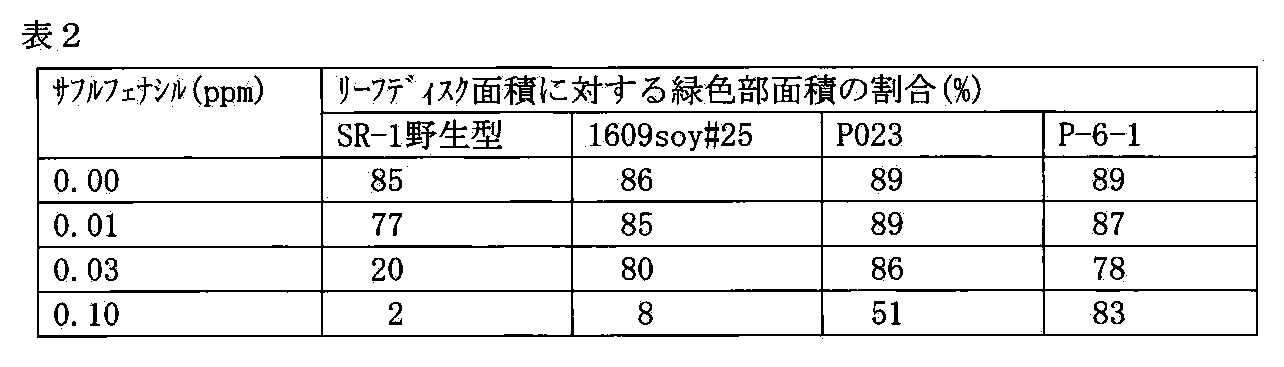
EP1598423に記載の組換えタバコ系統1609soy#17、#25および1584soy#16、P023、35S−2のホモ接合体の種子をMS寒天培地に無菌播種する。次いで、発芽した個体をクレハ培土(クレハ化学製)が入れられた栽培ポットに移植し、人工気象室内で外部環境に馴化した後、人工気象室内で約2週間栽培する。陰性対照として、SR−1野生型タバコ種子をMS寒天培地に無菌播種し、同様に人工気象室内で栽培する。このようにして得られる植物をサフルフェナシルの散布試験に供試する。サフルフェナシルを適当な溶媒に溶解し、アジバントを加え、水で希釈することにより散布液とする。
植物への当該散布液の散布は、走行型薬剤自動散布機(難波設計社製)を用いて、散布液20mLを0.9平方メートルの散布範囲に置かれた組換えタバコおよび野生型タバコ苗に均一に噴霧して行う。約2週間後に、供試された組換えタバコにおけるサフルフェナシルに対する感受性を、SR−1野生型タバコにおけるサフルフェナシルに対する感受性と比較する。その結果、組換えタバコ系統1609soy#17、#25および1584soy#16、P023、35S−2のホモ接合体はSR−1野生型タバコと比較してサフルフェナシルに対する感受性が低い結果となり、サフルフェナシル耐性を示す。
薬液散布によって生じた個体の枯死や、葉又は茎に褐変・白化の生じる薬害の程度に基づいてスコアリング評価を行う。スコアリングの基準は以下の通り。
「0」:個体が枯死した場合
「1」:葉又は茎に褐変・白化の生じる薬害が発生し、当該薬害が生育に対して大きな障害を与えているが、枯死していない場合
「2」:葉又は茎に褐変・白化の生じる薬害は発生しているが、当該薬害が生育に対して大きな障害を与えておらず、枯死していない場合
「3」:葉又は茎に褐変・白化の生じる薬害は軽微であるか、又は、殆ど見られない場合
実施例3(散布機による耐性試験 ダイズ)
US20060009361に記載の組換えダイズ系統J16、J18、J26、J28のT2世代の種子をクレハ培土が入られたポットに播種し人工気象室内で約3週間栽培する。陰性対照として、野生型ダイズ(cv.Jack)の種子を、同様に人工気象室内で栽培する。このようにして得られる植物をサフルフェナシルの散布試験に供試する。上記実施例2の方法に従って、ダイズ苗への散布試験を実施する。約2週間後に、供試された組換えダイズにおけるサフルフェナシルに対する感受性を、野生型ダイズ(cv.Jack)におけるサフルフェナシルに対する感受性と比較する。その結果、組換えダイズ系統J16、J18、J26、J28は野生型ダイズ(cv.Jack)と比較してサフルフェナシルに対する感受性が低く、サフルフェナシル耐性を示す。
Claims (10)
- 下記の(1)及び(2)のいずれか一方、または両方のDNAが導入されている作物植物を栽培する領域に、
サフルフェナシルを有効成分として含有する雑草防除剤を散布する工程を有する、前記作物植物の栽培方法。
(1)サフルフェナシルを代謝する活性を示すチトクロムP450のアミノ酸配列をコードする塩基配列を有するDNA
(2)プロトポルフィリノーゲンIXオキシダーゼ活性を示すタンパク質のアミノ酸配列をコードする塩基配列を有するDNA - 前記チトクロムP450が、放線菌由来のチトクロムP450である請求項1記載の栽培方法。
- 前記チトクロムP450が、下記のいずれかのチトクロムP450である請求項1記載の栽培方法。
(1)ストレプトミセス属に属する放線菌由来のチトクロムP450
(2)配列番号1又は2で示されるアミノ酸配列と90%以上の配列相同性を有するアミノ酸配列を有するチトクロムP450
(3)配列番号1で示されるアミノ酸配列を有するチトクロムP450
(4)配列番号2で示されるアミノ酸配列を有するチトクロムP450 - 前記プロトポルフィリノーゲンIXオキシダーゼ活性を示すタンパク質が、植物由来である請求項1記載の栽培方法。
- 前記プロトポルフィリノーゲンIXオキシダーゼ活性を示すタンパク質が、下記のいずれかのタンパク質である請求項1記載の栽培方法。
(1)植物由来であって、かつサフルフェナシルによって阻害されるプロトポルフィリノーゲンIXオキシダーゼ活性を示すタンパク質
(2)植物由来であって、かつサフルフェナシルによって阻害されないプロトポルフィリノーゲンIXオキシダーゼ活性を示すタンパク質
(3)配列番号3で示されるアミノ酸配列と90%以上の配列相同性を有するアミノ酸配列を有する、プロトポルフィリノーゲンIXオキシダーゼ活性を示すタンパク質
(4)配列番号3で示されるアミノ酸配列を有する、プロトポルフィリノーゲンIXオキシダーゼ活性を示すタンパク質 - 下記の(1)及び(2)のいずれか一方、または両方のDNAを植物細胞に導入して発現させる工程、および、該植物細胞にサフルフェナシルを接触させる工程を有するプロトポルフィリノーゲンIXオキシダーゼ阻害型除草活性化合物耐性細胞の選抜方法。
(1)サフルフェナシルを代謝する活性を示すチトクロムP450のアミノ酸配列をコードする塩基配列を有するDNA
(2)プロトポルフィリノーゲンIXオキシダーゼ活性を示すタンパク質のアミノ酸配列をコードする塩基配列を有するDNA - 前記チトクロムP450が、放線菌由来のチトクロムP450である請求項6記載の選抜方法。
- 前記チトクロムP450が、下記のいずれかのチトクロムP450である請求項6記載の選抜方法。
(1)ストレプトミセス属に属する放線菌由来のチトクロムP450
(2)配列番号1又は2で示されるアミノ酸配列と90%以上の配列相同性を有するアミノ酸配列を有するチトクロムP450
(3)配列番号1で示されるアミノ酸配列を有するチトクロムP450
(4)配列番号2で示されるアミノ酸配列を有するチトクロムP450 - 前記プロトポルフィリノーゲンIXオキシダーゼ活性を示すタンパク質が、植物由来である請求項6記載の選抜方法。
- 前記プロトポルフィリノーゲンIXオキシダーゼ活性を示すタンパク質が、下記のいずれかのタンパク質である請求項6記載の選抜方法。
(1)植物由来であって、かつサフルフェナシルによって阻害されるプロトポルフィリノーゲンIXオキシダーゼ活性を示すタンパク質
(2)植物由来であって、かつサフルフェナシルによって阻害されないプロトポルフィリノーゲンIXオキシダーゼ活性を示すタンパク質
(3)配列番号3で示されるアミノ酸配列と90%以上の配列相同性を有するアミノ酸配列を有するプロトポルフィリノーゲンIXオキシダーゼ活性を示すタンパク質
(4)配列番号3で示されるアミノ酸配列を有するプロトポルフィリノーゲンIXオキシダーゼ活性を示すタンパク質
Priority Applications (2)
| Application Number | Priority Date | Filing Date | Title |
|---|---|---|---|
| US13/377,115 US20120149576A1 (en) | 2009-06-11 | 2010-06-09 | Method for cultivating crop plant |
| BRPI1012945A BRPI1012945A2 (pt) | 2009-06-11 | 2010-06-09 | "métodos de controle de compressor com dupla sucção para sistemas de refrigeração" |
Applications Claiming Priority (2)
| Application Number | Priority Date | Filing Date | Title |
|---|---|---|---|
| JP2009140464A JP2010284111A (ja) | 2009-06-11 | 2009-06-11 | 作物植物の栽培方法 |
| JP2009-140464 | 2009-06-11 |
Publications (1)
| Publication Number | Publication Date |
|---|---|
| WO2010143743A1 true WO2010143743A1 (ja) | 2010-12-16 |
Family
ID=43308993
Family Applications (1)
| Application Number | Title | Priority Date | Filing Date |
|---|---|---|---|
| PCT/JP2010/060154 Ceased WO2010143743A1 (ja) | 2009-06-11 | 2010-06-09 | 作物植物の栽培方法 |
Country Status (4)
| Country | Link |
|---|---|
| US (1) | US20120149576A1 (ja) |
| JP (1) | JP2010284111A (ja) |
| BR (1) | BRPI1012945A2 (ja) |
| WO (1) | WO2010143743A1 (ja) |
Cited By (2)
| Publication number | Priority date | Publication date | Assignee | Title |
|---|---|---|---|---|
| EP2521441A4 (en) * | 2010-01-07 | 2013-10-23 | Basf Agro B V Arnhem Nl Zuerich Branch | HERBICID TOLERANT PLANTS |
| US10294488B2 (en) | 2012-12-18 | 2019-05-21 | Basf Se | Herbicide-metabolizing cytochrome P450 monooxygenases |
Families Citing this family (1)
| Publication number | Priority date | Publication date | Assignee | Title |
|---|---|---|---|---|
| CN110195077B (zh) * | 2019-06-14 | 2020-08-11 | 长江师范学院 | 一种构建卷丹百合高效遗传转化体系的方法 |
Citations (3)
| Publication number | Priority date | Publication date | Assignee | Title |
|---|---|---|---|---|
| WO2001083459A2 (en) * | 2000-05-04 | 2001-11-08 | Basf Aktiengesellschaft | Uracil substituted phenyl sulfamoyl carboxamides |
| JP2006000110A (ja) * | 2004-05-18 | 2006-01-05 | Sumitomo Chemical Co Ltd | 除草活性化合物耐性植物 |
| WO2008150473A2 (en) * | 2007-05-30 | 2008-12-11 | Syngenta Participations Ag | Cytochrome p450 genes conferring herbicide resistance |
Family Cites Families (1)
| Publication number | Priority date | Publication date | Assignee | Title |
|---|---|---|---|---|
| US6906245B1 (en) * | 1998-04-30 | 2005-06-14 | Sumitomo Chemical Company, Limited | Method for producing transgenic plants resistant to weed control compounds which disrupt the porphyrin pathways of plants |
-
2009
- 2009-06-11 JP JP2009140464A patent/JP2010284111A/ja active Pending
-
2010
- 2010-06-09 US US13/377,115 patent/US20120149576A1/en not_active Abandoned
- 2010-06-09 BR BRPI1012945A patent/BRPI1012945A2/pt not_active Application Discontinuation
- 2010-06-09 WO PCT/JP2010/060154 patent/WO2010143743A1/ja not_active Ceased
Patent Citations (3)
| Publication number | Priority date | Publication date | Assignee | Title |
|---|---|---|---|---|
| WO2001083459A2 (en) * | 2000-05-04 | 2001-11-08 | Basf Aktiengesellschaft | Uracil substituted phenyl sulfamoyl carboxamides |
| JP2006000110A (ja) * | 2004-05-18 | 2006-01-05 | Sumitomo Chemical Co Ltd | 除草活性化合物耐性植物 |
| WO2008150473A2 (en) * | 2007-05-30 | 2008-12-11 | Syngenta Participations Ag | Cytochrome p450 genes conferring herbicide resistance |
Non-Patent Citations (1)
| Title |
|---|
| GROSSMANN, K. ET AL.: "The Herbicide Saflufenacil (KixorTM) is a New Inhibitor of Protoporphyrinogen IX Oxidase Activity", WEED SCI., vol. 58, no. 1, January 2010 (2010-01-01), pages 1 - 9 * |
Cited By (3)
| Publication number | Priority date | Publication date | Assignee | Title |
|---|---|---|---|---|
| EP2521441A4 (en) * | 2010-01-07 | 2013-10-23 | Basf Agro B V Arnhem Nl Zuerich Branch | HERBICID TOLERANT PLANTS |
| US10174336B2 (en) | 2010-01-07 | 2019-01-08 | Basf Agrochemical Products B.V. | Herbicide-tolerant plants |
| US10294488B2 (en) | 2012-12-18 | 2019-05-21 | Basf Se | Herbicide-metabolizing cytochrome P450 monooxygenases |
Also Published As
| Publication number | Publication date |
|---|---|
| US20120149576A1 (en) | 2012-06-14 |
| BRPI1012945A2 (pt) | 2015-09-15 |
| JP2010284111A (ja) | 2010-12-24 |
Similar Documents
| Publication | Publication Date | Title |
|---|---|---|
| US20230062179A1 (en) | Methods for generating new genes in organism and use thereof | |
| EP3425046B1 (en) | Herbicide tolerant protein, encoding gene and use thereof | |
| EP4032976A1 (en) | Mutant hydroxyphenylpyruvate dioxygenase polypeptide, encoding gene thereof and use thereof | |
| EP3206481B1 (en) | Herbicide tolerance genes and methods of use thereof | |
| EP3434778A1 (en) | Application of herbicide-tolerant protein | |
| US20190029257A1 (en) | Application for herbicide-tolerant protein | |
| JP4720223B2 (ja) | 除草活性化合物耐性植物 | |
| EP3257936A1 (en) | Herbicide resistance protein, and encoding genes and application thereof | |
| AU2025267429A1 (en) | Use of protoporphyrinogen oxidase | |
| WO2010143743A1 (ja) | 作物植物の栽培方法 | |
| AU2021479356B2 (en) | Mutated hydroxyphenylpyruvate dioxygenase polypeptide, and coding gene and use thereof | |
| AU2022456077B2 (en) | Use of protoporphyrinogen oxidase | |
| RU2855470C2 (ru) | Мутированный полипептид гидроксифенилпируватдиоксигеназы, а также кодирующий его ген и применение указанного полипептида |
Legal Events
| Date | Code | Title | Description |
|---|---|---|---|
| 121 | Ep: the epo has been informed by wipo that ep was designated in this application |
Ref document number: 10786271 Country of ref document: EP Kind code of ref document: A1 |
|
| NENP | Non-entry into the national phase |
Ref country code: DE |
|
| WWE | Wipo information: entry into national phase |
Ref document number: 13377115 Country of ref document: US |
|
| 122 | Ep: pct application non-entry in european phase |
Ref document number: 10786271 Country of ref document: EP Kind code of ref document: A1 |
|
| REG | Reference to national code |
Ref country code: BR Ref legal event code: B01A Ref document number: PI1012945 Country of ref document: BR |
|
| ENP | Entry into the national phase |
Ref document number: PI1012945 Country of ref document: BR Kind code of ref document: A2 Effective date: 20111209 |