WO2010143899A9 - Procédé de production de feuille poreuse et feuille poreuse produite au moyen de ce procédé - Google Patents
Procédé de production de feuille poreuse et feuille poreuse produite au moyen de ce procédé Download PDFInfo
- Publication number
- WO2010143899A9 WO2010143899A9 PCT/KR2010/003733 KR2010003733W WO2010143899A9 WO 2010143899 A9 WO2010143899 A9 WO 2010143899A9 KR 2010003733 W KR2010003733 W KR 2010003733W WO 2010143899 A9 WO2010143899 A9 WO 2010143899A9
- Authority
- WO
- WIPO (PCT)
- Prior art keywords
- supercritical
- polymer resin
- resin sheet
- sheet
- porous sheet
- Prior art date
- Legal status (The legal status is an assumption and is not a legal conclusion. Google has not performed a legal analysis and makes no representation as to the accuracy of the status listed.)
- Ceased
Links
Images


Classifications
-
- B—PERFORMING OPERATIONS; TRANSPORTING
- B29—WORKING OF PLASTICS; WORKING OF SUBSTANCES IN A PLASTIC STATE IN GENERAL
- B29C—SHAPING OR JOINING OF PLASTICS; SHAPING OF MATERIAL IN A PLASTIC STATE, NOT OTHERWISE PROVIDED FOR; AFTER-TREATMENT OF THE SHAPED PRODUCTS, e.g. REPAIRING
- B29C44/00—Shaping by internal pressure generated in the material, e.g. swelling or foaming ; Producing porous or cellular expanded plastics articles
- B29C44/34—Auxiliary operations
- B29C44/3469—Cell or pore nucleation
- B29C44/348—Cell or pore nucleation by regulating the temperature and/or the pressure, e.g. suppression of foaming until the pressure is rapidly decreased
-
- C—CHEMISTRY; METALLURGY
- C08—ORGANIC MACROMOLECULAR COMPOUNDS; THEIR PREPARATION OR CHEMICAL WORKING-UP; COMPOSITIONS BASED THEREON
- C08J—WORKING-UP; GENERAL PROCESSES OF COMPOUNDING; AFTER-TREATMENT NOT COVERED BY SUBCLASSES C08B, C08C, C08F, C08G or C08H
- C08J5/00—Manufacture of articles or shaped materials containing macromolecular substances
- C08J5/18—Manufacture of films or sheets
-
- C—CHEMISTRY; METALLURGY
- C08—ORGANIC MACROMOLECULAR COMPOUNDS; THEIR PREPARATION OR CHEMICAL WORKING-UP; COMPOSITIONS BASED THEREON
- C08J—WORKING-UP; GENERAL PROCESSES OF COMPOUNDING; AFTER-TREATMENT NOT COVERED BY SUBCLASSES C08B, C08C, C08F, C08G or C08H
- C08J9/00—Working-up of macromolecular substances to porous or cellular articles or materials; After-treatment thereof
- C08J9/26—Working-up of macromolecular substances to porous or cellular articles or materials; After-treatment thereof by elimination of a solid phase from a macromolecular composition or article, e.g. leaching out
-
- C—CHEMISTRY; METALLURGY
- C08—ORGANIC MACROMOLECULAR COMPOUNDS; THEIR PREPARATION OR CHEMICAL WORKING-UP; COMPOSITIONS BASED THEREON
- C08J—WORKING-UP; GENERAL PROCESSES OF COMPOUNDING; AFTER-TREATMENT NOT COVERED BY SUBCLASSES C08B, C08C, C08F, C08G or C08H
- C08J2201/00—Foams characterised by the foaming process
- C08J2201/04—Foams characterised by the foaming process characterised by the elimination of a liquid or solid component, e.g. precipitation, leaching out, evaporation
- C08J2201/042—Elimination of an organic solid phase
-
- C—CHEMISTRY; METALLURGY
- C08—ORGANIC MACROMOLECULAR COMPOUNDS; THEIR PREPARATION OR CHEMICAL WORKING-UP; COMPOSITIONS BASED THEREON
- C08J—WORKING-UP; GENERAL PROCESSES OF COMPOUNDING; AFTER-TREATMENT NOT COVERED BY SUBCLASSES C08B, C08C, C08F, C08G or C08H
- C08J2203/00—Foams characterized by the expanding agent
- C08J2203/08—Supercritical fluid
-
- Y—GENERAL TAGGING OF NEW TECHNOLOGICAL DEVELOPMENTS; GENERAL TAGGING OF CROSS-SECTIONAL TECHNOLOGIES SPANNING OVER SEVERAL SECTIONS OF THE IPC; TECHNICAL SUBJECTS COVERED BY FORMER USPC CROSS-REFERENCE ART COLLECTIONS [XRACs] AND DIGESTS
- Y02—TECHNOLOGIES OR APPLICATIONS FOR MITIGATION OR ADAPTATION AGAINST CLIMATE CHANGE
- Y02P—CLIMATE CHANGE MITIGATION TECHNOLOGIES IN THE PRODUCTION OR PROCESSING OF GOODS
- Y02P20/00—Technologies relating to chemical industry
- Y02P20/50—Improvements relating to the production of bulk chemicals
- Y02P20/54—Improvements relating to the production of bulk chemicals using solvents, e.g. supercritical solvents or ionic liquids
Definitions
- the present invention relates to a method for producing a porous sheet using supercritical fluid extraction (SFE) and a porous sheet produced thereby.
- SFE supercritical fluid extraction
- CMP Chemical mechanical polishing
- manufacturing processes for semiconductor devices generally include the formation of various processing layers, selective removal or patterning of some of these layers, and the formation of semiconductor wafers by deposition of additional processing layers on the surface of the semiconductor substrate.
- the processing layer may include an insulating layer, a gate oxide layer, a conductive layer, a metal or glass layer, and the like.
- CMP Chemical mechanical polishing
- polishing compositions also called polishing slurries
- the polishing composition contains a chemical that interacts with or dissolves a portion of the top wafer layer, and an abrasive that physically removes a portion of the layer.
- the wafer and the polishing pad can rotate in the same direction or in opposite directions, which is preferred for carrying out a particular polishing process in either direction.
- the carrier may also reciprocate in a polishing pad on a polishing table.
- Polishing pads used in such chemical mechanical polishing (CMP) processes include soft and hard pad materials (polymer-impregnated fabrics, microporous films, cellular polymeric foams, non-porous). porous) polymer sheets and sintered thermoplastic particles).
- Pads containing a polyurethane resin impregnated with a polyester nonwoven are examples of polymer-impregnated woven polishing pads.
- the microporous polishing pad includes a microporous urethane film coated on the base material. These polishing pads are closed-cell porous films.
- Foamable polymeric foam polishing pads contain a closed-cell structure that is randomly and uniformly distributed three-dimensionally.
- polishing pads use a porous sheet having closed-pore in the pad, where the pores are used to improve the efficiency of the process by controlling the flow of the polishing slurry. Therefore, when forming pores in the polishing pad, it is important to uniformly and evenly dispersed.
- Korean Patent No. 10-0191227 describes a method of manufacturing a pad by adding a hollow polymeric microelement to a polymeric matrix.
- the hollow polymeric microelement has a shell having a thickness of several microns, and this shell has a problem in that a scratch can be formed on a polishing object such as a wafer in a chemical mechanical polishing (CMP) process.
- CMP chemical mechanical polishing
- An object of the present invention is to provide a method for preparing a porous sheet and a porous sheet manufactured thereby, which are excellent in uniformity and dispersibility of pores, can reduce scratch formation on a process, and can improve process efficiency. will be.
- the present invention comprises the steps of: a) preparing a polymer resin sheet comprising a supercritical extract object soluble in a supercritical fluid; And b) injecting a supercritical fluid into the polymer resin sheet to extract the supercritical extract object included in the polymer resin sheet to form pores in the polymer resin sheet. .
- a polishing pad comprising a porous sheet according to the present invention.
- the present invention it is possible to provide a method for producing a porous sheet capable of forming pores with excellent uniformity and dispersibility in the sheet.
- it is a method of extracting a substance that is soluble in the supercritical fluid, it is possible to form pores without leaving a residue inside the sheet.
- the occurrence of scratches on the wafer, which is the polishing target may be reduced by the residue, and process efficiency may be improved.
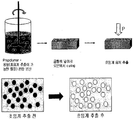
- FIG. 1 is a view showing a method for manufacturing a porous sheet according to the present invention.
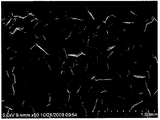
- Example 2 is a SEM photograph of the porous sheet according to Example 1 of the present invention.
- Method for producing a porous sheet comprises the steps of: a) preparing a polymer resin sheet comprising a supercritical extract object soluble in a supercritical fluid; And b) injecting a supercritical fluid into the polymer resin sheet to extract the supercritical extract contained in the polymer resin sheet to form pores in the polymer resin sheet.
- a material selected from an aromatic compound, an aliphatic hydrocarbon, and an aliphatic alcohol may be used.
- examples of the aromatic compound include naphthalene, anthracene, chrysene and pentacene.
- the aliphatic hydrocarbon C 7 to C 10 aliphatic hydrocarbon may be used, but is not limited thereto. Specifically, mineral oil, octane, decane and dodecane may be used as examples. Can be.
- Examples of the aliphatic alcohols include heptanol, nonanol, and dodecanol.
- naphthalene or octane may be used as the supercritical extract, but is not limited thereto.
- the shape of the supercritical extract object included in the polymer resin sheet may be spherical or elliptical, but is not limited thereto.
- the content of the supercritical extractable object in the polymer resin sheet of step a) may be 5 to 50% by weight, more preferably 20 to 40% by weight.
- the polymer resin sheet of step a) is polyurethane, thermoplastic elastomer, polyolefin, polycarbonate, polyvinyl alcohol, nylon, elastomeric rubber, styrene copolymer, polyaromatic, fluoropolymer, polyimide, crosslinked polyurethane Crosslinked polyolefins, polyethers, polyesters, polyacrylates, elastomeric polyethylenes, polytetrafluoroethylenes, polyethyleneterraphthalates, polyarylenes, polystyrenes, polymethylmethacrylates, copolymers and block copolymers thereof, And it may include a polymer resin selected from the group consisting of mixtures and blends thereof.
- polyurethane is a material having excellent abrasion resistance, and may be most preferable as a material of the polishing pad.
- the step a) comprises: a1) mixing the supercritical extract and a polymer resin or precursor; And a2) curing the mixture mixed in the step a1).
- the mixing condition of the supercritical extract and the polymer resin or precursor may vary depending on the mixing speed of the impeller and the temperature of the reactor. It may also be used simultaneously with the curing agent when mixing.
- the mixing speed of the impeller and the temperature conditions of the reactor can be variously adjusted, preferably the mixing speed of the impeller may be 200 to 3000rpm, the temperature of the reactor may be 40 to 70 °C.
- step a1) 1,4-butanediol (1,4-butandiol), 4,4'-methylenebis (2-chloroaniline) (4,4'-methylenebis (2-chloroaniline)), ethylene glycol, 1 , 2-propanediol, 1,3-propanediol, 1,2-butanediol, 1,6-hexanediol, neopentyl glycol, 1,4-cyclohexanediol, 1,4-cyclohexanedimethanol, 2,2 At least one selected from the group consisting of 4-trimethylpetanediol, hydroquinone, bis (2-hydroxyethyl) hydroquinone, 4,4'-dihydroxybiphenyl, bisphenol A, bisphenol F, and mixtures thereof Further chain extenders can be added.
- step a2) it can be cured for 4 to 48 hours at 70 to 100 °C.
- the polyurethane may be formed by an organic polyisocyanate, a polyurethane prepolymer, a polyol compound, and a chain extender.
- it may include 1 to 20% by weight of organic polyisocyanate, 10 to 88% by weight of polyurethane prepolymer, 10 to 88% by weight of polyol compound, and 1 to 50% by weight of chain extender.
- organic polyisocyanate examples include 2,4-toluene diisocyanate, 2,6-toluene diisocyanate, 2,2'-diphenylmethane diisocyanate, 2,4'-diphenylmethane diisocyanate, 4, Aromatic diisocyanates such as 4'-diphenylmethane diisocyanate, 1,5-naphthalene diisocyanate, p-phenylene diisocyanate, m-phenylene diisocyanate, p-xylylene diisocyanate, m-xylylene diisocyanate, ethylene Aliphatic diisocyanates such as diisocyanate, 2,2,4-trimethylhexamethylene diisocyanate, 1,6-hexamethylene diisocyanate, 1,4-cyclohexane diisocyanate, 4,4'-dicyclohexyl methane diisocyanate And alicyclic diisocyanates such as iso
- a trifunctional or more than trifunctional polyisocyanate compound can also be used.
- a polyfunctional isocyanate compound a series of diisocyanate adduct compounds can be used as desmodule-N (Bayer Corporation) or brand name duranate (made by Asahi Kasei Co., Ltd.).
- polyol compound examples include high molecular weight polyols such as polyether polyols, polyester polyols, polycarbonate polyols, and acrylic polyols. In addition to the above high molecular weight polyols, low molecular weight polyols may be used together. These polyol compounds can be used 1 type or in mixture of 2 or more types. However, this is not a kind limited.
- the ratio of the above-mentioned organic polyisocyanate, polyol compound and chain extender can be varied in various ways depending on the molecular weight and the desired physical properties of the use (for example, a polishing pad) of the polyurethane produced therefrom.
- the number of isocyanate groups of the organic polyisocyanate relative to the total number of functional groups (total of active hydrogen groups such as hydroxyl groups and amino groups) of the polyol compound and the chain extender is in the range of 0.95 to 1.15. Preferably, it may be more preferably 0.99 to 1.10.
- the ratio of a high molecular weight component and a low molecular weight component in a polyol compound can be determined by the characteristic calculated
- the polyurethane to be a matrix can be manufactured by applying a urethanization technique such as a melting method and a solution method, but in consideration of cost, working environment, etc. It is preferable to manufacture by the melting method.
- Polyurethane can be produced either by a prepolymer method or a one-shot method, but a prepolymer method in which an isocyanate terminated prepolymer is synthesized from an organic polyisocyanate and a polyol compound in advance and a chain extender is reacted therewith is produced. It is suitable because of excellent physical properties of urethane.
- Isocyanate-terminated prepolymer may have a molecular weight of about 800 to 5000 excellent in processability, physical properties and the like, may be suitable.
- the isocyanate terminal prepolymer is an isocyanate group-containing compound
- the chain extender polyol compound, if necessary
- the organic polyisocyanate is an isocyanate group-containing compound
- the chain extender and the polyol compound are active hydrogen group-containing compounds.
- stabilizers such as antioxidants, surfactants, lubricants, pigments, fillers, antistatic agents, and other additives may be further added to the polyurethane stock solution as necessary.
- step b) as a method of injecting the supercritical fluid into the polymer resin sheet prepared in step a), a pressurized gas injection process of forcibly injecting the supercritical fluid into the polymer resin sheet using high pressure may be used.
- the supercritical fluid is a state in which a gas and a liquid at a temperature and pressure are not able to distinguish a gas and a liquid because the evaporation process does not occur when a certain high temperature and high pressure limit is called a supercritical point. That is, the critical state, which means the material in this state.
- Supercritical fluids are produced by applying sufficient elevated temperature and pressure to the gas to create a supercritical state in which the gas behaves like a fluid.
- the gas may be a hydrocarbon, chlorofluorocarbons, hydrochlorofluorocarbons (eg Freon), nitrogen, carbon dioxide, carbon monoxide or combinations thereof.
- the gas is preferably a nonflammable gas, for example a gas containing no C-H bond. More preferably, the gas is nitrogen, carbon dioxide, or a combination thereof. Most preferably, the gas is carbon dioxide or a gas containing carbon dioxide.
- the gas is preferably converted to supercritical gas before being injected into the polymer resin sheet.
- the temperature is at least 31 ° C. and the pressure is between 7 MPa (about 1000 psi) and 35 MPa (about 5000 psi) (eg, 19 MPa (about 2800 psi) to 26 MPa (about 3800 psi)).
- the supercritical fluid of step b) may preferably include one or more selected from supercritical carbon dioxide, supercritical isobutane, supercritical butane, supercritical propane, supercritical pentane, and supercritical nitrogen.
- the step b) may be performed at a pressure of 50 to 300 atm and a temperature of 25 to 120 ° C., preferably at a pressure of 70 to 200 atm and a temperature of 30 to 80 ° C. Step b) may be performed in a supercritical equipment known in the art.
- step b) it may be mixed with acetone, alcohol and the like to perform a supercritical fluid extraction.
- the supercritical fluid may be injected at the same time, or the solvent may be mixed in the supercritical reactor in advance.
- the solvent may vary depending on the supercritical extract included in the polymer resin sheet, and for example, acetone, alcohol, hexane, and the like may dissolve the supercritical extract.
- the supercritical fluid of step b) when the supercritical fluid of step b) is injected into the polymer resin sheet prepared in step a), the supercritical fluid dissolves the supercritical extract contained in the sheet, thereby preparing in step a).
- the pores can be formed without leaving a residue in the polymer resin sheet.
- the pores formed may be closed pores.
- the closed pore means a pore in which pores are not independently connected to other pores.
- the pores formed in the polymer resin sheet in step b) may be spherical or elliptical, but are not limited thereto.
- the average diameter of the pores formed in the polymer resin sheet may be 80 micrometers or less, preferably 5 to 50 micrometers, and more preferably 10 to 30 micrometers.
- the average diameter of the pores means the average value of the lines when a plurality of lines passing through the center of the circle around the circle.
- the density of the sheet having pores formed in the polymer resin sheet may be 0.5 to 1 g / cm 3 , preferably 0.6 to 1 g / cm 3 , and more preferably 0.7 to 0.9 g / cm. It can be three .
- the polymer resin sheet in which the pores are formed in step b) may have a porosity of 50% or less, preferably 10 to 50%, and more preferably 20 to 40%.
- pores can be formed without leaving a residue in the polymer resin sheet (see FIG. 2).
- foaming in the case of the conventional pressurized gas foaming method, when foamed by injection into a polyurethane that is cured, that is, crosslinking is advanced, there is a disadvantage that foaming is not performed depending on the degree of curing.
- foaming proceeds by injection of pressurized gas, but it is difficult to show the physical properties of the pad for use in a CMP pad.
- foaming using a pressurized gas method to a polyurethane having a high degree of curing foaming does not occur at all or a polymer matrix is broken (see FIG. 4).
- the present invention provides a porous sheet produced by the above-described manufacturing method.
- the porous sheet according to the present invention can be used as a polishing pad.
- the porous sheet alone may be used as a polishing pad, or a plurality of porous sheets may be laminated and used as a polishing pad.
- by attaching another film to the porous sheet may be used as a polishing pad.
- a prepolymer of polyurethane is mixed with aliphatic hydrocarbons, naphthalene or fish oil as a solute soluble in a supercritical fluid and dispersed well.
- This prepolymer mixture is reacted with 1.4-butandiol or 4,4'-methylenebis (2-chloroaniline) (4,4'-methylenebis (2-chloroaniline)) as a chain extender. Form a chain. It is cured for 4-6 hours in an oven at 100 °C to form the desired shape in a mold. The cured polyurethane is placed in a supercritical equipment to extract the solute.
- CO 2 may be used as the supercritical fluid, and supercritical extraction may be performed by mixing with acetone or alcohol. Specifically, acetone or an alcohol, such as alcohol, is simultaneously put into the polyurethane sheet to be extracted. In other words, put acetone or alcohol in the supercritical extraction equipment, close the supercritical extraction equipment and inject CO 2 to the desired pressure. Alternatively, CO 2 can be injected simultaneously into the supercritical equipment.
- Example 1 a mixed solution is first prepared by mixing a prepolymer and octane.
- the prepolymer uses L325 (Chemtura, 9.17% NCO), and octane is used as the supercritical extract that is dissolved in the supercritical fluid, that is, the pore forming body.
- the cured polyurethane mixture was cut thin to 3 mm thick and placed in a supercritical extractor.
- the temperature of the supercritical extractor was 45 ° C. and carbon dioxide was pressurized into the apparatus to maintain the pressure at 150 bar. The pressure was released after holding in the apparatus for 1 hour. Polyurethane samples were removed from the apparatus, kept at room temperature for 1 hour, and then maintained at 100 ° C. for 1 hour.
- the sample thus prepared had a density of 0.802 g / cm 3 and a hardness of 50 with a Shore D meter. SEM pictures of the samples are shown in FIG. 2. The storage modulus and tan delta of this sample are shown in FIG. 3.
- the porous sheet is manufactured by using supercritical fluid extraction (SFE) according to the present invention
- SFE supercritical fluid extraction
- Example 2 prepolymer and MOCA are mixed first, followed by octane.
- the prepolymer was put into the reactor 1000g L325 (NCO% 9.17%, manufactured by Chemtura) and maintained at a temperature of 50 °C. 260 g of pre-melted MOCA was added and mixed at 1000 rpm for 30 seconds, followed by mixing 400 g of octane.
- the prepared polyurethane mixture was poured into a mold and gelled at room temperature for 30 minutes and then cured in an oven at 100 ° C. for 16 hours.
- the cured polyurethane mixture was cut thin to 3 mm thick and placed in a supercritical extractor.
- the temperature of the supercritical extractor was pressurized to 40 bar with carbon dioxide at 40 ° C. to maintain the pressure at 100 bar.
- the pressure was released after holding in the apparatus for 2 hours. Polyurethane samples were removed from the apparatus, kept at room temperature for 1 hour, and then maintained at 100 ° C. for 1 hour.
- Example 3 H12MDI is added to produce a high modulus pad.
- Example 3 The same procedure as in Example 1 was conducted except that H 12 MDI was added to L325 to prepare a prepolymer having an NCO% of 9.7%.
- the storage modulus and tan delta of the pads prepared in Example 3 are shown in FIG. 3.
- Example 4 H 12 MDI is added to produce a high modulus pad.
- Example 3 The same procedure as in Example 1 was carried out except that H 12 MDI was added to L325 to prepare a prepolymer having an NCO% of 11%.
- the storage modulus and tan delta of the pads prepared in Example 4 are shown in FIG. 3.
- Example 5 H 12 MDI is added to produce a high modulus pad.
- Example 3 The same procedure as in Example 1 was carried out except that H 12 MDI was added to L325 to prepare a prepolymer having an NCO% of 12%.
- the storage modulus and tan delta of the pads prepared in Example 5 are shown in FIG. 3.
- the pad sheet cured in the same manner as in Example 1 was placed in a supercritical extraction device. The temperature was 50 ° C. and the pressure was maintained at 150 bar. After holding for 1 hour, the pressure was removed and the sheet was taken out to remove all CO 2 from the 100 ° C. oven. The specific gravity of the pad prepared as described above was 0.75 g / cm 3 .
- Examples 1 and 3 to 5 storage modulus and tan delta were measured
- storage modulus and tan delta of FIG. 3 The specific measurement method of is as follows. DMA8000 (manufactured by PerkinElmer) was used to measure storage modulus and tan delta, frequency was 1.5 Hz, amplitude was 0.05 mm, and temperature was -10. The scan was from 100 ° C. to 100 ° C.
- the storage modulus of the sample prepared in Example 1 (NCO% 9.17) was measured to show 396.5 MPa at 25 ° C.
- FIG. 3 the storage modulus of the sample prepared in Example 1 (NCO% 9.17) was measured to show 396.5 MPa at 25 ° C.
- the storage modulus was 446.8, 580.3, and 698.4 MPa in the case of increasing the NCO% to 9.7, 11, and 12% by adding H 12 MDI, and increasing the storage modulus by increasing the NCO%.
- the storage modulus was 446.8, 580.3, and 698.4 MPa in the case of increasing the NCO% to 9.7, 11, and 12% by adding H 12 MDI, and increasing the storage modulus by increasing the NCO%.
- the storage modulus was 446.8, 580.3, and 698.4 MPa in the case of increasing the NCO% to 9.7, 11, and 12% by adding H 12 MDI, and increasing the storage modulus by increasing the NCO%.
- the cured polyurethane mixture was cut thin to 3 mm thick and placed in a supercritical foaming device.
- the temperature of the supercritical foamer was 45 ° C. and carbon dioxide was pressurized into the device to maintain the pressure at 150 bar. The pressure was released after holding in the apparatus for 1 hour. Polyurethane samples were removed from the apparatus, kept at room temperature for 1 hour, and then maintained at 100 ° C. for 1 hour.
Landscapes
- Chemical & Material Sciences (AREA)
- Engineering & Computer Science (AREA)
- Medicinal Chemistry (AREA)
- Materials Engineering (AREA)
- Health & Medical Sciences (AREA)
- Chemical Kinetics & Catalysis (AREA)
- Manufacturing & Machinery (AREA)
- Polymers & Plastics (AREA)
- Organic Chemistry (AREA)
- Manufacture Of Porous Articles, And Recovery And Treatment Of Waste Products (AREA)
- Mechanical Treatment Of Semiconductor (AREA)
- Casting Or Compression Moulding Of Plastics Or The Like (AREA)
- Finish Polishing, Edge Sharpening, And Grinding By Specific Grinding Devices (AREA)
Abstract
Priority Applications (2)
| Application Number | Priority Date | Filing Date | Title |
|---|---|---|---|
| JP2012514885A JP5748747B2 (ja) | 2009-06-10 | 2010-06-10 | 多孔性シートの製造方法及びこれにより製造された多孔性シート |
| US13/377,792 US20120085038A1 (en) | 2009-06-10 | 2010-06-10 | Method for manufacturing porous sheet and porous sheet manufactured by the method |
Applications Claiming Priority (2)
| Application Number | Priority Date | Filing Date | Title |
|---|---|---|---|
| KR10-2009-0051598 | 2009-06-10 | ||
| KR20090051598 | 2009-06-10 |
Publications (3)
| Publication Number | Publication Date |
|---|---|
| WO2010143899A2 WO2010143899A2 (fr) | 2010-12-16 |
| WO2010143899A3 WO2010143899A3 (fr) | 2011-03-31 |
| WO2010143899A9 true WO2010143899A9 (fr) | 2011-05-19 |
Family
ID=43309376
Family Applications (1)
| Application Number | Title | Priority Date | Filing Date |
|---|---|---|---|
| PCT/KR2010/003733 Ceased WO2010143899A2 (fr) | 2009-06-10 | 2010-06-10 | Procédé de production de feuille poreuse et feuille poreuse produite au moyen de ce procédé |
Country Status (5)
| Country | Link |
|---|---|
| US (1) | US20120085038A1 (fr) |
| JP (1) | JP5748747B2 (fr) |
| KR (1) | KR101234313B1 (fr) |
| TW (1) | TWI466930B (fr) |
| WO (1) | WO2010143899A2 (fr) |
Families Citing this family (9)
| Publication number | Priority date | Publication date | Assignee | Title |
|---|---|---|---|---|
| SG11201601175WA (en) * | 2013-08-22 | 2016-03-30 | Cabot Microelectronics Corp | Polishing pad with porous interface and solid core, and related apparatus and methods |
| US10625391B2 (en) | 2014-10-31 | 2020-04-21 | Kuraray Co., Ltd. | Non-porous molded article for polishing layer, polishing pad, and polishing method |
| KR102085088B1 (ko) * | 2017-11-28 | 2020-03-05 | 재단법인 대구경북첨단의료산업진흥재단 | 다공성 생체친화성 폴리머 구조체의 제조방법 및 이에 의해 제조된 다공성 생체친화성 폴리머 구조체 |
| KR101998309B1 (ko) * | 2017-11-30 | 2019-07-09 | 서울대학교 산학협력단 | 초임계 또는 아임계 유체를 이용한 멀티스케일 다공성 3차원 구조체 제조방법과 그 멀티스케일 다공성 3차원 구조체 |
| EP3670591B1 (fr) * | 2018-12-06 | 2024-10-02 | TSRC Corporation | Composition polymère, mousse et procédé associé |
| CN114670119B (zh) * | 2021-04-27 | 2024-01-12 | 宁波赢伟泰科新材料有限公司 | 一种提高抛光效率的化学机械抛光垫及其制备方法 |
| CN113968034A (zh) * | 2021-11-03 | 2022-01-25 | 特步(中国)有限公司 | 发泡编织元件的制作方法和发泡鞋面的制作方法 |
| CN114149611A (zh) * | 2021-11-09 | 2022-03-08 | 安徽省众望科希盟科技有限公司 | 一种使用聚酰胺酸改性膨化聚四氟乙烯的改性方法 |
| JP2023175401A (ja) * | 2022-05-30 | 2023-12-12 | ニッタ・デュポン株式会社 | 研磨パッド |
Family Cites Families (16)
| Publication number | Priority date | Publication date | Assignee | Title |
|---|---|---|---|---|
| DE19681433T1 (de) * | 1995-06-06 | 1998-05-07 | Univ North Carolina | Verfahren für die Herstellung von Polyester in Kohlendioxid |
| US6558607B1 (en) * | 1999-09-30 | 2003-05-06 | University Of Massachusetts | Crystallization of constrained polymers |
| JP2001323099A (ja) * | 2000-05-15 | 2001-11-20 | Nitto Denko Corp | 感光性樹脂組成物、多孔質樹脂、回路基板および回路付サスペンション基板 |
| US20050276967A1 (en) * | 2002-05-23 | 2005-12-15 | Cabot Microelectronics Corporation | Surface textured microporous polishing pads |
| US6913517B2 (en) * | 2002-05-23 | 2005-07-05 | Cabot Microelectronics Corporation | Microporous polishing pads |
| US7166247B2 (en) * | 2002-06-24 | 2007-01-23 | Micron Technology, Inc. | Foamed mechanical planarization pads made with supercritical fluid |
| US7311862B2 (en) * | 2002-10-28 | 2007-12-25 | Cabot Microelectronics Corporation | Method for manufacturing microporous CMP materials having controlled pore size |
| US7435165B2 (en) * | 2002-10-28 | 2008-10-14 | Cabot Microelectronics Corporation | Transparent microporous materials for CMP |
| US7267607B2 (en) * | 2002-10-28 | 2007-09-11 | Cabot Microelectronics Corporation | Transparent microporous materials for CMP |
| US6773473B2 (en) * | 2002-11-12 | 2004-08-10 | Saint-Gobain Abrasives Technology Company | Supercritical fluid extraction |
| JP4289089B2 (ja) * | 2003-09-02 | 2009-07-01 | 東洋紡績株式会社 | ポリエチレン多孔体の製造方法 |
| JP4948805B2 (ja) * | 2004-09-13 | 2012-06-06 | 日東電工株式会社 | 反射防止シート用の多孔質体の製造方法、反射防止シート用の多孔質体、反射防止膜、反射防止シートの製造方法及び反射防止シート |
| JP4121989B2 (ja) * | 2004-09-24 | 2008-07-23 | 大日本印刷株式会社 | 熱転写受像シート及びその製造方法 |
| JP4646199B2 (ja) * | 2004-09-29 | 2011-03-09 | 日東電工株式会社 | 多孔質膜の製造方法 |
| US20060211840A1 (en) * | 2005-03-20 | 2006-09-21 | Aspen Aerogels Inc. | Polyurea aerogels |
| JP2012509960A (ja) * | 2008-11-24 | 2012-04-26 | コーニング インコーポレイテッド | 3d細胞培養物品およびその方法 |
-
2010
- 2010-06-10 US US13/377,792 patent/US20120085038A1/en not_active Abandoned
- 2010-06-10 TW TW99118909A patent/TWI466930B/zh active
- 2010-06-10 WO PCT/KR2010/003733 patent/WO2010143899A2/fr not_active Ceased
- 2010-06-10 JP JP2012514885A patent/JP5748747B2/ja active Active
- 2010-06-10 KR KR1020100055002A patent/KR101234313B1/ko active Active
Also Published As
| Publication number | Publication date |
|---|---|
| JP2012529553A (ja) | 2012-11-22 |
| JP5748747B2 (ja) | 2015-07-15 |
| US20120085038A1 (en) | 2012-04-12 |
| TW201109375A (en) | 2011-03-16 |
| WO2010143899A2 (fr) | 2010-12-16 |
| KR101234313B1 (ko) | 2013-02-18 |
| KR20100132933A (ko) | 2010-12-20 |
| TWI466930B (zh) | 2015-01-01 |
| WO2010143899A3 (fr) | 2011-03-31 |
Similar Documents
| Publication | Publication Date | Title |
|---|---|---|
| WO2010143899A9 (fr) | Procédé de production de feuille poreuse et feuille poreuse produite au moyen de ce procédé | |
| US7414080B2 (en) | Polyurethane polishing pad | |
| CN101704309B (zh) | 层叠片及其制造方法 | |
| US20100247868A1 (en) | Polyurethane porous product and manufacturing method thereof and polishing pad having polyurethane porous product | |
| KR101177781B1 (ko) | 연마 패드의 제조 방법 | |
| KR101526010B1 (ko) | 화학 기계적 연마 패드 | |
| TWI707744B (zh) | 多孔性聚胺甲酸酯拋光墊及其製備方法 | |
| KR100986969B1 (ko) | 연마 패드용 대전방지성 폴리우레탄 다공질체 및 그 제조 방법 및 이를 이용한 연마패드 | |
| WO2008029538A1 (fr) | Tampon à polir | |
| TW200813199A (en) | Chemical mechanical polishing pad | |
| KR101924566B1 (ko) | 고단차 제거용 다층 연마패드 | |
| TW202033626A (zh) | 用於研磨墊之組成物、研磨墊及其製備方法 | |
| KR20210002429A (ko) | 연마패드용 조성물, 연마패드 및 이의 제조방법 | |
| TW202122475A (zh) | 研磨墊、其製備方法及使用其之半導體裝置的製備方法 | |
| KR101952361B1 (ko) | 폴리우레탄 조성물 및 이로부터 얻어진 고내산성 다층 연마패드 | |
| CN111212705A (zh) | 研磨垫及其制造方法 | |
| KR102185265B1 (ko) | 연마패드용 조성물, 연마패드 및 이의 제조방법 | |
| JP3306417B2 (ja) | 半導体研磨用ポリウレタン研磨パッドを製造する方法 | |
| KR101175337B1 (ko) | 다공성 시트의 제조방법 및 이에 의해 제조된 다공성 시트 | |
| JP2020049640A (ja) | 研磨パッド | |
| JP2012011516A (ja) | 研磨保持用パッド | |
| KR20100138192A (ko) | 다공성 시트의 제조방법 및 이에 의해 제조된 다공성 시트 | |
| JP2025135510A (ja) | 研磨パッドおよび研磨装置 | |
| JP2026060217A (ja) | 研磨パッドおよび研磨装置 | |
| JP2025135511A (ja) | 研磨パッドおよび研磨装置 |
Legal Events
| Date | Code | Title | Description |
|---|---|---|---|
| 121 | Ep: the epo has been informed by wipo that ep was designated in this application |
Ref document number: 10786382 Country of ref document: EP Kind code of ref document: A2 |
|
| WWE | Wipo information: entry into national phase |
Ref document number: 2012514885 Country of ref document: JP |
|
| NENP | Non-entry into the national phase |
Ref country code: DE |
|
| WWE | Wipo information: entry into national phase |
Ref document number: 13377792 Country of ref document: US |
|
| 122 | Ep: pct application non-entry in european phase |
Ref document number: 10786382 Country of ref document: EP Kind code of ref document: A2 |