WO2010143915A2 - Nanoparticules de titanate de baryum et leur procédé de production - Google Patents
Nanoparticules de titanate de baryum et leur procédé de production Download PDFInfo
- Publication number
- WO2010143915A2 WO2010143915A2 PCT/KR2010/003778 KR2010003778W WO2010143915A2 WO 2010143915 A2 WO2010143915 A2 WO 2010143915A2 KR 2010003778 W KR2010003778 W KR 2010003778W WO 2010143915 A2 WO2010143915 A2 WO 2010143915A2
- Authority
- WO
- WIPO (PCT)
- Prior art keywords
- batio
- beads
- tio
- mixed
- baco
- Prior art date
- Legal status (The legal status is an assumption and is not a legal conclusion. Google has not performed a legal analysis and makes no representation as to the accuracy of the status listed.)
- Ceased
Links
Images



Classifications
-
- C—CHEMISTRY; METALLURGY
- C04—CEMENTS; CONCRETE; ARTIFICIAL STONE; CERAMICS; REFRACTORIES
- C04B—LIME, MAGNESIA; SLAG; CEMENTS; COMPOSITIONS THEREOF, e.g. MORTARS, CONCRETE OR LIKE BUILDING MATERIALS; ARTIFICIAL STONE; CERAMICS; REFRACTORIES; TREATMENT OF NATURAL STONE
- C04B35/00—Shaped ceramic products characterised by their composition; Ceramics compositions; Processing powders of inorganic compounds preparatory to the manufacturing of ceramic products
- C04B35/01—Shaped ceramic products characterised by their composition; Ceramics compositions; Processing powders of inorganic compounds preparatory to the manufacturing of ceramic products based on oxide ceramics
- C04B35/46—Shaped ceramic products characterised by their composition; Ceramics compositions; Processing powders of inorganic compounds preparatory to the manufacturing of ceramic products based on oxide ceramics based on titanium oxides or titanates
- C04B35/462—Shaped ceramic products characterised by their composition; Ceramics compositions; Processing powders of inorganic compounds preparatory to the manufacturing of ceramic products based on oxide ceramics based on titanium oxides or titanates based on titanates
- C04B35/465—Shaped ceramic products characterised by their composition; Ceramics compositions; Processing powders of inorganic compounds preparatory to the manufacturing of ceramic products based on oxide ceramics based on titanium oxides or titanates based on titanates based on alkaline earth metal titanates
- C04B35/468—Shaped ceramic products characterised by their composition; Ceramics compositions; Processing powders of inorganic compounds preparatory to the manufacturing of ceramic products based on oxide ceramics based on titanium oxides or titanates based on titanates based on alkaline earth metal titanates based on barium titanates
- C04B35/4682—Shaped ceramic products characterised by their composition; Ceramics compositions; Processing powders of inorganic compounds preparatory to the manufacturing of ceramic products based on oxide ceramics based on titanium oxides or titanates based on titanates based on alkaline earth metal titanates based on barium titanates based on BaTiO3 perovskite phase
-
- C—CHEMISTRY; METALLURGY
- C04—CEMENTS; CONCRETE; ARTIFICIAL STONE; CERAMICS; REFRACTORIES
- C04B—LIME, MAGNESIA; SLAG; CEMENTS; COMPOSITIONS THEREOF, e.g. MORTARS, CONCRETE OR LIKE BUILDING MATERIALS; ARTIFICIAL STONE; CERAMICS; REFRACTORIES; TREATMENT OF NATURAL STONE
- C04B35/00—Shaped ceramic products characterised by their composition; Ceramics compositions; Processing powders of inorganic compounds preparatory to the manufacturing of ceramic products
- C04B35/01—Shaped ceramic products characterised by their composition; Ceramics compositions; Processing powders of inorganic compounds preparatory to the manufacturing of ceramic products based on oxide ceramics
- C04B35/46—Shaped ceramic products characterised by their composition; Ceramics compositions; Processing powders of inorganic compounds preparatory to the manufacturing of ceramic products based on oxide ceramics based on titanium oxides or titanates
- C04B35/462—Shaped ceramic products characterised by their composition; Ceramics compositions; Processing powders of inorganic compounds preparatory to the manufacturing of ceramic products based on oxide ceramics based on titanium oxides or titanates based on titanates
- C04B35/465—Shaped ceramic products characterised by their composition; Ceramics compositions; Processing powders of inorganic compounds preparatory to the manufacturing of ceramic products based on oxide ceramics based on titanium oxides or titanates based on titanates based on alkaline earth metal titanates
- C04B35/468—Shaped ceramic products characterised by their composition; Ceramics compositions; Processing powders of inorganic compounds preparatory to the manufacturing of ceramic products based on oxide ceramics based on titanium oxides or titanates based on titanates based on alkaline earth metal titanates based on barium titanates
-
- B—PERFORMING OPERATIONS; TRANSPORTING
- B82—NANOTECHNOLOGY
- B82Y—SPECIFIC USES OR APPLICATIONS OF NANOSTRUCTURES; MEASUREMENT OR ANALYSIS OF NANOSTRUCTURES; MANUFACTURE OR TREATMENT OF NANOSTRUCTURES
- B82Y30/00—Nanotechnology for materials or surface science, e.g. nanocomposites
-
- C—CHEMISTRY; METALLURGY
- C01—INORGANIC CHEMISTRY
- C01G—COMPOUNDS CONTAINING METALS NOT COVERED BY SUBCLASSES C01D OR C01F
- C01G23/00—Compounds of titanium
-
- C—CHEMISTRY; METALLURGY
- C01—INORGANIC CHEMISTRY
- C01G—COMPOUNDS CONTAINING METALS NOT COVERED BY SUBCLASSES C01D OR C01F
- C01G23/00—Compounds of titanium
- C01G23/003—Titanates
- C01G23/006—Alkaline earth titanates
-
- C—CHEMISTRY; METALLURGY
- C04—CEMENTS; CONCRETE; ARTIFICIAL STONE; CERAMICS; REFRACTORIES
- C04B—LIME, MAGNESIA; SLAG; CEMENTS; COMPOSITIONS THEREOF, e.g. MORTARS, CONCRETE OR LIKE BUILDING MATERIALS; ARTIFICIAL STONE; CERAMICS; REFRACTORIES; TREATMENT OF NATURAL STONE
- C04B35/00—Shaped ceramic products characterised by their composition; Ceramics compositions; Processing powders of inorganic compounds preparatory to the manufacturing of ceramic products
- C04B35/622—Forming processes; Processing powders of inorganic compounds preparatory to the manufacturing of ceramic products
- C04B35/626—Preparing or treating the powders individually or as batches ; preparing or treating macroscopic reinforcing agents for ceramic products, e.g. fibres; mechanical aspects section B
- C04B35/62605—Treating the starting powders individually or as mixtures
- C04B35/6261—Milling
- C04B35/62615—High energy or reactive ball milling
-
- C—CHEMISTRY; METALLURGY
- C04—CEMENTS; CONCRETE; ARTIFICIAL STONE; CERAMICS; REFRACTORIES
- C04B—LIME, MAGNESIA; SLAG; CEMENTS; COMPOSITIONS THEREOF, e.g. MORTARS, CONCRETE OR LIKE BUILDING MATERIALS; ARTIFICIAL STONE; CERAMICS; REFRACTORIES; TREATMENT OF NATURAL STONE
- C04B35/00—Shaped ceramic products characterised by their composition; Ceramics compositions; Processing powders of inorganic compounds preparatory to the manufacturing of ceramic products
- C04B35/622—Forming processes; Processing powders of inorganic compounds preparatory to the manufacturing of ceramic products
- C04B35/626—Preparing or treating the powders individually or as batches ; preparing or treating macroscopic reinforcing agents for ceramic products, e.g. fibres; mechanical aspects section B
- C04B35/62605—Treating the starting powders individually or as mixtures
- C04B35/62645—Thermal treatment of powders or mixtures thereof other than sintering
- C04B35/62675—Thermal treatment of powders or mixtures thereof other than sintering characterised by the treatment temperature
-
- C—CHEMISTRY; METALLURGY
- C01—INORGANIC CHEMISTRY
- C01P—INDEXING SCHEME RELATING TO STRUCTURAL AND PHYSICAL ASPECTS OF SOLID INORGANIC COMPOUNDS
- C01P2002/00—Crystal-structural characteristics
- C01P2002/70—Crystal-structural characteristics defined by measured X-ray, neutron or electron diffraction data
- C01P2002/72—Crystal-structural characteristics defined by measured X-ray, neutron or electron diffraction data by d-values or two theta-values, e.g. as X-ray diagram
-
- C—CHEMISTRY; METALLURGY
- C04—CEMENTS; CONCRETE; ARTIFICIAL STONE; CERAMICS; REFRACTORIES
- C04B—LIME, MAGNESIA; SLAG; CEMENTS; COMPOSITIONS THEREOF, e.g. MORTARS, CONCRETE OR LIKE BUILDING MATERIALS; ARTIFICIAL STONE; CERAMICS; REFRACTORIES; TREATMENT OF NATURAL STONE
- C04B2235/00—Aspects relating to ceramic starting mixtures or sintered ceramic products
- C04B2235/02—Composition of constituents of the starting material or of secondary phases of the final product
- C04B2235/30—Constituents and secondary phases not being of a fibrous nature
- C04B2235/32—Metal oxides, mixed metal oxides, or oxide-forming salts thereof, e.g. carbonates, nitrates, (oxy)hydroxides, chlorides
- C04B2235/3205—Alkaline earth oxides or oxide forming salts thereof, e.g. beryllium oxide
- C04B2235/3215—Barium oxides or oxide-forming salts thereof
-
- C—CHEMISTRY; METALLURGY
- C04—CEMENTS; CONCRETE; ARTIFICIAL STONE; CERAMICS; REFRACTORIES
- C04B—LIME, MAGNESIA; SLAG; CEMENTS; COMPOSITIONS THEREOF, e.g. MORTARS, CONCRETE OR LIKE BUILDING MATERIALS; ARTIFICIAL STONE; CERAMICS; REFRACTORIES; TREATMENT OF NATURAL STONE
- C04B2235/00—Aspects relating to ceramic starting mixtures or sintered ceramic products
- C04B2235/02—Composition of constituents of the starting material or of secondary phases of the final product
- C04B2235/30—Constituents and secondary phases not being of a fibrous nature
- C04B2235/32—Metal oxides, mixed metal oxides, or oxide-forming salts thereof, e.g. carbonates, nitrates, (oxy)hydroxides, chlorides
- C04B2235/3231—Refractory metal oxides, their mixed metal oxides, or oxide-forming salts thereof
- C04B2235/3232—Titanium oxides or titanates, e.g. rutile or anatase
-
- C—CHEMISTRY; METALLURGY
- C04—CEMENTS; CONCRETE; ARTIFICIAL STONE; CERAMICS; REFRACTORIES
- C04B—LIME, MAGNESIA; SLAG; CEMENTS; COMPOSITIONS THEREOF, e.g. MORTARS, CONCRETE OR LIKE BUILDING MATERIALS; ARTIFICIAL STONE; CERAMICS; REFRACTORIES; TREATMENT OF NATURAL STONE
- C04B2235/00—Aspects relating to ceramic starting mixtures or sintered ceramic products
- C04B2235/02—Composition of constituents of the starting material or of secondary phases of the final product
- C04B2235/50—Constituents or additives of the starting mixture chosen for their shape or used because of their shape or their physical appearance
- C04B2235/54—Particle size related information
- C04B2235/5418—Particle size related information expressed by the size of the particles or aggregates thereof
- C04B2235/5445—Particle size related information expressed by the size of the particles or aggregates thereof submicron sized, i.e. from 0,1 to 1 micron
-
- C—CHEMISTRY; METALLURGY
- C04—CEMENTS; CONCRETE; ARTIFICIAL STONE; CERAMICS; REFRACTORIES
- C04B—LIME, MAGNESIA; SLAG; CEMENTS; COMPOSITIONS THEREOF, e.g. MORTARS, CONCRETE OR LIKE BUILDING MATERIALS; ARTIFICIAL STONE; CERAMICS; REFRACTORIES; TREATMENT OF NATURAL STONE
- C04B2235/00—Aspects relating to ceramic starting mixtures or sintered ceramic products
- C04B2235/02—Composition of constituents of the starting material or of secondary phases of the final product
- C04B2235/50—Constituents or additives of the starting mixture chosen for their shape or used because of their shape or their physical appearance
- C04B2235/54—Particle size related information
- C04B2235/5418—Particle size related information expressed by the size of the particles or aggregates thereof
- C04B2235/5454—Particle size related information expressed by the size of the particles or aggregates thereof nanometer sized, i.e. below 100 nm
-
- C—CHEMISTRY; METALLURGY
- C04—CEMENTS; CONCRETE; ARTIFICIAL STONE; CERAMICS; REFRACTORIES
- C04B—LIME, MAGNESIA; SLAG; CEMENTS; COMPOSITIONS THEREOF, e.g. MORTARS, CONCRETE OR LIKE BUILDING MATERIALS; ARTIFICIAL STONE; CERAMICS; REFRACTORIES; TREATMENT OF NATURAL STONE
- C04B2235/00—Aspects relating to ceramic starting mixtures or sintered ceramic products
- C04B2235/70—Aspects relating to sintered or melt-casted ceramic products
- C04B2235/74—Physical characteristics
- C04B2235/76—Crystal structural characteristics, e.g. symmetry
- C04B2235/761—Unit-cell parameters, e.g. lattice constants
-
- C—CHEMISTRY; METALLURGY
- C04—CEMENTS; CONCRETE; ARTIFICIAL STONE; CERAMICS; REFRACTORIES
- C04B—LIME, MAGNESIA; SLAG; CEMENTS; COMPOSITIONS THEREOF, e.g. MORTARS, CONCRETE OR LIKE BUILDING MATERIALS; ARTIFICIAL STONE; CERAMICS; REFRACTORIES; TREATMENT OF NATURAL STONE
- C04B2235/00—Aspects relating to ceramic starting mixtures or sintered ceramic products
- C04B2235/70—Aspects relating to sintered or melt-casted ceramic products
- C04B2235/74—Physical characteristics
- C04B2235/76—Crystal structural characteristics, e.g. symmetry
- C04B2235/765—Tetragonal symmetry
-
- C—CHEMISTRY; METALLURGY
- C04—CEMENTS; CONCRETE; ARTIFICIAL STONE; CERAMICS; REFRACTORIES
- C04B—LIME, MAGNESIA; SLAG; CEMENTS; COMPOSITIONS THEREOF, e.g. MORTARS, CONCRETE OR LIKE BUILDING MATERIALS; ARTIFICIAL STONE; CERAMICS; REFRACTORIES; TREATMENT OF NATURAL STONE
- C04B2235/00—Aspects relating to ceramic starting mixtures or sintered ceramic products
- C04B2235/70—Aspects relating to sintered or melt-casted ceramic products
- C04B2235/74—Physical characteristics
- C04B2235/79—Non-stoichiometric products, e.g. perovskites (ABO3) with an A/B-ratio other than 1
Definitions
- the present invention relates to a technology of forming by using a solid-phase reaction method a low cost a BaTiO 3 having a nano size, and easy to process.
- Barium titanate (BaTiO 3 ) is one of the most widely used ceramic materials in the industry due to its excellent dielectric properties.
- barium titanate (BaTiO 3 ) accounts for 80 to 90% of the capacitor market.
- MLCC multilayer ceramic capacitor
- the MLCC has a structure in which a dielectric and an internal electrode are connected in parallel.
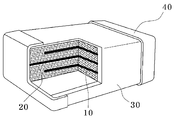
- 1 to 3 are cross-sectional views and schematic views showing a multilayer ceramic capacitor according to the prior art.
- FIG. 1 is a cross-sectional view of a laminated ceramic capacitor, in which dielectric layers 10 are alternately stacked so as to be connected to both electrodes 40 alternately, and an insulating dielectric layer 20 is formed in a region therebetween.
- the outer surface of the dielectric layer 20 is surrounded by the case 30 and the electrode 40.
- FIG. 2 is a realistic depiction of the external appearance and internal structure of the multilayer ceramic capacitor, in which the dielectric film 10, the dielectric layer 20, and the case 30 and the electrode 40 are organically combined.
- FIG. 3 is a photograph showing various kinds of multilayer ceramic capacitors currently used, 0603 (1.6 mm x 0.8 mm), 0402 (1.0 mm x 0.5 mm) and 0201 (0.4), which are actually used in general home appliances, for mobile communication. Mm x 0.2 mm).
- Such MLCCs were manufactured using internal electrodes such as Pd or Pd-Ag, which are mostly expensive until 1955. However, in recent years, the Pd value fluctuates severely, making it difficult to manufacture parts.
- the MLCC price can be reduced by 50 to 80% compared to the use of precious metals.
- BME the internal electrode is completely oxidized in an air atmosphere and thus cannot serve as an electrode. Therefore, MLCC must be sintered in a reducing atmosphere.
- researches related to a number of additives have been performed to secure reduction resistance, and an example thereof is as follows.
- Equation 1 The capacitance of the MLCC is expressed by Equation 1 below.
- ⁇ o is the dielectric constant in vacuum
- ⁇ r is the dielectric constant of the dielectric material
- N is the number of layers
- A is the electrode area
- d is the dielectric thickness.
- barium titanate (BaTiO 3 ) which has a higher dielectric constant than most materials, has a dielectric constant value of several thousand and a dielectric constant efficiency per volume is maximized. Therefore, most MLCCs are produced based on BaTiO 3 raw materials, and are produced by adding small amounts of additives to control electrical, thermal and mechanical properties.
- Table 1 shows the characteristics of various MLCC products satisfying the EIA standard, and the amounts, dielectric constants, and temperature characteristics of BaTiO 3 included in each product are described.
- MLCC products with the maximum dielectric efficiency per volume are composed of hundreds of layers with a dielectric layer of 1 ⁇ m in thickness, and are expected to decrease further in the future to replace Ta-based capacitors or electrolytic capacitors.
- the most widely used MLCC size according to EIA standard is 0603 (1.6mm ⁇ 0.8mm) for general home appliances, and 0402 (1.0mm ⁇ 0.5mm) and 0201 (0.4mm ⁇ 0.2mm) size for mobile communication. It is actually used.
- the raw material of BaTiO 3 can be used industrially only if it has a finer size than the thickness of the dielectric layer having strict specifications.
- tetragonality c / a
- the MLCC manufacturing process has the complexity of implementing a high dielectric constant through a variety of different technologies including raw material processing, slip behavior control, tape casting, and sintering behavior under reduced atmosphere.
- it is basically necessary to obtain BaTiO 3 particles having high quality nano size, high tetragonal ratio, and spherical uniform particle size distribution.
- BaTiO 3 which has been used as a nano raw material until now, requires a spherical shape for easy dispersion, low temperature sintering characteristics with high density, high dielectric constant, low loss coefficient, and stability of a product due to lot change.
- Representative techniques known as a manufacturing method for this is as follows.
- the hydrothermal method known as liquid phase reaction is close to a spherical shape, and has a narrow particle size distribution and has a form of fine particles having a small particle size difference.
- the hydrothermal synthesis method having this feature is a technique of heating a liquid suspension of an insoluble salt (additive) in an autoclave at high temperature and high pressure. Therefore, the crystallinity is high.
- the advantages of hydrothermal reactions are low energy, low pollution, simple equipment, and high precipitation reaction rate.
- the particle size prepared by the hydrothermal synthesis method is suitable for thin layer production at 200 nm.
- hydrothermal synthesis has disadvantages in spite of the above advantages. Due to the high water pressure, protons and hydroxide ions are intercalated in BaTiO 3 crystal lattice during hydrothermal reaction, increasing the unit lattice size. Therefore, there is a disadvantage in that the density of the particles is lowered. Moreover, these defects penetrating into the lattice at the end of the MLCC sintering process are causing swelling due to emissions.
- Solid phase reaction method is the most traditional BaTiO 3 synthesis method is usually prepared by mixing the TiO 2 powder and BaCO 3 powder as a starting material, and then calcined at 1100 ⁇ 1400 °C, milling process.
- the raw materials produced by the conventional solid-phase reaction method has a problem of coarse particles and chemical non-uniformity and coarse particles exist as heat treated at a high temperature. Therefore, the solid phase reaction method is not suitable for the production of BaTiO 3 powder having a nano-size.
- the present invention uses a solid-phase reaction method, using a high energy mill, to achieve a uniform grinding and dispersing effect at the same time by using a mixed beads, by controlling the grinding time and temperature, excellent phase compatibility, 100nm It is an object of the present invention to provide a method for producing BaTiO 3 having a uniform uniform average particle size and high tetragonality.
- BaTiO 3 powder manufacturing method is charged with BaCO 3 in a high energy mill, and then pulverized using two kinds of mixed beads having different particle diameters and after mixing TiO 2 to the pulverized BaCO 3 850 After the first calcination for 1 hour 30 minutes to 2 hours at a temperature of ⁇ 950 °C characterized in that it comprises a second calcination for 30 minutes to 1 hour at a temperature of 950 ⁇ 1100 °C.
- the mixed beads are beads having a particle size of 0.02 ⁇ 0.1mm and beads having a particle size of 0.3mm, characterized in that the mixing is so as to be 1: 1 in the volume ratio of each of the beads, the high energy mill Characterized in that the rotational speed of 3000 ⁇ 4200rpm, the step of grinding the BaCO 3 is carried out for 90 to 120 minutes, the step of mixing the TiO 2 to the pulverized BaCO 3 is the TiO 2 And loading the pulverized BaCO 3 into a first high energy mill including a mixed bead of 0.65 mm and 1 mm and rotating at 1500 to 1600 rpm, performing dispersion, and dispersing the powder on which the dispersion was performed, to the first high energy.
- the mixing beads contained in the first high energy mill and the second high energy mill are each mixed in a ratio of 1: 1 by volume ratio, wherein the second high energy mill Mixing beads are characterized in that it comprises beads having a particle size of at least three, the TiO 2 is characterized in that using a material pre-mixed with 55 to 60% by weight rutile and 40 to 45% by weight of anatase, the TiO
- BaTiO 3 powder according to the present invention is characterized in that it is prepared by the solid-phase reaction method described above is pulverized and dispersed to have a homogeneous particle size of 100nm or less.
- the present invention allows to obtain a uniform grinding and dispersing effect at the same time by using a mixed beads, and provides an effect to be loaded into a high energy mill for dispersing nano-dispersion connected in series so that the grinding and dispersion can be performed simultaneously.
- the present invention uses a mixture of rutile (58.2%) + anatase (41.8%) when using a TiO 2 starting material, so that a smooth diffusion path can be obtained and high crystallinity of rutile phase can be used simultaneously Compared to the use of other starting materials, ie, rutile or anatase single phase, it provides high reactivity and tetragonality (c / a).
- 1 to 3 are cross-sectional views and schematic views showing a multilayer ceramic capacitor according to the prior art.
- Figure 5 is a schematic diagram illustrating a high-energy mill for a BaTiO 3 prepared in accordance with the present invention.
- Figure 6 is a cross-sectional view showing the inside of the high energy mill mill cylinder for producing BaTiO 3 according to the present invention.
- Figure 7 is a SEM photograph showing BaCO 3 starting material for the production of BaTiO 3 according to the present invention.
- 9 to 14 are photographs showing the particle shape and particle size change of BaTiO 3 with grinding time when using 0.65mm beads when using the high energy mill according to the present invention.
- 15 to 20 are photographs showing the particle shape and the particle size change of BaTiO 3 with the grinding time when using 0.2mm beads when using the high energy mill according to the present invention.
- 21 to 23 are photographs showing the particle shape change of BaTiO 3 according to the grinding time when using a 0.2mm beads when using a high energy mill according to the present invention, the speed of the rotor to 3000rpm.
- 24 to 26 are photographs showing the change in particle shape of BaTiO 3 according to the grinding time when using a 0.2mm beads when using a high energy mill according to the present invention, and the rotor speed is 4200rpm.
- 27 and 28 are photographs showing the particle shape change of BaTiO 3 according to the type of beads and the number of passes when using the high energy mill according to the present invention.
- Figure 29 is a photograph showing the particle shape change of BaTiO 3 after mixing and TiO 2 type according to the present invention.
- FIG. 30 is a photograph showing the particle shape change of BaTiO 3 according to the TiO 2 type and mixing conditions according to the present invention.
- Figure 31 is a graph showing the XRD analysis results for analyzing the ratio of TiO 2 type and phase synthesis and tetragonal phase in accordance with the present invention.
- BaTiO 3 having a nano size is formed by using a low-cost, easy-to-process solid-phase reaction method, so as to obtain a critical particle size for cubic-tetragonal phase transition, and 200nm class
- a critical particle size for cubic-tetragonal phase transition and 200nm class
- barium titanate particles having a nano size and a method of manufacturing the same will be described in detail based on the technology of the present invention described above.
- Figure 5 is a schematic diagram showing a high energy mill for producing BaTiO 3 according to the present invention.
- the high energy mill has a mixing tank 100 for mixing the raw materials, and one side of the mixing tank 100 includes a circulation tube connected to the grinder cylinder 120. And, the grinder cylinder 120 is to be accurately controlled by the control device 110.
- the solid phase reaction method using the high energy mill according to the present invention promotes the activation of the fine starting material and the solid phase reaction to lower the reaction temperature and thus to reduce the particle size of the final synthetic material.
- FIG. 6 is a cross-sectional view showing the inside of a mill cylinder of a high energy mill for producing BaTiO 3 according to the present invention.
- High energy mill forms a powder having a nano size by a continuous process of the mill cylinder (120).
- the grinder cylinder 120 of FIG. 6 includes a rotor 200 capable of rotating at a high speed of several thousand rpm and having a disk shape, and a cooling system 230 provided to protect the outside thereof.
- the general ball mill method or attrition mill is a discontinuous process and the processing time is increased to grind to the desired particle size.
- the present invention by using a high energy mill, it is possible to efficiently form a powder having a nanoparticle size.
- FIG. 7 is a SEM photograph showing BaCO 3 starting material for producing BaTiO 3 according to the present invention
- FIG. 8 is a SEM photograph showing TiO 2 atanase for producing BaTiO 3 according to the present invention.
- BaCO 3 has a needle shape unlike TiO 2 having a spherical particle shape as shown in FIG. 8. Therefore, it is preferable to reduce the particle size by grinding before mixing using a high energy mill.
- the homogeneous grain growth can be caused by making the diffusion path homogeneous according to the result.
- 9 to 14 are photographs showing the particle shape and particle size change of BaCO 3 according to the grinding time when using 0.65mm beads when using the high energy mill according to the present invention.
- FIG. 9 is a state before grinding
- FIG. 10 is 40 minutes
- FIG. 11 is 60 minutes
- FIG. 12 is 80 minutes
- FIG. 13 is 100 minutes
- FIG. 14 is 120 minutes. It can be seen that at least 120 minutes must elapse before being crushed into spherical particles having a size of 80-120 nm.
- the grinding time can be changed depending on the amount of raw materials or the capacity of the high energy mill, the present invention is not limited by the time range.
- 15 to 20 are photographs showing the change in particle shape and particle size of BaCO 3 with the grinding time when using 0.2mm beads when using the high energy mill according to the present invention.
- FIG. 15 is a state before grinding
- FIG. 16 is 40 minutes
- FIG. 17 is 60 minutes
- FIG. 18 is 80 minutes
- FIG. 19 is 100 minutes
- FIG. 20 is 120 minutes. Comparing 120 minutes to be crushed into spherical particles having a size of 50 ⁇ 100nm, it can be seen that the finer grinding effect than the same time can be obtained than in the case of FIGS.
- the grinding efficiency may also vary depending on the number of revolutions of the high energy mill, and in order to measure the grinding efficiency for the same beads (0.2 mm), the rotor speed is changed to 3000 and 4200 rpm to determine the particle size according to the grinding time. The reduction was measured.
- 21 to 23 are photographs showing the change in particle shape of BaCO 3 according to the grinding time when using a 0.2mm beads, when the rotor speed is 3000rpm when using the high energy mill according to the present invention.
- FIG. 21 is a 30 minute grind at a speed of 3000 rpm
- FIG. 22 is a 60 minute grind
- FIG. 23 is a 90 minute grind.
- 24 to 26 are photographs showing the change in particle shape of BaCO 3 according to the grinding time when 0.2mm beads are used and the rotor speed is 4200 rpm when the high energy mill according to the present invention is used. Is the same as the case of FIGS. 21 to 23.
- the particle size of BaCO 3 using the beads of 0.2 mm can be seen that the average particle diameter of the sphere is pulverized to the size of 100 nm as shown in FIG. 20.
- the uniform grinding of BaCO 3 should be induced.
- the grinding is preferably performed using mixed beads. In order to prove the critical significance for this, it will be compared with the case of using a single size 0.2mm beads and mixed beads in the following drawings.
- 27 and 28 are photographs showing the particle shape change of BaCO 3 according to the type of beads and the number of passes when using the high energy mill according to the present invention.
- Figure 27 shows the particle shape after passing 20 pass at 3000rpm using a single 0.2mm beads
- Figure 28 shows the particle shape after passing 15apss by mixing 0.3mm and 0.1mm beads to 1: 1 in volume ratio Indicated.
- the BaCO 3 particles are pulverized into spherical particles of uniform size, whereas the uniformity of the particle size is reduced when the single beads are used.
- the mixed beads when used, large diameter beads lead to grinding and small size beads lead to dispersion, thereby increasing the uniform dispersion effect and the uniform grinding effect.
- the smaller particle size of the beads be 0.06 to 0.35 times the particle size of the large size. Therefore, based on 0.3 mm of beads having a large particle size, it is preferable to mix beads having a particle diameter of 0.02 to 0.1 mm.
- the calcination temperature can be lowered, which is also related to TiO 2 .
- the fine particles of TiO 2 as shown in FIG. 8 act as a catalyst to assist in the decomposition of BaCO 3 , wherein TiO 2 (density: 3.90 g / cm 3) on atanatase has a rutile TiO 2 structure. Since the density is lower than (density: 4.23 g / cm 3), the calcination temperature can be lowered more efficiently. Therefore, below, it is assumed that the particle shape change of BaTiO 3 according to the type of TiO 2 is investigated.
- Figure 29 is a picture showing the particle shape change of BaTiO 3 after mixing and type of TiO 2 according to the present invention.
- Fig. 29 shows the results of observing the raw material shape of the starting material for each TiO 2 with an electron microscope. After weighing using these starting materials, 1st and 0.65mm beads were firstly dispersed at 1600rpm using a high-energy mill, and then a high-energy mill containing 0.3mm and 0.1mm beads was connected and ground in series. Was carried out, and the results are shown in FIG. 29.
- the starting material of TiO 2 has a size similar to BaCO 3 pulverized to less than 100 nm and can be mixed in a uniform distribution.
- calcination temperature was carried out under the following conditions.
- FIG. 30 is a photograph showing changes in particle shape of BaTiO 3 according to TiO 2 type and mixing conditions according to the present invention, and shows the results of observing the particle shape of BaTiO 3 synthesized at each synthesis temperature with an electron microscope.
- the present invention allows to maintain for a short time at a high temperature.
- 31 is a graph showing the results of XRD analysis for analyzing the ratio of TiO 2 type, phase synthesis and tetragonal phase according to the present invention.
- the phase synthesis and tetragonality of each synthetic powder were observed by XRD, and the tetragonal ratio (c / a) is higher as the peaks of the (002) and (200) planes are clearly separated.
- tetragonal maintenance (c / a) values are summarized in the following conditions obtained by the peak separation method and are shown in the following [Table 3].
- ⁇ 002 ⁇ peak is not separated under the conditions below, and thus it can be seen that the dielectric constant is low in the cubic phase.
- TiO 2 in rutile phase is more advantageous than TiO 2 in anatase in order to increase tetragonal maintenance at low temperature synthesis temperature.
- the present invention uses a solid phase reaction method for producing a ceramic powder, using a mixed bead at the same time to obtain a uniform grinding and dispersing effect of BaCO 3 starting material, nano-dispersion is connected in series It is charged into the high energy mill to allow grinding and dispersion to be carried out simultaneously.
- a TiO 2 starting material by using a mixture of rutile (58.2%) + anatase (41.8%), it is possible to obtain a smooth diffusion path and to simultaneously use a high crystallinity of rutile, rutile or Compared to using anatase single phase, high reactivity and tetragonal maintenance (c / a) can be obtained.
Landscapes
- Chemical & Material Sciences (AREA)
- Engineering & Computer Science (AREA)
- Ceramic Engineering (AREA)
- Organic Chemistry (AREA)
- Materials Engineering (AREA)
- Manufacturing & Machinery (AREA)
- Structural Engineering (AREA)
- Inorganic Chemistry (AREA)
- Geology (AREA)
- General Life Sciences & Earth Sciences (AREA)
- Environmental & Geological Engineering (AREA)
- Life Sciences & Earth Sciences (AREA)
- Physics & Mathematics (AREA)
- Nanotechnology (AREA)
- Thermal Sciences (AREA)
- Composite Materials (AREA)
- Condensed Matter Physics & Semiconductors (AREA)
- General Physics & Mathematics (AREA)
- Crystallography & Structural Chemistry (AREA)
- Inorganic Compounds Of Heavy Metals (AREA)
- Compositions Of Oxide Ceramics (AREA)
Abstract
La présente invention concerne des nanoparticules de titanate de baryum et leur procédé de production, ainsi que l'utilisation de billes mélangées de façon qu'un effet de broyage et de dispersion puisse être obtenu simultanément, et la mise en oeuvre d'un procédé dans lequel une matière de départ à base de BaCO3 est broyée à l'échelle nanométrique puis est mélangée à du TiO2 à l'échelle nanométrique ce qui permet d'obtenir une dispersion au moyen d'un broyage à haute énergie et à basse vitesse de 1600 T/M et des billes mélangées de 0,65 mm et 1 mm dans un premier temps, et d'assurer un broyage et une dispersion simultanément par chargement dans des broyeurs à haute énergie de nano-broyage à 0,1 mm et 0,3 mm et de dispersion raccordés linéairement. La présente invention concerne également une invention dans laquelle, lorsque la matière de départ à base de TiO2 est utilisée, un mélange de rutile (58,2 %) et d'anatase (41,8 %) est utilisé de façon à obtenir un passage de diffusion lisse, et que le degré élevé de cristallisation de la phase rutile puisse être employé dans un même temps, afin d'obtenir une réactivité et une tétragonalité (c/a) plus importantes que lorsque d'autres matières de départ sont utilisées, comme une matière de départ ne contenant qu'une phase rutile ou qu'une phase anatase.
Priority Applications (1)
| Application Number | Priority Date | Filing Date | Title |
|---|---|---|---|
| CN2010800254046A CN102686535A (zh) | 2009-06-11 | 2010-06-11 | 具有纳米大小的BaTiO3粒子及其制备方法 |
Applications Claiming Priority (2)
| Application Number | Priority Date | Filing Date | Title |
|---|---|---|---|
| KR10-2009-0051863 | 2009-06-11 | ||
| KR1020090051863A KR101104627B1 (ko) | 2009-06-11 | 2009-06-11 | 나노크기를 갖는 티탄산바륨 입자 및 그의 제조 방법 |
Publications (2)
| Publication Number | Publication Date |
|---|---|
| WO2010143915A2 true WO2010143915A2 (fr) | 2010-12-16 |
| WO2010143915A3 WO2010143915A3 (fr) | 2011-04-14 |
Family
ID=43309387
Family Applications (1)
| Application Number | Title | Priority Date | Filing Date |
|---|---|---|---|
| PCT/KR2010/003778 Ceased WO2010143915A2 (fr) | 2009-06-11 | 2010-06-11 | Nanoparticules de titanate de baryum et leur procédé de production |
Country Status (3)
| Country | Link |
|---|---|
| KR (1) | KR101104627B1 (fr) |
| CN (1) | CN102686535A (fr) |
| WO (1) | WO2010143915A2 (fr) |
Cited By (4)
| Publication number | Priority date | Publication date | Assignee | Title |
|---|---|---|---|---|
| CN102557122A (zh) * | 2011-12-28 | 2012-07-11 | 广东风华高新科技股份有限公司 | 一种超细钛酸钡材料的制备方法 |
| RU2646062C1 (ru) * | 2017-04-27 | 2018-03-01 | Открытое акционерное общество "Витебский завод радиодеталей "Монолит" (ОАО "ВЗРД "Монолит") | Способ изготовления титаната бария (BaTiO3) для многослойных керамических конденсаторов с температурой спекания диэлектрика не более 1130oС |
| CN110655378A (zh) * | 2018-06-29 | 2020-01-07 | 中科院微电子研究所昆山分所 | 一种柔性电路板用复合材料的制备方法 |
| CN120097723A (zh) * | 2025-05-12 | 2025-06-06 | 杭州兴容科技有限公司 | 一种可用于mlcc的钙钛矿结构材料及其制备方法 |
Families Citing this family (8)
| Publication number | Priority date | Publication date | Assignee | Title |
|---|---|---|---|---|
| WO2014084428A1 (fr) * | 2012-11-30 | 2014-06-05 | 삼성정밀화학(주) | Procédé de préparation de poudre de titanate de baryum et poudre de titanate de baryum préparé selon ledit procédé |
| KR101719840B1 (ko) * | 2012-11-30 | 2017-03-27 | 삼성전기주식회사 | 고결정성 유전체 물질의 제조방법 |
| CN108217720B (zh) * | 2016-12-15 | 2020-05-05 | 南方科技大学 | 片式多层陶瓷电容器用钛酸钡纳米晶的制备方法 |
| CN106745223A (zh) * | 2017-03-16 | 2017-05-31 | 东北大学 | 改性二氧化钛粉体的制备方法及改性二氧化钛粉体 |
| CN112266012B (zh) * | 2020-10-28 | 2021-10-22 | 潮州三环(集团)股份有限公司 | 一种钛酸钡粉体及其制备方法 |
| CN112808260B (zh) * | 2020-12-28 | 2023-10-20 | 江门市科恒实业股份有限公司 | 一种球磨法制备铈锆固溶体的方法 |
| CN117185343A (zh) * | 2022-09-06 | 2023-12-08 | 中国科学院上海硅酸盐研究所 | 一种固相法制备超细四方相钛酸钡粉体的方法 |
| CN120097380B (zh) * | 2025-05-08 | 2025-08-08 | 杭州兴容科技有限公司 | 一种超细钛酸钡粉体的固相法制备方法 |
Family Cites Families (7)
| Publication number | Priority date | Publication date | Assignee | Title |
|---|---|---|---|---|
| JP4140695B2 (ja) * | 2002-07-31 | 2008-08-27 | 株式会社大阪チタニウムテクノロジーズ | 四塩化チタン水溶液及びこれを用いたチタン系複合酸化物の粉末製造方法 |
| KR100475478B1 (ko) * | 2002-08-30 | 2005-03-10 | 한창산업주식회사 | 미세 분말상 티탄산바륨의 제조방법 |
| KR100771796B1 (ko) * | 2005-04-30 | 2007-10-30 | 삼성전기주식회사 | 유전체용 세라믹분말의 제조방법 |
| KR100633723B1 (ko) * | 2005-08-04 | 2006-10-13 | 한화석유화학 주식회사 | 티탄산바륨의 제조방법 |
| JP2007161527A (ja) * | 2005-12-14 | 2007-06-28 | Matsushita Electric Ind Co Ltd | チタン酸バリウム粉末の製造方法および積層セラミックコンデンサ |
| CN101333000B (zh) * | 2007-06-27 | 2010-11-03 | 仙桃市中星电子材料有限公司 | 液相法合成高纯电子级钛酸钡的工艺 |
| KR100921352B1 (ko) * | 2009-03-12 | 2009-10-15 | 한화석유화학 주식회사 | 미립 티탄산바륨계 분말의 제조방법 |
-
2009
- 2009-06-11 KR KR1020090051863A patent/KR101104627B1/ko not_active Expired - Fee Related
-
2010
- 2010-06-11 WO PCT/KR2010/003778 patent/WO2010143915A2/fr not_active Ceased
- 2010-06-11 CN CN2010800254046A patent/CN102686535A/zh active Pending
Cited By (4)
| Publication number | Priority date | Publication date | Assignee | Title |
|---|---|---|---|---|
| CN102557122A (zh) * | 2011-12-28 | 2012-07-11 | 广东风华高新科技股份有限公司 | 一种超细钛酸钡材料的制备方法 |
| RU2646062C1 (ru) * | 2017-04-27 | 2018-03-01 | Открытое акционерное общество "Витебский завод радиодеталей "Монолит" (ОАО "ВЗРД "Монолит") | Способ изготовления титаната бария (BaTiO3) для многослойных керамических конденсаторов с температурой спекания диэлектрика не более 1130oС |
| CN110655378A (zh) * | 2018-06-29 | 2020-01-07 | 中科院微电子研究所昆山分所 | 一种柔性电路板用复合材料的制备方法 |
| CN120097723A (zh) * | 2025-05-12 | 2025-06-06 | 杭州兴容科技有限公司 | 一种可用于mlcc的钙钛矿结构材料及其制备方法 |
Also Published As
| Publication number | Publication date |
|---|---|
| KR101104627B1 (ko) | 2012-01-12 |
| KR20100133135A (ko) | 2010-12-21 |
| CN102686535A (zh) | 2012-09-19 |
| WO2010143915A3 (fr) | 2011-04-14 |
Similar Documents
| Publication | Publication Date | Title |
|---|---|---|
| WO2010143915A2 (fr) | Nanoparticules de titanate de baryum et leur procédé de production | |
| US7791859B2 (en) | Method for manufacturing dielectric ceramic powder, and multilayer ceramic capacitor obtained by using the ceramic powder | |
| Duran et al. | Fabrication and electrical properties of textured Sr0. 53Ba0. 47Nb2O6 ceramics by templated grain growth | |
| Gio | Enhancement in dielectric, ferroelectric, and piezoelectric properties of BaTiO3-modified Bi0. 5 (Na0. 4K0. 1) TiO3 lead-free ceramics | |
| Xu et al. | Superior ultra-high temperature multilayer ceramic capacitors based on polar nanoregion engineered lead-free relaxor | |
| KR102536054B1 (ko) | 페로브스카이트형 티탄산바륨 분말의 제조 방법 | |
| US20140065308A1 (en) | Dielectric composition, method of fabricating the same, and multilayer ceramic electronic component using the same | |
| WO2010143904A2 (fr) | Matériau fritté pour substance diélectrique et son procédé de fabrication | |
| JP2002255552A (ja) | チタン酸バリウム粉末およびその製造方法 | |
| KR20120060542A (ko) | 티탄산바륨 분말 제조 방법 및 티탄산바륨 분말 | |
| Jin et al. | Enhanced energy storage performance of lead-free BaTiO3-K0. 5Na0. 5NbO3 via grain engineering | |
| KR100360118B1 (ko) | 옥살레이트법에 의한 티탄산바륨계 산화물 분말 제조방법 | |
| JP4758872B2 (ja) | チタン酸バリウム粉末の製造方法 | |
| WO2010095860A2 (fr) | Poudres précurseurs de frittage pour la fabrication de substance diélectrique et leur procédé de fabrication | |
| US20040248724A1 (en) | Silicate-based sintering aid and method | |
| Wang et al. | Microstructure regulation and dielectric performance analysis of the high-pressure sintered nano-BaTiO₃ ceramics | |
| WO2015080304A1 (fr) | Procédé de préparation de titanate de baryum et titanate de baryum préparé par celui-ci | |
| Mao et al. | Effect of a‐site ionic radius on the structure and microwave dielectric characteristics of Sr1+ xSm1− xAl1− xTixO4 ceramics | |
| CN102557122A (zh) | 一种超细钛酸钡材料的制备方法 | |
| CN116283273A (zh) | 一种无铅压电陶瓷材料及其制备方法 | |
| Wang et al. | Synthesis of fine-grain Ba0. 96La0. 04TiO3 dielectric ceramics by different routes for multilayer ceramic capacitors | |
| Cheon et al. | Exploration of surface treatment and liquid additive processing for enhanced multilayer ceramic capacitors performance | |
| JP2004203626A (ja) | 誘電体組成物 | |
| WO2015099203A1 (fr) | Procédé de préparation d'oxalate de titane et de baryum, procédé de préparation de titanate de baryum, et titanate de baryum | |
| WO2014084429A1 (fr) | Procédé de préparation de titanate de baryum et titanate de baryum préparé par celui-ci |
Legal Events
| Date | Code | Title | Description |
|---|---|---|---|
| WWE | Wipo information: entry into national phase |
Ref document number: 201080025404.6 Country of ref document: CN |
|
| 121 | Ep: the epo has been informed by wipo that ep was designated in this application |
Ref document number: 10786398 Country of ref document: EP Kind code of ref document: A2 |
|
| NENP | Non-entry into the national phase |
Ref country code: DE |
|
| 122 | Ep: pct application non-entry in european phase |
Ref document number: 10786398 Country of ref document: EP Kind code of ref document: A2 |