WO2010143918A9 - Dispositif d'observation de la basse atmosphère et de test du type montant et descendant - Google Patents
Dispositif d'observation de la basse atmosphère et de test du type montant et descendant Download PDFInfo
- Publication number
- WO2010143918A9 WO2010143918A9 PCT/KR2010/003787 KR2010003787W WO2010143918A9 WO 2010143918 A9 WO2010143918 A9 WO 2010143918A9 KR 2010003787 W KR2010003787 W KR 2010003787W WO 2010143918 A9 WO2010143918 A9 WO 2010143918A9
- Authority
- WO
- WIPO (PCT)
- Prior art keywords
- observation
- ground
- lift
- gps
- instrument
- Prior art date
- Legal status (The legal status is an assumption and is not a legal conclusion. Google has not performed a legal analysis and makes no representation as to the accuracy of the status listed.)
- Ceased
Links
Images
Classifications
-
- G—PHYSICS
- G01—MEASURING; TESTING
- G01W—METEOROLOGY
- G01W1/00—Meteorology
- G01W1/08—Adaptations of balloons, missiles, or aircraft for meteorological purposes; Radiosondes
-
- G—PHYSICS
- G01—MEASURING; TESTING
- G01L—MEASURING FORCE, STRESS, TORQUE, WORK, MECHANICAL POWER, MECHANICAL EFFICIENCY, OR FLUID PRESSURE
- G01L5/00—Apparatus for, or methods of, measuring force, work, mechanical power, or torque, specially adapted for specific purposes
- G01L5/04—Apparatus for, or methods of, measuring force, work, mechanical power, or torque, specially adapted for specific purposes for measuring tension in flexible members, e.g. ropes, cables, wires, threads, belts or bands
-
- G—PHYSICS
- G01—MEASURING; TESTING
- G01W—METEOROLOGY
- G01W1/00—Meteorology
- G01W1/02—Instruments for indicating weather conditions by measuring two or more variables, e.g. humidity, pressure, temperature, cloud cover or wind speed
Definitions
- the present invention relates to a sub-atmospheric lift observation tester, and more particularly, to a sub-atmospheric lift observation tester capable of observing meteorological phenomena such as temperature, humidity, air pressure, wind direction, wind speed, and the like from the ground.
- Radiosonde is one of the instruments used to understand the structure and fluctuations of the atmosphere. It is an observation device that receives observation data transmitted at intervals and grasps the upper state of the atmosphere.
- Radiosonde measures the temperature, air pressure, and humidity while flying in the air, and the wind calculates the distance the balloon flies over a certain period of time.
- Long range navigation (Loran) method and Global Positioning System (GPS) method are widely used. In this way, the method of directly contacting the upper atmosphere and observing it has the advantage of having a higher accuracy than the remote sensing device that detects the upper state of the atmosphere using electromagnetic waves.
- equipment such as vertical crosswind equipment or radiometer, which remotely observes the state of the upper atmosphere using the property that electromagnetic waves are absorbed or scattered by water vapor and atmospheric composition in the air, has been invented and utilized.
- a remote high-rise exploration equipment has a disadvantage that is expensive to use the equipment itself, and also the stability is emphasized, which is unsuitable for portable use.
- a tethered balloon As an alternative high-rise instrument, a tethered balloon has been devised and used to observe the state of the lower layer. Tethered balloons, which are currently in use, use a method of connecting a balloon to the ground to prevent the balloon from flying and observing the atmosphere by hanging a radiosonde and a wind vane on the balloon.
- this method requires a large force to lift a large balloon, so it requires an electric motor called winch, which is a high output device on the ground, and has a restriction to supply power to the contact counter of the wind vane.
- the present invention has been made to solve the above problems, the purpose of which is unlike the conventional method of grasping the position of the instrument using theodolite (Theodolite) using the GPS radio sonde location of the radio sonde and ground mooring point It is to provide a sub-atmospheric lift observation experiment that can accurately know the position of the because it can know the exact position of.
- Another object of the present invention since the radio transmission signal interval is constant, it is to provide a lower atmospheric lift observation experimental apparatus that can observe the wind of the lower air layer only the location information of the radio zone when the connection line is freely loosened. have.
- Another object of the present invention there is an advantage that does not need to use the existing large lifting device by using a mechanical lifting device for unwinding and winding the connecting cord.
- Another object of the present invention by using a battery-type GPS radio sonde, unlike the conventional water-based radio sonde to provide a subsurface lift-type observation experiment that has the advantage of recycling the radio sonde only by replacing the battery. .
- Another object of the present invention is to provide a lower atmospheric lifting observation experiment with a greater economical effect compared to the conventional method since the recovery of the instrument can be recycled helium injected into the instrument.
- the present invention in order to achieve the above object, the floating mechanism;
- An apparatus elevator for elevating the apparatus by winding or unwinding a connecting line connected to the apparatus;
- a tension meter for measuring tension of the connecting cord connected to the apparatus;
- a radio sensor that is connected to a connection line between the device and the device lift and includes a GPS sensor for outputting an observation sensor for observing and outputting weather conditions and a location signal of the device on the ground; And a GPS antenna for receiving the observation signal of the observation sensor and the position signal of the GPS chip on the ground.
- the mechanical lift in the present invention is characterized in that the electric reel (Reel) device.
- the mechanical lift in the present invention is characterized in that it is installed on the pole adjustable length.
- the pole in the present invention is characterized in that it is fixed to the support located on the ground to face upward.
- the flowmeter which measures the injection gas amount of the said apparatus is further characterized by the above-mentioned.
- the display and storage means for expressing the signal received to the ground through the GPS receiver, and stored as data; characterized in that it is further provided.
- the lower-air elevating observation experiment of the present invention uses the GPS radio sonde to accurately determine the position of the radio sonde and the position of the ground mooring point, unlike the conventional method of detecting the position of the instrument using theodolite. Because of this, the precise observation result can be known, and the signal transmission interval of Radiosonde is constant, so when the cable is freely released, the wind of the lower layer can be observed only by the location information of Radiosonde.
- the electric reel there is an advantage that does not need to use the existing huge lifting device, and by using a battery-type GPS radio sonde, unlike the existing order-type radio sonde, there is an advantage that the radio sonde can be recycled only by replacing the batteries. Since the instrument can be recovered, helium that is injected into the instrument can be recycled. As compared with the method of the zone it is economical effect.
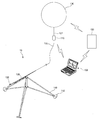
- Figure 1 is a schematic diagram showing a lower atmospheric lift observation experiment according to the present invention.
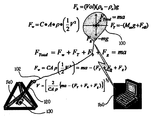
- FIG. 2 is a schematic diagram showing a state in which buoyancy, wind power, tension, and gravity are applied to the apparatus in the lower atmospheric lifting type observation tester.
- the lower atmospheric lifting type observation experiment apparatus 10 includes a device 100, a radio sonde 110, a pole 120, a device lift 130, and a support ( 140, the GPS antenna 150, the signal processing display unit 160, a tension meter, and a flow meter.
- the balloon 100 is a balloon made of a rubber material, and filled with helium gas in order to float, and can be recovered after the observation is completed, unlike the existing method, the helium gas can be reused.
- Radio sonde 110 is connected to the upper end of the connecting line 102 connecting the device 100 and the device elevator 130, and the built-in temperature sensor, humidity sensor and barometric pressure sensor to observe the weather conditions of the lower layer
- a GPS chip Global Positioning System Chip (Global Positioning System Chip) (not shown in the drawing) for observing temperature, humidity, air pressure, etc. through various sensors, and outputting the observation signal and the position signal of the instrument 100 to the GPS antenna 150 on the ground. It is built.
- GPS chip Global Positioning System Chip
- the radio sonde 110 can be reused by using a battery of a set voltage that can be replaced when the power supply is exhausted instead of a conventional disposable battery for the operation of various sensors and GPS chips.
- the temperature sensor, the humidity sensor, the barometric pressure sensor, etc. may directly output the observation signal to the signal processing display unit 160.
- Pole 120 is fixed to one side of the support 140, the mechanism lift 130 is installed at the rear end, it is possible to adjust the length by combining in several words. At this time, although not shown in the figure is provided with a loop for each node to prevent the movement guide and tangling of the connecting line 102 through the ring.
- connecting line 102 is selected as a specification that can withstand the set tensile strength because buoyancy, wind power, tension and gravity affect the mechanism 100.
- the instrument lifter 130 lifts or lowers the instrument 100 from the ground before the meteorological observation by winding or unwinding the connecting cord 102 connected to the instrument 100 automatically or manually by power. It is an electric reel device which lowers the apparatus 100 from the lower layer of the atmosphere to the ground after completion of the observation.
- the mechanical elevator 130 is capable of measuring the unwinding length of the connecting line 102 and adjusting the zero point by a button operation and is output numerically to the display by an applied power source.
- the support 140 is located on the ground in the form of a folding tricycle supporting the pole 120 on which the device elevator 130 is mounted on one side to face upward, the fixed weight 142 so as not to move by the wind or the like on the leg portion Is fitted.
- the GPS antenna 150 is installed to receive sensing output signals such as a temperature sensor, a humidity sensor, a barometric pressure sensor, and GPS satellite information of a GPS chip, which are built in the radio zone 110.
- the signal processing display unit 160 expresses a signal received to the ground through the GPS antenna 150 through dedicated software, and stores it as data on the hard disk. For example, a notebook computer or the like is applied thereto.
- Cable tension meter (not shown in the drawing) is installed on the connecting line 102 between the tip of the pole 120 and the lower end of the connecting line 102 connected to the instrument 100 and the radio sonde 110 The connecting cord 102 is used to measure the force pulling the instrument lift 130.
- a flow meter (not shown in the figure) is provided on the ground to measure the amount of helium gas injected into the apparatus 100 and is provided to apply this when calculating buoyancy.
- F b is buoyancy
- F W is wind power
- F T is tension
- F g gravity
- the buoyancy F b is obtained by calculating the volume of the instrument 100 at the difference between the helium density ⁇ h inside the instrument 100 and the density ⁇ e of the air surrounding the instrument according to the Archimedes principle, as shown in Equation (1) below. 100) and the gravity due to the weight of helium inside it.
- Equation (1) Vol is the volume of the instrument 100, m h and m bal are the weight of helium and the instrument 100, respectively, Mr is the weight of the radio sonde 110 suspended on the instrument (100). G in this equation is the gravitational acceleration.
- the wind power Fw is expressed by Equation (2).
- Equation (2) v is the wind speed, A is the cross-sectional area of the instrument 100, ⁇ e represents the density of the air, respectively.
- Equation (2) Cd is a resistance coefficient between air and a device, and is represented by Equation (3) according to Moriarty (1992).
- Equation (3) Cdc is the air drag calculated by Moriartie as a function of Reynolds number, and ⁇ ⁇ is the elevation angle of the instrument.
- Equation (2) When the cross-sectional area A of Equation (2) is assumed to be a spherical device having a volume Vol, the radius of the device 100 is Because of, Becomes At this time, the deformation effect of the mechanism 100 is reflected by adjusting the air drag.
- the tension F T is measured by using a tension meter as a force for pulling the electric device elevator 130, the connection cord 102 connecting the device 100 and the radio sonde 110.
- the measured tension is divided into the component of the horizontal wind and the component of the vertical direction and reflected in the wind and buoyancy, respectively.
- This inclination angle is understood as the position indicated by the GPS chip included in the radio sonde 110, the position of the radio sonde 110 when the connection line 102 is released Lm, this position and the connection line 102 is not released It is calculated as the angle between the positions of the radio sonde 110 when not.
- Equation (4) The movement of the instrument 100 by the wind is represented by Equation (4) representing the above four forces canceled with each other and the remaining pure force and the movement of the instrument 100 by this force.
- a is calculated using the position of the GPS radiosonde 110 received every 2 seconds as the acceleration of the instrument.
- F TW and F Tb represent the components of the tension F T in the wind and buoyancy directions, respectively.
- the corresponding wind direction is obtained by calculating the azimuth angle from the position information of the radio sonde 110 transmitted from the GPS chip of the radio sonde 110.
- the experimental process of the lower atmospheric lift observation experimental apparatus 10 first, after connecting the connecting line 102 of the apparatus elevator 130 to the instrument 100 to which the radio zone 110 is connected.
- the instrument 100 is positioned in the lower air layer and observed.
- temperature, humidity, and air pressure are sensed by various sensors built in the radio zone 110, and the GPS antenna 150 on the ground receives information on the location of the radio zone 110 by the weather observation signal and the GPS chip.
- the received signal is expressed through a dedicated software and stored as data on the hard disk.
- the present invention relates to a sub-atmospheric elevated observation experiment, and can be used to observe weather phenomena such as temperature, humidity, air pressure, wind direction, and wind speed of the sub-atmospheric layer.
Landscapes
- Environmental & Geological Engineering (AREA)
- Engineering & Computer Science (AREA)
- Ecology (AREA)
- Life Sciences & Earth Sciences (AREA)
- Atmospheric Sciences (AREA)
- Biodiversity & Conservation Biology (AREA)
- Environmental Sciences (AREA)
- Aviation & Aerospace Engineering (AREA)
- Physics & Mathematics (AREA)
- General Physics & Mathematics (AREA)
- Testing Or Calibration Of Command Recording Devices (AREA)
- Arrangements For Transmission Of Measured Signals (AREA)
- Position Fixing By Use Of Radio Waves (AREA)
Abstract
La présente invention concerne un dispositif d'observation de la basse atmosphère et de test du type montant et descendant qui permet de déterminer des valeurs précises de résultats d'observation par l'utilisation d'une radiosonde GPS, puisque cela permet de déterminer avec exactitude la position de la radiosonde et la position du point d'amarrage au sol.
Priority Applications (1)
| Application Number | Priority Date | Filing Date | Title |
|---|---|---|---|
| US13/376,233 US8842024B2 (en) | 2009-06-11 | 2010-06-11 | Lower atmosphere ascent and descent observation experimental tool |
Applications Claiming Priority (2)
| Application Number | Priority Date | Filing Date | Title |
|---|---|---|---|
| KR1020090051816A KR101045827B1 (ko) | 2009-06-11 | 2009-06-11 | 대기하층 승강식 관측 실험기 |
| KR10-2009-0051816 | 2009-06-11 |
Publications (3)
| Publication Number | Publication Date |
|---|---|
| WO2010143918A2 WO2010143918A2 (fr) | 2010-12-16 |
| WO2010143918A3 WO2010143918A3 (fr) | 2011-04-28 |
| WO2010143918A9 true WO2010143918A9 (fr) | 2011-06-23 |
Family
ID=43309390
Family Applications (1)
| Application Number | Title | Priority Date | Filing Date |
|---|---|---|---|
| PCT/KR2010/003787 Ceased WO2010143918A2 (fr) | 2009-06-11 | 2010-06-11 | Dispositif d'observation de la basse atmosphère et de test du type montant et descendant |
Country Status (3)
| Country | Link |
|---|---|
| US (1) | US8842024B2 (fr) |
| KR (1) | KR101045827B1 (fr) |
| WO (1) | WO2010143918A2 (fr) |
Families Citing this family (18)
| Publication number | Priority date | Publication date | Assignee | Title |
|---|---|---|---|---|
| KR101045827B1 (ko) | 2009-06-11 | 2011-07-04 | 대한민국 | 대기하층 승강식 관측 실험기 |
| KR101217584B1 (ko) * | 2011-03-15 | 2013-01-02 | 주식회사 국토해양환경기술단 | 풍선 및 연을 이용한 해상풍력 관측 시스템 |
| KR101228296B1 (ko) * | 2011-03-15 | 2013-01-31 | 주식회사 국토해양환경기술단 | 풍선 및 연을 이용한 해양 및 기상 관측 시스템 |
| KR20150106698A (ko) * | 2014-03-12 | 2015-09-22 | 한국전자통신연구원 | 테더존데 시스템 및 이의 관측 방법 |
| WO2016009402A2 (fr) * | 2014-07-18 | 2016-01-21 | Altec S.P.A. | Plateforme de capture d'images et/ou de signaux radio |
| KR101508558B1 (ko) | 2014-07-18 | 2015-04-16 | 한국표준과학연구원 | 라디오존데의 습도센서를 보호하는 이중 캡 |
| CN104698510B (zh) * | 2015-04-07 | 2016-09-07 | 国家电网公司 | 一种基于系留气球探空仪的大气逆温层探测方法 |
| KR101787189B1 (ko) | 2015-06-29 | 2017-11-16 | 한국표준과학연구원 | 복수의 온도센서가 구비된 라디오존데와 이를 이용한 온도 측정 방법 및 그 보정 시스템과 보정 방법 |
| KR101653109B1 (ko) | 2015-07-07 | 2016-09-02 | 한국표준과학연구원 | 라디오존데의 온도 및 습도 평가장치 및 평가방법 |
| WO2017082456A1 (fr) * | 2015-11-13 | 2017-05-18 | 주식회사 리눅스아이티 | Dispositif de mesure de vitesse du vent/direction du vent |
| KR20180086373A (ko) | 2017-01-20 | 2018-07-31 | 한국표준과학연구원 | 복사냉각이 보정된 기상온도 측정장치 및 복사냉각 보정방법 |
| KR101817893B1 (ko) * | 2017-03-21 | 2018-02-22 | 한국표준과학연구원 | 기상관측용 습도센서 및 이를 이용하는 라디오존데 |
| CN107628221A (zh) * | 2017-10-31 | 2018-01-26 | 南京际华三五二特种装备有限公司 | 一种军舰放球器专用帐篷 |
| CN108692711B (zh) * | 2018-03-21 | 2020-08-18 | 天津大学 | 基于低空探空火箭的海洋数据处理的实现方法 |
| US11709273B2 (en) | 2018-04-12 | 2023-07-25 | Aerostar International, Llc | Stratospheric position, navigation, and timing system |
| RU200288U1 (ru) * | 2020-06-30 | 2020-10-15 | Федеральное Государственное Казенное Военное Образовательное Учреждение Высшего Образования "Тихоокеанское Высшее Военное-Морское Училище Имени С.О. Макарова" Министерства Обороны Российской Федерации (Г. Владивосток) | Радиозонд многоразового использования |
| KR102453997B1 (ko) | 2021-09-01 | 2022-10-14 | 대한민국 | 가스 주입장치 |
| CN115616682A (zh) * | 2022-10-21 | 2023-01-17 | 北京爱尔达电子设备有限公司 | 使用棘面气球的高空风场测量系统 |
Family Cites Families (13)
| Publication number | Priority date | Publication date | Assignee | Title |
|---|---|---|---|---|
| US2361177A (en) * | 1941-04-25 | 1944-10-24 | Chilowsky Constantin | Method and apparatus for the detection of submarines by airplanes |
| US3260480A (en) * | 1964-08-18 | 1966-07-12 | Fairchild Hiller Corp | Aerial balloon system |
| US3361387A (en) * | 1965-03-04 | 1968-01-02 | Arthur D. Struble Jr. | Balloon systems |
| JP2810815B2 (ja) | 1991-10-29 | 1998-10-15 | 株式会社フジタ | 風向風速測定装置 |
| FR2714019B1 (fr) * | 1993-12-22 | 1996-03-08 | Matthieu Gobbi | Installation d'atterrissage d'un ballon captif. |
| JP2003227882A (ja) * | 2002-02-01 | 2003-08-15 | Meisei Electric Co Ltd | 気象観測装置 |
| US6799740B2 (en) * | 2002-03-25 | 2004-10-05 | Adapco, Inc. | Chemical application and flight guidance control system and method |
| KR20050112140A (ko) * | 2004-05-24 | 2005-11-29 | (주)동양전기화학 | 상층대기 기상 측정용 지피에스 존대 |
| FR2882986B1 (fr) * | 2005-03-08 | 2010-03-12 | Aerogroupe S A R L | Ballon captif mobile dans une tour |
| US20120049009A1 (en) * | 2005-09-14 | 2012-03-01 | Kissel Jr Waldemar F | Integral Powered Winged Aircraft for Infantry and Artillery Mobilization and Front Line Combat |
| US20070272801A1 (en) * | 2006-05-24 | 2007-11-29 | Donald Patrick Hilliard | Autonomously controlled GPS-guided parafoil recovery apparatus |
| US8018079B2 (en) * | 2009-02-23 | 2011-09-13 | Tetraheed Llc | Reciprocating system with buoyant aircraft, spinnaker sail, and heavy cars for generating electric power |
| KR101045827B1 (ko) | 2009-06-11 | 2011-07-04 | 대한민국 | 대기하층 승강식 관측 실험기 |
-
2009
- 2009-06-11 KR KR1020090051816A patent/KR101045827B1/ko active Active
-
2010
- 2010-06-11 WO PCT/KR2010/003787 patent/WO2010143918A2/fr not_active Ceased
- 2010-06-11 US US13/376,233 patent/US8842024B2/en active Active
Also Published As
| Publication number | Publication date |
|---|---|
| KR20100133106A (ko) | 2010-12-21 |
| US20120081232A1 (en) | 2012-04-05 |
| KR101045827B1 (ko) | 2011-07-04 |
| WO2010143918A3 (fr) | 2011-04-28 |
| WO2010143918A2 (fr) | 2010-12-16 |
| US8842024B2 (en) | 2014-09-23 |
Similar Documents
| Publication | Publication Date | Title |
|---|---|---|
| WO2010143918A9 (fr) | Dispositif d'observation de la basse atmosphère et de test du type montant et descendant | |
| CN109959802B (zh) | 一种水下探测器、地下水流速流向测量仪及方法 | |
| US4258568A (en) | Water current meter | |
| CN109297803A (zh) | 一种适用于全海深的海底沉积物力学特性测量系统 | |
| CN105628321B (zh) | 一种充气柔性结构的冲击动力学特性测试装置及测试方法 | |
| KR20150106698A (ko) | 테더존데 시스템 및 이의 관측 방법 | |
| CN114200531B (zh) | 一种多分量海底磁场测量方法及装置 | |
| CN102981185A (zh) | 三分量磁场和三分量电场海洋电磁数据采集站 | |
| CN102053282A (zh) | 井中三分量磁力梯度测量装置 | |
| JP2019077293A (ja) | 無人航空機を用いた水文調査基地及び水文調査方法 | |
| CN206647097U (zh) | 一种用于测量钻孔水位及孔深的测量装置 | |
| CN105865573B (zh) | 一种液位测量装置及其测量方法 | |
| CN105068157A (zh) | 对边界层风廓线雷达探测风速风向数据精度的验证方法 | |
| CN104596581A (zh) | 一种智能悬杆测流装置 | |
| CN106950129B (zh) | 高桩码头结构水平承载力的动力检测方法 | |
| CN110967522A (zh) | 一种风场梯度的测量方法 | |
| Simpson | A free fall probe for the measurement of velocity microstructure | |
| CN205919910U (zh) | 一种自浮式海底温度探测系统 | |
| CN202676499U (zh) | 沉管隧道管段浮运沉放中采水及检测水样容重的分析系统 | |
| CN205483179U (zh) | 一种岩土工程勘察钻孔水位测量仪 | |
| CN105547515A (zh) | 一种自浮式海底温度探测系统 | |
| KR101241443B1 (ko) | 풍선의 움직임을 이용한 풍속측정시스템 및 그를 이용한 풍속측정방법 | |
| CN206832254U (zh) | 一种无人机搭载全站仪的检测装置 | |
| JP2810815B2 (ja) | 風向風速測定装置 | |
| CN210825186U (zh) | 一种起重机幅度测量装置 |
Legal Events
| Date | Code | Title | Description |
|---|---|---|---|
| 121 | Ep: the epo has been informed by wipo that ep was designated in this application |
Ref document number: 10786401 Country of ref document: EP Kind code of ref document: A2 |
|
| WWE | Wipo information: entry into national phase |
Ref document number: 13376233 Country of ref document: US |
|
| NENP | Non-entry into the national phase |
Ref country code: DE |
|
| 122 | Ep: pct application non-entry in european phase |
Ref document number: 10786401 Country of ref document: EP Kind code of ref document: A2 |