WO2010146625A1 - Communication apparatus - Google Patents
Communication apparatus Download PDFInfo
- Publication number
- WO2010146625A1 WO2010146625A1 PCT/JP2009/002717 JP2009002717W WO2010146625A1 WO 2010146625 A1 WO2010146625 A1 WO 2010146625A1 JP 2009002717 W JP2009002717 W JP 2009002717W WO 2010146625 A1 WO2010146625 A1 WO 2010146625A1
- Authority
- WO
- WIPO (PCT)
- Prior art keywords
- period
- communication
- signal
- retransmission
- communication device
- Prior art date
- Legal status (The legal status is an assumption and is not a legal conclusion. Google has not performed a legal analysis and makes no representation as to the accuracy of the status listed.)
- Ceased
Links
Images


Classifications
-
- H—ELECTRICITY
- H04—ELECTRIC COMMUNICATION TECHNIQUE
- H04W—WIRELESS COMMUNICATION NETWORKS
- H04W52/00—Power management, e.g. Transmission Power Control [TPC] or power classes
- H04W52/02—Power saving arrangements
- H04W52/0209—Power saving arrangements in terminal devices
- H04W52/0212—Power saving arrangements in terminal devices managed by the network, e.g. network or access point is leader and terminal is follower
- H04W52/0216—Power saving arrangements in terminal devices managed by the network, e.g. network or access point is leader and terminal is follower using a pre-established activity schedule, e.g. traffic indication frame
-
- H—ELECTRICITY
- H04—ELECTRIC COMMUNICATION TECHNIQUE
- H04W—WIRELESS COMMUNICATION NETWORKS
- H04W72/00—Local resource management
- H04W72/20—Control channels or signalling for resource management
-
- H—ELECTRICITY
- H04—ELECTRIC COMMUNICATION TECHNIQUE
- H04W—WIRELESS COMMUNICATION NETWORKS
- H04W52/00—Power management, e.g. Transmission Power Control [TPC] or power classes
- H04W52/02—Power saving arrangements
- H04W52/0209—Power saving arrangements in terminal devices
- H04W52/0212—Power saving arrangements in terminal devices managed by the network, e.g. network or access point is leader and terminal is follower
- H04W52/0219—Power saving arrangements in terminal devices managed by the network, e.g. network or access point is leader and terminal is follower where the power saving management affects multiple terminals
-
- Y—GENERAL TAGGING OF NEW TECHNOLOGICAL DEVELOPMENTS; GENERAL TAGGING OF CROSS-SECTIONAL TECHNOLOGIES SPANNING OVER SEVERAL SECTIONS OF THE IPC; TECHNICAL SUBJECTS COVERED BY FORMER USPC CROSS-REFERENCE ART COLLECTIONS [XRACs] AND DIGESTS
- Y02—TECHNOLOGIES OR APPLICATIONS FOR MITIGATION OR ADAPTATION AGAINST CLIMATE CHANGE
- Y02D—CLIMATE CHANGE MITIGATION TECHNOLOGIES IN INFORMATION AND COMMUNICATION TECHNOLOGIES [ICT], I.E. INFORMATION AND COMMUNICATION TECHNOLOGIES AIMING AT THE REDUCTION OF THEIR OWN ENERGY USE
- Y02D30/00—Reducing energy consumption in communication networks
- Y02D30/70—Reducing energy consumption in communication networks in wireless communication networks
Definitions
- the present invention relates to a communication device.
- Assign (scheduling) a period during which the access point can transmit a signal without contention with other terminals (non-contention period) to each terminal (scheduling), and each terminal starts up in the contention-free period assigned to itself Technology is disclosed (for example, Non-Patent Document 1). Also, a technique is disclosed in which an access point assigns a dedicated period for retransmitting traffic whose delay allowable period is equal to or less than a threshold to each terminal (for example, Patent Document 1).
- the “period in which the signal can be transmitted” (communication period) is set in advance by the access point, depending on the degree of degradation of the propagation environment, communication may be performed before each terminal retransmits the signal that failed to be transmitted. The period may have ended. In such a case, there is a problem that the QoS (Quality of Service) request can not be satisfied.
- the access point dynamically allocates a communication period to each terminal, there is a problem that each terminal must always wait for a signal for allocating a communication period, and power consumption can not be reduced. .
- the present invention is to provide a communication apparatus that can retransmit in a timely manner even when the propagation environment changes, and can reduce power consumption.
- a communication apparatus is a communication apparatus which consumes less power when not waiting for a signal than the power consumption when waiting for a signal, and the communication apparatus transmits the signal.
- a first assignment signal in which a possible first period is described; and a second assignment signal after the first period in which a plurality of communication devices including the communication device can transmit signals.
- a receiving unit for receiving, a transmitting unit for transmitting a transmission signal in the first period, and a blocking unit for blocking at least a part of the power supply to the receiving unit during a period in which the signal is not awaited;
- the transmission unit transmits the transmission signal in the second period, and when the transmission of the transmission signal is completed in the first period, the blocking unit In the second period, Characterized by blocking at least a portion of the force applied.
- FIG. 1 shows a communication device according to a first embodiment.
- FIG. 6 is a view showing an operation of the communication device according to the first embodiment.
- FIG. 7 is a view showing an operation of the communication apparatus according to the first modification of the first embodiment.
- the communication system according to the first embodiment includes one base station (hereinafter, communication apparatus AP) and five communication apparatuses STA1 to STA5.
- the communication devices AP and STA1 to STA5 communicate using nondirectional (omni) radio waves.
- radio waves transmitted by the communication devices AP and STA1 to STA5 will be described by way of an example where they reach all other communication devices.
- the radio waves transmitted by the communication devices AP and STA1 to STA5 may reach only some of the other communication devices.
- the communication apparatus AP grants a transmission right to the communication apparatuses STA1 to STA5 by a central control method (polling method).
- the access control method in the first embodiment is not limited to the above, and may be a distributed control method (CSMA / CA method) or the like.
- FIG. 1 is a block diagram showing the communication apparatus STA1 of the first embodiment. The same applies to communication devices AP and STA2 to STA5.
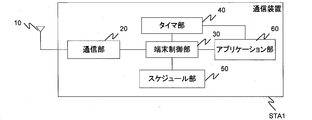
- the communication device STA1 includes an antenna 10, a communication unit 20, a terminal control unit 30, a timer unit 40, a scheduling unit 50, and an application unit 60.
- the communication device STA1 has two operation modes. There are a communication mode in which power consumption is large but a signal (frame) can be received, and a power saving mode in which a frame can not be received but power consumption is smaller than the communication mode.
- the power supply to at least a part of the communication unit 20 is reduced or stopped, or the timer input by the timer unit or data generation from the application unit is changed from the power saving mode to the communication mode
- Power may be supplied to a part necessary to shift to the normal mode by recognizing it as a trigger for transition, and power supply to other parts may be reduced / stopped.
- the communication unit 20 performs frame transmission / reception processing using the antenna 10.
- the communication unit 20 performs physical layer related processing such as frequency conversion processing and A / D conversion processing.
- the communication unit 20 transmits, receives, and stands by for a frame when in the operation mode.
- the terminal control unit 30 performs MAC layer related processing for wireless communication.
- the terminal control unit 30 controls an operation mode.
- the terminal control unit 30 shifts to the power saving mode when the frame transmission, reception, and standby are not performed.
- the terminal control unit 30 shuts off the power supply to the communication unit 20 and the schedule unit 50 in the power saving mode.
- the terminal control unit 30 performs processing of the upper layer (excluding the application layer) for wireless communication.
- the timer unit 40 counts from the power saving mode to the time to change to the communication mode.
- the timer unit 40 counts up to the time when the communication period assigned to the own station starts and the time when a broadcast signal (for example, Beacon signal) is transmitted.
- a broadcast signal for example, Beacon signal
- the terminal control unit 30 is activated and shifts from the power saving mode to the communication mode.
- the scheduling unit 50 stores schedule information (the communication period of the own station or each terminal).
- Schedule information is information that defines a communication period in which one or more communication devices can transmit or receive a signal.
- schedule information whether the communication apparatus STA1 to 5 transmits a signal to the communication apparatus AP (Uplink) or the communication apparatus AP transmits a signal to the communication apparatus STA1 to 5 (Downlink) with respect to the communication period?
- a time (DirectLink) for transmitting a signal between each of the devices STA1 to STA5 may be defined.
- the communication period is a period in which a signal can be transmitted in competition with another terminal (a contention period), or a period in which a signal can be transmitted without competition with another terminal (non-contention Period) may be described.
- the schedule information is determined by the communication device AP.
- the terminal control unit 30 reads out the schedule information stored by the scheduling unit 50, and performs communication processing and control of the operation mode. Scheduling is performed by the communication device AP.
- the communication devices STA1 to STA5 receive notification of a communication period (schedule information) from the communication device AP.
- the application unit 60 performs application layer related processing.
- the terminal control unit 30 is activated by using the notification from the application unit 60 as a trigger, and shifts from the power saving mode to the communication mode.
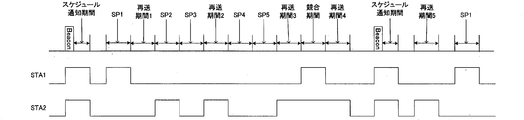
- FIG. 2 is a diagram schematically showing time change of schedule information and power consumption of the communication devices STA1 and STA2.
- the communication period SPn (n is an integer of 1 to 5) is a communication period assigned to the communication apparatus STAn.
- Retransmission periods 1 to 4 and contention periods can be used by all communication devices STA1 to STA5.
- each communication apparatus performs retransmission when communication in the communication period SPn allocated to the own station is not completed.
- each communication apparatus may retransmit a frame, or may transmit a new frame.
- each communication apparatus acquires a transmission right in accordance with a predetermined access control scheme and then starts frame transmission.
- each communication device acquires a transmission right by CSMA / CA.
- the schedule information is described in a broadcast signal transmitted from the communication device AP or a schedule signal transmitted in a subsequent schedule notification period.
- a period in which the power consumption of the communication devices STA1 and STA2 is high is a communication mode.
- a period in which the power consumption of the communication devices STA1 and STA2 is low is a power saving mode.
- the communication mode during the transmission processing, during the reception processing, and during the standby processing, the power consumption differs slightly, but in FIG. 2, the difference in the detailed power consumption is omitted.
- the communication device STA1 sets the reception period of the broadcast signal, the schedule notification period following it, the communication period SP1 allocated to the own station, and the contention period in which all communication devices can communicate as the communication mode. Power saving mode.
- the communication apparatus STA2 receives the broadcast signal reception period, the schedule notification period following it, the communication period SP2 assigned to the own station, the retransmission periods 2, 3, 4, and the competition with which all communication devices can communicate. The period is a communication mode, and the other period is a power saving mode. Whether the communication apparatuses STA1 and STA2 set the retransmission periods 1 to 4 as the communication mode is determined according to the communication results of the communication periods SP1 and SP2.
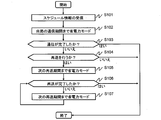
- FIG. 3 is a flowchart showing the operation of the communication devices STA1 and STA2.
- the communication devices STA1 to STA5 are first activated, they perform connection settings with the communication device AP such as authentication processing and association processing.
- the communication apparatus STA1 waits for and receives a broadcast signal from the communication apparatus AP.
- the communication device STA1 performs synchronization processing and the like according to the information described in the notification signal.
- the communication device STA1 receives schedule information from the communication device AP (step S101).
- the communication device STA1 receives a schedule signal (schedule information) from the communication device AP in the schedule notification period.
- the schedule signal received by the communication apparatus STA1 in the schedule notification period may be a plurality of frames.
- the communication apparatus STA1 may receive the broadcast signal in which the schedule information is described without receiving the schedule signal.
- the scheduling unit 50 of the communication apparatus STA1 stores schedule information.
- the assignment result (schedule information) of the communication period to each of the communication devices STA1 to STA5 is generated by the communication device AP.
- Information necessary for scheduling by the communication device AP for example, bandwidth information, data communication amount necessary for an application of the communication device STA1, and delay allowable time may be notified to the communication device AP in advance.
- the terminal control unit 30 of the communication apparatus STA1 is in the power saving mode until a predetermined period before the start time of the communication period SP1 of its own station (step S102).
- the timer unit 40 counts a period up to a predetermined period before the start time of the communication period SP1.
- the timer unit 40 may count a period shorter than the start time of the communication period SP1 by a period (preparation period) required for communication preparation.
- the timer unit 40 starts the terminal control unit 30 when the counting is completed.
- the terminal control unit 30 shifts to the communication mode.
- the terminal control unit 30 reads the schedule information from the schedule unit 50.
- the terminal control unit 30 activates the communication unit 20 to transmit and receive a frame during the communication period SP1.
- the terminal control unit 30 may activate the application unit 60 when transmitting a frame in the communication period SP1.
- the communication device STA1 transmits or receives a frame in the communication period SP1. Then, the communication apparatus STA1 determines whether the communication of the frame is completed in the communication period SP1 (step S103).
- the terminal control unit 30 of the communication apparatus STA1 determines whether to perform retransmission processing from the reception result of the frame. The terminal control unit 30 determines that the communication is completed when the retransmission occurs. The terminal control unit 30 determines that the communication is not completed when the retransmission occurs.
- the terminal control unit 30 of the communication device STA1 determines whether or not to perform retransmission processing from the delivery confirmation frame from the communication device AP.
- the terminal control unit 30 determines whether communication has been completed according to the amount of transmission data accumulated in the application unit 60, whether or not retransmission processing has been performed.
- the communication apparatus STA1 completes the communication of the frame in the communication period SP1 (“YES” in step S103). Since communication of the frame is completed in the communication period SP1, the communication device STA1 also enters the power saving mode in the retransmission periods 1, 2, 3 and 4. The communication apparatus STA1 is in the communication mode during a contention period in which a new frame can be transmitted. After this, the communication apparatus STA1 repeatedly enters the communication mode during the communication period in which the local station communicates and enters the low consumption mode other than the communication period in which the local station communicates.
- the communication period in which the local station communicates includes, for example, a contention period, a communication period of a broadcast signal, a schedule notification period, a communication period allocated to the local station, and a retransmission period when communication of a frame is not completed in the communication period. It is.
- the communication apparatus STA1 performs communication in the communication period SP1 allocated to the own station, and reduces power consumption by switching to the power saving mode without activating the retransmission period when the retransmission process is unnecessary. be able to.
- step S101 and S102 the operation of the communication apparatus STA2 will be described using FIG. 2 and FIG. The same applies to steps S101 and S102.
- the terminal control unit 30 of the communication apparatus STA2 determines that the communication of the frame is not completed in the communication period SP2 (“NO” in step S103).
- the terminal control unit 30 of the communication apparatus STA2 determines whether or not to perform the retransmission process using the retransmission period prior to the communication period SP2 and the contention period to be allocated to the own station next by the broadcast signal and the schedule signal. It determines (step S104).
- the terminal control unit 30 of the communication apparatus STA2 may determine to perform retransmission processing using a retransmission period when communication of a frame is not completed in the communication period SP2.
- the terminal control unit 30 determines that the retransmission process using the retransmission period is to be performed when the communication of the frame is not completed in the communication period SP2 and the remaining time of the delay allowance time of the frame is equal to or less than the threshold. You may This threshold may be a period until the start time or the end time of the next communication period SP2.
- the terminal control unit 30 of the communication apparatus STA2 enters the power saving mode until a predetermined period before the start time of the retransmission period 2 (step S105).
- the terminal control unit 30 shifts to the communication mode.
- the communication apparatus STA2 performs a retransmission process using the retransmission period 2 after receiving a polling signal from the communication apparatus AP or acquiring a transmission right by CSMA / CA.
- the communication apparatus STA2 does not complete the retransmission even if the retransmission periods 2 to 4 and the contention period are used (“NO” in step 106). Therefore, the communication apparatus STA2 is in the communication mode in the retransmission periods 2 to 5 and the contention period. After this, the communication apparatus STA2 repeatedly enters the communication mode during the communication period in which the local station communicates and enters the low consumption mode other than the communication period in which the local station communicates.
- the terminal control unit 30 of the communication apparatus STA2 uses the next retransmission period to perform retransmission processing each time it is determined that each of the retransmission periods 2 to 5 has ended and retransmission has not been completed (“No” in S106). It may be determined whether or not to try. If the time elapsed from the end time of the communication period SP2 does not exceed the delay allowance time, the terminal control unit 30 may determine to perform the retransmission process using the retransmission period.
- the communication apparatus STA2 does not complete frame transmission in the communication period SP2 assigned in advance by the communication apparatus AP because the retransmission processing occurs due to the deterioration of the radio propagation environment or the occurrence of the data transmission request of the application. Even if this is the case, timely retransmission processing can be performed while reducing power consumption.
- the communication devices STA1 to STA5 and AP can communicate the notification signal and the management frame (management signal) in order to maintain the connection when the period when the communication is not temporarily performed occurs. .
- the communication devices STA1 to STA5, AP communicate with the communication partner after performing connection processing such as authentication processing. After that, when communication is not performed temporarily, the communication devices STA1 to STA5, AP keep a predetermined interval in order to maintain the connection status with the communication partner, and maintain the connection processing by the synchronization processing by the notification signal and the management signal.
- Check the The communication devices STA1 to STA5 are in the communication mode when communicating the notification signal and the management signal, and are in the power saving mode for the period within that.
- FIG. 4 is a diagram schematically showing time change of schedule information and power consumption of the communication apparatus STA1.
- Figure 4 is normal (when both the notification signal and the management signal are successfully received), when an error occurs (when the notification signal and the management signal fail to be received), when the clock deviates (at the timing assumed by the terminal) 7 shows the power consumption of the communication apparatus STA1 in the case where it can not be received.
- a management communication period is set instead of the schedule notification period.
- the management communication period is a period for the communication devices STA1 to STA5 and AP to communicate a management signal.
- the retransmission period is a period for the communication devices STA1 to STA5 and AP to retransmit the management signal.
- the waiting period is a period in which the communication devices STA1 to STA5 wait to receive the next broadcast signal when the communication devices STA1 to 5 fail to receive the broadcast signal.
- FIG. 5 is a flowchart showing the operation of the communication device STA1.
- the communication apparatus STA1 performs clock synchronization processing by receiving the notification signal, and maintains the connection by exchanging the management signal.
- step S201 If the reception of the notification signal from the communication device AP is successful ("Yes” in step S201) and the reception of the management signal is successful ("Yes” in step S202), the communication device The connection state between the STA1 and the communication partner is maintained (step S203).
- the terminal control unit 30 of the communication apparatus STA1 is in the communication mode in the reception period of the notification signal and in the management communication period, as shown in “normal” in FIG. 5, and is in the power saving mode in the other periods.
- step S204 (At the time of management signal error) If the reception of the notification signal from the communication device AP is successful ("Yes” at step S201) and if the reception of the management signal fails ("No” at step S202), The communication apparatus STA1 attempts to receive the management signal in the retransmission period set after the management communication period (step S204). When the management signal is successfully received in the retransmission period ("Yes” in step S204), the connection state between the communication apparatus STA1 and the communication partner is maintained (step S203). On the other hand, when reception of the management signal fails in the retransmission period (“NO” in step S204), the connection state between the communication apparatus STA1 and the communication partner is disconnected (step S205).
- the connection state between the communication apparatus STA1 and the other party of communication may be disconnected when reception failure of the management signal in the management communication period and the retransmission period is continuous for a plurality of times (or for a predetermined period).
- the terminal control unit 30 of the communication apparatus STA1 is in the communication mode in the reception period of the notification signal, the management communication period, and the retransmission period, and is in the power saving mode in the other periods.
- step S201 When reception of a notification signal from the communication device AP fails (“No” in step S201), the communication device STA1 starts from the standby period set before the communication period of the next notification signal. The communication mode is awaited, and reception of the next broadcast signal is attempted (step S206).
- the notification signal and the management signal are successfully received during the standby period or the like (“YES” in step S206)
- the connection state between the communication apparatus STA1 and the communication partner is maintained (step S203).
- the notification signal can not be received in the standby period or the like (“NO” in step S206)
- the connection state between the communication apparatus STA1 and the communication partner is disconnected (step S207).
- the connection state between the communication apparatus STA1 and the other party of communication may be disconnected when reception failure of the broadcast signal in the standby period and the communication period of the broadcast signal continues a plurality of times (or continues for a fixed period). At this time, the communication apparatus STA1 discards connection information such as authentication information and association information on the assumption that communication with the communication partner is not possible.
- the terminal control unit 30 of the communication apparatus STA1 is in the communication mode in the reception period of the notification signal, the management communication period, and the standby period after failure to receive the notification signal, as shown in “at the time of a notification signal error” in FIG. , It becomes power saving mode in other period. Note that “at the time of notification signal error” in FIG. 5 shows an example in which the retransmission period is also in the communication mode, assuming that the communication apparatus STA1 has failed to receive the management signal.
- the notification signal is transmitted at predetermined intervals by the communication device AP, there may be a difference in the measurement result of the elapsed period between the communication devices STA1 to STA5 and the communication device AP.
- the timing that the communication apparatus STA1 assumes as the communication period of the notification signal is indicated by the notification signal surrounded by a broken line in "assume terminal" in FIG.
- the timing at which the communication device AP actually transmitted the notification signal is indicated by the notification signal surrounded by the solid line in FIG.
- the clocks of the communication device STA1 and the AP coincide with each other, and the communication device STA1 succeeds in receiving the broadcast signal.
- the communication period of the second notification signal In the communication period of the second notification signal, the communication period of the notification signal assumed by the communication device STA1 is much later than the communication period of the actual notification signal. Therefore, since the communication apparatus STA1 is in the power saving mode during a period in which the notification signal is transmitted by the communication apparatus AP, the reception of the notification signal fails (“NO” in step S201). Next, as in the case of a notification signal error, the communication apparatus STA1 waits in the communication mode from the standby period set before the communication period of the next notification signal, and tries to receive the next notification signal. (Step S206).
- the communication apparatus STA1 waits for a signal during the communication period of the third notification signal of FIG. Because of this, while reducing the power consumption, the notification signal can be received normally and the clock synchronization processing can be performed.
- Modification 2 The communication devices STA1 to STA5 according to the first embodiment use only the selected retransmission period of the retransmission periods 1 to 4 for retransmission when communication is not completed in the period SP1 to 5 allocated to the own station. It can be done.
- FIG. 6 is a diagram schematically showing time change of schedule information and power consumption of the communication devices STA1 to STA5.
- the schedule information shown in FIG. 6 is the same as the schedule information (FIG. 2) according to the first embodiment.
- the terminal control unit 30 of each of the communication devices STA1 to STA5 selects a candidate of a retransmission period to be used for frame retransmission among the retransmission periods 1 to 5.
- the terminal control unit 30 of each of the communication devices STA1 to STA5 selects the retransmission period set first after the communication periods SP1 to SP5 assigned to the own station as a candidate of a retransmission period to be used for frame retransmission.
- the terminal control unit 30 of each of the communication apparatuses STA1 to STA5 selects the retransmission period set immediately after the contention period as a candidate of the retransmission period to be used for frame retransmission.
- the terminal control unit 30 of each of the communication devices STA1 to STA5 selects the contention period as a candidate of a retransmission period to be used for frame retransmission.
- the retransmission period 1 is used by the communication device STA1 for retransmission of a frame under access control based on polling when the communication device STA1 does not complete communication in the communication period SP1.
- the communication devices STA2 to STA4 are in the power saving mode.
- the retransmission period 2 is used by the communication devices STA2 and STA3 to retransmit a frame under access control based on polling when the communication devices STA2 and STA3 do not complete communication in the communication periods SP2 and SP3.
- the communication devices STA1, 4, and 5 are in the power saving mode.
- the retransmission period 3 is used for retransmission of a frame under access control based on the polling method by the communication devices STA4 and STA5 when the communication devices STA4 and 5 do not complete communication in the communication periods SP4 and SP5.
- FIG. 6 shows an example in which the communication device STA4 completes communication in the communication period SP4.
- the communication devices STA1 to STA4 are in the power saving mode.
- the contention period is determined by the CSMA / CA by the communication apparatus (STA 1, 2, and 5 in the example of FIG. 6) whose communication has not been completed despite using the communication period assigned to the own station and its retransmission period. Used for frame retransmission under access control according to the scheme. In the contention period, the communication devices STA3 and STA4 are in the power saving mode.
- the retransmission period 4 is a retransmission period set immediately after the contention period.
- access control based on the polling method is performed by the communication device (STA 1, 2, and 5 in the example of FIG. 6) whose communication is not completed in the communication period assigned to the own station, its retransmission period, and the contention period. Used for frame retransmission.
- the communication devices STA 3 and 4 are in the power saving mode.
- the retransmission period 5 is a retransmission period that is set after the next broadcast signal is transmitted and before the communication period assigned to each communication terminal is set by the next schedule information.
- Retransmission period 5 is under the access control based on the polling method by the communication device (STA 1 and STA 5 in the example of FIG. 6) whose communication is not completed in the communication period assigned to the own station, its retransmission period, and the contention period. , Used for retransmission of frames.
- the communication devices STA2 to STA4 are in the power saving mode.
- the terminal control unit 30 of each of the communication devices STA1 to STA5 selects a retransmission period to be used for frame retransmission among the plurality of retransmission periods 1 to 5 set in the schedule information, and operates only in the retransmission period. In the other retransmission period, the power saving mode is set. Therefore, retransmission processing occurs due to deterioration of the radio propagation environment, occurrence of an application data transmission request, and the like, and frame transmission is not completed in communication periods SP1 to SP5 allocated in advance by the communication device AP. Also, it is possible to perform timely retransmission processing while reducing power consumption. As long as frame retransmission is not completed, there is no need to activate all the retransmission periods 1 to 5 set in the schedule information to enter the communication mode, and power consumption can be reduced.
- the activation can be performed in the contention period to perform retransmission processing, and can be activated in the subsequent retransmission period 4 and retransmission period 5 to perform the retransmission process. By doing this, it is possible to continue performing retransmission processing until the delay amount of the corresponding data exceeds the allowable amount.
- the terminal control unit 30 of the communication devices STA1 to 5 selects the retransmission period to be used first for the retransmission period to be used for frame retransmission and the retransmission period Power consumption can be reduced while suppressing occurrence of delay and improving throughput by switching to the operation mode only and the power saving mode during the other retransmission periods.
- a contention period is further generated.
- the retransmission period set immediately after the contention period is selected as the operation period by selecting the retransmission period to be used for frame retransmission, and is set immediately after the contention period and the contention period if retransmission processing is complete.
- the communication devices STA1 to STA5 and the AP communicate using nondirectional (omni) radio waves.
- the communication devices STA1 to STA5 and AP can communicate using directional radio waves.
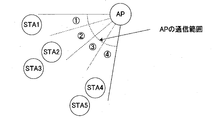
- FIG. 7 is a diagram illustrating a wireless system according to the third modification of the first embodiment.
- the wireless communication range of the communication apparatus AP includes STAs 1 to 5.
- the wireless communication range of the communication device AP is divided into four sectors 1 to 4.
- the communication device AP communicates with the communication device STA1 using the sector 1.
- the communication device AP communicates with the communication devices STA2 and STA3 using the sector 2.
- the communication device AP communicates with the communication devices STA4 and STA5 using the sector 4.
- the communication devices STA1 to STA5 grasp the directivity (for example, sector number) directed to the own station among the directivity of the communication device AP at the time of the authentication and connection processing.
- the sectors do not need to be clearly separated as physical directions as shown in FIG. 7, and communication devices with close directivity directions may be managed collectively as one sector.
- the communication periods SP1 to SP5 allocated to the communication devices STA1 to STA5 and the directivity of the communication device AP are set in the direction of the communication device to which the communication period is allocated.
- the retransmission periods 1 to 4 and the contention period, and the directivity of the communication apparatus AP need to be set in the direction of the communication apparatus that communicates using that period.
- step S101 in FIG. 2 When the communication devices STA1 to STA5 receive the schedule information (step S101 in FIG. 2), depending on which retransmission period 1 to 4 and the contention period, the directivity of the communication device AP becomes the direction of the own station. , Select the retransmission period to use.
- the communication device AP sets one or more communication devices that communicate using the same directivity as one group.
- the communication apparatus AP sets the communication apparatus STA1 as a group 1 (directivity: sector 1).
- the communication device AP sets the communication devices STA2, 3 as a group 2 (directivity: sector 2).
- the communication device AP sets the communication devices STA4, 5 as group 3 (directivity: sector 4).
- the terminal control unit 30 of the communication apparatus AP performs scheduling by setting the retransmission period of the communication apparatus belonging to the group after setting the communication period allocated to the communication apparatus belonging to the group. For example, after setting the communication period SP1 allocated to the communication device STA1 belonging to the group 1, the retransmission period 1 of the communication device STA1 belonging to the group 1 is set. Next, after setting the communication periods SP2 and SP3 allocated to the communication devices STA2 and STA3 belonging to the group 2, the retransmission periods 2 of the communication devices STA2 and STA3 belonging to the group 2 are set.
- the retransmission periods 3 of the communication devices STA4 and 5 belonging to the group 3 are set.
- the contention period and the retransmission period 4 that can be used by all the communication devices are set.
- the terminal control unit 30 of the communication apparatus AP can perform scheduling of the communication period, the retransmission period, and the contention period (similar to FIGS. 2 and 6).
- the communication device AP determines the direction of directivity in each retransmission period and the contention period. Since the retransmission period 1 may be used by the communication apparatus STA1 belonging to the group 1, the communication apparatus AP sets the directivity direction to the sector 1 in the retransmission period 1. Since the retransmission period 2 may be used by the communication devices STA 2 and 3 belonging to the group 2, the communication device AP sets the directivity direction to the sector 2 in the retransmission period 2. Since the retransmission period 3 may be used by the communication devices STA 4 and 5 belonging to the group 3, the communication device AP sets the direction of the retransmission period 3 and the directivity to the sector 4.
- the contention period and the retransmission period 4 may be used by all the communication devices STA1 to 5, the communication device AP has all directions of directivity in the retransmission period 4 and the contention period (sectors 1 to 4). I assume. Thus, the terminal control unit 30 of the communication device AP performs scheduling.
- the communication devices STA1 to STA5 receive the above scheduling information.
- the communication devices STA1 to 5 select the earliest retransmission period after the communication periods SP1 to 5 as a retransmission period to be used for frame retransmission. You may.
- the communication devices STA1 to 5 select the retransmission period as the retransmission period to be used for frame retransmission. Good.
- the communication apparatus STA2 selects to use the retransmission period 2 for frame retransmission.
- the schedule information may include, in addition to the information described in the first embodiment, information on the directivity of the communication apparatus AP at least in each of the retransmission periods 1 to 4 and the contention period.
- the communication devices STA1 to STA5 may select that a period in which the directivity of the communication device AP is the direction of the own station is used for frame retransmission.
- the terminal control unit 30 of the communication devices STA1 to STA5 uses the retransmission period to be used for frame retransmission according to the directivity of the communication device AP. Is selected, and only the retransmission period is in the operation mode, and the other retransmission periods are in the power saving mode. Therefore, retransmission processing occurs due to deterioration of the radio propagation environment, occurrence of an application data transmission request, and the like, and frame transmission is not completed in communication periods SP1 to SP5 allocated in advance by the communication device AP. Also, it is possible to perform timely retransmission processing while reducing power consumption.
- the terminal control unit 30 of the communication devices STA1 to 5 selects the retransmission period to be used first for the retransmission period to be used for frame retransmission and the retransmission period Power consumption can be reduced while suppressing occurrence of delay and improving throughput by switching to the operation mode only and the power saving mode during the other retransmission periods.
- the directivity of the communication apparatus AP indicates the locality of the local station
- the power saving mode can be set during an unintended retransmission period, and power consumption can be reduced without losing throughput.
- STA1, STA2, STA3, STA4, STA5, AP communication device
- 10 antenna
- 20 communication unit
- 30 terminal control unit
- 40 timer unit
- 50 schedule unit
- 60 application unit
Landscapes
- Engineering & Computer Science (AREA)
- Computer Networks & Wireless Communication (AREA)
- Signal Processing (AREA)
- Mobile Radio Communication Systems (AREA)
Abstract
Description
本発明は、通信装置に関するものである。 The present invention relates to a communication device.
アクセスポイントが各端末に対して“他の端末と競合せずに信号を送信することができる期間(非競合期間)”を割り当て(スケジューリング)、各端末が自身に割り当てられた非競合期間に起動する技術が開示されている(例えば、非特許文献1)。また、アクセスポイントが各端末に対して遅延許容期間が閾値以下のトラヒックを再送するための専用期間を割り当てる技術が開示されている(例えば特許文献1)。 Assign (scheduling) a period during which the access point can transmit a signal without contention with other terminals (non-contention period) to each terminal (scheduling), and each terminal starts up in the contention-free period assigned to itself Technology is disclosed (for example, Non-Patent Document 1). Also, a technique is disclosed in which an access point assigns a dedicated period for retransmitting traffic whose delay allowable period is equal to or less than a threshold to each terminal (for example, Patent Document 1).
しかし、アクセスポイントによって事前に“信号を送信することができる期間”(通信期間)が設定されるため、伝搬環境の劣化度合いによっては、各端末が送信に失敗した信号を再送する前に、通信期間が終了してしまう場合があった。このような場合、QoS(Quality of Service)要求を満足できないという問題があった。一方で、アクセスポイントが各端末に通信期間を動的に割り当てることとすると、各端末は、常に、通信期間を割り当てるための信号を待ちうける必要があり、消費電力を低減できないという問題があった。 However, since the “period in which the signal can be transmitted” (communication period) is set in advance by the access point, depending on the degree of degradation of the propagation environment, communication may be performed before each terminal retransmits the signal that failed to be transmitted. The period may have ended. In such a case, there is a problem that the QoS (Quality of Service) request can not be satisfied. On the other hand, assuming that the access point dynamically allocates a communication period to each terminal, there is a problem that each terminal must always wait for a signal for allocating a communication period, and power consumption can not be reduced. .
伝搬環境が変動したときにも適時に再送することができ、かつ消費電力を低減できる通信装置を提供することである。 The present invention is to provide a communication apparatus that can retransmit in a timely manner even when the propagation environment changes, and can reduce power consumption.
上記鑑みて、本発明の一実施の形態に係る通信装置は、信号を待ち受けるときの消費電力よりも、信号を待ち受けないときの消費電力が小さい通信装置であって、前記通信装置が信号を送信できる第1期間が記載された第1割当信号と、前記第1期間のあとであって前記通信装置を含む複数の通信装置が信号を送信できる第2期間が記載された第2割当信号とを受信する受信部と、前記第1期間に送信信号を送信する送信部と、信号を待ち受けない期間、前記受信部への電力供給を少なくとも一部遮断する遮断部とを備え、前記第1期間内に前記送信信号の送信が完了しない場合、前記送信部は、前記第2期間に前記送信信号を送信し、前記第1期間内に前記送信信号の送信が完了する場合、前記遮断部は、前記第2期間に前記受信部への電力供給の少なくとも一部を遮断することを特徴とする。 In view of the above, a communication apparatus according to an embodiment of the present invention is a communication apparatus which consumes less power when not waiting for a signal than the power consumption when waiting for a signal, and the communication apparatus transmits the signal. A first assignment signal in which a possible first period is described; and a second assignment signal after the first period in which a plurality of communication devices including the communication device can transmit signals. A receiving unit for receiving, a transmitting unit for transmitting a transmission signal in the first period, and a blocking unit for blocking at least a part of the power supply to the receiving unit during a period in which the signal is not awaited; When the transmission of the transmission signal is not completed, the transmission unit transmits the transmission signal in the second period, and when the transmission of the transmission signal is completed in the first period, the blocking unit In the second period, Characterized by blocking at least a portion of the force applied.
伝搬環境が変動したときにも適時に再送することができ、かつ消費電力を低減できる。 Even when the propagation environment changes, retransmission can be made in a timely manner, and power consumption can be reduced.
以下、無線LAN規格IEEE802.11を例として本発明の実施形態を説明する。なお、以下の実施形態は、無線通信方式全般に適用できる。 Hereinafter, embodiments of the present invention will be described by taking the wireless LAN standard IEEE 802.11 as an example. The following embodiments can be applied to the entire wireless communication system.
(第1の実施形態)
第1の実施形態に係る通信システムは、1つの基地局(以下、通信装置AP)と、5つの通信装置STA1~STA5を備える。通信装置AP、STA1~STA5は、無指向性(オムニ)の電波を用いて通信する。以下では、通信装置AP、STA1~STA5がそれぞれ送信した電波は、他のすべての通信装置へ到達する場合を例に説明する。通信装置AP、STA1~STA5が送信した電波が、その他の一部の通信装置のみへ到達することとしても良い。通信装置APは、集中制御方式(ポーリング方式)によって、通信装置STA1~STA5に送信権を付与する。なお、第1の実施形態におけるアクセス制御方式は、上記に限られず、分散制御方式(CSMA/CA方式)などであってもよい。
First Embodiment
The communication system according to the first embodiment includes one base station (hereinafter, communication apparatus AP) and five communication apparatuses STA1 to STA5. The communication devices AP and STA1 to STA5 communicate using nondirectional (omni) radio waves. In the following, radio waves transmitted by the communication devices AP and STA1 to STA5 will be described by way of an example where they reach all other communication devices. The radio waves transmitted by the communication devices AP and STA1 to STA5 may reach only some of the other communication devices. The communication apparatus AP grants a transmission right to the communication apparatuses STA1 to STA5 by a central control method (polling method). The access control method in the first embodiment is not limited to the above, and may be a distributed control method (CSMA / CA method) or the like.
図1は、第1の実施形態の通信装置STA1を示すブロック図である。なお、通信装置AP、STA2~STA5も同様である。通信装置STA1は、アンテナ10と、通信部20と、端末制御部30と、タイマ部40と、スケジュール部50と、アプリケーション部60とを有する。通信装置STA1には、2つの動作モードがある。消費電力は大きいが信号(フレーム)を受信できる通信モードと、フレームを受信できないが通信モードよりも消費電力が小さい省電力モードである。省電力モードでは、少なくとも通信部20の一部(少なくとも受信処理関連)への電力供給を削減・停止するか、タイマ部によるタイマ入力かアプリケーション部からのデータ発生を、省電力モードから通信モードへ移行する為のトリガとして認識して通常モードへ移行するのに必要な部分へ電力を供給し、他の部分の電力供給を削減・停止すればよい。
FIG. 1 is a block diagram showing the communication apparatus STA1 of the first embodiment. The same applies to communication devices AP and STA2 to STA5. The communication device STA1 includes an
通信部20は、アンテナ10を用いて、フレームの送受信処理を行う。通信部20は、周波数変換処理やA/D変換処理などの物理層関連の処理を行う。通信部20は、動作モードのときに、フレームの送信、受信、待ち受けを行う。
The
端末制御部30は、無線通信のためのMAC層関連の処理を行う。端末制御部30は、動作モードを制御する。端末制御部30は、フレームの送信、受信、待ち受けを行わないときに、省電力モードへ移行する。端末制御部30は、省電力モードのときに、通信部20とスケジュール部50への電源供給を遮断する。端末制御部30は、無線通信のための上位層(アプリケーション層除く)の処理を行う。
The
タイマ部40は、省電力モードのときに、省電力モードから通信モードへ変更する時刻までをカウントする。タイマ部40は、自局に割り当てられた通信期間が開始する時刻や、報知信号(例えば、Beacon信号)が送信される時刻までをカウントする。省電力モードでは、タイマ部40のみが起動する。タイマ部40からの通知をトリガに、端末制御部30は起動し、省電力モードから通信モードへ移行する。
In the power saving mode, the
スケジュール部50は、スケジュール情報(自局あるいは各端末の通信期間)を記憶する。スケジュール情報とは、1つ以上の通信装置が信号の送信または受信ができる通信期間を定める情報である。スケジュール情報では、上記通信期間について、通信装置STA1~5が通信装置APへ信号を送信する期間か(Uplink)、通信装置APが通信装置STA1~5へ信号を送信する期間か(Downlink)、通信装置STA1~5のそれぞれの間で信号を送信する時間か(DirectLink)、が定められても良い。スケジュール情報には、通信期間が、他の端末と競合して信号を送信することができる期間か(競合期間)か、他の端末と競合せずに信号を送信することができる期間(非競合期間)かについて、記載されても良い。
The
スケジュール情報は、通信装置APによって定められる。端末制御部30は、スケジュール部50が記憶するスケジュール情報を読み出し、通信処理及び動作モードの制御を行う。スケジューリングは、通信装置APによって行われる。通信装置STA1~STA5は、通信装置APから通信期間(スケジュール情報)の通知を受ける。
The schedule information is determined by the communication device AP. The
アプリケーション部60は、アプリケーション層関連の処理を行う。省電力モードのときにアプリケーション部60で送信データが発生した場合、アプリケーション部60からの通知をトリガに、端末制御部30は起動し、省電力モードから通信モードへ移行する。
The
図2は、スケジュール情報と通信装置STA1、STA2の消費電力の時間変化を模式的に示す図である。通信期間SPn(nは1~5の整数)は、通信装置STAnに割り当てられた通信期間である。再送期間1~4、競合期間は、すべての通信装置STA1~5が使用できる。再送期間1~4では、各通信装置は、自局に割り当てられた通信期間SPnにおける通信が完了しない場合に、再送を行う。競合期間では、各通信装置がフレームの再送を行ってもよく、新たなフレームの送信を行っても良い。再送期間1~4、競合期間では、各通信装置は既定のアクセス制御方式に従い送信権を獲得してからフレームの送信を開始する。競合期間では、各通信装置はCSMA/CAによって送信権を獲得する。スケジュール情報は、通信装置APから送信される報知信号、またはその後のスケジュール通知期間に送信されるスケジュール信号に記載される。
FIG. 2 is a diagram schematically showing time change of schedule information and power consumption of the communication devices STA1 and STA2. The communication period SPn (n is an integer of 1 to 5) is a communication period assigned to the communication apparatus STAn.
通信装置STA1、STA2の消費電力が高い期間は通信モードである。通信装置STA1、STA2の消費電力が低い期間は省電力モードである。通信モードのとき、送信処理中、受信処理中、待ち受け中のそれぞれで電力消費量は若干異なるが、図2では、細かな消費電力の差異を省略している。 A period in which the power consumption of the communication devices STA1 and STA2 is high is a communication mode. A period in which the power consumption of the communication devices STA1 and STA2 is low is a power saving mode. In the communication mode, during the transmission processing, during the reception processing, and during the standby processing, the power consumption differs slightly, but in FIG. 2, the difference in the detailed power consumption is omitted.
図2の例では、通信装置STA1は、報知信号の受信期間、それに続くスケジュール通知期間、自局に割り当てられた通信期間SP1、および全通信装置が通信可能な競合期間を通信モードとし、それ以外の期間を省電力モードとする。図2の例では、通信装置STA2は、報知信号の受信期間、それに続くスケジュール通知期間、自局に割り当てられた通信期間SP2、再送期間2、3、4、および全通信装置が通信可能な競合期間を通信モードとし、それ以外の期間を省電力モードとする。通信装置STA1、2が、再送期間1~4を通信モードとするか否かは、通信期間SP1、SP2の通信結果に応じて定められる。
In the example of FIG. 2, the communication device STA1 sets the reception period of the broadcast signal, the schedule notification period following it, the communication period SP1 allocated to the own station, and the contention period in which all communication devices can communicate as the communication mode. Power saving mode. In the example of FIG. 2, the communication apparatus STA2 receives the broadcast signal reception period, the schedule notification period following it, the communication period SP2 assigned to the own station, the
図3は、通信装置STA1、STA2の動作を示すフローチャート図である。まず、通信装置STA1~STA5は、最初に起動した後、通信装置APと認証処理やAssociation処理といった接続設定を行う。接続設定後、通信装置STA1は、通信装置APからの報知信号を待ちうけ、受信する。通信装置STA1は、報知信号に記載された情報によって同期処理等を行う。 FIG. 3 is a flowchart showing the operation of the communication devices STA1 and STA2. First, after the communication devices STA1 to STA5 are first activated, they perform connection settings with the communication device AP such as authentication processing and association processing. After setting the connection, the communication apparatus STA1 waits for and receives a broadcast signal from the communication apparatus AP. The communication device STA1 performs synchronization processing and the like according to the information described in the notification signal.
次に、通信装置STA1は、通信装置APから、スケジュール情報を受信する(ステップS101)。通信装置STA1は、スケジュール通知期間に、通信装置APから、スケジュール信号(スケジュール情報)を受信する。通信装置STA1がスケジュール通知期間に受信するスケジュール信号は、複数のフレームであっても良い。通信装置STA1は、スケジュール信号を受信せずに、スケジュール情報が記載された報知信号を受信しても良い。通信装置STA1のスケジュール部50は、スケジュール情報を記憶する。各通信装置STA1~STA5への通信期間の割り当て結果(スケジュール情報)は、通信装置APによって生成される。通信装置APがスケジューリングするに当たって必要な情報、例えば、通信装置STA1のアプリケーションに必要な帯域情報やデータ通信量、遅延許容時間などは、事前に通信装置APへ通知されても良い。
Next, the communication device STA1 receives schedule information from the communication device AP (step S101). The communication device STA1 receives a schedule signal (schedule information) from the communication device AP in the schedule notification period. The schedule signal received by the communication apparatus STA1 in the schedule notification period may be a plurality of frames. The communication apparatus STA1 may receive the broadcast signal in which the schedule information is described without receiving the schedule signal. The
次に、通信装置STA1の端末制御部30は、自局の通信期間SP1の開始時刻よりも所定期間前まで省電力モードとなる(ステップS102)。通信装置STA1が省電力モードとなると、タイマ部40は、通信期間SP1の開始時刻よりも所定期間前までの期間をカウントする。タイマ部40は、通信期間SP1の開始時刻よりも、通信の準備に要する期間(準備期間)だけ短い期間をカウントしても良い。タイマ部40は、カウントが終了すると、端末制御部30を起動させる。端末制御部30は、起動した後、通信モードへ移行する。端末制御部30は、スケジュール部50からスケジュール情報を読み出す。端末制御部30は、通信期間SP1にフレームの送受信を行うため、通信部20を起動する。端末制御部30は、通信期間SP1にフレームの送信を行う際に、アプリケーション部60を起動させても良い。
Next, the
次に、通信装置STA1は、通信期間SP1に、フレームを送信または受信する。そして、通信装置STA1は、通信期間SP1にフレームの通信が完了したかを判定する(ステップS103)。 Next, the communication device STA1 transmits or receives a frame in the communication period SP1. Then, the communication apparatus STA1 determines whether the communication of the frame is completed in the communication period SP1 (step S103).
通信装置APからフレームを受信する場合、通信装置STA1の端末制御部30は、フレームの受信結果から再送処理を行うか否かを判定する。端末制御部30は、再送が発生した場合に通信が完了したと判定する。端末制御部30は、再送が発生した場合に通信が完了していないと判定する。
When receiving a frame from the communication apparatus AP, the
通信装置APへフレームを送信する場合、通信装置STA1の端末制御部30は、通信装置APからの送達確認フレームから再送処理を行うか否かを判定する。端末制御部30は、再送処理が行われたか否か、アプリケーション部60に蓄積された送信データの量に応じて、通信が完了したか否かを判定する。
When transmitting a frame to the communication device AP, the
ここで、通信装置STA1は、通信期間SP1にフレームの通信が完了したものとする(ステップS103の“はい”)。通信装置STA1は、通信期間SP1にフレームの通信が完了したため、再送期間1、2、3、4も省電力モードとなる。通信装置STA1は、新たなフレームを送信できる競合期間に、通信モードとなる。これ以降、通信装置STA1は、自局が通信する通信期間に通信モードとなり、自局が通信する通信期間以外に低消費モードとなることを繰り返す。自局が通信する通信期間とは、例えば、競合期間や、報知信号の通信期間、スケジュール通知期間、自局に割り当てられる通信期間、通信期間にフレームの通信が完了しなかった場合の再送期間などである。
Here, it is assumed that the communication apparatus STA1 completes the communication of the frame in the communication period SP1 (“YES” in step S103). Since communication of the frame is completed in the communication period SP1, the communication device STA1 also enters the power saving mode in the
このように、通信装置STA1は、自局に割り当てられた通信期間SP1に通信を行うとともに、再送処理が不要な場合は再送期間を起動せず省電力モードとなることで、消費電力を低減することができる。 As described above, the communication apparatus STA1 performs communication in the communication period SP1 allocated to the own station, and reduces power consumption by switching to the power saving mode without activating the retransmission period when the retransmission process is unnecessary. be able to.
次に、図2、図3を用いて、通信装置STA2の動作を説明する。ステップS101、S102については同様である。ここで、通信装置STA2の端末制御部30が、通信期間SP2にフレームの通信が完了しなかったと判定したものとする(ステップS103の“いいえ”)。
Next, the operation of the communication apparatus STA2 will be described using FIG. 2 and FIG. The same applies to steps S101 and S102. Here, it is assumed that the
次に、通信装置STA2の端末制御部30は、報知信号やスケジュール信号によって次に自局に割り当てられる通信期間SP2や競合期間よりも前に、再送期間を用いて再送処理を行うか否かを判定する(ステップS104)。通信装置STA2の端末制御部30は、通信期間SP2にフレームの通信が完了しなかった場合に、再送期間を用いた再送処理を行うと判定してもよい。端末制御部30は、通信期間SP2にフレームの通信が完了しなかった場合であって、そのフレームの遅延許容時間の残り時間が閾値以下の場合に、再送期間を用いた再送処理を行うと判定してもよい。この閾値は、次の通信期間SP2の開始時刻あるいは終了時刻までの期間であってもよい。ここで、通信装置STA2は、再送期間を用いて再送処理を行うと判定したものとする(ステップS104の“はい”)。
Next, the
次に、通信装置STA2の端末制御部30は、再送期間2の開始時刻より所定期間前まで省電力モードとなる(ステップS105)。タイマ部40によるカウントが終了すると、端末制御部30は通信モードへ移行する。そして、通信装置STA2は、通信装置APからのポーリング信号を受信するか、CSMA/CAによって送信権を獲得した上で、再送期間2を用いて、再送処理を行う。
Next, the
図2の例では、通信装置STA2は、再送期間2~4、競合期間を用いても、再送が完了しない(ステップ106の“いいえ”)。そのため、通信装置STA2は、再送期間2~5、競合期間に通信モードとなる。これ以降、通信装置STA2は、自局が通信する通信期間に通信モードとなり、自局が通信する通信期間以外に低消費モードとなることを繰り返す。
In the example of FIG. 2, the communication apparatus STA2 does not complete the retransmission even if the
通信装置STA2の端末制御部30は、再送期間2~5のそれぞれが終了し、再送が完了しなかったと判定される(S106の“いいえ”)たびに、次の再送期間を用いて再送処理を試みるか否かを判定しても良い。端末制御部30は、通信期間SP2の終了時刻から経過した時間が遅延許容時間を超過していない場合に、再送期間を用いた再送処理を行うと判定してもよい。
The
このように、通信装置STA2は、無線の伝搬環境の劣化やアプリケーションのデータ送信要求の発生状況等によって再送処理が発生し、通信装置APによって予め割り当てられた通信期間SP2にフレームの送信が完了しない場合であっても、消費電力を低減させながら、適時な再送処理を行うことができる。 As described above, the communication apparatus STA2 does not complete frame transmission in the communication period SP2 assigned in advance by the communication apparatus AP because the retransmission processing occurs due to the deterioration of the radio propagation environment or the occurrence of the data transmission request of the application. Even if this is the case, timely retransmission processing can be performed while reducing power consumption.
(変形例1)
第1の実施形態に係る通信装置STA1~5、APは、一時的に通信を行わない期間が発生したときに接続を維持するため、報知信号及びマネジメントフレーム(管理信号)を通信することができる。通信装置STA1~5、APは、通信相手と、認証処理等の接続処理を行った上で通信する。その後、通信を一時的に行わない場合、通信装置STA1~5、APは、通信相手との接続状況を維持するために、既定の間隔を置いて、報知信号による同期処理と管理信号による接続維持の確認を行う。通信装置STA1~5は、報知信号及び管理信号を通信するときに通信モードとなり、それ以内の期間は省電力モードとなる。
(Modification 1)
The communication devices STA1 to STA5 and AP according to the first embodiment can communicate the notification signal and the management frame (management signal) in order to maintain the connection when the period when the communication is not temporarily performed occurs. . The communication devices STA1 to STA5, AP communicate with the communication partner after performing connection processing such as authentication processing. After that, when communication is not performed temporarily, the communication devices STA1 to STA5, AP keep a predetermined interval in order to maintain the connection status with the communication partner, and maintain the connection processing by the synchronization processing by the notification signal and the management signal. Check the The communication devices STA1 to STA5 are in the communication mode when communicating the notification signal and the management signal, and are in the power saving mode for the period within that.
図4は、スケジュール情報と通信装置STA1の消費電力の時間変化を模式的に示す図である。図4は、正常時(報知信号、管理信号ともに受信に成功した場合)、エラー発生時(報知信号、管理信号の受信に失敗した場合)、クロックずれ時(端末が想定するタイミングに報知信号の受信ができなかった場合)における通信装置STA1の消費電力を示す。 FIG. 4 is a diagram schematically showing time change of schedule information and power consumption of the communication apparatus STA1. Figure 4 is normal (when both the notification signal and the management signal are successfully received), when an error occurs (when the notification signal and the management signal fail to be received), when the clock deviates (at the timing assumed by the terminal) 7 shows the power consumption of the communication apparatus STA1 in the case where it can not be received.
第1の実施形態と相異し、報知信号の通信期間の後には、スケジュール通知期間ではなく、マネジメント通信期間が設定される。マネジメント通信期間は、通信装置STA1~5、APが、管理信号を通信するための期間である。再送期間は、通信装置STA1~5、APが、管理信号を再送するための期間である。待受期間は、通信装置STA1~5が、報知信号の受信に失敗したときに、次の報知信号の受信を行うために待ち受けを行う期間である。 Unlike the first embodiment, after the communication period of the notification signal, a management communication period is set instead of the schedule notification period. The management communication period is a period for the communication devices STA1 to STA5 and AP to communicate a management signal. The retransmission period is a period for the communication devices STA1 to STA5 and AP to retransmit the management signal. The waiting period is a period in which the communication devices STA1 to STA5 wait to receive the next broadcast signal when the communication devices STA1 to 5 fail to receive the broadcast signal.
図5は、通信装置STA1の動作を示すフローチャートである。通信装置STA1は、報知信号を受信することでクロックの同期処理を行い、管理信号を交換することで接続の維持を行う。 FIG. 5 is a flowchart showing the operation of the communication device STA1. The communication apparatus STA1 performs clock synchronization processing by receiving the notification signal, and maintains the connection by exchanging the management signal.
(正常時)通信装置APからの報知信号の受信に成功した場合(ステップS201の“はい”)であって、かつ、管理信号の受信に成功した場合(ステップS202の“はい”)、通信装置STA1と通信相手の接続状態は維持される(ステップS203)。通信装置STA1の端末制御部30は、図5の“正常時”に示すように、報知信号の受信期間及びマネジメント通信期間に通信モードとなり、それ以外の期間に省電力モードとなる。
(Normally) If the reception of the notification signal from the communication device AP is successful ("Yes" in step S201) and the reception of the management signal is successful ("Yes" in step S202), the communication device The connection state between the STA1 and the communication partner is maintained (step S203). The
(管理信号エラー時)通信装置APからの報知信号の受信に成功した場合(ステップS201の“はい”)であって、かつ、管理信号の受信に失敗した場合(ステップS202の“いいえ”)、通信装置STA1は、マネジメント通信期間のあとに設定された再送期間に、管理信号の受信を試みる(ステップS204)。再送期間に管理信号の受信に成功した場合(ステップS204の“はい”)、通信装置STA1と通信相手の接続状態は維持される(ステップS203)。一方で、再送期間に管理信号の受信に失敗した場合(ステップS204の“いいえ”)、通信装置STA1と通信相手の接続状態は切断される(ステップS205)。マネジメント通信期間及び再送期間における管理信号の受信失敗が複数回連続した(あるいは一定期間連続した)場合に、通信装置STA1と通信相手の接続状態が切断されることとしても良い。通信装置STA1の端末制御部30は、報知信号の受信期間、マネジメント通信期間、及び再送期間に通信モードとなり、それ以外の期間に省電力モードとなる。
(At the time of management signal error) If the reception of the notification signal from the communication device AP is successful ("Yes" at step S201) and if the reception of the management signal fails ("No" at step S202), The communication apparatus STA1 attempts to receive the management signal in the retransmission period set after the management communication period (step S204). When the management signal is successfully received in the retransmission period ("Yes" in step S204), the connection state between the communication apparatus STA1 and the communication partner is maintained (step S203). On the other hand, when reception of the management signal fails in the retransmission period (“NO” in step S204), the connection state between the communication apparatus STA1 and the communication partner is disconnected (step S205). The connection state between the communication apparatus STA1 and the other party of communication may be disconnected when reception failure of the management signal in the management communication period and the retransmission period is continuous for a plurality of times (or for a predetermined period). The
(報知信号エラー時)通信装置APからの報知信号の受信に失敗した場合(ステップS201の“いいえ”)、通信装置STA1は、次の報知信号の通信期間の前に設定された待受期間から通信モードとなって待ち受け、次の報知信号の受信を試みる(ステップS206)。待受期間等に報知信号及び管理信号の受信に成功した場合(ステップS206の“はい”)、通信装置STA1と通信相手の接続状態は維持される(ステップS203)。一方で、待受期間等に報知信号を受信できなかった場合(ステップS206の“いいえ”)、通信装置STA1と通信相手の接続状態は切断される(ステップS207)。待受期間及び報知信号の通信期間における報知信号の受信失敗が複数回連続した(あるいは一定期間連続した)場合に、通信装置STA1と通信相手の接続状態は切断されることとしても良い。このとき、通信装置STA1は、通信相手と通信不能な状態であるとして、認証情報やアソシエーション情報などの接続情報を破棄する。通信装置STA1の端末制御部30は、図5の“報知信号エラー時”に示すように、報知信号の受信期間、マネジメント通信期間、報知信号の受信に失敗した後の待受期間に通信モードとなり、それ以外の期間に省電力モードとなる。なお、図5の“報知信号エラー時”では、通信装置STA1が管理信号の受信に失敗したものとして、再送期間も通信モードとなる例を示す。
(At the time of a notification signal error) When reception of a notification signal from the communication device AP fails (“No” in step S201), the communication device STA1 starts from the standby period set before the communication period of the next notification signal. The communication mode is awaited, and reception of the next broadcast signal is attempted (step S206). When the notification signal and the management signal are successfully received during the standby period or the like (“YES” in step S206), the connection state between the communication apparatus STA1 and the communication partner is maintained (step S203). On the other hand, when the notification signal can not be received in the standby period or the like (“NO” in step S206), the connection state between the communication apparatus STA1 and the communication partner is disconnected (step S207). The connection state between the communication apparatus STA1 and the other party of communication may be disconnected when reception failure of the broadcast signal in the standby period and the communication period of the broadcast signal continues a plurality of times (or continues for a fixed period). At this time, the communication apparatus STA1 discards connection information such as authentication information and association information on the assumption that communication with the communication partner is not possible. The
(クロックずれ時)報知信号は通信装置APによって既定の間隔を置いて送信されるものの、通信装置STA1~5と通信装置APとで経過期間の計測結果にずれが生じることがある。通信装置STA1が報知信号の通信期間と想定するタイミングは、図5の“端末の想定”において破線で囲まれた報知信号で示される。通信装置APが報知信号を実際に送信したタイミングは、図5の実線で囲まれた報知信号で示される。1つ目の報知信号の通信期間では、通信装置STA1とAPとの間で双方のクロックが合致しており、通信装置STA1は、報知信号の受信に成功する。2つ目の報知信号の通信期間では、通信装置STA1が想定する報知信号の通信期間が、実際の報知信号の通信期間よりも大幅に遅い。そのため、通信装置APによって報知信号が送信される期間、通信装置STA1は、省電力モードであるため、報知信号の受信に失敗する(ステップS201の“いいえ”)。次に、通信装置STA1は、(報知信号エラー時)と同様に、次の報知信号の通信期間の前に設定された待受期間から通信モードとなって待ち受け、次の報知信号の受信を試みる(ステップS206)。 Although the notification signal is transmitted at predetermined intervals by the communication device AP, there may be a difference in the measurement result of the elapsed period between the communication devices STA1 to STA5 and the communication device AP. The timing that the communication apparatus STA1 assumes as the communication period of the notification signal is indicated by the notification signal surrounded by a broken line in "assume terminal" in FIG. The timing at which the communication device AP actually transmitted the notification signal is indicated by the notification signal surrounded by the solid line in FIG. During the communication period of the first broadcast signal, the clocks of the communication device STA1 and the AP coincide with each other, and the communication device STA1 succeeds in receiving the broadcast signal. In the communication period of the second notification signal, the communication period of the notification signal assumed by the communication device STA1 is much later than the communication period of the actual notification signal. Therefore, since the communication apparatus STA1 is in the power saving mode during a period in which the notification signal is transmitted by the communication apparatus AP, the reception of the notification signal fails (“NO” in step S201). Next, as in the case of a notification signal error, the communication apparatus STA1 waits in the communication mode from the standby period set before the communication period of the next notification signal, and tries to receive the next notification signal. (Step S206).
このようにすることで、たとえ通信装置STA1と通信装置APとの間でクロックにずれが発生したとしても、図5の3つ目の報知信号の通信期間では通信装置STA1は信号を待ち受ける状態にあるため、消費電力を低減させながら、正常に報知信号を受信できクロックの同期処理を行うことができる。 By doing this, even if a clock shift occurs between the communication apparatus STA1 and the communication apparatus AP, the communication apparatus STA1 waits for a signal during the communication period of the third notification signal of FIG. Because of this, while reducing the power consumption, the notification signal can be received normally and the clock synchronization processing can be performed.
(変形例2)
第1の実施形態に係る通信装置STA1~5は、自局に割り当てられた期間SP1~5に通信が完了しなかった場合、再送期間1~4のうち選択した再送期間のみを再送に使用することとすることができる。
(Modification 2)
The communication devices STA1 to STA5 according to the first embodiment use only the selected retransmission period of the
図6は、スケジュール情報と通信装置STA1~5の消費電力の時間変化を模式的に示す図である。図6に示すスケジュール情報は、第1の実施形態に係るスケジュール情報(図2)と同様である。 FIG. 6 is a diagram schematically showing time change of schedule information and power consumption of the communication devices STA1 to STA5. The schedule information shown in FIG. 6 is the same as the schedule information (FIG. 2) according to the first embodiment.
スケジュール情報を受信した後(図3のステップ101)、通信装置STA1~5の端末制御部30は、再送期間1~5のうち、フレームの再送に使用する再送期間の候補を選択する。通信装置STA1~5の端末制御部30は、自局に割り当てられた通信期間SP1~5のあと最先に設定された再送期間を、フレームの再送に使用する再送期間の候補として選択する。通信装置STA1~5の端末制御部30は、競合期間の直後に設定された再送期間を、フレームの再送に使用する再送期間の候補として選択する。通信装置STA1~5の端末制御部30は、競合期間を、フレームの再送に使用する再送期間の候補として選択する。
After receiving the schedule information (step 101 in FIG. 3), the
再送期間1は、通信装置STA1が通信期間SP1に通信が完了しなかった場合、通信装置STA1によって、ポーリング方式によるアクセス制御の下、フレームの再送に使用される。再送期間1では、通信装置STA2~4は省電力モードである。
The
再送期間2は、通信装置STA2、3が通信期間SP2、3に通信が完了しなかった場合、通信装置STA2、3によって、ポーリング方式によるアクセス制御の下、フレームの再送に使用される。再送期間2では、通信装置STA1、4、5は省電力モードである。
The
再送期間3は、通信装置STA4、5が通信期間SP4、5に通信が完了しなかった場合、通信装置STA4、5によって、ポーリング方式によるアクセス制御の下、フレームの再送に使用される。(図6では、通信装置STA4は通信期間SP4に通信が完了した例を示す。)再送期間3では、通信装置STA1~4は省電力モードである。
The
競合期間は、自局に割り当てられた通信期間及びその再送期間を使用したにも関わらず、通信が完了しなかった通信装置(図6の例では、STA1、2、5)によって、CSMA/CA方式によるアクセス制御の下、フレームの再送に使用される。競合期間では、通信装置STA3、4は省電力モードである。
The contention period is determined by the CSMA / CA by the communication apparatus (
再送期間4は、競合期間の直後に設定された再送期間である。再送期間4は、自局に割り当てられた通信期間、その再送期間、及び競合期間に通信が完了しなかった通信装置(図6の例では、STA1、2、5)によって、ポーリング方式によるアクセス制御の下、フレームの再送に使用される。再送期間4では、通信装置STA3、4は省電力モードである。
The
再送期間5は、次の報知信号が送信された後、次のスケジュール情報で各通信端末へ割り当てられる通信期間が設定される前に、設定される再送期間である。再送期間5は、自局に割り当てられた通信期間、その再送期間、及び競合期間に通信が完了しなかった通信装置(図6の例では、STA1、5)によって、ポーリング方式によるアクセス制御の下、フレームの再送に使用される。再送期間5では、通信装置STA2~4は省電力モードである。
The retransmission period 5 is a retransmission period that is set after the next broadcast signal is transmitted and before the communication period assigned to each communication terminal is set by the next schedule information. Retransmission period 5 is under the access control based on the polling method by the communication device (
このように、通信装置STA1~5の端末制御部30は、スケジュール情報で設定された複数の再送期間1~5のうち、フレームの再送に使用する再送期間を選択してその再送期間のみ動作モードとなり、それ以外の再送期間に省電力モードとなる。このため、無線の伝搬環境の劣化やアプリケーションのデータ送信要求の発生状況等によって再送処理が発生し、通信装置APによって予め割り当てられた通信期間SP1~5にフレームの送信が完了しない場合であっても、消費電力を低減させながら、適時な再送処理を行うことができる。フレームの再送が完了しない限り、スケジュール情報で設定された再送期間1~5すべてを起動して通信モードとなる必要が無くなり、電力消費量を削減する事ができる。
As described above, the
スケジュール情報で設定された再送期間でも再送処理が完了しない場合、競合期間に起動して再送処理を行うと共に、その後の再送期間4と再送期間5に起動して再送処理を行うことができる。このようにすることで、該当データの遅延期間の許容量をオーバーするまで再送処理を行い続ける事ができる。
When the retransmission process is not completed even in the retransmission period set by the schedule information, the activation can be performed in the contention period to perform retransmission processing, and can be activated in the
通信装置STA1~5の端末制御部30が自局に割り当てられた通信期間SP1~5の後、最先に設定される再送期間を、フレームの再送に使用する再送期間を選択してその再送期間のみ動作モードとなり、それ以外の再送期間に省電力モードとなることで、遅延の発生を抑制するとともにスループットを向上しながら、消費電力を低減できる。
After the communication periods SP1 to SP5 allocated to the own station, the
通信装置STA1~5の端末制御部30が自局に割り当てられた通信期間SP1~5の後、最先に設定される再送期間でも、フレームの再送処理が完了しなかった場合に、更に競合期間と競合期間の直後に設定される再送期間を、フレームの再送に使用する再送期間を選択して動作モードとなり、再送処理が完了している場合には競合期間と競合期間の直後に設定される再送期間に省電力モードとなることで、再送処理の発生状況に応じて動作させ、消費電力を低減することができる。
After the communication periods SP1 to SP5 in which the
<変形例3>
以上の実施形態では、通信装置STA1~5、APは、無指向性(オムニ)の電波を使用して通信するものとした。しかし、通信装置STA1~5、APは、指向性の電波を使用して通信することができる。
<
In the above embodiments, the communication devices STA1 to STA5 and the AP communicate using nondirectional (omni) radio waves. However, the communication devices STA1 to STA5 and AP can communicate using directional radio waves.
図7は、第1の実施形態の変形例3に係る無線システムを示す図である。通信装置APの無線の通信範囲は、STA1~5を含む。通信装置APの無線の通信範囲は、4つのセクタ1~4に分割される。通信装置APはセクタ1を用いて通信装置STA1と通信する。通信装置APはセクタ2を用いて通信装置STA2、3と通信する。通信装置APはセクタ4を用いて通信装置STA4、5と通信する。通信装置STA1~5は、認証・接続処理の際、通信装置APの指向性のうち自局向きの指向性(例えば、セクタ番号)を把握する。但し、各セクタは、図7に示すように物理的な方向として明確に分かれている必要はなく、指向性の方向が近しい通信装置をまとめて1つのセクタとして管理してもよい。
FIG. 7 is a diagram illustrating a wireless system according to the third modification of the first embodiment. The wireless communication range of the communication apparatus AP includes STAs 1 to 5. The wireless communication range of the communication device AP is divided into four
各通信装置STA1~5に割り当てられる通信期間SP1~5、通信装置APの指向性は、通信期間が割り当てられた通信装置の方向へ設定される。再送期間1~4及び競合期間、通信装置APの指向性は、その期間を使用して通信を行う通信装置の方向へ設定される必要がある。
The communication periods SP1 to SP5 allocated to the communication devices STA1 to STA5 and the directivity of the communication device AP are set in the direction of the communication device to which the communication period is allocated. The
通信装置STA1~5は、スケジュール情報を受信(図2のステップS101)したとき、いずれの再送期間1~4及び競合期間で、通信装置APの指向性が自局の方向となるかに応じて、使用する再送期間を選択する。
When the communication devices STA1 to STA5 receive the schedule information (step S101 in FIG. 2), depending on which
通信装置STA1~5が、変形例2で示す方法によって、フレームの再送を行う再送期間を選択する例で、以下、通信装置APのスケジューリング方法を説明する。通信装置APは、同一の指向性を用いて通信する1つ以上の通信装置を、1つのグループと設定する。通信装置APは、通信装置STA1をグループ1(指向性:セクタ1)とする。通信装置APは、通信装置STA2、3をグループ2(指向性:セクタ2)とする。通信装置APは、通信装置STA4、5をグループ3(指向性:セクタ4)とする。 In the example in which the communication apparatuses STA1 to STA5 select a retransmission period in which frame retransmission is performed according to the method described in the second modification, a scheduling method of the communication apparatus AP will be described below. The communication device AP sets one or more communication devices that communicate using the same directivity as one group. The communication apparatus AP sets the communication apparatus STA1 as a group 1 (directivity: sector 1). The communication device AP sets the communication devices STA2, 3 as a group 2 (directivity: sector 2). The communication device AP sets the communication devices STA4, 5 as group 3 (directivity: sector 4).
通信装置APの端末制御部30は、あるグループに属する通信装置に割り当てられる通信期間を設定した後、そのグループに属する通信装置の再送期間を設定することで、スケジューリングを行う。例えば、グループ1に属する通信装置STA1に割り当てられる通信期間SP1を設定した後、そのグループ1に属する通信装置STA1の再送期間1を設定する。その次に、グループ2に属する通信装置STA2、3に割り当てられる通信期間SP2、3を設定した後、そのグループ2に属する通信装置STA2、3の再送期間2を設定する。その次に、グループ3に属する通信装置STA4、5に割り当てられる通信期間SP4、5を設定した後、そのグループ3に属する通信装置STA4、5の再送期間3を設定する。すべてのグループについて通信期間と再送期間を設定した後、すべての通信装置が使用可能な競合期間及び再送期間4を設定する。このようにすることで、通信装置APの端末制御部30は、通信期間、再送期間、および競合期間(図2、図6と同様)のスケジューリングを行うことできる。
The
そして、通信装置APは、各再送期間、競合期間における指向性の方向を決定する。再送期間1は、グループ1に属する通信装置STA1によって使用される可能性があるため、通信装置APは、再送期間1において指向性の方向をセクタ1とする。再送期間2は、グループ2に属する通信装置STA2、3によって使用される可能性があるため、通信装置APは、再送期間2において指向性の方向をセクタ2とする。再送期間3は、グループ3に属する通信装置STA4、5によって使用される可能性があるため、通信装置APは、再送期間3、指向性の方向をセクタ4とする。競合期間及び再送期間4は、すべての通信装置STA1~5によって使用される可能性があるため、通信装置APは、再送期間4及び競合期間における指向性の方向を全方向(セクタ1~4)とする。このようにして、通信装置APの端末制御部30は、スケジューリングを行う。
Then, the communication device AP determines the direction of directivity in each retransmission period and the contention period. Since the
次に、各通信装置STA1~5の動作を説明する。通信装置STA1~5は、上記のスケジューリング情報を受信する。 Next, the operation of each of the communication devices STA1 to STA5 will be described. The communication devices STA1 to STA5 receive the above scheduling information.
通信装置STA1~5は、自局に割り当てられた通信期間SP1~5に通信が完了しない場合、通信期間SP1~5のあとで最先の再送期間を、フレームの再送に使用する再送期間として選択しても良い。 If communication is not completed in the communication periods SP1 to SP5 assigned to the own station, the communication devices STA1 to 5 select the earliest retransmission period after the communication periods SP1 to 5 as a retransmission period to be used for frame retransmission. You may.
通信装置STA1~5は、再送期間の前(直前)の期間における通信装置APの指向性が自局の方向である場合に、その再送期間をフレームの再送に使用する再送期間として選択してもよい。例えば、通信装置STA2は、再送期間2の前(直前)の通信期間SP3における通信装置APの指向性が自局の方向であるので、再送期間2をフレームの再送に使用すると選択する。
When the directivity of the communication apparatus AP in the period before (immediately before) the retransmission period is the direction of the own station, the communication devices STA1 to 5 select the retransmission period as the retransmission period to be used for frame retransmission. Good. For example, since the directivity of the communication apparatus AP in the communication period SP3 before (immediately) the
スケジュール情報には、第1の実施形態で説明した情報に加え、少なくとも再送期間1~4及び競合期間のそれぞれにおける通信装置APの指向性についての情報が記載されても良い。このとき、通信装置STA1~5は、再送期間1~4及び競合期間のうち、通信装置APの指向性が自局の方向である期間を、フレームの再送に使用すると選択してもよい。
The schedule information may include, in addition to the information described in the first embodiment, information on the directivity of the communication apparatus AP at least in each of the
このように、通信装置STA1~5の端末制御部30は、スケジュール情報で設定された複数の再送期間1~5のうち、通信装置APの指向性に応じて、フレームの再送に使用する再送期間を選択してその再送期間のみ動作モードとなり、それ以外の再送期間に省電力モードとなる。このため、無線の伝搬環境の劣化やアプリケーションのデータ送信要求の発生状況等によって再送処理が発生し、通信装置APによって予め割り当てられた通信期間SP1~5にフレームの送信が完了しない場合であっても、消費電力を低減させながら、適時な再送処理を行うことができる。
As described above, among the plurality of
通信装置STA1~5の端末制御部30が自局に割り当てられた通信期間SP1~5の後、最先に設定される再送期間を、フレームの再送に使用する再送期間を選択してその再送期間のみ動作モードとなり、それ以外の再送期間に省電力モードとなることで、遅延の発生を抑制するとともにスループットを向上しながら、消費電力を低減できる。
After the communication periods SP1 to SP5 allocated to the own station, the
再送期間の前(直前)の通信期間における通信装置APの指向性が自局の方向である再送期間を、フレームの再送に使用する再送期間として選択することで、再送期間の指向性情報が無くても、通信装置APが通信可能な状態の時に、適時な再送処理を行うことができる。 There is no directivity information of the retransmission period by selecting the retransmission period in which the directivity of the communication apparatus AP in the communication period before (or immediately before) the retransmission period is the direction of the local station as the retransmission period used for frame retransmission. However, when the communication apparatus AP is in a communicable state, it is possible to perform timely retransmission processing.
再送期間1~4及び競合期間のうち、通信装置APの指向性が自局の方向である期間を、フレームの再送に使用すると選択することで、通信装置APの指向性が自局の方向を向いていない再送期間、省電力モードとなることができ、スループットを損なうことなく消費電力を低減できる。
Among the
(その他の実施形態)
本発明の実施形態は上記の実施形態に限られず拡張、変更可能であり、拡張、変更した実施形態も本発明の技術的範囲に含まれる。
(Other embodiments)
The embodiments of the present invention are not limited to the above-described embodiments, and can be expanded and modified, and the expanded and modified embodiments are also included in the technical scope of the present invention.
STA1、STA2、STA3、STA4、STA5、AP:通信装置、10:アンテナ、20:通信部、30:端末制御部、40:タイマ部、50:スケジュール部、60:アプリケーション部 STA1, STA2, STA3, STA4, STA5, AP: communication device, 10: antenna, 20: communication unit, 30: terminal control unit, 40: timer unit, 50: schedule unit, 60: application unit
Claims (5)
前記通信装置が信号を送信できる第1期間と、前記第1期間のあとであって前記通信装置を含む複数の通信装置が信号を送信できる第2期間が記載された割当信号とを受信する受信部と、
前記第1期間に送信信号を送信する送信部と、
信号を待ち受けない期間、前記受信部への電力供給を少なくとも一部遮断する遮断部とを備え、
前記第1期間内に前記送信信号の送信が完了しない場合、前記送信部は、前記第2期間に前記送信信号を送信し、
前記第1期間内に前記送信信号の送信が完了する場合、前記遮断部は、前記第2期間に前記受信部への電力供給の少なくとも一部を遮断することを特徴とする通信装置。 A communication device that consumes less power when not waiting for a signal than power consumption when waiting for a signal,
Receiving a first period during which the communication device can transmit a signal, and an assignment signal described after the first period and in which a plurality of communication devices including the communication device can transmit a signal. Department,
A transmitter configured to transmit a transmission signal in the first period;
And a blocking unit for interrupting at least a part of the power supply to the receiving unit while waiting for a signal.
If the transmission of the transmission signal is not completed within the first period, the transmission unit transmits the transmission signal during the second period,
The communication device according to claim 1, wherein when the transmission of the transmission signal is completed within the first period, the blocking unit interrupts at least a part of the power supply to the receiving unit during the second period.
前記第2期間の前に設定された通信期間に、前記第2通信装置が通信に用いる電波の指向性が前記通信装置の方向を含む場合に、前記送信部は、前記第2期間に前記送信信号を送信し、
前記第2期間の前に設定された通信期間に、前記第2通信装置が通信に用いる電波の指向性が前記通信装置の方向を含まない場合に、前記遮断部は、前記第2期間に前記受信部への電力供給の少なくとも一部を遮断することを特徴とする請求項3に記載の通信装置。 The assignment signal is transmitted by the second communication device,
When the directivity of the radio wave used for communication by the second communication device includes the direction of the communication device during the communication period set before the second period, the transmission unit transmits the signal during the second period. Send a signal,
When the directivity of the radio wave used for communication by the second communication device does not include the direction of the communication device during the communication period set before the second period, the blocking unit may perform the second period during the second period. The communication apparatus according to claim 3, wherein at least a part of the power supply to the receiving unit is shut off.
前記第2期間に、前記第2通信装置が通信に用いる電波の指向性が前記通信装置の方向を含む場合に、前記送信部は、前記第2期間に前記送信信号を送信し、
前記第2期間に、前記第2通信装置が通信に用いる電波の指向性が前記通信装置の方向を含まない場合に、前記遮断部は、前記第2期間に前記受信部への電力供給の少なくとも一部を遮断することを特徴とする請求項3に記載の通信装置。 The second assignment signal is transmitted by a second communication device,
When the directivity of radio waves used for communication by the second communication device includes the direction of the communication device in the second period, the transmission unit transmits the transmission signal in the second period,
When the directivity of the radio wave used for communication by the second communication device does not include the direction of the communication device in the second period, the blocking unit at least supplies power to the receiving unit in the second period. The communication apparatus according to claim 3, wherein a part of the communication apparatus is blocked.
Priority Applications (5)
| Application Number | Priority Date | Filing Date | Title |
|---|---|---|---|
| JP2011519296A JP5237450B2 (en) | 2009-06-16 | 2009-06-16 | Communication device |
| PCT/JP2009/002717 WO2010146625A1 (en) | 2009-06-16 | 2009-06-16 | Communication apparatus |
| US13/326,714 US8271059B2 (en) | 2009-06-16 | 2011-12-15 | Communication device |
| US13/588,421 US8548392B2 (en) | 2009-06-16 | 2012-08-17 | Communication device |
| US14/014,024 US9648590B2 (en) | 2009-06-16 | 2013-08-29 | Communication device |
Applications Claiming Priority (1)
| Application Number | Priority Date | Filing Date | Title |
|---|---|---|---|
| PCT/JP2009/002717 WO2010146625A1 (en) | 2009-06-16 | 2009-06-16 | Communication apparatus |
Related Child Applications (1)
| Application Number | Title | Priority Date | Filing Date |
|---|---|---|---|
| US13/326,714 Continuation US8271059B2 (en) | 2009-06-16 | 2011-12-15 | Communication device |
Publications (1)
| Publication Number | Publication Date |
|---|---|
| WO2010146625A1 true WO2010146625A1 (en) | 2010-12-23 |
Family
ID=43355970
Family Applications (1)
| Application Number | Title | Priority Date | Filing Date |
|---|---|---|---|
| PCT/JP2009/002717 Ceased WO2010146625A1 (en) | 2009-06-16 | 2009-06-16 | Communication apparatus |
Country Status (3)
| Country | Link |
|---|---|
| US (3) | US8271059B2 (en) |
| JP (1) | JP5237450B2 (en) |
| WO (1) | WO2010146625A1 (en) |
Cited By (2)
| Publication number | Priority date | Publication date | Assignee | Title |
|---|---|---|---|---|
| JP2013102382A (en) * | 2011-11-09 | 2013-05-23 | National Institute Of Information & Communication Technology | Tvws channel assignment method |
| US9049661B2 (en) | 2011-09-14 | 2015-06-02 | Qualcomm Incorporated | Methods and apparatus to reduce power consumption for HARQ decoding |
Families Citing this family (4)
| Publication number | Priority date | Publication date | Assignee | Title |
|---|---|---|---|---|
| JP6089501B2 (en) * | 2012-08-28 | 2017-03-08 | 富士通株式会社 | Base station apparatus, radio communication system, and communication method |
| EP2836029A1 (en) * | 2013-08-09 | 2015-02-11 | Alcatel Lucent | Radio coverage enhancement employing message repetition |
| US11418619B1 (en) * | 2017-09-25 | 2022-08-16 | Amazon Technologies, Inc. | Scheduling data communication for devices |
| JP2025062210A (en) * | 2023-10-02 | 2025-04-14 | ソニーグループ株式会社 | Wireless communication device and wireless communication method |
Citations (4)
| Publication number | Priority date | Publication date | Assignee | Title |
|---|---|---|---|---|
| JP2004297750A (en) * | 2002-09-20 | 2004-10-21 | Mitsubishi Electric Corp | Wireless communication system |
| WO2007046620A1 (en) * | 2005-10-18 | 2007-04-26 | Samsung Electronics Co., Ltd. | Method and apparatus for allocating transmission period in a wireless communication system, and system therefor |
| JP2008211372A (en) * | 2007-02-23 | 2008-09-11 | Kyocera Corp | Wireless communication system, wireless communication terminal, wireless base station, and wireless communication method |
| JP2009060620A (en) * | 2008-09-08 | 2009-03-19 | Sharp Corp | Base station and terminal for wireless LAN system |
Family Cites Families (18)
| Publication number | Priority date | Publication date | Assignee | Title |
|---|---|---|---|---|
| US112006A (en) * | 1871-02-21 | Improvement in corn-planters | ||
| US370311A (en) * | 1887-09-20 | Hoisting and conveying machine | ||
| KR100693911B1 (en) | 2000-04-06 | 2007-03-12 | 엔티티 도꼬모 인코퍼레이티드 | Multicast signal transmission method and multicast transmission system, mobile station and base station |
| JP4726306B2 (en) * | 2001-01-31 | 2011-07-20 | パナソニック株式会社 | Wireless communication system, mobile terminal station and direction determination method |
| JP2002280942A (en) * | 2001-03-15 | 2002-09-27 | Nec Corp | Information terminal provided with variable directive antenna |
| US6990338B2 (en) * | 2001-06-11 | 2006-01-24 | The Boeing Company | Mobile wireless local area network and related methods |
| US7684380B2 (en) * | 2002-01-22 | 2010-03-23 | Freescale Semiconductor, Inc. | System and method for handling asynchronous data in a wireless network |
| JP2004320481A (en) | 2003-04-16 | 2004-11-11 | Matsushita Electric Ind Co Ltd | Communication terminal device, base station device, multicast communication system and method thereof |
| JP4143011B2 (en) | 2003-09-17 | 2008-09-03 | 松下電器産業株式会社 | Carrier sense multiple access method, radio base station apparatus and radio terminal apparatus |
| US7103371B1 (en) * | 2003-10-22 | 2006-09-05 | Itt Manufacturing Enterprises, Inc. | Method and apparatus for dynamic voice reservation within wireless networks |
| JP4163698B2 (en) | 2005-03-31 | 2008-10-08 | 株式会社東芝 | Wireless communication apparatus, bandwidth allocation method, and program |
| US7573865B2 (en) * | 2005-09-20 | 2009-08-11 | Freescale Semiconductor, Inc. | Method of synchronizing a wireless device using an external clock |
| KR101075777B1 (en) * | 2006-02-14 | 2011-10-24 | 한국과학기술원 | System and method for transmitting and receiving resource allocation information in a wireless communication system |
| US7760694B2 (en) * | 2006-07-19 | 2010-07-20 | Intel Corporation | Deviating from a transmission map to communicate in a wireless network |
| JP2008252240A (en) | 2007-03-29 | 2008-10-16 | Oki Electric Ind Co Ltd | Medium access control system and method |
| TWI482456B (en) * | 2007-12-07 | 2015-04-21 | Koninkl Philips Electronics Nv | Flexible mac superframe structure and beaconing method |
| US20090207769A1 (en) * | 2008-01-14 | 2009-08-20 | Electronics And Telecommunications Research Institute | Method and apparatus for scheduling timing for communication between sensor nodes in wireless sensor network |
| JP2011223135A (en) * | 2010-04-06 | 2011-11-04 | Sony Corp | Communication apparatus, communication method, and communication system |
-
2009
- 2009-06-16 JP JP2011519296A patent/JP5237450B2/en active Active
- 2009-06-16 WO PCT/JP2009/002717 patent/WO2010146625A1/en not_active Ceased
-
2011
- 2011-12-15 US US13/326,714 patent/US8271059B2/en active Active
-
2012
- 2012-08-17 US US13/588,421 patent/US8548392B2/en active Active
-
2013
- 2013-08-29 US US14/014,024 patent/US9648590B2/en active Active
Patent Citations (4)
| Publication number | Priority date | Publication date | Assignee | Title |
|---|---|---|---|---|
| JP2004297750A (en) * | 2002-09-20 | 2004-10-21 | Mitsubishi Electric Corp | Wireless communication system |
| WO2007046620A1 (en) * | 2005-10-18 | 2007-04-26 | Samsung Electronics Co., Ltd. | Method and apparatus for allocating transmission period in a wireless communication system, and system therefor |
| JP2008211372A (en) * | 2007-02-23 | 2008-09-11 | Kyocera Corp | Wireless communication system, wireless communication terminal, wireless base station, and wireless communication method |
| JP2009060620A (en) * | 2008-09-08 | 2009-03-19 | Sharp Corp | Base station and terminal for wireless LAN system |
Cited By (2)
| Publication number | Priority date | Publication date | Assignee | Title |
|---|---|---|---|---|
| US9049661B2 (en) | 2011-09-14 | 2015-06-02 | Qualcomm Incorporated | Methods and apparatus to reduce power consumption for HARQ decoding |
| JP2013102382A (en) * | 2011-11-09 | 2013-05-23 | National Institute Of Information & Communication Technology | Tvws channel assignment method |
Also Published As
| Publication number | Publication date |
|---|---|
| US20120315962A1 (en) | 2012-12-13 |
| US20120088460A1 (en) | 2012-04-12 |
| US8548392B2 (en) | 2013-10-01 |
| US8271059B2 (en) | 2012-09-18 |
| US9648590B2 (en) | 2017-05-09 |
| JP5237450B2 (en) | 2013-07-17 |
| US20130343254A1 (en) | 2013-12-26 |
| JPWO2010146625A1 (en) | 2012-11-29 |
Similar Documents
| Publication | Publication Date | Title |
|---|---|---|
| US10764909B2 (en) | System and method for sectorized transmission in a wireless network | |
| KR102417274B1 (en) | Multi-user wireless communication method and wireless communication terminal using same | |
| RU2713410C1 (en) | Method of operating a cellular network, including a high-frequency packet transmission | |
| WO2022027593A1 (en) | On sidelink drx mechanism for power saving | |
| KR102718036B1 (en) | Wireless communication terminal and wireless communication method for transmitting uplink by multiple users | |
| US10050746B2 (en) | System and method for orthogonal frequency division multiple access power-saving poll transmission | |
| WO2018036433A1 (en) | Information transmitting and receiving methods and devices, base station, and terminal | |
| US20100278128A1 (en) | Random access system for using multi-carrier structure in mobile communication system | |
| JP2016522631A (en) | Access point response to PS-POLL | |
| EP3577912B1 (en) | Determining access slot for communications on radio interface | |
| US9648590B2 (en) | Communication device | |
| Esswie | Power saving techniques in 3GPP 5G new radio: A comprehensive latency and reliability analysis | |
| JP5574855B2 (en) | Wireless communication system, wireless base station, wireless terminal station, and wireless communication method | |
| JP7609282B2 (en) | Wireless communication system, wireless communication control method, control device, and control program | |
| JP6089060B2 (en) | Communication apparatus and communication method | |
| JP5739974B2 (en) | Communication apparatus and communication method | |
| JP5443630B2 (en) | Communication device | |
| JP7582480B2 (en) | Wireless communication system, wireless communication control method, control device, and control program | |
| JP7632637B2 (en) | Wireless communication system, wireless communication control method, control device, and control program | |
| CN119856441A (en) | Method, communication device and infrastructure equipment |
Legal Events
| Date | Code | Title | Description |
|---|---|---|---|
| 121 | Ep: the epo has been informed by wipo that ep was designated in this application |
Ref document number: 09846120 Country of ref document: EP Kind code of ref document: A1 |
|
| WWE | Wipo information: entry into national phase |
Ref document number: 2011519296 Country of ref document: JP |
|
| NENP | Non-entry into the national phase |
Ref country code: DE |
|
| 122 | Ep: pct application non-entry in european phase |
Ref document number: 09846120 Country of ref document: EP Kind code of ref document: A1 |