WO2010146860A1 - Procédé de production d'un composant électronique moulé en résine - Google Patents
Procédé de production d'un composant électronique moulé en résine Download PDFInfo
- Publication number
- WO2010146860A1 WO2010146860A1 PCT/JP2010/004029 JP2010004029W WO2010146860A1 WO 2010146860 A1 WO2010146860 A1 WO 2010146860A1 JP 2010004029 W JP2010004029 W JP 2010004029W WO 2010146860 A1 WO2010146860 A1 WO 2010146860A1
- Authority
- WO
- WIPO (PCT)
- Prior art keywords
- mold
- resin
- manufacturing
- electronic component
- norbornene
- Prior art date
- Legal status (The legal status is an assumption and is not a legal conclusion. Google has not performed a legal analysis and makes no representation as to the accuracy of the status listed.)
- Ceased
Links
Images




















Classifications
-
- B—PERFORMING OPERATIONS; TRANSPORTING
- B29—WORKING OF PLASTICS; WORKING OF SUBSTANCES IN A PLASTIC STATE IN GENERAL
- B29C—SHAPING OR JOINING OF PLASTICS; SHAPING OF MATERIAL IN A PLASTIC STATE, NOT OTHERWISE PROVIDED FOR; AFTER-TREATMENT OF THE SHAPED PRODUCTS, e.g. REPAIRING
- B29C43/00—Compression moulding, i.e. applying external pressure to flow the moulding material; Apparatus therefor
- B29C43/02—Compression moulding, i.e. applying external pressure to flow the moulding material; Apparatus therefor of articles of definite length, i.e. discrete articles
- B29C43/18—Compression moulding, i.e. applying external pressure to flow the moulding material; Apparatus therefor of articles of definite length, i.e. discrete articles incorporating preformed parts or layers, e.g. compression moulding around inserts or for coating articles
-
- B—PERFORMING OPERATIONS; TRANSPORTING
- B29—WORKING OF PLASTICS; WORKING OF SUBSTANCES IN A PLASTIC STATE IN GENERAL
- B29C—SHAPING OR JOINING OF PLASTICS; SHAPING OF MATERIAL IN A PLASTIC STATE, NOT OTHERWISE PROVIDED FOR; AFTER-TREATMENT OF THE SHAPED PRODUCTS, e.g. REPAIRING
- B29C39/00—Shaping by casting, i.e. introducing the moulding material into a mould or between confining surfaces without significant moulding pressure; Apparatus therefor
- B29C39/003—Shaping by casting, i.e. introducing the moulding material into a mould or between confining surfaces without significant moulding pressure; Apparatus therefor characterised by the choice of material
- B29C39/006—Monomers or prepolymers
-
- B—PERFORMING OPERATIONS; TRANSPORTING
- B29—WORKING OF PLASTICS; WORKING OF SUBSTANCES IN A PLASTIC STATE IN GENERAL
- B29C—SHAPING OR JOINING OF PLASTICS; SHAPING OF MATERIAL IN A PLASTIC STATE, NOT OTHERWISE PROVIDED FOR; AFTER-TREATMENT OF THE SHAPED PRODUCTS, e.g. REPAIRING
- B29C39/00—Shaping by casting, i.e. introducing the moulding material into a mould or between confining surfaces without significant moulding pressure; Apparatus therefor
- B29C39/02—Shaping by casting, i.e. introducing the moulding material into a mould or between confining surfaces without significant moulding pressure; Apparatus therefor for making articles of definite length, i.e. discrete articles
- B29C39/10—Shaping by casting, i.e. introducing the moulding material into a mould or between confining surfaces without significant moulding pressure; Apparatus therefor for making articles of definite length, i.e. discrete articles incorporating preformed parts or layers, e.g. casting around inserts or for coating articles
-
- B—PERFORMING OPERATIONS; TRANSPORTING
- B29—WORKING OF PLASTICS; WORKING OF SUBSTANCES IN A PLASTIC STATE IN GENERAL
- B29C—SHAPING OR JOINING OF PLASTICS; SHAPING OF MATERIAL IN A PLASTIC STATE, NOT OTHERWISE PROVIDED FOR; AFTER-TREATMENT OF THE SHAPED PRODUCTS, e.g. REPAIRING
- B29C39/00—Shaping by casting, i.e. introducing the moulding material into a mould or between confining surfaces without significant moulding pressure; Apparatus therefor
- B29C39/22—Component parts, details or accessories; Auxiliary operations
- B29C39/38—Heating or cooling
-
- B—PERFORMING OPERATIONS; TRANSPORTING
- B29—WORKING OF PLASTICS; WORKING OF SUBSTANCES IN A PLASTIC STATE IN GENERAL
- B29C—SHAPING OR JOINING OF PLASTICS; SHAPING OF MATERIAL IN A PLASTIC STATE, NOT OTHERWISE PROVIDED FOR; AFTER-TREATMENT OF THE SHAPED PRODUCTS, e.g. REPAIRING
- B29C39/00—Shaping by casting, i.e. introducing the moulding material into a mould or between confining surfaces without significant moulding pressure; Apparatus therefor
- B29C39/22—Component parts, details or accessories; Auxiliary operations
- B29C39/40—Compensating volume change, e.g. retraction
- B29C39/405—Compensating volume change, e.g. retraction by applying pressure to the casting composition
-
- H—ELECTRICITY
- H01—ELECTRIC ELEMENTS
- H01G—CAPACITORS; CAPACITORS, RECTIFIERS, DETECTORS, SWITCHING DEVICES, LIGHT-SENSITIVE OR TEMPERATURE-SENSITIVE DEVICES OF THE ELECTROLYTIC TYPE
- H01G13/00—Apparatus specially adapted for manufacturing capacitors; Processes specially adapted for manufacturing capacitors not provided for in groups H01G4/00 - H01G11/00
- H01G13/003—Apparatus or processes for encapsulating capacitors
-
- H—ELECTRICITY
- H01—ELECTRIC ELEMENTS
- H01G—CAPACITORS; CAPACITORS, RECTIFIERS, DETECTORS, SWITCHING DEVICES, LIGHT-SENSITIVE OR TEMPERATURE-SENSITIVE DEVICES OF THE ELECTROLYTIC TYPE
- H01G9/00—Electrolytic capacitors, rectifiers, detectors, switching devices, light-sensitive or temperature-sensitive devices; Processes of their manufacture
- H01G9/004—Details
- H01G9/008—Terminals
- H01G9/012—Terminals specially adapted for solid capacitors
-
- H—ELECTRICITY
- H01—ELECTRIC ELEMENTS
- H01G—CAPACITORS; CAPACITORS, RECTIFIERS, DETECTORS, SWITCHING DEVICES, LIGHT-SENSITIVE OR TEMPERATURE-SENSITIVE DEVICES OF THE ELECTROLYTIC TYPE
- H01G9/00—Electrolytic capacitors, rectifiers, detectors, switching devices, light-sensitive or temperature-sensitive devices; Processes of their manufacture
- H01G9/004—Details
- H01G9/08—Housing; Encapsulation
- H01G9/10—Sealing, e.g. of lead-in wires
-
- H—ELECTRICITY
- H01—ELECTRIC ELEMENTS
- H01G—CAPACITORS; CAPACITORS, RECTIFIERS, DETECTORS, SWITCHING DEVICES, LIGHT-SENSITIVE OR TEMPERATURE-SENSITIVE DEVICES OF THE ELECTROLYTIC TYPE
- H01G9/00—Electrolytic capacitors, rectifiers, detectors, switching devices, light-sensitive or temperature-sensitive devices; Processes of their manufacture
- H01G9/15—Solid electrolytic capacitors
-
- B—PERFORMING OPERATIONS; TRANSPORTING
- B29—WORKING OF PLASTICS; WORKING OF SUBSTANCES IN A PLASTIC STATE IN GENERAL
- B29C—SHAPING OR JOINING OF PLASTICS; SHAPING OF MATERIAL IN A PLASTIC STATE, NOT OTHERWISE PROVIDED FOR; AFTER-TREATMENT OF THE SHAPED PRODUCTS, e.g. REPAIRING
- B29C43/00—Compression moulding, i.e. applying external pressure to flow the moulding material; Apparatus therefor
- B29C43/02—Compression moulding, i.e. applying external pressure to flow the moulding material; Apparatus therefor of articles of definite length, i.e. discrete articles
- B29C43/18—Compression moulding, i.e. applying external pressure to flow the moulding material; Apparatus therefor of articles of definite length, i.e. discrete articles incorporating preformed parts or layers, e.g. compression moulding around inserts or for coating articles
- B29C2043/181—Compression moulding, i.e. applying external pressure to flow the moulding material; Apparatus therefor of articles of definite length, i.e. discrete articles incorporating preformed parts or layers, e.g. compression moulding around inserts or for coating articles encapsulated
-
- B—PERFORMING OPERATIONS; TRANSPORTING
- B29—WORKING OF PLASTICS; WORKING OF SUBSTANCES IN A PLASTIC STATE IN GENERAL
- B29C—SHAPING OR JOINING OF PLASTICS; SHAPING OF MATERIAL IN A PLASTIC STATE, NOT OTHERWISE PROVIDED FOR; AFTER-TREATMENT OF THE SHAPED PRODUCTS, e.g. REPAIRING
- B29C43/00—Compression moulding, i.e. applying external pressure to flow the moulding material; Apparatus therefor
- B29C43/02—Compression moulding, i.e. applying external pressure to flow the moulding material; Apparatus therefor of articles of definite length, i.e. discrete articles
- B29C43/18—Compression moulding, i.e. applying external pressure to flow the moulding material; Apparatus therefor of articles of definite length, i.e. discrete articles incorporating preformed parts or layers, e.g. compression moulding around inserts or for coating articles
- B29C2043/181—Compression moulding, i.e. applying external pressure to flow the moulding material; Apparatus therefor of articles of definite length, i.e. discrete articles incorporating preformed parts or layers, e.g. compression moulding around inserts or for coating articles encapsulated
- B29C2043/182—Compression moulding, i.e. applying external pressure to flow the moulding material; Apparatus therefor of articles of definite length, i.e. discrete articles incorporating preformed parts or layers, e.g. compression moulding around inserts or for coating articles encapsulated completely
-
- B—PERFORMING OPERATIONS; TRANSPORTING
- B29—WORKING OF PLASTICS; WORKING OF SUBSTANCES IN A PLASTIC STATE IN GENERAL
- B29C—SHAPING OR JOINING OF PLASTICS; SHAPING OF MATERIAL IN A PLASTIC STATE, NOT OTHERWISE PROVIDED FOR; AFTER-TREATMENT OF THE SHAPED PRODUCTS, e.g. REPAIRING
- B29C70/00—Shaping composites, i.e. plastics material comprising reinforcements, fillers or preformed parts, e.g. inserts
- B29C70/68—Shaping composites, i.e. plastics material comprising reinforcements, fillers or preformed parts, e.g. inserts by incorporating or moulding on preformed parts, e.g. inserts or layers, e.g. foam blocks
- B29C70/70—Completely encapsulating inserts
-
- B—PERFORMING OPERATIONS; TRANSPORTING
- B29—WORKING OF PLASTICS; WORKING OF SUBSTANCES IN A PLASTIC STATE IN GENERAL
- B29C—SHAPING OR JOINING OF PLASTICS; SHAPING OF MATERIAL IN A PLASTIC STATE, NOT OTHERWISE PROVIDED FOR; AFTER-TREATMENT OF THE SHAPED PRODUCTS, e.g. REPAIRING
- B29C70/00—Shaping composites, i.e. plastics material comprising reinforcements, fillers or preformed parts, e.g. inserts
- B29C70/68—Shaping composites, i.e. plastics material comprising reinforcements, fillers or preformed parts, e.g. inserts by incorporating or moulding on preformed parts, e.g. inserts or layers, e.g. foam blocks
- B29C70/72—Encapsulating inserts having non-encapsulated projections, e.g. extremities or terminal portions of electrical components
-
- B—PERFORMING OPERATIONS; TRANSPORTING
- B29—WORKING OF PLASTICS; WORKING OF SUBSTANCES IN A PLASTIC STATE IN GENERAL
- B29K—INDEXING SCHEME ASSOCIATED WITH SUBCLASSES B29B, B29C OR B29D, RELATING TO MOULDING MATERIALS OR TO MATERIALS FOR MOULDS, REINFORCEMENTS, FILLERS OR PREFORMED PARTS, e.g. INSERTS
- B29K2023/00—Use of polyalkenes or derivatives thereof as moulding material
- B29K2023/38—Polymers of cycloalkenes, e.g. norbornene or cyclopentene
-
- B—PERFORMING OPERATIONS; TRANSPORTING
- B29—WORKING OF PLASTICS; WORKING OF SUBSTANCES IN A PLASTIC STATE IN GENERAL
- B29K—INDEXING SCHEME ASSOCIATED WITH SUBCLASSES B29B, B29C OR B29D, RELATING TO MOULDING MATERIALS OR TO MATERIALS FOR MOULDS, REINFORCEMENTS, FILLERS OR PREFORMED PARTS, e.g. INSERTS
- B29K2105/00—Condition, form or state of moulded material or of the material to be shaped
- B29K2105/0002—Condition, form or state of moulded material or of the material to be shaped monomers or prepolymers
Definitions
- the present invention relates to a method for manufacturing a resin-molded electronic component used in various electronic devices, electrical devices, industrial devices, automobiles and the like.
- FIG. 37 is a perspective view showing a mold used for molding an exterior body of a conventional resin mold type capacitor.
- the mold 120 for resin molding is composed of an upper mold 121 and a lower mold 122.
- the upper mold 121 is provided with a gate 123 for injecting uncured resin.
- an air vent hole 124 is provided on the mating surface of the upper mold 121 and the lower mold 122 for extracting air when the resin is injected.
- the capacitor element 126 to which the metal fitting 125 is connected is placed on the lower mold 122. At this time, the capacitor element 126 is accurately positioned on the lower mold 122 by fitting the metal fitting 125 into the recess 127 of the lower mold 122.
- the upper mold 121 is fastened to the lower mold 122, and uncured resin is injected from the gate 123. It is preferable to use a norbornene-based resin as the resin. Since the norbornene-based resin takes a short time to cure, a resin-molded capacitor can be manufactured with excellent productivity.
- the upper mold 121 and the lower mold 122 are preferably set to 50 ° C. to 120 ° C. so that the curing reaction of the norbornene resin proceeds.
- norbornene resins are excellent in productivity because they are cured in a short time.
- the norbornene-based resin since the norbornene-based resin has a too fast curing speed, the norbornene-based resin may be hardened before the cavity formed by the upper mold 121 and the lower mold 122 is sufficiently filled. As a result, a portion of the manufactured resin-molded capacitor 129 that is not sufficiently covered with the outer package 128 may be seen, which may lead to a decrease in reliability.
- the present invention is a manufacturing method for manufacturing a highly reliable resin mold electronic component with excellent productivity.
- a first mold having a cavity with an open upper surface and a second mold combined with the first mold from above are used.
- the manufacturing method of the resin mold type electronic component of the present invention includes the following steps.
- the temperature of the second mold is set higher than the temperature of the first mold.
- a highly reliable resin mold type electronic component can be manufactured with excellent productivity. This is because the temperature of the second mold is set higher than the temperature of the first mold. Therefore, the injected resin precursor is difficult to cure on the way, and spreads to every corner of the cavity. Then, the heat of the second mold is transferred to the resin precursor and cured. As a result, it is possible to manufacture a resin mold type electronic component sufficiently covered with the exterior body.
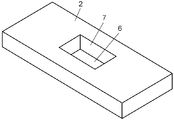
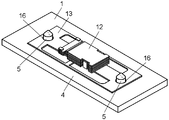
- FIG. 1 is a perspective view of a lower mold used in the method for producing a resin mold type capacitor according to Embodiment 1 of the present invention.
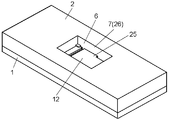
- FIG. 2A is a perspective view showing an upper surface side of a middle mold used in the method for producing a resin mold type capacitor according to Embodiment 1 of the present invention.
- FIG. 2B is a perspective view showing the lower surface side of the middle size shown in FIG. 2A.
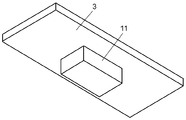
- FIG. 3 is a perspective view of an upper mold used in the method for manufacturing a resin mold type capacitor according to Embodiment 1 of the present invention.
- FIG. 1 is a perspective view of a lower mold used in the method for producing a resin mold type capacitor according to Embodiment 1 of the present invention.
- FIG. 2A is a perspective view showing an upper surface side of a middle mold used in the method for producing a resin mold type capacitor according to Embodiment 1 of the present invention.
- FIG. 3 is a perspective view of an upper mold used in the method for manufacturing a resin
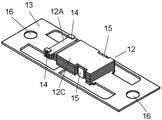
- FIG. 4A is a diagram showing a configuration of a capacitor element laminate and a lead frame used in the method for manufacturing a resin mold type capacitor according to Embodiment 1 of the present invention, and shows an upper portion of the capacitor element laminate with the lead frame connected thereto. It is a perspective view.
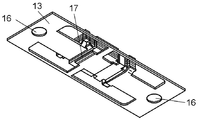
- FIG. 4B is a perspective view showing a lower portion of the capacitor element laminated body in a state where the lead frame shown in FIG. 4A is connected.
- 4C is a cross-sectional view of the capacitor element constituting the capacitor element laminate shown in FIG. 4A.
- FIG. 5 is a perspective view showing a first step of the method of manufacturing the resin mold type capacitor according to the first embodiment of the present invention.
- FIG. 6 is a perspective view showing a second step following the first step shown in FIG. FIG.
- FIG. 7 is a perspective view showing a third step following the second step shown in FIG.
- FIG. 8 is a perspective view showing a fourth step following the third step shown in FIG.
- FIG. 9 is a perspective view showing a fifth step following the fourth step shown in FIG.
- FIG. 10 is a perspective view showing a sixth step following the fifth step shown in FIG.
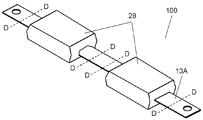
- FIG. 11 is a perspective view showing a capacitor element laminate in which an exterior body is coated by the method for manufacturing a resin mold type capacitor according to Embodiment 1 of the present invention.
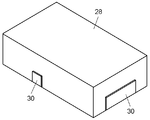
- FIG. 12A is a perspective view of a resin mold type capacitor manufactured by the method of manufacturing a resin mold type capacitor according to Embodiment 1 of the present invention.
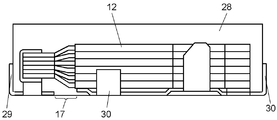
- 12B is a perspective side view of the resin mold type capacitor shown in FIG. 12A.
- FIG. 13 is a perspective view of another lower mold used in the method for manufacturing a resin mold type capacitor according to the first embodiment of the present invention.
- FIG. 14 is a perspective view of another mold used in the method for manufacturing a resin mold capacitor according to Embodiment 1 of the present invention.
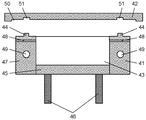
- FIG. 15 is a cross-sectional view of an upper mold and a lower mold used in the method for manufacturing a resin mold type electronic component according to Embodiment 2 of the present invention.
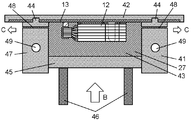
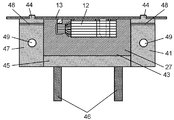
- FIG. 16 is a cross-sectional view showing a first step in the method of manufacturing a resin mold type electronic component according to the second embodiment of the present invention.
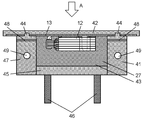
- FIG. 17 is a cross-sectional view showing a second step following the first step shown in FIG.
- FIG. 18 is a cross-sectional view showing a third step following the second step shown in FIG.
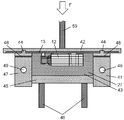
- FIG. 19 is a sectional view showing a state of the third step following FIG.
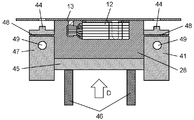
- FIG. 20 is a sectional view showing a fourth step following the third step shown in FIGS.
- FIG. 21 is a cross-sectional view showing the state after the first step and the second step in another method for manufacturing a resin mold type electronic component according to the second embodiment of the present invention.
- FIG. 22 is a sectional view showing a third step following the second step shown in FIG.
- FIG. 23 is a sectional view showing a state of the third step following FIG.
- FIG. 24 is a sectional view showing a state of the third step following FIG. FIG.
- FIG. 25 is a cross-sectional view of an upper mold and a lower mold used in the method for manufacturing a resin mold type capacitor according to Embodiment 3 of the present invention.
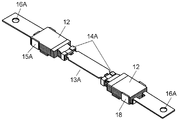
- FIG. 26A is a perspective view showing configurations of a capacitor element laminate and a lead frame used in the method for manufacturing a resin mold type capacitor according to Embodiment 3 of the present invention.
- FIG. 26B is a side view of the capacitor element multilayer body with the lead frame shown in FIG. 26A connected thereto.
- FIG. 27 is a cross-sectional view showing a first step in the method of manufacturing a resin mold type capacitor according to Embodiment 3 of the present invention.
- FIG. 28 is a sectional view showing a second step following the first step shown in FIG. FIG.
- FIG. 29 is a cross-sectional view showing a third step following the second step shown in FIG.
- FIG. 30 is a sectional view showing a fourth step following the third step shown in FIG.
- FIG. 31 is a sectional view showing a fifth step following the fourth step shown in FIG.
- FIG. 32 is a sectional view showing a sixth step following the fifth step shown in FIG.
- FIG. 33 is a perspective view showing a capacitor element laminate in which an exterior body is coated by the method for manufacturing a resin mold type capacitor according to Embodiment 3 of the present invention.
- FIG. 34A is a perspective view of a resin molded capacitor completed by the manufacturing method of Embodiment 3.
- FIG. 34B is a front perspective view of the resin mold type capacitor shown in FIG. 34A.
- FIG. 35 is a cross-sectional view showing a state where the molded body is attached to the upper mold in the fifth step of the method of manufacturing the resin mold capacitor according to Embodiment 3 of the present invention.
- FIG. 36 is a sectional view showing another sixth step following the fifth step shown in FIG.
- FIG. 37 is a perspective view showing a mold used for molding an exterior body of a conventional resin mold type capacitor.
- FIG. 38 is a perspective view of a resin mold type capacitor manufactured by a conventional manufacturing method.
- FIGS. 1 is a perspective view showing the appearance of the lower die
- FIG. 2A is a perspective view showing the upper surface side of the middle die
- FIG. 2B is a perspective view showing the lower surface side of the middle die
- FIG. 3 is a perspective view showing the lower surface side of the upper die.
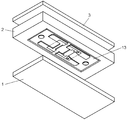
- a molding die used in the method for manufacturing a resin mold capacitor according to the present embodiment is composed of three molds: a lower mold 1, a middle mold 2, and an upper mold 3.
- FIGS. 1 to 3 The vertical relationship in FIGS. 1 to 3 is the vertical relationship when the actual manufacturing method is performed.
- the lower mold 1 includes a flat seat plate 4 and two cylindrical guide pins 5 provided vertically on the upper surface of the seat plate 4.
- the guide pin 5 is provided integrally with the seat plate 4, and the outer periphery of the upper end surface is chamfered. Therefore, it is easy to insert into the guide hole 10 of the middle mold 2 and the through hole 16 of the lead frame 13 which will be described later.
- the guide pin 5 can be easily inserted into the guide hole 10 of the middle mold 2 or the through hole 16 of the lead frame 13 by making the upper end of the guide pin 5 substantially hemispherical.
- the upper surface and the lower surface of the middle mold 2 have a rectangular shape that is substantially the same shape as the upper surface of the lower mold 1.
- a hollow portion 6 is provided in a central portion of the middle die 2 so as to penetrate from the upper surface to the lower surface of the middle die 2, and the upper surface opening 7 of the hollow portion 6 has a rectangular shape.
- a recess 9 that is slightly recessed is provided on the lower surface of the middle mold 2 so as to surround the lower surface opening 8 of the hollow portion 6.
- the depression 9 is provided for fitting a lead frame 13 described later with reference to FIG. 4A. That is, the depth of the recess 9 is substantially equal to the thickness of the lead frame 13.
- Two guide holes 10 for fitting the above-described guide pins 5 are provided between the outer periphery of the recess 9 and the lower surface opening 8 of the hollow portion 6.
- a rectangular parallelepiped protrusion 11 is vertically provided on the lower surface of the upper mold 3, and the lower surface of the protrusion 11 is rectangular.
- the lower surface of the protrusion 11 is designed to be substantially the same shape and slightly smaller than the upper surface opening 7 so that it can be inserted into the upper surface opening 7 of the hollow portion 6 of the middle mold 2 in FIG. 2A.
- the upper surface of the upper mold 3 has a flat plate shape.
- the upper surface of the upper mold 3 is not particularly limited to this.
- stainless steel is used as the material of the lower mold 1, the middle mold 2 and the upper mold 3.
- a metal such as iron, aluminum, or copper may be used. Any material having a relatively high thermal conductivity can be suitably employed as the material for the mold of the present embodiment.
- FIGS. 4A to 4C are perspective views showing the upper part of the laminate 12 with the lead frame 13 connected
- FIG. 4B is a perspective view showing the lower part of the laminate 12 with the lead frame 13 connected
- FIG. It is sectional drawing of the capacitor
- the lead frame 13 has a first bent portion 14 and a second bent portion 15.
- the laminate 12 has an anode part 12A and a cathode part 12C.
- the first bent portion 14 is bent on the upper surface of the laminate 12 so as to hold the anode portion 12A of the laminate 12, and is further fixedly connected to the anode portion 12A by resistance welding or laser welding.
- the second bent portion 15 is bent along the side surface of the laminate 12 so as to hold the cathode portion 12C of the laminate 12, and is further fixedly connected to the cathode portion 12C by conductive silver paint.
- two circular through holes 16 are provided in the vicinity of both ends on the long side of the lead frame 13.
- the through hole 16 is provided for inserting the guide pin 5 of the lower mold 1 described above.
- the lower surface of the lead frame 13 is separated by a separation portion 17.
- the separation portion 17 is provided in the lead frame 13 to prevent a short circuit between the anode terminal 29 and the cathode terminal 30 of the resin molded capacitor as a finished product.
- the laminate 12 is configured by laminating a plurality of capacitor elements 18 shown in FIG. 4C.
- the flat capacitor element 18 includes an anode body 21, a thin dielectric layer 22, a conductive polymer layer 23, and a cathode layer 24.
- the anode body 21 is composed of an aluminum foil 19 that is a valve action metal and an aluminum etching layer 20 formed on both surfaces thereof.
- the dielectric layer 22 is provided so as to surround the anode body 21.
- a conductive polymer layer 23 made of a conductive polymer (for example, polypyrrole) is sequentially laminated on the dielectric layer 22, and a cathode layer 24 made of carbon and silver paste is sequentially stacked on the conductive polymer layer 23. Yes.
- the capacitor elements 18 having such a configuration are sequentially laminated via conductive silver paint so that the cathode layers 24 of the capacitor elements 18 are electrically connected to each other, thereby forming the cathode portion 12C.
- the aluminum foil 19 projecting in a tongue shape from each capacitor element 18 is superposed to form one bundle to constitute the anode portion 12A.
- the cathode layer 24 on the lower surface of the capacitor element 18 positioned at the lowest stage of the multilayer body 12 is connected to the lead frame 13 via conductive silver paint.
- the cathode layer 24 on the side surface of each capacitor element 18 is also connected to the lead frame 13.
- the second bent portion 15 is connected via conductive silver paint.
- the laminated body 12 is formed by laminating
- FIGS. 5 shows the first step
- FIG. 6 shows the second step
- FIG. 7 shows the third step
- FIG. 8 shows the fourth step
- FIG. 9 shows the fifth step
- FIG. 11 shows the laminated body 12 on which the exterior body taken out from the mold is molded after the sixth step.
- the laminated body 12 arranged on the lead frame 13 and connected to the lead frame 13 is placed on the seat plate 4 of the lower mold 1.
- the lead frame 13 is disposed so as to be under the laminated body 12, and the lower surface of the lead frame 13 is aligned with the upper surface of the seat plate 4.
- the guide pins 5 provided on the upper surface of the lower mold 1 are inserted into the through holes 16 of the lead frame 13 and placed.
- the lead frame 13 and the laminated body 12 are accurately positioned at predetermined positions.
- Three or more guide pins 5 may be provided, but if at least two guide pins 5 are provided, the lead frame 13 and the laminated body 12 can be accurately positioned on the lower mold 1.
- the laminate 12 is placed on the lower mold 1 and at the same time, the lower mold 1 is heated in advance using a heater.
- the temperature T1 of the lower mold 1 is set to 40 ° C to 60 ° C.
- a heating method for example, there is a method of adjusting the temperature of the lower die 1 by opening a hole (not shown) having a diameter of about 10 mm on the side surface of the lower die 1 and inserting and heating a rod-shaped cartridge heater there. Can be mentioned. In the present embodiment, this method is used, but the present invention is not limited to this.
- a method of heating by a heater from the outside or a method of embedding a heater in the lower mold 1 and automatically adjusting the temperature may be used. .
- the middle mold 2 is attached to the lower mold 1 as shown in FIG.
- the laminated body 12 is attached so as to be accommodated in the hollow portion 6 of the middle mold 2.
- the middle mold 2 and the lower mold 1 constitute a first mold having a hollow portion 6 that is a cavity having an open upper surface.
- a guide hole 10 is provided on the lower surface of the middle mold 2. If the middle mold 2 is attached to the lower mold 1 so that the guide pins 5 protruding from the through holes 16 of the lead frame 13 are fitted into the guide holes 10, the laminated body 12 is inevitably lowered so that it is accommodated in the hollow portion 6.
- the mold 1 and the middle mold 2 are designed.
- a recess 9 is provided on the lower surface of the middle mold 2, that is, the mating surface with the lower mold 1. Therefore, the lead frame 13 is fitted in the recess 9. At this time, the lead frame 13 is sandwiched between the upper surface of the lower mold 1 and the surface of the recess 9, and both surfaces of the lead frame 13 are in close contact with the upper surface of the lower mold 1 and the surface of the recess 9.
- the middle mold 2 is preheated in the second step, and the temperature T2 of the middle mold 2 is set between 60 ° C. and 80 ° C.
- the same technique as that for the lower mold 1 is used.
- the laminate 12 is accommodated in the upper surface open type cavity 25 formed by the upper surface of the lower mold 1 and the hollow portion 6 of the middle mold 2.
- the upper surface opening portion 26 of the cavity 25 corresponds to the upper surface opening portion 7 of the middle mold 2.
- an uncured norbornene-based resin 27 is injected into the upper surface opening 26 of the cavity 25 from a nozzle or the like. That is, in the third step, the laminate 12 that is an element part of the electronic component and the norbornene-based resin 27 that is a liquid resin precursor containing a norbornene monomer are inserted into the cavity 25 of the first mold.
- the injection of the norbornene-based resin 27 ends at a predetermined position slightly lower than the upper end of the cavity 25 so as not to leak from the cavity 25.
- both surfaces of the lead frame 13 are in close contact with the upper surface of the lower mold 1 and the surface of the recess 9. Therefore, there is a possibility that the norbornene resin 27 leaks from the cavity 25 into the gap between the recess 9 and the upper surface of the lead frame 13, and the norbornene resin 27 adheres to the lead frame 13 located outside the laminate 12. Has been reduced.
- the norbornene-based resin 27 may be a compound having a norbornene ring structure.
- a tricyclic or higher polycyclic norbornene-based monomer because a molded product having excellent heat resistance can be obtained.
- polycyclic norbornene monomers such as tricyclopentadiene and tetracyclopentadiene, and ring-opening copolymerization with norbornene monomers can be performed as long as dicyclopentadiene is the main component and the object of the present invention is not impaired.
- a polymer obtained by polymerizing a mixed solution to which a comonomer such as a monocyclic cycloolefin such as cyclobutene or cyclopentene is appropriately added can be used.
- a comonomer such as a monocyclic cycloolefin such as cyclobutene or cyclopentene is appropriately added
- DCP two-component type dicyclopentadiene
- the norbornene-based resin 27 contains 65 wt% or more and 95 wt% or less of an inorganic filler made of aluminum hydroxide.
- the inorganic filler those having high flame retardancy are preferable, and aluminum hydroxide, magnesium hydroxide, silica, or a mixture thereof may be used.
- the content of the inorganic filler By setting the content of the inorganic filler to 65% by weight or more, it is possible to enhance flame retardancy, increase the flexural modulus and bending strength after curing, suppress deformation of electronic components, and increase mechanical strength. .
- molding can be maintained because content of an inorganic filler shall be 95 weight% or less.
- the upper die 3 is attached to the middle die 2 as shown in FIG. 8, and the exposed portion of the norbornene-based resin 27 exposed from the upper surface opening portion 26 of the cavity 25 is pressed from above by the upper die 3.
- the upper die 3 is a second die that is combined from above with the first die having a cavity having an open upper surface.
- the upper mold 3 is arranged so as to sandwich 27. Then, the laminate 12 and the norbornene-based resin 27 are pressed between the lower mold 1 and the middle mold 2 that are the first mold and the upper mold 3 that is the second mold.
- the exposed portion of the norbornene-based resin 27 is a portion that can be visually recognized from the upper surface opening portion 26 shown in FIG. In this way, by pressing the exposed portion of the norbornene-based resin 27 from above with the upper mold 3, the injected norbornene-based monomer further reaches every corner of the cavity 25 and is sufficiently filled.
- the norbornene resin 27 is pressed by the protruding portion 11 provided on the lower surface of the upper mold 3.
- the lower surface of the protrusion 11 is designed to have substantially the same shape as the upper surface opening 7 of the middle mold 2, that is, the upper surface opening 26 of the cavity 25. Therefore, when the norbornene-based resin 27 is pressed by the protruding portion 11, substantially the entire exposed portion of the norbornene-based resin 27 is pressed. By this pressing, the norbornene-based resin 27 is formed into a desired product design height shape.
- the upper mold 3 is preheated using the same technique as the lower mold 1 of the first step and the middle mold 2 of the second step.
- the upper mold temperature T3 is set between 80 ° C and 120 ° C.
- the lower mold 1, the middle mold 2 and the upper mold 3 are provided with a temperature difference, and the upper mold 3 is set at the highest temperature, the lower mold 1, the middle mold 2 and the upper mold 3 are combined.
- the heat of the upper mold 3 is transferred from the upper side to the lower side of the norbornene resin 27.
- the norbornene resin 27 is cured by this heat.
- the temperature of the upper mold 3 that is the second mold is set higher than the temperatures of the lower mold 1 and the middle mold 2 that are the first mold.
- the exposed portion of the norbornene-based resin 27 is pressed by the protruding portion 11 provided on the lower surface of the upper mold 3, but the present invention is not limited to this. It is also possible to use a substantially rectangular parallelepiped upper mold whose lower surface is substantially the same shape as the upper surface opening portion 26 of the cavity 25 and press the exposed portion of the norbornene resin 27 over the entire lower surface of the upper mold.
- the lower surface of the upper die 3 and the upper surface of the middle die 2 are not brought into contact. That is, the lowering of the upper die 3 is stopped at a predetermined position indicated by a broken line AA in FIG. 8, and a slight gap indicated by a double-headed arrow B in FIG. 8 is provided between the upper surface of the middle die 2 and the lower surface of the upper die 3. Provided. This position is determined by the desired product design height shape.
- the process proceeds to the fifth step.
- the lower die 1 is removed from the middle die 2 as shown in FIG.
- the norbornene resin 27 injected into the cavity 25 is sufficiently cured by the heat of the upper mold 3, and the laminate 12 is covered with the norbornene resin 27.
- the upper mold 3 is further lowered from the above position (broken line AA in FIG. 8), and the lower surface of the upper mold 3 and the upper surface of the middle mold 2 are brought into contact with each other.
- the laminated body 12 is pushed out from the middle mold 2, and as shown in FIG. 11, the laminated body 12 in a state where the laminated body 12 is covered with the norbornene resin 27 and the lead frame 13 is connected is taken out.
- the norbornene-based resin 27 in a cured state corresponds to the outer package 28 of the laminate 12.
- the upper surface opening 7 is slightly smaller than the lower surface opening 8, and the cross-sectional shape of the hollow portion 6 is directed downward. It is desirable to have an expanding taper shape. In this way, when the laminated body 12 is pushed out from the middle mold 2, the side surface of the exterior body 28 covering the laminated body 12 is easily detached from the side surface of the hollow portion 6 of the middle mold 2, and the laminated body 12 can be easily removed from the middle mold 2. It can be taken out.
- the laminated body 12 in a state where the outer body 28 is covered and the lead frame 13 is connected can be formed by going through the first step to the sixth step. Further, a predetermined position of the lead frame 13 indicated by a broken line CC in FIG. 11 is appropriately cut, and the lead frame 13 is bent toward the exterior body 28 to complete a norbornene-based resin mold type capacitor.
- the completed resin mold type capacitor is shown in FIGS. 12A and 12B.
- FIG. 12A is a perspective view showing the appearance of a resin mold type capacitor
- FIG. 12B is a perspective side view of the resin mold type capacitor, showing the internal structure through the exterior body 28 that is a mold resin.
- the resin mold type capacitor manufactured by the manufacturing method of the present embodiment has a shape of the cavity 25, that is, a substantially rectangular parallelepiped shape.
- the bent lead frame 13 becomes an anode terminal 29 and a cathode terminal 30 in this resin mold type capacitor.
- the anode terminal 29 and the cathode terminal 30 are disposed on the side surface and the bottom surface of the resin mold type capacitor.
- the lead frame 13 is provided with the separation portion 17 described above in advance, so that the anode terminal 29 is separated from the cathode terminal 30 and they are not short-circuited.
- a resin molded capacitor that is sufficiently covered with an exterior body can be manufactured, and the reliability of the resin molded capacitor can be improved.
- the temperature T1 of the lower mold 1 and the temperature T2 of the middle mold 2 are set lower than the temperature T3 of the upper mold 3 in the fourth step. That is, when the norbornene-based resin 27 is cured, the temperature of the lower mold is set lower than that of the upper mold so that the norbornene-based resin 27 does not sufficiently reach the position where the laminated body 12 should originally be coated. Can be prevented from being hardened. Then, the heat of the upper mold 3 is transferred to the norbornene resin 27, whereby the norbornene resin 27 is heated and cured. That is, in the manufacturing method in the present embodiment, the inside of the cavity 25 in FIG. 6 can be sufficiently filled with the norbornene-based resin 27, and the laminate 12 can be sufficiently covered.
- the viscosity of the uncured norbornene resin 27 can be adjusted by adding elastomers.
- elastomers include natural rubber, styrene-butadiene copolymer (SBR), styrene-butadiene-styrene block copolymer (SBS), styrene-isoprene-styrene copolymer (SIS), and ethylene-propylene-di.
- SBR styrene-butadiene copolymer
- SBS styrene-butadiene-styrene block copolymer
- SIS styrene-isoprene-styrene copolymer
- EPDM enterpolymer
- the viscosity can be adjusted in the range of about 5 ⁇ 10 ⁇ 3 Pa ⁇ s to 2 Pa ⁇ s at 30 ° C. depending on the amount of elastomer added.
- the temperature ranges from 2 ⁇ 10 ⁇ 1 Pa ⁇ s to 10 Pa ⁇ s at a temperature of 40 ° C. or higher and 60 ° C. or lower.
- the viscosity means a value measured with a rheometer.
- the curing rate of the norbornene resin 27 is basically fast, but this curing rate can be adjusted to some extent by adding an activity regulator.
- an activity regulator a compound having an action of reducing the metathesis catalyst can be used, and alcohols, haloalcohols, or acetylenes are preferable.
- a Lewis base compound can be used as an activity regulator.
- isopropyl alcohol is used as the activity regulator.
- the norbornene-based resin 27 generally has a faster curing speed than that of a thermosetting resin such as an epoxy resin, it is possible to achieve excellent productivity. Furthermore, in general, norbornene resins are superior in terms of moisture resistance and rigidity as compared with thermosetting resins such as epoxy resins. Therefore, the resin mold type capacitor manufactured by the manufacturing method according to the present embodiment ensures excellent moisture resistance, strength and impact resistance, and has high reliability.
- the temperature T1 of the lower mold 1 is set to 40 ° C. to 60 ° C.
- norbornene resins are cured even at room temperature.
- the temperature of the lower mold in the third step is set to 60 ° C. or lower as in the present embodiment, it has been confirmed that the injected norbornene-based resin 27 reaches the entire cavity 25 before being cured. .
- the lower limit of the temperature of the lower mold 1 is 40 ° C. Therefore, in the third step, it is desirable that the temperature T1 of the lower mold 1 is set to 40 ° C. or higher and 60 ° C. or lower.
- the temperature T2 of the middle mold 2 is set to 60 ° C. to 80 ° C. If T2 is 60 ° C. or higher and 80 ° C. or lower, the norbornene-based resin 27 will not be cured before reaching the cavity 25. Moreover, productivity can be improved by heating the intermediate mold 2 to some extent in advance.
- the temperature T3 of the upper mold 3 is set to 80 ° C. to 120 ° C.
- T3 is 80 ° C. or higher and 120 ° C. or lower, the norbornene-based resin 27 can be sufficiently cured.
- the laminated body 12 is positioned on the lower mold 1 by inserting the guide pins 5 of the lower mold 1 into the through holes 16 of the lead frame 13.
- the guide pins 5 are cylindrical, but the present invention is not limited to this. For example, the same effect can be obtained even in a prismatic shape.
- the guide pin 5 is fitted into the guide hole 10 provided on the lower surface of the middle mold 2 in the second step with the guide pin 5 protruding from the through hole 16 of the lead frame 13 in the first step.
- type 2 can be attached correctly.
- the laminate 12 can be accurately placed in the hollow portion 6 of the middle mold 2.
- the laminated body 12 can be positioned in the lower mold 1 using the guide pins 5 and can be accurately arranged in the hollow portion 6 of the middle mold 2 of the laminated body 12.
- the fourth step substantially the entire exposed portion of the norbornene-based resin 27 exposed from the upper surface opening portion 26 of the cavity 25 is pressed by the protruding portion 11 provided on the lower surface of the upper mold 3. is doing. Thereby, the heat of the upper mold 3 is transferred to the norbornene resin 27, and the norbornene resin 27 is cured.
- the laminated body 12 covered with the norbornene resin 27 is pushed out in the sixth step by pressing the exposed portion of the norbornene resin 27 with the protrusion 11, a portion other than the protrusion 11 on the lower surface of the upper mold 3. Can be used as a stopper.
- the laminated body 12 when the laminated body 12 is pushed out, the lower surface of the upper mold 3 and the upper surface of the middle mold 2 come into contact with each other and serve as a stopper, thereby preventing the laminated body 12 from being pushed down more than necessary. As a result, damage to the laminated body 12, the exterior body 28, and the lead frame 13 can be prevented, and productivity can be improved.
- FIG. 13 is a perspective view of another lower mold used in the method for manufacturing a resin mold type capacitor according to the present embodiment. That is, the elastic surface 31 may be formed on the contact surface with the middle mold 2. According to this configuration, when the middle mold 2 is attached to the lower mold 1A, the elastic surface 31 is deformed according to the shape of the lower surface of the middle mold 2 and the adhesion between the lower mold 1A and the middle mold 2 can be improved.
- the norbornene resin 27 is injected into the cavity 25 in the third step, the possibility that the norbornene resin 27 leaks from the gap between the lower mold 1A and the middle mold 2 can be reduced.
- a rubber material such as silicon or urethane may be used. Within the temperature range of the lower mold 1A in the manufacturing method of the present embodiment, the characteristics of these rubber materials do not change, and there is no problem in the manufacturing process and the quality of the resin mold capacitor as a finished product.
- the entire lower mold 1 may be made of an elastic material. Also in this case, the adhesion between the lower mold 1 and the middle mold 2 can be improved, and the possibility that the norbornene-based resin 27 leaks from the gap between the lower mold 1 and the middle mold 2 can be reduced.
- the entire middle mold 2 may be made of an elastic material. According to this configuration, when the middle mold 2 is attached to the lower mold 1, the adhesion between the lower mold 1 and the middle mold 2 can be improved, and the norbornene resin 27 leaks from the gap between the lower mold 1 and the middle mold 2. The possibility of being lost can be reduced. Furthermore, when the upper mold 3 is attached to the middle mold 2, the adhesion between the middle mold 2 and the upper mold 3 can be improved, and the norbornene resin 27 leaks from the gap between the middle mold 2 and the upper mold 3. The possibility can also be reduced.
- FIG. 14 is a perspective view of another mold used in the method for manufacturing a resin mold type capacitor according to the present embodiment.
- the lower die 32 has eight guide pins 35
- the middle die 33 has four hollow portions 36
- the upper die 34 has four A protrusion (not shown) is provided.
- the resin mold type capacitor manufactured by this mold is sufficiently covered with the exterior body similarly to the above-mentioned resin mold type capacitor and has high reliability.
- FIG. 14 shows a mold for molding four resin mold capacitors at the same time
- the present embodiment is not limited to this, and the manufacturing method of the present embodiment is also applied to molds for manufacturing quantities other than four. It is possible to do.
- FIG. 15 is a cross-sectional view of the lower mold and the upper mold.
- the molding die used in the method for manufacturing the resin mold capacitor in the present embodiment is composed of a lower die 41 and an upper die 42.
- the lower mold 41 is a first mold having a cavity 43 having an open upper surface
- the upper mold 42 is a second mold combined with the lower mold 41 from above.
- These two molds are arranged one above the other, and a norbornene-based resin is injected into the cavity 43 of the lower mold 41, and then the upper mold 42 is attached to the lower mold 41, so that the outer package of the capacitor element laminate as the element portion is formed. Mold.
- the vertical relationship in FIG. 15 is the vertical relationship when the actual manufacturing method is performed.
- the capacitor element laminate and the lead frame embedded in the norbornene resin are the same as the laminate 12 and the lead frame 13 described in the first embodiment with reference to FIGS. 4A to 4C.
- the lower mold 41 has a C-shaped cross section, and includes a side wall 47 and a bottom surface 45.
- a cuboid-shaped cavity 43 having an open top surface is provided at the center of the lower mold 41. That is, the cavity 43 is a space surrounded by the side wall 47.
- Two cylindrical guide pins 44 are vertically provided integrally with the side wall 47 on the upper end of the side wall 47, that is, on the surface of the open end.
- the outer periphery of the upper end surface of the guide pin 44 is chamfered so that it can be easily inserted into a guide hole 51 of the upper die 42 described later or the through hole 16 of the lead frame 13 shown in FIG. 4A. Alternatively, it is easy to insert the guide pin 44 into the guide hole 51 of the upper die 42 or the through hole 16 of the lead frame 13 by making the upper end of the guide pin 44 hemispherical.
- the bottom surface 45 has a flat plate shape, and a piston 46 is provided below the bottom surface 45.
- the bottom surface 45 is slidable in the vertical direction with respect to the side wall 47 by a piston 46. Therefore, the capacity of the cavity 43 can be changed by moving the bottom surface 45 in the vertical direction.
- a through hole 48 penetrating from the cavity 43 to the outside of the lower mold 41 is provided in the side wall 47.
- the diameter of the through hole 48 is very small compared to the depth of the cavity 43, and is about 0.2 mm.
- a cooling mechanism 49 is provided on the side wall 47. Specifically, a pipe is embedded in the side wall 47 so as to surround the cavity 43.
- the cooling mechanism 49 cools the lower mold 41 in a water-cooled manner by flowing temperature-controlled water into the pipe.
- it is not limited to the water cooling type, and may be an air cooling type or an oil cooling type.
- the upper mold 42 has a flat plate shape.
- the lower surface of the upper mold 42 is provided with a hollow 50 that is slightly recessed.
- the recess 50 is provided to accommodate the lead frame 13 as will be described later. That is, the depth of the recess 50 is substantially the same as the thickness of the lead frame 13, and the shape of the recess 50 is a rectangular shape that is substantially the same shape as the outer periphery of the lead frame 13.
- Two guide holes 51 for fitting the guide pins 44 are provided inside the recess 50.
- the upper die 42 is a flat plate, but is not limited to this.
- the materials of the lower mold 41 and the upper mold 42 are the same as those of the lower mold 1, the middle mold 2, and the upper mold 3 of the first embodiment.
- FIG. 16 is a cross-sectional view showing a first step of injecting an uncured norbornene resin 27, which is a liquid resin precursor containing a norbornene monomer, into the cavity 43 of the lower mold 41.
- FIG. 17 is a cross-sectional view showing a second step in which the composite body of the capacitor element multilayer body (hereinafter, multilayer body) 12 and the lead frame 13 is placed on the lower mold 41 and the multilayer body 12 is embedded in the norbornene resin 27.
- . 18 and 19 are cross-sectional views showing a third step of forming an exterior body 28 that covers and covers the laminate 12 by molding and curing the norbornene-based resin 27 on the laminate 12.
- FIG. 20 is a cross-sectional view showing a fourth step of taking out the laminated body 12 after forming the exterior body 28 from the mold.
- a certain amount of liquid norbornene-based resin 27 is injected into the open upper surface of the cavity 43 from a nozzle or the like.
- the injection of the norbornene-based resin 27 ends at a predetermined height h slightly lower than the upper end of the cavity 43 so as not to leak from the cavity 43.
- the height h indicates the height from the inner bottom surface of the cavity 43.
- the through hole 48 is provided in the side wall 47 of the lower mold 41. Since the diameter of the through hole 48 is small and the liquid norbornene resin 27 is slightly viscous, the norbornene resin 27 does not leak outside through the through hole 48 at the time of the first step. .
- the temperature of the lower mold 41 is set to 40 ° C. or more and 60 ° C. or less.
- a heating method a method similar to that of the lower mold 1 of the embodiment can be applied.
- the lower mold 41 is thus heated in the first step, but the norbornene-based resin 27 is not rapidly cured at a temperature of 40 ° C. or higher and 60 ° C. or lower. That is, this temperature range is below the so-called curing temperature. Therefore, the norbornene resin 27 is not cured in the first step. Accordingly, the norbornene-based resin 27 reaches all corners of the cavity 43.
- the curing temperature is 7.0 ⁇ 4.0 ⁇ 2.0 mm (a size equivalent to that of the resin mold type capacitor of the present embodiment) using norbornene resin 27 in a mold at that temperature. It is defined as the temperature at which the molding time required to obtain a bulk molded product is 30 seconds or less.
- the composite body of the laminated body 12 and the lead frame 13 attached to the laminated body 12 is placed on the upper end surface of the lower mold 41.
- guide pins 44 provided on the upper surface of the lower die 41 are inserted into the through holes 16 of the lead frame 13 and placed.
- the lead frame 13 and the laminated body 12 are accurately fixed and positioned at predetermined positions.
- Three or more guide pins 44 may be provided, but if at least two guide pins 44 are provided, the lead frame 13 and the laminate 12 can be accurately positioned on the lower die 41.
- the laminate 12 is disposed below the lead frame 13.
- the composite body of the laminate 12 and the lead frame 13 is arranged such that the laminate 12 is positioned on the inner bottom surface side of the lower die 41 and a part of the lead frame 13 is placed on the upper end surface of the lower die 41.
- the Therefore, the laminate 12 is immersed (embedded) in the norbornene-based resin 27 injected into the cavity 43 of the lower mold 41 in the first step.
- the injection height h of the norbornene-based resin 27 in the first step is desirably set so that the position of the liquid surface of the norbornene-based resin 27 after rising in the second step is in the above state.
- the upper die 42 is lowered from above the lower die 41, and the upper die 42 is attached to the lower die 41.
- the guide pin 44 protruding from the through hole 16 of the lead frame 13 is fitted into the guide hole 51 of the upper die 42.
- the upper die 42 is accurately positioned with respect to the lower die 41 and the lead frame 13.
- the lead frame 13 is sandwiched between the lower die 41 and the upper die 42. Since the lead frame 13 is fitted in the recess 50 of the upper die 42, the upper surface side of the lead frame 13 is in close contact with the surface of the recess 50 of the upper die 42.
- the upper end portion of the lower die 41 is in close contact with the lower surfaces of the lead frame 13 and the upper die 42.
- type 42 is heated previously before the 3rd step, and is the temperature more than the hardening temperature of the norbornene-type resin 27.
- the bottom surface 45 of the lower mold 41 is slid upward by the piston 46 so that the norbornene-based resin 27 in the cavity 43 has a desired product design height. Press to the position where it will be in shape. As a result, pressure is applied to the norbornene resin 27 in the cavity 43, the norbornene resin 27 reaches the details in the cavity 43, and the cavity 43 is filled with the norbornene resin 27.
- this operation is important.
- the gas in the cavity 43 and excess norbornene-based resin 27 are transferred to the outside of the lower mold 41 through the through holes 48 as indicated by arrows C. And discharged.
- the through hole 48 is provided in the side wall 47 of the lower mold 41.
- the present invention is not limited to this position, and the same effect can be obtained even if provided in the upper mold 42. Further, both the lower mold 41 and the upper mold 42 may be provided.
- the movement of the bottom surface 45 toward the upper mold 42 in the third step is performed as soon as possible after the upper mold 42 is attached to the lower mold 41. Curing of the norbornene resin 27 starts immediately after the high temperature upper mold 42 is attached to the lower mold 41. Therefore, when time elapses from the attachment to the third step, the norbornene-based resin 27 is cured and loses fluidity. As a result, the norbornene-based resin 27 does not reach the details in the cavity 43, and there is a possibility that a resin molded capacitor having a desired shape cannot be obtained.
- the upper die 42 is attached to the lower die 41 in the third step, and at the same time, the bottom surface 45 of the lower die 41 starts to move upward.
- the upper surface side of the lead frame 13 is in close contact with the surface of the recess 50 of the upper die 42, and the upper end portion of the lower die 41 is in close contact with the lower surface portion of the lead frame 13 and the upper die 42. . Therefore, the possibility that the norbornene-based resin 27 leaks from the cavity 43 into the gap between the recess 50 and the upper surface of the lead frame 13 and the possibility of leaking to the outside through the gap between the lead frame 13 and the upper end portion of the lower die 41 are reduced. Has been.
- the process proceeds to the fourth step. Since the norbornene resin 27 takes a short time to cure, it is sufficiently cured during this time.
- the upper die 42 is removed from the lower die 41, and the bottom surface 45 of the lower die 41 is further raised upward as indicated by the arrow D, so that the norbornene resin 27 is cured.
- the laminated body 12 covered with the exterior body 28 formed in this manner is pushed out of the mold. At this time, the norbornene resin 27 injected into the cavity 43 is sufficiently cured by the temperature of the upper mold 42.
- the laminate 12 in the state shown in FIG. 11 in the first embodiment is taken out. Thereafter, as in the first embodiment, the lead frame 13 is appropriately cut at a predetermined position, and the lead frame 13 is bent along the exterior body 28 to complete the resin mold type capacitor.
- the manufacturing method according to the present embodiment can provide the same effects as the manufacturing method according to the first embodiment.
- the temperature of the lower mold 41 is preferably set to 40 ° C. or more and 60 ° C. or less.
- the norbornene-based resin 27 is cured if it takes a long time even at room temperature.
- the temperature of the lower mold 41 in the first step is set to 60 ° C. or less, the injected norbornene-based resin 27 is cured.
- the lower limit of the temperature of the lower mold 41 is preferably 40 ° C.
- the temperature of the upper mold 42 is set to 80 ° C. or higher and 120 ° C. or lower in advance.
- the norbornene-type resin 27 can fully be hardened.
- the guide pins 44 of the lower mold 41 are inserted into the through holes 16 of the lead frame 13.
- the composite body of the laminate 12 and the lead frame 13 is positioned at the upper end portion of the lower mold 41.
- the guide pin 44 is cylindrical, but the present invention is not limited to this. For example, the same effect can be obtained even in a prismatic shape.
- a through hole 48 penetrating from the cavity 43 to the outside is provided in the side wall 47 of the lower mold 41.
- the through hole 48 By providing the through hole 48 in this way, excess gas in the cavity 43 and excess norbornene resin 27 can be discharged to the outside. Therefore, the cavity 43 in FIG. 19 can be filled with the norbornene-based resin 27 without a gap. Therefore, the laminate 12 can be sufficiently covered with the norbornene-based resin 27, and the reliability of the resin molded capacitor as a finished product can be improved.
- the lower mold 41 is provided with a cooling mechanism 49.
- the lower mold 41 In the first step, the lower mold 41 must be adjusted to a temperature not higher than the curing temperature of the norbornene resin 27 (40 ° C. or higher and 60 ° C. or lower). Therefore, when continuously manufacturing a resin mold type capacitor using the lower mold 41, it is necessary to cool the lower mold 41 after manufacturing the resin mold type capacitor through the first step to the fourth step. For this reason, by providing the cooling mechanism 49 in the lower mold 41 and cooling the lower mold 41 after the norbornene resin 27 is cured, a resin mold capacitor can be manufactured with excellent productivity.
- the composite body of the laminate 12 and the lead frame 13 is placed on the lower mold 41 in the second step.
- these steps are not limited to this order. That is, first, the composite body of the laminate 12 and the lead frame 13 is placed on the lower mold 41. Thereafter, for example, the norbornene-based resin 27 may be injected into the cavity 43 of the lower die 41 through a gap between the lead frame 13 and the opening end of the lower die 41 or a punched portion of the lead frame 13 to a predetermined position. Therefore, in this case, the first step is performed after the second step. Even in this way, a highly reliable resin mold type capacitor similar to the above-described method can be produced.
- the laminate 12 and the norbornene resin 27 that is a liquid resin precursor containing a norbornene monomer are inserted into the cavity 43 of the lower mold 41 that is the first mold. Thereafter, the upper mold 42 as the second mold is disposed so as to sandwich the laminate 12 and the norbornene resin 27. Thereafter, the laminate 12 and the norbornene resin 27 are pressed between the lower mold 41 and the upper mold 42, and the norbornene resin 27 is cured by the temperature of the upper mold 42. At this time, the temperature of the upper mold 42 is set higher than the temperature of the lower mold 41.
- the upper die 42 is lowered and the upper die 42 is attached to the lower die 41.
- the upper mold 42 is heated in advance to the curing temperature of the norbornene-based resin 27 or higher.
- the upper mold 42 is not heated in this manufacturing method. That is, the upper mold 42 has a temperature equal to or lower than the curing temperature of the norbornene resin 27. Therefore, the rapid curing of the norbornene resin 27 is not started. This is different from the manufacturing method described above.
- it is desirable that the lower mold 41 and the upper mold 42 are set to 40 ° C. or higher and 60 ° C. or lower at this time.
- the bottom surface 45 of the lower mold 41 is slid upward by the piston 46 to press the norbornene resin 27 in the cavity 43.
- both the lower mold 41 and the upper mold 42 are at a temperature lower than the curing temperature of the norbornene resin 27. For this reason, the norbornene-based resin 27 has sufficient fluidity without being cured, and spreads throughout the cavity 43.
- the heating pin 59 is contacted from the upper part of the upper mold 42 as indicated by an arrow F in FIG. Let At this time, the heating pin 59 is set to 80 ° C. or higher and 120 ° C. or lower which is higher than the curing temperature of the norbornene resin 27. Due to the propagation of the temperature of the heating pin 59, the upper die 42 is heated to a temperature higher than the curing temperature of the norbornene resin 27, and the temperature of the upper die 42 is further propagated to the norbornene resin 27 in the cavity 43 to start curing.
- the resin mold type capacitor is completed through the above-described fourth step and subsequent procedures.
- both the lower die 41 and the upper die 42 are at a temperature lower than the curing temperature of the norbornene resin 27. Therefore, the norbornene-based resin 27 has not started to be cured and has sufficient fluidity. Therefore, since the norbornene resin 27 has sufficient fluidity as described above, the norbornene resin 27 can be evenly distributed in the cavity 43. Then, after the norbornene resin 27 is evenly distributed in the cavity 43, the norbornene resin 27 is cured. Therefore, the uncoated portion of the outer package 28 of the resin molded capacitor as a finished product can be further reduced, and a highly reliable resin molded capacitor can be manufactured.
- the upper mold 42 is heated after the bottom surface 45 is slid.
- the present invention is not limited to this, and the upper mold 42 may be heated when the bottom surface 45 is slid.
- the norbornene-based resin 27 is cured in parallel with the sliding of the bottom surface 45, but the norbornene-based resin 27 can be distributed in the cavity 43 in a relatively short time by the sliding of the bottom surface 45. . Therefore, the cavity 43 can be filled before the norbornene-based resin 27 is completely cured.
- the upper die 42 is heated to a temperature equal to or higher than the curing temperature of the norbornene resin 27 by bringing the heating pin 59 into contact with the upper die 42.
- the heating method is not particularly limited thereto.
- a method of heating by inserting a rod-shaped cartridge heater into the upper die 42 a method of automatically adjusting the temperature with a heater embedded in the lower die 41, or the like may be used.
- the lower mold 41 may be heated. Even when the lower mold 41 is heated, the temperature can be propagated to the norbornene resin 27, and the norbornene resin 27 can be cured. Alternatively, both the lower mold 41 and the upper mold 42 may be heated. In this case, the temperature can be efficiently propagated to the norbornene resin 27, and the productivity of the resin mold type capacitor can be improved.
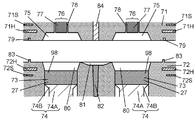
- FIG. 25 is a cross-sectional view of an upper die and a lower die constituting the molding die.
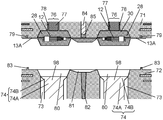
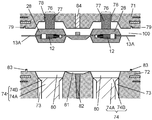
- the molding die used in the method for manufacturing the resin mold capacitor according to the present embodiment includes a movable upper die 71, a fixed lower die 72, and a plunger 74.
- the lower die 72 is provided to face the upper die 71, and the plunger 74 is provided inside a pot 73 included in the lower die 72.
- a norbornene-based resin is injected and filled into the cavity formed by the upper mold 71 and the lower mold 72 using the plunger 74.
- the exterior body of the capacitor element laminate is formed by curing the norbornene-based resin in the cavity.
- the bottom surface of the upper mold 71 is provided with two first concave portions 75 that open downward.
- the upper die 71 is provided with guide pin holes 79 on the outer sides of the two first recesses 75 respectively.
- the first recess 75 is designed to have a shape whose diameter decreases upward from an opening provided on the bottom surface of the upper mold 71.
- the first recess 75 may have a shape in which the diameter of the opening and the diameter of the upper surface are the same. That is, the shape of the hollow portion of the first recess 75 may be a rectangular parallelepiped or a cube.
- An upper ejector pin hole 76 communicating with the first recess 75 is provided in the approximate center of the upper surface of the first recess 75. Inside the upper ejector pin hole 76, an upper ejector pin 77 is disposed with a slight gap 78 from the inner wall of the upper ejector pin hole 76. The upper ejector pin 77 can be reciprocated in the vertical direction by a mechanism (not shown).
- the 2nd recessed part 80 is designed in the shape where a diameter becomes small toward an downward direction from an opening part.
- the lower mold 72 has a pot 73 opened toward the second recess 80 below the second recess 80. That is, the pot 73 is a hollow portion that opens toward the second recess 80 at a position corresponding to the bottom surface of the second recess 80.
- the pot 73 has a rectangular tube shape, and a plunger 74 slidable in the vertical direction is disposed in the pot 73.
- the plunger 74 is composed of a prismatic columnar portion 74A and a pressurizing portion 74B that is integrally provided at the upper end of the columnar portion 74A and has a flat plate with a tapered upper end surface.
- the outer peripheral portion of the upper end of the pressure unit 74B is in contact with the inner wall surface of the pot 73.
- the second recess 80 refers to the upper end of the rectangular tubular pot 73 from the opening on the upper surface of the lower mold 72, that is, the upper end surface of the pressurizing portion 74B of the plunger 74 in the state shown in FIG. Refers to the position up to.
- the surplus resin reservoir 81 is a recess provided on the upper surface of the lower mold 72 adjacent to the second recess 80 in order to store the surplus resin precursor leaked from the cavity when the exterior body is molded. Yes, the upper die 71 and the lower die 72 are opened toward the surfaces that are in contact with each other.
- the shape of the surplus resin reservoir 81 is a shape having a diameter that decreases from the top to the bottom as in the case of the second recess 80, but its depth is shallower than that of the second recess 80.
- a lower ejector pin 82 that is movable in the vertical direction is provided at the approximate center of the bottom of the surplus resin reservoir 81.
- the lower ejector pin 82 has a tapered shape whose diameter increases from the lower side to the upper side.
- the lower ejector pins 82 are provided to take out the excess resin accumulated in the excess resin reservoir portion 81 after molding the exterior body of the resin mold capacitor.
- the diameters of the second recess 80 and the surplus resin reservoir 81 are made smaller from the upper side to the lower side, but are not particularly limited thereto. That is, like the 1st recessed part 75, the shape where the diameter of an upper opening part and the diameter of a bottom face are the same may be sufficient.
- a hole is provided in the center of the upper mold 71, and a buffer pin 84 that can move up and down is disposed inside the hole.
- the hole provided with the buffer pin 84 is disposed so as to communicate with the surplus resin reservoir 81 when the upper mold 71 and the lower mold 72 are tightened.
- two cylindrical guide pins 83 are vertically installed integrally with the lower mold 72 on the outer side of the two second recesses 80.
- the guide pin 83 is used together with the guide pin hole 79 when positioning the laminated body 12.
- the outer periphery of the upper end surface of the guide pin 83 is chamfered so that it can be easily inserted into the guide pin hole 79 of the upper die 71 or the through hole of the lead frame. Alternatively, the same effect can be obtained even if the upper end of the guide pin 83 is substantially hemispherical.
- a heater 71H and a temperature sensor 71S are embedded in the upper mold 71, and a heater 72H and a temperature sensor 72S are embedded in the lower mold 72.
- the temperature of the lower mold 72 and the upper mold 71 can be adjusted using a heater and a temperature sensor. That is, the heater 71H and the temperature sensor 71S constitute a first temperature adjustment mechanism that adjusts the temperature of the upper mold 71, and the heater 72H and the temperature sensor 72S constitute a second temperature adjustment mechanism that adjusts the temperature of the lower mold 72. Yes.
- the first and second temperature control mechanisms are not limited to this configuration.
- the materials of the upper mold 71 and the lower mold 72 are the same as those of the lower mold 1, the middle mold 2, and the upper mold 3 of the first embodiment.
- FIG. 26A is a perspective view showing a capacitor element laminate with a lead frame attached
- FIG. 26B is a side view of the capacitor element laminate with a lead frame attached.
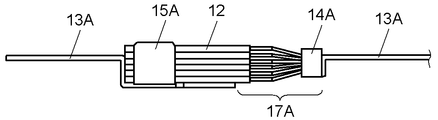
- the two capacitor element laminates 12 (hereinafter, laminates) and the lead frame 13A form a composite. That is, the two laminated bodies 12 are connected by the lead frame 13A.
- the first bent portion 14A of the lead frame 13A is bent so as to hold the anode portion of the laminate 12, and is further fixed and connected to the laminate 12 by resistance welding or laser welding.
- the second bent portion 15A is bent along the stacking direction of the cathode portion of the laminate 12, and is further fixed and connected to the laminate 12 by conductive silver paint. In this way, the connection between the lead frame 13A and the laminate 12 is the same as the connection between the lead frame 13 and the laminate 12 in the first embodiment.
- the laminated body 12 is configured by laminating a plurality of capacitor elements 18 described with reference to FIG. 4C in the first embodiment.
- the connection between the capacitor element 18 and the second bent portion 15A is the same as in the first embodiment.
- a circular through hole 16A is provided in the vicinity of both ends on the long side of the lead frame 13A.
- the through hole 16A is provided for inserting the guide pin 83 of the lower mold 72 described above.
- the diameter of the through hole 16 ⁇ / b> A is set slightly larger than the diameter of the guide pin 83 to the extent that it fits with the guide pin 83.
- the lead frame 13A is separated by the separation portion 17A. Although details will be described later, the lead frame 13A is separated by the separation portion 17A, thereby preventing a short circuit between the anode terminal 29A and the cathode terminal 30A of the resin molded capacitor as a finished product. This configuration is also the same as that of the lead frame 13 of the first embodiment.
- the lead frame 13A is formed by bending so as to extend in the horizontal direction from both ends in the major axis direction of the multilayer body 12 at a height approximately half that of the multilayer body 12.
- FIGS. 27 is a cross-sectional view showing a first step of injecting the norbornene-based resin
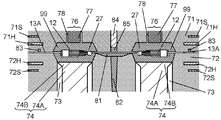
- FIG. 28 is a cross-sectional view showing a second step of placing the composite body of the laminate 12 and the lead frame 13A on the lower mold 72.
- FIG. 29 is a cross-sectional view showing a third step of fastening the upper die 71 and the lower die 72
- FIG. 30 is a cross-sectional view showing a fourth step of covering the laminated body 12 with the norbornene resin 27.
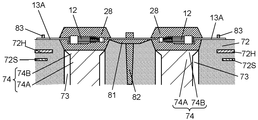
- FIG. 31 is a cross-sectional view showing a fifth step in which the upper mold 71 and the lower mold 72 are separated, and FIG.
- FIGS. 28 to 32 is a cross-sectional view showing a sixth step of taking out the laminated body 12 after molding the exterior body from the molding die.
- the mold is shown in a sectional view, and the composite body of the laminate 12 and the lead frame 13A is shown in a side view.
- the plunger 74 in the state of FIG. 25 is lowered to a predetermined position.
- the resin reservoir 98 is formed in advance on the upper surface of the pressurizing portion 74B of the plunger 74.
- the resin reservoir 98 is a space on the plunger 74 in the pot 73.
- the second recess 80 and the resin reservoir 98 formed in the pot 73 are provided in the lower mold 72 which is the first mold, and constitute a cavity whose upper surface is opened.
- liquid norbornene resin 27 having a viscosity of 10 Pa ⁇ s or less at 40 ° C. is dripped and injected into the resin reservoir 98 in the pot 73 from a nozzle or the like to obtain the state shown in FIG.
- the outer peripheral portion of the upper end of the pressurizing unit 74B is in contact with the inner wall surface of the pot 73, and there is no gap between the two. Therefore, the norbornene-based resin 27 is accumulated in the resin reservoir 98 without dripping down to the back side of the pressure unit 74B.
- the lower mold 72 is controlled to be equal to or lower than the curing temperature of the norbornene-based resin 27 by the second temperature control mechanism configured by the heater 72H and the temperature sensor 72S, and the columnar portion 74A of the plunger 74 is a pot 73. It is spaced apart from the inner wall surface.
- the amount of liquid norbornene resin 27 to be injected is preferably slightly larger than the capacity of the cavity described later. Therefore, the position where the plunger 74 is lowered may be adjusted so that the volume of the resin reservoir 98 is slightly larger than the capacity of the cavity. As shown in FIG. 27, in this embodiment, the resin reservoir 98 is just the space between the bottom surface of the second recess 80 and the pressurizing portion 74B of the plunger 74, but the present invention is not limited to this. . That is, if the amount of norbornene resin 27 to be injected is slightly larger than the capacity of the cavity as described above, the upper end of the resin reservoir 98 is located above or below the bottom surface of the second recess 80. It does not matter even if it is in the position.
- the temperature of the lower mold 72 is set to be equal to or lower than the curing temperature of the norbornene resin 27. Specifically, it is desirable to set to 40 ° C. or higher and 60 ° C. or lower. The reason and method for setting the temperature are the same as those of the lower mold 1 of the first embodiment.
- the nozzle used for injecting the norbornene-based resin 27 into the resin reservoir 98 is always cooled in order to prevent the norbornene-based resin 27 from being cured in the nozzle due to the heat of the mold. Is desirable.
- the composite body of the laminate 12 and the lead frame 13A attached to the laminate 12 is placed on the upper surface of the lower mold 72.
- guide pins 83 provided on the upper surface of the lower die 72 are inserted into the through holes 16A of the lead frame 13A and placed.
- the lead frame 13A and the laminated body 12 are accurately fixed and positioned at predetermined positions.
- Three or more guide pins 83 may be provided, but if at least two guide pins 83 are provided, the lead frame 13A and the laminated body 12 can be accurately positioned on the lower mold 72.
- the area of the opening of the pot 73 is the laminate placed on the upper surface of the lower die 72.
- the projected area from the top of the body 12 is assumed to be larger.
- the laminate 12 and the norbornene-based resin 27 are spaces in which the resin reservoir 98 and the second recess 80 in the pot 73 provided in the lower mold 72 communicate with each other. It is inserted into a cavity opened on the upper surface. This space corresponds to a cavity opened on the upper surface.
- the upper die 71 is lowered from above the lower die 72 as shown by the arrow C in FIG. 29, and the upper die 71 and the lower die 72 are tightened. That is, the upper mold 71 as the second mold is disposed so as to sandwich the laminate 12 and the norbornene resin 27. At this time, the guide pin 83 protruding from the through hole 16A of the lead frame 13A is fitted into the guide pin hole 79 of the upper die 71. Therefore, the upper die 71 is accurately positioned with respect to the lower die 72 and the lead frame 13A.
- the opening end of the first recess 75 of the upper mold 71 and the opening end of the second recess 80 of the lower mold 72 are leads. It overlaps via the frame 13A. Accordingly, the lead frame 13A is firmly held between the lower mold 72 and the upper mold 71, and the laminate 12 is positioned in the cavity 99 formed by the first recess 75 and the second recess 80.
- the upper die 71 is preheated by a first temperature control mechanism including a heater 71H and a temperature sensor 71S, and has a temperature equal to or higher than the curing temperature of the norbornene resin 27. Specifically, the upper mold 71 is heated to a temperature of 80 ° C. or higher and 120 ° C. or lower.
- the plunger 74 is raised at a constant pressure by a pressure adjusting mechanism (not shown) and slid to a predetermined position.
- the plunger 74 is raised to the lower end of the second recess 80.
- the norbornene-based resin 27 has already started to harden due to the temperature of the lower mold 72.
- the temperature of the lower mold 72 is 40 ° C. to 60 ° C., which is lower than the curing temperature of the norbornene resin 27. Therefore, at the start of the fourth step, the viscosity of the norbornene-based resin 27 is low and is a value between 2 ⁇ 10 ⁇ 1 Pa ⁇ s and 10 Pa ⁇ s. Therefore, in the fourth step, the norbornene-based resin 27 can be easily flowed under pressure by raising the plunger 74.
- the norbornene-based resin 27 in the resin reservoir 98 in the pot 73 is pressurized and fluidized and injected into the cavity 99 formed by the first recess 75 and the second recess 80. Filled.
- the position where the plunger 74 is raised is a position where the upper surface of the pressurizing unit 74 ⁇ / b> B is substantially flush with the bottom surface of the second recess 80.
- the viscosity of the norbornene-based resin 27 is low at this stage, mechanical stress applied to the laminate 12 and the lead frame 13A is small, and the laminate 12 and the lead frame 13A may be damaged or deformed. Can be reduced.
- the outer peripheral portion of the upper end of the pressurizing portion 74 ⁇ / b> B rises while being in sliding contact with the inner wall surface of the pot 73. Therefore, the liquid tightness of the resin reservoir 98 is maintained, and the norbornene-based resin 27 does not sag on the back surface of the pressurizing unit 74B.
- the norbornene-based resin 27 injected and filled in the cavity 99 reaches every corner of the cavity 99. In this way, even when the compact and the filling portion of the norbornene-based resin 27 is complicated like the laminated body 12, the norbornene-based resin 27 can be spread to the details.
- the temperature of the upper mold 71 that is heated in advance to the curing temperature of the norbornene resin 27 is propagated to the norbornene resin 27 filled in the cavity 99, and the norbornene resin 27 is cured into the shape of the cavity 99.
- the laminate 12 and the norbornene resin 27 are pressed between the lower mold 72 as the first mold and the upper mold 71 as the second mold, and the temperature of the upper mold 71 is increased.
- the norbornene resin 27 is cured.
- the temperature of the upper mold 71 is set higher than the temperature of the lower mold 72.
- Each cavity 99 is in a state where each surplus resin reservoir 81 provided between the two cavities 99 and a communication hole (not shown) communicate with each other. Therefore, surplus norbornene-based resin 27 overflowing from cavity 99 is discharged to surplus resin reservoir 81 through this communication hole.
- the buffering is performed.
- a portion 85 is formed.
- the buffer part 85 is formed by pushing up the buffer pin 84 by the norbornene resin 27 discharged into the surplus resin reservoir part 81. That is, the norbornene resin 27 is filled in the surplus resin reservoir 81, and the norbornene resin 27 is discharged into the surplus resin reservoir 81, so that the norbornene resin 27 in the surplus resin reservoir 81 is pressurized. It becomes a state.
- the buffer pin 84 receives pressure from the norbornene resin 27 and slides upward.
- the buffer portion 85 is formed between the lower end surface of the buffer pin 84 and the surplus resin reservoir portion 81, and the surplus norbornene resin 27 can be further absorbed. In this way, a part of the surplus of norbornene resin 27 is discharged to the buffer portion 85.
- the buffer pin 84 is provided on the upper die 71.
- the present invention is not limited thereto, and may be provided on the lower die 72, or may be provided on both.
- the gas in the cavity 99 is exhausted to the outside through a slight gap 78 between the inner wall of the upper ejector pin hole 76 and the upper ejector pin 77. With this configuration, it is possible to prevent the gas from remaining in the cavity 99 when the cavity 99 is filled with the norbornene resin 27.
- the norbornene-based resin 27 may leak into the gap 78.
- the gap 78 has a very small width, and in this step, the norbornene resin 27 starts to harden and the viscosity increases. Therefore, there is little possibility that the norbornene resin 27 leaks into the gap 78.
- the size of the communication hole from the cavity 99 to the surplus resin reservoir 81 may be made relatively large. Thereby, the norbornene-based resin 27 is preferentially discharged from the communication hole to the surplus resin reservoir 81 rather than leaking into the gap 78.
- the configuration is not limited to the above.
- the cavity 99 may be airtight without providing the gap 78, and a passage communicating from the surplus resin reservoir 81 to the vacuum pump may be provided, and the vacuum pump may be used to perform vacuum.
- the plunger 74 is raised to a predetermined position and after about 10 seconds, the process proceeds to the fifth step. Since the norbornene resin 27 takes a short time to cure, it is sufficiently cured during this time.
- the upper die 71 shown in FIG. 30 is raised and separated from the lower die 72.
- the norbornene resin 27 is cured into the shape of the cavity 99 to form the outer package 28.
- the laminate 12 and the lead frame 13 ⁇ / b> A covered with the exterior body 28 are placed on the lower mold 72.
- the plunger 74 is further raised from the position in the fourth step or the fifth step to a predetermined position.
- the position where the plunger 74 is raised is preferably a position where at least the upper end of the plunger 74 is above the upper surface of the lower mold 72 in order to facilitate the take-out operation.
- the shape of the 2nd recessed part 80 is formed so that a diameter may become small toward the downward direction from an opening part, the exterior body 28 and the inner wall of the 2nd recessed part 80 do not rub in a 6th step. The possibility of appearance defects is reduced.
- the lower ejector pin 82 rises in synchronization with the rise of the plunger 74. Thereby, the surplus resin in the cured state collected in the surplus resin reservoir 81 is also taken out to the outside.
- the case where the excess resin overflows into the excess resin reservoir portion 81 is described in order to easily show the operation of taking out the excess resin by the lower ejector pins 82.
- the surplus resin is very small and the surplus resin is accumulated only in a part of the surplus resin reservoir portion 81. In this case, as shown in FIG. 32, it does not come into contact with the excess resin cured on the upper surface of the lower ejector pin 82 and push the excess resin upward. Since there is little excess resin present in the excess resin reservoir 81, the upper surface of the lower ejector pin 82 is in direct contact with the lead frame 13A.
- the molded body 100 and the above-described slight excess resin are taken out from the molding die without hindering the fourth step or the molded body 100. be able to.
- FIG. 33 is a perspective view showing the molded body 100.
- 34A is a perspective view showing a completed resin mold type capacitor
- FIG. 34B is a perspective view.
- the exterior body 28 is shown through.
- a molded body 100 made of the laminate 12 and the lead frame 13A covered with the exterior body 28 formed by curing the norbornene resin 27 as shown in FIG. 33 is produced. . Further, a predetermined position of the lead frame 13A indicated by a broken line DD in FIG. 33 is appropriately cut, and the lead frame 13A is bent toward the exterior body 28, thereby completing the resin mold type capacitor shown in FIG. 34A.
- the resin-molded capacitor outer body 28 manufactured by the manufacturing method of the present embodiment has a cavity 99 shape, that is, a side surface having a substantially hexagonal shape.
- the shape of the exterior body 28 of the resin mold type capacitor is close to a rectangular parallelepiped. Therefore, the shape of the first recess 75 and the second recess 80 is such that the diameter of the opening and the bottom of the opening are such that the outer body 28 is not hindered when the laminated body 12 in a state of covering the outer body 28 is taken out. Is preferably close in size.
- the bent lead frame 13A becomes an anode terminal 29A and a cathode terminal 30A in this resin mold type capacitor.
- the anode terminal 29A and the cathode terminal 30A are arranged on both end surfaces and the lower surface in the long axis direction of the resin mold type capacitor. Since the separation portion 17A is provided in advance in the lead frame 13A, the anode terminal 29A is separated from the cathode terminal 30A and they are not short-circuited.
- the manufacturing method in the present embodiment has the same effects as those in the first and second embodiments. That is, it is possible to manufacture a resin mold type capacitor that is sufficiently covered with an exterior body, and to improve the reliability of the resin mold type capacitor. This is because the temperature of the lower die 72 is set lower than the temperature of the upper die 71 by the heaters 71H and 72H and the temperature sensors 71S and 72S in the third step and the fourth step. That is, in the manufacturing method in the present embodiment, the inside of the cavity 99 of FIG. 29 can be sufficiently filled with the norbornene-based resin 27, and the laminate 12 can be sufficiently covered.
- the inside of the cavity 99 can be filled into the norbornene-based resin 27 in a short time. Therefore, even in the case of the molded product of the present embodiment that is small and has a complicated filling range of the norbornene resin 27, the norbornene resin 27 can be distributed in detail in a short time. Become. As a result, it is possible to manufacture a highly reliable resin mold capacitor that is sufficiently covered with an exterior body without leaving an uncoated portion with excellent productivity.
- the upper mold 71 is heated in advance to a temperature equal to or higher than the curing temperature of the norbornene resin 27.
- the norbornene resin 27 is cured by propagating the temperature of the upper mold 71 to the norbornene resin 27.
- the cavity 99 is filled with the norbornene-based resin 27 in the fourth step, and at the same time, curing starts, and a resin mold type capacitor can be manufactured with excellent productivity.
- Preferred temperature settings for the upper mold 71 and the lower mold 72 are the same as those for the upper mold 42 and the lower mold 41 of the second embodiment.
- the norbornene-based resin 27 filled in the cavity 99 in the fourth step is sequentially directed from the upper side to the lower side of the cavity 99.
- Harden That is, the curing proceeds sequentially from the end portion of the product, and the occurrence of residual stress (stress difference) inside the norbornene resin 27 can be extremely reduced. Therefore, the mechanical stress given to the laminated body 12 at the time of hardening can be reduced.
- the pot 73 is opened toward the second recess 80, and the norbornene resin 27 is injected from the pot 73 into the cavity 99. Therefore, the norbornene-based resin 27 is injected at a lower pressure than in the case where the molding resin is injected from a gate having a relatively small diameter in the conventional manufacturing method. As a result, mechanical stress applied to the lead frame 13A and the laminate 12 can be reduced, and a highly reliable resin mold type capacitor is manufactured by reducing the possibility of damage to the lead frame 13A and the laminate 12. be able to.
- the area of the opening of the pot 73 is set to be larger than the projected area of the laminate 12, and the pressure applied to the norbornene-based resin 27 when injected into the cavity 99 is further reduced.
- the separation part 17A exists in the lead frame 13A as described above, and the laminated body 12 is exposed from the separation part 17A. That is, the laminate 12 is particularly susceptible to mechanical stress in the portion exposed from the separation portion 17A, and breakage is likely to occur in this portion. Therefore, in the laminate 12 and the lead frame 13A configured as in the present embodiment, it is important that the area of the opening of the pot 73 is larger than the projected area of the laminate 12.
- the projected area of the multilayer body 12 is the same as that of the capacitor elements 18.
- the composite of the lead frame 13A and the laminated body 12 is arranged so that the lead frame 13A connected to a part of the bottom surface of the laminated body 12 faces the opening of the pot 73.
- This is to protect the laminate 12 from the pressure received from the norbornene resin 27 by the lead frame 13A when the norbornene resin 27 is injected and filled into the cavity 99 in the fourth step.
- the possibility that the laminate 12 is damaged due to unnecessary stress is reduced.
- breakage such as cracks generated during manufacture causes generation of leakage current. Therefore, the handling in the second step as described above is particularly important.
- the pot 73 is opened toward the second recess 80 constituting a part of the cavity 99, when the plunger 74 is raised, the norbornene resin 27 in the pot 73 is directly pressurized and injected into the cavity 99.
- the material yield of the resin mold type capacitor can be improved. That is, since no runner or the like is required, the molding resin for the runner portion is not discarded as in the conventional manufacturing method, and the material loss can be reduced and the material yield can be improved.
- the norbornene-type resin 27 which is a liquid resin precursor. This is because when the manufacturing method according to the present embodiment is performed using a tablet-like or granulated molding resin, the unmelted molding resin may contact the laminate 12 and damage the laminate 12. It is because there is sex. As described above, in the manufacturing method according to the present embodiment, by using the liquid resin, the possibility of damage to the laminated body 12 is reduced, and the reliability of the resin mold type capacitor is increased.
- this liquid resin is 10 Pa ⁇ s or less at the start of the fourth step.
- the viscosity is 10 Pa ⁇ s or less, a resin molded capacitor having excellent reliability can be manufactured without damaging or deforming the laminate 12 or the lead frame 13A.
- the detailed description of the norbornene resin 27 is the same as that in the first embodiment.
- the molded body 100 is taken out from the lower mold 72 by further raising the plunger 74. Thereby, the molded object 100 can be taken out easily and productivity can be improved further.
- the lower mold 72 has a pot 73 opened toward the second recess 80, and the area of the opening of the pot 73 is larger than the projected area of the laminate 12.
- the upper mold 71 has a temperature control mechanism that controls the upper mold 71 to a temperature higher than the lower mold 72, and the temperature control mechanism that controls the lower mold 72 to a temperature lower than the upper mold 71 is provided to the lower mold 72. is doing. With this configuration, it is possible to manufacture a highly reliable resin-molded capacitor with excellent material yield and productivity as described above.
- the lower mold 72 has an excess resin reservoir 81 communicating with the second recess 80, and the excess resin reservoir 81 opens toward the contact surfaces of the upper mold 71 and the lower mold 72. With this configuration, surplus norbornene-based resin 27 accumulated in surplus resin reservoir 81 can be easily taken out in the fifth step.
- the lower mold 72 is conditioned at a relatively lower temperature than the upper mold 71. For this reason, the norbornene-based resin 27 discharged into the surplus resin reservoir 81 provided in the lower mold 72 is not immediately cured. As a result, the possibility that the norbornene-based resin 27 is hardened and clogged in the vicinity of the communication portion between the cavity 99 and the surplus resin reservoir 81 and the discharge of the norbornene-based resin 27 to the surplus resin reservoir 81 is reduced. .
- FIG. 35 is a cross-sectional view showing a state in which the molded body 100 is adhered to the upper mold 71 in the fifth step
- FIG. 36 is a cross-sectional view showing a sixth step of the molded body 100 in the state of FIG.
- the molded body 100 is basically placed on the lower mold 72. However, due to the adhesive force of the norbornene resin 27, the molded body 100 may stick to the upper mold 71 in the fifth step as shown in FIG. In such a case, as shown in FIG. 36, the molded body 100 can be removed from the upper mold 71 by lowering the upper ejector pin 77, and the molded body 100 can be taken out.
- a slight gap 78 is provided between the upper ejector pin 77 and the wall surface of the upper ejector pin hole 76, and the gas in the cavity 99 is exhausted from the gap 78 to the outside in the fourth step. Is done. Therefore, the norbornene resin 27 is easy to fill the cavity 99.
- the composite body of the laminate 12 and the lead frame 13A is placed on the lower mold 72 in the second step.
- these steps are not limited to this order.
- the norbornene-based resin 27 is placed in the resin reservoir 98 from the gap between the lead frame 13A and the open end of the lower mold 72, for example. You may inject
- the present invention is not limited to this.
- the present invention can be applied even when one resin mold type capacitor is manufactured, or even when three or more resin mold type capacitors are manufactured simultaneously. The same effect can be obtained.
- the upper mold 71 is connected to the upper mold 71.
- the first recess 75 may not be provided.
- an uncured norbornene-based resin is described as an example of a liquid resin precursor.
- the present invention is not limited to this material, and is a curable material having a viscosity of 10 Pa ⁇ s or less at 40 ° C. I just need it.
- a liquid epoxy resin may be used.
- the temperatures of the lower molds 1, 41, 72 are set to 80 ° C. or higher and 120 ° C. or lower
- the temperatures of the middle mold 2 are set to 110 ° C. or higher and 150 ° C. or lower
- the temperatures of the upper molds 3, 42, 71 are What is necessary is just to set to 140 degreeC or more and 180 degrees C or less.
- a laminated body composed of solid electrolytic capacitor elements as the element portion has been described as an example.
- the present invention is not limited to this, and other electronic component elements such as a coil can be applied as the element portion.
- the manufacturing method of the present invention it is possible to manufacture a resin mold type capacitor sufficiently covered with an exterior body, and to improve the reliability of the resin mold type capacitor. Furthermore, the norbornene-based resin used as the exterior body of the resin mold type capacitor has excellent moisture resistance, strength, and impact resistance. From these, the resin mold type
Landscapes
- Engineering & Computer Science (AREA)
- Power Engineering (AREA)
- Microelectronics & Electronic Packaging (AREA)
- Mechanical Engineering (AREA)
- Manufacturing & Machinery (AREA)
- Fixed Capacitors And Capacitor Manufacturing Machines (AREA)
Abstract
Priority Applications (2)
| Application Number | Priority Date | Filing Date | Title |
|---|---|---|---|
| US13/056,702 US9005504B2 (en) | 2009-06-17 | 2010-06-17 | Method of manufacturing resin molded electronic component |
| CN201080002933.4A CN102187412B (zh) | 2009-06-17 | 2010-06-17 | 树脂模制型电子部件的制造方法 |
Applications Claiming Priority (6)
| Application Number | Priority Date | Filing Date | Title |
|---|---|---|---|
| JP2009-143850 | 2009-06-17 | ||
| JP2009143850A JP5353462B2 (ja) | 2009-06-17 | 2009-06-17 | 樹脂モールド型コンデンサの製造方法 |
| JP2009212591A JP5353588B2 (ja) | 2009-09-15 | 2009-09-15 | 樹脂モールド型コンデンサの製造方法 |
| JP2009-212591 | 2009-09-15 | ||
| JP2009-277300 | 2009-12-07 | ||
| JP2009277300A JP5413165B2 (ja) | 2009-12-07 | 2009-12-07 | 樹脂モールド型コンデンサの製造方法およびこの製造方法に用いられる成形金型 |
Publications (1)
| Publication Number | Publication Date |
|---|---|
| WO2010146860A1 true WO2010146860A1 (fr) | 2010-12-23 |
Family
ID=43356190
Family Applications (1)
| Application Number | Title | Priority Date | Filing Date |
|---|---|---|---|
| PCT/JP2010/004029 Ceased WO2010146860A1 (fr) | 2009-06-17 | 2010-06-17 | Procédé de production d'un composant électronique moulé en résine |
Country Status (3)
| Country | Link |
|---|---|
| US (1) | US9005504B2 (fr) |
| CN (1) | CN102187412B (fr) |
| WO (1) | WO2010146860A1 (fr) |
Cited By (3)
| Publication number | Priority date | Publication date | Assignee | Title |
|---|---|---|---|---|
| US20120074608A1 (en) * | 2010-09-24 | 2012-03-29 | Satoru Asagiri | Control module manufacturing method |
| US20130207306A1 (en) * | 2012-02-14 | 2013-08-15 | Taiwan Semiconductor Manufacturing Company, Ltd. | Methods for Molding Integrated Circuits |
| US9005504B2 (en) | 2009-06-17 | 2015-04-14 | Panasonic Intellectual Property Management Co., Ltd. | Method of manufacturing resin molded electronic component |
Families Citing this family (8)
| Publication number | Priority date | Publication date | Assignee | Title |
|---|---|---|---|---|
| JP5743922B2 (ja) * | 2012-02-21 | 2015-07-01 | 日立オートモティブシステムズ株式会社 | 熱式空気流量測定装置 |
| JP6104535B2 (ja) | 2012-08-09 | 2017-03-29 | Nok株式会社 | 防爆弁構造及びその製造方法 |
| CN108550463B (zh) * | 2018-05-23 | 2024-09-06 | 荆州市荆力工程设计咨询有限责任公司 | 一种高压陶瓷电容器用绝缘套装壳体 |
| KR102545290B1 (ko) * | 2018-08-29 | 2023-06-16 | 삼성전자주식회사 | 반도체 패키지 몰딩 장치 |
| CN111546552A (zh) * | 2019-02-08 | 2020-08-18 | 柯惠Lp公司 | 完全封装的电子器件和印刷电路板 |
| CN114424307B (zh) * | 2019-09-18 | 2024-11-22 | 京瓷Avx元器件公司 | 含有阻隔涂覆物的固体电解电容器 |
| JP7199604B2 (ja) * | 2020-07-14 | 2023-01-05 | 三菱電機株式会社 | 半導体装置の製造方法 |
| CN118990921B (zh) * | 2024-09-30 | 2025-03-14 | 江苏天之泽生态科技有限公司 | 一种塑料餐盒成型装置 |
Citations (5)
| Publication number | Priority date | Publication date | Assignee | Title |
|---|---|---|---|---|
| JPH0217318U (fr) * | 1988-07-18 | 1990-02-05 | ||
| JPH06177190A (ja) * | 1992-12-01 | 1994-06-24 | Apic Yamada Kk | 半導体装置の樹脂モールド方法及び樹脂モールド装置 |
| JP2001088170A (ja) * | 1999-09-27 | 2001-04-03 | Matsushita Electric Works Ltd | 樹脂成形体の製造方法及び成形用金型 |
| JP2008159723A (ja) * | 2006-12-22 | 2008-07-10 | Matsushita Electric Ind Co Ltd | 電子部品、及びその作成方法 |
| JP2009124012A (ja) * | 2007-11-16 | 2009-06-04 | Towa Corp | 電子部品の圧縮成形方法及び金型 |
Family Cites Families (15)
| Publication number | Priority date | Publication date | Assignee | Title |
|---|---|---|---|---|
| DE3265764D1 (en) * | 1981-05-15 | 1985-10-03 | Ici Plc | Process for moulding reinforced curable compositions |
| USH559H (en) * | 1987-05-12 | 1988-12-06 | The United States Of America As Represented By The Secretary Of The Air Force | Advancing gelation front cure technique |
| JPH0231130U (fr) | 1988-08-22 | 1990-02-27 | ||
| JP3282988B2 (ja) * | 1997-05-01 | 2002-05-20 | アピックヤマダ株式会社 | 樹脂モールド方法及び樹脂モールド装置 |
| JPH11277594A (ja) | 1998-03-31 | 1999-10-12 | Nichicon Corp | プラスチック成形装置 |
| KR100271420B1 (ko) | 1998-09-23 | 2001-03-02 | 박찬구 | 화학증폭형 양성 포토레지스트 조성물 |
| JP2001254003A (ja) | 2000-03-09 | 2001-09-18 | Hitachi Chem Co Ltd | メタセシス重合性樹脂組成物およびそれを用いた電気・電子部品 |
| EP1464670B9 (fr) | 2001-12-28 | 2007-03-21 | Mitsui Chemicals, Inc. | L'utilisation d'un composition de caoutchouc pour preparer des etancheites de pile a combustible |
| JP4268389B2 (ja) * | 2002-09-06 | 2009-05-27 | Towa株式会社 | 電子部品の樹脂封止成形方法及び装置 |
| US7348220B2 (en) * | 2004-04-30 | 2008-03-25 | Sumitomo Bakelite Co., Ltd. | Resin-encapsulated type semiconductor packages, and production method and apparatus therefor |
| CN101322261A (zh) | 2005-12-02 | 2008-12-10 | 安格斯公司 | 低杂质弹性材料 |
| US20070244267A1 (en) | 2006-04-10 | 2007-10-18 | Dueber Thomas E | Hydrophobic crosslinkable compositions for electronic applications |
| JP4858966B2 (ja) * | 2006-11-02 | 2012-01-18 | Towa株式会社 | 電子部品の圧縮成形方法及び成形装置 |
| CN102187412B (zh) | 2009-06-17 | 2014-03-12 | 松下电器产业株式会社 | 树脂模制型电子部件的制造方法 |
| JP2011003827A (ja) * | 2009-06-22 | 2011-01-06 | Panasonic Corp | 電子部品 |
-
2010
- 2010-06-17 CN CN201080002933.4A patent/CN102187412B/zh not_active Expired - Fee Related
- 2010-06-17 US US13/056,702 patent/US9005504B2/en not_active Expired - Fee Related
- 2010-06-17 WO PCT/JP2010/004029 patent/WO2010146860A1/fr not_active Ceased
Patent Citations (5)
| Publication number | Priority date | Publication date | Assignee | Title |
|---|---|---|---|---|
| JPH0217318U (fr) * | 1988-07-18 | 1990-02-05 | ||
| JPH06177190A (ja) * | 1992-12-01 | 1994-06-24 | Apic Yamada Kk | 半導体装置の樹脂モールド方法及び樹脂モールド装置 |
| JP2001088170A (ja) * | 1999-09-27 | 2001-04-03 | Matsushita Electric Works Ltd | 樹脂成形体の製造方法及び成形用金型 |
| JP2008159723A (ja) * | 2006-12-22 | 2008-07-10 | Matsushita Electric Ind Co Ltd | 電子部品、及びその作成方法 |
| JP2009124012A (ja) * | 2007-11-16 | 2009-06-04 | Towa Corp | 電子部品の圧縮成形方法及び金型 |
Cited By (5)
| Publication number | Priority date | Publication date | Assignee | Title |
|---|---|---|---|---|
| US9005504B2 (en) | 2009-06-17 | 2015-04-14 | Panasonic Intellectual Property Management Co., Ltd. | Method of manufacturing resin molded electronic component |
| US20120074608A1 (en) * | 2010-09-24 | 2012-03-29 | Satoru Asagiri | Control module manufacturing method |
| US9597824B2 (en) * | 2010-09-24 | 2017-03-21 | Kabushiki Kaisha Toshiba | Control module manufacturing method |
| US20130207306A1 (en) * | 2012-02-14 | 2013-08-15 | Taiwan Semiconductor Manufacturing Company, Ltd. | Methods for Molding Integrated Circuits |
| US9662812B2 (en) * | 2012-02-14 | 2017-05-30 | Taiwan Semiconductor Manufacturing Company, Ltd. | Methods for molding integrated circuits |
Also Published As
| Publication number | Publication date |
|---|---|
| US20110127694A1 (en) | 2011-06-02 |
| CN102187412B (zh) | 2014-03-12 |
| CN102187412A (zh) | 2011-09-14 |
| US9005504B2 (en) | 2015-04-14 |
Similar Documents
| Publication | Publication Date | Title |
|---|---|---|
| US9005504B2 (en) | Method of manufacturing resin molded electronic component | |
| CN102386110B (zh) | 树脂密封成形品的制造方法和树脂密封成形品的制造装置 | |
| CN103448187B (zh) | 树脂密封成形装置 | |
| JP6020667B1 (ja) | トランスファー成形機および電子部品を製造する方法 | |
| CN113573867B (zh) | 树脂成形装置以及树脂成形品的制造方法 | |
| JP2018130026A (ja) | 磁石埋込み型コアの製造装置 | |
| JP5445695B2 (ja) | 半導体モジュール、モールド装置及びモールド成形方法 | |
| WO2013069491A1 (fr) | Ensemble pile à combustible et procédé de fabrication de celui-ci, et procédé et dispositif de fabrication de partie de liaison | |
| US9548253B2 (en) | Semiconductor device and method of manufacturing the same | |
| JP5748023B2 (ja) | 封止用樹脂シートの製造装置および封止用樹脂シートの製造方法 | |
| JP5413165B2 (ja) | 樹脂モールド型コンデンサの製造方法およびこの製造方法に用いられる成形金型 | |
| JP2007227622A (ja) | 実装方法 | |
| JP6226724B2 (ja) | 複合成形体の製造方法及び放熱性を向上させる方法 | |
| US20120107975A1 (en) | Method for packaging light emitting diode | |
| US20070181903A1 (en) | Semiconductor device manufacturing method and semiconductor device manufacturing apparatus | |
| KR20060042228A (ko) | 수지 밀봉장치 및 수지 밀봉 방법 | |
| WO2019179063A1 (fr) | Procédé d'emballage de plastique capable de résoudre un problème d'écoulement de matériau d'emballage de plastique et d'étendre la largeur de la matrice | |
| JP4481705B2 (ja) | 半導体素子封止装置および半導体素子封止方法 | |
| JP2010016137A (ja) | 半導体装置及び半導体装置の封止成形方法 | |
| KR101160887B1 (ko) | 압축 성형 장치 및 방법 | |
| EP2686902B1 (fr) | Procédé de liaison de plaque de pile à combustible et agencement | |
| JP2025108114A (ja) | タブリードの製造方法、タブリード、電気化学デバイス、電池及びキャパシタ | |
| TW202513267A (zh) | 成形模、樹脂成形裝置、及樹脂成形品的製造方法 | |
| CN120825885A (zh) | 一种模块产品的注塑封装结构及其产品制作方法 | |
| JP2012199346A (ja) | トランスファ成形方法及び成形装置 |
Legal Events
| Date | Code | Title | Description |
|---|---|---|---|
| WWE | Wipo information: entry into national phase |
Ref document number: 201080002933.4 Country of ref document: CN |
|
| WWE | Wipo information: entry into national phase |
Ref document number: 13056702 Country of ref document: US |
|
| 121 | Ep: the epo has been informed by wipo that ep was designated in this application |
Ref document number: 10789239 Country of ref document: EP Kind code of ref document: A1 |
|
| NENP | Non-entry into the national phase |
Ref country code: DE |
|
| 122 | Ep: pct application non-entry in european phase |
Ref document number: 10789239 Country of ref document: EP Kind code of ref document: A1 |