WO2010146872A1 - アリピプラゾールと有機酸を有効成分とする外用剤組成物 - Google Patents
アリピプラゾールと有機酸を有効成分とする外用剤組成物 Download PDFInfo
- Publication number
- WO2010146872A1 WO2010146872A1 PCT/JP2010/004066 JP2010004066W WO2010146872A1 WO 2010146872 A1 WO2010146872 A1 WO 2010146872A1 JP 2010004066 W JP2010004066 W JP 2010004066W WO 2010146872 A1 WO2010146872 A1 WO 2010146872A1
- Authority
- WO
- WIPO (PCT)
- Prior art keywords
- acid
- aripiprazole
- organic acid
- solvent
- percutaneous absorption
- Prior art date
- Legal status (The legal status is an assumption and is not a legal conclusion. Google has not performed a legal analysis and makes no representation as to the accuracy of the status listed.)
- Ceased
Links
Images




Classifications
-
- A—HUMAN NECESSITIES
- A61—MEDICAL OR VETERINARY SCIENCE; HYGIENE
- A61K—PREPARATIONS FOR MEDICAL, DENTAL OR TOILETRY PURPOSES
- A61K31/00—Medicinal preparations containing organic active ingredients
- A61K31/33—Heterocyclic compounds
- A61K31/395—Heterocyclic compounds having nitrogen as a ring hetero atom, e.g. guanethidine or rifamycins
- A61K31/495—Heterocyclic compounds having nitrogen as a ring hetero atom, e.g. guanethidine or rifamycins having six-membered rings with two or more nitrogen atoms as the only ring heteroatoms, e.g. piperazine or tetrazines
- A61K31/496—Non-condensed piperazines containing further heterocyclic rings, e.g. rifampin, thiothixene or sparfloxacin
-
- A—HUMAN NECESSITIES
- A61—MEDICAL OR VETERINARY SCIENCE; HYGIENE
- A61K—PREPARATIONS FOR MEDICAL, DENTAL OR TOILETRY PURPOSES
- A61K47/00—Medicinal preparations characterised by the non-active ingredients used, e.g. carriers or inert additives; Targeting or modifying agents chemically bound to the active ingredient
- A61K47/06—Organic compounds, e.g. natural or synthetic hydrocarbons, polyolefins, mineral oil, petrolatum or ozokerite
- A61K47/08—Organic compounds, e.g. natural or synthetic hydrocarbons, polyolefins, mineral oil, petrolatum or ozokerite containing oxygen, e.g. ethers, acetals, ketones, quinones, aldehydes, peroxides
- A61K47/12—Carboxylic acids; Salts or anhydrides thereof
-
- A—HUMAN NECESSITIES
- A61—MEDICAL OR VETERINARY SCIENCE; HYGIENE
- A61K—PREPARATIONS FOR MEDICAL, DENTAL OR TOILETRY PURPOSES
- A61K9/00—Medicinal preparations characterised by special physical form
- A61K9/0012—Galenical forms characterised by the site of application
- A61K9/0014—Skin, i.e. galenical aspects of topical compositions
-
- A—HUMAN NECESSITIES
- A61—MEDICAL OR VETERINARY SCIENCE; HYGIENE
- A61P—SPECIFIC THERAPEUTIC ACTIVITY OF CHEMICAL COMPOUNDS OR MEDICINAL PREPARATIONS
- A61P25/00—Drugs for disorders of the nervous system
- A61P25/18—Antipsychotics, i.e. neuroleptics; Drugs for mania or schizophrenia
Definitions
- the present invention relates to a transdermal preparation containing aripiprazole and an organic acid known as an atypical antipsychotic. More specifically, the present invention relates to a preparation having good transdermal absorbability obtained by adding an equimolar amount or more of an organic acid to aripiprazole.
- Aripiprazole ie 7- ⁇ 4- [4- (2,3-dichlorophenyl) -1-piperazinyl] butoxy ⁇ -3,4-dihydrocarbostyril or 7- ⁇ 4- [4- (2,3-dichlorophenyl)- 1-Piperazinyl] butoxy ⁇ -3,4-dihydro-2 (1H) -quinolinone is an atypical antipsychotic useful for the treatment of schizophrenia (Patent Document 1). Schizophrenia is a common type of psychosis and is characterized by delusions, hallucinations and exhaustive withdrawal from others. Signs of schizophrenia generally occur between the ages of 16 and 25 and affect 1 in 100 people worldwide. It is more common than Alzheimer's disease, multiple sclerosis, insulin-dependent diabetes and muscular dystrophy. It is known that early screening and treatment can significantly improve recovery and outcome, and that early therapeutic intervention can avoid costly hospitalization.
- Aripiprazole is usually determined to be a starting dose of 6 to 12 mg per day and a maintenance dose of 6 to 24 mg per day for adults, and can be administered orally once or twice a day.
- Non-Patent Document 1 the half-life in blood of healthy adults is as long as about 65 hours, and it is an excellent drug that is not easily affected by food. Then, the development of a new administration method of aripiprazole has been attempted, and a transdermal therapeutic absorption system (TTS) in the form of a plaster has been attempted in addition to the route of oral administration (Patent Document 2).
- TTS transdermal therapeutic absorption system
- transdermal preparation containing a basic drug containing aripiprazole and a copolymer mainly composed of polyvinylpyrrolidone is mentioned, there is no specific example, and only risperidone is described (patent) Reference 3).
- Patent No. 2608788 Special table 2004-529891 JP2007-217313 JP 2006-169238 A
- the object of the present invention is to provide a transdermally absorbable preparation containing aripiprazole and an organic acid and exhibiting good transdermal absorbability. It is another object of the present invention to provide an external preparation composition containing an organic acid salt of aripiprazole and having a good transdermal absorbability.
- a percutaneous absorption preparation having good percutaneous absorption can be prepared by preparing a salt with an organic acid having a log P in the range of -1.5 to 2.5 or an equilibrium mixture thereof.
- a monocarboxylic acid it can be seen that if a salt with a carboxylic acid of ⁇ 1.5 to 0 or an equilibrium mixture thereof is prepared, a more preferable percutaneous absorption preparation with excellent transdermal absorbability can be prepared. It was. Further, in the case of dicarboxylic acid, a more preferable percutaneous absorption preparation can be prepared by using dicarboxylic acid in the range of ⁇ 0.2 to 2.5. Further, it has been found that when an aromatic carboxylic acid or a sulfonic acid derivative is used, a more preferable percutaneous absorption preparation can be obtained with an organic acid in the range of ⁇ 0.7 to 2.5.
- aripiprazole is a highly crystalline compound, but these aripiprazole organic acid salts are stable in storage without precipitation of aripiprazole crystals even in high-concentration non-aqueous transdermal absorption preparations. It was found that a high percutaneous absorption preparation can be obtained.
- the organic solvent composition suitable for the organic acid salt of aripiprazole could be found.
- the organic acid salt of aripiprazole can be dissolved to facilitate the preparation of an external preparation composition, and the percutaneous absorption of aripiprazole can be improved.
- the salt formation equilibrium in the formulation system can be tilted toward the salt, and as a result, the transdermal absorbability of aripiprazole can be further increased. It became possible to improve. Based on these results, the present inventors completed the present invention.
- the gist of the present invention is as follows.
- a percutaneous absorption preparation containing an organic acid salt of aripiprazole in a preparation system The organic acid is an aromatic sulfonic acid, an aliphatic sulfonic acid, an aromatic carboxylic acid or an aliphatic carboxylic acid;
- the organic acid content is 0.5 to 5 times the molar amount of organic acid, with aripiprazole as 1.
- a transdermally absorbable preparation characterized by the above.
- the substituted aliphatic monocarboxylic acid is selected from lactic acid, glycolic acid, and levulinic acid.
- An equimolar salt of an organic acid selected from lactic acid, glycolic acid, and levulinic acid and aripiprazole is produced.
- a method for producing a transdermally absorbable preparation characterized by forming an organic acid salt of aripiprazole comprising the following steps in a preparation system, a) Select a compound with a log P of ⁇ 1.5 to 2.5 as the organic acid and add an organic acid in an amount 0.5 to 5 times the molar amount of aripiprazole to form an organic acid salt of aripiprazole.
- the organic acid salt is diluted by adding at least one selected from an ester solvent, an alcohol solvent, and an amide solvent, c) The diluted solution is mixed and dispersed in the base of the external preparation.
- a method for producing a transdermally absorbable preparation having good transdermal absorbability which is characterized by the above.
- (31) The transdermal system according to (29) or (30) above, wherein the ester solvent is selected from isopropyl myristate, diethyl sebacate, and medium chain fatty acid triglycerides.
- a method for producing a transdermally absorbable preparation characterized by forming an organic acid salt of aripiprazole comprising the following steps in a preparation system, a) the organic acid is an aromatic carboxylic acid or an aliphatic carboxylic acid, and an aripiprazole organic acid salt of aripiprazole is formed by adding 0.5 to 5 times the molar amount of the organic acid with aripiprazole as 1; b) The organic acid salt is diluted by adding at least one selected from an ester solvent, an alcohol solvent, and an amide solvent, c) The diluted solution is mixed and dispersed in the base of the external preparation.
- a method for producing a transdermally absorbable preparation having good transdermal absorbability which is characterized by the above.
- (40) The method for producing a transdermally absorbable preparation according to the above (39), wherein the aliphatic carboxylic acid is a substituted aliphatic carboxylic acid containing at least one hydroxyl group and / or ketone group as a substituent.
- (41) The method for producing a transdermally absorbable preparation according to the above (40), wherein the substituted aliphatic carboxylic acid is selected from lactic acid, glycolic acid and levulinic acid.
- (42) The method for producing a transdermally absorbable preparation according to the above (39), wherein the aromatic carboxylic acid is benzoic acid or salicylic acid.
- the ester solvent is one or more selected from isopropyl myristate, diethyl sebacate, medium-chain fatty acid triglyceride, and propylene carbonate, according to any one of (39) to (42) above.
- a method for producing a transdermally absorbable preparation (44) The above (39) to (43), wherein the alcohol solvent is one or more selected from propylene glycol, 2-propanol, 1,3-butanediol, ethylene glycol, and polyethylene glycol.
- the manufacturing method of the transdermal absorption preparation in any one.
- the transdermally absorbable preparation of the present invention is a transdermally absorbable preparation containing aripiprazole (log P value: 4.6) and an organic acid (log P value: -1.5 to 2.5) salt or an equilibrium mixture thereof.
- aripiprazole log P value: 4.6
- an organic acid log P value: -1.5 to 2.5
- aripiprazole alone cannot be achieved, and the transdermal absorbability is good.
- a stable transdermal preparation capable of avoiding the precipitation of aripiprazole crystals even at high concentrations can be produced.
- the first aspect of the present invention is an invention relating to a transdermally absorbable preparation containing aripiprazole organic acid salt formed in a preparation system by aripiprazole and an organic acid.
- aripiprazole refers to 7- ⁇ 4- [4- (2,3-dichlorophenyl) -1-piperazinyl] butoxy ⁇ -3,4-dihydrocarbostyril (7- ⁇ 4- [4- ( 2,3-dichlorophenyl) -1-piperazinyl] butoxy ⁇ -3,4-dihydro-2 (1H) -quinolinone).
- the “organic acid” referred to in the present invention refers to aliphatic monocarboxylic acid, aliphatic dicarboxylic acid, aromatic carboxylic acid, organic sulfonic acid and the like.
- the aliphatic monocarboxylic acid include short chain fatty acids having 2 to 7 carbon atoms such as acetic acid, butyric acid, hexanoic acid, and cyclohexanecarboxylic acid, for example, medium chain fatty acids having 8 to 11 carbon atoms such as octanoic acid and decanoic acid,
- long-chain fatty acids having 12 or more carbon atoms such as myristic acid, stearic acid, isostearic acid, oleic acid, such as glycolic acid, lactic acid, methoxyacetic acid, mandelic acid, levulinic acid, 3-hydroxybutyric acid, etc.
- short chain fatty acids substituted with a group examples include sebacic acid, adipic acid, malic acid, maleic acid, fumaric acid and the like.
- aromatic carboxylic acid examples include substituted or unsubstituted aromatic carboxylic acids such as benzoic acid, p-hydroxybenzoic acid, salicylic acid, acetylsalicylic acid and cinnamic acid.
- organic sulfonic acid examples include alkyl sulfonic acids such as methane sulfonic acid, ethane sulfonic acid, and menthyl sulfonic acid, and aromatic sulfonic acids such as benzene sulfonic acid, toluene sulfonic acid, and dodecyl benzene sulfonic acid.
- alkyl sulfonic acids such as methane sulfonic acid, ethane sulfonic acid, and menthyl sulfonic acid
- aromatic sulfonic acids such as benzene sulfonic acid, toluene sulfonic acid, and dodecyl benzene sulfonic acid.
- Preferred organic acids include those having a log P value of the organic acid of ⁇ 1.5 to 2.5, preferably an aliphatic monocarboxylic acid of ⁇ 1.5 to 0.
- glycolic acid Lactic acid, methoxyacetic acid, 3-hydroxybutyric acid, mandelic acid, levulinic acid and other hydroxyl groups, alkoxy groups, and short chain fatty acids substituted with acyl groups, for example, benzoic acid, P-hydroxybenzoic acid, salicylic acid, acetylsalicylic acid and other benzenes
- Carboxylic acid can be mentioned. More preferable aliphatic monocarboxylic acids include lactic acid, methoxyacetic acid and glycolic acid having a log P value of ⁇ 1.1 to ⁇ 0.7.
- Examples of the aliphatic dicarboxylic acid include substituted or unsubstituted aliphatic dicarboxylic acids having a logP value in the range of ⁇ 0.2 to 2.5, such as adipic acid and sebacic acid. More preferred examples include aliphatic dicarboxylic acids in the range of 0 to 2.5.
- Examples of the aromatic carboxylic acid include those having a log P value in the range of 1.5 to 2.5, such as benzoic acid and salicylic acid. More preferable examples include benzoic acid and salicylic acid.
- Examples of the organic sulfonic acid include those having a logP value in the range of -0.5 to 1.
- the addition amount of the organic acid in order to form an effective amount of the organic acid salt of aripiprazole in the solution, aripiprazole is 1, and the organic acid is required to be 0.5 times molar amount or more.
- the addition amount of the organic acid is preferably an equimolar or more and a 3-fold molar amount or less.
- aripiprazole organic acid salt formed in the pharmaceutical system means that the preparation contains a salt formed by the reaction of aripiprazole and an organic acid, or an equilibrium mixture of aripiprazole and an organic acid.
- formed in a formulation refers to the formation of an aripiprazole and organic acid salt or equilibrium mixture in an organic acid or solvent, which is mixed or diluted or dispersed in the base of a transdermal formulation.
- the “percutaneous absorption preparation” as used in the present invention refers to liquids, ointments, creams, patches and the like.
- a patch means a haptic agent or a plaster (tape).
- the percutaneous absorption preparation of the present invention may contain a solvent suitable for salt formation in order to produce aripiprazole salt in the preparation system.
- the solvent include ester solvents, alcohol solvents, amides.
- a system solvent can be preferably used.
- commonly used additives known to those skilled in the art can be appropriately added to this solvent depending on the dosage form. Examples of such additives include transdermal absorption enhancers, bases, surfactants, suspending agents, thickeners, inorganic particles, stabilizers, buffers, pH adjusters, colorants, fragrances, and the like. Can be mentioned.
- the term “non-aqueous” as used in the present invention refers to a substance that does not contain water as an essential constituent element.
- the “non-aqueous percutaneous absorption preparation” of the present invention is an external preparation that does not contain water as a constituent element, and does not take into consideration the water that is usually attached to or occluded in substances or solvents.
- a non-aqueous percutaneous absorption preparation in the case of a percutaneous absorption preparation, a haptic agent containing moisture as a constituent requirement does not correspond to this, and a tape preparation corresponds.
- the “ester solvent” referred to in the present invention is, for example, an ester of a long chain fatty acid such as oleic acid, caprylic acid, caproic acid, myristic acid, palmitic acid, stearic acid and the like and a monovalent aliphatic alcohol (for example, isopropyl myristate).
- myristic acid esters such as ethyl myristate, for example, isopropyl palmitate, palmitic acid esters such as ethyl palmitate, stearic acid esters such as isopropyl stearate, and oleic acid esters such as decyl oleate.
- Medium chain fatty acid triglycerides such as caprylic acid triglyceride, caproic acid triglyceride, peanut oil, olive oil, castor oil, cacao oil, hydrogenated oil (such as hydrogenated castor oil), such as adipic acid, sebacic acid, etc.
- Carboxylic acid and Esters with valent aliphatic alcohols for example, sebacic acid esters such as diethyl sebacate and diisopropyl sebacate, and adipic acid esters such as diethyl adipate and diisopropyl adipate
- propylene carbonate etc. Say something like carbonate.
- Preferred examples include myristic esters such as isopropyl myristate and ethyl myristate, such as caprylic acid triglyceride, caproic acid triglyceride, peanut oil, olive oil, castor oil, cacao oil, hydrogenated oil (eg, hardened castor oil), and the like.
- Medium chain fatty acid triglycerides for example, sebacate esters such as diethyl sebacate and diisopropyl sebacate, and propylene carbonate. More preferable examples include isopropyl myristate, medium chain fatty acid triglyceride, diethyl sebacate, and propylene carbonate.
- the “alcohol solvent” as used in the present invention refers to higher alcohols such as benzyl alcohol, lauryl alcohol, myristyl alcohol, cetyl alcohol, stearyl alcohol, cetostearyl alcohol, 2-octyldodecanol, such as ethanol, 2-propanol, 1 -Refers to lower alcohols such as propanol, for example, polyhydric alcohols such as ethylene glycol, glycerin, propylene glycol, 1,3-butanediol, and polyethylene glycol.
- higher alcohols such as benzyl alcohol, lauryl alcohol, myristyl alcohol, cetyl alcohol, stearyl alcohol, cetostearyl alcohol, 2-octyldodecanol, such as ethanol, 2-propanol, 1 -Refers to lower alcohols such as propanol, for example, polyhydric alcohols such as ethylene glycol, glycerin, propylene glycol, 1,
- Preferable examples include lower alcohols such as ethanol, 2-propanol and 1-propanol, and polyhydric alcohols such as ethylene glycol, glycerin, propylene glycol, 1,3-butanediol, and polyethylene glycol. More preferable examples include 2-propanol, ethylene glycol, polyethylene glycol, propylene glycol, and 1,3-butanediol.
- amide solvent examples include N-methyl-2-pyrrolidone, 1,3-dimethyl-2-imidazolidinone, 2-pyrrolidone, ⁇ -caprolactam, formamide, N-methylformamide, N, It refers to N-dimethylformamide, acetamide, N-methylacetamide, N, N-dimethylacetamide, N-methylpropanamide, hexamethylphosphoric triamide and the like.
- Preferable examples include N-methyl-2-pyrrolidone, N, N-dimethylformamide, N, N-dimethylacetamide and the like. More preferred is N-methyl-2-pyrrolidone.
- the ester solvent and an amide solvent are 1: 1 to 1: 4. It is preferable to use this composition in order to enhance the effect of improving transdermal absorbability.
- the “transdermal absorption enhancer” as used in the present invention refers to a reagent generally used in the field of patches to promote the transdermal absorption of a drug.
- the above organic acids, alcohol solvents, ester solvents, amide solvents, and essential oils such as menthol and limonene can be used.
- the same organic acid as that used for the organic acid salt of the basic medicinal component may be used as a transdermal enhancer, or a different one may be used.
- the same acetic acid or lactic acid may be added as a transdermal absorption enhancer, or oleic acid, levulinic acid, myristic acid, stearic acid, isostearic acid, etc.
- Preferred examples include volatile fatty acids such as menthol, N-methyl-2-pyrrolidone, lactic acid, oleic acid, and levulinic acid.
- the above alcohol solvent, ester solvent and amide solvent can be preferably used together with a general-purpose reagent.
- a general-purpose reagent for example, petrolatum, cetanol, beeswax, white honey bee, lanolin, purified lanolin, liquid paraffin, paraffin wax, plastic paraffin containing liquid paraffin and polyethylene, silicone oil, medium chain fatty acid triglyceride, squalene, microcrystalline wax, And oils such as whale wax.
- a plaster for example, natural rubber, isoprene rubber, polyisobutylene, styrene-isoprene-styrene block copolymer, styrene-butadiene-styrene block copolymer, styrene-ethylene-butylene-styrene.
- rubbers such as block copolymers, (meth) acrylic acid alkyl ester (co) polymers, polybutene, liquid polyisoprene.
- tackifier examples include polyterpene resin, polyolefin resin, polystyrene resin, hydrogenated petroleum resin, hydrogenated rosin and the like.
- softener examples include petroleum softeners such as process oil and low molecular weight polybutene, fatty acid softeners such as coconut oil and castor oil, and purified lanolin.
- fillers such as zinc oxide, titanium oxide, calcium carbonate, silicic acid, and antioxidants can be added as necessary.
- transdermal absorbability means that the transdermal absorption preparation of the present invention passes through the transdermal absorption preparation of the present invention as compared to the transdermal absorption preparation in which aripiprazole is present in a free form and no organic acid coexists. Says that it has excellent skin absorbability (skin permeability). Therefore, within the same composition for transdermal absorption, transdermal absorption preparations containing fatty acid salts that are superior in percutaneous absorption (skin permeability) over the percutaneous absorption of free body fall under the present invention. Is. As the surfactant that can be added to the transdermally absorbable preparation, a known surfactant can be used as necessary.
- Suspensions or thickeners that can be added to transdermally absorbable preparations include polysaccharides such as gum arabic, tragacanth, pullulan, locust bin gum, tamarind gum, pectin, xanthan gum, guar gum, carrageenan, methylcellulose, carmellose, carmellose sodium , Polyvinyl alcohol, polyvinyl pyrrolidone, acrylic acid copolymer, carboxyvinyl polymer, colloidal soot crystal cellulose and the like.
- inorganic particles that can be added to the transdermally absorbable preparation for example, talc, silicic anhydride, calcium carbonate, magnesium carbonate, colloidal silica, bentonite and the like can be used. By adding these, the tactile sensation of the preparation with respect to the skin can be controlled.
- a preservative examples include parahydroxybenzoates such as methylparaben and propylparapen, alcohols such as chlorobutanol, pendyl alcohol, and phenylethyl alcohol, thimerosal, acetic anhydride, and sorbic acid.
- the antioxidant examples include sodium bisulfite, L-ascorbic acid, sodium ascorbate, butylhydroxyanisole, dibutylhydroxytoluene, propyl gallate, tocopherol acetate, dl- ⁇ -tocopherol and the like.
- additives In addition to these additives, other drugs that have other drugs can be added as long as they do not interfere with the effects of the transdermal absorption preparation of the present invention.
- the additives exemplified above are appropriately selected according to the dosage form of the transdermally absorbable preparation of the present invention, and the amount of these additives is also appropriately selected within the range normally used according to each dosage form. Is done.
- a second aspect of the present invention relates to a method for producing a percutaneously absorbable preparation having good percutaneous absorbability, wherein an organic acid salt of aripiprazole (including an equilibrium mixture) is formed and contained in a preparation system. It is an invention.
- the production method of the present invention is a method for producing a transdermally absorbable preparation containing an aripiprazole organic acid salt formed and contained in a preparation system, which is characterized by the following steps.
- the organic acid is an aromatic carboxylic acid or an aliphatic carboxylic acid, and an aripiprazole organic acid salt of aripiprazole is formed by adding 0.5 to 5 times the molar amount of the organic acid with aripiprazole as 1;
- the organic acid salt is diluted by adding at least one selected from an ester solvent, an alcohol solvent, and an amide solvent, c)
- the diluted solution is mixed and dispersed in the base of the external preparation.
- Example 1 Synthesis of organic acid salt of aripiprazole 200 mg (0.446 mM) of aripiprazole and an organic acid described in Table 1 below were weighed and dissolved in 1 mL of tetrahydrofuran, and then tetrahydrofuran was distilled off under reduced pressure. Thus, an organic acid salt of aripiprazole was obtained as crystals. Furthermore, recrystallization was performed using ethyl acetate or THF. The melting point of the obtained crystal was measured using a micro melting point measuring device.
- Aripiprazole Since the pKa value of aripiprazole is 7.6 and is almost neutral, the equilibrium of the salt tends to move in the direction of dissociating into acid and base. Aripiprazole has good crystallinity and tends to be precipitated as crystals in a free form. Therefore, it is considered appropriate to use a substituted aliphatic carboxylic acid containing one or more hydroxyl groups and / or ketone groups as substituents in order to form a salt and enhance solubility in a solvent. It is done.
- Example 2 20 mg (0.045 mM) of the liquid drug aripiprazole formed by forming an aliphatic carboxylate salt of aripiprazole and each equimolar amount of the organic acid shown in Table 2 below were weighed in a sample container, Next, a solvent having a mass composition of diethyl sebacate: medium chain fatty acid triglyceride: N-methyl-2-pyrrolidone: propylene glycol (65: 20: 7.5: 7.5) was added, and the total amount was A liquid preparation containing aripiprazole-organic acid salt in the system was prepared to 1000 mg and containing 2 w / w% of aripiprazole. The transdermal absorbability was evaluated by the method of Test Example 1 using rat skin and a Franz diffusion cell. The results are shown in Table 2 and FIGS.
- aripiprazole has a high fat solubility (log P: 4.6), as a usable organic acid, in the case of a monocarboxylic acid, a lipophilic carboxylic acid lower than hexanoic acid (log P: 1.9) is preferable. It was found to show skin absorbability (skin permeability). Further, in the case of a dicarboxylic acid, a good transdermal absorbability is obtained in the case of a disoluble carboxylic acid having a sebacic acid (log P: 2.1) or lower and a higher range than maleic acid (log P: -0.3). Indicated. Thus, it was found that the range of the log P of the optimal organic acid differs between the monocarboxylic acid and the dicarboxylic acid.
- Example 3 aripiprazole 2w / w% solution of the additive effect
- Example 2 lactic acid for aripiprazole, adding a lactic acid molar amounts described in Table 3, to prepare a solution containing a lactate salt of aripiprazole.
- These solutions were applied to Franz diffusion cells by the method of Test Example 1 to evaluate percutaneous absorbability. The results are shown in Table 3 below and FIG.
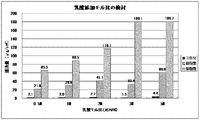
- the transdermal absorbability of a solution containing aripiprazole lactate was found to reach its peak if lactic acid was present in a molar amount of 3 times or more with respect to aripiprazole. It was. Since the pKa value of aripiprazole is 7.6, it is considered that a 3-fold molar amount of lactic acid is required to tilt the acid-base dissociation equilibrium toward the salt.
- Example 4 The pKa value of a liquid organic acid containing an aripiprazole aromatic carboxylate and sulfonate is lower than that of an aliphatic carboxylic acid, and the dissociation equilibrium of the salt tends to be inclined in the direction in which the salt is formed.
- Aromatic carboxylic acids and sulfonic acids were selected as acids.
- An organic acid salt of aripiprazole was prepared in the same manner as in Example 2. First, using the organic acids shown in Table 4 below, each equimolar amount was added and stirred to prepare a solution containing aripiprazole / organic acid salt in the system, containing 2 w / w% of aripiprazole. Transdermal absorbability was evaluated in the same manner as in Example 2. The results are shown in Table 4 and FIG.
- Example 5 Effect of solvent composition and aripiprazole concentration in a solution containing aripiprazole lactate salt
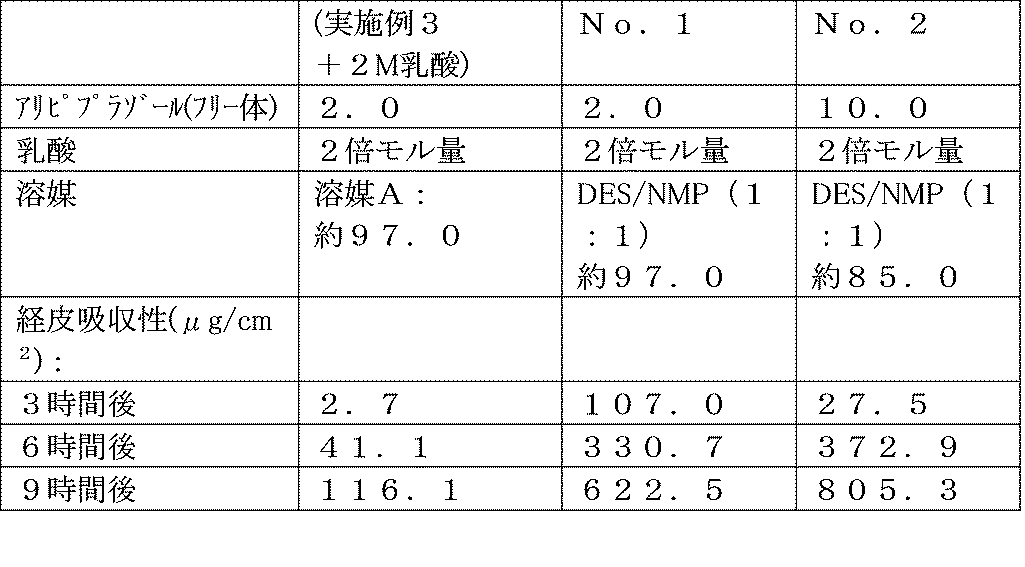
- the transdermal absorbability of a solution containing aripiprazole lactate is that the solvent composition is changed to a solvent composition containing only a fatty acid ester and an amide solvent (No. 1), and aripiprazole It was shown that the concentration was dramatically improved by increasing the concentration (No. 2).
- Example 6 Effect of solvent ratio in liquid preparation containing lactate of aripiprazole
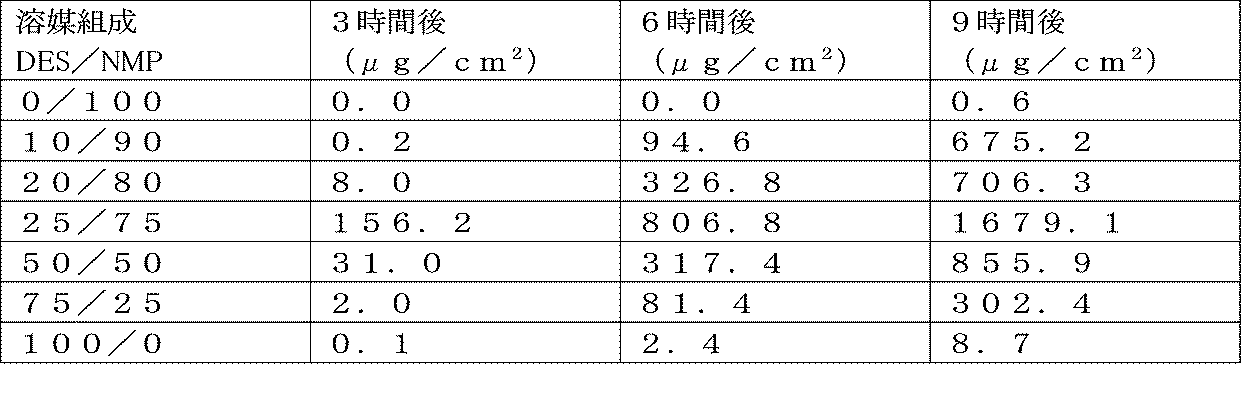
- a solution having the solvent composition changed as shown in Table 6 was prepared with a focus on 2 (aripiprazole 10 w / w%, 2-fold molar amount of lactic acid). These solutions were applied to Franz diffusion cells by the method of Test Example 1 to evaluate percutaneous absorbability. The results are shown in Table 6 below and FIG.
- the transdermal absorbability of a solution containing aripiprazole lactate was changed by changing the mixing ratio of the fatty acid ester and the amide solvent, as shown in FIG. It turns out that it draws a bell-shaped curve. It was found that the percutaneous absorbability was improved in the range of 50/50 to 20/80 as the composition of the fatty acid ester / amide solvent. In particular, it was shown that the percutaneous absorbability was maximized when the composition of the fatty acid ester / amide solvent was around 25/75.
- Example 1 Evaluation test of percutaneous absorbability of a solution containing aripiprazole
- Example 2 sample was collected each 100 ⁇ L of a solution of 1-6, Franz diffusion cell at the test temperature 32 ° C. (permeation area: 1 cm 2, receptor liquid volume: 8 mL) was evaluated test transdermal absorbency as follows using .
- Rat skin 5 weeks old Wistar rat (male) abdominal excised skin
- receptor solution physiological saline: ethanol (10: 1)
- Permeation drug concentration measurement HPLC-ES method (230 nm)
- Commercially available rat abdominal frozen skin (5-week-old Wistar rat) is sandwiched between vertical diffusion cells (effective diffusion area: 1 cm 2 ), and each sample shown in Table 5 is placed on the stratum corneum side.
- a saline / ethanol (10: 1) solution was applied.
- 100 ⁇ L of physiological saline was sampled, the drug concentration permeated through the skin was measured by HPLC, and the cumulative amount of drug permeated at each time was measured. .
- the transdermal absorbability of the organic acid salt of aripiprazole as shown in FIGS. 1 to 5 could be evaluated.
- a transdermally absorbable preparation having excellent transdermal absorbability for aripiprazole can be produced. That is, by selecting a suitable organic acid (an organic acid having low fat solubility) by combining the fat solubility of the medicinal component (log P: 4.6) and the fat solubility of the organic acid (log P), the transdermal absorbability A good aripiprazole organic acid salt can be made in the formulation system. That is, an organic acid salt of aripiprazole having a good transdermal absorbability is combined in the preparation system by appropriately combining organic acids having a fat solubility in the range of ⁇ 1.5 to 2, preferably ⁇ 1.5 to 0. Can be created.
- an organic solvent, a percutaneous absorption accelerator, a surfactant, and the like are appropriately selected and used for the organic acid salt of aripiprazole and the equilibrium mixture thereof obtained in the present invention, and the base of the external preparation composition Aripiprazole can be dissolved or dispersed therein to prepare an external preparation composition exhibiting a desired transdermal absorbability.
- the present invention provides an aripiprazole transdermally absorbable preparation having good transdermal absorbability.
Landscapes
- Health & Medical Sciences (AREA)
- Chemical & Material Sciences (AREA)
- Public Health (AREA)
- Life Sciences & Earth Sciences (AREA)
- General Health & Medical Sciences (AREA)
- Veterinary Medicine (AREA)
- Medicinal Chemistry (AREA)
- Pharmacology & Pharmacy (AREA)
- Animal Behavior & Ethology (AREA)
- Epidemiology (AREA)
- Engineering & Computer Science (AREA)
- General Chemical & Material Sciences (AREA)
- Chemical Kinetics & Catalysis (AREA)
- Oil, Petroleum & Natural Gas (AREA)
- Dermatology (AREA)
- Bioinformatics & Cheminformatics (AREA)
- Biomedical Technology (AREA)
- Neurology (AREA)
- Neurosurgery (AREA)
- Nuclear Medicine, Radiotherapy & Molecular Imaging (AREA)
- Organic Chemistry (AREA)
- Psychiatry (AREA)
- Medicinal Preparation (AREA)
- Pharmaceuticals Containing Other Organic And Inorganic Compounds (AREA)
Abstract
Description
統合失調症は、一般的なタイプの精神病であり、妄想、幻覚及び他者からの徹底的引きこもりを特徴とする。統合失調症の兆候は、概して16から25歳の間に起こり、世界中で100人に1人に発症する。アルツハイマー病、多発性硬化症、インシュリン依存性糖尿病及び筋ジストロフィーよりも多く見られる。早期検診及び治療により、回復及び結果を著しく改善することができ、更に、早期の治療的介入により、費用のかかる入院を避けることができる等のことが知られている。
そこで、アリピプラゾールの新たな投与方法の開拓が試みられ、経口投与のルート以外に硬膏剤の形態における経皮治療吸収システム(TTS)が試みられている(特許文献2)。しかしながら、具体的な効果については全く記載がなく、経皮吸収製剤の特徴が明確ではなかった。
また、アリピプラゾールを含む塩基性薬物とポリビニルピロリドンを主成分とする共重合体を含有する経皮吸収製剤が言及されているが、具体的な実施例はなく、リスペリドンのみが記載されている(特許文献3)。
しかし、具体的なアリピプラゾールと有機酸の組合せと効果については全く検討されていない。また、アリピプラゾールの有機酸塩に由来する経皮吸収性に関しても全く知られていない状況である。
更に、アリピプラゾールは非常に結晶性の良い化合物であるが、これらのアリピプラゾールの有機酸塩は高濃度含有の非水系経皮吸収製剤であっても、アリピプラゾールの結晶が析出することなく、保存安定性の高い経皮吸収製剤が得られることが分かった。また、アリピプラゾールの有機酸塩に好適な有機溶媒組成を見出すことができた。その結果、アリピプラゾールの有機酸塩を溶解させて外用剤組成物の作製を容易にすることができ、更にアリピプラゾールの経皮吸収性を向上させることができるようになった。
外用剤組成物の添加剤として、有機酸の添加量を増加させることにより、製剤系中の塩形成の平衡を塩の方向に傾けることができ、その結果、更にアリピプラゾールの経皮吸収性をより改善することができるようになった。これらの結果に基づき、本発明者らは本発明を完成した。
(1)アリピプラゾールの有機酸塩を製剤系中に含有する経皮吸収製剤であって、
有機酸が、芳香族スルホン酸、脂肪族スルホン酸、芳香族カルボン酸又は脂肪族カルボン酸であり、
有機酸の含量が、アリピプラゾールを1として、有機酸が0.5~5倍モル量である、
ことを特徴とする、経皮吸収製剤。
(2)有機酸が、芳香族カルボン酸又は脂肪族カルボン酸である、上記(1)に記載の経皮吸収製剤。
(3)脂肪族カルボン酸が、水酸基及び/又はケトン基を置換基として一つ以上を含有する置換された脂肪族モノカルボン酸である、上記(2)に記載の経皮吸収製剤。
(4)置換された脂肪族モノカルボン酸が、乳酸、グリコール酸、レブリン酸の中から選択されるものである、上記(3)に記載の経皮吸収製剤。
(5)芳香族カルボン酸が、安息香酸又はサリチル酸である、上記(2)に記載の経皮吸収製剤。
(6)エステル系溶媒、アルコール系溶媒、アミド系溶媒の中から選ばれる少なくとも一つが添加されている、上記(1)~(5)のいずれかに記載の経皮吸収製剤。
(7)エステル系溶媒が、ミリスチン酸イソプロピル、セバシン酸ジエチル、中鎖脂肪酸トリグリセリド、炭酸プロピレンの中から選択される一つ以上のものである、上記(6)に記載の経皮吸収製剤。
(8)アルコール系溶媒が、プロピレングリコール、2-プロパノール、1,3-ブタンジオール、エチレングリコール、ポリエチレングリコールの中から選択される一つ以上のものである、上記(6)~(7)のいずれかに記載の経皮吸収製剤。
(9)アミド系溶媒が、N,N-ジメチルホルムアミド、N,N-ジメチルアセトアミド、N-メチル-2-ピロリドンの中から選択される一つ以上のものである、上記(6)~(8)のいずれかに記載の経皮吸収製剤。
(10)エステル系溶媒およびアミド系溶媒の両方が添加されている、上記(6)~(9)のいずれかに記載の経皮吸収製剤。
(11)アミド系溶媒が、N-メチル-2-ピロリドンである、上記(6)~(10)に記載の経皮吸収製剤。
(12)エステル系溶媒とアミド系溶媒が1:1~1:4の組成で添加されている、上記(6)~(11)のいずれかに記載の経皮吸収製剤。
(13)有機酸とアリピプラゾールが等モルの塩を形成することを特徴とする、上記(1)~(12)のいずれかに記載の経皮吸収製剤。
(14)経皮吸収製剤が、非水系経皮吸収製剤である上記(1)~(13)のいずれかに記載の経皮吸収製剤。
有機酸のlogPが-1.5~2.5である化合物との塩を含有する、
ことを特徴とする、経皮吸収性の良好な経皮吸収製剤。
(16)有機酸のlogPが、-1.5~0である、上記(15)記載の経皮吸収製剤。
(17)有機酸が、グリコール酸、メトキシ酢酸、乳酸、レブリン酸の中から選択されるものである、上記(15)に記載の経皮吸収製剤。
(18)エステル系溶媒、アルコール系溶媒、アミド系溶媒の中から選ばれる少なくとも一つが添加されている、上記(15)~(17)のいずれかに記載の経皮吸収製剤。
(19)エステル系溶媒が、ミリスチン酸イソプロピル、セバシン酸ジエチル、中鎖脂肪酸トリグリセリド、炭酸プロピレンの中から選択される一つ以上のものである、上記(18)に記載の経皮吸収製剤。
(20)アルコール系溶媒が、プロピレングリコール、2-プロパノール、1,3-ブタンジオール、エチレングリコール、ポリエチレングリコールの中から選択される一つ以上のものである、上記(18)~(19)のいずれかに記載の経皮吸収製剤。
(21)アミド系溶媒が、N,N-ジメチルホルムアミド、N,N-ジメチルアセトアミド、N-メチル-2-ピロリドンの中から選択される一つ以上のものである、上記(18)~(20)のいずれかに記載の経皮吸収製剤。
(22)エステル系溶媒およびアミド系溶媒の両方が添加されている、上記(18)~(21)のいずれかに記載の経皮吸収製剤。
(23)アミド系溶媒が、N-メチル-2-ピロリドンである、上記(18)~(22)のいずれかに記載の経皮吸収製剤。
(24)エステル系溶媒とアミド系溶媒が1:1~1:4の組成で添加されている、上記(18)~(23)のいずれかに記載の経皮吸収製剤。
(25)有機酸が、アリピプラゾールを1として0.5~5倍モル量含有される、上記(15)~(24)のいずれかに記載の経皮吸収製剤。
(26)有機酸とアリピプラゾールが等モルの塩を形成することを特徴とする、上記(15)~(25)のいずれかに記載の経皮吸収製剤。
(27)経皮吸収製剤が、非水系経皮吸収製剤である上記(1)~(13)のいずれかに記載の経皮吸収製剤。
(29)次の工程からなるアリピプラゾールの有機酸塩を製剤系中に形成させることを特徴とする経皮吸収製剤の製造方法であって、
a)有機酸としてlogPが-1.5~2.5である化合物を選択し、アリピプラゾールの0.5~5倍モル量の有機酸を加えて、アリピプラゾールの有機酸塩を形成する、
b)上記の有機酸塩にエステル系溶媒、アルコール系溶媒、アミド系溶媒の中から選ばれる少なくとも一つを加えて希釈し、
c)上記希釈溶液を外用剤の基剤に混入し分散させる、
ことを特徴とする、経皮吸収性の良好な経皮吸収製剤の製造方法。
(30)有機酸が、グリコール酸、メトキシ酢酸、乳酸、レブリン酸の中から選択されるものである、上記(29)に記載の経皮吸収製剤の製造方法。
(31)エステル系溶媒がミリスチン酸イソプロピル、セバシン酸ジエチル、中鎖脂肪酸トリグリセリドの中から一つ以上のものが選択されることを特徴とする、上記(29)または(30)に記載の経皮吸収製剤の製造方法。
(32)アルコール系溶媒が2-プロパノール、エチレングリコール、プロピレングリコール、1,3-ブタンジオールの中から一つ以上のものが選択されることを特徴とする、上記(29)~(31)のいずれかに記載の経皮吸収製剤の製造方法。
(33)アミド系溶媒が、N,N-ジメチルホルムアミド、N,N-ジメチルアセトアミド、N-メチル-2-ピロリドンの中から選択される一つ以上のものである、上記(29)~(32)のいずれかに記載の経皮吸収製剤の製造方法。
(34)アミド系溶媒が、N-メチル-2-ピロリドンである、上記(33)に記載の経皮吸収製剤の製造方法。
(35)エステル系溶媒とアミド系溶媒が1:1~1:4の組成で添加される、上記(29)~(34)のいずれかに記載の経皮吸収製剤の製造方法。
(36)有機酸が、アリピプラゾールを1として0.5~5倍モル量含有される、上記(29)~(35)のいずれかに記載の経皮吸収製剤の製造方法。
(37)有機酸とアリピプラゾールが等モルの塩を形成することを特徴とする、上記(29)~(36)のいずれかに記載の経皮吸収製剤の製造方法。
(38)経皮吸収製剤が、非水系経皮吸収製剤である上記(29)~(37)のいずれかに記載の経皮吸収製剤の製造方法。
a)有機酸が、芳香族カルボン酸又は脂肪族カルボン酸であり、アリピプラゾールを1として、0.5~5倍モル量の有機酸を加えて、アリピプラゾールの有機酸塩を形成する、
b)上記の有機酸塩に、エステル系溶媒、アルコール系溶媒、アミド系溶媒の中から選ばれる少なくとも一つを加えて希釈し、
c)上記希釈溶液を外用剤の基剤に混入し分散させる、
ことを特徴とする、経皮吸収性の良好な経皮吸収製剤の製造方法。
(40)脂肪族カルボン酸が、水酸基及び/又はケトン基を置換基として一つ以上を含有する置換された脂肪族カルボン酸である、上記(39)に記載の経皮吸収製剤の製造方法。
(41)置換された脂肪族カルボン酸が、乳酸、グリコール酸、レブリン酸の中から選択されるものである、上記(40)に記載の経皮吸収製剤の製造方法。
(42)芳香族カルボン酸が、安息香酸又はサリチル酸である、上記(39)に記載の経皮吸収製剤の製造方法。
(43)エステル系溶媒が、ミリスチン酸イソプロピル、セバシン酸ジエチル、中鎖脂肪酸トリグリセリド、炭酸プロピレンの中から選択される一つ以上のものである、上記(39)~(42)のいずれかに記載の経皮吸収製剤の製造方法。
(44)アルコール系溶媒が、プロピレングリコール、2-プロパノール、1,3-ブタンジオール、エチレングリコール、ポリエチレングリコールの中から一つ以上が選択されるものである、上記(39)~(43)のいずれかに記載の経皮吸収製剤の製造方法。
(45)アミド系溶媒がN-メチル-2-ピロリドンである、上記(39)~(44)のいずれかに記載の経皮吸収製剤の製造方法。
(46)エステル系溶媒とアミド系溶媒が1:1~1:4の組成で添加される、上記(39)~(45)のいずれかに記載の経皮吸収製剤の製造方法。
(47)有機酸とアリピプラゾールが等モルの塩を形成することを特徴とする、上記(39)~(46)のいずれかに記載の経皮吸収製剤の製造方法。
(48)経皮吸収製剤が、非水系経皮吸収製剤である上記(39)~(47)のいずれかに記載の経皮吸収製剤。
更に、溶媒組成を選択することにより、アリピプラゾールの経皮吸収性がより向上できるようになったことから、アリピプラゾールの経皮吸収製剤の製品化ができるようになった。
本発明の第一の態様は、アリピプラゾールと有機酸によって製剤系中で形成されるアリピプラゾール有機酸塩を含有する経皮吸収製剤に関する発明である。
本発明で言う「アリピプラゾール」とは、7-{4-[4-(2,3-ジクロロフェニル)-1-ピペラジニル]ブトキシ}-3,4-ジヒドロカルボスチリル( 7-{4-[4―(2,3-dichlorophenyl)-1-piperazinyl]butoxy}-3,4-dihydro-2(1H)-quinolinone )のことを言う。
芳香族カルボン酸としては、例えば安息香酸、p-ヒドロキシ安息香酸、サリチル酸、アセチルサリチル酸、桂皮酸等の置換又は無置換の芳香族カルボン酸を挙げることができる。有機スルホン酸としては、例えばメタンスルホン酸、エタンスルホン酸、メンティルスルホン酸等のアルキルスルホン酸、例えばベンゼンスルホン酸、トルエンスルホン酸、ドデシルベンゼンスルホン酸等の芳香族スルホン酸を挙げることができる。
好ましい有機酸としては、有機酸のlogPの値が、-1.5~2.5、好ましくは、脂肪族モノカルボン酸として-1.5~0であるものを挙げることができ、例えばグリコール酸、乳酸、メトキシ酢酸、3-ヒドロキシ酪酸、マンデル酸、レブリン酸等の水酸基やアルコキシ基、アシル基で置換された短鎖脂肪酸、例えば安息香酸、P-ヒドロキシ安息香酸、サリチル酸、アセチルサリチル酸等のベンゼンカルボン酸を挙げることができる。より好ましい脂肪族モノカルボン酸としては、logPの値が-1.1~-0.7である乳酸、メトキシ酢酸、グリコール酸を挙げることができる。
脂肪族ジカルボン酸としては、例えばアジピン酸やセバシン酸のような,logPの値が-0.2~2.5の範囲にある、置換又は無置換の脂肪族ジカルボン酸を挙げることができる。より好ましくは0~2.5の範囲の脂肪族ジカルボン酸を挙げることができる。
芳香族カルボン酸としては、例えば安息香酸やサリチル酸のようにlogPの値が1.5~2.5の範囲にあるものを挙げることができる。より好ましいものとしては、安息香酸やサリチル酸を挙げることができる。
有機スルホン酸としては、logPの値が-0.5~1の範囲にあるものを挙げることができる。
有機酸の添加量としては、アリピプラゾールの有機酸塩の有効量を溶液中で形成させるため、アリピプラゾールを1として、有機酸は0.5倍モル量以上が必要である。過剰の有機酸を加えると、塩の解離平衡が塩に傾くため、3倍モル量以上の有機酸が存在すれば、図3に示されるように経皮吸収性は上限に達していた。従って、有機酸を5倍モル量存在すれば充分な量である。更に有機酸の添加量として、好ましくは等モル以上で3倍モル量以下を添加すればよい。
本発明で言う「経皮吸収製剤」とは、液剤、軟膏剤、クリーム剤、貼付剤等のことを言う。貼付剤とは、ハップ剤、硬膏剤(テープ剤)のことを言う。
本発明の経皮吸収製剤には、製剤系中でアリピプラゾールの塩を作成するため塩の形成に適切な溶媒を含有していてもよく、この溶媒としては、エステル系溶媒、アルコール系溶媒、アミド系溶媒を好ましく使用することができる。更に、その剤型に応じて当業者に公知な通常使用される添加物をこの溶媒に適宜添加することができる。このような添加物として、例えば、経皮吸収促進剤、基剤、界面活性剤、懸濁化剤、増粘剤、無機粒子、安定化剤、緩衝剤、pH調整剤、着色剤、香料等を挙げることができる。
本発明で言う「非水系」とは、水を必須の構成要件として含まないものを言う。即ち、本発明の「非水系経皮吸収製剤」とは、水を構成要件として含まない外用剤のことであり、通常、物質や溶媒に付着あるいは吸蔵されている水分については考慮されていない。例えば、非水系経皮吸収製剤としては、経皮吸収製剤の場合、水分を構成要件として含むハップ剤はこれに該当せず、テープ剤が該当する。
好ましいものとして、例えばミリスチン酸イソプロピル、ミリスチン酸エチル等のミリスチン酸エステル類、例えばカプリル酸トリグリセリド,カプロン酸トリグリセリド,落花生油、オリーブ油、ヒマシ油,カカオ油、水素添加油脂(例え硬化ヒマシ油等)等の中鎖脂肪酸トリグリセリド、例えば、セバシン酸ジエチル、セバシン酸ジイソプロピル等のセバシン酸エステル類、炭酸プロピレンが挙げられる。より好ましいものとしては、ミリスチン酸イソプロピル、中鎖脂肪酸トリグリセリド、セバシン酸ジエチル、炭酸プロピレンを挙げることができる。
好ましいものとしては、例えばエタノール、2-プロパノール、1-プロパノール等の低級アルコール、例えばエチレングリコール、グリセリン、プロピレングリコール、1,3-ブタンジオール、ポリエチレングリコール等の多価アルコール等が挙げられる。より好ましいものとしては、2-プロパノール、エチレングリコール、ポリエチレングリコール、プロピレングリコール、1,3-ブタンジオールを挙げることができる。
好ましいものとしては、例えばN-メチル-2-ピロリドン、N,N-ジメチルホルムアミド、N,N-ジメチルアセトアミド等が挙げられる。より好ましいものとしては、N-メチル-2-ピロリドンを挙げることができる。
本発明において、これら溶媒のうち、エステル系溶媒とアミド系溶媒を併用することが、経皮吸収性を向上させる点から好ましく、特に、エステル系溶媒とアミド系溶媒が1:1~1:4の組成で用いることが、その経皮吸収性向上効果を高める上で好ましい。
本発明で言う「経皮吸収促進剤」とは、薬剤の経皮吸収を促進させるために貼付剤の分野で一般的に汎用される試剤のことを言う。例えば上記の有機酸、アルコール系溶媒、エステル系溶媒、アミド系溶媒や、例えばメントール、リモネン等の精油類などを挙げることができる。更に、塩基性薬効成分の有機酸塩に使用したものと同じ有機酸を経皮促進剤として使用してもよいし、異なるものを使用してもよい。例えば塩基性薬効成分の酢酸塩、乳酸塩等の場合、同じ酢酸や乳酸を経皮吸収促進剤として加えてもよいし、オレイン酸やレブリン酸、ミリスチン酸、ステアリン酸、イソステアリン酸等を加えてもよい。好ましくは、メントール、N-メチル-2-ピロリドンや乳酸、オレイン酸、レブリン酸等の揮発性の低い脂肪酸を挙げることができる。
軟膏製剤の場合には、例えばワセリン、セタノール、ミツロウ、サラシミツロク、ラノリン、精製ラノリン、流動パラフィン、パラフィンワックス、流動パラフィンとポリエチレンとを含むプラスチベース、シリコーンオイル、中鎖脂肪酸トリグリセリド、スクアレン、マイクロクリスタリンワックス、鯨ロウ等の油類等を挙げることができる。
硬膏剤(テープ剤)の場合には、エラストマーとして例えば天然ゴム、イソプレンゴム、ポリイソブチレン、スチレン-イソプレン-スチレンブロック共重合体、スチレン-ブタジェン-スチレンブロック共重合体、スチレン-エチレン-ブチレン-スチレンブロック共重合体、(メタ)アクリル酸アルキルエステル(共)重合体、ポリブテン、液状ポリイソプレン等のゴム類を挙げることができる。粘着付与剤としては、例えばポリテルペン樹脂、ポリオレフィン樹脂、ポリスチレン樹脂、水素添加石油樹脂、水添ロジン等を挙げることができる。軟化剤としては、例えばプロセスオイル、低分子ポリブテン等の石油系軟化剤、例えばヤシ油、ひまし油等の脂肪酸系軟化剤、精製ラノリン等を挙げることができる。その他の成分として、必要に応じて、例えば酸化亜鉛、酸化チタン、炭酸カルシウム、ケイ酸類等の充填剤や抗酸化剤を加えることが出来る。
経皮吸収製剤に添加可能な界面活性剤としては、適宜必要に応じて公知の界面活性剤を使用することができる。
経皮吸収製剤に添加可能な懸濁剤又は増粘剤としては、アラビアゴム,トラガント,プルラン,ローカストビンガム,タマリンドガム,ペクチン、キサンタンガム、グアーガム、カラギーナン等の多糖類、メチルセルロース、カルメロース、カルメロースナトリウム、ポリビニルアルコール、ポリビニルピロリドン、アクリル酸コポリマー、カルボキシビニルポリマー、コロイダル徽結晶セルロース等が挙げられる。
経皮吸収製剤に添加可能な無機粒子としては、例えば、タルク、無水ケイ酸、炭酸カルシウム、炭酸マグネシウム、コロイダルシリカ、ベントナイト等を用いることができる。これらを添加することによって、皮膚に対する製剤の触感をコントロールすることができる。
なお、これらの添加物の他に、本発明の経皮吸収製剤における作用効果を妨げないものであれば、更に、その他の薬物を有する医薬品を添加することもできる。
上記のように例示した添加剤は、本発明の経皮吸収製剤の剤型に応じて適宜選択され、また、これらの添加量も、それぞれの剤型に応じて通常用いられる範囲内で適宜選択される。
本発明の第二の態様は、アリピプラゾールの有機酸塩(平衡混合物を含む)を製剤系中に形成させ含有することを特徴とする、経皮吸収性の良好な経皮吸収製剤の製造方法に関する発明である。
本発明の製造方法としては、適宜公知の汎用手段を利用でき、特に次の工程を特徴とするアリピプラゾールの有機酸塩を製剤系中に形成させ含有する経皮吸収製剤の製造方法である。
a)有機酸が、芳香族カルボン酸又は脂肪族カルボン酸であり、アリピプラゾールを1として、0.5~5倍モル量の有機酸を加えて、アリピプラゾールの有機酸塩を形成する、
b)上記の有機酸塩にエステル系溶媒、アルコール系溶媒、アミド系溶媒の中から選ばれる少なくとも一つを加えて希釈し、
c)上記希釈溶液を外用剤の基剤に混入し分散させる、
ことを特徴とする、経皮吸収性の良好な非水系経皮吸収製剤の製造方法である。
上記用語の定義やその他の添加物については、前項の第一の態様で記載した内容と同じである。
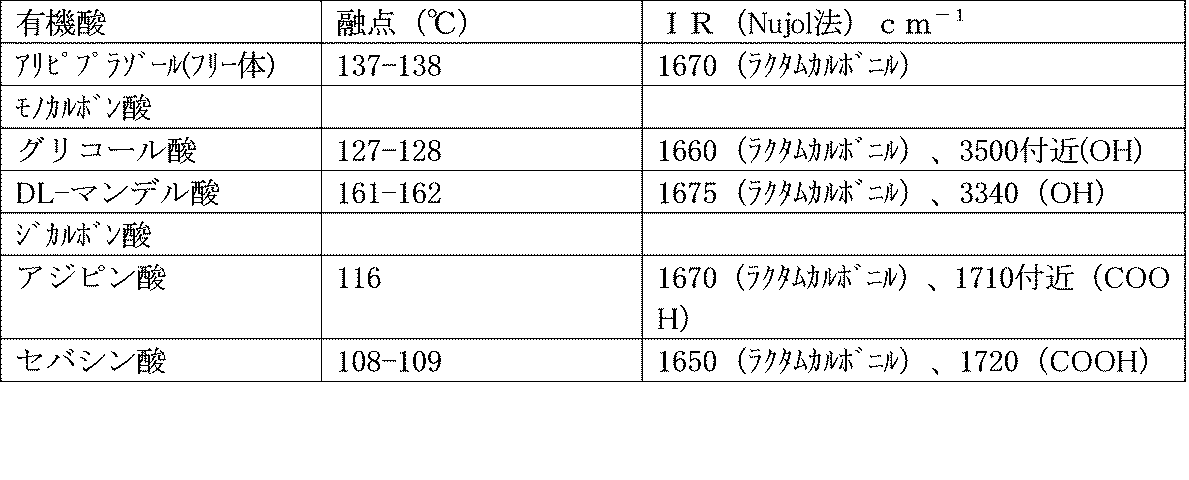
アリピプラゾール200mg(0.446mM)と以下の表1に記載の有機酸を等モル秤取し、テトラヒドロフラン1mLに溶解し、次いで、テトラヒドロフランを減圧留去してアリピプラゾールの有機酸塩を結晶として得た。更に、酢酸エチル又はTHFを用いて再結晶を行った。得られた結晶の融点をミクロ融点測定器を使用して測定した。
赤外吸収スペクトルでは、原料のモノカルボン酸の1700~1720cm-1付近の吸収帯は消失するが、生成すると考えられるカルボキシルイオンの吸収は、アリピプラゾールのIR吸収と重なり、識別できなかった。
アリピプラゾールの20mg(0.045mM)及び、以下の表2に示される有機酸各等モル量をサンプル容器に秤取し、次いで、溶媒組成が、質量比でセバシン酸ジエチル:中鎖脂肪酸トリグリセリド:N-メチル-2-ピロリドン:プロピレングリコール(65:20:7.5:7.5)である溶媒を加えて、全量が1000mgになるように調製し、アリピプラゾールの2w/w%を含有する、アリピプラゾール・有機酸塩を系中に含有する液剤を調製した。 経皮吸収性はラットの皮膚を用いて、フランツ拡散セルを使用して試験例1の方法で評価した。
その結果を表2と図1、図2に示す。
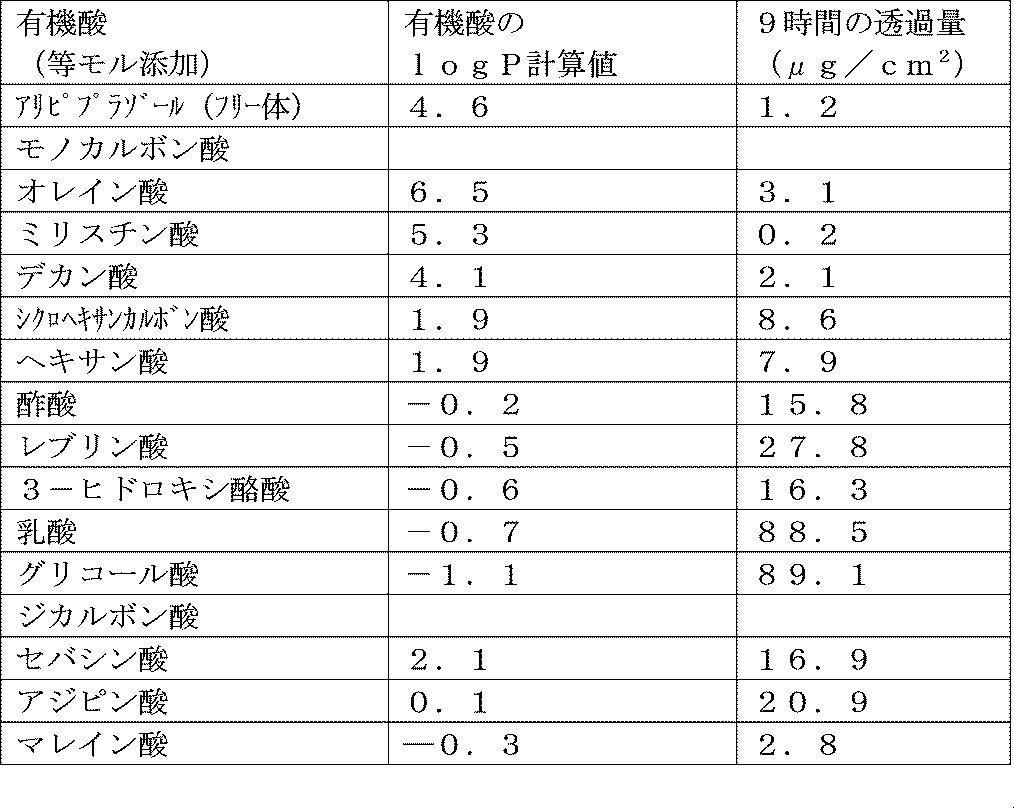
有機酸のlogP計算値は、PubChemの値(2009年2月改訂)を用いた。
実施例2のアリピプラゾール2w/w%溶液に対して、表3に記載のモル量の乳酸を添加し、アリピプラゾールの乳酸塩を含有する液剤を作製した。これらの液剤を試験例1の方法でフランツ拡散セルに供して経皮吸収性を評価した。
その結果を以下の表3と図3に示した。

有機酸のpKa値が脂肪族カルボン酸よりも低く、塩の解離平衡が、塩が形成される方向に傾き易い有機酸として、芳香族カルボン酸とスルホン酸を選択した。アリピプラゾールの有機酸塩を実施例2と同様にして作製した。まず、以下の表4に示される有機酸を使用し、各等モル量添加して攪拌し、アリピプラゾールを2w/w%含有する、アリピプラゾール・有機酸塩を系中に含有する液剤を作製した。
経皮吸収性は実施例2と同様にして評価した。
その結果を表4と図2に示す。
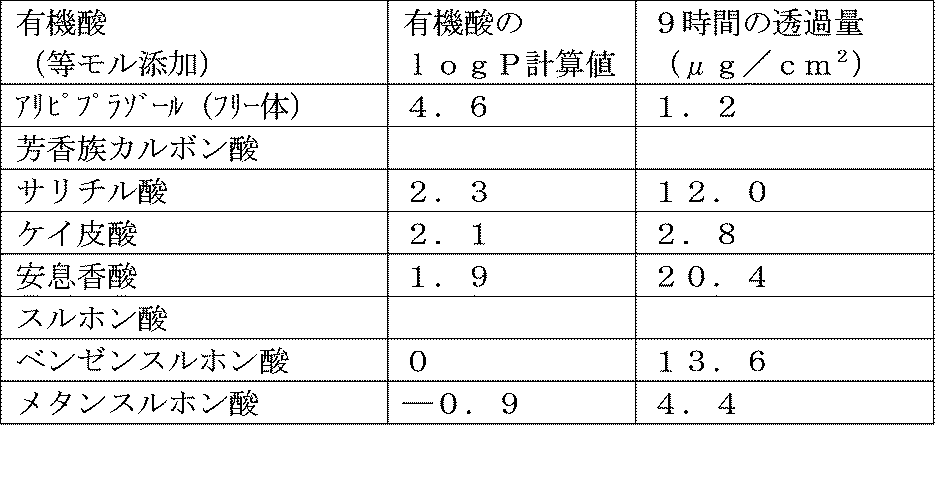
有機酸のlogP計算値は、実施例2と同様にPubChemの値を用いた。
実施例3の、アリピプラゾール2w/w%溶液(溶媒組成:セバシン酸ジエチル(以下、DES)/中鎖脂肪酸トリグリセリド/N-メチル-2-ピロリドン(以下、NMP)/プロピレングリコール=65/20/7.5/7.5 以下、溶媒A)に2倍モル量の乳酸を添加し、アリピプラゾールの乳酸塩を含有する液剤を作製した。更に、表5に記載のように、アリピプラゾール、2倍モル量の乳酸および溶媒組成の液剤を作製した。これらの液剤を試験例1の方法でフランツ拡散セルに供して経皮吸収性を評価した。
その結果を以下の表5と図4に示した。
DES:セバシン酸ジエチル
NMP:N-メチル-2-ピロリドン
実施例5のNo.2(アリピプラゾール10w/w%、2倍モル量の乳酸)の液剤を中心にして、表6に記載するように溶媒組成を変化させた液剤を作製した。これらの液剤を試験例1の方法でフランツ拡散セルに供して経皮吸収性を評価した。
その結果を以下の表6と図5に示した。
DES:セバシン酸ジエチル
NMP:N-メチル-2-ピロリドン
アリピプラゾール有機酸塩を製剤系中に形成して含有する経皮吸収製剤の経皮吸収性を比較検討するため、実施例2~6の液剤の各100μLを分取し、試験温度32℃でフランツ拡散セル(透過面積:1cm2、レセプター液容量:8mL)を用いて以下のように経皮吸収性の評価試験を行なった。
(1)ラット皮膚: 5週令のウィスターラット(雄)の腹部摘出皮膚
(2)レセプター溶液:生理食塩水:エタノール(10:1)
(3)透過薬物の濃度測定:HPLC-ES法(230nm)
市販のラット腹部冷凍皮膚(5週齢のウイスター系ラット)を縦型拡散セル(有効拡散面積:1cm2)に挟み、角質層側に表5に記載の各サンプルを、また、真皮層側に生理的食塩水/エタノール(10:1)溶液を適用した。実験開始後3時間目、6時間目、9時間目に生理的食塩水を100μLサンプリングし、皮膚を透過して溶出した薬物濃度をHPLCにより測定し、各時間における薬物の累積透過量を測定した。その結果、図1~図5に示されるようなアリピプラゾールの有機酸塩の経皮吸収性を評価することが出来た。
更に、本発明で得られたアリピプラゾールの有機酸塩およびそれらの平衡混合物に対して、有機溶媒、経皮吸収促進剤、界面活性剤等を適宜選択して使用し、外用剤組成物の基剤中にアリピプラゾールを溶解または分散させ、所望の経皮吸収性を示す外用剤組成物を作製することができる。このように本発明は、経皮吸収性の良好なアリピプラゾールの経皮吸収製剤を提供するものである。
Claims (23)
- アリピプラゾールの有機酸塩を製剤系中に含有する経皮吸収製剤であって、
有機酸が、水酸基及び/又はケトン基を置換基として一つ以上を含有する置換された脂肪族カルボン酸であり、
有機酸の含量が、アリピプラゾールを1として、有機酸が0.5~5倍モル量である、
ことを特徴とする、経皮吸収製剤。 - 置換された脂肪族カルボン酸が、乳酸、グリコール酸、レブリン酸の中から選択されるものである、請求項1に記載の経皮吸収製剤。
- エステル系溶媒、アルコール系溶媒、アミド系溶媒の中から選ばれる少なくとも一つが添加されている、請求項1又は2に記載の経皮吸収製剤。
- エステル系溶媒が、ミリスチン酸イソプロピル、セバシン酸ジエチル、中鎖脂肪酸トリグリセリド、炭酸プロピレンの中から選択される一つ以上のものである、請求項3に記載の経皮吸収製剤。
- アルコール系溶媒が、プロピレングリコール、2-プロパノール、1,3-ブタンジオール、エチレングリコール、ポリエチレングリコールの中から選択される一つ以上のものである、請求項3~4のいずれかに記載の経皮吸収製剤。
- アミド系溶媒が、N,N-ジメチルホルムアミド、N,N-ジメチルアセトアミド、N-メチル-2-ピロリドンの中から選択される一つ以上のものである、請求項3~5のいずれかに記載の経皮吸収製剤。
- エステル系溶媒およびアミド系溶媒の両方が添加されている、請求項3~6のいずれかに記載の経皮吸収製剤。
- アミド系溶媒が、N-メチル-2-ピロリドンである、請求項6~7のいずれかに記載の経皮吸収製剤。
- エステル系溶媒とアミド系溶媒が1:1~1:4の組成である、請求項3~8のいずれかに記載の経皮吸収製剤。
- 有機酸が、アリピプラゾールを1として0.5~3倍モル量含有される、請求項1~9のいずれかに記載の経皮吸収製剤。
- 有機酸が、アリピプラゾールと等モル量含有される、請求項1~10のいずれかに記載の経皮吸収製剤。
- 経皮吸収製剤が、非水系経皮吸収製剤である、請求項1~11のいずれかに記載の経皮吸収製剤。
- 乳酸、グリコール酸、レブリン酸の中から選択される有機酸とアリピプラゾールとの等モル塩。
- 次の工程からなる、アリピプラゾールの有機酸塩を製剤系中に形成させることを特徴とする経皮吸収製剤の製造方法であって、
a)有機酸が、芳香族カルボン酸又は脂肪族カルボン酸であり、アリピプラゾールを1として、0.5~5倍モル量の有機酸を加えて、アリピプラゾールの有機酸塩を形成する、
b)上記の有機酸塩にエステル系溶媒、アルコール系溶媒、アミド系溶媒の中から選ばれる少なくとも一つを加えて希釈し、
c)上記希釈溶液を外用剤の基剤に混入し分散させる、
ことを特徴とする、経皮吸収性の良好な経皮吸収製剤の製造方法。 - 有機酸が、グリコール酸、乳酸、レブリン酸の中から選択されるものである、請求項14に記載の経皮吸収製剤の製造方法。
- 有機酸が、アリピプラゾールを1として0.5~3倍モル量含有される、請求項14又は15に記載の経皮吸収製剤の製造方法。
- エステル系溶媒がミリスチン酸イソプロピル、セバシン酸ジエチル、中鎖脂肪酸トリグリセリドの中から一つ以上のものが選択されることを特徴とする、請求項14~16のいずれかに記載の経皮吸収製剤の製造方法。
- アルコール系溶媒が2-プロパノール、エチレングリコール、プロピレングリコール、1,3-ブタンジオールの中から選択される一つ以上のものである、請求項14~17のいずれかに記載の経皮吸収製剤の製造方法。
- アミド系溶媒が、N,N-ジメチルホルムアミド、N,N-ジメチルアセトアミド、N-メチル-2-ピロリドンの中から選択される一つ以上のものである、請求項14~18のいずれかに記載の経皮吸収製剤の製造方法。
- アミド系溶媒が、N-メチル-2-ピロリドンである、請求項19に記載の経皮吸収製剤の製造方法。
- エステル系溶媒およびアミド系溶媒を併用する、請求項14~20のいずれかに記載の経皮吸収製剤の製造方法。
- エステル系溶媒とアミド系溶媒が1:1~1:4の組成である、請求項14~21のいずれかに記載の経皮吸収製剤の製造方法。
- 経皮吸収製剤が、非水系経皮吸収製剤である上記(14)~(22)のいずれかに記載の経皮吸収製剤の製造方法。
Priority Applications (2)
| Application Number | Priority Date | Filing Date | Title |
|---|---|---|---|
| JP2011519576A JP5664871B2 (ja) | 2009-06-19 | 2010-06-17 | アリピプラゾールと有機酸を有効成分とする外用剤組成物 |
| US13/378,615 US8815261B2 (en) | 2009-06-19 | 2010-06-17 | Composition for external application comprising aripiprazole and organic acid as active ingredients |
Applications Claiming Priority (2)
| Application Number | Priority Date | Filing Date | Title |
|---|---|---|---|
| JP2009146414 | 2009-06-19 | ||
| JP2009-146414 | 2009-06-19 |
Publications (1)
| Publication Number | Publication Date |
|---|---|
| WO2010146872A1 true WO2010146872A1 (ja) | 2010-12-23 |
Family
ID=43356202
Family Applications (1)
| Application Number | Title | Priority Date | Filing Date |
|---|---|---|---|
| PCT/JP2010/004066 Ceased WO2010146872A1 (ja) | 2009-06-19 | 2010-06-17 | アリピプラゾールと有機酸を有効成分とする外用剤組成物 |
Country Status (3)
| Country | Link |
|---|---|
| US (1) | US8815261B2 (ja) |
| JP (1) | JP5664871B2 (ja) |
| WO (1) | WO2010146872A1 (ja) |
Cited By (25)
| Publication number | Priority date | Publication date | Assignee | Title |
|---|---|---|---|---|
| WO2012105715A1 (en) * | 2011-02-02 | 2012-08-09 | Dainippon Sumitomo Pharma Co., Ltd. | Novel external preparation |
| WO2013133388A1 (ja) * | 2012-03-07 | 2013-09-12 | 株式会社 ケイ・エム トランスダーム | 貼付剤 |
| JP2014503479A (ja) * | 2010-10-28 | 2014-02-13 | トランスダーマル リサーチ ファーム ラボラトリーズ エルエルシー | アリピプラゾール組成物及びその経皮送達のための方法 |
| US8933059B2 (en) | 2012-06-18 | 2015-01-13 | Therapeuticsmd, Inc. | Natural combination hormone replacement formulations and therapies |
| US8987237B2 (en) | 2011-11-23 | 2015-03-24 | Therapeuticsmd, Inc. | Natural combination hormone replacement formulations and therapies |
| JP2015532135A (ja) * | 2012-09-28 | 2015-11-09 | デルポー,インコーポレイティド | 抗精神病薬の徐放のための装置及び方法 |
| US9180091B2 (en) | 2012-12-21 | 2015-11-10 | Therapeuticsmd, Inc. | Soluble estradiol capsule for vaginal insertion |
| US9289382B2 (en) | 2012-06-18 | 2016-03-22 | Therapeuticsmd, Inc. | Vaginal inserted estradiol pharmaceutical compositions and methods |
| JP2016535134A (ja) * | 2013-11-18 | 2016-11-10 | エルジー・ケム・リミテッド | 有機亜鉛触媒、その製造方法およびこれを用いたポリアルキレンカーボネート樹脂の製造方法 |
| JP2016199521A (ja) * | 2015-04-14 | 2016-12-01 | 帝國製薬株式会社 | ブレクスピプラゾールの経皮吸収製剤 |
| WO2017195897A1 (ja) * | 2016-05-12 | 2017-11-16 | 富士フイルム株式会社 | 経皮製剤 |
| US9931349B2 (en) | 2016-04-01 | 2018-04-03 | Therapeuticsmd, Inc. | Steroid hormone pharmaceutical composition |
| WO2018117125A1 (ja) * | 2016-12-19 | 2018-06-28 | 富士フイルム株式会社 | 経皮製剤 |
| US10052386B2 (en) | 2012-06-18 | 2018-08-21 | Therapeuticsmd, Inc. | Progesterone formulations |
| US10206932B2 (en) | 2014-05-22 | 2019-02-19 | Therapeuticsmd, Inc. | Natural combination hormone replacement formulations and therapies |
| US10258630B2 (en) | 2014-10-22 | 2019-04-16 | Therapeuticsmd, Inc. | Vaginal inserted estradiol pharmaceutical compositions and methods |
| US10286077B2 (en) | 2016-04-01 | 2019-05-14 | Therapeuticsmd, Inc. | Steroid hormone compositions in medium chain oils |
| WO2019102992A1 (ja) * | 2017-11-21 | 2019-05-31 | 積水化学工業株式会社 | 皮膚外用剤 |
| US10328087B2 (en) | 2015-07-23 | 2019-06-25 | Therapeuticsmd, Inc. | Formulations for solubilizing hormones |
| US10471072B2 (en) | 2012-12-21 | 2019-11-12 | Therapeuticsmd, Inc. | Vaginal inserted estradiol pharmaceutical compositions and methods |
| US10471148B2 (en) | 2012-06-18 | 2019-11-12 | Therapeuticsmd, Inc. | Progesterone formulations having a desirable PK profile |
| US10537581B2 (en) | 2012-12-21 | 2020-01-21 | Therapeuticsmd, Inc. | Vaginal inserted estradiol pharmaceutical compositions and methods |
| US10806740B2 (en) | 2012-06-18 | 2020-10-20 | Therapeuticsmd, Inc. | Natural combination hormone replacement formulations and therapies |
| US11246875B2 (en) | 2012-12-21 | 2022-02-15 | Therapeuticsmd, Inc. | Vaginal inserted estradiol pharmaceutical compositions and methods |
| US11266661B2 (en) | 2012-12-21 | 2022-03-08 | Therapeuticsmd, Inc. | Vaginal inserted estradiol pharmaceutical compositions and methods |
Families Citing this family (12)
| Publication number | Priority date | Publication date | Assignee | Title |
|---|---|---|---|---|
| US9757374B2 (en) | 2010-10-28 | 2017-09-12 | Aequus Pharmaceuticals Inc. | Aripiprazole compositions and methods for its transdermal delivery |
| JP5856153B2 (ja) | 2011-05-10 | 2016-02-09 | 伊藤忠ケミカルフロンティア株式会社 | 非水性貼付剤 |
| US11786455B2 (en) | 2011-05-10 | 2023-10-17 | Itochu Chemical Frontier Corporation | Non-aqueous patch |
| ES3034911T3 (en) | 2011-05-10 | 2025-08-26 | Itochu Chemical Frontier Corp | Non-aqueous patch |
| SI2823815T1 (sl) | 2011-09-27 | 2018-09-28 | Itochu Chemical Frontier Corporation | Ne-vodni obliž |
| US9913840B2 (en) | 2015-06-08 | 2018-03-13 | Corium International, Inc. | Formulations for aripiprazole delivery transdermally |
| WO2017025912A1 (en) * | 2015-08-13 | 2017-02-16 | Aequus Pharmaceuticals Inc. | Aripiprazole compositions and methods for its transdermal delivery |
| AU2017331340B2 (en) * | 2016-09-23 | 2023-09-28 | Delpor, Inc. | Compositions for small molecule therapeutic agent compounds |
| JP2021515038A (ja) * | 2018-02-27 | 2021-06-17 | デルポー・インコーポレイテッドDelpor, Inc. | 小分子治療剤化合物のための組成物 |
| WO2021041730A1 (en) * | 2019-08-28 | 2021-03-04 | Delpor, Inc. | Compositions for small molecule therapeutic agent compounds |
| WO2025189654A1 (zh) * | 2024-03-15 | 2025-09-18 | 中国药科大学 | 喹啉酮类药物共晶及其制备方法、药物组合物和应用 |
| CN118955369B (zh) * | 2024-07-25 | 2026-04-21 | 中国药科大学 | 喹啉酮类药物共晶及其制备方法、药物组合物和应用 |
Citations (5)
| Publication number | Priority date | Publication date | Assignee | Title |
|---|---|---|---|---|
| JP2002509874A (ja) * | 1998-03-30 | 2002-04-02 | エルティエス ローマン テラピー−ズュステーメ アーゲー | 塩基性アルカリ金属塩を用いて活性物質塩を遊離塩基に変換する経皮治療システムの製造方法 |
| JP2004529891A (ja) * | 2001-03-07 | 2004-09-30 | エルテーエス ローマン テラピー−ジステーメ アーゲー | 部分的ドーパミン−d2作用薬の投与用の経皮治療吸収システム |
| JP2007217313A (ja) * | 2006-02-15 | 2007-08-30 | Hisamitsu Pharmaceut Co Inc | 凝集力向上及び徐放化の外用貼付剤 |
| WO2007142295A1 (ja) * | 2006-06-09 | 2007-12-13 | Dainippon Sumitomo Pharma Co., Ltd. | 新規テープ製剤 |
| WO2008038003A2 (en) * | 2006-09-26 | 2008-04-03 | Zysis Limited | Pharmaceutical compositions of aripiprazole |
Family Cites Families (7)
| Publication number | Priority date | Publication date | Assignee | Title |
|---|---|---|---|---|
| US5006528A (en) | 1988-10-31 | 1991-04-09 | Otsuka Pharmaceutical Co., Ltd. | Carbostyril derivatives |
| JP2608788B2 (ja) | 1988-10-31 | 1997-05-14 | 大塚製薬 株式会社 | 精神分裂病治療剤 |
| US20040170672A1 (en) * | 2001-03-07 | 2004-09-02 | Thorsten Selzer | Transdermal therapeutic system for administration of partial dopamine-d2 agonists |
| MY129350A (en) * | 2001-04-25 | 2007-03-30 | Bristol Myers Squibb Co | Aripiprazole oral solution |
| ATE413166T1 (de) | 2004-11-22 | 2008-11-15 | Hisamitsu Pharmaceutical Co | Transdermales pflaster enthaltend einen schmelzpunktsenkenden hilfsstoff |
| JP5075334B2 (ja) | 2004-11-22 | 2012-11-21 | 久光製薬株式会社 | 薬物含有貼付剤 |
| EP1844036B1 (en) * | 2005-01-27 | 2015-09-23 | Sandoz Ag | Process for the preparation of aripiprazole |
-
2010
- 2010-06-17 JP JP2011519576A patent/JP5664871B2/ja not_active Expired - Fee Related
- 2010-06-17 WO PCT/JP2010/004066 patent/WO2010146872A1/ja not_active Ceased
- 2010-06-17 US US13/378,615 patent/US8815261B2/en not_active Expired - Fee Related
Patent Citations (5)
| Publication number | Priority date | Publication date | Assignee | Title |
|---|---|---|---|---|
| JP2002509874A (ja) * | 1998-03-30 | 2002-04-02 | エルティエス ローマン テラピー−ズュステーメ アーゲー | 塩基性アルカリ金属塩を用いて活性物質塩を遊離塩基に変換する経皮治療システムの製造方法 |
| JP2004529891A (ja) * | 2001-03-07 | 2004-09-30 | エルテーエス ローマン テラピー−ジステーメ アーゲー | 部分的ドーパミン−d2作用薬の投与用の経皮治療吸収システム |
| JP2007217313A (ja) * | 2006-02-15 | 2007-08-30 | Hisamitsu Pharmaceut Co Inc | 凝集力向上及び徐放化の外用貼付剤 |
| WO2007142295A1 (ja) * | 2006-06-09 | 2007-12-13 | Dainippon Sumitomo Pharma Co., Ltd. | 新規テープ製剤 |
| WO2008038003A2 (en) * | 2006-09-26 | 2008-04-03 | Zysis Limited | Pharmaceutical compositions of aripiprazole |
Cited By (65)
| Publication number | Priority date | Publication date | Assignee | Title |
|---|---|---|---|---|
| JP2014503479A (ja) * | 2010-10-28 | 2014-02-13 | トランスダーマル リサーチ ファーム ラボラトリーズ エルエルシー | アリピプラゾール組成物及びその経皮送達のための方法 |
| JP2014504585A (ja) * | 2011-02-02 | 2014-02-24 | 大日本住友製薬株式会社 | 新規外用製剤 |
| WO2012105715A1 (en) * | 2011-02-02 | 2012-08-09 | Dainippon Sumitomo Pharma Co., Ltd. | Novel external preparation |
| US8987237B2 (en) | 2011-11-23 | 2015-03-24 | Therapeuticsmd, Inc. | Natural combination hormone replacement formulations and therapies |
| US10675288B2 (en) | 2011-11-23 | 2020-06-09 | Therapeuticsmd, Inc. | Natural combination hormone replacement formulations and therapies |
| US9248136B2 (en) | 2011-11-23 | 2016-02-02 | Therapeuticsmd, Inc. | Transdermal hormone replacement therapies |
| US8993548B2 (en) | 2011-11-23 | 2015-03-31 | Therapeuticsmd, Inc. | Natural combination hormone replacement formulations and therapies |
| US8993549B2 (en) | 2011-11-23 | 2015-03-31 | Therapeuticsmd, Inc. | Natural combination hormone replacement formulations and therapies |
| US11103516B2 (en) | 2011-11-23 | 2021-08-31 | Therapeuticsmd, Inc. | Natural combination hormone replacement formulations and therapies |
| US11793819B2 (en) | 2011-11-23 | 2023-10-24 | Therapeuticsmd, Inc. | Natural combination hormone replacement formulations and therapies |
| US9114146B2 (en) | 2011-11-23 | 2015-08-25 | Therapeuticsmd, Inc. | Natural combination hormone replacement formulations and therapies |
| US9114145B2 (en) | 2011-11-23 | 2015-08-25 | Therapeuticsmd, Inc. | Natural combination hormone replacement formulations and therapies |
| WO2013133388A1 (ja) * | 2012-03-07 | 2013-09-12 | 株式会社 ケイ・エム トランスダーム | 貼付剤 |
| US11865179B2 (en) | 2012-06-18 | 2024-01-09 | Therapeuticsmd, Inc. | Progesterone formulations having a desirable PK profile |
| US11166963B2 (en) | 2012-06-18 | 2021-11-09 | Therapeuticsmd, Inc. | Natural combination hormone replacement formulations and therapies |
| US10639375B2 (en) | 2012-06-18 | 2020-05-05 | Therapeuticsmd, Inc. | Progesterone formulations |
| US9289382B2 (en) | 2012-06-18 | 2016-03-22 | Therapeuticsmd, Inc. | Vaginal inserted estradiol pharmaceutical compositions and methods |
| US9301920B2 (en) | 2012-06-18 | 2016-04-05 | Therapeuticsmd, Inc. | Natural combination hormone replacement formulations and therapies |
| US9012434B2 (en) | 2012-06-18 | 2015-04-21 | Therapeuticsmd, Inc. | Natural combination hormone replacement formulations and therapies |
| US11529360B2 (en) | 2012-06-18 | 2022-12-20 | Therapeuticsmd, Inc. | Natural combination hormone replacement formulations and therapies |
| US10471148B2 (en) | 2012-06-18 | 2019-11-12 | Therapeuticsmd, Inc. | Progesterone formulations having a desirable PK profile |
| US11110099B2 (en) | 2012-06-18 | 2021-09-07 | Therapeuticsmd, Inc. | Natural combination hormone replacement formulations and therapies |
| US9006222B2 (en) | 2012-06-18 | 2015-04-14 | Therapeuticsmd, Inc. | Natural combination hormone replacement formulations and therapies |
| US8987238B2 (en) | 2012-06-18 | 2015-03-24 | Therapeuticsmd, Inc. | Natural combination hormone replacement formulations and therapies |
| US10052386B2 (en) | 2012-06-18 | 2018-08-21 | Therapeuticsmd, Inc. | Progesterone formulations |
| US11033626B2 (en) | 2012-06-18 | 2021-06-15 | Therapeuticsmd, Inc. | Progesterone formulations having a desirable pk profile |
| US10806740B2 (en) | 2012-06-18 | 2020-10-20 | Therapeuticsmd, Inc. | Natural combination hormone replacement formulations and therapies |
| US8933059B2 (en) | 2012-06-18 | 2015-01-13 | Therapeuticsmd, Inc. | Natural combination hormone replacement formulations and therapies |
| JP2015532135A (ja) * | 2012-09-28 | 2015-11-09 | デルポー,インコーポレイティド | 抗精神病薬の徐放のための装置及び方法 |
| US11065197B2 (en) | 2012-12-21 | 2021-07-20 | Therapeuticsmd, Inc. | Soluble estradiol capsule for vaginal insertion |
| US10888516B2 (en) | 2012-12-21 | 2021-01-12 | Therapeuticsmd, Inc. | Soluble estradiol capsule for vaginal insertion |
| US9180091B2 (en) | 2012-12-21 | 2015-11-10 | Therapeuticsmd, Inc. | Soluble estradiol capsule for vaginal insertion |
| US11304959B2 (en) | 2012-12-21 | 2022-04-19 | Therapeuticsmd, Inc. | Vaginal inserted estradiol pharmaceutical compositions and methods |
| US10471072B2 (en) | 2012-12-21 | 2019-11-12 | Therapeuticsmd, Inc. | Vaginal inserted estradiol pharmaceutical compositions and methods |
| US11266661B2 (en) | 2012-12-21 | 2022-03-08 | Therapeuticsmd, Inc. | Vaginal inserted estradiol pharmaceutical compositions and methods |
| US11246875B2 (en) | 2012-12-21 | 2022-02-15 | Therapeuticsmd, Inc. | Vaginal inserted estradiol pharmaceutical compositions and methods |
| US10537581B2 (en) | 2012-12-21 | 2020-01-21 | Therapeuticsmd, Inc. | Vaginal inserted estradiol pharmaceutical compositions and methods |
| US10568891B2 (en) | 2012-12-21 | 2020-02-25 | Therapeuticsmd, Inc. | Vaginal inserted estradiol pharmaceutical compositions and methods |
| US11241445B2 (en) | 2012-12-21 | 2022-02-08 | Therapeuticsmd, Inc. | Vaginal inserted estradiol pharmaceutical compositions and methods |
| US11497709B2 (en) | 2012-12-21 | 2022-11-15 | Therapeuticsmd, Inc. | Vaginal inserted estradiol pharmaceutical compositions and methods |
| US11123283B2 (en) | 2012-12-21 | 2021-09-21 | Therapeuticsmd, Inc. | Soluble estradiol capsule for vaginal insertion |
| US10806697B2 (en) | 2012-12-21 | 2020-10-20 | Therapeuticsmd, Inc. | Vaginal inserted estradiol pharmaceutical compositions and methods |
| US11116717B2 (en) | 2012-12-21 | 2021-09-14 | Therapeuticsmd, Inc. | Soluble estradiol capsule for vaginal insertion |
| US10835487B2 (en) | 2012-12-21 | 2020-11-17 | Therapeuticsmd, Inc. | Vaginal inserted estradiol pharmaceutical compositions and methods |
| US11351182B2 (en) | 2012-12-21 | 2022-06-07 | Therapeuticsmd, Inc. | Vaginal inserted estradiol pharmaceutical compositions and methods |
| US11622933B2 (en) | 2012-12-21 | 2023-04-11 | Therapeuticsmd, Inc. | Soluble estradiol capsule for vaginal insertion |
| US10047196B2 (en) | 2013-11-18 | 2018-08-14 | Lg Chem, Ltd. | Organic zinc catalyst, and manufacturing method thereof and manufacturing method of polyalkylene carbonate resin using the same (as amended) |
| JP2016535134A (ja) * | 2013-11-18 | 2016-11-10 | エルジー・ケム・リミテッド | 有機亜鉛触媒、その製造方法およびこれを用いたポリアルキレンカーボネート樹脂の製造方法 |
| US11103513B2 (en) | 2014-05-22 | 2021-08-31 | TherapeuticsMD | Natural combination hormone replacement formulations and therapies |
| US10206932B2 (en) | 2014-05-22 | 2019-02-19 | Therapeuticsmd, Inc. | Natural combination hormone replacement formulations and therapies |
| US10258630B2 (en) | 2014-10-22 | 2019-04-16 | Therapeuticsmd, Inc. | Vaginal inserted estradiol pharmaceutical compositions and methods |
| US10398708B2 (en) | 2014-10-22 | 2019-09-03 | Therapeuticsmd, Inc. | Vaginal inserted estradiol pharmaceutical compositions and methods |
| US10668082B2 (en) | 2014-10-22 | 2020-06-02 | Therapeuticsmd, Inc. | Vaginal inserted estradiol pharmaceutical compositions and methods |
| JP2016199521A (ja) * | 2015-04-14 | 2016-12-01 | 帝國製薬株式会社 | ブレクスピプラゾールの経皮吸収製剤 |
| US10328087B2 (en) | 2015-07-23 | 2019-06-25 | Therapeuticsmd, Inc. | Formulations for solubilizing hormones |
| US10912783B2 (en) | 2015-07-23 | 2021-02-09 | Therapeuticsmd, Inc. | Formulations for solubilizing hormones |
| US9931349B2 (en) | 2016-04-01 | 2018-04-03 | Therapeuticsmd, Inc. | Steroid hormone pharmaceutical composition |
| US10286077B2 (en) | 2016-04-01 | 2019-05-14 | Therapeuticsmd, Inc. | Steroid hormone compositions in medium chain oils |
| US10532059B2 (en) | 2016-04-01 | 2020-01-14 | Therapeuticsmd, Inc. | Steroid hormone pharmaceutical composition |
| JPWO2017195897A1 (ja) * | 2016-05-12 | 2019-01-17 | 富士フイルム株式会社 | 経皮製剤 |
| WO2017195897A1 (ja) * | 2016-05-12 | 2017-11-16 | 富士フイルム株式会社 | 経皮製剤 |
| WO2018117125A1 (ja) * | 2016-12-19 | 2018-06-28 | 富士フイルム株式会社 | 経皮製剤 |
| JPWO2018117125A1 (ja) * | 2016-12-19 | 2019-08-08 | 富士フイルム株式会社 | 経皮製剤 |
| US11033506B2 (en) | 2017-11-21 | 2021-06-15 | Sekisui Chemical Co., Ltd. | External skin preparation comprising a core-shell structure |
| WO2019102992A1 (ja) * | 2017-11-21 | 2019-05-31 | 積水化学工業株式会社 | 皮膚外用剤 |
Also Published As
| Publication number | Publication date |
|---|---|
| JPWO2010146872A1 (ja) | 2012-11-29 |
| US8815261B2 (en) | 2014-08-26 |
| US20120184563A1 (en) | 2012-07-19 |
| JP5664871B2 (ja) | 2015-02-04 |
Similar Documents
| Publication | Publication Date | Title |
|---|---|---|
| JP5664871B2 (ja) | アリピプラゾールと有機酸を有効成分とする外用剤組成物 | |
| JP5544544B2 (ja) | 塩基性薬効成分の脂肪酸塩、安息香酸塩を含有する外用剤とその製造方法 | |
| CN101909651B (zh) | 包括基于脂肪酸的离子型液体作为活性成分的外用制剂组合物 | |
| Qian et al. | Coamorphous lurasidone hydrochloride–saccharin with charge-assisted hydrogen bonding interaction shows improved physical stability and enhanced dissolution with pH-independent solubility behavior | |
| JP6238991B2 (ja) | 局所ケトプロフェン組成物 | |
| US20100029704A1 (en) | Salt of nonsteroidal anti-inflammatory drug and organic amine compound and use thereof | |
| JP6131522B2 (ja) | ロキソプロフェン含有外用剤 | |
| US20100173965A1 (en) | Antifungal composition | |
| TWI316857B (en) | Topical composition | |
| JP2015531374A5 (ja) | ||
| WO2009081217A1 (en) | Pharmaceutical formulations containing tolperisone | |
| JPWO2009028650A1 (ja) | 乳化型外用剤およびその製造方法 | |
| JP2006503026A (ja) | 局所施用のためのフェニルピリドン化合物の安定なクリーム製剤 | |
| Zhang et al. | Injectable sustained release PLA microparticles prepared by solvent evaporation-media milling technology | |
| TW202202129A (zh) | 含麻醉藥物活性成分的透皮製劑及其製備方法 | |
| JP6131523B2 (ja) | ロキソプロフェン含有外用剤 | |
| KR20220012238A (ko) | 외용제 | |
| JP2019006737A (ja) | 医薬組成物 | |
| CN114502142B (zh) | 包含温度响应性离子液体的医药组合物 | |
| JP6203682B2 (ja) | アリピプラゾール含有水性液剤 | |
| JP6625208B2 (ja) | 経皮製剤 | |
| CN103228280B (zh) | 包含瑞伐拉赞或其盐的可注射液体组合物 | |
| JP2019006738A (ja) | 医薬組成物 | |
| WO2024135819A1 (ja) | ヘパリン類似物質およびロキソプロフェン、その塩およびそれらの水和物からなる群から選択される少なくとも一種を含有する皮膚外用剤 | |
| WO2014102497A1 (fr) | Composition dermatologique comprenant un inhibiteur de pde7 sous forme solubilisée, son procédé de préparation et son utilisation |
Legal Events
| Date | Code | Title | Description |
|---|---|---|---|
| 121 | Ep: the epo has been informed by wipo that ep was designated in this application |
Ref document number: 10789251 Country of ref document: EP Kind code of ref document: A1 |
|
| WWE | Wipo information: entry into national phase |
Ref document number: 2011519576 Country of ref document: JP |
|
| NENP | Non-entry into the national phase |
Ref country code: DE |
|
| WWE | Wipo information: entry into national phase |
Ref document number: 13378615 Country of ref document: US |
|
| 122 | Ep: pct application non-entry in european phase |
Ref document number: 10789251 Country of ref document: EP Kind code of ref document: A1 |