WO2010146924A1 - Système de communication sans fil, station de base, station mobile, procédé de communication sans fil et programme de communication sans fil - Google Patents
Système de communication sans fil, station de base, station mobile, procédé de communication sans fil et programme de communication sans fil Download PDFInfo
- Publication number
- WO2010146924A1 WO2010146924A1 PCT/JP2010/056568 JP2010056568W WO2010146924A1 WO 2010146924 A1 WO2010146924 A1 WO 2010146924A1 JP 2010056568 W JP2010056568 W JP 2010056568W WO 2010146924 A1 WO2010146924 A1 WO 2010146924A1
- Authority
- WO
- WIPO (PCT)
- Prior art keywords
- station apparatus
- orthogonal
- mobile station
- resources
- control information
- Prior art date
- Legal status (The legal status is an assumption and is not a legal conclusion. Google has not performed a legal analysis and makes no representation as to the accuracy of the status listed.)
- Ceased
Links
Images






Classifications
-
- H—ELECTRICITY
- H04—ELECTRIC COMMUNICATION TECHNIQUE
- H04L—TRANSMISSION OF DIGITAL INFORMATION, e.g. TELEGRAPHIC COMMUNICATION
- H04L5/00—Arrangements affording multiple use of the transmission path
- H04L5/003—Arrangements for allocating sub-channels of the transmission path
- H04L5/0053—Allocation of signalling, i.e. of overhead other than pilot signals
-
- H—ELECTRICITY
- H04—ELECTRIC COMMUNICATION TECHNIQUE
- H04J—MULTIPLEX COMMUNICATION
- H04J13/00—Code division multiplex systems
- H04J13/16—Code allocation
- H04J13/18—Allocation of orthogonal codes
-
- H—ELECTRICITY
- H04—ELECTRIC COMMUNICATION TECHNIQUE
- H04W—WIRELESS COMMUNICATION NETWORKS
- H04W72/00—Local resource management
- H04W72/02—Selection of wireless resources by user or terminal
-
- H—ELECTRICITY
- H04—ELECTRIC COMMUNICATION TECHNIQUE
- H04L—TRANSMISSION OF DIGITAL INFORMATION, e.g. TELEGRAPHIC COMMUNICATION
- H04L5/00—Arrangements affording multiple use of the transmission path
- H04L5/0001—Arrangements for dividing the transmission path
- H04L5/0014—Three-dimensional division
- H04L5/0016—Time-frequency-code
Definitions
- the present invention relates to a radio communication system for transmitting control information from one or more mobile station apparatuses to a base station apparatus by a transmission method using two or more orthogonal resources, a base station apparatus, a mobile station apparatus, and a radio
- the present invention relates to a communication method and a wireless communication program.
- W-CDMA Wideband-Code Division Multiple Access
- GSM Global System for Mobile Communications
- LTE-A LTE Advanced
- LTE Long Term Evolution
- a maximum of 4 spatial multiplexing transmissions using MIMO are employed for downlink signals.
- MIMO Multiple Input Multiple Multiple Output
- CSI Channel State Information
- the plurality of information is information such as CQI (Channel Quality Indicator), PMI (Precoding Matrix Indicator), and RI (Rank Indicator).
- CQI is information corresponding to a modulation method and a coding rate that can be demodulated by the receiver.
- the wideband CQI is an effective CQI over all frequencies, and serves as an index representing reception quality that fluctuates over the long term.
- the subband CQI is an effective CQI for each specific frequency size, and is used to notify a specific frequency band with good reception quality in a frequency selective fading environment.
- the subband CQI is applicable only to a narrow frequency region as compared with the wideband CQI, and uses a lot of frequency resources to notify the base station apparatus.
- PMI is information indicating a sequence for weighting a transmission signal sequence in a transmitter.
- an increase in throughput can be expected by multiplexing different information data sequences in the space and separating them by the mobile station apparatus, but the effect of increasing the throughput largely depends on this signal separation accuracy.
- it is effective to multiply the transmission signal by a weight according to the propagation path condition (this is called precoding).
- a list of precoders is held in advance by a transmitter and a receiver (this is called a code book), and only an index indicating one of these elements is fed back, and this index is used.
- PMI Corresponds to PMI.
- PMI There are two types of PMI: wideband PMI and subband PMI.
- the wideband PMI is an effective PMI over all frequencies, and the subband PMI is an effective PMI for each frequency size.
- the subband PMI is applied only to a narrow frequency region as compared with the wideband PMI, and uses a lot of resources to notify the base station apparatus.
- precoding suitable for each frequency band can be performed in a frequency selective fading environment, and as a result, communication quality can be improved.
- RI is information representing the number of transmission signal sequences to be multiplexed in MIMO spatial multiplexing.
- the optimum spatial multiplexing number changes according to the correlation for each antenna of the propagation path and the signal-to-noise power ratio, so the mobile station apparatus notifies the base station apparatus of the optimum number of spatial multiplexing sequences. .
- This is RI, and the base station apparatus determines the spatial multiplexing number of the downlink signal according to the received RI.
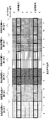
- FIGS. 8 and 9 are diagrams illustrating the principle of resource management divided by time and frequency in an LTE uplink control channel, where the horizontal axis represents time and the vertical axis represents frequency.
- uplink resources are an uplink control channel (PUCCH: Physical-Uplink-Control-Channel) mainly used for transmitting control information and a physical for each mobile station apparatus to mainly transmit data. It has an uplink shared channel (PUSCH: Physical-Uplink-Shared-Channel), and each is expressed as a set of division units called resource blocks (RB: Resource-Block). The number of resource blocks in the frequency direction depends on the system bandwidth.
- PUCCH Physical-Uplink-Control-Channel
- PUSCH Physical-Uplink-Shared-Channel
- RB Resource-Block
- a time unit occupied by one resource block is called one slot, and a combination of two slots is called one subframe.
- the allocation unit in the PUCCH is a subframe, and is allocated by hopping for each slot in order to acquire frequency diversity.
- resource blocks X having the same numbers (shown by m in the figure) shown in FIG. 8 are assigned, and subframes are assigned to both ends of the frequency axis.
- FIG. 9 is a diagram showing an example of the configuration within one resource block (RB) X on the frequency-time axis.
- one resource block is composed of seven SC-FDMA symbols (corresponding to one slot) and 12 subcarriers in the frequency direction.
- a minimum resource unit composed of 1SC-FDMA symbol ⁇ 1 subcarrier is called a resource element (RE).
- a CAZAC sequence Constant Amplitude and Zero Auto-Correlation
- PAPR Peak to Average Power to Ratio
- one symbol of CSI (for example, 2 bits of information in the case of QPSK) is spread by an orthogonal sequence of sequence length 12, and is composed of 1 SC-FDMA symbol ⁇ 12 subcarriers.
- an orthogonal sequence a sequence obtained by cyclically shifting a CAZAC sequence with a different length on the time axis is used.
- a reference signal (or also referred to as a pilot signal) for use in channel estimation at the time of demodulation is similarly arranged.
- a known sequence is spread by an orthogonal code having a sequence length of 12 at a transmitter and a receiver, and is arranged in a resource element composed of 1SC-FDMA symbol ⁇ 12 subcarriers.
- LTE it is determined that reference signals are arranged at the positions of SC-FDMA symbol numbers 1 and 5 in FIG.
- CSI transmission on PUCCH in LTE is performed based on orthogonal (frequency, code) resources allocated at a certain time from the base station apparatus.
- orthogonal (frequency, code) resources allocated at a certain time from the base station apparatus.
- SC-FDMA Single-Carrier-Frequency-Division-Multiple-Access
- m is assigned to the mobile station apparatus.
- the code resource corresponds to an orthogonal code to be assigned, and corresponds to one of the cyclic shifts assigned to the mobile station apparatus for the CAZAC sequence described above.
- CSI transmission resources When CSI transmission resources are allocated from the base station apparatus to the mobile station apparatus, information on frequencies and code resources that can be used at a certain time is notified to the mobile station apparatus. That is, CSI can be continuously fed back by a single allocation process.
- different information is transmitted for each subframe.
- Feedback type In subband CQI, the system band is divided by the number of divisions determined by the system band, and CQI corresponding to the bandwidth is transmitted in one subframe. In order to transmit subband CQI for the entire system band, it is necessary to transmit subframes for the number of divisions corresponding to the system band. In each subframe, 5 to 9 bits are encoded into 20 bits, which is the capacity of one PUCCH, and transmitted.
- the mobile station apparatus transmits wideband CQI and wideband PMI calculated in all system bands in one subframe. In the subframe, 6 to 11 bits are encoded into 20 bits and transmitted. Feedback type3. In RI, transmission is performed in one subframe. In a subframe, 1-2 bits are encoded into 20 bits and transmitted.
- CQI for the entire system band is transmitted in one subframe. In a subframe, 4 bits are encoded into 20 bits.
- the number of information bits to be transmitted is converted to 20 bits by channel coding regardless of any feedback type or control information type.
- SINR Signal to Interference plus Noise Ratio: signal power vs. interference power / noise Power ratio
- Non-Patent Document 1 proposes to increase the gain using transmission diversity such as SCTD (Space Code Transmit Transmit Diversity).
- SCTD Space Code Transmit Transmit Diversity
- two orthogonal sequences are assigned to each transmission antenna, and each receiver receives the respective information in these two sequences, and obtains a high gain by combining the maximum ratio.
- Non-Patent Document 2 proposes application of a method called STBC (Space Time Block Coding).
- STBC Space Time Block Coding
- Non-Patent Document 3 as a transmission method using two orthogonal resources, a method is proposed in which two orthogonal resources are allocated to different antennas and different information is transmitted by the respective antennas. In this transmission method, it is possible not to improve communication quality, but to transmit more information bits while satisfying the communication quality when the required communication quality is satisfied.
- FIG. 10 is a diagram illustrating an example of orthogonal resource allocation in the maximum number 6 of UEs that can be multiplexed when SCTD is applied to a 2Tx antenna.
- two orthogonal resources are allocated to each of mobile station apparatus A to mobile station apparatus F. Therefore, there is a problem that the capacity of PUCCH is halved by applying transmission diversity.
- CSI transmission using LTE PUCCH supports only a transmission scheme that uses one orthogonal resource, but LTE-A may apply a transmission scheme that uses two orthogonal resources. And requires allocation of additional orthogonal resources from LTE.
- the present invention has been made in view of such circumstances, and a radio communication system, a base station apparatus, and a mobile station that can support allocation of two or more orthogonal resources to a mobile station apparatus without significantly reducing the capacity.
- An object is to provide a station apparatus, a wireless communication method, and a wireless communication program.
- the wireless communication system of the present invention wirelessly transmits control information from one or more mobile station apparatuses to a base station apparatus by a transmission method using two or more orthogonal resources.
- the control information when the control information satisfies a predetermined condition, two or more resources belonging to at least one of a code resource and a frequency resource are allocated as two or more orthogonal resources, and the control information is transmitted It is characterized by doing.
- the radio communication system of the present invention allocates two or more orthogonal resources only when a predetermined condition is satisfied, the orthogonal resources can be allocated to the mobile station device without significantly reducing the capacity. It becomes possible.
- the mobile station apparatus can receive a channel estimation sequence separately for each transmission antenna, and a transmission diversity scheme such as SCTD or STBC is used for PUCCH. Applicable to transmission.
- SCTD transmission diversity scheme
- LTE-A there is a possibility that a transmission scheme using two orthogonal resources may be applied, and such a case can be dealt with.
- a resource other than the specific resource is uniquely determined by an index indicating the specific resource. It is characterized by being.
- the base station apparatus extracts the second and subsequent orthogonal resources without notifying an additional control signal. And two or more orthogonal resources can be used. In this way, the mobile station apparatus can determine whether or not the second and subsequent orthogonal resources are available without any additional signal. For example, it is determined whether or not the control signal requires good error rate characteristics, and the second and subsequent orthogonal resources can be used according to a rule determined in advance between the base station device and the mobile station device.
- orthogonal resources it is possible to assign orthogonal resources to mobile station apparatuses without significantly reducing capacity and without needing to exchange additional control information. Also, one or two orthogonal resources can be used for one mobile station apparatus without adding a signal for allocating two or more orthogonal resources greatly from the current system. If determination is possible based on the number of transmission bits, a resource other than a specific resource can be uniquely determined by determining according to a rule determined in advance between the base station device and the mobile station device.
- the wireless communication system of the present invention is characterized in that the control information satisfies the predetermined condition when the control information is CSI. Accordingly, since CSI transmission resources are allocated as control information, information on frequency resources or code resources is notified to the mobile station apparatus at a certain time. That is, CSI can be continuously fed back by a single allocation process. In LTE, different information can be transmitted for each subframe, and a large number of information can be transmitted in one subframe.
- the base station apparatus transmits a signal specifying allocation of one orthogonal resource among the two or more orthogonal resources.
- the assignment of the two or more orthogonal resources is specified by transmitting to the mobile station apparatus.
- the radio communication system allocates the two or more orthogonal resources by transmitting a signal specifying the allocation of the two or more orthogonal resources from the base station apparatus to the mobile station apparatus. It is characterized by notifying. Thereby, the mobile station apparatus can use one orthogonal resource notified from the base station apparatus and the orthogonal resource determined in advance in the base station apparatus and the mobile station apparatus. As a result, two or more orthogonal resources can be used without the mobile station apparatus being explicitly notified of the second and subsequent orthogonal resources.
- a radio communication system is a radio communication system that transmits control information from a plurality of mobile station apparatuses to a base station apparatus by a transmission method using two or more orthogonal resources, and assigned A shared orthogonal resource used in all of the time is allocated from the base station apparatus to a specific mobile station apparatus, and a non-shared orthogonal resource used in a part of the allocated time is specified from the base station apparatus
- the unshared orthogonal resource is allocated to a mobile station device other than the specific mobile station device at a certain time when the unshared orthogonal resource is not allocated to the specific mobile station device. It is characterized by that. Thereby, orthogonal resources can be shared between mobile station apparatuses, orthogonal resources can be efficiently used, and a significant decrease in capacity can be prevented.
- the number of bits of the control information is 1 subframe, 1 transmission antenna, 1 and the predetermined number of bits that can be transmitted by orthogonal resources is x
- the number of bits exceeding x is 1
- the predetermined condition is satisfied when transmission is possible using subframes, two transmission antennas, and two orthogonal resources.
- the wireless communication system of the present invention is characterized in that the control information satisfies the predetermined condition when the control information is RI. As a result, it is possible to cope with a situation in which control information having a good error rate characteristic as a required condition is transmitted.
- the mobile station apparatus can transmit control information using one or two orthogonal resources by notifying only one orthogonal resource. For example, according to the required quality of control information transmitted by the mobile station apparatus, it is possible to transmit control information without allocating signals necessary for additional orthogonal resource allocation and without allocating orthogonal resources.
- the base station apparatus of the present invention is a base station apparatus that receives control information from one or more mobile station apparatuses by a transmission method using two or more orthogonal resources, and the control information is When a predetermined condition is satisfied, two or more resources belonging to at least one of a code resource and a frequency resource are allocated as two or more orthogonal resources, and the control information transmitted based on the allocation is received. It is a feature. As a result, orthogonal resources can be allocated without significantly reducing the capacity. Further, the channel estimation sequence can be received separately for each transmission antenna.
- the mobile station apparatus of the present invention is a mobile station apparatus that transmits control information to a base station apparatus by a transmission method using two or more orthogonal resources, and the control information satisfies a predetermined condition.
- the control information is transmitted using two or more resources belonging to at least one of code resources and frequency resources allocated as two or more orthogonal resources.
- orthogonal resources can be allocated without significantly reducing the capacity.
- the channel estimation sequence can be received separately for each transmission antenna.
- the wireless communication method of the present invention is a wireless communication method for transmitting control information from one or more mobile station apparatuses to a base station apparatus by a transmission method using two or more orthogonal resources, When the control information satisfies a predetermined condition, two or more resources belonging to at least one of a code resource and a frequency resource are allocated as two or more orthogonal resources, and the control information is transmitted. .
- orthogonal resources can be allocated without significantly reducing the capacity. Further, the channel estimation sequence can be received separately for each transmission antenna.
- the wireless communication program of the present invention is a wireless communication program that is executed on a base station device that receives control information from one or more mobile station devices by a transmission method using two or more orthogonal resources.
- a process of allocating two or more resources belonging to at least one of a code resource and a frequency resource as two or more orthogonal resources, and transmission based on the allocation The base station apparatus is caused to execute a process of receiving the control information.
- orthogonal resources can be allocated without significantly reducing the capacity.
- the channel estimation sequence can be received separately for each transmission antenna.
- a radio communication program of the present invention is a radio communication program executed on a mobile station apparatus that transmits control information to a base station apparatus by a transmission method using two or more orthogonal resources,
- the process of transmitting the control information using two or more resources belonging to at least one of code resources and frequency resources allocated as two or more orthogonal resources It is characterized by being executed by a station device.
- orthogonal resources can be allocated without significantly reducing the capacity. Further, the channel estimation sequence can be received separately for each transmission antenna.
- FIG. 10 is a sequence chart illustrating an operation of a wireless communication system according to a third embodiment. It is a conceptual diagram which shows allocation of the resource divided
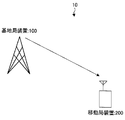
- FIG. 1 is a schematic diagram showing a wireless communication system 10 in the present embodiment.
- the wireless communication system 10 includes a base station device 100 and a mobile station device 200.
- the mobile station device 200 is an example of many mobile station devices with which the base station device 100 communicates.
- PVS Precoder Vector Switching
- SCTD SCTD
- PVS is a transmission method applicable to a plurality of antennas by using one orthogonal resource by applying signal processing to a modulated signal.
- the transmission method for transmission using one orthogonal resource is not necessarily PVS, and may be another method.
- the transmission method using two orthogonal resources is not necessarily SCTD, and may be another transmission method.
- the application of the present invention is not limited to CSI, and can be applied to control information of a communication method for performing CDMA in a predetermined frequency and time domain, such as ACK and NACK.
- the mobile station device 200 includes two antennas. When one orthogonal resource is assigned, one orthogonal resource is assigned to each of the plurality of antennas, When two orthogonal resources are allocated, two orthogonal resources are allocated to different antennas.
- the base station apparatus 100 includes one or more antennas, and can demodulate information transmitted from the mobile station apparatus 200 using one or two orthogonal resources.
- FIG. 2 is a functional block diagram illustrating a configuration example of the base station apparatus 100.
- the base station apparatus 100 includes a transmission unit 110, a scheduling unit 120, a reception unit 130, and an antenna 140.
- the transmission unit 110 includes an orthogonal resource information multiplexing unit 111, a modulation unit 112, a mapping unit 113, and a wireless transmission unit 114.
- the scheduling unit 120 includes a time / frequency resource control unit 121 and an orthogonal code control unit 122
- the reception unit 130 includes a radio reception unit 131, an information extraction unit 132, a propagation path compensation / despreading unit 133, a synthesis unit
- a demodulation unit 134 is provided.
- the antennas 140 are provided as many as necessary for transmitting downlink signals and receiving uplink signals.
- the downlink data generated in the base station apparatus 100 and transmitted to each mobile station apparatus 200 and the orthogonal resource (frequency, orthogonal code) information for CSI transmission output from the scheduling section 120 are orthogonal resource information multiplexed. Data that is input to the unit 111 and transmitted to each mobile station device 200 is generated.
- orthogonal resource information may be transmitted explicitly using several to several tens of bits regardless of the transmission format, or may be uniquely determined from other information.
- downlink information may include control information in each layer.
- the signal output from the orthogonal resource information multiplexing unit 111 is modulated by the modulation unit 112 under the designation of the scheduling unit 120 and converted into a signal form to be transmitted. Specifically, the bit string is modulated into a signal such as BPSK or QPSK.
- the signal modulated by the modulation unit 112 is input to the mapping unit 113 and mapped to resources according to the designation of the scheduling unit 120. Specifically, in the case of OFDMA, each mobile station apparatus 200 is mapped to a frequency resource designated at a certain time, and information notified to all the mobile station apparatuses 200 is also appropriately mapped to the time and frequency resources.
- the output of the mapping unit 113 is input to the wireless transmission unit 114 and converted into a format suitable for the transmission method.
- a time domain signal is generated by performing IFFT (Inverse Fast Fourier Transformation) on a frequency domain signal.
- IFFT Inverse Fast Fourier Transformation
- MIMO Multiple Input Multiple Output
- the scheduling unit 120 receives control information from an upper layer and performs resource allocation to each mobile station device 200, modulation scheme, coding rate determination, and the like.
- the time / frequency resource control unit 121 is a function for controlling which information (control information, signal to each mobile station apparatus 200) including uplink and downlink is allocated to which time / frequency resource. Data mapping and uplink data control signal output management are performed.
- the orthogonal code control unit 122 performs allocation and management of orthogonal codes used by each mobile station apparatus 200 in an uplink signal for performing CDMA.
- the scheduling unit 120 is different from the prior art in that a plurality of orthogonal resources (combinations of frequency and code) are allocated to one mobile station apparatus 200 at the same time (ie, subframe).
- the base station apparatus 100 allocates a time represented by an offset and period from a specific time in the mobile station apparatus 200 communicating with the base station apparatus 100, and one code resource and frequency resource at that time. At the same time, additional codes and frequency resources are allocated to a part of this time, and one mobile station apparatus 200 allocates two orthogonal resources (a combination of codes and frequencies) in a specific subframe. Manage to be available.
- the base station apparatus 100 transmits one orthogonal resource when allocating two orthogonal resources to the mobile station apparatus 200, and the base station apparatus can extract two orthogonal resources from the one orthogonal resource.
- the orthogonal resource determined between 100 and the mobile station apparatus 200 is notified.
- the signal transmitted from the mobile station device 200 is received by the antenna 140 and then input to the wireless reception unit 131.
- the wireless reception unit 131 receives data and control signals, generates a digital signal corresponding to the transmission method, and outputs it. For example, in the case of an OFDM-based communication system, a signal subjected to FFT processing in units of processing time is output after analog conversion of the received signal.
- the output of the wireless reception unit 131 is input to the information extraction unit 132 and is divided for each type of information. Specifically, the received signal is divided for each data from each mobile station apparatus 200, and among them, it is divided into control information and a signal to a higher layer. In this embodiment, it is assumed that the information extraction unit 132 separates and outputs the frequency resources at the time when the target CSI signal is included.
- the output of the information extraction unit 132 is input to the propagation path compensation / despreading unit 133.
- the propagation path compensation / despreading section 133 estimates the propagation path from the reference signal included in the input signal, compensates for the received signal, and simultaneously uses the orthogonal code managed by the scheduling section 120. Is despread. If the reference signal is also spread, the propagation path is calculated after despreading based on the spread code information input from the scheduling unit 120.
- the order of performing channel compensation and despreading is not limited.
- the propagation path compensation / despreading unit 133 performs output for each spreading code.
- the output of the propagation path compensation / despreading unit 133 is input to the synthesis / demodulation unit 134.
- the combining / demodulating unit 134 refers to the scheduling unit 120 and performs demodulation processing for reproducing the transmitted bits when a single orthogonal resource is allocated.
- two orthogonal resources are allocated at a certain time in the scheduling unit, two input sequences are combined and demodulated at the same time.
- Combining is a process for improving reception quality by performing weighted addition in accordance with propagation path conditions.
- the processing order of the channel compensation / despreading unit 133 and the combining / demodulating unit 134 is not limited. Furthermore, these processes can be performed simultaneously by using MMSE (Minimum
- MMSE Minimum
- FIG. 3 is a functional block diagram illustrating a configuration example of the mobile station apparatus 200.
- the mobile station device 200 includes a receiving unit 210, a schedule information management unit 220, a transmission unit 230, and an antenna 240.
- the reception unit 210 includes a wireless reception unit 211, a propagation path compensation unit 212, and a decoding processing unit 213.
- the decoding processing unit 213 includes an error correction / detection unit 214, a demodulation unit 215, and an information extraction / separation unit 216.
- the schedule information management unit 220 includes an uplink scheduling management unit 224, a downlink scheduling management unit 221, an orthogonal code management unit 222, and a control information management unit 223.
- the transmission unit 230 includes an information multiplexing unit 231, a modulation / spreading unit 232, a mapping unit 233, and a wireless transmission unit 234.
- There are as many antennas 240 as necessary for transmitting uplink signals and receiving downlink signals.
- the wireless reception unit 211 When the downlink signal transmitted from the base station apparatus 100 is received by the antenna 240, this signal is input to the radio reception unit 211.
- the wireless reception unit 211 performs processing according to a communication method in addition to analog / digital (A / D) conversion and the like, and outputs the result. For example, in the case of OFDMA, the time-series signal after A / D conversion is subjected to FFT processing, converted into a time / frequency domain signal, and output.
- An output signal of the wireless reception unit 211 is input to the propagation path compensation unit 212, and propagation path estimation is performed using a reference signal or the like attached to the input signal, and propagation path compensation is performed based on the estimation and output. .
- the output of the propagation path compensation unit 212 is input to the decoding processing unit 213, which is demodulated based on the output of the schedule information management unit 220, and error correction / detection is performed if necessary. Thereafter, for each output type, the output is classified into a first output used for scheduling and a second output processed in an upper layer.
- control information including downlink and uplink schedule information addressed to the local station is received, after performing demodulation and error correction, the scheduling information addressed to the local station is extracted as a first output. Output to the schedule information manager.
- data is extracted using information managed by the downlink scheduling management unit 221 (for example, at which frequency and time the data addressed to the own station is transmitted), and then demodulated. , Error detection is performed and output as a second output. The presence / absence of an error detection result is output to the schedule information management unit 220 and managed by the control information management unit 223.
- an orthogonal code of information transmitted using CDMA such as CSI
- this is also output to the schedule information management unit 220 and managed by the orthogonal code management unit 222.
- the order of processing by the error correction / detection unit 214, the demodulation unit 215, and the information extraction / separation unit 216 is not limited. Specifically, these processes may be mixed before and after depending on information, and these processes may be mixed depending on the system.
- a plurality of control information may be managed from a single scheduling information, and a plurality of orthogonal codes for using CDMA such as CSI may be managed.
- the transmission unit 230 transmits uplink control information such as uplink data and CSI.
- uplink control information such as uplink data and CSI.
- the CSI and downlink data managed by the control information management unit 223 are supplied to the information multiplexing unit 231 at the transmission timing.
- the information multiplexing unit 231 performs a process for transmitting the input information at the same time. However, in the present embodiment, description will be made assuming that only the CSI is transmitted using the orthogonal resource transmitted from the base station apparatus 100.
- the CSI signal input to the information multiplexing unit 231 is supplied to the modulation / spreading unit 232.
- the modulation / spreading unit 232 modulates and spreads the signal using the modulation scheme information and the spreading code supplied from the schedule information management unit 220.
- the transmission system PVS or SCTD
- the spreading code code sequence and number of codes
- spreading means specifically spreading using a CAZAC sequence having a sequence length of 12 in the frequency direction. Specifically, one CAZAC sequence is given to one mobile station apparatus 200. .
- orthogonal resources are allocated to different antennas, and the modulated signal is spread with the respective orthogonal resources.
- Modulation / spreading section 232 outputs to mapping section 233, and mapping section 233 performs mapping based on resource information assigned by base station apparatus 100 managed by uplink scheduling management section 224. Specifically, the resource information represents time / frequency resources in OFDMA.
- the number of outputs from the mapping unit 233 is the same as the number of outputs from the modulation / spreading unit, that is, two.
- the two series of signals mapped by the mapping unit 233 are input to the wireless transmission unit 234 and converted into a signal form for transmission.
- an operation of converting a signal in the frequency domain by IFFT and providing a guard interval corresponds to this.
- the output of the wireless transmission unit 234 has two sequences, and each is supplied to two antennas 140.
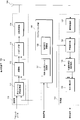
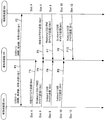
- FIG. 4A is a sequence chart showing the operation of the wireless communication system 10.
- Base station apparatus 100 first allocates orthogonal resources for transmitting an uplink CSI signal to mobile station apparatus 200 (step S1).
- step S1 RI in step S2
- step S4 Subband CQI in step S4, and one orthogonal resource (one orthogonal code, one frequency) are allocated for Subband CQI transmission in step S5, and Wideband CQI in step S3.
- 2 orthogonal resources (2 orthogonal codes, 2 frequencies) are allocated for / PMI transmission. Details of the orthogonal resource allocation will be described later.
- the mobile station apparatus 200 to which the orthogonal resource used in each of step S2, step S3, step S4, and step S5 is assigned first applies PVS by one orthogonal resource and transmits an RI in slot 4. (Step S2). Subsequently, in Slot 6, SCTD using two orthogonal resources is applied, and WidebandWCQI / PMI is transmitted (step S3). Further, in Slot 8, PVS with one orthogonal resource is applied and Subband CQI is transmitted (step S4). Subsequently, in Slot 10, PVS with one orthogonal resource is applied, and Subband CQI is transmitted (step S5).
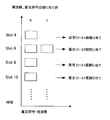
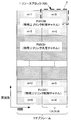
- FIG. 4B is a conceptual diagram showing allocation of resources divided by time, frequency / orthogonal codes.
- the horizontal axis indicates frequency / orthogonal code assignment
- the vertical axis indicates time assignment.
- the RI in Step S2 transmitted from the mobile station apparatus 200 to the base station apparatus 100
- the Wideband CQI / PMI in Step S3 the Wideband CQI in Step S4
- the orthogonal for Subband CQI transmission in Step S5 Allocate resources.
- each of the two orthogonal resources to be allocated is a combination of an orthogonal code and a frequency, and it is not necessary to allocate two different orthogonal codes and two different frequencies.
- the frequency may be used, or the combination may be different so that two different orthogonal codes and one frequency are allocated.
- the orthogonal resource index does not need to be 0 or 1, and it is sufficient that the orthogonal resource can be allocated to the mobile station apparatus 200.
- the base station apparatus 100 allocates it by notifying one orthogonal resource (orthogonal resource index 0).
- the control signal of any layer may be used for the allocation of the orthogonal resources.
- the mobile station apparatus 200 that has received the orthogonal resource from the base station apparatus 100, the number of RBs (frequency bandwidth) allocated to one mobile station apparatus 200, the number of uplink signal symbols, the cell ID, and the slot in one frame
- the frequency resource and orthogonal code resource are extracted based on the index, the symbol index in one slot, and the like.
- orthogonal resource index 0 when allocating two orthogonal resources (orthogonal resource index 0, orthogonal resource index 1) from the base station apparatus 100 to the mobile station apparatus 200, only one orthogonal resource (orthogonal resource 0) is notified.
- the orthogonal resources can be used.
- the first of the two orthogonal resources to be allocated uses the orthogonal resource (orthogonal resource index 0) explicitly notified from the base station apparatus 100.
- the mobile station apparatus 200 extracts an additional orthogonal resource index 1 for use in transmission of Wideband CQI / PMI (13 bits).
- the mobile station apparatus 200 adds additional orthogonal resources from the base station apparatus 100.
- the second orthogonal resource can be used without assigning.
- CSI can be transmitted by allocating two or more resources belonging to at least one of a code resource and a frequency resource as two or more orthogonal resources.
- the predetermined condition is that the number of CSI bits exceeds the predetermined number of bits that can be transmitted in one subframe.
- the number of CSI bits is 1 subframe, 1 transmission antenna, 1 and the predetermined number of bits that can be transmitted with orthogonal resources is x
- the number of bits exceeding x xn is 1 subframe
- 2 A predetermined condition is satisfied when transmission can be performed by using a transmission antenna and two orthogonal resources. Whether or not the resource can be used can be determined by the mobile station apparatus 200 without an additional signal. It is not necessary to make a judgment based on whether or not Wideband CQI / PMI (13 bits). If the judgment can be made based on the number of transmission bits, a judgment can be made according to a rule determined in advance between the base station apparatus 100 and the mobile station apparatus 200. it can.
- the second orthogonal resource that is not explicitly notified from the base station apparatus 100 to the mobile station apparatus 200 does not have to be the orthogonal resource index 1.
- the second orthogonal resource may be calculated from the first orthogonal resource, the slot number, or the like as an orthogonal resource index determined between the base station apparatus 100 and the mobile station apparatus 200 in advance.
- a signal specifying allocation of one of the two or more orthogonal resources is transmitted from the base station apparatus 100 to the mobile station apparatus 200. Thereby, allocation of two or more orthogonal resources is specified.
- a resource other than the specific resource is uniquely determined by an index indicating the specific resource.
- a signal indicating that two or more orthogonal resources are allocated is transmitted from the base station apparatus 100 to the mobile station apparatus 200, and when one orthogonal resource is allocated, 2
- the number of allocated orthogonal resources may be notified by not transmitting a signal indicating that the above orthogonal resources are allocated from the base station apparatus 100 to the mobile station apparatus 200.
- the allocation of two or more orthogonal resources may be explicitly notified by transmitting a signal specifying the allocation of two or more orthogonal resources from the base station apparatus 100 to the mobile station apparatus 200.
- the base station apparatus 100 allocates one or two orthogonal resources to the mobile station apparatus 200 for the CSI signal transmission by the mobile station apparatus 200, and notifies the mobile station apparatus 200 by only one orthogonal resource notification. Can transmit a CSI signal using one or two orthogonal resources. That is, according to the number of bits of the CSI signal transmitted by the mobile station apparatus 200, it is possible to transmit the CSI signal by allocating the orthogonal resource without notification of the signal necessary for additional orthogonal resource allocation and without the overhead required for allocation. .
- movement of the base station apparatus 100 and a mobile station apparatus is performed by execution of a program.
- FIG. 5A is a sequence chart showing the operation of the wireless communication system 10.
- the configurations of base station apparatus 100 and mobile station apparatus 200 are the same as those shown in FIGS.
- the criterion for sharing the number of orthogonal resources (1 or 2) of the CSI signal between the base station apparatus and the mobile station apparatus is different from the above embodiment.
- base station apparatus 100 transmits allocation of orthogonal resources for transmitting an uplink CSI signal to mobile station apparatus 200 (step T1).
- Step T1 Wideband CQI / PMI (13 bits) in Step T3, Subband CQI / PMI (8 bits) in Step T4, and Subband CQI (8 bits) transmission in Step T5, one orthogonal resource (one orthogonal code, 1 frequency) and 2 orthogonal resources (2 orthogonal codes, 2 frequencies) are allocated for RI (2 bit) transmission in step T2.
- mobile station apparatus 200 to which the orthogonal resource used in each of steps T2, T3, T4, and T5 is allocated first applies SCTD using two orthogonal resources and transmits RI in Slot 4. (Step T2). Subsequently, in Slot 6, PVS using one orthogonal resource is applied, and Wideband CQI / PMI is transmitted (step T3). Further, in Slot 8, PVS using one orthogonal resource is applied, and Subband CQI is transmitted (step T4). Subsequently, in Slot 10, PVS by one orthogonal resource is applied, and Subband CQI is transmitted (step T5).
- FIG. 5B is a conceptual diagram illustrating allocation of resources divided by time, frequency, and orthogonal code.
- the horizontal axis indicates frequency / orthogonal code assignment
- the vertical axis indicates time assignment.
- the RI in Step T2 transmitted from the mobile station apparatus 200 to the base station apparatus 100
- the Wideband CQI / PMI in Step T3 the Wideband CQI in Step T4
- the orthogonal for transmitting Subband CQI in Step T5 Allocate resources.
- each of the two orthogonal resources to be allocated is a combination of an orthogonal code and a frequency, and the combination of each orthogonal resource may be different. Therefore, it is not necessary to assign two different orthogonal codes and two different frequencies. One orthogonal code and two different frequencies may be used, or two different orthogonal codes and one frequency may be assigned. Also good. Furthermore, the orthogonal resource index does not need to be 0 or 1, and it is sufficient that the orthogonal resource can be allocated to the mobile station apparatus 200.
- the base station apparatus 100 allocates it by notifying one orthogonal resource (orthogonal resource index 0).
- any layer control signal may be used for the allocation of the orthogonal resources.
- the mobile station apparatus 200 that has received the orthogonal resource from the base station apparatus 100, the number of RBs (frequency bandwidth) allocated to one mobile station apparatus 200, the number of uplink signal symbols, the cell ID, and the slot in one frame Frequency resources and orthogonal code resources are extracted based on the index or the symbol index in one slot.
- orthogonal resource index 0 when allocating two orthogonal resources (orthogonal resource index 0, orthogonal resource index 1) from the base station apparatus 100 to the mobile station apparatus 200, only one orthogonal resource (orthogonal resource 0) is notified.
- the orthogonal resources can be used.
- the first of the two orthogonal resources to be allocated uses the orthogonal resource (orthogonal resource index 0) explicitly notified from the base station apparatus 100.
- the mobile station apparatus 200 extracts an additional orthogonal resource index 1 for use in transmission of RI (2 bits).
- the mobile station apparatus 200 does not allocate an additional orthogonal resource from the base station apparatus 100.
- the second orthogonal resource can be used.
- the mobile station apparatus 200 can determine whether or not the second orthogonal resource can be used without any additional signal. It is not necessary to determine whether the signal is RI or not, and it is determined based on whether the signal requires a good error rate characteristic, and a second rule is determined according to a rule determined in advance between the base station device 100 and the mobile station device 200. Orthogonal resources can be used.
- the second orthogonal resource that is not explicitly notified from the base station apparatus 100 to the mobile station apparatus 200 does not have to be the orthogonal resource index 1.
- the orthogonal resource index determined between the base station apparatus 100 and the mobile station apparatus 200 in advance may be calculated from the first orthogonal resource, the slot number, or the like.
- the base station apparatus 100 allocates one or two orthogonal resources to the mobile station apparatus 200 for the CSI signal transmission of the mobile station apparatus 200, and the mobile station apparatus is notified by only one orthogonal resource.
- the apparatus 200 can transmit a CSI signal using one or two orthogonal resources. That is, according to the required quality of the CSI signal transmitted by the mobile station apparatus 200, it is possible to transmit the CSI signal by allocating the orthogonal resource without notification of the signal required for additional orthogonal resource allocation and without the overhead required for allocation. .
- orthogonal resources are allocated without notification or the like between the base station apparatus 100 and one mobile station apparatus 200, but notification is made between the base station apparatus 100 and two or more mobile station apparatuses 200. Orthogonal resources may be allocated without the like.
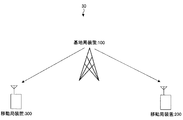
- FIG. 6 is a schematic diagram showing the wireless communication system 30 in the present embodiment.
- the wireless communication system 30 includes a base station device 100 and mobile station devices 200 and 300.
- the configurations of base station apparatus 100 and mobile station apparatuses 200 and 300 are the same as the configurations shown in FIGS.
- the mobile station devices 200 and 300 are only distinguished according to an operation example described later, and the configuration of both is the same.
- the difference between the present embodiment and the first and second embodiments is an orthogonal resource allocation method considering a plurality of mobile station devices from the base station device 100 to the mobile station device 200 or the mobile station device 300.
- the mobile station apparatuses belonging to the base station apparatus 100 do not have to be two mobile station apparatuses, and may be three or more mobile station apparatuses.
- FIG. 7A is a sequence chart showing the operation of the wireless communication system 30. In the following, processing between the base station apparatus 100 and the two mobile station apparatuses 200 and 300 will be described, but the same procedure can be performed when three or more mobile station apparatuses communicate with the base station apparatus 100. is there.
- PVS transmission diversity
- SCTD transmission diversity
- base station apparatus 100 allocates orthogonal resources for transmitting an uplink CSI signal to mobile station apparatus 200 (steps P3, P4, P6, and P8) (step P1). At the same time, base station apparatus 100 allocates orthogonal resources for transmitting an uplink CSI signal to mobile station apparatus 300 (steps P5, P7, P9, and P10) (step P2).
- Step P1 one orthogonal resource (one orthogonal code, one frequency) is allocated for each transmission of Wideband CQI / PMI in Step P4, Subband CQI in Step P6, and Subband CQI in Step P8. . Then, two orthogonal resources (two orthogonal codes, two frequencies) are allocated for transmission of RI in step P3.
- mobile station apparatus 200 to which the orthogonal resource used in each of steps P3, P4, P6, and P8 is assigned first applies SCTD using two orthogonal resources and transmits an RI in Slot 4. (Step P3). Subsequently, the mobile station apparatus 200 applies PVS using one orthogonal resource in slot 6, and transmits Wideband CQI / PMI (step P4).
- the mobile station apparatus 200 applies PVS using one orthogonal resource in Slot 8, and transmits Subband CQI (Step P6).
- the mobile station apparatus 300 applies PVS using one orthogonal resource in Slot 8, and transmits Wideband CQI / PMI (step P7).
- the mobile station apparatus 200 applies PVS using one orthogonal resource in Slot 10, and transmits Subband CQI (Step P8).
- the mobile station device 300 applies PVS using one orthogonal resource in Slot 10 and transmits Subband CQI (step P9).
- the mobile station device 300 applies PVS using one orthogonal resource in Slot 12, and transmits Subband CQI (Step P10).
- FIG. 7B is a conceptual diagram illustrating allocation of resources divided by time, frequency, and orthogonal code.
- the horizontal axis indicates frequency / orthogonal code assignment
- the vertical axis indicates time assignment.
- the orthogonal resource index to be allocated does not have to be 0 or 1, and may be any orthogonal resource that can be allocated to the mobile station apparatuses 200 and 300.
- the RI in Step P5 transmitted from the mobile station apparatus 300 to the base station apparatus 100 Wideband CQI / PMI in Step P7, Subband CQI in Step P9, Subband CQI transmission in Step P10 Allocate orthogonal resources.
- one orthogonal resource (one orthogonal resource) is transmitted for each transmission of Wideband CQI / PMI in Step P7, Subband CQI in Step P9, and Subband CQI in Step P10.
- the orthogonal resource index to be allocated does not have to be 1 or 2, and may be any orthogonal resource that can be allocated to the mobile station apparatuses 200 and 300.
- the base station apparatus 100 when allocating one orthogonal resource to the mobile station apparatus 200 or the mobile station apparatus 300, the base station apparatus 100 notifies one orthogonal resource (orthogonal resource index 0 or orthogonal resource index 2). assign. Note that any layer of control signals may be used for the allocation of orthogonal resources. Also, the mobile station apparatus 200 that has received the orthogonal resource from the base station apparatus 100, the number of RBs (frequency bandwidth) allocated to one mobile station apparatus, the number of uplink signal symbols, the cell ID, and the slot index in one frame A frequency resource and an orthogonal code resource are extracted based on a symbol index in one slot.
- orthogonal resource index 1 orthogonal resource index 1
- orthogonal resource index 2 orthogonal resource index 2
- the first of the two orthogonal resources allocated to each mobile station apparatus 200, 300 uses the orthogonal resource (orthogonal resource index 0 or orthogonal resource index 2) explicitly notified from the base station apparatus 100. .
- the mobile station apparatus 200 or the mobile station apparatus 300 extracts an additional orthogonal resource index 1 for use in transmission of RI (2 bits).
- mobile station apparatuses 200 and 300 allocate additional orthogonal resources from base station apparatus 100.
- the second orthogonal resource can be used without any.
- the second orthogonal resource can be used does not need to be RI, but is a signal that requires good error rate characteristics, and is between the base station apparatus 100 and the mobile station apparatuses 200 and 300.
- the mobile station devices 200 and 300 need only be able to determine without additional signals according to the rules determined in advance.
- one or two orthogonal resources allocated to the mobile station apparatus 200 and the mobile station apparatus 300 do not have to be orthogonal resource indexes 0 to 2, and do not overlap between the mobile station apparatuses 200 and 300.
- the base station apparatus 100 transmits two or more mobile station apparatuses 200 and 300 to one or two mobile station apparatuses 200 and 300 as necessary.
- the mobile station apparatus 200 can transmit a CSI signal using one or two orthogonal resources by notification of one orthogonal resource from the base station apparatus 100. That is, according to the required quality of the CSI signal transmitted by the mobile station apparatuses 200 and 300, one or two orthogonal resources without notification of signals required for additional orthogonal resource allocation and without overhead required for allocation Can be used to transmit CSI signals.
- Base station apparatus 110 Transmitter 111 Orthogonal resource information multiplexer 112 Modulator 113 Mapping unit 114 Wireless transmitter 120 Scheduling unit 121 Time / frequency resource controller 122 Orthogonal code controller 130 Receiver 131 Radio reception Unit 132 information extracting unit 133 propagation path compensation / despreading unit 134 combining / demodulating unit 140 antenna 200 mobile station apparatus 210 receiving unit 211 wireless receiving unit 212 propagation path compensating unit 213 decoding processing unit 214 error correcting / detecting unit 215 demodulating unit 216 Information extraction / separation unit 220 Schedule information management unit 221 Downlink scheduling management unit 222 Orthogonal code management unit 223 Control information management unit 224 Uplink scheduling management unit 230 Transmission unit 231 Information multiplexing unit 232 Modulation / spreading unit 233 Mapin Part 234 radio transmitter 240 antenna 300 mobile station apparatus
Landscapes
- Engineering & Computer Science (AREA)
- Signal Processing (AREA)
- Computer Networks & Wireless Communication (AREA)
- Mobile Radio Communication Systems (AREA)
Abstract
L'invention concerne un système de communication sans fil, une station de base, une station mobile, un procédé de communication sans fil et un programme de communication sans fil permettant l'attribution d'au moins deux ressources orthogonales à la station mobile sans réduction sensible de capacité. Dans le système de communication sans fil selon l'invention, au moins une station mobile (200) transmet des informations de commande à une station de base (100) au moyen d'un procédé de transmission faisant appel à au moins deux ressources orthogonales. Si les informations de commande remplissent des conditions prescrites, au moins deux ressources orthogonales, à savoir des ressources de code et/ou des ressources de fréquence, sont attribuées et les informations de commande sont transmises. Comme au moins deux ressources sont attribuées uniquement si des conditions prescrites sont remplies, il est donc possible d'attribuer des ressources orthogonales à la station mobile (200) sans réduction sensible de capacité.
Applications Claiming Priority (2)
| Application Number | Priority Date | Filing Date | Title |
|---|---|---|---|
| JP2009146124 | 2009-06-19 | ||
| JP2009-146124 | 2009-06-19 |
Publications (1)
| Publication Number | Publication Date |
|---|---|
| WO2010146924A1 true WO2010146924A1 (fr) | 2010-12-23 |
Family
ID=43356253
Family Applications (1)
| Application Number | Title | Priority Date | Filing Date |
|---|---|---|---|
| PCT/JP2010/056568 Ceased WO2010146924A1 (fr) | 2009-06-19 | 2010-04-13 | Système de communication sans fil, station de base, station mobile, procédé de communication sans fil et programme de communication sans fil |
Country Status (1)
| Country | Link |
|---|---|
| WO (1) | WO2010146924A1 (fr) |
Citations (1)
| Publication number | Priority date | Publication date | Assignee | Title |
|---|---|---|---|---|
| WO2009022704A1 (fr) * | 2007-08-14 | 2009-02-19 | Ntt Docomo, Inc. | Dispositif utilisateur, station de base, et procédé de configuration de canal de contrôle de liaison ascendante |
-
2010
- 2010-04-13 WO PCT/JP2010/056568 patent/WO2010146924A1/fr not_active Ceased
Patent Citations (1)
| Publication number | Priority date | Publication date | Assignee | Title |
|---|---|---|---|---|
| WO2009022704A1 (fr) * | 2007-08-14 | 2009-02-19 | Ntt Docomo, Inc. | Dispositif utilisateur, station de base, et procédé de configuration de canal de contrôle de liaison ascendante |
Non-Patent Citations (1)
| Title |
|---|
| PANASONIC: "CQI transmission methods for large reports on PUCCH", 3GPP TSG-RAN WG1 MEETING #51, RL-074927, November 2007 (2007-11-01), pages 1 - 5 * |
Similar Documents
| Publication | Publication Date | Title |
|---|---|---|
| JP5357119B2 (ja) | 移動端末装置及び無線通信方法 | |
| US9398590B2 (en) | Mobile terminal device and radio base station apparatus | |
| JP5477872B2 (ja) | 移動局装置および基地局装置 | |
| CA2786810C (fr) | Une methode et un noeud emetteur destines a la transmission d'un motif de signal de reference de demodulation | |
| EP2395776B1 (fr) | Système de communication sans fil, appareil de station de base et appareil de station mobile pour émettre d'information de feed-back | |
| JP5154295B2 (ja) | 基地局装置及びユーザ装置並びに通信制御方法 | |
| JP5291663B2 (ja) | データ送信方法、基地局装置及び移動局装置 | |
| EP2487953A1 (fr) | Dispositif de station de base sans fil, dispositif de terminal mobile et procédé de communication sans fil | |
| JP4938122B2 (ja) | フィードバック方法及び移動端末装置 | |
| JP5291664B2 (ja) | データ送信方法、基地局装置及び移動局装置 | |
| CN102835051B (zh) | 通信控制方法、移动台装置以及基站装置 | |
| WO2011016390A1 (fr) | Système de communication sans fil, dispositif de station mobile, et dispositif de station de base | |
| KR20140021676A (ko) | 간섭층들의 표시를 위한 다운링크 제어 시그널링 | |
| WO2013084693A1 (fr) | Dispositif de station de base sans fil, système et procédé de communication sans fil | |
| WO2010122749A1 (fr) | Système de communication, appareil de communication et procédé de communication | |
| JP6989368B2 (ja) | 基地局、端末、及び無線通信方法 | |
| JP2010200077A (ja) | 移動通信システム、基地局装置、移動局装置および移動通信方法 | |
| WO2010146924A1 (fr) | Système de communication sans fil, station de base, station mobile, procédé de communication sans fil et programme de communication sans fil | |
| WO2010084821A1 (fr) | Système de communication mobile, appareil de station de base, appareil de station mobile, et procédé de communication mobile | |
| JP2012080584A (ja) | フィードバック方法及び移動端末装置 | |
| HK1144637B (en) | Wireless communication system, base station apparatus and mobile station apparatus | |
| KR20140129977A (ko) | 상향링크 제어 및 데이터 채널 구성 | |
| WO2011099373A1 (fr) | Procédé de communication, dispositif formant station mobile, dispositif formant station de base, système de communication mobile, et circuit intégré | |
| KR20140129978A (ko) | 스몰셀에 적합한 제어 및 데이터 자원 할당 및 채널 구조 |
Legal Events
| Date | Code | Title | Description |
|---|---|---|---|
| 121 | Ep: the epo has been informed by wipo that ep was designated in this application |
Ref document number: 10789301 Country of ref document: EP Kind code of ref document: A1 |
|
| NENP | Non-entry into the national phase |
Ref country code: DE |
|
| 122 | Ep: pct application non-entry in european phase |
Ref document number: 10789301 Country of ref document: EP Kind code of ref document: A1 |
|
| NENP | Non-entry into the national phase |
Ref country code: JP |