WO2010146982A1 - ポリウレタンおよびそれを含有する研磨層形成用組成物、ならびに化学機械研磨用パッドおよびそれを用いた化学機械研磨方法 - Google Patents
ポリウレタンおよびそれを含有する研磨層形成用組成物、ならびに化学機械研磨用パッドおよびそれを用いた化学機械研磨方法 Download PDFInfo
- Publication number
- WO2010146982A1 WO2010146982A1 PCT/JP2010/059184 JP2010059184W WO2010146982A1 WO 2010146982 A1 WO2010146982 A1 WO 2010146982A1 JP 2010059184 W JP2010059184 W JP 2010059184W WO 2010146982 A1 WO2010146982 A1 WO 2010146982A1
- Authority
- WO
- WIPO (PCT)
- Prior art keywords
- polyurethane
- chemical mechanical
- mechanical polishing
- compound
- polishing
- Prior art date
- Legal status (The legal status is an assumption and is not a legal conclusion. Google has not performed a legal analysis and makes no representation as to the accuracy of the status listed.)
- Ceased
Links
Images
Classifications
-
- B—PERFORMING OPERATIONS; TRANSPORTING
- B24—GRINDING; POLISHING
- B24B—MACHINES, DEVICES, OR PROCESSES FOR GRINDING OR POLISHING; DRESSING OR CONDITIONING OF ABRADING SURFACES; FEEDING OF GRINDING, POLISHING, OR LAPPING AGENTS
- B24B37/00—Lapping machines or devices; Accessories
- B24B37/11—Lapping tools
- B24B37/20—Lapping pads for working plane surfaces
- B24B37/24—Lapping pads for working plane surfaces characterised by the composition or properties of the pad materials
-
- C—CHEMISTRY; METALLURGY
- C08—ORGANIC MACROMOLECULAR COMPOUNDS; THEIR PREPARATION OR CHEMICAL WORKING-UP; COMPOSITIONS BASED THEREON
- C08G—MACROMOLECULAR COMPOUNDS OBTAINED OTHERWISE THAN BY REACTIONS ONLY INVOLVING UNSATURATED CARBON-TO-CARBON BONDS
- C08G18/00—Polymeric products of isocyanates or isothiocyanates
- C08G18/06—Polymeric products of isocyanates or isothiocyanates with compounds having active hydrogen
- C08G18/28—Polymeric products of isocyanates or isothiocyanates with compounds having active hydrogen characterised by the compounds used containing active hydrogen
- C08G18/30—Low-molecular-weight compounds
- C08G18/32—Polyhydroxy compounds; Polyamines; Hydroxyamines
-
- B—PERFORMING OPERATIONS; TRANSPORTING
- B24—GRINDING; POLISHING
- B24B—MACHINES, DEVICES, OR PROCESSES FOR GRINDING OR POLISHING; DRESSING OR CONDITIONING OF ABRADING SURFACES; FEEDING OF GRINDING, POLISHING, OR LAPPING AGENTS
- B24B37/00—Lapping machines or devices; Accessories
-
- C—CHEMISTRY; METALLURGY
- C08—ORGANIC MACROMOLECULAR COMPOUNDS; THEIR PREPARATION OR CHEMICAL WORKING-UP; COMPOSITIONS BASED THEREON
- C08G—MACROMOLECULAR COMPOUNDS OBTAINED OTHERWISE THAN BY REACTIONS ONLY INVOLVING UNSATURATED CARBON-TO-CARBON BONDS
- C08G18/00—Polymeric products of isocyanates or isothiocyanates
- C08G18/06—Polymeric products of isocyanates or isothiocyanates with compounds having active hydrogen
- C08G18/28—Polymeric products of isocyanates or isothiocyanates with compounds having active hydrogen characterised by the compounds used containing active hydrogen
- C08G18/40—High-molecular-weight compounds
- C08G18/48—Polyethers
- C08G18/4833—Polyethers containing oxyethylene units
-
- C—CHEMISTRY; METALLURGY
- C08—ORGANIC MACROMOLECULAR COMPOUNDS; THEIR PREPARATION OR CHEMICAL WORKING-UP; COMPOSITIONS BASED THEREON
- C08G—MACROMOLECULAR COMPOUNDS OBTAINED OTHERWISE THAN BY REACTIONS ONLY INVOLVING UNSATURATED CARBON-TO-CARBON BONDS
- C08G18/00—Polymeric products of isocyanates or isothiocyanates
- C08G18/06—Polymeric products of isocyanates or isothiocyanates with compounds having active hydrogen
- C08G18/28—Polymeric products of isocyanates or isothiocyanates with compounds having active hydrogen characterised by the compounds used containing active hydrogen
- C08G18/40—High-molecular-weight compounds
- C08G18/48—Polyethers
- C08G18/4854—Polyethers containing oxyalkylene groups having four carbon atoms in the alkylene group
-
- C—CHEMISTRY; METALLURGY
- C08—ORGANIC MACROMOLECULAR COMPOUNDS; THEIR PREPARATION OR CHEMICAL WORKING-UP; COMPOSITIONS BASED THEREON
- C08G—MACROMOLECULAR COMPOUNDS OBTAINED OTHERWISE THAN BY REACTIONS ONLY INVOLVING UNSATURATED CARBON-TO-CARBON BONDS
- C08G18/00—Polymeric products of isocyanates or isothiocyanates
- C08G18/06—Polymeric products of isocyanates or isothiocyanates with compounds having active hydrogen
- C08G18/28—Polymeric products of isocyanates or isothiocyanates with compounds having active hydrogen characterised by the compounds used containing active hydrogen
- C08G18/65—Low-molecular-weight compounds having active hydrogen with high-molecular-weight compounds having active hydrogen
- C08G18/6576—Compounds of group C08G18/69
- C08G18/6582—Compounds of group C08G18/69 with compounds of group C08G18/32 or polyamines of C08G18/38
- C08G18/6588—Compounds of group C08G18/69 with compounds of group C08G18/32 or polyamines of C08G18/38 with compounds of group C08G18/3203
-
- C—CHEMISTRY; METALLURGY
- C08—ORGANIC MACROMOLECULAR COMPOUNDS; THEIR PREPARATION OR CHEMICAL WORKING-UP; COMPOSITIONS BASED THEREON
- C08G—MACROMOLECULAR COMPOUNDS OBTAINED OTHERWISE THAN BY REACTIONS ONLY INVOLVING UNSATURATED CARBON-TO-CARBON BONDS
- C08G18/00—Polymeric products of isocyanates or isothiocyanates
- C08G18/06—Polymeric products of isocyanates or isothiocyanates with compounds having active hydrogen
- C08G18/28—Polymeric products of isocyanates or isothiocyanates with compounds having active hydrogen characterised by the compounds used containing active hydrogen
- C08G18/65—Low-molecular-weight compounds having active hydrogen with high-molecular-weight compounds having active hydrogen
- C08G18/66—Compounds of groups C08G18/42, C08G18/48, or C08G18/52
- C08G18/6666—Compounds of group C08G18/48 or C08G18/52
- C08G18/667—Compounds of group C08G18/48 or C08G18/52 with compounds of group C08G18/32 or polyamines of C08G18/38
- C08G18/6674—Compounds of group C08G18/48 or C08G18/52 with compounds of group C08G18/32 or polyamines of C08G18/38 with compounds of group C08G18/3203
-
- C—CHEMISTRY; METALLURGY
- C08—ORGANIC MACROMOLECULAR COMPOUNDS; THEIR PREPARATION OR CHEMICAL WORKING-UP; COMPOSITIONS BASED THEREON
- C08G—MACROMOLECULAR COMPOUNDS OBTAINED OTHERWISE THAN BY REACTIONS ONLY INVOLVING UNSATURATED CARBON-TO-CARBON BONDS
- C08G18/00—Polymeric products of isocyanates or isothiocyanates
- C08G18/06—Polymeric products of isocyanates or isothiocyanates with compounds having active hydrogen
- C08G18/28—Polymeric products of isocyanates or isothiocyanates with compounds having active hydrogen characterised by the compounds used containing active hydrogen
- C08G18/67—Unsaturated compounds having active hydrogen
- C08G18/69—Polymers of conjugated dienes
-
- C—CHEMISTRY; METALLURGY
- C08—ORGANIC MACROMOLECULAR COMPOUNDS; THEIR PREPARATION OR CHEMICAL WORKING-UP; COMPOSITIONS BASED THEREON
- C08J—WORKING-UP; GENERAL PROCESSES OF COMPOUNDING; AFTER-TREATMENT NOT COVERED BY SUBCLASSES C08B, C08C, C08F, C08G or C08H
- C08J5/00—Manufacture of articles or shaped materials containing macromolecular substances
-
- H—ELECTRICITY
- H10—SEMICONDUCTOR DEVICES; ELECTRIC SOLID-STATE DEVICES NOT OTHERWISE PROVIDED FOR
- H10P—GENERIC PROCESSES OR APPARATUS FOR THE MANUFACTURE OR TREATMENT OF DEVICES COVERED BY CLASS H10
- H10P52/00—Grinding, lapping or polishing of wafers, substrates or parts of devices
Definitions
- the present invention relates to polyurethane, a composition for forming a polishing layer containing the same, a chemical mechanical polishing pad, and a chemical mechanical polishing method using the same.
- Polyurethane elastomers are excellent in mechanical properties, have many features such as wear resistance, oil resistance and bending resistance, and have been used as materials for conveyor belts, shoe soles, hoses and golf balls.
- a polishing pad for polishing glass or a semiconductor substrate for example, a porous nonwoven fabric or a polyurethane molded product obtained by impregnating a nonwoven fabric with a polyurethane solution as described in JP-A-64-58475, etc. Has been used.
- polishing pad (hereinafter referred to as “chemical mechanical polishing pad”) suitable for a chemical mechanical polishing method (hereinafter referred to as “CMP method”) for flattening the surface of a semiconductor substrate
- CMP method a polishing pad suitable for a chemical mechanical polishing method for flattening the surface of a semiconductor substrate
- a polishing pad in which a filler-like component is dispersed in polyurethane described in Japanese Patent Application Laid-Open No. 8-500622 and a polishing pad using urethane foam described in Japanese Patent Application Laid-Open No. 2000-17252 have been studied.
- the chemical mechanical polishing pad needs to have an appropriate rigidity from the viewpoint of ensuring flatness and high quality of the surface to be polished.
- the chemical mechanical polishing pad needs to be able to follow the waviness and warpage of the wafer, that is, toughness, from the viewpoint of ensuring uniformity.
- a chemical mechanical polishing pad with high rigidity low deformation in a wide horizontal region
- is finished with high accuracy in terms of chip flatness but is prone to polishing defects (scratches) and is uniform across the entire wafer surface.
- a flexible chemical mechanical polishing pad has a narrow deformation area in the horizontal direction.
- the flatness of each chip is not very good, but polishing defects (scratches) hardly occur, and the uniformity over the entire wafer surface improves.
- conventional polyurethane pads are not necessarily made of a material having a balance between rigidity and toughness.
- the balance between rigidity and toughness can be adjusted by combining with other resins or adding additives such as fillers and crosslinking agents, but it has physical properties suitable for polishing pads.
- Thermoplastic polyurethane generally has a high flow initiation temperature and is not suitable for kneading with additives that are vulnerable to heating.
- one of the objects of the present invention is to provide a polyurethane excellent in balance between rigidity and toughness (mechanical characteristics) and workability.
- One of the objects of the present invention is to provide a composition for forming a polishing layer that is chemically stable and can improve both the flatness of the surface to be polished and the reduction of polishing defects (scratches). .
- One of the objects of the present invention is to provide a chemical mechanical polishing pad capable of achieving both improvement in flatness of a surface to be polished and reduction in polishing defects (scratches).
- the present invention has been made to solve at least a part of the above-described problems, and can be realized as the following aspects or application examples.
- the number average molecular weight of the (B) polyol is 400 to 5,000
- the (C) chain extender includes (C1) a compound represented by the following general formula (1) and (C2) a compound represented by the following general formula (2),
- the number average molecular weight of the compound (C1) and the compound (C2) is less than 400
- the value of the number of moles (M 1) and said compound the number of moles of (C2) M 1 / is calculated from (M 2) (M 1 + M 2) of the compound (C1) is, at 0.25 to 0.9 is there.
- R 1 and R 2 each independently represents a hydrogen atom or a substituted or unsubstituted alkyl group having 1 to 6 carbon atoms.
- M is an arbitrary number of 1 to 13) Is an integer.
- R 3 and R 4 each independently represents a hydrogen atom or a substituted or unsubstituted alkyl group having 1 to 6 carbon atoms.
- N is an arbitrary number of 1 to 12) Is an integer.
- R 1 and R 2 of the compound (C1) may be a hydrogen atom.
- the compound (C1) may be at least one selected from 1,3-propanediol and 1,5-pentanediol.
- R 3 and R 4 of the compound (C2) may be a hydrogen atom.
- the compound (C2) may be at least one selected from ethylene glycol, 1,4-butanediol, 1,6-hexanediol, and 1,18-octadecanediol.
- composition for forming a polishing layer according to the present invention is: At least water-soluble particles and the polyurethane described in any one of Application Examples 1 to 5 are contained.
- Application Example 8 One aspect of the chemical mechanical polishing pad according to the present invention is: It is manufactured using the polishing layer forming composition described in Application Example 6 or Application Example 7.
- the melting point (flow start temperature) is lower than that of a polyurethane synthesized using a single chain extender, it can be processed even at a low temperature, and an additive (for example, a crosslinking agent, Water-soluble particles etc.) can be added without reacting or deteriorating.
- an additive for example, a crosslinking agent, Water-soluble particles etc.
- tensile strength elongation, breaking stress
- polishing layer-forming composition contains polyurethane having the above-described physical properties, a chemically stable composition that does not react with or degrade additives such as a crosslinking agent or water-soluble particles; Become.
- the chemical mechanical polishing pad has a polishing layer containing the above-described physical properties of polyurethane, it has moderate rigidity and toughness, and particularly suppresses the generation of scratches in the chemical mechanical polishing process. be able to.
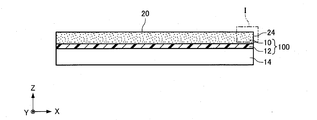
- FIG. 1 is a cross-sectional view schematically showing a chemical mechanical polishing pad according to the present embodiment.
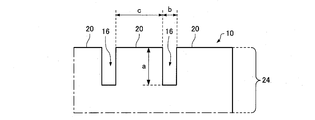
- FIG. 2 is an enlarged view of region I in FIG.
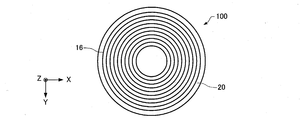
- FIG. 3 is a plan view schematically showing the chemical mechanical polishing pad according to the present embodiment.
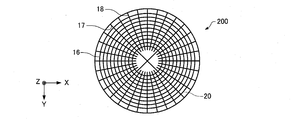
- FIG. 4 is a plan view schematically showing the chemical mechanical polishing pad according to the first modification.
- FIG. 5 is a plan view schematically showing a chemical mechanical polishing pad according to a second modification.
- the polyurethane according to the present embodiment is a polyurethane obtained by reacting a mixture containing at least (A) a diisocyanate, (B) a polyol, and (C) a chain extender.
- the number average molecular weight of the polyol is 400 to 5,000
- the chain extender (C1) includes (C1) a compound represented by the following general formula (1) and (C2) the following general formula (2).
- the number average molecular weight of the compound (C1) and the compound (C2) is less than 400, the number of moles (M 1 ) of the compound (C1) and the number of moles of the compound (C2)
- the value of M 1 / (M 1 + M 2 ) calculated from the number (M 2 ) is 0.25 to 0.9.
- R 1 and R 2 each independently represents a hydrogen atom or a substituted or unsubstituted alkyl group having 1 to 6 carbon atoms.
- M is an arbitrary number of 1 to 13) Is an integer.
- R 3 and R 4 each independently represents a hydrogen atom or a substituted or unsubstituted alkyl group having 1 to 6 carbon atoms.
- N is an arbitrary number of 1 to 12) Is an integer.
- Diisocyanate is a compound represented by the following general formula (3), and is an essential component for forming a urethane bond of polyurethane.
- R 5 represents an arbitrary divalent organic group.
- diisocyanate examples include 2,4-tolylene diisocyanate, 2,6-tolylene diisocyanate, 2,2′-diphenylmethane diisocyanate, 2,4′-diphenylmethane diisocyanate, 4,4′-diphenylmethane diisocyanate, naphthalene diisocyanate, 1 , 5-naphthalene diisocyanate, p-phenylene diisocyanate, m-phenylene diisocyanate, p-xylene diisocyanate, m-phenylene diisocyanate and other aromatic diisocyanates; ethylene diisocyanate, 2,2,4-trimethylhexamethylene diisocyanate, 1,6- Aliphatic diisocyanates such as hexamethylene diisocyanate; alicyclic rings such as isophorone diisocyanate and norbornene diisocyanate Diisocyanate, and the like.
- 2,4-tolylene diisocyanate, 2,6-tolylene diisocyanate, 4,4'-diphenylmethane diisocyanate, and isophorone diisocyanate are preferable from the viewpoint of easy acquisition and reaction control with a hydroxyl group described later.
- these diisocyanates may be used individually by 1 type, and may be used in combination of 2 or more type.
- the polyurethane according to the present embodiment contains (B) a polyol as a monomer component.
- the polyol is a general term for alcohols having two or more hydroxyl groups, but in the present embodiment, those having 2 to 3 hydroxyl groups are preferable.
- the number average molecular weight in terms of styrene measured by (B) polyol gel permeation chromatography (GPC) is 400 to 5,000, more preferably 400 to 4,100, and particularly preferably 400. ⁇ 2,500.
- polyol the polyol normally used in the technical field of polyurethane can be used, for example, hydroxy terminal polyester, polyether polyol, polyester polyol, polycarbonate polyol, polyolefin polyol, polyester carbonate polyol, polyether carbonate.
- a polyol, a polyesteramide polyol, etc. are mentioned.
- polyether polyol, polyolefin polyol, and polycarbonate polyol are preferred from the viewpoint of good hydrolysis resistance.
- polyether polyol examples include polytetramethylene glycol (PTMG), polypropylene glycol (PPG), polyethylene glycol (PEG), polyoxyethylene-propylene glycol (EO-PO), polyoxyethylene-bisphenol A ether, polyoxypropylene -Bisphenol A and the like.
- polyester polyol examples include polybutylene adipate, polyhexamethylene adipate, and polycaprolactone polyol.
- polycarbonate polyol examples include a reaction product of a polyester glycol such as polycaprolactone polyol and an alkylene carbonate, a reaction product of a reaction mixture obtained by reacting ethylene carbonate with a polyhydric alcohol, and an organic dicarboxylic acid.
- diols such as 1,3-propanediol, 1,4-butanediol, 1,6-hexanediol, diethylene glycol, polyethylene glycol, polypropylene glycol, polytetramethylene glycol, phosgene, diallyl carbonate (for example, diphenyl carbonate)
- reaction products with cyclic carbonates eg, propylene carbonate.
- the polyolefin polyol is preferably a polyol having a carbon-carbon double bond in the molecule, and examples thereof include hydroxy-terminated polybutadiene, castor oil-based polyol, partially saponified ethylene-vinyl acetate copolymer, and the like.
- a polyol having a carbon-carbon double bond in the molecule a carbon-carbon double bond can be introduced into the polyurethane skeleton, which can be a crosslinking point when the polyurethane skeleton is crosslinked.
- These polyols may be used alone or in combination of two or more.
- (C) Chain extender The polyurethane concerning this Embodiment contains (C) chain extender as a monomer component.
- (C) as a chain extender (C1) a compound represented by the following general formula (1) (hereinafter also referred to as “compound (C1)”) and (C2) It includes a compound represented by the formula (2) (hereinafter also referred to as “compound (C2)”).
- R 1 and R 2 each independently represents a hydrogen atom or a substituted or unsubstituted alkyl group having 1 to 6 carbon atoms.
- M is an arbitrary number of 1 to 13) And is preferably an integer from 1 to 6.
- R 3 and R 4 each independently represents a hydrogen atom or a substituted or unsubstituted alkyl group having 1 to 6 carbon atoms.
- N is an arbitrary number of 1 to 12) And is preferably an integer of 1 to 5.
- the number average molecular weight in terms of styrene measured by gel permeation chromatography (GPC) of the compound (C1) and the compound (C2) is less than 400, preferably 300 or less, particularly preferably 40 to 300. It is.
- the polyurethane according to the present embodiment is a combination of the compound (C1) and the compound (C2) as the chain extender (C).
- the melting point (flow start temperature) is low, the processability is excellent, and high mechanical properties are exhibited.
- the compound (C1) and the compound (C2) will be described.
- Compound (C1) examples include 1,3-propanediol, 1,3-butylene glycol, 1,5-pentanediol, neopentyl glycol, 3-methyl-1,5-pentanediol, 2-ethyl- And low molecular weight dihydric alcohols such as 1,3-hexanediol, 1,9-nonanediol, and dimethylolbutanoic acid.
- 1,3-propanediol, 1,3-butylene glycol, and 1,5-pentanediol are preferable from the viewpoint of easy reaction control with an isocyanate group.
- 1,3-propanediol and 1,5-pentanediol in which R 1 and R 2 are hydrogen atoms are more preferable.
- Compound (C2) examples include ethylene glycol, 1,2-propanediol, 1,4-butanediol, 1,6-hexanediol, 1,18-octadecanediol, 2-methyl-1,8-octane. And low molecular weight dihydric alcohols such as diols.
- ethylene glycol, 1,2-propanediol, 1,4-butanediol, 1,6-hexanediol, and 1,18-octadecanediol are preferable from the viewpoint of easy reaction control with an isocyanate group.
- the tensile strength (elongation and breaking stress) can be improved without significantly reducing the hardness as compared with a polyurethane synthesized using a single chain extender.
- M 1 / (M 1 + M 2 ) is less than 0.25 or exceeds 0.9, the fluidity is lowered, so that the workability is impaired and the mechanical properties tend to be lowered.
- the polyurethane according to this embodiment is considered to exhibit the above-described characteristics by the following mechanism.
- polyurethane is a block copolymer in which a hard segment composed of isocyanate and a chain extender (short chain diol) and a soft segment composed of a polyol are bonded.
- a hard segment having crystallinity mainly contributes to the rigidity (hardness, elastic modulus, etc.) of polyurethane.
- the soft segment having amorphous properties mainly contributes to the toughness (tensile strength, etc.) of polyurethane.
- the hard segment when the hard segment is composed of a diol unit composed of a single repeating unit, the urethane bonds constituting the hard segment are regularly arranged, so that the crystallinity is improved and the rigidity is excellent. It will be.
- the hard segment structure is rigid, the melting point of the polyurethane rises, and the flexibility of the soft segment connecting the hard segments is remarkably reduced, so that the toughness is lowered. As a result, a polyurethane having both mechanical properties and processability cannot be obtained.
- the hard segment as in the present invention is composed of two or more types of repeating units having different carbon chain lengths between hydroxyl groups, and the number of repeating units is an even number and an odd number of diol units, Since the urethane bonds are irregularly arranged, the crystallinity is disturbed and the melting point is lowered. Moreover, since the influence with respect to the freedom degree of a soft segment is small compared with the hard segment comprised by the diol unit which consists of a single repeating unit, high toughness is shown. As a result, processing such as kneading and molding during heating is facilitated, and a polyurethane having excellent mechanical properties can be obtained.
- polyurethane can be controlled also by changing the polyol species constituting the soft segment.
- polyol species constituting the soft segment.
- two or more types of polyols having different carbon chain lengths are used in combination or polyols having crystallinity / amorphity are used in combination, a polyurethane having excellent processability and mechanical properties as described above cannot be obtained. .
- the polyurethane according to the present embodiment contains (A) diisocyanate, (B) polyol, and (C) chain extender as essential components, but may contain additives other than these components. .
- additives include catalysts, antioxidants, ultraviolet absorbers, lubricants, peptizers, and the like.
- the content of (A) diisocyanate in the monomer mixture is preferably 20 to 60% by mass, more preferably 25 to 55% by mass.
- the content of the (B) polyol in the monomer mixture is preferably 30 to 70% by mass, more preferably 35 to 65% by mass.
- the content of the (C) chain extender in the monomer mixture is preferably 1 to 15% by mass, more preferably 2 to 12% by mass.
- the polyurethane according to the present embodiment contains the compound (C1) and the compound (C2) as the (C) chain extender, and the ratio of the respective proportions to the (C) chain extender is as described above.
- the ratio of the respective proportions to the (C) chain extender is as described above.
- the analysis of the polyol polyol type is disclosed in Japanese Patent Application Laid-Open No. 2002-371121 regarding a method of performing thermal decomposition, and can be measured by using this method.
- Duro D hardness is an index for determining the hardness of polyurethane.
- the Duro D hardness can be measured according to “JIS K6253”.
- the duro D hardness of the polyurethane according to the present embodiment is preferably 30 or more, more preferably 35 or more.
- Breaking stress, breaking strain, tensile product As indicators for judging the mechanical properties of polyurethane, "breaking stress”, “breaking strain”, “tensile product” can be mentioned.
- the breaking stress and breaking strain can be determined from a tensile test in accordance with “JIS K6251”.
- the tensile product can be obtained by calculating the product of the breaking stress and the breaking strain.
- the breaking stress of the polyurethane according to the present embodiment is preferably 4 MPa or more, more preferably 5 MPa or more, and particularly preferably 6 MPa or more.
- the breaking strain of the polyurethane according to the present embodiment is preferably 200% or more, more preferably 300% or more, and particularly preferably 400% or more.
- the tensile product of the polyurethane according to the present embodiment is preferably 800 MPa or more, more preferably 1500 MPa or more, and particularly preferably 2400 MPa or more. When these physical properties are within the above ranges, the polyurethane has excellent tensile strength (elongation and breaking stress).
- Flow start temperature is an index for judging the ease of processing of polyurethane from the viewpoint of temperature.
- the flow start temperature can be measured according to “10. Flow test” of “JIS K7311”. Specific measurement conditions are as described in the examples.
- the flow start temperature of the polyurethane according to this embodiment is preferably 60 to 120 ° C., more preferably 70 to 110 ° C., and still more preferably 80 to 100 ° C.
- additives for example, a crosslinking agent, water-soluble particles, etc.
- polishing layer forming composition contains at least water-soluble particles and the polyurethane. Since the composition for forming an abrasive layer according to the present embodiment contains the polyurethane, it becomes a chemically stable composition that does not react or deteriorate additives such as water-soluble particles and crosslinking agents. .
- the composition for forming a polishing layer according to this embodiment contains water-soluble particles.
- the water-soluble particles are in contact with a chemical mechanical polishing aqueous dispersion (hereinafter also referred to as “slurry”) in a chemical mechanical polishing pad obtained by molding the polishing layer forming composition according to the present embodiment.
- slurry chemical mechanical polishing aqueous dispersion
- This is used to form pores that can be released from the surface of the polishing layer of the chemical mechanical polishing pad to hold the slurry.
- the liberation is caused by dissolution, swelling, or the like due to contact with water or an aqueous mixed medium contained in the chemical mechanical polishing dispersion.
- the water-soluble particles are not particularly limited, and examples thereof include organic water-soluble particles and inorganic water-soluble particles.
- Examples of the material constituting the organic water-soluble particles include saccharides (polysaccharides (eg, starch, dextrin and cyclodextrin), lactose, mannitol, etc.), celluloses (hydroxypropylcellulose, methylcellulose, etc.), proteins, Examples include polyvinyl alcohol, polyvinyl pyrrolidone, polyacrylic acid, polyethylene oxide, water-soluble photosensitive resin, sulfonated polyisoprene, and sulfonated isoprene copolymer.
- saccharides polysaccharides (eg, starch, dextrin and cyclodextrin), lactose, mannitol, etc.), celluloses (hydroxypropylcellulose, methylcellulose, etc.), proteins, Examples include polyvinyl alcohol, polyvinyl pyrrolidone, polyacrylic acid, polyethylene oxide, water-soluble photosensitive resin, sulfonated polyisoprene, and
- Examples of the material constituting the inorganic water-soluble particles include potassium acetate, potassium nitrate, potassium carbonate, potassium hydrogen carbonate, potassium chloride, potassium bromide, potassium phosphate, magnesium nitrate, potassium sulfate, magnesium sulfate, and calcium nitrate. Can be mentioned.
- water-soluble particles can be used alone or in combination of two or more. Further, the water-soluble particles may be one type of water-soluble particles made of the above materials, or may be two or more types of water-soluble particles made of different materials.
- the average particle diameter of the water-soluble particles is preferably 0.1 to 500 ⁇ m, more preferably 0.5 to 100 ⁇ m.
- the average particle diameter of the water-soluble particles can be measured by a laser scattering diffraction type measuring machine. When the average particle diameter of the water-soluble particles is within the above range, the pore size generated by the desorption of the water-soluble particles can be controlled to an appropriate range, thereby enabling the chemical mechanical polishing aqueous system in the chemical mechanical polishing step.
- a chemical mechanical polishing pad having excellent dispersion holding ability and polishing rate and excellent mechanical strength can be obtained.
- the content of the water-soluble particles in the composition for forming a polishing layer according to the present embodiment is preferably 1 to 300 parts by weight, more preferably 1 to 200 parts by weight, particularly 100 parts by weight of polyurethane.
- the amount is preferably 3 to 150 parts by mass.
- the composition for polishing layer formation concerning this Embodiment can contain a crosslinking agent.
- a crosslinking agent is mix
- the polishing layer can have a crosslinked structure.
- the polishing layer forming composition according to the present embodiment can be mixed with the above-mentioned uncrosslinked polyurethane and a crosslinking agent at a low temperature. Thereby, the chemically stable composition containing a polyurethane and a crosslinking agent can be obtained, without making a crosslinking agent react.
- the polyurethane contained in the molded article can be easily cross-linked by heating the above-mentioned composition for forming an abrasive layer into which the cross-linking agent has been introduced within a temperature range where the cross-linking agent reacts.
- the method for crosslinking the polyurethane is not particularly limited, but is preferably a chemical crosslinking method.
- the crosslinking agent used in the chemical crosslinking method include organic peroxides, sulfur, sulfur compounds and the like.
- a chemical cross-linking method using an organic peroxide that generates radicals by heating is more preferable because of good handling properties and low contamination to an object to be polished in the chemical mechanical polishing step.
- organic peroxide examples include ketone peroxide, peroxyketal, hydroperoxide, dialkyl peroxide, diacyl peroxide, peroxycarbonate, and peroxyester.
- dialkyl peroxide is particularly preferable from the viewpoint of crosslinking rate, and specific examples include dicumyl peroxide, 2,5-dimethyl-2,5-bis (t-butylperoxy) hexane, and the like.
- the said organic peroxide may be used individually by 1 type, and may use 2 or more types together.
- the content of the crosslinking agent in the polishing layer forming composition according to the present embodiment is preferably 0.1 to 10 parts by mass, more preferably 0.1 to 5 parts by mass with respect to 100 parts by mass of polyurethane. It is particularly preferably 0.1 to 3 parts by mass.
- a polishing layer having excellent mechanical properties such as hardness, elastic modulus, residual strain, etc. can be formed. If the content of the crosslinking agent is less than the above range, the polyurethane cannot be sufficiently crosslinked, and the hardness and elastic modulus of the resulting polishing layer are lowered.
- composition for forming a polishing layer according to the present embodiment is a crosslinking aid for accelerating the crosslinking reaction and an appropriate value for the hardness of the polishing layer as long as the object of the present invention is not impaired. You may mix
- the manufacturing method of the polishing layer forming composition concerning this Embodiment is not specifically limited. For example, it can be obtained by weighing a predetermined amount of the above materials and kneading them with a kneader or the like.
- a kneader conventionally known ones can be used, and examples thereof include a roll, a kneader, a Banbury mixer, an extruder (single screw, multi screw) and the like.
- the chemical mechanical polishing pad according to the present embodiment has a polishing layer obtained by molding the above-described polishing layer forming composition.
- the chemical mechanical polishing pad according to the present embodiment has a polishing layer containing polyurethane having the physical properties as described above, and therefore has appropriate rigidity and toughness. Can be suppressed.
- the configuration of the chemical mechanical polishing pad according to the present embodiment is not particularly limited as long as it has a polishing layer obtained by molding the above-described polishing layer forming composition.
- the configuration of a chemical mechanical polishing pad according to an embodiment of the present invention will be described with reference to the drawings.
- FIG. 1 is a cross-sectional view schematically showing an example of a chemical mechanical polishing pad according to the present embodiment.
- the chemical mechanical polishing pad 100 includes a polishing layer 10 and a support layer 12 formed on a surface of the polishing layer 10 in contact with the polishing apparatus surface plate 14.
- the polishing layer 10 and the support layer 12 will be described in detail.
- polishing layer Although the planar shape of the polishing layer 10 is not specifically limited, For example, it can be circular. When the planar shape of the polishing layer 10 is circular, the size is preferably 150 mm to 1200 mm in diameter, more preferably 500 mm to 800 mm in diameter. The thickness of the polishing layer 10 is preferably 0.5 mm to 5.0 mm, more preferably 1.0 mm to 3.0 mm, and particularly preferably 1.5 mm to 3.0 mm.
- FIG. 2 is an enlarged view of the region I in FIG. 1, and is a cross-sectional view schematically showing the detailed shape of the polishing layer 10.
- a plurality of grooves 16 may be formed on the surface 20 (hereinafter referred to as “polishing surface”) of the polishing layer 10 that contacts the object to be polished.
- the groove 16 holds the chemical mechanical polishing aqueous dispersion supplied during chemical mechanical polishing, distributes it evenly on the polishing surface, and removes polishing scraps and used chemical mechanical polishing aqueous dispersion. It has the function of serving as a path for temporarily retaining waste and discharging it to the outside.
- the cross-sectional shape of the groove 16 is not particularly limited, but may be a polygonal shape such as a rectangle, a U-shape, or the like as shown in FIG.
- the depth a of the groove 16 is preferably 0.1 mm to 2.5 mm, more preferably 0.2 mm to 2.0 mm.
- the groove width b of the groove 16 is preferably 0.1 mm to 5.0 mm, more preferably 0.2 mm to 3.0 mm.
- the distance c between adjacent grooves 16 can be preferably 0.05 mm to 100 mm, more preferably 0.1 mm to 10 mm.
- the grooves 16 can be formed with a constant interval within the above range. By forming the groove 16 having the shape in the above range, it is possible to easily manufacture a chemical mechanical polishing pad having an excellent effect of reducing scratches on the surface to be polished and having a long life.
- FIG. 3 is a plan view of the chemical mechanical polishing pad 100 according to the present embodiment.
- the groove 16 can be formed in a plurality of concentric circles whose diameter gradually increases from the center of the polishing surface 20 toward the outer edge.
- the polishing layer 10 is obtained by molding the above-described polishing layer forming composition.
- a method for forming the polishing layer 10 when the above-mentioned polishing layer forming composition contains a crosslinking agent, it is preferably formed by crosslinking at 160 to 220 ° C., more preferably 170 to 200 ° C. do it.
- the above-mentioned composition for forming an abrasive layer does not contain a crosslinking agent
- a method for forming a plasticized composition for forming an abrasive layer with a press or an injection molding machine and solidifying by cooling, or a T-die What is necessary is just to shape
- the groove 16 can be formed by cutting.
- channel 16 can also be simultaneously formed with the rough shape of the polishing layer 10 by mold-molding the composition for forming the polishing layer described above using a mold in which a pattern to be the groove 16 is formed.
- FIG. 4 is a plan view of the chemical mechanical polishing pad 200 according to the first modification, and corresponds to FIG.
- the chemical mechanical polishing pad 200 according to the first modification is polished in that it further includes a plurality of grooves 17 and grooves 18 extending radially from the center of the polishing surface 20 toward the outer edge in addition to the annular groove 16.
- the grooves 17 and 18 only need to extend from an arbitrary position in the “center portion” toward the outer edge, and the shape thereof may be, for example, a linear shape, an arc shape, or a combination thereof.
- the center portion refers to a region surrounded by a circle having a radius of 50 mm with the center of gravity of the polishing layer as the center.
- the cross-sectional shapes of the groove 17 and the groove 18 can be the same as the groove 16 described above.
- the other configuration of the chemical mechanical polishing pad 200 according to the first modification is the same as the configuration of the polishing layer 10 described with reference to FIGS.
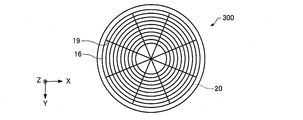
- FIG. 5 is a plan view of the chemical mechanical polishing pad 300 according to the second modification, and corresponds to FIG.
- the chemical mechanical polishing pad 300 according to the second modification includes the polishing layer described above in that it includes a plurality of grooves 19 extending radially from the center of the polishing surface 20 toward the outer edge in addition to the annular groove 16. Different from 10.
- the cross-sectional shape of the groove 19 can be the same as the groove 16 described above.
- the other configuration of the chemical mechanical polishing pad 300 according to the second modification is the same as the configuration of the polishing layer 10 described with reference to FIGS.
- the support layer 12 is used in the chemical mechanical polishing pad 100 to support the polishing layer 10 on the polishing apparatus surface plate 14.
- the support layer 12 may be an adhesive layer or a cushion layer having the adhesive layer on both sides.
- the adhesive layer can be made of, for example, an adhesive sheet.
- the thickness of the pressure-sensitive adhesive sheet is preferably 50 ⁇ m to 250 ⁇ m. By having a thickness of 50 ⁇ m or more, the pressure from the polishing surface 20 side of the polishing layer 10 can be sufficiently relaxed, and by having a thickness of 250 ⁇ m or less, the influence of unevenness on the polishing performance is not affected. Thus, the chemical mechanical polishing pad 100 having a uniform thickness can be obtained.
- the material of the pressure-sensitive adhesive sheet is not particularly limited as long as the polishing layer 10 can be fixed to the polishing apparatus surface plate 14, but is preferably an acrylic or rubber-based material having a lower elastic modulus than the polishing layer 10.
- the adhesive strength of the pressure-sensitive adhesive sheet is not particularly limited as long as the chemical mechanical polishing pad can be fixed to the polishing machine surface plate 14, but when the adhesive strength of the pressure-sensitive adhesive sheet is measured according to the standard of “JIS Z0237”, the adhesive strength Is preferably 3 N / 25 mm or more, more preferably 4 N / cm or more, and particularly preferably 10 N / 25 mm or more.
- the cushion layer is made of a material whose hardness is lower than that of the polishing layer 10, the material is not particularly limited, and may be a porous body (foam) or a non-porous body.
- a cushion layer the layer which shape
- the thickness of the cushion layer is preferably 0.1 mm to 5.0 mm, more preferably 0.5 mm to 2.0 mm.
- Chemical mechanical polishing method The chemical mechanical polishing method according to the present embodiment is characterized in that chemical mechanical polishing is performed using the chemical mechanical polishing pad described above.
- the chemical mechanical polishing pad described above has a polishing layer containing the above-mentioned physical properties of polyurethane, so it has moderate rigidity and toughness, and in particular suppresses the generation of scratches in the chemical mechanical polishing process. can do.
- a commercially available chemical mechanical polishing apparatus can be used.
- Examples of commercially available chemical mechanical polishing apparatuses include: “EPO-112” and “EPO-222” manufactured by Ebara Manufacturing Co., Ltd .; “LGP-510” and “LGP-552” manufactured by Lapmaster SFT; A model “Mirra”, etc., is available.
- Preferred polishing conditions should be set as appropriate depending on the chemical mechanical polishing apparatus to be used.
- “Mirra” is used as the chemical mechanical polishing apparatus, the following conditions can be used.
- Head rotation speed preferably 30 to 150 rpm, more preferably 40 to 120 rpm
- Head load preferably 0.8 to 2.8 psi, more preferably 1.4 to 2.1 psi -Surface plate rotation speed: preferably 30 to 150 rpm, more preferably 40 to 120 rpm -Surface plate rotation speed / head rotation speed ratio: preferably 0.5-2, more preferably 0.7-1.5
- Chemical chemical polishing aqueous dispersion supply rate preferably 50 to 300 cm 3 / min, more preferably 100 to 200 cm 3 / min
- an optimal one can be appropriately selected according to the polishing target (copper film, insulating film, low dielectric constant insulating film, etc.).
- 1,5-pentanediol manufactured by Ube Industries, Ltd., trade name “1,5-pentane” as the component (C1) of the chain extender (C) "Diol”; hereinafter referred to as “15PD” and 1.9 parts by mass
- 1,4-butanediol as the component (C2) (trade name "14BG” manufactured by Mitsubishi Chemical Corporation); hereinafter referred to as "14BG” ) was added, and stirred and mixed.
- thermoplastic polyurethane A was spread on a surface-treated SUS vat, allowed to react at 110 ° C. for 1 hour, and further annealed at 80 ° C. for 16 hours to obtain a thermoplastic polyurethane A.
- Examples 2 to 18 and Comparative Examples 1 to 9 Examples similar to Example 1 except that the types and contents of the components (A) diisocyanate, (B) polyol, and (C) chain extender were changed to those shown in Tables 1 to 3.
- the thermoplastic polyurethanes B to AA of 2 to 18 and Comparative Examples 1 to 9 were obtained.
- the number average molecular weight (Mn) of the polyol (B) is gel permeation chromatography (GPC) (manufactured by Tosoh Corporation, apparatus model number “HLC-8120”, column model number “TSK-GEL ⁇ -M ").
- GPC gel permeation chromatography
- the breaking stress and breaking strain were measured.
- the breaking stress and breaking strain were determined from a tensile test in accordance with “JIS K6251”.
- the product of the obtained breaking stress and breaking strain was calculated as a tensile product.
- the tensile product is an index of the mechanical properties of polyurethane.
- the results are also shown in Tables 1 to 3.
- the breaking stress is preferably 4 MPa or more, more preferably 5 MPa or more, and particularly preferably 6 MPa or more.
- the breaking strain is preferably 200% or more, more preferably 300% or more, and particularly preferably 400% or more.
- the tensile product is preferably 800 MPa or more, more preferably 1500 MPa or more, and particularly preferably 2400 MPa or more.
- the flow start temperature (processing temperature) of the polyurethane obtained in “5.1. Production of polyurethane” was measured.
- the flow start temperature was measured by a method based on “10. Flow test” of “JIS K7311”.
- the measurement apparatus and measurement conditions for the flow start temperature are shown below.
- ⁇ Testing machine CFT-500 (manufactured by Shimadzu Corporation) -Preheating conditions: 90 ° C x 4 minutes-Temperature increase rate: 3 ° C / min-Start temperature: 90 ° C ⁇
- the temperature starts to be increased at the same time as the above test load is applied, and the temperature at which flow begins to flow out of the die is the flow start temperature of polyurethane (processing temperature). It was.
- the flow start temperature is an index of polyurethane processability.
- the results are also shown in Tables 1 to 3.
- the flow initiation temperature is preferably 60 ° C. to 120 ° C., more preferably 70 ° C. to 110 ° C., and particularly preferably 80 ° C. to 100 ° C.
- MFR Melt Flow Rate
- Example 6 (1,4-butanediol and 1,5-propanediol are used in combination as chain extenders) and Comparative Example 1 (1,4-butanediol is used as the chain extender only)
- the polyurethane of Example 6 was 40 and the polyurethane of Comparative Example 1 was 37 in terms of durometer. . That is, no significant difference was observed in the durometer.
- the polyurethane of Example 6 was 6194 MPa, while the polyurethane of Comparative Example 1 was 367 MPa. That is, it was found that the polyurethane of Example 6 was remarkably excellent in mechanical properties. Moreover, in the flow start temperature, the polyurethane of Example 6 was 92 ° C., whereas the polyurethane of Comparative Example 1 was 126 ° C. That is, it was found that the polyurethane of Example 6 can be processed at a low temperature and has excellent processability.
- the polyurethane of Comparative Example 7 (1,4-butanediol and 1,6 hexanediol were used in combination as chain extenders, and the other components were similar to Example 6), and the polyurethane of Comparative Example 8 A chain extender having a different chain length is used in combination, as shown in FIG. 1 (1,3-propanediol and 1,5propanediol are used together as chain extenders, and the other components are similar to those in Example 6). Even if the combination of repeating units is even-even and odd-odd, two or more of the five items mentioned above are defective, and the combination of repeating units is odd-even to achieve both mechanical properties and workability. It turns out that you can.
- polishing Layer Forming Composition 100 parts by mass of polyurethane A as polyurethane and ⁇ -cyclodextrin (trade name “Dexipal ⁇ -100”, manufactured by Shimizu Minato Sugar Co., Ltd., average particle diameter of 20 ⁇ m as water-soluble particles; 34 parts by mass (denoted as “ ⁇ -CD”) were kneaded by a rudder adjusted to 140 ° C.
- polishing layer forming composition obtained in the above step “5.4.1a. Production of polishing layer forming composition” was subjected to a crosslinking reaction at 180 ° C. for 20 minutes in a press mold. A cylindrical molded body (polishing layer substrate) having a diameter of 845 mm and a thickness of 3.2 mm was obtained.
- the polishing layer substrate manufactured in the above-mentioned process of “5.4.1b. Manufacturing of polishing layer substrate” is set in the insertion port of a wide belt sander device (manufactured by Meinan Seisakusho Co., Ltd.), and the roller is set at 500 rpm. While rotating, each of the front and back surfaces of the molded body was moved at a speed of 0.1 m / s using sandpaper (manufactured by Kovac Co., Ltd.) of particle size meshes # 120, # 150 and # 220 in order. The regular grinding was performed by 0.1 mm (the total grinding amount was 0.3 mm for each of the front surface and the back surface).
- the polishing layer forming composition obtained in the process of “5.4.3a. Production of Polishing Layer Forming Composition” is kneaded with a router adjusted to 160 ° C. A pellet of the forming composition was obtained. Next, the temperature of a mold having a cavity having a diameter of 850 mm and a depth of 3.0 mm was adjusted to 40 ° C. Next, an injection molding machine (manufactured by Mitsubishi Heavy Industries Plastic Technology Co., Ltd .; Model 1600MMIIIW) in which the temperature in the cylinder was set to 160 ° C. was prepared. The obtained pellets are softened by heating in a cylinder, and this is quickly pushed into the mold and molded to obtain a cylindrical molded body (polishing layer substrate) having a diameter of 845 mm and a thickness of 3.2 mm. It was.
- polishing rate As an object to be polished, a chemical mechanical polishing process was performed for 1 minute under the above-mentioned conditions using a silicon substrate with an 8-inch thermal oxide film provided with a 15,000 mm thick copper film, The film thickness before and after the treatment was measured using an electrically conductive film thickness measuring instrument (manufactured by KLA-Tencor Corporation, model “Omnimap RS75”), and the polishing rate was calculated from the film thickness before and after the treatment and the polishing treatment time. The results are also shown in Tables 3 to 5. The larger the polishing rate value, the better. However, the polishing rate is preferably 800 nm / min or more, more preferably 850 nm / min or more, and particularly preferably 900 nm / min or more.
- End point detection time and flatness evaluation A wafer with a pattern (manufactured by SEMATECH INTERNATIONAL, model “SEMATECH 854”) was used as an object to be polished.
- the end point detection time was determined by measuring the time from the start of polishing until the end point detected by infrared rays emitted from the table. The shorter the end point detection time, the better. However, it is preferably 90 seconds or less, more preferably 80 seconds or less, and particularly preferably 70 seconds or less.
- the flatness a pattern in which copper wiring portions having a width of 100 ⁇ m and insulating portions having a width of 100 ⁇ m are continuously arranged in the length direction after polishing the wafer having a pattern of 1.2 times the end point detection time.
- the amount of copper wiring dent in the 100 ⁇ m wiring width (hereinafter referred to as “dishing amount”) It was also evaluated by measuring. The results are shown in Tables 3-5.
- the dishing amount is preferably less than 30 nm, more preferably less than 25 nm, and particularly preferably less than 20 nm.
- the cut rate can be used as an index of the life of the chemical mechanical polishing pad, and is preferably less than 3.5 ⁇ m / min, more preferably less than 3.0 ⁇ m / min, and particularly preferably less than 2.5 ⁇ m / min. is there.
- thermoplastic polyurethane composition according to the present invention has good mechanical properties and processability. Furthermore, by using this as a composition for forming a polishing layer, a chemical mechanical polishing pad having a polishing layer excellent in polishing rate, end point detection rate, flatness, scratch performance, and life is manufactured. I was able to.
Landscapes
- Chemical & Material Sciences (AREA)
- Health & Medical Sciences (AREA)
- Chemical Kinetics & Catalysis (AREA)
- Medicinal Chemistry (AREA)
- Polymers & Plastics (AREA)
- Organic Chemistry (AREA)
- Engineering & Computer Science (AREA)
- Mechanical Engineering (AREA)
- Manufacturing & Machinery (AREA)
- Materials Engineering (AREA)
- Mechanical Treatment Of Semiconductor (AREA)
- Finish Polishing, Edge Sharpening, And Grinding By Specific Grinding Devices (AREA)
- Polyurethanes Or Polyureas (AREA)
- Manufacture Of Macromolecular Shaped Articles (AREA)
Abstract
Description
本発明にかかるポリウレタンの一態様は、
少なくとも(A)ジイソシアネートと、(B)ポリオールと、(C)鎖延長剤と、を含有する混合物を反応させて得られたポリウレタンであって、
前記(B)ポリオールの数平均分子量は、400~5,000であり、
前記(C)鎖延長剤は、(C1)下記一般式(1)で示される化合物と、(C2)下記一般式(2)で示される化合物と、を含み、
前記化合物(C1)および前記化合物(C2)の数平均分子量は、400未満であり、
前記化合物(C1)のモル数(M1)および前記化合物(C2)のモル数(M2)から算出されるM1/(M1+M2)の値が、0.25~0.9である。
(上記一般式(1)において、複数存在するR1およびR2は、それぞれ独立に水素原子または炭素数が1~6の置換もしくは非置換のアルキル基を表す。mは、1~13の任意の整数である。)
(上記一般式(2)において、複数存在するR3およびR4は、それぞれ独立に水素原子または炭素数が1~6の置換もしくは非置換のアルキル基を表す。nは、1~12の任意の整数である。)
適用例1において、
前記化合物(C1)のR1およびR2は、水素原子であることができる。
適用例1または適用例2において、
前記化合物(C1)は、1,3-プロパンジオールおよび1,5-ペンタンジオールから選択される少なくとも1種であることができる。
適用例1ないし適用例3のいずれか一例において、
前記化合物(C2)のR3およびR4は、水素原子であることができる。
適用例1ないし適用例4のいずれか一例において、
前記化合物(C2)は、エチレングリコール、1,4-ブタンジオール、1,6-ヘキサンジオールおよび1,18-オクタデカンジオールから選択される少なくとも1種であることができる。
本発明にかかる研磨層形成用組成物の一態様は、
少なくとも水溶性粒子と、適用例1ないし適用例5のいずれか一例に記載のポリウレタンと、を含有する。
適用例6において、
さらに、架橋剤を含有することができる。
本発明にかかる化学機械研磨用パッドの一態様は、
適用例6または適用例7に記載の研磨層形成用組成物を用いて製造されたものである。
本発明にかかる化学機械研磨方法の一態様は、
適用例8に記載の化学機械研磨用パッドを用いて化学機械研磨することを特徴とする。
本実施の形態にかかるポリウレタンは、少なくとも(A)ジイソシアネートと、(B)ポリオールと、(C)鎖延長剤と、を含有する混合物を反応させて得られたポリウレタンであって、前記(B)ポリオールの数平均分子量は、400~5,000であり、前記(C)鎖延長剤は、(C1)下記一般式(1)で示される化合物と、(C2)下記一般式(2)で示される化合物と、を含み、前記化合物(C1)および前記化合物(C2)の数平均分子量は、400未満であり、前記化合物(C1)のモル数(M1)および前記化合物(C2)のモル数(M2)から算出されるM1/(M1+M2)の値が、0.25~0.9であることを特徴とする。
(上記一般式(1)において、複数存在するR1およびR2は、それぞれ独立に水素原子または炭素数が1~6の置換もしくは非置換のアルキル基を表す。mは、1~13の任意の整数である。)
(上記一般式(2)において、複数存在するR3およびR4は、それぞれ独立に水素原子または炭素数が1~6の置換もしくは非置換のアルキル基を表す。nは、1~12の任意の整数である。)
本実施の形態にかかるポリウレタンは、モノマー成分として(A)ジイソシアネートを含有する。ジイソシアネートは、下記一般式(3)で示される化合物であり、ポリウレタンのウレタン結合を形成するための必須成分である。
(上記一般式(3)中、R5は、任意の二価の有機基を表す。)
本実施の形態にかかるポリウレタンは、モノマー成分として(B)ポリオールを含有する。ポリオールとは、2個以上の水酸基を有するアルコール類の総称であるが、本実施の形態においては、2~3個の水酸基を有するものが好ましい。また、(B)ポリオールのゲルパーミエーションクロマトグラフィー(GPC)によって測定されるスチレン換算の数平均分子量は、400~5,000であり、より好ましくは400~4,100であり、特に好ましくは400~2,500である。(B)ポリオールの数平均分子量が前記範囲内にあると、剛性(硬さ、弾性率)と靱性(引張強度)とのバランスが良好なポリウレタンを合成することができる。(B)ポリオールの数平均分子量が5,000を超える場合には、得られるポリウレタンの剛性が低下する傾向がある。一方、(B)ポリオールの数平均分子量が400未満の場合には、得られるポリウレタンの靱性が低下する傾向がある。
本実施の形態にかかるポリウレタンは、モノマー成分として(C)鎖延長剤を含有する。本実施の形態にかかるポリウレタンは、(C)鎖延長剤として、(C1)下記一般式(1)で示される化合物(以下、「化合物(C1)」ともいう。)および、(C2)下記一般式(2)で示される化合物(以下、「化合物(C2)」ともいう。)を含むことを特徴とする。
(上記一般式(1)において、複数存在するR1およびR2は、それぞれ独立に水素原子または炭素数が1~6の置換もしくは非置換のアルキル基を表す。mは、1~13の任意の整数であり、好ましくは1~6の任意の整数である。)
(上記一般式(2)において、複数存在するR3およびR4は、それぞれ独立に水素原子または炭素数が1~6の置換もしくは非置換のアルキル基を表す。nは、1~12の任意の整数であり、好ましくは1~5の任意の整数である。)
上記化合物(C1)としては、例えば、1,3-プロパンジオール、1,3-ブチレングリコール、1,5-ペンタンジオール、ネオペンチルグリコール、3-メチル-1,5-ペンタンジオール、2-エチル-1,3-ヘキサンジオール、1,9-ノナンジオール、ジメチロールブタン酸等の低分子量二価アルコールが挙げられる。
上記化合物(C2)としては、例えば、エチレングリコール、1,2-プロパンジオール、1,4-ブタンジオール、1,6-ヘキサンジオール、1,18-オクタデカンジオール、2-メチル-1,8-オクタンジオール等の低分子量二価アルコールが挙げられる。
本実施の形態にかかるポリウレタンにおいて、上記化合物(C1)のモル数(M1)および上記化合物(C2)のモル数(M2)より算出されるM1/(M1+M2)の値は0.25~0.9であり、好ましくは0.3~0.85であり、より好ましくは0.4~0.8である。M1/(M1+M2)の値が上記範囲内であると、単一の鎖延長剤を使用して合成されたポリウレタンと比較して融点(流動開始温度)が低下するため低温でも加工しやすくなる。また、単一の鎖延長剤を使用して合成されたポリウレタンと比較して硬さを大きく低下させずに、引張強度(伸び、破断応力)を向上させることができる。一方、M1/(M1+M2)の値が0.25未満または0.9を超えると、流動性が低下するため加工性が損なわれ、力学特性も低下する傾向がある。
本実施の形態にかかるポリウレタンは、(A)ジイソシアネート、(B)ポリオール、(C)鎖延長剤を必須成分として含有するが、これらの成分以外の添加剤を含有させてもよい。かかる添加剤としては、触媒、酸化防止剤、紫外線吸収剤、滑剤、しゃく解剤等が挙げられる。
本実施の形態にかかるポリウレタンを製造する方法としては、公知のポリウレタン化反応の技術が用いられる。具体的には、(A)ジイソシアネート、(B)ポリオール、(C)鎖延長剤として上記化合物(C1)および上記化合物(C2)の各モノマーを混合・撹拌してモノマー混合物を調製し、大気圧下において常温から150℃で反応させることによりポリウレタンを製造することができる。上記各モノマーを反応させる順序は特に限定されず、同時に加えて反応させてもよい。
1.6.1.デュロD硬度
ポリウレタンの硬さを判断する指標として、「デュロD硬度」が挙げられる。デュロD硬度は、「JIS K6253」に準拠して測定することができる。
ポリウレタンの力学特性を判断する指標として、「破断応力」、「破断歪」、「抗張積」が挙げられる。破断応力および破断歪は、「JIS K6251」に準拠した引張試験から求めることができる。抗張積は、破断応力と破断歪の積を算出することで求めることができる。
ポリウレタンの加工のし易さを温度の観点から判断する指標として、「流動開始温度」が挙げられる。流動開始温度は、「JIS K7311」の「10.流れ試験」に準拠して測定することができる。具体的な測定条件は、実施例に記載のとおりである。
本実施の形態にかかる研磨層形成用組成物は、少なくとも水溶性粒子と、上記ポリウレタンと、を含有する。本実施の形態にかかる研磨層形成用組成物は、上記ポリウレタンを含有しているので、水溶性粒子や架橋剤等の添加剤を反応または劣化させることのない化学的に安定な組成物となる。
本実施の形態にかかる研磨層形成用組成物は、水溶性粒子を含有する。水溶性粒子は、本実施の形態にかかる研磨層形成用組成物を成形して得られた化学機械研磨用パッドにおいて、化学機械研磨用水系分散体(以下、「スラリー」ともいう)と接触することにより前記化学機械研磨用パッドの研磨層表面から遊離して、該スラリーを保持することのできる空孔(ポア)を形成するために用いられる。上記遊離は、化学機械研磨用分散体中に含有される水または水系混合媒体との接触による溶解、膨潤等によって生じる。
本実施の形態にかかる研磨層形成用組成物は、架橋剤を含有することができる。架橋剤は、ポリウレタンを架橋させるために配合されるものである。架橋剤を配合することにより、本実施の形態にかかる研磨層形成用組成物を用いて研磨層を形成する際に、該研磨層に架橋構造を持たせることができる。
本実施の形態にかかる研磨層形成用組成物は、本発明の目的を損なわない範囲で、架橋反応を促進するための架橋助剤、研磨層の硬度を適正な値にするための有機フィラーまたは無機フィラー等の添加剤を配合してもよい。
本実施の形態にかかる研磨層形成用組成物の製造方法は、特に限定されない。例えば上述した材料を所定量秤り取り、それらを混練機等で混練することにより得ることができる。混練機としては、従来から公知のものを用いることができ、例えば、ロール、ニーダー、バンバリーミキサー、押出機(単軸、多軸)等が挙げられる。
本実施の形態にかかる化学機械研磨用パッドは、上述した研磨層形成用組成物を成形することで得られた研磨層を有することを特徴とする。本実施の形態にかかる化学機械研磨用パッドは、上述したような物性のポリウレタンを含有している研磨層を有しているので適度な剛性および靱性を兼ね備えており、特に化学機械研磨工程におけるスクラッチの発生を抑制することができる。
研磨層10の平面形状は、特に限定されないが、例えば円形状であることができる。研磨層10の平面形状が円形状である場合、その大きさは、好ましくは直径150mm~1200mm、より好ましくは直径500mm~800mmである。研磨層10の厚さは、好ましくは0.5mm~5.0mm、より好ましくは1.0mm~3.0mm、特に好ましくは1.5mm~3.0mmである。
支持層12は、化学機械研磨用パッド100において、研磨装置用定盤14に研磨層10を支持するために用いられる。支持層12は、接着層であってもよいし、接着層を両面に有するクッション層であってもよい。
本実施の形態にかかる化学機械研磨方法は、上述した化学機械研磨用パッドを用いて化学機械研磨することを特徴とする。上述した化学機械研磨用パッドは、上述したような物性のポリウレタンを含有している研磨層を有しているので適度な剛性および靱性を兼ね備えており、特に化学機械研磨工程におけるスクラッチの発生を抑制することができる。
・ヘッド回転数:好ましくは30~150rpm、より好ましくは40~120rpm
・ヘッド荷重:好ましくは0.8~2.8psi、より好ましくは1.4~2.1psi
・定盤回転数:好ましくは30~150rpm、より好ましくは40~120rpm
・定盤回転数/ヘッド回転数比:好ましくは0.5~2、より好ましくは0.7~1.5
・化学機械研磨用水系分散体供給速度:好ましくは50~300cm3/分、より好ましくは100~200cm3/分
以下、本発明を実施例により詳細に説明するが、本発明はこれらの実施例により何ら限定されるものではない。
5.1.1.実施例1
空気雰囲気下で、撹拌機を備えた2Lの4つ口セパラブルフラスコに、(B)ポリオール成分として末端が水酸基化されたポリブタジエン(Mn=1516、日本曹達株式会社製、商品名「NISSO PB G-1000」;以下、「G-1000」と記す)を35.0質量部、およびポリテトラメチレングリコール(Mn=1012、保土谷化学工業株式会社製、商品名「PTG-1000SN」;以下、「PTG-1000」と記す)を28.5質量部投入し、60℃に調温して撹拌した。
(A)ジイソシアネート、(B)ポリオール、(C)鎖延長剤の各成分の種類および含有量を表1~表3に記載のものに変更したこと以外は、実施例1と同様にして実施例2~18、比較例1~9の熱可塑性ポリウレタンB~AAを得た。
・「PTG-650」:ポリテトラメチレングリコール(Mn=657、保土谷化学工業株式会社製、商品名「PTG-650SN」
・「PTG-2000」:ポリテトラメチレングリコール(Mn=2004、保土谷化学工業株式会社製、商品名「PTG-2000SN」
・「PEG-200」:ポリエチレングリコール(Mn=200、三洋化成工業株式会社製、商品名「PEG-200」)
・「PEG-400」:ポリエチレングリコール(Mn=401、三洋化成工業株式会社製、商品名「PEG-400」)
・「PEG-4000」:ポリエチレングリコール(Mn=4026、三洋化成工業株式会社製、商品名「PEG-4000」)
・「PEG-10000」:ポリエチレングリコール(Mn=10000、三洋化成工業株式会社製、商品名「PEG-10000」)
・「13PD」:1,3-プロパンジオール(シェルケミカルズジャパン株式会社製、商品名「1,3-プロパンジオール」)
・「16HD」:1,6-ヘキサンジオール(宇部興産株式会社製、商品名「1,6-ヘキサンジオール」)
・「118OD」:1,18-オクタデカンジオール(アルドリッチ・ケミカル社製)
・「EG」:エチレングリコール(株式会社日本触媒製、商品名「エチレングリコール」)
5.2.1.硬度
上記「5.1.ポリウレタンの製造」で得られたポリウレタンについて、デュロD硬度を測定した。デュロD硬度は、「JIS K6253」に準拠して測定した。その結果を表1~表3に併せて示す。
上記「5.1.ポリウレタンの製造」で得られたポリウレタンについて、破断応力および破断歪を測定した。破断応力および破断歪は、「JIS K6251」に準拠した引張試験から求めた。次いで、求めた破断応力と破断歪の積を抗張積として算出した。抗張積は、ポリウレタンの力学特性の一指標となる。その結果を表1~表3に併せて示す。なお、破断応力は、好ましくは4MPa以上、より好ましくは5MPa以上、特に好ましくは6MPa以上である。破断歪は、好ましくは200%以上、より好ましくは300%以上、特に好ましくは400%以上である。抗張積は、好ましくは800MPa以上、より好ましくは1500MPa以上、特に好ましくは2400MPa以上である。
上記「5.1.ポリウレタンの製造」で得られたポリウレタンについて、流動開始温度(加工温度)を測定した。流動開始温度の測定は、「JIS K7311」の「10.流れ試験」に準拠した方法で行った。流動開始温度の測定装置および測定条件について、以下に示す。
・試験機:CFT-500(株式会社島津製作所製)
・予熱条件:90℃×4分
・昇温速度:3℃/分
・開始温度:90℃
・試験荷重:98N
・使用ダイス:直径1mm、長さ1mm
上記「5.1.ポリウレタンの製造」で得られたポリウレタンについて、MFR測定を行った。MFRの測定は、「JIS K7210」の「プラスチック―熱可塑性プラスチックのメルトマスフローレイト(MFR)およびメルトボリュームフローレイトI(MVR)の試験方法」に準拠した方法で行った。具体的には、下記の条件にて熱可塑性ポリウレタンのMFR(g/10分)の測定を行った。MFRは、ポリウレタンの加工性の一指標となる。その結果を表1~表3に併せて示す。なお、MFRは、好ましくは10以上、より好ましくは15以上、特に好ましくは25以上である。
・試験機:120-SAS-2000(株式会社安田精機製作所製)
・シリンダ温度:130℃
・試験荷重:98N


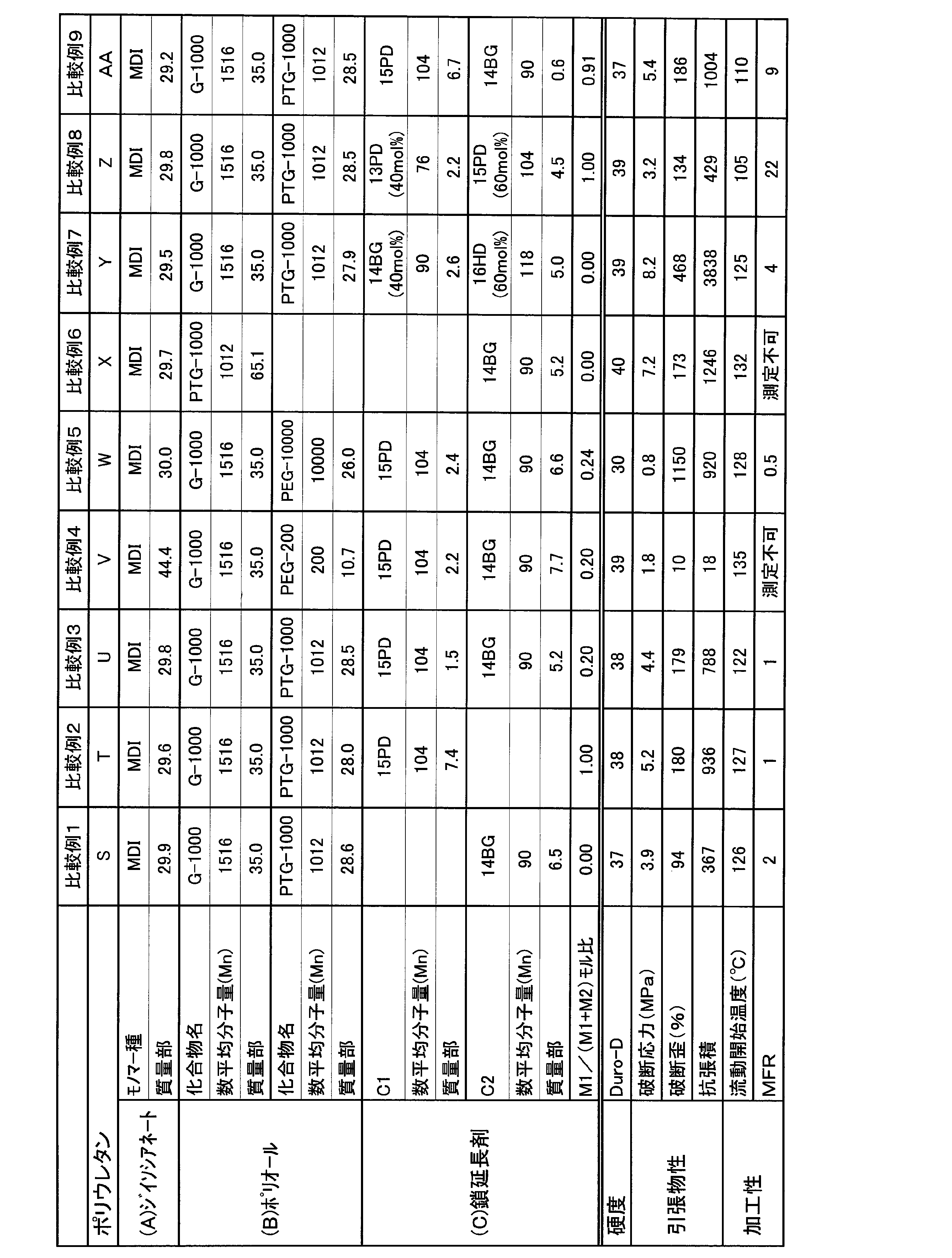
表1~表3によれば、実施例1~18のポリウレタンは、いずれも良好な力学特性(破断応力、破断歪、抗張積)および加工性(流動開始温度、MFR)を示した。
5.4.1.実施例19
5.4.1a.研磨層形成用組成物の製造
ポリウレタンとして上記ポリウレタンA100質量部と、水溶性粒子としてβ-サイクロデキストリン(塩水港精糖株式会社製、商品名「デキシパールβ-100」、平均粒径20μm;以下、「β-CD」と記す)34質量部を140℃に調温されたルーダーにより混練した。
上記「5.4.1a.研磨層形成用組成物の製造」の工程で得られた研磨層形成用組成物を、プレス金型内にて180℃で20分間架橋反応させ、直径845mm、厚さ3.2mmの円柱状の成形体(研磨層基体)を得た。
上記「5.4.1b.研磨層基体の製造」の工程で製造した研磨層基体を、ワイドベルトサンダー機器(株式会社名南製作所製)の挿入口にセットし、ローラーを500rpmで回転しながら、成形体の表面および裏面につき、粒度メッシュ#120、#150および#220のサンドペーパー(株式会社コバックス製)を順次に用いてそれぞれ0.1m/sの速さで動かして各番定あたり0.1mmずつ研削した(総研削量は、表面、裏面それぞれ0.3mmずつである。)。
上記「5.4.1c.パッドの製造」の工程で製造したパッドを切削加工機(加藤機械株式会社製)の定盤上に、吸引圧力20kPaで吸引固定した。この状態で、幅0.5mm、深さ1mmの同心円状の溝群を中心から半径10mm以遠の所にピッチ2mmで形成し、さらに、同機械を用いて、中心から254mmのところを切削することで、直径508mm、厚さ2.5mmの化学機械研磨用パッドを製造した。
上記「5.4.1a.研磨層形成用組成物の製造」の工程において、ポリウレタンの種類、水溶性粒子および架橋剤の含有量を表4~表6に記載のものに変更したこと以外は、実施例19の化学機械研磨用パッドの製造方法と全く同様にして、実施例20~25、30~33、比較例9~13、15、16の化学機械研磨用パッドを製造した。
5.4.3a.研磨層形成用組成物の製造
上記「5.4.1a.研磨層形成用組成物の製造」の工程において、ポリウレタンの種類、水溶性粒子の含有量を表4~表6に記載のものに変更したこと以外は全く同様にして研磨層形成用組成物を製造した。
上記「5.4.3a.研磨層形成用組成物の製造」の工程で得られた研磨層形成用組成物を160℃に調温されたルーダーにより混練して、研磨層形成用組成物のペレットを得た。次いで、直径850mm、深さ3.0mmのキャビティーを有する金型を40℃に調温した。次いで、シリンダー中の温度を160℃にセットした射出成形機(三菱重工プラスチックテクノロジー株式会社製;型式1600MMIIIW)を用意した。得られたペレットをシリンダー中で加熱して柔らかくし、これを上記金型に速やかに押し込んで成形することにより、直径845mm、厚さ3.2mmの円柱状の成形体(研磨層基体)を得た。
上記「5.4.3b.研磨層基体の製造」の工程で製造した研磨層基体について、上記「5.4.1c.パッドの製造」の工程と同様の方法によりパッドを得た。
上記「5.4.3c.パッドの製造」の工程で製造したパッドについて、上記「5.4.1d.化学機械研磨用パッドの製造」の工程と同様の方法により、実施例26~29および比較例14の化学機械研磨用パッドを得た。
上記「5.4.化学機械研磨用パッドの製造」で製造した化学機械研磨用パッドの溝を形成していない面へ両面テープ#422(3M社製)をラミネートした後、化学機械研磨装置(アプライドマテリアルズ社製、形式「Mirra」)に装着し、以下の条件にて化学機械研磨を行い、研磨特性を評価した。その結果を表4~表6に併せて示す。
・ヘッド回転数:120rpm
・ヘッド荷重:1.5psi(10.3kPa)
・テーブル回転数:120rpm
・化学機械研磨用水系分散体供給速度:200cm3/分
・化学機械研磨用水系分散体:CMS7401/CMS7452(JSR株式会社製)
被研磨物として、8インチ熱酸化膜付シリコン基板上に膜厚15,000Åの銅膜が設けられたものを用いて、上述の条件で1分間化学機械研磨処理を行って、処理前後の膜厚を電気伝導式膜厚測定器(ケーエルエー・テンコール社製、形式「オムニマップRS75」)を用いて測定し、処理前後の膜厚および研磨処理時間から研磨速度を算出した。その結果を表3~表5に併せて示す。なお、研磨速度の値は、大きければ大きいほど良好であるといえるが、好ましくは800nm/分以上、より好ましくは850nm/分以上、特に好ましくは900nm/分以上である。
パターン付きウエハ(SEMATECH INTERNATIONAL社製、形式「SEMATECH 854」)を被研磨物として用いた。終点検出時間は、研磨開始後テーブル上から発する赤外線によって検知した終点に至るまでの時間を測定することにより求めた。なお、終点検出時間は、短ければ短いほど良好であるといえるが、好ましくは90秒以下、より好ましくは80秒以下、特に好ましくは70秒以下である。
研磨処理後の上記パターン付きウエハの被研磨面において、サーフスキャンSP1(KLAテンコール社製)を使用して、銅配線部における範囲120μm×120μmの単位領域についてランダムに200箇所観察することで、単位領域当たりのスクラッチの個数を測定した。その結果を表3~表5に示す。なお、スクラッチは、好ましくは90個未満、より好ましくは70個未満、特に好ましくは50個未満である。
上記化学機械研磨装置に上記「5.4.化学機械研磨用パッドの製造」で製造した化学機械研磨用パッドを装着し、ドレッサーとしてA165(3M社製)を用いてテーブル回転数60rpm、ドレッシング回転数65rpm、ドレッシング荷重4.5kgfの条件でドレッシングを1時間行った。ドレッシング前後の研磨層について、超高精度レーザー変位計(KEYENCE社製、「LC-2400」)を用いて化学機械研磨用パッドの中心を通る直線上における30mm毎の間隔の15点につき変位量を測定した。ドレッシング前後の化学機械研磨用パッドの厚み(μm)の差を磨耗量として、これにドレッシングを行った時間(60分)で除した値をカットレート(μm/分)とした。その結果を表3~表5に示す。なお、カットレートは、化学機械研磨用パッドのライフの指標とすることができ、好ましくは3.5μm/分未満、より好ましくは3.0μm/分未満、特に好ましくは2.5μm/分未満である。
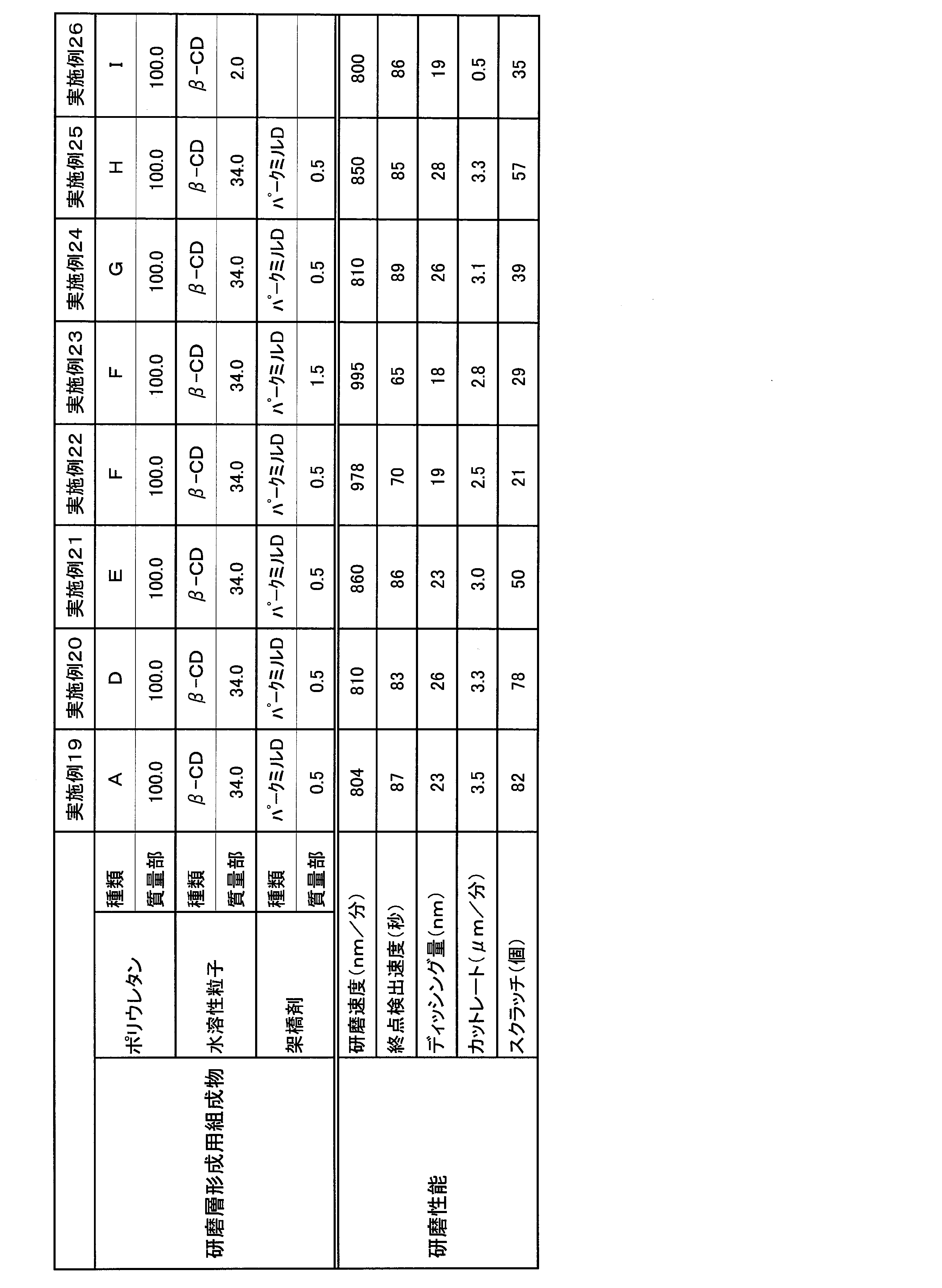
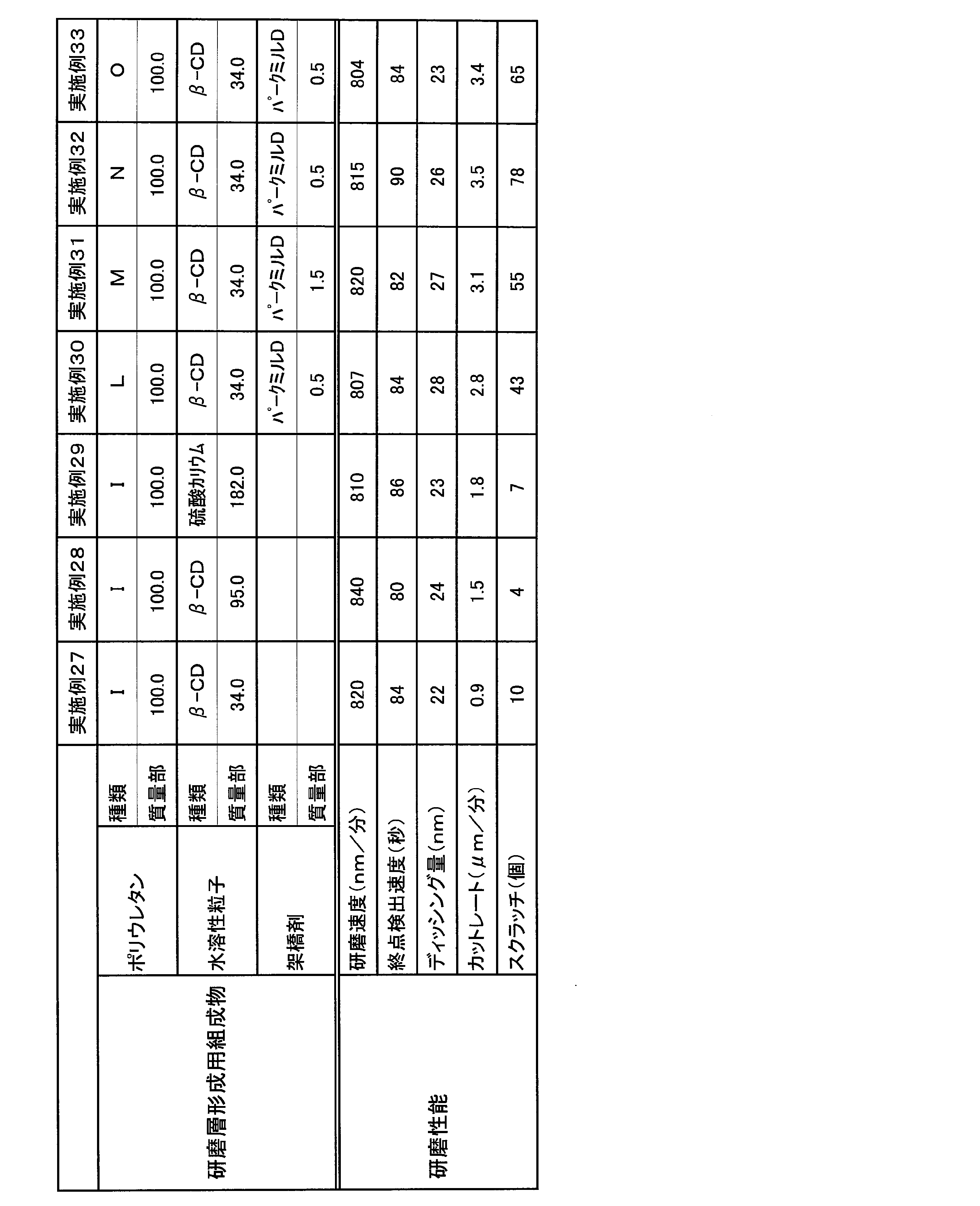

表4~表5によれば、実施例19~33の化学機械研磨用パッドは、研磨速度、終点検出速度、ディッシング量(平坦性)、カットレート、およびスクラッチの5項目の研磨特性においていずれも好ましい結果が得られた。
Claims (9)
- 少なくとも(A)ジイソシアネートと、(B)ポリオールと、(C)鎖延長剤と、を含有する混合物を反応させて得られたポリウレタンであって、
前記(B)ポリオールの数平均分子量は、400~5,000であり、
前記(C)鎖延長剤は、(C1)下記一般式(1)で示される化合物と、(C2)下記一般式(2)で示される化合物と、を含み、
前記化合物(C1)および前記化合物(C2)の数平均分子量は、400未満であり、
前記化合物(C1)のモル数(M1)および前記化合物(C2)のモル数(M2)から算出されるM1/(M1+M2)の値が、0.25~0.9である、ポリウレタン。
HO-(CR1R2)2m+1-OH …(1)
(上記一般式(1)において、複数存在するR1およびR2は、それぞれ独立に水素原子または炭素数が1~6の置換もしくは非置換のアルキル基を表す。mは、1~13の任意の整数である。)
HO-(CR3R4)2n-OH …(2)
(上記一般式(2)において、複数存在するR3およびR4は、それぞれ独立に水素原子または炭素数が1~6の置換もしくは非置換のアルキル基を表す。nは、1~12の任意の整数である。) - 請求項1において、
前記化合物(C1)のR1およびR2は、水素原子である、ポリウレタン。 - 請求項1または請求項2において、
前記化合物(C1)は、1,3-プロパンジオールおよび1,5-ペンタンジオールから選択される少なくとも1種である、ポリウレタン。 - 請求項1ないし請求項3のいずれか一項において、
前記化合物(C2)のR3およびR4は、水素原子である、ポリウレタン。 - 請求項1ないし請求項4のいずれか一項において、
前記化合物(C2)は、エチレングリコール、1,4-ブタンジオール、1,6-ヘキサンジオールおよび1,18-オクタデカンジオールから選択される少なくとも1種である、ポリウレタン。 - 少なくとも水溶性粒子と、請求項1ないし請求項5のいずれか一項に記載のポリウレタンと、を含有する、研磨層形成用組成物。
- 請求項6において、
さらに、架橋剤を含有する、研磨層形成用組成物。 - 請求項6または請求項7に記載の研磨層形成用組成物を用いて製造された、化学機械研磨用パッド。
- 請求項8に記載の化学機械研磨用パッドを用いて化学機械研磨する、化学機械研磨方法。
Priority Applications (5)
| Application Number | Priority Date | Filing Date | Title |
|---|---|---|---|
| US13/375,849 US20120083187A1 (en) | 2009-06-18 | 2010-05-31 | Polyurethane, composition for formation of polishing layers that contains same, pad for chemical mechanical polishing, and chemical mechanical polishing method using same |
| EP10789357.0A EP2444433A4 (en) | 2009-06-18 | 2010-05-31 | POLYURETHANE, COMPOSITION FOR THE FORMATION OF POLISHING LAYERS THEREFOR, CLOTH FOR CHEMICAL-MECHANICAL CLEANING AND CHEMICAL-MECHANICAL CLEANING PROCESS THEREWITH |
| JP2011519712A JP5725300B2 (ja) | 2009-06-18 | 2010-05-31 | 研磨層形成用組成物、ならびに化学機械研磨用パッドおよびそれを用いた化学機械研磨方法 |
| CN2010800236264A CN102449017A (zh) | 2009-06-18 | 2010-05-31 | 聚氨酯及含有它的研磨层形成用组合物、以及化学机械研磨用垫及使用它的化学机械研磨方法 |
| US14/254,395 US20140223832A1 (en) | 2009-06-18 | 2014-04-16 | Polyurethane, composition for formation of polishing layers that contains same, pad for chemical mechanical polishing, and chemical mechanical polishing method using same |
Applications Claiming Priority (2)
| Application Number | Priority Date | Filing Date | Title |
|---|---|---|---|
| JP2009-145239 | 2009-06-18 | ||
| JP2009145239 | 2009-06-18 |
Related Child Applications (2)
| Application Number | Title | Priority Date | Filing Date |
|---|---|---|---|
| US13/375,849 A-371-Of-International US20120083187A1 (en) | 2009-06-18 | 2010-05-31 | Polyurethane, composition for formation of polishing layers that contains same, pad for chemical mechanical polishing, and chemical mechanical polishing method using same |
| US14/254,395 Division US20140223832A1 (en) | 2009-06-18 | 2014-04-16 | Polyurethane, composition for formation of polishing layers that contains same, pad for chemical mechanical polishing, and chemical mechanical polishing method using same |
Publications (1)
| Publication Number | Publication Date |
|---|---|
| WO2010146982A1 true WO2010146982A1 (ja) | 2010-12-23 |
Family
ID=43356302
Family Applications (1)
| Application Number | Title | Priority Date | Filing Date |
|---|---|---|---|
| PCT/JP2010/059184 Ceased WO2010146982A1 (ja) | 2009-06-18 | 2010-05-31 | ポリウレタンおよびそれを含有する研磨層形成用組成物、ならびに化学機械研磨用パッドおよびそれを用いた化学機械研磨方法 |
Country Status (7)
| Country | Link |
|---|---|
| US (2) | US20120083187A1 (ja) |
| EP (1) | EP2444433A4 (ja) |
| JP (1) | JP5725300B2 (ja) |
| KR (1) | KR20120039523A (ja) |
| CN (1) | CN102449017A (ja) |
| TW (1) | TWI488875B (ja) |
| WO (1) | WO2010146982A1 (ja) |
Cited By (6)
| Publication number | Priority date | Publication date | Assignee | Title |
|---|---|---|---|---|
| CN103958124A (zh) * | 2011-12-02 | 2014-07-30 | 旭硝子株式会社 | 玻璃板的研磨装置 |
| CN104105575A (zh) * | 2011-11-29 | 2014-10-15 | 内克斯普拉纳公司 | 具有基层和抛光表面层的抛光垫 |
| JP2016010836A (ja) * | 2014-06-30 | 2016-01-21 | 株式会社東芝 | 研磨装置、研磨方法、及び研磨パッド |
| JP2017523297A (ja) * | 2014-07-07 | 2017-08-17 | ジェイエイチ ローデス カンパニー, インコーポレイテッド | 硬質表面を研磨するための研磨材料、この材料を含む媒体、およびそれを形成および使用する方法 |
| JP2018523735A (ja) * | 2015-08-03 | 2018-08-23 | レプソル・エセ・アRepsol, S.A. | ポリエーテルカーボネートポリオールを含む接着組成物 |
| WO2020036038A1 (ja) | 2018-08-11 | 2020-02-20 | 株式会社クラレ | 研磨層用ポリウレタン、研磨層及び研磨パッド |
Families Citing this family (17)
| Publication number | Priority date | Publication date | Assignee | Title |
|---|---|---|---|---|
| US20110101665A1 (en) * | 2009-10-30 | 2011-05-05 | Dasc, Llc | Hockey skate |
| TWI510328B (zh) * | 2010-05-03 | 2015-12-01 | Iv Technologies Co Ltd | 基底層、包括此基底層的研磨墊及研磨方法 |
| JP5062455B2 (ja) | 2010-07-12 | 2012-10-31 | Jsr株式会社 | 化学機械研磨パッドおよび化学機械研磨方法 |
| US9067297B2 (en) | 2011-11-29 | 2015-06-30 | Nexplanar Corporation | Polishing pad with foundation layer and polishing surface layer |
| US9108293B2 (en) * | 2012-07-30 | 2015-08-18 | Rohm And Haas Electronic Materials Cmp Holdings, Inc. | Method for chemical mechanical polishing layer pretexturing |
| TWI485173B (zh) * | 2013-04-12 | 2015-05-21 | Button Int Co Ltd | Biodegradable Thermoplastic Polyurethanes Containing Amide Bond Groups |
| KR102066002B1 (ko) | 2013-06-10 | 2020-02-11 | 삼성전자주식회사 | 연마 패드 조성물 |
| WO2015037756A1 (ko) * | 2013-09-12 | 2015-03-19 | 주식회사 동성하이켐 | 골프공 제조용 열가소성 폴리우레탄 수지 조성물 및 그의 제조방법 |
| KR20160143700A (ko) * | 2014-03-25 | 2016-12-14 | 바스프 에스이 | Tpu 공압 호스 |
| US10217645B2 (en) * | 2014-07-25 | 2019-02-26 | Versum Materials Us, Llc | Chemical mechanical polishing (CMP) of cobalt-containing substrate |
| KR102398130B1 (ko) * | 2014-10-31 | 2022-05-13 | 주식회사 쿠라레 | 연마층용 비다공성 성형체, 연마 패드 및 연마 방법 |
| JP6541683B2 (ja) * | 2014-11-28 | 2019-07-10 | 株式会社クラレ | 研磨層用成形体及び研磨パッド |
| US11498182B2 (en) * | 2016-02-26 | 2022-11-15 | Fujimi Incorporated | Polishing method and polishing pad |
| US10875146B2 (en) * | 2016-03-24 | 2020-12-29 | Rohm And Haas Electronic Materials Cmp Holdings | Debris-removal groove for CMP polishing pad |
| CN109952331B (zh) | 2016-11-14 | 2022-09-27 | 巴斯夫欧洲公司 | 膨胀热塑性聚氨酯颗粒、其制备方法及模塑品的制备方法 |
| KR102638363B1 (ko) * | 2018-12-03 | 2024-02-19 | 주식회사 쿠라레 | 연마층용 폴리우레탄, 연마층 및 연마 패드 |
| TWI750732B (zh) * | 2020-07-10 | 2021-12-21 | 國家中山科學研究院 | 抗濕熱聚氨基甲酸酯彈性體之製法 |
Citations (11)
| Publication number | Priority date | Publication date | Assignee | Title |
|---|---|---|---|---|
| JPS6458475A (en) | 1987-08-25 | 1989-03-06 | Rodeele Nitta Kk | Grinding pad |
| JPH0450221A (ja) * | 1990-06-19 | 1992-02-19 | Chisso Corp | 合成皮革表皮層用ポリウレタン樹脂 |
| JPH06271831A (ja) * | 1993-03-22 | 1994-09-27 | Toyobo Co Ltd | 電線用結束剤 |
| JPH08500622A (ja) | 1992-08-19 | 1996-01-23 | ロデール インコーポレーテッド | 高分子微小エレメントを含む高分子基材 |
| JP2000017252A (ja) | 1998-06-29 | 2000-01-18 | Dainippon Ink & Chem Inc | 研磨材組成物及びその研磨材 |
| JP2000336142A (ja) * | 1999-05-28 | 2000-12-05 | Asahi Glass Co Ltd | ポリウレタン樹脂およびその製造方法 |
| JP2002371121A (ja) | 2001-04-09 | 2002-12-26 | Toyobo Co Ltd | ポリウレタン組成物からなる研磨パッド |
| JP2002371154A (ja) * | 2000-12-08 | 2002-12-26 | Kuraray Co Ltd | 熱可塑性ポリウレタン発泡体およびその製造方法並びに該発泡体からなる研磨パッド |
| JP2005089650A (ja) * | 2003-09-18 | 2005-04-07 | Mitsui Chemicals Inc | 自己乳化性水性ポリウレタン樹脂を含有する水性塗工材、及びそれから得られる皮膜形成物 |
| JP2005514480A (ja) * | 2001-12-21 | 2005-05-19 | ノベオン・アイピー・ホールディングズ・コーポレイション | 押出成形可能な高結晶性熱可塑性ポリウレタン |
| JP2006523759A (ja) * | 2003-03-04 | 2006-10-19 | ノベオン アイピー ホールディングス コーポレイション | 熱可塑性ポリウレタン |
Family Cites Families (12)
| Publication number | Priority date | Publication date | Assignee | Title |
|---|---|---|---|---|
| DE2817457A1 (de) * | 1978-04-21 | 1979-10-31 | Bayer Ag | Thermoplastische polyurethane fuer die verarbeitung in extrudern oder/und auf kalandern |
| US6022939A (en) * | 1994-12-23 | 2000-02-08 | Bayer Aktiengesellschaft | Thermoplastic polyurethanes with improved melt flow |
| EP1010712B1 (de) * | 1998-12-16 | 2009-10-28 | Bayer MaterialScience AG | Aliphatische thermoplastische Polyurethane, Verfahren zu ihrer Herstellung und ihre Verwendung |
| EP1270801A4 (en) * | 2000-02-28 | 2006-08-23 | Matsumoto Yushi Seiyaku Kk | PROCESS FOR PRODUCING POROUS OBJECT |
| DE10020163B4 (de) * | 2000-04-25 | 2007-05-31 | Bayer Materialscience Ag | Aliphatische thermoplastische Polyurethane und ihre Verwendung |
| US20070173601A1 (en) * | 2004-09-01 | 2007-07-26 | Rukavina Thomas G | Polyurethanes, articles and coatings prepared therefrom and methods of making the same |
| DE102004062476A1 (de) * | 2004-12-24 | 2006-07-06 | Bayer Materialscience Ag | Aliphatische sinterfähige thermoplastische Polyurethane und deren Verwendung |
| EP1975985A4 (en) * | 2006-01-25 | 2011-08-10 | Jsr Corp | CHEMICAL-MECHANICAL POLISHING ELEMENT AND METHOD OF MANUFACTURING THEREOF |
| ATE543849T1 (de) * | 2006-04-19 | 2012-02-15 | Basf Se | Thermoplastische polyurethane |
| US8771725B2 (en) * | 2007-10-12 | 2014-07-08 | Chesson Laboratory Associates, Inc. | Poly(urea-urethane) compositions useful as topical medicaments and methods of using the same |
| EP2083027B8 (en) * | 2008-01-24 | 2012-05-16 | JSR Corporation | Mechanical polishing pad and chemical mechanical polishing method |
| WO2009103767A1 (de) * | 2008-02-22 | 2009-08-27 | Basf Se | Thermoplastisches polyurethan mit verminderter belagsbildung |
-
2010
- 2010-05-31 CN CN2010800236264A patent/CN102449017A/zh active Pending
- 2010-05-31 JP JP2011519712A patent/JP5725300B2/ja active Active
- 2010-05-31 KR KR1020117027473A patent/KR20120039523A/ko not_active Withdrawn
- 2010-05-31 WO PCT/JP2010/059184 patent/WO2010146982A1/ja not_active Ceased
- 2010-05-31 EP EP10789357.0A patent/EP2444433A4/en not_active Withdrawn
- 2010-05-31 US US13/375,849 patent/US20120083187A1/en not_active Abandoned
- 2010-06-17 TW TW099119703A patent/TWI488875B/zh not_active IP Right Cessation
-
2014
- 2014-04-16 US US14/254,395 patent/US20140223832A1/en not_active Abandoned
Patent Citations (11)
| Publication number | Priority date | Publication date | Assignee | Title |
|---|---|---|---|---|
| JPS6458475A (en) | 1987-08-25 | 1989-03-06 | Rodeele Nitta Kk | Grinding pad |
| JPH0450221A (ja) * | 1990-06-19 | 1992-02-19 | Chisso Corp | 合成皮革表皮層用ポリウレタン樹脂 |
| JPH08500622A (ja) | 1992-08-19 | 1996-01-23 | ロデール インコーポレーテッド | 高分子微小エレメントを含む高分子基材 |
| JPH06271831A (ja) * | 1993-03-22 | 1994-09-27 | Toyobo Co Ltd | 電線用結束剤 |
| JP2000017252A (ja) | 1998-06-29 | 2000-01-18 | Dainippon Ink & Chem Inc | 研磨材組成物及びその研磨材 |
| JP2000336142A (ja) * | 1999-05-28 | 2000-12-05 | Asahi Glass Co Ltd | ポリウレタン樹脂およびその製造方法 |
| JP2002371154A (ja) * | 2000-12-08 | 2002-12-26 | Kuraray Co Ltd | 熱可塑性ポリウレタン発泡体およびその製造方法並びに該発泡体からなる研磨パッド |
| JP2002371121A (ja) | 2001-04-09 | 2002-12-26 | Toyobo Co Ltd | ポリウレタン組成物からなる研磨パッド |
| JP2005514480A (ja) * | 2001-12-21 | 2005-05-19 | ノベオン・アイピー・ホールディングズ・コーポレイション | 押出成形可能な高結晶性熱可塑性ポリウレタン |
| JP2006523759A (ja) * | 2003-03-04 | 2006-10-19 | ノベオン アイピー ホールディングス コーポレイション | 熱可塑性ポリウレタン |
| JP2005089650A (ja) * | 2003-09-18 | 2005-04-07 | Mitsui Chemicals Inc | 自己乳化性水性ポリウレタン樹脂を含有する水性塗工材、及びそれから得られる皮膜形成物 |
Non-Patent Citations (1)
| Title |
|---|
| See also references of EP2444433A4 |
Cited By (10)
| Publication number | Priority date | Publication date | Assignee | Title |
|---|---|---|---|---|
| CN104105575A (zh) * | 2011-11-29 | 2014-10-15 | 内克斯普拉纳公司 | 具有基层和抛光表面层的抛光垫 |
| JP2015503232A (ja) * | 2011-11-29 | 2015-01-29 | ネクスプラナー コーポレイション | 下地層および研磨表面層を有する研磨パッド |
| CN105773400A (zh) * | 2011-11-29 | 2016-07-20 | 内克斯普拉纳公司 | 具有基层和抛光表面层的抛光垫 |
| CN104105575B (zh) * | 2011-11-29 | 2017-11-14 | 嘉柏微电子材料股份公司 | 具有基层和抛光表面层的抛光垫 |
| CN103958124A (zh) * | 2011-12-02 | 2014-07-30 | 旭硝子株式会社 | 玻璃板的研磨装置 |
| JP2016010836A (ja) * | 2014-06-30 | 2016-01-21 | 株式会社東芝 | 研磨装置、研磨方法、及び研磨パッド |
| JP2017523297A (ja) * | 2014-07-07 | 2017-08-17 | ジェイエイチ ローデス カンパニー, インコーポレイテッド | 硬質表面を研磨するための研磨材料、この材料を含む媒体、およびそれを形成および使用する方法 |
| JP2018523735A (ja) * | 2015-08-03 | 2018-08-23 | レプソル・エセ・アRepsol, S.A. | ポリエーテルカーボネートポリオールを含む接着組成物 |
| WO2020036038A1 (ja) | 2018-08-11 | 2020-02-20 | 株式会社クラレ | 研磨層用ポリウレタン、研磨層及び研磨パッド |
| KR20210021056A (ko) | 2018-08-11 | 2021-02-24 | 주식회사 쿠라레 | 연마층용 폴리우레탄, 연마층 및 연마 패드 |
Also Published As
| Publication number | Publication date |
|---|---|
| EP2444433A4 (en) | 2014-06-11 |
| EP2444433A1 (en) | 2012-04-25 |
| KR20120039523A (ko) | 2012-04-25 |
| US20140223832A1 (en) | 2014-08-14 |
| US20120083187A1 (en) | 2012-04-05 |
| JPWO2010146982A1 (ja) | 2012-12-06 |
| TW201107359A (en) | 2011-03-01 |
| CN102449017A (zh) | 2012-05-09 |
| JP5725300B2 (ja) | 2015-05-27 |
| TWI488875B (zh) | 2015-06-21 |
Similar Documents
| Publication | Publication Date | Title |
|---|---|---|
| JP5725300B2 (ja) | 研磨層形成用組成物、ならびに化学機械研磨用パッドおよびそれを用いた化学機械研磨方法 | |
| JP5347524B2 (ja) | 化学機械研磨パッドの研磨層形成用組成物、化学機械研磨パッドおよび化学機械研磨方法 | |
| EP3213868B1 (en) | Nonporous molded article for polishing layer, polishing pad, and polishing method | |
| TWI386992B (zh) | 金屬膜研磨用墊及使用它之金屬膜之研磨方法 | |
| US10328548B2 (en) | Polishing-layer molded body, and polishing pad | |
| TWI838883B (zh) | 研磨墊 | |
| JP5549111B2 (ja) | 化学機械研磨パッドの研磨層形成用組成物、化学機械研磨パッドおよび化学機械研磨方法 | |
| TW202328258A (zh) | 研磨層用熱塑性聚胺基甲酸酯、研磨層、及研磨墊 | |
| JP7611411B2 (ja) | 研磨パッド | |
| HK1112012A1 (en) | Polymer material, foam obtained from same, and polishing pad using those |
Legal Events
| Date | Code | Title | Description |
|---|---|---|---|
| WWE | Wipo information: entry into national phase |
Ref document number: 201080023626.4 Country of ref document: CN |
|
| 121 | Ep: the epo has been informed by wipo that ep was designated in this application |
Ref document number: 10789357 Country of ref document: EP Kind code of ref document: A1 |
|
| ENP | Entry into the national phase |
Ref document number: 2011519712 Country of ref document: JP Kind code of ref document: A |
|
| ENP | Entry into the national phase |
Ref document number: 20117027473 Country of ref document: KR Kind code of ref document: A |
|
| WWE | Wipo information: entry into national phase |
Ref document number: 2010789357 Country of ref document: EP |
|
| WWE | Wipo information: entry into national phase |
Ref document number: 13375849 Country of ref document: US |
|
| NENP | Non-entry into the national phase |
Ref country code: DE |