WO2010150762A1 - 固体高分子電解質組成物、及びイオン交換膜、膜/電極接合体、燃料電池 - Google Patents
固体高分子電解質組成物、及びイオン交換膜、膜/電極接合体、燃料電池 Download PDFInfo
- Publication number
- WO2010150762A1 WO2010150762A1 PCT/JP2010/060505 JP2010060505W WO2010150762A1 WO 2010150762 A1 WO2010150762 A1 WO 2010150762A1 JP 2010060505 W JP2010060505 W JP 2010060505W WO 2010150762 A1 WO2010150762 A1 WO 2010150762A1
- Authority
- WO
- WIPO (PCT)
- Prior art keywords
- polymer electrolyte
- group
- phosphorus
- membrane
- compound
- Prior art date
- Legal status (The legal status is an assumption and is not a legal conclusion. Google has not performed a legal analysis and makes no representation as to the accuracy of the status listed.)
- Ceased
Links
Classifications
-
- H—ELECTRICITY
- H01—ELECTRIC ELEMENTS
- H01B—CABLES; CONDUCTORS; INSULATORS; SELECTION OF MATERIALS FOR THEIR CONDUCTIVE, INSULATING OR DIELECTRIC PROPERTIES
- H01B1/00—Conductors or conductive bodies characterised by the conductive materials; Selection of materials as conductors
- H01B1/06—Conductors or conductive bodies characterised by the conductive materials; Selection of materials as conductors mainly consisting of other non-metallic substances
- H01B1/12—Conductors or conductive bodies characterised by the conductive materials; Selection of materials as conductors mainly consisting of other non-metallic substances organic substances
- H01B1/122—Ionic conductors
-
- C—CHEMISTRY; METALLURGY
- C08—ORGANIC MACROMOLECULAR COMPOUNDS; THEIR PREPARATION OR CHEMICAL WORKING-UP; COMPOSITIONS BASED THEREON
- C08J—WORKING-UP; GENERAL PROCESSES OF COMPOUNDING; AFTER-TREATMENT NOT COVERED BY SUBCLASSES C08B, C08C, C08F, C08G or C08H
- C08J5/00—Manufacture of articles or shaped materials containing macromolecular substances
- C08J5/20—Manufacture of shaped structures of ion-exchange resins
- C08J5/22—Films, membranes or diaphragms
- C08J5/2206—Films, membranes or diaphragms based on organic and/or inorganic macromolecular compounds
- C08J5/2275—Heterogeneous membranes
-
- H—ELECTRICITY
- H01—ELECTRIC ELEMENTS
- H01M—PROCESSES OR MEANS, e.g. BATTERIES, FOR THE DIRECT CONVERSION OF CHEMICAL ENERGY INTO ELECTRICAL ENERGY
- H01M8/00—Fuel cells; Manufacture thereof
- H01M8/10—Fuel cells with solid electrolytes
- H01M8/1016—Fuel cells with solid electrolytes characterised by the electrolyte material
- H01M8/1018—Polymeric electrolyte materials
- H01M8/102—Polymeric electrolyte materials characterised by the chemical structure of the main chain of the ion-conducting polymer
- H01M8/1023—Polymeric electrolyte materials characterised by the chemical structure of the main chain of the ion-conducting polymer having only carbon, e.g. polyarylenes, polystyrenes or polybutadiene-styrenes
-
- H—ELECTRICITY
- H01—ELECTRIC ELEMENTS
- H01M—PROCESSES OR MEANS, e.g. BATTERIES, FOR THE DIRECT CONVERSION OF CHEMICAL ENERGY INTO ELECTRICAL ENERGY
- H01M8/00—Fuel cells; Manufacture thereof
- H01M8/10—Fuel cells with solid electrolytes
- H01M8/1016—Fuel cells with solid electrolytes characterised by the electrolyte material
- H01M8/1018—Polymeric electrolyte materials
- H01M8/102—Polymeric electrolyte materials characterised by the chemical structure of the main chain of the ion-conducting polymer
- H01M8/1025—Polymeric electrolyte materials characterised by the chemical structure of the main chain of the ion-conducting polymer having only carbon and oxygen, e.g. polyethers, sulfonated polyetheretherketones [S-PEEK], sulfonated polysaccharides, sulfonated celluloses or sulfonated polyesters
-
- H—ELECTRICITY
- H01—ELECTRIC ELEMENTS
- H01M—PROCESSES OR MEANS, e.g. BATTERIES, FOR THE DIRECT CONVERSION OF CHEMICAL ENERGY INTO ELECTRICAL ENERGY
- H01M8/00—Fuel cells; Manufacture thereof
- H01M8/10—Fuel cells with solid electrolytes
- H01M8/1016—Fuel cells with solid electrolytes characterised by the electrolyte material
- H01M8/1018—Polymeric electrolyte materials
- H01M8/102—Polymeric electrolyte materials characterised by the chemical structure of the main chain of the ion-conducting polymer
- H01M8/1032—Polymeric electrolyte materials characterised by the chemical structure of the main chain of the ion-conducting polymer having sulfur, e.g. sulfonated-polyethersulfones [S-PES]
-
- H—ELECTRICITY
- H01—ELECTRIC ELEMENTS
- H01M—PROCESSES OR MEANS, e.g. BATTERIES, FOR THE DIRECT CONVERSION OF CHEMICAL ENERGY INTO ELECTRICAL ENERGY
- H01M8/00—Fuel cells; Manufacture thereof
- H01M8/10—Fuel cells with solid electrolytes
- H01M8/1016—Fuel cells with solid electrolytes characterised by the electrolyte material
- H01M8/1018—Polymeric electrolyte materials
- H01M8/1041—Polymer electrolyte composites, mixtures or blends
- H01M8/1046—Mixtures of at least one polymer and at least one additive
- H01M8/1048—Ion-conducting additives, e.g. ion-conducting particles, heteropolyacids, metal phosphate or polybenzimidazole with phosphoric acid
-
- C—CHEMISTRY; METALLURGY
- C08—ORGANIC MACROMOLECULAR COMPOUNDS; THEIR PREPARATION OR CHEMICAL WORKING-UP; COMPOSITIONS BASED THEREON
- C08J—WORKING-UP; GENERAL PROCESSES OF COMPOUNDING; AFTER-TREATMENT NOT COVERED BY SUBCLASSES C08B, C08C, C08F, C08G or C08H
- C08J2365/00—Characterised by the use of macromolecular compounds obtained by reactions forming a carbon-to-carbon link in the main chain; Derivatives of such polymers
- C08J2365/02—Polyphenylenes
-
- H—ELECTRICITY
- H01—ELECTRIC ELEMENTS
- H01M—PROCESSES OR MEANS, e.g. BATTERIES, FOR THE DIRECT CONVERSION OF CHEMICAL ENERGY INTO ELECTRICAL ENERGY
- H01M8/00—Fuel cells; Manufacture thereof
- H01M8/10—Fuel cells with solid electrolytes
- H01M8/1016—Fuel cells with solid electrolytes characterised by the electrolyte material
- H01M8/1018—Polymeric electrolyte materials
- H01M8/1041—Polymer electrolyte composites, mixtures or blends
- H01M8/1046—Mixtures of at least one polymer and at least one additive
- H01M8/1051—Non-ion-conducting additives, e.g. stabilisers, SiO2 or ZrO2
-
- Y—GENERAL TAGGING OF NEW TECHNOLOGICAL DEVELOPMENTS; GENERAL TAGGING OF CROSS-SECTIONAL TECHNOLOGIES SPANNING OVER SEVERAL SECTIONS OF THE IPC; TECHNICAL SUBJECTS COVERED BY FORMER USPC CROSS-REFERENCE ART COLLECTIONS [XRACs] AND DIGESTS
- Y02—TECHNOLOGIES OR APPLICATIONS FOR MITIGATION OR ADAPTATION AGAINST CLIMATE CHANGE
- Y02E—REDUCTION OF GREENHOUSE GAS [GHG] EMISSIONS, RELATED TO ENERGY GENERATION, TRANSMISSION OR DISTRIBUTION
- Y02E60/00—Enabling technologies; Technologies with a potential or indirect contribution to GHG emissions mitigation
- Y02E60/30—Hydrogen technology
- Y02E60/50—Fuel cells
-
- Y—GENERAL TAGGING OF NEW TECHNOLOGICAL DEVELOPMENTS; GENERAL TAGGING OF CROSS-SECTIONAL TECHNOLOGIES SPANNING OVER SEVERAL SECTIONS OF THE IPC; TECHNICAL SUBJECTS COVERED BY FORMER USPC CROSS-REFERENCE ART COLLECTIONS [XRACs] AND DIGESTS
- Y02—TECHNOLOGIES OR APPLICATIONS FOR MITIGATION OR ADAPTATION AGAINST CLIMATE CHANGE
- Y02P—CLIMATE CHANGE MITIGATION TECHNOLOGIES IN THE PRODUCTION OR PROCESSING OF GOODS
- Y02P20/00—Technologies relating to chemical industry
- Y02P20/50—Improvements relating to the production of bulk chemicals
- Y02P20/582—Recycling of unreacted starting or intermediate materials
Definitions
- the present invention relates to a solid polymer electrolyte composition having excellent durability, an ion exchange membrane using the electrolyte composition, a membrane / electrode assembly, and a fuel cell.
- a proton conductive ion exchange membrane is usually used for the polymer solid electrolyte membrane.
- the polymer solid electrolyte membrane must have characteristics such as fuel permeation deterrence and mechanical strength that prevent permeation of hydrogen and the like of the fuel.
- a polymer solid electrolyte membrane for example, a membrane containing a perfluorocarbon sulfonic acid polymer into which a sulfonic acid group is introduced as represented by Nafion (registered trademark) manufactured by DuPont, USA is known.
- Perfluorocarbon sulfonic acid ion exchange membranes exhibit well-balanced characteristics as electrolyte membranes for fuel cells, but more excellent membranes are required in terms of cost and performance.
- Fluorine ion exchange membranes such as perfluorocarbon sulfonic acid ion exchange membranes, when used in fuel cells, can cause harmful hydrofluoric acid to be mixed into the exhaust gas depending on the operating conditions, and can cause a heavy impact on the environment during disposal. It also has problems such as giving. For this reason, development of hydrocarbon ion exchange membranes has been actively conducted.
- a highly durable solid polymer electrolyte made of a polymer compound having a hydrocarbon moiety and introduced with a functional group containing phosphorus (Patent Documents 1 and 2 below) ), A highly durable solid polymer electrolyte composition obtained by mixing a polymer compound having an electrolyte group and a hydrocarbon part and a phosphorus-containing polymer compound (Patent Documents 3 and 4 below) and the like have been proposed. Yes.
- the method of introducing a functional group containing phosphorus has drawbacks that the polymerization of the electrolyte polymer is complicated and the structure of the applicable electrolyte polymer is limited. Further, in the method of mixing the polymer compound having an electrolyte group and a hydrocarbon part and the phosphorus-containing polymer compound, the phosphorus-containing polymer compound may be eluted under the operating conditions of the fuel cell.
- a method for suppressing elution of the phosphorus-containing polymer compound As a method for suppressing elution of the phosphorus-containing polymer compound, a method using a water-insoluble compound is considered.
- a water-insoluble phosphorus-containing polymer compound an aromatic polymer compound into which a functional group containing phosphorus is introduced ( The following patent documents 5 and 6) have been proposed.
- the density of phosphorus in the polymer compound containing phosphorus is low, and in order to obtain sufficient oxidation resistance, it is necessary to add a large amount of phosphorus-containing polymer compound. There is a concern that costs will rise.
- phosphoric acid forms an insoluble or hardly soluble salt with many metals.
- a solid polymer electrolyte composition excellent in oxidation resistance a composite of a hydrocarbon-based solid polymer electrolyte and a zirconium phosphonate compound having a chelating functional group (Patent Document 7 below) has been filed.
- the solubility of the chelating functional group having a phosphonic acid group in water is decreased by complexing with Zr, the decrease in the solubility is not sufficient.
- the chelating functional group having a phosphonic acid group improves oxidation resistance by capturing metal ions that serve as a decomposition catalyst for the peroxide, and thus is not sufficiently durable against peroxide radicals.
- the present invention has been made against the background of the problems of the prior art, and is a solid polymer electrolyte excellent in durability that can improve oxidation resistance without causing a decrease in proton conductivity or elution of added components. It is an object of the present invention to provide a composition and an ion exchange membrane, a membrane / electrode assembly, and a fuel cell using the electrolyte composition.
- the solid polymer electrolyte composition according to the present invention contains 90 to 99.95 parts by mass of an aromatic hydrocarbon polymer electrolyte, 0.05 to 10 parts by mass of a phosphorus-containing polymer compound, and 10 to 5000 ppm of a metal element.
- the gist of the invention is that the electrolyte composition can solve the above problems, and the present invention has been completed.
- the aromatic hydrocarbon polymer electrolyte is mainly composed of an aromatic hydrocarbon polymer whose main structure may contain a hetero atom such as an oxygen atom, a sulfur atom or a nitrogen atom. And having an acidic ionic group such as a sulfonic acid group, a phosphonic acid group, a sulfonimide group, a phosphoric acid group, or a carboxyl group. Further, it is preferable that the aromatic hydrocarbon polymer electrolyte is a block copolymer having a hydrophilic segment and a hydrophobic segment, because even if the ion exchange capacity is high, the swelling property against hot water is small and the durability is high.
- the phosphorus-containing polymer compound includes various compounds containing a functional group containing trivalent phosphorus and / or a functional group containing pentavalent phosphorus. Moreover, as a phosphorus-containing high molecular compound, the compound which has a phosphonic acid group is preferable, and an alkylphosphonic acid type compound is especially preferable among these. In particular, polyvinyl phosphonic acid is preferably exemplified.
- the metal element is preferably a P—OH structure or a P—OH structure and an S—OH structure, which renders the phosphorus-containing polymer compound water-insoluble or hardly soluble, such as alkaline earth metals, transition metals, And rare earth elements.
- Mg, Ca, Co, Ni, Zn, Sr, Zr, Ba, and Ce are preferable.
- the functional group containing phosphorus is introduced into the aromatic hydrocarbon polymer electrolyte, the oxidative degradation reaction of the polymer electrolyte is suppressed by the functional group containing phosphorus. Furthermore, the elution of the phosphorus-containing polymer compound can be suppressed by adding a metal element. This makes it possible to obtain a solid polymer electrolyte composition having practically sufficient oxidation resistance.
- the solid polymer electrolyte composition according to the present invention contains an aromatic hydrocarbon-based polymer electrolyte, a phosphorus-containing polymer compound, and a metal element, so that elution of the phosphorus-containing polymer compound is suppressed and oxidation resistance is long. The effect is that it lasts for a long time.
- the solid polymer electrolyte composition having excellent durability according to the present invention is obtained by mixing an aromatic hydrocarbon polymer electrolyte, a phosphorus-containing polymer compound, and a metal element.
- the aromatic hydrocarbon polymer electrolyte in the present invention is required to have an ion exchange capacity of 0.5 to 3.0 meq / g, and has an ion exchange capacity of 1.0 to 2.5 meq / g. Is preferred.
- the aromatic hydrocarbon polymer electrolyte is mainly composed of an aromatic hydrocarbon polymer that may contain a hetero atom such as an oxygen atom, a sulfur atom, or a nitrogen atom. And having an acidic ionic group such as a phosphonic acid group, a sulfonimide group, a phosphoric acid group, or a carboxyl group.
- an acidic ionic group such as a phosphonic acid group, a sulfonimide group, a phosphoric acid group, or a carboxyl group.
- a strong acid group such as a sulfonic acid group or a sulfonimide group is preferable because proton conductivity increases, and a phosphonic acid group or a phosphoric acid group exhibits proton conductivity even under high temperature and low humidity conditions. preferable.
- the aromatic hydrocarbon polymer electrolyte in the present invention has one or more structures selected from structures represented by the following chemical formula 1 and one or more structures selected from structures represented by the following chemical formula 2 A polyelectrolyte containing more than one type of polymer.
- X is a —S ( ⁇ O) 2 — group or —C ( ⁇ O) — group
- Y is H or a monovalent cation
- Ar 1 is an electron-withdrawing group.
- Z 1 represents either an oxygen atom or a sulfur atom
- Ar represents one or more groups selected from the group consisting of a divalent aromatic group or a divalent aliphatic group, respectively. .
- the aromatic hydrocarbon polymer electrolyte in the present invention may contain a plurality of structures within the range of the structure represented by Chemical Formula 1 or 2.
- bonding mode of the structure represented by Chemical formula 1 and the structure represented by Chemical formula 2 is not specifically limited, You may couple
- the aromatic hydrocarbon polymer electrolyte has a block structure, even if the ion exchange capacity is increased in order to obtain high proton conductivity, the swelling property against hot water is suppressed and the durability is excellent, which is preferable.
- the number average molecular weight is preferably 1000 or more and 50000 or less, more preferably 3000 or more and 20000 or less, respectively.
- X in Chemical Formula 1 is preferably a —S ( ⁇ O) 2 — group because solubility in a solvent is improved. It is preferable that X is a —C ( ⁇ O) — group because the softening temperature of the polymer can be lowered to enhance the bonding property with the electrode, or the photocrosslinking property can be imparted to the electrolyte membrane.
- Y is preferably an H atom. However, if Y is an H atom, it is easily decomposed by heat or the like. Therefore, during processing such as manufacturing of an electrolyte membrane, Y is set as an alkali metal salt such as Na or K, and Y is converted to H atom by acid treatment after processing. A polymer electrolyte membrane can also be obtained by conversion.
- Z 1 is preferably O since it has advantages such as less coloring of the polymer and easy availability of raw materials.
- Z 1 is preferably S because oxidation resistance is improved.
- Ar in Chemical Formulas 1 and 2 is one or more groups selected from the group consisting of a divalent aromatic group or a divalent aliphatic group.
- Ar include aromatic rings such as benzene ring and pyridine ring, condensed polycyclic aromatic groups such as naphthalene ring and anthracene ring, and aromatic groups directly bonded, aliphatic groups, sulfone groups, ether groups, sulfides Groups, perfluoroalkyl groups, and groups connected by an aliphatic group including an aromatic group, aliphatic groups, and aliphatic groups including an aromatic group can be exemplified, but are not limited thereto. Absent. Ar in Chemical Formulas 1 and 2 may consist of a plurality of structures.
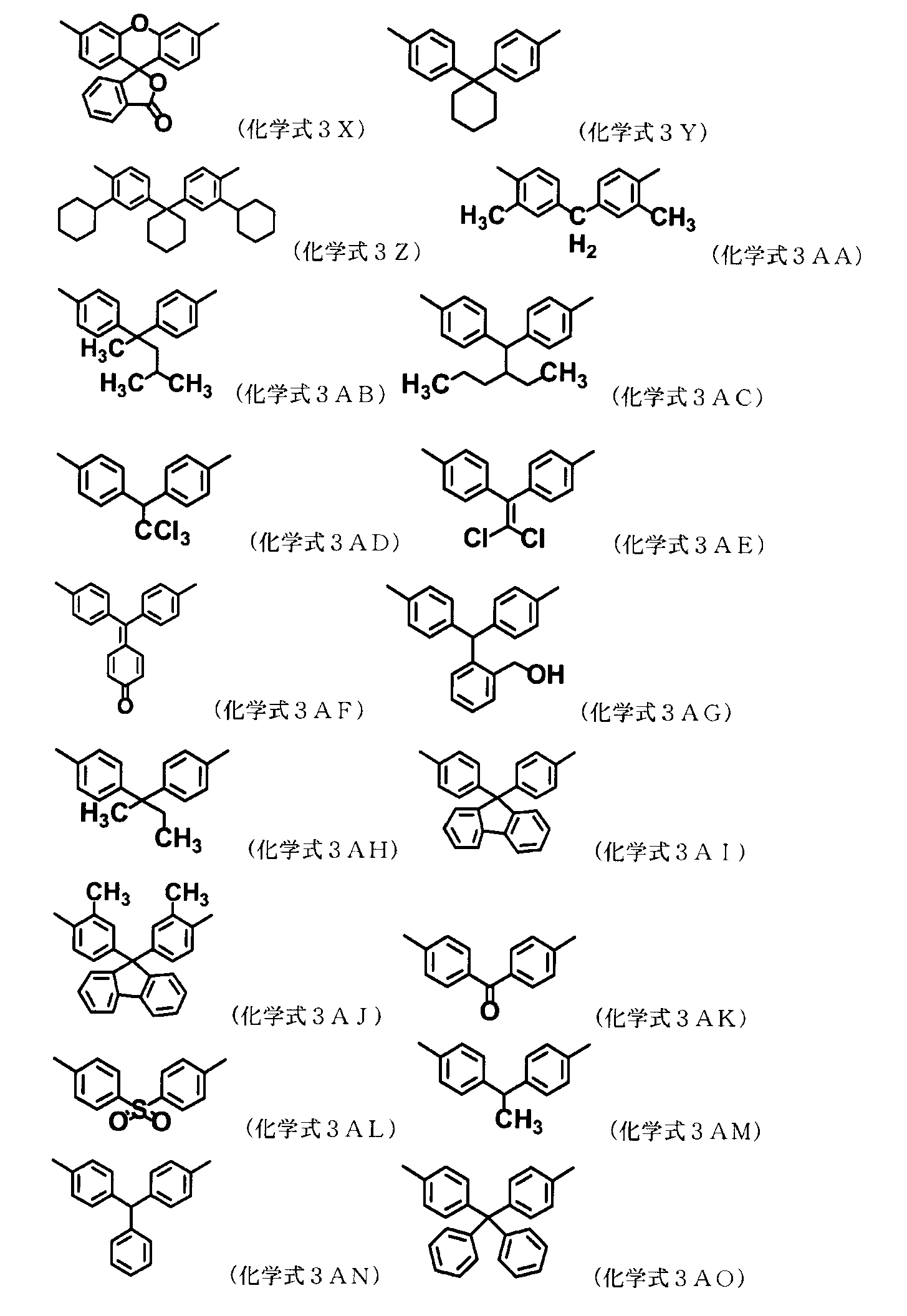
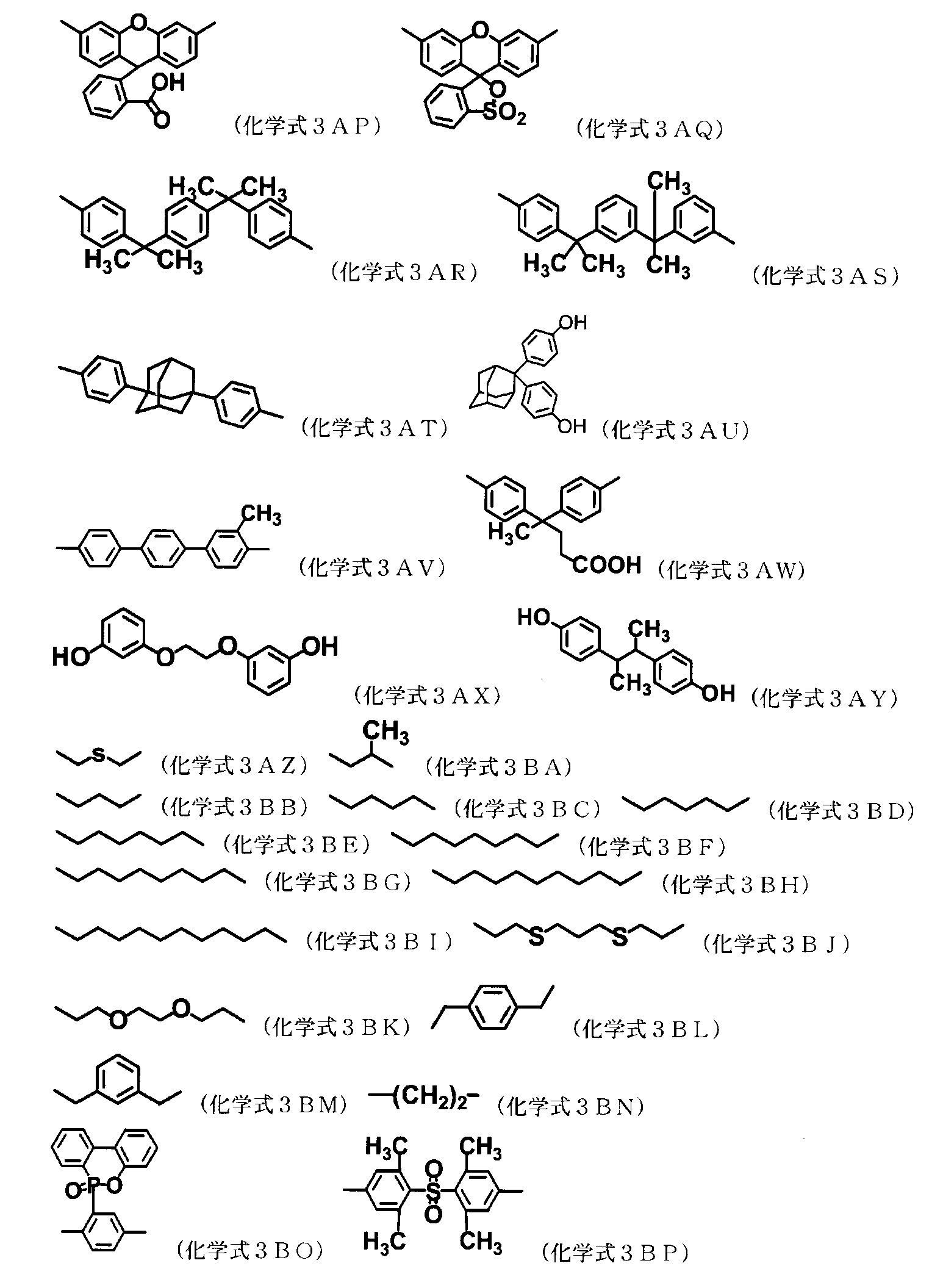
- the structures of Chemical Formulas 3E and 3AV are preferable because they suppress swelling of the polymer electrolyte membrane.
- structures such as chemical formulas 3F, 3G, 3N, 3O, 3U, and 3Y are preferable because they lower the softening temperature of the polymer electrolyte membrane and improve the bondability with the electrode catalyst layer.
- Structures represented by the chemical formulas 3AX and 3AY are also preferable because the softening temperature of the polymer electrolyte membrane is lowered, so that the bonding property with the electrode catalyst layer is improved.
- the structure represented by the chemical formulas 3AY to 3BN is preferable for improving the bondability with the electrode catalyst layer and improving the durability, and the structure represented by the chemical formulas 3AO, 3AI, 3AN, 3AQ, 3X is This is preferable because methanol permeability is suppressed.
- the structures represented by the chemical formulas 3I, 3J, and 3K are preferable because they suppress flooding in the fuel cell.
- the structure represented by the chemical formula 3BO is preferable because it improves the durability of the polymer electrolyte membrane.
- Z 1 in the chemical formulas 1 and 2 is preferably a sulfur atom.
- o represents an integer of 2 to 10.
- Ar in the chemical formulas 1 and 2 may be composed of a plurality of groups.
- a structure represented by the chemical formula 3E, a chemical formula 3F, 3G, 3N, 3O, 3U, 3Y, 3AX, 3AY A combination with one or more structures selected from the group consisting of structures represented by 3AY to 3BN, one or more selected from the group consisting of structures represented by chemical formulas 3F, 3G, 3N, 3O, 3U, 3Y
- a combination of at least one structure selected from the group represented by the structures represented by 3AY to 3BN is preferred.
- Ar 1 in Chemical Formula 2 is preferably a divalent aromatic group having an electron-withdrawing group.
- the electron-withdrawing group include a sulfone group, a sulfonyl group, a sulfonic acid group, a sulfonic acid ester group, a sulfonic acid amide group, a sulfonic acid imide group, a carboxyl group, a carbonyl group, a carboxylic acid ester group, a cyano group, a halogen group, Although a trifluoromethyl group, a nitro group, etc. can be mentioned, it is not limited to these, What is necessary is just a well-known arbitrary electron withdrawing group.
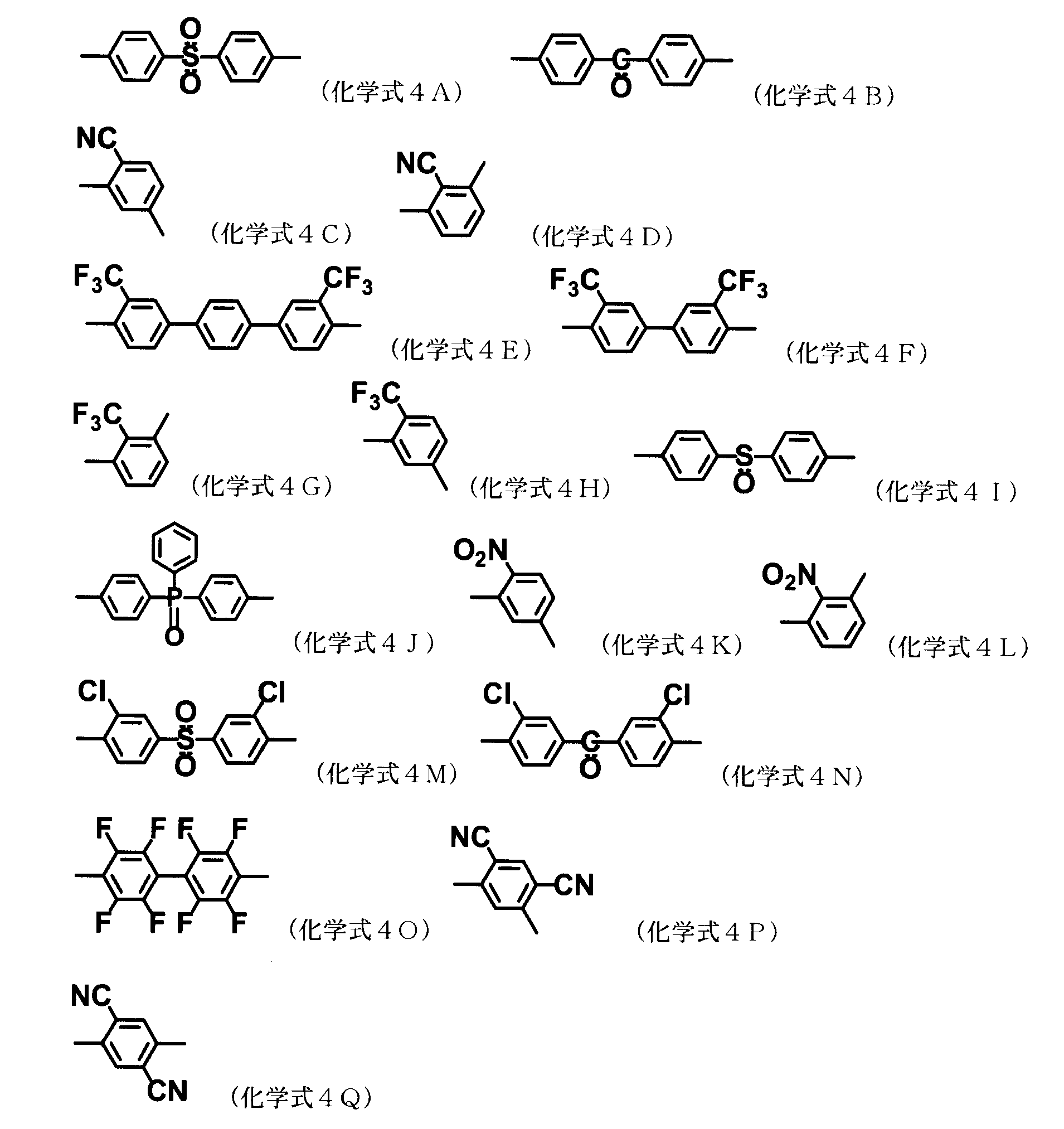
- a preferable structure of Ar 1 in the chemical formula 2 is a structure represented by the chemical formulas 4A to 4D.
- a structure represented by the chemical formulas 4C and 4D is more preferable, and a structure represented by the chemical formula 4D is more preferable.
- the structure of Chemical Formula 4A is preferable because it can increase the solubility of the polymer.
- the structure of the chemical formula 4B is preferable because it lowers the softening temperature of the polymer to enhance the bondability with the electrode or impart photocrosslinkability.
- the structure of Chemical Formula 4C or 4D is preferable because the swelling of the polymer can be reduced, and the structure of Chemical Formula 4D is more preferable.
- Ar1 in Chemical Formula 2 may be composed of a plurality of structures, and when composed of a plurality of structures, it consists of two or more structures selected from the group consisting of Chemical Formulas 4A to 4D, and Chemical Formulas 4A to 4D.
- a combination of at least one structure selected from the group and at least one structure selected from the group consisting of chemical formulas 4E to 4Q is preferable.
- the polymer constituting the polymer electrolyte in the present invention includes, for example, one or more compounds selected from the group consisting of aromatic dihalogen compounds and aromatic dinitro compounds activated with electron-withdrawing groups, bisphenol compounds, bisthiols.
- one or more compounds selected from the group consisting of a phenol compound and an alkyldithiol compound in the presence of a basic compound it can be polymerized by an aromatic nucleophilic substitution reaction.
- the degree of polymerization of the resulting polymer can be adjusted. Is from 0.8 to 1.2, more preferably from 0.9 to 1.1, even more preferably from 0.95 to 1.05, and a polymer having the highest degree of polymerization when 1 is obtained. Can do.
- the monovalent cation species may be sodium, potassium, other metal species, various amines, or the like, but is not limited thereto.
- Examples of compounds in which the sulfonic acid group is a salt include sodium 3,3′-disulfonate-4,4′-dichlorodiphenylsulfone, sodium 3,3′-disulfonate-4,4′-difluorodiphenylsulfone Sodium 3,3′-disulfonate-4,4′-dichlorodiphenyl ketone, sodium 3,3′-disulfonate-4,4′-difluorodiphenyl sulfone, sodium 3,3′-disulfonate-4,4 ′ -Difluorodiphenyl ketone, potassium 3,3'-disulfonate 4,4'-dichlorodiphenyl sulfone, potassium 3,3'-disulfonate 4,4'-dichlorodiphenyl sulfone, potassium 3,3'-disulfonate 4,4'-dichlorodiphenyl sulfone,
- the activated aromatic dihalogen compound containing no ionic group includes 2,6-dichlorobenzonitrile, 2,4-dichlorobenzonitrile, 2,6-difluorobenzonitrile, 2,4-difluorobenzonitrile, 4, 4'-dichlorodiphenyl sulfone, 4,4'-difluorodiphenyl sulfone, 4,4'-difluorobenzophenone, 4,4'-dichlorobenzophenone, decafluorobiphenyl, 3,3'-bis (trifluoromethyl) -4, 4'-dichlorobiphenyl, 3,3'-bis (trifluoromethyl) -p-terphenyl, and the like, but not limited thereto, other aromatics active in aromatic nucleophilic substitution reaction Dihalogen compounds, aromatic dinitro compounds, aromatic dicyano compounds and the like can also be used.
- 2,6-dichlorobenzonitrile, 2,4-dichlorobenzonitrile, 2,6-difluorobenzonitrile and 2,4-difluorobenzonitrile are preferable, and 2,6-dichlorobenzonitrile, 2,6 -Difluorobenzonitrile is more preferred.
- bisphenol compounds or bisthiophenol compounds examples include 9,9-bis (4-hydroxyphenyl) fluorene, 9,9-bis (3-methyl-4-hydroxyphenyl) fluorene, 4,4′-biphenol, 4 , 4'-dimercaptobiphenyl, bis (4-hydroxyphenyl) sulfone, 1,1-bis (4-hydroxyphenyl) ethane, 2,2-bis (4-hydroxyphenyl) propane, bis (4-hydroxyphenyl) Methane, 2,2-bis (4-hydroxyphenyl) butane, 3,3-bis (4-hydroxyphenyl) pentane, 2,2-bis (4-hydroxy-3,5-dimethylphenyl) propane, bis (4 -Hydroxy-3,5-dimethylphenyl) methane, bis (4-hydroxy-2,5-dimethylpheny ) Methane, bis (4-hydroxyphenyl) phenylmethane, bis (4-hydroxyphenyl) diphenylmethane, 1,1-bis (4-
- alkyldithiol compounds include 1,2-ethanedithiol, 1,3-propanedithiol, 1,2-propanedithiol, 1,4-butanedithiol, 2,3-dihydroxy-1,4-butanedithiol, , 5-pentanedithiol, 1,6-hexanedithiol, 1,7-heptanedithiol, 1,8-octanedithiol, 1,9-nonanedithiol, 1,10-decanedithiol, 1,11-undecanedithiol, 1, 12-dodecanedithiol, 1,13-tridecanedithiol, 1,14-tetradecanedithiol, 1,15-pentadecanedithiol, 1,16-hexadecanedithiol, 1,17-heptadecanedithiol, 1,18-octadecanedithiol, 1 , 19-
- Polymerization can be carried out in the temperature range of 0 to 350 ° C., but a temperature of 50 to 250 ° C. is preferred. When the temperature is lower than 0 ° C., the reaction does not proceed sufficiently, and when the temperature is higher than 350 ° C., the polymer tends to be decomposed.
- the reaction can be carried out in the absence of a solvent, but is preferably carried out in a solvent.
- the solvent examples include N-methyl-2-pyrrolidone, N, N-dimethylacetamide, N, N-dimethylformamide, dimethyl sulfoxide, diphenyl sulfone, sulfolane, and the like. And any solvent that can be used as a stable solvent in the aromatic nucleophilic substitution reaction. These organic solvents may be used alone or as a mixture of two or more.
- a bisphenol compound, a bisthiophenol compound, and an alkyldithiol compound are reacted with an isocyanate compound such as phenyl isocyanate without using a basic compound, and an activated dihalogen aromatic A compound or a dinitroaromatic compound can also be directly reacted.
- Examples of basic compounds include sodium hydroxide, potassium hydroxide, sodium carbonate, potassium carbonate, sodium hydrogen carbonate, potassium hydrogen carbonate, etc., which can convert aromatic diols and aromatic dimercapto compounds into an active phenoxide structure. If it is, it can be used without being limited to these.
- the basic compound can be polymerized satisfactorily when used in an amount of 100 mol% or more as an alkali metal with respect to the hydroxyl group and mercapto group of the bisphenol compound, bisthiophenol compound, and alkyldithiol compound,
- the alkali metal content is in the range of 105 to 125 mol% with respect to the hydroxyl group and mercaptite group of the bisphenol compound, bisthiophenol compound, and alkyldithiol compound.
- An excessive amount of the basic compound is not preferable because it causes side reactions such as decomposition.
- water may be generated as a by-product.
- water can be removed from the system as an azeotrope by coexisting toluene or the like in the reaction system.
- a water absorbing material such as molecular sieve can also be used.
- the amount is more than 50% by weight, the viscosity of the reaction system becomes too high and the post-treatment of the reaction product tends to be difficult.
- the solvent is removed from the reaction solution by evaporation, and the residue is washed as necessary to obtain the desired polymer.
- the polymer can be obtained by precipitating the polymer as a solid by adding the reaction solution in a solvent having low polymer solubility, and collecting the precipitate by filtration.
- a polymer solution can be obtained by removing by-product salts by filtration.
- the solid polymer electrolyte of the present invention has a block structure in which any one of the structures represented by Chemical Formula 1 and Chemical Formula 2 is continuous, or a structure in which the structure represented by Chemical Formula 1 is continuous and a structure represented by Chemical Formula 2. Although the form which the continuous block structure couple
- a polymer having a segment represented by Chemical Formula 1 and having a hydroxyl group or a halogeno group at both ends or a hydroxyl group at one end of the hydroxyl group and a segment represented by Chemical Formula 2 can be prepared by reacting in combination with a polymer in which both ends are hydroxy groups or halogeno groups or one end is a hydroxy group and the other is a halogeno group.
- a A method in which a polymer having a hydroxy group at both ends and a polymer having a halogeno group at both ends are condensed by an aromatic nucleophilic substitution reaction under the action of a base; b. A method in which a polymer having one hydroxy group and one halogeno group at both ends and another polymer having one hydroxy group and one halogeno group at both ends are condensed by an aromatic nucleophilic substitution reaction under the action of a base, c .
- a polymer having a hydroxy group at both ends and another polymer having a hydroxy group at both ends are combined with 4, 4′-difluorobenzophenone, decafluorobiphenyl, hexafluorobenzene, 4 , 4′-difluorodiphenyl sulfone, a compound that acts as a linking group, and d.
- 4 polymers having a halogeno group at both ends and another polymer having a halogeno group at both ends examples thereof include a method using a compound acting as a linking group, such as 4′-dihydroxybiphenyl, bisphenol A, 4,4′-dihydroxybenzophenone, or 4,4′-dihydroxydiphenylsulfone, or a method of bonding by a dehalogen condensation reaction.
- a compound acting as a linking group such as 4′-dihydroxybiphenyl, bisphenol A, 4,4′-dihydroxybenzophenone, or 4,4′-dihydroxydiphenylsulfone
- a method of bonding by a dehalogen condensation reaction such as 4′-dihydroxybiphenyl, bisphenol A, 4,4′-dihydroxybenzophenone, or 4,4′-dihydroxydiphenylsulfone
- the aromatic hydrocarbon polymer electrolyte used in the composite polymer electrolyte membrane of the present invention preferably has a logarithmic viscosity of 0.1 dL / g or more measured by a method described later.
- the logarithmic viscosity is more preferably 0.3 dL / g or more.
- the logarithmic viscosity exceeds 5 dL / g, problems in processability such as difficulty in dissolving the polymer occur, which is not preferable.
- polar organic solvents such as N-methylpyrrolidone and N, N-dimethylacetamide can be generally used. If the solubility is low, concentrated sulfuric acid is used. It can also be measured.
- the composite polymer electrolyte membrane in the present invention can have any thickness, but if it is 5 ⁇ m or less, it becomes difficult to satisfy the predetermined characteristics, and therefore it is preferably 5 ⁇ m or more, and more preferably 10 ⁇ m or more. . Moreover, since manufacture will become difficult when it becomes 300 micrometers or more, it is preferable that it is 300 micrometers or less. *
- the composite polymer electrolyte membrane composition in the present invention may contain other polymers.
- polymers include polyesters such as polyethylene terephthalate, polybutylene terephthalate, and polyethylene naphthalate, polyamides such as nylon 6, nylon 6,6, nylon 6,10, and nylon 12, polymethyl methacrylate, and polymethacrylic acid.
- Acrylate resins such as esters, polymethyl acrylate, polyacrylates, polyacrylic acid resins, polymethacrylic acid resins, polyethylene, polypropylene, various polyolefins including polystyrene and diene polymers, polyurethane resins, cellulose acetate Cellulose resins such as ethyl cellulose, polyarylate, aramid, polycarbonate, polyphenylene sulfide, polyphenylene oxide, polysulfone, polyethylene Thermal curing of aromatic polymers such as tersulfone, polyetheretherketone, polyetherimide, polyimide, polyamideimide, polybenzimidazole, polybenzoxazole, polybenzthiazole, epoxy resin, phenol resin, novolac resin, benzoxazine resin There are no particular restrictions on the conductive resin.
- a resin composition with a basic polymer such as polybenzimidazole or polyvinylpyridine can be said to be a preferable combination for improving the polymer dimensionality, and when a sulfonic acid group is further introduced into these basic polymers, The processability of the composition becomes more preferable.
- the polymer electrolyte membrane of the present invention preferably contains 50% by mass or more and less than 100% by mass of the proton conductive polymer. More preferably, it is 70 mass% or more and less than 100 mass%.
- the sulfonic acid group concentration of the polymer electrolyte membrane tends to be low, and good ion conductivity tends to be not obtained, and the unit containing the sulfonic acid group becomes a discontinuous phase and conducts. Ion mobility tends to decrease.
- the polymer electrolyte membrane of the present invention can be used as necessary, for example, an antioxidant, a heat stabilizer, a lubricant, a tackifier, a plasticizer, a crosslinking agent, a viscosity modifier, an antistatic agent, an antibacterial agent, and an antifoaming agent.
- Various additives such as an agent, a dispersant, and a polymerization inhibitor may be included. *
- the phosphorus-containing polymer compound means a polymer compound containing a functional group containing phosphorus, and corresponds to a polymer compound having a functional group containing phosphorus in the main chain or side chain.
- the functional group containing phosphorus includes a functional group containing trivalent phosphorus and a functional group containing pentavalent phosphorus.
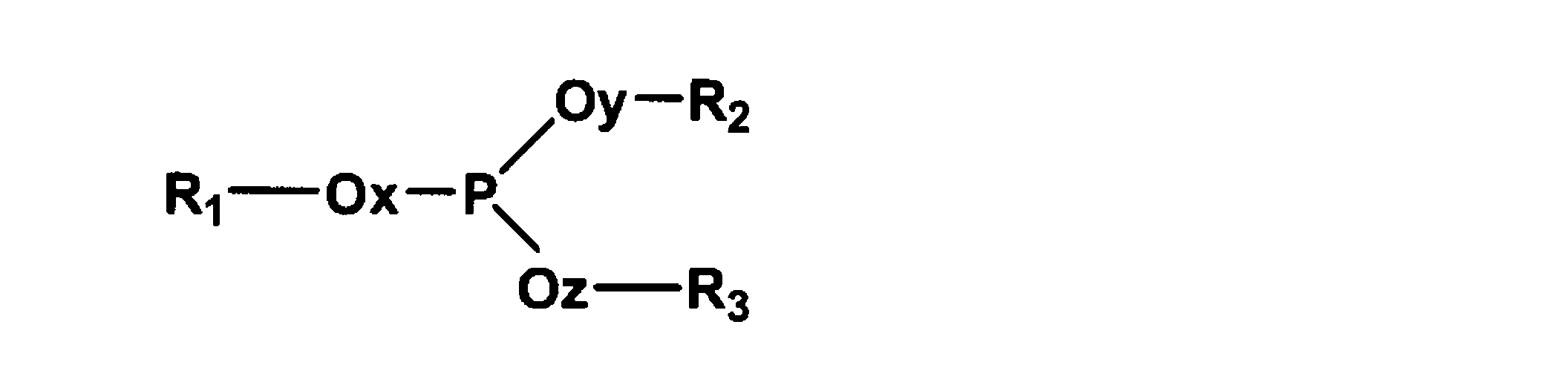
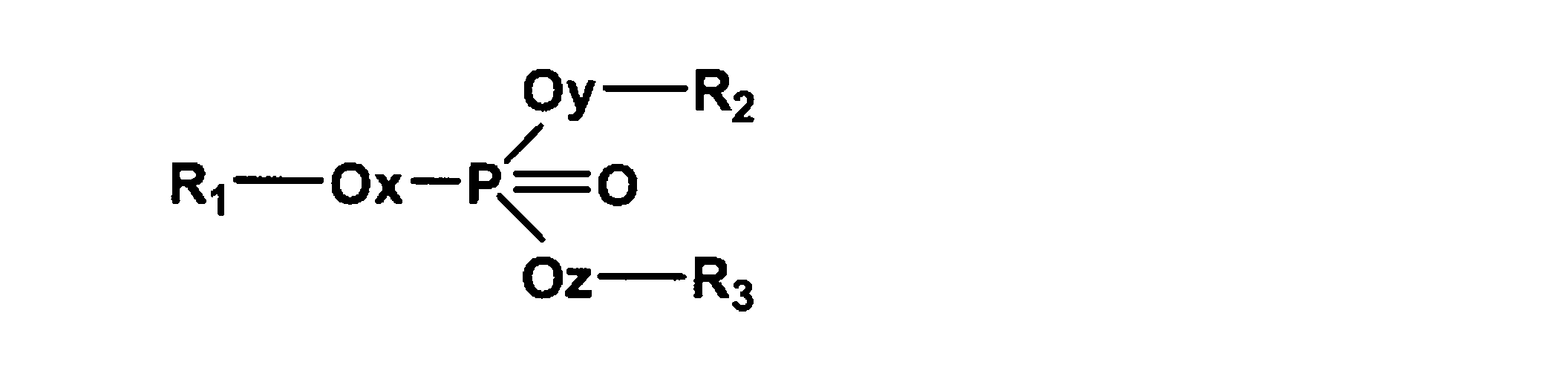
- the “functional group containing phosphorus” in the present invention includes trivalent and functional groups. Both pentavalent functional groups are included. These functional groups containing phosphorus are represented by the general formulas shown in the following chemical formula 7 (functional group containing trivalent phosphorus) and chemical formula 8 (functional group containing pentavalent phosphorus). Can do.
- x, y, and z take a value of 0 or 1.
- R 1 represents a linear, cyclic, or branched hydrocarbon compound represented by the general formula CmHn, or R 2 and R 3 represent fluorine, chlorine, bromine. A halogen atom or a hydrogen atom, or a monovalent organic group. Further, in the formulas 7 and 8, when y or z is 1, R 2 or R 3 may be a metal atom.
- phosphonic acid groups include phosphonic acid groups, phosphonic acid ester groups, phosphite groups, phosphoric acid, and phosphoric acid esters.
- a phosphonic acid group is particularly suitable as a functional group containing phosphorus because it is inexpensive and can impart high oxidation resistance to a polymer compound having a hydrocarbon moiety.
- the phosphorus-containing polymer compound examples include polyvinyl phosphonic acid, a copolymer containing polyvinyl phosphonic acid, a polyether sulfone resin into which a phosphonic acid group is introduced, a polyether ether ketone resin, a linear phenol- Formaldehyde resin, cross-linked phenol-formaldehyde resin, linear polystyrene resin, cross-linked polystyrene resin, linear poly (trifluorostyrene) resin, cross-linked (trifluorostyrene) resin, poly (2,3-diphenyl-1 , 4-phenylene oxide) resin, poly (allyl ether ketone) resin, poly (arylene ether sulfone) resin, poly (phenylquinosanline) resin, poly (benzylsilane) resin, polystyrene-graft-ethylenetetrafluoroethylene resin, Polystyrene-gra DOO - polyvinylidene fluor
- the mixing method of the aromatic hydrocarbon polymer electrolyte and the phosphorus-containing polymer compound is not particularly limited, and various methods can be used. For example, a solution dope or blend may be used. Further, when both the aromatic hydrocarbon polymer electrolyte and the phosphorus-containing polymer compound are heat-melted, they may be blended by heat melting.
- a structure in which the phosphorus-containing polymer compound is uniformly dispersed throughout the solid polymer electrolyte may be obtained by uniformly mixing the aromatic hydrocarbon polymer electrolyte and the phosphorus-containing polymer compound.
- the main part of the solid polymer electrolyte is composed only of the aromatic hydrocarbon polymer electrolyte, and only the part requiring oxidation resistance is a mixture of the aromatic hydrocarbon polymer electrolyte and the phosphorus-containing polymer compound. You may comprise.
- a method of inserting a membrane-like molded product made of a mixture of an aromatic hydrocarbon polymer electrolyte and a phosphorus-containing polymer compound between an electrolyte consisting only of an aromatic hydrocarbon polymer electrolyte and an electrode is also available. It is considered effective for maintaining the performance of
- the type and amount of the electrolyte group to be introduced into the aromatic hydrocarbon polymer electrolyte, or the mixing ratio of the phosphorus-containing polymer compound and the aromatic hydrocarbon polymer electrolyte can be determined by conductivity, oxidation resistance, etc. Adjustment may be made according to the characteristics required for the solid polymer electrolyte.
- the oxidation resistance improves.
- the functional group containing phosphorus is a weakly acidic group, the conductivity of the entire material decreases as the amount of introduction increases. Therefore, when used in applications where only oxidation resistance is a problem and high conductivity is not required, the mixing ratio of the phosphorus-containing polymer compound to the aromatic hydrocarbon polymer electrolyte may be increased. .
- the amount of the polymer compound containing phosphorus when the amount of the polymer compound containing phosphorus is less than 0.05 parts by mass of the polymer electrolyte composition, the effect of improving the oxidation resistance is not sufficient. Therefore, the amount of the polymer compound containing phosphorus needs to be 0.05 parts by mass or more of the total electrolyte group.
- the functional group containing phosphorus is preferably 0.3 parts by mass or more. If the amount of the phosphorus-containing polymer compound introduced exceeds 10 parts by mass of the polymer electrolyte composition, the physical properties of the electrolyte polymer such as proton conductivity may be reduced. Therefore, the amount of the phosphorus-containing polymer compound introduced must be 10 parts by mass or less of the total electrolyte.
- the polymer electrolyte membrane composition is characterized by containing 10 to 5000 ppm of a metal element.
- Preferred metal elements include a P—OH structure or an interaction between a P—OH structure and an S—OH structure.
- the phosphorus-containing polymer compound water-insoluble or sparingly soluble, and examples thereof include alkaline earth metals, transition metals, and rare earth elements.
- Mg, Ca, Co, Ni, Zn, Sr, Zr, Ba, and Ce are preferable.
- the composite polymer electrolyte membrane composition in the present invention may contain only one of the above-mentioned metal elements, or may contain two or more metal elements.
- a preferable content is 50 ppm or more and less than 3000 ppm, and more preferably 100 ppm or more and less than 1000 ppm.
- the effect of adding the metal element is to suppress the elution of the phosphorus-containing polymer compound into water.
- Elution of the molecular compound into water is 10% by mass or less even when immersed for 48 hours at 80 ° C.
- the method for mixing the metal elements is not particularly limited, and various methods can be used.
- a solid polymer electrolyte membrane or a precursor thereof, a catalyst layer, or a diffusion layer, or a substrate such as a solid polymer electrolyte membrane or a precursor thereof, a diffusion layer, or polyethylene terephthalate having a catalyst layer formed on the surface thereof Is contacted with either the first solution containing a water-soluble salt or organometallic complex containing a metal element or the second solution containing a phosphorus-containing polymer compound, and then the other solution.
- an electrolyte membrane of a mixture of an aromatic hydrocarbon solid polymer electrolyte and a phosphorus-containing polymer compound or a precursor thereof, a catalyst layer, a diffusion layer, or a phosphorus-containing polymer compound having a catalyst layer formed on the surface thereof an electrolyte membrane of the mixture or a precursor thereof, a diffusion layer, or a substrate such as polyethylene terephthalate is brought into contact with a water-soluble salt containing a metal element or a solution containing an organometallic complex.
- a phosphorus-containing polymer compound or a solution thereof and a water-soluble salt or organometallic complex containing a metal element or a solution thereof are mixed to prepare a phosphorus-containing polymer and metal composite, and then an aromatic hydrocarbon polymer.
- a method of mixing with an electrolyte may also be used.
- Phosphorus-containing polymer compound or metal element may be doped and mixed with the sulfonic acid group of the polymer electrolyte membrane forming a salt with the cationic species, and converted to free sulfonic acid group by acid treatment In this state, a phosphorus-containing polymer compound or a metal element may be doped and mixed.
- the salt containing a metal element may be water-soluble, and the type thereof is not particularly limited.
- Specific examples of water-soluble salts include acetates, oxalates, nitrates, lead sulfates, chlorides and the like of metal elements such as rare earth elements.
- the organometallic complex may be liquid at room temperature or soluble in an appropriate solvent.
- a tert of a metal element such as a rare earth element is used.
- Preferred examples include butoxide ((C 3 H 3) 3 C 2 O ⁇ ), ethyl hexanonate, octane dionate, isopropoxide ((C 3 H 3) 2 C 3 H 0 ⁇ ), and the like.
- washing with ion-exchanged water may be performed at an arbitrary stage in order to remove excess phosphorus-containing polymer compound or metal element. At this time, heat may be applied as necessary.
- washing with ion-exchanged water may be omitted.
- a solution of a water-soluble salt or organometallic complex containing a metal element may be used as it is, but in order to stabilize the water-soluble salt or organometallic complex, citric acid (C 6 H is used as necessary.
- a complexing agent such as 8 O 7 ) may be added.
- Solvents that can be used in the solution composition for producing the polymer electrolyte membrane of the present invention include N, N-dimethylformamide, N, N-dimethylacetamide, N, N-diethylacetamide, N-methyl-2 -Aprotic organic polar solvents such as pyrrolidone, dimethyl sulfoxide, hexamethylphosphonamide, N-morpholine oxide, alcohol solvents such as methanol and ethanol, ketone solvents such as acetone, ether solvents such as diethyl ether, etc. Examples include, but are not limited to, polar solvents, and mixtures of these organic solvents and mixtures with water.
- the concentration of the polymer electrolyte in the solution composition is preferably in the range of 0.1 to 50% by weight, more preferably in the range of 5 to 50% by weight, and still more preferably in the range of 10 to 40% by weight.
- the most preferable method for forming the polymer electrolyte membrane of the present invention is casting from a solution composition, and the polymer electrolyte membrane can be obtained by removing the solvent from the cast solution composition as described above. .
- the removal of the solvent is preferably by drying in view of the uniformity of the polymer electrolyte membrane.
- it can also dry at the lowest temperature possible under reduced pressure.
- the viscosity of a solution composition is high, when a board
- the thickness of the solution composition at the time of casting is not particularly limited, but is preferably 10 to 2000 ⁇ m. More preferably, it is 50 to 1500 ⁇ m. When the thickness of the solution composition is less than 10 ⁇ m, the form as a polymer electrolyte membrane tends not to be maintained, and when it is more than 2000 ⁇ m, a non-uniform film tends to be easily formed.
- a known method can be used as a method for controlling the cast thickness of the solution composition. For example, the thickness can be controlled by the amount and concentration of the solution by making the thickness constant using an applicator, a doctor blade or the like, or making the cast area constant using a glass petri dish or the like. The cast solution composition can obtain a more uniform film by adjusting the solvent removal rate.
- the evaporation rate can be reduced by lowering the temperature in the first stage.
- the coagulation rate of the compound can be adjusted by leaving the solution composition in air or an inert gas for an appropriate time.
- the sulfonic acid group in the proton conductive polymer forms a salt with a cation because stability is improved.
- it can be converted to free sulfonic acid by an appropriate acid treatment. In this case, it is effective to immerse the membrane in an aqueous solution of sulfuric acid, hydrochloric acid, etc. with or without heating.
- the membrane / electrode assembly of the present invention can be obtained by bonding the composite polymer electrolyte membrane of the present invention to an electrode catalyst layer.
- An electrode consists of an electrode material and a layer (electrode catalyst layer) containing a catalyst formed on the surface thereof, and a known material can be used as the electrode material.
- a conductive porous material such as carbon paper or carbon cloth can be used, but is not limited thereto.
- a material subjected to surface treatment such as water repellent treatment or hydrophilic treatment can be used.
- a known material can be used for the catalyst.
- platinum, an alloy of platinum and ruthenium, and the like can be given, but the invention is not limited to them.
- the catalyst can be used in any known form, and for example, carbon particles carrying catalyst fine particles can be used, but are not limited thereto.
- An adhesive can be used for the catalyst and the electrode catalyst layer including the particles carrying the catalyst, and as the adhesive, a resin having proton conductivity can be used.
- a conventionally known method can be used. For example, a method of applying an adhesive to the electrode surface and bonding the composite polymer electrolyte membrane and the electrode, a composite polymer electrolyte membrane And a method of heating and pressurizing the electrode catalyst layer prepared by applying a paste containing a catalyst to the electrode in advance, attaching the electrode after transferring the catalyst layer prepared on another sheet to the composite polymer electrolyte membrane
- the method include, but are not limited to, a method in which a dispersion containing a catalyst and conductive particles is coated on the surface of the composite polymer electrolyte membrane by spraying, printing, or the like, and then joining the electrodes.
- a known material such as a Nafion (trade name) solution may be used, or an adhesive mainly composed of the same polymer composition as that of the polymer constituting the polymer electrolyte in the present invention may be used. Those having other hydrocarbon proton conductive polymers as a main component may also be used.
- a catalyst such as platinum or platinum-ruthenium alloy necessary for the electrode reaction can be obtained by dispersing the catalyst supported on conductive particles such as carbon in the adhesive. .
- the fuel cell of the present invention can be produced using the composite polymer electrolyte membrane or the membrane / electrode assembly of the present invention.
- the fuel cell of the present invention includes, for example, an oxygen electrode, a fuel electrode, a polymer electrolyte membrane sandwiched between the electrodes, an oxidant flow path provided on the oxygen electrode side, and a fuel electrode side.
- the fuel flow path is provided.
- a fuel cell stack can be obtained by connecting such unit cells with a conductive separator.
- the composite polymer electrolyte membrane of the present invention is suitable for a polymer electrolyte fuel cell.
- the solid polymer electrolyte composition of the present invention has excellent oxidation resistance due to the phosphorus-containing polymer compound, and excellent long-term durability by suppressing elution of the phosphorus-containing polymer compound.
- the composite polymer electrolyte membrane of the present invention can be used for a fuel cell that uses a liquid such as methanol, dimethyl ether, or formic acid as a fuel, but can be particularly suitably used for a fuel cell that uses a gas such as hydrogen. Further, it can be used for any known application as a polymer electrolyte membrane such as an electrolytic membrane and a separation membrane.
- ⁇ Proton conductivity> A platinum wire (diameter: 0.2 mm) was pressed against the surface of the strip-shaped membrane sample on a self-made measuring probe (manufactured by Teflon (registered trademark)), and a constant temperature / humidity oven at 80 ° C. and 95% RH (Nagano Science Co., Ltd.) The sample was held in Machine Works, LH-20-01), and the impedance between the platinum wires was measured by SOLARTRON 1250 FREQUENCY RESPONSE ANALYSER.
- a membrane-electrode assembly was obtained.
- the joined body was incorporated into an evaluation fuel cell FC25-02SP manufactured by Electrochem, and the hydrogen generation and air humidified at 75 ° C. were supplied to the anode and the cathode at a cell temperature of 80 ° C., and the power generation characteristics were evaluated.
- the output voltage at a current density of 0.5 A / cm 2 was defined as electric power (V).
- ⁇ NMR measurement> A polymer (a sulfonic acid group is Na or K salt) was dissolved in a solvent, and 1 H-NMR was measured at room temperature and 13 C-NMR was measured at 70 ° C. using UNITY-500 manufactured by VARIAN.
- As the solvent a mixed solvent of NMP and deuterated dimethyl sulfoxide (85/15 vol./vol.) was used.
- the hydrophilic oligomer and the hydrophobic oligomer constituting the hydrophilic segment and the hydrophobic segment of the block polymer are measured by 1 H-NMR spectrum, respectively, and from the integration ratio of the peak derived from the end group and the peak of the skeleton part, The average molecular weight was determined.
- the composition ratio of the hydrophilic segment to the hydrophobic segment was analyzed by 1 H-NMR.
- ⁇ Swellability evaluation> A proton exchange membrane that had been left in a room at 23 ° C. and 50% RH for one day was cut out in a 50 mm square, and then immersed in hot water at 80 ° C. for 24 hours. After soaking, the dimensions and weight of the membrane were quickly measured. The membrane was dried at 120 ° C. for 3 hours, and the dry weight was measured. The water absorption rate and area swelling rate were calculated according to the following formula. The size of the film was measured by measuring the length of two orthogonal sides connected to a specific vertex.
- Neutralization treatment was performed using ammonia water, and the molybdic acid and phosphoric acid in the decomposition solution were reacted to form phosphomolybdic acid, which was reduced by hydrazine sulfate, and the absorbance at 830 nm of heteropolyblue produced was quantified. .
- the quantification was performed separately using a calibration curve obtained using a phosphorus standard solution.
- the proton exchange membrane was dried in a vacuum dryer (110 ° C.) for 8 hours, and then allowed to cool to room temperature in a desiccator. A part of the sample was weighed into a platinum crucible, heated and carbonized on a hot plate, and after carbonization, heated in an electric furnace (550 ° C.) overnight to incinerate. To the incineration residue, 5 ml of hydrochloric acid (6M) and several drops of hydrofluoric acid (50%) were added, and heat treatment (100 ° C.) was performed on a hot plate.
- Dissolution amount (%) (Amount of phosphorus before dissolution test ⁇ Amount of phosphorus after dissolution test) / Amount of phosphorus before dissolution test ⁇ 100
- Ferrous sulfate (7 hydrate) 0.149 g was dissolved in 1 L of water to prepare a 30 ppm Fe aqueous solution.
- Fenton reagent was prepared by adding 50 g of 30% hydrogen peroxide solution to 50 ml of 30 ppm Fe aqueous solution, adding water and stirring well to make the total amount 500 ml.
- a proton exchange membrane (52 mg) that had been dried at 100 ° C. for 1 hour and then measured for weight was immersed in 29 ml of a Fenton reagent in a reagent bottle, and 60 ° C. The film was taken out and washed with water, dried at 100 ° C. for 1 hour, and then weighed. When the membrane did not retain its shape, the residue was filtered through a glass filter, dried at 100 ° C. for 1 hour, and then weighed. The residual percentage of the weight after the treatment with respect to the weight before the treatment was determined.
- the reaction solution was cooled to room temperature, poured into 3000 ml of pure water to solidify the oligomer, and further washed with pure water three times to remove NMP and inorganic salts.
- the oligomer washed with water was separated by filtration and then dried under reduced pressure at 120 ° C. for 16 hours to obtain a hydrophobic oligomer.
- the number average molecular weight determined by 1 H-NMR measurement was 12169.
- the chemical structure is shown below.
- PVPA polyvinylphosphonic acid
- the membrane is immersed and washed in pure water, immersed in 1N sulfuric acid for 1 hour, sulfonic acid groups are converted into acid form, washed with pure water to remove free sulfuric acid, and air-dried to proton exchange membrane.
- Example 2 A proton exchange membrane was obtained in the same manner as in Example 1 except that P2 was used instead of P1.
- Example 4PVPA A proton exchange membrane was prepared in the same manner as in Example 2 except that the concentration of was changed to 0.1 wt%.
- Example 5 A proton exchange membrane was obtained in the same manner as in Example 2 except that 500 mg of a 10% methanol solution of VP-N was used instead of PVPA.
- Example 6 ZrOCl instead of 0.015 wt% aqueous solution of 2 ⁇ 8H 2 O, was except for using 0.02 wt% aqueous solution of Ce (NO 3) 3 ⁇ 6H 2 O in the same manner as in Example 2 to create a proton exchange membrane .
- Example 7 A proton exchange membrane was prepared in the same manner as in Example 2 except that a 0.01 wt% aqueous solution of Ca (NO 3 ) 2 .4H 2 O was used instead of the 0.015 wt% aqueous solution of ZrOCl 2 .8H 2 O. .
- Example 8 P1 was immersed in 1N sulfuric acid overnight to convert the sulfonic acid group to the acid form, washed with pure water to remove free sulfuric acid, and dried under reduced pressure at 110 ° C. for 8 hours.
- 10% of P1 obtained acid type NMP solution of 10% 20g and PVPA NMP / water 15/85 were mixed (wt / wt) solution 250mg and ZrOCl 2 ⁇ 8H 2 O 0.015wt% aqueous 350mg of. Then, it casted by the thickness of 400 micrometers on the glass plate using the applicator, heated at 100 degreeC for 2 hours, and dried. Thereafter, the glass plate was allowed to cool to near room temperature, and the membrane was peeled off with water attached to the membrane. The peeled membrane was washed with pure water to remove residual NMP and air dried to obtain a proton exchange membrane.
- Comparative Example 1 20 g of a 10% NMP solution of P1 was cast on a glass plate with a thickness of 400 ⁇ m using an applicator, heated at 100 ° C. for 2 hours, and dried. Thereafter, the glass plate was allowed to cool to near room temperature, and the membrane was peeled off with water attached to the membrane. The peeled membrane is immersed in pure water, and then immersed in 1N sulfuric acid for 1 hour to convert the sulfonic acid group into an acid form, washed with pure water to remove free sulfuric acid, and air-dried to obtain a proton exchange membrane. It was.
- Comparative Example 2 A proton exchange membrane was prepared in the same manner as in Comparative Example 1 except that P2 was used instead of P1.
- PVPA polyvinylphosphonic acid
- the peeled membrane is immersed in pure water, and then immersed in 1N sulfuric acid for 1 hour to convert the sulfonic acid group into an acid form, washed with pure water to remove free sulfuric acid, and air-dried to obtain a proton exchange membrane. It was.
- Comparative Example 4 0.4 g of the proton exchange membrane obtained in Comparative Example 2 was immersed in 100 ml of a 4 wt% aqueous solution of ZrOCl 2 .8H 2 O and heated to reflux for 2 hours. Thereafter, the membrane was taken out and immersed in a 50% aqueous solution of nitrilotris (methylenephosphonic acid) (Chillest Co., Ltd.) overnight. The membrane was washed with pure water to remove free acid, and air-dried to obtain a proton exchange membrane.
- nitrilotris methylenephosphonic acid
- Table 1 shows the proton conductivity of the proton exchange membranes obtained in the examples and comparative examples.
- the proton exchange membrane of the random polymer of Comparative Example 1 was in a very fragile state in 3 hours, and hardly remained in shape in 4 hours.
- the proton exchange membrane of the block copolymer polymer of Comparative Example 2 was in a state where the hydrophilic segment was completely removed in 4 hours and only the hydrophobic portion remained. It was confirmed that the proton exchange membranes to which the phosphorus-containing compounds of Examples 1 to 8 and Comparative Examples 3 and 4 were added had a small weight change, and that the Fenton resistance was increased by the addition of the phosphorus-containing compound.
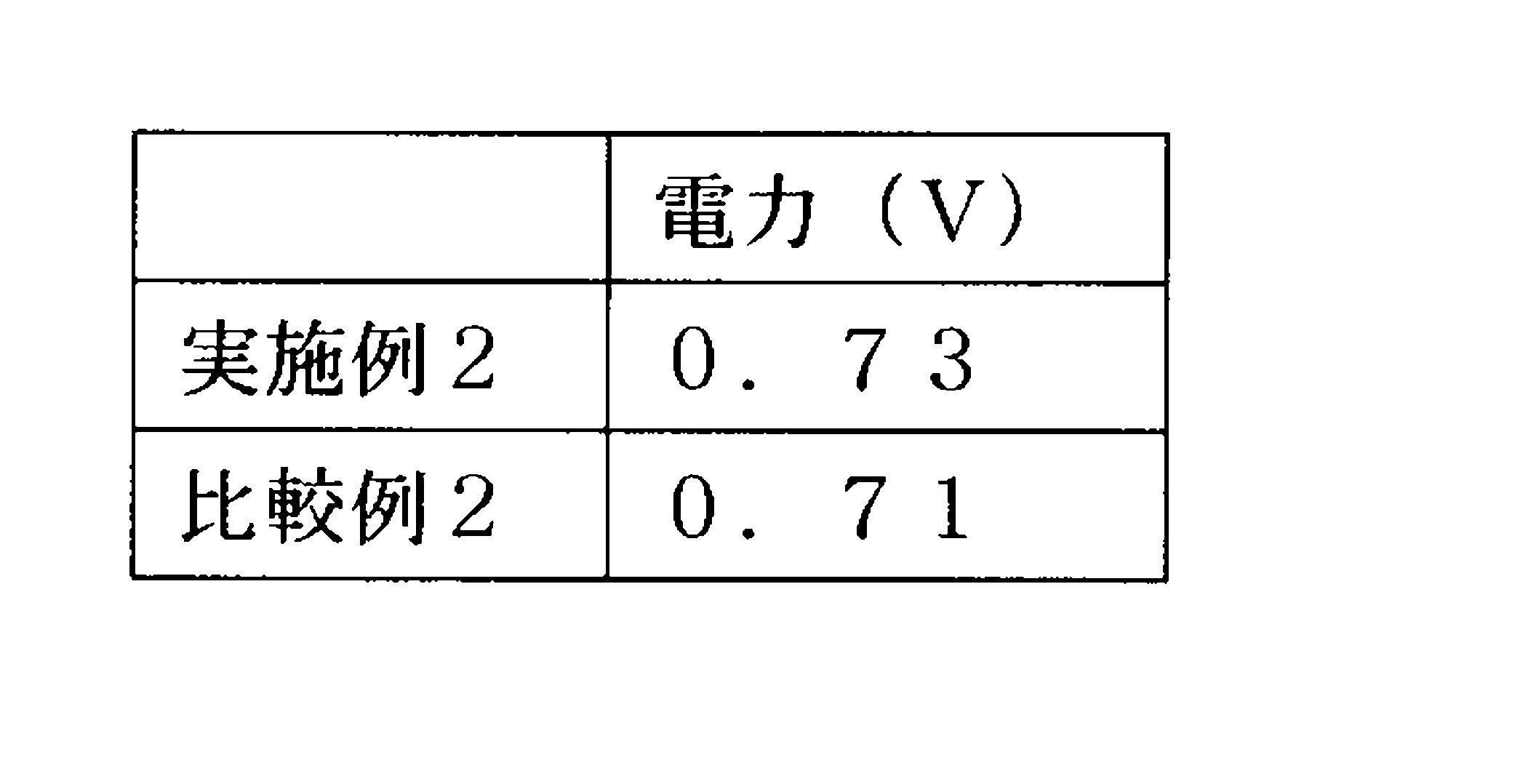
- the power generation test was performed on the proton exchange membranes obtained in the examples and comparative examples. The results are shown in Table 5.
- Example 2 The power was the same in Example 2 and Comparative Example 2, and no deterioration in battery performance due to the addition of the phosphorus-containing polymer compound was observed.
- the present invention uses a solid polymer electrolyte composition excellent in durability capable of improving oxidation resistance without causing a decrease in proton conductivity or elution of an additive component, and the electrolyte composition. It provides ion exchange membranes, membrane / electrode assemblies, and fuel cells, and contributes greatly to the industry.
Landscapes
- Chemical & Material Sciences (AREA)
- Engineering & Computer Science (AREA)
- Manufacturing & Machinery (AREA)
- Chemical Kinetics & Catalysis (AREA)
- General Chemical & Material Sciences (AREA)
- Electrochemistry (AREA)
- Sustainable Energy (AREA)
- Sustainable Development (AREA)
- Life Sciences & Earth Sciences (AREA)
- Crystallography & Structural Chemistry (AREA)
- Health & Medical Sciences (AREA)
- Spectroscopy & Molecular Physics (AREA)
- Physics & Mathematics (AREA)
- Organic Chemistry (AREA)
- Polymers & Plastics (AREA)
- Medicinal Chemistry (AREA)
- Materials Engineering (AREA)
- Inorganic Chemistry (AREA)
- Composite Materials (AREA)
- Conductive Materials (AREA)
- Fuel Cell (AREA)
- Compositions Of Macromolecular Compounds (AREA)
- Inert Electrodes (AREA)
Abstract
Description
)、電解質基及び炭化水素部を有する高分子化合物
と、含燐高分子化合物とを混合することにより得られる高耐久性固体高分子電解質組成物(下記特許文献3および4)などが提案されている。


. 両末端にヒドロキシ基を有するポリマーと両末端にヒドロキシ基を有する別のポリマーとを4 , 4 ’ - ジフルオロベンゾフェノン、デカフルオロビフェニル、ヘキサフルオロベンゼン、4
, 4 ’ -ジフルオロジフェニルスルホンなど連結基として働く化合物を用いて結合させる方法、d. 両末端にハロゲノ基を有するポリマーと両末端にハロゲノ基を有する別のポリマーとを4
、4 ’ - ジヒドロキシビフェニル、ビスフェノールA 、4 , 4 ’ - ジヒドロキシベンゾフェノン、4 、4 ’ - ジヒドロキシジフェニルスルホンなど連結基として働く化合物を用いるか、脱ハロゲン縮合反応により結合させる方法などが例示される。また、上記反応と同様の素反応が起こりうる反応性基を有するポリマーおよびモノマーを重合反応させる方法も用いることが出来る。
- ブトキサイド( (C H 3)3C O - ) 、エチルヘキサノネート、オクタンジオネート、イソプロポキサイド( (C H 3)2C H O - ) 等が好適な一例として挙げられる。
電極は、電極材料と、その表面に形成された触媒を含む層(電極触媒層)とからなり、電極材料としては、公知の材料を用いることができる。例えば、カーボンペーパーやカーボンクロスなど、導電性の多孔質材料を用いることができるが、それらに限定されるものではない。カーボンペーパーやカーボンクロスなど、導電性の多孔質材料は、撥水処理、親水処理などの表面処理がされたものを用いることもできる。触媒には、公知の材料を用いることができる。例えば、白金、白金とルテニウムなどの合金などを挙げることができるが、それらに限定されるものではない。
触媒は公知の任意の形態で用いることができ、例えば触媒微粒子を坦持させたカーボン粒子を用いることができるが、それらに限定されるものではない。
触媒や触媒を坦持した粒子を含む電極触媒層には、接着剤を用いることができ、接着剤としては、プロトン伝導性を有する樹脂を用いることができる。
ポリマー粉末を0.5g/dLの濃度でN-メチル-2-ピロリドン(略号:NMP)に溶解し、30℃の恒温槽中でウベローデ型粘度計を用いて粘度測定を行い、対数粘度(ln[ta/tb])/cで評価した(taは試料溶液の落下秒数、tbは溶媒のみの落下秒数、cはポリマー濃度を表す)。
自作測定用プローブ(テフロン(登録商標)製)上で短冊状膜試料の表面に白金線(直径:0.2mm)を押しあて、80℃95%RHの恒温・恒湿オーブン(株式会社ナガノ科学機械製作所、LH-20-01)中に試料を保持し、白金線間のインピーダンスをSOLARTRON社1250FREQUENCY RESPONSE ANALYSERにより測定した。極間距離を変化させて測定し、極間距離とC-Cプロットから見積もられる抵抗測定値をプロットした勾配から以下の式により膜と白金線間の接触抵抗をキャンセルした導電率を算出した。
導電率[S/cm]=1/膜幅[cm]×膜厚[cm]×抵抗極間勾配[Ω/cm]
デュポン社製20%ナフィオン(商品名)溶液に、市販の40%Pt触媒担持カーボン(田中貴金属工業株式会社 燃料電池用触媒 TEC10V40E)と、少量の超純水及びイソプロパノールを加えた後、均一になるまで撹拌し、触媒ペーストを調製した。この触媒ペーストを、東レ製カーボンペーパーTGPH-060に白金の付着量が0.5mg/cm2になるように均一に塗布・乾燥して、電極触媒層付きガス拡散層を作製した。上記の電極触媒層付きガス拡散層の間に、高分子電解質膜を、電極触媒層が膜に接するように挟み、ホットプレス法により160℃、10MPaにて3分間加圧、加熱することにより、膜-電極接合体とした。この接合体をElectrochem社製の評価用燃料電池セルFC25-02SPに組み込んでセル温度80℃で、アノード及びカソードにそれぞれ75℃で加湿した水素と空気を供給して発電特性を評価した。電流密度が0.5A/cm2における出力電圧を電力(V)とした。
ポリマー(スルホン酸基はNaもしくはK塩)を溶媒に溶解し、VARIAN社製UNITY-500を用いて1H-NMRは室温で、13C-NMRは70℃でそれぞれ測定を行った。溶媒にはNMPと重ジメチルスルホキシドの混合溶媒(85/15 vol./vol.)を用いた。ブロックポリマーの親水性セグメント及び疎水性セグメントをそれぞれ構成する親水性オリゴマー及び疎水性オリゴマーは、1H-NMRスペクトルを測定し、末端基由来のピークと骨格部分のピークのそれぞれの積分比から、数平均分子量を求めた。また、ブロックポリマーについては、親水性セグメントと疎水性セグメントの組成比を1H-NMRで分析した。
23℃50%RHの室内に1日放置しておいたプロトン交換膜を50mm四方に切り出した後、80℃の熱水に24時間浸漬した。浸漬後、膜の寸法及び重量をすばやく測定した。膜は120℃で3時間乾燥させ、乾燥重量を測定した。以下の式に従って、吸水率及び面積膨潤率を算出した。膜の寸法は特定の頂点に結合した直交する2辺の長さを測定した。
吸水率(%)={浸漬後の重量(g)-乾燥重量(g)}÷乾燥重量(g)×100
面積膨潤率(%)={浸漬後の辺の長さA(mm)×浸漬後の辺の長さB(mm)}÷{50×50}×100-100
プロトン交換膜を真空乾燥器(110℃)で8時間乾燥させた後、デシケーター中で室温まで放冷した。試料の一部を50ml三角フラスコに秤量し、硫酸(97%、精密分析用)3ml、硝酸(60%、精密分析用)3.5ml、過塩素酸(60%、精密分析用)0.5mlを加えて、ホットプレート上で除々に昇温し、酸分解した。最終的には、硫酸白煙が確認されるまで加熱を続け、硝酸、過塩素酸を除去した。アンモニア水を用いて中和処理を行い、モリブデン酸と分解液中のリン酸を反応させ、リンモリブデン酸とし、これを硫酸ヒドラジンで還元して生じるヘテロポリ青の830nmにおける吸光度を測定して定量した。定量に際しては、別途、リン標準溶液を用いて求めた検量線を用いて行った。
プロトン交換膜を真空乾燥器(110℃)で8時間乾燥させた後、デシケーター中で室温まで放冷した。試料の一部を白金るつぼに秤量し、ホットプレート上で加熱、炭化し、炭化後に電気炉(550℃)で一晩加熱し、灰化した。灰化残渣に塩酸(6M)5mlおよびフッ化水素酸(50%)数滴を添加し、ホットプレート上で加熱処理(100℃)を行った。酸が揮発した後、塩酸(1.2M)20mlを添加し、一晩静置し、無機物を完全に溶解させた。溶解液中のジルコニウム量、カルシウム量については、ICP発光分析装置を用いて検量線法により求めた。
試料を真空乾燥器(110℃)で8時間乾燥させた後、デシケーター中で室温まで放冷した。試料の一部を密閉系酸分解用のテフロン(登録商標)製容器に秤量し、硝酸(60%、精密分析用)4mlを加えて、マイクロ波分解装置内で加熱酸分解を行った。完全分解後を確認した後、精製水を用いて30
mlに希釈定容したものを測定液とした。測定液中のセリウム量については、ICP発光分析装置を用いて検量線法により求めた。
プロトン交換膜を重量で500倍以上の過剰量の水に浸漬し、80℃のオーブンで48時間加熱した。試料を取り出し、風乾させた後、燐の定量分析を行った。含燐化合物の溶出量は以下の式より求めた。
溶出量(%)=(溶出試験前の燐の量-溶出試験後の燐の量)/溶出試験前の燐の量×100
硫酸第一鉄(7水和物)0.149gを1Lの水に溶解し、30ppmのFe水溶液を調整した。30ppmのFe水溶液50mlに30% 過酸化水素水50 g を加え、さらに水を加えてよく攪拌し全量を500mlとしてフェントン試薬を調整した。予め100℃で1時間乾燥した後で重量を測定しておいたプロトン交換膜52mgを、試薬瓶に入れたフェントン試薬29mlに浸漬し、60℃
で3時間または4時間処理し、膜を取り出して水洗し、100℃ で1 時間乾燥した後重量を測定した。膜が形状をとどめていない場合は、残渣をガラスフィルターで濾過し、100℃で1時間乾燥した後重量を測定した。処理前の重量に対する処理後の重量の残存%を求めた。
予め100 ℃で1時間乾燥した後で重量を測定しておいたプロトン交換膜52m g を、試薬瓶に入れた10%過酸化水素水29mlに浸漬し、80℃ で3時間または4時間処理し、膜を取り出して水洗し、100℃で1時間乾燥した後重量を測定した。
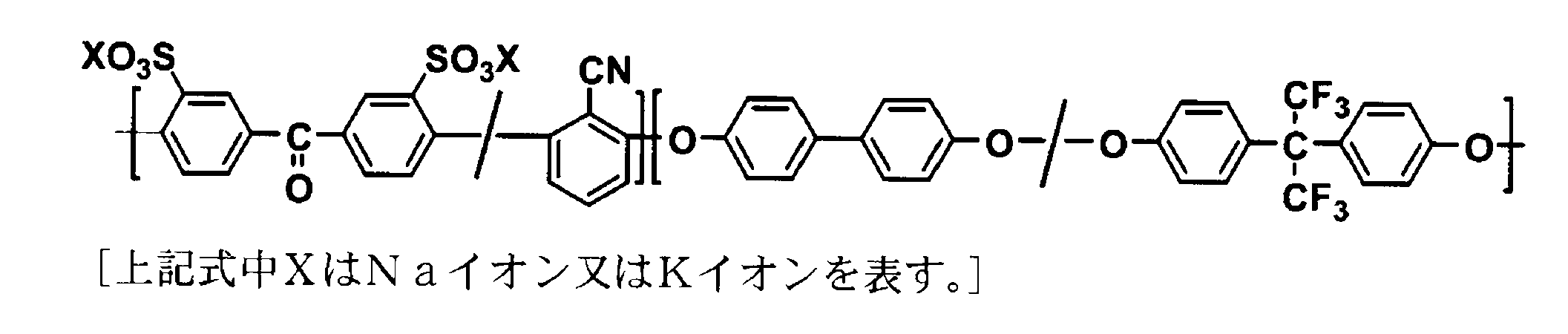
4,4’-ジクロロベンゾフェノン-3,3-ジスルホン酸ナトリウム86.90g(190.9mmol)、2,6-ジクロロベンゾニトリル(略号:DCBN)41.91g(242.9mmol)、4,4’-ビフェノール(略号:BP)65.14g(353.6mmol)、2,2-ビス(4-ヒドロキシフェニル)ヘキサフルオロプロパン(略号:6F-BisA)26.81g(80.2mmol)、炭酸カリウム65.95g(477.2mmol)、NMP500ml、トルエン100mlを、窒素導入管、攪拌翼、ディーンスタークトラップ、温度計を取り付けた1000ml枝付きフラスコに入れ、オイルバス中で攪拌しつつ窒素気流下で加熱した。トルエンとの共沸による脱水を140℃で行なった後、トルエンをすべて留去した。その後、200℃に昇温し、5時間加熱した。反応溶液を室温まで冷却した後、3000mlの純水に注ぎオリゴマーを固化させ、さらに純水で5回洗浄して、NMP及び無機塩を除去した。濾別した後、120℃で16時間減圧乾燥してランダム共重合体の高分子電解質(P1)を得た。以下、概高分子電解質を(P1)と略記する。P1の化学構造を以下に示す。P1の対数粘度は、1.2dL/gだった。
2,6-ジクロロベンゾニトリル(略号:DCBN)30.00g(173.9mmol)、4,4’-ビフェノール(略号:BP)32.87g(176.4mmol)、炭酸カリウム29.25g(211.7mmol)、NMP440mlを窒素導入管、攪拌翼、ディーンスタークトラップ、温度計を取り付けた1000ml枝付きフラスコに入れ、オイルバス中で攪拌しつつ窒素気流下で加熱した。200℃に昇温し、4時間攪拌した。反応溶液を室温まで冷却した後、3000mlの純水に注ぎオリゴマーを固化させ、さらに純水で3回洗浄して、NMP及び無機塩を除去した。水洗したオリゴマーは、濾別した後、120℃で16時間減圧乾燥して疎水性オリゴマーを得た。1H-NMR測定による数平均分子量は12169だった。化学構造を以下に示す。

4,4’-ジクロロジフェニルスルホン-3,3’-ジスルホン酸ソーダ(略号:S-DCDPS)250.0g(508.9mmol)、BP98.63g(529.7mmol)、炭酸ナトリウム66.23g(624.9mmol)、NMP650ml、トルエン150mlを、窒素導入管、攪拌翼、ディーンスタークトラップ、温度計を取り付けた2000ml枝付きフラスコに入れ、オイルバス中で攪拌しつつ窒素気流下で加熱した。トルエンとの共沸による脱水を140℃で行なった後、トルエンをすべて留去した。その後、200℃に昇温し、16時間加熱した。続いて、NMP500mlを投入し、攪拌しながら室温まで冷却した。得られた溶液を、25G2ガラスフィルターで吸引濾過したところ、黄色の透明な溶液が得られた。得られた溶液を3Lのアセトンに滴下してオリゴマーを固化させた。オリゴマーはさらにアセトンで3回洗浄した後、濾別して減圧乾燥し親水性オリゴマーを得た。1H-NMR測定による数平均分子量は12460であった。親水性オリゴマーの化学構造を以下に示す。

親水性オリゴマー 6.95g、疎水性オリゴマー 5.00g、NMP110mlを、窒素導入管、攪拌翼、ディーンスタークトラップ、温度計を取り付けた200ml枝付きフラスコに入れ、窒素気流下70℃のオイルバス中で攪拌し溶解させた。その後、デカフルオロビフェニル(DFB)
0.27g、炭酸カリウム0.12gを加え、110℃まで加熱し、10時間反応させた。反応溶液の固形分濃度は10重量%とした。その後、室温まで冷却し、1Lの純水中に滴下してポリマーを固化させた。純水で3回洗浄した後、純水に浸漬したまま80℃で5時間処理した。さらに水を除去したポリマーを、1000mlのイソプロパノールと500mlの水との混合溶媒に室温で16時間浸漬し、ポリマーを取り出し洗浄を行った。同じ操作をもう一度行った。その後、濾過でポリマーを濾別し、120℃で12時間減圧乾燥して高分子電解質(P2)を得た。P2の対数粘度は、2.1dL/gだった。NMRから求めた親水性セグメントと疎水性セグメントの組成比は32/68だった。化学構造を以下に示す。


P1の10%NMP溶液20gとポリビニルホスホン酸(略号:PVPA、アルドリッチ製)の5%NMP/水=15/85(wt/wt)溶液500mgを混合した。その後、アプリケーターを用いてガラス板上に400μmの厚みでキャストし、100℃で2時間加熱して乾燥した。その後、ガラス板を室温付近まで放冷し、膜ごと水につけて膜を剥離した。剥離した膜を純水に浸漬した後、ZrOCl2・8H2Oの0.015wt%水溶液
に一晩浸漬した。その後、膜を純水に浸漬して洗浄し、1N硫酸に1時間浸漬して、スルホン酸基を酸型に変換し、純水で洗浄して遊離の硫酸を除き、風乾してプロトン交換膜を得た。
P1の代わりにP2を用いた以外は、実施例1と同様にしてプロトン交換膜を得た。
PVPAの5%NMP/水=15/85(wt/wt)溶液を80mgとし、ZrOCl2・8H2O水溶液の濃度を0.005wt%とした以外は実施例2と同様にしてプロトン交換膜を作成した。
PVPAのかわりに、VP-Nの10%メタノール溶液500mgを用いた以外は実施例2と同様にしてプロトン交換膜を得た。
ZrOCl2・8H2Oの0.015wt%水溶液のかわりに、Ce(NO3)3・6H2Oの0.02wt%水溶液を用いた以外は実施例2と同様にしてプロトン交換膜を作成した。
ZrOCl2・8H2Oの0.015wt%水溶液のかわりに、Ca(NO3)2・4H2Oの0.01wt%水溶液を用いた以外は実施例2と同様にしてプロトン交換膜を作成した。
P1を1N硫酸に一晩浸漬して、スルホン酸基を酸型に変換し、純水で洗浄して遊離の硫酸を除き、110℃で8時間減圧乾燥した。得られた酸型のP1の10%NMP溶液20gとPVPAの10%NMP/水=15/85(wt/wt)溶液250mgとZrOCl2・8H2Oの0.015wt%水溶液350mgを混合した。その後、アプリケーターを用いてガラス板上に400μmの厚みでキャストし、100℃で2時間加熱して乾燥した。その後、ガラス板を室温付近まで放冷し、膜ごと水につけて膜を剥離した。剥離した膜を純水で洗浄して残留NMPを除き、風乾してプロトン交換膜を得た。
P1の10%NMP溶液20gをアプリケーターを用いてガラス板上に400μmの厚みでキャストし、100℃で2時間加熱して乾燥した。その後、ガラス板を室温付近まで放冷し、膜ごと水につけて膜を剥離した。剥離した膜は純水に浸漬した後、1N硫酸に1時間浸漬して、スルホン酸基を酸型に変換し、純水で洗浄して遊離の硫酸を除き、風乾してプロトン交換膜を得た。
P1のかわりにP2を用いた以外は比較例1と同様にしてプロトン交換膜を作成した。
P2の10%NMP溶液20gとポリビニルホスホン酸(略号:PVPA、アルドリッチ製)の5%NMP/水=15/85(wt/wt)溶液500mgを混合した。その後、アプリケーターを用いてガラス板上に400μmの厚みでキャストし、100℃で2時間加熱して乾燥した。その後、ガラス板を室温付近まで放冷し、膜ごと水につけて膜を剥離した。剥離した膜は純水に浸漬した後、1N硫酸に1時間浸漬して、スルホン酸基を酸型に変換し、純水で洗浄して遊離の硫酸を除き、風乾してプロトン交換膜を得た。
比較例2で得られたプロトン交換膜0.4gをZrOCl2・8H2Oの4wt%水溶液100mlに浸漬し、2時間加熱還流した。その後、膜を取り出して、ニトリロトリス(メチレンホスホン酸)(キレスト株式会社)の50%水溶液に一晩浸漬した。膜を純水で洗浄して遊離の酸を除き、風乾してプロトン交換膜を得た。
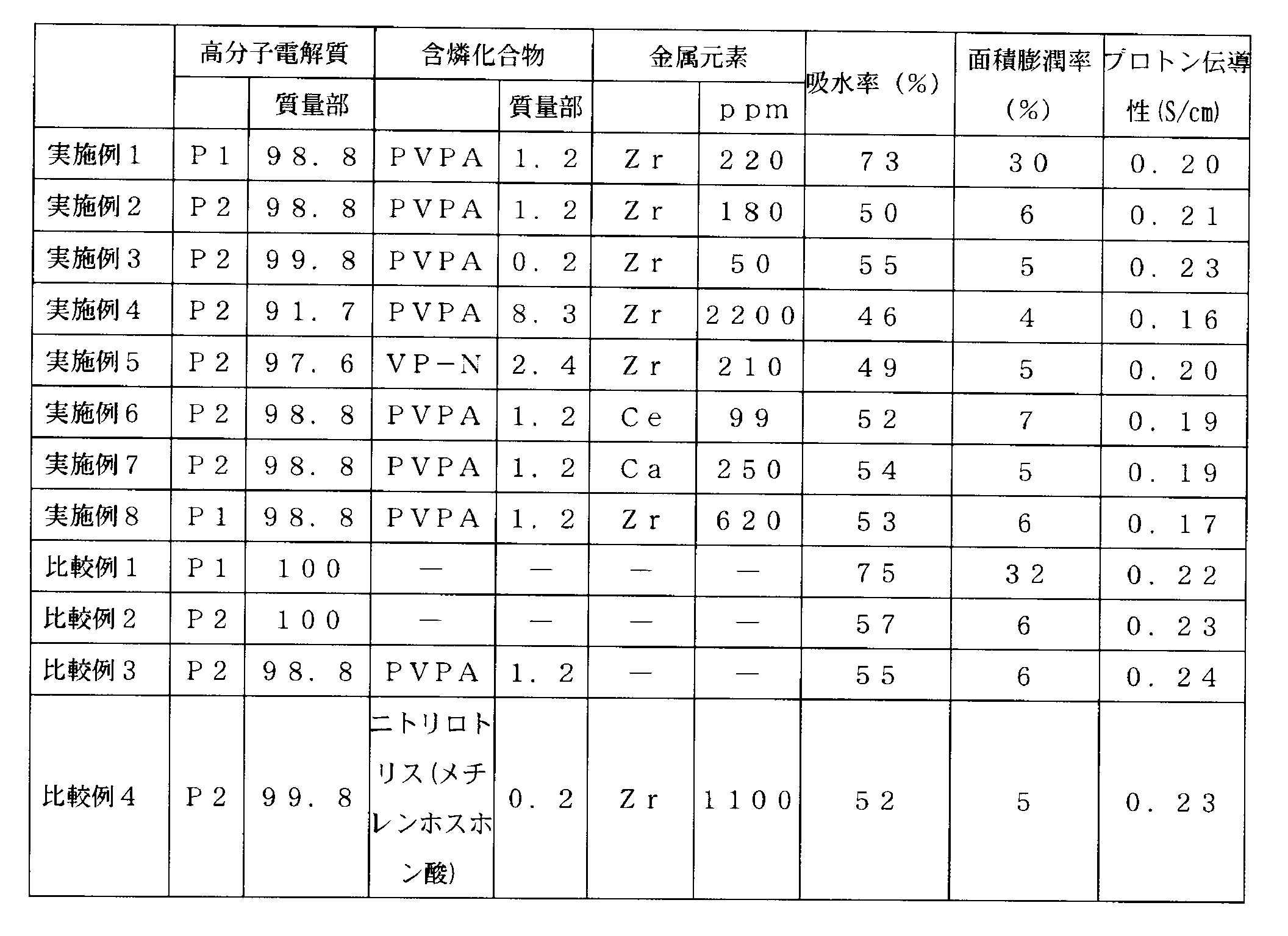
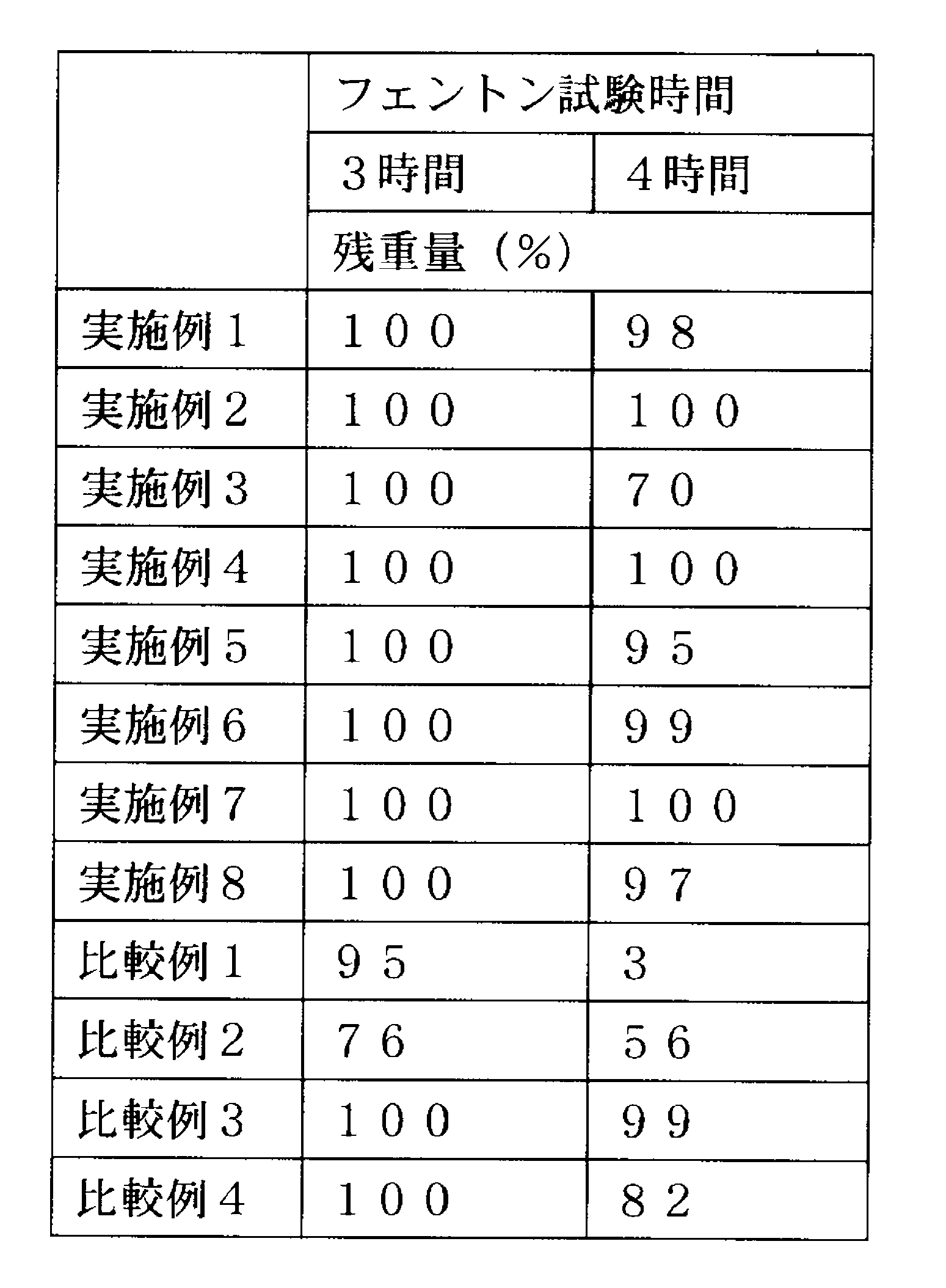

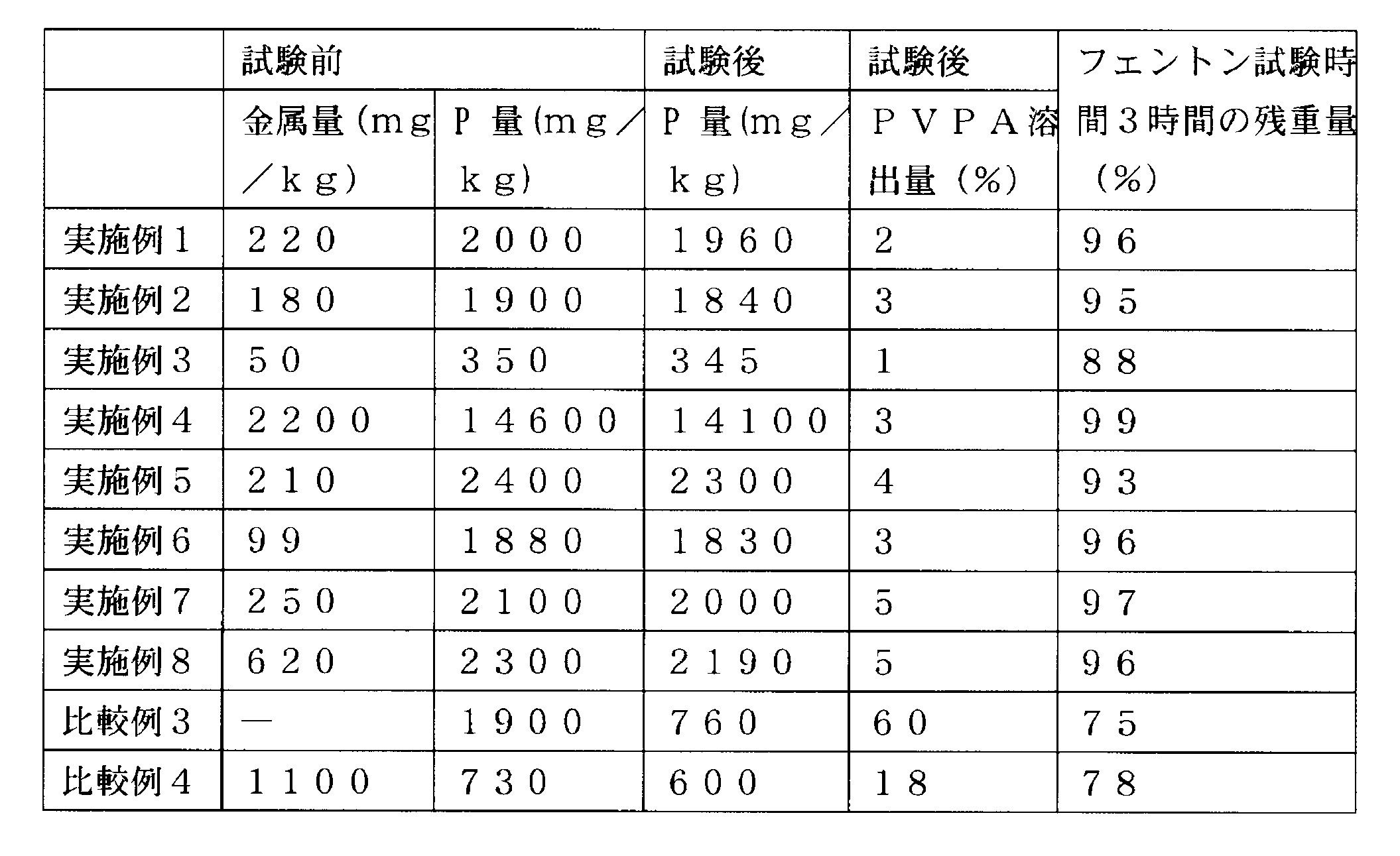
溶出試験後の膜のフェントン試験を行ったところ、金属元素を添加した実施例1~8は金属元素を添加していない比較例3および溶出の抑制が不十分な比較例4より高いフェントン耐性を示し、金属元素の添加により含燐高分子化合物の溶出を抑制することで長期にわたる高い耐酸化性が得られると考えられる。
Claims (11)
- 芳香族炭化水素系高分子電解質90~99.95質量部と含燐高分子化合物0.05~10質量部と金属元素10~5000ppmを含む固体高分子電解質組成物。
- 前記芳香族炭化水素系高分子電解質が、下記化学式1で表される構造単位の少なくとも1種と、下記化学式2で表される構造単位の少なくとも1種とを有するポリマーからなる請求項1に記載の高分子電解質組成物。

- 前記芳香族炭化水素系高分子電解質が親水性セグメントと疎水性セグメントを有するブロック共重合ポリマーであることを特徴とする請求項1又は2のいずれかに記載の固体高分子電解質組成物。
- 前記含燐高分子化合物がホスホン酸基を有する化合物であることを特徴とする請求項1~3のいずれかに記載の固体高分子電解質組成物。
- 前記固体高分子電解質組成物を80℃の水に48時間浸漬したときの前記含燐高分子化合物の溶出量が前記含燐高分子化合物の含有量に対して10質量%以下である請求項1~4のいずれかに記載の固体高分子電解質組成物。
- 前記含燐高分子化合物が、ポリビニルホスホン酸であることを特徴とする請求項1~5のいずれかに記載の固体高分子電解質組成物。
- 前記金属元素がMg、Ca、Co、Ni、Zn、Sr、Zr、Ba、Ceからなる群より選ばれる少なくとも1種以上の金属元素であることを特徴とする請求項1~6のいずれかに記載の固体高分子電解質組成物。
- 請求項1~7のいずれかに記載の固体高分子電解質組成物からなるイオン交換膜。
- 請求項8のイオン交換膜を用いた膜/電極接合体。
- 請求項1~7のいずれかに記載の固体高分子電解質組成物を用いた電極触媒層を有する膜/ 電極接合体。
- 請求項9又は10に記載の膜/ 電極接合体を用いた燃料電池。
Priority Applications (4)
| Application Number | Priority Date | Filing Date | Title |
|---|---|---|---|
| JP2011519897A JP5720568B2 (ja) | 2009-06-24 | 2010-06-22 | 固体高分子電解質組成物、及びイオン交換膜、膜/電極接合体、燃料電池 |
| CN2010800278977A CN102483966A (zh) | 2009-06-24 | 2010-06-22 | 固体高分子电解质组合物、以及离子交换膜、膜/电极接合体、燃料电池 |
| US13/380,367 US20120107725A1 (en) | 2009-06-24 | 2010-06-22 | Solid Polymer Electrolyte Composition, and Ion-Exchange Membrane, Membrane Electrode Assembly and Fuel Cell |
| EP10792080.3A EP2447953A4 (en) | 2009-06-24 | 2010-06-22 | SOLIDS POLYMER ELECTROLYTE COMPOSITION, ION EXCHANGE MEMBRANE, MEMBRANE ELECTRODE ARRANGEMENT AND FUEL CELL |
Applications Claiming Priority (2)
| Application Number | Priority Date | Filing Date | Title |
|---|---|---|---|
| JP2009-149664 | 2009-06-24 | ||
| JP2009149664 | 2009-06-24 |
Publications (1)
| Publication Number | Publication Date |
|---|---|
| WO2010150762A1 true WO2010150762A1 (ja) | 2010-12-29 |
Family
ID=43386531
Family Applications (1)
| Application Number | Title | Priority Date | Filing Date |
|---|---|---|---|
| PCT/JP2010/060505 Ceased WO2010150762A1 (ja) | 2009-06-24 | 2010-06-22 | 固体高分子電解質組成物、及びイオン交換膜、膜/電極接合体、燃料電池 |
Country Status (5)
| Country | Link |
|---|---|
| US (1) | US20120107725A1 (ja) |
| EP (1) | EP2447953A4 (ja) |
| JP (1) | JP5720568B2 (ja) |
| CN (1) | CN102483966A (ja) |
| WO (1) | WO2010150762A1 (ja) |
Cited By (7)
| Publication number | Priority date | Publication date | Assignee | Title |
|---|---|---|---|---|
| JP2012079415A (ja) * | 2010-09-30 | 2012-04-19 | Toyobo Co Ltd | 高分子電解質膜、およびそれを用いた膜/電極接合体,燃料電池 |
| CN103648626A (zh) * | 2011-07-04 | 2014-03-19 | 东洋纺株式会社 | 废水处理用的反渗透膜 |
| KR101389544B1 (ko) * | 2012-03-02 | 2014-04-25 | 한양대학교 산학협력단 | 고분자 전해질 조성물 및 이로부터 제조된 연료 전지용 고분자 전해질 막 |
| EP2750233A4 (en) * | 2011-08-22 | 2015-08-19 | Toyo Boseki | ION EXCHANGE MEMBRANE FOR VANADIUM REDOX BATTERIES, COMPOSITE BODIES AND VANADIUM REDOX BATTERY |
| WO2016024454A1 (ja) * | 2014-08-14 | 2016-02-18 | 富士フイルム株式会社 | 高分子機能性膜、電解質膜及び電解質膜の製造方法、イオン交換性ポリマー製造用組成物、並びに、イオン交換性ポリマーの製造方法 |
| KR20170079498A (ko) * | 2015-12-30 | 2017-07-10 | 코오롱인더스트리 주식회사 | 에너지 저장 장치용 이온 교환막 및 이를 포함하는 에너지 저장 장치 |
| CN121110051A (zh) * | 2025-11-14 | 2025-12-12 | 湖南七维氢能科技有限公司 | 一种膜电极及其在富集氘水中的应用 |
Families Citing this family (4)
| Publication number | Priority date | Publication date | Assignee | Title |
|---|---|---|---|---|
| CN103566780B (zh) * | 2012-07-27 | 2015-06-10 | 清华大学 | 一种氟取代聚芳醚复合阴离子电解质膜的制备方法 |
| CN102863636B (zh) * | 2012-09-19 | 2014-07-23 | 清华大学 | 一种原位聚合法制备含氟聚芳醚复合阴离子交换膜的方法 |
| KR101882863B1 (ko) * | 2013-01-10 | 2018-08-24 | 삼성전자주식회사 | 고분자, 그 제조방법, 이로부터 형성된 복합체, 이를 포함한 전극과 복합막 및 이를 채용한 연료전지 |
| KR102738075B1 (ko) * | 2019-05-17 | 2024-12-04 | 주식회사 엘지화학 | 분리막 내 금속 함량의 분석 방법 |
Citations (12)
| Publication number | Priority date | Publication date | Assignee | Title |
|---|---|---|---|---|
| JP2000011756A (ja) | 1998-06-22 | 2000-01-14 | Toyota Central Res & Dev Lab Inc | 高耐久性固体高分子電解質 |
| JP2000011755A (ja) | 1998-06-22 | 2000-01-14 | Toyota Central Res & Dev Lab Inc | 高耐久性固体高分子電解質 |
| JP2001223015A (ja) * | 1999-11-29 | 2001-08-17 | Toyota Central Res & Dev Lab Inc | 高耐久性固体高分子電解質及びその高耐久性固体高分子電解質を用いた電極−電解質接合体並びにその電極−電解質接合体を用いた電気化学デバイス |
| JP2002343132A (ja) | 2001-05-10 | 2002-11-29 | Toyota Central Res & Dev Lab Inc | 複合化固体高分子電解質及びその製造方法並びに燃料電池 |
| JP2003238678A (ja) | 2001-04-24 | 2003-08-27 | Sumitomo Chem Co Ltd | 芳香族系高分子ホスホン酸類、その製造方法及びその用途 |
| JP2003528212A (ja) * | 2000-03-22 | 2003-09-24 | ビクトレックス マニュファクチャリング リミテッド | イオン交換材料 |
| JP2004079252A (ja) | 2002-08-12 | 2004-03-11 | Toyota Motor Corp | 高耐久性固体高分子電解質及びそれを用いた固体高分子電解質(複合)膜 |
| JP2004134269A (ja) | 2002-10-11 | 2004-04-30 | Toyota Motor Corp | 高耐久性高分子電解質、同組成物、および燃料電池 |
| JP2004175997A (ja) | 2002-11-28 | 2004-06-24 | Toyota Motor Corp | 含燐高分子化合物、その合成方法、高耐久性固体高分子電解質組成物、及び燃料電池 |
| JP2007188706A (ja) * | 2006-01-12 | 2007-07-26 | Asahi Glass Co Ltd | 固体高分子形燃料電池用電解質膜および固体高分子形燃料電池用膜電極接合体 |
| JP2007194121A (ja) * | 2006-01-20 | 2007-08-02 | Toyota Central Res & Dev Lab Inc | 膜電極接合体及び固体高分子型燃料電池 |
| JP2008123974A (ja) * | 2006-11-16 | 2008-05-29 | Toyobo Co Ltd | 燃料電池用高分子電解質膜とその用途 |
Family Cites Families (2)
| Publication number | Priority date | Publication date | Assignee | Title |
|---|---|---|---|---|
| JP2005036113A (ja) * | 2003-07-16 | 2005-02-10 | Honda Motor Co Ltd | スルホン化ポリフォスファゼン誘導体及びその製造方法 |
| JP2005174769A (ja) * | 2003-12-11 | 2005-06-30 | Sumitomo Bakelite Co Ltd | 固体高分子型電解質膜 |
-
2010
- 2010-06-22 CN CN2010800278977A patent/CN102483966A/zh active Pending
- 2010-06-22 EP EP10792080.3A patent/EP2447953A4/en not_active Withdrawn
- 2010-06-22 US US13/380,367 patent/US20120107725A1/en not_active Abandoned
- 2010-06-22 JP JP2011519897A patent/JP5720568B2/ja active Active
- 2010-06-22 WO PCT/JP2010/060505 patent/WO2010150762A1/ja not_active Ceased
Patent Citations (12)
| Publication number | Priority date | Publication date | Assignee | Title |
|---|---|---|---|---|
| JP2000011756A (ja) | 1998-06-22 | 2000-01-14 | Toyota Central Res & Dev Lab Inc | 高耐久性固体高分子電解質 |
| JP2000011755A (ja) | 1998-06-22 | 2000-01-14 | Toyota Central Res & Dev Lab Inc | 高耐久性固体高分子電解質 |
| JP2001223015A (ja) * | 1999-11-29 | 2001-08-17 | Toyota Central Res & Dev Lab Inc | 高耐久性固体高分子電解質及びその高耐久性固体高分子電解質を用いた電極−電解質接合体並びにその電極−電解質接合体を用いた電気化学デバイス |
| JP2003528212A (ja) * | 2000-03-22 | 2003-09-24 | ビクトレックス マニュファクチャリング リミテッド | イオン交換材料 |
| JP2003238678A (ja) | 2001-04-24 | 2003-08-27 | Sumitomo Chem Co Ltd | 芳香族系高分子ホスホン酸類、その製造方法及びその用途 |
| JP2002343132A (ja) | 2001-05-10 | 2002-11-29 | Toyota Central Res & Dev Lab Inc | 複合化固体高分子電解質及びその製造方法並びに燃料電池 |
| JP2004079252A (ja) | 2002-08-12 | 2004-03-11 | Toyota Motor Corp | 高耐久性固体高分子電解質及びそれを用いた固体高分子電解質(複合)膜 |
| JP2004134269A (ja) | 2002-10-11 | 2004-04-30 | Toyota Motor Corp | 高耐久性高分子電解質、同組成物、および燃料電池 |
| JP2004175997A (ja) | 2002-11-28 | 2004-06-24 | Toyota Motor Corp | 含燐高分子化合物、その合成方法、高耐久性固体高分子電解質組成物、及び燃料電池 |
| JP2007188706A (ja) * | 2006-01-12 | 2007-07-26 | Asahi Glass Co Ltd | 固体高分子形燃料電池用電解質膜および固体高分子形燃料電池用膜電極接合体 |
| JP2007194121A (ja) * | 2006-01-20 | 2007-08-02 | Toyota Central Res & Dev Lab Inc | 膜電極接合体及び固体高分子型燃料電池 |
| JP2008123974A (ja) * | 2006-11-16 | 2008-05-29 | Toyobo Co Ltd | 燃料電池用高分子電解質膜とその用途 |
Non-Patent Citations (2)
| Title |
|---|
| J. APPL. POLY. SCI., vol. 70, 1998, pages 1947 |
| See also references of EP2447953A4 * |
Cited By (9)
| Publication number | Priority date | Publication date | Assignee | Title |
|---|---|---|---|---|
| JP2012079415A (ja) * | 2010-09-30 | 2012-04-19 | Toyobo Co Ltd | 高分子電解質膜、およびそれを用いた膜/電極接合体,燃料電池 |
| CN103648626A (zh) * | 2011-07-04 | 2014-03-19 | 东洋纺株式会社 | 废水处理用的反渗透膜 |
| CN103648626B (zh) * | 2011-07-04 | 2016-02-17 | 东洋纺株式会社 | 废水处理用的反渗透膜 |
| EP2750233A4 (en) * | 2011-08-22 | 2015-08-19 | Toyo Boseki | ION EXCHANGE MEMBRANE FOR VANADIUM REDOX BATTERIES, COMPOSITE BODIES AND VANADIUM REDOX BATTERY |
| KR101389544B1 (ko) * | 2012-03-02 | 2014-04-25 | 한양대학교 산학협력단 | 고분자 전해질 조성물 및 이로부터 제조된 연료 전지용 고분자 전해질 막 |
| WO2016024454A1 (ja) * | 2014-08-14 | 2016-02-18 | 富士フイルム株式会社 | 高分子機能性膜、電解質膜及び電解質膜の製造方法、イオン交換性ポリマー製造用組成物、並びに、イオン交換性ポリマーの製造方法 |
| JPWO2016024454A1 (ja) * | 2014-08-14 | 2017-04-27 | 富士フイルム株式会社 | 高分子機能性膜、電解質膜及び電解質膜の製造方法、イオン交換性ポリマー製造用組成物、並びに、イオン交換性ポリマーの製造方法 |
| KR20170079498A (ko) * | 2015-12-30 | 2017-07-10 | 코오롱인더스트리 주식회사 | 에너지 저장 장치용 이온 교환막 및 이를 포함하는 에너지 저장 장치 |
| CN121110051A (zh) * | 2025-11-14 | 2025-12-12 | 湖南七维氢能科技有限公司 | 一种膜电极及其在富集氘水中的应用 |
Also Published As
| Publication number | Publication date |
|---|---|
| EP2447953A1 (en) | 2012-05-02 |
| EP2447953A4 (en) | 2015-08-26 |
| US20120107725A1 (en) | 2012-05-03 |
| JP5720568B2 (ja) | 2015-05-20 |
| CN102483966A (zh) | 2012-05-30 |
| JPWO2010150762A1 (ja) | 2012-12-10 |
Similar Documents
| Publication | Publication Date | Title |
|---|---|---|
| JP5720568B2 (ja) | 固体高分子電解質組成物、及びイオン交換膜、膜/電極接合体、燃料電池 | |
| JP3928611B2 (ja) | ポリアリーレンエーテル系化合物、それを含有する組成物、およびそれらの製造方法 | |
| WO2006132207A1 (ja) | スルホン酸基含有ポリマーおよびその製造方法、該スルホン酸基含有ポリマーを含有する樹脂組成物、高分子電解質膜、高分子電解質膜/電極接合体、燃料電池 | |
| JP2008234844A (ja) | 高分子電解質膜とその用途及び高分子電解質膜の製造方法 | |
| JP5614210B2 (ja) | 高分子電解質膜、およびそれを用いた膜/電極接合体,燃料電池 | |
| JP2008214520A (ja) | 高分子電解質膜とその用途 | |
| JP4337038B2 (ja) | 酸性基含有ポリベンズイミダゾール系化合物を含む組成物 | |
| JP2008037897A (ja) | スルホン酸基含有光架橋性ポリマー、スルホン酸基含有光架橋性ポリマー組成物、高分子電解質膜、架橋高分子電解質膜、高分子電解質膜/電極接合体、及び燃料電池及びその用途 | |
| CN101218281A (zh) | 含磺酸基聚合物及其制造方法、含有该含磺酸基聚合物的树脂组合物、聚合物电解质膜、聚合物电解质膜/电极接合体、燃料电池 | |
| JP2007146111A (ja) | スルホン酸基含有ポリマー、イオン交換膜、膜/電極接合体、燃料電池、ポリマー組成物 | |
| JP2008120956A (ja) | スルホン酸基含有ポリマー、その製造方法及びその用途 | |
| JPWO2008038702A1 (ja) | スルホン酸基含有ポリマー、その製造方法、スルホン酸基含有ポリマーを用いた高分子電解質膜、膜/電極接合体及び燃料電池 | |
| JP4063596B2 (ja) | プロトン伝導性高分子化合物およびプロトン伝導性高分子膜 | |
| JP2008204929A (ja) | 高分子電解質膜とその用途及び高分子電解質膜の製造方法 | |
| JP2005235404A (ja) | ブレンドイオン交換膜、膜/電極接合体、燃料電池 | |
| JP2008115340A (ja) | スルホン酸基含有ポリマー、その組成物及びその用途 | |
| JP4720090B2 (ja) | スルホン酸基含有高分子電解質膜及びそれを用いた物品 | |
| JP5470674B2 (ja) | 高分子電解質膜、高分子電解質膜/電極接合体、燃料電池、燃料電池の運転方法 | |
| JP4022833B2 (ja) | スルホン酸基含有ポリマー及びその用途 | |
| JP3651683B1 (ja) | スルホン酸基含有高分子化合物及びそれにより得られるイオン伝導膜とそれを用いた物品 | |
| JP2006206809A (ja) | スルホン酸基含有ポリマー、該ポリマーを含むポリマー組成物、該ポリマーを用いたイオン交換樹脂およびイオン交換膜、該イオン交換膜を用いて得られる膜/電極接合体ならびに燃料電池 | |
| JP2007063533A (ja) | スルホン酸基含有ポリマーとその用途および製造方法 | |
| JP4697385B2 (ja) | イオン交換膜、膜/電極接合体、燃料電池 | |
| JP2008074946A (ja) | スルホン酸基含有ポリマー及び該ポリマーを用いた組成物、高分子電解質膜、膜/電極接合体及び燃料電池 | |
| JP2008037896A (ja) | スルホン酸基含有熱架橋性ポリマー、スルホン酸基含有熱架橋性ポリマー組成物、高分子電解質膜、架橋高分子電解質膜、高分子電解質膜/電極接合体、及び燃料電池及びその用途 |
Legal Events
| Date | Code | Title | Description |
|---|---|---|---|
| WWE | Wipo information: entry into national phase |
Ref document number: 201080027897.7 Country of ref document: CN |
|
| 121 | Ep: the epo has been informed by wipo that ep was designated in this application |
Ref document number: 10792080 Country of ref document: EP Kind code of ref document: A1 |
|
| ENP | Entry into the national phase |
Ref document number: 2011519897 Country of ref document: JP Kind code of ref document: A |
|
| WWE | Wipo information: entry into national phase |
Ref document number: 13380367 Country of ref document: US |
|
| NENP | Non-entry into the national phase |
Ref country code: DE |
|
| REEP | Request for entry into the european phase |
Ref document number: 2010792080 Country of ref document: EP |
|
| WWE | Wipo information: entry into national phase |
Ref document number: 2010792080 Country of ref document: EP |