WO2011002011A1 - Agent thérapeutique combinant un inhibiteur de sglt1 et un inhibiteur de dpp-iv - Google Patents
Agent thérapeutique combinant un inhibiteur de sglt1 et un inhibiteur de dpp-iv Download PDFInfo
- Publication number
- WO2011002011A1 WO2011002011A1 PCT/JP2010/061126 JP2010061126W WO2011002011A1 WO 2011002011 A1 WO2011002011 A1 WO 2011002011A1 JP 2010061126 W JP2010061126 W JP 2010061126W WO 2011002011 A1 WO2011002011 A1 WO 2011002011A1
- Authority
- WO
- WIPO (PCT)
- Prior art keywords
- compound
- inhibitor
- dpp
- acid
- pharmacologically acceptable
- Prior art date
- Legal status (The legal status is an assumption and is not a legal conclusion. Google has not performed a legal analysis and makes no representation as to the accuracy of the status listed.)
- Ceased
Links
Images


Classifications
-
- A—HUMAN NECESSITIES
- A61—MEDICAL OR VETERINARY SCIENCE; HYGIENE
- A61K—PREPARATIONS FOR MEDICAL, DENTAL OR TOILETRY PURPOSES
- A61K31/00—Medicinal preparations containing organic active ingredients
- A61K31/33—Heterocyclic compounds
- A61K31/395—Heterocyclic compounds having nitrogen as a ring hetero atom, e.g. guanethidine or rifamycins
- A61K31/495—Heterocyclic compounds having nitrogen as a ring hetero atom, e.g. guanethidine or rifamycins having six-membered rings with two or more nitrogen atoms as the only ring heteroatoms, e.g. piperazine or tetrazines
- A61K31/4985—Pyrazines or piperazines ortho- or peri-condensed with heterocyclic ring systems
-
- A—HUMAN NECESSITIES
- A61—MEDICAL OR VETERINARY SCIENCE; HYGIENE
- A61K—PREPARATIONS FOR MEDICAL, DENTAL OR TOILETRY PURPOSES
- A61K31/00—Medicinal preparations containing organic active ingredients
- A61K31/33—Heterocyclic compounds
- A61K31/395—Heterocyclic compounds having nitrogen as a ring hetero atom, e.g. guanethidine or rifamycins
- A61K31/495—Heterocyclic compounds having nitrogen as a ring hetero atom, e.g. guanethidine or rifamycins having six-membered rings with two or more nitrogen atoms as the only ring heteroatoms, e.g. piperazine or tetrazines
- A61K31/505—Pyrimidines; Hydrogenated pyrimidines, e.g. trimethoprim
- A61K31/519—Pyrimidines; Hydrogenated pyrimidines, e.g. trimethoprim ortho- or peri-condensed with heterocyclic rings
-
- A—HUMAN NECESSITIES
- A61—MEDICAL OR VETERINARY SCIENCE; HYGIENE
- A61K—PREPARATIONS FOR MEDICAL, DENTAL OR TOILETRY PURPOSES
- A61K31/00—Medicinal preparations containing organic active ingredients
- A61K31/70—Carbohydrates; Sugars; Derivatives thereof
- A61K31/7042—Compounds having saccharide radicals and heterocyclic rings
- A61K31/7052—Compounds having saccharide radicals and heterocyclic rings having nitrogen as a ring hetero atom, e.g. nucleosides, nucleotides
- A61K31/7056—Compounds having saccharide radicals and heterocyclic rings having nitrogen as a ring hetero atom, e.g. nucleosides, nucleotides containing five-membered rings with nitrogen as a ring hetero atom
-
- A—HUMAN NECESSITIES
- A61—MEDICAL OR VETERINARY SCIENCE; HYGIENE
- A61P—SPECIFIC THERAPEUTIC ACTIVITY OF CHEMICAL COMPOUNDS OR MEDICINAL PREPARATIONS
- A61P3/00—Drugs for disorders of the metabolism
- A61P3/04—Anorexiants; Antiobesity agents
-
- A—HUMAN NECESSITIES
- A61—MEDICAL OR VETERINARY SCIENCE; HYGIENE
- A61P—SPECIFIC THERAPEUTIC ACTIVITY OF CHEMICAL COMPOUNDS OR MEDICINAL PREPARATIONS
- A61P3/00—Drugs for disorders of the metabolism
- A61P3/08—Drugs for disorders of the metabolism for glucose homeostasis
-
- A—HUMAN NECESSITIES
- A61—MEDICAL OR VETERINARY SCIENCE; HYGIENE
- A61P—SPECIFIC THERAPEUTIC ACTIVITY OF CHEMICAL COMPOUNDS OR MEDICINAL PREPARATIONS
- A61P3/00—Drugs for disorders of the metabolism
- A61P3/08—Drugs for disorders of the metabolism for glucose homeostasis
- A61P3/10—Drugs for disorders of the metabolism for glucose homeostasis for hyperglycaemia, e.g. antidiabetics
-
- A—HUMAN NECESSITIES
- A61—MEDICAL OR VETERINARY SCIENCE; HYGIENE
- A61P—SPECIFIC THERAPEUTIC ACTIVITY OF CHEMICAL COMPOUNDS OR MEDICINAL PREPARATIONS
- A61P43/00—Drugs for specific purposes, not provided for in groups A61P1/00-A61P41/00
-
- A—HUMAN NECESSITIES
- A61—MEDICAL OR VETERINARY SCIENCE; HYGIENE
- A61P—SPECIFIC THERAPEUTIC ACTIVITY OF CHEMICAL COMPOUNDS OR MEDICINAL PREPARATIONS
- A61P9/00—Drugs for disorders of the cardiovascular system
- A61P9/10—Drugs for disorders of the cardiovascular system for treating ischaemic or atherosclerotic diseases, e.g. antianginal drugs, coronary vasodilators, drugs for myocardial infarction, retinopathy, cerebrovascula insufficiency, renal arteriosclerosis
Definitions
- the present invention relates to a pharmaceutical comprising a combination of an SGLT1 inhibitor and a DPP-IV inhibitor. More specifically, 3- (3- ⁇ 4- [3- ( ⁇ -D-glucopyranosyloxy) -5-isopropyl-1H-pyrazol-4-ylmethyl] -3-methylphenoxy ⁇ propylamino) -2 , 2-dimethylpropionamide (hereinafter sometimes referred to as “compound 1”) or a pharmacologically acceptable salt thereof and a DPP-IV inhibitor.
- Diabetes is a group of metabolic diseases whose main symptom is a chronically elevated blood glucose level (blood glucose level) due to insufficient insulin action.
- dietary therapy and exercise therapy are usually performed, and when the target glycemic control cannot be achieved, drug therapy using an oral hypoglycemic drug or an insulin preparation is performed.
- oral hypoglycemic drugs sulfonylurea drugs (SU drugs), fast-acting insulin secretagogues, ⁇ -glucosidase inhibitors, insulin resistance-improving drugs such as thiazolidine drugs, and biguanides are used depending on the patient's condition. Yes.
- SU drugs sulfonylurea drugs
- fast-acting insulin secretagogues ⁇ -glucosidase inhibitors
- ⁇ -glucosidase inhibitors insulin resistance-improving drugs
- biguanides biguanides
- SU drugs are reported to be secondary ineffective due to hypoglycemia or long-term use
- ⁇ -glucosidase inhibitors are reported to be diarrhea
- insulin resistance improvers are related to weight gain and edema
- biguanides are reported to be lactic acidosis, etc. Yes. That is, although a diabetes therapeutic drug having a different mechanism of action has been proposed or put into practical use, it is not easy to select the most suitable drug for each patient because the pathology and symptoms of diabetic patients are complicated.
- oral hypoglycemic drugs If continuous administration of blood glucose control cannot be achieved by single-dose administration of oral hypoglycemic drugs, it may be necessary to use oral hypoglycemic drugs in combination with insulin or in combination with insulin. From the viewpoint of safety and safety, it is required to provide a highly useful combination of drugs. That is, early establishment of a combination therapy with an effective combination that can exhibit excellent effects without increasing the occurrence of side effects such as hypoglycemia and pancreatic exhaustion is desired.
- Patent Document 1 discloses the formula (I) used for the medicament of the present invention: Compound 1 (chemical name: 3- (3- ⁇ 4- [3- ( ⁇ -D-glucopyranosyloxy) -5-isopropyl-1H-pyrazol-4-ylmethyl] -3-methylphenoxy ⁇ Various pyrazole derivatives including propylamino) -2,2-dimethylpropionamide) have been described.
- Glucagon-like peptide 1 is one of the incretins (gastrointestinal hormones that promote insulin secretion during food intake) and is a potent insulin secretion enhancer, but dipeptidyl peptidase-IV ( DPP-IV) is known to be hydrolyzed (Non-patent Documents 1 and 2).
- DPP-IV inhibitors that regulate blood glucose levels in type 2 diabetes and impaired glucose tolerance by suppressing the inactivation of GLP-1 by DPP-IV and extending the duration of endogenous GLP-1 Has been developed.
- sitagliptin is a DPP-IV inhibitor represented by the following formula (II), has an action of increasing active GLP-1, and is marketed as a therapeutic agent for type 2 diabetes.
- Patent Document 1 has a general description of a combination with various antidiabetic drugs including a DPP-IV inhibitor. None has been reported so far.
- a drug comprising a combination of an SGLT1 inhibitor such as Compound 1 or a pharmacologically acceptable salt thereof and a DPP-IV inhibitor has a remarkable blood glucose increase inhibitory effect or GLP-1 concentration.
- an SGLT1 inhibitor such as Compound 1 or a pharmacologically acceptable salt thereof
- a DPP-IV inhibitor has a remarkable blood glucose increase inhibitory effect or GLP-1 concentration.
- Bo Ahren Best Practice & Research Clinical Endocrinology & Metabolism, 2007, Volume 21, Issue 4, p.517-533 Carolyn F. Deacon, Diabetes, September 2004, Vol. 53, p.2181-2189 Bo Ahren, Vascular Health and Risk Management, 2008, Vol.4, No.2, p.383-394 Diabetes Care. 2009; 32: 193-203
- the present invention provides a medicament comprising a combination of Compound 1 or a pharmacologically acceptable salt thereof and a DPP-IV inhibitor, which is useful for the treatment of diseases caused by hyperglycemia.
- the present invention Item 1: 3- (3- ⁇ 4- [3- ( ⁇ -D-glucopyranosyloxy) -5-isopropyl-1H-pyrazol-4-ylmethyl] -3-methylphenoxy ⁇ propylamino) -2, SGLT1 inhibitor which is 2-dimethylpropionamide or a pharmacologically acceptable salt thereof, sitagliptin, vildagliptin, alogliptin, saxagliptin, dutogliptin, melogliptin, carmeliptin, linagliptin and 6-[(3R) -3-aminopiperidine- 1-yl] -5- (2-chloro-5-fluorobenzyl) -1,3-dimethyl-1H-pyrrolo [3,2-d] pyrimidine-2,4 (3H, 5H) -dione and their drugs
- a pharmaceutical comprising a combination of a DPP-IV inhibitor selected from the group consisting of physically acceptable salt
- the pharmaceutical according to Item 1 which is pyrrolo [3,2-d] pyrimidine-2,4 (3H, 5H) -dione, or a pharmaceutically acceptable salt thereof.
- Item 3 The pharmaceutical according to Item 1 or 2, wherein the DPP-IV inhibitor is sitagliptin or a pharmacologically acceptable salt thereof,
- Item 4 The DPP-IV inhibitor is 6-[(3R) -3-aminopiperidin-1-yl] -5- (2-chloro-5-fluorobenzyl) -1,3-dimethyl-1H-pyrrolo [ Item 3.
- Item 5 The medicament according to any one of Items 1 to 4, which is used for treating a disease caused by hyperglycemia.
- Item 6 The disease according to Item 5, wherein the disease caused by hyperglycemia is a disease selected from the group consisting of diabetes, impaired glucose tolerance, impaired fasting blood glucose, diabetic complications, obesity, and hyperinsulinemia.
- Medicine, Item 7 The medicament according to any one of Items 1 to 4, which is a postprandial hyperglycemic agent, Item 8: The pharmaceutical or the like according to any one of Items 1 to 4, which is a GLP-1 action potentiator.
- the present invention comprises a combination of Compound 1 or a pharmacologically acceptable salt thereof and a DPP-IV inhibitor, and sufficient blood glucose can be obtained by administration of an SGLT1 inhibitor or DPP-IV inhibitor.
- the present invention relates to a medicine or the like that can be used for treating a disease caused by hyperglycemia, improving postprandial hyperglycemia, or enhancing GLP-1 action in a patient who cannot obtain control.
- the medicament of the present invention has a strong blood glucose elevation-inhibiting action and a GLP-1 enhancing action, and is extremely useful for the treatment of diseases caused by hyperglycemia.
- This medicine has excellent postprandial hyperglycemia improvement effect, and suppresses the progress of diabetes treatment and the progress from diabetes to diabetic complications (eg, diabetic neuropathy, diabetic nephropathy, diabetic retinopathy, arteriosclerosis) Useful for.
- diabetic complications eg, diabetic neuropathy, diabetic nephropathy, diabetic retinopathy, arteriosclerosis
- superior effects typified by enhancing blood glucose elevation-inhibiting action, increasing active GLP-1 concentration, reducing excessive insulin secretion, etc.
- FIG. 1 shows the blood glucose level change in the oral mixed carbohydrate tolerance test performed 30 minutes after drug administration (mean value ⁇ SE).
- ⁇ indicates solvent
- ⁇ indicates compound 2 (0.03 mg / kg)
- ⁇ indicates compound X (0.3 mg / kg)
- ⁇ indicates compound 2 (0.03 mg / kg) + compound X (0.3 mg / kg)
- the figure on the right shows the area under the increased blood glucose curve of the oral mixed carbohydrate tolerance test (mean ⁇ SE).
- FIG. 2 shows changes in plasma active GLP-1 concentration in the oral mixed carbohydrate tolerance test performed 30 minutes after drug administration (mean ⁇ SE).
- ⁇ indicates solvent
- ⁇ indicates compound 2 (0.03 mg / kg)
- ⁇ indicates compound X (0.3 mg / kg)
- ⁇ indicates compound 2 (0.03 mg / kg) + compound X (0.3 mg / kg)
- the figure on the right shows the area under the increased plasma active GLP-1 concentration curve in the oral mixed carbohydrate tolerance test (mean ⁇ SE). ** P ⁇ 0.01 (compared with solvent group), Student's t test.
- ZF rats were orally administered by gavage with Compound 2, Compound X and both of these agents.
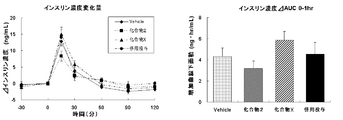
- the graph on the left side of FIG. 3 shows changes in plasma insulin concentration in the oral mixed carbohydrate tolerance test performed 30 minutes after drug administration (mean value ⁇ SE).
- ⁇ indicates solvent
- ⁇ indicates compound 2 (0.03 mg / kg)
- ⁇ indicates compound X (0.3 mg / kg)
- ⁇ indicates compound 2 (0.03 mg / kg) + compound X (0.3 mg / kg)
- the figure on the right shows the area under the increased plasma insulin concentration curve for the oral mixed carbohydrate tolerance test (mean ⁇ SE).
- a preferred “SGLT1 inhibitor” in the present invention includes Compound 1 or a pharmacologically acceptable salt thereof.
- “Compound 1 or a pharmacologically acceptable salt thereof” can be produced by a method described in the literature, a method analogous thereto, or a method described in Reference Examples (see, for example, Patent Document 1).
- Examples of the “pharmacologically acceptable salt of Compound 1” include acid addition salts with mineral acids such as hydrochloric acid, hydrobromic acid, hydroiodic acid, sulfuric acid, nitric acid, phosphoric acid, formic acid, acetic acid, Methanesulfonic acid, benzenesulfonic acid, p-toluenesulfonic acid, propionic acid, citric acid, succinic acid, tartaric acid, fumaric acid, butyric acid, oxalic acid, malonic acid, maleic acid, lactic acid, malic acid, carbonic acid, glutamic acid, aspartic acid Acid addition salts with organic acids such as sebacic acid, salts with inorganic bases such as sodium salt and potassium salt, N-methyl-D
- the compound 1 or a pharmacologically acceptable salt thereof includes a hydrate or a solvate with a pharmacologically acceptable solvent (for example, ethanol).
- Examples of the “pharmacologically acceptable salt of Compound 1” include “3- (3- ⁇ 4- [3- ( ⁇ -D-glucopyranosyloxy) -5-isopropyl-1H-pyrazole-4- Ylmethyl] -3-methylphenoxy ⁇ propylamino) -2,2-dimethylpropionamide / 1/2 fumarate dihydrate) ”or“ bis [3- (3- ⁇ 4- [3- ( ⁇ - D-glucopyranosyloxy) -5-isopropyl-1H-pyrazol-4-ylmethyl] -3-methylphenoxy ⁇ propylamino) -2,2-dimethylpropionamide] monosebacinate (hereinafter “compound 2”) And compound 2 is more preferable.
- SGLT1 inhibitor in addition to “Compound 1 or a pharmacologically acceptable salt thereof”, a compound having selective inhibitory activity on SGLT1, that is, inhibition of sodium-dependent glucose cotransporter 2 (SGLT2) A compound having a stronger inhibitory activity against SGLT1 than the activity may be used.
- Specific examples thereof include, for example, the compounds described in International Publication WO2007 / 129668 pamphlet, Japanese translations of PCT publication No. 2008-501745, International Publication WO2007 / 126117 pamphlet and the like or pharmacologically acceptable salts thereof. .
- Examples of the compounds described in the pamphlet of International Publication No. WO2007 / 129668 include 4- ⁇ 4- [2- (benzyloxy) ethoxy] -2-methylbenzyl ⁇ -5-isopropyl-1H-pyrazol-3-yl.
- Examples of the compound described in JP-T-2008-501745 include compounds represented by the following table.
- Examples of the compounds described in International Publication WO2007 / 126117 pamphlet include compounds represented by the following table.
- Examples of the “DPP-IV inhibitor” in the present invention include sitagliptin, vildagliptin, alogliptin, saxagliptin, dutogliptin, melogliptin, caregliptin, caregliptin (Cegliptin), (Teneligliptin) ", linagliptin and 6-[(3R) -3-aminopiperidin-1-yl] -5- (2-chloro-5-fluorobenzyl) -1,3-dimethyl-1H-pyrrolo [ 3,2-d] pyrimidine-2,4 (3H, 5H) -dione, and DPP-IV inhibitors selected from the group consisting of pharmacologically acceptable salts thereof.
- pharmacologically acceptable salts thereof include acid addition salts with mineral acids such as hydrochloric acid, hydrobromic acid, hydroiodic acid, sulfuric acid, nitric acid, phosphoric acid, formic acid, acetic acid, methanesulfonic acid.
- Organic such as benzenesulfonic acid, p-toluenesulfonic acid, propionic acid, citric acid, succinic acid, tartaric acid, fumaric acid, butyric acid, oxalic acid, malonic acid, maleic acid, lactic acid, malic acid, carbonic acid, glutamic acid, aspartic acid
- acids organic salts such as diethanolamine salts, ethylenediamine salts and N-methylglucamine salts
- salts with inorganic bases such as calcium salts, magnesium salts, sodium salts and potassium salts.
- the above DPP-IV inhibitors include hydrates thereof and solvates with pharmacologically acceptable solvents (for example, ethanol and the like).
- DPP-IV inhibitor can also be produced by a method described in the literature or a method according to them (for example, International Publication WO2004 / 085378 Pamphlet, International Publication WO2004 / 085661 Pamphlet, International Publication WO2006 / 033848 Pamphlet, International publication WO00 / 34241 pamphlet etc.).
- Compound 3 or a pharmacologically acceptable salt thereof can be easily produced by a method described in the literature or a method analogous thereto (see, for example, Patent Document 5).
- Compound 3 or a pharmacologically acceptable salt thereof includes a hydrate or a solvate with a pharmacologically acceptable solvent (for example, ethanol).
- Compound 3 or a pharmacologically acceptable salt thereof includes hydrochloride thereof (compound 4; 6-[(3R) -3-aminopiperidin-1-yl] -5- (2-chloro-5-fluorobenzyl) ) -1,3-dimethyl-1H-pyrrolo [3,2-d] pyrimidine-2,4 (3H, 5H) -dione monohydrochloride) is preferred, and the half hydrate of compound 4 (compound X; 6-[(3R) -3-Aminopiperidin-1-yl] -5- (2-chloro-5-fluorobenzyl) -1,3-dimethyl-1H-pyrrolo [3,2-d] pyrimidine-2, 4 (3H, 5H) -dione monohydrochloride 1/2 hydrate is even more preferable.
- pharmacologically acceptable salt of sitagliptin phosphate or a hydrate thereof is preferable.
- a pharmacologically acceptable salt of vildagliptin hydrochloride is preferable.
- pharmacologically acceptable salt of alogliptin benzoate is preferable.
- the “medicament in combination” (hereinafter sometimes referred to as the medicament of the present invention) is compound 1 or a pharmacologically acceptable salt thereof, sitagliptin, vildagliptin, alogliptin, saxagliptin, dutogliptin, melogliptin , Carmegliptin, linagliptin and compound X and a DPP-IV inhibitor selected from the group consisting of pharmacologically acceptable salts thereof. These components may be combined at the time of administration, and may be combined in vivo after administration.
- compound 1 a compound described in International Publication WO2007 / 129668 pamphlet, a compound described in JP 2008-501745 A, a compound described in International Publication WO2007 / 126117 pamphlet, and A pharmaceutical comprising a combination of an SGLT1 inhibitor selected from the group consisting of pharmacologically acceptable salts thereof and a DPP-IV inhibitor which is Compound 3 or a pharmacologically acceptable salt thereof. Also good.
- the pharmaceutical composition of the present invention includes both a single preparation (combination agent) containing two active ingredients and a combination of separate preparations (combination kit, etc.). Including those used in the same dosage form or in different dosage forms.
- the medicament of the present invention when the number of daily administrations of two active ingredients is different, it includes those in which simultaneous administration and single agent administration are mixed in one day.
- Examples of the “disease caused by hyperglycemia” in the present invention include type 1 and type 2 diabetes, impaired glucose tolerance, abnormal fasting blood glucose, diabetic complications (for example, retinopathy, neuropathy, nephropathy, ulcer, Angiopathy), obesity, hyperinsulinemia, hyperlipidemia, hypercholesterolemia, hypertriglyceridemia, dyslipidemia, atherosclerosis, hypertension, congestive heart failure, edema, hyperuricemia, Gout etc. are mentioned.
- the medicament of the present invention enhances GLP-1 action, thereby suppressing glucagon secretion, suppressing gastric emptying, promoting pancreatic ⁇ -cell differentiation / proliferation and suppressing apoptosis, improving myocardial and endothelial function, gastric acid / pancreatic juice Suppression of secretion, suppression of feeding, weight loss, increased insulin sensitivity, increased glucose uptake / accumulation in muscle / adipose tissue, suppression of glucose synthesis in liver, suppression of stomach movement, decreased postprandial / fasting blood glucose, decreased HbA 1C , fructosamine Normalization of concentration, cranial nerve protection, cardioprotective effect, etc. can be expected, especially type 1 and type 2 diabetes, impaired glucose tolerance, fasting blood glucose abnormality, diabetic complications, obesity, hyperinsulinemia, etc. It is extremely useful in the treatment of
- treatment of a disease caused by hyperglycemia includes prevention of transition to diabetes (prophylactic treatment) of a person with impaired glucose tolerance or an impaired fasting blood glucose obtained by correcting hyperglycemia. It is.
- the “GLP-1 action enhancer” means a drug that enhances the action of GLP-1 by increasing and maintaining the endogenous active GLP-1 concentration.
- dosage forms When the medicament of the present invention is used for actual treatment, preparations of various dosage forms are used depending on the drug and usage.
- dosage forms include powders, granules, fine granules, dry syrups, tablets, capsules, injections, liquids and the like, which are administered orally or parenterally.
- Each formulation can be produced by formulating each active ingredient simultaneously or separately.
- the dosage forms of both may be the same or different, and each available single formulation may be used.
- the medicament of the present invention is prepared by an appropriate excipient, disintegrant, binder, lubricant, diluent, buffering agent, isotonic agent, preservative, wetting agent according to the method used in pharmacology depending on the dosage form. It can also be produced by mixing or diluting / dissolving appropriately with pharmaceutical additives such as agents, emulsifiers, dispersants, stabilizers, solubilizers, etc., and dispensing according to conventional methods.
- pharmaceutical additives such as agents, emulsifiers, dispersants, stabilizers, solubilizers, etc.
- a tablet can be easily produced by a method described in the literature or a method analogous thereto. If necessary, the tablets may be coated to form film-coated tablets, sugar-coated tablets, enteric-coated tablets, and the like.
- Capsules may be prepared by adding appropriate excipients, lubricants, and the like to the active ingredient as necessary and mixing well, and then filling the appropriate capsules into capsules. Further, it may be filled after granulation or fine granulation by a conventional method.
- the dose of each active ingredient is appropriately determined depending on the patient's age, sex, body weight, disease and degree of treatment, drug, dosage form, administration method, drug combination, etc.
- the SGLT1 inhibitor is, for example, a compound 1 or a pharmacologically acceptable salt thereof in the range of about 0.1 to 1000 mg per day for an adult when administered orally, and about 0.01 to about a day for an adult when administered parenterally. In the range of 300 mg, it can be appropriately administered in one or several divided doses.
- DPP-IV inhibitors can be administered in an amount of approximately 0.01 to 3000 mg per day for adults once or in several divided doses.
- sitagliptin is 1 to 400 mg / day
- vildagliptin is 1 -100 mg / day
- alogliptin 1-400 mg / day saxagliptin 1-400 mg / day, etc. can be administered in one or several divided doses.
- Reference example 1 Bis [3- (3- ⁇ 4- [3- ( ⁇ -D-glucopyranosyloxy) -5-isopropyl-1H-pyrazol-4-ylmethyl] -3-methylphenoxy ⁇ propylamino) -2,2 -Dimethylpropionamide] monosebacate 3- (3- ⁇ 4- [3- ( ⁇ -D-glucopyranosyloxy) -5-isopropyl-1H-pyrazol-4-ylmethyl] -3-methylphenoxy ⁇ Propylamino) -2,2-dimethylpropionamide (1.00 g) and sebacic acid (0.18 g) were suspended in ethanol (10 mL) and dissolved by heating and stirring at 70 ° C. for 5 minutes.
- Reference example 2 3- (3- ⁇ 4- [3- ( ⁇ -D-glucopyranosyloxy) -5-isopropyl-1H-pyrazol-4-ylmethyl] -3-methylphenoxy ⁇ propylamino) -2,2-dimethyl Propionamide 1/2 fumarate dihydrate 3- (3- ⁇ 4- [3- ( ⁇ -D-glucopyranosyloxy) -5-isopropyl-1H-pyrazol-4-ylmethyl] -3 -Methylphenoxy ⁇ propylamino) -2,2-dimethylpropionamide (17 g) was dissolved in ethanol (150 mL) by heating at 40 ° C., and 1/2 equivalent of fumaric acid (1.75 g) and ethanol (105 mL) were added.
- Test Example 1 Blood glucose elevation inhibitory effect test example 1A: ZF rats (10 weeks old, male, Japan SLC), which is a type 2 diabetes model, were used. The anti-diabetic effect obtained by the combination of Compound 2 and Compound X was examined using as an index the anti-diabetic effect after loading with a mixed carbohydrate.
- Plasma was collected from the tail vein over time, EDTA was added as an anticoagulant to a final concentration of 1 mg / mL, and 1/100 amount of DPP-IV inhibitor (Millipore) was added. Plasma was centrifuged and the glucose concentration was measured with a commercially available kit (Glucose CII-Test Wako, Wako Pure Chemical Industries, Ltd.). The blood glucose level (plasma glucose concentration) at each time point was expressed as the mean ⁇ standard error of each group (N 8) (Table 4). The area under the blood glucose level increase curve ( ⁇ AUC 0-1 hr and ⁇ AUC 0-2 hr ) 0 to 1 hour and 0 to 2 hours after the mixed carbohydrate loading was calculated by the trapezoidal method. The results of each group were expressed as mean ⁇ standard error, and Student's t test was performed (Table 5). Also, a risk rate of less than 5% was considered significant.
- the group administered with Compound 2 which is an SGLT1 inhibitor and the compound X which is a DPP-IV inhibitor showed an increase in blood glucose after mixed carbohydrate loading as compared with the solvent group. It was suppressed by 37% and 50% from 0 to 1 hour, respectively. When both compounds were used in combination, the blood glucose elevation-inhibiting action was even stronger, with a marked suppression of 83%. That is, in the case of combined use, a significant difference was recognized as compared with the solvent or each administration alone. Similarly, it was suppressed by 12% and 42% when administered alone at 0 to 2 hours, respectively, and when combined, 68% was further markedly suppressed.
- Test Example 1B C57BL / 6J mice (9 weeks old, male, CLEA Japan), which are normal mice, were used.
- the anti-diabetic effect obtained by the combination of Compound 2 and sitagliptin phosphate was examined using as an index the effect of suppressing the increase in blood glucose after glucose loading.
- C57BL / 6J mice were divided into 4 groups (3-4 mice each), and after overnight fasting, 1 group contained only solvent, 2 group contained 0.1 mg / kg of compound 2 (solvent: distilled water) In group 3, 1 mg / kg sitagliptin phosphate (solvent: 0.25% methylcellulose solution) was forcibly orally administered to group 4 (Table 6).
- a 0.4 g / mL glucose solution was orally administered by gavage at 5 mL / kg.
- Sitagliptin phosphate was administered 30 minutes prior to glucose loading and Compound 2 was administered immediately prior to glucose loading.
- Blood was collected from the tail vein over time, and the plasma glucose concentration (mg / dL) was measured using a small electrode blood glucose measurement device Antsense II.
- Area under the curve (AUC 0-1hr ) (mg ⁇ hr / dL) and increase AUC ( ⁇ AUC 0-1hr ) (mg ⁇ hr / dL) for 0-1 hour after glucose loading was calculated by the trapezoidal method.
- the results of each group were expressed as mean ⁇ standard error, and the Student t test was performed and shown in Table 6. Also, a risk rate of less than 5% was considered significant.
- the medicament of the present invention enhances the blood glucose elevation-inhibiting action of the DPP-IV inhibitor without inducing side effects such as hypoglycemia, and is extremely useful for the treatment of diseases caused by hyperglycemia. Useful.
- the group administered with Compound 2 and Compound X alone had an active GLP-1 concentration ⁇ AUC at 0 to 1 hour after the mixed carbohydrate loading, as compared with the solvent group, respectively. Increased by 1.32 (pM ⁇ hr) and 2.85 (pM ⁇ hr). When Compound 2 and Compound X were used in combination, they were more potent and showed a significant increase of 5.77 (pM ⁇ hr). Similarly, it increases by 2.25 (pM ⁇ hr) and 2.39 (pM ⁇ hr), respectively, 0 to 2 hours after mixed carbohydrate loading, and in the case of combined use, it is further significantly and markedly 7.40 (pM ⁇ hr). Showed an increase.
- Compound X administration increased plasma active GLP-1 concentration after loading with mixed carbohydrates.
- the maximum increase in plasma active GLP-1 concentration was similar to that in the solvent group, but unlike the control group, it was higher than that in the control group until 90 minutes after loading with mixed carbohydrates. Indicated.
- the combined administration of both drugs increased the maximum value of the increase in the plasma active GLP-1 concentration compared to the administration of Compound X alone, while extending the duration of the concentration to 90 minutes. This can also be understood from the fact that ⁇ AUC of plasma active GLP-1 concentration at 0-2 hours was significantly higher in the combination administration group.
- Test Example 2B Normal Wistar rats were divided into 4 groups (5 each), and after overnight fasting, 1 group contained only solvent, 2 group contained 0.03 mg / kg of compound 2 (solvent: distilled water), 3 30 mg / kg sitagliptin phosphate (solvent: 0.25% methylcellulose solution) was administered to the group, and both compounds were forcibly administered orally to group 4.
- a 0.4 g / mL glucose solution was orally administered by gavage at 5 mL / kg.
- Sitagliptin phosphate was administered 30 minutes prior to glucose loading and Compound 2 was administered immediately prior to glucose loading.
- One hour after glucose administration the abdomen was opened under diethyl ether anesthesia, and blood was collected from the portal vein.
- the concentration of active GLP-1 in portal vein plasma was measured using a commercially available kit GLP-1 (7-36) Active ELISA Kit (Millipore). The results of each group were expressed as mean ⁇ standard error, and Student's t-test was performed (Table 9). Also, a risk rate of less than 5% was considered significant.
- the ⁇ AUC of the insulin concentration slightly increased in the compound X administration group and decreased in the compound 2 administration group.
- the combination administration group showed a decrease compared to the compound X administration group and an increase compared to the compound 2 administration group, and as a result, the area under the insulin concentration increase curve was almost the same as that of the control group. That is, it is shown that glycemic control is possible by administering both compounds in combination with a smaller amount of insulin secretion compared to administration of Compound X alone.
- the active GLP-1 concentration which is known to protect pancreatic ⁇ cells, etc., increased synergistically, and the increase was sustained (Test Example 2).
- Compound 2 which is an SGLT1 inhibitor, supplements the effects of DPP-IV inhibitors on blood glucose levels in a manner that does not depend on insulin secretion, and at the same time increases the concentration of GLP-1, which is known to protect pancreatic ⁇ cells. It was confirmed to show the combined effect such as increasing.
- Examples 1 to 3 According to the formulations of Formulation Examples 1 to 3, 300 mg tablets are obtained by mixing, granulating and tableting the following components 1-6.
- Example 4 In accordance with the formulation of Formulation Example 4, the following components 1-5 are mixed, wet granulated using an aqueous solution of component 6, and mixed with component 7. The resulting mixture is tableted to obtain 300 mg tablets.
- the medicament of the present invention has a strong blood glucose elevation-inhibiting action and a GLP-1 enhancing action, and is extremely useful for the treatment of diseases caused by hyperglycemia.
Landscapes
- Health & Medical Sciences (AREA)
- Life Sciences & Earth Sciences (AREA)
- Chemical & Material Sciences (AREA)
- Medicinal Chemistry (AREA)
- Veterinary Medicine (AREA)
- Animal Behavior & Ethology (AREA)
- Public Health (AREA)
- General Health & Medical Sciences (AREA)
- Pharmacology & Pharmacy (AREA)
- Engineering & Computer Science (AREA)
- Diabetes (AREA)
- Bioinformatics & Cheminformatics (AREA)
- General Chemical & Material Sciences (AREA)
- Nuclear Medicine, Radiotherapy & Molecular Imaging (AREA)
- Organic Chemistry (AREA)
- Chemical Kinetics & Catalysis (AREA)
- Hematology (AREA)
- Obesity (AREA)
- Epidemiology (AREA)
- Endocrinology (AREA)
- Emergency Medicine (AREA)
- Molecular Biology (AREA)
- Urology & Nephrology (AREA)
- Heart & Thoracic Surgery (AREA)
- Cardiology (AREA)
- Vascular Medicine (AREA)
- Child & Adolescent Psychology (AREA)
- Pharmaceuticals Containing Other Organic And Inorganic Compounds (AREA)
Abstract
L'agent thérapeutique ci-décrit, utile pour le traitement des maladies liées à l'hyperglycémie, comprend une combinaison d'un 3-(3-{4-[3-(ß-D-gluco- pyranosyloxy)-5-isopropyl-1H- pyrazol-4-ylméthyl]-3-méthylphénoxy}- propylamino)-2,2-diméthylpropionamide ayant une activité inhibitrice sur SGLT1 (sodium-dependent glucose cotransporter 1), ou d'un sel pharmacologiquement acceptable de celui-ci, et d'un inhibiteur de DPP-IV.
Priority Applications (1)
| Application Number | Priority Date | Filing Date | Title |
|---|---|---|---|
| JP2011520948A JPWO2011002011A1 (ja) | 2009-07-01 | 2010-06-30 | Sglt1阻害薬とdpp−iv阻害薬を組み合わせてなる医薬 |
Applications Claiming Priority (2)
| Application Number | Priority Date | Filing Date | Title |
|---|---|---|---|
| JP2009-157282 | 2009-07-01 | ||
| JP2009157282 | 2009-07-01 |
Publications (1)
| Publication Number | Publication Date |
|---|---|
| WO2011002011A1 true WO2011002011A1 (fr) | 2011-01-06 |
Family
ID=43411082
Family Applications (1)
| Application Number | Title | Priority Date | Filing Date |
|---|---|---|---|
| PCT/JP2010/061126 Ceased WO2011002011A1 (fr) | 2009-07-01 | 2010-06-30 | Agent thérapeutique combinant un inhibiteur de sglt1 et un inhibiteur de dpp-iv |
Country Status (3)
| Country | Link |
|---|---|
| JP (1) | JPWO2011002011A1 (fr) |
| TW (1) | TW201105338A (fr) |
| WO (1) | WO2011002011A1 (fr) |
Cited By (4)
| Publication number | Priority date | Publication date | Assignee | Title |
|---|---|---|---|---|
| JP2015520759A (ja) * | 2012-05-24 | 2015-07-23 | ヴァーヴァ ファーマシューティカルズ リミテッド | 減量法 |
| US10172837B2 (en) | 2007-01-25 | 2019-01-08 | NAIA Metabolic, Inc. | Insulin sensitisers and methods of treatment |
| JPWO2021045159A1 (fr) * | 2019-09-04 | 2021-03-11 | ||
| RU2857384C2 (ru) * | 2019-09-04 | 2026-03-04 | Джапан Тобакко Инк. | Способ лечения или профилактики диабета с помощью комбинированной медицины |
Citations (3)
| Publication number | Priority date | Publication date | Assignee | Title |
|---|---|---|---|---|
| WO2004018491A1 (fr) * | 2002-08-23 | 2004-03-04 | Kissei Pharmaceutical Co., Ltd. | Derives de pyrazole, composition de medicament contenant ces derives, utilisation medicale de ces derives et intermediaire pour la production de ces derives |
| WO2006068163A1 (fr) * | 2004-12-24 | 2006-06-29 | Dainippon Sumitomo Pharma Co., Ltd. | Dérivés bicycliques de pyrrole |
| WO2009084531A1 (fr) * | 2007-12-27 | 2009-07-09 | Kissei Pharmaceutical Co., Ltd. | Monosébacate d'un dérivé de pyrazole |
-
2010
- 2010-06-30 TW TW099121572A patent/TW201105338A/zh unknown
- 2010-06-30 WO PCT/JP2010/061126 patent/WO2011002011A1/fr not_active Ceased
- 2010-06-30 JP JP2011520948A patent/JPWO2011002011A1/ja active Pending
Patent Citations (3)
| Publication number | Priority date | Publication date | Assignee | Title |
|---|---|---|---|---|
| WO2004018491A1 (fr) * | 2002-08-23 | 2004-03-04 | Kissei Pharmaceutical Co., Ltd. | Derives de pyrazole, composition de medicament contenant ces derives, utilisation medicale de ces derives et intermediaire pour la production de ces derives |
| WO2006068163A1 (fr) * | 2004-12-24 | 2006-06-29 | Dainippon Sumitomo Pharma Co., Ltd. | Dérivés bicycliques de pyrrole |
| WO2009084531A1 (fr) * | 2007-12-27 | 2009-07-09 | Kissei Pharmaceutical Co., Ltd. | Monosébacate d'un dérivé de pyrazole |
Non-Patent Citations (1)
| Title |
|---|
| GREEN, J. ET AL.: "New combination treatments in the management of diabetes: focus on sitagliptin-metformin", VASC HEALTH RISK MANAG, vol. 4, no. 4, 2008, pages 743 - 751 * |
Cited By (9)
| Publication number | Priority date | Publication date | Assignee | Title |
|---|---|---|---|---|
| US10172837B2 (en) | 2007-01-25 | 2019-01-08 | NAIA Metabolic, Inc. | Insulin sensitisers and methods of treatment |
| JP2015520759A (ja) * | 2012-05-24 | 2015-07-23 | ヴァーヴァ ファーマシューティカルズ リミテッド | 減量法 |
| JPWO2021045159A1 (fr) * | 2019-09-04 | 2021-03-11 | ||
| WO2021045159A1 (fr) * | 2019-09-04 | 2021-03-11 | 日本たばこ産業株式会社 | Procédé thérapeutique ou prophylactique pour le diabète utilisant la polythérapie |
| EP4026564A4 (fr) * | 2019-09-04 | 2023-03-15 | Japan Tobacco Inc. | Procédé thérapeutique ou prophylactique pour le diabète utilisant la polythérapie |
| EP4342466A1 (fr) * | 2019-09-04 | 2024-03-27 | Japan Tobacco Inc. | Procédé thérapeutique ou prophylactique pour le diabète utilisant la polythérapie |
| JP7692832B2 (ja) | 2019-09-04 | 2025-06-16 | 日本たばこ産業株式会社 | 併用医薬による糖尿病の治療又は予防方法 |
| AU2020341926B2 (en) * | 2019-09-04 | 2026-02-26 | Shionogi & Co., Ltd. | Therapeutic or prophylactic method for diabetes using combination medicine |
| RU2857384C2 (ru) * | 2019-09-04 | 2026-03-04 | Джапан Тобакко Инк. | Способ лечения или профилактики диабета с помощью комбинированной медицины |
Also Published As
| Publication number | Publication date |
|---|---|
| JPWO2011002011A1 (ja) | 2012-12-13 |
| TW201105338A (en) | 2011-02-16 |
Similar Documents
| Publication | Publication Date | Title |
|---|---|---|
| EP4125896B1 (fr) | Traitement du diabète de type 2 avec de l'acide 2-[(4-{6-[(4-cyano-2-fluorobenzyl) oxy]pyridin-2-yl}pipéridin-1-yl)méthyl]-1-[(2s)-oxétan-2-ylméthyl]-1h-benzimidazole-6-carboxylique ou un sel pharmaceutiquement acceptable correspondant | |
| CA2724133C (fr) | Preparation pharmaceutique comportant un inhibiteur de dpp-iv et autres agents therapeutiques du diabete sous forme concomitante ou combinee | |
| ES2902073T3 (es) | Beta-hidroxietilaminas sustituidas con heteroarilo para uso en el tratamiento de hiperglucemia | |
| WO2011002001A1 (fr) | Agent thérapeutique combinant un dérivé de pyrazole et un médicament de type biguanide | |
| US20220370366A1 (en) | Tablets containing cilofexor and pharmaceutically acceptable carriers | |
| US20140228286A1 (en) | Specific pde4b-inhibitors for the treatment of diabetes mellitus | |
| TWI842924B (zh) | Gpr119致效劑及dpp-4抑制劑的藥物組合及藥物套組 | |
| JP2024544698A (ja) | 高血糖症及び2型糖尿病の治療のための(r)-2-(tert-ブチルアミノ)-1-(5-フルオロピリジン-3-イル)-エタン-1-オールヘミ酒石酸塩の結晶形態 | |
| JP2025094217A (ja) | 併用医薬による糖尿病の治療又は予防方法 | |
| US20230218563A1 (en) | Methods for treating or preventing chronic kidney disease | |
| CN101821227A (zh) | 激素敏感性脂酶调节剂及使用方法 | |
| CN110237068A (zh) | 苯并六元环衍生物作为dpp-4长效抑制剂的应用 | |
| JPWO2011002011A1 (ja) | Sglt1阻害薬とdpp−iv阻害薬を組み合わせてなる医薬 | |
| AU2015330643B2 (en) | Substituted aromatic compounds and pharmaceutical compositions for the prevention and treatment of diabetes | |
| JPWO2006011397A1 (ja) | 糖尿病の予防または治療のための薬剤 | |
| JP6250196B2 (ja) | 糖尿病治療用組成物 | |
| CN102256605B (zh) | 包含抑制二肽基肽酶-iv活性的化合物以及其他抗糖尿病剂或抗肥胖剂作为活性成分的、用于预防和治疗糖尿病或肥胖症的药物组合物 | |
| WO2009128360A1 (fr) | Agent thérapeutique pour le diabète | |
| WO2011002012A1 (fr) | Agent thérapeutique comprenant une combinaison d'un inhibiteur de sglt1 et d'un agent d'amélioration de la résistance à l'insuline | |
| CN106432026A (zh) | 一类对糖尿病具有潜在治疗活性的化合物 | |
| WO2010098298A1 (fr) | Composition pharmaceutique contenant une combinaison d'un composé possédant une activité inhibitrice de la digestion/absorption des nutriments et d'un dérivé de cyclohexanecarboxamide | |
| RU2818562C2 (ru) | Комбинированная терапия агонистами gpr119 и ингибиторами dpp-4 | |
| HK1236421B (en) | Substituted aromatic compounds and pharmaceutical compositions for the prevention and treatment of diabetes | |
| HK1160031B (en) | Pharmaceutical composition for prevention and treatment of diabetes or obesity comprising a compound that inhibits activity of dipeptidyl peptidase-iv, and other antidiabetic or antiobesity agents as active ingredients |
Legal Events
| Date | Code | Title | Description |
|---|---|---|---|
| 121 | Ep: the epo has been informed by wipo that ep was designated in this application |
Ref document number: 10794179 Country of ref document: EP Kind code of ref document: A1 |
|
| WWE | Wipo information: entry into national phase |
Ref document number: 2011520948 Country of ref document: JP |
|
| NENP | Non-entry into the national phase |
Ref country code: DE |
|
| 122 | Ep: pct application non-entry in european phase |
Ref document number: 10794179 Country of ref document: EP Kind code of ref document: A1 |