WO2011004791A1 - フェライト磁性材料 - Google Patents
フェライト磁性材料 Download PDFInfo
- Publication number
- WO2011004791A1 WO2011004791A1 PCT/JP2010/061403 JP2010061403W WO2011004791A1 WO 2011004791 A1 WO2011004791 A1 WO 2011004791A1 JP 2010061403 W JP2010061403 W JP 2010061403W WO 2011004791 A1 WO2011004791 A1 WO 2011004791A1
- Authority
- WO
- WIPO (PCT)
- Prior art keywords
- ferrite
- magnetic material
- magnet
- hcj
- ferrite magnetic
- Prior art date
- Legal status (The legal status is an assumption and is not a legal conclusion. Google has not performed a legal analysis and makes no representation as to the accuracy of the status listed.)
- Ceased
Links
Images


Classifications
-
- C—CHEMISTRY; METALLURGY
- C04—CEMENTS; CONCRETE; ARTIFICIAL STONE; CERAMICS; REFRACTORIES
- C04B—LIME, MAGNESIA; SLAG; CEMENTS; COMPOSITIONS THEREOF, e.g. MORTARS, CONCRETE OR LIKE BUILDING MATERIALS; ARTIFICIAL STONE; CERAMICS; REFRACTORIES; TREATMENT OF NATURAL STONE
- C04B35/00—Shaped ceramic products characterised by their composition; Ceramics compositions; Processing powders of inorganic compounds preparatory to the manufacturing of ceramic products
- C04B35/01—Shaped ceramic products characterised by their composition; Ceramics compositions; Processing powders of inorganic compounds preparatory to the manufacturing of ceramic products based on oxide ceramics
- C04B35/26—Shaped ceramic products characterised by their composition; Ceramics compositions; Processing powders of inorganic compounds preparatory to the manufacturing of ceramic products based on oxide ceramics based on ferrites
- C04B35/2608—Compositions containing one or more ferrites of the group comprising manganese, zinc, nickel, copper or cobalt and one or more ferrites of the group comprising rare earth metals, alkali metals, alkaline earth metals or lead
- C04B35/2633—Compositions containing one or more ferrites of the group comprising manganese, zinc, nickel, copper or cobalt and one or more ferrites of the group comprising rare earth metals, alkali metals, alkaline earth metals or lead containing barium, strontium or calcium
-
- C—CHEMISTRY; METALLURGY
- C04—CEMENTS; CONCRETE; ARTIFICIAL STONE; CERAMICS; REFRACTORIES
- C04B—LIME, MAGNESIA; SLAG; CEMENTS; COMPOSITIONS THEREOF, e.g. MORTARS, CONCRETE OR LIKE BUILDING MATERIALS; ARTIFICIAL STONE; CERAMICS; REFRACTORIES; TREATMENT OF NATURAL STONE
- C04B35/00—Shaped ceramic products characterised by their composition; Ceramics compositions; Processing powders of inorganic compounds preparatory to the manufacturing of ceramic products
- C04B35/01—Shaped ceramic products characterised by their composition; Ceramics compositions; Processing powders of inorganic compounds preparatory to the manufacturing of ceramic products based on oxide ceramics
- C04B35/46—Shaped ceramic products characterised by their composition; Ceramics compositions; Processing powders of inorganic compounds preparatory to the manufacturing of ceramic products based on oxide ceramics based on titanium oxides or titanates
- C04B35/462—Shaped ceramic products characterised by their composition; Ceramics compositions; Processing powders of inorganic compounds preparatory to the manufacturing of ceramic products based on oxide ceramics based on titanium oxides or titanates based on titanates
- C04B35/465—Shaped ceramic products characterised by their composition; Ceramics compositions; Processing powders of inorganic compounds preparatory to the manufacturing of ceramic products based on oxide ceramics based on titanium oxides or titanates based on titanates based on alkaline earth metal titanates
- C04B35/468—Shaped ceramic products characterised by their composition; Ceramics compositions; Processing powders of inorganic compounds preparatory to the manufacturing of ceramic products based on oxide ceramics based on titanium oxides or titanates based on titanates based on alkaline earth metal titanates based on barium titanates
-
- C—CHEMISTRY; METALLURGY
- C01—INORGANIC CHEMISTRY
- C01G—COMPOUNDS CONTAINING METALS NOT COVERED BY SUBCLASSES C01D OR C01F
- C01G49/00—Compounds of iron
- C01G49/0018—Mixed oxides or hydroxides
-
- C—CHEMISTRY; METALLURGY
- C01—INORGANIC CHEMISTRY
- C01G—COMPOUNDS CONTAINING METALS NOT COVERED BY SUBCLASSES C01D OR C01F
- C01G49/00—Compounds of iron
- C01G49/0018—Mixed oxides or hydroxides
- C01G49/0036—Mixed oxides or hydroxides containing one alkaline earth metal, magnesium or lead
-
- C—CHEMISTRY; METALLURGY
- C01—INORGANIC CHEMISTRY
- C01G—COMPOUNDS CONTAINING METALS NOT COVERED BY SUBCLASSES C01D OR C01F
- C01G49/00—Compounds of iron
- C01G49/009—Compounds containing iron, with or without oxygen or hydrogen, and containing two or more other elements
-
- C—CHEMISTRY; METALLURGY
- C04—CEMENTS; CONCRETE; ARTIFICIAL STONE; CERAMICS; REFRACTORIES
- C04B—LIME, MAGNESIA; SLAG; CEMENTS; COMPOSITIONS THEREOF, e.g. MORTARS, CONCRETE OR LIKE BUILDING MATERIALS; ARTIFICIAL STONE; CERAMICS; REFRACTORIES; TREATMENT OF NATURAL STONE
- C04B35/00—Shaped ceramic products characterised by their composition; Ceramics compositions; Processing powders of inorganic compounds preparatory to the manufacturing of ceramic products
- C04B35/01—Shaped ceramic products characterised by their composition; Ceramics compositions; Processing powders of inorganic compounds preparatory to the manufacturing of ceramic products based on oxide ceramics
- C04B35/26—Shaped ceramic products characterised by their composition; Ceramics compositions; Processing powders of inorganic compounds preparatory to the manufacturing of ceramic products based on oxide ceramics based on ferrites
-
- C—CHEMISTRY; METALLURGY
- C04—CEMENTS; CONCRETE; ARTIFICIAL STONE; CERAMICS; REFRACTORIES
- C04B—LIME, MAGNESIA; SLAG; CEMENTS; COMPOSITIONS THEREOF, e.g. MORTARS, CONCRETE OR LIKE BUILDING MATERIALS; ARTIFICIAL STONE; CERAMICS; REFRACTORIES; TREATMENT OF NATURAL STONE
- C04B35/00—Shaped ceramic products characterised by their composition; Ceramics compositions; Processing powders of inorganic compounds preparatory to the manufacturing of ceramic products
- C04B35/01—Shaped ceramic products characterised by their composition; Ceramics compositions; Processing powders of inorganic compounds preparatory to the manufacturing of ceramic products based on oxide ceramics
- C04B35/26—Shaped ceramic products characterised by their composition; Ceramics compositions; Processing powders of inorganic compounds preparatory to the manufacturing of ceramic products based on oxide ceramics based on ferrites
- C04B35/2641—Compositions containing one or more ferrites of the group comprising rare earth metals and one or more ferrites of the group comprising alkali metals, alkaline earth metals or lead
-
- C—CHEMISTRY; METALLURGY
- C04—CEMENTS; CONCRETE; ARTIFICIAL STONE; CERAMICS; REFRACTORIES
- C04B—LIME, MAGNESIA; SLAG; CEMENTS; COMPOSITIONS THEREOF, e.g. MORTARS, CONCRETE OR LIKE BUILDING MATERIALS; ARTIFICIAL STONE; CERAMICS; REFRACTORIES; TREATMENT OF NATURAL STONE
- C04B35/00—Shaped ceramic products characterised by their composition; Ceramics compositions; Processing powders of inorganic compounds preparatory to the manufacturing of ceramic products
- C04B35/622—Forming processes; Processing powders of inorganic compounds preparatory to the manufacturing of ceramic products
- C04B35/626—Preparing or treating the powders individually or as batches ; preparing or treating macroscopic reinforcing agents for ceramic products, e.g. fibres; mechanical aspects section B
- C04B35/62605—Treating the starting powders individually or as mixtures
- C04B35/6261—Milling
- C04B35/6262—Milling of calcined, sintered clinker or ceramics
-
- C—CHEMISTRY; METALLURGY
- C04—CEMENTS; CONCRETE; ARTIFICIAL STONE; CERAMICS; REFRACTORIES
- C04B—LIME, MAGNESIA; SLAG; CEMENTS; COMPOSITIONS THEREOF, e.g. MORTARS, CONCRETE OR LIKE BUILDING MATERIALS; ARTIFICIAL STONE; CERAMICS; REFRACTORIES; TREATMENT OF NATURAL STONE
- C04B35/00—Shaped ceramic products characterised by their composition; Ceramics compositions; Processing powders of inorganic compounds preparatory to the manufacturing of ceramic products
- C04B35/622—Forming processes; Processing powders of inorganic compounds preparatory to the manufacturing of ceramic products
- C04B35/626—Preparing or treating the powders individually or as batches ; preparing or treating macroscopic reinforcing agents for ceramic products, e.g. fibres; mechanical aspects section B
- C04B35/63—Preparing or treating the powders individually or as batches ; preparing or treating macroscopic reinforcing agents for ceramic products, e.g. fibres; mechanical aspects section B using additives specially adapted for forming the products, e.g.. binder binders
- C04B35/632—Organic additives
-
- H—ELECTRICITY
- H01—ELECTRIC ELEMENTS
- H01F—MAGNETS; INDUCTANCES; TRANSFORMERS; SELECTION OF MATERIALS FOR THEIR MAGNETIC PROPERTIES
- H01F1/00—Magnets or magnetic bodies characterised by the magnetic materials therefor; Selection of materials for their magnetic properties
- H01F1/01—Magnets or magnetic bodies characterised by the magnetic materials therefor; Selection of materials for their magnetic properties of inorganic materials
- H01F1/03—Magnets or magnetic bodies characterised by the magnetic materials therefor; Selection of materials for their magnetic properties of inorganic materials characterised by their coercivity
- H01F1/032—Magnets or magnetic bodies characterised by the magnetic materials therefor; Selection of materials for their magnetic properties of inorganic materials characterised by their coercivity of hard-magnetic materials
- H01F1/10—Magnets or magnetic bodies characterised by the magnetic materials therefor; Selection of materials for their magnetic properties of inorganic materials characterised by their coercivity of hard-magnetic materials non-metallic substances, e.g. ferrites, e.g. [(Ba,Sr)O(Fe2O3)6] ferrites with hexagonal structure
-
- H—ELECTRICITY
- H01—ELECTRIC ELEMENTS
- H01F—MAGNETS; INDUCTANCES; TRANSFORMERS; SELECTION OF MATERIALS FOR THEIR MAGNETIC PROPERTIES
- H01F1/00—Magnets or magnetic bodies characterised by the magnetic materials therefor; Selection of materials for their magnetic properties
- H01F1/01—Magnets or magnetic bodies characterised by the magnetic materials therefor; Selection of materials for their magnetic properties of inorganic materials
- H01F1/03—Magnets or magnetic bodies characterised by the magnetic materials therefor; Selection of materials for their magnetic properties of inorganic materials characterised by their coercivity
- H01F1/032—Magnets or magnetic bodies characterised by the magnetic materials therefor; Selection of materials for their magnetic properties of inorganic materials characterised by their coercivity of hard-magnetic materials
- H01F1/10—Magnets or magnetic bodies characterised by the magnetic materials therefor; Selection of materials for their magnetic properties of inorganic materials characterised by their coercivity of hard-magnetic materials non-metallic substances, e.g. ferrites, e.g. [(Ba,Sr)O(Fe2O3)6] ferrites with hexagonal structure
- H01F1/11—Magnets or magnetic bodies characterised by the magnetic materials therefor; Selection of materials for their magnetic properties of inorganic materials characterised by their coercivity of hard-magnetic materials non-metallic substances, e.g. ferrites, e.g. [(Ba,Sr)O(Fe2O3)6] ferrites with hexagonal structure in the form of particles
-
- C—CHEMISTRY; METALLURGY
- C01—INORGANIC CHEMISTRY
- C01P—INDEXING SCHEME RELATING TO STRUCTURAL AND PHYSICAL ASPECTS OF SOLID INORGANIC COMPOUNDS
- C01P2002/00—Crystal-structural characteristics
- C01P2002/50—Solid solutions
- C01P2002/52—Solid solutions containing elements as dopants
-
- C—CHEMISTRY; METALLURGY
- C01—INORGANIC CHEMISTRY
- C01P—INDEXING SCHEME RELATING TO STRUCTURAL AND PHYSICAL ASPECTS OF SOLID INORGANIC COMPOUNDS
- C01P2006/00—Physical properties of inorganic compounds
- C01P2006/42—Magnetic properties
-
- C—CHEMISTRY; METALLURGY
- C04—CEMENTS; CONCRETE; ARTIFICIAL STONE; CERAMICS; REFRACTORIES
- C04B—LIME, MAGNESIA; SLAG; CEMENTS; COMPOSITIONS THEREOF, e.g. MORTARS, CONCRETE OR LIKE BUILDING MATERIALS; ARTIFICIAL STONE; CERAMICS; REFRACTORIES; TREATMENT OF NATURAL STONE
- C04B2235/00—Aspects relating to ceramic starting mixtures or sintered ceramic products
- C04B2235/02—Composition of constituents of the starting material or of secondary phases of the final product
- C04B2235/30—Constituents and secondary phases not being of a fibrous nature
- C04B2235/32—Metal oxides, mixed metal oxides, or oxide-forming salts thereof, e.g. carbonates, nitrates, (oxy)hydroxides, chlorides
-
- C—CHEMISTRY; METALLURGY
- C04—CEMENTS; CONCRETE; ARTIFICIAL STONE; CERAMICS; REFRACTORIES
- C04B—LIME, MAGNESIA; SLAG; CEMENTS; COMPOSITIONS THEREOF, e.g. MORTARS, CONCRETE OR LIKE BUILDING MATERIALS; ARTIFICIAL STONE; CERAMICS; REFRACTORIES; TREATMENT OF NATURAL STONE
- C04B2235/00—Aspects relating to ceramic starting mixtures or sintered ceramic products
- C04B2235/02—Composition of constituents of the starting material or of secondary phases of the final product
- C04B2235/30—Constituents and secondary phases not being of a fibrous nature
- C04B2235/32—Metal oxides, mixed metal oxides, or oxide-forming salts thereof, e.g. carbonates, nitrates, (oxy)hydroxides, chlorides
- C04B2235/3201—Alkali metal oxides or oxide-forming salts thereof
- C04B2235/3203—Lithium oxide or oxide-forming salts thereof
-
- C—CHEMISTRY; METALLURGY
- C04—CEMENTS; CONCRETE; ARTIFICIAL STONE; CERAMICS; REFRACTORIES
- C04B—LIME, MAGNESIA; SLAG; CEMENTS; COMPOSITIONS THEREOF, e.g. MORTARS, CONCRETE OR LIKE BUILDING MATERIALS; ARTIFICIAL STONE; CERAMICS; REFRACTORIES; TREATMENT OF NATURAL STONE
- C04B2235/00—Aspects relating to ceramic starting mixtures or sintered ceramic products
- C04B2235/02—Composition of constituents of the starting material or of secondary phases of the final product
- C04B2235/30—Constituents and secondary phases not being of a fibrous nature
- C04B2235/32—Metal oxides, mixed metal oxides, or oxide-forming salts thereof, e.g. carbonates, nitrates, (oxy)hydroxides, chlorides
- C04B2235/3205—Alkaline earth oxides or oxide forming salts thereof, e.g. beryllium oxide
- C04B2235/3206—Magnesium oxides or oxide-forming salts thereof
-
- C—CHEMISTRY; METALLURGY
- C04—CEMENTS; CONCRETE; ARTIFICIAL STONE; CERAMICS; REFRACTORIES
- C04B—LIME, MAGNESIA; SLAG; CEMENTS; COMPOSITIONS THEREOF, e.g. MORTARS, CONCRETE OR LIKE BUILDING MATERIALS; ARTIFICIAL STONE; CERAMICS; REFRACTORIES; TREATMENT OF NATURAL STONE
- C04B2235/00—Aspects relating to ceramic starting mixtures or sintered ceramic products
- C04B2235/02—Composition of constituents of the starting material or of secondary phases of the final product
- C04B2235/30—Constituents and secondary phases not being of a fibrous nature
- C04B2235/32—Metal oxides, mixed metal oxides, or oxide-forming salts thereof, e.g. carbonates, nitrates, (oxy)hydroxides, chlorides
- C04B2235/3205—Alkaline earth oxides or oxide forming salts thereof, e.g. beryllium oxide
- C04B2235/3208—Calcium oxide or oxide-forming salts thereof, e.g. lime
-
- C—CHEMISTRY; METALLURGY
- C04—CEMENTS; CONCRETE; ARTIFICIAL STONE; CERAMICS; REFRACTORIES
- C04B—LIME, MAGNESIA; SLAG; CEMENTS; COMPOSITIONS THEREOF, e.g. MORTARS, CONCRETE OR LIKE BUILDING MATERIALS; ARTIFICIAL STONE; CERAMICS; REFRACTORIES; TREATMENT OF NATURAL STONE
- C04B2235/00—Aspects relating to ceramic starting mixtures or sintered ceramic products
- C04B2235/02—Composition of constituents of the starting material or of secondary phases of the final product
- C04B2235/30—Constituents and secondary phases not being of a fibrous nature
- C04B2235/32—Metal oxides, mixed metal oxides, or oxide-forming salts thereof, e.g. carbonates, nitrates, (oxy)hydroxides, chlorides
- C04B2235/3205—Alkaline earth oxides or oxide forming salts thereof, e.g. beryllium oxide
- C04B2235/3213—Strontium oxides or oxide-forming salts thereof
-
- C—CHEMISTRY; METALLURGY
- C04—CEMENTS; CONCRETE; ARTIFICIAL STONE; CERAMICS; REFRACTORIES
- C04B—LIME, MAGNESIA; SLAG; CEMENTS; COMPOSITIONS THEREOF, e.g. MORTARS, CONCRETE OR LIKE BUILDING MATERIALS; ARTIFICIAL STONE; CERAMICS; REFRACTORIES; TREATMENT OF NATURAL STONE
- C04B2235/00—Aspects relating to ceramic starting mixtures or sintered ceramic products
- C04B2235/02—Composition of constituents of the starting material or of secondary phases of the final product
- C04B2235/30—Constituents and secondary phases not being of a fibrous nature
- C04B2235/32—Metal oxides, mixed metal oxides, or oxide-forming salts thereof, e.g. carbonates, nitrates, (oxy)hydroxides, chlorides
- C04B2235/3205—Alkaline earth oxides or oxide forming salts thereof, e.g. beryllium oxide
- C04B2235/3215—Barium oxides or oxide-forming salts thereof
-
- C—CHEMISTRY; METALLURGY
- C04—CEMENTS; CONCRETE; ARTIFICIAL STONE; CERAMICS; REFRACTORIES
- C04B—LIME, MAGNESIA; SLAG; CEMENTS; COMPOSITIONS THEREOF, e.g. MORTARS, CONCRETE OR LIKE BUILDING MATERIALS; ARTIFICIAL STONE; CERAMICS; REFRACTORIES; TREATMENT OF NATURAL STONE
- C04B2235/00—Aspects relating to ceramic starting mixtures or sintered ceramic products
- C04B2235/02—Composition of constituents of the starting material or of secondary phases of the final product
- C04B2235/30—Constituents and secondary phases not being of a fibrous nature
- C04B2235/32—Metal oxides, mixed metal oxides, or oxide-forming salts thereof, e.g. carbonates, nitrates, (oxy)hydroxides, chlorides
- C04B2235/3217—Aluminum oxide or oxide forming salts thereof, e.g. bauxite, alpha-alumina
-
- C—CHEMISTRY; METALLURGY
- C04—CEMENTS; CONCRETE; ARTIFICIAL STONE; CERAMICS; REFRACTORIES
- C04B—LIME, MAGNESIA; SLAG; CEMENTS; COMPOSITIONS THEREOF, e.g. MORTARS, CONCRETE OR LIKE BUILDING MATERIALS; ARTIFICIAL STONE; CERAMICS; REFRACTORIES; TREATMENT OF NATURAL STONE
- C04B2235/00—Aspects relating to ceramic starting mixtures or sintered ceramic products
- C04B2235/02—Composition of constituents of the starting material or of secondary phases of the final product
- C04B2235/30—Constituents and secondary phases not being of a fibrous nature
- C04B2235/32—Metal oxides, mixed metal oxides, or oxide-forming salts thereof, e.g. carbonates, nitrates, (oxy)hydroxides, chlorides
- C04B2235/3224—Rare earth oxide or oxide forming salts thereof, e.g. scandium oxide
-
- C—CHEMISTRY; METALLURGY
- C04—CEMENTS; CONCRETE; ARTIFICIAL STONE; CERAMICS; REFRACTORIES
- C04B—LIME, MAGNESIA; SLAG; CEMENTS; COMPOSITIONS THEREOF, e.g. MORTARS, CONCRETE OR LIKE BUILDING MATERIALS; ARTIFICIAL STONE; CERAMICS; REFRACTORIES; TREATMENT OF NATURAL STONE
- C04B2235/00—Aspects relating to ceramic starting mixtures or sintered ceramic products
- C04B2235/02—Composition of constituents of the starting material or of secondary phases of the final product
- C04B2235/30—Constituents and secondary phases not being of a fibrous nature
- C04B2235/32—Metal oxides, mixed metal oxides, or oxide-forming salts thereof, e.g. carbonates, nitrates, (oxy)hydroxides, chlorides
- C04B2235/3224—Rare earth oxide or oxide forming salts thereof, e.g. scandium oxide
- C04B2235/3225—Yttrium oxide or oxide-forming salts thereof
-
- C—CHEMISTRY; METALLURGY
- C04—CEMENTS; CONCRETE; ARTIFICIAL STONE; CERAMICS; REFRACTORIES
- C04B—LIME, MAGNESIA; SLAG; CEMENTS; COMPOSITIONS THEREOF, e.g. MORTARS, CONCRETE OR LIKE BUILDING MATERIALS; ARTIFICIAL STONE; CERAMICS; REFRACTORIES; TREATMENT OF NATURAL STONE
- C04B2235/00—Aspects relating to ceramic starting mixtures or sintered ceramic products
- C04B2235/02—Composition of constituents of the starting material or of secondary phases of the final product
- C04B2235/30—Constituents and secondary phases not being of a fibrous nature
- C04B2235/32—Metal oxides, mixed metal oxides, or oxide-forming salts thereof, e.g. carbonates, nitrates, (oxy)hydroxides, chlorides
- C04B2235/3224—Rare earth oxide or oxide forming salts thereof, e.g. scandium oxide
- C04B2235/3227—Lanthanum oxide or oxide-forming salts thereof
-
- C—CHEMISTRY; METALLURGY
- C04—CEMENTS; CONCRETE; ARTIFICIAL STONE; CERAMICS; REFRACTORIES
- C04B—LIME, MAGNESIA; SLAG; CEMENTS; COMPOSITIONS THEREOF, e.g. MORTARS, CONCRETE OR LIKE BUILDING MATERIALS; ARTIFICIAL STONE; CERAMICS; REFRACTORIES; TREATMENT OF NATURAL STONE
- C04B2235/00—Aspects relating to ceramic starting mixtures or sintered ceramic products
- C04B2235/02—Composition of constituents of the starting material or of secondary phases of the final product
- C04B2235/30—Constituents and secondary phases not being of a fibrous nature
- C04B2235/32—Metal oxides, mixed metal oxides, or oxide-forming salts thereof, e.g. carbonates, nitrates, (oxy)hydroxides, chlorides
- C04B2235/3231—Refractory metal oxides, their mixed metal oxides, or oxide-forming salts thereof
- C04B2235/3232—Titanium oxides or titanates, e.g. rutile or anatase
-
- C—CHEMISTRY; METALLURGY
- C04—CEMENTS; CONCRETE; ARTIFICIAL STONE; CERAMICS; REFRACTORIES
- C04B—LIME, MAGNESIA; SLAG; CEMENTS; COMPOSITIONS THEREOF, e.g. MORTARS, CONCRETE OR LIKE BUILDING MATERIALS; ARTIFICIAL STONE; CERAMICS; REFRACTORIES; TREATMENT OF NATURAL STONE
- C04B2235/00—Aspects relating to ceramic starting mixtures or sintered ceramic products
- C04B2235/02—Composition of constituents of the starting material or of secondary phases of the final product
- C04B2235/30—Constituents and secondary phases not being of a fibrous nature
- C04B2235/32—Metal oxides, mixed metal oxides, or oxide-forming salts thereof, e.g. carbonates, nitrates, (oxy)hydroxides, chlorides
- C04B2235/3231—Refractory metal oxides, their mixed metal oxides, or oxide-forming salts thereof
- C04B2235/3239—Vanadium oxides, vanadates or oxide forming salts thereof, e.g. magnesium vanadate
-
- C—CHEMISTRY; METALLURGY
- C04—CEMENTS; CONCRETE; ARTIFICIAL STONE; CERAMICS; REFRACTORIES
- C04B—LIME, MAGNESIA; SLAG; CEMENTS; COMPOSITIONS THEREOF, e.g. MORTARS, CONCRETE OR LIKE BUILDING MATERIALS; ARTIFICIAL STONE; CERAMICS; REFRACTORIES; TREATMENT OF NATURAL STONE
- C04B2235/00—Aspects relating to ceramic starting mixtures or sintered ceramic products
- C04B2235/02—Composition of constituents of the starting material or of secondary phases of the final product
- C04B2235/30—Constituents and secondary phases not being of a fibrous nature
- C04B2235/32—Metal oxides, mixed metal oxides, or oxide-forming salts thereof, e.g. carbonates, nitrates, (oxy)hydroxides, chlorides
- C04B2235/3231—Refractory metal oxides, their mixed metal oxides, or oxide-forming salts thereof
- C04B2235/3241—Chromium oxides, chromates, or oxide-forming salts thereof
-
- C—CHEMISTRY; METALLURGY
- C04—CEMENTS; CONCRETE; ARTIFICIAL STONE; CERAMICS; REFRACTORIES
- C04B—LIME, MAGNESIA; SLAG; CEMENTS; COMPOSITIONS THEREOF, e.g. MORTARS, CONCRETE OR LIKE BUILDING MATERIALS; ARTIFICIAL STONE; CERAMICS; REFRACTORIES; TREATMENT OF NATURAL STONE
- C04B2235/00—Aspects relating to ceramic starting mixtures or sintered ceramic products
- C04B2235/02—Composition of constituents of the starting material or of secondary phases of the final product
- C04B2235/30—Constituents and secondary phases not being of a fibrous nature
- C04B2235/32—Metal oxides, mixed metal oxides, or oxide-forming salts thereof, e.g. carbonates, nitrates, (oxy)hydroxides, chlorides
- C04B2235/3231—Refractory metal oxides, their mixed metal oxides, or oxide-forming salts thereof
- C04B2235/3244—Zirconium oxides, zirconates, hafnium oxides, hafnates, or oxide-forming salts thereof
-
- C—CHEMISTRY; METALLURGY
- C04—CEMENTS; CONCRETE; ARTIFICIAL STONE; CERAMICS; REFRACTORIES
- C04B—LIME, MAGNESIA; SLAG; CEMENTS; COMPOSITIONS THEREOF, e.g. MORTARS, CONCRETE OR LIKE BUILDING MATERIALS; ARTIFICIAL STONE; CERAMICS; REFRACTORIES; TREATMENT OF NATURAL STONE
- C04B2235/00—Aspects relating to ceramic starting mixtures or sintered ceramic products
- C04B2235/02—Composition of constituents of the starting material or of secondary phases of the final product
- C04B2235/30—Constituents and secondary phases not being of a fibrous nature
- C04B2235/32—Metal oxides, mixed metal oxides, or oxide-forming salts thereof, e.g. carbonates, nitrates, (oxy)hydroxides, chlorides
- C04B2235/3231—Refractory metal oxides, their mixed metal oxides, or oxide-forming salts thereof
- C04B2235/3251—Niobium oxides, niobates, tantalum oxides, tantalates, or oxide-forming salts thereof
-
- C—CHEMISTRY; METALLURGY
- C04—CEMENTS; CONCRETE; ARTIFICIAL STONE; CERAMICS; REFRACTORIES
- C04B—LIME, MAGNESIA; SLAG; CEMENTS; COMPOSITIONS THEREOF, e.g. MORTARS, CONCRETE OR LIKE BUILDING MATERIALS; ARTIFICIAL STONE; CERAMICS; REFRACTORIES; TREATMENT OF NATURAL STONE
- C04B2235/00—Aspects relating to ceramic starting mixtures or sintered ceramic products
- C04B2235/02—Composition of constituents of the starting material or of secondary phases of the final product
- C04B2235/30—Constituents and secondary phases not being of a fibrous nature
- C04B2235/32—Metal oxides, mixed metal oxides, or oxide-forming salts thereof, e.g. carbonates, nitrates, (oxy)hydroxides, chlorides
- C04B2235/3231—Refractory metal oxides, their mixed metal oxides, or oxide-forming salts thereof
- C04B2235/3256—Molybdenum oxides, molybdates or oxide forming salts thereof, e.g. cadmium molybdate
-
- C—CHEMISTRY; METALLURGY
- C04—CEMENTS; CONCRETE; ARTIFICIAL STONE; CERAMICS; REFRACTORIES
- C04B—LIME, MAGNESIA; SLAG; CEMENTS; COMPOSITIONS THEREOF, e.g. MORTARS, CONCRETE OR LIKE BUILDING MATERIALS; ARTIFICIAL STONE; CERAMICS; REFRACTORIES; TREATMENT OF NATURAL STONE
- C04B2235/00—Aspects relating to ceramic starting mixtures or sintered ceramic products
- C04B2235/02—Composition of constituents of the starting material or of secondary phases of the final product
- C04B2235/30—Constituents and secondary phases not being of a fibrous nature
- C04B2235/32—Metal oxides, mixed metal oxides, or oxide-forming salts thereof, e.g. carbonates, nitrates, (oxy)hydroxides, chlorides
- C04B2235/3231—Refractory metal oxides, their mixed metal oxides, or oxide-forming salts thereof
- C04B2235/3258—Tungsten oxides, tungstates, or oxide-forming salts thereof
-
- C—CHEMISTRY; METALLURGY
- C04—CEMENTS; CONCRETE; ARTIFICIAL STONE; CERAMICS; REFRACTORIES
- C04B—LIME, MAGNESIA; SLAG; CEMENTS; COMPOSITIONS THEREOF, e.g. MORTARS, CONCRETE OR LIKE BUILDING MATERIALS; ARTIFICIAL STONE; CERAMICS; REFRACTORIES; TREATMENT OF NATURAL STONE
- C04B2235/00—Aspects relating to ceramic starting mixtures or sintered ceramic products
- C04B2235/02—Composition of constituents of the starting material or of secondary phases of the final product
- C04B2235/30—Constituents and secondary phases not being of a fibrous nature
- C04B2235/32—Metal oxides, mixed metal oxides, or oxide-forming salts thereof, e.g. carbonates, nitrates, (oxy)hydroxides, chlorides
- C04B2235/3262—Manganese oxides, manganates, rhenium oxides or oxide-forming salts thereof, e.g. MnO
-
- C—CHEMISTRY; METALLURGY
- C04—CEMENTS; CONCRETE; ARTIFICIAL STONE; CERAMICS; REFRACTORIES
- C04B—LIME, MAGNESIA; SLAG; CEMENTS; COMPOSITIONS THEREOF, e.g. MORTARS, CONCRETE OR LIKE BUILDING MATERIALS; ARTIFICIAL STONE; CERAMICS; REFRACTORIES; TREATMENT OF NATURAL STONE
- C04B2235/00—Aspects relating to ceramic starting mixtures or sintered ceramic products
- C04B2235/02—Composition of constituents of the starting material or of secondary phases of the final product
- C04B2235/30—Constituents and secondary phases not being of a fibrous nature
- C04B2235/32—Metal oxides, mixed metal oxides, or oxide-forming salts thereof, e.g. carbonates, nitrates, (oxy)hydroxides, chlorides
- C04B2235/327—Iron group oxides, their mixed metal oxides, or oxide-forming salts thereof
- C04B2235/3275—Cobalt oxides, cobaltates or cobaltites or oxide forming salts thereof, e.g. bismuth cobaltate, zinc cobaltite
-
- C—CHEMISTRY; METALLURGY
- C04—CEMENTS; CONCRETE; ARTIFICIAL STONE; CERAMICS; REFRACTORIES
- C04B—LIME, MAGNESIA; SLAG; CEMENTS; COMPOSITIONS THEREOF, e.g. MORTARS, CONCRETE OR LIKE BUILDING MATERIALS; ARTIFICIAL STONE; CERAMICS; REFRACTORIES; TREATMENT OF NATURAL STONE
- C04B2235/00—Aspects relating to ceramic starting mixtures or sintered ceramic products
- C04B2235/02—Composition of constituents of the starting material or of secondary phases of the final product
- C04B2235/30—Constituents and secondary phases not being of a fibrous nature
- C04B2235/32—Metal oxides, mixed metal oxides, or oxide-forming salts thereof, e.g. carbonates, nitrates, (oxy)hydroxides, chlorides
- C04B2235/327—Iron group oxides, their mixed metal oxides, or oxide-forming salts thereof
- C04B2235/3275—Cobalt oxides, cobaltates or cobaltites or oxide forming salts thereof, e.g. bismuth cobaltate, zinc cobaltite
- C04B2235/3277—Co3O4
-
- C—CHEMISTRY; METALLURGY
- C04—CEMENTS; CONCRETE; ARTIFICIAL STONE; CERAMICS; REFRACTORIES
- C04B—LIME, MAGNESIA; SLAG; CEMENTS; COMPOSITIONS THEREOF, e.g. MORTARS, CONCRETE OR LIKE BUILDING MATERIALS; ARTIFICIAL STONE; CERAMICS; REFRACTORIES; TREATMENT OF NATURAL STONE
- C04B2235/00—Aspects relating to ceramic starting mixtures or sintered ceramic products
- C04B2235/02—Composition of constituents of the starting material or of secondary phases of the final product
- C04B2235/30—Constituents and secondary phases not being of a fibrous nature
- C04B2235/32—Metal oxides, mixed metal oxides, or oxide-forming salts thereof, e.g. carbonates, nitrates, (oxy)hydroxides, chlorides
- C04B2235/327—Iron group oxides, their mixed metal oxides, or oxide-forming salts thereof
- C04B2235/3279—Nickel oxides, nickalates, or oxide-forming salts thereof
-
- C—CHEMISTRY; METALLURGY
- C04—CEMENTS; CONCRETE; ARTIFICIAL STONE; CERAMICS; REFRACTORIES
- C04B—LIME, MAGNESIA; SLAG; CEMENTS; COMPOSITIONS THEREOF, e.g. MORTARS, CONCRETE OR LIKE BUILDING MATERIALS; ARTIFICIAL STONE; CERAMICS; REFRACTORIES; TREATMENT OF NATURAL STONE
- C04B2235/00—Aspects relating to ceramic starting mixtures or sintered ceramic products
- C04B2235/02—Composition of constituents of the starting material or of secondary phases of the final product
- C04B2235/30—Constituents and secondary phases not being of a fibrous nature
- C04B2235/32—Metal oxides, mixed metal oxides, or oxide-forming salts thereof, e.g. carbonates, nitrates, (oxy)hydroxides, chlorides
- C04B2235/3281—Copper oxides, cuprates or oxide-forming salts thereof, e.g. CuO or Cu2O
-
- C—CHEMISTRY; METALLURGY
- C04—CEMENTS; CONCRETE; ARTIFICIAL STONE; CERAMICS; REFRACTORIES
- C04B—LIME, MAGNESIA; SLAG; CEMENTS; COMPOSITIONS THEREOF, e.g. MORTARS, CONCRETE OR LIKE BUILDING MATERIALS; ARTIFICIAL STONE; CERAMICS; REFRACTORIES; TREATMENT OF NATURAL STONE
- C04B2235/00—Aspects relating to ceramic starting mixtures or sintered ceramic products
- C04B2235/02—Composition of constituents of the starting material or of secondary phases of the final product
- C04B2235/30—Constituents and secondary phases not being of a fibrous nature
- C04B2235/32—Metal oxides, mixed metal oxides, or oxide-forming salts thereof, e.g. carbonates, nitrates, (oxy)hydroxides, chlorides
- C04B2235/3284—Zinc oxides, zincates, cadmium oxides, cadmiates, mercury oxides, mercurates or oxide forming salts thereof
-
- C—CHEMISTRY; METALLURGY
- C04—CEMENTS; CONCRETE; ARTIFICIAL STONE; CERAMICS; REFRACTORIES
- C04B—LIME, MAGNESIA; SLAG; CEMENTS; COMPOSITIONS THEREOF, e.g. MORTARS, CONCRETE OR LIKE BUILDING MATERIALS; ARTIFICIAL STONE; CERAMICS; REFRACTORIES; TREATMENT OF NATURAL STONE
- C04B2235/00—Aspects relating to ceramic starting mixtures or sintered ceramic products
- C04B2235/02—Composition of constituents of the starting material or of secondary phases of the final product
- C04B2235/30—Constituents and secondary phases not being of a fibrous nature
- C04B2235/32—Metal oxides, mixed metal oxides, or oxide-forming salts thereof, e.g. carbonates, nitrates, (oxy)hydroxides, chlorides
- C04B2235/3286—Gallium oxides, gallates, indium oxides, indates, thallium oxides, thallates or oxide forming salts thereof, e.g. zinc gallate
-
- C—CHEMISTRY; METALLURGY
- C04—CEMENTS; CONCRETE; ARTIFICIAL STONE; CERAMICS; REFRACTORIES
- C04B—LIME, MAGNESIA; SLAG; CEMENTS; COMPOSITIONS THEREOF, e.g. MORTARS, CONCRETE OR LIKE BUILDING MATERIALS; ARTIFICIAL STONE; CERAMICS; REFRACTORIES; TREATMENT OF NATURAL STONE
- C04B2235/00—Aspects relating to ceramic starting mixtures or sintered ceramic products
- C04B2235/02—Composition of constituents of the starting material or of secondary phases of the final product
- C04B2235/30—Constituents and secondary phases not being of a fibrous nature
- C04B2235/32—Metal oxides, mixed metal oxides, or oxide-forming salts thereof, e.g. carbonates, nitrates, (oxy)hydroxides, chlorides
- C04B2235/3287—Germanium oxides, germanates or oxide forming salts thereof, e.g. copper germanate
-
- C—CHEMISTRY; METALLURGY
- C04—CEMENTS; CONCRETE; ARTIFICIAL STONE; CERAMICS; REFRACTORIES
- C04B—LIME, MAGNESIA; SLAG; CEMENTS; COMPOSITIONS THEREOF, e.g. MORTARS, CONCRETE OR LIKE BUILDING MATERIALS; ARTIFICIAL STONE; CERAMICS; REFRACTORIES; TREATMENT OF NATURAL STONE
- C04B2235/00—Aspects relating to ceramic starting mixtures or sintered ceramic products
- C04B2235/02—Composition of constituents of the starting material or of secondary phases of the final product
- C04B2235/30—Constituents and secondary phases not being of a fibrous nature
- C04B2235/32—Metal oxides, mixed metal oxides, or oxide-forming salts thereof, e.g. carbonates, nitrates, (oxy)hydroxides, chlorides
- C04B2235/3293—Tin oxides, stannates or oxide forming salts thereof, e.g. indium tin oxide [ITO]
-
- C—CHEMISTRY; METALLURGY
- C04—CEMENTS; CONCRETE; ARTIFICIAL STONE; CERAMICS; REFRACTORIES
- C04B—LIME, MAGNESIA; SLAG; CEMENTS; COMPOSITIONS THEREOF, e.g. MORTARS, CONCRETE OR LIKE BUILDING MATERIALS; ARTIFICIAL STONE; CERAMICS; REFRACTORIES; TREATMENT OF NATURAL STONE
- C04B2235/00—Aspects relating to ceramic starting mixtures or sintered ceramic products
- C04B2235/02—Composition of constituents of the starting material or of secondary phases of the final product
- C04B2235/30—Constituents and secondary phases not being of a fibrous nature
- C04B2235/32—Metal oxides, mixed metal oxides, or oxide-forming salts thereof, e.g. carbonates, nitrates, (oxy)hydroxides, chlorides
- C04B2235/3294—Antimony oxides, antimonates, antimonites or oxide forming salts thereof, indium antimonate
-
- C—CHEMISTRY; METALLURGY
- C04—CEMENTS; CONCRETE; ARTIFICIAL STONE; CERAMICS; REFRACTORIES
- C04B—LIME, MAGNESIA; SLAG; CEMENTS; COMPOSITIONS THEREOF, e.g. MORTARS, CONCRETE OR LIKE BUILDING MATERIALS; ARTIFICIAL STONE; CERAMICS; REFRACTORIES; TREATMENT OF NATURAL STONE
- C04B2235/00—Aspects relating to ceramic starting mixtures or sintered ceramic products
- C04B2235/02—Composition of constituents of the starting material or of secondary phases of the final product
- C04B2235/30—Constituents and secondary phases not being of a fibrous nature
- C04B2235/32—Metal oxides, mixed metal oxides, or oxide-forming salts thereof, e.g. carbonates, nitrates, (oxy)hydroxides, chlorides
- C04B2235/3298—Bismuth oxides, bismuthates or oxide forming salts thereof, e.g. zinc bismuthate
-
- C—CHEMISTRY; METALLURGY
- C04—CEMENTS; CONCRETE; ARTIFICIAL STONE; CERAMICS; REFRACTORIES
- C04B—LIME, MAGNESIA; SLAG; CEMENTS; COMPOSITIONS THEREOF, e.g. MORTARS, CONCRETE OR LIKE BUILDING MATERIALS; ARTIFICIAL STONE; CERAMICS; REFRACTORIES; TREATMENT OF NATURAL STONE
- C04B2235/00—Aspects relating to ceramic starting mixtures or sintered ceramic products
- C04B2235/02—Composition of constituents of the starting material or of secondary phases of the final product
- C04B2235/30—Constituents and secondary phases not being of a fibrous nature
- C04B2235/34—Non-metal oxides, non-metal mixed oxides, or salts thereof that form the non-metal oxides upon heating, e.g. carbonates, nitrates, (oxy)hydroxides, chlorides
- C04B2235/3409—Boron oxide, borates, boric acids, or oxide forming salts thereof, e.g. borax
-
- C—CHEMISTRY; METALLURGY
- C04—CEMENTS; CONCRETE; ARTIFICIAL STONE; CERAMICS; REFRACTORIES
- C04B—LIME, MAGNESIA; SLAG; CEMENTS; COMPOSITIONS THEREOF, e.g. MORTARS, CONCRETE OR LIKE BUILDING MATERIALS; ARTIFICIAL STONE; CERAMICS; REFRACTORIES; TREATMENT OF NATURAL STONE
- C04B2235/00—Aspects relating to ceramic starting mixtures or sintered ceramic products
- C04B2235/02—Composition of constituents of the starting material or of secondary phases of the final product
- C04B2235/30—Constituents and secondary phases not being of a fibrous nature
- C04B2235/34—Non-metal oxides, non-metal mixed oxides, or salts thereof that form the non-metal oxides upon heating, e.g. carbonates, nitrates, (oxy)hydroxides, chlorides
- C04B2235/3418—Silicon oxide, silicic acids or oxide forming salts thereof, e.g. silica sol, fused silica, silica fume, cristobalite, quartz or flint
-
- C—CHEMISTRY; METALLURGY
- C04—CEMENTS; CONCRETE; ARTIFICIAL STONE; CERAMICS; REFRACTORIES
- C04B—LIME, MAGNESIA; SLAG; CEMENTS; COMPOSITIONS THEREOF, e.g. MORTARS, CONCRETE OR LIKE BUILDING MATERIALS; ARTIFICIAL STONE; CERAMICS; REFRACTORIES; TREATMENT OF NATURAL STONE
- C04B2235/00—Aspects relating to ceramic starting mixtures or sintered ceramic products
- C04B2235/02—Composition of constituents of the starting material or of secondary phases of the final product
- C04B2235/50—Constituents or additives of the starting mixture chosen for their shape or used because of their shape or their physical appearance
- C04B2235/54—Particle size related information
- C04B2235/5409—Particle size related information expressed by specific surface values
-
- C—CHEMISTRY; METALLURGY
- C04—CEMENTS; CONCRETE; ARTIFICIAL STONE; CERAMICS; REFRACTORIES
- C04B—LIME, MAGNESIA; SLAG; CEMENTS; COMPOSITIONS THEREOF, e.g. MORTARS, CONCRETE OR LIKE BUILDING MATERIALS; ARTIFICIAL STONE; CERAMICS; REFRACTORIES; TREATMENT OF NATURAL STONE
- C04B2235/00—Aspects relating to ceramic starting mixtures or sintered ceramic products
- C04B2235/02—Composition of constituents of the starting material or of secondary phases of the final product
- C04B2235/50—Constituents or additives of the starting mixture chosen for their shape or used because of their shape or their physical appearance
- C04B2235/54—Particle size related information
- C04B2235/5418—Particle size related information expressed by the size of the particles or aggregates thereof
- C04B2235/5436—Particle size related information expressed by the size of the particles or aggregates thereof micrometer sized, i.e. from 1 to 100 micron
-
- C—CHEMISTRY; METALLURGY
- C04—CEMENTS; CONCRETE; ARTIFICIAL STONE; CERAMICS; REFRACTORIES
- C04B—LIME, MAGNESIA; SLAG; CEMENTS; COMPOSITIONS THEREOF, e.g. MORTARS, CONCRETE OR LIKE BUILDING MATERIALS; ARTIFICIAL STONE; CERAMICS; REFRACTORIES; TREATMENT OF NATURAL STONE
- C04B2235/00—Aspects relating to ceramic starting mixtures or sintered ceramic products
- C04B2235/02—Composition of constituents of the starting material or of secondary phases of the final product
- C04B2235/50—Constituents or additives of the starting mixture chosen for their shape or used because of their shape or their physical appearance
- C04B2235/54—Particle size related information
- C04B2235/5418—Particle size related information expressed by the size of the particles or aggregates thereof
- C04B2235/5445—Particle size related information expressed by the size of the particles or aggregates thereof submicron sized, i.e. from 0,1 to 1 micron
-
- C—CHEMISTRY; METALLURGY
- C04—CEMENTS; CONCRETE; ARTIFICIAL STONE; CERAMICS; REFRACTORIES
- C04B—LIME, MAGNESIA; SLAG; CEMENTS; COMPOSITIONS THEREOF, e.g. MORTARS, CONCRETE OR LIKE BUILDING MATERIALS; ARTIFICIAL STONE; CERAMICS; REFRACTORIES; TREATMENT OF NATURAL STONE
- C04B2235/00—Aspects relating to ceramic starting mixtures or sintered ceramic products
- C04B2235/02—Composition of constituents of the starting material or of secondary phases of the final product
- C04B2235/50—Constituents or additives of the starting mixture chosen for their shape or used because of their shape or their physical appearance
- C04B2235/54—Particle size related information
- C04B2235/549—Particle size related information the particle size being expressed by crystallite size or primary particle size
-
- C—CHEMISTRY; METALLURGY
- C04—CEMENTS; CONCRETE; ARTIFICIAL STONE; CERAMICS; REFRACTORIES
- C04B—LIME, MAGNESIA; SLAG; CEMENTS; COMPOSITIONS THEREOF, e.g. MORTARS, CONCRETE OR LIKE BUILDING MATERIALS; ARTIFICIAL STONE; CERAMICS; REFRACTORIES; TREATMENT OF NATURAL STONE
- C04B2235/00—Aspects relating to ceramic starting mixtures or sintered ceramic products
- C04B2235/60—Aspects relating to the preparation, properties or mechanical treatment of green bodies or pre-forms
- C04B2235/605—Making or treating the green body or pre-form in a magnetic field
-
- C—CHEMISTRY; METALLURGY
- C04—CEMENTS; CONCRETE; ARTIFICIAL STONE; CERAMICS; REFRACTORIES
- C04B—LIME, MAGNESIA; SLAG; CEMENTS; COMPOSITIONS THEREOF, e.g. MORTARS, CONCRETE OR LIKE BUILDING MATERIALS; ARTIFICIAL STONE; CERAMICS; REFRACTORIES; TREATMENT OF NATURAL STONE
- C04B2235/00—Aspects relating to ceramic starting mixtures or sintered ceramic products
- C04B2235/70—Aspects relating to sintered or melt-casted ceramic products
- C04B2235/72—Products characterised by the absence or the low content of specific components, e.g. alkali metal free alumina ceramics
-
- C—CHEMISTRY; METALLURGY
- C04—CEMENTS; CONCRETE; ARTIFICIAL STONE; CERAMICS; REFRACTORIES
- C04B—LIME, MAGNESIA; SLAG; CEMENTS; COMPOSITIONS THEREOF, e.g. MORTARS, CONCRETE OR LIKE BUILDING MATERIALS; ARTIFICIAL STONE; CERAMICS; REFRACTORIES; TREATMENT OF NATURAL STONE
- C04B2235/00—Aspects relating to ceramic starting mixtures or sintered ceramic products
- C04B2235/70—Aspects relating to sintered or melt-casted ceramic products
- C04B2235/74—Physical characteristics
- C04B2235/76—Crystal structural characteristics, e.g. symmetry
- C04B2235/767—Hexagonal symmetry, e.g. beta-Si3N4, beta-Sialon, alpha-SiC or hexa-ferrites
-
- C—CHEMISTRY; METALLURGY
- C04—CEMENTS; CONCRETE; ARTIFICIAL STONE; CERAMICS; REFRACTORIES
- C04B—LIME, MAGNESIA; SLAG; CEMENTS; COMPOSITIONS THEREOF, e.g. MORTARS, CONCRETE OR LIKE BUILDING MATERIALS; ARTIFICIAL STONE; CERAMICS; REFRACTORIES; TREATMENT OF NATURAL STONE
- C04B2235/00—Aspects relating to ceramic starting mixtures or sintered ceramic products
- C04B2235/70—Aspects relating to sintered or melt-casted ceramic products
- C04B2235/94—Products characterised by their shape
-
- C—CHEMISTRY; METALLURGY
- C04—CEMENTS; CONCRETE; ARTIFICIAL STONE; CERAMICS; REFRACTORIES
- C04B—LIME, MAGNESIA; SLAG; CEMENTS; COMPOSITIONS THEREOF, e.g. MORTARS, CONCRETE OR LIKE BUILDING MATERIALS; ARTIFICIAL STONE; CERAMICS; REFRACTORIES; TREATMENT OF NATURAL STONE
- C04B2235/00—Aspects relating to ceramic starting mixtures or sintered ceramic products
- C04B2235/70—Aspects relating to sintered or melt-casted ceramic products
- C04B2235/95—Products characterised by their size, e.g. microceramics
-
- C—CHEMISTRY; METALLURGY
- C04—CEMENTS; CONCRETE; ARTIFICIAL STONE; CERAMICS; REFRACTORIES
- C04B—LIME, MAGNESIA; SLAG; CEMENTS; COMPOSITIONS THEREOF, e.g. MORTARS, CONCRETE OR LIKE BUILDING MATERIALS; ARTIFICIAL STONE; CERAMICS; REFRACTORIES; TREATMENT OF NATURAL STONE
- C04B2235/00—Aspects relating to ceramic starting mixtures or sintered ceramic products
- C04B2235/70—Aspects relating to sintered or melt-casted ceramic products
- C04B2235/96—Properties of ceramic products, e.g. mechanical properties such as strength, toughness, wear resistance
- C04B2235/9607—Thermal properties, e.g. thermal expansion coefficient
- C04B2235/9615—Linear firing shrinkage
Definitions
- the present invention relates to a ferrite magnetic material.
- ferrite magnetic materials made of these ferrites are provided as permanent magnets in the form of sintered ferrite or bonded magnets.
- permanent magnets made of a ferrite magnetic material have been required to have high magnetic properties while being small.
- residual magnetic flux density (Br) and coercive force (HcJ) are used as indicators of the magnetic characteristics of the permanent magnet, and those having high magnetic properties are evaluated as having high magnetic characteristics.
- Br residual magnetic flux density
- HcJ coercive force
- Patent Document 1 discloses an oxide magnetic material that can obtain a sintered ferrite magnet having high Br and HcJ by including at least La, Ba, and Co in M-type Ca ferrite.
- Patent Document 2 discloses an oxide magnetic material that can obtain a sintered ferrite magnet having high Br and HcJ by including La, Sr, and Co in M-type Ca ferrite. Further, Patent Document 3 below discloses a sintered magnet having high Br and HcJ by including Sr, La and Co in the M-type Sr ferrite.
- the permanent magnet In addition to having high Br and HcJ, the permanent magnet also has a high ratio of magnetic field values (Hk) when the magnetization to HcJ is 90% of Br, so-called squareness ratio (Hk / HcJ). Is preferred. When Hk / HcJ is high, demagnetization due to an external magnetic field or temperature change is small, and stable magnetic characteristics can be obtained.
- the present invention has been made in view of such circumstances, and a ferrite magnetic material capable of maintaining a high Br and HcJ and obtaining a permanent magnet having a high Hk / HcJ, and the ferrite magnetic material. It aims at providing the magnet which becomes.
- the ferrite magnetic material of the present invention is a ferrite magnetic material having a main phase composed of a ferrite phase having a hexagonal crystal structure, and has a main composition represented by the following formula (1): Ca 1-w-x-y R w Sr x Ba y Fe z M m O 19 (1)
- R is at least one element selected from the group consisting of rare earth elements (including Y) and Bi and includes at least La
- M is Co, Mn, Mg, Ni, Cu
- w, x, y, z and m satisfy the following formulas (2), (3), (4), (5), (6), (7) and (8), 0.25 ⁇ w ⁇ 0.65 (2) 0.01 ⁇ x ⁇ 0.45 (3) 0.0002 ⁇ y ⁇ 0.011 (4) y ⁇ x (5) 8 ⁇ z ⁇ 11 (6) 1.0 ⁇ w
- the ferrite magnetic material of the present invention is represented by the above formula (1), each element satisfies the conditions of formulas (2) to (8), further contains a Si component as a subcomponent, and further constitutes a main composition.
- each element satisfies the conditions of formulas (2) to (8), further contains a Si component as a subcomponent, and further constitutes a main composition.
- this invention provides the magnet which consists of a ferrite magnetic material of the said invention, has an arc segment shape, and the central angle of the said shape is 30 degrees or more, Preferably it is 60 degrees or more.
- Such an arc segment-shaped ferrite permanent magnet is widely used in applications such as motors.
- the ferrite magnetic material of the present invention provides an arc segment-shaped magnet having high Br, HcJ and Hk / HcJ. can do.
- the ferrite magnetic material of the present invention is extremely advantageous for forming a magnet having such a shape. That is, an arc segment-shaped magnet made of a ferrite magnetic material is often composed of a sintered body of a ferrite magnetic material. Such a magnet is manufactured by forming a compact using a ferrite magnetic material before sintering and firing the compact. When obtaining an arc segment shaped sintered body, a shaped body having a corresponding shape is used.
- the compact usually shrinks at a certain rate during firing, but when magnetically oriented, the shrinkage varies greatly between the c-axis (easy magnetization axis) direction and the a-axis direction when viewed from the crystal structure.
- the shrinkage rate in the direction is larger than the shrinkage rate in the a-axis direction.
- the arc of the molded body is also deepened.
- the vicinity of both ends is not sufficiently hardened, and it takes a long time for molding.
- strict molding conditions are required as compared with the prior art, such as the need to increase the molding pressure.
- productivity tends to be low, and the characteristics of the obtained magnet tend to deteriorate. Therefore, conventionally, it has been difficult to produce a sintered ferrite magnet having anisotropy such that the center angle is 30 ° or more.
- the ferrite magnetic material of the present invention since the ferrite magnetic material of the present invention has the specific composition as described above, the effect of increasing the reduction ratio at the time of firing the molded body can be exhibited. Therefore, according to this ferrite magnetic material, it is possible to easily obtain a sintered body having a deep arc (a large central angle) from a compact having a shallow arc by using a large reduction ratio at the time of firing as compared with the conventional one. it can. Therefore, the arc segment-shaped magnet made of the ferrite magnetic material of the present invention can easily have a large central angle of 30 ° or more, preferably 60 ° or more.
- a ferrite magnetic material capable of obtaining an arc segment-shaped permanent magnet not only having a high Br and HcJ but also having a high Hk / HcJ and a large central angle. It becomes.
- FIG. 1 is a perspective view showing a ferrite permanent magnet according to a preferred embodiment.
- a ferrite permanent magnet 1 (hereinafter, simply referred to as “magnet 1”) shown in FIG. 1 has a curved shape so that the end surface is arcuate, and generally has an arc segment shape, a C shape, and a tile shape. It has a shape called a shape, an arcuate shape or the like.
- the magnet 1 is a ferrite sintered magnet composed of a sintered body of ferrite magnetic material.
- the ferrite magnetic material constituting the magnet 1 has a main phase composed of a ferrite phase having a hexagonal crystal structure, and is preferably magnetoplumbite type (M type) ferrite.
- the main phase is a portion constituting the crystal grains among the crystal grains constituting the ferrite sintered body and the grain boundary formed between the grains, and in a preferred case, 95% by volume of the sintered body. Occupy the above.
- the ferrite magnetic material of the present embodiment has a main composition represented by the following formula (1). This main composition is included in the main phase described above and forms a hexagonal crystal structure.
- R is at least one element selected from the group consisting of rare earth elements (including Y) and Bi and includes at least La, and M is Co, Mn, Mg, Ni, It is at least one element selected from the group consisting of Cu and Zn and contains at least Co.
- w, x, y, z and m represent atomic ratios of R, Sr, Ba, Fe and M, respectively, and the following formulas (2), (3), (4), All of (5), (6), (7) and (8) are satisfied.
- the ferrite magnetic material contains at least a Si component as an auxiliary component other than the main composition described above, and the total amount of the Si component is 0.1 to 3% by mass with respect to the main composition.
- the Si component is a component containing Si in the constituent elements. When a plurality of types of Si components are included, the total amount is the above-mentioned “total amount”.
- the Ca, R, Sr, Ba, Fe, M, and Si elements have a relationship that their molar ratios satisfy the following formula (9). 1.5 ⁇ [(Ca + R + Sr + Ba) ⁇ (Fe + M) / 12] /Si ⁇ 3.5 (9)
- the atomic ratio (1-wxy) of Ca in the main composition is preferably more than 0.05 and less than 0.59. If the atomic ratio of Ca is too small, the ferrite magnetic material may not be M-type ferrite. In addition, the proportion of non-magnetic phases such as ⁇ -Fe 2 O 3 increases, and R is excessive, and non-magnetic hetero phases such as ortho-ferrite are generated, and the magnetic properties (particularly Br and HcJ) tend to decrease. It is in. On the other hand, if the atomic ratio of Ca is too large, M-type ferrite may not be obtained, and nonmagnetic phases such as CaFeO 3-x may increase and magnetic characteristics may be deteriorated.
- the element represented by R includes at least La, and as other than La, at least one selected from the group consisting of rare earth elements (including Y) and Bi is preferable, and at least one selected from the group consisting of rare earth elements Is more preferable.
- R contains only La from the viewpoint of improving the anisotropic magnetic field.
- the atomic ratio (w) of R in the main composition is more than 0.25 and less than 0.65, and in this range, Br, HcJ, and Hk / HcJ can be obtained satisfactorily. If the atomic ratio of R is too small, the solid solution amount of M in the ferrite magnetic material becomes insufficient, and Br and HcJ decrease. On the other hand, if it is too large, a non-magnetic hetero phase such as orthoferrite is generated, and Hk / HcJ becomes low, making it difficult to obtain a practical magnet. From such a viewpoint, the atomic ratio of R is preferably 0.3 to 0.55, and more preferably 0.35 to 0.5.
- the atomic ratio (x) of Sr is more than 0.01 and less than 0.45, and satisfactory Br, HcJ, and Hk / HcJ are satisfied by being in this range. If the atomic ratio of Sr is too small, the ratio of Ca and / or La increases, and Hk / HcJ decreases. On the other hand, when the atomic ratio of Sr is too large, Br and HcJ become insufficient. From such a viewpoint, the atomic ratio of Sr is preferably 0.05 to 0.35, and more preferably 0.05 to 0.2.
- the atomic ratio (y) of Ba is more than 0.0002 and less than 0.011, and in this range, satisfactory Br, HcJ, and Hk / HcJ are satisfied. If the atomic ratio of Ba is too small, a sufficient Hk / HcJ improvement effect cannot be obtained. On the other hand, if it is too large, Br and HcJ will undesirably decrease. From such a viewpoint, the atomic ratio of Ba is preferably 0.0006 to 0.010.
- the atomic ratio (x) of Sr and the atomic ratio (y) of Ba satisfy the relationship y ⁇ x.
- a sufficiently high Hk / HcJ can be easily obtained, and a shrinkage ratio as described later can be obtained.
- Increasing the size makes it easier to obtain an arc segment shaped magnet.
- the atomic ratio (z) of Fe is more than 8 and less than 11, and within this range, satisfactory Br, HcJ and Hk / HcJ are satisfied. If the atomic ratio of Fe is too small or too large, Br and HcJ are disadvantageously reduced.
- the atomic ratio of Fe is preferably 8.5 to 10.5, and more preferably 9 to 10.
- the element represented by M includes at least Co, and other than Co is preferably at least one selected from the group consisting of Mn, Mg, Ni, Cu and Zn, and is selected from the group consisting of Mn, Ni and Zn At least one is more preferable. However, it is particularly preferable that M contains only Co from the viewpoint of improving the anisotropic magnetic field.
- the main composition of the ferrite magnetic material first satisfies the condition that m / z exceeds 0.017 and less than 0.065 with respect to the atomic ratio (m) of M. Further, the condition that w / m is greater than 1.0 and less than 2.5 is satisfied. By satisfying these conditions, good Br, HcJ and Hk / HcJ can be obtained. When the atomic ratio of M is too small, good Br and HcJ cannot be obtained. In particular, when the ratio of Co is too small, good HcJ cannot be obtained. On the other hand, when the ratio of M is too large, Br and HcJ tend to decrease rather.
- m / z is preferably 0.02 to 0.05, and more preferably 0.022 to 0.04. Further, w / m is preferably 1.2 to 2.0, and more preferably 1.5 to 1.8.
- the ferrite magnetic material includes subcomponents described later in addition to the main composition described above. Subcomponents can be included in both the main phase and grain boundaries of the ferrite magnetic material. In the ferrite magnetic material, the components other than the subcomponents are the main composition. From the viewpoint of obtaining sufficient magnetic properties, the content of the main composition in the ferrite magnetic material is preferably 90% by mass or more, and more preferably 95 to 100% by mass.
- the ferrite magnetic material of this embodiment includes at least a Si component as a subcomponent.
- the Si component is not particularly limited as long as it has a composition containing Si.
- the Si component may be added in the form of SiO 2 , Na 2 SiO 3 , SiO 2 .nH 2 O, or the like. Since the ferrite magnetic material contains the Si component, the sinterability is good, the crystal grain size of the sintered body is appropriately adjusted, and the magnetic properties are well controlled. As a result, high Hk / HcJ can be obtained while maintaining Br and HcJ well.
- the content of the Si component is a total of all the Si components, and is 0.1 to 3% by mass in terms of SiO 2 .
- the Si component has such a content, high HcJ is obtained.
- the molar ratio of Ca, R, Sr, Ba, Fe, M, and Si satisfies the following formula (9). 1.5 ⁇ [(Ca + R + Sr + Ba) ⁇ (Fe + M) / 12] /Si ⁇ 3.5 (9)
- the magnetoplumbite type structure is generally represented by AB 12 O 19 .
- [(Ca + R + Sr + Ba) ⁇ (Fe + M) / 12] / Si in the above formula (9) can be expressed as (A ⁇ B / 12) / Si.
- this equation is the abundance ratio (A site component / Si component) of the A site component and the Si component that are considered to exist at the grain boundary overflowing from the main phase.
- the ferrite magnetic material contains the above-described main composition and subcomponents including at least the Si component, but the composition of the ferrite magnetic material can be measured by fluorescent X-ray quantitative analysis. The presence of the main phase can be confirmed by X-ray diffraction or electron beam diffraction.
- the ferrite magnetic material of the present embodiment may contain a component other than the Si component as a subcomponent.
- a component other than the Si component for example, Al and / or Cr may be included.
- the HcJ of the magnet 1 tends to be improved.
- the content of Al and / or Cr is 0.1% by mass or more in total in terms of Al 2 O 3 or Cr 2 O 3 with respect to the entire ferrite magnetic material. It is preferable that However, since these components may lower the Br of the magnet 1, it is desirable that the content be 3% by mass or less from the viewpoint of obtaining good Br.
- the auxiliary component may include B, for example, as a B 2 O 3.
- B the calcining temperature and the sintering temperature when obtaining a sintered body made of a ferrite magnetic material can be lowered, and the magnet 1 can be obtained with high productivity.
- the saturation magnetization of the magnet 1 may be reduced if there is too much B, the content of B is preferably 0.5% by mass or less as B 2 O 3 with respect to the entire ferrite magnetic material.
- the ferrite magnetic material includes Ga, Mg, Cu, Mn, Ni, Zn, In, Li, Ti, Zr, Ge, Sn, V, Nb, Ta, Sb, As, W, Mo, etc. as subcomponents. , And may be included in the form of an oxide.
- oxides of the stoichiometric composition of each atom 5% by mass or less of gallium oxide, 5% by mass or less of magnesium oxide, 5% by mass or less of copper oxide, 5% by mass or less of manganese oxide, oxidation Nickel 5 mass% or less, zinc oxide 5 mass% or less, indium oxide 3 mass% or less, lithium oxide 1 mass% or less, titanium oxide 3 mass% or less, zirconium oxide 3 mass% or less, germanium oxide 3 mass% or less, tin oxide 3 mass% or less, vanadium oxide 3 mass% or less, niobium oxide 3 mass% or less, tantalum oxide 3 mass% or less, antimony oxide 3 mass% or less, arsenic oxide 3 mass% or less, tungsten oxide 3 mass% or less, molybdenum oxide 3 It is preferable that it is below mass%. However, when a plurality of these are included in combination, it is desirable that the total be 5% by mass or less in order to avoid deterioration of magnetic
- a ferrite magnetic material does not contain an alkali metal element (Na, K, Rb etc.) as a subcomponent.
- Alkali metal elements tend to reduce the saturation magnetization of the magnet 1.
- the alkali metal element may be included in the raw material for obtaining the ferrite magnetic material, for example, and may be included in the ferrite magnetic material as long as it is unavoidably included. .
- the content of the alkali metal element that does not greatly affect the magnetic properties is 3% by mass or less.
- the ferrite magnetic material constituting the magnet 1 is in the form of a sintered body and has a structure including crystal grains (main phase) and grain boundaries.
- the average crystal grain size of the crystal grains in this sintered body is preferably 1.5 ⁇ m or less, more preferably 1.0 ⁇ m or less, and further preferably 0.5 to 1.0 ⁇ m. By having such an average crystal grain size, high HcJ is easily obtained.
- the crystal grain size of the sintered body of the ferrite magnetic material can be measured with a scanning electron microscope.
- the magnet 1 has an arc segment shape in which a flat plate is curved in one direction so that an end surface thereof has an arc shape.
- FIG. 2 is a plan view of the magnet 1 as viewed from above and an end view as viewed from the side.
- the magnet 1 has a fan-shaped planar shape having a predetermined center angle.
- the central angle of the arc segment-shaped magnet is a value defined as follows. That is, the central angle is the central angle of the arc when the outer side of the end surface having an arc shape is assumed to be an arc, and is indicated by ⁇ in the end view shown in FIG.
- the crystal structure is generally oriented so as to have radial anisotropy in the arrow direction indicated by OR in the end view of FIG.
- the magnet 1 of the present embodiment is composed of a sintered body of a ferrite magnetic material having the above-described composition and crystal structure, when it has such an arc segment shape, the formed body is fired and fired.
- the shrinkage behavior is usually such that the central angle is further increased by firing due to the difference in shrinkage between the a-axis direction and the c-axis direction.
- This difference in shrinkage ratio can be expressed by, for example, a shrinkage ratio (shrinkage ratio in the c-axis direction / shrinkage ratio in the a-axis direction), and this shrinkage ratio is determined substantially by the composition of the ferrite magnetic material. .
- the greater the reduction ratio the greater the shrinkage between the arc tangential direction and the arc normal direction when the arc segment shape is used, resulting in shrinkage that increases the central angle as a whole. .
- the ferrite magnetic material of the present embodiment capable of generating such a high reduction ratio, the arc having a deep arc (the central angle is reduced) from a compact having a shallow arc by using a large reduction ratio at the time of firing. A large) sintered body can be easily obtained. Therefore, the ferrite magnetic material of the present embodiment is advantageous for obtaining the magnet 1 having a large central angle of 30 ° or more, preferably 60 ° or more.
- the magnet obtained by the present invention is not limited to the above-described form as long as it is made of the ferrite magnetic material of the present invention.
- the magnet can have various shapes such as a flat plate shape and a cylindrical shape in addition to the arc segment shape having anisotropy. Even if it is other than the arc segment shape, as long as it is made of the ferrite magnetic material of the present invention, high Hk / HcJ can be obtained while maintaining high Br and HcJ.
- the magnet 1 is not limited to the sintered body of the ferrite magnetic material as described above, and may be, for example, a bonded magnet in which a powder of the ferrite magnetic material is bonded with a binder.
- the condition of the ferrite magnetic material as described above may be satisfied in the powder of the ferrite magnetic material.
- the average particle size of the primary particles constituting the ferrite magnetic material powder is not particularly limited, but is preferably 2 ⁇ m or less, more preferably 1 ⁇ m or less, and even more preferably 0.1 to 1 ⁇ m. If this average particle size is too large, the ratio of multi-domain particles in the powder becomes high, and there is a risk that HcJ will decrease. On the other hand, if the average particle size is too small, the magnetism is lowered due to thermal disturbance, and the orientation and moldability during molding in a magnetic field are deteriorated.
- binder examples include nitrile rubber (for example, NBR rubber), chlorinated polyethylene, polyamide resin (for example, nylon 6, nylon 12 (or more, registered trademark)), and the like.
- the method for manufacturing a ferrite permanent magnet As described above will be described.
- the ferrite sintered magnet can be manufactured through a blending process, a calcination process, a pulverization process, a molding process, and a firing process. Each step will be described below.
- the raw material of the ferrite magnetic material is blended to obtain a raw material composition.
- a compound (raw material compound) containing one or more of elements constituting the ferrite magnetic material can be mentioned.
- the raw material compound is preferably, for example, a powder.
- the raw material compound include oxides of each element or compounds (carbonates, hydroxides, nitrates, etc.) that become oxides upon firing.
- SrCO 3 , La (OH) 3 , Fe 2 O 3 , BaCO 3 , CaCO 3 and Co 3 O 4 can be exemplified.
- the average particle diameter of the raw material compound powder is preferably about 0.1 to 2.0 ⁇ m, for example, from the viewpoint of enabling homogeneous blending.
- examples of the raw material for the Si component in the ferrite magnetic material include SiO 2, but are not particularly limited as long as they are Si-containing compounds. Moreover, you may mix
- each raw material is weighed and mixed so as to obtain a desired composition of the ferrite magnetic material, and then mixed and pulverized for about 0.1 to 20 hours using a wet attritor, ball mill or the like. Can be done.
- the Si raw material for example, SiO 2
- the Ca raw material for example, CaCo 3
- the raw material powder obtained in the blending step is calcined.
- the calcination is preferably performed in an oxidizing atmosphere such as air.
- the calcination temperature is preferably in the temperature range of 1100 to 1400 ° C, more preferably 1100 to 1300 ° C, and even more preferably 1100 to 1250 ° C.
- the calcination time can be 1 second to 10 hours, and is preferably 1 second to 3 hours.
- the calcined body obtained by calcining contains 70% or more of the main phase (M phase) as described above.
- the primary particle primary particle diameter is preferably 10 ⁇ m or less, more preferably 2 ⁇ m or less.
- the pulverization step the calcined body that has been granulated or agglomerated by the calcination step is pulverized and again powdered. Thereby, the shaping
- raw materials that were not blended in the blending step as described above may be added (post-addition of raw materials).
- the pulverization step may be performed in a two-step process, for example, after the calcined body is pulverized (coarse pulverization) into a coarse powder, and then finely pulverized (fine pulverization).
- the coarse pulverization can be performed using, for example, a vibration mill or the like until the average particle diameter becomes 0.5 to 5.0 ⁇ m.
- the coarsely pulverized material obtained by the coarse pulverization is further pulverized by a wet attritor, a ball mill, a jet mill or the like.
- the average particle size of the pulverized material obtained is preferably 0.08 to 2.0 ⁇ m, more preferably 0.1 to 1.0 ⁇ m, and still more preferably about 0.2 to 0.8 ⁇ m.
- Grind as follows.
- the specific surface area of the finely pulverized material (for example, determined by the BET method) is preferably about 7 to 12 m 2 / g.
- the suitable pulverization time varies depending on the pulverization method. For example, in the case of a wet attritor, 30 minutes to 10 hours are preferable, and in the case of wet pulverization using a ball mill, about 10 to 50 hours are preferable.
- the addition can be performed in pulverization.
- SiO 2 that is a Si component and CaCO 3 that is a Ca component can be added during fine pulverization, but these may be added in a blending step or a coarse pulverization step.
- a polyhydric alcohol represented by the general formula C n (OH) n H n + 2 in order to increase the degree of magnetic orientation of the sintered body obtained after firing.
- n is preferably 4 to 100, more preferably 4 to 30, more preferably 4 to 20, and more preferably 4 to 12. Is more preferable.
- the polyhydric alcohol include sorbitol. Two or more polyhydric alcohols may be used in combination. Furthermore, other known dispersants may be used in combination with the polyhydric alcohol.
- the addition amount is preferably 0.05 to 5.0% by mass, preferably 0.1 to 3.0% by mass, with respect to the object to be added (eg, coarsely pulverized material) More preferably, it is more preferably 0.2 to 2.0% by mass.
- the polyhydric alcohol added in the fine pulverization step is thermally decomposed and removed in a baking step described later.
- the pulverized material (preferably finely pulverized material) obtained after the pulverization step is molded in a magnetic field to obtain a molded body.
- Molding can be performed by either dry molding or wet molding. From the viewpoint of increasing the degree of magnetic orientation, it is preferably performed by wet molding.
- the slurry is concentrated to a predetermined concentration to obtain a slurry for wet molding, and molding is performed using this slurry. Preferably it is done. Concentration of the slurry can be performed by centrifugation, filter press, or the like.
- the wet forming slurry is preferably such that the finely pulverized material accounts for about 30 to 80% by mass in the total amount of the slurry.
- water is preferable as a dispersion medium for dispersing the finely pulverized material.
- a surfactant such as gluconic acid, gluconate or sorbitol may be added to the slurry.
- a non-aqueous solvent may be used as the dispersion medium.
- an organic solvent such as toluene or xylene can be used.
- a surfactant such as oleic acid.
- the wet-forming slurry may be prepared by adding a dispersion medium or the like to the finely pulverized material in a dry state after pulverization.
- the wet molding slurry is then molded in a magnetic field.
- the molding pressure is preferably about 9.8 to 49 MPa (0.1 to 0.5 ton / cm 2 ), and the applied magnetic field is preferably about 398 to 1194 kA / m (5 to 15 kOe). .
- the magnet 1 made of the ferrite magnetic material of the present invention is formed, as described above, when an arc segment-shaped magnet is manufactured, a high reduction ratio can be generated in the firing step described later. it can. Therefore, in this molding step, a magnet having a deep arc after firing can be obtained even if a molded body having a shallower arc (smaller central angle) than the desired magnet is formed.
- the center angle of the compact is preferably set as appropriate depending on the composition of the ferrite magnetic material.
- the center angle of the compact can be set to be about 10 to 20% smaller than the center angle of the target magnet. .
- the firing step the molded body obtained in the molding step is fired to obtain a sintered body.
- the magnet 1 which consists of a sintered compact of a ferrite magnetic material as mentioned above is obtained.
- a molded body formed to have a predetermined center angle contracts, and at this time, a certain reduction ratio is generated.
- the obtained sintered body has a smaller central angle than the molded body.
- the reduction ratio during firing is preferably 1.0 to 2.5, and more preferably 1.5 to 2.5.
- Firing can be performed in an oxidizing atmosphere such as the air.
- the firing temperature is preferably 1050 to 1270 ° C., more preferably 1080 to 1240 ° C.
- the firing time (the time for maintaining the firing temperature) is preferably about 0.5 to 3 hours.
- the molded body is obtained by wet molding as described above, if the molded body is rapidly heated by firing without being sufficiently dried, volatilization of the dispersion medium and the like occurs vigorously and cracks are generated in the molded body. there's a possibility that. Therefore, from the viewpoint of avoiding such inconvenience, before reaching the above sintering temperature, the molded body is heated, for example, from room temperature to about 100 ° C. at a slow temperature increase rate of about 0.5 ° C./min. It is preferable to suppress the generation of cracks by sufficiently drying the layer.
- a surfactant dispersant
- heating is performed at a temperature rising rate of about 2.5 ° C./min in a temperature range of about 100 to 500 ° C. It is preferable to remove (degreasing treatment).
- these processes may be performed at the beginning of a baking process, and may be performed separately before a baking process.
- a bonded magnet instead of a ferrite sintered magnet as a magnet, for example, after performing the above-described pulverization step, the obtained pulverized product and a binder are mixed and formed in a magnetic field. By doing so, a bonded magnet containing the ferrite magnetic material powder of the present invention can be obtained.
- the manufacturing method of the ferrite sintered magnet using said raw material is demonstrated.
- the raw material of the main composition was mixed and pulverized for 10 minutes with a wet attritor to obtain a slurry (compounding step). After drying this slurry, calcination was performed in the air at 1250 ° C. for 2 hours (calcination step).
- the obtained calcined powder was coarsely pulverized for 10 minutes with a small rod vibration mill.
- This mixture was pulverized for 33 hours using a wet ball mill to obtain a slurry (the pulverization step).
- the slurry obtained after pulverization was adjusted to a solid content concentration of 73 to 75% to obtain a wet molding slurry.
- This wet molding slurry was molded in an applied magnetic field of 796 kA / m (10 kOe) using a wet magnetic field molding machine to obtain a molded body having a cylindrical shape with a diameter of 30 mm and a thickness of 15 mm (molding step).
- the obtained molded body was sufficiently dried at room temperature in the air, and then fired in the air at 1200 ° C. for 1 hour to obtain a sintered ferrite magnet (firing step).
- the Sr ratio (x) is more than 0.0003 and less than 0.4545
- the Ca ratio (1-wxy) is more than 0.1487 and less than 0.6007. It was found that high Hk / HcJ can be obtained while maintaining Br and HcJ well.
- Example 2 (Production of ferrite sintered magnet)
- Example 3 (Production of ferrite sintered magnet)
- Experimental Example 3 As shown in Table 3, ferrite sintering was performed in the same manner as in Example 1 except that a plurality of combinations of raw materials were prepared so that ferrite magnetic materials having different main composition atomic ratios were obtained. Magnets were manufactured.
- Example 4 (Production of ferrite sintered magnet)
- Experimental Example 4 As shown in Table 4, ferrite sintering was performed in the same manner as in Example 1 except that a plurality of combinations of raw materials were prepared so that ferrite magnetic materials having different main composition atomic ratios were obtained. Magnets were manufactured.
- Example 5 (Production of ferrite sintered magnet)
- Experimental Example 5 As shown in Table 5, ferrite sintering was performed in the same manner as in Example 1 except that a plurality of combinations of raw materials were prepared so that ferrite magnetic materials having different main composition atomic ratios were obtained. Magnets were manufactured.
- And diameter (sh ⁇ (%) 100 ⁇ (diameter of sintered body / diameter of molded body) ⁇ 100), and based on this, the ratio of shrinkage before and after sintering (shhh / sh ⁇ : c-axis direction / a-axis direction) was calculated.
- Table 5 The results obtained are summarized in Table 5.
- Example 6 (Production of ferrite sintered magnet)
- Experimental Example 6 as shown in Table 6, Examples were prepared except that a plurality of combinations of raw materials were prepared so that the proportions (mol%) of the constituent elements of the ferrite magnetic material constituting the ferrite sintered magnet were different from each other.
- a ferrite sintered magnet was manufactured.
- the ratio (mol%) of each constituent element is a value obtained by standardizing the content of each element when converted to the oxide shown in Table 6 as 100% as a whole.
- Table 7 shows the compact size required to obtain the same sintered compact size using each ferrite magnetic material.
- the dimensions of OR, IR, width and length in Table 7 are the dimensions of the portions shown in FIG.
- sh (%), sh ⁇ , and shhh / sh ⁇ are values measured with a cylindrical ferrite sintered magnet made of a corresponding ferrite magnetic material.
- Example 8 A ferrite sintered magnet made of two types of ferrite magnetic materials was produced in the same manner as in Experimental Example 7, except that the dimensions of the target sintered body were changed as shown in Table 8. Each molded body dimension required to obtain the body dimensions was determined. Table 8 shows the obtained results.
- Example 9 A ferrite sintered magnet made of two types of ferrite magnetic materials was produced in the same manner as in Experimental Example 7, except that the dimensions of the target sintered body were changed as shown in Table 9. Each molded body dimension required to obtain the body dimensions was determined. In addition, the sintered body using each ferrite magnetic material was manufactured 10,000 times, and the number of times that the sintered body was cracked was counted, and in the molding process, the slurry for wet molding was filled in the mold. The average time required was determined. Table 9 shows the obtained results.
- a ferrite magnetic material having a larger Ba substitution amount can use a molded body having a smaller central angle. Further, it has been found that the ferrite magnetic material having a larger Ba substitution amount can reduce cracks when manufacturing a sintered body having a larger central angle, and can shorten the filling time at the time of molding.
Landscapes
- Chemical & Material Sciences (AREA)
- Engineering & Computer Science (AREA)
- Organic Chemistry (AREA)
- Ceramic Engineering (AREA)
- Manufacturing & Machinery (AREA)
- Inorganic Chemistry (AREA)
- Materials Engineering (AREA)
- Structural Engineering (AREA)
- Power Engineering (AREA)
- Life Sciences & Earth Sciences (AREA)
- General Life Sciences & Earth Sciences (AREA)
- Geology (AREA)
- Hard Magnetic Materials (AREA)
- Magnetic Ceramics (AREA)
- Compounds Of Iron (AREA)
- Inorganic Compounds Of Heavy Metals (AREA)
Abstract
Description
Ca1-w-x-yRwSrxBayFezMmO19 (1)
(式(1)中、Rは希土類元素(Yを含む)及びBiからなる群より選ばれる少なくとも1種の元素であってLaを少なくとも含み、Mは、Co、Mn、Mg、Ni、Cu及びZnからなる群より選ばれる少なくとも1種の元素であってCoを少なくとも含む。)
式(1)中、w、x、y、z及びmは、下記式(2)、(3)、(4)、(5)、(6)、(7)及び(8)を満たし、
0.25<w<0.65 (2)
0.01<x<0.45 (3)
0.0002<y<0.011 (4)
y<x (5)
8<z<11 (6)
1.0<w/m<2.5 (7)
0.017<m/z<0.065 (8)
副成分として少なくともSi成分を含み、このSi成分の総量が、主組成に対して0.1~3質量%であり、且つ、Ca、R、Sr、Ba、Fe、M及びSiが、モル比で下記式(9)を満たす、ことを特徴とする。
1.5≦[(Ca+R+Sr+Ba)-(Fe+M)/12]/Si≦3.5 (9)
図1は、好適な実施形態のフェライト永久磁石を示す斜視図である。図1に示すフェライト永久磁石1(以下、単に「磁石1」と称する。)は、端面が円弧状となるように湾曲した形状を有しており、一般にアークセグメント形状、C形形状、瓦型形状、弓形形状等と呼ばれる形状を有している。この磁石1は、フェライト磁性材料の焼結体から構成された、フェライト焼結磁石である。
0.25<w<0.65 (2)
0.01<x<0.45 (3)
0.0002<y<0.011 (4)
y<x (5)
8<z<11 (6)
1.0<w/m<2.5 (7)
0.017<m/z<0.065 (8)
1.5≦[(Ca+R+Sr+Ba)-(Fe+M)/12]/Si≦3.5 (9)
1.5≦[(Ca+R+Sr+Ba)-(Fe+M)/12]/Si≦3.5 (9)
次に、上述したようなフェライト永久磁石の製造方法の好適な実施形態について説明する。以下の実施形態では、フェライト磁性材料からなるフェライト焼結磁石の製造方法の一例を示す。本実施形態では、フェライト焼結磁石は、配合工程、仮焼工程、粉砕工程、成形工程及び焼成工程を経て製造することができる。各工程については以下に説明する。
配合工程では、フェライト磁性材料の原料を配合して、原料組成物を得る。まず、フェライト磁性材料の原料としては、これを構成する元素のうちの1種又は2種以上を含む化合物(原料化合物)が挙げられる。原料化合物は、例えば粉末状のものが好適である。原料化合物としては、各元素の酸化物、又は焼成により酸化物となる化合物(炭酸塩、水酸化物、硝酸塩等)が挙げられる。例えばSrCO3、La(OH)3、Fe2O3、BaCO3、CaCO3及びCo3O4等が例示できる。原料化合物の粉末の平均粒径は、例えば、均質な配合を可能とする観点から、0.1~2.0μm程度とすることが好ましい。
仮焼工程では、配合工程で得られた原料粉末を仮焼する。仮焼は、例えば、空気中等の酸化性雰囲気中で行うことが好ましい。仮焼の温度は、1100~1400℃の温度範囲とすることが好ましく、1100~1300℃がより好ましく、1100~1250℃がさらに好ましい。仮焼の時間は、1秒間~10時間とすることができ、1秒間~3時間であると好ましい。仮焼により得られる仮焼体は、上述したような主相(M相)を70%以上含む。主相の一次粒子径は、好ましくは10μm以下であり、より好ましくは2μm以下である。
粉砕工程では、仮焼工程により顆粒状や塊状とされた仮焼体を粉砕し、再び粉末状にする。これにより、後述する成形工程での成形が容易となる。この粉砕工程では、上述したような配合工程で配合しなかった原料を添加してもよい(原料の後添加)。粉砕工程は、例えば、仮焼体を粗い粉末となるように粉砕(粗粉砕)した後、これを更に微細に粉砕する(微粉砕)、2段階の工程で行ってもよい。
成形工程では、粉砕工程後に得られた粉砕材(好ましくは微粉砕材)を、磁場中で成形して、成形体を得る。成形は、乾式成形及び湿式成形のいずれの方法でも行うことができる。磁気的配向度を高くする観点からは、湿式成形で行うことが好ましい。
焼成工程では、成形工程で得られた成形体を焼成して焼結体とする。これにより、上述したような、フェライト磁性材料の焼結体からなる磁石1が得られる。アークセグメント形状の磁石を製造する場合、焼成では、所定の中心角を有するように成形された成形体が収縮し、この際、一定の縮率比が生じる。これにより、得られる焼結体は、成形体よりも更に小さな中心角を有するものとなる。円弧が深い焼結体を得るためには、焼成時の縮率比は、1.0~2.5であると好ましく、1.5~2.5であるとより好ましい。
まず、フェライト磁性材料の主組成の原料として、酸化鉄(Fe2O3)、炭酸カルシウム(CaCO3)、炭酸ストロンチウム(SrCO3)、酸化コバルト(Co3O4)、炭酸バリウム(BaCO3)及び水酸化ランタン(La(OH)3)を準備し、これらの原料を、焼成後の主組成が以下の組成式となるように秤量した。また、Si成分として酸化ケイ素(SiO2)を、主組成に対して0.69質量%となるように準備した。
主組成の組成式:Ca1-w-x-yLawSrxBayFezComO19
実験例1で得られた各フェライト焼結磁石の円柱の上下面を加工した後、最大印加磁場755kA/m(12kOe)のB-Hトレーサを用い、これらのBr(mT)及びHcJ(kA/m)を求めるとともに、Brの90%になるときの外部磁界強度(Hk)を測定し、これに基づいてHk/HcJ(%)を求めた。

実験例2では、表2に示すように主組成の原子比率がそれぞれ異なるフェライト磁性材料が得られるように、複数の組み合わせの原料を準備したこと以外は、実施例1と同様にしてフェライト焼結磁石の製造を行った。この実験例2は、特にLa(w=0.1801~0.6621)の原子比率を大きく変化させ、これに伴ってLa/Co(w/m=0.72~2.65)が変化するようにして、サンプル2-1~2-9の各種フェライト焼結磁石を製造したものである。
実験例2で得られた各フェライト焼結磁石を用い、実験例1と同様にしてこれらのBr(mT)、HcJ(kA/m)及びHk/HcJ(%)を求めた。得られた結果を表2に示す。
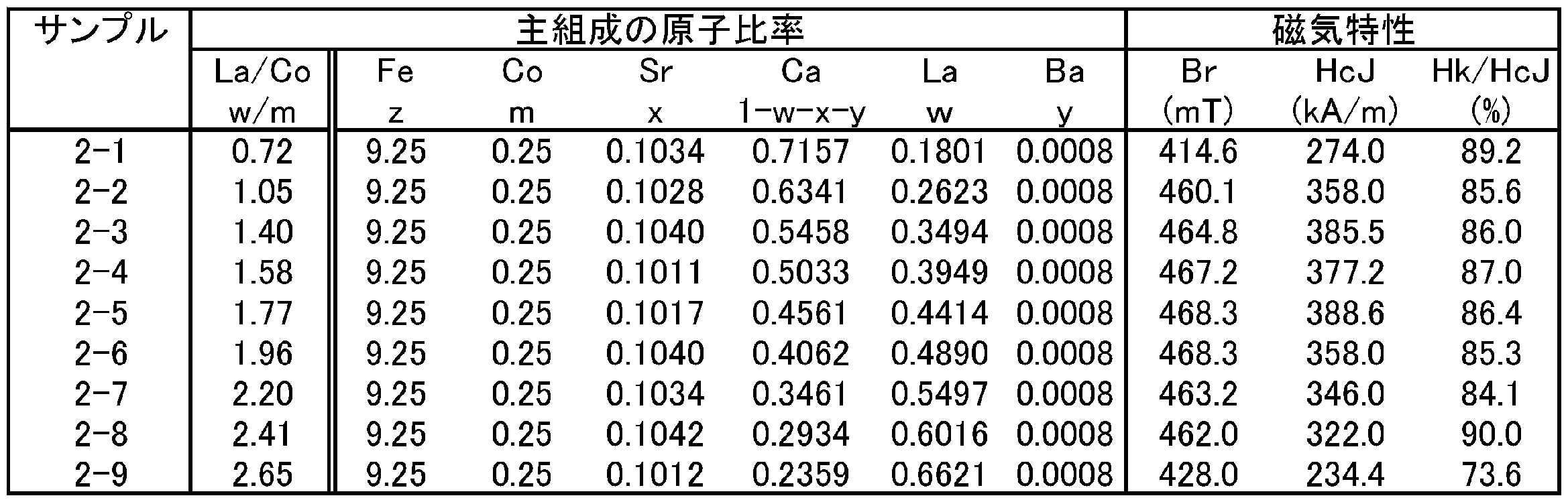
実験例3では、表3に示すように主組成の原子比率がそれぞれ異なるフェライト磁性材料が得られるように、複数の組み合わせの原料を準備したこと以外は、実施例1と同様にしてフェライト焼結磁石の製造を行った。この実験例3は、特にFe(z=7.80~12.10)の原子比率を大きく変化させて、サンプル3-1~3-10の各種フェライト焼結磁石を製造したものである。
実験例3で得られた各フェライト焼結磁石を用い、実験例1と同様にしてこれらのBr(mT)、HcJ(kA/m)及びHk/HcJ(%)を求めた。得られた結果を表3に示す。

実験例4では、表4に示すように主組成の原子比率がそれぞれ異なるフェライト磁性材料が得られるように、複数の組み合わせの原料を準備したこと以外は、実施例1と同様にしてフェライト焼結磁石の製造を行った。この実験例4は、特にCo(m=0.00~0.70)の原子比率を大きく変化させ、これに伴ってCo/Fe(m/z=0.000~0.076)及びLa/Co(w/m=0.564~3.589)が変化するようにして、サンプル4-1~4-7の各種フェライト焼結磁石を製造したものである。
実験例4で得られた各フェライト焼結磁石を用い、実験例1と同様にしてこれらのBr(mT)、HcJ(kA/m)及びHk/HcJ(%)を求めた。得られた結果を表4に示す。

実験例5では、表5に示すように主組成の原子比率がそれぞれ異なるフェライト磁性材料が得られるように、複数の組み合わせの原料を準備したこと以外は、実施例1と同様にしてフェライト焼結磁石の製造を行った。この実験例5は、特にBa(y=0.0002~0.0150)の原子比率を大きく変化させて、サンプル5-1~5-11の各種フェライト焼結磁石を製造したものである。
実験例5で得られた各フェライト焼結磁石を用い、実験例1と同様にしてこれらのBr(mT)、HcJ(kA/m)及びHk/HcJ(%)を求めた。
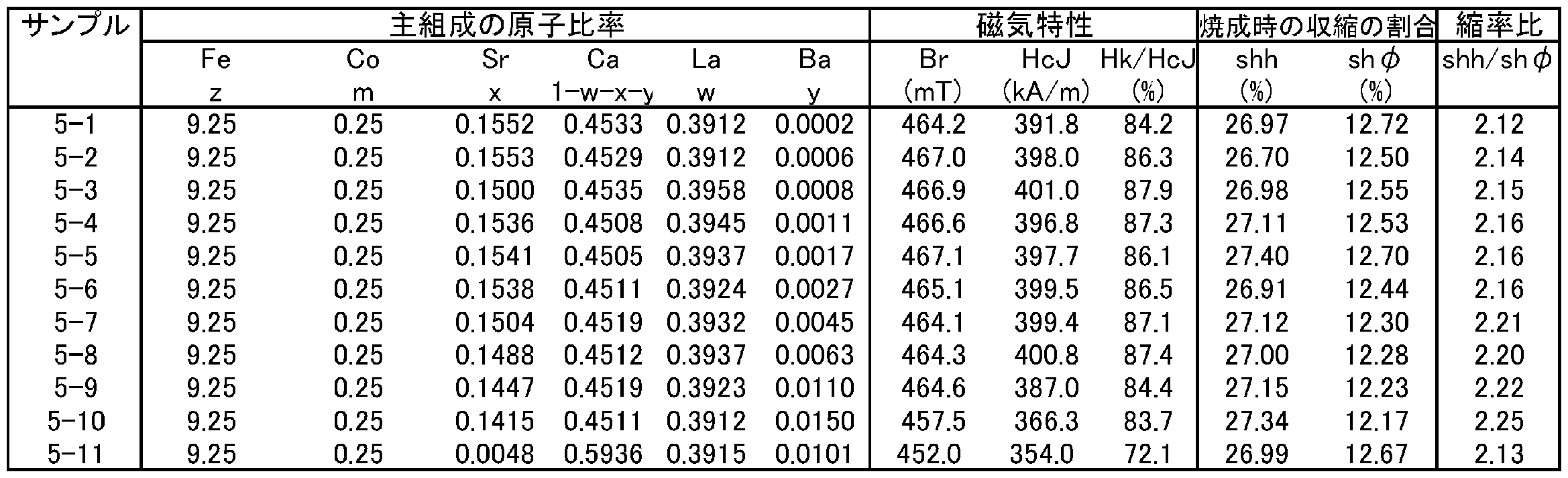
実験例6では、表6に示す通り、フェライト焼結磁石を構成するフェライト磁性材料の構成元素の割合(モル%)がそれぞれ異なるように、複数の組み合わせの原料を準備したこと以外は、実施例1と同様にしてフェライト焼結磁石の製造を行った。各構成元素の割合(モル%)は、各元素のそれぞれ表6に示す酸化物に換算したときの含有量を、全体を100%として規格化した値である。この実験例6は、特にSi成分(SiO2)の含有量を大きく変化させ、これに伴って「[(Ca+R+Sr+Ba)-(Fe+M)/12]/Si」の値が変化するようにして、サンプル6-1~6-5の各種フェライト焼結磁石を製造したものである。
実験例6で得られた各フェライト焼結磁石を用い、実験例1と同様にしてこれらのBr(mT)、HcJ(kA/m)及びHk/HcJ(%)を求めた。得られた結果を表6に示す。

まず、主組成におけるBaの原子比率(y)が、0.0002及び0.0045となるようにしたこと以外は、実施例1と同様にして円柱状のフェライト焼結磁石を作製した。これらについて、焼成時における成形体の収縮の割合を、厚み(shh(%)=100-(焼結体の厚み/成形体の厚み)×100)、及び直径(shΦ(%)=100-(焼結体の直径/成形体の直径)×100)をそれぞれ求め、これに基づいて焼結前後の縮率比(shh/shΦ:c軸方向/a軸方向)を算出した。
これとともに、これらと同様のフェライト磁性材料からなる、図1に示すアークセグメント型のフェライト焼結磁石をそれぞれ作製した。具体的には、各湿式成形用スラリーを得た後、アークセグメント形状が得られるように成形工程を行ったこと以外は、実験例1と同様にして、フェライト焼結磁石を得た。

目的とする焼結体の寸法を表8に示すように変えたこと以外は、実験例7と同様に2種類のフェライト磁性材料からなるフェライト焼結磁石の製造を行い、この際、同じ焼結体寸法を得るために必要となったそれぞれの成形体寸法を求めた。得られた結果を表8に示す。

目的とする焼結体の寸法を表9に示すように変えたこと以外は、実験例7と同様に2種類のフェライト磁性材料からなるフェライト焼結磁石の製造を行い、この際、同じ焼結体寸法を得るために必要となったそれぞれの成形体寸法を求めた。また、各フェライト磁性材料を用いた焼結体の製造をそれぞれ10000回行い、そのうち焼結体にクラックが生じた回数を数えるとともに、成形工程において、湿式成形用スラリーを金型に充填するのに要した平均時間を求めた。得られた結果を表9に示す。

Claims (3)
- 六方晶構造を有するフェライト相からなる主相を有するフェライト磁性材料であって、
下記式(1)で表される主組成を有し、
Ca1-w-x-yRwSrxBayFezMmO19 (1)
(式(1)中、Rは希土類元素(Yを含む)及びBiからなる群より選ばれる少なくとも1種の元素であってLaを少なくとも含み、Mは、Co、Mn、Mg、Ni、Cu及びZnからなる群より選ばれる少なくとも1種の元素であってCoを少なくとも含む。)
前記式(1)中、w、x、y、z及びmは、下記式(2)、(3)、(4)、(5)、(6)、(7)及び(8)を満たし、
0.25<w<0.65 (2)
0.01<x<0.45 (3)
0.0002<y<0.011 (4)
y<x (5)
8<z<11 (6)
1.0<w/m<2.5 (7)
0.017<m/z<0.065 (8)
副成分として少なくともSi成分を含み、該Si成分の総量が、前記主組成に対して0.1~3質量%であり、且つ、
Ca、R、Sr、Ba、Fe、M及びSiのモル比が、下記式(9)を満たす、1.5≦[(Ca+R+Sr+Ba)-(Fe+M)/12]/Si≦3.5 (9)
ことを特徴とするフェライト磁性材料。 - 請求項1記載のフェライト磁性材料からなり、アークセグメント形状を有し、且つ当該形状の中心角が30°以上である、ことを特徴とする磁石。
- 前記中心角が60°以上である、ことを特徴とする請求項2記載の磁石。
Priority Applications (6)
| Application Number | Priority Date | Filing Date | Title |
|---|---|---|---|
| US13/382,211 US9272955B2 (en) | 2009-07-08 | 2010-07-05 | Ferrite magnetic material |
| EP10797102.0A EP2452928B1 (en) | 2009-07-08 | 2010-07-05 | Ferrite magnetic material |
| EP16001943.6A EP3150567B1 (en) | 2009-07-08 | 2010-07-05 | Ferrite magnetic material |
| CN201080030766.4A CN102471162B (zh) | 2009-07-08 | 2010-07-05 | 铁氧体磁性材料 |
| KR1020147023258A KR20140114057A (ko) | 2009-07-08 | 2010-07-05 | 페라이트 자성 재료 |
| JP2011521908A JP5626211B2 (ja) | 2009-07-08 | 2010-07-05 | フェライト磁性材料 |
Applications Claiming Priority (2)
| Application Number | Priority Date | Filing Date | Title |
|---|---|---|---|
| JP2009-161927 | 2009-07-08 | ||
| JP2009161927 | 2009-07-08 |
Publications (1)
| Publication Number | Publication Date |
|---|---|
| WO2011004791A1 true WO2011004791A1 (ja) | 2011-01-13 |
Family
ID=43429215
Family Applications (1)
| Application Number | Title | Priority Date | Filing Date |
|---|---|---|---|
| PCT/JP2010/061403 Ceased WO2011004791A1 (ja) | 2009-07-08 | 2010-07-05 | フェライト磁性材料 |
Country Status (6)
| Country | Link |
|---|---|
| US (1) | US9272955B2 (ja) |
| EP (2) | EP3150567B1 (ja) |
| JP (1) | JP5626211B2 (ja) |
| KR (2) | KR20120041744A (ja) |
| CN (1) | CN102471162B (ja) |
| WO (1) | WO2011004791A1 (ja) |
Cited By (13)
| Publication number | Priority date | Publication date | Assignee | Title |
|---|---|---|---|---|
| EP2511249A4 (en) * | 2010-03-17 | 2013-10-02 | Tdk Corp | FERRITE MAGNETIC MATERIAL, FERRITMAGNET AND FERRITE INTERMAGNET |
| JP2013209265A (ja) * | 2012-03-30 | 2013-10-10 | Dowa Electronics Materials Co Ltd | 焼結粒子及びそれを用いた電子写真現像剤用キャリア、電子写真用現像剤並びに焼結粒子の製造方法 |
| JP2013216537A (ja) * | 2012-04-09 | 2013-10-24 | Dowa Electronics Materials Co Ltd | フェライト粒子の製造方法 |
| CN103548101A (zh) * | 2011-05-31 | 2014-01-29 | 双龙马泰里尔株式会社 | 磁铅石型铁氧体磁性材料以及由其得到的分段式永磁体 |
| WO2014034401A1 (ja) * | 2012-08-31 | 2014-03-06 | 日立金属株式会社 | フェライト仮焼体、フェライト焼結磁石の製造方法及びフェライト焼結磁石 |
| DE102017200454A1 (de) | 2016-01-15 | 2017-07-20 | Tdk Corporation | Gesinterter Ferritmagnet |
| JP2017126719A (ja) * | 2016-01-15 | 2017-07-20 | Tdk株式会社 | フェライト焼結磁石 |
| WO2020045573A1 (ja) * | 2018-08-31 | 2020-03-05 | Dowaエレクトロニクス株式会社 | ボンド磁石用フェライト粉末およびその製造方法 |
| JP2020038963A (ja) * | 2018-08-31 | 2020-03-12 | Dowaエレクトロニクス株式会社 | ボンド磁石用フェライト粉末およびその製造方法 |
| JP2020126931A (ja) * | 2019-02-05 | 2020-08-20 | Tdk株式会社 | フェライト焼結磁石 |
| JP2022007929A (ja) * | 2020-03-24 | 2022-01-13 | 日立金属株式会社 | フェライト仮焼体、フェライト焼結磁石及びその製造方法 |
| US11440848B2 (en) | 2019-02-07 | 2022-09-13 | Tdk Corporation | Ferrite sintered magnet |
| US11776720B2 (en) | 2020-03-24 | 2023-10-03 | Proterial, Ltd. | Calcined ferrite, and sintered ferrite magnet and its production method |
Families Citing this family (17)
| Publication number | Priority date | Publication date | Assignee | Title |
|---|---|---|---|---|
| EP2660829A4 (en) * | 2010-12-27 | 2017-11-29 | TDK Corporation | Magnetic body |
| CN102815933B (zh) * | 2012-09-10 | 2014-06-04 | 浙江省东阳市中航磁性有限公司 | 一种永磁钡铁氧体材料及其制备方法 |
| US9005490B2 (en) * | 2012-12-14 | 2015-04-14 | Delphi Technologies, Inc. | Material for solid state sintered material |
| JP6596828B2 (ja) * | 2014-03-07 | 2019-10-30 | Tdk株式会社 | フェライト焼結磁石及びそれを備えるモータ |
| WO2016033563A1 (en) | 2014-08-29 | 2016-03-03 | Ecolab Usa Inc. | Solid rinse aid composition comprising polyacrylic acid |
| CN104591720B (zh) * | 2015-02-06 | 2016-08-17 | 苏州欢颜电气有限公司 | 电气工程用铁氧体磁性材料 |
| CN104973858A (zh) * | 2015-05-28 | 2015-10-14 | 横店集团东磁股份有限公司 | 一种烧结永磁铁氧体材料及其制备方法 |
| KR102588231B1 (ko) * | 2016-06-20 | 2023-10-13 | 유니온머티리얼 주식회사 | 페라이트 자성재료 및 페라이트 소결자석 |
| KR102588230B1 (ko) * | 2016-06-20 | 2023-10-13 | 유니온머티리얼 주식회사 | 페라이트 자성재료 및 페라이트 소결자석 |
| CN106601418A (zh) * | 2016-11-17 | 2017-04-26 | 安徽荣玖智能装备科技有限公司 | 一种耐压新能源汽车磁力水泵用粉末冶金磁环及其制作方法 |
| CN108424137B (zh) * | 2018-03-13 | 2021-04-20 | 四川诺威胜电子科技有限公司 | 高各向异性低铁磁共振线宽六角铁氧体材料及制备方法 |
| TWI686356B (zh) * | 2019-05-10 | 2020-03-01 | 中國鋼鐵股份有限公司 | 改質鐵氧體磁粉及磁石的製造方法 |
| CN110467452A (zh) * | 2019-09-25 | 2019-11-19 | 横店集团东磁股份有限公司 | 一种永磁材料及其制备方法 |
| CN111362687A (zh) * | 2019-12-17 | 2020-07-03 | 横店集团东磁股份有限公司 | 一种永磁铁氧体及其制备方法 |
| JP7367582B2 (ja) * | 2020-03-23 | 2023-10-24 | Tdk株式会社 | フェライト焼結磁石 |
| FR3118029B1 (fr) * | 2020-12-22 | 2022-12-16 | Saint Gobain Ct Recherches | Bille magnetique |
| JP7716352B2 (ja) * | 2021-03-24 | 2025-07-31 | Tdk株式会社 | フェライト焼結磁石、フェライト粒子、ボンド磁石、及び、回転電気機械 |
Citations (5)
| Publication number | Priority date | Publication date | Assignee | Title |
|---|---|---|---|---|
| JPH0478566B2 (ja) | 1983-06-27 | 1992-12-11 | Mitsubishi Chem Ind | |
| JP2001076919A (ja) * | 1999-07-07 | 2001-03-23 | Tdk Corp | フェライト磁石およびその製造方法 |
| JP3163279B2 (ja) | 1997-02-25 | 2001-05-08 | ティーディーケイ株式会社 | 焼結磁石およびモータ |
| WO2007077811A1 (ja) | 2005-12-28 | 2007-07-12 | Hitachi Metals, Ltd. | 酸化物磁性材料 |
| WO2008105449A1 (ja) * | 2007-03-01 | 2008-09-04 | Tdk Corporation | フェライト焼結磁石 |
Family Cites Families (15)
| Publication number | Priority date | Publication date | Assignee | Title |
|---|---|---|---|---|
| DE69824362T2 (de) | 1997-02-25 | 2005-06-16 | Tdk Corp. | Magnetisches Oxidmaterial, Ferritteilchen, gesinterter Magnet, Verbundmagnet, magnetischer Aufzeichnungsträger und Motor |
| EP0940823B1 (en) | 1997-09-19 | 2008-03-05 | TDK Corporation | Sintered magnet |
| JP3181559B2 (ja) | 1997-09-19 | 2001-07-03 | ティーディーケイ株式会社 | 酸化物磁性材料、フェライト粒子、ボンディット磁石、焼結磁石、これらの製造方法および磁気記録媒体 |
| KR20070017466A (ko) | 2003-09-12 | 2007-02-12 | 가부시키가이샤 네오맥스 | 페라이트 소결 자석 |
| US7906036B2 (en) * | 2003-09-12 | 2011-03-15 | Neomax Co., Ltd. | Ferrite sintered magnet |
| WO2006028185A1 (ja) * | 2004-09-10 | 2006-03-16 | Neomax Co., Ltd. | 酸化物磁性材料および焼結磁石 |
| JP4215261B2 (ja) | 2004-10-29 | 2009-01-28 | Tdk株式会社 | フェライト磁性材料及びその製造方法 |
| JP4078566B2 (ja) | 2005-11-25 | 2008-04-23 | 日立金属株式会社 | 酸化物磁性材料及びその製造方法、並びにフェライト焼結磁石及びその製造方法 |
| CN100578695C (zh) * | 2005-12-19 | 2010-01-06 | Tdk株式会社 | 铁氧体磁性材料 |
| US7919007B2 (en) * | 2005-12-19 | 2011-04-05 | Tdk Corporation | Ferrite magnetic material |
| TWI433433B (zh) | 2006-03-10 | 2014-04-01 | Hitachi Metals Ltd | 黏結磁鐵及磁力輥 |
| JP2007258880A (ja) * | 2006-03-22 | 2007-10-04 | Tdk Corp | 非可逆回路素子 |
| JP4640432B2 (ja) * | 2008-03-31 | 2011-03-02 | Tdk株式会社 | フェライト焼結磁石 |
| KR101649242B1 (ko) * | 2009-06-30 | 2016-08-18 | 히타치 긴조쿠 가부시키가이샤 | 페라이트 소결 자석의 제조 방법 및 페라이트 소결 자석 |
| JP5120467B2 (ja) * | 2010-03-17 | 2013-01-16 | Tdk株式会社 | フェライト磁性材料、フェライト磁石、フェライト焼結磁石 |
-
2010
- 2010-07-05 EP EP16001943.6A patent/EP3150567B1/en active Active
- 2010-07-05 JP JP2011521908A patent/JP5626211B2/ja active Active
- 2010-07-05 KR KR1020127002961A patent/KR20120041744A/ko not_active Ceased
- 2010-07-05 WO PCT/JP2010/061403 patent/WO2011004791A1/ja not_active Ceased
- 2010-07-05 US US13/382,211 patent/US9272955B2/en active Active
- 2010-07-05 CN CN201080030766.4A patent/CN102471162B/zh active Active
- 2010-07-05 EP EP10797102.0A patent/EP2452928B1/en active Active
- 2010-07-05 KR KR1020147023258A patent/KR20140114057A/ko not_active Ceased
Patent Citations (5)
| Publication number | Priority date | Publication date | Assignee | Title |
|---|---|---|---|---|
| JPH0478566B2 (ja) | 1983-06-27 | 1992-12-11 | Mitsubishi Chem Ind | |
| JP3163279B2 (ja) | 1997-02-25 | 2001-05-08 | ティーディーケイ株式会社 | 焼結磁石およびモータ |
| JP2001076919A (ja) * | 1999-07-07 | 2001-03-23 | Tdk Corp | フェライト磁石およびその製造方法 |
| WO2007077811A1 (ja) | 2005-12-28 | 2007-07-12 | Hitachi Metals, Ltd. | 酸化物磁性材料 |
| WO2008105449A1 (ja) * | 2007-03-01 | 2008-09-04 | Tdk Corporation | フェライト焼結磁石 |
Non-Patent Citations (1)
| Title |
|---|
| See also references of EP2452928A1 |
Cited By (31)
| Publication number | Priority date | Publication date | Assignee | Title |
|---|---|---|---|---|
| US20140097378A1 (en) * | 2010-03-17 | 2014-04-10 | Tdk Corporation | Ferrite magnetic material, ferrite magnet, and ferrite sintered magnet |
| KR101613649B1 (ko) | 2010-03-17 | 2016-04-20 | 티디케이가부시기가이샤 | 페라이트 자성 재료, 페라이트 자석, 페라이트 소결 자석 |
| US9202613B2 (en) * | 2010-03-17 | 2015-12-01 | Tdk Corporation | Ferrite magnetic material, ferrite magnet, and ferrite sintered magnet |
| EP2511249A4 (en) * | 2010-03-17 | 2013-10-02 | Tdk Corp | FERRITE MAGNETIC MATERIAL, FERRITMAGNET AND FERRITE INTERMAGNET |
| EP2715747A4 (en) * | 2011-05-31 | 2014-12-24 | Ssangyong Materials Corp | MAGNETOPLUMBLY FERRITE MAGNETIC MATERIAL AND SEGMENTAL PERMANENT MAGNET FROM THIS |
| CN103548101A (zh) * | 2011-05-31 | 2014-01-29 | 双龙马泰里尔株式会社 | 磁铅石型铁氧体磁性材料以及由其得到的分段式永磁体 |
| CN103548101B (zh) * | 2011-05-31 | 2016-12-07 | 双龙马泰里尔株式会社 | 磁铅石型铁氧体磁性材料以及由其得到的分段式永磁体 |
| US10141091B2 (en) | 2011-05-31 | 2018-11-27 | Union Materials Corporation | Magnetoplumbite-type ferrite magnetic material and segment-type permanent magnet derived therefrom |
| JP2013209265A (ja) * | 2012-03-30 | 2013-10-10 | Dowa Electronics Materials Co Ltd | 焼結粒子及びそれを用いた電子写真現像剤用キャリア、電子写真用現像剤並びに焼結粒子の製造方法 |
| JP2013216537A (ja) * | 2012-04-09 | 2013-10-24 | Dowa Electronics Materials Co Ltd | フェライト粒子の製造方法 |
| WO2014034401A1 (ja) * | 2012-08-31 | 2014-03-06 | 日立金属株式会社 | フェライト仮焼体、フェライト焼結磁石の製造方法及びフェライト焼結磁石 |
| JPWO2014034401A1 (ja) * | 2012-08-31 | 2016-08-08 | 日立金属株式会社 | フェライト仮焼体、フェライト焼結磁石の製造方法及びフェライト焼結磁石 |
| US9601248B2 (en) | 2012-08-31 | 2017-03-21 | Hitachi Metals, Ltd. | Calcined ferrite, sintered ferrite magnet and its production method |
| DE102017200497A1 (de) | 2016-01-15 | 2017-07-20 | Tdk Corporation | Gesinterter Ferritmagnet |
| JP2017126719A (ja) * | 2016-01-15 | 2017-07-20 | Tdk株式会社 | フェライト焼結磁石 |
| JP2017126718A (ja) * | 2016-01-15 | 2017-07-20 | Tdk株式会社 | フェライト焼結磁石 |
| DE102017200454A1 (de) | 2016-01-15 | 2017-07-20 | Tdk Corporation | Gesinterter Ferritmagnet |
| US10249417B2 (en) | 2016-01-15 | 2019-04-02 | Tdk Corporation | Ferrite sintered magnet |
| US10373746B2 (en) | 2016-01-15 | 2019-08-06 | Tdk Corporation | Ferrite sintered magnet |
| DE102017200497B4 (de) | 2016-01-15 | 2024-10-17 | Tdk Corporation | Gesinterter Ferritmagnet |
| DE102017200454B4 (de) | 2016-01-15 | 2024-07-18 | Tdk Corporation | Gesinterter Ferritmagnet |
| KR20210041088A (ko) * | 2018-08-31 | 2021-04-14 | 도와 일렉트로닉스 가부시키가이샤 | 본드 자석용 페라이트 분말 및 그의 제조 방법 |
| KR102532582B1 (ko) * | 2018-08-31 | 2023-05-12 | 도와 일렉트로닉스 가부시키가이샤 | 본드 자석용 페라이트 분말 및 그의 제조 방법 |
| JP2020038963A (ja) * | 2018-08-31 | 2020-03-12 | Dowaエレクトロニクス株式会社 | ボンド磁石用フェライト粉末およびその製造方法 |
| WO2020045573A1 (ja) * | 2018-08-31 | 2020-03-05 | Dowaエレクトロニクス株式会社 | ボンド磁石用フェライト粉末およびその製造方法 |
| JP2020126931A (ja) * | 2019-02-05 | 2020-08-20 | Tdk株式会社 | フェライト焼結磁石 |
| JP7338161B2 (ja) | 2019-02-05 | 2023-09-05 | Tdk株式会社 | フェライト焼結磁石 |
| US11440848B2 (en) | 2019-02-07 | 2022-09-13 | Tdk Corporation | Ferrite sintered magnet |
| JP2022007929A (ja) * | 2020-03-24 | 2022-01-13 | 日立金属株式会社 | フェライト仮焼体、フェライト焼結磁石及びその製造方法 |
| US11404188B2 (en) | 2020-03-24 | 2022-08-02 | Hitachi Metals, Ltd. | Calcined ferrite, and sintered ferrite magnet and its production method |
| US11776720B2 (en) | 2020-03-24 | 2023-10-03 | Proterial, Ltd. | Calcined ferrite, and sintered ferrite magnet and its production method |
Also Published As
| Publication number | Publication date |
|---|---|
| EP2452928B1 (en) | 2016-09-07 |
| US20120161910A1 (en) | 2012-06-28 |
| CN102471162B (zh) | 2016-05-04 |
| CN102471162A (zh) | 2012-05-23 |
| KR20140114057A (ko) | 2014-09-25 |
| EP2452928A1 (en) | 2012-05-16 |
| US9272955B2 (en) | 2016-03-01 |
| EP3150567A1 (en) | 2017-04-05 |
| EP3150567B1 (en) | 2025-11-19 |
| EP2452928A4 (en) | 2013-01-30 |
| KR20120041744A (ko) | 2012-05-02 |
| JP5626211B2 (ja) | 2014-11-19 |
| JPWO2011004791A1 (ja) | 2012-12-20 |
Similar Documents
| Publication | Publication Date | Title |
|---|---|---|
| JP5626211B2 (ja) | フェライト磁性材料 | |
| JP6160619B2 (ja) | フェライト磁性材料、フェライト焼結磁石及びモータ | |
| JP5873333B2 (ja) | フェライト焼結磁石の製造方法及びフェライト焼結磁石 | |
| JP5418595B2 (ja) | 焼結磁石 | |
| JP5929764B2 (ja) | フェライト焼結磁石及びその製造方法 | |
| KR101347851B1 (ko) | 산화물 자성 재료 | |
| JP4215261B2 (ja) | フェライト磁性材料及びその製造方法 | |
| JP2019172507A (ja) | フェライト焼結磁石及びフェライト焼結磁石の製造方法 | |
| JP7000954B2 (ja) | フェライト焼結磁石 | |
| JP2021052097A (ja) | フェライト焼結磁石 | |
| JP5521622B2 (ja) | 酸化物磁性材料、フェライト焼結磁石及びフェライト焼結磁石の製造方法 | |
| JP2020129579A (ja) | フェライト焼結磁石 | |
| JP6863374B2 (ja) | フェライト磁石 | |
| JP7155573B2 (ja) | フェライト焼結磁石 | |
| JP2001052912A (ja) | フェライト磁石材料およびそれを用いた焼結磁石ならびにボンド磁石 | |
| JP7367581B2 (ja) | フェライト焼結磁石 | |
| JP4543849B2 (ja) | フェライト磁性材料 | |
| JP4924794B2 (ja) | フェライト磁性材料の製造方法 |
Legal Events
| Date | Code | Title | Description |
|---|---|---|---|
| WWE | Wipo information: entry into national phase |
Ref document number: 201080030766.4 Country of ref document: CN |
|
| 121 | Ep: the epo has been informed by wipo that ep was designated in this application |
Ref document number: 10797102 Country of ref document: EP Kind code of ref document: A1 |
|
| WWE | Wipo information: entry into national phase |
Ref document number: 2011521908 Country of ref document: JP |
|
| NENP | Non-entry into the national phase |
Ref country code: DE |
|
| ENP | Entry into the national phase |
Ref document number: 20127002961 Country of ref document: KR Kind code of ref document: A |
|
| REEP | Request for entry into the european phase |
Ref document number: 2010797102 Country of ref document: EP |
|
| WWE | Wipo information: entry into national phase |
Ref document number: 2010797102 Country of ref document: EP |
|
| WWE | Wipo information: entry into national phase |
Ref document number: 13382211 Country of ref document: US |