WO2011004833A1 - 固体電解質用組成物およびそれを用いた太陽電池 - Google Patents
固体電解質用組成物およびそれを用いた太陽電池 Download PDFInfo
- Publication number
- WO2011004833A1 WO2011004833A1 PCT/JP2010/061514 JP2010061514W WO2011004833A1 WO 2011004833 A1 WO2011004833 A1 WO 2011004833A1 JP 2010061514 W JP2010061514 W JP 2010061514W WO 2011004833 A1 WO2011004833 A1 WO 2011004833A1
- Authority
- WO
- WIPO (PCT)
- Prior art keywords
- monomer
- group
- composition
- polymer
- meth
- Prior art date
- Legal status (The legal status is an assumption and is not a legal conclusion. Google has not performed a legal analysis and makes no representation as to the accuracy of the status listed.)
- Ceased
Links
- 0 Cc(c(*)c1*I)c(*)c(*)c1N Chemical compound Cc(c(*)c1*I)c(*)c(*)c1N 0.000 description 5
Classifications
-
- C—CHEMISTRY; METALLURGY
- C08—ORGANIC MACROMOLECULAR COMPOUNDS; THEIR PREPARATION OR CHEMICAL WORKING-UP; COMPOSITIONS BASED THEREON
- C08L—COMPOSITIONS OF MACROMOLECULAR COMPOUNDS
- C08L101/00—Compositions of unspecified macromolecular compounds
- C08L101/02—Compositions of unspecified macromolecular compounds characterised by the presence of specified groups, e.g. terminal or pendant functional groups
-
- C—CHEMISTRY; METALLURGY
- C08—ORGANIC MACROMOLECULAR COMPOUNDS; THEIR PREPARATION OR CHEMICAL WORKING-UP; COMPOSITIONS BASED THEREON
- C08G—MACROMOLECULAR COMPOUNDS OBTAINED OTHERWISE THAN BY REACTIONS ONLY INVOLVING UNSATURATED CARBON-TO-CARBON BONDS
- C08G73/00—Macromolecular compounds obtained by reactions forming a linkage containing nitrogen with or without oxygen or carbon in the main chain of the macromolecule, not provided for in groups C08G12/00 - C08G71/00
- C08G73/02—Polyamines
- C08G73/026—Wholly aromatic polyamines
- C08G73/0266—Polyanilines or derivatives thereof
-
- C—CHEMISTRY; METALLURGY
- C08—ORGANIC MACROMOLECULAR COMPOUNDS; THEIR PREPARATION OR CHEMICAL WORKING-UP; COMPOSITIONS BASED THEREON
- C08J—WORKING-UP; GENERAL PROCESSES OF COMPOUNDING; AFTER-TREATMENT NOT COVERED BY SUBCLASSES C08B, C08C, C08F, C08G or C08H
- C08J5/00—Manufacture of articles or shaped materials containing macromolecular substances
- C08J5/20—Manufacture of shaped structures of ion-exchange resins
-
- C—CHEMISTRY; METALLURGY
- C08—ORGANIC MACROMOLECULAR COMPOUNDS; THEIR PREPARATION OR CHEMICAL WORKING-UP; COMPOSITIONS BASED THEREON
- C08K—Use of inorganic or non-macromolecular organic substances as compounding ingredients
- C08K3/00—Use of inorganic substances as compounding ingredients
- C08K3/02—Elements
- C08K3/04—Carbon
-
- C—CHEMISTRY; METALLURGY
- C08—ORGANIC MACROMOLECULAR COMPOUNDS; THEIR PREPARATION OR CHEMICAL WORKING-UP; COMPOSITIONS BASED THEREON
- C08K—Use of inorganic or non-macromolecular organic substances as compounding ingredients
- C08K3/00—Use of inorganic substances as compounding ingredients
- C08K3/02—Elements
- C08K3/04—Carbon
- C08K3/041—Carbon nanotubes
-
- C—CHEMISTRY; METALLURGY
- C08—ORGANIC MACROMOLECULAR COMPOUNDS; THEIR PREPARATION OR CHEMICAL WORKING-UP; COMPOSITIONS BASED THEREON
- C08K—Use of inorganic or non-macromolecular organic substances as compounding ingredients
- C08K3/00—Use of inorganic substances as compounding ingredients
- C08K3/02—Elements
- C08K3/04—Carbon
- C08K3/045—Fullerenes
-
- C—CHEMISTRY; METALLURGY
- C08—ORGANIC MACROMOLECULAR COMPOUNDS; THEIR PREPARATION OR CHEMICAL WORKING-UP; COMPOSITIONS BASED THEREON
- C08L—COMPOSITIONS OF MACROMOLECULAR COMPOUNDS
- C08L79/00—Compositions of macromolecular compounds obtained by reactions forming in the main chain of the macromolecule a linkage containing nitrogen with or without oxygen or carbon only, not provided for in groups C08L61/00 - C08L77/00
- C08L79/02—Polyamines
-
- H—ELECTRICITY
- H01—ELECTRIC ELEMENTS
- H01B—CABLES; CONDUCTORS; INSULATORS; SELECTION OF MATERIALS FOR THEIR CONDUCTIVE, INSULATING OR DIELECTRIC PROPERTIES
- H01B1/00—Conductors or conductive bodies characterised by the conductive materials; Selection of materials as conductors
- H01B1/20—Conductive material dispersed in non-conductive organic material
-
- H—ELECTRICITY
- H01—ELECTRIC ELEMENTS
- H01G—CAPACITORS; CAPACITORS, RECTIFIERS, DETECTORS, SWITCHING DEVICES, LIGHT-SENSITIVE OR TEMPERATURE-SENSITIVE DEVICES OF THE ELECTROLYTIC TYPE
- H01G9/00—Electrolytic capacitors, rectifiers, detectors, switching devices, light-sensitive or temperature-sensitive devices; Processes of their manufacture
- H01G9/20—Light-sensitive devices
- H01G9/2004—Light-sensitive devices characterised by the electrolyte, e.g. comprising an organic electrolyte
- H01G9/2009—Solid electrolytes
-
- C—CHEMISTRY; METALLURGY
- C08—ORGANIC MACROMOLECULAR COMPOUNDS; THEIR PREPARATION OR CHEMICAL WORKING-UP; COMPOSITIONS BASED THEREON
- C08G—MACROMOLECULAR COMPOUNDS OBTAINED OTHERWISE THAN BY REACTIONS ONLY INVOLVING UNSATURATED CARBON-TO-CARBON BONDS
- C08G2261/00—Macromolecular compounds obtained by reactions forming a carbon-to-carbon link in the main chain of the macromolecule
- C08G2261/30—Monomer units or repeat units incorporating structural elements in the main chain
- C08G2261/32—Monomer units or repeat units incorporating structural elements in the main chain incorporating heteroaromatic structural elements in the main chain
- C08G2261/322—Monomer units or repeat units incorporating structural elements in the main chain incorporating heteroaromatic structural elements in the main chain non-condensed
- C08G2261/3221—Monomer units or repeat units incorporating structural elements in the main chain incorporating heteroaromatic structural elements in the main chain non-condensed containing one or more nitrogen atoms as the only heteroatom, e.g. pyrrole, pyridine or triazole
-
- C—CHEMISTRY; METALLURGY
- C08—ORGANIC MACROMOLECULAR COMPOUNDS; THEIR PREPARATION OR CHEMICAL WORKING-UP; COMPOSITIONS BASED THEREON
- C08G—MACROMOLECULAR COMPOUNDS OBTAINED OTHERWISE THAN BY REACTIONS ONLY INVOLVING UNSATURATED CARBON-TO-CARBON BONDS
- C08G2261/00—Macromolecular compounds obtained by reactions forming a carbon-to-carbon link in the main chain of the macromolecule
- C08G2261/30—Monomer units or repeat units incorporating structural elements in the main chain
- C08G2261/32—Monomer units or repeat units incorporating structural elements in the main chain incorporating heteroaromatic structural elements in the main chain
- C08G2261/322—Monomer units or repeat units incorporating structural elements in the main chain incorporating heteroaromatic structural elements in the main chain non-condensed
- C08G2261/3223—Monomer units or repeat units incorporating structural elements in the main chain incorporating heteroaromatic structural elements in the main chain non-condensed containing one or more sulfur atoms as the only heteroatom, e.g. thiophene
-
- C—CHEMISTRY; METALLURGY
- C08—ORGANIC MACROMOLECULAR COMPOUNDS; THEIR PREPARATION OR CHEMICAL WORKING-UP; COMPOSITIONS BASED THEREON
- C08J—WORKING-UP; GENERAL PROCESSES OF COMPOUNDING; AFTER-TREATMENT NOT COVERED BY SUBCLASSES C08B, C08C, C08F, C08G or C08H
- C08J2379/00—Characterised by the use of macromolecular compounds obtained by reactions forming in the main chain of the macromolecule a linkage containing nitrogen with or without oxygen, or carbon only, not provided for in groups C08J2361/00 - C08J2377/00
- C08J2379/02—Polyamines
-
- C—CHEMISTRY; METALLURGY
- C08—ORGANIC MACROMOLECULAR COMPOUNDS; THEIR PREPARATION OR CHEMICAL WORKING-UP; COMPOSITIONS BASED THEREON
- C08L—COMPOSITIONS OF MACROMOLECULAR COMPOUNDS
- C08L2203/00—Applications
- C08L2203/20—Applications use in electrical or conductive gadgets
-
- H—ELECTRICITY
- H01—ELECTRIC ELEMENTS
- H01G—CAPACITORS; CAPACITORS, RECTIFIERS, DETECTORS, SWITCHING DEVICES, LIGHT-SENSITIVE OR TEMPERATURE-SENSITIVE DEVICES OF THE ELECTROLYTIC TYPE
- H01G9/00—Electrolytic capacitors, rectifiers, detectors, switching devices, light-sensitive or temperature-sensitive devices; Processes of their manufacture
- H01G9/20—Light-sensitive devices
- H01G9/2027—Light-sensitive devices comprising an oxide semiconductor electrode
- H01G9/2031—Light-sensitive devices comprising an oxide semiconductor electrode comprising titanium oxide, e.g. TiO2
-
- H—ELECTRICITY
- H01—ELECTRIC ELEMENTS
- H01G—CAPACITORS; CAPACITORS, RECTIFIERS, DETECTORS, SWITCHING DEVICES, LIGHT-SENSITIVE OR TEMPERATURE-SENSITIVE DEVICES OF THE ELECTROLYTIC TYPE
- H01G9/00—Electrolytic capacitors, rectifiers, detectors, switching devices, light-sensitive or temperature-sensitive devices; Processes of their manufacture
- H01G9/20—Light-sensitive devices
- H01G9/2059—Light-sensitive devices comprising an organic dye as the active light absorbing material, e.g. adsorbed on an electrode or dissolved in solution
-
- Y—GENERAL TAGGING OF NEW TECHNOLOGICAL DEVELOPMENTS; GENERAL TAGGING OF CROSS-SECTIONAL TECHNOLOGIES SPANNING OVER SEVERAL SECTIONS OF THE IPC; TECHNICAL SUBJECTS COVERED BY FORMER USPC CROSS-REFERENCE ART COLLECTIONS [XRACs] AND DIGESTS
- Y02—TECHNOLOGIES OR APPLICATIONS FOR MITIGATION OR ADAPTATION AGAINST CLIMATE CHANGE
- Y02E—REDUCTION OF GREENHOUSE GAS [GHG] EMISSIONS, RELATED TO ENERGY GENERATION, TRANSMISSION OR DISTRIBUTION
- Y02E10/00—Energy generation through renewable energy sources
- Y02E10/50—Photovoltaic [PV] energy
- Y02E10/542—Dye sensitized solar cells
Definitions
- the present invention relates to a composition for solid electrolyte and a solar cell using the same.
- the role of the electrolyte layer in the dye-sensitized solar cell is important, and usually the redox ability of I ⁇ / I 3 ⁇ by the combination of iodine anions such as iodine and lithium iodide is used. For this reason, when aiming for a highly efficient dye-sensitized solar cell, the electrolyte layer uses a solvent with a high degree of ion dissociation in order to sufficiently extract iodine redox efficiency, and allows the diffusion of iodine ions at a sufficient speed. There is a need. However, considering the use of a solar cell, making the electrolyte layer into a liquid material requires strict sealing in terms of liquid leakage and prevention of air diffusion. Furthermore, it is necessary to introduce iodine anions and iodine molecules in order for the iodine redox to function, which may cause problems of corrosion and deterioration of the material.
- a gelling agent is mixed with the electrolyte solution to form a gel, and an iodine redox couple as an electrolytic substrate is dissolved (polyvinylidene fluoride, polyethylene glycol, polyvinyl alcohol, polyvinylpyrrolidone capable of ion dissociation with a solid substance)
- an iodine redox couple as an electrolytic substrate is dissolved (polyvinylidene fluoride, polyethylene glycol, polyvinyl alcohol, polyvinylpyrrolidone capable of ion dissociation with a solid substance)
- a method of dissociating and dissolving in a polymer material, etc.) and quasi-individualization has been proposed. In this case, however, the ion diffusing ability is deteriorated, and the reduction of conversion efficiency and the deterioration of battery life are problematic.
- the electrolyte in the dye-sensitized solar cell is required to have a sufficient ion diffusion rate, and further requires a redox pair for stabilizing the anion that has delivered electrons.
- these electrochemical electron cycles contribute to the extension of the life of the charge, which can be said to be a major feature of the dye-sensitized solar cell.
- Patent Document 3 considering the fact that diffusion of ionic molecules in a pseudo-individual state is physically difficult, a method of directly introducing ion pairs into a charge transfer material is being studied (Patent Document 3, etc.) ), which stabilizes the anion by making the unstable anion that has undergone electron transfer function the oxidation-reduction ability of the conductive polymer, and further, the point where insufficient ion diffusion is achieved by the conductive polymer having charge transfer ability. Compensates by performing a charge path. For this reason, the electrolyte layer is obtained in a solid state, and redox ability is expressed without using iodine as an essential component.
- Patent Document 3 there is room for improvement in terms of efficiency because the ion pair and the conductive polymer are not sufficiently dissolved together.
- a polymer in which ⁇ conjugation has originally developed has high planarity of the polymer chain and high crystallinity (stacking property) between polymer chains due to the affinity of ⁇ bond.
- the planarity and crystallinity are enhanced.
- the solubility (solubility by heat or a solvent) of the ⁇ -conjugated polymer doped with the dopant is usually lowered.
- conductive polymers and ion pairs doped at higher orders cannot be mixed at the molecular level, and ion dissociation is incomplete due to localization of ion pairs, and sufficient power generation efficiency cannot be obtained. is there.
- Patent Document 1 attempts to produce conductive polyaniline with improved solubility. Specifically, in an aqueous solution, a polyaniline monomer is reacted with a surfactant composed of a sulfonic acid metal salt, an ammonium sulfonate salt or a phosphate ester having a repeating structure of an alkylene ether in the molecular structure, and the parent is reacted.
- a surfactant composed of a sulfonic acid metal salt, an ammonium sulfonate salt or a phosphate ester having a repeating structure of an alkylene ether in the molecular structure
- An aniline-surfactant salt with a solvating structure is produced and oxidatively polymerized using this as a monomer.
- a ketone solvent or an aromatic solvent is added to the obtained aqueous solution of conductive polyaniline to separate the supernatant, and the conductive polyaniline and the above solvent are mixed in the supernatant to obtain a conductive film for forming a conductive coating film.
- a polyaniline solution is produced.
- the conductive polyaniline solution prepared in Patent Document 1 has a problem that the conductive polyaniline remains in a granular form and is not uniformly dissolved. Further, an ion pair is added to these conductive polyaniline solutions. In addition, significant aggregation occurs due to the interaction between the dopant component and the ion pair. In addition, since the ion pair cannot be solidified, sufficient power generation efficiency cannot be obtained.
- Patent Document 4 proposes a solid solution polymer of an electrolyte.
- the polymer structure is a liquid crystalline polymer.
- these carriers are also ions only, and the dissociation constant of the added ion pair is not adjusted.
- a polymer material capable of dissolving ion pairs in a solid state is used as a matrix layer, and the charge transfer material can be mixed in order to provide a sufficient charge transfer path in these matrix layers.
- the charge transfer material used here needs to have corrosion resistance against ionic substances.
- the function can be generated by simply mixing the material capable of solidifying these ion pairs and the charge transporting substance, but further, a dopant material doped in the charge transporting material such as a conductive polymer is used. It has a function capable of forming a solid solution of ion pairs, and it is desirable that the ion pair be made more uniform at the molecular level.
- a nanoporous titanium oxide layer or the like is generally used for the anode electrode on which the dye is immobilized, and it is necessary to sufficiently fill these voids.
- the present invention relates to the following.
- the monomer (a) includes the monomer (a-2) having the chelating ability and the monomer (a-1) having a sulfonic acid group or a sulfonate group, The solid according to [2] or [3], wherein the monomer (a) contains the monomer (a-1) having a sulfonic acid group or a sulfonic acid group in an amount of 4 mol% or less.
- Composition for electrolyte includes the monomer (a-2) having the chelating ability and the monomer (a-1) having a sulfonic acid group or a sulfonate group.
- the ⁇ -conjugated polymer ( ⁇ ) is a ⁇ -conjugated polymer obtained by polymerizing at least one monomer selected from monomers represented by the following formulas (I) to (III).
- R 1 to R 6 each independently represents a hydrogen atom, an alkyl group having 1 to 12 carbon atoms or an alkoxy group having 1 to 10 carbon atoms
- R 7 represents a hydrogen atom, an alkyl group having 1 to 12 carbon atoms.
- the monomer (a-2) having the chelating ability is a monomer having a pyridyl group or a phenanthroline structure, or a group represented by the following formula (IV) or represented by the following formula (V):
- the polymer compound (A) is a polymer compound obtained by polymerizing the monomer (a-2) having the chelating ability and the monomer (a-1) having a sulfonic acid group or a sulfonate group.
- the charge transfer material is a ⁇ -conjugated polymer ( ⁇ )
- the solid electrolyte composition polymerizes monomers in an electrolytic substrate solvent to form the ⁇ -conjugated polymer ( ⁇ )
- the composition for solid electrolytes according to [2] which is obtained by doping the molecular compound (A) into the ⁇ -conjugated polymer ( ⁇ ).
- the polymer compound (A) includes 10 to 50 mol% of the monomer (a-1) having the sulfonic acid group or sulfonate group, and 10 to 90 mol% of the monomer (a-2) having the chelating ability. And a polymer compound obtained by polymerizing 0 to 70 mol% of other monomer (a-3) (Here, the total amount of monomers (a-1) to (a-3) is 100 mol%).
- the ⁇ -conjugated polymer ( ⁇ ) is a ⁇ -conjugated polymer obtained by polymerizing at least one monomer selected from monomers represented by the following formulas (I) to (III): The composition for solid electrolytes according to [8] or [9], which is characterized.
- R 1 to R 6 each independently represents a hydrogen atom, an alkyl group having 1 to 12 carbon atoms or an alkoxy group having 1 to 10 carbon atoms
- R 7 represents a hydrogen atom, an alkyl group having 1 to 12 carbon atoms.
- the monomer (a-2) having the chelating ability is a monomer having a pyridyl group or a phenanthroline structure, or a group represented by the following formula (IV) or represented by the following formula (V):
- R 8 represents an alkyl group having 1 to 4 carbon atoms.
- R 9 represents an ethylene group, and R 10 represents an alkyl group having 1 to 4 carbon atoms.
- N represents an integer of 1 to 5.
- composition for a solid electrolyte of the present invention when a polymer electrolyte layer of a dye-sensitized solar cell is formed, both efficient charge transfer and sufficient charge life can be achieved.
- composition for solid electrolytes of the present invention can be uniformly dissolved or dispersed in a solvent, and a smooth film can be formed. Furthermore, even if an ionic compound is blended with the above-mentioned composition for solid electrolyte in a solvent, a smooth film can be formed. In other words, the solid electrolyte composition of the present invention can form a highly stable solution.
- (meth) acryl means acryl or methacryl
- (meth) acryloyl means acryloyl or methacryloyl
- (meth) acrylate means acrylate or methacrylate.
- the composition for solid electrolyte of the present invention comprises a polymer (A) and a charge transfer material, and the polymer compound (A) comprises a monomer (a) containing a monomer (a-2) having chelating ability. It is a polymer compound obtained by polymerization. More specifically, the solid electrolyte composition is a composition containing the polymer compound (A) and a carbon material or a ⁇ -conjugated polymer ( ⁇ ) (aspects 1 and 2), or This is a composition obtained by doping a polymer compound (A) into a ⁇ -conjugated polymer ( ⁇ ) (Aspect 3).
- composition obtained by doping a polymer compound (A) into a ⁇ -conjugated polymer ( ⁇ ) is simply referred to as “a ⁇ -conjugated system high in which the polymer compound (A) is doped”. Also referred to as “molecule ( ⁇ )” or “doped ⁇ -conjugated polymer ( ⁇ )”.
- composition for solid electrolyte of aspect 1 includes the polymer compound (A) and a carbon material.
- the composition for solid electrolyte of embodiment 1 is also simply referred to as “the composition of embodiment 1”.
- the polymer compound (A) is obtained by polymerizing the monomer (a) including the monomer (a-2) having chelating ability.
- a solution in which the composition is usually dispersed is formed.
- the interaction with the ion pair is relatively weak, so that it is difficult to aggregate. That is, the solution obtained from the composition for solid electrolyte of aspect 1 has high stability.
- the monomer (a) for preparing the polymer compound (A) only the monomer (a-2) having a chelating ability may be used. Furthermore, the monomer (a) having a sulfonic acid group or a sulfonate group -1) and other monomers (a-3) may be used. In the present specification, “monomer having a sulfonic acid group or sulfonate group (a-1)”, “monomer having chelating ability (a-2)” and “other monomer (a-3)” These are also simply referred to as “monomer (a-1)”, “monomer (a-2)” and “monomer (a-3)”, respectively.
- the monomer (a-2) having a chelating ability is derived from a group having a chelating ability (a group capable of coordinating to ions, for example, when the composition of embodiment 1 is mixed with an ionic compound in a solvent.
- lithium ions or ammonium ions are preferably used as ions derived from ionic compounds (cationic species).
- ionic compounds cationic species.
- membrane obtained from the composition of aspect 1 can exhibit high electrical conductivity.
- Monomers (a-2) may be used alone or in combination of two or more.
- the monomer (a-2) preferably has a group having a chelating ability and a polymerizable vinyl group.
- a group having chelating ability for example, a pyridyl group, a 1,10-phenanthroline structure, a group represented by the following formula (IV), or a group represented by the following formula (V) is preferable.
- the oxygen atom contained in the group represented by the following formula (IV) or the group represented by the following formula (V) can be easily coordinated to an ion (cationic species) derived from the ionic compound.
- R 8 is an alkyl group having 1 to 4 carbon atoms.
- the alkyl group include a methyl group, an ethyl group, a propyl group, and a butyl group. Of these, a methyl group is more preferable.
- R 9 represents an ethylene group.
- R 10 represents an alkyl group having 1 to 4 carbon atoms. Examples of the alkyl group include a methyl group, an ethyl group, a propyl group, and a butyl group. Of these, a methyl group is more preferable.
- n represents an integer of 1 to 5.
- examples of such a monomer (a-2) include 2-acetoacetoxyethyl (meth) acrylate, methoxyethyl (meth) acrylate, ethoxyethyl (meth) acrylate, butoxyethyl (meth) acrylate,
- Examples include methoxy polyethylene glycol (meth) acrylate, ethyl carbitol (meth) acrylate, methoxy diethylene glycol methacrylate, methoxy triethylene glycol (meth) acrylate, vinyl pyridine, and vinyl phenanthroline.
- the monomer (a-1) having a sulfonic acid group or a sulfonic acid group is preferably a monomer having a sulfonic acid group or a sulfonic acid group and a polymerizable vinyl group.
- Monomers (a-1) may be used alone or in combination of two or more.
- the monomer (a-1) may have a sulfonic acid group and a sulfonic acid group.
- Examples of such a monomer (a-1) include styrene sulfonic acid; styrene sulfonate such as sodium styrene sulfonate, potassium styrene sulfonate, calcium styrene sulfonate; ethyl (meth) acrylate 2-sulfonic acid; And ethyl (meth) acrylate 2-sulfonate such as ethyl acrylate 2-sodium sulfonate, ethyl (meth) acrylate 2-potassium sulfonate, ethyl (meth) acrylate 2-calcium sulfonate, and the like. . Of these, sodium styrenesulfonate and ethyl (meth) acrylate 2-sodium sulfonate are preferred because copolymerization with other copolymerization monomers is easy.
- Other monomer (a-3) is a monomer other than monomer (a-1) and monomer (a-2).
- the monomer (a-3) include a monomer (a-3-1) having a hydrophilic group and a polymerizable vinyl group, and a monomer (a-3) having an aromatic group or alicyclic group and a polymerizable vinyl group. -2), or a monomer (a-3-3) having an alkyl group and a polymerizable vinyl group is preferably used.
- a monomer having a hydrophilic group and a polymerizable vinyl group has a pH of more than 5.5 and less than 8.0 when dissolved at 0.1 mmol / l in distilled water at pH 7.0 at room temperature. (5.5 ⁇ pH ⁇ 8.0).
- Monomers (a-3) may be used alone or in combination of two or more.
- (meth) acrylic monomers are more preferably used.
- (meth) acrylic monomer (a-3-1) examples include acrylic acid, methacrylic acid, 2-methacryloyloxyethyl succinic acid, 2-hydroxyethyl (meth) acrylate, 2- Examples thereof include hydroxypropyl (meth) acrylate, 4-hydroxybutyl (meth) acrylate, ⁇ - (meth) acryloyloxyethyl hydrogen succinate and the like.
- the monomer (a-3-2) that is a (meth) acrylic monomer include benzyl (meth) acrylate, phenoxyethyl (meth) acrylate, ethyl (meth) acrylate 2-methyl phthalate, (Meth) acrylic acid ethyl 2-phthalic acid ethyl ester, cyclohexyl (meth) acrylate, dicyclopentanyl (meth) acrylate, dicyclopentanyloxyethyl (meth) acrylate, dicyclopentenyl (meth) acrylate, sidiclopentenyl Oxyethyl (meth) acrylate, isobornyl (meth) acrylate, t-butylcyclohexyl (meth) acrylate, cyclohexyl (meth) acrylate, (meth) acrylate morpholine, pentamethylpiperidinyl methacrylate, tetramethyl Rupipe
- the monomer (a-3-3) that is a (meth) acrylic monomer include methyl (meth) acrylate, ethyl (meth) acrylate, n-propyl (meth) acrylate, and i-propyl (meth) acrylate.
- the monomer (a-3-1) other than the (meth) acrylic monomer and having a hydrophilic group and a polymerizable vinyl group (anhydrous) maleic acid may be mentioned.
- Specific examples of the monomer (a-3-2) other than the (meth) acrylic monomer having an aromatic group or alicyclic group and a polymerizable vinyl group include styrene and dimethylstyrene. Vinyl naphthalene, n-vinyl carbazole, vinyl n-ethyl carbazole, and vinyl fluorene.
- the polymer compound (A) used in the present invention is obtained by polymerizing the monomer (a), and the monomer (a-2) is contained in an amount of 30 mol% or more in 100 mol% of the monomer (a). It is preferable. That is, only the monomer (a-2) may be used as the monomer (a).
- monomer (a-3) When monomer (a-3) is used as monomer (a) together with monomer (a-2), monomer (a-2) is contained in an amount of 30 mol% or more and less than 100 mol% in 100 mol% of monomer (a).
- the monomer (a-3) is preferably contained in an amount of more than 0 mol% and 70 mol% or less.
- the monomer (a-1) is used together with the monomer (a-2) as the monomer (a)
- the monomer (a-2) is used in an amount of 96 mol% or more and less than 100 mol% in 100 mol% of the monomer (a). It is preferable that the monomer (a-1) is contained in an amount of more than 0 mol% and 4 mol% or less.
- the monomer (a-2) is 30 mol% in 100 mol% of the monomer (a). It is preferably contained in an amount of less than 100 mol%, monomer (a-1) exceeding 0 mol% and 4 mol% or less, and monomer (a-3) exceeding 0 mol% and not more than 66 mol%.
- the amount of the monomer (a-1) is the total amount of the two or more monomers. The same applies to the monomer (a-2) and the monomer (a-3).
- the balance between hydrophobicity and hydrophilicity can be adjusted by polymerizing the hydrophilic monomer (a-1) and other monomers (a-3) in the above amounts. Therefore, the dispersibility of the composition of aspect 1 can be improved. Further, when the monomer (a-2) is polymerized in the above amount, the conductivity of the film obtained from the composition of Embodiment 1 is improved. In the case where the polymer compound (A) is produced using the monomer (a-3) when the composition of Embodiment 1 is applied to a dye-sensitized solar cell, the conversion efficiency of the solar cell is reduced. There is. Therefore, it is also preferable not to use the monomer (a-3) as little as possible or not to produce the polymer compound (A).
- the polymerization reaction of the monomers (a-1) to (a-3) can be performed by a known method. For example, after mixing these monomers, a polymerization initiator is added thereto, and polymerization is started by heating, light irradiation, etc., and the polymer compound (A) can be produced.
- the polymerization method for producing the polymer compound (A) is not particularly limited as long as it can be carried out so that a specific monomer is not separated from the monomer mixture.
- solution polymerization method bulk ( (Bulk) polymerization method and precipitation polymerization method.
- the polymerization initiator used in the polymerization reaction is not particularly limited as long as it can be dissolved in the above components and the solvent used in the reaction.
- the polymerization initiator include oil-soluble peroxide-based thermal polymerization initiators such as benzoyl peroxide (BPO), oil-soluble azo-based thermal polymerization initiators such as azobisisobutyronitrile (AIBN), azobiscyanovaleric acid ( Water-soluble azo-based thermal polymerization initiators such as ACVA).
- a water-soluble peroxide-based thermal polymerization initiator such as ammonium persulfate or potassium persulfate or hydrogen peroxide water may be used.
- redox agents such as ferrocene and amines are possible.
- polymerization initiators can be used, for example, in the range of 0.001 to 0.1 mol with respect to 1 mol of the total amount of the monomers, and any method of batch charging, dropping charging and sequential charging can be used.
- a polymerization method using a combination of mercaptan and metallocene is also possible (see, for example, JP-A-2000-344823). It is.
- the solvent used in the polymerization reaction includes alcohol solvents such as methanol, ethanol, isopropyl alcohol and butanol, ketone solvents such as acetone, methyl ethyl ketone and methyl isobutyl ketone, methyl cellosolve, ethyl cellosolve, propylene glycol methyl ether, propylene
- alcohol solvents such as methanol, ethanol, isopropyl alcohol and butanol
- ketone solvents such as acetone, methyl ethyl ketone and methyl isobutyl ketone
- methyl cellosolve ethyl cellosolve
- propylene glycol methyl ether propylene
- glycol solvents such as glycol ethyl ether
- ester solvents such as ethyl acetate, methyl lactate, and ethyl lactate.
- a chain transfer agent may be used in combination with the polymerization initiator in addition to the polymerization initiator. It is used appropriately when it is desired to adjust the molecular weight.
- the chain transfer agent that can be used is not particularly limited as long as it can be dissolved in the above-mentioned monomer or solvent.
- An oily radical inhibitor such as dimer (ASD) can be used.
- this polymerization reaction is preferably performed at a temperature equal to or lower than the boiling point of the solvent to be used (except in the case of bulk polymerization), for example, at about 65 ° C. to 80 ° C.
- a temperature equal to or lower than the boiling point of the solvent to be used except in the case of bulk polymerization
- it is preferably carried out at 25 ° C. to 80 ° C.
- the polymer obtained as described above can be purified as necessary to obtain a polymer compound (A).
- a polymer compound (A) for example, low-molecular impurities such as oleaginous low-molecular impurities and residual monomers are removed with an oily poor solvent such as hexane, and then the polymer is precipitated with an aqueous poor solvent such as acetonitrile and methanol, and water-based impurities and Remove any residue.
- the polymer compound (A) obtained as described above preferably has a GPC equivalent weight average molecular weight of 3,000 to 100,000. If the weight average molecular weight is less than 3,000, the function as a polymer compound may be insufficient. Conversely, when it exceeds 100,000, the solubility of the polymer compound itself in the solvent may be poor.
- Examples of the carbon material include graphite, carbon black, fullerene, and carbon nanotube.
- the carbon material is preferably at least one selected from graphite, carbon black, fullerene and carbon nanotube.
- Graphite may be used alone or in combination of two or more. The same applies to carbon black, fullerene and carbon nanotube.
- the carbon material is preferably added in an amount of about 0.1 to 600 parts by weight per 100 parts by weight of the polymer compound (A).
- the other compound is preferably added in an amount of about 0.1 to 600 parts by weight per 100 parts by weight of the polymer compound (A).
- Embodiment 1 When such a composition of Embodiment 1 is blended in a solvent, it is uniformly dispersed in the solvent, and a solution is obtained.
- aromatic solvents such as benzene, toluene and xylene
- ester solvents such as ethyl acetate, propyl acetate, butyl acetate, methyl lactate and ethyl lactate, acetone, methyl ethyl ketone, methyl isobutyl ketone
- ketone solvents such as cyclohexanone and cyclopentanone
- alcohol solvents such as methanol, ethanol, isopropyl alcohol, methyl cellosolve, and propylene glycol monomethyl ether acetate.
- the said solvent may be used independently or may be used in mixture of 2 or more types.
- composition of Embodiment 1 is preferably used so as to be dispersed at about 0.1 to 10% by mass in 100% by mass of the solution.
- the above solution contains benzyl alcohol, phenol, m-cresol, o-cresol, 2-naphthanol, 1-naphthanol, guaicol, 2, for the purpose of improving the stability of the solution and improving the conductivity in the coating state.
- An aromatic compound having a hydroxyl group such as 6-dimethylphenol may be added.
- These compounds are preferably added in an amount of about 50 to 500 parts by weight with respect to 100 parts by weight of the above solution (the total of the composition and the solvent of Embodiment 1 used).
- the solution of the composition of the above aspect 1 is suitably used for forming a conductive film.
- a conductive film can be easily formed by applying the above solution to a site requiring conductivity and volatilizing and drying the solvent.
- the composition of aspect 1 is uniformly dispersed, a smooth film can be formed, and the film has high conductivity.
- the composition of Embodiment 1 contains a carbon material, the obtained film exhibits excellent charge mobility and conductivity. Therefore, since the film can be formed as a solid state film without causing the solvent to coexist in the film, deterioration of the film can be suppressed.
- the solution of the composition of the above aspect 1 is also suitably used for forming an electrolyte polymer layer of a dye-sensitized solar cell.
- the composition of Embodiment 1 of the present invention is used for a charge transport material for solar cells.
- an ionic compound is further blended in the solution.
- the ionic compound examples include lithium halide, lithium salt of Lewis acid, ammonium salt of Lewis acid, and the like. More specifically, as the ionic compound, LiI, NaI, KI, LiBF 4 , LiPF 6 , AlI 3 , NiI 2 , CuI, CoI 2 , 1-methyl-3-propylimidazolium iodide is preferably used. It is done. As the cationic species, lithium having a small molecular weight and a high mobility is particularly preferable. On the other hand, an ammonium salt of Lewis acid is preferably used because it may be more soluble than these lithium salt compounds.
- the ionic compound is preferably added in an amount of about 0.1 to 500 parts by weight with respect to 100 parts by weight of the above solution (the total of the composition and the solvent of Embodiment 1 used).
- a dye-sensitized solar cell is usually a laminate in which a transparent substrate, a light transmissive electrode, a metal oxide layer carrying a dye, an electrolyte polymer layer, a counter electrode, and a counter electrode substrate are stacked in this order. It has a structure (see, for example, WO 2009-013942 pamphlet).
- An electrolyte polymer layer can be easily formed by applying the above solution onto a metal oxide layer carrying a dye and evaporating and drying the solvent. In the above solution, since the composition of aspect 1 is finely dispersed uniformly, a smooth electrolyte polymer layer can be formed, and the electrolyte polymer layer has high electrical conductivity.
- the composition of Embodiment 1 includes a carbon material, the obtained electrolyte polymer layer exhibits excellent charge mobility and conductivity.
- the electrolyte polymer layer can be formed as a solid state layer without causing a solvent to coexist in the electrolyte polymer layer, it is possible to suppress deterioration of the solar cell.
- a counter electrode is arrange
- tin oxide, FTO, ITO an electrode obtained by depositing platinum on the surface of a conductive metal electrode formed of a conductive metal in a mesh shape
- tin oxide, FTO, ITO You may use the electroconductive metal electrode etc. which formed the electroconductive metal in mesh shape as it is. That is, a barrier layer or the like is not particularly required.
- Japanese Patent Application Publication No. 2004-514753 discloses an aqueous dispersion containing an aqueous dispersible powder and an inorganic alkali metal salt for an aqueous dispersible powder having polythiophene and polyaniline. If using such a water-dispersible product producing the electrolyte polymer layer, the water remains in the dye-sensitized solar cell, there is a problem of causing binding decomposition of TiO 2 and a dye. In addition, the water-dispersed product is uniform in appearance, but in fact, the interaction between polythiophene and polyaniline and the inorganic alkali metal salt is small, and the dye-sensitized solar cell using the water-dispersed product has high conversion efficiency. There is a problem that cannot be obtained. On the other hand, according to the composition of aspect 1, as mentioned above, the obtained electrolyte polymer layer expresses more excellent charge mobility and conductivity, and is excellent in the conversion efficiency of the solar cell.
- composition for solid electrolytes of aspect 2 contains a polymer compound (A) and a ⁇ -conjugated polymer ( ⁇ ).
- the composition for solid electrolyte of embodiment 2 is also simply referred to as “composition of embodiment 2”.
- the polymer compound (A) is obtained by polymerizing the monomer (a) including the monomer (a-2) having chelating ability.
- a solution in which the composition is normally dissolved or dispersed is formed.
- the interaction with the ion pair is relatively weak, so that it is difficult to aggregate. That is, the solution obtained from the composition for solid electrolytes of aspect 2 has high stability.
- the monomer (a) for preparing the polymer compound (A) only the monomer (a-2) having a chelating ability may be used. Furthermore, the monomer (a) having a sulfonic acid group or a sulfonate group -1) and other monomers (a-3) may be used. In the present specification, “monomer having a sulfonic acid group or sulfonate group (a-1)”, “monomer having chelating ability (a-2)” and “other monomer (a-3)” These are also simply referred to as “monomer (a-1)”, “monomer (a-2)” and “monomer (a-3)”, respectively.
- the monomer (a-2) having a chelating ability includes a group having a chelating ability (a group capable of coordinating to ions, for example, an ion derived from an ionic compound when the composition of Embodiment 2 is mixed with a solvent together with the ionic compound.
- Monomers (a-2) may be used alone or in combination of two or more.
- the monomer (a-2) preferably has a group having a chelating ability and a polymerizable vinyl group.
- a group having chelating ability for example, a pyridyl group, a 1,10-phenanthroline structure, a group represented by the following formula (IV), or a group represented by the following formula (V) is preferable.
- the oxygen atom contained in the group represented by the following formula (IV) or the group represented by the following formula (V) can be easily coordinated to an ion (cationic species) derived from the ionic compound.
- R 8 is an alkyl group having 1 to 4 carbon atoms.
- the alkyl group include a methyl group, an ethyl group, a propyl group, and a butyl group. Of these, a methyl group is more preferable.
- R 9 represents an ethylene group.
- R 10 represents an alkyl group having 1 to 4 carbon atoms. Examples of the alkyl group include a methyl group, an ethyl group, a propyl group, and a butyl group. Of these, a methyl group is more preferable.
- n represents an integer of 1 to 5.
- examples of such a monomer (a-2) include 2-acetoacetoxyethyl (meth) acrylate, methoxyethyl (meth) acrylate, ethoxyethyl (meth) acrylate, butoxyethyl (meth) acrylate,
- Examples include methoxy polyethylene glycol (meth) acrylate, ethyl carbitol (meth) acrylate, methoxy diethylene glycol methacrylate, methoxy triethylene glycol (meth) acrylate, vinyl pyridine, and vinyl phenanthroline.
- the monomer (a-1) having a sulfonic acid group or a sulfonic acid group is preferably a monomer having a sulfonic acid group or a sulfonic acid group and a polymerizable vinyl group.
- Monomers (a-1) may be used alone or in combination of two or more.
- the monomer (a-1) may have a sulfonic acid group and a sulfonic acid group.
- Examples of such a monomer (a-1) include styrene sulfonic acid; styrene sulfonate such as sodium styrene sulfonate, potassium styrene sulfonate, calcium styrene sulfonate; ethyl (meth) acrylate 2-sulfonic acid; And ethyl (meth) acrylate 2-sulfonate such as ethyl acrylate 2-sodium sulfonate, ethyl (meth) acrylate 2-potassium sulfonate, ethyl (meth) acrylate 2-calcium sulfonate, and the like. .
- (meth) acrylic acid means methacrylic acid or acrylic acid.
- sodium styrenesulfonate and ethyl (meth) acrylate 2-sodium sulfonate are preferred because copolymerization with other copolymerization monomers is easy.
- Other monomer (a-3) is a monomer other than monomer (a-1) and monomer (a-2).
- the monomer (a-3) include a monomer (a-3-1) having a hydrophilic group and a polymerizable vinyl group, and a monomer (a-3) having an aromatic group or alicyclic group and a polymerizable vinyl group. -2), or a monomer (a-3-3) having an alkyl group and a polymerizable vinyl group is preferably used.
- a monomer having a hydrophilic group and a polymerizable vinyl group has a pH of more than 5.5 and less than 8.0 when dissolved at 0.1 mmol / l in distilled water at pH 7.0 at room temperature. (5.5 ⁇ pH ⁇ 8.0).
- Monomers (a-3) may be used alone or in combination of two or more.
- (meth) acrylic monomers are more preferably used.
- (meth) acrylic monomer (a-3-1) examples include acrylic acid, methacrylic acid, 2-methacryloyloxyethyl succinic acid, 2-hydroxyethyl (meth) acrylate, 2- Examples thereof include hydroxypropyl (meth) acrylate, 4-hydroxybutyl (meth) acrylate, ⁇ - (meth) acryloyloxyethyl hydrogen succinate and the like.
- the monomer (a-3-2) that is a (meth) acrylic monomer include benzyl (meth) acrylate, phenoxyethyl (meth) acrylate, ethyl (meth) acrylate 2-methyl phthalate, (Meth) acrylic acid ethyl 2-phthalic acid ethyl ester, cyclohexyl (meth) acrylate, dicyclopentanyl (meth) acrylate, dicyclopentanyloxyethyl (meth) acrylate, dicyclopentenyl (meth) acrylate, sidiclopentenyl Oxyethyl (meth) acrylate, isobornyl (meth) acrylate, t-butylcyclohexyl (meth) acrylate, cyclohexyl (meth) acrylate, (meth) acrylate morpholine, pentamethylpiperidinyl methacrylate, tetramethyl Rupipe
- the monomer (a-3-3) that is a (meth) acrylic monomer include methyl (meth) acrylate, ethyl (meth) acrylate, n-propyl (meth) acrylate, and i-propyl (meth) acrylate.
- the monomer (a-3-1) other than the (meth) acrylic monomer and having a hydrophilic group and a polymerizable vinyl group (anhydrous) maleic acid may be mentioned.
- Specific examples of the monomer (a-3-2) other than the (meth) acrylic monomer having an aromatic group or alicyclic group and a polymerizable vinyl group include styrene and dimethylstyrene. Vinyl naphthalene, n-vinyl carbazole, vinyl n-ethyl carbazole, and vinyl fluorene.
- the polymer compound (A) used in the present invention is obtained by polymerizing the monomer (a), and the monomer (a-2) is contained in an amount of 30 mol% or more in 100 mol% of the monomer (a). It is preferable. That is, only the monomer (a-2) may be used as the monomer (a).
- monomer (a-3) When monomer (a-3) is used as monomer (a) together with monomer (a-2), monomer (a-2) is contained in an amount of 30 mol% or more and less than 100 mol% in 100 mol% of monomer (a).
- the monomer (a-3) is preferably contained in an amount of more than 0 mol% and 70 mol% or less.
- the monomer (a-1) is used together with the monomer (a-2) as the monomer (a)
- the monomer (a-2) is used in an amount of 96 mol% or more and less than 100 mol% in 100 mol% of the monomer (a). It is preferable that the monomer (a-1) is contained in an amount of more than 0 mol% and 4 mol% or less.
- the monomer (a-2) is 30 mol% in 100 mol% of the monomer (a). It is preferably contained in an amount of less than 100 mol%, monomer (a-1) exceeding 0 mol% and 4 mol% or less, and monomer (a-3) exceeding 0 mol% and not more than 66 mol%.
- the amount of the monomer (a-1) is the total amount of the two or more monomers. The same applies to the monomer (a-2) and the monomer (a-3).
- the balance between hydrophobicity and hydrophilicity can be adjusted by polymerizing the hydrophilic monomer (a-1) and other monomers (a-3) in the above amounts. Therefore, the dispersibility of the composition of aspect 2 can be improved. Furthermore, when the monomer (a-2) is polymerized in the above amount, the conductivity of the film obtained from the composition of Embodiment 2 is improved.
- the polymerization reaction of the monomers (a-1) to (a-3) can be performed by a known method. For example, after mixing these monomers, a polymerization initiator is added thereto, and polymerization is started by heating, light irradiation, etc., and the polymer compound (A) can be produced.
- the polymerization method for producing the polymer compound (A) is not particularly limited as long as it can be carried out so that a specific monomer is not separated from the monomer mixture.
- solution polymerization method bulk ( (Bulk) polymerization method and precipitation polymerization method.
- the polymerization initiator used in the polymerization reaction is not particularly limited as long as it can be dissolved in the above components and the solvent used in the reaction.
- the polymerization initiator include oil-soluble peroxide-based thermal polymerization initiators such as benzoyl peroxide (BPO), oil-soluble azo-based thermal polymerization initiators such as azobisisobutyronitrile (AIBN), azobiscyanovaleric acid ( Water-soluble azo-based thermal polymerization initiators such as ACVA).
- a water-soluble peroxide-based thermal polymerization initiator such as ammonium persulfate or potassium persulfate or hydrogen peroxide water may be used.
- redox agents such as ferrocene and amines are possible.
- polymerization initiators can be used, for example, in the range of 0.001 to 0.1 mol with respect to 1 mol of the total amount of the monomers, and any method of batch charging, dropping charging and sequential charging can be used.
- a polymerization method using a combination of mercaptan and metallocene is also possible (see, for example, JP-A-2000-344823). It is.
- the solvent used in the polymerization reaction includes alcohol solvents such as methanol, ethanol, isopropyl alcohol and butanol, ketone solvents such as acetone, methyl ethyl ketone and methyl isobutyl ketone, methyl cellosolve, ethyl cellosolve, propylene glycol methyl ether, propylene
- alcohol solvents such as methanol, ethanol, isopropyl alcohol and butanol
- ketone solvents such as acetone, methyl ethyl ketone and methyl isobutyl ketone
- methyl cellosolve ethyl cellosolve
- propylene glycol methyl ether propylene
- glycol solvents such as glycol ethyl ether
- ester solvents such as ethyl acetate, methyl lactate, and ethyl lactate.
- a chain transfer agent may be used in combination with the polymerization initiator in addition to the polymerization initiator. It is used appropriately when it is desired to adjust the molecular weight.
- the chain transfer agent that can be used is not particularly limited as long as it can be dissolved in the above-mentioned monomer or solvent.
- An oily radical inhibitor such as dimer (ASD) can be used.
- this polymerization reaction is preferably performed at a temperature equal to or lower than the boiling point of the solvent to be used (except in the case of bulk polymerization), for example, at about 65 ° C. to 80 ° C.
- a temperature equal to or lower than the boiling point of the solvent to be used except in the case of bulk polymerization
- it is preferably carried out at 25 ° C. to 80 ° C.
- the polymer obtained as described above can be purified as necessary to obtain a polymer compound (A).
- a polymer compound (A) for example, low-molecular impurities such as oleaginous low-molecular impurities and residual monomers are removed with an oily poor solvent such as hexane, and then the polymer is precipitated with an aqueous poor solvent such as acetonitrile and methanol, and water-based impurities and Remove any residue.
- the polymer compound (A) obtained as described above preferably has a GPC equivalent weight average molecular weight of 3,000 to 100,000. If the weight average molecular weight is less than 3,000, the function as a polymer compound may be insufficient. Conversely, when it exceeds 100,000, the solubility of the polymer compound itself in the solvent may be poor.
- the ⁇ -conjugated polymer ( ⁇ ) is usually prepared by adding at least one monomer selected from monomers represented by the following formulas (I) to (III) to an electrolytic substrate solvent, and further adding this to an oxidizing agent. Oxidized to produce.
- monomers represented by formulas (I) to (III) are also referred to as “monomers (I) to (III)”, respectively.
- R 1 to R 4 each independently represents a hydrogen atom, an alkyl group having 1 to 12 carbon atoms, or an alkoxy group having 1 to 10 carbon atoms.
- the alkyl group include a methyl group, an ethyl group, a propyl group, and a butyl group.
- a longer alkyl group can improve solubility in a hydrophobic solvent, but a hydrogen atom is preferred from the viewpoint of the conductivity of the conductive polymer.
- the alkoxy group include a methoxy group, an ethoxy group, a propoxy group, and a butoxy group. Of these, longer alkoxy groups have better solubility in polar solvents, but hydrogen atoms are preferred for the same reason as described above.
- R 1 ⁇ R 4 is an alkoxy group having 1 to 10 carbon atoms
- R 1 to R 4 are a hydrogen atom or an alkyl group having 1 to 12 carbon atoms
- the monomer (I-1) include o-anisidine, p-anisidine, m-anisidine, methoxyaniline, and butoxyaniline.
- the monomer (I-2) more specifically, aniline, o-toluidine, m-toluidine, 3,5-dimethylaniline, 2,3-dimethylaniline, 2,5-dimethylaniline, 2, 6-dimethylaniline, 2-ethylaniline, 3-ethylaniline, 2-isopropylaniline, 3-isopropylaniline, 2-methyl-6-ethylaniline, 2-n-propylaniline, 2-methyl-5-isopropylaniline, Examples include 2-butylaniline, 3-butylaniline, 5,6,7,8-tetrahydro-1-naphthylamine, and 2,6-diethylaniline.
- R 5 to R 6 each independently represents a hydrogen atom, an alkyl group having 1 to 12 carbon atoms, or an alkoxy group having 1 to 10 carbon atoms. Examples, preferred ranges and reasons for the alkyl group and the alkoxy group are the same as those for R 1 in the formula (I).
- R 5 and R 6 may be bonded to each other to form an alkylenedioxy group having 1 to 8 carbon atoms. Examples of the alkylenedioxy group include an ethylenedioxy group and a propylenedioxy group. Of these, an ethylenedioxy group is preferred.
- R 5 ⁇ R 6 is an alkoxy group having 1 to 10 carbon atoms, other than the alkoxy group
- R 5 ⁇ R 6 Is a hydrogen atom or an alkyl group having 1 to 10 carbon atoms (II-1) (wherein R 5 and R 6 are bonded to each other to form an alkylenedioxy group having 1 to 8 carbon atoms).
- the monomer (II-1) more specifically, 3-methoxythiophene, 3,4-ethylenedioxythiophene, 3,4-propylenedioxythiophene, 3,4-dimethoxythiophene, 3,4- ( 2 ′, 2′-dimethylpropylene) dioxythiophene, 3,4- (2 ′, 2′-diethylpropylene) dioxythiophene.
- thiophene 3-methylthiophene, 3-ethylthiophene, 3-propylthiophene, 3-butylthiophene, 3-pentylthiophene, 3-hexylthiophene, 3 -Heptylthiophene, 3-n-octylthiophene.
- R 5 to R 6 each independently represents a hydrogen atom, an alkyl group having 1 to 12 carbon atoms, or an alkoxy group having 1 to 10 carbon atoms. Examples, preferred ranges and reasons for the alkyl group and the alkoxy group are the same as those for R 1 in the formula (I). R 5 and R 6 may be bonded to each other to form an alkylenedioxy group having 1 to 8 carbon atoms. Examples and preferred ranges of the alkylenedioxy group are the same as R 5 in the above formula (II).
- R 7 represents a hydrogen atom, an alkyl group having 1 to 12 carbon atoms, or an aromatic group. Examples of the alkyl group include a methyl group, an ethyl group, a propyl group, and a butyl group. Of these, a hydrogen atom is preferable.
- the monomer (III-1) includes 3,4-ethylenedioxypyrrole and 3,4-propylenedioxypyrrole. More specifically, examples of the monomer (III-2) include pyrrole, 3-methylpyrrole, 3-heptylpyrrole, and 3-n-octylpyrrole.
- Monomers (I) to (III) may be used as a mixture, and monomers (I) to (III) may be used alone or in combination of two or more.
- the monomers (I) to (III) may be appropriately adjusted.
- an electrolytic substrate solvent such as ion exchange water is first made acidic if necessary, and an emulsifier such as p-toluenesulfonic acid is added thereto.
- an emulsifier such as p-toluenesulfonic acid is added thereto.
- monomers (I) to (III) are added to this, and an oxidizing agent is further added for oxidative polymerization.
- Examples of acidic components used to make the electrolytic substrate solvent acidic in the above reaction include hydrochloric acid, sulfuric acid, perchloric acid, periodic acid, iron (III) chloride, iron (III) sulfate, and the like.
- the amount of the acidic component may be about 0.5 to 4.0 mol with respect to 1 mol of the total amount of monomers (I) to (III) used.
- the oxidant used in the reaction must be appropriately adjusted depending on the redox potential of the aromatic compound (monomer) that forms the ⁇ -conjugated polymer ( ⁇ ).
- the oxidizing agent is usually used in an amount of about 1.0 to 3.0 mol (monovalent conversion) per 1 mol of the total amount of monomers (I) to (III). ) Depending on the total amount of monomers (I) to (III), 1 mol or less can be sufficiently polymerized.
- the temperature of the polymerization reaction for obtaining the ⁇ -conjugated polymer varies depending on the types of monomers (I) to (III), and the amount of heat generated after the oxidation reaction and the ease of drawing out hydrogen vary. It is determined appropriately depending on the type of (III). In general, when the monomer (I) is used, the temperature is preferably 40 ° C. or lower, the monomer (II) is preferably 90 ° C. or lower, and the monomer (III) is preferably 20 ° C. or lower.
- the reaction temperature should be relatively low and the reaction time should be relatively long, and vice versa. That's fine.
- the polymer obtained in this manner can be further subjected to washing or the like if necessary, and then can be converted into the target ⁇ -conjugated polymer ( ⁇ ).
- the number average molecular weight measured by GPC is usually 1,000 to 300,000.
- the ⁇ -conjugated polymer ( ⁇ ) is preferably added in an amount of about 0.1 to 600 parts by weight with respect to 100 parts by weight of the polymer compound (A).
- the other compound is preferably added in an amount of about 0.1 to 600 parts by weight per 100 parts by weight of the polymer compound (A).
- composition of aspect 2 When such a composition of aspect 2 is blended in a solvent, the solution is uniformly dissolved or dispersed in the solvent to obtain a solution.
- aromatic solvents such as benzene, toluene and xylene
- ester solvents such as ethyl acetate, propyl acetate, butyl acetate, methyl lactate and ethyl lactate, acetone, methyl ethyl ketone, methyl isobutyl ketone
- ketone solvents such as cyclohexanone and cyclopentanone
- alcohol solvents such as methanol, ethanol, isopropyl alcohol, methyl cellosolve, and propylene glycol monomethyl ether acetate.
- the said solvent may be used independently or may be used in mixture of 2 or more types.
- composition of Embodiment 2 is preferably used so as to be dissolved or dispersed in about 0.1 to 10% by mass in 100% by mass of the solution.
- the above solution contains benzyl alcohol, phenol, m-cresol, o-cresol, 2-naphthanol, 1-naphthanol, guaicol, 2, for the purpose of improving the stability of the solution and improving the conductivity in the coating state.
- An aromatic compound having a hydroxyl group such as 6-dimethylphenol may be added.
- These compounds are preferably added in an amount of about 50 to 500 parts by weight with respect to 100 parts by weight of the above-mentioned solution (the total of the composition and the solvent of Embodiment 2 used).
- the solution of the composition of the above aspect 2 is suitably used for forming a conductive film.
- a conductive film can be easily formed by applying the above solution to a site requiring conductivity and volatilizing and drying the solvent.
- the composition of aspect 2 is uniformly dissolved or dispersed, a smooth film can be formed, and the film has high conductivity.
- the composition of Embodiment 2 contains a ⁇ -conjugated polymer, the obtained film exhibits excellent charge mobility and conductivity. Therefore, since the film can be formed as a solid state film without causing the solvent to coexist in the film, deterioration of the film can be suppressed.
- the solution of the composition of the above aspect 2 is also suitably used for forming an electrolyte polymer layer of a dye-sensitized solar cell.
- the composition of Embodiment 2 of the present invention is used for a charge transport material for solar cells.
- an ionic compound is further blended in the solution.
- the ionic compound include lithium halide, lithium salt of Lewis acid, ammonium salt of Lewis acid, and the like. More specifically, examples of the ionic compound include LiI, NaI, KI, LiBF 4 , LiPF 6 , AlI 3 , NiI 2 , CuI 2 , CoI 2 , 1-methyl-3-propylimidazolium iodide, 1,2 -Dimethyl-3-propylimidazolium iodide is preferably used. As the cationic species, lithium having a small molecular weight and a high mobility is particularly preferable. On the other hand, an ammonium salt of Lewis acid is preferably used because it may be more soluble than these lithium salt compounds.
- the ionic compound is preferably added in an amount of about 0.1 to 500 parts by weight with respect to 100 parts by weight of the above liquid (the total of the composition and the solvent of Embodiment 2 used).
- the polymer compound (A) is obtained by polymerizing the monomer (a-2), the ⁇ -conjugated polymer can be obtained even if the composition of Embodiment 2 is blended with a solvent together with the ionic compound. Aggregation of ( ⁇ ) is suppressed.
- a highly stable solution can be formed.
- the composition of aspect 2 may not only be melt
- a dye-sensitized solar cell is usually a laminate in which a transparent substrate, a light transmissive electrode, a metal oxide layer carrying a dye, an electrolyte polymer layer, a counter electrode, and a counter electrode substrate are stacked in this order. It has a structure (see, for example, WO 2009-013942 pamphlet).
- An electrolyte polymer layer can be easily formed by applying the above solution onto a metal oxide layer carrying a dye and evaporating and drying the solvent. In the above solution, since the composition of the aspect 2 is uniformly dissolved or uniformly finely dispersed, a smooth electrolyte polymer layer can be formed, and the electrolyte polymer layer has high electrical conductivity.
- the composition of Embodiment 2 contains a ⁇ -conjugated polymer, the obtained electrolyte polymer layer exhibits excellent charge mobility and conductivity.
- the electrolyte polymer layer can be formed as a solid state layer without causing a solvent to coexist in the electrolyte polymer layer, it is possible to suppress deterioration of the solar cell.
- a counter electrode is arrange
- tin oxide, FTO, ITO an electrode obtained by depositing platinum on the surface of a conductive metal electrode formed of a conductive metal in a mesh shape
- tin oxide, FTO, ITO You may use the electroconductive metal electrode etc. which formed the electroconductive metal in mesh shape as it is. That is, a barrier layer or the like is not particularly required.
- Japanese Patent Application Publication No. 2004-514753 discloses an aqueous dispersion containing an aqueous dispersible powder and an inorganic alkali metal salt for an aqueous dispersible powder having polythiophene and polyaniline. If using such a water-dispersible product producing the electrolyte polymer layer, the water remains in the dye-sensitized solar cell, there is a problem of causing binding decomposition of TiO 2 and a dye. In addition, the water-dispersed product is uniform in appearance, but in fact, the interaction between polythiophene and polyaniline and the inorganic alkali metal salt is small, and the dye-sensitized solar cell using the water-dispersed product has high conversion efficiency. There is a problem that cannot be obtained. On the other hand, according to the composition of aspect 2, as described above, the obtained electrolyte polymer layer expresses more excellent charge mobility and conductivity, and is excellent in the conversion efficiency of the solar cell.
- composition of aspect 3 contains a polymer compound (A) and a ⁇ -conjugated polymer ( ⁇ ).
- the composition of aspect 3 is a composition obtained by doping the polymer compound (A) into the ⁇ -conjugated polymer ( ⁇ ).
- a composition obtained by doping a polymer compound (A) into a ⁇ -conjugated polymer ( ⁇ ) is simply referred to as “a ⁇ -conjugated system high in which the polymer compound (A) is doped”. Also referred to as “molecule ( ⁇ )” or “doped ⁇ -conjugated polymer ( ⁇ )”.
- the ⁇ -conjugated polymer ( ⁇ ) doped with the polymer compound (A) as a dopant is usually in the presence of the polymer compound (A) and an oxidant in an electrolytic substrate solvent as described below.
- the polymer compound (A) includes a monomer (a-1) having a sulfonic acid group or a sulfonate group, a monomer (a-2) having a chelating ability, and other monomers as necessary. It is a polymer compound obtained by polymerizing (a-3).
- “monomer having a sulfonic acid group or sulfonate group (a-1)”, “monomer having chelating ability (a-2)” and “other monomer (a-3)” are also simply referred to as “monomer (a-1)”, “monomer (a-2)” and “monomer (a-3)”, respectively.
- the polymer compound (A) When the polymer compound (A) is allowed to coexist during the polymerization of the ⁇ -conjugated polymer ( ⁇ ), the polymer compound (A) is incorporated into the ⁇ -conjugated polymer ( ⁇ ) as a dopant.
- the ⁇ -conjugated polymer ( ⁇ ) has high conductivity.
- the produced ⁇ -conjugated polymer ( ⁇ ) has a reduced stacking, so the finally obtained doped ⁇ -conjugated polymer ( ⁇ ) High solubility (heat or solvent solubility).
- the polymer compound (A) is obtained by polymerizing the monomer (a-1) and the monomer (a-3) as necessary, properties such as hydrophobicity and hydrophilicity are adjusted. This also contributes to the excellent solubility of the doped ⁇ -conjugated polymer ( ⁇ ).
- the polymer compound (A) is obtained by polymerizing the monomer (a-2), the finally obtained doped ⁇ -conjugated polymer ( ⁇ ) is blended in a solvent together with the ionic compound.
- aggregation of the ⁇ -conjugated polymer ( ⁇ ) can be suppressed. This mechanism is thought to be due to the fact that monomer (a-2) has a chelating ability and can be coordinated and supplemented to the ion species (cation species) of the ionic compound.
- the doped ⁇ -conjugated polymer ( ⁇ ) has both high electric conductivity and high solubility (solubility by heat or solvent). Furthermore, the solution obtained from the doped ⁇ -conjugated polymer ( ⁇ ) has high stability.
- the polymer compound (A) that coexists when the ⁇ -conjugated polymer ( ⁇ ) is polymerized also exhibits a function of forming a uniform polymerization field as an emulsifier.
- the polymer compound (A) used in the present invention is polymerized by using a monomer (a-1) having a sulfonic acid group or a sulfonate group and a monomer (a-2) having a chelating ability at a specific ratio. Or a monomer (a-1) having a sulfonic acid group or a sulfonate group, a monomer (a-2) having a chelating ability, and another monomer (a-3). Is a polymer compound obtained by polymerization using a specific ratio.
- the monomer (a-1) having a sulfonic acid group or a sulfonic acid group is preferably a monomer having a sulfonic acid group or a sulfonic acid group and a polymerizable vinyl group.
- Monomers (a-1) may be used alone or in combination of two or more.
- the monomer (a-1) may have a sulfonic acid group and a sulfonic acid group.
- Examples of such a monomer (a-1) include styrene sulfonic acid; styrene sulfonate such as sodium styrene sulfonate, potassium styrene sulfonate, calcium styrene sulfonate; ethyl (meth) acrylate 2-sulfonic acid; And ethyl (meth) acrylate 2-sulfonate such as ethyl acrylate 2-sodium sulfonate, ethyl (meth) acrylate 2-potassium sulfonate, ethyl (meth) acrylate 2-calcium sulfonate, and the like. .
- (meth) acrylic acid means methacrylic acid or acrylic acid.
- sodium styrene sulfonate and ethyl (meth) acrylate 2-sodium sulfonate are used because copolymerization with other copolymerization monomers is easy and washing after polymerization of the conductive polymer is easy. preferable.
- the monomer (a-2) having a chelating ability includes a group having a chelating ability (a group capable of coordinating to an ion, for example, the finally obtained doped ⁇ -conjugated polymer ( ⁇ ) and a ionic compound in a solvent.
- a group capable of coordinating to ions derived from an ionic compound Specifically, as described later, lithium ions or ammonium ions (such as imidazolium ions) are preferably used as ions derived from ionic compounds (cationic species). Can coordinate to these cationic species.
- Monomers (a-2) may be used alone or in combination of two or more.
- the monomer (a-2) preferably has a group having a chelating ability and a polymerizable vinyl group.
- a group having chelating ability for example, a pyridyl group, a 1,10-phenanthroline structure, a group represented by the following formula (IV), or a group represented by the following formula (V) is preferable.
- the oxygen atom contained in the group represented by the following formula (IV) or the group represented by the following formula (V) can be easily coordinated to an ion (cationic species) derived from the ionic compound.
- R 8 is an alkyl group having 1 to 4 carbon atoms.
- the alkyl group include a methyl group, an ethyl group, a propyl group, and a butyl group.
- a methyl group is more preferable from the viewpoint of imparting water solubility as an emulsifier.
- R 9 represents an ethylene group.
- R 10 represents an alkyl group having 1 to 4 carbon atoms. Examples of the alkyl group include a methyl group, an ethyl group, a propyl group, and a butyl group. Among these, a methyl group is more preferable from the viewpoint of imparting water solubility as an emulsifier.
- n represents an integer of 1 to 5.
- examples of such a monomer (a-2) include 2-acetoacetoxyethyl (meth) acrylate, methoxyethyl (meth) acrylate, ethoxyethyl (meth) acrylate, butoxyethyl (meth) acrylate,
- Examples include methoxy polyethylene glycol (meth) acrylate, ethyl carbitol (meth) acrylate, methoxy diethylene glycol methacrylate, methoxy triethylene glycol (meth) acrylate, vinyl pyridine, and vinyl phenanthroline.
- Other monomer (a-3) is a monomer other than monomer (a-1) and monomer (a-2).
- the monomer (a-3) include a monomer (a-3-1) having a hydrophilic group and a polymerizable vinyl group, and a monomer (a-3) having an aromatic group or alicyclic group and a polymerizable vinyl group. -2), or a monomer (a-3-3) having an alkyl group and a polymerizable vinyl group is preferably used.
- a monomer having a hydrophilic group and a polymerizable vinyl group has a pH of more than 5.5 and less than 8.0 when dissolved at 0.1 mmol / l in distilled water at pH 7.0 at room temperature. (5.5 ⁇ pH ⁇ 8.0).
- Monomers (a-3) may be used alone or in combination of two or more.
- (meth) acrylic monomers are more preferably used.
- (meth) acrylic monomer (a-3-1) examples include acrylic acid, methacrylic acid, 2-methacryloyloxyethyl succinic acid, 2-hydroxyethyl (meth) acrylate, 2- Examples thereof include hydroxypropyl (meth) acrylate, 4-hydroxybutyl (meth) acrylate, ⁇ - (meth) acryloyloxyethyl hydrogen succinate and the like.
- the monomer (a-3-2) that is a (meth) acrylic monomer include benzyl (meth) acrylate, phenoxyethyl (meth) acrylate, ethyl (meth) acrylate 2-methyl phthalate, (Meth) acrylic acid ethyl 2-phthalic acid ethyl ester, cyclohexyl (meth) acrylate, dicyclopentanyl (meth) acrylate, dicyclopentanyloxyethyl (meth) acrylate, dicyclopentenyl (meth) acrylate, sidiclopentenyl Oxyethyl (meth) acrylate, isobornyl (meth) acrylate, t-butylcyclohexyl (meth) acrylate, cyclohexyl (meth) acrylate, (meth) acrylate morpholine, pentamethylpiperidinyl methacrylate, tetramethyl Rupipe
- the monomer (a-3-3) that is a (meth) acrylic monomer include methyl (meth) acrylate, ethyl (meth) acrylate, n-propyl (meth) acrylate, and i-propyl (meth) acrylate.
- the monomer (a-3-1) other than the (meth) acrylic monomer and having a hydrophilic group and a polymerizable vinyl group (anhydrous) maleic acid may be mentioned.
- Specific examples of the monomer (a-3-2) other than the (meth) acrylic monomer having an aromatic group or alicyclic group and a polymerizable vinyl group include styrene and dimethylstyrene. Vinyl naphthalene, n-vinyl carbazole, vinyl n-ethyl carbazole, and vinyl fluorene.
- the polymer compound (A) used in the present invention comprises 10 to 50 mol% of the monomer (a-1), more preferably 10 to 40 mol%, still more preferably 15 to 35 mol%, and 10 to 90 mol of the monomer (a-2). %, More preferably 10 to 80 mol%, more preferably 15 to 70 mol%, and monomer (a-3) 0 to 70 mol%, more preferably 0 to 70 mol%, still more preferably 15 to 70 mol%. can get.
- the total amount of the monomers (a-1) to (a-3) is 100 mol%.
- the amount of the monomer (a-1) is the total amount of the two or more monomers.
- the hydrophilic monomer (a-1) and, if necessary, the other monomer (a-3) are polymerized in the above amounts, the balance between hydrophobicity and hydrophilicity can be adjusted. Therefore, it is possible to contribute by improving the solubility of the finally obtained doped ⁇ -conjugated polymer ( ⁇ ). Further, when the monomer (a-2) is polymerized in the above amount, even if the finally obtained doped ⁇ -conjugated polymer ( ⁇ ) is blended with a solvent together with the ionic compound, the ⁇ -conjugated polymer Aggregation of ( ⁇ ) is suppressed. That is, a highly stable solution can be prepared.
- the polymerization reaction of the monomers (a-1) to (a-3) can be performed by a known method. For example, after mixing these monomers, a polymerization initiator is added thereto, and polymerization is started by heating, light irradiation, etc., and the polymer compound (A) can be produced.
- the polymerization method for producing the polymer compound (A) is not particularly limited as long as it can be carried out so that a specific monomer is not separated from the monomer mixture.
- solution polymerization method bulk ( (Bulk) polymerization method and precipitation polymerization method.
- the polymerization initiator used in the polymerization reaction is not particularly limited as long as it can be dissolved in the above components and the solvent used in the reaction.
- the polymerization initiator include oil-soluble peroxide-based thermal polymerization initiators such as benzoyl peroxide (BPO), oil-soluble azo-based thermal polymerization initiators such as azobisisobutyronitrile (AIBN), azobiscyanovaleric acid ( Water-soluble azo-based thermal polymerization initiators such as ACVA).
- a water-soluble peroxide-based thermal polymerization initiator such as ammonium persulfate or potassium persulfate or hydrogen peroxide water may be used.
- redox agents such as ferrocene and amines are possible.
- polymerization initiators can be used, for example, in the range of 0.001 to 0.1 mol with respect to 1 mol of the total amount of the monomers, and any method of batch charging, dropping charging and sequential charging can be used.
- a polymerization method using a combination of mercaptan and metallocene is also possible (see, for example, JP-A-2000-344823). It is.
- the solvent used in the polymerization reaction includes alcohol solvents such as methanol, ethanol, isopropyl alcohol and butanol, ketone solvents such as acetone, methyl ethyl ketone and methyl isobutyl ketone, methyl cellosolve, ethyl cellosolve, propylene glycol methyl ether, propylene
- alcohol solvents such as methanol, ethanol, isopropyl alcohol and butanol
- ketone solvents such as acetone, methyl ethyl ketone and methyl isobutyl ketone
- methyl cellosolve ethyl cellosolve
- propylene glycol methyl ether propylene
- glycol solvents such as glycol ethyl ether
- ester solvents such as ethyl acetate, methyl lactate, and ethyl lactate.
- a chain transfer agent may be used in combination with the polymerization initiator in addition to the polymerization initiator. It is used appropriately when it is desired to adjust the molecular weight.
- the chain transfer agent that can be used is not particularly limited as long as it can be dissolved in the above-mentioned monomer or solvent.
- An oily radical inhibitor such as dimer (ASD) can be used.
- this polymerization reaction is preferably performed at a temperature equal to or lower than the boiling point of the solvent to be used (except in the case of bulk polymerization), for example, at about 65 ° C. to 80 ° C.
- a temperature equal to or lower than the boiling point of the solvent to be used except in the case of bulk polymerization
- it is preferably carried out at 25 ° C. to 80 ° C.
- the polymer obtained as described above can be purified as necessary to obtain a polymer compound (A).
- a polymer compound (A) for example, low-molecular impurities such as oleaginous low-molecular impurities and residual monomers are removed with an oily poor solvent such as hexane, and then the polymer is precipitated with an aqueous poor solvent such as acetonitrile and methanol, and water-based impurities and Remove any residue.
- the polymer compound (A) is introduced as a dopant into the ⁇ -conjugated polymer ( ⁇ ), and acts as a stack inhibitor and a solvent solubilizer.
- the function of the finally obtained doped ⁇ -conjugated polymer ( ⁇ ) may be reduced. Because there is. And by such refinement
- the polymer compound (A) obtained as described above preferably has a GPC equivalent weight average molecular weight of 3,000 to 100,000. If the weight average molecular weight is less than 3,000, the function as a polymer compound may be insufficient. On the other hand, if it exceeds 100,000, the solubility in the polymerization field (acidic aqueous solution) may not be sufficient during the polymerization of the ⁇ -conjugated polymer ( ⁇ ). In addition, since the solubility of the polymer compound itself in the solvent is poor, the doped ⁇ -conjugated polymer ( ⁇ ) may be difficult to dissolve in the solvent.
- the doped ⁇ -conjugated polymer ( ⁇ ) of the present invention is produced using the polymer compound (A) as follows. That is, the polymer compound (A) is dissolved in an electrolytic substrate solvent, and then at least one monomer selected from monomers represented by the following formulas (I) to (III) is added to the solution, Further, it is manufactured by oxidizing with an oxidizing agent. Thereby, the ⁇ -conjugated polymer ( ⁇ ) is generated, and the polymer compound (A) is doped into the ⁇ -conjugated polymer ( ⁇ ).
- the polymer compound (A) may be used alone or in combination of two or more.
- “monomers represented by formulas (I) to (III)” are also referred to as “monomers (I) to (III)”, respectively.
- R 1 to R 4 each independently represents a hydrogen atom, an alkyl group having 1 to 12 carbon atoms, or an alkoxy group having 1 to 10 carbon atoms.
- the alkyl group include a methyl group, an ethyl group, a propyl group, and a butyl group.
- a longer alkyl group can improve solubility in a hydrophobic solvent, but a hydrogen atom is preferred from the viewpoint of the conductivity of the conductive polymer.
- the alkoxy group include a methoxy group, an ethoxy group, a propoxy group, and a butoxy group. Of these, longer alkoxy groups have better solubility in polar solvents, but hydrogen atoms are preferred for the same reason as described above.
- R 1 ⁇ R 4 is an alkoxy group having 1 to 10 carbon atoms
- R 1 to R 4 are a hydrogen atom or an alkyl group having 1 to 12 carbon atoms
- the monomer (I-1) include o-anisidine, p-anisidine, m-anisidine, methoxyaniline, and butoxyaniline.
- the monomer (I-2) more specifically, aniline, o-toluidine, m-toluidine, 3,5-dimethylaniline, 2,3-dimethylaniline, 2,5-dimethylaniline, 2, 6-dimethylaniline, 2-ethylaniline, 3-ethylaniline, 2-isopropylaniline, 3-isopropylaniline, 2-methyl-6-ethylaniline, 2-n-propylaniline, 2-methyl-5-isopropylaniline, Examples include 2-butylaniline, 3-butylaniline, 5,6,7,8-tetrahydro-1-naphthylamine, and 2,6-diethylaniline.
- R 5 to R 6 each independently represents a hydrogen atom, an alkyl group having 1 to 12 carbon atoms, or an alkoxy group having 1 to 10 carbon atoms. Examples, preferred ranges and reasons for the alkyl group and the alkoxy group are the same as those for R 1 in the formula (I).
- R 5 and R 6 may be bonded to each other to form an alkylenedioxy group having 1 to 8 carbon atoms. Examples of the alkylenedioxy group include an ethylenedioxy group and a propylenedioxy group. Of these, an ethylenedioxy group is preferred.
- R 5 ⁇ R 6 is an alkoxy group having 1 to 10 carbon atoms, other than the alkoxy group
- R 5 ⁇ R 6 Is a hydrogen atom or an alkyl group having 1 to 10 carbon atoms (II-1) (wherein R 5 and R 6 are bonded to each other to form an alkylenedioxy group having 1 to 8 carbon atoms).
- the monomer (II-1) more specifically, 3-methoxythiophene, 3,4-ethylenedioxythiophene, 3,4-propylenedioxythiophene, 3,4-dimethoxythiophene, 3,4- ( 2 ′, 2′-dimethylpropylene) dioxythiophene, 3,4- (2 ′, 2′-diethylpropylene) dioxythiophene.
- thiophene 3-methylthiophene, 3-ethylthiophene, 3-propylthiophene, 3-butylthiophene, 3-pentylthiophene, 3-hexylthiophene, 3 -Heptylthiophene, 3-n-octylthiophene.
- R 5 to R 6 each independently represents a hydrogen atom, an alkyl group having 1 to 12 carbon atoms, or an alkoxy group having 1 to 10 carbon atoms. Examples, preferred ranges and reasons for the alkyl group and the alkoxy group are the same as those for R 1 in the formula (I). R 5 and R 6 may be bonded to each other to form an alkylenedioxy group having 1 to 8 carbon atoms. Examples and preferred ranges of the alkylenedioxy group are the same as R 5 in the above formula (II).
- R 7 represents a hydrogen atom, an alkyl group having 1 to 12 carbon atoms, or an aromatic group. Examples of the alkyl group include a methyl group, an ethyl group, a propyl group, and a butyl group. Of these, a hydrogen atom is preferable.
- the monomer (III-1) includes 3,4-ethylenedioxypyrrole and 3,4-propylenedioxypyrrole. More specifically, examples of the monomer (III-2) include pyrrole, 3-methylpyrrole, 3-heptylpyrrole, and 3-n-octylpyrrole.
- Monomers (I) to (III) may be used as a mixture, and monomers (I) to (III) may be used alone or in combination of two or more.
- the monomers (I) to (III) and the monomers (a-1) to (a) used in the production of the polymer compound (A) are used.
- -3) may be adjusted as appropriate.
- the monomer (I-1), the monomer (II-1) and the monomer (III-1) the monomer (a-3-1) is used when the polymer compound (A) is produced. It is preferable. In this case, it becomes easy to dissolve in alcohol solvents such as methanol, ethanol, propylene glycol monomethyl ether, and ketone solvents such as acetone and methyl ethyl ketone.
- the monomer (I-2), the monomer (II-2) and the monomer (III-2) are used, the monomer (a-3-2) or the monomer (a 3-3) is preferably used. In this case, it becomes easy to dissolve in a hydrophobic solvent such as toluene or ethyl acetate.
- an electrolytic substrate solvent such as ion-exchanged water is first made acidic if necessary, and the polymer compound ( A) is added. Next, monomers (I) to (III) are added to this, and an oxidizing agent is further added for oxidative polymerization.
- a highly hydrophilic organic solvent may be used in combination. Examples of the highly hydrophilic organic solvent include ketone solvents such as acetone and methyl ethyl ketone, and alcohol solvents such as methanol, ethanol and isopropyl alcohol.
- the anion field in which oxidation proceeds can be provided uniformly and stably.
- the monomer can be stably provided while controlling the stacking of the ⁇ -conjugated polymer in the polymerization growth field.
- Doping of the polymer compound (A) into the ⁇ -conjugated polymer is promoted in the polymerization growth field, (4) The doped ⁇ -conjugated polymer can be precipitated from the electrolytic substrate solvent, etc.
- Examples of acidic components used to make the electrolytic substrate solvent acidic in the above reaction include hydrochloric acid, sulfuric acid, perchloric acid, periodic acid, iron (III) chloride, iron (III) sulfate, and the like.
- the amount of the acidic component may be about 0.5 to 4.0 mol with respect to 1 mol of the total amount of monomers (I) to (III) used.
- the oxidant used in the reaction must be appropriately adjusted depending on the redox potential of the aromatic compound (monomer) that forms the ⁇ -conjugated polymer ( ⁇ ).
- the proportion of the amount of the polymer compound (A) and the monomers (I) to (III) used in the reaction depends on the desired properties of the doped ⁇ -conjugated polymer.
- the compound (A) has a sulfonic acid group, it is expressed as follows depending on the number of moles of the sulfonic acid group in the polymer compound (A) and the total number of moles of the monomers (I) to (III) used. be able to. That is, the polymer compound (A) is allowed to coexist in such an amount that the sulfonic acid group in the compound becomes 0.3 to 1.5 mol with respect to 1 mol of the total amount of the monomers (I) to (III).
- the polymer compound (A) when the polymer compound (A) has a sulfonate group, the sulfonate group may be read as the sulfonate group in the above description.
- the polymer compound (A) may be present in an amount of 10 to 600 parts by weight, preferably 300 to 600 parts by weight, based on 100 parts by weight of the total amount of the monomers (I) to (III).
- the oxidizing agent is usually used in an amount of about 1.0 to 3.0 mol (monovalent conversion) per 1 mol of the total amount of monomers (I) to (III). ) Depending on the total amount of monomers (I) to (III), 1 mol or less can be sufficiently polymerized.
- the temperature of the polymerization reaction for obtaining the doped ⁇ -conjugated polymer differs depending on the type of monomers (I) to (III), because the amount of heat generated after the oxidation reaction and the ease of drawing out hydrogen differ. ) To (III) as appropriate.
- the temperature is preferably 40 ° C. or lower
- the monomer (II) is preferably 90 ° C. or lower
- the monomer (III) is preferably 20 ° C. or lower.
- the reaction temperature should be relatively low and the reaction time should be relatively long. And it is sufficient.
- the polymer obtained in this way can be made into a target ⁇ -conjugated polymer ( ⁇ ) after further washing or the like, if necessary.
- composition obtained by doping the ⁇ -conjugated polymer ( ⁇ ) with the polymer compound (A) obtained as described above has a high molecular compound (A) in all the molecules of the ⁇ -conjugated polymer ( ⁇ ). ) Is doped, and not all the molecules of the ⁇ -conjugated polymer ( ⁇ ) are doped with the polymer compound (A). That is, a ⁇ -conjugated polymer ( ⁇ ) doped with the polymer compound (A) and a ⁇ -conjugated polymer ( ⁇ ) not doped with the polymer compound (A) may be mixed.
- the number-average molecular weight of the ⁇ -conjugated polymer ( ⁇ ) is usually 1,000 to 300,000.
- the conductive polymer usually doped causes stacking (crystallization) due to improvement in planarity, and becomes insoluble in a solvent.
- This number average molecular weight is a value measured by GPC using a solvent in which the ⁇ -conjugated polymer skeleton becomes soluble after the dope component is desorbed, and the dope desorption process (alkali treatment, electrolysis, etc.) This is a comprehensive reference value including the decomposition of the ⁇ -conjugated polymer at the point of time.
- aromatic solvents such as benzene, toluene and xylene
- ester solvents such as ethyl acetate, propyl acetate, butyl acetate, methyl lactate and ethyl lactate, acetone, methyl ethyl ketone, methyl isobutyl ketone
- ketone solvents such as cyclohexanone and cyclopentanone
- alcohol solvents such as methanol, ethanol, isopropyl alcohol, methyl cellosolve, and propylene glycol monomethyl ether acetate.
- the said solvent may be used independently or may be used in mixture of 2 or more types.
- the ⁇ -conjugated polymer ( ⁇ ) doped with the polymer compound (A) is preferably dissolved at about 0.1 to 10% by mass in 100% by mass of the solution.
- the above solution contains benzyl alcohol, phenol, m-cresol, o-cresol, 2-naphthanol, 1-naphthanol, guaicol, 2, for the purpose of improving the stability of the solution and improving the conductivity in the coating state.
- An aromatic compound having a hydroxyl group such as 6-dimethylphenol may be added.
- These compounds are preferably added in an amount of about 50 to 500 parts by weight with respect to 100 parts by weight of the above solution (the total of the doped ⁇ -conjugated polymer ( ⁇ ) and the solvent).
- Other compounds are preferably added in an amount of about 0.1 to 500 parts by weight with respect to 100 parts by weight of the above solution (the total of the doped ⁇ -conjugated polymer ( ⁇ ) and the solvent).
- the solution of the doped ⁇ -conjugated polymer ( ⁇ ) is preferably used for forming a conductive film.
- a conductive film can be easily formed by applying the above solution to a site requiring conductivity and volatilizing and drying the solvent. Since the doped ⁇ -conjugated polymer ( ⁇ ) is uniformly dissolved in the solution, a smooth film can be formed, and the film has high conductivity.
- the solution of the doped ⁇ -conjugated polymer ( ⁇ ) is also suitably used for forming an electrolyte polymer layer of a dye-sensitized solar cell.
- an ionic compound is further blended in the solution.
- the ionic compound include lithium halide, lithium salt of Lewis acid, ammonium salt of Lewis acid, and the like. More specifically, examples of the ionic compound include LiI, NaI, KI, LiBF 4 , LiPF 6 , AlI 3 , NiI 2 , CuI 2 , CoI 2 , 1-methyl-3-propylimidazolium iodide, 1,2 -Dimethyl-3-propylimidazolium iodide is preferably used. As the cationic species, lithium having a small molecular weight and a high mobility is particularly preferable. On the other hand, an ammonium salt of Lewis acid is preferably used because it may be more soluble than these lithium salt compounds.
- the ionic compound is preferably added in an amount of about 0.1 to 500 parts by weight based on 100 parts by weight of the above solution (the total of the doped ⁇ -conjugated polymer ( ⁇ ) and the solvent).
- the polymer compound (A) is obtained by polymerizing the monomer (a-2), the finally obtained doped ⁇ -conjugated polymer ( ⁇ ) is mixed with the ionic compound together with the solvent. Even if it mix
- the doped ⁇ -conjugated polymer ( ⁇ ) may not only be uniformly dissolved but also finely dispersed uniformly. Even in the case of fine dispersion, there is no problem in the production of the electrolyte polymer layer described later.
- a dye-sensitized solar cell is usually a laminate in which a transparent substrate, a light transmissive electrode, a metal oxide layer carrying a dye, an electrolyte polymer layer, a counter electrode, and a counter electrode substrate are stacked in this order. It has a structure (see, for example, WO 2009-013942 pamphlet).
- An electrolyte polymer layer can be easily formed by applying the above solution onto a metal oxide layer carrying a dye and evaporating and drying the solvent.
- the doped ⁇ -conjugated polymer ( ⁇ ) is uniformly dissolved or finely dispersed, so that a smooth electrolyte polymer layer can be formed, and the electrolyte polymer layer has high electrical conductivity.
- the electrolyte polymer layer can be formed as a solid state layer without causing a solvent to coexist in the electrolyte polymer layer, it is possible to suppress deterioration of the solar cell.
- a counter electrode is arrange
- tin oxide, FTO, ITO an electrode obtained by depositing platinum on the surface of a conductive metal electrode formed of a conductive metal in a mesh shape
- tin oxide, FTO, ITO You may use the electroconductive metal electrode etc. which formed the electroconductive metal in mesh shape as it is. That is, a barrier layer or the like is not particularly required.
- the metal oxide layer carrying the dye formed on the surface of the light transmissive electrode will be described below (the same applies to modes 1 and 2).
- the metal oxide used here is a metal oxide capable of forming an n-type semiconductor electrode, such as titanium oxide, zinc oxide, tin oxide, iron oxide, tungsten oxide, zirconium oxide, hafnium oxide, and tantalum oxide. Can be mentioned. These can be used alone or in combination.
- nano-titanium oxide and nano-zinc oxide having photocatalytic properties.
- the average primary particle diameter of such a metal oxide is usually in the range of 3 to 200 nm, preferably 7 to 30 nm.
- the metal oxide may be an aggregate of metal oxides having the average primary particle size as described above.
- a metal oxide paste is formed by adding a solvent inert to the metal oxide to such a metal oxide.
- a solvent inert When nano-titanium oxide having photocatalytic properties is used as the metal oxide, water, alcohols, a water-alcohol mixed solvent, or the like can be used as a solvent for preparing the paste.
- a dispersant such as paratoluenesulfonic acid can be added to facilitate dispersion, and a small amount of an oxidizing agent such as hydrogen peroxide can be added to improve cohesion.
- a trace amount of a binder such as titanium tetrachloride or tetraalkoxytitanium may be added.
- a noble metal can be supported on this metal oxide.
- platinum is added to the metal oxide by adding a colloid of noble metals such as platinum colloid and ultrasonically dispersing. It can be supported.
- silver nanocolloid particles may be used as the noble metal.
- the amount of such noble metal supported is usually 0.1 to 10 parts by weight, preferably 0.5 to 5 parts by weight, based on 100 parts by weight of the metal oxide.
- the average primary particle size of the noble metal supported is usually in the range of 4 to 100 nm.
- the metal oxide paste prepared as described above is applied to the light transmissive electrode formed on the surface of the transparent substrate.
- the coating thickness of the metal oxide paste at this time is a dry thickness, and is usually in the range of 0.5 to 100 ⁇ m, preferably 1 to 30 ⁇ m.
- a metal oxide layer can be formed by heating the metal oxide paste thus applied to remove the solvent.
- the temperature at this time is preferably set to a temperature near the boiling point of the solvent used.
- a water-ethanol mixed solvent it is preferably heated once at around 80 ° C. near the boiling point of ethanol and then heated at a temperature around 120 ° C., which is higher than the boiling point of water.
- the dried substrate is further sintered at 400 to 500 ° C. for about 30 minutes to 1 hour.
- the dye is supported on the metal oxide layer thus formed.
- the dyes used here include ruthenium (N3, N719, etc.), carbazole (MK-2, etc.), porphyrin (WMC217, WMC273, etc.), coumarin (NKX-2311, NKX-2510, etc.), indole Examples include D102, D131, phthalocyanine, merocyanine, eosin, squaric acid, and the like.
- a solution in which the dye is dissolved in a solvent capable of dissolving the dye for example, acetonitrile, is prepared.
- concentration of the dye solution at this time is usually in the range of 0.01 to 0.1 mol of dye / 1000 ml of solvent.
- the temperature for immersing the transparent substrate in the dye solution is usually 20 to 50 ° C., and is usually immersed for 30 minutes to 24 hours at such a temperature.
- the amount of the dye supported is sufficient if the entire surface of the formed metal oxide is coated at the level equivalent to one molecule of the dye.
- the hydroxyl group on the surface of the metal oxide is usually chemically bonded.
- Dyes with carboxyl groups that can be used are used. For this reason, if a sufficient chemical bond is formed on the surface, the excess dye component is removed from the surface by performing sufficient washing after the dye carrying treatment.
- the Lewis acid or halogen anion can be doped into the ⁇ -conjugated polymer ( ⁇ ), and the cation species lithium or ammonium as the counter ion is derived from the ⁇ -conjugated polymer ( ⁇ ). It can be a counter ion of a dedoped anionic dopant ion species (a dopant ion species derived from the polymer compound (A)). Therefore, in the process in which the dye-sensitized solar cell generates an electromotive force, in the electrolyte polymer layer, the dopant ion species and the Lewis acid or the halogen anion of the ionic compound (B) are substituted for each other to transfer charges. .
- Japanese Patent Application Publication No. 2004-514753 discloses an aqueous dispersion containing an aqueous dispersible powder and an inorganic alkali metal salt for an aqueous dispersible powder having polythiophene and polyaniline. If using such a water-dispersible product producing the electrolyte polymer layer, the water remains in the dye-sensitized solar cell, there is a problem of causing binding decomposition of TiO 2 and a dye. In addition, the water-dispersed product is uniform in appearance, but in fact, the interaction between polythiophene and polyaniline and the inorganic alkali metal salt is small, and the dye-sensitized solar cell using the water-dispersed product has high conversion efficiency. There is a problem that cannot be obtained. On the other hand, according to the composition of aspect 3, as mentioned above, the obtained electrolyte polymer layer expresses more excellent charge mobility and conductivity, and is excellent in the conversion efficiency of the solar cell.
- a ⁇ -conjugated polymer ( ⁇ ) may be further blended.
- the ⁇ -conjugated polymer ( ⁇ ) is preferably added in an amount of about 0.1 to 600 parts by weight with respect to 100 parts by weight of the polymer compound (A).
- the monomer (a-2) may not be used when the polymer compound (A) is polymerized. That is, in the composition of another embodiment, the polymer compound (A) is a polymer compound obtained by polymerizing the monomer (a-1) having a sulfonic acid group or a sulfonate group, and the composition for solid electrolyte In the presence of the polymer compound (A) and an oxidizing agent, the monomer is polymerized in an electrolytic substrate solvent to form a ⁇ -conjugated polymer ( ⁇ ), and the polymer compound (A) is transformed into a ⁇ -conjugated system. It may be a composition for solid electrolyte obtained by doping the polymer ( ⁇ ).
- composition of Embodiments 1 to 3 of the present invention when used as a charge transport material for solar cells, an ionic compound may not be blended. Further, addition of iodine molecules to the compositions of Embodiments 1 to 3 of the present invention is not prevented.
- the conductive polymer composition of the present invention will be specifically described with reference to examples, but the present invention is not limited thereto.
- the molecular weight was measured by the following method.
- AAEM acetoacetoxyethyl methacrylate
- BzMA benzyl methacrylate
- EHMA 2-ethylhexyl methacrylate
- 150 g of ion exchange water and 300 g of isopropyl alcohol (IPA) were added. While introducing nitrogen gas into the flask, the mixture in the flask was heated to 70 ° C. Next, 0.7 g of azobisisobutyronitrile was charged into the flask, and the polymerization reaction was carried out for 18 hours while maintaining 70 ° C. to obtain a polymer solution (A-1) containing the polymer compound (A).
- IPA isopropyl alcohol
- the total amount of the obtained polymer solution (A-1) was transferred to a 2000 cm 3 beaker, 500 g of hexane was added while stirring with a stirrer, and then allowed to stand for 1 hour to remove the oil layer containing impurities.
- the solution on the water layer side was dried at 100 ° C. for 24 hours with a dryer.
- the obtained solid was dried under reduced pressure at 100 ° C. for 24 hours, and then pulverized in a mortar to obtain a polymer compound powder (AP-1).
- Polymer compounds (AP-2) to (AP-14) were prepared in the same manner as in Production Example 1-1 except that the monomers were replaced with the monomers shown in Table 1-1 and the polymerization conditions were changed to the conditions shown in Table 1-2. ) Further, Mw of the polymer compounds (AP-2) to (AP-14) is shown in Table 1-1. Tables 1-1 and 1-2 also show Production Example 1-1.
- the polymerization conditions for AP-7, 8, and 14 were also changed from those in Production Example 1-1 for the following points.
- AP-7 8 300 g of MEK and 100 g of monomer were charged in a flask, and 0.7 g of AIBN was added while introducing nitrogen, and polymerization was performed for 18 hours.
- AP-14 100 g of water, 200 g of IPA, and 100 g of monomer were charged into a flask, and 0.5 g was added while introducing nitrogen, and polymerization was performed for 18 hours.
- AP-7, 8, and 14 were not washed.
- MS-2N 2-sodium sulfoethyl methacrylate NaSS: sodium styrenesulfonate AAEM: acetoacetoxyethyl methacrylate PME-100: methoxydiethylene glycol methacrylate BzMA: benzyl methacrylate 2EHMA: 2-ethylhexyl methacrylate CHMA: cyclohexyl methacrylate HEMA: 2-hydroxyethyl Methacrylate
- AIBN Azobisisobutyronitrile
- Example 1 27.8 g of the polymer compound (AP-1) obtained in Production Example 1 was added to a four-necked flask having a capacity of 1000 cm 3 equipped with a stirrer, a nitrogen gas inlet tube, a reflux condenser, an inlet, and a thermometer. 500 g of ion-exchanged water and 6 g of 35% hydrochloric acid aqueous solution were added, heated to 60 ° C. and stirred for 3 hours, and then cooled to 25 ° C. The solution in the flask was uniformly transparent.
- compositions (E-2) to (E-7) were prepared by the method shown in Example 1 except that the conditions in Table 1-3 were used.
- Table 1-3 including also Example 1, the monomer composition of the composition, the species and amount of the polymer compound (A) used, the amount of hydrochloric acid used, the amount of oxidizing agent used and the amount thereof, and the reaction conditions (reaction temperature) And reaction time).
- Compositions (EC-4), (EC-5), and (EC-7) were prepared by the method shown in Example 1 except that the conditions in Table 1-3 were used.
- PEDOT The case where 3,4-ethylenedioxythiophene is used as a monomer.
- Example 9 ammonium peroxodisulfate
- P-TS p-toluenesulfonic acid
- Example 10 A composition of Embodiment 2 was obtained in the same manner as in Example 9, except that the polymer ( ⁇ ) and the polymer compound (A) described in Table 2-1 were used.
- Example 10 30 parts by weight of the polymer ( ⁇ -10) obtained in Production Example 10 ′ and 70 parts by weight of the polymer compound (AP-8) obtained in Production Example 8 were mixed, and Reference Example 3 Then, 20 parts by weight of the polymer ( ⁇ C-3) obtained in Production Example 3 ′ and 80 parts by weight of the polymer compound (AP-10) obtained in Production Example 10 were mixed.
- Example 8 In Example 8, 20 parts by weight of carbon nanotubes (CNT) and 80 parts by weight of the polymer compound (AP-7) obtained in Production Example 7 were mixed to obtain the composition of Embodiment 1 (Table 2-1). .
- Example 11 Reference Examples 1, 2, 6, 9, 11, 12
- a composition of Embodiment 1 was obtained in the same manner as in Example 10 except that the carbon material and the polymer compound (A) described in Table 2-1 were used.
- Reference Example 8 In Reference Example 8, 30 parts by weight of aluminum powder and 70 parts by weight of the polymer compound (AP-7) obtained in Production Example 7 were mixed to obtain a composition (Table 2-1).
- PEDOT Poly (ethylenedioxythiophene) CNT: Carbon nanotube CB: Carbon black D149: (Mitsubishi Paper Industries) MK-2: (Made by Soken Chemical) N719: (Solaronics) Table 2-2 is a continuation of Table 2-1.
- the numerical value in parentheses is the amount (part by weight) of the charge transfer material used.
- the numerical value in parentheses is the amount (parts by weight) of the compound (A) used.
- the numerical values described represent the charged amount (%). This is because the description of “ ⁇ ” is substantially decreased in the washing process.
- ⁇ Evaluation method> (Solubility in solvent) Dissolve the dry conductive polymer prepared in the examples and reference examples in a solvent (toluene when using aniline and anisidine, propylene glycol monomethyl ether when using PEDOT, and MEK when using other). The dissolution state was confirmed visually. More specifically, when the blending form is mixed, the polymer compound (A) and carbon are dispersed. In the case of a doped ⁇ -conjugated polymer ( ⁇ ), the conductive polymer is a solvent. Then, the dissolved (dispersed) state was visually confirmed.
- Table 2-1 shows the results.
- the case where a uniform conductive polymer solution was obtained by dissolution was indicated as ⁇
- the case where the conductive polymer solution was not obtained because it was not dissolved was indicated as ⁇ .
- Carbon or the like (CB, CNT, fullerene, insoluble conductive polymer) is blended as shown in Table 2-1 so that the total solid content is 5% in the polymer compound (A) dissolved in the solvent (MEK). A mixed solution was made.
- Table 2-1 shows the results.
- the case where the solution was not agglomerated and kept in a uniform solution state was ⁇
- the case where the material was slightly agglomerated but became a uniform finely dispersed solution ⁇ was agglomerated and the material was uniformly dispersed.
- X was marked
- aggregation was remarkable and mixing was difficult, it was marked XX.
- Table 2-1 shows the results.
- ⁇ when the coating film is uniform and glossy
- ⁇ when the coating film is uniform and without gloss
- ⁇ when the coating film is partially non-uniform
- x when the coating film is nonuniform When it was rough, it was set as x.
- Comparative Example 13 is a comparative evaluation using a wet DSC cell. For this wet process, a 100 ⁇ m-thick film in which the TiO 2 portion was cut out was overlaid on the substrate in (2) above, and an electrolyte solution was potted on the TiO 2 , and then a Pt glass substrate was bonded and fixed.
- Example 1 the above evaluation was carried out when MK-2 was used as a sensitizing dye and when N719 was used (Tables 2-1 and 2-2).
- Example 2 and Reference Example 3 were also evaluated by changing the dye.
Landscapes
- Chemical & Material Sciences (AREA)
- Chemical Kinetics & Catalysis (AREA)
- Medicinal Chemistry (AREA)
- Polymers & Plastics (AREA)
- Organic Chemistry (AREA)
- Health & Medical Sciences (AREA)
- Engineering & Computer Science (AREA)
- Electrochemistry (AREA)
- Power Engineering (AREA)
- Materials Engineering (AREA)
- Manufacturing & Machinery (AREA)
- Microelectronics & Electronic Packaging (AREA)
- Nanotechnology (AREA)
- Spectroscopy & Molecular Physics (AREA)
- Dispersion Chemistry (AREA)
- Physics & Mathematics (AREA)
- Hybrid Cells (AREA)
- Compositions Of Macromolecular Compounds (AREA)
- Conductive Materials (AREA)
- Photovoltaic Devices (AREA)
Abstract
Description
上記モノマー(a)中、上記スルホン酸基またはスルホン酸塩基を有するモノマー(a-1)が4mol%以下の量で含まれていることを特徴とする[2]または[3]に記載の固体電解質用組成物。
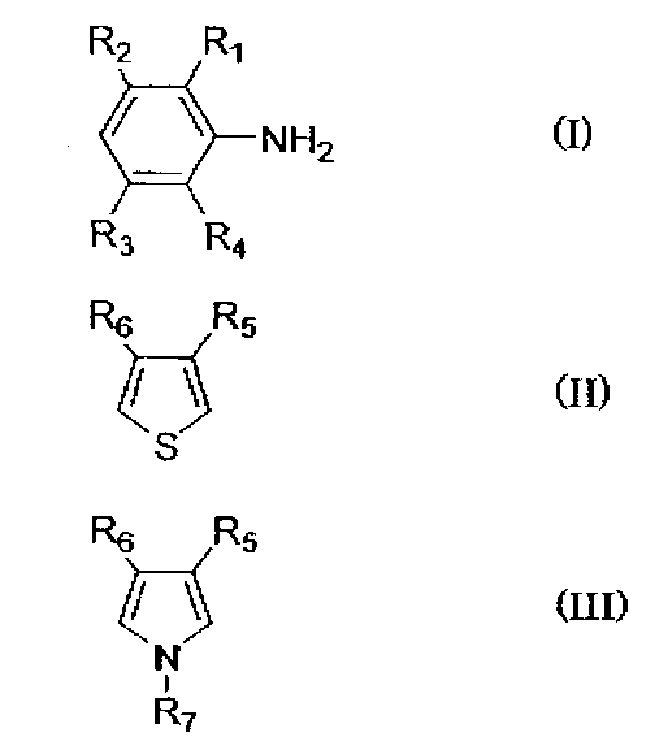
[7]上記キレート能を有するモノマー(a-2)が、ピリジル基またはフェナントロリン構造を有するモノマーであるか、あるいは、下記式(IV)で表される基または下記式(V)で表される基を有するモノマーであることを特徴とする[2]~[6]のいずれかに記載の固体電解質用組成物。
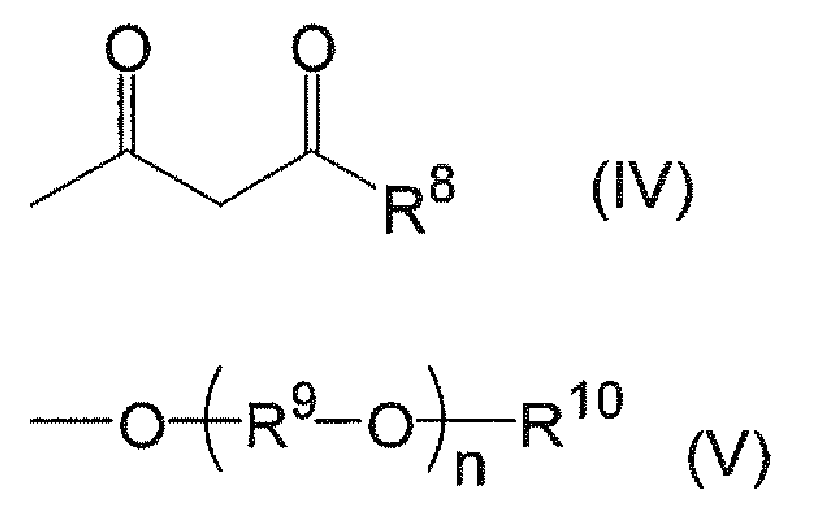
[8]上記高分子化合物(A)が、上記キレート能を有するモノマー(a-2)とスルホン酸基またはスルホン酸塩基を有するモノマー(a-1)とを重合して得られる高分子化合物であり、
上記電荷移動性材料が、π共役系高分子(β)であり、
上記固体電解質用組成物が、上記高分子化合物(A)および酸化剤の存在下で、電解性基質溶媒中、モノマーを重合して上記π共役系高分子(β)を生成させるとともに、上記高分子化合物(A)を上記π共役系高分子(β)にドープさせて得られることを特徴とする[2]に記載の固体電解質用組成物。
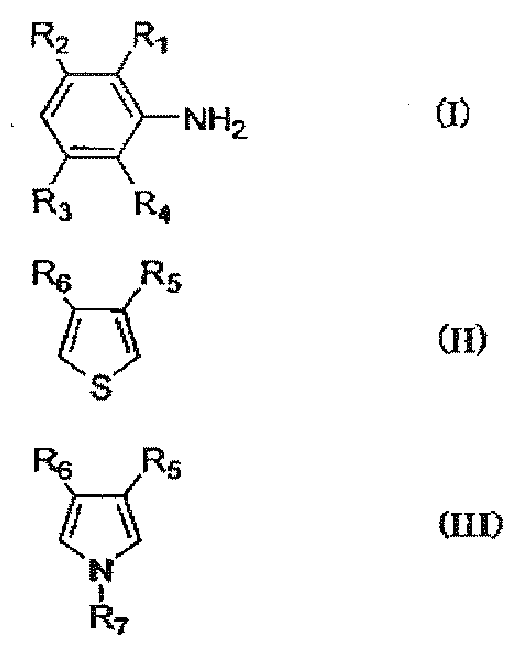
[11]上記キレート能を有するモノマー(a-2)が、ピリジル基またはフェナントロリン構造を有するモノマーであるか、あるいは、下記式(IV)で表される基または下記式(V)で表される基を有するモノマーであることを特徴とする[7]~[10]のいずれかに記載の固体電解質用組成物。
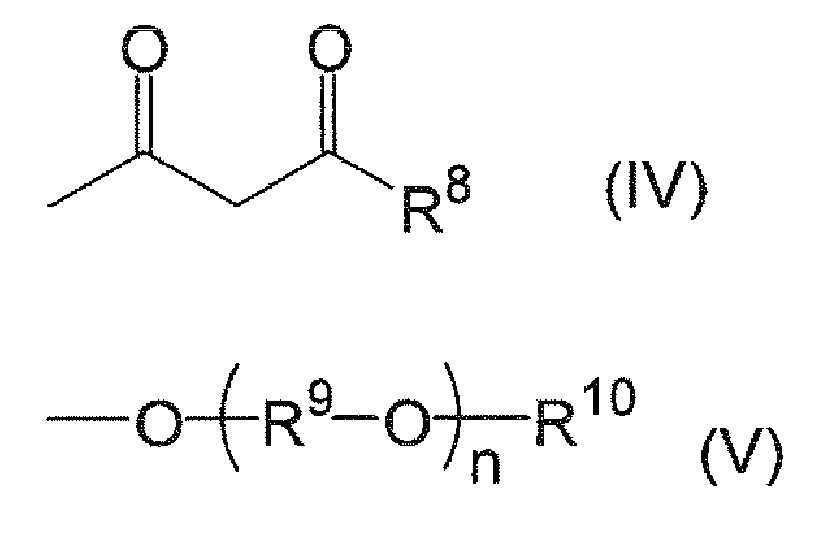
[12][1]~[11]のいずれかに記載の固体電解質用組成物を用いた太陽電池用電荷輸送材。
態様1の固体電解質用組成物は、高分子化合物(A)と、炭素材料とを含む。なお、本明細書において「態様1の固体電解質用組成物」を単に「態様1の組成物」ともいう。高分子化合物(A)は、キレート能を有するモノマー(a-2)を含むモノマー(a)を重合して得られる。このような態様1の組成物を溶剤に配合すると、通常組成物が均一に分散した溶液を形成する。さらに該組成物をイオン性化合物ととともに溶剤に配合した場合は、イオン対との相互作用が比較的弱いため、凝集し難い。すなわち、態様1の固体電解質用組成物から得られる溶液は、高い安定性を有する。
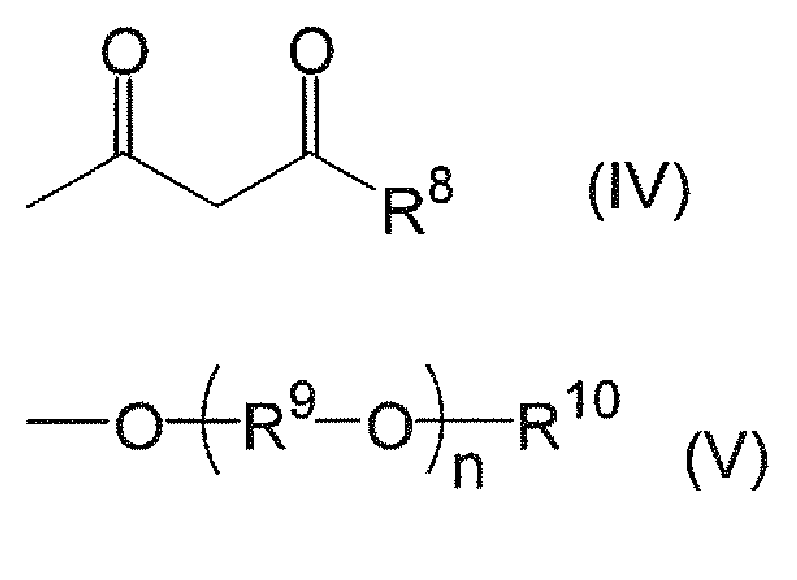
態様2の固体電解質用組成物は、高分子化合物(A)と、π共役系高分子(β)とを含む。なお、本明細書において「態様2の固体電解質用組成物」を単に「態様2の組成物」ともいう。高分子化合物(A)は、キレート能を有するモノマー(a-2)を含むモノマー(a)を重合して得られる。このような態様2の組成物を溶剤に配合すると、通常組成物が均一に溶解または分散した溶液を形成する。さらに該組成物をイオン性化合物とともに溶剤に配合した場合は、イオン対との相互作用が比較的弱いため、凝集し難い。すなわち、態様2の固体電解質用組成物から得られる溶液は、高い安定性を有する。
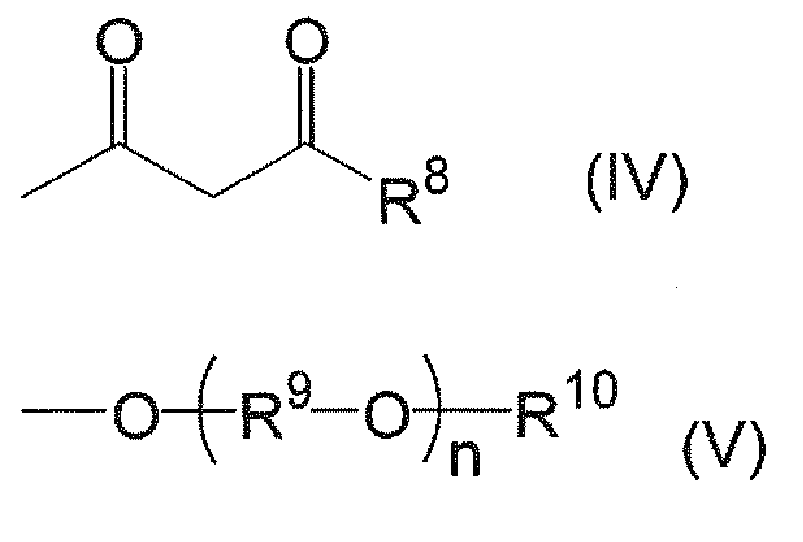
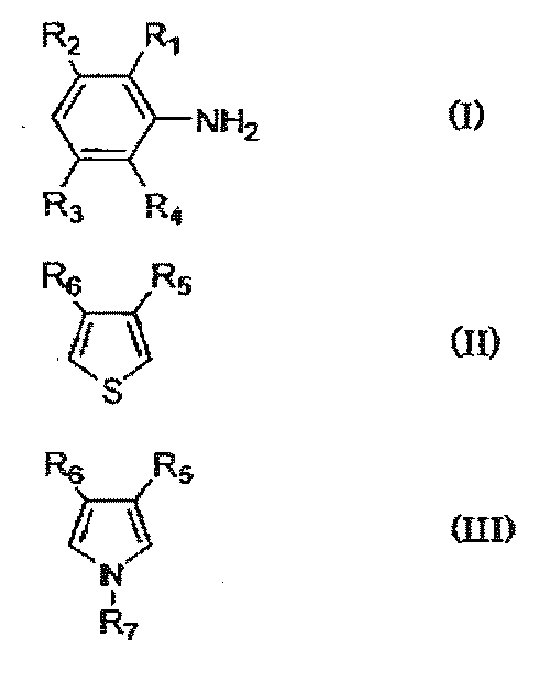
態様3の組成物は、高分子化合物(A)とπ共役系高分子(β)とを含む。いいかえると、態様3の組成物は、高分子化合物(A)をπ共役系高分子(β)にドープさせて得られる組成物である。なお、本明細書において、「高分子化合物(A)をπ共役系高分子(β)にドープさせて得られる組成物」を、単に「高分子化合物(A)がドープされたπ共役系高分子(β)」または「ドープ済みπ共役系高分子(β)」ともいう。

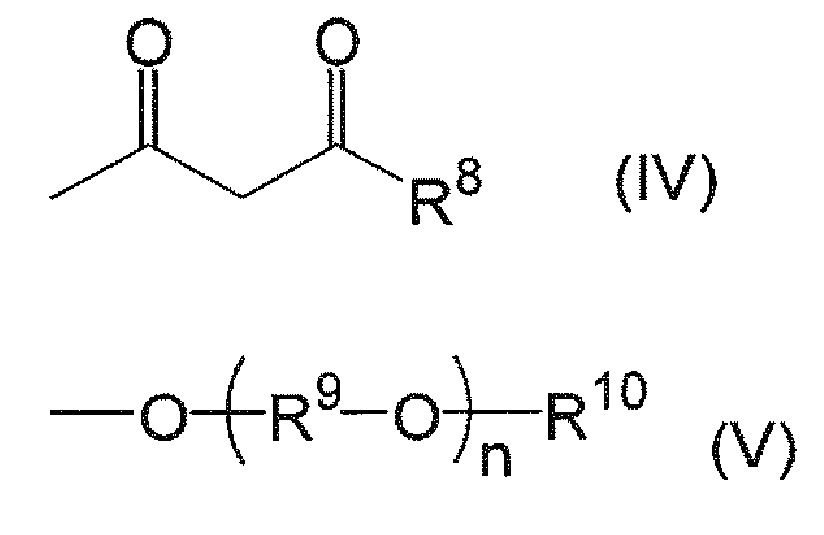
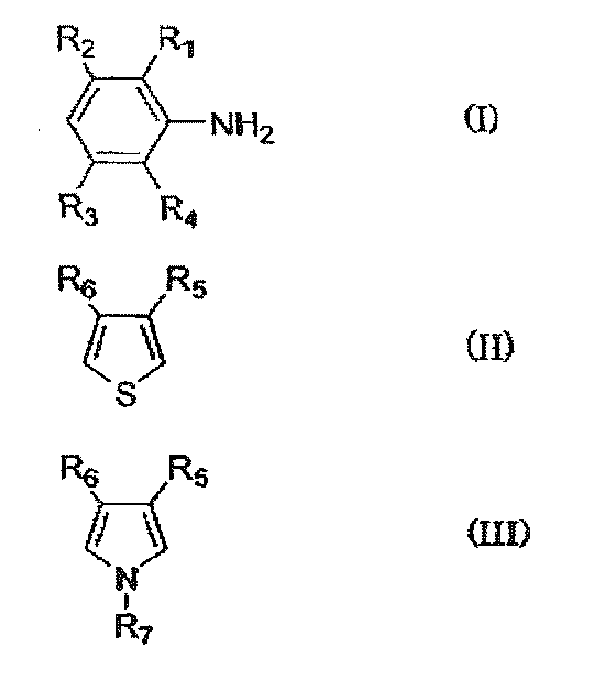
態様1の組成物において、さらにπ共役系高分子(β)を配合してもよい。この場合、π共役系高分子(β)は、高分子化合物(A)100重量部に対し、0.1~600重量部程度加えることが好ましい。
下記条件でのGPCにより測定した。
カラム:GF-1G7B+GF-510HQ(Asahipak:登録商標、
昭和電工(株)製)
基準物質:ポリスチレンおよびポリスチレンスルホン酸ナトリウム
サンプル濃度:1.0mg/ml
溶離液:50ミリモル塩化リチウム水溶液/CH3CN=60/40wt
流量:0.6ml/min
カラム温度:30℃
検出器:UV254nm
〔製造例1-1〕
撹拌機、窒素ガス導入管、環流冷却器、投入口および温度計を備えた容量1000cm3の四つ口フラスコに、2-ソジウムスルホエチルメタクリレート(MS-2N)を24.3g(25モル%)、アセトアセトキシエチルメタクリレート(AAEM)を25.7g(15モル%)、ベンジルメタクリレート(BzMA)を42.8g(30モル%)、2-エチルヘキシルメタクリレート(2EHMA)を48.2g(30モル%)、イオン交換水を150g、イソプロピルアルコール(IPA)を300g投入した。フラスコ内に窒素ガスを導入しながら、フラスコ内の混合物を70℃まで昇温した。次いで、アゾビスイソブチロニトリルを0.7gフラスコ内に投入し、70℃を保ち、18時間重合反応を行って高分子化合物(A)を含むポリマー溶液(A-1)を得た。
モノマーを表1-1に示すモノマーに代え、重合条件を表1-2に示す条件に代えた以外は製造例1-1と同様にして、高分子化合物(AP-2)~(AP-14)を得た。また、高分子化合物(AP-2)~(AP-14)のMwを表1-1に示す。なお、表1-1、1-2には製造例1-1についても示した。
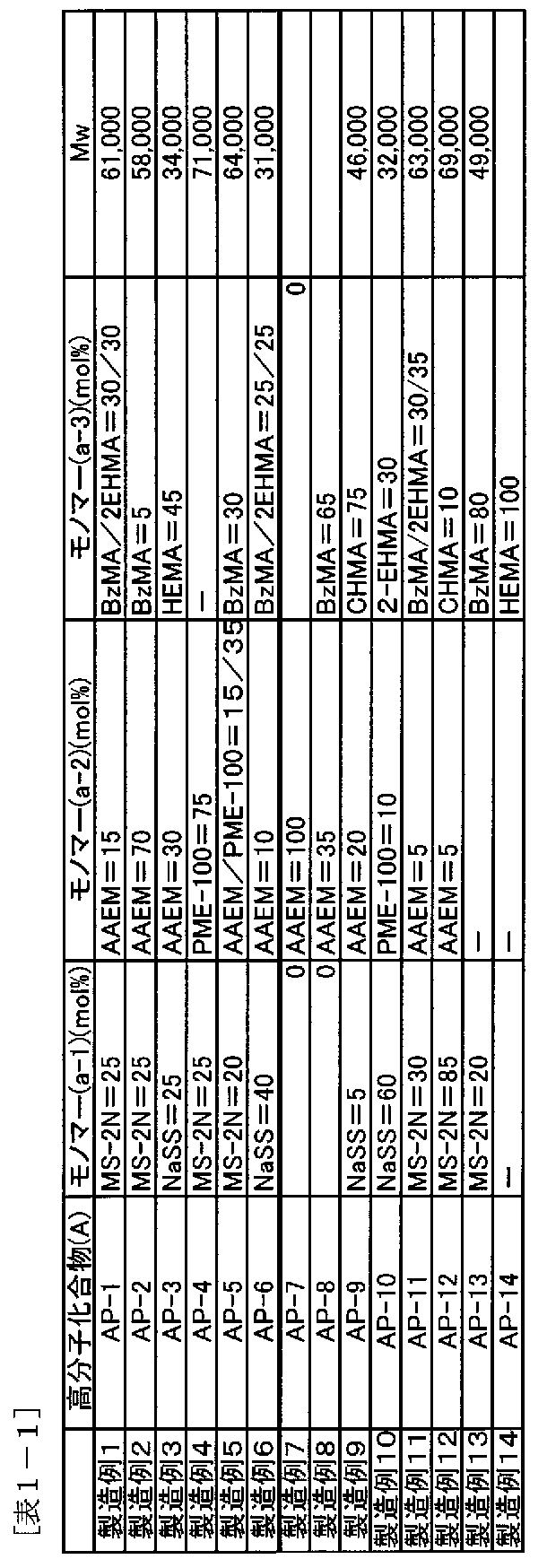
NaSS:スチレンスルホン酸ナトリウム
AAEM:アセトアセトキシエチルメタクリレート
PME-100:メトキシジエチレングリコールメタクリレート
BzMA:ベンジルメタクリレート
2EHMA:2-エチルヘキシルメタクリレート
CHMA:シクロヘキシルメタクリレート
HEMA:2-ヒドロキシエチルメタクリレート
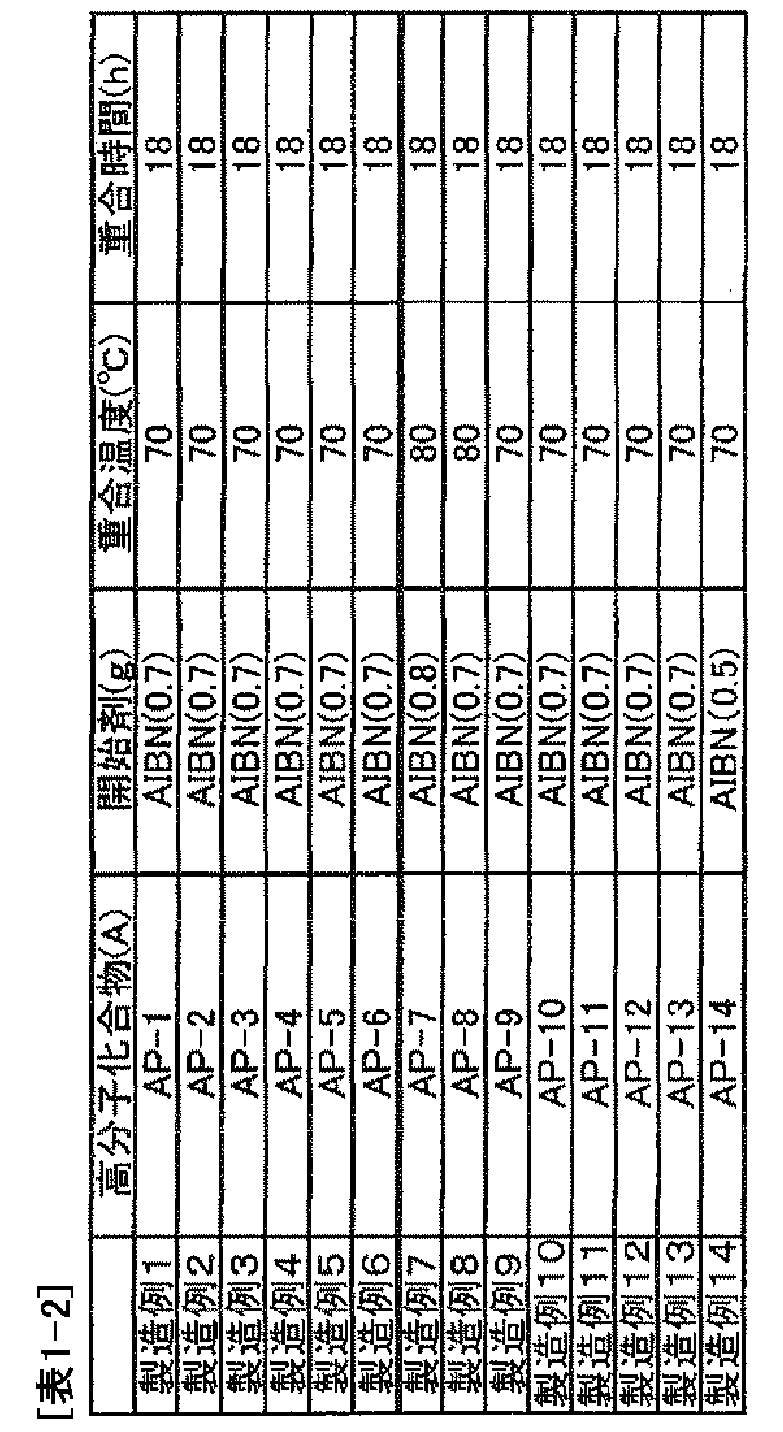
なお、表1-2、開始剤の欄におけるカッコ内の数値は、開始剤の量を表す。
撹拌機、窒素ガス導入管、環流冷却器、投入口および温度計を備えた容量1000cm3の四つ口フラスコに、製造例1で得られた高分子化合物(AP-1)を27.8g、イオン交換水を500g、35%塩酸水溶液を6g投入し、60℃に加熱して3時間撹拌を行った後、25℃まで冷却した。フラスコ内の溶液は、均一透明なものであった。
表1-3の条件に代えた以外は、実施例1に示した方法により組成物(E-2)~(E-7)(態様3の組成物)を調製した。表1-3中には、実施例1についても含めて、組成物のモノマー組成、使用高分子化合物(A)種およびその量、使用塩酸量、使用酸化剤およびその量並びに反応条件(反応温度および反応時間)を示した。
表1-3の条件に代えた以外は、実施例1に示した方法により組成物(EC-4)、(EC-5)、(EC-7)を調製した。
表1-4の条件に代えた以外は、実施例1に示した方法により高分子(β-9)、(β-10)、(βC-3)を調製した。

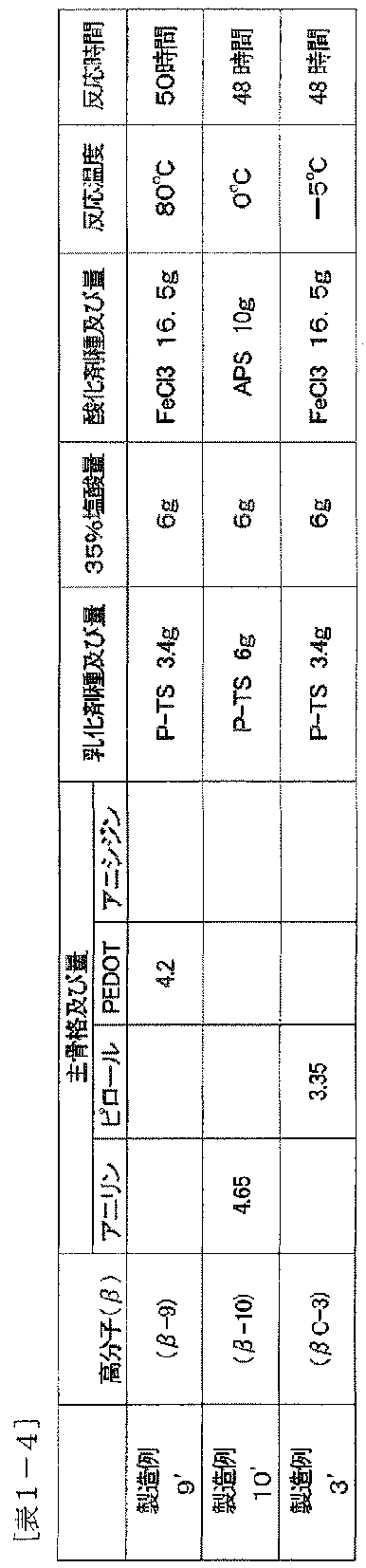
P-TS:p-トルエンスルホン酸
[実施例9]
実施例9では、製造例9’で得た高分子(β-9)30重量部と製造例7で得た高分子化合物(AP-7)70重量部とを混合し、態様2の組成物を得た(表2-1)。
表2-1に記載した高分子(β)、高分子化合物(A)に代えた他は、実施例9と同様にして、態様2の組成物を得た。
実施例8では、カーボンナノチューブ(CNT)20重量部と製造例7で得た高分子化合物(AP-7)80重量部とを混合し、態様1の組成物を得た(表2-1)。
表2-1に記載した炭素材料、高分子化合物(A)に代えた他は、実施例10と同様にして、態様1の組成物を得た。
参考例8では、アルミ粉末30重量部と製造例7で得た高分子化合物(AP-7)70重量部とを混合し、組成物を得た(表2-1)。
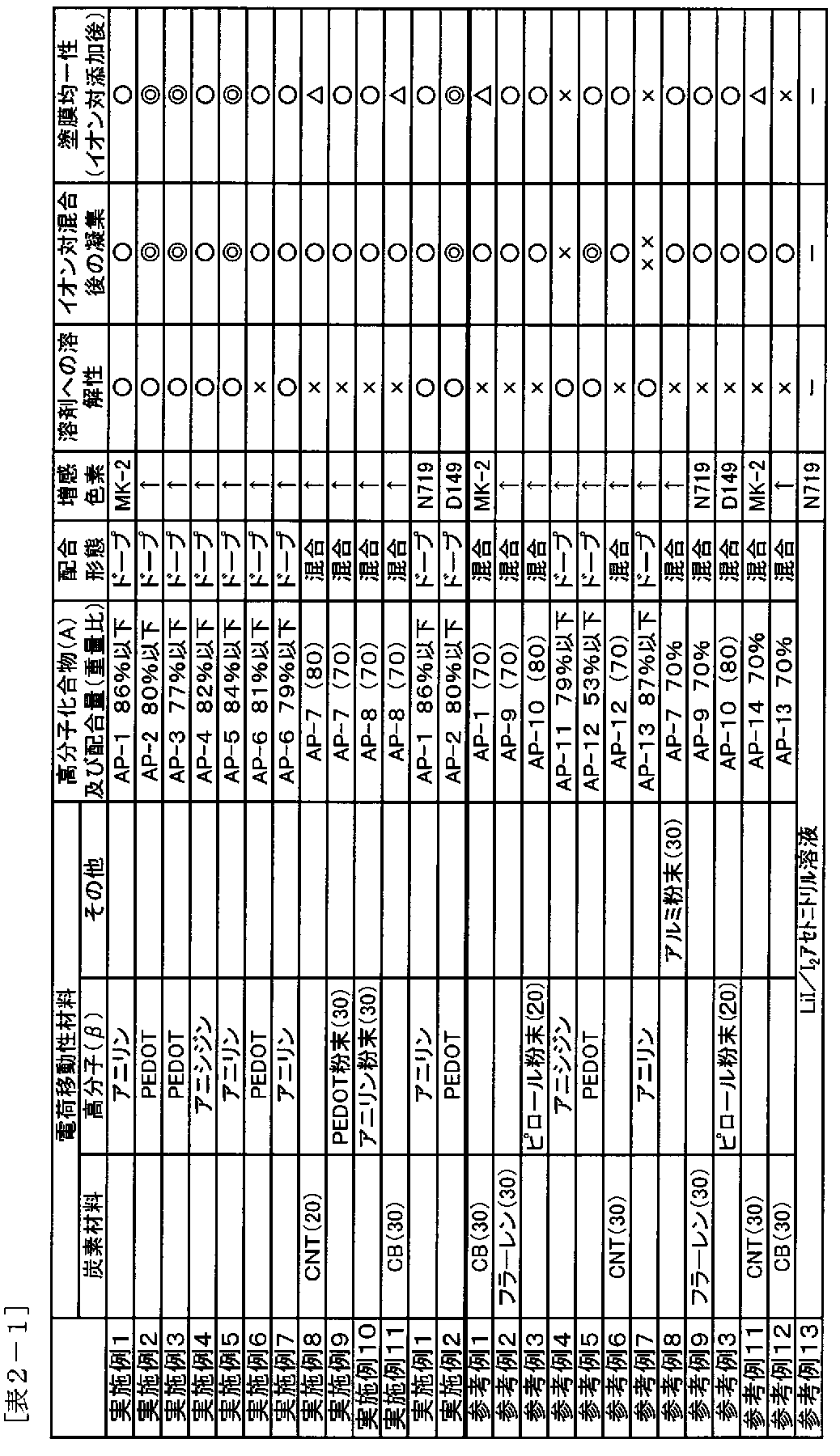
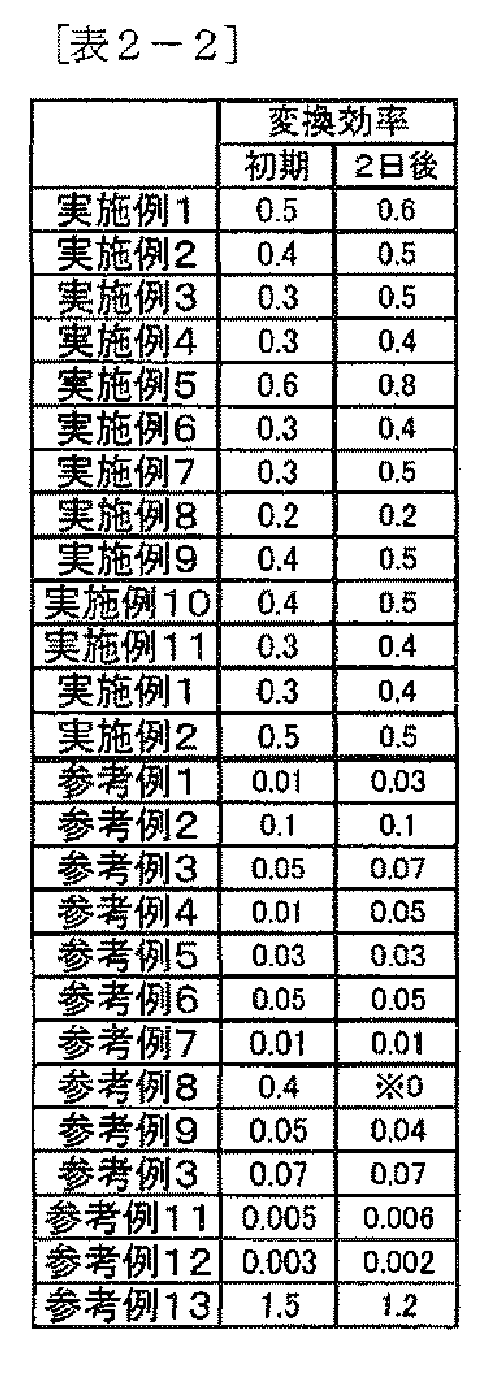
CNT:カーボンナノチューブ
CB:カーボンブラック D149:(三菱製紙社製)
MK-2:(綜研化学社製)
N719:(ソーラロニクス社製)
表2-2は表2-1の続きである。
(溶剤への溶解性)
実施例および参考例で作製した乾燥導電性ポリマーを溶剤(アニリン、アニシジンを用いた場合についてはトルエン、PEDOTを用いた場合についてはプロピレングリコールモノメチルエーテル、その他を用いた場合についてはMEK)中に溶解した時の溶解状態を目視で確認した。より具体的には、配合形態が混合である時は、高分子化合物(A)及びカーボン等を分散した状態を、ドープ済みπ共役系高分子(β)の場合は前記導電性高分子を溶剤に溶解した後、溶解(分散)状態を目視で確認した。
(1)溶剤(MEK)に溶解した高分子化合物(A)に全固形分が5%となる様に、カーボン等(CB、CNT、フラーレン、不溶性導電性ポリマー)を表2-1の配合で混合した溶液を作製した。
上記イオン対添加・混合後の溶液をガラス基板上にポッティングして100℃×10分乾燥した後の目視による均一性の確認を行った。
(1)TiO2スパッタを行ったFTOガラス基板上にソーラロニクス社製T/SPを約5μmdry(面積5mm2)で塗工した後、500℃で30分焼成を行った。
表2-2に、初期および2日後の結果を示す。
Claims (14)
- 高分子化合物(A)と電荷移動性材料とを含み、前記高分子化合物(A)が、キレート能を有するモノマー(a-2)を含むモノマー(a)を重合して得られる高分子化合物であることを特徴とする固体電解質用組成物。
- 前記電荷移動性材料が、炭素材料および/またはπ共役系高分子(β)であることを特徴とする請求項1に記載の固体電解質用組成物。
- 前記モノマー(a)中、前記キレート能を有するモノマー(a-2)が30mol%以上の量で含まれていることを特徴とする請求項2に記載の固体電解質用組成物。
- 前記モノマー(a)が、前記キレート能を有するモノマー(a-2)とスルホン酸基またはスルホン酸塩基を有するモノマー(a-1)とを含み、
前記モノマー(a)中、前記スルホン酸基またはスルホン酸塩基を有するモノマー(a-1)が4mol%以下の量で含まれていることを特徴とする請求項2または3に記載の固体電解質用組成物。 - 前記炭素材料が、グラファイト、カーボンブラック、フラーレンおよびカーボンナノチューブから選ばれる少なくとも一種であることを特徴とする請求項2~4のいずれかに記載の固体電解質用組成物。
- 前記π共役系高分子(β)が、下記式(I)~(III)で表されるモノマーから選ばれる少なくとも一種のモノマーを重合して得られるπ共役系高分子であることを特徴とする請求項2~5のいずれかに記載の固体電解質用組成物。

- 前記キレート能を有するモノマー(a-2)が、ピリジル基またはフェナントロリン構造を有するモノマーであることを特徴とする請求項2~6のいずれかに記載の固体電解質用組成物。
- 前記キレート能を有するモノマー(a-2)が、下記式(IV)で表される基または下記式(V)で表される基を有するモノマーであることを特徴とする請求項2~6のいずれかに記載の固体電解質用組成物。
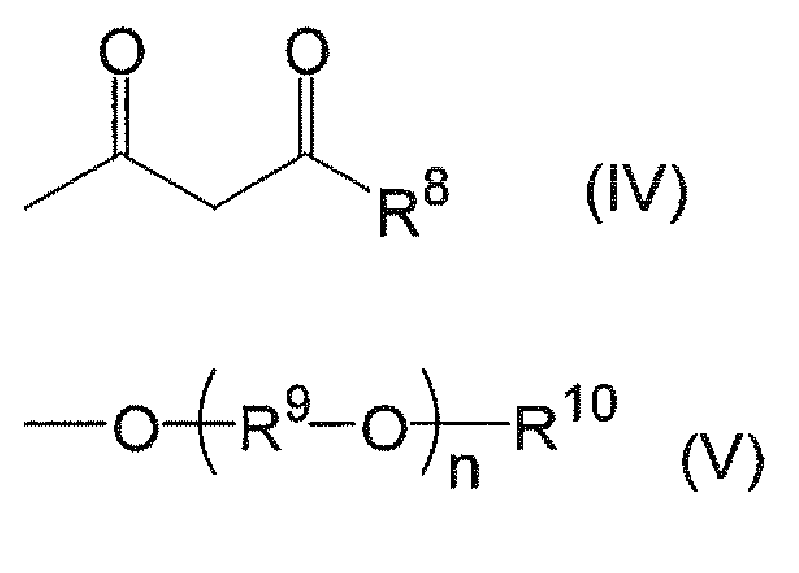
- 前記高分子化合物(A)が、前記キレート能を有するモノマー(a-2)とスルホン酸基またはスルホン酸塩基を有するモノマー(a-1)とを重合して得られる高分子化合物であり、
前記電荷移動性材料が、π共役系高分子(β)であり、
前記固体電解質用組成物が、前記高分子化合物(A)および酸化剤の存在下で、電解性基質溶媒中、モノマーを重合して前記π共役系高分子(β)を生成させるとともに、前記高分子化合物(A)を前記π共役系高分子(β)にドープさせて得られることを特徴とする請求項2に記載の固体電解質用組成物。 - 前記高分子化合物(A)が、前記スルホン酸基またはスルホン酸塩基を有するモノマー(a-1)10~50mol%と、前記キレート能を有するモノマー(a-2)10~90mol%と、その他のモノマー(a-3)0~70mol%とを重合して得られる高分子化合物である(ここで、モノマー(a-1)~(a-3)の合計量を100mol%とする。)ことを特徴とする請求項9に記載の固体電解質用組成物。
- 前記π共役系高分子(β)が、下記式(I)~(III)で表されるモノマーから選ばれる少なくとも一種のモノマーを重合して得られるπ共役系高分子であることを特徴とする請求項9または10に記載の固体電解質用組成物。

- 前記キレート能を有するモノマー(a-2)が、ピリジル基またはフェナントロリン構造を有するモノマーであることを特徴とする請求項9~11のいずれかに記載の固体電解質用組成物。
- 前記キレート能を有するモノマー(a-2)が、下記式(IV)で表される基または下記式(V)で表される基を有するモノマーであることを特徴とする請求項9~11のいずれかに記載の固体電解質用組成物。

- 請求項1~13のいずれかに記載の固体電解質用組成物を用いた太陽電池用電荷輸送材。
Priority Applications (4)
| Application Number | Priority Date | Filing Date | Title |
|---|---|---|---|
| EP10797144.2A EP2452983B1 (en) | 2009-07-08 | 2010-07-07 | Composition for solid electrolyte and solar cell using same |
| JP2011521936A JP5417630B2 (ja) | 2009-07-08 | 2010-07-07 | 固体電解質用組成物およびそれを用いた太陽電池 |
| US13/382,652 US20120104308A1 (en) | 2009-07-08 | 2010-07-07 | Composition for Solid Electrolyte and Solar Cell Using the Same |
| CN201080030800.8A CN102471593B (zh) | 2009-07-08 | 2010-07-07 | 固体电解质用组合物以及使用该组合物的太阳能电池 |
Applications Claiming Priority (2)
| Application Number | Priority Date | Filing Date | Title |
|---|---|---|---|
| JP2009162182 | 2009-07-08 | ||
| JP2009-162182 | 2009-07-08 |
Publications (1)
| Publication Number | Publication Date |
|---|---|
| WO2011004833A1 true WO2011004833A1 (ja) | 2011-01-13 |
Family
ID=43429257
Family Applications (1)
| Application Number | Title | Priority Date | Filing Date |
|---|---|---|---|
| PCT/JP2010/061514 Ceased WO2011004833A1 (ja) | 2009-07-08 | 2010-07-07 | 固体電解質用組成物およびそれを用いた太陽電池 |
Country Status (7)
| Country | Link |
|---|---|
| US (1) | US20120104308A1 (ja) |
| EP (1) | EP2452983B1 (ja) |
| JP (1) | JP5417630B2 (ja) |
| KR (1) | KR20120052193A (ja) |
| CN (1) | CN102471593B (ja) |
| TW (1) | TWI488909B (ja) |
| WO (1) | WO2011004833A1 (ja) |
Cited By (3)
| Publication number | Priority date | Publication date | Assignee | Title |
|---|---|---|---|---|
| WO2018123177A1 (ja) | 2016-12-28 | 2018-07-05 | 昭和電工株式会社 | ポリイソチアナフテン系導電性重合体の製造方法 |
| US10388463B2 (en) | 2015-05-29 | 2019-08-20 | Panasonic Intellectual Property Management Co., Ltd. | Electrolytic capacitor and conductive polymer dispersion |
| US10685787B2 (en) | 2015-03-31 | 2020-06-16 | Panasonic Intellectual Property Management Co., Ltd. | Electrolytic capacitor including conductive polymer with copolymer dopant and conductive polymer dispersion |
Families Citing this family (14)
| Publication number | Priority date | Publication date | Assignee | Title |
|---|---|---|---|---|
| WO2010095648A1 (ja) | 2009-02-17 | 2010-08-26 | 綜研化学株式会社 | 複合導電性ポリマー組成物、その製造方法、当該組成物を含有する溶液、および当該組成物の用途 |
| US9058916B2 (en) | 2009-02-17 | 2015-06-16 | Soken Chemical & Engineering Co., Ltd. | Composite conductive polymer composition, method of manufacturing the same, solution containing the composition, use of the composition |
| US9035533B2 (en) * | 2010-09-24 | 2015-05-19 | Kuraray Co., Ltd. | Paste and polymer transducer including coating film formed from same as electrolyte film or electrode films |
| TWI489672B (zh) * | 2012-07-05 | 2015-06-21 | Univ Vanung | 一種膠態高分子電解質 |
| US9959982B2 (en) * | 2012-09-24 | 2018-05-01 | Konica Minolta, Inc. | Photoelectric conversion element and method for producing the same |
| US9539103B2 (en) | 2013-03-15 | 2017-01-10 | Globus Medical, Inc. | Expandable intervertebral implant |
| US9474622B2 (en) | 2013-03-15 | 2016-10-25 | Globus Medical, Inc | Expandable intervertebral implant |
| US9233009B2 (en) | 2013-03-15 | 2016-01-12 | Globus Medical, Inc. | Expandable intervertebral implant |
| US9034045B2 (en) | 2013-03-15 | 2015-05-19 | Globus Medical, Inc | Expandable intervertebral implant |
| CN103342471B (zh) * | 2013-07-05 | 2015-10-21 | 西北师范大学 | 一种光电纳米复合膜材料及其制备方法和应用 |
| KR101519786B1 (ko) * | 2014-04-30 | 2015-05-12 | 상명대학교 천안산학협력단 | 상온 인쇄형 고분자 겔 전해질 조성물 및 이를 이용한 염료감응 태양전지 |
| JP6438348B2 (ja) * | 2014-08-28 | 2018-12-12 | 信越化学工業株式会社 | 導電性ポリマー複合体及び基板 |
| TWI641010B (zh) * | 2017-11-29 | 2018-11-11 | 住華科技股份有限公司 | 感壓性黏著組成物、電極複合膜及其製造方法 |
| CN110010356B (zh) * | 2018-02-15 | 2021-06-29 | 湖南辰砾新材料有限公司 | 一种高导电率固态电解质的制备方法 |
Citations (16)
| Publication number | Priority date | Publication date | Assignee | Title |
|---|---|---|---|---|
| JPH0435353B2 (ja) | 1984-05-01 | 1992-06-10 | Ricoh Kk | |
| JPH1186632A (ja) | 1997-09-12 | 1999-03-30 | Shikoku Chem Corp | 溶融塩型高分子電解質 |
| JP2000344823A (ja) | 1999-03-31 | 2000-12-12 | Soken Chem & Eng Co Ltd | 塊状重合用触媒および該触媒を用いた重合方法 |
| JP2001106782A (ja) * | 1999-10-04 | 2001-04-17 | Chemiprokasei Kaisha Ltd | 新規高分子錯体およびそれを用いたエレクトロルミネッセント素子 |
| JP2004514753A (ja) | 2000-11-22 | 2004-05-20 | バイエル アクチェンゲゼルシャフト | 分散性ポリマー粉末 |
| JP2004307722A (ja) * | 2003-04-09 | 2004-11-04 | Nippon Shokubai Co Ltd | エマルション型導電性ポリマー組成物およびその製造方法 |
| JP2005508418A (ja) * | 2001-11-06 | 2005-03-31 | イー・アイ・デュポン・ドウ・ヌムール・アンド・カンパニー | ポリ(ジオキシチオフェン)/ポリ(アクリルアミドアルキルスルホン酸)複合体 |
| JP3906071B2 (ja) * | 2000-12-27 | 2007-04-18 | 日東電工株式会社 | 導電性ポリアニリン組成物、そのフィルム及びそれらの製造方法 |
| JP2007126507A (ja) * | 2005-11-01 | 2007-05-24 | Yokohama Rubber Co Ltd:The | 導電性組成物及びその製造方法 |
| WO2008010978A2 (en) * | 2006-07-17 | 2008-01-24 | E. I. Du Pont De Nemours And Company | Metal compositions, thermal imaging donors and patterned multilayer compositions derived therefrom |
| JP2008045061A (ja) * | 2006-08-18 | 2008-02-28 | Shin Etsu Polymer Co Ltd | 導電性固形物ならびにその製造方法、および導電性高分子溶液 |
| JP2008121014A (ja) * | 2006-11-08 | 2008-05-29 | Cheil Industries Inc | 伝導性高分子共重合体、伝導性高分子共重合体組成物、伝導性高分子共重合体組成物膜、及びこれを用いた有機光電素子 |
| JP2008179809A (ja) * | 2006-12-27 | 2008-08-07 | Toray Ind Inc | 帯電防止材料および帯電防止フィルム |
| JP2008210696A (ja) | 2007-02-27 | 2008-09-11 | Univ Of Tokyo | 電解質組成物及びその製造方法並びに電解質組成物を用いた電気化学素子 |
| JP2009013942A (ja) | 2007-07-09 | 2009-01-22 | Honda Motor Co Ltd | エンジンのブリーザ装置 |
| WO2009131012A1 (ja) * | 2008-04-21 | 2009-10-29 | テイカ株式会社 | 導電性組成物の分散液、導電性組成物および固体電解コンデンサ |
Family Cites Families (10)
| Publication number | Priority date | Publication date | Assignee | Title |
|---|---|---|---|---|
| JPH04184811A (ja) * | 1990-11-19 | 1992-07-01 | Mitsubishi Petrochem Co Ltd | 固体電解質膜 |
| EP1244168A1 (en) * | 2001-03-20 | 2002-09-25 | Francois Sugnaux | Mesoporous network electrode for electrochemical cell |
| US6814888B2 (en) * | 2001-05-11 | 2004-11-09 | Mitsui Chemicals, Inc. | Dopant agent and electroconductive polymer material comprising the same |
| JP4298246B2 (ja) * | 2002-09-20 | 2009-07-15 | 日清紡ホールディングス株式会社 | 非水電解質、電気二重層キャパシタおよび非水電解質二次電池 |
| KR100599716B1 (ko) * | 2004-06-23 | 2006-07-12 | 삼성에스디아이 주식회사 | 연료전지 및 그의 제조방법 |
| KR100709207B1 (ko) * | 2004-06-30 | 2007-04-18 | 삼성에스디아이 주식회사 | 리튬 이차 전지 |
| TWI303832B (en) * | 2004-08-30 | 2008-12-01 | Shinetsu Polymer Co | Conductive composition and conductive cross-linked product, capacitor and production method thereof, and antistatic coating material, antistatic coating, antistatic film, optical filter, bnd optical information recording medium |
| CN101070420B (zh) * | 2006-05-09 | 2010-05-12 | 远东新世纪股份有限公司 | 导电高分子组成物及其所制成的抗静电涂料与抗静电膜 |
| CN101302340A (zh) * | 2007-05-09 | 2008-11-12 | 郑州泰达电子材料科技有限公司 | 导电性复合体、导电性聚合物组合物和使用该导电性聚合物组合物的电子元件 |
| EP2175517B1 (en) * | 2007-07-25 | 2015-04-22 | Soken Chemical & Engineering Co. Ltd., | Dye-sensitized solar cell |
-
2010
- 2010-07-07 CN CN201080030800.8A patent/CN102471593B/zh active Active
- 2010-07-07 US US13/382,652 patent/US20120104308A1/en not_active Abandoned
- 2010-07-07 WO PCT/JP2010/061514 patent/WO2011004833A1/ja not_active Ceased
- 2010-07-07 KR KR1020117029023A patent/KR20120052193A/ko not_active Ceased
- 2010-07-07 JP JP2011521936A patent/JP5417630B2/ja active Active
- 2010-07-07 EP EP10797144.2A patent/EP2452983B1/en active Active
- 2010-07-08 TW TW099122447A patent/TWI488909B/zh active
Patent Citations (16)
| Publication number | Priority date | Publication date | Assignee | Title |
|---|---|---|---|---|
| JPH0435353B2 (ja) | 1984-05-01 | 1992-06-10 | Ricoh Kk | |
| JPH1186632A (ja) | 1997-09-12 | 1999-03-30 | Shikoku Chem Corp | 溶融塩型高分子電解質 |
| JP2000344823A (ja) | 1999-03-31 | 2000-12-12 | Soken Chem & Eng Co Ltd | 塊状重合用触媒および該触媒を用いた重合方法 |
| JP2001106782A (ja) * | 1999-10-04 | 2001-04-17 | Chemiprokasei Kaisha Ltd | 新規高分子錯体およびそれを用いたエレクトロルミネッセント素子 |
| JP2004514753A (ja) | 2000-11-22 | 2004-05-20 | バイエル アクチェンゲゼルシャフト | 分散性ポリマー粉末 |
| JP3906071B2 (ja) * | 2000-12-27 | 2007-04-18 | 日東電工株式会社 | 導電性ポリアニリン組成物、そのフィルム及びそれらの製造方法 |
| JP2005508418A (ja) * | 2001-11-06 | 2005-03-31 | イー・アイ・デュポン・ドウ・ヌムール・アンド・カンパニー | ポリ(ジオキシチオフェン)/ポリ(アクリルアミドアルキルスルホン酸)複合体 |
| JP2004307722A (ja) * | 2003-04-09 | 2004-11-04 | Nippon Shokubai Co Ltd | エマルション型導電性ポリマー組成物およびその製造方法 |
| JP2007126507A (ja) * | 2005-11-01 | 2007-05-24 | Yokohama Rubber Co Ltd:The | 導電性組成物及びその製造方法 |
| WO2008010978A2 (en) * | 2006-07-17 | 2008-01-24 | E. I. Du Pont De Nemours And Company | Metal compositions, thermal imaging donors and patterned multilayer compositions derived therefrom |
| JP2008045061A (ja) * | 2006-08-18 | 2008-02-28 | Shin Etsu Polymer Co Ltd | 導電性固形物ならびにその製造方法、および導電性高分子溶液 |
| JP2008121014A (ja) * | 2006-11-08 | 2008-05-29 | Cheil Industries Inc | 伝導性高分子共重合体、伝導性高分子共重合体組成物、伝導性高分子共重合体組成物膜、及びこれを用いた有機光電素子 |
| JP2008179809A (ja) * | 2006-12-27 | 2008-08-07 | Toray Ind Inc | 帯電防止材料および帯電防止フィルム |
| JP2008210696A (ja) | 2007-02-27 | 2008-09-11 | Univ Of Tokyo | 電解質組成物及びその製造方法並びに電解質組成物を用いた電気化学素子 |
| JP2009013942A (ja) | 2007-07-09 | 2009-01-22 | Honda Motor Co Ltd | エンジンのブリーザ装置 |
| WO2009131012A1 (ja) * | 2008-04-21 | 2009-10-29 | テイカ株式会社 | 導電性組成物の分散液、導電性組成物および固体電解コンデンサ |
Non-Patent Citations (1)
| Title |
|---|
| See also references of EP2452983A4 |
Cited By (5)
| Publication number | Priority date | Publication date | Assignee | Title |
|---|---|---|---|---|
| US10685787B2 (en) | 2015-03-31 | 2020-06-16 | Panasonic Intellectual Property Management Co., Ltd. | Electrolytic capacitor including conductive polymer with copolymer dopant and conductive polymer dispersion |
| US10388463B2 (en) | 2015-05-29 | 2019-08-20 | Panasonic Intellectual Property Management Co., Ltd. | Electrolytic capacitor and conductive polymer dispersion |
| WO2018123177A1 (ja) | 2016-12-28 | 2018-07-05 | 昭和電工株式会社 | ポリイソチアナフテン系導電性重合体の製造方法 |
| KR20190084124A (ko) | 2016-12-28 | 2019-07-15 | 쇼와 덴코 가부시키가이샤 | 폴리이소티아나프텐계 도전성 중합체의 제조 방법 |
| US11136432B2 (en) | 2016-12-28 | 2021-10-05 | Showa Denko K.K. | Method for producing polyisothianaphthene-based electroconductive polymer |
Also Published As
| Publication number | Publication date |
|---|---|
| CN102471593B (zh) | 2014-06-04 |
| JP5417630B2 (ja) | 2014-02-19 |
| EP2452983A4 (en) | 2013-10-30 |
| JPWO2011004833A1 (ja) | 2012-12-20 |
| EP2452983B1 (en) | 2019-01-02 |
| KR20120052193A (ko) | 2012-05-23 |
| EP2452983A1 (en) | 2012-05-16 |
| CN102471593A (zh) | 2012-05-23 |
| TWI488909B (zh) | 2015-06-21 |
| TW201111434A (en) | 2011-04-01 |
| US20120104308A1 (en) | 2012-05-03 |
Similar Documents
| Publication | Publication Date | Title |
|---|---|---|
| JP5417630B2 (ja) | 固体電解質用組成物およびそれを用いた太陽電池 | |
| JP5417629B2 (ja) | 導電性高分子組成物およびその製造方法 | |
| TWI448520B (zh) | A composite conductive polymer composition, a method for producing the same, a solution containing the composition, and use of the composition | |
| KR101295763B1 (ko) | 복합 전기 전도성 폴리머 조성물, 이의 제조 방법, 이를 함유하는 용액, 및 이의 용도 | |
| JP5869881B2 (ja) | 複合導電性高分子溶液およびその製造方法 | |
| JP5738178B2 (ja) | 複合導電性高分子組成物、その製造方法、当該組成物を含有する溶液、および当該組成物の用途 | |
| TWI595038B (zh) | Composite conductive polymer composition, method for producing the same, solution containing the composition, and use of the composition | |
| CN103443890A (zh) | 导电性聚合物溶液及其制备方法,导电性聚合物材料,以及使用所述导电性聚合物材料的固体电解电容器及其制备方法 | |
| JP2012153867A (ja) | 導電性組成物ならびにその製造方法とその導電性組成物を用いたキャパシタ |
Legal Events
| Date | Code | Title | Description |
|---|---|---|---|
| WWE | Wipo information: entry into national phase |
Ref document number: 201080030800.8 Country of ref document: CN |
|
| 121 | Ep: the epo has been informed by wipo that ep was designated in this application |
Ref document number: 10797144 Country of ref document: EP Kind code of ref document: A1 |
|
| ENP | Entry into the national phase |
Ref document number: 20117029023 Country of ref document: KR Kind code of ref document: A |
|
| WWE | Wipo information: entry into national phase |
Ref document number: 2010797144 Country of ref document: EP |
|
| WWE | Wipo information: entry into national phase |
Ref document number: 13382652 Country of ref document: US Ref document number: 2011521936 Country of ref document: JP |
|
| NENP | Non-entry into the national phase |
Ref country code: DE |