WO2011007858A1 - コバルトセリウム化合物、アルカリ蓄電池、及び、コバルトセリウム化合物の製造方法 - Google Patents
コバルトセリウム化合物、アルカリ蓄電池、及び、コバルトセリウム化合物の製造方法 Download PDFInfo
- Publication number
- WO2011007858A1 WO2011007858A1 PCT/JP2010/062040 JP2010062040W WO2011007858A1 WO 2011007858 A1 WO2011007858 A1 WO 2011007858A1 JP 2010062040 W JP2010062040 W JP 2010062040W WO 2011007858 A1 WO2011007858 A1 WO 2011007858A1
- Authority
- WO
- WIPO (PCT)
- Prior art keywords
- cerium
- cobalt
- ions
- aqueous solution
- total
- Prior art date
- Legal status (The legal status is an assumption and is not a legal conclusion. Google has not performed a legal analysis and makes no representation as to the accuracy of the status listed.)
- Ceased
Links
Images

Classifications
-
- H—ELECTRICITY
- H01—ELECTRIC ELEMENTS
- H01M—PROCESSES OR MEANS, e.g. BATTERIES, FOR THE DIRECT CONVERSION OF CHEMICAL ENERGY INTO ELECTRICAL ENERGY
- H01M4/00—Electrodes
- H01M4/02—Electrodes composed of, or comprising, active material
- H01M4/62—Selection of inactive substances as ingredients for active masses, e.g. binders, fillers
- H01M4/624—Electric conductive fillers
-
- C—CHEMISTRY; METALLURGY
- C01—INORGANIC CHEMISTRY
- C01G—COMPOUNDS CONTAINING METALS NOT COVERED BY SUBCLASSES C01D OR C01F
- C01G51/00—Compounds of cobalt
- C01G51/40—Complex oxides containing cobalt and at least one other metal element
-
- C—CHEMISTRY; METALLURGY
- C01—INORGANIC CHEMISTRY
- C01G—COMPOUNDS CONTAINING METALS NOT COVERED BY SUBCLASSES C01D OR C01F
- C01G51/00—Compounds of cobalt
- C01G51/80—Compounds containing cobalt, with or without oxygen or hydrogen, and containing one or more other elements
- C01G51/82—Compounds containing cobalt, with or without oxygen or hydrogen, and containing two or more other elements
-
- C—CHEMISTRY; METALLURGY
- C01—INORGANIC CHEMISTRY
- C01G—COMPOUNDS CONTAINING METALS NOT COVERED BY SUBCLASSES C01D OR C01F
- C01G53/00—Compounds of nickel
- C01G53/80—Compounds containing nickel, with or without oxygen or hydrogen, and containing one or more other elements
- C01G53/82—Compounds containing nickel, with or without oxygen or hydrogen, and containing two or more other elements
-
- H—ELECTRICITY
- H01—ELECTRIC ELEMENTS
- H01M—PROCESSES OR MEANS, e.g. BATTERIES, FOR THE DIRECT CONVERSION OF CHEMICAL ENERGY INTO ELECTRICAL ENERGY
- H01M4/00—Electrodes
- H01M4/02—Electrodes composed of, or comprising, active material
- H01M4/62—Selection of inactive substances as ingredients for active masses, e.g. binders, fillers
- H01M4/624—Electric conductive fillers
- H01M4/626—Metals
-
- C—CHEMISTRY; METALLURGY
- C01—INORGANIC CHEMISTRY
- C01P—INDEXING SCHEME RELATING TO STRUCTURAL AND PHYSICAL ASPECTS OF SOLID INORGANIC COMPOUNDS
- C01P2002/00—Crystal-structural characteristics
- C01P2002/50—Solid solutions
- C01P2002/52—Solid solutions containing elements as dopants
-
- C—CHEMISTRY; METALLURGY
- C01—INORGANIC CHEMISTRY
- C01P—INDEXING SCHEME RELATING TO STRUCTURAL AND PHYSICAL ASPECTS OF SOLID INORGANIC COMPOUNDS
- C01P2002/00—Crystal-structural characteristics
- C01P2002/70—Crystal-structural characteristics defined by measured X-ray, neutron or electron diffraction data
- C01P2002/76—Crystal-structural characteristics defined by measured X-ray, neutron or electron diffraction data by a space-group or by other symmetry indications
-
- C—CHEMISTRY; METALLURGY
- C01—INORGANIC CHEMISTRY
- C01P—INDEXING SCHEME RELATING TO STRUCTURAL AND PHYSICAL ASPECTS OF SOLID INORGANIC COMPOUNDS
- C01P2004/00—Particle morphology
- C01P2004/80—Particles consisting of a mixture of two or more inorganic phases
-
- C—CHEMISTRY; METALLURGY
- C01—INORGANIC CHEMISTRY
- C01P—INDEXING SCHEME RELATING TO STRUCTURAL AND PHYSICAL ASPECTS OF SOLID INORGANIC COMPOUNDS
- C01P2006/00—Physical properties of inorganic compounds
- C01P2006/12—Surface area
-
- C—CHEMISTRY; METALLURGY
- C01—INORGANIC CHEMISTRY
- C01P—INDEXING SCHEME RELATING TO STRUCTURAL AND PHYSICAL ASPECTS OF SOLID INORGANIC COMPOUNDS
- C01P2006/00—Physical properties of inorganic compounds
- C01P2006/40—Electric properties
-
- H—ELECTRICITY
- H01—ELECTRIC ELEMENTS
- H01M—PROCESSES OR MEANS, e.g. BATTERIES, FOR THE DIRECT CONVERSION OF CHEMICAL ENERGY INTO ELECTRICAL ENERGY
- H01M10/00—Secondary cells; Manufacture thereof
- H01M10/24—Alkaline accumulators
-
- Y—GENERAL TAGGING OF NEW TECHNOLOGICAL DEVELOPMENTS; GENERAL TAGGING OF CROSS-SECTIONAL TECHNOLOGIES SPANNING OVER SEVERAL SECTIONS OF THE IPC; TECHNICAL SUBJECTS COVERED BY FORMER USPC CROSS-REFERENCE ART COLLECTIONS [XRACs] AND DIGESTS
- Y02—TECHNOLOGIES OR APPLICATIONS FOR MITIGATION OR ADAPTATION AGAINST CLIMATE CHANGE
- Y02E—REDUCTION OF GREENHOUSE GAS [GHG] EMISSIONS, RELATED TO ENERGY GENERATION, TRANSMISSION OR DISTRIBUTION
- Y02E60/00—Enabling technologies; Technologies with a potential or indirect contribution to GHG emissions mitigation
- Y02E60/10—Energy storage using batteries
-
- Y—GENERAL TAGGING OF NEW TECHNOLOGICAL DEVELOPMENTS; GENERAL TAGGING OF CROSS-SECTIONAL TECHNOLOGIES SPANNING OVER SEVERAL SECTIONS OF THE IPC; TECHNICAL SUBJECTS COVERED BY FORMER USPC CROSS-REFERENCE ART COLLECTIONS [XRACs] AND DIGESTS
- Y02—TECHNOLOGIES OR APPLICATIONS FOR MITIGATION OR ADAPTATION AGAINST CLIMATE CHANGE
- Y02P—CLIMATE CHANGE MITIGATION TECHNOLOGIES IN THE PRODUCTION OR PROCESSING OF GOODS
- Y02P70/00—Climate change mitigation technologies in the production process for final industrial or consumer products
- Y02P70/50—Manufacturing or production processes characterised by the final manufactured product
Definitions
- the present invention relates to a cobalt cerium compound, an alkaline storage battery using the cobalt cerium compound, and a method for producing the cobalt cerium compound.
- the cobalt cerium compound is considered to be applied to various uses that require a low-resistance cobalt compound. Below, especially the case where it utilizes for the positive electrode for alkaline storage batteries is demonstrated.
- nickel base hydride batteries, nickel cadmium batteries, and nickel electrodes that serve as positive electrodes for alkaline storage batteries such as nickel zinc batteries
- non-sintered nickel paste (nickel foam base) filled with paste-like active material A type electrode is used.
- the non-sintered electrode configuration in which the nickel foam base material is simply filled with the active material reduces the conductivity as the battery discharges, and effectively functions as the positive electrode of the battery among the nickel foam base materials. Since there are not a few regions that do not exist, a technique of using cobalt oxyhydroxide, which is a highly conductive cobalt compound, as a conductive assistant is considered.
- Patent Document 1 proposes a configuration in which antimony or the like is added to a cobalt oxide compound.
- Patent Document 1 Although a large number of substances added to cobalt oxide compounds are listed in Patent Document 1, only a small portion of magnesium and aluminum are actually evaluated based on experimental data. . Also, the evaluation is not sufficient as an evaluation because only the change in the battery capacity is measured. Furthermore, it cannot be estimated what kind of characteristics can be obtained for additive substances that have not been evaluated using experimental data.
- the present invention has been made in view of such circumstances, and its purpose is to have a high reduction resistance and a sufficient function as a conductive additive when added as a conductive additive to the positive electrode active material. It is in providing a compound that can be exerted.
- cerium (Ce) is adopted as a substance to be added to a cobalt compound as a conductive additive, it has unique characteristics that are completely different from those obtained by adding other substances.
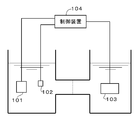
- the experimental apparatus shown in FIG. 5 is configured such that the working electrode 101, the reference electrode 102, and the counter electrode 103 are arranged in the electrolyte solution, and the control device 104 can set the potential of the working electrode 101 based on the reference electrode 102.
- the working electrode 101 is made of nickel foam filled with a cobalt cerium compound
- the reference electrode 102 is made of Hg / HgO.
- the counter electrode 103 is composed of a hydrogen storage alloy electrode similar to the negative electrode of a normal nickel metal hydride battery, and these are arranged in a 6.8 mol / liter potassium hydroxide aqueous solution that is an electrolytic solution.
- the control device 104 sets the potential of the working electrode 101 based on the reference electrode 102 to ⁇ 1V (substantially the same potential as that of the counter electrode 103) at which the cobalt cerium compound is likely to cause a reduction reaction. Is measured. The ease of the reduction reaction can be quantitatively evaluated by the integrated value of the current flowing through the reduction reaction.
- a cobalt cerium compound as a sample was prepared by the following procedure. First, a cobalt compound and a cerium compound were dissolved to produce an aqueous solution containing cobalt ions and cerium ions, and the pH was adjusted by adding the aqueous solution dropwise to a pH-adjusted sodium hydroxide solution little by little. Next, a hydroxide containing cobalt and cerium was deposited in an aqueous solution, and the hydroxide was produced by oxidation treatment, that is, heat treatment in the presence of oxygen. Said measurement was performed about the several cobalt cerium compound produced by changing the abundance ratio of the cobalt ion and cerium ion in the said aqueous solution.
- the positive electrode paste was filled in a foamed nickel substrate having a thickness of 1.4 mm and a surface density of 450 g / m 2 , dried and then rolled to obtain an original plate. The original plate was cut into a size of 2 cm ⁇ 2 cm, and a current collecting tab was attached as a working electrode 101. The amount of the cobalt cerium compound calculated from the filling amount of the electrode plate was 0.2 g.
- the inventors of the present invention conducted a detailed analysis of the crystal structure.
- the crystal structure was analyzed by analyzing the measurement result by the X-ray diffractometer by the Rietveld method.
- the existence ratio of the phase having the specified crystal structure was also specified.
- the X-ray diffractometer is manufactured by Bruker AXS, product number M06XCE, and the measurement conditions are 40 kV, 100 mA (Cu tube).
- Rietan 2000 was used as analysis software for the Rietveld method.
- the specific resistance value was obtained by the powder resistance measurement method, and was measured in a state where 50 mg of the sample powder was put in a circular mold having a radius of 4 mm and pressurized at 10 MPa. From this measurement result, the specific resistance value (reciprocal of conductivity) of the sample powder is obtained. These measurement results are shown in Table 1.
- “Cerium content” indicates the atomic percentage of the content of cerium ions relative to the total of cobalt ions and cerium ions in an aqueous solution containing cobalt ions and cerium ions in the process of producing a cobalt-cerium compound.
- the “reduction current amount” is a current measured using the experimental apparatus shown in FIG. 5 and is a measurement result of the accumulated current amount for one hour. Therefore, the numerical value shows the average current value for 1 hour.
- the cobalt cerium compound is a rhombohedral structure and a cobalt oxyhydroxide phase having a crystal structure of the space group R3m structure (hereinafter, simply referred to as “cobalt oxyhydroxide phase”).
- a cerium dioxide phase (hereinafter, simply referred to as “cerium dioxide phase”) having a crystal structure of a fluorite structure and a space group Fm3m structure, and depending on the preparation conditions of the cobalt cerium compound, a slight amount of tricobalt tetroxide It was found to contain a crystalline phase.
- the cobalt oxyhydroxide phase has a rhombohedral structure and a space group R3m structure crystal structure, and includes at least cobalt atoms, oxygen atoms, and hydrogen atoms as constituent elements. Yes.
- a cobalt oxyhydroxide phase can contain a cerium atom. These atoms are arranged at predetermined sites shown in FIG.
- oxygen atoms are arranged at the Co or Ce, 3a3, and 9b sites at the 3a1, 3a2 sites.
- oxygen atoms are arranged at the Co or Ce, 3a3, and 9b sites at the 3a1, 3a2 sites.
- atoms do not have to be arranged at the 3a4 site, but it is preferable to arrange Na as shown in FIG.
- the arrangement of Na at the 3a4 site can be performed by allowing sodium hydroxide to coexist when heat-treating a hydroxide containing cobalt and cerium as described later. By including Na in this manner, the oxidation can easily proceed in the oxidation process in the manufacturing process.
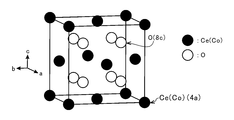
- the cerium dioxide phase has a fluorite structure and a crystal structure of a space group Fm3m structure, and contains at least cerium atoms and oxygen atoms as constituent elements.
- a cerium dioxide phase can contain a cobalt atom. These atoms are arranged at predetermined sites shown in FIG. Specifically, Co or Ce is arranged at the 4a site, and oxygen atoms are arranged at the 8c site. Thus, in the said cerium dioxide phase, when cobalt is contained, cobalt has substituted a part of cerium.
- the content rate of each phase of the above-mentioned cobalt oxyhydroxide phase, the cerium dioxide phase, and the tricobalt tetroxide crystal phase in the cobalt cerium compound is shown by mass%.
- the “existence ratio of the cerium dioxide phase” indicates the existence ratio of the cerium dioxide phase in the cobalt cerium compound between the cobalt oxyhydroxide phase and the cerium dioxide phase. The ratio to the total is calculated from the content ratio of each layer.
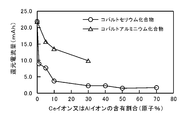
- FIG. 1 also shows data of a compound containing aluminum, which will be described later. From the graph of FIG. 1, it can be seen that when the “cerium content”, that is, the content of cerium ions with respect to the total of cobalt ions and cerium ions exceeds 5 atomic%, the reduction current value decreases rapidly. That is, when the content ratio of the cerium ion with respect to the total of the cobalt ion and the cerium ion exceeds 5 atomic%, it is shown that the reduction reaction hardly occurs rapidly. And the low value is maintained until the content rate of cerium ion reaches 70 atomic% with data.
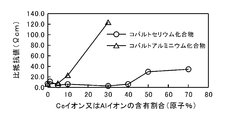
- FIG. 2 is a graph plotting the relationship between the “specific resistance value” and the “cerium content ratio” shown in Table 1 (the leftmost column of Table 1).
- FIG. 2 also shows data of a compound containing aluminum, which will be described later. From the graph of FIG. 2, when “cerium content”, that is, when the content of cerium ions with respect to the total of cobalt ions and cerium ions is 40 atomic% or less, a low value that is almost the same as when no cerium is added. Is maintained. When the content ratio of cerium ions exceeds 40 atomic%, the specific resistance value temporarily increases to 50 atomic%, but it is a practically small value.
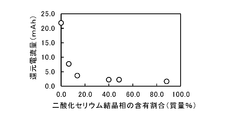
- FIG. 3 is a graph plotting the relationship between the “reduction current amount” shown in Table 1 and the “existence ratio of the cerium dioxide phase” (the rightmost column in Table 1).
- the reduction current value decreases rapidly. Yes. That is, when the abundance ratio of the cerium dioxide phase with respect to the total of the cobalt oxyhydroxide phase and the cerium dioxide phase exceeds 6.5% by mass, the reduction reaction hardly occurs rapidly. And the low value is maintained until the abundance ratio of the said cerium dioxide phase reaches 88 mass% with data.
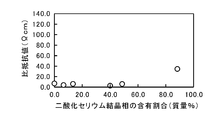
- FIG. 4 is a graph plotting the relationship between the “specific resistance value” shown in Table 1 and the “existence ratio of the cerium dioxide phase” (the rightmost column in Table 1).
- the abundance ratio of cerium dioxide corresponding to 40 atomic% is approximately 49% or less, no cerium is added. Maintains a low value that remains almost unchanged.
- the “additional element content ratio” is the same as the “cerium content ratio” in Table 1, with the cobalt ion and the ion of each element in the aqueous solution containing the cobalt ion and each element ion in the manufacturing process.
- the content ratio of ions of each element with respect to the total is shown in atomic%.
- the “specific resistance value” and the “reduction current amount” are the same as those in Table 1.
- the “content ratio of the additive element” is changed in three stages, and the other elements are represented by 30 atomic% to obtain approximate characteristics.
- the amount of reduction current is considerably higher than that of the cobalt cerium compound, but shows a tendency to decrease with increasing aluminum ions. Therefore, it is expected that the reduction current amount can be further reduced by further increasing the aluminum ion content.
- the specific resistance value is small, but the amount of reduction current is large and the reduction resistance is low, and for magnesium and yttrium, the specific resistance value is very high. Moreover, the reduction current value is large for iron.
- cobalt cerium compounds are compared with cobalt compounds to which such various elements are added, it can be said that cobalt cerium compounds are peculiar in that they show extremely good values both in terms of reduction current and specific resistance. .
- cobalt oxyhydroxide from the viewpoint of a substance used in applications requiring both reduction resistance and a low specific resistance value such as a conductive additive used in a positive electrode for an alkaline storage battery.
- Phase and a cerium dioxide phase, and the proportion of the cerium dioxide phase present is 6.5 mass% or more and 88 mass% or less with respect to the total of the cobalt oxyhydroxide phase and the cerium dioxide phase. The compound meets such demands accurately.
- the cobalt cerium compound is preferably mainly composed of a cobalt oxyhydroxide phase and a cerium dioxide phase. Specifically, the total of these two phases is 50% by mass or more, preferably 75% by mass. More preferably, the content is 94% by mass or more and 98% by mass or more.
- the specific resistance value tends to increase. By avoiding such a range, the specific resistance value is improved. It becomes a cobalt cerium compound.
- it is an electrode containing said cobalt cerium compound and a positive electrode active material, it comprises the positive electrode of the alkaline storage battery using the conductive support agent which has a favorable characteristic in terms of both reduction resistance and a low specific resistance. it can.
- cobalt cerium includes a step of oxidizing the hydroxide after the hydroxide containing cobalt and cerium is precipitated in the aqueous solution by changing the pH of the aqueous solution containing cobalt ions and cerium ions.
- the ratio of the cerium ion contained in the aqueous solution containing the cobalt ion and the cerium ion is based on the total of the cobalt ion and the cerium ion. It is preferably set to 5 atomic% or more and 70 atomic% or less.
- the cobalt cerium compound according to the present invention is a cobalt compound containing cerium, and the abundance ratio of cerium is set in a range of 5 atomic% to 70 atomic% with respect to the total of cerium and cobalt.
- the point is the first characteristic configuration.
- the abundance ratio of cerium is preferably set to a value larger than 5 atomic% with respect to the sum of cerium and cobalt, and the abundance ratio of cerium is relative to the sum of cerium and cobalt. And more preferably 10 atomic% or more.
- the cobalt cerium compound preferably has a cerium content of 40 atomic% or less with respect to the total of cerium and cobalt.
- the alkaline storage battery according to the present invention is characterized by having an electrode including the cobalt cerium compound and the positive electrode active material having the first characteristic configuration described above. And the shape of the said positive electrode active material is a particulate form, It is preferable that the cobalt cerium compound exists in the state laminated
- the cobalt cerium compound according to the present invention includes a cobalt oxyhydroxide phase having a rhombohedral structure and a crystal structure of a space group R3m structure, and a cerium dioxide phase having a fluorite structure and a crystal structure of a space group Fm3m structure.
- the second characteristic configuration is that the proportion of the cerium phase present is 6.5% by mass or more and 88% by mass or less with respect to the total of the cobalt oxyhydroxide phase and the cerium dioxide phase.
- the abundance ratio of the cerium dioxide phase is preferably greater than 6.5% by mass based on the total of the cobalt oxyhydroxide phase and the cerium dioxide phase, and the cobalt oxyhydroxide phase and the cerium dioxide phase More preferably, it is 13.4% by mass or more based on the total.
- the proportion of the cerium dioxide phase present is preferably 49% by mass or less with respect to the total of the cobalt oxyhydroxide phase and the cerium dioxide phase, and it is possible to provide a conductive additive having a smaller specific resistance value. It becomes possible.
- the alkaline storage battery according to the present invention is characterized by having an electrode including the cobalt cerium compound and the positive electrode active material having the second characteristic configuration described above.
- the shape of the positive electrode active material is particulate, and the cobalt cerium compound is preferably present in a state of being laminated on the surface of the particulate positive electrode active material, and has high reduction resistance and low specific resistance.
- the hydroxide containing cobalt and cerium is precipitated in the aqueous solution by changing the pH of the aqueous solution containing cobalt ions and cerium ions.
- the method for producing a cobalt cerium compound comprising a step of oxidizing the cerium ion, wherein before depositing the hydroxide, the ratio of the cerium ions contained in the aqueous solution containing the cobalt ions and the cerium ions is It is characterized by being set to 5 atom% or more and 70 atom% or less with respect to the total of cobalt ions and the cerium ions.
- the compound When a cobalt cerium compound produced by such a production method is added as a conductive additive to the positive electrode active material of an alkaline storage battery, the compound has high reduction resistance and can sufficiently function as a conductive additive; Become.
- the ratio of the cerium ions contained in the aqueous solution containing the cobalt ions and the cerium ions is such that the cobalt ions and the cerium ions are It is preferably greater than 5 atomic% with respect to the total.
- the proportion of the cerium ions contained in the aqueous solution containing the cobalt ions and the cerium ions is 10 atomic% with respect to the total of the cobalt ions and the cerium ions.
- the above is preferable.
- the ratio of the cerium ions contained in the aqueous solution containing the cobalt ions and the cerium ions is 40 atomic% with respect to the total of the cobalt ions and the cerium ions. It is preferable to set the following, and it becomes possible to provide a conductive additive having a smaller specific resistance value.
- an oxidation treatment is performed after the hydroxide is precipitated, and the aqueous solution containing the cobalt ions and the cerium ions is mixed with an aqueous solution adjusted to a predetermined pH.
- the aqueous solution adjusted to the predetermined pH preferably contains sodium hydroxide, potassium hydroxide, and lithium hydroxide, and the aqueous solution adjusted to the predetermined pH contains a particulate positive electrode active material. Is more preferable.
- FIG. 1 is a graph showing the relationship between the reduction current characteristic of the cobalt cerium compound of the present invention and the content of cerium ions.
- FIG. 2 is a graph showing the relationship between the specific resistance value of the cobalt cerium compound of the present invention and the content ratio of cerium ions.
- FIG. 3 is a graph showing the relationship between the reduction current characteristics of the cobalt cerium compound of the present invention and the abundance ratio of the cerium dioxide phase.
- FIG. 4 is a graph showing the relationship between the specific resistance value of the cobalt cerium compound of the present invention and the abundance ratio of the cerium dioxide phase.
- FIG. 5 is a view showing an apparatus for evaluating a cobalt cerium compound of the present invention.
- FIG. 5 is a view showing an apparatus for evaluating a cobalt cerium compound of the present invention.
- FIG. 6 is a diagram showing a crystal structure model of a cobalt oxyhydroxide phase constituting a part of the cobalt cerium compound of the present invention.
- FIG. 7 is a diagram showing a crystal structure model of a cerium dioxide phase constituting a part of the cobalt cerium compound of the present invention.
- an aqueous solution containing cobalt ions and cerium ions is prepared by dissolving a cobalt compound and a cerium compound, and the pH of the aqueous solution is adjusted to precipitate a hydroxide containing cobalt and cerium in the aqueous solution.
- a method for adjusting the pH of an aqueous solution containing cobalt ions and cerium ions a method of dropping an aqueous solution containing cobalt ions and cerium ions into an aqueous solution adjusted to a target pH can be used.
- the pH value can be 8 or more, preferably 9 or more and 12 or less.
- an aqueous solution containing sodium hydroxide, potassium hydroxide, lithium hydroxide, or the like can be used. More specifically, in a specific example of treatment, an aqueous solution in which cobalt sulfate and cerium nitrate were dissolved in a predetermined ratio was dropped into a vigorously stirred NaOH aqueous solution at a temperature of 45 ° C. and a pH of 9. At this time, the concentration of cobalt sulfate and cerium nitrate aqueous solution was adjusted such that the sum of Co atoms and Ce atoms was 1.6 atomic mol / liter. The pH control during the dropping is performed using 18 wt% NaOH. Filtration, washing with water and drying to obtain cobalt cerium hydroxide.
- the hydroxide containing cobalt and cerium is oxidized by heat treatment in the presence of oxygen to obtain a cobalt cerium compound.
- a method for the oxidation treatment a method of heating a hydroxide containing cobalt and cerium in the atmosphere can be used.
- the heating temperature may be 60 ° C. or higher and the boiling point of the aqueous sodium hydroxide solution, preferably 100 ° C. or higher.
- 40 g of 48 wt% NaOH aqueous solution may be added to 50 g of cobalt cerium hydroxide and heated in the atmosphere at 120 ° C. for 1 hour.
- the target cobalt cerium compound is obtained by filtration, washing with water and drying.
- the cobalt cerium compound thus produced can be used as a conductive aid in a form mixed with nickel hydroxide powder, which is an active material.
- this use amount range is applied when the total content of the cobalt oxyhydroxide phase and the cerium dioxide phase contained in the cobalt cerium compound is 94% by mass (wt%) or more. Therefore, when the content ratio of both phases is small, it is preferable to change the usage amount range to a range including a larger amount so that the total amount of the cobalt oxyhydroxide phase and the cerium dioxide phase is included to the same extent. .
- nickel hydroxide particles are mixed in a pH-adjusted aqueous solution, and then an aqueous solution containing cobalt ions and cerium ions is added dropwise thereto.
- a method of performing an oxidation treatment can be used.
- an aqueous solution in which nickel sulfate is dissolved has a concentration of 1 mol / liter with pH 12 and temperature controlled at 45 ° C. while stirring vigorously. Add dropwise into aqueous ammonium sulfate solution. The pH can be adjusted using an 18 wt% NaOH aqueous solution. Subsequently, filtration, washing with water, and drying are performed to obtain spherical nickel hydroxide particles.
- nickel hydroxide particles in a state where a hydroxide containing cobalt and cerium is deposited on the surface are obtained. can get.
- the nickel hydroxide particles prepared as described above are put into a 0.1 mol / liter ammonium sulfate aqueous solution, and the pH 9 temperature is controlled at 45 ° C., followed by vigorous stirring. The pH adjustment is performed using an 18 wt% NaOH aqueous solution.
- aqueous solution in which cobalt sulfate and cerium nitrate are dissolved at a predetermined ratio is dropped into this solution.
- concentration of the cobalt sulfate and cerium nitrate aqueous solution at this time is adjusted so that the total of Co atoms and Ce atoms is 1.6 atom mol / liter.
- the amount of precipitates on the surface of the nickel hydroxide particles is such that the amount of Co and Ce contained therein (mass in terms of metal) is about 4 wt% with respect to the total amount of nickel hydroxide, Co and Ce. Adjust as follows. Next, filtration, washing and drying are performed to obtain nickel hydroxide particles coated with a hydroxide containing cerium and cobalt.
- the nickel hydroxide particles in a state in which the hydroxide containing cobalt and cerium is deposited on the surface are subsequently subjected to oxidation treatment, thereby obtaining nickel hydroxide particles having the cobalt cerium compound of the present invention on the surface. it can.
- the oxidation treatment at this time is preferably heated in a mixed state with an aqueous sodium hydroxide solution as in the above-described oxidation treatment.
- the amount of sodium hydroxide aqueous solution used is preferably mixed so that (Na / (Co + Ce + Ni)) is 0.5 or more.
- oxidation treatment 40 g of a 48 wt% NaOH aqueous solution is added to 120 g of nickel hydroxide particles in a state where a hydroxide containing cobalt and cerium is deposited on the surface. Heat in air for 1 hour. Subsequently, the target active material particle is produced by filtration, washing with water and drying. By this step, nickel hydroxide particles having a cobalt cerium compound on the surface are obtained.
- the mixing ratio of each material is set so that the ratio of cerium ions is 5 atomic percent or more or larger than 5 atomic percent with respect to the total of cobalt ions and cerium ions, the reduction current amount can be reduced and reduction resistance can be reduced. Can be improved. Furthermore, if the ratio of the cerium ions contained in the aqueous solution is set to be 10 atomic% or more with respect to the total of cobalt ions and cerium ions, the reduction current amount is more reliably reduced and the reduction resistance is higher. it can.
- the upper limit value of the ratio of cerium ions contained in the aqueous solution containing cobalt ions and cerium ions all the data on the side where the content ratio of cerium ions is high is also comparable in reduction resistance (small reduction current). Since the resistance value is small, it is difficult to define the upper limit value. However, it can be confirmed that at least the highest content ratio of the obtained data has high reduction resistance. That is, before the hydroxide is precipitated, the ratio of cerium ions contained in the aqueous solution containing cobalt ions and cerium ions is 5 atomic% or more or 5 atomic% with respect to the total of cobalt ions and cerium ions. It has been confirmed that if it is larger and set to 70 atomic% or less, it has high reduction resistance.
- the specific resistance value of the produced cobalt cerium compound in any range of the ratio of cerium ions set as described above.
- the specific resistance value is basically a good value. However, when the change in specific resistance value in FIG. 2 is seen in more detail, the specific resistance value tends to increase when the content ratio of cerium ions with respect to the total of cobalt ions and cerium ions exceeds 40 atomic%.
- the proportion of cerium ions contained in the aqueous solution containing cobalt ions and cerium ions is larger than 5 atomic% and 40 atoms with respect to the total of cobalt ions and cerium ions.
- the cobalt cerium compound prepared under the above conditions has a rhombohedral structure and a space group R3m structure crystal structure and a cerium-containing cobalt oxyhydroxide phase (appropriately, “oxyhydroxide Cobalt cerium mainly composed of a cerium dioxide phase (abbreviated as “cerium dioxide phase” as appropriate) having a crystal structure of a fluorite structure and a space group Fm3m structure and containing cobalt.
- oxyhydroxide Cobalt cerium mainly composed of a cerium dioxide phase abbreviated as “cerium dioxide phase” as appropriate
- some amount of tricobalt tetroxide crystal phase is included depending on the preparation conditions of the compound.
- the ratio of cerium ions in the aqueous solution containing cobalt ions and cerium ions prepared in the manufacturing process of the cobalt cerium compound (strictly speaking, the content ratio of cerium ions with respect to the total of cobalt ions and cerium ions), and the cerium dioxide phase
- the abundance ratio (strictly speaking, the abundance ratio of the cerium dioxide phase with respect to the total of the cobalt oxyhydroxide phase and the cerium dioxide phase) is correlated and has a substantially proportional relationship.
- Cobalt cerium compound in which the mixing ratio of each material is set so that the ratio of cerium ions contained in the aqueous solution containing cobalt ions and cerium ions is greater than 5 atomic% with respect to the total of cobalt ions and cerium ions
- the ratio of the cerium dioxide phase to the total of the cobalt oxyhydroxide phase and the cerium dioxide phase is 6.5% by mass or greater than 6.5% by mass, cobalt ions and cerium ions are added.
- the cobalt cerium compound is prepared by setting the proportion of cerium ions contained in the aqueous solution to 70 atomic% or less with respect to the total of cobalt ions and cerium ions, the cobalt oxyhydroxide phase, the cerium dioxide phase, The abundance ratio of the cerium dioxide phase with respect to the total is 88% by mass or less. Further, the mixing ratio of each material is set so that the ratio of cerium ions contained in the aqueous solution containing cobalt ions and cerium ions is 10 atomic% or more with respect to the total of cobalt ions and cerium ions. When a cerium compound is produced, the ratio of the cerium dioxide phase to the total of the cobalt oxyhydroxide phase and the cerium dioxide phase is 13.4% by mass or more.
- the ratio of cerium ions contained in the aqueous solution containing cobalt ions and cerium ions is greater than 5 atomic% with respect to the total of cobalt ions and cerium ions, and
- the ratio of the cerium dioxide phase to the total of the cobalt oxyhydroxide phase and the cerium dioxide phase is 6.5% by mass or more or 6.5% by mass. % And 49% by mass or less.
- the ratio of cerium ions contained in the aqueous solution containing cobalt ions and cerium ions is set to 15 atomic% or more or 20 atomic% or more based on the total of cobalt ions and cerium ions, the cobalt aluminum compound On the other hand, the material cost is superior.
- a paste mainly composed of a hydrogen storage alloy powder is applied to a negative electrode substrate made of a punched steel plate in which nickel is plated on iron, dried, and then pressed to a predetermined thickness to produce a negative electrode.
- the negative electrode, a polypropylene nonwoven fabric separator, and the positive electrode described above are laminated, and the laminate is wound into a roll.
- a positive electrode current collecting plate and a negative electrode current collecting plate After attaching a positive electrode current collecting plate and a negative electrode current collecting plate to this, it inserts in a bottomed cylindrical can body and injects electrolyte solution. After that, a ring-shaped gasket is attached to the periphery, and a disc-shaped lid provided with a cap-shaped terminal or the like is attached in a state of being in electrical contact with the positive electrode current collector plate, and the open end of the can body is attached. Fix by caulking.
- the amount of the cobalt cerium compound deposited on the nickel hydroxide particles is such that the amount of Co and Ce contained in the compound (mass converted to metal) is the mass of the nickel hydroxide particles and the mass of Co and Ce (on the metal). It was 4 wt% with respect to the total of (converted mass).
- An aqueous solution of nickel hydroxide particles having a cobalt cerium compound on the surface and a carboxymethyl cellulose (CMC) concentration of 1 wt% was added and kneaded, and polytetrafluoroethylene (PTFE) was mixed therein to make a paste.
- the positive electrode paste was filled in a foamed nickel substrate having a thickness of 1.4 mm and a surface density of 450 g / m 2 , dried and then rolled to obtain an original plate. The original plate was cut into a size of 4 cm ⁇ 6 cm.
- nickel hydroxide having a cobalt cerium compound on its surface was filled so that the electrode capacity of the plate of this size was 500 mAh.
- This plate was used as a positive electrode, a hydrogen storage alloy electrode as a negative electrode, and an open cell was formed with a separator interposed.
- As the electrolytic solution a 6.8 mol / liter potassium hydroxide aqueous solution was used.
- nickel hydroxide particles having cobalt oxyhydroxide on the surface were manufactured and used as comparative samples.
- nickel hydroxide particles were prepared, and nickel hydroxide particles having cobalt hydroxide precipitated on the surface were prepared by adding dropwise an aqueous solution containing cobalt to a pH-adjusted aqueous solution obtained by mixing the nickel hydroxide particles.
- the specific conditions were the same as in the case of the measurement sample to which the present invention was applied except that the aqueous solution did not contain cerium ions.
- an aqueous cobalt sulfate solution was used instead of an aqueous solution of cobalt sulfate and cerium nitrate.
- nickel hydroxide particles having cobalt oxyhydroxide on the surface were obtained.
- the oxidation treatment was performed under the same conditions as the measurement sample to which the present invention was applied.
- the amount of cobalt oxyhydroxide was 4 wt% with respect to the total of the amount of nickel hydroxide particles and the amount of Co (mass converted to metal) in the amount of Co (mass converted to metal) contained in this compound.
- an open cell was prepared in the same manner as the measurement sample to which the present invention was applied.
- the measurement sample to which the present invention is applied and the comparative sample to which the present invention is not applied are charged at a charging current of 1.0 C for 15 hours under a temperature environment of 20 ° C.
- the process of discharging at 0.0 C with a final voltage of 0.0 V was repeated, and the discharge capacity at 10th cycle (discharge capacity before constant resistance connection) was examined. Thereafter, under a temperature environment of 20 ° C., the battery was charged with a charging current of 0.1 C for 15 hours and rested for 1 hour, and then discharged with a discharging current of 0.2 C at a final voltage of 0.0 V, and set to a state at the end of discharging.
- the nickel metal hydride battery was illustrated as an alkaline storage battery to which this invention is applied, it is applicable to manufacture of various alkaline storage batteries, such as a nickel cadmium battery.
Landscapes
- Chemical & Material Sciences (AREA)
- Organic Chemistry (AREA)
- Inorganic Chemistry (AREA)
- Chemical Kinetics & Catalysis (AREA)
- Electrochemistry (AREA)
- General Chemical & Material Sciences (AREA)
- Battery Electrode And Active Subsutance (AREA)
- Inorganic Compounds Of Heavy Metals (AREA)
Abstract
Description
近年、ニッケル金属水素化物電池、ニッケルカドミウム電池、あるいは、ニッケル亜鉛電池等のアルカリ蓄電池の正極となるニッケル電極として、ニッケル基材(ニッケル発泡基材)にペースト状の活物質を充填する非焼結式電極が用いられている。
又、単に活物質をニッケル発泡基材に充填するだけの非焼結式電極の構成では、電池の放電に伴って導電率が低下し、ニッケル発泡基材のうちで電池の正極として有効に機能しない領域が少なからず存在するようになるため、導電性の高いコバルト化合物であるオキシ水酸化コバルトを導電助剤として用いる手法が考えられている。
具体的には、アルカリ蓄電池が過放電状態となって正極電位が負極電位に近づいた場合、あるいは逆充電の状態となった場合等に、オキシ水酸化コバルトが還元されてコバルトの価数が小さくなり、それに伴って導電率が低下してしまうのである。更には、還元されて水酸化コバルト(Co(OH)2)に変化すると電解液中に溶け出して、導電助剤としての機能を果たさなくなる。
例えば下記特許文献1では、コバルトの酸化化合物にアンチモン等を添加する構成が提案されている。
作用極101は発泡ニッケルにコバルトセリウム化合物が充填されたものであり、参照極102はHg/HgOで構成されている。また、対極103は通常のニッケル水素電池の負極と同様の水素吸蔵合金極で構成され、これらが、電解液である6.8mol/リットルの水酸化カリウム水溶液中に配置されている。
上記水溶液中のコバルトイオンとセリウムイオンとの存在割合を変化させて作製した複数のコバルトセリウム化合物について上記の測定を行った。
該正極ペーストを、厚さ1.4mm、面密度450g/m2の発泡ニッケル基板に充填し、乾燥後ロール掛けして原板とした。該原板を2cm×2cmの寸法に裁断し、集電用タブを取り付け作用極101とした。該極板の充填量から算定されるコバルトセリウム化合物の量は0.2gであった。
X線回折装置による測定結果をリートベルト法によって解析することで、結晶構造を解析した。試料粉末中の結晶構造を特定すると共に、特定した結晶構造を有する相の存在割合の特定も行った。X線回折装置はBrukerAXS社製、品番M06XCEで、測定条件は40kV、100mA(Cu管球))である。リートベルト法の解析ソフトとしてRIETAN2000を用いた。比抵抗値は、粉体抵抗測定法により得た値で、半径4mmの円形の型に試料粉末を50mg入れて10MPaで加圧した状態で測定した。この測定結果から試料粉末の比抵抗値(導電率の逆数)が得られる。これらの測定結果を表1に示す。

「還元電流量」は、図5に示す実験装置を用いて測定した電流であり、1時間の積算電流量の測定結果である。従って、数値は1時間の平均電流値を示している。
図6に結晶構造モデルを示すように、オキシ水酸化コバルト相は、菱面体構造で空間群R3m構造の結晶構造を有しており、少なくともコバルト原子、酸素原子および水素原子を構成元素として含んでいる。そして、本発明のコバルトセリウム化合物においては、オキシ水酸化コバルト相はセリウム原子を含むことができる。
これらの原子は、図6で示す所定のサイトに配置されている。具体的には、3a1,3a2サイトにCoまたはCe、3a3,9bサイトに酸素原子(水分子、水酸イオンを構成する酸素原子を含む)が配置されている。
このようにセリウムが含まれる場合には3a1,3a2サイトに配置される。なお、3a4サイトには、原子が配置されていなくても良いが、同図のようにNaを配置することが好ましい。3a4サイトへのNaの配置は、後述するようにコバルトとセリウムとを含む水酸化物を加熱処理する際に水酸化ナトリウムを共存させることによっておこなうことができる。このようにNaを含むことで、製造工程における酸化処理において、酸化を容易に進行させることができる。
このように、上記二酸化セリウム相においては、コバルトが含まれる場合には、コバルトはセリウムの一部を置換している。
更に、表1の右端の欄に、「二酸化セリウム相の存在割合」として示しているのは、コバルトセリウム化合物中における、二酸化セリウム相の存在割合を、オキシ水酸化コバルト相と二酸化セリウム相との合計に対する割合として、上記各層の含有割合から算出したものである。
図1にはアルミニウムを含有する化合物のデータを併記しているが、これについては後述する。
図1のグラフから、「セリウムの含有割合」すなわちコバルトイオンとセリウムイオンとの合計に対するセリウムイオンの含有割合が5原子%を超えると急激に還元電流値が小さくなっていることが判る。すなわち、コバルトイオンとセリウムイオンとの合計に対するセリウムイオンの含有割合が5原子%を超えると急激に還元反応が起こり難くなっていることを示している。そして、セリウムイオンの含有割合がデータのある70原子%に至るまで低い値を維持している。
図2でもアルミニウムを含有する化合物のデータを併記しているが、これについても後述する。
図2のグラフから、「セリウムの含有割合」すなわちコバルトイオンとセリウムイオンとの合計に対するセリウムイオンの含有割合が40原子%以下のときは、セリウムを全く添加していない状態とほとんど変わらない低い値を維持している。セリウムイオンの含有割合が40原子%を超えると50原子%まで一旦比抵抗値が上昇するが、実用的に十分小さい値である。
図3のグラフでも図1のグラフと対応して、セリウムイオンの含有割合が5原子%に対応する二酸化セリウム相の存在割合が6.5質量%を超えると急激に還元電流値が小さくなっている。すなわち、オキシ水酸化コバルト相と二酸化セリウム相との合計に対する前記二酸化セリウム相の存在割合が6.5質量%を超えると急激に還元反応が起こり難くなっていることを示している。そして、前記二酸化セリウム相の存在割合がデータのある88質量%に至るまで低い値を維持している。
図4のグラフでも図2のグラフと対応して、「セリウムの含有割合」が40原子%に対応する二酸化セリウムの存在割合が略49%以下のときは、セリウムを全く添加していない状態とほとんど変わらない低い値を維持している。
コバルト化合物に添加する物質として、アルミニウム(Al)、マンガン(Mn)、マグネシウム(Mg)、イットリウム(Y)、及び、鉄(Fe)を用いた。
これらの各物質について、上記のセリウムの場合と同様の処理を行ってコバルトとの化合物を作製し、上記と同様の比抵抗及び還元電流の測定を行った。その結果を表2に示す。
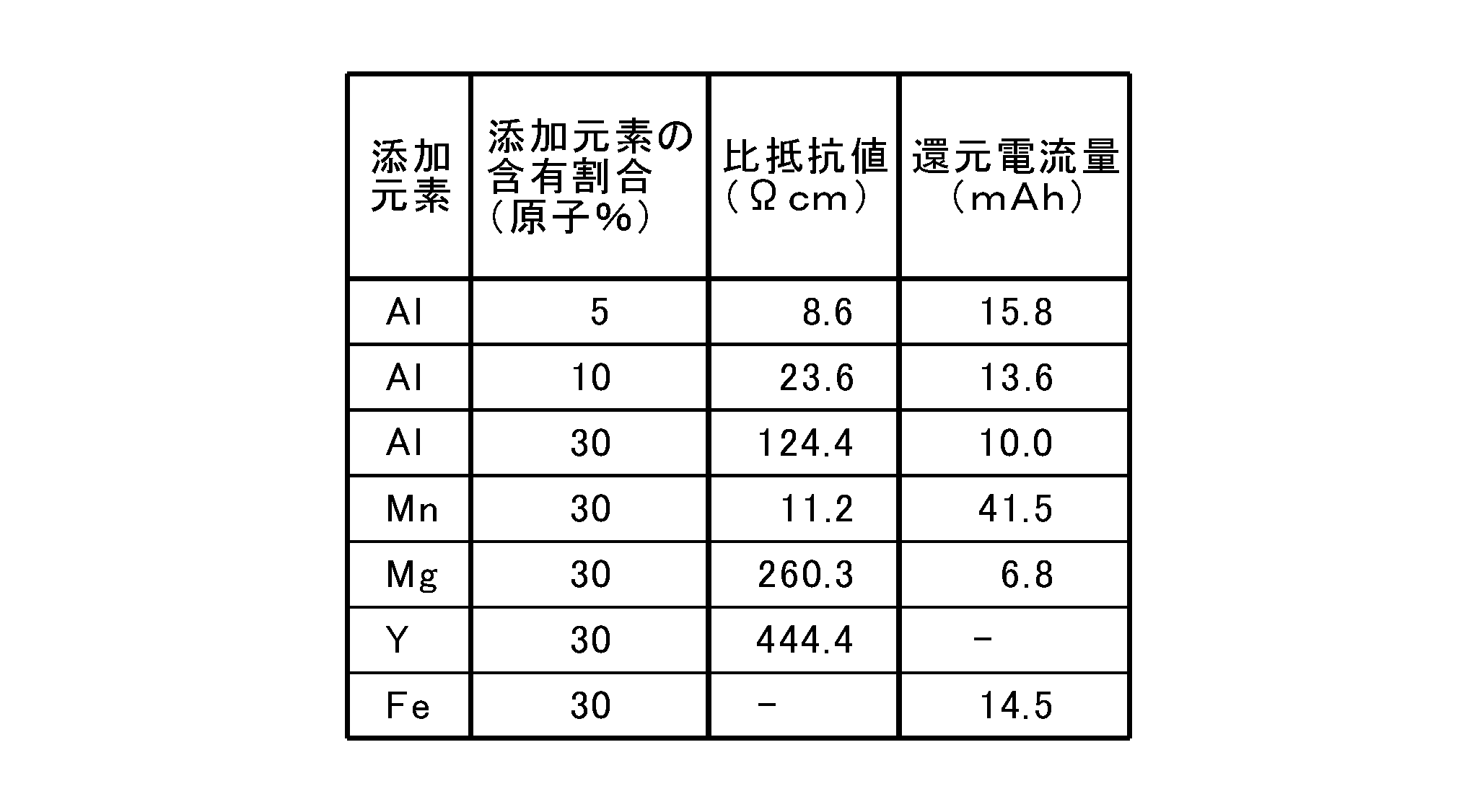
表2に示すように、アルミニウムについては「添加元素の含有割合」を3段階に変化させており、他の元素については30原子%で代表させておおよその特性を把握する。
コバルトセリウム化合物とコバルトアルミニウム化合物とを比較すると、還元電流量に関しては、コバルトセリウム化合物よりもかなり高い値であるものの、アルミニウムイオンの増大に対して一応の減少傾向を示している。従って、アルミニウムイオンの含有割合を更に大きくすると還元電流量を更に小さくできることが期待される。
コバルトセリウム化合物をこのような種々の元素を添加したコバルト化合物と比較すると、還元電流量及び比抵抗値の双方で極めて良好な値を示している点でコバルトセリウム化合物は特異な存在であると言える。
当該コバルトセリウム化合物は、セリウムの存在割合が、セリウムとコバルトとの合計に対して5原子%より大きい値に設定されていることが好ましく、セリウムの存在割合が、セリウムとコバルトとの合計に対して10原子%以上であることがより好ましい。
また、当該コバルトセリウム化合物は、セリウムの存在割合が、セリウムとコバルトとの合計に対して40原子%以下であることが好ましい。
そして、前記正極活物質の形状は粒子状であり、コバルトセリウム化合物は、前記粒子状の正極活物質の表面に積層した状態で存在していることが好ましい。
コバルトセリウム化合物をアルカリ蓄電池の正極活物質に導電助剤として添加したときに、高い耐還元性を有して導電助剤としての機能を十分に発揮できる化合物となる。
また、前記二酸化セリウム相の存在割合が、前記オキシ水酸化コバルト相と前記二酸化セリウム相との合計に対して49質量%以下であることが好ましく、より比抵抗値の小さい導電助剤の提供が可能となる。
そして、正極活物質の形状は粒子状であり、コバルトセリウム化合物は、前記粒子状の正極活物質の表面に積層した状態で存在していることが好ましく、耐還元性が高く比抵抗値に小さい導電助剤を正極に用いることでアルカリ蓄電池の性能を更に向上できるようになる。
このような製造方法で製造されたコバルトセリウム化合物をアルカリ蓄電池の正極活物質に導電助剤として添加したときに、高い耐還元性を有して導電助剤としての機能を十分に発揮できる化合物となる。
当該コバルトセリウム化合物の製造方法は、前記水酸化物を析出させる前において、前記コバルトイオンと前記セリウムイオンとを含む前記水溶液に含まれる前記セリウムイオンの割合が、前記コバルトイオンと前記セリウムイオンとの合計に対して5原子%より大きいことが好ましい。
また、前記水酸化物を析出させる前において、前記コバルトイオンと前記セリウムイオンとを含む前記水溶液に含まれる前記セリウムイオンの割合が、前記コバルトイオンと前記セリウムイオンとの合計に対して10原子%以上であることが好ましい。
さらに、前記水酸化物を析出させる前において、前記コバルトイオンと前記セリウムイオンとを含む前記水溶液に含まれる前記セリウムイオンの割合が、前記コバルトイオンと前記セリウムイオンとの合計に対して40原子%以下に設定されていることが好ましく、より比抵抗値の小さい導電助剤の提供が可能となる。
前記水酸化物を析出させたあとに酸化処理を経ることが好ましく、また、前記コバルトイオンと前記セリウムイオンとを含む前記水溶液を、所定のpHに調整された水溶液に混合する工程を経ることが好ましい。
そして、前記所定のpHに調整された水溶液は、水酸化ナトリウム、水酸化カリウム、水酸化リチウムを含むことが好ましく、前記所定のpHに調整された水溶液は、粒子状の正極活物質を含むことがさらに好ましい。
〔コバルトセリウム化合物の作製〕
コバルトセリウム化合物の製造工程を概略的に説明する。
コバルトセリウム化合物は導電助剤として水酸化ニッケルに添加するのであるが、コバルトセリウム化合物を単独で作製した後に水酸化ニッケルに添加する手法と、コバルトセリウム化合物の製造過程で水酸化ニッケルと一体化する(具体的には、水酸化ニッケルの表面にコバルトセリウム化合物を析出させる)手法とがある。後者の手法は、コバルトセリウム化合物の量を削減できるので好ましい。
先ず、コバルトセリウム化合物を単独で作製する手法について説明する。
この作製手法では、先ず、コバルト化合物とセリウム化合物とを溶かしてコバルトイオンとセリウムイオンを含む水溶液を作製し、その水溶液のpHを調整して、コバルトとセリウムを含む水酸化物を水溶液中に析出させる。
コバルトイオンとセリウムイオンを含む水溶液のpHを調整する方法としては、コバルトイオンとセリウムイオンを含む水溶液を目的のpHに調整済みの水溶液に滴下する方法を用いることができる。pHの値は8以上、好ましくは9以上12以下を採用することができる。pH調整済みの水溶液としては、水酸化ナトリウム、水酸化カリウム、水酸化リチウムなどを含む水溶液を用いることができる。
更に具体的な処理例で説明すると、温度を45℃、pHを9に制御し、激しく攪拌したNaOH水溶液の中に、硫酸コバルトと硝酸セリウムを所定の比率で溶解させた水溶液を滴下させた。このときの硫酸コバルトと硝酸セリウム水溶液の濃度は、Co原子とCe原子との合計が1.6原子mol/リットルに調整した。滴下中のpH制御は、18wt%NaOHを用いて行う。ろ過、水洗、乾燥して、コバルトセリウム水酸化物を得る。
この方法を用いる場合、コバルトとセリウムとを含む水酸化物は、水酸化ナトリウム水溶液と混合した状態で加熱することが好ましい。
なぜなら、ナトリウムは水酸化物中のコバルトの酸化が促進する作用があるからである。この作用が顕著に認められることから、水酸化ナトリウム水溶液の混合量は、(Co+Ce)とNaと原子比(Na/(Co+Ce))が0.5以上となるように混合することが好ましい。
加熱温度は60℃以上水酸化ナトリウム水溶液の沸点以下、好ましくは100℃以上を用いることができる。
具体的な酸化処理の例としては、コバルトセリウム水酸化物50gに対して、40gの48wt%NaOH水溶液を添加して、120℃で1時間、大気中で加熱すれば良い。
次いで、ろ過、水洗、乾燥して、目的のコバルトセリウム化合物が得られる。
このように作製したコバルトセリウム化合物は、活物質である水酸化ニッケルの粉末に混合される形で導電助剤として使用することができる。
次に、アルカリ蓄電池用電極の活物質として用いる水酸化ニッケル粒子の表面に直接析出させる手法について説明する。この手法で析出させることにより、電極の内部にコバルトセリウム化合物のネットワークが形成されるので内部抵抗の低いアルカリ蓄電池用電極を得ることができ、その使用量も大幅に削減することができる。
コバルトセリウム化合物の使用量(水酸化ニッケル粒子表面への析出量)としては、コバルトセリウム化合物と水酸化ニッケルとの合計に対して0.1wt%以上10wt%以下のものを用いることができる。
この範囲の使用量とすることで内部抵抗の十分に低いアルカリ蓄電池用電極を得ることができる。ただし、この使用量範囲は、コバルトセリウム化合物に含まれるオキシ水酸化コバルト相および二酸化セリウム相の合計の含有割合が94質量%(wt%)以上の場合に適用されるものである。
そのため、両相の含有割合が小さい場合には、オキシ水酸化コバルト相および二酸化セリウム相の合計量が同じ程度含まれるように、当該使用量範囲をより多い量を含む範囲に変更するのが好ましい。
より具体的な処理例としては、0.1mol/リットルの硫酸アンモニウム水溶液に上述のようにして作製した水酸化ニッケル粒子を入れ、pH9温度を45℃に制御し、激しく攪拌する。pH調整は18wt%NaOH水溶液を用いて行う。
この溶液中に、硫酸コバルトと硝酸セリウムを所定の比率で溶解させた水溶液を滴下させる。このときの硫酸コバルトと硝酸セリウム水溶液の濃度は、Co原子とCe原子との合計が1.6原子mol/リットルに調整する。
また、水酸化ニッケル粒子表面の析出物の量は、それに含まれるCoとCeの量(金属に換算した質量)が、水酸化ニッケルとCoとCeの合計の量に対して約4wt%となるように調整する。次いで、ろ過、水洗、乾燥して、セリウムとコバルトとを含む水酸化物がコートされた水酸化ニッケルの粒子が得られる。
より具体的な酸化処理の例としては、コバルトとセリウムとを含む水酸化物が表面に析出した状態の水酸化ニッケル粒子50gに対して、40gの48wt%NaOH水溶液を添加して、120℃で1時間、大気中で加熱する。次いで、ろ過、水洗、乾燥して、目的の活物質粒子を作製する。この工程によって、コバルトセリウム化合物を表面に備えた水酸化ニッケル粒子が得られる。
上述のコバルトセリウム化合物の作製条件について更に詳述すると、上述の2つのコバルトセリウム化合物の作製手法の何れにおいても、上記のコバルトイオンとセリウムイオンを含む水溶液中におけるセリウムイオンの含有割合をどのように設定するかで、コバルトセリウム化合物の特性が変化する。
具体的には、耐還元性が高いコバルトセリウム化合物を得るという観点で、上記表1及び図1から、上記水酸化物を析出させる前において、コバルトイオンとセリウムイオンとを含む前記水溶液に含まれるセリウムイオンの割合が、コバルトイオンとセリウムイオンとの合計に対して5原子%以上または5原子%より大きくなるように各材料の混合比を設定すれば、還元電流量を小さくして耐還元性を向上させることができる。更に、水溶液に含まれるセリウムイオンの割合が、コバルトイオンとセリウムイオンとの合計に対して10原子%以上になるように設定すれば、より確実に還元電流量が小さく耐還元性が高い状態とできる。
すなわち、上記水酸化物を析出させる前において、コバルトイオンとセリウムイオンとを含む前記水溶液に含まれるセリウムイオンの割合が、コバルトイオンとセリウムイオンとの合計に対して5原子%以上または5原子%より大きく且つ70原子%以下に設定すれば、高い耐還元性を有することが確認されている。
但し、図2の比抵抗値の変化をより詳細に見ると、コバルトイオンとセリウムイオンとの合計に対するセリウムイオンの含有割合が40原子%を超えると比抵抗値が増加傾向を示している。従って、前記水酸化物を析出させる前において、コバルトイオンとセリウムイオンとを含む前記水溶液に含まれるセリウムイオンの割合が、コバルトイオンとセリウムイオンとの合計に対して5原子%より大きく且つ40原子%以下に設定することで、比抵抗値を極力小さくするという観点で特に良好な特性のコバルトセリウム化合物を作製できる。
更に、コバルトイオンとセリウムイオンとを含む前記水溶液に含まれるセリウムイオンの割合を、コバルトイオンとセリウムイオンとの合計に対して10原子%以上となるように各材料の混合比を設定してコバルトセリウム化合物を作製すると、上記オキシ水酸化コバルト相と上記二酸化セリウム相との合計に対する上記二酸化セリウム相の存在割合が13.4質量%以上となる。
コバルトとセリウムとの価格を比較するとコバルトの方が遙かに高価であり、材料コスト面では、セリウムの使用割合を極力大きくすることが望ましいことになる。
図2において、コバルトアルミニウム化合物の場合は、アルミニウムイオンの含有割合が12.5原子%を超えるとコバルトセリウム化合物の最大比抵抗値よりも比抵抗値が大となる。従って、コバルトイオンとセリウムイオンとを含む前記水溶液に含まれるセリウムイオンの割合を、コバルトイオンとセリウムイオンとの合計に対して15原子%以上あるいは20原子%以上に設定すれば、コバルトアルミニウム化合物に対して材料コスト的にも優位となる。
次ぎに、アルカリ蓄電池(より具体的にはニッケル水素電池)の正極を作製する過程を概略的に説明する。
上述の2つの作製手法、すなわち、コバルトセリウム化合物を単独で作製した後に水酸化ニッケル粉末に添加する手法、あるいは、水酸化ニッケルの表面にコバルトセリウム化合物を析出させる手法の何れかで作製した水酸化ニッケルとコバルトセリウム化合物との混在物にカルボキシルメチルセルロース(CMC)水溶液等を添加してペースト状とする。
このペーストを多孔質のニッケル基材(ニッケル発泡基材)などの電子伝導性のある基材に充填して、その後乾燥処理し、所定の厚みにプレスしてアルカリ蓄電池用正極とする。
次ぎに、アルカリ蓄電池としてニッケル水素電池を製造する場合の工程を概略的に説明する。尚、各部の溶接等の詳細な説明については記載を省略する。
鉄にニッケルメッキを施したパンチング鋼板からなる負極基板に水素吸蔵合金粉末を主成分とするペーストを塗布し、乾燥した後に所定の厚みにプレスして負極を作製する。
この負極とポリプロピレンの不織布製セパレータと上述の正極とを積層し、その積層体をロール状に捲回する。
これに正極集電板及び負極集電板を取り付けた後、有底筒状の缶体に挿入し、電解液を注液する。
この後、周囲にリング状のガスケットが取り付けられると共にキャップ状の端子等を備えた円板状の蓋体を、正極集電板と電気的に接触する状態で取り付け、前記缶体の開放端を加締めることで固定する。
次ぎに、本発明を適用したアルカリ蓄電池の特性を検証するために、上述の製造方法でアルカリ蓄電池を作製すると共に、本発明を適用しない比較用試料を作製して、それらについて過放電後の放電回復容量を測定した。この測定はアルカリ蓄電池を過放電の状態にしてオキシ水酸化コバルトが還元され易い状態としたきに、電池としての能力をどの程度に維持出来ているかを調べるものである。
コバルトセリウム化合物の作製は、上述の水酸化ニッケルの表面にコバルトセリウム化合物を析出させる手法を用いて行った。水酸化ニッケル粒子の作製、水酸化ニッケル粒子へのコバルトとセリウムとを含む水酸化物の析出及びそれの酸化処理の具体的な条件は、各処理について具体的な処理例として説明しているものと同じとした。但し、水酸化ニッケル粒子へのコバルトとセリウムとを含む水酸化物の析出工程での、硫酸コバルトと硝酸セリウムとの水溶液における硫酸コバルトと硝酸セリウムとの比率は7:3とした。
又、水酸化ニッケル粒子に析出したコバルトセリウム化合物の量は、この化合物に含まれるCoとCeの量(金属に換算した質量)が水酸化ニッケル粒子の質量およびCoとCeとの質量(金属に換算した質量)の合計に対して4wt%であった。
該正極ペーストを、厚さ1.4mm、面密度450g/m2の発泡ニッケル基板に充填し、乾燥後ロール掛けして原板とした。該原板を4cm×6cmの寸法に裁断した。
また、この寸法の板の電極容量は500mAhになるようにコバルトセリウム化合物を表面に備えた水酸化ニッケルを充填した。この板を正極、水素吸蔵合金電極を負極とし、セパレータを介在させて、開放形セルを構成した。電解液は6.8mol/リットル水酸化カリウム水溶液を用いた。
本発明を適用したアルカリ蓄電池との比較のために、オキシ水酸化コバルトを表面に備えた水酸化ニッケル粒子を製作して比較用試料とした。まず、水酸化ニッケル粒子を製作し、これを混合したpH調整済みの水溶液にコバルトを含む水溶液と滴下することによって、コバルト水酸化物が表面に析出した水酸化ニッケル粒子を製作した。
具体的な条件は、水溶液にセリウムイオンを含まないこと以外は本発明を適用した測定用試料の場合と同じとした。つまり、硫酸コバルトと硝酸セリウムとの水溶液に代えて硫酸コバルト水溶液を用いた。
つぎに、水酸化ニッケル粒子表面に析出したコバルト水酸化物を酸化処理することによって、オキシ水酸化コバルトを表面に備えた水酸化ニッケル粒子を得た。酸化処理の方法は、本発明を適用した測定用試料と同じ条件でおこなった。オキシ水酸化コバルトの量は、この化合物に含まれるCo量(金属に換算した質量)が水酸化ニッケル粒子の質量およびCo量(金属に換算した質量)の合計に対して4wt%であった。
この比較用試料についても、上述の本発明を適用した測定用試料と同様にして開放形セルを作製した。
上記の本発明を適用した測定用試料及び本発明を適用していない比較用試料について、20℃の温度環境下、充電電流1.0Cで15時間充電し、1時間休止した後、放電電流1.0Cで終止電圧を0.0Vとして放電する工程を繰返し、10サイクル目の放電容量(定抵抗接続前の放電容量)を調べた。その後、20℃の温度環境下、充電電流0.1Cで15時間充電し、1時間休止した後、放電電流0.2Cで終止電圧を0.0Vとして放電し、放電末期の状態に設定した。その状態で、これらのセルに対し、60℃の環境下で定抵抗を正負極間に3日間接続した。この操作により、いわゆる過放電状態が再現されることとなり、コバルトセリウム化合物が備えられた正極の電位は負極とほぼ同電位に設定されることとなる。その後、再度20℃の温度環境下において、これらのセルを充電電流0.1Cで15時間充電し、1時間休止した後、放電電流0.2Cで終止電圧を0.0Vとして放電し、定抵抗接続後の放電回復容量(過放電後の放電回復容量)を調べた。
上記試験条件での試験結果、定抵抗接続前の放電容量を100とした場合の相対指数で表して、本発明を適用した測定用試料では、放電回復容量が85.4%であったのに対して、本発明を適用していない比較用試料では、放電回復容量が73.3%であった。
従って、本発明のコバルトセリウム化合物を表面に備えた水酸化ニッケル粒子は耐過放電性に優れた活物質であることがわかる。
上記実施の形態では、本発明を適用するアルカリ蓄電池として、ニッケル水素電池を例示したが、ニッケルカドミウム電池等の各種のアルカリ蓄電池の製造に適用できる。
102 参照極
103 対極
104 制御装置
Claims (20)
- セリウムを含むコバルト化合物であって、セリウムの存在割合が、セリウムとコバルトとの合計に対して5原子%以上且つ70原子%以下の範囲に設定されているコバルトセリウム化合物。
- セリウムの存在割合が、セリウムとコバルトとの合計に対して5原子%より大きい値に設定されている請求項1記載のコバルトセリウム化合物。
- セリウムの存在割合が、セリウムとコバルトとの合計に対して10原子%以上である請求項1記載のコバルトセリウム化合物。
- セリウムの存在割合が、セリウムとコバルトとの合計に対して40原子%以下である請求項1記載のコバルトセリウム化合物。
- 請求項1に記載のコバルトセリウム化合物と正極活物質とを含む電極を有するアルカリ蓄電池。
- 前記正極活物質の形状は粒子状であり、コバルトセリウム化合物は、前記粒子状の正極活物質の表面に積層した状態で存在している請求項5記載のアルカリ蓄電池。
- 菱面体構造で空間群R3m構造の結晶構造を有するオキシ水酸化コバルト相と、ホタル石構造で空間群Fm3m構造の結晶構造を有する二酸化セリウム相とを含み、前記二酸化セリウム相の存在割合が、前記オキシ水酸化コバルト相と前記二酸化セリウム相との合計に対して6.5質量%以上且つ88質量%以下の範囲に設定されているコバルトセリウム化合物。
- 前記二酸化セリウム相の存在割合が、前記オキシ水酸化コバルト相と前記二酸化セリウム相との合計に対して6.5質量%より大きい値に設定されている請求項7記載のコバルトセリウム化合物。
- 前記二酸化セリウム相の存在割合が、前記オキシ水酸化コバルト相と前記二酸化セリウム相との合計に対して13.4質量%以上である請求項7記載のコバルトセリウム化合物。
- 前記二酸化セリウム相の存在割合が、前記オキシ水酸化コバルト相と前記二酸化セリウム相との合計に対して49質量%以下である請求項7記載のコバルトセリウム化合物。
- 請求項7に記載のコバルトセリウム化合物と正極活物質とを含む電極を有するアルカリ蓄電池。
- 正極活物質の形状は粒子状であり、コバルトセリウム化合物は、前記粒子状の正極活物質の表面に積層した状態で存在している請求項11記載のアルカリ蓄電池。
- コバルトイオンとセリウムイオンとを含む水溶液のpHを変化させることによってコバルトとセリウムとを含む水酸化物を前記水溶液中に析出させた後に、前記水酸化物を酸化処理する工程を含むコバルトセリウム化合物の製造方法であって、
前記水酸化物を析出させる前において、前記コバルトイオンと前記セリウムイオンとを含む前記水溶液に含まれる前記セリウムイオンの割合が、前記コバルトイオンと前記セリウムイオンとの合計に対して5原子%以上且つ70原子%以下の範囲に設定されているコバルトセリウム化合物の製造方法。 - 前記水酸化物を析出させる前において、前記コバルトイオンと前記セリウムイオンとを含む前記水溶液に含まれる前記セリウムイオンの割合が、前記コバルトイオンと前記セリウムイオンとの合計に対して5原子%より大きい値に設定されている請求項13に記載のコバルトセリウム化合物の製造方法。
- 前記水酸化物を析出させる前において、前記コバルトイオンと前記セリウムイオンとを含む前記水溶液に含まれる前記セリウムイオンの割合が、前記コバルトイオンと前記セリウムイオンとの合計に対して10原子%以上である請求項13に記載のコバルトセリウム化合物の製造方法。
- 前記水酸化物を析出させる前において、前記コバルトイオンと前記セリウムイオンとを含む前記水溶液に含まれる前記セリウムイオンの割合が、前記コバルトイオンと前記セリウムイオンとの合計に対して40原子%以下である請求項13記載のコバルトセリウム化合物の製造方法。
- 前記水酸化物を析出させたあとに酸化処理を経ることを特徴とする請求項13記載のコバルトセリウム化合物の製造方法。
- 前記コバルトイオンと前記セリウムイオンとを含む前記水溶液を、所定のpHに調整された水溶液に混合する工程を経る請求項13記載のコバルトセリウム化合物の製造方法。
- 前記所定のpHに調整された水溶液は、水酸化ナトリウム、水酸化カリウム、水酸化リチウムを含む請求項18記載のコバルトセリウム化合物の製造方法。
- 前記所定のpHに調整された水溶液は、粒子状の正極活物質を含む請求項18記載のコバルトセリウム化合物の製造方法。
Priority Applications (4)
| Application Number | Priority Date | Filing Date | Title |
|---|---|---|---|
| CN201080030960.2A CN102471091B (zh) | 2009-07-17 | 2010-07-16 | 钴铈化合物、碱蓄电池和钴铈化合物的制造方法 |
| US13/383,824 US8968932B2 (en) | 2009-07-17 | 2010-07-16 | Cobalt cerium compound, alkaline secondary battery, and method for producing cobalt cerium compound |
| JP2011522864A JP5742028B2 (ja) | 2009-07-17 | 2010-07-16 | コバルトセリウム化合物、アルカリ蓄電池、及び、コバルトセリウム化合物の製造方法 |
| EP10799916.1A EP2455342B1 (en) | 2009-07-17 | 2010-07-16 | Cobalt cerium compound, alkaline storage battery, and method for producing cobalt cerium compound |
Applications Claiming Priority (2)
| Application Number | Priority Date | Filing Date | Title |
|---|---|---|---|
| JP2009168655 | 2009-07-17 | ||
| JP2009-168655 | 2009-07-17 |
Publications (1)
| Publication Number | Publication Date |
|---|---|
| WO2011007858A1 true WO2011007858A1 (ja) | 2011-01-20 |
Family
ID=43449468
Family Applications (1)
| Application Number | Title | Priority Date | Filing Date |
|---|---|---|---|
| PCT/JP2010/062040 Ceased WO2011007858A1 (ja) | 2009-07-17 | 2010-07-16 | コバルトセリウム化合物、アルカリ蓄電池、及び、コバルトセリウム化合物の製造方法 |
Country Status (5)
| Country | Link |
|---|---|
| US (1) | US8968932B2 (ja) |
| EP (1) | EP2455342B1 (ja) |
| JP (2) | JP5742028B2 (ja) |
| CN (1) | CN102471091B (ja) |
| WO (1) | WO2011007858A1 (ja) |
Cited By (3)
| Publication number | Priority date | Publication date | Assignee | Title |
|---|---|---|---|---|
| US8877372B2 (en) | 2011-01-11 | 2014-11-04 | Gs Yuasa International Ltd. | Alkaline secondary battery |
| US8883349B2 (en) | 2010-08-05 | 2014-11-11 | Gs Yuasa International Ltd. | Alkaline secondary battery and method for manufacturing positive electrode material for alkaline secondary battery |
| US9269952B2 (en) | 2011-01-11 | 2016-02-23 | Gs Yuasa International Ltd. | Positive active material for alkaline secondary battery, method for manufacturing the same and alkaline secondary battery |
Families Citing this family (2)
| Publication number | Priority date | Publication date | Assignee | Title |
|---|---|---|---|---|
| EP2455342B1 (en) * | 2009-07-17 | 2019-09-11 | GS Yuasa International Ltd. | Cobalt cerium compound, alkaline storage battery, and method for producing cobalt cerium compound |
| CN114171711B (zh) * | 2021-11-12 | 2023-10-31 | 西南民族大学 | 水系锌离子电池的电极制备方法、电极与电池 |
Citations (5)
| Publication number | Priority date | Publication date | Assignee | Title |
|---|---|---|---|---|
| JPH1050308A (ja) | 1996-05-07 | 1998-02-20 | Saft (Soc Accumulateurs Fixes Traction) Sa | ペースト型ニッケル電極 |
| JP2001332257A (ja) * | 1999-10-08 | 2001-11-30 | Hitachi Maxell Ltd | アルカリ蓄電池用非焼結式正極、その製造方法および前記非焼結式正極を用いたアルカリ蓄電池 |
| JP2002160920A (ja) * | 2000-11-17 | 2002-06-04 | Kose Corp | 金属酸化物固溶酸化セリウム及びその製造方法並びにそれを配合した樹脂組成物及び化粧料 |
| JP2003017046A (ja) * | 2001-06-29 | 2003-01-17 | Yuasa Corp | アルカリ蓄電池用ニッケル電極活物質、アルカリ蓄電池用ニッケル電極およびアルカリ蓄電池 |
| JP2005263612A (ja) * | 2004-02-18 | 2005-09-29 | Nippon Shokubai Co Ltd | 金属酸化物粒子およびその用途 |
Family Cites Families (18)
| Publication number | Priority date | Publication date | Assignee | Title |
|---|---|---|---|---|
| JP2524741B2 (ja) * | 1987-03-17 | 1996-08-14 | 日本電池株式会社 | アルカリ電池 |
| JP3527594B2 (ja) * | 1995-11-16 | 2004-05-17 | 松下電器産業株式会社 | アルカリ蓄電池およびその製造法 |
| JP3223858B2 (ja) * | 1996-12-24 | 2001-10-29 | 松下電器産業株式会社 | アルカリ蓄電池とその正極活物質およびその製造方法 |
| US6287726B1 (en) | 1997-01-10 | 2001-09-11 | Matsushita Electric Industrial Co., L.T.D. | Method for producing nickel positive electrode for alkaline storage batteries |
| JP3505351B2 (ja) * | 1997-06-30 | 2004-03-08 | 三洋電機株式会社 | アルカリ蓄電池用ニッケル正極 |
| US6270535B1 (en) * | 1998-09-04 | 2001-08-07 | Moltech Power Systems, Inc. | Method of forming CoOOH and NiOOH in a NiMH electrochemical cell and an electrochemical cell formed thereby |
| JP2001185137A (ja) * | 1999-12-27 | 2001-07-06 | Sanyo Electric Co Ltd | アルカリ蓄電池用正極活物質、アルカリ蓄電池用正極及びアルカリ蓄電池 |
| JP4552319B2 (ja) * | 2000-12-25 | 2010-09-29 | 株式会社Gsユアサ | アルカリ蓄電池用正極活物質の製造方法 |
| EP1547973A4 (en) * | 2002-09-05 | 2008-07-30 | Nat Inst Of Advanced Ind Scien | FINE CARBON POWDER WITH METAL OXIDE, METAL-NITRIDE OR METAL CARBIDE COATING, MANUFACTURING METHOD DAF R AND SUPERCONDENSATOR AND SECONDARY BATTERY USING THE FINE CARBON POWDER |
| US7172710B2 (en) | 2003-03-03 | 2007-02-06 | Ovonic Battery Company, Inc. | Performance enhancing additive material for the nickel hydroxide positive electrode in rechargeable alkaline cells |
| JP4412936B2 (ja) * | 2003-07-31 | 2010-02-10 | パナソニック株式会社 | オキシ水酸化コバルトおよびその製造方法ならびにそれを用いたアルカリ蓄電池 |
| KR20060122963A (ko) | 2004-02-18 | 2006-11-30 | 가부시키가이샤 닛폰 쇼쿠바이 | 금속 산화물 입자 및 그것의 용도 |
| JP2007149646A (ja) | 2005-10-28 | 2007-06-14 | Sanyo Electric Co Ltd | ニッケル水素蓄電池 |
| JP5134213B2 (ja) * | 2006-06-13 | 2013-01-30 | 株式会社田中化学研究所 | アルカリ電池用正極活物質 |
| JP5428103B2 (ja) * | 2007-02-21 | 2014-02-26 | 国立大学法人 大分大学 | 低温水素製造用触媒及びその製造方法と水素製造方法 |
| US20090117471A1 (en) * | 2007-10-30 | 2009-05-07 | The Research Foundation Of The State University Of New York | Lithium ion battery electrode and method for manufacture of same |
| JP4760816B2 (ja) * | 2007-11-14 | 2011-08-31 | ソニー株式会社 | リチウムイオン二次電池用正極及びリチウムイオン二次電池 |
| EP2455342B1 (en) * | 2009-07-17 | 2019-09-11 | GS Yuasa International Ltd. | Cobalt cerium compound, alkaline storage battery, and method for producing cobalt cerium compound |
-
2010
- 2010-07-16 EP EP10799916.1A patent/EP2455342B1/en active Active
- 2010-07-16 JP JP2011522864A patent/JP5742028B2/ja active Active
- 2010-07-16 CN CN201080030960.2A patent/CN102471091B/zh active Active
- 2010-07-16 WO PCT/JP2010/062040 patent/WO2011007858A1/ja not_active Ceased
- 2010-07-16 US US13/383,824 patent/US8968932B2/en active Active
-
2014
- 2014-10-22 JP JP2014215534A patent/JP5850548B2/ja active Active
Patent Citations (5)
| Publication number | Priority date | Publication date | Assignee | Title |
|---|---|---|---|---|
| JPH1050308A (ja) | 1996-05-07 | 1998-02-20 | Saft (Soc Accumulateurs Fixes Traction) Sa | ペースト型ニッケル電極 |
| JP2001332257A (ja) * | 1999-10-08 | 2001-11-30 | Hitachi Maxell Ltd | アルカリ蓄電池用非焼結式正極、その製造方法および前記非焼結式正極を用いたアルカリ蓄電池 |
| JP2002160920A (ja) * | 2000-11-17 | 2002-06-04 | Kose Corp | 金属酸化物固溶酸化セリウム及びその製造方法並びにそれを配合した樹脂組成物及び化粧料 |
| JP2003017046A (ja) * | 2001-06-29 | 2003-01-17 | Yuasa Corp | アルカリ蓄電池用ニッケル電極活物質、アルカリ蓄電池用ニッケル電極およびアルカリ蓄電池 |
| JP2005263612A (ja) * | 2004-02-18 | 2005-09-29 | Nippon Shokubai Co Ltd | 金属酸化物粒子およびその用途 |
Non-Patent Citations (2)
| Title |
|---|
| L.F. LIOTTA ET AL.: "Co3O4/CeO2 composite oxides for methane emissions abatement: Relationship between Co3O4-CeO2 interaction and catalytic activity", APPLIED CATALYSIS B: ENVIRONMENTAL, vol. 66, no. 3-4, 20 July 2006 (2006-07-20), pages 217 - 227, XP028001085 * |
| See also references of EP2455342A4 |
Cited By (3)
| Publication number | Priority date | Publication date | Assignee | Title |
|---|---|---|---|---|
| US8883349B2 (en) | 2010-08-05 | 2014-11-11 | Gs Yuasa International Ltd. | Alkaline secondary battery and method for manufacturing positive electrode material for alkaline secondary battery |
| US8877372B2 (en) | 2011-01-11 | 2014-11-04 | Gs Yuasa International Ltd. | Alkaline secondary battery |
| US9269952B2 (en) | 2011-01-11 | 2016-02-23 | Gs Yuasa International Ltd. | Positive active material for alkaline secondary battery, method for manufacturing the same and alkaline secondary battery |
Also Published As
| Publication number | Publication date |
|---|---|
| JPWO2011007858A1 (ja) | 2012-12-27 |
| EP2455342B1 (en) | 2019-09-11 |
| US20120115034A1 (en) | 2012-05-10 |
| CN102471091B (zh) | 2015-05-20 |
| US8968932B2 (en) | 2015-03-03 |
| CN102471091A (zh) | 2012-05-23 |
| EP2455342A1 (en) | 2012-05-23 |
| EP2455342A4 (en) | 2015-03-11 |
| JP2015061815A (ja) | 2015-04-02 |
| JP5742028B2 (ja) | 2015-07-01 |
| JP5850548B2 (ja) | 2016-02-03 |
Similar Documents
| Publication | Publication Date | Title |
|---|---|---|
| JP6090673B2 (ja) | アルカリ蓄電池とアルカリ蓄電池用の正極材 | |
| JP5850548B2 (ja) | コバルトセリウム化合物の製造方法 | |
| CN103119762B (zh) | 碱性蓄电池用正极活性物质、其制造方法及碱性蓄电池 | |
| EP2645458B1 (en) | Alkaline storage battery | |
| JP5783178B2 (ja) | アルカリ蓄電池及びアルカリ蓄電池用正極材料の製造方法 | |
| JP5743185B2 (ja) | アルカリ蓄電池用正極活物質およびアルカリ蓄電池 | |
| JP2007518244A (ja) | ニッケル電極用正電極活性材料 | |
| JPH0950805A (ja) | アルカリ蓄電池用ニッケル電極及びニッケル電極用活物質並びにその製造方法、アルカリ蓄電池 | |
| JP5760353B2 (ja) | コバルトジルコニウム化合物及び活物質、それらの製造方法、並びにアルカリ蓄電池 | |
| JP7732751B2 (ja) | 鉄-炭素複合材料、その製造方法、負極およびニッケル水素電池 | |
| JP5309479B2 (ja) | アルカリ蓄電池 | |
| JP2014082196A (ja) | アルカリ蓄電池及びアルカリ蓄電池用の正極材 | |
| JP2002231238A (ja) | アルカリ蓄電池用ニッケル極及びアルカリ蓄電池 | |
| JP2002063898A (ja) | アルカリ二次電池用正極活物質 |
Legal Events
| Date | Code | Title | Description |
|---|---|---|---|
| WWE | Wipo information: entry into national phase |
Ref document number: 201080030960.2 Country of ref document: CN |
|
| 121 | Ep: the epo has been informed by wipo that ep was designated in this application |
Ref document number: 10799916 Country of ref document: EP Kind code of ref document: A1 |
|
| ENP | Entry into the national phase |
Ref document number: 2011522864 Country of ref document: JP Kind code of ref document: A |
|
| WWE | Wipo information: entry into national phase |
Ref document number: 13383824 Country of ref document: US |
|
| NENP | Non-entry into the national phase |
Ref country code: DE |
|
| WWE | Wipo information: entry into national phase |
Ref document number: 2010799916 Country of ref document: EP |