WO2011024545A1 - マイクロレンズ用感光性樹脂組成物 - Google Patents
マイクロレンズ用感光性樹脂組成物 Download PDFInfo
- Publication number
- WO2011024545A1 WO2011024545A1 PCT/JP2010/060476 JP2010060476W WO2011024545A1 WO 2011024545 A1 WO2011024545 A1 WO 2011024545A1 JP 2010060476 W JP2010060476 W JP 2010060476W WO 2011024545 A1 WO2011024545 A1 WO 2011024545A1
- Authority
- WO
- WIPO (PCT)
- Prior art keywords
- group
- resin composition
- photosensitive resin
- component
- microlens
- Prior art date
- Legal status (The legal status is an assumption and is not a legal conclusion. Google has not performed a legal analysis and makes no representation as to the accuracy of the status listed.)
- Ceased
Links
- 0 CCN(C*)c1nc(N(COC)COC)nc(N(COC)COC)n1 Chemical compound CCN(C*)c1nc(N(COC)COC)nc(N(COC)COC)n1 0.000 description 1
Classifications
-
- C—CHEMISTRY; METALLURGY
- C08—ORGANIC MACROMOLECULAR COMPOUNDS; THEIR PREPARATION OR CHEMICAL WORKING-UP; COMPOSITIONS BASED THEREON
- C08F—MACROMOLECULAR COMPOUNDS OBTAINED BY REACTIONS ONLY INVOLVING CARBON-TO-CARBON UNSATURATED BONDS
- C08F26/00—Homopolymers and copolymers of compounds having one or more unsaturated aliphatic radicals, each having only one carbon-to-carbon double bond, and at least one being terminated by a single or double bond to nitrogen or by a heterocyclic ring containing nitrogen
- C08F26/06—Homopolymers and copolymers of compounds having one or more unsaturated aliphatic radicals, each having only one carbon-to-carbon double bond, and at least one being terminated by a single or double bond to nitrogen or by a heterocyclic ring containing nitrogen by a heterocyclic ring containing nitrogen
-
- C—CHEMISTRY; METALLURGY
- C08—ORGANIC MACROMOLECULAR COMPOUNDS; THEIR PREPARATION OR CHEMICAL WORKING-UP; COMPOSITIONS BASED THEREON
- C08F—MACROMOLECULAR COMPOUNDS OBTAINED BY REACTIONS ONLY INVOLVING CARBON-TO-CARBON UNSATURATED BONDS
- C08F22/00—Homopolymers and copolymers of compounds having one or more unsaturated aliphatic radicals each having only one carbon-to-carbon double bond, and at least one being terminated by a carboxyl radical and containing at least one other carboxyl radical in the molecule; Salts, anhydrides, esters, amides, imides or nitriles thereof
- C08F22/36—Amides or imides
- C08F22/40—Imides, e.g. cyclic imides
-
- C—CHEMISTRY; METALLURGY
- C08—ORGANIC MACROMOLECULAR COMPOUNDS; THEIR PREPARATION OR CHEMICAL WORKING-UP; COMPOSITIONS BASED THEREON
- C08L—COMPOSITIONS OF MACROMOLECULAR COMPOUNDS
- C08L33/00—Compositions of homopolymers or copolymers of compounds having one or more unsaturated aliphatic radicals, each having only one carbon-to-carbon double bond, and only one being terminated by only one carboxyl radical, or of salts, anhydrides, esters, amides, imides or nitriles thereof; Compositions of derivatives of such polymers
- C08L33/24—Homopolymers or copolymers of amides or imides
-
- G—PHYSICS
- G02—OPTICS
- G02B—OPTICAL ELEMENTS, SYSTEMS OR APPARATUS
- G02B1/00—Optical elements characterised by the material of which they are made; Optical coatings for optical elements
- G02B1/04—Optical elements characterised by the material of which they are made; Optical coatings for optical elements made of organic materials, e.g. plastics
- G02B1/041—Lenses
-
- G—PHYSICS
- G02—OPTICS
- G02B—OPTICAL ELEMENTS, SYSTEMS OR APPARATUS
- G02B1/00—Optical elements characterised by the material of which they are made; Optical coatings for optical elements
- G02B1/04—Optical elements characterised by the material of which they are made; Optical coatings for optical elements made of organic materials, e.g. plastics
- G02B1/041—Lenses
- G02B1/043—Contact lenses
-
- G—PHYSICS
- G03—PHOTOGRAPHY; CINEMATOGRAPHY; ANALOGOUS TECHNIQUES USING WAVES OTHER THAN OPTICAL WAVES; ELECTROGRAPHY; HOLOGRAPHY
- G03F—PHOTOMECHANICAL PRODUCTION OF TEXTURED OR PATTERNED SURFACES, e.g. FOR PRINTING, FOR PROCESSING OF SEMICONDUCTOR DEVICES; MATERIALS THEREFOR; ORIGINALS THEREFOR; APPARATUS SPECIALLY ADAPTED THEREFOR
- G03F7/00—Photomechanical, e.g. photolithographic, production of textured or patterned surfaces, e.g. printing surfaces; Materials therefor, e.g. comprising photoresists; Apparatus specially adapted therefor
- G03F7/0005—Production of optical devices or components in so far as characterised by the lithographic processes or materials used therefor
-
- G—PHYSICS
- G03—PHOTOGRAPHY; CINEMATOGRAPHY; ANALOGOUS TECHNIQUES USING WAVES OTHER THAN OPTICAL WAVES; ELECTROGRAPHY; HOLOGRAPHY
- G03F—PHOTOMECHANICAL PRODUCTION OF TEXTURED OR PATTERNED SURFACES, e.g. FOR PRINTING, FOR PROCESSING OF SEMICONDUCTOR DEVICES; MATERIALS THEREFOR; ORIGINALS THEREFOR; APPARATUS SPECIALLY ADAPTED THEREFOR
- G03F7/00—Photomechanical, e.g. photolithographic, production of textured or patterned surfaces, e.g. printing surfaces; Materials therefor, e.g. comprising photoresists; Apparatus specially adapted therefor
- G03F7/004—Photosensitive materials
- G03F7/0045—Photosensitive materials with organic non-macromolecular light-sensitive compounds not otherwise provided for, e.g. dissolution inhibitors
-
- G—PHYSICS
- G03—PHOTOGRAPHY; CINEMATOGRAPHY; ANALOGOUS TECHNIQUES USING WAVES OTHER THAN OPTICAL WAVES; ELECTROGRAPHY; HOLOGRAPHY
- G03F—PHOTOMECHANICAL PRODUCTION OF TEXTURED OR PATTERNED SURFACES, e.g. FOR PRINTING, FOR PROCESSING OF SEMICONDUCTOR DEVICES; MATERIALS THEREFOR; ORIGINALS THEREFOR; APPARATUS SPECIALLY ADAPTED THEREFOR
- G03F7/00—Photomechanical, e.g. photolithographic, production of textured or patterned surfaces, e.g. printing surfaces; Materials therefor, e.g. comprising photoresists; Apparatus specially adapted therefor
- G03F7/004—Photosensitive materials
- G03F7/022—Quinonediazides
- G03F7/023—Macromolecular quinonediazides; Macromolecular additives, e.g. binders
-
- G—PHYSICS
- G03—PHOTOGRAPHY; CINEMATOGRAPHY; ANALOGOUS TECHNIQUES USING WAVES OTHER THAN OPTICAL WAVES; ELECTROGRAPHY; HOLOGRAPHY
- G03F—PHOTOMECHANICAL PRODUCTION OF TEXTURED OR PATTERNED SURFACES, e.g. FOR PRINTING, FOR PROCESSING OF SEMICONDUCTOR DEVICES; MATERIALS THEREFOR; ORIGINALS THEREFOR; APPARATUS SPECIALLY ADAPTED THEREFOR
- G03F7/00—Photomechanical, e.g. photolithographic, production of textured or patterned surfaces, e.g. printing surfaces; Materials therefor, e.g. comprising photoresists; Apparatus specially adapted therefor
- G03F7/004—Photosensitive materials
- G03F7/022—Quinonediazides
- G03F7/023—Macromolecular quinonediazides; Macromolecular additives, e.g. binders
- G03F7/0233—Macromolecular quinonediazides; Macromolecular additives, e.g. binders characterised by the polymeric binders or the macromolecular additives other than the macromolecular quinonediazides
-
- G—PHYSICS
- G03—PHOTOGRAPHY; CINEMATOGRAPHY; ANALOGOUS TECHNIQUES USING WAVES OTHER THAN OPTICAL WAVES; ELECTROGRAPHY; HOLOGRAPHY
- G03F—PHOTOMECHANICAL PRODUCTION OF TEXTURED OR PATTERNED SURFACES, e.g. FOR PRINTING, FOR PROCESSING OF SEMICONDUCTOR DEVICES; MATERIALS THEREFOR; ORIGINALS THEREFOR; APPARATUS SPECIALLY ADAPTED THEREFOR
- G03F7/00—Photomechanical, e.g. photolithographic, production of textured or patterned surfaces, e.g. printing surfaces; Materials therefor, e.g. comprising photoresists; Apparatus specially adapted therefor
- G03F7/26—Processing photosensitive materials; Apparatus therefor
- G03F7/40—Treatment after imagewise removal, e.g. baking
Definitions
- the present invention relates to a photosensitive resin composition for microlenses. More specifically, the present invention relates to a photosensitive resin composition for a microlens that can remarkably improve transparency, heat resistance, heat discoloration resistance and solvent resistance.
- polyhydroxystyrene is known as a material for forming a microlens.
- the polyhydroxystyrene is used as a microlens forming material, the hemispherical shape of the microlens is easily changed by heating at a high temperature, and it is difficult to form a microlens having a stable shape.
- polyhydroxystyrene is easily colored by heat treatment and tends to deteriorate transparency, and coloring may be observed when the microlens is used.
- Patent Documents 1 to 4 a photoresist composition containing a maleimide copolymer, an antireflection film-forming composition, a material for forming a resist protective film for immersion lithography, and the like have been proposed (Patent Documents 1 to 4).
- insulating films for display devices such as liquid crystal displays (LCDs) and organic electroluminescence display devices
- alkali-soluble copolymers comprising indene, maleimide and N-substituted maleimide, 1,2-naphthoquinonediazide compounds
- a method for forming an insulating film for a display device, which uses a radiation-sensitive resin composition containing a crosslinking agent has been proposed (Patent Document 5).
- a maleimide copolymer comprising a monomer structural unit derived from styrene, a monomer structural unit derived from styrenes, and a monomer structure derived from (meth) acrylic acid (patent) Reference 6).
- the present invention has been made based on the above circumstances, and the problem to be solved is a microlens that can remarkably improve transparency, heat resistance, heat discoloration resistance, solvent resistance, and patterning properties. It is providing the photosensitive resin composition.
- the component (A) has at least one N-substituted maleimide structural unit represented by the following formula (2) in addition to the maleimide structural unit represented by the above formula (1).
- the photosensitive resin composition for microlenses according to the first aspect which is a polymer.
- X represents an alkyl group having 1 to 5 carbon atoms, a cycloalkyl group having 5 or 6 carbon atoms, a phenyl group or a benzyl group, provided that the alkyl group, the cycloalkyl group, the phenyl group and In the benzyl group, part or all of the hydrogen atoms may be substituted with a halogen atom, a carboxyl group, a hydroxyl group, an amino group or a nitro group.
- the component (A) is a copolymer having at least one structural unit represented by the following formula (3), formula (4), or formula (5).
- the photosensitive resin composition for microlenses as described in a 2nd viewpoint.
- Y represents a phenyl group, a naphthyl group, an anthracenyl group, a biphenylyl group, a carbazole group or an alkoxy group having 1 to 8 carbon atoms, provided that the phenyl group, the naphthyl group, the anthracenyl group, the biphenylyl group.
- carbazole group is a group in which some or all of the hydrogen atoms are alkyl groups having 1 to 10 carbon atoms, cycloalkyl groups having 5 or 6 carbon atoms, halogen atoms, carboxyl groups, hydroxyl groups, amino groups, or nitro groups. It may be replaced.
- the photosensitive resin composition for a microlens according to any one of the first aspect to the third aspect wherein the polymer has a weight average molecular weight of 1,000 to 30,000.
- a cured film obtained from the photosensitive resin composition for microlenses according to any one of the first aspect to the fourth aspect As a sixth aspect, a microlens produced from the photosensitive resin composition for a microlens according to any one of the first aspect to the fourth aspect.
- the film formed from the photosensitive resin composition for microlenses of the present invention can have excellent transparency, heat resistance, heat discoloration resistance and solvent resistance. Moreover, the pattern formed from the photosensitive resin composition for microlenses of this invention can also have the outstanding heat resistance. Furthermore, by changing the type of N-substituted maleimide contained in the photosensitive resin composition for microlenses of the present invention, various microlenses having different refractive indexes can be formed from the composition. As described above, the film formed from the photosensitive resin composition for microlens of the present invention is colored when the heat treatment is performed at a high temperature in the formation process or the formation process of peripheral devices such as wiring. In addition, the possibility that the lens shape is deformed can be significantly reduced.
- the photosensitive resin composition for microlenses of the present invention is suitable as a material for forming a microlens material.
- the present invention is a photosensitive resin composition for a microlens which contains a polymer having a maleimide structural unit as the component (A), a crosslinking agent as the component (B), and a photosensitive agent as the component (C).
- A a polymer having a maleimide structural unit as the component (A)
- B a crosslinking agent
- C a photosensitive agent as the component (C)
- the solid content obtained by removing the solvent from the photosensitive resin composition for a microlens of the present invention is usually 1 to 50% by mass.
- the component (A) of the present invention is a polymer having at least a maleimide structural unit represented by the following formula (1).
- the component (A) of the present invention includes one or more N-substituted maleimide structures represented by the following formula (2) as structural units other than the maleimide structural unit represented by the above formula (1).
- a copolymer having units may be used.
- X represents an alkyl group having 1 to 5 carbon atoms, a cycloalkyl group having 5 or 6 carbon atoms, a phenyl group or a benzyl group, provided that the alkyl group, the cycloalkyl group, the phenyl group and In the benzyl group, part or all of the hydrogen atoms may be substituted with a halogen atom, a carboxyl group, a hydroxyl group, an amino group, or a nitro group.
- (A) component of this invention replaces with the structural unit represented by the said Formula (2) as structural units other than the structural unit represented by the said Formula (1), or is the said Formula (2).
- a copolymer having one or more structural units represented by the following formula (3), formula (4) or formula (5) may be used together with the structural unit represented.
- Y represents a phenyl group, a naphthyl group, an anthracenyl group, a biphenylyl group, a carbazole group or an alkoxy group having 1 to 8 carbon atoms, provided that the phenyl group, the naphthyl group, the anthracenyl group, the biphenylyl group.
- carbazole group is a group in which some or all of the hydrogen atoms are alkyl groups having 1 to 10 carbon atoms, cycloalkyl groups having 5 or 6 carbon atoms, halogen atoms, carboxyl groups, hydroxyl groups, amino groups, or nitro groups. It may be replaced.
- the polymer of the component (A) is a copolymer having a structural unit represented by the above formula (2) and / or the above formula (3) as a polymer other than the polymer represented by the above formula (1).
- the molar ratio of the above formula (1) to the above formula (2) and / or the above formula (3) is usually 10 to 90:90 to 10, preferably 20 to 70:80 to 30 It is.
- the alkyl group may be a branched alkyl group or a linear alkyl group, and examples of the branched alkyl group include a tert-butyl group.
- the weight average molecular weight of the polymer is usually 1000 to 30000, preferably 1500 to 20000.
- the weight average molecular weight is a value obtained by using gel as a standard sample by gel permeation chromatography (GPC).
- the content of the component (A) in the microlens photosensitive resin composition of the present invention is usually 1 to 99% by mass based on the content in the solid content of the microlens photosensitive resin composition. Yes, preferably 10 to 95% by mass.
- the method for obtaining a polymer having a maleimide structural unit represented by (II) and one or more structural units represented by the above formula (3), formula (4) or formula (5) is not particularly limited, Generally, it can be obtained by polymerizing a monomer mixture containing the monomer species used to obtain the above-described polymer in a polymerization solvent at a temperature of usually 50 to 110 ° C.
- the crosslinking agent which is the component (B) of the present invention is a compound which forms a bond with a compounded composition such as a resin or other crosslinking agent molecules by the action of heat or acid.
- a compounded composition such as a resin or other crosslinking agent molecules by the action of heat or acid.
- the crosslinking agent include polyfunctional (meth) acrylate compounds, epoxy compounds, hydroxymethyl group-substituted phenol compounds, and compounds having an alkoxyalkylated amino group. These crosslinking agents can be used alone or in combination of two or more.
- polyfunctional (meth) acrylate compound examples include trimethylolpropane tri (meth) acrylate, ditrimethylolpropane tetra (meth) acrylate, pentaerythritol tri (meth) acrylate, pentaerythritol tetra (meth) acrylate, and dipentaerythritol.
- epoxy compound examples include novolac type epoxy resins, bisphenol type epoxy resins, alicyclic epoxy resins, and aliphatic epoxy resins.
- hydroxymethyl group-substituted phenol compound examples include 2-hydroxymethyl-4,6-dimethylphenol, 1,3,5-trihydroxymethylbenzene, and 3,5-dihydroxymethyl-4-methoxytoluene [2, 6-bis (hydroxymethyl) -p-cresol] and the like.
- Examples of the compound having an alkoxyalkylated amino group include, for example, (poly) methylolated melamine, (poly) methylolated glycoluril, (poly) methylolated benzoguanamine, (poly) methylolated urea, And a nitrogen-containing compound having a plurality of active methylol groups, wherein at least one hydrogen atom of the hydroxyl group of the methylol group is substituted with an alkyl group such as a methyl group or a butyl group.
- the compound having an alkoxyalkylated amino group may be a mixture of a plurality of substituted compounds, and some of them contain an oligomer component formed by self-condensation, but these can also be used. . More specifically, for example, hexamethoxymethyl melamine ("CYMEL (registered trademark) 303" manufactured by Nippon Cytec Industries Co., Ltd.), tetrabutoxymethylglycoluril (“CYMEL (registered trademark) 1170 manufactured by Nippon Cytec Industries, Inc.).
- the content of the component (B) in the photosensitive resin composition for microlenses of the present invention is usually 1 to 50% by mass based on the content in the solid content of the photosensitive resin composition for microlenses.
- the photosensitive agent which is the component (C) of the present invention is not particularly limited as long as it can be used as a photosensitive component, but a 1,2-naphthoquinonediazide compound is preferable.
- the 1,2-naphthoquinonediazide compound is a compound having a hydroxyl group, and among these hydroxyl groups, 10 to 100 mol%, preferably 20 to 95 mol% is 1,2-naphthoquinonediazidesulfonic acid ester. Compound can be used.
- Examples of the compound having a hydroxyl group include phenol, o-cresol, m-cresol, p-cresol, hydroquinone, resorcinol, catechol, methyl gallate, ethyl gallate, 1,3,3-tris (4-hydroxy Phenyl) butane, 4,4′-isopropylidenediphenol, 2,2-bis (4-hydroxyphenyl) propane, 1,1-bis (4-hydroxyphenyl) cyclohexane, 4,4′-dihydroxyphenylsulfone, 4 , 4-hexafluoroisopropylidenediphenol, 4,4 ′, 4 ′′ -trishydroxyphenylethane, 1,1,1-trishydroxyphenylethane, 4,4 ′-[1- [4- [1- ( 4-hydroxyphenyl) -1-methylethyl] phenyl] ethylidene] Bisphenol, 2,4-dihydroxybenzophenone, 2,3,4-trihydroxybenzophen
- These photosensitizers can be used alone or in combination of two or more.
- the content of the component (C) in the microlens photosensitive resin composition of the present invention is usually 1 to 50% by mass based on the content in the solid content of the microlens photosensitive resin composition.
- the method for preparing the composition for forming a microlens of the present invention is not particularly limited.
- the polymer (A) component is dissolved in a solvent, and the crosslinking agent (B) component and (C) are dissolved in this solution.
- examples include a method in which a photosensitive agent as a component is mixed at a predetermined ratio to obtain a uniform solution.
- a method in which other additives are further added and mixed as necessary are further added and mixed as necessary.
- the solvent is not particularly limited as long as it dissolves the components (A) to (C).
- solvents include ethylene glycol monomethyl ether, ethylene glycol monoethyl ether, methyl cellosolve acetate, ethyl cellosolve acetate, diethylene glycol monomethyl ether, diethylene glycol monoethyl ether, propylene glycol, propylene glycol monomethyl ether, propylene glycol monomethyl ether acetate.
- solvents can be used alone or in combination of two or more.
- propylene glycol monomethyl ether propylene glycol monomethyl ether acetate, 2-heptanone, ethyl lactate, butyl lactate and cyclohexanone are preferable from the viewpoint of improving the leveling property of the coating film.
- the composition for forming a microlens of the present invention can also contain a surfactant for the purpose of improving the coating property.
- the surfactant include polyoxyethylene lauryl ether, polyoxyethylene stearyl ether, polyoxyethylene cetyl ether, polyoxyethylene alkyl ethers such as polyoxyethylene oleyl ether, polyoxyethylene octylphenol ether, polyoxyethylene Polyoxyethylene alkyl allyl ethers such as nonylphenol ether, polyoxyethylene / polyoxypropylene block copolymers, sorbitan monolaurate, sorbitan monopalmitate, sorbitan monostearate, sorbitan monooleate, sorbitan trioleate, sorbitan tristearate Sorbitan fatty acid esters such as rate, polyoxyethylene sorbitan monolaurate, polyoxyethylene Nonionic surfactants such as polyoxyethylene sorbitan fatty acid esters such as sorbitan monopalmitate, polyoxyethylene
- the content in the microlens forming composition of the present invention is 3% by mass or less based on the content in the solid content of the microlens forming composition. , Preferably it is 1 mass% or less, More preferably, it is 0.5 mass% or less.
- the resin composition for microlenses of the present invention is provided with a curing aid, an ultraviolet absorber, a sensitizer, a plasticizer, an antioxidant, and an adhesion aid as necessary, as long as the effects of the present invention are not impaired. Etc. can be included.
- Substrate for example, a semiconductor substrate such as silicon coated with a silicon oxide film, a semiconductor substrate such as silicon coated with a silicon nitride film or a silicon oxynitride film, a silicon nitride substrate, a quartz substrate, a glass substrate (an alkali glass, (Including alkali glass and crystallized glass), glass substrate on which an ITO film is formed, etc. ⁇ , the photosensitive resin composition for microlens of the present invention is applied by an appropriate application method such as a spinner or a coater, A coating film is formed by prebaking using a heating means such as a hot plate.
- a heating means such as a hot plate.
- the pre-bake conditions are appropriately selected from a baking temperature of 80 to 250 ° C. and a baking time of 0.3 to 60 minutes, preferably a baking temperature of 80 to 150 ° C. and a baking time of 0.5 to 5 minutes.
- the film thickness of the film formed from the composition for forming a microlens of the present invention is 0.005 to 3.0 ⁇ m, preferably 0.01 to 1.0 ⁇ m.
- exposure is performed through a mask (reticle) for forming a predetermined pattern on the film obtained above.
- a mask for forming a predetermined pattern on the film obtained above.
- ultraviolet rays such as g-line and i-line and far-infrared rays such as KrF excimer laser can be used.
- post-exposure heating Post Exposure Bake
- the conditions for the post-exposure heating are appropriately selected from heating temperatures of 80 to 150 ° C. and heating times of 0.3 to 60 minutes. And it develops with an alkali developing solution.
- alkaline developer examples include aqueous solutions of alkali metal hydroxides such as potassium hydroxide and sodium hydroxide, aqueous solutions of quaternary ammonium hydroxides such as tetramethylammonium hydroxide, tetraethylammonium hydroxide and choline, and ethanolamine. And alkaline aqueous solutions such as amine aqueous solutions such as propylamine and ethylenediamine. Further, a surfactant or the like can be added to these developers.
- alkali metal hydroxides such as potassium hydroxide and sodium hydroxide
- quaternary ammonium hydroxides such as tetramethylammonium hydroxide, tetraethylammonium hydroxide and choline
- alkaline aqueous solutions such as amine aqueous solutions such as propylamine and ethylenediamine.
- a surfactant or the like can be added to these developers.
- the development conditions are appropriately selected from a development temperature of 5 to 50 ° C. and a development time of 10 to 300 seconds.
- a film formed from the composition for forming a microlens of the present invention can be easily developed at room temperature using an aqueous tetramethylammonium hydroxide solution. After development, rinsing is performed using ultrapure water or the like.
- the entire surface of the substrate is exposed using ultraviolet rays such as g-line and i-line, KrF excimer laser, or the like.
- post-baking is performed using a heating means such as a hot plate.
- the post-baking conditions are appropriately selected from a baking temperature of 100 to 250 ° C. and a baking time of 0.5 to 60 minutes.
- Example 6 9 g of polymer as component (A) obtained in Synthesis Example 6, 2.7 g of CYMEL (registered trademark) 303 (Nippon Cytec Industries, Ltd.) as a crosslinking agent as component (B), and photosensitive property as component (C) 2.7 g of P-200 (manufactured by Toyo Gosei Kogyo Co., Ltd.) as an agent, 0.03 g of MegaFac (registered trademark) R-30 (manufactured by DIC Corporation) as a surfactant, 46.0 g of propylene glycol monomethyl ether and A solution was prepared by dissolving in 19.7 g of ethyl lactate. Then, it filtered using the polyethylene micro filter with a hole diameter of 0.10 micrometer, and prepared the photosensitive resin composition solution.
- the transmittance of this film at a wavelength of 400 nm was measured using an ultraviolet-visible spectrophotometer UV-2550 (manufactured by Shimadzu Corporation). Furthermore, after heating this film
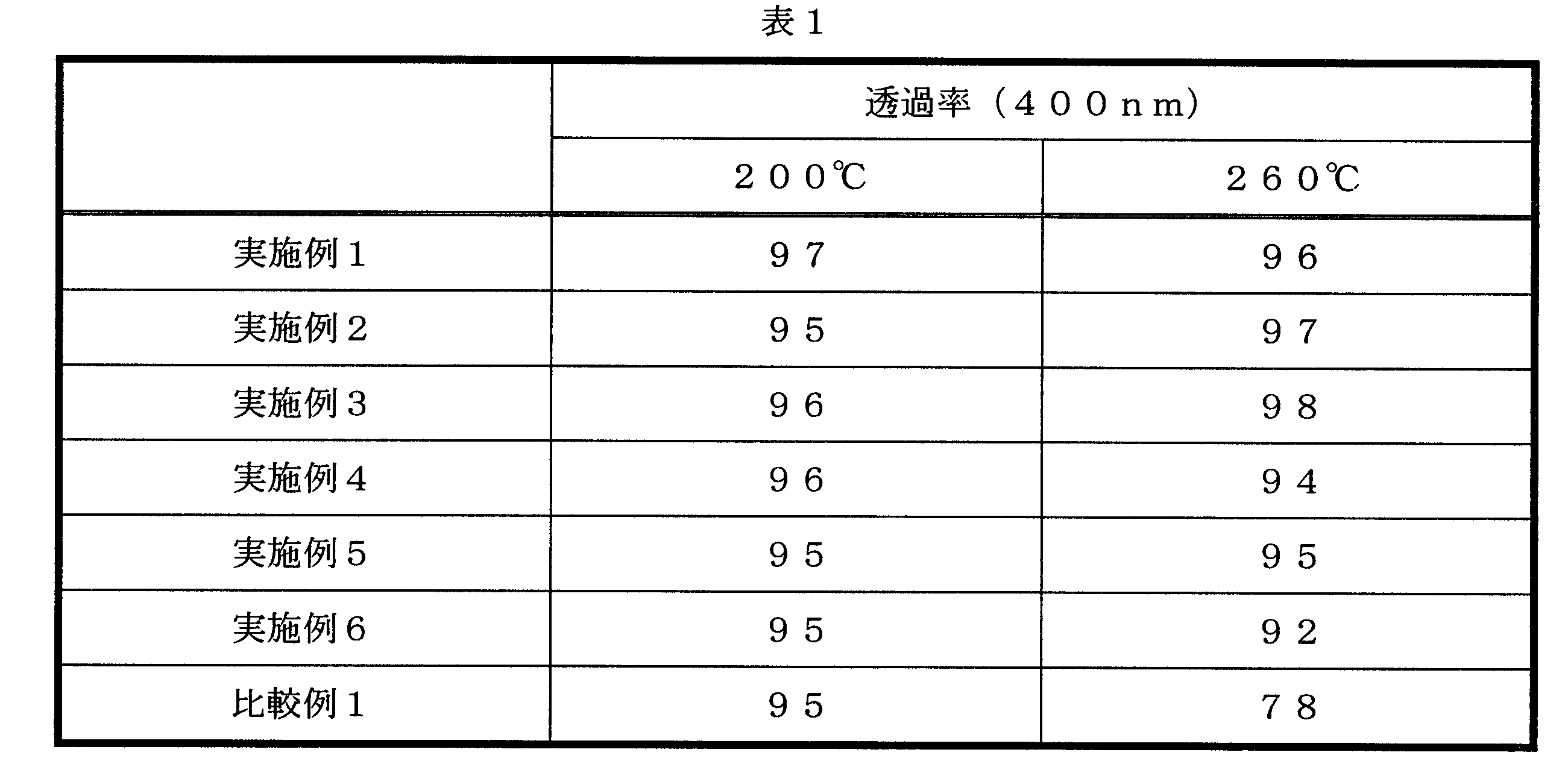
- the film formed from the photosensitive resin composition of the present invention had high heat resistance and was hardly colored even after being heated at 260 ° C.
- the film permeability was 95% after post-baking at 200 ° C. for 5 minutes, but when the film was further heated at 260 ° C. for 3 minutes, the film permeability was reduced to 78%.
- the pattern formed using the photosensitive resin composition of the present invention had high heat resistance, and the pattern did not reflow under any conditions of 200 ° C. and 260 ° C.
Landscapes
- Physics & Mathematics (AREA)
- General Physics & Mathematics (AREA)
- Chemical & Material Sciences (AREA)
- Spectroscopy & Molecular Physics (AREA)
- Health & Medical Sciences (AREA)
- Chemical Kinetics & Catalysis (AREA)
- Medicinal Chemistry (AREA)
- Polymers & Plastics (AREA)
- Organic Chemistry (AREA)
- Optics & Photonics (AREA)
- Materials For Photolithography (AREA)
- Addition Polymer Or Copolymer, Post-Treatments, Or Chemical Modifications (AREA)
Abstract
Description
また、液晶ディスプレイ(LCD)、有機エレクトロルミネッセンスディスプレイ装置等のディスプレイ装置の絶縁膜の開発を目的に、インデンとマレイミドとN-置換マレイミドからなるアルカリ可溶性共重合体、1,2-ナフトキノンジアジド化合物、架橋剤を含有する感放射線性樹脂組成物を用いることを特徴とするディスプレイ装置の絶縁膜形成方法が提案されている(特許文献5)。
さらに、多官能(メタ)アクリレートとの相溶性に非常に優れ、また、アルカリ可溶性も良好であり、したがって、このような特徴が要求される各種用途に好適に用いることを目的に、無置換マレイミド由来の単量体構造単位、スチレン類由来の単量体構造単位、(メタ)アクリル酸由来の単量体構造を含有することを特徴とする、マレイミド系共重合体が提案されている(特許文献6)。
しかし、これら従来文献は、マイクロレンズ用感光性樹脂組成物としての用途の提供を目的とするものでなく、かつ、無置換マレイミド又は無置換マレイミド及びN-置換マレイミド単位構造を有する共重合体のマイクロレンズ用感光性樹脂組成物への適用について具体的な手段及び効果は示唆されていない。
すなわち、第1観点として、
(A)成分、(B)成分、及び(C)成分を含有するマイクロレンズ用感光性樹脂組成物。
(A)成分:下記式(1)で表されるマレイミド構造単位を有する重合体
(B)成分:架橋剤
(C)成分:感光剤



第5観点として、第1観点乃至第4観点のうちいずれかに記載のマイクロレンズ用感光性樹脂組成物から得られる硬化膜。
第6観点として、第1観点乃至第4観点のうちいずれかに記載のマイクロレンズ用感光性樹脂組成物から作製されるマイクロレンズ。
また、本発明のマイクロレンズ用感光性樹脂組成物から形成されたパターンも優れた耐熱性を有することが可能である。
さらに本発明のマイクロレンズ用感光性樹脂組成物に含有されるN-置換マレイミドの種類を変えることで、当該組成物から屈折率が異なる様々なマイクロレンズを形成することができる。
以上より、本発明のマイクロレンズ用感光性樹脂組成物から形成される膜は、その形成工程、または配線等の周辺装置の形成工程において、高温での加熱処理が行われる場合にマイクロレンズが着色し、レンズ形状が変形する可能性を著しく減少できる。また、マイクロレンズ形成後に電極、配線形成工程が行われる場合には、有機溶剤によるマイクロレンズの変形、剥離といった問題も著しく減少できる。
したがって、本発明のマイクロレンズ用感光性樹脂組成物は、マイクロレンズ材料を形成する材料として好適である。
以下、各成分の詳細を説明する。
本発明のマイクロレンズ用感光樹脂組成物から溶剤を除いた固形分は通常、1乃至50質量%である。
本発明の(A)成分は、少なくとも下記式(1)で表されるマレイミド構造単位を有する重合体である。



本発明の(B)成分である架橋剤は、熱や酸の作用により、樹脂等の配合組成物や他の架橋剤分子との結合を形成する化合物である。当該架橋剤としては、例えば、多官能(メタ)アクリレート化合物、エポキシ化合物、ヒドロキシメチル基置換フェノール化合物、及びアルコキシアルキル化されたアミノ基を有する化合物等を挙げることができる。
これらの架橋剤は、単独で又は二種以上を組み合わせて用いることができる。
アルコキシアルキル化されたアミノ基を有する化合物のうち、下記式(6)で表されるヘキサメトキシメチルメラミンが好ましい。

本発明の(C)成分である感光剤としては、感光成分として使用できる化合物であれば、特に限定されるものでないが、1,2-ナフトキノンジアジド化合物が好ましい。
前記1,2-ナフトキノンジアジド化合物としては、ヒドロキシル基を有する化合物であって、これらのヒドロキシル基のうち、10乃至100モル%、好ましくは20乃至95モル%が1,2-ナフトキノンジアジドスルホン酸エステル化された化合物を用いることができる。
そのような溶剤としては、例えば、エチレングリコールモノメチルエーテル、エチレングリコールモノエチルエーテル、メチルセロソルブアセテート、エチルセロソルブアセテート、ジエチレングリコールモノメチルエーテル、ジエチレングリコールモノエチルエーテル、プロピレングリコール、プロピレングリコールモノメチルエーテル、プロピレングリコールモノメチルエーテルアセテート、プロピレングリコールプロピルエーテルアセテート、プロピレングリコールモノブチルエーテル、プロピレングリコールモノブチルエーテルアセテート、トルエン、キシレン、メチルエチルケトン、シクロペンタノン、シクロヘキサノン、2-ヒドロキシプロピオン酸エチル、2-ヒドロキシ-2-メチルプロピオン酸エチル、エトキシ酢酸エチル、ヒドロキシ酢酸エチル、2-ヒドロキシ-3-メチルブタン酸メチル、3-メトキシプロピオン酸メチル、3-メトキシプロピオン酸エチル、3-エトキシプロピオン酸エチル、3-エトキシプロピオン酸メチル、ピルビン酸メチル、酢酸エチル、酢酸ブチル、乳酸エチル、乳酸ブチル、2-ヘプタノン、γ-ブチロラクトン等を挙げることができる。
当該界面活性剤としては、例えば、ポリオキシエチレンラウリルエーテル、ポリオキシエチレンステアリルエーテル、ポリオキシエチレンセチルエーテル、ポリオキシエチレンオレイルエーテル等のポリオキシエチレンアルキルエーテル類、ポリオキシエチレンオクチルフェノールエーテル、ポリオキシエチレンノニルフェノールエーテル等のポリオキシエチレンアルキルアリルエーテル類、ポリオキシエチレン・ポリオキシプロピレンブロックコポリマー類、ソルビタンモノラウレート、ソルビタンモノパルミテート、ソルビタンモノステアレート、ソルビタンモノオレエート、ソルビタントリオレエート、ソルビタントリステアレート等のソルビタン脂肪酸エステル類、ポリオキシエチレンソルビタンモノラウレート、ポリオキシエチレンソルビタンモノパルミテート、ポリオキシエチレンソルビタンモノステアレート、ポリオキシエチレンソルビタントリオレエート、ポリオキシエチレンソルビタントリステアレート等のポリオキシエチレンソルビタン脂肪酸エステル類等のノニオン系界面活性剤、エフトップ(登録商標)EF301、EF303、EF352(三菱マテリアル電子化成株式会社(旧(株)ジェムコ)製)、メガファック(登録商標)F171、F173、R30(DIC株式会社(旧大日本インキ化学工業(株))製)、フロラードFC430、FC431(住友スリーエム(株)製)、アサヒガード(登録商標)AG710、サーフロンS-382、SC101、SC102、SC103、SC104、SC105、SC106(旭硝子(株)製)等のフッ素系界面活性剤、オルガノシロキサンポリマーKP341(信越化学工業(株)製)等を挙げることができる。
さらに、これらの現像液に界面活性剤等を加えることもできる。
[下記合成例で得られたポリマーの重量平均分子量の測定]
装置:日本分光(株)製GPCシステム
カラム:Shodex〔登録商標〕KL-804L及び803L
カラムオーブン:40℃
流量:1ml/分
溶離液:テトラヒドロフラン
<合成例1>
マレイミド9.6g、N-シクロヘキシルマレイミド20g、2,2’-アゾビス(イソ酪酸)ジメチル1.8gを2-ブタノン47.1gに溶解させた後、この溶液を2-ブタノン78.5gが加熱還流されているフラスコ中に4時間かけて滴下した。滴下終了後、4時間反応させた。この反応溶液を室温に冷却後、ヘキサン/ジエチルエーテル混合溶媒に投入してポリマーを再沈殿させ、減圧乾燥して、下記式(7)で表される構造単位を有するポリマー(共重合体)を得た。
得られたポリマーの重量平均分子量Mwは10,400(ポリスチレン換算)であった。

マレイミド7.5g、N-フェニルマレイミド15g、2,2’-アゾビス(イソ酪酸)ジメチル1.4gを2-ブタノン35.7gに溶解させた後、この溶液を2-ブタノン59.5gが加熱還流されているフラスコ中に2時間かけて滴下した。滴下終了後、2時間反応させた。この反応溶液を室温に冷却後、ヘキサン/ジエチルエーテル混合溶媒に投入してポリマーを再沈殿させ、減圧乾燥して、下記式(8)で表される構造単位を有するポリマー(共重合体)を得た。
得られたポリマーの重量平均分子量Mwは8,200(ポリスチレン換算)であった。
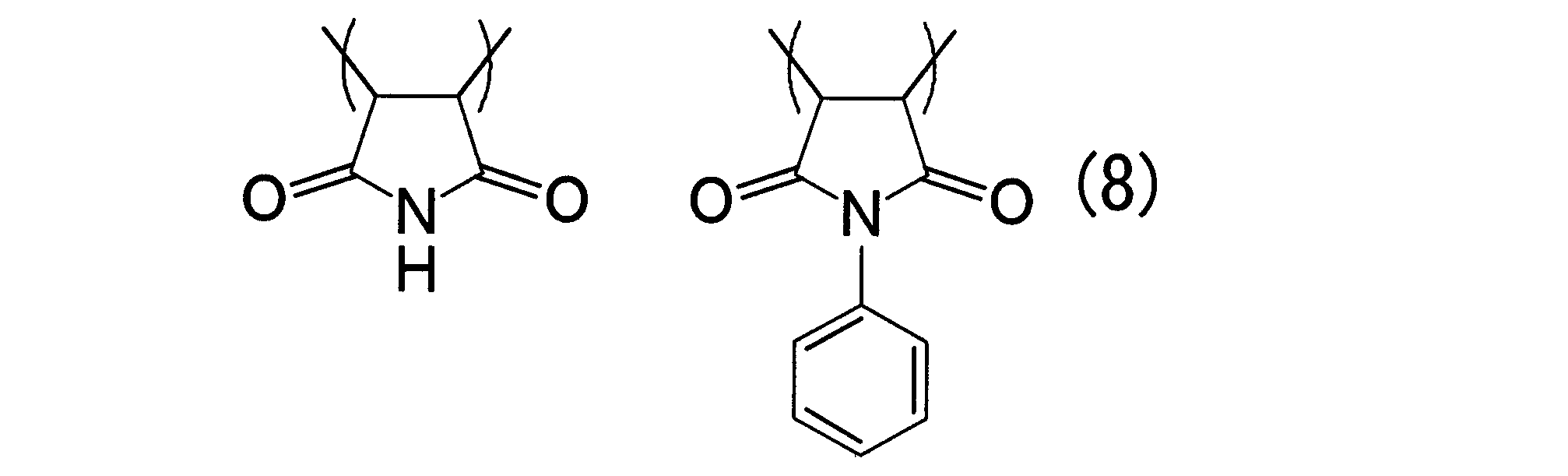
マレイミド4.7g、N-2,4,6-トリクロロフェニルマレイミド15g、2,2’-アゾビス(イソ酪酸)ジメチル1.2gを2-ブタノン31.3gに溶解させた後、この溶液を2-ブタノン52.1gが加熱還流されているフラスコ中に2時間かけて滴下した。滴下終了後、3時間反応させた。この反応溶液を室温に冷却後、ヘキサン/ジエチルエーテル混合溶媒に投入してポリマーを再沈殿させ、減圧乾燥して、下記式(9)で表される構造単位を有するポリマー(共重合体)を得た。
得られたポリマーの重量平均分子量Mwは3,000(ポリスチレン換算)であった。
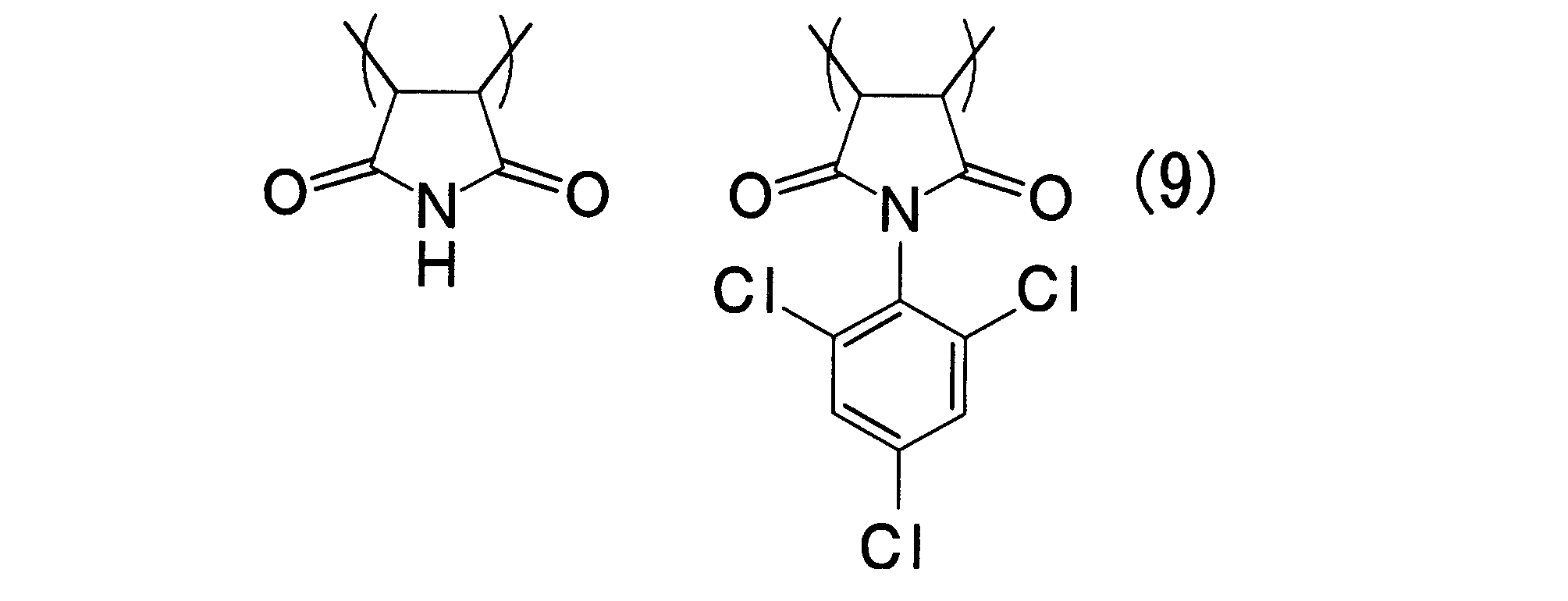
マレイミド6.9g、N-ベンジルマレイミド15g、2,2’-アゾビス(イソ酪酸)ジメチル1.3gを2-ブタノン34.8gに溶解させた後、この溶液を2-ブタノン58.0gが加熱還流されているフラスコ中に2時間かけて滴下した。滴下終了後、3時間反応させた。この反応溶液を室温に冷却後、ヘキサン/ジエチルエーテル混合溶媒に投入してポリマーを再沈殿させ、減圧乾燥して、下記式(10)で表される構造単位を有するポリマー(共重合体)を得た。
得られたポリマーの重量平均分子量Mwは5,600(ポリスチレン換算)であった。
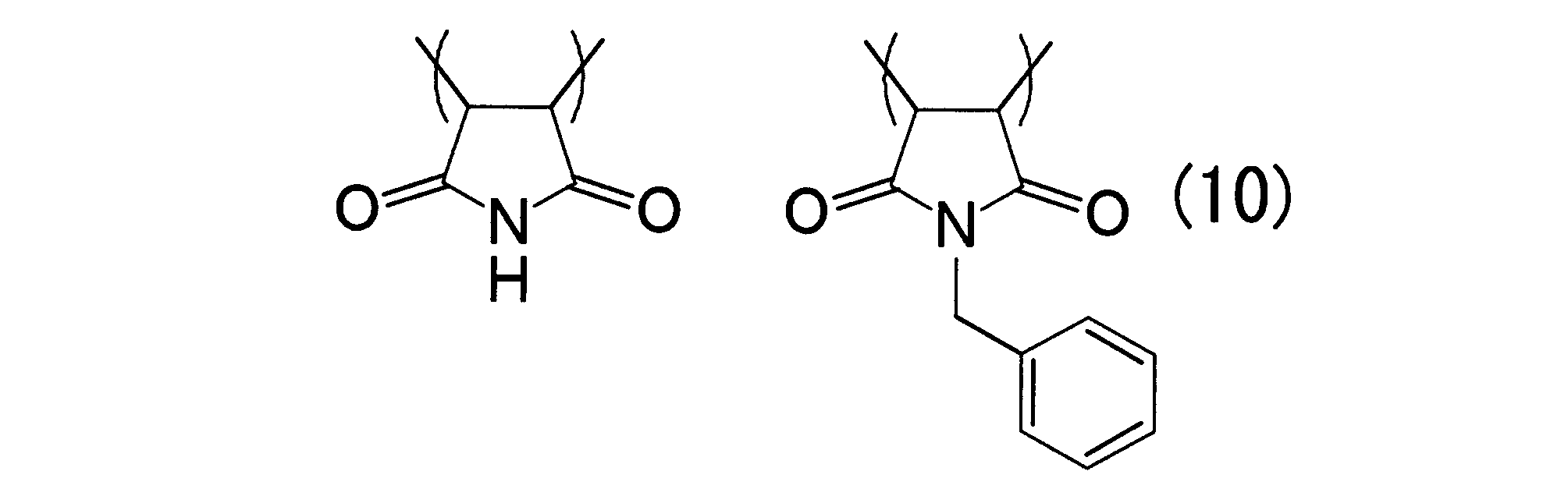
マレイミド9g、N-シクロヘキシルマレイミド10g、n-ブチルビニルエーテル3.7g、2,2’-アゾビス(イソ酪酸)ジメチル1.4gを2-ブタノン36.2gに溶解させた後、この溶液を2-ブタノン60.3gが加熱還流されているフラスコ中に2時間かけて滴下した。滴下終了後、3時間反応させた。この反応溶液を室温に冷却後、ヘキサン/ジエチルエーテル混合溶媒に投入してポリマーを再沈殿させ、減圧乾燥して、下記式(11)で表される構造単位を有するポリマー(共重合体)を得た。
得られたポリマーの重量平均分子量Mwは5,800(ポリスチレン換算)であった。
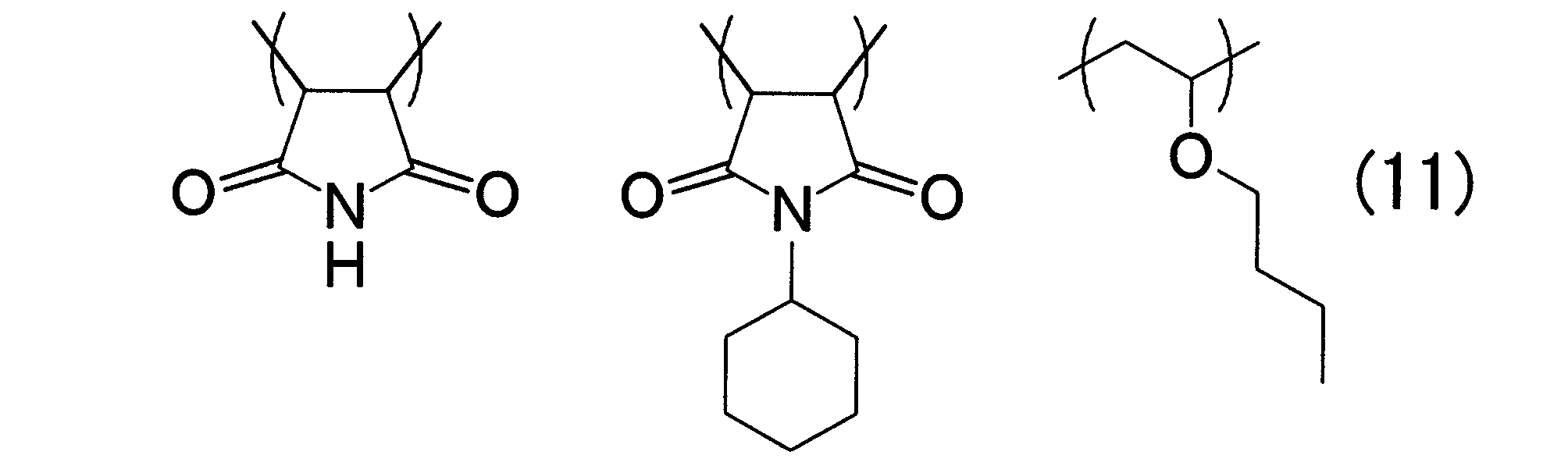
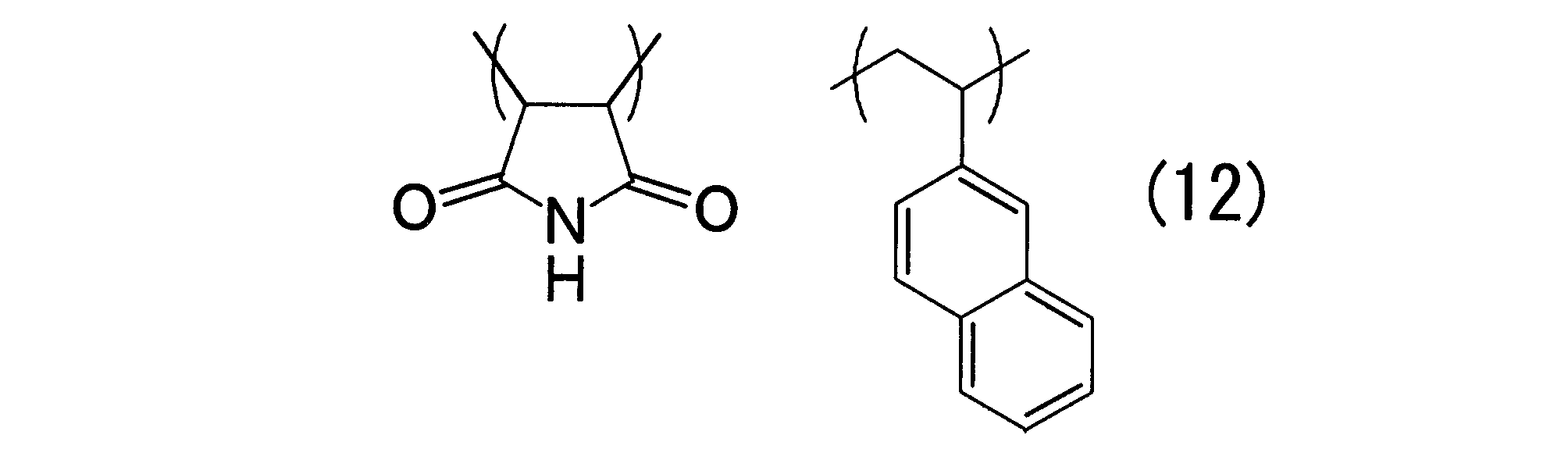
マレイミド17g、2-ビニルナフタレン27g、2,2’-アゾビスイソブチロニトリル2.2gをプロピレングリコールモノメチルエーテル108gに溶解し、窒素雰囲気下加熱して80℃に保ったプロピレングリコールモノメチルエーテル30gに2時間かけて滴下した。滴下終了後、80℃で20時間反応させた。この反応溶液を室温に冷却後、メタノールに投入してポリマーを再沈殿させ、減圧乾燥して、下記式(12)で表される構造単位を有するポリマー(共重合体)を得た。
得られたポリマーの重量平均分子量Mwは7,300(ポリスチレン換算)であった。
<実施例1~5>
合成例1~5で得られた(A)成分であるポリマー9g、(B)成分である架橋剤としてCYMEL(登録商標)303(日本サイテックインダストリーズ(株))2.7g、(C)成分である感光剤としてP-150(東洋合成工業(株)製)2.7g、界面活性剤としてメガファック(登録商標)R-30(DIC(株)製)0.04gをプロピレングリコールモノメチルエーテル32.9g及びプロピレングリコールモノメチルエーテルアセテート32.9gに溶解させ溶液とした。その後、孔径0.10μmのポリエチレン製ミクロフィルターを用いて濾過して感光性樹脂組成物溶液を調製した。
合成例6で得られた(A)成分であるポリマー9g、(B)成分である架橋剤としてCYMEL(登録商標)303(日本サイテックインダストリーズ(株))2.7g、(C)成分である感光剤としてP-200(東洋合成工業(株)製)2.7g、界面活性剤としてメガファック(登録商標)R-30(DIC(株)製)0.03gをプロピレングリコールモノメチルエーテル46.0g及び乳酸エチル19.7gに溶解させ溶液とした。その後、孔径0.10μmのポリエチレン製ミクロフィルターを用いて濾過して感光性樹脂組成物溶液を調製した。
下記式(13)で表されるポリ(4-ビニルフェノール)(シグマアルドリッチジャパン(株)製、重量平均分子量Mw20,000)9g、感光剤としてP-200(東洋合成工業(株)製)2.7g、架橋剤としてCYMEL(登録商標)303(日本サイテックインダストリーズ(株))2.7g、界面活性剤としてメガファック(登録商標)R-30(DIC(株)製)0.03gをプロピレングリコールモノメチルエーテル46.0g及び乳酸エチル19.7gに溶解させ溶液とした。その後、孔径0.10μmのポリエチレン製ミクロフィルターを用いて濾過して感光性樹脂組成物溶液を調製した。

実施例1~6及び比較例1で調製した感光性樹脂組成物溶液を、石英基板上にスピンコーターを用いて塗布し、ホットプレート上において100℃で2分間プリベークした。次いで、紫外線照射装置PLA-501(F)(キャノン(株)製)により、365nmにおける照射量が500mJ/cm2の紫外線を全面照射した(フォトブリーチング)。次いで、ホットプレート上において200℃で5分間ポストベークを行い、膜厚1μmの膜を形成した。この膜を紫外線可視分光光度計UV-2550((株)島津製作所製)を用いて波長400nmの透過率を測定した。さらにこの膜を260℃で3分間加熱した後、波長400nmの透過率を測定した。評価の結果を表1に示す。
実施例1~6及び比較例1で調製した感光性樹脂組成物溶液を、シリコンウェハー上にスピンコーターを用いて塗布し、ホットプレート上において100℃で2分間プリベークして、膜厚1μmの感光性樹脂膜を形成した。次いで、i線ステッパーNSR-2205i12D(NA=0.63)((株)ニコン製)を用いて、マスクを介して露光した。次いで、ホットプレート上において、100℃で2分間、露光後ベーク(PEB)し、TMAH水溶液(実施例1~5は0.2質量%、実施例6及び比較例1は1.0質量%)で60秒間現像し、超純水で20秒間リンス、乾燥して2μm×2μmのドットパターンを形成した。さらに、前記i線ステッパーを用いて、500mJ/cm2のi線を全面照射し(フォトブリーチング)、ホットプレート上において200℃で5分間ポストベークを行った。さらに、この膜を260℃で3分間加熱した。走査型電子顕微鏡S-4800((株)日立ハイテクノロジーズ製)を用いて、現像・リンス・乾燥後、200℃ポストベーク後、及び260℃加熱後のパターンの観察を行った。評価の結果を表2に示す。

実施例1~6及び比較例1で調製した感光性樹脂組成物溶液をそれぞれ、シリコンウェハー上にスピンコーターを用いて塗布し、ホットプレート上において100℃で2分間プリベークした。次いで、紫外線照射装置PLA-501(F)(キャノン(株)製)により、365nmにおける照射量が500mJ/cm2の紫外線を全面照射した(フォトブリーチング)。次いで、ホットプレート上において200℃で5分間ポストベークを行い、膜厚1μmの膜を形成した。これらの膜を、アセトン、N-メチルピロリドン、2-プロパノール、及び2-ヘプタノンに、それぞれ23℃にて10分間浸漬した。いずれも、浸漬前後での膜厚変化が5%以下であることを確認した。
Claims (6)
- (A)成分、(B)成分、及び(C)成分を含有するマイクロレンズ用感光性樹脂組成物。
(A)成分:下記式(1)で表されるマレイミド構造単位を有する重合体
(B)成分:架橋剤
(C)成分:感光剤

- 前記(A)成分が、上記式(1)で表されるマレイミド構造単位に加えて、下記式(2)で表される少なくとも1種のN-置換マレイミド構造単位を有する共重合体である、請求項1に記載のマイクロレンズ用感光性樹脂組成物。

- 前記(A)成分が、さらに、下記式(3)、式(4)又は式(5)で表される少なくとも1種の構造単位を有する共重合体である、請求項1又は請求項2に記載のマイクロレンズ用感光性樹脂組成物。

- 前記重合体の重量平均分子量が1000乃至20000である、請求項1乃至請求項3のうちいずれか一項に記載のマイクロレンズ用感光性樹脂組成物。
- 請求項1乃至請求項4のうちいずれか一項に記載のマイクロレンズ用感光性樹脂組成物から得られる硬化膜。
- 請求項1乃至請求項4のうちいずれか一項に記載の感光性樹脂組成物から作製されるマイクロレンズ。
Priority Applications (4)
| Application Number | Priority Date | Filing Date | Title |
|---|---|---|---|
| CN2010800362430A CN102472833A (zh) | 2009-08-24 | 2010-06-21 | 微透镜用感光性树脂组合物 |
| US13/391,761 US8993699B2 (en) | 2009-08-24 | 2010-06-21 | Photosensitive resin composition for microlens |
| EP10811596.5A EP2472293B1 (en) | 2009-08-24 | 2010-06-21 | Photosensitive resin composition for microlens |
| JP2011528690A JP5725301B2 (ja) | 2009-08-24 | 2010-06-21 | マイクロレンズ用感光性樹脂組成物 |
Applications Claiming Priority (2)
| Application Number | Priority Date | Filing Date | Title |
|---|---|---|---|
| JP2009-193108 | 2009-08-24 | ||
| JP2009193108 | 2009-08-24 |
Publications (1)
| Publication Number | Publication Date |
|---|---|
| WO2011024545A1 true WO2011024545A1 (ja) | 2011-03-03 |
Family
ID=43627656
Family Applications (1)
| Application Number | Title | Priority Date | Filing Date |
|---|---|---|---|
| PCT/JP2010/060476 Ceased WO2011024545A1 (ja) | 2009-08-24 | 2010-06-21 | マイクロレンズ用感光性樹脂組成物 |
Country Status (7)
| Country | Link |
|---|---|
| US (1) | US8993699B2 (ja) |
| EP (1) | EP2472293B1 (ja) |
| JP (1) | JP5725301B2 (ja) |
| KR (1) | KR101593006B1 (ja) |
| CN (1) | CN102472833A (ja) |
| TW (1) | TWI477518B (ja) |
| WO (1) | WO2011024545A1 (ja) |
Cited By (4)
| Publication number | Priority date | Publication date | Assignee | Title |
|---|---|---|---|---|
| WO2012105288A1 (ja) * | 2011-01-31 | 2012-08-09 | 日産化学工業株式会社 | マイクロレンズ形成用感光性樹脂組成物 |
| CN103717630A (zh) * | 2011-09-05 | 2014-04-09 | 日产化学工业株式会社 | 树脂组合物 |
| JP2014189726A (ja) * | 2013-03-28 | 2014-10-06 | Nissan Chem Ind Ltd | レンズ形成用感光性樹脂組成物 |
| EP2833203A4 (en) * | 2012-03-27 | 2015-09-09 | Nissan Chemical Ind Ltd | LIGHT-SENSITIVE RESIN COMPOSITION |
Families Citing this family (1)
| Publication number | Priority date | Publication date | Assignee | Title |
|---|---|---|---|---|
| WO2015122109A1 (ja) * | 2014-02-13 | 2015-08-20 | 日産化学工業株式会社 | 樹脂組成物 |
Citations (14)
| Publication number | Priority date | Publication date | Assignee | Title |
|---|---|---|---|---|
| JPH0623842B2 (ja) | 1983-11-01 | 1994-03-30 | ヘキスト・セラニーズ・コーポレーション | ポジのホトレジスト組成物 |
| JP2001354822A (ja) | 2000-06-12 | 2001-12-25 | Jsr Corp | 感放射線性樹脂組成物、その層間絶縁膜およびマイクロレンズの形成への使用、ならびに層間絶縁膜およびマイクロレンズ |
| JP2002032377A (ja) | 2000-07-14 | 2002-01-31 | National Agricultural Research Organization | 遺伝子の類縁性検索方法および遺伝子の類縁性検索システム |
| WO2002083764A1 (en) * | 2001-04-09 | 2002-10-24 | Sekisui Chemical Co., Ltd. | Photoreactive composition |
| JP2002341137A (ja) * | 2001-05-11 | 2002-11-27 | Kanegafuchi Chem Ind Co Ltd | 光学フィルム、偏光子保護フィルムおよび偏光板 |
| JP2003026942A (ja) * | 2001-05-11 | 2003-01-29 | Kanegafuchi Chem Ind Co Ltd | 樹脂組成物 |
| JP2003131375A (ja) | 2001-10-25 | 2003-05-09 | Hitachi Ltd | パターン状絶縁膜形成方法 |
| US6586560B1 (en) | 2001-09-18 | 2003-07-01 | Microchem Corp. | Alkaline soluble maleimide-containing polymers |
| JP2004224894A (ja) | 2003-01-22 | 2004-08-12 | Nippon Shokubai Co Ltd | マレイミド系共重合体 |
| WO2005116764A1 (ja) * | 2004-05-26 | 2005-12-08 | Nissan Chemical Industries, Ltd. | ポジ型感光性樹脂組成物並びに得られる層間絶縁膜およびマイクロレンズ |
| JP2008303315A (ja) | 2007-06-08 | 2008-12-18 | Maruzen Petrochem Co Ltd | 新規ビニルエーテル共重合体 |
| JP2009003366A (ja) * | 2007-06-25 | 2009-01-08 | Jsr Corp | マイクロレンズ形成に用いられる感放射線性樹脂組成物 |
| JP2009157038A (ja) * | 2007-12-26 | 2009-07-16 | Sumitomo Chemical Co Ltd | マイクロレンズ及びマイクロレンズ用感光性組成物 |
| JP2009179770A (ja) * | 2008-02-01 | 2009-08-13 | Fujifilm Corp | 有機無機複合材料および光学物品 |
Family Cites Families (12)
| Publication number | Priority date | Publication date | Assignee | Title |
|---|---|---|---|---|
| JPS60135453A (ja) * | 1983-12-22 | 1985-07-18 | Mitsubishi Monsanto Chem Co | 熱可塑性樹脂組成物 |
| JPS6116955A (ja) * | 1984-07-03 | 1986-01-24 | Mitsubishi Monsanto Chem Co | 耐熱性耐衝撃性樹脂組成物 |
| JPS61264036A (ja) * | 1985-05-17 | 1986-11-21 | Mitsubishi Monsanto Chem Co | 耐熱性耐衝撃性熱可塑性樹脂組成物 |
| JP3270079B2 (ja) | 1991-11-05 | 2002-04-02 | ミサワホーム株式会社 | ラッピング装置 |
| JPH0649302A (ja) * | 1991-12-06 | 1994-02-22 | Japan Synthetic Rubber Co Ltd | 難燃性樹脂組成物 |
| JP4051538B2 (ja) | 2001-02-22 | 2008-02-27 | 日産化学工業株式会社 | リソグラフィー用反射防止膜形成組成物 |
| JP4328951B2 (ja) * | 2003-10-07 | 2009-09-09 | 信越化学工業株式会社 | レジスト材料及びパターン形成方法 |
| CN101443704A (zh) * | 2006-05-16 | 2009-05-27 | 日产化学工业株式会社 | 正型感光性树脂组合物以及由其得到的多孔膜 |
| JP2008176278A (ja) * | 2006-10-18 | 2008-07-31 | Jsr Corp | ドライフィルム、マイクロレンズおよびそれらの製造方法 |
| CN101165592A (zh) * | 2006-10-18 | 2008-04-23 | Jsr株式会社 | 干膜、微透镜以及它们的制造方法 |
| EP2154569A4 (en) * | 2007-05-17 | 2011-12-28 | Nissan Chemical Ind Ltd | PHOTOSENSITIVE RESIN AND METHOD FOR MANUFACTURING MICROLENSES |
| JP5079653B2 (ja) * | 2008-09-29 | 2012-11-21 | 富士フイルム株式会社 | 着色硬化性組成物、カラーフィルタ及びその製造方法、並びに固体撮像素子 |
-
2010
- 2010-06-21 EP EP10811596.5A patent/EP2472293B1/en not_active Not-in-force
- 2010-06-21 KR KR1020127007067A patent/KR101593006B1/ko not_active Expired - Fee Related
- 2010-06-21 JP JP2011528690A patent/JP5725301B2/ja active Active
- 2010-06-21 WO PCT/JP2010/060476 patent/WO2011024545A1/ja not_active Ceased
- 2010-06-21 US US13/391,761 patent/US8993699B2/en not_active Expired - Fee Related
- 2010-06-21 CN CN2010800362430A patent/CN102472833A/zh active Pending
- 2010-07-14 TW TW099123124A patent/TWI477518B/zh not_active IP Right Cessation
Patent Citations (14)
| Publication number | Priority date | Publication date | Assignee | Title |
|---|---|---|---|---|
| JPH0623842B2 (ja) | 1983-11-01 | 1994-03-30 | ヘキスト・セラニーズ・コーポレーション | ポジのホトレジスト組成物 |
| JP2001354822A (ja) | 2000-06-12 | 2001-12-25 | Jsr Corp | 感放射線性樹脂組成物、その層間絶縁膜およびマイクロレンズの形成への使用、ならびに層間絶縁膜およびマイクロレンズ |
| JP2002032377A (ja) | 2000-07-14 | 2002-01-31 | National Agricultural Research Organization | 遺伝子の類縁性検索方法および遺伝子の類縁性検索システム |
| WO2002083764A1 (en) * | 2001-04-09 | 2002-10-24 | Sekisui Chemical Co., Ltd. | Photoreactive composition |
| JP2002341137A (ja) * | 2001-05-11 | 2002-11-27 | Kanegafuchi Chem Ind Co Ltd | 光学フィルム、偏光子保護フィルムおよび偏光板 |
| JP2003026942A (ja) * | 2001-05-11 | 2003-01-29 | Kanegafuchi Chem Ind Co Ltd | 樹脂組成物 |
| US6586560B1 (en) | 2001-09-18 | 2003-07-01 | Microchem Corp. | Alkaline soluble maleimide-containing polymers |
| JP2003131375A (ja) | 2001-10-25 | 2003-05-09 | Hitachi Ltd | パターン状絶縁膜形成方法 |
| JP2004224894A (ja) | 2003-01-22 | 2004-08-12 | Nippon Shokubai Co Ltd | マレイミド系共重合体 |
| WO2005116764A1 (ja) * | 2004-05-26 | 2005-12-08 | Nissan Chemical Industries, Ltd. | ポジ型感光性樹脂組成物並びに得られる層間絶縁膜およびマイクロレンズ |
| JP2008303315A (ja) | 2007-06-08 | 2008-12-18 | Maruzen Petrochem Co Ltd | 新規ビニルエーテル共重合体 |
| JP2009003366A (ja) * | 2007-06-25 | 2009-01-08 | Jsr Corp | マイクロレンズ形成に用いられる感放射線性樹脂組成物 |
| JP2009157038A (ja) * | 2007-12-26 | 2009-07-16 | Sumitomo Chemical Co Ltd | マイクロレンズ及びマイクロレンズ用感光性組成物 |
| JP2009179770A (ja) * | 2008-02-01 | 2009-08-13 | Fujifilm Corp | 有機無機複合材料および光学物品 |
Non-Patent Citations (1)
| Title |
|---|
| See also references of EP2472293A4 * |
Cited By (9)
| Publication number | Priority date | Publication date | Assignee | Title |
|---|---|---|---|---|
| WO2012105288A1 (ja) * | 2011-01-31 | 2012-08-09 | 日産化学工業株式会社 | マイクロレンズ形成用感光性樹脂組成物 |
| US9052437B2 (en) | 2011-01-31 | 2015-06-09 | Nissan Chemical Industries, Ltd. | Photosensitive resin composition for forming microlens |
| JP5867735B2 (ja) * | 2011-01-31 | 2016-02-24 | 日産化学工業株式会社 | マイクロレンズ形成用感光性樹脂組成物 |
| TWI557141B (zh) * | 2011-01-31 | 2016-11-11 | 日產化學工業股份有限公司 | 形成微透鏡用之感光性樹脂組成物 |
| CN103717630A (zh) * | 2011-09-05 | 2014-04-09 | 日产化学工业株式会社 | 树脂组合物 |
| CN103717630B (zh) * | 2011-09-05 | 2016-08-24 | 日产化学工业株式会社 | 树脂组合物 |
| EP2833203A4 (en) * | 2012-03-27 | 2015-09-09 | Nissan Chemical Ind Ltd | LIGHT-SENSITIVE RESIN COMPOSITION |
| US9348224B2 (en) | 2012-03-27 | 2016-05-24 | Nissan Chemical Industries, Ltd. | Photosensitive resin composition |
| JP2014189726A (ja) * | 2013-03-28 | 2014-10-06 | Nissan Chem Ind Ltd | レンズ形成用感光性樹脂組成物 |
Also Published As
| Publication number | Publication date |
|---|---|
| TWI477518B (zh) | 2015-03-21 |
| JP5725301B2 (ja) | 2015-05-27 |
| KR20120046775A (ko) | 2012-05-10 |
| EP2472293A4 (en) | 2014-07-30 |
| KR101593006B1 (ko) | 2016-02-11 |
| EP2472293B1 (en) | 2016-06-29 |
| TW201116544A (en) | 2011-05-16 |
| US8993699B2 (en) | 2015-03-31 |
| JPWO2011024545A1 (ja) | 2013-01-24 |
| CN102472833A (zh) | 2012-05-23 |
| US20120156598A1 (en) | 2012-06-21 |
| EP2472293A1 (en) | 2012-07-04 |
Similar Documents
| Publication | Publication Date | Title |
|---|---|---|
| JP5696858B2 (ja) | マイクロレンズ用感光性樹脂組成物 | |
| JP5867735B2 (ja) | マイクロレンズ形成用感光性樹脂組成物 | |
| JP6103256B2 (ja) | 感光性樹脂組成物 | |
| JP5725301B2 (ja) | マイクロレンズ用感光性樹脂組成物 | |
| JP5574124B2 (ja) | 共重合体を含有する感光性樹脂組成物 |
Legal Events
| Date | Code | Title | Description |
|---|---|---|---|
| WWE | Wipo information: entry into national phase |
Ref document number: 201080036243.0 Country of ref document: CN |
|
| 121 | Ep: the epo has been informed by wipo that ep was designated in this application |
Ref document number: 10811596 Country of ref document: EP Kind code of ref document: A1 |
|
| WWE | Wipo information: entry into national phase |
Ref document number: 2011528690 Country of ref document: JP |
|
| WWE | Wipo information: entry into national phase |
Ref document number: 13391761 Country of ref document: US |
|
| NENP | Non-entry into the national phase |
Ref country code: DE |
|
| WWE | Wipo information: entry into national phase |
Ref document number: 2010811596 Country of ref document: EP |
|
| ENP | Entry into the national phase |
Ref document number: 20127007067 Country of ref document: KR Kind code of ref document: A |