WO2011024856A1 - 含フッ素重合体の製造方法 - Google Patents
含フッ素重合体の製造方法 Download PDFInfo
- Publication number
- WO2011024856A1 WO2011024856A1 PCT/JP2010/064380 JP2010064380W WO2011024856A1 WO 2011024856 A1 WO2011024856 A1 WO 2011024856A1 JP 2010064380 W JP2010064380 W JP 2010064380W WO 2011024856 A1 WO2011024856 A1 WO 2011024856A1
- Authority
- WO
- WIPO (PCT)
- Prior art keywords
- polymerization
- water
- ppm
- compound
- fluoropolymer
- Prior art date
- Legal status (The legal status is an assumption and is not a legal conclusion. Google has not performed a legal analysis and makes no representation as to the accuracy of the status listed.)
- Ceased
Links
Classifications
-
- C—CHEMISTRY; METALLURGY
- C08—ORGANIC MACROMOLECULAR COMPOUNDS; THEIR PREPARATION OR CHEMICAL WORKING-UP; COMPOSITIONS BASED THEREON
- C08F—MACROMOLECULAR COMPOUNDS OBTAINED BY REACTIONS ONLY INVOLVING CARBON-TO-CARBON UNSATURATED BONDS
- C08F214/00—Copolymers of compounds having one or more unsaturated aliphatic radicals, each having only one carbon-to-carbon double bond, and at least one being terminated by a halogen
- C08F214/18—Monomers containing fluorine
-
- C—CHEMISTRY; METALLURGY
- C08—ORGANIC MACROMOLECULAR COMPOUNDS; THEIR PREPARATION OR CHEMICAL WORKING-UP; COMPOSITIONS BASED THEREON
- C08F—MACROMOLECULAR COMPOUNDS OBTAINED BY REACTIONS ONLY INVOLVING CARBON-TO-CARBON UNSATURATED BONDS
- C08F14/00—Homopolymers and copolymers of compounds having one or more unsaturated aliphatic radicals, each having only one carbon-to-carbon double bond, and at least one being terminated by a halogen
- C08F14/18—Monomers containing fluorine
-
- C—CHEMISTRY; METALLURGY
- C08—ORGANIC MACROMOLECULAR COMPOUNDS; THEIR PREPARATION OR CHEMICAL WORKING-UP; COMPOSITIONS BASED THEREON
- C08F—MACROMOLECULAR COMPOUNDS OBTAINED BY REACTIONS ONLY INVOLVING CARBON-TO-CARBON UNSATURATED BONDS
- C08F14/00—Homopolymers and copolymers of compounds having one or more unsaturated aliphatic radicals, each having only one carbon-to-carbon double bond, and at least one being terminated by a halogen
- C08F14/18—Monomers containing fluorine
- C08F14/22—Vinylidene fluoride
-
- C—CHEMISTRY; METALLURGY
- C08—ORGANIC MACROMOLECULAR COMPOUNDS; THEIR PREPARATION OR CHEMICAL WORKING-UP; COMPOSITIONS BASED THEREON
- C08F—MACROMOLECULAR COMPOUNDS OBTAINED BY REACTIONS ONLY INVOLVING CARBON-TO-CARBON UNSATURATED BONDS
- C08F14/00—Homopolymers and copolymers of compounds having one or more unsaturated aliphatic radicals, each having only one carbon-to-carbon double bond, and at least one being terminated by a halogen
- C08F14/18—Monomers containing fluorine
- C08F14/24—Trifluorochloroethene
-
- C—CHEMISTRY; METALLURGY
- C08—ORGANIC MACROMOLECULAR COMPOUNDS; THEIR PREPARATION OR CHEMICAL WORKING-UP; COMPOSITIONS BASED THEREON
- C08F—MACROMOLECULAR COMPOUNDS OBTAINED BY REACTIONS ONLY INVOLVING CARBON-TO-CARBON UNSATURATED BONDS
- C08F14/00—Homopolymers and copolymers of compounds having one or more unsaturated aliphatic radicals, each having only one carbon-to-carbon double bond, and at least one being terminated by a halogen
- C08F14/18—Monomers containing fluorine
- C08F14/26—Tetrafluoroethene
-
- C—CHEMISTRY; METALLURGY
- C08—ORGANIC MACROMOLECULAR COMPOUNDS; THEIR PREPARATION OR CHEMICAL WORKING-UP; COMPOSITIONS BASED THEREON
- C08F—MACROMOLECULAR COMPOUNDS OBTAINED BY REACTIONS ONLY INVOLVING CARBON-TO-CARBON UNSATURATED BONDS
- C08F214/00—Copolymers of compounds having one or more unsaturated aliphatic radicals, each having only one carbon-to-carbon double bond, and at least one being terminated by a halogen
- C08F214/18—Monomers containing fluorine
- C08F214/22—Vinylidene fluoride
- C08F214/225—Vinylidene fluoride with non-fluorinated comonomers
- C08F214/227—Vinylidene fluoride with non-fluorinated comonomers with non-fluorinated vinyl ethers
-
- C—CHEMISTRY; METALLURGY
- C08—ORGANIC MACROMOLECULAR COMPOUNDS; THEIR PREPARATION OR CHEMICAL WORKING-UP; COMPOSITIONS BASED THEREON
- C08F—MACROMOLECULAR COMPOUNDS OBTAINED BY REACTIONS ONLY INVOLVING CARBON-TO-CARBON UNSATURATED BONDS
- C08F214/00—Copolymers of compounds having one or more unsaturated aliphatic radicals, each having only one carbon-to-carbon double bond, and at least one being terminated by a halogen
- C08F214/18—Monomers containing fluorine
- C08F214/28—Hexyfluoropropene
- C08F214/285—Hexyfluoropropene with non-fluorinated comonomers
- C08F214/287—Hexyfluoropropene with non-fluorinated comonomers with non-fluorinated vinyl ethers
Definitions
- the present invention relates to a method for producing a fluoropolymer using a non-fluorine compound having surface activity.
- Fluoropolymers have excellent chemical resistance, solvent resistance, heat resistance, and antifouling properties, so as raw materials for various products that take advantage of these properties, the automotive industry, semiconductor industry, chemical industry, It is used in a wide range of industrial fields such as paint.
- fluoropolymers are produced by emulsion polymerization, suspension polymerization or solution polymerization of fluoroolefin.
- a surfactant is used in the emulsion polymerization method.
- the amount of the surfactant used increases, the number of polymer particles generated at the initial stage of the emulsion polymerization increases, and the polymerization rate increases, and the fluorine-containing weight increases. Combined production efficiency is improved.
- a large amount of surfactant is used, there is a tendency to reduce various physical properties such as water resistance of the fluoropolymer from which the surfactant is obtained. Therefore, it has been desired to develop a production method that can be efficiently polymerized in the presence of a small amount of a surfactant and that does not adversely affect various physical properties of the fluoropolymer.
- Patent Documents 2 and 3 a production method using alkyl phosphoric acid or an ester thereof (Patent Documents 2 and 3), a method using a compound in which phosphoric acid, sulfonic acid, carboxylic acid or the like is bonded to a quaternary carbon atom. (Patent Document 4) has been proposed.
- alkyl phosphoric acid or its ester when alkyl phosphoric acid or its ester is used, it is not always sufficient in terms of the number of generated particles, the polymerization rate, the molecular weight of the obtained polymer, the polymer concentration of the dispersion, the polymerization temperature, the polymerization pressure, etc.
- a further increase in the number of generated particles is desired.
- An object of the present invention is to provide a method for producing a fluorine-containing polymer having a large number of generated particles and a small particle diameter by using a specific non-fluorine compound having a surface activity.
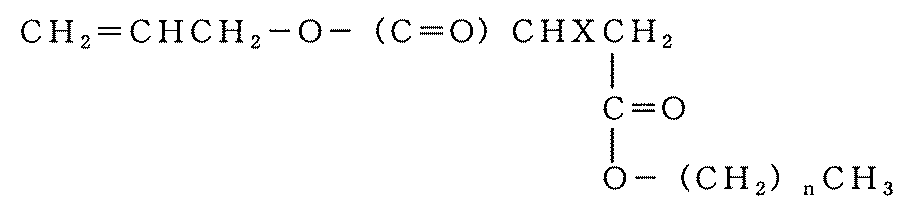
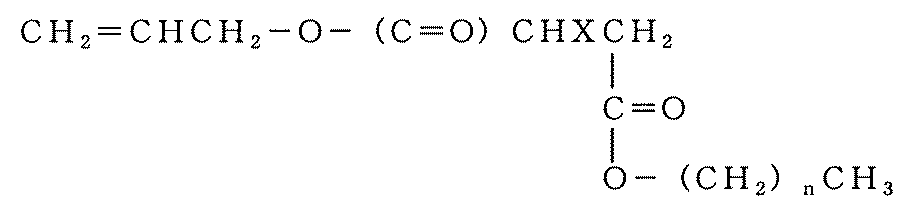
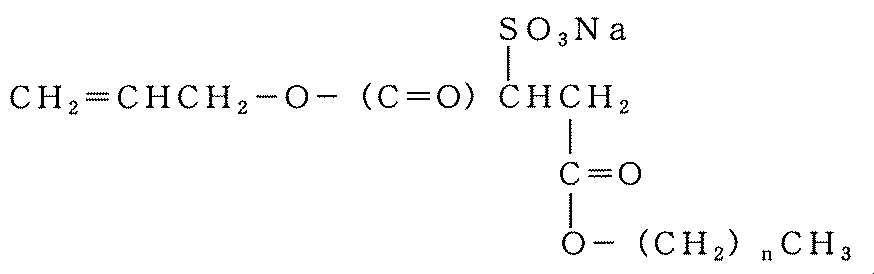
- the present invention Formula (1): (Wherein X is H or SO 3 Y (Y is NH 4 or an alkali metal atom); n is an integer of 0 to 19), and is a simple substance containing at least one fluoroolefin in the presence of the compound (1).
- the present invention relates to a method for producing a fluorine-containing polymer, which comprises subjecting a polymer to aqueous dispersion polymerization.
- a fluorine-containing surfactant having 6 or less carbon atoms may be used in combination.
- the fluoroolefin to be used for polymerization contains at least one fluoroolefin selected from the group consisting of vinyl fluoride, vinylidene fluoride, tetrafluoroethylene, hexafluoropropylene and chlorotrifluoroethylene. From the viewpoint of good properties and solvent resistance.
- aqueous dispersion polymerization emulsion polymerization or suspension polymerization is preferable.
- a fluorine-containing polymer having a large number of generated particles and a small particle diameter can be produced by using a specific non-fluorine compound having surface activity.
- the method for producing the fluoropolymer of the present invention comprises: Formula (1): (Wherein X is H or SO 3 Y (Y is NH 4 or an alkali metal atom); n is an integer of 0 to 19), and is a simple substance containing at least one fluoroolefin in the presence of the compound (1). It is characterized in that the monomer is subjected to aqueous dispersion polymerization.
- n 10 or 11 is preferable.
- the fluoroolefin polymerized by the production method of the present invention is not particularly limited, and one kind or two or more kinds can be used.
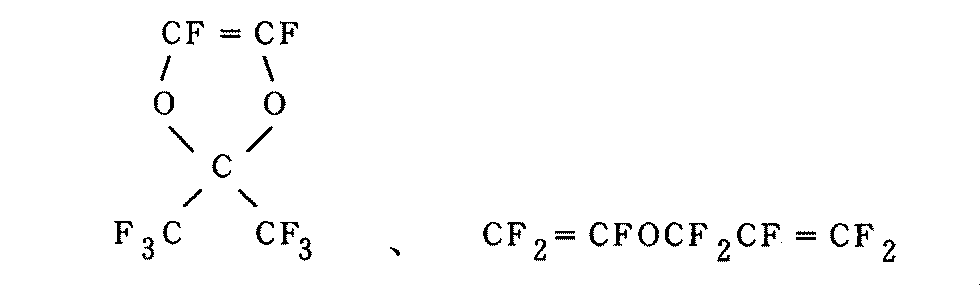
- the fluoroolefin include tetrafluoroethylene (TFE), hexafluoropropylene (HFP), perfluoro (alkyl vinyl ether) (PAVE), Perfluoroolefins such as: chlorotrifluoroethylene (CTFE), vinyl fluoride (VF), vinylidene fluoride (VdF), trifluoroethylene, trifluoropropylene, pentafluoropropylene, tetrafluoropropylene, hexafluoroisobutene, etc. And perfluoroolefin.
- PAVE include perfluoro (methyl vinyl ether) (PMVE), perfluoro (ethyl vinyl ether) (PEVE), perfluoro (propyl vinyl ether) (PPVE), and the like.
- functional group-containing fluoroolefin monomers can be used.
- a group; X 1 and X 2 are the same or different and each is a hydrogen atom or a fluorine atom; R f is a divalent fluorine-containing alkylene group having 1 to 40 carbon atoms or a divalent containing an ether bond having 1 to 40 carbon atoms A fluorine-containing alkylene group; and m is 0 or 1).
- Non-perfluoroolefins include iodine-containing monomers such as perfluoro (6,6-dihydro-6-iodo-3-oxa-acid described in JP-B-5-63482 and JP-A-62-12734. Periodinated vinyl ethers such as 1-hexene) and perfluoro (5-iodo-3-oxa-1-pentene) can also be used.
- a non-fluorinated monomer copolymerizable with a fluoroolefin may be used in combination.
- aqueous dispersion polymerization is carried out in the presence of compound (1) (surfactant).
- surfactant examples include emulsion polymerization and suspension polymerization.
- emulsion polymerization is preferable from the viewpoint of producing a large number of polymer particles having a small particle diameter.
- emulsion polymerization applied to the initial stage of seed polymerization, that is, seed particle production is preferable in that the number of particles can be increased even if the amount of the surfactant in the obtained fluoropolymer is the same.
- the amount of compound (1) used is preferably 10 to 5000 ppm, more preferably 20 to 4000 ppm based on the total amount of water. Of these, 50 to 1000 ppm, particularly 100 to 700 ppm is preferable.
- the amount of the compound (1) used is less than 10 ppm, the surface activity tends to be small and the number of generated particles tends to decrease, and when it exceeds 5000 ppm, the polymerization rate tends to decrease.
- the compound (1) can be used alone, or the emulsion polymerization proceeds sufficiently stably, but may be used in combination with other surfactants.
- the other surfactant may be a fluorine-containing surfactant or a non-fluorine (hydrocarbon) surfactant (except for the compound of the formula (1)).
- the fluorine-containing surfactant is preferably a fluorine-containing anionic surfactant from the viewpoint of polymerization stability.
- fluorine-containing anionic surfactant known ones can be used.
- US Patent Application Publication No. 2007/0015864 US Patent Application Publication No. 2007/0015865, US Patent Application Publication No. 2007/0015866.
- No. Frets, WO 2007/119526 pamphlet, WO 2007/046482 pamphlet, those described in WO 2007/046345 pamphlet can be exemplified.
- fluorine-containing surfactants that can be used in combination include, for example, F (CF 2 ) n COOM, CF 3 CF 2 CF 2 OCF (CF 3 ) CF 2 OCF (CF 3 ) COOM, CF 3 CF 2 OCF (CF 3) CF 2 OCF (CF 3 ) COOM, CF 3 OCF (CF 3) CF 2 OCF (CF 3) COOM, H (CF 2 CF 2) 2 CH 2 OCF (CF 3) COOM, H (CF 2) m COOM, C 6 F 13 CH 2 CH 2 SO 3 M, F (CF 2 CF 2 ) p CH 2 CH 2 SO 3 M, F (CF 2 CF 2 ) q CH 2 CH 2 SO 4 M (where M Is a monovalent cation; n is an integer of 2 to 5; m is an integer of 2 to 10; p is an integer of 2 to 10; q is an integer of 2 to 10).
- fluorine-containing surfactants having 6 or less carbon atoms can increase the concentration of the fluorine-containing polymer in the resulting polymerization product liquid and can be stably dispersed. It is preferable because it can be used as a liquid.
- the amount of other surfactants that can be used in combination is, for example, in the case of emulsion polymerization, the total amount with compound (1) is preferably 10 to 5000 ppm, more preferably 20 to 4000 ppm, based on the total amount of water.
- the total amount of the compound (1) and the other surfactant is less than 10 ppm, the surface active ability tends to decrease and the number of generated particles tends to decrease, and when it exceeds 5000 ppm, the polymerization rate tends to decrease. .
- examples of the surfactant that can be used in combination include a fluorine-containing reactive surfactant composed of a fluorine-containing compound having a radical polymerizable unsaturated bond and a hydrophilic group in the molecule.
- the fluorine-containing reactive surfactant can constitute a part of the polymer chain of the polymer when it is present in the reaction system during the polymerization.
- a fluorine-containing compound described in JP-A-8-67795 can be used.
- Polymerization temperature is not particularly limited, and an optimum temperature is employed according to the type of polymerization initiator. However, if it is too high, the monomer density in the gas phase part may easily decrease or a branching reaction of the polymer may occur, and the desired copolymer may not be obtained. It may slow down and lead to a decrease in production efficiency.
- the temperature is preferably 40 to 120 ° C, more preferably 50 to 100 ° C.
- Monomer may be supplied continuously or sequentially.
- oil-soluble peroxides can also be used. These typical oil-soluble initiators such as diisopropyl peroxydicarbonate (IPP) and di-n-propyl peroxydicarbonate (NPP) These peroxycarbonates have a risk of explosion and the like, are expensive, and have a problem that scales easily adhere to the wall of the polymerization tank during the polymerization reaction. In order to further reduce the compression set of the fluoropolymer, it is preferable to use a water-soluble radical polymerization initiator.
- IPP isopropyl peroxydicarbonate
- NPP di-n-propyl peroxydicarbonate
- water-soluble radical polymerization initiator In order to further reduce the compression set of the fluoropolymer, it is preferable to use a water-soluble radical polymerization initiator.
- water-soluble radical polymerization initiator examples include persulfuric acid, perboric acid, perchloric acid, perphosphoric acid, ammonium percarbonate, potassium salt, sodium salt, and the like. Particularly, ammonium persulfate and potassium persulfate are used. preferable.
- the addition amount of the polymerization initiator is not particularly limited, but it is added all at once in the initial stage of polymerization, sequentially or continuously, such that the polymerization rate is not significantly reduced (for example, several ppm to water concentration). do it.
- the upper limit is a range in which the heat of polymerization reaction can be removed from the surface of the apparatus.
- a molecular weight modifier or the like may be further added.
- the molecular weight modifier may be added all at once in the initial stage, or may be added continuously or dividedly.
- the molecular weight regulator examples include esters such as dimethyl malonate, diethyl malonate, methyl acetate, ethyl acetate, butyl acetate, dimethyl succinate, isopentane, isopropanol, acetone, various mercaptans, carbon tetrachloride, cyclohexane, mono Examples thereof include iodomethane, 1-iodomethane, 1-iodopropane, isopropyl iodide, diiodomethane, 1,2-diiodomethane, 1,3-diiodopropane and the like.
- a buffering agent or the like may be added as appropriate, but the amount is preferably used within a range not impairing the effects of the present invention.
- the polymerization pressure may be appropriately selected within the range of 0.1 to 10 MPa, and further 0.2 to 8 MPa, and within this range, the pressure may be low (0.1 to 1 MPa) or high (1 to 10 MPa).
- the stirring means for example, anchor blades, turbine blades, inclined blades and the like can be used, but stirring with a large blade called a full zone or max blend is preferable from the viewpoint of good monomer diffusion and polymer dispersion stability.
- the stirring device may be a horizontal stirring device or a vertical stirring device.
- the concentration of the fluoropolymer in the polymerization product liquid is increased.
- a stable fluoropolymer dispersion can be obtained even when the fluoropolymer concentration is about 45% by mass.
- a fluorine-containing anionic surfactant having 6 or less carbon atoms is used in combination, a dispersion of a fluorine-containing polymer having a high concentration exceeding 45% by mass, for example, 45 to 55% by mass, should be obtained in a stable state. Can do.
- the equipment and measurement conditions used for the evaluation of characteristics are as follows.
- Average particle size measuring device Microtrack UPA manufactured by HONEYWELL Measurement method: dynamic light scattering method
- the emulsion to be measured is diluted to a concentration measurable with pure water to make a sample, and measurement is performed at room temperature.
- the number average diameter of the obtained data is defined as the particle diameter.
- MFR Melt flow rate
- Coagulation was carried out by freezing 200 g of this dispersion at ⁇ 10 ° C. for 24 hours. The obtained coagulated product was washed with water and dried to obtain a fluoropolymer.
- the number average molecular weight (Mn) and the weight average molecular weight (Mw) of this fluoropolymer measured by GPC are 3.89 ⁇ 10 4 and 6.57 ⁇ 10 4 , respectively, and the molecular weight distribution Mw / Mn is 1.69. Met.
- Coagulation was carried out by freezing 200 g of this dispersion at ⁇ 10 ° C. for 24 hours. The obtained coagulated product was washed with water and dried to obtain a fluoropolymer.
- the number average molecular weight and weight average molecular weight measured by GPC were 7.81 ⁇ 10 3 and 7.54 ⁇ 10 4 , respectively, and the molecular weight distribution Mw / Mn was 9.65.
- This dispersion 200g was frozen at -10 ° C for 24 hours for coagulation.
- the obtained coagulated product was washed with water and dried to obtain a fluoropolymer. Since this fluoropolymer does not dissolve in THF, the molecular weight using GPC could not be measured.
- Coagulation was carried out by freezing 200 g of this dispersion at ⁇ 10 ° C. for 24 hours. The obtained coagulated product was washed with water and dried to obtain a fluoropolymer.
- the number average molecular weight and weight average molecular weight measured by GPC were 1.15 ⁇ 10 4 and 5.70 ⁇ 10 4 , respectively, and the molecular weight distribution Mw / Mn was 4.96.
- 669 g, 1146 g, 1440 g, and 1783 g of the mixed monomer were consumed, 1.41 g of a 38% by mass aqueous solution of the compound (1-1) was dissolved in 4 ml of ion-exchanged water and injected. After 14 hours and 44 minutes from the start of polymerization, unreacted monomers were released, and the autoclave was cooled to obtain a fluoropolymer dispersion having a solid content concentration of 44.4% by mass.
- This dispersion 200g was frozen at -10 ° C for 24 hours for coagulation.
- the obtained coagulated product was washed with water and dried to obtain a fluoropolymer.
- MFR of this fluoropolymer 9.18 g / 10 min. Met.
- Example 4 In a 2 L stainless steel autoclave, 2675 g of ion-exchanged water, 11.8 g of 50% by mass aqueous solution of ammonium perfluorohexanoate (concentration of ammonium perfluorohexanoate 2200 ppm / water), 38 mass of the compound (1-1) A 1.41 g% aqueous solution (concentration of compound (1-1): 200 ppm / water) was charged, and the system was sufficiently replaced with nitrogen gas, and then the pressure was reduced.
- the temperature was raised to 70 ° C.
- VdF / TFE / CTFE 73.3 / 14.4 / 12.3% mol%) mixed monomer is mixed with an internal pressure of 0.75 to 0.80 MPa. Supplied to maintain. Unreacted monomer was released 5 hours and 18 minutes after the start of polymerization, and the autoclave was cooled to obtain a dispersion of a fluoropolymer having a solid content concentration of 45.5% by mass.
- This dispersion 200g was frozen at -10 ° C for 24 hours for coagulation.
- the obtained coagulated product was washed with water and dried to obtain a fluoropolymer.
- MFR of this fluoropolymer it was 2.34 g / 10 min. Met.
- Example 5 A 2 L stainless steel autoclave was charged with 500 g of ion-exchanged water and 0.26 g of a 38% by mass aqueous solution of the compound (1-1) (concentration of compound (1-1) 200 ppm / water), and the system was filled with nitrogen gas. Then, the pressure was reduced. Subsequently, VdF was injected into the polymerization tank so that the internal pressure was 0.75 to 0.80 MPa, and the temperature was raised to 70 ° C.
- VdF VdF homopolymer
- the average particle diameter of the obtained PVdF was 330 nm, and the number of particles in the dispersion was 1.04 ⁇ 10 12 (pieces / 1 g of water).
- Example 7 A 2 L stainless steel autoclave was charged with 1000 g of ion-exchanged water and 1.04 g of a 38 mass% aqueous solution of the compound (1-1) (the concentration of the compound (1-1) was 400 ppm / water), and the system was filled with nitrogen gas. Then, the pressure was reduced. Subsequently, VdF was injected into the polymerization tank so that the internal pressure became 2.3 to 2.5 MPa, and the temperature was raised to 70 ° C.
- VdF VdF homopolymer
- the average particle diameter of the obtained PVdF was 85.6 nm, and the number of particles in the dispersion was 1.94 ⁇ 10 14 (pieces / water 1 g).
- Comparative Example 3 A 2L stainless steel autoclave was charged with 1000g of ion exchange water and 0.50g of 50% aqueous solution of ammonium perfluorohexanoate (ammonium perfluorohexanoate concentration of 1000ppm / water), and the system was thoroughly replaced with nitrogen gas. And reduced pressure. Subsequently, VdF was injected into the polymerization tank so that the internal pressure was 0.75 to 0.80 MPa, and the temperature was raised to 70 ° C.
Landscapes
- Chemical & Material Sciences (AREA)
- Health & Medical Sciences (AREA)
- Chemical Kinetics & Catalysis (AREA)
- Medicinal Chemistry (AREA)
- Polymers & Plastics (AREA)
- Organic Chemistry (AREA)
- Addition Polymer Or Copolymer, Post-Treatments, Or Chemical Modifications (AREA)
- Polymerisation Methods In General (AREA)
Abstract
Description
式(1):
式(1):
CX1 2=CX2-(Rf)m-Y1 (2)
(式中、Y1は-OH、-COOH、-SO2F、-SO3M2(M2は水素原子、NH4基またはアルカリ金属)、カルボン酸塩、カルボキシエステル基、エポキシ基またはシアノ基;X1およびX2は同じかまたは異なりいずれも水素原子またはフッ素原子;Rfは炭素数1~40の2価の含フッ素アルキレン基または炭素数1~40のエーテル結合を含有する2価の含フッ素アルキレン基;mは0または1)で示される化合物があげられる。


測定装置:HONEYWELL社製のマイクロトラックUPA
測定方法:動的光散乱法
測定する乳濁液を純水で計測可能な濃度に希釈して試料とし、室温にて測定を行う。得られたデータの個数平均径を粒子径とする。
計算方法:(1)で求めた平均粒子径と固形分含有量から、重合体比重を1.8として計算する。
NMR測定装置:VARIAN社製
1H-NMR測定条件:400MHz(テトラメチルシラン=0ppm)
19F-NMR測定条件:376MHz(トリクロロフルオロメタン=0ppm)
昭和電工製Shodex GPC-104を使用し、標準ポリスチレン換算の重量平均分子量および数平均分子量を求める。
測定条件
キャリア:テトラヒドロフラン(THF)
流速:0.6ml/min
カラム温度:40℃
試料:測定する樹脂の3%THF溶液
安田精機製作所社製Dyniscoメルトインデックステスターを用い、約6gの樹脂を250℃±0.5℃に保たれた0.376インチIDシリンダーに投入し、5分間放置して温度が平衡状態に達した後、10Kgのピストン荷重のもとで直径0.0825インチ、長さ0.315インチのオリフィスを通して押し出す(同時期に採取した樹脂の3回の平均値をMFR値とする。単位はg/10分)。
2Lのステンレススチール製のオートクレーブに、イオン交換水1000g、式(1-1):
2Lのステンレススチール製のオートクレーブに、イオン交換水500g、式:
NaSO3CH((CH2)mCH3)((CH2)nCH3)
(m+n=14~17の混合物)で示される化合物0.1g(200ppm/水)を仕込み、系内を窒素ガスで充分に置換後、減圧にした。続いて重合槽内を系内圧力が0.60~0.65MPaとなるようにVdF/TFE/CTFE(=74/14/12モル%)混合単量体を圧入し、70℃に昇温した。
2Lのステンレススチール製のオートクレーブに、イオン交換水500g、パーフルオロオクタン酸アンモニウム50%水溶液0.50g(パーフルオロオクタン酸アンモニウムの濃度1000ppm/水)を仕込み、系内を窒素ガスで充分に置換後、減圧にした。続いて重合槽内を系内圧力が1.00~1.10MPaとなるようにVdF/TFE/CTFE(=74/14/12モル%)混合単量体を圧入し、60℃に昇温した。
2Lのステンレススチール製のオートクレーブに、イオン交換水1000g、前記化合物(1-1)の38質量%水溶液0.52g(化合物(1-1)の濃度200ppm/水)を仕込み、系内を窒素ガスで充分に置換後、減圧にした。続いて重合槽内を系内圧力が0.75~0.80MPaとなるようにVdF/HFP(=78/22モル%)混合単量体を圧入し、70℃に昇温した。
6Lのステンレススチール製のオートクレーブに、イオン交換水2675g、前記化合物(1-1)の38質量%水溶液1.41g(化合物(1-1)の濃度200ppm/水)を仕込み、系内を窒素ガスで充分に置換後、減圧にした。続いて重合槽内を系内圧力が0.75~0.8MPaとなるようにVdF/TFE/CTFE(=71.5/14.9/13.6モル%)混合単量体を圧入し、70℃に昇温した。
2Lのステンレススチール製のオートクレーブに、イオン交換水2675g、パーフルオロヘキサン酸アンモニウムの50質量%水溶液11.8g(パーフルオロヘキサン酸アンモニウムの濃度2200ppm/水)、前記化合物(1-1)の38質量%水溶液1.41g(化合物(1-1)の濃度200ppm/水)を仕込み、系内を窒素ガスで充分に置換後、減圧にした。続いて重合槽内を系内圧力が0.75~0.8MPaとなるようにVdF/TFE/CTFE(=73.3/14.4/12.3モル%)混合単量体を圧入し、70℃に昇温した。
2Lのステンレススチール製のオートクレーブに、イオン交換水500g、前記化合物(1-1)の38質量%水溶液0.26g(化合物(1-1)の濃度200ppm/水)を仕込み、系内を窒素ガスで充分に置換後、減圧にした。続いて重合槽内を系内圧力が0.75~0.80MPaとなるようにVdFを圧入し、70℃に昇温した。
2Lのステンレススチール製のオートクレーブに、イオン交換水500g、前記化合物(1-1)の38質量%水溶液0.26g(化合物(1-1)の濃度200ppm/水)を仕込み、系内を窒素ガスで充分に置換後、減圧にした。続いて重合槽内を系内圧力が0.55~0.60MPaとなるようにVdF/TFE/HFP(=50/20/30モル%)混合単量体を圧入し、70℃に昇温した。
2Lのステンレススチール製のオートクレーブに、イオン交換水1000g、前記化合物(1-1)の38質量%水溶液1.04g(化合物(1-1)の濃度400ppm/水)を仕込み、系内を窒素ガスで充分に置換後、減圧にした。続いて重合槽内を系内圧力が2.3~2.5MPaとなるようにVdFを圧入し、70℃に昇温した。
2Lのステンレススチール製のオートクレーブに、イオン交換水500g、前記化合物(1-1)の38質量%水溶液0.26g(化合物(1-1)の濃度200ppm/水)を仕込み、系内を窒素ガスで充分に置換後、減圧にした。続いて重合槽内を系内圧力が0.75~0.80MPaとなるようにVdF/TFE(=60/40モル%)混合単量体を圧入し、70℃に昇温した。
2Lのステンレススチール製のオートクレーブに、イオン交換水1000g、パーフルオロヘキサン酸アンモニウム50%水溶液0.50g(パーフルオロヘキサン酸アンモニウムの濃度1000ppm/水)を仕込み、系内を窒素ガスで充分に置換後、減圧にした。続いて重合槽内を系内圧力が0.75~0.80MPaとなるようにVdFを圧入し、70℃に昇温した。
Claims (6)
- 式(1):

- 炭素数が6以下の含フッ素界面活性剤を併用する請求項1記載の製造方法。
- フルオロオレフィンが、フッ化ビニル、フッ化ビニリデン、テトラフルオロエチレン、ヘキサフルオロプロピレンおよびクロロトリフルオロエチレンよりなる群れから選ばれる少なくとも1種のフルオロオレフィンを含む請求項1または2記載の製造方法。
- フルオロオレフィンが、フッ化ビニリデン、テトラフルオロエチレンおよびクロロトリフルオロエチレンである請求項1~3のいずれかに記載の製造方法。
- フルオロオレフィンが、フッ化ビニリデンおよびヘキサフルオロプロピレンである請求項1~3のいずれかに記載の製造方法。
- 水性分散重合が、乳化重合である請求項1~5のいずれかに記載の製造方法。
Priority Applications (4)
| Application Number | Priority Date | Filing Date | Title |
|---|---|---|---|
| US13/392,733 US8952115B2 (en) | 2009-08-28 | 2010-08-25 | Method for producing fluorine-containing polymer |
| EP10811905.8A EP2471824B1 (en) | 2009-08-28 | 2010-08-25 | Method for producing fluorine-containing polymer |
| CN201080037785.XA CN102482363B (zh) | 2009-08-28 | 2010-08-25 | 含氟聚合物的制造方法 |
| JP2011528822A JP5598476B2 (ja) | 2009-08-28 | 2010-08-25 | 含フッ素重合体の製造方法 |
Applications Claiming Priority (4)
| Application Number | Priority Date | Filing Date | Title |
|---|---|---|---|
| JP2009-198153 | 2009-08-28 | ||
| JP2009198153 | 2009-08-28 | ||
| JP2009-265124 | 2009-11-20 | ||
| JP2009265124 | 2009-11-20 |
Publications (1)
| Publication Number | Publication Date |
|---|---|
| WO2011024856A1 true WO2011024856A1 (ja) | 2011-03-03 |
Family
ID=43627956
Family Applications (1)
| Application Number | Title | Priority Date | Filing Date |
|---|---|---|---|
| PCT/JP2010/064380 Ceased WO2011024856A1 (ja) | 2009-08-28 | 2010-08-25 | 含フッ素重合体の製造方法 |
Country Status (5)
| Country | Link |
|---|---|
| US (1) | US8952115B2 (ja) |
| EP (1) | EP2471824B1 (ja) |
| JP (1) | JP5598476B2 (ja) |
| CN (1) | CN102482363B (ja) |
| WO (1) | WO2011024856A1 (ja) |
Cited By (7)
| Publication number | Priority date | Publication date | Assignee | Title |
|---|---|---|---|---|
| JP2013082946A (ja) * | 2011-08-25 | 2013-05-09 | Daikin Industries Ltd | ポリテトラフルオロエチレン水性分散液の製造方法 |
| US8563670B2 (en) | 2010-11-09 | 2013-10-22 | E I Du Pont De Nemours And Company | Nucleation in aqueous polymerization of fluoromonomer |
| US9074025B2 (en) | 2010-11-09 | 2015-07-07 | The Chemours Company Fc, Llc | Reducing the telogenic behavior of hydrocarbon-containing surfactants in aqueous dispersion fluoromonomer polymerization |
| US9255164B2 (en) | 2010-11-09 | 2016-02-09 | The Chemours Company Fc, Llc | Aqueous polymerization of perfluoromonomer using hydrocarbon surfactant |
| FR3167152A1 (fr) * | 2024-10-08 | 2026-04-10 | Arkema France | Procédé de fabrication d’un P(VDF-TrFE-CTFE) de composition chimique homogène et polymères ainsi obtenus. |
| FR3167153A1 (fr) * | 2024-10-08 | 2026-04-10 | Arkema France | P(VDF-TrFE-CTFE) de composition chimique homogène |
| FR3167151A1 (fr) * | 2024-10-08 | 2026-04-10 | Arkema France | Procédé de fabrication d’un terpolymère de composition chimique homogène et polymères ainsi obtenus. |
Families Citing this family (4)
| Publication number | Priority date | Publication date | Assignee | Title |
|---|---|---|---|---|
| CN103408469B (zh) * | 2013-08-27 | 2015-04-22 | 华鼎鸿基采油技术服务(北京)有限公司 | 新型聚合物表面活性剂的制备方法及应用 |
| EP4001322B1 (en) * | 2019-07-16 | 2025-12-24 | Daikin Industries, Ltd. | Method for producing fluorine-containing elastomer, and composition |
| WO2021085470A1 (ja) * | 2019-10-29 | 2021-05-06 | Agc株式会社 | ポリテトラフルオロエチレン水性分散液の製造方法 |
| CN114685706B (zh) * | 2020-12-28 | 2023-10-13 | 旭化成株式会社 | 氟代烯烃的水分散体和氟代烯烃的共聚物的水分散体以及它们的制造方法 |
Citations (23)
| Publication number | Priority date | Publication date | Assignee | Title |
|---|---|---|---|---|
| US3250808A (en) | 1963-10-31 | 1966-05-10 | Du Pont | Fluorocarbon ethers derived from hexafluoropropylene epoxide |
| US3271341A (en) | 1961-08-07 | 1966-09-06 | Du Pont | Aqueous colloidal dispersions of polymer |
| JPS6212734A (ja) | 1985-03-28 | 1987-01-21 | Daikin Ind Ltd | 新規フルオロビニルエ−テルおよびそれを含む共重合体 |
| JPH0841415A (ja) * | 1994-07-28 | 1996-02-13 | Dainippon Ink & Chem Inc | 樹脂組成物 |
| JPH0867795A (ja) | 1994-08-31 | 1996-03-12 | Daikin Ind Ltd | ビニリデンフルオライド系共重合体水性分散液、ビニリデンフルオライド系シード重合体水性分散液およびそれらの製法 |
| JPH09296011A (ja) * | 1996-04-30 | 1997-11-18 | Dainippon Ink & Chem Inc | 重合体水性分散液及びその製造方法 |
| JP2002105107A (ja) * | 2000-09-29 | 2002-04-10 | Nippon Shokubai Co Ltd | 水性樹脂分散体の製造方法 |
| JP2003119204A (ja) | 2001-10-05 | 2003-04-23 | Daikin Ind Ltd | 含フッ素重合体ラテックスの製造方法 |
| WO2005042593A1 (ja) | 2003-10-31 | 2005-05-12 | Daikin Industries, Ltd. | 含フッ素重合体水性分散体の製造方法及び含フッ素重合体水性分散体 |
| US20070015865A1 (en) | 2005-07-15 | 2007-01-18 | 3M Innovative Properties Company | Aqueous emulsion polymerization of fluorinated monomers using a perfluoropolyether surfactant |
| US20070015864A1 (en) | 2005-07-15 | 2007-01-18 | 3M Innovative Properties Company | Method of making fluoropolymer dispersion |
| US20070015866A1 (en) | 2005-07-15 | 2007-01-18 | 3M Innovative Properties Company | Aqueous emulsion polymerization of fluorinated monomers using a fluorinated surfactant |
| WO2007046482A1 (ja) | 2005-10-20 | 2007-04-26 | Asahi Glass Company, Limited | ポリテトラフルオロエチレン水性分散液およびその製品 |
| WO2007046345A1 (ja) | 2005-10-17 | 2007-04-26 | Asahi Glass Company, Limited | ポリテトラフルオロエチレン水性乳化液、それから得られるポリテトラフルオロエチレンファインパウダーおよび多孔体 |
| WO2007046377A1 (ja) | 2005-10-20 | 2007-04-26 | Asahi Glass Company, Limited | 溶融成形可能なフッ素樹脂の製造方法 |
| US20070117914A1 (en) | 2005-11-24 | 2007-05-24 | 3M Innovative Properties Company | Fluorinated surfactants for use in making a fluoropolymer |
| US20070142541A1 (en) | 2005-12-21 | 2007-06-21 | 3M Innovative Properties Company | Fluorinated surfactants for making fluoropolymers |
| WO2007119526A1 (ja) | 2006-04-14 | 2007-10-25 | Bridgestone Corporation | インラインヒータ及びその製造方法 |
| US20070276103A1 (en) | 2006-05-25 | 2007-11-29 | 3M Innovative Properties Company | Fluorinated Surfactants |
| US20080015319A1 (en) | 2006-07-13 | 2008-01-17 | Klaus Hintzer | Explosion taming surfactants for the production of perfluoropolymers |
| WO2008060461A1 (en) | 2006-11-09 | 2008-05-22 | E. I. Du Pont De Nemours And Company | Aqueous polymerization of fluorinated monomer using polymerization agent comprising fluoropolyether acid or salt and short chain fluorosurfactant |
| WO2009145117A1 (ja) * | 2008-05-26 | 2009-12-03 | ダイキン工業株式会社 | 含フッ素重合体の製造方法 |
| WO2010104142A1 (ja) * | 2009-03-12 | 2010-09-16 | ダイキン工業株式会社 | 含フッ素シード重合体粒子の水性分散液の製造方法、および水性塗料組成物ならびに塗装物品 |
Family Cites Families (8)
| Publication number | Priority date | Publication date | Assignee | Title |
|---|---|---|---|---|
| JP3489403B2 (ja) | 1997-04-23 | 2004-01-19 | ダイキン工業株式会社 | 含フッ素樹脂水性分散組成物および塗装物 |
| US6512063B2 (en) * | 2000-10-04 | 2003-01-28 | Dupont Dow Elastomers L.L.C. | Process for producing fluoroelastomers |
| US6869997B2 (en) * | 2003-05-06 | 2005-03-22 | Arkema, Inc. | Polymerization of fluoromonomers using a 3-allyloxy-2-hydroxy-1-propanesulfonic acid salt as surfactant |
| JP2007504617A (ja) | 2003-09-04 | 2007-03-01 | コニンクリユケ フィリップス エレクトロニクス エヌ.ブイ. | デジタルアドレス可能な照明インターフェースの変換方法 |
| EP1726599B1 (en) | 2003-12-25 | 2013-07-24 | Daikin Industries, Ltd. | Process for producing fluoropolymer |
| JP5048228B2 (ja) * | 2005-02-23 | 2012-10-17 | 中央理化工業株式会社 | 水性エマルジョン組成物 |
| JP4325719B2 (ja) | 2005-08-04 | 2009-09-02 | ダイキン工業株式会社 | 含フッ素複合重合体粒子の水性分散体の製法、水性分散体および複合重合体粒子 |
| US8124699B2 (en) * | 2005-08-08 | 2012-02-28 | Arkema Inc. | Polymerization of fluoropolymers using alkyl phosphonate surfactants |
-
2010
- 2010-08-25 EP EP10811905.8A patent/EP2471824B1/en active Active
- 2010-08-25 US US13/392,733 patent/US8952115B2/en active Active
- 2010-08-25 JP JP2011528822A patent/JP5598476B2/ja active Active
- 2010-08-25 CN CN201080037785.XA patent/CN102482363B/zh active Active
- 2010-08-25 WO PCT/JP2010/064380 patent/WO2011024856A1/ja not_active Ceased
Patent Citations (24)
| Publication number | Priority date | Publication date | Assignee | Title |
|---|---|---|---|---|
| US3271341A (en) | 1961-08-07 | 1966-09-06 | Du Pont | Aqueous colloidal dispersions of polymer |
| US3250808A (en) | 1963-10-31 | 1966-05-10 | Du Pont | Fluorocarbon ethers derived from hexafluoropropylene epoxide |
| JPS6212734A (ja) | 1985-03-28 | 1987-01-21 | Daikin Ind Ltd | 新規フルオロビニルエ−テルおよびそれを含む共重合体 |
| JPH0563482B2 (ja) | 1985-03-28 | 1993-09-10 | Daikin Ind Ltd | |
| JPH0841415A (ja) * | 1994-07-28 | 1996-02-13 | Dainippon Ink & Chem Inc | 樹脂組成物 |
| JPH0867795A (ja) | 1994-08-31 | 1996-03-12 | Daikin Ind Ltd | ビニリデンフルオライド系共重合体水性分散液、ビニリデンフルオライド系シード重合体水性分散液およびそれらの製法 |
| JPH09296011A (ja) * | 1996-04-30 | 1997-11-18 | Dainippon Ink & Chem Inc | 重合体水性分散液及びその製造方法 |
| JP2002105107A (ja) * | 2000-09-29 | 2002-04-10 | Nippon Shokubai Co Ltd | 水性樹脂分散体の製造方法 |
| JP2003119204A (ja) | 2001-10-05 | 2003-04-23 | Daikin Ind Ltd | 含フッ素重合体ラテックスの製造方法 |
| WO2005042593A1 (ja) | 2003-10-31 | 2005-05-12 | Daikin Industries, Ltd. | 含フッ素重合体水性分散体の製造方法及び含フッ素重合体水性分散体 |
| US20070015866A1 (en) | 2005-07-15 | 2007-01-18 | 3M Innovative Properties Company | Aqueous emulsion polymerization of fluorinated monomers using a fluorinated surfactant |
| US20070015864A1 (en) | 2005-07-15 | 2007-01-18 | 3M Innovative Properties Company | Method of making fluoropolymer dispersion |
| US20070015865A1 (en) | 2005-07-15 | 2007-01-18 | 3M Innovative Properties Company | Aqueous emulsion polymerization of fluorinated monomers using a perfluoropolyether surfactant |
| WO2007046345A1 (ja) | 2005-10-17 | 2007-04-26 | Asahi Glass Company, Limited | ポリテトラフルオロエチレン水性乳化液、それから得られるポリテトラフルオロエチレンファインパウダーおよび多孔体 |
| WO2007046482A1 (ja) | 2005-10-20 | 2007-04-26 | Asahi Glass Company, Limited | ポリテトラフルオロエチレン水性分散液およびその製品 |
| WO2007046377A1 (ja) | 2005-10-20 | 2007-04-26 | Asahi Glass Company, Limited | 溶融成形可能なフッ素樹脂の製造方法 |
| US20070117914A1 (en) | 2005-11-24 | 2007-05-24 | 3M Innovative Properties Company | Fluorinated surfactants for use in making a fluoropolymer |
| US20070142541A1 (en) | 2005-12-21 | 2007-06-21 | 3M Innovative Properties Company | Fluorinated surfactants for making fluoropolymers |
| WO2007119526A1 (ja) | 2006-04-14 | 2007-10-25 | Bridgestone Corporation | インラインヒータ及びその製造方法 |
| US20070276103A1 (en) | 2006-05-25 | 2007-11-29 | 3M Innovative Properties Company | Fluorinated Surfactants |
| US20080015319A1 (en) | 2006-07-13 | 2008-01-17 | Klaus Hintzer | Explosion taming surfactants for the production of perfluoropolymers |
| WO2008060461A1 (en) | 2006-11-09 | 2008-05-22 | E. I. Du Pont De Nemours And Company | Aqueous polymerization of fluorinated monomer using polymerization agent comprising fluoropolyether acid or salt and short chain fluorosurfactant |
| WO2009145117A1 (ja) * | 2008-05-26 | 2009-12-03 | ダイキン工業株式会社 | 含フッ素重合体の製造方法 |
| WO2010104142A1 (ja) * | 2009-03-12 | 2010-09-16 | ダイキン工業株式会社 | 含フッ素シード重合体粒子の水性分散液の製造方法、および水性塗料組成物ならびに塗装物品 |
Non-Patent Citations (1)
| Title |
|---|
| See also references of EP2471824A4 * |
Cited By (13)
| Publication number | Priority date | Publication date | Assignee | Title |
|---|---|---|---|---|
| US10703829B2 (en) | 2010-11-09 | 2020-07-07 | The Chemours Company Fc, Llc | Aqueous polymerization of perfluoromonomer using hydrocarbon surfactant |
| US8563670B2 (en) | 2010-11-09 | 2013-10-22 | E I Du Pont De Nemours And Company | Nucleation in aqueous polymerization of fluoromonomer |
| US9074025B2 (en) | 2010-11-09 | 2015-07-07 | The Chemours Company Fc, Llc | Reducing the telogenic behavior of hydrocarbon-containing surfactants in aqueous dispersion fluoromonomer polymerization |
| US9255164B2 (en) | 2010-11-09 | 2016-02-09 | The Chemours Company Fc, Llc | Aqueous polymerization of perfluoromonomer using hydrocarbon surfactant |
| US9518170B2 (en) | 2010-11-09 | 2016-12-13 | The Chemours Company Fc, Llc | Aqueous polymerization of perfluoromonomer using hydrocarbon surfactant |
| US11655312B2 (en) | 2010-11-09 | 2023-05-23 | The Chemours Company Fc, Llc | Aqueous polymerization of perfluoromonomer using hydrocarbon surfactant |
| US9580590B2 (en) | 2011-08-25 | 2017-02-28 | Daikin Industries, Ltd. | Method for producing aqueous polytetrafluoroethylene dispersion |
| JP2013082946A (ja) * | 2011-08-25 | 2013-05-09 | Daikin Industries Ltd | ポリテトラフルオロエチレン水性分散液の製造方法 |
| FR3167152A1 (fr) * | 2024-10-08 | 2026-04-10 | Arkema France | Procédé de fabrication d’un P(VDF-TrFE-CTFE) de composition chimique homogène et polymères ainsi obtenus. |
| FR3167153A1 (fr) * | 2024-10-08 | 2026-04-10 | Arkema France | P(VDF-TrFE-CTFE) de composition chimique homogène |
| FR3167151A1 (fr) * | 2024-10-08 | 2026-04-10 | Arkema France | Procédé de fabrication d’un terpolymère de composition chimique homogène et polymères ainsi obtenus. |
| WO2026078340A1 (fr) * | 2024-10-08 | 2026-04-16 | Arkema France | Procédé de fabrication d'un terpolymère de composition chimique homogène et polymères ainsi obtenus |
| WO2026078342A1 (fr) * | 2024-10-08 | 2026-04-16 | Arkema France | Procédé de fabrication d'un p(vdf-trfe-ctfe) de composition chimique homogène et polymères ainsi obtenus |
Also Published As
| Publication number | Publication date |
|---|---|
| US20120157646A1 (en) | 2012-06-21 |
| EP2471824A1 (en) | 2012-07-04 |
| CN102482363A (zh) | 2012-05-30 |
| JP5598476B2 (ja) | 2014-10-01 |
| EP2471824B1 (en) | 2014-11-26 |
| EP2471824A4 (en) | 2013-05-15 |
| US8952115B2 (en) | 2015-02-10 |
| JPWO2011024856A1 (ja) | 2013-01-31 |
| CN102482363B (zh) | 2014-01-01 |
Similar Documents
| Publication | Publication Date | Title |
|---|---|---|
| JP5598476B2 (ja) | 含フッ素重合体の製造方法 | |
| JP4100431B2 (ja) | フルオロポリマーの製造方法 | |
| JP4714991B2 (ja) | 含フッ素ポリマーの製造法 | |
| JP5673541B2 (ja) | 含フッ素重合体の製造方法 | |
| JP5742384B2 (ja) | 含フッ素重合体の製造方法 | |
| CN106414510A (zh) | 采用聚环氧烷在含氟单体的水相聚合中成核 | |
| JP6204488B2 (ja) | 部分フッ素化ポリマー | |
| JP6225683B2 (ja) | フルオロポリマー水性分散液の製造方法 | |
| US20140200310A1 (en) | Method for producing aqueous polytetrafluoroethylene dispersion | |
| CN105377903A (zh) | 含氟聚合物水性分散液的制造方法、含氟聚合物水性分散液和含氟聚合物 | |
| JP2024147795A (ja) | フルオロポリマー分散液を作るためのプロセス | |
| JP5433962B2 (ja) | 含フッ素共重合体およびその水性分散液 | |
| JP5454470B2 (ja) | 含フッ素重合体の製造方法 | |
| JP2014132098A (ja) | 含フッ素共重合体の製造方法 | |
| JP6341633B2 (ja) | パーフルオロゴム水性分散液の製造方法 | |
| KR101207421B1 (ko) | 플루오로설포네이트계 불소계 계면활성제를 사용하는 비닐리덴 플루오라이드 함유 불소계 단량체의 수분산 에멀젼 중합방법 | |
| JP7410045B2 (ja) | 高固形分、無界面活性剤フルオロポリマー |
Legal Events
| Date | Code | Title | Description |
|---|---|---|---|
| WWE | Wipo information: entry into national phase |
Ref document number: 201080037785.X Country of ref document: CN |
|
| 121 | Ep: the epo has been informed by wipo that ep was designated in this application |
Ref document number: 10811905 Country of ref document: EP Kind code of ref document: A1 |
|
| WWE | Wipo information: entry into national phase |
Ref document number: 2011528822 Country of ref document: JP |
|
| WWE | Wipo information: entry into national phase |
Ref document number: 13392733 Country of ref document: US |
|
| NENP | Non-entry into the national phase |
Ref country code: DE |
|
| WWE | Wipo information: entry into national phase |
Ref document number: 2010811905 Country of ref document: EP |