WO2011027504A1 - Récepteur de radiodiffusion numérique et procédé de réception de radiodiffusion numérique - Google Patents
Récepteur de radiodiffusion numérique et procédé de réception de radiodiffusion numérique Download PDFInfo
- Publication number
- WO2011027504A1 WO2011027504A1 PCT/JP2010/004866 JP2010004866W WO2011027504A1 WO 2011027504 A1 WO2011027504 A1 WO 2011027504A1 JP 2010004866 W JP2010004866 W JP 2010004866W WO 2011027504 A1 WO2011027504 A1 WO 2011027504A1
- Authority
- WO
- WIPO (PCT)
- Prior art keywords
- application
- management unit
- mhp
- service
- digital broadcast
- Prior art date
- Legal status (The legal status is an assumption and is not a legal conclusion. Google has not performed a legal analysis and makes no representation as to the accuracy of the status listed.)
- Ceased
Links
Images




Classifications
-
- H—ELECTRICITY
- H04—ELECTRIC COMMUNICATION TECHNIQUE
- H04N—PICTORIAL COMMUNICATION, e.g. TELEVISION
- H04N21/00—Selective content distribution, e.g. interactive television or video on demand [VOD]
- H04N21/40—Client devices specifically adapted for the reception of or interaction with content, e.g. set-top-box [STB]; Operations thereof
- H04N21/43—Processing of content or additional data, e.g. demultiplexing additional data from a digital video stream; Elementary client operations, e.g. monitoring of home network or synchronising decoder's clock; Client middleware
- H04N21/443—OS processes, e.g. booting an STB, implementing a Java virtual machine in an STB or power management in an STB
- H04N21/4433—Implementing client middleware, e.g. Multimedia Home Platform [MHP]
-
- H—ELECTRICITY
- H04—ELECTRIC COMMUNICATION TECHNIQUE
- H04H—BROADCAST COMMUNICATION
- H04H20/00—Arrangements for broadcast or for distribution combined with broadcast
- H04H20/86—Arrangements characterised by the broadcast information itself
- H04H20/91—Arrangements characterised by the broadcast information itself broadcasting computer programmes
-
- H—ELECTRICITY
- H04—ELECTRIC COMMUNICATION TECHNIQUE
- H04H—BROADCAST COMMUNICATION
- H04H60/00—Arrangements for broadcast applications with a direct linking to broadcast information or broadcast space-time; Broadcast-related systems
- H04H60/09—Arrangements for device control with a direct linkage to broadcast information or to broadcast space-time; Arrangements for control of broadcast-related services
- H04H60/13—Arrangements for device control affected by the broadcast information
-
- H—ELECTRICITY
- H04—ELECTRIC COMMUNICATION TECHNIQUE
- H04H—BROADCAST COMMUNICATION
- H04H40/00—Arrangements specially adapted for receiving broadcast information
- H04H40/18—Arrangements characterised by circuits or components specially adapted for receiving
- H04H40/27—Arrangements characterised by circuits or components specially adapted for receiving specially adapted for broadcast systems covered by groups H04H20/53 - H04H20/95
Definitions
- the present invention relates to an apparatus and method for receiving a digital broadcast, and in particular, a digital broadcast receiver capable of executing an application (for example, an application conforming to the DVB-MHP standard (hereinafter referred to as “MHP application”)) and the present invention relates to a method for receiving a digital broadcast in the digital broadcast receiver.
- an application for example, an application conforming to the DVB-MHP standard (hereinafter referred to as “MHP application”)
- MHP application an application conforming to the DVB-MHP standard
- data of a plurality of services are multiplexed to form a data stream, which is transmitted from a broadcasting station as MPEG-2 TS (Transport Stream).
- the digital broadcast receiver (hereinafter sometimes abbreviated as “receiver”) that has received the TS can identify the different services for the plurality of encoded signals constituting the multiplexed service. Includes information such as PSI (Program Specific Information) and SI (Program Information (Service Information)).
- PSI Program Specific Information
- SI Program Information
- the PSI includes a PMT (program correspondence table (Program MapMTTable)).
- the PMT includes information for specifying the PID (packet identifier (Packet ⁇ Identifier)) of each encoded signal of various data constituting the service.
- the receiver refers to the PID of the PMT and identifies a data packet containing the necessary data, thereby extracting necessary data from the TS while recognizing the different service.
- service is synonymous with “program” distinguished by the PMT.
- the DVB-MHP standard is a middleware for causing a receiver to execute an application (MHP application; hereinafter, abbreviated as “MHP application”) that is sent to the receiver via a digital broadcast wave or the like. It is a standard.
- MHP application is sent to the receiver in an object carousel method using, for example, a section of the TS.
- the received MHP application is executed by a Java (registered trademark) virtual machine (Java VM) (included in the middleware) running on the operating system (OS) of the digital broadcast receiver.
- Java registered trademark
- OS operating system
- the MHP application includes an EPG (Electronic Program Guide) application that provides a function for a user to select a service (program), a game application that provides a game, and a weather forecast application that provides weather forecast information.
- Software that provides various functions is included.
- the EPG application can display, for example, a service title at the time of service selection (channel selection), ⁇ Browsing of electronic program guides ⁇ Displaying the contents of each service ⁇ Searching for services by genre or title, based on information input by the user via the user interface of the receiver, This is an application having a function (channel selection function) for switching a service to be provided.
- the receiver has a function of automatically starting and stopping an MHP application based on (MHP) application control information (AIT) sent from a broadcasting station without bothering the viewer.
- the AIT Application Information Table
- the receiver detects the PID of the AIT from the PMT, acquires the AIT, and uses the control information (AUTOSTART, PRESENT, KILL, DESTROY, etc.) included in the AIT to operate all the MHP applications (startup, execution)
- the automatic control function is realized by determining the life cycle for each MHP application. With this function, the MHP application can be automatically started or stopped by the receiver based on the AIT (Non-Patent Document 1 (Multimedia Home Platform (MHP) Specification 1.1.3)).
- An MHP application generally has bidirectionality (interactivity) that can operate in response to user input.
- the MHP application may use a part of the input device of the receiver (for example, a specific operation key of the remote controller of the receiver) for inputting information from the user to the MHP application. is there.
- the input from a specific operation key of the remote controller is exclusively used for the input to the MHP application, and the function originally possessed by the operation key (when the MHP application is not executed) The assigned function) is temporarily lost.
- services provided by digital broadcasting include data broadcasting, and data broadcasting includes, for example, text multiplex broadcasting (teletext).
- teletext text multiplex broadcasting
- the viewer often uses the operation keys of the remote controller to select information.
- the activated MHP application occupies a part of the operation keys.
- the viewer can operate the teletext. Unfavorable situations arise, such as disappearance or severely restricted operations.
- the receiver has two types, an operation control mode (AutoStart_ON) that automatically controls the operation state of the MHP application based on the detected AIT, and an operation control mode (AutoStart_OFF) that does not automatically control the MHP application.
- the MHP application operation control mode is provided.
- the operation control mode of the AutoStart_ON when the receiver detects that an AIT exists in the selected (tuned) service, the operation of the MHP application is performed based on the AIT. Automatically controls state (start, stop, etc.) and life cycle.
- the receiver determines whether the operation state of the MHP application or the like regardless of whether or not the AIT related to the selected service is detected. Does not perform automatic control. In this case, in order to execute the activation of the MHP application or the like, the viewer needs to manually control the operation state of the MHP application.
- Non-Patent Document 2 (DGTVi operation manual) describes that a receiver has an operation control mode of AutoStart_ON and an operation control mode of AutoStart_OFF, and the viewer can use the two types of operation control modes. Can be set in the receiver so as to be switchable, and in the operation control mode of AutoStart_OFF, the viewer can acquire (start up) the MHP application from the application list.
- a receiver user manually selects an MHP application from an application list that displays a list of MHP applications and issues an execution instruction when the receiver operates in an operation control mode of AutoStart_OFF.
- the MHP application is activated at the receiver only after input.
- the conventional digital broadcast receiver automatically determines the operating state of an application (for example, MHP application) that is also included in the broadcast wave based on information (for example, AIT) that the broadcast station includes and transmits in the broadcast wave.
- an application for example, MHP application
- information for example, AIT
- Some receivers can be configured to control or not.
- the operation control mode of AutoStart_ON and the operation control mode of AutoStart_OFF are set in the receiver. That is, once the setting is made in the receiver, the setting is applied to all services. Therefore, if the operation control mode (AutoStart_ON / AutoStart_OFF) currently set for the receiver is different from the desired operation control mode in the service that is desired to be displayed, the viewer can display the service, etc. Before giving instructions to the receiver, the viewer needs to manually switch the setting of the operation control mode.
- the MHP application that does not want to start automatically Or, conversely, an MHP application that is desired to be automatically started does not start.
- the former case includes a possibility that an operation that restricts operations for data broadcasting or the like may occur.
- an MHP application that a viewer manually starts from an application list is selected. In doing so, there is a possibility that the viewer may feel the difficulty of selection.
- the present invention is configured to enable / disable an automatic control function such as an operating state of an application (for example, an MHP application) based on information included in a broadcast wave such as AIT, a life cycle,
- an automatic control function such as an operating state of an application (for example, an MHP application) based on information included in a broadcast wave such as AIT, a life cycle
- a digital broadcast receiver that can be appropriately switched according to a service to be received, and a digital broadcast receiving method in the digital broadcast receiver.
- the present invention is a digital broadcast receiver that receives predetermined data distributed by a digital broadcast wave, configures an application from the data, and executes the data stream.
- An application management unit that controls the operation state of the application based on the application control information included in the data stream and related to the predetermined service, and an application based on the application control information by the application management unit
- a data management unit that holds application activation information that is a setting related to execution of control of the operation state in association with a predetermined service, and the application management unit receives a request to select a predetermined service A predetermined service for the tuner section. It sends a channel selection instruction for outputting the data stream according to the scan, in accordance with the application activation information that is related to the predetermined service, and executes control of the operation state of the application based on the application control information, a digital broadcast receiver.
- the application activation information includes setting information regarding whether to control the operation state of the application based on the application control information.
- the application management unit executes the MHP application that outputs the request regardless of setting information included in the application activation information. It is preferable to execute the control of the operation state so as to continue.
- the application is preferably an MHP application, and the application control information is preferably an AIT.
- a digital broadcast receiving method in a digital broadcast receiver capable of receiving predetermined data distributed by a digital broadcast wave and configuring and executing an application from the data.
- the application management unit receives a request to select a predetermined service, and sends a channel selection instruction to output a data stream related to the predetermined service to the tuner unit based on the request to select the predetermined service.
- a step in which the tuner unit demodulates the digital broadcast wave and outputs a data stream related to a predetermined service, and an operation of the application based on the application control information held in association with the predetermined service by the application management unit Apps that are settings related to execution of state control The step of referring to the dynamic information, and the step of executing the control of the operation state of the application based on the application control information included in the data stream and related to the predetermined service according to the application activation information by the application management unit This is a digital broadcast receiving method.
- a digital broadcast executed by a computer of a digital broadcast receiver that receives predetermined data distributed by a digital broadcast wave, and configures and executes an application from the data.
- a receiving program that causes the application management unit to receive a request to select a predetermined service, and causes the tuner unit to output a data stream related to the predetermined service based on the request to select the predetermined service
- Application behavior based on control information A step of referring to the application activation information that is a setting related to the execution of the control of the application, and the application management unit in accordance with the application activation information, the operation state of the application based on the application control information included in the data stream and related to the predetermined service And a step of executing control.
- an automatic control function of an operating state, a life cycle, etc. of an application (for example, an MHP application) based on information included in a broadcast wave such as AIT
- an application for example, an MHP application
- the setting for enabling / disabling can be switched appropriately according to the service to be received.
- FIG. 1 is a block diagram of a digital broadcast receiver 100 according to a first embodiment of the present invention.
- the block diagram which shows the detail of the control part 7, the execution part 9, and the memory
- Example of MHP application operation control mode setting in receiver 100 Flowchart of key code delivery processing Flow chart of MHP application operation control process at the time of service selection
- the first embodiment is a digital broadcast receiver (and a digital broadcast receiving method in the receiver).
- the user sets the operation state and life cycle of the MHP application based on the AIT (Application Information Table) according to whether the automatic control by the receiver is valid or invalid for each service. It can be set.
- AIT is data (application control information) including information for application control (activation, termination, destruction, etc.).
- a user can automatically operate an operation mode (hereinafter, referred to as an operation state of an MHP application based on the AIT by the receiver) for each service.
- operation control mode can be set to either the AutoStart_ON mode or the AutoStart_OFF mode.
- the user sets the operation control mode of the receiver for a predetermined service in advance, thereby indicating the operation control mode to be applied to the service.
- the receiver When the service is stored and the service is selected (tuned) thereafter, the receiver refers to the data indicating the operation control mode set for the service, and the operation state of the MHP application based on the AIT of the service It is determined whether or not the automatic control is executed.
- the term “service” means a program distinguished by PMT (Program Map Table).
- the “service” includes a program that is regularly broadcast with a predetermined regularity (broadcast time, day of the week, etc.).
- a plurality of programs that are broadcast according to the predetermined regularity Is regarded as a unit for setting automatic control validity / invalidity based on AIT, and it is possible to simply set validity / invalidity of automatic control of AIT for a plurality of programs.
- the user (viewer) since the user (viewer) can set the operation control mode (AutoStart_OFF, AutoStart_ON) in advance for each service, the user (viewer) switches the service ( There is no need to manually switch the operation control mode to a desired mode when selecting (or selecting).
- the operation control mode AutoStart_OFF, AutoStart_ON
- the receiver according to the present embodiment selects a service in which the operation control mode of AutoStart_OFF is set and the user (viewer) does not want to automatically control the operation state of the MHP application by the receiver
- the automatic control of the MHP application based on the AIT is automatically turned off (AutoStart_OFF operation control mode)
- the user (viewer) selects a service that the receiver wants to automatically control the operation state of the MHP application by the receiver.
- the automatic control of the MHP application based on the AIT is automatically turned on (AutoStart_ON operation control mode).
- the digital broadcast receiving method according to the first embodiment is also implemented in the digital broadcast receiver, so that the same effect as described above can be obtained.
- MHP application includes all applications conforming to the MHP standard, and for example, “DVB-J application” is included in the “MHP application”.
- the MHP application includes an EPG application, a game application, a weather forecast application, and the like, all of which are applications downloaded and acquired by the receiver 100 from a broadcasting station.
- EPG application electronic program guide
- game application electronic game application
- weather forecast application a weather forecast application
- the present embodiment relates to automatic control of the operation state of the MHP application based on the AIT, this means that the present invention is limited to automatic control of the operation state of the MHP application based on the AIT. Not what you want.
- the following embodiments are presented solely for the purpose of illustrating the present invention.
- the digital broadcast receiver has a function of caching the MHP application extracted from the broadcast wave in a predetermined storage area.
- the cache function according to the MHP application is performed based on favorite registration information registered in the receiver. That is, the MHP application included in the service registered in the favorite registration information or the like is preferentially cached.
- the receiver refers to the setting of the operation control mode of the MHP application set for the service registered in the favorite registration information or the like, and is included in the service whose operation control mode is set to the AutoStart_ON mode.
- the MHP application to be cached is more preferentially cached.
- the process of extracting the MHP application from the broadcast wave is omitted as appropriate, and the use efficiency of the storage area used for the cache is improved.
- the digital broadcast receiver according to the first embodiment can determine whether or not to delete the cached MHP application in the same manner as the above-described priority order. It is.
- the digital broadcast receiving method implemented in the digital broadcast receiver according to the first embodiment is implemented in the digital broadcast receiver as a computer-executable program.
- the program can be provided to the digital broadcast receiver via a portable storage medium or a communication line.
- the provided program is held in a storage device or the like connected to the digital broadcast receiver, and is appropriately read and executed by a processing device (for example, CPU) of the digital broadcast receiver.
- FIG. 1 is a block diagram illustrating a hardware configuration of a digital broadcast receiver 100 according to the first embodiment.
- a digital broadcast receiver (hereinafter simply referred to as “receiver”) 100 includes a tuner unit 1, a TD decoder unit 3, an AV decoder unit 5, a control unit 7, an MHP application execution unit 9, a synthesis unit 11, The audio output unit 13, the remote controller reception unit 15, and the storage unit 17 are included.
- the tuner unit 1 demodulates and outputs MPEG2-TS (Motion-Picture Experts-Group-phase 2-Transport Stream) related to the currently selected (selected) service from the broadcast wave received by the antenna unit 200.
- MPEG2-TS Motion-Picture Experts-Group-phase 2-Transport Stream
- the MPEG2-TS may include one or more MHP applications in addition to video data and audio data related to the service.
- An MHP application includes one or more files that include one or more class files and is distributed in an object carousel format.
- the TD decoder unit 3 has a function of filtering the TS demodulated and output by the tuner unit 1.
- the TD decoder unit 3 outputs the video data and audio data included in the TS received from the tuner unit 1 to the AV decoder unit 5, and sends the AIT, object carousel, etc. to the control unit 7 (central processing unit (CPU)).
- CPU central processing unit
- the AV decoder unit 5 has a function of receiving video data and audio data from the TD decoder unit 3, decoding the received data, and outputting the decoded data to the synthesis unit 11.
- the control unit 7 is a controller realized by arithmetic processing by a central processing unit (CPU) and a program executed in the CPU, and this controller controls the entire receiver 100.
- the control unit 7 demodulates (selects) a predetermined service to the tuner unit 1 in accordance with a key code indicating a key pressed in the remote controller 19 input from the remote controller reception unit 15. Instruct.
- the control unit 7 manages the operation state (startup, termination, etc.) and life cycle (deletion, etc.) of the MHP application based on the AIT related to the service, and stores necessary files from the object carousel to the storage unit 17 (memory, etc.). ) To download.
- the control unit 7 can instruct the MHP application execution unit 9 to execute a predetermined MHP application.
- the MHP application execution unit 9 includes a Java virtual machine defined by DVB-MHP. Based on an instruction from the control unit 7, the MHP application execution unit 9 reads and executes the MHP application file held in the storage unit 17. Similarly to the control unit 7, the MHP application execution unit 9 may also be realized by a central processing unit (CPU) and arithmetic processing by a program executed on the CPU. Alternatively, the MHP application execution unit 9 may be realized by a dedicated circuit.
- CPU central processing unit
- the MHP application execution unit 9 may be realized by a dedicated circuit.
- the combining unit 11 combines the decoded video data and audio data input from the AV decoder unit 5 with the video data related to the MHP application input from the MHP application executing unit 9 and outputs the video / audio. To the unit 13.
- the combining unit 11 is preferably configured to include a dedicated circuit.
- the video / audio output unit 13 outputs the synthesized video data input from the synthesis unit 11 to the video display unit 301 such as a monitor, and outputs the (after synthesis) audio data to the audio output unit 303 such as a speaker. .
- the remote controller receiving unit 15 receives data (user operation information) sent from the remote controller 19 via the wireless transmission path, analyzes the data, and displays the keys operated in the remote controller 19 and the contents of the operation. It outputs to the control part 7 as the key code which is the data to show. For example, the user (viewer) operates the remote controller 19 to input various settings such as the setting of the operation control mode of the MHP application to the control unit 7 via the remote controller reception unit 15, It is possible to input an instruction to select (select) a service (including data broadcasting) to be performed.
- the storage unit 17 is a storage unit (data storage area) configured by a storage device such as a (volatile) memory, a hard disk drive (HDD), or a nonvolatile memory.
- the storage unit 17 holds the object carousel of the MHP application in a state that the control unit 7 or the MHP application execution unit 9 can refer to as one or a plurality of files (MHP application cache 171c (FIG. 2)).
- An MHP application holding unit 171 (FIG. 2) that provides the file to the MHP application execution unit 9 or the like according to a request from the application execution unit 9 or the like is included.
- the storage unit 17 sets data for an operation control mode (current operation control mode information) set for the currently selected (tuned) service or one or a plurality of predetermined services.
- a data management unit 173 (FIG. 2) that stores data (MHP application activation information) indicating the operation control mode of the MHP application that has been performed is included.
- FIG. 2 is a block diagram for explaining functions realized by the control unit 7, the MHP application execution unit 9, and the storage unit 17 of the receiver 100.
- This function can be realized by an arithmetic processing unit such as a central processing unit and a program executed in the processing unit.
- the control unit 7 has functions as an operating system (OS) 71, an MHP application operation control mode setting management unit 73, a channel selection unit 75, a key distribution mode management unit 77, a key distribution unit 79, and a built-in application management unit 81.
- the MHP application management unit 83 is a function (module) that is activated by the built-in application management unit 81 when executing an MHP application.
- the built-in applications (1) and (2) (85 and 87) are installed at the time of shipment, or installed in the receiver 100 via a network or a storage medium such as an SD card, and stored in the storage unit 17 of the receiver 100.
- the built-in applications are read from the storage unit 17 as appropriate and executed by the built-in application management unit 81. Examples of the built-in application include a child lock application and a banner application.
- the operating system (OS) 71 is software having a function for controlling and managing the entire receiver 100.
- the MHP application operation control mode setting management unit 73 allows the user (viewer) to use the remote controller 19, the video display unit 301, and the like (both in FIG. 1) as a user interface, and to the receiver 100 regarding a specific service.
- a function for inputting the setting of the operation control mode of the MHP application is provided.
- the setting information input to the receiver 100 through the function is held as the MHP application activation information 173b in the data management unit 173 of the storage unit 17 and is referred to by the control unit 7 as appropriate.
- the MHP application operation control mode setting management unit 73 generates data indicating the operation control mode set for the currently selected (tuned) service, and performs data management as the current operation control mode information 173a.
- the channel selection unit 75 instructs the tuner unit 1 to select a service (channel selection) based on the channel selection request from the built-in application management unit 81.
- the key distribution mode management unit 77 recognizes the applications (built-in application and MHP application) currently operating in the receiver 100, and determines the key distribution mode to be one of mode 1 and mode 2 based on the recognition. . More specifically, the key distribution mode management unit 77 monitors the presence or absence of an MHP application that is currently operating in the receiver 100, and determines that the key distribution mode is mode 1 if there is no MHP application that is operating. If at least one MHP application is in operation, the key distribution mode is determined as mode 2. The determined setting value of the key delivery mode is stored in the key delivery mode management unit 77 as key delivery mode data 77a.
- the key delivery unit 77 determines the key delivery mode to be mode 1
- the key delivery unit 77 sends the key code received from the remote controller reception unit 15 to the built-in application management unit 81.
- the key delivery unit 77 sends the key code received from the remote controller reception unit 15 to the MHP application management unit 83.
- the key distribution unit 79 outputs (distributes) the key code received from the remote controller reception unit 15 through the OS 71 to at least one of the built-in application management unit 81 and the MHP application management unit 83.
- the key delivery unit 79 determines the delivery destination of the key code
- the key delivery unit 79 refers to the key delivery mode data 77a determined and managed by the key delivery mode management unit 77, and based on the key delivery mode data 77a, the key delivery mode data 77a Determine the delivery destination.
- the key delivery unit 79 delivers (outputs) the key code of a predetermined specific key (built-in application dedicated key) to the built-in application management unit 81 regardless of the key delivery mode. To do.
- the built-in application dedicated keys include, for example, channel up (Channel Up), channel down (Channel Down), volume up (Volume Up), volume down (Volume Down), power on (Power On ), Operation keys to which functions such as power off are assigned.
- the key codes of these specific keys are always delivered to the built-in application management unit 81 even when the MHP application is operating in the receiver 100.
- the built-in application management unit 81 executes built-in application operation control (startup, etc.) and key code delivery control for the built-in application. Also, the built-in application management unit 81 receives an instruction (channel selection instruction, etc.) from the built-in application (85, 87, etc.) and MHP application (171a, 171b, etc.), and a block related to the instruction (channel selection unit 75, etc.) It also has a function to send to.
- the built-in application management unit 81 determines whether the TS demodulated by the tuner unit 1 (FIG. 1) includes information related to the AIT based on the channel selection instruction of the channel selection unit 75, and is currently selected.
- the MHP application management unit 83 can be activated based on the AIT and the MHP application activation information 173b for the service.
- the built-in application management unit 81 refers to a PMT (Program Map) included in the TS, detects the PID of the AIT, and extracts the AIT based on the PID. Then, the built-in application management unit 81 uses the AIT to describe an instruction related to operation control such as activation and stop of the MHP application, description of link information to an object carousel to which the MHP application is delivered, and an MHP application.
- a description of information necessary for MHP application control such as the path of a file used at startup, and a description about the life cycle of the MHP application are extracted, and the operation control and life of the MHP application such as “application_type” and “application_control_code” are extracted.
- the MHP application management unit 83 is activated.
- the MHP application activation information 173b for the service referred to in conjunction with the AIT indicates the MHP application operation control mode “AutoStart_OFF”
- the built-in application management unit 81 sets “application_control_code” of the AIT to “AUTOSTART”. Even if it is specified, it is possible not to start the MHP application management unit 83.
- the MHP application management unit 83 is middleware that manages the execution of the MHP application.
- the MHP application management unit 83 performs operation control (startup, etc.) of the MHP application and key distribution for the MHP application based on information described in the AIT via the built-in application management unit 81.
- the MHP application execution unit 9 includes a virtual machine (VM unit 91) that executes the MHP applications 1, 2 and the like (171a, 171b, etc.) and various APIs (channel selection API 93a, drawing API 93b, etc.).
- the VM unit 91 executes the MHP application (171a, 171b, etc.) under the management of the MHP application management unit 83.
- the MHP application can call the functions of the receiver 100 as appropriate by using various APIs (93a, 93b, etc.).
- a call from an MHP application through API is sent to a predetermined block from API (93a or the like) through built-in application management unit 81.
- the MHP application 1 (171a) when the MHP application 1 (171a) is an EPG application and the service is selected based on the delivered key code, the MHP application 1 (171a) selects the channel using the channel selection API 93a. Station instructions can be output.
- the channel selection instruction is once sent to the built-in application management unit 81, and the built-in application management unit 81 sends the channel selection instruction to the channel selection unit 75.
- the storage unit 17 has a function of holding various data used by the receiver 100.
- the storage unit 17 includes an MHP application holding unit 171 that holds data related to the MHP application, and a data management unit 173 that holds data related to operation control of the MHP application.
- the MHP application holding unit 171 is a storage area that holds data related to the MHP application extracted from the object carousel in a file format (cached MHP application 171c) that can be referred to by the control unit 7 and the MHP application execution unit 9. is there.
- the receiver 100 downloads the MHP application included in the service whose MHP application operation control mode is set to AutoStart_ON in the MHP application activation information 173b in advance (before selecting the service) from the broadcast wave,
- the MHP application holding unit 171 may cache and hold the MHP application 171c.
- the receiver 100 is designated as “AUTOSTART” in the “application_control_code” of the AIT of the service.
- the downloaded MHP application may be downloaded from the broadcast wave.
- the data management unit 173 displays the current operation control mode information 173a, which is data indicating the operation control mode set for the currently selected (tuned) service, and the operation of the MHP application set for a predetermined service.
- This is a storage area for holding MHP application activation information 173b, which is data indicating the control mode.
- FIG. 3 is an example diagram for explaining an example of operation control of an MHP application based on AIT by a conventional digital broadcast receiver.
- FIG. 3A shows an AIT (service A AIT) related to a predetermined service (service A).
- FIG. 3B shows an AIT (service B AIT) related to a predetermined service (service B) different from the service A.
- the operation control mode of the MHP application can be set to either the AutoStart_ON mode or the AutoStart_OFF mode for the receiver.
- FIG. 3C is a table showing the operation control of the MHP application performed by the receiver when the AutoStart_ON mode is set in the conventional receiver.
- a conventional digital broadcast receiver when the AutoStart_ON mode is set for the receiver, all the selected services (both service A and service B in the figure) are selected.
- the operation control of the MHP application is automatically executed based on the AIT related to the service provided.
- the conventional receiver as long as the AutoStart_ON mode is set, if the service A is selected, the MHP application is based on the service A AIT. The operation control is automatically performed. Similarly, when the service B is selected, the operation control of the MHP application is automatically performed based on the service B AIT.
- the MHP application for which “AUTOSTART” is designated is automatically activated simultaneously with the selection of the service, and the MHP application for which “PRESENT” is designated is being executed when the service is selected.
- the execution state is continued. For example, when the service to be selected is switched from the service B to the service A, the MHP application 1 is activated (in this case, the execution state is continued), and the execution state of the MHP application 2 is also continued. Is made. Since the MHP application 3 was not activated in the service B that was selected immediately before the selection of the service A, it is not newly activated in the service A.
- FIG. 3D is a table showing operation control of the MHP application performed by the receiver when the AutoStart_OFF mode is set in the conventional receiver.
- the AIT is used for all currently selected services (both service A and service B in the figure).
- the description of “application_control_code” is replaced with “KILL”, for example, and automatic operation control of the MHP application based on the AIT is executed.
- the service A is selected in the conventional receiver.
- the description of the “application_control_code” in the AIT is replaced with “KILL”, and the operation control of the MHP application based on the AIT is automatically performed.
- the description of “application_control_code” of the service B AIT is replaced with “KILL”, and the operation control of the MHP application based on the AIT is automatically performed.
- the value after the replacement of the description of “application_control_code” may be a value other than “KILL”.
- the AIT extraction performed by referring to the PMT and the operation control of the MHP application performed automatically based on the AIT are not performed. In addition, it is possible to terminate the manager of the MHP application.
- FIG. 4 is an example of a screen displayed on the video output unit 301 (FIG. 1) when the MHP application is executed in the conventional receiver or the receiver 100 according to the present embodiment.
- FIG. 4A shows an execution example of the MHP application APL1
- FIG. 4B shows an execution example of the MHP application APL2 different from the MHP application APL1.
- These two types of MHP applications APL1 and APL2 are both EPG applications.
- the specifications of the operation keys used for channel selection differ between the two applications.
- the MHP application APL1 in FIG. 4A has a specification that the channel selection is performed using only the left and right direction keys.
- the MHP application APL2 in FIG. 4B has a specification in which channel selection is performed using the up / down direction key and the determination key.
- an EPG application which key of an operation key provided in a user interface such as the remote controller 19 (FIG. 1) is assigned to service switching by the EPG application depends on the person who provides the MHP application ( For example, it is left to the discretion of the broadcasting station). Therefore, when the key code is input from the remote controller 19 (FIG. 1) and the key code is delivered to the EPG application that is the MHP application, the receiver 100 or the like starts any operation with the key code. I can't know.
- the receiver 100 or the like displays the content of the operation assigned to the key code only when an operation instruction based on the key code is sent from the EPG application (MHP application) to the built-in application management unit 81 (FIG. 1). Indirect but can know.
- the user turns on / off automatic control of the operation state of the MHP application based on the AIT in advance for each service. Can be set to By doing so, the user (viewer) sets off automatic control of the operation state of the MHP application based on the AIT in advance for a specific service, and a part of the operation by the MHP application is performed for viewing the service.
- the automatic control of the operation state of the MHP application based on the AIT is set to ON in advance.
- a predetermined MHP application is automatically started simultaneously with service selection (channel selection), and the troublesomeness of starting the MHP application from the application list by manual operation can be avoided.
- FIG. 5 is a flowchart of the MHP application operation control mode setting process in the receiver 100 according to the present embodiment.
- the setting of ON / OFF of the MHP application operation control based on the AIT AutoStart_ON mode / AutoStart_OFF mode
- the AIT AutoStart_ON mode / AutoStart_OFF mode
- the MHP application operation control mode setting management unit 73 (FIG. 2) accepts selection of a service that is a target for setting the operation control mode of the MHP application from the user (viewer).
- the selection may be accepted using the remote controller 19, the video display unit 301, the audio output unit 303, etc. as a user interface.
- step S103 the MHP application operation control mode setting management unit 73 (FIG. 2) selects the operation control mode of the MHP application to be set for the service selected in step S101 from the user (viewer). Accept.
- selection of AutoStart_ON or AutoStart_OFF is accepted.
- a setting input such as a replacement rule for rereading and executing the description of “application_control_code” of the AIT may be received.
- the AIT “application_control_code” description “AUTOSTART” is read as “PRESENT”, and a description other than “AUTOSTART” is read as “KILL”. It is possible to make it execute.
- step S105 the MHP application operation control mode setting management unit 73 (FIG. 2) associates the operation control mode received in step S103 with the service received in step S101, as MHP application activation information 173b for the service.
- the data is stored in the data management unit 173 (FIG. 2).
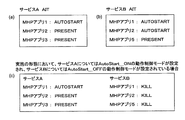
- FIG. 6 is an exemplary diagram for explaining an example of operation control of the MHP application based on the AIT by the receiver 100 according to the present embodiment.
- 6 (a) and 6 (b) are AITs related to service A and service B, similar to FIGS. 3 (a) and 3 (b).
- FIG. 6C shows that the automatic control of the operation state of the MHP application based on the AIT for the service A is set to ON (AutoStart_ON mode), and the automatic control of the operation state of the MHP application based on the AIT for the service B is turned off (AutoStart_OFF).
- This is a table showing the operation control of the MHP application performed by the receiver 100 when the (mode) is set.
- the receiver 100 extracts the AIT (FIG. 6A) of the service A, and automatically executes the operation control of the MHP application based on the description of the AIT. To do.
- the receiver 100 activates the MHP application 1 (description “AUTOSTART” of “application_control_code”), and the MHP application 2 and the MHP application 3 If it is being executed, the execution is continued (description “PRESENT” of “application_control_code”).
- service A is selected (tuned) in this way
- service B is selected (tuned)
- receiver 100 stops all MHP applications.
- the receiver 100 is in a service in which the operation control mode of the MHP application is set to OFF (AutoStart_OFF)
- the MHP application MHP application 1, MHP application 2, MHP application 5 described in the AIT of the service. All other MHP apps are also stopped.
- AUTOSTART is replaced with a predetermined description other than “AUTOSTART” (for example, “PRESENT”, and “Description other than AUTOSTART” in AIT is replaced with “KILL”, and the MHP application based on AIT It is also possible to control the operation state and the like. Furthermore, when the channel selection change to the service B is performed based on a channel selection instruction from the MHP application, the receiver 100 continues the execution without stopping the MHP application. Can be. By doing so, it is possible to prevent the MHP application used by the user (viewer) from suddenly ending after a service change (channel selection). If the AIT of service B includes a description for stopping the execution of the MHP application, the MHP application may also be stopped.
- FIG. 7 is a flowchart of the key code delivery process
- FIG. 8 is a schematic diagram showing a data flow related to the key code delivery process.
- the remote controller 19 transmits user operation information 101.
- the remote controller receiving unit 15 receives the user operation information 101 transmitted from the remote controller 19, analyzes the user operation information, converts it into a key code, and converts the key code 103 into the operating system (OS) of the control unit 7. ) 71. (Fig. 8)
- step S ⁇ b> 201 the OS 71 checks whether or not a key code is input from the remote controller receiving unit 15. When the OS 71 detects the input of the key code (“YES” in step S201), the process proceeds to step S203. When the OS 71 does not detect the input of the key code (“NO” in step S201), the key code delivery process ends. (Fig. 7)
- the key code 103 received by the OS 71 is sent to the key delivery unit 79 (key code 105). (Fig. 8)
- step S203 the key delivery unit 79 determines whether or not the key code 105 is a key code for a built-in application dedicated key. If the key delivery unit 79 determines that the key code 105 is a key code for the built-in application dedicated key (“YES” in step S203), the process proceeds to step S205. If the key delivery unit 79 determines that the key code 105 is not the key code for the built-in application key (“NO” in step S203), the process proceeds to step S207. (Fig. 7)
- step S205 the key delivery unit 79 outputs a key code to the built-in application management unit 81 (key code 107 in FIG. 8).
- step S207 the key delivery unit 79 refers to the current key delivery mode setting value (key delivery mode data 77a) held by the key delivery mode management unit 77. (Arrow 113 in FIGS. 7 and 8)
- step S209 the key delivery unit 79 checks whether or not the current key delivery mode setting value acquired with reference to the key delivery mode data 77a is mode “1”. If the key delivery unit 79 determines that the current key delivery mode setting value is “1” (“YES” in step S209), the process proceeds to step S205. If the key delivery unit 79 determines that the current key delivery mode setting value is not “1” (“2”) (“NO” in step S209), the process proceeds to step S211.
- step S211 the key delivery unit 79 outputs a key code to the MHP application management unit 83 (key code 115 in FIG. 8).
- the receiver 100 sends the key code of the dedicated key for the built-in application to the built-in application management unit 81 regardless of the set value of the key delivery mode, and the key code of the operation key other than the dedicated key for the built-in application.
- the set value of the key delivery mode is mode “1”
- it is sent to the built-in application management unit 81
- the set value of the key delivery mode is mode “2”
- the key code delivery process is performed.
- control unit 7 and MHP application in relation to the key code (107 and 115) delivered to either built-in application management unit 81 or MHP application management unit 83 by the key code delivery processing of FIG.
- the process executed by the unit 9 will be briefly described.
- Key code (key code 107) delivered to the built-in application management unit 81 The key code 107 is sent from the built-in application management unit 81 to a built-in application (for example, built-in application (1) 85).
- the built-in application that has received the key code executes a predetermined process based on the key code, and returns a predetermined instruction (for example, a channel selection instruction 109) to the built-in application management unit 81 as necessary.
- the built-in application management unit 81 that has received the instruction from the built-in application sends the instruction to an appropriate block according to the content of the instruction.
- the built-in application management unit 81 when the built-in application management unit 81 receives the channel selection instruction 109 from the built-in application (1) 85, the built-in application management unit 81 sends a channel selection instruction 111 to the channel selection unit 75. Also, the built-in application management unit 81 entrusts the processing related to the basic operation of outputting a channel selection instruction to the channel selection unit 75 based on the delivered key code, and performs internal processing. It may be configured to be able to.
- Key code (key code 115) delivered to the MHP application management unit 83 The key code 115 is sent from the MHP application management unit 81 to the VM unit 91 of the MHP application execution unit 9.
- the VM unit 91 (the MHP application) that has received the key code 117 executes a predetermined process based on the key code, and uses a predetermined instruction (for example, the API) to the built-in application management unit 81 (for example, The channel selection instruction 121) is returned.
- the built-in application management unit 81 that has received the instruction from the MHP application sends the instruction to an appropriate block according to the content of the instruction. For example, when the built-in application management unit 81 receives the channel selection instruction 121 from the MHP application 171a through the channel selection API 93a, the built-in application management unit 81 sends a channel selection instruction 123 to the channel selection unit 75.
- the channel selection unit 75 Upon receiving the channel selection instruction 111 or 123, the channel selection unit 75 sends a channel selection instruction to the tuner unit 1 (FIG. 1) based on the channel selection instruction 111 or 123.
- the key code of the built-in application dedicated key is always processed in the built-in application, and the instruction that the built-in application outputs in response to the input of the key code is the built-in application management unit.
- the operation by the key code is realized.
- the key codes of the operation keys other than the built-in application dedicated key are distributed to the built-in application management unit 81 or the MHP application management unit 83 based on the key delivery mode setting value held in the key delivery mode management unit 77.
- the key code sent to the MHP application management unit 83 is processed in the MHP application being executed in the MHP application execution unit 9.
- the MHP application sends a predetermined instruction according to the key code to the built-in application management unit 81 using an appropriate API.
- the built-in application management unit 81 sends the received instruction to a predetermined block. In this way, an operation using the key code is realized.
- the built-in application management unit 81 can identify whether the received instruction is an instruction output from the built-in application or an instruction output from the MHP application.
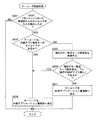
- the built-in application management unit 81 receives a channel selection instruction, sends a channel selection instruction to the channel selection unit 75 (FIGS. 2 and 8) based on the channel selection instruction, and controls the operation of the MHP application. It is a flowchart which shows the process to perform.
- step S301 the key delivery unit 79 sends a key code to the built-in application management unit 81.
- the key code is sent from the built-in application management unit 81 to the built-in application.
- the built-in application that has received the key code executes a predetermined process based on the key code, and returns a predetermined instruction to the built-in application management unit 81 as necessary.
- a predetermined instruction is returned from the MHP application execution unit 9 to the built-in application management unit 81 as necessary.
- step S303 the built-in application management unit 81 determines whether or not the received instruction is a channel selection instruction. If the built-in application management unit 81 determines that the received instruction is a channel selection instruction (“YES” in step S303), the process proceeds to step S305. When the built-in application management unit 81 determines that the received instruction is not a channel selection instruction (“NO” in step S303), the service selection MHP application control process illustrated in FIG. 9 ends.
- step S305 the built-in application management unit 81 notifies the channel selection unit 75 of a channel selection instruction, and the channel selection unit 75 (FIG. 1), the OS 71 (FIG. 2), and the channel selection unit 75 (FIG. 2) perform the selection.
- a PMT related to the service selected by the station instruction is acquired, a description (PID or the like) related to the AIT related to the service is searched, and the presence or absence of the AIT related to the service is checked.
- step S307 the built-in application management unit 81 determines whether there is an AIT related to the service from the PMT. If the built-in application management unit 81 determines that an AIT exists (“YES” in step S307), the process proceeds to step S309. If the built-in application management unit 81 determines that no AIT exists (“NO” in step S307), the process proceeds to step S321.
- step S309 the built-in application management unit 81 acquires the MHP application activation information 173b.
- step S311 the built-in application management unit 81 determines, based on the acquired MHP application activation information 173b, whether the MHP application operation control mode set for the service related to the channel selection is AutoStart_ON / OFF. If the built-in application management unit 81 determines that the MHP application operation control mode for the service is AutoStart_ON (“ON” in step S311), the process proceeds to step S313. If the built-in application management unit 81 determines that the MHP application operation control mode for the service is AutoStart_OFF (“OFF” in step S313), the process proceeds to step S321.
- step S313 the built-in application management unit 81 determines whether there is an MHP application currently being executed.
- the MHP application that is currently being executed is an MHP application that has been executed in a service provided before channel selection. This determination may be performed by various methods. For example, it may be determined from the current operation control mode information 173a, AIT, etc. related to the service immediately before channel selection. Alternatively, it may be checked whether the MHP application management unit 83 is activated.
- the process skips to step S319. If the built-in application management unit 81 determines that there is no currently executing MHP application (“NO” in step S313), the process proceeds to step S315.
- step S315 the built-in application management unit 81 activates the MHP application management unit 83.
- step S317 the built-in application management unit 81 sends an instruction to the key delivery mode management unit 77 to change the key delivery mode setting value (key delivery mode data 77a) to mode “2”. Based on the instruction, the key delivery mode management unit 77 changes the key delivery mode setting value (key delivery mode data 77a) to mode “2”. The built-in application management unit 81 updates the current operation control mode information of the data management unit 173.
- step S319 the built-in application management unit 81 executes operation control and life cycle management of the MHP application based on the AIT of the selected service. Accordingly, the MHP application management unit 83 instructs the MHP application execution unit 9 to execute / stop a predetermined MHP application. In response to the instruction, the MHP application execution unit 9 starts activation of a predetermined MHP application.
- step S307 determines in step S307 that the AIT does not exist. If the built-in application management unit 81 determines in step S307 that the AIT does not exist, the process proceeds to step S321.
- step S321 the built-in application management unit 81 determines whether or not there is an MHP application currently being executed, as in step S313. If the built-in application management unit 81 determines that there is a currently executing MHP application (“YES” in step S321), the process proceeds to step S323. When the built-in application management unit 81 determines that there is no MHP application currently being executed (“NO” in step S321), the service selection MHP application control process illustrated in FIG. 9 ends. At the end, the built-in application management unit 81 updates the current operation control mode information 173a and the key distribution mode data 77a.
- step S323 the built-in application management unit 81 determines whether or not the channel selection instruction related to the determination in step S303 is a channel selection instruction output from the MHP application.
- the MHP application that outputs a channel selection instruction is, for example, an EPG application.
- Such an MHP application can output a channel selection instruction to the built-in application management unit 81 using, for example, the channel selection API 93a (FIG. 8). If the built-in application management unit 81 determines that the channel selection instruction is a channel selection instruction output from the MHP application (“YES” in step S323), the process proceeds to step S325.
- the built-in application management unit 81 determines that the channel selection instruction is not a channel selection instruction output from the MHP application (for example, a channel selection instruction from the built-in application) (“NO” in step S323), the process is performed as a step. The process proceeds to S327.
- step S325 the built-in application management unit 81 continues the execution of the MHP application (EPG application) that has output the channel selection instruction among the currently executed MHP applications, and stops the execution of the other MHP applications that are being executed. . Then, the service selection MHP application control process shown in FIG. At the end, the built-in application management unit 81 updates the current operation control mode information 173a and the key distribution mode data 77a.
- EPG application MHP application
- step S327 the built-in application management unit 81 stops the execution of all currently executed MHP applications. Then, the service selection MHP application control process shown in FIG. At the end, the built-in application management unit 81 updates the current operation control mode information 173a and the key distribution mode data 77a.
- the digital broadcast receiver can set the operation control mode (AutoStart_OFF, AutoStart_ON) for each service. By doing so, when a user (viewer) switches (selects) a service, the service can be switched under a desired operation control mode without manually switching the operation control mode. The operability of the broadcast receiver is greatly improved.
- the digital broadcasting that can appropriately set the settings related to the validity / invalidity of the automatic control function such as the operation state of the MHP application and the life cycle based on the application control information according to the service to be received.
- the present invention is not limited to the MHP application, and the digital broadcast receiver and the digital broadcast receiving method of the present invention can be applied to an application that performs processing similar to the DVB-MHP standard, for example, a North American cable.
- the present invention can also be applied to an application (OCAP application) compliant with the OCAP (OpenCable Application Platform) standard, which is a television standard.
- OCAP application OpenCable Application Platform
- the digital broadcast receiver is a service for receiving settings related to the validity / invalidity of an automatic control function such as an operating state of an application (for example, an MHP application) based on information included in a broadcast wave such as AIT and a life cycle. Therefore, it is useful as a broadcasting device such as a digital broadcasting receiver.
- an automatic control function such as an operating state of an application (for example, an MHP application) based on information included in a broadcast wave such as AIT and a life cycle. Therefore, it is useful as a broadcasting device such as a digital broadcasting receiver.
- Built-in application (1) 87 ⁇ ⁇ ⁇ Built-in application (2) 91 ... Virtual machine part 93a ... API for channel selection 93b ... API for drawing DESCRIPTION OF SYMBOLS 100 ... Digital broadcast receiver 101 ... User operation information 103 ... Key code 105 ... Key code 107 ... Key code 109 ...
- Key code and channel selection instruction 111 based on it Station instruction 113 ⁇ ⁇ ⁇ Key distribution mode reference request and key distribution mode set value data 115 based on the request ⁇ ⁇ ⁇ Key code 117 ⁇ ⁇ ⁇ Key code 119 ⁇ ⁇ ⁇ Channel selection instruction 121 ⁇ ⁇ ⁇ Channel selection instruction 123 ⁇ ⁇ Channel selection instruction 171
- MHP application holding unit 171a MHP application 1 171b ... MHP application 2 171c ... MHP application cache 173 ... Data management unit 173a ... Current operation control mode information 173b ... MHP application activation information
Landscapes
- Engineering & Computer Science (AREA)
- Signal Processing (AREA)
- Multimedia (AREA)
- General Engineering & Computer Science (AREA)
- Software Systems (AREA)
- Two-Way Televisions, Distribution Of Moving Picture Or The Like (AREA)
- Circuits Of Receivers In General (AREA)
Abstract
L'invention porte sur un récepteur de radiodiffusion numérique qui comprend : une unité de syntonisation qui démodule des ondes de radiodiffusion numérique et délivre des flux de données ; une unité de gestion d'application qui exécute une commande de l'état de fonctionnement d'applications, sur la base d'informations de commande d'application incluses dans le flux de données et qui sont associées à un service prescrit ; et une unité de gestion de données qui retient, en association avec le service prescrit, des informations de démarrage d'application, qui sont un réglage lié à l'exécution de la commande de l'état de fonctionnement des applications par l'unité de gestion d'application, sur la base d'informations de commande d'application. Le récepteur de radiodiffusion numérique amène également l'unité de gestion d'application à exécuter la commande de l'état de fonctionnement sur la base des informations de commande d'application, conformément aux informations de démarrage d'application.
Applications Claiming Priority (2)
| Application Number | Priority Date | Filing Date | Title |
|---|---|---|---|
| JP2009202614 | 2009-09-02 | ||
| JP2009-202614 | 2009-09-02 |
Publications (1)
| Publication Number | Publication Date |
|---|---|
| WO2011027504A1 true WO2011027504A1 (fr) | 2011-03-10 |
Family
ID=43649062
Family Applications (1)
| Application Number | Title | Priority Date | Filing Date |
|---|---|---|---|
| PCT/JP2010/004866 Ceased WO2011027504A1 (fr) | 2009-09-02 | 2010-08-02 | Récepteur de radiodiffusion numérique et procédé de réception de radiodiffusion numérique |
Country Status (1)
| Country | Link |
|---|---|
| WO (1) | WO2011027504A1 (fr) |
Cited By (10)
| Publication number | Priority date | Publication date | Assignee | Title |
|---|---|---|---|---|
| JP2012244430A (ja) * | 2011-05-19 | 2012-12-10 | Nippon Hoso Kyokai <Nhk> | 受信機及びプログラム |
| JP2013009357A (ja) * | 2011-05-20 | 2013-01-10 | Nippon Hoso Kyokai <Nhk> | 放送通信連携受信装置 |
| JP2013009339A (ja) * | 2011-05-20 | 2013-01-10 | Nippon Hoso Kyokai <Nhk> | 受信機 |
| JP2013009330A (ja) * | 2011-05-20 | 2013-01-10 | Nippon Hoso Kyokai <Nhk> | 受信機 |
| JP2013009356A (ja) * | 2011-05-20 | 2013-01-10 | Nippon Hoso Kyokai <Nhk> | 放送通信連携受信装置 |
| WO2013080450A1 (fr) * | 2011-12-02 | 2013-06-06 | ソニー株式会社 | Dispositif de traitement d'informations, procédé de traitement d'informations et programme |
| WO2013154023A1 (fr) * | 2012-04-12 | 2013-10-17 | ソニー株式会社 | Appareil de réception, procédé de réception, appareil d'émission, procédé d'émission et programme |
| WO2015104742A1 (fr) * | 2014-01-07 | 2015-07-16 | ソニー株式会社 | Dispositif de traitement d'informations et procédé de traitement d'informations |
| JPWO2014021125A1 (ja) * | 2012-07-31 | 2016-07-21 | ソニー株式会社 | 受信装置、受信方法、送信装置、及び送信方法 |
| JP2018196125A (ja) * | 2018-07-10 | 2018-12-06 | マクセル株式会社 | アプリケーション制御方法 |
Citations (3)
| Publication number | Priority date | Publication date | Assignee | Title |
|---|---|---|---|---|
| JP2003264748A (ja) * | 2002-03-07 | 2003-09-19 | Nec Corp | デジタル放送受信機 |
| JP2008310553A (ja) * | 2007-06-14 | 2008-12-25 | Panasonic Corp | デジタル放送受信機及びデジタル放送受信システム |
| JP2009044401A (ja) * | 2007-08-08 | 2009-02-26 | Panasonic Corp | 受信装置 |
-
2010
- 2010-08-02 WO PCT/JP2010/004866 patent/WO2011027504A1/fr not_active Ceased
Patent Citations (3)
| Publication number | Priority date | Publication date | Assignee | Title |
|---|---|---|---|---|
| JP2003264748A (ja) * | 2002-03-07 | 2003-09-19 | Nec Corp | デジタル放送受信機 |
| JP2008310553A (ja) * | 2007-06-14 | 2008-12-25 | Panasonic Corp | デジタル放送受信機及びデジタル放送受信システム |
| JP2009044401A (ja) * | 2007-08-08 | 2009-02-26 | Panasonic Corp | 受信装置 |
Cited By (19)
| Publication number | Priority date | Publication date | Assignee | Title |
|---|---|---|---|---|
| JP2012244430A (ja) * | 2011-05-19 | 2012-12-10 | Nippon Hoso Kyokai <Nhk> | 受信機及びプログラム |
| JP2013009357A (ja) * | 2011-05-20 | 2013-01-10 | Nippon Hoso Kyokai <Nhk> | 放送通信連携受信装置 |
| JP2013009339A (ja) * | 2011-05-20 | 2013-01-10 | Nippon Hoso Kyokai <Nhk> | 受信機 |
| JP2013009330A (ja) * | 2011-05-20 | 2013-01-10 | Nippon Hoso Kyokai <Nhk> | 受信機 |
| JP2013009356A (ja) * | 2011-05-20 | 2013-01-10 | Nippon Hoso Kyokai <Nhk> | 放送通信連携受信装置 |
| JP2015080229A (ja) * | 2011-12-02 | 2015-04-23 | ソニー株式会社 | 情報処理装置、情報処理方法およびプログラム |
| JP2015073306A (ja) * | 2011-12-02 | 2015-04-16 | ソニー株式会社 | 情報処理装置、情報処理方法およびプログラム |
| WO2013080450A1 (fr) * | 2011-12-02 | 2013-06-06 | ソニー株式会社 | Dispositif de traitement d'informations, procédé de traitement d'informations et programme |
| US9313546B2 (en) | 2011-12-02 | 2016-04-12 | Sony Corporation | Information processing apparatus, information processing method, and program |
| US9451318B2 (en) | 2012-04-12 | 2016-09-20 | Sony Corporation | Reception apparatus, reception method, transmission apparatus, transmission method, and program |
| US9912982B2 (en) | 2012-04-12 | 2018-03-06 | Saturn Licensing Llc | Reception of broadcast data in a data carousel transmission scheme and television receiver for the same |
| JPWO2013154023A1 (ja) * | 2012-04-12 | 2015-12-17 | ソニー株式会社 | 受信装置、受信方法、送信装置、送信方法、及びプログラム |
| WO2013154023A1 (fr) * | 2012-04-12 | 2013-10-17 | ソニー株式会社 | Appareil de réception, procédé de réception, appareil d'émission, procédé d'émission et programme |
| JPWO2014021125A1 (ja) * | 2012-07-31 | 2016-07-21 | ソニー株式会社 | 受信装置、受信方法、送信装置、及び送信方法 |
| US10674213B2 (en) | 2012-07-31 | 2020-06-02 | Saturn Licensing Llc | Reception apparatus, reception method, transmission apparatus, and transmission method |
| JPWO2015104742A1 (ja) * | 2014-01-07 | 2017-03-23 | ソニー株式会社 | 情報処理装置および情報処理方法 |
| WO2015104742A1 (fr) * | 2014-01-07 | 2015-07-16 | ソニー株式会社 | Dispositif de traitement d'informations et procédé de traitement d'informations |
| US11012747B2 (en) | 2014-01-07 | 2021-05-18 | Sony Corporation | Controlling an operation of an application based on application information table |
| JP2018196125A (ja) * | 2018-07-10 | 2018-12-06 | マクセル株式会社 | アプリケーション制御方法 |
Similar Documents
| Publication | Publication Date | Title |
|---|---|---|
| WO2011027504A1 (fr) | Récepteur de radiodiffusion numérique et procédé de réception de radiodiffusion numérique | |
| KR101526967B1 (ko) | 방송 송신기, 방송 수신기 및 케이블 방송의 소프트웨어수신 방법 | |
| JP5916614B2 (ja) | 受信装置、受信方法、送信装置、送信方法、プログラム、および放送システム | |
| US20080111699A1 (en) | Broadcasting receiver and method of processing broadcasting signal | |
| KR20090108266A (ko) | 녹화/재생 장치, 콘텐츠 위치 관리 서버, 정보저장매체,콘텐츠 정보 관리 방법 및 콘텐츠 정보 관리 방법을 기록한기록매체 | |
| KR100577146B1 (ko) | 디지털방송수신장치 | |
| US8494158B2 (en) | Method of downloading software in digital broadcast receiver | |
| JP5615482B2 (ja) | デジタル放送の受信装置および受信制御方法、デジタル放送送信装置 | |
| KR102270360B1 (ko) | 디스플레이장치 및 그 제어방법 | |
| JP5324280B2 (ja) | 放送受信装置 | |
| JP2007006406A (ja) | ディジタル放送受信装置 | |
| US20080013472A1 (en) | Method of controlling data broadcast and data broadcast receiver | |
| US20240236410A9 (en) | Digital broadcast receiving apparatus | |
| US20250056089A1 (en) | Broadcast receiving apparatus, setting method, transmission method, display controlling method, and recording medium | |
| CN105009594B (zh) | 用于选择电视节目及其相关服务和用于显示它们的方法以及相关设备 | |
| KR100683346B1 (ko) | 디지털 멀티미디어 방송 수신 장치의 전자 프로그램 안내정보 처리 방법 | |
| JP2025104727A (ja) | 受信装置、放送システム、受信方法、および、プログラム | |
| KR101259112B1 (ko) | 방송 신호 수신기 및 긴급 경고 메시지 처리 방법 | |
| KR100697407B1 (ko) | 디지털 텔레비젼 수신기의 데이터 방송 어플리케이션 정보표시방법 | |
| KR20070117819A (ko) | 오픈케이블 방송처리장치 및 그 제어방법 | |
| KR20060007162A (ko) | 케이블 디지털 텔레비전의 자동 채널 검색 방법 | |
| JP2006332798A (ja) | 地上波デジタル放送受信機 | |
| JP2008306481A (ja) | デジタル放送受信装置及びその制御方法、並びにコンピュータプログラム | |
| KR20060067730A (ko) | 디지털 멀티미디어 방송 수신 장치의 전자 프로그램 안내정보 처리 방법 | |
| KR20010042543A (ko) | 프로그램을 제공하기 위한 방법 및 장치 |
Legal Events
| Date | Code | Title | Description |
|---|---|---|---|
| 121 | Ep: the epo has been informed by wipo that ep was designated in this application |
Ref document number: 10813459 Country of ref document: EP Kind code of ref document: A1 |
|
| NENP | Non-entry into the national phase |
Ref country code: DE |
|
| 122 | Ep: pct application non-entry in european phase |
Ref document number: 10813459 Country of ref document: EP Kind code of ref document: A1 |
|
| NENP | Non-entry into the national phase |
Ref country code: JP |