WO2011027806A1 - 不安障害治療剤 - Google Patents
不安障害治療剤 Download PDFInfo
- Publication number
- WO2011027806A1 WO2011027806A1 PCT/JP2010/064989 JP2010064989W WO2011027806A1 WO 2011027806 A1 WO2011027806 A1 WO 2011027806A1 JP 2010064989 W JP2010064989 W JP 2010064989W WO 2011027806 A1 WO2011027806 A1 WO 2011027806A1
- Authority
- WO
- WIPO (PCT)
- Prior art keywords
- disorder
- compound
- pharmaceutically acceptable
- anxiety
- acceptable salt
- Prior art date
- Legal status (The legal status is an assumption and is not a legal conclusion. Google has not performed a legal analysis and makes no representation as to the accuracy of the status listed.)
- Ceased
Links
Classifications
-
- C—CHEMISTRY; METALLURGY
- C07—ORGANIC CHEMISTRY
- C07D—HETEROCYCLIC COMPOUNDS
- C07D417/00—Heterocyclic compounds containing two or more hetero rings, at least one ring having nitrogen and sulfur atoms as the only ring hetero atoms, not provided for by group C07D415/00
- C07D417/14—Heterocyclic compounds containing two or more hetero rings, at least one ring having nitrogen and sulfur atoms as the only ring hetero atoms, not provided for by group C07D415/00 containing three or more hetero rings
-
- A—HUMAN NECESSITIES
- A61—MEDICAL OR VETERINARY SCIENCE; HYGIENE
- A61K—PREPARATIONS FOR MEDICAL, DENTAL OR TOILETRY PURPOSES
- A61K31/00—Medicinal preparations containing organic active ingredients
- A61K31/33—Heterocyclic compounds
- A61K31/335—Heterocyclic compounds having oxygen as the only ring hetero atom, e.g. fungichromin
- A61K31/34—Heterocyclic compounds having oxygen as the only ring hetero atom, e.g. fungichromin having five-membered rings with one oxygen as the only ring hetero atom, e.g. isosorbide
-
- A—HUMAN NECESSITIES
- A61—MEDICAL OR VETERINARY SCIENCE; HYGIENE
- A61K—PREPARATIONS FOR MEDICAL, DENTAL OR TOILETRY PURPOSES
- A61K31/00—Medicinal preparations containing organic active ingredients
- A61K31/33—Heterocyclic compounds
- A61K31/335—Heterocyclic compounds having oxygen as the only ring hetero atom, e.g. fungichromin
- A61K31/35—Heterocyclic compounds having oxygen as the only ring hetero atom, e.g. fungichromin having six-membered rings with one oxygen as the only ring hetero atom
-
- A—HUMAN NECESSITIES
- A61—MEDICAL OR VETERINARY SCIENCE; HYGIENE
- A61K—PREPARATIONS FOR MEDICAL, DENTAL OR TOILETRY PURPOSES
- A61K31/00—Medicinal preparations containing organic active ingredients
- A61K31/33—Heterocyclic compounds
- A61K31/395—Heterocyclic compounds having nitrogen as a ring hetero atom, e.g. guanethidine or rifamycins
- A61K31/41—Heterocyclic compounds having nitrogen as a ring hetero atom, e.g. guanethidine or rifamycins having five-membered rings with two or more ring hetero atoms, at least one of which being nitrogen, e.g. tetrazole
- A61K31/425—Thiazoles
- A61K31/426—1,3-Thiazoles
-
- A—HUMAN NECESSITIES
- A61—MEDICAL OR VETERINARY SCIENCE; HYGIENE
- A61K—PREPARATIONS FOR MEDICAL, DENTAL OR TOILETRY PURPOSES
- A61K31/00—Medicinal preparations containing organic active ingredients
- A61K31/33—Heterocyclic compounds
- A61K31/395—Heterocyclic compounds having nitrogen as a ring hetero atom, e.g. guanethidine or rifamycins
- A61K31/435—Heterocyclic compounds having nitrogen as a ring hetero atom, e.g. guanethidine or rifamycins having six-membered rings with one nitrogen as the only ring hetero atom
-
- A—HUMAN NECESSITIES
- A61—MEDICAL OR VETERINARY SCIENCE; HYGIENE
- A61K—PREPARATIONS FOR MEDICAL, DENTAL OR TOILETRY PURPOSES
- A61K31/00—Medicinal preparations containing organic active ingredients
- A61K31/33—Heterocyclic compounds
- A61K31/395—Heterocyclic compounds having nitrogen as a ring hetero atom, e.g. guanethidine or rifamycins
- A61K31/435—Heterocyclic compounds having nitrogen as a ring hetero atom, e.g. guanethidine or rifamycins having six-membered rings with one nitrogen as the only ring hetero atom
- A61K31/44—Non condensed pyridines; Hydrogenated derivatives thereof
- A61K31/4427—Non condensed pyridines; Hydrogenated derivatives thereof containing further heterocyclic ring systems
- A61K31/4439—Non condensed pyridines; Hydrogenated derivatives thereof containing further heterocyclic ring systems containing a five-membered ring with nitrogen as a ring hetero atom, e.g. omeprazole
-
- A—HUMAN NECESSITIES
- A61—MEDICAL OR VETERINARY SCIENCE; HYGIENE
- A61K—PREPARATIONS FOR MEDICAL, DENTAL OR TOILETRY PURPOSES
- A61K31/00—Medicinal preparations containing organic active ingredients
- A61K31/33—Heterocyclic compounds
- A61K31/395—Heterocyclic compounds having nitrogen as a ring hetero atom, e.g. guanethidine or rifamycins
- A61K31/495—Heterocyclic compounds having nitrogen as a ring hetero atom, e.g. guanethidine or rifamycins having six-membered rings with two or more nitrogen atoms as the only ring heteroatoms, e.g. piperazine or tetrazines
- A61K31/505—Pyrimidines; Hydrogenated pyrimidines, e.g. trimethoprim
- A61K31/506—Pyrimidines; Hydrogenated pyrimidines, e.g. trimethoprim not condensed and containing further heterocyclic rings
-
- A—HUMAN NECESSITIES
- A61—MEDICAL OR VETERINARY SCIENCE; HYGIENE
- A61K—PREPARATIONS FOR MEDICAL, DENTAL OR TOILETRY PURPOSES
- A61K31/00—Medicinal preparations containing organic active ingredients
- A61K31/33—Heterocyclic compounds
- A61K31/395—Heterocyclic compounds having nitrogen as a ring hetero atom, e.g. guanethidine or rifamycins
- A61K31/535—Heterocyclic compounds having nitrogen as a ring hetero atom, e.g. guanethidine or rifamycins having six-membered rings with at least one nitrogen and one oxygen as the ring hetero atoms, e.g. 1,2-oxazines
- A61K31/5375—1,4-Oxazines, e.g. morpholine
- A61K31/5377—1,4-Oxazines, e.g. morpholine not condensed and containing further heterocyclic rings, e.g. timolol
-
- A—HUMAN NECESSITIES
- A61—MEDICAL OR VETERINARY SCIENCE; HYGIENE
- A61P—SPECIFIC THERAPEUTIC ACTIVITY OF CHEMICAL COMPOUNDS OR MEDICINAL PREPARATIONS
- A61P25/00—Drugs for disorders of the nervous system
-
- A—HUMAN NECESSITIES
- A61—MEDICAL OR VETERINARY SCIENCE; HYGIENE
- A61P—SPECIFIC THERAPEUTIC ACTIVITY OF CHEMICAL COMPOUNDS OR MEDICINAL PREPARATIONS
- A61P25/00—Drugs for disorders of the nervous system
- A61P25/22—Anxiolytics
-
- C—CHEMISTRY; METALLURGY
- C07—ORGANIC CHEMISTRY
- C07D—HETEROCYCLIC COMPOUNDS
- C07D491/00—Heterocyclic compounds containing in the condensed ring system both one or more rings having oxygen atoms as the only ring hetero atoms and one or more rings having nitrogen atoms as the only ring hetero atoms, not provided for by groups C07D451/00 - C07D459/00, C07D463/00, C07D477/00 or C07D489/00
- C07D491/02—Heterocyclic compounds containing in the condensed ring system both one or more rings having oxygen atoms as the only ring hetero atoms and one or more rings having nitrogen atoms as the only ring hetero atoms, not provided for by groups C07D451/00 - C07D459/00, C07D463/00, C07D477/00 or C07D489/00 in which the condensed system contains two hetero rings
- C07D491/04—Ortho-condensed systems
- C07D491/044—Ortho-condensed systems with only one oxygen atom as ring hetero atom in the oxygen-containing ring
- C07D491/048—Ortho-condensed systems with only one oxygen atom as ring hetero atom in the oxygen-containing ring the oxygen-containing ring being five-membered
-
- C—CHEMISTRY; METALLURGY
- C07—ORGANIC CHEMISTRY
- C07D—HETEROCYCLIC COMPOUNDS
- C07D491/00—Heterocyclic compounds containing in the condensed ring system both one or more rings having oxygen atoms as the only ring hetero atoms and one or more rings having nitrogen atoms as the only ring hetero atoms, not provided for by groups C07D451/00 - C07D459/00, C07D463/00, C07D477/00 or C07D489/00
- C07D491/02—Heterocyclic compounds containing in the condensed ring system both one or more rings having oxygen atoms as the only ring hetero atoms and one or more rings having nitrogen atoms as the only ring hetero atoms, not provided for by groups C07D451/00 - C07D459/00, C07D463/00, C07D477/00 or C07D489/00 in which the condensed system contains two hetero rings
- C07D491/04—Ortho-condensed systems
- C07D491/044—Ortho-condensed systems with only one oxygen atom as ring hetero atom in the oxygen-containing ring
- C07D491/052—Ortho-condensed systems with only one oxygen atom as ring hetero atom in the oxygen-containing ring the oxygen-containing ring being six-membered
-
- C—CHEMISTRY; METALLURGY
- C07—ORGANIC CHEMISTRY
- C07D—HETEROCYCLIC COMPOUNDS
- C07D495/00—Heterocyclic compounds containing in the condensed system at least one hetero ring having sulfur atoms as the only ring hetero atoms
- C07D495/02—Heterocyclic compounds containing in the condensed system at least one hetero ring having sulfur atoms as the only ring hetero atoms in which the condensed system contains two hetero rings
- C07D495/04—Ortho-condensed systems
Definitions
- the present invention relates to a therapeutic and / or preventive agent for anxiety disorders such as panic disorder, agoraphobia, obsessive compulsive disorder, social phobia, post-traumatic stress disorder, specific phobia, generalized anxiety disorder.
- anxiety disorders such as panic disorder, agoraphobia, obsessive compulsive disorder, social phobia, post-traumatic stress disorder, specific phobia, generalized anxiety disorder.
- Anxiety disorders are a group of psychological problems whose important characteristics include excessive anxiety, fear, anxiety, avoidance and forced rituals, which are excessive morbidity, excessive medical services Cause usage and dysfunction, or result in such consequences. They are one of the most prevalent psychiatric conditions in the United States and most other countries. Disease incidence is fairly uniform across cultures. In most cases, women are more likely to experience anxiety disorders than men. Chronic anxiety disorders can increase cardiovascular-related mortality and therefore must be properly diagnosed and prompt treatment initiated.
- Anxiety disorders listed in the “Mental Disease Diagnosis / Statistics Manual” (4th edition – revised in 1994, published by the American Psychiatric Association, Washington DC, p.393-444) include agoraphobia or Panic disorder without panic disorder, agoraphobia without history of panic disorder, social phobia, obsessive compulsive disorder (OCD), post-traumatic stress disorder (PTSD), acute stress disorder, generalized anxiety disorder (GAD), general Anxiety disorders resulting from medical conditions, drug-induced anxiety disorders, specific phobias, anxiety disorders not specifically mentioned, and the like.
- Panic disorder with or without agoraphobia is an anxiety disorder whose essential characteristics are recurrent panic attacks (ie, strong fear or discomfort with at least four characteristic associated symptoms) Discrete period). Seizures usually last for a few minutes (or rarely a few hours) and are unexpected and almost always before being exposed to a situation that causes anxiety, as in simple phobias or There is no tendency to occur immediately when exposed. The “unexpected” aspect of this seizure is an essential feature of this disorder.
- a panic attack begins with a sudden attack of intense anxiety or fear, such as shortness of breath, dizziness, fainting, suffocation, palpitation, tremors, sweating, nausea, nausea, numbness, hot flashes or chills, chest pain, etc. It is typically accompanied by symptoms. Panic disorder may be associated with agoraphobia, and in severe cases, the parties are virtually withdrawn from home.
- Obsessive-compulsive disorder OCD
- OCD Obsessive-compulsive disorder
- the primary symptoms of obsessive-compulsive disorder are sufficiently severe and recurrent obsessions (ie, prominent) because they cause tightness, take time, and significantly interfere with a person's normal daily work or lifestyle With recurrent, non-disappearing thoughts, images or urges that cause anxiety) and / or compulsory behavior (ie, repetitive or mental acts performed to relieve anxiety caused by the person's obsession) is there.
- Obsessions typically relate to pollution, doubt (including loss of confidence) and blasphemy of sexual or religious thought.
- Typical obsessions include cleaning, checking, organizing things, and counting things.
- Social phobia Social phobia is characterized by persistent social or public fear that can cause confusion. Typical situations that people with social phobia fear or avoid include parties, meetings, meals in front of others, writing in front of others, speeches, conversations, first-time encounters, and other related Situation. Exposure to social or public situations almost always causes sweating, trembling, throbbing or pounding, mental confusion and the desire to escape, as well as immediate anxiety reactions.
- Posttraumatic stress disorder Key characteristic symptoms include re-experience of a traumatic event (ie, psychological distress), escape from stimuli recalling the event, general reactive paralysis, increased arousal, etc. .
- Related “events” include, for example, simple bereavement, chronic illness, and marital conflict.
- Generalized anxiety disorder (GAD) GAD is characterized by unrealistic or excessive anxiety and concerns about two or more living environments that last more than six months. There are more days than days without experiencing this concern, during which time the affected person is bothered by the concern. It shows signs such as motor tension, autonomic hyperactivity, vigilance, and scanning.
- Specific phobias Specific phobias are anxiety disorders whose essential characteristics are significant fear of a circumscribed stimulus, which is a panic attack in social situations. It can be said that it is a subject or situation other than the fear of going out, humiliating or embarrassed (this is classified as social phobia). Examples include airplane phobia, height phobia, animal phobia, injection phobia, blood phobia and the like.
- Anxiety disorders are suspected of various causes, especially genetic temperament, childhood growth and development, and a combination of these and subsequent life experiences. Anxiety disorders are treated by using counseling, psychotherapy, pharmacological therapy (pharmacotherapy), etc. alone or in combination.
- Drugs typically used to treat anxiety disorder patients include benzodiazepines, selective serotonin reuptake inhibitors (SSRI), serotonin and noradrenaline uptake inhibitors (SNRI), buspirone, and the like.
- Benzodiazepines belong to a large class of relatively safe and widely prescribed drugs that have rapid and sufficient anxiolytic and sedative hypnotic effects.
- Drugs belonging to the SSRI / SNRI category are used for the treatment of anxiety disorders such as panic disorder, agoraphobia, OCD, social phobia, post-traumatic stress disorder, specific phobias, broader anxiety disorders [Kaplan &Sadock's Comprehensive textbook of psychiatry 7th. Edition, 1, p.1441 (1999)].
- Buspirone is a relatively selective 5HT 1A partial agonist that has been approved by the FDA as the most useful anxiolytic for the treatment of GAD and is now frequently used as an adjunct to SSRI [Kaplan &Sadock's Comprehensive textbook of psychiatry 7th. Edition, 1, p.1441 (1999)].
- adenosine is widely distributed in the living body, and is known to exhibit various physiological actions on the central nervous system, myocardium, kidney, smooth muscle and the like through its receptor (see Non-Patent Document 1). ).
- an adenosine A 1 antagonist has a defecation promoting action (Jpn. J. Pharmacol., 68, p. 119 (1995)).
- adenosine A 2A receptor is particularly involved in the central nervous system, and its antagonists include, for example, therapeutic drugs for Parkinson's disease (see Non-Patent Document 2), therapeutic drugs for sleep disorders ( Nature Neuroscience, p.858 (2005); see Patent Document 3), and is known to be useful as a therapeutic agent for depression (Neurology, 61 (11 Suppl 6), S82-7 (2003)).
- therapeutic drugs for Parkinson's disease see Non-Patent Document 2
- therapeutic drugs for sleep disorders Nature Neuroscience, p.858 (2005); see Patent Document 3
- is known to be useful as a therapeutic agent for depression Neurology, 61 (11 Suppl 6), S82-7 (2003).
- adenosine A 2A receptor antagonism showed behavioral pharmacological changes similar to administration of antidepressants, based on studies using adenosine A 2A receptor-deficient mice. Induction has been reported (Br. J. Pharmacol., 134, p.68 (2001)).
- a xanthine compound having an adenosine A 2A receptor antagonistic activity is known to have antidepressant activity (for example, WO94 / 01114), and further, has anti-Parkinson disease activity (for example, Ann.
- the object of the present invention is to treat and / or prevent an anxiety disorder such as panic disorder, agoraphobia, obsessive compulsive disorder, social phobia, post-traumatic stress disorder, specific phobia, generalized anxiety disorder, etc. Is to provide.
- an anxiety disorder such as panic disorder, agoraphobia, obsessive compulsive disorder, social phobia, post-traumatic stress disorder, specific phobia, generalized anxiety disorder, etc. Is to provide.
- the present invention relates to the following (1) to (14).
- R 1 represents aryl, aralkyl, aromatic heterocyclic group, aromatic heterocyclic alkyl, aliphatic heterocyclic alkyl or tetrahydropyranyloxy, or a halogen; lower alkoxy or morpholino A lower alkyl optionally substituted with a lower alkyl; a lower alkoxy; a lower alkanoyl; and a group substituted with 1 to 3 substituents selected from the group consisting of vinyl, and R 2 represents pyridyl or tetrahydropyranyl)
- a therapeutic and / or prophylactic agent for anxiety disorders comprising a thiazole derivative represented by the formula or a pharmaceutically acceptable salt thereof as an active ingredient.
- R 1 is phenyl, pyridyl, pyrimidinyl, 5,6-dihydro-2H-pyridylmethyl or tetrahydropyranyloxy, or these groups include a fluorine atom, a chlorine atom, a bromine atom, methyl, ethyl, methoxy
- An anxiety disorder treatment and / or prevention agent is phenyl, pyridyl, pyrimidinyl, 5,6-dihydro-2H-pyridylmethyl or tetrahydropyranyloxy, or these groups include a fluorine atom, a chlorine atom, a bromine atom, methyl, ethyl, methoxy
- R 1 is pyridyl or pyrimidinyl, or these groups are halogen; lower alkyl optionally substituted with lower alkoxy or morpholino; lower alkoxy; lower alkanoyl; and vinyl, 1 to A therapeutic and / or prophylactic agent for anxiety disorders comprising the thiazole derivative according to (1) or a pharmaceutically acceptable salt thereof as an active ingredient, wherein three substituents are substituted groups.
- a therapeutic and / or prophylactic agent for anxiety disorder comprising, as an active ingredient, the thiazole derivative or a pharmaceutically acceptable salt thereof according to any one of (1) to (3), wherein R 2 is pyridyl.
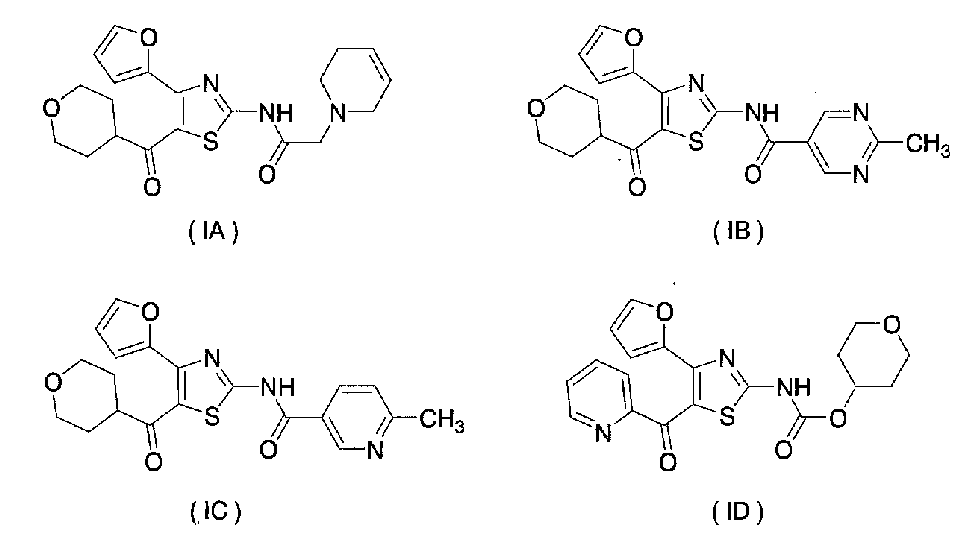
- the thiazole derivative represented by the general formula (I) is a compound represented by any of the following formulas (IA) to (IAA) or a pharmaceutically acceptable salt thereof: A therapeutic and / or prophylactic agent for anxiety disorders containing salt as an active ingredient.
- the thiazole derivative represented by the general formula (I) is a compound represented by any one of the following formulas (IA) to (ID) or a pharmaceutically acceptable salt thereof A therapeutic and / or prophylactic agent for anxiety disorders containing salt as an active ingredient.
- the anxiety disorder is panic disorder, agoraphobia, obsessive-compulsive disorder, social phobia, post-traumatic stress disorder, specific phobia or generalized anxiety disorder (1)-(7) The agent described.
- a method for treating and / or preventing an anxiety disorder comprising administering an effective amount of the thiazole derivative or a pharmaceutically acceptable salt thereof according to any one of (1) to (7) above.
- the method according to (9), wherein the anxiety disorder is panic disorder, agoraphobia, obsessive compulsive disorder, social phobia, post-traumatic stress disorder, specific phobia or generalized anxiety disorder.
- an anxiety disorder containing a thiazole derivative or a pharmaceutically acceptable salt thereof as an active ingredient for example, panic disorder, agoraphobia, obsessive compulsive disorder, social phobia, post-traumatic stress disorder, specific A treatment and / or prevention agent for phobia, generalized anxiety disorder, etc.
- a thiazole derivative or a pharmaceutically acceptable salt thereof as an active ingredient for example, panic disorder, agoraphobia, obsessive compulsive disorder, social phobia, post-traumatic stress disorder, specific A treatment and / or prevention agent for phobia, generalized anxiety disorder, etc.
- each group of general formula (I) examples include linear or branched alkyl having 1 to 10 carbon atoms, and more specifically, methyl, ethyl, propyl, isopropyl, butyl, isobutyl, and sec-butyl, tert-butyl, pentyl, isopentyl, neopentyl, hexyl, heptyl, octyl, nonyl, decyl and the like.
- aralkyl examples include aralkyl having 7 to 16 carbon atoms, and more specifically, benzyl, phenethyl, phenylpropyl, phenylbutyl, phenylpentyl, phenylhexyl, phenylheptyl, phenyloctyl, phenylnonyl, phenyldecyl, naphthyl.
- Examples thereof include methyl, naphthylethyl, naphthylpropyl, naphthylbutyl, naphthylpentyl, naphthylhexyl, anthrylmethyl, anthrylethyl and the like.
- aryl examples include aryl having 6 to 14 carbon atoms, and more specifically, phenyl, naphthyl, azulenyl, anthryl and the like.
- aromatic heterocyclic group for example, a 5-membered or 6-membered monocyclic aromatic heterocyclic group containing at least one atom selected from a nitrogen atom, an oxygen atom and a sulfur atom, and a 3- to 8-membered ring are condensed.
- Examples of the aromatic heterocyclic alkyl include groups in which an aromatic heterocyclic group is bonded to alkylene, and examples of the aromatic heterocyclic group include groups exemplified in the above aromatic heterocyclic groups,
- Examples of the alkylene include alkylene having 1 to 10 carbon atoms, and specific examples include methylene, ethylene, trimethylene, propylene, tetramethylene, pentamethylene, hexamethylene, heptamethylene, octamethylene, nonamethylene, decamethylene and the like. It is done.
- aromatic heterocyclic alkyl examples include pyrrolylmethyl, pyrrolylethyl, thiazolylmethyl, pyridylmethyl, pyridylethyl, pyrimidinylmethyl, pyrimidinylethyl, indolylmethyl, benzoimidazolylmethyl, and the like.
- Examples of the aliphatic heterocyclic alkyl include a group in which an aliphatic heterocyclic group is bonded to alkylene.
- Examples of the aliphatic heterocyclic group include at least one atom selected from a nitrogen atom, an oxygen atom, and a sulfur atom.
- alkylene examples include alkylene having 1 to 10 carbon atoms, and specifically include methylene, ethylene, trimethylene, propylene, tetramethylene, pentamethylene, hexamethylene, heptamethylene, octamethylene, nonamethylene, decamethylene and the like. It is done.
- aliphatic heterocyclic alkyl for example, 5,6-dihydro-2H-pyridylmethyl, 5,6-dihydro-2H-pyridylethyl, tetrahydro-2H-pyranylmethyl, 5,6-dihydro-2H- Examples include pyranylmethyl, 5,6-dihydro-2H-pyranylethyl, morpholinomethyl, morpholinoethyl, piperazinylmethyl, oxazolidinylmethyl and the like.
- Halogen means each atom of fluorine, chlorine, bromine and iodine.
- Compound (I) or a pharmaceutically acceptable salt thereof used in the present invention includes various subtypes of adenosine receptors (for example, adenosine A 1 , A 2A , A 2B and A 3 receptors), A compound having a strong antagonism against the adenosine A2A receptor is preferred. Therefore, the compound (I) of the present invention or a pharmaceutically acceptable salt thereof is preferably a compound having a strong affinity for the adenosine A2A receptor.
- a compound having an inhibitory effect of 50% or more at a test compound concentration of 3 ⁇ 10 ⁇ 8 mol / L is preferable, and 1 ⁇ 10 ⁇ 8 More preferably, the compound having an inhibitory action of 50% or more at mol / L, more preferably a compound having an inhibitory action of 50% or more at 3 ⁇ 10 ⁇ 9 mol / L, 50% at 1 ⁇ 10 ⁇ 9 mol / L Even more preferred are compounds having the above inhibitory action.
- a compound having an inhibitory action with an inhibition constant (Ki value) of 30 nmol / L or less obtained by the same test is preferred, a compound having an inhibitory action of 10 nmol / L or less is more preferred, and an inhibition of 3 nmol / L or less is preferred.
- Ki value inhibition constant
- Compounds having an action are more preferred, and compounds having an inhibitory action of 1 nmol / L or less are even more preferred.
- a compound having selective affinity for adenosine A 2A receptor for example, a compound having an affinity for the adenosine A 2A receptor greater than the affinity for the adenosine A 1 receptor is preferable.
- a compound having an affinity for adenosine A 2A receptor of 5 times or more is preferable, compared with an affinity for adenosine A 1 receptor (for example, comparing by Ki value), and a compound having 10 times or more of affinity is preferable. More preferably, a compound of 50 times or more is further preferable, a compound of 100 times or more is even more preferable, and a compound of 500 times or more is most preferable.
- affinities can be determined by a conventional method, for example, by a method according to Test Example 1 described later, or by literature [for example, Naunyn Schmiedebergs Arch Pharmacol., 355 (1), p.59 (1987); Naunyn Schmiedebergs Arch Pharmacol., 355 (2), p.204 (1987); Br. J. Pharmacol., 117 (8), p.1645 (1996), etc.]. More specifically, as the compound (I), for example, R 1 is halogen, C 1-6 alkoxy, or C 1-6 alkyl, C 1-6 alkanoyl, vinyl and C 1 which may be substituted by morpholino.
- substituents selected from 1-6 alkoxy may be substituted phenyl; halogen, C 1-6 alkoxy or morpholino may be substituted C 1-6 alkyl, C 1-6 alkanoyl 1 to 3 substituents selected from vinyl and C 1-6 alkoxy may be substituted pyridyl; halogen, C 1-6 alkoxy or morpholino may be substituted C 1-6 alkyl, C Pyrimidinyl optionally substituted by 1 to 3 substituents selected from 1-6 alkanoyl, vinyl and C 1-6 alkoxy; 1-3 selected from halogen, C 1-6 alkyl and C 1-6 alkoxy 5,6-dihydro-2H- which may be substituted 2,4,5-tetrahydropyranyloxy; pyrrolyl; indolyl; oxazolopyridyl; quinolyl; 1H-3,4-dihydropyranopyridinyl; 1H-3,4-dihydrothiopyran
- the pharmaceutically acceptable salt of compound (I) includes, for example, pharmaceutically acceptable acid addition salts, metal salts, ammonium salts, organic amine addition salts, amino acid addition salts and the like.
- pharmaceutically acceptable acid addition salt of compound (I) include inorganic acid salts such as hydrochloride, hydrobromide, nitrate, sulfate, phosphate, acetate, oxalate, and maleic acid.
- Organic salts such as salts, fumarate, citrate, benzoate, methanesulfonate and the like
- pharmaceutically acceptable metal salts include, for example, alkali metal salts such as sodium salt and potassium salt , Alkaline earth metal salts such as magnesium salts and calcium salts, aluminum salts, zinc salts and the like.
- examples of pharmaceutically acceptable ammonium salts include salts such as ammonium and tetramethylammonium.
- Examples of acceptable organic amine addition salts include addition salts such as morpholine and piperidine, and examples of pharmaceutically acceptable amino acid addition salts include lysine. , Glycine, phenylalanine, aspartic acid, glutamic acid and the like.
- Compound (I) can be produced according to a conventionally known method, for example, a method described in WO2005 / 063743 or the like.
- compound (Ia) described in WO2005 / 063743 is preferably 0.5 to 5 equivalents of compound (Ib) and, for example, methanol, dichloromethane, chloroform, toluene, ethyl acetate, acetonitrile, tetrahydrofuran (THF), N, N-dimethylformamide (DMF), N, N-dimethylacetamide (DMA), pyridine, water, or a mixed solvent thereof, preferably 1 to 5 equivalents of, for example, 1,3- In the presence of a condensing agent such as dicyclohexanecarbodiimide (DCC), 1-ethyl-3- (3-dimethylaminopropyl) carbodiimide (EDC) hydrochloride, preferably 1 to 5
- compound (I) is preferably compound (Ia) described in WO2005 / 063743 with 1 to 10 equivalents of compound (Ic) without solvent or, for example, dichloromethane, chloroform, 1,2-dichloroethane. , Toluene, ethyl acetate, acetonitrile, THF, DMF, DMA, pyridine, etc., preferably in the presence of 1 to 10 equivalents of a base such as potassium carbonate, triethylamine, 4-dimethylaminopyridine (DMAP), if necessary, It can also be produced by reacting at a temperature between 20 ° C. and 150 ° C. for 5 minutes to 72 hours.
- a base such as potassium carbonate, triethylamine, 4-dimethylaminopyridine (DMAP)
- Some compounds (I) may have stereoisomers such as geometric isomers and optical isomers, tautomers and the like, but the therapeutic and / or prophylactic agents for anxiety disorders of the present invention include these. All possible isomers and mixtures thereof can be used, including When it is desired to obtain a salt of compound (I), it can be purified as it is when compound (I) is obtained in the form of a salt. When it is obtained in a free form, compound (I) can be obtained in an appropriate solvent. It may be isolated or purified by dissolving or suspending and adding an acid or base to form a salt.
- test Example 1 Adenosine Receptor Binding Action
- Adenosine A 2A Receptor Binding Test The test can be performed, for example, according to the method of Varani et al. (British Journal of Pharmacology, 117, p. 1693 (1996)).
- human recombinant adenosine A 2A receptor is expressed in HEK-293 cells, a cell membrane expressing the receptor is collected from the cells, a suspension is prepared, and tritium is added to the cell membrane suspension.
- 2- [p- (2-carboxyethyl) phenethylamino] -5 '-(N-ethylcarboxamide) adenosine 3 H-CGS21680: 50 mmol / L
- test compound solution test compound in dimethyl sulfoxide solution
- Tris HCl Tris (hydroxymethyl) aminomethane hydrochloride
- the mixture was rapidly suction filtered on a glass fiber filter, and the inhibition rate of the test compound against human adenosine A 2A receptor binding ( 3 H-CGS21680 binding) was determined by measuring the amount of radioactivity of the glass fiber filter. Can be requested.
- the rat striatum was suspended in an ice-cooled 50 mL 50 mmol / L Tris HCl buffer (pH 7.7) with a polytron homogenizer, and then centrifuged, and the resulting precipitate was obtained. Add 50 mmol / L Tris HCl buffer and resuspend, and centrifuge again.
- Tris HCl buffer (10 mmol / L magnesium chloride, containing 0.02 units / mg tissue of adenosine deaminase) to a final concentration of 5 mg (wet weight) / mL.
- Tris HCl buffer 10 mmol / L magnesium chloride, containing 0.02 units / mg tissue of adenosine deaminase
- test compound solution diluted dimethyl sulfoxide solution of test compound in Tris HCl buffer.
- the mixture is allowed to stand at 25 ° C. for 120 minutes, and then subjected to rapid suction filtration on glass fiber filter paper, and immediately washed with ice-cold 50 mmol / L Tris HCl buffer.
- the glass fiber filter paper is transferred to a vial, microcinch (PKI) is added, and the amount of radioactivity is measured by TopCount (manufactured by PerkinElmer), so that the test compound rat adenosine A 2A receptor binding ( 3 H-CGS21680 The inhibition rate for binding) can be determined.
- PKI microcinch
- TopCount manufactured by PerkinElmer
- the inhibition rate can be calculated by the following formula.
- the total binding amount is the amount of 3 H-CGS21680 binding radioactivity in the absence of the test compound.
- the non-specific binding amount is the amount of radioactivity bound to 3 H-CGS21680 in the presence of 50 ⁇ mol / L 5′-nuethylcarboxamide adenosine (NECA) or 100 ⁇ mol / L cyclopentyladenosine (CPA).
- the amount of binding in the presence of a drug is the amount of 3 H-CGS21680 binding radioactivity in the presence of a test compound.
- the concentration of the test compound by appropriately adjusting the concentration of the test compound, the inhibition rate of the test compound or a pharmaceutically acceptable salt thereof to the adenosine A 2A receptor at each concentration, and the concentration of the test compound that inhibits binding by 50% (IC 50 ) can be calculated.
- the inhibition constant (Ki value) with respect to the adenosine A2A receptor binding of a test compound is computable by following Formula.
- L indicates the concentration of 3 H-CGS21680 used in the test.
- Kd is the dissociation constant of 3 H-CGS21680 used in the test.
- 3 H-CGS21680 3 H-5-amino-7- (2-phenylethyl) -2- (2-furyl) pyrazolo [4,3-e] -1,2,4-triazolo [1 , 5-c] pyrimidine ( 3 H-SCH58261) and the like can also be used.
- a human A 1 receptor-expressing CHO cell membrane is used, and as a labeling compound, for example, 1,3-dipropyl-8-cyclopentylxanthine ( 3 H-DPCPX) labeled with tritium is used.
- the amount of non-specific binding is determined, for example, by measuring the amount of 3 H-DPCPX binding radioactivity in the presence of 100 ⁇ mol / L (-)-N 6 -2-phenylisopropyladenosine (R (-)-PIA). it can be, it is possible to confirm the affinity for the human adenosine a 1 receptors of the test compound.
- rat A 1 receptor-expressing cell membrane manufactured by Perkin Elmer
- N 6 -cyclohexyladenosine ( 3 H-CHA) labeled with tritium is used as the labeling compound.
- the amount of non-specific binding can be determined, for example, by measuring the amount of 3 H-CHA binding radioactivity in the presence of 10 ⁇ mol / L DPCPX, and confirming the affinity of the test compound for the rat adenosine A 1 receptor be able to.
- the thiazole derivative used in the present invention or a pharmaceutically acceptable salt thereof has a selective affinity for the adenosine A 2A receptor.
- Affinity of compound (I) or a pharmaceutically acceptable salt thereof for adenosine receptor Compound (I) or a pharmaceutically acceptable salt thereof for adenosine A 1 receptor and adenosine A 2A receptor Examples of affinity are shown below.
- the test results are the results measured according to the above method at MDS Pharma Services Inc.
- Test Example 2 Adenosine Receptor Binding Action (2) In the same manner as in Test Example 1 above, the affinity of the compounds (IE) to (IAA) for the adenosine receptor was confirmed (the test results were measured according to the above method at Ricerca Biosciences, LLC). Result).
- Test Example 3 Effect of Compound (I) or a Pharmaceutically Acceptable Salt in the Mouse Bean Tamed Test This test is known as one of the anxiolytic drug evaluation models (Nippon Pharmacology Journal, 126, p. 94 (2005)).
- Marble hiding behavior is a behavior in which a mouse embeds a marble placed on a spread planar in the planar, and is suppressed without selective suppression by a selective serotonin reuptake inhibitor (SSRI).
- SSRI selective serotonin reuptake inhibitor
- mice trying to cover up harmless marbles with a planer is apparently similar to the obsessive-compulsive behavior of obsessive-compulsive disorder patients that are recognized as irrational, and SSRI is a treatment for obsessive-compulsive disorder Since it is effective, marble hiding behavior is positioned as an animal model of obsessive-compulsive disorder.
- the effect of the drug was expressed by the actual number of hidden marbles and the inhibition rate calculated by the following formula.
- test Example 4 Effect of Compound (I) or a Pharmaceutically Acceptable Salt thereof in Rat Social Interaction Test Two individually reared rats having approximately the same body weight are placed in the same measurement cage. Observe social interaction such as smell sniffing, tracking, grooming, etc., exhibited by two rats. It is known that administration of existing anxiolytic drugs increases this social interaction. The study is considered to be an animal model of social phobia or generalized anxiety disorder, where the opposing social environment is thought to cause stress between two rats (Eur. J. Pharmacol., 408, p.41 (2000)).
- mice 60 minutes after oral administration of the solvent (0.5 w / v% MC solution) or test compound (suspended in 0.5w / v% MC solution and prepared to give 0.5 mL per 100 g rat body weight) Rats were allowed to encounter in an acrylic box (50 cm x 50 cm x 50 cm). Immediately after that, the total appearance time (interaction time between rats) of social interaction behavior (smell sniffing behavior, tracking, grooming, etc.) observed for 10 minutes was measured with a stopwatch.
- Test Example 5 Effect of Compound (I) or a pharmaceutically acceptable salt thereof on drug-induced anxiety-like behavior in the rat social interaction test Using the method of Test Example 4, a compound for anxiety induced by administration of an anxiety-inducing substance The effect of was examined.
- One of the anxiety-inducing substances is yohimbine (adrenergic ⁇ 2 receptor antagonist).
- Yohimbine's anxiety-inducing activity is thought to contribute to increased locus coeruleus activity associated with ⁇ 2 receptor antagonism.
- Anxiety symptoms that appear when yohimbine is administered to healthy individuals are reported to be similar to panic disorder in which abnormalities of the locus coeruleus are thought to contribute significantly to the pathophysiology. Therefore, Yohimbine-induced anxiety is considered to be a model that well reflects anxiety symptoms (eg, panic disorder) associated with abnormal locus coeruleus activity.
- m-chlorophenylpiperadine hydrochloride is an anxiety-inducing substance having a 5-HT 2 receptor stimulating action.
- mCPP has been reported to exacerbate the symptoms of human generalized anxiety disorder.
- Anxiety behavior induced by mCPP is considered to be a model that well reflects anxiety (for example, generalized anxiety disorder) associated with abnormal transmission of information via 5-HT 2 receptors.
- Compound (IC) (0.5 w / v% MC solution suspension, prepared to be administered at 0.25 mL per 100 g rat body weight) administered at a dose of 0.3 mg / kg 30 minutes before mCPP administration ,
- the decrease in interaction time by mCPP (0.5 mg / kg) was significantly improved (0.3 mg / kg: 62.4 ⁇ 6.9 seconds, P ⁇ 0.001, Dunnett test).
- the rat is placed in a conflict between conflicting stimuli that want water (a positive strengthening factor) but not a shock (a negative strengthening factor, a punitive stimulus). It is considered.
- a positive strengthening factor a positive strengthening factor
- a shock a negative strengthening factor, a punitive stimulus.
- anxiety about punitive stimuli is suppressed and behavior to try to take a positive reinforcement factor is observed.
- This study is considered one of the animal models of generalized anxiety disorder (Journal of Japanese Pharmacological Society, 115, p.5 (2005), Clinical Psychopharmacology, 9, p.2389 (2006)).
- the experimental equipment consists of a soundproof box and a test cage (25 ⁇ 30 ⁇ 25 cm) installed in the soundproof box, a shock generator, a control device, a licking sensor, and a PC analysis system. Rats can freely drink water through 20 grids on the test cage floor and metal nozzles on the inner wall. A weak electric current was passed between the test cage floor grid and the metal nozzle, the licking (drinking) contact energization was detected by a licking sensor, and measured by a PC analysis system via a controller.
- a shock generator energized between the test cage floor grid and the metal nozzle to apply an electric shock. Rats were acclimated for 10 minutes in the test cage and then moved to the rearing cage to restrict drinking. When 24 hours had passed, they were placed in the test cage, allowed to drink freely (no electric shock) for 5 minutes, and then moved back into the breeding cage to restrict drinking. After another 24 hours, the patient was allowed to drink again for 5 minutes in the test cage (pre-drug session, no electric shock), and the number of drinkings (drinking counts) was measured with the metal nozzle 20 licked once (pre value). ).
- test compound sustained release of 0.5 w / v% MC solution, prepared to give 0.5 mL per 100g rat body weight
- solvent 0.5 w / v% MC solution
- test compound sustained release of 0.5 w / v% MC solution, prepared to give 0.5 mL per 100g rat body weight
- a test was conducted for 5 minutes (test-punished session, with electric shock).
- every 20 licking of the rat's drinking water gave an electric shock of 0.16 mA, 0.2 sec / shock from the metal nozzle to the floor grid (punished drinking).
- Non-drinking rats were not counted, and the average value of the number of drinking was compared only for those with conflicts.
- Test Example 7 Effect of Compound (I) or a Pharmaceutically Acceptable Salt in the Rat Elevated Cross Maze Test
- Drugs with anxiolytic activity increase the time and number of times an animal stays on the open arm, while conversely, an anxiety-inducing substance decreases these parameters because of a conflict with aversion (Clinical psychopharmacology, 9, p.2389 (2006)).
- This study is considered to be one of the animal models of generalized anxiety disorder (Journal of Japanese Pharmacological Society, 115, p.5 (2005), Clinical Psychopharmacology, 9, p.2389 (2006)).
- the behavior of the rat on the maze was photographed with a digital video camera installed on the ceiling of the laboratory, and the time spent in the open arm, the closed arm and the central platform, the number of times of entry and the distance traveled were measured using analysis software.
- the influence of the test compound was evaluated by determining the stay time of the open arm within the observation time, the open arm approach rate (the ratio of the number of open arm entries to the total number of open arm / enclosed arm entries), and the total travel distance on the maze.
- the rat's open arm stay time, approach rate, and total movement distance on the maze at the time of solvent administration were 21.6 ⁇ 7.4 seconds, 15.5 ⁇ 3.0%, and 2521.97 ⁇ 95.34 cm, respectively.
- Test Example 8 Effects of Compound (I) or a Pharmaceutically Acceptable Salt in the Rat Fear Conditioned Stress Response (CFS) Test This study (Nippon Pharmacology Journal, 113, p.113 (1999)) The influence of psychological stress caused by experience on the living body can be measured as behavioral inhibition (freezing reaction) or autonomic nervous system hyperactivity (respiration rate, blood pressure rise).
- the experimental equipment consists of a soundproof box and a test cage (20 x 20 x 25 cm) installed in the soundproof box, a shock generator, a control device, an external monitor and a PC analysis system.
- Stainless steel rods are placed at 1 cm intervals on the test cage floor, and a scrambled current can be flowed from a program command via a shock generator.
- a speaker is installed inside the soundproof box, and a 65-dB buzzer sound can be presented from the command of the dedicated program via the control device.
- Animal behavior in the test cage was recorded by a CCD camera installed on the ceiling of the soundproof box.
- the immobile state that continued for 2 seconds or more was defined as freezing, and (freezing onset time / measuring time) ⁇ 100 was defined as the freezing onset rate.
- the conditioning trial was performed under the following conditions. Rats were placed in the test cage for 5 minutes and loaded with electrical stimulation (0.3 ⁇ mA ⁇ 5 ⁇ s) from the floor grid a total of 6 times (after 60, 90, 120, 150, 180, and 210 seconds). In addition, a 10-second buzzer sound (10 kHz, 65 dB) was presented 5 seconds before each electrical stimulation. The regeneration trial was performed under the following conditions.
- Compound (I) or a pharmaceutically acceptable salt thereof can be administered alone as it is, but it is usually desirable to provide it as various pharmaceutical preparations. These pharmaceutical preparations are used for animals or humans.
- the pharmaceutical preparation according to the present invention may contain Compound (I) or a pharmaceutically acceptable salt thereof as an active ingredient alone or as a mixture with any other active ingredient for treatment.
- These pharmaceutical preparations are well known in the technical field of pharmaceutics by mixing the active ingredient with one or more pharmaceutically acceptable carriers (eg, diluents, solvents, excipients, etc.). Manufactured by any method.
- the administration route it is desirable to use one that is most effective in the treatment, and it can be oral or parenteral such as intravenous or transdermal.
- the dosage form include tablets, injections, and external preparations.
- tablets suitable for oral administration can be produced using excipients such as lactose, disintegrants such as starch, lubricants such as magnesium stearate, binders such as hydroxypropylcellulose, and the like.
- an injection suitable for parenteral administration can be produced using a diluent or a solvent such as a salt solution, a glucose solution or a mixed solution of a saline solution and a glucose solution.
- the dosage form suitable for the external preparation is not particularly limited, and examples thereof include an ointment, cream, liniment, lotion, poultice, plaster, and tape.
- ointments, creams and the like can be produced by dissolving or mixing and dispersing active ingredients in a base such as white petrolatum.
- the dose and frequency of administration of compound (I) or a pharmaceutically acceptable salt thereof vary depending on the administration form, patient age, body weight, nature or severity of the condition to be treated, etc.
- the dose is 0.01 to 1000 mg, preferably 0.05 to 100 mg per adult, once to several times a day.
- parenteral administration such as intravenous administration
- usually 0.001 to 1000 mg, preferably 0.01 to 100 mg per adult is administered once to several times a day.
- transdermal administration an external preparation containing 0.001 to 10% of compound (I) or a pharmaceutically acceptable salt thereof is usually applied and administered once or several times a day.
- the dose and the number of doses vary depending on the various conditions described above.
- the therapeutic and / or prophylactic agent for anxiety disorders of the present invention can be used in combination with Compound (I) or a pharmaceutically acceptable salt thereof and one or more other pharmaceutical ingredients.
- Other pharmaceutical ingredients used in combination include, for example, other drugs having anxiolytic activity, specifically tryptamine reuptake inhibitors such as buspirone, sertraline, paroxetine, nefazodone, fluxetine; benzodiazepines, etc.
- GABA receptor agonists for example, diazepam, tofisopam, alprazolam, fltopazepam, etc.
- corticotropin releasing factor antagonists such as pivagabin
- MAO inhibitors such as amisulpride.
- compound (I) or a pharmaceutically acceptable salt thereof When compound (I) or a pharmaceutically acceptable salt thereof is used in combination with the above other pharmaceutical ingredients, compound (I) or a pharmaceutically acceptable salt thereof and other pharmaceutical ingredients are those components As long as it can be formulated as a preparation, it can be administered to a patient in need thereof as a single preparation or a combination of plural preparations, and a combination of two or more preparations is preferred. Furthermore, when compound (I) or a pharmaceutically acceptable salt thereof and other pharmaceutical ingredients are used or administered as a combination of a plurality of preparations, these preparations are used or administered simultaneously or separately with time. be able to.
- compound (I) or a pharmaceutically acceptable salt thereof and other pharmaceutical ingredients are administered as a combination of a plurality of preparations, for example, a first ingredient containing compound (I) or a pharmaceutically acceptable salt thereof ( a) and the second component (b) containing other medicinal components are formulated separately and prepared as a kit. Using this kit, each component can be used simultaneously or at the same time for the same subject. Can be administered by the same route or by different routes.
- the material and shape of the kit are not particularly limited as long as it is a container in which the contents and the components of the contents are not denatured due to external temperature or light when stored, and the chemical components are not eluted from the container.
- the first component and the second component, which are the contents can be administered via separate routes (for example, a tube) or the same route. What you have is used. Specific examples include tablets and injection kits.
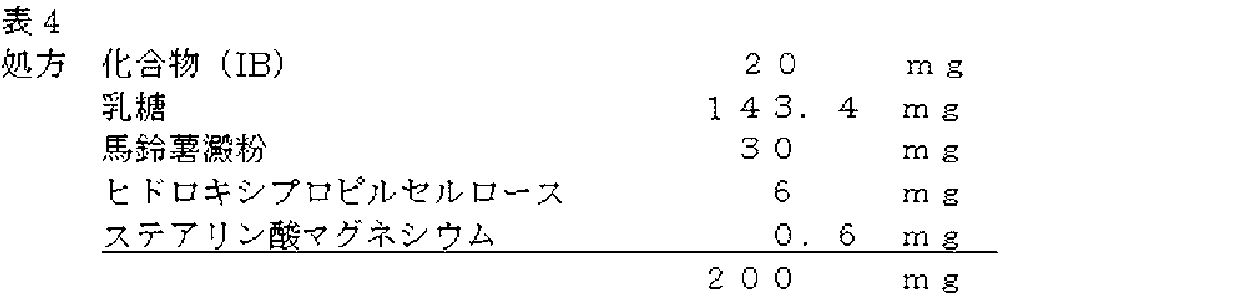
- a tablet having the following composition is prepared by a conventional method. 40 g of compound (IA), 286.8 g of lactose and 60 g of potato starch are mixed, and 120 g of a 10% aqueous solution of hydroxypropylcellulose is added thereto. This mixture is kneaded by a conventional method, granulated and dried, and then sized to obtain granules for tableting. Add 1.2 g of magnesium stearate to this, mix, and tablet with a tableting machine with 8 mm diameter punch (RT-15, manufactured by Kikusui Co., Ltd.). Tablet (20 mg of active ingredient per tablet) Containing).
- Example 2 In the same manner as in Example 1, a tablet having the following composition is prepared.
- Example 2 In the same manner as in Example 1, a tablet having the following composition is prepared.
- An injection having the following composition is prepared by a conventional method. Add 1 g of compound (IA) to distilled water for injection, mix, add hydrochloric acid and aqueous sodium hydroxide solution to adjust the pH to 7, and make the total volume 1000 ml with distilled water for injection. The obtained mixture is aseptically filled into glass vials in a volume of 2 mL to give an injection (containing 2 mg of active ingredient per vial).
- Reference example 1 Compounds (IA) to (ID) were obtained according to the method described in WO2005 / 063743.
- Reference example 2 N- [4- (2-Furyl) -5- (tetrahydropyran-4-carbonyl) thiazol-2-yl) -6-vinylpyridine-3-carboxamide (compound (IE))
- Step 1 Methyl 6-chloronicotinate (1.51 g, 8.79 mmol) was dissolved in DMF (35 mL), vinyltributyltin (3.32 mL, 11.4 mmol), dichlorobis (tri-o-tolylphosphine) palladium (206 mg, 0.262 mmol) and lithium chloride (554 mg, 13.1 mmol) were added, and the mixture was stirred at 100 ° C.
- Step 2 2- (Chloromethyl) -N- [4- (2-furyl) -5- (tetrahydropyran-4-carbonyl) thiazol-2-yl] pyridine-4-carboxamide (70.0 mg) obtained in Step 1 , 0.162 mmol) was dissolved in acetonitrile (2.0 mL), morpholine (70.0 ⁇ L, 2.15 mmol) was added, and the mixture was stirred with heating under reflux for 1 hour. The mixture was allowed to cool to room temperature, water and saturated aqueous sodium hydrogen carbonate solution were added, and the mixture was extracted with ethyl acetate. The organic layer was washed with saturated brine, and dried over anhydrous magnesium sulfate.
- acetic acid 1.5 mL was dissolved in water (3.5 mL), and piperidine acetate aqueous solution prepared by adding piperidine (2.6 mL) and 2-cyanoacetamide (4.62 g, 54.9 mmol) were added to the above aqueous solution A.
- the mixture was stirred for 4 hours under heating to reflux.
- Acetic acid 3.6 mL was added to the mixture, and after cooling to 0 ° C., the precipitated solid was collected by filtration to give 2-oxo-1,5,7,8-tetrahydro-2H-pyrano [4,3-b] Pyridine-3-carbonitrile (1.72 g, 20%) was obtained as a white solid.
- Step 2 2-Oxo-1,5,7,8-tetrahydro-2H-pyrano [4,3-b] pyridine-3-carbonitrile (2.50 g, 14.4 mmol) obtained in Step 1 was converted to phosphoryl chloride (20 mL). ) And stirred for 4 hours under heating to reflux.
- Step 3 2-Chloro-7,8-dihydro-5H-pyrano [4,3-b] pyridine-3-carbonitrile (1.77 g, 9.09 mmol) obtained in Step 2 was dissolved in ethanol (30 mL), Acetic acid (9 mL) and zinc (2.60 g) were added, and the mixture was stirred for 4 hours with heating under reflux. The mixture was allowed to cool to room temperature, filtered through celite, and the filtrate was concentrated under reduced pressure.
- Step 2 In the same manner as in Step 2 of Reference Example 2, from the methyl 6- (1-propenyl) nicotinate (326 mg, 1.84 mmol) obtained above, 6- (1-propenyl) nicotinic acid (251 mg, 84 %) was obtained as milky white crystals.
- Step 3 In the same manner as in Step 3 of Reference Example 16, the 2-chloro-7,8-dihydro-5H-thiopyrano [4,3-b] pyridine-3-carbonitrile (1.75 g, 8.31 mmol) obtained above was used. ) To give 7,8-dihydro-5H-thiopyrano [4,3-b] pyridine-3-carbonitrile (804 mg, 55%).
- Step 4 In the same manner as in Step 1 of Reference Example 17, from the 7,8-dihydro-5H-thiopyrano [4,3-b] pyridine-3-carbonitrile (874 mg, 4.96 mmol) obtained above, 8-Dihydro-5H-thiopyrano [4,3-b] pyridine-3-carboxylic acid hydrochloride (901 mg, 78%) was obtained.
- the present invention is used for the treatment and / or prevention of anxiety disorders such as panic disorder, agoraphobia, obsessive compulsive disorder, social phobia, post-traumatic stress disorder, specific phobia, generalized anxiety disorder, etc. Can do.
- anxiety disorders such as panic disorder, agoraphobia, obsessive compulsive disorder, social phobia, post-traumatic stress disorder, specific phobia, generalized anxiety disorder, etc. Can do.
Landscapes
- Health & Medical Sciences (AREA)
- Chemical & Material Sciences (AREA)
- Organic Chemistry (AREA)
- Pharmacology & Pharmacy (AREA)
- Animal Behavior & Ethology (AREA)
- Veterinary Medicine (AREA)
- Public Health (AREA)
- General Health & Medical Sciences (AREA)
- Life Sciences & Earth Sciences (AREA)
- Medicinal Chemistry (AREA)
- Epidemiology (AREA)
- Biomedical Technology (AREA)
- Engineering & Computer Science (AREA)
- General Chemical & Material Sciences (AREA)
- Neurology (AREA)
- Chemical Kinetics & Catalysis (AREA)
- Nuclear Medicine, Radiotherapy & Molecular Imaging (AREA)
- Neurosurgery (AREA)
- Bioinformatics & Cheminformatics (AREA)
- Pharmaceuticals Containing Other Organic And Inorganic Compounds (AREA)
- Plural Heterocyclic Compounds (AREA)
- Nitrogen Condensed Heterocyclic Rings (AREA)
- Heterocyclic Carbon Compounds Containing A Hetero Ring Having Oxygen Or Sulfur (AREA)
- Hydrogenated Pyridines (AREA)
Abstract
Description
不安障害は心理学的問題の一群であり、それらの重要な特徴として、過大な不安、恐怖、心配、回避および強制的儀式などがあげられ、これらは過度の罹患率、医療サービスの過剰利用および機能障害を引き起こしたりそのような結果に帰着したりする。それらは、米国および他のほとんどの国において最も流行している精神医学的状態の1つである。疾患の発生率は、文化を越えてかなり一様である。ほとんどの場合、男性よりも女性が不安障害を経験する可能性が高い。慢性不安障害は、心臓血管関連死亡率を増加させることがあり、それゆえ適切な診断および迅速な治療の開始がなされなければならない。
広場恐怖症を伴うまたは伴わないパニック障害
パニック障害は不安障害の一つであり、その本質的な特徴は再発性パニック発作(すなわち、少なくとも4つの特徴的な関連症状を伴う強い恐怖または不快感の離散的期間)である。発作は通常、数分間(または、めったにないが、数時間)持続し、予期せざるものであり、単純な恐怖症の場合のように、ほとんど常に不安を引き起こすような状況に曝される前または曝されたときに、直ちに生じる傾向はない。この発作の「予期せざる」という側面は、この障害の本質的な特徴である。パニック発作は、強度の不安または恐怖が突然襲ってくることで始まり、例えば息切れ、めまい、失神、息詰まり、動悸、震え、発汗、おこり、吐き気、しびれ感、のぼせまたは悪寒、胸痛などの身体的症状を伴うことが典型的である。パニック障害は広場恐怖症と関係していることがあり、重篤な場合、当事者は事実上家に引きこもる。
パニック障害歴のない広場恐怖症
広場恐怖症は、万一パニック発作またはパニック様症状(例えば、突然のめまいの発作または突然の下痢の発作が起きることの恐れ)が起きた場合に、そこから逃げ出すことが困難である(または困惑する)かもしれない、またはそこでは助けを求めることができない可能性がある場所あるいは状況にいることについての不安を特徴とする状態である。広場恐怖症は、広場恐怖症を伴うパニック障害およびパニック障害歴がないという状況で生じる。無力化させるもしくは極端に困惑させるようなパニック様症状、または完全なパニック発作というよりは限定された症状の発作が起きることに恐怖の対象があることを除けば、パニック障害歴のない広場恐怖症の本質的な特徴は、広場恐怖症を伴うパニック障害の特徴と同様である。
強迫性障害(OCD)
強迫性障害の一次症状は、窮迫を引き起こしたり、時間がかかったり、人の正常な日常業務またはライフスタイルを著しく妨げたりするため、十分に重症であり、再発性の強迫観念(すなわち、顕著な不安を引き起こす再発性で払っても消えない考え、イメージまたは衝動)および/または強迫行為(すなわち、本人の強迫観念により引き起こされた不安を緩和するために実行される反復行動または精神的行為)である。強迫観念は、汚染、疑念(自信喪失を含む)および性的もしくは宗教的考えの冒涜に関することが典型的である。典型的な強迫行為としては、洗浄行為、確認行為、物を整理する行為、物を数える行為などがあげられる。
社会恐怖症
社会恐怖症は、困惑が生じ得るような社会的または人前での執拗な恐怖により特徴付けられる。社会恐怖症である人が恐れたり避けたりする典型的な状況としては、パーティー、会議、他人の前での食事、他人の前での筆記、演説、会話、初めての人との対面、その他関連する状況などがあげられる。社会的または人前での状況に曝されることは、即時の不安反応はもちろんのこと、発汗、震え、ドキドキするもしくは叩くような鼓動、精神的混乱および逃げ出したくなる願望をほとんど常に引き起こす。
心的外傷後ストレス障害(PTSD)
主要な特徴的症状は、心的外傷性(すなわち、心理的な苦悩)の出来事の再体験、その出来事を想起させる刺激からの逃避、一般的な反応性の麻痺、覚醒の増加などがあげられる。関係する「出来事」は、例えば単なる死別、慢性疾患、夫婦間の軋轢などがあげられる。
全般性不安障害(GAD)
GADは、非現実的もしくは過剰な不安、および2つ以上の生活環境についての心配が、6ヶ月以上続くという状態がその本質的な特徴である。この心配をコントロールすることが困難であることを経験し、その間、罹患している人がその懸念により悩まされるときがある日の方が無い日より多い。運動緊張(motor tension)、自律神経性活動過剰(autonomic hyperactivity)、不眠(vigilance)、じろじろ見る(scanning)などの徴候をはっきり示す。
特定の恐怖症
特定の恐怖症は、その本質的な特徴が、制限された刺激(a circumscribed stimulus)への著しい恐怖である不安障害であり、この制限された刺激は社会的状況においてパニック発作が出たり恥辱を味わったり当惑したりするという恐怖(これは社会恐怖症に分類される)以外の対象または状況であるといえる。例えば、飛行機恐怖症、高所恐怖症、動物恐怖症、注射恐怖症、血液恐怖症などがあげられる。
例えば、アデノシンA1拮抗剤は排便促進作用を有することが知られている(Jpn. J. Pharmacol., 68, p. 119 (1995))。また、アデノシンA2A受容体は、特に中枢神経系に関与していることが知られており、その拮抗剤は、例えばパーキンソン病の治療薬(非特許文献2参照)、睡眠障害の治療薬(Nature Neuroscience, p.858 (2005);特許文献3参照)、うつ病の治療薬(Neurology, 61(11 Suppl 6), S82-7 (2003))などとして有用であることが知られている。アデノシン受容体とパーキンソン病の関係については多くの報告がある(Nature Reviews Drug Discovery, 5, p.845 (2006); Current Pharmaceutical Design, 14, p.1475 (2008))。
(1) 一般式(I)
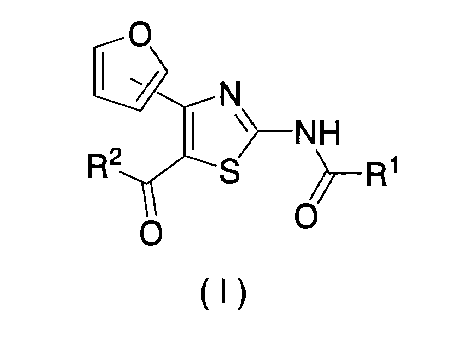
で表されるチアゾール誘導体またはその薬学的に許容される塩を有効成分として含有する不安障害の治療および/または予防剤。
(2) R1がフェニル、ピリジル、ピリミジニル、5,6-ジヒドロ-2H-ピリジルメチルまたはテトラヒドロピラニルオキシであるか、またはこれらの基にフッ素原子、塩素原子、臭素原子、メチル、エチル、メトキシおよびエトキシから選ばれる1~3個の置換基が置換した基であり、R2がピリジルまたはテトラヒドロピラニルである(1)記載のチアゾール誘導体またはその薬学的に許容される塩を有効成分として含有する不安障害の治療および/または予防剤。
(3) R1がピリジルまたはピリミジニルであるか、またはこれらの基にハロゲン;低級アルコキシまたはモルホリノで置換されていてもよい低級アルキル;低級アルコキシ;低級アルカノイル;およびビニルからなる群から選ばれる1~3個の置換基が置換した基である(1)記載のチアゾール誘導体またはその薬学的に許容される塩を有効成分として含有する不安障害の治療および/または予防剤。
(4) R2が、ピリジルである(1)~(3)のいずれかに記載のチアゾール誘導体またはその薬学的に許容される塩を有効成分として含有する不安障害の治療および/または予防剤。
(5) R2が、テトラヒドロピラニルである(1)~(3)のいずれかに記載のチアゾール誘導体またはその薬学的に許容される塩を有効成分として含有する不安障害の治療および/または予防剤。
(6) 一般式(I)で表されるチアゾール誘導体が、下記式(IA)~(IAA)のいずれかで表される化合物である(1)記載のチアゾール誘導体またはその薬学的に許容される塩を有効成分として含有する不安障害の治療および/または予防剤。
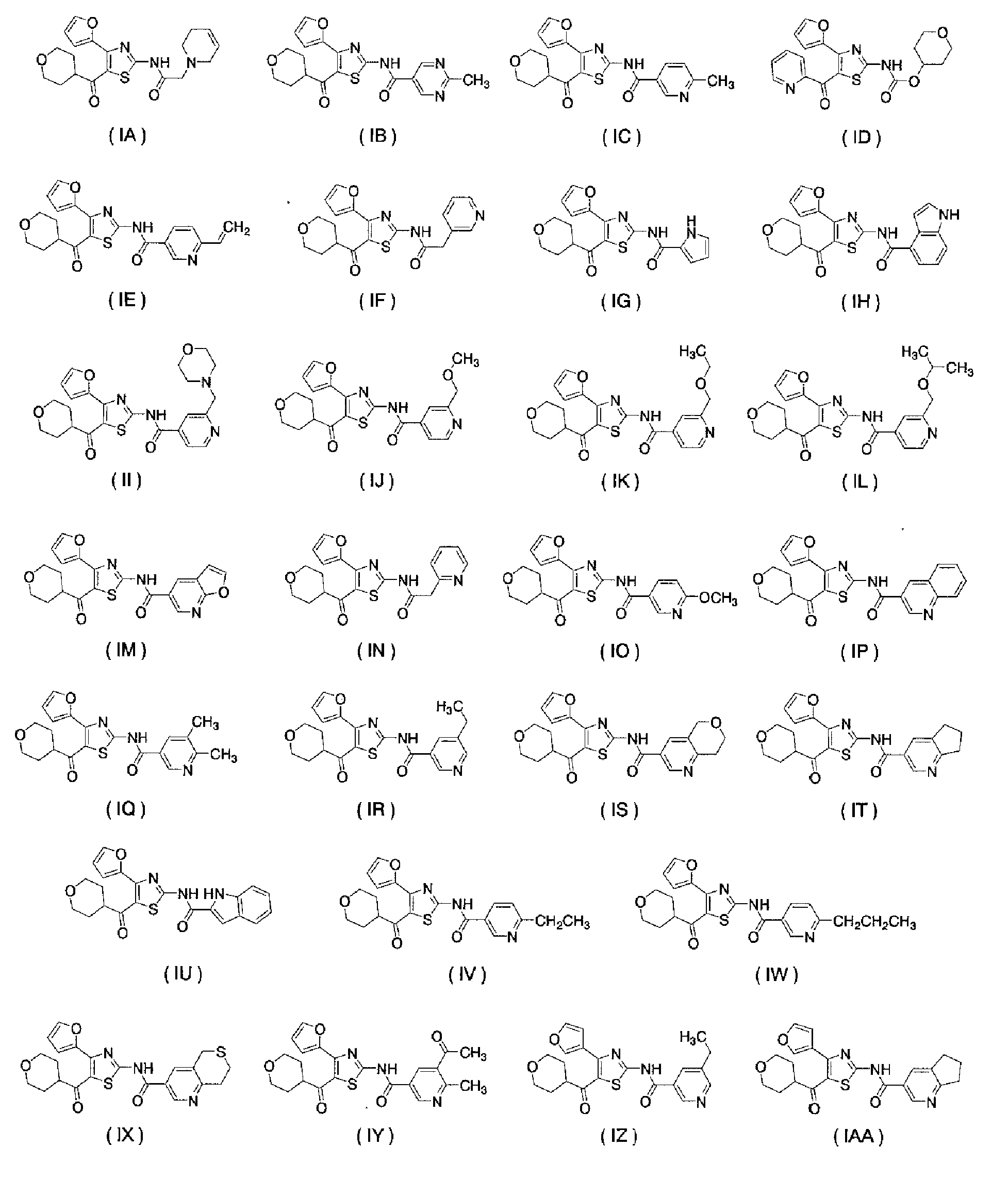

(9) 上記(1)~(7)のいずれかに記載のチアゾール誘導体またはその薬学的に許容される塩の有効量を投与することを含む不安障害の治療および/または予防方法。
(10) 不安障害がパニック障害、広場恐怖症、強迫性障害、社会恐怖症、心的外傷後ストレス障害、特定の恐怖症または全般性不安障害である(9)記載の方法。
(11) 不安障害の治療および/または予防に使用するための上記(1)~(7)のいずれかに記載のチアゾール誘導体またはその薬学的に許容される塩。
(12) 不安障害がパニック障害、広場恐怖症、強迫性障害、社会恐怖症、心的外傷後ストレス障害、特定の恐怖症または全般性不安障害である(11)記載のチアゾール誘導体またはその薬学的に許容される塩。
(13) 不安障害の治療および/または予防剤の製造のための上記(1)~(7)のいずれかに記載のチアゾール誘導体またはその薬学的に許容される塩の使用。
(14) 不安障害がパニック障害、広場恐怖症、強迫性障害、社会恐怖症、心的外傷後ストレス障害、特定の恐怖症または全般性不安障害である(13)記載の使用。
一般式(I)の各基の定義において、
低級アルキル、低級アルコキシおよび低級アルカノイルの低級アルキル部分としては、例えば直鎖または分岐状の炭素数1~10のアルキルがあげられ、より具体的にはメチル、エチル、プロピル、イソプロピル、ブチル、イソブチル、sec-ブチル、tert-ブチル、ペンチル、イソペンチル、ネオペンチル、ヘキシル、ヘプチル、オクチル、ノニル、デシルなどがあげられる。
芳香族複素環基としては、例えば窒素原子、酸素原子および硫黄原子から選ばれる少なくとも1個の原子を含む5員または6員の単環性芳香族複素環基、3~8員の環が縮合した二環または三環性で窒素原子、酸素原子および硫黄原子から選ばれる少なくとも1個の原子を含む縮環性芳香族複素環基などがあげられ、より具体的にはフリル、チエニル、ピロリル、イミダゾリル、ピラゾリル、オキサゾリル、イソオキサゾリル、オキサジアゾリル、チアゾリル、イソチアゾリル、チアジアゾリル、トリアゾリル、テトラゾリル、ピリジル、ピリダジニル、ピリミジニル、ピラジニル、トリアジニル、ベンゾフラニル、ベンゾチオフェニル、ベンゾオキサゾリル、ベンゾチアゾリル、イソインドリル、インドリル、インダゾリル、ベンゾイミダゾリル、ベンゾトリアゾリル、オキサゾロピリミジニル、チアゾロピリミジニル、ピロロピリジニル、ピロロピリミジニル、イミダゾピリジニル、プリニル、キノリニル、イソキノリニル、シンノリニル、フタラジニル、キナゾリニル、キノキサリニル、ナフチリジニル、フロ[2,3-b]ピリジル、6,7-ジヒドロ-5H-シクロペンタ[b]ピリジル、7,8-ジヒドロ-5H-ピラノ[4,3-b]ピリジル、7,8-ジヒドロ-5H-チオピラノ[4,3-b]ピリジルなどがあげられる。
本発明に使用される化合物(I)またはその薬学的に許容される塩としては、アデノシン受容体の各種サブタイプ(例えば、アデノシンA1、A2A、A2BおよびA3受容体)のうち、アデノシンA2A受容体に対し強い拮抗作用を有する化合物が好ましい。
従って、本発明の化合物(I)またはその薬学的に許容される塩としては、アデノシンA2A受容体に対し強い親和性を有する化合物が好ましい。例えば、後記の試験例1で示したアデノシンA2A受容体結合試験において、試験化合物の濃度が3×10⁻⁸ mol/Lで50%以上の阻害作用を有する化合物が好ましく、1×10-8 mol/Lで50%以上の阻害作用を有する化合物がより好ましく、3×10-9 mol/Lで50%以上の阻害作用を有する化合物がさらに好ましく、1×10-9 mol/Lで50%以上の阻害作用を有する化合物がさらにより好ましい。また、同試験により得られる阻害定数(Ki値)が30 nmol/L以下の阻害作用を有する化合物が好ましく、10 nmol/L以下の阻害作用を有する化合物がより好ましく、3 nmol/L以下の阻害作用を有する化合物がさらに好ましく、1 nmol/L以下の阻害作用を有する化合物がさらにより好ましい。
より具体的には、化合物(I)としては、例えば、R1がハロゲン、C1-6アルコキシ、またはモルホリノが置換していてもよいC1-6アルキル、C1-6アルカノイル、ビニルおよびC1-6アルコキシから選ばれる1~3個の置換基が置換していてもよいフェニル;ハロゲン、C1-6アルコキシまたはモルホリノが置換していてもよいC1-6アルキル、C1-6アルカノイル、ビニルおよびC1-6アルコキシから選ばれる1~3個の置換基が置換していてもよいピリジル;ハロゲン、C1-6アルコキシまたはモルホリノが置換していてもよいC1-6アルキル、C1-6アルカノイル、ビニルおよびC1-6アルコキシから選ばれる1~3個の置換基が置換していてもよいピリミジニル;ハロゲン、C1-6アルキルおよびC1-6アルコキシから選ばれる1~3個の置換基が置換していてもよい5,6-ジヒドロ-2H-ピリジルメチル;2,3,4,5-テトラヒドロピラニルオキシ;ピロリル;インドリル;オキサゾロピリジル;キノリル;1H-3,4-ジヒドロピラノピリジニル;1H-3,4-ジヒドロチオピラノピリジニル;シクロペンタピリジル;またはピリジルメチルである化合物が好ましく、R1がフッ素原子、塩素原子、メチルおよびメトキシから選ばれる1~3個の置換基が置換していてもよいフェニル;フッ素原子、塩素原子、メチルおよびメトキシから選ばれる1~3個の置換基が置換していてもよいピリジル;フッ素原子、塩素原子、メチルおよびメトキシから選ばれる1~3個の置換基が置換していてもよいピリミジニル;フッ素原子、塩素原子、メチルおよびメトキシから選ばれる1~3個の置換基が置換していてもよい5,6-ジヒドロ-2H-ピリジルメチル;または2,3,4,5-テトラヒドロピラニルオキシである化合物がより好ましく、R1が塩素原子、メチルおよびメトキシから選ばれる1~3個の置換基が置換したピリジル;塩素原子、メチルおよびメトキシから選ばれる1~3個の置換基が置換したピリミジニル;5,6-ジヒドロ-2H-ピリジルメチル;または2,3,4,5-テトラヒドロピラニルオキシである化合物がさらに好ましい。さらにより具体的には、例えば下記式(IA)~(IAA)の化合物などが好ましい。


具体的には、上記式の通り、例えばWO2005/063743に記載の化合物(Ia)を好ましくは0.5~5当量の化合物(Ib)と、例えばメタノール、ジクロロメタン、クロロホルム、トルエン、酢酸エチル、アセトニトリル、テトラヒドロフラン(THF)、N,N-ジメチルホルムアミド(DMF)、N,N-ジメチルアセトアミド(DMA)、ピリジン、水、またはこれらの混合溶媒などの溶媒中、好ましくは1~5当量の例えば1,3-ジシクロヘキサンカルボジイミド(DCC)、1-エチル-3-(3-ジメチルアミノプロピル)カルボジイミド(EDC)・塩酸塩などの縮合剤の存在下、必要により好ましくは1~5当量の1-ヒドロキシベンズゾトリアゾール(HOBt)・一水和物、4-ジメチルアミノピリジン(DMAP)などの存在下、-20℃と用いる溶媒の沸点との間の温度で、5分間~72時間反応させることによって化合物(I)を製造することができる。
化合物(I)の塩を取得したいとき、化合物(I)が塩の形で得られるときはそのまま精製すればよく、また、遊離の形で得られるときは、化合物(I)を適当な溶媒に溶解または懸濁し、酸または塩基を加えて塩を形成させて単離、精製すればよい。
次に、代表的な化合物(I)の薬理作用について試験例により具体的に説明する。
試験例1 アデノシン受容体結合作用
(1)アデノシンA2A受容体結合試験
試験は例えば、Varaniらの方法(British Journal of Pharmacology, 117, p.1693 (1996))に準じて行うことができる。
具体的には例えば、ラット線条体を、氷冷した50 mLの50 mmol/L Tris HCl緩衝液(pH 7.7)中で、ポリトロンホモジナイザーで懸濁した後、遠心分離し、得られた沈殿物に50 mmol/L Tris HCl緩衝液を加えて再懸濁し、同様に遠心分離を行う。得られる最終沈殿物に、5 mg(湿重量)/mLの組織濃度になるように50 mmol/L Tris HCl緩衝液(10 mmol/L塩化マグネシウム、アデノシンデアミナーゼ0.02ユニット/mg組織を含む)を加えて懸濁し、トリチウムで標識したCGS-21680(最終濃度6.0 mmol/L)および試験化合物溶液(試験化合物のジメチルスルホキシド溶液をTris HCl緩衝液で希釈)を加える。その混合液を25℃で120分間静置した後、ガラス繊維濾紙上で急速吸引ろ過し、直ちに氷令した50 mmol/L Tris HCl緩衝液で洗浄する。ガラス繊維濾紙をバイアルびんに移し、マイクロシンチ(PKI社)を加え、放射能量をトップカウント(パーキンエルマー社製)で測定することにより、試験化合物のラットアデノシンA2A受容体結合(3H-CGS21680結合)に対する阻害率を求めることができる。

上記試験において、試験化合物の濃度を適宜調整することにより、各濃度における試験化合物またはその薬学的に許容される塩のアデノシンA2A受容体に対する阻害率、および結合を50%阻害する試験化合物の濃度(IC50)を算出できる。

また、3H-CGS21680の代わりに3H-5-アミノ-7-(2-フェニルエチル)-2-(2-フリル)ピラゾロ[4,3-e]-1,2,4-トリアゾロ[1,5-c]ピリミジン(3H-SCH58261)などを用いることもできる。
(2)アデノシンA1受容体結合試験
上記(1)と同様の方法で下記の材料を使用することにより、試験化合物のアデノシンA1受容体に対する阻害定数(Ki値)を算出することができる。
(3)化合物(I)またはその薬学的に許容される塩のアデノシン受容体に対する親和性
化合物(I)またはその薬学的に許容される塩のアデノシンA1受容体およびアデノシンA2A受容体への親和性の例を以下に示す。なお、試験結果はMDSファーマサービス社(MDS Pharma Services Inc.)において上記の方法に準じて測定された結果である。

試験例2 アデノシン受容体結合作用(2)
上記試験例1と同様にして、化合物(IE)~(IAA)のアデノシン受容体に対する親和性を確認した(試験結果はリセルカ バイオサイエンス社(Ricerca Biosciences, LLC)において上記の方法に準じて測定された結果である)。

試験例3 マウスビー玉隠し試験における化合物(I)またはその薬学的に許容される塩の作用
本試験は、抗不安薬評価モデルの一つとして知られている(日本薬理学雑誌, 126, p.94 (2005))。ビー玉隠し行動は、敷き詰めたプレナー上に置いたビー玉をマウスがプレナー内に埋めてしまう行動であり、選択的セロトニン再取り込み阻害薬(Selective serotonin reuptake inhibitor、SSRI)により運動抑制を伴うことなく抑制される。無害なビー玉をプレナーで覆い隠そうとするマウスの行動が、不合理と認識しつつ繰り返される強迫性障害患者の強迫行為と見かけ上類似していることや、SSRIが強迫性障害の治療薬として有効であることなどから、ビー玉隠し行動は強迫性障害の動物モデルとして位置づけられる。

化合物(IC)が上記試験で抑制効果を示したことから、アデノシンA2A受容体に対し選択的な親和性を有する化合物(I)は強迫性障害を含む不安障害の治療および/または予防に有用であると考えられた。
試験例4 ラット社会的相互作用(Social interaction)試験における化合物(I)またはその薬学的に許容される塩の作用
体重がほぼ同程度の個別飼育した2匹のラットを同じ測定ケージ内に入れ、2匹のラットが示す臭い嗅ぎ行動、追尾、毛づくろいなどの社会的相互作用(social interaction)を観察する。既存の抗不安薬を投与することにより、この社会的相互作用が増加することが知られている。本試験は、2匹のラット間に、相対する社会的環境がストレスを生じさせると考えられており、社会恐怖症または全般性不安障害の動物モデルであると考えられている(Eur. J. Pharmacol., 408, p.41 (2000))。
化合物(IC)が上記試験で効果を示したことから、アデノシンA2A受容体に対し選択的な親和性を有する化合物(I)は社会恐怖症および/または全般性不安障害を含む不安障害の治療および/または予防に有用であると考えられた。
試験例5 ラットsocial interaction試験における薬物誘発不安様行動に対する化合物(I)またはその薬学的に許容される塩の作用
試験例4の方法を用いて、不安惹起物質の投与により誘発される不安に対する化合物の影響を検討した。不安惹起物質の一つに、ヨヒンビン(Yohimbine;アドレナリンα2受容体拮抗薬)が知られている。Yohimbineの不安惹起作用には、α2受容体拮抗作用に伴う青斑核活動亢進が寄与すると考えられている。健常人にYohimbineを投与することで現れる不安症状は、青斑核活動異常がその病態生理に大きく寄与すると考えられているパニック障害と類似することが報告されている。このことから、Yohimbine誘発不安は青斑核活動異常に伴う不安症状(例えばパニック障害)をよく反映したモデルであると考えられている。
溶媒(0.5 w/v% MC溶液)を測定の30分前に投与した群では、ラット間に見られるinteraction時間が平均で90.6 ± 7.1 秒であった。これに対し、Yohimbineを測定の30分前に投与(0.5 w/v% MC溶液に溶解し、ラット体重100 gあたり0.25 mL投与となるように調製したものを5 mg/kgの用量で経口投与)した群では、ラット間のinteraction時間が有意に減少した(57.6 ± 3.4 秒, P=0.0010, Aspin-Welch test)。化合物(IC)(0.5 w/v% MC溶液の懸濁液、ラット体重100gあたり0.25 mL投与となるように調製したもの)をYohimbineの投与30分前に0.03 mg/kgの用量で投与したところ、上記のYohimbine(5 mg/kg)によるinteraction時間減少を有意に改善した(0.03 mg/kg:90.3 ±5.0 秒、P = 0.00019, Steel test)。
溶媒(0.5 w/v% MCラット体重100 gあたり0.25 mL経口投与)を測定の30分前に投与した群では、ラット間に見られるinteraction時間が平均で83.4 ± 5.1 秒であった。これに対し、mCPPを測定の30分前に投与(0.5 w/v% MC溶液に溶解し、ラット体重100 gあたり0.25 mL投与となるように調製したものを0.5 mg/kgの用量で経口投与)した群では、ラット間のinteraction時間が有意に減少した(32.5 ± 3.6 秒、P<0.001、Student’s t-test)。化合物(IC)(0.5 w/v% MC溶液の懸濁液、ラット体重100gあたり0.25 mL投与となるように調製したもの)をmCPPの投与30分前に0.3 mg/kgの用量で投与したところ、上記のmCPP(0.5 mg/kg)によるinteraction時間減少を有意に改善した(0.3 mg/kg:62.4 ± 6.9 秒、 P<0.001、Dunnett test)。
試験例6 ラットのボーゲル型葛藤試験(Vogel conflict test)における化合物(I)またはその薬学的に許容される塩の作用
本試験は、給水制限をしたラットが、飲水する度に電気ショックを受ける条件下で、飲水回数(飲水時に与えられるショック回数)を測定するものである。この条件下でラットは、水(正の強化因子)は欲しいけれど電撃(負の強化因子、罰刺激)は受けたくないという、相反する刺激の間で葛藤(コンフリクト)状態に置かれていると考えられている。抗不安作用をもつ薬物をラットに投与すると、罰刺激に対する不安が抑えられ正の強化因子を取ろうとする行動がみられる。本試験は、全般性不安障害の動物モデルの一つと考えられている(日本薬理学会雑誌, 115, p.5 (2005)、臨床精神薬理, 9, p.2389 (2006))。
化合物(IC)が上記試験で効果を示したことから、アデノシンA2A受容体に対し選択的な親和性を有する化合物(I)は全般性不安障害を含む不安障害の治療および/または予防に有用であると考えられた。
試験例7 ラット高架式十字迷路試験における化合物(I)またはその薬学的に許容される塩の作用
本試験では、げっ歯類の探索行動欲求と、明るく開けた新奇空間(オープンアーム)に対する生得的嫌悪との間に葛藤が生じるため、抗不安作用を有する薬物は、動物がオープンアーム上に滞在する時間および進入する回数を増加させ、反対に不安惹起物質はこれらのパラメータを減少させることが報告されている(臨床精神薬理, 9, p.2389 (2006))。本試験は、全般性不安障害の動物モデルの1つであると考えられている(日本薬理学会雑誌, 115, p.5 (2005)、臨床精神薬理, 9, p.2389 (2006))。
試験例8 ラット恐怖条件付けストレス反応(CFS)試験における化合物(I)またはその薬学的に許容される塩の作用
本試験(日本薬理学雑誌, 113, p.113 (1999))では、過去の嫌悪体験に起因する心理的ストレスが生体に与える影響を、行動抑制(フリージング反応)または自律神経系の活動亢進(呼吸数、血圧の上昇)として測定することができる。
従って、アデノシンA2A受容体に対し選択的な親和性を有する化合物(I)は心理的ストレス誘発不安障害(心的外傷後ストレス障害)を含む不安障害の治療および/または予防に有用であると考えられた。
本発明に係わる医薬製剤は、活性成分として化合物(I)またはその薬学的に許容される塩を単独で、または任意の他の治療のための有効成分との混合物として含有することができる。また、それら医薬製剤は、活性成分を薬学的に許容される一種またはそれ以上の担体(例えば、希釈剤、溶剤、賦形剤など)と一緒に混合し、製剤学の技術分野においてよく知られている任意の方法により製造される。
投与形態としては、例えば錠剤、注射剤、外用剤などがあげられる。
経口投与に適当な、例えば錠剤などは、乳糖などの賦形剤、澱粉などの崩壊剤、ステアリン酸マグネシウムなどの滑沢剤、ヒドロキシプロピルセルロースなどの結合剤などを用いて製造できる。
外用剤に適当な剤型としては、特に限定されるものではなく、例えば軟膏剤、クリーム剤、リニメント剤、ローション剤、パップ剤、プラスター剤、テープ剤などがあげられる。例えば、軟膏剤、クリーム剤などは、例えば白色ワセリンなどの基剤に活性成分を溶解または混合分散して製造できる。
組み合わせて用いられる他の医薬成分としては、例えば抗不安作用を有する他の薬物などがあげられ、具体的には例えばブスピロン、セルトラリン、パロキセチン、ネファゾドン、フルキセチンなどのトリプタミン再取り込み阻害薬;ベンゾジアゼピンなどのGABA受容体アゴニスト(例えばジアゼパム、トフィソパム、アルプラゾラム、フルトパゼパムなど);ピバガビンなどのコルチコトロピン放出因子アンタゴニスト;アミスルプリドなどのMAO阻害剤などがあげられる。



化合物(IA)~(ID)は、WO2005/063743に記載の方法に従って得た。
参考例2
N-[4-(2-フリル)-5-(テトラヒドロピラン-4-カルボニル)チアゾール-2-イル)-6-ビニルピリジン-3-カルボキサミド(化合物(IE))
工程1 6-クロロニコチン酸メチル(1.51 g, 8.79 mmol)をDMF(35 mL)に溶解し、ビニルトリブチルすず(3.32 mL, 11.4 mmol)、ジクロロビス(トリ-o-トリルホスフィン)パラジウム(206 mg, 0.262 mmol)および塩化リチウム(554 mg, 13.1 mmol)を加えて100℃で2時間攪拌した。混合物を室温まで放冷後、フッ化カリウム水溶液を加え、セライトろ過し、残渣を酢酸エチルで洗浄した。得られたろ液に飽和炭酸水素ナトリウム水溶液を加えて酢酸エチルで抽出し、有機層を飽和食塩水で洗浄後、無水硫酸マグネシウムで乾燥した。減圧下濃縮して得られる残渣をシリカゲルカラムクロマトグラフィー(ヘキサン:酢酸エチル=70:30)で精製することにより、6-ビニルニコチン酸メチル(1.22 g, 85%)を無色透明油状物として得た。
1H NMR (CDCl3, δppm): 3.95 (s, 3H), 5.63 (dd, J = 1.1, 10.8 Hz, 1H), 6.35 (dd, J = 1.1, 17.4 Hz, 1H), 6.87 (dd, J = 10.8, 17.4 Hz, 1H), 7.40 (d, J = 8.2 Hz, 1H), 8.25 (dd, J = 2.1, 8.2 Hz, 1H), 9.15-9.18(m, 1H).
工程2 上記で得られた6-ビニルニコチン酸メチル(491 mg, 2.97 mmol)を50%メタノール水(8 mL)に溶解し、水酸化リチウム一水和物(276 mg, 6.57 mmol)を加えた後、室温で1時間攪拌した。混合物を0℃まで冷却後、3 mol/L塩酸(3 mL)を加えて析出した固体をろ取することにより、6-ビニルニコチン酸(309 mg, 70%)を白色固体として得た。
1H NMR (DMSO-d6, δppm): 5.61 (dd, J= 1.5, 10.8 Hz, 1H), 6.37 (dd, J= 1.5, 17.4 Hz, 1H), 6.89 (dd, J= 10.8, 17.4 Hz, 1H), 7.62 (d, J= 8.2 Hz, 1H), 8.22 (dd, J = 2.2, 8.2 Hz, 1H), 9.01 (d, J = 2.2 Hz, 1H), 13.35 (brs, 1H).
工程3 WO2005/063743に記載の2-アミノ-4-(2-フリル)チアゾール-5-イル=テトラヒドロピラン-4-イル=ケトン(301 mg, 1.08 mmol)をDMF (1.5 mL)に溶解し、EDC塩酸塩(412 mg, 2.15 mmol)、DMAP (66 mg, 0.54 mmol)および上記で得られた6-ビニルニコチン酸(306 mg, 1.65 mmol)を加え、50℃で5時間攪拌した。混合物を室温まで放冷後、水および飽和炭酸水素ナトリウム水溶液を加えて酢酸エチルで抽出し、有機層を飽和食塩水で洗浄後、無水硫酸マグネシウムで乾燥した。減圧下濃縮して得られる残渣をシリカゲルカラムクロマトグラフィー(ヘキサン:酢酸エチル=50:50)で精製し、エタノール-水から再結晶することにより、化合物(IE) (1.22 g, 85%)を白色結晶として得た。
1H NMR (CDCl3, δppm): 1.80-2.01 (m, 4H), 3.11-3.25 (m, 1H), 3.51 (ddd, J= 3.1, 11.4, 11.4 Hz, 2H), 4.02-4.11 (m, 2H), 5.71 (dd, J = 0.8, 10.7 Hz, 1H), 6.43 (dd, J = 0.8, 17.5 Hz, 1H), 6.57 (dd, J = 1.7, 3.8 Hz, 1H), 6.90 (dd, J = 10.7, 17.5 Hz, 1H), 7.51 (d, J = 8.2 Hz, 1H), 7.58 (dd, J = 0.5, 1.7 Hz, 1H), 7.84 (d, J = 3.8 Hz, 1H), 8.21 (dd, J = 2.4, 8.2 Hz, 1H), 9.13 (d, J = 2.4 Hz, 1H), 9.84 (brs, 1H). ESIMS m/z: [M+H]+ 410.
参考例3
N-[4-(2-フリル)-5-(テトラヒドロピラン-4-カルボニル)チアゾール-2-イル]-2-(ピリジン-3-イル)アセトアミド(化合物(IF))
WO2005/063743に記載の2-アミノ-4-(2-フリル)チアゾール-5-イル=テトラヒドロピラン-4-イル=ケトン(105 mg, 0.377 mmol)をDMF (2.0 mL)に溶解し、EDC塩酸塩(421 mg, 2.20 mmol)、HOBt・一水和物(340 mg, 2.21 mmol)および3-ピリジル酢酸塩酸塩(370 mg, 2.14mmol)を加えて、80℃で終夜攪拌した。混合物を室温まで放冷後、水および飽和炭酸水素ナトリウム水溶液を加えて析出した固体をろ取し、減圧乾燥した。得られた固体をシリカゲルカラムクロマトグラフィー(ヘキサン:酢酸エチル=50:50)で精製し、エタノール-水から再結晶することにより、化合物(IF) (112 mg, 75%)を白色結晶として得た。
1H NMR (CDCl3, δppm): 1.80-2.01 (m, 4H), 3.05-3.16 (m, 1H), 3.45 (ddd, J = 2.8, 11.4, 11.4 Hz, 2H), 3.81 (s, 2H), 3.97-4.06 (m, 2H), 6.54 (dd, J= 1.8, 3.6 Hz, 1H), 7.32 (dd, J= 7.8, 4.8 Hz, 1H), 7.52-7.54 (m, 1H), 7.62-7.68 (m, 2H), 8.55-8.64 (m, 2H), 9.21 (s, 1H). APCIMS m/z: [M+H]+ 398.
参考例4
N-[4-(2-フリル)-5-(テトラヒドロピラン-4-カルボニル)チアゾール-2-イル]-1H-ピロール-2-カルボキサミド(化合物(IG))
参考例3と同様にして、WO2005/063743に記載の2-アミノ-4-(2-フリル)チアゾール-5-イル=テトラヒドロピラン-4-イル=ケトン(100 mg, 0.360 mmol)およびピロール-2-カルボン酸(240 mg, 2.18 mmol)から、化合物(IG) (86.0 mg, 65%)を淡褐色結晶として得た。
1H NMR (CDCl3, δppm): 1.80-2.01(m, 4H), 3.08-3.24 (m, 1H), 3.47 (ddd, J = 2.7, 11.5, 11.5 Hz, 2H), 4.00-4.09 (m, 2H), 6.34-6.36 (m, 1H), 6.56 (dd, J= 1.8, 3.6 Hz, 1H), 6.86-6.88 (m, 1H), 7.06-7.10 (m, 1H), 7.55-7.57 (m, 1H), 7.71 (dd, J = 0.7, 3.7 Hz, 1H), 9.49 (brs, 1H), 9.65 (brs, 1H). APCIMS m/z: [M+H]+ 372.
参考例5
N-[4-(2-フリル)-5-(テトラヒドロピラン-4-カルボニル)チアゾール-2-イル]-1H-インドール-4-カルボキサミド(化合物(IH))
参考例3と同様にして、WO2005/063743に記載の2-アミノ-4-(2-フリル)チアゾール-5-イル=テトラヒドロピラン-4-イル=ケトン(102 mg, 0.367 mmol)およびインドール-4-カルボン酸(331 mg, 2.05 mmol)から、化合物(IH) (97.6 mg, 63%)を乳白色結晶として得た。
1H NMR (CDCl3, δppm): 1.80-2.01 (m, 4H), 3.17-3.28 (m, 1H), 3.50 (ddd, J = 3.0, 11.2, 11.2 Hz, 2H), 4.02-4.11 (m, 2H), 6.58 (dd, J = 1.7, 3.5 Hz, 1H), 7.23-7.36 (m, 2H), 7.43-7.48 (m, 1H), 7.58-7.60 (m, 1H), 7.67 (dd, J = 4.2, 7.7 Hz, 2H), 7.76 (dd, J = 0.7, 3.5 Hz, 1H), 8.46 (brs, 1H), 9.70 (brs, 1H). APCIMS m/z: [M+H]+ 422.
参考例6
N-[4-(2-フリル)-5-(テトラヒドロピラン-4-カルボニル)チアゾール-2-イル]-2-(モルホリン-4-イルメチル)ピリジン-4-カルボキサミド(化合物(II))
工程1 WO2005/063743に記載の2-アミノ-4-(2-フリル)チアゾール-5-イル=テトラヒドロピラン-4-イル=ケトン(2.00 g, 7.19 mmol)をDMF (35 mL)に溶解し、EDC塩酸塩(5.50 g, 28.6 mmol)、HOBt・一水和物(4.40 g, 28.8 mmol)およびWO03/043636に記載の方法で得られる2-(クロロメチル)イソニコチン酸(4.93 g, 28.7 mmol)を加えて、80℃で終夜攪拌した。混合物を室温まで放冷後、水および飽和炭酸水素ナトリウム水溶液を加えて析出した固体をろ取し、減圧乾燥した。得られた固体をシリカゲルカラムクロマトグラフィー(ヘキサン:酢酸エチル=50:50)で精製することにより、2-(クロロメチル)-N-[4-(2-フリル)-5-(テトラヒドロピラン-4-カルボニル)チアゾール-2-イル]ピリジン-4-カルボキサミド(700 mg, 23%)を淡褐色固体として得た。
1H NMR (CDCl3, δppm): 1.84-1.97 (m, 4H), 3.12-3.23 (m, 1H), 3.46-3.57 (m, 2H), 4.02-4.11 (m, 2H), 4.75 (s, 2H), 6.52 (dd, J = 3.6, 1.7 Hz, 1H), 7.50 (dd, J = 1.7, 0.7 Hz, 1H), 7.70 (dd, J = 5.1, 1.7 Hz, 1H), 7.79 (dd, J = 3.6, 0.7 Hz, 1H), 7.92-7.95 (m, 1H), 8.79 (dd, J = 5.1, 0.7 Hz, 1H).
工程2 工程1で得られた2-(クロロメチル)-N-[4-(2-フリル)-5-(テトラヒドロピラン-4-カルボニル)チアゾール-2-イル]ピリジン-4-カルボキサミド(70.0 mg, 0.162 mmol)をアセトニトリル(2.0 mL)に溶解し、モルホリン(70.0μL, 2.15 mmol)を加え、加熱還流下で1時間攪拌した。混合物を室温まで放冷後、水および飽和炭酸水素ナトリウム水溶液を加えて酢酸エチルで抽出し、有機層を飽和食塩水で洗浄し、無水硫酸マグネシウムで乾燥した。減圧下濃縮して得られる残渣をシリカゲルカラムクロマトグラフィー(クロロホルム:メタノール=95:5)で精製し、ヘキサン-酢酸エチルでリスラリーすることにより、化合物(II) (54.6 mg, 71%)を淡褐色固体として得た。
1H NMR (CDCl3, δppm): 1.80-2.01 (m, 4H), 2.51-2.59 (m, 4H), 3.10-3.24 (m, 1H), 3.51 (ddd, J = 3.0, 11.3, 11.3 Hz, 2H), 3.75-3.82 (m, 6H), 4.01-4.13 (m, 2H), 6.59 (dd, J = 1.8, 3.6 Hz, 1H), 7.60 (dd, J = 0.7, 1.8 Hz, 1H), 7.69 (dd, J = 1.8, 5.1 Hz, 1H), 7.84 (dd, J = 0.7, 3.6 Hz, 1H), 7.93-7.95 (m, 1H), 8.82 (dd, J = 0.7, 5.1 Hz, 1H). ESIMS m/z: [M+H]+ 483.
参考例7
N-[4-(2-フリル)-5-(テトラヒドロピラン-4-カルボニル)チアゾール-2-イル]-2-メトキシメチルピリジン-4-カルボキサミド(化合物(IJ))
氷冷下、60%水素化ナトリウム(10.0 mg, 0.250 mmol)をDMF (1.0 mL)に溶解し、メタノール(110μL, 2.72 mmol)をゆっくりと滴下した後、0℃で10分間攪拌した。続いて、参考例6の工程1で得られた2-(クロロメチル)-N-[4-(2-フリル)-5-(テトラヒドロピラン-4-カルボニル)チアゾール-2-イル]ピリジン-4-カルボキサミド(81.0 mg, 0.189 mmol)をDMF (1.0 mL)に溶解して、混合物にゆっくりと滴下した後、室温で5時間撹拌した。混合物に水および飽和炭酸水素ナトリウム水溶液を加えて酢酸エチルで抽出し、有機層を飽和食塩水で洗浄し、無水硫酸マグネシウムで乾燥した。減圧下濃縮して得られる残渣をシリカゲルカラムクロマトグラフィー(ヘキサン:酢酸エチル=50:50)で精製し、エタノール-水から再結晶することにより、化合物(IJ) (45.0 mg, 56%)を白色結晶として得た。
1H NMR (CDCl3, δppm): 1.80-2.01 (m, 4H), 3.14-3.23 (m, 1H), 3.52 (ddd, J = 3.0, 11.2, 11.2 Hz, 2H), 3.53 (s, 3H), 4.02-4.18 (m, 2H), 4.65 (s, 2H), 6.52 (dd, J = 1.8, 3.6 Hz, 1H), 7.50 (d, J = 1.1 Hz, 1H), 7.71 (dd, J = 1.3, 5.1 Hz, 1H), 7.79 (d, J = 3.6 Hz, 1H), 7.85 (s, 1H), 8.77 (d, J = 5.1 Hz, 1H), 10.41 (brs, 1H). APCIMS m/z: [M+H]+ 428.
参考例8
2-エトキシメチル-N-[4-(2-フリル)-5-(テトラヒドロピラン-4-カルボニル)チアゾール-2-イル]ピリジン-4-カルボキサミド(化合物(IK))
参考例7と同様にして、2-(クロロメチル)-N-[4-(2-フリル)-5-(テトラヒドロピラン-4-カルボニル)チアゾール-2-イル]ピリジン-4-カルボキサミド(80.0 mg, 0.185 mmol)およびエタノール(200μL, 3.54 mmol)から、化合物(IK) (47.0 mg, 57%)を白色結晶として得た。
1H NMR (CDCl3, δppm): 1.36 (t, J = 7.1 Hz, 3H), 1.80-2.01 (m, 4H), 3.11-3.28 (m, 1H), 3.51 (ddd, J= 3.2, 11.4, 11.4 Hz, 2H), 3.72 (q, J= 7.1 Hz, 2H), 4.00-4.12 (m, 2H), 4.73 (s, 2H), 6.58 (dd, J = 1.7, 3.6 Hz, 1H), 7.58 (dd, J = 0.7, 1.7 Hz, 1H), 7.72 (dd, J = 1.7, 5.0Hz, 1H), 7.84 (dd, J = 0.7, 3.6 Hz, 1H), 7.92 (dd, J = 0.7, 1.7Hz, 1H), 8.80 (d, J = 5.0 Hz, 1H), 9.95 (brs, 1H). APCIMS m/z: [M+H]+ 442.
参考例9
N-[4-(2-フリル)-5-(テトラヒドロピラン-4-カルボニル)チアゾール-2-イル]-2-イソプロポキシメチルピリジン-4-カルボキサミド(化合物(IL))
参考例7と同様にして、2-(クロロメチル)-N-[4-(2-フリル)-5-(テトラヒドロピラン-4-カルボニル)チアゾール-2-イル]ピリジン-4-カルボキサミド(80.1 mg, 0.185 mmol)および2-プロパノール(350μL, 4.60 mmol)から、化合物(IL) (30.2 mg, 36%)を白色結晶として得た。
1H NMR (CDCl3, δppm): 1.31 (d, J = 6.0 Hz, 6H), 1.80-2.01 (m, 4H), 3.15-3.22 (m, 1H), 3.51 (ddd, J= 2.8, 11.4, 11.4 Hz, 2H), 3.78-3.86 (qq, J = 6.0, 6.0 Hz, 1H), 4.01-4.11 (m, 2H), 4.73 (s, 2H), 6.58 (dd, J= 1.8, 3.6 Hz, 1H), 7.59 (dd, J= 0.6, 1.8 Hz, 1H), 7.71 (dd, J= 1.5, 5.1 Hz, 1H), 7.85 (dd, J= 0.4, 3.5 Hz, 1H), 7.93 (d, J = 0.6 Hz, 1H), 8.79 (dd, J = 0.4, 5.1 Hz, 1H), 9.91 (brs, 1H). APCIMS m/z: [M+H]+ 456.
参考例10
N-[4-(2-フリル)-5-(テトラヒドロピラン-4-カルボニル)チアゾール-2-イル]フロ[2,3-b]ピリジン-5-カルボキサミド(化合物(IM))
WO2005/063743に記載の2-アミノ-4-(2-フリル)チアゾール-5-イル=テトラヒドロピラン-4-イル=ケトン(125 mg, 0.450 mmol)をDMF (2.2 mL)に溶解し、EDC塩酸塩(173 mg, 0.900 mmol)、HOBt・一水和物(138 mg, 0.900 mmol)およびテトラへドロン・レターズ(Tetrahedron Letters)、第35巻、p.9355 (1994年)に記載の方法で得られるフロ[2,3-b]ピリジン-5-カルボン酸(147 mg, 0.900 mmol)を加えて、50℃で2時間、次いで70℃で1時間攪拌した。さらに混合物に、EDC塩酸塩(173 mg, 0.900 mmol)、HOBt・一水和物(138 mg, 0.900 mmol)およびフロ[2,3-b]ピリジン-5-カルボン酸(147 mg, 0.900 mmol)を加えて、70℃で1.5時間攪拌した。混合物を水-飽和炭酸水素ナトリウム水溶液(1:1)に加えて析出した固体を濾取し、乾燥した。得られた固体をシリカゲルカラムクロマトグラフィー(ヘキサン:酢酸エチル=50:50)で精製し、エタノール-水から再結晶することにより、化合物(IM) (81.2 mg, 43%)を得た。
1H NMR (DMSO-d6, δppm): 1.56-1.77 (m, 4H), 3.16-3.26 (m, 1H), 3.37-3.47 (m, 2H), 3.87-3.92 (m, 2H), 6.71 (dd, J = 1.9, 3.5 Hz, 1H), 7.21 (d, J = 2.4 Hz, 1H), 7.45 (dd, J = 0.9, 3.5 Hz, 1H), 7.91 (dd, J = 0.9, 1.9 Hz, 1H), 8.27 (d, J = 2.4 Hz, 1H), 8.86 (d, J = 2.4 Hz, 1H), 9.04 (d, J = 2.4 Hz, 1H). ESIMS m/z: [M+H]+ 424.
参考例11
N-[4-(2-フリル)-5-(テトラヒドロピラン-4-カルボニル)チアゾール-2-イル]-2-(ピリジン-2-イル)アセトアミド(化合物(IN))
参考例2の工程3と同様にして、WO2005/063743に記載の2-アミノ-4-(2-フリル)チアゾール-5-イル=テトラヒドロピラン-4-イル=ケトン(154 mg, 0.553 mmol)および2-ピリジル酢酸塩酸塩(196 mg, 1.13 mmol)から、化合物(IN) (125 mg, 58%)を白色結晶として得た。
1H NMR (CDCl3, δppm): 1.78-1.95 (m, 4H), 3.01-3.21 (m, 1H), 3.47 (ddd, J = 2.6, 11.4, 11.4 Hz, 2H), 3.98-4.09 (m, 2H), 4.03 (s, 2H), 6.57 (dd, J= 1.8, 3.6 Hz, 1H), 7.25-7.34 (m, 2H), 7.59 (dd, J = 0.7, 1.8 Hz, 1H), 7.70 (dd, J = 0.7, 3.5 Hz, 1H), 7.74 (ddd, J = 1.8, 7.7, 7.7 Hz, 1H), 8.69-8.73 (m, 1H), 12.09 (brs, 1H). APCIMS m/z: [M+H]+ 398.
参考例12
N-[4-(2-フリル)-5-(テトラヒドロピラン-4-カルボニル)チアゾール-2-イル]-6-メトキシピリジン-3-カルボキサミド(化合物(IO))
参考例2の工程3と同様にして、WO2005/063743に記載の2-アミノ-4-(2-フリル)チアゾール-5-イル=テトラヒドロピラン-4-イル=ケトン(150 mg, 0.539 mmol)および6-メトキシニコチン酸(101 mg, 0.659 mmol)から、化合物(IO) (121 mg, 54%)を白色結晶として得た。
1H NMR (CDCl3, δppm): 1.80-2.01 (m, 4H), 3.10-3.25 (m, 1H), 3.51 (ddd, J = 2.9, 11.4, 11.4 Hz, 2H), 4.02-4.11 (m, 2H), 4.04 (s, 3H), 6.55 (dd, J= 1.7, 3.5 Hz, 1H), 6.87 (d, J= 8.8 Hz, 1H), 7.53-7.57 (m, 1H), 7.83 (dd, J = 0.6, 3.5 Hz, 1H), 8.10 (dd, J = 2.6, 8.8 Hz, 1H), 8.77 (dd, J = 0.6, 2.6 Hz, 1H), 9.93 (brs, 1H). APCIMS m/z: [M+H]+ 414.
参考例13
N-[4-(2-フリル)-5-(テトラヒドロピラン-4-カルボニル)チアゾール-2-イル]キノリン-3-カルボキサミド(化合物(IP))
参考例2の工程3と同様にして、WO2005/063743に記載の2-アミノ-4-(2-フリル)チアゾール-5-イル=テトラヒドロピラン-4-イル=ケトン(151 mg, 0.543 mmol)およびキノリン-3-カルボン酸(142 mg, 0.820 mmol)から、化合物(IP) (178 mg, 76%)を淡黄色結晶として得た。
1H NMR (CDCl3, δppm): 1.80-2.01 (m, 4H), 3.15-3.25 (m, 1H), 3.52 (ddd, J = 2.9, 11.4, 11.4 Hz, 2H), 4.06-4.10 (m, 2H), 6.47 (dd, J = 1.7, 3.5 Hz, 1H), 7.47 (dd, J = 0.7, 1.6 Hz, 1H), 7.66-7.74 (m, 2H), 7.87-7.95 (m, 2H), 8.20 (dd, J = 0.9, 8.4 Hz, 1H), 8.71 (d, J = 1.8 Hz, 1H), 9.43 (d, J = 2.4 Hz, 1H), 10.55 (s, 1H). APCIMS m/z: [M+H]+ 434.
参考例14
N-[4-(2-フリル)-5-(テトラヒドロピラン-4-カルボニル)チアゾール-2-イル]-5,6-ジメチルピリジン-3-カルボキサミド(化合物(IQ))
工程1 ジャーナル・オブ・ヘテロサイクリック・ケミストリー(J. Heterocyclic Chem.)、24巻、p. 351 (1987年)に記載の方法で得られる5,6-ジメチルピリジン-3-カルボニトリル(502 mg, 3.79 mmol)を70%エタノール水(4.5 mL)に懸濁し、水酸化ナトリウム(444 mg, 11.1 mmol)を加えて、加熱還流下で3時間攪拌した。混合物を0℃に氷冷し、6 mol/L塩酸(1.9 mL)を加えた。減圧下濃縮して得られる残渣をクロロホルム-メタノールに懸濁した。無機塩をろ過で取り除き、得られたろ液を減圧下濃縮することにより5,6-ジメチルピリジン-3-カルボン酸(569 mg, 99%)を淡桃色固体として得た。
1H NMR (DMSO-d6, δppm): 2.23 (s, 3H), 2.39 (s, 3H), 7.83 (d, J = 1.7 Hz, 1H), 8.64 (d, J = 1.7 Hz, 1H).
工程2 参考例2の工程3と同様にして、WO2005/063743に記載の2-アミノ-4-(2-フリル)チアゾール-5-イル=テトラヒドロピラン-4-イル=ケトン(151 mg, 0.550 mmol)および上記で得られた5,6-ジメチルピリジン-3-カルボン酸(166mg, 1.10 mmol)から、化合物(IQ) (112 mg, 49%)を白色結晶として得た。
1H NMR (CDCl3, δppm): 1.80-2.01 (m, 4H), 2.34 (s, 3H), 2.59 (s, 3H), 3.12-3.23 (m, 1H), 3.51 (ddd, J= 2.9, 11.3, 11.3 Hz, 2H), 4.04-4.09 (m, 2H), 6.49 (dd, J = 2.0, 3.6 Hz, 1H), 7.47 (d, J = 1.7 Hz, 1H), 7.79 (dd, J = 0.5, 3.5 Hz, 1H), 7.89 (d, J = 1.7 Hz, 1H), 8.86 (d, J= 2.0 Hz, 1H). ESIMS m/z: [M+H]+ 412.
参考例15
5-エチル-N-[4-(2-フリル)-5-(テトラヒドロピラン-4-カルボニル)チアゾール-2-イル]ピリジン-3-カルボキサミド(化合物(IR))
参考例2の工程3と同様にして、WO2005/063743に記載の2-アミノ-4-(2-フリル)チアゾール-5-イル=テトラヒドロピラン-4-イル=ケトン(151 mg, 0.543 mmol)および5-エチルニコチン酸(128 mg, 0.814 mmol)から、化合物(IR) (145 mg, 65%)を白色結晶として得た。
1H NMR (CDCl3, δppm): 1.32 (t, J= 7.6 Hz, 3H), 1.83-2.01 (m, 4H), 2.77 (q, J = 7.6 Hz, 2H), 3.11-3.26 (m, 1H), 3.51 (ddd, J = 2.9, 11.4, 11.4 Hz, 2H), 4.01-4.11 (m, 2H), 6.54 (dd, J = 1.8, 3.6 Hz, 1H), 7.51-7.53 (m, 1H), 7.80 (dd, J= 0.7, 3.6 Hz, 1H), 8.03-8.06 (m, 1H), 8.70 (d, J = 2.0 Hz, 1H), 8.99 (d, J= 2.0 Hz, 1H), 10.24 (brs, 1H). ESIMS m/z: [M+H]+ 412.
参考例16
N-[4-(2-フリル)-5-(テトラヒドロピラン-4-カルボニル)チアゾール-2-イル]-7,8-ジヒドロ-5H-ピラノ[4,3-b]ピリジン-3-カルボキサミド(化合物(IS))
工程1 水素化ナトリウム(2.06 g, 51.5 mmol)をジエチルエーテル(40 mL)に懸濁し、-5℃でメタノール(2.1 mL, 51.8 mmol)をゆっくり加えた。続いて混合物にエタノール(6 mL)を加え、室温で5分間攪拌し、0℃に冷却した後、テトラヒドロ-4H-ピラン-4-オン(4.61 mL, 49.9 mmol)およびギ酸エチル(4.11 mL, 51.1 mmol)の混合液をゆっくり加えた。混合物を室温で2時間攪拌した後、生成物を水(30 mL)で抽出した(水溶液A)。
1H NMR (CDCl3, δppm): 2.89 (t, J= 5.6 Hz, 2H), 3.99 (t, J = 5.6 Hz, 2H), 4.54 (s, 2H), 7.59 (s, 1H). APCIMS m/z: [M-H]- 175.
工程2 工程1で得られる2-オキソ-1,5,7,8-テトラヒドロ-2H-ピラノ[4,3-b]ピリジン-3-カルボニトリル(2.50 g, 14.4 mmol)を塩化ホスホリル(20 mL)に溶解し、加熱還流下で4時間攪拌した。混合物を室温まで放冷後、0℃に冷却した飽和炭酸水素ナトリウム水溶液にゆっくり加えてクロロホルムで抽出した。有機層を飽和食塩水で洗浄し、無水硫酸マグネシウムで乾燥した。減圧下濃縮して得られる残渣をシリカゲルカラムクロマトグラフィー(ヘキサン:酢酸エチル=50:50)で精製することにより、2-クロロ-7,8-ジヒドロ-5H-ピラノ[4,3-b]ピリジン-3-カルボニトリル(1.85 g, 66%)を白色固体として得た。
1H NMR (CDCl3, δppm): 3.07 (t, J= 5.8 Hz, 2H), 4.07 (t, J = 5.8 Hz, 2H), 4.75-4.76 (m, 2H), 7.63 (s, 1H).
工程3 工程2で得られる2-クロロ-7,8-ジヒドロ-5H-ピラノ[4,3-b]ピリジン-3-カルボニトリル(1.77 g, 9.09 mmol)をエタノール(30 mL)に溶解し、酢酸(9 mL)および亜鉛(2.60 g)を加えて加熱還流下で4時間攪拌した。混合物を室温まで放冷後、セライトろ過し、ろ液を減圧下濃縮して得られる残渣に飽和炭酸水素ナトリウム水溶液を加えてクロロホルムで抽出した。有機層を飽和食塩水で洗浄し、無水硫酸マグネシウムで乾燥した。減圧下濃縮して得られる残渣をシリカゲルカラムクロマトグラフィー(ヘキサン:酢酸エチル=50:50)で精製することにより、7,8-ジヒドロ-5H-ピラノ[4,3-b]ピリジン-3-カルボニトリル(1.06 g, 73%)を白色固体として得た。
1H NMR (CDCl3, δppm): 3.10 (t, J = 5.8 Hz, 2H), 4.10 (t, J = 5.8 Hz, 2H), 4.79 (s, 2H), 7.59 (d, J = 1.7 Hz, 1H), 8.71 (d, J = 1.7 Hz, 1H). APCIMS m/z: [M+H]+ 161.
工程4 参考例14の工程1と同様の方法にして、上記で得られた7,8-ジヒドロ-5H-ピラノ[4,3-b]ピリジン-3-カルボニトリル(609 mg, 3.80 mmol)から、7,8-ジヒドロ-5H-ピラノ[4,3-b]ピリジン-3-カルボン酸(318 mg, 47%)を白色固体として得た。
1H NMR (DMSO-d6, δppm): 2.86 (t, J= 5.8 Hz, 2H), 3.95 (t, J = 5.8 Hz, 2H), 4.70 (s, 2H), 7.80 (d, J= 1.7 Hz, 1H), 8.76(d, J = 1.7 Hz, 1H). ESIMS m/z: [M-H]- 178.
工程5 参考例2の工程3と同様にして、WO2005/063743に記載の2-アミノ-4-(2-フリル)チアゾール-5-イル=テトラヒドロピラン-4-イル=ケトン(152 mg, 0.546 mmol)および上記で得られる7,8-ジヒドロ-5H-ピラノ[4,3-b]ピリジン-3-カルボン酸(432 mg, 2.00 mmol)から、化合物(IS) (178 mg, 74%)を白色結晶として得た。
1H NMR (CDCl3, δppm): 1.80-2.01 (m, 4H), 3.10 (t, J = 5.6 Hz, 2H), 3.13-3.24 (m, 1H), 3.51 (ddd, J = 2.8, 11.4, 11.4 Hz, 2H), 4.03-4.14 (m, 4H), 4.79 (s, 2H), 6.50 (dd, J= 1.7, 3.6 Hz, 1H), 7.46 (dd, J= 0.6, 1.7 Hz, 1H), 7.78 (dd, J= 0.6, 3.6 Hz, 1H), 7.82 (d, J= 2.2 Hz, 1H), 8.94 (d, J = 2.2 Hz, 1H), 10.58 (s, 1H). ESIMS m/z: [M+H]+ 440.
参考例17
N-[4-(2-フリル)-5-(テトラヒドロピラン-4-カルボニル)チアゾール-2-イル]-6,7-ジヒドロ-5H-シクロペンタ[b]ピリジン-3-カルボキサミド(化合物(IT))
工程1 ジャーナル・オブ・ヘテロサイクリック・ケミストリー(J. Heterocyclic Chem.)、24巻、p. 351 (1987年)に記載の方法で得られる6,7-ジヒドロ-5H-シクロペンタ[b]ピリジン-3-カルボニトリル(901 mg, 6.25 mmol)を6 mol/L塩酸(9 mL)に懸濁し、加熱還流下で5時間攪拌した。混合物を0℃に氷冷し、析出した固体をろ取することにより、6,7-ジヒドロ-5H-シクロペンタ[b]ピリジン-3-カルボン酸塩酸塩(543 mg, 44%)を淡褐色固体として得た。
1H NMR (DMSO-d6, δppm): 2.16 (tt, J= 7.4, 7.8 Hz, 2H), 3.02 (t, J= 7.4 Hz, 2H), 3.10 (t, J = 7.8 Hz, 2H), 8.34 (s, 1H), 8.92 (s, 1H).
工程2 参考例2の工程3と同様にして、WO2005/063743に記載の2-アミノ-4-(2-フリル)チアゾール-5-イル=テトラヒドロピラン-4-イル=ケトン(152 mg, 0.546 mmol)および上記で得られた6,7-ジヒドロ-5H-シクロペンタ[b]ピリジン-3-カルボン酸塩酸塩(165 mg, 0.827 mmol)から、化合物(IT) (134 mg, 58%)を白色結晶として得た。
1H NMR (CDCl3, δppm): 1.78-2.01 (m, 4H), 2.16-2.28 (m, 2H), 3.01 (t, J = 7.6 Hz, 2H), 3.10 (t, J = 7.7 Hz, 2H), 3.11-3.25 (m, 1H), 3.51 (ddd, J = 3.0, 11.4, 11.4 Hz, 2H), 4.00-4.10 (m, 2H), 6.52 (dd, J = 1.8, 3.6 Hz, 1H), 7.51 (dd, J = 0.7, 1.7 Hz, 1H), 7.80 (dd, J = 0.7, 3.6 Hz, 1H), 7.95-8.00 (m, 1H), 8.87-8.91 (m, 1H), 10.20 (brs, 1H). ESIMS m/z: [M+H]+ 424.
参考例18
N-[4-(2-フリル)-5-(テトラヒドロピラン-4-カルボニル)チアゾール-2-イル]-1H-インドール-2-カルボキサミド(化合物(IU))
参考例3と同様にして、WO2005/063743に記載の2-アミノ-4-(2-フリル)チアゾール-5-イル=テトラヒドロピラン-4-イル=ケトン(102 mg, 0.366 mmol)およびインドール-2-カルボン酸(350 mg, 2.17 mmol)から、化合物(IU) (97.5 mg, 63%)を淡褐色結晶として得た。
1H NMR (CDCl3, δppm): 1.80-2.01 (m, 4H), 3.10-3.24 (m, 1H), 3.50 (ddd, J = 2.7, 11.5, 11.5 Hz, 2H), 4.01-4.11 (m, 2H), 6.59 (dd, J = 1.7, 3.5 Hz, 1H), 7.14 (dd, J = 0.9, 2.2 Hz, 1H), 7.19-7.25 (m, 1H), 7.36-7.43 (m, 1H), 7.46-7.52 (m, 1H), 7.60 (dd, J = 0.7, 1.7 Hz, 1H), 7.72-7.77 (m, 1H), 7.83 (dd, J = 0.7, 3.5 Hz, 1H), 9.21 (brs, 1H), 9.66 (brs, 1H). APCIMS m/z: [M+H]+ 422.
参考例19
6-エチル-N-[4-(2-フリル)-5-(テトラヒドロピラン-4-カルボニル)チアゾール-2-イル]ピリジン-3-カルボキサミド(化合物(IV))
参考例2で得られる化合物(IE) (90.0 mg, 0.220 mmol)をアルゴン雰囲気下でエタノール(10 mL)に溶解し、10%パラジウム炭素(10%-Pd/C;含水)(88.9 mg)を加え、次いで水素雰囲気下で、混合物を室温で終夜攪拌した。混合物をセライトろ過した後、ろ液を減圧濃縮して得られる残渣をプレパラティブ薄層クロマトグラフィー(ヘキサン:酢酸エチル=30:70)で精製し、エタノール-水から再結晶することにより、化合物(IV) (70.0mg, 77%)を白色結晶として得た。
1H NMR (CDCl3, δppm): 1.36 (t, J = 7.6 Hz, 3H), 1.80-2.01 (m, 4H), 2.94 (q, J = 7.6 Hz, 2H), 3.11-3.27 (m, 1H), 3.51 (ddd, J = 3.0, 11.3, 11.3 Hz, 2H), 3.99-4.13 (m, 2H), 6.54 (dd, J = 1.7, 3.5 Hz, 1H), 7.35 (d, J = 8.1 Hz, 1H), 7.52 (dd, J = 0.7, 1.7 Hz, 1H), 7.81 (dd, J = 0.7, 3.6 Hz, 1H), 8.15 (dd, J = 2.2, 8.2 Hz, 1H), 9.08 (d, J = 2.2 Hz, 1H), 10.13 (brs, 1H). ESIMS m/z: [M+H]+ 412.
参考例20
N-[4-(2-フリル)-5-(テトラヒドロピラン-4-カルボニル)チアゾール-2-イル]-6-プロピルピリジン-3-カルボキサミド(化合物(IW))
工程1 参考例2の工程1と同様にして、6-クロロニコチン酸メチル(862 mg, 6.48 mmol)およびアリルトリブチルすず(2.20 mL, 7.09 mmol)から、6-(1-プロペニル)ニコチン酸メチル(327 mg, 37%)を無色透明油状物として得た。
1H NMR (CDCl3, δppm): 1.97 (dd, J= 1.7, 6.8 Hz, 3H), 3.95 (s, 3H), 6.55 (dq, J = 1.7, 15.7 Hz, 1H), 6.92 (dq, J = 6.8, 15.7 Hz, 1H), 7.25-7.30 (m, 1H), 8.19 (dd, J = 2.2, 8.2 Hz, 1H), 9.11 (dd, J = 0.5, 2.2 Hz, 1H).
工程2 参考例2の工程2と同様にして、上記で得られる6-(1-プロペニル)ニコチン酸メチル(326 mg, 1.84 mmol)から、6-(1-プロペニル)ニコチン酸(251 mg, 84%)を乳白色結晶として得た。
1H NMR (DMSO-d6, δppm):1.91 (dd, J = 1.8, 6.8 Hz, 3H), 6.58 (dq, J = 1.8, 15.5 Hz, 1H), 6.91 (dq, J = 6.8, 15.5 Hz, 1H), 7.48 (dd, J = 0.5, 8.3 Hz, 1H), 8.15 (dd, J = 2.2, 8.3 Hz, 1H), 8.95 (dd, J = 0.5, 2.2 Hz, 1H), 13.24 (brs, 1H). ESIMS m/z: [M+H]+ 164.
工程3 参考例2の工程3と同様にして、WO2005/063743に記載の2-アミノ-4-(2-フリル)チアゾール-5-イル=テトラヒドロピラン-4-イル=ケトン(257 mg, 0.908 mmol)および上記で得られる6-(1-プロペニル)ニコチン酸(251 mg, 1.26 mmol)から、N-[4-(2-フリル)-5-(テトラヒドロピラン-4-カルボニル)チアゾール-2-イル]-6-(1-プロペニル)ピリジン-3-カルボキサミド(125 mg, 33%)を白色結晶として得た。
1H NMR (CDCl3, δppm): 1.82-1.96 (m, 4H), 2.01 (dd, J = 1.4, 6.8 Hz, 3H), 3.12-3.23 (m, 1H), 3.52 (ddd, J = 3.0, 11.2, 11.2 Hz, 2H), 4.02-4.11 (m, 2H), 6.54-6.62 (m, 2H), 7.00 (dd, J = 6.8, 15.5 Hz, 1H), 7.37 (d, J = 8.4 Hz, 1H), 7.55 (dd, J = 0.8, 1.6 Hz, 1H), 7.82 (d, J = 3.6 Hz, 1H), 8.15 (dd, J = 2.4, 8.3 Hz, 1H), 9.08 (d, J = 2.4 Hz, 1H), 10.00 (brs, 1H). ESIMS m/z: [M+H]+ 424.
工程4 参考例19と同様にして、上記で得られたN-[4-(2-フリル)-5-(テトラヒドロピラン-4-カルボニル)チアゾール-2-イル]-6-(1-プロペニル)ピリジン-3-カルボキサミド(125 mg, 0.296 mmol)から、標記化合物(IW) (96.0 mg, 76%)を白色結晶として得た。
1H NMR (CDCl3, δppm): 1.00 (t, J= 7.3 Hz, 3H), 1.75-1.97 (m, 6H), 2.88 (t, J = 7.6 Hz, 2H), 3.13-3.24 (m, 1H), 3.51 (ddd, J = 3.1, 11.4, 11.4 Hz, 2H), 4.02-4.11 (m, 2H), 6.55 (dd, J = 1.8, 3.6 Hz, 1H), 7.33 (d, J = 8.2 Hz, 1H), 7.53-7.55 (m, 1H), 7.81 (d, J= 3.6 Hz, 1H), 8.15 (dd, J = 2.5, 8.2 Hz, 1H), 9.09 (d, J = 2.1 Hz, 1H), 10.14 (s, 1H). ESIMS m/z: [M+H]+ 426.
参考例21
N-[4-(2-フリル)-5-(テトラヒドロピラン-4-カルボニル)チアゾール-2-イル]-7,8-ジヒドロ-5H-チオピラノ[4,3-b]ピリジン-3-カルボキサミド(化合物(IX))
工程1 参考例16の工程1と同様にして、テトラヒドロ-4H-チオピラン-4-オン(5.00 g, 43.0 mmol)から、2-オキソ-1,5,7,8-テトラヒドロ-5H-チオピラノ[4,3-b]ピリジン-3-カルボニトリル(3.06 g, 37%)を淡黄色固体として得た。
1H NMR (CDCl3, δppm): 2.93 (t, J = 6.0 Hz, 2H), 3.11 (t, J = 6.0 Hz, 2H), 3.58 (s, 2H), 7.67 (s, 1H), 13.4 (brs, 1H).
工程2 参考例16の工程2と同様にして、上記で得られた2-オキソ-1,5,7,8-テトラヒドロ-5H-チオピラノ[4,3-b]ピリジン-3-カルボニトリル(2.78 g, 14.4 mmol)から、2-クロロ-7,8-ジヒドロ-5H-チオピラノ[4,3-b]ピリジン-3-カルボニトリル(1.75 g, 58%)を得た。
1H NMR (CDCl3, δppm): 3.01 (t, J= 6.1 Hz, 2H), 3.27 (t, J = 6.1 Hz, 2H), 3.78 (s, 2H), 7.71 (s, 1H).
工程3 参考例16の工程3と同様にして、上記で得られた2-クロロ-7,8-ジヒドロ-5H-チオピラノ[4,3-b]ピリジン-3-カルボニトリル(1.75 g, 8.31 mmol)から、7,8-ジヒドロ-5H-チオピラノ[4,3-b]ピリジン-3-カルボニトリル(804 mg, 55%)を得た。
1H NMR (CDCl3, δppm): 3.04 (t, J= 6.2 Hz, 2H), 3.30 (t, J = 6.2 Hz, 2H), 3.81 (s, 2H), 7.68 (d, J= 2.0 Hz, 1H), 8.69 (d, J = 2.0 Hz, 1H).
工程4 参考例17の工程1と同様にして、上記で得られる7,8-ジヒドロ-5H-チオピラノ[4,3-b]ピリジン-3-カルボニトリル(874 mg, 4.96 mmol)から、7,8-ジヒドロ-5H-チオピラノ[4,3-b]ピリジン-3-カルボン酸塩酸塩(901 mg, 78%)を得た。
1H NMR (DMSO-d6, δppm): 3.01 (t, J= 6.2 Hz, 2H), 3.24 (t, J = 6.2 Hz, 2H), 3.96 (s, 2H), 8.27-8.36(m, 1H), 8.92 (d, J = 1.8 Hz, 1H). ESIMS m/z: [M-H]- 194.
工程5 参考例2の工程3と同様にして、WO2005/063743に記載の2-アミノ-4-(2-フリル)チアゾール-5-イル=テトラヒドロピラン-4-イル=ケトン(70.7 mg, 0.254 mmol)および上記で得られた7,8-ジヒドロ-5H-チオピラノ[4,3-b]ピリジン-3-カルボン酸塩酸塩(90.9 mg, 0.392 mmol)から、化合物(IX) (79.0 mg, 68%)を淡褐色結晶として得た。
1H NMR (CDCl3, δppm): 1.81-2.01 (m, 4H), 3.05 (t, J = 6.2 Hz, 2H), 3.15-3.22 (m, 1H), 3.33 (t, J = 6.0 Hz, 2H), 3.51 (ddd, J = 2.9, 11.4, 11.4 Hz, 2H), 3.83 (s, 2H), 4.03-4.10 (m, 2H), 6.53 (dd, J= 1.8, 3.5 Hz, 1H), 7.51 (dd, J= 0.7, 1.8 Hz, 1H), 7.81 (dd, J= 0.7, 3.5 Hz, 1H), 7.94-7.96 (m, 1H), 8.95 (d, J = 2.2 Hz, 1H). ESIMS m/z: [M+H]+ 456.
参考例22
5-アセチル-N-[4-(2-フリル)-5-(テトラヒドロピラン-4-カルボニル)チアゾール-2-イル]-6-メチルピリジン-3-カルボキサミド(化合物(IY))
工程1 参考例2の工程2と同様にして、シンセシス(Synthesis)、5巻、p.400 (1986年)に記載の方法で得られる5-アセチル-6-メチルピリジン-3-カルボン酸エチル(561 mg, 2.71 mmol)から、5-アセチル-6-メチルピリジン-3-カルボン酸(462mg, 定量的)を黄色固体として得た。
1H NMR (DMSO-d6, δppm): 2.63 (s, 3H), 2.66 (s, 3H), 8.54 (d, J = 2.0 Hz, 1H), 9.01 (d, J = 2.0 Hz, 1H).
工程2 WO2005/063743に記載の2-アミノ-4-(2-フリル)チアゾール-5-イル=テトラヒドロピラン-4-イル=ケトン(71.2 mg, 0.256 mmol)をDMF (0.5 mL)に溶解し、ヘキサフルオロリン酸(ベンゾトリアゾール-1-イルオキシ)トリピロリジノホスホニウム(PyBOP) (262 mg, 0.510 mmol)、ジイソプロピルエチルアミン(DIPEA) (150μL, 0.860 mmol)および上記で得られた5-アセチル-6-メチルピリジン-3-カルボン酸(93.2 mg, 0.520 mmol)を加えた後、80℃で終夜攪拌した。混合物を室温まで放冷後、水および飽和炭酸水素ナトリウム水溶液を加えて酢酸エチルで抽出し、有機層を飽和食塩水で洗浄後、無水硫酸マグネシウムで乾燥した。減圧下溶媒を留去して得られる残渣をシリカゲルカラムクロマトグラフィー(ヘキサン:酢酸エチル=50:50)で精製し、エタノール-水でリスラリーすることにより、化合物(IY) (87.4 mg, 77%)を淡黄色固体として得た。
1H NMR (CDCl3, δppm): 1.81-2.01 (m, 4H), 2.67 (s, 3H), 2.86 (s, 3H), 3.13-3.23 (m, 1H), 3.51 (ddd, J = 2.9, 11.4, 11.4 Hz, 2H), 4.03-4.10 (m, 2H), 6.56 (dd, J = 1.7, 3.5 Hz, 1H), 7.55 (dd, J = 0.6, 1.7 Hz, 1H), 7.82 (d, J = 0.6, 3.5 Hz, 1H), 8.54 (d, J = 2.4 Hz, 1H), 9.11 (d, J= 2.4 Hz, 1H). ESIMS m/z: [M+H]+ 440.
参考例23
5-エチル-N-[4-(3-フリル)-5-(テトラヒドロピラン-4-カルボニル)チアゾール-2-イル]ピリジン-3-カルボキサミド(化合物(IZ))
参考例2の工程3と同様にして、WO2005/063743に記載の方法で得られる2-アミノ-4-(3-フリル)チアゾール-5-イル=テトラヒドロピラン-4-イル=ケトン(151 mg, 0.541 mmol)および5-エチルニコチン酸(249 mg, 1.64 mmol)から、化合物(IZ) (177 mg, 79%)を白色結晶として得た。
1H NMR (CDCl3, δppm): 1.34 (t, J= 7.6 Hz, 3H), 1.80-2.01 (m, 4H), 2.80 (q, J = 7.6 Hz, 2H), 3.11-3.18 (m, 1H), 3.51 (ddd, J = 2.8, 11.4, 11.4 Hz, 2H), 4.01-4.10 (m, 2H), 7.01 (dd, J = 0.7, 1.8 Hz, 1H), 7.45-7.48 (m, 1H), 8.10-8.13 (m, 1H), 8.63 (dd, J = 0.7, 1.5 Hz, 1H), 8.71-8.76 (m, 1H), 9.02-9.05 (m, 1H). ESIMS m/z: [M+H]+ 412.
参考例24
N-[4-(3-フリル)-5-(テトラヒドロピラン-4-カルボニル)チアゾール-2-イル]-6,7-ジヒドロ-5H-シクロペンタ[b]ピリジン-3-カルボキサミド(化合物(IAA))
参考例2の工程3と同様にして、2-アミノ-4-(3-フリル)チアゾール-5-イル=テトラヒドロピラン-4-イル=ケトン(120 mg, 0.432 mmol)および6,7-ジヒドロ-5H-シクロペンタ[b]ピリジン-3-カルボン酸塩酸塩(172 mg, 0.870 mmol)から、化合物(IAA) (71.1 mg, 39%)を白色結晶として得た。
1H NMR (CDCl3, δppm): 1.80-2.01 (m, 4H), 2.18-2.30 (m, 2H), 3.03-3.20 (m, 5H), 3.52 (ddd, J = 2.9, 11.3, 11.3 Hz, 2H), 4.01-4.10 (m, 2H), 7.03 (dd, J = 0.6, 2.0 Hz, 1H), 7.48 (dd, J = 1.7, 1.7 Hz, 1H), 8.08-8.10 (m, 1H), 8.68-8.70 (m, 1H), 8.95-8.97 (m, 1H). ESIMS m/z: [M+H]+ 424.
Claims (14)
- 一般式(I)

で表されるチアゾール誘導体またはその薬学的に許容される塩を有効成分として含有する不安障害の治療および/または予防剤。 - R1がフェニル、ピリジル、ピリミジニル、5,6-ジヒドロ-2H-ピリジルメチルまたはテトラヒドロピラニルオキシであるか、またはこれらの基にフッ素原子、塩素原子、臭素原子、メチル、エチル、メトキシおよびエトキシから選ばれる1~3個の置換基が置換した基であり、R2がピリジルまたはテトラヒドロピラニルである請求項1記載のチアゾール誘導体またはその薬学的に許容される塩を有効成分として含有する不安障害の治療および/または予防剤。
- R1がピリジルまたはピリミジニルであるか、またはこれらの基にハロゲン;低級アルコキシまたはモルホリノで置換されていてもよい低級アルキル;低級アルコキシ;低級アルカノイル;およびビニルからなる群から選ばれる1~3個の置換基が置換した基である請求項1記載のチアゾール誘導体またはその薬学的に許容される塩を有効成分として含有する不安障害の治療および/または予防剤。
- R2が、ピリジルである請求項1~3のいずれかに記載のチアゾール誘導体またはその薬学的に許容される塩を有効成分として含有する不安障害の治療および/または予防剤。
- R2が、テトラヒドロピラニルである請求項1~3のいずれかに記載のチアゾール誘導体またはその薬学的に許容される塩を有効成分として含有する不安障害の治療および/または予防剤。
- 一般式(I)で表されるチアゾール誘導体が、下記式(IA)~(IAA)のいずれかで表される化合物である請求項1記載のチアゾール誘導体またはその薬学的に許容される塩を有効成分として含有する不安障害の治療および/または予防剤。
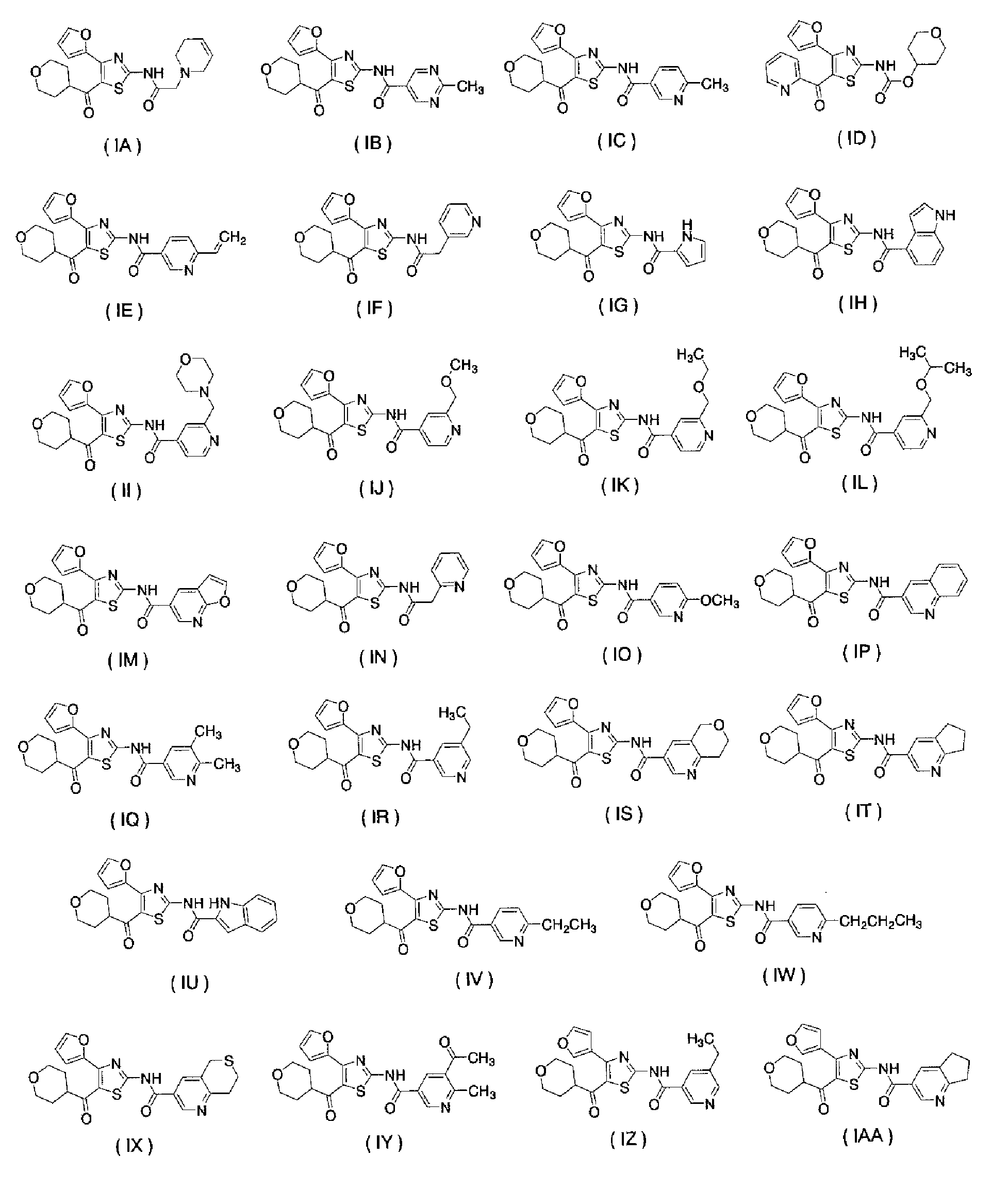
- 一般式(I)で表されるチアゾール誘導体が、下記式(IA)~(ID)のいずれかで表される化合物である請求項1記載のチアゾール誘導体またはその薬学的に許容される塩を有効成分として含有する不安障害の治療および/または予防剤。

- 不安障害がパニック障害、広場恐怖症、強迫性障害、社会恐怖症、心的外傷後ストレス障害、特定の恐怖症または全般性不安障害である請求項1~7のいずれかに記載の剤。
- 請求項1~7のいずれかに記載のチアゾール誘導体またはその薬学的に許容される塩の有効量を投与することを含む不安障害の治療および/または予防方法。
- 不安障害がパニック障害、広場恐怖症、強迫性障害、社会恐怖症、心的外傷後ストレス障害、特定の恐怖症または全般性不安障害である請求項9記載の方法。
- 不安障害の治療および/または予防に使用するための請求項1~7のいずれかに記載のチアゾール誘導体またはその薬学的に許容される塩。
- 不安障害がパニック障害、広場恐怖症、強迫性障害、社会恐怖症、心的外傷後ストレス障害、特定の恐怖症または全般性不安障害である請求項11記載のチアゾール誘導体またはその薬学的に許容される塩。
- 不安障害の治療および/または予防剤の製造のための請求項1~7のいずれかに記載のチアゾール誘導体またはその薬学的に許容される塩の使用。
- 不安障害がパニック障害、広場恐怖症、強迫性障害、社会恐怖症、心的外傷後ストレス障害、特定の恐怖症または全般性不安障害である請求項13記載の使用。
Priority Applications (28)
| Application Number | Priority Date | Filing Date | Title |
|---|---|---|---|
| UAA201203922A UA113383C2 (xx) | 2009-09-02 | 2010-02-09 | Терапевтичний агент для лікування тривожних розладів |
| SM20170465T SMT201700465T1 (it) | 2009-09-02 | 2010-09-02 | Agente terapeutico per i disturbi d' ansia |
| EA201270360A EA023728B1 (ru) | 2009-09-02 | 2010-09-02 | Терапевтическое средство от тревожных расстройств |
| CA2772922A CA2772922C (en) | 2009-09-02 | 2010-09-02 | Thiazoles derivatives for treating or preventing anxiety disorders |
| HRP20171418TT HRP20171418T1 (hr) | 2009-09-02 | 2010-09-02 | Terapeutsko sredstvo za poremećaje anksioznosti |
| DK10813754.8T DK2474544T3 (en) | 2009-09-02 | 2010-09-02 | Therapeutic remedy for anxiety disorders |
| SI201031544T SI2474544T1 (sl) | 2009-09-02 | 2010-09-02 | Terapevtsko sredstvo za anksiozne motnje |
| CN2010800392099A CN102482271A (zh) | 2009-09-02 | 2010-09-02 | 焦虑障碍治疗剂 |
| PL10813754T PL2474544T3 (pl) | 2009-09-02 | 2010-09-02 | Środek terapeutyczny do zastosowania w zaburzeniach lękowych |
| EP10813754.8A EP2474544B1 (en) | 2009-09-02 | 2010-09-02 | Therapeutic agent for anxiety disorders |
| AU2010290424A AU2010290424C1 (en) | 2009-09-02 | 2010-09-02 | Therapeutic agent for anxiety disorders |
| MX2012002529A MX2012002529A (es) | 2009-09-02 | 2010-09-02 | Agente terapeutico para trastornos de ansiedad. |
| BR112012004850-3A BR112012004850A2 (pt) | 2009-09-02 | 2010-09-02 | Agente para o tratamento e/ou profilaxia de um distúrbio de ansiedade, e, uso do derivado de tiazol. |
| ES10813754.8T ES2643840T3 (es) | 2009-09-02 | 2010-09-02 | Agente terapéutico para trastornos de ansiedad |
| US13/393,068 US20120172362A1 (en) | 2009-09-02 | 2010-09-02 | Therapeutic agent for anxiety disorders |
| LTEP10813754.8T LT2474544T (lt) | 2009-09-02 | 2010-09-02 | Terapinis agentas nuo nerimo sutrikimų |
| RS20170966A RS56401B1 (sr) | 2009-09-02 | 2010-09-02 | Terapeutsko sredstvo za anksiozne poremećaje |
| JP2011529927A JP5663485B2 (ja) | 2009-09-02 | 2010-09-02 | 不安障害治療剤 |
| MEP-2017-233A ME02877B (me) | 2009-09-02 | 2010-09-02 | Terapeutsko sredstvo za anksiozne poremećaje |
| NZ598754A NZ598754A (en) | 2009-09-02 | 2010-09-02 | Therapeutic agent for anxiety disorders |
| KR1020177010507A KR20170044768A (ko) | 2009-09-02 | 2010-09-02 | 불안 장해 치료제 |
| IL218320A IL218320A (en) | 2009-09-02 | 2012-02-26 | A medical cause of anxiety disorders |
| TNP2012000093A TN2012000093A1 (en) | 2009-09-02 | 2012-02-27 | Therapeutic agent for anxiety disorders |
| ZA2012/02347A ZA201202347B (en) | 2009-09-02 | 2012-03-30 | Therapeutic agent for anxiety disorders |
| MA34734A MA33619B1 (fr) | 2009-09-02 | 2012-03-30 | Agent thérapeutique pour des troubles de l'anxiété |
| CY20171101029T CY1119483T1 (el) | 2009-09-02 | 2017-10-04 | Θεραπευτικος παραγων για τις αγχωδεις διαταραχες |
| US16/568,827 US20200002327A1 (en) | 2009-09-02 | 2019-09-12 | Therapeutic agent for anxiety disorders |
| US16/853,885 US20200247798A1 (en) | 2009-09-02 | 2020-04-21 | Therapeutic agent for anxiety disorders |
Applications Claiming Priority (2)
| Application Number | Priority Date | Filing Date | Title |
|---|---|---|---|
| JP2009202894 | 2009-09-02 | ||
| JP2009-202894 | 2009-09-02 |
Related Child Applications (2)
| Application Number | Title | Priority Date | Filing Date |
|---|---|---|---|
| US13/393,068 A-371-Of-International US20120172362A1 (en) | 2009-09-02 | 2010-09-02 | Therapeutic agent for anxiety disorders |
| US14/552,728 Continuation US20150080415A1 (en) | 2009-09-02 | 2014-11-25 | Therapeutic agent for anxiety disorders |
Publications (1)
| Publication Number | Publication Date |
|---|---|
| WO2011027806A1 true WO2011027806A1 (ja) | 2011-03-10 |
Family
ID=43649340
Family Applications (1)
| Application Number | Title | Priority Date | Filing Date |
|---|---|---|---|
| PCT/JP2010/064989 Ceased WO2011027806A1 (ja) | 2009-09-02 | 2010-09-02 | 不安障害治療剤 |
Country Status (32)
| Country | Link |
|---|---|
| US (1) | US20120172362A1 (ja) |
| EP (1) | EP2474544B1 (ja) |
| JP (1) | JP5663485B2 (ja) |
| KR (2) | KR20120047311A (ja) |
| CN (1) | CN102482271A (ja) |
| AU (1) | AU2010290424C1 (ja) |
| BR (1) | BR112012004850A2 (ja) |
| CA (1) | CA2772922C (ja) |
| CL (1) | CL2012000533A1 (ja) |
| CY (1) | CY1119483T1 (ja) |
| DK (1) | DK2474544T3 (ja) |
| DO (1) | DOP2012000056A (ja) |
| EA (1) | EA023728B1 (ja) |
| ES (1) | ES2643840T3 (ja) |
| GE (1) | GEP20156225B (ja) |
| HR (1) | HRP20171418T1 (ja) |
| HU (1) | HUE036543T2 (ja) |
| IL (1) | IL218320A (ja) |
| LT (1) | LT2474544T (ja) |
| MA (1) | MA33619B1 (ja) |
| ME (1) | ME02877B (ja) |
| MX (1) | MX2012002529A (ja) |
| NZ (1) | NZ598754A (ja) |
| PL (1) | PL2474544T3 (ja) |
| PT (1) | PT2474544T (ja) |
| RS (1) | RS56401B1 (ja) |
| SI (1) | SI2474544T1 (ja) |
| SM (1) | SMT201700465T1 (ja) |
| TN (1) | TN2012000093A1 (ja) |
| UA (1) | UA113383C2 (ja) |
| WO (1) | WO2011027806A1 (ja) |
| ZA (1) | ZA201202347B (ja) |
Cited By (1)
| Publication number | Priority date | Publication date | Assignee | Title |
|---|---|---|---|---|
| WO2016111381A1 (en) | 2015-01-09 | 2016-07-14 | Kyowa Hakko Kirin Co., Ltd. | Production method of thiazole derivative |
Families Citing this family (4)
| Publication number | Priority date | Publication date | Assignee | Title |
|---|---|---|---|---|
| JP4638355B2 (ja) * | 2003-12-26 | 2011-02-23 | 協和発酵キリン株式会社 | チアゾール誘導体 |
| MA41090A (fr) * | 2014-12-03 | 2017-10-10 | H Lundbeck As | Antagoniste de a2a faiblement dosé pour le traitement du tdah et de la maladie de parkinson |
| JO3544B1 (ar) * | 2015-03-19 | 2020-07-05 | Kyowa Kirin Co Ltd | عامل علاجي للاختلال الوظيفي في الفص الجبهي |
| EP3853225B1 (en) | 2018-09-17 | 2023-11-29 | Yungjin Pharm. Co., Ltd. | N-(5-(3-(1-((thiazol-2-yl)amino)-1-oxopropan-2-yl)phenyl)pyridin-2-yl)acrylamide derivatives as cdk7 inhibitors for the treatment of cancer |
Citations (8)
| Publication number | Priority date | Publication date | Assignee | Title |
|---|---|---|---|---|
| WO1994001114A1 (fr) | 1992-07-08 | 1994-01-20 | Kyowa Hakko Kogyo Co., Ltd. | Antidepresseur |
| WO1999012546A1 (en) | 1997-09-05 | 1999-03-18 | Kyowa Hakko Kogyo Co., Ltd. | Remedial agent for neural degeneration |
| WO2000069464A1 (en) * | 1999-05-12 | 2000-11-23 | Fujisawa Pharmaceutical Co., Ltd. | Novel use |
| WO2003022283A1 (en) | 2001-09-13 | 2003-03-20 | Schering Corporation | Combination of an adenosine a2a receptor antagonist and an antidepressant or anxiolytic |
| WO2003043636A1 (en) | 2001-11-19 | 2003-05-30 | F. Hoffmann-La Roche Ag | Nicotin-or isonicotin benzothiazole derivatives |
| WO2004108137A1 (en) | 2003-06-10 | 2004-12-16 | Kyowa Hakko Kogyo Co., Ltd. | A method of treating an anxiety disorder |
| WO2005063743A1 (ja) | 2003-12-26 | 2005-07-14 | Kyowa Hakko Kogyo Co., Ltd. | チアゾール誘導体 |
| WO2007015528A1 (ja) | 2005-08-02 | 2007-02-08 | Kyowa Hakko Kogyo Co., Ltd. | 睡眠障害の治療および/または予防剤 |
Family Cites Families (3)
| Publication number | Priority date | Publication date | Assignee | Title |
|---|---|---|---|---|
| US20040152659A1 (en) * | 1999-05-12 | 2004-08-05 | Fujisawa Pharmaceutical Co. Ltd. | Method for the treatment of parkinson's disease comprising administering an A1A2a receptor dual antagonist |
| US20100280023A1 (en) * | 2005-06-23 | 2010-11-04 | Kyowa Hakko Kogyo Co., Ltd. | Thiazole derivatives |
| UA110097C2 (uk) * | 2009-09-02 | 2015-11-25 | Терапевтичний агент для лікування розладів настрою |
-
2010
- 2010-02-09 UA UAA201203922A patent/UA113383C2/uk unknown
- 2010-09-02 KR KR1020127008310A patent/KR20120047311A/ko not_active Ceased
- 2010-09-02 SI SI201031544T patent/SI2474544T1/sl unknown
- 2010-09-02 MX MX2012002529A patent/MX2012002529A/es active IP Right Grant
- 2010-09-02 ME MEP-2017-233A patent/ME02877B/me unknown
- 2010-09-02 PL PL10813754T patent/PL2474544T3/pl unknown
- 2010-09-02 RS RS20170966A patent/RS56401B1/sr unknown
- 2010-09-02 CA CA2772922A patent/CA2772922C/en not_active Expired - Fee Related
- 2010-09-02 JP JP2011529927A patent/JP5663485B2/ja not_active Expired - Fee Related
- 2010-09-02 KR KR1020177010507A patent/KR20170044768A/ko not_active Ceased
- 2010-09-02 AU AU2010290424A patent/AU2010290424C1/en not_active Ceased
- 2010-09-02 PT PT108137548T patent/PT2474544T/pt unknown
- 2010-09-02 EP EP10813754.8A patent/EP2474544B1/en active Active
- 2010-09-02 LT LTEP10813754.8T patent/LT2474544T/lt unknown
- 2010-09-02 SM SM20170465T patent/SMT201700465T1/it unknown
- 2010-09-02 HU HUE10813754A patent/HUE036543T2/hu unknown
- 2010-09-02 ES ES10813754.8T patent/ES2643840T3/es active Active
- 2010-09-02 GE GEAP201012648A patent/GEP20156225B/en unknown
- 2010-09-02 EA EA201270360A patent/EA023728B1/ru not_active IP Right Cessation
- 2010-09-02 DK DK10813754.8T patent/DK2474544T3/en active
- 2010-09-02 NZ NZ598754A patent/NZ598754A/en not_active IP Right Cessation
- 2010-09-02 WO PCT/JP2010/064989 patent/WO2011027806A1/ja not_active Ceased
- 2010-09-02 CN CN2010800392099A patent/CN102482271A/zh active Pending
- 2010-09-02 HR HRP20171418TT patent/HRP20171418T1/hr unknown
- 2010-09-02 BR BR112012004850-3A patent/BR112012004850A2/pt not_active Application Discontinuation
- 2010-09-02 US US13/393,068 patent/US20120172362A1/en not_active Abandoned
-
2012
- 2012-02-26 IL IL218320A patent/IL218320A/en active IP Right Grant
- 2012-02-27 TN TNP2012000093A patent/TN2012000093A1/en unknown
- 2012-02-29 CL CL2012000533A patent/CL2012000533A1/es unknown
- 2012-03-01 DO DO2012000056A patent/DOP2012000056A/es unknown
- 2012-03-30 ZA ZA2012/02347A patent/ZA201202347B/en unknown
- 2012-03-30 MA MA34734A patent/MA33619B1/fr unknown
-
2017
- 2017-10-04 CY CY20171101029T patent/CY1119483T1/el unknown
Patent Citations (8)
| Publication number | Priority date | Publication date | Assignee | Title |
|---|---|---|---|---|
| WO1994001114A1 (fr) | 1992-07-08 | 1994-01-20 | Kyowa Hakko Kogyo Co., Ltd. | Antidepresseur |
| WO1999012546A1 (en) | 1997-09-05 | 1999-03-18 | Kyowa Hakko Kogyo Co., Ltd. | Remedial agent for neural degeneration |
| WO2000069464A1 (en) * | 1999-05-12 | 2000-11-23 | Fujisawa Pharmaceutical Co., Ltd. | Novel use |
| WO2003022283A1 (en) | 2001-09-13 | 2003-03-20 | Schering Corporation | Combination of an adenosine a2a receptor antagonist and an antidepressant or anxiolytic |
| WO2003043636A1 (en) | 2001-11-19 | 2003-05-30 | F. Hoffmann-La Roche Ag | Nicotin-or isonicotin benzothiazole derivatives |
| WO2004108137A1 (en) | 2003-06-10 | 2004-12-16 | Kyowa Hakko Kogyo Co., Ltd. | A method of treating an anxiety disorder |
| WO2005063743A1 (ja) | 2003-12-26 | 2005-07-14 | Kyowa Hakko Kogyo Co., Ltd. | チアゾール誘導体 |
| WO2007015528A1 (ja) | 2005-08-02 | 2007-02-08 | Kyowa Hakko Kogyo Co., Ltd. | 睡眠障害の治療および/または予防剤 |
Non-Patent Citations (25)
| Title |
|---|
| "Diagnostic and Statistical Manual of Mental Disorders", 1994, AMERICAN PSYCHIATRIC ASSOCIATION, pages: 393 - 444 |
| "Kaplan & Sadock's Comprehensive textbook of psychiatry", vol. 1, 1999, pages: 1441 |
| ANN. NEUROL., vol. 43, 1998, pages 507 |
| BR. J. PHARMACOL., vol. 117, no. 8, 1996, pages 1645 |
| BR. J. PHARMACOL., vol. 134, 2001, pages 68 |
| BRUNS ET AL., MOLECULAR PHARMACOLOGY, vol. 29, 1986, pages 331 |
| CURRENT PHARMACEUTICAL DESIGN, vol. 14, 2008, pages 1475 |
| EUR. J. PHARMACOL., vol. 408, 2000, pages 41 |
| FOLIA PHARMACOLOGICA JAPONICA, vol. 113, 1999, pages 113 |
| FOLIA PHARMACOLOGICA JAPONICA, vol. 115, 2005, pages 5 |
| GRIEBEL, G. ET AL.: "Comparison of the behavioral effects of an adenosine A1/A2-receptor antagonist, CGS 15943A, and an Al-selective antagonist, DPCPX", PSYCHOPHARMACOLOGY, vol. 103, no. 4, 1991, BERLIN, GERMANY, pages 541 - 4, XP008154902 * |
| J. HETEROCYCLIC CHEM., vol. 24, 1987, pages 351 |
| JAPANESE JOURNAL OF CLINICAL PSYCHOPHARMACOLOGY, vol. 9, 2006, pages 2389 |
| JPN. J. PHARMACOL., vol. 68, 1995, pages 119 |
| NATURE NEUROSCIENCE, 2005, pages 858 |
| NATURE REVIEWS DRUG DISCOVERY, vol. 5, 2006, pages 247 |
| NATURE REVIEWS DRUG DISCOVERY, vol. 5, 2006, pages 845 |
| NAUNYN SCHMIEDEBERGS ARCH PHARMACOL., vol. 355, no. 1, 1987, pages 59 |
| NAUNYN SCHMIEDEBERGS ARCH PHARMACOL., vol. 355, no. 2, 1987, pages 204 |
| NEUROLOGY, vol. 61, no. 11, 2003, pages S82 - 7 |
| PROGRESS IN NEUROBIOLOGY, vol. 83, 2007, pages 332 |
| See also references of EP2474544A4 |
| SYNTHESIS, vol. 5, 1986, pages 400 |
| TETRAHEDRON LETTERS, vol. 35, 1994, pages 9355 |
| VARANI ET AL., BRITISH JOURNAL OF PHARMACOLOGY, vol. 117, 1996, pages 1693 |
Cited By (5)
| Publication number | Priority date | Publication date | Assignee | Title |
|---|---|---|---|---|
| WO2016111381A1 (en) | 2015-01-09 | 2016-07-14 | Kyowa Hakko Kirin Co., Ltd. | Production method of thiazole derivative |
| US10214523B2 (en) | 2015-01-09 | 2019-02-26 | Kyowa Hakko Kirin Co., Ltd. | Production method of thiazole derivative |
| US10618894B2 (en) | 2015-01-09 | 2020-04-14 | Kyowa Kirin Co., Ltd. | Production method of thiazole derivative |
| US10894790B2 (en) | 2015-01-09 | 2021-01-19 | Kyowa Kirin Co., Ltd | Production method of thiazole derivative |
| EP3822269A1 (en) | 2015-01-09 | 2021-05-19 | Kyowa Kirin Co., Ltd. | Production method of thiazole derivative |
Also Published As
Similar Documents
| Publication | Publication Date | Title |
|---|---|---|
| JP5663484B2 (ja) | 気分障害治療剤 | |
| TW201240665A (en) | Use of active pharmaceutical compounds for the treatment of central nervous system conditions | |
| EP3378860A1 (en) | Therapeutic agent for motor disorders | |
| JP2022526854A (ja) | ホスファチジルイノシトール3-キナーゼ阻害剤 | |
| JP5663485B2 (ja) | 不安障害治療剤 | |
| US10196383B2 (en) | Substituted quinazoline compounds and preparation and uses thereof | |
| US20200247798A1 (en) | Therapeutic agent for anxiety disorders | |
| HK1173143A (en) | Therapeutic agent for anxiety disorders | |
| HK1173144B (en) | Therapeutic agent for mood disorders | |
| HK1173144A (en) | Therapeutic agent for mood disorders | |
| HK1261314A1 (en) | Therapeutic agent for motor disorders |
Legal Events
| Date | Code | Title | Description |
|---|---|---|---|
| WWE | Wipo information: entry into national phase |
Ref document number: 201080039209.9 Country of ref document: CN |
|
| 121 | Ep: the epo has been informed by wipo that ep was designated in this application |
Ref document number: 10813754 Country of ref document: EP Kind code of ref document: A1 |
|
| WWE | Wipo information: entry into national phase |
Ref document number: 218320 Country of ref document: IL |
|
| WWE | Wipo information: entry into national phase |
Ref document number: MX/A/2012/002529 Country of ref document: MX |
|
| WWE | Wipo information: entry into national phase |
Ref document number: 2012000533 Country of ref document: CL |
|
| WWE | Wipo information: entry into national phase |
Ref document number: 2772922 Country of ref document: CA |
|
| NENP | Non-entry into the national phase |
Ref country code: DE |
|
| WWE | Wipo information: entry into national phase |
Ref document number: 2011529927 Country of ref document: JP |
|
| WWE | Wipo information: entry into national phase |
Ref document number: 13393068 Country of ref document: US |
|
| WWE | Wipo information: entry into national phase |
Ref document number: 2010290424 Country of ref document: AU |
|
| REEP | Request for entry into the european phase |
Ref document number: 2010813754 Country of ref document: EP |
|
| WWE | Wipo information: entry into national phase |
Ref document number: 2010813754 Country of ref document: EP |
|
| WWE | Wipo information: entry into national phase |
Ref document number: 12648 Country of ref document: GE |
|
| WWE | Wipo information: entry into national phase |
Ref document number: DZP2012000213 Country of ref document: DZ |
|
| ENP | Entry into the national phase |
Ref document number: 20127008310 Country of ref document: KR Kind code of ref document: A |
|
| WWE | Wipo information: entry into national phase |
Ref document number: 201270360 Country of ref document: EA |
|
| WWE | Wipo information: entry into national phase |
Ref document number: A201203922 Country of ref document: UA |
|
| ENP | Entry into the national phase |
Ref document number: 2010290424 Country of ref document: AU Date of ref document: 20100902 Kind code of ref document: A |
|
| REG | Reference to national code |
Ref country code: BR Ref legal event code: B01A Ref document number: 112012004850 Country of ref document: BR |
|
| ENP | Entry into the national phase |
Ref document number: 112012004850 Country of ref document: BR Kind code of ref document: A2 Effective date: 20120302 |