WO2011040491A1 - コラーゲンペプチド含有組成物の製造方法 - Google Patents
コラーゲンペプチド含有組成物の製造方法 Download PDFInfo
- Publication number
- WO2011040491A1 WO2011040491A1 PCT/JP2010/066991 JP2010066991W WO2011040491A1 WO 2011040491 A1 WO2011040491 A1 WO 2011040491A1 JP 2010066991 W JP2010066991 W JP 2010066991W WO 2011040491 A1 WO2011040491 A1 WO 2011040491A1
- Authority
- WO
- WIPO (PCT)
- Prior art keywords
- collagen peptide
- mass
- containing composition
- collagen
- peptide
- Prior art date
- Legal status (The legal status is an assumption and is not a legal conclusion. Google has not performed a legal analysis and makes no representation as to the accuracy of the status listed.)
- Ceased
Links
Classifications
-
- A—HUMAN NECESSITIES
- A23—FOODS OR FOODSTUFFS; TREATMENT THEREOF, NOT COVERED BY OTHER CLASSES
- A23J—PROTEIN COMPOSITIONS FOR FOODSTUFFS; WORKING-UP PROTEINS FOR FOODSTUFFS; PHOSPHATIDE COMPOSITIONS FOR FOODSTUFFS
- A23J1/00—Obtaining protein compositions for foodstuffs; Bulk opening of eggs and separation of yolks from whites
- A23J1/10—Obtaining protein compositions for foodstuffs; Bulk opening of eggs and separation of yolks from whites from hair, feathers, horn, skins, leather, bones, or the like
-
- A—HUMAN NECESSITIES
- A23—FOODS OR FOODSTUFFS; TREATMENT THEREOF, NOT COVERED BY OTHER CLASSES
- A23J—PROTEIN COMPOSITIONS FOR FOODSTUFFS; WORKING-UP PROTEINS FOR FOODSTUFFS; PHOSPHATIDE COMPOSITIONS FOR FOODSTUFFS
- A23J3/00—Working-up of proteins for foodstuffs
-
- A—HUMAN NECESSITIES
- A23—FOODS OR FOODSTUFFS; TREATMENT THEREOF, NOT COVERED BY OTHER CLASSES
- A23J—PROTEIN COMPOSITIONS FOR FOODSTUFFS; WORKING-UP PROTEINS FOR FOODSTUFFS; PHOSPHATIDE COMPOSITIONS FOR FOODSTUFFS
- A23J3/00—Working-up of proteins for foodstuffs
- A23J3/04—Animal proteins
-
- A—HUMAN NECESSITIES
- A23—FOODS OR FOODSTUFFS; TREATMENT THEREOF, NOT COVERED BY OTHER CLASSES
- A23L—FOODS, FOODSTUFFS OR NON-ALCOHOLIC BEVERAGES, NOT OTHERWISE PROVIDED FOR; PREPARATION OR TREATMENT THEREOF
- A23L2/00—Non-alcoholic beverages; Dry compositions or concentrates therefor; Preparation or treatment thereof
- A23L2/52—Adding ingredients
- A23L2/66—Proteins
-
- A—HUMAN NECESSITIES
- A23—FOODS OR FOODSTUFFS; TREATMENT THEREOF, NOT COVERED BY OTHER CLASSES
- A23L—FOODS, FOODSTUFFS OR NON-ALCOHOLIC BEVERAGES, NOT OTHERWISE PROVIDED FOR; PREPARATION OR TREATMENT THEREOF
- A23L33/00—Modifying nutritive qualities of foods; Dietetic products; Preparation or treatment thereof
- A23L33/10—Modifying nutritive qualities of foods; Dietetic products; Preparation or treatment thereof using additives
- A23L33/17—Amino acids, peptides or proteins
- A23L33/18—Peptides; Protein hydrolysates
-
- A—HUMAN NECESSITIES
- A23—FOODS OR FOODSTUFFS; TREATMENT THEREOF, NOT COVERED BY OTHER CLASSES
- A23V—INDEXING SCHEME RELATING TO FOODS, FOODSTUFFS OR NON-ALCOHOLIC BEVERAGES AND LACTIC OR PROPIONIC ACID BACTERIA USED IN FOODSTUFFS OR FOOD PREPARATION
- A23V2002/00—Food compositions, function of food ingredients or processes for food or foodstuffs
Definitions
- the present invention relates to a method for producing a collagen peptide-containing composition.
- Collagen is an animal protein conventionally used as a gelatin in the food field, but since it is the main component of the dermis and connective tissue, it has recently attracted particular attention from the medical and beauty fields. Yes. For this reason, many collagen-containing foods and beverages have been developed in order to easily ingest highly functional collagen (for example, JP-A-3-160956). In order to effectively use the ingested collagen in the body, foods and drinks containing collagen peptides in which high molecular weight collagen is reduced have been developed (for example, JP-A-2006-204287). On the other hand, collagen has a gelatin-like unpleasant odor and a unique unpleasant taste of collagen, so when blended as it is in food, it may impair the taste and aroma of the food itself and may not match the consumer's preference. is there.
- WO 00/24273 pamphlet discloses an edible product containing collagen containing a masking agent containing sucralose. It is described that by adding sucralose to a weight percent aqueous solution, the added odor and taste that are specific to collagen can be significantly masked.
- Japanese Patent Laid-Open No. 2006-204287 discloses a collagen-containing food or drink containing sucralose and stevia extract. A collagen peptide, sucralose, stevia mixture, and acesulfame potassium are mixed and dissolved to adjust the pH.
- a collagen-containing beverage that has been heat sterilized after preparation is disclosed.
- peptides derived from soy protein are also known as peptides that exhibit bitterness and astringency.
- Japanese Patent Application Laid-Open No. 2007-97465 discloses a food or drink to which a peptide derived from soy protein and an oligosaccharide such as maltosyl trehalose are added. By adding an oligosaccharide, sweetness and sourness can be obtained. It is described that the bitterness and astringency of peptide-containing foods and drinks can be reduced with little influence.
- JP 2000-300190 A discloses a food and beverage with reduced bitterness obtained by adding a sodium salt of an organic acid such as sodium citrate and a saccharide such as maltitol to soybean peptide. ing.
- An object of the present invention is to provide a collagen peptide-containing composition that contains collagen with high utilization efficiency and is easy to drink.
- the present invention is as follows.
- [1] A collagen peptide having an average molecular weight of 1200 or less, 0.0001 to 0.05 part by mass of a saccharide capable of causing a Maillard reaction with an amino group in the collagen peptide with respect to 1 part by mass of the collagen peptide, 12.
- a method for producing a collagen peptide-containing composition comprising: performing a masking treatment in 12 liquids under a condition of 70 to 100 ° C. for 0.01 to 2 hours.
- [2] The method for producing a collagen peptide-containing composition according to [1], wherein the amount of the saccharide is 0.001 to 0.03 parts by mass with respect to 1 part by mass of the collagen peptide.
- [3] The method for producing a collagen peptide-containing composition according to any one of [1] or [2], wherein the collagen peptide is a collagen peptide having an average molecular weight of 1000 or less.
- [4] The method for producing a collagen peptide-containing composition according to any one of [1] to [3], further comprising performing a heat sterilization treatment.
- [5] The saccharide according to any one of [1] to [4], wherein the saccharide is at least one reducing sugar selected from a reducing monosaccharide, a reducing disaccharide, a reducing trisaccharide, and a reducing oligosaccharide.
- Collagen peptide-containing composition that is 5 or less with respect to the free amino group terminal amount 100 shown in the above.
- the method for producing a collagen peptide-containing composition of the present invention comprises a collagen peptide having an average molecular weight of 1200 or less, and sugars capable of causing a Maillard reaction with an amino group in the collagen peptide with respect to 1 part by mass of the collagen peptide.
- a method for producing a collagen peptide-containing composition comprising: performing a masking treatment in which 0.05 part by mass is reacted in a liquid having a pH of 5 to 12 under conditions of 70 to 100 ° C. and 0.01 to 2 hours It is.
- a masking treatment is performed in which a collagen peptide having an average molecular weight of 1200 or less and a predetermined saccharide capable of causing a Maillard reaction are reacted in a liquid having a pH of 5 to 12 under predetermined conditions.
- Maillard reaction occurs between the amino acid and the saccharide, and the bitterness and unpleasant odor derived from the collagen peptide is reduced.
- the present collagen peptide-containing composition contains a low molecular weight collagen peptide, it is possible to provide a collagen peptide-containing composition and a food and drink that are easy to drink and that have high utilization efficiency of collagen and have reduced bitterness and unpleasant odor. it can.
- the collagen peptide containing composition in this invention may be not only the composition which comprises final product itself as a drink or a foodstuff, but the raw material composition which comprises a part of final product. In the case of a raw material composition, it may be mixed with other similar compositions applied to beverages or foods, and may be subjected to processing for commercialization to constitute food and drink.
- the collagen peptide-containing composition in the present invention may be a liquid in the masking treatment, and after that, a drying treatment is performed to form a powder, a thickener is mixed into a gel, or a mixture with an aqueous medium. It may be in the form of a solution.
- the food and drink containing the collagen peptide-containing composition may be in any form such as powder, gel, and solution.
- the term “process” is not limited to an independent process, and is included in this term if the intended action of this process is achieved even when it cannot be clearly distinguished from other processes. .
- a numerical range indicated by using “to” indicates a range including the numerical values described before and after “to” as the minimum value and the maximum value, respectively.
- the amount of each component in the composition when there are a plurality of substances corresponding to each component in the composition, the plurality present in the composition unless otherwise specified. Means the total amount of substances. The present invention will be described below.
- the collagen peptide used in the present invention is a low molecular weight collagen peptide having an average molecular weight of 1200 or less.
- the average molecular weight of the collagen peptide is preferably 1000 or less, and more preferably 800 or less.
- the average molecular weight of the collagen peptide is preferably 300 or more, and more preferably 400 or more, from the viewpoint of taste and protection of nutritional components when performing heat treatment.
- the average molecular weight of the collagen peptide can be confirmed using gel permeation chromatography (GPC). That is, in order to obtain the average molecular weight of a collagen peptide by GPC, a calibration curve of the relationship between the retention time and molecular weight obtained by measuring several types of polyethylene glycol (PEG) each having a known molecular weight in advance under the same conditions. Calculate based on the above.
- the average molecular weight in the present invention refers to a weight average molecular weight calculated in terms of PEG according to this method.
- the collagen peptide is obtained by hydrolyzing gelatin with an enzyme or an acid, is a protein containing a large amount of glycine, and is also available as a commercial product.
- the collagen is not particularly limited, whether it is collagen extracted from mammalian collagen tissue or collagen extracted from fish. In recent years, collagen derived from fish is preferable from the viewpoint of product image and safety.
- As a raw material of collagen derived from fish it may be saltwater fish or freshwater fish, and skins such as tuna (sharkfin), shark, cod, flounder, flounder, Thailand, tilapia, salmon and the like.
- Examples of mammal-derived collagen materials include pigs and cows.
- the amino acid composition and the number of amino acids constituting the collagen peptide are not particularly limited as long as they are within the above molecular weight range.
- a peptide bond such as a collagen tripeptide having 3 amino acid residues (2 peptide bonds) is used.
- Examples include oligopeptides having 2-6.
- the content of the collagen peptide in the solution at the time of the masking treatment may be present in such an amount that the Maillard reaction can proceed and is generally 0.1% by mass to 90% by mass with respect to the total mass of the solution. %, Preferably from 1% by mass to 80% by mass from the viewpoint of dissolution time and reactivity.
- the saccharide used in the masking treatment of the present invention can cause a Maillard reaction with the terminal amino group of the collagen peptide.
- sugar in this collagen peptide containing composition contains the saccharide
- the saccharide used for the reaction with the collagen peptide in the masking treatment of the present invention may be any ketone or aldehyde that can cause a Maillard reaction, and examples thereof include reducing sugars. From the viewpoint of efficient generation of the Maillard reaction with the collagen peptide, the saccharide is preferably a reducing sugar.
- Such a reducing sugar may be any sugar that is reducible in an aqueous solution, and is at least one reducing sugar selected from a reducing monosaccharide, a reducing disaccharide, a reducing trisaccharide, and a reducing oligosaccharide. It is preferable from the viewpoint of masking treatment.
- reducing sugars examples include glucose (glucose), fructose, galactose, mannose, idose, altrose, growth, talose, allose, xylose, arabinose, lyxose, ribose, threose, erythrose, erythrulose, xylulose, ribulose, psicose, sorbose Monosaccharides such as tagatose, disaccharides such as maltose, lactose and palatinose, and trisaccharides such as raffinose. These isomerized sugars may be used, and so-called oligosaccharides may be used.
- the oligosaccharide examples include fructooligosaccharide, maltooligosaccharide, isomaltooligosaccharide, and galactooligosaccharide. You may use these individually or in combination of 2 or more types.
- the oligosaccharide means a saccharide having 4 to 20 saccharide units.
- the reducing sugar is preferably maltose (malt sugar) from the viewpoint of reaction control.
- such a saccharide reacts with the collagen peptide in the range of 0.0001 to 0.05 parts by mass of the saccharide with respect to 1 part by mass of the collagen peptide. If the amount of saccharide is less than 0.0001 parts by mass with respect to 1 part by mass of collagen peptide, effective masking cannot be expected. On the other hand, if it exceeds 0.05 parts by mass, the reaction rate increases and control is performed. Becomes difficult. From the viewpoint of effective masking of the collagen peptide, the amount is preferably 0.001 to 0.03 parts by mass with respect to 1 part by mass of the collagen peptide.
- the masking treatment in the present invention is performed in a liquid having a pH of 5 to 12 under the conditions of 70 to 100 ° C. and 0.01 to 2 hours.
- the heating temperature in the masking treatment is less than 70 ° C., it becomes difficult to mask the collagen peptide by the masking reaction within a practically acceptable production process time, while when it exceeds 100 ° C., Since the speed of progression increases, it becomes difficult to control the masking of the collagen peptide.
- the reaction time is less than 0.01 hour, effective masking by the masking reaction cannot be expected. On the other hand, if the reaction time exceeds 2 hours, the reaction proceeds excessively and an unpleasant flavor may be imparted.
- the heating temperature in the masking treatment is preferably 75 ° C. to 95 ° C., more preferably 80 ° C. to 90 ° C., from the viewpoint of allowing the reaction to proceed stably and adjusting to an appropriate level.
- the heating time is preferably 0.05 hours to 1 hour, preferably 0.1 hours to 0.5 hours, from the viewpoint of obtaining a sufficient masking effect and not imparting an extra flavor due to by-products. It is more preferable.
- the effective masking process is preferably determined by the relationship between the heating temperature and the heating time. From the relationship between effective masking treatment and deterioration of contained components, 75 ° C. to 95 ° C. and 0.1 hour to 3 hours are more preferable.
- the pH of the liquid during the masking process is pH 5-12.
- the pH is 5 or more, effective masking can be expected in a short time when considering actual production.
- the pH exceeds 12, the reaction rate increases and the reaction control becomes difficult, and an unpleasant flavor may be imparted.
- the liquid at the time of the masking treatment is preferably pH 5.3 to 10 and more preferably pH 5.5 to 8 from the viewpoint of the speed of the masking reaction.
- the pH adjuster that can be used is not particularly limited, and is organic such as citric acid, gluconic acid, L-tartaric acid, malic acid, lactic acid, adipic acid, succinic acid, acetic acid, fumaric acid, phytic acid, and derivatives thereof.
- Acids and inorganic such as sodium bicarbonate (sodium bicarbonate), sodium carbonate, sodium hydroxide, calcium hydroxide, disodium hydrogen phosphate, sodium dihydrogen phosphate, dipotassium hydrogen phosphate, potassium dihydrogen phosphate, potassium carbonate Mention may be made of acids.
- the organic acid may be in the form of a sodium salt, potassium salt, or magnesium salt.
- pH adjustment it is sufficient that the pH is 5 to 12 at the time of masking treatment, and the pH adjustment may be performed before or after heating or during heating.
- the fluctuation range of pH due to the addition of saccharide is so small that it can be ignored, it may be regarded as the pH before the addition of saccharide as long as the pH is adjusted with respect to the solution containing the collagen peptide.
- the Maillard reaction for the masking process starts when the presence of both the collagen peptide and saccharide, the pH condition, and the temperature condition are complete.
- the liquid used as the reaction system of the Maillard reaction should just be a liquid which can melt
- the liquid before the start of the Maillard reaction may be a liquid that contains neither collagen peptide nor saccharide, or may be a solution in which only the collagen peptide is dissolved.
- the solution at the start of the Maillard reaction is a mixed solution of both the collagen peptide and the saccharide, although it may be a solution in which only the collagen peptide and the saccharide are dissolved.
- the timing of adding the saccharide to the liquid may be before, after, or simultaneously with the addition of the collagen peptide, and may be before or after the above pH condition and temperature condition are satisfied. May be.
- adding saccharides while heating from the viewpoint of shortening the treatment time, it is preferable to add while raising the temperature to the masking treatment temperature, and from the viewpoint of easy control of the reaction, It is preferable to add it when the temperature increase width is small.
- the addition time of saccharide is set as the starting point of the masking treatment time.
- the timing of addition of the collagen peptide to the reaction solution is no particular limitation on the timing of addition of the collagen peptide to the reaction solution, except that the pH may be changed by the addition of the collagen peptide, and it is preferable to adjust the pH after the addition. From the viewpoint of reaction uniformity, it is preferable to add the saccharide to this solution while heating the solution containing the collagen peptide to a predetermined temperature.
- the reaction product obtained after the masking treatment may be further subjected to a heat sterilization treatment.
- the heat sterilization treatment performed after the masking treatment may be any heat sterilization treatment usually used in the food and drink field, and examples include treatment at 65 ° C. to 100 ° C. for 0.1 hour to 1 hour. From the viewpoint of not causing excessive alteration of the product, treatment at 65 ° C. to 85 ° C. for 0.1 hour to 1 hour is preferable.
- a sterilized collagen peptide-containing composition is obtained.
- each additive component added after the masking treatment may be a normal addition time and is not particularly limited.
- Such other additive components include at least one additional amino acid selected from the group consisting of lysine, proline and ornithine.
- additional amino acid By using the additional amino acid as an additive component to the reaction product obtained by the masking treatment, lysine, proline or ornithine is provided in a single state maintaining the amino acid structure, not in a form reacted with sugar. Lysine, proline and ornithine are known as collagen components or collagen synthesis promoting components. By adding these additional amino acids in the body, the production efficiency and utilization efficiency of collagen in the body is increased.
- lysine and proline in collagen molecules are contained in modified forms such as hydroxylation, and it is known that such modified forms cannot be used in the body.
- the lysine and proline are used together with other collagen components to increase the production efficiency of collagen in the body. Since lysine and proline have a bitterness peculiar to amino acids, it is difficult to add them to the collagen peptide. However, by reducing the unpleasant flavor of the collagen peptide by this masking, a certain amount of compounding becomes possible.
- the lysine and proline may be in the form of an inorganic acid salt such as hydrochloride or phosphate, or an organic acid salt such as citrate, malate, ⁇ -ketoglutarate, or aspartate.
- Ornithine includes L-ornithine and D-ornithine.
- Ornithine may be obtained by a chemical synthesis method, a fermentation production method, or the like, or may be a commercially available product.
- Ornithine may be in the form of an inorganic acid salt such as hydrochloride or phosphate, or an organic acid salt such as citrate, malate, ⁇ -ketoglutarate, or aspartate.
- the addition amount of the additional amino acid as the additive component is not particularly limited, but is preferably 0.01% by mass to 50% by mass with respect to the mass of the collagen peptide from the viewpoint of collagen production efficiency and flavor. More preferably, it is 1 to 30% by mass.
- the addition amount of these additional amino acids in the collagen peptide-containing composition can be determined from the viewpoint of the utilization efficiency of collagen, and in the case of lysine, it is 0.01% by mass to 40% by mass with respect to the mass of the collagen peptide.
- proline it is preferably 0.01% by mass to 50% by mass, and more preferably 0.1% by mass to 30% by mass. More preferably, it is preferably 0.01% by mass to 40% by mass, and more preferably 0.1% to 20% by mass in the case of ornithine.
- ascorbic acid an inorganic acid or organic acid ester derivative thereof or a salt thereof (hereinafter referred to as “ascorbic acid” when these are collectively referred to) Is preferably added).
- Ascorbic acid or derivatives thereof or salts thereof include L-ascorbic acid, L-ascorbic acid Na, L-ascorbic acid K, L-ascorbic acid Ca, L-ascorbic acid phosphate, L-ascorbic acid phosphate Magnesium salt, L-ascorbic acid sulfate, L-ascorbic acid sulfate disodium salt, L-ascorbic acid stearate, L-ascorbic acid 2-glucoside, L-ascorbyl palmitate, tetraisopalmitate L- Examples include ascorbyl. These may be used alone or in combination of two or more.
- the amount of ascorbic acid added as an additive component is not particularly limited, but is preferably 0.01% by mass to 100% by mass with respect to the mass of the collagen peptide from the viewpoint of collagen production efficiency, and 0.1% by mass. More preferably, the content is from 80% by mass to 80% by mass.
- a masking agent for additional amino acids may be added to the reaction product obtained by the masking treatment as a further additive component.
- the bitterness and unpleasant odor by an additional amino acid reduce.
- examples of such masking agents include inclusion agents and sweeteners commonly used in the food and drink field.
- a dextrin compound is preferable, and among the dextrin compounds, cyclodextrin is more preferable.
- the cyclodextrin include ⁇ -, ⁇ -, ⁇ -cyclodextrin, branched ⁇ -, branched ⁇ -, and branched ⁇ -cyclodextrin. These dextrins are preferably 1% by mass to 100% by mass and more preferably 5% by mass to 50% by mass with respect to the mass of the additional amino acid.
- Sweeteners may be natural or artificial sweeteners in addition to the sugars described above in the masking process.
- sweeteners include commonly used monosaccharides, disaccharides, oligosaccharides, polysaccharides, sugar alcohols and the like.
- additives commonly used in foods and drinks such as coloring agents, preservatives, thickening stabilizers, antioxidants, color formers, bleaching agents, fungicides, gum bases, bittering agents, enzymes, brighteners, acidity A seasoning, a seasoning, an emulsifier, a strengthening agent, a manufacturing agent, a fragrance, a spice extract and the like may be added.
- additional components may be added to the reaction product obtained after the masking treatment, or may be added to the liquid before the masking treatment as long as it does not affect the Maillard reaction of collagen peptides and saccharides subjected to the masking treatment. .
- the collagen peptide-containing composition of the present invention is a composition containing a collagen peptide obtained by the above production method, and since it is masked, bitterness and unpleasant odor are reduced even if it contains a collagen peptide. Yes.
- the quantity of a sweetener and a masking agent can be made smaller than the quantity normally used.
- the total amount of saccharides contained in the composition as a whole is 0.0001 to 0.5 parts by mass, preferably 0. 0005 parts by mass to 0.25 parts by mass. Since the saccharide content is thus reduced, the collagen peptide-containing composition of the present invention contains collagen peptide with high utilization efficiency and can provide a refreshing taste, as a raw material for foods and drinks that are easy to drink. Preferably used.
- the content of the collagen peptide in the collagen peptide-containing composition of the present invention is selected according to the type and purpose of the food and drink, but generally 1 mass relative to the total mass of the collagen peptide-containing composition as the final product. % To 99% by mass, preferably 5% to 80% by mass.
- Another collagen peptide-containing composition of the present invention contains a collagen peptide having an average molecular weight of 1200 or less, and the free amino group terminal amount shown when the ninhydrin reaction is performed on the collagen peptide is the same as the collagen peptide. It is a collagen peptide-containing composition that is 5 or less with respect to the free amino group terminal amount 100 shown when the ninhydrin reaction is performed on mass glycine.
- bitterness occurs when the average molecular weight of collagen peptides is 1200 or less.
- the cause of bitterness is the free amino group terminal of the peptide.
- the free amino group terminal amount shown by the ninhydrin reaction is 5 or less with respect to the free amino group terminal amount 100 of glycine having the same mass as the collagen peptide. Therefore, even if it contains a collagen peptide having an average molecular weight of 1200 or less, the bitterness is reduced and it can be preferably used as a food or drink.
- the free amino group terminal amount of the collagen peptide can be estimated by the ninhydrin reaction.
- Ninhydrin is used as a coloring reagent for amino acids and peptides.
- a City of the National Academy of Sciences is used as a coloring reagent for amino acids and peptides.
- a City of the National Academy of the National Academy of Sciences is used as a coloring reagent for amino acids and peptides.
- a having a maximum absorbance around 570 nm is generated via ammonia derived from an amino group. Therefore, the production amount of the Oxfordmann dye and the amino terminal amount of the peptide are correlated, and the free amino group terminal amount can be known from the dye production amount.
- the amount of the collagen peptide in the composition exceeds 5 as the above-mentioned free amino group terminal amount due to the ninhydrin reaction with respect to glycine 100, bitterness acceptable as a food or drink cannot be obtained.
- the amount of the collagen peptide in the composition is preferably 4.6 or less with respect to glycine 100 as the above-mentioned specific free amino group terminal amount from the viewpoint of obtaining a beverage with reduced bitterness.
- Such a collagen peptide-containing composition preferably contains 1 part by mass of a collagen peptide having an average molecular weight of 1200 or less and 0.0001 to 0.05 parts by mass of a saccharide capable of causing a Maillard reaction with an amino group in the collagen peptide.
- the additional components such as additional amino acids, masking agents, ascorbic acid, etc. already described in the present specification, and other additives are also included in the collagen peptide-containing composition in combination of one or more. It may be.
- the method for producing the collagen peptide-containing composition may further include a step of adding these additional components. More preferably, the method for producing the collagen peptide-containing composition further includes heat sterilization treatment for the reaction product obtained by performing the masking treatment.
- the total amount of saccharide contained in the entire composition is preferably 0.0001 to 0.5 parts by mass with respect to 1 part by mass of the collagen peptide. 0.0005 parts by mass to 0.25 parts by mass is more preferable. Since the saccharide content is thus reduced, the other collagen peptide-containing composition of the present invention contains a collagen peptide with high utilization efficiency, and can provide a clean taste and is easy to drink. It is preferably used as a raw material.
- the food / beverage products of this invention contain said collagen peptide containing composition.
- the composition contains a heat-sterilized collagen peptide-containing composition, may be composed only of this collagen peptide-containing composition, and may be composed in combination with other raw materials.
- the food / beverage product of the present invention has a total saccharide content of 0.0001 to 0.5 parts by mass with respect to 1 part by mass of the collagen peptide, as in the collagen peptide-containing composition.
- the content is preferably 0.0005 parts by mass to 0.4 parts by mass. Since the saccharide content is thus reduced, the collagen peptide is contained with high utilization efficiency, and a refreshing taste can be provided, making it easy to drink.
- the content of the collagen peptide in the food or drink of the present invention can be appropriately selected according to the form of the food or drink.
- the content of collagen peptide is generally 0.1% to 75% by weight and 1% to 50% by weight with respect to the weight of the whole food and drink. It is preferable.
- collagen peptide-containing composition and food and drink of the present invention are those obtained by masking bitterness by subjecting a mixed solution of collagen peptide and saccharide to a heat reaction.
- Collagen peptide-containing compositions and foods and drinks contain reaction products due to masking reactions, and the presence of these reaction products is caused by structural analysis of collagen peptides, detection of sugar, dye meter, ninhydrin color reaction, etc. It can be confirmed using.
- the pH of the collagen peptide-containing composition and food or drink of the present invention is preferably 3.0 to 5.0, more preferably 3.5 to 4.0, and more preferably 3.8 to 3.95, as a pH at 20 ° C. Particularly preferred. A pH of 3.5 or higher is often suitable for drinking, while a pH of 4.0 or lower is preferred in terms of stability. What is necessary is just to adjust pH of the collagen peptide containing composition of this invention, and food-drinks using the above pH adjusters. Moreover, what is necessary is just to perform the heat sterilization process mentioned above after adjusting pH.
- the food and drink of the present invention can take various forms that can be supplied into the body mainly by the oral route, for example, powdered food, sheet-like food, bottled food, canned food, retort food, capsule food, tablet-like food, fluid You may use as foods and drinks, such as a health food, a functional food, a dietary supplement, and the food for specific health as forms, such as a foodstuff and a drink.
- the method of reducing the odor of the collagen peptide-containing composition of the present invention is a 0.0001 saccharide capable of causing a Maillard reaction with an amino group in the collagen peptide with respect to a collagen peptide having an average molecular weight of 1200 or less and 1 part by mass of the collagen peptide.
- Masking treatment in which ⁇ 0.05 parts by mass is reacted in a liquid having a pH of 5 to 12 under the conditions of 70 ° C. to 100 ° C. for 0.01 hour to 2 hours.
- the collagen peptide is masked using a predetermined saccharide, and as described above, the Maillard reaction occurs and the odor peculiar to the collagen peptide is effectively reduced. be able to.
- the composition containing a collagen peptide for example, food / beverage products containing a collagen peptide, both the functionality and high palatability by a collagen peptide can be satisfied.
- the saccharide capable of causing a Maillard reaction with an amino group in the collagen peptide, and various conditions for masking treatment, the method for producing the collagen peptide-containing composition described above The contents in can be applied as they are.
- Example 1 10 g of collagen peptide (derived from fish) (average molecular weight 700) was added to 10 g of purified water and dissolved by heating to 60 ° C., and then 0.05 g of maltose was added and dissolved to prepare a mixed solution. The pH of the solution before addition of maltose was pH 6.2. Then, after heating up to 70 degreeC, it heated for 2 hours and masked. After the treatment, 0.8 g of citric acid was added, followed by rapid cooling to 40 ° C.
- Example 1 A sample solution of Example 1 was prepared.
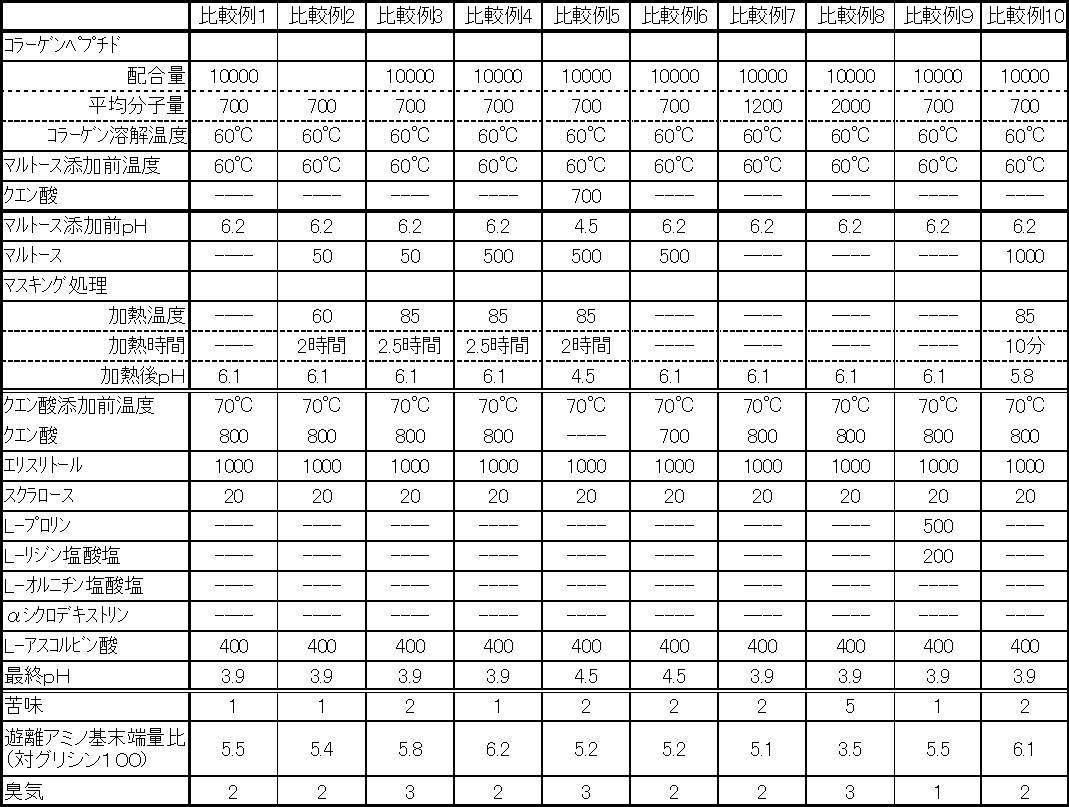
- Example 2 to 9 Sample solutions of Examples 2 to 9 were prepared in the same manner as in Example 1 except that the types and amounts of the respective components were changed as described in Table 1. Maltose was added after dissolving the collagen peptide, and then heated to 85 ° C or 95 ° C. After the heat treatment for a specified time, the mixture was rapidly cooled to 40 ° C., and when the temperature was lowered to 70 ° C., citric acid was added. In addition, the quantity of each component in Table 1 and Table 2 was shown by mg in 30 ml.
- Example 10 In Example 5, the sample of Example 10 was added in the same manner as in Example 5 except that maltose was added after completion of heating at 85 ° C, citric acid was added immediately before quenching, and the heating time at 85 ° C was 40 minutes. A liquid was prepared.
- Comparative Examples 1 to 4, 6 to 10 Sample solutions of Comparative Examples 1 to 4 and 6 to 10 were prepared in the same manner as in Example 1 except that the type, amount, heating temperature, and heating time of each component were changed as described in Table 2. .
- Comparative Examples 7 and 8 used collagen peptides with average molecular weights of 1200 and 2000, respectively. For Comparative Examples 1 and 6 to 10, the collagen peptide was not subjected to the heat masking treatment.
- Comparative Example 5 In the preparation of Comparative Example 4, the addition of citric acid was performed simultaneously with the addition of maltose, the reaction time was changed to 2 hours, and the amount of citric acid was reduced to 700 mg. A sample solution was prepared.
- Example 9 Evaluation of remaining liquid in container Using the sample liquids of Example 2, Example 9 and Comparative Example 8, evaluation of remaining liquid in the container was performed as an index of adhesion to the container. Fill each sample solution into a 30 ml container (product number: No.2 30-25) made by Nippon acid-tolerant and cool at 4 ° C, then replace the contents with another container, The difference between the mass and the mass after replacement was measured, and the difference was evaluated. The emptying method was performed by moving the contents with the container mouth down 180 °, leaving it for 10 seconds, and then returning it to the original position.
- a 30 ml container product number: No.2 30-25
- the emptying method was performed by moving the contents with the container mouth down 180 °, leaving it for 10 seconds, and then returning it to the original position.
- Example 2 Based on the amount of the remaining liquid after ingestion, it was evaluated as 0 to less than 0.5 g: A, 0.5 g or more and less than 1.0 g: B, 1 g or more: C. As a result, both Example 2 and Example 9 were A (0 to less than 0.5 g), but Comparative Example 8 was B (0.5 g or more and less than 1.0 g). From these results, the sample solution of this example showed little loss due to container adhesion.
- Example 5 was evaluated as B
- Example 10 was evaluated as A.
Landscapes
- Life Sciences & Earth Sciences (AREA)
- Chemical & Material Sciences (AREA)
- Engineering & Computer Science (AREA)
- Food Science & Technology (AREA)
- Polymers & Plastics (AREA)
- Health & Medical Sciences (AREA)
- Nutrition Science (AREA)
- Biochemistry (AREA)
- Zoology (AREA)
- Molecular Biology (AREA)
- Proteomics, Peptides & Aminoacids (AREA)
- Mycology (AREA)
- Non-Alcoholic Beverages (AREA)
- Coloring Foods And Improving Nutritive Qualities (AREA)
- General Preparation And Processing Of Foods (AREA)
- Jellies, Jams, And Syrups (AREA)
- Peptides Or Proteins (AREA)
Abstract
Description
その一方で、コラーゲンは、ゼラチン様の不快臭とコラーゲン独特の不快味を有するため、食品にそのまま配合すると、食品そのものの美味しさや香りを損なう場合があり、消費者の嗜好性に合わないことがある。
また、特開2006-204287号公報では、スクラロース及びステビア抽出物を含有したコラーゲン含有飲食品が開示されており、コラーゲンペプチドと、スクラロースと、ステビア混合物と、アセスルファムカリウムを混合溶解して、pHを調整後、加熱殺菌したコラーゲン含有飲料が開示されている。
また、特開2000-300190号公報には、大豆ペプチドに、クエン酸ナトリウムなどの有機酸のナトリウム塩と、マルチトールなどの糖類とを添加して得られる苦味の低減した食品及び飲料が開示されている。
[1]平均分子量1200以下のコラーゲンペプチドと、該コラーゲンペプチド1質量部に対して、該コラーゲンペプチド中のアミノ基とメイラード反応を生じうる糖類0.0001~0.05質量部とを、pH5~12の液体中で、70℃~100℃、0.01時間~2時間の条件で反応させるマスキング処理を行うこと、を含むコラーゲンペプチド含有組成物の製造方法。
[2] 前記糖類の量が、前記コラーゲンペプチド1質量部に対して0.001~0.03質量部である[1]に記載のコラーゲンペプチド含有組成物の製造方法。
[3] 前記コラーゲンペプチドが、平均分子量1000以下のコラーゲンペプチドである[1]又は[2]のいずれかに記載のコラーゲンペプチド含有組成物の製造方法。
[4] 更に、加熱滅菌処理を行うことを含む[1]~[3]のいずれかに記載のコラーゲンペプチド含有組成物の製造方法。
[5] 前記糖類が、還元性単糖、還元性二糖、還元性三糖及び還元性オリゴ糖から選択された少なくとも1つの還元糖である[1]~[4]のいずれかに記載のコラーゲンペプチド含有組成物の製造方法。
[6] リジン、プロリン及びオルニチンからなる群より選択された少なくとも1つの追加アミノ酸を、前記マスキング処理により得られた反応物に添加することを更に含む[1]~[5]のいずれかに記載のコラーゲンペプチド含有組成物の製造方法。
[7] リジン及びプロリンからなる群より選択された少なくとも1つの追加アミノ酸を、前記マスキング処理により得られた反応物に添加することを更に含む[1]~[5]のいずれかに記載のコラーゲンペプチド含有組成物の製造方法。
[8] 包摂剤及び甘味料からなる群より選択された少なくとも1つ添加成分を、前記マスキング処理により得られた反応物に添加することを更に含む[1]~[7]のいずれかに記載のコラーゲンペプチド含有組成物の製造方法。
[9] アスコルビン酸を、前記マスキング処理により得られた反応物に更に添加することを含む[1]~[8]のいずれかに記載のコラーゲンペプチド含有組成物の製造方法。
[10] [1]~[9]のいずれかに記載の製造方法により得られ、糖類の総量が、前記コラーゲンペプチド1質量部に対して0.0001~0.5質量部であるコラーゲンペプチド含有組成物。
[11] 平均分子量1200以下のコラーゲンペプチドを含み、該コラーゲンペプチドに対してニンヒドリン反応を行った際に示される遊離アミノ基末端量が、当該コラーゲンペプチドと同一質量のグリシンに対してニンヒドリン反応を行った際に示される遊離アミノ基末端量100に対して5以下であるコラーゲンペプチド含有組成物。
[12] [1]~[9]のいずれかに記載の製造方法により得られた[11]記載のコラーゲンペプチド含有組成物。
[13] 前記組成物中の糖類の総量が、前記コラーゲンペプチド1質量部に対して0.0001質量部~0.5質量部である[11]又は[12]記載のコラーゲンペプチド含有組成物。
[14] [10]~[13]のいずれかに記載のコラーゲンペプチド含有組成物を含む飲食品。
[15] 平均分子量1200以下のコラーゲンペプチド1質量部に対して、該コラーゲンペプチド中のアミノ基とメイラード反応を生じうる糖類0.0001~0.05質量部とを、pH5~12の液体中で、70℃~100℃、0.01時間~2時間の条件で反応させるマスキング処理を行うこと、を含む本発明のコラーゲンペプチド含有組成物の臭い低減方法。
また本発明におけるコラーゲンペプチド含有組成物は、マスキング処理において液体であればよく、その後、乾燥処理を行って粉末状としても、増粘剤を配合してゲル状としても、水性媒体と混合して溶液状としてもよい。また、コラーゲンペプチド含有組成物を含む飲食品も、同様に粉末状、ゲル状、溶液状など如何なる形態であってもよい。
また、本明細書において「~」を用いて示された数値範囲は、「~」の前後に記載される数値をそれぞれ最小値及び最大値として含む範囲を示す。
また、本発明において、組成物中の各成分の量について言及する場合、組成物中に各成分に該当する物質が複数存在する場合には、特に断らない限り、組成物中に存在する当該複数の物質の合計量を意味する。
以下に本発明を説明する。
還元糖としては、反応制御の観点からの観点から、中でもマルトース(麦芽糖)であることが好ましい。
マスキング処理における加熱温度が70℃未満の場合は、実際的に許容される製造工程時間内でのマスキング反応によるコラーゲンペプチドのマスキングを行うことが困難となり、一方、100℃を超える場合は、反応の進行速度が速まるため、コラーゲンペプチドのマスキングの調節が難しくなる。
また、反応時間が0.01時間未満では、マスキング反応による効果的なマスキングが期待できず、一方、2時間を超えると反応が進行し過ぎて不快な風味が付与されることがある。
また加熱時間は、十分なマスキング効果を得るため及び副生成物による余計な風味を付与しない観点から、0.05時間~1時間であることが好ましく、0.1時間~0.5時間であることがより好ましい。
効果的なマスキング処理は、加熱温度と加熱時間との関係で決定されることが好ましい。効果的なマスキング処理と含有成分の劣化との関係から、75℃~95℃且つ0.1時間~3時間であることが更に好ましい。
マスキング処理時の液体は、マスキング反応の速度の観点からpH5.3~10とすることが好ましく、pH5.5~8であることがより好ましい。
pHの調整に関しては、マスキング処理時にpH5~12となっていればよく、pH調整の時期は加熱の前後、加熱中のいずれであってもよい。特に、糖類の添加によるpHの変動幅は無視できる程度に小さいので、コラーゲンペプチドを含む溶液に対してpH調整した後であれば、糖類添加前のpHと同視してもよい。
このため、メイラード反応の反応系となる液体は、コラーゲンペプチド及び糖類の双方を溶解可能な液体であればよく、このような液体としては、一般に水を挙げることができる。また、メイラード反応開始前の液体は、コラーゲンペプチド及び糖類のいずれもが含まれない液体であってもよく、これらのうちのコラーゲンペプチドのみが溶解した溶液であってもよく、これらのうちの糖類のみが溶解した溶液であってもよく、コラーゲンペプチド及び糖類の双方が溶解した溶液であってもよいが、メイラード反応開始時の液体は、コラーゲンペプチド及び糖類の双方の混合溶液である。
マスキング処理のために、糖類及びコラーゲンペプチドを、反応系としての液体へ添加する時期には特に制限はなく、加熱の前後のいずれであってよく、加熱中に添加してもよい。また糖類とコラーゲンペプチドとの添加順序についても特に制限はなく、いずれが先であっても本発明の利益は同様に得ることができる。
リジン及びプロリンは、アミノ酸特有の苦味を有するため、コラーゲンペプチドへの追加が困難であるが、本マスキングにてコラーゲンペプチドの不快な風味を低減しておくことである程度の高配合が可能となる。リジン及びプロリンとしては、塩酸塩、リン酸塩などの無機酸塩、クエン酸塩、リンゴ酸塩、α-ケトグルタル酸、アスパラギン酸塩などの有機酸塩の形態であってもよい。
コラーゲンペプチド含有組成物におけるこれらの追加アミノ酸の添加量は、コラーゲンの利用効率の観点からそれぞれ決定でき、リジンの場合には、コラーゲンペプチドの質量に対して0.01質量%~40質量%であることが好ましく、0.1質量%~20質量%あることがより好ましく、同様に、プロリンの場合には、0.01質量%~50質量%であることが好ましく、0.1質量%~30質量%であることがより好ましく、オルニチンの場合には、0.01質量%~40質量%であることが好ましく、0.1質量%~20質量%あることがより好ましい。
アスコルビン酸若しくはその誘導体又はそれら塩としては、L-アスコルビン酸、L-アスコルビン酸Na、L-アスコルビン酸K、L-アスコルビン酸Ca、L-アスコルビン酸リン酸エステル、L-アスコルビン酸リン酸エステルのマグネシウム塩、L-アスコルビン酸硫酸エステル、L-アスコルビン酸硫酸エステル2ナトリウム塩、L-アスコルビン酸ステアリン酸エステル、L-アスコルビン酸2-グルコシド、L-アスコルビル酸パルミチン酸エステル、テトライソパルミチン酸L-アスコルビル等が挙げられる。これらは単独で又は2種以上を組み合わせ使用してもよい。
本発明のコラーゲンペプチド含有組成物は、上記製造方法によって得られたコラーゲンペプチドを含有する組成物であり、マスキング処理されていることから、コラーゲンペプチドを含有しても苦みや不快臭が低減されている。
本発明のコラーゲンペプチド含有組成物におけるコラーゲンペプチドの含有量は、飲食品の種類及び目的等に応じて選択されるが、一般に、最終製品としてのコラーゲンペプチド含有組成物の全質量に対して1質量%~99質量%、好ましくは5質量%~80質量%とすることができる。
本コラーゲンペプチド含有組成物の製造方法は、マスキング処理を行って得られた反応物に対して更に加熱滅菌処理を行うことを含むものであることが、更に好ましい。
本発明の飲食品は、上記のコラーゲンペプチド含有組成物を含むものである。特に、加熱殺菌済みのコラーゲンペプチド含有組成物を含むものであり、このコラーゲンペプチド含有組成物のみで構成したものであってもよく、更に他の原材料と組み合わせ構成してもよい。
本発明の飲食品は、上記コラーゲンペプチド含有組成物と同様に、組成物全体として含有される糖類の総量が、コラーゲンペプチド1質量部に対して0.0001質量部~0.5質量部のものとすることが好ましく、0.0005質量部~0.4質量部のものである。このように糖類の含有量が低減されているため、コラーゲンペプチドを高い利用効率で含有すると共に、すっきりとした味を提供でき、飲みやすい。
本発明のコラーゲンペプチド含有組成物及び飲食品のpHは、上述したようなpH調整剤を用いて調整すればよい。また、上述した加熱殺菌処理は、pHを調整した後に行えばよい。
本発明の臭い低減方法では、コラーゲンペプチドに対して、所定の糖類を用いたマスキング処理を行うので、上述したように、メイラード反応が生じて、コラーゲンペプチドに特有の臭いを、効果的に低減することができる。これにより、コラーゲンペプチドを含有する組成物、例えば、コラーゲンペプチドを含有する飲食品について、コラーゲンペプチドによる機能性と高い嗜好性を共に満足させることができる。
精製水10gにコラーゲンペプチド(魚由来)(平均分子量700)10gを添加して60℃に加温して溶解した後、マルトース0.05gを添加して溶解し、混合溶液を調整した。マルトース添加前の溶液のpHは、pH6.2であった。その後、70℃に昇温した後、2時間加熱して、マスキング処理を行った。
処理後、クエン酸を0.8g添加した後、40℃まで急速冷却した。その後、エリスリトール1g、スクラロース0.02g及びL-アスコルビン酸0.4gを順次添加し、精製水で全量を30mlとし、最終pHをpH3.9に調整した後、85℃で15分間殺菌消毒して、実施例1の試料液を調製した。
各成分の種類及び量を表1に記載されているように変更した以外は、実施例1と同様にして、実施例2~9試料液を調製した。マルトースはコラーゲンペプチド溶解後、添加し、その後、85℃あるいは95℃に昇温した。指定時間加熱処理したのち40℃まで急冷し、途中70℃まで降温した時点で、クエン酸を添加した。なお、表1及び表2中の各成分の量は30ml中のmgで示した。
実施例5において、マルトースの添加を85℃昇温完了後に行い、クエン酸の添加を急冷直前に行い、85℃加熱時間を40分にした以外は実施例5と同様にして実施例10の試料液を調製した。
各成分の種類、量および加熱温度および加熱時間を表2に記載されているように変更した以外は、実施例1と同様にして、比較例1~4、6~10の試料液を調製した。比較例7と8は、それぞれ平均分子量が1200および2000のコラーゲンペプチドを使用した。比較例1、6~10についてはコラーゲンペプチドの加熱マスキング処理は実施しなかった。
比較例4の調製において、クエン酸の添加をマルトースの添加と同時にし、反応時間を2時間に変更して、クエン酸量を700mgに減量した他は比較例4と同様にして、比較例5の試料液を調製した。
(1)コラーゲン含有飲料の臭い、苦味評価試験
実施例1~10及び比較例1~10のコラーゲン含有飲料を飲んだときの苦味とペプチド臭について、被験者10人により評価した。評価基準は1~6の6段階評価とし、苦味については1の方が苦いと感じる、臭気については1の方が臭気を強く感じるとして採点した。平均点を表1及び表2に示す(小数点以下は四捨五入して評価)。
実施例1~10および比較例1~10について、マスキング処理後のコラーゲンペプチド溶液を取り出し、精製水でコラーゲンペプチド濃度0.5%(w/w)に希釈した。一方、ニンヒドリン試液(和光純薬製)を精製水で希釈し、ニンヒドリン30μmol/mL溶液を調製した。
この両液を1:1の比率(質量比)で混合し、95℃で15分加熱した後直ちに冷却した。冷却後適当な倍率で希釈し、この溶液の570nm吸光度を測定した。
また、0.025%(w/w)のグリシン溶液を調製し、コラーゲンペプチド溶液に対する上記と同様の処理を、この0.025%(w/w)のグリシン溶液に対しても行った。
両者の測定結果より遊離アミノ基末端量比を求めた。結果を表1及び表2に示す。
また、遊離アミノ基末端量の結果から、熱処理したコラーゲンペプチド溶液の遊離アミノ基末端量が、該コラーゲンペプチドと同一質量のグリシン100に対して5以下である時、組成物の苦みが低減されていることが分かる。

比較例8、実施例2及び実施例9の試料液の効果実感について、被験者15人(女性5名ずつのA群からC群)により評価した。
被験者は、それぞれ試料液を30mlずつ1週間毎日飲み、以下の肌の状態に関する10項目について、毎日、10段階評価した。
肌の状態の記録項目:
(a)肌のうるおい、(b)肌ハリ、(c)肌のきめ、(d)肌のかさつき状態、(e)肌の弾力性、(f)化粧のり・使用感、(g)肌荒れ、(h)にきび、(i)肌のかゆみ、(j)肌のつや
効果を感じた被験者の割合は、比較例8の試料液については79%なのに対して、実施例9の試料液については86%、実施例2の試料液については92%と、本発明の食品、特にコラーゲン分子量が低いものは高い割合を示した。
実施例2、実施例9及び比較例8の試料液を用いて、容器への付着の指標として容器内液残り評価を行った。
各試料液を、日本耐酸壜製の30ml容器(品番:No.2 30-25)に30mlの飲料を充填し、4℃にて冷却した後、内容物を別容器に空け替え、もとの質量と空け替え後の質量差を測定し、その差で評価した。空け替え方法は容器口を180°下に向け内容物を移し、口を下に向けてから10秒静置後、元にもどす方法で行った。
摂取後の液残りの量に基づいて、0~0.5g未満:A、0.5g以上1.0g未満:B、1g以上:Cと評価した。その結果、実施例2及び実施例9はいずれもA(0~0.5g未満)であったが、比較例8はB(0.5g以上1.0g未満)であった。これらの結果から、本実施例の試料液では、容器付着による損失が少ないものであった。
実施例5及び実施例10の試料液と同一の試料液を、それぞれN=5で調製してそれぞれ官能評価を行い、5つの風味バラツキを次のように評価した。A:ほぼ同等、B:わずかに異なるものあり、C:明らかに異なるものあり。
その結果、実施例5はB、実施例10はAの評価であり、マルトースの添加及びクエン酸のマスキング処理後の添加をそれぞれ高温で行った実施例10の試料液は、再現性の観点からより好ましいものであった。
本明細書に記載された全ての文献、特許出願、および技術規格は、個々の文献、特許出願、および技術規格が参照により取り込まれることが具体的かつ個々に記された場合と同程度に、本明細書中に援用されて取り込まれる。
Claims (15)
- 平均分子量1200以下のコラーゲンペプチドと、該コラーゲンペプチド1質量部に対して、該コラーゲンペプチド中のアミノ基とメイラード反応を生じうる糖類0.0001~0.05質量部とを、pH5~12の液体中で、70℃~100℃、0.01時間~2時間の条件で反応させるマスキング処理を行うこと、
を含むコラーゲンペプチド含有組成物の製造方法。 - 前記糖類の量が、前記コラーゲンペプチド1質量部に対して0.001~0.03質量部である請求項1記載のコラーゲンペプチド含有組成物の製造方法。
- 前記コラーゲンペプチドが、平均分子量1000以下のコラーゲンペプチドである請求項1又は請求項2記載のコラーゲンペプチド含有組成物の製造方法。
- 更に、加熱滅菌処理を行うことを含む請求項1~請求項3のいずれか1項記載のコラーゲンペプチド含有組成物の製造方法。
- 前記糖類が、還元性単糖、還元性二糖、還元性三糖及び還元性オリゴ糖から選択された少なくとも1つの還元糖である請求項1~請求項4のいずれか1項記載のコラーゲンペプチド含有組成物の製造方法。
- リジン、プロリン及びオルニチンからなる群より選択された少なくとも1つの追加アミノ酸を、前記マスキング処理後に得られた反応物に添加することを更に含む請求項1~請求項5のいずれか1項記載のコラーゲンペプチド含有組成物の製造方法。
- リジン及びプロリンからなる群より選択された少なくとも1つの追加アミノ酸を、前記マスキング処理により得られた反応物に添加することを更に含む請求項1~請求項5のいずれか1項記載のコラーゲンペプチド含有組成物の製造方法。
- 包摂剤及び甘味料からなる群より選択された少なくとも1つの添加成分を、前記マスキング処理により得られた反応物に添加することを更に含む請求項1~請求項7のいずれか1項記載のコラーゲンペプチド含有組成物の製造方法。
- アスコルビン酸を、前記マスキング処理により得られた反応物に更に添加することを含む請求項1~請求項8のいずれか1項記載のコラーゲンペプチド含有組成物の製造方法。
- 請求項1~請求項9のいずれか1項記載の製造方法により得られ、糖類の総量が、前記コラーゲンペプチド1質量部に対して0.0001~0.5質量部であるコラーゲンペプチド含有組成物。
- 平均分子量1200以下のコラーゲンペプチドを含み、該コラーゲンペプチドに対してニンヒドリン反応を行った際に示される遊離アミノ基末端量が、当該コラーゲンペプチドと同一質量のグリシンに対してニンヒドリン反応を行った際に示される遊離アミノ基末端量100に対して5以下であるコラーゲンペプチド含有組成物。
- 請求項1~請求項9のいずれか1項記載の製造方法により得られた請求項11記載のコラーゲンペプチド含有組成物。
- 前記組成物中の糖類の総量が、前記コラーゲンペプチド1質量部に対して0.0001質量部~0.5質量部である請求項11又は請求項12記載のコラーゲンペプチド含有組成物。
- 請求項10~請求項13のいずれか1項記載のコラーゲンペプチド含有組成物を含む飲食品。
- 平均分子量1200以下のコラーゲンペプチド1質量部と、該コラーゲンペプチド中のアミノ基とメイラード反応を生じうる糖類0.0001~0.05質量部とを、pH5~12の液体中で、70℃~100℃、0.01時間~2時間の条件で反応させるマスキング処理を行うこと、
を含むコラーゲンペプチド含有組成物の臭い低減方法。
Priority Applications (4)
| Application Number | Priority Date | Filing Date | Title |
|---|---|---|---|
| KR1020127010157A KR101880768B1 (ko) | 2009-09-30 | 2010-09-29 | 콜라겐 펩티드 함유 조성물의 제조 방법 |
| EP10820606.1A EP2484227B1 (en) | 2009-09-30 | 2010-09-29 | Process for production of composition containing collagen peptide |
| US13/497,025 US20120183672A1 (en) | 2009-09-30 | 2010-09-29 | Process for production of composition containing collagen peptide |
| CN201080040587.9A CN102480992B (zh) | 2009-09-30 | 2010-09-29 | 含胶原肽组合物的制造方法 |
Applications Claiming Priority (4)
| Application Number | Priority Date | Filing Date | Title |
|---|---|---|---|
| JP2009228869 | 2009-09-30 | ||
| JP2009-228869 | 2009-09-30 | ||
| JP2009263409 | 2009-11-18 | ||
| JP2009-263409 | 2009-11-18 |
Publications (1)
| Publication Number | Publication Date |
|---|---|
| WO2011040491A1 true WO2011040491A1 (ja) | 2011-04-07 |
Family
ID=43826303
Family Applications (1)
| Application Number | Title | Priority Date | Filing Date |
|---|---|---|---|
| PCT/JP2010/066991 Ceased WO2011040491A1 (ja) | 2009-09-30 | 2010-09-29 | コラーゲンペプチド含有組成物の製造方法 |
Country Status (6)
| Country | Link |
|---|---|
| US (1) | US20120183672A1 (ja) |
| EP (1) | EP2484227B1 (ja) |
| JP (1) | JP5283676B2 (ja) |
| KR (1) | KR101880768B1 (ja) |
| CN (1) | CN102480992B (ja) |
| WO (1) | WO2011040491A1 (ja) |
Cited By (1)
| Publication number | Priority date | Publication date | Assignee | Title |
|---|---|---|---|---|
| CN112293749A (zh) * | 2020-10-29 | 2021-02-02 | 河北赛谱睿思医药科技有限公司 | 一种胶原蛋白肽饮品组合物及制备方法 |
Families Citing this family (16)
| Publication number | Priority date | Publication date | Assignee | Title |
|---|---|---|---|---|
| JP5283743B2 (ja) * | 2011-10-07 | 2013-09-04 | 富士フイルム株式会社 | 飲料組成物 |
| JP5749640B2 (ja) * | 2011-12-27 | 2015-07-15 | 森永製菓株式会社 | コラーゲンドリンクの風味改善方法 |
| JP6212316B2 (ja) * | 2013-07-24 | 2017-10-11 | 松谷化学工業株式会社 | 飲食物の異味異臭をマスキングする方法及び該方法により得られる飲食物 |
| CA2945271C (en) * | 2014-04-10 | 2022-07-05 | Suntory Holdings Limited | Method for masking bitterness of composition containing collagen peptide |
| JP6377431B2 (ja) * | 2014-06-26 | 2018-08-22 | 富士フイルム株式会社 | 飲料組成物 |
| JP6787552B2 (ja) * | 2015-11-27 | 2020-11-18 | 株式会社ピカソ美化学研究所 | コラーゲン含有組成物およびコラーゲンのマスキング方法 |
| JP6629581B2 (ja) * | 2015-11-30 | 2020-01-15 | サントリーホールディングス株式会社 | ヒドロキシチロソール含有茶飲料 |
| CN106928345B (zh) * | 2017-03-03 | 2020-06-09 | 江西师范大学 | 一种高抗氧化活性鱼胶原多肽的制备方法 |
| CN108101963A (zh) * | 2018-01-30 | 2018-06-01 | 广西天昌投资有限公司 | 一种寡糖肽及其制备方法 |
| US11154079B2 (en) * | 2018-05-08 | 2021-10-26 | Epc Natural Products Co., Ltd. | Tasteful natural sweetener and flavor |
| CN109105684B (zh) * | 2018-06-25 | 2022-07-29 | 仙乐健康科技股份有限公司 | 一种减少胶原蛋白肽糖基化的组合物 |
| US12389929B2 (en) | 2018-10-26 | 2025-08-19 | Basf Se | Bitter taste masking of peptides |
| CN113925110B (zh) * | 2021-09-03 | 2023-08-15 | 自然资源部第三海洋研究所 | 一种鱼精蛋白肽规模化制备方法 |
| KR102517807B1 (ko) * | 2022-07-14 | 2023-04-05 | 코리아콜라겐(주) | 신체 에너지 활성 드링크 분말 조성물 및 이를 포함하는 신체 에너지 활성 드링크 분말 |
| CN119523110A (zh) * | 2025-01-21 | 2025-02-28 | 中国海洋大学三亚海洋研究院 | 一种基于糖基化修饰去除鱼鳞胶原肽腥味的方法 |
| CN121426933B (zh) * | 2025-12-29 | 2026-05-05 | 中国海洋大学三亚海洋研究院 | 一种无褐变高接枝度的糖基化胶原蛋白肽的制备方法 |
Citations (11)
| Publication number | Priority date | Publication date | Assignee | Title |
|---|---|---|---|---|
| JPH03160956A (ja) | 1989-11-17 | 1991-07-10 | Nitta Gelatin Inc | 飲食品用の改質非凝固性ゼラチンの製造方法、蛋白質含有飲食品材料の製造方法、および蛋白質含有飲料の製造方法 |
| JP2000300190A (ja) | 1999-04-26 | 2000-10-31 | Fuji Oil Co Ltd | 苦味の低減した食品及び飲料 |
| JP2006204287A (ja) | 2004-12-27 | 2006-08-10 | Lotte Co Ltd | コラーゲン含有飲食品 |
| JP2007097465A (ja) | 2005-10-04 | 2007-04-19 | Calpis Co Ltd | 苦味、渋味が低減されたペプチド含有飲食品およびその製造方法 |
| JP2007159557A (ja) * | 2005-11-21 | 2007-06-28 | Meiji Seika Kaisha Ltd | コラーゲン臭の除去方法とその応用飲食品 |
| JP2008079565A (ja) * | 2006-09-28 | 2008-04-10 | Toyo Suisan Kaisha Ltd | 濁りおよび沈殿が防止された植物ポリフェノールとコラーゲンを含む飲食品、並びに飲食品における濁りおよび沈殿の防止方法 |
| JP2008148610A (ja) * | 2006-12-15 | 2008-07-03 | Nisshin Oillio Group Ltd | コラーゲン含有食品 |
| JP2009118824A (ja) * | 2007-11-19 | 2009-06-04 | Kao Corp | コラーゲン含有組成物 |
| JP2009189284A (ja) * | 2008-02-13 | 2009-08-27 | Lotte Co Ltd | コラーゲンペプチドの脱臭方法及びそれを用いた飲食品または組成物 |
| JP2009228869A (ja) | 2008-03-25 | 2009-10-08 | Kayaba Ind Co Ltd | ピストン部構造 |
| JP2009263409A (ja) | 2008-04-22 | 2009-11-12 | Dic Corp | 活性エネルギー線硬化型樹脂組成物、活性エネルギー線硬化型塗料及び成形物 |
Family Cites Families (9)
| Publication number | Priority date | Publication date | Assignee | Title |
|---|---|---|---|---|
| IE47561B1 (en) * | 1977-10-10 | 1984-04-18 | Mars G B Ltd | Improved food product |
| JP3574612B2 (ja) * | 2000-08-08 | 2004-10-06 | 新田ゼラチン株式会社 | コラーゲン添加飲食品 |
| AU1142001A (en) * | 2000-10-19 | 2002-04-29 | Dsm N.V. | Protein hydrolysates |
| JP2002125638A (ja) * | 2000-10-19 | 2002-05-08 | Nippon Meat Packers Inc | 関節強化飲料 |
| JP4654593B2 (ja) * | 2004-04-09 | 2011-03-23 | 味の素株式会社 | 香気成分前駆体 |
| JP4557291B2 (ja) * | 2004-12-16 | 2010-10-06 | 麒麟麦酒株式会社 | 色度、風味に優れた発酵アルコール飲料 |
| KR20060074013A (ko) * | 2004-12-27 | 2006-06-30 | 가부시끼가이샤 롯데 | 콜라겐 함유 음식품 |
| CN101396129A (zh) * | 2007-09-29 | 2009-04-01 | 孙秀爱 | 一种添加有肉皮的肉食品及其制备方法 |
| AU2009225516B2 (en) * | 2008-03-19 | 2014-08-14 | Wisconsin Alumni Research Foundation | Production of protein-polysaccharide conjugates |
-
2010
- 2010-09-29 US US13/497,025 patent/US20120183672A1/en not_active Abandoned
- 2010-09-29 KR KR1020127010157A patent/KR101880768B1/ko active Active
- 2010-09-29 WO PCT/JP2010/066991 patent/WO2011040491A1/ja not_active Ceased
- 2010-09-29 CN CN201080040587.9A patent/CN102480992B/zh active Active
- 2010-09-29 JP JP2010219753A patent/JP5283676B2/ja active Active
- 2010-09-29 EP EP10820606.1A patent/EP2484227B1/en not_active Not-in-force
Patent Citations (11)
| Publication number | Priority date | Publication date | Assignee | Title |
|---|---|---|---|---|
| JPH03160956A (ja) | 1989-11-17 | 1991-07-10 | Nitta Gelatin Inc | 飲食品用の改質非凝固性ゼラチンの製造方法、蛋白質含有飲食品材料の製造方法、および蛋白質含有飲料の製造方法 |
| JP2000300190A (ja) | 1999-04-26 | 2000-10-31 | Fuji Oil Co Ltd | 苦味の低減した食品及び飲料 |
| JP2006204287A (ja) | 2004-12-27 | 2006-08-10 | Lotte Co Ltd | コラーゲン含有飲食品 |
| JP2007097465A (ja) | 2005-10-04 | 2007-04-19 | Calpis Co Ltd | 苦味、渋味が低減されたペプチド含有飲食品およびその製造方法 |
| JP2007159557A (ja) * | 2005-11-21 | 2007-06-28 | Meiji Seika Kaisha Ltd | コラーゲン臭の除去方法とその応用飲食品 |
| JP2008079565A (ja) * | 2006-09-28 | 2008-04-10 | Toyo Suisan Kaisha Ltd | 濁りおよび沈殿が防止された植物ポリフェノールとコラーゲンを含む飲食品、並びに飲食品における濁りおよび沈殿の防止方法 |
| JP2008148610A (ja) * | 2006-12-15 | 2008-07-03 | Nisshin Oillio Group Ltd | コラーゲン含有食品 |
| JP2009118824A (ja) * | 2007-11-19 | 2009-06-04 | Kao Corp | コラーゲン含有組成物 |
| JP2009189284A (ja) * | 2008-02-13 | 2009-08-27 | Lotte Co Ltd | コラーゲンペプチドの脱臭方法及びそれを用いた飲食品または組成物 |
| JP2009228869A (ja) | 2008-03-25 | 2009-10-08 | Kayaba Ind Co Ltd | ピストン部構造 |
| JP2009263409A (ja) | 2008-04-22 | 2009-11-12 | Dic Corp | 活性エネルギー線硬化型樹脂組成物、活性エネルギー線硬化型塗料及び成形物 |
Non-Patent Citations (6)
| Title |
|---|
| KEIZO ARIHARA ET AL.: "Keihi Collagen Bunkaibutsu o Genryo to suru Maillard Hanno Seiseibutsu no Kosanka Kassei to Shikosei", THE JAPANESE SOCIETY ZOOTECHNICAL SCIENCE ANNUAL MEETING ABSTRACTS, vol. 109, 27 March 2008 (2008-03-27), pages 63, XP008163415 * |
| MASAKI YOSHIDA ET AL.: "Regulation of Collagen Metabolism in Human Skin Fibroblasts by Low- Molecular-Mass Substance", JOURNAL OF SCCJ, vol. 30, no. 3, October 1996 (1996-10-01), pages 293 - 299, XP008160682 * |
| MASASHI OGASAWARA ET AL.: "Taste properties of Maillard-reaction products prepared from 1000 to 5000 Da peptide", FOOD CHEMISTRY, vol. 99, no. 3, 2006, pages 600 - 604, XP027989460 * |
| NOBUYUKI IJICHI: "Effects of free amino acid L-ornithine for wound healing and skin condition", FOOD PROCESSING AND INGREDIENTS, vol. 45, no. 8, 1 August 2010 (2010-08-01), pages 10 - 12, XP008160678 * |
| TOSHIHIDE NISHIMURA: "Mechanism involved in the improvement of meat taste during postmortem aging", FOODS & FOOD INGREDIENTS J. JPN., vol. 213, no. 4, 1 April 2008 (2008-04-01), pages 336 - 344, XP008160626 * |
| YUKIO MITSUI: "Choonpa Donyu Oyobi Ion Donyu ni yoru Ascorbic Acid no Keihi Shinto Sokushin Koka", FRAGRANCE JOURNAL, vol. 34, no. 9, 15 September 2006 (2006-09-15), pages 83 - 86, XP008160683 * |
Cited By (1)
| Publication number | Priority date | Publication date | Assignee | Title |
|---|---|---|---|---|
| CN112293749A (zh) * | 2020-10-29 | 2021-02-02 | 河北赛谱睿思医药科技有限公司 | 一种胶原蛋白肽饮品组合物及制备方法 |
Also Published As
| Publication number | Publication date |
|---|---|
| EP2484227A4 (en) | 2014-12-10 |
| JP5283676B2 (ja) | 2013-09-04 |
| CN102480992B (zh) | 2017-07-14 |
| CN102480992A (zh) | 2012-05-30 |
| KR101880768B1 (ko) | 2018-07-20 |
| EP2484227A1 (en) | 2012-08-08 |
| JP2011125329A (ja) | 2011-06-30 |
| US20120183672A1 (en) | 2012-07-19 |
| EP2484227B1 (en) | 2018-08-01 |
| KR20120084742A (ko) | 2012-07-30 |
Similar Documents
| Publication | Publication Date | Title |
|---|---|---|
| JP5283676B2 (ja) | コラーゲンペプチド含有組成物の製造方法 | |
| JP5283743B2 (ja) | 飲料組成物 | |
| JP7197519B2 (ja) | コラーゲンペプチドを含む液状経口用組成物及びコラーゲンペプチドを含む液状経口用組成物の風味改善方法 | |
| JP6377431B2 (ja) | 飲料組成物 | |
| AU2015313804A1 (en) | A flavor modifying composition, uses thereof and products comprising the same | |
| JP6296792B2 (ja) | 飲料組成物の品質安定化方法および飲料組成物 | |
| Antonik et al. | Characteristics of sweeteners used in foods and their effects on human health | |
| JP5355809B1 (ja) | 飲料 | |
| TW202404479A (zh) | 組成物 | |
| KR100943745B1 (ko) | 이소말툴로스를 함유하는 장 영양제의 제조방법 | |
| JP4410074B2 (ja) | 酸性ゲル状食品 | |
| JP5813304B2 (ja) | コラーゲンが有する不快味のマスキング方法 | |
| EP4637373A1 (en) | Alternative milk formulations and methods for decreasing sulfuric smell during milk heat treatment | |
| JP2016149946A (ja) | 飲料 | |
| JP2008148568A (ja) | 蛋白質補給食品 | |
| JP7834040B2 (ja) | ツバメの巣含有飲食品組成物 | |
| JP2014168421A (ja) | 鉄化合物含有飲食品 | |
| JP7410654B2 (ja) | アミノ酸成分含有飲食組成物、アミノ酸成分の不快味マスキング剤及びアミノ酸成分に由来する不快味を改善する方法 | |
| JP2017200451A (ja) | 飲料 | |
| JP2006342061A (ja) | ミネラル含有水溶液組成物 | |
| JP2021073869A (ja) | 不快味の低減された飲食品組成物 | |
| JP2019103493A (ja) | 炭酸飲料 | |
| JP2018014962A (ja) | 飲料 |
Legal Events
| Date | Code | Title | Description |
|---|---|---|---|
| WWE | Wipo information: entry into national phase |
Ref document number: 201080040587.9 Country of ref document: CN |
|
| 121 | Ep: the epo has been informed by wipo that ep was designated in this application |
Ref document number: 10820606 Country of ref document: EP Kind code of ref document: A1 |
|
| WWE | Wipo information: entry into national phase |
Ref document number: 13497025 Country of ref document: US |
|
| WWE | Wipo information: entry into national phase |
Ref document number: 2010820606 Country of ref document: EP |
|
| NENP | Non-entry into the national phase |
Ref country code: DE |
|
| ENP | Entry into the national phase |
Ref document number: 20127010157 Country of ref document: KR Kind code of ref document: A |