WO2011064897A1 - ビスベンゾオキサジノン化合物 - Google Patents
ビスベンゾオキサジノン化合物 Download PDFInfo
- Publication number
- WO2011064897A1 WO2011064897A1 PCT/JP2009/070267 JP2009070267W WO2011064897A1 WO 2011064897 A1 WO2011064897 A1 WO 2011064897A1 JP 2009070267 W JP2009070267 W JP 2009070267W WO 2011064897 A1 WO2011064897 A1 WO 2011064897A1
- Authority
- WO
- WIPO (PCT)
- Prior art keywords
- group
- compound
- carbon atoms
- resin composition
- acid
- Prior art date
- Legal status (The legal status is an assumption and is not a legal conclusion. Google has not performed a legal analysis and makes no representation as to the accuracy of the status listed.)
- Ceased
Links
- 0 C*(C)(C(c(cc1)ccc1C(*)=O)=O)C1=CC=C*(*)CC1O Chemical compound C*(C)(C(c(cc1)ccc1C(*)=O)=O)C1=CC=C*(*)CC1O 0.000 description 1
Classifications
-
- C—CHEMISTRY; METALLURGY
- C07—ORGANIC CHEMISTRY
- C07D—HETEROCYCLIC COMPOUNDS
- C07D265/00—Heterocyclic compounds containing six-membered rings having one nitrogen atom and one oxygen atom as the only ring hetero atoms
- C07D265/04—1,3-Oxazines; Hydrogenated 1,3-oxazines
- C07D265/12—1,3-Oxazines; Hydrogenated 1,3-oxazines condensed with carbocyclic rings or ring systems
- C07D265/14—1,3-Oxazines; Hydrogenated 1,3-oxazines condensed with carbocyclic rings or ring systems condensed with one six-membered ring
- C07D265/16—1,3-Oxazines; Hydrogenated 1,3-oxazines condensed with carbocyclic rings or ring systems condensed with one six-membered ring with only hydrogen or carbon atoms directly attached in positions 2 and 4
-
- C—CHEMISTRY; METALLURGY
- C07—ORGANIC CHEMISTRY
- C07D—HETEROCYCLIC COMPOUNDS
- C07D413/00—Heterocyclic compounds containing two or more hetero rings, at least one ring having nitrogen and oxygen atoms as the only ring hetero atoms
- C07D413/02—Heterocyclic compounds containing two or more hetero rings, at least one ring having nitrogen and oxygen atoms as the only ring hetero atoms containing two hetero rings
- C07D413/10—Heterocyclic compounds containing two or more hetero rings, at least one ring having nitrogen and oxygen atoms as the only ring hetero atoms containing two hetero rings linked by a carbon chain containing aromatic rings
-
- C—CHEMISTRY; METALLURGY
- C07—ORGANIC CHEMISTRY
- C07D—HETEROCYCLIC COMPOUNDS
- C07D265/00—Heterocyclic compounds containing six-membered rings having one nitrogen atom and one oxygen atom as the only ring hetero atoms
- C07D265/04—1,3-Oxazines; Hydrogenated 1,3-oxazines
- C07D265/12—1,3-Oxazines; Hydrogenated 1,3-oxazines condensed with carbocyclic rings or ring systems
- C07D265/14—1,3-Oxazines; Hydrogenated 1,3-oxazines condensed with carbocyclic rings or ring systems condensed with one six-membered ring
- C07D265/20—1,3-Oxazines; Hydrogenated 1,3-oxazines condensed with carbocyclic rings or ring systems condensed with one six-membered ring with hetero atoms directly attached in position 4
- C07D265/22—Oxygen atoms
-
- C—CHEMISTRY; METALLURGY
- C08—ORGANIC MACROMOLECULAR COMPOUNDS; THEIR PREPARATION OR CHEMICAL WORKING-UP; COMPOSITIONS BASED THEREON
- C08K—Use of inorganic or non-macromolecular organic substances as compounding ingredients
- C08K5/00—Use of organic ingredients
- C08K5/16—Nitrogen-containing compounds
- C08K5/34—Heterocyclic compounds having nitrogen in the ring
- C08K5/35—Heterocyclic compounds having nitrogen in the ring having also oxygen in the ring
- C08K5/357—Six-membered rings
-
- C—CHEMISTRY; METALLURGY
- C08—ORGANIC MACROMOLECULAR COMPOUNDS; THEIR PREPARATION OR CHEMICAL WORKING-UP; COMPOSITIONS BASED THEREON
- C08L—COMPOSITIONS OF MACROMOLECULAR COMPOUNDS
- C08L69/00—Compositions of polycarbonates; Compositions of derivatives of polycarbonates
Definitions
- the present invention relates to a bisbenzoxazinone compound, a production method thereof, and a resin composition containing the compound.
- Polycarbonate resins are excellent in transparency, heat resistance and mechanical strength and are used in various applications. However, when the polycarbonate resin is used outdoors for a long period of time or used for a lamp light source cover, weather resistance may be a problem. Therefore, it has been proposed that the polycarbonate resin contains an ultraviolet absorber. However, depending on the type of ultraviolet absorber to be added, the hue and heat-and-moisture resistance of the polycarbonate resin may decrease.
- Bisbenzoxazinone compounds are known as ultraviolet absorbers for resins. Bisbenzoxazinone compounds can be produced by reacting anthranilic acid with dicarboxylic acid dihalides (Patent Documents 1 to 3).
- Patent Document 4 It can also be produced by reacting isatoic anhydride with dicarboxylic acid dihalide.
- an alkali metal compound such as sodium carbonate or sodium hydroxide is used as a dehydrohalogenating agent for the reaction. Therefore, the obtained bisbenzoxazinone compound contains a trace amount of alkali metal halide such as sodium chloride.
- this bisbenzoxazinone compound containing an alkali metal salt is added to a polycarbonate resin as an ultraviolet absorber, the alkali metal lowers the wet heat resistance of the polycarbonate resin.
- Patent Document 4 proposes a method for producing a bisbenzoxazinone compound having a low yellow index and a low sodium concentration by reacting purified isatoic anhydride with a dicarboxylic acid dihalide in pyridine.
- this document does not disclose a specific means of purification.
- there is no detailed definition for the amount of dicarboxylic acid dihalide and the amount described in the examples causes an excess of dicarboxylic acid dihalide and causes impurities to be generated.
- the raw material isatoic anhydride is more expensive than the method using anthranilic acid as a raw material.
- an object of the present invention is to provide a bisbenzoxazinone compound capable of imparting excellent hue, moist heat resistance and weather resistance to a polycarbonate resin.
- Another object of the present invention is to provide a method for producing a bisbenzoxazinone compound from an anthranilic acid derivative without using an alkali metal compound such as sodium hydroxide or sodium carbonate as a dehydrohalogenating agent.
- Another object of the present invention is to provide a resin composition containing an aromatic polycarbonate and excellent in hue, heat and humidity resistance, and weather resistance, and a molded product thereof.
- the present inventors have reacted a reaction between an anthranilic acid derivative (1) and an aromatic dicarboxylic acid dihalide (2) represented by the following reaction formula.
- the reaction proceeds smoothly by removing the hydrogen halide (HX in the formula) generated in the reaction by introducing an inert gas such as nitrogen into the reaction solution or reaction vessel in an organic solvent that is not involved.
- an inert gas such as nitrogen
- the intermediate amide compound (3) is obtained in a high yield, and then the obtained amide compound is reacted with a dehydrating agent, whereby a high purity bisbenzoxazinone compound (4) is used without using an alkali metal compound.
- the present invention has been completed. That is, the present invention includes the following inventions. 1.
- R 1 and R 2 are each independently a hydrogen atom, a hydroxyl group, an alkyl group having 1 to 3 carbon atoms, an alkoxy group having 1 to 3 carbon atoms, an acyl group having 1 to 3 carbon atoms, or 1 to 3 carbon atoms
- 3 represents an acyloxy group, an alkoxycarbonyl group having 1 to 3 carbon atoms, a halogen atom, a nitro group, or a carboxyl group.
- the purity is 98% or more
- the content of the compound represented by the following formula (7) is less than 0.15%
- the content of sodium metal is less than 50 ppm
- V A bisbenzoxazinone compound having a YI value of
- the organic solvent is at least one selected from the group consisting of ketones, aromatic hydrocarbons, halogenated hydrocarbons, and ethers. 5.
- the inert gas is nitrogen. 6).
- the dehydrating agent is acetic anhydride. 7).
- R 1 is a hydrogen atom
- R 2 is a hydrogen atom
- X is a chlorine atom in formulas (1) to (4). 8).
- a resin composition comprising 100 parts by weight of an aromatic polycarbonate (component A) and 0.01 to 5 parts by weight of the compound (component B) of the preceding item 1.
- the resin composition according to item 8 further comprising at least one stabilizer (C component) selected from a phosphorus stabilizer (C1 component) and a hindered phenol stabilizer (C2 component).
- C component selected from a phosphorus stabilizer (C1 component) and a hindered phenol stabilizer (C2 component).
- C1 component phosphorus stabilizer
- C2 component hindered phenol stabilizer
- the bisbenzoxazinone compound of the present invention is represented by the following formula (4).
- R 1 And R 2 Each independently represents a hydrogen atom, a hydroxyl group, an alkyl group having 1 to 3 carbon atoms, an alkoxy group having 1 to 3 carbon atoms, an acyl group having 1 to 3 carbon atoms, an acyloxy group having 1 to 3 carbon atoms, or 1 to 3 carbon atoms.
- 3 represents an alkoxycarbonyl group, a halogen atom, a nitro group, or a carboxyl group.
- Examples of the alkyl group having 1 to 3 carbon atoms include a methyl group, an ethyl group, and a propyl group.
- Examples of the alkoxy group having 1 to 3 carbon atoms include a methoxy group, an ethoxy group, and a propoxy group.
- Examples of the acyl group having 1 to 3 carbon atoms include an acetyl group and an acryloyl group.
- Examples of the acyloxy group having 1 to 3 carbon atoms (R—CO—O—) include those in which R is a methyl group or an ethyl group.
- Examples of the alkoxycarbonyl group having 1 to 3 carbon atoms include those in which R is a methyl group or an ethyl group.
- Examples of the halogen atom include a fluorine atom, a chlorine atom, and a bromine atom. More preferably, R 1 Is a hydrogen atom.
- the purity of the bisbenzoxazinone compound is measured by HPLC (High Performance Liquid Chromatography) method.
- the content of the compound represented by the following formula (7) is less than 0.15% by weight, preferably less than 0.12% by weight, more preferably less than 0.1% by weight. is there.
- the content of the compound represented by the formula (7) is measured by a HPLC (High Performance Liquid Chromatography) method.
- the bisbenzoxazinone compound of the present invention has a maximum peak in the range of 380 to 480 nm, preferably in the range of 400 to 460 nm, more preferably in the range of 440 to 460 nm in the measurement of light reflectance in the visible light region in powder form. .
- the bisbenzoxazinone compound of the present invention has a maximum light reflectance of 100 to 120%, preferably 100 to 110% in the measurement of light reflectance in the visible light region in powder form.
- the light reflectance is the maximum in the range of 380 to 480 nm using TR-1800MK-II manufactured by Tokyo Denshoku Co., Ltd., packed in a cylindrical glass container having a diameter of 30 mm and a height of 13 mm with powder of a bisbenzoxazinone compound. Measure the peak value. The measurement is performed by the reflection method (2-degree field of view, C light source).
- the bisbenzoxazinone compound of the present invention has a sodium metal content of less than 50 ppm, preferably less than 40 ppm, more preferably less than 25 ppm. The content of sodium metal is measured by flame atomic absorption spectrophotometry.
- the bisbenzoxazinone compound of the present invention has a YI value of ⁇ 10 to 10, preferably ⁇ 5 to 5, and more preferably 0 to 3.
- the YI value is measured using a powder of a bisbenzoxazinone compound using TR-1800MK-II manufactured by Tokyo Denshoku Co., Ltd. The measurement is performed by the reflection method (2-degree field of view, C light source).
- ⁇ Method for producing bisbenzoxazinone compound> The bisbenzoxazinone compound of the present invention can be produced by the following method.
- the method comprises a step 1 for obtaining an amide compound (3) and a step 2 for dehydrating and cyclizing the amide compound to obtain a bisbenzoxazinone compound (4).
- Step 1 is a step of obtaining an amide compound (3) by reacting the anthranilic acid derivative (1) and the aromatic dicarboxylic acid dihalide (2) in an organic solvent under an inert gas stream.
- the anthranilic acid derivative is represented by the following formula (1).
- R 1 Is a hydrogen atom, hydroxyl group, alkyl group having 1 to 3 carbon atoms, alkoxy group having 1 to 3 carbon atoms, acyl group having 1 to 3 carbon atoms, acyloxy group having 1 to 3 carbon atoms, alkoxy having 1 to 3 carbon atoms Represents a carbonyl group, a halogen atom, a nitro group, or a carboxyl group.
- Examples of the alkyl group having 1 to 3 carbon atoms include a methyl group, an ethyl group, and a propyl group.
- Examples of the alkoxy group having 1 to 3 carbon atoms include a methoxy group, an ethoxy group, and a propoxy group.
- Examples of the acyl group having 1 to 3 carbon atoms include an acetyl group and an acryloyl group.
- Examples of the acyloxy group having 1 to 3 carbon atoms (R—CO—O—) include those in which R is a methyl group or an ethyl group.
- Examples of the alkoxycarbonyl group having 1 to 3 carbon atoms include those in which R is a methyl group or an ethyl group.
- Examples of the halogen atom include a fluorine atom, a chlorine atom, and a bromine atom. More preferably, R 1 Is a hydrogen atom.
- anthranilic acid is mentioned.
- the aromatic dicarboxylic acid dihalide is represented by the following formula (2).
- X represents a halogen atom.
- Examples of the halogen atom include a fluorine atom, a chlorine atom, a bromine atom, and an iodine atom. Preferably it is a chlorine atom.
- R 2 Is a hydrogen atom, hydroxyl group, alkyl group having 1 to 3 carbon atoms, alkoxy group having 1 to 3 carbon atoms, acyl group having 1 to 3 carbon atoms, acyloxy group having 1 to 3 carbon atoms, alkoxy having 1 to 3 carbon atoms Represents a carbonyl group, a halogen atom, a nitro group, or a carboxyl group. These specific examples are the same as those in the formula (1). More preferably, R 2 Is a hydrogen atom. Specific examples include terephthalic acid dichloride.
- compound (3) is obtained by reacting 2 moles of anthranilic acid derivative with 1 mole of aromatic dicarboxylic acid dihalide, but 1 mole of anthranilic acid derivative with respect to 1 mole of aromatic dicarboxylic acid dihalide.
- an anthranilic acid derivative slightly in excess of the stoichiometric amount. That is, the amount of the aromatic dicarboxylic acid dihalide used in the reaction is preferably 0.43 to 0.5 mol, more preferably 0.47 to 0.5 mol, with respect to 1 mol of the anthranilic acid derivative.
- R 1 And R 2 Is the same as defined in the above formulas (1) and (2), more preferably R 1 And R 2 Is a hydrogen atom.
- a tertiary amine such as pyridine is used as an organic base in the reaction of isatoic anhydride and aromatic dicarboxylic acid dihalide.
- the reaction intermediate represented by is unstable, and as a result, the impurity represented by the formula (7) tends to increase.
- the compound of formula (7) was confirmed by HPLC and LC (liquid chromatography) / MS (mass spectrum).
- the organic solvent is a solvent in which the starting anthranilic acid derivative (1) and the aromatic dicarboxylic acid dihalide (2) are soluble and do not participate in the reaction.
- ketones such as acetone, methyl isobutyl ketone (MIBK) and cyclohexanone, aromatic hydrocarbons such as toluene and xylene, ethers such as tetrahydrofuran and dioxane, 1,2-dichloroethane, 1,1,1- Halogenated hydrocarbons such as trichloroethane and chlorobenzene are preferred.
- ketones are particularly preferred from the viewpoints of solubility of raw materials and ease of reaction.
- the amount of the organic solvent used in the reaction is not particularly limited, but is preferably 350 to 3,500 parts by weight, more preferably 800 to 1,200 parts by weight with respect to 100 parts by weight of the anthranilic acid derivative.
- the present invention is characterized in that an inert gas is introduced into the reaction system, the reaction is allowed to proceed under an inert gas stream, and hydrogen halide is removed.
- the inert gas used in the present invention include nitrogen and argon, and nitrogen is particularly preferable.
- the amount of the inert gas used for the reaction is preferably 1 to 50 L / hour with respect to 1 mol of the anthranilic acid derivative. If the amount exceeds this amount, the amount of transpiration due to the inert gas stream becomes large. Is extremely slow. More preferably, it is 5 to 15 L / hour. Note that the inert gas may be blown into an organic solvent or may be blown into the gas phase of the reaction vessel.
- the reaction apparatus may be anything that has an inert gas introduction section, a gas outlet section, and a reflux apparatus and can stir a normal slurry-like reaction liquid. However, a facility for removing hydrogen halide contained in the aerated inert gas is necessary.
- the reaction temperature is preferably room temperature to 140 ° C., and if it is higher than this, the tendency to color becomes strong. More preferably, it is 50 to 90 ° C.
- the reaction time varies depending on the flow rate of the inert gas and the reaction temperature, but is preferably 0.5 to 20 hours, and more preferably 8 to 12 hours.
- the amide compound represented by the formula (3) can be used in the next step without any particular purification.
- Step 1 an amide compound represented by the following formula (3) is obtained as a crystal. Where R 1 And R 2 Is the same as in equations (1) to (3).
- Step 2 is a reaction of the amide compound represented by the formula (3) obtained in the step 1 with a dehydrating agent to cyclize the following formula (4) Is a step of obtaining a bisbenzoxazinone compound represented by the formula: Where R 1 And R 2 Is the same as in equations (1) to (3). More preferably, R 1 And R 2 Is a hydrogen atom.
- 2,2'-phenylenebis (3,1-benzoxazin-4-one) can be mentioned.
- the dehydrating agent examples include acetic anhydride, phosphorus pentoxide, sulfur trioxide and the like, and acetic anhydride is preferable from the viewpoint of ease of handling.
- the dehydrating agent is required to be at least 2 equivalents, preferably 5 equivalents or more, more preferably 20 equivalents or more, with respect to 1 equivalent of the amide compound represented by the formula (3). It can also be used as a solvent as a preferred embodiment.
- the reaction apparatus may be anything that has a reflux device and can stir the reaction liquid in a slurry state. However, some of the acid gas generated during the reaction comes out at the exhaust port, and equipment to remove it is necessary.
- the reaction temperature varies depending on the boiling point of the solvent used, but is preferably 80 ° C.
- R in the formulas (1) to (4) 1 Is a hydrogen atom
- R 2 Is preferably a hydrogen atom
- X is a chlorine atom
- the resin composition of the present invention contains 100 parts by weight of an aromatic polycarbonate (component A) and 0.01 to 5 parts by weight of the bisbenzoxazinone compound (component B) of the present invention.
- the content of the bisbenzoxazinone compound (component B) is preferably 0.01 to 3 parts by weight, more preferably 0.1 to 1 part by weight with respect to 100 parts by weight of the aromatic polycarbonate (component A).
- the aromatic polycarbonate used as the component A in the present invention is obtained by reacting a dihydric phenol and a carbonate precursor.
- the reaction method include an interfacial polymerization method, a melt transesterification method, a solid phase transesterification method of a carbonate prepolymer, and a ring-opening polymerization method of a cyclic carbonate compound.
- Representative examples of the dihydric phenol used here include hydroquinone, resorcinol, 4,4′-biphenol, 1,1-bis (4-hydroxyphenyl) ethane, and 2,2-bis (4-hydroxyphenyl).
- a preferred dihydric phenol is bis (4-hydroxyphenyl) alkane, and bisphenol A is particularly preferred from the viewpoint of impact resistance.
- the carbonate precursor carbonyl halide, carbonic acid diester, haloformate or the like is used, and specific examples include phosgene, diphenyl carbonate, dihaloformate of dihydric phenol, and the like.
- a catalyst, a terminal terminator, and an antioxidant for preventing the dihydric phenol from being oxidized as necessary. Etc. may be used.
- the aromatic polycarbonate may be a branched polycarbonate copolymerized with a trifunctional or higher polyfunctional aromatic compound, or may be a polyester carbonate resin copolymerized with an aromatic or aliphatic difunctional carboxylic acid, Moreover, the mixture which mixed 2 or more types of the obtained polycarbonate resin may be sufficient.
- trifunctional or higher polyfunctional aromatic compounds include 1,1,1-tris (4-hydroxyphenyl) ethane and 1,1,1-tris (3,5-dimethyl-4-hydroxyphenyl) ethane. Can be used.
- the ratio is preferably 0.001 to 1 mol%, more preferably 0.005 to 0.5 mol%, still more preferably 0.001 mol% in the total amount of the aromatic polycarbonate. 01 to 0.3 mol%.
- a branched structure may be generated as a side reaction, and the amount of the branched structure is preferably 0.001 to 1 mol%, more preferably 0.005 in the total amount of the aromatic polycarbonate.
- the amount is from 0.5 to 0.5 mol%, more preferably from 0.01 to 0.3 mol%.
- This ratio 1 It is possible to calculate by H-NMR measurement.
- the aliphatic bifunctional carboxylic acid is preferably ⁇ , ⁇ -dicarboxylic acid.
- Preferred examples of the aliphatic difunctional carboxylic acid include linear saturated aliphatic dicarboxylic acids such as sebacic acid (decanedioic acid), dodecanedioic acid, tetradecanedioic acid, octadecanedioic acid, and icosanedioic acid.
- the reaction by the interfacial polymerization method is usually a reaction between a dihydric phenol and phosgene, and is performed in the presence of an acid binder and an organic solvent.
- an acid binder for example, alkali metal hydroxides such as sodium hydroxide and potassium hydroxide, pyridine and the like are used.
- organic solvent for example, halogenated hydrocarbons such as methylene chloride and chlorobenzene are used.
- a catalyst such as a tertiary amine or a quaternary ammonium salt can be used, and a monofunctional compound such as phenol, p-tert-butylphenol or p-cumylphenol as a molecular weight regulator.
- Phenols are preferably used.
- examples of monofunctional phenols include decylphenol, dodecylphenol, tetradecylphenol, hexadecylphenol, octadecylphenol, eicosylphenol, docosylphenol, and triacontylphenol. These monofunctional phenols having a relatively long chain alkyl group are effective when improvement in fluidity and hydrolysis resistance is required.
- the reaction temperature is usually 0 to 40 ° C.
- the reaction time is several minutes to 5 hours
- the pH during the reaction is preferably kept at 10 or more.
- the reaction by the melting method is usually a transesterification reaction between a dihydric phenol and a carbonic acid diester, and the dihydric phenol and the carbonic acid diester are mixed in the presence of an inert gas and reacted at 120 to 350 ° C. under reduced pressure.
- the degree of vacuum is changed stepwise, and finally the phenols produced at 133 Pa or less are removed from the system.
- the reaction time is usually about 1 to 4 hours.
- Examples of the carbonic acid diester include diphenyl carbonate, dinaphthyl carbonate, bis (diphenyl) carbonate, dimethyl carbonate, diethyl carbonate, and dibutyl carbonate. Of these, diphenyl carbonate is preferred.
- a polymerization catalyst can be used to increase the polymerization rate.
- Polymerization catalysts include alkali metal and alkaline earth metal hydroxides such as sodium hydroxide and potassium hydroxide, boron and aluminum hydroxides, alkali metal salts, alkaline earth metal salts, quaternary ammonium salts, Alkali metal and alkaline earth metal alkoxides, alkali metal and alkaline earth metal organic acid salts, zinc compounds, boron compounds, silicon compounds, germanium compounds, organic tin compounds, lead compounds, antimony compounds, manganese compounds, titanium compounds, Examples of the catalyst generally used for esterification and transesterification of zirconium compounds and the like.
- a catalyst may be used independently and may be used in combination of 2 or more types.
- the amount of these polymerization catalysts used is preferably 1 ⁇ 10 with respect to 1 mol of dihydric phenol as a raw material. -8 ⁇ 1 ⁇ 10 -3 Equivalent weight, more preferably 1 ⁇ 10 -7 ⁇ 5 ⁇ 10 -4 It is selected in the range of equivalents.
- phenolic end groups for example, 2-chlorophenyl phenyl carbonate, 2-methoxycarbonylphenyl phenyl carbonate, 2-ethoxycarbonylphenyl phenyl carbonate, etc.
- Compounds can be added. Further, it is preferable to use a deactivator that neutralizes the activity of the catalyst in the melt transesterification method.
- the amount of the deactivator is preferably 0.5 to 50 moles per mole of the remaining catalyst.
- the deactivator is preferably used in a proportion of 0.01 to 500 ppm, more preferably 0.01 to 300 ppm, and still more preferably 0.01 to 100 ppm with respect to the aromatic polycarbonate after polymerization.
- Preferred examples of the deactivator include phosphonium salts such as tetrabutylphosphonium dodecylbenzenesulfonate and ammonium salts such as tetraethylammonium dodecylbenzyl sulfate.
- the viscosity average molecular weight of the aromatic polycarbonate is preferably 13,000 to 40,000, more preferably 14,000 to 30,000, and still more preferably 15,000 to 27,000.
- the resin composition of the present invention has sufficient strength and good melt fluidity during molding. Such good melt flowability is preferable because it enables further reduction of molding strain. Moreover, when it is in the above range, resistance to secondary processing such as hard coat treatment is sufficient.
- the aromatic polycarbonate may be obtained by mixing those having a viscosity average molecular weight outside the above range.
- the viscosity average molecular weight (M) of the aromatic polycarbonate is a specific viscosity ( ⁇ determined at 20 ° C.
- the resin composition of the present invention may contain a stabilizer (component C).
- the stabilizer (C component) is preferably at least one selected from a phosphorus stabilizer (C1 component) and a hindered phenol stabilizer (C2 component).
- Examples of the phosphorus stabilizer (C1 component) include phosphite compounds, phosphate compounds, phosphonite compounds, and phosphonate compounds.
- Phosphite compounds include triphenyl phosphite, tris (nonylphenyl) phosphite, tridecyl phosphite, trioctyl phosphite, trioctadecyl phosphite, didecyl monophenyl phosphite, dioctyl monophenyl phosphite, diisopropyl monophenyl Phosphite, monobutyl diphenyl phosphite, monodecyl diphenyl phosphite, monooctyl diphenyl phosphite, 2,2-methylenebis (4,6-di-tert-butylphenyl) octyl phosphite, tris (diethy
- 2,2′-methylenebis (4,6-di-tert-butylphenyl) (2,4-di-tert-butylphenyl) phosphite 2,2′-methylenebis (4,6-di-tert-Butylphenyl) (2-tert-butyl-4-methylphenyl) phosphite
- 2,2′-ethylidenebis (4-methyl-6-tert-butylphenyl) (2-tert-butyl-4-methylphenyl) phosphite.
- phosphate compound examples include tributyl phosphate, trimethyl phosphate, tricresyl phosphate, triphenyl phosphate, trichlorophenyl phosphate, triethyl phosphate, diphenyl cresyl phosphate, diphenyl monoorxenyl phosphate, tributoxyethyl phosphate, dibutyl phosphate, dioctyl phosphate, Examples thereof include diisopropyl phosphate. Triphenyl phosphate and trimethyl phosphate are preferred.
- Examples of the phosphonite compound include tetrakis (2,4-di-tert-butylphenyl) -4,4′-biphenylenediphosphonite, tetrakis (2,4-di-tert-butylphenyl) -4,3′-biphenylenedi.
- Such a phosphonite compound is preferable because it can be used in combination with a phosphite compound having an aryl group in which two or more alkyl groups are substituted.
- the phosphonate compound examples include dimethyl benzenephosphonate, diethyl benzenephosphonate, and dipropyl benzenephosphonate.
- the phosphorus stabilizer (C1 component) can be used by mixing not only one but also two or more.
- a phosphorus stabilizer (C1 component) a phosphite compound or a phosphonite compound is preferable.
- tris (2,4-di-tert-butylphenyl) phosphite, tetrakis (2,4-di-tert-butylphenyl) -4,4′-biphenylenediphosphonite and bis (2,4-di-) tert-Butylphenyl) -phenyl-phenylphosphonite is preferred.
- a combination of these and a phosphate compound is also a preferred embodiment.
- the content of the phosphorus stabilizer (component C1) is preferably 0.0001 to 1 part by weight, more preferably 0.001 to 0.1 part by weight, based on 100 parts by weight of the aromatic polycarbonate (component A).
- the content of the phosphorus stabilizer (C1 component) is too small than the above range, it is difficult to obtain a good stabilizing effect, and when it exceeds the above range, the physical properties of the composition are deteriorated.
- the hindered phenol stabilizer (C2 component) include ⁇ -tocopherol, butylhydroxytoluene, sinapy alcohol, vitamin E, n-octadecyl- ⁇ - (4′-hydroxy-3 ′, 5′-di-tert-).
- the said hindered phenolic antioxidant can be used individually or in combination of 2 or more types.
- the content of the hindered phenol stabilizer (C2 component) is preferably 0.0001 to 1 part by weight, more preferably 0.001 to 0.1 part by weight based on 100 parts by weight of the aromatic polycarbonate (component A). Part, more preferably 0.005 to 0.1 part by weight.
- the content of the hindered phenol stabilizer (C2 component) is too small than the above range, it is difficult to obtain a good stabilizing effect.
- the content exceeds the above range, the composition is colored and molded. The appearance of the product may be reduced.
- the resin composition of the present invention may contain a hindered amine light stabilizer.
- hindered amine light stabilizers include bis (2,2,6,6-tetramethyl-4-piperidyl) sebacate, bis (1,2,2,6,6-pentamethyl-4-piperidyl) sebacate, tetrakis (2 , 2,6,6-tetramethyl-4-piperidyl) -1,2,3,4-butanetetracarboxylate, tetrakis (1,2,2,6,6-pentamethyl-4-piperidyl) -1,2 , 3,4-Butanetetracarboxylate, poly ⁇ [6- (1,1,3,3-tetramethylbutyl) amino-1,3,5-triazine-2,4-diyl] [(2,2, 6,6-tetramethylpiperidyl) imino] hexamethylene [(2,2,6,6-tetramethylpiperidyl) imino] ⁇ , and polymethylpropyl 3-oxy- [4- (2,2,6,6- Te Ramechiru) piperidiny
- the light stabilizer may be used alone or in combination of two or more.
- the content of the light stabilizer is preferably 0.0005 to 3 parts by weight, more preferably 0.01 to 2 parts by weight, and still more preferably 0.02 to 3 parts by weight with respect to 100 parts by weight of the aromatic polycarbonate (component A). 1 part by weight.
- the resin composition of the present invention may contain an anthraquinone dye having no OH functional group in the skeleton.
- anthraquinone dyes that do not have an OH functional group in the skeleton used as the dye include those generally used as bluing agents by those skilled in the art, but are not limited to blue, red, orange Many types such as green, yellow and purple can be used, and various colors can be achieved by combining one or more dyes.
- Bayer's MACROLEX Violet B (compound of formula (a)), Bayer's MACROLEX Blue RR (compound of formula (b)), Yes PLAST Blue 8520 (compound of formula (c)), PLAST Violet 8855 (compound of formula (d)), PLAST Red 8350, PLAST Red 8340, PLAST Red 8320, OIL Green 5602, DIARESIN made by Mitsubishi Chemical Co., Ltd. Blue N, Sumitomo Chemical Co., Ltd. SUMIPLAST Violet RR, etc. are mentioned.
- compounds of formula (a), formula (b), formula (c), formula (d) are used.
- the content of the anthraquinone dye (component D) is preferably 1 ⁇ 10 with respect to 100 parts by weight of the aromatic polycarbonate (component A). -6 ⁇ 1,000 ⁇ 10 -6 Parts by weight, more preferably 5 ⁇ 10 -6 ⁇ 500 ⁇ 10 -6 Parts by weight, more preferably 10 ⁇ 10 -6 ⁇ 150 ⁇ 10 -6 Parts by weight, particularly preferably 10 ⁇ 10 -6 ⁇ 100 ⁇ 10 -6 Parts by weight.
- Dyes other than anthraquinone can be used in combination, but 50% or more of the dye is preferably an anthraquinone dye that does not have an OH functional group in the skeleton.
- Preferred dyes include perylene dyes, coumarin dyes, thioindigo dyes, anthraquinone dyes, thioxanthone dyes, ferrocyanides such as bitumen, perinone dyes, quinoline dyes, quinacridone dyes, dioxazine dyes, isoindo Examples thereof include linone dyes and phthalocyanine dyes.
- the content of the dye / pigment is preferably 0.0001 to 1 part by weight, more preferably 0.0005 to 0.5 part by weight, per 100 parts by weight of the aromatic polycarbonate (component A).
- the resin composition of the present invention may contain a release agent.
- ester fatty acid ester
- the alcohol may be a monohydric alcohol or a dihydric or higher polyhydric alcohol. More preferably, the main component is a polyhydric alcohol. Examples of monohydric alcohols include dodecanol, tetradecanol, hexadecanol, octadecanol, eicosanol, tetracosanol, seryl alcohol and triacontanol.
- the polyhydric alcohol examples include glycerin, diglycerin, polyglycerin (such as decaglycerin), pentaerythritol, dipentaerythritol, diethylene glycol, and propylene glycol. Of these, pentaerythritol is preferable.
- the aliphatic carboxylic acid preferably has 3 to 32 carbon atoms, and particularly preferably an aliphatic carboxylic acid having 10 to 22 carbon atoms.
- aliphatic carboxylic acids examples include decanoic acid, undecanoic acid, dodecanoic acid, tridecanoic acid, tetradecanoic acid, pentadecanoic acid, hexadecanoic acid (palmitic acid), heptadecanoic acid, octadecanoic acid (stearic acid), nonadecanoic acid, icosanoic acid, and docosane
- saturated aliphatic carboxylic acids such as acids (behenic acid).
- unsaturated aliphatic carboxylic acids such as palmitoleic acid, oleic acid, linoleic acid, linolenic acid, eicosenoic acid, eicosapentaenoic acid, and cetreic acid.
- aliphatic carboxylic acids having 14 to 20 carbon atoms are preferable.
- saturated aliphatic carboxylic acids are preferred.
- Such aliphatic carboxylic acids are usually produced from natural fats and oils such as animal fats (such as beef tallow and pork fat) and vegetable fats and oils (such as palm oil). Of other carboxylic acid components.
- aliphatic carboxylic acid consists of the form of the mixture containing the other carboxylic acid component manufactured from natural fats and oils.
- the acid value in the fatty acid ester is preferably 20 or less (can take substantially 0). However, in the case of all esters (full esters), it is preferable to contain at least a free fatty acid in order to improve releasability.
- the acid value in the full ester is preferably in the range of 3 to 15.
- the iodine value of the fatty acid ester is preferably 10 or less (can take substantially 0).
- the fatty acid ester may be either a partial ester or a full ester, but in the present invention, the fatty acid ester is more preferably a partial ester in terms of good releasability and durability.
- glycerin monoester is preferred.
- the glycerin monoester is mainly composed of glycerin and a fatty acid monoester.
- Suitable fatty acids include saturated fatty acids such as stearic acid, palmitic acid, behenic acid, arachidic acid, montanic acid, lauric acid and the like.
- unsaturated fatty acids such as oleic acid, linoleic acid, and sorbic acid, are mentioned.
- glycerin monoesters of stearic acid behenic acid and palmitic acid are preferred.
- Such fatty acids are synthesized from natural fatty acids and become a mixture as described above.
- the glycerin monoester can be used in combination with other release agents, particularly fatty acid full esters, but even when used in combination, it is preferable that the glycerin monoester is the main component. That is, in 100% by weight of the release agent, it is preferably 60% by weight or more, more preferably 80% or more, and still more preferably 85% or more. Therefore, the release agent is preferably a full ester of a polyhydric alcohol and an aliphatic carboxylic acid.
- the full ester does not necessarily have an esterification rate of 100%, may be 80% or more, and preferably 85% or more.
- the resin composition of the present invention may contain an antistatic agent.
- the antistatic agent include organic sulfonic acid phosphonium salts such as (i) aryl sulfonic acid phosphonium salts represented by dodecylbenzenesulfonic acid phosphonium salts and alkylsulfonic acid phosphonium salts.
- the content of the organic sulfonic acid phosphonium salt is preferably 5 parts by weight or less, more preferably 0.05 to 5 parts by weight, still more preferably 1 to 3.5 parts by weight per 100 parts by weight of the aromatic polycarbonate (component A). Particularly preferred is a range of 1.5 to 3 parts by weight.
- Antistatic agents include (ii) lithium organic sulfonate, sodium organic sulfonate, potassium organic sulfonate, cesium organic sulfonate, rubidium organic sulfonate, calcium organic sulfonate, magnesium organic sulfonate, barium organic sulfonate, etc. Examples include alkali (earth) metal salts of organic sulfonates.
- metal salts of dodecylbenzenesulfonic acid, metal salts of perfluoroalkanesulfonic acid, and the like are exemplified.
- the content of the organic sulfonate alkali (earth) metal salt is preferably 0.5 parts by weight or less, more preferably 0.001 to 0.3 parts by weight per 100 parts by weight of the aromatic polycarbonate (component A).
- the amount is preferably 0.005 to 0.2 parts by weight.
- alkali metal salts such as potassium, cesium, and rubidium are preferable.
- the antistatic agent examples include (iii) ammonium organic sulfonates such as ammonium alkyl sulfonate and ammonium aryl sulfonate.
- the content of the ammonium salt is preferably 0.05 parts by weight or less per 100 parts by weight of the aromatic polycarbonate (component A).
- the antistatic agent examples include (iv) glycerol derivative esters such as (iv) glycerol monostearate, maleic anhydride monoglyceride, and maleic anhydride diglyceride.
- the ester content is preferably 0.5 parts by weight or less per 100 parts by weight of the aromatic polycarbonate (component A).
- the antistatic agent examples include (v) a polymer containing a poly (oxyalkylene) glycol component such as polyether ester amide as a constituent component.
- the content of the polymer is preferably 5 parts by weight or less per 100 parts by weight of the aromatic polycarbonate (component A).
- the other antistatic agent examples include (vi) non-organic compounds such as carbon black, carbon fiber, carbon nanotube, graphite, metal powder, and metal oxide powder.
- the content of the non-organic compound is preferably 0.05 parts by weight or less per 100 parts by weight of the aromatic polycarbonate (component A).
- Lame retardants In the resin composition of the present invention, an amount of flame retardant that does not impair the object of the present invention can be used.
- Examples of the flame retardant include a halogenated bisphenol A polycarbonate flame retardant, an organic salt flame retardant, an aromatic phosphate ester flame retardant, and a halogenated aromatic phosphate ester flame retardant. One or more of them can be used.
- Examples of the polycarbonate-type flame retardant of halogenated bisphenol A include a polycarbonate-type flame retardant of tetrabromobisphenol A, a copolymer polycarbonate-type flame retardant of tetrabromobisphenol A and bisphenol A, and the like.
- Organic salt flame retardants include dipotassium diphenylsulfone-3,3′-disulfonate, potassium diphenylsulfone-3-sulfonate, sodium 2,4,5-trichlorobenzenesulfonate, 2,4,5-trichlorobenzenesulfonic acid Potassium, potassium bis (2,6-dibromo-4-cumylphenyl) phosphate, sodium bis (4-cumylphenyl) phosphate, potassium bis (p-toluenesulfone) imide, potassium bis (diphenylphosphate) imide, bis (2 , 4,6-tribromophenyl) potassium phosphate, potassium bis (2,4-dibromophenyl) phosphate, potassium bis (4-bromophenyl) phosphate, potassium diphenylphosphate, sodium diphenylphosphate, perfluorobutane Potassium sulfonate, sodium lauryl sulfate Arm or potassium, and
- halogenated aromatic phosphate type flame retardant examples include tris (2,4,6-tribromophenyl) phosphate, tris (2,4-dibromophenyl) phosphate, tris (4-bromophenyl) phosphate, and the like.
- Aromatic phosphate ester flame retardants include triphenyl phosphate, tris (2,6-xylyl) phosphate, tetrakis (2,6-xylyl) resorcin diphosphate, tetrakis (2,6-xylyl) hydroquinone diphosphate, tetrakis ( 2,6-xylyl) -4,4′-biphenol diphosphate, tetraphenylresorcin diphosphate, tetraphenylhydroquinone diphosphate, tetraphenyl-4,4′-biphenol diphosphate, the aromatic ring source is resorcin and phenol Aromatic polyphosphates that do not contain OH groups, aromatic ring sources that are resorcinol and phenol, aromatic polyphosphates that contain phenolic OH groups, aromatic ring sources that are hydroquinone and phenol, and phenolic O Aromatic polyphosphates that do not contain groups, aromatic polyphosphat
- polyester resins such as polyethylene terephthalate and polybutylene terephthalate, polyamide resins, polyimide resins, polyetherimide resins, polyurethane resins, silicone resins, polyphenylene ether resins, polyphenylene sulfide resins, polysulfone resins, polyethylene, and polypropylene.
- Polyolefin resins polystyrene resins, acrylonitrile / styrene copolymers (AS resins), acrylonitrile / butadiene / styrene copolymers (ABS resins), polymethacrylate resins, phenol resins, and epoxy resins.
- AS resins acrylonitrile / styrene copolymers
- ABS resins acrylonitrile / butadiene / styrene copolymers
- polymethacrylate resins phenol resins
- epoxy resins epoxy resins.
- the elastomer for example, isobutylene / isoprene rubber, styrene / butadiene rubber, ethylene / propylene rubber, acrylic elastomer, polyester elastomer, polyamide elastomer, MBS (methyl methacrylate / sterene / butadiene) which is a core-
- the resin composition of the present invention may contain various inorganic fillers, flow modifiers, antibacterial agents, photocatalytic antifouling agents, infrared absorbers, and photochromic agents.
- the resin composition of the present invention has a total light transmittance of 70% or more when formed into a 2 mm thick molded plate.
- ⁇ Haze before and after the wet heat test when formed into a 2 mm thick molded plate is preferably 2.0 or less, more preferably 1.5 or less, and even more preferably 1.0 or less.
- ⁇ Haze before and after the weathering acceleration test when formed into a 2 mm thick molded plate is preferably 1.0 or less, more preferably 0.8 or less, and even more preferably 0.6 or less.
- the maximum peak of the light reflectance in the range of 380 to 480 nm measured by overlaying a white standard plate on a molded plate having a thickness of 2 mm is preferably 60 to 80%, more preferably 65 to 75. %, More preferably 65 to 72%.
- Any method is employed for producing the resin composition of the present invention.
- aromatic polycarbonate (component A) and bisbenzoxazinone compound (component B), and optionally other additives using premixing means such as a V-type blender, Henschel mixer, mechanochemical apparatus, extrusion mixer, etc. After thorough mixing, if necessary, granulate with an extruding granulator or briquetting machine, then melt kneading with a melt kneader typified by a vent type twin screw extruder, and pelletize with a device such as a pelletizer The method of doing is mentioned.
- a method of supplying each component independently to a melt kneader represented by a vent type twin screw extruder, or a part of each component is premixed and then supplied to the melt kneader independently of the remaining components.
- the method of doing is also mentioned.
- the method of premixing a part of each component include a method of premixing other than the aromatic polycarbonate (component A) in advance and then mixing with the aromatic polycarbonate (component A).
- a premixing method for example, when a component having a powder form is included as the component A, a part of the powder and an additive to be blended are blended to form a master batch of the additive diluted with powder. Is mentioned. Furthermore, the method etc.
- a liquid injection apparatus or a liquid addition apparatus can be used for supply to a melt extruder.
- a vacuum pump is preferably installed for efficiently discharging generated moisture and volatile gas to the outside of the extruder. It is also possible to remove a foreign substance from the resin composition by installing a screen for removing the foreign substance mixed in the extrusion raw material in the zone in front of the extruder die.
- Examples of such a screen include a wire mesh, a screen changer, a sintered metal plate (such as a disk filter), and the like.
- Examples of the melt-kneader include a banbury mixer, a kneading roll, a single-screw extruder, a multi-screw extruder having three or more axes, in addition to a twin-screw extruder.
- the resin extruded as described above is directly cut into pellets, or after forming the strands, the strands are cut with a pelletizer to be pelletized. When it is necessary to reduce the influence of external dust during pelletization, it is preferable to clean the atmosphere around the extruder.
- a molded product comprising the resin composition of the present invention.
- the molded article of the present invention can be obtained by injection molding of pellets of a resin composition.
- injection molding not only ordinary molding methods, but also injection compression molding, injection press molding, gas assist injection molding, insert molding, in-mold coating molding, heat insulation mold molding, rapid heating / cooling mold molding, two-color molding. , Sandwich molding, and ultra-high speed injection molding.
- a cold runner method or a hot runner method can be selected for molding.
- the molded product of the present invention includes extruded products such as sheets and films. For forming a sheet or film, an inflation method, a calendar method, a casting method, or the like can be used.
- the molded product of the present invention is excellent in transparency, hue, releasability, dry heat resistance, and weather resistance, and is therefore suitable for various transparent members that require various high qualities.
- transparent members include transparent members for vehicles such as a head lamp lens, a blinker lamp lens, a tail lamp lens, a resin window glass, and a meter cover.
- a headlamp lens more specifically a through-type headlamp lens, is preferably used.
- the through-type headlamp lens includes a lamp cover that performs a condensing function with a reflector, a lamp unit cover that has the lamp unit as an integral unit, and the like.
- an illumination lamp cover, a resin window glass for construction, a solar cell cover, a solar cell substrate, a lens for a display device, a touch panel, and the like can be given.
- the front cover of a gaming machine such as a pachinko machine, a circuit cover, a chassis, a pachinko ball conveyance guide, and the like can be given.
- Various types of surface treatment can be performed on the molded product of the present invention.
- the surface treatment various surface treatments such as a hard coat, a water / oil repellent coat, a hydrophilic coat, an antistatic coat, an ultraviolet absorption coat, an infrared absorption coat, and metalizing (evaporation) can be performed.
- the molded article of the present invention has excellent initial hue, molding heat resistance, moist heat resistance and weather resistance, and improved resistance to cracking of the molded article when exposed to a poor environment after molding. It is extremely suitable for performing such surface treatment.
- the resin composition of the present invention is suitable for a surface treatment including a factor that adversely affects a polycarbonate resin such as a solvent, and is particularly suitable for a hard coat.
- various hard coat agents can be used as the hard coat treatment.
- the hard coating agent examples include a silicone resin hard coating agent and an organic resin hard coating agent.
- the silicone resin hard coat agent is a resin having a siloxane bond.
- partial hydrolysates of trialkoxysilane and tetraalkoxysilane or their alkylated products, hydrolyzed mixtures of methyltrialkoxysilane and phenyltrialkoxysilane, partial hydrolytic condensation of colloidal silica filled organotrialkoxysilane Such as things. These contain alcohol generated during the condensation reaction, and may be dissolved or dispersed in any organic solvent, water, or a mixture thereof as required.
- the organic solvent for this purpose include lower fatty acid alcohols, polyhydric alcohols and ethers thereof, and esters.
- various surfactants such as siloxane-based and alkyl fluoride-based surfactants may be added to the hard coat layer.
- the organic resin hard coat agent include melamine resin, urethane resin, alkyd resin, acrylic resin, and polyfunctional acrylic resin.
- the polyfunctional acrylic resin include resins such as polyol acrylate, polyester acrylate, urethane acrylate, epoxy acrylate, and phosphazene acrylate.
- a silicone resin hard coat agent having excellent long-term weather resistance and relatively high surface hardness is preferable, and in particular, after forming a primer layer made of various resins, a silicone resin hard coat is formed thereon.
- the resin that forms such a primer layer include urethane resins, acrylic resins, polyester resins, epoxy resins, melamine resins, amino resins, and polyester acrylates, urethane acrylates, epoxy acrylates, phosphazene acrylates, and various block isocyanate components and polyol components.
- examples include various polyfunctional acrylic resins such as melamine acrylate and amino acrylate. These may be used alone or in combination of two or more. Among these, particularly preferred are those containing 50% by weight, more preferably 60% by weight or more of acrylic resin and polyfunctional acrylic resin, and those comprising acrylic resin are particularly preferred.
- the resin forming the primer layer of the silicone resin hard coat agent includes the above-mentioned light stabilizer and ultraviolet absorber, silicone resin hard coat catalyst, thermal / photopolymerization initiator, polymerization inhibitor, silicone antifoam Agents, leveling agents, thickeners, suspending agents, anti-sagging agents, flame retardants, organic / inorganic pigment / dye additives and auxiliary additives.
- the YI value is a powder of 2,2′-phenylenebis (3,1-benzoxazin-4-one) (compounds B1 to B3, comparative products 1 to 2) having a diameter of 30 mm and a height of 13 mm. It packed in the cylindrical glass container and calculated
- Example 1 Compound B1 (Step 1: Amidation) Anthranilic acid (manufactured by Tokyo Chemical Industry Co., Ltd.) in a 500 ml four-necked flask equipped with a thermometer, a stirrer, a reflux condenser, a dropping funnel, a nitrogen gas inlet, and a gas outlet connected to a hydrogen halide removing facility 25 g of HPLC purity 99.9%, Na amount 60 ppm) was dissolved in 150 g of methyl isobutyl ketone (MIBK).
- MIBK methyl isobutyl ketone
- the temperature of the solution was adjusted to 55 to 60 ° C., and 18 g of terephthalic acid dichloride (manufactured by Tokyo Chemical Industry Co., Ltd.) dissolved in 72 g of MIBK was added dropwise over 30 minutes. Thereafter, the reaction was carried out in the range of 80 to 85 ° C. for 12 hours while flowing nitrogen at 100 ml / min (6 L / h) through the gas phase of the reaction flask. After the reaction, the temperature of the solution was cooled to 30 ° C. or lower, filtered, and the obtained crystal was washed with 100 ml of MIBK.
- terephthalic acid dichloride manufactured by Tokyo Chemical Industry Co., Ltd.
- This crystal and 120 g of methanol were placed in a 500 ml four-necked flask equipped with a thermometer, a stirrer, a reflux condenser, a dropping funnel, and a gas outlet connected to an acid gas removal facility, and stirred for 30 minutes in the range of 50 to 60 ° C. Washed.
- 120 g of ion-exchanged water was added dropwise, cooled to 30 ° C. or lower and filtered, and the resulting crystals were washed with 120 g of methanol.
- the obtained crystals were dried at 60 ° C. to obtain 29 g of 2,2′-phenylenebis (3,1-benzoxazin-4-one) as slightly yellow crystals (Compound B1).
- the compound B1 obtained had an HPLC purity of 98.9%, the content of the compound of formula (7) was 0.05% by weight, and the maximum peak in the light reflectance measurement was 450 nm, the maximum light reflectance was 105%, The content of sodium metal was less than 1 ppm, and the YI value was -4.3. The yield was 89.0%.
- Example 2 Compound B2 (Step 1: Amidation) Anthranilic acid (manufactured by Fuso Chemical Industry Co., Ltd.) in a 500 ml four-necked flask equipped with a thermometer, a stirrer, a reflux condenser, a dropping funnel, a nitrogen gas inlet, and a gas outlet connected to a hydrogen halide removing facility 25 g of HPLC purity 98.5%, Na amount 590 ppm) was dissolved in 150 g of methyl isobutyl ketone (MIBK).
- MIBK methyl isobutyl ketone
- the temperature of the solution was set to a range of 55 to 60 ° C., and 18 g of terephthalic acid dichloride (Ihara Nikkei Chemical Co., Ltd.) dissolved in 72 g of MIBK was added dropwise over 30 minutes. Thereafter, the reaction was carried out in the range of 80 to 85 ° C. for 10 hours while flowing nitrogen at 120 ml / min (7.2 L / h) through the gas phase of the reaction flask. After the reaction, the temperature of the solution was cooled to 30 ° C. or lower, filtered, and the obtained crystal was washed with 100 ml of MIBK.
- terephthalic acid dichloride Ihara Nikkei Chemical Co., Ltd.
- This crystal and 120 g of methanol were placed in a 500 ml four-necked flask equipped with a thermometer, a stirrer, a reflux condenser, a dropping funnel, and a gas outlet connected to an acid gas removal facility, and stirred for 30 minutes in the range of 50 to 60 ° C. Washed.
- 60 g of ion-exchanged water was added dropwise, cooled to 30 ° C. or lower and filtered, and the resulting crystals were washed with 60 g of methanol.
- the obtained crystals were dried at 60 ° C. to obtain 30.3 g of slightly yellow crystals of 2,2′-phenylenebis (3,1-benzoxazin-4-one) (Compound B2).
- Example 3 Compound B3 (Step 1: Amidation) In a 500 ml four-necked flask equipped with a thermometer, a stirrer, a reflux condenser, a dropping funnel, a nitrogen gas inlet, and a gas outlet connected to a hydrogen halide removing facility, anthranilic acid (manufactured by Samsung Chemical Industries, Ltd.
- HPLC HPLC 25 g (purity 99.2%, Na amount 100 ppm) were dissolved in 150 g of methyl isobutyl ketone (MIBK).
- MIBK methyl isobutyl ketone
- the temperature of the solution was set to a range of 55 to 60 ° C., and 18 g of terephthalic acid dichloride (Ihara Nikkei Chemical Co., Ltd.) dissolved in 72 g of MIBK was added dropwise over 30 minutes. Thereafter, the reaction was carried out in the range of 80 to 85 ° C. for 20 hours while flowing nitrogen at 33 ml / min (2 L / h) into the gas phase part of the reaction flask. After the reaction, the temperature of the solution was cooled to 30 ° C.
- This crystal and 120 g of methanol were placed in a 500 ml four-necked flask equipped with a thermometer, a stirrer, a reflux condenser, a dropping funnel, and a gas outlet connected to an acid gas removal facility, and stirred for 30 minutes in the range of 50 to 60 ° C. Washed.
- 120 g of ion-exchanged water was added dropwise, cooled to 30 ° C. or lower and filtered, and the resulting crystals were washed with 120 g of methanol.
- the obtained crystals were dried at 60 ° C. to obtain 29 g of 2,2′-phenylenebis (3,1-benzoxazin-4-one) as slightly yellow crystals (Compound B3).
- the compound B3 obtained had an HPLC purity of 99.4%, the content of the compound of formula (7) was 0.08% by weight, and the maximum peak was 450 nm, the maximum light reflectance was 101% in the light reflectance measurement, The sodium metal content was less than 1 ppm and the YI value was 0.5. The yield was 89.6%.
- Comparative Example 1 Comparative product 1 (Step 1: Amidation) In a 1,000 ml four-necked flask equipped with a thermometer, a stirrer, a reflux condenser, a dropping funnel, a nitrogen gas inlet, and a gas outlet connected to a hydrogen halide removing facility, acitranlic acid (Samsung Chemical Co., Ltd.) Manufactured HPLC purity 99.2%, Na amount 100 ppm) and 20.9 g of sodium carbonate were dissolved in 446 g of water to prepare an alkaline aqueous solution.
- acitranlic acid Sudsung Chemical Co., Ltd.
- terephthalic acid dichloride manufactured by Tokyo Chemical Industry Co., Ltd.
- An organic solvent solution obtained by dissolving 18 g in 107 g of acetone was added dropwise at 20 to 30 ° C. After the addition, the mixture was reacted by mixing at room temperature for 2 hours and further under reflux of acetone for 1 hour. Next, concentrated hydrochloric acid was added to acidify the reaction system, followed by filtration and drying to obtain 34.1 g of N, N′-bis (O-carboxyphenyl) terephthalamide.
- the HPLC purity of the obtained Comparative product 1 was 99.9%, the content of the compound of the formula (7) was 0.04%, the maximum peak was 450 nm in the light reflectance measurement, and the maximum light reflectance was 80%.
- the sodium metal content was 200 ppm, and the YI value was 13.0.
- the yield was 89.0%.
- Comparative Example 2 Comparative product 2 In a 500 ml four-necked flask equipped with a thermometer, a stirrer, a reflux condenser, a dropping funnel, a nitrogen gas inlet, and a gas outlet connected to a hydrogen halide removing facility, a commercially available isatoic acid (HPLC manufactured by BASF) It was recrystallized by dissolving 97.5% purity, Na amount 2000 ppm) in dimethylformamide (DMF) at a temperature of 60 ° C. The mixture was allowed to cool and the crystals were filtered and dried to give purified isatoic anhydride.
- HPLC dimethylformamide
- ⁇ Haze Haze after treatment ⁇ Haze before treatment (7)
- Weather resistance weather resistance accelerated test
- WEL-SUN-HC sunshine weather meter
- ⁇ Haze Haze after treatment ⁇ Haze before treatment ⁇ Examples 4-7, Comparative Examples 3-6> 100 parts by weight of an aromatic polycarbonate produced from bisphenol A and phosgene by an interfacial polycondensation method, and various additives shown in Table 2 in various amounts, and further an anthraquinone dye (manufactured by Bayer: Macrolex Violet B) 0005 parts by weight were mixed and mixed in a blender, and then melt-kneaded using a vent type twin screw extruder to obtain pellets.
- an aromatic polycarbonate produced from bisphenol A and phosgene by an interfacial polycondensation method, and various additives shown in Table 2 in various amounts, and further an anthraquinone dye (manufactured by Bayer: Macrolex Violet B) 0005 parts by weight were mixed and mixed in a blender, and then melt-kneaded using a vent type twin screw extruder to obtain pellets.
- the additives to be added to the aromatic polycarbonate were preliminarily prepared with an aromatic polycarbonate in advance with a concentration of 10 to 100 times the blending amount as a guide, and then the whole was mixed by a blender.
- the vent type twin screw extruder used was TEX30 ⁇ (completely meshing, rotating in the same direction, two-thread screw) manufactured by Nippon Steel Works.
- the kneading zone was of one type before the vent opening.
- Extrusion conditions were a discharge rate of 25 kg / h, a screw rotation speed of 140 rpm, a vent vacuum of 3 kPa, and an extrusion temperature of 280 ° C. from the first supply port to the die part.
- the obtained pellets were dried in a hot air circulation dryer at 120 ° C. for 5 hours, and then using an injection molding machine, the cylinder temperature was 320 ° C. and the mold temperature was 80 ° C. A square plate was formed. SG260M-HP manufactured by Sumitomo Heavy Industries, Ltd. was used as the injection molding machine. The evaluation results of the obtained molded plate are shown in Table 2. Each component indicated by symbols in Table 2 is as follows.
- Component A aromatic polycarbonate
- PC Aromatic polycarbonate powder having a viscosity average molecular weight of 22,400 produced from bisphenol A and phosgene by interfacial condensation polymerization (manufactured by Teijin Chemicals Ltd .: Panlite L-1225WP) (C component: stabilizer)
- C1 Phosphite stabilizer (Ciba Specialty Chemicals: Irgafos 168)
- C2 hindered phenol-based stabilizer (Ciba Specialty Chemicals: Irganox 1076)
- D component anthraquinone dye
- D1 Bayer Macrolex Violet B (Other ingredients)
- Mold release agent full ester having a molecular weight of 925 consisting of pentaerythritol and an aliphatic carboxylic acid (Riken Vitamin Co., Ltd .: Riquester EW-400) Effect of the Invention
- the bisbenzoxazinone compound of the present invention
- the bisbenzoxazinone compound of the present invention has a high purity and a low content of sodium metal, hydrolysis of the polycarbonate resin with an alkali metal under wet heat can be prevented. Since the bisbenzoxazinone compound of the present invention emits fluorescence, has a high maximum light reflectance, and exhibits a good YI value, the hue of the polycarbonate resin can be improved. According to the production method of the present invention, as shown in the above reaction formula, an alkali metal such as sodium hydroxide or sodium carbonate is used to remove hydrogen halide by-produced when producing the amide compound (3). Since no compound is used, the resulting bisbenzoxazinone compound has high purity without substantially containing an alkali metal salt. Moreover, according to the manufacturing method of this invention, a bisbenzoxazinone compound can be manufactured with a high yield.
- the resin composition of the present invention is excellent in hue, heat and humidity resistance, and weather resistance.
- the molded product of the present invention can be used for a transparent member for vehicles.
Landscapes
- Chemical & Material Sciences (AREA)
- Organic Chemistry (AREA)
- Health & Medical Sciences (AREA)
- Chemical Kinetics & Catalysis (AREA)
- Medicinal Chemistry (AREA)
- Polymers & Plastics (AREA)
- Compositions Of Macromolecular Compounds (AREA)
- Heterocyclic Carbon Compounds Containing A Hetero Ring Having Nitrogen And Oxygen As The Only Ring Hetero Atoms (AREA)
Abstract
Description
樹脂用の紫外線吸収剤としてビスベンゾオキサジノン化合物が知られている。ビスベンゾオキサジノン化合物は、アントラニル酸とジカルボン酸ジハロゲン化物とを反応させて製造することができる(特許文献1~3)。また無水イサト酸とジカルボン酸ジハロゲン化物とを反応させて製造することができる(特許文献4)。
アントラニル酸を原料とする特許文献1~3のいずれの方法も、反応の脱ハロゲン化水素剤として炭酸ナトリウム、水酸化ナトリウムなどのようなアルカリ金属化合物を用いる。そのため得られるビスベンゾオキサジノン化合物中に塩化ナトリウムなどの微量のハロゲン化アルカリ金属塩を含有する。このアルカリ金属塩を含有するビスベンゾオキサジノン化合物を紫外線吸収剤としてポリカーボネート樹脂に添加すると、アルカリ金属により、ポリカーボネート樹脂の耐湿熱性が低下する。
一方、特許文献4には精製した無水イサト酸とジカルボン酸ジハロゲン化物とを、ピリジン中で反応させ、黄色インデックスやナトリウム濃度の低いビスベンゾオキサジノン化合物を製造する方法が提案されている。しかし、この文献には精製の具体的手段は明らかにされていない。またジカルボン酸ジハロゲン化物の量についても詳細な規定が無く、実施例に記載された量ではジカルボン酸ジハロゲン化物が過剰となり、不純物が生成する原因となる。また無水イサト酸を原料とする方法は、アントラニル酸を原料とする方法に比べ原料の無水イサト酸が高価である。そのためアントラニル酸を原料とし、ポリカーボネート樹脂の色相、耐湿熱性を低下させないビスベンゾオキサジノン化合物が望まれている。
また本発明の目的は、脱ハロゲン化水素剤として水酸化ナトリウム、炭酸ナトリウムなどのアルカリ金属化合物を用いることなく、アントラニル酸誘導体からビスベンゾオキサジノン化合物を製造する方法を提供することにある。
さらに本発明の目的は、芳香族ポリカーボネートを含有し、色相、耐湿熱性および耐候性に優れた樹脂組成物およびその成形品を提供することにある。
本発明者らは、上記問題点を解決するために鋭意検討した結果、下記反応式で表される、アントラニル酸誘導体(1)と芳香族ジカルボン酸ジハロゲン化物(2)との反応を、反応に関与しない有機溶媒中で行い、かつ、反応液中もしくは反応容器内に窒素などの不活性ガスを導入して、反応で生成するハロゲン化水素(式中HX)を除去すると、反応が円滑に進行し中間体のアミド化合物(3)が高収率で得られ、その後、得られたアミド化合物を脱水剤と反応させると、アルカリ金属化合物を用いることなく、純度の高いビスベンゾオキサジノン化合物(4)を製造できることを見出し、本発明を完成した。

1. 下記式(4)で表され、

(i)純度が98%以上であり、
(ii)下記式(7)で表される化合物の含有量が0.15%未満であり、

(iv)ナトリウム金属の含有量が50ppm未満であり、
(v)YI値が−10~10、であるビスベンゾオキサジノン化合物。
2. 式(4)のR1が水素原子、R2が水素原子である前項1記載のビスベンゾオキサジノン化合物。
3. 下記式(1)で表されるアントラニル酸誘導体と下記式(2)で表される芳香族ジカルボン酸ジハロゲン化物とを、不活性ガス気流下、有機溶媒中で反応させ、下記式(3)で表されるアミド化合物を製造した後、
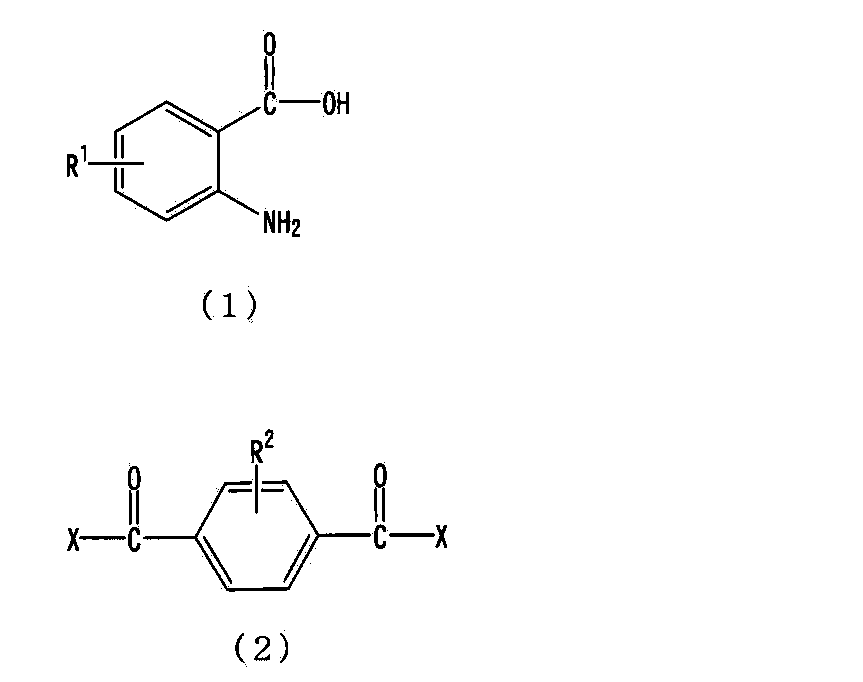
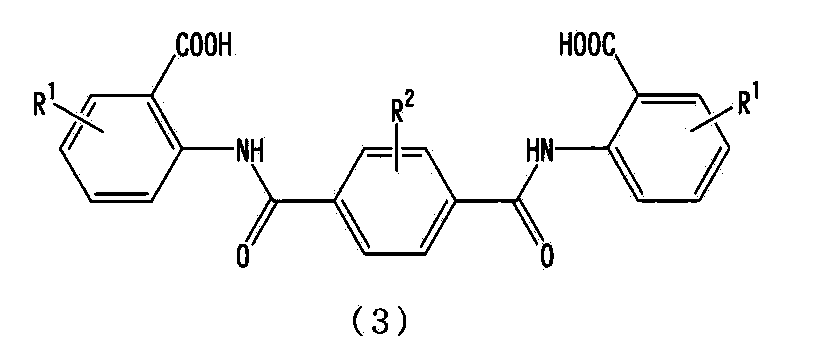
得られた式(3)で表されるアミド化合物を脱水剤と反応させることからなる前項1記載のビスベンゾオキサジノン化合物の製造方法。
4. 有機溶媒は、ケトン類、芳香族炭化水素類、ハロゲン化炭化水素類およびエーテル類からなる群より選ばれる少なくとも一種である前項3記載の製造方法。
5. 不活性ガスが窒素である前項4記載の製造方法。
6. 脱水剤が無水酢酸である前項4記載の製造方法。
7. 式(1)~式(4)の、R1が水素原子、R2が水素原子、Xが塩素原子である前項4記載の製造方法。
8. 芳香族ポリカーボネート(A成分)100重量部および前項1の化合物(B成分)0.01~5重量部を含有する樹脂組成物。
9. さらにリン系安定剤(C1成分)およびヒンダードフェノール系安定剤(C2成分)から選ばれる少なくとも1種の安定剤(C成分)を含有する前項8記載の樹脂組成物。
10. 厚さ2mmの成形板にしたときの全光線透過率が70%以上である前項8記載の樹脂組成物。
11. 厚さ2mmの成形板にしたときの湿熱試験前後のΔHazeが2.0以下である前項8記載の樹脂組成物。
12. 厚さ2mmの成形板の耐候促進試験前後のΔHazeが1.0以下である前項8記載の樹脂組成物。
13. 厚さ2mmの成形板に白色標準板を重ねて測定した380~480nmの範囲の光線反射率の最大ピークが60~80%である前項8記載の樹脂組成物。
14. 前項8~13のいずれか1項に記載の樹脂組成物からなる成形品。
15. 車両用透明部材である前項14に記載の成形品。
本発明のビスベンゾオキサジノン化合物は下記式(4)で表される。

炭素数1~3のアルキル基として、メチル基、エチル基、プロピル基などが挙げられる。炭素数1~3のアルコキシ基として、メトキシ基、エトキシ基、プロポキシ基などが挙げられる。炭素数1~3のアシル基(R−CO−)としてアセチル基、アクリロイル基などが挙げられる。炭素数1~3のアシルオキシ基(R−CO−O−)として、Rがメチル基、エチル基のものが挙げられる。炭素数1~3のアルコキシカルボニル基(−CO−OR)として、Rがメチル基、エチル基のものが挙げられる。ハロゲン原子として、フッ素原子、塩素原子、臭素原子などが挙げられる。より好ましくは、R1は、水素原子である。式(4)のR1が水素原子、R2が水素原子であるビスベンゾオキサジノン化合物が好ましい。
(純度)
本発明のビスベンゾオキサジノン化合物は、純度が98%以上、好ましくは98.2%以上、より好ましくは98.5%以上である。なお、ビスベンゾオキサジノン化合物の純度は、HPLC(高速液体クロマトグラフィー)法により測定する。
(式(7)で表される化合物)
本発明のビスベンゾオキサジノン化合物は、下記式(7)で表される化合物の含有量が0.15重量%未満、好ましくは0.12重量%未満、より好ましくは0.1重量%未満である。式(7)で表される化合物の含有量は、HPLC(高速液体クロマトグラフィー)法により測定する。

本発明のビスベンゾオキサジノン化合物は、パウダー状での可視光線領域の光線反射率測定において最大ピークが380~480nmの範囲、好ましくは400~460nmの範囲、より好ましくは440~460nmの範囲にある。
本発明のビスベンゾオキサジノン化合物は、パウダー状での可視光線領域の光線反射率測定において最大光線反射率が100~120%、好ましくは100~110%である。
光線反射率は、ビスベンゾオキサジノン化合物のパウダーを直径30mm、高さ13mmの円筒型ガラス容器に詰め、東京電色株式会社製TR−1800MK−IIを使用して380~480nmの範囲にある最大ピーク値を測定する。測定は反射法(2度視野、C光源)にて実施する。
(ナトリウム金属の含有量)
本発明のビスベンゾオキサジノン化合物は、ナトリウム金属の含有量が50ppm未満、好ましくは40ppm未満、より好ましくは25ppm未満である。ナトリウム金属の含有量は、フレーム原子吸光光度法により測定する。
(YI値)
本発明のビスベンゾオキサジノン化合物は、YI値が−10~10、好ましくは−5~5、より好ましくは0~3である。YI値は、ビスベンゾオキサジノン化合物のパウダーを東京電色株式会社製TR−1800MK−IIを使用して測定する。測定は反射法(2度視野、C光源)にて実施する。
〈ビスベンゾオキサジノン化合物の製造方法〉
本発明のビスベンゾオキサジノン化合物は、以下に示す方法で製造することができる。該方法は、アミド化合物(3)を得る工程1とアミド化合物を脱水し環化しビスベンゾオキサジノン化合物(4)を得る工程2からなる。
(工程1)
工程1は、アントラニル酸誘導体(1)と芳香族ジカルボン酸ジハロゲン化物(2)とを、不活性ガスの気流下、有機溶媒中で反応させアミド化合物(3)を得る工程である。
アントラニル酸誘導体は、下記式(1)で表される。

炭素数1~3のアルキル基として、メチル基、エチル基、プロピル基などが挙げられる。炭素数1~3のアルコキシ基として、メトキシ基、エトキシ基、プロポキシ基などが挙げられる。炭素数1~3のアシル基(R−CO−)としてアセチル基、アクリロイル基などが挙げられる。炭素数1~3のアシルオキシ基(R−CO−O−)として、Rがメチル基、エチル基のものが挙げられる。炭素数1~3のアルコキシカルボニル基(−CO−OR)として、Rがメチル基、エチル基のものが挙げられる。ハロゲン原子として、フッ素原子、塩素原子、臭素原子などが挙げられる。より好ましくは、R1は、水素原子である。具体的には、アントラニル酸が挙げられる。
芳香族ジカルボン酸ジハロゲン化物は、下記式(2)で表される。

R2は、水素原子、水酸基、炭素数1~3のアルキル基、炭素数1~3のアルコキシ基、炭素数1~3のアシル基、炭素数1~3のアシルオキシ基、炭素数1~3のアルコキシカルボニル基、ハロゲン原子、ニトロ基、カルボキシル基を表す。これらの具体例は式(1)と同じである。より好ましくは、R2は、水素原子である。具体的には、テレフタル酸ジクロライドが挙げられる。
上記反応において、化合物(3)は芳香族ジカルボン酸ジハロゲン化物1モルに対し、アントラニル酸誘導体2モルが反応することにより得られるが、芳香族ジカルボン酸ジハロゲン化物1モルに対しアントラニル酸誘導体1モルが反応した下記式(5)で表わされる副生成物の生成を抑制するためにアントラニル酸誘導体を化学量論量より若干過剰に用いることが好ましい。すなわち反応に用いる芳香族ジカルボン酸ジハロゲン化物の量は、1モルのアントラニル酸誘導体に対し、好ましくは0.43~0.5モル、より好ましくは0.47~0.5モルである。

また特許文献4にあるようにイサト酸無水物と芳香族ジカルボン酸ジハロゲン化物の反応では有機塩基としてピリジンのような第三級アミンを使用しているが、これらは嵩高いために式(6)で表されるような反応中間体が不安定になり、その結果として式(7)で表される不純物が増加しやすい。式(7)の化合物についてはHPLCならびにLC(液体クロマトグラフィー)/MS(マススペクトル)にて確認した。

反応に用いる有機溶媒の量は特に限定されないが、アントラニル酸誘導体100重量部に対し、好ましくは350~3,500重量部、より好ましくは800~1,200重量部である。
本発明は、反応系内に不活性ガスを導入し、反応を不活性ガス気流下に進行させ、ハロゲン化水素を除去することを特徴とする。
本発明で用いる不活性ガスとしては、窒素、アルゴンなどが挙げられ、特に窒素が好ましい。反応に用いる不活性ガスの量は、アントラニル酸誘導体1モルに対して、好ましくは1~50L/時間であり、これを超えると不活性ガスの気流により蒸散する量が多大となり、少ない場合は反応が極めて遅くなる。より好ましくは5~15L/時間である。なお、不活性ガスは、有機溶媒中に吹き込んでも良いし、反応容器の気相中に吹き込んでも良い。
反応装置は不活性ガス導入部、ガス導出部および環流装置を有する、通常のスラリー状態の反応液を攪拌することが可能な物であればよい。ただし通気した不活性ガス中に含まれるハロゲン化水素を除去する設備が必要である。また反応温度は室温~140℃とするのが好ましくこれ以上の温度になると着色する傾向が強くなる。より好ましくは50~90℃である。また反応時間は不活性ガスの流量と反応温度により変化するが、0.5~20時間とするのが好ましく、より好ましくは8~12時間である。また式(3)で表されるアミド化合物は特に精製することなく次工程に用いることができる。
工程1では、下記式(3)で表されるアミド化合物が結晶として得られる。

(工程2)
工程2は、工程1で得られた式(3)で表されるアミド化合物を脱水剤と反応させ、環化させ下記式(4)
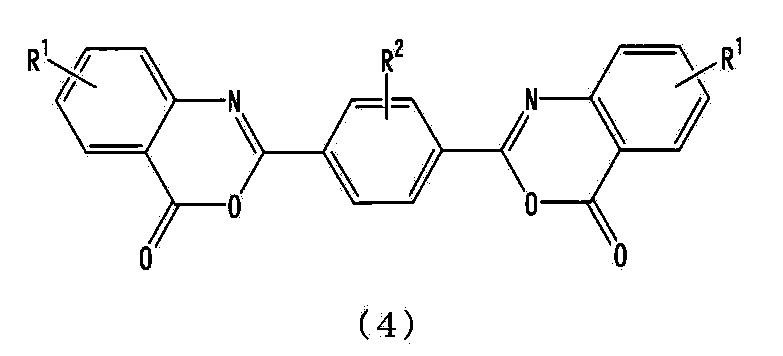
脱水剤として、無水酢酸、五酸化リン、三酸化硫黄などが挙げられ、取り扱い易さより無水酢酸が好ましい。脱水剤は、式(3)で表されるアミド化合物1当量に対して、少なくとも2当量以上必要であり、好ましくは5当量以上、より好ましくは20当量以上である。好ましい態様として溶媒として用いることもできる。
反応装置は、還流装置を有して、スラリー状態の反応液を攪拌することが可能な物であればよい。ただし排気口には反応時に生成した酸性ガスが一部出てくるので、これを除去する設備が必要である。また反応温度は用いる溶媒の沸点によって異なるが、80℃以上とするのが好ましく、より好ましくは120~140℃である。また、脱水反応時に副生する酸性成分を取り除く為に水洗を行うことが好ましい。また反応時間は脱水剤の当量、種類により異なるが、1~24時間とするのが好ましく、より好ましくは8~16時間である。
本発明の製造方法において、式(1)~式(4)の、R1が、水素原子、R2が水素原子、Xが塩素原子であることが好ましい。
本発明の製造方法によれば、アルカリ金属を使用することなく不活性ガスにより反応を進めるので、アルカリ金属の含有量の少ないビスベンゾオキサジノン化合物を得ることができる。また不活性ガス雰囲気下で反応が進むので、反応時において、酸化などの副反応が起こりにくく、高純度で色相に優れたビスベンゾオキサジノン化合物が得られる。
〈樹脂組成物〉
本発明の樹脂組成物は、芳香族ポリカーボネート(A成分)100重量部、本発明のビスベンゾオキサジノン化合物(B成分)0.01~5重量部を含有する。ビスベンゾオキサジノン化合物(B成分)の含有量は、芳香族ポリカーボネート(A成分)100重量部に対し、好ましくは0.01~3重量部、より好ましくは0.1~1重量部である。
(芳香族ポリカーボネート:A成分)
本発明でA成分として使用される芳香族ポリカーボネートは、二価フェノールとカーボネート前駆体とを反応させて得られるものである。反応方法の一例として界面重合法、溶融エステル交換法、カーボネートプレポリマーの固相エステル交換法、および環状カーボネート化合物の開環重合法などを挙げることができる。
ここで使用される二価フェノールの代表的な例としては、ハイドロキノン、レゾルシノール、4,4’−ビフェノール、1,1−ビス(4−ヒドロキシフェニル)エタン、2,2−ビス(4−ヒドロキシフェニル)プロパン(通称ビスフェノールA)、2,2−ビス(4−ヒドロキシ−3−メチルフェニル)プロパン、2,2−ビス(4−ヒドロキシフェニル)ブタン、1,1−ビス(4−ヒドロキシフェニル)−1−フェニルエタン、1,1−ビス(4−ヒドロキシフェニル)シクロヘキサン、1,1−ビス(4−ヒドロキシフェニル)−3,3,5−トリメチルシクロヘキサン、2,2−ビス(4−ヒドロキシフェニル)ペンタン、4,4’−(p−フェニレンジイソプロピリデン)ジフェノール、4,4’−(m−フェニレンジイソプロピリデン)ジフェノール、1,1−ビス(4−ヒドロキシフェニル)−4−イソプロピルシクロヘキサン、ビス(4−ヒドロキシフェニル)オキシド、ビス(4−ヒドロキシフェニル)スルフィド、ビス(4−ヒドロキシフェニル)スルホキシド、ビス(4−ヒドロキシフェニル)スルホン、ビス(4−ヒドロキシフェニル)ケトン、ビス(4−ヒドロキシフェニル)エステル、2,2−ビス(3,5−ジブロモ−4−ヒドロキシフェニル)プロパン、ビス(3,5−ジブロモ−4−ヒドロキシフェニル)スルホン、ビス(4−ヒドロキシ−3−メチルフェニル)スルフィド、9,9−ビス(4−ヒドロキシフェニル)フルオレンおよび9,9−ビス(4−ヒドロキシ−3−メチルフェニル)フルオレンなどが挙げられる。好ましい二価フェノールは、ビス(4−ヒドロキシフェニル)アルカンであり、なかでも耐衝撃性の点からビスフェノールAが特に好ましい。
カーボネート前駆体としてはカルボニルハライド、炭酸ジエステルまたはハロホルメートなどが使用され、具体的にはホスゲン、ジフェニルカーボネートまたは二価フェノールのジハロホルメートなどが挙げられる。
上記二価フェノールとカーボネート前駆体を界面重合法によって芳香族ポリカーボネート樹脂を製造するに当っては、必要に応じて触媒、末端停止剤、二価フェノールが酸化するのを防止するための酸化防止剤などを使用してもよい。また芳香族ポリカーボネートは三官能以上の多官能性芳香族化合物を共重合した分岐ポリカーボネートであっても、芳香族または脂肪族の二官能性カルボン酸を共重合したポリエステルカーボネート樹脂であってもよく、また、得られたポリカーボネート樹脂の2種以上を混合した混合物であってもよい。
三官能以上の多官能性芳香族化合物としては、1,1,1−トリス(4−ヒドロキシフェニル)エタン、1,1,1−トリス(3,5−ジメチル−4−ヒドロキシフェニル)エタンなどが使用できる。
分岐ポリカーボネートを生ずる多官能性化合物を含む場合、かかる割合は、芳香族ポリカーボネート全量中、好ましくは0.001~1モル%、より好ましくは0.005~0.5モル%、さらに好ましくは0.01~0.3モル%である。また特に溶融エステル交換法の場合、副反応として分岐構造が生ずる場合があるが、かかる分岐構造量についても、芳香族ポリカーボネート全量中、好ましくは0.001~1モル%、より好ましくは0.005~0.5モル%、さらに好ましくは0.01~0.3モル%である。尚、かかる割合については1H−NMR測定により算出することが可能である。
脂肪族の二官能性のカルボン酸は、α,ω−ジカルボン酸が好ましい。脂肪族の二官能性のカルボン酸としては例えば、セバシン酸(デカン二酸)、ドデカン二酸、テトラデカン二酸、オクタデカン二酸、イコサン二酸などの直鎖飽和脂肪族ジカルボン酸が好ましく挙げられる。
更にポリオルガノシロキサン単位を共重合した、ポリカーボネート−ポリオルガノシロキサン共重合体の使用も可能である。
界面重合法による反応は、通常、二価フェノールとホスゲンとの反応であり、酸結合剤および有機溶媒の存在下に反応させる。酸結合剤としては例えば水酸化ナトリウムや水酸化カリウムなどのアルカリ金属水酸化物、ピリジンなどが用いられる。
有機溶媒としては、例えば塩化メチレン、クロロベンゼンなどのハロゲン化炭化水素が用いられる。
また、反応促進のために、例えば第三級アミンや第四級アンモニウム塩などの触媒を用いることができ、分子量調節剤として例えばフェノール、p−tert−ブチルフェノール、p−クミルフェノールなどの単官能フェノール類を用いるのが好ましい。更に単官能フェノール類としては、デシルフェノール、ドデシルフェノール、テトラデシルフェノール、ヘキサデシルフェノール、オクタデシルフェノール、エイコシルフェノール、ドコシルフェノールおよびトリアコンチルフェノールなどを挙げることができる。これらの比較的長鎖のアルキル基を有する単官能フェノール類は、流動性や耐加水分解性の向上が求められる場合に有効である。
反応温度は通常0~40℃、反応時間は数分~5時間、反応中のpHは通常10以上に保つのが好ましい。
溶融法による反応は、通常二価フェノールと炭酸ジエステルとのエステル交換反応であり、不活性ガスの存在下に二価フェノールと炭酸ジエステルを混合し、減圧下通常120~350℃で反応させる。減圧度は段階的に変化させ、最終的には133Pa以下にして生成したフェノール類を系外に除去させる。反応時間は通常1~4時間程度である。
炭酸ジエステルとしては、例えばジフェニルカーボネート、ジナフチルカーボネート、ビス(ジフェニル)カーボネート、ジメチルカーボネート、ジエチルカーボネートおよびジブチルカーボネートなどが挙げられる。なかでもジフェニルカーボネートが好ましい。
重合速度を速めるために重合触媒を使用することができる。重合触媒としては、水酸化ナトリウムや水酸化カリウムなどのアルカリ金属やアルカリ土類金属の水酸化物、ホウ素やアルミニウムの水酸化物、アルカリ金属塩、アルカリ土類金属塩、第4級アンモニウム塩、アルカリ金属やアルカリ土類金属のアルコキシド、アルカリ金属やアルカリ土類金属の有機酸塩、亜鉛化合物、ホウ素化合物、ケイ素化合物、ゲルマニウム化合物、有機錫化合物、鉛化合物、アンチモン化合物、マンガン化合物、チタン化合物、ジルコニウム化合物などの通常エステル化反応やエステル交換反応に使用される触媒が挙げられる。触媒は単独で使用しても良いし、二種類以上を併用して使用しても良い。これらの重合触媒の使用量は、原料の二価フェノール1モルに対し、好ましくは1×10⁻⁸~1×10⁻³当量、より好ましくは1×10⁻⁷~5×10⁻⁴当量の範囲で選ばれる。
また、重合反応において、フェノール性の末端基を減少するために、重縮反応の後期あるいは終了後に、例えば2−クロロフェニルフェニルカーボネート、2−メトキシカルボニルフェニルフェニルカーボネートおよび2−エトキシカルボニルフェニルフェニルカーボネートなどの化合物を加えることができる。
さらに溶融エステル交換法では触媒の活性を中和する失活剤を用いることが好ましい。かかる失活剤の量としては、残存する触媒1モルに対して0.5~50モルの割合で用いるのが好ましい。また失活剤は、重合後の芳香族ポリカーボネートに対し、好ましくは0.01~500ppmの割合、より好ましくは0.01~300ppm、さらに好ましくは0.01~100ppmの割合で使用する。失活剤としては、ドデシルベンゼンスルホン酸テトラブチルホスホニウム塩などのホスホニウム塩、テトラエチルアンモニウムドデシルベンジルサルフェートなどのアンモニウム塩などが好ましく挙げられる。
芳香族ポリカーボネートの粘度平均分子量は、好ましくは13,000~40,000であり、より好ましくは14,000~30,000であり、更に好ましくは15,000~27,000である。かかる粘度平均分子量を有する芳香族ポリカーボネートを使用した場合、本発明の樹脂組成物は十分な強度および成形時の良好な溶融流動性を有する。かかる良好な溶融流動性は、成形歪みの更なる低減を可能にするため好ましい。また上記範囲内の場合には、ハードコート処理などの2次加工への耐性も十分となる。尚、芳香族ポリカーボネートは、その粘度平均分子量が上記範囲外のものを混合して得られたものであってもよい。
芳香族ポリカーボネートの粘度平均分子量(M)は塩化メチレン100mlにポリカーボネート樹脂0.7gを溶解した溶液から20℃で求めた比粘度(ηsp)を次式に挿入して求めたものである。
ηsp/c=[η]+0.45×[η]2c(但し[η]は極限粘度)
[η]=1.23×10⁻⁴M0.83
c=0.7
(安定剤:C成分)
本発明の樹脂組成物は、安定剤(C成分)を含有していても良い。安定剤(C成分は、好ましくはリン系安定剤(C1成分)およびヒンダードフェノール系安定剤(C2成分)から選ばれる少なくとも1種である。
リン系安定剤(C1成分)としては、ホスファイト化合物、ホスフェート化合物、ホスホナイト化合物、ホスホネイト化合物などが例示される。
ホスファイト化合物としては、トリフェニルホスファイト、トリス(ノニルフェニル)ホスファイト、トリデシルホスファイト、トリオクチルホスファイト、トリオクタデシルホスファイト、ジデシルモノフェニルホスファイト、ジオクチルモノフェニルホスファイト、ジイソプロピルモノフェニルホスファイト、モノブチルジフェニルホスファイト、モノデシルジフェニルホスファイト、モノオクチルジフェニルホスファイト、2,2−メチレンビス(4,6−ジ−tert−ブチルフェニル)オクチルホスファイト、トリス(ジエチルフェニル)ホスファイト、トリス(ジ−iso−プロピルフェニル)ホスファイト、トリス(ジ−n−ブチルフェニル)ホスファイト、トリス(2,4−ジ−tert−ブチルフェニル)ホスファイト、トリス(2,6−ジ−tert−ブチルフェニル)ホスファイト、ジステアリルペンタエリスリトールジホスファイト、ビス(2,4−ジ−tert−ブチルフェニル)ペンタエリスリトールジホスファイト、ビス(2,6−ジ−tert−ブチル−4−メチルフェニル)ペンタエリスリトールジホスファイト、ビス(2,6−ジ−tert−ブチル−4−エチルフェニル)ペンタエリスリトールジホスファイト、フェニルビスフェノールAペンタエリスリトールジホスファイト、ビス(ノニルフェニル)ペンタエリスリトールジホスファイト、ジシクロヘキシルペンタエリスリトールジホスファイトなどが挙げられる。
他のホスファイト化合物としては二価フェノール類と反応し環状構造を有するものも使用できる。例えば、2,2’−メチレンビス(4,6−ジ−tert−ブチルフェニル)(2,4−ジ−tert−ブチルフェニル)ホスファイト、2,2’−メチレンビス(4,6−ジ−tert−ブチルフェニル)(2−tert−ブチル−4−メチルフェニル)ホスファイト、2,2’−メチレンビス(4−メチル−6−tert−ブチルフェニル)(2−tert−ブチル−4−メチルフェニル)ホスファイト、2,2’−エチリデンビス(4−メチル−6−tert−ブチルフェニル)(2−tert−ブチル−4−メチルフェニル)ホスファイトなどを挙げることができる。
ホスフェート化合物としては、トリブチルホスフェート、トリメチルホスフェート、トリクレジルホスフェート、トリフェニルホスフェート、トリクロルフェニルホスフェート、トリエチルホスフェート、ジフェニルクレジルホスフェート、ジフェニルモノオルソキセニルホスフェート、トリブトキシエチルホスフェート、ジブチルホスフェート、ジオクチルホスフェート、ジイソプロピルホスフェートなどを挙げることができる。好ましくはトリフェニルホスフェート、トリメチルホスフェートである。
ホスホナイト化合物としては、テトラキス(2,4−ジ−tert−ブチルフェニル)−4,4’−ビフェニレンジホスホナイト、テトラキス(2,4−ジ−tert−ブチルフェニル)−4,3’−ビフェニレンジホスホナイト、テトラキス(2,4−ジ−tert−ブチルフェニル)−3,3’−ビフェニレンジホスホナイト、テトラキス(2,6−ジ−tert−ブチルフェニル)−4,4’−ビフェニレンジホスホナイト、テトラキス(2,6−ジ−tert−ブチルフェニル)−4,3’−ビフェニレンジホスホナイト、テトラキス(2,6−ジ−tert−ブチルフェニル)−3,3’−ビフェニレンジホスホナイト、ビス(2,4−ジ−tert−ブチルフェニル)−4−フェニル−フェニルホスホナイト、ビス(2,4−ジ−tert−ブチルフェニル)−3−フェニル−フェニルホスホナイト、ビス(2,6−ジ−n−ブチルフェニル)−3−フェニル−フェニルホスホナイト、ビス(2,6−ジ−tert−ブチルフェニル)−4−フェニル−フェニルホスホナイト、ビス(2,6−ジ−tert−ブチルフェニル)−3−フェニル−フェニルホスホナイトなどが挙げられる。テトラキス(ジ−tert−ブチルフェニル)−ビフェニレンジホスホナイト、ビス(ジ−tert−ブチルフェニル)−フェニル−フェニルホスホナイトが好ましく、テトラキス(2,4−ジ−tert−ブチルフェニル)−ビフェニレンジホスホナイト、ビス(2,4−ジ−tert−ブチルフェニル)−フェニル−フェニルホスホナイトがより好ましい。かかるホスホナイト化合物は上記アルキル基が2以上置換したアリール基を有するホスファイト化合物との併用可能であり好ましい。
ホスホネイト化合物としては、ベンゼンホスホン酸ジメチル、ベンゼンホスホン酸ジエチル、およびベンゼンホスホン酸ジプロピルなどが挙げられる。
リン系安定剤(C1成分)は、1種のみならず2種以上を混合して用いることができる。リン系安定剤(C1成分)として、ホスファイト化合物またはホスホナイト化合物が好ましい。殊にトリス(2,4−ジ−tert−ブチルフェニル)ホスファイト、テトラキス(2,4−ジ−tert−ブチルフェニル)−4,4’−ビフェニレンジホスホナイトおよびビス(2,4−ジ−tert−ブチルフェニル)−フェニル−フェニルホスホナイトが好ましい。またこれらとホスフェート化合物との併用も好ましい態様である。
リン系安定剤(C1成分)の含有量は、芳香族ポリカーボネート(A成分)100重量部に対して、好ましくは0.0001~1重量部、より好ましくは0.001~0.1重量部、さらに好ましくは0.005~0.1重量部である。リン系安定剤(C1成分)の含有量が上記範囲よりも少なすぎる場合には良好な安定化効果を得ることが難しく、上記範囲を超えて多すぎる場合は、組成物の物性低下を起こす場合がある。
ヒンダードフェノール系安定剤(C2成分)としては、α−トコフェロール、ブチルヒドロキシトルエン、シナピルアルコール、ビタミンE、n−オクタデシル−β−(4’−ヒドロキシ−3’,5’−ジ−tert−ブチルフェニル)プロピオネート、2−tert−ブチル−6−(3’−tert−ブチル−5’−メチル−2’−ヒドロキシベンジル)−4−メチルフェニルアクリレート、2,6−ジ−tert−ブチル−4−(N,N−ジメチルアミノメチル)フェノール、3,5−ジ−tert−ブチル−4−ヒドロキシベンジルホスホネートジエチルエステル、2,2’−メチレンビス(4−メチル−6−tert−ブチルフェノール)、2,2’−メチレンビス(4−エチル−6−tert−ブチルフェノール)、4,4’−メチレンビス(2,6−ジ−tert−ブチルフェノール)、2,2’−メチレンビス(4−メチル−6−シクロヘキシルフェノール)、2,2’−ジメチレン−ビス(6−α−メチル−ベンジル−p−クレゾール)、2,2’−エチリデン−ビス(4,6−ジ−tert−ブチルフェノール)、2,2’−ブチリデン−ビス(4−メチル−6−tert−ブチルフェノール)、4,4’−ブチリデン−ビス(3−メチル−6−tert−ブチルフェノール)、トリエチレングリコール−N−ビス−3−(3−tert−ブチル−4−ヒドロキシ−5−メチルフェニル)プロピオネート、1,6−ヘキサンジオールビス[3−(3,5−ジ−tert−ブチル−4−ヒドロキシフェニル)プロピオネート]、ビス[2−tert−ブチル−4−メチル6−(3−tert−ブチル−5−メチル−2−ヒドロキシベンジル)フェニル]テレフタレート、3,9−ビス{2−[3−(3−tert−ブチル−4−ヒドロキシ−5−メチルフェニル)プロピオニルオキシ]−1,1−ジメチルエチル}−2,4,8,10−テトラオキサスピロ[5,5]ウンデカン、4,4’−チオビス(6−tert−ブチル−m−クレゾール)、4,4’−チオビス(3−メチル−6−tert−ブチルフェノール)、2,2’−チオビス(4−メチル−6−tert−ブチルフェノール)、ビス(3,5−ジ−tert−ブチル−4−ヒドロキシベンジル)スルフィド、4,4’−ジ−チオビス(2,6−ジ−tert−ブチルフェノール)、4,4’−トリ−チオビス(2,6−ジ−tert−ブチルフェノール)、2,2−チオジエチレンビス−[3−(3,5−ジ−tert−ブチル−4−ヒドロキシフェニル)プロピオネート]、2,4−ビス(n−オクチルチオ)−6−(4−ヒドロキシ−3’,5’−ジ−tert−ブチルアニリノ)−1,3,5−トリアジン、N,N’−ヘキサメチレンビス−(3,5−ジ−tert−ブチル−4−ヒドロキシヒドロシンナミド)、N,N’−ビス[3−(3,5−ジ−tert−ブチル−4−ヒドロキシフェニル)プロピオニル]ヒドラジン、1,1,3−トリス(2−メチル−4−ヒドロキシ−5−tert−ブチルフェニル)ブタン、1,3,5−トリメチル−2,4,6−トリス(3,5−ジ−tert−ブチル−4−ヒドロキシベンジル)ベンゼン、トリス(3,5−ジ−tert−ブチル−4−ヒドロキシフェニル)イソシアヌレート、トリス(3,5−ジ−tert−ブチル−4−ヒドロキシベンジル)イソシアヌレート、1,3,5−トリス(4−tert−ブチル−3−ヒドロキシ−2,6−ジメチルベンジル)イソシアヌレート、1,3,5−トリス2[3(3,5−ジ−tert−ブチル−4−ヒドロキシフェニル)プロピオニルオキシ]エチルイソシアヌレート、およびテトラキス[メチレン−3−(3’,5’−ジ−tert−ブチル−4−ヒドロキシフェニル)プロピオネート]メタンなどが例示される。これらはいずれも入手容易である。上記ヒンダードフェノール系酸化防止剤は、単独でまたは2種以上を組合せて使用することができる。
ヒンダードフェノール系安定剤(C2成分)の含有量は、芳香族ポリカーボネート(A成分)100重量部に対して、好ましくは0.0001~1重量部、より好ましくは0.001~0.1重量部、さらに好ましくは0.005~0.1重量部である。ヒンダードフェノール系安定剤(C2成分)の含有量が上記範囲よりも少なすぎる場合には良好な安定化効果を得ることが難しく、上記範囲を超えて多すぎる場合は、組成物が着色し成形品外観を低下させる場合がある。
(光安定剤)
また本発明の樹脂組成物は、ヒンダードアミン系の光安定剤を含有していても良い。ヒンダードアミン系の光安定剤として、ビス(2,2,6,6−テトラメチル−4−ピペリジル)セバケート、ビス(1,2,2,6,6−ペンタメチル−4−ピペリジル)セバケート、テトラキス(2,2,6,6−テトラメチル−4−ピペリジル)−1,2,3,4−ブタンテトラカルボキシレート、テトラキス(1,2,2,6,6−ペンタメチル−4−ピペリジル)−1,2,3,4−ブタンテトラカルボキシレート、ポリ{[6−(1,1,3,3−テトラメチルブチル)アミノ−1,3,5−トリアジン−2,4−ジイル][(2,2,6,6−テトラメチルピペリジル)イミノ]ヘキサメチレン[(2,2,6,6−テトラメチルピペリジル)イミノ]}、およびポリメチルプロピル3−オキシ−[4−(2,2,6,6−テトラメチル)ピペリジニル]シロキサンなどが挙げられる。
上記光安定剤は、単独であるいは2種以上の混合物を用いてもよい。光安定剤の含有量は、芳香族ポリカーボネート(A成分)100重量部に対して、好ましくは0.0005~3重量部、より好ましくは0.01~2重量部、さらに好ましくは0.02~1重量部である。
<アントラキノン系染料:D成分>
本発明の樹脂組成物は、骨格にOH官能基を有さないアントラキノン系染料を含有していても良い。染料として使用される骨格にOH官能基を有さないアントラキノン系染料としては、当該業者で一般的にブルーイング剤として使用するものも含まれるが、青色に限定されるものではなく、赤色、橙色、緑色、黄色、紫色など数多くの種類が使用可能であり、一種または複数の染料の組合せにより多彩な色彩を達成可能である。
骨格にOH官能基を有さないアントラキノン系染料(D成分)としては、バイエル社のMACROLEX Violet B(式(a)の化合物)、バイエル社製MACROLEX Blue RR(式(b)の化合物)、有本化学工業社製PLAST Blue 8520(式(c)の化合物)、PLAST Violet 8855(式(d)の化合物)、PLAST Red 8350、PLAST Red 8340、PLAST Red 8320、OIL Green 5602、三菱化学社製DIARESIN Blue N、住友化学工業社製SUMIPLAST Violet RR等が挙げられる。好ましくは式(a)、式(b)、式(c)、式(d)の化合物が使用される。
アントラキノン系染料(D成分)の含有量は、100重量部の芳香族ポリカーボネート(A成分)に対して、好ましくは1×10⁻⁶~1,000×10−6重量部、より好ましくは5×10⁻⁶~500×10−6重量部であり、さらに好ましくは10×10−6~150×10−6重量部であり、特に好ましくは10×10−6~100×10−6重量部である。
アントラキノン系以外の染料も併用可能であるが、染料の50%以上は骨格にOH官能基を有さないアントラキノン系染料であることが望ましく、他の染料と併用した場合の添加量も、染料全体の添加量で100重量部の芳香族ポリカーボネート(A成分)に対して、1×10⁻⁶~1,000×10−6重量部である。
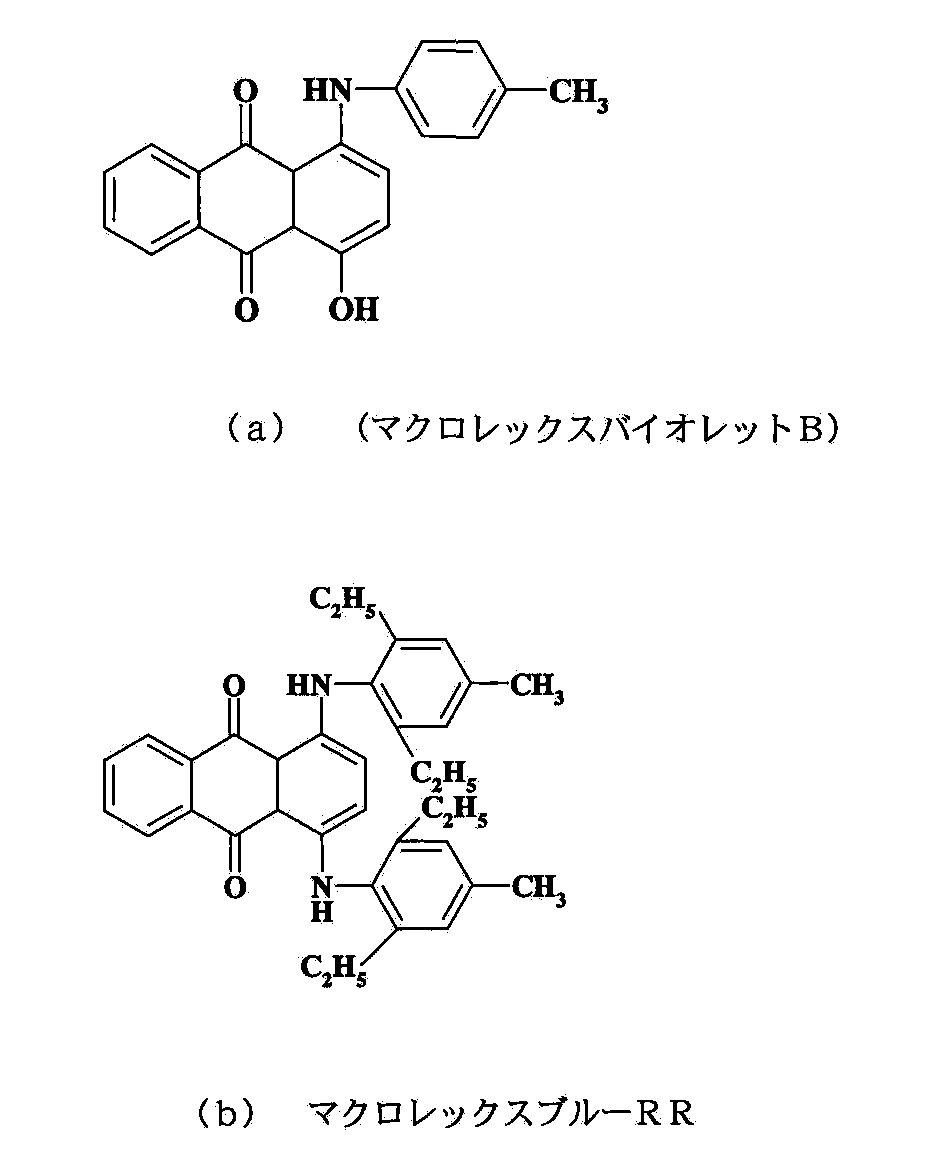

本発明の樹脂組成物には、発明の目的を損なわない範囲でアントラキノン系染料(D成分)以外にも各種の染顔料を使用することができる。特に透明性を維持する点から、染料が好適である。好ましい染料としてはペリレン系染料、クマリン系染料、チオインジゴ系染料、アンスラキノン系染料、チオキサントン系染料、紺青などのフェロシアン化物、ペリノン系染料、キノリン系染料、キナクリドン系染料、ジオキサジン系染料、イソインドリノン系染料、およびフタロシアニン系染料などを挙げることができる。染顔料の含有量は、芳香族ポリカーボネート(A成分)100重量部あたり、好ましくは0.0001~1重量部、より好ましくは0.0005~0.5重量部である。
(離型剤)
本発明の樹脂組成物は離型剤を含んでいても良い。離型剤としてはアルコールと脂肪族カルボン酸とのエステル(脂肪酸エステル)が好ましい。
アルコールとしては一価アルコールおよび二価以上の多価アルコールのいずれでもよい。多価アルコールを主体とすることがより好ましい。一価アルコールとしては、ドデカノール、テトラデカノール、ヘキサデカノール、オクタデカノール、エイコサノール、テトラコサノール、セリルアルコールおよびトリアコンタノールなどが例示される。多価アルコールの具体例としては、グリセリン、ジグリセリン、ポリグリセリン(例えばデカグリセリンなど)、ペンタエリスリトール、ジペンタエリスリトール、ジエチレングリコール、およびプロピレングリコールなどが挙げられる。中でもペンタエリスリトールが好ましい。
一方、脂肪族カルボン酸は炭素数3~32であることが好ましく、特に炭素数10~22の脂肪族カルボン酸が好ましい。該脂肪族カルボン酸として、デカン酸、ウンデカン酸、ドデカン酸、トリデカン酸、テトラデカン酸、ペンタデカン酸、ヘキサデカン酸(パルミチン酸)、ヘプタデカン酸、オクタデカン酸(ステアリン酸)、ノナデカン酸、イコサン酸、およびドコサン酸(ベヘン酸)などの飽和脂肪族カルボン酸が挙げられる。またパルミトレイン酸、オレイン酸、リノール酸、リノレン酸、エイコセン酸、エイコサペンタエン酸、およびセトレイン酸などの不飽和脂肪族カルボン酸が挙げられる。上記の中でも脂肪族カルボン酸は、炭素原子数14~20であるものが好ましい。なかでも飽和脂肪族カルボン酸が好ましい。
かかる脂肪族カルボン酸は通常、動物性油脂(牛脂および豚脂など)や植物性油脂(パーム油など)などの天然油脂類から製造されるため、これらの脂肪族カルボン酸は、通常炭素原子数の異なる他のカルボン酸成分を含む混合物である。従って、脂肪族カルボン酸は、天然油脂類から製造される他のカルボン酸成分を含む混合物の形態からなる。
脂肪酸エステルにおける酸価は、20以下(実質的に0を取り得る)であることが好ましい。しかしながら全エステル(フルエステル)の場合には、離型性を向上させるため、少なからず遊離の脂肪酸を含有することが好ましく、この点においてフルエステルにおける酸価は3~15の範囲が好ましい。また脂肪酸エステルのヨウ素価は、10以下(実質的に0を取り得る)が好ましい。これらの特性はJIS K 0070に規定された方法により求めることができる。
脂肪酸エステルは、部分エステルおよびフルエステルのいずれであってもよいが、本発明においてより好ましくは良好な離型性および耐久性の点で部分エステルである。中でもグリセリンモノエステルが好ましい。グリセリンモノエステルは、グリセリンと脂肪酸のモノエステルが主成分である。好適な脂肪酸としてはステアリン酸、パルチミン酸、ベヘン酸、アラキン酸、モンタン酸、ラウリン酸等の飽和脂肪酸が挙げられる。またオレイン酸、リノール酸、ソルビン酸等の不飽和脂肪酸が挙げられる。特にステアリン酸、ベヘン酸、およびパルチミン酸のグリセリンモノエステルを主成分としたものが好ましい。尚、かかる脂肪酸は、天然の脂肪酸から合成されたものであり、上述のとおり混合物となる。グリセリンモノエステルは、他の離型剤、殊に脂肪酸フルエステルとの併用が可能であるが、併用した場合でもグリセリンモノエステルを主成分とすることが好ましい。即ち、離型剤100重量%中、60重量%以上とすることが好ましく、80%以上がより好ましく、85%以上が更に好ましい。よって離型剤は、多価アルコールと脂肪族カルボン酸とのフルエステルが好ましい。但し、本発明においてフルエステルとは、そのエステル化率が必ずしも100%である必要はなく、80%以上であればよく、好ましくは85%以上である。
(帯電防止剤)
本発明の樹脂組成物は帯電防止剤を含んでいても良い。帯電防止剤としては、例えば(i)ドデシルベンゼンスルホン酸ホスホニウム塩に代表されるアリールスルホン酸ホスホニウム塩、アルキルスルホン酸ホスホニウム塩などの有機スルホン酸ホスホニウム塩が挙げられる。有機スルホン酸ホスホニウム塩の含有量は、芳香族ポリカーボネート(A成分)100重量部あたり、好ましくは5重量部以下、より好ましくは0.05~5重量部、さらに好ましくは1~3.5重量部、特に好ましくは1.5~3重量部の範囲である。
帯電防止剤としては、(ii)有機スルホン酸リチウム、有機スルホン酸ナトリウム、有機スルホン酸カリウム、有機スルホン酸セシウム、有機スルホン酸ルビジウム、有機スルホン酸カルシウム、有機スルホン酸マグネシウム、有機スルホン酸バリウムなどの有機スルホン酸アルカリ(土類)金属塩が挙げられる。具体的には例えばドデシルベンゼンスルホン酸の金属塩やパーフルオロアルカンスルホン酸の金属塩などが例示される。有機スルホン酸アルカリ(土類)金属塩の含有量は、芳香族ポリカーボネート(A成分)100重量部あたり、好ましくは0.5重量部以下、より好ましくは0.001~0.3重量部、さらに好ましくは0.005~0.2重量部である。特にカリウム、セシウム、およびルビジウムなどのアルカリ金属塩が好適である。
帯電防止剤としては、(iii)アルキルスルホン酸アンモニウム塩、およびアリールスルホン酸アンモニウム塩などの有機スルホン酸アンモニウム塩が挙げられる。該アンモニウム塩の含有量は、芳香族ポリカーボネート(A成分)100重量部あたり、好ましくは0.05重量部以下である。
帯電防止剤としては、例えば(iv)グリセリンモノステアレート、無水マレイン酸モノグリセライドおよび無水マレイン酸ジグリセライドなどのグリセリン誘導体エステルが挙げられる。該エステルの含有量は、芳香族ポリカーボネート(A成分)100重量部あたり、好ましくは0.5重量部以下である。
帯電防止剤としては、(v)ポリエーテルエステルアミドなどのポリ(オキシアルキレン)グリコール成分をその構成成分として含有するポリマーが挙げられる。該ポリマーの含有量は、芳香族ポリカーボネート(A成分)100重量部あたり、好ましくは5重量部以下である。
他の帯電防止剤としては、例えば、(vi)カーボンブラック、カーボンファイバー、カーボンナノチューブ、グラファイト、金属粉末、金属酸化物粉末などの非有機化合物が挙げられる。該非有機化合物の含有量は、芳香族ポリカーボネート(A成分)100重量部あたり、好ましくは0.05重量部以下である。
(難燃剤)
本発明の樹脂組成物には、本発明の目的が損なわれない量の難燃剤を使用することができる。難燃剤としては、ハロゲン化ビスフェノールAのポリカーボネート型難燃剤、有機塩系難燃剤、芳香族リン酸エステル系難燃剤、ハロゲン化芳香族リン酸エステル型難燃剤などが挙げられる。それらを一種以上使用することができる。
ハロゲン化ビスフェノールAのポリカーボネート型難燃剤として、テトラブロモビスフェノールAのポリカーボネート型難燃剤、テトラブロモビスフェノールAとビスフェノールAとの共重合ポリカーボネート型難燃剤などが挙げられる。
有機塩系難燃剤として、ジフェニルスルホン−3,3’−ジスルホン酸ジカリウム、ジフェニルスルホン−3−スルホン酸カリウム、2,4,5−トリクロロベンゼンスルホン酸ナトリウム、2,4,5−トリクロロベンゼンスルホン酸カリウム、ビス(2,6−ジブロモ−4−クミルフェニル)リン酸カリウム、ビス(4−クミルフェニル)リン酸ナトリウム、ビス(p−トルエンスルホン)イミドカリウム、ビス(ジフェニルリン酸)イミドカリウム、ビス(2,4,6−トリブロモフェニル)リン酸カリウム、ビス(2,4−ジブロモフェニル)リン酸カリウム、ビス(4−ブロモフェニル)リン酸カリウム、ジフェニルリン酸カリウム、ジフェニルリン酸ナトリウム、パーフルオロブタンスルホン酸カリウム、ラウリル硫酸ナトリウムあるいはカリウム、ヘキサデシル硫酸ナトリウムあるいはカリウムなどが挙げられる。
ハロゲン化芳香族リン酸エステル型難燃剤として、トリス(2,4,6−トリブロモフェニル)ホスフェート、トリス(2,4−ジブロモフェニル)ホスフェート、トリス(4−ブロモフェニル)ホスフェートなどが挙げられる。
芳香族リン酸エステル系難燃剤として、トリフェニルホスフェート、トリス(2,6−キシリル)ホスフェート、テトラキス(2,6−キシリル)レゾルシンジホスフェート、テトラキス(2,6−キシリル)ヒドロキノンジホスフェート、テトラキス(2,6−キシリル)−4,4’−ビフェノールジホスフェート、テトラフェニルレゾルシンジホスフェート、テトラフェニルヒドロキノンジホスフェート、テトラフェニル−4,4’−ビフェノールジホスフェート、芳香環ソースがレゾルシンとフェノールでありフェノール性OH基を含まない芳香族ポリホスフェート、芳香環ソースがレゾルシンとフェノールでありフェノール性OH基を含む芳香族ポリホスフェート、芳香環ソースがヒドロキノンとフェノールでありフェノール性OH基を含まない芳香族ポリホスフェート、同様のフェノール性OH基を含む芳香族ポリホスフェート(以下に示す「芳香族ポリホスフェート」は、フェノール性OH基を含む芳香族ポリホスフェートと含まない芳香族ポリホスフェートの両方を意味するものとする)、芳香環ソースがビスフェノールAとフェノールである芳香族ポリホスフェート、芳香環ソースがテトラブロモビスフェノールAとフェノールである芳香族ポリホスフェート、芳香環ソースがレゾルシンと2,6−キシレノールである芳香族ポリホスフェート、芳香環ソースがヒドロキノンと2,6−キシレノールである芳香族ポリホスフェート、芳香環ソースがビスフェノールAと2,6−キシレノールである芳香族ポリホスフェート、芳香環ソースがテトラブロモビスフェノールAと2,6−キシレノールである芳香族ポリホスフェートなどが挙げられる。
(その他)
本発明の樹脂組成物には、他の樹脂やエラストマーを本発明の目的が損なわれない範囲で少割合使用することもできる。
かかる他の樹脂としては、ポリエチレンテレフタレート、ポリブチレンテレフタレートなどのポリエステル樹脂、ポリアミド樹脂、ポリイミド樹脂、ポリエーテルイミド樹脂、ポリウレタン樹脂、シリコーン樹脂、ポリフェニレンエーテル樹脂、ポリフェニレンスルフィド樹脂、ポリスルホン樹脂、ポリエチレン、ポリプロピレンなどのポリオレフィン樹脂、ポリスチレン樹脂、アクリロニトリル/スチレン共重合体(AS樹脂)、アクリロニトリル/ブタジエン/スチレン共重合体(ABS樹脂)、ポリメタクリレート樹脂、フェノール樹脂、エポキシ樹脂などの樹脂が挙げられる。
また、エラストマーとしては、例えばイソブチレン/イソプレンゴム、スチレン/ブタジエンゴム、エチレン/プロピレンゴム、アクリル系エラストマー、ポリエステル系エラストマー、ポリアミド系エラストマー、コアシェル型のエラストマーであるMBS(メタクリル酸メチル/ステレン/ブタジエン)ゴム、MAS(メタクリル酸メチル/アクリロニトリル/スチレン)ゴムなどが挙げられる。
本発明の樹脂組成物には、各種無機充填材、流動改質剤、抗菌剤、光触媒系防汚剤、赤外線吸収剤、およびフォトクロミック剤などを配合することができる。
(樹脂組成物の特性)
本発明の樹脂組成物は、厚さ2mmの成形板にしたときの全光線透過率が70%以上である。
本発明の樹脂組成物は、厚さ2mmの成形板にしたときの湿熱試験前後のΔHazeが好ましくは2.0以下、より好ましくは1.5以下、さらに好ましくは1.0以下である。
本発明の樹脂組成物は、厚さ2mmの成形板にしたときの耐候促進試験前後のΔHazeが好ましくは1.0以下、より好ましくは0.8以下、さらに好ましくは0.6以下である。
本発明の樹脂組成物は、厚さ2mmの成形板に白色標準板を重ねて測定した380~480nmの範囲の光線反射率の最大ピークが、好ましくは60~80%、より好ましくは65~75%、さらに好ましくは65~72%である。
(樹脂組成物の製造)
本発明の樹脂組成物を製造するには、任意の方法が採用される。例えば芳香族ポリカーボネート(A成分)およびビスベンゾオキサジノン化合物(B成分)、並びに任意に他の添加剤を、V型ブレンダー、ヘンシェルミキサー、メカノケミカル装置、押出混合機などの予備混合手段を用いて充分に混合した後、場合により押出造粒器やブリケッティングマシーンなどにより造粒を行い、その後ベント式二軸押出機に代表される溶融混練機で溶融混練、およびペレタイザーなどの機器によりペレット化する方法が挙げられる。
他に、各成分をそれぞれ独立にベント式二軸押出機に代表される溶融混練機に供給する方法や、各成分の一部を予備混合した後、残りの成分と独立に溶融混練機に供給する方法なども挙げられる。各成分の一部を予備混合する方法としては例えば、芳香族ポリカーボネート(A成分)以外を予め予備混合した後、芳香族ポリカーボネート(A成分)に混合する方法が挙げられる。
また予備混合する方法としては例えば、A成分としてパウダーの形態を有するものを含む場合、かかるパウダーの一部と配合する添加剤とをブレンドして、パウダーで希釈した添加剤のマスターバッチとする方法が挙げられる。更に一成分を独立に溶融押出機の途中から供給する方法なども挙げられる。尚、配合する成分に液状のものがある場合には、溶融押出機への供給にいわゆる液注装置、または液添装置を使用することができる。
押出機としては、原料中の水分や、溶融混練樹脂から発生する揮発ガスを脱気できるベントを有するものが好ましく使用できる。ベントからは発生水分や揮発ガスを効率よく押出機外部へ排出するための真空ポンプが好ましく設置される。また押出原料中に混入した異物などを除去するためのスクリーンを押出機ダイス部前のゾーンに設置し、異物を樹脂組成物から取り除くことも可能である。かかるスクリーンとしては金網、スクリーンチェンジャー、焼結金属プレート(ディスクフィルターなど)などを挙げることができる。
溶融混練機としては二軸押出機の他にバンバリーミキサー、混練ロール、単軸押出機、3軸以上の多軸押出機などを挙げることができる。
上記の如く押出された樹脂は、直接切断してペレット化するか、またはストランドを形成した後かかるストランドをペレタイザーで切断してペレット化される。ペレット化に際して外部の埃などの影響を低減する必要がある場合には、押出機周囲の雰囲気を清浄化することが好ましい。
〈成形品〉
本発明によれば、本発明の樹脂組成物からなる成形品が提供される。本発明の成形品は、樹脂組成物のペレットを射出成形して得ることができる。かかる射出成形においては、通常の成形方法だけでなく、射出圧縮成形、射出プレス成形、ガスアシスト射出成形、インサート成形、インモールドコーティング成形、断熱金型成形、急速加熱冷却金型成形、二色成形、サンドイッチ成形、および超高速射出成形などを挙げることができる。また成形はコールドランナー方式およびホットランナー方式のいずれも選択することができる。
また本発明の成形品には、シート、フィルムなどの押出成形品を包含する。シート、フィルムの成形にはインフレーション法や、カレンダー法、キャスティング法なども使用可能である。更に特定の延伸操作をかけることにより熱収縮チューブとして成形することも可能である。また回転成形やブロー成形などにより中空成形品とすることも可能である。
本発明の成形品は、透明性、色相、離型性、耐乾熱性、耐候性に優れることから、各種の高い品質が要求される各種の透明部材に好適である。
かかる透明部材としては、ヘッドランプレンズ、ウインカーランプレンズ、テールランプレンズ、樹脂窓ガラス、メーターカバーなどの車両用透明部材が挙げられる。特にヘッドランプレンズ、更に詳しくは素通し型のヘッドランプレンズが好適に挙げられる。尚、ここで素通し型のヘッドランプレンズは、集光作用をリフレクターで行うランプのカバー、ランプユニットを一体として有するランプユニットのカバーおよびこれらに類するものを含む。また、照明灯カバー、建築用樹脂窓ガラス、太陽電池カバー、太陽電池基材、ディスプレー装置用レンズ、タッチパネルなどが挙げられる。またパチンコ機など遊技機の前面カバー、回路カバー、シャーシ、パチンコ玉搬送ガイドなどが挙げられる。
本発明の成形品には、各種の表面処理を行うことができる。表面処理としては、ハードコート、撥水・撥油コート、親水性コート、帯電防止コート、紫外線吸収コート、赤外線吸収コート、並びにメタライジング(蒸着など)などの各種の表面処理を行うことができる。
本発明の成形品は、初期色相、成形耐熱性、耐湿熱性および耐候性に優れ、また成形後に劣悪な環境下に曝された場合に生ずる成形品の割れへの耐性が改善されていることから、かかる表面処理を行うのに極めて適している。殊に溶剤などポリカーボネート樹脂に悪影響を与える因子を含む表面処理に本発明の樹脂組成物は適し、特にハードコートに適している。
ここでハードコート処理としては各種のハードコート剤が使用可能である。ハードコート剤としては、シリコーン樹脂系ハードコート剤や有機樹脂系ハードコート剤などが挙げられる。
シリコーン樹脂系ハードコート剤は、シロキサン結合をもった樹脂である。例えば、トリアルコキシシランおよびテトラアルコキシシランまたはそれらのアルキル化物の部分加水分解物、メチルトリアルコキシシランおよびフェニルトリアルコキシシランの混合物を加水分解したもの、コロイド状シリカ充填オルガノトリアルコキシシランの部分加水分解縮合物などが挙げられる。これらには縮合反応時に発生するアルコールなどが含まれているが、更に必要に応じて任意の有機溶剤、水、あるいはこれらの混合物に溶解ないしは分散させてもよい。そのための有機溶剤としては、低級脂肪酸アルコール類、多価アルコールとそのエーテル、エステル類などが挙げられる。なお、ハードコート層には平滑な表面状態を得るため各種界面活性剤、例えば、シロキサン系、フッ化アルキル系界面活性剤などを添加してもよい。
有機樹脂系ハードコート剤としては、メラミン樹脂、ウレタン樹脂、アルキド樹脂、アクリル樹脂、多官能アクリル樹脂などが挙げられる。ここで多官能アクリル樹脂としてはポリオールアクリレート、ポリエステルアクリレート、ウレタンアクリレート、エポキシアクリレート、ホスファゼンアクリレートなどの樹脂が挙げられる。これらハードコート剤のうち長期間の耐候性に優れ、かつ表面硬度が比較的高いシリコーン樹脂系ハードコート剤が好ましく、特に各種の樹脂からなるプライマー層を形成した後、その上にシリコーン樹脂系ハードコート剤から調整された硬化層を形成したものが好ましい。
かかるプライマー層を形成する樹脂としては、各種ブロックイソシアネート成分およびポリオール成分からなるウレタン樹脂、アクリル樹脂、ポリエステル樹脂、エポキシ樹脂、メラミン樹脂、アミノ樹脂、およびポリエステルアクリレート、ウレタンアクリレート、エポキシアクリレート、ホスファゼンアクリレート、メラミンアクリレート、アミノアクリレートなどの各種多官能アクリル樹脂を挙げることができる。これらは単独でも2種以上を併用して使用することもできる。これらの中でも特に好ましくはアクリル樹脂、多官能アクリル樹脂が50重量%、より好ましくは60重量%以上含有するものを挙げることができ、特にアクリル樹脂からなるものが好ましい。
更に、シリコーン樹脂系ハードコート剤のプライマー層を形成する樹脂には、前述した光安定剤や紫外線吸収剤、シリコーン樹脂ハードコート剤の触媒、熱・光重合開始剤、重合禁止剤、シリコーン消泡剤、レベリング剤、増粘剤、沈殿防止剤、垂れ防止剤、難燃剤、有機・無機顔料・染料の各種添加剤および添加助剤を含むことができる。
〈ビスベンゾオキサジノン化合物〉
(1)HPLC(高速液体クロマトグラフィー)純度
(i)アントラニル酸およびイサト酸無水物
島津製作所LC10システムにて下記の条件で行った。
カラム:GLサイエンス社製
Inertsil ODS−3(4.6mmφ×250mm)
カラム温度:40℃
溶離液:10mMリン酸ナトリウム緩衝溶液pH=2.6/アセトニト
リル=50/50(V/V)
流量 :0.5ml/min
検出器:265nm
サンプル注入量:10μl
(ii)2,2’−フェニレンビス(3,1−ベンズオキサジン−4−オン)
島津製作所LC10システムにて下記の条件で行った。
カラム:アジレントテクノロジー社製
ZORBAX SB−C18(4.6mmφ×250mm)
カラム温度:40℃
検出器:240nm
溶離液A:10mMリン酸ナトリウム緩衝溶液pH=2.6/アセトニト
リル=50/50(V/V)
溶離液B:アセトニトリル
流量:1ml/min
グラジエント条件
時間(min) 0 15 40 50 60 80
A(%) 100 20 20 10 100 100
B(%) 0 80 80 90 0 0
サンプル注入量 5μl
サンプル溶解溶媒約5mgをTHF約15mlにて溶解し、これに溶離液A(アセトニトリル/リン酸緩衝液)を加えて25mlにし、シリンジフィルターにて不溶分をろ過して分析した。
HPLCのピーク面積を重量%に換算して求めた。
(2)パウダー状での最大光線反射率
2,2’−フェニレンビス(3,1−ベンズオキサジン−4−オン)(化合物B1~B3、比較品1~2)のパウダーを直径30mm、高さ13mmの円筒型ガラス容器に詰め、東京電色株式会社製TR−1800MK−IIを使用してパウダー反射率の測定を行った。測定条件は、反射法(2度視野、C光源)にて実施し、380~780nmにおける最大波長を測定した。
(3)パウダーの粒度分布、平均粒径
パウダーの粒度分布、平均粒径は、(株)堀場製作所製レーザ回折/散乱式粒子径分布測定装置LA−920にて下記の条件で測定した。
測定方法:フロー式
分散媒:イソプロピルアルコール
超音波:10分間(強度7)
相対屈折率:116a000I
循環速度:7
(4)ナトリウム金属の含有量
ナトリウム金属の含有量は、バリアン製 フレーム原子吸光光度計 AA−220FSにて試料に硫酸を加えて加熱し灰化し、残渣を塩酸で溶解したものを試料溶液とし測定した。
(5)YI値
YI値は、2,2’−フェニレンビス(3,1−ベンズオキサジン−4−オン)(化合物B1~B3、比較品1~2)のパウダーを直径30mm、高さ13mmの円筒型ガラス容器に詰め、日本電色株式会社製TR−1800MK−IIを使用し下記式より求めた。測定条件は、反射法(2度視野、C光源)にて実施した。
YI=[100−(1.28X−1.06Z)]/Y
(視覚による色の相違を三刺激値X,Y,Zから数量的に算出する。)
実施例1:化合物B1
(工程1:アミド化)
温度計、攪拌機、環流冷却器、滴下ロート、窒素ガス導入部、およびハロゲン化水素除去設備へ接続されたガス導出部を備えた、500ml4つ口フラスコ中で、アントラニル酸(東京化成工業株式会社製 HPLC純度99.9%,Na量 60ppm)25gをメチルイソブチルケトン(MIBK)150gに溶解した。次に溶液の温度を55~60℃の範囲とし、テレフタル酸ジクロライド(東京化成工業株式会社製)18gをMIBK72gに溶解したものを30分間で滴下した。その後、反応フラスコの気相部に窒素を100ml/min(6L/h)で流しながら80~85℃の範囲で12時間反応させた。反応後、溶液の温度を30℃以下まで冷却し、濾過し、得られた結晶をMIBK100mlで洗浄した。
(工程2:脱水)
温度計、攪拌機、環流冷却器、滴下ロート、還流液抜き取り口および酸性ガス除去設備へ接続されたガス導出部を備えた、500ml4つ口フラスコに得られた結晶と無水酢酸300gを入れ、1時間に10g程度ずつ還流液を留出させながら12時間加熱還流した。温度は徐々に上昇し最終的に130℃を超えた。その後30℃以下まで冷却し、濾過した。
この結晶とメタノール120gを温度計、攪拌機、環流冷却器、滴下ロート、および酸性ガス除去設備へ接続されたガス導出部を備えた、500ml4つ口フラスコに入れ50~60℃の範囲で30分間撹拌洗浄した。これにイオン交換水120gを滴下し、30℃以下まで冷却したのち濾過し、得られた結晶をメタノール120gで洗浄した。得られた結晶を60℃で乾燥し29gの微黄色結晶の2,2’−フェニレンビス(3,1−ベンズオキサジン−4−オン)を得た(化合物B1)。
得られた化合物B1のHPLC純度は98.9%、式(7)の化合物の含有量は0.05重量%であり、光線反射率測定において最大ピークは450nm、最大光線反射率は105%、ナトリウム金属の含有量は1ppm未満、YI値は−4.3であった。また収率は、89.0%であった。
実施例2:化合物B2
(工程1:アミド化)
温度計、攪拌機、環流冷却器、滴下ロート、窒素ガス導入部、およびハロゲン化水素除去設備へ接続されたガス導出部を備えた、500ml4つ口フラスコ中で、アントラニル酸(扶桑化学工業株式会社製 HPLC純度98.5%,Na量 590ppm)25gをメチルイソブチルケトン(MIBK)150gに溶解した。次に溶液の温度を55~60℃の範囲とし、テレフタル酸ジクロライド(イハラニッケイ化学工業株式会社製)18gをMIBK72gに溶解したものを30分間で滴下した。その後、反応フラスコの気相部に窒素を120ml/min(7.2L/h)で流しながら80~85℃の範囲で10時間反応させた。反応後、溶液の温度を30℃以下まで冷却し、濾過し、得られた結晶をMIBK100mlで洗浄した。
(工程2:脱水)
温度計、攪拌機、環流冷却器、滴下ロート、還流液抜き取り口および酸性ガス除去設備へ接続されたガス導出部を備えた、500ml4つ口フラスコに得られた結晶と無水酢酸300gを入れ、1時間に10g程度ずつ還流液を留出させながら12時間加熱還流した。温度は徐々に上昇し最終的に130℃を超えた。その後30℃以下まで冷却し、濾過した。
この結晶とメタノール120gを温度計、攪拌機、環流冷却器、滴下ロート、および酸性ガス除去設備へ接続されたガス導出部を備えた、500ml4つ口フラスコに入れ50~60℃の範囲で30分間撹拌洗浄した。これにイオン交換水60gを滴下し、30℃以下まで冷却したのち濾過し、得られた結晶をメタノール60gで洗浄した。得られた結晶を60℃で乾燥し30.3gの微黄色結晶の2,2’−フェニレンビス(3,1−ベンズオキサジン−4−オン)を得た(化合物B2)。
得られた化合物B2のHPLC純度は98.6%、式(7)の化合物の含有量は0.05重量%であり、光線反射率測定において最大ピークは450nm、最大光線反射率は103%、ナトリウム金属の含有量は23ppm、YI値は−5.9であった。また収率は、93.1%であった。
実施例3:化合物B3
(工程1:アミド化)
温度計、攪拌機、環流冷却器、滴下ロート、窒素ガス導入部、およびハロゲン化水素除去設備へ接続されたガス導出部を備えた、500ml4つ口フラスコ中で、アントラニル酸(三星化学工業社製 HPLC純度99.2%,Na量 100ppm)25gをメチルイソブチルケトン(MIBK)150gに溶解した。次に溶液の温度を55~60℃の範囲とし、テレフタル酸ジクロライド(イハラニッケイ化学工業株式会社製)18gをMIBK72gに溶解したものを30分間で滴下した。その後、反応フラスコの気相部に窒素を33ml/min(2L/h)で流しながら80~85℃の範囲で20時間反応させた。反応後、溶液の温度を30℃以下まで冷却し、濾過し、得られた結晶をMIBK100mlで洗浄した。
(工程2:脱水)
温度計、攪拌機、環流冷却器、滴下ロート、還流液抜き取り口および酸性ガス除去設備へ接続されたガス導出部を備えた、500ml4つ口フラスコに得られた結晶と無水酢酸300gを入れ、1時間に10g程度ずつ還流液を留出させながら12時間加熱還流した。温度は徐々に上昇し最終的に130℃を超えた。その後30℃以下まで冷却し、濾過した。
この結晶とメタノール120gを温度計、攪拌機、環流冷却器、滴下ロート、および酸性ガス除去設備へ接続されたガス導出部を備えた、500ml4つ口フラスコに入れ50~60℃の範囲で30分間撹拌洗浄した。これにイオン交換水120gを滴下し、30℃以下まで冷却したのち濾過し、得られた結晶をメタノール120gで洗浄した。得られた結晶を60℃で乾燥し29gの微黄色結晶の2,2’−フェニレンビス(3,1−ベンズオキサジン−4−オン)を得た(化合物B3)。
得られた化合物B3のHPLC純度は99.4%、式(7)の化合物の含有量は0.08重量%であり、光線反射率測定において最大ピークは450nm、最大光線反射率は101%、ナトリウム金属の含有量は1ppm未満、YI値は0.5であった。また収率は、89.6%であった。
比較例1:比較品1
(工程1:アミド化)
温度計、攪拌機、環流冷却器、滴下ロート、窒素ガス導入部、およびハロゲン化水素除去設備へ接続されたガス導出部を備えた、1,000ml4つ口フラスコ中で、アシトラニル酸(三星化学工業社製 HPLC純度99.2%,Na量100ppm)25gおよび炭酸ナトリウム20.9gを水446gに溶解してアルカリ水溶液を調整しこのアルカリ水溶液に攪拌下で、テレフタル酸ジクロライド(東京化成工業株式会社製)18gをアセトン107gに溶解した有機溶媒溶液を20~30℃で滴下し、滴下後室温下で2時間、さらにアセトン還流下で1時間混合し反応させた。次いで濃塩酸を加えて反応系を酸性にしてろ過、乾燥し、34.1gのN,N’−ビス(O−カルボキシフェニル)テレフタルアミドを得た。
(工程2:脱水)
温度計、攪拌機、環流冷却器、滴下ロート、還流液抜き取り口および酸性ガス除去設備へ接続されたガス導出部を備えた、1,000ml4つ口フラスコに得られた結晶と無水酢酸178.6gを加え無水酢酸の還流下で2時間反応させた。反応物を冷却した後ろ過、乾燥して27.7gの微黄色結晶の2,2’−フェニレンビス(3,1−ベンズオキサジン−4−オン)を得た(比較品1)。
得られた比較品1のHPLC純度は99.9%、式(7)の化合物の含有量は、0.04%であり、光線反射率測定において最大ピークは450nm、最大光線反射率は80%、ナトリウム金属の含有量は200ppm、YI値は13.0であった。また収率は、89.0%であった。
比較例2:比較品2
温度計、攪拌機、環流冷却器、滴下ロート、窒素ガス導入部、およびハロゲン化水素除去設備へ接続されたガス導出部を備えた、500ml4つ口フラスコ中で、市販のイサト酸(BASF社製 HPLC純度97.5%,Na量 2000ppm)をジメチルホルムアミド(DMF)中に60℃の温度で溶解することによりそれを再結晶した。混合物を放置冷却し、結晶をろ過し、乾燥して、精製イサト酸無水物を得た。
次に精製乾燥イサト酸無水物25gを約60℃の温度で乾燥ピリジン250gに溶解した。E.I.du.Pont de Nemours and Company からのテレフタロイルジクロリド15.8を、温度を維持するために僅かに冷却しながら、イサト酸無水物混合物に攪拌しながら緩徐に添加した。沈殿生成物をろ過し、洗浄し、乾燥して43.86gの微黄色結晶の2,2’−フェニレンビス(3,1−ベンズオキサジン−4−オン)を得た(比較品2)。
得られた比較品2のHPLC純度は96.7%、式(7)の化合物の含有量は0.26%であり、光線反射率測定において最大ピークは450nm、最大光線反射率は91%、ナトリウム金属の含有量は13ppm、YI値は−5.8であった。また収率は、85.0%であった。
〈樹脂組成物〉
成形品の各特性は以下の方法で測定した。
(1)反射率最大ピーク
算術平均粗さ(Ra)が0.03μmであるキャビティ面を持つ金型を使用し、最大型締め力が150Tonの射出成形機にて、シリンダー温度320℃、金型温度80℃の条件で、成形サイクル60秒にて厚さ2mmの50mm角板を作成し評価を行った。得られた成形品に、白色標準板を重ねて日本電色株式会社製TR−1800MK−IIを使用して反射率最大ピークを測定した。
(2)全光線透過率
(1)で得られた成形品を株式会社平山製作所PC−305SIII/Vにて全光線透過率を測定した(条件;C光源、2度視野)。
(3)成形品色相
(1)で得られた成形品を東京電色株式会社製TR−1800MK−IIを使用して次式によりYI(条件;C光源、2度視野)を測定した。
YI=[100−(1.28X−1.06Z)]/Y
(視覚による色の相違を三刺激値X,Y,Zから数量的に算出する。)
(6)耐湿熱性
(1)で得られた成形品を株式会社平山製作所PC−305SIII/Vにて120℃、相対湿度95%,で24時間処理した後のHazeと処理前のHazeとの差をΔHazeとして示した。
ΔHaze=処理後のHaze−処理前のHaze
(7)耐候性(耐候促進試験)
(1)で得られた成形品をサンシャイン・ウェザー・メーター(スガ試験機(株)製:WEL−SUN−HC)を使用しブラックパネル温度63℃、湿度50%、18分間水噴霧と102分間噴霧無しの計120分を1サイクルとして、1,000時間処理した後のHazeと処理前のHaze差をΔHazeとして記載した。
ΔHaze=処理後のHaze−処理前のHaze
〈実施例4~7、比較例3~6〉
ビスフェノールAとホスゲンから界面縮重合法により製造された芳香族ポリカーボネート100重量部に、表2記載の各種添加剤を各配合量で、さらにアントラキノン系染料(バイエル社製:マクロレックスバイオレットB)を0.0005重量部配合し、ブレンダーにて混合した後、ベント式二軸押出機を用いて溶融混練しペレットを得た。
芳香族ポリカーボネートに添加する添加剤はそれぞれ配合量の10~100倍の濃度を目安に予め芳香族ポリカーボネートとの予備混合物を作成した後、ブレンダーによる全体の混合を行った。ベント式二軸押出機は(株)日本製鋼所製:TEX30α(完全かみ合い、同方向回転、2条ネジスクリュー)を使用した。混練ゾーンはベント口手前に1箇所のタイプとした。押出条件は吐出量25kg/h、スクリュー回転数140rpm、ベントの真空度3kPaであり、また押出温度は第1供給口からダイス部分まで280℃とした。
得られたペレットを120℃で5時間、熱風循環式乾燥機にて乾燥した後、射出成形機を用いて、シリンダー温度320℃および金型温度80℃の条件で、厚さ2mmの50mm角の角板を成形した。射出成形機は住友重機械工業(株)製SG260M−HPを使用した。得られた成形板の各評価結果を表2に示した。
表2中記号表記の各成分は下記の通りである。
(A成分:芳香族ポリカーボネート)
PC:ビスフェノールAとホスゲンから界面縮重合法により製造された粘度平均分子量22,400の芳香族ポリカーボネートパウダー(帝人化成(株)製:パンライトL−1225WP)
(C成分:安定剤)
C1:ホスファイト系安定剤(チバ・スペシャルティ・ケミカルズ製:Irgafos168)
C2:ヒンダードフェノール系安定剤(チバ・スペシャリティ・ケミカルズ製:Irganox1076)
(D成分:アントラキノン系染料)
D1:バイエル社のマクロレックスバイオレットB
(その他の成分)
離型剤:ペンタエリスリトールと脂肪族カルボン酸からなる分子量925のフルエステル(理研ビタミン(株)製:リケスターEW−400)
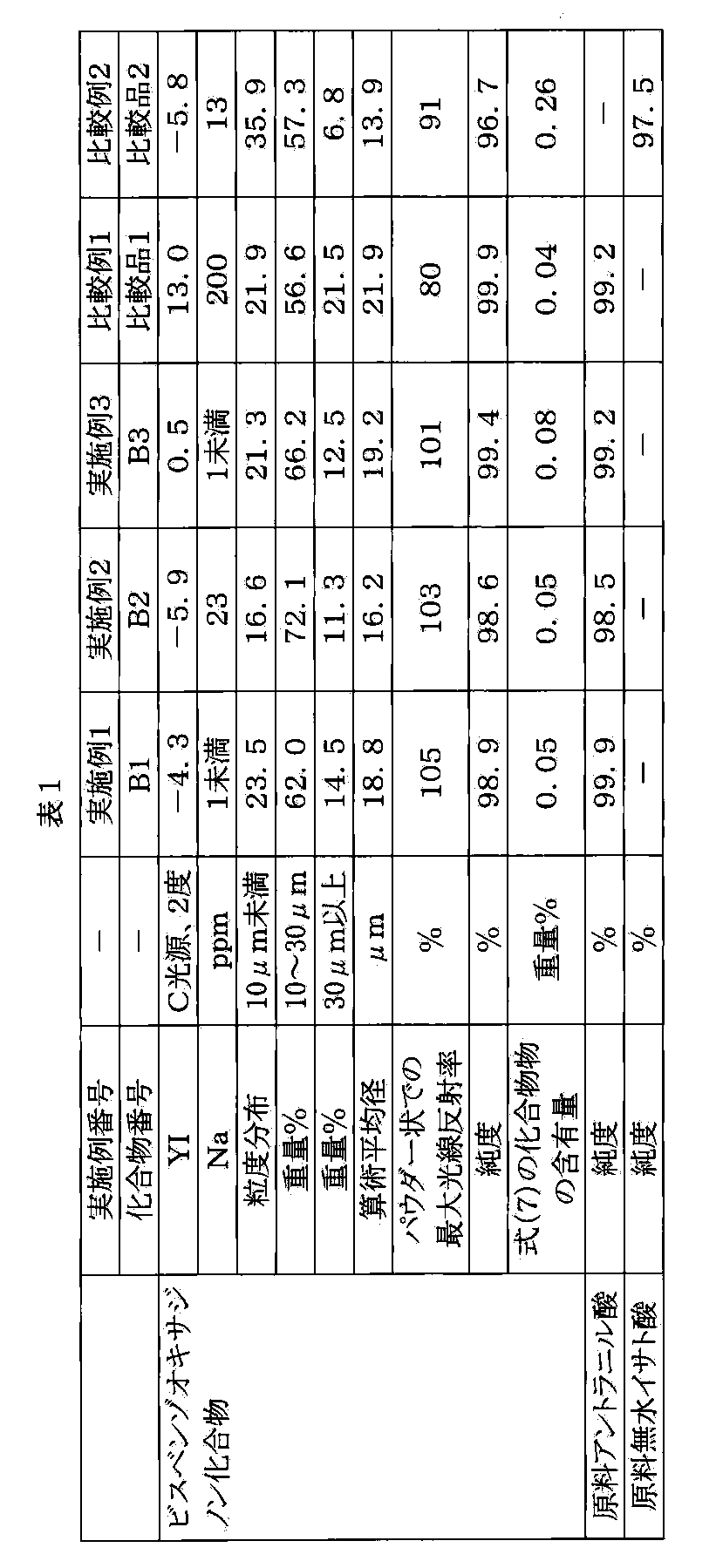
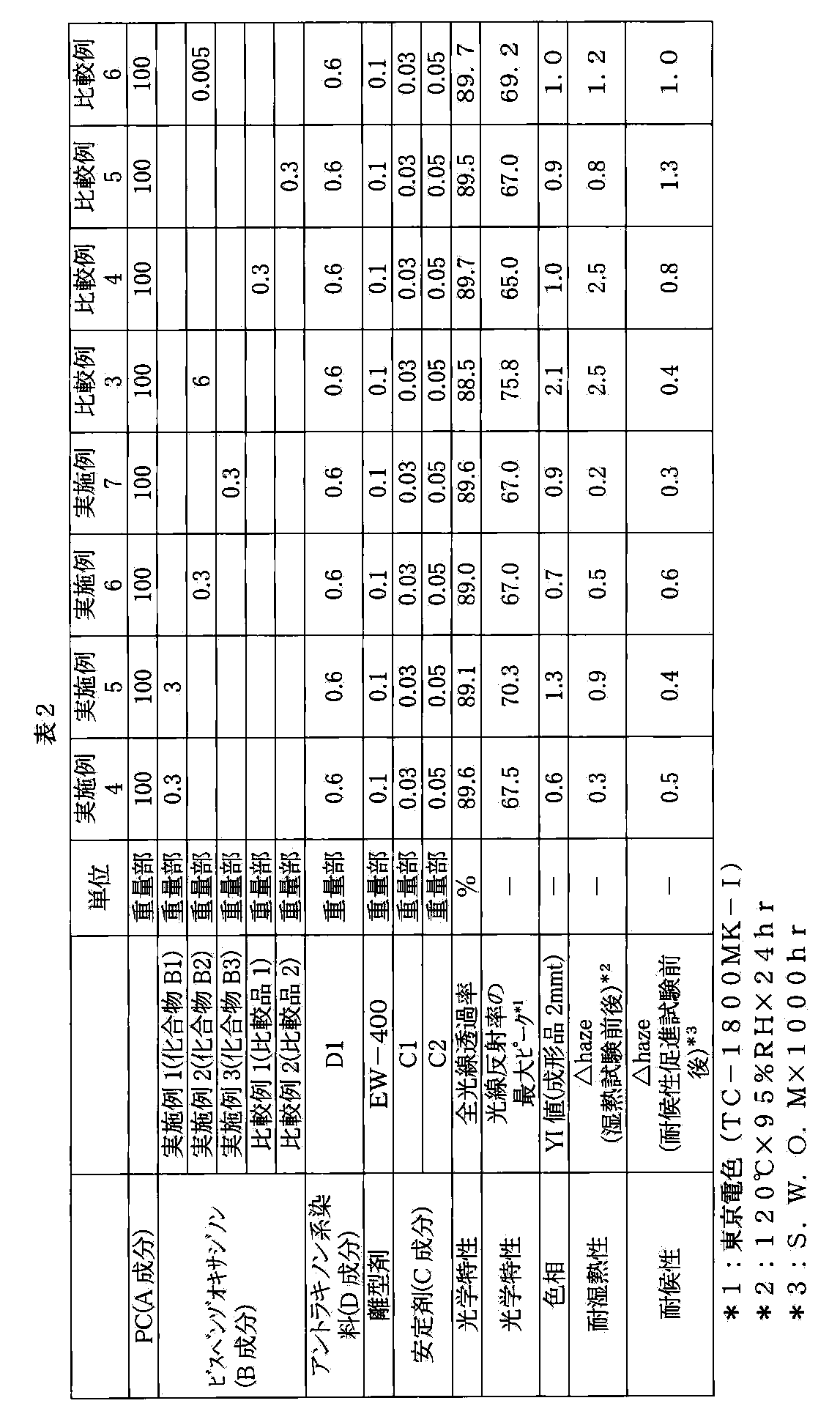
本発明のビスベンゾオキサジノン化合物は、優れた紫外線吸収能を有し、ポリカーボネート樹脂の耐候性を向上させることができる。また本発明のビスベンゾオキサジノン化合物は、純度が高く、ナトリウム金属の含有量が低いので、アルカリ金属によるポリカーボネート樹脂の湿熱下における加水分解を防止することができる。本発明のビスベンゾオキサジノン化合物は、蛍光を発し最大光線反射率が高く、良好なYI値を示すので、ポリカーボネート樹脂の色相を向上させることができる。
本発明の製造方法によれば、上記反応式に示したように、アミド化合物(3)を製造する際に副生するハロゲン化水素の除去に、水酸化ナトリウム、炭酸ナトリウムなどのようなアルカリ金属化合物を使用しないので、得られるビスベンゾオキサジノン化合物はアルカリ金属塩を実質的に含有することなく純度が高い。また本発明の製造方法によれば、高い収率でビスベンゾオキサジノン化合物を製造することができる。本発明の樹脂組成物は、色相、耐湿熱性、耐候性に優れる。
Claims (15)
- 下記式(4)で表され、
(式中、R1およびR2はそれぞれ独立に、水素原子、水酸基、炭素数1~3のアルキル基、炭素数1~3のアルコキシ基、炭素数1~3のアシル基、炭素数1~3のアシルオキシ基、炭素数1~3のアルコキシカルボニル基、ハロゲン原子、ニトロ基、カルボキシル基を表す。)
(i)純度が98%以上であり、
(ii)下記式(7)で表される化合物の含有量が0.15重量%未満であり、
(iii)パウダー状での可視光線領域の光線反射率測定において最大ピークが380~480nmの範囲にあり、かつ最大光線反射率が100~120%であり、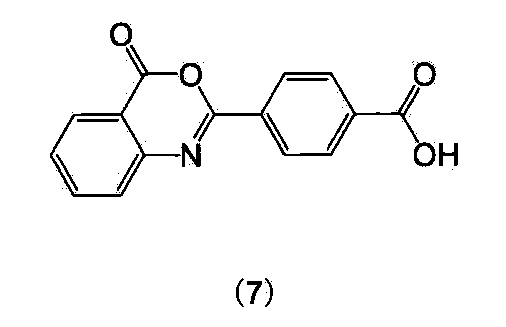
(iv)ナトリウム金属の含有量が50ppm未満であり、
(v)YI値が−10~10、であるビスベンゾオキサジノン化合物。 - 式(4)のR1が水素原子、R2が水素原子である請求項1記載のビスベンゾオキサジノン化合物。
- 下記式(1)で表されるアントラニル酸誘導体と下記式(2)で表される芳香族ジカルボン酸ジハロゲン化物とを、不活性ガス気流下、有機溶媒中で反応させ、下記式(3)で表されるアミド化合物を製造した後、
(式中、R1およびR2はそれぞれ独立に、水素原子、水酸基、炭素数1~3のアルキル基、炭素数1~3のアルコキシ基、炭素数1~3のアシル基、炭素数1~3のアシルオキシ基、炭素数1~3のアルコキシカルボニル基、ハロゲン原子、ニトロ基、カルボキシル基を表す。Xはハロゲン原子を表す。)
得られた式(3)で表されるアミド化合物を脱水剤と反応させることからなる請求項1記載のビスベンゾオキサジノン化合物の製造方法。 - 有機溶媒は、ケトン類、芳香族炭化水素類、ハロゲン化炭化水素類およびエーテル類からなる群より選ばれる少なくとも一種である請求項3記載の製造方法。
- 不活性ガスが窒素である請求項4記載の製造方法。
- 脱水剤が無水酢酸である請求項4記載の製造方法。
- 式(1)~式(4)の、R1が、水素原子、R2が水素原子、Xが塩素原子である請求項4記載の製造方法。
- 芳香族ポリカーボネート(A成分)100重量部および請求項1の化合物(B成分)0.01~5重量部を含有する樹脂組成物。
- さらにリン系安定剤(C1成分)およびヒンダードフェノール系安定剤(C2成分)から選ばれる少なくとも1種の安定剤(C成分)を含有する請求項8記載の樹脂組成物。
- 厚さ2mmの成形板にしたときの全光線透過率が70%以上である請求項8記載の樹脂組成物。
- 厚さ2mmの成形板にしたときの湿熱試験前後のΔHazeが2.0以下である請求項8記載の樹脂組成物。
- 厚さ2mmの成形板の耐候促進試験前後のΔHazeが1.0以下である請求項8記載の樹脂組成物。
- 厚さ2mmの成形板に白色標準板を重ねて測定した380~480nmの範囲の光線反射率の最大ピークが60~80%である請求項8記載の樹脂組成物。
- 請求項8~13のいずれか1項に記載の樹脂組成物からなる成形品。
- 車両用透明部材である請求項14に記載の成形品。
Priority Applications (7)
| Application Number | Priority Date | Filing Date | Title |
|---|---|---|---|
| EP16161415.1A EP3056488A1 (en) | 2009-11-26 | 2009-11-26 | Bisbenzoxazinone compound |
| EP09851686.7A EP2505585B1 (en) | 2009-11-26 | 2009-11-26 | Bis-benzoxazinone compound |
| CN200980162588.8A CN102725275B (zh) | 2009-11-26 | 2009-11-26 | 双苯并噁嗪酮化合物 |
| KR1020127013406A KR20120112411A (ko) | 2009-11-26 | 2009-11-26 | 비스벤조옥사지논 화합물 |
| JP2011543069A JP5749177B2 (ja) | 2009-11-26 | 2009-11-26 | ビスベンゾオキサジノン化合物を含有する樹脂組成物 |
| US13/512,077 US20120252941A1 (en) | 2009-11-26 | 2009-11-26 | Bisbenzoxazinone compound |
| PCT/JP2009/070267 WO2011064897A1 (ja) | 2009-11-26 | 2009-11-26 | ビスベンゾオキサジノン化合物 |
Applications Claiming Priority (1)
| Application Number | Priority Date | Filing Date | Title |
|---|---|---|---|
| PCT/JP2009/070267 WO2011064897A1 (ja) | 2009-11-26 | 2009-11-26 | ビスベンゾオキサジノン化合物 |
Publications (1)
| Publication Number | Publication Date |
|---|---|
| WO2011064897A1 true WO2011064897A1 (ja) | 2011-06-03 |
Family
ID=44066016
Family Applications (1)
| Application Number | Title | Priority Date | Filing Date |
|---|---|---|---|
| PCT/JP2009/070267 Ceased WO2011064897A1 (ja) | 2009-11-26 | 2009-11-26 | ビスベンゾオキサジノン化合物 |
Country Status (6)
| Country | Link |
|---|---|
| US (1) | US20120252941A1 (ja) |
| EP (2) | EP3056488A1 (ja) |
| JP (1) | JP5749177B2 (ja) |
| KR (1) | KR20120112411A (ja) |
| CN (1) | CN102725275B (ja) |
| WO (1) | WO2011064897A1 (ja) |
Cited By (4)
| Publication number | Priority date | Publication date | Assignee | Title |
|---|---|---|---|---|
| WO2014171540A1 (ja) * | 2013-04-19 | 2014-10-23 | 出光興産株式会社 | ポリカーボネート系樹脂組成物及び成形体 |
| JP2016028168A (ja) * | 2015-11-10 | 2016-02-25 | 出光興産株式会社 | ポリカーボネート系樹脂組成物及び成形体 |
| JP2016507607A (ja) * | 2012-12-20 | 2016-03-10 | バイエル・マテリアルサイエンス・アクチェンゲゼルシャフトBayer MaterialScience AG | 有機着色剤および良好な加工特性を有する着色ポリマー組成物 |
| WO2021172472A1 (ja) * | 2020-02-27 | 2021-09-02 | 出光興産株式会社 | ポリカーボネート樹脂組成物及び成形体 |
Families Citing this family (5)
| Publication number | Priority date | Publication date | Assignee | Title |
|---|---|---|---|---|
| CN103947306B (zh) * | 2011-11-22 | 2017-06-23 | 松下知识产权经营株式会社 | 包覆金属的柔性基材及其制备方法 |
| CN103641789B (zh) * | 2013-12-03 | 2015-12-02 | 沈阳化工大学 | 一种聚合体紫外吸收剂的制备方法 |
| EP3348617B1 (en) * | 2017-01-12 | 2021-01-06 | SABIC Global Technologies B.V. | Method to improve optical properties of stabilized polycarbonate compositions |
| CN107033135B (zh) | 2017-05-26 | 2020-09-11 | 浙江省诸暨合力化学对外贸易有限公司 | 一种制备异噁嗪酮化合物的方法及其应用 |
| CN112939884A (zh) * | 2021-02-26 | 2021-06-11 | 畅的新材料科技(上海)有限公司 | 一种双苯并恶嗪酮类化合物及其制备方法 |
Citations (11)
| Publication number | Priority date | Publication date | Assignee | Title |
|---|---|---|---|---|
| JPS58194854A (ja) | 1982-05-10 | 1983-11-12 | Teijin Ltd | ビスアントラニル酸誘導体の製造法 |
| JPS61291575A (ja) | 1985-06-20 | 1986-12-22 | Nisso Yuka Kogyo Kk | ベンゾオキサジン類の製造法 |
| JPH07330783A (ja) * | 1994-06-08 | 1995-12-19 | Nippon Oil & Fats Co Ltd | リン酸エステル誘導体の製造方法 |
| WO2003035735A1 (en) | 2001-10-22 | 2003-05-01 | Cytec Technology Corp. | Low color, low sodium benzoxazinone uv absorbers and process for making same |
| JP2003155468A (ja) | 2001-11-20 | 2003-05-30 | Takemoto Oil & Fat Co Ltd | 熱可塑性高分子用紫外線吸収剤の製造方法及び熱可塑性高分子用紫外線吸収剤 |
| WO2003095557A1 (en) * | 2002-05-08 | 2003-11-20 | Teijin Chemicals, Ltd. | Polycarbonate resin composition, pellet thereof, and molded article thereof |
| JP2004526707A (ja) * | 2001-02-09 | 2004-09-02 | シーメンス アクチエンゲゼルシヤフト | 非晶質の有機1,3,2−ジオキサボリン発光体、その製造方法およびその使用 |
| JP2006124600A (ja) * | 2004-11-01 | 2006-05-18 | Teijin Chem Ltd | 光高反射性ポリカーボネート樹脂組成物およびその製造方法 |
| WO2009041715A1 (en) * | 2007-09-27 | 2009-04-02 | Fujifilm Corporation | Method of producing benzoxazinone-based compound |
| WO2009123147A1 (ja) * | 2008-03-31 | 2009-10-08 | 富士フイルム株式会社 | 紫外線吸収剤およびその製造方法 |
| JP2009286717A (ja) * | 2008-05-28 | 2009-12-10 | Kinkai Kagaku Kk | ビスベンゾオキサジノン化合物の製造方法 |
Family Cites Families (5)
| Publication number | Priority date | Publication date | Assignee | Title |
|---|---|---|---|---|
| DE4140303A1 (de) * | 1991-12-06 | 1993-06-09 | Basf Ag, 6700 Ludwigshafen, De | Verfahren zur herstellung von 4h-3,1-benzoxazin-4-onen |
| JP2000264879A (ja) * | 1999-03-18 | 2000-09-26 | Nippon Paper Industries Co Ltd | ビスベンゾオキサジノン化合物の製造方法 |
| KR100583387B1 (ko) * | 2001-11-20 | 2006-05-25 | 다케모토 유시 가부시키 가이샤 | 열가소성 고분자용 자외선 흡수제 및 그의 제조방법 |
| JP2003155374A (ja) * | 2001-11-20 | 2003-05-27 | Takemoto Oil & Fat Co Ltd | 熱可塑性高分子用紫外線吸収剤 |
| US7148313B2 (en) * | 2004-03-26 | 2006-12-12 | Teijin Chemicals, Ltd. | Polycarbonate resin composition and molded articles thereof |
-
2009
- 2009-11-26 JP JP2011543069A patent/JP5749177B2/ja not_active Expired - Fee Related
- 2009-11-26 CN CN200980162588.8A patent/CN102725275B/zh not_active Expired - Fee Related
- 2009-11-26 EP EP16161415.1A patent/EP3056488A1/en not_active Withdrawn
- 2009-11-26 EP EP09851686.7A patent/EP2505585B1/en not_active Not-in-force
- 2009-11-26 WO PCT/JP2009/070267 patent/WO2011064897A1/ja not_active Ceased
- 2009-11-26 KR KR1020127013406A patent/KR20120112411A/ko not_active Ceased
- 2009-11-26 US US13/512,077 patent/US20120252941A1/en not_active Abandoned
Patent Citations (12)
| Publication number | Priority date | Publication date | Assignee | Title |
|---|---|---|---|---|
| JPS58194854A (ja) | 1982-05-10 | 1983-11-12 | Teijin Ltd | ビスアントラニル酸誘導体の製造法 |
| JPS61291575A (ja) | 1985-06-20 | 1986-12-22 | Nisso Yuka Kogyo Kk | ベンゾオキサジン類の製造法 |
| JPH07330783A (ja) * | 1994-06-08 | 1995-12-19 | Nippon Oil & Fats Co Ltd | リン酸エステル誘導体の製造方法 |
| JP2004526707A (ja) * | 2001-02-09 | 2004-09-02 | シーメンス アクチエンゲゼルシヤフト | 非晶質の有機1,3,2−ジオキサボリン発光体、その製造方法およびその使用 |
| WO2003035735A1 (en) | 2001-10-22 | 2003-05-01 | Cytec Technology Corp. | Low color, low sodium benzoxazinone uv absorbers and process for making same |
| JP2005507006A (ja) * | 2001-10-22 | 2005-03-10 | サイテク・テクノロジー・コーポレーシヨン | 低い色彩、低いナトリウムベンズオキサジノンのuv吸収剤およびそれらの製法 |
| JP2003155468A (ja) | 2001-11-20 | 2003-05-30 | Takemoto Oil & Fat Co Ltd | 熱可塑性高分子用紫外線吸収剤の製造方法及び熱可塑性高分子用紫外線吸収剤 |
| WO2003095557A1 (en) * | 2002-05-08 | 2003-11-20 | Teijin Chemicals, Ltd. | Polycarbonate resin composition, pellet thereof, and molded article thereof |
| JP2006124600A (ja) * | 2004-11-01 | 2006-05-18 | Teijin Chem Ltd | 光高反射性ポリカーボネート樹脂組成物およびその製造方法 |
| WO2009041715A1 (en) * | 2007-09-27 | 2009-04-02 | Fujifilm Corporation | Method of producing benzoxazinone-based compound |
| WO2009123147A1 (ja) * | 2008-03-31 | 2009-10-08 | 富士フイルム株式会社 | 紫外線吸収剤およびその製造方法 |
| JP2009286717A (ja) * | 2008-05-28 | 2009-12-10 | Kinkai Kagaku Kk | ビスベンゾオキサジノン化合物の製造方法 |
Non-Patent Citations (1)
| Title |
|---|
| See also references of EP2505585A4 * |
Cited By (9)
| Publication number | Priority date | Publication date | Assignee | Title |
|---|---|---|---|---|
| JP2016507607A (ja) * | 2012-12-20 | 2016-03-10 | バイエル・マテリアルサイエンス・アクチェンゲゼルシャフトBayer MaterialScience AG | 有機着色剤および良好な加工特性を有する着色ポリマー組成物 |
| WO2014171540A1 (ja) * | 2013-04-19 | 2014-10-23 | 出光興産株式会社 | ポリカーボネート系樹脂組成物及び成形体 |
| JP2014210872A (ja) * | 2013-04-19 | 2014-11-13 | 出光興産株式会社 | ポリカーボネート系樹脂組成物及び成形体 |
| US10072134B2 (en) | 2013-04-19 | 2018-09-11 | Idemitsu Kosan Co., Ltd. | Polycarbonate-type resin composition and molded article |
| JP2016028168A (ja) * | 2015-11-10 | 2016-02-25 | 出光興産株式会社 | ポリカーボネート系樹脂組成物及び成形体 |
| WO2021172472A1 (ja) * | 2020-02-27 | 2021-09-02 | 出光興産株式会社 | ポリカーボネート樹脂組成物及び成形体 |
| JP2021134286A (ja) * | 2020-02-27 | 2021-09-13 | 出光興産株式会社 | ポリカーボネート樹脂組成物及び成形体 |
| JP7539776B2 (ja) | 2020-02-27 | 2024-08-26 | 出光興産株式会社 | ポリカーボネート樹脂組成物及び成形体 |
| US12570837B2 (en) | 2020-02-27 | 2026-03-10 | Idemitsu Kosan Co., Ltd. | Polycarbonate resin composition and molded article |
Also Published As
| Publication number | Publication date |
|---|---|
| US20120252941A1 (en) | 2012-10-04 |
| EP2505585B1 (en) | 2016-08-03 |
| JP5749177B2 (ja) | 2015-07-15 |
| JPWO2011064897A1 (ja) | 2013-04-11 |
| EP2505585A1 (en) | 2012-10-03 |
| CN102725275A (zh) | 2012-10-10 |
| CN102725275B (zh) | 2015-06-10 |
| KR20120112411A (ko) | 2012-10-11 |
| EP3056488A1 (en) | 2016-08-17 |
| EP2505585A4 (en) | 2012-10-24 |
Similar Documents
| Publication | Publication Date | Title |
|---|---|---|
| JP5749177B2 (ja) | ビスベンゾオキサジノン化合物を含有する樹脂組成物 | |
| JP5542810B2 (ja) | ポリカーボネート樹脂組成物およびその成形品 | |
| JP6328985B2 (ja) | ポリカーボネート樹脂組成物 | |
| JP4243512B2 (ja) | ポリカーボネート樹脂組成物、そのペレットおよびその成形品 | |
| TW201739835A (zh) | 樹脂組成物及使用其之薄膜以及載體帶 | |
| JP5584001B2 (ja) | ポリカーボネート樹脂組成物およびその成形品 | |
| JP4520124B2 (ja) | ポリカーボネート樹脂組成物及びその成形品 | |
| JP6729559B2 (ja) | 車載用射出成形体並びにそれを用いた自動車ライトガイド、自動車内装パネル及び自動車ランプレンズ | |
| JP4938212B2 (ja) | 熱可塑性樹脂組成物およびその成形品 | |
| JP2004027104A (ja) | ポリカーボネート樹脂組成物及びその成形品 | |
| JP4005408B2 (ja) | ポリカーボネート樹脂組成物及びその成形品 | |
| JP2015034191A (ja) | 透明難燃性熱可塑性樹脂組成物およびその成形品 | |
| JP4046159B2 (ja) | ポリカーボネート樹脂組成物及びその成形品 | |
| JP4046160B2 (ja) | ポリカーボネート樹脂組成物及びその成形品 | |
| JP4820972B2 (ja) | ポリカーボネート樹脂の回転成形方法 | |
| WO2023145197A1 (ja) | 芳香族ポリカーボネート樹脂組成物及びその成形品 | |
| WO2024062815A1 (ja) | 芳香族ポリカーボネート樹脂組成物及びその成形品 | |
| JP4511877B2 (ja) | ポリカーボネート樹脂組成物およびその成形品 | |
| TWI460165B (zh) | Dibenzo Ketone compounds | |
| JP2006028442A (ja) | ポリカーボネート樹脂シートまたはフィルム | |
| WO2016158844A1 (ja) | 導光板用成形体 | |
| JP2005325319A (ja) | ポリカーボネート樹脂組成物 |
Legal Events
| Date | Code | Title | Description |
|---|---|---|---|
| WWE | Wipo information: entry into national phase |
Ref document number: 200980162588.8 Country of ref document: CN |
|
| 121 | Ep: the epo has been informed by wipo that ep was designated in this application |
Ref document number: 09851686 Country of ref document: EP Kind code of ref document: A1 |
|
| WWE | Wipo information: entry into national phase |
Ref document number: 2011543069 Country of ref document: JP |
|
| ENP | Entry into the national phase |
Ref document number: 20127013406 Country of ref document: KR Kind code of ref document: A |
|
| REEP | Request for entry into the european phase |
Ref document number: 2009851686 Country of ref document: EP |
|
| WWE | Wipo information: entry into national phase |
Ref document number: 13512077 Country of ref document: US Ref document number: 4611/CHENP/2012 Country of ref document: IN Ref document number: 2009851686 Country of ref document: EP |
|
| NENP | Non-entry into the national phase |
Ref country code: DE |