WO2011089709A1 - 粘稠な組成物 - Google Patents
粘稠な組成物 Download PDFInfo
- Publication number
- WO2011089709A1 WO2011089709A1 PCT/JP2010/050800 JP2010050800W WO2011089709A1 WO 2011089709 A1 WO2011089709 A1 WO 2011089709A1 JP 2010050800 W JP2010050800 W JP 2010050800W WO 2011089709 A1 WO2011089709 A1 WO 2011089709A1
- Authority
- WO
- WIPO (PCT)
- Prior art keywords
- cellulose
- component
- composition
- fiber diameter
- fiber
- Prior art date
- Legal status (The legal status is an assumption and is not a legal conclusion. Google has not performed a legal analysis and makes no representation as to the accuracy of the status listed.)
- Ceased
Links
Classifications
-
- A—HUMAN NECESSITIES
- A61—MEDICAL OR VETERINARY SCIENCE; HYGIENE
- A61K—PREPARATIONS FOR MEDICAL, DENTAL OR TOILETRY PURPOSES
- A61K8/00—Cosmetics or similar toiletry preparations
- A61K8/18—Cosmetics or similar toiletry preparations characterised by the composition
- A61K8/72—Cosmetics or similar toiletry preparations characterised by the composition containing organic macromolecular compounds
- A61K8/73—Polysaccharides
- A61K8/731—Cellulose; Quaternized cellulose derivatives
-
- A—HUMAN NECESSITIES
- A61—MEDICAL OR VETERINARY SCIENCE; HYGIENE
- A61K—PREPARATIONS FOR MEDICAL, DENTAL OR TOILETRY PURPOSES
- A61K8/00—Cosmetics or similar toiletry preparations
- A61K8/18—Cosmetics or similar toiletry preparations characterised by the composition
- A61K8/72—Cosmetics or similar toiletry preparations characterised by the composition containing organic macromolecular compounds
- A61K8/73—Polysaccharides
-
- A—HUMAN NECESSITIES
- A01—AGRICULTURE; FORESTRY; ANIMAL HUSBANDRY; HUNTING; TRAPPING; FISHING
- A01N—PRESERVATION OF BODIES OF HUMANS OR ANIMALS OR PLANTS OR PARTS THEREOF; BIOCIDES, e.g. AS DISINFECTANTS, AS PESTICIDES OR AS HERBICIDES; PEST REPELLANTS OR ATTRACTANTS; PLANT GROWTH REGULATORS
- A01N25/00—Biocides, pest repellants or attractants, or plant growth regulators, characterised by their forms, or by their non-active ingredients or by their methods of application, e.g. seed treatment or sequential application; Substances for reducing the noxious effect of the active ingredients to organisms other than pests
- A01N25/02—Biocides, pest repellants or attractants, or plant growth regulators, characterised by their forms, or by their non-active ingredients or by their methods of application, e.g. seed treatment or sequential application; Substances for reducing the noxious effect of the active ingredients to organisms other than pests containing liquids as carriers, diluents or solvents
- A01N25/04—Dispersions, emulsions, suspoemulsions, suspension concentrates or gels
-
- A—HUMAN NECESSITIES
- A01—AGRICULTURE; FORESTRY; ANIMAL HUSBANDRY; HUNTING; TRAPPING; FISHING
- A01N—PRESERVATION OF BODIES OF HUMANS OR ANIMALS OR PLANTS OR PARTS THEREOF; BIOCIDES, e.g. AS DISINFECTANTS, AS PESTICIDES OR AS HERBICIDES; PEST REPELLANTS OR ATTRACTANTS; PLANT GROWTH REGULATORS
- A01N37/00—Biocides, pest repellants or attractants, or plant growth regulators containing organic compounds containing a carbon atom having three bonds to hetero atoms with at the most two bonds to halogen, e.g. carboxylic acids
- A01N37/36—Biocides, pest repellants or attractants, or plant growth regulators containing organic compounds containing a carbon atom having three bonds to hetero atoms with at the most two bonds to halogen, e.g. carboxylic acids containing at least one carboxylic group or a thio analogue, or a derivative thereof, and a singly bound oxygen or sulfur atom attached to the same carbon skeleton, this oxygen or sulfur atom not being a member of a carboxylic group or of a thio analogue, or of a derivative thereof, e.g. hydroxy-carboxylic acids
- A01N37/38—Biocides, pest repellants or attractants, or plant growth regulators containing organic compounds containing a carbon atom having three bonds to hetero atoms with at the most two bonds to halogen, e.g. carboxylic acids containing at least one carboxylic group or a thio analogue, or a derivative thereof, and a singly bound oxygen or sulfur atom attached to the same carbon skeleton, this oxygen or sulfur atom not being a member of a carboxylic group or of a thio analogue, or of a derivative thereof, e.g. hydroxy-carboxylic acids having at least one oxygen or sulfur atom attached to an aromatic ring system
- A01N37/40—Biocides, pest repellants or attractants, or plant growth regulators containing organic compounds containing a carbon atom having three bonds to hetero atoms with at the most two bonds to halogen, e.g. carboxylic acids containing at least one carboxylic group or a thio analogue, or a derivative thereof, and a singly bound oxygen or sulfur atom attached to the same carbon skeleton, this oxygen or sulfur atom not being a member of a carboxylic group or of a thio analogue, or of a derivative thereof, e.g. hydroxy-carboxylic acids having at least one oxygen or sulfur atom attached to an aromatic ring system having at least one carboxylic group or a thio analogue, or a derivative thereof, and one oxygen or sulfur atom attached to the same aromatic ring system
-
- A—HUMAN NECESSITIES
- A61—MEDICAL OR VETERINARY SCIENCE; HYGIENE
- A61K—PREPARATIONS FOR MEDICAL, DENTAL OR TOILETRY PURPOSES
- A61K47/00—Medicinal preparations characterised by the non-active ingredients used, e.g. carriers or inert additives; Targeting or modifying agents chemically bound to the active ingredient
- A61K47/30—Macromolecular organic or inorganic compounds, e.g. inorganic polyphosphates
- A61K47/36—Polysaccharides; Derivatives thereof, e.g. gums, starch, alginate, dextrin, hyaluronic acid, chitosan, inulin, agar or pectin
- A61K47/38—Cellulose; Derivatives thereof
-
- A—HUMAN NECESSITIES
- A61—MEDICAL OR VETERINARY SCIENCE; HYGIENE
- A61K—PREPARATIONS FOR MEDICAL, DENTAL OR TOILETRY PURPOSES
- A61K8/00—Cosmetics or similar toiletry preparations
- A61K8/02—Cosmetics or similar toiletry preparations characterised by special physical form
-
- A—HUMAN NECESSITIES
- A61—MEDICAL OR VETERINARY SCIENCE; HYGIENE
- A61K—PREPARATIONS FOR MEDICAL, DENTAL OR TOILETRY PURPOSES
- A61K8/00—Cosmetics or similar toiletry preparations
- A61K8/02—Cosmetics or similar toiletry preparations characterised by special physical form
- A61K8/0241—Containing particulates characterized by their shape and/or structure
- A61K8/027—Fibers; Fibrils
-
- A—HUMAN NECESSITIES
- A61—MEDICAL OR VETERINARY SCIENCE; HYGIENE
- A61K—PREPARATIONS FOR MEDICAL, DENTAL OR TOILETRY PURPOSES
- A61K8/00—Cosmetics or similar toiletry preparations
- A61K8/02—Cosmetics or similar toiletry preparations characterised by special physical form
- A61K8/04—Dispersions; Emulsions
- A61K8/042—Gels
-
- A—HUMAN NECESSITIES
- A61—MEDICAL OR VETERINARY SCIENCE; HYGIENE
- A61K—PREPARATIONS FOR MEDICAL, DENTAL OR TOILETRY PURPOSES
- A61K8/00—Cosmetics or similar toiletry preparations
- A61K8/02—Cosmetics or similar toiletry preparations characterised by special physical form
- A61K8/04—Dispersions; Emulsions
- A61K8/046—Aerosols; Foams
-
- A—HUMAN NECESSITIES
- A61—MEDICAL OR VETERINARY SCIENCE; HYGIENE
- A61K—PREPARATIONS FOR MEDICAL, DENTAL OR TOILETRY PURPOSES
- A61K8/00—Cosmetics or similar toiletry preparations
- A61K8/18—Cosmetics or similar toiletry preparations characterised by the composition
- A61K8/19—Cosmetics or similar toiletry preparations characterised by the composition containing inorganic ingredients
-
- A—HUMAN NECESSITIES
- A61—MEDICAL OR VETERINARY SCIENCE; HYGIENE
- A61K—PREPARATIONS FOR MEDICAL, DENTAL OR TOILETRY PURPOSES
- A61K8/00—Cosmetics or similar toiletry preparations
- A61K8/18—Cosmetics or similar toiletry preparations characterised by the composition
- A61K8/19—Cosmetics or similar toiletry preparations characterised by the composition containing inorganic ingredients
- A61K8/29—Titanium; Compounds thereof
-
- A—HUMAN NECESSITIES
- A61—MEDICAL OR VETERINARY SCIENCE; HYGIENE
- A61K—PREPARATIONS FOR MEDICAL, DENTAL OR TOILETRY PURPOSES
- A61K8/00—Cosmetics or similar toiletry preparations
- A61K8/18—Cosmetics or similar toiletry preparations characterised by the composition
- A61K8/30—Cosmetics or similar toiletry preparations characterised by the composition containing organic compounds
- A61K8/31—Hydrocarbons
-
- A—HUMAN NECESSITIES
- A61—MEDICAL OR VETERINARY SCIENCE; HYGIENE
- A61K—PREPARATIONS FOR MEDICAL, DENTAL OR TOILETRY PURPOSES
- A61K8/00—Cosmetics or similar toiletry preparations
- A61K8/18—Cosmetics or similar toiletry preparations characterised by the composition
- A61K8/30—Cosmetics or similar toiletry preparations characterised by the composition containing organic compounds
- A61K8/33—Cosmetics or similar toiletry preparations characterised by the composition containing organic compounds containing oxygen
- A61K8/34—Alcohols
-
- A—HUMAN NECESSITIES
- A61—MEDICAL OR VETERINARY SCIENCE; HYGIENE
- A61K—PREPARATIONS FOR MEDICAL, DENTAL OR TOILETRY PURPOSES
- A61K8/00—Cosmetics or similar toiletry preparations
- A61K8/18—Cosmetics or similar toiletry preparations characterised by the composition
- A61K8/30—Cosmetics or similar toiletry preparations characterised by the composition containing organic compounds
- A61K8/33—Cosmetics or similar toiletry preparations characterised by the composition containing organic compounds containing oxygen
- A61K8/34—Alcohols
- A61K8/345—Alcohols containing more than one hydroxy group
-
- A—HUMAN NECESSITIES
- A61—MEDICAL OR VETERINARY SCIENCE; HYGIENE
- A61K—PREPARATIONS FOR MEDICAL, DENTAL OR TOILETRY PURPOSES
- A61K8/00—Cosmetics or similar toiletry preparations
- A61K8/18—Cosmetics or similar toiletry preparations characterised by the composition
- A61K8/30—Cosmetics or similar toiletry preparations characterised by the composition containing organic compounds
- A61K8/33—Cosmetics or similar toiletry preparations characterised by the composition containing organic compounds containing oxygen
- A61K8/37—Esters of carboxylic acids
-
- A—HUMAN NECESSITIES
- A61—MEDICAL OR VETERINARY SCIENCE; HYGIENE
- A61K—PREPARATIONS FOR MEDICAL, DENTAL OR TOILETRY PURPOSES
- A61K8/00—Cosmetics or similar toiletry preparations
- A61K8/18—Cosmetics or similar toiletry preparations characterised by the composition
- A61K8/72—Cosmetics or similar toiletry preparations characterised by the composition containing organic macromolecular compounds
- A61K8/84—Cosmetics or similar toiletry preparations characterised by the composition containing organic macromolecular compounds obtained by reactions otherwise than those involving only carbon-carbon unsaturated bonds
- A61K8/86—Polyethers
-
- A—HUMAN NECESSITIES
- A61—MEDICAL OR VETERINARY SCIENCE; HYGIENE
- A61K—PREPARATIONS FOR MEDICAL, DENTAL OR TOILETRY PURPOSES
- A61K8/00—Cosmetics or similar toiletry preparations
- A61K8/18—Cosmetics or similar toiletry preparations characterised by the composition
- A61K8/72—Cosmetics or similar toiletry preparations characterised by the composition containing organic macromolecular compounds
- A61K8/84—Cosmetics or similar toiletry preparations characterised by the composition containing organic macromolecular compounds obtained by reactions otherwise than those involving only carbon-carbon unsaturated bonds
- A61K8/89—Polysiloxanes
- A61K8/891—Polysiloxanes saturated, e.g. dimethicone, phenyl trimethicone, C24-C28 methicone or stearyl dimethicone
-
- A—HUMAN NECESSITIES
- A61—MEDICAL OR VETERINARY SCIENCE; HYGIENE
- A61K—PREPARATIONS FOR MEDICAL, DENTAL OR TOILETRY PURPOSES
- A61K8/00—Cosmetics or similar toiletry preparations
- A61K8/18—Cosmetics or similar toiletry preparations characterised by the composition
- A61K8/92—Oils, fats or waxes; Derivatives thereof, e.g. hydrogenation products thereof
-
- A—HUMAN NECESSITIES
- A61—MEDICAL OR VETERINARY SCIENCE; HYGIENE
- A61K—PREPARATIONS FOR MEDICAL, DENTAL OR TOILETRY PURPOSES
- A61K8/00—Cosmetics or similar toiletry preparations
- A61K8/18—Cosmetics or similar toiletry preparations characterised by the composition
- A61K8/92—Oils, fats or waxes; Derivatives thereof, e.g. hydrogenation products thereof
- A61K8/922—Oils, fats or waxes; Derivatives thereof, e.g. hydrogenation products thereof of vegetable origin
-
- A—HUMAN NECESSITIES
- A61—MEDICAL OR VETERINARY SCIENCE; HYGIENE
- A61Q—SPECIFIC USE OF COSMETICS OR SIMILAR TOILETRY PREPARATIONS
- A61Q13/00—Formulations or additives for perfume preparations
-
- A—HUMAN NECESSITIES
- A61—MEDICAL OR VETERINARY SCIENCE; HYGIENE
- A61Q—SPECIFIC USE OF COSMETICS OR SIMILAR TOILETRY PREPARATIONS
- A61Q15/00—Anti-perspirants or body deodorants
-
- A—HUMAN NECESSITIES
- A61—MEDICAL OR VETERINARY SCIENCE; HYGIENE
- A61Q—SPECIFIC USE OF COSMETICS OR SIMILAR TOILETRY PREPARATIONS
- A61Q19/00—Preparations for care of the skin
-
- A—HUMAN NECESSITIES
- A61—MEDICAL OR VETERINARY SCIENCE; HYGIENE
- A61Q—SPECIFIC USE OF COSMETICS OR SIMILAR TOILETRY PREPARATIONS
- A61Q19/00—Preparations for care of the skin
- A61Q19/007—Preparations for dry skin
-
- C—CHEMISTRY; METALLURGY
- C08—ORGANIC MACROMOLECULAR COMPOUNDS; THEIR PREPARATION OR CHEMICAL WORKING-UP; COMPOSITIONS BASED THEREON
- C08B—POLYSACCHARIDES; DERIVATIVES THEREOF
- C08B15/00—Preparation of other cellulose derivatives or modified cellulose, e.g. complexes
- C08B15/02—Oxycellulose; Hydrocellulose; Cellulosehydrate, e.g. microcrystalline cellulose
-
- A—HUMAN NECESSITIES
- A61—MEDICAL OR VETERINARY SCIENCE; HYGIENE
- A61K—PREPARATIONS FOR MEDICAL, DENTAL OR TOILETRY PURPOSES
- A61K2800/00—Properties of cosmetic compositions or active ingredients thereof or formulation aids used therein and process related aspects
- A61K2800/10—General cosmetic use
-
- A—HUMAN NECESSITIES
- A61—MEDICAL OR VETERINARY SCIENCE; HYGIENE
- A61K—PREPARATIONS FOR MEDICAL, DENTAL OR TOILETRY PURPOSES
- A61K2800/00—Properties of cosmetic compositions or active ingredients thereof or formulation aids used therein and process related aspects
- A61K2800/40—Chemical, physico-chemical or functional or structural properties of particular ingredients
- A61K2800/41—Particular ingredients further characterized by their size
- A61K2800/413—Nanosized, i.e. having sizes below 100 nm
-
- A—HUMAN NECESSITIES
- A61—MEDICAL OR VETERINARY SCIENCE; HYGIENE
- A61K—PREPARATIONS FOR MEDICAL, DENTAL OR TOILETRY PURPOSES
- A61K2800/00—Properties of cosmetic compositions or active ingredients thereof or formulation aids used therein and process related aspects
- A61K2800/40—Chemical, physico-chemical or functional or structural properties of particular ingredients
- A61K2800/48—Thickener, Thickening system
-
- A—HUMAN NECESSITIES
- A61—MEDICAL OR VETERINARY SCIENCE; HYGIENE
- A61K—PREPARATIONS FOR MEDICAL, DENTAL OR TOILETRY PURPOSES
- A61K2800/00—Properties of cosmetic compositions or active ingredients thereof or formulation aids used therein and process related aspects
- A61K2800/40—Chemical, physico-chemical or functional or structural properties of particular ingredients
- A61K2800/54—Polymers characterized by specific structures/properties
-
- A—HUMAN NECESSITIES
- A61—MEDICAL OR VETERINARY SCIENCE; HYGIENE
- A61Q—SPECIFIC USE OF COSMETICS OR SIMILAR TOILETRY PREPARATIONS
- A61Q19/00—Preparations for care of the skin
- A61Q19/10—Washing or bathing preparations
Definitions
- the present invention relates to a viscous composition using cellulose fibers.
- viscous compositions examples include cosmetic compositions used for various cosmetics, and gel-like compositions used for increasing viscosity and gelling. Further, for viscous sprays used for spraying Examples thereof include compositions.
- a composition in which a polymer material or the like is blended with a dispersion medium such as water, alcohol, or oil has been used.
- the polymer material is used for the purpose of imparting a shape retention ability (shape retention) for maintaining thickening and dispersion stability.
- water-soluble cellulose such as methyl cellulose and carboxymethyl cellulose salt
- Synthetic polymers such as derivatives, polyvinyl alcohol, polyvinyl pyrrolidone, carboxyvinyl polymer, polyethylene glycol, and natural polymer polysaccharides such as quince seed, bee gum, xanthan gum, and hyaluronate are used. Since many of these polymer materials are water-soluble, they exhibit stringiness and poor usability, and many have poor salt resistance.
- Patent Document 1 a cosmetic composition using cellulose particles obtained by hydrolysis and physical grinding without regenerating natural cellulose has been proposed.
- Patent Document 1 a cosmetic composition using cellulose particles obtained by hydrolysis and physical grinding without regenerating natural cellulose. This is a composition having a lower fat content than conventional cosmetic compositions, and can achieve creamy or milky properties, but those with large particle sizes are included, so dispersibility is insufficient. This causes a rough feeling.
- Patent Document 2 a method for producing a microfibrous cellulose in which an aqueous suspension of pulp is treated with a high-pressure homogenizer and pulverized to a microfibril level has been proposed.
- the highly dispersed cellulose obtained by this production method needs to be treated using a great deal of energy, and the degree of dispersion is insufficient.
- all of the conventional finely divided cellulose dispersions are white opaque, and there is a problem that they cannot be applied to cosmetics that require transparency.
- Patent Document 3 a cosmetic composition using cellulose finely divided into nano-sizes.
- ionic cellulose such as polyvinyl alcohol, polyvinyl pyrrolidone, sodium polyacrylate, carboxyvinyl polymer, polyethylene glycol, and other synthetic polymers, and water-swelling clay minerals such as smectite have been used.
- Non-Patent Document 1 discloses that the above xanthan gum has a strong spinnability and has a sticky feeling when used in cosmetics and the like.
- Many of these natural polymer compounds, water-soluble celluloses, and synthetic polymers have many problems in the range of use and design properties, such as markedly lowering viscosity due to the coexisting salts, and showing stringiness.
- a nasal gel using a carboxyvinyl polymer as a gelling agent has been proposed, and it has been disclosed that this improves dripping and has effects such as promoting absorption of medicinal ingredients (patent document). 4).
- cellulose particles downsized to several tens of nm have high transparency, and high viscosity, dispersion / emulsion stability, and structural stability can be obtained with a small addition amount (Patent Documents). 5).
- Patent Documents Such a thing described in the patent document is insufficient for solving the above-mentioned problem as will be described later.
- spray products are used in a wide range of products such as hair care products, skin care products, fragrances, cleaning agents, various coating agents, and agricultural chemicals.
- Many spray products are commercialized by filling a spray device with a liquid composition.
- the desired properties of a spray product are that it can be sprayed in a wide range of environmental conditions (temperature, humidity, etc.) using a normal spray container, and the spray droplets have a suitable size for the intended use, and For example, there is no spray unevenness, and it is difficult for dripping to occur when spraying on a vertical surface or an inclined surface.
- Patent Document 6 proposes a gel mist cosmetic using smectite, a clay mineral
- Patent Document 7 discloses a gel spray composition using hectorite, which is also a clay mineral. Things have been proposed. Since these clay minerals have very small particles, they swell and disperse with water and other solvents to form a sol-gel. These dispersions of clay minerals have thixotropic properties, and therefore exhibit a property of liquefying when a pressure (force) above a certain level is applied and gelling immediately when the pressure (force) is removed. By utilizing the properties peculiar to this clay mineral, it becomes possible to spray without causing dripping by combining the spray composition with a spray container.
- Patent Document 8 proposes an aerosol composition in which an aqueous stock solution having a high viscosity is sprayed in a mist form and uniformly adhered without dripping.
- Cellulose thickeners and cross-linked acrylic thickeners are used in this aqueous stock solution, and these thickeners do not exhibit stringiness (stringiness) even at high viscosities. Since it exhibits high thixotropic properties, it can be an excellent gel-like composition for spraying.
- the average degree of polymerization (DP) is 100 or less
- the fraction of the cellulose I-type crystal component is 0.1 or less
- the fraction of the cellulose II-type crystal component is 0.4 or less
- a composition comprising cellulose fine particles having an average particle size of 2 ⁇ m or less and a liquid dispersion medium, wherein the cellulose concentration in the composition is 0.1 to 5.0% by weight, and the composition Maximum viscosity in a viscosity-shear stress curve measured at 25 ° C.
- a composition for a spray agent having a value ( ⁇ max ) of ⁇ max ⁇ 1 ⁇ 10 3 mPa ⁇ s.
- the cellulose fine particles used in this spray composition can be obtained by acid hydrolysis treatment of natural cellulose or regenerated cellulose.
- the composition for spraying using the cellulose particles as described above is transparent in an aqueous medium, the mother droplets are well fixed on the sprayed surface, and uneven spraying is less likely to occur. It has excellent characteristics such as no dripping of liquid. Such a thing described in the patent document is insufficient for solving the above-mentioned problem as will be described later.
- JP-A-5-32519 Japanese Patent Laid-Open No. Sho 56-1000080 JP 2000-26229 A JP 2001-89359 A International Publication No. 99/28350 JP-A-9-241115 JP 2000-51682 A JP 2006-321760 A JP 2003-73229 A
- the thing of the latest patent document 3 uses the sticky feeling at the time of apply
- a large amount of sulfuric acid is required for the production of cellulose fine particles, there are problems in environmental load and workability.
- the salt tolerance of the dispersion of cellulose fine particles is low, there is a problem that the application range is greatly limited.
- Patent Documents 4 and 5 relating to conventional thickeners and gelling agents, those described in Patent Document 4 described above require a pH adjustment with a basic substance at the time of preparation. There are also manufacturing difficulties such as the need for strong agitation in order to uniformly mix and disperse the medicinal ingredients in the substrate.
- the cellulose particles described in Patent Document 5 not only have a reduced viscosity in the presence of electrolytes such as salts and high-concentration ionic surfactants, but the cellulose particles settle to form a dispersion. There were difficulties such as being unable to take.
- Patent Documents 6 to 8 relating to the spray composition
- the spray compositions of Patent Document 6 and Patent Document 7 have an opaque dispersion due to the dispersion of the clay mineral, and the clay mineral has a unique coloring. Therefore, there is a problem that it cannot be used for applications requiring transparency. Moreover, when the sprayed coating film is dried, there is also a problem that powder blowing tends to occur. Further, when alcohol is present in the solvent, there is a problem that clay minerals are aggregated and spray characteristics (spray characteristics) are greatly deteriorated.
- the spray composition of Patent Document 9 is such that when an ionic substance such as an anionic active agent, an inorganic salt, or carboxymethyl cellulose is added, the hydration of cellulose molecules can be achieved even with a small amount of addition. Inhibited and causes aggregation and sedimentation.
- various functional additives such as ionic substances are blended into the spray composition and commercialized.
- the cellulose fine particles described in Patent Document 9 are functional additives that can be blended from the above circumstances. There is a problem that there is a limit.
- the conventionally proposed sprayable gel compositions generally have the following problems (1) and (2).
- the present invention is a viscous composition useful as a cosmetic composition excellent in shape retention performance, dispersion stability, and salt resistance, and also in the coexistence of a salt, an ionic surfactant, and the like.
- a viscous composition useful as a gel composition capable of maintaining high viscosity, and a stable gel shape over time, with no decrease in viscosity even in the presence of functional additives such as electrolytes and ionic substances. It is an object of the present invention to provide a viscous composition useful as a spray composition that can be kept and sprayed.
- the viscous composition of the present invention comprises one component selected from the following components (A), (A ′) and (A ′′) and a component (B).
- This configuration is the first gist.
- (A) Cellulose fibers having a maximum fiber diameter of 1000 nm or less and a number average fiber diameter of 2 to 100 nm, the cellulose having a cellulose I-type crystal structure and a hydroxyl group at the C6 position of a glucose unit in the cellulose molecule Cellulose fibers in which is selectively oxidized and modified to aldehyde groups and carboxyl groups, and the amount of carboxyl groups is 0.6 to 2.2 mmol / g.
- B Water.
- this invention contains (B) and (C) component in addition to the following (A) component, when preparing a cosmetics composition with the viscous composition which is the 1st summary.
- the second gist (A) Cellulose fibers having a maximum fiber diameter of 1000 nm or less and a number average fiber diameter of 2 to 100 nm, the cellulose having a cellulose I-type crystal structure and a hydroxyl group at the C6 position of a glucose unit in the cellulose molecule Cellulose fibers in which is selectively oxidized and modified to aldehyde groups and carboxyl groups, and the amount of carboxyl groups is 0.6 to 2.2 mmol / g.
- B Water.
- C Functional additive.
- the present invention uses the component (B) in addition to the following component (A ′) when the gel composition is prepared from the viscous composition as the first gist. 3)
- a composition in which the content of the component is in the range of 0.3 to 5.0% by weight of the entire gel composition is a third gist.
- (A ′) a cellulose fiber having a maximum fiber diameter of 1000 nm or less and a number average fiber diameter of 2 to 150 nm, the cellulose having a cellulose I-type crystal structure and having a C6 position of a glucose unit in a cellulose molecule.
- Cellulose fibers having hydroxyl groups selectively oxidized and modified to aldehyde groups and carboxyl groups, and having the aldehyde groups of 0.08 to 0.3 mmol / g and the carboxyl groups of 0.6 to 2.0 mmol / g.
- the spray composition when the spray composition is prepared from the viscous composition according to the first aspect of the present invention, it contains (B) component in addition to the following (A ′′) component, and (A ′′) component:
- the cellulose fiber content is 0.1 to 3.0% by weight, and includes 1 ⁇ 10 ⁇ 3 S ⁇ 1 to 1 ⁇ 10 3 S ⁇ 1 as measured by a cone-plate rotary viscometer In the shear rate region, the maximum value ( ⁇ max ) measured at 20 ° C. is ⁇ max ⁇ 1 ⁇ 10 4 mPa ⁇ s, and the minimum value ( ⁇ min ) is ⁇ min ⁇ 1 ⁇ 10 2 mPa ⁇ s.
- a certain configuration is a fourth gist.
- B Water.
- the present inventors have conducted a series of studies in order to find useful cellulose fibers for use in cosmetics, thickeners / gelling agents, sprays, and the like. Among them, first, in order to obtain a cosmetic composition excellent in shape retention performance, dispersion stability and salt resistance, earnest research was repeated. In the course of the research, a cellulose fiber having a maximum fiber diameter of 1000 nm or less and a number average fiber diameter of 2 to 100 nm, the cellulose having a cellulose I-type crystal structure, and C6 of glucose units in the cellulose molecule.
- a fine cellulose fiber (A) in which the hydroxyl group at the position was selectively oxidized and modified to an aldehyde group and a carboxyl group and the amount of the carboxyl group was 0.6 to 2.2 mmol / g was found.
- the present inventors obtain a viscous composition useful as a gel-like composition that can maintain a high viscosity even in the presence of a salt or an ionic surfactant, among other viscous compositions. For this reason, further research was conducted.
- the maximum fiber diameter is 1000 nm or less
- the number average fiber diameter is 2 to 150 nm
- it has a cellulose I-type crystal structure
- the hydroxyl group at the C6 position of the glucose unit in the cellulose molecule is selectively oxidized. Attention was focused on fine cellulose fibers that have been modified to aldehyde groups and carboxyl groups.
- a specific fine cellulose fiber (water-insoluble cellulose fiber) (A ′) having 0.08 to 0.3 mmol / g of the aldehyde group and 0.6 to 2.0 mmol / g of the carboxyl group is liquid-dispersed.
- a gel-like composition formed in combination with water as a medium was identified.
- the specific cellulose fiber content was in the range of 0.3 to 5.0% by weight of the entire gel-like composition. In some cases, we found that we were able to achieve our intended purpose.
- This fine cellulose fiber (A ′′) has a maximum fiber diameter of 1000 nm or less and a number average fiber diameter of 2 to 150 nm, does not cause sedimentation of cellulose fibers in water as a dispersion medium, and is transparent while maintaining fluidity. Although it is gelled, when sprayed, it is immediately liquefied by its spray pressure, so it can be sprayed well.
- This cellulose is a natural cellulose solid material having a type I crystal structure on the surface.
- Oxidized and refined fiber, spray-coated mother droplets are gelled again, so the fixability is good, spray unevenness is unlikely to occur, and dripping occurs on the vertical and inclined surfaces of the mother droplets
- a part of the hydroxyl group of the cellulose hydroxyl group at the C6 position of the glucose unit in the cellulose molecule
- More functional groups such as carboxyl groups and aldehyde groups, and the amount of these functional groups is set in a specific range. Therefore, a high viscosity can be achieved by adding a small amount of the above cellulose, which is efficient.
- the gel can be kept at a high viscosity without causing separation or water separation even in the presence of electrolytes or ionic substances. I found what I could do.
- the viscous composition of the present invention uses special cellulose fibers such as the above (A), (A ′), and (A ′′).
- the cellulose fiber of the above component (A), the water of (B), and the functional additive such as the water separation raw material of (C) are excellent in shape retention performance and dispersion stability, and cosmetics
- a cosmetic composition excellent in salt resistance satisfying the properties and performance required as a product is obtained, and the specific cellulose fiber (A) is extremely fine, so that it feels sticky when applied to the skin,
- the cosmetic composition has no feeling of roughness and is excellent in use feeling, and the cosmetic composition is excellent in temperature stability without causing a decrease in viscosity even at a high temperature of 50 ° C. or higher.
- this cosmetic composition is composed of conventional cellulose fine particles.
- the smoothness of the surface at the time of application, which was not obtained, and the non-stickiness peculiar to water-soluble polymers can be easily imparted.
- the cellulose fiber of the component (A) is a part of hydroxyl groups of the cellulose fiber using a co-oxidant in the presence of an N-oxyl compound such as 2,2,6,6-tetramethylpiperidine (TEMPO).
- TEMPO 2,2,6,6-tetramethylpiperidine
- the viscous composition of the present invention when used as a gel composition, among the special cellulose fibers, the cellulose fibers (A ′) and the water (B) are combined.
- the gel composition thus formed has a fine cellulose fiber content of (A ′) in the range of 0.3 to 5.0% by weight of the entire gel composition. Even in the presence of a surfactant or the like, it has a high viscosity and can maintain a gel state without causing separation or water separation. Further, the gel composition according to the present invention is excellent in convenience such as no spinnability and easy to mix with various functional additives.
- this gel composition can sufficiently maintain viscosity even in a high-temperature environment, for example, it is used in an application in which the temperature inside the vehicle becomes a high temperature of 70 ° C. or higher (air fresheners, deodorizers, dissipators, etc.). It can also be used for odorants and the like. It should be noted that natural polysaccharide gelling agents such as gelatin and agarose cause gel-sol transition at high temperatures and are not suitable for such applications because they cannot retain the viscosity as a gel.
- the said gel-like composition formed using the said specific cellulose fiber and water (liquid dispersion medium) is also rich in the compoundability with functional additives, such as inorganic salt and surfactant, it is fragrance. It can be used widely and suitably as a base material for toiletry articles such as agents.
- the cellulose fiber of the component (A ′) is obtained by oxidizing a part of the hydroxyl group of the cellulose fiber to a carboxyl group and an aldehyde group using a cooxidant in the presence of an N-oxyl compound.
- a cooxidant in the presence of an N-oxyl compound.
- the viscous composition of the present invention when used as a spray composition, the above-mentioned special cellulose fiber (A ′′) is combined with water (B). Even if it contains functional additives such as electrolytes and ionic substances, a stable gel state can be maintained over time, so various functional additives required for the application can be blended without any problems.
- this spray composition which is composed only of the essential components, is transparent, and when sprayed, it is immediately liquefied by the spray pressure, so that it is sprayed well. Since the mother droplets spray-coated in this way are gelled again, the fixing property is good and the spray unevenness is not easily generated. Who does not occur. Further, the coating film formed by the spray composition, does not cause blowing powdery be dried.
- This spray composition has a content of the above-mentioned special cellulose fiber of 0.1 to 3.0% by weight and 1 ⁇ 10 ⁇ 3 S ⁇ as measured by a cone / plate type rotational viscometer.
- dripping occurs because the maximum viscosity value ( ⁇ max ) measured at 20 ° C. is ⁇ max ⁇ 1 ⁇ 10 4 mPa ⁇ s. Without spraying, good spray application is possible.
- the minimum value ( ⁇ min ) of the viscosity is ⁇ min ⁇ 1 ⁇ 10 2 mPa ⁇ s, this composition is sprayed as fine mother droplets, and no unevenness occurs.
- the amount of carboxyl groups and aldehyde groups of the cellulose fiber is preferably set. It can be easily set to be within the range, and better results can be obtained as a spray composition.
- the viscous composition of the present invention will be specifically described in terms of a cosmetic composition, a gel composition, and a spray composition.
- the cosmetic composition according to the present invention comprises a specific cellulose fiber (component A), water (component B), and a functional additive (component C).
- the cosmetic composition according to the present invention is a cellulose fiber having a maximum fiber diameter of 1000 nm or less and a number average fiber diameter of 2 to 100 nm, and the cellulose has a cellulose I-type crystal structure and cellulose.
- the cellulose fiber is a fiber obtained by subjecting a naturally-derived cellulose solid raw material having an I-type crystal structure to surface oxidation and refinement.
- nanofibers called microfibrils are first formed almost without exception, and these form multiple bundles to form a higher-order solid structure.
- a part of the hydroxyl group is oxidized and converted into an aldehyde group and a carboxyl group.
- the cellulose constituting the specific cellulose fiber (component A) has an I-type crystal structure.
- the specific cellulose fiber (component A) has a maximum fiber diameter of 1000 nm or less and a number average fiber diameter of 2 to 100 nm. From the viewpoint of dispersion stability, the number average fiber diameter is preferably 3 to 80 nm. It is. That is, if the number average fiber diameter is less than 2 nm, it is essentially dissolved in the dispersion medium. Conversely, if the number average fiber diameter exceeds 100 nm, the cellulose fibers are precipitated, and the cellulose fibers are blended. This is because the functionality cannot be expressed. Similarly, if the maximum fiber diameter exceeds 1000 nm, the cellulose fibers will settle, and the functionality due to the blending of the cellulose fibers cannot be expressed.
- the number average fiber diameter and maximum fiber diameter of the specific cellulose fiber (component A) can be measured, for example, as follows. That is, water is added to cellulose fibers to make the solid content of cellulose 1% by weight. This is dispersed using an ultrasonic homogenizer, a high-pressure homogenizer, a blender having a rotational speed of 15,000 rpm or more, and then a sample is prepared by lyophilization. This is observed with a scanning electron microscope (SEM) or the like, and the number average fiber diameter and the maximum fiber diameter of the cellulose fiber can be measured and calculated from the obtained image.
- SEM scanning electron microscope
- the hydroxyl group at the C6 position of the glucose unit in the cellulose molecule is selectively oxidized and modified to an aldehyde group and a carboxyl group, and the amount of the carboxyl group is 0.6. ⁇ 2.2 mmol / g.
- the range of 0.6 to 2.0 mmol / g is particularly preferable from the viewpoint of shape retention performance and dispersion stability. That is, when the amount of carboxyl groups is less than 0.6 mmol / g, the dispersion stability of cellulose fibers is poor and precipitation may occur. Conversely, when the amount of carboxyl groups exceeds 2.2 mmol / g, This is because there is a tendency to give a strong and sticky feeling.
- Measurement of the carboxyl group amount of the specific cellulose fiber (component A) can be performed by potentiometric titration, for example. That is, the dried cellulose fiber is dispersed in water, a 0.01N sodium chloride aqueous solution is added, and the cellulose fiber is dispersed by sufficiently stirring. Next, 0.1N hydrochloric acid solution was added until pH 2.5-3.0, and 0.04N aqueous sodium hydroxide solution was added dropwise at a rate of 0.1 ml / min. The amount of carboxyl groups can be calculated from the difference between the neutralization point of hydrochloric acid and the neutralization point of carboxyl groups derived from cellulose fibers.
- adjustment of the amount of carboxyl groups can be performed by controlling the addition amount and reaction time of a co-oxidant used in the oxidation step of cellulose fibers, as will be described later.
- the specific cellulose fiber (component A) in the present invention only the hydroxyl group at the C6 position of the glucose unit on the surface of the cellulose fiber is selectively oxidized to an aldehyde group and a carboxyl group. Whether or not only the hydroxyl group at the C6 position of the glucose unit on the cellulose fiber surface is selectively oxidized to an aldehyde group and a carboxyl group can be confirmed by, for example, a 13 C-NMR chart.
- the 62 ppm peak corresponding to the C6 position of the primary hydroxyl group of the glucose unit which can be confirmed on the 13 C-NMR chart of cellulose before oxidation, disappears after the oxidation reaction, and instead a peak derived from the carboxyl group at 178 ppm. appear. In this way, it can be confirmed that only the C6 hydroxyl group of the glucose unit is oxidized to an aldehyde group and a carboxyl group.
- a functional additive (component C) is further used in the cosmetic composition according to the present invention.
- said functional additive the oily raw material, surfactant, alcohol, functional component, etc. which are shown below are used, for example, These are used individually or in combination of 2 or more types.
- a cosmetic composition is obtained by blending these components A to C.
- oily materials include jojoba oil, macadamia nut oil, avocado oil, evening primrose oil, mink oil, rapeseed oil, castor oil, sunflower oil, corn oil, cacao oil, coconut oil, rice bran oil, olive oil, almond oil, sesame oil
- Natural animal and vegetable fats and oils such as safflower oil, soybean oil, cocoon oil, persic oil, cotton oil, molasses, palm oil, palm kernel oil, egg yolk oil, lanolin, squalene; synthetic triglyceride, squalane, liquid paraffin, petrolatum, ceresin, Hydrocarbons such as microcrystalline wax and isoparaffin; waxes such as carnauba wax, paraffin wax, whale wax, beeswax, chiyandelilla wax, lanolin; cetanol, stearyl alcohol, lauryl alcohol, cetostearyl alcohol, oleyl alcohol, Higher alcohols such as hexyl alcohol,
- oily raw material examples include amino-modified silicone, epoxy-modified silicone, carboxyl-modified silicone, carbinol-modified silicone, methacryl-modified silicone, mercapto-modified silicone, phenol-modified silicone, one-end reactive silicone, and different functional group-modified silicone.
- Silicone resin methylphenylpolysiloxane, methylpolysiloxane, octamethylcyclotetrasiloxane, decamethylcyclopentasiloxane, dodecamethylcyclohex Siloxane, methylcyclopolysiloxane, octanemethyltrisiloxane, decamethyltetrasiloxane, polyoxyethylene-methylpolysiloxane copolymer, polyoxypropylene-methylpolysiloxane copolymer, poly (oxyethylene-oxypropylene) methylpoly Siloxane copolymer, methylhydrogenpolysiloxane, tetrahydrotetramethylcyclote
- surfactant examples include propylene glycol fatty acid ester, glycerin fatty acid ester, polyglycerin fatty acid ester, polyglycerin fatty acid ester sorbitan fatty acid ester, polyoxyethylene sorbite fatty acid ester, polyethylene glycol fatty acid ester, polyoxyethylene castor oil, polyoxy Ethylene hardened castor oil, polyoxyethylene alkyl ether, polyoxyethylene phytosterol, polyoxyethylene polyoxypropylene alkyl ether, polyoxyethylene alkylphenyl ether, polyoxyethylene lanolin, polyoxyethylene lanolin alcohol, polyoxyethylene beeswax derivative, polyoxy Ethylene alkylamine, polyoxyethylene fatty acid amide, polyoxy Nonionic surfactants such as ethylene alkylphenyl formaldehyde condensates and polyoxyethylene alkyl ether phosphates (salts) and alkyl sulfate salts; polyoxy Nonionic surfactants such
- Anionic surfactants cationic surfactants such as alkyltrimethylammonium chloride, dialkyldimethylammonium chloride and benzalkonium chloride; natural products having surface-active ability such as lecithin, lanolin, cholesterol and saponin; sulfosuccinic acid esters and ethylene oxide -Hypoallergenic surfactants such as propylene oxide block copolymers; amphoteric surfactants such as lauryldimethylaminoacetic acid betaine. These may be used alone or in combination of two or more.
- Alcohols examples include water-soluble alcohols such as ethanol and isopropanol that are soluble in water, water-soluble polyhydric alcohols such as glycerin, ethylene glycol, propylene glycol, and butanediol, and mixtures thereof.
- Examples of the functional component include paraaminobenzoic acid and derivatives thereof, homomethyl-7N-acetylaranthranilate, butylmethoxybenzoylmethane, di-paramethoxycinnamic acid-mono-2-ethylhexylate glyceryl, octyl Paramethoxycinnamic acid derivatives such as cinnamate, salicylic acid derivatives such as amino salicylate, benzophenoline derivatives such as 2,4-dihydroxybenzophenone, ethyl hexyl dimethoxybenzylidenedioxoimidazoline propionate, liquid lanolin acetate, extract of coganebana root, trianilino UV absorbers such as p-carboethylhexyloxy-triazine; ascorbic acid and its derivatives such as arbutin, kojic acid, magnesium ascorbate phosphate, glutathi
- Glycosaminoglycans and salts thereof amino acids such as glycine, serine, threonine, alanine, aspartic acid, tyrosine, valine, leucine, arginine, glutamine, prophosphoric acid, sugar amino acid compounds such as aminocarbonyl reactants, aloe, maronier, etc.
- Moisturizers such as plant extracts, trimethylglycine, urea, uric acid, ammonia, lecithin, lanolin, squalane, squalene, glucosamine, creatinine, DNA, RNA and other nucleic acid related substances; carboxymethylcellulose, hydroxyethylcellulose, Droxypropyltrimethylammonium chloride ether, ethylcellulose, hydroxypropylcellulose, methylhydroxypropylcellulose, soluble starch, carboxymethyl starch, methyl starch, propylene glycol alginate, polyvinyl alcohol, polyvinyl pyrrolidone, polyvinyl methyl ether, carboxyvinyl polymer, polyacryl Acid, methylcellulose, hydroxyethylcellulose, gum arabic, xanthan gum, carrageenan, galactan, pectin, mannan, starch, dextran, succinoglucan, curdlan, hyaluronic acid, gelatin, case
- Thickeners such as polyoxyethylene fatty acid ester methylglycoside and tetradecenesulfonic acid; sequestering agents such as ethylenediaminetetraacetic acid and its salts, phosphoric acid, ascorbic acid, succinic acid, gluconic acid, polyphosphates, metaphosphates, etc.
- Organic solvents such as ethanol, propylene glycol and 1,3-butylene glycol, antioxidants such as butylhydroxytoluene, tocopherol and phytic acid; benzoic acid and its salts , Paraoxybenzoic acid alkyl esters (ethyl paraben, butyl paraben, etc.) and salts thereof, dehydroacetic acid and salts thereof, parachloromethcresol, hexachlorophene, boric acid, resorcin, tribromosaran, octphenylphenol, chlorhexidine gluconate, thyram Photosensitizer 201, phenoxyethanol, benzalkonium chloride, benzotonium chloride, halocarban, chlorhexidine chloride, trichlorocarbanide, tocopherol acetate, zinc pyrithione, hinokitiol, phenol, isopropylmethylphenol, 2,4,4-trichloro-2- Anti
- Local stimulants nutrients such as amino acids, glycyrrhetinic acid, glycyrrhizic acid derivatives, carpronium chloride, nonyl acid vanillamide, allantoin, azulene, aminocaproic acid, hydrocortisone and other anti-inflammatory agents, zinc oxide, zinc sulfate, allantoin hydroxyaluminum, aluminum chloride
- Astringents such as zinc sulfocolate and tannic acid, refreshing agents such as menthol and camphor, silicones such as antihistamines, polymeric silicones and cyclic silicones Quality, various agents such as antioxidants such as BHA, BHT, gallic acid and NDGA; yeasts such as Saccharomyces, filamentous fungi, bacteria, bovine placenta, human placenta, human umbilical cord, yeast, collagen, milk-derived protein, wheat, Soybean, cow blood, pig blood, chicken crown, chamomile, cucumber, rice, she
- the cellulose fiber (component A) used in the cosmetic composition according to the present invention can be produced, for example, as follows. That is, first, sodium bromide and an N-oxy radical catalyst are added to a slurry obtained by dispersing natural cellulose such as softwood pulp in water and dispersed and dissolved with sufficient stirring. Next, a co-oxidant such as a hypochlorous acid aqueous solution is added, and the reaction is carried out until no pH change is observed while dropping a 0.5N aqueous sodium hydroxide solution so as to maintain the pH of 10.5.
- a co-oxidant such as a hypochlorous acid aqueous solution
- the slurry obtained by the above reaction is purified by washing with water and filtering to remove unreacted raw materials, catalysts, etc., and the target product is water of specific cellulose fibers (component A) with oxidized fiber surfaces.
- a dispersion can be obtained.
- a composition having good transparency can be obtained by processing using a dispersing device having a strong dispersing power such as a high-pressure homogenizer or an ultra-high pressure homogenizer. Can do.
- N-oxy radical catalyst examples include 2,2,6,6-tetramethylpiperidinooxy radical (TEMPO), 4-acetamido-TEMPO, and the like.
- TEMPO 2,2,6,6-tetramethylpiperidinooxy radical
- the N-oxy radical catalyst is added in a catalytic amount, preferably 0.1 to 4 mmol / l, more preferably 0.2 to 2 mmol / l.
- co-oxidant examples include hypohalous acid or a salt thereof, hypohalous acid or a salt thereof, perhalogen acid or a salt thereof, hydrogen peroxide, a perorganic acid, and the like. These may be used alone or in combination of two or more. Of these, alkali metal hypohalites such as sodium hypochlorite and sodium hypobromite are preferable. And when using the said sodium hypochlorite, it is preferable in terms of reaction rate to advance reaction in presence of alkali bromide metals, such as sodium bromide.
- the addition amount of the alkali metal bromide is about 1 to 40 times mol, preferably about 10 to 20 times mol for the N-oxy radical catalyst.
- the cosmetic composition according to the present invention is a functional additive (component C) used as a cosmetic application in an aqueous dispersion of cellulose fibers (component A) obtained as described above, that is, an oily raw material, an interface.
- component C a functional additive
- component A aqueous dispersion of cellulose fibers obtained as described above, that is, an oily raw material, an interface.
- functional additives such as activators, alcohols, and functional ingredients and mixing them.
- the mixing treatment include various kneaders such as vacuum homomixers, dispersers, propeller mixers, kneaders, various pulverizers, blenders, homogenizers, ultrasonic homogenizers, colloid mills, pebble mills, bead mill pulverizers, high pressure homogenizers, and ultrahigh pressures.
- a homogenizer or the like can be used.
- the amount of the specific cellulose fiber (component A) in the cosmetic composition according to the present invention varies depending on the desired function, but is usually in the range of 0.01 to 6.0% by weight. The range of 0.1 to 2.0% by weight is preferable.
- the compounding quantity of the said oil-based raw material, surfactant, or a functional component is used suitably according to the use of cosmetics.
- the cosmetic composition of a desired property can be prepared by changing the density
- the cosmetic composition according to the present invention includes, for example, lotion, milky lotion, cold cream, burnishing cream, massage cream, emollient cream, cleansing cream, cosmetic liquid, pack, foundation, sunscreen cosmetic, Suntan cosmetics, moisturizing creams, hand creams, whitening emulsions, various skin lotions, shampoos, rinses, hair conditioners, rinse-in shampoos, hair styling agents (hair foam, gel-like hair conditioners, etc.), hair treatment agents ( Hair creams, treatment lotions, etc.), hair cosmetics such as hair dyes and lotion type hair restorers or hair nourishing agents, as well as detergents such as hand cleaners, pre-shave lotions, after-shave lotions Fragrances and dentifrices, ointments, can be used for applications such as plasters.
- the gel composition according to the present invention comprises a specific cellulose fiber (A ′ component) and water (B component).
- the content of the specific cellulose fiber (component A ′) is set to 0.3 to 5.0% by weight of the entire gel composition, and preferably is set to a value of 0.8. It is in the range of 5 to 3.0% by weight. That is, when the content of the A ′ component is within the above range, high viscosity can be maintained even in the presence of a salt or an ionic surfactant.
- the content of the A ′ component when the content of the A ′ component is less than 0.3% by weight, it does not become a gel when the functional additive is blended, and exhibits fluidity, and conversely, the content of the A ′ component is If it exceeds 5.0% by weight, the viscosity becomes very high, and the refining process is impossible in the dispersion process, and the gel-like composition cannot be obtained substantially because the gel-like composition is not macroscopically homogeneous. Because.
- the specific fine cellulose fiber (component A ′) used in the gel composition according to the present invention is similar to the fine cellulose fiber used in the cosmetic composition in which some of the hydroxyl groups of the cellulose fiber are converted into carboxyl groups and aldehyde groups. It is an oxidized cellulose fiber, and the maximum fiber diameter is 1000 nm or less. However, the number average fiber diameter is 2 to 150 nm, preferably the maximum fiber diameter is 500 nm or less and the number average fiber diameter is 2 to 100 nm, particularly preferably the maximum fiber diameter is 30 nm or less and the number average fiber diameter. Is 2 to 10 nm. That is, when cellulose fibers having a maximum fiber diameter of more than 1000 nm or a number average fiber diameter of more than 150 nm are used, the cellulose fibers settle and retain fluidity and do not become a gel.
- the analysis of the maximum fiber diameter and the number average fiber diameter can be performed in the same manner as described in the section of the cosmetic composition. Specifically, for example, it can be performed as follows. That is, an aqueous dispersion of fine cellulose having a solid content of 0.05 to 0.1% by weight was prepared, and the dispersion was cast on a carbon film-coated grid that had been subjected to a hydrophilization treatment. (TEM) observation sample.
- TEM scanning electron microscope
- observation with an electron microscope image is performed at a magnification of 5000 times, 10000 times, or 50000 times depending on the size of the constituent fibers.
- the amount of carboxyl group and aldehyde group of the specific cellulose fiber (A ′ component) used in the present invention will be described.
- the total amount of carboxyl groups and aldehyde groups present in cellulose is large, because it can be stably present as a finer fiber diameter.
- the amount of the aldehyde group in the specific cellulose fiber (component A ′) is 0.08 to 0.3 mmol / g, because the viscosity can be increased with a small addition amount.
- the amount of the carboxyl group is set in the range of 0.6 to 2.0 mmol / g, preferably the amount of the aldehyde group is 0.10 to 0.25 mmol / g, and the amount of the carboxyl group is The range is 0.8 to 1.6 mmol / g. That is, when the amount of the carboxyl group and the amount of the aldehyde group are set in the above ranges, the specific cellulose fiber (A ′ component) is stably present in the gel without causing aggregation and precipitation.
- adjustment of the desired carboxyl group amount and aldehyde group amount can be performed by controlling the addition amount and reaction time of the co-oxidant used in the cellulose fiber oxidation step, as will be described later.
- the amount of the carboxyl group can be measured by the following method.
- the amount of aldehyde groups can be measured by potentiometric titration as follows.
- the specific cellulose fiber (component A ′) can be obtained in the same manner as in the cosmetic composition. More specifically, it can be obtained, for example, by performing (1) a soot oxidation reaction step, (2) a soot purification step, (3) a soot dispersion step (a refinement treatment step), and the like. Hereinafter, each process is demonstrated in order.
- Oxidation reaction step After dispersing natural cellulose and N-oxyl compound in water (dispersion medium), a co-oxidant is added to start the reaction. During the reaction, a 0.5 M aqueous sodium hydroxide solution is added dropwise to maintain the pH at 10 to 11, and the reaction is regarded as complete when no change in pH is observed.
- the co-oxidant is not a substance that directly oxidizes a cellulose hydroxyl group but a substance that oxidizes an N-oxyl compound used as an oxidation catalyst.
- the above natural cellulose means purified cellulose isolated from cellulose biosynthetic systems such as plants, animals, and bacteria-producing gels. More specifically, softwood pulp, hardwood pulp, cotton pulp such as cotton linter and cotton lint, non-wood pulp such as straw pulp and bagasse pulp, bacterial cellulose (BC), cellulose isolated from sea squirt, seaweed Cellulose isolated from can be mentioned. These may be used alone or in combination of two or more. Among these, soft wood pulp, hardwood pulp, cotton pulp such as cotton linter and cotton lint, and non-wood pulp such as straw pulp and bagasse pulp are preferable.
- the natural cellulose is preferably subjected to a treatment for increasing the surface area such as beating, because the reaction efficiency can be increased and the productivity can be increased.
- a treatment for increasing the surface area such as beating
- the reaction efficiency can be increased and the productivity can be increased.
- the natural cellulose that has been stored after being isolated and purified and not dried (never dry) is used, the microfibril bundles are likely to swell. This is preferable because the number average fiber diameter after the crystallization treatment can be reduced.
- the dispersion medium of natural cellulose in the above reaction is water, and the concentration of natural cellulose in the reaction aqueous solution is arbitrary as long as the reagent (natural cellulose) can be sufficiently diffused. Usually, it is about 5% or less based on the weight of the reaction aqueous solution, but the reaction concentration can be increased by using a device having a strong mechanical stirring force.
- examples of the N-oxyl compound include compounds having a nitroxy radical generally used as an oxidation catalyst.
- the N-oxyl compound is preferably a water-soluble compound, more preferably a piperidine nitroxyoxy radical, particularly 2,2,6,6-tetramethylpiperidinooxy radical (TEMPO) or 4-acetamido-TEMPO. preferable.
- the N-oxyl compound is added in a catalytic amount, preferably 0.1 to 4 mmol / l, more preferably 0.2 to 2 mmol / l.
- co-oxidant examples include hypohalous acid or a salt thereof, halous acid or a salt thereof, perhalogen acid or a salt thereof, hydrogen peroxide, a perorganic acid, and the like. These may be used alone or in combination of two or more. Of these, alkali metal hypohalites such as sodium hypochlorite and sodium hypobromite are preferable. And when using the said sodium hypochlorite, it is preferable in terms of reaction rate to advance reaction in presence of alkali bromide metals, such as sodium bromide.
- the addition amount of the alkali metal bromide is about 1 to 40 times mol, preferably about 10 to 20 times mol for the N-oxyl compound.
- the pH of the aqueous reaction solution is preferably maintained in the range of about 8-11.
- the temperature of the aqueous solution is arbitrary at about 4 to 40 ° C., but the reaction can be performed at room temperature (25 ° C.), and the temperature is not particularly required to be controlled.
- the degree of oxidation is controlled by the amount of co-oxidant added and the reaction time.
- the reaction time is about 5-120 minutes and is completed within 240 minutes at the most.
- the purification method in the purification step may be any device as long as it can achieve the above-described purpose, such as a method using centrifugal dehydration (for example, a continuous decanter).
- the aqueous dispersion of the reactant fibers thus obtained has a solid content (cellulose) concentration in the range of about 10 wt% to 50 wt% in the squeezed state.
- the solid content concentration is higher than 50% by weight, it is not preferable because extremely high energy is required for dispersion.
- the reaction fiber (water dispersion) impregnated with water obtained in the purification step is dispersed in a dispersion medium and subjected to a dispersion treatment. With the treatment, the viscosity increases, and a dispersion of finely pulverized cellulose fibers can be obtained. Thereafter, the cellulose fiber dispersion is dried to obtain a specific cellulose fiber (component A ′).
- the cellulose fiber dispersion may be used in the gel composition in the state of dispersion without drying.
- Dispersers used in the above dispersion process include high-powered homomixers, high-pressure homogenizers, ultra-high-pressure homogenizers, ultrasonic dispersion processing, beaters, disk type refiners, conical type refiners, double disk type refiners, grinders, etc.
- a disperser for example, a screw mixer, a paddle mixer, a disper mixer, a turbine mixer, or the like may be used.
- the dispersion medium is water
- spray drying, freeze drying, or the like is used.
- the dispersion medium is a mixed solution of water and an organic solvent
- a drum is used.
- a drying method using a dryer, a spray drying method using a spray dryer, or the like is used.
- a functional additive (C ′ component) together with the specific cellulose fiber (A ′ component) and water (B component) in the gel composition according to the present invention.
- the functional additive (C ′ component) include inorganic salts, organic salts, surfactants, oils, humectants, preservatives, organic fine particles, inorganic fine particles, deodorants, perfumes, organic solvents, and the like. can give. These may be used alone or in combination of two or more.
- the inorganic salts are preferably those that can be dissolved / dispersed in water (component B), for example, salts made of alkali metal, alkaline earth metal, transition metal, hydrogen halide, sulfuric acid, carbonic acid, etc.
- component B water
- NaCl, KCl, CaCl 2 , MgCl 2 , (NH 4 ) 2 SO 4 , Na 2 CO 3 and the like can be mentioned. These may be used alone or in combination of two or more.
- the organic salts are substantially water-soluble by neutralizing hydroxides such as alkali metals and alkaline earth metals, and organic amines and carboxyl groups, phosphoric acid groups and sulfonic acid groups present in the molecule. Any substance that exhibits water dispersibility can be used without particular limitation.
- surfactant those which can be dissolved / dispersed in water (component B) are preferable.
- sulfonic acid surfactants such as sodium alkylsulfosuccinate, sodium alkylsulfonate, and alkyl sulfate ester salt
- polyoxyethylene alkyl Nonionic surfactants such as phosphate ester surfactants such as phosphate esters, alkylene oxide adducts of higher alcohols, and alkylene oxide adducts of alkylarylphenols. These may be used alone or in combination of two or more.
- oils examples include silicone oils such as methylpolysiloxane and silicone polyether copolymer, vegetable oils such as olive oil and castor oil, animal oils, lanolin, liquid paraffin, squalane and the like. These may be used alone or in combination of two or more.
- humectant examples include hyaluronic acid, glycerin, 1,3-butylene glycol, sorbitol, dipropylene glycol and the like. These may be used alone or in combination of two or more.
- organic fine particles examples include styrene-butadiene latex, acrylic emulsion, urethane emulsion and the like. These may be used alone or in combination of two or more.
- examples of the inorganic fine particles include titanium oxide, silica compound, and carbon black. These may be used alone or in combination of two or more.
- preservative examples include methyl paraben and ethyl paraben, and these may be used alone or in combination of two or more.
- Examples of the deodorant and fragrance include D limonene, decyl aldehyde, menthone, pulegone, eugenol, cinnamaldehyde, benzaldehyde, menthol, peppermint oil, lemon oil, orange oil, plants (for example, honeybee, dodami, tsuga, ginkgo biloba) , Deodorized active ingredients extracted from water, hydrophilic organic solvents, etc. from various organs such as black pine, larch, red pine, giraffe, holly mushroom, lilac, buttercup, hornbill, camellia and forsythia. These may be used alone or in combination of two or more.
- organic solvent examples include water-soluble alcohols (methanol, ethanol, isopropanol, isobutanol, sec-butanol, tert-butanol, methyl cellosolve, ethyl cellosolve, ethylene glycol, glycerin, etc.), ethers (ethylene Glycol dimethyl ether, 1,4-dioxane, tetrahydrofuran, etc.), ketones (acetone, methyl ethyl ketone), N, N-dimethylformamide, N, N-dimethylacetamide, dimethyl sulfoxide and the like. These may be used alone or in combination of two or more.
- water-soluble alcohols methanol, ethanol, isopropanol, isobutanol, sec-butanol, tert-butanol, methyl cellosolve, ethyl cellosolve, ethylene glycol, glycerin, etc.
- ethers
- the amount of the functional additive (C ′ component) is preferably used in an amount necessary for the functional additive to exhibit the intended effect, and is not particularly limited.
- the gel composition according to the present invention for example, appropriately mixes the specific cellulose fiber (A ′ component) and water (B component) together with a functional additive (C ′ component) as necessary. It can be obtained by mixing treatment.
- Examples of the mixing treatment include various types of kneaders such as vacuum homomixers, dispersers, propeller mixers, kneaders, various pulverizers, blenders, homogenizers, ultrasonic homogenizers, colloid mills, pebble mills, bead mill pulverizers, high-pressure homogenizers, and ultra-high pressures. Examples thereof include a mixing process using a homogenizer or the like.
- the viscosity of the gel composition according to the present invention is preferably 15 Pa ⁇ s or more, particularly preferably in the range of 30 to 150 Pa ⁇ s.
- the viscosity can be measured using, for example, a BH viscometer (No. 4 rotor).
- the amount of the water (component B) is such that the content of the specific cellulose fiber (component A ′) is 0.1 to 5.0% by weight of the entire gel composition. Used. That is, when the gel composition according to the present invention consists only of the specific cellulose fiber (A ′ component) and the water (B component), the blending amount of water (B component) is the entire composition. The remaining amount (95% to 99.9% by weight) excluding the specific cellulose fiber (A ′ component) content (0.1 to 5.0% by weight) from the amount of water (component B) It becomes.
- the gel composition according to the present invention contains a functional additive (C ′ component) and the like in addition to the specific cellulose fiber (A ′ component) and water (B component), the composition
- the remaining amount excluding the specific cellulose fiber (A ′ component) content (0.1 to 5.0% by weight) and the functional additive (C ′ component) content is water (B component). ).
- the spray composition according to the present invention comprises the following components (A ′′) and (B), and the content ratio of cellulose fibers in the component (A ′′) is 0.1 to 3.0.
- ( ⁇ max ) is ⁇ max ⁇ 1 ⁇ 10 4 mPa ⁇ s
- the minimum value ( ⁇ min ) is ⁇ min ⁇ 1 ⁇ 10 2 mPa ⁇ s.
- B Water.
- the fine cellulose fiber of the component (A ′′) has a maximum fiber diameter of 1000 nm or less and a number average fiber diameter of 2 to 150 nm, as in the cosmetic composition and the gel composition.
- the analysis of the maximum fiber diameter and the number average fiber diameter in the cellulose fiber can be performed in the same manner as that of the gel composition.
- an aqueous dispersion of fine cellulose having a solid content of 0.05 to 0.1% by weight is prepared, and the dispersion is cast on a carbon film-coated grid that has been subjected to a hydrophilic treatment, so that transmission electron A sample for observation with a microscope (TEM) is used.
- TEM transmission electron A sample for observation with a microscope
- TEM transmission electron A sample for observation with a microscope
- the fiber of the big fiber diameter outside this invention you may observe the scanning electron microscope (SEM) image of the surface cast on glass. Then, observation with an electron microscope image is performed at a magnification of 5000 times, 10000 times, or 50000 times depending on the size of the constituent fibers.
- the cellulose constituting the cellulose fiber of the component (A ′′) has a cellulose I-type crystal structure, and a part of hydroxyl groups of the cellulose (hydroxyl group at the C6 position of the glucose unit in the cellulose molecule) is selective.
- This is a fiber in which the cellulose fiber of the component (A ′′) is a surface-oxidized and refined cellulose solid raw material having a type I crystal structure.
- nanofibers called microfibrils are first formed almost without exception, and these form a multi-bundle to form a high-order solid structure.
- a part of the hydroxyl group is oxidized and converted into a carboxyl group or an aldehyde group.
- the cellulose fiber of the component (A ′′) is particularly oxidized by using a co-oxidant in the presence of an N-oxyl compound. It can be easily set to be in a suitable range, and better results can be obtained as a spray composition.
- the above-mentioned co-oxidant is not a substance that directly oxidizes the hydroxyl group of cellulose, A substance that oxidizes an N-oxyl compound used as an oxidation catalyst.
- the spray composition of the present invention is not only dissolved in water, but is present in a microscopically dispersed state, so that it can be sprayed in the form of fine mist droplets and applied to lotions. In this case, an effect of showing a smooth feeling when attached to the skin is obtained.
- the cellulose constituting the cellulose fiber of the component (A ′′) has a carboxyl group of 0.6.
- the aldehyde group has 0.05 to 0.3 mmol / g, in particular, the carboxyl group has 0.8 to 1.8 mmol / g and the aldehyde group has 0.08 to 0.25 mmol.
- the cellulose fiber (A ′′) having a small fiber diameter is stably present in the gel without causing aggregation / sedimentation. Since the viscosity is increased by the amount, the gel state can be efficiently maintained.
- the measurement of the carboxyl group amount and the aldehyde group amount in the cellulose fiber can be performed in the same manner as in the case of the gel composition. That is, first, 60 ml of a 0.5 to 1 wt% slurry was prepared from a cellulose sample whose dry weight was precisely weighed, adjusted to a pH of about 2.5 with a 0.1 M hydrochloric acid aqueous solution, and then 0.05 M sodium hydroxide. An aqueous solution is dropped to measure electrical conductivity. The measurement is continued until the pH is about 11. From the amount (V) of sodium hydroxide consumed in the weak acid neutralization stage where the change in electrical conductivity is gradual, the functional group amount (a) is obtained by the following equation (2). The functional group amount (a) indicates the amount of carboxyl groups.
- the cellulose sample was further oxidized at room temperature for 48 hours in a 2 wt% sodium chlorite aqueous solution adjusted to pH 4 to 5 with acetic acid, and then neutralized again according to the above method.
- the functional group amount (b) is determined by the above formula (2).
- the amount of functional groups added by the oxidation [(b)-(a)] indicates the amount of aldehyde groups.
- the introduction of a carboxyl group or an aldehyde group into the cellulose constituting the cellulose fiber of the component (A ′′) indicates that carbonyl in the total reflection infrared spectroscopic spectrum (ATR) in a sample from which moisture has been completely removed. It can also be confirmed by the presence of absorption due to the group (near 1608 cm ⁇ 1 ), especially in the case of an acid-type carboxyl group (COOH), absorption is present at 1730 cm ⁇ 1 in the above measurement.
- the cellulose fiber as the component (A ′′) can be obtained in substantially the same manner as in the cosmetic composition and the gel composition. That is, (1) an oxidation reaction step, (2) a purification step and (3 ) It can be obtained through a dispersion process (miniaturization process), which will be described in detail below.
- natural cellulose means purified cellulose isolated from cellulose biosynthetic systems such as plants, animals, and bacteria-producing gels. More specifically, softwood pulp, hardwood pulp, cotton pulp such as cotton linter and cotton lint, non-wood pulp such as straw pulp and bagasse pulp, bacterial cellulose (BC), cellulose isolated from sea squirts, Examples include cellulose isolated from seaweed.
- cellulose fibers suitable for the present invention are cotton pulp such as softwood pulp, hardwood pulp, cotton linter and cotton lint, and non-wood pulp such as straw pulp and bagasse pulp.
- Natural cellulose is preferably subjected to a treatment for increasing the surface area such as beating, whereby the reaction efficiency can be increased and the productivity can be increased. Furthermore, when natural cellulose is used that has been isolated and purified and then stored without drying (never dry), the microfibril bundles are likely to swell, increasing the reaction efficiency, The number average fiber diameter after the refining treatment can be reduced, which is preferable.
- the cellulose fiber is oxidized using a co-oxidant in the presence of an N-oxyl compound, for example.
- the N-oxyl compound a compound having a nitroxy radical generally used as an oxidation catalyst is used.
- the N-oxyl compound used in the present invention is preferably a water-soluble compound.
- piperidine nitroxyoxy radical is preferable, and TEMPO (2,2,6,6, -tetramethylpiperidinooxy radical) or 4-acetamido-TEMPO is particularly preferable.
- a catalytic amount is sufficient for the addition of these N-oxyl compounds, preferably 0.1 to 4 mmol / l, more preferably 0.2 to 2 mmol / l.
- hypohalous acid or a salt thereof hypohalous acid or a salt thereof, perhalogen acid or a salt thereof, hydrogen peroxide, a perorganic acid, and the like
- Metal hypohalites such as sodium hypochlorite and sodium hypobromite.
- sodium hypochlorite it is preferable in terms of the reaction rate to advance the reaction in the presence of an alkali metal bromide such as sodium bromide.
- the addition amount of the alkali metal bromide is about 1 to 40 times mol, preferably about 10 to 20 times mol for the N-oxyl compound.
- the pH of the aqueous reaction solution is preferably maintained in the range of about 8-11.
- the temperature of the aqueous solution is arbitrary at about 4 to 40 ° C., but the reaction can be performed at room temperature, and the temperature is not particularly required to be controlled.
- the degree of oxidation is controlled by the amount of co-oxidant added and the reaction time.
- the reaction time is about 5-120 minutes and is completed within 240 minutes at the most.
- the fiber (reactant fiber) that has undergone the oxidation reaction step is purified.
- purification is performed for the purpose of removing unreacted hypochlorous acid and various by-products from the reactant fibers.
- the reactant fibers are usually not dispersed evenly to the nanofiber unit. Therefore, a high purity (99% by weight or more) reactant fiber is obtained by repeating normal purification, that is, water washing and filtration. And water dispersion.
- the purification method in the purification step may be an apparatus that can achieve the above-described purpose, such as a method using centrifugal dehydration (for example, a continuous decanter).
- the aqueous dispersion of reactant fibers thus obtained has a solid content (cellulose) concentration in the range of approximately 10 to 50% by weight in a squeezed state.
- solid content concentration in the range of approximately 10 to 50% by weight in a squeezed state.
- the solid content concentration is higher than 50% by weight, it is not preferable because extremely high energy is required for the dispersion.
- the reaction product fiber that has undergone the above purification process is subjected to a dispersion process (a refinement treatment process).
- the dispersion (miniaturization) of the reactant fibers in this dispersion step depends on the degree of reaction in the reactant fibers (the amount of conversion to aldehyde groups and carboxyl groups), but the reactant fibers that have suitably reacted have been processed.
- a general-purpose disperser such as a screw mixer, paddle mixer, disper mixer, turbine mixer, etc. A dispersion can be obtained.
- the dispersion treatment miniaturization treatment
- water (dispersion medium) of the component (B) and a part or all of the functional additive are added.
- the above distributed processing may be performed.
- more powerful such as homomixer under high speed rotation, high pressure homogenizer, ultra high pressure homogenizer, ultrasonic dispersion treatment, beater, disc type refiner, conical type refiner, double disc type refiner, grinder
- the reactant fibers can be downsized efficiently and highly, and it is more efficient and preferable to set the fiber diameter in a desired range.
- component (B) water (component (B)) is used for the dispersion medium of the cellulose fiber of component (A ′′) obtained as described above.
- the functional additive [(C ′′) component] used as necessary together with the component (A ′′) and the component (B) is used in a wider range than that used in the cosmetic composition. Electrolytes, ionic substances, surfactants, oils, humectants, organic fine particles, inorganic fine particles, preservatives, deodorants, perfumes, organic solvents, and the like.
- the spray composition according to the present invention has a high viscosity indicating a gel state even when an electrolyte or an ionic substance (including an ionic surfactant) is blended, and is capable of separating and separating water. Since it has the characteristic of maintaining a gel state without causing it, it can exhibit excellent performance in a spray composition in which these functional additives are necessary materials.
- Examples of the electrolyte / ionic substance include alkali metals, alkaline earth metals, transition metals, and the like, such as sodium chloride, sodium edetate, and sodium ascorbate, hydrogen halide, sulfuric acid, carbonic acid, and carboxyl groups in the molecule.
- sulfonic acid surfactants such as sodium alkylsulfosuccinate, sodium alkylsulfonate, alkylsulfuric acid ester salt, polyoxyethylene alkylsulfuric acid ester salt, and alkylbenzenesulfonic acid salt
- Phosphoric ester surfactants such as oxyethylene alkyl phosphates that can be dissolved and dispersed in a dispersion medium such as water are used.
- nonionic surfactant examples include propylene glycol fatty acid ester, glycerin fatty acid ester, polyoxyethylene glycerin fatty acid ester, polyglycerin fatty acid ester sorbitan fatty acid ester, polyoxyethylene sorbitan fatty acid ester, polyoxyethylene sorbit fatty acid ester, Polyethylene glycol fatty acid ester, polyoxyethylene castor oil, polyoxyethylene hydrogenated castor oil, polyoxyethylene alkyl ether, polyoxyethylene phytosterol, polyoxyethylene polyoxypropylene alkyl ether, polyoxyethylene alkylphenyl ether, polyoxyethylene lanolin, polyoxy Ethylene lanolin alcohol, polyoxyethylene beeswax derivative, polio Shi polyoxyethylene alkyl amines, polyoxyethylene fatty acid amides, polyoxyethylene alkylphenyl formaldehyde condensates and the like.
- oils examples include jojoba oil, macadamia nut oil, avocado oil, evening primrose oil, mink oil, rapeseed oil, castor oil, sunflower oil, corn oil, cacao oil, coconut oil, rice bran oil, olive oil, almond oil, sesame oil, safflower oil.
- Natural oils and fats such as flower oil, soybean oil, cocoon oil, persic oil, mink oil, cottonseed oil, mole oil, palm oil, palm kernel oil, egg yolk oil, lanolin, squalene, synthetic triglyceride, squalane, liquid paraffin, petrolatum, ceresin, Microcrystalline wax, hydrocarbons such as isoparaffin, carnauba wax, paraffin wax, whale wax, beeswax, candelilla wax, wax such as lanolin, higher alcohols (cetanol, stearyl alcohol, lauryl alcohol, cetostearyl alcohol) Oleyl alcohol, behenyl alcohol, lanolin alcohol, hydrogenated lanolin alcohol, hexyl decanol, octyldodecanol, etc.), lauric acid, myristic acid, palmitic acid, stearic acid, behenic acid, isostearic acid, oleic acid, linolenic acid, lin
- the silicones are dimethylpolysiloxane, methylphenylpolysiloxane, methylpolysiloxane, octamethylcyclotetrasiloxane, decamethylcyclopentasiloxane, dodecamethylcyclohexanesiloxane, methylcyclopolysiloxane, octamethyl.
- Trisiloxane decamethyltetrasiloxane, polyoxyethylene / methylpolysiloxane copolymer, polyoxypropylene / methylpolysiloxane copolymer, poly (oxyethylene / oxypropylene) methylpolysiloxane copolymer, methylhydrogenpolysiloxane , Tetrahydrotetramethylcyclotetrasiloxane, stearoxymethyl polysiloxane, cetoxymethyl polysiloxane, methyl polysiloxane emulsion, Polymerization methylpolysiloxane, trimethylsiloxysilicate, crosslinked methylpolysiloxane, a crosslinked methylphenyl polysiloxane.
- organic acids such as glyceryl trioctanoate, maltitol, sorbitol, glycerin, propylene glycol, 1,3-butylene glycol, polyethylene glycol, glycol and other polyhydric alcohols, pyrrolidone carboxylate soda, lactate soda, and citrate soda And salts thereof, hyaluronic acid and its salts such as sodium hyaluronate, hydrolyzate of yeast and yeast extract, fermentation metabolites such as yeast culture and lactic acid bacteria culture, water-soluble proteins such as collagen, elastin, keratin, and sericin, collagen Hydrolysates, casein hydrolysates, silk hydrolysates, peptides such as sodium polyaspartate and their salts, saccharides / polysaccharides such as trehalose, xylobiose, maltose, sucrose, glucose, vegetable viscous polysaccharides and the like Guidance ,
- Nucleic acid-related substances such as sugar amino acid compounds such as aminocarbonyl reaction products, plant extracts such as aloe and maronier, trimethylglycine, urea, uric acid, ammonia, lecithin, lanolin, squalane, squalene, glucosamine, creatinine, DNA, RNA, etc. Can be given. These may be used alone or in combination of two or more.
- examples of the organic fine particles include latex emulsions obtained by emulsion polymerization such as styrene-butadiene copolymer latex and acrylic emulsion, and polyurethane water dispersions.
- examples of the inorganic fine particles include inorganic fine particles such as zeolite, montmorillonite, asbestos, smectite, mica, fumed silica, colloidal silica, and titanium oxide. These fine particles are desirably finely divided so as to have an average particle diameter of 10 ⁇ m or less, preferably 5 ⁇ m or less so as not to impair the spray characteristics.
- Examples of the preservative include methyl paraben and ethyl paraben.
- Deodorants and fragrances include D-limonene, decylaldehyde, menthone, pulegone, eugenol, cinnamaldehyde, benzaldehyde, menthol, peppermint oil, lemon oil, orange oil, and a deodorizing active ingredient extracted from each organ of plants (for example, , Deodorant active ingredients extracted from each organ of water, hydrophilic, organic solvent, beetle, damselfly, moth, ginkgo, black pine, larch, red pine, giraffe, holly mushroom, lilac, kinmokusei, buffalo, camellia, forsythia ) Etc. These may be used alone or in combination of two or more.
- organic solvent examples include water-soluble alcohols (methanol, ethanol, isopropanol, isobutanol, sec-butanol, tert-butanol, methyl cellosolve, ethyl cellosolve, ethylene glycol, glycerin, etc.), ethers (ethylene glycol dimethyl ether, 1,4-dioxane, tetrahydrofuran, etc.), ketones (acetone, methyl ethyl ketone), N, N-dimethylformamide, N, N-dimethylacetamide, dimethyl sulfoxide and the like. These may be used alone or in combination of two or more.
- water-soluble alcohols methanol, ethanol, isopropanol, isobutanol, sec-butanol, tert-butanol, methyl cellosolve, ethyl cellosolve, ethylene glycol, glycerin, etc.
- ethers ethylene
- component (C ′′) are used alone or in combination of two or more depending on the application field and required performance of the spray composition according to the present invention.
- the blending amount is also used in an appropriate range according to the required performance.
- the spray composition according to the present invention is prepared by dispersing the above components (A ′′) and (B) (and (C ′′) as necessary) with various dispersers.
- the As this disperser the same disperser used for preparing the cellulose fiber of the component (A ′′) is used. As described above, the preparation of the cellulose fiber of the component (A ′′) is used. At the time (during refinement), water (dispersion medium) of component (B) and functional additive of component (C ′′) may be added, but cellulose fiber of component (A ′′) was prepared. Thereafter, water (component B) and a functional additive (component C ′′) may be added, and dispersion may be performed by the disperser.
- the cellulose fiber of component (A ′′) serves as an emulsion stabilizer. Therefore, when blending oils, the cellulose fiber dispersion and the oils may be prepared in advance according to a conventional method for preparing an O / W emulsion emulsion. At that time, a nonionic surfactant or the like serving as an emulsion stabilizer may be used in combination, and the blending amount of the cellulose fiber is determined in consideration of the emulsion stability and sprayability.
- the viscosity and the content ratio of the cellulose fiber as the component (A ′′) are adjusted to a specific range from the viewpoint of the size of the mother droplets.
- the content of the cellulose fiber of the component (A ′′) is 0.1 to 3.0% by weight, and 1 ⁇ 10 ⁇ 3 S ⁇ 1 to 1 ⁇ as measured by a cone plate type rotational viscometer.
- the maximum viscosity value ( ⁇ max ) measured at 20 ° C. is set to ⁇ max ⁇ 1 ⁇ 10 4 mPa ⁇ s, which causes dripping. Without spraying, good spray application is possible.
- the minimum value ( ⁇ min ) of the viscosity is set as ⁇ min ⁇ 1 ⁇ 10 2 mPa ⁇ s, it is sprayed as fine mother droplets, and unevenness does not occur.
- the value of ⁇ max is less than 1 ⁇ 10 4 mPa ⁇ s, the prevention of dripping of spray droplets cannot be expected, and the value of ⁇ min is 1 ⁇ 10 If it exceeds 2 mPa ⁇ s, the mother droplets become large and spray unevenness occurs.
- the spray composition according to the present invention can prevent dripping under all conditions of application by spraying. In order to sufficiently exhibit the above effect, it is preferable that ⁇ max ⁇ 5 ⁇ 10 4 mPa ⁇ s.
- spray dispersion does not occur if ⁇ min ⁇ 1 ⁇ 10 2 mPa ⁇ s is satisfied at a normal coating density, but ⁇ min ⁇ 5 ⁇ 10 1 mPa ⁇ s is required when spraying very thinly and uniformly. It is preferable that In the spray composition according to the present invention, it is desirable that the value of ⁇ max does not exceed 10 9 mPa ⁇ s as a range in which spraying can be stably performed.
- the spray composition according to the present invention has high thixotropic properties, when it is used as a spray agent, the viscosity can be reduced during spray spraying to achieve good spraying, but the droplets after spraying are fixed on the coated surface. Since the viscosity is recovered by this time, dripping after fixing to the surface is extremely difficult. Furthermore, the spray composition according to the present invention is excellent in temperature stability without causing a decrease in viscosity even at a high temperature of 50 ° C. or higher, has no sticky feeling peculiar to water-soluble polymers, and has excellent spreadability after application. Have the same properties.
- the spray spraying apparatus which accommodates the spray composition which concerns on this invention should just be what can be filled with the said composition easily, can be sprayed, and functions as a spray agent.
- the spray spraying device is configured to house the spray composition in a spraying device.
- Dispenser-type sprayer equipped with a sprayable pump-type nozzle This sprayer can operate spraying at atmospheric pressure, does not require pressurized gas, etc., and has a relatively simple container structure.
- the structure is composed of an extrusion pump type nozzle equipped with a sucking tube and a screw type container in which the nozzle is fixed and filled with the composition.
- the dispenser-type spraying device here includes all devices that have improved the structure of the pump-type nozzle in order to improve the spraying performance. Although the spray characteristics depend on the hole diameter of the ejection nozzle, the pumping volume per pump, and the like, these conditions are selected according to the purpose.
- Trigger-type sprayer The trigger-type sprayer is equipped with a pistol-type trigger-type spray device at the mouth of the container body filled with the above-mentioned composition as a sprayer for household detergent, clothing paste, kitchen detergent, etc. It can be operated at atmospheric pressure and is highly versatile as a liquid sprayer.
- the trigger type sprayer as referred to herein includes all improvements in a part of the trigger type spray device in order to improve the spray performance.
- Aerosol type sprayer enables continuous atomization or continuous foam formation that cannot be realized by the above two spraying devices by filling the container with a propellant.
- the aerosol-type sprayer referred to here includes all improvements made to the spray device portion of the aerosol-type container. In general, atomization using the present atomizer enables finer atomization as compared to the above two sprays performed at atmospheric pressure.
- the propellant used in aerosol spraying include dimethyl ether, liquefied petroleum gas, carbon dioxide gas, nitrogen gas, argon gas, air, oxygen gas, and chlorofluorocarbon gas. These may be used alone or in combination of two or more. It is done.
- the use of the spray composition according to the present invention as the mother liquor makes the container in the spraying device a gel, so that the mother liquor flows inside the container.
- atomization in all directions of the spray atomizer is possible. In extreme cases, it can be sprayed upside down and will function well as a spray atomizer.
- cellulose fibers and cellulose fine particles were prepared as follows.
- Low crystalline cellulose fine particles were prepared according to Example 1 described in JP-A No. 2000-26229. That is, a wood dope was obtained by dissolving wood pulp having an average degree of polymerization (DP) of 760 at ⁇ 5 ° C. in a 60 wt% sulfuric acid aqueous solution so that the cellulose concentration was 4 wt%. This cellulose dope was poured into 2.5 times by weight of water (5 ° C.) with stirring, and the cellulose was aggregated in a floc form to obtain a suspension.
- DP average degree of polymerization
- This suspension is hydrolyzed for 10 minutes after reaching a temperature of 80 ° C., and then sufficiently washed with water and dehydrated under reduced pressure until the pH of the washing solution becomes 4 or more, and paste-like cellulose fine particles having a cellulose concentration of 6% by weight.
- a translucent white paste was obtained. Further, this paste was diluted with water to a cellulose concentration of 5% by weight, and mixed with a blender at a rotational speed of 15000 rpm or more for 5 minutes to obtain a translucent white paste containing low crystalline cellulose fine particles H4.
- the quantification of the carboxyl group on the cellulose fiber surface was performed by potentiometric titration. That is, 0.3 g of each dried cellulose fiber was dispersed in 55 ml of water, 5 ml of 0.01N sodium chloride aqueous solution was added, and the mixture was sufficiently stirred to disperse the cellulose fibers. Next, 0.1N hydrochloric acid solution was added until pH 2.5-3.0, and 0.04N aqueous sodium hydroxide solution was added dropwise at a rate of 0.1 ml / min. The amount of carboxyl group was calculated from the difference between the neutralization point of hydrochloric acid and the neutralization point of the carboxyl group derived from the cellulose fiber.
- Aldehyde group content The aldehyde group on the surface of the cellulose fiber was quantified by the method shown below. That is, the sample was dispersed in water, and the amount of carboxyl groups in the sample in which all the aldehyde groups were oxidized to carboxyl groups using sodium nitrite under acetic acid acidity was measured. It was.
- Example 1A As shown in Table 2 below, 1.0% by weight of cellulose fiber T3 as a solid content, 10% by weight of surfactant A (polysodium disodium polyoxyethylene sulfosuccinate), and 89% by weight of water are added and mixed. Then, a cosmetic composition was prepared by stirring in a vacuum at a rotational speed of 15,000 rpm or more for 10 minutes.
- surfactant A polysodium disodium polyoxyethylene sulfosuccinate
- Example 2A and 3A Comparative Examples 1A to 4A
- Table 2 a cosmetic composition was prepared according to Example 1A, except that the type and amount of each component were changed.
- ⁇ viscosity The viscosity of each cosmetic composition was measured using a BH viscometer (rotor No. 4, rotation speed 2.5 rpm, 3 minutes, 25 ° C.).
- the product of the example had high viscosity and excellent dispersion stability.
- the example products maintained a substantially stable state for 2 months or more in the evaluation of dispersion stability.
- the product of Comparative Example 1A using cellulose fiber H1 had a low viscosity, and became nonuniform in the dispersion stability evaluation, and was inferior in dispersion stability.
- the product of Comparative Example 2A using cellulose fiber H2 had a high viscosity but was inferior in dispersion stability.
- the product of Comparative Example 3A using cellulose fiber H3 had a very low viscosity.
- the product of Comparative Example 4A using cellulose fine particles H4 had a low viscosity, was separated and inferior in dispersion stability.
- Example 1B Water was added to the cellulose fiber T3 to adjust the cellulose solid content to 1 wt%, and it was processed once with a high-pressure disperser (manufactured by Sugino Machine, Ultimateizer HJP-25003, operating pressure 150 MPa) to obtain a transparent gel-like material. .
- a high-pressure disperser manufactured by Sugino Machine, Ultimateizer HJP-25003, operating pressure 150 MPa
- 30 g of polyoxyethylene glyceryl isostearate, 30 g of silicon oil A (manufactured by Shin-Etsu Chemical Co., Ltd., KF96-100CS) and 30 g of squalane are added to 10 g of this gel-like product.
- the mixture was prepared using Primix Co., Ltd., TK Robotics, 8,000 rpm ⁇ 1 minute) to prepare a cosmetic composition.
- Example 2B As shown in Table 3 below, a cosmetic composition was prepared in the same manner as in Example 1B, except that silicon oil B (manufactured by Shin-Etsu Chemical Co., Ltd., KF995) was used instead of silicon oil A in Example 1B. did.
- Example 1B As shown in Table 3 below, a cosmetic composition was prepared in the same manner as in Example 1B, except that water was used instead of the gel material of Example 1B.
- Example 2B As shown in Table 3 below, a cosmetic composition was prepared in the same manner as in Example 2B, except that water was used instead of the gel material of Example 2B.
- the comparative example 1B product which does not contain the cellulose fiber T3-containing gel-like product has a lower viscosity than that of the example product, has a sticky feeling, and is inferior in evaluation of dispersion stability.
- the comparative example 2B product which does not contain the cellulose fiber T3-containing gel-like product was good in terms of dispersion stability, but had a low viscosity and a sticky feeling.
- Example 1C As shown in Table 4 below, 1.0% by weight of cellulose fiber T1 as a solid content, 20% by weight of liquid paraffin, and 5% by weight of glycerin were added, and a homomixer (Primics Co., Ltd., TK Robotics, 12,000 rpm ⁇ 10 minutes) to prepare a cosmetic composition.
- a homomixer Principals Co., Ltd., TK Robotics, 12,000 rpm ⁇ 10 minutes
- Examples 2C to 3C As shown in Table 4 below, a cosmetic composition was prepared in the same manner as in Example 1C, except that cellulose fibers T2 to T3 were used instead of cellulose fiber T1 in Example 1C.
- Example 1C As shown in Table 5 below, a cosmetic composition was prepared in the same manner as in Example 1C, except that the cellulose fiber T1 of Example 1C was not used and water was used instead (water was increased). .
- Example 2C As shown in Table 5 below, a cosmetic composition was prepared according to Example 1C using hydroxyethyl cellulose (manufactured by Tokyo Chemical Industry Co., Ltd.) instead of the cellulose fiber T1 of Example 1C.
- the products of the examples had high viscosity, excellent dispersion stability, and good evaluations of stickiness and roughness.
- the example products maintained a substantially stable state for 2 months or more in the evaluation of dispersion stability.
- the products of Examples 1C to 3C using cellulose fibers T1 to T3 having a high amount of carboxyl groups gave better results in each evaluation.
- Comparative Example 1C not containing the cellulose fiber T1 had a low viscosity and was poor in evaluation of stickiness and dispersion stability. Moreover, it replaced with the cellulose fiber T1, and the comparative example 2C goods using the hydroxyethyl cellulose also had a low viscosity, and the evaluation of stickiness and dispersion stability was inferior.
- the product of Comparative Example 3C using cellulose fiber H1 had a lower viscosity than that of the Example product, had a sticky feeling, and had a poor feeling of roughness and evaluation of dispersion stability.
- the comparative example 4C product using the cellulose fiber H2 also had a low viscosity compared with the example product, and the evaluation of stickiness was inferior.
- the product of Comparative Example 5C using cellulose fiber H3 had a low viscosity and was poor in evaluation of stickiness.
- cellulose fibers S1 ′ to S3 ′ for Examples and cellulose fibers H1 ′ and H2 ′ for Comparative Examples were produced as follows.
- Cellulose Fibers S2 ′, S3 ′ (for Examples) and Cellulose Fibers H1 ′, H2 ′ (for Comparative Examples) were prepared according to the production of cellulose fibers S1 ′ except that the amount of sodium hypochlorite added and the reaction time were changed as shown in Table 6 below. Were prepared.
- Maximum fiber diameter, number average fiber diameter Water was added to the cellulose fibers S1 ′ to S3 ′ and H1 ′ and H2 ′ to form a 2% by weight slurry, and a finer treatment was performed at a rotational speed of 8,000 rpm for 10 minutes using a disper type mixer.
- the maximum fiber diameter and the number average fiber diameter of each cellulose fiber were observed using a transmission electron microscope (TEM) (manufactured by JEOL Ltd., JEM-1400). That is, from the TEM image (magnification: 10000 times) negatively stained with 2% uranyl acetate after each cellulose fiber was cast on a carbon film-coated grid that had been hydrophilized, the maximum fiber diameter and The number average fiber diameter was calculated.
- TEM transmission electron microscope
- Examples 1D to 9D, Comparative Examples 1D to 8D Water is added to form a slurry so that the concentrations of the cellulose fibers S1 ′ to S3 ′, H1 ′, and H2 ′ are in the ratios shown in Table 7 below, and the rotational speed is 8,000 rpm using a disper mixer. Each sample was obtained by performing a micronization process for 10 minutes. In Table 7, the remaining amount excluding the addition amount of cellulose fiber is the addition amount of water (hereinafter the same).
- cellulose fibers S1 ′ to S3 ′ having an aldehyde group amount of 0.08 to 0.3 mmol / g and a carboxyl group amount of 0.6 to 2.0 mmol / g were used.
- the products of Examples 1D to 9D having a cellulose fiber content of 0.3 to 5.0% by weight maintained a gel state even after being stored for 2 weeks.
- cellulose fibers S1 'to S3' having an aldehyde group amount of 0.08 to 0.3 mmol / g and a carboxyl group amount of 0.6 to 2.0 mmol / g are used.
- the products of Comparative Examples 1D, 3D, and 5D in which the fiber content was less than the lower limit (0.3% by weight) did not enter a gel state.
- cellulose fibers S1 ′ to S3 ′ having an aldehyde group amount of 0.08 to 0.3 mmol / g and a carboxyl group amount of 0.6 to 2.0 mmol / g are used.
- Comparative Examples 2D, 4D, and 6D products whose amount exceeded the upper limit (5.0% by weight) were too high in viscosity, so that they could not be uniformly dispersed and a gel-like product could not be prepared.
- a gel composition was prepared using the cellulose fiber, water (liquid dispersion medium), and functional additives (inorganic salts and the like).
- Examples 10D to 222D, Comparative Examples 9D to 148D Water and functional additives shown in Tables 8 to 38 (inorganic) so that the concentrations of cellulose fibers S1 ′ to S3 ′, H1 ′, and H2 ′ are in the ratios shown in Tables 8 to 38 below.
- Salt, surfactant, oil, moisturizer, preservative, inorganic fine particles, organic fine particles, organic solvent, fragrance / deodorant in the ratio shown in the table to make a slurry, and rotate using a disper type mixer
- Each sample was obtained by performing a micronization process at several 8,000 rpm for 10 minutes.
- the remaining amount excluding the addition amount of the cellulose fiber and the functional additive is the addition amount of water (hereinafter the same).
- this diluted sample was subjected to a micronization treatment four times with an ultrahigh pressure homogenizer (manufactured by Mizuho Kogyo Co., Ltd., Microfluidizer M-110EH, operating pressure 1,750 kg / cm 2 ) to obtain a sample.
- the refined cellulose fiber (A1 ′) obtained by treating the sample containing only water (Blank) four times had an average particle size of 0.18 ⁇ m and a transmittance of 95% of the dispersion.
- Titanium oxide inorganic fine particles 1
- Bengala Inorganic fine particles 2
- cellulose fibers S1 ′ to S3 ′ having an aldehyde group amount of 0.08 to 0.3 mmol / g and a carboxyl group amount of 0.6 to 2.0 mmol / g were used.
- the example products having a cellulose fiber content of 0.3 to 5.0% by weight showed a small decrease in viscosity even when various functional additives (inorganic salts, etc.) were added, and maintained a gel state. It was. In the conventional product, when various functional additives were added, the viscosity was greatly reduced, and the separation or gel state could not be maintained.
- cellulose fibers S1 'to S3' having an aldehyde group amount of 0.08 to 0.3 mmol / g and a carboxyl group amount of 0.6 to 2.0 mmol / g are used.
- the comparative product having a fiber content of less than the lower limit (0.3% by weight) could not maintain a gel state after 1 day.
- cellulose fibers S1 ′ to S3 ′ having an aldehyde group amount of 0.08 to 0.3 mmol / g and a carboxyl group amount of 0.6 to 2.0 mmol / g are used.
- the comparative example product whose amount exceeds the upper limit (5.0% by weight) could not obtain a macroscopically homogeneous gel composition.
- the cellulose fiber H1 ′ having a carboxyl group amount of less than 0.6 mmol / g the cellulose fiber partially separated and settled, resulting in a macro-uniform gel.
- the comparative product using the cellulose fiber H2 ′ having a carboxyl group amount exceeding 2.0 mmol / g was fluid with time and could not maintain a gel state after 2 days.
- cellulose fibers S1 ′′ to S3 ′′ for examples and cellulose fibers H1 ′′ and H2 ′′ for comparative examples were prepared as follows.
- reaction product was filtered with a glass filter, it was washed with a sufficient amount of ion-exchanged water and filtered, and the electrical conductivity of the obtained filtrate was measured. The purification process was completed when the electrical conductivity of the filtrate ceased to change even after repeated washing with water. A reaction product fiber impregnated with water having a solid content of 20% by weight was obtained.
- Dispersion process (miniaturization process) Water is added to the reactant fiber to make a 2.0 wt% slurry, which is then 1.72 using an ultra high pressure homogenizer (microfluidizer, model: M-110-E / H, manufactured by Mizuho Kogyo Co., Ltd.). Cellulose fibers S1 ′′ that were processed twice at an operating pressure of ⁇ 10 8 Pa were obtained.
- ultra high pressure homogenizer microfluidizer, model: M-110-E / H, manufactured by Mizuho Kogyo Co., Ltd.
- each cellulose fiber was cast on a carbon film-coated grid that had been hydrophilized and then observed from a TEM image that was negatively stained with 2 wt% uranyl acetate.
- cellulose fine particles were prepared according to the method described in Examples of JP-A-2003-73229. That is, first, a raw material pulp having a polymerization degree of 760 obtained by cutting a sheet-like refined pulp into 5 mm ⁇ 5 mm chips is dissolved in a 65 wt% sulfuric acid aqueous solution so that the cellulose concentration becomes 5 wt% at ⁇ 5 ° C., A transparent and viscous cellulose dope was obtained. This cellulose dope was poured into 2.5 times by weight of water (5 ° C.) with stirring, and the cellulose was aggregated in a floc form to obtain a dispersion of a floc solid.
- This suspension is hydrolyzed at 85 ° C. for 20 minutes, and then the sulfuric acid aqueous solution as a dispersion medium is removed by vacuum filtration using a glass filter, and then the washing is sufficiently repeated until the pH of the washing solution is about 3. Thereafter, it was washed (neutralized) with a dilute aqueous ammonia solution having a pH of about 11, and further washed with ion-exchanged water to obtain a translucent white gel-like product having a cellulose concentration of 6.0% by weight.
- the gel-like material thus obtained is diluted with ion-exchanged water, prepared so that the cellulose concentration becomes 4.0% by weight, and using a homomixer (TK Robotics, manufactured by Primix).
- cellulose fibers S1 ′′ to S3 ′′, H1 ′′, H2 ′′ (cellulose fibers for examples and comparative examples) prepared as described above were prepared as thickeners.
- the spray composition thus obtained was measured with a cone-plate type rotational viscometer (Rheosol-G2000, manufactured by UBM), from 1 ⁇ 10 ⁇ 3 S ⁇ 1 to 1 ⁇ 10 3 S ⁇ .
- ⁇ max maximum value
- ⁇ min minimum value
- Each of the spray compositions was filled in a commercially available dispenser-type spray container for 50 ml capacity (manufactured by Sampleratech Co., Ltd.), and the spray characteristics (spray characteristics) were evaluated according to the following determination method and criteria. . The results are also shown in Table 43 below.
- thickeners cellulose fibers S1 ′′ to S3 ′′, H1 ′′, H2 ′′, cellulose fine particles
- this thickener is blended with ion-exchanged water and inorganic salts / electrolytes (any one of sodium chloride, sodium edetate, and sodium ascorbate) in combinations shown in Table 44 to Table 46 below to increase the viscosity.
- the concentration of the agent is 0.5% by weight, 1.0% by weight, or 1.5% by weight (see Table 44 to Table 46), and the concentration of inorganic salts / electrolytes is 0.1% by weight. did.
- each of the preparations thus prepared was subjected to a dispersion treatment for 10 minutes at a rotational speed of 15000 rpm using a homomixer (TK Robotics, manufactured by Primix Co., Ltd.). Prepared.
- the spray composition thus obtained was measured with a cone-plate type rotational viscometer (Rheosol-G2000, manufactured by UBM), from 1 ⁇ 10 ⁇ 3 S ⁇ 1 to 1 ⁇ 10 3 S ⁇ .
- the maximum value ( ⁇ max ) and the minimum value ( ⁇ min ) of the viscosity measured at 20 ° C. in the shear rate region including 1 are shown in Tables 44 to 46 below.
- each of the above spray compositions was filled in a commercially available dispenser type spray container for 50 ml capacity (manufactured by Sampleratech Co., Ltd.).
- the spray characteristics were evaluated according to the above. The results are also shown in Table 44 to Table 46 below.
- the spray compositions of Examples using the cellulose fibers S1 ′′ to S3 ′′ are added with inorganic salts and electrolytes. It can be seen that On the other hand, the comparative spray composition using cellulose fibers H1 ′′ and H2 ′′ and cellulose fine particles as a thickening agent has a markedly reduced viscosity due to the addition of inorganic salts and electrolytes, making it difficult to maintain a gel state (separation). In addition, although spraying was possible, spraying unevenness and dripping were reduced. Or, the sediment was blocked by the nozzle, that is, it became impossible to spray from the middle.
- Examples 28E to 45E, Comparative Examples 30E to 46E Thickeners (cellulose fibers S1 ′′ to S3 ′′, H1 ′′, H2 ′′, cellulose fine particles) used in the above examples and comparative examples were prepared. Then, the thickener is blended with ion-exchanged water and an additive (combination of ethanol, dimethylpolysiloxane, or glyceryl trioctanoate) shown in Table 47 to Table 49 below, and the concentration of the thickener Etc. were prepared so as to have the ratios shown in Table 47 to Table 49 below. Then, each of the preparations thus prepared was subjected to a dispersion treatment for 10 minutes at a rotational speed of 15000 rpm using a homomixer (TK Robotics, manufactured by Primix Co., Ltd.). Prepared.
- TK Robotics manufactured by Primix Co., Ltd.
- the spray composition thus obtained was measured with a cone-plate type rotational viscometer (Rheosol-G2000, manufactured by UBM), from 1 ⁇ 10 ⁇ 3 S ⁇ 1 to 1 ⁇ 10 3 S ⁇ .
- the maximum value ( ⁇ max ) and the minimum value ( ⁇ min ) of the viscosity measured at 20 ° C. in the shear rate region including 1 are shown in Tables 47 to 49 below.
- Each of the spray compositions is filled in a commercially available dispenser-type spray container for 50 ml capacity (manufactured by Sampleratech Co., Ltd.), and the determination methods and criteria shown in Examples 1E to 9E and Comparative Examples 1E to 11E are used.
- the spray characteristics were evaluated according to the above. The results are also shown in Table 47 to Table 49 below.
- the spray compositions of Examples using cellulose fibers S1 ′′ to S3 ′′ may have a slightly reduced viscosity due to the addition of oils or alcohols. It can be seen that by slightly increasing the amount of cellulose fiber, a good gel state and spray characteristics are exhibited.
- the comparative spray composition using cellulose fibers H1 ′′ and H2 ′′ and cellulose fine particles as a thickener has a markedly reduced viscosity due to the addition of oils and alcohols, making it difficult to maintain a gel state (separation).
- the spraying unevenness and dripping of the dripping were also noticeable in the spray characteristics. Or, the sediment was blocked by the nozzle, that is, it became impossible to spray from the middle.
- Example 46E to 51E, Comparative Examples 47E to 52E Thickeners (cellulose fibers S1 ′′ to S3 ′′, H1 ′′, H2 ′′, cellulose fine particles) used in the above examples and comparative examples were prepared. Then, ion thickened water and titanium oxide (TTO-V3, manufactured by Ishihara Sangyo Co., Ltd.) as an additive are blended with the thickener, and the concentration of the thickener is set to the ratio shown in Table 50 below. And the titanium oxide concentration was adjusted to 0.1% by weight. Then, each of the preparations thus prepared was subjected to a dispersion treatment for 10 minutes at a rotational speed of 15000 rpm using a homomixer (TK Robotics, manufactured by Primix Co., Ltd.). Prepared.
- TTO-V3 titanium oxide
- the spray composition thus obtained was measured with a cone-plate type rotational viscometer (Rheosol-G2000, manufactured by UBM), from 1 ⁇ 10 ⁇ 3 S ⁇ 1 to 1 ⁇ 10 3 S ⁇ .
- the maximum value ( ⁇ max ) and the minimum value ( ⁇ min ) of the viscosity measured at 20 ° C. in the shear rate region including 1 are also shown in Table 50 below.
- each of the above spray compositions was filled in a commercially available dispenser type spray container for 50 ml capacity (manufactured by Sampleratech Co., Ltd.).
- the spray characteristics were evaluated according to the above. The results are also shown in Table 50 below.
- the spray compositions of Examples using the cellulose fibers S1 ′′ to S3 ′′ have a slightly lower viscosity due to the addition of titanium oxide, but the amount of cellulose fibers is slightly increased. Thus, it can be seen that a good gel state and spray characteristics are exhibited.
- the comparative spray composition using cellulose fibers H1 ′′ and H2 ′′ and cellulose fine particles as a thickener is separated by generating water separation at the upper part of the composition while maintaining the gel state by blending with titanium oxide. Further, the spray unevenness considered to be caused by the separation was also noticeable in the spray characteristics.
- the viscous composition of the present invention is used as a cosmetic composition, a gel composition, a spray composition or the like.
- the cosmetic composition includes, for example, lotion, milky lotion, cold cream, vanishing cream, massage cream, emollient cream, cleansing cream, serum, pack, foundation, sunscreen cosmetic, suntan cosmetic, moisture cream, hand cream.
- Whitening emulsion various skin lotions such as lotions, shampoos, rinses, hair conditioners, rinse-in shampoos, hair styling agents (hair foam, gel hair conditioners, etc.), hair treatment agents (hair creams, treatment lotions, etc.), dyeings Hair cosmetics such as hair preparations and lotion-type hair restorers or hair nourishing agents, as well as cleaning agents such as hand cleaners, pre-shave lotions, after-shave lotions, fragrances, dentifrices, ointments, and patching agents It can be used in applications.
- skin lotions such as lotions, shampoos, rinses, hair conditioners, rinse-in shampoos, hair styling agents (hair foam, gel hair conditioners, etc.), hair treatment agents (hair creams, treatment lotions, etc.), dyeings
- Hair cosmetics such as hair preparations and lotion-type hair restorers or hair nourishing agents, as well as cleaning agents such as hand cleaners, pre-shave lotions, after-shave lotions, fragrances, dentifrices
- the said gel-like composition uses the cellulose fiber which is a natural raw material as a gelatinizer, and is also rich in the compoundability with various functional additives, It can be used widely and suitably as such a toiletry article base material.
- the spray composition is gel-like, uses a natural material as a thickener, and is rich in compounding properties with various functional additives. It can be used widely and suitably as a base material for toiletries such as.
Landscapes
- Health & Medical Sciences (AREA)
- Life Sciences & Earth Sciences (AREA)
- General Health & Medical Sciences (AREA)
- Veterinary Medicine (AREA)
- Public Health (AREA)
- Animal Behavior & Ethology (AREA)
- Epidemiology (AREA)
- Birds (AREA)
- Chemical & Material Sciences (AREA)
- Dispersion Chemistry (AREA)
- Engineering & Computer Science (AREA)
- Medicinal Chemistry (AREA)
- Inorganic Chemistry (AREA)
- Emergency Medicine (AREA)
- Dermatology (AREA)
- Organic Chemistry (AREA)
- Polymers & Plastics (AREA)
- Chemical Kinetics & Catalysis (AREA)
- Materials Engineering (AREA)
- Biochemistry (AREA)
- Environmental Sciences (AREA)
- Dentistry (AREA)
- Wood Science & Technology (AREA)
- Zoology (AREA)
- Plant Pathology (AREA)
- Pest Control & Pesticides (AREA)
- Oil, Petroleum & Natural Gas (AREA)
- Agronomy & Crop Science (AREA)
- Toxicology (AREA)
- Pharmacology & Pharmacy (AREA)
- Cosmetics (AREA)
Abstract
Description
(1)使用する用途等が限定され、かつスプレーされた塗膜が乾燥すると、粉吹きが生じる。
(2)イオン性物質や電解質等の存在下で、粘度が大きく低下してゲル状態を保てなかったり、増粘剤自体の凝集・沈降がみられるようになる。
(A)最大繊維径が1000nm以下で、数平均繊維径が2~100nmのセルロース繊維であって、そのセルロースが、セルロースI型結晶構造を有すると共に、セルロース分子中のグルコースユニットのC6位の水酸基が選択的に酸化されてアルデヒド基およびカルボキシル基に変性されており、カルボキシル基の量が0.6~2.2mmol/gである、セルロース繊維。
(A′)最大繊維径が1000nm以下で、数平均繊維径が2~150nmのセルロース繊維であって、そのセルロースが、セルロースI型結晶構造を有すると共に、セルロース分子中のグルコースユニットのC6位の水酸基が選択的に酸化されてアルデヒド基およびカルボキシル基に変性され、上記アルデヒド基を0.08~0.3mmol/gおよび上記カルボキシル基を0.6~2.0mmol/g有する、セルロース繊維。
(A″)最大繊維径が1000nm以下で、数平均繊維径が2~150nmのセルロース繊維であって、そのセルロースが、セルロースI型結晶構造を有すると共に、セルロース分子中のグルコースユニットのC6位の水酸基が選択的に酸化されてアルデヒド基およびカルボキシル基に変性され、上記カルボキシル基を0.6~2.0mmol/gおよび上記アルデヒド基を0.05~0.3mmol/g有する、セルロース繊維。
(B)水。
(A)最大繊維径が1000nm以下で、数平均繊維径が2~100nmのセルロース繊維であって、そのセルロースが、セルロースI型結晶構造を有すると共に、セルロース分子中のグルコースユニットのC6位の水酸基が選択的に酸化されてアルデヒド基およびカルボキシル基に変性されており、カルボキシル基の量が0.6~2.2mmol/gである、セルロース繊維。
(B)水。
(C)機能性添加剤。
(A′)最大繊維径が1000nm以下で、数平均繊維径が2~150nmのセルロース繊維であって、そのセルロースが、セルロースI型結晶構造を有すると共に、セルロース分子中のグルコースユニットのC6位の水酸基が選択的に酸化されてアルデヒド基およびカルボキシル基に変性され、上記アルデヒド基を0.08~0.3mmol/gおよび上記カルボキシル基を0.6~2.0mmol/g有する、セルロース繊維。
(B)水。
(A″)最大繊維径が1000nm以下で、数平均繊維径が2~150nmのセルロース繊維であって、そのセルロースが、セルロースI型結晶構造を有すると共に、セルロース分子中のグルコースユニットのC6位の水酸基が選択的に酸化されてアルデヒド基およびカルボキシル基に変性され、上記カルボキシル基を0.6~2.0mmol/gおよび上記アルデヒド基を0.05~0.3mmol/g有する、セルロース繊維。
(B)水。
まず、化粧料組成物の形態を詳しく説明する。
上記油性原料としては、例えば、ホホバ油、マカデミアナッツ油、アボガド油、月見草油、ミンク油、ナタネ油、ヒマシ油、ヒマワリ油、トウモロコシ油、カカオ油、ヤシ油、コメヌカ油、オリーブ油、アーモンド油、ごま油、サフラワー油、大豆油、椿油、パーシック油、綿花油、モクロウ、パーム油、パーム核油、卵黄油、ラノリン、スクワレン等の天然動植物油脂類;合成トリグリセライド、スクワラン、流動パラフィン、ワセリン、セレシン、マイクロクリスタリンワックス、イソパラフィン等の炭化水素類;カルナバウロウ、パラフィンワックス、鯨ロウ、ミツロウ、キヤンデリラワックス、ラノリン等のワックス類;セタノール、ステアリルアルコール、ラウリルアルコール、セトステアリルアルコール、オレイルアルコール、ベヘニルアルコール、ラノリンアルコール、水添ラノリンアルコール、ヘキシルデカノール、オクチルドデカノール等の高級アルコール類、ラウリン酸、ミリスチン酸、パルミチン酸、ステアリン酸、ベヘニン酸、イソステアリン酸、オレイン酸、リノレン酸、リノール酸、オキシステアリン酸、ウンデシレン酸、ラノリン脂肪酸、硬質ラノリン脂肪酸、軟質ラノリン脂肪酸等の高級脂肪酸類;コレステリル-オクチルドデシル-ベヘニル等のコレステロールおよびその誘導体;イソプロピルミリスチン酸、イソプロピルパルミチン酸、イソプロピルステアリン酸、2-エチルヘキサン酸グリセロール、ブチルステアリン酸等のエステル類;ジエチレングリコールモノプロピルエーテル、ポリオキシエチレンポリオキシプロピレンペンタエリトリトールエーテル、ポリオキシプロピレンブチルエーテル、リノール酸エチル等の極性オイル等があげられる。また、上記油性原料としては、例えば、アミノ変性シリコーン、エポキシ変性シリコーン、カルボキシル変性シリコーン、カルビノール変性シリコーン、メタクリル変性シリコーン、メルカプト変性シリコーン、フェノール変性シリコーン、片末端反応性シリコーン、異種官能基変性シリコーン、ポリエーテル変性シリコーン、メチルスチリル変性シリコーン、アルキル変性シリコーン、高級脂肪酸変性シリコーン、親水性特殊変性シリコーン、高級アルコキシ変性シリコーン、高級脂肪酸含有シリコーン、フッ素変性シリコーン等があげられ、より具体的には、シリコーン樹脂、メチルフェニルポリシロキサン、メチルポリシロキサン、オクタメチルシクロテトラシロキサン、デカメチルシクロペンタシロキサン、ドデカメチルシクロヘキサンシロキサン、メチルシクロポリシロキサン、オクタンメチルトリシロキサン、デカメチルテトラシロキサン、ポリオキシエチレン-メチルポリシロキサン共重合体、ポリオキシプロピレン-メチルポリシロキサン共重合体、ポリ(オキシエチレン-オキシプロピレン)メチルポリシロキサン共重合体、メチルハイドロゲンポリシロキサン、テトラヒドロテトラメチルシクロテトラシロキサン、ステアロキシメチルポリシロキサン、セトキシメチルポリシロキサン、メチルポリシロキサンエマルジョン、高重合メチルポリシロキサン、トリメチルシロキシケイ酸、架橋型メチルポリシロキサン、架橋型メチルフェニルポリシロキサン、架橋型メチルフェニルポリシロキサン、架橋型メチルフェニルポリシロキサン等の各種誘導体を含むシリコーン類等があげられる。これらは単独でもしくは二種以上併せて用いられる。
上記界面活性剤としては、例えば、プロピレングリコール脂肪酸エステル、グリセリン脂肪酸エステル、ポリグリセリン脂肪酸エステル、ポリグリセリン脂肪酸エステルソルビタン脂肪酸エステル、ポリオキシエチレンソルビット脂肪酸エステル、ポリエチレングリコール脂肪酸エステル、ポリオキシエチレンひまし油、ポリオキシエチレン硬化ひまし油、ポリオキシエチレンアルキルエーテル、ポリオキシエチレンフィトステロール、ポリオキシエチレンポリオキシプロピレンアルキルエーテル、ポリオキシエチレンアルキルフェニルエーテル、ポリオキシエチレンラノリン、ポリオキシエチレンラノリンアルコール、ポリオキシエチレンミツロウ誘導体、ポリオキシエチレンアルキルアミン、ポリオキシエチレン脂肪酸アミド、ポリオキシエチレンアルキルフェニルホルムアルデヒド縮合体、ポリオキシエチレンアルキルエーテルリン酸(塩)等の非イオン界面活性剤やアルキル硫酸エステル塩;ポリオキシエチレンアルキル硫酸エステル塩、アルキルベンゼンスルホン酸塩、α-オレフィンスルホン酸塩等のアニオン界面活性剤;塩化アルキルトリメチルアンモニウム、塩化ジアルキルジメチルアンモニウム、塩化ベンザルコニウム等のカチオン界面活性剤;レシチン、ラノリン、コレステロール、サポニン等の界面活性能を有する天然物;スルホコハク酸エステル類やエチレンオキシド-プロピレンオキシドブロック共重合体等のような低刺激性界面活性剤;ラウリルジメチルアミノ酢酸ベタイン等の両性界面活性剤等があげられる。これらは単独でもしくは二種以上併せて用いられる。
上記アルコールとしては、例えば、水に可溶なエタノール,イソプロパノール等の水溶性アルコール、グリセリン,エチレングリコール,プロピレングリコール,ブタンジオール等の水溶性多価アルコール、およびこれらの混合物等があげられる。
上記機能性成分としては、例えば、パラアミノ安息香酸およびその誘導体、ホモメチル-7N-アセチルアラントイラニレート、ブチルメトキシベンゾイルメタン、ジ-パラメトキシケイ皮酸-モノ-2-エチルへキサン酸グリセリル、オクチルシンナメート等のパラメトキシケイ皮酸誘導体、アミノサリシレート等のサリチル酸誘導体、2,4-ジヒドロキシベンゾフェノン等のベンゾフェノリン誘導体、ジメトキシベンジリデンジオキソイミダゾリンプロピオン酸エチルヘキシル、酢酸液状ラノリン、コガネバナ根抽出エキス、トリアニリノ-p-カルボエチルヘキシルオキシ-トリアジン等の紫外線吸収剤;アルブチン、コウジ酸、リン酸アスコルビン酸マグネシウム等のアスコルビン酸およびその誘導体、グルタチオン、甘草エキス、チョウジエキス、茶抽出物、アスタキサンチン、牛胎盤エキス、トコフェロールおよびその誘導体、トラネキサム酸およびその塩、アズレン、γ-ヒドロキシ酪酸等の美白成分;マルチトール、ソルビトール、グリセリン、プロピレングリコール、1,3-ブチレングリコール、ポリエチレングリコール、グリコール等の多価アルコール、ピロリドンカルボン酸ナトリウム、酪酸ナトリウム、クエン酸ナトリウム等の有機酸およびその塩、ヒアルロン酸ナトリウム等のヒアルロン酸およびその塩、酵母および酵母抽出液の加水分解物、酵母培養液、乳酸菌培養液等の醗酵代謝産物、コラーゲン、エラスチン、ケラチン、セリシン等の水溶性タンパク、コラーゲン加水分解物、カゼイン加水分解物、シルク加水分解物、ポリアスパラギン酸ナトリウム等のペプチド類およびその塩、トレハロース、キシロビオース、マルトース、ショ糖、ブドウ糖、植物性粘質多糖類の糖類、多糖類およびその誘導体、水溶性キチン、キトサン、ペクチン、コンドロイチン硫酸およびその塩等のグリコサミノグリカンおよびその塩、グリシン、セリン、スレオニン、アラニン、アスパラギン酸、チロシン、バリン、ロイシン、アルギニン、グルタミン、プロリン酸等のアミノ酸、アミノカルボニル反応物等の糖アミノ酸化合物、アロエ、マロニエ等の植物抽出液、トリメチルグリシン、尿素、尿酸、アンモニア、レシチン、ラノリン、スクワラン、スクワレン、グルコサミン、クレアチニン、DNA、RNA等の核酸関連物質等の保湿剤;カルボキシメチルセルロース、ヒドロキシエチルセルロース、ヒドロキシプロピルトリメチルアンモニウムクロリドエーテル、エチルセルロース、ヒドロキシプロピルセルロース、メチルヒドロキシプロピルセルロース、可溶性デンプン、カルボキシメチルデンプン、メチルデンプン、アルギン酸プロピレングリコールエステル、ポリビニルアルコール、ポリビニルピロリドン、ポリビニルメチルエーテル、カルボキシビニルポリマー、ポリアクリル酸、メチルセルロース、ヒドロキシエチルセルロース、アラビアガム、キサンタンガム、カラギーナン、ガラクタン、ペクチン、マンナン、デンプン、デキストラン、サクシノグルカン、カードラン、ヒアルロン酸、ゼラチン、カゼイン、アルブミン、コラーゲン、メトキシエチレン無水マレイン酸共重合体、両性メタクリル酸エステル共重合体、ポリ塩化ジメチルメチレンピペリジニウム、ポリアクリル酸エステル共重合体、ポリビニルアルコール、ニトロセルロース、シリコーンレジン、ポリエチレングリコール脂肪酸エステル、ジステアリン酸ポリエチレングリコール等のポリオキシエチレン脂肪酸エステル、ポリオキシエチレンジオレイン酸メチルグルコシド等のポリオキシエチレン脂肪酸エステルメチルグリコシド、テトラデセンスルホン酸等の増粘剤;エチレンジアミン四酢酸およびその塩類、リン酸、アスコルビン酸、コハク酸、グルコン酸、ポリリン酸塩類、メタリン酸塩類等の金属イオン封鎖剤;エタノール、プロピレングリコール、1,3-ブチレングリコール等の有機溶剤、ブチルヒドロキシトルエン、トコフェロール、フィチン酸等の酸化防止剤;安息香酸およびその塩、パラオキシ安息香酸アルキルエステル(エチルパラベン、ブチルパラベン等)およびその塩、デヒドロ酢酸およびその塩類、パラクロルメタクレゾール、ヘキサクロロフェン、ホウ酸、レゾルシン、トリブロムサラン、オクトフェニルフェノール、グルコン酸クロルヘキシジン、チラム、感光素201号、フェノキシエタノール、塩化ベンザルコニウム、塩化ベンゾトニウム、ハロカルバン、塩化クロルヘキシジン、トリクロロカルバニド、酢酸トコフェロール、ジンクピリチオン、ヒノキチオール、フェノール、イソプロピルメチルフェノール、2,4,4-トリクロロ-2-ヒドロキシフェノール、ヘキサクロロフェン等の抗菌、防腐剤;クエン酸、リンゴ酸、酒石酸、乳酸、アジピン酸、グルタミン酸、アスパラギン酸、マレイン酸等の有機酸;ビタミンAおよびその誘導体;ビタミンB6 塩酸塩、ビタミンB6 トリパルミテート、ビタミンB6 ジオクタノエート、ビタミンB2 およびその誘導体等のビタミンB類;アスコルビン酸、アスコルビン酸硫酸エステル、アスコルビン酸リン酸エステル等のビタミンC類、α-トコフェロール、β-トコフェロール、γ-トコフェロール等のビタミンE類、ビタミンD類、ビタミンH、パントテン酸等のビタミン類、ニコチン酸アミド、ニコチン酸ベンジル、γ-オリザノール、アラントイン、グリチルチン酸(塩)、グリチルレチン酸およびその誘導体、ヒノキチオール、ムシジン、ビサボロール、ユーカリプトール、チモールイソシトール、サポニン類(キラヤサポニン、アズキサポニン、ヘチマサポニン等)、トラネキサム酸、パントテルエチルエーテル、エチニルエストラジオール、セファランジン、プラセンタエキス、センブリエキス、セファランチン、ビタミンEおよびその誘導体、ガンマ-オリザノール等の血行促進剤、トウガラシチンキ、ショオウキョウチンキ、カンタリスチンキ、ニコチン酸ベンジルエステル等の局所刺激剤、アミノ酸等の栄養剤、グリチルレチン酸、グリチルリチン酸誘導体、塩化カルプロニウム、ノニル酸ワニルアミド、アラントイン、アズレン、アミノカプロン酸、ヒドロコルチゾン等の抗炎症剤、酸化亜鉛、硫酸亜鉛、アラントインヒドロキシアルミニウム、塩化アルミニウム、スルホ石炭酸亜鉛、タンニン酸等の収斂剤、メントール、カンフル等の清涼剤、抗ヒスタミン剤、高分子シリコーン、環状シリコーン等のシリコン系物質、BHA、BHT、没食子酸、NDGA等の酸化防止剤等の各種薬剤;サッカロマイセス等の酵母、糸状菌、バクテリア、牛胎盤、人胎盤、人せい帯、酵母、コラーゲン、牛乳由来タンパク、小麦、大豆、牛血液、豚血液、鶏冠、カミツレ、きゅうり、米、シアバター、シラカバ、茶、トマト、にんにく、ハマメリス、バラ、ヘチマ、ホップ、桃、杏、レモン、キウイ、どくだみ、トウガラシ、クララ、ギシギシ、コウホネ、セージ、ノコギリ草、ゼニアオイ、センキュウ、センブリ、タイム、トウキ、トウヒ、バーチ、スギナ、マロニエ、ユキノシタ、アルニカ、ユリ、ヨモギ、シャクヤク、アロエ、アロエベラ、オウゴン、オウバク、コウカ、ベニバナ、サンシン、シコン、タイソウ、チンピ、ニンジン、ヨクイニン、ハトムギ、クチナシ、サワラ等の動植物、微生物およびその一部から有機溶媒、アルコール、多価アルコール、水、水性アルコール等で抽出または加水分解して得た天然エキス;色素類;炭酸カルシウム、タルク、カオリン、マイカ、イオウ、ラウロイルリジン、微粒子シリカ、二酸化チタン、二酸化亜鉛、ベンガラ、黄酸化鉄、黒酸化鉄、ナイロン12粉末、ポリメチルメタクリレート粉末、ポリエチレン粉末、ポリスチレン粉末等の粉末成分;カチオン化セルロース、カルボキシビニルポリマー、カルボニルピロリドン、ポリビニルピロリドン-酢酸ビニル共重合体、キサンタンガム、ヒドロキシエチルセルロース等の高分子添加剤;香料類;キレート剤;トリエタノールアミンや水酸化カリウム、ホウ砂等のアルカリ;酸化防止剤等があげられる。これらは単独でもしくは二種以上併せて用いられる。
つぎに、ゲル状組成物について説明する。
乾燥重量を精秤したセルロース試料から0.5~1重量%スラリーを60ml調製し、0.1Mの塩酸水溶液によってpHを約2.5とした後、0.05Mの水酸化ナトリウム水溶液を滴下して、電気伝導度測定を行う。測定はpHが約11になるまで続ける。電気伝導度の変化が緩やかな弱酸の中和段階において消費された水酸化ナトリウム量(V)から、下の式(1)に従い官能基量1(カルボキシル基量)を求めることができる。

上記セルロース試料を、酢酸でpHを4~5に調整した2%亜塩素酸ナトリウム水溶液中でさらに48時間常温(25℃)で酸化し、上記式(1)に準じて官能基量2を測定する。そして、この酸化によって追加された官能基量(官能基量2-官能基量1)を算出し、アルデヒド基量とする。
天然セルロースと、N-オキシル化合物とを水(分散媒体)に分散させた後、共酸化剤を添加して、反応を開始する。反応中は0.5Mの水酸化ナトリウム水溶液を滴下してpHを10~11に保ち、pHに変化が見られなくなった時点で反応終了と見なす。ここで、共酸化剤とは、直接的にセルロース水酸基を酸化する物質ではなく、酸化触媒として用いられるN-オキシル化合物を酸化する物質のことである。
つぎに、未反応の共酸化剤(次亜塩素酸等)や、各種副生成物等を除く目的で精製を行う。反応物繊維は通常、この段階ではナノファイバー単位までばらばらに分散しているわけではないため、通常の精製法、すなわち水洗とろ過を繰り返すことで高純度(99重量%以上)の反応物繊維と水の分散体とする。
上記精製工程にて得られる水を含浸した反応物繊維(水分散体)を、分散媒体中に分散させ分散処理を行う。処理に伴って粘度が上昇し、微細化処理されたセルロース繊維の分散体を得ることができる。その後、上記セルロース繊維の分散体を乾燥することによって、特定のセルロース繊維(A′成分)を得ることできる。なお、上記セルロース繊維の分散体を乾燥することなく、分散体の状態でゲル状組成物に用いても差し支えない。
つぎに、スプレー用組成物について説明する。
(A″)最大繊維径が1000nm以下で、数平均繊維径が2~150nmのセルロース繊維であって、そのセルロースが、セルロースI型結晶構造を有すると共に、セルロース分子中のグルコースユニットのC6位の水酸基が選択的に酸化されてアルデヒド基およびカルボキシル基に変性され、上記カルボキシル基を0.6~2.0mmol/gおよび上記アルデヒド基を0.05~0.3mmol/g有する、セルロース繊維。
(B)水。

まず、酸化反応工程に使用する、水中に天然セルロースを分散させた分散液を調製する。ここで、天然セルロースは、植物,動物,バクテリア産生ゲル等のセルロースの生合成系から単離した精製セルロースを意味する。より具体的には、針葉樹系パルプ、広葉樹系パルプ、コットンリンターやコットンリントのような綿系パルプ、麦わらパルプやバガスパルプ等の非木材系パルプ、バクテリアセルロース(BC)、ホヤから単離されるセルロース、海草から単離されるセルロース等があげられる。これらの中で本発明に好適なセルロース繊維は、針葉樹系パルプ、広葉樹系パルプ、コットンリンター、コットンリント等の綿系パルプ、麦わらパルプ、バガスパルプなどの非木材系パルプである。天然セルロースは、好ましくは、叩解等の表面積を高める処理を施すと、反応効率を高めることができ、生産性を高めることができる。さらに、天然セルロースとして、単離、精製の後、乾燥させないで(ネバードライで)保存していたものを使用すると、ミクロフィブリルの集束体が膨潤し易い状態であるため、反応効率を高めて、微細化処理後の数平均繊維径を小さくすることができ、好ましい。
つぎに、上記酸化反応工程を経た繊維(反応物繊維)は精製される。この精製工程は、上記反応物繊維から、未反応の次亜塩素酸や各種副生成物等を除く目的で精製を行う。反応物繊維は、通常、この段階ではナノファイバー単位までばらばらに分散しているわけではないため、通常の精製法、すなわち水洗とろ過を繰り返すことで高純度(99重量%以上)の反応物繊維と水の分散体とする。その精製工程における精製方法は、遠心脱水を利用する方法(例えば、連続式デカンダー)のように、上述した目的を達成できる装置であればよい。このようして得られる反応物繊維の水分散体は、絞った状態で固形分(セルロース)濃度としておよそ10~50重量%の範囲にある。この後の工程で、ナノファイバーへ分散させることを考慮すると、50重量%よりも高い固形分濃度とすると、分散に極めて高いエネルギーが必要となることから好ましくない。
つぎに、上記精製工程を経た反応物繊維は、分散工程(微細化処理工程)にかけられる。この分散工程における反応物繊維の分散(微細化)は、反応物繊維における反応の進行度(アルデヒド基やカルボキシル基への変換量)にも依存するが、好適に反応が進行した反応物繊維に対しては、上記精製工程により得られた反応物繊維(水分散体)を、例えば、スクリュー型ミキサー、パドルミキサー、ディスパー型ミキサー、タービン型ミキサー等の汎用の分散機で処理することにより、目的とする分散体を得ることができる。なお、この反応物繊維の分散処理(微細化処理)に際し、必要に応じ、この段階で、前記(B)成分の水(分散媒体)や、機能性添加剤の一部もしくは全部を添加し、上記分散処理を行ってもよい。また、上記分散機として、高速回転下でのホモミキサー、高圧ホモジナイザー、超高圧ホモジナイザー、超音波分散処理、ビーター、ディスク型レファイナー、コニカル型レファイナー、ダブルディスク型レファイナー、グラインダーのような、より強力で叩解能力のある装置を使用すると、反応物繊維を効率的かつ高度にダウンサイジングすることが可能となり、その繊維径を所望の範囲に設定することが、より効率的になされ、好ましい。
まず、化粧料組成物の実施例について比較例と併せて説明する。ただし、本発明(化粧料組成物)はこれら実施例に限定されるものではない。
針葉樹パルプ2g(乾燥重量)に水150ml、臭化ナトリウム0.025g、TEMPO(N-オキシラジカル触媒)0.025gを加え、充分撹拌して分散させた後、13重量%次亜塩素酸ナトリウム水溶液(共酸化剤)を、1.0gのパルプに対して次亜塩素酸ナトリウム量が5.4mmol/gとなるように加え、pHを10~11に保持するように0.5N水酸化ナトリウム水溶液を滴下しながらpH変化が見られなくなるまで反応させた(反応時間:120分)。反応終了後、0.1N塩酸を添加して中和した後、ろ過と水洗を繰り返して精製し、繊維表面が酸化されたセルロース繊維T1を得た。
添加する次亜塩素酸ナトリウム水溶液の量および反応時間を、下記の表1に示すように変更する以外は、セルロール繊維T1の作製に準じて、各セルロール繊維を作製した。
針葉樹パルプの代わりに、針葉樹パルプを18%水酸化ナトリウム水溶液に一夜浸漬しセルロールI型結晶構造をセルロースII型結晶構造に変換したマーセル化セルロースを用いてセルロース繊維T1と同じ条件にて反応させた。セルロース繊維H3は、反応途中から溶解し、反応終了時には均一な水溶液となった。得られた水溶液を0.1N塩酸水溶液でpH7~8に中和し、透析用セルロース膜(Spectra/PorCE 、分画分子量500)を用いて流水中に10日間放置することにより残存する塩類、未反応原料、触媒を除去した。得られた水溶液を凍結乾燥して、セルロース繊維H3の粉体を得た。
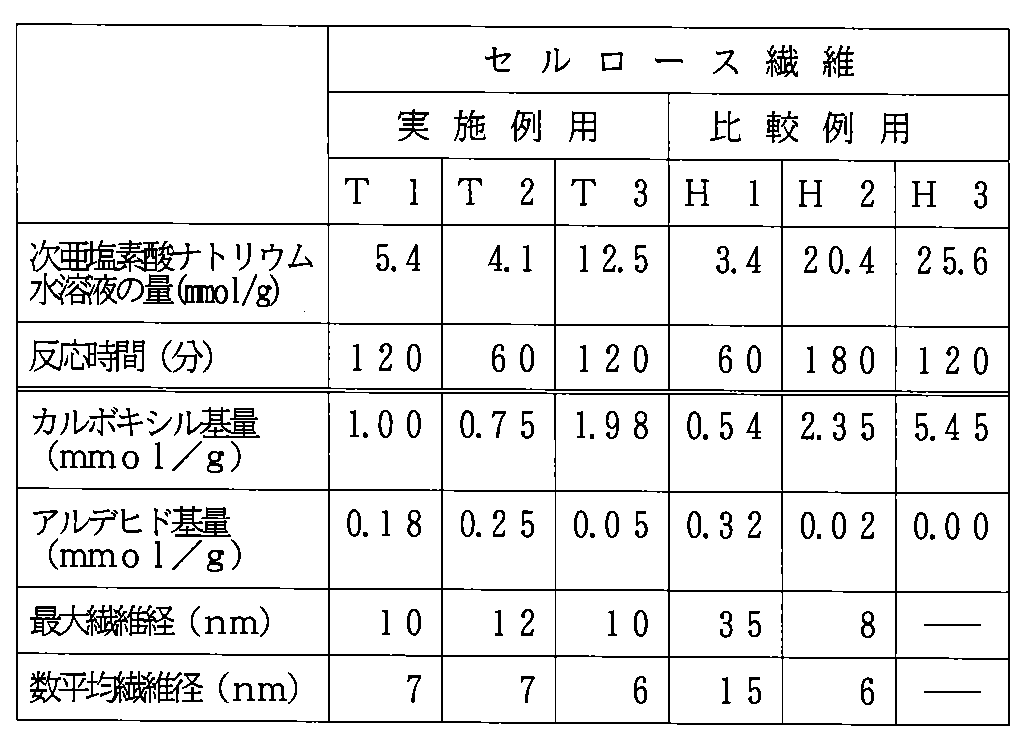
特開2000-26229号公報に記載の実施例1に準じて、低結晶性セルロース微粒子を調製した。すなわち、平均重合度(DP)760の木材パルプを、-5℃で60重量%硫酸水溶液にセルロース濃度が4重量%になるように溶解してセルロースドープを得た。このセルロースドープを重量で2.5倍量の水中(5℃)に撹拌しながら注ぎ、セルロースをフロック状に凝集させ懸濁液を得た。この懸濁液を80℃の温度に達してから10分間加水分解し、ついで洗液のpHが4以上になるまで充分に水洗と減圧脱水を繰り返し、セルロース濃度6重量%のペースト状のセルロース微粒子の半透明白色ペースト状物を得た。さらに、このペーストを水でセルロース濃度5重量%に希釈し、ブレンダーで15000rpm以上の回転速度で5分間混合し、低結晶性セルロース微粒子H4を含有する半透明白色ペースト状物を得た。
各セルロース繊維に水を加え、セルロースの固形分を1重量%とした。これを、超高圧ホモジナイザー(みづほ工業社製、Microfluidizer M-110EH)を用いて、分散させた後、凍結乾燥により試料を調製し、走査型電子顕微鏡(SEM)(日本電子社製、JSM-6380LV)により得られた画像(倍率:10000倍)から、各セルロース繊維の数平均繊維径・最大繊維径を測定した。
セルロース繊維表面のカルボキシル基の定量は、電位差滴定により行った。すなわち、乾燥させた各セルロース繊維0.3gを水55mlに分散させ、0.01Nの塩化ナトリウム水溶液5mlを加えて、充分に撹拌してセルロース繊維を分散させた。つぎに、0.1Nの塩酸溶液をpH2.5~3.0になるまで加え、0.04Nの水酸化ナトリウム水溶液を毎分0.1mlの速度で滴下し、得られたpH曲線から過剰の塩酸の中和点と、このセルロース繊維由来のカルボキシル基の中和点との差から、カルボキシル基量を算出した。
セルロース繊維表面のアルデヒド基の定量は、以下に示す方法により行った。すなわち、試料を水に分散させ、酢酸酸性下で亜塩酸ナトリウムを用いてアルデヒド基を全てカルボキシル基まで酸化させた試料のカルボキシル基量を測定し、酸化前のカルボキシル基量の差をもってアルデヒド基量とした。
セルロース繊維表面上のグルコースユニットのC6位の水酸基のみが選択的にカルボキシル基に酸化されているかどうかについて、13C-NMRチャートで確認した。すなわち、酸化前のセルロースの13C-NMRチャートで確認できるグルコース単位の1級水酸基のC6位に相当する62ppmのピークが、酸化反応後は消失し、代わりに178ppmにカルボキシル基に由来するピークが現れていた。このことから、セルロース繊維T1~T3は、いずれもグルコース単位のC6位水酸基のみがアルデヒド基およびカルボキシル基に酸化されていることが確認された。
下記の表2に示すように、セルロース繊維T3を固形分として1.0重量%、界面活性剤A(ポリオキシエチレンスルホコハク酸ラウリル二ナトリウム)を10重量%、水を89重量%添加して混合し、真空中で15,000rpm以上の回転速度で10分間撹拌することにより、化粧料組成物を調製した。
下記の表2に示すように、各成分の種類、配合量を変更する以外は、実施例1Aに準じて、化粧料組成物を調製した。

各化粧料組成物の粘度を、BH型粘度計(ローターNo.4、回転数2.5rpm、3分、25℃)を用いて測定した。
各化粧料組成物の混合処理後の均一性の経時変化を調べ、分散安定性を評価した。すなわち、各化粧料組成物を40℃の密閉された環境で10日放置した後、状態を評価した。
セルロース繊維T3に水を加えてセルロース固形分1wt%に調整し、高圧分散器(スギノマシン社製、アルティマイザーHJP-25003、操作圧力150MPa)で1回処理して透明なゲル状物を得た。つぎに、下記の表3に示すように、このゲル状物10gに、イソステアリン酸ポリオキシエチレングリセリル30g、シリコンオイルA(信越化学社製、KF96-100CS)30g、スクワラン30gを加え、ホモミキサー(プライミクス社製、T.Kロボミックス、8,000rpm×1分)を用いて混合し、化粧料組成物を調製した。
下記の表3に示すように、実施例1BのシリコンオイルAに代えて、シリコンオイルB(信越化学社製、KF995)を用いる以外は、実施例1Bと同様にして、化粧料組成物を調製した。
下記の表3に示すように、実施例1Bのゲル状物に代えて、水を用いる以外は、実施例1Bと同様にして、化粧料組成物を調製した。
下記の表3に示すように、実施例2Bのゲル状物に代えて、水を用いる以外は、実施例2Bと同様にして、化粧料組成物を調製した。

前記と同様の基準に従い、評価を行った。
各化粧料組成物を、無作為に抽出した10人の上腕に塗布した。評価は、(A)べたつきなし、(B)べたつく、(C)非常にべたつくの3段階で行い、(A)が8人以上を◎、5~7人を○、2~4人を△、1人以下を×とした。
各化粧料組成物を、無作為に抽出した10人の上腕に塗布した。評価は、(A)きわめてなめらか、(B)ややざらつく、(C)非常にざらつくの3段階で行い、(A)が8人以上を◎、5~7人を○、2~4人を△、1人以下を×とした。
前記と同様の基準に従い、評価を行った。
下記の表4に示すように、セルロース繊維T1を固形分として1.0重量%、流動パラフィンを20重量%、グリセリンを5重量%添加し、ホモミキサー(プライミクス社製、T.Kロボミックス、12,000rpm×10分)を用いて分散して、化粧料組成物を調製した。
下記の表4に示すように、実施例1Cのセルロース繊維T1に代えて、セルロース繊維T2~T3をそれぞれ用いる以外は、実施例1Cと同様にして、化粧料組成物調製した。
下記の表5に示すように、実施例1Cのセルロース繊維T1を用いず、これに代えて水を用いる(水を増量)以外は、実施例1Cと同様にして、化粧料組成物を調製した。
下記の表5に示すように、実施例1Cのセルロース繊維T1に代えて、ヒドロキシエチルセルロース(東京化成工業製)を用い、実施例1Cに準じて、化粧料組成物を調製した。
下記の表5に示すように、実施例1Cのセルロース繊維T1に代えて、セルロース繊維H1~H3をそれぞれ用いる以外は、実施例1Cと同様にして、化粧料組成物調製した。


(1) 酸化工程
乾燥重量で200g相当分の未乾燥の亜硫酸漂白針葉樹パルプ(主に1000nmを超える繊維径の繊維からなる)と、TEMPO2.5gと、臭化ナトリウム25gとを水1500mlに分散させた後、13重量%次亜塩素酸ナトリウム水溶液を、1.0gのパルプに対して次亜塩素酸ナトリウムの量が5.4mmolとなるように加えて反応を開始した。反応中は0.5Mの水酸化ナトリウム水溶液を滴下してpHを10~11に保ち、pHに変化が見られなくなった時点で反応終了と見なした(反応時間:120分)。
上記反応物をガラスフィルターにてろ過した後、充分な量のイオン交換水による水洗、ろ過を行い、得られたろ液の電気伝導度を測定した。水洗を繰り返しても、ろ液の電気伝導度に変化がなくなった時点で精製工程を終了した。このようにして、水を含んだ固形分量15重量%のセルロース繊維S1′を得た。
添加する次亜塩素酸ナトリウムの量および反応時間を、下記の表6に示すように変更する以外は、セルロール繊維S1′の作製に準じて、セルロール繊維S2′,S3′,H1′,H2′をそれぞれ作製した。
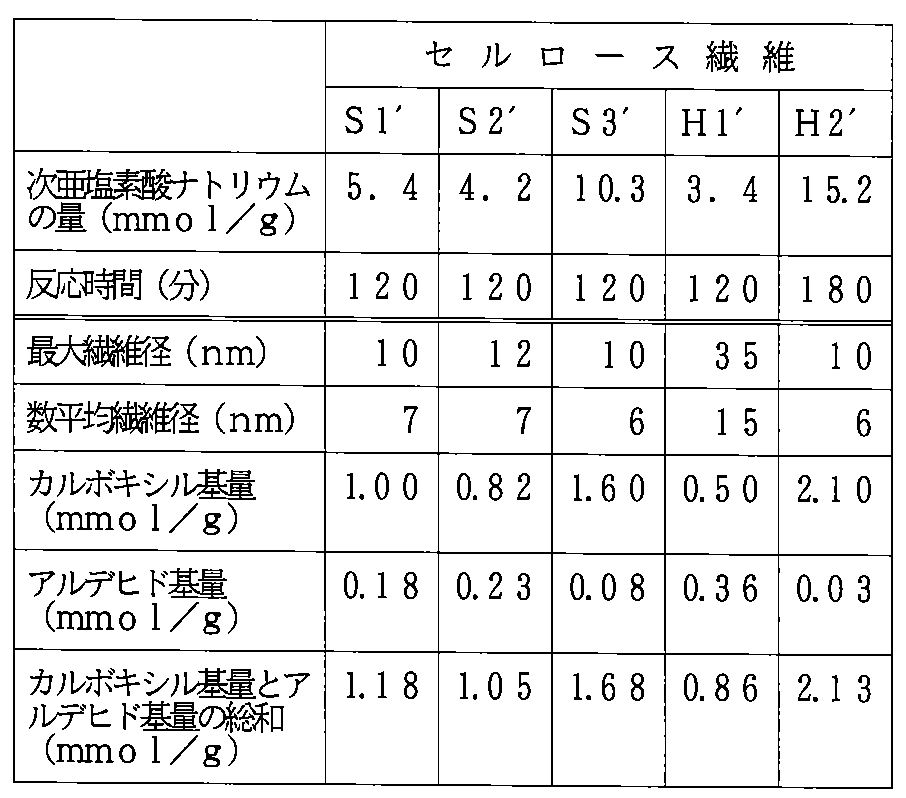
上記セルロース繊維S1′~S3′およびH1′,H2′に水を加えて2重量%のスラリーとして、ディスパー型ミキサーを用いて回転数8,000rpmで10分間微細化処理を行った。各セルロース繊維の最大繊維径および数平均繊維径を、透過型電子顕微鏡(TEM)(日本電子社製、JEM-1400)を用いて観察した。すなわち、各セルロース繊維を親水化処理済みのカーボン膜被覆グリッド上にキャストした後、2%ウラニルアセテートでネガティブ染色したTEM像(倍率:10000倍)から、先に述べた方法に従い、最大繊維径および数平均繊維径を算出した。
上記ディスパー型ミキサーを用いて約10分間の処理を行ったスラリーを60ml調製し、0.1Mの塩酸水溶液によってpHを約2.5とした後、0.05Mの水酸化ナトリウム水溶液を滴下して、電気伝導度測定を行った。測定はpHが約11になるまで続けた。電気伝導度の変化が緩やかな弱酸の中和段階において消費された水酸化ナトリウム量(V)から、下の式(1)に従い官能基量1(カルボキシル基量)を求めた。

上記セルロース繊維を、酢酸でpHを4~5に調整した2%亜塩素酸ナトリウム水溶液中でさらに48時間常温(25℃)で酸化し、上記式(1)に準じて官能基量2を測定した。そして、この酸化によって追加された官能基量(官能基量2-官能基量1)を算出し、アルデヒド基量を求めた。
上記スラリーの一部を乾燥させて得られた透明な膜状のセルロースの広角X線回折像から、セルロースI型結晶構造を有することを確認した。また、全反射式赤外分光スペクトル(ATR)において、カルボニル基に起因する吸収(1608cm-1付近)および酸型のカルボキシル基(COOH)に起因する吸収(1730cm-1付近)が存在することも確認した。
上記セルロース繊維S1′~S3′,H1′,H2′の各濃度が、下記の表7に示す割合になるように、水を添加してスラリーとし、ディスパー型ミキサーを用いて回転数8,000rpmで10分間微細化処理を行って、各試料を得た。なお、表7において、セルロース繊維の添加量を除く残量が、水の添加量である(以下、同様)。

得られた各試料(組成物)を25℃で24時間放置した後、BH型粘度計(No.4ローター)(東機産業社製、BH型粘度計)を用いて回転数2.5rpm(3分)で粘度を測定した。
1日後、1週間後、2週間後のゲルの状態を目視で観察した。評価は、ゲル状態のものを「○」、液状(流動性あり)のものを「×」、ゲルから水分離したもの「分離」とした。
セルロース繊維S1′~S3′,H1′,H2′の各濃度が、下記の表8~表38に示す割合になるように、水および下記の表8~表38に示す機能性添加剤(無機塩類、界面活性剤、オイル類、保湿剤、防腐剤、無機微粒子、有機微粒子、有機溶媒、香料・消臭剤)を同表に示す割合で添加してスラリーとし、ディスパー型ミキサーを用いて回転数8,000rpmで10分間微細化処理を行って、各試料を得た。なお、表8~表38において、セルロース繊維と機能性添加剤の添加量を除く残量が、水の添加量である(以下、同様)。
WO99/28350に記載の方法に準拠して得られたセルロース繊維を用いた。すなわち、バルブシートを5mm×5mmのチップに切断した重合度760の木材バルブを、-5℃で65%硫酸水溶液にセルロース濃度が5%になるように150rpmの撹拌条件下で10分間溶解して透明で均一なセルロースドープを得た。このセルロースドープを、重量で2.5倍量の水中(5℃)に撹拌しながら注ぎ、セルロースをフロック状に凝集させ懸濁液を得た。この懸濁液を85℃で20分間加水分解し、ついで洗液のpHが4以上になるまで充分に水洗と濾過を繰り返し、セルロース濃度15%の白色かつ透明性を帯びたゲル状物のセルロース繊維を得た。このゲル状物を家庭用フードプロセッサー(ナイフカッター)で3分間混合均一化処理し、さらに水および後記の表39および表40に示す機能性添加剤(〔無機塩類〕NaCl、KCl、CaCl2 、MgCl2 、(NH4 )2 SO4 、Na2 CO3 、〔界面活性剤〕活性剤1~3、〔オイル類〕オイル類1~3、〔有機溶媒〕有機溶媒1,2)を表中に示す所定濃度になるように加えてセルロース濃度1.5%に希釈し、ブレンダーで15,000rpmの回転速度で5分間混合した。つぎに、この希釈されたサンプルを、超高圧ホモジナイザー(みづほ工業社製,Microfluidizer M-110EH 型、操作圧力1,750kg/cm2 )で4回微細化処理を行い、試料を得た。水のみ添加した試料(Blank) を4回処理した微細化セルロース繊維(A1′)は、平均粒子径が0.18μmであり、かつ分散体の透過率は95%であった。
ディスパー型ミキサーで水および後記の表41に示す機能性添加剤(〔無機塩類〕NaCl、KCl、CaCl2 、MgCl2 、(NH4 )2 SO4 、Na2 CO3 、〔界面活性剤〕活性剤3、〔オイル類〕オイル類1~3、〔無機微粒子〕無機微粒子1,2)を、最終的に表中に示す所定濃度となるように配合した水溶液もしくは水分散液97.5gに、ディスパー型撹拌機を用いて回転数8,000rpmで撹拌しながら、カルボキシビニルポリマーA2′(BFGoodrich社製、カーボポール980)0.50gを徐々に加えて分散させた。そこに、10%水酸化ナトリウム水溶液2.0gを滴下し、中和増粘を行った。充分に均質化するために10分間撹拌して試料を作製した。なお、水とカルボキシビニルポリマーA2′のみで作製した試料(Blank) の粘度は61.0Pa・sであった。
NaCl、KCl、CaCl2 、MgCl2 、(NH4 )2 SO4 、Na2 CO3
ポリオキシエチレンラウリルエーテル(活性剤1)
アルキルポリグルコシド(活性剤2)
ポリオキシエチレンラウリルエーテル硫酸ソーダ(活性剤3)
ジメチルポリシロキサン(オイル類1)
トリイソオクタン酸グリセリル(オイル類2)
スクワラン(オイル類3)
グリセリン
メチルパラベン
酸化チタン(無機微粒子1)
ベンガラ(無機微粒子2)
ウレタンエマルジョン(第一工業製薬社製、スーパフレックス150)
エタノール(有機溶媒1)
イソプロパノール(有機溶媒2)
Dリモネン(香料・消臭剤1)
オレンジ油(香料・消臭剤2)


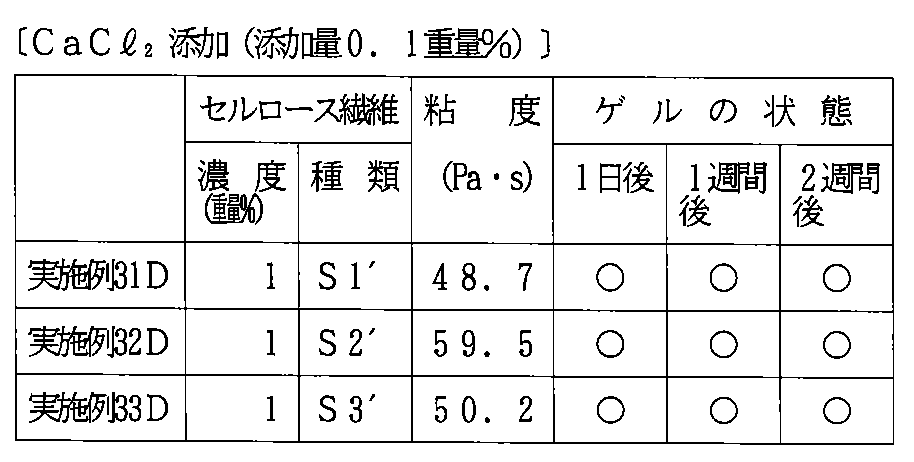


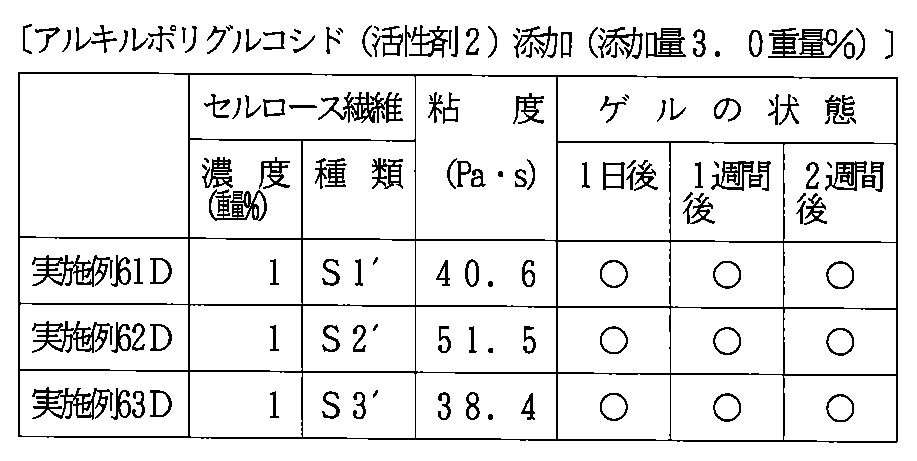
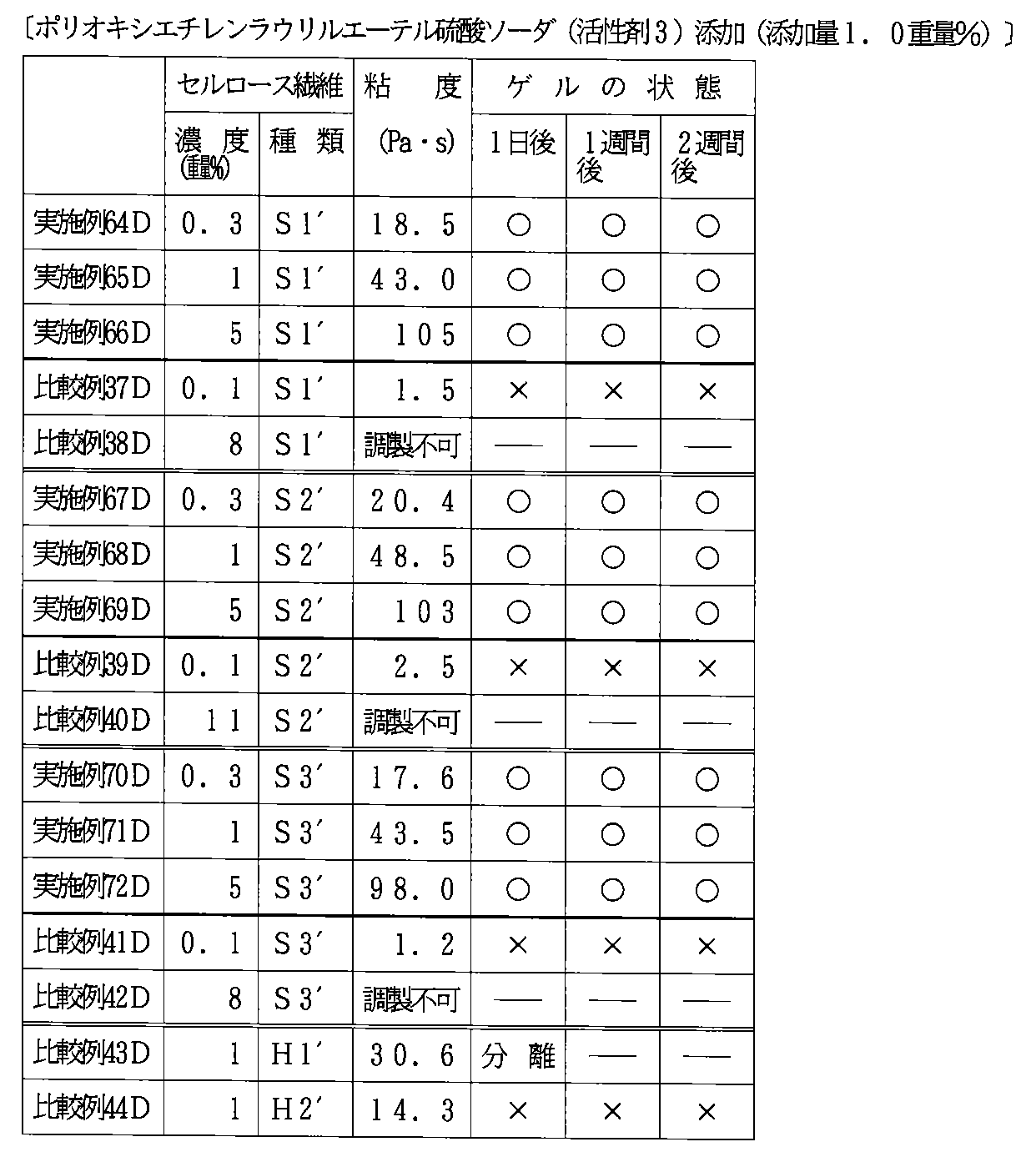


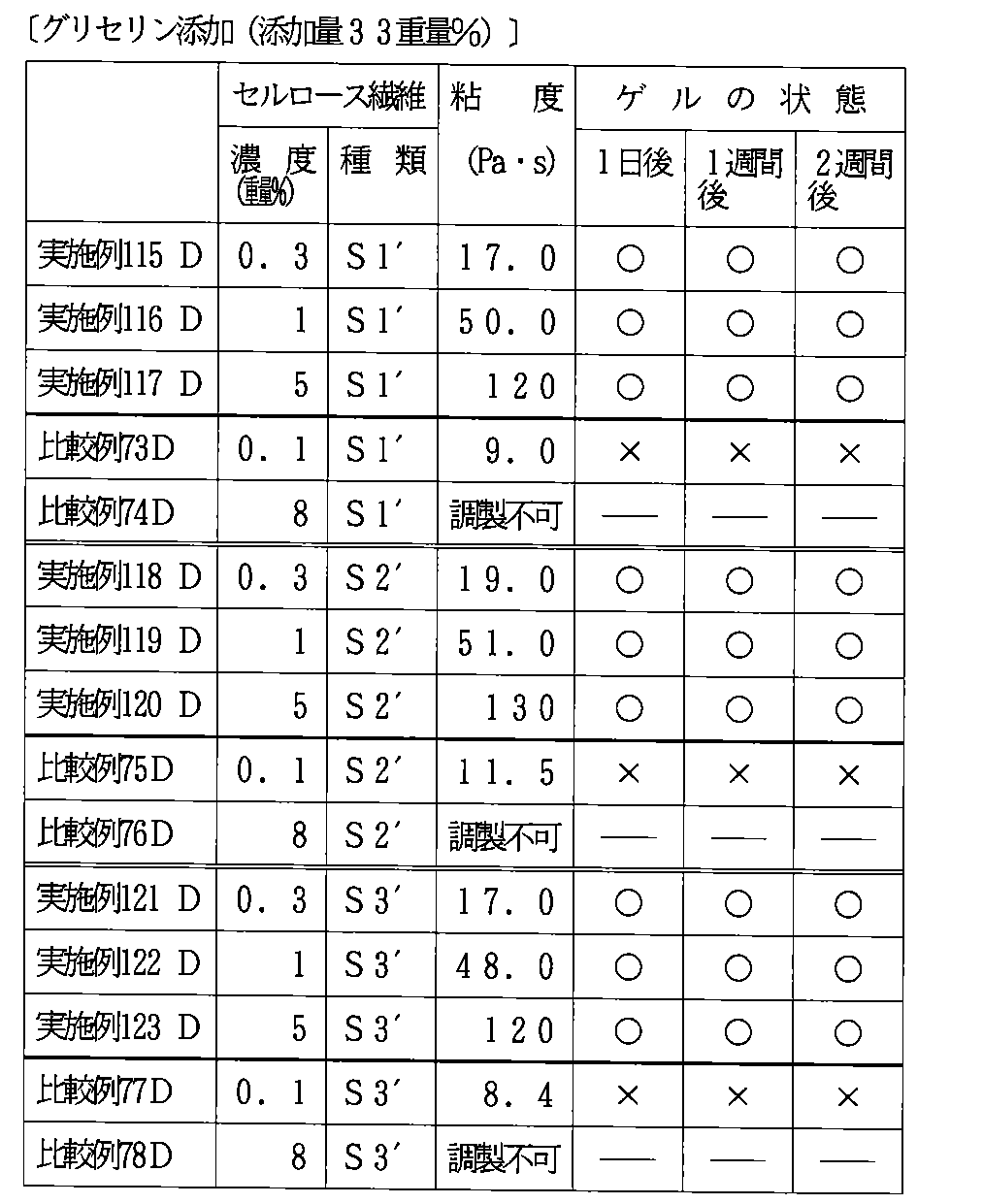


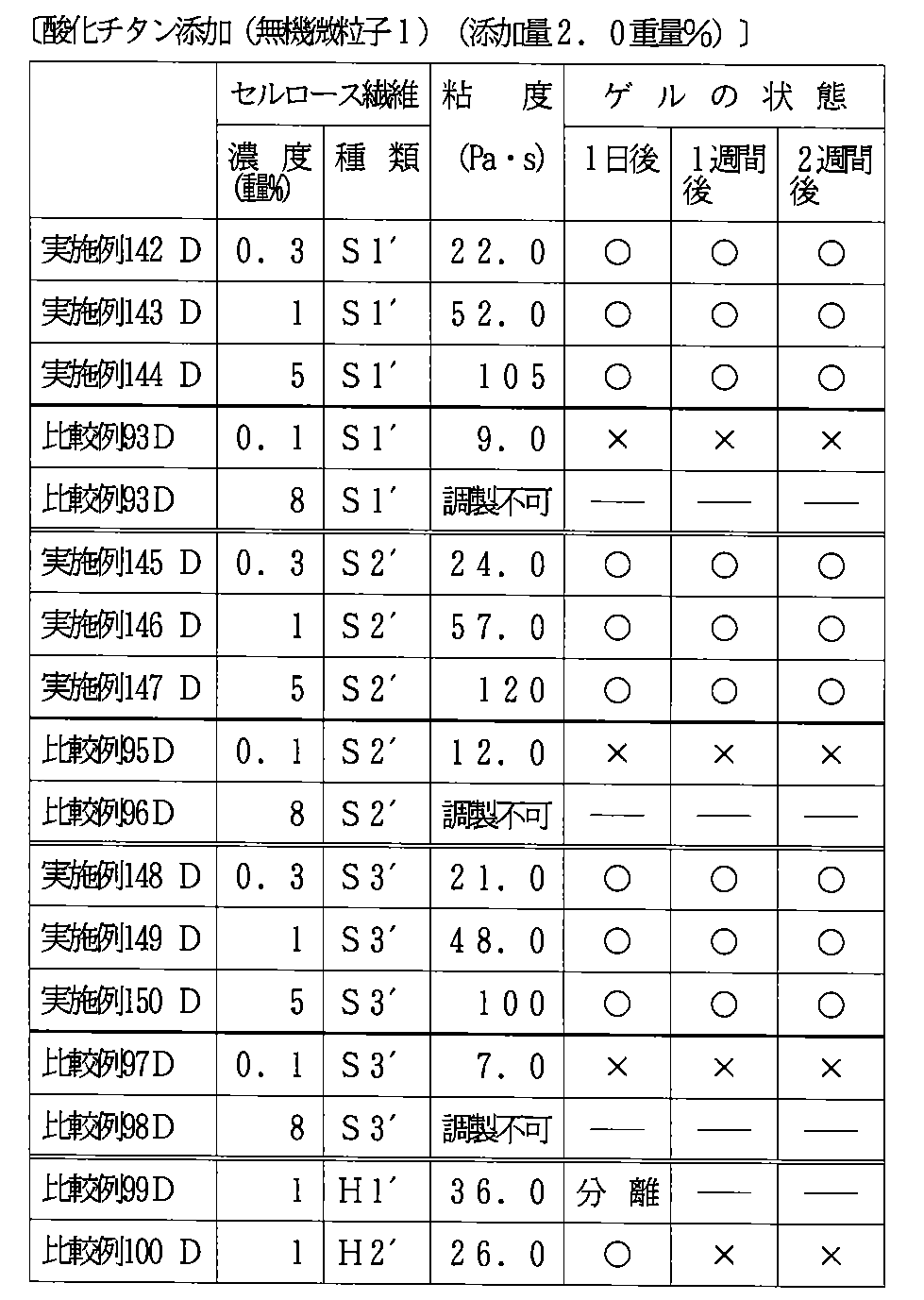

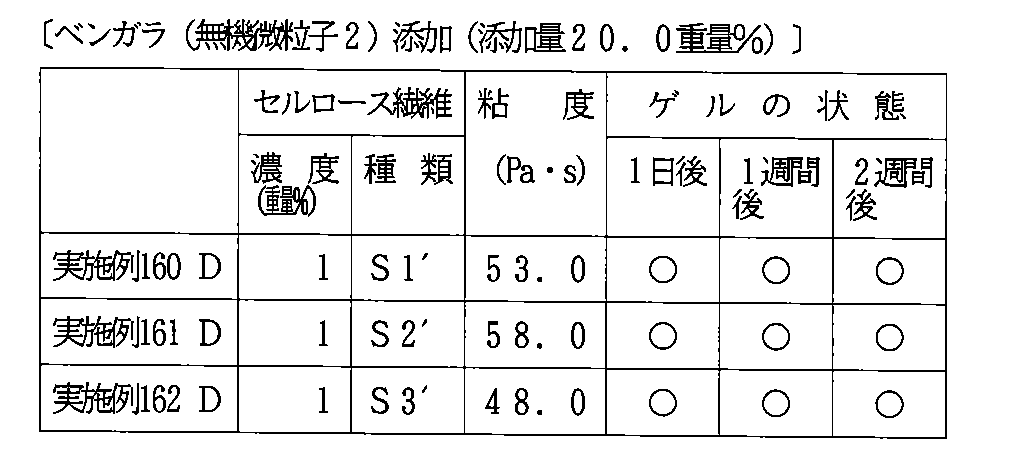


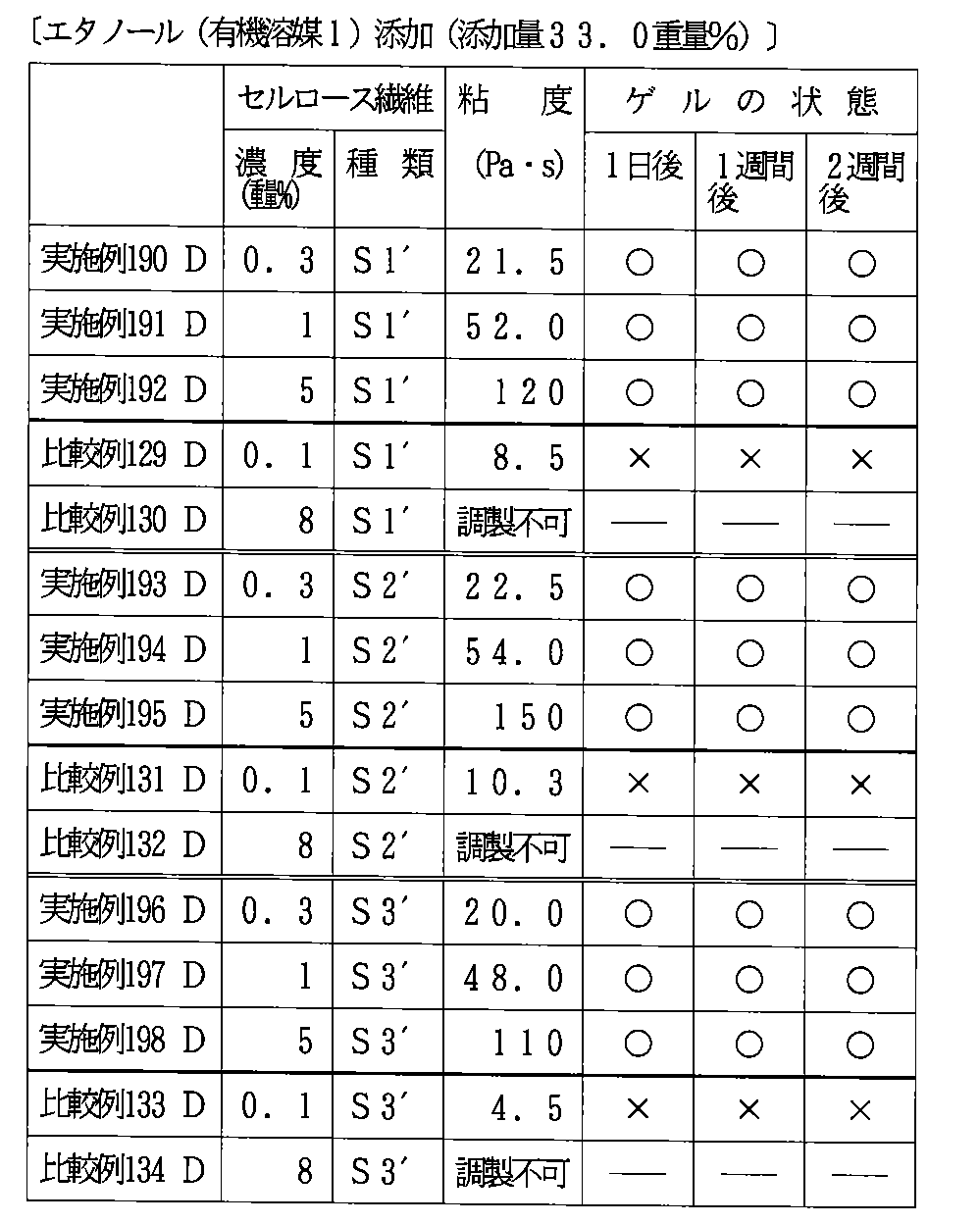


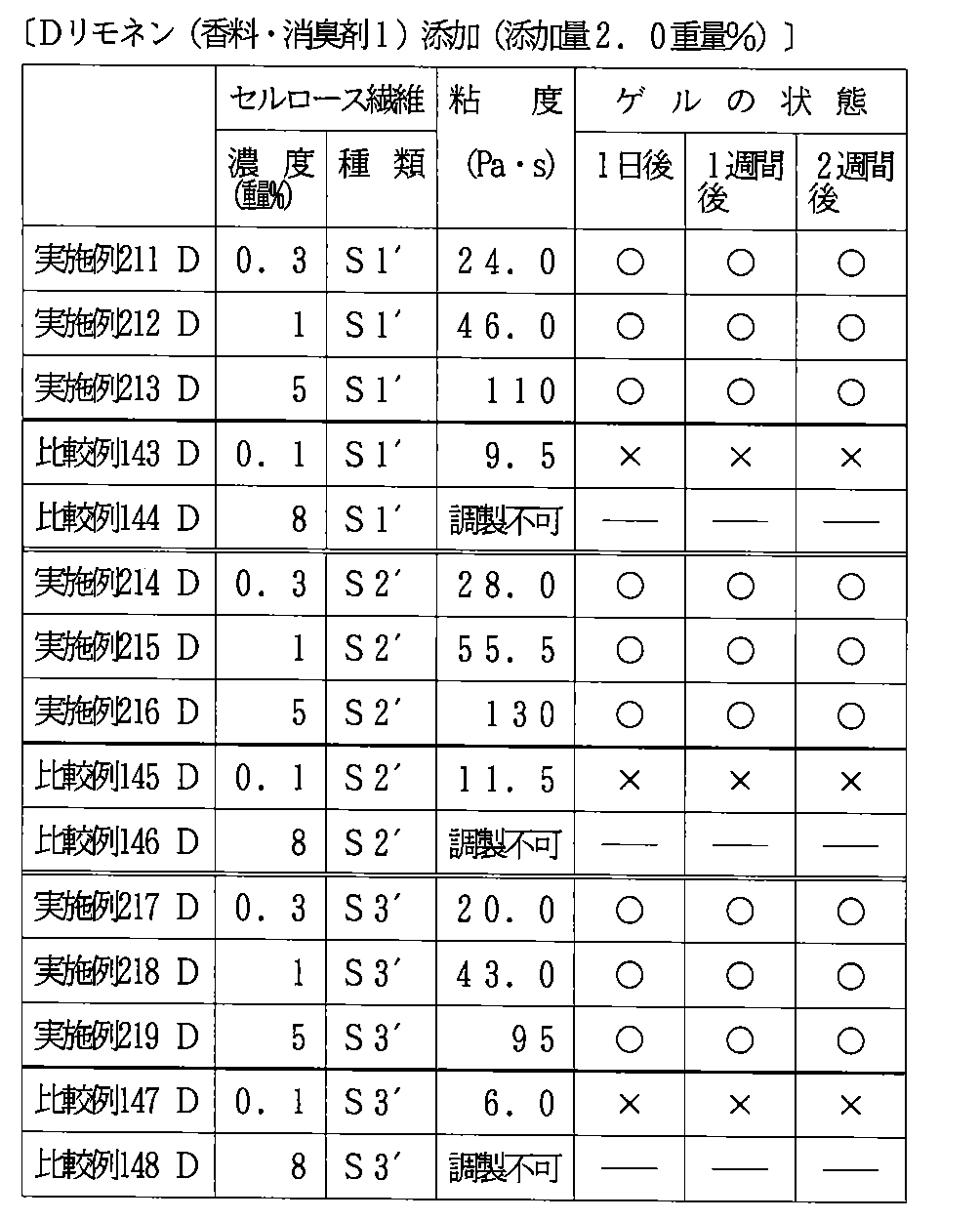

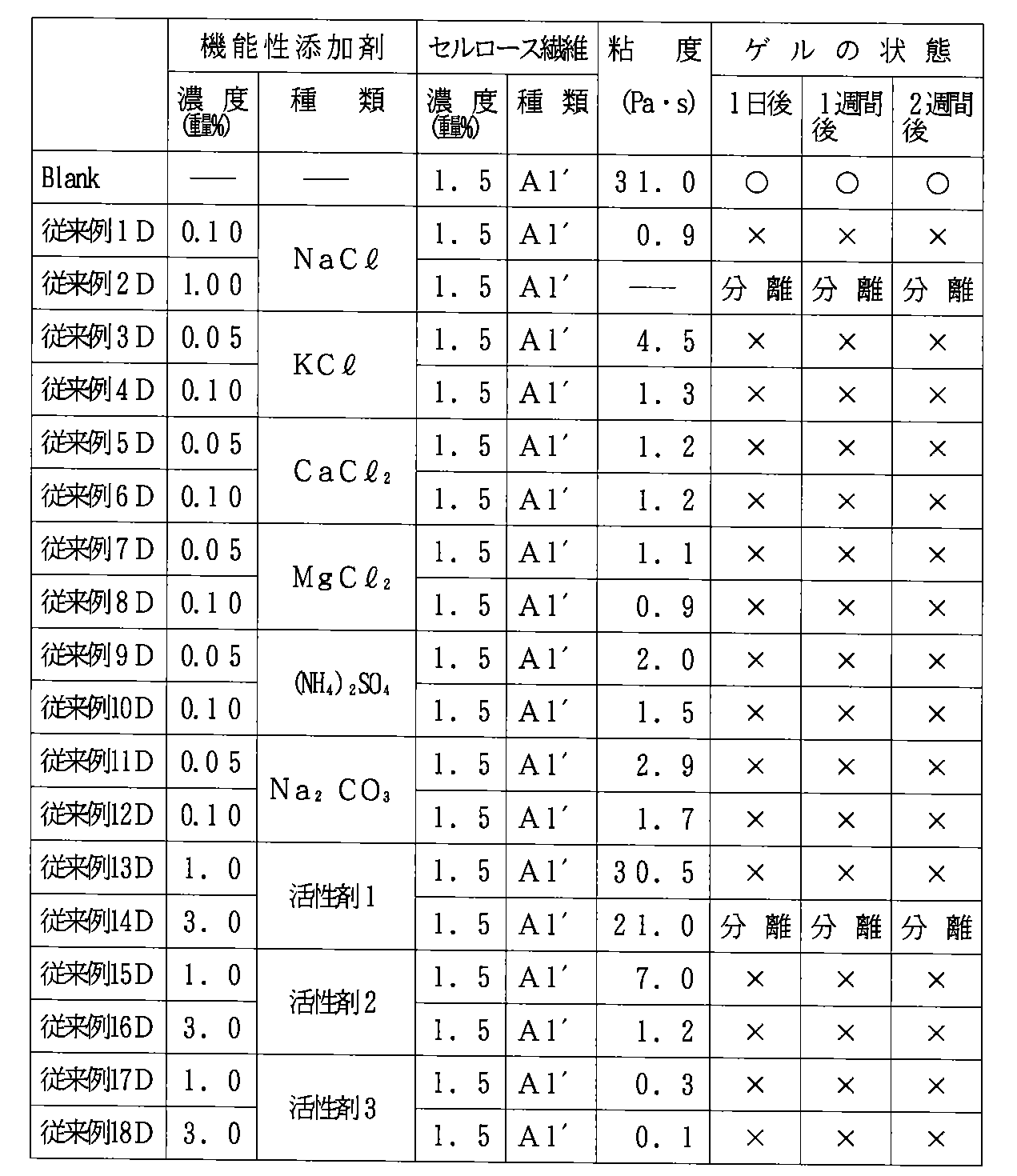
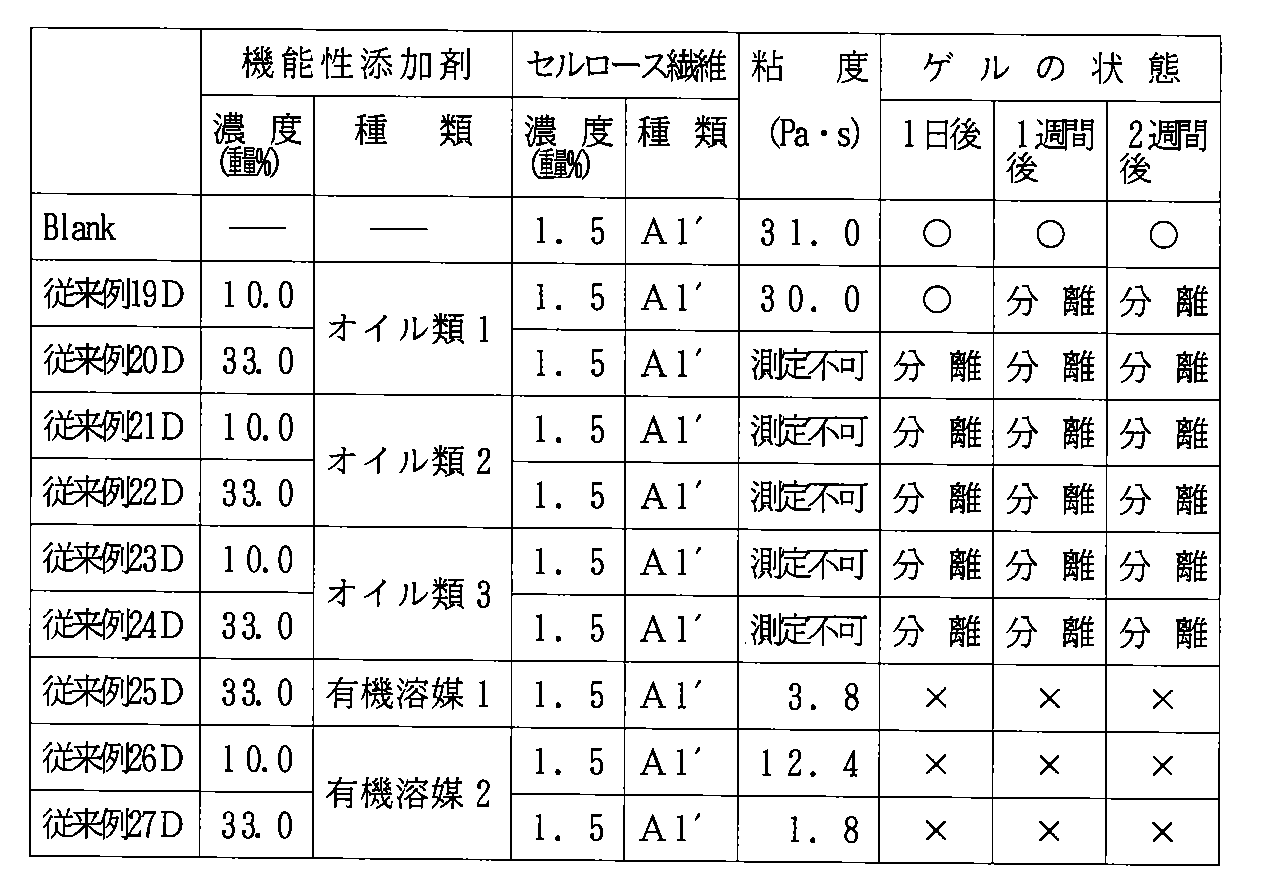

(1) 酸化工程
乾燥重量で200g相当分の未乾燥の亜硫酸漂白針葉樹パルプ(主に1000nmを超える繊維径の繊維からなる)と、TEMPO2.5gと、臭化ナトリウム25gとを水1000mlに分散させた後、13重量%次亜塩素酸ナトリウム水溶液を、100gのパルプに対して次亜塩素酸ナトリウムの量が5.4mmolとなるように加えて反応を開始した。反応中は0.5Mの水酸化ナトリウム水溶液を滴下してpHを10~11に保ち、pHに変化が見られなくなった時点で反応終了と見なした(反応時間:120分)。
上記反応物をガラスフィルターにてろ過した後、充分な量のイオン交換水による水洗、ろ過を行い、得られたろ液の電気伝導度を測定した。水洗を繰り返しても、ろ液の電気伝導度に変化がなくなった時点で精製工程を終了した。固形分量20重量%の水を含浸させた反応物繊維を得た。
上記反応物繊維に水を加え2.0重量%スラリーとし、次いで、これを、超高圧ホモジナイザー(マイクロフルイダイザー、型式:M-110-E/H、みづほ工業社製)を用いて1.72×108 Paの操作圧力で2回処理し、微細化処理されたセルロース繊維S1″を得た。
次亜塩素酸ナトリウムの量および反応時間を、下記の表42に示すように変更する以外は、セルロール繊維S1″に準じて、セルロール繊維S2″,S3″(実施例用)およびH1″,H2″(比較例用)をそれぞれ作製した。

各セルロース繊維の最大繊維径および数平均繊維径をTEM観察により測定した。すなわち、各セルロース繊維を親水化処理済みのカーボン膜被覆グリッド上にキャストした後、2重量%ウラニルアセテートでネガティブ染色したTEM像から観察した。
各セルロース繊維の2.0重量%スラリーを60ml調製し、0.1Mの塩酸水溶液によってpHを約2.5とした後、0.05Mの水酸化ナトリウム水溶液を滴下して、電気伝導度測定を行った。測定はpHが約11になるまで続けた。電気伝導度の変化が緩やかな弱酸の中和段階において消費された水酸化ナトリウム量(V)から、下の式(2)に従い官能基量(a)(カルボキシル基量)を求めた。

上記セルロース繊維を、酢酸でpHを4~5に調製した2重量%亜塩素酸ナトリウム水溶液中でさらに48時間常温(25℃)で酸化し、上記手法に従い、再度、中和を行い、その際消費された水酸化ナトリウム量(V)から、上記式(2)により、官能基量(b)を求めた。そして、この酸化によって追加された官能基量〔(b)-(a)〕を算出し、アルデヒド基量とした。
上記スラリーの一部を乾燥させて得られた透明な膜状のセルロースの広角X線回折像像から、セルロース繊維S1″~S3″およびH1″,H2″が、全て、セルロースI型結晶構造を有することを確認した。また、これら全てのセルロース繊維が、全反射式赤外分光スペクトル(ATR)において、カルボニル基に起因する吸収(1608cm-1付近)および酸型のカルボキシル基(COOH)に起因する吸収(1730cm-1付近)が存在することも確認した。
セルロース繊維表面上のグルコースユニットの6位の水酸基のみが選択的にカルボキシル基に酸化されているかどうかについて、13C-NMRチャートで確認した。すなわち、酸化前のセルロースの13C-NMRチャートで確認できるグルコース単位の1級水酸基のC6位に相当する62ppmのピークが、酸化反応後は消失し、代わりに178ppmにカルボキシル基に由来するピークが現れていた。このことから、セルロース繊維S1″~S3″は、いずれもグルコース単位のC6位水酸基のみがアルデヒド基およびカルボキシル基に酸化されていることが確認された。
特開2003-73229公報の実施例に記載の方法に準じ、セルロース微粒子を作製した。すなわち、まず、シート状の精製パルプを5mm×5mmのチップに切断した重合度760の原料パルプを、-5℃でセルロース濃度が5重量%になるように65重量%硫酸水溶液に溶解して、透明かつ粘調なセルロースドープを得た。このセルロースドープを、重量で2.5倍量の水中(5℃)に撹拌しながら注ぎ、セルロースをフロック状に凝集させ、フロック状固体の分散液を得た。この懸濁液を85℃で20分間加水分解させた後、ガラスフィルターを用いた減圧濾過により分散媒である硫酸水溶液を除去し、次いで洗液のpHが3程度になるまで充分に水洗を繰り返した後、pHがおよそ11の希薄なアンモニア水溶液で洗浄(中和)し、さらにイオン交換水で水洗し、セルロース濃度が6.0重量%の半透明白色のゲル状物を得た。このようにして得られたゲル状物を、イオン交換水で希釈し、セルロース濃度が4.0重量%となるように調製し、ホモミキサー(T.K.ロボミックス、プライミクス社製)を用いて15000rpmの回転速度で10分間分散処理を行い、引き続いて超高圧ホモジナイザー(マイクロフルイダイザー、型式:M-110-E/H、みづほ工業社製)を用いて1.72×108 Paの操作圧力で5回処理し、透明性の高いセルロース(セルロース微粒子の水分散体)(pH=6.7)を得た。
まず、増粘剤として、上記作製のセルロース繊維S1″~S3″,H1″,H2″(実施例用および比較例用のセルロース繊維)を準備した。また、上記作製のセルロース微粒子、カルボキシビニルポリマー(カーボポール980、中外貿易社販売)、ポリアクリルアミド(平均分子量:900万~1000万,キシダ化学社製)、合成スメクタイト微粒子(スメクトンSA、クニミネ工業社製)も準備した。そして、この増粘剤に、イオン交換水のみを加え、増粘剤の濃度が、0.5重量%,1.0重量%,1.5重量%のいずれか(表43参照)となるよう調製した。なお、カルボキシビニルポリマー溶液(比較例6E,7E)には、カルボキシビニルポリマー溶解後、希薄アンモニア水による中和を実施した。そして、上記のように調製したものを、各々、ホモミキサー(T.K.ロボミックス、プライミクス社製)を用いて15000rpmの回転速度で10分間の分散処理を行い、これにより、スプレー用組成物を調製した。
〔ゲル状態〕
組成物の入ったスプレー容器を逆転させ、液面の動きを目視で観察した。なお、セルロース繊維の一部もしくは機能性添剤が分離沈降している組成物は、表において「分離」と示した。
×:逆転させた時、直ちに液面が激しく動く。
△:逆転させた時、ゆっくりと液面が動く。
○:逆転させた時、液面が動かない。
〔噴霧状態〕
実際に噴霧して状態を観察した。
×:ノズルから組成物が発射されず、噴霧不可能。または、ノズルから組成物は発射されるが、ミストの状態とならない。
○:ノズルから組成物が良好な状態のミストとして発射される。
〔噴射むら〕
18cm×18cmの曇りガラス板を垂直に立て、水平距離で20cm離れた位置からガラス板に向けて噴霧を1回実施し、直後のガラス面に付着した液滴の分布状態を観察した。そして、スプレーの母液としてイオン交換水のみを用いた場合の結果と比較した。
×:大きな液滴が散在し明確に噴霧むらが確認される。
△:大きな液滴の散在は見られないが、イオン交換水のみの場合と比較すると液滴の分布は粗い。
○:イオン交換水のみの場合と同等かそれ以上緻密に液滴が分布される。
〔液だれ性〕
噴霧むらの評価と同じ条件で噴霧を数回行い、垂直ガラス面に隙間のないように液滴が吹き付けられた状態となるまで噴霧を続け、ガラス板の垂直性を保持した状態でのガラス面上での噴霧液の液だれ性を各噴霧ごとに観察した。
×:1回の噴霧でも液だれが起こる。
△:1回の噴霧では液だれは起こらないがガラス表面上での噴霧液の厚みが増すに従って液だれが発生した。
○:複数回の噴霧によっても全く液だれが起こらない。

まず、上記実施例および比較例で使用の増粘剤(セルロース繊維S1″~S3″,H1″,H2″、セルロース微粒子)を準備した。そして、この増粘剤に、イオン交換水と、後記の表44~表46に示す組み合わせの無機塩類・電解質(塩化ナトリウム,エデト酸ナトリウム,アスコルビン酸ナトリウムのいずれか)とを配合し、増粘剤の濃度が、0.5重量%,1.0重量%,1.5重量%のいずれか(表44~表46参照)、無機塩類・電解質の濃度が0.1重量%となるよう調製した。そして、このように調製したものを、各々、ホモミキサー(T.K.ロボミックス、プライミクス社製)を用いて15000rpmの回転速度で10分間の分散処理を行い、これにより、スプレー用組成物を調製した。


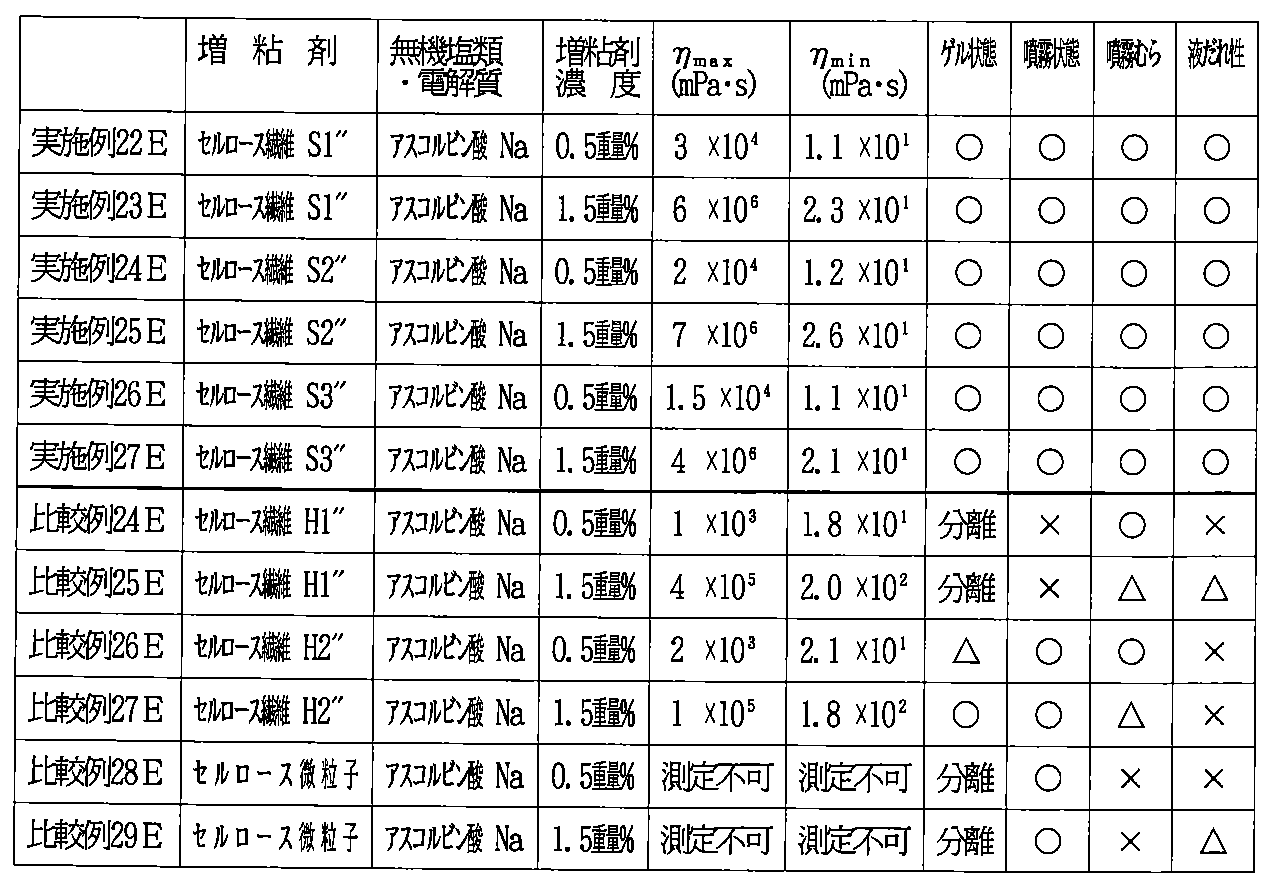
上記実施例および比較例で使用の増粘剤(セルロース繊維S1″~S3″,H1″,H2″、セルロース微粒子)を準備した。そして、この増粘剤に、イオン交換水と、後記の表47~表49に示す組み合わせの添加剤(エタノール,ジメチルポリシロキサン,トリオクタン酸グリセリルのいずれか)とを配合し、増粘剤の濃度等を、後記の表47~表49に示す割合となるよう調製した。そして、このように調製したものを、各々、ホモミキサー(T.K.ロボミックス、プライミクス社製)を用いて15000rpmの回転速度で10分間の分散処理を行い、これにより、スプレー用組成物を調製した。


上記実施例および比較例で使用の増粘剤(セルロース繊維S1″~S3″,H1″,H2″、セルロース微粒子)を準備した。そして、この増粘剤に、イオン交換水と、添加剤として酸化チタン(TTO-V3、石原産業社製)とを配合し、増粘剤の濃度を、後記の表50に示す割合となるよう調製し、かつ、酸化チタン濃度が0.1重量%となるよう調製した。そして、このように調製したものを、各々、ホモミキサー(T.K.ロボミックス、プライミクス社製)を用いて15000rpmの回転速度で10分間の分散処理を行い、これにより、スプレー用組成物を調製した。
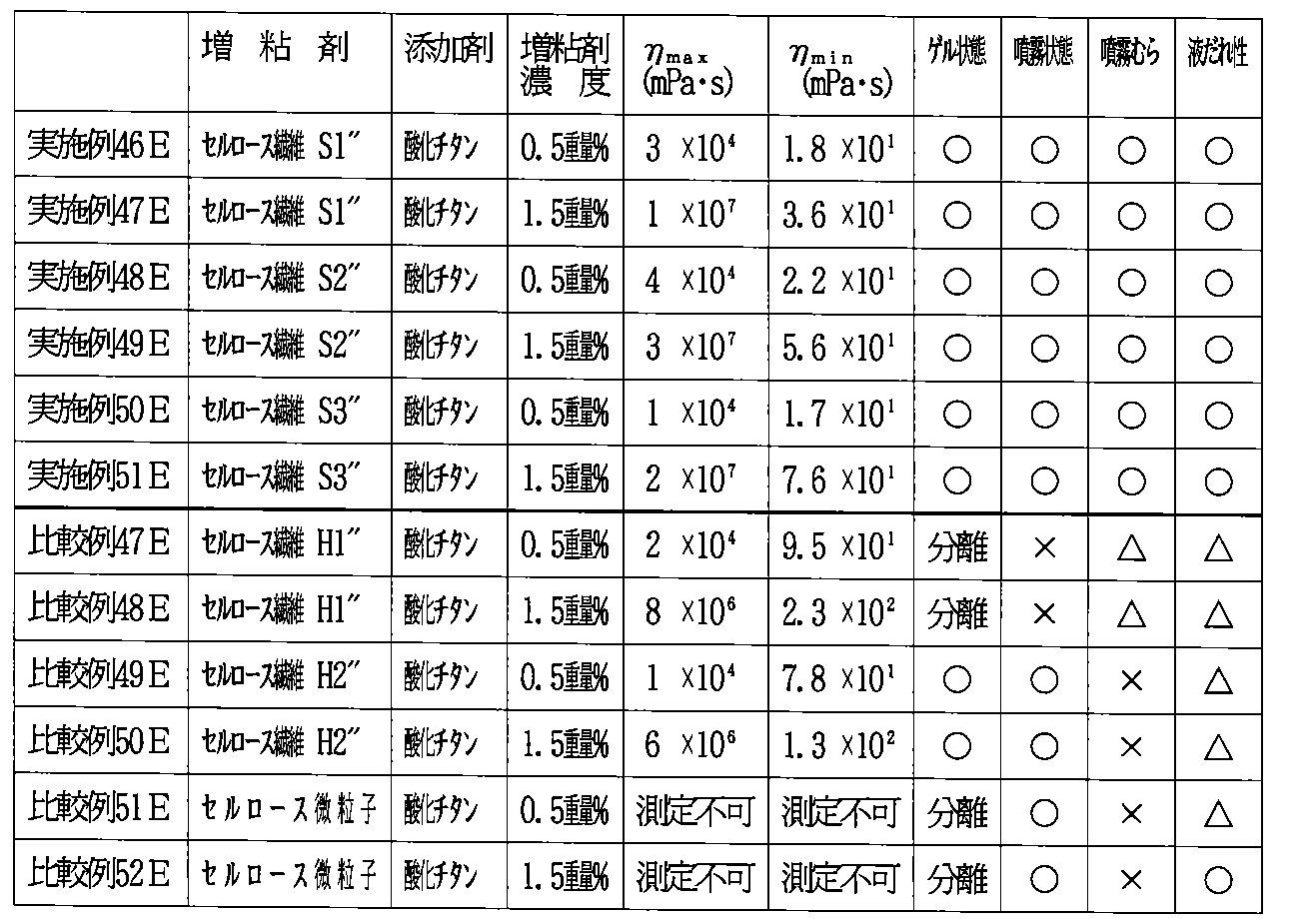
Claims (13)
- 下記の(A),(A′)および(A″)成分から選ばれた一つの成分と(B)成分を含有することを特徴とする粘稠な組成物。
(A)最大繊維径が1000nm以下で、数平均繊維径が2~100nmのセルロース繊維であって、そのセルロースが、セルロースI型結晶構造を有すると共に、セルロース分子中のグルコースユニットのC6位の水酸基が選択的に酸化されてアルデヒド基およびカルボキシル基に変性されており、カルボキシル基の量が0.6~2.2mmol/gである、セルロース繊維。
(A′)最大繊維径が1000nm以下で、数平均繊維径が2~150nmのセルロース繊維であって、そのセルロースが、セルロースI型結晶構造を有すると共に、セルロース分子中のグルコースユニットのC6位の水酸基が選択的に酸化されてアルデヒド基およびカルボキシル基に変性され、上記アルデヒド基を0.08~0.3mmol/gおよび上記カルボキシル基を0.6~2.0mmol/g有する、セルロース繊維。
(A″)最大繊維径が1000nm以下で、数平均繊維径が2~150nmのセルロース繊維であって、そのセルロースが、セルロースI型結晶構造を有すると共に、セルロース分子中のグルコースユニットのC6位の水酸基が選択的に酸化されてアルデヒド基およびカルボキシル基に変性され、上記カルボキシル基を0.6~2.0mmol/gおよび上記アルデヒド基を0.05~0.3mmol/g有する、セルロース繊維。
(B)水。 - 請求項1記載の粘稠な組成物が化粧料組成物であって、下記の(A)成分に加えて(B)および(C)成分を含有する請求項1記載の粘稠な組成物。
(A)最大繊維径が1000nm以下で、数平均繊維径が2~100nmのセルロース繊維であって、そのセルロースが、セルロースI型結晶構造を有すると共に、セルロース分子中のグルコースユニットのC6位の水酸基が選択的に酸化されてアルデヒド基およびカルボキシル基に変性されており、カルボキシル基の量が0.6~2.2mmol/gである、セルロース繊維。
(B)水。
(C)機能性添加剤。 - 上記(A)成分のセルロース繊維が、N-オキシル化合物の存在下、共酸化剤を用いて酸化されたものである請求項2記載の粘稠な組成物。
- 上記(C)成分の機能性添加剤が、油性原料、界面活性剤、アルコール類および機能成分からなる群から選ばれた少なくとも一つである請求項2または3記載の粘稠な組成物。
- 請求項1記載の粘稠な組成物がゲル状組成物であって、下記の(A′)成分に加えて(B)成分を用いてなり、(A′)成分の含有割合がゲル状組成物全体の0.3~5.0重量%の範囲になっている請求項1記載の粘稠な組成物。
(A′)最大繊維径が1000nm以下で、数平均繊維径が2~150nmのセルロース繊維であって、そのセルロースが、セルロースI型結晶構造を有すると共に、セルロース分子中のグルコースユニットのC6位の水酸基が選択的に酸化されてアルデヒド基およびカルボキシル基に変性され、上記アルデヒド基を0.08~0.3mmol/gおよび上記カルボキシル基を0.6~2.0mmol/g有する、セルロース繊維。
(B)水。 - 上記(A′)成分のセルロース繊維が、N-オキシル化合物の存在下、共酸化剤を用いて、セルロース繊維の水酸基の一部をカルボキシル基およびアルデヒド基に酸化されたものである請求項5記載の粘稠な組成物。
- 機能性添加剤(C′)を含有する請求項5または6記載の粘稠な組成物。
- 上記機能性添加剤(C′)が、無機塩類、界面活性剤、オイル類、保湿剤、防腐剤、有機微粒子、無機微粒子、消臭剤、香料および有機溶媒からなる群から選ばれた少なくとも一つである請求項5~7のいずれか一項に記載の粘稠な組成物。
- 請求項1記載の粘稠な組成物がスプレー用組成物であって、下記の(A″)成分に加えて(B)成分を含有し、(A″)成分のセルロース繊維の含有割合が0.1~3.0重量%であり、かつ、コーン・プレート型回転粘度計の測定による,1×10-3S-1~1×10³ S-1を含むずり速度領域において,20℃で測定した粘度の最大値(ηmax )がηmax ≧1×10⁴ mPa・sであり、最小値(ηmin )がηmin ≦1×10² mPa・sである請求項1記載の粘稠な組成物。
(A″)最大繊維径が1000nm以下で、数平均繊維径が2~150nmのセルロース繊維であって、そのセルロースが、セルロースI型結晶構造を有すると共に、セルロース分子中のグルコースユニットのC6位の水酸基が選択的に酸化されてアルデヒド基およびカルボキシル基に変性され、上記カルボキシル基を0.6~2.0mmol/gおよび上記アルデヒド基を0.05~0.3mmol/g有する、セルロース繊維。
(B)水。 - 上記(A″)成分のセルロース繊維が、N-オキシル化合物の存在下、共酸化剤を用いて酸化されたものである請求項9記載の粘稠な組成物。
- 上記(A″)および(B)成分とともに、下記の(C″)成分を含有する請求項9または10記載の粘稠な組成物。
(C″)機能性添加剤。 - 上記(C″)成分の機能性添加剤が、電解質、イオン性物質、界面活性剤、オイル類、保湿剤、有機微粒子、無機微粒子、防腐剤、消臭剤および香料からなる群から選ばれた少なくとも一つである請求項9~11のいずれか一項に記載の粘稠な組成物。
- スプレー噴霧装置内に収容されている請求項9~12のいずれか一項に記載の粘稠な組成物。
Priority Applications (9)
| Application Number | Priority Date | Filing Date | Title |
|---|---|---|---|
| EP10843875.5A EP2526922B1 (en) | 2010-01-22 | 2010-01-22 | Viscous composition |
| PCT/JP2010/050800 WO2011089709A1 (ja) | 2010-01-22 | 2010-01-22 | 粘稠な組成物 |
| US13/574,264 US9248090B2 (en) | 2010-01-22 | 2010-01-22 | Viscous composition |
| CN2010800621204A CN102724955A (zh) | 2010-01-22 | 2010-01-22 | 粘性组合物 |
| EP18194555.1A EP3437624A1 (en) | 2010-01-22 | 2010-01-22 | Viscous composition |
| KR1020127019510A KR101512886B1 (ko) | 2010-01-22 | 2010-01-22 | 점성 조성물 |
| EP18194553.6A EP3437629A1 (en) | 2010-01-22 | 2010-01-22 | Viscous composition |
| US14/950,618 US9901527B2 (en) | 2010-01-22 | 2015-11-24 | Viscous composition |
| US14/950,573 US9801802B2 (en) | 2010-01-22 | 2015-11-24 | Viscous composition |
Applications Claiming Priority (1)
| Application Number | Priority Date | Filing Date | Title |
|---|---|---|---|
| PCT/JP2010/050800 WO2011089709A1 (ja) | 2010-01-22 | 2010-01-22 | 粘稠な組成物 |
Related Child Applications (3)
| Application Number | Title | Priority Date | Filing Date |
|---|---|---|---|
| US13/574,264 A-371-Of-International US9248090B2 (en) | 2010-01-22 | 2010-01-22 | Viscous composition |
| US14/950,573 Division US9801802B2 (en) | 2010-01-22 | 2015-11-24 | Viscous composition |
| US14/950,618 Division US9901527B2 (en) | 2010-01-22 | 2015-11-24 | Viscous composition |
Publications (1)
| Publication Number | Publication Date |
|---|---|
| WO2011089709A1 true WO2011089709A1 (ja) | 2011-07-28 |
Family
ID=44306531
Family Applications (1)
| Application Number | Title | Priority Date | Filing Date |
|---|---|---|---|
| PCT/JP2010/050800 Ceased WO2011089709A1 (ja) | 2010-01-22 | 2010-01-22 | 粘稠な組成物 |
Country Status (5)
| Country | Link |
|---|---|
| US (3) | US9248090B2 (ja) |
| EP (3) | EP2526922B1 (ja) |
| KR (1) | KR101512886B1 (ja) |
| CN (1) | CN102724955A (ja) |
| WO (1) | WO2011089709A1 (ja) |
Cited By (34)
| Publication number | Priority date | Publication date | Assignee | Title |
|---|---|---|---|---|
| WO2012132903A1 (ja) * | 2011-03-30 | 2012-10-04 | 日本製紙株式会社 | セルロースナノファイバーの製造方法 |
| JP2013181167A (ja) * | 2012-03-05 | 2013-09-12 | Dai Ichi Kogyo Seiyaku Co Ltd | 水性インク組成物およびそれを用いた筆記具 |
| JP2014133826A (ja) * | 2013-01-10 | 2014-07-24 | Toppan Forms Co Ltd | 保冷具 |
| JP2015157796A (ja) * | 2014-01-21 | 2015-09-03 | 株式会社スギノマシン | 乳化剤とその製造方法、及びオーガニック化粧料 |
| JP2016065030A (ja) * | 2014-09-19 | 2016-04-28 | 第一工業製薬株式会社 | スプレー用組成物およびそれを用いたスプレー噴霧装置 |
| JP2016065116A (ja) * | 2014-09-24 | 2016-04-28 | 第一工業製薬株式会社 | セルロースナノファイバー水分散体組成物、それを用いた食品および化粧料。 |
| WO2016152491A1 (ja) * | 2015-03-26 | 2016-09-29 | 花王株式会社 | 粘性水系組成物 |
| JP2017036254A (ja) * | 2015-08-12 | 2017-02-16 | 株式会社ピカソ美化学研究所 | 日焼止め組成物 |
| JPWO2014175289A1 (ja) * | 2013-04-22 | 2017-02-23 | 日産化学工業株式会社 | 増粘性組成物 |
| JP2017109946A (ja) * | 2015-12-16 | 2017-06-22 | 第一工業製薬株式会社 | 皮膚外用剤 |
| JP2017110085A (ja) * | 2015-12-16 | 2017-06-22 | 第一工業製薬株式会社 | 粘性水系組成物およびその製造方法 |
| JP2017222610A (ja) * | 2016-06-16 | 2017-12-21 | 日本製紙株式会社 | 発泡性エアゾール組成物 |
| JP2018515592A (ja) * | 2015-05-22 | 2018-06-14 | シャンハイ グリーン バレー ファーマシューティカル カンパニー リミテッド | 酸化型β−1,4−グルクロン酸オリゴマーおよびその製造方法と使用 |
| US10076583B2 (en) | 2016-08-01 | 2018-09-18 | The Procter & Gamble Company | Phase-stable, sprayable freshening compositions comprising suspended particles and methods of freshening the air or a surface with the same |
| US10080814B2 (en) | 2016-08-01 | 2018-09-25 | The Procter & Gamble Company | Sprayable freshening product comprising suspended particles and methods of freshening the air or a surface with the same |
| JP2018178309A (ja) * | 2017-04-13 | 2018-11-15 | 花王株式会社 | セルロース繊維複合体 |
| US10143764B2 (en) | 2016-08-01 | 2018-12-04 | The Procter & Gamble Company | Phase-stable, sprayable freshening compositions comprising suspended particles |
| JP2019507162A (ja) * | 2016-03-03 | 2019-03-14 | エルジー ハウスホールド アンド ヘルスケア リミテッド | バイオセルロース微細繊維水分散体ネットワーク組成物 |
| JP2020500910A (ja) * | 2016-12-12 | 2020-01-16 | クラリアント・インターナシヨナル・リミテツド | 化粧料組成物、皮膚科学的組成物または医薬組成物におけるバイオベースのポリマーの使用 |
| JP2020037650A (ja) * | 2018-09-04 | 2020-03-12 | 日本製紙株式会社 | 酸化セルロースナノファイバー、および酸化セルロースナノファイバー分散液 |
| US10842729B2 (en) | 2017-09-13 | 2020-11-24 | Living Proof, Inc. | Color protectant compositions |
| US10987300B2 (en) | 2017-09-13 | 2021-04-27 | Living Proof, Inc. | Long lasting cosmetic compositions |
| US11097031B2 (en) | 2016-08-01 | 2021-08-24 | The Procter & Gamble Company | Phase-stable, sprayable freshening compositions comprising suspended particles |
| US11306170B2 (en) | 2016-12-15 | 2022-04-19 | Clariant International Ltd. | Water-soluble and/or water-swellable hybrid polymer |
| US11339241B2 (en) | 2016-12-15 | 2022-05-24 | Clariant International Ltd. | Water-soluble and/or water-swellable hybrid polymer |
| US11384186B2 (en) | 2016-12-12 | 2022-07-12 | Clariant International Ltd | Polymer comprising certain level of bio-based carbon |
| JPWO2022158498A1 (ja) * | 2021-01-20 | 2022-07-28 | ||
| US11401362B2 (en) | 2016-12-15 | 2022-08-02 | Clariant International Ltd | Water-soluble and/or water-swellable hybrid polymer |
| US11447682B2 (en) | 2015-06-17 | 2022-09-20 | Clariant International Ltd | Water-soluble or water-swellable polymers as water loss reducers in cement slurries |
| JP2022191822A (ja) * | 2021-06-16 | 2022-12-28 | 大日精化工業株式会社 | 酸化多糖及びその製造方法、並びに酸化多糖分散体 |
| US11542343B2 (en) | 2016-12-15 | 2023-01-03 | Clariant International Ltd | Water-soluble and/or water-swellable hybrid polymer |
| US11622929B2 (en) | 2016-03-08 | 2023-04-11 | Living Proof, Inc. | Long lasting cosmetic compositions |
| US12029805B2 (en) | 2017-11-20 | 2024-07-09 | Living Proof, Inc. | Properties for achieving long-lasting cosmetic performance |
| US12048760B2 (en) | 2018-04-27 | 2024-07-30 | Living Proof, Inc. | Long lasting cosmetic compositions |
Families Citing this family (31)
| Publication number | Priority date | Publication date | Assignee | Title |
|---|---|---|---|---|
| US10010490B2 (en) | 2012-12-04 | 2018-07-03 | Nissan Chemical Industries, Ltd. | Cosmetic composition comprising cellulose fibers with small fiber diameter and comparatively small aspect ratio |
| FI20135773A7 (fi) * | 2013-07-16 | 2015-01-17 | Stora Enso Oyj | Menetelmä hapetetun tai mikrofibrilloidun selluloosan valmistamiseksi |
| RU2016105773A (ru) * | 2013-08-30 | 2017-10-05 | Дай-Ити Когио Сейяку Ко., Лтд. | Добавка для извлечения сырой нефти |
| CN104042449B (zh) * | 2014-05-26 | 2015-09-16 | 诺斯贝尔(中山)无纺日化有限公司 | 一种高温稳定的水凝胶面膜贴 |
| EP3081208B1 (en) * | 2015-04-13 | 2019-08-21 | Borregaard AS | Skin care spray compositions comprising microfibrillated cellulose |
| US10550353B2 (en) * | 2015-05-22 | 2020-02-04 | The Penn State Research Foundation | Multi-surfactant systems comprising lauric arginate ethyl ester and fatty acid |
| WO2017024122A1 (en) * | 2015-08-04 | 2017-02-09 | Api Intellectual Property Holdings, Llc | Processes for producing high-viscosity compounds as rheology modifiers, and compositions produced therefrom |
| TWI759283B (zh) * | 2016-03-03 | 2022-04-01 | 南韓商Lg生活健康股份有限公司 | 水分散生物纖維素微纖維網路分散體、組合物及其用途 |
| KR102399486B1 (ko) * | 2016-08-08 | 2022-05-18 | 주식회사 엘지생활건강 | 미세먼지 차단용 바이오셀룰로오스 미세섬유 수분산체 네트워크 조성물 |
| KR101816792B1 (ko) | 2016-03-03 | 2018-01-09 | 주식회사 엘지생활건강 | 바이오셀룰로오스 미세섬유 수분산체 네트워크 조성물 |
| WO2017150950A1 (ko) | 2016-03-03 | 2017-09-08 | 주식회사 엘지생활건강 | 바이오셀룰로오스 미세섬유 수분산체 네트워크 조성물 |
| KR102349932B1 (ko) * | 2016-08-08 | 2022-01-12 | 주식회사 엘지생활건강 | 케라틴 구조체 보호용 바이오셀룰로오스 미세섬유 수분산체 네트워크 조성물 |
| US11015291B2 (en) * | 2016-03-16 | 2021-05-25 | Futamura Kagaku Kabushiki Kaisha | Fine cellulose fiber and production method for same |
| KR102725169B1 (ko) * | 2016-04-20 | 2024-11-01 | 주식회사 엘지생활건강 | 셀룰로오스 나노섬유 제조방법 |
| KR101818105B1 (ko) * | 2016-05-18 | 2018-01-15 | 주식회사 에이티바이오 | 회합성 공중합체로 표면 개질된 셀룰로오즈 미세섬유 및 이를 포함하는 점증제 조성물 |
| KR101791840B1 (ko) * | 2017-06-30 | 2017-10-31 | 에이치앤비 주식회사 | 불함수능 바이오셀룰로오스 분말, 그 제조방법 및 그를 이용한 화장품 |
| KR20190076772A (ko) | 2017-12-22 | 2019-07-02 | 에스케이바이오랜드 주식회사 | 가역적인 졸-겔 현상이 일어나는 바이오셀룰로오스 겔 및 이의 제조방법 |
| JP7018345B2 (ja) * | 2018-03-30 | 2022-02-10 | 大王製紙株式会社 | ゲル状洗浄剤組成物及び洗浄剤製品 |
| KR20190140871A (ko) * | 2018-06-12 | 2019-12-20 | 에스케이바이오랜드 주식회사 | 가역적인 졸-겔 현상이 일어나는 박테리얼 셀룰로오스 겔의 용도 |
| EP3581591A1 (en) * | 2018-06-13 | 2019-12-18 | UPM-Kymmene Corporation | A nanofibrillar cellulose product and a method for manufacturing thereof |
| US11508827B2 (en) | 2018-09-26 | 2022-11-22 | Taiwan Semiconductor Manufacturing Co., Ltd. | Air spacer for a gate structure of a transistor |
| JP6653364B1 (ja) * | 2018-09-28 | 2020-02-26 | 大王製紙株式会社 | ゲル状洗浄剤組成物及び洗浄剤製品 |
| JP6845510B2 (ja) * | 2018-12-27 | 2021-03-17 | 株式会社佐野商会 | 化粧料 |
| JP6915140B1 (ja) * | 2020-10-07 | 2021-08-04 | 第一工業製薬株式会社 | 粘性水系組成物および皮膚外用剤 |
| US12318961B2 (en) | 2021-01-15 | 2025-06-03 | Innotech Alberta Inc. | Cellulose particle mold release layer |
| FR3119713B1 (fr) * | 2021-02-05 | 2022-12-30 | Univ Grenoble Alpes | Composition pour la fabrication d’électrode, électrode et procédé associé |
| KR102659423B1 (ko) * | 2021-10-26 | 2024-04-22 | ㈜디케이머트리얼즈 | 3d 스캔용 스프레이 조성물 |
| US20230152063A1 (en) * | 2021-11-17 | 2023-05-18 | Crystal, Inc. | Incapacitating Chemical Agent Dispersal Using a Portable Electronic Device |
| BR102022006855A2 (pt) * | 2022-04-08 | 2023-10-10 | Eurofarma Laboratorios S.A | Composição em spray nasal bioadesivo, processo de preparação e uso |
| CN116421793B (zh) * | 2023-03-19 | 2025-07-11 | 上海名流卫生用品股份有限公司 | 一种水性人体润滑剂及其制备方法 |
| CN116567945B (zh) * | 2023-05-18 | 2024-03-22 | 南京林业大学 | 一种导电的柔性透明木膜、电子器件及制备方法 |
Citations (16)
| Publication number | Priority date | Publication date | Assignee | Title |
|---|---|---|---|---|
| JPS56100801A (en) | 1979-12-26 | 1981-08-13 | Itt | Microfibrous cellulose and its manufacture |
| JPH0532519A (ja) | 1991-08-01 | 1993-02-09 | Asahi Chem Ind Co Ltd | 化粧用組成物 |
| JPH09241115A (ja) | 1996-03-05 | 1997-09-16 | Sunstar Inc | ゲル状ミスト化粧料及びこれに用いるゲル状組成物 |
| WO1999028350A1 (en) | 1997-12-04 | 1999-06-10 | Asahi Kasei Kogyo Kabushiki Kaisha | Cellulose dispersion |
| JP2000026229A (ja) | 1998-05-07 | 2000-01-25 | Asahi Chem Ind Co Ltd | 低結晶性のセルロ―ス微粒子を含む化粧料組成物 |
| JP2000051682A (ja) | 1998-08-06 | 2000-02-22 | Ai System Product:Kk | ゲル状物質及びスプレー装置 |
| JP2001089359A (ja) | 1999-09-24 | 2001-04-03 | Toko Yakuhin Kogyo Kk | 鎮痛成分の点鼻用ゲルまたはゾル製剤 |
| JP2003073229A (ja) | 2001-09-03 | 2003-03-12 | Asahi Kasei Corp | セルロースを含有するスプレー剤 |
| JP2006321760A (ja) | 2005-05-19 | 2006-11-30 | Daizo:Kk | ゲルスプレー用エアゾール組成物 |
| JP2007091618A (ja) * | 2005-09-28 | 2007-04-12 | Toppan Printing Co Ltd | 包接担体およびその製造方法、並びに包接担体を用いた包接体、抗菌剤、および、水溶性を付与する方法 |
| JP2007291192A (ja) * | 2006-04-24 | 2007-11-08 | Toppan Printing Co Ltd | 保湿剤、並びに、それを用いた皮膚外用剤 |
| JP2008001728A (ja) * | 2006-06-20 | 2008-01-10 | Asahi Kasei Corp | 微細セルロース繊維 |
| JP2008308802A (ja) * | 2007-06-18 | 2008-12-25 | Univ Of Tokyo | セルロースナノファイバーの製造方法 |
| JP2010037348A (ja) * | 2008-07-31 | 2010-02-18 | Dai Ichi Kogyo Seiyaku Co Ltd | ゲル状組成物 |
| JP2010037199A (ja) * | 2008-07-31 | 2010-02-18 | Dai Ichi Kogyo Seiyaku Co Ltd | 化粧料組成物 |
| JP2010037200A (ja) * | 2008-07-31 | 2010-02-18 | Dai Ichi Kogyo Seiyaku Co Ltd | スプレー用組成物およびそれを用いたスプレー噴霧装置 |
Family Cites Families (23)
| Publication number | Priority date | Publication date | Assignee | Title |
|---|---|---|---|---|
| US4957992A (en) * | 1987-04-21 | 1990-09-18 | Kao Corporation | Hair cosmetic composition |
| US5414079A (en) * | 1993-08-03 | 1995-05-09 | Biocontrol Incorporated | Oxidized cellulose |
| JP3755903B2 (ja) | 1993-09-30 | 2006-03-15 | 株式会社ダイゾー | ジェルスプレー用組成物 |
| JPH09165323A (ja) | 1995-12-15 | 1997-06-24 | Osaka Ship Building Co Ltd | 整髪用組成物 |
| US6599999B1 (en) * | 1997-02-04 | 2003-07-29 | National Starch And Chemical Investment Holding Corporation | Hair care compositions containing polymeric N-vinyl acetamide and methods of treating hair |
| JP3516846B2 (ja) | 1997-10-16 | 2004-04-05 | 花王株式会社 | 再分散型非乳化化粧料 |
| JP2000309503A (ja) | 1999-04-28 | 2000-11-07 | Asahi Chem Ind Co Ltd | セルロース微粒子を含む液状又はクリーム状化粧料 |
| JP2000319117A (ja) | 1999-04-30 | 2000-11-21 | Asahi Chem Ind Co Ltd | セルロース微粒子含有保湿性組成物 |
| JP2002255741A (ja) | 2001-03-05 | 2002-09-11 | Pola Chem Ind Inc | ゲル状エアゾール化粧料 |
| JP2003137729A (ja) | 2001-10-29 | 2003-05-14 | Pola Chem Ind Inc | ゲル状ミスト組成物 |
| JP4846147B2 (ja) | 2001-12-17 | 2011-12-28 | 凸版印刷株式会社 | 酸化多糖類材料を被覆又は含浸させた材料の製造方法 |
| US7153496B2 (en) * | 2002-01-18 | 2006-12-26 | Noveon Ip Holdings Corp. | Hair setting compositions, polymers and methods |
| JP4022085B2 (ja) | 2002-02-27 | 2007-12-12 | 博隆 伊原 | セルロース誘導体粒子及びその製造方法並びにそれを用いた化粧料 |
| JP2004061043A (ja) | 2002-07-31 | 2004-02-26 | Mitsubishi Electric Corp | 冷凍冷蔵庫 |
| EP1577361A4 (en) | 2002-12-27 | 2009-04-08 | Asahi Kasei Chemicals Corp | spray composition |
| CN1922363B (zh) * | 2004-02-19 | 2011-04-13 | 东丽株式会社 | 纳米纤维配合溶液、乳液和凝胶状物及其制造方法,以及纳米纤维合成纸及其制造方法 |
| US20080138300A2 (en) * | 2004-10-15 | 2008-06-12 | L'oreal S.A. | Composition cosmetique comprenant un polymere acrylique |
| US20090098079A1 (en) * | 2005-06-20 | 2009-04-16 | The Procter & Gamble Company | Product release system for atomizing cosmetic hair compositions containing cationic polymers |
| JP5343302B2 (ja) | 2005-12-21 | 2013-11-13 | 凸版印刷株式会社 | 包接複合体の製造方法 |
| EP2216345B1 (en) * | 2007-11-26 | 2014-07-02 | The University of Tokyo | Cellulose nanofiber, production method of same and cellulose nanofiber dispersion |
| JP5108587B2 (ja) | 2007-12-11 | 2012-12-26 | 花王株式会社 | セルロース分散液の製造方法 |
| JP4927015B2 (ja) * | 2008-03-31 | 2012-05-09 | 花王株式会社 | 繊維製品用張り付与剤組成物 |
| JP1577361S (ja) | 2016-08-17 | 2017-05-29 |
-
2010
- 2010-01-22 CN CN2010800621204A patent/CN102724955A/zh active Pending
- 2010-01-22 US US13/574,264 patent/US9248090B2/en active Active
- 2010-01-22 EP EP10843875.5A patent/EP2526922B1/en active Active
- 2010-01-22 WO PCT/JP2010/050800 patent/WO2011089709A1/ja not_active Ceased
- 2010-01-22 KR KR1020127019510A patent/KR101512886B1/ko active Active
- 2010-01-22 EP EP18194555.1A patent/EP3437624A1/en not_active Withdrawn
- 2010-01-22 EP EP18194553.6A patent/EP3437629A1/en not_active Withdrawn
-
2015
- 2015-11-24 US US14/950,573 patent/US9801802B2/en active Active
- 2015-11-24 US US14/950,618 patent/US9901527B2/en active Active
Patent Citations (16)
| Publication number | Priority date | Publication date | Assignee | Title |
|---|---|---|---|---|
| JPS56100801A (en) | 1979-12-26 | 1981-08-13 | Itt | Microfibrous cellulose and its manufacture |
| JPH0532519A (ja) | 1991-08-01 | 1993-02-09 | Asahi Chem Ind Co Ltd | 化粧用組成物 |
| JPH09241115A (ja) | 1996-03-05 | 1997-09-16 | Sunstar Inc | ゲル状ミスト化粧料及びこれに用いるゲル状組成物 |
| WO1999028350A1 (en) | 1997-12-04 | 1999-06-10 | Asahi Kasei Kogyo Kabushiki Kaisha | Cellulose dispersion |
| JP2000026229A (ja) | 1998-05-07 | 2000-01-25 | Asahi Chem Ind Co Ltd | 低結晶性のセルロ―ス微粒子を含む化粧料組成物 |
| JP2000051682A (ja) | 1998-08-06 | 2000-02-22 | Ai System Product:Kk | ゲル状物質及びスプレー装置 |
| JP2001089359A (ja) | 1999-09-24 | 2001-04-03 | Toko Yakuhin Kogyo Kk | 鎮痛成分の点鼻用ゲルまたはゾル製剤 |
| JP2003073229A (ja) | 2001-09-03 | 2003-03-12 | Asahi Kasei Corp | セルロースを含有するスプレー剤 |
| JP2006321760A (ja) | 2005-05-19 | 2006-11-30 | Daizo:Kk | ゲルスプレー用エアゾール組成物 |
| JP2007091618A (ja) * | 2005-09-28 | 2007-04-12 | Toppan Printing Co Ltd | 包接担体およびその製造方法、並びに包接担体を用いた包接体、抗菌剤、および、水溶性を付与する方法 |
| JP2007291192A (ja) * | 2006-04-24 | 2007-11-08 | Toppan Printing Co Ltd | 保湿剤、並びに、それを用いた皮膚外用剤 |
| JP2008001728A (ja) * | 2006-06-20 | 2008-01-10 | Asahi Kasei Corp | 微細セルロース繊維 |
| JP2008308802A (ja) * | 2007-06-18 | 2008-12-25 | Univ Of Tokyo | セルロースナノファイバーの製造方法 |
| JP2010037348A (ja) * | 2008-07-31 | 2010-02-18 | Dai Ichi Kogyo Seiyaku Co Ltd | ゲル状組成物 |
| JP2010037199A (ja) * | 2008-07-31 | 2010-02-18 | Dai Ichi Kogyo Seiyaku Co Ltd | 化粧料組成物 |
| JP2010037200A (ja) * | 2008-07-31 | 2010-02-18 | Dai Ichi Kogyo Seiyaku Co Ltd | スプレー用組成物およびそれを用いたスプレー噴霧装置 |
Non-Patent Citations (1)
| Title |
|---|
| MITSUHIRO SHIBAYAMA; KANJI KAJIWARA: "Newest Trend of Polymer Gel", 30 April 2004, CMC PUBLISHING, pages: 216 - 226 |
Cited By (50)
| Publication number | Priority date | Publication date | Assignee | Title |
|---|---|---|---|---|
| WO2012132903A1 (ja) * | 2011-03-30 | 2012-10-04 | 日本製紙株式会社 | セルロースナノファイバーの製造方法 |
| US9139662B2 (en) | 2011-03-30 | 2015-09-22 | Nippon Paper Industries Co., Ltd. | Method for producing cellulose nanofibers |
| JP2013181167A (ja) * | 2012-03-05 | 2013-09-12 | Dai Ichi Kogyo Seiyaku Co Ltd | 水性インク組成物およびそれを用いた筆記具 |
| JP2014133826A (ja) * | 2013-01-10 | 2014-07-24 | Toppan Forms Co Ltd | 保冷具 |
| JPWO2014175289A1 (ja) * | 2013-04-22 | 2017-02-23 | 日産化学工業株式会社 | 増粘性組成物 |
| JP2015157796A (ja) * | 2014-01-21 | 2015-09-03 | 株式会社スギノマシン | 乳化剤とその製造方法、及びオーガニック化粧料 |
| JP2016065030A (ja) * | 2014-09-19 | 2016-04-28 | 第一工業製薬株式会社 | スプレー用組成物およびそれを用いたスプレー噴霧装置 |
| JP2016065116A (ja) * | 2014-09-24 | 2016-04-28 | 第一工業製薬株式会社 | セルロースナノファイバー水分散体組成物、それを用いた食品および化粧料。 |
| WO2016152491A1 (ja) * | 2015-03-26 | 2016-09-29 | 花王株式会社 | 粘性水系組成物 |
| JP2016183329A (ja) * | 2015-03-26 | 2016-10-20 | 花王株式会社 | 粘性水系組成物 |
| US10961425B2 (en) | 2015-03-26 | 2021-03-30 | Kao Corporation | Viscous water-based composition |
| JP2019131574A (ja) * | 2015-05-22 | 2019-08-08 | シャンハイ グリーン バレー ファーマシューティカル カンパニー リミテッド | 酸化型β−1,4−グルクロン酸オリゴマーおよびその製造方法と使用 |
| US10898508B2 (en) | 2015-05-22 | 2021-01-26 | Shanghai Green Valley Pharmaceutical Co., Ltd. | Oxidized β-1,4-oligoglucuronic acid, and preparation method therefor and uses thereof |
| JP2018515592A (ja) * | 2015-05-22 | 2018-06-14 | シャンハイ グリーン バレー ファーマシューティカル カンパニー リミテッド | 酸化型β−1,4−グルクロン酸オリゴマーおよびその製造方法と使用 |
| US11447682B2 (en) | 2015-06-17 | 2022-09-20 | Clariant International Ltd | Water-soluble or water-swellable polymers as water loss reducers in cement slurries |
| JP2017036254A (ja) * | 2015-08-12 | 2017-02-16 | 株式会社ピカソ美化学研究所 | 日焼止め組成物 |
| JP2017110085A (ja) * | 2015-12-16 | 2017-06-22 | 第一工業製薬株式会社 | 粘性水系組成物およびその製造方法 |
| JP2017109946A (ja) * | 2015-12-16 | 2017-06-22 | 第一工業製薬株式会社 | 皮膚外用剤 |
| JP2019507162A (ja) * | 2016-03-03 | 2019-03-14 | エルジー ハウスホールド アンド ヘルスケア リミテッド | バイオセルロース微細繊維水分散体ネットワーク組成物 |
| JP7004387B2 (ja) | 2016-03-03 | 2022-01-21 | エルジー ハウスホールド アンド ヘルスケア リミテッド | バイオセルロース微細繊維水分散体ネットワーク組成物 |
| US11622929B2 (en) | 2016-03-08 | 2023-04-11 | Living Proof, Inc. | Long lasting cosmetic compositions |
| US11648189B2 (en) | 2016-06-16 | 2023-05-16 | Nippon Paper Industries Co., Ltd. | Foamable aerosol composition |
| KR102503314B1 (ko) | 2016-06-16 | 2023-02-28 | 닛뽄세이시가부시끼가이샤 | 발포성 에어졸 조성물 |
| WO2017217511A1 (ja) * | 2016-06-16 | 2017-12-21 | 日本製紙株式会社 | 発泡性エアゾール組成物 |
| JP2017222610A (ja) * | 2016-06-16 | 2017-12-21 | 日本製紙株式会社 | 発泡性エアゾール組成物 |
| KR20210037010A (ko) * | 2016-06-16 | 2021-04-05 | 닛뽄세이시가부시끼가이샤 | 발포성 에어졸 조성물 |
| US10143764B2 (en) | 2016-08-01 | 2018-12-04 | The Procter & Gamble Company | Phase-stable, sprayable freshening compositions comprising suspended particles |
| US11097031B2 (en) | 2016-08-01 | 2021-08-24 | The Procter & Gamble Company | Phase-stable, sprayable freshening compositions comprising suspended particles |
| US10080814B2 (en) | 2016-08-01 | 2018-09-25 | The Procter & Gamble Company | Sprayable freshening product comprising suspended particles and methods of freshening the air or a surface with the same |
| US10076583B2 (en) | 2016-08-01 | 2018-09-18 | The Procter & Gamble Company | Phase-stable, sprayable freshening compositions comprising suspended particles and methods of freshening the air or a surface with the same |
| US10888633B2 (en) | 2016-08-01 | 2021-01-12 | The Procter & Gamble Company | Phase-stable, sprayable freshening compositions comprising suspended particles |
| US11384186B2 (en) | 2016-12-12 | 2022-07-12 | Clariant International Ltd | Polymer comprising certain level of bio-based carbon |
| US11311473B2 (en) | 2016-12-12 | 2022-04-26 | Clariant International Ltd | Use of a bio-based polymer in a cosmetic, dermatological or pharmaceutical composition |
| JP2020500910A (ja) * | 2016-12-12 | 2020-01-16 | クラリアント・インターナシヨナル・リミテツド | 化粧料組成物、皮膚科学的組成物または医薬組成物におけるバイオベースのポリマーの使用 |
| US11339241B2 (en) | 2016-12-15 | 2022-05-24 | Clariant International Ltd. | Water-soluble and/or water-swellable hybrid polymer |
| US11306170B2 (en) | 2016-12-15 | 2022-04-19 | Clariant International Ltd. | Water-soluble and/or water-swellable hybrid polymer |
| US11401362B2 (en) | 2016-12-15 | 2022-08-02 | Clariant International Ltd | Water-soluble and/or water-swellable hybrid polymer |
| US11542343B2 (en) | 2016-12-15 | 2023-01-03 | Clariant International Ltd | Water-soluble and/or water-swellable hybrid polymer |
| JP2018178309A (ja) * | 2017-04-13 | 2018-11-15 | 花王株式会社 | セルロース繊維複合体 |
| US10987300B2 (en) | 2017-09-13 | 2021-04-27 | Living Proof, Inc. | Long lasting cosmetic compositions |
| US10842729B2 (en) | 2017-09-13 | 2020-11-24 | Living Proof, Inc. | Color protectant compositions |
| US11707426B2 (en) | 2017-09-13 | 2023-07-25 | Living Proof, Inc. | Color protectant compositions |
| US12029805B2 (en) | 2017-11-20 | 2024-07-09 | Living Proof, Inc. | Properties for achieving long-lasting cosmetic performance |
| US12048760B2 (en) | 2018-04-27 | 2024-07-30 | Living Proof, Inc. | Long lasting cosmetic compositions |
| CN112638951A (zh) * | 2018-09-04 | 2021-04-09 | 日本制纸株式会社 | 氧化纤维素纳米纤维和氧化纤维素纳米纤维分散液 |
| JP2020037650A (ja) * | 2018-09-04 | 2020-03-12 | 日本製紙株式会社 | 酸化セルロースナノファイバー、および酸化セルロースナノファイバー分散液 |
| JP7283874B2 (ja) | 2018-09-04 | 2023-05-30 | 日本製紙株式会社 | 酸化セルロースナノファイバー、および酸化セルロースナノファイバー分散液 |
| WO2020050015A1 (ja) * | 2018-09-04 | 2020-03-12 | 日本製紙株式会社 | 酸化セルロースナノファイバー、および酸化セルロースナノファイバー分散液 |
| JPWO2022158498A1 (ja) * | 2021-01-20 | 2022-07-28 | ||
| JP2022191822A (ja) * | 2021-06-16 | 2022-12-28 | 大日精化工業株式会社 | 酸化多糖及びその製造方法、並びに酸化多糖分散体 |
Also Published As
| Publication number | Publication date |
|---|---|
| KR20120123371A (ko) | 2012-11-08 |
| EP2526922A1 (en) | 2012-11-28 |
| EP3437624A1 (en) | 2019-02-06 |
| CN102724955A (zh) | 2012-10-10 |
| EP3437629A1 (en) | 2019-02-06 |
| US9901527B2 (en) | 2018-02-27 |
| KR101512886B1 (ko) | 2015-04-16 |
| EP2526922A4 (en) | 2015-12-02 |
| US20120308624A1 (en) | 2012-12-06 |
| US20160074306A1 (en) | 2016-03-17 |
| US9801802B2 (en) | 2017-10-31 |
| EP2526922B1 (en) | 2018-10-03 |
| US9248090B2 (en) | 2016-02-02 |
| US20160074305A1 (en) | 2016-03-17 |
Similar Documents
| Publication | Publication Date | Title |
|---|---|---|
| KR101512886B1 (ko) | 점성 조성물 | |
| JP5269512B2 (ja) | 化粧料組成物 | |
| JP5269513B2 (ja) | スプレー用組成物およびそれを用いたスプレー噴霧装置 | |
| JP5502712B2 (ja) | 粘性水系組成物 | |
| JP4236064B2 (ja) | 低結晶性のセルロース微粒子を含む化粧料組成物 | |
| JP5722021B2 (ja) | 粘性水系組成物およびその製法、並びにそれに用いるセルロース繊維 | |
| JP6769748B2 (ja) | 発泡性エアゾール組成物 | |
| JP5701570B2 (ja) | 粘性水系組成物およびその製法 | |
| JP2019206521A (ja) | カルボキシメチル化セルロースナノファイバーを含む添加剤 | |
| JP5795094B2 (ja) | 増粘剤組成物 | |
| JP6308531B2 (ja) | 皮膚外用剤 | |
| JP2010037348A (ja) | ゲル状組成物 | |
| JP2003073229A (ja) | セルロースを含有するスプレー剤 | |
| JP2001520180A (ja) | 少なくとも1種のポリヒドロキシル化有機化合物と組み合わされた本質的に非晶質のセルロースナノフィブリルの、化粧品調合物中における使用 | |
| WO2021065788A1 (ja) | 乳化組成物、化粧料組成物、及び乳化組成物の製造方法 | |
| JP2021059502A5 (ja) | ||
| JPWO2004061043A1 (ja) | スプレー用組成物 | |
| JP2019011287A (ja) | 化粧料組成物 | |
| JP6425518B2 (ja) | スプレー用組成物およびそれを用いたスプレー噴霧装置 | |
| JP2016094358A (ja) | セルロースナノファイバー分散体およびこれを用いた化粧料組成物。 | |
| JP2010018645A (ja) | 後発泡性エアゾール組成物および該後発泡性エアゾール組成物を用いるエアゾール製品 | |
| JP7100550B2 (ja) | スプレー用組成物 | |
| JP2016065031A (ja) | 化粧料組成物 | |
| JP2000319117A (ja) | セルロース微粒子含有保湿性組成物 | |
| JP2022179845A (ja) | ミスト化粧料 |
Legal Events
| Date | Code | Title | Description |
|---|---|---|---|
| WWE | Wipo information: entry into national phase |
Ref document number: 201080062120.4 Country of ref document: CN |
|
| 121 | Ep: the epo has been informed by wipo that ep was designated in this application |
Ref document number: 10843875 Country of ref document: EP Kind code of ref document: A1 |
|
| WWE | Wipo information: entry into national phase |
Ref document number: 2010843875 Country of ref document: EP |
|
| WWE | Wipo information: entry into national phase |
Ref document number: 13574264 Country of ref document: US |
|
| ENP | Entry into the national phase |
Ref document number: 20127019510 Country of ref document: KR Kind code of ref document: A |
|
| NENP | Non-entry into the national phase |
Ref country code: DE |
|
| NENP | Non-entry into the national phase |
Ref country code: JP |