WO2011093341A1 - 植物生育向上剤、種子、及び植物の生育を向上させる方法 - Google Patents
植物生育向上剤、種子、及び植物の生育を向上させる方法 Download PDFInfo
- Publication number
- WO2011093341A1 WO2011093341A1 PCT/JP2011/051500 JP2011051500W WO2011093341A1 WO 2011093341 A1 WO2011093341 A1 WO 2011093341A1 JP 2011051500 W JP2011051500 W JP 2011051500W WO 2011093341 A1 WO2011093341 A1 WO 2011093341A1
- Authority
- WO
- WIPO (PCT)
- Prior art keywords
- plant
- growth
- soil
- molybdenum
- plant growth
- Prior art date
- Legal status (The legal status is an assumption and is not a legal conclusion. Google has not performed a legal analysis and makes no representation as to the accuracy of the status listed.)
- Ceased
Links
Images














Classifications
-
- A—HUMAN NECESSITIES
- A01—AGRICULTURE; FORESTRY; ANIMAL HUSBANDRY; HUNTING; TRAPPING; FISHING
- A01N—PRESERVATION OF BODIES OF HUMANS OR ANIMALS OR PLANTS OR PARTS THEREOF; BIOCIDES, e.g. AS DISINFECTANTS, AS PESTICIDES OR AS HERBICIDES; PEST REPELLANTS OR ATTRACTANTS; PLANT GROWTH REGULATORS
- A01N59/00—Biocides, pest repellants or attractants, or plant growth regulators containing elements or inorganic compounds
-
- A—HUMAN NECESSITIES
- A01—AGRICULTURE; FORESTRY; ANIMAL HUSBANDRY; HUNTING; TRAPPING; FISHING
- A01N—PRESERVATION OF BODIES OF HUMANS OR ANIMALS OR PLANTS OR PARTS THEREOF; BIOCIDES, e.g. AS DISINFECTANTS, AS PESTICIDES OR AS HERBICIDES; PEST REPELLANTS OR ATTRACTANTS; PLANT GROWTH REGULATORS
- A01N59/00—Biocides, pest repellants or attractants, or plant growth regulators containing elements or inorganic compounds
- A01N59/16—Heavy metals; Compounds thereof
-
- A—HUMAN NECESSITIES
- A01—AGRICULTURE; FORESTRY; ANIMAL HUSBANDRY; HUNTING; TRAPPING; FISHING
- A01C—PLANTING; SOWING; FERTILISING
- A01C1/00—Apparatus, or methods of use thereof, for testing or treating seed, roots, or the like, prior to sowing or planting
-
- A—HUMAN NECESSITIES
- A01—AGRICULTURE; FORESTRY; ANIMAL HUSBANDRY; HUNTING; TRAPPING; FISHING
- A01N—PRESERVATION OF BODIES OF HUMANS OR ANIMALS OR PLANTS OR PARTS THEREOF; BIOCIDES, e.g. AS DISINFECTANTS, AS PESTICIDES OR AS HERBICIDES; PEST REPELLANTS OR ATTRACTANTS; PLANT GROWTH REGULATORS
- A01N25/00—Biocides, pest repellants or attractants, or plant growth regulators, characterised by their forms, or by their non-active ingredients or by their methods of application, e.g. seed treatment or sequential application; Substances for reducing the noxious effect of the active ingredients to organisms other than pests
-
- A—HUMAN NECESSITIES
- A01—AGRICULTURE; FORESTRY; ANIMAL HUSBANDRY; HUNTING; TRAPPING; FISHING
- A01N—PRESERVATION OF BODIES OF HUMANS OR ANIMALS OR PLANTS OR PARTS THEREOF; BIOCIDES, e.g. AS DISINFECTANTS, AS PESTICIDES OR AS HERBICIDES; PEST REPELLANTS OR ATTRACTANTS; PLANT GROWTH REGULATORS
- A01N59/00—Biocides, pest repellants or attractants, or plant growth regulators containing elements or inorganic compounds
- A01N59/02—Sulfur; Selenium; Tellurium; Compounds thereof
-
- C—CHEMISTRY; METALLURGY
- C05—FERTILISERS; MANUFACTURE THEREOF
- C05D—INORGANIC FERTILISERS NOT COVERED BY SUBCLASSES C05B, C05C; FERTILISERS PRODUCING CARBON DIOXIDE
- C05D9/00—Other inorganic fertilisers
- C05D9/02—Other inorganic fertilisers containing trace elements
Definitions
- the present invention relates to a plant growth improver, seeds, and a method for improving plant growth.
- Rice is one of the world's three largest grains, and rice is the most important crop with the largest acreage in Japan.
- seedlings grown in seedling boxes are planted in Hyundai, which is more expensive than rice cultivation in other countries, and cost reduction is desired. .
- farmers are also aging and labor saving is required.
- direct sowing in which rice seeds are directly sown in Hyundai has been attracting attention.
- Non-Patent Document 1 describes that the cause is soil reduction in which a substance that receives electrons instead of oxygen is consumed after the oxygen in the soil is exhausted. Furthermore, Non-Patent Document 1 describes that, among several phenomena brought about by soil reduction, the main factors of growth failure in direct sowing are considered to be organic acids and divalent iron produced by soil reduction. ing.
- Non-Patent Document 2 In order to improve such poor growth in direct sowing, in direct sowing, for example, by covering the seed surface with an oxygen generator or the like before sowing, seed oxygen deficiency and soil reduction are suppressed, (Non-Patent Document 2).
- a method of sowing seeds coated with iron or the like on the surface of soil to give up sowing in flooded soil and avoid bird damage and floating is spreading (Patent Document 1).
- the seedling establishment is stabilized by dropping the water of Honda after sowing seeds (Non-patent Document 2).
- Motoyuki Sugawara Special Research Report No. 20 of Ishikawa Prefectural Agricultural College, “Study on seedling emergence and seedling in direct sowing of paddy rice in flooded soil”, March 1993 Ministry of Agriculture, Forestry and Fisheries Ninth Review Meeting Document 1, “Current status of direct sowing technology for rice”, p. 13, March 2008 (http://www.maff.go.jp/j/study/kome_sys/15pdf/data1.pdf)
- the seedling establishment of the dry rice field is stable, but the direct seeding of the dry field is limited to the paddy field where water can be collected even if it is not scraped.
- direct sowing of dry rice fields there are problems that water and fertilizer are easy to escape and weeds are prone to grow, and that it is impossible to perform when rain continues and fertilizer components are easy to flow, and eutrophication of the surrounding environment is also a problem. Arise.
- the falling water causes the fertilizer components to flow with the water, so that the fertilizer is wasted and the problem of eutrophication of the surrounding environment arises.
- the sowing season of paddy rice is close to the rainy season, and when it continues to rain, it cannot be carried out.
- the present invention has been made in view of the above problems, and its object is to provide a plant growth improver for improving plant growth, seeds provided with a plant growth improver, and a method for improving plant growth. There is to do.
- the present inventors have analyzed the factors that prevent seeds seeded in the soil from establishing seedlings, and as a result, the soil reduction itself, in which oxygen-deficient or oxygen substitutes are consumed, causes poor plant growth. I found that it was not. Specifically, as a result of significant reduction of the soil in the vicinity of the seed, microorganisms in the soil produce sulfide ions from sulfate ions, and the sulfide ions can cause damage to the seeds. It was found that this is the main cause.
- the present invention has been completed through examination of methods for inhibiting the generation of sulfide ions by microorganisms.
- Non-patent document 1 stated that it is not the main cause of the cause of the failure, and in recent years studies that suspected that sulfide ions are a major factor in reducing seedling establishment have been conducted. It wasn't.
- the plant growth improving agent according to the present invention is intended to improve plant growth, and contains a growth improving component that improves the concentration of oxoanion, which is heavier than sulfate ions and contains four oxygens, around the plant. It is a feature.
- the growth improving component is selected from the group consisting of a molybdenum-containing material, a tungsten-containing material, a chromium-containing material, a selenium-containing material, and a tellurium-containing material that supplies an oxoanion.
- the growth improving component may be preferably selected from the group consisting of a molybdenum compound, a tungsten compound, a chromium compound, a selenium compound, and a tellurium compound that supplies an oxoanion.
- the growth improving component may be preferably slightly soluble in water.
- the growth improving component is more preferably a molybdenum compound or a tungsten compound.
- the plant growth improver As the above-mentioned plant, it is preferably used for a plant that is cultivated under the condition that at least a part of the plant body is in a submerged state, It is preferably used for grasses. Moreover, it is preferable that the plant growth improving agent which concerns on this invention is what improves the seedling establishment of the said plant (namely, seedling improvement agent).
- the seed according to the present invention is characterized in that any of the above-described plant growth improvers is applied to the surface or inside thereof.
- the method for improving the growth of a plant according to the present invention includes a cultivation process for growing a plant in the presence of a growth-improving component that improves the concentration of an oxoanion heavier than sulfate ions and containing four oxygens around the plant. It is characterized by including.
- the growth improving component comprises a molybdenum-containing material, a tungsten-containing material, a chromium-containing material, a selenium-containing material, and a tellurium-containing material that supplies an oxoanion. More preferably, it is selected. Further, the growth improving component may be preferably selected from the group consisting of a molybdenum compound, a tungsten compound, a chromium compound, a selenium compound, and a tellurium compound that supplies an oxoanion.
- the method for improving the growth of a plant according to the present invention comprises adding the above-mentioned growth improving component by adding any of the above-described plant growth improving agents to a solution for growing the plant, soil, or an alternative thereof. Preferably it is present.
- the method for improving the growth of a plant according to the present invention includes the plant growth improver, which is heavier than sulfate ions and contains four oxygens in the solution or the solution of the soil or a substitute thereof. It is preferably present in the range of 0.01 mM to 10 mM in terms of oxoanion.
- the redox potential standardized at pH 7 is at least temporarily 0 mV or less in at least a part of the solution, the soil, or an alternative thereof. Sometimes, it is preferable to add the plant growth improver to the solution, the soil, or an alternative thereof.
- the method for improving the growth of the plant according to the present invention further includes a sowing step of sowing the seeds described above in a solution for growing the plant, soil, or an alternative thereof before the cultivation step, It is preferable that the growth improving component is present by the sowing step.
- the cultivation step in at least one of a seedling establishment period or a period in which at least a part of the plant body is temporarily flooded.
- “at least a part of the plant body is in a flooded state” is a concept including “the plant root system is in a flooded state”.
- “the plant root system is flooded” means that the growth of the plant is inhibited regardless of whether the surface of the soil or the surface of the soil substitute is flooded. It is intended to keep the root system in an overhumid state for a predetermined period of time.
- This method is intended for use as, for example, a seedling improving agent, a root rot inhibitor, or a moisture damage preventing / relaxing agent.
- the method for improving the growth of the plant according to the present invention includes a molybdenum-containing material, a tungsten-containing material, a chromium-containing material, a selenium-containing material, or a tellurium-containing material in a plant-growing solution, soil, or an alternative thereof. And adding a material that is heavier than sulfate ions and that solubilizes or contains four oxygen-containing oxoanions to the solution, the soil, or an alternative thereof.
- the process of adding the material may be performed on the solution, soil, or a substitute for growing the plant, or on the solution, soil, or the substitute before the plant is grown. Also good.
- the plant growth improving agent according to the present invention contains a growth improving component that improves the concentration of the oxoanion, which is heavier than sulfate ions and contains four oxygens, around the plant, so that the growth of the plant can be improved. Is possible.
- Plant growth improver One feature of the plant growth improving agent according to the present invention is that it contains a growth improving component that improves (that is, increases) the concentration of an oxoanion that is heavier than sulfate ions and contains four oxygens around the plant. Yes.
- the plant growth improving agent inhibits the activity of microorganisms such as the production of sulfide ions that damage plants by disturbing the sulfate ion metabolism of microorganisms existing around the plant by the growth improving component. This prevents plant damage and improves plant growth.
- the plant growth improver is effective for improving plant growth including improvement of plant seedling, initial growth, prevention of fallen fall, etc. To improve. Growth of a plant improves by making a plant growth improving agent exist in the growth environment of a plant and growing a plant.
- the growth improving component is preferably selected from the group consisting of a molybdenum-containing material, a tungsten-containing material, a chromium-containing material, a selenium-containing material, and a tellurium-containing material that supplies an oxoanion.
- the molybdenum-containing material is a concept including a simple molybdenum and a molybdenum compound.
- any of the tungsten-containing material, the chromium-containing material, the selenium-containing material, and the tellurium-containing material is a concept including the corresponding simple substance and compound.
- Molybdenum, tungsten, chromium, selenium, and tellurium each have a structure similar to that of sulfate ions, that is, groups 4A (6) and 6A (6) of the periodic table that contain four oxygens and produce oxoanions heavier than sulfate ions.
- these oxoanions have a structure similar to that of sulfate ions, it is thought that the activity of microorganisms is reduced by antagonizing sulfate ions or inactivating enzymes involved in sulfur metabolism involving sulfate ions. It is done.
- One of these sulfur metabolism reactions is a reaction that generates sulfide ions from sulfate ions. Sulfide ions have an adverse effect on plant growth.
- These oxoanions are thought to disrupt the sulfur metabolism of microorganisms that adversely affect plants and improve plant growth.
- oxoanions also suppress the activity of microorganisms such as spoilage.
- Sulfur element which is a component of sulfate ion, is also an essential element for living organisms.
- these oxoanions also disrupt the various sulfur metabolisms of microorganisms other than the formation of sulfide ions, reducing the activity of microorganisms.
- Plants also require elemental sulfur, but because they are larger than microorganisms, they are relatively unaffected by these oxoanions, and as a result, plant growth is improved by reducing the activity of microorganisms. it is conceivable that.
- the growth enhancing component is preferably an oxo acid that supplies these oxo anions, a polyacid condensed with them, a hetero acid containing elements such as phosphorus or silicon, and a salt thereof or a compound containing them. .
- a slightly soluble compound in which the oxoanion concentration is difficult to increase, or a compound in the form of a polyacid or heteroacid in which the oxoanion is not easily supplied is desirable.
- a simple substance that is gradually oxidized to produce an oxoanion is also desirable.
- molybdenum is a trace element of plants, and since it is conventionally used as a fertilizer, it is highly safe.
- the molybdenum-containing material has a strong anti-corruption effect, and is preferable even in an environment where sulfide ions are not generated.
- the molybdenum-containing material is preferably metal molybdenum (simple substance), molybdenum oxide (molybdic anhydride), molybdic acid and its salt, molybdophosphoric acid (phosphomolybdic acid) and its salt, molybdosilicic acid (silicomolybdic acid) and its salt.
- metal molybdenum molybdenum oxide, molybdate, calcium molybdate, magnesium molybdate, ammonium molybdate (ammonium phosphomolybdate), potassium molybdate (potassium phosphomolybdate), ammonium molybdate, It is preferably selected from the group consisting of sodium molybdate, potassium molybdate, molybdophosphoric acid, molybdophosphoric acid sodium (phosphomolybdate sodium), molybdosilicate.
- a slightly soluble molybdenum-containing material that is slightly soluble in water is particularly preferable because it does not adversely affect the target plant.
- the slightly soluble molybdenum-containing material is a molybdenum compound or a simple substance having a water soluble ratio of 10% or less by weight, for example, metal molybdenum, molybdenum oxide, molybdic acid, calcium molybdate, magnesium molybdate, ammonium molybdophosphate. And potassium molybdophosphate.
- polyacids and heteroacids condensed with an oxoanion, salts thereof, and compounds containing them are particularly preferable because molybdate ions are not easily supplied and do not adversely affect plants.
- ammonium molybdate and potassium molybdate are slightly soluble in water and are not easily supplied with molybdate ions, and are salts of heteroacids, and are excellent in seedling improvement and growth improvement effects, Furthermore, it is preferable from the viewpoint that it is easy to adhere to the periphery of the seed and it is colored yellow so that the accidental ingestion of the added seed can be prevented. See also the examples described later, especially the description of Example 4-2 and FIG.
- Tungsten is not a trace element of plants, but toxicity to plants and animals has not been reported, and is preferable from the viewpoint of safety.
- a tungsten-containing material is used as the growth-improving component, a slightly soluble tungsten-containing material is desirable, and a compound in the form of a polyacid or heteroacid that is difficult to supply tungstate ions is desirable. Therefore, the tungsten-containing material is preferably metallic tungsten, tungsten oxide (anhydrous tungstic acid), tungstic acid and its salt, tungstophosphoric acid (phosphotungstic acid) and its salt, or tungstosilicic acid (silicotungstic acid) and its salt. Of those that are inexpensive and commercially available, slightly soluble metal tungsten, tungsten oxide, tungstic acid, ammonium paratungstate, or ammonium tungstate phosphate (ammonium phosphotungstate) is preferred.
- the plant growth enhancer is a plant, for example, for a plant that is cultivated under a condition that at least a part of the plant body is in a submerged state, particularly a plant that is forced to be in a submerged state at least temporarily. Used.
- the plant growth improver is particularly preferably used for plants cultivated in paddy fields.
- the conditions that at least temporarily become flooded include not only the state of growing plants in a long-term flooded state such as paddy fields and hydroponics, but also the case of being temporarily flooded due to heavy rain. Including.
- Examples of plants that are cultivated under such conditions that are at least temporarily flooded include grasses such as rice, barley and wheat, leguminous plants such as soybeans, and capeaceae plants such as buckwheat. And cruciferous plants such as rape and cabbage.
- wheat and barley which are important as winter crops in paddy fields, are prone to wet damage that causes root rot due to heavy rain, one of which is the generation of sulfide ions due to soil reduction. Therefore, it is expected that moisture damage can be reduced by using a plant growth improver.
- soybean which is a major crop crop in paddy fields, is also subject to rainy season, so it is prone to wet damage that causes seedlings to become poor due to heavy rain, partly due to the generation of sulfide ions due to soil reduction, If a plant growth improver is used, it is expected that the moisture damage of soybean can be reduced.
- the plant for which the plant growth improver is used is preferable as the plant for which the plant growth improver is used, and rice is particularly preferable.
- the plant growth improving agent has a particularly remarkable effect on improving plant growth when transplanting rice seedlings grown using seedling cost into paddy fields or when directly seeding paddy rice.
- the use of a plant growth improver is particularly effective because sulfide ions are generated by the soil reduction and the seedling is unstable.
- the plant growth improving agent may be in a liquid form in which the growth improving component is dissolved in a solvent, or in a liquid form dispersed in a dispersion medium.
- the plant growth improving agent may be in the form of a solid formed by combining a growth improving component and a pharmaceutically acceptable excipient.
- the plant growth improver When added to soil or applied to seeds and used as a seed treatment agent, the plant growth improver is in the form of a fine powder or liquid from the viewpoint of maintaining the ease of addition and the accuracy of the amount added.
- the solvent for dissolving the growth improving component or the dispersion medium for dispersing it may be any solvent that does not affect the effect of the growth improving component and does not adversely affect the plant.
- polyvinyl alcohol in addition to water, polyvinyl alcohol, carboxy Examples thereof include an aqueous solution containing a thickener such as sodium methylcellulose, and a combination of solutions that increase viscosity by mixing two types of solutions such as a sodium alginate solution and a calcium solution.
- a solution of polyvinyl alcohol or sodium carboxymethyl cellulose is more desirable because it is commercially available as a laundry paste at daily necessities stores, and is easily available, safe and inexpensive.
- the plant growth improver is a liquid (solution or the like) in which the growth improving component is concentrated, and the user may be able to dilute and use it appropriately at the time of use. That is, the density
- the plant growth improver may appropriately contain additives such as a pH adjuster, other antibacterial agents and the like as long as it has an effect of improving plant growth.
- the plant growth improver can be used by adding to the soil on which the plant is grown or its substitute.
- the substitute for the soil on which the plant is grown is intended to be other than the soil on which the plant can be grown, and examples thereof include a hydroponic medium or rock wool.
- the plant growth enhancer may be used by attaching to the surface or inside of the plant seed, or may be used by attaching to the plant itself.
- Sulfide ions that may be generated by microorganisms can move while dissolved in the solution, or can be changed to hydrogen sulfide and rise in the solution. For this reason, for example, when sulfide ions are generated in soil at a high water level, they can move as sulfide ions or rise to change to hydrogen sulfide, and can cause damage to floating plants that float on the water surface. Therefore, the plant growth improver is preferably used in the range where sulfide ions or hydrogen sulfide can reach the plant, not only in the plant itself and the plant rhizosphere but also in the plant growth environment.
- a plant growth enhancer When a plant growth enhancer is used by adding it to a solution for growing plants, soil, or a substitute thereof, it is heavier than sulfate ions in the solution for growing the plant, or a solution of soil or a substitute thereof. Further, it is preferably added so as to be present in the range of 0.01 mM to 10 mM in terms of oxoanion containing four oxygens, particularly preferably 0.05 mM to 3 mM. Thereby, even when paddy rice is directly sown, for example, seedlings can be established without dropping water after sowing, and the plant is not adversely affected.
- the symbol “ ⁇ ” indicates a numerical range, it is interpreted as including the upper limit and the lower limit (that is, the same meaning as above).
- the solution of soil or its substitute is a liquid component contained in the soil or its substitute, and can be obtained by decompressing the soil or its substitute.
- the concentration shown above is obtained by inserting a hollow unglazed pipe (made by Token Sangyo Co., Ltd., insulating pipe 2DH-1560 / 100) into a flooded soil, connecting the other with a tube, and creating a negative pressure inside the pipe. It is good also as a density
- anions such as molybdate ions are difficult to be adsorbed on soil.
- the supernatant liquid after shaking can be substituted, so the concentration shown above is shaken for 1 hour under the condition that 1.5 times the weight of the solution is present in the soil and allowed to stand for 1 day to settle the soil particles. It is good also considering the density
- the aim is to improve the decline in plant growth caused by particularly harmful sulfide ions, sulfide ions are not generated when the redox potential in solution, soil or their substitutes is reduced to a certain level.
- a plant growth improver it is particularly preferable that the concentration of the growth improving component in the solution or the solution of the soil or a substitute thereof is maintained within the above-described predetermined concentration range. Therefore, it is preferable to use a slightly soluble growth-improving component that dissolves slowly and does not easily decrease in concentration.
- a water-soluble growth improving component is used, it is preferably added repeatedly at intervals corresponding to the attenuation in order to compensate for the decrease in concentration due to runoff.
- the plant growth improver may be added to the solution, soil, or an alternative thereof so that the plant growth improver is present in the plant growth environment during plant seedling and growth. Therefore, it is most preferable to add at the start of the cultivation process, because the work efficiency is good and preferable.
- the plant growth improver may be added before the cultivation process, and depending on the growth environment such as the weather, for example, flooding due to rain When there is a concern, it may be added during the cultivation process.
- the position where the plant growth enhancer is added may be the solution, soil, or the entire layer of these substitutes, or may be around the seed, on the surface, or inside. Further, when the growth improving component is slightly soluble in water, it is preferably added in the vicinity of the seed (including the surface or the inside of the seed). When a plant growth improving agent is added to paddy fields, the plant growth improving agent may be dissolved and flowed into irrigation water. Moreover, you may add the plant growth improving agent which concerns on this invention, mixing with some materials, such as a fertilizer or compost. In particular, compost contains 1) sulfate ions that are the source of sulfide ions that suppress the growth of plants, and 2) easily degradable organic substances that are easily reduced to form sulfate ions.
- a plant growth improving agent may be sprayed from above the plant.
- the plant growth improving agent that has adhered to the plant by spraying can also act effectively by falling and dissolving in the solution, soil or their substitutes due to rainfall or the like.
- pesticide application is often applied to plants, so if a solution in which a plant growth improver is dissolved together with the pesticide is prepared and applied, the plant growth improver is added to the solution, soil or It can be added to substitutes.
- a plant growth improving agent applied to the seed surface of a plant When using a plant growth improving agent applied to the seed surface of a plant, an appropriate quantitative condition of the growth improving component varies greatly depending on the type.
- a solid plant growth improver When a solid plant growth improver is applied to the seed surface of a plant and used, for example, a slightly soluble metal molybdenum, molybdenum oxide, molybdate, calcium molybdate, magnesium molybdate, which has a low adverse effect on the plant and is highly effective.
- ammonium molybdophosphate potassium molybdophosphate, tungsten metal, tungsten oxide, tungstic acid, ammonium paratungstate, or ammonium tungstophosphate (ammonium phosphotungstate) in terms of molybdenum or tungsten per 1 g of dry matter weight of seeds 0.01 mmol to 10 mmol, preferably 0.02 mmol to 1 mmol, more preferably 0.05 mmol to 0.1 mmol are preferably attached to the seed surface using an adhesive such as polyvinyl alcohol. Arbitrariness.
- the amount of the growth improving component used is in the range of 0.05 mmol to 0.1 mmol, a component for controlling the dissolution and / or diffusion of the growth improving component (for example, clay mineral) is allowed to coexist. Things may be preferable.
- a liquid plant growth enhancer When a liquid plant growth enhancer is applied to or used on the seed surface of plants, for example, in the case of an ammonium molybdate solution and a sodium molybdate solution that have a relatively low adverse effect on plants, the moisture on the seed surface after immersion is reduced. It is preferable to immerse plant seeds in a solution of 0.1 M or more and 10 M or less, preferably 1 M or more and 5 M or less in terms of molybdenum, under the condition of removing water with a dehydrator or the like. Further, the time for treating the seed with the solution is not particularly limited, and may be appropriately set according to the concentration of the solution, the size of the seed, the plant species, etc., but is between 1 minute and 10 minutes, preferably 1 About minutes.
- the plant growth improver is solubilized in the soil, and the plant can be grown in the presence of a growth enhancing component having a concentration effective for improving the growth of the plant. Moreover, you may provide the solution of said plant growth improving agent to the seed surface by spray etc.
- the plant growth improving agent when the plant growth improving agent is applied to the seed surface or inside of the plant, a conventionally known oxygen generator, iron or the like may be applied to the surface or inside of the seed together.
- the plant growth improving agent may not be completely coated on the seed surface, and may be applied to a part thereof. Therefore, it is sufficient to immerse the seed in the solution of the plant growth improver for a short time, and the cost and labor can be reduced.
- Plant growth improver containing molybdenum-containing material is seeded at about 0.02 mol / m 2 in terms of molybdenum (about 3 g / m 2 with ammonium molybdophosphate) using a simultaneous seeding fertilizer that can be sown by spot or row seeding. After adding and sowing to the soil in the vicinity of the planned position, it is cultivated in the same manner as a conventionally known method.
- plant growth improver containing molybdenum-containing material is added to soil at about 0.2 mol / m 2 (about 32 g / m 2 with ammonium molybdate) in terms of molybdenum. Then, sowing and cultivating in the same manner as conventionally known methods.
- the seed according to the present invention is characterized in that the plant growth improving agent according to the present invention is applied to the surface or inside thereof.
- Seeds are microorganisms such as the production of sulfide ions that harm plants by disturbing the sulfate ion metabolism of microorganisms present in the vicinity of the plant by the growth enhancing component in the plant growth enhancer applied to the surface or inside. By suppressing the activity of the plant, the growth of the plant on which the seed has germinated is improved.
- the seed according to the present invention preferably contains a plant growth improver not only on the surface but also inside thereof.
- the seed according to the present invention can be produced by adhering or applying a powder or solution containing a plant growth improving agent to the seed surface of a plant.
- the method for attaching or applying a powder or solution containing a plant growth improving agent to the seed surface include, for example, a method of applying a plant growth improving agent after attaching an appropriate amount of water or adhesive to the seed surface, water or adhesion.
- examples thereof include a method of adding a powder containing a plant growth enhancer to the agent and stirring the mixture, and then applying the mixture to the seed, and a method of mixing and stirring a solution containing an appropriate amount of the plant growth enhancer with the seed.
- the solution When seeds are dipped in a solution containing a plant growth enhancer to produce seeds according to the present invention, the solution can be absorbed into the seed shell or inside. At this time, when using a low-concentration solution that does not adversely affect the plant, it can be soaked for a long time to promote seed growth, and a high-concentration solution is required if treatment is desired in a short time. It is.
- the plant growth improving agent does not have to be attached to the entire surface of the seed, and it is sufficient that the plant growth improving agent is attached to a part of the surface. Therefore, it is sufficient to immerse the seed in the solution of the plant growth improver for a short time, and the cost and labor can be reduced.
- the appropriate concentration conditions for the growth enhancing component contained in the plant growth improving agent are the same as those described in the above item [Plant Growth Improving Agent]. Description is omitted.
- the seed according to the present invention may be coated with a known spreading agent in order to improve the adhesion efficiency to the seed before the plant growth improving agent is applied.
- an oxygen generator, iron, etc. may be provided together on the surface and inside of the seed. And after giving a plant growth improving agent to a seed, you may dry so that a seed surface may not become sticky.
- the plant seed to which the plant growth improving agent is imparted is not particularly limited as long as it is a plant seed that may be damaged by microorganisms.
- rice seed is preferable.
- the seed according to the present invention has a remarkable effect of improving plant growth when directly sown.
- the plant growth improving agent is solubilized in the soil or an alternative thereof, and the growth improving component has a concentration effective for improving the growth of the plant. Plants can be grown in the presence of
- the method for improving the growth of a plant according to the present invention comprises the presence of a growth improving component that improves (ie increases) the concentration of an oxoanion that is heavier than sulfate ions and contains four oxygens around the plant. It includes a cultivation process for growing plants.
- the method of improving the growth of a plant improves the growth of the plant by suppressing the activity of microorganisms in the growth environment of the plant with the growth improving component.
- the method for improving the growth of the plant is effective for improving the growth of the plant, including the improvement of the plant seedling establishment, the improvement of the initial growth, the prevention of fallen fall that is root pain due to sulfide ions, etc.
- the presence of a small amount of growth-improving components is significantly improved.
- a growth improving component is present in the plant growth environment.
- the plant growth environment is intended to be the vicinity of the plant including the plant itself, the solution in which the plant grows, the soil, or a substitute for the soil, and the rhizosphere of the plant.
- the solution for growing plants or the substitute for soil is intended to be a liquid or solid (other than soil) capable of growing plants, and examples thereof include a hydroponic medium or rock wool.
- the sulfide ions can move while dissolved in the solution, or can change into hydrogen sulfide and rise in the solution.
- the growth improving component is present not only in the vicinity of the plant including the plant itself and in the plant rhizosphere but also in a range where sulfide ions and hydrogen sulfide can reach the plant in the growth environment of the plant.
- the growth improving component contains four oxygens and generates molybdenum oxoanions heavier than sulfate ions, which are molybdenum in Groups 6A (6) and 6B (16) of the Periodic Table. , Preferably selected from the group consisting of inclusions of tungsten, chromium, selenium and tellurium.
- the oxoanions produced by these growth-improving components have a shape similar to that of sulfate ions, which are substrates for sulfide ions, and thus disrupt the sulfate ion metabolism of microorganisms around the plants, causing harm to plants. It is thought to suppress the activity of microorganisms such as the formation of sulfide ions.
- molybdenum is a trace element of plants and is conventionally used as a fertilizer, so it is preferable from the viewpoint of safety.
- molybdenum-containing materials are preferable even in an environment where sulfide ions are not generated because they have a strong effect of suppressing microorganisms such as suppression of spoilage.
- the molybdenum-containing material is preferably metal molybdenum (simple substance), molybdenum oxide (anhydrous molybdic acid), molybdic acid and its salt, molybdophosphoric acid and its salt, and molybdosilicic acid and its salt.
- metal molybdenum molybdenum oxide, molybdate, calcium molybdate, magnesium molybdate, ammonium molybdate, potassium molybdate, ammonium molybdate, sodium molybdate, potassium molybdate, molybdophosphoric acid, molybdoline It is preferably selected from the group consisting of sodium acid and molybdosilicic acid.
- a slightly soluble molybdenum-containing material that is slightly soluble in water is particularly preferable because it does not adversely affect the target plant.
- polyacids and heteroacids condensed with an oxoanion, salts thereof, and compounds containing them are particularly preferable because molybdate ions are not easily supplied and do not adversely affect plants.
- Ammonium molybdophosphate and potassium molybdophosphate are salts of heteroacids that are slightly soluble in water and are not easily supplied with molybdate ions, and are preferable because they are excellent in seedling improvement and growth improvement effects. Further, ammonium molybdophosphate and potassium molybdophosphate are preferable from the viewpoint that they can easily adhere to the periphery of the seed and are colored yellow, so that accidental ingestion of the coated seed can be prevented.
- Tungsten is not a trace element of plants, but toxicity to plants and animals has not been reported, and is preferable from the viewpoint of safety.
- a tungsten-containing material is used as the growth-improving component, a slightly soluble tungsten-containing material is desirable, and a compound in the form of a polyacid or heteroacid that is difficult to supply tungstate ions is desirable.
- the tungsten-containing material is preferably metallic tungsten, tungsten oxide (tungstic anhydride), tungstic acid and its salt, tungstophosphoric acid and its salt, or tungstosilicic acid and its salt.
- slightly soluble metal tungsten, tungsten oxide, tungstic acid, ammonium paratungstate, or ammonium tungstate phosphate is preferred.
- the method for improving the growth of a plant can be applied as a plant, for example, to a plant cultivated under a condition that is at least temporarily flooded.
- the condition that at least temporarily becomes flooded is not only the condition of growing plants in a long-term flooded condition such as paddy field, hydroponics, etc., but also the case where the flooded condition is forced temporarily due to heavy rain etc. Including.
- Examples of plants that are cultivated under such conditions that are at least temporarily flooded include grasses such as rice, barley and wheat, leguminous plants such as soybeans, and capeaceae plants such as buckwheat. And cruciferous plants such as rape and cabbage.
- the present method has a remarkable effect of improving plant growth when directly sowing rice.
- paddy rice is directly sown, the use of this method is effective because sulfide ions are generated by soil reduction and the seedling is unstable.
- the growth improving component may be present by adding the plant growth improving agent according to the present invention to a solution for growing the plant, soil, or an alternative thereof.
- the growth improving component is added in an amount of 0.01 mM in terms of an oxoanion that is heavier than sulfate ions and contains four oxygens in a solution for growing plants, soil, or a solution of these substitutes. It is preferable to add a plant growth improving agent so that it is present in the range of ⁇ 10 mM, and particularly preferably 0.05 mM to 3 mM. Thereby, for example, even when paddy rice is directly sown, seedlings can be established without dropping water after sowing and the plant is not adversely affected.
- the solution of soil or its substitute is a liquid component contained in the soil or its substitute, and can be obtained by decompressing the soil or its substitute.
- the concentration shown above is obtained by inserting a hollow unglazed pipe (made by Tohken Sangyo Co., Ltd., insulating pipe 2DH-1560 / 100) into the soil, connecting the other with a tube, and making the inside of the pipe have a negative pressure. It is good also as a density
- anions such as molybdate ions are difficult to be adsorbed on soil.
- the supernatant liquid after shaking can be substituted, so the concentration shown above is shaken for 1 hour under the condition that 1.5 times the weight of the solution is present in the soil and allowed to stand for 1 day to settle the soil particles. It is good also considering the density
- the plant growth improver is added to the solution, soil, or these.
- the oxidation-reduction potential normalized at pH 7 is expected to be 0 mV or less in a solution for growing plants, soil, or a substitute for these, even in a part or for a short time. It is preferable to add a plant growth improver.
- the plant growth enhancer has a concentration of the growth enhancing component within the above predetermined concentration range so that the redox potential of the solution, soil, or an alternative thereof does not decrease to the above level and sulfide ions are not generated. It is preferable to add so that it may be kept at. Therefore, it is preferable to use a slightly soluble growth-improving component that dissolves slowly and does not easily decrease in concentration. And when using a water-soluble growth improvement component, in order to compensate the fall of the density
- the plant growth improver may be added to the solution, soil, or an alternative thereof so that the plant growth improver is present in the plant growth environment during plant seedling and growth. Therefore, it is most preferable to add at the start of the cultivation process, because the work efficiency is good and preferable.
- the plant growth improver may be added before the cultivation process, and depending on the growth environment such as the weather, for example, flooding due to rain When there is a concern, it may be added during the cultivation process.
- the position where the plant growth improving agent is added may be in the entire layer of soil or its substitute, or may be around the seed, on the surface, or inside. Moreover, when the growth improving component is slightly soluble in water, it is preferably added in the vicinity of the seed (including the surface or inside). When a plant growth improving agent is added to paddy fields, the plant growth improving agent may be dissolved and flowed into irrigation water.
- the method for improving the growth of the plant according to the present invention may further include a step of sowing the seed according to the present invention in the soil for growing the plant before the cultivation step.
- the seed according to the present invention contains a plant growth improving agent on the surface or inside thereof, so that the growth improving component is solubilized in soil and the like, and the growth of the plant is suppressed by suppressing the activity of microorganisms in the plant growth environment. To improve.
- the seeds according to the present invention are sown in paddy fields after plowing using, for example, a conventionally known spot sowing machine, row seeding machine, and sowing machine.
- a plant growth improver may be further added to the soil or the like during the growing season of the plant.
- the method for improving the growth of a plant according to the present invention includes a solution containing a molybdenum, a tungsten-containing material, a chromium-containing material, a selenium-containing material, or a tellurium-containing material in a solution, soil, or a substitute for growing the plant.
- the growth enhancing component may be present by adding a material that is heavier than ions and that generates or solubilizes an oxoanion containing four oxygens to the solution, the soil, or an alternative thereof.
- Plant soils may contain molybdenum, tungsten, chromium, selenium, or tellurium compounds, solubilizing their oxoanions to disrupt microbial sulfur metabolism and reduce activity. And improve plant growth.
- Materials that solubilize growth-improving components in the soil where plants are grown include materials that administer a large amount of anions different from growth-improving components into the soil and solubilize the growth-improving components in the soil by ion exchange.
- An example of such a material is phosphate fertilizer.
- the material which solubilizes the growth improvement component in soil can also be used by heating the soil which grows a plant, or making it alkaline.
- the present invention is expected to be widely used in the agricultural field where crops are cultivated under water-rich conditions, particularly in paddy rice cultivation.
- the plant growth improver according to the present invention the seed provided with the plant growth improver, and the method for improving the growth of the plant, while reducing the burden on the environment, realizing low cost and labor saving, and easily It is also possible to cultivate plants efficiently.
- seedling establishment is improved, so that it is not necessary to drop water in the paddy field after seed sowing, which leads to reduction of water and fertilizer and suppresses weeds by suppressing weeds. Can be reduced.
- the number of seeds to be sown can be reduced by improving seedling establishment, and the cost for seeds can be reduced.
- the present invention is also useful for preserving the growth environment of plants.
- direct sowing of flooded water has been a labor-saving method, but has been difficult to introduce due to instability of seedling establishment. Since seedling establishment of paddy rice is stabilized by the present invention, introduction of flooded direct sowing can be promoted.
- the amount of the growth enhancing component imparted to the seed is very small and can be easily used because it only needs to be imparted to the seed.
- the molybdenum-containing material used as the growth improving component is inexpensive and is a trace element of plants, and is used as a fertilizer component, so there is no problem in terms of safety.
- tungsten-containing materials have no reports on toxicity and are considered preferable from the viewpoint of safety.
- the plant growth improver according to the present invention is also used as a seedling improving agent for improving plant seedling establishment ability or a seedling improvement method.
- the improvement of plant seedling establishment is the rate of seedling establishment compared to the same type of plant that has reached the seedling establishment stage in substantially the same environment and under the same conditions (no plant growth improver is applied) ( It means that the ratio of seedling standing) becomes higher, preferably 20% or more, more preferably 25% or more, still more preferably 30% or more, particularly preferably 50% or more.
- a plant growth improvement agent when used as a seedling improvement agent, for the purpose of efficiently improving the seedling establishment ratio while suppressing the use amount of an active ingredient (growth improvement component) to a small amount, a plant growth improvement agent may be imparted to the seed.
- the method for applying the plant growth improving agent to the seed is not particularly limited. As described above, 1) a method of immersing the seed in a liquid (solution or dispersion) containing the plant growth improving agent for a certain time, or 2) a plant. Examples thereof include a method of coating the seed surface with a layer containing a growth enhancer. In the case of the method 2), for example, the seed surface is coated with an adhesive in which a plant growth improving agent is dissolved or dispersed.
- an adhesive layer or a liquid (water or the like) layer is formed on the surface of the seed, and a powdery plant growth improving agent is adhered thereto.
- the type of the adhesive is not particularly limited, and various components known in the field of seed coating can be used.
- the layer containing the plant growth improving agent may be formed directly on the surface of the seed, or may be applied to the surface of the seed through another coating layer. That is, the seed may be a multilayer coated seed further provided with another coating layer in addition to the layer containing the plant growth improving agent.
- the kind of other coating layer is not specifically limited, For example, the layer containing various seed processing agents (bactericidal agent etc.), etc. are mentioned.
- the seed covered with the layer containing the plant growth improving agent may further contain a component (for example, clay mineral) that controls the dissolution and / or diffusion of the growth improving component according to the present invention.
- a component for example, clay mineral
- these components may be contained in the layer containing a plant growth improving agent, or may be contained in another coating layer.
- the plant growth improver according to the present invention is also used as a moisture damage prevention / mitigation agent for preventing the occurrence of moisture damage in plants or reducing damage caused by moisture damage.
- a moisture damage prevention / mitigation agent for preventing the occurrence of moisture damage in plants or reducing damage caused by moisture damage.
- it is not particularly limited, for example, when water is supplied or expected to be supplied beyond the extent of inhibiting the healthy growth of the target plant due to heavy rain, long rain, river flooding, etc., Apply a plant growth improver (moisture damage prevention / relaxation agent) to the plant.
- the present invention is also applicable to the modes exemplified below.
- Coated seeds are obtained by dressing with water or an adhesive (such as PVA) and immediately sown.
- At least one compound selected from the group consisting of molybdenum oxide, ammonium molybdophosphate, and potassium molybdophosphate is about 20% to 200%, more preferably about 50% to 100%, based on dry seed weight. And mix with clay to seed and seed.
- the seeds thus obtained can be applied to the current popular sowing machines such as sowing or spot sowing, and efficient sowing work is possible.
- the mixture containing clay is a mixture containing at least one of an oxygen generator or iron and clay.
- the seed is immersed or covered in soluble molybdenum (ammonium molybdate or sodium phosphomolybdate, see also FIG. 13) for about 1 minute to obtain a seed treated with the above compound.
- soluble molybdenum ammonium molybdate or sodium phosphomolybdate, see also FIG. 13
- the plant growth improver according to the present invention can suppress the growth and / or activity of various bacteria, as can be seen from the fact that rot is suppressed in Example 3. Therefore, by adding a plant growth improving agent to seeds and the like, it is possible to suppress disease bacteria that cause diseases to plants, and it is expected that addition of a plant growth improving agent to seeds can also be used as a disease control method. From the viewpoint of bactericidal action, molybdenum-containing substances are particularly preferred among these plant growth improvers, but tungsten-containing substances and the like also show bactericidal action.
- Example 1 Effect of growth enhancing components on plant growth
- (1-1 Effect of sulfate ion, a substrate of sulfide ions, on seedling establishment)
- the adjusted soil was put into a container (cylindrical shape of about 7 cm in diameter) in an amount equivalent to 120 g of dry soil, shaken for about 1 hour, and allowed to stand at 4 ° C. for 2 days. Under this condition, the soil layer was about 4 cm, and the water layer on the soil surface was about 1 cm.
- Paddy rice seeds (variety: Hinohikari) were soaked for 10 minutes in a 5-fold diluted solution of 70% ethanol and sodium hypochlorite solution (purchased from Wako Pure Chemical Industries) for disinfection for 5 days in water at 10 ° C. Soaked in water at 30 ° C. for 2 days to allow slight sprouting. This bud was used for the following tests.
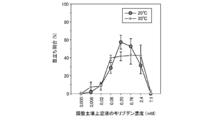
- the seedling establishment ratio was greatly reduced in the presence of a sulfate ion concentration of 1 mM under any conditions.
- the sulfate ion concentration exceeded 2 mM at 20 ° C.
- the seedlings were hardly established.
- the seedling establishment ratio decreased to 10% or less when the sulfate ion concentration exceeded 3 mM.
- Rice seeds (variety: Hinohikari) were soaked for 10 minutes in a 5-fold diluted solution of 70% by volume ethanol and sodium hypochlorite solution (purchased from Wako Pure Chemical Industries) for disinfection. The buds were soaked in water at 30 ° C. for 2 days and slightly sprouted.
- FIG. 3 shows the rice seedling establishment rate after 21 days in soil to which each concentration of potassium molybdate aqueous solution was added.
- the seedling establishment ratio was calculated by the ratio of the number of individuals from which the third leaf was extracted from nine seeds in one container, and was expressed as the average and standard error of 6 containers under the same conditions.
- the sulfide ion suppression effect of the molybdenum-containing material was investigated by the relationship between the degree of iron sulfide generation in the soil and the molybdenum concentration in the soil solution, and the results are shown in FIG.
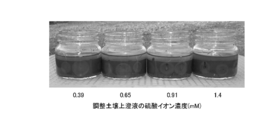
- the result shown in FIG. 4 is that of the sample obtained by the same method as in Example 1-2, but in order to understand the reduced state of the soil, methylene blue that is decolorized in the reduced state is 0.1% of the dry soil. Heavy addition is shown, and represents the state of 2 weeks after sowing at 30 ° C.
- the molybdenum concentration of the supernatant after shaking the adjusted soil was as shown in FIG.
- a decolorization circle indicating soil reduction occurs in the vicinity of the seeds.
- the potassium molybdate aqueous solution was not added (molybdenum concentration 0 mM)
- a darker circle indicating the presence of iron sulfide was observed in the soil, confirming the generation of sulfide ions and a decrease in seedling establishment.
- the rice that survived at a molybdenum concentration of 0 mM is one whose seeds have come out on the surface, and is not expected to be affected by sulfide ions.
- Example 2 Solubility of growth improving components
- the effects of various growth improving components on plant growth were compared.
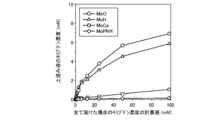
- Information provided by Wako Pure Chemical Industries https://www.siyaku.com/) regarding the characteristics of molybdenum and tungsten inclusions (both powders) and the inclusions other than metallic tungsten (metal molybdenum, phosphorus molybdenum) Potassium acid was actually obtained from Nippon Shin Metals Co., Ltd., and others were purchased from Wako Pure Chemical Industries, Ltd.).
- the solubility in water was investigated and summarized in Table 1 together with the color.
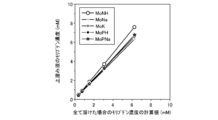
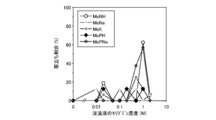
- FIG. 5 shows the relationship between the molybdenum concentration measured and the calculated value of the molybdenum concentration when all were dissolved. As shown in FIG. 5, the concentration of the supernatant of these readily soluble molybdenum-containing materials almost coincided with the calculated value, and it was shown that almost the entire amount was dissolved in this concentration range.
- the seedling establishment ratio of paddy rice was not significantly improved except for ammonium molybdate (MoNH) or sodium molybdophosphate (MoPNa). Further, even in the case of ammonium molybdate (MoNH) or sodium molybdophosphate (MoPNa), the seedling establishment ratio was improved only when the molybdenum concentration of the immersion liquid was about 1M, and the seedling establishment ratio was decreased in the case of 2M.
- the sulfide What is necessary is just to carry out so that generation
- failure suppression to a plant may be compatible.
- the molybdenum concentration is relatively high, if the immersion treatment time is made shorter, the growth can be improved without substantially damaging the plant.
- molybdenum oxide (MoO), molybdate (MoH), ammonium molybdophosphate (MoPNH), tungsten oxide (WO), and ammonium tungstate phosphate (WPNH) are 0.1 mmol / g (per dry seed) as molybdenum or tungsten.
- MoO molybdenum oxide
- MoH molybdate
- MoPNH ammonium molybdophosphate
- WO tungsten oxide
- WPNH ammonium tungstate phosphate
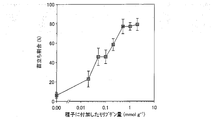
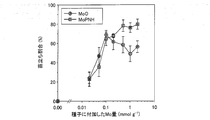
- the seedling establishment ratio of paddy rice was established at an addition amount of 0.05 mmol / g (per dry seed) or more as molybdenum or tungsten in most of the molybdenum-containing materials and tungsten-containing materials investigated. The rate has improved.
- Example 3 Effect of inhibiting decay of molybdenum-containing material
- Rice seeds at various molybdenum concentrations for each readily soluble molybdenum-containing material of ammonium molybdate (MoNH), sodium molybdate (MoNa), potassium molybdate (MoK), molybdophosphoric acid (MoPH) and sodium molybdophosphate (MoPNa) The growth potential and spoilage control effect of the rice were investigated. The results are shown in Table 2.
- the “immersion” in the left column of Table 2 indicates the result of leaving the rice seeds immersed in various molybdenum-containing solutions kept at 30 ° C. for 2 weeks.
- “10 minute soaking” in the right column of the table is the result of lifting rice seeds in various molybdenum-containing solutions for 10 minutes and then leaving them in water kept at 30 ° C. for 2 weeks. Indicates. In either case, the seeds were simply immersed in a solution or water without using soil. It was judged that it was able to grow about the density
- the indicated concentration indicates that it can be grown at the corresponding concentration or has been judged to be able to inhibit spoilage, which means that it cannot necessarily grow at a concentration higher than that, and it means that there is no spoilage suppression at a concentration lower than that. Do not mean.
- concentration which attached the large and small symbol is the upper limit or lower limit investigated, and shows that a range may be expanded by investigating in the density
- the slightly soluble molybdenum-containing material showed a spoilage inhibiting effect at a very low concentration, and it was possible to grow rice seeds.
- Example 4 Effect of growth-improving components on rice seedling establishment
- 4-1 In order to grasp the seedling improvement effect by ammonium molybdophosphate, which is a slightly soluble salt of heteroacid, which is considered to be suitable as a growth improving component, based on the above examples, and has a spoilage inhibiting effect at a low concentration, The establishment of seeds to which this compound was added was examined in detail. First, as in Example 1-2, soil (but no molybdenum compound was added) and germinated rice seeds were prepared.
- the germinated paddy rice seeds were immersed for 1 minute in a diluted solution of commercially available laundry paste (made of rocket soap, My laundry paste) of about 10% by weight or less of polyvinyl alcohol, and centrifuged at 1000 rpm to obtain an extra solution. Except for the above, immediately after different amounts of ammonium molybdate were applied, seeds with different amounts of ammonium molybdate were prepared. After standing for a while, seeding was carried out in the same manner as in Example 1-2, and allowed to stand in a thermostat at 30 ° C. In addition, 6 containers were applied per condition, and the results are shown in FIG. 11 as an average and standard error.
- the method of investigation is metal molybdenum (Mo), molybdenum oxide (MoO), molybdate (MoH), magnesium molybdate (MoMg), calcium molybdate (MoCa), and ammonium molybdophosphate (MoPNH).
- MoPK potassium molybdophosphate
- WH tungstic acid
- WPNH tungstophosphate ammonium
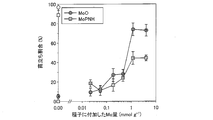
- the prepared seeds were allowed to stand for a while and then sown in the same manner as in Example 4-1, and allowed to stand at 30 ° C. Note that the results are shown as average and standard error in FIG. 14 to FIG. 14 to 15b, the horizontal axis indicates the number of moles (mmol) of molybdenum or tungsten deposited per gram of dried seeds. The number of moles of molybdenum or tungsten corresponding to each dot in FIGS. 14 to 15b is 0, 0.02, 0.05, 0.1, 0.2, 0.5, 1, 2 mmol in order from the left.
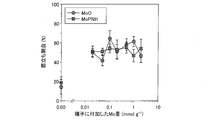
- Example 4-3 Among the molybdenum-containing materials used in Example 4-2, for molybdenum oxide (MoO) and ammonium molybdophosphate (MoPNH), in Example 4-2, 1) the static temperature condition after sowing was 30 ° C. What changed into 20 degreeC 2) The thing which changed the stationary temperature conditions after sowing to 20 degreeC or 30 degreeC was prepared using the dry seed instead of the germination bud, and the detailed investigation was performed. In the same manner as in Example 4-2, 6 containers were placed for each condition, and the seedling establishment ratio and standard error were examined. The results are shown in FIG. 16 (germinated seed, standing temperature condition 20 ° C.), FIG. 17 (dried seed, standing temperature condition 30 ° C.), and FIG.
- the horizontal axis indicates the number of moles (mmol) of molybdenum deposited per gram of dried seeds.
- the number of moles of molybdenum corresponding to each dot in FIGS. 16 to 18 is 0, 0.02, 0.05, 0.1, 0.2, 0.5, 1, 2 mmol in order from the left.
- the effect of addition of molybdenum was obtained regardless of the presence or absence of the sprouting treatment and the standing temperature conditions.
- the effect of improving the seedling emerges remarkably even under the condition of 20 ° C., which is relatively close to the normal seedling temperature environment.
- the horizontal axis indicates the number of moles (mmol) of molybdenum attached per gram of dried seeds.
- the number of moles of molybdenum corresponding to each dot in FIG. 19a is 0, 0.02, 0.05, 0.1, 0.2, 0.5, 1, 2 mmol in order from the left.
- molybdenum oxide MoO
- MoPNH ammonium molybdate
- MoPK potassium molybdophosphate
- the horizontal axis indicates the number of moles of molybdenum (mmol) attached per gram of dried seeds.
- the number of moles of molybdenum corresponding to each dot in FIG. 19b is 0, 0.02, 0.05, 0.1, 0.2, 0.5, 1, 2 mmol in order from the left, and molybdenum oxide (MoO) Furthermore, the experiment was conducted at 5, 10 mmol.
- the seedling establishment ratio decreased to 20% or less when the weight of 25 wt% calcium peroxide was 0.1 times or less of the dry seed weight.
- the seedling establishment ratio of 40% or more could be maintained even when the weight of 25% by weight of calcium peroxide was 0.1 times or less of the dry seed weight.
- the weight of 25% by weight calcium peroxide was 0.2 to 0.5 times the dry seed weight, the proportion of seedlings was higher when molybdenum oxide was mixed than when it was not mixed.
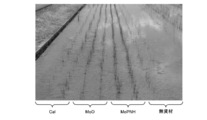
- dry seeds (Cal) coated with the same weight of oxygen generator (Calper powder granules 16, Hodogaya UPL Co., Ltd.) per dry seed were also prepared.
- the calper powder granule 16 is an oxygen generator mainly composed of calcium peroxide.
- Example 5 Effect of growth enhancing components on seedling establishment of barley and soybean
- ammonium sulfate corresponding to 10 g / m 2 as nitrogen and 5 g / m 2 of potassium as potassium oxide
- Corresponding potassium chloride was added as a solution, and each 100 g of dry soil was put into a container (cylinder shape having a diameter of about 7 cm), shaken for about 1 hour, and allowed to stand at 4 ° C. for 2 days.
- the soil-liquid ratio was 0.7. Under this condition, the soil surface and the water surface were almost the same height.
- the barley seeds (variety: Nishinokara) and soybean seeds (variety: Fukuyutaka) that have not been subjected to infiltration or the like in advance are soaked in water for 1 minute to remove excess water, and immediately, dry matter weight 1 g 0.2 mmol of ammonium molybdophosphate (purchased from Wako Pure Chemical Industries, Ltd.) was attached to the soil and submerged in the soil by about half. Then, at 20 ° C and 30 ° C constant temperature, add water to keep the soil surface slightly covered with water, apply 6 containers per condition, and establish seedling rate after 2 weeks (rate of surviving individuals) Was measured. The results are shown in FIG.
- the seedling establishment ratio was improved by the addition of ammonium molybdophosphate.
- Example 6 Effect of growth enhancing components on seedling establishment of barley and wheat
- (6-1) Equivalent to 10 g / m 2 of ammonium sulfate as nitrogen and 5 g / m 2 of potassium as potassium oxide when converted to 100 kg / m 2 of dry soil with respect to the paddy wet soil similar to Example 4-1.
- Potassium chloride to be added was added as a solution so that the soil-liquid ratio was 0.7, and each 100 g of dry soil was added to a container (cylindrical shape of about 7 cm in diameter). In order to flatten the soil surface, it was lightly held with a flat plate from above and then allowed to stand at 4 ° C. for 1 day.
- barley seeds (variety: Nishino Chikara) and wheat seeds (variety: Chikugoizumi) that have not been previously treated for infiltration or the like are made of commercially available laundry paste (made of rocket soap, My laundry paste) of less than 10% by weight of polyvinyl alcohol.
- laundry paste made of rocket soap, My laundry paste
- 0.01 mmol to 0.5 mmol of molybdenum oxide MoO, Or purchased from Wako Pure Chemical Industries
- MoPNH ammonium phosphomolybdate
- the water level was maintained by adding water so that the soil surface was slightly covered with water at a constant temperature of 20 ° C., 6 containers were applied per condition, and the seedling establishment rate (ratio of surviving individuals) was measured after 2 weeks.
- the result of barley is shown in FIG. 20a
- the result of wheat is shown in FIG. 20b.
- the horizontal axis indicates the number of moles (mmol) of molybdenum deposited per gram of dried seeds.
- the number of moles of molybdenum corresponding to each dot in the figure is 0, 0.01, 0.02, 0.05, 0.1, 0.2, 0.5 mmol in order from the left.
- the white symbol in the figure indicates a seedling establishment ratio when cultivated under field conditions without irrigating water.
- barley seeds and wheat seeds were also found to have improved seedling establishment ratio by addition of molybdenum oxide or ammonium phosphomolybdate.
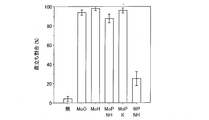
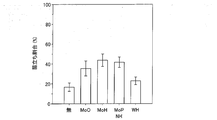
- Example 6-1 Soil was prepared in the same manner as in Example 6-1. Barley as in Example 6-1 with molybdenum oxide (MoO), molybdate (MoH), ammonium molybdophosphate (MoPNH), or potassium molybdophosphate (MoPK) at a rate of 0.5 mmol as molybdenum per gram of dried seeds. Seeds and wheat seeds. In addition, untreated seeds (nothing) that were not covered with anything were also prepared. For barley, tungsten oxide (WO) was used. For barley and wheat, tungstophosphate ammonium (WPNH) was used as tungsten per 1 g of dried seeds, and 0.5 mmol seeds were also produced.
- MoO molybdenum oxide
- MoH molybdate
- MoPNH ammonium molybdophosphate
- MoPK potassium molybdophosphate
- Example 6-1 Example 6-1
- water was added, the water level was maintained so that the surface water became 15 mm, and after 3 days, the surface water was sucked out with a pipette and discarded.
- sowing except for the difference in water level, it was controlled at 20 ° C. as in Example 6-1, and 6 containers were applied per condition, and the seedling establishment rate (ratio of surviving individuals) was 2 weeks after sowing. It was measured.
- the result of barley is shown in FIG. 20c
- the result of wheat is shown in FIG. 20d.
- Example 6a Effect of growth improving components on seedling establishment of soybean
- (6a-1) Soil was prepared in the same manner as in Example 6-1. Next, dilute soybean seed (variety: Fukuyutaka) that has not been previously treated with infiltration, etc. by diluting commercial laundry paste (made by rocket soap, My laundry paste) of about 10% by weight of polyvinyl alcohol 10 times. Immerse in the liquid for 1 minute. Next, after dehydrating for 30 seconds with a commercially available washing machine and removing the excess solution, 0.01 mmol to 0.5 mmol molybdenum oxide (MoO, purchased from Wako Pure Chemical Industries) or phosphorus Ammonium molybdate (MoPNH, purchased from Wako Pure Chemical Industries) was attached.
- MoO molybdenum oxide
- MoPNH phosphorus Ammonium molybdate
- the seeds were buried so that the upper ends of the seeds were at the same height as the soil surface. Water was added so that the surface water became 15 mm immediately after sowing in an indoor room with an air temperature of 25 ° C. and an artificial light (light intensity: 0.4 mmol / m 2 / s, 12 hours a day) Was pipetted out and discarded. Six containers were applied per condition, and the seedling establishment rate (rate of surviving individuals) was measured 2 weeks after sowing. The result is shown in FIG. In FIG. 20e, the horizontal axis indicates the number of moles (mmol) of molybdenum deposited per gram of dried seeds.
- the number of moles of molybdenum corresponding to each dot in the figure is 0 (no treatment), 0.01, 0.02, 0.05, 0.1, 0.2, 0.5 mmol in order from the left.
- the white symbol of a figure shows the seedling establishment ratio at the time of growing on field conditions, without drowning water.
- the seedling establishment ratio with respect to no treatment was improved by addition of molybdenum oxide and ammonium phosphomolybdate.
- Example 6a-1 After these were sown in the same manner as in Example 6a-1, the water level was maintained so that the surface water became 15 mm and the temperature was controlled at 20 ° C. Two days later, the water on the soil surface was sucked out with a pipette and discarded. Furthermore, it managed at 20 degreeC, 6 containers were applied per condition, and the seedling establishment ratio (ratio of surviving individuals) was measured after 2 weeks. The result is shown in FIG.
- Example 6b Effect of growth enhancing components on buckwheat seedling establishment
- Soil was prepared in the same manner as in Example 6-1.
- buckwheat seed variety: Sachiizumi
- a commercial laundry paste made by rocket soap, My laundry paste
- molybdenum oxide MoO
- molybdic acid MoH
- ammonium molybdophosphate MoPNH
- tungstic acid WH
- Example 7 Effect of growth-improving components on avoidance of barley's wet damage
- 1.2 t / 10a of cow manure compost and 6 kg / 10a equivalent of ammonium sulfate were applied with nitrogen.
- seeds of barley variety: Nishinokara
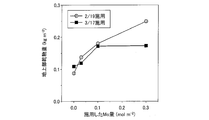
- 8 sections of 50 cm ⁇ 70 cm separated by corrugated plates were provided, and on February 19 or March 17, as molybdenum, 0,0.03,0.1,0.3 mol / A m 2 equivalent of ammonium molybdophosphate was applied.
- the above-ground part of the barley separated by corrugated sheets was cut and the dry weight was determined. The results are shown in FIG.
- the dry weight of the above-ground part at the time of harvesting was about 0.1 kg / m 2 when molybdenum was not applied, but there was a tendency that the dry weight of the above-ground part increased as more molybdenum was applied. It was. In particular, in the molybdenum application in the order of 0.3 mol / m 2 in February, about 0.25 kg / m 2 was obtained as a shoot dry weight at harvest. From the above, it was suggested that in the cultivation of crops that are vulnerable to moisture damage, such as barley, the moisture damage of the crop is reduced by applying molybdenum to the field.
- the present invention can be widely used in the agricultural field where crops are cultivated, particularly in rice cultivation.
Landscapes
- Life Sciences & Earth Sciences (AREA)
- Chemical & Material Sciences (AREA)
- Health & Medical Sciences (AREA)
- Environmental Sciences (AREA)
- Inorganic Chemistry (AREA)
- General Health & Medical Sciences (AREA)
- Wood Science & Technology (AREA)
- Engineering & Computer Science (AREA)
- Dentistry (AREA)
- Plant Pathology (AREA)
- Pest Control & Pesticides (AREA)
- Zoology (AREA)
- Agronomy & Crop Science (AREA)
- Chemical Kinetics & Catalysis (AREA)
- Organic Chemistry (AREA)
- Toxicology (AREA)
- Soil Sciences (AREA)
- Agricultural Chemicals And Associated Chemicals (AREA)
- Pretreatment Of Seeds And Plants (AREA)
- Cultivation Of Plants (AREA)
- Fertilizers (AREA)
Abstract
Description
本発明に係る植物生育向上剤は、硫酸イオンよりも重くかつ4つの酸素を含むオキソアニオンの、植物の周囲における濃度を向上させる(すなわち、上昇させる)生育向上成分を含むことを一つの特徴としている。植物生育向上剤は、生育向上成分により、植物の周辺に存在する微生物の硫酸イオン代謝を攪乱して、植物に害を及ぼす硫化物イオンの生成等、微生物の活動を抑制する。これにより、植物の障害を防ぎ、植物の生育を向上させる。植物生育向上剤は、植物の苗立ちの向上、初期生育の向上、秋落ちの防止等を含む植物の生育の向上に効果的であるが、特に、植物の苗立ちに対しては少量で顕著に向上させる。植物生育向上剤を植物の生育環境に存在させて植物を生育することによって、植物の生育が向上する。
本発明に係る種子は、本発明に係る植物生育向上剤が表面又は内部に付与されたことを特徴としている。種子は、表面又は内部に付与された植物生育向上剤中の生育向上成分によって、植物の周辺に存在する微生物の硫酸イオン代謝を攪乱して、植物に害を及ぼす硫化物イオンの生成等の微生物の活動を抑制することによって、当該種子が発芽した植物の生育を向上させる。また、本発明に係る種子は、表面のみならず、その内部にさらに植物生育向上剤を含んでいることが好ましい。
本発明に係る植物の生育を向上させる方法は、硫酸イオンよりも重くかつ4つの酸素を含むオキソアニオンの、植物の周囲における濃度を向上させる(すなわち、上昇させる)生育向上成分の存在下で、植物を生育する栽培工程を包含することを特徴としている。植物の生育を向上させる方法は、生育向上成分により、植物の生育環境における微生物の活動を抑制することによって、植物の生育を向上させる。植物の生育を向上させる方法は、植物の苗立ちの向上、初期生育の向上、硫化物イオンによる根痛みである秋落ちの防止等を含む植物の生育の向上に効果的であるが、特に、植物の苗立ちに対しては少量の生育向上成分の存在により顕著に向上させる。
植物の生育を向上させる方法においては、本発明に係る植物生育向上剤を、植物を生育する溶液、土壌又はこれらの代替物に添加することによって、生育向上成分を存在させてもよい。
本発明に係る植物の生育を向上させる方法は、上記栽培工程の前に、上述した本発明に係る種子を、植物を生育する土壌に播種する工程をさらに包含してもよい。本発明に係る種子は、その表面又は内部に植物生育向上剤を含んでいるので、生育向上成分が土壌等に可溶化し、植物の生育環境における微生物の活動を抑制することによって、植物の生育を向上させる。
本発明に係る植物の生育を向上させる方法は、植物を生育する溶液、土壌又はこれらの代替物中のモリブデン含有物、タングステン含有物、クロム含有物、セレン含有物、又はテルル含有物から、硫酸イオンよりも重くかつ4つの酸素を含むオキソアニオンを生成又は可溶化させる資材を、上記溶液、上記土壌又はこれらの代替物に添加することによって、上記生育向上成分を存在させてもよい。
本発明は、水が多い条件で作物を栽培する農業分野、特に水稲作での広範な利用が期待される。本発明に係る植物生育向上剤、植物生育向上剤が付与された種子、及び植物の生育を向上させる方法によれば、環境への負荷を抑えつつ、低コスト及び省力化を実現し、容易にかつ効率よく植物を栽培することが可能である。特に、本発明を水稲に適用すれば、苗立ちが向上するので、種子の播種後に水田の水を落とす必要がなく、水や肥料の削減につながるとともに、雑草が抑制されることにより除草剤を削減することができる。また、苗立ちの向上により播種する種子の数を削減でき、種子にかかる費用を削減することができる。本発明は、植物の生育環境の保全にも役立つものである。
(1-1:硫化物イオンの基質である硫酸イオンが苗立ちに及ぼす影響)
水田土壌を殺菌せずに20℃恒温、30℃恒温、屋外に置いた場合(期間中の平均気温は平均25.4℃)、又は20℃恒温であるが土壌を殺菌した場合において、硫化物イオンの基質である硫酸イオンの土壌溶液中の濃度が水稲の苗立ち割合に及ぼす影響について調査し、結果を図1に示した。
水田湿潤土壌(福岡県筑後市の水田で採取し、湿潤土のまま直前まで冷蔵保管)に対して、乾土100kg/m2と換算したときに、硫酸アンモニウムを窒素として10g/m2相当量、及び酸化カリウムとして5g/m2相当量のカリウムを塩化カリウムによって添加した。また、モリブデン酸カリウム(和光純薬工業より購入)の添加量が異なる8条件を作成するために、それぞれ0、0.038、0.075、0.15、0.3、0.75、1.5、3mol/m2相当量となるように、かつ土液比が1:1.5となるように溶液に溶かして土壌に添加した。物質添加後の土壌を、乾土120g相当量ずつ容器(直径約7cm円筒形)に入れて、1時間ほど振盪し、4℃で2日間静置した。この条件で、土層が約4cm、土壌表面上の水層が1cmほどとなった。
モリブデン含有物の硫化物イオン抑制効果を、土壌中の硫化鉄の発生程度と土壌溶液中のモリブデン濃度との関係により調査し、結果を図4に示した。図4に示す結果は、実施例1-2と同様の方法で得られたサンプルのものであるが、土壌の還元状態が分かるように、還元状態で脱色するメチレンブルーを乾土の0.1%重添加しており、30℃で播種後2週間目の状態を表している。調整土壌の振盪後上澄液のモリブデン濃度は図4に示す各濃度となった。
(2-1:生育向上成分が硫化物イオン生成抑制及び苗立ち割合に及ぼす効果)
種々の生育向上成分が植物の生育に及ぼす影響について比較した。モリブデン及びタングステンの含有物(いずれも粉末)の特性を、和光純薬工業が提供する情報(https://www.siyaku.com/)及び、金属タングステン以外の当該含有物(金属モリブデン、リンモリブデン酸カリウムは日本新金属(株)製、その他は和光純薬工業より購入)を実際に入手して、水への溶けやすさを調査し、色とともに表1にまとめた。

次に、水に溶けやすかった易溶性の各モリブデン含有物について濃度を変えた水溶液を作成し、実施例1-1と同様に催芽した水稲種子(品種:ヒノヒカリ)を10分間浸漬し、実施例1-3と同様に調製した土壌(ただし、モリブデン含有物は添加していない)に播種した場合において、硫化物イオン生成抑制日数(硫化鉄である黒色斑点が出現しない期間)及び苗立ち割合を調査し、結果を図7及び図8に示した。
わずかに出芽させた種子の水分を軽く拭き取り、即座に、表1に示す微溶性含有物について様々な量を付加した(まぶした)。水分が乾ききらないうちに、実施例2-2と同様に調製した土壌に播種し、硫化物イオン生成抑制日数及び苗立ち割合を調査した。結果を図9及び図10に示す。
土壌が介在しない水耕栽培において、モリブデン含有物による腐敗抑制効果を調査した。モリブデン酸アンモニウム(MoNH)、モリブデン酸ナトリウム(MoNa)、モリブデン酸カリウム(MoK)、モリブドリン酸(MoPH)及びモリブドリン酸ナトリウム(MoPNa)のそれぞれの易溶性モリブデン含有物について、種々のモリブデン濃度における水稲種子の生育可能性及び腐敗抑制効果を調査した。結果を表2に示す。


(4-1)
上記の実施例を踏まえて、生育向上成分として適すると考えられた、微溶性でヘテロ酸の塩であり、低濃度で腐敗抑制効果を持つ、モリブドリン酸アンモニウムによる苗立ち向上効果を把握するため、この化合物を付加した種子の苗立ちを詳細に調べた。まず、実施例1-2と同様に土壌(ただし、モリブデン化合物は添加していない)と催芽した水稲種子とを調製した。催芽した水稲種子は、ポリビニルアルコール10重量%弱程度の市販の洗濯糊(ロケット石鹸製、マイ洗濯糊)を10倍に希釈した希釈液に1分間浸漬した後、1000rpmで遠心し、余分な溶液を除いて、ただちに異なる量のモリブドリン酸アンモニウムをまぶし、モリブドリン酸アンモニウムの付加量が異なる種子を調製した。しばらく放置した後、実施例1-2と同様に播種し、30℃の恒温器内で静置した。なお、一条件につき6容器を当てて、図11に結果を平均と標準誤差で示した。
上記の各実施例を踏まえて、生育向上成分として適すると考えられた微溶性のモリブデン含有物及び微溶性のタングステン含有物による苗立ち向上効果を把握するため、これらの含有物を付加した種子の苗立ちを詳細に調べた。
実施例4-2で用いたモリブデン含有物のうち、酸化モリブデン(MoO)及びモリブドリン酸アンモニウム(MoPNH)については、上記実施例4-2において、1)播種後の静置温度条件を30℃から20℃に変更したもの、2)催芽籾の代わりに乾燥種子を用い、播種後の静置温度条件を20℃又は30℃に変更したものを準備し、さらに詳細な調査を行った。そして、実施例4-2と同様に、一条件につき6容器をあてて、苗立ち割合と標準誤差を調べた。結果を、図16(催芽種子、静置温度条件20℃)、図17(乾燥種子、静置温度条件30℃)、及び図18(乾燥種子、静置温度条件20℃)に示す。なお、図16~図18において、横軸は、乾燥種子1グラム当たりに付着したモリブデンのモル数(mmol)を指す。図16~図18における各ドットに対応するモリブデンのモル数は左から順に、0、0.02、0.05、0.1、0.2、0.5、1、2mmolである。
また、実施例1-2と同様に催芽した種子(催芽籾)と、乾燥種子当たり同重量の粘土(ネオライト興産株式会社、大平DLクレー)に、酸化モリブデン(MoO)又はモリブドリン酸アンモニウム(MoPNH)を混ぜて、これをポリビニルアルコール10重量%程度の市販の洗濯糊(ロケット石鹸製、マイ洗濯糊)を半分に薄めた溶液を用いて表面に被覆させた種子について、上記実施例4-1と同様の条件で播種し、栽培した。次いで、実施例4-1と同様に、一条件につき6容器をあてて、苗立ち割合と標準誤差を調べた。結果を図19aに示す。なお、図19aにおいて、横軸は、乾燥種子1グラム当たりに付着したモリブデンのモル数(mmol)を指す。図19aにおける各ドットに対応するモリブデンのモル数は左から順に、0、0.02、0.05、0.1、0.2、0.5、1、2mmolである。
また、乾燥種子の半分の重量の還元鉄(和光純薬工業(株)、一級)に、酸化モリブデン(MoO)、モリブドリン酸アンモニウム(MoPNH)又はモリブドリン酸カリウム(MoPK)を混ぜて、霧吹きで水をかけながら、催芽していない乾燥種子の表面に被覆させ、鉄さびが生じるように十分に湿らせた状態を経過して、さらに一晩経過させた。この被覆種子について、実施例4-1と同様に30℃で土壌15mmの深さに播種し、一条件につき6容器をあてて、苗立ち割合と標準誤差を調べた。結果を図19bに示す。なお、図19bにおいて、横軸は、乾燥種子1グラム当たりに付着したモリブデンのモル数(mmol)を指す。図19bにおける各ドットに対応するモリブデンのモル数は左から順に、0、0.02、0.05、0.1、0.2、0.5、1、2mmolであり、酸化モリブデン(MoO)はさらに、5、10mmolでも実験を行った。
また、過酸化カルシウム(和光純薬工業(株)、25重量%含有製品)のみと、当該過酸化カルシウムの添加量を変えて、乾燥種子当たり0.1mmol/gの酸化モリブデン(MoO)に混合した粉末とをそれぞれ、霧吹きで水をかけながら催芽していない乾燥種子の表面に被覆させた。この被覆種子について、実施例4-1と同様に30℃で土壌15mmの深さに播種し、一条件につき6容器をあてて、苗立ち割合と標準誤差とを調べた。結果を図19cに示す。なお、図19cにおいて、横軸は、乾燥種子の重量に対して、付着させた25重量%過酸化カルシウムの実物重量比を指す。図19cにおける各ドットに対応する25重量%過酸化カルシウムの実物重量比は左から順に、0、0.01、0.02、0.05、0.1、0.2、0.5、1倍であった。
乾燥した水稲種子(品種:ヒノヒカリ)を準備した。次いで、乾燥種子当たり半分の重量の粘土(ネオライト興産株式会社、大平DLクレー)に、乾燥種子当たりモリブデンとして0.1mmol/gの酸化モリブデン(MoO)又はモリブドリン酸アンモニウム(MoPNH)を混ぜて、これをポリビニルアルコール10重量%程度の市販の洗濯糊(ロケット石鹸製、マイ洗濯糊)を半分に薄めた溶液を用いて乾燥種子の表面に被覆させた。別に、モリブデンを添加しない粘土のみで被覆した乾燥種子(無資材)も準備した。さらに、乾燥種子当たり同重量の酸素発生剤(カルパー粉粒剤16、保土谷UPL株式会社)を被覆した乾燥種子(Cal)も準備した。なお、カルパー粉粒剤16は過酸化カルシウムを主成分とする酸素発生剤である。
実施例4-1と同様に、水田湿潤土壌に対して、乾土100kg/m2と換算したときに、窒素として10g/m2相当量の硫酸アンモニウム、及び酸化カリウムとして5g/m2のカリウムに相当する塩化カリウムを溶液として添加し、乾土100g相当量ずつ容器(直径約7cm円筒形)に入れて、1時間ほど振盪し、4℃で2日間静置した。ただし、土液比は0.7とした。この条件で、土壌表面と水面はほぼ同じ高さになった。次に、事前に浸潤等の処理をしていないオオムギ種子(品種:ニシノチカラ)及びダイズ種子(品種:フクユタカ)を1分間水に浸けて、余分な水分を除いた後、即時に、乾物重量1gに対して0.2mmolのモリブドリン酸アンモニウム(和光純薬工業より購入)を付着させ、土壌中に半分ほど沈めた。その後、20℃恒温及び30℃恒温において、土壌表面がわずかに水を被る程度に水を足して水位を保ち、一条件につき6容器をあてて、2週間後に苗立ち割合(生存個体の割合)を測定した。結果を図12に示す。
(6-1)
実施例4-1と同様の水田湿潤土壌に対して、乾土100kg/m2と換算したときに、窒素として10g/m2相当量の硫酸アンモニウム、及び酸化カリウムとして5g/m2のカリウムに相当する塩化カリウムを、土液比が0.7となるよう溶液として添加し、乾土100g相当量ずつ容器(直径約7cm円筒形)に入れた。土壌表面を平らにするため、上から平面板で軽く抑えたあとで、4℃で1日間静置した。次に、事前に浸潤等の処理をしていないオオムギ種子(品種:ニシノチカラ)及びコムギ種子(品種:チクゴイズミ)を、ポリビニルアルコール10重量%弱程度の市販の洗濯糊(ロケット石鹸製、マイ洗濯糊)を10倍に希釈した希釈液に1分間浸け、次いで1000rpmで遠心し、余分な溶液を除いた後、即時に、乾物重量1gに対して0.01mmol~0.5mmolの酸化モリブデン(MoO、和光純薬工業より購入)又はリンモリブデン酸アンモニウム(MoPNH、和光純薬工業より購入)を付着させた。この種子を、土壌中に半分ほど沈めた。その後、20℃恒温で、土壌表面がわずかに水を被る程度に水を足して水位を保ち、一条件につき6容器をあてて、2週間後に苗立ち割合(生存個体の割合)を測定した。大麦の結果を図20a、小麦の結果を図20bに示す。なお、図20a、図20bにおいて、横軸は、乾燥種子1グラム当たりに付着したモリブデンのモル数(mmol)を指す。図中の各ドットに対応するモリブデンのモル数は左から順に、0、0.01、0.02、0.05、0.1、0.2、0.5mmolである。なお、図中の白抜きの記号は、水を湛水せずに、畑条件のままで栽培した場合の苗立ち割合を示す。
実施例6-1と同様に、土壌を調整した。酸化モリブデン(MoO)、モリブデン酸(MoH)、モリブドリン酸アンモニウム(MoPNH)、又はモリブドリン酸カリウム(MoPK)を、乾燥種子1g当たりモリブデンとして0.5mmolの割合で、実施例6-1と同様に大麦種子と小麦種子にまぶした。また、対象として何もまぶさない無処理の種子(無)も調整した。なお、大麦では、酸化タングステン(WO)を、大麦と小麦では、タングストリン酸アンモニウム(WPNH)を乾燥種子1g当たりタングステンとして0.5mmolをまぶした種子も作った。これらを実施例6-1と同様に土壌に播種した後、種子上端が土壌表面と同じ高さになるように埋めた。その後、水を添加し、表面水が15mmとなるように水位を保ち、3日後に表面の水をピペットで吸い出して捨てた。なお、播種後は、水位の違いを除いて、実施例6-1と同様に20℃で管理し、一条件につき6容器を当てて、播種2週間後に苗立ち割合(生存個体の割合)を測定した。大麦の結果を図20c、小麦の結果を図20dに示す。
(6a-1)
実施例6-1と同様に土壌を調製した。次に、事前に浸潤等の処理をしていないダイズ種子(品種:フクユタカ)を、ポリビニルアルコール10重量%弱程度の市販の洗濯糊(ロケット石鹸製、マイ洗濯糊)を10倍に希釈した希釈液に1分間浸けた。次いで市販の洗濯機で30秒脱水し、余分な溶液を除いた後、即時に、乾物重量1gに対して0.01mmol~0.5mmolの酸化モリブデン(MoO、和光純薬工業より購入)又はリンモリブデン酸アンモニウム(MoPNH、和光純薬工業より購入)を付着させた。この種子を、種子の上端が土壌表面と同じ高さとなるように埋めた。気温25℃、人工灯(光量は0.4mmol/m2/s、1日12時間点灯)の室内で、播種後直ぐに表面水が15mmとなるように水を添加し、2日後に表面の水をピペットで吸い出して捨てた。一条件につき6容器を当てて、播種2週間後に苗立ち割合(生存個体の割合)を測定した。結果を図20eに示す。なお、図20eにおいて、横軸は、乾燥種子1グラム当たりに付着したモリブデンのモル数(mmol)を指す。図の各ドットに対応するモリブデンのモル数は左から順に、0(無処理)、0.01、0.02、0.05、0.1、0.2、0.5mmolである。なお、図の白抜きの記号は、水を湛水せずに、畑条件のままで栽培した場合の苗立ち割合を示す。
実施例6-1と同様に、土壌を調整した。酸化モリブデン(MoO)、モリブデン酸(MoH)、モリブドリン酸アンモニウム(MoPNH)、モリブドリン酸カリウム(MoPK)、タングステン酸(WH)、またはタングストリン酸アンモニウム(WPNH)を、乾燥種子1g当たりモリブデンまたはタングステンとして0.5mmolの割合で、実施例6a-1と同様にダイズ種子にまぶした。また、対象として何もまぶさない無処理の種子(無)も準備した。これらを実施例6a-1と同様に土壌に播種した後、表面水が15mmとなるように水位を保ち、20℃で管理した。2日後に土壌表面の水をピペットで吸い出して捨てた。さらに、20℃で管理し、一条件につき6容器を当てて、2週間後に苗立ち割合(生存個体の割合)を測定した。結果を図20fに示す。
実施例6-1と同様に、土壌を調整した。次に、事前に浸潤等の処理をしていないソバ種子(品種:さちいずみ)を、ポリビニルアルコール10重量%弱程度の市販の洗濯糊(ロケット石鹸製、マイ洗濯糊)を10倍に希釈した希釈液に1分間浸け、次いで1000rpmで遠心し、余分な溶液を除いた。その直後に、酸化モリブデン(MoO)、モリブデン酸(MoH)、モリブドリン酸アンモニウム(MoPNH)、またはタングステン酸(WH)を、乾燥種子1g当たりモリブデンまたはタングステンとして0.5mmolの割合で、ソバ種子にまぶした。また、対象として何もまぶさない無処理の種子(無)も準備した。この種子を、種子の上端が土壌表面と同じ高さとなるように埋めた。気温25℃、人工灯(光量は0.4mmol/m2/s、1日12時間点灯)の室内で、播種2日後に表面水が15mmとなるように水を添加し、その1日後に表面の水をピペットで吸い出して捨てた。一条件につき6容器をあてて、播種2週間後に苗立ち割合(生存個体の割合)を測定した。
福岡県筑後市の排水が不良な水田に、牛糞堆肥1.2t/10aと窒素で6kg/10a相当量の硫酸アンモニウムを施用した。2009年11月、オオムギ(品種:ニシノチカラ)の種子を9kg/10a播種した。2010年2月に50cm×70cmを波板で区切った区を8つ設けて、同2月19日または同3月17日に、モリブデンとして0,0.03,0.1,0.3mol/m2相当量のモリブドリン酸アンモニウムを施用した。同5月11日に、波板で区切った中のオオムギの地上部を刈り取り、乾燥重を求めた。結果を図21に示す。
Claims (18)
- 硫酸イオンよりも重くかつ4つの酸素を含むオキソアニオンの、植物の周囲における濃度を向上させる生育向上成分を含むことを特徴とする植物の生育を向上させる植物生育向上剤。
- 上記生育向上成分は、オキソアニオンを供給する、モリブデン含有物、タングステン含有物、クロム含有物、セレン含有物、及びテルル含有物からなる群より選択されることを特徴とする請求項1に記載の植物生育向上剤。
- 上記生育向上成分は、オキソアニオンを供給する、モリブデン化合物、タングステン化合物、クロム化合物、セレン化合物、及びテルル化合物からなる群より選択されることを特徴とする請求項1に記載の植物生育向上剤。
- 上記植物として、少なくとも一時的に植物体の少なくとも一部が湛水状態となる条件下で栽培される植物に対して用いられることを特徴とする請求項1~3のいずれか1項に記載の植物生育向上剤。
- 上記植物は、イネ科の植物であることを特徴とする請求項4に記載の植物生育向上剤。
- 上記植物の苗立ちを向上させることを特徴とする請求項1~5のいずれか1項に記載の植物生育向上剤。
- 上記生育向上成分は、水に対して微溶性であることを特徴とする請求項1~6のいずれか1項に記載の植物生育向上剤。
- 上記生育向上成分は、オキソアニオンを供給する、モリブデン化合物又はタングステン化合物であることを特徴とする請求項3に記載の植物生育向上剤。
- 請求項1~8のいずれか1項に記載の植物生育向上剤が表面又は内部に付与されたことを特徴とする種子。
- 硫酸イオンよりも重くかつ4つの酸素を含むオキソアニオンの、植物の周囲における濃度を向上させる生育向上成分の存在下で、植物を生育させる栽培工程を包含することを特徴とする植物の生育を向上させる方法。
- 上記生育向上成分は、オキソアニオンを供給する、モリブデン含有物、タングステン含有物、クロム含有物、セレン含有物、及びテルル含有物からなる群より選択されることを特徴とする請求項10に記載の方法。
- 上記生育向上成分は、オキソアニオンを供給する、モリブデン化合物、タングステン化合物、クロム化合物、セレン化合物、及びテルル化合物からなる群より選択されることを特徴とする請求項10に記載の方法。
- 請求項1~8のいずれか1項に記載の植物生育向上剤を、上記植物を生育させる溶液、土壌又はこれらの代替物に添加することによって、上記生育向上成分を存在させることを特徴とする請求項10~12のいずれか1項に記載の方法。
- 上記植物生育向上剤を、上記溶液中、又は上記土壌若しくはこれらの代替物の溶液中に、硫酸イオンよりも重くかつ4つの酸素を含むオキソアニオン換算で0.01mM~10mMの範囲内で存在させることを特徴とする請求項13に記載の方法。
- 上記溶液、上記土壌又はこれらの代替物中の少なくとも一部において、pH7で標準化される酸化還元電位が、少なくとも一時的に0mV以下であるときに、上記植物生育向上剤を上記溶液、上記土壌又はこれらの代替物に添加することを特徴とする請求項13に記載の方法。
- 上記栽培工程の前に、請求項9に記載の種子を、植物を生育させる溶液、土壌又はこれらの代替物に播種する播種工程をさらに包含し、当該播種工程により上記生育向上成分を存在させることを特徴とする請求項10~12のいずれか1項に記載の方法。
- 苗立ち期、又は一時的に植物体の少なくとも一部が湛水状態となる期間、の少なくとも一方において、上記栽培工程を行うことを特徴とする請求項10~15のいずれか1項に記載の方法。
- 植物を生育させる溶液、土壌又はこれらの代替物中のモリブデン含有物、タングステン含有物、クロム含有物、セレン含有物、又はテルル含有物から、硫酸イオンよりも重くかつ4つの酸素を含むオキソアニオンを生成又は可溶化させる資材を、上記溶液、上記土壌又はこれらの代替物に添加する工程を包含することを特徴とする植物の生育を向上させる方法。
Priority Applications (6)
| Application Number | Priority Date | Filing Date | Title |
|---|---|---|---|
| US13/520,198 US20120283096A1 (en) | 2010-01-26 | 2011-01-26 | Agent for improving plant growth, seeds, and method for improving plant growth |
| BR112012017621A BR112012017621A2 (pt) | 2010-01-26 | 2011-01-26 | agente para melhorar o crescimento da planta, sementes e método para melhorar o crescimento da planta |
| EP11737054.4A EP2529625A4 (en) | 2010-01-26 | 2011-01-26 | AGENT FOR ENHANCING GROWTH OF PLANTS, SEEDS AND METHOD FOR ENHANCING PLANT GROWTH |
| JP2011551880A JP5477753B2 (ja) | 2010-01-26 | 2011-01-26 | 植物生育向上剤、種子、及び植物の生育を向上させる方法 |
| KR1020127016895A KR20120124399A (ko) | 2010-01-26 | 2011-01-26 | 식물 생육 향상제, 종자, 및 식물의 생육을 향상시키는 방법 |
| CN2011800060257A CN102711482A (zh) | 2010-01-26 | 2011-01-26 | 植物生长改良剂、种子、以及改良植物生长的方法 |
Applications Claiming Priority (4)
| Application Number | Priority Date | Filing Date | Title |
|---|---|---|---|
| JP2010014471 | 2010-01-26 | ||
| JP2010-014471 | 2010-06-11 | ||
| JP2010183071 | 2010-08-18 | ||
| JP2010-183071 | 2010-08-18 |
Publications (1)
| Publication Number | Publication Date |
|---|---|
| WO2011093341A1 true WO2011093341A1 (ja) | 2011-08-04 |
Family
ID=44319325
Family Applications (1)
| Application Number | Title | Priority Date | Filing Date |
|---|---|---|---|
| PCT/JP2011/051500 Ceased WO2011093341A1 (ja) | 2010-01-26 | 2011-01-26 | 植物生育向上剤、種子、及び植物の生育を向上させる方法 |
Country Status (7)
| Country | Link |
|---|---|
| US (1) | US20120283096A1 (ja) |
| EP (1) | EP2529625A4 (ja) |
| JP (1) | JP5477753B2 (ja) |
| KR (1) | KR20120124399A (ja) |
| CN (1) | CN102711482A (ja) |
| BR (1) | BR112012017621A2 (ja) |
| WO (1) | WO2011093341A1 (ja) |
Cited By (2)
| Publication number | Priority date | Publication date | Assignee | Title |
|---|---|---|---|---|
| JP2013146266A (ja) * | 2011-12-20 | 2013-08-01 | National Agriculture & Food Research Organization | 繁殖体被覆物、栽培方法、及び繁殖体被覆物の製造方法 |
| JP2013208106A (ja) * | 2012-02-27 | 2013-10-10 | National Agriculture & Food Research Organization | 植物繁殖体、及びその栽培方法 |
Families Citing this family (7)
| Publication number | Priority date | Publication date | Assignee | Title |
|---|---|---|---|---|
| RU2553238C2 (ru) * | 2013-10-11 | 2015-06-10 | Государственное научное учреждение Поволжский научно-исследовательский институт производства и переработки мясомолочной продукции Российской академии сельскохозяйственных наук | Способ стимуляции проращивания семян сельскохозяйственных культур |
| CN103964948B (zh) * | 2014-04-23 | 2016-01-13 | 中国水稻研究所 | 一种水稻专用富硒无土有机育秧基质及其生产方法 |
| EP3628138A1 (en) * | 2015-07-29 | 2020-04-01 | The Sangyo Shinko Co., Ltd. | Steelmaking slag-coated seed and method for producing same |
| JP7506454B2 (ja) * | 2018-03-30 | 2024-06-26 | 株式会社フジタ | 植物生長促進方法 |
| CN110537466A (zh) * | 2019-09-30 | 2019-12-06 | 毕节市农业科学研究所 | 一种粳稻高产的培育方法 |
| GB202306474D0 (en) * | 2023-05-02 | 2023-06-14 | Croda Int Plc | Seed treatment composition and use |
| CN118947294B (zh) * | 2024-10-21 | 2025-02-21 | 内蒙古蒙草植物营养科技有限公司 | 一种自动化精准覆种装置 |
Citations (3)
| Publication number | Priority date | Publication date | Assignee | Title |
|---|---|---|---|---|
| JPH1146603A (ja) * | 1997-07-31 | 1999-02-23 | Norin Suisansyo Hokuriku Nogyo Shikenjo | 水稲種子の生産方法 |
| JP2005192458A (ja) | 2004-01-06 | 2005-07-21 | National Agriculture & Bio-Oriented Research Organization | 鉄粉被覆稲種子の製造法 |
| JP2006232690A (ja) * | 2005-02-23 | 2006-09-07 | National Agriculture & Food Research Organization | イネ細菌性病害の防除方法 |
Family Cites Families (8)
| Publication number | Priority date | Publication date | Assignee | Title |
|---|---|---|---|---|
| DE3020422A1 (de) * | 1980-05-29 | 1981-12-10 | Bayer Ag, 5090 Leverkusen | Ionenaustauscher-duengemittel |
| JPH01146603A (ja) * | 1987-11-29 | 1989-06-08 | Mita Ind Co Ltd | パンチ刃の製造方法 |
| US5549729A (en) * | 1988-09-09 | 1996-08-27 | Yamashita; Thomas T. | Method and composition for promoting and controlling growth of plants |
| CN1178208A (zh) * | 1996-09-27 | 1998-04-08 | 大连华南微肥厂 | 双效液体微肥及其制备方法 |
| MXPA04009282A (es) * | 2002-03-26 | 2005-01-25 | Georgia Pacific Resins | Fertilizador de nitrogeno de lenta liberacion. |
| CN101166842B (zh) * | 2005-06-28 | 2012-07-04 | 坂仓康郎 | 氧活化材料、燃烧效率改良材料、植物生长促进材料、嗜氧微生物活化材料、动物生长促进及活化材料、肌肉软化材料、除锈及防锈材料以及氧气活化的方法 |
| CN101473841B (zh) * | 2009-01-21 | 2012-02-01 | 广西大学 | 微胚乳玉米专用种衣剂 |
| CN101611719B (zh) * | 2009-07-23 | 2014-07-09 | 北京联合创业环保工程股份有限公司 | 植物生长促进剂及其制备方法 |
-
2011
- 2011-01-26 EP EP11737054.4A patent/EP2529625A4/en not_active Withdrawn
- 2011-01-26 BR BR112012017621A patent/BR112012017621A2/pt not_active IP Right Cessation
- 2011-01-26 WO PCT/JP2011/051500 patent/WO2011093341A1/ja not_active Ceased
- 2011-01-26 CN CN2011800060257A patent/CN102711482A/zh active Pending
- 2011-01-26 US US13/520,198 patent/US20120283096A1/en not_active Abandoned
- 2011-01-26 JP JP2011551880A patent/JP5477753B2/ja active Active
- 2011-01-26 KR KR1020127016895A patent/KR20120124399A/ko not_active Withdrawn
Patent Citations (3)
| Publication number | Priority date | Publication date | Assignee | Title |
|---|---|---|---|---|
| JPH1146603A (ja) * | 1997-07-31 | 1999-02-23 | Norin Suisansyo Hokuriku Nogyo Shikenjo | 水稲種子の生産方法 |
| JP2005192458A (ja) | 2004-01-06 | 2005-07-21 | National Agriculture & Bio-Oriented Research Organization | 鉄粉被覆稲種子の製造法 |
| JP2006232690A (ja) * | 2005-02-23 | 2006-09-07 | National Agriculture & Food Research Organization | イネ細菌性病害の防除方法 |
Non-Patent Citations (6)
| Title |
|---|
| ABSTRACTS OF THE ANNUAL MEETING, JAPANESE SOCIETY OF SOIL SCIENCE AND PLANT NUTRITION, 56TH SERIES, 7 September 2010 (2010-09-07), pages 27, XP008155699 * |
| HAGIWARA, M.: "Ishikawa Agricultural College Special Research Report No. 20", RESEARCH OF GERMINATION AND SEEDLING ESTABLISHMENT OF PADDY RICE DIRECTLY PLANTED IN SUBMERGED SOIL, March 1993 (1993-03-01) |
| JAPANESE JOURNAL OF CROP SCIENCE, vol. 79, no. 1, 3 September 2010 (2010-09-03), pages 16 - 25, XP008155716 * |
| KYUMA, K., SHIN-DOJYOGAKU, 1984, pages 166 |
| PRESENT STATE OF TECHNIQUES OF DIRECT SEEDING OF RICE, 13 March 2003 (2003-03-13), Retrieved from the Internet <URL:http://www.maff.go.jp/j/study/kome_sys/09/pdf/data1.pdf> |
| See also references of EP2529625A4 * |
Cited By (2)
| Publication number | Priority date | Publication date | Assignee | Title |
|---|---|---|---|---|
| JP2013146266A (ja) * | 2011-12-20 | 2013-08-01 | National Agriculture & Food Research Organization | 繁殖体被覆物、栽培方法、及び繁殖体被覆物の製造方法 |
| JP2013208106A (ja) * | 2012-02-27 | 2013-10-10 | National Agriculture & Food Research Organization | 植物繁殖体、及びその栽培方法 |
Also Published As
| Publication number | Publication date |
|---|---|
| JP5477753B2 (ja) | 2014-04-23 |
| CN102711482A (zh) | 2012-10-03 |
| JPWO2011093341A1 (ja) | 2013-06-06 |
| US20120283096A1 (en) | 2012-11-08 |
| BR112012017621A2 (pt) | 2019-09-24 |
| KR20120124399A (ko) | 2012-11-13 |
| EP2529625A4 (en) | 2013-09-25 |
| EP2529625A1 (en) | 2012-12-05 |
Similar Documents
| Publication | Publication Date | Title |
|---|---|---|
| JP5477753B2 (ja) | 植物生育向上剤、種子、及び植物の生育を向上させる方法 | |
| JP6142986B2 (ja) | 植物繁殖体、及びその栽培方法 | |
| JP5775539B2 (ja) | 除草剤へのストレス耐性を改善するためのプロリンの使用 | |
| JP6024972B2 (ja) | 繁殖体被覆物、栽培方法、及び繁殖体被覆物の製造方法 | |
| US11930812B2 (en) | Coating materials for seeds and for particulate materials, including fertilizers | |
| ES2300284T3 (es) | Recubrimiento de semilla destinado a mejorar la eficacia de los nutrientes vegetales y de la semilla recubierta. | |
| RU2582368C2 (ru) | Способ стимулирования роста растения | |
| JP2012239459A (ja) | 被覆種子の製造方法、栽培方法及び被覆種子 | |
| PL193620B1 (pl) | Zastosowanie kompozycji obejmującej laktoperoksydazę, tiocyjanian (SCN<^>-<D>) i/lub jodek (I<^>-<D>), układ donorowy nadtlenku wodoru, w szczególności oksydazę glukozy i glukozę oraz podłoże olejowe | |
| JP5787283B2 (ja) | イネ用土壌病害防除剤 | |
| KR20010079883A (ko) | 식물병해 예방용 조성물 및 그 사용방법 | |
| US20160219871A1 (en) | Cross-linked hydrophilic polymer coated seeds and methods of preparation thereof | |
| WO2017217892A1 (ru) | Композиция для регулирования роста растений, способ обработки ею растений и активный ингредиент в её составе | |
| CN105165855A (zh) | 一种农药型小麦拌种剂及其制备方法 | |
| CN110012695A (zh) | 一种提高水稻种子活力的处理方法 | |
| RU2144753C1 (ru) | Способ ускоренного получения всходов семян сельскохозяйственных культур | |
| CA3254500A1 (en) | AGRICULTURAL COMPOSITIONS AND ASSOCIATED PROCESSES | |
| JPS61233606A (ja) | 農園芸用殺菌剤組成物 | |
| JP3793109B2 (ja) | カンラン石を含む蔬菜作物生育促進用土壌改良剤 | |
| Du Buisson | The extraction and saturation of soils with volatile antiseptics | |
| EA031474B1 (ru) | Удерживающая почвенную влагу композиция, содержащая оксид железа(iii) | |
| JP2018038348A (ja) | 薬剤処理種子及びその製造方法 | |
| KR20020070164A (ko) | 올리빈을 주재로 하는 채소원예작물 생육촉진용토양개량제 조성물 | |
| JP2024018662A (ja) | 大豆用植物賦活剤 | |
| JP2022035344A (ja) | 水耕栽培用装置 |
Legal Events
| Date | Code | Title | Description |
|---|---|---|---|
| WWE | Wipo information: entry into national phase |
Ref document number: 201180006025.7 Country of ref document: CN |
|
| 121 | Ep: the epo has been informed by wipo that ep was designated in this application |
Ref document number: 11737054 Country of ref document: EP Kind code of ref document: A1 |
|
| WWE | Wipo information: entry into national phase |
Ref document number: 2011551880 Country of ref document: JP |
|
| ENP | Entry into the national phase |
Ref document number: 20127016895 Country of ref document: KR Kind code of ref document: A |
|
| WWE | Wipo information: entry into national phase |
Ref document number: 13520198 Country of ref document: US |
|
| WWE | Wipo information: entry into national phase |
Ref document number: 2011737054 Country of ref document: EP |
|
| NENP | Non-entry into the national phase |
Ref country code: DE |
|
| REG | Reference to national code |
Ref country code: BR Ref legal event code: B01A Ref document number: 112012017621 Country of ref document: BR |
|
| ENP | Entry into the national phase |
Ref document number: 112012017621 Country of ref document: BR Kind code of ref document: A2 Effective date: 20120717 |