WO2011102342A1 - Support d'anticorps immobilisé, procédé de production de support d'anticorps immobilisé, et utilisation dudit support d'anticorps immobilisé - Google Patents
Support d'anticorps immobilisé, procédé de production de support d'anticorps immobilisé, et utilisation dudit support d'anticorps immobilisé Download PDFInfo
- Publication number
- WO2011102342A1 WO2011102342A1 PCT/JP2011/053157 JP2011053157W WO2011102342A1 WO 2011102342 A1 WO2011102342 A1 WO 2011102342A1 JP 2011053157 W JP2011053157 W JP 2011053157W WO 2011102342 A1 WO2011102342 A1 WO 2011102342A1
- Authority
- WO
- WIPO (PCT)
- Prior art keywords
- antibody
- immobilized
- heavy chain
- light chain
- small molecule
- Prior art date
- Legal status (The legal status is an assumption and is not a legal conclusion. Google has not performed a legal analysis and makes no representation as to the accuracy of the status listed.)
- Ceased
Links
Images








Classifications
-
- C—CHEMISTRY; METALLURGY
- C07—ORGANIC CHEMISTRY
- C07K—PEPTIDES
- C07K17/00—Carrier-bound or immobilised peptides; Preparation thereof
-
- C—CHEMISTRY; METALLURGY
- C07—ORGANIC CHEMISTRY
- C07K—PEPTIDES
- C07K16/00—Immunoglobulins [IG], e.g. monoclonal or polyclonal antibodies
- C07K16/18—Immunoglobulins [IG], e.g. monoclonal or polyclonal antibodies against material from animals or humans
-
- C—CHEMISTRY; METALLURGY
- C07—ORGANIC CHEMISTRY
- C07K—PEPTIDES
- C07K16/00—Immunoglobulins [IG], e.g. monoclonal or polyclonal antibodies
-
- C—CHEMISTRY; METALLURGY
- C07—ORGANIC CHEMISTRY
- C07K—PEPTIDES
- C07K16/00—Immunoglobulins [IG], e.g. monoclonal or polyclonal antibodies
- C07K16/18—Immunoglobulins [IG], e.g. monoclonal or polyclonal antibodies against material from animals or humans
- C07K16/24—Immunoglobulins [IG], e.g. monoclonal or polyclonal antibodies against material from animals or humans against cytokines, lymphokines or interferons
- C07K16/249—Interferons
-
- C—CHEMISTRY; METALLURGY
- C07—ORGANIC CHEMISTRY
- C07K—PEPTIDES
- C07K16/00—Immunoglobulins [IG], e.g. monoclonal or polyclonal antibodies
- C07K16/18—Immunoglobulins [IG], e.g. monoclonal or polyclonal antibodies against material from animals or humans
- C07K16/28—Immunoglobulins [IG], e.g. monoclonal or polyclonal antibodies against material from animals or humans against receptors, cell surface antigens or cell surface determinants
- C07K16/2887—Immunoglobulins [IG], e.g. monoclonal or polyclonal antibodies against material from animals or humans against receptors, cell surface antigens or cell surface determinants against CD20
-
- C—CHEMISTRY; METALLURGY
- C07—ORGANIC CHEMISTRY
- C07K—PEPTIDES
- C07K16/00—Immunoglobulins [IG], e.g. monoclonal or polyclonal antibodies
- C07K16/18—Immunoglobulins [IG], e.g. monoclonal or polyclonal antibodies against material from animals or humans
- C07K16/28—Immunoglobulins [IG], e.g. monoclonal or polyclonal antibodies against material from animals or humans against receptors, cell surface antigens or cell surface determinants
- C07K16/30—Immunoglobulins [IG], e.g. monoclonal or polyclonal antibodies against material from animals or humans against receptors, cell surface antigens or cell surface determinants from tumour cells
- C07K16/303—Liver or Pancreas
-
- C—CHEMISTRY; METALLURGY
- C07—ORGANIC CHEMISTRY
- C07K—PEPTIDES
- C07K16/00—Immunoglobulins [IG], e.g. monoclonal or polyclonal antibodies
- C07K16/40—Immunoglobulins [IG], e.g. monoclonal or polyclonal antibodies against enzymes
-
- C—CHEMISTRY; METALLURGY
- C07—ORGANIC CHEMISTRY
- C07K—PEPTIDES
- C07K2317/00—Immunoglobulins specific features
- C07K2317/20—Immunoglobulins specific features characterized by taxonomic origin
- C07K2317/21—Immunoglobulins specific features characterized by taxonomic origin from primates, e.g. man
-
- C—CHEMISTRY; METALLURGY
- C07—ORGANIC CHEMISTRY
- C07K—PEPTIDES
- C07K2317/00—Immunoglobulins specific features
- C07K2317/20—Immunoglobulins specific features characterized by taxonomic origin
- C07K2317/24—Immunoglobulins specific features characterized by taxonomic origin containing regions, domains or residues from different species, e.g. chimeric, humanized or veneered
-
- C—CHEMISTRY; METALLURGY
- C07—ORGANIC CHEMISTRY
- C07K—PEPTIDES
- C07K2317/00—Immunoglobulins specific features
- C07K2317/50—Immunoglobulins specific features characterized by immunoglobulin fragments
- C07K2317/51—Complete heavy chain or Fd fragment, i.e. VH + CH1
-
- C—CHEMISTRY; METALLURGY
- C07—ORGANIC CHEMISTRY
- C07K—PEPTIDES
- C07K2317/00—Immunoglobulins specific features
- C07K2317/50—Immunoglobulins specific features characterized by immunoglobulin fragments
- C07K2317/515—Complete light chain, i.e. VL + CL
-
- C—CHEMISTRY; METALLURGY
- C07—ORGANIC CHEMISTRY
- C07K—PEPTIDES
- C07K2317/00—Immunoglobulins specific features
- C07K2317/50—Immunoglobulins specific features characterized by immunoglobulin fragments
- C07K2317/55—Fab or Fab'
Definitions
- the present invention relates to an antibody-immobilized carrier on which an antibody is immobilized, particularly a carrier on which a low molecular weight antibody is immobilized, a method for producing an antibody-immobilized carrier, and use of the antibody-immobilized carrier.
- an immunoassay method for detecting a trace amount substance using an antigen-antibody reaction is known.
- development of antibody drugs using antibody functions has been active.
- Antibody drugs are attracting attention as a technology that can provide high-efficiency, few side effects, action on various drug targets and industrial production, and can quickly provide a therapeutic method for target molecules found in genome research.
- Antibody drugs include blocking antibodies that bind to receptors and ligands to inhibit signal transduction, conversely, signaling antibodies that bind to receptors and exhibit receptor cross-linking action, and have cell death that have ADCC activity and CDC activity. It has various functions such as targeting antibodies with sex.
- This method is a technique for preparing an antibody library displaying various antigen-specific antibodies on phage and screening for antibodies that specifically bind to a specific antigen (see, for example, Patent Document 1).
- the antibody screening method using the phage display method described above has problems that the operation is complicated and isolation of positive clones is difficult, and there is a possibility that false positive clones may be selected. . For this reason, in addition to the phage display method, development of a new technique that can be used for antibody screening has been strongly demanded.
- the present invention has been made in view of the above-mentioned problems, and its object is to provide an antibody-immobilized carrier that can also be used for antibody screening, a method for producing the antibody-immobilized carrier, and the use of the antibody-immobilized carrier. There is.
- one or more antibody immobilization regions each independently immobilized with a heavy chain small molecule antibody comprising a heavy chain variable region and a light chain small molecule antibody comprising a light chain variable region
- the heavy chain low molecular weight antibody and the light chain low molecular weight antibody are antibody-immobilized carriers derived from antibodies that recognize different antigens.
- the heavy chain small molecule antibody and the light chain small molecule antibody are immobilized on a carrier via a carrier-binding peptide that binds to a material on the surface of the carrier separately.
- the antibody immobilization according to (1) which is arranged on the C-terminal side of the variable region of the heavy chain in the low-chain antibody and on the C-terminal side of the variable region of the light chain in the light-chain low-molecular antibody Carrier.
- the material on the surface of the carrier is one obtained by modifying a plastic resin such as polystyrene, polycarbonate, polypropylene, polyethylene, polydimethylsiloxane (PDMS) or polymethyl methacrylate (PMMA) to make it hydrophilic (2).
- a plastic resin such as polystyrene, polycarbonate, polypropylene, polyethylene, polydimethylsiloxane (PDMS) or polymethyl methacrylate (PMMA) to make it hydrophilic (2).
- PDMS polydimethylsiloxane
- PMMA polymethyl methacrylate
- the carrier-binding peptide is a peptide that binds to hydrophilic polystyrene, polycarbonate, polypropylene, polyethylene, polydimethylsiloxane (PDMS), or polymethyl methacrylate (PMMA), as described in (2) or (3).
- Antibody solidification carrier is a peptide that binds to hydrophilic polystyrene, polycarbonate, polypropylene, polyethylene, polydimethylsiloxane (PDMS), or polymethyl methacrylate (PMMA), as described in (2) or (3).
- Antibody solidification carrier is a peptide that binds to hydrophilic polystyrene, polycarbonate, polypropylene, polyethylene, polydimethylsiloxane (PDMS), or polymethyl methacrylate (PMMA), as described in (2) or (3).
- Antibody solidification carrier is a peptide that binds to hydrophilic polystyrene, polycarbonate, polypropylene, polyethylene,
- the heavy chain small molecule antibody is a heavy chain small molecule antibody comprising a heavy chain variable region, or a heavy chain small molecule antibody comprising a heavy chain variable region and a heavy chain first constant region (CH 1 )
- the antibody-immobilized carrier according to any one of (1) to (4), which is FabH).
- the light chain small molecule antibody is a light chain small molecule antibody comprising a light chain variable region, or a light chain small molecule antibody (FabL) comprising a light chain variable region and a light chain constant region (C k ).
- the antibody-solidifying carrier according to any one of (1) to (5).
- the immobilization step (a) the insoluble aggregates of the heavy chain low molecular antibody and the light chain low molecular antibody are contacted with the surface of the carrier in a state of being denatured with a denaturing agent, respectively, and immobilized on the carrier. And (b) removing the denaturing agent from the immobilized denatured heavy chain low molecular weight antibody and light chain low molecular weight antibody, thereby denatured heavy chain small molecule antibody and light chain small molecule.
- the first step and the second step are performed for the light chain small molecule antibody, and then the first step and the second step are performed for the heavy chain small molecule antibody (10 ) For preparing an antibody-immobilized carrier.
- An antibody screening method comprising the step of:
- the heavy chain low molecular weight antibody immobilized on the antibody immobilization region is a heavy chain small molecule antibody comprising a variable region of a heavy chain derived from the chimeric antibody or humanized antibody.
- the light chain small molecule antibody immobilized on the antibody immobilization region is a light chain small molecule antibody comprising a variable region of a light chain derived from any human antibody, and the antibody immobilization carrier has the specific antibody as described above.
- Light chain immobilized on Antibodies screening method having a step (iii) of determining the specific antigen as a candidate of the variable region of the light chain of recognizing human antibody.
- the light chain small molecule antibody determined as a candidate in the above step (iii) and the heavy chain small molecule antibody including the variable region of the heavy chain derived from any human antibody are immobilized on the antibody immobilization region.
- the heavy chain small molecule antibody immobilized in the antibody immobilization region detected in step (v) is determined as a variable region candidate for the heavy chain of a human antibody that recognizes the specific antigen.
- a light chain small molecule antibody immobilized on the antibody immobilization region is a light chain small molecule antibody comprising a light chain variable region derived from the chimeric antibody or humanized antibody.
- the heavy chain small molecule antibody to be immobilized on the antibody immobilization region is a heavy chain small molecule antibody comprising a variable region of a heavy chain derived from any human antibody, and the antibody immobilization carrier has the specific antibody as described above.
- the antibody-immobilized carrier of the present invention is a carrier in which a large number of heavy chains and light chains derived from different antibodies are combined and immobilized, an antibody that recognizes a specific antigen can be efficiently screened. In addition to antibody screening, it can be used for screening of diagnostic antibodies, and can also be used for various immunoassays utilizing antigen-antibody reactions.
- (A) is the figure which showed typically a mode that one set of the heavy chain low molecular weight antibody and light chain low molecular weight antibody which were fix
- (b) is a support
- a carrier comprising a mouse anti-RNase antibody and a small molecule antibody in which PS-tag is bound to Fab H, Fab L, and Fab H, and a small molecule antibody in which PS-tag is bound to FabL, each alone or in combination.
- a carrier comprising a mouse anti-RNase antibody and a small molecule antibody in which PS-tag is bound to Fab H, Fab L, and Fab H, and a small molecule antibody in which PS-tag is bound to FabL, each alone or in combination. It is a figure which shows the result of producing and examining solid-phase refolding conditions.
- Mouse anti-CRP antibody mouse anti-RNase antibody, human anti-IFNG antibody and human anti-ED-B antibody-derived low molecular antibody in which PS-tag is bound to FabH, and low molecular antibody in which PS-tag is bound to Fab L It is a figure which shows the result of producing the support
- Mouse anti-CRP antibody, mouse anti-RNase antibody, human anti-IFNG antibody and human anti-ED-B antibody-derived low molecular antibody in which PS-tag is bound to FabH, and low molecular antibody in which PS-tag is bound to Fab L It is a figure which shows the result of producing the support
- Mouse anti-CRP antibody, mouse anti-RNase antibody, human anti-IFNG antibody and human anti-ED-B antibody-derived low molecular antibody in which PS-tag is bound to FabH, and low molecular antibody in which PS-tag is bound to Fab L It is a figure which shows the result of producing the support
- a carrier comprising a mouse anti-RNase antibody and a small molecule antibody in which PS-tag is bound to Fab H, Fab L, and Fab H, and a small molecule antibody in which PS-tag is bound to FabL, each alone or in combination. It is a figure which shows the result of having produced and investigated the difference in the antigen binding activity by the difference in the immobilization method. It is a figure which shows the result of having investigated affinity (luminescence intensity
- FIG. 1 shows the results of a Fab antibody obtained by combining 960 kinds of human FabL-PS libraries.
- the lower panel shows the clone No. of human Fab H-PS.
- FIG. 2 is a view showing the results of a Fab antibody obtained by combining 960 types of human Fab L-PS libraries.
- the upper panel shows human FabNoH-PS clone no.
- Fig. 3 shows the results of a Fab antibody obtained by combining 960 human FabL-PS libraries, and the lower panel shows human Fab H-PS clone no.
- FIG. 4 shows the results of Fab antibody combining 960 types of human Fab ⁇ ⁇ L-PS libraries. Clone No. of human Fab H-PS.
- FIG. 1 shows the results of a Fab antibody obtained by combining 960 kinds of human FabL-PS libraries.
- the lower panel shows the clone No. of human Fab H-PS.
- FIG. 2 is a view showing the results of
- FIG. 11 is a diagram showing the results of Fab antibodies combining 960 types of human FabL-PS libraries.
- the upper panel shows human Fab L-PS clone no.
- Fig. 1 shows the results of a Fab antibody obtained by combining 960 human FabH-PS libraries, and the lower panel shows the clone No. of human Fab L-PS.
- FIG. 2 is a diagram showing the results of Fab antibodies obtained by combining 960 types of human FabFH-PS libraries.
- the upper panel shows human Fab L-PS clone no.
- Fig. 3 shows the results of a Fab antibody obtained by combining 960 kinds of human FabH-PS libraries.
- the lower panel shows the clone No. of human Fab L-PS.
- FIG. 11 shows the results of Fab antibodies obtained by combining 960 species of human Fab H-PS libraries. Clone No. of human Fab L-PS.
- FIG. 12 shows the results of Fab antibodies obtained by combining
- the words “recognize an antigen”, “have affinity with an antigen” and “bind with an antigen” all mean that the antibody component immunoreacts with the antigen, all of which are synonymous and replace each other. Is possible.
- the antibody immobilization carrier according to the present invention is an antibody immobilization in which a heavy chain small molecule antibody including at least a heavy chain variable region and a light chain small molecule antibody including at least a light chain variable region are separately immobilized.
- a heavy chain small molecule antibody including at least a heavy chain variable region and a light chain small molecule antibody including at least a light chain variable region are separately immobilized.
- Each of the above-described heavy chain low-molecular antibody and light chain low-molecular antibody may be derived from antibodies that recognize different antigens, and may have other specific structures, materials, forms, etc. Is not particularly limited.
- the “small molecule antibody” in the present invention is an antibody fragment in which a part of a full-length antibody (whole antibody such as whole IgG) is deleted, and is at least a heavy chain variable region (VH) or a light chain variable region. (VL) should be included and it should just have the binding ability to an antigen.
- preferable low molecular weight antibodies include, for example, Fab, Fab ′, F (ab ′) 2 and the like in VH, VL, heavy chain or light chain. It is preferably a heavy chain variable region, or a heavy chain variable region and a heavy chain first constant region (CH 1 ) (FabH).
- the light chain low-molecular antibody is preferably a light chain variable region, or a light chain variable region and a light chain constant region (C k ) (FabL). This is because these low-molecular antibodies can be efficiently immobilized on a carrier.
- a low molecular antibody it can be produced by a known cloning technique or chemical synthesis method.
- DNA encoding the above antibody fragment (low molecular antibody) is prepared, and this is inserted into a vector capable of autonomous replication to obtain recombinant DNA, which is transformed into Escherichia coli, Bacillus subtilis,
- a peptide containing the present amino acid sequence can be collected from the culture by introducing it into an appropriate host such as actinomycetes, yeast, filamentous fungi, plant cells, insect cells, animal cells, etc. (for example, Co, M. S. et al., J. Immunol.
- DNA encoding the above-mentioned low molecular antibody can be prepared and synthesized by a cell-free protein synthesis system using wheat germ, Escherichia coli cell extract or the like. Further, the low-molecular-weight antibody can be obtained by using a conventional peptide chemical synthesis method such as “solid phase method” or “liquid phase method” to extend amino acids by sequential dehydration condensation.
- antibodies can be produced in large quantities and at low cost by means of antibody production technology by genetic recombination. For this reason, an antibody-producing gene is isolated from a normal antibody-producing cell line, a base sequence corresponding to a low-molecular antibody is prepared from the gene, and this is incorporated into Escherichia coli, etc. It is preferable to produce a low molecular weight antibody.
- mRNA or total RNA encoding a variable region is isolated from a hybridoma producing an antibody. Isolation of mRNA or total RNA may be performed by a known method such as guanidine ultracentrifugation (Chirgwin, J. M. et al., Biochemistry (1979) 18, 5294-5299), guanidine thiocyanate hot phenol method.
- RNA of interest is prepared using mRNA Purification Kit (Pharmacia).
- mRNA can be directly prepared by using QuickPrep mRNA Purification Kit (Pharmacia).
- the antibody variable region cDNA is synthesized from the obtained mRNA using reverse transcriptase.
- cDNA synthesis is performed using AMV Reverse Transcriptase First-strand DNA Synthesis Kit (manufactured by Seikagaku Corporation).
- AMV Reverse Transcriptase First-strand DNA Synthesis Kit manufactured by Seikagaku Corporation.
- 5'-AmpliFINDER RACE Kit manufactured by Clontech
- 5'-RACE method using PCR Frohman, M. A.et al., Proc. Natl. Acad. Sci. USA (1988) 85, 8998-9002
- Belyavsky, A. et al., Nucleic Acids Res. (1989) 17, 2919-2932 and the like can be used.
- the desired DNA fragment is purified from the obtained PCR product and ligated with vector DNA. Further, a recombinant vector is prepared from this, introduced into Escherichia coli, etc., and colonies are selected to prepare a desired recombinant vector. Then, the base sequence of the target DNA is confirmed by a known method such as the dideoxynucleotide chain termination method.
- the gene encoding the antibody of the present invention obtained as described above can be expressed and obtained by a known method.
- the gene can be expressed by functionally binding an antibody gene to be expressed downstream of a commonly used useful promoter.
- the promoter include lacz promoter and araB promoter.
- lacz promoter the method of Ward et al. (Nature (1098) 341, 544-546; FASEB J. (1992) 6, 2422-2427), or when using the araB promoter, the method of Better et al. (Science (1988) 240, 1041-1043).
- the produced antibody aggregates in the cytoplasm and becomes an inclusion body. After separating the antibody protein aggregate, the antibody structure may be appropriately refolded and used.
- a signal sequence for antibody secretion can be inserted between the promoter and the antibody gene, and the antibody can be secreted into the periplasm.
- a signal sequence for antibody secretion a pelB signal sequence (Lei, S. P. et al J. Bacteriol. (1987) 169, 4379) may be used when the periplasm of E. coli is produced. After separating the antibody produced in the periplasm, the structure of the antibody is appropriately refolded and used.
- APH aminoglycoside transferase
- TK thymidine kinase
- Ecogpt E. coli xanthine guanine phosphoribosyltransferase
- dhfr dihydrofolate reductase
- a eukaryotic cell or a prokaryotic cell system can be used for the production of the antibody used in the present invention.
- eukaryotic cells include established mammalian cell systems, insect cell systems, filamentous fungal cells, and animal cells such as yeast cells.
- prokaryotic cells include bacterial cells such as E. coli cells.
- the transformed host cell is cultured in vitro or in vivo to produce the desired antibody.
- Host cells are cultured according to a known method.
- DMEM, MEM, RPMI1640, and IMDM can be used as the culture medium, and a serum supplement such as fetal calf serum (FCS) can be used in combination.
- FCS fetal calf serum
- the antibody expressed and produced as described above can be purified to homogeneity.
- the purification of the low-molecular antibody is not particularly limited because a known method can be used.
- the separation and purification of the low-molecular antibody used in the present invention can be performed using an affinity column.
- an affinity column For example, as a column using a protein A column, Hyper® D, POROS, Sepharose® F.F. (Pharmacia) and the like can be mentioned.
- antibodies can be separated and purified by appropriately selecting and combining chromatography columns other than the affinity column, filters, ultrafiltration, salting out, dialysis, etc. (Antibodies A Laboratory Manual. Ed Harlow, David Lane , Cold Spring Harbor Laboratory, 1988).
- the solution containing the product from the transformant is brought into contact with the surface of the carrier by contacting it with the surface of the carrier. It can be directly adsorbed and separated and purified.
- the solution containing the product refers to all solutions containing the target low-molecular antibody and containing unnecessary impurities due to the host.
- a cell disruption solution a soluble fraction obtained by centrifuging a cell disruption solution, a solubilized insoluble fraction obtained by centrifuging a cell disruption solution, a cell membrane fraction, a cell wall fraction And secreted products produced from cells, body fluids, or incompletely purified products thereof.
- heterologous genes when expressed in large quantities in the host by introducing recombinant DNA, they are generated as insoluble aggregates (inclusion bodies) in order to avoid adverse effects on the host by the generated proteins.
- the low molecular weight antibody is produced as an insoluble aggregate, the insoluble aggregate can be solubilized with a denaturing agent and then immobilized on the carrier surface as it is, and the denaturing agent is removed in the immobilized state.
- the small molecule antibody may be refolded.
- the low molecular antibody of the present invention can be directly immobilized on the carrier surface.
- refolding can be performed by adding an appropriate refolding buffer in a fixed state.
- causes of denaturation include physical causes such as heating, freezing, high pressure, ultrasonic waves, ultraviolet rays, X-rays, stirring, adsorption, dilution, extreme acidity or alkalinity, organic solvents, heavy metal salts, denaturing agents, surface activity
- chemical causes such as chemicals.
- the above method for obtaining a low molecular antibody can be used not only for obtaining a low molecular antibody but also for an antibody described later, for example, a fully human antibody, and the description can be used as appropriate.
- At least one antibody immobilization region is provided, and the number thereof is not particularly limited. More preferably, it is preferable that two or more antibody immobilization regions are provided independently.
- “Independently comprising two or more” means that one antibody-immobilized region is immobilized with a pair of heavy-chain low-molecular antibody and light-chain low-molecular antibody, and such antibody-immobilized region It is intended that there are two or more independently on the carrier.
- “the heavy chain low molecular antibody and the light chain low molecular antibody are derived from antibodies that recognize different antigens”. This is intended that the heavy chain small molecule antibody and the light chain small molecule antibody are prepared from antibodies having binding properties with different antigens.
- the heavy chain is derived from an anti-interferon ⁇ (IFNG) antibody
- the light chain is derived from an anti-interleukin 6 receptor (IL-6R) antibody.
- IFNG anti-interferon ⁇
- IL-6R anti-interleukin 6 receptor
- humans are preferred as the original origin of antibodies, but are not limited to humans, and antibodies derived from various vertebrates such as chickens, mice, rats, rabbits, sheep and monkeys can be used
- the carrier is not particularly limited as long as it can immobilize the antibody, and is usually insoluble in water.
- the carrier is a film, bead, gel or substrate of a material selected from resin, nylon, nitrocellulose, polysaccharide, glass or metal, and the carrier is on a support such as glass, ceramics, metal or plastic as necessary. It is in.
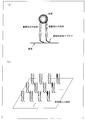
- FIGS. 1A and 1B schematically show an example of the structure of an antibody-immobilized carrier according to the present invention.
- FIG. 1 (a) is a diagram schematically showing a state in which one pair of a heavy chain low molecular weight antibody and a light chain low molecular weight antibody immobilized on a carrier reacts with an antigen
- FIG. 5 is a diagram schematically showing a state in which a number of combinations of heavy chain low-molecular weight antibodies and light chain low-molecular weight antibodies are immobilized on a carrier.
- the heavy chain low-molecular antibody and the light chain low-molecular antibody are separately immobilized on the carrier via a carrier-binding peptide.
- the heavy chain small molecule antibody and the light chain small molecule antibody are immobilized individually as separate molecules as a pair in one antibody immobilization region.
- the heavy chain low molecular weight antibody and the light chain low molecular weight antibody may be separately immobilized when immobilized on the antibody immobilization region, and after being immobilized on the antibody immobilization region. May interact with each other, and an SS bond or the like may be formed.
- the heavy chain small molecule antibody and the light chain small molecule antibody are immobilized on a carrier via a “carrier-binding peptide”.
- the C-terminal side binds perpendicularly to the carrier surface and the antigen-binding site faces outward so that the variable regions of the heavy and light chains can contribute to the antigen-antibody reaction, respectively.
- the “carrier-binding peptide” is located on the C-terminal side of the variable region of the heavy chain in the heavy chain small molecule antibody, and the C of the variable region of the light chain in the light chain small molecule antibody. It is preferable that they are respectively arranged on the end side.
- the “carrier-binding peptide” may be a peptide having a function of binding to the material on the surface of the carrier, and other specific amino acid sequences, lengths, and the like are not particularly limited.
- “binding” means that the peptide and the surface of the carrier interact with each other with a strength that can be used for the intended purpose of the present invention, and includes the case of adsorbing with affinity to the surface of the carrier. .
- the material on the surface of the carrier is preferably a material that has been hydrophilized by modifying a plastic resin such as polystyrene, polycarbonate, polypropylene, polyethylene, polydimethylsiloxane (PDMS), or polymethyl methacrylate (PMMA).
- a plastic resin such as polystyrene, polycarbonate, polypropylene, polyethylene, polydimethylsiloxane (PDMS), or polymethyl methacrylate (PMMA).
- examples of the carrier-binding peptide include peptides having a function of binding to each of the above-mentioned hydrophilic-treated plastic resins.
- hydrophilic polystyrene is used as the material for the carrier surface, a peptide that binds to the hydrophilic polystyrene is selected.
- the carrier-binding peptide As the carrier-binding peptide, several known peptides that have a function of binding to each of the hydrophilic plastic resins can be appropriately used.
- a peptide that binds to hydrophilic polystyrene hereinafter sometimes referred to as “PS-tag”
- PS-tag hydrophilic polystyrene
- RXXXXRRXRR R: arginine
- X isoleucine
- leucine (L) leucine
- V valine
- A alanine
- G methionine in order from the N-terminal side to the C-terminal side.
- M serine
- T threonine
- peptides having the amino acid sequences set forth in SEQ ID NOs: 1 to 20 of WO2009 / 101807A1 can be used.
- PS-tag in which X is all isoleucine is used.
- a peptide having a function of binding to hydrophilic polycarbonate for example, a peptide described in JP-T-2004-518442 (Japanese Patent Application No. 2003-571248) can be used.
- peptides having amino acid sequences in SEQ ID NOS: 12 to 17 in the present Sequence Listing which are peptides having a function of binding to PC uniquely found by the present inventors, can also be used. Note that the peptides of SEQ ID NOs: 12 to 17 in the Sequence Listing of the present application are unknown at the time of this application.
- Examples of the peptide having a function of binding to polymethyl methacrylate (PMMA) include, for example, peptides described in (Serizawa et al. (Langmuir 2007, 23, 11127-11133), It is possible to use peptides having the amino acid sequences shown in SEQ ID NOs: 15, 18 and 19 in the present Sequence Listing, which are peptides having a function of binding to PC found in the above. Nineteen peptides are unknown at the time of this application.
- hydrophilically treated polystyrene as the material for the carrier surface and use a peptide that binds to hydrophilic polystyrene as the carrier-binding peptide. This is because, in this combination, the peptide is firmly bound to the carrier even in the presence of a surfactant or a denaturing agent.
- the carrier-binding peptide may be directly bonded to the C terminus of the low-molecular antibody or may be bonded via an appropriate linker sequence.
- a known tag sequence such as a His tag may be provided on the C-terminal side of the carrier-binding peptide.
- a plastic resin surface suitable as a material for the carrier surface is generally hydrophobic.
- a carrier having a hydrophilic resin surface can be obtained by subjecting this surface to various hydrophilic treatments.
- a carrier having a hydrophilic polystyrene surface can be prepared by performing UV + O 3 treatment or plasma oxidation treatment.
- the hydrophilic treatment method the method described in International Publication No. WO2009 / 101807A1 can be used.
- the carrier (substrate) material of the present invention conventionally known materials such as various metal materials, glass plates, ceramic plates and the like can be used in addition to the resin, and are not particularly limited.
- the above-described plastic resin can be provided on the surface of the carrier material to form a substrate for the antibody-immobilized carrier of the present invention.
- the form of the carrier may be plate-like (including the walls and bottom surfaces of the container and well) or granular.
- Japanese Patent Application Laid-Open No. 2007-279018 if a granular plastic substrate whose surface is hydrophilized is filled in the fluid handling part (each well) of the microwell plate, a low molecular antibody is contained in the well.
- a low molecular antibody can be immobilized on the surface of a granular plastic substrate simply by injecting a solution containing the same.
- the antibody-immobilized carrier of the present invention can also be used as a sensor chip for the surface plasmon resonance method (SPR method).
- SPR method surface plasmon resonance method
- a thin film of plastic resin such as hydrophilic polystyrene may be formed on a gold substrate, and the antibody may be immobilized thereon.
- each antibody-immobilized region of the antibody-immobilized carrier of the present invention has a structure in which antibodies having different heavy chains and light chains are immobilized by the number of combinations. It is preferable that the number of such antibody-immobilized regions is larger because efficient antibody screening can be performed. For example, 10 2, 10 4, 10 6, 10 7 and the like as a preferred number. In particular, the number of combinations of heavy and light chains of the antibody in vivo in humans is said to 10 7.
- the number of antibody immobilization regions can be made the same as the combination of antibodies in the human body, and the antibody production system in the human body can be reproduced on one antibody immobilization carrier (In Vitro Domain Shuffling technology). ).
- the present inventors sequentially immobilized a FabH and Fab L fragment each fused with a hydrophilic polystyrene-binding peptide on a plastic carrier, and associated them by associating them with the antigen originally possessed by the antibody. It was demonstrated that a library of antibody fragments can be created on a substrate by restoring the specificity and comprehensively changing the combination of FabH and FabFL. According to the “In Vitro Domain Shuffling Technology” developed by the present inventors, it is possible to immobilize various heavy chain low molecular weight antibodies and light chain low molecular weight antibodies on a carrier and evaluate antigen binding activity. .
- an antibody library can be prepared, it is possible to identify an antibody (a combination of heavy chain and light chain) specific to an antigen protein by performing an immunoassay using this antibody-immobilized carrier. Become. Therefore, it is very useful for screening of antibody drug candidates and screening of diagnostic antibodies.
- an antibody immobilization carrier when a plurality of antibody immobilization regions are provided on an antibody immobilization carrier, information management of position information (coordinate information) on the carrier for heavy chain low-molecular weight antibodies and light chain low-molecular weight antibodies on a carrier such as a PC is performed. It is preferable to keep it.
- a causative agent antigen, target molecule
- a heavy chain and a light chain having high antigen specificity are obtained from the coordinates at which a signal is obtained. Can be specified.
- antibody genes with high antigen specificity can be obtained by linking genetic information of immobilized heavy and light chains.
- the method for producing an antibody-immobilized carrier according to the present invention comprises: immobilizing a heavy chain small molecule antibody comprising a heavy chain variable region and a light chain small molecule antibody comprising a light chain variable region separately on a carrier. It has an immobilization process for producing an antibody immobilization region, and the above heavy chain low molecular antibody and light chain low molecular antibody may be derived from antibodies recognizing different antigens, and other processes, conditions, materials, etc. As for, conventionally known ones can be used and are not particularly limited. More preferably, the immobilization step is preferably performed a plurality of times so that two or more of the antibody immobilization regions are independently provided.
- a heavy chain low molecular weight antibody / light chain low molecular weight antibody is prepared by a gene recombination technique, it is generally obtained as an insoluble aggregate as described above.
- this insoluble aggregate is first solubilized using a denaturing agent in order to recover the insoluble aggregate. Thereafter, multistage dialysis is performed to remove the denaturant and reactivate it (refolding). After purification and quantification, the above-described immobilization step can be performed to immobilize the carrier (so-called liquid). Phase refolding method).
- solid phase refolding method in order to recover insoluble aggregates, it can be contacted with a carrier in a solubilized state using a denaturant, and then the denaturant can be removed and refolded (so-called solid phase refolding method).
- any method can be used, but it is preferable to perform a solid phase refolding method from the viewpoint of yield and efficiency (process and cost).
- the immobilization step (a) the insoluble aggregates of the heavy chain low molecular weight antibody and the light chain low molecular weight antibody are each brought into contact with the surface of the carrier in a state of being denatured with a denaturing agent and immobilized on the carrier. And (b) removing the denaturing agent from the immobilized denatured heavy chain low molecular weight antibody and light chain low molecular weight antibody, thereby denatured heavy chain small molecule antibody and light chain small molecule. And a second step of refolding the antibody.
- the concentration of the low-molecular antibody contained in the solution used in the first step (a) is not particularly limited and can be set as appropriate, but is preferably 0.1 ⁇ g / ml to 500 ⁇ g / ml, preferably 0.5 ⁇ g / ml to 200 ⁇ g. / Ml is more preferred, and 1 ⁇ g / ml to 100 ⁇ g / ml is even more preferred.
- the “denaturing agent” general protein denaturing agents, surfactants and the like can be used, and are not particularly limited.
- protein denaturing agents such as urea and guanidine hydrochloride, SDS, CHAPS, etc. Can be mentioned.
- the concentration of the denaturing agent can also be appropriately set according to the amount and type of the low molecular antibody used, and is not limited. For example, as shown in Examples described later, when the low molecular antibody is 5 to 100 ⁇ g / ml, it is preferable to use 0.5 M to 8 M urea as the denaturing agent, and use 0.5 M to 4 M urea. It is more preferable to use 0.5 M to 2 M urea.
- a surfactant such as Tween 20 may be used in combination as an aggregation inhibitor.
- the denaturant is, for example, first solubilized insoluble aggregates in the presence of a denaturant at a high concentration (for example, 8M) and then diluted to a preferred denaturant concentration (0.5M to 2M) and then contacted with the carrier. It is also possible to fix it.
- the denaturation time and immobilization time can also be set as appropriate according to the amount and type of low-molecular antibody and are not limited.
- the time for contacting the low molecular antibody solution and the carrier is, for example, preferably 10 minutes to 10 hours, more preferably 30 minutes to 5 hours, and further preferably 1 hour to 3 hours.
- the method for removing the denaturant is not limited because a known method can be used.
- the denaturant is washed by washing with a general buffer. Can be removed.
- the composition of the buffer solution for solubilizing the low-molecular antibody used in the steps (a) and (b) and the washing solution for removing the denaturant can be conventionally used and is not particularly limited. . For example, what was described in the Example mentioned later can be used conveniently.
- the first step and the second step in the immobilization step are preferably performed separately for the heavy chain low molecular antibody and the light chain low molecular antibody. That is, it is preferable to immobilize the heavy chain low-molecular weight antibody and the light chain low-molecular weight antibody separately in multiple stages (for example, two stages).
- the light chain low molecular weight antibody modified by the first step (a) is immobilized on the carrier.
- the second step of (b) is performed to refold the light chain small molecule antibody that has been denatured. Subsequently, it is preferable to similarly perform (a) the first step and (b) the second step for the heavy chain low-molecular antibody.
- the heavy chain small molecule antibody and the light chain small molecule antibody are separately immobilized, the heavy chain small molecule antibody and the light chain small molecule antibody are mixed and contacted with the carrier. This is because the antigen-binding activity is remarkably superior to that in the case of performing the immobilization step.
- the order of which low molecular antibody is first immobilized on a carrier is not particularly limited, It is preferable that the light chain small molecule antibody is immobilized by performing the first step and the second step, and then the heavy chain small molecule antibody is immobilized by performing the first step and the second step. This is because when immobilized in this order, the antigen-binding ability of the antibody on the carrier can be further enhanced, as shown in the Examples described later.
- the present invention includes the antibody-immobilized carrier obtained by the production method described above.
- the antibody screening method according to the present invention only needs to have a step of screening a heavy chain low molecular antibody and / or a light chain low molecular antibody recognizing a specific antigen using the above-described antibody-immobilized carrier.
- the other processes, conditions, materials, and the like can be conventionally known, and are not particularly limited.
- a full-length antibody can be obtained by recloning the heavy chain small molecule antibody and / or the light chain small molecule antibody selected by the screening method of the present invention.
- the antibody drug or diagnostic antibody when a target substance of an antibody drug or diagnostic antibody is used as the “specific antigen”, the antibody drug or diagnostic antibody can be obtained.
- a target substance (antigen) of the antibody drug is brought into contact with the above-described antibody-immobilized carrier, and an antibody that specifically recognizes the antigen is selected.
- the method for evaluating the antigen binding activity is not limited because a known method can be used. For example, as shown in the examples described later, it can be evaluated by an ELISA method using a biotinylated antigen.
- the “specific antigen” used in the screening method is labeled for convenience of detection.
- the labeling substance used for labeling is not particularly limited, and examples thereof include fluorescent dyes, enzymes, proteins, radioisotopes, chemiluminescent substances, biotin, and colored labeling substances.
- Fluorescent dyes that are generally used for detection and quantification by labeling substances such as polypeptides and polynucleotides that are generally antigens are not particularly limited.
- fluorescein isothiocyanate (FITC) HEX (4,7,2 ', 4', 5 ', 7'-hexachloro-6-carboxylfluorescein, green fluorescent dye
- fluorescein, NED trade name, Applied) Biosystems, yellow fluorescent dye
- 6-FAM trade name, Applied Biosystems, yellow-green fluorescent dye
- rhodamine or a derivative thereof for example, tetramethylrhodamine (TMR)), Alexa Fluor ( Invitrogen), Cy Dye (GE Healthcare), Quantum Dot (Invitrogen), and the like.
- examples of the color labeling substance include colloidal metal and colored latex.
- Typical examples of colloidal metals include platinum colloids and gold colloids.
- the size of the colloidal metal particles is usually about 3 nm to 100 nm in diameter.
- Representative examples of the colored latex include synthetic latex such as polystyrene latex colored with respective pigments such as red and blue. Natural latex such as natural rubber latex can also be used as the latex.
- the size of the colored latex can be selected from about several tens nm to several hundred nm in diameter. Commercially available products can be used as they are for these color labeling substances, but they can be further processed in some cases or can be produced by methods known per se.
- a heavy chain small molecule antibody and / or a light chain small molecule antibody selected by the screening method of the present invention, and a full-length antibody obtained by cloning these small molecule antibodies, are useful for therapeutic and prophylactic use in vivo. It can be used for various immunoassay methods including antigen-antibody reaction such as use, in-vitro and in-vivo diagnostic use, in-vitro assay and reagent use.
- antigen-antibody reaction such as use, in-vitro and in-vivo diagnostic use, in-vitro assay and reagent use.
- a humanized antibody having is preferred.
- a known technique may be used for a technique for producing a fully human antibody or the like by analyzing the amino acid sequence of the antibody selected by the screening method of the present invention.
- the present invention also provides a method for screening a human antibody (fully human antibody) recognizing a specific antigen based on a chimeric antibody or humanized antibody recognizing a specific antigen using the above-described antibody-immobilized carrier. are also included.
- the screening method according to the present invention was developed in response to the above request, and is substantially equivalent to a chimeric antibody or a humanized antibody using the In Vitro Domain Shuffling technology using the above-described antibody-immobilized carrier.
- a fully human antibody having a higher antigen specificity is obtained. Specifically, the following steps are provided.
- the first aspect of the screening method is a method for screening a human antibody (fully human antibody) that recognizes a specific antigen based on a chimeric antibody or a humanized antibody that recognizes the specific antigen
- the heavy chain small molecule antibody immobilized on the antibody immobilization region is a heavy chain small molecule antibody comprising a variable region of a heavy chain derived from the chimeric antibody or humanized antibody, and a light chain immobilized on the antibody immobilization region.
- the low molecular weight antibody is a light chain low molecular weight antibody including a variable region of a light chain derived from any human antibody, the step (i) of bringing the specific antigen into contact with the antibody immobilization carrier, and the antibody immobilization A step (ii) of detecting an antibody solidified region recognizing the specific antigen in a carrier; and a light chain small molecule antibody immobilized on the antibody immobilization region detected in the step (ii) The step of determining a candidate of the variable region of the light chain of recognizing human antibody antigen (iii), and has a.
- antibody immobilization in which a light chain small molecule antibody determined as a candidate in the above step (iii) and a heavy chain small molecule antibody including a variable region of a heavy chain derived from any human antibody are immobilized in an antibody immobilization region
- a step of determining the heavy chain small molecule antibody immobilized on the antibody immobilization region detected in the step (v) as a candidate for a variable region of a heavy chain of a human antibody that recognizes the specific antigen vi).
- the antibody immobilization carrier includes a plurality of antibody immobilization regions in which a heavy chain low molecular antibody and a light chain low molecular antibody are separately immobilized.
- a heavy chain small molecule antibody in the antibody-immobilized region a heavy chain small molecule antibody containing a heavy chain variable region derived from a chimeric antibody or a humanized antibody that has already been confirmed to have antigen specificity to a specific antigen. Immobilize.
- a light chain small molecule antibody including a variable region of a light chain derived from any human antibody is immobilized at the site of the light chain small molecule antibody.
- the known heavy chain small molecule antibody is arbitrarily selected from a library of light chains derived from human antibodies, compared to those containing a variable region of a heavy chain derived from a chimeric antibody or humanized antibody (preferably only one type).
- an antibody-immobilized carrier comprising a plurality of types of antibody-immobilized regions combined with a light chain low-molecular weight antibody containing a variable region of a light chain is prepared.
- the antibody solid region is preferably prepared at about 10 3.
- the antibody-immobilized carrier having the above structure is contacted with an antigen, an antibody-immobilized region having a high antigen-binding activity is identified, and a light chain low-molecular weight antibody immobilized on the region is selected.
- This light chain small molecule antibody is determined as a candidate for the variable region of the light chain of a human antibody that recognizes the specific antigen.
- the light chain low molecular weight antibody including the variable region of the light chain of the selected human antibody is immobilized on the antibody immobilization region of the separately prepared antibody immobilization carrier.
- the heavy chain low-molecular antibody a heavy chain low-molecular antibody including a variable region of a heavy chain derived from a plurality of arbitrary human antibodies is immobilized.
- a low molecular weight antibody comprising a heavy chain variable region arbitrarily selected from a heavy chain library derived from a human antibody, in contrast to a light chain low molecular weight antibody comprising a light chain variable region of a human antibody selected as a candidate
- an antibody-immobilized carrier having a plurality of types of antibody-immobilized regions combined with each other is prepared.
- the antibody solid region is preferably prepared at about 10 4.
- the antibody-immobilized carrier having the above structure is brought into contact with an antigen, an antibody-immobilized region having a high antigen-binding activity is identified, and a heavy chain low-molecular antibody immobilized on the region is selected.
- This heavy chain small molecule antibody is determined as a candidate for the variable region of the heavy chain of a human antibody that recognizes the specific antigen. It is preferable to prepare about 10 4 antibody immobilization regions, but in order to reduce the working time and labor, several to 10 2 antibody immobilization regions, or 10 2 to 10 3 antibody immobilization regions are used. You can also Even in such a case, a fully human antibody having a sufficiently excellent effect can be obtained by using the present invention.
- a combination of a light chain and a heavy chain having a high binding activity for a specific antigen can be selected from a human antibody library.
- a fully human antibody having an antigen binding activity equivalent to or higher than that of a chimeric antibody or a humanized antibody can be obtained.
- candidate light chains of human antibodies with high antigen specificity are selected in combination with the heavy chains of chimeric antibodies or humanized antibodies, but the present invention is not limited to this embodiment.
- a candidate for a heavy chain small molecule antibody arbitrarily selected from a heavy chain library of human antibodies is selected in combination with a light chain of a chimeric antibody or a humanized antibody, and then combined with such a candidate for heavy chain to obtain antigen-specificity.
- a method of selecting light chain candidates of highly human antibodies may be used.
- a human antibody that recognizes a specific antigen is screened based on a chimeric antibody or a humanized antibody that recognizes the specific antigen using the above-described antibody-immobilized carrier.
- the light chain small molecule antibody to be immobilized on the antibody immobilization region is a light chain small molecule antibody comprising a light chain variable region derived from the chimeric antibody or humanized antibody, and the antibody immobilization region
- the heavy chain small molecule antibody to be immobilized on is a heavy chain small molecule antibody containing a variable region of a heavy chain derived from any human antibody, and the step of contacting the specific antigen with the antibody immobilization carrier (i)
- Child antibody, determining the specific antigen as a candidate of the heavy chain region of recognizing human antibody (iii) may have a.
- an antibody immobilization carrier in which the heavy chain small molecule antibody determined in the above step (iii) and a light chain small molecule antibody including a variable region of a light chain derived from any human antibody are immobilized on the antibody immobilization region And (v) a step of bringing the specific antigen into contact with the antibody-immobilized carrier, and a step (v) of detecting an antibody solidified region that recognizes the specific antigen in the antibody-immobilized carrier. And (vi) determining the light chain low-molecular weight antibody immobilized on the antibody-immobilized region detected in step (v) as a candidate for the variable region of the light chain of a human antibody that recognizes the specific antigen. It is preferable to have.
- a light chain (or heavy chain) of a human antibody is selected as a candidate, it is combined with the light chain (or heavy chain) that is the candidate to derive from a human antibody having a high antigen binding activity.
- the method is a two-step method of selecting a heavy chain (or light chain) candidate, the present invention is not limited to such a mode.
- a step of selecting a heavy chain (or light chain) of a human antibody having a high antigen-binding activity in combination with a light chain (or heavy chain) derived from an antibody or a humanized antibody as a candidate and
- the human antibody light chain and heavy chain candidates selected from each of the steps (b) may be combined to obtain a fully human antibody having a higher antigen binding activity (three steps).
- Such an embodiment is preferable in that the antigen-binding activity of the selected human antibody light chain candidate and heavy chain candidate can be examined in a plurality of combinations.
- the present invention relates to a human antibody comprising a step of producing a human antibody by combining the candidate light chain variable region and the heavy chain variable region candidate determined by the above screening method.
- Manufacturing methods are also encompassed. That is, the method for producing a human antibody of the present invention can be said to include the screening method as one step.
- a method for producing a fully human antibody from light chain and heavy chain candidates selected from a human antibody light chain library or a heavy chain library can be a conventionally known method, and is not particularly limited. .
- it can be produced by a cloning technique or a chemical synthesis method used when obtaining the above-mentioned “small molecule antibody”, and the description thereof is incorporated.
- DNA encoding the above antibody is prepared and inserted into a vector capable of autonomous replication to obtain recombinant DNA, which is introduced into an appropriate host such as E. coli or animal cells.
- a peptide containing the present amino acid sequence can be collected from the culture.
- a cell-free protein synthesis system or a conventional peptide chemical synthesis method may be used.
- the purification of the antibody is not particularly limited, and a known method can be used.
- Fab and PS-tag fusion Fab are related to the scFv gene. Therefore, in this example, the Fab gene was prepared by isolating the gene corresponding to the VH and VL domain portions from the scFv gene by PCR and fusing it with the genes of the CH 1 domain and the C k domain.
- the amino acid sequences of Fab and PS-tag fusion Fab used in the examples are as follows. The N-terminal part of the Fab and PS-tag fusion Fab used was methionine (M) as the start codon.
- a histidine tag (H ⁇ 6) is added to the end of the pET22-derived sequence at the C-terminal, and in the presence of PS-tag, a PS-tag sequence is added between the pET22-derived sequences.
- a histidine tag (H ⁇ 6) was added to the C-terminal part.
- Fab-H (Fab H) derived from mouse anti-RNase antibody SEQ ID NO: 1 -Fab-H derived from PS-tag fusion mouse anti-RNase antibody (Fab H-PS) ...
- SEQ ID NO: 2 Fab-L (Fab L) derived from mouse anti-RNase antibody
- SEQ ID NO: 3 Fab-L derived from PS-tag fusion mouse anti-RNase (Fab L-PS) ...
- SEQ ID NO: 4 -Fab-H derived from PS-tag fusion mouse anti-CRP antibody (Fab H-PS) ...
- SEQ ID NO: 5 -Fab-L derived from PS-tag fusion mouse anti-CRP antibody (Fab L-PS) ...
- SEQ ID NO: 6 -Fab-H derived from PS-tag fusion human anti-ED-B antibody (Fab H-PS) ...
- SEQ ID NO: 7 -Fab-L derived from PS-tag fusion human anti-ED-B antibody (Fab L-PS) ...
- SEQ ID NO: 8 -Fab-H derived from PS-tag fusion human anti-IFNG antibody (Fab H-PS) ...
- SEQ ID NO: 9 -Fab-L derived from PS-tag fusion human anti-IFNG antibody (Fab L-PS) ...
- SEQ ID NO: 10 A specific method for preparing a low molecular antibody (Fab and PS-tag fusion Fab) is as follows.
- Liquid A was supplied to the column at a flow rate of 1 ml / min and washed. Subsequently, the solution B was supplied to the column at a flow rate of 1 ml / min, and the Fab and PS-tag fusion Fab were recovered. After recovery, the low molecular antibody was dialyzed overnight against 8M urea-1 ⁇ PBS.
- biotinylated antigen 1 mg / ml was dialyzed against 1 L of 1 ⁇ PBS.
- 1 mg of biotinamide caproic acid N-hydroxysuccinimide ester was weighed and 10 ⁇ l of N, N-dimethylformamide was added and dissolved (solution C).
- the dialyzed antigen was transferred to a sample bottle, 10 ⁇ l of solution C was added, and the mixture was gently stirred at room temperature for 1 hour. Thereafter, it was dialyzed overnight against 1 L of 1 ⁇ PBS.
- Antibody-immobilized carrier using low molecular weight antibody derived from mouse anti-RNase antibody was immobilized on a hydrophilic PS plate by a solid phase refolding method. Specifically, first, the final concentration of the low-molecular antibodies Fab H and Fab H-PS (or Fab L and Fab L-PS) is 100 ⁇ g / ml, the final concentration of urea is 4 M, and the final concentration of Tween 20 is 1%. And diluted for 10 minutes at room temperature. Subsequently, 100 ⁇ l was added to the hydrophilic PS plate and incubated at 25 ° C. for 1 hour.
- Fab H was refolded on a hydrophilic PS plate.
- Fab L, Fab L-PS and Fab H-PS the same operation as described above was carried out, and each was immobilized on a hydrophilic PS plate.
- the prepared antibody immobilization carriers are as follows. ⁇ Fab H immobilized carrier (H) -Carrier (L) on which Fab L is immobilized ⁇ Fab H-PS immobilized carrier (H-PS) ⁇ Fab L-PS immobilized carrier (L-PS) -A carrier in which Fab L-PS is immobilized after Fab H-PS is immobilized on a carrier (H-PS / L-PS) -A carrier in which Fab H-PS is immobilized after Fab L-PS is immobilized on a carrier (L-PS / H-PS) Using these antibody-immobilized carriers, each antigen binding activity was examined by ELISA.
- the solid-phase refolding conditions for immobilizing a low molecular weight antibody derived from a mouse anti-RNase antibody on a hydrophilic PS plate were examined. Specifically, the final concentration of the low molecular weight antibody (Fab H, Fab H-PS, Fab L or Fab L-PS) is 5 ⁇ g / ml, and the final concentration of urea is 4M, 2M, 1M, 0.5M. Except for the above, it was immobilized on a hydrophilic PS plate by the same method as in the above ⁇ 5>. The following five types of antibody-immobilized carriers were prepared by changing the combination of low molecular weight antibodies and repeating the operation.
- the immobilization method is the same as the above ⁇ 5> and ⁇ 6> except that the final concentration of each Fab L-PS and Fab H-PS is 5 ⁇ g / ml and the final concentration of urea is 2M. It was. The operation was repeated by changing the combination of various Fab L-PS and Fab H-PS, and finally, 16 types of antibody-immobilized carriers in which all the combinations of Fab L-PS and Fab H-PS were combined, and various Fab L- Eight types of antibody-immobilized carriers on which only PS or Fab H-PS was immobilized were prepared.
- Each antigen binding activity was examined by ELISA using mouse RNase, mouse CRP, human ED-B or human IFNG as the antigen.
- the ELISA method was performed in the same manner as in the above ⁇ 6>.
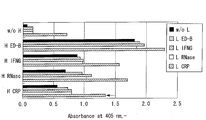
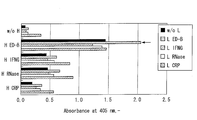
- the respective detection results are shown in FIGS.
- “w / o H” indicates that Fab H-PS was not immobilized but only Fab L-PS was immobilized.
- “w / o L” indicates that Fab L-PS was not immobilized, but only Fab H-PS was immobilized.
- the “L ED-B” bar indicates that Fab L-PS and Fab H-PS derived from human anti-ED-B antibody are immobilized. The results of the antigen binding activity of the PS plate are shown.
- AFP ⁇ -fetoprotein
- Mice were immunized 4 times every other week with 50 ⁇ g of AFP, and the spleen was removed at 5 weeks. Total RNA in the spleen was collected, and the Fab H and Fab L gene groups of the antibody were amplified by RT-PCR. The Fab H and Fab L gene groups were ligated to the Nde I / Not I site of the PS-tag fusion protein expression vector pET-PS19-6. Escherichia coli BL21 (DE3) Rosetta was transformed with the ligated vector, and single colonized on an LB-ampicillin plate.
- the Escherichia coli introduced with the Fab H gene group was designated as Fab H-PS E. coli library (1 ⁇ 10 5 colonies), and the E. coli introduced with the FabL gene group was designated as Fab L-PS E. coli library (1 ⁇ 10 5 colonies).
- a single colony was similarly inoculated from the Fab L-PS E. coli library. Specifically, 10 plates (960 colonies) of each of the Fab H-PS E. coli library and the Fab L-PS E. coli library were inoculated. Thereafter, the deep well plate was cultured at 37 ° C. and 1,400 rpm for 24 hours.
- the average signal intensity (fluorescence intensity) of 960 clones of H chain was 1086.
- the average signal intensity (fluorescence intensity) of 960 clones of L chain was 1028.
- Fluorescence measurement Blackplate (BD Falcon # 353285) was used as a 384 well PS plate for screening.
- the PS plate was irradiated with oxygen plasma at 30 W for 1 minute to hydrophilize the surface of the PS plate.
- 10 ⁇ l of FabL-PS library top 30 clones were added to each well. This was incubated at 25 ° C. for 2 hours.
- 10 ⁇ l of FabH-PS library top 40 clones was added to each well. This was incubated at 25 ° C. for 2 hours.
- a combination of a heavy chain and a light chain having a fluorescence intensity signal of 5000 or more was determined as an anti-AFP antibody.
- H3, L4, (H3, L6), (H3, L12), (H6, L6), (H8, L6), (H8, L15), (H19, L9), (H20, L9) , (H35, L6) were determined as anti-AFP specific antibodies for liver cancer diagnosis.
- H in a parenthesis means a heavy chain
- a number is the order
- L in parentheses means a light chain, and is the rank of the L chain shown in FIG. That is, it was found that these heavy chain and light chain combinations can be used as anti-AFP antibodies.
- the human antibody Fab H and Fab L gene groups were amplified from human spleen Total RNA (Clontech, # 636525) by RT-PCR.
- the FabH and Fab L genes were ligated to the NdeI / Not I site of the PS-tag fusion protein expression vector pET-PS19-6.
- Escherichia coli BL21 (DE3) Rosetta was transformed with the ligated vector, and single colonized on an LB-ampicillin plate.
- the Escherichia coli into which the Fab H gene group was introduced was designated as the Fab H-PS E. coli library (1 ⁇ 10 6 colonies), and the Escherichia coli into which the Fab L gene group was introduced was designated as the Fab L-PS Escherichia coli library (1 ⁇ 10 6 colonies).
- the epitope peptide was synthesized by a solid phase synthesis method, and a fluorescence-labeled epitope peptide with FITC added to the N-terminal portion was prepared and used as an antigen.
- the specific procedure is as follows.
- a 1 ⁇ g / ml FITC-labeled antigen solution containing 0.1% Tween® 20 and 5% human serum is prepared, and 40 ⁇ l is added to each well. Incubated for hours. After washing with 0.1% Tween PBS, fluorescence intensity was measured using a fluorescence plate reader (TECAN infinite M200) (excitation wavelength: 486 nm, fluorescence wavelength: 520 nm).
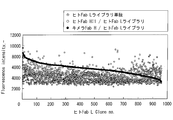
- FIG. 11 shows the result of crossing the chimeric H chain and human L chain library (960 species).
- the vertical axis indicates the fluorescence intensity
- the horizontal axis indicates the type of human L chain.
- the highest fluorescence intensity was 6435
- the average fluorescence intensity was 2466.
- 95 clones were selected in the descending order of the detected fluorescence intensity for the L chain having a fluorescence intensity of 4000 or more.
- a black plate for fluorescence measurement (Greiner # 655076) was used.
- the PS plate was irradiated with oxygen plasma at 30 W for 1 minute to hydrophilize the surface of the PS plate.
- Human Fab L-PS Top95 clone and Rituxan (registered trademark) Fab H-PS chimera were mixed to give a final concentration of 2M urea, 20% Tween 20%, chimera Fab H-PS 25 ⁇ g / ml.
- a human FabL-PS library solution ie, without chimeric Fab H-PS
- a final concentration of 0.1% Tween 20 and 2M urea was also prepared.
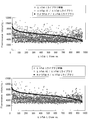
- the upper panel shows the fluorescence intensity of the combination of the top 95 clones of the human L chain and the H chain of the chimeric antibody
- the lower panel shows the fluorescence intensity of the 95 clones of the human L chain alone.
- those whose fluorescence intensity increased by 6000 or more were 61 clones (63.8%), those that increased by 4000 or more 77 clones (81.9%), 93 clones (98.9%) increased by 2000 or more, and some clones increased by 14131 at the maximum. It was revealed that when many of the screened human L chains were combined with the H chain derived from the chimeric antibody, the antigen binding ability was significantly increased.
- Fluorescence measurement Blackplate (BD Falcon # 353285) was used as a 384 well PS plate for screening.
- the PS plate was irradiated with oxygen plasma at 30 W for 1 minute to hydrophilize the surface of the PS plate.
- 9 ⁇ l of human FabH-PS library was added to each well.
- 4 ⁇ l of Rituxan (registered trademark) chimeric FabL-PS prepared in 2 M urea 1% Tween PBS, 250 ⁇ g / ml was added and incubated for 2 hours.
- 80 ⁇ l of 2% BSA-0.1% Tween PBS was added to each well and blocked for 1 hour.
- FIG. 13 shows the result of multiplying the L chain derived from the chimeric antibody and the human H chain library (960 species).
- the vertical axis represents the fluorescence intensity
- the horizontal axis represents the type of human H chain.
- the highest fluorescence intensity was 12074
- the average fluorescence intensity was 2716.
- 94 clones were selected in the descending order of the detected fluorescence intensity for the H chain having a fluorescence intensity of 4000 or more.
- a black plate for fluorescence measurement (Greiner # 655076) was used.
- the PS plate was irradiated with oxygen plasma at 30 W for 1 minute to hydrophilize the surface of the PS plate.
- Human FabH-PS library Top94 clone dissolved in 8M urea-PBS and Rituxan (registered trademark) Fab L-PS chimera were mixed to give final concentrations of 2M urea, 201% Tween, and chimeric Fab L-PS 25 ⁇ g / ml.
- a human Fab H-PS library solution (ie, containing no chimeric Fab L-PS) with a final concentration of 0.1% Tween20 and 2M urea was also prepared. 100 ⁇ l of each well was added and incubated for 2 hours. After washing with 0.1% Tween-PBS, 270 ⁇ l of 2% BSA-0.1% Tween-PBS was added to each well and blocked for 1 hour. After washing with 0.1% Tween PBS, a 1 ⁇ g / ml FITC-labeled antigen solution containing 0.1% Tween 20 and 5% human serum was prepared, and 100 ⁇ l was added to each well, followed by incubation for 1 hour with light shielding. . After washing with 0.1% TweenPBS, fluorescence intensity was measured using a fluorescence plate reader (TECANCAinfinite M200) (excitation wavelength: 486 nm, fluorescence wavelength: 520 nm).
- the upper panel shows the fluorescence intensity of the combination of the upper 94 clones of human H chain and the L chain of the chimeric antibody
- the lower panel shows the fluorescence intensity of 94 clones of human H chain alone.
- 17 clones (18.1%) increased in fluorescence intensity by 2000 or more, and those increased by 1000 or more
- a fluorescence measurement Black plate (Greiner® # 655076) was used as a 96-well PS plate for screening.
- the PS plate was irradiated with oxygen plasma at 30 W for 1 minute to hydrophilize the surface of the PS plate.
- each clone of human Fab H-PS, each clone of human Fab L-PS, Rituxan (registered trademark) chimeric Fab ⁇ ⁇ ⁇ L-PS and chimeric Fab ⁇ H-PS in 8M urea-PBS-1% Tween 20 Each was prepared to be 1 mg / ml.
- FIG. 1 A total of 40 types of human Fabs were prepared on a PS plate using 8 types of human Fab H-PS clones and 5 types of human FabL-PS clones, and the results of evaluating the affinity with the FITC-labeled antigen are shown in FIG. As shown in the figure, there were many combinations of human Fab-H-PS / human Fab L-PS that showed a higher signal than that of the chimeric FabH-PS / chimeric FabL-PS control.
- FIG. 16 shows the result of calculating the specific activity (that is, the signal intensity per unit Fab) by dividing the obtained signal intensity by the immobilized amount of Fab H-PS / FabL-PS.
- the specific activity that is, the signal intensity per unit Fab
- a fluorescence measurement Black plate (BD Falcon # 353285) was used as a 384 well PS plate for screening.
- the PS plate was irradiated with oxygen plasma at 30 W for 1 minute to hydrophilize the surface of the PS plate.
- 9 ⁇ l of human Fab L-PS library was added to each well.
- 4 ⁇ l of each human FabH-PS clone prepared in 2M Urea 1% Tween ⁇ PBS, 250 ⁇ g / ml was added and incubated for 2 hours. After washing with 0.1% Tween-PBS, 80 ⁇ l of 2% BSA-0.1% Tween-PBS was added to each well and blocked for 1 hour.
- a fluorescence measurement Black plate (BD Falcon # 353285) was used as a 384 well PS plate for screening.
- the PS plate was irradiated with oxygen plasma at 30 W for 1 minute to hydrophilize the surface of the PS plate.
- 9 ⁇ l of human FabFH-PS library was added to each well.
- 4 ⁇ l of each human FabL-PS clone prepared in 2M Urea 1% Tween ⁇ PBS, 250 ⁇ g / ml was added and incubated for 2 hours. After washing with 0.1% Tween-PBS, 80 ⁇ l of 2% BSA-0.1% Tween-PBS was added to each well and blocked for 1 hour.
- Human Fab H-PS library 960 clones or human FabH-PS library 960 clones were comprehensively associated with each other, and 9600 kinds of Fab antibodies comprising human FabH-PS / human Fab L-PS were produced on PS plate.
- the results of evaluating the affinity of the fluorescently labeled antigen for these human FabH-PS / human Fab L-PS are shown in FIGS.
- FIG. 17 shows the human Fab H-PS clone No.
- FIG. 1 shows the results of a Fab antibody obtained by combining 960 human Fab ⁇ ⁇ L-PS libraries.
- the lower panel of FIG. Fig. 2 shows the results of Fab antibodies combining 960 types of human Fab L-PS libraries.
- the upper panel of FIG. 18 shows human FabH-PS clone no.
- Fig. 3 shows the results of Fab antibody combining 960 kinds of human Fab L-PS libraries.
- the lower panel of Fig. 18 shows human FabH-PS clone no.
- Fig. 4 shows the results of Fab antibody combining 960 kinds of human Fab L-PS libraries.
- FIG. 19 shows human FabH-PS clone No.
- FIG. 11 shows the results of a Fab antibody obtained by combining 960 kinds of human Fab L-PS libraries.
- FIG. 20 shows the human Fab L-PS clone No.
- FIG. 1 shows the results of a Fab antibody obtained by combining 960 types of human Fab H-PS libraries.
- the lower panel of FIG. Fig. 2 shows the results of Fab antibodies combining 960 types of human Fab H-PS libraries.
- the upper panel of FIG. 21 shows human FabL-PS clone No.
- FIG. 3 shows the results of a Fab antibody obtained by combining 960 types of human FabPSH-PS libraries.
- the lower panel of FIG. FIG. 11 shows the results of Fab antibody combining 960 kinds of human Fab H-PS libraries.
- FIG. 22 shows human FabL-PS clone no.
- FIG. 12 shows the results of Fab antibodies combining 960 types of human FabFH-PS libraries.
- humans can obtain signals that are equivalent to or higher than the Fab antibody consisting of chimeric Fab H-PS / human Fab L-PS or human Fab H-PS / chimeric Fab L-PS.
- Many combinations of Fab H-PS / human Fab L-PS were detected.
- a combination of human Fab H-PS / human Fab L-PS which has a signal intensity of 10,000 or more, is highly likely to have an extremely high affinity for an antigen. Therefore, if these detailed affinity evaluations are carried out, it is possible to obtain a fully human antibody clone having higher affinity and fewer side effects than a chimeric antibody comprising chimeric Fab H-PS / chimeric Fab L-PS.
- the present invention can be used as a basic technology for antibody screening, and by recloning the screened heavy chain small molecule antibody and light chain small molecule antibody into a full-length antibody, for example, as an antibody drug or diagnostic agent It can be used.
Landscapes
- Chemical & Material Sciences (AREA)
- Health & Medical Sciences (AREA)
- Organic Chemistry (AREA)
- Immunology (AREA)
- Life Sciences & Earth Sciences (AREA)
- Medicinal Chemistry (AREA)
- General Health & Medical Sciences (AREA)
- Genetics & Genomics (AREA)
- Biophysics (AREA)
- Molecular Biology (AREA)
- Proteomics, Peptides & Aminoacids (AREA)
- Biochemistry (AREA)
- Gastroenterology & Hepatology (AREA)
- Cell Biology (AREA)
- Peptides Or Proteins (AREA)
- Preparation Of Compounds By Using Micro-Organisms (AREA)
Abstract
Priority Applications (3)
| Application Number | Priority Date | Filing Date | Title |
|---|---|---|---|
| JP2012500598A JP5851391B2 (ja) | 2010-02-16 | 2011-02-15 | 抗体固定化担体、抗体固定化担体の製造方法および当該抗体固定化担体の利用 |
| US13/578,974 US8883985B2 (en) | 2010-02-16 | 2011-02-15 | Antibody-immobilized carrier, method of producing antibody-immobilized carrier, and use of said antibody-immobilized carrier |
| US14/502,013 US9598501B2 (en) | 2010-02-16 | 2014-09-30 | Antibody-immobilized carrier, method of producing antibody-immobilized carrier, and use of said antibody-immobilized carrier |
Applications Claiming Priority (2)
| Application Number | Priority Date | Filing Date | Title |
|---|---|---|---|
| JP2010-031684 | 2010-02-16 | ||
| JP2010031684 | 2010-02-16 |
Related Child Applications (2)
| Application Number | Title | Priority Date | Filing Date |
|---|---|---|---|
| US13/578,974 A-371-Of-International US8883985B2 (en) | 2010-02-16 | 2011-02-15 | Antibody-immobilized carrier, method of producing antibody-immobilized carrier, and use of said antibody-immobilized carrier |
| US14/502,013 Division US9598501B2 (en) | 2010-02-16 | 2014-09-30 | Antibody-immobilized carrier, method of producing antibody-immobilized carrier, and use of said antibody-immobilized carrier |
Publications (1)
| Publication Number | Publication Date |
|---|---|
| WO2011102342A1 true WO2011102342A1 (fr) | 2011-08-25 |
Family
ID=44482927
Family Applications (1)
| Application Number | Title | Priority Date | Filing Date |
|---|---|---|---|
| PCT/JP2011/053157 Ceased WO2011102342A1 (fr) | 2010-02-16 | 2011-02-15 | Support d'anticorps immobilisé, procédé de production de support d'anticorps immobilisé, et utilisation dudit support d'anticorps immobilisé |
Country Status (3)
| Country | Link |
|---|---|
| US (2) | US8883985B2 (fr) |
| JP (1) | JP5851391B2 (fr) |
| WO (1) | WO2011102342A1 (fr) |
Cited By (4)
| Publication number | Priority date | Publication date | Assignee | Title |
|---|---|---|---|---|
| JPWO2014125955A1 (ja) * | 2013-02-15 | 2017-02-02 | 国立大学法人京都工芸繊維大学 | 抗体のリフォールディング方法、リフォールディングされた抗体の製造方法、リフォールディングされた抗体、及びこれらの利用 |
| US20220185912A1 (en) * | 2012-10-25 | 2022-06-16 | Bioverativ Usa Inc. | Anti-complement c1s antibodies and uses thereof |
| US12240917B2 (en) | 2012-11-02 | 2025-03-04 | Bioverativ Usa Inc. | Anti-complement C1s antibodies and uses thereof |
| US12391750B2 (en) | 2016-10-12 | 2025-08-19 | Bioverativ Usa Inc. | Anti-C1S antibodies and methods of use thereof |
Families Citing this family (6)
| Publication number | Priority date | Publication date | Assignee | Title |
|---|---|---|---|---|
| WO2015121339A1 (fr) | 2014-02-14 | 2015-08-20 | RUHR-UNIVERSITäT BOCHUM | Biocapteur pour la conformation et l'analyse d'une structure secondaire |
| CA2981321A1 (fr) | 2015-04-06 | 2016-10-13 | True North Therapeutics, Inc. | Anticorps anti-c1s humanises et leurs procedes d'utilisation |
| ES2834484T3 (es) | 2016-11-21 | 2021-06-17 | Univ Ruhr Bochum | Método para la preselección de fármacos para enfermedades de plegamiento incorrecto de proteínas |
| US11078254B2 (en) | 2017-04-11 | 2021-08-03 | National Institute Of Advanced Industrial Science And Technology | Method for immobilizing lectin |
| EP3631446B1 (fr) | 2017-05-29 | 2024-04-17 | betaSENSE GmbH | Biocapteur pour la conformation et l'analyse de structure secondaire |
| CN115334974A (zh) * | 2020-03-31 | 2022-11-11 | 富士胶片株式会社 | 信息处理装置、信息处理方法及信息处理程序 |
Citations (1)
| Publication number | Priority date | Publication date | Assignee | Title |
|---|---|---|---|---|
| WO2009101807A1 (fr) * | 2008-02-14 | 2009-08-20 | National University Corporation Kyoto Institute Of Technology | Peptide, utilisation du peptide, procédé de fabrication du peptide, support solide ayant le peptide immobilisé sur celui-ci et procédé de fabrication du support solide |
Family Cites Families (6)
| Publication number | Priority date | Publication date | Assignee | Title |
|---|---|---|---|---|
| JP2003531588A (ja) * | 2000-04-11 | 2003-10-28 | ジェネンテック・インコーポレーテッド | 多価抗体とその用途 |
| WO2004016782A1 (fr) * | 2002-08-16 | 2004-02-26 | The University Of Tokyo | Procede d'analyse d'une interaction entre des proteines |
| WO2004106375A1 (fr) * | 2003-05-30 | 2004-12-09 | Merus Biopharmaceuticals B.V. I.O. | Banque de fab pour la preparation de fab anti-vegf et antirabique |
| AU2006300951A1 (en) | 2005-10-11 | 2007-04-19 | Domantis Limited | Antibody polypeptide library screening and selected antibody polypeptides |
| NZ575827A (en) * | 2006-09-21 | 2012-02-24 | Prometheus Lab Inc | Antibody-based arrays for detecting multiple signal transducers in rare circulating cells |
| EP2179291B1 (fr) * | 2007-07-13 | 2014-10-22 | Nestec S.A. | Selection de medicament pour une therapie contre le cancer des poumons utilisant des reseaux a base d'anticorps |
-
2011
- 2011-02-15 WO PCT/JP2011/053157 patent/WO2011102342A1/fr not_active Ceased
- 2011-02-15 JP JP2012500598A patent/JP5851391B2/ja not_active Expired - Fee Related
- 2011-02-15 US US13/578,974 patent/US8883985B2/en active Active
-
2014
- 2014-09-30 US US14/502,013 patent/US9598501B2/en not_active Expired - Fee Related
Patent Citations (1)
| Publication number | Priority date | Publication date | Assignee | Title |
|---|---|---|---|---|
| WO2009101807A1 (fr) * | 2008-02-14 | 2009-08-20 | National University Corporation Kyoto Institute Of Technology | Peptide, utilisation du peptide, procédé de fabrication du peptide, support solide ayant le peptide immobilisé sur celui-ci et procédé de fabrication du support solide |
Non-Patent Citations (2)
| Title |
|---|
| EIKI SASAKI ET AL.: "in vitro domain shuffling o Mochiita Kotai Library no Kaihatsu", ABSTRACTS OF 42ND AUTUMN MEETING OF THE SOCIETY OF CHEMICAL ENGINEERS, vol. 42, no. 109, 6 August 2010 (2010-08-06), JAPAN * |
| YOICHI KUMADA ET AL.: "Innovative one-step ELISA using hydrophilic polystyrene plate", BIOSCIENCE & INDUSTRY, vol. 65, no. 9, 2007, pages 460 - 462 * |
Cited By (5)
| Publication number | Priority date | Publication date | Assignee | Title |
|---|---|---|---|---|
| US20220185912A1 (en) * | 2012-10-25 | 2022-06-16 | Bioverativ Usa Inc. | Anti-complement c1s antibodies and uses thereof |
| US12215169B2 (en) * | 2012-10-25 | 2025-02-04 | Bioverativ Usa Inc. | Anti-complement C1s antibodies and uses thereof |
| US12240917B2 (en) | 2012-11-02 | 2025-03-04 | Bioverativ Usa Inc. | Anti-complement C1s antibodies and uses thereof |
| JPWO2014125955A1 (ja) * | 2013-02-15 | 2017-02-02 | 国立大学法人京都工芸繊維大学 | 抗体のリフォールディング方法、リフォールディングされた抗体の製造方法、リフォールディングされた抗体、及びこれらの利用 |
| US12391750B2 (en) | 2016-10-12 | 2025-08-19 | Bioverativ Usa Inc. | Anti-C1S antibodies and methods of use thereof |
Also Published As
| Publication number | Publication date |
|---|---|
| US9598501B2 (en) | 2017-03-21 |
| JPWO2011102342A1 (ja) | 2013-06-17 |
| JP5851391B2 (ja) | 2016-02-03 |
| US8883985B2 (en) | 2014-11-11 |
| US20150018534A1 (en) | 2015-01-15 |
| US20120309943A1 (en) | 2012-12-06 |
Similar Documents
| Publication | Publication Date | Title |
|---|---|---|
| JP5851391B2 (ja) | 抗体固定化担体、抗体固定化担体の製造方法および当該抗体固定化担体の利用 | |
| JP5582482B2 (ja) | 復元されたペプチドの生産方法及びペプチドが固定化された固相の生産方法 | |
| AU2013339038B2 (en) | Antibody and antibody composition production method | |
| JP6985572B2 (ja) | 単鎖抗体のスクリーニング方法及び単鎖抗体 | |
| JP2024147571A (ja) | 可溶性bcmaに対する抗体 | |
| JP2026064998A (ja) | ヒト化抗補体Bb因子抗体およびその使用 | |
| CN112574303B (zh) | 一种抗c反应蛋白的抗体 | |
| CN109336973B (zh) | 抗转铁蛋白抗体及其用途 | |
| Moricoli et al. | Blocking monocyte transmigration in in vitro system by a human antibody scFv anti-CD99. Efficient large scale purification from periplasmic inclusion bodies in E. coli expression system | |
| WO2006033413A1 (fr) | Procédé de quantification de peptide | |
| CN112574304B (zh) | 一种抗c反应蛋白的抗体 | |
| US20190248922A1 (en) | Affinity ligands and methods relating thereto | |
| CN111471109A (zh) | 一种抗成纤维细胞生长因子受体4单克隆抗体及其制备方法和用途 | |
| CN112979798B (zh) | 一种包含c反应蛋白抗原结合结构域的分离的结合蛋白 | |
| CN113366021A (zh) | 糖基化Apo J特异性抗体及其用途 | |
| CN118234864A (zh) | 抗EphA4抗体 | |
| CN112940121B (zh) | 一种pd-l1抗体及其提取方法 | |
| JP7366411B2 (ja) | ヒトαディフェンシンHD5を検出する方法及びキット、並びにこれらにおいて用いられる抗体 | |
| CN112724251B (zh) | 一种包含c反应蛋白抗原结合结构域的结合蛋白 | |
| WO2023035226A1 (fr) | Anticorps anti-ang2, son procédé de préparation et son utilisation | |
| RANWADANA | In vitro selection of anti-gliadin single-domain antibodies from a naïve library and its application for cDNA-display mediated immuno-PCR | |
| US20200308273A1 (en) | Methods and systems for detecting peptide aggregates | |
| CN119591701A (zh) | 一种抗c反应蛋白的抗体及其应用 | |
| TW202604948A (zh) | 人類化抗補體因子bb抗體及其用途 | |
| CN119591704A (zh) | 一种抗c反应蛋白的抗体及其应用 |
Legal Events
| Date | Code | Title | Description |
|---|---|---|---|
| 121 | Ep: the epo has been informed by wipo that ep was designated in this application |
Ref document number: 11744628 Country of ref document: EP Kind code of ref document: A1 |
|
| WWE | Wipo information: entry into national phase |
Ref document number: 13578974 Country of ref document: US Ref document number: 2012500598 Country of ref document: JP |
|
| NENP | Non-entry into the national phase |
Ref country code: DE |
|
| 122 | Ep: pct application non-entry in european phase |
Ref document number: 11744628 Country of ref document: EP Kind code of ref document: A1 |