WO2011105151A1 - 血清または血漿分離用組成物及び血液検査用容器 - Google Patents
血清または血漿分離用組成物及び血液検査用容器 Download PDFInfo
- Publication number
- WO2011105151A1 WO2011105151A1 PCT/JP2011/051300 JP2011051300W WO2011105151A1 WO 2011105151 A1 WO2011105151 A1 WO 2011105151A1 JP 2011051300 W JP2011051300 W JP 2011051300W WO 2011105151 A1 WO2011105151 A1 WO 2011105151A1
- Authority
- WO
- WIPO (PCT)
- Prior art keywords
- inorganic powder
- plasma
- composition
- serum
- blood
- Prior art date
- Legal status (The legal status is an assumption and is not a legal conclusion. Google has not performed a legal analysis and makes no representation as to the accuracy of the status listed.)
- Ceased
Links
Classifications
-
- G—PHYSICS
- G01—MEASURING; TESTING
- G01N—INVESTIGATING OR ANALYSING MATERIALS BY DETERMINING THEIR CHEMICAL OR PHYSICAL PROPERTIES
- G01N33/00—Investigating or analysing materials by specific methods not covered by groups G01N1/00 - G01N31/00
- G01N33/48—Biological material, e.g. blood, urine; Haemocytometers
- G01N33/483—Physical analysis of biological material
- G01N33/487—Physical analysis of biological material of liquid biological material
- G01N33/49—Blood
- G01N33/491—Blood by separating the blood components
-
- C—CHEMISTRY; METALLURGY
- C08—ORGANIC MACROMOLECULAR COMPOUNDS; THEIR PREPARATION OR CHEMICAL WORKING-UP; COMPOSITIONS BASED THEREON
- C08L—COMPOSITIONS OF MACROMOLECULAR COMPOUNDS
- C08L71/00—Compositions of polyethers obtained by reactions forming an ether link in the main chain; Compositions of derivatives of such polymers
- C08L71/02—Polyalkylene oxides
-
- C—CHEMISTRY; METALLURGY
- C08—ORGANIC MACROMOLECULAR COMPOUNDS; THEIR PREPARATION OR CHEMICAL WORKING-UP; COMPOSITIONS BASED THEREON
- C08G—MACROMOLECULAR COMPOUNDS OBTAINED OTHERWISE THAN BY REACTIONS ONLY INVOLVING UNSATURATED CARBON-TO-CARBON BONDS
- C08G2650/00—Macromolecular compounds obtained by reactions forming an ether link in the main chain of the macromolecule
- C08G2650/28—Macromolecular compounds obtained by reactions forming an ether link in the main chain of the macromolecule characterised by the polymer type
- C08G2650/58—Ethylene oxide or propylene oxide copolymers, e.g. pluronics
-
- Y—GENERAL TAGGING OF NEW TECHNOLOGICAL DEVELOPMENTS; GENERAL TAGGING OF CROSS-SECTIONAL TECHNOLOGIES SPANNING OVER SEVERAL SECTIONS OF THE IPC; TECHNICAL SUBJECTS COVERED BY FORMER USPC CROSS-REFERENCE ART COLLECTIONS [XRACs] AND DIGESTS
- Y10—TECHNICAL SUBJECTS COVERED BY FORMER USPC
- Y10T—TECHNICAL SUBJECTS COVERED BY FORMER US CLASSIFICATION
- Y10T137/00—Fluid handling
- Y10T137/794—With means for separating solid material from the fluid
-
- Y—GENERAL TAGGING OF NEW TECHNOLOGICAL DEVELOPMENTS; GENERAL TAGGING OF CROSS-SECTIONAL TECHNOLOGIES SPANNING OVER SEVERAL SECTIONS OF THE IPC; TECHNICAL SUBJECTS COVERED BY FORMER USPC CROSS-REFERENCE ART COLLECTIONS [XRACs] AND DIGESTS
- Y10—TECHNICAL SUBJECTS COVERED BY FORMER USPC
- Y10T—TECHNICAL SUBJECTS COVERED BY FORMER US CLASSIFICATION
- Y10T436/00—Chemistry: analytical and immunological testing
- Y10T436/10—Composition for standardization, calibration, simulation, stabilization, preparation or preservation; processes of use in preparation for chemical testing
- Y10T436/106664—Blood serum or blood plasma standard or control
-
- Y—GENERAL TAGGING OF NEW TECHNOLOGICAL DEVELOPMENTS; GENERAL TAGGING OF CROSS-SECTIONAL TECHNOLOGIES SPANNING OVER SEVERAL SECTIONS OF THE IPC; TECHNICAL SUBJECTS COVERED BY FORMER USPC CROSS-REFERENCE ART COLLECTIONS [XRACs] AND DIGESTS
- Y10—TECHNICAL SUBJECTS COVERED BY FORMER USPC
- Y10T—TECHNICAL SUBJECTS COVERED BY FORMER US CLASSIFICATION
- Y10T436/00—Chemistry: analytical and immunological testing
- Y10T436/25—Chemistry: analytical and immunological testing including sample preparation
Definitions
- the present invention relates to a composition and a blood test container used for separating serum or plasma from blood, and more particularly, for separating serum or plasma from blood by utilizing a difference in specific gravity of blood components.
- the present invention relates to a serum or plasma separation composition and a blood test container.
- a method of separating serum or plasma from blood by centrifugation using the specific gravity difference of blood components is widely used.
- various compositions for separating serum or plasma have been proposed.
- the serum or plasma separation composition As the serum or plasma separation composition, a composition having thixotropic properties is used. Since it has thixotropy, the composition for separating serum or plasma contained in a test container can be prevented from flowing during transportation or storage. In addition, after blood collection, a partition made of a composition for separating serum or plasma is formed by centrifugation, and when the serum or plasma above the partition is collected in another container, or when transported or stored, the partition Hard to collapse.
- Patent Document 1 discloses a separation composition in which an inorganic fine powder is dispersed in a liquid resin component for the purpose of adjusting specific gravity and imparting thixotropy.
- silicon dioxide-based inorganic powder such as silica and bentonite, titanium dioxide-based inorganic powder, and the like are used.
- the liquid resin component silicone oil, ⁇ -olefin-maleic acid diester copolymer, acrylic resin, polyester copolymer, and the like are themselves liquid.
- a liquid resin is disclosed.
- the inorganic powder concentration is increased.
- the network is strengthened with time due to hydrogen bonding between the inorganic powders, so that the yield value increases, and the fluidity is not exhibited with a normal centrifugal force.
- this network density further increases with time, it is divided into island-domains where inorganic powders are present in relatively high concentrations and sea-domains where inorganic powders are dilute. May cause phase separation.
- the yield value of the island-like part becomes higher and it becomes difficult to re-fuse with other components of the separation composition, so that it breaks during the flow by centrifugation and becomes oil droplets in the blood.
- Patent Documents 1 and 2 In order to solve the above problems, in Patent Documents 1 and 2 below, various surfactants such as a polyoxyethylene polyoxypropylene block copolymer and a silicone surfactant are used as thixotropic enhancers. Organic compounds are blended. Thereby, the density
- various surfactants such as a polyoxyethylene polyoxypropylene block copolymer and a silicone surfactant are used as thixotropic enhancers.
- Organic compounds are blended. Thereby, the density
- the thixotropic enhancers are water-soluble, there is a problem that the thixotropic enhancer elutes in the blood. As a result, the blood cell membrane may be damaged, and blood cell components may leak and adversely affect the test value. Moreover, absorption of blood moisture into the separation composition is promoted, and the separation composition may become cloudy.
- the surface hydroxyl group concentration is lower than that of the hydrophobic inorganic fine powder having a low surface hydroxyl group concentration.
- the ratio of the hydrophilic inorganic fine powder is increased, the plasma or blood cells remain sandwiched in a thin film in the partition wall made of the separation composition formed between the plasma and blood cell components by centrifugation. It was found that the appearance of the partition was as if a crack had occurred.
- An object of the present invention is to provide a composition for separating serum or plasma, which can make up for the initial lack of thixotropy even when the concentration of the inorganic powder is lowered, and is difficult to cause cracks or the like in the partition formed by centrifugation, and
- An object of the present invention is to provide a blood test container containing the serum or plasma separation composition.
- the inventors of the present invention provide a serum or plasma separation composition using a liquid resin component having partition wall-forming properties, a hydrophilic inorganic powder and a hydrophobic inorganic powder, and an organic compound as a thixotropic enhancer.
- a liquid resin component having partition wall-forming properties e.g., a hydrophilic inorganic powder and a hydrophobic inorganic powder, and an organic compound as a thixotropic enhancer.
- low molecular weight alkylene glycols such as propylene glycol, which are known as thixotropic enhancers, are only surprisingly enhanced in the crack-like appearance after centrifugation only by enhancing the thixotropic imparting power of the inorganic powder.
- the crack-like appearance is maintained while maintaining the thixotropy-enhancing power by adjusting the number average molecular weight to 500 or more and 100,000 or less, and by blending at a concentration of 0.2 to 5% by weight. It has been found that the problem can be solved, and the present invention has been completed.
- serum or plasma separation comprising a liquid resin component having partition wall-forming properties, a hydrophilic inorganic powder, a hydrophobic inorganic powder, and an organic compound as a thixotropic enhancer.
- the organic compound is 1) a homopolymer of one monomer selected from alkylene oxide monomers having 3 to 5 carbon atoms, and 2) an alkylene oxide having 2 to 5 carbon atoms.
- the polyalkylene glycol and / or its derivative having an average molecular weight of 500 or more and 100,000 or less, and the content ratio of the polyalkylene glycol and / or its derivative is 0.2% by weight or more and 5% by weight or less of the whole.
- a composition for separating serum or plasma is provided.
- composition for separating serum or plasma wherein water is further added to the first aspect.
- hydrophilic silica is used as the hydrophilic inorganic powder
- hydrophobic silica is preferably used as the hydrophobic inorganic powder.
- a container main body and a blood test container which is contained in the container main body and contains the serum or plasma separating composition configured according to the present invention. Details of the present invention will be described below.
- the liquid resin component in the composition for separating serum or plasma of the present invention is not particularly limited as long as it is liquid at 5 ° C. or higher and has fluidity and specific gravity necessary for developing partition-forming properties. .
- the specific gravity mentioned here is the density ratio of the liquid resin component at 25 ° C. to the density of water at 25 ° C., and means 0.9 to 1.1, preferably 1.02 to 1.07. To do.
- liquid resin components examples include silicone resin, ⁇ -olefin-fumaric acid diester copolymer system, acrylic resin, polyester, sebacic acid, 2,2-dimethyl-1,3-propanediol and 1,2-propane.
- liquid resins such as a copolymer system with diol, polyether polyurethane, or polyether ester.
- liquid mixtures of poly- ⁇ -pinene polymer and chlorinated hydrocarbons liquid mixtures of chlorinated polybutenes and liquid compounds such as epoxidized animal and vegetable oils, ethylene trifluoride chloride and benzene polycarboxylic acid alkyl ester derivatives, etc.
- Petroleum resin also referred to as petroleum hydrocarbon resin or DCPD resin (cyclopenta) consisting of unhydrogenated, partially hydrogenated or fully hydrogenated Diene-based petroleum resin) and benzene polycarboxylic acid alkyl ester derivatives (for example, phthalic acid ester, trimellitic acid ester, pyromellitic acid ester), etc.
- the resulting solution can also be used.
- a hydrophilic inorganic powder and a hydrophobic inorganic powder are used in combination.
- Such an inorganic powder is not particularly limited as long as the surface is hydrophilic or hydrophobic.
- the inorganic powder include silica produced by a known gas phase method (also referred to as dry method) or precipitation method, or silicon dioxide-based clay minerals such as bentonite and smectite, or titanium dioxide-based and alumina-based materials. And fine powders.
- the titanium dioxide-based inorganic powder preferably has a rutile crystal structure because the crystal structure of the anatase type has a strong photocatalytic activity and may decompose organic substances such as liquid resin components.
- alumina-based inorganic powder has a possibility of adversely affecting the test value of aluminum, which is contained in blood in a very small amount, and thus is limited to applications in which aluminum is not measured. Accordingly, silicon dioxide-based powders such as silica or clay minerals such as bentonite or smectite are more preferable.
- the inorganic powder generally has a hydroxyl group on the surface and is hydrophilic, but a hydrophobic inorganic powder can be obtained by treating the surface. Whether the surface of the inorganic powder is hydrophilic or hydrophobic is generally determined by the state of dispersion in a water / alcohol mixed solvent. If the inorganic powder can be dispersed in pure water, the inorganic powder is made hydrophilic. In this case, the hydroxyl group on the powder surface remains as it is.
- the inorganic powder when the inorganic powder cannot be dispersed unless it is a mixed solvent of water and alcohol, the inorganic powder is made hydrophobic.
- the hydrophobic inorganic powder As the alcohol, methanol, ethanol, or the like is used, but as the hydrophobic inorganic powder, it is easy to use a hydrophobic inorganic powder that is dispersed to a mixed solvent having an alcohol concentration of 25% by volume or more.
- hydrophobic inorganic powder those obtained by blocking part of hydroxyl groups on the surface of hydrophilic inorganic powder with alkylsilyl groups such as dimethylsilyl group, trimethylsilyl group, octylsilyl group, silicone oil, etc. are generally available. Is possible.
- the use ratio of the hydrophilic inorganic powder and the hydrophobic inorganic powder is preferably such that the ratio of hydrophilic inorganic powder / hydrophobic inorganic powder is in the range of 0.2 to 1.0 by weight, and 0.3 to 0 Is more preferably in the range of .9, and still more preferably in the range of 0.3 to 0.8.
- the total concentration of the inorganic powder in the composition for separation can be suppressed to 3% by weight or less, so that the initial thixotropy can be maintained for a long time. And stable.
- the hydrophilic inorganic powder / hydrophobic inorganic powder ratio (weight ratio) is less than 0.2, the thixotropy imparting power by the hydrophilic inorganic powder is weakened. Therefore, the total concentration of the inorganic powder is required to be 3% by weight or more, and it is difficult to stably maintain the initial thixotropy over a long period of time.
- the ratio of hydrophilic inorganic powder / hydrophobic inorganic powder (weight ratio) is larger than 1.0, the total concentration of inorganic powder can be suppressed to 3% by weight or less, and the initial thixotropic property can be maintained over a long period of time. More stable and stable. However, water in the blood is easily absorbed by the hydrophilic inorganic powder, and the separation composition may become cloudy.
- the hydrophilic inorganic powder and hydrophobic inorganic powder are preferably fine powders.
- a fine powder means a powder having an average primary particle diameter (diameter) of 10 ⁇ m or less or a BET specific surface area of 30 m 2 / g or more. When it is a fine powder, the specific surface area can be increased, and thixotropic properties can be effectively imparted.
- the BET specific surface area is a method for obtaining the specific surface area of a sample from the amount of molecules adsorbed on the powder particle surface at the temperature of liquid nitrogen. Nitrogen molecules, argon molecules, etc. are used as the molecules to be adsorbed.
- hydrophilic silica is preferably used as the hydrophilic one.
- hydrophilic silica include Aerosil (registered trademark) 130, 200, 300, OX50 and other hydrophilic grades (manufactured by Nippon Aerosil Co., Ltd.), Leolosil (registered trademark) QS-10, QS-20, QS-30 and the like.
- Hydrophilic silica such as hydrophilic grades (manufactured by Tokuyama Corporation), WACKER HDK (registered trademark) hydrophilic grades (manufactured by Asahi Kasei Wacker Silicone) such as WACKER HDK S13, N20, and T30.
- hydrophobic silica is preferably used as the hydrophobic silicon dioxide-based inorganic powder.
- hydrophobic silica examples include Aerosil hydrophobic grades such as Aerosil R972, R974, R805, and R812 (manufactured by Nippon Aerosil Co., Ltd.), Leolosil MT-10, DM-30S, HM-30S, KS-20S, PM-20.
- Vapor phase hydrophobic silica such as hydrophobic reolosil (made by Tokuyama) and WACKER HDK hydrophobic grades (made by Asahi Kasei Wacker Silicone) such as WACKER HDK H15, H18, and H30 are easy to obtain and easy to use.
- the polyalkylene glycol and / or derivatives thereof used in the present invention are: 1) a homopolymer of one monomer selected from alkylene oxide monomers having 3 to 5 carbon atoms, and 2) 2 to 2 carbon atoms.
- a random copolymer, alternating copolymer or periodic copolymer of two or more monomers selected from 5 alkylene oxide monomers, and 3) an alkylene oxide monomer having 3 to 5 carbon atoms At least one selected from the group consisting of a block copolymer of two or more monomers selected from 4) and a graft copolymer comprising at least one polymer selected from 1) to 3) above And / or its derivatives.
- the polyalkylene glycol and / or derivative thereof used in the present invention may be used alone or in combination of two or more. For example, only 1 type of polyalkylene glycol and / or its derivative which consist of a homopolymer may be used, and 2 or more types may be used together. Similarly, only 1 type of polyalkylene glycol and / or its derivative which consist of a random copolymer, a block copolymer, etc. may be used, and 2 or more types may be used together. Furthermore, these various polyalkylene glycols and / or derivatives thereof may be used in various combinations.
- polyalkylene glycol having one or more hydroxyl groups depending on the number of hydroxyl groups derived from the number of functional groups of the starting alcohol or depending on the presence or absence of blocking treatment with an alkyl group or the like of the hydroxyl group And / or any of its derivatives is used, but in order to reduce water solubility, the number of hydroxyl groups per molecule is more preferably 3 or less.
- polyalkylene glycol derivative examples include those having a hydrophobic residue such as alkylene, alkene, alkyne, aromatic ring, dimethylsiloxane, etc., introduced in the molecule other than the purpose of blocking or blocking the hydroxyl group. It is done.
- the polyalkylene glycol derivative may contain a hydrogen-bonding polar group such as a carbonyl group, an amino group or a thiol group in place of or in addition to the hydroxyl group.
- a hydrogen-bonding polar group such as a carbonyl group, an amino group or a thiol group in place of or in addition to the hydroxyl group.
- the number of polar groups per molecule is more preferably 3 or less.
- the number average molecular weight of the polyalkylene glycol and / or its derivative is smaller than 500, the crack suppressing effect in the formed partition wall is remarkably reduced. Therefore, the number average molecular weight needs to be 500 or more. In addition, if the number average molecular weight of the polyalkylene glycol and / or its derivative is too large, the thixotropic enhancement effect is weakened. Therefore, the number average molecular weight is preferably 100,000 or less.
- a number average molecular weight of 3000 or more further reduces water solubility and avoids adverse effects on blood test values. Therefore, it is more preferable.
- the number average molecular weight is more preferably 1500 or more for the same reason.
- the use concentration of polyalkylene glycol and / or its derivative needs to be 5% by weight or less of the whole serum or plasma separation composition. If it exceeds 5% by weight, the thixotropy enhancing power is greatly impaired, and it becomes difficult to suppress the concentration of the inorganic powder to 3% by weight or less. Preferably, it is 3 weight% or less, More preferably, it is 2 weight% or less.
- the lower limit of the use concentration of the polyalkylene glycol and / or its derivative is preferably 0.2% by weight or more, more preferably 0.4% by weight or more, in order to more reliably suppress cracks in the partition walls. More preferably, it is used at 6 wt% or more.
- polyalkylene glycol having a number average molecular weight of 500 or more and 100000 or less and not containing an ethylene glycol block used in the present invention include those having a terminal hydroxyl group number greater than 1, Uniol (registered trademark) PB- 700, PB-1000, PB-2000, D-700, D-1200, D-4000, TG-1000, TG-3000, TG-4000, HS-1600D, etc.
- polyalkylene glycol derivatives include those having one terminal hydroxyl group, such as Uniluve MB-7, MB-14, MB-38, MB-700, etc. (manufactured by NOF Corporation).
- Newpole series such as Newpole LB-285, LB-625, LB-3000, and LB-1800X (manufactured by Sanyo Chemical Co., Ltd.) and preminol series such as Preminol S1004F and S1005 (manufactured by Asahi Glass Co., Ltd.).
- Uniol DB-530, Unilube 50DB-22, etc. have aromatic rings in the molecule
- Unisafe TM PKA-5014 manufactured by NOF Corporation has allyl groups in the molecule ).
- deionized water such as distilled water or ion-exchanged water may be appropriately used, and it is used at a concentration higher than that required for one water molecule to coordinate with one hydroxyl group on the surface of the inorganic powder. preferable.
- the upper limit concentration of water is preferably not more than the saturated concentration of water at 25 ° C. of the liquid resin component. In that case, even if the composition for separation is left at a low temperature of 0 ° C. or lower, the blended water is less likely to precipitate and become cloudy.
- the method for producing the serum or plasma separation composition provided by the first aspect of the present application is not particularly limited. What is necessary is just to mix
- the mixing method is not particularly limited, and a known kneading method such as a planetary mixer, a roll mill, or a homogenizer may be used.
- water is further added to the first aspect, but at least when water is added, it is preferable to mix, dissolve and mix with the liquid resin component at a temperature of 30 ° C. or higher. Moreover, it is preferable to avoid mixing a hydrophilic inorganic powder and water simultaneously. That is, if water and a hydrophilic inorganic powder are mixed with a liquid resin component at the same time, the hydrophilic inorganic powders cause strong aggregation through water, which may make it difficult to disperse in the liquid resin component.
- test container The shape of the test container for containing the serum or plasma separation composition of the present invention is not particularly limited, and a known low-tubular container having an opening at one end may be used.
- the material of the container is not particularly limited, and a known glass or thermoplastic resin such as polyethylene, polypropylene, polystyrene, polyacrylate, polymethacrylate, or polyethylene terephthalate may be used.
- a known glass or thermoplastic resin such as polyethylene, polypropylene, polystyrene, polyacrylate, polymethacrylate, or polyethylene terephthalate may be used.
- the serum or plasma separation composition When separating serum or plasma from blood using the serum or plasma separation composition according to the present invention, for example, the serum or plasma separation composition is accommodated in the bottom or side wall of the blood test container, and thereafter Then, blood as a sample is collected in a container.
- the serum or plasma separation composition is located in these intermediate layers to form a partition that separates them.
- an anticoagulant such as an alkali metal salt such as heparin or ethylenediaminetetraacetic acid may be added to the blood and / or blood test container in advance or applied to the inner wall of the container. That's fine.
- blood may be collected in a blood test container without using an anticoagulant and coagulated after the blood is coagulated.
- a substance that promotes coagulation of blood such as silica, bentonite, smectite, or a clay mineral, or thrombin is used in advance for blood and / or blood. What is necessary is just to add in the container for a test
- the specific polyalkylene glycol and / or derivative thereof is contained in addition to the liquid resin component, the hydrophilic inorganic powder and the hydrophobic inorganic powder. Since the total concentration is 0.2 wt% or more and 5 wt% or less, even if the total concentration of the inorganic powder is lowered to, for example, about 3 wt% or less, the inspection container containing the composition is long. The initial thixotropy can be made large enough that it does not flow even if it is laid down for a while.
- the partition wall made of the separating agent formed between the plasma layer and the blood cell layer is unlikely to crack. Therefore, it is difficult for the leakage component from the blood cells to be mixed into the plasma. Furthermore, no oil droplets drift in the blood and no oil film floats on the blood surface. Therefore, the analyzer is hardly contaminated and it is difficult to give an erroneous measurement value.
- the concentration of the inorganic powder is, for example, 3 wt% as in the serum or plasma separation composition provided by the first embodiment. Even if it is lowered to about% or less, sufficient initial thixotropy can be obtained as in the first embodiment.
- the initial thixotropy can be stably maintained over a long period of time, and the partition wall made of the separating agent is hardly cracked, so that oil droplets do not float in the blood and the oil film does not easily float on the blood surface.
- test container according to the present invention contains the serum or plasma separation composition provided by the first and second aspects, serum or plasma can be stored during storage or transportation of the blood test container.
- the composition for separating plasma is difficult to flow. Therefore, it is possible to prevent contamination of other drugs such as a blood anticoagulant, a blood coagulation promoter, or a glycolysis inhibitor contained in the blood test container.
- the partition wall made of the composition for separation is difficult to collapse after centrifugation, once separated serum and plasma and blood cell components are not mixed again. Therefore, each component in serum and plasma can be measured with high accuracy.
- Example 1 As a liquid resin component, cyclopentadiene oligomer (ExxonMobil, trade name: ESCOREZ5690) and trimellitic acid ester (Dainippon Ink Chemical Co., trade name: Monosizer W700) are dissolved at 130 ° C. A liquid resin component was prepared. Polypropylene glycol (manufactured by NOF Corporation, trade name: Uniol D700) was dissolved in the liquid resin component as polyalkylene glycol and cooled to about 30 ° C.
- hydrophilic fine powder silica manufactured by Nippon Aerosil Co., Ltd., trade name: Aerosil 200CF
- hydrophobic fine powder silica manufactured by Nippon Aerosil Co., Ltd., trade name: Aerosil R974
- the resin component was dispersed while stirring.
- the serum or plasma separation composition of Example 1 was obtained.
- the mixture ratio of each component is as showing in Table 5 below.
- Examples 2 to 4 and Comparative Examples 1 to 4 A composition for separating serum or plasma was obtained in the same manner as in Example 1 except that the blending ratio of each component was changed as shown in Table 5.
- the mobility of the separation composition moved to the partition wall formation position is shown in three stages shown in Table 6 below, and the degree of crack-like appearance generated in the partition walls is shown in Table 7 below. Evaluation was based on a stage score.
- Example 1 to 4 and Comparative Examples 2 to 4 the total blending ratio of hydrophilic and hydrophobic silica was reduced to 2.7% by weight in order to suppress an increase in yield value due to agglomeration of silica over time.
- the inorganic powder / hydrophobic inorganic powder ratio was 0.6.
- polyalkylene glycols having various number average molecular weights were blended at a ratio of 0.8% by weight.
- Comparative Example 1 alone polyalkylene glycol was not blended, and the total blending ratio of hydrophilic and hydrophobic silica was increased to 3.5% by weight in order to compensate for insufficient thixotropy.
- the hydrophobic inorganic powder ratio was 0.6.
- the separation partition formed between the plasma layer and the blood cell layer has a crack-like appearance. Therefore, it was found that there is no possibility that the leakage component from the blood cell diffuses and moves through the partition wall and is mixed into the plasma. Furthermore, due to re-aggregation of inorganic fine powders, the composition components released during centrifugation do not float in the form of oil droplets in the blood or float on the blood surface in the form of an oil film. It has been found that it does not cause troublesome problems such as adhering to the reaction cell of the analytical device or the surface of the electrode for measuring the electrolyte, thereby fouling them and giving an erroneous measurement value.
- Example 5 As a liquid resin component, cyclopentadiene oligomer (ExxonMobil, trade name: ESCOREZ5690) and trimellitic acid ester (Dainippon Ink Chemical Co., trade name: Monosizer W700) are dissolved at 130 ° C. A liquid resin component was prepared. Polypropylene glycol (manufactured by NOF Corporation, trade name: Uniol D4000) was dissolved in this liquid resin component as polyalkylene glycol and cooled to about 30 ° C.
- hydrophilic fine powder silica manufactured by Nippon Aerosil Co., Ltd., trade name: Aerosil 200CF
- hydrophobic fine powder silica manufactured by Nippon Aerosil Co., Ltd., trade name: Aerosil R974
- the resin component was dispersed while stirring.
- the serum or plasma separation composition of Example 5 was obtained.
- the compounding ratio of each component is as shown in Table 11 below.
- Example 6 to 8 and Comparative Examples 5 to 7 A composition for separating serum or plasma was obtained in the same manner as in Example 5 except that the blending ratio of each component was changed as shown in Table 11.
- the method for preparing and evaluating a blood test container containing the separation composition was in accordance with Example 1. However, the evaluation was carried out on a sample which was stored for 1 week in a lying state at a room temperature of about 25 ° C. after the blood test container was prepared.
- Example 5 to 8 and Comparative Examples 5 to 7 the total blending ratio of hydrophilic and hydrophobic silica was reduced to 2.7% by weight in order to suppress an increase in yield value due to agglomeration of silica over time.
- the inorganic powder / hydrophobic inorganic powder ratio was 0.6.
- polyalkylene glycols having a number average molecular weight of 4000 were blended in various weight percentages.
- Examples 5 to 8 all showed sufficient thixotropy and flow resistance, but Comparative Examples 6 and 7 out of Comparative Examples 5 to 7 were insufficient in thixotropy and flow resistance. In Comparative Examples 6 to 7, a phase separation phenomenon was observed.
- Example 9 As a liquid resin component, cyclopentadiene oligomer (ExxonMobil, trade name: ESCOREZ5690) and trimellitic acid ester (Dainippon Ink Chemical Co., trade name: Monosizer W700) are dissolved at 130 ° C. A liquid resin component was prepared. Polypropylene glycol (manufactured by NOF Corporation, trade name: Uniol D4000) was dissolved in this liquid resin component as polyalkylene glycol and cooled to about 30 ° C.
- hydrophilic fine powder silica manufactured by Nippon Aerosil Co., Ltd., trade name: Aerosil 200CF
- hydrophobic fine powder silica manufactured by Nippon Aerosil Co., Ltd., trade name: Aerosil R974
- the resin component was dispersed while stirring.
- the serum or plasma separation composition of Example 9 was obtained.
- the mixture ratio of each component is as showing in Table 13 below.
- Example 10 to 12 and Comparative Examples 8 to 10 A serum or plasma separation composition was obtained in the same manner as in Example 9 except that the blending ratio of each component was changed as shown in Table 13.
- the method for preparing and evaluating a blood test container containing the separation composition was in accordance with Example 1. However, the evaluation was carried out on a sample which was stored for 1 week in a lying state at a room temperature of about 25 ° C. after the blood test container was prepared. Regarding the cloudiness of the septum, the blood collection tube after blood collection was visually observed for the presence of cloudiness after 1 month of refrigeration at 4 ° C.
- Example 13 As a liquid resin component, cyclopentadiene oligomer (ExxonMobil, trade names: ESCOREZ5690, ESCOREZ5380) and trimellitic acid ester (J-PLUS, trade name: TOTM NB) are dissolved at 130 ° C. and liquid. A resin component was prepared. Polypropylene glycol (manufactured by Asahi Glass Co., Ltd., trade name: PREMINOL S3011) was dissolved in the liquid resin component as polyalkylene glycol, and cooled to about 30 ° C.
- hydrophilic fine powder silica manufactured by Nippon Aerosil Co., Ltd., trade name: Aerosil 200CF
- hydrophobic fine powder silica manufactured by Nippon Aerosil Co., Ltd., trade name: Aerosil R974
- the resin component was dispersed while stirring.
- the serum or plasma separation composition of Example 13 was obtained.
- the mixture ratio of each component is as showing in Table 17 below.
- Example 14 to 19 A serum or plasma separation composition was obtained in the same manner as in Example 13 except that the blending ratio of each component was changed as shown in Table 17.
- the method for preparing and evaluating a blood test container containing the separation composition was in accordance with Example 1.
- the blood collection tube after blood collection was visually observed for the presence of cloudiness after 1 month of refrigeration at 4 ° C.
- Example 13 to 19 In order to suppress an increase in yield value due to agglomeration of silica over time, in Examples 13 to 19, the total blending ratio of hydrophilic and hydrophobic silica was reduced to 2.7% by weight, and hydrophilic inorganic powder / hydrophobic inorganic The powder ratio was set to 0.4 to 0.7. Further, a polyalkylene glycol having a number average molecular weight of 10500 was blended at a ratio of 0.8% by weight. Further, in Examples 14 to 19, purified water was blended at a ratio of 0.1% by weight. All of Examples 13 to 19 showed sufficient thixotropy and flow resistance.
- the serum or plasma separation compositions of Examples 13 to 19 maintain sufficient thixotropy and flow resistance regardless of the difference in the liquid resin component, and can be applied to the partition walls after centrifugation. No crack-like appearance, mobility to partition wall formation site, hemolysis, presence or absence of oily suspended matter or oil film, even when stored at 4 ° C for 1 month after blood collection, the partition wall may not appear cloudy I understood.
Landscapes
- Health & Medical Sciences (AREA)
- Life Sciences & Earth Sciences (AREA)
- Chemical & Material Sciences (AREA)
- Engineering & Computer Science (AREA)
- Biomedical Technology (AREA)
- Hematology (AREA)
- Medicinal Chemistry (AREA)
- Physics & Mathematics (AREA)
- Biophysics (AREA)
- Food Science & Technology (AREA)
- Organic Chemistry (AREA)
- Polymers & Plastics (AREA)
- Chemical Kinetics & Catalysis (AREA)
- Molecular Biology (AREA)
- Urology & Nephrology (AREA)
- Ecology (AREA)
- Analytical Chemistry (AREA)
- Biochemistry (AREA)
- General Health & Medical Sciences (AREA)
- General Physics & Mathematics (AREA)
- Immunology (AREA)
- Pathology (AREA)
- Investigating Or Analysing Biological Materials (AREA)
- Agricultural Chemicals And Associated Chemicals (AREA)
Abstract
Description
分離を速やかに行うために、従来より、様々な血清または血漿分離用組成物が提案されている。
相分離が生じると、島状部分の降伏値がさらに高くなって、分離用組成物の他の成分と再融合し難くなるため、遠心分離による流動中に千切れて、血液中に油滴として漂ったり、千切れた海状部分が油膜となり血液に浮くおそれがある。油滴や油膜が生じると、測定装置を汚染し、誤った測定値を与えるおそれがある。
以下、本発明の詳細を説明する。
本発明の血清または血漿分離用組成物における液状樹脂成分とは、5℃以上で液状であり、隔壁形成性を発現するために必要な流動性と比重を有する限り、特に限定されるものではない。ここに言う流動性とは、コーンプレート型ローターを装着したBROOKFIELD型回転粘度計における25℃の粘度(せん断速度=1sec-1)が500Pa・s以下であることを意味する。また、ここに言う比重は、25℃の水の密度に対する25℃の液状樹脂成分の密度比であって、0.9~1.1、好ましくは1.02~1.07であることを意味する。このような液状樹脂成分としては、シリコーン樹脂、α-オレフィン-フマル酸ジエステル共重合体系、アクリル系樹脂、ポリエステル、セバシン酸と2,2-ジメチル-1,3-プロパンジオールと1,2-プロパンジオールとの共重合体系、ポリエーテルポリウレタン、もしくはポリエーテルエステル等の液状樹脂が挙げられる。また、ポリ-α-ピネンポリマーと塩素化炭化水素との液状混合物、塩素化ポリブテンとエポキシ化動植物油等の液状化合物との液状混合物、三弗化塩化エチレンやベンゼンポリカルボン酸アルキルエステル誘導体等とポリオキシアルキレングリコール等との液状混合物、あるいは、石油類のスチームクラッキングにより得られる、C5留分(シクロペンタジエン、イソプレン、ピペリレン、2-メチルブテン-1、2-メチルブテン-2等を含む)の単独または共重合物、C9留分(スチレン、ビニルトルエン、α-メチルスチレン、インデン、クマロン等を含む)の単独または共重合物、前記C5留分とC9留分の共重合物等の未水添、部分水添、または完全水添物からなる、石油樹脂(石油系炭化水素樹脂とも言う)あるいはDCPD樹脂(シクロペンタジエン系石油樹脂とも言う)等とベンゼンポリカルボン酸アルキルエステル誘導体(例えばフタル酸エステル、トリメリット酸エステル、ピロメリット酸エステル)等との液状混合物等の、液体同士あるいは固体と液体を混合して得られる溶液なども用いることができる。
本発明では、親水性無機粉末と、疎水性無機粉末とが併用される。このような無機粉末は、表面が親水性または疎水性であれば特に限定されるものではない。無機粉末の例としては、公知の気相法(乾式法とも言う)あるいは沈降法で製造されるシリカ、または、ベントナイト、スメクタイト等からなる粘土鉱物等の二酸化ケイ素系、あるいは二酸化チタン系、アルミナ系等の微粉末が挙げられる。
本発明に用いるポリアルキレングリコール及び/またはその誘導体は、1)炭素数が3~5のアルキレンオキサイド単量体から選ばれる1種の単量体の単独重合体と、2)炭素数が2~5のアルキレンオキサイド単量体から選ばれる2種以上の単量体のランダム共重合体、交互共重合体、または周期的共重合体と、3)炭素数が3~5のアルキレンオキサイド単量体から選ばれる2種以上の単量体のブロック共重合体と、4)上記1)~3)から選ばれる少なくとも1種の重合体よりなるグラフト共重合体とからなる群より選ばれる少なくとも1種の重合体及び/またはその誘導体である。
1個の水酸基を有するポリアルキレングリコール及び/またはその誘導体については、数平均分子量は1500以上であることが、同じ理由により、より好ましい。
本発明の第2の態様により提供される血清または血漿分離用組成物では、上記隔壁形成性を有する液状樹脂成分、親水性無機粉末、疎水性無機粉末及びポリアルキレングリコール及び/またはその誘導体に、さらに水が配合されている。
本願の第1の態様により提供される血清または血漿分離用組成物の製造方法は特に限定されない。上記液状樹脂成分と、親水性無機粉末と、疎水性無機粉末と、ポリアルキレングリコール及び/またはその誘導体とを配合し、混合すればよい。混合方法は、特に限定されることはなく、プラネタリーミキサー、ロールミル、ホモジナイザー等の公知の混練方法を用いればよい。
本発明の血清または血漿分離用組成物を収容する検査用容器の形状は、特に制限されることはなく、公知の、一端に開口部を有する有低管状容器を用いればよい。
よって、血液検査用容器内に収容された血液抗凝固剤、血液凝固促進剤または解糖阻止剤などの他の薬剤の汚染を防止することができる。加えて、遠心分離後に、分離用組成物からなる隔壁が崩れ難いので、一旦分離した血清や血漿と、血球成分とが再び混じり合うこともない。従って、血清や血漿中の各成分を高精度に測定することが可能となる。
実施例及び比較例において用いた物質は以下の通りである。


液状樹脂成分として、シクロペンタジエン系オリゴマー(エクソンモービル社製、商品名:ESCOREZ5690)と、トリメリット酸エステル(大日本インキ化学工業社製、商品名:モノサイザーW700)とを130℃で溶解し、液状樹脂成分を調製した。この液状樹脂成分に、ポリアルキレングリコールとして、ポリプロピレングリコール(日油社製、商品名:ユニオールD700)を溶解させ、約30℃まで冷却した。次に、無機粉末として、親水性微粉末シリカ(日本アエロジル社製、商品名:アエロジル200CF)及び疎水性微粉末シリカ(日本アエロジル社製、商品名:アエロジルR974)を、プラネタリーミキサーで前記液状樹脂成分を攪拌しつつ、分散させた。このようにして、実施例1の血清または血漿分離用組成物を得た。なお、各成分の配合割合は、下記の表5に示すとおりである。
各成分の配合割合を表5に示したように変更したことを除いては、実施例1と同様にして、血清または血漿分離用組成物を得た。

10mL容量のポリエチレンテレフタレート製試験管(直径16mm×長さ100mm)10本に、上記分離用組成物を約1.2gずつ収容し、10本の血液検査用容器を作製した。
1)各分離用組成物の25℃における比重を浮沈法により測定した。
7mL容量の血液検査用容器1本から、約0.5gの分離用組成物をできるだけ捏ね回さないように回収し、コーンプレート型ローターを装着したBROOKFIELD回転粘度計で、25℃における粘度(せん断速度=1sec-1)及び降伏値(せん断速度=1sec-1及び2sec-1)を測定した。
10mL容量の血液検査用容器5本を上端が45度斜め下向きになるように、60℃で24時間保持し、分離用組成物の最初の液面位置から流れた先端までの距離を測定し、平均値を求めた。また、液状成分の染み出しの有無を相分離の有無として評価した。
7mL容量の血液検査用容器4本に、ボランティアの人新鮮血を3mL/本の割合で採取し、転倒混和した後、20℃で1700G×5分の条件で遠心分離した。
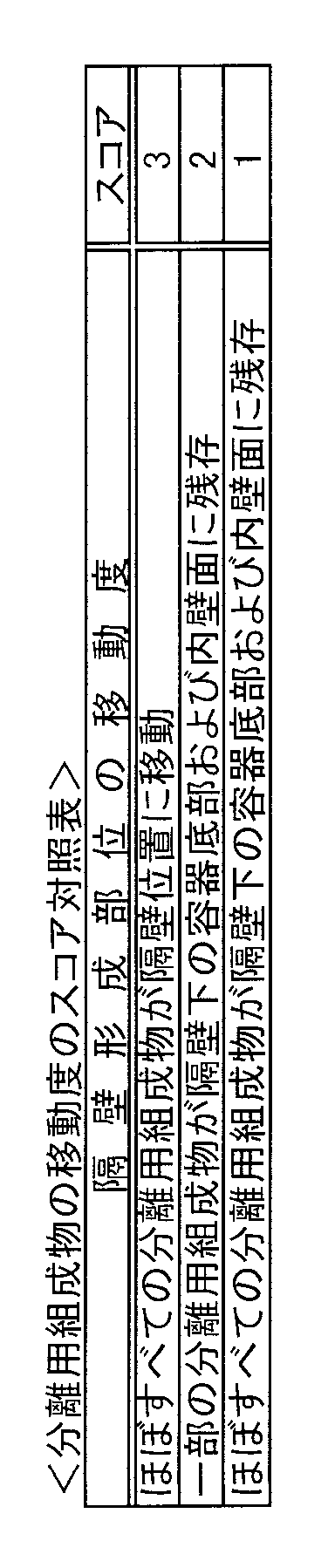

実施例1~4及び比較例1~4の評価結果を表8~10にまとめた。


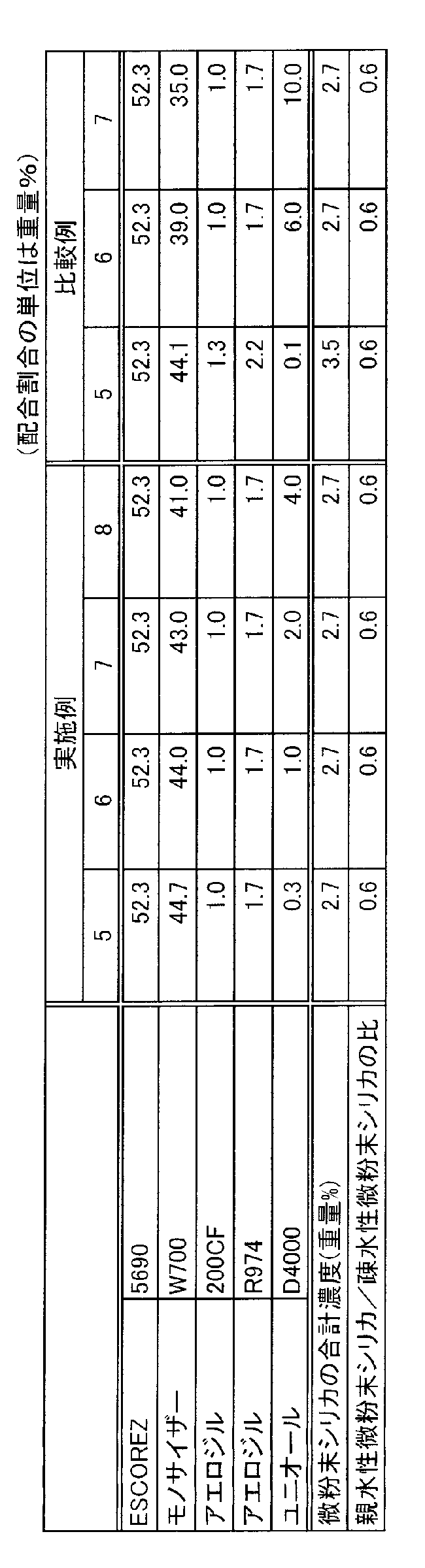
液状樹脂成分として、シクロペンタジエン系オリゴマー(エクソンモービル社製、商品名:ESCOREZ5690)と、トリメリット酸エステル(大日本インキ化学工業社製、商品名:モノサイザーW700)とを130℃で溶解し、液状樹脂成分を調製した。この液状樹脂成分に、ポリアルキレングリコールとして、ポリプロピレングリコール(日油社製、商品名:ユニオールD4000)を溶解させ、約30℃まで冷却した。次に、無機粉末として、親水性微粉末シリカ(日本アエロジル社製、商品名:アエロジル200CF)及び疎水性微粉末シリカ(日本アエロジル社製、商品名:アエロジルR974)を、プラネタリーミキサーで前記液状樹脂成分を攪拌しつつ、分散させた。このようにして、実施例5の血清または血漿分離用組成物を得た。なお、各成分の配合割合は、下記の表11に示すとおりである。
各成分の配合割合を表11に示したように変更したことを除いては、実施例5と同様にして、血清または血漿分離用組成物を得た。
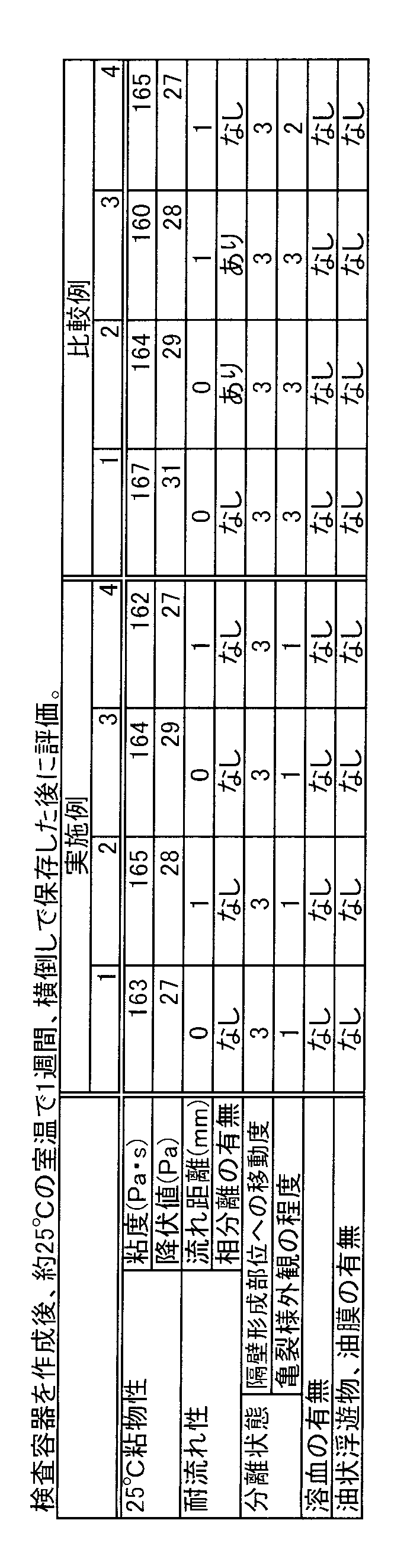
ただし、評価は、血液検査容器の作成後、約25℃の室温で横倒し状態で1週間保存したものについて行った。
実施例5~8及び比較例5~7の評価結果を表12にまとめた。

次に実施例9~12及び比較例8~10について述べる。
液状樹脂成分として、シクロペンタジエン系オリゴマー(エクソンモービル社製、商品名:ESCOREZ5690)と、トリメリット酸エステル(大日本インキ化学工業社製、商品名:モノサイザーW700)とを130℃で溶解し、液状樹脂成分を調製した。この液状樹脂成分に、ポリアルキレングリコールとして、ポリプロピレングリコール(日油社製、商品名:ユニオールD4000)を溶解させ、約30℃まで冷却した。次に、無機粉末として、親水性微粉末シリカ(日本アエロジル社製、商品名:アエロジル200CF)及び疎水性微粉末シリカ(日本アエロジル社製、商品名:アエロジルR974)を、プラネタリーミキサーで前記液状樹脂成分を攪拌しつつ、分散させた。このようにして、実施例9の血清または血漿分離用組成物を得た。なお、各成分の配合割合は、下記の表13に示すとおりである。
各成分の配合割合を表13に示したように変更したことを除いては、実施例9と同様にして、血清または血漿分離用組成物を得た。

ただし、評価は、血液検査容器の作成後、約25℃の室温で横倒し状態で1週間保存したものについて行った。
なお、隔壁の白濁については、採血後の採血管を4℃冷蔵1カ月後に白濁の有無を目視観察した。
実施例9~12及び比較例8~10の評価結果を表14にまとめた。

しかしながら、比較例9~10においては、4℃冷蔵1カ月後の隔壁に白濁が生じていた。
実施例において用いた物質は以下の通りである。
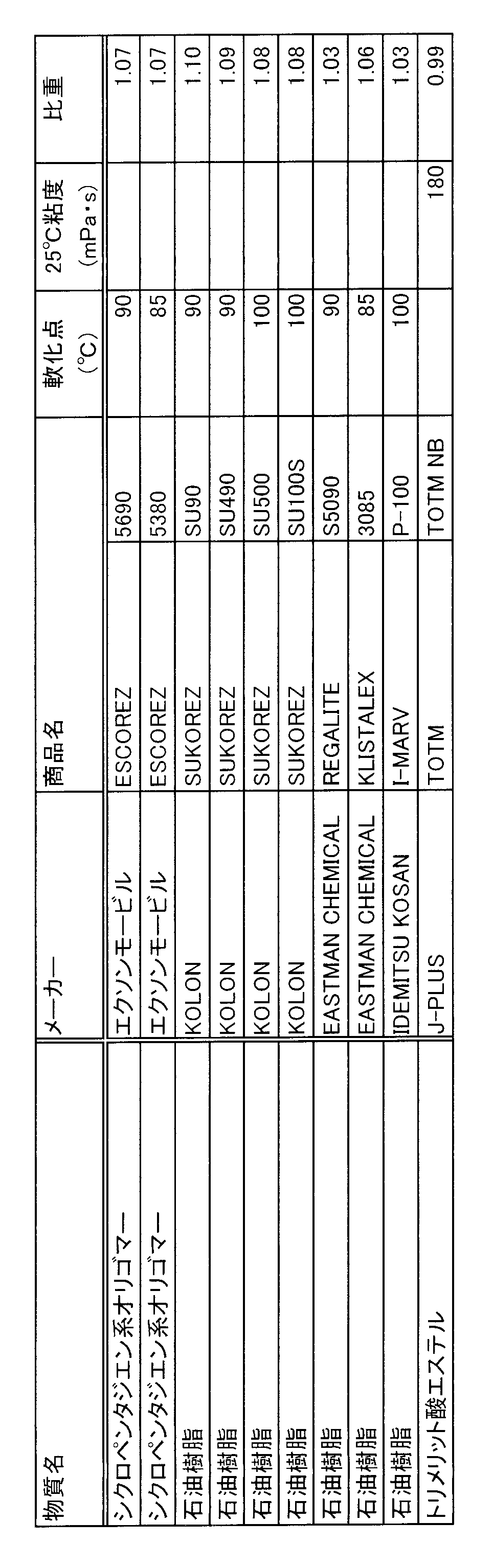

液状樹脂成分として、シクロペンタジエン系オリゴマー(エクソンモービル社製、商品名:ESCOREZ5690、ESCOREZ5380)と、トリメリット酸エステル(J-PLUS社製、商品名:TOTM NB)とを130℃で溶解し、液状樹脂成分を調製した。この液状樹脂成分に、ポリアルキレングリコールとして、ポリプロピレングリコール(旭硝子社製、商品名:PREMINOL S3011)を溶解させ、約30℃まで冷却した。次に、無機粉末として、親水性微粉末シリカ(日本アエロジル社製、商品名:アエロジル200CF)及び疎水性微粉末シリカ(日本アエロジル社製、商品名:アエロジルR974)を、プラネタリーミキサーで前記液状樹脂成分を攪拌しつつ、分散させた。このようにして、実施例13の血清または血漿分離用組成物を得た。なお、各成分の配合割合は、下記の表17に示すとおりである。
各成分の配合割合を表17に示したように変更したことを除いては、実施例13と同様にして、血清または血漿分離用組成物を得た。

実施例13~19の評価結果を表18~20にまとめた。


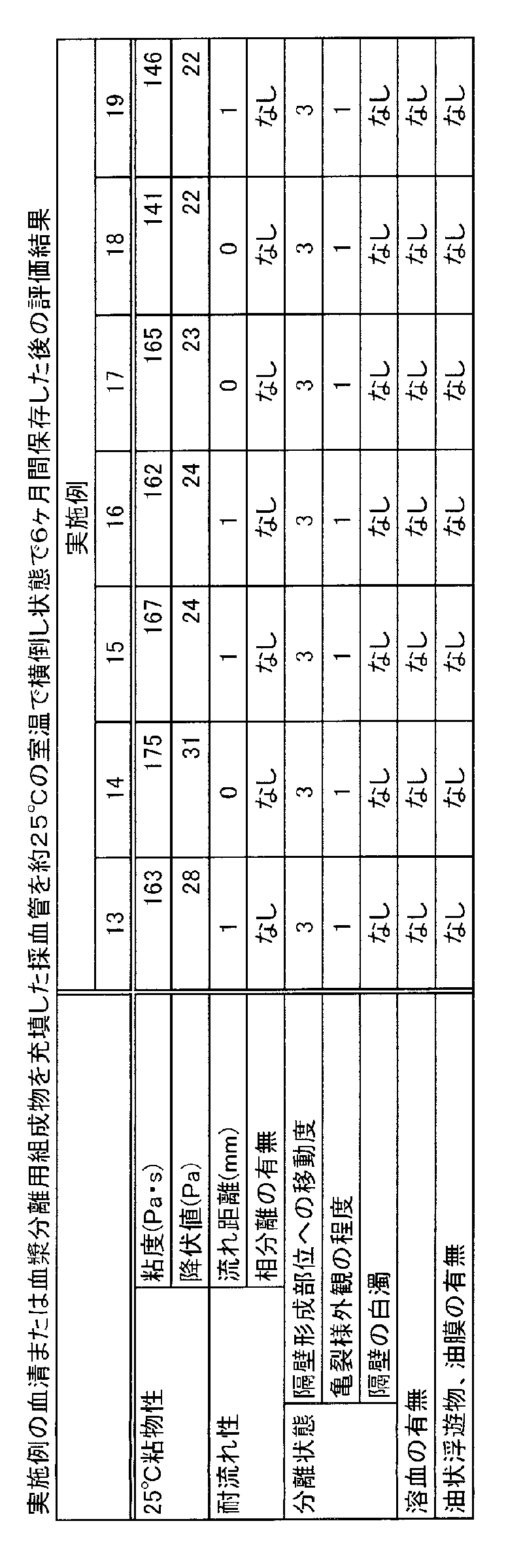
さらに実施例14~19では、精製水を0.1重量%の割合で配合した。
実施例13~19のすべてで充分なチクソトロピー性と耐流れ性を示した。
Claims (5)
- 隔壁形成性を有する液状樹脂成分と、
親水性無機粉末と、
疎水性無機粉末と、
チクソトロピー性増強剤としての有機化合物とからなる血清または血漿分離用組成物において、前記有機化合物が、
1)炭素数が3~5のアルキレンオキサイド単量体から選ばれる1種の単量体の単独重合体と、
2)炭素数が2~5のアルキレンオキサイド単量体から選ばれる2種以上の単量体のランダム共重合体、交互共重合体、または周期的共重合体と、
3)炭素数が3~5のアルキレンオキサイド単量体から選ばれる2種以上の単量体のブロック共重合体と、
4)上記1)~3)から選ばれる少なくとも1種の重合体よりなるグラフト共重合体とからなる群より選ばれる少なくとも1種の重合体からなり、
且つ、数平均分子量が500以上100000以下であるポリアルキレングリコール及び/またはその誘導体であって、該ポリアルキレングリコール及び/またはその誘導体の含有割合が全体の0.2重量%以上、5重量%以下であることを特徴とする、血清または血漿分離用組成物。 - 更に水を含むことを特徴とする、請求項1記載の血清または血漿分離用組成物。
- 疎水性無機粉末の重量%に対する親水性無機粉末の重量%比が0.2以上、1.0以下である、請求項1または2に記載の血清または血漿分離用組成物。
- 前記親水性無機粉末が、親水性シリカであり、前記疎水性無機粉末が疎水性シリカである、請求項1~3のいずれか1項に記載の血清または血漿分離用組成物。
- 容器本体と、容器本体内に収容されており、請求項1~4のいずれか1項に記載の血清または血漿分離用組成物とを備える、血液検査用容器。
Priority Applications (4)
| Application Number | Priority Date | Filing Date | Title |
|---|---|---|---|
| EP20110747115 EP2410329B1 (en) | 2010-02-26 | 2011-01-25 | Composition for plasma and serum separation, and container for blood testing |
| US13/320,782 US8623655B2 (en) | 2010-02-26 | 2011-01-25 | Composition for plasma and serum separation, and container for blood testing |
| CN201180007669.8A CN102741690B (zh) | 2010-02-26 | 2011-01-25 | 血清或血浆分离用组合物及血液检查用容器 |
| JP2011512776A JP4750911B1 (ja) | 2010-02-26 | 2011-01-25 | 血清または血漿分離用組成物及び血液検査用容器 |
Applications Claiming Priority (2)
| Application Number | Priority Date | Filing Date | Title |
|---|---|---|---|
| JP2010-043140 | 2010-02-26 | ||
| JP2010043140 | 2010-02-26 |
Publications (1)
| Publication Number | Publication Date |
|---|---|
| WO2011105151A1 true WO2011105151A1 (ja) | 2011-09-01 |
Family
ID=44506573
Family Applications (1)
| Application Number | Title | Priority Date | Filing Date |
|---|---|---|---|
| PCT/JP2011/051300 Ceased WO2011105151A1 (ja) | 2010-02-26 | 2011-01-25 | 血清または血漿分離用組成物及び血液検査用容器 |
Country Status (5)
| Country | Link |
|---|---|
| US (1) | US8623655B2 (ja) |
| EP (1) | EP2410329B1 (ja) |
| JP (1) | JP4750911B1 (ja) |
| CN (1) | CN102741690B (ja) |
| WO (1) | WO2011105151A1 (ja) |
Cited By (6)
| Publication number | Priority date | Publication date | Assignee | Title |
|---|---|---|---|---|
| JP5373075B2 (ja) * | 2010-02-26 | 2013-12-18 | 積水メディカル株式会社 | 血液分離剤及び血液採取容器 |
| WO2016159236A1 (ja) * | 2015-03-31 | 2016-10-06 | 積水メディカル株式会社 | 血清または血漿分離用組成物、並びに血液採取容器 |
| WO2016199851A1 (ja) * | 2015-06-10 | 2016-12-15 | 積水メディカル株式会社 | 血清または血漿分離用組成物、血液検査用容器、並びに血清または血漿分離用組成物の安定化方法 |
| WO2020158787A1 (ja) | 2019-02-01 | 2020-08-06 | 積水メディカル株式会社 | 血餅付着防止剤及び血液採取容器 |
| WO2020235544A1 (ja) * | 2019-05-20 | 2020-11-26 | 積水メディカル株式会社 | 単核球含有血漿分離用組成物及び血液採取容器 |
| WO2021124847A1 (ja) | 2019-12-18 | 2021-06-24 | 積水メディカル株式会社 | 血液採取容器 |
Families Citing this family (2)
| Publication number | Priority date | Publication date | Assignee | Title |
|---|---|---|---|---|
| WO2015046557A1 (ja) * | 2013-09-30 | 2015-04-02 | 積水メディカル株式会社 | 循環腫瘍細胞濃縮分離デバイス及び循環腫瘍細胞の濃縮分離方法 |
| CN104558354B (zh) * | 2014-12-08 | 2017-04-26 | 南雄阳普医疗科技有限公司 | 一种富血小板血浆分离胶及富血小板血浆制备方法 |
Citations (5)
| Publication number | Priority date | Publication date | Assignee | Title |
|---|---|---|---|---|
| US4083784A (en) | 1974-12-16 | 1978-04-11 | Corning Glass Works | Stabilized blood separating composition |
| JPS6410122A (en) | 1987-07-03 | 1989-01-13 | Hitachi Ltd | S/d converter |
| JP2002365281A (ja) * | 2001-06-05 | 2002-12-18 | Sekisui Chem Co Ltd | 血清または血漿分離用組成物 |
| JP2003294731A (ja) * | 2001-12-04 | 2003-10-15 | Sekisui Chem Co Ltd | 血清または血漿分離用組成物、及びこれを収容した血液検査用容器 |
| WO2007029525A1 (ja) * | 2005-09-09 | 2007-03-15 | Toagosei Co., Ltd. | 血液分離剤用重合体及び血液分離剤組成物 |
Family Cites Families (11)
| Publication number | Priority date | Publication date | Assignee | Title |
|---|---|---|---|---|
| US4043928A (en) | 1973-10-31 | 1977-08-23 | Lukacs And Jacoby Associates | Serum separating composition of matter |
| US4350593A (en) * | 1977-12-19 | 1982-09-21 | Becton, Dickinson And Company | Assembly, compositions and method for separating blood |
| US4235725A (en) * | 1978-08-16 | 1980-11-25 | Owens-Illinois, Inc. | Sterile blood-collecting and separating device |
| JPH0743369B2 (ja) * | 1987-12-28 | 1995-05-15 | 積水化学工業株式会社 | 血清又は血漿分離用組成物 |
| US4994393A (en) * | 1989-02-22 | 1991-02-19 | Becton, Dickinson And Company | Blood partitioning composition |
| JP3593215B2 (ja) | 1995-08-28 | 2004-11-24 | 積水化学工業株式会社 | 血清又は血漿分離用組成物 |
| US7090970B2 (en) | 2001-12-04 | 2006-08-15 | Sekisui Chemical Co., Ltd. | Composition for blood serum or plasma separation and vessel for blood examination containing the same |
| US20070190148A1 (en) * | 2006-02-14 | 2007-08-16 | Peter Cronin | Gel compositions, apparatuses and fluid separation methods |
| WO2007139018A1 (ja) * | 2006-05-25 | 2007-12-06 | Sekisui Chemical Co., Ltd. | 血清または血漿分離用組成物及び血液検査用容器 |
| EP2360470A4 (en) * | 2008-11-07 | 2013-01-02 | Hitachi Chemical Co Ltd | BLOOD SERUM OR BLOOD PLASMA SEPARATOR MATERIAL AND BLOOD COLLECTION TUBE USING THE SAME |
| WO2011105253A1 (ja) * | 2010-02-26 | 2011-09-01 | 積水メディカル株式会社 | 血液分離剤及び血液採取容器 |
-
2011
- 2011-01-25 EP EP20110747115 patent/EP2410329B1/en active Active
- 2011-01-25 US US13/320,782 patent/US8623655B2/en active Active
- 2011-01-25 CN CN201180007669.8A patent/CN102741690B/zh active Active
- 2011-01-25 WO PCT/JP2011/051300 patent/WO2011105151A1/ja not_active Ceased
- 2011-01-25 JP JP2011512776A patent/JP4750911B1/ja active Active
Patent Citations (5)
| Publication number | Priority date | Publication date | Assignee | Title |
|---|---|---|---|---|
| US4083784A (en) | 1974-12-16 | 1978-04-11 | Corning Glass Works | Stabilized blood separating composition |
| JPS6410122A (en) | 1987-07-03 | 1989-01-13 | Hitachi Ltd | S/d converter |
| JP2002365281A (ja) * | 2001-06-05 | 2002-12-18 | Sekisui Chem Co Ltd | 血清または血漿分離用組成物 |
| JP2003294731A (ja) * | 2001-12-04 | 2003-10-15 | Sekisui Chem Co Ltd | 血清または血漿分離用組成物、及びこれを収容した血液検査用容器 |
| WO2007029525A1 (ja) * | 2005-09-09 | 2007-03-15 | Toagosei Co., Ltd. | 血液分離剤用重合体及び血液分離剤組成物 |
Non-Patent Citations (3)
| Title |
|---|
| "The 47th Annual Meeting of The NMR Society of Japan", 2008, article "Surface and Internal Hydroxyl Group Density of Porous Silica Gel" |
| MASAYOSHI FUJI, FUNCTIONALIZATION OF PARTICLE SURFACE., vol. 24, no. 10, 2003, pages 625 - 634 |
| See also references of EP2410329A4 |
Cited By (15)
| Publication number | Priority date | Publication date | Assignee | Title |
|---|---|---|---|---|
| JP5373075B2 (ja) * | 2010-02-26 | 2013-12-18 | 積水メディカル株式会社 | 血液分離剤及び血液採取容器 |
| KR20170132135A (ko) | 2015-03-31 | 2017-12-01 | 세키스이 메디칼 가부시키가이샤 | 혈청 또는 혈장 분리용 조성물, 그리고 혈액 채취 용기 |
| WO2016159236A1 (ja) * | 2015-03-31 | 2016-10-06 | 積水メディカル株式会社 | 血清または血漿分離用組成物、並びに血液採取容器 |
| US10617602B2 (en) | 2015-03-31 | 2020-04-14 | Sekisui Medical Co., Ltd. | Composition for serum or plasma separation, and container for blood collection |
| JPWO2016159236A1 (ja) * | 2015-03-31 | 2017-09-07 | 積水メディカル株式会社 | 血清または血漿分離用組成物、並びに血液採取容器 |
| JPWO2016199851A1 (ja) * | 2015-06-10 | 2017-08-10 | 積水メディカル株式会社 | 血清または血漿分離用組成物、血液検査用容器、並びに血清または血漿分離用組成物の安定化方法 |
| WO2016199851A1 (ja) * | 2015-06-10 | 2016-12-15 | 積水メディカル株式会社 | 血清または血漿分離用組成物、血液検査用容器、並びに血清または血漿分離用組成物の安定化方法 |
| US10677778B2 (en) | 2015-06-10 | 2020-06-09 | Sekisui Medical Co., Ltd. | Serum- or plasma-separating composition, blood-test container, and method of stabilizing serum- or plasma-separating composition |
| WO2020158787A1 (ja) | 2019-02-01 | 2020-08-06 | 積水メディカル株式会社 | 血餅付着防止剤及び血液採取容器 |
| US12390563B2 (en) | 2019-02-01 | 2025-08-19 | Sekisui Medical Co., Ltd. | Clot adhesion preventing agent and blood collection container |
| WO2020235544A1 (ja) * | 2019-05-20 | 2020-11-26 | 積水メディカル株式会社 | 単核球含有血漿分離用組成物及び血液採取容器 |
| JP6809747B1 (ja) * | 2019-05-20 | 2021-01-06 | 積水メディカル株式会社 | 単核球含有血漿分離用組成物及び血液採取容器 |
| JP2021001912A (ja) * | 2019-05-20 | 2021-01-07 | 積水メディカル株式会社 | 単核球含有血漿分離用組成物及び血液採取容器 |
| JP7513343B2 (ja) | 2019-05-20 | 2024-07-09 | 積水メディカル株式会社 | 単核球含有血漿分離用組成物及び血液採取容器 |
| WO2021124847A1 (ja) | 2019-12-18 | 2021-06-24 | 積水メディカル株式会社 | 血液採取容器 |
Also Published As
| Publication number | Publication date |
|---|---|
| EP2410329A4 (en) | 2012-12-05 |
| US20120070350A1 (en) | 2012-03-22 |
| US8623655B2 (en) | 2014-01-07 |
| CN102741690A (zh) | 2012-10-17 |
| EP2410329A1 (en) | 2012-01-25 |
| JP4750911B1 (ja) | 2011-08-17 |
| CN102741690B (zh) | 2015-06-17 |
| EP2410329B1 (en) | 2014-10-01 |
| JPWO2011105151A1 (ja) | 2013-06-20 |
Similar Documents
| Publication | Publication Date | Title |
|---|---|---|
| JP4750911B1 (ja) | 血清または血漿分離用組成物及び血液検査用容器 | |
| CN104634956B (zh) | 用于分离血清或血浆的组合物以及用于检查血液的容器 | |
| JP5373075B2 (ja) | 血液分離剤及び血液採取容器 | |
| CN100456036C (zh) | 用于分离血清或血浆的组合物和含有该组合物的血液检测容器 | |
| JP6535050B2 (ja) | 循環腫瘍細胞濃縮分離デバイス及び循環腫瘍細胞の濃縮分離方法 | |
| CN114340493B (zh) | 血液采集容器和血浆的分离方法 | |
| KR20200103530A (ko) | 혈청 또는 혈장 분리용 조성물, 혈액 채취 용기, 및 혈청 또는 혈장의 분리 방법 | |
| JP7513343B2 (ja) | 単核球含有血漿分離用組成物及び血液採取容器 | |
| KR20230159830A (ko) | 혈액 분리용 조성물, 혈액 채취 용기 및 백혈구의 분리 방법 | |
| JP2013061283A (ja) | 血清または血漿分離用組成物の滅菌方法 | |
| WO2025197904A1 (ja) | 血液採取容器、血漿の分離方法、細胞外遊離核酸の分離方法及び細胞外小胞の分離方法 | |
| JP2002365282A (ja) | 血清または血漿分離用組成物 | |
| JPS61154541A (ja) | 真空採血管 | |
| JP2016197132A (ja) | 血清または血漿分離用組成物の滅菌方法 | |
| JPH0510095B2 (ja) | ||
| JPS61172061A (ja) | 真空採血管 | |
| JP2002365281A (ja) | 血清または血漿分離用組成物 |
Legal Events
| Date | Code | Title | Description |
|---|---|---|---|
| WWE | Wipo information: entry into national phase |
Ref document number: 201180007669.8 Country of ref document: CN |
|
| WWE | Wipo information: entry into national phase |
Ref document number: 2011512776 Country of ref document: JP |
|
| WWE | Wipo information: entry into national phase |
Ref document number: 2011747115 Country of ref document: EP |
|
| 121 | Ep: the epo has been informed by wipo that ep was designated in this application |
Ref document number: 11747115 Country of ref document: EP Kind code of ref document: A1 |
|
| WWE | Wipo information: entry into national phase |
Ref document number: 13320782 Country of ref document: US |
|
| NENP | Non-entry into the national phase |
Ref country code: DE |