WO2011105611A1 - 悪液質を治療するためのグレリン受容体作動物質 - Google Patents
悪液質を治療するためのグレリン受容体作動物質 Download PDFInfo
- Publication number
- WO2011105611A1 WO2011105611A1 PCT/JP2011/054556 JP2011054556W WO2011105611A1 WO 2011105611 A1 WO2011105611 A1 WO 2011105611A1 JP 2011054556 W JP2011054556 W JP 2011054556W WO 2011105611 A1 WO2011105611 A1 WO 2011105611A1
- Authority
- WO
- WIPO (PCT)
- Prior art keywords
- oxo
- ethyl
- alkyl
- pyridin
- pyrazolo
- Prior art date
- Legal status (The legal status is an assumption and is not a legal conclusion. Google has not performed a legal analysis and makes no representation as to the accuracy of the status listed.)
- Ceased
Links
Classifications
-
- C—CHEMISTRY; METALLURGY
- C07—ORGANIC CHEMISTRY
- C07D—HETEROCYCLIC COMPOUNDS
- C07D471/00—Heterocyclic compounds containing nitrogen atoms as the only ring hetero atoms in the condensed system, at least one ring being a six-membered ring with one nitrogen atom, not provided for by groups C07D451/00 - C07D463/00
- C07D471/02—Heterocyclic compounds containing nitrogen atoms as the only ring hetero atoms in the condensed system, at least one ring being a six-membered ring with one nitrogen atom, not provided for by groups C07D451/00 - C07D463/00 in which the condensed system contains two hetero rings
- C07D471/04—Ortho-condensed systems
-
- A—HUMAN NECESSITIES
- A61—MEDICAL OR VETERINARY SCIENCE; HYGIENE
- A61K—PREPARATIONS FOR MEDICAL, DENTAL OR TOILETRY PURPOSES
- A61K31/00—Medicinal preparations containing organic active ingredients
- A61K31/33—Heterocyclic compounds
- A61K31/395—Heterocyclic compounds having nitrogen as a ring hetero atom, e.g. guanethidine or rifamycins
- A61K31/435—Heterocyclic compounds having nitrogen as a ring hetero atom, e.g. guanethidine or rifamycins having six-membered rings with one nitrogen as the only ring hetero atom
- A61K31/4353—Heterocyclic compounds having nitrogen as a ring hetero atom, e.g. guanethidine or rifamycins having six-membered rings with one nitrogen as the only ring hetero atom ortho- or peri-condensed with heterocyclic ring systems
- A61K31/437—Heterocyclic compounds having nitrogen as a ring hetero atom, e.g. guanethidine or rifamycins having six-membered rings with one nitrogen as the only ring hetero atom ortho- or peri-condensed with heterocyclic ring systems the heterocyclic ring system containing a five-membered ring having nitrogen as a ring hetero atom, e.g. indolizine, beta-carboline
-
- A—HUMAN NECESSITIES
- A61—MEDICAL OR VETERINARY SCIENCE; HYGIENE
- A61K—PREPARATIONS FOR MEDICAL, DENTAL OR TOILETRY PURPOSES
- A61K45/00—Medicinal preparations containing active ingredients not provided for in groups A61K31/00 - A61K41/00
- A61K45/06—Mixtures of active ingredients without chemical characterisation, e.g. antiphlogistics and cardiaca
-
- A—HUMAN NECESSITIES
- A61—MEDICAL OR VETERINARY SCIENCE; HYGIENE
- A61P—SPECIFIC THERAPEUTIC ACTIVITY OF CHEMICAL COMPOUNDS OR MEDICINAL PREPARATIONS
- A61P1/00—Drugs for disorders of the alimentary tract or the digestive system
- A61P1/14—Prodigestives, e.g. acids, enzymes, appetite stimulants, antidyspeptics, tonics, antiflatulents
-
- A—HUMAN NECESSITIES
- A61—MEDICAL OR VETERINARY SCIENCE; HYGIENE
- A61P—SPECIFIC THERAPEUTIC ACTIVITY OF CHEMICAL COMPOUNDS OR MEDICINAL PREPARATIONS
- A61P3/00—Drugs for disorders of the metabolism
-
- A—HUMAN NECESSITIES
- A61—MEDICAL OR VETERINARY SCIENCE; HYGIENE
- A61P—SPECIFIC THERAPEUTIC ACTIVITY OF CHEMICAL COMPOUNDS OR MEDICINAL PREPARATIONS
- A61P7/00—Drugs for disorders of the blood or the extracellular fluid
-
- A—HUMAN NECESSITIES
- A61—MEDICAL OR VETERINARY SCIENCE; HYGIENE
- A61P—SPECIFIC THERAPEUTIC ACTIVITY OF CHEMICAL COMPOUNDS OR MEDICINAL PREPARATIONS
- A61P7/00—Drugs for disorders of the blood or the extracellular fluid
- A61P7/06—Antianaemics
-
- A—HUMAN NECESSITIES
- A61—MEDICAL OR VETERINARY SCIENCE; HYGIENE
- A61P—SPECIFIC THERAPEUTIC ACTIVITY OF CHEMICAL COMPOUNDS OR MEDICINAL PREPARATIONS
- A61P7/00—Drugs for disorders of the blood or the extracellular fluid
- A61P7/10—Antioedematous agents; Diuretics
Definitions
- the present invention relates to a therapeutic agent for cachexia that develops in chronic diseases such as malignant tumor, tuberculosis, diabetes, blood disease, endocrine disease, chronic obstructive pulmonary disease, chronic kidney disease, heart failure, infection and acquired immune deficiency syndrome. . More specifically, a compound represented by the general formula (I) having ghrelin receptor agonistic activity that promotes the secretion of growth hormone, a pharmaceutically acceptable salt thereof, or a pharmaceutical composition containing them. , For use in the manufacture of a medicament for the treatment of cachexia.
- the present invention also relates to a method for treating the above-mentioned diseases, which comprises administering the compound or a pharmaceutical composition containing them to humans or animals.
- the present invention relates to the use of the compounds, their pharmaceutically acceptable salts, or pharmaceutical compositions containing them in combination with one or more second active agents. Furthermore, the present invention relates to a pharmaceutical composition and kit comprising a compound of general formula (I) or a pharmaceutically acceptable salt thereof for use in the treatment of the above diseases.
- Cachexia is a progressive weight loss, anemia in chronic diseases such as malignancy, tuberculosis, diabetes, blood disease, endocrine disease, chronic obstructive pulmonary disease, chronic kidney disease, heart failure, infection and acquired immune deficiency syndrome , Edema, anorexia, etc. are systemic syndromes (for example, Cologne et al. “Cancer cachexia”: Journal of Parental and Enteral Nutrition “J. Parenteral and Enteral Nutrition” 12, 286-298 (1988), American Journal of Medicine “American Journal of Medicine", 85, 289-291 (1988)). Conventionally, nutritional supplementation and endocrine therapy have been tried for cachexia, but no satisfactory treatment has been established.
- Cachexia is often caused by malignant tumors, but when antitumor agents are administered in this case, antitumor effects are usually obtained, but side effects caused by antitumor agents are usually added, and cachexia does not improve (Nelson et al. Journal of Clinical Oncology “Journal of Clinical Oncology”, 12, 213-225 (1994)).
- the gist of the present invention is as follows: [1] A compound represented by the general formula (I), a racemic mixture, a diastereomeric mixture and an optical isomer of the compound for producing a pharmaceutical for treating cachexia in humans or animals, and pharmaceutically acceptable.
- One or more uses selected from the group consisting of salts thereof and prodrugs thereof [Wherein e is 0 or 1; n and w are each independently 0, 1 or 2; Provided that w and n must not both be 0 at the same time; Y is oxygen or sulfur; R 1 Is hydrogen, —CN, — (CH 2 ) q N (X 6 ) C (O) X 6 ,-(CH 2 ) q N (X 6 ) C (O) (CH 2 ) t -A 1 ,-(CH 2 ) q N (X 6 ) SO 2 (CH 2 ) t -A 1 ,-(CH 2 ) q N (X 6 ) SO 2 X 6 ,-(CH 2 ) q N (X 6 ) C (O) N (X 6 ) (CH 2 ) t -A 1 ,-(CH 2 ) q N (X 6 ) C (O) N (X 6 ) (CH 2 ) t -
- R 7 And R 8 Are independently hydrogen or optionally substituted (C 1 -C 6 ) Is alkyl ⁇ where R 7 And R 8
- Optionally substituted (C 1 -C 6 ) Alkyl is A 1 , -C (O) O- (C 1 -C 6 ) Alkyl, -S (O) m (C 1 -C 6 ) Alkyl, 1 to 5 halogens, 1 to 3 hydroxys, 1 to 3 —O—C (O) (C 1 -C Ten ) Alkyl or 1 to 3 (C 1 -C 6 )
- R 1 Is-(C 1 ⁇ C Three ) Alkyl-phenyl,-(C 1 ⁇ C Three ) Alkyl-pyridyl,-(C 1 ⁇ C Three ) Alkyl-quinolinyl or-(C 1 ⁇ C Three ) Alkyl-thiazolyl, wherein R 1 Phenyl in halo is halo, CF Three , CH Three And optionally substituted with one or two substituents independently selected from the group consisting of phenyl; R 2 Is hydrogen,-(C 1 ⁇ C Four ) Alkyl or-(C 1 ⁇ C Four ) Alkyl-CF Three Is; R Three Is-(C 1 ⁇ C Four ) Alkylindolyl,-(C 1 ⁇ C Four ) Alkylphenyl,-(C 1 ⁇ C Four ) Alkyl-O- (C 1 ⁇ C Four ) Al
- a pharmaceutical composition comprising the compound according to any one of [1] to [4], or a pharmaceutically acceptable salt thereof, used for the treatment of cachexia;
- a kit used for the treatment of cachexia comprising the compound according to any one of [1] to [4] above, or a pharmaceutically acceptable salt thereof;
- the kit described in [10] comprising the compound described in any of [1] to [4] above, or a pharmaceutically acceptable salt thereof, one or more kinds of second active agents, and a container.
- a pharmaceutical composition comprising the compound according to any one of [1] to [4] above, or a pharmaceutically acceptable salt thereof, and a description relating to the pharmaceutical composition, wherein the cachexia is A product containing a description that may or may not be used to treat.
- the therapeutic agent of the present invention is used for the treatment of cachexia occurring in chronic diseases such as malignant tumor, tuberculosis, diabetes, blood disease, endocrine disease, chronic obstructive pulmonary disease, chronic kidney disease, heart failure, infection and acquired immune deficiency syndrome. Used as a therapeutic agent.
- systemic systemic symptoms such as progressive weight loss (including weight loss due to adipose tissue degradation and weight loss due to muscle tissue degradation), anemia, edema, anorexia, etc. in the above chronic diseases Syndrome is improved. Since transplantation of cancer cells or tissues into animals causes a decrease in food intake and weight, these animals are used as an animal model of cachexia (endoclinology “Endocrinology” 148). Volume, 3004-3012, 2007).
- the compound represented by the general formula (I) is effective for the treatment of cachexia.
- the compound (substance) of the general formula (I) is disclosed in WO 97/024369 as a substance that promotes the secretion of growth hormone.
- osteoporosis congestive heart failure, age-related weakness or obesity, accelerated fracture repair, reduced protein catabolic response after major surgery, reduced cachexia and protein loss due to chronic diseases, wounds Accelerate healing, accelerate recovery of burned patients or patients undergoing major surgery, muscle strength, mobility, maintenance of skin thickness, improved metabolic or renal homeostasis, growth of growth hormone deficient children, etc. The use is described.
- a compound represented by the following general formula (I) (a compound disclosed in WO97 / 024369) or a pharmaceutically acceptable salt thereof.
- the compounds of the present invention include those solvates, complexes, polymorphs, prodrugs, isomers, and isotope-labeled compounds described below.
- the present invention relates to a compound represented by the following general formula (I):
- the carbon having X 5 or X 5a and the nitrogen having R 7 and R 8 form one or two alkylene bridges, each alkylene bridge containing 1 to 5 carbon atoms, provided that When one alkylene bridge is formed, X 5 or X 5a but not both can be present on the carbon atom and R 7 or R 8 but not both be present on the nitrogen atom And when two more alkylene bridges are formed, X 5 and X 5a cannot be present on the carbon atom and R 7 and R 8 cannot be present on the nitrogen atom.
- X 5a and X 5 are independently selected from the group consisting of a partially saturated or fully saturated 3- to 7-membered ring, or oxygen, sulfur and nitrogen, together with the carbon atom to which they are attached. Forming a partially saturated or fully saturated 4- to 8-membered ring having 1 to 4 heteroatoms; Or X 5a and X 5 are partially saturated, optionally having from 1 to 4 heteroatoms independently selected from the group consisting of nitrogen, sulfur and oxygen, together with the carbon atom to which they are attached, Partially saturated optionally having one or two heteroatoms independently selected from the group consisting of nitrogen, sulfur and oxygen fused to a fully saturated or non-saturated 5- or 6-membered ring Forming a bicyclic ring system consisting of 5- or 6-membered rings, Z 1 is a single bond, O or NX 2 , provided that when a and b are both 0, Z 1 is not NX 2 or O— ⁇ ; R 7 and R 8 are independently hydrogen or optionally substituted (C 1 -
- a preferred group of compounds referred to as “Group A” includes compounds having the general formula (I) as indicated above [where X 4 is hydrogen; R 4 is hydrogen or methyl. ; R 7 is hydrogen or (C 1 -C 3) alkyl; R 8 is optionally substituted with hydrogen or one or two hydroxyl groups (C 1 -C 3) alkyl; R 6 is ⁇ Wherein Z 1 is a single bond and a is 0 or 1 ⁇ ; X 5 and X 5a are each independently hydrogen, trifluoromethyl, phenyl, optionally substituted (C 1 -C 6 ) alkyl ⁇ wherein optionally substituted (C 1 -C 6 ) Alkyl includes OX 2 , imidazolyl, phenyl, indolyl, p-hydroxyphenyl, (C 5 -C 7 ) cycloalkyl, —S (O) m (C 1 -C 6 ) alkyl, —N (X 2 ) (X 2 )
- Group A compounds having the general formula (I) as indicated above [where b is 0; X 5 and X 5a are each independently hydrogen, (C 1 -C 3) alkyl or hydroxy (C 1 -C 3) alkyl; R 3 is 1-indolyl -CH 2 -, 2-indolyl - CH 2 -, 3- indolyl -CH 2 -, 1-naphthyl -CH 2 -, 2-naphthyl -CH 2 -, 1-benzimidazolyl -CH 2 -, 2-benzimidazolyl -CH 2 -, phenyl - (C 1- C 4 ) alkyl-, 2-pyridyl- (C 1 -C 4 ) alkyl-, 3-pyridyl- (C 1 -C 4 ) alkyl-, 4-pyridyl- (C 1 -C
- Group B compounds referred to as “Group C” preferred compounds include “Group B” compounds having the general formula (I) as shown above [wherein R 4 is hydrogen. a is 0; n is 1 or 2; w is 0 or 1; X 5 and X 5a are each independently hydrogen, methyl or hydroxymethyl, provided that X 5 is hydrogen X 5a is not hydrogen; R 7 and R 8 are each hydrogen; and R 3 is phenyl -CH 2 -O-CH 2 -, phenyl -CH 2 -S-CH 2 -, 1- naphthyl -CH 2 -, 2-naphthyl —CH 2 —, phenyl- (CH 2 ) 3 — or 3-indolyl —CH 2 — ⁇ wherein the aryl moiety of the group defined for R 3 is optionally substituted with 1 to 3 substituents And each substituent is independently selected from the group consisting of fluoro, chloro, methyl, OCH 3
- preferred compounds include compounds of “Group C” having the general formula (I) as shown above [wherein R 1 is ⁇ ( CH 2) t -A 1, - (CH 2) q - (C 3 -C 7) cycloalkyl, or (C 1 -C 10) alkyl ⁇ wherein, a 1 in the definition of R 1 is, one Each of the substituents is independently selected from the group consisting of fluoro, chloro, methyl, OCH 3 , OCF 2 H, OCF 3 and CF 3 ; cyclo in the definition of R 1 Alkyl and alkyl groups are (C 1 -C 4 ) alkyl, hydroxyl, (C 1 -C 4 ) alkoxy, carboxyl, CONH 2 , —S (O) m (C 1 -C 6 ) alkyl, —CO 2 ( C 1 -C 4) alkyl ester, 1H-tetrazol-5-
- preferred compound groups include “D group” compounds in which w is 0 and n is 1.
- R 1 is — (CH 2 ) t —A 1 ⁇ wherein A 1 in the definition of R 1 is phenyl, thienyl, thiazolyl, pyridyl, optionally substituted with 1 to 3 substituents Or pyrimidyl, wherein each substituent is independently selected from the group consisting of F, Cl, Me, OMe, CF 3 , OCF 3 and OCF 2 H; t is 0, 1 or 2 ⁇ ; And R 3 is phenyl-CH 2 —O—CH 2 —, phenyl- (CH 2 ) 3 — or 3-indolyl-CH 2 — ⁇ wherein the aryl moiety is 1 to 3 substituents And each substituent is independently selected from the group consisting of F, Cl, Me
- F group compounds having the general formula (I) as shown above [wherein X 5 and X 5a are R 1 is —CH 2 -phenyl, —CH 2 -4-fluoro-phenyl, —CH 2 -pyridyl or —CH 2 -thiazolyl, and R 2 is hydrogen, methyl, ethyl , T-butyl or —CH 2 CF 3 ].
- preferred compound groups include the following general formula: Compounds of the “Group G” having the racemic diastereomeric mixtures and optical isomers of this compound ⁇ where R 1 is —CH 2 -phenyl, R 2 is methyl and R 3 is — ( CH 2 ) 3 -phenyl; R 1 is —CH 2 —phenyl, R 2 is methyl, and R 3 is 3-indolyl —CH 2 —; R 1 is —CH 2 —phenyl, R 2 is ethyl, and R 3 is 3-indolyl —CH 2 —; R 1 is —CH 2 -4-fluoro-phenyl, R 2 is methyl, and R 3 is 3-indolyl-CH 2 —; R 1 is —CH 2 -phenyl, R 2 is methyl, and R 3 is —CH 2 —O—CH 2 -phenyl; R 1 is —CH 2
- preferred compounds include the “G group” compound having the general formula (I) as indicated above ⁇ where R 1 is —CH 2 -phenyl and R 3 is phenyl- (CH 2 ) 3 —.
- R 1 is —CH 2 -phenyl or —CH 2 -4-fluoro-phenyl
- R 3 is 3-indolyl- Compounds of “Group G”, which are CH 2 —, are included.
- R 1 is —CH 2 -phenyl or —CH 2 -4-fluoro-phenyl
- R 3 is phenyl-CH 2. Included are compounds of “G” group, which is —O—CH 2 —.
- the 3a- (R) and 3a- (S) isomers are preferred, the 3a- (R) isomer is preferred over the 3a- (S) isomer, and the L-tartrate salt of the 3a- (R) isomer is Preferred salt.
- R 1 is — (CH 2 ) t —A 1 ⁇ wherein A 1 in the definition of R 1 is phenyl, thienyl, thiazolyl, pyridyl, optionally substituted with 1 to 3 substituents Or pyrimidyl, wherein each substituent is independently selected from the group consisting of F, Cl, Me, OMe, CF 3 , OCF 3 and OCF 2 H; t is 0, 1 or 2 ⁇ ; R 3 is phenyl-CH 2 —O—CH 2 —, phenyl- (CH 2 ) 3 — or 3-indolyl-CH 2 — ⁇ wherein the aryl moiety is 1 to 3 substituents And each substituent is independently selected from the group consisting of F, Cl, Me, OMe
- K group compounds referred to as “L group” preferred compounds are the “K group” compounds wherein X 5 and X 5a are each methyl; R 1 is —CH 2 -phenyl , —CH 2 -4-fluoro-phenyl, —CH 2 -pyridyl or —CH 2 -thiazolyl, and R 2 is hydrogen, methyl, ethyl, t-butyl or —CH 2 CF 3 ].
- a preferable compound group is a compound of “L group” wherein R 1 is —CH 2 -phenyl, R 2 is hydrogen or methyl, R 3 is —CH 2 —O—CH 2 -phenyl].
- Group A compounds referred to as “Group M” preferred compounds include “Group A” compounds having the general formula (I) as indicated above [where b is 0; X 5 and X 5a are each independently hydrogen, (C 1 -C 3 ) alkyl or hydroxy (C 1 -C 3 ) alkyl; R 3 is 1-indolyl-CH 2 —, 2-indolyl-CH 2 —, 3-indolyl-CH 2 —, 1-naphthyl-CH 2 —, 2-naphthyl-CH 2 —, 1-benzimidazolyl-CH.
- M group compounds referred to as “M 1 group”
- preferred compound groups include “M group” compounds having the general formula (I) as shown above [wherein R 4 is hydrogen, Yes; a is 0; n is 1; w is 1; e is 0; X 5 and X 5a are each independently hydrogen, methyl or hydroxymethyl, provided that X When 5 is hydrogen, X 5a is not hydrogen; R 7 and R 8 are each hydrogen; Y is oxygen; R 2 is hydrogen, methyl, ethyl, propyl, i-propyl, t- butyl, -CH 2 CF 3, CF 3 or -CH 2 - cyclopropyl; R 1 is CH 2 -A 1 ⁇ wherein, a 1 in the definition of R 1 is one to three of Phenyl, thienyl, thiazolyl, pyridyl or pyrimidyl optionally substituted with substituents, each substituent being , Cl, Me, OMe
- Bu M 1 group ⁇ No compound having the general formula as given above and (I) [wherein, X 5 and X 5a is each methyl; R 2 is methyl, ethyl or —CH 2 CF 3 ; A 1 is phenyl optionally substituted with 1 to 3 substituents, each substituent being , F, Cl, Me, OMe , CF 3, OCF 3 and are independently selected from the group consisting of OCF 2 H; R 3 is phenyl -CH 2 -O-CH 2 -, phenyl - (CH 2) 3 - Or thienyl-CH 2 —O—CH 2 —, where the aryl moiety is optionally substituted with 1 to 3 substituents, each substituent being F, Cl, Me, OMe, CF 3 , Independently selected from the group consisting of OCF 3 and OCF 2 H ⁇ ].
- Bu O group ⁇ To referred Bu M 1 group ⁇ No compound Bu M 1 group ⁇ No compound having the general formula as given above and (I) [wherein, X 5 And X 5a are each methyl; R 2 is methyl, ethyl or CH 2 CF 3 ; A 1 is 2-pyridyl or 3-pyridyl optionally substituted with one to two substituents , and the each substituent is F, Cl, Me, OMe, independently selected from the group consisting of CF 3, OCF 3 and OCF 2 H; R 3 is phenyl -CH 2 -O-CH 2 -, phenyl — (CH 2 ) 3 — or thienyl —CH 2 —O—CH 2 —, where the aryl moiety is optionally substituted with 1 to 3 substituents, each substituent being F, Cl , Me, OMe, CF 3, selected OCF 3 and from the group consisting of OCF 2 H independently ⁇ ] is Murrell.
- Bu P group ⁇ To referred Bu M 1 group ⁇ No compound Bu M 1 group ⁇ No compound having the general formula as given above and (I) [wherein, X 5 And X 5a are each methyl; R 2 is methyl, ethyl or CH 2 CF 3 ; A 1 is phenyl optionally substituted with 1 to 3 substituents, and each substituent is, F, Cl, Me, OMe , CF 3, independently selected from the group consisting of OCF 3 and OCF 2 H; R 3 is 2-pyridyl -CH 2 -O-CH 2 - or 3-pyridyl -CH 2 —O—CH 2 —, where the aryl moiety is optionally substituted with 1 to 2 substituents, each of which is F, Cl, Me, OMe, CF 3 , OCF 3 and Selected independently from the group consisting of OCF 2 H ⁇ ].
- preferred compound groups include the following general formula: Compounds of the “Group O” having the racemic and diastereomeric mixtures and optical isomers of this compound are included ⁇ where R 2 is methyl, A 1 is 2-pyridyl and R 3 is —CH 2 -O-CH 2 -phenyl; R 2 is CH 2 CF 3 , A 1 is 2-pyridyl, and R 3 is —CH 2 —O—CH 2 -3-chloro-phenyl; R 2 is CH 2 CF 3 , A 1 is 2-pyridyl, and R 3 is —CH 2 —O—CH 2 -4-chloro-phenyl; R 2 is CH 2 CF 3 , A 1 is 2-pyridyl, and R 3 is —CH 2 —O—CH 2 -2,4-di-chloro-phenyl; R 2 is CH 2 CF 3 , A 1 is 2-pyridyl, and R 3 is —CH 2 —O—CH 2 -2
- alkyl group is intended to include an alkyl group with a chain length specified in either a linear or branched structure that may optionally contain double or triple bonds.
- alkyl groups include methyl, ethyl, propyl, isopropyl, butyl, sec-butyl, tert-butyl, pentyl, isopentyl, hexyl, isohexyl, allyl, ethynyl, propenyl, butadienyl, hexenyl and the like.
- the alkoxy group specified above is intended to include an alkoxy group with a chain length specified in either a linear or branched structure.
- alkoxy groups include methoxy, ethoxy, propoxy, isopropoxy, butoxy, isobutoxy, tert-butoxy, pentoxy, isopentoxy, hexoxy, isohexoxy, allyloxy, 2-propynyloxy, isobutenyloxy, hexenyloxy, etc. There is.
- Halogen or “halo” is intended to include the halogen atoms fluorine, chlorine, bromine and iodine.
- Halogenated alkyl is intended to include an alkyl group as defined above substituted with one or more halogen atoms as defined above.
- Halogenated cycloalkyl is intended to include cycloalkyl groups substituted by one or more halogen atoms as defined above.
- Aryl means phenyl and naphthyl and aromatic 5- and 6-membered rings having 1 to 4 heteroatoms or fused 5- or 6-membered rings having 1 to 4 heteroatoms of nitrogen, sulfur or oxygen. Or is intended to include a 6-membered bicyclic ring.
- heterocyclic aromatic rings include pyridine, thiophene (also known as thienyl), furan, benzothiophene, tetrazole, indole, N-methylindole, dihydroindole, indazole, N-formylindole. , Benzimidazole, thiazole, pyrimidine, and thiadiazole.
- prodrug refers to a drug precursor that releases a drug in vivo via a chemical or physiological process after administration (eg, the prodrug is converted to the desired drug form by entering a physiological pH). It refers to a compound that is a substance. Exemplary prodrugs release the corresponding free acid upon cleavage, and such hydrolyzable ester-forming residues of the compounds of the invention include, but are not limited to, carboxylic acid substituents.
- R 1 is — (CH 2 ) q C (O) 2 X 6 where X 6 is hydrogen, or R 2 or A 1 contains a carboxylic acid ⁇ ⁇ here
- free hydrogen is (C 1 -C 4 ) alkyl, (C 2 -C 12 ) alkanoyloxymethyl, (C 4 -C 9 ) 1- (alkanoyloxy) ethyl, 5 to 10 carbon atoms 1-methyl-1- (alkanoyloxy) -ethyl having 3 to 6-carbon atoms alkoxycarbonyloxymethyl, 4 to 7-carbon atoms 1- (alkoxycarbonyloxy) ethyl, 5 8 to 8 charcoal 1-methyl-1- (alkoxycarbonyloxy) ethyl having atoms, N- (alkoxycarbonyl) aminomethyl having 3 to 9 carbon atoms, 1- (N--) having 4 to 10 carbon atoms (Alkoxycarbonyl) amino) ethyl, 3-
- Examples of other prodrugs are alcohols of the general formula (I) [wherein the free hydrogen of the hydroxyl substituent (eg R 1 contains hydroxyl) is (C 1 -C 6 ) alkanoyloxymethyl 1-((C 1 -C 6 ) alkanoyloxy) ethyl, 1-methyl-1-((C 1 -C 6 ) alkanoyloxy) ethyl, (C 1 -C 6 ) alkoxycarbonyloxymethyl, N- ( C 1 -C 6 ) alkoxy-carbonylamino-methyl, succinoyl, (C 1 -C 6 ) alkanoyl, ⁇ -amino (C 1 -C 4 ) alkanoyl, arylacetyl and ⁇ -aminoacyl, or ⁇ -aminoacyl- ⁇ - aminoacyl ⁇ wherein the ⁇ - aminoacyl moieties are independently, L- amino acids naturally occurring found in proteins, P (O) (OH)
- Amino substituents ⁇ eg when R 7 , R 8 are hydrogen, one of the free hydrogens is (C 2 -C 12 ) alkanoyloxymethyl, (C 4 -C 9 ) 1- (alkanoyloxy) ethyl, 1-methyl-1- (alkanoyloxy) -ethyl having 5 to 10 carbon atoms, alkoxycarbonyloxymethyl having 3 to 6 carbon atoms, 1-methyl having 4 to 7 carbon atoms (Alkoxycarbonyloxy) ethyl, 1-methyl-1- (alkoxycarbonyloxy) ethyl having 5 to 8 carbon atoms, N- (alkoxycarbonyl) aminomethyl having 3 to 9 carbon atoms, 4 1- (N- (alkoxycarbonyl) amino) ethyl, 3-phthalidyl, 4-crotonolactonyl, gamma-butyrolas having from 10 to 10 carbon atoms Ton-4-yl, di -N
- the prodrugs of the present invention in which the carboxyl group of the carboxylic acid of general formula (I) is replaced by an ester are about 0 ° C. to 100 ° C. in the presence of a base such as potassium carbonate in an inert solvent such as DMF.
- a base such as potassium carbonate
- an inert solvent such as DMF.
- the acid is combined with a suitable alcohol as a solvent in the presence of a catalytic amount of acid such as concentrated sulfuric acid at a temperature of about 20 ° C. to 120 ° C., preferably at reflux, for about 1 hour to about 24 hours.
- Another method is the reaction of this acid in an inert solvent such as THF, removal of the produced water by concomitant physical (eg, Gene-Stark trap) or chemical (eg, molecular sieve) means.
- the prodrugs of the present invention in which the alcohol group is derived as an ether are about 1 to about 24 hours at a temperature of about 0 ° C. to 100 ° C. in the presence of a base such as potassium carbonate in an inert solvent such as DMF.
- a base such as potassium carbonate
- an inert solvent such as DMF.
- Alkanoylaminomethyl ethers can be obtained by the reaction of alcohol and bis- (alkanoylamino) methane in the presence of a catalytic amount of acid in an inert solvent such as THF by the method described in US Pat. No. 4,997,984. it can.
- these compounds can be prepared by the methods described by H. Hoffman et al., J.gOrg. Chem. 1994, 59, 3530.
- All of the compounds of the present invention have at least one asymmetric center as pointed out by an asterisk in the above structural formula (I). Additional asymmetric centers can exist on the molecule depending on the nature of the various substituents on the molecule. Each such asymmetric center gives rise to two optical isomers, all optical isomers such as separated, pure or partially purified optical isomers, their racemic mixtures or Diastereomeric mixtures are intended to be included within the scope of the present invention.
- an asymmetric center represented by an asterisk it has been found that a more active and therefore more preferred isomer of absolute stereochemistry is represented by the general formula (IA). This preferred absolute configuration also applies to general formula (I).
- the spatial configuration of the asymmetric center corresponds to that of the D-amino acid. In many cases this will vary depending on the R 3 and R 4 counterparts used to make the R- or S-stereochemical assignment, which is also referred to as the R-configuration.
- the present compounds are usually provided in the form of their pharmaceutically acceptable acid addition salts, such as salts derived from the use of inorganic and organic acids.
- acids are hydrochloric acid, nitric acid, sulfuric acid, phosphoric acid, formic acid, acetic acid, trifluoroacetic acid, propionic acid, maleic acid, succinic acid, D-tartaric acid, L-tartaric acid, malonic acid, methanesulfonic acid and the like.
- certain compounds containing acidic functional groups such as carboxy may be provided in the form of their inorganic salts in which the counter ion can be selected from sodium, potassium, lithium, calcium, magnesium, etc., as well as organic bases. it can.
- a pharmaceutically acceptable salt is formed by weighing about 1 equivalent of a compound of general formula (I) and contacting it with about 1 equivalent of a suitable corresponding acid of the desired salt. Finishing and isolation of the resulting salt is well known to those skilled in the art.
- suitable salts see “Handbook of Pharmaceutical Salts: Properties, Selection, and Use” by Stahl and Wermuth (Wiley-VCH, Weinheim, Germany, 2002).
- solvate is used to describe a molecular complex comprising a compound of the invention and one or more pharmaceutically acceptable solvent molecules, such as ethanol.
- complexes such as inclusion bodies, drug-host inclusion complexes, etc. in which the drug and host are present in stoichiometric or non-stoichiometric amounts are also within the scope of the compounds of the present invention. Contained within. Also included are complexes of drugs containing two or more organic and / or inorganic components that may be in stoichiometric or non-stoichiometric amounts. The resulting complex may be ionized, partially ionized, or non-ionized. For a review of such complexes, see Haleblian J Pharm Sci, 64 (8), 1269-1288 (August 1975).
- references to compounds of the present invention include references to salts, solvates and complexes thereof and solvates and complexes of salts thereof.
- the compounds of the invention include polymorphs, prodrugs, isomers thereof (including optical isomers, geometric isomers and tautomers) as defined herein, and isotopic labels of the compounds of the invention Contains compounds.
- the present invention includes all polymorphs of the compounds of the present invention as defined above.
- the compounds of the present invention containing one or more asymmetric carbon atoms may exist as two or more stereoisomers.
- a compound of the invention contains an alkenyl or alkenylene group
- geometric cis / trans (ie, Z / E) isomers are possible.
- a compound of the invention contains, for example, a keto or oxime group or an aromatic moiety
- tautomeric isomerization (“tautomerism") may exist.
- a single compound may exhibit more than one type of isomerism.
- the cis / trans isomers can be separated by conventional techniques well known to those skilled in the art, such as chromatography and fractional crystallization.
- racemic compound or racemic precursor
- a suitable optically active compound such as an alcohol, or an acid or base such as tartaric acid or 1-phenylethylamine if the compound of the invention contains an acidic or basic moiety.
- a suitable optically active compound such as an alcohol, or an acid or base such as tartaric acid or 1-phenylethylamine if the compound of the invention contains an acidic or basic moiety.
- the resulting diastereomeric mixture can be separated by chromatography and / or fractional crystallization, wherein one or both of the diastereoisomers are pure one or more corresponding by means well known to those skilled in the art.
- the chiral compound (and its chiral precursor) in the compounds of the present invention is 0-50% (V / V) isopropanol, usually 2-20% (V / V), and 0-5% (V / V).
- alkylamines usually 0.1% (V / V) diethylamine in hydrocarbons, usually heptane or hexane, on a moving resin consisting of a moving bed of chromatography, usually using HPLC and enantiomeric Can be obtained in an enriched form. Concentration of the eluate gives an enriched mixture.
- Stereomeric aggregates can be separated by conventional techniques known to those skilled in the art. For example, “Stereochemistry” of “Organic” Compounds by EoundL Eliel (Wiley, New York, 1994).
- the present invention includes a pharmaceutically acceptable invention in which one or more atoms are replaced by an atom having the same atomic number but having an atomic weight or mass number different from the atomic weight or mass number normally found in nature. All of the isotopically labeled compounds of
- Suitable isotopes for inclusion in the compounds of the present invention include hydrogen such as 2 H and 3 H, carbon such as 11 C, 13 C and 14 C, chlorine such as 38 Cl, fluorine such as 18 F , Iodine such as 123 I and 125 I, nitrogen such as 13 N and 15 N, oxygen such as 15 O, 17 O and 18 O, phosphorus such as 32 P, and sulfur isotopes such as 35 S.
- isotope-labeled compounds included in the compounds of the present invention are used in the treatment of cancer (including diagnosis, alleviation of symptoms, improvement in QOL, prevention) and Useful for studying tissue distribution of matrix.
- the radioactive isotopes tritium, ie 3 H, and carbon-14, ie 14 C are particularly useful for this purpose in view of their ease of incorporation and ready means of detection.
- substitution with heavier isotopes such as deuterium, ie 2 H may provide certain therapeutic benefits derived from greater metabolic stability, for example increased in vivo half-life or reduced dose requirements Therefore, it may be preferable in certain environments.
- positron emitting isotopes such as 11 C, 18 F, 15 O and 13 N
- PET positron emission tomography
- the isotope-labeled compounds included in the compounds of the present invention can be prepared using conventional techniques known to those skilled in the art, or using appropriate isotope-labeled reagents in place of previously used unlabeled reagents and the accompanying examples. And can be prepared by methods analogous to those described in the preparation.
- solvates according to the invention include solvates in which the solvent for crystallization is isotopically substituted, for example D 2 O, d6-acetone, d6-DMSO.
- the compounds of the present invention for pharmaceutical use can be administered as crystalline products or amorphous products. They can be obtained by methods such as precipitation, crystallization, freeze drying or spray drying or evaporative drying, for example as solid plugs, powders or films. Microwave or radio frequency drying can be used for this purpose.
- the compounds of the present invention may be administered orally, parenterally (eg, intramuscularly, intraperitoneally, intravenously or subcutaneously, or transplanted), nasally, vaginally, rectally, sublingually, or by a local route of administration. And can be formulated with a pharmaceutically acceptable carrier to provide a suitable dosage form for each route of administration.
- solid dosage forms for oral administration include capsules, tablets, pills, powders, and granules.
- the active compound is admixed with at least one inert pharmaceutically acceptable carrier such as sucrose, lactose or starch.
- Such dosage forms can also include additional materials other than such inert diluents, such as lubricants such as magnesium stearate, as is customary.
- the dosage forms can also contain buffering agents. Tablets and pills can additionally be prepared with enteric coatings.
- Oral liquid dosage forms include pharmaceutically acceptable emulsions, solutions, suspensions, syrups, and elixirs containing inert diluents commonly used in the art such as water. It is done.
- the compositions can also include adjuvants such as wetting, emulsifying and suspending agents and sweetening, flavoring and perfuming agents.
- Preparations for parenteral administration according to the present invention include sterile aqueous or non-aqueous solutions, suspensions, or emulsions.
- non-aqueous solvents or excipients are propylene glycol, polyethylene glycol, vegetable oils such as olive oil and corn oil, gelatin, and injectable organic esters such as ethyl oleate.
- Such dosage forms can also contain adjuvants such as preservatives, wetting agents, emulsifying agents, and dispersing agents. They can be sterilized, for example, by filtration through a bacteria retaining filter, by including a sterilizing agent in the composition, by irradiating the composition, or by heating the composition. They can also be manufactured in the form of sterile solid compositions that can be dissolved in sterile water, or other sterile injectable medium, immediately before use.
- composition for rectal or vaginal administration is preferably a suppository that can contain, in addition to the active substance, a pharmaceutical additive such as cocoa butter or a suppository wax.
- composition for nasal or sublingual administration can also be prepared with standard pharmaceutical additives well known in the art.
- Formulations for topical administration in the mouth include lozenges containing the active ingredient in a flavor base such as sucrose and gum arabic or tragacanth gum; and gelatin and glycerin or sucrose and gum arabic And a base tablet containing an active ingredient in the base.
- a flavor base such as sucrose and gum arabic or tragacanth gum
- gelatin and glycerin or sucrose and gum arabic a base tablet containing an active ingredient in the base.
- the compound of the present invention or a pharmaceutically acceptable salt thereof may be formulated as a depot preparation (sustained preparation). Such long acting formulations may be administered by implantation (for example subcutaneously or intramuscularly) or by intramuscular injection.
- the compounds may be formulated, for example, with a suitable polymeric or hydrophobic material (eg, as an acceptable emulsion in oil) or an ion exchange resin, or as a slowly soluble derivative, such as a slowly soluble salt.
- Formulations may include those suitable for oral administration, such as other agents common in the art, such as flavoring agents, particularly in view of the type of formulation in question, in addition to the ingredients described above.
- the amount of active ingredient in the compositions of the present invention can vary, however, the amount of active ingredient should be such that a suitable dosage form is obtained.
- the dose chosen will depend on the desired therapeutic effect, the route of administration, and the duration of treatment. Usually, dosage levels of 0.0001 to 100 mg / kg body weight per day are administered to humans and other animals, such as mammals, in order to obtain an effective release of growth hormone.
- a preferred dose range is 0.01 to 5.0 mg / kg body weight per day, which can be administered as a single dose or divided into multiple doses.
- Compound (I) of the present invention or a salt thereof improves cachexia, that is, malignant tumor, tuberculosis, diabetes, blood disease, endocrine disease, chronic obstructive pulmonary disease, Progressive weight loss (including weight loss due to adipose tissue degradation and weight loss due to muscle tissue degradation), anemia, edema, anorexia, etc. manifested in chronic diseases such as chronic kidney disease, heart failure, infection and acquired immune deficiency syndrome It has the effect of improving systemic syndromes that are mainly symptoms. Moreover, the toxicity of the compound of the present invention is low.
- the therapeutic agent of the present invention is used as a cachexia therapeutic agent or a malnutrition therapeutic agent in mammals (eg, human, mouse, rat, rabbit, dog, cat, cow, horse, pig, monkey, etc.).
- mammals eg, human, mouse, rat, rabbit, dog, cat, cow, horse, pig, monkey, etc.
- cachexia for example, cancer cachexia, tuberculosis cachexia, diabetic cachexia, blood disease cachexia, endocrine disease cachexia, chronic obstructive pulmonary cachexia, chronic kidney disease evil Examples include fluid quality, heart failure cachexia, infectious cachexia or cachexia due to acquired immunodeficiency syndrome.
- the therapeutic agent of the present invention is preferably used for malignant tumors, particularly solid cancers, among cachexia.
- the compound of the present invention may be used as it is for the therapeutic agent of the present invention, it is usually used as a pharmaceutical composition obtained by mixing the compound of the present invention with a pharmacologically acceptable carrier known per se.
- a pharmacologically acceptable carrier various organic or inorganic carrier substances commonly used as pharmaceutical materials are used, and excipients, lubricants, binders, disintegrants in solid preparations; solvents in liquid preparations , Solubilizers, suspending agents, isotonic agents, buffers, soothing agents and the like.
- preparation additives such as preservatives, antioxidants, colorants, sweeteners and the like can be used.
- Preferable examples of the excipient include lactose, sucrose, D-mannitol, starch, crystalline cellulose, light anhydrous silicic acid and the like.
- Preferable examples of the lubricant include magnesium stearate, calcium stearate, talc, colloidal silica and the like.
- Preferable examples of the binder include crystalline cellulose, sucrose, D-mannitol, trehalose, dextrin, hydroxypropylcellulose, hydroxypropylmethylcellulose, polyvinylpyrrolidone and the like.
- Preferable examples of the disintegrant include starch, carboxymethyl cellulose, carboxymethyl cellulose calcium, croscarmellose sodium, carboxymethyl starch sodium and the like.
- Preferable examples of the solvent include water for injection, alcohol, propylene glycol, macrogol, sesame oil, corn oil, tricaprylin and the like.
- Preferable examples of the solubilizer include polyethylene glycol, propylene glycol, D-mannitol, trehalose, benzyl benzoate, ethanol, trisaminomethane, cholesterol, triethanolamine, sodium carbonate, sodium citrate and the like.
- Suitable examples of the suspending agent include surfactants such as stearyltriethanolamine, sodium lauryl sulfate, laurylaminopropionic acid, lecithin, benzalkonium chloride, benzethonium chloride, glyceryl monostearate; Examples thereof include hydrophilic polymers such as polyvinylpyrrolidone, sodium carboxymethylcellulose, methylcellulose, hydroxymethylcellulose, hydroxyethylcellulose, and hydroxypropylcellulose.
- Preferable examples of the isotonic agent include sodium chloride, glycerin, D-mannitol and the like.
- Preferable examples of the buffer include buffer solutions such as phosphate, acetate, carbonate, citrate and the like.
- Preferable examples of the soothing agent include benzyl alcohol.
- Preferable examples of the preservative include paraoxybenzoates, chlorobutanol, benzyl alcohol, phenethyl alcohol, dehydroacetic acid, sorbic acid and the like.
- Preferable examples of the antioxidant include sulfite and ascorbic acid.
- the compound of the present invention is used for the treatment of cachexia that develops in chronic diseases such as malignant tumor, tuberculosis, diabetes, blood disease, endocrine disease, chronic obstructive pulmonary disease, chronic kidney disease, heart failure, infection and acquired immune deficiency syndrome.
- chronic diseases such as malignant tumor, tuberculosis, diabetes, blood disease, endocrine disease, chronic obstructive pulmonary disease, chronic kidney disease, heart failure, infection and acquired immune deficiency syndrome.
- it can be effectively combined with one or more other compounds having ghrelin receptor agonist activity and other pharmacologically active compounds (second active agents).
- the therapeutic agent of the present invention can be administered to the same subject simultaneously with other chemotherapeutic agents or immunotherapeutic agents as the second active agent, and administered to the same subject with a time lag. You can also.
- the dosage of these drugs can be appropriately selected based on the clinically used dose.
- the mixing ratio of the therapeutic agent of the present invention and other drugs can be appropriately selected according to the administration subject, age and weight of the administration subject, symptoms, administration time, dosage form, administration method, combination of drugs, and the like. .
- chemotherapeutic agents include alkylating agents (eg, cyclophosphamide, ifosfamide), antimetabolites (eg, methotrexate, 5-fluorouracil), anticancer antibiotics (eg, mitomycin, adriamycin), plant-derived anticancer agents (For example, vincristine, vindesine, taxol), cisplatin, carboplatin, etopoxide and the like.
- alkylating agents eg, cyclophosphamide, ifosfamide
- antimetabolites eg, methotrexate, 5-fluorouracil
- anticancer antibiotics eg, mitomycin, adriamycin
- plant-derived anticancer agents eg, vincristine, vindesine, taxol
- cisplatin carboplatin, etopoxide and the like.
- 5-fluorouracil derivatives such as flurtulon or neoflu
- immunotherapeutic agent examples include microbial or bacterial components (for example, muramyl dipeptide derivatives, picibanil), polysaccharides having immunopotentiating activity (for example, lentinan, schizophyllan, krestin), cytokines obtained by genetic engineering techniques (for example, Interferon, interleukin (IL)), colony stimulating factor (for example, granulocyte colony stimulating factor, erythropoietin) and the like can be mentioned, among which IL-1, IL-2, IL-12 and the like are preferable.
- microbial or bacterial components for example, muramyl dipeptide derivatives, picibanil
- polysaccharides having immunopotentiating activity for example, lentinan, schizophyllan, krestin
- cytokines obtained by genetic engineering techniques
- IL interleukin
- colony stimulating factor for example, granulocyte colony stimulating factor, erythropoietin
- drugs that have been shown to improve cachexia in animal models and clinically ie, cyclooxygenase inhibitors (eg, indomethacin) [Cancer Research, 49, 5935-5939, 1989] , Progesterone derivatives (for example, megesterol acetate) [Journal of Clinical Oncology, Vol. 12, pp. 213-225, 1994], carbohydrate steroids (eg, dexamethasone), metoclopramide drugs, tetrahydro Cannabinol drugs (the literature is the same as above), fat metabolism improving agent (for example, eicosapentaenoic acid) [British Journal of Cancer, Vol. 68, pp. 314-318, 1993 Year), growth hor Emissions, IGF-1 TNF- ⁇ or a factor inducing cachexia,, LIF, IL-6, or oncostatin M, can also be used in combination with the therapeutic agent of the present invention.
- the compound of the present invention can also be used in combination with a diuretic.
- the administration timing of the compound of the present invention and the diuretic is not limited, and these may be administered simultaneously to the administration subject or may be administered with a time difference.
- the dose of the diuretic can be appropriately selected based on the clinically used dose.
- the compounding ratio of the compound of the present invention and the diuretic can be appropriately selected depending on the administration subject, age and weight of the administration subject, symptoms, administration time, dosage form, administration method, combination, and the like.
- the diuretic is usually used in an amount of about 0.01 to about 100 parts by weight, preferably about 0.1 to about 20 parts by weight per 1 part by weight of the compound of the present invention.
- diuretics examples include xanthine derivative preparations (eg, sodium salicylate theobromine, calcium salicylate theobromine, etc.), thiazide preparations (eg, etiazide, cyclopenthiazide, trichloromethiazide, hydrochlorothiazide, hydroflumethiazide, benchylhydrochlorothiazide, Penflutizide, polythiazide, meticlotiazide, etc.), anti-aldosterone preparations (eg, spironolactone, triamterene, etc.), carbonic anhydrase inhibitors (eg, acetazolamide, etc.), chlorobenzenesulfonamide preparations (eg, chlorthalidone, mefluside, indapamide, etc.), Examples include azosemide, isosorbide, ethacrynic acid, piretanide, bumetanide, furosemide
- a kit used for the treatment of cachexia containing the compound of the present invention or a pharmaceutically acceptable salt thereof is also one aspect of the present invention.
- a pharmaceutical composition comprising the compound of the present invention or a pharmaceutically acceptable salt thereof, and a description relating to the pharmaceutical composition, comprising malignant tumor, tuberculosis, diabetes, blood disease, endocrine disease, chronic obstructive pulmonary disease
- treatment reverses the progression of a disorder or symptom to which the term applies, or one or more symptoms within such disorder or symptom, refers to mitigating, inhibiting or preventing it.
- Treatment includes not only treating cachexia, but also broadly includes the concept of relief of symptoms, improvement of QOL, so-called prevention. Accordingly, “therapeutic agent” also includes “prophylactic agent”.
- the compounds of the present invention treat cachexia that develops in chronic diseases such as malignant tumors, tuberculosis, diabetes, blood diseases, endocrine diseases, chronic obstructive pulmonary disease, chronic kidney disease, heart failure, infections and acquired immune deficiency syndrome. It is administered in an amount sufficient to enhance the effect. Such a therapeutically effective amount will vary depending on the particular condition to be treated, the condition of the patient, the route of administration, the formulation, the judgment of the practitioner, and other factors. It will depend on what will be apparent to those skilled in the art in light of this disclosure and will be determined using routine optimization techniques.
- the compounds of the present invention can be incorporated into therapeutic compositions.
- Such agents are mixed with a pharmaceutically acceptable transport medium or carrier.
- compositions include solvents, dispersion media, coatings, antibacterial and antifungal agents, and isotonic and absorption delaying agents that are compatible with pharmaceutical administration.
- the medium can also contain other active or inactive ingredients.
- the therapeutic effect of the compounds of the invention can be measured by standard therapeutic procedures in vitro or in experimental animals, eg, by determining ED 50 (therapeutically effective dose in 50% of the population). .
- Data obtained from in vitro assays and animal studies can be used to determine the range of dosages prescribed to humans. This dosage may vary according to the formulation and route of administration.
- this therapeutically effective dose can be estimated initially from in vitro assays or assays using mammals. Doses can be formulated in animal models to achieve circulating plasma drug concentration ranges with reference to these assays. Such information is used to more accurately determine useful doses in humans.
- a therapeutically effective dose can also be determined from human data. The level in plasma is measured by, for example, high performance liquid chromatography or a mass spectrometer.
- treatment of a mammal with a compound of the present invention using a therapeutically effective amount can include, but is not limited to, a single treatment, treatment every other day or continuous administration.
- the exact amount of compound administered to a human patient will be at the discretion of the physician.
- the dose used will depend on a number of factors, including the age and sex of the patient, the precise symptoms to be treated and their severity, and the route of administration.
- compositions are administered in the form of pharmaceutical compositions. It is common practice to provide such compositions in admixture with one or more pharmaceutically acceptable carriers or excipients. Preferably, it is a pharmaceutical composition used for the treatment of cancer.
- a pharmaceutical composition comprising a compound of the present invention for use in the treatment of cancer is also one aspect of the present invention.
- the compound of the present invention can be administered as a raw chemical, but is preferably provided as a pharmaceutical preparation.
- the formulation contains the compound together with one or more acceptable carriers or diluents therefor, optionally with other therapeutic ingredients.
- the carrier must be compatible with the other ingredients of the formulation and not deleterious to the recipient thereof.
- the therapeutic composition is formulated to be suitable for the intended route of administration.
- routes of administration include parenteral (eg, intravenous, intradermal, subcutaneous), oral (eg, oral ingestion or inhalation), transdermal (topical), transmucosal, and rectal and topical (dermal, oral and Administration (including sublingual). Solutions or suspensions can be prepared as described in Remington's Pharmacentical Sciences, (18 th ed., Gennaro, ed., Mack Publishing Co., Easton, PA, (1990)).
- the present invention can also combine separate pharmaceutical compositions into a kit form.
- the kit includes two or more separate pharmaceutical compositions: a compound of the invention; a second active agent as described herein.
- the kit typically includes containers for containing separate compositions, such as, for example, split bottles or split foil packets, but separate compositions can also be included in a single unsplit container.
- Kit forms are those where the separate components are preferably administered in different dosage forms (eg, oral and parenteral), where the separate components are administered at different dosage intervals, or the individual components combined by the prescribing physician Is particularly useful when it is necessary to titrate.
- Blister packs are well known in the packaging industry and are widely used for packaging pharmaceutical unit dosage forms (eg, tablet, capsule, etc.). Blister packs generally consist of a sheet of relatively hard material, preferably covered by a foil of transparent plastic material. During the packaging process, recesses are formed in the plastic foil. These indentations have the size and shape of the individual tablets or capsules to be packed. The tablet or capsule is then placed in the recess and the sheet of relatively hard material is sealed against the plastic foil at the foil surface opposite to the direction in which the recess was formed. As a result, the tablets or capsules are sealed in the recesses between the plastic foil and the sheet.
- the strength of the sheet is such that the tablet or capsule can be removed from the blister pack by manually applying pressure to the recess so that an opening is formed in the sheet at the location of the recess. The tablet or capsule can then be removed through the opening.
- the methods provided herein administer a compound of the invention in combination with one or more second active agents and / or in combination with surgery. Including doing. Administration of the compound of the present invention and the second active agent to the patient can be performed simultaneously or sequentially by the same or different routes of administration. The suitability of a particular route of administration used for a particular active agent is treated and the active agent itself (eg, whether it can be administered orally without degradation before entering the bloodstream) Depends on the disease. Recommended routes of administration for the second active agent are known to those of skill in the art. See, for example, the Physician's DESK Reference.
- the compound of the invention or the second active agent, respectively is intravenously or subcutaneously once or twice daily, usually about 0.1 to about 3,000 mg, preferably about 1 to about 1,000. mg, more preferably from about 5 to about 500 mg, more preferably from about 10 to about 375 mg, or most preferably from about 50 to about 200 mg.
- treating cachexia that develops in chronic diseases such as malignancy, tuberculosis, diabetes, blood disease, endocrine disease, chronic obstructive pulmonary disease, chronic kidney disease, heart failure, infection and acquired immune deficiency syndrome
- a method comprising administering a compound of the present invention in combination with (eg, before, during, or after) a conventional therapy.
- the second active agent is co-administered with a compound of the invention or is usually administered with a delay of about 1 to 50 hours.
- the compounds of the invention are administered first, followed by administration with the second active agent, usually with a delay of about 1 to 50 hours.
- the second active agent is administered first, followed by administration with the compound of the invention, usually with a delay of about 1-50 hours. In some embodiments, the delay is preferably 24 hours.
- the compound of the invention is usually in an amount of about 0.1 to 3000 mg as a daily dose, either alone or in combination with a second active agent disclosed herein, prior to use of conventional therapy. Can be administered during, after or after.
- the methods provided herein include: a) administering a dose of about 0.1 to 3000 mg of a compound of the invention, usually a daily dose, to a patient in need thereof; and b) administering a therapeutically effective amount of a second active agent, such as an adjunct therapeutic agent.
- the administration mode of the compound of the present invention and the concomitant drug is not particularly limited as long as the compound of the present invention and the concomitant drug are combined at the time of administration.
- Examples of such administration forms include (1) administration of a single preparation obtained by simultaneously formulating a compound of the present invention and a concomitant drug, and (2) preparation of a compound of the present invention and a concomitant drug separately. Simultaneous administration of the two preparations obtained by the same route by the same route of administration, (3) ⁇ There is a time difference in the same route of administration of the two formulations obtained by separately formulating the compound of the present invention and the concomitant drug.
- either sequential or simultaneous administration may be performed by any suitable route.
- Preferred unit dosage forms are those containing an effective daily dose of the active ingredient or a suitable fraction thereof.
- the daily dose of the compound having the compound of the present invention is preferably about 0.1 mg to 3000 mg, more preferably about 1 mg to 1000 mg. As described above, the dose varies depending on the circumstances of each patient and is not limited thereto.
- a suitable administration subject of the compound of the present invention or the pharmaceutical composition containing the compound is a mammal including a human.
- mammals having cachexia that develop in chronic diseases such as malignant tumor, tuberculosis, diabetes, blood disease, endocrine disease, chronic obstructive pulmonary disease, chronic kidney disease, heart failure, infection and acquired immune deficiency syndrome are preferred. .
- Example 1 Inhibitory Effect on Weight Loss of Cancer-bearing Mice Cancer-bearing mice using mouse colon cancer colon 26 are known as a system that can well reproduce the symptoms of cancer cachexia (Cancer Research, Vol. 50, 4528-4532). Page (1990)). In this test, a tumor-bearing mouse using mouse colon cancer CT26 cells (Journal of Immunology, Vol. 154, pp. 4665-4692 (1995)) established by the same method as mouse colon cancer colon 26 is used. The action of Compound A was evaluated. That is, 5 ⁇ 10 6 mouse colon cancer CT26 cells were transplanted subcutaneously into the flank of 7-week-old BALB / c mice.
- mice were divided into two groups, and from the day after transplantation, water for injection was orally administered to the control group and Compound A 75 mg / kg was orally administered once a day to the compound administration group.
- the administration volume was 10 mL / kg.
- Tumor size in mice after 5 days and 10 days after transplanting (major axis and minor axis) was measured to calculate the tumor volume than diameter ⁇ (minor diameter) 2/2 equation.
- mouth was measured every day after transplanting.
- [Table 1] shows the tumor volume 5 days and 10 days after transplantation of mouse colon cancer CT26 cells and the body weight 10 days after transplantation, respectively. Data are expressed as mean ⁇ standard error.
- Example 2 Inhibition of Weight Loss of Cancer-Transplanted Rats Transplanting cancer cells or tissues into animals causes a decrease in food intake and weight, and is therefore used as an animal model for cancer cachexia (Endocrinology “Endocrinology”, 148, 3004-3012, 2007). Using this model, the effect of Compound A was examined. Sarcoma cells induced by methylcholanthrene were injected subcutaneously into the abdomen of rats. Thereafter, the animals were raised in a normal environment for about 8 days to produce cancer-donating animals. 0.2-0.3 g of fresh cancer tissue obtained from cancer donor animals was implanted subcutaneously into the abdomen of anesthetized rats.
- Compound A was administered once a day for 5 to 14 days, and body weight was measured daily.
- Compound A significantly suppressed the progression of weight loss in cancer-bearing animals, which is an index of cachexia expression in a dose-dependent manner.
- the compound of the present invention can be used for improving or treating cachexia.
Landscapes
- Health & Medical Sciences (AREA)
- Chemical & Material Sciences (AREA)
- Organic Chemistry (AREA)
- Animal Behavior & Ethology (AREA)
- Veterinary Medicine (AREA)
- Pharmacology & Pharmacy (AREA)
- General Health & Medical Sciences (AREA)
- Public Health (AREA)
- Medicinal Chemistry (AREA)
- Life Sciences & Earth Sciences (AREA)
- Epidemiology (AREA)
- Nuclear Medicine, Radiotherapy & Molecular Imaging (AREA)
- General Chemical & Material Sciences (AREA)
- Chemical Kinetics & Catalysis (AREA)
- Bioinformatics & Cheminformatics (AREA)
- Engineering & Computer Science (AREA)
- Hematology (AREA)
- Diabetes (AREA)
- Nutrition Science (AREA)
- Obesity (AREA)
- Pharmaceuticals Containing Other Organic And Inorganic Compounds (AREA)
- Nitrogen Condensed Heterocyclic Rings (AREA)
- Medicines That Contain Protein Lipid Enzymes And Other Medicines (AREA)
Abstract
Description

[1] ヒト又は動物において悪液質を治療する医薬品の製造のための一般式(I)で示される化合物、当該化合物のラセミ混合物およびジアステレオマー混合物および光学異性体ならびに薬学的に許容することのできるその塩およびそのプロドラッグからなる群より選択される1以上の使用:

nおよびwは、それぞれ独立に0、1または2であるが;
但し、wおよびnは、同時に両方とも0であってはならず;
Yは、酸素または硫黄であり;
R1は、水素、-CN、-(CH2)qN(X6)C(O)X6、-(CH2)qN(X6)C(O)(CH2)t-A1、-(CH2)qN(X6)SO2(CH2)t-A1、-(CH2)qN(X6)SO2X6、-(CH2)qN(X6)C(O)N(X6)(CH2)t-A1、-(CH2)qN(X6)C(O)N(X6)(X6)、-(CH2)qC(O)N(X6)(X6)、-(CH2)qC(O)N(X6)(CH2)t-A1、-(CH2)qC(O)OX6、-(CH2)qC(O)O(CH2)t-A1、-(CH2)qOX6、-(CH2)qOC(O)X6、-(CH2)qOC(O)(CH2)t-A1、-(CH2)qOC(O)N(X6)(CH2)t-A1、-(CH2)qOC(O)N(X6)(X6)、-(CH2)qC(O)X6、-(CH2)qC(O)(CH2)t-A1、-(CH2)qN(X6)C(O)OX6、-(CH2)qN(X6)SO2N(X6)(X6)、-(CH2)qS(O)mX6、-(CH2)qS(O)m(CH2)t-A1、-(C1-C10)アルキル、-(CH2)t-A1、-(CH2)q-(C3-C7)シクロアルキル、-(CH2)q-Y1-(C1-C6)アルキル、-(CH2)q-Y1-(CH2)t-A1または-(CH2)q-Y1-(CH2)t-(C3-C7)シクロアルキルであり{ここで、R1の定義におけるアルキルおよびシクロアルキル基は、(C1-C4)アルキル、ヒドロキシル、(C1-C4)アルコキシ、カルボキシル、-CONH2、-S(O)m(C1-C6)アルキル、-CO2(C1-C4)アルキルエステル、1H-テトラゾール-5-イルまたは1個、2個もしくは3個のフルオロで任意に置換され;
Y1は、O、S(O)m、-C(O)NX6-、-CH=CH-、-C≡C-、
-N(X6)C(O)-、-C(O)NX6-、-C(O)O-、
-OC(O)N(X6)-または-OC(O)-であり;
qは、0、1、2、3または4であり;
tは、0、1、2または3であり;
前記(CH2)q基および(CH2)t基は、それぞれ、ヒドロキシル、(C1-C4)アルコキシ、カルボキシル、-CONH2、-S(O)m(C1-C6)アルキル、-CO2(C1-C4)アルキルエステル、1H-テトラゾール-5-イル、1個、2個もしくは3個のフルオロまたは1個もしくは2個の(C1-C4)アルキルで任意に置換することができる};
R2は、水素、(C1-C8)アルキル、-(C0-C3)アルキル-(C3-C8)
シクロアルキル、-(C1-C4)アルキル-A1またはA1であり{ここで、R2の定義におけるアルキル基およびシクロアルキル基は、ヒドロキシル、-C(O)OX6、-C(O)N(X6)(X6)、-N(X6)(X6)、-S(O)m(C1-C6)アルキル、-C(O)A1、-C(O)(X6)、CF3、CNまたは1個、2個もしくは3個のハロゲンで任意に置換される};
R3は、A1、(C1-C10)アルキル、-(C1-C6)アルキル-A1、-(C1-C6)アルキル-(C3-C7)シクロアルキル、-(C1-C5)アルキル-X1-(C1-C5)アルキル、-(C1-C5)アルキル-X1-(C0-C5)アルキル-A1または-(C1-C5)アルキル-X1-(C1-C5)アルキル-(C3-C7)シクロアルキルであり{ここで、R3の定義におけるアルキル基は、-S(O)m(C1-C6)アルキル、-C(O)OX3、1個、2個、3個、4個もしくは5個のハロゲン、または1個、2個もしくは3個のOX3で任意に置換され;
X1は、O、S(O)m、-N(X2)C(O)-、-C(O)N(X2)-、-OC(O)-、-C(O)O-、-CX2=CX2-、-N(X2)C(O)O-、-OC(O)N(X2)-または-C≡C-である};
R4は、水素、(C1-C6)アルキルもしくは(C3-C7)シクロアルキルであるか、又はR3およびR4は、それらが結合している炭素原子と共に、(C5-C7)シクロアルキル;(C5-C7)シクロアルケニル;酸素、硫黄および窒素から成る群から独立に選ばれる1個から4個のヘテロ原子を有する部分的に飽和した若しくは全て飽和した4-から8-員環を形成するか、又は窒素、硫黄および酸素から成る群から独立に選ばれる1個から4個のヘテロ原子を任意に有する部分的に飽和した、全て飽和していない、若しくは全て飽和した5-もしくは6-員環に縮合した、部分的に飽和した若しくは全て飽和した5-もしくは6-員環から成る二環式環系であり;
X4は、水素もしくは(C1-C6)アルキルであるか又は、X4は、R4およびX4が結合している窒素原子およびR4が結合している炭素原子と共に、5から7員環を形成し;
R6は、結合であるか、または

X5およびX5aは、それぞれ、水素、トリフルオロメチル、A1および任意に置換される(C1-C6)アルキルから成る群から独立に選ばれ;X5およびX5aの定義における任意に置換される(C1-C6)アルキルは、A1、OX2、-S(O)m(C1-C6)アルキル、-C(O)OX2、(C3-C7)シクロアルキル、-N(X2)(X2)および-C(O)N(X2)(X2)から成る群から選ばれる置換基で任意に置換されるか;
またはX5もしくはX5aを有する炭素は、R7およびR8を有する窒素と、各アルキレン橋が1個から5個の炭素原子を含有する1個もしくは2個のアルキレン橋を形成するが、但し、1個のアルキレン橋が形成される場合は、両方ではなくX5もしくはX5aが、炭素原子上に存在することができ、両方ではなくR7もしくはR8が、窒素原子上に存在することができ、更に2個のアルキレン橋が形成される場合は、X5およびX5aは、炭素原子上に存在することはできず、R7およびR8は窒素原子上に存在することができず;
または、X5aおよびX5は、それらが結合している炭素原子と共に、部分的に飽和したもしくは全て飽和した3-から7-員環、または酸素、硫黄および窒素から成る群から独立に選ばれる1個から4個のヘテロ原子を有する部分的に飽和したもしくは全て飽和した4-から8-員環を形成し;
または、X5aおよびX5は、それらが結合している炭素原子と共に、窒素、硫黄および酸素から成る群から独立に選ばれる1個から4個のヘテロ原子を任意に有する部分的に飽和した、全て飽和した、若しくは全て飽和していない5-もしくは6-員環に縮合した、窒素、硫黄および酸素から成る群から独立に選ばれる1個または2個のヘテロ原子を任意に有する部分的に飽和した若しくは全て飽和した5-もしくは6-員環から成る二環式環系を形成し;
Z1は、結合、OまたはN-X2であるが、但し、aおよびbが両方とも0である場合は、Z1は、N-X2またはOではない};
R7およびR8は、独立に、水素または任意に置換された(C1-C6)アルキルである{ここで、R7およびR8の定義における任意に置換された(C1-C6)アルキルは、A1、-C(O)O-(C1-C6)アルキル、-S(O)m(C1-C6)アルキル、1個から5個のハロゲン、1個から3個のヒドロキシ、1個から3個の-O-C(O)(C1-C10)アルキルまたは1個から3個の(C1-C6)アルコキシで任意に独立に置換される}か;またはR7およびR8は、共に、-(CH2)r-L-(CH2)r-{ここで、Lは、C(X2)(X2)、S(O)mまたはN(X2)である}を形成することができ;
各例のA1は、独立に、(C5-C7)シクロアルケニル、フェニルまたは、酸素、硫黄および窒素から成る群から独立に選ばれる1個から4個のヘテロ原子を任意に有する部分的に飽和した、全て飽和した、若しくは全て飽和していない4-から8-員環、窒素、硫黄および酸素から成る群から独立に選ばれる1個から4個のヘテロ原子を任意に有する部分的に飽和した、全て飽和した、若しくは全て飽和していない5-もしくは6-員環に縮合した、窒素、硫黄および酸素から成る群から独立に選ばれる1個から4個のヘテロ原子を任意に有する部分的に飽和した、全て飽和していないもしくは全て飽和した5-もしくは6-員環から成る二環式環系であり;
各例のA1は、A1が二環式環系である場合、一方又は任意に両方の環において、3個までの置換基で独立に任意に置換され、各置換基は、F、Cl、Br、I、OCF3、OCF2H、CF3、CH3、OCH3、-OX6、-C(O)N(X6)(X6)、-C(O)OX6、オキソ、(C1-C6)アルキル、ニトロ、シアノ、ベンジル、-S(O)m(C1-C6)アルキル、1H-テトラゾール-5-イル、フェニル、フェノキシ、フェニルアルキルオキシ、ハロフェニル、メチレンジオキシ、-N(X6)(X6)、-N(X6)C(O)(X6)、-SO2N(X6)(X6)、-N(X6)SO2-フェニル、-N(X6)SO2X6、-CONX11X12、-SO2NX11X12、-NX6SO2X12、-NX6CONX11X12、-NX6SO2NX11X12、-NX6C(O)X12、イミダゾリル、チアゾリルおよびテトラゾリルから成る群から独立に選ばれるが、但し、A1が、任意にメチレンジオキシで置換される場合、それは、1個のメチレンジオキシで置換することだけができ{ここで、X11は、水素、または任意に置換される(C1-C6)アルキルであり;X11を定義した任意に置換される(C1-C6)アルキルは、フェニル、フェノキシ、(C1-C6)アルコキシカルボニル、-S(O)m(C1-C6)アルキル、1個から5個のハロゲン、1個から3個のヒドロキシ、1個から3個の(C1-C10)アルカノイルオキシまたは1個から3個の(C1-C6)アルコキシで任意に独立に置換され;X12は、水素、(C1-C6)アルキル、フェニル、チアゾリル、イミダゾリル、フリルまたはチエニルであるが、但し、X12が水素ではない場合、X12は、Cl、F、CH3、OCH3、OCF3およびCF3から成る群から独立に選ばれる1個から3個の置換基で任意に置換されるか;
または、X11およびX12は、共に、-(CH2)r-L1-(CH2)r-を形成し;L1は、C(X2)(X2)、O、S(O)mまたはN(X2)である};
各例のrは、独立に1、2または3であり;
各例のX2は、独立に、水素、任意に置換される(C1-C6)アルキル、または任意に置換される(C3-C7)シクロアルキルであり{ここで、X2の定義における、任意に置換される(C1-C6)アルキルおよび任意に置換される(C3-C7)シクロアルキルは、-S(O)m(C1-C6)アルキル、-C(O)OX3、1個から5個のハロゲンまたは1個から3個のOX3で任意に独立に置換される};
各例のX3は、独立に、水素または(C1-C6)アルキルであり;
X6は、独立に、水素、任意に置換される(C1-C6)アルキル、(C2-C6)ハロゲン化アルキル、任意に置換される(C3-C7)シクロアルキル、(C3-C7)ハロゲン化シクロアルキルである{ここで、X6の定義における任意に置換される(C1-C6)アルキルおよび任意に置換される(C3-C7)シクロアルキルは、1個もしくは2個の(C1-C4)アルキル、ヒドロキシル、(C1-C4)アルコキシ、カルボキシル、CONH2、-S(O)m(C1-C6)アルキル、カルボキシレート、(C1-C4)アルキルエステル、または1H-テトラゾール-5-イルにより任意に独立に置換される}か;または1個の原子上に2個のX6基が存在し、両方のX6が独立に(C1-C6)アルキルである場合、2個の(C1-C6)アルキル基は、2個のX6基が結合している原子と共に、任意に結合して、酸素、硫黄またはNX7を任意に有する4-から9-員環を形成することができ;
X7は、水素または、ヒドロキシルで任意に置換された(C1-C6)アルキルであり;そして各例のmは、独立に0、1または2であるが;
但し、X6およびX12は、それらが、C(O)X6、C(O)X12、SO2X6またはSO2X12の形のC(O)またはSO2に結合している場合、水素ではあり得ず;そしてR6が結合である場合、LはN(X2)であり、定義-(CH2)r-L-(CH2)r-における各rは、独立に2または3である];
[2] ヒト又は動物において悪液質を治療する医薬品の製造のための一般式(II)で示される化合物、当該化合物のラセミ混合物およびジアステレオマー混合物および光学異性体ならびに薬学的に許容することのできるその塩およびそのプロドラッグからなる群より選択される1以上の使用:
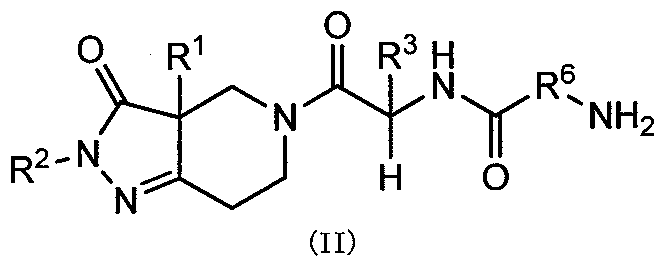
R2は、水素、-(C1~C4)アルキル、又は-(C1~C4)アルキル-CF3であり;
R3は、-(C1~C4)アルキルインドリル、-(C1~C4)アルキルフェニル、-(C1~C4)アルキル-O-(C1~C4)アルキル-Ar、-(C1~C4)アルキル-S-(C1~C4)アルキル-Arであり、その際、Arはフェニル、チエニル、チアゾリル、ピリジル、ピリミジル又はベンズイソキサゾリルであり、前記Arはハロ、OCF3、CF3およびCH3から成る群から独立に選ばれる1又は2個の置換基で任意に置換されてもよく;
並びにR6は、-C(X5)(X5)であり、その際X5は-(C1~C6)アルキルである);
[3] 以下の化合物群より選択される化合物、又はその薬学的に許容しうる塩である[1]または[2]に記載の使用:
2-アミノ-N-(1-(3a-(R,S)-ベンジル-2-メチル-3-オキソ-2,3,3a,4,6,7-ヘキサヒドロ-ピラゾロ[4,3-c]ピリジン-5-カルボニル)-4-フェニル(R)-ブチル]-イソブチルアミド;
2-アミノ-N-(1-(3a-(R)-ベンジル-2-メチル-3-オキソ-2,3,3a,4,6,7-ヘキサヒドロ-ピラゾロ[4,3-c]ピリジン-5-カルボニル)-4-フェニル(R)-ブチル]-イソブチルアミド;
2-アミノ-N-[1-(3a-(S)-ベンジル-2-メチル-3-オキソ-2,3,3a,4,6,7-ヘキサヒドロ-ピラゾロ[4,3-c]ピリジン-5-カルボニル)-4-フェニル(R)-ブチル]-イソブチルアミド;
2-アミノ-N-[2-(3a-(R,S)-ベンジル-2-メチル-3-オキソ-2,3,3a,4,6,7-ヘキサヒドロ-ピラゾロ[4,3-c]ピリジン-5-イル)-1-(R)-(1H-インドール-3-イルメチル)-2-オキソ-エチル]-イソブチルアミド;
2-アミノ-N-[2-(3a-(R)-ベンジル-2-メチル-3-オキソ-2,3,3a,4,6,7-ヘキサヒドロ-ピラゾロ[4,3-c]ピリジン-5-イル)-1-(R)-(1H-インドール-3-イルメチル)-2-オキソ-エチル]-イソブチルアミド;
2-アミノ-N-[2-(3a-(S)-ベンジル-2-メチル-3-オキソ-2,3,3a,4,6,7-ヘキサヒドロ-ピラゾロ[4,3-c]ピリジン-5-イル)-1-(R)-(1H-インドール-3-イルメチル)-2-オキソ-エチル]-イソブチルアミド;
2-アミノ-N-[2-(3a-(R,S)-ベンジル-2-エチル-3-オキソ-2,3,3a,4,6,7-ヘキサヒドロ-ピラゾロ[4,3-c]ピリジン-5-イル)-1-(R)-(1H-インドール-3-イルメチル)-2-オキソ-エチル]-イソブチルアミド;
2-アミノ-N-[2-(3a-(R)-ベンジル-2-エチル-3-オキソ-2,3,3a,4,6,7-ヘキサヒドロ-ピラゾロ[4,3-c]ピリジン-5-イル)-1-(R)-(1H-インドール-3-イルメチル)-2-オキソ-エチル]-イソブチルアミド;
2-アミノ-N-[2-(3a-(S)-ベンジル-2-エチル-3-オキソ-2,3,3a,4,6,7-ヘキサヒドロ-ピラゾロ[4,3-c]ピリジン-5-イル)-1-(R)-(1H-インドール-3-イルメチル)-2-オキソ-エチル]-イソブチルアミド;
2-アミノ-N-[2-(3a-(R,S)-(4-フルオロ-ベンジル)-2-メチル-3-オキソ-2,3,3a,4,6,7-ヘキサヒドロ-ピラゾロ[4,3-c]ピリジン-5-イル)-1-(R)-(1H-インドール-3-イルメチル)-2-オキソ-エチル]-イソブチルアミド;
2-アミノ-N-[2-(3a-(R)-(4-フルオロ-ベンジル)-2-メチル-3-オキソ-2,3,3a,4,6,7-ヘキサヒドロ-ピラゾロ[4,3-c]ピリジン-5-イル)-1-(R)-(1H-インドール-3-イルメチル)-2-オキソ-エチル]-イソブチルアミド;
2-アミノ-N-[2-(3a-(S)-(4-フルオロ-ベンジル)-2-メチル-3-オキソ-2,3,3a,4,6,7-ヘキサヒドロ-ピラゾロ[4,3-c]ピリジン-5-イル)-1-(R)-(1H-インドール-3-イルメチル)-2-オキソ-エチル]-イソブチルアミド;
2-アミノ-N-[2-(3a-(R,S)-ベンジル-2-メチル-3-オキソ-2,3,3a,4,6,7-ヘキサヒドロ-ピラゾロ[4,3-c]ピリジン-5-イル)-1-(R)-ベンジルオキシメチル-2-オキソ-エチル]-イソブチルアミド;
2-アミノ-N-[2-(3a-(R)-ベンジル-2-メチル-3-オキソ-2,3,3a,4,6,7-ヘキサヒドロ-ピラゾロ[4,3-c]ピリジン-5-イル)-1-(R)-ベンジルオキシメチル-2-オキソ-エチル]-イソブチルアミド;
2-アミノ-N-[2-(3a-(S)-ベンジル-2-メチル-3-オキソ-2,3,3a,4,6,7-ヘキサヒドロ-ピラゾロ[4,3-c]ピリジン-5-イル)-1-(R)-ベンジルオキシメチル-2-オキソ-エチル]-イソブチルアミド;
2-アミノ-N-[2-(3a-(R,S)-ベンジル-2-エチル-3-オキソ-2,3,3a,4,6,7-ヘキサヒドロ-ピラゾロ[4,3-c]ピリジン-5-イル)-1-(R)-ベンジルオキシメチル-2-オキソ-エチル]-イソブチルアミド;
2-アミノ-N-[2-(3a-(R)-ベンジル-2-エチル-3-オキソ-2,3,3a,4,6,7-ヘキサヒドロ-ピラゾロ[4,3-c]ピリジン-5-イル)-1-(R)-ベンジルオキシメチル-2-オキソ-エチル]-イソブチルアミド;
2-アミノ-N-[2-(3a-(S)-ベンジル-2-エチル-3-オキソ-2,3,3a,4,6,7-ヘキサヒドロ-ピラゾロ[4,3-c]ピリジン-5-イル)-1-(R)-ベンジルオキシメチル-2-オキソ-エチル]-イソブチルアミド;
2-アミノ-N-[2-(3a-(R,S)-ベンジル-3-オキソ-2-(2,2,2-トリフルオロ-エチル)-2,3,3a,4,6,7-ヘキサヒドロ-ピラゾロ[4,3-c]ピリジン-5-イル)-1-(R)-ベンジルオキシメチル-2-オキソ-エチル]-イソブチルアミド;
2-アミノ-N-[2-(3a-(R)-ベンジル-3-オキソ-2-(2,2,2-トリフルオロ-エチル)-2,3,3a,4,6,7-ヘキサヒドロ-ピラゾロ[4,3-c]ピリジン-5-イル)-1-(R)-ベンジルオキシメチル-2-オキソ-エチル]-イソブチルアミド;
2-アミノ-N-[2-(3a-(S)-ベンジル-3-オキソ-2-(2,2,2-トリフルオロ-エチル)-2,3,3a,4,6,7-ヘキサヒドロ-ピラゾロ[4,3-c]ピリジン-5-イル)-1-(R)-ベンジルオキシメチル-2-オキソ-エチル]-イソブチルアミド;
2-アミノ-N-[1-(R)-ベンジルオキシメチル-2-(3a-(R,S)-(4-フルオロ-ベンジル)-2-メチル-3-オキソ-2,3,3a,4,6,7-ヘキサヒドロ-ピラゾロ[4,3-c]ピリジン-5-イル)-2-オキソ-エチル]-イソブチルアミド;
2-アミノ-N-[1-(R)-ベンジルオキシメチル-2-(3a-(R)-(4-フルオロ-ベンジル)-2-メチル-3-オキソ-2,3,3a,4,6,7-ヘキサヒドロ-ピラゾロ[4,3-c]ピリジン-5-イル)-2-オキソ-エチル]-イソブチルアミド;
2-アミノ-N-[1-(R)-ベンジルオキシメチル-2-(3a-(S)-(4-フルオロ-ベンジル)-2-メチル-3-オキソ-2,3,3a,4,6,7-ヘキサヒドロ-ピラゾロ[4,3-c]ピリジン-5-イル)-2-オキソ-エチル]-イソブチルアミド;
2-アミノ-N-[2-(3a-(R,S)-ベンジル-2-tert-ブチル-3-オキソ-2,3,3a,4,6,7-ヘキサヒドロ-ピラゾロ[4,3-c]ピリジン-5-イル)-1-(R)-ベンジルオキシメチル-2-オキソ-エチル]-イソブチルアミド;
2-アミノ-N-[2-(3a-(R)-ベンジル-2-tert-ブチル-3-オキソ-2,3,3a,4,6,7-ヘキサヒドロ-ピラゾロ[4,3-c]ピリジン-5-イル)-1-(R)-ベンジルオキシメチル-2-オキソ-エチル]-イソブチルアミド;
2-アミノ-N-[2-(3a-(S)-ベンジル-2-tert-ブチル-3-オキソ-2,3,3a,4,6,7-ヘキサヒドロ-ピラゾロ[4,3-c]ピリジン-5-イル)-1-(R)-ベンジルオキシメチル-2-オキソ-エチル]-イソブチルアミド;
2-アミノ-N-[2-(3a-(R,S)-ベンジル-3-オキソ-2,3,3a,4,6,7-ヘキサヒドロ-ピラゾロ[4,3-c]ピリジン-5-イル)-1-(R)-ベンジルオキシメチル-2-オキソ-エチル]-イソブチルアミド;
2-アミノ-N-[2-(3a-(R)-ベンジル-3-オキソ-2,3,3a,4,6,7-ヘキサヒドロ-ピラゾロ[4,3-c]ピリジン-5-イル)-1-(R)-ベンジルオキシメチル-2-オキソ-エチル]-イソブチルアミド;
2-アミノ-N-[2-(3a-(S)-ベンジル-3-オキソ-2,3,3a,4,6,7-ヘキサヒドロ-ピラゾロ[4,3-c]ピリジン-5-イル)-1-(R)-ベンジルオキシメチル-2-オキソ-エチル]-イソブチルアミド;
2-アミノ-N-[1-(R)-ベンジルオキシメチル-2-(2-メチル-3-オキソ-3a-(R,S)-ピリジン-2-イルメチル-2,3,3a,4,6,7-ヘキサヒドロ-ピラゾロ[4,3-c]ピリジン-5-イル)-2-オキソ-エチル]-2-メチル-プロピオンアミド;
2-アミノ-N-[1-(R)-ベンジルオキシメチル-2-(2-メチル-3-オキソ-3a-(R)-ピリジン-2-イルメチル-2,3,3a,4,6,7-ヘキサヒドロ-ピラゾロ[4,3-c]ピリジン-5-イル)-2-オキソ-エチル]-2-メチル-プロピオンアミド;
2-アミノ-N-[1-(R)-ベンジルオキシメチル-2-(2-メチル-3-オキソ-3a-(S)-ピリジン-2-イルメチル-2,3,3a,4,6,7-ヘキサヒドロ-ピラゾロ[4,3-c]ピリジン-5-イル)-2-オキソ-エチル]-2-メチル-プロピオンアミド;
2-アミノ-N-[1-(R)-(3-クロロ-ベンジルオキシメチル)-2-オキソ-2-(3-オキソ-3a-(R,S)-ピリジン-2-イルメチル-2-(2,2,2-トリフルオロ-エチル)-2,3,3a,4,6,7-ヘキサヒドロ-ピラゾロ[4,3-c]ピリジン-5-イル)-エチル]-2-メチル-プロピオンアミド;
2-アミノ-N-[1-(R)-(3-クロロ-ベンジルオキシメチル)-2-オキソ-2-(3-オキソ-3a-(R)-ピリジン-2-イルメチル-2-(2,2,2-トリフルオロ-エチル)-2,3,3a,4,6,7-ヘキサヒドロ-ピラゾロ[4,3-c]ピリジン-5-イル)-エチル]-2-メチル-プロピオンアミド;
2-アミノ-N-[1-(R)-(3-クロロ-ベンジルオキシメチル)-2-オキソ-2-(3-オキソ-3a-(S)-ピリジン-2-イルメチル-2-(2,2,2-トリフルオロ-エチル)-2,3,3a,4,6,7-ヘキサヒドロ-ピラゾロ[4,3-c]ピリジン-5-イル)-エチル]-2-メチル-プロピオンアミド;
2-アミノ-N-[1-(R)-(4-クロロ-ベンジルオキシメチル)-2-オキソ-2-(3-オキソ-3a-(R,S)-ピリジン-2-イルメチル-2-(2,2,2-トリフルオロ-エチル)-2,3,3a,4,6,7-ヘキサヒドロ-ピラゾロ[4,3-c]ピリジン-5-イル)-エチル]-2-メチル-プロピオンアミド;
2-アミノ-N-[1-(R)-(4-クロロ-ベンジルオキシメチル)-2-オキソ-2-(3-オキソ-3a-(R)-ピリジン-2-イルメチル-2-(2,2,2-トリフルオロ-エチル)-2,3,3a,4,6,7-ヘキサヒドロ-ピラゾロ[4,3-c]ピリジン-5-イル)-エチル]-2-メチル-プロピオンアミド;
2-アミノ-N-[1-(R)-(4-クロロ-ベンジルオキシメチル)-2-オキソ-2-(3-オキソ-3a-(S)-ピリジン-2-イルメチル-2-(2,2,2-トリフルオロ-エチル)-2,3,3a,4,6,7-ヘキサヒドロ-ピラゾロ[4,3-c]ピリジン-5-イル)-エチル]-2-メチル-プロピオンアミド;
2-アミノ-N-[1-(R)-(2,4-ジクロロ-ベンジルオキシメチル)-2-オキソ-2-(3-オキソ-3a-(R,S)-ピリジン-2-イルメチル-2-(2,2,2-トリフルオロ-エチル)-2,3,3a,4,6,7-ヘキサヒドロ-ピラゾロ[4,3-c]ピリジン-5-イル)-エチル]-2-メチル-プロピオンアミド;
2-アミノ-N-[1-(R)-(2,4-ジクロロ-ベンジルオキシメチル)-2-オキソ-2-(3-オキソ-3a-(R)-ピリジン-2-イルメチル-2-(2,2,2-トリフルオロ-エチル)-2,3,3a,4,6,7-ヘキサヒドロ-ピラゾロ[4,3-c]ピリジン-5-イル)-エチル]-2-メチル-プロピオンアミド;
2-アミノ-N-[1-(R)-(2,4-ジクロロ-ベンジルオキシメチル)-2-オキソ-2-(3-オキソ-3a-(S)-ピリジン-2-イルメチル-2-(2,2,2-トリフルオロ-エチル)-2,3,3a,4,6,7-ヘキサヒドロ-ピラゾロ[4,3-c]ピリジン-5-イル)-エチル]-2-メチル-プロピオンアミド;
2-アミノ-N-[1-(R)-(4-クロロ-チオフェン-2-イルメトキシメチル)-2-オキソ-2-(3-オキソ-3a-(R,S)-ピリジン-2-イルメチル-2-(2,2,2-トリフルオロ-エチル)-2,3,3a,4,5,7-ヘキサヒドロ-ピラゾロ[3,4-c]ピリジン-6-イル)-エチル]-2-メチル-プロピオンアミド;
2-アミノ-N-[1-(R)-(4-クロロ-チオフェン-2-イルメトキシメチル)-2-オキソ-2-(3-オキソ-3a-(R)-ピリジン-2-イルメチル-2-(2,2,2-トリフルオロ-エチル)-2,3,3a,4,5,7-ヘキサヒドロ-ピラゾロ[3,4-c]ピリジン-6-イル)-エチル]-2-メチル-プロピオンアミド;
2-アミノ-N-[1-(R)-(4-クロロ-チオフェン-2-イルメトキシメチル)-2-オキソ-2-(3-オキソ-3a-(S)-ピリジン-2-イルメチル-2-(2,2,2-トリフルオロ-エチル)-2,3,3a,4,5,7-ヘキサヒドロ-ピラゾロ[3,4-c]ピリジン-6-イル)-エチル]-2-メチル-プロピオンアミド;
2-アミノ-N-[1-(R)-(2,4-ジフルオロ-ベンジルオキシメチル)-2-オキソ-2-(3-オキソ-3a-(R,S)-ピリジン-2-イルメチル-2-(2,2,2-トリフルオロ-エチル)-2,3,3a,4,6,7-ヘキサヒドロ-ピラゾロ[4,3-c]ピリジン-5-イル)-エチル]-2-メチル-プロピオンアミド;
2-アミノ-N-[1-(R)-(2,4-ジフルオロ-ベンジルオキシメチル)-2-オキソ-2-(3-オキソ-3a-(R)-ピリジン-2-イルメチル-2-(2,2,2-トリフルオロ-エチル)-2,3,3a,4,6,7-ヘキサヒドロ-ピラゾロ[4,3-c]ピリジン-5-イル)-エチル]-2-メチル-プロピオンアミド;
2-アミノ-N-[1-(R)-(2,4-ジフルオロ-ベンジルオキシメチル)-2-オキソ-2-(3-オキソ-3a-(S)-ピリジン-2-イルメチル-2-(2,2,2-トリフルオロ-エチル)-2,3,3a,4,6,7-ヘキサヒドロ-ピラゾロ[4,3-c]ピリジン-5-イル)-エチル]-2-メチル-プロピオンアミド;
2-アミノ-N-[2-(3a-(R,S)-ベンジル-2-メチル-3-オキソ-2,3,3a,4,6,7-ヘキサヒドロ-ピラゾロ[4,3-c]ピリジン-5-イル)-1-(R)-(3,4-ジフルオロ-ベンジルオキシメチル)-2-オキソ-エチル]-2-メチル-プロピオンアミド;
2-アミノ-N-[2-(3a-(R)-ベンジル-2-メチル-3-オキソ-2,3,3a,4,6,7-ヘキサヒドロ-ピラゾロ[4,3-c]ピリジン-5-イル)-1-(R)-(3,4-ジフルオロ-ベンジルオキシメチル)-2-オキソ-エチル]-2-メチル-プロピオンアミド;および
2-アミノ-N-[2-(3a-(S)-ベンジル-2-メチル-3-オキソ-2,3,3a,4,6,7-ヘキサヒドロ-ピラゾロ[4,3-c]ピリジン-5-イル)-1-(R)-(3,4-ジフルオロ-ベンジルオキシメチル)-2-オキソ-エチル]-2-メチル-プロピオンアミド;
[4] 以下の化合物群より選択される化合物、又はその薬学的に許容しうる塩である上記[1]または[2]に記載の使用:
2-アミノ-N-[2-(3a-(R)-ベンジル-2-メチル-3-オキソ-2,3,3a,4,6,7-ヘキサヒドロ-ピラゾロ[4,3-c]ピリジン-5-イル)-1-(R)-ベンジルオキシメチル-2-オキソ-エチル]-イソブチルアミド;および
2-アミノ-N-[1-(R)-(2,4-ジフルオロ-ベンジルオキシメチル)-2-オキソ-2-(3-オキソ-3a-(R)-ピリジン-2-イルメチル-2-(2,2,2-トリフルオロ-エチル)-2,3,3a,4,6,7-ヘキサヒドロ-ピラゾロ[4,3-c]ピリジン-5-イル)-エチル]-2-メチル-プロピオンアミド;
[5] 悪液質が、癌性悪液質、結核性悪液質、糖尿病性悪液質、血液疾患性悪液質、内分泌疾患性悪液質、慢性閉塞性肺疾患性悪液質、慢性腎臓病性悪液質、心不全性悪液質、感染症性悪液質または後天性免疫不全症候群による悪液質である、上記[1]から[4]のいずれかに記載の使用;
[6] 1種類以上の第二の活性薬剤と組み合わせた、上記[1]から[4]のいずれかに記載した化合物、又はその薬学的に許容される塩の使用;
[7] 第二の活性薬剤が、
化学療法剤、免疫療法剤、動物モデル又は臨床で悪液質改善作用が認められている薬剤、又は利尿剤のいずれかであってよい上記[6]に記載の使用;
[8] 上記[1]から[4]のいずれかに記載した化合物、又はその薬学的に許容される塩の有効量をヒト又は動物に投与することを含む、悪液質を治療するための方法;
[9] 悪液質の治療に用いる、上記[1]から[4]のいずれかに記載した化合物、又はその薬学的に許容される塩を含む医薬組成物;
[10] 上記[1]から[4]のいずれかに記載した化合物、又はその薬学的に許容される塩を含む悪液質の治療に使用されるキット;
[11] 上記[1]から[4]のいずれかに記載した化合物、又はその薬学的に許容される塩と1種類以上の第二の活性薬剤と容器を含む上記[10]に記載したキット;ならびに
[12] 上記[1]から[4]のいずれかに記載した化合物、又はその薬学的に許容される塩を含む医薬組成物、並びに当該医薬組成物に関する記載物であって、悪液質を治療するために使用され得る又は使用されるべき旨が記された記載物を含む製品。
動物に癌細胞または癌組織を移植すると、摂餌量の減少や体重の減少が引き起こされることから、これらの動物は、悪液質の動物モデルとして利用されている(エンドクリノロジー“Endocrinology”148巻,3004-3012,2007)。
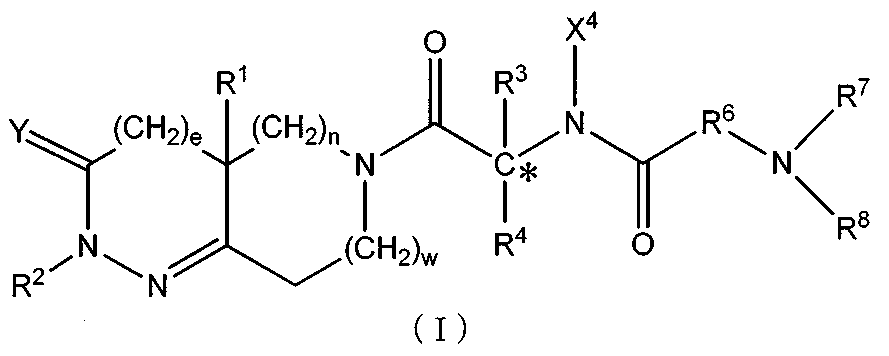
nおよびwは、それぞれ独立に0、1または2であるが、但し、wおよびnは、同時に両方とも0であってはならず;
Yは、酸素または硫黄であり;
R1は、水素、-CN、-(CH2)qN(X6)C(O)X6、-(CH2)qN(X6)C(O)(CH2)t-A1、-(CH2)qN(X6)SO2(CH2)t-A1、-(CH2)qN(X6)SO2X6、-(CH2)qN(X6)C(O)N(X6)(CH2)t-A1、-(CH2)qN(X6)C(O)N(X6)(X6)、-(CH2)qC(O)N(X6)(X6)、-(CH2)qC(O)N(X6)(CH2)t-A1、-(CH2)qC(O)OX6、-(CH2)qC(O)O(CH2)t-A1、-(CH2)qOX6、-(CH2)qOC(O)X6、-(CH2)qOC(O)(CH2)t-A1、-(CH2)qOC(O)N(X6)(CH2)t-A1、-(CH2)qOC(O)N(X6)(X6)、-(CH2)qC(O)X6、-(CH2)qC(O)(CH2)t-A1、-(CH2)qN(X6)C(O)OX6、-(CH2)qN(X6)SO2N(X6)(X6)、-(CH2)qS(O)mX6、-(CH2)qS(O)m(CH2)t-A1、-(C1-C10)アルキル、-(CH2)t-A1、-(CH2)q-(C3-C7)シクロアルキル、-(CH2)q-Y1-(C1-C6)アルキル、-(CH2)q-Y1-(CH2)t-A1または-(CH2)q-Y1-(CH2)t-(C3-C7)シクロアルキルであり{ここで、R1の定義におけるアルキルおよびシクロアルキル基は、(C1-C4)アルキル、ヒドロキシル、(C1-C4)アルコキシ、カルボキシル、-CONH2、-S(O)m(C1-C6)アルキル、-CO2(C1-C4)アルキルエステル、1H-テトラゾール-5-イルまたは1個、2個もしくは3個のフルオロで任意に置換され;
Y1は、O、S(O)m、-C(O)NX6-、-CH=CH-、-C≡C-、-N(X6)C(O)-、-C(O)NX6-、-C(O)O-、-OC(O)N(X6)-または-OC(O)-であり;
qは、0、1、2、3または4であり;
tは、0、1、2または3であり;
この(CH2)q基および(CH2)t基は、それぞれ、ヒドロキシル、(C1-C4)アルコキシ、カルボキシル、-CONH2、-S(O)m(C1-C6)アルキル、-CO2(C1-C4)アルキルエステル、1H-テトラゾール-5-イル、1個、2個もしくは3個のフルオロまたは1個もしくは2個の(C1-C4)アルキルで任意に置換することができる};
R2は、水素、(C1-C8)アルキル、-(C0-C3)アルキル-(C3-C8)シクロアルキル、-(C1-C4)アルキル-A1またはA1であり{ここで、R2の定義におけるアルキル基およびシクロアルキル基は、ヒドロキシル、-C(O)OX6、-C(O)N(X6)(X6)、-N(X6)(X6)、-S(O)m(C1-C6)アルキル、-C(O)A1、-C(O)(X6)、CF3、CNまたは1個、2個もしくは3個のハロゲンで任意に置換される};
R3は、A1、(C1-C10)アルキル、-(C1-C6)アルキル-A1、-(C1-C6)アルキル-(C3-C7)シクロアルキル、-(C1-C5)アルキル-X1-(C1-C5)アルキル、-(C1-C5)アルキル-X1-(C0-C5)アルキル-A1または-(C1-C5)アルキル-X1-(C1-C5)アルキル-(C3-C7)シクロアルキルであり{ここで、R3の定義におけるアルキル基は、-S(O)m(C1-C6)アルキル、-C(O)OX3、1個、2個、3個、4個もしくは5個のハロゲン、または1個、2個もしくは3個のOX3で任意に置換され;
X1は、O、S(O)m、-N(X2)C(O)-、-C(O)N(X2)-、-OC(O)-、-C(O)O-、-CX2=CX2-、-N(X2)C(O)O-、-OC(O)N(X2)-または-C≡C-である};
R4は、水素、(C1-C6)アルキルもしくは(C3-C7)シクロアルキルであるか、又はR3およびR4は、それらが結合している炭素原子と共に、(C5-C7)シクロアルキル、(C5-C7)シクロアルケニル、酸素、硫黄および窒素から成る群から独立に選ばれる1個から4個のヘテロ原子を有する部分的に飽和した若しくは全て飽和した4-から8-員環を形成するか、又は窒素、硫黄および酸素から成る群から独立に選ばれる1個から4個のヘテロ原子を任意に有する部分的に飽和した、全て飽和していない、若しくは全て飽和した5-もしくは6-員環に縮合した、部分的に飽和した若しくは全て飽和した5-もしくは6-員環から成る二環式環系であり;
X4は、水素もしくは(C1-C6)アルキルであるか又は、X4は、R4およびX4が結合している窒素原子およびR4が結合している炭素原子と共に、5から7員環を形成し;
R6は、結合であるか、または

X5およびX5aは、それぞれ、水素、トリフルオロメチル、A1および任意に置換される(C1-C6)アルキルから成る群から独立に選ばれ;X5およびX5aの定義における任意に置換される(C1-C6)アルキルは、A1、OX2、-S(O)m(C1-C6)アルキル、-C(O)OX2、(C3-C7)シクロアルキル、-N(X2)(X2)および-C(O)N(X2)(X2)から成る群から選ばれる置換基で任意に置換されるか;
またはX5もしくはX5aを有する炭素は、R7およびR8を有する窒素と、各アルキレン橋が1個から5個の炭素原子を含有する1個もしくは2個のアルキレン橋を形成するが、但し、1個のアルキレン橋が形成される場合は、両方ではなくX5もしくはX5aが、炭素原子上に存在することができ、両方ではなくR7もしくはR8が、窒素原子上に存在することができ、更に2個のアルキレン橋が形成される場合は、X5およびX5aは、炭素原子上に存在することはできず、R7およびR8は窒素原子上に存在することができず;
または、X5aおよびX5は、それらが結合している炭素原子と共に、部分的に飽和したもしくは全て飽和した3-から7-員環、または酸素、硫黄および窒素から成る群から独立に選ばれる1個から4個のヘテロ原子を有する部分的に飽和したもしくは全て飽和した4-から8-員環を形成し;
または、X5aおよびX5は、それらが結合している炭素原子と共に、窒素、硫黄および酸素から成る群から独立に選ばれる1個から4個のヘテロ原子を任意に有する部分的に飽和した、全て飽和した、若しくは全て飽和していない5-もしくは6-員環に縮合した、窒素、硫黄および酸素から成る群から独立に選ばれる1個または2個のヘテロ原子を任意に有する部分的に飽和した若しくは全て飽和した5-もしくは6-員環から成る二環式環系を形成し;
Z1は、単結合、OまたはN-X2であるが、但し、aおよびbが両方とも0である場合は、Z1は、N-X2またはO-ではない};
R7およびR8は、独立に、水素または任意に置換された(C1-C6)アルキルである{ここで、R7およびR8の定義における任意に置換された(C1-C6)アルキルは、A1、-C(O)O-(C1-C6)アルキル、-S(O)m(C1-C6)アルキル、1個から5個のハロゲン、1個から3個のヒドロキシ、1個から3個の-O-C(O)(C1-C10)アルキルまたは1個から3個の(C1-C6)アルコキシで任意に独立に置換される}か;またはR7およびR8は、共に、-(CH2)r-L-(CH2)r-{ここで、Lは、C(X2)(X2)、S(O)mまたはN(X2)である}を形成することができ;各例のA1は、独立に、(C5-C7)シクロアルケニル、フェニルまたは、酸素、硫黄および窒素から成る群から独立に選ばれる1個から4個のヘテロ原子を任意に有する部分的に飽和した、全て飽和した、若しくは全て飽和していない4-から8-員環、窒素、硫黄および酸素から成る群から独立に選ばれる1個から4個のヘテロ原子を任意に有する部分的に飽和した、全て飽和した、若しくは全て飽和していない5-もしくは6-員環に縮合した、窒素、硫黄および酸素から成る群から独立に選ばれる1個から4個のヘテロ原子を任意に有する部分的に飽和した、全て飽和していないもしくは全て飽和した5-もしくは6-員環から成る二環式環系であり;
各例のA1は、A1が二環式環系である場合、一方又は任意に両方の環において、3個までの置換基で独立に任意に置換され、各置換基は、F、Cl、Br、I、OCF3、OCF2H、CF3、CH3、OCH3、-OX6、-C(O)N(X6)(X6)、-C(O)OX6、オキソ、(C1-C6)アルキル、ニトロ、シアノ、ベンジル、-S(O)m(C1-C6)アルキル、1H-テトラゾール-5-イル、フェニル、フェノキシ、フェニルアルキルオキシ、ハロフェニル、メチレンジオキシ、-N(X6)(X6)、-N(X6)C(O)(X6)、-SO2N(X6)(X6)、-N(X6)SO2-フェニル、-N(X6)SO2X6、-CONX11X12、-SO2NX11X12、-NX6SO2X12、-NX6CONX11X12、-NX6SO2NX11X12、-NX6C(O)X12、イミダゾリル、チアゾリルまたはテトラゾリルから成る群から独立に選ばれるが、但し、A1が、任意にメチレンジオキシで置換される場合、それは、1個のメチレンジオキシで置換することだけができ{ここで、X11は、水素、または任意に置換される(C1-C6)アルキルであり;X11を定義した任意に置換される(C1-C6)アルキルは、フェニル、フェノキシ、(C1-C6)アルコキシカルボニル、-S(O)m(C1-C6)アルキル、1個から5個のハロゲン、1個から3個のヒドロキシ、1個から3個の(C1-C10)アルカノイルオキシまたは1個から3個の(C1-C6)アルコキシで任意に独立に置換され;
X12は、水素、(C1-C6)アルキル、フェニル、チアゾリル、イミダゾリル、フリルまたはチエニルであるが、但し、X12が水素ではない場合、X12は、Cl、F、CH3、OCH3、OCF3およびCF3から成る群から独立に選ばれる1個から3個の置換基で任意に置換されるか;
または、X11およびX12は、共に、-(CH2)r-L1-(CH2)r-を形成し;L1は、C(X2)(X2)、O、S(O)mまたはN(X2)である};
各例のrは、独立に1、2または3であり;
各例のX2は、独立に、水素、任意に置換される(C1-C6)アルキル、または任意に置換される(C3-C7)シクロアルキルであり{ここで、X2の定義における、任意に置換される(C1-C6)アルキルおよび任意に置換される(C3-C7)シクロアルキルは、-S(O)m(C1-C6)アルキル、-C(O)OX3、1個から5個のハロゲンまたは1個から3個のOX3で任意に独立に置換される};
各例のX3は、独立に、水素または(C1-C6)アルキルであり;
X6は、独立に、水素、任意に置換される(C1-C6)アルキル、(C2-C6)ハロゲン化アルキル、任意に置換される(C3-C7)シクロアルキル、(C3-C7)ハロゲン化シクロアルキルである{ここで、X6の定義における任意に置換される(C1-C6)アルキルおよび任意に置換される(C3-C7)シクロアルキルは、1個もしくは2個の(C1-C4)アルキル、ヒドロキシル、(C1-C4)アルコキシ、カルボキシル、CONH2、-S(O)m(C1-C6)アルキル、カルボキシレート、(C1-C4)アルキルエステル、または1H-テトラゾール-5-イルにより任意に独立に置換される}か;または1個の原子上に2個のX6基が存在し、両方のX6が独立に(C1-C6)アルキルである場合、2個の(C1-C6)アルキル基は、2個のX6基が結合している原子と共に、任意に結合して、酸素、硫黄またはNX7を任意に有する4-から9-員環を形成することができ;
X7は、水素または、ヒドロキシルで任意に置換された(C1-C6)アルキルであり;そして各例のmは、独立に0、1または2であるが;
但し、X6およびX12は、それが、C(O)X6、C(O)X12、SO2X6またはSO2X12の形のC(O)またはSO2に結合している場合、水素ではあり得ず;そしてR6が単結合である場合、LはN(X2)であり、定義-(CH2)r-L-(CH2)r-における各rは、独立に2または3である]。
R6は、

X5およびX5aは、それぞれ独立に、水素、トリフルオロメチル、フェニル、任意に置換される(C1-C6)アルキルである{ここで、任意に置換される(C1-C6)アルキルは、OX2、イミダゾリル、フェニル、インドリル、p-ヒドロキシフェニル、(C5-C7)シクロアルキル、-S(O)m(C1-C6)アルキル、-N(X2)(X2)または-C(O)N(X2)(X2)で任意に置換される}か;
またはX5およびR7は、共に、(C1-C5)アルキレン橋を形成し、そして゛A群゛化合物のために定義していない他の置換基は、上記の一般式(I)のために定義したとおりである]。
R7およびR8は、それぞれ水素であり;そしてR3は、フェニル-CH2-O-CH2-、フェニル-CH2-S-CH2-、1-ナフチル-CH2-、2-ナフチル-CH2-、フェニル-(CH2)3-または3-インドリル-CH2-である{ここで、R3のために定義した基のアリール部分は、1個から3個の置換基で任意に置換され、各置換基は、フルオロ、クロロ、メチル、OCH3、OCF2H、OCF3およびCF3から成る群から独立に選ばれる}]が含まれる。
YはOであり;R2は、水素、-(C0-C3)アルキル-(C3-C8)シクロアルキル、フェニルまたは(C1-C8)アルキルである{ここで、(C1-C8)アルキル基は、ヒドロキシル、-CF3または1個から3個のハロゲンで任意に置換される}]が含まれる。
R1は、-(CH2)t-A1であり{ここで、R1の定義におけるA1は、1個から3個の置換基で任意に置換される、フェニル、チエニル、チアゾリル、ピリジルまたはピリミジルであり、各置換基は、F、Cl、Me、OMe、CF3、OCF3およびOCF2Hから成る群から独立に選ばれ;tは、0、1または2である};
そしてR3は、フェニル-CH2-O-CH2-、フェニル-(CH2)3-または3-インドリル-CH2-である{ここで、アリール部分は、1個から3個の置換基で任意に置換され、各置換基は、F、Cl、Me、OMe、CF3、OCF3またはOCF2Hから成る群から独立に選ばれる}]である。
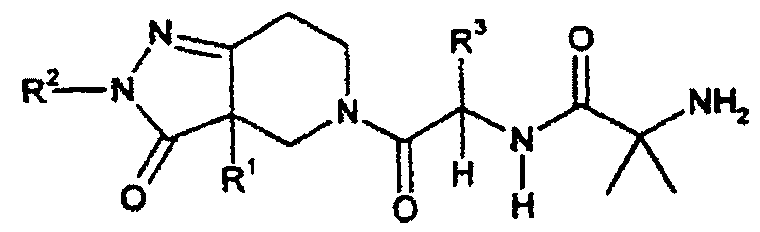
R1は-CH2-フェニルであり、R2はメチルであり、R3は3-インドリル-CH2-である;
R1は-CH2-フェニルであり、R2はエチルであり、R3は3-インドリル-CH2-である;
R1は-CH2-4-フルオロ-フェニルであり、R2はメチルであり、R3は3-インドリル-CH2-である;
R1は-CH2-フェニルであり、R2はメチルであり、R3は-CH2-O-CH2-フェニルである;
R1は-CH2-フェニルであり、R2はエチルであり、R3は-CH2-O-CH2-フェニルである;
R1は-CH2-フェニルであり、R2は-CH2-CF3であり、R3は-CH2-O-CH2-フェニルである;
R1は-CH2-4-フルオロ-フェニルであり、R2はメチルであり、R3は-CH2-O-CH2-フェニルである;
R1は-CH2-フェニルであり、R2はt-ブチルであり、R3は-CH2-O-CH2-フェニルであるか;又はR1は-CH2-フェニルであり、R2はメチルであり、R3は-CH2-O-CH2-3,4-ジ-フルオロ-フェニルである}。
そしてR3は、フェニル-CH2-O-CH2-、フェニル-(CH2)3-または3-インドリル-CH2-である{ここで、アリール部分は、1個から3個の置換基で任意に置換され、各置換基は、F、Cl、Me、OMe、CF3、OCF3またはOCF2Hから成る群から独立に選ばれる}]が含まれる。
R3は、1-インドリル-CH2-、2-インドリル-CH2-、3-インドリル-CH2-、1-ナフチル-CH2-、2-ナフチル-CH2-、1-ベンズイミダゾリル-CH2-、2-ベンズイミダゾリル-CH2-、フェニル-(C1-C4)アルキル-、2-ピリジル-(C1-C4)アルキル-、3-ピリジル-(C1-C4)アルキル-、4-ピリジル-(C1-C4)アルキル-、フェニル-CH2-S-CH2-、チエニル-(C1-C4)アルキル-、フェニル-(C0-C3)アルキル-O-CH2-、フェニル-CH2-O-フェニル-CH2-、3-ベンゾチエニル-CH2-、チエニル-CH2-O-CH2-、チアゾリル-CH2-O-CH2-、ピリジル-CH2-O-CH2-、ピリミジル-CH2-O-CH2-およびフェニル-O-CH2-CH2から成る群から選ばれる{ここで、R3のために定義した基のアリール部分は、1個から3個の置換基で任意に置換され、各置換基は、メチレンジオキシ、F、Cl、CH3、OCH3、OCF3、OCF2HおよびCF3から成る群から独立に選ばれる}]が含まれる。
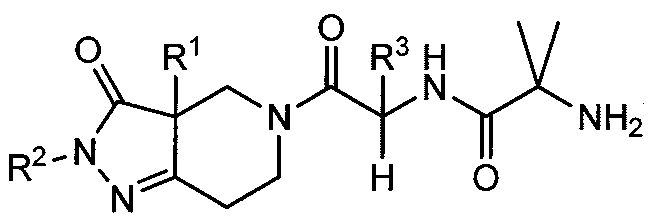
R2はCH2CF3であり、A1は2-ピリジルであり、R3は、-CH2-O-CH2-3-クロロ-フェニルである;
R2はCH2CF3であり、A1は2-ピリジルであり、R3は、-CH2-O-CH2-4-クロロ-フェニルである;
R2はCH2CF3であり、A1は2-ピリジルであり、R3は、-CH2-O-CH2-2,4-ジ-クロロ-フェニルである;
R2はCH2CF3であり、A1は2-ピリジルであり、R3は、-CH2-O-CH2-3-クロロ-チオフェンであるか;又はR2はCH2CF3であり、A1は2-ピリジルであり、R3は、-CH2-O-CH2-2,4-ジ-フルオロ-フェニルである}。
2-アミノ-N-(1-(3a-(R,S)-ベンジル-2-メチル-3-オキソ-2,3,3a,4,6,7-ヘキサヒドロ-ピラゾロ[4,3-c]ピリジン-5-カルボニル)-4-フェニル(R)-ブチル]-イソブチルアミド;
2-アミノ-N-(1-(3a-(R)-ベンジル-2-メチル-3-オキソ-2,3,3a,4,6,7-ヘキサヒドロ-ピラゾロ[4,3-c]ピリジン-5-カルボニル)-4-フェニル(R)-ブチル]-イソブチルアミド;
2-アミノ-N-[1-(3a-(S)-ベンジル-2-メチル-3-オキソ-2,3,3a,4,6,7-ヘキサヒドロ-ピラゾロ[4,3-c]ピリジン-5-カルボニル)-4-フェニル(R)-ブチル]-イソブチルアミド;
2-アミノ-N-[2-(3a-(R,S)-ベンジル-2-メチル-3-オキソ-2,3,3a,4,6,7-ヘキサヒドロ-ピラゾロ[4,3-c]ピリジン-5-イル)-1-(R)-(1H-インドール-3-イルメチル)-2-オキソ-エチル]-イソブチルアミド;
2-アミノ-N-[2-(3a-(R)-ベンジル-2-メチル-3-オキソ-2,3,3a,4,6,7-ヘキサヒドロ-ピラゾロ[4,3-c]ピリジン-5-イル)-1-(R)-(1H-インドール-3-イルメチル)-2-オキソ-エチル]-イソブチルアミド;
2-アミノ-N-[2-(3a-(S)-ベンジル-2-メチル-3-オキソ-2,3,3a,4,6,7-ヘキサヒドロ-ピラゾロ[4,3-c]ピリジン-5-イル)-1-(R)-(1H-インドール-3-イルメチル)-2-オキソ-エチル]-イソブチルアミド;
2-アミノ-N-[2-(3a-(R,S)-ベンジル-2-エチル-3-オキソ-2,3,3a,4,6,7-ヘキサヒドロ-ピラゾロ[4,3-c]ピリジン-5-イル)-1-(R)-(1H-インドール-3-イルメチル)-2-オキソ-エチル]-イソブチルアミド;
2-アミノ-N-[2-(3a-(R)-ベンジル-2-エチル-3-オキソ-2,3,3a,4,6,7-ヘキサヒドロ-ピラゾロ[4,3-c]ピリジン-5-イル)-1-(R)-(1H-インドール-3-イルメチル)-2-オキソ-エチル]-イソブチルアミド;
2-アミノ-N-[2-(3a-(S)-ベンジル-2-エチル-3-オキソ-2,3,3a,4,6,7-ヘキサヒドロ-ピラゾロ[4,3-c]ピリジン-5-イル)-1-(R)-(1H-インドール-3-イルメチル)-2-オキソ-エチル]-イソブチルアミド;
2-アミノ-N-[2-(3a-(R,S)-(4-フルオロ-ベンジル)-2-メチル-3-オキソ-2,3,3a,4,6,7-ヘキサヒドロ-ピラゾロ[4,3-c]ピリジン-5-イル)-1-(R)-(1H-インドール-3-イルメチル)-2-オキソ-エチル]-イソブチルアミド;
2-アミノ-N-[2-(3a-(R)-(4-フルオロ-ベンジル)-2-メチル-3-オキソ-2,3,3a,4,6,7-ヘキサヒドロ-ピラゾロ[4,3-c]ピリジン-5-イル)-1-(R)-(1H-インドール-3-イルメチル)-2-オキソ-エチル]-イソブチルアミド;
2-アミノ-N-[2-(3a-(S)-(4-フルオロ-ベンジル)-2-メチル-3-オキソ-2,3,3a,4,6,7-ヘキサヒドロ-ピラゾロ[4,3-c]ピリジン-5-イル)-1-(R)-(1H-インドール-3-イルメチル)-2-オキソ-エチル]-イソブチルアミド;
2-アミノ-N-[2-(3a-(R,S)-ベンジル-2-メチル-3-オキソ-2,3,3a,4,6,7-ヘキサヒドロ-ピラゾロ[4,3-c]ピリジン-5-イル)-1-(R)-ベンジルオキシメチル-2-オキソ-エチル]-イソブチルアミド;
2-アミノ-N-[2-(3a-(R)-ベンジル-2-メチル-3-オキソ-2,3,3a,4,6,7-ヘキサヒドロ-ピラゾロ[4,3-c]ピリジン-5-イル)-1-(R)-ベンジルオキシメチル-2-オキソ-エチル]-イソブチルアミド;
2-アミノ-N-[2-(3a-(S)-ベンジル-2-メチル-3-オキソ-2,3,3a,4,6,7-ヘキサヒドロ-ピラゾロ[4,3-c]ピリジン-5-イル)-1-(R)-ベンジルオキシメチル-2-オキソ-エチル]-イソブチルアミド;
2-アミノ-N-[2-(3a-(R,S)-ベンジル-2-エチル-3-オキソ-2,3,3a,4,6,7-ヘキサヒドロ-ピラゾロ[4,3-c]ピリジン-5-イル)-1-(R)-ベンジルオキシメチル-2-オキソ-エチル]-イソブチルアミド;
2-アミノ-N-[2-(3a-(R)-ベンジル-2-エチル-3-オキソ-2,3,3a,4,6,7-ヘキサヒドロ-ピラゾロ[4,3-c]ピリジン-5-イル)-1-(R)-ベンジルオキシメチル-2-オキソ-エチル]-イソブチルアミド;
2-アミノ-N-[2-(3a-(S)-ベンジル-2-エチル-3-オキソ-2,3,3a,4,6,7-ヘキサヒドロ-ピラゾロ[4,3-c]ピリジン-5-イル)-1-(R)-ベンジルオキシメチル-2-オキソ-エチル]-イソブチルアミド;
2-アミノ-N-[2-(3a-(R,S)-ベンジル-3-オキソ-2-(2,2,2-トリフルオロ-エチル)-2,3,3a,4,6,7-ヘキサヒドロ-ピラゾロ[4,3-c]ピリジン-5-イル)-1-(R)-ベンジルオキシメチル-2-オキソ-エチル]-イソブチルアミド;
2-アミノ-N-[2-(3a-(R)-ベンジル-3-オキソ-2-(2,2,2-トリフルオロ-エチル)-2,3,3a,4,6,7-ヘキサヒドロ-ピラゾロ[4,3-c]ピリジン-5-イル)-1-(R)-ベンジルオキシメチル-2-オキソ-エチル]-イソブチルアミド;
2-アミノ-N-[2-(3a-(S)-ベンジル-3-オキソ-2-(2,2,2-トリフルオロ-エチル)-2,3,3a,4,6,7-ヘキサヒドロ-ピラゾロ[4,3-c]ピリジン-5-イル)-1-(R)-ベンジルオキシメチル-2-オキソ-エチル]-イソブチルアミド;
2-アミノ-N-[1-(R)-ベンジルオキシメチル-2-(3a-(R,S)-(4-フルオロ-ベンジル)-2-メチル-3-オキソ-2,3,3a,4,6,7-ヘキサヒドロ-ピラゾロ[4,3-c]ピリジン-5-イル)-2-オキソ-エチル]-イソブチルアミド;
2-アミノ-N-[1-(R)-ベンジルオキシメチル-2-(3a-(R)-(4-フルオロ-ベンジル)-2-メチル-3-オキソ-2,3,3a,4,6,7-ヘキサヒドロ-ピラゾロ[4,3-c]ピリジン-5-イル)-2-オキソ-エチル]-イソブチルアミド;
2-アミノ-N-[1-(R)-ベンジルオキシメチル-2-(3a-(S)-(4-フルオロ-ベンジル)-2-メチル-3-オキソ-2,3,3a,4,6,7-ヘキサヒドロ-ピラゾロ[4,3-c]ピリジン-5-イル)-2-オキソ-エチル]-イソブチルアミド;
2-アミノ-N-[2-(3a-(R,S)-ベンジル-2-tert-ブチル-3-オキソ-2,3,3a,4,6,7-ヘキサヒドロ-ピラゾロ[4,3-c]ピリジン-5-イル)-1-(R)-ベンジルオキシメチル-2-オキソ-エチル]-イソブチルアミド;
2-アミノ-N-[2-(3a-(R)-ベンジル-2-tert-ブチル-3-オキソ-2,3,3a,4,6,7-ヘキサヒドロ-ピラゾロ[4,3-c]ピリジン-5-イル)-1-(R)-ベンジルオキシメチル-2-オキソ-エチル]-イソブチルアミド;
2-アミノ-N-[2-(3a-(S)-ベンジル-2-tert-ブチル-3-オキソ-2,3,3a,4,6,7-ヘキサヒドロ-ピラゾロ[4,3-c]ピリジン-5-イル)-1-(R)-ベンジルオキシメチル-2-オキソ-エチル]-イソブチルアミド;
2-アミノ-N-[2-(3a-(R,S)-ベンジル-3-オキソ-2,3,3a,4,6,7-ヘキサヒドロ-ピラゾロ[4,3-c]ピリジン-5-イル)-1-(R)-ベンジルオキシメチル-2-オキソ-エチル]-イソブチルアミド;
2-アミノ-N-[2-(3a-(R)-ベンジル-3-オキソ-2,3,3a,4,6,7-ヘキサヒドロ-ピラゾロ[4,3-c]ピリジン-5-イル)-1-(R)-ベンジルオキシメチル-2-オキソ-エチル]-イソブチルアミド;
2-アミノ-N-[2-(3a-(S)-ベンジル-3-オキソ-2,3,3a,4,6,7-ヘキサヒドロ-ピラゾロ[4,3-c]ピリジン-5-イル)-1-(R)-ベンジルオキシメチル-2-オキソ-エチル]-イソブチルアミド;
2-アミノ-N-[1-(R)-ベンジルオキシメチル-2-(2-メチル-3-オキソ-3a-(R,S)-ピリジン-2-イルメチル-2,3,3a,4,6,7-ヘキサヒドロ-ピラゾロ[4,3-c]ピリジン-5-イル)-2-オキソ-エチル]-2-メチル-プロピオンアミド;
2-アミノ-N-[1-(R)-ベンジルオキシメチル-2-(2-メチル-3-オキソ-3a-(R)-ピリジン-2-イルメチル-2,3,3a,4,6,7-ヘキサヒドロ-ピラゾロ[4,3-c]ピリジン-5-イル)-2-オキソ-エチル]-2-メチル-プロピオンアミド;
2-アミノ-N-[1-(R)-ベンジルオキシメチル-2-(2-メチル-3-オキソ-3a-(S)-ピリジン-2-イルメチル-2,3,3a,4,6,7-ヘキサヒドロ-ピラゾロ[4,3-c]ピリジン-5-イル)-2-オキソ-エチル]-2-メチル-プロピオンアミド;
2-アミノ-N-[1-(R)-(3-クロロ-ベンジルオキシメチル)-2-オキソ-2-(3-オキソ-3a-(R,S)-ピリジン-2-イルメチル-2-(2,2,2-トリフルオロ-エチル)-2,3,3a,4,6,7-ヘキサヒドロ-ピラゾロ[4,3-c]ピリジン-5-イル)-エチル]-2-メチル-プロピオンアミド;
2-アミノ-N-[1-(R)-(3-クロロ-ベンジルオキシメチル)-2-オキソ-2-(3-オキソ-3a-(R)-ピリジン-2-イルメチル-2-(2,2,2-トリフルオロ-エチル)-2,3,3a,4,6,7-ヘキサヒドロ-ピラゾロ[4,3-c]ピリジン-5-イル)-エチル]-2-メチル-プロピオンアミド;
2-アミノ-N-[1-(R)-(3-クロロ-ベンジルオキシメチル)-2-オキソ-2-(3-オキソ-3a-(S)-ピリジン-2-イルメチル-2-(2,2,2-トリフルオロ-エチル)-2,3,3a,4,6,7-ヘキサヒドロ-ピラゾロ[4,3-c]ピリジン-5-イル)-エチル]-2-メチル-プロピオンアミド;
2-アミノ-N-[1-(R)-(4-クロロ-ベンジルオキシメチル)-2-オキソ-2-(3-オキソ-3a-(R,S)-ピリジン-2-イルメチル-2-(2,2,2-トリフルオロ-エチル)-2,3,3a,4,6,7-ヘキサヒドロ-ピラゾロ[4,3-c]ピリジン-5-イル)-エチル]-2-メチル-プロピオンアミド;
2-アミノ-N-[1-(R)-(4-クロロ-ベンジルオキシメチル)-2-オキソ-2-(3-オキソ-3a-(R)-ピリジン-2-イルメチル-2-(2,2,2-トリフルオロ-エチル)-2,3,3a,4,6,7-ヘキサヒドロ-ピラゾロ[4,3-c]ピリジン-5-イル)-エチル]-2-メチル-プロピオンアミド;
2-アミノ-N-[1-(R)-(4-クロロ-ベンジルオキシメチル)-2-オキソ-2-(3-オキソ-3a-(S)-ピリジン-2-イルメチル-2-(2,2,2-トリフルオロ-エチル)-2,3,3a,4,6,7-ヘキサヒドロ-ピラゾロ[4,3-c]ピリジン-5-イル)-エチル]-2-メチル-プロピオンアミド;
2-アミノ-N-[1-(R)-(2,4-ジクロロ-ベンジルオキシメチル)-2-オキソ-2-(3-オキソ-3a-(R,S)-ピリジン-2-イルメチル-2-(2,2,2-トリフルオロ-エチル)-2,3,3a,4,6,7-ヘキサヒドロ-ピラゾロ[4,3-c]ピリジン-5-イル)-エチル]-2-メチル-プロピオンアミド;
2-アミノ-N-[1-(R)-(2,4-ジクロロ-ベンジルオキシメチル)-2-オキソ-2-(3-オキソ-3a-(R)-ピリジン-2-イルメチル-2-(2,2,2-トリフルオロ-エチル)-2,3,3a,4,6,7-ヘキサヒドロ-ピラゾロ[4,3-c]ピリジン-5-イル)-エチル]-2-メチル-プロピオンアミド;
2-アミノ-N-[1-(R)-(2,4-ジクロロ-ベンジルオキシメチル)-2-オキソ-2-(3-オキソ-3a-(S)-ピリジン-2-イルメチル-2-(2,2,2-トリフルオロ-エチル)-2,3,3a,4,6,7-ヘキサヒドロ-ピラゾロ[4,3-c]ピリジン-5-イル)-エチル]-2-メチル-プロピオンアミド;
2-アミノ-N-[1-(R)-(4-クロロ-チオフェン-2-イルメトキシメチル)-2-オキソ-2-(3-オキソ-3a-(R,S)-ピリジン-2-イルメチル-2-(2,2,2-トリフルオロ-エチル)-2,3,3a,4,5,7-ヘキサヒドロ-ピラゾロ[3,4-c]ピリジン-6-イル)-エチル]-2-メチル-プロピオンアミド;
2-アミノ-N-[1-(R)-(4-クロロ-チオフェン-2-イルメトキシメチル)-2-オキソ-2-(3-オキソ-3a-(R)-ピリジン-2-イルメチル-2-(2,2,2-トリフルオロ-エチル)-2,3,3a,4,5,7-ヘキサヒドロ-ピラゾロ[3,4-c]ピリジン-6-イル)-エチル]-2-メチル-プロピオンアミド;
2-アミノ-N-[1-(R)-(4-クロロ-チオフェン-2-イルメトキシメチル)-2-オキソ-2-(3-オキソ-3a-(S)-ピリジン-2-イルメチル-2-(2,2,2-トリフルオロ-エチル)-2,3,3a,4,5,7-ヘキサヒドロ-ピラゾロ[3,4-c]ピリジン-6-イル)-エチル]-2-メチル-プロピオンアミド;
2-アミノ-N-[1-(R)-(2,4-ジフルオロ-ベンジルオキシメチル)-2-オキソ-2-(3-オキソ-3a-(R,S)-ピリジン-2-イルメチル-2-(2,2,2-トリフルオロ-エチル)-2,3,3a,4,6,7-ヘキサヒドロ-ピラゾロ[4,3-c]ピリジン-5-イル)-エチル]-2-メチル-プロピオンアミド;
2-アミノ-N-[1-(R)-(2,4-ジフルオロ-ベンジルオキシメチル)-2-オキソ-2-(3-オキソ-3a-(R)-ピリジン-2-イルメチル-2-(2,2,2-トリフルオロ-エチル)-2,3,3a,4,6,7-ヘキサヒドロ-ピラゾロ[4,3-c]ピリジン-5-イル)-エチル]-2-メチル-プロピオンアミド;
2-アミノ-N-[1-(R)-(2,4-ジフルオロ-ベンジルオキシメチル)-2-オキソ-2-(3-オキソ-3a-(S)-ピリジン-2-イルメチル-2-(2,2,2-トリフルオロ-エチル)-2,3,3a,4,6,7-ヘキサヒドロ-ピラゾロ[4,3-c]ピリジン-5-イル)-エチル]-2-メチル-プロピオンアミド;
2-アミノ-N-[2-(3a-(R,S)-ベンジル-2-メチル-3-オキソ-2,3,3a,4,6,7-ヘキサヒドロ-ピラゾロ[4,3-c]ピリジン-5-イル)-1-(R)-(3,4-ジフルオロ-ベンジルオキシメチル)-2-オキソ-エチル]-2-メチル-プロピオンアミド;
2-アミノ-N-[2-(3a-(R)-ベンジル-2-メチル-3-オキソ-2,3,3a,4,6,7-ヘキサヒドロ-ピラゾロ[4,3-c]ピリジン-5-イル)-1-(R)-(3,4-ジフルオロ-ベンジルオキシメチル)-2-オキソ-エチル]-2-メチル-プロピオンアミド;および
2-アミノ-N-[2-(3a-(S)-ベンジル-2-メチル-3-オキソ-2,3,3a,4,6,7-ヘキサヒドロ-ピラゾロ[4,3-c]ピリジン-5-イル)-1-(R)-(3,4-ジフルオロ-ベンジルオキシメチル)-2-オキソ-エチル]-2-メチル-プロピオンアミド。
2-アミノ-N-[2-(3a-(R)-ベンジル-2-メチル-3-オキソ-2,3,3a,4,6,7-ヘキサヒドロ-ピラゾロ[4,3-c]ピリジン-5-イル)-1-(R)-ベンジルオキシメチル-2-オキソ-エチル]-イソブチルアミド;および
2-アミノ-N-[1-(R)-(2,4-ジフルオロ-ベンジルオキシメチル)-2-オキソ-2-(3-オキソ-3a-(R)-ピリジン-2-イルメチル-2-(2,2,2-トリフルオロ-エチル)-2,3,3a,4,6,7-ヘキサヒドロ-ピラゾロ[4,3-c]ピリジン-5-イル)-エチル]-2-メチル-プロピオンアミド。
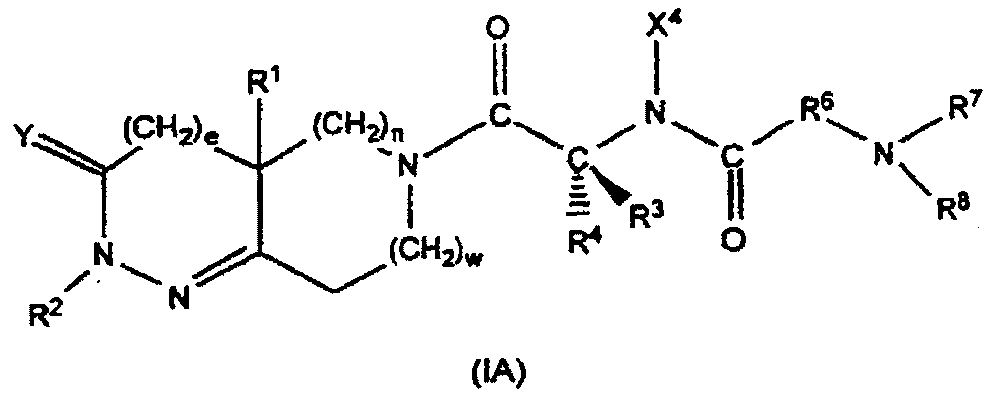
好ましい用量範囲は、1日当たり0.01から5.0mg/kg体重であり、これは、1回用量として投与することができるし、又は複数回量に分割することもできる。
特にヒト患者に投与される化合物の正確な量は医師の判断によることになろう。しかしながら、使用される用量は患者の年齢及び性別、治療しようとする正確な症状及びその重篤度、ならびに投与経路をはじめとするいくつかの因子によるものである。
特定の実施態様において、本明細書に提供される方法は、1つ以上の第二の活性薬剤と組み合わせて、及び/又は外科手術と組み合わせて、本発明の化合物を投与することを含む。患者に対する本発明の化合物及び第二の活性薬剤の投与は、同じか、又は異なる投与経路によって同時に、又は連続して行うことができる。特定の活性薬剤のために使用される特定の投与経路の適合性は、活性薬剤自体(例えば、それが血流に入る前に分解することなく経口投与することができるかどうか)及び治療される疾患に依存する。第二の活性薬剤のための投与の推奨される経路は、当業者に公知である。例えば、医師用卓上参考書(Physician's DESK Reference)を参照されたい。
化合物B:2-アミノ-N-[1-(R)-(2,4-ジフルオロ-ベンジルオキシメチル)-2-オキソ-2-(3-オキソ-3a-(R)-ピリジン-2-イルメチル-2-(2,2,2-トリフルオロ-エチル)-2,3,3a,4,6,7-ヘキサヒドロ-ピラゾロ[4,3-c]ピリジン-5-イル)-エチル]-2-メチル-プロピオンアミド。
マウス結腸癌colon26を用いた担癌マウスは癌性悪液質の症状をよく再現できる系として知られている(キャンサー・リサーチ,50巻,4528~4532頁(1990年))。本試験ではマウス結腸癌colon26と同一手法で樹立されたマウス結腸癌CT26細胞(ジャーナルオブイムノロジー,154巻,4685~4692頁(1995年))を用いた担癌マウスを用い、体重に対する本発明の化合物Aの作用を評価した。すなわち、7週齢のBALB/cマウスの脇腹皮下に5×106個のマウス結腸癌CT26細胞を移植した。移植を行ったマウスを2群に分け、移植翌日から対照群には注射用水、化合物投与群には化合物A75mg/kgを一日一回連日経口投与した。投与容量は10mL/kgとした。移植後5日後および10日後にマウスの腫瘍径(長径および短径)を計測し、長径×(短径)2/2の式より腫瘍体積を算出した。また、移植した後毎日マウスの体重を測定した。マウス結腸癌CT26細胞の移植5日後および10日後の腫瘍体積ならびに移植10日後の体重を、それぞれ〔表1〕に示す。データは平均値±標準誤差で表わす。
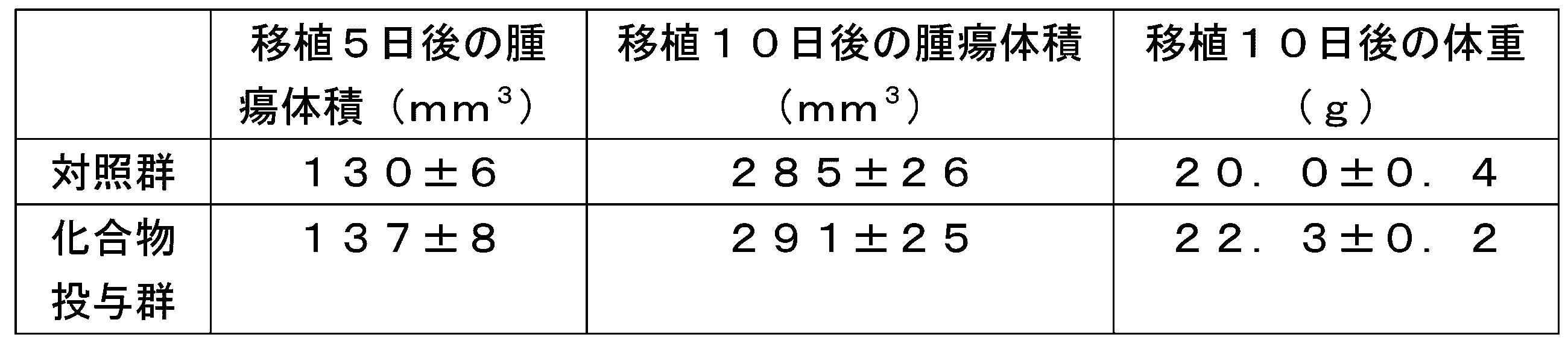
対照群では徐々に腫瘍は増殖し、移植後10日目の腫瘍体積は285±26mm3となった。対照群と比較して化合物投与群の腫瘍体積は、291±25mm3であり、腫瘍体積変化に有意差は認められなかった。したがって、この結果は、化合物投与群と対照群とを比較しても化合物Aが腫瘍体積を変化させるものではないことを意味している。
移植前の対照群と化合物投与群の体重に差はなかったが、マウス結腸癌CT26細胞を移植した担癌マウスに、化合物Aを投与すると、移植10日後には対照群に対して、化合物投与群の体重が有意に増加していることが明らかとなった。対照群と化合物投与群との間には、統計的にも0.1%以下の危険率で有意差が認められており、この事実を支持している。
これらの結果は、化合物Aが悪液質の改善剤又は治療剤として有用であることを示している。
動物に癌細胞または癌組織を移植すると、摂餌量の減少や体重の減少が引き起こされることから、癌悪液質の動物モデルとして利用されている(エンドクリノロジー“Endocrinology”148巻,3004-3012,2007).このモデルを用いて、化合物Aの効果を検討した。メチルコラントレンにより誘導した肉腫細胞をラットの腹部皮下に注入した。その後約8日間通常環境で飼育し、癌提供動物を作製した。癌提供動物から得た0.2-0.3gの新鮮な癌組織を麻酔下ラットの腹部皮下に移植した。癌移植の6-7日後から、化合物Aを一日一回、5日間から14日間投与し、経日的に体重を測定した。化合物Aは用量依存的に悪液質発現の指標となる担癌動物の体重減少の進行を有意に抑制した。
Claims (12)
- ヒト又は動物において悪液質を治療する医薬品の製造のための一般式(I)で示される化合物、当該化合物のラセミ混合物およびジアステレオマー混合物および光学異性体ならびに薬学的に許容することのできるその塩およびそのプロドラッグからなる群より選択される1以上の使用:

nおよびwは、それぞれ独立に0、1または2であるが;
但し、wおよびnは、同時に両方とも0であってはならず;
Yは、酸素または硫黄であり;
R1は、水素、-CN、-(CH2)qN(X6)C(O)X6、-(CH2)qN(X6)C(O)(CH2)t-A1、-(CH2)qN(X6)SO2(CH2)t-A1、-(CH2)qN(X6)SO2X6、-(CH2)qN(X6)C(O)N(X6)(CH2)t-A1、
-(CH2)qN(X6)C(O)N(X6)(X6)、-(CH2)qC(O)N(X6)(X6)、-(CH2)qC(O)N(X6)(CH2)t-A1、-(CH2)qC(O)OX6、-(CH2)qC(O)O(CH2)t-A1、-(CH2)qOX6、-(CH2)qOC(O)X6、-(CH2)qOC(O)(CH2)t-A1、-(CH2)qOC(O)N(X6)(CH2)t-A1、-(CH2)qOC(O)N(X6)(X6)、-(CH2)qC(O)X6、-(CH2)qC(O)(CH2)t-A1、-(CH2)qN(X6)C(O)OX6、-(CH2)qN(X6)SO2N(X6)(X6)、-(CH2)qS(O)mX6、-(CH2)qS(O)m(CH2)t-A1、-(C1-C10)アルキル、-(CH2)t-A1、-(CH2)q-(C3-C7)シクロアルキル、-(CH2)q-Y1-(C1-C6)アルキル、-(CH2)q-Y1-(CH2)t-A1または-(CH2)q-Y1-(CH2)t-(C3-C7)シクロアルキルであり
{ここで、R1の定義におけるアルキルおよびシクロアルキル基は、(C1-C4)アルキル、ヒドロキシル、(C1-C4)アルコキシ、カルボキシル、-CONH2、-S(O)m(C1-C6)アルキル、-CO2(C1-C4)アルキルエステル、1H-テトラゾール-5-イルまたは1個、2個もしくは3個のフルオロで任意に置換され;
Y1は、O、S(O)m、-C(O)NX6-、-CH=CH-、-C≡C-、-N(X6)C(O)-、-C(O)NX6-、-C(O)O-、-OC(O)N(X6)-または-OC(O)-であり;
qは、0、1、2、3または4であり;
tは、0、1、2または3であり;
前記(CH2)q基および(CH2)t基は、それぞれ、ヒドロキシル、(C1-C4)アルコキシ、カルボキシル、-CONH2、-S(O)m(C1-C6)アルキル、-CO2(C1-C4)アルキルエステル、1H-テトラゾール-5-イル、1個、2個もしくは3個のフルオロまたは1個もしくは2個の(C1-C4)アルキルで任意に置換することができる};
R2は、水素、(C1-C8)アルキル、-(C0-C3)アルキル-(C3-C8)シクロアルキル、-(C1-C4)アルキル-A1またはA1であり{ここで、R2の定義におけるアルキル基およびシクロアルキル基は、ヒドロキシル、-C(O)OX6、-C(O)N(X6)(X6)、-N(X6)(X6)、-S(O)m(C1-C6)アルキル、-C(O)A1、-C(O)(X6)、CF3、CNまたは1個、2個もしくは3個のハロゲンで任意に置換される};
R3は、A1、(C1-C10)アルキル、-(C1-C6)アルキル-A1、-(C1-C6)アルキル-(C3-C7)シクロアルキル、-(C1-C5)アルキル-X1-(C1-C5)アルキル、-(C1-C5)アルキル-X1-(C0-C5)アルキル-A1または-(C1-C5)アルキル-X1-(C1-C5)アルキル-(C3-C7)シクロアルキルであり{ここで、R3の定義におけるアルキル基は、-S(O)m(C1-C6)アルキル、-C(O)OX3、1個、2個、3個、4個もしくは5個のハロゲン、または1個、2個もしくは3個のOX3で任意に置換され;
X1は、O、S(O)m、-N(X2)C(O)-、-C(O)N(X2)-、-OC(O)-、-C(O)O-、-CX2=CX2-、-N(X2)C(O)O-、-OC(O)N(X2)-または-C≡C-である};
R4は、水素、(C1-C6)アルキルもしくは(C3-C7)シクロアルキルであるか、又はR3およびR4は、それらが結合している炭素原子と共に、(C5-C7)シクロアルキル;(C5-C7)シクロアルケニル;酸素、硫黄および窒素から成る群から独立に選ばれる1個から4個のヘテロ原子を有する部分的に飽和した若しくは全て飽和した4-から8-員環を形成するか、又は窒素、硫黄および酸素から成る群から独立に選ばれる1個から4個のヘテロ原子を任意に有する部分的に飽和した、全て飽和していない、若しくは全て飽和した5-もしくは6-員環に縮合した、部分的に飽和した若しくは全て飽和した5-もしくは6-員環から成る二環式環系であり;
X4は、水素もしくは(C1-C6)アルキルであるか又は、X4は、R4およびX4が結合している窒素原子およびR4が結合している炭素原子と共に、5から7員環を形成し;
R6は、結合であるか、または
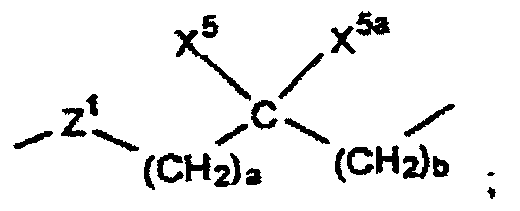
X5およびX5aは、それぞれ、水素、トリフルオロメチル、A1および任意に置換される(C1-C6)アルキルから成る群から独立に選ばれ;X5およびX5aの定義における任意に置換される(C1-C6)アルキルは、A1、OX2、-S(O)m(C1-C6)アルキル、-C(O)OX2、(C3-C7)シクロアルキル、-N(X2)(X2)および-C(O)N(X2)(X2)から成る群から選ばれる置換基で任意に置換されるか;
またはX5もしくはX5aを有する炭素は、R7およびR8を有する窒素と、各アルキレン橋が1個から5個の炭素原子を含有する1個もしくは2個のアルキレン橋を形成するが、但し、1個のアルキレン橋が形成される場合は、両方ではなくX5もしくはX5aが、炭素原子上に存在することができ、両方ではなくR7もしくはR8が、窒素原子上に存在することができ、更に2個のアルキレン橋が形成される場合は、X5およびX5aは、炭素原子上に存在することはできず、R7およびR8は窒素原子上に存在することができず;
または、X5aおよびX5は、それらが結合している炭素原子と共に、部分的に飽和したもしくは全て飽和した3-から7-員環、または酸素、硫黄および窒素から成る群から独立に選ばれる1個から4個のヘテロ原子を有する部分的に飽和したもしくは全て飽和した4-から8-員環を形成し;
または、X5aおよびX5は、それらが結合している炭素原子と共に、窒素、硫黄および酸素から成る群から独立に選ばれる1個から4個のヘテロ原子を任意に有する部分的に飽和した、全て飽和した、若しくは全て飽和していない5-もしくは6-員環に縮合した、窒素、硫黄および酸素から成る群から独立に選ばれる1個または2個のヘテロ原子を任意に有する部分的に飽和した若しくは全て飽和した5-もしくは6-員環から成る二環式環系を形成し;
Z1は、結合、OまたはN-X2であるが、但し、aおよびbが両方とも0である場合は、Z1は、N-X2またはOではない};
R7およびR8は、独立に、水素または任意に置換された(C1-C6)アルキルである{ここで、R7およびR8の定義における任意に置換された(C1-C6)アルキルは、A1、-C(O)O-(C1-C6)アルキル、-S(O)m(C1-C6)アルキル、1個から5個のハロゲン、1個から3個のヒドロキシ、1個から3個の-O-C(O)(C1-C10)アルキルまたは1個から3個の(C1-C6)アルコキシで任意に独立に置換される}か;またはR7およびR8は、共に、-(CH2)r-L-(CH2)r-{ここで、Lは、C(X2)(X2)、S(O)mまたはN(X2)である}を形成することができ;
各例のA1は、独立に、(C5-C7)シクロアルケニル、フェニルまたは、酸素、硫黄および窒素から成る群から独立に選ばれる1個から4個のヘテロ原子を任意に有する部分的に飽和した、全て飽和した、若しくは全て飽和していない4-から8-員環、窒素、硫黄および酸素から成る群から独立に選ばれる1個から4個のヘテロ原子を任意に有する部分的に飽和した、全て飽和した、若しくは全て飽和していない5-もしくは6-員環に縮合した、窒素、硫黄および酸素から成る群から独立に選ばれる1個から4個のヘテロ原子を任意に有する部分的に飽和した、全て飽和していないもしくは全て飽和した5-もしくは6-員環から成る二環式環系であり;
各例のA1は、A1が二環式環系である場合、一方又は任意に両方の環において、3個までの置換基で独立に任意に置換され、各置換基は、F、Cl、Br、I、OCF3、OCF2H、CF3、CH3、OCH3、-OX6、-C(O)N(X6)(X6)、-C(O)OX6、オキソ、(C1-C6)アルキル、ニトロ、シアノ、ベンジル、-S(O)m(C1-C6)アルキル、1H-テトラゾール-5-イル、フェニル、フェノキシ、フェニルアルキルオキシ、ハロフェニル、メチレンジオキシ、-N(X6)(X6)、-N(X6)C(O)(X6)、-SO2N(X6)(X6)、-N(X6)SO2-フェニル、-N(X6)SO2X6、-CONX11X12、-SO2NX11X12、-NX6SO2X12、-NX6CONX11X12、-NX6SO2NX11X12、-NX6C(O)X12、イミダゾリル、チアゾリルおよびテトラゾリルから成る群から独立に選ばれるが、但し、A1が、任意にメチレンジオキシで置換される場合、それは、1個のメチレンジオキシで置換することだけができ{ここで、X11は、水素、または任意に置換される(C1-C6)アルキルであり;X11を定義した任意に置換される(C1-C6)アルキルは、フェニル、フェノキシ、(C1-C6)アルコキシカルボニル、-S(O)m(C1-C6)アルキル、1個から5個のハロゲン、1個から3個のヒドロキシ、1個から3個の(C1-C10)アルカノイルオキシまたは1個から3個の(C1-C6)アルコキシで任意に独立に置換され;X12は、水素、(C1-C6)アルキル、フェニル、チアゾリル、イミダゾリル、フリルまたはチエニルであるが、但し、X12が水素ではない場合、X12は、Cl、F、CH3、OCH3、OCF3およびCF3から成る群から独立に選ばれる1個から3個の置換基で任意に置換されるか;
または、X11およびX12は、共に、-(CH2)r-L1-(CH2)r-を形成し;L1は、C(X2)(X2)、O、S(O)mまたはN(X2)である};
各例のrは、独立に1、2または3であり;
各例のX2は、独立に、水素、任意に置換される(C1-C6)アルキル、または任意に置換される(C3-C7)シクロアルキルであり{ここで、X2の定義における、任意に置換される(C1-C6)アルキルおよび任意に置換される(C3-C7)シクロアルキルは、-S(O)m(C1-C6)アルキル、-C(O)OX3、1個から5個のハロゲンまたは1個から3個のOX3で任意に独立に置換される};
各例のX3は、独立に、水素または(C1-C6)アルキルであり;
X6は、独立に、水素、任意に置換される(C1-C6)アルキル、(C2-C6)ハロゲン化アルキル、任意に置換される(C3-C7)シクロアルキル、(C3-C7)ハロゲン化シクロアルキルである{ここで、X6の定義における任意に置換される(C1-C6)アルキルおよび任意に置換される(C3-C7)シクロアルキルは、1個もしくは2個の(C1-C4)アルキル、ヒドロキシル、(C1-C4)アルコキシ、カルボキシル、CONH2、-S(O)m(C1-C6)アルキル、カルボキシレート、(C1-C4)アルキルエステル、または1H-テトラゾール-5-イルにより任意に独立に置換される}か;または1個の原子上に2個のX6基が存在し、両方のX6が独立に(C1-C6)アルキルである場合、2個の(C1-C6)アルキル基は、2個のX6基が結合している原子と共に、任意に結合して、酸素、硫黄またはNX7を任意に有する4-から9-員環を形成することができ;
X7は、水素または、ヒドロキシルで任意に置換された(C1-C6)アルキルであり;そして各例のmは、独立に0、1または2であるが;
但し、X6およびX12は、それらが、C(O)X6、C(O)X12、SO2X6またはSO2X12の形のC(O)またはSO2に結合している場合、水素ではあり得ず;そしてR6が結合である場合、LはN(X2)であり、定義-(CH2)r-L-(CH2)r-における各rは、独立に2または3である]。 - ヒト又は動物において悪液質を治療する医薬品の製造のための一般式(II)で示される化合物、当該化合物のラセミ混合物およびジアステレオマー混合物および光学異性体ならびに薬学的に許容することのできるその塩およびそのプロドラッグからなる群より選択される1以上の使用:
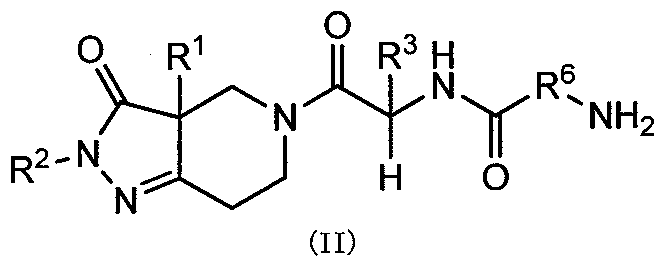
R2は、水素、-(C1~C4)アルキル、又は-(C1~C4)アルキル-CF3であり;
R3は、-(C1~C4)アルキルインドリル、-(C1~C4)アルキルフェニル、-(C1~C4)アルキル-O-(C1~C4)アルキル-Ar、-(C1~C4)アルキル-S-(C1~C4)アルキル-Arであり、その際、Arはフェニル、チエニル、チアゾリル、ピリジル、ピリミジル又はベンズイソキサゾリルであり、前記Arはハロ、OCF3、CF3およびCH3から成る群から独立に選ばれる1又は2個の置換基で任意に置換されてもよく;
並びにR6は、-C(X5)(X5)であり、その際X5は-(C1~C6)アルキルである)。 - 以下の化合物群より選択される化合物、又はその薬学的に許容しうる塩である請求項1または請求項2に記載の使用:
2-アミノ-N-(1-(3a-(R,S)-ベンジル-2-メチル-3-オキソ-2,3,3a,4,6,7-ヘキサヒドロ-ピラゾロ[4,3-c]ピリジン-5-カルボニル)-4-フェニル(R)-ブチル]-イソブチルアミド;
2-アミノ-N-(1-(3a-(R)-ベンジル-2-メチル-3-オキソ-2,3,3a,4,6,7-ヘキサヒドロ-ピラゾロ[4,3-c]ピリジン-5-カルボニル)-4-フェニル(R)-ブチル]-イソブチルアミド;
2-アミノ-N-[1-(3a-(S)-ベンジル-2-メチル-3-オキソ-2,3,3a,4,6,7-ヘキサヒドロ-ピラゾロ[4,3-c]ピリジン-5-カルボニル)-4-フェニル(R)-ブチル]-イソブチルアミド;
2-アミノ-N-[2-(3a-(R,S)-ベンジル-2-メチル-3-オキソ-2,3,3a,4,6,7-ヘキサヒドロ-ピラゾロ[4,3-c]ピリジン-5-イル)-1-(R)-(1H-インドール-3-イルメチル)-2-オキソ-エチル]-イソブチルアミド;
2-アミノ-N-[2-(3a-(R)-ベンジル-2-メチル-3-オキソ-2,3,3a,4,6,7-ヘキサヒドロ-ピラゾロ[4,3-c]ピリジン-5-イル)-1-(R)-(1H-インドール-3-イルメチル)-2-オキソ-エチル]-イソブチルアミド;
2-アミノ-N-[2-(3a-(S)-ベンジル-2-メチル-3-オキソ-2,3,3a,4,6,7-ヘキサヒドロ-ピラゾロ[4,3-c]ピリジン-5-イル)-1-(R)-(1H-インドール-3-イルメチル)-2-オキソ-エチル]-イソブチルアミド;
2-アミノ-N-[2-(3a-(R,S)-ベンジル-2-エチル-3-オキソ-2,3,3a,4,6,7-ヘキサヒドロ-ピラゾロ[4,3-c]ピリジン-5-イル)-1-(R)-(1H-インドール-3-イルメチル)-2-オキソ-エチル]-イソブチルアミド;
2-アミノ-N-[2-(3a-(R)-ベンジル-2-エチル-3-オキソ-2,3,3a,4,6,7-ヘキサヒドロ-ピラゾロ[4,3-c]ピリジン-5-イル)-1-(R)-(1H-インドール-3-イルメチル)-2-オキソ-エチル]-イソブチルアミド;
2-アミノ-N-[2-(3a-(S)-ベンジル-2-エチル-3-オキソ-2,3,3a,4,6,7-ヘキサヒドロ-ピラゾロ[4,3-c]ピリジン-5-イル)-1-(R)-(1H-インドール-3-イルメチル)-2-オキソ-エチル]-イソブチルアミド;
2-アミノ-N-[2-(3a-(R,S)-(4-フルオロ-ベンジル)-2-メチル-3-オキソ-2,3,3a,4,6,7-ヘキサヒドロ-ピラゾロ[4,3-c]ピリジン-5-イル)-1-(R)-(1H-インドール-3-イルメチル)-2-オキソ-エチル]-イソブチルアミド;
2-アミノ-N-[2-(3a-(R)-(4-フルオロ-ベンジル)-2-メチル-3-オキソ-2,3,3a,4,6,7-ヘキサヒドロ-ピラゾロ[4,3-c]ピリジン-5-イル)-1-(R)-(1H-インドール-3-イルメチル)-2-オキソ-エチル]-イソブチルアミド;
2-アミノ-N-[2-(3a-(S)-(4-フルオロ-ベンジル)-2-メチル-3-オキソ-2,3,3a,4,6,7-ヘキサヒドロ-ピラゾロ[4,3-c]ピリジン-5-イル)-1-(R)-(1H-インドール-3-イルメチル)-2-オキソ-エチル]-イソブチルアミド;
2-アミノ-N-[2-(3a-(R,S)-ベンジル-2-メチル-3-オキソ-2,3,3a,4,6,7-ヘキサヒドロ-ピラゾロ[4,3-c]ピリジン-5-イル)-1-(R)-ベンジルオキシメチル-2-オキソ-エチル]-イソブチルアミド;
2-アミノ-N-[2-(3a-(R)-ベンジル-2-メチル-3-オキソ-2,3,3a,4,6,7-ヘキサヒドロ-ピラゾロ[4,3-c]ピリジン-5-イル)-1-(R)-ベンジルオキシメチル-2-オキソ-エチル]-イソブチルアミド;
2-アミノ-N-[2-(3a-(S)-ベンジル-2-メチル-3-オキソ-2,3,3a,4,6,7-ヘキサヒドロ-ピラゾロ[4,3-c]ピリジン-5-イル)-1-(R)-ベンジルオキシメチル-2-オキソ-エチル]-イソブチルアミド;
2-アミノ-N-[2-(3a-(R,S)-ベンジル-2-エチル-3-オキソ-2,3,3a,4,6,7-ヘキサヒドロ-ピラゾロ[4,3-c]ピリジン-5-イル)-1-(R)-ベンジルオキシメチル-2-オキソ-エチル]-イソブチルアミド;
2-アミノ-N-[2-(3a-(R)-ベンジル-2-エチル-3-オキソ-2,3,3a,4,6,7-ヘキサヒドロ-ピラゾロ[4,3-c]ピリジン-5-イル)-1-(R)-ベンジルオキシメチル-2-オキソ-エチル]-イソブチルアミド;
2-アミノ-N-[2-(3a-(S)-ベンジル-2-エチル-3-オキソ-2,3,3a,4,6,7-ヘキサヒドロ-ピラゾロ[4,3-c]ピリジン-5-イル)-1-(R)-ベンジルオキシメチル-2-オキソ-エチル]-イソブチルアミド;
2-アミノ-N-[2-(3a-(R,S)-ベンジル-3-オキソ-2-(2,2,2-トリフルオロ-エチル)-2,3,3a,4,6,7-ヘキサヒドロ-ピラゾロ[4,3-c]ピリジン-5-イル)-1-(R)-ベンジルオキシメチル-2-オキソ-エチル]-イソブチルアミド;
2-アミノ-N-[2-(3a-(R)-ベンジル-3-オキソ-2-(2,2,2-トリフルオロ-エチル)-2,3,3a,4,6,7-ヘキサヒドロ-ピラゾロ[4,3-c]ピリジン-5-イル)-1-(R)-ベンジルオキシメチル-2-オキソ-エチル]-イソブチルアミド;
2-アミノ-N-[2-(3a-(S)-ベンジル-3-オキソ-2-(2,2,2-トリフルオロ-エチル)-2,3,3a,4,6,7-ヘキサヒドロ-ピラゾロ[4,3-c]ピリジン-5-イル)-1-(R)-ベンジルオキシメチル-2-オキソ-エチル]-イソブチルアミド;
2-アミノ-N-[1-(R)-ベンジルオキシメチル-2-(3a-(R,S)-(4-フルオロ-ベンジル)-2-メチル-3-オキソ-2,3,3a,4,6,7-ヘキサヒドロ-ピラゾロ[4,3-c]ピリジン-5-イル)-2-オキソ-エチル]-イソブチルアミド;
2-アミノ-N-[1-(R)-ベンジルオキシメチル-2-(3a-(R)-(4-フルオロ-ベンジル)-2-メチル-3-オキソ-2,3,3a,4,6,7-ヘキサヒドロ-ピラゾロ[4,3-c]ピリジン-5-イル)-2-オキソ-エチル]-イソブチルアミド;
2-アミノ-N-[1-(R)-ベンジルオキシメチル-2-(3a-(S)-(4-フルオロ-ベンジル)-2-メチル-3-オキソ-2,3,3a,4,6,7-ヘキサヒドロ-ピラゾロ[4,3-c]ピリジン-5-イル)-2-オキソ-エチル]-イソブチルアミド;
2-アミノ-N-[2-(3a-(R,S)-ベンジル-2-tert-ブチル-3-オキソ-2,3,3a,4,6,7-ヘキサヒドロ-ピラゾロ[4,3-c]ピリジン-5-イル)-1-(R)-ベンジルオキシメチル-2-オキソ-エチル]-イソブチルアミド;
2-アミノ-N-[2-(3a-(R)-ベンジル-2-tert-ブチル-3-オキソ-2,3,3a,4,6,7-ヘキサヒドロ-ピラゾロ[4,3-c]ピリジン-5-イル)-1-(R)-ベンジルオキシメチル-2-オキソ-エチル]-イソブチルアミド;
2-アミノ-N-[2-(3a-(S)-ベンジル-2-tert-ブチル-3-オキソ-2,3,3a,4,6,7-ヘキサヒドロ-ピラゾロ[4,3-c]ピリジン-5-イル)-1-(R)-ベンジルオキシメチル-2-オキソ-エチル]-イソブチルアミド;
2-アミノ-N-[2-(3a-(R,S)-ベンジル-3-オキソ-2,3,3a,4,6,7-ヘキサヒドロ-ピラゾロ[4,3-c]ピリジン-5-イル)-1-(R)-ベンジルオキシメチル-2-オキソ-エチル]-イソブチルアミド;
2-アミノ-N-[2-(3a-(R)-ベンジル-3-オキソ-2,3,3a,4,6,7-ヘキサヒドロ-ピラゾロ[4,3-c]ピリジン-5-イル)-1-(R)-ベンジルオキシメチル-2-オキソ-エチル]-イソブチルアミド;
2-アミノ-N-[2-(3a-(S)-ベンジル-3-オキソ-2,3,3a,4,6,7-ヘキサヒドロ-ピラゾロ[4,3-c]ピリジン-5-イル)-1-(R)-ベンジルオキシメチル-2-オキソ-エチル]-イソブチルアミド;
2-アミノ-N-[1-(R)-ベンジルオキシメチル-2-(2-メチル-3-オキソ-3a-(R,S)-ピリジン-2-イルメチル-2,3,3a,4,6,7-ヘキサヒドロ-ピラゾロ[4,3-c]ピリジン-5-イル)-2-オキソ-エチル]-2-メチル-プロピオンアミド;
2-アミノ-N-[1-(R)-ベンジルオキシメチル-2-(2-メチル-3-オキソ-3a-(R)-ピリジン-2-イルメチル-2,3,3a,4,6,7-ヘキサヒドロ-ピラゾロ[4,3-c]ピリジン-5-イル)-2-オキソ-エチル]-2-メチル-プロピオンアミド;
2-アミノ-N-[1-(R)-ベンジルオキシメチル-2-(2-メチル-3-オキソ-3a-(S)-ピリジン-2-イルメチル-2,3,3a,4,6,7-ヘキサヒドロ-ピラゾロ[4,3-c]ピリジン-5-イル)-2-オキソ-エチル]-2-メチル-プロピオンアミド;
2-アミノ-N-[1-(R)-(3-クロロ-ベンジルオキシメチル)-2-オキソ-2-(3-オキソ-3a-(R,S)-ピリジン-2-イルメチル-2-(2,2,2-トリフルオロ-エチル)-2,3,3a,4,6,7-ヘキサヒドロ-ピラゾロ[4,3-c]ピリジン-5-イル)-エチル]-2-メチル-プロピオンアミド;
2-アミノ-N-[1-(R)-(3-クロロ-ベンジルオキシメチル)-2-オキソ-2-(3-オキソ-3a-(R)-ピリジン-2-イルメチル-2-(2,2,2-トリフルオロ-エチル)-2,3,3a,4,6,7-ヘキサヒドロ-ピラゾロ[4,3-c]ピリジン-5-イル)-エチル]-2-メチル-プロピオンアミド;
2-アミノ-N-[1-(R)-(3-クロロ-ベンジルオキシメチル)-2-オキソ-2-(3-オキソ-3a-(S)-ピリジン-2-イルメチル-2-(2,2,2-トリフルオロ-エチル)-2,3,3a,4,6,7-ヘキサヒドロ-ピラゾロ[4,3-c]ピリジン-5-イル)-エチル]-2-メチル-プロピオンアミド;
2-アミノ-N-[1-(R)-(4-クロロ-ベンジルオキシメチル)-2-オキソ-2-(3-オキソ-3a-(R,S)-ピリジン-2-イルメチル-2-(2,2,2-トリフルオロ-エチル)-2,3,3a,4,6,7-ヘキサヒドロ-ピラゾロ[4,3-c]ピリジン-5-イル)-エチル]-2-メチル-プロピオンアミド;
2-アミノ-N-[1-(R)-(4-クロロ-ベンジルオキシメチル)-2-オキソ-2-(3-オキソ-3a-(R)-ピリジン-2-イルメチル-2-(2,2,2-トリフルオロ-エチル)-2,3,3a,4,6,7-ヘキサヒドロ-ピラゾロ[4,3-c]ピリジン-5-イル)-エチル]-2-メチル-プロピオンアミド;
2-アミノ-N-[1-(R)-(4-クロロ-ベンジルオキシメチル)-2-オキソ-2-(3-オキソ-3a-(S)-ピリジン-2-イルメチル-2-(2,2,2-トリフルオロ-エチル)-2,3,3a,4,6,7-ヘキサヒドロ-ピラゾロ[4,3-c]ピリジン-5-イル)-エチル]-2-メチル-プロピオンアミド;
2-アミノ-N-[1-(R)-(2,4-ジクロロ-ベンジルオキシメチル)-2-オキソ-2-(3-オキソ-3a-(R,S)-ピリジン-2-イルメチル-2-(2,2,2-トリフルオロ-エチル)-2,3,3a,4,6,7-ヘキサヒドロ-ピラゾロ[4,3-c]ピリジン-5-イル)-エチル]-2-メチル-プロピオンアミド;
2-アミノ-N-[1-(R)-(2,4-ジクロロ-ベンジルオキシメチル)-2-オキソ-2-(3-オキソ-3a-(R)-ピリジン-2-イルメチル-2-(2,2,2-トリフルオロ-エチル)-2,3,3a,4,6,7-ヘキサヒドロ-ピラゾロ[4,3-c]ピリジン-5-イル)-エチル]-2-メチル-プロピオンアミド;
2-アミノ-N-[1-(R)-(2,4-ジクロロ-ベンジルオキシメチル)-2-オキソ-2-(3-オキソ-3a-(S)-ピリジン-2-イルメチル-2-(2,2,2-トリフルオロ-エチル)-2,3,3a,4,6,7-ヘキサヒドロ-ピラゾロ[4,3-c]ピリジン-5-イル)-エチル]-2-メチル-プロピオンアミド;
2-アミノ-N-[1-(R)-(4-クロロ-チオフェン-2-イルメトキシメチル)-2-オキソ-2-(3-オキソ-3a-(R,S)-ピリジン-2-イルメチル-2-(2,2,2-トリフルオロ-エチル)-2,3,3a,4,5,7-ヘキサヒドロ-ピラゾロ[3,4-c]ピリジン-6-イル)-エチル]-2-メチル-プロピオンアミド;
2-アミノ-N-[1-(R)-(4-クロロ-チオフェン-2-イルメトキシメチル)-2-オキソ-2-(3-オキソ-3a-(R)-ピリジン-2-イルメチル-2-(2,2,2-トリフルオロ-エチル)-2,3,3a,4,5,7-ヘキサヒドロ-ピラゾロ[3,4-c]ピリジン-6-イル)-エチル]-2-メチル-プロピオンアミド;
2-アミノ-N-[1-(R)-(4-クロロ-チオフェン-2-イルメトキシメチル)-2-オキソ-2-(3-オキソ-3a-(S)-ピリジン-2-イルメチル-2-(2,2,2-トリフルオロ-エチル)-2,3,3a,4,5,7-ヘキサヒドロ-ピラゾロ[3,4-c]ピリジン-6-イル)-エチル]-2-メチル-プロピオンアミド;
2-アミノ-N-[1-(R)-(2,4-ジフルオロ-ベンジルオキシメチル)-2-オキソ-2-(3-オキソ-3a-(R,S)-ピリジン-2-イルメチル-2-(2,2,2-トリフルオロ-エチル)-2,3,3a,4,6,7-ヘキサヒドロ-ピラゾロ[4,3-c]ピリジン-5-イル)-エチル]-2-メチル-プロピオンアミド;
2-アミノ-N-[1-(R)-(2,4-ジフルオロ-ベンジルオキシメチル)-2-オキソ-2-(3-オキソ-3a-(R)-ピリジン-2-イルメチル-2-(2,2,2-トリフルオロ-エチル)-2,3,3a,4,6,7-ヘキサヒドロ-ピラゾロ[4,3-c]ピリジン-5-イル)-エチル]-2-メチル-プロピオンアミド;
2-アミノ-N-[1-(R)-(2,4-ジフルオロ-ベンジルオキシメチル)-2-オキソ-2-(3-オキソ-3a-(S)-ピリジン-2-イルメチル-2-(2,2,2-トリフルオロ-エチル)-2,3,3a,4,6,7-ヘキサヒドロ-ピラゾロ[4,3-c]ピリジン-5-イル)-エチル]-2-メチル-プロピオンアミド;
2-アミノ-N-[2-(3a-(R,S)-ベンジル-2-メチル-3-オキソ-2,3,3a,4,6,7-ヘキサヒドロ-ピラゾロ[4,3-c]ピリジン-5-イル)-1-(R)-(3,4-ジフルオロ-ベンジルオキシメチル)-2-オキソ-エチル]-2-メチル-プロピオンアミド;
2-アミノ-N-[2-(3a-(R)-ベンジル-2-メチル-3-オキソ-2,3,3a,4,6,7-ヘキサヒドロ-ピラゾロ[4,3-c]ピリジン-5-イル)-1-(R)-(3,4-ジフルオロ-ベンジルオキシメチル)-2-オキソ-エチル]-2-メチル-プロピオンアミド;および
2-アミノ-N-[2-(3a-(S)-ベンジル-2-メチル-3-オキソ-2,3,3a,4,6,7-ヘキサヒドロ-ピラゾロ[4,3-c]ピリジン-5-イル)-1-(R)-(3,4-ジフルオロ-ベンジルオキシメチル)-2-オキソ-エチル]-2-メチル-プロピオンアミド。 - 以下の化合物群より選択される化合物、又はその薬学的に許容しうる塩である請求項1または請求項2に記載の使用:
2-アミノ-N-[2-(3a-(R)-ベンジル-2-メチル-3-オキソ-2,3,3a,4,6,7-ヘキサヒドロ-ピラゾロ[4,3-c]ピリジン-5-イル)-1-(R)-ベンジルオキシメチル-2-オキソ-エチル]-イソブチルアミド;および
2-アミノ-N-[1-(R)-(2,4-ジフルオロ-ベンジルオキシメチル)-2-オキソ-2-(3-オキソ-3a-(R)-ピリジン-2-イルメチル-2-(2,2,2-トリフルオロ-エチル)-2,3,3a,4,6,7-ヘキサヒドロ-ピラゾロ[4,3-c]ピリジン-5-イル)-エチル]-2-メチル-プロピオンアミド。 - 悪液質が、癌性悪液質、結核性悪液質、糖尿病性悪液質、血液疾患性悪液質、内分泌疾患性悪液質、慢性閉塞性肺疾患性悪液質、慢性腎臓病性悪液質、心不全性悪液質、感染症性悪液質または後天性免疫不全症候群による悪液質である、請求項1から請求項4のいずれかに記載の使用。
- 1種類以上の第二の活性薬剤と組み合わせた、請求項1から請求項4のいずれかに記載した化合物、又はその薬学的に許容される塩の使用。
- 第二の活性薬剤が、
化学療法剤、免疫療法剤、動物モデル又は臨床で悪液質改善作用が認められている薬剤、又は利尿剤のいずれかであってよい請求項6に記載の使用。 - 請求項1から請求項4のいずれかに記載した化合物、又はその薬学的に許容される塩の有効量をヒト又は動物に投与することを含む、悪液質を治療するための方法。
- 悪液質の治療に用いる、請求項1から請求項4のいずれかに記載した化合物、又はその薬学的に許容される塩を含む医薬組成物。
- 請求項1から請求項4のいずれかに記載した化合物、又はその薬学的に許容される塩を含む悪液質の治療に使用されるキット。
- 請求項1から請求項4のいずれかに記載した化合物、又はその薬学的に許容される塩と1種類以上の第二の活性薬剤と容器を含む請求項10に記載されるキット。
- 請求項1から請求項4のいずれかに記載した化合物、又はその薬学的に許容される塩を含む医薬組成物、並びに当該医薬組成物に関する記載物であって、悪液質を治療するために使用され得る又は使用されるべき旨が記された記載物を含む製品。
Priority Applications (13)
| Application Number | Priority Date | Filing Date | Title |
|---|---|---|---|
| BR112012020377-0A BR112012020377B1 (pt) | 2010-02-26 | 2011-02-28 | Uso de um composto ou sal farmaceuticamente aceitável do mesmo e embalagem comercial |
| HK13101402.5A HK1174615B (en) | 2010-02-26 | 2011-02-28 | Ghrelin receptor agonist for treatment of dyscrasia |
| KR1020127024117A KR20120131183A (ko) | 2010-02-26 | 2011-02-28 | 악액질 치료용 그렐린 수용체 작용제 |
| US13/580,479 US10975070B2 (en) | 2010-02-26 | 2011-02-28 | Ghrelin receptor agonist for treatment of cachexia |
| CA2789750A CA2789750C (en) | 2010-02-26 | 2011-02-28 | Ghrelin receptor agonist for treatment of cachexia |
| CN201180009948.8A CN102762564B (zh) | 2010-02-26 | 2011-02-28 | 用于治疗恶病质的葛瑞林受体激动剂 |
| RU2012141061/04A RU2012141061A (ru) | 2010-02-26 | 2011-02-28 | Агонист рецептора грелина для лечения кахексии |
| EP11747565.7A EP2540721B1 (en) | 2010-02-26 | 2011-02-28 | Ghrelin receptor agonist for treatment of cachexia |
| JP2012501911A JPWO2011105611A1 (ja) | 2010-02-26 | 2011-02-28 | 悪液質を治療するためのグレリン受容体作動物質 |
| MX2012009774A MX341660B (es) | 2010-02-26 | 2011-02-28 | Agonista del receptor de ghrelina para el tratamiento de caquexia. |
| ES11747565.7T ES2615731T3 (es) | 2010-02-26 | 2011-02-28 | Agonista del receptor de ghrelina para el tratamiento de caquexia |
| US17/189,552 US20210179613A1 (en) | 2010-02-26 | 2021-03-02 | Ghrelin receptor agonist for treatment of cachexia |
| FR23C1048C FR23C1048I1 (fr) | 2010-02-26 | 2023-12-18 | Agonistes de recepteur de ghreline pour la traitemnet de la cachexia |
Applications Claiming Priority (2)
| Application Number | Priority Date | Filing Date | Title |
|---|---|---|---|
| JP2010-043484 | 2010-02-26 | ||
| JP2010043484 | 2010-02-26 |
Related Child Applications (2)
| Application Number | Title | Priority Date | Filing Date |
|---|---|---|---|
| US13/580,479 A-371-Of-International US10975070B2 (en) | 2010-02-26 | 2011-02-28 | Ghrelin receptor agonist for treatment of cachexia |
| US17/189,552 Continuation US20210179613A1 (en) | 2010-02-26 | 2021-03-02 | Ghrelin receptor agonist for treatment of cachexia |
Publications (1)
| Publication Number | Publication Date |
|---|---|
| WO2011105611A1 true WO2011105611A1 (ja) | 2011-09-01 |
Family
ID=44507004
Family Applications (1)
| Application Number | Title | Priority Date | Filing Date |
|---|---|---|---|
| PCT/JP2011/054556 Ceased WO2011105611A1 (ja) | 2010-02-26 | 2011-02-28 | 悪液質を治療するためのグレリン受容体作動物質 |
Country Status (12)
| Country | Link |
|---|---|
| US (2) | US10975070B2 (ja) |
| EP (1) | EP2540721B1 (ja) |
| JP (1) | JPWO2011105611A1 (ja) |
| KR (1) | KR20120131183A (ja) |
| CN (1) | CN102762564B (ja) |
| BR (1) | BR112012020377B1 (ja) |
| CA (1) | CA2789750C (ja) |
| ES (1) | ES2615731T3 (ja) |
| FR (1) | FR23C1048I1 (ja) |
| MX (1) | MX341660B (ja) |
| RU (1) | RU2012141061A (ja) |
| WO (1) | WO2011105611A1 (ja) |
Cited By (2)
| Publication number | Priority date | Publication date | Assignee | Title |
|---|---|---|---|---|
| JP2016500660A (ja) * | 2012-09-27 | 2016-01-14 | アラタナ セラピューティクス、 インコーポレイテッド | 食欲不振制御化合物の組成物および使用方法 |
| WO2022065831A1 (ko) * | 2020-09-22 | 2022-03-31 | 경북대학교 산학협력단 | 그렐린 수용체 작용제로서의 트리아졸 화합물의 용도 |
Families Citing this family (5)
| Publication number | Priority date | Publication date | Assignee | Title |
|---|---|---|---|---|
| BR112015029586B1 (pt) * | 2013-05-28 | 2022-05-03 | Raqualia Pharma Inc | Formas polimorfas |
| EP3212648A1 (en) * | 2014-10-31 | 2017-09-06 | RaQualia Pharma Inc. | Tetrahydropyrazolopyridine derivatives as ghrelin receptor agonists |
| US9700591B2 (en) | 2015-01-28 | 2017-07-11 | Aratana Therapeutics, Inc. | Compositions and methods for chronic use of a weight-gaining compound |
| CN115778960B (zh) * | 2022-08-19 | 2024-09-20 | 广州六顺生物科技有限公司 | 一种杂芳环衍生物在制备治疗或预防恶病质药物中的应用 |
| CN119868339A (zh) * | 2025-01-23 | 2025-04-25 | 北京珺泰科技有限公司 | 淫羊藿素在治疗肿瘤恶病质的药物中的应用 |
Citations (8)
| Publication number | Priority date | Publication date | Assignee | Title |
|---|---|---|---|---|
| US4997984A (en) | 1989-12-19 | 1991-03-05 | Shawa Denko K.K. | Process for preparation of N-(α-alkoxyethyl)-carboxylic acid amide |
| WO1997024369A1 (en) | 1995-12-28 | 1997-07-10 | Pfizer Inc. | Growth-hormone secretagogues |
| JP2002012556A (ja) * | 2000-05-31 | 2002-01-15 | Pfizer Prod Inc | 胃腸運動を刺激するための組成物及び方法 |
| JP2007063225A (ja) * | 2005-09-01 | 2007-03-15 | Takeda Chem Ind Ltd | イミダゾピリジン化合物 |
| JP2008510706A (ja) * | 2004-08-18 | 2008-04-10 | エリクシアー ファーマシューティカルズ, インコーポレイテッド | 成長ホルモン分泌促進物質 |
| WO2008153027A1 (ja) * | 2007-06-11 | 2008-12-18 | Takeda Pharmaceutical Company Limited | ピロロキノリン誘導体およびその用途 |
| WO2009063993A1 (ja) * | 2007-11-15 | 2009-05-22 | Takeda Pharmaceutical Company Limited | 縮合ピリジン誘導体およびその用途 |
| WO2009139340A1 (ja) * | 2008-05-12 | 2009-11-19 | 武田薬品工業株式会社 | ピラゾール化合物 |
Family Cites Families (3)
| Publication number | Priority date | Publication date | Assignee | Title |
|---|---|---|---|---|
| IL145106A0 (en) * | 2000-08-30 | 2002-06-30 | Pfizer Prod Inc | Intermittent administration of a geowth hormone secretagogue |
| CA2677813A1 (en) * | 2007-02-13 | 2008-08-21 | Helsinn Therapeutics (U.S.), Inc. | Method of treating cell proliferative disorders using growth hormone secretagogues |
| CN111419845A (zh) | 2012-09-27 | 2020-07-17 | 阿莱塔纳治疗学股份有限公司 | 应用控制食欲不振的化合物的组合物和方法 |
-
2011
- 2011-02-28 RU RU2012141061/04A patent/RU2012141061A/ru not_active Application Discontinuation
- 2011-02-28 EP EP11747565.7A patent/EP2540721B1/en active Active
- 2011-02-28 JP JP2012501911A patent/JPWO2011105611A1/ja active Pending
- 2011-02-28 KR KR1020127024117A patent/KR20120131183A/ko not_active Withdrawn
- 2011-02-28 CA CA2789750A patent/CA2789750C/en active Active
- 2011-02-28 MX MX2012009774A patent/MX341660B/es active IP Right Grant
- 2011-02-28 CN CN201180009948.8A patent/CN102762564B/zh active Active
- 2011-02-28 ES ES11747565.7T patent/ES2615731T3/es active Active
- 2011-02-28 WO PCT/JP2011/054556 patent/WO2011105611A1/ja not_active Ceased
- 2011-02-28 US US13/580,479 patent/US10975070B2/en active Active
- 2011-02-28 BR BR112012020377-0A patent/BR112012020377B1/pt active IP Right Grant
-
2021
- 2021-03-02 US US17/189,552 patent/US20210179613A1/en not_active Abandoned
-
2023
- 2023-12-18 FR FR23C1048C patent/FR23C1048I1/fr active Active
Patent Citations (9)
| Publication number | Priority date | Publication date | Assignee | Title |
|---|---|---|---|---|
| US4997984A (en) | 1989-12-19 | 1991-03-05 | Shawa Denko K.K. | Process for preparation of N-(α-alkoxyethyl)-carboxylic acid amide |
| WO1997024369A1 (en) | 1995-12-28 | 1997-07-10 | Pfizer Inc. | Growth-hormone secretagogues |
| JPH11501945A (ja) * | 1995-12-28 | 1999-02-16 | ファイザー インク. | 成長ホルモン分泌促進物質 |
| JP2002012556A (ja) * | 2000-05-31 | 2002-01-15 | Pfizer Prod Inc | 胃腸運動を刺激するための組成物及び方法 |
| JP2008510706A (ja) * | 2004-08-18 | 2008-04-10 | エリクシアー ファーマシューティカルズ, インコーポレイテッド | 成長ホルモン分泌促進物質 |
| JP2007063225A (ja) * | 2005-09-01 | 2007-03-15 | Takeda Chem Ind Ltd | イミダゾピリジン化合物 |
| WO2008153027A1 (ja) * | 2007-06-11 | 2008-12-18 | Takeda Pharmaceutical Company Limited | ピロロキノリン誘導体およびその用途 |
| WO2009063993A1 (ja) * | 2007-11-15 | 2009-05-22 | Takeda Pharmaceutical Company Limited | 縮合ピリジン誘導体およびその用途 |
| WO2009139340A1 (ja) * | 2008-05-12 | 2009-11-19 | 武田薬品工業株式会社 | ピラゾール化合物 |
Non-Patent Citations (16)
| Title |
|---|
| "Remington's Pharmaceutical Sciences", 1990, MACK PUBLISHING CO. |
| AMERICAN JOURNAL OF MEDICINE, vol. 85, 1988, pages 289 - 291 |
| BRITISH JOURNAL OF CANCER, vol. 68, 1993, pages 314 - 318 |
| CANCER RESEARCH, vol. 49, 1989, pages 5935 - 5939 |
| CANCER RESEARCH, vol. 50, 1990, pages 4528 - 4532 |
| E L ELIEL: "Stereochemistry of Organic Compounds", 1994, WILEY |
| ENDOCRINOLOGY, vol. 148, 2007, pages 3004 - 3012 |
| HALEBLIAN, J PHARM SCI, vol. 64, no. 8, August 1975 (1975-08-01), pages 1269 - 1288 |
| HOFFMAN ET AL., J. ORG. CHEM., vol. 59, 1994, pages 3530 |
| JOURNAL OF CLINICAL ONCOLOGY, vol. 12, 1994, pages 213 - 225 |
| KERN ET AL., CANCER CACHEXIA, J. PARENTERAL AND ENTERAL NUTRITION, vol. 12, 1988, pages 286 - 298 |
| NELSON ET AL., JOURNAL OF CLINICAL ONCOLOGY, vol. 12, 1994, pages 213 - 225 |
| NELSON, JOURNAL OF CLINICAL ONCOLOGY, vol. 12, 1994, pages 213 - 225 |
| See also references of EP2540721A4 |
| STAHL; WERMUTH: "Handbook of Pharmaceutical Salts: Properties, Selection, and Use", 2002, WILEY-VCH |
| THE JOURNAL OF IMMUNOLOGY, vol. 154, 1995, pages 4685 - 4692 |
Cited By (4)
| Publication number | Priority date | Publication date | Assignee | Title |
|---|---|---|---|---|
| JP2016500660A (ja) * | 2012-09-27 | 2016-01-14 | アラタナ セラピューティクス、 インコーポレイテッド | 食欲不振制御化合物の組成物および使用方法 |
| JP2018117625A (ja) * | 2012-09-27 | 2018-08-02 | アラタナ セラピューティクス、 インコーポレイテッド | 食欲不振制御化合物の組成物および使用方法 |
| WO2022065831A1 (ko) * | 2020-09-22 | 2022-03-31 | 경북대학교 산학협력단 | 그렐린 수용체 작용제로서의 트리아졸 화합물의 용도 |
| US12570617B2 (en) | 2020-09-22 | 2026-03-10 | Kyungpook National University Industry-Academic Cooperation Foundation | Use of triazole compound as ghrelin receptor agonist |
Also Published As
| Publication number | Publication date |
|---|---|
| CA2789750A1 (en) | 2011-09-01 |
| US10975070B2 (en) | 2021-04-13 |
| HK1174615A1 (en) | 2013-06-14 |
| RU2012141061A (ru) | 2014-04-10 |
| EP2540721A1 (en) | 2013-01-02 |
| BR112012020377B1 (pt) | 2019-10-08 |
| KR20120131183A (ko) | 2012-12-04 |
| MX2012009774A (es) | 2012-10-05 |
| EP2540721B1 (en) | 2016-12-14 |
| MX341660B (es) | 2016-08-29 |
| EP2540721A4 (en) | 2013-08-07 |
| BR112012020377A8 (pt) | 2018-01-02 |
| BR112012020377A2 (pt) | 2016-05-10 |
| US20120322821A1 (en) | 2012-12-20 |
| CA2789750C (en) | 2018-03-06 |
| CN102762564B (zh) | 2015-09-30 |
| ES2615731T3 (es) | 2017-06-08 |
| US20210179613A1 (en) | 2021-06-17 |
| JPWO2011105611A1 (ja) | 2013-06-20 |
| FR23C1048I1 (fr) | 2024-01-19 |
| CN102762564A (zh) | 2012-10-31 |
Similar Documents
| Publication | Publication Date | Title |
|---|---|---|
| US20210179613A1 (en) | Ghrelin receptor agonist for treatment of cachexia | |
| JP4698681B2 (ja) | アミノピリミジン類の化合物及びその塩の調製方法と薬物の用途 | |
| JP2021127346A (ja) | ジアザ二環式置換イミダゾピリミジンおよび呼吸障害を治療するためのその使用 | |
| CN114026072A (zh) | 治疗特发性肺纤维化的方法 | |
| TWI741286B (zh) | 治療癌症之方法 | |
| TW201628621A (zh) | 泛素活化酶抑制劑及輻射之施用 | |
| KR20160048807A (ko) | 과증식성 질병의 치료에서 사용하기 위한 mek 억제제 및 erk 억제제의 조합 | |
| KR101909433B1 (ko) | 키나제 저해제의 부작용 저감제 | |
| KR20190077476A (ko) | 상글리페린 거대고리 유사체의 항암 화합물로서의 용도 | |
| US20200306255A1 (en) | Compositions and methods for treating niemann pick c disease | |
| US20210196730A1 (en) | Compound and use thereof | |
| JP2024546605A (ja) | がんを治療するための併用療法の使用 | |
| JPH09323930A (ja) | 悪液質の予防・治療剤 | |
| WO2014175699A1 (ko) | 벤지딘 유도체, 이의 제조방법 및 이를 함유하는 c형 간염 바이러스에 의한 간질환 치료용 약학적 조성물. | |
| CN121127460A (zh) | 可用作治疗剂的新型化合物 | |
| JP2014515026A (ja) | アカデシン誘導体、それを含有する製剤および組成物、その治療目的での使用、ならびにその合成法 | |
| US20030087944A1 (en) | Method for the treatment of renal dysfunction with spla2 inhibitors | |
| CN113164487B (zh) | 磷酸二酯酶抑制剂 | |
| HK1174615B (en) | Ghrelin receptor agonist for treatment of dyscrasia | |
| US12139505B2 (en) | Compositions useful in therapy of autophagy-related pathologies, and methods of making and using the same | |
| KR20050038632A (ko) | 양성 및 악성 종양 질환의 치료를 위한 디스오라졸 및 이의유도체를 함유하는 의약 | |
| CN120774829A (zh) | 一类氨基酸化合物及其在机体炎症性疾病中的用途 | |
| JPH08169826A (ja) | 悪液質の予防、治療剤 | |
| CN108218925A (zh) | 咪唑并吡啶类化合物钴配合物及其应用 | |
| WO2018144791A1 (en) | Combination of vps34 inhibitors and mtor inhibitors |
Legal Events
| Date | Code | Title | Description |
|---|---|---|---|
| WWE | Wipo information: entry into national phase |
Ref document number: 201180009948.8 Country of ref document: CN |
|
| 121 | Ep: the epo has been informed by wipo that ep was designated in this application |
Ref document number: 11747565 Country of ref document: EP Kind code of ref document: A1 |
|
| WWE | Wipo information: entry into national phase |
Ref document number: 2012501911 Country of ref document: JP |
|
| WWE | Wipo information: entry into national phase |
Ref document number: 2116/KOLNP/2012 Country of ref document: IN |
|
| ENP | Entry into the national phase |
Ref document number: 2789750 Country of ref document: CA |
|
| REEP | Request for entry into the european phase |
Ref document number: 2011747565 Country of ref document: EP |
|
| WWE | Wipo information: entry into national phase |
Ref document number: 2011747565 Country of ref document: EP |
|
| WWE | Wipo information: entry into national phase |
Ref document number: MX/A/2012/009774 Country of ref document: MX |
|
| NENP | Non-entry into the national phase |
Ref country code: DE |
|
| WWE | Wipo information: entry into national phase |
Ref document number: 13580479 Country of ref document: US |
|
| ENP | Entry into the national phase |
Ref document number: 20127024117 Country of ref document: KR Kind code of ref document: A |
|
| WWE | Wipo information: entry into national phase |
Ref document number: 2012141061 Country of ref document: RU |
|
| REG | Reference to national code |
Ref country code: BR Ref legal event code: B01A Ref document number: 112012020377 Country of ref document: BR |
|
| ENP | Entry into the national phase |
Ref document number: 112012020377 Country of ref document: BR Kind code of ref document: A2 Effective date: 20120814 |