WO2011108183A1 - 画像処理装置、コンテンツ配信システム、画像処理方法、及びプログラム - Google Patents
画像処理装置、コンテンツ配信システム、画像処理方法、及びプログラム Download PDFInfo
- Publication number
- WO2011108183A1 WO2011108183A1 PCT/JP2011/000296 JP2011000296W WO2011108183A1 WO 2011108183 A1 WO2011108183 A1 WO 2011108183A1 JP 2011000296 W JP2011000296 W JP 2011000296W WO 2011108183 A1 WO2011108183 A1 WO 2011108183A1
- Authority
- WO
- WIPO (PCT)
- Prior art keywords
- data
- image
- image data
- face
- image processing
- Prior art date
- Legal status (The legal status is an assumption and is not a legal conclusion. Google has not performed a legal analysis and makes no representation as to the accuracy of the status listed.)
- Ceased
Links
Images




Classifications
-
- H—ELECTRICITY
- H04—ELECTRIC COMMUNICATION TECHNIQUE
- H04N—PICTORIAL COMMUNICATION, e.g. TELEVISION
- H04N21/00—Selective content distribution, e.g. interactive television or video on demand [VOD]
- H04N21/40—Client devices specifically adapted for the reception of or interaction with content, e.g. set-top-box [STB]; Operations thereof
- H04N21/41—Structure of client; Structure of client peripherals
- H04N21/414—Specialised client platforms, e.g. receiver in car or embedded in a mobile appliance
- H04N21/41415—Specialised client platforms, e.g. receiver in car or embedded in a mobile appliance involving a public display, viewable by several users in a public space outside their home, e.g. movie theatre, information kiosk
-
- G—PHYSICS
- G06—COMPUTING OR CALCULATING; COUNTING
- G06T—IMAGE DATA PROCESSING OR GENERATION, IN GENERAL
- G06T7/00—Image analysis
- G06T7/70—Determining position or orientation of objects or cameras
- G06T7/73—Determining position or orientation of objects or cameras using feature-based methods
-
- H—ELECTRICITY
- H04—ELECTRIC COMMUNICATION TECHNIQUE
- H04N—PICTORIAL COMMUNICATION, e.g. TELEVISION
- H04N21/00—Selective content distribution, e.g. interactive television or video on demand [VOD]
- H04N21/40—Client devices specifically adapted for the reception of or interaction with content, e.g. set-top-box [STB]; Operations thereof
- H04N21/41—Structure of client; Structure of client peripherals
- H04N21/422—Input-only peripherals, i.e. input devices connected to specially adapted client devices, e.g. global positioning system [GPS]
- H04N21/4223—Cameras
-
- H—ELECTRICITY
- H04—ELECTRIC COMMUNICATION TECHNIQUE
- H04N—PICTORIAL COMMUNICATION, e.g. TELEVISION
- H04N21/00—Selective content distribution, e.g. interactive television or video on demand [VOD]
- H04N21/40—Client devices specifically adapted for the reception of or interaction with content, e.g. set-top-box [STB]; Operations thereof
- H04N21/43—Processing of content or additional data, e.g. demultiplexing additional data from a digital video stream; Elementary client operations, e.g. monitoring of home network or synchronising decoder's clock; Client middleware
- H04N21/44—Processing of video elementary streams, e.g. splicing a video clip retrieved from local storage with an incoming video stream or rendering scenes according to encoded video stream scene graphs
- H04N21/44008—Processing of video elementary streams, e.g. splicing a video clip retrieved from local storage with an incoming video stream or rendering scenes according to encoded video stream scene graphs involving operations for analysing video streams, e.g. detecting features or characteristics in the video stream
-
- H—ELECTRICITY
- H04—ELECTRIC COMMUNICATION TECHNIQUE
- H04N—PICTORIAL COMMUNICATION, e.g. TELEVISION
- H04N21/00—Selective content distribution, e.g. interactive television or video on demand [VOD]
- H04N21/40—Client devices specifically adapted for the reception of or interaction with content, e.g. set-top-box [STB]; Operations thereof
- H04N21/43—Processing of content or additional data, e.g. demultiplexing additional data from a digital video stream; Elementary client operations, e.g. monitoring of home network or synchronising decoder's clock; Client middleware
- H04N21/442—Monitoring of processes or resources, e.g. detecting the failure of a recording device, monitoring the downstream bandwidth, the number of times a movie has been viewed, the storage space available from the internal hard disk
- H04N21/44213—Monitoring of end-user related data
- H04N21/44218—Detecting physical presence or behaviour of the user, e.g. using sensors to detect if the user is leaving the room or changes his face expression during a TV programme
-
- G—PHYSICS
- G06—COMPUTING OR CALCULATING; COUNTING
- G06T—IMAGE DATA PROCESSING OR GENERATION, IN GENERAL
- G06T2207/00—Indexing scheme for image analysis or image enhancement
- G06T2207/10—Image acquisition modality
- G06T2207/10016—Video; Image sequence
-
- G—PHYSICS
- G06—COMPUTING OR CALCULATING; COUNTING
- G06T—IMAGE DATA PROCESSING OR GENERATION, IN GENERAL
- G06T2207/00—Indexing scheme for image analysis or image enhancement
- G06T2207/30—Subject of image; Context of image processing
- G06T2207/30196—Human being; Person
-
- G—PHYSICS
- G06—COMPUTING OR CALCULATING; COUNTING
- G06T—IMAGE DATA PROCESSING OR GENERATION, IN GENERAL
- G06T2207/00—Indexing scheme for image analysis or image enhancement
- G06T2207/30—Subject of image; Context of image processing
- G06T2207/30196—Human being; Person
- G06T2207/30201—Face
Definitions
- the present invention relates to an image processing apparatus, a content distribution system, an image processing method, and a program for extracting a person image from an image.
- a service in which an image display device is installed in a place where an unspecified passer passes and information is provided to the passer-by through this image display device is spreading.
- One technique related to such a service is the technique described in Patent Document 1. This technology should acquire passerby's face, half body, or whole body image information, parameterize the face configuration from this image information and extract it as a feature, and provide it to the passerby based on the extracted feature Information is determined.
- detecting the number of people passing in front of the image display device and the direction of the body of the passerby is important in measuring the effect of providing information.
- An object of the present invention is to provide an image processing device, a content distribution system, an image processing method, and a program capable of accurately detecting a human image regardless of the direction of the person and detecting the direction of the human body. is there.
- the body direction feature data indicating the body of the person and indicating that the body is facing a specific direction
- the direction data indicating the direction of the body direction feature data
- Body feature data storage means for storing in a plurality of directions in association with By reading the plurality of body direction feature data stored in the body feature data storage means in association with the direction data and using each of the plurality of body direction feature data, Body detection means for extracting body image data representing the body; An image processing apparatus is provided.
- content storage means for storing video content
- An image display device for receiving the video content stored in the content storage means via a communication network and displaying the received video content
- An imaging device that images the front of the image display device to generate image data
- An image processing apparatus for receiving and processing the image data via a communication network;
- the image processing apparatus includes: The body direction feature data indicating that the body is a person and indicating that the body is facing a specific direction is associated with the direction data indicating the direction of the body direction feature data.
- Body feature data storage means for storing each direction; By reading the plurality of body direction feature data stored in the body feature data storage means in association with the direction data and using each of the plurality of body direction feature data, Body detection means for extracting body image data representing the body; A content distribution system is provided.
- image acquisition means for acquiring image data
- An image processing unit that extracts body image data indicating a human upper body from the image data acquired from the image acquisition unit, and specifies an orientation of the body indicated by the body image data;
- An image processing apparatus is provided.
- the body direction feature data indicating that the computer is the upper body of a person and that the body is facing a specific direction is used as the direction of the body direction feature data. It is stored in correspondence with the direction data shown for each direction, There is provided an image processing method in which the computer uses each of the plurality of body direction feature data to extract body image data indicating a person's body from image data.
- a program for causing a computer to function as an image processing apparatus In the computer, The body direction feature data indicating that the body is a person and indicating that the body is facing a specific direction is associated with the direction data indicating the direction of the body direction feature data.
- the ability to remember by direction A function of extracting body image data indicating a person's body from image data by using each of the plurality of body direction feature data; A program for realizing the above is provided.
- the present invention it is possible to accurately detect a human image regardless of the direction of the person and to detect the direction of the person's body.
- FIG. 1 is a block diagram illustrating a configuration of an image processing apparatus according to a first embodiment. It is a figure which shows the structure of the data which the upper body characteristic data storage part has memorize
- 2 is a flowchart illustrating an operation of the image processing apparatus illustrated in FIG. 1. It is a figure which shows the modification of the structure of the data which the face image memory
- FIG. 1 It is a figure which shows the structure of the data which the upper body image memory
- “storage” includes both a case of temporarily storing in a memory and a case of storing and storing in a hard disk or the like.
- the storage unit may be a memory, a hard disk, a storage, or the like in terms of hardware configuration.
- the body direction feature data is data used when extracting a human body from image data. More specifically, the body direction characteristic data is data indicating that the body is a person and that the body is facing a specific direction.
- the direction data is data indicating which direction the upper body or face of a person is facing.
- the face feature data is data used when extracting a human face from image data.
- the moving image identification information is data for identifying moving image data processed by the image processing apparatus 100 from each other.
- FIG. 1 is a block diagram illustrating a configuration of an image processing apparatus 100 according to the first embodiment.
- the image processing apparatus 100 includes a body feature data storage unit 110 and a body detection unit 140.
- the body feature data storage unit 110 indicates body direction feature data indicating that the body is a human body and indicating that the body is facing a specific direction, and indicates the direction of the body direction feature data. It is stored for each of a plurality of directions in association with the direction data shown.
- the upper body refers to a part of the human body including the head and both shoulders, for example.
- the body detection unit 140 reads a plurality of body direction feature data stored in the body feature data storage unit 110 in association with the direction data, and uses each of the plurality of body direction feature data to obtain image data. Body image data indicating the upper body of the person is extracted from.
- the image processing apparatus 100 also includes a face feature data storage unit 120, an image data acquisition unit 130, a face image detection unit 150, and a face image storage unit 160.
- the face feature data storage unit 120 stores face direction feature data indicating that the face is a person and indicating that the face is facing a specific direction in association with the direction data.
- the image data acquisition unit 130 acquires image data processed by the image processing apparatus 100 in association with image identification information that identifies the image data from other image data.
- the image data may be image data indicating a still image or a plurality of image data indicating each frame of a moving image.
- the face image detection unit 150 acquires the body image data in association with the direction data corresponding to the body direction feature data used when extracting the body image data, and the face corresponding to the acquired direction data
- the feature data is read from the face feature data storage unit 120. Then, the face image detection unit 150 extracts face image data indicating a person's face from the body image data using the read face feature data. However, the face image detection unit 150 may extract face image data using face feature data that does not correspond to the acquired direction data.
- the face image storage unit 160 stores the face image data detected by the face image detection unit 150.
- the face image storage unit 160 may store the face image data in association with the direction data corresponding to the face direction feature data used when extracting the face image data.
- each component of the image processing apparatus 100 illustrated in FIG. 1 is not a hardware unit configuration but a functional unit block.
- Each component of the image processing apparatus 100 is centered on an arbitrary computer CPU, memory, a program that realizes the components shown in the figure loaded in the memory, a storage unit such as a hard disk for storing the program, and a network connection interface. It is realized by any combination of hardware and software.
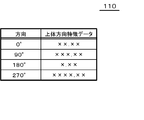
- FIG. 2 is a diagram showing the configuration of data stored in the body feature data storage unit 110 in a table format.
- the body feature data storage unit 110 stores, for each of a plurality of orientations (angles), feature data (body direction feature data) of a body image of a person facing that orientation.
- the data structure of the body direction feature data may be different depending on the orientation corresponding to the body direction feature data.
- the body direction feature data is determined by how to capture both hands, the shape of the torso, the shape of the face, the number of eyes, and the like.
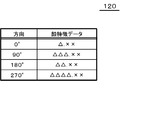
- FIG. 3 is a diagram showing the configuration of data stored in the face feature data storage unit 120 in a table format.
- the face feature data storage unit 120 stores, for each of a plurality of orientations (angles), feature data (face feature data) used when extracting a face image of a person facing that orientation.
- the face feature data is determined by, for example, the shape of the face and the number of eyes.
- FIG. 4 is a diagram showing the configuration of data stored in the face image storage unit 160 in a table format.
- the face image storage unit 160 stores face image data extracted from image data corresponding to the image identification information for each image identification information.
- the image data is each frame constituting the moving image data. Therefore, the image identification information includes moving image identification information for identifying moving image data and information (for example, time information) for specifying a frame.
- the face image storage unit 160 stores face image data in association with direction data corresponding to the face image data. For example, the face image storage unit 160 has the table shown in FIG. 4 for each image identification information and each direction data.
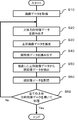
- FIG. 5 is a flowchart showing the operation of the image processing apparatus 100 shown in FIG. Each process described below including this figure may be performed immediately or may be performed at an appropriate timing by batch processing.
- the image data acquisition unit 130 of the image processing apparatus 100 acquires image data in association with image identification information (step S10).
- the body detection unit 140 acquires the image data and image identification information acquired by the image data acquisition unit 130.
- the body detection unit 140 reads any body direction feature data from the body feature data storage unit 110 in association with the direction data (step S20).
- the body detection unit 140 extracts the body image data by processing the image data using the read body direction feature data (step S30).
- the body detection unit 140 outputs the extracted body image data to the face image detection unit 150.
- the body detection unit 140 outputs the image identification information and the direction data corresponding to the body direction feature data read in step S20 to the face image detection unit 150 in association with the body image data.
- the face image detection unit 150 reads face direction feature data corresponding to the direction data acquired from the body detection unit 140 from the face feature data storage unit 120 (step S40).
- the face image detection unit 150 extracts face image data from the body image data acquired from the body detection unit 140 by using the read face direction feature data (step S50).
- the face image detection unit 150 stores the extracted face image data in the face image storage unit 160 in association with the image identification information and the direction data acquired from the body detection unit 140 (step S60).
- the face image detection unit 150 may extract face image data using face feature data that does not correspond to the acquired direction data.
- the image processing apparatus 100 performs the processes shown in steps S20 to S60 on all body direction feature data (step S62).
- the body feature data storage unit 110 of the image processing apparatus 100 stores body direction feature data corresponding to the direction for each direction data.
- the body detection unit 140 extracts body image data from the image data using the body direction feature data stored in the body feature data storage unit 110. Accordingly, it is possible to accurately detect a human image regardless of the direction of the person and to detect the direction of the person's body.
- the face image detection unit 150 detects face image data from the body image data detected by the body detection unit 140. In this way, it is possible to detect the face image data with higher accuracy than in the case where the face image is directly detected from the image data.
- the face image storage unit 160 uses not only the direction data (face direction) corresponding to the face feature data used when extracting the face image data, but also the face image data.
- the direction data (body direction) corresponding to the body image data from which the face image data has been extracted may be stored in association with each other.
- FIG. 7 is a block diagram illustrating a functional configuration of the image processing apparatus 100 according to the second embodiment.
- the functional configuration of the image processing apparatus 100 according to the present embodiment is the same as that of the image processing apparatus 100 according to the first embodiment, except that the body image storage unit 145 is included.
- the body image storage unit 145 stores the body image data detected by the body detection unit 140 in association with the direction data corresponding to the body direction feature data used when extracting the body image data. ing.
- FIG. 8 is a diagram showing the configuration of data stored in the body image storage unit 145 in a table format.
- the body image storage unit 145 stores body image data extracted from image data corresponding to the image identification information for each image identification information.
- the configuration of the image identification information is the same as that described with reference to FIG. 4 in the first embodiment.
- the body image storage unit 145 stores body image data in association with direction data corresponding to the body image data.
- the body image storage unit 145 has the table shown in FIG. 8 for each image identification information and each direction data.
- FIG. 9 is a flowchart showing the operation of the image processing apparatus 100 shown in FIG.
- the processing (steps S10 to S30) until the body image data is extracted is the same as the processing described in the first embodiment with reference to FIG.
- the body detection unit 140 After extracting the body image data, the body detection unit 140 stores the extracted body image data in the body image storage unit 145 in association with the image identification information and the direction data (step S32). The body detection unit 140 performs the processing shown in steps S20 to S32 on all body direction feature data (step S34).
- the face image detection unit 150 reads only the body image data corresponding to the specific direction data. That is, the face image detection unit 150 does not read at least one predetermined direction data, for example, body image data associated with backward (180 °) or horizontal (90 °, 270 °), and the remaining directions. Data, for example, body image data associated with the front direction (0 °) is read (step S36).
- step S40 to step S60 Since the subsequent processing (step S40 to step S60) is the same as that of the first embodiment, description thereof is omitted.
- the body image storage unit 145 the body image data can be processed using the extracted body image data and the direction data indicating the direction.
- the face image detection unit 150 does not perform face image extraction processing on all body image data, but applies to body image data facing a specific direction, for example, the front. Only the face image data is extracted. For this reason, the load of the image processing apparatus 100 can be reduced.
- FIG. 10 is a block diagram illustrating a functional configuration of the image processing apparatus 100 according to the third embodiment.
- the image processing apparatus 100 according to the present embodiment is the same as the image processing apparatus 100 shown in the image processing apparatus according to the first or second embodiment except that the image processing apparatus 100 includes an attribute detection unit 170 and an attribute data storage unit 175. It is the same composition.
- FIG. 10 shows the same case as in the second embodiment.
- the attribute data storage unit 175 stores attribute feature data indicating facial features by attribute, for example, by age and sex, for example, by direction data.
- the attribute detection unit 170 reads out and uses the attribute feature data stored in the attribute data storage unit 175, and classifies the face image data stored in the face image storage unit 160 by age and sex.
- the attribute detection unit 170 reads the face image data from the face image storage unit 160 in association with the direction data. Then, the attribute detection unit 170 reads attribute feature data corresponding to the direction data read from the face image storage unit 160 from the attribute data storage unit 175. Then, the attribute detection unit 170 uses the feature data read from the attribute data storage unit 175 to determine data indicating the attribute of the face image data read from the face image storage unit 160. Then, the attribute detection unit 170 stores data indicating the attribute in the face image storage unit 160 in association with the face image data.
- the processing performed by the attribute detection unit 170 may be performed only on predetermined direction data, for example, face image data corresponding to direction data indicating that the front is facing.
- FIG. 11 is a diagram showing the data stored in the attribute data storage unit 175 in a table format.
- the attribute data storage unit 175 stores attribute feature data indicating facial features by age group and sex in association with direction data.
- the age group is divided in units of 10 years old, but the unit defining the age group is not limited to this.
- the attribute data storage unit 175 stores feature data used when the direction data is 0 °, that is, when facing the front, but is used when facing the other direction. The feature data may be further stored.
- FIG. 12 is a diagram showing data stored in the face image storage unit 160 according to the present embodiment in a table format.
- the face image storage unit 160 stores data indicating attributes in association with the face image data in addition to the data shown in FIG.
- the same effects as those of the first or second embodiment can also be obtained by this embodiment. Further, since the data indicating the attribute is associated with the face image data, it is possible to analyze what kind of attribute the person is facing in which direction. Further, since the attribute data storage unit 175 stores the attribute data for each direction data, the attribute detection unit 170 can determine the attribute for each face image data with high accuracy.
- FIG. 13 is a block diagram illustrating a functional configuration of the image processing apparatus 100 according to the fourth embodiment.
- the image processing apparatus 100 according to the present embodiment has the same configuration as that of the second or third embodiment except for the following points.
- FIG. 13 shows a case similar to that of the third embodiment.
- the image data is generated by imaging the front of the image display device.
- the plurality of direction data is divided into viewing direction data and non-viewing direction data.
- the viewing direction data indicates that the upper body indicated by the upper body image data faces the image display device
- the non-viewing direction data indicates that the upper body indicated by the upper body image data does not face the image display device. It is shown that.
- the image processing apparatus 100 includes an audience rating calculation unit 180 and an audience rating storage unit 185.
- the audience rating calculation unit 180 uses the body image data stored in the body image storage unit 145 to calculate the audience rating of the image display device.
- the audience rating is calculated, for example, as a ratio of the number of body image data corresponding to the viewing direction data to the total number of body image data.
- the audience rating storage unit 185 calculates an audience rating for each piece of identification information of the image processing apparatus 100.
- the audience rating storage unit 185 stores the audience rating calculated by the audience rating calculation unit 180 in association with information indicating the date and time.
- FIG. 14 is a diagram showing data stored in the audience rating storage unit 185 in a table format.
- the audience rating storage unit 185 stores the audience ratings by day and by time zone.
- the audience rating storage unit 185 may store the audience ratings for each day and for each time period for each piece of identification information of the image processing apparatus 100.
- the unit of the audience rating is not limited to this, and the overall audience rating may be stored instead of the identification information of the image processing apparatus 100.
- FIG. 15 is a flowchart showing the operation of the audience rating calculation unit 180.
- the audience rating calculation unit 180 performs the processing shown in the figure at a predetermined timing.
- the audience rating calculation unit 180 counts the number of body image data stored in the body image storage unit 145 for each predetermined time period. As a result, the total number of body image data, that is, the total number of people who have passed in front of the image processing apparatus during that time period is calculated (step S110).
- the audience rating calculation unit 180 counts the number of body image data corresponding to the viewing direction data among the body image data stored in the body image storage unit 145 for each predetermined time period. . Thereby, the number of persons estimated to have visually recognized the image processing apparatus in the time zone is calculated (step S120).
- the audience rating calculation unit 180 calculates the audience rating for each predetermined time period by dividing the number calculated in step S120 by the number calculated in step S110 (step S130). Thereafter, the audience rating calculation unit 180 causes the audience rating storage unit 185 to store the audience rating for each time period (step S140).
- the audience rating calculation unit 180 calculates the audience rating, and this audience rating is calculated based on the number of body image data. That is, in the present embodiment, the data that is the parameter of the audience rating includes a person who is difficult to detect only by face detection, such as a person facing sideways or backward. Therefore, the audience rating can be calculated with high accuracy.
- the image data processed by the image processing apparatus 100 may be generated by imaging the exhibition space.
- the image processing apparatus 100 it is possible to calculate the audience rating of the exhibition space, that is, the ratio of the person who viewed the exhibition space to the total number of people who passed in front of the exhibition space.
- the audience rating calculation unit 180 may calculate the audience rating using the data stored in the face image storage unit 160. In this case, the audience rating calculation unit 180 can individually calculate the audience rating based on the combination of the body direction and the face direction.
- the face feature data storage unit 120 stores face feature data for each face orientation in a state independent of the body orientation indicated by the body image data. Then, the face image data detection unit 150 causes the face image storage unit 160 to store the face orientation corresponding to the face feature data used when detecting the face image data.
- the audience rating calculation unit 180 calculates the number of face image data in which both the upper body and the face are facing the front of the image display device for each predetermined time period, and this number is calculated as the first audience rating. It is good also as a molecule
- FIG. 16 is a diagram illustrating a configuration of a content distribution system according to the fifth embodiment.
- This content distribution system includes an image processing device 100, a content distribution device 200, an image display device 300, and an imaging device 400.
- the content distribution device 200 stores video content, and transmits this video content to the image display device 300 via the communication network 10 such as the Internet.
- the image display device 300 displays the video content received from the content distribution device 200.
- the imaging device 400 captures the front of the image display device 300 to generate image data, for example, moving image data, and immediately transmits the generated image data to the image processing device 100 via the communication network 10.
- the image processing apparatus 100 performs the process shown in the fourth embodiment on the image data received from the imaging apparatus 400.
- FIG. 17 is a block diagram illustrating a functional configuration of the image processing apparatus 100 according to the present embodiment.
- the image processing apparatus 100 in the present embodiment has the same configuration as the image processing apparatus 100 shown in the fourth embodiment except for the following points.
- the image data acquisition unit 130 receives image data from the imaging device 400. Then, the body detection unit 140 immediately processes the received image data and extracts body image data.
- the image processing apparatus 100 includes a display control unit 190.
- the display control unit 190 includes the number of body image data corresponding to the viewing direction data among the body image data detected by the body detection unit 140 and the direction data corresponding to the extracted body image data.
- the image display apparatus 300 is controlled based on the above.
- FIG. 18 is a flowchart for explaining an example of processing performed by the display control unit 190.
- the body detection unit 140 When the image data acquisition unit 130 of the image processing apparatus 100 acquires image data (step S110), the body detection unit 140 immediately reads body direction feature data corresponding to the viewing direction data (step S120). . Next, the body detection unit 140 performs a process of extracting body image data from the image data acquired in step S110 by using the body direction feature data read in step S120 (step S130).
- step S140: Yes the display control unit 190 does not perform processing.
- the display control unit 190 controls the image display device 300 (step S150).
- the control performed here includes, for example, a process for increasing the sound of the image display apparatus 300 and a process for canceling the display of the image display apparatus 300.
- the display control unit 190 controls the image display device 300 based on the direction data corresponding to the extracted body image data
- the body detection unit 140 uses all body direction feature data.
- the process of extracting the body image data from the image data acquired in step S110 is immediately performed.
- the image display device 300 is controlled based on the totaled result of the direction data corresponding to the extracted body image data.
- the contents of the control include, for example, a process for increasing the sound of the image display apparatus 300 and a process for canceling the display of the image display apparatus 300.
- the display control unit 190 also controls the image display device 300 based on the number of body image data corresponding to the viewing direction data. Therefore, the image display device 300 can be controlled based on the number of people viewing the image display device 300.
- the image processing apparatus 100 may control the content distribution apparatus 200. For example, the image processing apparatus 100 extracts face image data from the body image data extracted in step S130, and recognizes data indicating attributes corresponding to the face image data. Then, the image processing apparatus 100 causes the content distribution apparatus 200 to distribute video content corresponding to the recognized attribute to the image display apparatus 300. In this way, video content can be displayed on the image display device 300 in accordance with the attribute of the person who is watching the image display device 300.
Landscapes
- Engineering & Computer Science (AREA)
- Multimedia (AREA)
- Signal Processing (AREA)
- General Health & Medical Sciences (AREA)
- Social Psychology (AREA)
- Health & Medical Sciences (AREA)
- Databases & Information Systems (AREA)
- Computer Networks & Wireless Communication (AREA)
- Computer Vision & Pattern Recognition (AREA)
- Theoretical Computer Science (AREA)
- General Physics & Mathematics (AREA)
- Physics & Mathematics (AREA)
- Image Processing (AREA)
- Image Analysis (AREA)
- Two-Way Televisions, Distribution Of Moving Picture Or The Like (AREA)
Abstract
Description
前記上体特徴データ記憶手段が記憶している前記複数の上体方向特徴データを前記方向データに対応付けて読み出し、前記複数の上体方向特徴データそれぞれを用いることにより、画像データから人物の上体を示す上体画像データを抽出する上体検出手段と、
を備える画像処理装置が提供される。
通信網を介して前記コンテンツ記憶手段が記憶している前記映像コンテンツを受信し、受信した前記映像コンテンツを表示する画像表示装置と、
前記画像表示装置の前を撮像して画像データを生成する撮像装置と、
通信網を介して前記画像データを受信して処理する画像処理装置と、
を備え、
前記画像処理装置は、
人物の上体であることを示し、かつ当該上体が特定の方向を向いていることを示す上体方向特徴データを、当該上体方向特徴データの方向を示す方向データに対応付けて複数の方向別に記憶する上体特徴データ記憶手段と、
前記上体特徴データ記憶手段が記憶している前記複数の上体方向特徴データを前記方向データに対応付けて読み出し、前記複数の上体方向特徴データそれぞれを用いることにより、前記画像データから人物の上体を示す上体画像データを抽出する上体検出手段と、
を備えるコンテンツ配信システムが提供される。
前記画像取得手段が取得した画像データから、画像データから人物の上体を示す上体画像データを抽出するとともに、当該上体画像データが示す上体の向きを特定する画像処理手段と、
を備える画像処理装置が提供される。
前記コンピュータが、前記複数の上体方向特徴データそれぞれを用いることにより、画像データから人物の上体を示す上体画像データを抽出する、画像処理方法が提供される。
前記コンピュータに、
人物の上体であることを示し、かつ当該上体が特定の方向を向いていることを示す上体方向特徴データを、当該上体方向特徴データの方向を示す方向データに対応付けて複数の方向別に記憶する機能と、
前記複数の上体方向特徴データそれぞれを用いることにより、画像データから人物の上体を示す上体画像データを抽出する機能と、
を実現させるプログラムが提供される。
図1は、第1の実施形態にかかる画像処理装置100の構成を示すブロック図である。画像処理装置100は、上体特徴データ記憶部110及び上体検出部140を供えている。上体特徴データ記憶部110は、人物の上体であることを示し、かつ当該上体が特定の方向を向いていることを示す上体方向特徴データを、当該上体方向特徴データの方向を示す方向データに対応付けて複数の方向別に記憶している。ここで上体とは、例えば人体のうち頭部及び両肩を含む部分を指す。上体検出部140は、上体特徴データ記憶部110が記憶している複数の上体方向特徴データを方向データに対応付けて読み出し、複数の上体方向特徴データそれぞれを用いることにより、画像データから人物の上体を示す上体画像データを抽出する。
図7は、第2の実施形態に係る画像処理装置100の機能構成を示すブロック図である。本実施形態に係る画像処理装置100の機能構成は、上体画像記憶部145を有している点を除いて、第1の実施形態に係る画像処理装置100と同様の構成である。上体画像記憶部145は、上体検出部140が検出した上体画像データを、当該上体画像データを抽出するときに用いた上体方向特徴データに対応する方向データに対応付けて記憶している。
図10は、第3の実施形態に係る画像処理装置100の機能構成を示すブロック図である。本実施形態における画像処理装置100は、属性検出部170及び属性データ記憶部175を有している点を除いて、第1又は第2の実施形態に係る画像処理装置に示す画像処理装置100と同様の構成である。なお図10は、第2の実施形態と同様の場合を示している。
図13は、第4の実施形態に係る画像処理装置100の機能構成を示すブロック図である。本実施形態に係る画像処理装置100は、以下の点を除いて第2又は第3の実施形態のいずれかと同様の構成である。なお図13は、第3の実施形態と同様の場合を示している。
図16は、第5の実施形態に係るコンテンツ配信システムの構成を示す図である。このコンテンツ配信システムは、画像処理装置100、コンテンツ配信装置200、画像表示装置300、及び撮像装置400を備えている。
Claims (15)
- 人物の上体であることを示し、かつ当該上体が特定の方向を向いていることを示す上体方向特徴データを、当該上体方向特徴データの方向を示す方向データに対応付けて複数の方向別に記憶する上体特徴データ記憶手段と、
前記上体特徴データ記憶手段が記憶している前記複数の上体方向特徴データを前記方向データに対応付けて読み出し、前記複数の上体方向特徴データそれぞれを用いることにより、画像データから人物の上体を示す上体画像データを抽出する上体検出手段と、
を備える画像処理装置。 - 請求項1に記載の画像処理装置において、
前記上体検出手段が検出した前記上体画像データを、当該上体画像データを抽出するときに用いた前記上体方向特徴データに対応する前記方向データに対応付けて記憶する上体画像記憶手段を備える画像処理装置。 - 請求項1又は2に記載の画像処理装置において、
人物の顔であることを示す顔方向特徴データを前記方向データに対応付けて記憶する顔特徴データ記憶手段と、
前記上体画像データを、当該上体画像データを抽出するときに用いた前記上体方向特徴データに対応する前記方向データに対応付けて取得し、取得した前記方向データに対応する前記顔方向特徴データを前記顔特徴データ記憶手段から読み出し、読み出した前記顔方向特徴データを用いて前記上体画像データから人物の顔を示す顔画像データを抽出する顔画像検出手段と、
前記顔画像検出手段が検出した顔画像データを記憶する顔画像記憶手段と、
を備える画像処理装置。 - 請求項3に記載の画像処理装置において、
前記顔画像検出手段は、予め定められた少なくとも一つの前記方向データに対応付けられている前記上体画像データを読み出さず、残りの前記方向データに対応付けられている前記上体画像データを読み出す画像処理装置。 - 請求項3又は4に記載の画像処理装置において、
属性別に顔の特徴を示す属性特徴データを記憶する属性データ記憶手段と、
前記属性データ記憶手段が記憶している前記属性特徴データを読み出して用いることにより、前記顔画像データを年齢別かつ性別に分類する属性検出手段をさらに備える画像処理装置。 - 請求項5に記載の画像処理装置において、
前記属性検出手段は、予め定められた前記方向データに対応している前記顔画像データのみを、年齢別かつ性別に分類する画像処理装置。 - 請求項1~6のいずれか一つに記載の画像処理装置において、
前記画像データは、画像表示装置の前を撮像することにより生成されている画像処理装置。 - 請求項7に記載の画像処理装置において、
前記方向データは、前記上体画像データが示す上体が前記画像表示装置を向いていることを示す視認方向データと、前記画像表示装置を向いていないことを示す非視認方向データとに分けられており、
前記上体検出手段が検出した前記上体画像データを、当該上体画像データを抽出するときに用いた前記上体方向特徴データに対応する前記方向データに対応付けて記憶する上体画像記憶手段と、
前記上体画像記憶手段が記憶している前記上体画像データを用いて、前記上体画像データの総数に対する、前記視認方向データに対応する前記上体画像データの数の比率を視聴率として算出する視聴率算出手段をさらに備える画像処理装置。 - 請求項3に記載の画像処理装置において、
前記画像データは、画像表示装置の前を撮像することにより生成されており、
前記顔特徴データ記憶手段は、前記顔の向き別に前記顔特徴データを記憶しており、
前記顔画像記憶手段は、前記顔画像データを、当該顔画像データを抽出するときに用いた前記顔特徴データに対応する向き、及び当該顔画像データが抽出された前記上体画像データを抽出するときに用いた前記上体方向特徴データに対応する前記方向データに対応付けて記憶しており、
前記顔画像記憶手段が記憶している前記顔の向き及び前記方向データの組み合わせを用いて、前記画像表示装置を視認したと推定される前記顔画像データの数を算出し、前記顔画像データの総数に対する、前記算出した数の比率を視聴率として算出する視聴率算出手段をさらに備える画像処理装置。 - 請求項7~9のいずれか一項に記載の画像処理装置において、
前記方向データは、前記上体画像データが示す上体が前記画像表示装置を向いていることを示す視認方向データと、前記画像表示装置を向いていないことを示す非視認方向データとに分けられており、
前記上体検出手段は、前記画像データを生成する撮像装置から即時に前記画像データを取得し、当該即時に取得した前記画像データから前記上体画像データを抽出し、
さらに、前記即時に取得した前記画像データから抽出され、かつ前記視認方向データに対応している前記上体画像データの数に基づいて、前記画像表示装置を制御する表示制御手段を備える画像処理装置。 - 請求項7~10のいずれか一項に記載の画像処理装置において、
前記上体検出手段は、前記画像データを生成する撮像装置から即時に前記画像データを取得し、当該即時に取得した前記画像データから前記上体画像データを抽出し、
さらに、前記即時に取得した前記画像データから抽出された前記上体画像データに対応している前記方向データに基づいて、前記画像表示装置を制御する画像処理装置。 - 画像データを取得する画像取得手段と、
前記画像取得手段が取得した画像データから人物の上体を示す上体画像データを抽出するとともに、当該上体画像データが示す上体の向きを特定する画像処理手段と、
を備える画像処理装置。 - 映像コンテンツを記憶しているコンテンツ記憶手段と、
通信網を介して前記コンテンツ記憶手段が記憶している前記映像コンテンツを受信し、受信した前記映像コンテンツを表示する画像表示装置と、
前記画像表示装置の前を撮像して画像データを生成する撮像装置と、
通信網を介して前記画像データを受信して処理する画像処理装置と、
を備え、
前記画像処理装置は、
人物の上体であることを示し、かつ当該上体が特定の方向を向いていることを示す上体方向特徴データを、当該上体方向特徴データの方向を示す方向データに対応付けて複数の方向別に記憶する上体特徴データ記憶手段と、
前記上体特徴データ記憶手段が記憶している前記複数の上体方向特徴データを前記方向データに対応付けて読み出し、前記複数の上体方向特徴データそれぞれを用いることにより、前記画像データから人物の上体を示す上体画像データを抽出する上体検出手段と、
を備えるコンテンツ配信システム。 - コンピュータが、人物の上体であることを示し、かつ当該上体が特定の方向を向いていることを示す上体方向特徴データを、当該上体方向特徴データの方向を示す方向データに対応付けて複数の方向別に記憶しておき、
前記コンピュータが、前記複数の前記上体方向特徴データそれぞれを用いることにより、画像データから人物の上体を示す上体画像データを抽出する、画像処理方法。 - コンピュータを画像処理装置として機能させるプログラムであって、
前記コンピュータに、
人物の上体であることを示し、かつ当該上体が特定の方向を向いていることを示す上体方向特徴データを、当該上体方向特徴データの方向を示す方向データに対応付けて複数の方向別に記憶する機能と、
前記複数の上体方向特徴データそれぞれを用いることにより、画像データから人物の上体を示す上体画像データを抽出する機能と、
を実現させるプログラム。
Priority Applications (3)
| Application Number | Priority Date | Filing Date | Title |
|---|---|---|---|
| HK13105160.8A HK1178354B (en) | 2010-03-02 | 2011-01-20 | Image processing device, content delivery system, image processing method, and program |
| CN201180011876.0A CN102783174B (zh) | 2010-03-02 | 2011-01-20 | 图像处理设备、内容传递系统、图像处理方法和程序 |
| US13/582,198 US8971635B2 (en) | 2010-03-02 | 2011-01-20 | Image processing apparatus, content delivery system, image processing method, and program |
Applications Claiming Priority (2)
| Application Number | Priority Date | Filing Date | Title |
|---|---|---|---|
| JP2010-045744 | 2010-03-02 | ||
| JP2010045744A JP5115763B2 (ja) | 2010-03-02 | 2010-03-02 | 画像処理装置、コンテンツ配信システム、画像処理方法、及びプログラム |
Publications (1)
| Publication Number | Publication Date |
|---|---|
| WO2011108183A1 true WO2011108183A1 (ja) | 2011-09-09 |
Family
ID=44541854
Family Applications (1)
| Application Number | Title | Priority Date | Filing Date |
|---|---|---|---|
| PCT/JP2011/000296 Ceased WO2011108183A1 (ja) | 2010-03-02 | 2011-01-20 | 画像処理装置、コンテンツ配信システム、画像処理方法、及びプログラム |
Country Status (4)
| Country | Link |
|---|---|
| US (1) | US8971635B2 (ja) |
| JP (1) | JP5115763B2 (ja) |
| CN (1) | CN102783174B (ja) |
| WO (1) | WO2011108183A1 (ja) |
Families Citing this family (5)
| Publication number | Priority date | Publication date | Assignee | Title |
|---|---|---|---|---|
| US10120057B1 (en) | 2015-10-13 | 2018-11-06 | Google Llc | System and method for determining the direction of an actor |
| US9691153B1 (en) | 2015-10-21 | 2017-06-27 | Google Inc. | System and method for using image data to determine a direction of an actor |
| WO2017120469A1 (en) * | 2016-01-06 | 2017-07-13 | Tvision Insights, Inc. | Systems and methods for assessing viewer engagement |
| US10025308B1 (en) | 2016-02-19 | 2018-07-17 | Google Llc | System and method to obtain and use attribute data |
| CN106385624A (zh) * | 2016-09-29 | 2017-02-08 | 乐视控股(北京)有限公司 | 视频播放方法及装置 |
Citations (4)
| Publication number | Priority date | Publication date | Assignee | Title |
|---|---|---|---|---|
| JP2005503726A (ja) * | 2001-09-20 | 2005-02-03 | コーニンクレッカ フィリップス エレクトロニクス エヌ ヴィ | ユーザの注目に基づくリアルタイム・マルチメディア・コンテンツ送出の品質適合 |
| JP2006065447A (ja) * | 2004-08-25 | 2006-03-09 | Nippon Telegr & Teleph Corp <Ntt> | 識別器設定装置、注目度計測装置、識別器設定方法、注目度計測方法、およびプログラム |
| JP2006254274A (ja) * | 2005-03-14 | 2006-09-21 | Mitsubishi Precision Co Ltd | 視聴層分析装置、販売戦略支援システム、広告支援システム及びtv装置 |
| JP2008085685A (ja) * | 2006-09-28 | 2008-04-10 | Hitachi Ltd | 小型カメラ搭載型の列車内情報表示システム |
Family Cites Families (5)
| Publication number | Priority date | Publication date | Assignee | Title |
|---|---|---|---|---|
| JP4165095B2 (ja) * | 2002-03-15 | 2008-10-15 | オムロン株式会社 | 情報提供装置および情報提供方法 |
| JP3954484B2 (ja) * | 2002-12-12 | 2007-08-08 | 株式会社東芝 | 画像処理装置およびプログラム |
| JP4450799B2 (ja) * | 2006-03-10 | 2010-04-14 | 富士フイルム株式会社 | 対象画像検出装置の制御方法 |
| JP5010905B2 (ja) * | 2006-12-13 | 2012-08-29 | パナソニック株式会社 | 顔認証装置 |
| JP4518157B2 (ja) * | 2008-01-31 | 2010-08-04 | カシオ計算機株式会社 | 撮像装置及びそのプログラム |
-
2010
- 2010-03-02 JP JP2010045744A patent/JP5115763B2/ja active Active
-
2011
- 2011-01-20 WO PCT/JP2011/000296 patent/WO2011108183A1/ja not_active Ceased
- 2011-01-20 CN CN201180011876.0A patent/CN102783174B/zh active Active
- 2011-01-20 US US13/582,198 patent/US8971635B2/en active Active
Patent Citations (4)
| Publication number | Priority date | Publication date | Assignee | Title |
|---|---|---|---|---|
| JP2005503726A (ja) * | 2001-09-20 | 2005-02-03 | コーニンクレッカ フィリップス エレクトロニクス エヌ ヴィ | ユーザの注目に基づくリアルタイム・マルチメディア・コンテンツ送出の品質適合 |
| JP2006065447A (ja) * | 2004-08-25 | 2006-03-09 | Nippon Telegr & Teleph Corp <Ntt> | 識別器設定装置、注目度計測装置、識別器設定方法、注目度計測方法、およびプログラム |
| JP2006254274A (ja) * | 2005-03-14 | 2006-09-21 | Mitsubishi Precision Co Ltd | 視聴層分析装置、販売戦略支援システム、広告支援システム及びtv装置 |
| JP2008085685A (ja) * | 2006-09-28 | 2008-04-10 | Hitachi Ltd | 小型カメラ搭載型の列車内情報表示システム |
Also Published As
| Publication number | Publication date |
|---|---|
| US8971635B2 (en) | 2015-03-03 |
| CN102783174B (zh) | 2015-12-02 |
| JP2011180917A (ja) | 2011-09-15 |
| HK1178354A1 (zh) | 2013-09-06 |
| US20120321197A1 (en) | 2012-12-20 |
| JP5115763B2 (ja) | 2013-01-09 |
| CN102783174A (zh) | 2012-11-14 |
Similar Documents
| Publication | Publication Date | Title |
|---|---|---|
| JP5224360B2 (ja) | 電子広告装置、電子広告方法及びプログラム | |
| JP4934861B2 (ja) | 表示システム、表示方法、表示効果測定システム、及び、表示効果測定方法。 | |
| JP4876687B2 (ja) | 注目度計測装置及び注目度計測システム | |
| JP5217922B2 (ja) | 電子広告システム、電子広告配信装置、及びプログラム | |
| JP2020078058A (ja) | 画像処理装置、監視システム、画像処理方法、及びプログラム | |
| KR20190020779A (ko) | 인게이지먼트값 처리 시스템 및 인게이지먼트값 처리 장치 | |
| US9361705B2 (en) | Methods and systems for measuring group behavior | |
| JP2008112401A (ja) | 広告効果測定装置 | |
| JP5115763B2 (ja) | 画像処理装置、コンテンツ配信システム、画像処理方法、及びプログラム | |
| WO2017018012A1 (ja) | 情報処理システム、情報処理方法、および記録媒体 | |
| CN111639702A (zh) | 一种多媒体数据分析方法、设备、服务器及可读存储介质 | |
| JP2013157984A (ja) | Ui提供方法およびそれを適用した映像受信装置 | |
| JP5460793B2 (ja) | 表示装置、表示方法、テレビジョン受信機及び表示制御装置 | |
| US20140240222A1 (en) | Image processing apparatus, image processing method, and non-transitory computer readable medium | |
| JP5489197B2 (ja) | 電子広告装置・方法及びプログラム | |
| CN103514429B (zh) | 检测对象的特定部位的方法及图像处理设备 | |
| CN102542300B (zh) | 体感游戏中人体位置自动识别的方法及显示终端 | |
| JP2007265125A (ja) | コンテンツ表示装置 | |
| JP7329967B2 (ja) | 画像処理装置、システム、画像処理装置の制御方法、及び、プログラム | |
| US20100150447A1 (en) | Description based video searching system and method | |
| WO2012054048A1 (en) | Apparatus and method for evaluating an object | |
| JP6198187B2 (ja) | 信号処理装置及び信号処理方法 | |
| TW201305967A (zh) | 具學習力之視覺注意預測系統及其方法 | |
| US12175795B2 (en) | Device and method for determining engagement of a subject | |
| JP2010161573A5 (ja) | 情報処理装置、制御方法、コンピュータプログラム、および記憶媒体 |
Legal Events
| Date | Code | Title | Description |
|---|---|---|---|
| WWE | Wipo information: entry into national phase |
Ref document number: 201180011876.0 Country of ref document: CN |
|
| 121 | Ep: the epo has been informed by wipo that ep was designated in this application |
Ref document number: 11750298 Country of ref document: EP Kind code of ref document: A1 |
|
| WWE | Wipo information: entry into national phase |
Ref document number: 13582198 Country of ref document: US |
|
| NENP | Non-entry into the national phase |
Ref country code: DE |
|
| 122 | Ep: pct application non-entry in european phase |
Ref document number: 11750298 Country of ref document: EP Kind code of ref document: A1 |