WO2011111656A1 - Procédé de production d'un copolymère, composition de catalyseur utilisée dans celui-ci et copolymère - Google Patents
Procédé de production d'un copolymère, composition de catalyseur utilisée dans celui-ci et copolymère Download PDFInfo
- Publication number
- WO2011111656A1 WO2011111656A1 PCT/JP2011/055249 JP2011055249W WO2011111656A1 WO 2011111656 A1 WO2011111656 A1 WO 2011111656A1 JP 2011055249 W JP2011055249 W JP 2011055249W WO 2011111656 A1 WO2011111656 A1 WO 2011111656A1
- Authority
- WO
- WIPO (PCT)
- Prior art keywords
- group
- copolymer
- substituted
- producing
- styrene
- Prior art date
- Legal status (The legal status is an assumption and is not a legal conclusion. Google has not performed a legal analysis and makes no representation as to the accuracy of the status listed.)
- Ceased
Links
Images












Classifications
-
- C—CHEMISTRY; METALLURGY
- C08—ORGANIC MACROMOLECULAR COMPOUNDS; THEIR PREPARATION OR CHEMICAL WORKING-UP; COMPOSITIONS BASED THEREON
- C08F—MACROMOLECULAR COMPOUNDS OBTAINED BY REACTIONS ONLY INVOLVING CARBON-TO-CARBON UNSATURATED BONDS
- C08F210/00—Copolymers of unsaturated aliphatic hydrocarbons having only one carbon-to-carbon double bond
- C08F210/02—Ethene
-
- C—CHEMISTRY; METALLURGY
- C08—ORGANIC MACROMOLECULAR COMPOUNDS; THEIR PREPARATION OR CHEMICAL WORKING-UP; COMPOSITIONS BASED THEREON
- C08F—MACROMOLECULAR COMPOUNDS OBTAINED BY REACTIONS ONLY INVOLVING CARBON-TO-CARBON UNSATURATED BONDS
- C08F10/00—Homopolymers and copolymers of unsaturated aliphatic hydrocarbons having only one carbon-to-carbon double bond
-
- C—CHEMISTRY; METALLURGY
- C08—ORGANIC MACROMOLECULAR COMPOUNDS; THEIR PREPARATION OR CHEMICAL WORKING-UP; COMPOSITIONS BASED THEREON
- C08F—MACROMOLECULAR COMPOUNDS OBTAINED BY REACTIONS ONLY INVOLVING CARBON-TO-CARBON UNSATURATED BONDS
- C08F236/00—Copolymers of compounds having one or more unsaturated aliphatic radicals, at least one having two or more carbon-to-carbon double bonds
- C08F236/02—Copolymers of compounds having one or more unsaturated aliphatic radicals, at least one having two or more carbon-to-carbon double bonds the radical having only two carbon-to-carbon double bonds
- C08F236/20—Copolymers of compounds having one or more unsaturated aliphatic radicals, at least one having two or more carbon-to-carbon double bonds the radical having only two carbon-to-carbon double bonds unconjugated
Definitions
- the present invention relates to a method for producing a copolymer, a catalyst composition used therefor, and a copolymer.
- the metallocene complex is a compound that is used as one of catalyst components for various polymerization reactions, and is a complex compound in which one or more cyclopentadienyl or a derivative thereof is bonded to a central metal.
- a metallocene complex having one cyclopentadienyl or a derivative thereof bonded to a central metal may be referred to as a half metallocene complex.
- Metallocene complexes have completely different characteristics (including catalytic activity for polymerization reaction) depending on the type of central metal. As for metallocene complexes in which the central metal is a Group 3 metal or a lanthanoid metal atom, for example, the following reports have been made.
- a complex represented by the structural formula (II) can be used as a component of a polymerization catalyst system (see Patent Document 1).
- the complex disclosed in this document is characterized by containing a bridged ligand having cyclopentadienyl (or a derivative thereof).
- a hydride complex represented by (C 5 Me 4 SiMe 3 ) LnH 2 (THF) (Ln represents a Group 3 metal or a lanthanoid metal; the same applies hereinafter) is known (for example, Non-Patent Document 1). reference).
- a complex represented by (C 5 Me 4 SiMe 3 ) Ln (CH 2 SiMe 3 ) 2 (THF) used as a precursor of the hydride complex is also known.
- the styrene polymer is a syndiotactic styrene polymer obtained by a polymerization reaction using a metallocene complex, in addition to an atactic styrene polymer called general grade polystyrene (GPPS) or high impact polystyrene (HIPS).
- GPPS general grade polystyrene
- HIPS high impact polystyrene
- Coalescence (sPS) is produced industrially. The synthesis of sPS was announced by Idemitsu Kosan in 1986, and was synthesized using a catalyst system containing a titanium metallocene complex (see, for example, Non-Patent Document 4).
- the catalyst system mainly includes CpTiX 3 / MAO, and CpTiR 3 / B (C 6 F 5 ) 3 (Cp is substituted or unsubstituted cyclopentadienyl or indenyl: X is halide or alkoxy: R is alkyl: MAO is methylaluminoxane) or the like.
- sPS is a polymer that has a high melting point (about 270 ° C.), good crystallinity, excellent heat resistance, chemical resistance, dimensional stability, and the like, and is widely used industrially. .
- a high melting point about 270 ° C.
- good crystallinity excellent heat resistance
- chemical resistance chemical resistance
- dimensional stability and the like
- the molding process is difficult.
- Non-Patent Document 5 discloses several reports on the synthesis of ethylene-styrene copolymers.
- the ethylene-styrene copolymers reported by them are copolymers that do not have regioselectivity or stereoregularity with respect to the chain of styrene structural units. Accordingly, an ethylene-styrene copolymer having regioselectivity and a copolymer having high stereoregularity (especially syndiotacticity) with respect to the styrene structural unit is a compound of interest.
- Non-patent Document 10 Non-patent Document 10
- the catalytic activity in this polymerization reaction is not sufficient, and further improvement is required.
- Cyclic olefin polymers are expected to be superior in heat resistance, strength, and elastic modulus as compared to non-cyclic olefin polymers because the movement of the polymer chain is restricted. Furthermore, the potential as an optical material is expanding. However, cyclic olefin compounds generally have low polymerization activity due to their bulky molecules, and effective polymerization catalyst systems are limited.
- Non-patent Document 7 a 1,3-cyclohexadiene polymer obtained by polymerizing 1,3-cyclohexadiene, which is one of cyclic olefins, using a specific nickel catalyst has been reported (Non-patent Document 7). ).
- the polymer is characterized by a 1,4-selective addition polymerization of 1,3-cyclohexadiene, and is suggested to be cis-syndiotactic. There are no specific reports on the city and molecular weight.
- dicyclopentadiene which is one of norbornenes has a C ⁇ C double bond derived from a norbornene structure and a C ⁇ C double bond derived from cyclopentene.
- a copolymer with ethylene is an interesting compound, but recently it has been reported that it can be synthesized using a specific Zr complex as a polymerization catalyst (Non-patent Document 9).
- the copolymer of dicyclopentadiene and ethylene synthesized by the reported method has a limited molecular weight and dicyclopentadiene content.
- copolymers described in Non-Patent Documents 11 and 12 are known as copolymers.
- metallocene complexes especially metallocene complexes whose central metal is a Group 3 metal or a lanthanoid metal
- a copolymer of non-conjugated diene and propylene is known, but a copolymer of non-conjugated diene and styrene is not known.
- the present invention provides a novel process for producing a copolymer using a metallocene complex and a novel copolymer obtained by polymerizing a non-conjugated diene and styrene.
- the method for producing a copolymer according to the present invention includes 1) a ligand containing a central metal M which is a Group 3 metal atom or a lanthanoid metal atom, and a substituted or unsubstituted cyclopentadienyl derivative bonded to the central metal.
- Cp * monoanionic ligands Q 1 and Q 2 , and W neutral Lewis base L, metallocene complex represented by general formula (I), and 2) consisting of non-coordinating anion and cation
- the method comprises polymerizing at least one of ethylene and substituted or unsubstituted styrene with a non-conjugated diene using a catalyst composition containing an ionic compound as a catalyst.
- W represents an integer of 0 to 3.
- a central metal M which is a Group 3 metal atom or a lanthanoid metal atom, a ligand Cp * containing a substituted or unsubstituted cyclopentadienyl derivative bonded to the central metal, a monoanionic ligand Q Ethylene containing 1 and Q 2 , and a metallocene complex represented by the above general formula (I), including W neutral Lewis bases L, and (2) an ionic compound comprising a non-coordinating anion and a cation
- a catalyst composition for polymerizing at least one of substituted or unsubstituted styrene and a non-conjugated diene is also within the scope of the present invention.
- copolymer obtained by the above-described method for producing a copolymer according to the present invention is also within the scope of the present invention.
- a production method for polymerizing at least one of ethylene and substituted or unsubstituted styrene with a non-conjugated diene which is a novel use of a metallocene complex.
- a novel copolymer obtained by polymerizing a non-conjugated diene and styrene is provided.
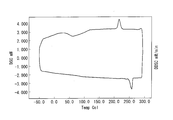
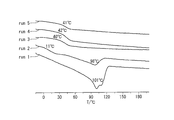
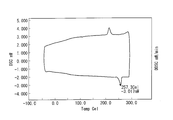
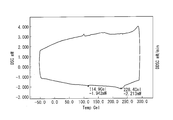
- the DSC curve of the copolymer obtained in Example 1 is shown.
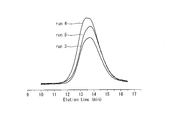
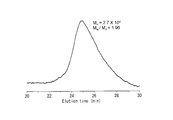
- the GPC profile of the copolymer obtained in Example 1 is shown.
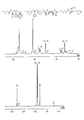
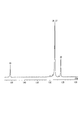
- 1 shows a 13 C NMR spectrum chart of the multiblock-syndiotactic polystyrene-hexadiene copolymer obtained in Example 1.
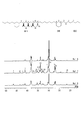
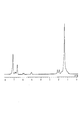
- FIG. 2 shows a 1 H NMR spectrum chart of the multiblock-syndiotactic polystyrene-hexadiene copolymer obtained in Example 1.
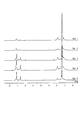
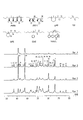
- FIG. It shows the 1 H NMR spectrum chart of the terpolymer obtained in Example 2.
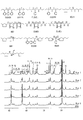
- the 13 C NMR spectrum chart of the terpolymer obtained in Example 2 is shown.
- the 13 C NMR spectrum chart of the terpolymer obtained in Example 2 is shown.
- the GPC profile of the terpolymer obtained in Example 2 is shown.
- the DSC curve of the terpolymer obtained in Example 2 is shown.
- 2 shows the GPC profile of the ethylene-heptadiene copolymer obtained in Example 3.
- the DSC curve of the copolymer obtained in Example 3 is shown.
- 1 shows a 1 H NMR spectrum chart of an ethylene-heptadiene copolymer obtained in Example 3.
- 1 shows a 13 C NMR spectrum chart of the ethylene-heptadiene copolymer obtained in Example 3.
- FIG. 1 shows a 13 C NMR spectrum chart of the ethylene-heptadiene copolymer obtained in Example 3.
- FIG. 1 shows a 13 C NMR spectrum chart of the ethylene-heptadiene copolymer obtained in Example 3.
- the GPC profile of the ethylene-heptadiene-styrene copolymer obtained in Example 4 is shown.
- 13 shows a 13 C NMR spectrum chart of the ethylene-heptadiene-styrene copolymer obtained in Example 4.
- FIG. The 13 C NMR spectrum chart of the aromatic ring region of the ethylene-heptadiene-styrene copolymer obtained in Example 4 is shown.
- 1 shows a 1 H NMR spectrum chart of an ethylene-heptadiene-styrene copolymer obtained in Example 4.
- 2 shows a DSC curve of the ethylene-heptadiene-styrene copolymer obtained in Example 4.
- Example 5 shows the 1 H NMR spectrum chart of the styrene-ethylene-decadiene copolymer obtained in Example 5.
- the 13 C NMR spectrum chart of the styrene-ethylene-decadiene copolymer obtained in Example 5 is shown.
- the GPC profile of the styrene-ethylene-decadiene copolymer obtained in Example 5 is shown.
- 2 shows a DSC curve of the styrene-ethylene-decadiene copolymer obtained in Example 5.
- 1 shows the 1 H NMR spectrum chart of the styrene-ethylene-decadiene copolymer obtained in Example 5.
- the 13 C NMR spectrum chart of the styrene-ethylene-decadiene copolymer obtained in Example 5 is shown.
- the GPC profile of the styrene-ethylene-decadiene copolymer obtained in Example 5 is shown.
- 2 shows a DSC curve of the styrene-ethylene-de
- the method for producing a copolymer according to the present invention polymerizes at least one of ethylene and substituted or unsubstituted styrene with a non-conjugated diene according to the present invention.
- a step of polymerizing at least one of ethylene and substituted or unsubstituted styrene with a non-conjugated diene using a catalyst composition containing a catalyst composition hereinafter simply referred to as “catalyst composition according to the present invention” to be used as a catalyst.
- the catalyst composition according to the present invention comprises: 1) a ligand Cp * containing a central metal M which is a Group 3 metal atom or a lanthanoid metal atom, and a substituted or unsubstituted cyclopentadienyl derivative bonded to the central metal;
- the metallocene complex represented by the above general formula (I) containing monoanionic ligands Q 1 and Q 2 and W neutral Lewis bases L, and 2) ionicity comprising a non-coordinating anion and a cation Contains compounds.
- the complex is preferably a half metallocene complex.
- M is a central metal in the metallocene complex.
- the central metal M is a Group 3 metal or a lanthanoid metal. Since the metallocene complex used in the present invention can be used as one component of the polymerization catalyst composition, the central metal M is appropriately selected depending on the type of monomer to be polymerized. Of these, Group 3 metals are preferable, scandium (Sc) and yttrium (Y) are more preferable, and Sc is more preferable.
- any Group 3 metal or lanthanoid metal may be used.
- Sc gadolinium (Gd), Y, holmium (Ho), lutetium (Lu), erbium (Er) Dysprosium (Dy), terbium (Tb), thulium (Tm) can be selected.
- any Group 3 metal or lanthanoid metal may be used.
- the central metal M is preferably Sc, Gd, Y, or Lu.
- Cp * is a ligand containing a cyclopentadienyl derivative and is ⁇ -bonded to the central metal M.
- the ligand is preferably a non-bridged ligand.
- the non-bridged ligand means a ligand having a coordination atom or a coordination group other than the cyclopentadienyl derivative, wherein the cyclopentadienyl derivative is ⁇ -bonded to the central metal.
- Examples of the substituted or unsubstituted cyclopentadienyl derivative contained in Cp * include non-bridged ligands such as a cyclopentadienyl ring, a fluorenyl ring, and an octahydrofluorenyl ring.
- the most preferred cyclopentadienyl derivative is a cyclopentadienyl ring.
- the cyclopentadienyl ring is represented by a composition formula: C 5 H 5-X1 R X1 .
- X1 represents an integer of 0 to 5.
- Each R independently represents a hydrocarbyl group, a substituted hydrocarbyl group, or a metalloid group substituted with a hydrocarbyl group.
- the composition formula is C 5 H 5-X1 R 1 X1 (X1 represents an integer of 0 to 5, and R 1 is a hydrocarbyl group or a hydrocarbyl group optionally having a substituent having 1 to 20 carbon atoms.
- the hydrocarbyl group is preferably a hydrocarbyl group having 1 to 20 carbon atoms, more preferably a C1 to 20 (preferably C1 to 10, more preferably C1 to 6) alkyl group, a phenyl group, a benzyl group, etc. And most preferably a methyl group.
- examples of the hydrocarbyl group having a substituent include a hydrocarbyl group in which at least one hydrogen atom of the hydrocarbyl group is substituted with a halogen atom, an amide group, a phosphide group, an alkoxy group, an aryloxy group, or the like.
- examples of the metalloid in the metalloid group substituted with a hydrocarbyl group include germyl (Ge), stannyl (Sn), silyl (Si), and the like. Further, the number of substitution of the hydrocarbyl group substituted with the metalloid group is determined by the type of metalloid (for example, in the case of a silyl group, the number of substitution of the hydrocarbyl group is 3).
- At least one R of the cyclopentadienyl ring is a metalloid group (preferably a silyl group) substituted with a hydrocarbyl group, more preferably a trimethylsilyl group.
- Preferred cyclopentadienyl rings include, but are not limited to, those represented by the following structural formulas.
- fluorenyl ring examples include a composition formula: C 13 H 9-X2 R 2 X2 (wherein X2 represents an integer of 0 to 9, and R 2 is a hydrocarbyl group optionally having a substituent having 1 to 20 carbon atoms) Or a metalloid group substituted with a hydrocarbyl group).
- the octahydrofluorenyl ring includes, for example, a composition formula: C 13 H 17-X3 R 3 X3 (X3 represents an integer of 0 to 17, and R 3 has a substituent having 1 to 20 carbon atoms. And a hydrocarbyl group or a metalloid group substituted with a hydrocarbyl group).
- Examples of the tetrahydrofluorenyl ring include a composition formula: C 13 H 13-X4 R 3 X4 (X4 represents an integer of 0 to 13, and R 3 may have a substituent having 1 to 20 carbon atoms. A good hydrocarbyl group or a metalloid group substituted with a hydrocarbyl group).
- the cyclopentadienyl derivative contained in the ligand Cp * is an indenyl ring (composition formula: C 9 H 7-X5 R X5 ) or a tetrahydroindenyl ring (composition formula: C 9 H 11-X6 R X6 ).
- R is the same as R in the above-described cyclopentadienyl ring
- X5 is an integer of 0 to 7
- X6 is an integer of 0 to 11.
- Q 1 and Q 2 are monoanionic ligands.
- Q 1 and Q 2 are each independently, for example, substituted or unsubstituted hydride, halide, hydrocarbyl group having 1 to 20 carbon atoms, alkoxy group or aryloxy group, monoanion coordination of amide group or phosphino group Examples include but are not limited to children.
- Q 1 and Q 2 are preferably each independently a hydrocarbyl group which may have a substituent having 1 to 20 carbon atoms, and each independently is an ortho-dimethylaminobenzyl group or a trimethylsilyl group. It is more preferable.
- Q 1 and Q 2 may be bonded to each other or may be combined to form a dianionic ligand (dianion ligand).
- dianionic ligand examples include alkylidene, diene, cyclometallated hydrocarbyl group, bidentate chelate ligand and the like.
- halides include chloride, bromide, fluoride, and iodide.
- the hydrocarbyl group having 1 to 20 carbon atoms is preferably methyl, ethyl, propyl, butyl, amyl, isoamyl, hexyl, isobutyl, heptyl, octyl, nonyl, decyl, cetyl
- an alkyl group such as a 2-ethylhexyl group
- an unsubstituted hydrocarbyl group such as a phenyl group or a benzyl group
- a substituted hydrocarbyl group such as a substituted benzyl group, a trialkylsilylmethyl group or a bis (trialkylsilyl) methyl group
- preferred hydrocarbyl groups include substituted or unsubstituted benzyl groups and trialkylsilylmethyl groups, and more preferred examples include ortho-dimethylaminobenzyl groups and trimethylsilylmethyl groups.
- alkoxy group or aryloxy group include a methoxy group and a substituted or unsubstituted phenoxy group.
- amide group examples include a dimethylamide group, a diethylamide group, a methylethylamide group, a di-t-butylamide group, a diisopropylamide group, an unsubstituted or substituted diphenylamide group.
- Preferred examples of the phosphino group include a diphenylphosphino group, a dicyclohexylphosphino group, a diethylphosphino group, and a dimethylphosphino group.
- alkylidene examples are preferably methylidene, ethylidene, and propylidene.
- Preferred examples of the cyclometalated hydrocarbyl group include propylene, butylene, pentylene, hexylene and octylene.
- L is a neutral Lewis base.
- the neutral Lewis base include tetrahydrofuran, diethyl ether, dimethylaniline, trimethylphosphine, lithium chloride and the like, preferably tetrahydrofuran.
- L may be bonded to Q 1 and / or Q 2 to form a so-called multidentate ligand.
- W in LW in the general formula (I) represents the number of neutral Lewis bases L.
- W is an integer of 0 to 3, preferably 0 to 1.
- the metallocene complex used in the present invention can be synthesized by a conventionally known method. For example, (1) Tardif, O.I. Nishiura, M .; Hou, Z. M. Organometallics 22, 1171, (2003). (2) Hultzsch, K .; C. Spaniol, T .; P. Okuda, J .; Angew. Chem. Int. Ed, 38, 227, (1999). Etc. can be synthesized according to the method described in the above. Moreover, the specific example of the manufacturing method of these complexes is described also in the below-mentioned Example.
- the catalyst composition according to the present invention contains an ionic compound.
- An ionic compound is composed of a non-coordinating anion and a cation.
- the ionic compound is combined with the metallocene complex described above to cause the metallocene complex to exhibit activity as a polymerization catalyst.
- the mechanism it can be considered that the ionic compound reacts with the metallocene complex to generate a cationic complex (active species).
- a tetravalent boron anion is preferable, and tetra (phenyl) borate, tetrakis (monofluorophenyl) borate, tetrakis (difluorophenyl) borate, tetrakis (tri Fluorophenyl) borate, tetrakis (trifluorophenyl) borate, tetrakis (pentafluorophenyl) borate, tetrakis (tetrafluoromethylphenyl) borate, tetra (tolyl) borate, tetra (xylyl) borate, (triphenyl, pentafluorophenyl) Examples thereof include borate, [tris (pentafluorophenyl), phenyl] borate, and tridecahydride-7,8-dicarbaoundecaborate.
- Examples of the cation that is a constituent component of the ionic compound include a carbonium cation, an oxonium cation, an ammonium cation, a phosphonium cation, a cycloheptatrienyl cation, and a ferrocenium cation having a transition metal.
- Examples of the carbonium cation include tri-substituted carbonium cations such as a triphenyl carbonium cation and a tri-substituted phenyl carbonium cation.
- Examples of the tri-substituted phenyl carbonium cation include a tri (methylphenyl) carbonium cation and a tri (dimethylphenyl) carbonium cation.
- ammonium cations include trialkylammonium cations, triethylammonium cations, tripropylammonium cations, tributylammonium cations, tri (n-butyl) ammonium cations, and the like, N, N-dimethylanilinium cations, N, N-diethylanilinium cation, N, N-2,4,6-pentamethylanilinium cation and other N, N-dialkylanilinium cation, di (isopropyl) ammonium cation, dicyclohexylammonium cation and other dialkylammonium cations It is done.
- Examples of the phosphonium cation include triarylphosphonium cations such as a triphenylphosphonium cation, a tri (methylphenyl) phosphonium cation, and a tri (dimethylphenyl) phosphonium cation.
- an anilinium cation or a carbonium cation is preferable, and a triphenylcarbonium cation is more preferable.
- the ionic compound contained in the catalyst composition according to the present invention may be a combination of those selected from the non-coordinating anions and cations.
- triphenylcarbonium tetrakis (pentafluorophenyl) borate triphenylcarbonium tetrakis (tetrafluorophenyl) borate, N, N-dimethylanilinium tetrakis (pentafluorophenyl) borate, 1,1′-dimethylferrocete Examples thereof include nium tetrakis (pentafluorophenyl) borate.
- One ionic compound may be used, or two or more ionic compounds may be used in combination.
- triphenylcarbonium tetrakis (pentafluorophenyl) borate are particularly preferred.
- Lewis acids that can react with transition metal compounds to form cationic transition metal compounds, such as B (C 6 F 5 ) 3 , Al (C 6 F 5 ) 3, etc., are used as ionic compounds. These may be used in combination with the ionic compound.
- an alkylaluminum compound (aluminoxane, preferably MAO or MMAO) or a combination of an alkylaluminum compound and a borate compound can be used as the ionic compound.
- the monoanionic ligands Q 1 and Q 2 in the general formula (I) are other than alkyl or hydride (for example, halogen), an alkylaluminum compound or a combination of an alkylaluminum compound and a borate compound Is preferably used.
- the catalyst composition according to the present invention can contain optional components in addition to the metallocene complex and the ionic compound.
- optional component include an alkylaluminum compound, a silane compound, and hydrogen.
- the alkylaluminum compound includes an organoaluminum compound called aluminoxane (alumoxane) used in a metallocene polymerization catalyst.
- aluminoxane aluminoxane
- MAO methylaluminoxane
- silane compound examples include phenylsilane.
- composition of each component in the catalyst composition according to the present invention the molar ratio of the ionic compound to the metallocene complex varies depending on the type of the complex and the ionic compound.
- the molar ratio is, for example, 0.5 to 1 when the ionic compound is composed of a carbonium cation and a boron anion (for example, [Ph 3 C] [B (C 6 F 5 ) 4 ]). In the case of MAO or the like, it is preferably about 300 to 4000.
- the metallocene complex can be sufficiently activated by setting the molar ratio as described above. Moreover, if it is an above-described molar ratio, it can suppress that the ionic compound which consists of a carbonium cation and a boron anion will react with the monomer which should be superposed
- the Lewis base L may inhibit the coordination to the active center of the olefin monomer
- the catalyst composition according to the present invention can be used as a polymerization catalyst composition (particularly an addition polymerization catalyst composition).
- “providing as a composition” includes providing a metallocene complex (active species) activated by reaction with an ionic compound.
- the catalyst composition according to the present invention can be used not only as a homopolymerization reaction but also as a polymerization catalyst composition in a copolymerization reaction.
- the monomer to be copolymerized only needs to have addition polymerizability.
- the monomer in the production method according to the present invention is at least one of ethylene and substituted or unsubstituted styrene and a non-conjugated diene. Other monomers may be further polymerized as appropriate.
- the amount of ethylene, substituted or unsubstituted styrene, and non-conjugated diene may be appropriately set according to the use of the copolymer to be produced.
- the monomer to be polymerized is at least ethylene, substituted or unsubstituted styrene, and a carbon-carbon single bond of 2 or more and 10 or less, preferably 4 or more and 10 or less, between two double bonds. If it is a non-conjugated diene connected via an ethylene, terpolymerization of ethylene, styrene and non-conjugated diene can be carried out.
- the styrene polymerized in the catalyst composition according to the present invention may be a substituted styrene, an unsubstituted styrene, or both a substituted styrene and an unsubstituted styrene. Further, the substituted styrene may be of multiple types. How the substituted styrene is substituted styrene is not particularly limited.
- a halogen atom an alkyl group having 1 to 4 carbon atoms, an alkoxy group having 1 to 4 carbon atoms, Examples thereof include those substituted with a substituent such as an alkylsilyl group and a carboxyalkyl group.
- the number of substituents is not particularly limited, but those having 1 to 3 substituents on the phenyl group are preferred, and one is more preferred. Of substituted or unsubstituted styrene, unsubstituted styrene is most preferred.
- examples of the substituent and the place where the substituent is substituted are as follows.
- Alkyl such as p-methyl, m-methyl, o-methyl, 2,4-dimethyl, 2,5-dimethyl, 3,4-dimethyl, 3,5-dimethyl, p-tertiary butyl
- Halogens such as p-chloro, m-chloro, o-chloro, p-bromo, m-bromo, o-bromo, p-fluoro, m-fluoro, o-fluoro, o-methyl-p-fluoro
- p Halogen substituted alkyl such as chloromethyl, m-chloromethyl, o-chloromethyl
- alkoxy such as p-methoxy, m-methoxy, o-methoxy, p-ethoxy, m-ethoxy, o-ethoxy (5) carboxyalkyl such as p-carboxymethyl
- Non-conjugated diene The non-conjugated diene that is polymerized in the catalyst composition according to the present invention is not particularly limited.
- linear acyclic diene compounds such as 1,4-hexadiene, 1,5-hexadiene, 1,6-heptadiene, 1,7-octadiene, 1,9-decadiene, etc.
- non-conjugated dienes those in which double bonds are located at both ends of the main chain are preferred.
- the non-conjugated diene has 2 or 3 carbon-carbon single bonds between two double bonds. It is preferable that they are connected via each other.
- Such non-conjugated dienes are suitably cyclized when polymerized. Thereby, a copolymer in which a part of the main chain has a cyclic structure can be obtained.
- the polymerization step in the production method according to the present invention may be a step in which at least one of ethylene and substituted or unsubstituted styrene is polymerized with a non-conjugated diene using the catalyst composition according to the present invention as a catalyst.
- the catalyst composition according to the present invention when preparing a monomer solution in which a monomer is dissolved in a solvent, the catalyst composition according to the present invention may be added to the monomer solution, or the catalyst composition according to the present invention may be added to a solvent.
- a monomer solution may be added to the catalyst solution dissolved in the catalyst. If the monomer is a gas, the catalyst composition according to the present invention may be supplied to a liquid phase dissolved in a solvent through a gas pipe or the like.
- the production method according to the present invention may be any method such as a gas phase polymerization method, a solution polymerization method, a suspension polymerization method, a liquid phase bulk polymerization method, an emulsion polymerization method, a solid phase polymerization method.
- the solvent to be used is not particularly limited as long as it is inert in the polymerization reaction and can dissolve the monomer and the catalyst.
- saturated aliphatic hydrocarbons such as butane, pentane, hexane and heptane
- saturated alicyclic hydrocarbons such as cyclopentane and cyclohexane
- aromatic hydrocarbons such as benzene and toluene
- Halogenated hydrocarbons such as ethylene, perchlorethylene, 1,2-dichloroethane, chlorobenzene, bromobenzene and chlorotoluene
- ethers such as tetrahydrofuran and diethyl ether.
- a solvent having low toxicity to a living body is preferable.
- an aromatic hydrocarbon, particularly toluene is preferable.
- the solvent may be used alone or in combination of two or more.
- the amount of the solvent used is arbitrary, but it is preferable that the concentration of the metallocene complex contained in the catalyst composition according to the present invention is 0.1 to 0.0001 mol / l.
- the polymerization temperature when the polymerization step is performed by solution polymerization may be any temperature, for example, ⁇ 90 ° C. or more and 100 ° C. or less.
- the polymerization temperature may be appropriately selected according to the type of monomer to be polymerized and the like, and can be performed, for example, near room temperature, that is, about 25 ° C.
- the polymerization time is, for example, about several seconds to several hours, and may be appropriately selected according to the type of monomer to be polymerized. For example, it may be 1 hour or less, and in some cases 1 minute or less.
- the amount of monomer to be supplied in the polymerization step can be appropriately set according to the intended copolymer to be produced.
- the pressure of the ethylene gas supplied can be arbitrarily adjusted, for example, it may be 1 atm. By adjusting the pressure, it is possible to adjust the molecular weight of the copolymer or the ethylene content.
- the substituted or unsubstituted styrene is preferably 100 times or more and 2000 times or less, more preferably 200 times or more and 1000 times or less in terms of molar ratio to the metallocene complex.
- the non-conjugated diene is preferably 100 times or more and 2000 times or less, more preferably 200 times or more and 1000 times or less in terms of molar ratio to the metallocene complex.
- the ratio is increased, it is possible to obtain a copolymer having a large molecular weight, but when the ratio greatly exceeds 2000 times, the activity may decrease.
- the copolymer For the production of the copolymer, 1) If it is a random copolymer or an alternating copolymer, it can be produced by polymerizing a mixture of two or more monomers in the presence of a catalyst composition, 2) If it is a block copolymer, it can manufacture by supplying each monomer in order in the reaction system containing a catalyst composition.
- the produced copolymer may be precipitated by opening the reaction mixture in methanol or the like.
- a copolymer can be obtained by filtering the precipitated copolymer and drying it.
- the polymerization product may be collected by filtration of the reaction solution after the polymerization step and washed with methanol or the like.
- the yield of the obtained copolymer varies depending on the type of metallocene complex contained in the catalyst composition according to the present invention, but can be around 100%. In particular, a high yield can be achieved when an Sc complex is used.
- the copolymer according to the present invention is a copolymer obtained by the production method according to the present invention.
- one embodiment of the copolymer according to the present invention is a novel copolymer in which a non-conjugated diene and styrene are polymerized.
- the repeating unit derived from a non-conjugated diene may have a linear structure, may form a cyclic structure, or may include both structures.
- a part of the main chain (in the copolymer with styrene) can be suitably formed into a cyclic structure, and two double bonds are connected via two or three carbon-carbon single bonds. By doing so, it can be made a ring structure more suitably.
- the thing of a saturated cyclic structure can be manufactured more suitably as a cyclic structure.
- the preferred constitution ratio of the repeating unit derived from the non-conjugated diene is 2 to 98 mol%, more preferably 5 to 95 mol%. Within this range, the properties derived from non-conjugated dienes are sufficiently exhibited.
- the molecular weight distribution of the copolymer according to the present invention is arbitrary, but can be a copolymer having a relatively narrow molecular weight distribution.
- the molecular weight distribution is a value measured by the GPC method (measured at 145 ° C. using polystyrene as a standard substance and 1,2-dichlorobenzene as an eluent (may be measured at 40 ° C. using THF as an eluent)). It means (M w / M n ) and can be measured using, for example, a GPC measurement device (TOSOH HLC 8121 GPC / HT).
- M w / M n is 6 or less, preferably 5 or less, and more preferably 4 or less.
- the number average molecular weight of the copolymer according to the present invention is arbitrary, but is, for example, 1000 or more, preferably 3000 or more, and more preferably 5000 or more.
- the melting point of the copolymer according to the present invention is a structure of a repeating unit derived from a non-conjugated diene, a structure of a repeating unit derived from styrene, a repeating unit derived from styrene, a repeating unit derived from ethylene, and a repeating unit derived from a non-conjugated diene. It changes depending on the ratio. For example, a copolymer according to the present invention having a melting point of 200 ° C. or higher is expected to have the same characteristics (heat resistance, chemical resistance, dimensional stability, etc.) as conventional sPS.
- the melting point can be increased by increasing the styrene content.
- the melting point is a melting point measured by a differential scanning calorimetry (DSC) method.
- the copolymer according to the present invention includes a highly syndiotactic polystyrene chain.
- “high syndiotactic” is in accordance with the description in Patent Document 4.
- the syndiotacticity of the styrene block chain is, for example, 60 r% or more, preferably 80 r%, more preferably 85 r%, more preferably 90 r%, particularly preferably 95 r% in terms of dyads. Most preferably, it is 99r% or more.
- the styrene content is preferably 15 mol% or more, more preferably 30 mol% or more. If it is 15 mol% or less, the syndiotactic styrene chain may be reduced. In particular, it can be seen from the examples described later that those having a styrene content of 30 mol% or more contain a styrene chain having a syndiotactic selectivity of 99r%.
- the center metal M is more preferably a third metal atom.
- the center metal M is more preferably scandium (Sc) or yttrium (Y).
- the center metal M is more preferably scandium (Sc).
- the substituted or unsubstituted cyclopentadienyl derivative has a cyclopentadienyl ring (composition formula: C 5 H 5-X1 R 1 X1 ; X1 is 0 to R 1 represents an integer of 5, R 1 represents a hydrocarbyl group which may have a substituent having 1 to 20 carbon atoms or a metalloid group substituted with a hydrocarbyl group, a fluorenyl ring (composition formula: C 13 H 9-X2 R 2 X2 ; X2 represents an integer of 0 to 9, and R 2 represents a hydrocarbyl group which may have a substituent having 1 to 20 carbon atoms or a metalloid group substituted with a hydrocarbyl group) or an octahydrofluorenyl ring (composition formula: C 13 H 17-X3 R 3 X3; X3 is 0 to an integer of 17, R
- the substituted or unsubstituted cyclopentadienyl derivative has a cyclopentadienyl ring (composition formula: C 5 H 5-X1 R 1 X1 ; X1 is 0 to It is more preferable that R 1 represents an integer of 5 and R 1 represents a hydrocarbyl group which may have a substituent having 1 to 20 carbon atoms or a metalloid group substituted with a hydrocarbyl group). .
- the substituted or unsubstituted cyclopentadienyl derivative has a cyclopentadienyl ring (composition formula: C 5 H 5-X1 R 1 ′ X1 ; X1 is 0
- R 1 ′ represents an optionally substituted alkyl group having 1 to 6 carbon atoms or a silyl group optionally having an alkyl group having 1 to 6 carbon atoms as a substituent. It is more preferable that
- the substituted or unsubstituted cyclopentadienyl derivative has a cyclopentadienyl ring (composition formula: C 5 H 5-X1 R 1 ′′ X1 ; It is more preferably a non-bridging ligand which represents an integer of 0 to 5 and R 1 ′′ represents a methyl group or a trimethyl group.
- Q 1 and Q 2 are each independently a substituted or unsubstituted hydride, halide, C 1-20 hydrocarbyl group, alkoxy group, aryl It is more preferably a monoanionic ligand of an oxy group, an amide group or a phosphino group (provided that Q 1 and Q 2 may be bonded to each other or may be combined to form a dianionic ligand).
- Q 1 and Q 2 are each independently a hydrocarbyl group which may have a substituent having 1 to 20 carbon atoms.
- Q 1 and Q 2 are each independently an ortho-dimethylaminobenzyl group or a trimethylsilyl group.
- the neutral Lewis base L is more preferably tetrahydrofuran.
- the non-conjugated diene has two double bonds connected via two or three carbon-carbon single bonds.
- the monomer composition is composed of ethylene, substituted or unsubstituted styrene, and a carbon-carbon having 4 to 10 carbon atoms between two double bonds. It is more preferable to include a non-conjugated diene connected via a single bond.
- the copolymer according to the present invention may include a polystyrene chain, the syndiotacticity in the polystyrene chain may be 60 r% or more, and a part of the main chain other than the polystyrene chain may have a cyclic structure.
- (C 5 Me 4 SiMe 3 ) Sc (CH 2 C 6 H 4 NMe 2 -o) 2 is described in X. Li, M.M. Nishiura, K .; Mori, T .; Mashiko, Z .; Hou, Chem. Commun. 2007, 4137. Was synthesized according to the method described in 1. Moreover, (C 5 H 5 ) Sc (CH 2 C 6 H 4 NMe 2 -o) 2 was synthesized by the following method.
- Example 1 Copolymerization of 1,5-hexadiene and styrene As shown in the following reaction formula, 1,5-hexadiene and styrene were copolymerized.
- Table 1 shows the molar ratio of monomers in the polymerization carried out in this example.
- FIG. 1 shows a DSC curve of the copolymer obtained from Run 6 in Table 1.
- FIG. 2 shows the GPC profile of the copolymer obtained from Run 6 in Table 1.
- FIG. 3 shows a 13 C NMR spectrum chart of the multiblock-syndiotactic polystyrene-hexadiene copolymer obtained from Run 6 in Table 1.
- FIG. 4 shows a 1 H NMR spectrum chart of the multiblock-syndiotactic polystyrene-hexadiene copolymer obtained from Run 6 in Table 1.
- DSC measurement it measured at 10 degrees C / min using DSC6220 by SII. The syndiotacticity of run 3-9 was 99r%.
- Example 2 Ternary polymerization of 1,5-hexadiene, ethylene and styrene
- terpolymerization of 1,5-hexadiene, ethylene and styrene was carried out.
- Table 2 shows the molar ratio of the monomers in the polymerization performed in this example.
- a toluene solution (2 ml) of 1,5-hexadiene (624 mg, 7.6 mmol) and styrene (198 mg, 1.9 mmol) was put into a two-necked flask containing a magnetic stirring bar.
- the two-necked flask was taken out of the glove box, placed in a water bath (25 ° C.), and connected to a sufficiently cleaned Schlenk ethylene line and a mercury shield stopper using a three-way cock.
- Ethylene was fed (1 atm) and saturated in solution by stirring for 2 minutes.
- FIG. 5 shows a 1 H NMR spectrum chart of the terpolymer obtained from Runs 1 to 5 in Table 2.
- FIG. 6 shows a 13 C NMR spectrum chart of the terpolymer obtained from Runs 1 to 5 in Table 2.
- FIG. 7 shows a 13 C NMR spectrum chart of the terpolymer obtained from Run 4 in Table 2.
- FIG. 8 shows the GPC profile of the terpolymer obtained from Runs 1 to 5 in Table 2.
- FIG. 9 shows a DSC curve of the terpolymer obtained from Run 5 in Table 2. The syndiotacticity of run 2 to 5 was 99r%.
- Example 3 Copolymerization of 1,6-heptadiene and ethylene
- Table 3 shows the type of catalyst, the amount of 1,6-heptadiene, and the like in the polymerization performed in this example.
- a toluene solution (1 ml) of 1,6-heptadiene (183 mg, 1.9 mmol) was put into a two-necked flask containing a magnetic stir bar.
- the two-necked flask was taken out of the glove box, placed in a water bath (25 ° C.), and connected to a sufficiently cleaned Schlenk ethylene line and a mercury shield stopper using a three-way cock.
- Ethylene was fed (1 atm) and saturated in solution by stirring for 2 minutes.
- FIG. 10 shows the GPC profile of the ethylene-heptadiene copolymer obtained from Runs 3, 4, and 5 in Table 3.
- FIG. 11 shows DSC curves of the copolymers obtained from Runs 1 to 5 in Table 3.
- FIG. 12 shows a 1 H NMR spectrum chart of the ethylene-heptadiene copolymer obtained from Runs 1 to 5 in Table 3.
- FIG. 13 shows a 13 C NMR spectrum chart of the ethylene-heptadiene copolymer obtained from Runs 1 to 5 in Table 3.
- FIG. 14 shows a 13 C NMR spectrum chart of the ethylene-heptadiene copolymer obtained from Runs 6 to 8 in Table 3.
- Example 4 terpolymerization of 1,6-heptadiene, ethylene and styrene
- terpolymerization of 1,6-heptadiene, ethylene and styrene was performed.
- Table 4 shows the molar ratio of the monomers in the polymerization performed in this example.
- a chlorobenzene solution (1 ml) of 1,6-heptadiene (548 mg, 5.7 mmol) and styrene (297 mg, 2.85 mmol) was put into a two-necked flask containing a magnetic stirring bar.
- the two-necked flask was taken out of the glove box, placed in a water bath (25 ° C.), and connected to a sufficiently cleaned Schlenk ethylene line and a mercury shield stopper using a three-way cock.
- Ethylene was fed (1 atm) and saturated in solution by stirring for 2 minutes.
- FIG. 15 shows the GPC profile of the ethylene-heptadiene-styrene copolymer obtained from Runs 3, 4, 5, and 7 in Table 4.
- FIG. 16 shows a 13 C NMR spectrum chart of the ethylene-heptadiene-styrene copolymer obtained from 3, 4, 5, and 7 in Table 4.
- FIG. 17 shows a 13 C NMR spectrum chart of the aromatic ring region of the ethylene-heptadiene-styrene copolymer obtained from Run 5 in Table 4.
- FIG. 18 shows a 1 H NMR spectrum chart of the ethylene-heptadiene-styrene copolymer obtained from Table 4.
- FIG. 19 shows the DSC curve of the ethylene-heptadiene-styrene copolymer obtained from Run 3 in Table 4. The syndiotacticity of run 2 to 8 was 99r%.
- Example 5 Copolymerization of 1,7-octadiene or 1,9-decadiene with ethylene and styrene
- 1,7-octadiene or 1,9-decadiene was copolymerized with ethylene and styrene.
- Table 5 shows the types of monomers, the molar ratios of the monomers, and the like in the polymerization performed in this example.
- Run 1 and Run 2 in Table 5 A detailed polymerization method will be described using Run 1 and Run 2 in Table 5 as an example.
- Run 3 and Run 4 were polymerized in the same manner as Run 1 and Run 2, respectively, except that the types and amounts of monomers were as shown in Table 5.
- FIG. 20 shows a 1 H NMR spectrum chart of the styrene-ethylene-decadiene copolymer obtained from Run 4 in Table 5.
- FIG. 21 shows a 13 C NMR spectrum chart of the styrene-ethylene-decadiene copolymer obtained from Run 4 in Table 5.
- FIG. 22 shows the GPC profile of the styrene-ethylene-decadiene copolymer obtained from Run 4 in Table 5.
- FIG. 23 shows a DSC curve of the styrene-ethylene-decadiene copolymer obtained from Run 4 in Table 5.
- FIG. 24 shows a 1 H NMR spectrum chart of the styrene-ethylene-octadiene copolymer obtained from Run 2 in Table 5.
- FIG. 25 shows a 13 C NMR spectrum chart of the styrene-ethylene-octadiene copolymer obtained from Run 2 in Table 5.
- FIG. 26 shows the GPC profile of the styrene-ethylene-octadiene copolymer obtained from Run 2 in Table 5.
- FIG. 27 shows a DSC curve of the styrene-ethylene-octadiene copolymer obtained from Run 2 in Table 5.
- polymerization catalyst composition of the present invention new production methods for various polymer compounds are provided, and further, new polymer compounds are provided.
Landscapes
- Chemical & Material Sciences (AREA)
- Health & Medical Sciences (AREA)
- Chemical Kinetics & Catalysis (AREA)
- Medicinal Chemistry (AREA)
- Polymers & Plastics (AREA)
- Organic Chemistry (AREA)
- Transition And Organic Metals Composition Catalysts For Addition Polymerization (AREA)
- Addition Polymer Or Copolymer, Post-Treatments, Or Chemical Modifications (AREA)
Abstract
L'invention divulgue un procédé de production d'un copolymère qui comprend un procédé de polymérisation d'au moins un parmi l'éthylène et un styrène éventuellement substitué avec un diène non conjugué. (1) Un complexe métallocène qui est représenté par la formule générale (I) et qui contient un métal central (M), qui est un atome métallique du 3ème groupe ou un métal des lanthanides, un ligand (Cp*), qui contient un cyclopentadiényle éventuellement substitué lié au métal central, des ligands monoanioniques (Q1 et Q2) et un nombre W de bases de Lewis neutres et (2) une composition de catalyseur qui contient un composé ionique formé à partir d'un anion non coordinant et d'un cation sont utilisés comme catalyseur. (Dans la formule, W représente un entier de 0-3.)
Applications Claiming Priority (2)
| Application Number | Priority Date | Filing Date | Title |
|---|---|---|---|
| JP2010-054854 | 2010-03-11 | ||
| JP2010054854 | 2010-03-11 |
Publications (1)
| Publication Number | Publication Date |
|---|---|
| WO2011111656A1 true WO2011111656A1 (fr) | 2011-09-15 |
Family
ID=44563458
Family Applications (1)
| Application Number | Title | Priority Date | Filing Date |
|---|---|---|---|
| PCT/JP2011/055249 Ceased WO2011111656A1 (fr) | 2010-03-11 | 2011-03-07 | Procédé de production d'un copolymère, composition de catalyseur utilisée dans celui-ci et copolymère |
Country Status (1)
| Country | Link |
|---|---|
| WO (1) | WO2011111656A1 (fr) |
Cited By (5)
| Publication number | Priority date | Publication date | Assignee | Title |
|---|---|---|---|---|
| JP2012131965A (ja) * | 2010-11-30 | 2012-07-12 | Bridgestone Corp | 共重合体及びその製造方法、並びに、ゴム組成物、架橋ゴム組成物、及びタイヤ |
| KR101426735B1 (ko) | 2013-08-16 | 2014-08-05 | 한국생산기술연구원 | 기계적 물성 및 내열성이 향상된 폴리(에틸렌-지방족 디엔)-g-폴리스티렌계 공중합체 및 이의 제조방법 |
| WO2016140243A1 (fr) * | 2015-03-02 | 2016-09-09 | 国立研究開発法人理化学研究所 | Composé polymère et son procédé de production |
| JP2017101181A (ja) * | 2015-12-03 | 2017-06-08 | 株式会社ブリヂストン | 多元共重合体の製造方法及び多元共重合体 |
| WO2018104669A1 (fr) * | 2016-12-09 | 2018-06-14 | Compagnie Generale Des Etablissements Michelin | Terpolymeres d'ethylene, de 1,3-butadiene ou d'isoprene, et d'une alpha-monoolefine aromatique |
Citations (5)
| Publication number | Priority date | Publication date | Assignee | Title |
|---|---|---|---|---|
| JPH01501555A (ja) * | 1986-12-19 | 1989-06-01 | エクソン・ケミカル・パテンツ・インク | エチレンコポリマー |
| JP2003524038A (ja) * | 2000-02-22 | 2003-08-12 | ユニベーション・テクノロジーズ・エルエルシー | 触媒系、その製造方法及び重合プロセスにおけるその使用 |
| WO2006004068A1 (fr) * | 2004-07-02 | 2006-01-12 | Riken | Composition de polymerization catalyseur contenant des complexes metallocenes et polymères produites à partir des mêmes éléments. |
| JP2008063300A (ja) * | 2006-09-11 | 2008-03-21 | Nippon Zeon Co Ltd | カチオン錯体、これを含有してなる重合触媒、この重合触媒を用いる重合方法及び重合体 |
| JP2008222780A (ja) * | 2007-03-09 | 2008-09-25 | Institute Of Physical & Chemical Research | 複素環配位子を含む金属錯体、及びそれを含む重合触媒組成物 |
-
2011
- 2011-03-07 WO PCT/JP2011/055249 patent/WO2011111656A1/fr not_active Ceased
Patent Citations (5)
| Publication number | Priority date | Publication date | Assignee | Title |
|---|---|---|---|---|
| JPH01501555A (ja) * | 1986-12-19 | 1989-06-01 | エクソン・ケミカル・パテンツ・インク | エチレンコポリマー |
| JP2003524038A (ja) * | 2000-02-22 | 2003-08-12 | ユニベーション・テクノロジーズ・エルエルシー | 触媒系、その製造方法及び重合プロセスにおけるその使用 |
| WO2006004068A1 (fr) * | 2004-07-02 | 2006-01-12 | Riken | Composition de polymerization catalyseur contenant des complexes metallocenes et polymères produites à partir des mêmes éléments. |
| JP2008063300A (ja) * | 2006-09-11 | 2008-03-21 | Nippon Zeon Co Ltd | カチオン錯体、これを含有してなる重合触媒、この重合触媒を用いる重合方法及び重合体 |
| JP2008222780A (ja) * | 2007-03-09 | 2008-09-25 | Institute Of Physical & Chemical Research | 複素環配位子を含む金属錯体、及びそれを含む重合触媒組成物 |
Cited By (9)
| Publication number | Priority date | Publication date | Assignee | Title |
|---|---|---|---|---|
| JP2012131965A (ja) * | 2010-11-30 | 2012-07-12 | Bridgestone Corp | 共重合体及びその製造方法、並びに、ゴム組成物、架橋ゴム組成物、及びタイヤ |
| KR101426735B1 (ko) | 2013-08-16 | 2014-08-05 | 한국생산기술연구원 | 기계적 물성 및 내열성이 향상된 폴리(에틸렌-지방족 디엔)-g-폴리스티렌계 공중합체 및 이의 제조방법 |
| WO2015023047A1 (fr) * | 2013-08-16 | 2015-02-19 | 한국생산기술연구원 | Copolymère à base de poly(éthylène-diène aliphatique)-g-polystyrène ayant des propriétés mécaniques et une résistance à la chaleur améliorées et procédé de préparation de ce dernier |
| US9688802B2 (en) | 2013-08-16 | 2017-06-27 | Korea Institute Of Industrial Technology | Poly(ethylene-aliphatic diene)-g-polystyrene based copolymer having improved mechanical properties and heat resistance and method for preparing same |
| WO2016140243A1 (fr) * | 2015-03-02 | 2016-09-09 | 国立研究開発法人理化学研究所 | Composé polymère et son procédé de production |
| JPWO2016140243A1 (ja) * | 2015-03-02 | 2017-12-07 | 国立研究開発法人理化学研究所 | 高分子化合物及び高分子化合物の製造方法 |
| JP2017101181A (ja) * | 2015-12-03 | 2017-06-08 | 株式会社ブリヂストン | 多元共重合体の製造方法及び多元共重合体 |
| WO2018104669A1 (fr) * | 2016-12-09 | 2018-06-14 | Compagnie Generale Des Etablissements Michelin | Terpolymeres d'ethylene, de 1,3-butadiene ou d'isoprene, et d'une alpha-monoolefine aromatique |
| FR3060007A1 (fr) * | 2016-12-09 | 2018-06-15 | Compagnie Generale Des Etablissements Michelin | Terpolymeres d'ethylene, de 1,3-butadiene ou d'isoprene, et d'une alpha-monoolefine aromatique |
Similar Documents
| Publication | Publication Date | Title |
|---|---|---|
| JP5098332B2 (ja) | メタロセン錯体を含む重合触媒組成物、およびそれを用いて製造される重合体 | |
| AU651423B2 (en) | Process for preparing addition polymerization catalysts via metal center oxidation | |
| CN113508123B (zh) | 过渡金属化合物和包含其的催化剂组合物 | |
| RU2670752C9 (ru) | Полимер на основе олефинов с исключительной способностью к переработке | |
| JPH0753618A (ja) | 付加重合触媒及びその使用法 | |
| JP2001516761A (ja) | シクロペンタフェナンスレニル金属錯体及び重合法 | |
| WO2011056020A2 (fr) | Composition de catalyseur à métallocène mixte et procédé pour préparer une polyoléfine utilisant celle-ci | |
| CN106414470A (zh) | 作为聚合催化剂的第iva族金属的甲硅烷基二(六甲基茚基)络合物 | |
| WO2011111656A1 (fr) | Procédé de production d'un copolymère, composition de catalyseur utilisée dans celui-ci et copolymère | |
| KR101737568B1 (ko) | 혼성 담지 촉매 및 이를 이용하는 올레핀계 중합체의 제조방법 | |
| JP7542889B2 (ja) | 極性オレフィン重合体及び共重合体の製造方法 | |
| EP3339332B1 (fr) | Catalyseur métallocène supporté et procédé de préparation d'une polyoléfine à l'aide de ce catalyseur | |
| KR20190073264A (ko) | 올레핀 중합체, 이의 제조 방법, 그리고 이를 이용한 필름 | |
| KR102086767B1 (ko) | 프로필렌-알파올레핀 공중합체 | |
| KR102693458B1 (ko) | 폴리에틸렌 및 이의 염소화 폴리에틸렌 | |
| Alt et al. | Bridged and unbridged substituted indenyl complexes of titanium and zirconium as catalysts for homogeneous and heterogeneous homo-and copolymerization of olefins | |
| JP3572325B2 (ja) | オレフィン重合用触媒およびそれを用いたポリオレフィンの製造方法 | |
| JP2008222780A (ja) | 複素環配位子を含む金属錯体、及びそれを含む重合触媒組成物 | |
| JP5713380B2 (ja) | ブロック共重合体の製造方法、それに用いる触媒組成物、およびブロック共重合体 | |
| JP2017178786A (ja) | メタロセン錯体、オレフィン重合用触媒、およびオレフィン重合体の製造方法 | |
| KR20170001424A (ko) | 폴리올레핀 제조용 촉매 시스템 및 폴리올레핀의 제조방법 | |
| JP5626752B2 (ja) | 芳香族ビニル化合物と共役ポリエン化合物とのブロック共重合体の製造方法 | |
| JP2014025043A (ja) | ペンタジエン単独又は共重合体の製造方法及びペンタジエン単独又は共重合体 |
Legal Events
| Date | Code | Title | Description |
|---|---|---|---|
| 121 | Ep: the epo has been informed by wipo that ep was designated in this application |
Ref document number: 11753314 Country of ref document: EP Kind code of ref document: A1 |
|
| NENP | Non-entry into the national phase |
Ref country code: DE |
|
| 122 | Ep: pct application non-entry in european phase |
Ref document number: 11753314 Country of ref document: EP Kind code of ref document: A1 |
|
| NENP | Non-entry into the national phase |
Ref country code: JP |