WO2011114586A1 - ポリビニルアルコールの製造方法及び製造装置 - Google Patents
ポリビニルアルコールの製造方法及び製造装置 Download PDFInfo
- Publication number
- WO2011114586A1 WO2011114586A1 PCT/JP2010/071793 JP2010071793W WO2011114586A1 WO 2011114586 A1 WO2011114586 A1 WO 2011114586A1 JP 2010071793 W JP2010071793 W JP 2010071793W WO 2011114586 A1 WO2011114586 A1 WO 2011114586A1
- Authority
- WO
- WIPO (PCT)
- Prior art keywords
- methanol
- polymerization
- liquid
- polyvinyl alcohol
- tower body
- Prior art date
- Legal status (The legal status is an assumption and is not a legal conclusion. Google has not performed a legal analysis and makes no representation as to the accuracy of the status listed.)
- Ceased
Links
Images
Classifications
-
- C—CHEMISTRY; METALLURGY
- C08—ORGANIC MACROMOLECULAR COMPOUNDS; THEIR PREPARATION OR CHEMICAL WORKING-UP; COMPOSITIONS BASED THEREON
- C08F—MACROMOLECULAR COMPOUNDS OBTAINED BY REACTIONS ONLY INVOLVING CARBON-TO-CARBON UNSATURATED BONDS
- C08F6/00—Post-polymerisation treatments
- C08F6/001—Removal of residual monomers by physical means
-
- C—CHEMISTRY; METALLURGY
- C08—ORGANIC MACROMOLECULAR COMPOUNDS; THEIR PREPARATION OR CHEMICAL WORKING-UP; COMPOSITIONS BASED THEREON
- C08F—MACROMOLECULAR COMPOUNDS OBTAINED BY REACTIONS ONLY INVOLVING CARBON-TO-CARBON UNSATURATED BONDS
- C08F8/00—Chemical modification by after-treatment
- C08F8/12—Hydrolysis
-
- B—PERFORMING OPERATIONS; TRANSPORTING
- B01—PHYSICAL OR CHEMICAL PROCESSES OR APPARATUS IN GENERAL
- B01J—CHEMICAL OR PHYSICAL PROCESSES, e.g. CATALYSIS OR COLLOID CHEMISTRY; THEIR RELEVANT APPARATUS
- B01J2208/00—Processes carried out in the presence of solid particles; Reactors therefor
- B01J2208/00008—Controlling the process
- B01J2208/00628—Controlling the composition of the reactive mixture
-
- B—PERFORMING OPERATIONS; TRANSPORTING
- B01—PHYSICAL OR CHEMICAL PROCESSES OR APPARATUS IN GENERAL
- B01J—CHEMICAL OR PHYSICAL PROCESSES, e.g. CATALYSIS OR COLLOID CHEMISTRY; THEIR RELEVANT APPARATUS
- B01J2219/00—Chemical, physical or physico-chemical processes in general; Their relevant apparatus
- B01J2219/00002—Chemical plants
- B01J2219/00004—Scale aspects
- B01J2219/00006—Large-scale industrial plants
Definitions
- the present invention relates to a method and apparatus for producing polyvinyl alcohol. More specifically, the present invention relates to a technique for removing unreacted monomers from a paste obtained by a polymerization process.
- Polyvinyl alcohol is a water-soluble synthetic resin, and has been used mainly as a raw material for synthetic fibers in the past. In recent years, film materials, emulsifying dispersants, adhesives, and binder resins have been utilized. It is used in various fields. This PVA resin is generally produced by polymerizing a vinyl ester and saponifying the obtained polyvinyl ester in an organic solvent in the presence of a catalyst.
- a demonomer process for removing unreacted monomers from the polymerization solution is performed between the polymerization process and the saponification process.
- the method for example, there is a method of introducing a polymerization liquid obtained by a polymerization step into a demonomer tower having a plurality of perforated plates and blowing methanol vapor from the bottom of the tower to bring methanol into contact with the polymerization liquid.
- Patent Documents 1 to 3 have a problem that the monomer removal efficiency is low. Therefore, in the conventional manufacturing method, as described in Patent Document 1, a part of the overhead liquid is refluxed to improve the thermal efficiency. However, in recent years, further efficiency and energy savings have been achieved. Is required.
- the main object of the present invention is to provide a polyvinyl alcohol production method and production apparatus that can efficiently remove unreacted monomers from a polymerization solution with less energy than in the past.
- the method for producing a polyvinyl alcohol resin according to the present invention comprises a polymerization step of polymerizing one or more vinyl esters, or copolymerizing a vinyl ester and another monomer copolymerizable therewith, Depolymerization step of removing unreacted monomer by bringing methanol vapor into contact with the polymerization solution obtained in the polymerization step, and saponification of the solution from which unreacted monomer has been removed in the presence of an alkali catalyst in an organic solvent And in the demonomer step, liquid methanol is added to the polymerization solution, and the concentration is adjusted before contacting with methanol vapor.
- This production method may further include a step of concentrating the mixture of the monomer and methanol generated by the contact between the polymerization solution and methanol vapor to an azeotropic composition. Moreover, a monomer can also be collect
- the apparatus for producing a polyvinyl alcohol resin according to the present invention includes a tower body, a methanol introduction pipe for adding methanol to the polymerization liquid, a polymerization liquid introduction mechanism for introducing the polymerization liquid to the upper part of the tower body, and a lower part of the tower body.
- a methanol vapor introduction mechanism for introducing methanol vapor, and a polymerization liquid diluted with methanol is introduced into the tower body.
- the polymerization liquid introduced into the column body is diluted with liquid methanol, the solution after removing the monomer can be used as it is for the saponification reaction even if the amount of methanol vapor blown is reduced. Is possible.
- the polymerization solution and methanol vapor are in countercurrent contact within the tower body.
- liquid methanol is added to the polymerization solution, unreacted monomers can be efficiently removed from the polymerization solution with less energy than in the past.
- Polymerization process In the method for producing a polyvinyl alcohol resin of the present embodiment, first, one or two or more kinds of vinyl esters are polymerized, or a vinyl ester and other monomers copolymerizable therewith are copolymerized, The ester is obtained.
- the vinyl ester used herein include vinyl formate, vinyl acetate, vinyl propionate, vinyl valelate, vinyl caprate, vinyl laurate, vinyl stearate, vinyl benzoate, vinyl piperate and vinyl versatate.
- vinyl acetate is particularly preferable from the viewpoint of polymerization stability.
- vinyl esters are not particularly limited.
- ⁇ -olefins such as ethylene and propylene, methyl (meth) acrylate, ethyl (meth) acrylate, (Meth) acrylic acid alkyl esters such as butyl (meth) acrylate and (meth) acrylic acid-2-ethylhexyl, unsaturated amides such as (meth) acrylamide and N-methylolacrylamide, (meth) acrylic acid, croton Unsaturated acids such as acids, maleic acid, itaconic acid and fumaric acid, alkyl esters of unsaturated acids (such as methyl, ethyl, propyl), anhydrides of unsaturated acids such as maleic anhydride, salts of unsaturated acids (sodium Salt, potassium salt, ammonium salt, etc.), allyl glycidyl ether, glycidyl (meta Glycidy
- liquid methanol is added to the polymerization liquid before being brought into contact with methanol vapor, and the concentration thereof is adjusted.
- a part of the mixture of the separated monomer and methanol is added as a reflux liquid to the polymerization liquid before contact with methanol vapor, and the concentration of the polymerization liquid is adjusted by changing the addition amount.
- the circulation amount of unreacted monomers increases, a large amount of methanol vapor is required.
- liquid methanol is added to the polymerization liquid separately from the reflux liquid for adjusting the concentration of the polymerization liquid.
- the amount added can be reduced.
- the reflux liquid is added to the polymerization liquid in order to increase the monomer concentration in the polymerization liquid so that the separation liquid has a composition close to the azeotropic composition.
- the concentration of the polymerization solution after adding liquid methanol is preferably 10 to 70% by mass.
- concentration of the polymerization liquid before contacting with methanol vapor is less than 10% by mass, a large amount of methanol vapor is required, which may increase the energy consumption.
- concentration of the polymerization liquid before contacting with methanol vapor is less than 10% by mass, a large amount of methanol vapor is required, which may increase the energy consumption.
- it exceeds 70% by mass polymerization occurs in the column. This is because the fluidity of the liquid is lowered and clogging may occur.
- the viscosity of the polymerization solution is preferably 0.001 to 2.0 Pa ⁇ s. Thereby, the demonomer treatment can be performed with high efficiency.
- the polymer (polyvinyl ester) solution subjected to the demonomer treatment is saponified in the presence of a catalyst in an organic solvent.
- organic solvent used here, alcohols such as methanol, ethanol, propanol, ethylene glycol, propylene glycol, glycerin and diethylene glycol can be used, and methanol is particularly preferable.
- the saponification catalyst examples include alkali catalysts such as sodium hydroxide, potassium hydroxide, sodium alcoholate and sodium carbonate, and acid catalysts such as sulfuric acid, phosphoric acid and hydrochloric acid.
- alkali catalysts such as sodium hydroxide, potassium hydroxide, sodium alcoholate and sodium carbonate
- acid catalysts such as sulfuric acid, phosphoric acid and hydrochloric acid.
- an alkali catalyst is preferably used, and sodium hydroxide is more preferably used. Thereby, the saponification rate can be increased and the productivity can be improved.
- the degree of saponification of the PVA resin obtained by the saponification step is not particularly limited, and can be appropriately set according to the application.
- a washing step and a drying step for removing impurities such as sodium acetate may be performed as necessary. Good.
- the concentration of the polymerization solution is adjusted by adding liquid methanol, as in the conventional method, In order to bring the polymer solution to the concentration required in the saponification step, it is not necessary to add excess reflux. As a result, the amount of methanol vapor blown can be reduced, and unreacted monomers can be efficiently removed from the polymerization solution with less methanol vapor than in the past.
- the composition of the separation liquid can be easily brought close to the azeotropic composition of the monomer and methanol by adjusting the amount of the reflux liquid added to the polymerization liquid.
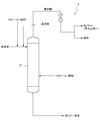
- FIG. 1 is a diagram schematically showing a configuration of a PVA resin production apparatus according to the present embodiment.
- the PVA resin manufacturing apparatus 1 of the present embodiment realizes the PVA resin manufacturing method of the first embodiment described above, and includes a substantially cylindrical tower body 2 as shown in FIG.
- the upper part of the tower body 2 is provided with a polymerization liquid inlet for introducing a polymerization liquid, and the lower part of the tower body 2 is provided with a methanol inlet for introducing methanol vapor. Further, a multi-stage perforated plate or the like is arranged inside the tower body 2 so that the polymerization solution and methanol vapor come into contact in countercurrent.
- a degassing port for taking out a mixed gas of monomer and methanol is provided at the top of the tower body 2, and an outlet for discharging the demonomerized polymer solution at the bottom of the tower body 2. Is provided.
- a pipe for passing the polymerization liquid is connected to the polymerization liquid inlet of the tower body 2, and an injection pipe for introducing a reflux liquid and liquid methanol for concentration adjustment are connected to this pipe.
- An injection pipe for injecting is connected. That is, in this PVA resin production apparatus 1, the polymerization liquid discharged from the polymerization can is adjusted to a predetermined concentration in the pipe and introduced into the tower body 2.
- a reflux liquid and liquid methanol are added to a polymerization liquid discharged from a polymerization can (not shown), and the concentration thereof is adjusted to a predetermined range.
- the polymerization liquid after concentration adjustment is introduced into the column main body 2 from the polymerization liquid inlet, and methanol vapor is introduced from the methanol inlet.
- the polymer moves from the upper side to the lower side of the tower body 2 and the methanol vapor moves from the lower side to the upper side of the tower body 2, so that the polymerization solution and the methanol vapor come into contact with each other in a countercurrent direction.
- the monomer contained in the liquid is gasified with methanol.
- the unreacted monomer contained in the polymerization liquid is discharged from the top of the column as a mixture with methanol.
- the polymerization solution (polymer solution) from which the monomer has been removed is discharged from the bottom of the column and sent to a saponification step described later.
- the apparatus for producing the PVA resin of this embodiment adds liquid methanol together with the reflux liquid to the polymerization liquid, the circulation amount of the unreacted monomer is reduced, and the polymerization liquid is used with less energy than conventional. Unreacted monomer can be efficiently removed.
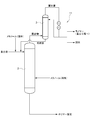
- FIG. 2 is a diagram schematically showing the configuration of the PVA resin production apparatus of the present embodiment.
- the PVA resin production apparatus 11 of the present embodiment includes a concentration unit 3 that concentrates a mixture of methanol and monomer discharged from the tower body 2 to an azeotropic composition in addition to the tower body 2. Is provided.
- the structure of this concentration part 3 is not specifically limited, It is preferable to set it as the structure which arrange
- the mixture of the monomer and methanol taken out from the tower body 2 is introduced into the lower part of the concentration unit 3 and concentrated to the azeotropic composition.
- a distillate having an increased monomer concentration is obtained from the top of the concentration unit 3, and a part of this distillate is again introduced into the upper portion of the concentration unit 3 as a reflux liquid.
- the remainder of the distillate is partially reused in the polymerization step, and the unused portion is sent to a solvent recovery system that separates and recovers monomer and methanol.
- a methanol solution having a low monomer concentration is taken out from the lower part of the concentration unit 3 and injected as a diluent into a pipe through which the polymerization solution flows.
- the monomer can be efficiently recovered.
- unreacted monomers can be efficiently separated and recovered from the polymerization liquid with less energy than conventional manufacturing apparatuses.
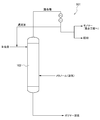
- the unreacted monomer is separated from the polymerization solution using the manufacturing apparatus (Example) of the third embodiment shown in FIG. 2 and the conventional manufacturing apparatus (Comparative Example) shown in FIG. And compared their energy efficiency.
- a polymerization liquid having a vinyl acetate concentration of 29 mass% and a polymer concentration of 54 mass% was introduced from the polymerization can into the tower body 2102 at a flow rate of 3.4 t / hour.
- liquid methanol was injected into the polymerization liquid at a flow rate of 1.0 t / hour before being introduced into the tower body 2.
- the reflux liquid was injected into the polymerization liquid at a flow rate of 3.3 t / hour before being introduced into the tower body 2.
- the amount of methanol blown was 3.4 t / hour
- the recovered polymer solution was at a flow rate of 5.2 t / hour
- the polymer concentration was 36% by mass
- the vinyl acetate residual amount was less than 1500 ppm. It was.
- the vinyl acetate concentration in the distillate was 58.6% by mass
- the total (flow rate) of the distillate reused in the polymerization step and the liquid sent to the recovery system was 1.6 t / hour.
- the amount of methanol blown was 2.4 t / hour
- the recovered polymer solution was a flow rate of 5.2 t / hour
- the vinyl acetate residual amount. was less than 1500 ppm.
- the concentration of vinyl acetate in the distillate is 58.9% by mass
- the total of the distillate reused in the polymerization process and the liquid sent to the recovery system (flow rate) is 1.6 t / hr.
- the returned reflux liquid was 1.5 t / hour.
- the amount of methanol vapor blown can be reduced, so that the energy required to generate methanol vapor can be reduced, and efficient desorption can be achieved. It was confirmed that the monomer treatment was possible.
Landscapes
- Chemical & Material Sciences (AREA)
- Health & Medical Sciences (AREA)
- Chemical Kinetics & Catalysis (AREA)
- Medicinal Chemistry (AREA)
- Polymers & Plastics (AREA)
- Organic Chemistry (AREA)
- General Chemical & Material Sciences (AREA)
- Addition Polymer Or Copolymer, Post-Treatments, Or Chemical Modifications (AREA)
- Polymerisation Methods In General (AREA)
Abstract
Description
本発明においては、重合液に液体状のメタノールを添加しているため、メタノール蒸気の吹き込み量を低減することができる。
この製造方法では、更に、重合液とメタノール蒸気との接触により生じたモノマーとメタノールとの混合物を共沸組成物まで濃縮する工程を有していてもよい。
また、前記濃縮後の溶液から、モノマーを回収することもできる。
本発明においては、塔本体に導入する重合液を、液体状のメタノールで希釈しているため、メタノール蒸気の吹き込み量を少なくしても、モノマー除去後の溶液を、そのまま鹸化反応に使用することが可能である。
この製造装置では、前記塔本体内部において、重合液とメタノール蒸気とが向流接触する。
また、前記塔本体の頂部から取り出された溜出液を共沸組成まで濃縮する濃縮部を有していてもよい。
先ず、本発明の第1の実施形態に係るポリビニルアルコール(PVA)樹脂の製造方法について説明する。本実施形態のPVAの製造方法では、重合工程後の重合液(ペースト)から未反応のモノマーを除去する脱モノマー工程において、メタノール蒸気と接触させる前に、重合液に液体状のメタノールを加えて、その濃度を調節する。
本実施形態のポリビニルアルコール樹脂の製造方法では、先ず、1種若しくは2種以上のビニルエステルを重合するか、又は、ビニルエステルとこれと共重合可能なその他のモノマーとを共重合して、ポリビニルエステルを得る。ここで使用するビニルエステルとしては、例えば、蟻酸ビニル、酢酸ビニル、プロピオン酸ビニル、バレリン酸ビニル、カプリン酸ビニル、ラウリン酸ビニル、ステアリン酸ビニル、安息香酸ビニル、ピパリン酸ビニル及びバーサチック酸ビニルなどが挙げられるが、重合安定性の観点から特に酢酸ビニルが好ましい。
次に、重合工程後の重合液(ペースト)から、未反応のモノマー(ビニルエステル及びその他のモノマー)を除去する脱モノマー工程を行う。具体的には、例えば蒸留塔内において重合液とメタノール蒸気とを向流接触させて、未反応のモノマーとメタノールとの混合物を重合液から分離する。これにより、未反応のモノマーをほとんど含まないポリマー溶液を得ることができる。
その後、脱モノマー処理したポリマー(ポリビニルエステル)溶液を、有機溶媒中において、触媒の存在下で鹸化する。ここで使用する有機溶媒としては、メタノール、エタノール、プロパノール、エチレングリコール、プロピレングリコール、グリセリン及びジエチレングリコールなどのアルコール類を使用することができるが、特に、メタノールが好ましい。
次に、本発明の第2の実施形態に係るPVA樹脂の製造装置について説明する。図1は本実施形態のPVA樹脂の製造装置の構成を模式的に示す図である。本実施形態のPVA樹脂の製造装置1は、前述した第1の実施形態のPVA樹脂製造方法を実現するものであり、図1に示すように略筒状の塔本体2を備えている。
次に、本発明の第3の実施形態に係るPVA樹脂の製造装置について説明する。図2は本実施形態のPVA樹脂の製造装置の構成を模式的に示す図である。図2に示すように、本実施形態のPVA樹脂の製造装置11には、塔本体2に加えて、塔本体2から排出したメタノールとモノマーの混合物を、共沸組成物に濃縮する濃縮部3が設けられている。この濃縮部3の構成は、特に限定されるものではないが、塔本体内に、複数のガス噴出部を備えたバルブトレイを、多段に配設した構成とすることが好ましい。
2 塔本体
3 濃縮部
Claims (6)
- 1種若しくは2種以上のビニルエステルを重合するか、又は、ビニルエステルとこれと共重合可能なその他のモノマーとを共重合する重合工程と、
該重合工程により得られた重合液にメタノール蒸気を接触させて、未反応のモノマーを除去する脱モノマー工程と、
未反応のモノマーを除去した溶液を、有機溶媒中において、アルカリ触媒の存在下で鹸化する鹸化工程と、を少なくとも有し、
前記脱モノマー工程において、重合液に液体状のメタノールを添加し、メタノール蒸気を接触させる前に、その濃度を調節するポリビニルアルコールの製造方法。 - 更に、重合液とメタノール蒸気との接触により生じたモノマーとメタノールとの混合物を共沸組成物まで濃縮する工程を有することを特徴とする請求項1に記載のポリビニルアルコールの製造方法。
- 前記濃縮後の溶液から、モノマーを回収することを特徴とする請求項2に記載のポリビニルアルコールの製造方法。
- 塔本体と、
重合液にメタノールを添加するメタノール導入配管を備え、前記塔本体上部に重合液を導入する重合液導入機構と、
前記塔本体下部にメタノール蒸気を導入するメタノール蒸気導入機構と、を有し、
メタノールで希釈された重合液が前記塔本体に導入されるポリビニルアルコールの製造装置。 - 前記塔本体内部において、重合液とメタノール蒸気とが向流接触することを特徴とする請求項4に記載のポリビニルアルコールの製造装置。
- 更に、前記塔本体の頂部から取り出された溜出液を濃縮する濃縮部を有することを特徴とする請求項4又は5に記載のポリビニルアルコールの製造装置。
Priority Applications (5)
| Application Number | Priority Date | Filing Date | Title |
|---|---|---|---|
| JP2012505453A JP5758879B2 (ja) | 2010-03-18 | 2010-12-06 | ポリビニルアルコールの製造方法及び製造装置 |
| EP10847992.4A EP2548899A4 (en) | 2010-03-18 | 2010-12-06 | METHOD OF MANUFACTURING AND PRODUCING DEVICE FOR POLYVINYL ALCOHOL |
| SG2012067864A SG184049A1 (en) | 2010-03-18 | 2010-12-06 | Production method and production device for polyvinyl alcohol |
| CN201080065470.6A CN102812055B (zh) | 2010-03-18 | 2010-12-06 | 聚乙烯醇的制造方法及制造装置 |
| US13/634,313 US20130005905A1 (en) | 2010-03-18 | 2010-12-06 | Production method and production device for polyvinyl alcohol |
Applications Claiming Priority (2)
| Application Number | Priority Date | Filing Date | Title |
|---|---|---|---|
| JP2010-061808 | 2010-03-18 | ||
| JP2010061808 | 2010-03-18 |
Publications (1)
| Publication Number | Publication Date |
|---|---|
| WO2011114586A1 true WO2011114586A1 (ja) | 2011-09-22 |
Family
ID=44648704
Family Applications (1)
| Application Number | Title | Priority Date | Filing Date |
|---|---|---|---|
| PCT/JP2010/071793 Ceased WO2011114586A1 (ja) | 2010-03-18 | 2010-12-06 | ポリビニルアルコールの製造方法及び製造装置 |
Country Status (7)
| Country | Link |
|---|---|
| US (1) | US20130005905A1 (ja) |
| EP (1) | EP2548899A4 (ja) |
| JP (1) | JP5758879B2 (ja) |
| CN (1) | CN102812055B (ja) |
| SG (2) | SG10201502112VA (ja) |
| TW (1) | TW201132659A (ja) |
| WO (1) | WO2011114586A1 (ja) |
Families Citing this family (4)
| Publication number | Priority date | Publication date | Assignee | Title |
|---|---|---|---|---|
| CN106117399B (zh) * | 2016-08-17 | 2019-02-26 | 中国石化长城能源化工(宁夏)有限公司 | 一种pva多品种聚合系统生产装置 |
| CN106084099B (zh) * | 2016-08-17 | 2018-09-04 | 中国石化长城能源化工(宁夏)有限公司 | 一种有效降低聚合精馏能耗和提高操作稳定性的系统装置 |
| CN110590975A (zh) * | 2018-06-12 | 2019-12-20 | 武汉武药科技有限公司 | 一种药用聚乙烯醇及其制备方法 |
| CN115990440A (zh) * | 2021-10-19 | 2023-04-21 | 中国石油化工股份有限公司 | 一种高聚合度PVAc凝胶加工系统 |
Citations (6)
| Publication number | Priority date | Publication date | Assignee | Title |
|---|---|---|---|---|
| JPH0323589B2 (ja) | 1986-11-21 | 1991-03-29 | Exxon Research Engineering Co | |
| JPH03287631A (ja) * | 1990-04-05 | 1991-12-18 | Kuraray Co Ltd | ポリビニルアルコール系フイルムの製法および偏光フイルムの製法 |
| JPH0987320A (ja) * | 1995-09-20 | 1997-03-31 | Shin Etsu Chem Co Ltd | ビニルエステル系重合体組成物からの単量体除去方法及び装置 |
| JP2002012617A (ja) * | 2000-06-29 | 2002-01-15 | Kuraray Co Ltd | エチレン−酢酸ビニル共重合体およびそのケン化物の製造方法 |
| JP2002293823A (ja) | 2001-03-30 | 2002-10-09 | Unitika Chem Co Ltd | 環状カーボネート基含有ビニルアルコール系重合体の製造方法 |
| JP2007245432A (ja) | 2006-03-14 | 2007-09-27 | Japan Vam & Poval Co Ltd | 樹脂の洗浄方法およびその方法により洗浄された樹脂 |
Family Cites Families (10)
| Publication number | Priority date | Publication date | Assignee | Title |
|---|---|---|---|---|
| US3560461A (en) * | 1965-12-04 | 1971-02-02 | Kurashiki Rayon Co | Method of saponifying vinyl acetate copolymers |
| US3513142A (en) * | 1969-03-07 | 1970-05-19 | Du Pont | Production of polyvinyl alcohol of improved color by oxygen purge |
| US5310790A (en) * | 1986-08-01 | 1994-05-10 | Kuraray Co. Ltd. | Process for producing polyvinyl ester having a high degree of polymerization and process for producing polyvinyl alcohol having a high degree of polymerization |
| US5292804A (en) * | 1991-09-23 | 1994-03-08 | Air Products And Chemicals, Inc. | Separation of azeotropes in poly(vinyl alcohol) process |
| CA2179555C (en) * | 1995-06-26 | 2007-02-20 | Takeshi Moritani | Process for producing vinyl acetate polymer and saponified product of vinyl acetate polymer and resin composition |
| CA2399167C (en) * | 2001-09-03 | 2008-03-18 | Kuraray Co., Ltd. | Ethylene-vinyl alcohol copolymer composition, and powdery coating composition comprising it |
| WO2007122706A1 (ja) * | 2006-04-19 | 2007-11-01 | The Nippon Synthetic Chemical Industry Co., Ltd. | ポリビニルアルコール系樹脂及びその用途 |
| US7838609B2 (en) * | 2007-02-21 | 2010-11-23 | The Nippon Synthetic Chemical Industry Co., Ltd. | Polyvinyl alcohol type resin, monolayer film and laminate |
| CN101240048A (zh) * | 2007-12-20 | 2008-08-13 | 四川大学 | 低结晶性聚乙烯醇的制备 |
| JP5479752B2 (ja) * | 2008-02-19 | 2014-04-23 | 株式会社クラレ | ビニルアルコール系重合体およびその製造方法 |
-
2010
- 2010-12-06 CN CN201080065470.6A patent/CN102812055B/zh active Active
- 2010-12-06 JP JP2012505453A patent/JP5758879B2/ja active Active
- 2010-12-06 US US13/634,313 patent/US20130005905A1/en not_active Abandoned
- 2010-12-06 WO PCT/JP2010/071793 patent/WO2011114586A1/ja not_active Ceased
- 2010-12-06 EP EP10847992.4A patent/EP2548899A4/en not_active Withdrawn
- 2010-12-06 SG SG10201502112VA patent/SG10201502112VA/en unknown
- 2010-12-06 SG SG2012067864A patent/SG184049A1/en unknown
- 2010-12-22 TW TW099145311A patent/TW201132659A/zh unknown
Patent Citations (6)
| Publication number | Priority date | Publication date | Assignee | Title |
|---|---|---|---|---|
| JPH0323589B2 (ja) | 1986-11-21 | 1991-03-29 | Exxon Research Engineering Co | |
| JPH03287631A (ja) * | 1990-04-05 | 1991-12-18 | Kuraray Co Ltd | ポリビニルアルコール系フイルムの製法および偏光フイルムの製法 |
| JPH0987320A (ja) * | 1995-09-20 | 1997-03-31 | Shin Etsu Chem Co Ltd | ビニルエステル系重合体組成物からの単量体除去方法及び装置 |
| JP2002012617A (ja) * | 2000-06-29 | 2002-01-15 | Kuraray Co Ltd | エチレン−酢酸ビニル共重合体およびそのケン化物の製造方法 |
| JP2002293823A (ja) | 2001-03-30 | 2002-10-09 | Unitika Chem Co Ltd | 環状カーボネート基含有ビニルアルコール系重合体の製造方法 |
| JP2007245432A (ja) | 2006-03-14 | 2007-09-27 | Japan Vam & Poval Co Ltd | 樹脂の洗浄方法およびその方法により洗浄された樹脂 |
Also Published As
| Publication number | Publication date |
|---|---|
| JPWO2011114586A1 (ja) | 2013-06-27 |
| JP5758879B2 (ja) | 2015-08-05 |
| SG184049A1 (en) | 2012-10-30 |
| CN102812055A (zh) | 2012-12-05 |
| TW201132659A (en) | 2011-10-01 |
| US20130005905A1 (en) | 2013-01-03 |
| SG10201502112VA (en) | 2015-05-28 |
| CN102812055B (zh) | 2017-05-24 |
| EP2548899A1 (en) | 2013-01-23 |
| EP2548899A4 (en) | 2014-11-26 |
Similar Documents
| Publication | Publication Date | Title |
|---|---|---|
| US9074031B2 (en) | Method for producing polyvinyl alcohol resin | |
| JP5758879B2 (ja) | ポリビニルアルコールの製造方法及び製造装置 | |
| CN104130215B (zh) | 双氧水直接氧化丙烯连续生产环氧丙烷的方法 | |
| US20240384012A1 (en) | Preparation Method for Ethylene-Vinyl Alcohol Copolymer | |
| CN103619428A (zh) | 处理来自乙酸乙烯酯和乙烯在水介质中聚合的废水和废气冷凝物的方法 | |
| CN107597187A (zh) | 连续生产(甲基)丙烯酸羟基酯和(甲基)丙烯酸二酯的方法及磺酸树脂催化剂 | |
| US9022362B2 (en) | Residual monomer elimination device and polyvinyl alcohol resin production method | |
| KR20230096896A (ko) | 에틸렌-비닐알코올 공중합체의 제조 방법 | |
| CN115872952B (zh) | 一种甲基丙烯酸缩水甘油酯的制备方法和系统 | |
| CN114195957B (zh) | 一种聚合物多元醇的制备方法 | |
| CN106084099A (zh) | 一种有效降低聚合精馏能耗和提高操作稳定性的系统 | |
| CN204661592U (zh) | 一种高产出的evoh连续制备系统 | |
| CN111269095B (zh) | 一种乙二醇叔丁基醚的精制方法及系统 | |
| CN105732360B (zh) | 一种用于丙烯酸单体精制的阻聚剂 | |
| EP2031013B1 (en) | Process for producing hydrous composition of ethylene/vinyl alcohol copolymer | |
| CN219050351U (zh) | 一种副产高纯度甲缩醛的mma分离系统 | |
| KR20250149750A (ko) | 에틸렌계 중합체 및 에틸렌계 중합체의 제조 방법 | |
| JP2015520135A (ja) | メタクリル酸及びその誘導体の生成のための方法及びそれから生成されるポリマー | |
| CN115594586A (zh) | 一种甲基丙烯醛氧化酯化反应产物的分离方法 | |
| CN109503336B (zh) | 一种处理不合格物料DMMn物料的设备及方法 | |
| CN109467501B (zh) | 聚乙烯醇母液回收单元中醋酸精制及共沸剂再生工艺和装置 | |
| CN120054366A (zh) | 提高丙烯酸丁酯收率的系统和方法 | |
| CN121627509A (zh) | 一种连续化反应精馏制备含双键的烯基酯的方法和系统 | |
| CN120094236A (zh) | 一种环己酮生产中回收利用重油的系统及方法 | |
| CN116568712A (zh) | 回收乙烯基酯-乙烯共聚物的制备中的残余单体的方法 |
Legal Events
| Date | Code | Title | Description |
|---|---|---|---|
| WWE | Wipo information: entry into national phase |
Ref document number: 201080065470.6 Country of ref document: CN |
|
| 121 | Ep: the epo has been informed by wipo that ep was designated in this application |
Ref document number: 10847992 Country of ref document: EP Kind code of ref document: A1 |
|
| WWE | Wipo information: entry into national phase |
Ref document number: 2012505453 Country of ref document: JP |
|
| WWE | Wipo information: entry into national phase |
Ref document number: 13634313 Country of ref document: US |
|
| NENP | Non-entry into the national phase |
Ref country code: DE |
|
| WWE | Wipo information: entry into national phase |
Ref document number: 2010847992 Country of ref document: EP |