WO2011122503A1 - ステンレス箔およびその箔を用いた排ガス浄化装置用触媒担体 - Google Patents
ステンレス箔およびその箔を用いた排ガス浄化装置用触媒担体 Download PDFInfo
- Publication number
- WO2011122503A1 WO2011122503A1 PCT/JP2011/057489 JP2011057489W WO2011122503A1 WO 2011122503 A1 WO2011122503 A1 WO 2011122503A1 JP 2011057489 W JP2011057489 W JP 2011057489W WO 2011122503 A1 WO2011122503 A1 WO 2011122503A1
- Authority
- WO
- WIPO (PCT)
- Prior art keywords
- less
- foil
- stainless steel
- content
- exhaust gas
- Prior art date
- Legal status (The legal status is an assumption and is not a legal conclusion. Google has not performed a legal analysis and makes no representation as to the accuracy of the status listed.)
- Ceased
Links
Images


Classifications
-
- B—PERFORMING OPERATIONS; TRANSPORTING
- B23—MACHINE TOOLS; METAL-WORKING NOT OTHERWISE PROVIDED FOR
- B23K—SOLDERING OR UNSOLDERING; WELDING; CLADDING OR PLATING BY SOLDERING OR WELDING; CUTTING BY APPLYING HEAT LOCALLY, e.g. FLAME CUTTING; WORKING BY LASER BEAM
- B23K1/00—Soldering, e.g. brazing, or unsoldering
- B23K1/0008—Soldering, e.g. brazing, or unsoldering specially adapted for particular articles or work
- B23K1/0014—Brazing of honeycomb sandwich structures
-
- B—PERFORMING OPERATIONS; TRANSPORTING
- B01—PHYSICAL OR CHEMICAL PROCESSES OR APPARATUS IN GENERAL
- B01D—SEPARATION
- B01D53/00—Separation of gases or vapours; Recovering vapours of volatile solvents from gases; Chemical or biological purification of waste gases, e.g. engine exhaust gases, smoke, fumes, flue gases, aerosols
- B01D53/34—Chemical or biological purification of waste gases
- B01D53/92—Chemical or biological purification of waste gases of engine exhaust gases
- B01D53/94—Chemical or biological purification of waste gases of engine exhaust gases by catalytic processes
-
- B—PERFORMING OPERATIONS; TRANSPORTING
- B01—PHYSICAL OR CHEMICAL PROCESSES OR APPARATUS IN GENERAL
- B01J—CHEMICAL OR PHYSICAL PROCESSES, e.g. CATALYSIS OR COLLOID CHEMISTRY; THEIR RELEVANT APPARATUS
- B01J35/00—Catalysts, in general, characterised by their form or physical properties
- B01J35/30—Catalysts, in general, characterised by their form or physical properties characterised by their physical properties
- B01J35/391—Physical properties of the active metal ingredient
- B01J35/395—Thickness of the active catalytic layer
-
- B—PERFORMING OPERATIONS; TRANSPORTING
- B01—PHYSICAL OR CHEMICAL PROCESSES OR APPARATUS IN GENERAL
- B01J—CHEMICAL OR PHYSICAL PROCESSES, e.g. CATALYSIS OR COLLOID CHEMISTRY; THEIR RELEVANT APPARATUS
- B01J35/00—Catalysts, in general, characterised by their form or physical properties
- B01J35/50—Catalysts, in general, characterised by their form or physical properties characterised by their shape or configuration
- B01J35/58—Fabrics or filaments
- B01J35/59—Membranes
-
- B—PERFORMING OPERATIONS; TRANSPORTING
- B23—MACHINE TOOLS; METAL-WORKING NOT OTHERWISE PROVIDED FOR
- B23K—SOLDERING OR UNSOLDERING; WELDING; CLADDING OR PLATING BY SOLDERING OR WELDING; CUTTING BY APPLYING HEAT LOCALLY, e.g. FLAME CUTTING; WORKING BY LASER BEAM
- B23K11/00—Resistance welding; Severing by resistance heating
- B23K11/002—Resistance welding; Severing by resistance heating specially adapted for particular articles or work
- B23K11/0093—Welding of honeycomb sandwich structures
-
- B—PERFORMING OPERATIONS; TRANSPORTING
- B23—MACHINE TOOLS; METAL-WORKING NOT OTHERWISE PROVIDED FOR
- B23K—SOLDERING OR UNSOLDERING; WELDING; CLADDING OR PLATING BY SOLDERING OR WELDING; CUTTING BY APPLYING HEAT LOCALLY, e.g. FLAME CUTTING; WORKING BY LASER BEAM
- B23K20/00—Non-electric welding by applying impact or other pressure, with or without the application of heat, e.g. cladding or plating
- B23K20/02—Non-electric welding by applying impact or other pressure, with or without the application of heat, e.g. cladding or plating by means of a press ; Diffusion bonding
- B23K20/023—Thermo-compression bonding
-
- C—CHEMISTRY; METALLURGY
- C21—METALLURGY OF IRON
- C21D—MODIFYING THE PHYSICAL STRUCTURE OF FERROUS METALS; GENERAL DEVICES FOR HEAT TREATMENT OF FERROUS OR NON-FERROUS METALS OR ALLOYS; MAKING METAL MALLEABLE, e.g. BY DECARBURISATION OR TEMPERING
- C21D6/00—Heat treatment of ferrous alloys
- C21D6/002—Heat treatment of ferrous alloys containing Cr
-
- C—CHEMISTRY; METALLURGY
- C22—METALLURGY; FERROUS OR NON-FERROUS ALLOYS; TREATMENT OF ALLOYS OR NON-FERROUS METALS
- C22C—ALLOYS
- C22C38/00—Ferrous alloys, e.g. steel alloys
- C22C38/001—Ferrous alloys, e.g. steel alloys containing N
-
- C—CHEMISTRY; METALLURGY
- C22—METALLURGY; FERROUS OR NON-FERROUS ALLOYS; TREATMENT OF ALLOYS OR NON-FERROUS METALS
- C22C—ALLOYS
- C22C38/00—Ferrous alloys, e.g. steel alloys
- C22C38/002—Ferrous alloys, e.g. steel alloys containing In, Mg, or other elements not provided for in one single group C22C38/001 - C22C38/60
-
- C—CHEMISTRY; METALLURGY
- C22—METALLURGY; FERROUS OR NON-FERROUS ALLOYS; TREATMENT OF ALLOYS OR NON-FERROUS METALS
- C22C—ALLOYS
- C22C38/00—Ferrous alloys, e.g. steel alloys
- C22C38/004—Very low carbon steels, i.e. having a carbon content of less than 0,01%
-
- C—CHEMISTRY; METALLURGY
- C22—METALLURGY; FERROUS OR NON-FERROUS ALLOYS; TREATMENT OF ALLOYS OR NON-FERROUS METALS
- C22C—ALLOYS
- C22C38/00—Ferrous alloys, e.g. steel alloys
- C22C38/005—Ferrous alloys, e.g. steel alloys containing rare earths, i.e. Sc, Y, Lanthanides
-
- C—CHEMISTRY; METALLURGY
- C22—METALLURGY; FERROUS OR NON-FERROUS ALLOYS; TREATMENT OF ALLOYS OR NON-FERROUS METALS
- C22C—ALLOYS
- C22C38/00—Ferrous alloys, e.g. steel alloys
- C22C38/02—Ferrous alloys, e.g. steel alloys containing silicon
-
- C—CHEMISTRY; METALLURGY
- C22—METALLURGY; FERROUS OR NON-FERROUS ALLOYS; TREATMENT OF ALLOYS OR NON-FERROUS METALS
- C22C—ALLOYS
- C22C38/00—Ferrous alloys, e.g. steel alloys
- C22C38/04—Ferrous alloys, e.g. steel alloys containing manganese
-
- C—CHEMISTRY; METALLURGY
- C22—METALLURGY; FERROUS OR NON-FERROUS ALLOYS; TREATMENT OF ALLOYS OR NON-FERROUS METALS
- C22C—ALLOYS
- C22C38/00—Ferrous alloys, e.g. steel alloys
- C22C38/06—Ferrous alloys, e.g. steel alloys containing aluminium
-
- C—CHEMISTRY; METALLURGY
- C22—METALLURGY; FERROUS OR NON-FERROUS ALLOYS; TREATMENT OF ALLOYS OR NON-FERROUS METALS
- C22C—ALLOYS
- C22C38/00—Ferrous alloys, e.g. steel alloys
- C22C38/08—Ferrous alloys, e.g. steel alloys containing nickel
-
- C—CHEMISTRY; METALLURGY
- C22—METALLURGY; FERROUS OR NON-FERROUS ALLOYS; TREATMENT OF ALLOYS OR NON-FERROUS METALS
- C22C—ALLOYS
- C22C38/00—Ferrous alloys, e.g. steel alloys
- C22C38/12—Ferrous alloys, e.g. steel alloys containing tungsten, tantalum, molybdenum, vanadium, or niobium
-
- C—CHEMISTRY; METALLURGY
- C22—METALLURGY; FERROUS OR NON-FERROUS ALLOYS; TREATMENT OF ALLOYS OR NON-FERROUS METALS
- C22C—ALLOYS
- C22C38/00—Ferrous alloys, e.g. steel alloys
- C22C38/16—Ferrous alloys, e.g. steel alloys containing copper
-
- C—CHEMISTRY; METALLURGY
- C22—METALLURGY; FERROUS OR NON-FERROUS ALLOYS; TREATMENT OF ALLOYS OR NON-FERROUS METALS
- C22C—ALLOYS
- C22C38/00—Ferrous alloys, e.g. steel alloys
- C22C38/18—Ferrous alloys, e.g. steel alloys containing chromium
- C22C38/26—Ferrous alloys, e.g. steel alloys containing chromium with niobium or tantalum
-
- C—CHEMISTRY; METALLURGY
- C22—METALLURGY; FERROUS OR NON-FERROUS ALLOYS; TREATMENT OF ALLOYS OR NON-FERROUS METALS
- C22C—ALLOYS
- C22C38/00—Ferrous alloys, e.g. steel alloys
- C22C38/18—Ferrous alloys, e.g. steel alloys containing chromium
- C22C38/28—Ferrous alloys, e.g. steel alloys containing chromium with titanium or zirconium
-
- C—CHEMISTRY; METALLURGY
- C22—METALLURGY; FERROUS OR NON-FERROUS ALLOYS; TREATMENT OF ALLOYS OR NON-FERROUS METALS
- C22C—ALLOYS
- C22C38/00—Ferrous alloys, e.g. steel alloys
- C22C38/18—Ferrous alloys, e.g. steel alloys containing chromium
- C22C38/40—Ferrous alloys, e.g. steel alloys containing chromium with nickel
- C22C38/44—Ferrous alloys, e.g. steel alloys containing chromium with nickel with molybdenum or tungsten
-
- C—CHEMISTRY; METALLURGY
- C22—METALLURGY; FERROUS OR NON-FERROUS ALLOYS; TREATMENT OF ALLOYS OR NON-FERROUS METALS
- C22C—ALLOYS
- C22C38/00—Ferrous alloys, e.g. steel alloys
- C22C38/18—Ferrous alloys, e.g. steel alloys containing chromium
- C22C38/40—Ferrous alloys, e.g. steel alloys containing chromium with nickel
- C22C38/48—Ferrous alloys, e.g. steel alloys containing chromium with nickel with niobium or tantalum
-
- C—CHEMISTRY; METALLURGY
- C22—METALLURGY; FERROUS OR NON-FERROUS ALLOYS; TREATMENT OF ALLOYS OR NON-FERROUS METALS
- C22C—ALLOYS
- C22C38/00—Ferrous alloys, e.g. steel alloys
- C22C38/18—Ferrous alloys, e.g. steel alloys containing chromium
- C22C38/40—Ferrous alloys, e.g. steel alloys containing chromium with nickel
- C22C38/50—Ferrous alloys, e.g. steel alloys containing chromium with nickel with titanium or zirconium
-
- F—MECHANICAL ENGINEERING; LIGHTING; HEATING; WEAPONS; BLASTING
- F01—MACHINES OR ENGINES IN GENERAL; ENGINE PLANTS IN GENERAL; STEAM ENGINES
- F01N—GAS-FLOW SILENCERS OR EXHAUST APPARATUS FOR MACHINES OR ENGINES IN GENERAL; GAS-FLOW SILENCERS OR EXHAUST APPARATUS FOR INTERNAL-COMBUSTION ENGINES
- F01N3/00—Exhaust or silencing apparatus having means for purifying, rendering innocuous, or otherwise treating exhaust
- F01N3/08—Exhaust or silencing apparatus having means for purifying, rendering innocuous, or otherwise treating exhaust for rendering innocuous
- F01N3/10—Exhaust or silencing apparatus having means for purifying, rendering innocuous, or otherwise treating exhaust for rendering innocuous by thermal or catalytic conversion of noxious components of exhaust
- F01N3/24—Exhaust or silencing apparatus having means for purifying, rendering innocuous, or otherwise treating exhaust for rendering innocuous by thermal or catalytic conversion of noxious components of exhaust characterised by constructional aspects of converting apparatus
- F01N3/28—Construction of catalytic reactors
- F01N3/2803—Construction of catalytic reactors characterised by structure, by material or by manufacturing of catalyst support
-
- B—PERFORMING OPERATIONS; TRANSPORTING
- B01—PHYSICAL OR CHEMICAL PROCESSES OR APPARATUS IN GENERAL
- B01J—CHEMICAL OR PHYSICAL PROCESSES, e.g. CATALYSIS OR COLLOID CHEMISTRY; THEIR RELEVANT APPARATUS
- B01J37/00—Processes, in general, for preparing catalysts; Processes, in general, for activation of catalysts
- B01J37/02—Impregnation, coating or precipitation
- B01J37/0215—Coating
- B01J37/0225—Coating of metal substrates
-
- B—PERFORMING OPERATIONS; TRANSPORTING
- B23—MACHINE TOOLS; METAL-WORKING NOT OTHERWISE PROVIDED FOR
- B23K—SOLDERING OR UNSOLDERING; WELDING; CLADDING OR PLATING BY SOLDERING OR WELDING; CUTTING BY APPLYING HEAT LOCALLY, e.g. FLAME CUTTING; WORKING BY LASER BEAM
- B23K2101/00—Articles made by soldering, welding or cutting
- B23K2101/006—Vehicles
-
- B—PERFORMING OPERATIONS; TRANSPORTING
- B23—MACHINE TOOLS; METAL-WORKING NOT OTHERWISE PROVIDED FOR
- B23K—SOLDERING OR UNSOLDERING; WELDING; CLADDING OR PLATING BY SOLDERING OR WELDING; CUTTING BY APPLYING HEAT LOCALLY, e.g. FLAME CUTTING; WORKING BY LASER BEAM
- B23K2101/00—Articles made by soldering, welding or cutting
- B23K2101/02—Honeycomb structures
-
- F—MECHANICAL ENGINEERING; LIGHTING; HEATING; WEAPONS; BLASTING
- F01—MACHINES OR ENGINES IN GENERAL; ENGINE PLANTS IN GENERAL; STEAM ENGINES
- F01N—GAS-FLOW SILENCERS OR EXHAUST APPARATUS FOR MACHINES OR ENGINES IN GENERAL; GAS-FLOW SILENCERS OR EXHAUST APPARATUS FOR INTERNAL-COMBUSTION ENGINES
- F01N2330/00—Structure of catalyst support or particle filter
- F01N2330/02—Metallic plates or honeycombs, e.g. superposed or rolled-up corrugated or otherwise deformed sheet metal
-
- F—MECHANICAL ENGINEERING; LIGHTING; HEATING; WEAPONS; BLASTING
- F01—MACHINES OR ENGINES IN GENERAL; ENGINE PLANTS IN GENERAL; STEAM ENGINES
- F01N—GAS-FLOW SILENCERS OR EXHAUST APPARATUS FOR MACHINES OR ENGINES IN GENERAL; GAS-FLOW SILENCERS OR EXHAUST APPARATUS FOR INTERNAL-COMBUSTION ENGINES
- F01N2530/00—Selection of materials for tubes, chambers or housings
- F01N2530/02—Corrosion resistive metals
- F01N2530/04—Steel alloys, e.g. stainless steel
-
- F—MECHANICAL ENGINEERING; LIGHTING; HEATING; WEAPONS; BLASTING
- F01—MACHINES OR ENGINES IN GENERAL; ENGINE PLANTS IN GENERAL; STEAM ENGINES
- F01N—GAS-FLOW SILENCERS OR EXHAUST APPARATUS FOR MACHINES OR ENGINES IN GENERAL; GAS-FLOW SILENCERS OR EXHAUST APPARATUS FOR INTERNAL-COMBUSTION ENGINES
- F01N3/00—Exhaust or silencing apparatus having means for purifying, rendering innocuous, or otherwise treating exhaust
- F01N3/08—Exhaust or silencing apparatus having means for purifying, rendering innocuous, or otherwise treating exhaust for rendering innocuous
- F01N3/10—Exhaust or silencing apparatus having means for purifying, rendering innocuous, or otherwise treating exhaust for rendering innocuous by thermal or catalytic conversion of noxious components of exhaust
- F01N3/24—Exhaust or silencing apparatus having means for purifying, rendering innocuous, or otherwise treating exhaust for rendering innocuous by thermal or catalytic conversion of noxious components of exhaust characterised by constructional aspects of converting apparatus
- F01N3/28—Construction of catalytic reactors
- F01N3/2803—Construction of catalytic reactors characterised by structure, by material or by manufacturing of catalyst support
- F01N3/2807—Metal other than sintered metal
- F01N3/281—Metallic honeycomb monoliths made of stacked or rolled sheets, foils or plates
-
- Y—GENERAL TAGGING OF NEW TECHNOLOGICAL DEVELOPMENTS; GENERAL TAGGING OF CROSS-SECTIONAL TECHNOLOGIES SPANNING OVER SEVERAL SECTIONS OF THE IPC; TECHNICAL SUBJECTS COVERED BY FORMER USPC CROSS-REFERENCE ART COLLECTIONS [XRACs] AND DIGESTS
- Y10—TECHNICAL SUBJECTS COVERED BY FORMER USPC
- Y10T—TECHNICAL SUBJECTS COVERED BY FORMER US CLASSIFICATION
- Y10T428/00—Stock material or miscellaneous articles
- Y10T428/12—All metal or with adjacent metals
- Y10T428/12431—Foil or filament smaller than 6 mils
Definitions
- the present invention is used for catalyst carriers for exhaust gas purification devices such as automobiles, motorcycles, marine bikes, snowmobiles, etc., for high temperatures.
- Strength especially Young's modulus, fracture stress, deformation resistance), excellent oxidation resistance at high temperatures, and salt corrosion corrosion resistance
- Stainless steel foil salt corrosion resistance inless steel foil
- Ferritic stainless steel made of Fe-Cr-Al-based alloy has excellent oxidation resistance at high temperatures, so automobiles, motorcycles, marine bikes, motor boats, etc.
- exhaust gas purification device members for example, catalyst carriers, various sensors
- a stove for example, catalyst carriers, various sensors
- a gas burner for example, a gas burner
- a heating furnace member member of heater or electric heating element by utilizing the characteristics of high electrical resistivity, etc. It has also been used.
- Patent Document 1 discloses that instead of a conventional ceramic catalyst carrier for the purpose of downsizing and improving engine performance of a catalyst carrier for an automobile exhaust gas purification device, A metal honeycomb using a 20-100 ⁇ m thick Fe—Cr—Al stainless steel foil having excellent oxidation resistance at high temperatures is disclosed.
- the metal honeycomb is formed by alternately stacking flat stainless steel foils (flat sheets) and corrugated stainless steel foils (corrugated sheets) to form a honeycomb structure (honeycomb structure).
- a catalytic material (catalytic material) is applied to the surface of the stainless steel foil and used in an exhaust gas purification device.
- FIG. 1 shows an example of a metal honeycomb, which is a metal produced by winding a stack of flat plates 1 and corrugated plates 2 into a roll shape and fixing the outer periphery thereof with an external cylinder 3.
- the honeycomb 4 is made.
- the wall thickness of the catalyst carrier When the wall thickness of the catalyst carrier is reduced by using such a stainless steel foil, its thermal capacity is reduced, so that the catalyst can be activated in a short time from engine starting or exhaust resistance (exhaust pressure). This is effective for downsizing the catalyst carrier and improving engine performance.
- Patent Document 2 discloses that an Fe-20Cr-5Al alloy containing Zr, Hf, and a rare earth element contains Mo and W, and further contains Ni in an amount of 1 to 15% to precipitate NiAl.
- a heat resistant stainless steel foil having improved durability by improving the yield strength (strength) is disclosed.
- Patent Document 3 describes a material for low heat capacity and low exhaust pressure (low exhaust gas pressure) excellent in high-temperature strength.
- the foil thickness is less than 40 ⁇ m, and the Al amount and Cr amount are changed in accordance with the foil thickness.
- Patent Document 4 Fe-20Cr-5Al alloy containing Y misch metal (Mishmetal or mixed metals), Nb, Ta, Mo, An alloy foil for a metal carrier that contains W and has improved proof stress and oxidation resistance at high temperatures is disclosed. Further, Patent Document 5 discloses that an Fe-20Cr-5Al alloy containing La, Ce, Pr, and Nd contains a predetermined amount of Ta and Mo, W, and Nb with respect to C + N, thereby increasing the temperature. A heat-resistant stainless steel foil having improved durability and improved durability is disclosed.
- JP-A-56-96726 JP-T-2005-504176 Japanese Patent No. 3210535 (Japanese Patent Laid-Open No. 8-168680) JP 05-277380 A Japanese Patent Publication No. 06-104879
- the stainless steel foil described in Patent Document 2 contains a large amount of Ni, which is an austenite-stabilizing element, steel that is a ferrite-stabilizing element during the oxidation of the foil.
- the amount of solid solution Al decreases, and a portion of the ferrite is austenitizing, so the thermal expansion coefficient greatly changes, and the strength of the catalyst support at high temperatures In particular, there is a problem that the deformation resistance is lowered. As a result, the supported catalyst may be peeled off or the corrugated plate may be crushed.
- the stainless steel foils described in Patent Documents 3 to 5 improve the strength at high temperature by containing Nb and Ta, but have a problem that the oxidation resistance at high temperature is remarkably lowered. Further, Nb and Ta easily form oxides with Fe and Al, and these oxides deform the foil geometry in the heating process and the cooling process (high temperature). Strength reduction). Furthermore, when the stainless steel foil described in Patent Documents 2 to 5 is applied to a catalyst carrier for an exhaust gas purification device of a marine motorcycle or motor boat, salt corrosion is likely to occur due to contact with seawater or the like. There is also a problem.
- An object of the present invention is to provide a stainless steel foil having high strength at high temperature, excellent oxidation resistance at high temperature, and excellent salt corrosion resistance, and a catalyst carrier for an exhaust gas purification apparatus using the foil. .
- the present inventors have intensively studied to achieve the above object.
- the Nb and Ta contents are reduced, the Cr content is 25% by mass or more, and Mo and W. It has been found that it is effective to contain 0.5 to 6.0% by mass of at least one kind.
- the present invention has been made on the basis of such findings.
- C 0.05% or less
- Si 2.0% or less
- Mn 1.0% or less
- S 0.003% or less.
- P 0.05% or less
- Cr 25.0-35.0%
- Ni 0.05-0.30%
- Al 3.0-10.0%
- N 0.10% or less
- Ti 0.02% or less
- Nb 0.02% or less
- Ta 0.02% or less
- Zr 0.005 to 0.20%
- Mo a stainless steel foil characterized by containing at least one of W and W in a total amount of 0.5 to 6.0%, the balance being Fe and inevitable impurities.
- the stainless steel foil of the present invention it is preferable that at least one of Mo and W in total is 2.5 to 5.0% by mass. Further, in terms of mass%, Hf: 0.01 to 0.20%, mass ppm, Ca: 10 to 300 ppm and Mg: 15 to 300 ppm, or Cu: 0.03 to 1.0% are preferably contained individually or simultaneously. In other words, it is preferable to contain one or more of the following groups (A) to (C). (A) In mass%, at least one of Mo and W is 2.5 to 5.0% in total. (B) By mass%, Hf: 0.01 to 0.20%, mass ppm, Ca: 10 to 300 ppm and Mg: 15 to 300 ppm. (C) By mass%, Cu: 0.03 to 1.0%. In the stainless steel foil of this invention, it is preferable that foil thickness is 40 micrometers or more. The present invention also provides a catalyst carrier for an exhaust gas purifying apparatus characterized by using a stainless steel foil having the above component composition and foil thickness.
- the stainless steel foil of the present invention is suitable not only for catalyst carriers for exhaust gas purifying apparatuses such as automobiles, motorcycles, marine bikes, and snowmobiles, but also for other combustion gas exhaust system devices.
- the C content is 0.05% or less, preferably 0.02% or less, but more preferably reduced as much as possible.
- the Si content is 2.0% or less, preferably 1.0% or less.
- 0.05% or more is preferably contained, and more preferably 0.1% or more.
- Mn 1.0% or less
- the Mn content is 1.0% or less, preferably 0.5% or less.
- the S content is 0.003% or less, preferably 0.001% or less, but more preferably reduced.
- the P content is 0.05% or less, preferably 0.03% or less, but more preferably reduced.
- Cr 25.0-35.0% Cr is one of the most important elements in the present invention, and is an indispensable element for ensuring strength at high temperatures and salt corrosion resistance.
- the pitting corrosion potential in a 3.5% NaCl solution having a Young's modulus at 1000 ° C. of 110 GPa or more and 30 ° C. Has been found to be desirably 300 mV vs. SCE or higher.
- the Cr content 25.0% or more, compared with the Fe-20Cr-5Al alloy having a Cr content of 20% described in Patent Documents 2 to 5. It can be seen that the Young's modulus is improved by 1.1 to 1.2 times at 110 GPa or more, and the pitting potential is improved by 2 to 4 times at 300 mV vs SCE or more. When used in more severe salt damage and corrosive environments such as marine bikes and motor boats, it is desirable that the pitting potential is 400 mV vs SCE or more, in which case the Cr content is 26.0% or more. It is preferable that However, if the Cr content exceeds 35.0%, the toughness is reduced and the manufacture of the foil becomes difficult due to the decrease in workability. Therefore, the Cr content is 25.0 to 35.0%, preferably 26.0 to 32.0%. More preferably, the content is 28.0 to 32.0%.
- Ni 0.05-0.30% Since Ni has an effect of improving brazability at the time of forming the catalyst carrier, its content is set to 0.05% or more. However, when the content of Ni, which is an austenite stabilizing element, exceeds 0.30%, the solid solution Al in the foil decreases during the progress of oxidation at a high temperature, and when Cr begins to be oxidized, austenite is generated. The thermal expansion coefficient of the foil is changed, and defects such as foil constriction and breakage occur. Therefore, the Ni content is 0.05 to 0.30%, preferably 0.08 to 0.20%.
- Al 3.0 to 10.0%
- Al is an element that forms a highly protective Al 2 O 3 film on the foil surface and improves oxidation resistance at high temperatures.
- the Al content is set to 3.0 to 10.0%.
- the content is 4.5 to 6.5%.
- the N content is 0.10% or less, preferably 0.05% or less.
- Ti 0.02% or less Ti is an element that is easily oxidized. When the content exceeds 0.02%, a large amount of Ti oxide is mixed in the Al 2 O 3 film, the brazing property is remarkably lowered, and the oxidation resistance at high temperature is also lowered. Therefore, the Ti content is 0.02% or less, preferably 0.01% or less, but more preferably reduced as much as possible.
- Nb 0.02% or less If the Nb content exceeds 0.02%, an unprotected oxide layer of (Fe, Al) NbO 4 is formed, and the oxidation resistance at high temperatures is significantly reduced. To do.
- (Fe, Al) NbO 4 has a large coefficient of thermal expansion, which facilitates deformation of the foil and causes catalyst peeling. Therefore, the Nb content is 0.02% or less, preferably 0.01% or less, but more preferably reduced as much as possible.
- Ta 0.02% or less Similar to Nb, when the Ta content exceeds 0.02%, (Fe, Al) TaO 4 has no protective property, and an oxide film having a large coefficient of thermal expansion is generated. While the oxidation resistance is remarkably lowered, the deformation of the foil is promoted and the catalyst is peeled off. Therefore, the Ta content is 0.02% or less, preferably 0.01% or less, but more preferably reduced. The total content of Nb and Ta is more preferably 0.03% or less, and further preferably 0.02% or less.
- Zr 0.005 to 0.20%
- Zr combines with C and N in the steel to improve the creep characteristics.
- the toughness is improved and the workability is improved to facilitate the production of the foil.
- it concentrates in the Al 2 O 3 grain boundary in the Al 2 O 3 film to improve the oxidation resistance at high temperature, the strength at high temperature, particularly the deformation resistance.
- the Zr content needs to be 0.005% or more.
- the Zr content is 0.005 to 0.20%, preferably 0.01 to 0.05%.
- Ce 0.02% or less
- the Ce content exceeds 0.02%, a CeO-type oxide is formed at the interface between the Al 2 O 3 coating and the base steel surface, and the strength at high temperatures, particularly deformation resistance, is increased. Remarkably deteriorates and causes shape defects. Therefore, the Ce content is 0.02% or less, but it is more preferable to reduce it as much as possible.
- REM excluding Ce refers to 14 elements such as La, Nd, and Sm excluding Ce having atomic numbers 57 to 71.
- REM improves the adhesion of the Al 2 O 3 film has a very significant effect on peeling resistance improving Al 2 O 3 film in an environment that is repeatedly oxidized.
- the Al 2 O 3 columnar crystals that are produced are enlarged, the density of the oxide grain boundaries, which are the oxygen diffusion paths, is reduced, improving the resistance to oxidation at high temperatures and the strength at high temperatures, especially deformation resistance.
- the REM content excluding Ce needs to be 0.03% or more.
- the REM content excluding Ce exceeds 0.20%, the toughness is lowered, and the manufacture of the foil becomes difficult due to the lowering of workability. Therefore, the REM content excluding Ce is 0.03 to 0.20%, preferably 0.05 to 0.10%.
- At least one of Mo and W 0.5 to 6.0% in total Mo and W increase the strength at high temperature, particularly Young's modulus and breaking stress, and the life of the catalyst carrier is improved. Moreover, these elements simultaneously stabilize the Al 2 O 3 film and improve the salt damage corrosion resistance. In order to obtain such an effect, the content of at least one of Mo and W needs to be 0.5% or more in total. On the other hand, if the content of at least one of Mo and W exceeds 6.0% in total, it becomes difficult to produce a foil due to a decrease in workability. Accordingly, the total content of at least one of Mo and W is 0.5 to 6.0%, preferably 2.5 to 5.0%.
- the balance other than the above component elements is Fe and unavoidable impurities, but for the following reasons, at least of Hf: 0.01 to 0.20%, Ca: 10 to 300 ppm, and Mg: 15 to 300 ppm.
- One kind or Cu: 0.03 to 1.0% can be contained individually or simultaneously.
- Hf 0.01 to 0.20%
- Ca 10 to 300 ppm
- Mg 15 to 300 ppm
- At least one type of Hf improves the adhesion between the Al 2 O 3 film and the ground iron, and further reduces solute Al.
- the Hf content is preferably 0.01%.
- the Hf content exceeds 0.20%, it is mixed as HfO 2 in the Al 2 O 3 film to form an oxygen diffusion path, and on the contrary, the reduction of solid solution Al is accelerated by oxidation.
- Fe and an intermetallic compound are formed, and toughness is reduced. Therefore, the Hf content is preferably 0.01 to 0.20%, more preferably 0.02 to 0.10%.
- Ca and Mg have the function of improving the adhesion of the Al 2 O 3 film, like Hf.
- the Ca content is preferably 10 ppm or more and the Mg content is preferably 15 ppm or more.
- the Ca content is preferably 10 to 300 ppm, and the Mg content is preferably 15 to 300 pp. More preferably, both the Ca content and the Mg content are 20 to 100 ppm.
- Cu 0.03 to 1.0%
- Cu is an Fe-Cr-Al stainless steel foil having a Cr content of 25.0% or more and an Al content of 3.0% or more as in the present invention. It is an effective element for improving the properties. 3, C: 0.004 to 0.008%, Si: 0.15 to 0.17%, Mn: 0.12 to 0.15%, S: 0.0004 to 0.0009%, P: 0.023-0.025%, Cr: 30.2-30.7%, Ni: 0.11-0.15%, Al: 5.1-5.8%, N: 0.004-0.
- the Cu content was set to 0.03% or more. By doing so, it can be seen that the pitting potential, which is an index of salt corrosion resistance, is improved. However, if the Cu content exceeds 1.0%, it becomes difficult to produce a foil due to a decrease in workability. Therefore, the Cu content is set to 0.03 to 1.0%. Considering salt corrosion resistance and low cost, it is preferably 0.1 to 0.5%.
- the foil thickness is thinner in order to reduce the exhaust resistance.
- the catalyst carrier for the exhaust gas purifying apparatus is used in a harsher environment, and there is a risk of breakage. Therefore, the foil thickness is preferably 40 ⁇ m or more. . From the viewpoint of exhaust resistance, it is more preferable that the thickness be 110 ⁇ m or less.
- the stainless steel foil which is this invention can be manufactured with the following manufacturing methods, for example. First, a steel containing the above component composition is melted in a converter (electric converter), an electric furnace, or the like, and then secondary refined by VOD (Vacuum Oxygen Decarburization) or AOD (Argon Oxygen Decarburization). The steel slab is formed by ingot-bundling rolling or continuous casting, heated to 1050 to 1250 ° C., and then hot rolled to form a hot-rolled steel sheet. Next, the scale on the surface of the hot-rolled steel sheet is removed by pickling, shot blasting, grinding, etc., and annealing and cold rolling are repeated a plurality of times. A stainless foil having a predetermined foil thickness, for example, 40 to 110 ⁇ m is used.
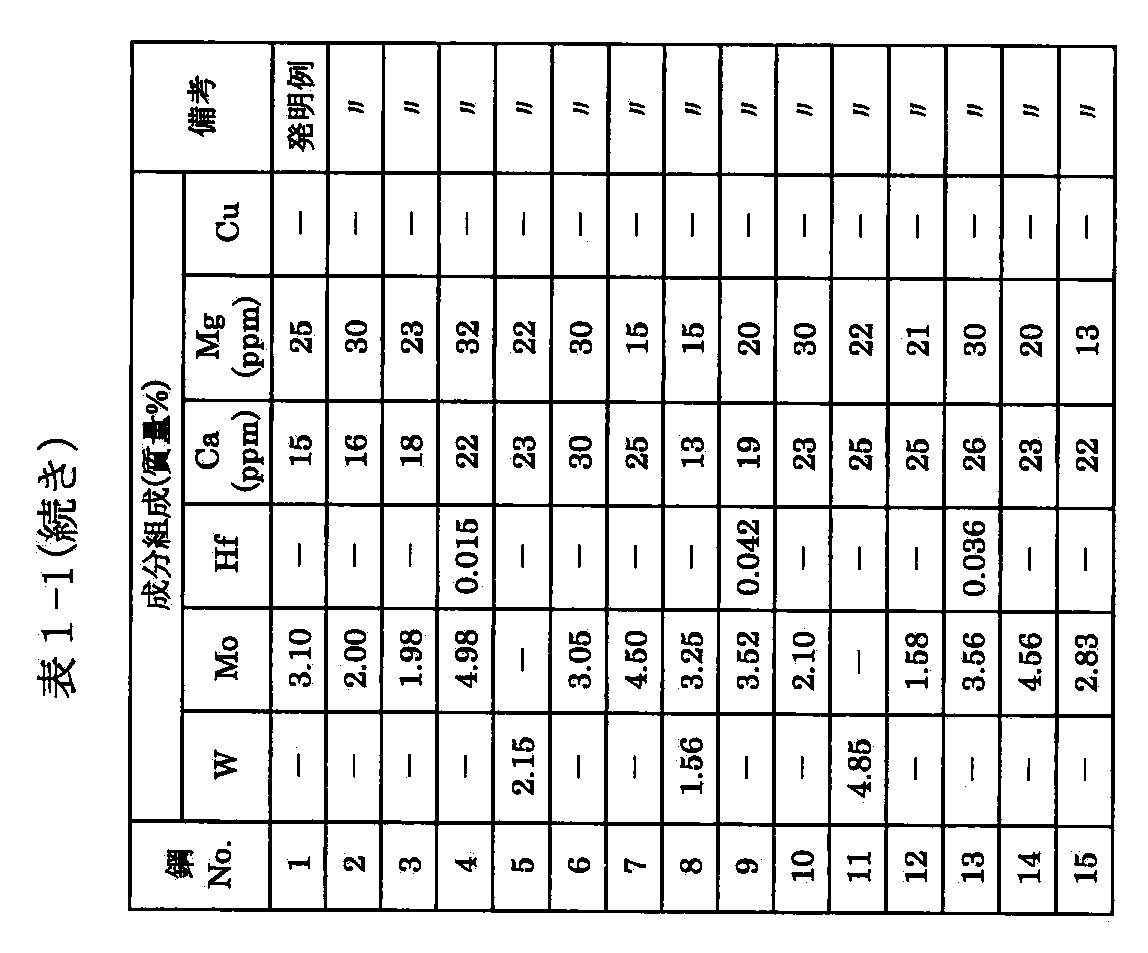
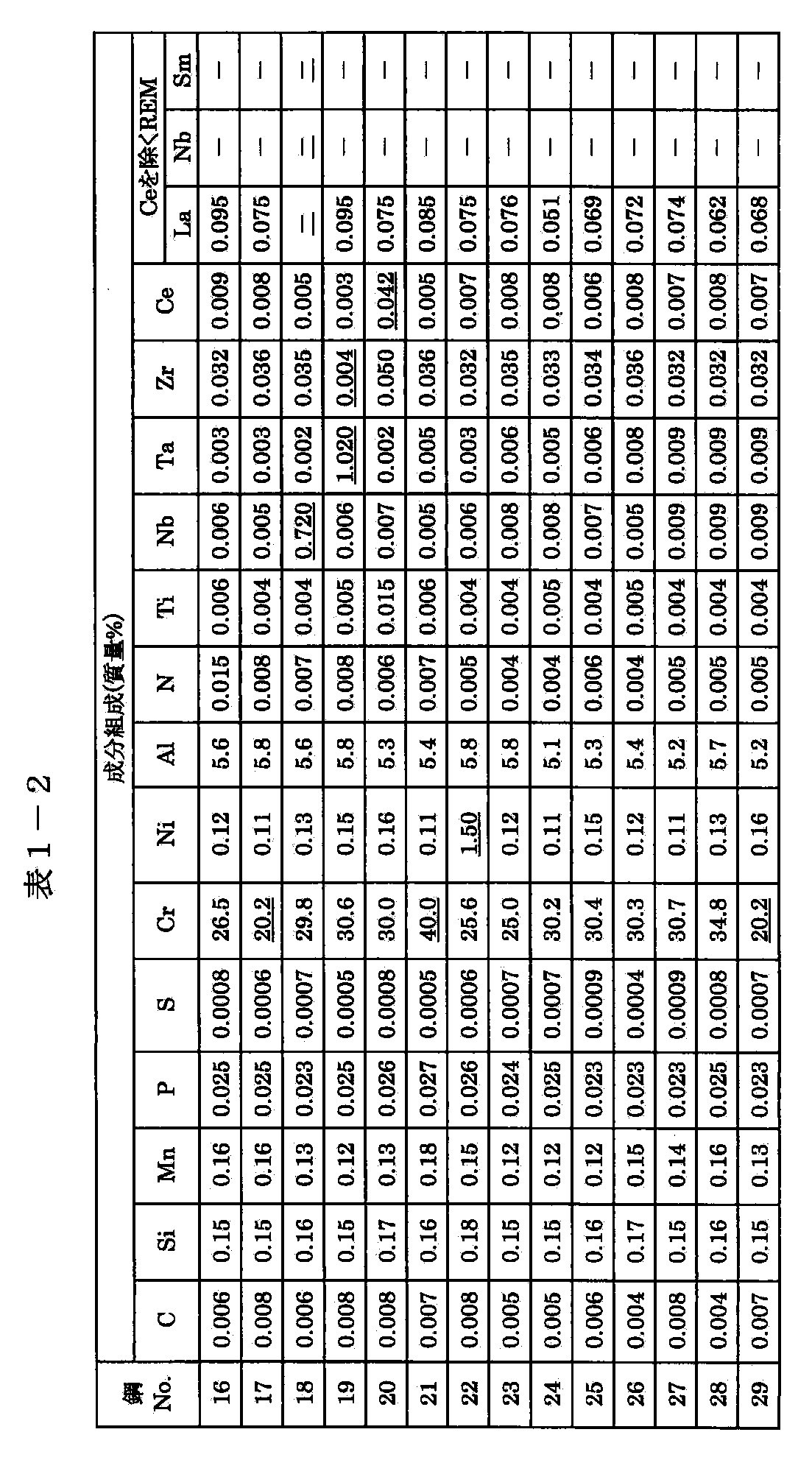
- the steel having the chemical composition shown in Table 1-1 and Table 1-2 melted by vacuum melting was heated to 1200 ° C and hot-rolled in a temperature range of 900 to 1200 ° C to obtain a thickness of 4 mm.
- a rolled steel sheet was used.
- these hot-rolled steel sheets were annealed at 1000 ° C. in the air, pickled, and then cold-rolled to obtain cold-rolled steel sheets having a thickness of 1.0 mm.
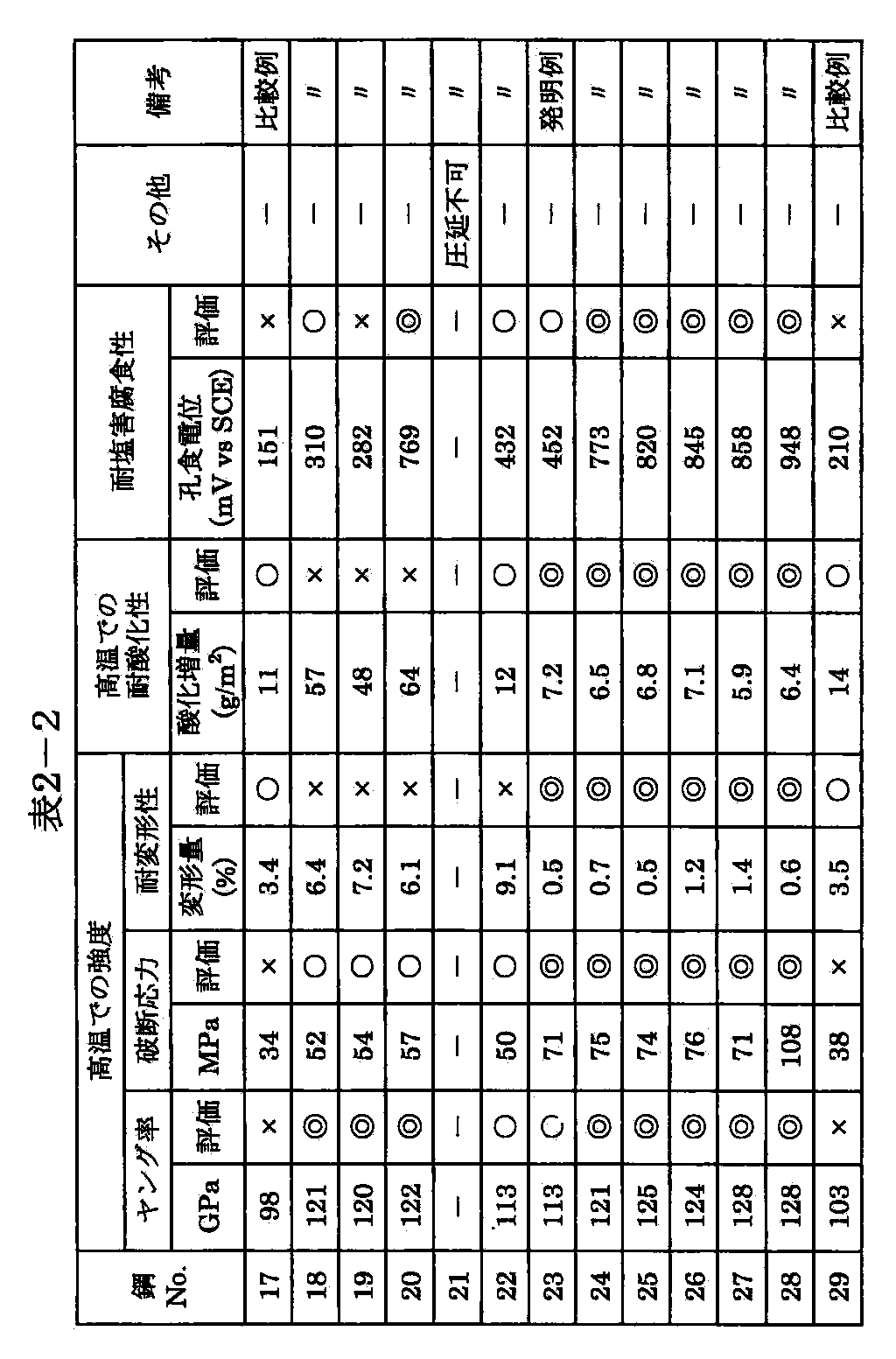
- No. 21 was cracked during hot rolling and could not be a hot rolled steel sheet.
- steel no. Cold-rolled steel sheets except for No. 21 were annealed at 950 to 1050 ° C. for 1 minute in the atmosphere, then pickled, repeated cold rolling and annealing with a cluster mill multiple times, width 100 mm, foil thickness A 40 ⁇ m foil was obtained.
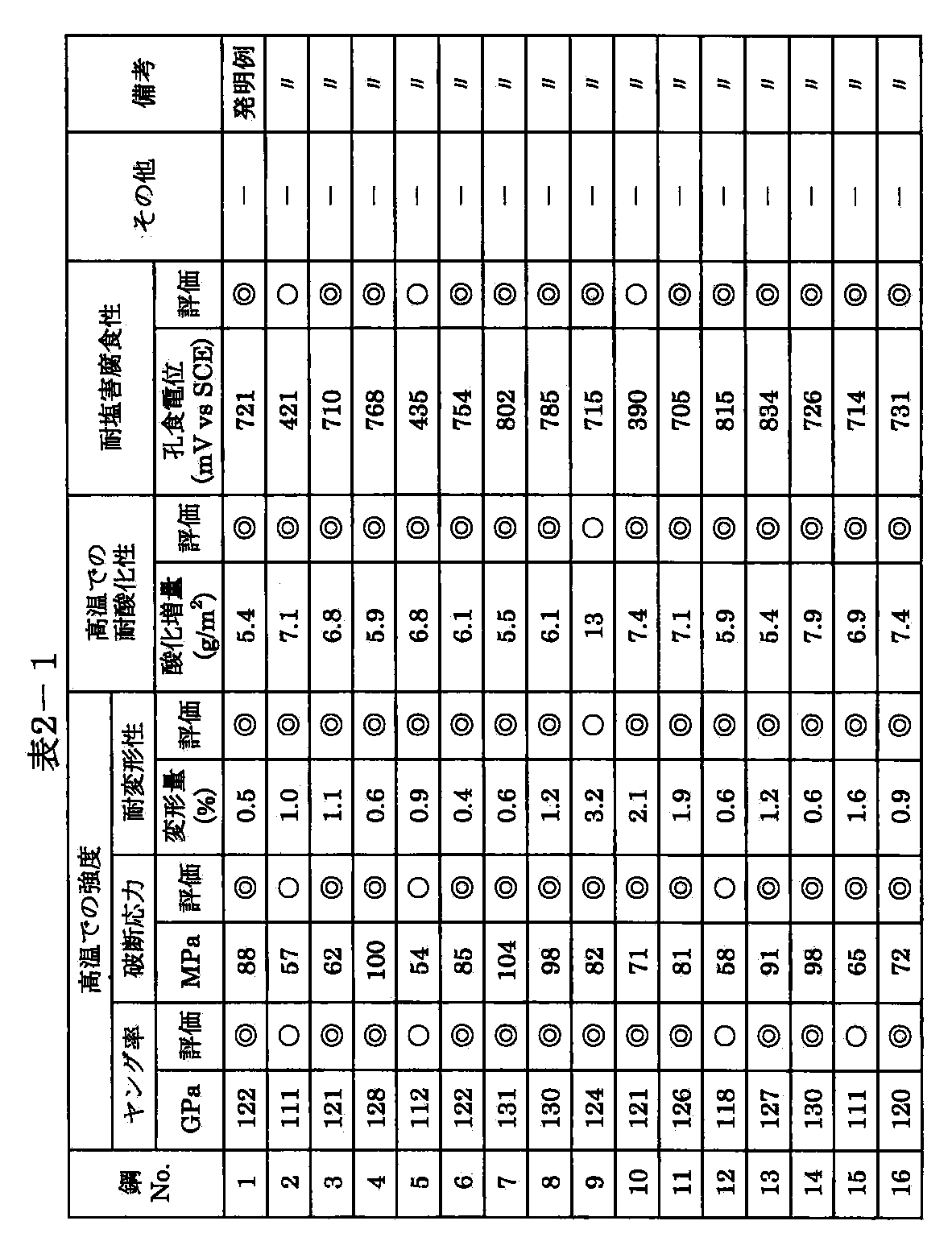
- the strength at high temperature (Young's modulus, breaking stress, deformation resistance), oxidation resistance at high temperature, and salt corrosion resistance are obtained by the following methods. evaluated.
- Young's modulus First, a hot-rolled steel sheet having a thickness of 4 mm was subjected to heat treatment at 1200 ° C. for 30 minutes as a pretreatment. This is usually about 1150 to 1250 ° C. for about 30 minutes when a honeycomb carrier is assembled into a honeycomb shape and then diffusion bonding or brazing bonding is performed on the contact between the corrugated plate (corrugated plate) and the flat plate. This is because heat treatment is performed.
- Breaking stress First, a heat treatment at 1200 ° C. for 30 minutes corresponding to the heat treatment at the time of diffusion bonding or brazing bonding was performed on a cold-rolled steel sheet having a thickness of 1 mm. Next, the test piece shown in FIG. 4 was cut out from the cold-rolled steel sheet after the heat treatment, and a high temperature tensile test was performed at 900 ° C. to measure the breaking stress. At this time, the tensile speed was initially 0.2 mm / min and 5 mm / min after exceeding the yield strength. The measurement results of the breaking stress were xC for less than 40 MPa, B for 40 MPa or more and less than 60 MPa, A for 60 MPa or more, and A or B for satisfying the object of the present invention.
- Deformation resistance First, heat treatment at 1200 ° C. for 30 minutes corresponding to heat treatment at the time of diffusion bonding or brazing bonding is applied to a foil having a thickness of 40 ⁇ m at 4 ⁇ 10 ⁇ 5 Torr (5.3 ⁇ 10 ⁇ 3 Pa) or less. In a vacuum. Next, 100 mm width ⁇ 50 mm length test pieces were rounded into a cylindrical shape with a diameter of 5 mm in the length direction from the foil after heat treatment, and three end pieces were fastened by spot welding, and three pieces were produced from each foil. After heating in an air atmosphere furnace at 1150 ° C. for 400 hours, three average dimensional deformation amounts (ratio of increment of cylinder length after heating to cylinder length before heating) were measured.
- the measurement result of the average dimensional deformation amount is over 5% ⁇ C, over 3% over 5% is ⁇ B, 3% or less is ⁇ A, and ⁇ B or ⁇ A satisfies the object of the present invention.
- Oxidation resistance at high temperature First, heat treatment at 1200 ° C. for 30 minutes corresponding to heat treatment at the time of diffusion bonding or brazing bonding was applied to a foil having a thickness of 40 ⁇ m at 4 ⁇ 10 ⁇ 5 Torr (5.3 ⁇ 10 ⁇ 3). Pa) It was performed in the following vacuum. Next, three test pieces of 20 mm width ⁇ 30 mm length were collected from the heat-treated foil and heated in an air atmosphere furnace at 1150 ° C.
- Salt corrosion resistance First, a 20 mm square test piece was cut out from a cold rolled steel sheet with a thickness of 1 mm, sealed with resin leaving a surface of 11 ⁇ 11 mm, and then passivated by dipping in 10% nitric acid. Then, the surface 10 ⁇ 10 mm portion was polished. Next, based on JIS G0577 “Method for Measuring Pitting Corrosion Potential of Stainless Steel”, the sample was left standing for 10 minutes after being immersed in a 3.5% NaCl solution at 30 ° C., and a potential scan was started to measure the pitting corrosion potential.
- the measurement results of the pitting corrosion potential are xC for less than 300 (mV vs SCE), B for 300 (mV vs SCE) to less than 700 (mV vs SCE), and A for 700 (mV vs SCE) or more. If B or ⁇ A, the object of the present invention was satisfied.
- the stainless steel foil of the present invention is suitable not only for catalyst carriers for exhaust gas purifying apparatuses such as automobiles, motorcycles, marine bikes, and snowmobiles, but also for other combustion gas exhaust system devices.
Landscapes
- Chemical & Material Sciences (AREA)
- Engineering & Computer Science (AREA)
- Mechanical Engineering (AREA)
- Materials Engineering (AREA)
- Organic Chemistry (AREA)
- Metallurgy (AREA)
- Chemical Kinetics & Catalysis (AREA)
- Crystallography & Structural Chemistry (AREA)
- Thermal Sciences (AREA)
- Physics & Mathematics (AREA)
- Combustion & Propulsion (AREA)
- Health & Medical Sciences (AREA)
- General Chemical & Material Sciences (AREA)
- Oil, Petroleum & Natural Gas (AREA)
- Analytical Chemistry (AREA)
- Environmental & Geological Engineering (AREA)
- Biomedical Technology (AREA)
- General Engineering & Computer Science (AREA)
- Toxicology (AREA)
- Catalysts (AREA)
- Heat Treatment Of Sheet Steel (AREA)
- Exhaust Gas Treatment By Means Of Catalyst (AREA)
Abstract
Description
さらに、特許文献2から5に記載のステンレス箔を、マリンバイクやモーターボートの排気ガス浄化装置用触媒担体に適用すると、海水(seawater)などとの接触により塩害腐食(salt corrosion)が発生しやすいといった問題もある。
(A)質量%で、MoおよびWのうち少なくとも一種が合計で2.5~5.0%である。
(B)質量%で、Hf:0.01~0.20%、質量ppmで、Ca:10~300ppmおよびMg:15~300ppmのうち少なくとも一種である。
(C)質量%で、Cu:0.03~1.0%である。
本発明のステンレス箔では、箔厚が40μm以上であることが好ましい。
本発明は、また、上記の成分組成や箔厚からなるステンレス箔を用いたことを特徴とする排ガス浄化装置用触媒担体を提供する。
以下に示す成分元素の含有量の単位である「%」、「ppm」は、それぞれ「質量%」、「質量ppm」を意味するものとする。
C含有量が0.05%を超えると、高温での強度が低下し、高温での耐酸化性も低下する。また、靭性の低下も招く。よって、C含有量は0.05%以下、好ましくは0.02%以下とするが、極力低減することがより好ましい。但し、鋼の強度をより向上させる場合には、0.001%以上含有させのが好ましく、より好ましくは0.003%以上含有させる。
Si含有量が2.0%を超えると、靭性が低下するとともに、加工性の低下により箔の製造を困難にする。よって、Si含有量は2.0%以下、好ましくは1.0%以下とする。但し、耐酸化性をより向上させる場合には、0.05%以上含有させるのが好ましく、より好ましくは0.1%以上含有させる。
Mn含有量が1.0%を超えると、高温での耐酸化性が低下する。また、耐塩害腐食性の低下も招く。よって、Mn含有量は1.0%以下、好ましくは0.5%以下とする。但し、鋼中のSを更に固定する必要がある場合には、0.05%以上含有させるのが好ましく、より好ましくは0.01%以上含有させる。
S含有量が0.003%を超えると、触媒担体におけるAl2O3皮膜の密着性や高温での耐酸化性が低下する。よって、S含有量は0.003%以下、好ましくは0.001%以下とするが、極力低減することがより好ましい。
P含有量が0.05%を超えると、加工性が低下して箔の製造を困難にするだけでなく、触媒担体におけるAl2O3皮膜の密着性や高温での耐酸化性が低下する。よって、P含有量は0.05%以下、好ましくは0.03%以下とするが、極力低減することがより好ましい。
Crは本発明において最も重要な元素の一つであり、高温での強度および耐塩害腐食性を確保する上で必要不可欠な元素である。本発明者らによる検討の結果、十分な高温での強度および耐塩害腐食性を確保するためには、1000℃におけるヤング率が110GPa以上、30℃の3.5%NaCl溶液中における孔食電位が300mV vs SCE以上であることが望ましいことがわかった。
Niは触媒担体成形時のロウ付け性(brazability)を向上する効果があるため、その含有量は0.05%以上とする。しかし、オーステナイト安定化元素であるNiの含有量が0.30%を超える場合は、高温での酸化進行時に箔中の固溶Alが減少し、Crが酸化され始めると、オーステナイトが生成して箔の熱膨張係数を変化させ、箔の括れ(constriction)や破断などの不具合が発生する。よって、Ni含有量は0.05~0.30%、好ましくは0.08~0.20%とする。
Alは箔表面に保護性の高いAl2O3皮膜を形成し、高温での耐酸化性を向上させる元素である。しかし、Al含有量が3.0%未満では、十分な耐酸化性が得られない。一方、Al含有量が10.0%を超えると、加工性の低下により箔の製造を困難にする。よって、Al含有量は3.0~10.0%とする。好ましくは4.5~6.5%とする。
N含有量が0.10%を超えると、靱性が低下するとともに、加工性の低下により箔の製造を困難にする。よって、N含有量は0.10%以下、好ましくは0.05%以下とする。
Tiは酸化されやすい元素である。その含有量が0.02%を超えると、Ti酸化物がAl2O3皮膜中に多量に混入し、ロウ付け性が著しく低下するとともに、高温での耐酸化性も低下する。よって、Ti含有量は0.02%以下、好ましくは0.01%以下とするが、極力低減することがより好ましい。
Nb含有量が0.02%を超えると、(Fe,Al)NbO4の保護性のない酸化皮膜(oxide layer)が生成し、高温での耐酸化性が著しく低下する。また、(Fe,Al)NbO4は熱膨張率が大きいため、箔の変形を助長し、触媒の剥離を引き起こす。よって、Nb含有量は0.02%以下、好ましくは0.01%以下とするが、極力低減することがより好ましい。
Nbと同様、Ta含有量が0.02%を超えると、(Fe,Al)TaO4の保護性がなく、熱膨張率が大きい酸化皮膜が生成し、高温での耐酸化性が著しく低下するとともに、箔の変形を助長し、触媒の剥離を引き起こす。よって、Ta含有量は0.02%以下、好ましくは0.01%以下とするが、極力低減することがより好ましい。
なお、NbとTaの総含有量は0.03%以下とすることがより好ましく、0.02%以下とすることがさらに好ましい。
Zrは鋼中のC、Nと結合し、クリープ特性を改善する。また、同時に靭性が向上するとともに、加工性が向上して箔の製造を容易にする。さらに、Al2O3皮膜中においてAl2O3粒界に濃化して高温での耐酸化性や、高温での強度、特に耐変形性を向上させる。このような効果を得るには、Zr含有量は0.005%以上とする必要がある。一方、Zr含有量が0.20%を超えると、Feなどと金属間化合物をつくり、靭性を低下させる。よって、Zr含有量は0.005~0.20%、好ましくは0.01~0.05%とする。
Ce含有量が0.02%を超えると、Al2O3皮膜と母材鋼表面との界面にCeO型の酸化物が生成し、高温での強度、特に耐変形性を著しく劣化させ、形状不良を引き起こす。よって、Ce含有量は0.02%以下とするが、極力低減することがより好ましい。
Ceを除くREMとは、La、Nd、Smなど原子番号57~71までのCeを除く14種の元素とする。一般に、REMはAl2O3皮膜の密着性を改善し、繰り返し酸化される環境下においてAl2O3皮膜の耐剥離性向上に極めて顕著な効果を有する。また、生成するAl2O3の柱状晶を大きくするので、酸素の拡散経路である酸化物粒界の密度が小さくなり、高温での耐酸化性や高温での強度、特に耐変形性を向上させる。このような効果を得るには、Ceを除くREM含有量は0.03%以上とする必要がある。一方、Ceを除くREM含有量が0.20%を超えると、靭性が低下するとともに、加工性の低下により箔の製造を困難にする。よって、Ceを除くREM含有量は0.03~0.20%、好ましくは0.05~0.10%とする。
MoおよびWは高温での強度、特にヤング率と破断応力を増大し、触媒担体の寿命が良好となる。また、これらの元素は、同時に、Al2O3皮膜を安定化させ、耐塩害腐食性を向上させる。このような効果を得るには、MoおよびWのうち少なくとも一種の含有量は合計で0.5%以上とする必要がある。一方、MoおよびWのうち少なくとも一種の含有量が合計で6.0%を超えると、加工性の低下により箔の製造を困難にする。よって、MoおよびWのうち少なくとも一種の含有量は合計で0.5~6.0%、好ましくは2.5~5.0%とする。
HfはAl2O3皮膜と地鉄の密着性を良好にし、さらに固溶Alの減少を抑制するため、高温での耐酸化性を向上させる効果がある。このような効果を得るには、Hf含有量は0.01%とすることが好ましい。一方、Hf含有量が0.20%を超えると、Al2O3皮膜中にHfO2として混入して、酸素の拡散経路となり、かえって酸化により固溶Alの減少を早める。また、Feと金属間化合物を形成し、靭性を低下させる。よって、Hf含有量は0.01~0.20%とすることが好ましく、0.02~0.10%とすることがより好ましい。
Cuは、本発明のようなCr含有量が25.0%以上、Al含有量が3.0%以上のFe−Cr−Al系ステンレス箔において、高温での耐酸化性の向上および耐塩害腐食性の改善に効果的な元素である。図3に、C:0.004~0.008%、Si:0.15~0.17%、Mn:0.12~0.15%、S:0.0004~0.0009%、P:0.023~0.025%、Cr:30.2~30.7%、Ni:0.11~0.15%、Al:5.1~5.8%、N:0.004~0.007%、Ti:0.004~0.005%、Nb:0.005~0.009%、Ta:0.005~0.009%、Zr:0.032~0.036%、Ce:0.006~0.008%、La:0.051~0.082%、Mo:2.85~3.11%、Ca:15~25ppm、Mg:15~31ppmを含有し、残部がFeおよび不可避的不純物からなる合金のCu含有量を0(但し、この0%は検出限界以下であることを示す。具体的には、0.01%未満であることを示す。)~1.00%の範囲に変えて、後述する方法により測定した30℃の3.5%NaCl溶液中における孔食電位の結果を示したが、Cu含有量を0.03%以上にすることにより、耐塩害腐食性の指標である孔食電位が向上することがわかる。
しかし、Cu含有量が1.0%を超えると、加工性の低下により箔の製造を困難にする。よって、Cu含有量は0.03~1.0%とする。耐塩害腐食性および低コストを考慮すると、0.1~0.5%とすることが好ましい。
まず、上記の成分組成を含有する鋼を、転炉(steel converter)や電気炉(electric furnace)などで溶製し、VOD(Vacuum Oxygen Decarburization)やAOD(Argon Oxygen Decarburization)で二次精錬した後、造塊−分塊圧延法や連続鋳造法(continuous casting)で鋼スラブとし、1050~1250℃に加熱後、熱間圧延(hot rolling)して熱延鋼板とする。次いで、熱延鋼板表面のスケール(scale)を酸洗(pickling)やショットブラスト(shotbrast)、研削(griding)などで除去し、焼鈍(annealing)と冷問圧延(cold rolling)を複数回繰り返し、所定の箔厚、例えば40~110μmのステンレス箔とする。
高温での耐酸化性:まず、箔厚40μmの箔に、拡散接合あるいはロウ付け接合時の熱処理に相当する1200℃×30分の熱処理を4×10⁻⁵Torr(5.3×10⁻³Pa)以下の真空中で行った。次に、熱処理後の箔より20mm幅×30mm長さの試験片を3ヶ採取し、大気雰囲気炉中で1150℃×400時間加熱して、3ヶの平均の酸化増量(加熱前後重量変化を初期の表面積で除した量)を測定した。このとき、酸化増量には、加熱後に試験片から剥離したスケールも回収し、加えた。平均の酸化増量の測定結果は、15g/m2超えを×C、10g/m2超え15g/m2以下を○B、10g/m2以下を◎Aとし、○Bあるいは◎Aであれば本発明の目的を満足するとした。
耐塩害腐食性:まず、板厚1mmの冷延鋼板より20mm角の試験片を切り出し、表面11×11mmを残して樹脂でシールした後、10%濃度の硝酸に浸漬して不動態化処理を行い、さらに表面10×10mmの部分を研磨した。次に、JIS G0577「ステンレス鋼の孔食電位測定方法」をベースに、30℃の3.5%NaCl溶液中に浸漬後10分放置し、電位走査を開始して孔食電位を測定した。孔食電位の測定結果は、300(mV vs SCE)未満を×C、300(mV vs SCE)以上700(mV vs SCE)未満を○B、700(mV vs SCE)以上を◎Aとし、○Bあるいは◎Aであれば本発明の目的を満足するとした。
2 波板
3 外筒
4 金属製ハニカム


Claims (6)
- 質量%で、C:0.05%以下、Si:2.0%以下、Mn:1.0%以下、S:0.003%以下、P:0.05%以下、Cr:25.0~35.0%、Ni:0.05~0.30%、Al:3.0~10.0%、N:0.10%以下、Ti:0.02%以下、Nb:0.02%以下、Ta:0.02%以下、Zr:0.005~0.20%、Ce:0.02%以下、Ceを除くREM:0.03~0.20%、MoおよびWのうち少なくとも一種を合計で0.5~6.0%含有し、残部がFeおよび不可避的不純物であることを特徴とするステンレス箔。
- 質量%で、MoおよびWのうち少なくとも一種が合計で2.5~5.0%であることを特徴とする請求項1に記載のステンレス箔。
- さらに、質量%で、Hf:0.01~0.20%と、質量ppmで、Ca:10~300ppmおよびMg:15~300ppmのうち少なくとも一種とを含有することを特徴とする請求項1または2に記載のステンレス箔。
- さらに、質量%で、Cu:0.03~1.0%を含有することを特徴とする請求項1~3のいずれか一項に記載のステンレス箔。
- 箔厚が40μm以上であることを特徴とする請求項1~4のいずれか一項に記載のステンレス箔。
- 請求項1~5のいずれか一項に記載のステンレス箔を用いたことを特徴とする排ガス浄化装置用触媒担体。
Priority Applications (6)
| Application Number | Priority Date | Filing Date | Title |
|---|---|---|---|
| KR1020127026048A KR101502846B1 (ko) | 2010-03-30 | 2011-03-18 | 스테인레스 박 및 그 박을 이용한 배기가스 정화 장치용 촉매 담체 |
| RU2012146123/02A RU2518873C1 (ru) | 2010-03-30 | 2011-03-18 | Фольга из нержавеющей стали и носитель катализатора для устройства очистки выхлопного газа, использующий эту фольгу |
| ES11762734.9T ES2615906T3 (es) | 2010-03-30 | 2011-03-18 | Lámina de acero inoxidable y portador de catalizador para dispositivo de purificación de gases de escape utilizando la lámina |
| CN201180015953.XA CN102822369B (zh) | 2010-03-30 | 2011-03-18 | 不锈钢箔和使用该箔的排气净化装置用催化剂载体 |
| US13/637,409 US9273382B2 (en) | 2010-03-30 | 2011-03-18 | Stainless steel foil and catalyst carrier for exhaust gas purifying device using the foil |
| EP11762734.9A EP2554700B1 (en) | 2010-03-30 | 2011-03-18 | Stainless steel foil and catalyst carrier for exhaust gas purification device using the foil |
Applications Claiming Priority (2)
| Application Number | Priority Date | Filing Date | Title |
|---|---|---|---|
| JP2010-076605 | 2010-03-30 | ||
| JP2010076605 | 2010-03-30 |
Publications (1)
| Publication Number | Publication Date |
|---|---|
| WO2011122503A1 true WO2011122503A1 (ja) | 2011-10-06 |
Family
ID=44712209
Family Applications (1)
| Application Number | Title | Priority Date | Filing Date |
|---|---|---|---|
| PCT/JP2011/057489 Ceased WO2011122503A1 (ja) | 2010-03-30 | 2011-03-18 | ステンレス箔およびその箔を用いた排ガス浄化装置用触媒担体 |
Country Status (9)
| Country | Link |
|---|---|
| US (1) | US9273382B2 (ja) |
| EP (1) | EP2554700B1 (ja) |
| JP (1) | JP5760525B2 (ja) |
| KR (1) | KR101502846B1 (ja) |
| CN (1) | CN102822369B (ja) |
| ES (1) | ES2615906T3 (ja) |
| RU (1) | RU2518873C1 (ja) |
| TW (1) | TWI479035B (ja) |
| WO (1) | WO2011122503A1 (ja) |
Families Citing this family (8)
| Publication number | Priority date | Publication date | Assignee | Title |
|---|---|---|---|---|
| JP5919711B2 (ja) * | 2011-10-04 | 2016-05-18 | Jfeスチール株式会社 | Al含有フェライト系ステンレス熱延鋼帯の製造方法およびAl含有フェライト系ステンレス熱延鋼帯、ステンレス箔、並びに、自動車排ガス浄化装置用触媒担体 |
| ES2937148T3 (es) * | 2012-02-24 | 2023-03-24 | Dsm Ip Assets Bv | Catalizador metálico pulverulento que comprende una aleación de Fe |
| CN103861656A (zh) * | 2012-12-14 | 2014-06-18 | 上海郎特汽车净化器有限公司 | 一种用于柴油机尾气碳烟捕集催化的催化剂载体 |
| US10323294B2 (en) * | 2015-08-17 | 2019-06-18 | Nippon Steel & Sumikin Materials Co., Ltd. | Austenitic stainless steel foil |
| BR102016001063B1 (pt) * | 2016-01-18 | 2021-06-08 | Amsted Maxion Fundição E Equipamentos Ferroviários S/A | liga de aço para componentes ferroviários, e processo de obtenção de uma liga de aço para componentes ferroviários |
| RU2627533C1 (ru) * | 2016-06-16 | 2017-08-08 | Юлия Алексеевна Щепочкина | Коррозионно-стойкая сталь |
| JP6562188B1 (ja) * | 2018-01-30 | 2019-08-21 | Jfeスチール株式会社 | Fe−Cr合金の製造方法 |
| EP3929322A4 (en) * | 2019-02-19 | 2022-12-07 | JFE Steel Corporation | FERRITIC STAINLESS STEEL SHEET, MANUFACTURING PROCESS THEREOF AND STAINLESS STEEL SHEET WITH AN EVAPORATED AL COATING |
Citations (8)
| Publication number | Priority date | Publication date | Assignee | Title |
|---|---|---|---|---|
| JPS5696726A (en) | 1979-11-28 | 1981-08-05 | Gen Motors Corp | Foil clad with oxide whisker and its manufacture |
| JPH05277380A (ja) | 1992-03-31 | 1993-10-26 | Nippon Steel Corp | 自動車排ガス浄化触媒高耐熱型メタル担体用Fe−Cr−Al系合金箔 |
| JPH06116686A (ja) * | 1992-10-06 | 1994-04-26 | Kawasaki Steel Corp | 耐酸化性に優れたFe−Cr−Al系合金およびその箔 |
| JPH06212363A (ja) * | 1993-01-12 | 1994-08-02 | Kawasaki Steel Corp | 高温耐酸化性および高温耐久性に優れたFe−Cr−Al系合金鋼 |
| JPH06104879B2 (ja) | 1990-09-04 | 1994-12-21 | 新日本製鐵株式会社 | 燃焼排ガス浄化触媒担体用耐熱ステンレス箔 |
| JP3210535B2 (ja) | 1994-12-20 | 2001-09-17 | 新日本製鐵株式会社 | 低熱容量・低背圧の排ガス浄化用メタル担体 |
| JP2005504176A (ja) | 2001-10-02 | 2005-02-10 | サンドビック アクティエボラーグ | 高温用途用フェライトステンレス鋼およびその箔の製造方法 |
| JP2009046718A (ja) * | 2007-08-17 | 2009-03-05 | Jfe Steel Kk | 合金箔と排気ガス浄化装置用触媒担体 |
Family Cites Families (11)
| Publication number | Priority date | Publication date | Assignee | Title |
|---|---|---|---|---|
| EP0516097B1 (en) * | 1991-05-29 | 1996-08-28 | Kawasaki Steel Corporation | Iron-chromium-aluminium alloy, catalytic substrate comprising the same and method of preparation |
| JP3335647B2 (ja) * | 1991-05-29 | 2002-10-21 | 川崎製鉄株式会社 | 耐久性に優れたFe−Cr−Al合金およびそれを用いた触媒担体 |
| JP2001164341A (ja) | 1999-12-10 | 2001-06-19 | Nippon Steel Corp | 加工部耐食性に優れた鋼 |
| JP4154932B2 (ja) * | 2002-06-14 | 2008-09-24 | Jfeスチール株式会社 | 高温強度、耐高温酸化性および耐高温塩害性に優れたフェライト系ステンレス鋼 |
| JP4198446B2 (ja) * | 2002-11-20 | 2008-12-17 | 新日鉄マテリアルズ株式会社 | ステンレス鋼板及びそれを用いてなるハニカム構造体 |
| SE527742C2 (sv) * | 2004-02-23 | 2006-05-30 | Sandvik Intellectual Property | Ferritiskt stål för högtemperaturtillämpningar, sätt att framställa detta, produkt och användning av stålet |
| SE528027C2 (sv) * | 2004-04-16 | 2006-08-08 | Sandvik Intellectual Property | Användning av ett ferritiskt stål i katalysatorer för dieselmotorer |
| DE102005016722A1 (de) * | 2004-04-28 | 2006-02-09 | Thyssenkrupp Vdm Gmbh | Eisen-Chrom-Aluminium-Legierung |
| RU2270268C1 (ru) * | 2005-02-01 | 2006-02-20 | Закрытое акционерное общество "Ижевский опытно-механический завод" | Коррозионно-стойкая сталь и изделие из нее |
| RU2288966C1 (ru) * | 2005-04-01 | 2006-12-10 | Федеральное государственное унитарное предприятие "Всероссийский научно-исследовательский институт авиационных материалов" (ФГУП "ВИАМ") | Коррозионно-стойкая сталь и изделие, выполненное из нее |
| US8921759B2 (en) * | 2012-07-26 | 2014-12-30 | Optiz, Inc. | Integrated image sensor package with liquid crystal lens |
-
2011
- 2011-03-09 JP JP2011051279A patent/JP5760525B2/ja active Active
- 2011-03-18 ES ES11762734.9T patent/ES2615906T3/es active Active
- 2011-03-18 KR KR1020127026048A patent/KR101502846B1/ko active Active
- 2011-03-18 EP EP11762734.9A patent/EP2554700B1/en active Active
- 2011-03-18 CN CN201180015953.XA patent/CN102822369B/zh active Active
- 2011-03-18 RU RU2012146123/02A patent/RU2518873C1/ru not_active IP Right Cessation
- 2011-03-18 US US13/637,409 patent/US9273382B2/en active Active
- 2011-03-18 WO PCT/JP2011/057489 patent/WO2011122503A1/ja not_active Ceased
- 2011-03-25 TW TW100110409A patent/TWI479035B/zh active
Patent Citations (8)
| Publication number | Priority date | Publication date | Assignee | Title |
|---|---|---|---|---|
| JPS5696726A (en) | 1979-11-28 | 1981-08-05 | Gen Motors Corp | Foil clad with oxide whisker and its manufacture |
| JPH06104879B2 (ja) | 1990-09-04 | 1994-12-21 | 新日本製鐵株式会社 | 燃焼排ガス浄化触媒担体用耐熱ステンレス箔 |
| JPH05277380A (ja) | 1992-03-31 | 1993-10-26 | Nippon Steel Corp | 自動車排ガス浄化触媒高耐熱型メタル担体用Fe−Cr−Al系合金箔 |
| JPH06116686A (ja) * | 1992-10-06 | 1994-04-26 | Kawasaki Steel Corp | 耐酸化性に優れたFe−Cr−Al系合金およびその箔 |
| JPH06212363A (ja) * | 1993-01-12 | 1994-08-02 | Kawasaki Steel Corp | 高温耐酸化性および高温耐久性に優れたFe−Cr−Al系合金鋼 |
| JP3210535B2 (ja) | 1994-12-20 | 2001-09-17 | 新日本製鐵株式会社 | 低熱容量・低背圧の排ガス浄化用メタル担体 |
| JP2005504176A (ja) | 2001-10-02 | 2005-02-10 | サンドビック アクティエボラーグ | 高温用途用フェライトステンレス鋼およびその箔の製造方法 |
| JP2009046718A (ja) * | 2007-08-17 | 2009-03-05 | Jfe Steel Kk | 合金箔と排気ガス浄化装置用触媒担体 |
Non-Patent Citations (1)
| Title |
|---|
| See also references of EP2554700A4 |
Also Published As
| Publication number | Publication date |
|---|---|
| RU2012146123A (ru) | 2014-05-10 |
| KR20120130013A (ko) | 2012-11-28 |
| US9273382B2 (en) | 2016-03-01 |
| EP2554700B1 (en) | 2016-11-16 |
| CN102822369A (zh) | 2012-12-12 |
| ES2615906T3 (es) | 2017-06-08 |
| TWI479035B (zh) | 2015-04-01 |
| KR101502846B1 (ko) | 2015-03-17 |
| JP2011225971A (ja) | 2011-11-10 |
| CN102822369B (zh) | 2016-01-06 |
| JP5760525B2 (ja) | 2015-08-12 |
| US20130196172A1 (en) | 2013-08-01 |
| EP2554700A1 (en) | 2013-02-06 |
| TW201202443A (en) | 2012-01-16 |
| RU2518873C1 (ru) | 2014-06-10 |
| EP2554700A4 (en) | 2015-11-04 |
Similar Documents
| Publication | Publication Date | Title |
|---|---|---|
| JP5522330B2 (ja) | フェライト系ステンレス箔 | |
| CN105431562B (zh) | 铁素体系不锈钢箔 | |
| JP5760525B2 (ja) | ステンレス箔およびその箔を用いた排ガス浄化装置用触媒担体 | |
| JP5561447B1 (ja) | ステンレス鋼板およびステンレス箔 | |
| JP5126437B1 (ja) | ステンレス箔およびその箔を用いた排ガス浄化装置用触媒担体 | |
| CN106795599B (zh) | 铁素体系不锈钢箔及其制造方法 | |
| JP6319537B1 (ja) | ステンレス鋼板およびステンレス箔 |
Legal Events
| Date | Code | Title | Description |
|---|---|---|---|
| WWE | Wipo information: entry into national phase |
Ref document number: 201180015953.X Country of ref document: CN |
|
| 121 | Ep: the epo has been informed by wipo that ep was designated in this application |
Ref document number: 11762734 Country of ref document: EP Kind code of ref document: A1 |
|
| WWE | Wipo information: entry into national phase |
Ref document number: 2739/KOLNP/2012 Country of ref document: IN |
|
| REEP | Request for entry into the european phase |
Ref document number: 2011762734 Country of ref document: EP |
|
| WWE | Wipo information: entry into national phase |
Ref document number: 2011762734 Country of ref document: EP |
|
| NENP | Non-entry into the national phase |
Ref country code: DE |
|
| ENP | Entry into the national phase |
Ref document number: 20127026048 Country of ref document: KR Kind code of ref document: A |
|
| WWE | Wipo information: entry into national phase |
Ref document number: 2012146123 Country of ref document: RU |
|
| WWE | Wipo information: entry into national phase |
Ref document number: 13637409 Country of ref document: US |