WO2011136165A1 - 糖類の分析装置及び分析方法 - Google Patents
糖類の分析装置及び分析方法 Download PDFInfo
- Publication number
- WO2011136165A1 WO2011136165A1 PCT/JP2011/060040 JP2011060040W WO2011136165A1 WO 2011136165 A1 WO2011136165 A1 WO 2011136165A1 JP 2011060040 W JP2011060040 W JP 2011060040W WO 2011136165 A1 WO2011136165 A1 WO 2011136165A1
- Authority
- WO
- WIPO (PCT)
- Prior art keywords
- column
- reducing sugar
- eluate
- boric acid
- mobile phase
- Prior art date
- Legal status (The legal status is an assumption and is not a legal conclusion. Google has not performed a legal analysis and makes no representation as to the accuracy of the status listed.)
- Ceased
Links
Images

Classifications
-
- G—PHYSICS
- G01—MEASURING; TESTING
- G01N—INVESTIGATING OR ANALYSING MATERIALS BY DETERMINING THEIR CHEMICAL OR PHYSICAL PROPERTIES
- G01N30/00—Investigating or analysing materials by separation into components using adsorption, absorption or similar phenomena or using ion-exchange, e.g. chromatography or field flow fractionation
- G01N30/02—Column chromatography
- G01N30/62—Detectors specially adapted therefor
- G01N30/74—Optical detectors
-
- G—PHYSICS
- G01—MEASURING; TESTING
- G01N—INVESTIGATING OR ANALYSING MATERIALS BY DETERMINING THEIR CHEMICAL OR PHYSICAL PROPERTIES
- G01N30/00—Investigating or analysing materials by separation into components using adsorption, absorption or similar phenomena or using ion-exchange, e.g. chromatography or field flow fractionation
- G01N30/96—Investigating or analysing materials by separation into components using adsorption, absorption or similar phenomena or using ion-exchange, e.g. chromatography or field flow fractionation using ion-exchange
-
- G—PHYSICS
- G01—MEASURING; TESTING
- G01N—INVESTIGATING OR ANALYSING MATERIALS BY DETERMINING THEIR CHEMICAL OR PHYSICAL PROPERTIES
- G01N30/00—Investigating or analysing materials by separation into components using adsorption, absorption or similar phenomena or using ion-exchange, e.g. chromatography or field flow fractionation
- G01N30/02—Column chromatography
- G01N30/88—Integrated analysis systems specially adapted therefor, not covered by a single one of the groups G01N30/04 - G01N30/86
-
- G—PHYSICS
- G01—MEASURING; TESTING
- G01N—INVESTIGATING OR ANALYSING MATERIALS BY DETERMINING THEIR CHEMICAL OR PHYSICAL PROPERTIES
- G01N21/00—Investigating or analysing materials by the use of optical means, i.e. using sub-millimetre waves, infrared, visible or ultraviolet light
- G01N21/75—Systems in which material is subjected to a chemical reaction, the progress or the result of the reaction being investigated
- G01N21/77—Systems in which material is subjected to a chemical reaction, the progress or the result of the reaction being investigated by observing the effect on a chemical indicator
- G01N2021/7769—Measurement method of reaction-produced change in sensor
- G01N2021/7786—Fluorescence
-
- G—PHYSICS
- G01—MEASURING; TESTING
- G01N—INVESTIGATING OR ANALYSING MATERIALS BY DETERMINING THEIR CHEMICAL OR PHYSICAL PROPERTIES
- G01N30/00—Investigating or analysing materials by separation into components using adsorption, absorption or similar phenomena or using ion-exchange, e.g. chromatography or field flow fractionation
- G01N30/02—Column chromatography
- G01N30/88—Integrated analysis systems specially adapted therefor, not covered by a single one of the groups G01N30/04 - G01N30/86
- G01N2030/8809—Integrated analysis systems specially adapted therefor, not covered by a single one of the groups G01N30/04 - G01N30/86 analysis specially adapted for the sample
- G01N2030/8813—Integrated analysis systems specially adapted therefor, not covered by a single one of the groups G01N30/04 - G01N30/86 analysis specially adapted for the sample biological materials
- G01N2030/8836—Integrated analysis systems specially adapted therefor, not covered by a single one of the groups G01N30/04 - G01N30/86 analysis specially adapted for the sample biological materials involving saccharides
-
- G—PHYSICS
- G01—MEASURING; TESTING
- G01N—INVESTIGATING OR ANALYSING MATERIALS BY DETERMINING THEIR CHEMICAL OR PHYSICAL PROPERTIES
- G01N21/00—Investigating or analysing materials by the use of optical means, i.e. using sub-millimetre waves, infrared, visible or ultraviolet light
- G01N21/62—Systems in which the material investigated is excited whereby it emits light or causes a change in wavelength of the incident light
- G01N21/63—Systems in which the material investigated is excited whereby it emits light or causes a change in wavelength of the incident light optically excited
- G01N21/64—Fluorescence; Phosphorescence
-
- Y—GENERAL TAGGING OF NEW TECHNOLOGICAL DEVELOPMENTS; GENERAL TAGGING OF CROSS-SECTIONAL TECHNOLOGIES SPANNING OVER SEVERAL SECTIONS OF THE IPC; TECHNICAL SUBJECTS COVERED BY FORMER USPC CROSS-REFERENCE ART COLLECTIONS [XRACs] AND DIGESTS
- Y10—TECHNICAL SUBJECTS COVERED BY FORMER USPC
- Y10T—TECHNICAL SUBJECTS COVERED BY FORMER US CLASSIFICATION
- Y10T436/00—Chemistry: analytical and immunological testing
- Y10T436/14—Heterocyclic carbon compound [i.e., O, S, N, Se, Te, as only ring hetero atom]
-
- Y—GENERAL TAGGING OF NEW TECHNOLOGICAL DEVELOPMENTS; GENERAL TAGGING OF CROSS-SECTIONAL TECHNOLOGIES SPANNING OVER SEVERAL SECTIONS OF THE IPC; TECHNICAL SUBJECTS COVERED BY FORMER USPC CROSS-REFERENCE ART COLLECTIONS [XRACs] AND DIGESTS
- Y10—TECHNICAL SUBJECTS COVERED BY FORMER USPC
- Y10T—TECHNICAL SUBJECTS COVERED BY FORMER US CLASSIFICATION
- Y10T436/00—Chemistry: analytical and immunological testing
- Y10T436/14—Heterocyclic carbon compound [i.e., O, S, N, Se, Te, as only ring hetero atom]
- Y10T436/142222—Hetero-O [e.g., ascorbic acid, etc.]
-
- Y—GENERAL TAGGING OF NEW TECHNOLOGICAL DEVELOPMENTS; GENERAL TAGGING OF CROSS-SECTIONAL TECHNOLOGIES SPANNING OVER SEVERAL SECTIONS OF THE IPC; TECHNICAL SUBJECTS COVERED BY FORMER USPC CROSS-REFERENCE ART COLLECTIONS [XRACs] AND DIGESTS
- Y10—TECHNICAL SUBJECTS COVERED BY FORMER USPC
- Y10T—TECHNICAL SUBJECTS COVERED BY FORMER US CLASSIFICATION
- Y10T436/00—Chemistry: analytical and immunological testing
- Y10T436/14—Heterocyclic carbon compound [i.e., O, S, N, Se, Te, as only ring hetero atom]
- Y10T436/142222—Hetero-O [e.g., ascorbic acid, etc.]
- Y10T436/143333—Saccharide [e.g., DNA, etc.]
Definitions
- the present invention relates to a reducing sugar separation / analysis apparatus using post-column fluorescence detection-borate complex anion exchange method and a separation / analysis method using the same, and in particular, a sample solution separated by column chromatography is heated together with a basic amino acid.
- the present invention relates to an apparatus for separating and analyzing reducing sugars by a post-column fluorescence detection-boric acid complex anion exchange method, which includes arranging a back pressure generator in a flow path between a heater to be reacted and a fluorescence detector.
- a sample containing reducing sugar is eluted by subjecting it to liquid chromatography using an aqueous solution containing boric acid as the mobile phase, and in the flow path, basic amino acids such as arginine are eluted.
- a method is known in which a boric acid aqueous solution containing is added, subjected to a heating reaction, cooled, and irradiated with excitation light to measure fluorescence intensity or absorbance (Patent Document 1).
- the apparatus used here extends the outflow path of liquid chromatography, connects the supply path of an aqueous boric acid solution containing basic amino acid to this flow path, then heats, cools, excites light irradiation equipment, And a device for measuring fluorescence intensity or the like.
- this method it is necessary to provide a supply path for adding a boric acid aqueous solution containing a basic amino acid to the eluate from liquid chromatography for reaction.
- a sample containing a reducing sugar is eluted by subjecting it to liquid chromatography using a mobile phase containing a basic amino acid such as boric acid and a reaction reagent, arginine, and the like in the flow path.
- a method is known in which the eluate is heated to react the reaction reagent and reducing sugar (heat reaction) and then cooled, and the reaction solution is irradiated with excitation light to measure fluorescence intensity or absorbance (patent) Reference 2).
- Non-Patent Document 1 This fluorescent derivative is a brown melanoidin produced by a heating reaction (Maillard reaction) between a reducing sugar and a basic amino acid, which is an amino compound, and when irradiated with light having a wavelength of 320 nm as excitation light, It emits light with a wavelength of 430 nm.
- these analytical methods for reducing sugars have the property that reducing sugars easily bind to boric acid to form anionic complex ions, and that these anionic complex ions are retained in anion exchange column chromatography. Is used.
- an aqueous solution (pH 7 to 10) containing a basic amino acid at a concentration of 0.01 to 5% and a boric acid at a concentration of 0.05 to 0.5 M is used as a mobile phase. It is done. Basic amino acids used at this time are arginine, lysine, histidine and the like. Furthermore, recently, it is also known to separate sugars using a gradient of 0.1 M borate buffer and 0.4 M borate buffer as a mobile phase for liquid chromatography (Patent Documents 3 and 4).
- Reducing sugars that can be analyzed by post-column fluorescence detection-boric acid complex anion exchange method are those that cause Maillard reaction with basic amino acids.
- Monosaccharides such as glucose, mannose, galactose, fructose, rhamnose, fucose, maltose, malto It includes oligosaccharides such as triose, amino sugars such as glucosamine and galactosamine, and uron sugars such as glucuronic acid.
- ⁇ Reducing sugars derived from glycoprotein sugar chains are examples of the analysis target of the method.
- Examples of reducing sugars constituting the sugar chain of glycoprotein include monosaccharides such as mannose, galactose, and fucose, and aminosaccharides such as galactosamine.
- the sugar chain may also contain mannose-6-phosphate (M6P).
- the object of the present invention is to remove the noise of the fluorescence detected by the fluorescence detector generated by heating and cooling the flow path in the post-column fluorescence detection-borate complex anion exchange method, It is to increase detection sensitivity.
- the present inventors in the post-column fluorescence detection-boric acid complex anion exchange method, heated a sample solution separated by column chromatography together with a basic amino acid, An attempt was made to place a back pressure generator in the flow path between the fluorescence detector. As a result, it was found that by arranging the back pressure generator, the noise of the fluorescence detected by the fluorescence detector can be removed and the detection sensitivity can be increased.
- the present invention has been completed based on these findings.
- a separation / analysis apparatus using column chromatography of reducing sugar contained in a sample solution comprising an anion exchange resin column for separating reducing sugar contained in the sample solution, and an eluate from the column
- An apparatus for separating and analyzing reducing sugar comprising: a fluorescence detector that performs the detection, and a back pressure generator installed between the heater and the fluorescence detector. 2.
- the reducing sugar separation / analysis apparatus wherein a cooling device is further provided between the heater and the back pressure generator. 3.
- the sample solution containing reducing sugar is loaded onto an anion exchange resin column, and the column is washed by passing a sufficient amount of the first mobile phase, which is an aqueous solution containing a predetermined concentration of boric acid, through the column,
- a second mobile phase which is an aqueous boric acid solution in which the concentration of boric acid or a water-soluble inorganic salt is increased as compared with the first mobile phase, is continuously supplied to the column at a predetermined flow rate to reduce the reducing sugar.
- the eluate from the column is continuously guided into the flow path, At least one basic amino acid is continuously added to the eluate at a predetermined rate;
- the mixed solution is heated by passing the eluate after the addition through a heater at a predetermined temperature in the flow path over a predetermined time, After passing the heated mixed solution through a back pressure generator, Recording the fluorescence intensity measured by subjecting the mixed solution to a fluorescence detector, A method for separating and analyzing reducing sugars using the apparatus of 1 or 2 above. 4).
- a sample solution containing reducing sugar is loaded onto an anion exchange resin column, and a sufficient amount of the first mobile phase, which is an aqueous solution containing at least one basic amino acid at a predetermined concentration and boric acid at a predetermined concentration, is applied to the column. Wash the column by passing it through,
- the second mobile phase which is a boric acid aqueous solution in which the concentration of boric acid or a water-soluble inorganic salt is increased compared to the first mobile phase, is continuously supplied to the column at a predetermined flow rate to reduce the reducing sugar.
- the eluate from the column is continuously guided into the flow path, Heating the eluate by passing the eluate through a heater at a predetermined temperature in the flow path over a predetermined time; After passing the heated eluate through a back pressure generator, Recording the fluorescence intensity measured by subjecting the eluate to a fluorescence detector, A method for separating and analyzing reducing sugars using the apparatus of 1 or 2 above. 5. The method of 3 or 4 above, wherein the reducing sugar contains mannose-6-phosphate.
- the present invention can improve detection sensitivity by removing noise in the analysis of reducing sugars by post-column fluorescence detection-borate complex anion exchange method. Therefore, according to the separation / analysis apparatus or separation / analysis method of the present invention, it is not necessary to correct the detection result using dedicated software, and it can be used as it is. Is possible.
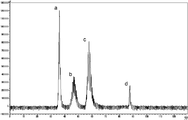
- Chromatogram showing the analysis result of reducing sugar standard solution when no back pressure generator is installed.
- the vertical axis represents the fluorescence intensity
- the horizontal axis represents the elapsed time (minutes) after completion of loading with the reducing sugar standard solution.
- the peaks from a to d correspond to a: mannose, b: fucose, c: galactose, d: M6P, respectively.
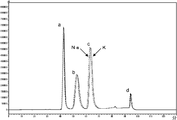
- Chromatogram (1) showing the analysis result of reducing sugar standard solution when a back pressure generator is installed. Same as above for vertical axis, horizontal axis, and peaks a to d.
- the water-soluble inorganic salt used for the preparation of Solution B is sodium chloride.
- Chromatogram (2) showing the analysis results of the reducing sugar standard solution when a back pressure generator is installed. Same as above for vertical axis, horizontal axis, and peaks a to d.
- the water-soluble inorganic salt used for the preparation of Solution B was sodium chloride (Na: broken line) and potassium chloride (K: solid line).
- aqueous boric acid solution means that a small amount of a base or basic salt as a pH adjusting agent such as sodium hydroxide (or sodium borate) is added to adjust pH appropriately. Also included.
- boric acid concentration for a boric acid aqueous solution refers to the concentration when boron in the aqueous solution is converted to boric acid (H 3 BO 3 ).
- boric acid added in the form of a salt (such as sodium borate).
- the conditions for the post-column fluorescence detection-boric acid complex anion exchange method can be set without any limitation as long as the reducing sugar can be separated and analyzed, including those described in the above prior art documents. And under the conditions shown in Table 2 (Method I and Method II).
- Method I the concentration of inorganic salt (sodium chloride) is increased over time
- method II the concentration of boric acid is increased over time.
- M6P is contained in the reducing sugar to be analyzed, M6P can be separated and analyzed particularly well by the method I shown in Table 1 or a method analogous thereto.
- both the solution A and the solution B which are mixed or independently form a mobile phase, are aqueous solutions.
- the ratio of solution B can be increased continuously or intermittently, but is preferably increased continuously, and particularly preferably linearly (ie continuously at a constant rate). To) enhanced.
- the ratio of the solution B may be increased until the reducing sugar to be analyzed is eluted.
- the first mobile phase is the first mobile phase when the chromatography is started after the loading of the sample is completed.
- the first mobile phase is an aqueous solution containing a predetermined concentration of boric acid, and may optionally contain a predetermined concentration of a water-soluble inorganic salt.
- the concentration of boric acid in the first mobile phase is preferably in the range of 50 to 150 mM.
- the concentration of the water-soluble inorganic salt in the first mobile phase is preferably in the range of 0 to 30 mM.
- the second mobile phase is a mobile phase that passes the first mobile phase through the column and then passes through the column to elute the reducing sugar from the column, and has a concentration of boric acid as compared to the first mobile phase.
- it is a mobile phase in which the concentration of the water-soluble inorganic salt is increased (in Table 2, the mobile phase in which the ratio of the solution B is increased).
- mobile phase the first mobile phase and the second mobile phase are included without distinction.
- the concentration of the inorganic salt of the mobile phase sodium chloride in the method I
- the inorganic salt used at this time is not particularly limited as long as it is a water-soluble inorganic salt (excluding borate), but is preferably a neutral salt that shows neutrality when dissolved in water, particularly sodium chloride, Potassium chloride is preferred.
- the concentration of the inorganic salt of the second mobile phase is increased as in Method I above, the concentration of boric acid in the mobile phase is determined by analysis of reducing sugar, for example, neutral reducing sugar according to the purpose.
- analysis of M6P or the like is not limited as much as possible, but it is preferably in the range of 50 to 150 mM, more preferably 75 to 125 mM, and particularly preferably about 100 mM.
- the pH of the mobile phase at that time is preferably in the range of 7.5 to 9.5, particularly preferably about 9.
- the boric acid concentration of the mobile phase when the boric acid concentration of the second mobile phase is increased as in the above-mentioned method II, the boric acid concentration of the mobile phase may be increased from 100 mM to 400 mM, but the range is the target of analysis. It can be appropriately changed according to the type of reducing sugar.
- the pH of the solution A is preferably in the range of 7.5 to 8.5, particularly preferably about 8.
- the pH of the solution B is preferably in the range of 8.5 to 9.5, particularly preferably. About nine.
- the flow rate of the mobile phase should be adjusted as appropriate according to the analytical equipment to be used, the type of reducing sugar to be analyzed, etc., so that the analytical result is good, and is generally adjusted to 0.1 to 1 mL / min. However, the flow rate of the mobile phase may be adjusted to less than 0.1 mL / min or more than 1 mL / min depending on the characteristics of the analytical instrument.
- anion exchange resin used in the anion exchange column chromatography in the present invention either a weak anion exchange resin or a strong anion exchange resin can be used, but a strong anion exchange resin is preferably used.
- elution by anion exchange column chromatography may be performed at room temperature, but it is preferable to perform the column heating by a column oven or the like. However, the heating temperature in that case is up to about 70 ° C, preferably about 65 ° C.
- the basic amino acid used in the present invention is not particularly limited, but is preferably arginine, lysine, and histidine, and particularly preferably arginine. Any one of basic amino acids may be used alone, or a plurality of basic amino acids may be used as a mixture.
- the basic amino acid can be added by using an aqueous solution containing the amino acid as a reaction reagent and injecting it into the eluate from the column flowing in the flow path.
- the basic amino acid injection rate may be appropriate as long as it is kept constant during a single analysis.
- the concentration after mixing with the eluate from the column in the flow path (final concentration) should be 0.1 to 2 w / v%, and 0.5 to 1.8 w / v%.
- the basic amino acid is preferably added by, for example, a method of injecting it into the flow path in the form of an aqueous boric acid solution containing the basic amino acid.
- the boric acid concentration in the aqueous solution may be the same as the boric acid concentration of the mobile phase, but may be different to some extent.
- the basic amino acid may be added and dissolved in the mobile phase in advance at a predetermined concentration instead of being added to the flow path as a reaction reagent later. By doing so, it is possible to omit a supply route required when a reaction reagent containing a basic amino acid is added to the eluate later.
- the concentration of the basic amino acid in the mobile phase may be adjusted to 0.1 to 2 w / v%, preferably 0.5 to 1.8 w / v%, preferably 1.0 to 1.5 w / v%. It is more preferable to adjust so that.
- the reducing sugar and the basic amino acid contained in the eluate from the column are heated in a heater to react.
- the reaction temperature during the (heating reaction) can be 140 to 180 ° C., preferably about 150 ° C.
- the reaction at this time is a Maillard reaction in which a reducing group in a sugar molecule reacts with a basic amino acid to produce a brown substance (melanoidin).
- a heater is a device having a heating area for heating the solution in the flow path to a predetermined temperature for a predetermined time, and if it has such a heating area, it can be used without any limitation as a heater. be able to.
- the heating time in the heater is not particularly limited as long as it is sufficient to cause the Maillard reaction, but it is generally 1 to 20 minutes.
- the eluate after the heating reaction in order to further reduce the noise of fluorescence detected by the fluorescence detector, it is preferable to cool the eluate after the heating reaction by passing it through a cooling device.
- the temperature of the eluate after cooling is not particularly limited as long as subsequent fluorescence intensity measurement is not hindered, but is preferably 15 ° C to 70 ° C.
- the cooling at this time can be performed by air-cooling, water-cooling, etc. of a flow path with a cooling device. Air cooling can be performed, for example, by blowing air through a flow path with a fan. In the case of water cooling, tap water may be used as it is.
- the eluate after the heating reaction can be cooled to the temperature in the column oven by passing the flow path through a cooling tank (5 in FIG. 1).
- the back pressure generator used in the present invention is installed in the flow path, and is for increasing the pressure (back pressure) of the solution in the flow path on the upstream side.
- the back pressure generator has an effect of reducing noise of fluorescence detected by the fluorescence detector in the post-column detection method.
- the back pressure generator can be used without particular limitation as long as it can generate back pressure.
- the back pressure can be generated, for example, by narrowing the flow path inside the back pressure generator.
- back pressure generator As a back pressure generator, commercially available back pressure regulator (1/16 flange type unit (4 x 1.3cm), made by SSI), back pressure regulator (BACK PRESSURE REGULATOR ASSEMBLY, WI P-763 (100 PSI) CARTRIDGE, No .U-607 (manufactured by Upchurch Scientific) can be preferably used in the present invention. These back pressure regulators are generally attached to the detector outlet and used as a device for applying a constant back pressure in the detector.
- the back pressure generator is installed in the flow path between the heater and the fluorescence detector.
- a cooling device is installed downstream of the heater, it may be installed downstream of the cooling device. preferable.
- the saccharide that can be analyzed in the present invention is a reducing sugar that causes a Maillard reaction with a basic amino acid.
- Examples include monosaccharides such as glucose, mannose, galactose, fructose, rhamnose and fucose, oligosaccharides such as maltose and maltotriose, amino sugars such as glucosamine and galactosamine, uronic acids such as glucuronic acid, and mannose-6-
- examples thereof include phosphorylated saccharides such as phosphoric acid, and in particular, monosaccharides such as mannose, galactose and fucose and phosphorylated saccharides such as mannose-6-phosphate.
- the saccharide to be analyzed is prepared as a sample solution, that is, a pre-dissolved saccharide in a predetermined concentration.
- the predetermined medium used at this time is an aqueous medium, preferably pure water or a solution having the same composition as the first mobile phase.
- D (+)-mannose 300 mg, L ( ⁇ )-fucose 100 mg and D (+)-galactose 300 mg were dissolved in pure water to make 100 mL.
- a solution obtained by diluting this aqueous solution 20 times with pure water was used as a neutral reducing sugar mixture standard solution.
- a M6P standard stock solution was prepared by dissolving 10 mg of mannose-6-phosphate sodium salt in pure water to make 5 mL.
- a reducing sugar standard solution was prepared by mixing 18 mL of a neutral reducing sugar mixture standard solution and 2.5 mL of an M6P standard stock solution and adding pure water to make 50 mL.
- reaction reagent 30 g of L-arginine and 10 g of boric acid were dissolved in pure water, the total amount was 1000 mL, and suction filtration was performed using a membrane filter of 0.22 ⁇ m or less, and the resulting solution was used as a reaction test solution.
- Example 1 Post-column fluorescence detection-borate complex anion exchange method for sugar analysis
- Equipment Shimadzu HPLC System LC-10Avp Reducing Sugar Analysis System, Shimadzu Corporation
- an anion exchange column Shim-pack ISA -07 / S2504 (4.0 mm I.D. ⁇ 250 mm, base material: polystyrene gel, stationary phase: quaternary ammonium group, Shimadzu Corporation) and Shim-pack guard column ISA as a column oven for heating this column (4.0 mm ID ⁇ 50 mm, Shimadzu Corporation) was set.
- a heat block (ALB-221, manufactured by Asahi Techno Glass) was set as a heater downstream of the column outlet.
- the column was heated to 65 ° C in a column oven and the heat block was set to 150 ° C.
- a cooling tank (a tank filled with tap water at room temperature) was installed downstream of the heat block, and a back pressure regulator (MS equipment: U-607) was installed downstream of the heat block.
- MS equipment: U-607 was installed downstream of the heat block.
- a fluorescence detector was installed downstream of the solution, and the solution after passing through the back pressure regulator was irradiated with ultraviolet light having a wavelength of 320 nm as excitation light to detect fluorescence having a wavelength of 430 nm.
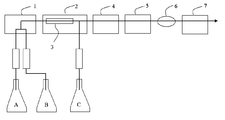
- the arrangement of the apparatus and the flow path are schematically shown in FIG.
- the first mobile phase was allowed to flow through the column for 35 minutes at a flow rate of 0.3 mL / min, and then the volume ratio of solution A and solution B was increased to 25 over 25 minutes at the same flow rate. : Increase linearly to 75 (so boric acid 100 mM, sodium chloride rises to 150 mM), and for another 10 minutes at the same flow rate with the volume ratio of solution B being 100% (so boric acid is 100 mM, sodium chloride is 200 mM) Then, as in the first mobile phase, Solution A and Solution B were flowed at the same flow rate at a volume ratio of 90:10 (so boric acid was 100 mM and sodium chloride was 20 mM).
- Example 2 Sugar analysis by post-column fluorescence detection-borate complex anion exchange method Under the same conditions as in Example 1, a reducing sugar standard solution analysis was performed. Next, the reducing sugar standard solution was analyzed under the same conditions as in Example 1 except that the solution B was prepared by replacing the inorganic salts added to the solution B with 200 mM potassium chloride instead of 200 mM sodium chloride. Compared.
- the present invention can remove fluorescence noise detected by a fluorescence detector in the post-column fluorescence detection-borate complex anion exchange method, and can be used as a highly sensitive analyzer for reducing sugars.
Landscapes
- Physics & Mathematics (AREA)
- Health & Medical Sciences (AREA)
- Life Sciences & Earth Sciences (AREA)
- Chemical & Material Sciences (AREA)
- Analytical Chemistry (AREA)
- Biochemistry (AREA)
- General Health & Medical Sciences (AREA)
- General Physics & Mathematics (AREA)
- Immunology (AREA)
- Pathology (AREA)
- Spectroscopy & Molecular Physics (AREA)
- Investigating Or Analysing Materials By The Use Of Chemical Reactions (AREA)
- Investigating, Analyzing Materials By Fluorescence Or Luminescence (AREA)
- Investigating Or Analysing Biological Materials (AREA)
Abstract
Description
本発明は,これらの発見に基づいて完成されたものである。
1.試料溶液中に含まれる還元糖のカラムクロマトグラフィーを用いた分離分析装置であって,該試料溶液中に含まれる還元糖を分離するための陰イオン交換樹脂カラムと,該カラムからの溶出液中に含まれる還元糖を塩基性アミノ酸と反応させるための加熱器と,該加熱器で反応後の該溶出液に励起光を連続的に照射して該溶出液から放射される蛍光の強度を測定する蛍光検出器と,該加熱器と該蛍光検出器の間に設置した背圧発生器とを含む,還元糖の分離分析装置。
2.該加熱器と該背圧発生器との間に,更に冷却装置を設置した,上記1の還元糖の分離分析装置。
3.還元糖を含む試料溶液を陰イオン交換樹脂カラムに負荷し,所定濃度のホウ酸を含有する水溶液である第1の移動相の十分量を該カラムに通すことによりカラムを洗浄し,
該カラムに,第1の移動相に比してホウ酸又は水溶性無機塩の濃度を高めたホウ酸水溶液である第2の移動相を,所定の流速で連続的に供給して還元糖をこれにより溶離させ,
該カラムからの溶出液を連続的に流路中に導き,
該溶出液に少なくとも1種の塩基性アミノ酸を所定速度で連続的に添加し,
該添加後の溶出液をして,該流路の所定温度の加熱器内を所定時間かけて通過させることにより,該混合溶液を加熱し,
該加熱後の混合溶液を,背圧発生器に通した後,
該混合溶液を蛍光検出器にかけることにより測定された蛍光強度を記録することを含んでなる,
上記1または2の装置を用いた,還元糖の分離分析方法。
4.還元糖を含む試料溶液を陰イオン交換樹脂カラムに負荷し,所定濃度の少なくとも1種の塩基性アミノ酸と所定濃度のホウ酸を含有する水溶液である第1の移動相の十分量を該カラムに通すことによりカラムを洗浄し,
該カラムに,第1の移動相に比してホウ酸又は水溶性無機塩の濃度を高めたホウ酸水溶液である第2の移動相を,所定の流速で連続的に供給して還元糖をこれにより溶離させ,
該カラムからの溶出液を連続的に流路中に導き,
該溶出液をして,該流路の所定温度の加熱器内を所定時間かけて通過させることにより,該溶出液を加熱し,
該加熱後の溶出液を,背圧発生器に通した後,
該溶出液を蛍光検出器にかけることにより測定された蛍光強度を記録することを含んでなる,
上記1または2の装置を用いた,還元糖の分離分析方法。
5.還元糖がマンノース-6-リン酸を含むものである上記3または4の方法。

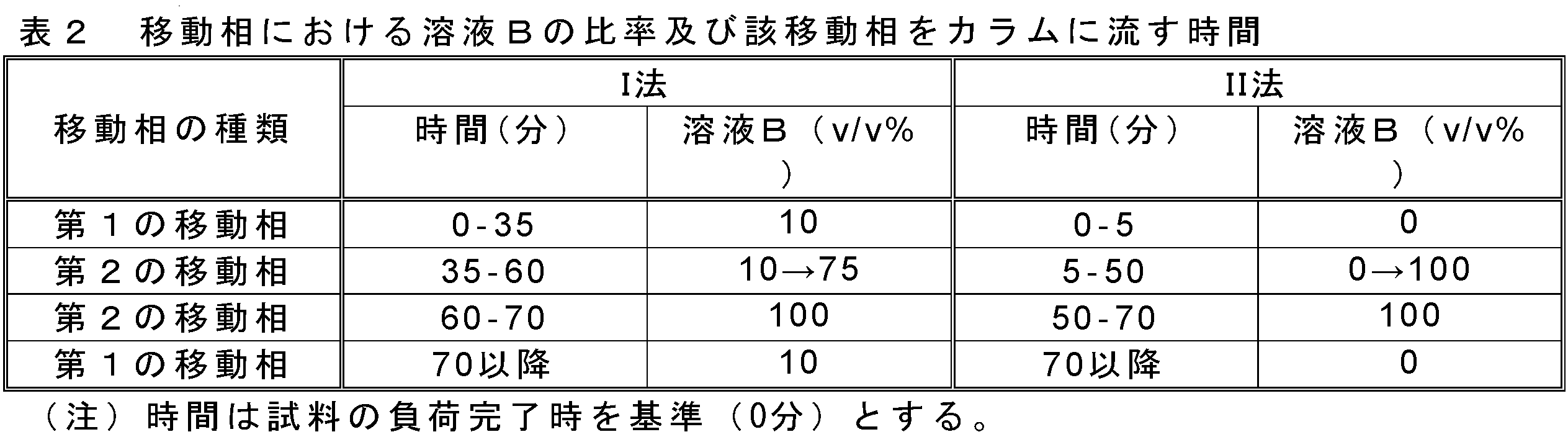
本発明において,第1の移動相は,試料の負荷完了後クロマトグラフィーを開始する時の最初の移動相である。第1の移動相は,所定濃度のホウ酸を含有する水溶液であり,所望により,所定濃度の水溶性無機塩を含有してもよい。第1の移動相におけるホウ酸の濃度としては,50~150mMの範囲が好ましい。第1の移動相における水溶性無機塩の濃度としては,0~30mMの範囲が好ましい。第2の移動相は,カラムに第1の移動相を通した後に,カラムから還元糖を溶離させるためにカラムに通す移動相であって,第1の移動相と比較してホウ酸の濃度又は水溶性無機塩の濃度を高めた移動相(上記表2においては,溶液Bの比率を上昇させた移動相)である。単に「移動相」というときは,第1の移動相及び第2の移動相を区別することなく包含する。
移動相の流速は,使用する分析機器,分析対象の還元糖の種類等に応じて,分析結果が良好となるように適宜調整されるべきものであり,一般に0.1~1mL /分に調整されるが,分析機器の特性等によっては,移動相の流速は0.1mL /分未満,または1mL /分を超える流速に調整してもよい。
D(+)-マンノース300mg,L(-)-フコース100mg及びD(+)-ガラクトース300mgを純水に溶かして100mLとした。この水溶液を純水で20倍に希釈したものを中性還元糖混合物標準溶液とした。マンノース-6-リン酸ナトリウム塩10mgを純水に溶かして5mLとしたものをM6P標準原液とした。中性還元糖混合物標準溶液18mLとM6P標準原液2.5mLを混合し,純水を加えて50mLとしたものを,還元糖標準溶液とした。
ホウ酸6.2gを純水に加えて溶かし,2N水酸化ナトリウムを用いてpH9.0に調整した後,純水を加えて全量を1000mLとし,0.22μmのメンブレンフィルターを用いて吸引ろ過した。得られた溶液を溶液A(100mMホウ酸溶液(pH9.0))とした。またホウ酸6.2g及び塩化ナトリウム11.7gを純水に加えて溶かし,2N水酸化ナトリウムを用いてpH9.0に調整した後,純水を加えて全量を1000mLとし,0.22μmのメンブレンフィルターを用いて吸引ろ過した。得られた溶液を溶液B(100mMホウ酸-200mM塩化ナトリウム溶液(pH9.0))とした。
L-アルギニン30gとホウ酸10gを純水に加えて溶かし,全量を1000mLとし,0.22μm以下のメンブレンフィルターを用いて吸引ろ過し,得られた溶液を反応試液とした。
(1)装置
島津HPLCシステムLC-10Avp(還元糖分析システム,島津製作所)に陰イオン交換カラムであるShim-pack ISA-07/S2504(4.0mmI.D.×250mm,基材:ポリスチレンゲル,固定相:第4級アンモニウム基,島津製作所)をセットし,更にこのカラムを加熱するカラムオーブンとしてShim-pack ガードカラムISA(4.0mmI.D.×50mm,島津製作所)をセットした。また,カラムの流出口の下流に加熱器としてヒートブロック(ALB-221,旭テクノグラス製)をセットした。カラムオーブンでカラムを65℃に加熱するとともに,ヒートブロックを150℃にセットした。また,ヒートブロックの下流に冷却槽(室温で水道水を満たした槽)を設置し,その下流に背圧発生器としてバックプレッシャーレギュレーター(エムエス機器:U-607)を設置した。更にその下流に蛍光検出器を設置し,バックプレッシャーレギュレーター通過後の溶液に,励起光として波長320nmの紫外線を照射し,波長430nmの蛍光を検出するようにした。装置の配置及び流路を模式的に図1に示した。
還元糖分析システムのオートサンプラーに,溶液Aと溶液Bをセットし,更に,カラムの流出口の下流(ヒートブロックの上流)から,反応試液が供給されるようにセットした(図1参照)。溶液Aと溶液Bを90:10の体積比率で混合して製した第1の移動相(従って,ホウ酸100mM,塩化ナトリウム20mM)でカラムを平衡化した後,還元糖標準溶液をカラムに負荷した。

背圧発生器を使用しないこと以外は,上記実施例1と同じ装置及び同じ操作手順により,還元糖標準溶液を分析した。
背圧発生器を設置しなかった場合の,還元糖標準溶液の分析結果(すなわち,比較例1の分析結果)では,蛍光検出器で検出された蛍光の測定曲線にノイズが認められ,そのノイズは各ピークの面積(AUC)の正確な算出に支障をきたす程度であった(図2)。一方,背圧発生器を設置した場合の分析結果(すなわち,実施例1の分析結果)では,各ピークの面積(AUC)が正確に算出できる程度にノイズが除去された滑らかな測定曲線が得られた(図3)。
実施例1と同じ条件により,還元糖標準溶液分析した。次いで,溶液Bに加える無機塩類を,200mMの塩化ナトリウムに代えて200mMの塩化カリウムとして溶液Bを調製すること以外は上記実施例1と同じ条件により還元糖標準溶液を分析し,両者の結果を比較した。
溶液Bに加える無機塩類を,200mMの塩化ナトリウムに代えて200mMの塩化カリウムとした場合でも,背圧発生器を設置することにより,200mMの塩化ナトリウムを用いた場合と同様に,各ピークの面積(AUC)が正確に算出できる程度にノイズが除去された滑らかな測定曲線が得られた(図4)。
2:カラムオーブン
3:カラム
4:加熱器(ヒートブロック)
5:冷却槽
6:背圧発生器
7:蛍光検出器
A:溶液A
B:溶液B
C:反応試液
Claims (5)
- 試料溶液中に含まれる還元糖のカラムクロマトグラフィーを用いた分離分析装置であって,該試料溶液中に含まれる還元糖を分離するための陰イオン交換樹脂カラムと,該カラムからの溶出液中に含まれる還元糖を塩基性アミノ酸と反応させるための加熱器と,該加熱器で反応後の該溶出液に励起光を連続的に照射して該溶出液から放射される蛍光の強度を測定する蛍光検出器と,該加熱器と該蛍光検出器の間に設置した背圧発生器とを含む,還元糖の分離分析装置。
- 該加熱器と該背圧発生器との間に,更に冷却装置を設置した,請求項1の還元糖の分離分析装置。
- 還元糖を含む試料溶液を陰イオン交換樹脂カラムに負荷し,所定濃度のホウ酸を含有する水溶液である第1の移動相の十分量を該カラムに通すことによりカラムを洗浄し,
該カラムに,第1の移動相に比してホウ酸又は水溶性無機塩の濃度を高めたホウ酸水溶液である第2の移動相を,所定の流速で連続的に供給して還元糖をこれにより溶離させ,
該カラムからの溶出液を連続的に流路中に導き,
該溶出液に少なくとも1種の塩基性アミノ酸を所定速度で連続的に添加し,
該添加後の溶出液をして,該流路の所定温度の加熱器内を所定時間かけて通過させることにより,該混合溶液を加熱し,
該加熱後の混合溶液を,背圧発生器に通した後,
該混合溶液を蛍光検出器にかけることにより測定された蛍光強度を記録することを含んでなる,
請求項1または2の装置を用いた,還元糖の分離分析方法。 - 還元糖を含む試料溶液を陰イオン交換樹脂カラムに負荷し,所定濃度の少なくとも1種の塩基性アミノ酸と所定濃度のホウ酸を含有する水溶液である第1の移動相の十分量を該カラムに通すことによりカラムを洗浄し,
該カラムに,第1の移動相に比してホウ酸又は水溶性無機塩の濃度を高めたホウ酸水溶液である第2の移動相を,所定の流速で連続的に供給して還元糖をこれにより溶離させ,
該カラムからの溶出液を連続的に流路中に導き,
該溶出液をして,該流路の所定温度の加熱器内を所定時間かけて通過させることにより,該溶出液を加熱し,
該加熱後の溶出液を,背圧発生器に通した後,
該溶出液を蛍光検出器にかけることにより測定された蛍光強度を記録することを含んでなる,
請求項1または2の装置を用いた,還元糖の分離分析方法。 - 還元糖がマンノース-6-リン酸を含むものである請求項3または4の方法。
Priority Applications (4)
| Application Number | Priority Date | Filing Date | Title |
|---|---|---|---|
| EP11774946.5A EP2565644B1 (en) | 2010-04-28 | 2011-04-25 | Sugar analysis device and analysis method |
| JP2012512828A JPWO2011136165A1 (ja) | 2010-04-28 | 2011-04-25 | 糖類の分析装置及び分析方法 |
| CN2011800211153A CN102859352A (zh) | 2010-04-28 | 2011-04-25 | 糖类的分析装置及分析方法 |
| US13/643,308 US8673648B2 (en) | 2010-04-28 | 2011-04-25 | Sugar analysis device and analysis method |
Applications Claiming Priority (2)
| Application Number | Priority Date | Filing Date | Title |
|---|---|---|---|
| JP2010104324 | 2010-04-28 | ||
| JP2010-104324 | 2010-04-28 |
Publications (1)
| Publication Number | Publication Date |
|---|---|
| WO2011136165A1 true WO2011136165A1 (ja) | 2011-11-03 |
Family
ID=44861464
Family Applications (1)
| Application Number | Title | Priority Date | Filing Date |
|---|---|---|---|
| PCT/JP2011/060040 Ceased WO2011136165A1 (ja) | 2010-04-28 | 2011-04-25 | 糖類の分析装置及び分析方法 |
Country Status (5)
| Country | Link |
|---|---|
| US (1) | US8673648B2 (ja) |
| EP (1) | EP2565644B1 (ja) |
| JP (1) | JPWO2011136165A1 (ja) |
| CN (1) | CN102859352A (ja) |
| WO (1) | WO2011136165A1 (ja) |
Cited By (2)
| Publication number | Priority date | Publication date | Assignee | Title |
|---|---|---|---|---|
| EP2693212B1 (en) * | 2011-03-29 | 2018-05-16 | JCR Pharmaceuticals Co., Ltd. | Instrument and methods for analysis of mannose 6-phosphate |
| JP2020508678A (ja) * | 2017-02-28 | 2020-03-26 | アメリカン ステリライザー カンパニー | 蛍光による微生物の検出のための回復培地 |
Families Citing this family (2)
| Publication number | Priority date | Publication date | Assignee | Title |
|---|---|---|---|---|
| CN109632986B (zh) * | 2018-12-13 | 2022-07-01 | 金日制药(中国)有限公司 | 一种糖及糖醇类化合物的柱后衍生检测方法 |
| CN114487227B (zh) * | 2022-01-27 | 2024-10-15 | 唐传生物科技(厦门)有限公司 | 一种用于单糖分析的高效液相法 |
Citations (9)
| Publication number | Priority date | Publication date | Assignee | Title |
|---|---|---|---|---|
| JPS58216953A (ja) | 1982-06-10 | 1983-12-16 | Shimadzu Corp | 糖類の分析法及びその装置 |
| JPS59111059A (ja) * | 1982-12-17 | 1984-06-27 | Funakoshi Yakuhin Kk | 高速液体クロマトグラフイ−用試薬およびその製造方法 |
| JPS6125059A (ja) | 1984-07-14 | 1986-02-03 | Shimadzu Corp | 糖類の分析法及びその装置 |
| JP2002131326A (ja) * | 2000-10-25 | 2002-05-09 | Shimadzu Corp | ポストカラム試薬混合反応装置 |
| JP2003194791A (ja) * | 2001-12-27 | 2003-07-09 | National Institute Of Advanced Industrial & Technology | 糖類混合物の同時分析方法及びそれに用いる分析装置 |
| JP2006184131A (ja) | 2004-12-27 | 2006-07-13 | Nippon Meat Packers Inc | フコイダン含量の測定方法及びフコイダン含有食品 |
| JP2007120972A (ja) * | 2005-10-25 | 2007-05-17 | Jasco Corp | 超臨界システム |
| JP2008042550A (ja) | 2006-08-07 | 2008-02-21 | Nippon Telegr & Teleph Corp <Ntt> | 光通信システム |
| JP2009036685A (ja) * | 2007-08-03 | 2009-02-19 | Shimadzu Corp | 還元糖の分析方法 |
Family Cites Families (5)
| Publication number | Priority date | Publication date | Assignee | Title |
|---|---|---|---|---|
| JPS5914191B2 (ja) * | 1978-11-21 | 1984-04-03 | 株式会社島津製作所 | 糖類の分析法およびその装置 |
| US7010964B2 (en) * | 2002-10-31 | 2006-03-14 | Nanostream, Inc. | Pressurized microfluidic devices with optical detection regions |
| JP4018975B2 (ja) * | 2002-12-16 | 2007-12-05 | 野村化学株式会社 | 逆相液体クロマトグラフィー |
| JP4182219B2 (ja) * | 2004-02-26 | 2008-11-19 | 独立行政法人産業技術総合研究所 | リン酸化糖の分析方法及び定量方法 |
| CN1271403C (zh) * | 2004-07-16 | 2006-08-23 | 上海中医药大学 | 一种多糖定量检测方法及系统 |
-
2011
- 2011-04-25 CN CN2011800211153A patent/CN102859352A/zh active Pending
- 2011-04-25 JP JP2012512828A patent/JPWO2011136165A1/ja active Pending
- 2011-04-25 US US13/643,308 patent/US8673648B2/en not_active Expired - Fee Related
- 2011-04-25 WO PCT/JP2011/060040 patent/WO2011136165A1/ja not_active Ceased
- 2011-04-25 EP EP11774946.5A patent/EP2565644B1/en not_active Not-in-force
Patent Citations (9)
| Publication number | Priority date | Publication date | Assignee | Title |
|---|---|---|---|---|
| JPS58216953A (ja) | 1982-06-10 | 1983-12-16 | Shimadzu Corp | 糖類の分析法及びその装置 |
| JPS59111059A (ja) * | 1982-12-17 | 1984-06-27 | Funakoshi Yakuhin Kk | 高速液体クロマトグラフイ−用試薬およびその製造方法 |
| JPS6125059A (ja) | 1984-07-14 | 1986-02-03 | Shimadzu Corp | 糖類の分析法及びその装置 |
| JP2002131326A (ja) * | 2000-10-25 | 2002-05-09 | Shimadzu Corp | ポストカラム試薬混合反応装置 |
| JP2003194791A (ja) * | 2001-12-27 | 2003-07-09 | National Institute Of Advanced Industrial & Technology | 糖類混合物の同時分析方法及びそれに用いる分析装置 |
| JP2006184131A (ja) | 2004-12-27 | 2006-07-13 | Nippon Meat Packers Inc | フコイダン含量の測定方法及びフコイダン含有食品 |
| JP2007120972A (ja) * | 2005-10-25 | 2007-05-17 | Jasco Corp | 超臨界システム |
| JP2008042550A (ja) | 2006-08-07 | 2008-02-21 | Nippon Telegr & Teleph Corp <Ntt> | 光通信システム |
| JP2009036685A (ja) * | 2007-08-03 | 2009-02-19 | Shimadzu Corp | 還元糖の分析方法 |
Non-Patent Citations (4)
| Title |
|---|
| HIROHISA MIKAMI ET AL.: "Post-Column Fluorometric Detection of Reducing Sugars in High Performance Liquid Chromatography Using Arginine", JOURNAL OF JAPAN SOCIETY FOR ANALYTICAL CHEMISTRY, vol. 32, no. 6, 5 June 1983 (1983-06-05), pages E207 - E210, XP008162164 * |
| MICHAEL V.PICKERING: "Assembling an HPLC Postcolumn System: Practical Considerations", LC GC, vol. 6, no. 11, November 1988 (1988-11-01), pages 994, 996 - 997, XP008162168 * |
| MIKAMI H., BUNSEKI KAGAKU, vol. 32, 1983, pages E207 |
| See also references of EP2565644A4 |
Cited By (2)
| Publication number | Priority date | Publication date | Assignee | Title |
|---|---|---|---|---|
| EP2693212B1 (en) * | 2011-03-29 | 2018-05-16 | JCR Pharmaceuticals Co., Ltd. | Instrument and methods for analysis of mannose 6-phosphate |
| JP2020508678A (ja) * | 2017-02-28 | 2020-03-26 | アメリカン ステリライザー カンパニー | 蛍光による微生物の検出のための回復培地 |
Also Published As
| Publication number | Publication date |
|---|---|
| EP2565644A4 (en) | 2014-06-25 |
| JPWO2011136165A1 (ja) | 2013-07-18 |
| US8673648B2 (en) | 2014-03-18 |
| EP2565644B1 (en) | 2017-08-02 |
| CN102859352A (zh) | 2013-01-02 |
| EP2565644A1 (en) | 2013-03-06 |
| US20130095570A1 (en) | 2013-04-18 |
Similar Documents
| Publication | Publication Date | Title |
|---|---|---|
| WO2011136165A1 (ja) | 糖類の分析装置及び分析方法 | |
| JP5685381B2 (ja) | 糖類の分析方法 | |
| US9250190B2 (en) | Reagent and method using the same | |
| US9250191B2 (en) | Method for analysing amino acids and a reagent for use with the same | |
| Smolkova et al. | Synthesis and application of BODIPY-based fluorescent labeling tag for oligosaccharide and N-linked glycan analysis by high-performance liquid chromatography with fluorescence detection | |
| Yodoshi et al. | Optimized conditions for high-performance liquid chromatography analysis of oligosaccharides using 7-amino-4-methylcoumarin as a reductive amination reagent | |
| JP6092768B2 (ja) | マンノース−6−リン酸の分析装置及び分析法 | |
| CN110161168B (zh) | 唑来膦酸及其杂质的高效液相色谱检测方法 | |
| CN115144509A (zh) | 一种地夸磷索四钠中间体5’-尿苷酸二钠的质量控制方法 | |
| Ijiri et al. | Sensitive determination of rhodamine 110-labeled monosaccharides in glycoprotein by capillary electrophoresis with laser-induced fluorescence detection | |
| Li et al. | High-performance liquid chromatography associated with resonance Rayleigh scattering spectral study of the interactions of palladium (ii)–antimigraine chelates with Erythrosin B and their analytical applications | |
| JPH076966B2 (ja) | 糖類の分析法及びその装置 | |
| CN121476488A (zh) | 一种有机胺催化剂中痕量杂质含量的高效液相色谱分析方法 | |
| Henderson et al. | Enhanced UV detection of sugar phosphates by addition of a metal complex to the HPLC mobile phase | |
| JPS61254852A (ja) | ヒスタミンの分析方法及び装置 | |
| Sakaguchi et al. | Quantification of glycated N‐terminal peptide of hemoglobin using derivatization for multiple functional groups of amino acids followed by liquid chromatography/tandem mass spectrometry | |
| CN1010984B (zh) | 糖类的分析法及其装置 |
Legal Events
| Date | Code | Title | Description |
|---|---|---|---|
| WWE | Wipo information: entry into national phase |
Ref document number: 201180021115.3 Country of ref document: CN |
|
| 121 | Ep: the epo has been informed by wipo that ep was designated in this application |
Ref document number: 11774946 Country of ref document: EP Kind code of ref document: A1 |
|
| WWE | Wipo information: entry into national phase |
Ref document number: 2012512828 Country of ref document: JP |
|
| REEP | Request for entry into the european phase |
Ref document number: 2011774946 Country of ref document: EP |
|
| WWE | Wipo information: entry into national phase |
Ref document number: 2011774946 Country of ref document: EP |
|
| NENP | Non-entry into the national phase |
Ref country code: DE |
|
| WWE | Wipo information: entry into national phase |
Ref document number: 13643308 Country of ref document: US |