WO2011136533A2 - Appareil et procédé de chromatographie - Google Patents
Appareil et procédé de chromatographie Download PDFInfo
- Publication number
- WO2011136533A2 WO2011136533A2 PCT/KR2011/003015 KR2011003015W WO2011136533A2 WO 2011136533 A2 WO2011136533 A2 WO 2011136533A2 KR 2011003015 W KR2011003015 W KR 2011003015W WO 2011136533 A2 WO2011136533 A2 WO 2011136533A2
- Authority
- WO
- WIPO (PCT)
- Prior art keywords
- column
- sample
- loading
- starting
- chromatography
- Prior art date
- Legal status (The legal status is an assumption and is not a legal conclusion. Google has not performed a legal analysis and makes no representation as to the accuracy of the status listed.)
- Ceased
Links
Images






Classifications
-
- C—CHEMISTRY; METALLURGY
- C07—ORGANIC CHEMISTRY
- C07K—PEPTIDES
- C07K1/00—General methods for the preparation of peptides, i.e. processes for the organic chemical preparation of peptides or proteins of any length
- C07K1/14—Extraction; Separation; Purification
- C07K1/16—Extraction; Separation; Purification by chromatography
-
- C—CHEMISTRY; METALLURGY
- C07—ORGANIC CHEMISTRY
- C07K—PEPTIDES
- C07K16/00—Immunoglobulins [IG], e.g. monoclonal or polyclonal antibodies
Definitions
- the present invention relates to a chromatography apparatus and method for improving the efficiency of an adsorbent.
- the three most commonly used chromatographic processes for purifying monoclonal antibodies in the biopharmaceutical industry are as follows: 1) First step: Protein A, the selective capture of monoclonal antibodies in cell culture. A) chromatography, 2) second step: cation exchange resin chromatography as an intermediate purification step; And 3) Third step: Anion exchange resin chromatography as the last purification step (see FIG. 1).
- Protein A chromatography has a very strong affinity for monoclonal antibodies in cell culture, so a single purification yields more than 90% yield and purity is 99% based on SEC (Size Exclusion Chromatography). It has been the strongest weapon in monoclonal antibody chromatography purification.
- the biggest bottleneck for the production of therapeutic monoclonal antibodies via high titer cell culture processes is the purification process, particularly the Protein A chromatography process, which is traditionally carried out in batch mode and has disadvantages:
- the simulated mobile phase chromatography process uses at least four columns and up to 20 identical columns for Biogen Idec.'S patent.
- all rubber or plastic parts that have been in contact with the product are usually used to perform product change over to end production of one product and prevent cross-contamination between products before producing the next product.
- the system is complicated and the number of columns is large, which requires a lot of time and labor.
- Simulated mobile phase chromatography is a complex system of control consisting of multiple columns, pumps and valves, and it is difficult to keep the process operating coefficients stable in the event of a failure of the pump or valve.
- a start column and a end column for chromatography for obtaining a target protein; in each of the injection step of loading a sample, a recovery step including washing and elution, and a regeneration step are performed.
- a starting column and a terminal column A sample injection hole for the start column and an end column provided in each of the start column and the end column for sample loading;
- an end sample distributor for loading through the end sample inlet for the sample passed through the end column to the starting column; provides a chromatography device comprising a.
- n columns are terminated from the start column.
- N columns consisting of columns, allowing sample flow from the front column to the back column on the flow of the sample, and allowing sample flow from the end column to the start column (the start column being the back column of the end column)
- a chromatographic method for obtaining a target protein using the method comprising the steps of: 1) loading a sample into a front column by using the starting column as a front column; 2) loading the sample from the front column into the back column; 3) prior to the washing of the front column, blocking loading to the back column and loading the sample directly into the back column; 4) loading the sample passed through the back column into the next column; And 5) prior to the washing of the back column, blocking loading to the next column, and loading the sample directly onto the next column; including, starting from the end column to the end column again from the end column.
- the use efficiency of the adsorbent (resin) is increased to shorten the process time, the number of column operations is reduced compared to the same volume of a single batch column, and the amount of resin used is also reduced at the same ratio. Therefore, it is economical by purifying the desired protein with high efficiency.
- 1 is a flow chart of therapeutic monoclonal antibody production.
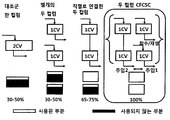
- FIG. 3 compares the schematic diagram of the one column batch chromatography and the two column chromatography apparatus and the three column chromatography apparatus:
- FIG. 6 is a conceptual diagram of operation of a two column chromatography apparatus.
- FIG. 7 is a conceptual diagram of operation of a three column chromatography apparatus.
- FIG. 8 is a schematic diagram of a two column chromatography apparatus.
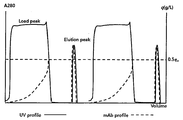
- 10 is a one column batch chromatography graph.
- 11 is a two column chromatography apparatus graph.
- the inventors have devised a multi-column (e.g. two or three column) chromatography system to compensate for the shortcomings of one column batch chromatography. Purification results were calculated.
- a multi-column e.g. two or three column
- the two-column chromatography system was equivalent or shorter than the control in the process time per batch in the bioreactor titer range of 1.0 g / L to 10.0 g / L, and the sorbent (resin) utilization efficiency was maximized.
- the number of driving operations decreased by 30-50%.
- the bioreactor titer ranges from 3.0 g / L to 10 g / L, the process time per batch is equal to or shorter than the control and the maximum use of adsorbent (resin) results in 30 to 30 50% decrease.
- the present invention was completed by confirming that a high titer cell culture batch could be an alternative chromatographic system capable of meeting the demand for high throughput and high efficiency purification.
- the chromatography apparatus of the present invention is as follows.
- the chromatography apparatus has two independent inlets for each column. One is a cell culture medium injection only and the other is an injection hole for exclusively injecting several buffer solutions used in the Protein A batch process (FIGS. 8 and 9).
- Injection of the cell culture is carried out continuously and the injection of the buffer changes sequentially with each step of the batch process.
- the columns are connected in series and the distributor distributes the flow of fluid from the column to the wastewater treatment, product collection tank or inlet of another column.
- the two column chromatography apparatus (FIG. 6) is designed for the case where the titer of the cell culture is less than 3.0 g / L, but is applicable even more.
- Cell cultures filtered at the injection stage are injected to the maximum binding capacity at equilibrium and the product leaking from the first column is continuously injected into the second column.
- the first column Once the first column has adsorbed the product to its maximum, it is separated from the second column and enters the recovery stage.
- the cell culture is then injected up to the second column and the column rotation is repeated until the cell culture is depleted.
- the three-column chromatographic apparatus (FIG. 7) is designed for processes with normal cell culture titers of 3.0 g / L or more, in which the bioreactors have the same relatively short sample infusion time compared to low cell culture titers.
- the filtered cell culture in the sample injection step is injected to the maximum binding capacity at equilibrium, and the sample flowing out without being adsorbed in the first column is continuously injected into the second column.
- the column is separated from the second column and enters the recovery stage. At this moment, the cell culture is injected into the second column as much as possible and the sample flowing out without being adsorbed to the second column is continuously injected into the third column which is equilibrated in advance.
- next column shift occurs when the injection of the second column is complete, where the first column enters the regeneration phase for the next cycle. This cycle continues until the cell culture is depleted (FIG. 7).
- the chromatographic apparatus of the present invention comprises: an intermediate column for chromatography for obtaining a target protein; an injection step for loading a sample, a recovery step including a washing and an elution, and a regeneration step are performed, and the sample is separated from the starting column distributor.
- Loadable intermediate column An injection port for an intermediate column provided in the intermediate column for sample loading;
- an intermediate column distributor for loading through the intermediate column inlet for distributing the sample passed through the intermediate column; characterized in that it further comprises.
- the chromatographic apparatus of the present invention is characterized in that the distributor for the starting column loads the sample passed through the starting column into the end column.
- the chromatographic apparatus of the present invention is characterized in that the distributor for the intermediate column loads the sample passed through the intermediate column into the end column.
- the target protein in the step of loading the sample is monoclonal antibody, immunoglobulin and recombinant protein, but is not limited thereto.
- the solid phase of the step of loading the sample is protein A or protein G.
- the wash buffer solution may be a low salt concentration or a high salt concentration, more preferably the low salt concentration is when the addition of 0.001 mM to 100 mM NaCl in 10 mM to 50 mM buffer.
- the high salt concentration of the wash buffer solution is when 1 M NaCl is added at 0.001 mM to 100 mM buffer at 50 mM.
- the elution buffer preferably comprises an acid buffer.
- the regeneration buffer is a clean in place (CIP) solution
- the CIP solution comprises phosphoric acid or citric acid.
- Bioreactor cell culture titers were applied at 0.3 g / L, 1.0 g / L, 3.0 g / L and 10.0 g / L, reflecting information from Professor Matt Crougham of Keck graduate Institute, cited by Genentech of the United States at IBC 2008.
- the use volume of the bioreactor was set to 12,500 L which is commonly used on production scale.
- the diameter of the column was chosen as the diameter of several representative columns on the production scale and the column bed height was also chosen as 22.2 cm, which is a commonly used height on the production scale.
- the flow rate of the buffer solution was applied at 300 cm / hr at a linear velocity, the maximum operational flow rate of the MabSelect Xtra ® resin applied in the examples.
- the injection target per chromatography number was set to 35 g / L, which is 90% of the maximum dynamic binding capacity of MabSelect Xtra® resin in the control column, 1 column batch column.
- for column chromatography injection per number chromatography goal it was set to 80% of the q m MabSlect Xtra r resin maximum static binding capacity (static binding capacity) of.
- Cycle no RoundUp (Titer (g / L) / 0.9 DBC m / column vol. (L))
- Cycle no RoundUp (Titer (g / L) / 0.8 DBC m / column vol. (L))
- Table 4 Calculated number of chromatographic runs by experiment group Simulation condition Bioreactor titer (g / L) Column bore (mm) Column volume (L) Count / Batch 1 column (control) 2 columns 3 columns One 0.3 450 35 4 2 2 2 1.0 600 63 6 4 4 3 1.0 1,000 174 3 2 2 4 3.0 1,400 342 4 2 2 5 10.0 2,000 697 6 4 4
- Resin was assumed to be able to use up to 200 refilled resins, with an annual yield of 60 batches.
- the calculated amount of buffer solution per batch is shown in Table 6, and the two-column chromatography unit showed a decrease of 22% to 42% compared to the control group, and the three-column chromatography unit was 10.0 at 3.0 g / L based on the bioreactor titer. It was found to decrease from 29% to 40% in the g / L range.
- the calculated process time for each condition is shown in Table 7 and the two-column chromatographic apparatus showed the same result as the control at 1.0 g / L bioreactor titer, and then decreased up to 48% at 3.0 g / L.
- the maximum increase was 123% compared to the control at 1.0 g / L or less, but the decrease was 18% at 3.0 g / L and 63% at 10.0 g / L.
Landscapes
- Chemical & Material Sciences (AREA)
- Organic Chemistry (AREA)
- Health & Medical Sciences (AREA)
- Medicinal Chemistry (AREA)
- Biochemistry (AREA)
- Biophysics (AREA)
- General Health & Medical Sciences (AREA)
- Genetics & Genomics (AREA)
- Life Sciences & Earth Sciences (AREA)
- Molecular Biology (AREA)
- Proteomics, Peptides & Aminoacids (AREA)
- Immunology (AREA)
- Analytical Chemistry (AREA)
- Peptides Or Proteins (AREA)
- Treatment Of Liquids With Adsorbents In General (AREA)
- Preparation Of Compounds By Using Micro-Organisms (AREA)
Abstract
La présente invention concerne un appareil de chromatographie comprenant une colonne initiale et une colonne finale pour chromatographie pour obtenir une protéine cible, dans lequel l'étape d'injection de chargement d'un échantillon, l'étape de collecte comprenant un lavage et une élution et l'étape de régénération sont conduites dans chaque colonne ; une entrée pour la colonne initiale et une entrée pour la colonne finale disposées au niveau de la colonne initiale et de la colonne finale, respectivement, pour charger un échantillon ; un distributeur pour la colonne initiale destiné à distribuer l'échantillon qui est chargé par l'intermédiaire de l'entrée pour la colonne initiale afin qu'il traverse la colonne initiale ; et un distributeur d'échantillon pour la colonne finale destiné à charger l'échantillon qui est chargé par l'intermédiaire de l'entrée pour la colonne finale afin qu'il traverse la colonne finale, sur la colonne initiale, et un procédé de chromatographie utilisant celui-ci.
Priority Applications (1)
| Application Number | Priority Date | Filing Date | Title |
|---|---|---|---|
| US13/643,146 US9024000B2 (en) | 2010-04-27 | 2011-04-26 | Method to improve the sorbent efficiency of protein A chromatography using switching column with continuous feeding |
Applications Claiming Priority (2)
| Application Number | Priority Date | Filing Date | Title |
|---|---|---|---|
| KR1020100038745A KR101152036B1 (ko) | 2010-04-27 | 2010-04-27 | 컬럼 순환 및 시료 연속주입법을 이용한 단백질 a 크로마토그래피 정제 방법 |
| KR10-2010-0038745 | 2010-04-27 |
Publications (2)
| Publication Number | Publication Date |
|---|---|
| WO2011136533A2 true WO2011136533A2 (fr) | 2011-11-03 |
| WO2011136533A3 WO2011136533A3 (fr) | 2012-04-19 |
Family
ID=44862030
Family Applications (1)
| Application Number | Title | Priority Date | Filing Date |
|---|---|---|---|
| PCT/KR2011/003015 Ceased WO2011136533A2 (fr) | 2010-04-27 | 2011-04-26 | Appareil et procédé de chromatographie |
Country Status (3)
| Country | Link |
|---|---|
| US (1) | US9024000B2 (fr) |
| KR (1) | KR101152036B1 (fr) |
| WO (1) | WO2011136533A2 (fr) |
Cited By (1)
| Publication number | Priority date | Publication date | Assignee | Title |
|---|---|---|---|---|
| US11590434B2 (en) | 2011-10-04 | 2023-02-28 | Merck Patent Gmbh | Method and apparatus for chromatographic purification |
Families Citing this family (16)
| Publication number | Priority date | Publication date | Assignee | Title |
|---|---|---|---|---|
| US10948483B2 (en) * | 2013-04-08 | 2021-03-16 | Chromacon Ag | Method for control, monitoring and/or optimization of a chromatographic process |
| US10099156B2 (en) * | 2013-04-08 | 2018-10-16 | Chromacon Ag | Chromatographic purification method |
| US20150093800A1 (en) * | 2013-09-05 | 2015-04-02 | Genentech, Inc. | Method for chromatography reuse |
| US11566082B2 (en) | 2014-11-17 | 2023-01-31 | Cytiva Bioprocess R&D Ab | Mutated immunoglobulin-binding polypeptides |
| EP3037513A1 (fr) * | 2015-05-13 | 2016-06-29 | Bayer Technology Services GmbH | Procédé destiné à l'élution continue d'un produit sur des colonnes de chromatographie |
| WO2017194593A1 (fr) | 2016-05-11 | 2017-11-16 | Ge Healthcare Bioprocess R&D Ab | Procédé de nettoyage et/ou de désinfection d'une matrice de séparation |
| US10654887B2 (en) | 2016-05-11 | 2020-05-19 | Ge Healthcare Bio-Process R&D Ab | Separation matrix |
| WO2017194592A1 (fr) | 2016-05-11 | 2017-11-16 | Ge Healthcare Bioprocess R&D Ab | Procédé de conservation d'une matrice de séparation |
| US10513537B2 (en) | 2016-05-11 | 2019-12-24 | Ge Healthcare Bioprocess R&D Ab | Separation matrix |
| US10703774B2 (en) | 2016-09-30 | 2020-07-07 | Ge Healthcare Bioprocess R&D Ab | Separation method |
| US10889615B2 (en) | 2016-05-11 | 2021-01-12 | Cytiva Bioprocess R&D Ab | Mutated immunoglobulin-binding polypeptides |
| US10730908B2 (en) | 2016-05-11 | 2020-08-04 | Ge Healthcare Bioprocess R&D Ab | Separation method |
| JP7031934B2 (ja) | 2016-05-11 | 2022-03-08 | サイティバ・バイオプロセス・アールアンドディ・アクチボラグ | 分離マトリックス |
| CN109475789B (zh) | 2016-07-13 | 2020-06-05 | 克罗麦肯公司 | 纯化方法及其用途 |
| US12448411B2 (en) | 2016-09-30 | 2025-10-21 | Cytiva Bioprocess R&D Ab | Separation method |
| GB201905886D0 (en) * | 2019-04-26 | 2019-06-12 | Ge Healthcare Bio Sciences Ab | Method in liquid chromatography |
Family Cites Families (5)
| Publication number | Priority date | Publication date | Assignee | Title |
|---|---|---|---|---|
| US5429746A (en) * | 1994-02-22 | 1995-07-04 | Smith Kline Beecham Corporation | Antibody purification |
| NZ507557A (en) | 1998-05-06 | 2003-10-31 | Genentech Inc | Protein purification by ion exchange chromatography |
| JP2006507249A (ja) | 2002-09-13 | 2006-03-02 | バイオジェン アイデック インコーポレイテッド | 疑似移動床式クロマトグラフィーによる、ポリペプチドを精製する方法 |
| SE0400501D0 (sv) | 2004-02-27 | 2004-02-27 | Amersham Biosciences Ab | Antibody purification |
| WO2008153472A1 (fr) | 2007-06-15 | 2008-12-18 | Ge Healthcare Bio-Sciences Ab | Procédé de chromatographie |
-
2010
- 2010-04-27 KR KR1020100038745A patent/KR101152036B1/ko active Active
-
2011
- 2011-04-26 US US13/643,146 patent/US9024000B2/en active Active
- 2011-04-26 WO PCT/KR2011/003015 patent/WO2011136533A2/fr not_active Ceased
Cited By (1)
| Publication number | Priority date | Publication date | Assignee | Title |
|---|---|---|---|---|
| US11590434B2 (en) | 2011-10-04 | 2023-02-28 | Merck Patent Gmbh | Method and apparatus for chromatographic purification |
Also Published As
| Publication number | Publication date |
|---|---|
| KR101152036B1 (ko) | 2012-06-08 |
| US20130046080A1 (en) | 2013-02-21 |
| KR20110119174A (ko) | 2011-11-02 |
| US9024000B2 (en) | 2015-05-05 |
| WO2011136533A3 (fr) | 2012-04-19 |
Similar Documents
| Publication | Publication Date | Title |
|---|---|---|
| WO2011136533A2 (fr) | Appareil et procédé de chromatographie | |
| CA2498725C (fr) | Procede de purification de polypeptides par chromatographie sur lit mobile simule | |
| CN101340960B (zh) | 用于色谱分离的装置 | |
| Steinebach et al. | Continuous counter‐current chromatography for capture and polishing steps in biopharmaceutical production | |
| US11648490B2 (en) | Valve manifolds for simulated moving bed chromatography | |
| CN102796149B (zh) | 一种依替米星的连续分离纯化工艺 | |
| CN104513286B (zh) | 一种分离纯化非达米星的方法 | |
| CN106166402B (zh) | 一种模拟移动床色谱分离装置 | |
| CN108424897A (zh) | 一种rhTNK-tPA细胞收获液的纯化方法 | |
| Ding et al. | Efficient purification of the antimicrobial peptide ε-poly-L-lysine from microbial culture medium with continuous ion-exchange chromatography | |
| US10717023B1 (en) | Method for continuous purification | |
| CN113341014B (zh) | 连续流层析装置和方法 | |
| EP4408561B1 (fr) | Procédé de purification et ses utilisations | |
| Morrison et al. | Characterization and design of chemically selective cationic displacers using a robotic high‐throughput screen | |
| CN119656654A (zh) | 分离纯化装置及分离纯化方法 | |
| HK1077228B (en) | Method of purifying polypeptides by simulated moving bed chromatography | |
| JPH1190104A (ja) | 擬似移動床式分離装置 | |
| Li et al. | Modeling and Simulation of Simulated Moving Bed Chromatography Separation Process |
Legal Events
| Date | Code | Title | Description |
|---|---|---|---|
| 121 | Ep: the epo has been informed by wipo that ep was designated in this application |
Ref document number: 11775238 Country of ref document: EP Kind code of ref document: A2 |
|
| WWE | Wipo information: entry into national phase |
Ref document number: 13643146 Country of ref document: US |
|
| NENP | Non-entry into the national phase |
Ref country code: DE |
|
| 122 | Ep: pct application non-entry in european phase |
Ref document number: 11775238 Country of ref document: EP Kind code of ref document: A2 |