WO2011136618A2 - Procédé et dispositif de radiorecherche pour terminal e-mbs dans un système multiporteuses - Google Patents
Procédé et dispositif de radiorecherche pour terminal e-mbs dans un système multiporteuses Download PDFInfo
- Publication number
- WO2011136618A2 WO2011136618A2 PCT/KR2011/003227 KR2011003227W WO2011136618A2 WO 2011136618 A2 WO2011136618 A2 WO 2011136618A2 KR 2011003227 W KR2011003227 W KR 2011003227W WO 2011136618 A2 WO2011136618 A2 WO 2011136618A2
- Authority
- WO
- WIPO (PCT)
- Prior art keywords
- carrier
- paging
- network
- message
- mbs
- Prior art date
- Legal status (The legal status is an assumption and is not a legal conclusion. Google has not performed a legal analysis and makes no representation as to the accuracy of the status listed.)
- Ceased
Links
Images


Classifications
-
- H—ELECTRICITY
- H04—ELECTRIC COMMUNICATION TECHNIQUE
- H04W—WIRELESS COMMUNICATION NETWORKS
- H04W68/00—User notification, e.g. alerting and paging, for incoming communication, change of service or the like
- H04W68/02—Arrangements for increasing efficiency of notification or paging channel
- H04W68/025—Indirect paging
-
- H—ELECTRICITY
- H04—ELECTRIC COMMUNICATION TECHNIQUE
- H04W—WIRELESS COMMUNICATION NETWORKS
- H04W4/00—Services specially adapted for wireless communication networks; Facilities therefor
- H04W4/06—Selective distribution of broadcast services, e.g. multimedia broadcast multicast service [MBMS]; Services to user groups; One-way selective calling services
-
- H—ELECTRICITY
- H04—ELECTRIC COMMUNICATION TECHNIQUE
- H04W—WIRELESS COMMUNICATION NETWORKS
- H04W60/00—Affiliation to network, e.g. registration; Terminating affiliation with the network, e.g. de-registration
- H04W60/06—De-registration or detaching
-
- H—ELECTRICITY
- H04—ELECTRIC COMMUNICATION TECHNIQUE
- H04W—WIRELESS COMMUNICATION NETWORKS
- H04W64/00—Locating users or terminals or network equipment for network management purposes, e.g. mobility management
-
- H—ELECTRICITY
- H04—ELECTRIC COMMUNICATION TECHNIQUE
- H04W—WIRELESS COMMUNICATION NETWORKS
- H04W76/00—Connection management
- H04W76/10—Connection setup
- H04W76/19—Connection re-establishment
-
- H—ELECTRICITY
- H04—ELECTRIC COMMUNICATION TECHNIQUE
- H04W—WIRELESS COMMUNICATION NETWORKS
- H04W72/00—Local resource management
- H04W72/30—Resource management for broadcast services
Definitions
- the present disclosure relates to a multi-carrier system, and more particularly, to a paging method and apparatus for an E-MBS terminal.
- E-MBS 16m Enhanced Multicast and Broadcast Service
- E-MBS Advanced Multicast and Broadcast Services
- MSTID multicast STID
- FID FID
- E-MBS service is provided only in downlink, and can be coordination or synchronized between base stations belonging to one group to allow macro diversity.
- Each E-MBS connection is associated with the service flow provided with QoS and traffic parameters for the service flow.
- Service flows for transmitting the E-MBS data may be described as an example to individual terminals participating in the service while the terminal performs a general operation. During such description, the terminal identifies the service and learns the parameters related to the service flow.
- Each base station capable of providing an E-MBS service belongs to a specific E-MBS zone, and one base station may belong to a plurality of E-MBS zones.
- An E-MBS zone is defined as one set of base stations where the same MSTID and FID are used to transmit the content of a particular service flow.
- Each E-MBS zone is identified by a unique E-MBS zone ID.
- the MSTIDs and FIDs used for common E-MBS content and services must be the same for all base stations in the same E-MBS zone.
- the user may include information to be transmitted by modulating the amplitude, frequency and / or phase of the sine wave or the periodic pulse wave.
- a sine wave or pulse wave that serves to carry information is called a carrier.
- the carrier modulation method includes a single carrier modulation scheme (SCM) or a multi-carrier modulation scheme (MCM).
- SCM single carrier modulation scheme
- MCM multi-carrier modulation scheme
- the single carrier modulation method is a modulation method in which all information is loaded on one carrier and modulated.
- Multi-carrier modulation divides the entire bandwidth channel of one carrier into sub-channels having several small bandwidths, and multiple narrow-band sub-carriers through each sub-channel. Refers to a technique for transmitting in multiples.
- each subchannel can be approximated to a flat channel (Flat Channel) due to the small bandwidth.
- the user can compensate for the distortion of the channel using a simple equalizer.
- the multi-carrier modulation scheme may be implemented at high speed using fast Fourier transform (FFT). That is, it is advantageous for high speed data transmission compared to the single carrier modulation method (SCM).
- FFT fast Fourier transform
- embodiments of the present invention disclose a multi-carrier system that supports broadband by using one or more carriers in a carrier aggregation.
- the multi-carrier system described below represents a case in which one or more carriers are bundled and used, unlike the multi-carrier modulation scheme in which one carrier is divided and used.
- a multi-band or multi-carrier
- a plurality of carriers for example, multiple frequency carriers (FCs)
- FCs frequency carriers
- MAC medium access control
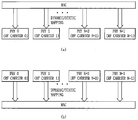
- FIG. 1 (a) and (b) are diagrams for explaining a multi-band radio frequency (RF) based signal transmission and reception method.
- RF radio frequency
- one medium access control layer at a transmitting end and a receiving end may manage multiple carriers in order to use multicarriers efficiently.
- both the transmitting end and the receiving end can transmit and receive multicarriers.
- frequency carriers (FCs) managed in one medium access control layer do not need to be adjacent to each other, which is flexible in terms of resource management. That is, both contiguous aggregation and non-contiguous aggregation are possible.
- physical layer (PHY) 0, physical layer 1, .. physical layer n-2, physical layer n-1 represent multiple bands according to the present technology, and each band is It may have a frequency carrier (FC) size allocated for a specific service according to a predetermined frequency policy.
- FC frequency carrier
- the physical layer 0 (RF carrier 0) may have a frequency band size allocated for general FM radio broadcasting
- the physical layer 1 (RF carrier 1) may have a frequency band size allocated for cellular communication.
- each frequency band may have a different frequency band size according to each frequency band characteristic.
- each frequency carrier FC has an A [MHz] size.
- each frequency allocation band may be represented by a carrier frequency for using a baseband signal in each frequency band.
- each frequency allocation band is referred to as a "carrier frequency band” or each carrier frequency band when there is no confusion. Representative simply referred to as "carrier”.
- 3GPP LTE-A 3GPP LTE-A
- a component carrier to distinguish the above-mentioned carrier from the subcarrier (subcarrier) used in the multi-carrier scheme.
- multi-band scheme described above may be referred to as a “multi-carrier” scheme or a “carrier aggregation” scheme.
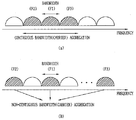
- 2 (a) and 2 (b) show an example in which a multi-carrier is used in a general wireless communication system.
- a multicarrier in a general technique may be a contiguous carrier aggregation of contiguous carriers, and a non-contiguous carrier aggregation of discontinuous carriers as shown in (b) of FIG. 2.
- the unit for combining these carriers is a basic bandwidth unit of a legacy technology (e.g. LTE, Long Term Evolution (LTE) -advanced system, LTE, IEEE 802.16e in the IEEE 802.16m system).
- LTE Long Term Evolution
- LTE Long Term Evolution
- IEEE 802.16e in the IEEE 802.16m system
- the first carrier refers to a carrier on which the traffic of the terminal and the base station, the exchange of complete physical layer and full PHY / MAC control information is performed.
- the primary carrier can also be used for the general operation of the terminal, such as network entry.
- Each terminal has one main carrier in one cell.
- the second carrier (or secondary carrier) is an additional carrier that can be used for the exchange of traffic according to the base station specific allocation commands and laws usually received from the first carrier.
- the second carrier may include control signaling to support multicarrier operation.
- a carrier of a multi-carrier system based on the primary and secondary carriers described above may be divided into a Fully configured carrier and a Partially configured carrier as follows.
- Fully configured carrier refers to a carrier on which control signaling is configured.
- information and parameters for multi-carrier operation and other carriers may be included in the control channels.
- Partially configured carrier includes all control channels for supporting downlink transmission in downlink carriers without pairing uplink carriers in TDD DL transmission or frequency division duplex (FDD) mode. This refers to the carrier to be set.
- FDD frequency division duplex
- the terminal performs initial network entry through the primary carrier, and information on the multi-carrier capabilities of each other in the registration process through the exchange of registration request / response (AAI_REG-REQ / RSP) messages with the base station. Can be exchanged.
- AAA_REG-REQ / RSP registration request / response
- the present specification is to solve the problem that the paging carrier to which the paging message is transmitted according to whether the idle mode terminal receives the E-MBS service, by reporting the start or end of receiving the E-MBS service to the network It is an object of the present invention to provide a method for properly setting a paging carrier according to whether an E-MBS service is received.
- the present specification provides a method for transmitting the E-MBS service reception status information of the terminal to the base station when the terminal transitions to the idle mode.
- the present specification is to provide a method for informing the base station to the carrier that can be network re-entry, if network re-entry as a paging carrier is not possible.
- the present disclosure provides a method for receiving a paging message of an idle mode terminal in a multi-carrier system, the method comprising: receiving a paging message from a network through a first carrier corresponding to a predetermined condition in a paging listening period; Transmitting a first ranging request message to the network, the first ranging request message including control information indicating a location update procedure for initiating reception of an E-MBS service; Determining a second carrier to which the E-MBS service is transmitted as a paging carrier; And receiving a paging message from the network on the determined second carrier.
- the determining of the second carrier as a paging carrier may further include receiving paging carrier determination information indicating that the paging message is transmitted from the network through a second carrier through which an E-MBS service is transmitted. It is done.
- the paging carrier determination information may be received from the network through a ranging response (RNG-RSP) message.
- RNG-RSP ranging response
- the method may further include: transmitting a second ranging request message to the network, the second ranging request message including control information indicating a location update procedure for notifying completion of E-MBS service reception; Determining the first carrier as a paging carrier; And receiving the paging message from the network through the determined first carrier.
- determining the first carrier as a paging carrier further includes receiving a second ranging response message from the network, the second ranging response message including paging carrier determination information indicating that the paging message is transmitted on the first carrier. It is characterized by.
- the predetermined condition is a modulo operation of a de-registration identifier (DID) used to distinguish an idle mode terminal from the number of carriers (N) in a paging group to which the network belongs (DID modulo N). It is characterized by that.
- DID de-registration identifier
- the network is characterized in that the base station or a paging controller (paging controller).
- the first carrier may be a fully configured carrier
- the second carrier may be a fully configured carrier or a partially configured carrier.
- the first ranging request message is transmitted through the first carrier, and the second ranging request message is transmitted through the second carrier. It is characterized by.
- the first and second ranging request messages are transmitted through the first carrier.
- the method may further include transmitting a deregistration request message including E-MBS service reception status information to the base station; And receiving a deregistration response message from the base station in response to the deregistration request message.
- the E-MBS service reception status information is characterized in that the information indicating the start or end of E-MBS service reception.
- the deregistration request message may further include paging carrier selection mode information indicating a request for transmitting a paging message through one of the first carrier and the second carrier. .
- the deregistration response message may further include paging carrier selection mode information indicating that a paging message is transmitted through one of the first carrier and the second carrier.
- the present specification provides a terminal for receiving a paging message (paging message) in a multi-carrier system, a wireless communication unit for transmitting and receiving a wireless signal with the outside; And a control unit connected to the wireless communication unit, wherein the control unit controls the wireless communication unit to receive a paging message from a network through a first carrier corresponding to a predetermined condition, and provides a location for notifying the start of receiving an E-MBS service. Control the wireless communication unit to transmit a first ranging request message including control information indicating an update procedure to the network, determine a second carrier to which an E-MBS service is transmitted as a paging carrier, and determine the determined second carrier Control to receive a paging message from the network through.
- the controller may control the wireless communication unit to transmit a second ranging request message to the network, the second ranging request message including control information indicating a location update procedure for notifying the end of E-MBS service reception, and the first carrier to be a paging carrier. And control the wireless communication unit to receive the paging message from the network through the determined first carrier.
- the predetermined condition is a modulo operation of a de-registration identifier (DID) used to distinguish an idle mode terminal from the number of carriers (N) in a paging group to which the network belongs (DID modulo N). It is characterized by that.
- DID de-registration identifier
- the present disclosure provides a network re-entry method of an idle mode terminal in a multi-carrier system, the method comprising: receiving a paging message from a base station including carrier information indicating a network re-entrant carrier through a paging carrier; And performing network reentry to the base station based on the carrier information, wherein the paging carrier is a partially configured carrier.
- the carrier information is characterized in that the physical carrier index (physical carrier index).
- the method may further include determining any one of the carrier information when there are a plurality of network reentrant carriers.
- the determining of any one carrier may be performed randomly or modulo operation of an idle mode terminal identifier (DID) and the number of network reentrant carriers.
- DID idle mode terminal identifier
- the paging carrier may be a carrier through which the E-MBS is transmitted or a carrier corresponding to a modulo operation result value of the idle mode terminal identifier and the number of carriers in the paging group.
- an idle mode terminal notifies the network (base station or paging controller) of starting or ending reception of an E-MBS service in a multi-carrier supporting system, thereby effectively setting a paging carrier of the terminal.
- the present specification has an effect that the base station informs the carrier (network reentry) to the terminal (network reentry), thereby reducing the process of cell reselection unnecessarily.
- FIG. 1 (a) and (b) are diagrams for explaining a multi-band radio frequency (RF) based signal transmission and reception method.
- RF radio frequency
- 2 (a) and 2 (b) show an example in which a multi-carrier is used in a general wireless communication system.
- FIG. 3 is a block diagram illustrating a wireless communication system.
- FIG. 4 shows an internal block diagram of a terminal and a base station in a wireless access system.
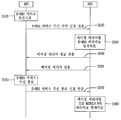
- FIG. 5 is a flowchart illustrating a method of receiving a paging message of a terminal according to an E-MBS service reception status (start or end) report according to the first embodiment of the present disclosure.
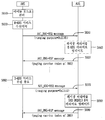
- FIG. 6 is a flowchart illustrating a method of updating a paging carrier by performing a location update process for reporting an E-MBS service reception status according to the first embodiment of the present specification.
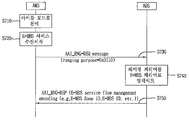
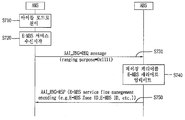
- 7 (a) and 7 (b) illustrate another method of updating a paging carrier by performing a location update process for reporting an E-MBS service reception status as another example of the first embodiment of the present specification. It is a flow chart.
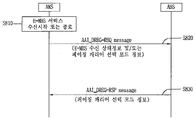
- FIG. 8 is an example illustrating a method of transmitting E-MBS service reception status information to a base station by a terminal according to a second embodiment of the present disclosure to deregister with a base station.
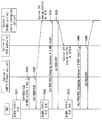
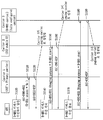
- 9 to 12 show an overall flowchart for configuring a paging carrier of the E-MBS terminal according to the embodiments of the present disclosure, respectively.
- CDMA code division multiple access
- FDMA frequency division multiple access
- TDMA time division multiple access
- OFDMA orthogonal frequency division multiple access
- SC-FDMA single carrier frequency division multiple access
- CDMA may be implemented with a radio technology such as Universal Terrestrial Radio Access (UTRA) or CDMA2000.
- TDMA may be implemented with wireless technologies such as Global System for Mobile communications (GSM) / General Packet Radio Service (GPRS) / Enhanced Data Rates for GSM Evolution (EDGE).
- GSM Global System for Mobile communications
- GPRS General Packet Radio Service
- EDGE Enhanced Data Rates for GSM Evolution
- OFDMA may be implemented in a wireless technology such as IEEE 802.11 (Wi-Fi), IEEE 802.16 (WiMAX), IEEE 802-20, Evolved UTRA (E-UTRA), or the like.
- IEEE 802.16m is an evolution of IEEE 802.16e and provides backward compatibility with systems based on IEEE 802.16e.
- UTRA is part of the Universal Mobile Telecommunications System (UMTS).
- 3rd Generation Partnership Project (3GPP) Long Term Evolution (LTE) is part of Evolved UMTS (E-UMTS) using Evolved-UMTS Terrestrial Radio Access (E-UTRA), which employs OFDMA in downlink and SC in uplink -FDMA is adopted.
- LTE-A Advanced is an evolution of 3GPP LTE.
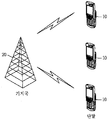
- FIG. 3 is a block diagram illustrating a wireless communication system.
- Wireless communication systems are widely deployed to provide various communication services such as voice and packet data.
- a wireless communication system includes a mobile station (MS) 10 and a base station 20 (BS).
- the terminal 10 may be fixed or mobile, and may be called by other terms such as a user equipment (UE), a user terminal (UT), a subscriber station (SS), a wireless device, an advanced mobile station (AMS), and the like. have.
- UE user equipment
- UT user terminal
- SS subscriber station
- AMS advanced mobile station
- the base station 20 generally refers to a fixed station for communicating with the terminal 10 and may be referred to in other terms such as a NodeB, a base transceiver system (BTS), and an access point. .
- BTS base transceiver system
- One or more cells may exist in one base station 20.
- the wireless communication system may be an Orthogonal Frequency Division Multiplexing (OFDM) / Orthogonal Frequency Division Multiple Access (OFDMA) based system.
- OFDM Orthogonal Frequency Division Multiplexing
- OFDMA Orthogonal Frequency Division Multiple Access
- OFDM uses multiple orthogonal subcarriers. OFDM uses orthogonality between inverse fast fourier transforms (IFFTs) and fast fourier transforms (FFTs).
- IFFTs inverse fast fourier transforms
- FFTs fast fourier transforms
- the transmitter data is sent by performing an IFFT.
- the receiver performs FFT on the received signal to recover the original data.
- the transmitter uses an IFFT to combine multiple subcarriers, and the receiver uses a corresponding FFT to separate multiple subcarriers.
- a slot is also the minimum possible data allocation unit, defined by time and subchannels.
- a subchannel may be composed of a plurality of tiles.
- the subchannel consists of 6 tiles, and one burst in uplink may consist of 3 OFDM symbols and 1 subchannel.
- each tile may include 4 contiguous subcarriers on 3 OFDM symbols.
- each tile may comprise three contiguous subcarriers on three OFDM symbols.
- the bin includes 9 contiguous subcarriers on the OFDM symbol.
- a band refers to a group of four rows of bins, and an adaptive modulation and coding (AMC) subchannel consists of six contiguous bins in the same band.
- AMC adaptive modulation and coding
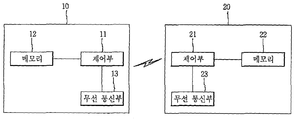
- FIG. 4 shows an internal block diagram of a terminal and a base station in a wireless access system.
- the terminal 10 includes a control unit 11, a memory 12, and a radio communication (RF) unit 13.
- RF radio communication
- the terminal also includes a display unit, a user interface unit, and the like.
- the controller 11 implements the proposed function, process and / or method. Layers of the air interface protocol may be implemented by the controller 11.
- the memory 12 is connected to the control unit 11 and stores a protocol or parameter for performing wireless communication. That is, it stores the terminal driving system, the application, and the general file.
- the RF unit 13 is connected to the control unit 11 and transmits and / or receives a radio signal.
- the display unit displays various information of the terminal, and may use well-known elements such as liquid crystal display (LCD) and organic light emitting diodes (OLED).
- the user interface may be a combination of a well-known user interface such as a keypad or a touch screen.
- the base station 20 includes a control unit 21, a memory 22, and a radio frequency unit (RF) unit 23.
- RF radio frequency unit
- the control unit 21 implements the proposed function, process and / or method. Layers of the air interface protocol may be implemented by the controller 21.
- the memory 22 is connected to the control unit 21 to store a protocol or parameter for performing wireless communication.
- the RF unit 23 is connected to the control unit 21 to transmit and / or receive a radio signal.
- the controllers 11 and 21 may include an application-specific integrated circuit (ASIC), another chipset, a logic circuit, and / or a data processing device.
- the memories 12 and 22 may include read-only memory (ROM), random access memory (RAM), flash memory, memory cards, storage media and / or other storage devices.
- the RF unit 13 and 23 may include a baseband circuit for processing a radio signal.
- the above-described technique may be implemented as a module (process, function, etc.) for performing the above-described function.
- the module may be stored in the memories 12 and 22 and executed by the controllers 11 and 21.
- the memories 12 and 22 may be inside or outside the controllers 11 and 21, and may be connected to the controllers 11 and 21 by various well-known means.
- Non-macro diversity transmission mode There are two modes for transmitting E-MBS traffic: non-macro diversity transmission mode and macro diversity transmission mode.
- Non-macro diversity mode is used when base stations in the same zone coordination of transmissions in the same frame and cannot use macro diversity mode. All base stations belonging to the same E-MBS zone transmit SDUs carrying the same contents in the same frame. These SDUs are mapped to MPDUs in the same frame. This means the same SDU fragments, the same fragment sequence number, and the same fragment size. This allows the same AMS to receive E-MBS transmissions from ABSs in the same zone.
- Macro diversity mode means that all ABS in a zone synchronizes E-MBS transmission, which means that all ABS in a zone transmit the same data using the same resources at the same time. This has the effect of obtaining macro diversity gain in E-MBS transmission.
- all ABS in the same zone share the following information:
- AAI_E-MBS-CFG message Information about the E-MBS configuration is periodically transmitted to terminals interested in the E-MBS using a MAC control message called an AAI_E-MBS-CFG message.
- the E-MBS configuration indicator specifies resources reserved for E-MBS traffic and additional information necessary for E-MBS operation in a downlink physical resource.
- E-MBS_ZONE_ID is used to indicate a service area in which the E-MBS ID and the FID for the E-MBS service flow are valid.
- the E-MBS zone ID to which the base station belongs is included in the E-MBS CFG message.
- the E-MBS zone ID cannot be '0'.
- the base station When the base station sends an AAI_DSA message to establish a connection to the E-MBS zone ID, the E-MBS zone ID will be encoded in the DSA message.
- One base station may have multiple E-MBS zone IDs for other E-MBS services.
- MSI refers to the number of consecutive super-frames in which the access network can schedule traffic for streams related to the MBS zone prior to the start of the MSI interval.
- the MSI can have intervals of several superframes and the length of the MSI interval, denoted by N MSI , depending on the special use of E-MBS.
- the E-MBS map message has a mapping address of E-MBS data associated with the E-MBS zone during one full MSI.
- the E-MBS map message is configured to be used to fully define one transmission situation for a given stream in one MSI.
- the indication of the MSI length is sent via an SCD message.
- the UE calculates the start of MSI as follows.
- the MSI starts with a superframe in which the N Superframe of the MSI satisfies the following conditions.
- the terminal can only demodulate E-MBS data bursts associated with the content selected by the user.
- the UE wakes up in each MSI section to check whether there is an E-MBS data burst to be demodulated.
- a paging group information message (PGID_Info message) is transmitted on all fully configured carriers.
- the paging advertisement message (AAI_PAG-ADV message) for the terminal is transmitted on only one of the fully configured carriers.
- the idle mode terminal determines a carrier index for monitoring a paging message in a paging listening interval of the terminal.
- the paging message transmitted in the paging listening interval is transmitted using the following rule.
- N is the number of carriers in the paging group at the base station used to transmit the paging message for the idle mode terminal.
- DID De-registration Identifier
- N is the number of carriers in the paging group at the base station used to transmit the paging message for the idle mode terminal.
- DID De-registration Identifier
- the paging carrier index corresponds to an ascending order of physical carrier indexes of carriers used for transmitting a paging message at the base station.
- the paging carrier indication bit is used to specify whether the carrier is a paging carrier or not. If the paging carrier indication is '1', the carrier indicates a paging carrier. Paging carrier indications of other carriers may be included in a paging group information message and may be included in a neighbor advertisement message (AAI_NBR-ADV) or a multi-carrier advertisement message (AAI_MC-ADV).
- the terminal determines if the paging carrier indication is included in the neighbor advertisement message.
- the paging carrier indication received via the message may be used.
- the paging advertisement message is sent on one or more frames starting from the second subframe within the super frame.
- the paging advertisement message for the E-MBS terminal may be transmitted on the same carrier as the dedicated carrier for the E-MBS.
- a paging carrier for receiving a paging message from a network is set to N in the DID. Determined by the modulo value, it will wait to receive a paging message from the network on the carrier corresponding to the paging carrier index. That is, when the idle mode terminal wants to receive the E-MBS service, if the terminal already has the E-MBS configuration information, the terminal receives the E-MBS service using the previously received E-MBS configuration information.
- the base station will perform paging to the terminal to the paging carrier before receiving the E-MBS service, the terminal It will be determined that the paging message is sent on the E-MBS carrier.
- the network may have a method of transmitting paging information of all terminals subscribed to the E-MBS service to the E-MBS carrier.
- the network may have a method of transmitting paging information of all terminals subscribed to the E-MBS service to the E-MBS carrier.
- it is necessary to transmit paging information of all the terminals subscribed to the E-MBS in one paging group to one E-MBS carrier. This may increase the paging overhead of the E-MBS carrier.
- the terminal reports the E-MBS service reception status (start or end) to the network so that the paging carrier of the terminal is appropriately set. How to do this will be described in detail through embodiments.
- the first embodiment provides a method of transmitting a paging message of a base station through the E-MBS service reception status (start or end) report of the idle mode terminal.
- a paging message is a carrier ('E-MBS carrier' or 'second' to which the E-MBS service is transmitted).
- the present invention provides a method of configuring a paging carrier of a terminal to be transmitted through a carrier ('first carrier') corresponding to a DID modulo N, rather than a carrier.
- FIG. 5 is a flowchart illustrating a method of receiving a paging message of a terminal according to an E-MBS service reception status (start or end) report according to the first embodiment of the present disclosure.
- the terminal when the idle mode terminal starts to receive the E-MBS service from the base station (S510), the terminal transmits a signal indicating the start of receiving the E-MBS service to the network (S520).
- the network may be a base station or a paging controller.
- the signal indicating the start of receiving the E-MBS service may be transmitted through a location update process of the terminal.
- a method of notifying the start of receiving the E-MBS service through the location update procedure will be described in detail below.
- the network When the network receives a signal indicating the start of receiving the E-MBS service from the terminal, the network updates the paging carrier index of the idle mode terminal to a carrier provided with the E-MBS service (S530).
- the network may transmit the updated paging carrier index, that is, the E-MBS carrier index, to the idle mode terminal (S540).
- the idle mode terminal receives a paging message from the network through the E-MBS carrier (S550).
- the idle mode terminal receiving the E-MBS service terminates the reception of the E-MBS service (S560)
- the idle mode terminal transmits a signal indicating the end of the E-MBS service reception to the network (S570).
- the network when the network receives a signal indicating the end of the E-MBS service reception from the idle mode terminal, the network and the paging carrier index (paging carrier index) of the terminal and the deregistration identifier (DID) of the idle mode terminal; Through the modulo operation of the value of N (carriers per paging group to which the base station belongs) (DID modulo N) it is set to the carrier index of the output value (S580).
- FIG. 6 is a flowchart illustrating a method of updating a paging carrier by performing a location update process for reporting an E-MBS service reception status according to the first embodiment of the present specification.
- a ranging request message including control information indicating a location update procedure for notifying start of receiving an E-MBS service is transmitted to a base station. Transmit (S630).
- control information is ranging purpose indication (Ranging purpose indication) indicating the ranging purpose.
- the ranging purpose indication information may be set to '0x1110'.
- the network when the network receives the ranging request message in which the ranging purpose indication information is set to '0x1110' from the idle mode terminal, the network sets the paging carrier of the terminal as a carrier to which the E-MBS service is transmitted (S640).
- the carrier on which the E-MBS service is transmitted may be a dedicated carrier for transmitting the E-MBS service.
- the network when the network (base station or paging controller) responds to a location update of the terminal, the network includes a paging carrier index set in the ranging response message to inform the terminal of the paging carrier.
- the terminal If the paging carrier index is not included in the ranging response message (AAI_RNG-RSP) transmitted to the idle mode terminal, the terminal automatically sets the E-MBS carrier as the paging carrier.
- the ranging request message including the control information indicating that the location update procedure for notifying the end of the E-MBS service reception to the network (base station or paging controller) It transmits (S670).
- control information is ranging purpose indication information
- the ranging purpose indication information may be set to '0x1111' as an example.
- the base station determines the paging carrier of the idle mode terminal of the idle mode terminal.
- the DID is set to a value modulo calculated with N (the number of carriers for each paging group at the base station) (S680).
- the idle mode when the base station responds to a location update of the terminal, the idle mode includes a paging carrier index corresponding to the DID modulo N in a ranging response message (AAI_RNG-RSP message). It may inform the terminal (S690).
- the terminal when receiving the E-MBS service, the terminal indicates the ranging purpose defined for the E-MBS service flow management encoding update in order to inform the network of the start of receiving the E-MBS service.
- (ranging purpose indication) information value eg, '0x0110'
- ranging purpose indication information value
- 7 (a) and 7 (b) illustrate another method of updating a paging carrier by performing a location update process for reporting an E-MBS service reception status as another example of the first embodiment of the present specification. It is a flow chart.
- E-MBS service flow management encoding information e.g., an E-MBS Zone
- E-MBS IDs and FIDs physical carrier index
- the ranging purpose indication information is an example of '0b0110' in order for the UE to obtain E-MBS service flow management encoding information from the base station.
- the ranging request message is transmitted to the base station (S710 to S730).
- the base station transmits a ranging response message (AAI_RNG-RSP message) including the E-MBS service flow management encoding information to the terminal in response to the ranging request message (S750).
- a ranging response message (AAI_RNG-RSP message) including the E-MBS service flow management encoding information to the terminal in response to the ranging request message (S750).
- the base station sets the paging carrier to the E-MBS carrier (S740).
- the set paging carrier may be included in the ranging response message and transmitted to the idle mode terminal.
- FIG. 7B illustrates a case in which the ranging purpose indication information is '0x1111' in step S730.
- Table 1 below shows an example of a ranging request message (RNG-REQ message) format according to the first embodiment of the present specification.
- the ranging purpose indication field value when the ranging purpose indication field value is set to '0b1110', it is a location update procedure for notifying the start of receiving the E-MBS service, and if it is set to '0b1111', it indicates the end of receiving the E-MBS service. It can be seen that this indicates a location update procedure.
- Table 2 below shows another example of a ranging request message (RNG-REQ message) format according to the first embodiment of the present specification.
- the ranging purpose indication field value when the ranging purpose indication field value is set to '0b0110', it can be seen that the location update is performed to notify the start of receiving the E-MBS service. In addition, when the ranging purpose indication field value is set to '0b1111', it indicates that the location update is performed to indicate the end of reception of the E-MBS service.
- Table 3 shows an example of a ranging response message (RNG-RSP message) format according to the first embodiment of the present specification.
- the ranging response message includes a paging carrier index field indicating a physical carrier index for transmitting the paging advertisement message for the idle mode terminal.
- the idle mode terminal (AAI) ranging request message (AAI) indicating that any one of the ranging purpose indication (Ranging purpose indication) to perform the location update to request the paging carrier (AAI) -RNG-REQ message) can be transmitted to the base station.
- the base station When the base station receives a ranging request message including ranging purpose indication information for a paging carrier request from the idle mode terminal, the base station transmits a ranging response message including a paging carrier index to the idle mode terminal.
- Table 4 below shows an example of a ranging request message format including ranging purpose indication information indicating that location update is performed for a paging carrier request according to an embodiment of the present specification.
- the Preferred Paging Carrier Type field indicates whether a paging carrier requested by the UE to the base station is an E-MBS carrier or a carrier corresponding to DID modulo N.
- the paging carrier is requested as an E-MBS carrier, which indicates that the idle mode terminal has started receiving the E-MBS service.
- the paging carrier is requested as a carrier corresponding to DID modulo N, which indicates that the idle mode terminal has finished receiving the E-MBS service.
- Table 5 below shows another example of a ranging request (RNG-REQ) message format including ranging purpose indication information indicating that location update is performed for a paging carrier request according to an embodiment of the present specification.
- the E-MBS status field value is '0', it indicates that the UE has started receiving the E-MBS service, and the paging carrier is set to the E-MBS carrier.
- the paging carrier is set to the carrier of the DID modulo N.
- the E-MBS status field value is exemplified as being included when the ranging purpose indication is set to 0b1111.
- the E-MBS status information field for indicating the start or end of the E-MBS service may be included in the AAI-RNG-REQ to inform the base station of the related information.
- the E-MBS status field may be included in the AAI-RNG-REQ message and transmitted to the base station as an optional field.
- a network base station or paging controller
- transmits a paging message to an idle mode terminal and the terminal selects a paging carrier according to a situation. Let's take a quick look at this.
- the network (base station or paging controller) is not only a paging message (AAI_PAG-ADV) for the idle mode terminals receiving the E-MBS service on the carrier to which the E-MBS is transmitted ('E-MBS carrier'), but also the E-MBS service. Transmit a paging message for the terminals that do not receive the.
- the UEs not receiving the E-MBS service are Idle mode UEs that determine a paging carrier corresponding to a paging carrier index obtained by modulo DID of the UE with N.
- the paging message for all Idle mode terminals belonging to all paging groups belonging to the base station is transmitted through the E-MBS carrier, and the paging message for the Idle mode terminal is transmitted to the paging carrier determined by the value of DID modulo N. do.
- the UE selects the paging carrier as a carrier for transmitting the E-MBS service and receives a paging message from the network through the E-MBS carrier.
- the terminal sets the paging carrier to the carrier determined by the value of DID modulo N in the E-MBS carrier.
- a paging message is received from a network through a carrier corresponding to the DID modulo N.
- the base station is a terminal receiving the E-MBS service
- the Paging Advertisement (AAI_PAG-ADV) message is transmitted through the carrier corresponding to the paging carrier index generated by the E-MBS carrier and the DID modulo N.
- the second embodiment provides a method of receiving a paging message from the network through the E-MBS service reception status report of the terminal in the process of the terminal transitions from the connected state to the idle mode.
- the terminal in the process of de-registration of the terminal, the terminal may inform the base station of information on whether it is currently receiving an E-MBS service.
- the terminal transitions to the idle mode, if the base station and the terminal is currently receiving the E-MBS service set the paging carrier of the terminal to the carrier for transmitting the E-MBS, if the terminal is not receiving the E-MBS service
- the base station and the terminal set the paging carrier of the terminal as a carrier corresponding to the DID modulo N.
- FIG. 8 is an example illustrating a method of transmitting E-MBS service reception status information to a base station by a terminal according to a second embodiment of the present disclosure to deregister with a base station.
- the terminal may or may not receive an E-MBS service (S810).
- the terminal When the terminal transitions to the idle mode, the terminal transmits a DREG-REQ message including the E-MBS service reception status information to the base station (S820).
- the E-MBS service reception state information refers to whether the UE is currently receiving the E-MBS service, that is, the information informing the base station of the start or end of the E-MBS service reception.
- Table 6 below shows an example of an AAI_DREG-REQ message format including E-MBS service reception status information according to a second embodiment of the present disclosure.
- E-MBS reception status One Indicates whether the terminal is currently receiving the E-MBS 0b0: The terminal does not receive the E-MBS 0b1: The terminal is currently receiving the E-MBS
- the deregistration request message is for a paging carrier selection mode indicating a paging carrier that the terminal wants to use to the base station to select a paging carrier when the terminal enters an idle mode. It may further include information.
- Table 7 below shows an example of an AAI_DREG-REQ message format including paging carrier selection mode information according to an embodiment of the present disclosure.
- M Paging carrier selection mode One Indicates whether the paging carrier index for the AMS which currently receives the E-MBS service is configured based on the equation "DID modulo N" or to the carrier where the E-MBS service is provided. 0b0: The paging carrier index is set to the equation "DID modulo N”. 0b1: The paging carrier index for AMS is set to the carrier where the E-MBS service is provided.
- the terminal when the UE transitions to the idle mode when receiving the E-MBS service, the terminal uploads information on which paging carrier mode to receive.
- the paging carrier selection mode value when the paging carrier selection mode value is set to '0b0', it indicates that the UE wants to receive a paging message as a paging carrier index for DID modulo N when receiving the E-MBS service.
- the paging carrier selection mode value when the paging carrier selection mode value is set to '0b1', it indicates that the terminal wants to receive a paging message as a carrier to which the E-MBS service is transmitted when receiving the E-MBS service.
- the base station when the base station receives the deregistration request message including at least one of E-MBS service reception status information and paging carrier selection mode information from the terminal, the deregistration response (AAI_DREG-RSP) in response to the deregistration request message. ) Transmits the message to the terminal (S830).
- the deregistration response message includes paging carrier selection mode information.
- the paging carrier selection mode information indicates information indicating a paging carrier selection mode to be used by the terminal in consideration of the setting value of the paging carrier selection mode field when the base station receives AAI_DREG-REQ from the terminal.
- Table 8 below shows an example of an AAI_DREG-REQ message format including paging carrier selection mode information according to an embodiment of the present disclosure.
- M Paging carrier selection mode One Indicates whether the paging carrier index for AMS is the index based on the equation "DID modulo N" or the carrier where the E-MBS service is provided. 0b0: The paging carrier index is set to the equation "DID modulo N”. 0b1: The paging carrier index for AMS is set to the carrier where the E-MBS service is provided.
- the terminal when the base station transmits an AAI_DREG-RSP message including the paging carrier selection mode set to '0b0' to the terminal, the terminal receives the paging carrier index when receiving the E-MBS service. Determines that the DID modulo N is set, and the start and end of the E-MBS reception need not be reported to the base station in the idle mode.
- the terminal may transmit both the salping E-MBS service reception status information and the paging carrier selection mode information when the E-MBS is received in the deregistration request message to the base station.
- Table 9 shows an example of a deregistration request message format including E-MBS service reception status (start or end) information and paging carrier selection mode information.
- M Paging carrier selection mode One Indicates whether the paging carrier index for the AMS which currently receives the E-MBS service is configured based on the equation "DID modulo N" or to the carrier where the E-MBS service is provided. 0b0: The paging carrier index is set to the equation "DID modulo N”. 0b1: The paging carrier index for AMS is set to the carrier where the E-MBS service is provided.
- M E-MBS reception status One Indicates whether the terminal is currently receiving the E-MBS 0b0: The terminal does not receive the E-MBS 0b1: The terminal is currently receiving the E-MBS It will be present when Paging carrier selection mode is 0b1
- the UE reports the reception state of the E-MBS service only when the paging carrier index for the E-MBS UE is a carrier through which the E-MBS is transmitted. If the base station sets the paging carrier index to the carrier to which the E-MBS is transmitted, the terminal performs a process of notifying the base station at the start and end of receiving the E-MBS service.
- the terminal may inform the base station of the start and end of reception of the E-MBS service through a location update procedure.
- Table 10 below shows an example of a deregistration request message format including paging carrier selection mode information that implicitly implies E-MBS service reception status information according to an embodiment of the present disclosure.
- M Paging carrier selection mode One Indicates whether the paging carrier index for the AMS which currently receives the E-MBS service is configured based on the equation "DID modulo N" or to the carrier where the E-MBS service is provided. 0b0: The paging carrier index is set to the equation "DID modulo N". This value shall be generally chosen by when the AMS does not receive E-MBS service currently. 0b1: The paging carrier index for AMS is set to the carrier where the E-MBS service is provided. This value shall be generally chosen by AMS when the ABS receives E-MBS service currently. This implicitly indicates that the AMS receives E-MBS service currently.
- the paging carrier selection mode field may implicitly imply E-MBS reception state information. For example, when the Paging carrier selection mode field value is '0b0', the terminal enters Idle mode while not currently receiving the E-MBS service, and '0b1' indicates that the terminal is currently receiving the E-MBS service. Indicates.
- a third embodiment of the network re-entry (network re-entry) to the base station Let's look at it in detail.
- the terminal when the network reentry process cannot be performed through the paging carrier (for example, when the paging carrier is partially configured carrier or the cell bar is set to '1'), the terminal performs the network reentry process to the base station.
- the paging carrier for example, when the paging carrier is partially configured carrier or the cell bar is set to '1'
- the terminal when the network reentry process cannot be performed through the paging carrier (for example, when the paging carrier is partially configured carrier or the cell bar is set to '1'), the terminal performs the network reentry process to the base station.
- a base station transmits a paging message to E-MBS terminals (that is, terminals that do not perform a Dynamic Service Deletion (DSD) after performing a DSA (Dynamic Service Addition)
- DSD Dynamic Service Deletion
- DSA Dynamic Service Addition
- the base station After setting the paging carrier of the terminal to the value of DID modulo N, if the terminal does not perform network re-entry within a certain time after sending a paging message to wake the terminal through the carrier, the base station is paging through the E-MBS carrier Send a message.
- the UE In case of a carrier), the UE must perform a network entry process to a carrier other than the paging carrier.
- Method 1 is a cell reselection process.
- the terminal When the terminal receives a paging message from the base station (carrier) is a partially configured carrier (carrier configured), the terminal performs a cell reselection (cell reselection) process. That is, the terminal determines a carrier for network reentry through a cell rescanning process and then performs a network reentry process through the determined carrier.
- a cell reselection cell reselection
- Method 2 is a process of performing network re-entry with a carrier corresponding to DID modulo N.
- the terminal When the terminal cannot enter the network with a paging carrier through which a paging message is transmitted, the terminal performs a network re-entry procedure to the carrier corresponding to the DID modulo N.
- the terminal subscribes to the E-MBS service and receives a paging message from the network as an E-MBS dedicated carrier, which is a partially configured carrier
- the terminal receives a de-registeration identifier (DID) modulo N (number of carrier per PGID in an ABS) is set as a carrier for network reentry.
- DID de-registeration identifier
- the UE paging through the E-MBS carrier performs network re-entry with a carrier corresponding to DID modulo N.
- the terminal receiving the E-MBS through the partially configured carrier enters the idle mode (through the deregistration process) or the paging group information (PGID), the multi-carrier advertisement (MC-ADV), the neighbor advertisement (NBR-ADV) message. Receive the N value through. Therefore, the UE can calculate the network re-entry carrier through the DID modulo N.
- PGID paging group information
- M-ADV multi-carrier advertisement
- NBR-ADV neighbor advertisement
- Method 3 is a method in which a base station transmits network accessible carrier information to a terminal.
- the base station In order for the base station to instruct the paging terminal to perform network entry using another carrier, the base station includes physical carrier index information that the terminal can enter in the paging message and transmits the information to the terminal.
- paging carrier index information included in the paging message may be equally applied or differently applied to all terminals included in the paging message.
- Table 11 shows an example of a paging advertisement message (PAG-ADV message) format according to an embodiment of the present disclosure.
- Num_AMSs indicates the number ofpaged AMSs in a corresponding paginggroup1.
- Deregistration Identifier 18 Used to indicate Deregistration ID for the AMS to be paged (DeregistrationIdentifier and Paging Cycle are used toidentify each paged AMS) 0..218-1
- MAC Address Hash 24 used to identify the AMS to be paged Paging Cycle Action code
- Physical carrier index 6 The terminal indicates a carrier index to perform network reentry. The UE performs network reentry with the carrier indicated by this carrier index.
- the base station may send one or more carrier index information capable of entering the network in the paging message to the terminal.
- all carrier information capable of network re-entry is included in the multi-carrier information supported by the base station and transmitted to the terminal.
- Table 12 below shows an example of a paging advertisement message format including all carrier information capable of network re-entry.
- Num_AMSs indicates the number ofpaged AMSs in a corresponding paginggroup1.
- Physical carrier index 6 All terminals receiving this paging message indicate a carrier index to perform network reentry. The UE performs network reentry with the carrier indicated by this carrier index.
- the base station supports multiple carriers and the paging message is transmitted to the partially configured carrier or the cell bar of the carrier to which the paging message is transmitted is set to 1, the physical carrier index is included. ⁇
- the terminal that receives the paging message including one or more physical carrier indexes from the base station selects a carrier capable of network re-entry among the received physical carrier indexes, and then performs network reentry with the selected carrier.
- network re-entry when there is only one carrier selected (ie, network reentry), network re-entry is performed on the carrier.
- the UE selects one network re-entry carrier using any one of the following methods, and then selects a network re-entry carrier to the base station through the selected carrier. Perform network re-entry with the base station.
- the terminal randomly selects one of the carriers capable of network entry to perform network reentry with the base station.
- the UE When the number of carriers available for a network entry is M, the UE performs network reentry with carriers of an index corresponding to a DID modulo M operation result value.
- the network reentrant physical carrier index information transmitted by the base station may be differently applied to each terminal to be paged.
- an example of a paging advertisement (PAG-ADV) message format may be configured as shown in Table 13 below.
- Num_AMSs indicates the number ofpaged AMSs in a corresponding paginggroup1.
- Deregistration Identifier 18 Used to indicate Deregistration ID for the AMS to be paged (DeregistrationIdentifier and Paging Cycle are used toidentify each paged AMS) 0..218-1
- MAC Address Hash 24 used to identify the AMS to be paged Paging Cycle Action code
- Physical carrier index 6 The terminal indicates a carrier index to perform network reentry. The UE performs network reentry with the carrier indicated by this carrier index.
- the overhead of a specific carrier can be reduced by providing a carrier index for network re-entry for each terminal.
- the base station When the base station transmits a paging message through the paging carrier to the terminal, when the network entry to the paging carrier is prohibited, the base station cell cell information in the paging message (paging message) Includes and transmits to the terminal.
- the cell bar when the cell bar is set to '1', it indicates that network reentry is impossible with a corresponding carrier, and the terminal performs network re-entry with a carrier corresponding to DID modulo N.
- Table 14 shows an example of a paging advertisement (AAI_PAG-ADV) message format including cell bar information.
- AAI_PAG-ADV message () ⁇ Cell bar One Indicates whether AAI_PAG-ADV includes the physical carrier index. If the terminal being paged is allowed to enter the current carrier network will be set to zero. That is, when the terminal currently being paged to the carrier cannot enter the network, it is set to 1. 1: Include physical carrier index. ⁇
- Method 5 is a method of notifying a terminal of a carrier that can enter a network through a location update procedure.
- the UE may transmit preferred carrier index information for network reentry together with the AAI-RNG-REQ message to the base station.
- the base station receiving the AAI_RNG-REQ message requesting the physical carrier index from the terminal transmits the ranging response (AAI_RNG-RSP) message to the terminal by including the physical carrier index to enable the terminal to enter the network.
- AAI_RNG-RSP ranging response
- the ranging request message (AAI-RNG-REQ) includes preferred carrier index information (Preferred carrier index)
- Preferred carrier index the physical carrier index transmitted by the base station to the terminal is the preferred carrier index (preferred carrier) requested by the terminal index).
- the terminal receiving the ranging response (AAI_RNG-RSP) message from the base station performs network entry to the physical carrier index included in the ranging response message.
- the UE corresponds to the preferred carrier index included in the ranging request message. Perform network re-entry with the carrier.
- Table 15 shows an example of a ranging request message format including preferred carrier index information.
- Table 16 shows an example of a ranging response (REG-RSP) message format including carrier index information capable of network entry.
- REG-RSP ranging response
- the terminal reports the E-MBS service reception status to the base station through a location update procedure based on the contents described in Embodiments 1 to 3, thereby configuring a paging carrier of the terminal between the terminal and the base station (or paging controller). The method will be described with reference to FIGS. 9 through 12.
- FIGS. 9 and 10 illustrate a method of setting a paging carrier when the terminal transitions to an idle mode while receiving an E-MBS service.
- FIGS. 11 and 12 illustrate a method of setting a paging carrier after the terminal transitions to an idle mode without receiving an E-MBS service. In this case, a method of configuring a paging carrier according to whether an E-MBS service is received is shown.
- Figures 9 to 12 when the terminal transitions from the connected mode to the idle mode that is, the terminal may inform the base station of the E-MBS service reception state of the terminal through the deregistration process with the base station.
- FIG. 9 is a diagram illustrating a method of setting a paging carrier by reporting E-MBS service reception status information through a location update procedure according to one embodiment of the present specification.
- FIG. 9 shows a method of setting a paging carrier when the carrier to which the E-MBS service is transmitted is a fully configured carrier.
- the UE when the UE enters the idle mode in the connected mode, when receiving the E-MBS service (S910), the UE transmits the E-MBS to the base station through an AAI-DREG-REQ message. Notify that the service is received (S920).
- the paging carrier of the terminal is set to the E-MBS carrier (ie, carrier 3).
- the base station may transmit to the terminal including information indicating that the paging carrier is carrier 3 in the AAI-DREG-RSP message (S930).
- carrier 3 which is an E-MBS carrier, is a fully configured carrier. Therefore, when the terminal terminates the reception of the E-MBS service (S940), the terminal notifies the end of the E-MBS service reception by transmitting a ranging request (AAI-RNG-REQ) message to the base station via the E-MBS carrier ( S950).
- a ranging request AAA-RNG-REQ
- the paging carrier of the terminal is set to a carrier (carrier 2) corresponding to DID modulo N.
- the base station may include information indicating that the paging carrier is carrier 2 in the AAI-RNG-RSP and transmit to the terminal (S960).
- the UE When the UE starts receiving the E-MBS service again through the Carrier 2 (S970), the UE informs the base station of the reception of the E-MBS service by the carrier AAI-RNG-REQ to notify the start of receiving the E-MBS service through the carrier 2 The message is transmitted to the base station (S980).
- the paging carrier is set to 'carrier 3' as described above.
- the base station may include information indicating that the paging carrier is carrier 3 in the AAI-RNG-RSP message and transmit to the terminal (S990).
- FIG. 10 illustrates a paging carrier setup method according to another embodiment of the present disclosure, in particular, when the E-MBS carrier is a partially configured carrier.
- the E-MBS carrier (carrier 3) is a partially configured carrier
- the UE when the UE stops receiving the E-MBS service, the UE corresponds to carrier 2 (DID modulo N carrier).
- the AAI-RNG-REQ message is transmitted to the base station through the E-MBS service reception end.
- the paging carrier is set to carrier 2 (carrier corresponding to DID modulo N).
- the base station may include information indicating that the paging carrier is carrier 2 in the AAI-RNG-RSP message and transmit to the terminal (S1060).
- FIG. 11 is a diagram illustrating a method for setting a paging carrier by reporting an E-MBS service reception status information through a location update procedure by an idle mode terminal according to another embodiment of the present disclosure.
- FIG. 11 illustrates a method for setting a paging carrier when the carrier to which the E-MBS service is transmitted is a fully configured carrier.
- the UE when the UE enters the idle mode in the connected state, the UE transmits an AAI-DREG-REQ message including information indicating that the E-MBS service is not received to the base station, thereby receiving the E-MBS service reception state. Report (S1110, S1120).
- the paging carrier of the idle mode terminal is set to carrier 2 (ie, carrier corresponding to DID modulo N).
- the base station may include information indicating that the paging carrier is carrier 2 in the AAI-DREG-RSP message and transmit it to the terminal (S1130).
- the E-MBS carrier is a fully configured carrier.
- the UE when the UE starts receiving the E-MBS service (S1140), the UE transmits an AAI-RNG-REQ message to the base station through carrier 2 (carrier corresponding to DID modulo N) to start receiving the E-MBS service. Notify (S1150).
- the paging carrier is set to carrier 3 (E-MBS carrier).
- the base station may include information indicating that the paging carrier is carrier 3 in the AAI-RNG-RSP message and transmit it to the terminal (S1160).
- the terminal transmits an AAI-RNG-REQ message to the base station through the carrier 3 to inform the end of the E-MBS service reception (S1180).
- carrier 2 is set as a paging carrier.
- the base station may include information indicating that the paging carrier is carrier 2 in the AAI-RNG-RSP message and transmit it to the terminal (S1190).
- an E-MBS carrier is a partially configured carrier.
- the E-MBS carrier is a partially configured carrier.
- the UE When the UE starts receiving the E-MBS service, the UE notifies the E-MBS service reception by transmitting an AAI-RNG-REQ message to the base station through carrier 2 (carrier corresponding to DID modulo N) (S1250).
- the paging carrier is set to carrier 3 (E-MBS carrier).
- the base station may include information indicating that the paging carrier is carrier 3 in the AAI-RNG-RSP message and transmit it to the terminal (S1260).
- the UE if the UE stops receiving the E-MBS service through Carrier 3 (S1270), the UE transmits through the carrier 2 (ie, a carrier corresponding to DID modulo N) to inform the base station of the end of receiving the E-MBS service.
- the AAI-RNG-REQ including the information indicating the termination of the E-MBS service reception is transmitted to the base station (S1280).
- carrier 2 is set as a paging carrier.
- the base station may include information indicating that the paging carrier is carrier 2 in the AAI-RNG-RSP message and transmit it to the terminal (S1290).
Landscapes
- Engineering & Computer Science (AREA)
- Computer Networks & Wireless Communication (AREA)
- Signal Processing (AREA)
- Multimedia (AREA)
- Mobile Radio Communication Systems (AREA)
Abstract
La présente invention concerne un procédé de réception d'un message de radiorecherche d'un terminal en mode repos dans un système multiporteuses, comportant les étapes consistant à : recevoir, en provenance d'un réseau, un message de radiorecherche via une première porteuse correspondant à un état prédéterminé au cours d'un intervalle d'écoute de radiorecherche ; envoyer au réseau un premier message de demande de mesure de distance, comprenant des informations de commande indicatives d'une procédure de mise à jour de position servant à notifier le début d'une réception de service E-MBS ; déterminer, en tant que porteuse de radiorecherche, une deuxième porteuse à partir de laquelle un service E-MBS est émis ; et recevoir le message de radiorecherche en provenance du réseau via la deuxième porteuse déterminée.
Priority Applications (1)
| Application Number | Priority Date | Filing Date | Title |
|---|---|---|---|
| US13/643,869 US9237552B2 (en) | 2010-04-29 | 2011-04-29 | Paging method and device for E-MBS terminal in multi-carrier system |
Applications Claiming Priority (8)
| Application Number | Priority Date | Filing Date | Title |
|---|---|---|---|
| US32953510P | 2010-04-29 | 2010-04-29 | |
| US61/329,535 | 2010-04-29 | ||
| US35709910P | 2010-06-22 | 2010-06-22 | |
| US61/357,099 | 2010-06-22 | ||
| US36229010P | 2010-07-07 | 2010-07-07 | |
| US61/362,290 | 2010-07-07 | ||
| KR1020110040519A KR20110120835A (ko) | 2010-04-29 | 2011-04-29 | 멀티 캐리어 시스템에서 e-mbs 단말을 위한 페이징 방법 및 장치 |
| KR10-2011-0040519 | 2011-04-29 |
Publications (2)
| Publication Number | Publication Date |
|---|---|
| WO2011136618A2 true WO2011136618A2 (fr) | 2011-11-03 |
| WO2011136618A3 WO2011136618A3 (fr) | 2012-03-01 |
Family
ID=44862089
Family Applications (1)
| Application Number | Title | Priority Date | Filing Date |
|---|---|---|---|
| PCT/KR2011/003227 Ceased WO2011136618A2 (fr) | 2010-04-29 | 2011-04-29 | Procédé et dispositif de radiorecherche pour terminal e-mbs dans un système multiporteuses |
Country Status (3)
| Country | Link |
|---|---|
| US (1) | US9237552B2 (fr) |
| KR (1) | KR20110120835A (fr) |
| WO (1) | WO2011136618A2 (fr) |
Families Citing this family (10)
| Publication number | Priority date | Publication date | Assignee | Title |
|---|---|---|---|---|
| KR101670746B1 (ko) * | 2009-12-15 | 2016-11-09 | 엘지전자 주식회사 | 무선 통신 시스템에서의 멀티캐스트 및 브로드캐스트 서비스 데이터를 위한 자원 할당 방법 및 이를 위한 장치 |
| KR20110121559A (ko) * | 2010-04-30 | 2011-11-07 | 한국전자통신연구원 | 기지국, 이동국, 페이징 메시지 전송 방법, 및 페이징 메시지 수신 방법 |
| GB2491858C (en) * | 2011-06-14 | 2020-07-29 | Sca Ipla Holdings Inc | Telecommunications method and system |
| KR20140022387A (ko) * | 2011-06-15 | 2014-02-24 | 엘지전자 주식회사 | 아이들 모드에서의 동작 방법 및 m2m기기 |
| US9420396B2 (en) * | 2011-07-29 | 2016-08-16 | Blackberry Limited | System and method for determining a location for a device in a communication network |
| US20130294233A1 (en) * | 2012-05-04 | 2013-11-07 | Industry-Academic Cooperation Foundation, Chosun University | Base station control method for connection of terminal with higher priority and base station supporting the same |
| CN106877944B (zh) | 2015-12-10 | 2019-07-19 | 电信科学技术研究院 | 一种有源天线设备及其测试方法 |
| CN107734640B (zh) * | 2016-08-12 | 2019-09-17 | 电信科学技术研究院 | 一种寻呼消息发送、接收方法及相关设备 |
| US20240236944A1 (en) * | 2021-05-10 | 2024-07-11 | Beijing Xiaomi Mobile Softrware Co., Ltd. | Paging method and apparatus |
| US20240276448A1 (en) * | 2021-06-22 | 2024-08-15 | Beijing Xiaomi Mobile Software Co., Ltd. | Subgroup paging method and apparatus, communication device, and storage medium |
Family Cites Families (8)
| Publication number | Priority date | Publication date | Assignee | Title |
|---|---|---|---|---|
| KR100594116B1 (ko) | 2004-06-18 | 2006-06-28 | 삼성전자주식회사 | 광대역 무선 접속 통신 시스템에서 인접 기지국의 정보구성과 송/수신 방법 및 시스템 |
| US8670359B2 (en) * | 2005-02-14 | 2014-03-11 | Lg Electronics Inc. | Method of controlling data transmission for MBS in broadband wireless access system |
| EP1746787B1 (fr) | 2005-07-19 | 2008-03-12 | Samsung Electronics Co., Ltd. | Appareil et procédé pour la planification des transmissions de données dans un systéme de communication |
| US20070233795A1 (en) | 2006-04-04 | 2007-10-04 | Wireless Services Corp. | Managing messages between multiple wireless carriers using a relatively limited number of identifiers |
| KR101041155B1 (ko) | 2007-12-18 | 2011-06-13 | 삼성전자주식회사 | 광대역 무선통신 시스템에서 위치 갱신 수행 여부 판단장치 및 방법 |
| KR20090127031A (ko) * | 2008-06-04 | 2009-12-09 | 삼성전자주식회사 | 무선통신 시스템에서 단말의 유휴 모드를 지원하기 위한 방법 및 장치 |
| US9839001B2 (en) * | 2009-03-23 | 2017-12-05 | Apple Inc. | Methods and apparatus for optimizing paging mechanisms and publication of dynamic paging mechanisms |
| EP2341719B1 (fr) * | 2009-12-29 | 2015-10-28 | Acer Incorporated | Procédé d'attribution de porteuses de recherche, station de base multiporteuse et dispositif de communication sans fil l'utilisant |
-
2011
- 2011-04-29 KR KR1020110040519A patent/KR20110120835A/ko not_active Withdrawn
- 2011-04-29 US US13/643,869 patent/US9237552B2/en not_active Expired - Fee Related
- 2011-04-29 WO PCT/KR2011/003227 patent/WO2011136618A2/fr not_active Ceased
Also Published As
| Publication number | Publication date |
|---|---|
| US9237552B2 (en) | 2016-01-12 |
| US20130058280A1 (en) | 2013-03-07 |
| WO2011136618A3 (fr) | 2012-03-01 |
| KR20110120835A (ko) | 2011-11-04 |
Similar Documents
| Publication | Publication Date | Title |
|---|---|---|
| WO2011136618A2 (fr) | Procédé et dispositif de radiorecherche pour terminal e-mbs dans un système multiporteuses | |
| WO2020263048A1 (fr) | Procédé et appareil pour améliorer la couverture pour pdcch dans un système de communication sans fil | |
| WO2022086109A1 (fr) | Procédé et dispositif de traitement de données de services mbs | |
| WO2024035018A1 (fr) | Procédé, équipement utilisateur, dispositif de traitement, support de stockage et programme informatique permettant de recevoir un signal de liaison descendante, et procédé et station de base permettant de transmettre un signal de liaison descendante | |
| WO2019190180A1 (fr) | Procédé et dispositif de renseignements csi en mode drx dans un système de communication sans fil de nouvelle génération | |
| WO2022154613A1 (fr) | Procédé et appareil pour la transmission et la réception d'un signal sans fil dans un système de communication sans fil | |
| WO2021054674A1 (fr) | Procédé et dispositif de commutation de données de mbs | |
| WO2022240194A1 (fr) | Procédé de transmission et de réception de notification d'activation de session de multidiffusion | |
| WO2014062035A1 (fr) | Système et procédé pour protocole de découverte de dispositif ad-hoc/assistée par réseau pour communications de dispositif à dispositif | |
| WO2019147061A1 (fr) | Procédé d'émission et de réception d'un signal dans un système de communication sans fil et dispositif associé | |
| EP3482594A1 (fr) | Procédé et appareil d'émission et de réception d'informations de commande de liaison descendante dans un système de communication sans fil | |
| WO2011105840A2 (fr) | Appareil et procédé pour transmettre des informations de rétroaction de liaison montante pour une porteuse sur canal de retour montant dans un système multiporteuse | |
| WO2021206340A1 (fr) | Procédé de commande de communication de liaison latérale, et dispositif associé | |
| WO2011122852A2 (fr) | Procédé et appareil permettant de contrôler un canal de signalisation dans un système de communication sans fil | |
| WO2010143925A9 (fr) | Procédé de gestion efficiente de porteuses dans un système d'accès sans fil à large bande | |
| WO2020166953A1 (fr) | Procédé et appareil de réduction de la consommation d'énergie d'un terminal dans un système de communication sans fil | |
| WO2022154606A1 (fr) | Procédé et dispositif d'émission/réception d'un signal sans fil dans un système de communication sans fil | |
| WO2020060355A1 (fr) | Procédé et dispositif de réduction de consommation d'énergie pendant la mesure dans un système de communication sans fil | |
| WO2020096436A1 (fr) | Procédé de réalisation d'une réception discontinue d'un terminal dans un système de communication sans fil et appareil utilisant le procédé | |
| WO2023055194A1 (fr) | Procédé et dispositif pour activer et inactiver une partie de bande passante dans un système de communication sans fil | |
| WO2022149907A1 (fr) | Procédé de commande de communication de liaison latérale et dispositif associé | |
| WO2022235095A1 (fr) | Procédé et appareil pour déterminer une ressource candidate pour une détection partielle dans v2x nr | |
| WO2021066374A1 (fr) | Procédé et appareil de transmission de s-ssb dans nr v2x | |
| WO2024029911A1 (fr) | Procédé, équipement utilisateur, dispositif de traitement, support de stockage, et programme informatique de réception de canal de liaison descendante, et procédé et station de base de transmission de canal de liaison descendante | |
| WO2023182864A1 (fr) | Suspension et reprise de session de multidiffusion dans un système de communication sans fil |
Legal Events
| Date | Code | Title | Description |
|---|---|---|---|
| 121 | Ep: the epo has been informed by wipo that ep was designated in this application |
Ref document number: 11775323 Country of ref document: EP Kind code of ref document: A2 |
|
| WWE | Wipo information: entry into national phase |
Ref document number: 13643869 Country of ref document: US |
|
| NENP | Non-entry into the national phase |
Ref country code: DE |
|
| 122 | Ep: pct application non-entry in european phase |
Ref document number: 11775323 Country of ref document: EP Kind code of ref document: A2 |