WO2011142575A2 - 리튬 이차전지용 음극 활물질, 그 제조방법 및 이를 포함하는 리튬 이차전지 - Google Patents
리튬 이차전지용 음극 활물질, 그 제조방법 및 이를 포함하는 리튬 이차전지 Download PDFInfo
- Publication number
- WO2011142575A2 WO2011142575A2 PCT/KR2011/003453 KR2011003453W WO2011142575A2 WO 2011142575 A2 WO2011142575 A2 WO 2011142575A2 KR 2011003453 W KR2011003453 W KR 2011003453W WO 2011142575 A2 WO2011142575 A2 WO 2011142575A2
- Authority
- WO
- WIPO (PCT)
- Prior art keywords
- active material
- secondary battery
- lithium secondary
- carbon
- negative electrode
- Prior art date
- Legal status (The legal status is an assumption and is not a legal conclusion. Google has not performed a legal analysis and makes no representation as to the accuracy of the status listed.)
- Ceased
Links
Images


Classifications
-
- H—ELECTRICITY
- H01—ELECTRIC ELEMENTS
- H01M—PROCESSES OR MEANS, e.g. BATTERIES, FOR THE DIRECT CONVERSION OF CHEMICAL ENERGY INTO ELECTRICAL ENERGY
- H01M4/00—Electrodes
- H01M4/02—Electrodes composed of, or comprising, active material
- H01M4/36—Selection of substances as active materials, active masses, active liquids
- H01M4/58—Selection of substances as active materials, active masses, active liquids of inorganic compounds other than oxides or hydroxides, e.g. sulfides, selenides, tellurides, halogenides or LiCoFy; of polyanionic structures, e.g. phosphates, silicates or borates
- H01M4/583—Carbonaceous material, e.g. graphite-intercalation compounds or CFx
-
- H—ELECTRICITY
- H01—ELECTRIC ELEMENTS
- H01M—PROCESSES OR MEANS, e.g. BATTERIES, FOR THE DIRECT CONVERSION OF CHEMICAL ENERGY INTO ELECTRICAL ENERGY
- H01M4/00—Electrodes
- H01M4/02—Electrodes composed of, or comprising, active material
- H01M4/36—Selection of substances as active materials, active masses, active liquids
- H01M4/38—Selection of substances as active materials, active masses, active liquids of elements or alloys
- H01M4/386—Silicon or alloys based on silicon
-
- H—ELECTRICITY
- H01—ELECTRIC ELEMENTS
- H01M—PROCESSES OR MEANS, e.g. BATTERIES, FOR THE DIRECT CONVERSION OF CHEMICAL ENERGY INTO ELECTRICAL ENERGY
- H01M10/00—Secondary cells; Manufacture thereof
- H01M10/05—Accumulators with non-aqueous electrolyte
- H01M10/052—Li-accumulators
-
- H—ELECTRICITY
- H01—ELECTRIC ELEMENTS
- H01M—PROCESSES OR MEANS, e.g. BATTERIES, FOR THE DIRECT CONVERSION OF CHEMICAL ENERGY INTO ELECTRICAL ENERGY
- H01M4/00—Electrodes
- H01M4/02—Electrodes composed of, or comprising, active material
- H01M4/13—Electrodes for accumulators with non-aqueous electrolyte, e.g. for lithium-accumulators; Processes of manufacture thereof
- H01M4/134—Electrodes based on metals, Si or alloys
-
- H—ELECTRICITY
- H01—ELECTRIC ELEMENTS
- H01M—PROCESSES OR MEANS, e.g. BATTERIES, FOR THE DIRECT CONVERSION OF CHEMICAL ENERGY INTO ELECTRICAL ENERGY
- H01M4/00—Electrodes
- H01M4/02—Electrodes composed of, or comprising, active material
- H01M4/13—Electrodes for accumulators with non-aqueous electrolyte, e.g. for lithium-accumulators; Processes of manufacture thereof
- H01M4/139—Processes of manufacture
- H01M4/1397—Processes of manufacture of electrodes based on inorganic compounds other than oxides or hydroxides, e.g. sulfides, selenides, tellurides, halogenides or LiCoFy
-
- H—ELECTRICITY
- H01—ELECTRIC ELEMENTS
- H01M—PROCESSES OR MEANS, e.g. BATTERIES, FOR THE DIRECT CONVERSION OF CHEMICAL ENERGY INTO ELECTRICAL ENERGY
- H01M4/00—Electrodes
- H01M4/02—Electrodes composed of, or comprising, active material
- H01M4/36—Selection of substances as active materials, active masses, active liquids
- H01M4/362—Composites
- H01M4/366—Composites as layered products
-
- H—ELECTRICITY
- H01—ELECTRIC ELEMENTS
- H01M—PROCESSES OR MEANS, e.g. BATTERIES, FOR THE DIRECT CONVERSION OF CHEMICAL ENERGY INTO ELECTRICAL ENERGY
- H01M4/00—Electrodes
- H01M4/02—Electrodes composed of, or comprising, active material
- H01M4/36—Selection of substances as active materials, active masses, active liquids
- H01M4/38—Selection of substances as active materials, active masses, active liquids of elements or alloys
-
- H—ELECTRICITY
- H01—ELECTRIC ELEMENTS
- H01M—PROCESSES OR MEANS, e.g. BATTERIES, FOR THE DIRECT CONVERSION OF CHEMICAL ENERGY INTO ELECTRICAL ENERGY
- H01M4/00—Electrodes
- H01M4/02—Electrodes composed of, or comprising, active material
- H01M4/36—Selection of substances as active materials, active masses, active liquids
- H01M4/48—Selection of substances as active materials, active masses, active liquids of inorganic oxides or hydroxides
-
- H—ELECTRICITY
- H01—ELECTRIC ELEMENTS
- H01M—PROCESSES OR MEANS, e.g. BATTERIES, FOR THE DIRECT CONVERSION OF CHEMICAL ENERGY INTO ELECTRICAL ENERGY
- H01M4/00—Electrodes
- H01M4/02—Electrodes composed of, or comprising, active material
- H01M4/36—Selection of substances as active materials, active masses, active liquids
- H01M4/48—Selection of substances as active materials, active masses, active liquids of inorganic oxides or hydroxides
- H01M4/483—Selection of substances as active materials, active masses, active liquids of inorganic oxides or hydroxides for non-aqueous cells
-
- H—ELECTRICITY
- H01—ELECTRIC ELEMENTS
- H01M—PROCESSES OR MEANS, e.g. BATTERIES, FOR THE DIRECT CONVERSION OF CHEMICAL ENERGY INTO ELECTRICAL ENERGY
- H01M4/00—Electrodes
- H01M4/02—Electrodes composed of, or comprising, active material
- H01M4/36—Selection of substances as active materials, active masses, active liquids
- H01M4/48—Selection of substances as active materials, active masses, active liquids of inorganic oxides or hydroxides
- H01M4/485—Selection of substances as active materials, active masses, active liquids of inorganic oxides or hydroxides of mixed oxides or hydroxides for inserting or intercalating light metals, e.g. LiTi2O4 or LiTi2OxFy
-
- H—ELECTRICITY
- H01—ELECTRIC ELEMENTS
- H01M—PROCESSES OR MEANS, e.g. BATTERIES, FOR THE DIRECT CONVERSION OF CHEMICAL ENERGY INTO ELECTRICAL ENERGY
- H01M4/00—Electrodes
- H01M4/02—Electrodes composed of, or comprising, active material
- H01M4/36—Selection of substances as active materials, active masses, active liquids
- H01M4/58—Selection of substances as active materials, active masses, active liquids of inorganic compounds other than oxides or hydroxides, e.g. sulfides, selenides, tellurides, halogenides or LiCoFy; of polyanionic structures, e.g. phosphates, silicates or borates
- H01M4/583—Carbonaceous material, e.g. graphite-intercalation compounds or CFx
- H01M4/587—Carbonaceous material, e.g. graphite-intercalation compounds or CFx for inserting or intercalating light metals
-
- H—ELECTRICITY
- H01—ELECTRIC ELEMENTS
- H01M—PROCESSES OR MEANS, e.g. BATTERIES, FOR THE DIRECT CONVERSION OF CHEMICAL ENERGY INTO ELECTRICAL ENERGY
- H01M4/00—Electrodes
- H01M4/02—Electrodes composed of, or comprising, active material
- H01M4/62—Selection of inactive substances as ingredients for active masses, e.g. binders, fillers
- H01M4/624—Electric conductive fillers
- H01M4/625—Carbon or graphite
-
- Y—GENERAL TAGGING OF NEW TECHNOLOGICAL DEVELOPMENTS; GENERAL TAGGING OF CROSS-SECTIONAL TECHNOLOGIES SPANNING OVER SEVERAL SECTIONS OF THE IPC; TECHNICAL SUBJECTS COVERED BY FORMER USPC CROSS-REFERENCE ART COLLECTIONS [XRACs] AND DIGESTS
- Y02—TECHNOLOGIES OR APPLICATIONS FOR MITIGATION OR ADAPTATION AGAINST CLIMATE CHANGE
- Y02E—REDUCTION OF GREENHOUSE GAS [GHG] EMISSIONS, RELATED TO ENERGY GENERATION, TRANSMISSION OR DISTRIBUTION
- Y02E60/00—Enabling technologies; Technologies with a potential or indirect contribution to GHG emissions mitigation
- Y02E60/10—Energy storage using batteries
Definitions
- the present invention relates to a negative electrode active material for a lithium secondary battery, a method for manufacturing the same, and a lithium secondary battery including the same. More particularly, the charge is generated by cracking and destruction of active material particles due to volume change caused by reaction with lithium during charging / discharging. As the discharge cycle progresses, a phenomenon in which the capacity decreases rapidly is prevented, and thus the cycle life is extended, and thus, a negative active material for a lithium secondary battery capable of securing a high energy density suitable for a high capacity battery, a method of manufacturing the same, and lithium including the same It relates to a secondary battery.
- lithium secondary batteries as a power source and power source for portable small electronic devices such as mobile phones, portable personal digital assistants (PDAs), notebook PCs, MP3s, and electric vehicles has been increasing rapidly. Accordingly, the demand for higher capacity and longer cycle life of lithium secondary batteries is increasing.
- the negative electrode active material of the lithium secondary battery As the negative electrode active material of the lithium secondary battery, a carbon-based material is mainly used. However, the maximum theoretical capacity of the carbon-based negative electrode active material is limited to 372 mAh / g, and has a problem of severe life deterioration. Therefore, there have been many researches and proposals on lithium bipolar materials that can exhibit high capacity and replace lithium metal, and one of them is using silicon (Si).
- silicon reversibly occludes and releases lithium through compound formation reaction with lithium, and the theoretical maximum capacity is about 4020 mAh / g (9800 mAh / cc), which is very large compared to carbon material, and thus is a high capacity cathode material. It is known to be promising. However, in the case of silicon, as the charge / discharge cycle progresses due to the cracking and the silicon active material particles being destroyed due to the volume change caused by the reaction with lithium during the charge / discharge, the cycle life is shortened.
- anode active material having an energy density suitable for high capacity battery, excellent stability and safety, and long cycle life while maintaining excellent battery characteristics, and an economical manufacturing method of the anode active material.
- a method of mechanically grinding graphite in silicon or mixing carbon material in silicon together and firing has been proposed.
- graphite is added to silicon, although the capacity is smaller than that of silicon, there is an advantage in that the cycle life can be greatly improved, but a secondary battery negative electrode active material and a manufacturing method coated with silicon hollow fiber type carbon, LTO, and carbon-based material simultaneously There was no suggestion.
- an object of the present invention is to provide an anode active material for a lithium secondary battery and precursors thereof having improved electrical conductivity, energy density, stability, safety, and cycle life characteristics.
- Another object of the present invention is to provide a method of manufacturing the negative electrode active material for the lithium secondary battery.
- Another object of the present invention is to provide a lithium secondary battery including the negative electrode active material for the lithium secondary battery.
- the present invention is a negative electrode active material for a lithium secondary battery, the present invention active particles that can be absorbed / released lithium ions; And a coating layer coated on the surface of the active particles, wherein the coating layer provides a first material that is a nano hollow fiber and a second material that is a carbon precursor or LTO.
- the active particle is one selected from the group consisting of silicon, silicon oxide, metal, metal oxide and mixtures thereof, wherein the metal is Sn, Al, Pb, Zn, Bi, In, Mg, Ga, Cd, Ag, Pt , Pd, Ir, Rh, Ru, Ni, Mo, Cr, Cu, Ti, W, Co, V and Ge may be one or more selected from the group consisting of.
- the nano hollow fiber is nano hollow fiber carbon, and may be a single wall carbon nanotube, a multiwall carbon nanotube, a carbon nanofiber, graphene or a mixture thereof.
- the carbon precursor is a kind of glucose, scurose, polyethylene glycol, poly vinyl alcohol, poly vinyl chloride, poly vinyl chloride, citric acid or heterogeneous. Or more, preferably one or more selected from the group consisting of glucose, squarose and citric acid.
- the diameter of the nano-hollow fibrous carbon is 2 to 100 nm, and the composite anode active material coated with the carbon precursor or the second material of LTO and the first material of the nano hollow fibrous carbon has an average particle diameter of 5 nm to It is 400 nm and the crystal whose average particle diameter of a secondary particle is 3 micrometers-30 micrometers.
- the present invention comprises the steps of preparing a dispersion by incorporating (a) the active particles for the negative electrode active material, the carbon precursor and the nano-hollow fibrous carbon in an aqueous solution, and then dispersed; (b) stirring the reaction system in the reactor or having an ultrasonic wave in the reaction system (acoustic chemistry, Sonochemistry) to uniformly coat the surface of the active particles with a coating layer composed of the nano hollow fibrous carbon and a carbon precursor.
- the ultrasonic wave excitation process is performed under multibubble golwlgmunjlhhf snuiescence (MBSL) conditions.
- the method comprises the steps of drying the mixture after the coating step;
- the method may further include obtaining a composite anode active material by firing the dried mixture in an inert gas atmosphere.
- the content of the nano-hollow fibrous carbon in the dispersion of step (a) is 0.5 to 8% by weight based on the total weight of the dispersion, and in the step of preparing the dispersion of the step (a) of the nano-hollow fibrous carbon Dispersion may be carried out using an ultrasonic dispersion method or a high pressure dispersion method.
- the coating layer is carried out at a temperature range of 10 to 50 °C under an inert gas atmosphere
- the firing is carried out at a temperature range of 500 to 900 °C under an inert gas atmosphere.
- the present invention provides a lithium secondary battery comprising the above-described negative electrode active material in order to solve the above another problem.
- the negative electrode active material for a lithium secondary battery of the present invention prevents a phenomenon in which the capacity decreases rapidly as the charge / discharge cycle progresses due to the occurrence of cracking due to the volume change caused by the reaction with lithium during charge / discharge and destruction of the active material particles. As a result, since the cycle life is extended, a high energy density suitable for a high capacity battery can be ensured. Therefore, the lithium secondary battery manufactured by using the negative electrode active material for a lithium secondary battery of the present invention can improve stability and safety while maintaining excellent basic electrical characteristics, and can improve cycle life characteristics. In addition, according to the method for manufacturing a composite negative electrode active material for a lithium secondary battery of the present invention, a composite negative electrode active material having the above characteristics can be produced with excellent reproducibility and productivity.
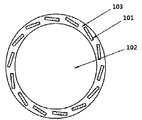
- FIG. 1 is a schematic diagram of a cross section of a negative electrode active material for a lithium secondary battery prepared in Example 1.
- FIG. 1 is a schematic diagram of a cross section of a negative electrode active material for a lithium secondary battery prepared in Example 1.
- FIG. 2 is a schematic view of a cross section of a negative electrode active material for a lithium secondary battery prepared in Example 2.
- FIG. 2 is a schematic view of a cross section of a negative electrode active material for a lithium secondary battery prepared in Example 2.
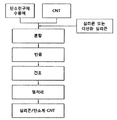
- Figure 3 is a flow chart for explaining the negative electrode active material manufacturing step in the wet manufacturing method of the negative electrode active material prepared in Example 1.
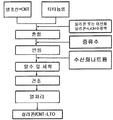
- Figure 4 is a flow chart for explaining the negative electrode active material manufacturing step in the wet manufacturing method of the negative electrode active material prepared in Example 2.
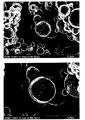
- Example 5 is a view showing the results of the electric field scanning microscope analysis of the composite positive electrode active material for a lithium secondary battery prepared in Example 1 of the present invention.
- Example 6 is a view showing the results of the electric field scanning microscope analysis of the composite positive electrode active material for a lithium secondary battery prepared in Example 2 of the present invention.
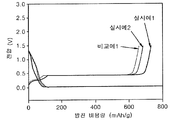
- FIG. 7 is a view showing the charge and discharge results of the negative electrode active material for a lithium secondary battery prepared in an embodiment of the present invention.
- the negative electrode active material for a lithium secondary battery according to the present invention includes a core and a coating layer coating the core, and the coating layer includes a first material which is a nano hollow fiber and a second material which is mixed with the first material.
- the core may be silicon, metal or metal oxide and mixed alloys thereof in which lithium ions may be absorbed / released.
- the second material is a carbon-based material, and in another embodiment of the present invention, the second material is LTO (Lithium Titanium Oxide, Li 4 Ti 5 O 12 ).
- the negative electrode active material is divided into a core and a coating layer, and as the coating layer component, the fiber (first material) having a hollow structure, which is a passage of lithium ions, and the particle size of the negative electrode active material and the volume according to the reaction between the lithium ions Use materials (second material) that can minimize changes simultaneously.
- the coating layer according to the present invention can be coated on the metal oxide which is the core through the simultaneous coating of the first material and the second material, so that the economy is excellent.
- FIG. 1 and 2 are cross-sectional views of a composite negative electrode active material precursor for a lithium secondary battery or a composite metal negative electrode active material for a lithium secondary battery according to an aspect of the present invention.
- a coating layer for coating the active particles 102 and the active particles 102 as a core the coating layer is a coating layer together with the first material 101 and the first material is a nano hollow fiber
- a second material used as is disclosed, the second material is a carbon-based material 100 or LTO (103).
- the active particles refer to particles made of any material having a certain form (a shape of a sphere, a tube, etc.) and capable of absorbing / releasing lithium ions.
- the active particles may be selected from the group consisting of silicon, silicon oxide, metals, metal oxides and mixtures thereof, wherein the metal is Sn, Al, Pb, Zn, Bi, In, Mg, Ga, Cd , Ag, Pt, Pd, Ir, Rh, Ru, Ni, Mo, Cr, Cu, Ti, W, Co, V and Ge may be one or more selected from the group consisting of.
- the active particles may be silicon, in which case the anode active material according to an embodiment of the present invention is in the form of silicon (core)-(nano hollow fiber + carbon-based compound) (coating layer), or silicon (core) )-(Nano hollow fiber + LTO) (coating layer).
- the nano hollow fiber 101 is preferably a carbon material having a nano-sized hollow, and may be a single wall carbon nanotube, a multiwall carbon nanotube, a carbon nanofiber, graphene, or a mixture thereof.
- the scope of the present invention is not limited thereto, and any and all fibers having a structure (hollow or channel) in which a migration path of lithium ions can be provided are within the scope of the present invention.
- the second precursor carbon precursor is glucose, scurose, polyethylene glycol, poly vinyl alcohol, poly vinyl chloride, citric acid Any one or two or more, preferably any one containing glucose, squarose, citric acid, and can be uniformly coated on the surface of the negative electrode active material 102 through the reaction of the first step with the nano hollow fiber. have.
- the carbon precursor is coated on the surface of the active particles such as silicon
- a portion of carbon and oxygen contained in a subsequent heat treatment process (firing process) is converted to carbon dioxide or carbon monoxide to evaporate.
- firing process is converted to carbon dioxide or carbon monoxide to evaporate.
- only carbon remains on the surface of the active particles.
- An example of the reaction is as follows.
- the second material 100 which is the carbon precursor or LTO, is preferably 5 to 50% by weight of the negative electrode active material, more preferably 10 to 40% by weight, and most preferably 20 to 30% by weight.
- the weight ratio of the carbon precursor or the LTO is less than 5%, there is a problem that the safety and battery life of the negative electrode active material is reduced, and when it exceeds 50%, the energy density and the tap density are low.
- Lithium salts in the precursor 100 for preparing LTO are acetate, nitrate, sulfate, carbonate, hydroxide and lithium phosphate (Li 3 PO 4 ).
- Phosphate such as may be used, and the type of titanium salt is bis ammonium lactato dihydroxide (bis (ammonium lactato) dihydroxide), boride (boride), bromide (bromide), butoxide (butoxide), tertiary- Tert-butoxide, chloride, chloride tetrahydrofuran, diisopropoxide bis (acetylacetonate), ethoxide, ethylhexyloxide ), Fluoride, hydride, iodide, isopropoxide, methoxide, oxysulfate, propoxy (Propoxide), it may be used, and sulfate (sulfate), so long as it can be obtained on a commercial scale is not particularly
- the present invention provides a nano hollow fiber as a first material and an LTO as a second material in active particles such as silicon, tin dioxide, silicon oxide, a metal oxide containing the same, and a metal compound of the negative electrode active material.
- FIG. 3 is a step diagram for a method of manufacturing a negative electrode active material using a carbon-based material as a second material.
- a carbon nanotube which is a nano hollow fibrous carbon material that is a first material of the coating layer is dispersed in an aqueous carbon precursor solution that is a second material of the coating layer.
- the content of the nano-hollow fibrous carbon is preferably 0.5 to 8% by weight based on the total weight of the dispersion, and if less than the above range, the movement of lithium ions is limited, and when it exceeds the weight%, volume expansion by heat Problems may arise.
- active particles such as silicon or silicon oxide are mixed and dispersed. That is, after dissolving the carbon precursor in distilled water, the carbon nanotubes, which are nano hollow fibrous carbon materials, and silicon or silicon dioxide, which are active particles, are continuously mixed. At this time, the mixing was performed by transferring the mixed material to the reactor using a metering pump.
- the reaction system in the reactor is sufficiently stirred at low speed or with ultrasonic waves in the reaction system (acoustic chemistry, Sonochemistry), so that the silicon composite anode active material coated with the carbon precursor, the second material, and the nano hollow fiber type carbon, the first material, or A silicon oxide composite negative electrode active material coated with a carbon precursor and nano hollow fiber type carbon was simultaneously synthesized.
- the kind of the active particles of the present invention is not limited to silicon or silicon oxide, and various other metals or metal oxides may be used.
- the operating frequency is 28 kHz to 400 kHz and the intensity is preferably maintained at 100 W to 800 W.
- the precipitation of crystals proceeds more easily through multibubble sonoluminescence (MBSL) conditions.
- an embodiment of the present invention is to adjust the operating frequency to 20 kHz to 300 kHz, operating intensity to 160 W to 600 W, while maintaining the temperature in the reactor at 15 to 35 °C the pressure in the reactor Constant pressure was applied at 1 to 5 atm.
- inert gas selected from the group consisting of nitrogen gas, argon gas, and combinations thereof into the reactor. Injecting nitrogen gas and / or argon gas into the reactor, the silicon composite anode active material coated with carbon-based and nano hollow fiber-type carbon simultaneously or the silicon dioxide composite anode active material coated with carbon-based and nano hollow fiber-like carbon simultaneously
- the size of can be made small and therefore the tap density can be further increased. This is an effect obtained from the sound wave emission phenomenon, and the above-described effect occurs because the reaction is performed by the high temperature and high pressure appearing in the sound wave emission shape.
- the particle size of the particles has an average particle diameter of 1 to 30 ⁇ m, preferably 1 to 10 ⁇ m, and more preferably 1 to 5 ⁇ m. to be.
- the average particle diameter of the particles before the reaction (primary particles) is 5 nm to 400 nm
- the average particle diameter of the particles (secondary particles) fired after coating is 1 ⁇ m to 30 ⁇ m.
- the shape of the particles is preferably spherical.
- the mixture is dried, a silicon composite negative electrode active material or carbon-based and nano-hollow fibers simultaneously coated with carbon-based (carbon precursor) and nano-hollow-fiber carbon suitable for the negative electrode active material of a high capacity lithium secondary battery Firing to obtain a silicon dioxide composite negative electrode active material coated with a carbon simultaneously at the same time in the temperature range of 400 to 800 °C, preferably 500 to 700 °C under an inert gas atmosphere for the reason that it can achieve a desirable structure while suppressing the growth of the particle size Can be implemented.
- the inert gas atmosphere inside the kiln can be formed by blowing a gas selected from the group consisting of nitrogen gas, argon gas, and combinations thereof.
- the composite anode active material for a secondary battery obtained here includes a coating layer made of a carbon-based second material and a first hollow nanofiber-type carbon, and active particles inside the coating layer, as shown in FIG. 1.
- FIG. 4 is a flowchart illustrating a method of manufacturing a negative electrode active material using LTO as a second material according to another embodiment of the present invention.
- glacial acetic acid and titanium salt in which carbon nanotubes are dispersed are mixed. Possible examples of such titanium salts are as listed above.
- silicon or silicon oxide as active particles is mixed into the mixed solution, mixed, and then distilled water is added.
- the first and second materials are then coated on the surface of the active particles.
- a heat treatment process is performed after the drying process, and the heat treatment firing process conditions are as described above.
- a negative electrode active material having a core-coating layer structure of silicon (active particle) -carbon nanotube (CNT, first material) / LTO (second material) is manufactured.
- a composite anode active material having the above characteristics can be produced with excellent reproducibility and productivity.
- the present invention relates to a lithium secondary battery including a lithium secondary battery negative electrode active material prepared by the above method as another means for solving the above problems.
- the lithium secondary battery of the present invention is a lithium battery having a positive electrode and a negative electrode capable of absorbing and discharging lithium ions, a separator interposed between the positive electrode and the negative electrode, and an electrolyte, wherein the negative electrode includes the active material described above. Therefore, the lithium secondary battery according to the present invention exhibits excellent characteristics compared to the conventional lithium secondary battery due to the excellent reproducibility, life characteristics, etc. of the negative electrode.
- Na 2 cation was substituted with H cation in a Na 2 SiO 3 1M aqueous solution to prepare an H 2 SiO 3 aqueous solution.
- 3 wt% of nano hollow fiber carbon multi-walled carbon nanotubes, MWCNT
- MWCNT multi-walled carbon nanotubes
- Dispersion of nano hollow fiber type carbon was used by ultrasonic dispersion method and high pressure dispersion method. After adding sucrose and citric acid aqueous solution to the H 2 SiO 3 aqueous solution, the mixture was stirred for 1 hour and then the reaction system in the reactor was sufficiently stirred at low speed, or with ultrasonic wave for 1 hour (acoustics, Sonochemistry).
- the temperature in the reactor was maintained at 30 ° C. by using a circulating thermostat, the operating frequency was 200 kHz, the intensity was 300 W, the pressure in the reactor was constantly pressurized to 3 atm, and argon gas was used inside the reactor.
- the reaction was dried at 150 degrees in a spray dryer. After drying, the mixture was calcined at 700 to 1100 ° C. for 24 hours in a nitrogen atmosphere, whereby silicon / silicon oxide was used as an active particle, and a cathode active material was prepared in which a CNT and a carbon precursor (sucrose), which are nano hollow fibers, form a coating layer.
- Example 2 In the same manner as in Example 1, except that TiO 2 and LiOH were added to prepare LTO instead of sucrose and citric acid aqueous solution.
- Example 1 is the same as Example 1 except that sucrose and citric acid and carbon nanotubes (CNT) are not included.
- sucrose and citric acid and carbon nanotubes (CNT) are not included.
- the CNTs are well dispersed in the particles of the negative electrode active material, and the particle average particle size is about 10 micrometers.
- the particle size analysis of the material was performed using a laser diffraction particle size distribution meter. From the result of the cumulative particle size distribution, the particle size at the point where the cumulative volume reaches 10%, 50%, and 90% was confirmed, and was set as d10, d50, and d90, respectively. The results are shown in Table 1 below.
- the tap density was calculated by tapping 50 g of material into the cylinder, measuring the volume after 2000 taps, and calculating the tap density. The results are shown in Table 1 above.
- a negative electrode active material: conductive material: binder was weighed in a weight ratio of 80: 12: 8. After mixing the slurry of the mixed material to the aluminum thin film and dried for 8 hours at 120 °C to prepare a pole plate, and then press the prepared pole plate. Li metal was used as a negative electrode, a 2030 type coin cell was prepared, and 1M-LiPF6 dissolved in EC-DEC (volume ratio 1: 1) was used as an electrolyte. Charge and discharge were performed at 1.5 V for charging conditions and 0.02 V for discharge conditions, and the results are shown in FIG. 7.
- the negative electrode active material simultaneously containing the carbon material and the CNT has a very good discharge specific amount.
Landscapes
- Chemical & Material Sciences (AREA)
- Chemical Kinetics & Catalysis (AREA)
- Electrochemistry (AREA)
- General Chemical & Material Sciences (AREA)
- Inorganic Chemistry (AREA)
- Engineering & Computer Science (AREA)
- Materials Engineering (AREA)
- Composite Materials (AREA)
- Manufacturing & Machinery (AREA)
- Battery Electrode And Active Subsutance (AREA)
Priority Applications (4)
| Application Number | Priority Date | Filing Date | Title |
|---|---|---|---|
| EP11780792.5A EP2571084A4 (de) | 2010-05-11 | 2011-05-11 | Anodenaktivmaterial für eine lithiumsekundärbatterie, herstellungsverfahren dafür und lithiumsekundärbatterie damit |
| CN2011800285886A CN102934265A (zh) | 2010-05-11 | 2011-05-11 | 用于锂二次电池的阳极活性物质,制备这种物质的方法和包含这种物质的锂二次电池 |
| US13/696,916 US20130059203A1 (en) | 2010-05-11 | 2011-05-11 | Anode active material for a lithium secondary battery, method for preparing same, and lithium secondary battery including same |
| JP2013510022A JP2013528907A (ja) | 2010-05-11 | 2011-05-11 | リチウム二次電池用負極活物質、その製造方法及びそれを含むリチウム二次電池 |
Applications Claiming Priority (2)
| Application Number | Priority Date | Filing Date | Title |
|---|---|---|---|
| KR10-2010-0043798 | 2010-05-11 | ||
| KR20100043798 | 2010-05-11 |
Publications (3)
| Publication Number | Publication Date |
|---|---|
| WO2011142575A2 true WO2011142575A2 (ko) | 2011-11-17 |
| WO2011142575A3 WO2011142575A3 (ko) | 2012-03-01 |
| WO2011142575A9 WO2011142575A9 (ko) | 2012-04-19 |
Family
ID=44914810
Family Applications (1)
| Application Number | Title | Priority Date | Filing Date |
|---|---|---|---|
| PCT/KR2011/003453 Ceased WO2011142575A2 (ko) | 2010-05-11 | 2011-05-11 | 리튬 이차전지용 음극 활물질, 그 제조방법 및 이를 포함하는 리튬 이차전지 |
Country Status (6)
| Country | Link |
|---|---|
| US (1) | US20130059203A1 (de) |
| EP (1) | EP2571084A4 (de) |
| JP (1) | JP2013528907A (de) |
| KR (1) | KR20110124728A (de) |
| CN (1) | CN102934265A (de) |
| WO (1) | WO2011142575A2 (de) |
Cited By (4)
| Publication number | Priority date | Publication date | Assignee | Title |
|---|---|---|---|---|
| WO2014054792A1 (ja) * | 2012-10-05 | 2014-04-10 | ソニー株式会社 | 活物質、活物質の製造方法、電極および二次電池 |
| CN109326788A (zh) * | 2018-11-20 | 2019-02-12 | 青海大学 | 负极材料和锂离子电池及其制备方法 |
| KR20190060792A (ko) * | 2016-09-19 | 2019-06-03 | 유미코아 | 재충전이 가능한 전기화학 셀 및 배터리(rechargeable electrochemical cell and battery) |
| US10615409B2 (en) | 2015-10-22 | 2020-04-07 | Samsung Electronics Co., Ltd. | Electrode active material, electrode and secondary battery including the same, and method of preparing the electrode active material |
Families Citing this family (41)
| Publication number | Priority date | Publication date | Assignee | Title |
|---|---|---|---|---|
| JP2013191529A (ja) * | 2012-02-16 | 2013-09-26 | Hitachi Chemical Co Ltd | 複合材料、複合材料の製造方法、リチウムイオン二次電池用電極材料、リチウムイオン二次電池用負極、及びリチウムイオン二次電池 |
| WO2014027845A1 (ko) * | 2012-08-16 | 2014-02-20 | 충남대학교산학협력단 | 리튬이차전지용 실리콘 복합재 음극활물질, 이의 제조방법 및 이를 포함하는 리튬이차전지 |
| KR101456201B1 (ko) * | 2012-10-16 | 2014-10-31 | 국립대학법인 울산과학기술대학교 산학협력단 | 리튬 이차 전지용 음극 활물질, 리튬 이차 전지용 음극 활물질의 제조 방법 및 상기 리튬 이차 전지용 음극 활물질을 포함하는 리튬 이차 전지 |
| KR101906973B1 (ko) * | 2012-12-05 | 2018-12-07 | 삼성전자주식회사 | 표면 개질된 음극 활물질용 실리콘 나노입자 및 그 제조방법 |
| KR101582385B1 (ko) | 2012-12-21 | 2016-01-04 | 주식회사 엘지화학 | 리튬 이차 전지용 음극재, 이의 제조 방법 및 이를 포함하는 리튬 이차 전지 |
| CN104011910B (zh) * | 2012-12-21 | 2017-08-08 | 株式会社Lg 化学 | 锂二次电池用负极活性材料、其制备方法和包含所述负极活性材料的锂二次电池 |
| KR101463171B1 (ko) * | 2013-01-11 | 2014-11-21 | 주식회사 예일전자 | 이차전지의 음극재용 탄소코팅 실리콘산화물 분말의 제조방법 |
| KR101687055B1 (ko) * | 2013-05-16 | 2016-12-15 | 주식회사 엘지화학 | 중공형 실리콘계 입자, 이의 제조 방법, 및 이를 포함하는 리튬 이차 전지용 음극 활물질 |
| JP6193184B2 (ja) * | 2013-07-08 | 2017-09-06 | 株式会社東芝 | 非水電解質二次電池用負極活物質、非水電解質二次電池用負極活物質の製造方法、非水電解質二次電池、電池パック及び車 |
| CN104282881B (zh) * | 2013-07-11 | 2017-03-08 | 万向一二三股份公司 | 一种软包锂离子电池硅负极及其制造方法 |
| US9959947B2 (en) | 2013-09-30 | 2018-05-01 | Samsung Electronics Co., Ltd. | Composite, carbon composite including the composite, electrode, lithium battery, electroluminescent device, biosensor, semiconductor device, and thermoelectric device including the composite and/or the carbon composite |
| CN103872326A (zh) * | 2014-04-08 | 2014-06-18 | 福建师范大学 | 锂离子电池负极材料的套环状氧化物修饰碳纳米纤维 |
| KR102161625B1 (ko) | 2014-05-09 | 2020-10-05 | 삼성에스디아이 주식회사 | 음극, 이를 채용한 리튬 전지 및 리튬 전지의 제조 방법 |
| KR102234287B1 (ko) * | 2014-08-08 | 2021-03-31 | 삼성에스디아이 주식회사 | 음극 활물질, 이를 채용한 음극과 리튬 전지, 및 상기 음극 활물질의 제조방법 |
| US20160181604A1 (en) * | 2014-09-12 | 2016-06-23 | Johnson Controls Technology Company | Systems and methods for lithium titanate oxide (lto) anode electrodes for lithium ion battery cells |
| US20160181603A1 (en) * | 2014-09-12 | 2016-06-23 | Johnson Controls Technology Company | Systems and methods for lithium titanate oxide (lto) anode electrodes for lithium ion battery cells |
| JP6438287B2 (ja) | 2014-12-05 | 2018-12-12 | 株式会社東芝 | 非水電解質電池用活物質、非水電解質電池用電極、非水電解質二次電池および電池パック |
| KR101942496B1 (ko) | 2015-08-20 | 2019-01-25 | 주식회사 엘지화학 | 진동을 이용한 전지셀 제조용 가스 트랩 제거 장치 |
| KR101997746B1 (ko) | 2015-09-24 | 2019-07-08 | 삼성전자주식회사 | 전지 팩 및 이의 충/방전 제어 방법 |
| KR102537224B1 (ko) * | 2015-10-12 | 2023-05-26 | 삼성에스디아이 주식회사 | 복합 전극 활물질, 이를 포함하는 리튬 전지, 및 상기 복합 전극 활물질의 제조방법 |
| KR102537225B1 (ko) * | 2015-10-23 | 2023-05-30 | 삼성전자주식회사 | 복합 음극 활물질, 상기 복합 음극 활물질을 포함하는 음극 및 상기 음극을 포함하는 리튬 이차전지 |
| US20170214038A1 (en) * | 2016-01-25 | 2017-07-27 | Ford Cheer International Limited | Lithium titanate electrode material, producing method and applications of same |
| PL3343677T3 (pl) | 2016-06-02 | 2023-10-30 | Lg Energy Solution, Ltd. | Materiał aktywny katody, zawierająca go katoda i zawierająca go litowa bateria akumulatorowa |
| WO2017209561A1 (ko) * | 2016-06-02 | 2017-12-07 | 주식회사 엘지화학 | 음극 활물질, 이를 포함하는 음극 및 이를 포함하는 리튬 이차전지 |
| KR102026918B1 (ko) | 2016-07-04 | 2019-09-30 | 주식회사 엘지화학 | 이차전지용 양극활물질의 제조방법 및 이에 따라 제조된 이차전지용 양극활물질 |
| EP3324419B1 (de) | 2016-11-18 | 2020-04-22 | Samsung Electronics Co., Ltd. | Cluster-struktur eines porösen siliciumverbundstoffs, verfahren zur herstellung davon, kohlenstoffverbundstoffe mit verwendung davon und elektrode, lithiumbatterie und vorrichtung damit |
| JP7099325B2 (ja) | 2016-11-22 | 2022-07-12 | 三菱ケミカル株式会社 | 非水系二次電池用負極材、非水系二次電池用負極及び非水系二次電池 |
| WO2018098506A1 (en) * | 2016-11-28 | 2018-05-31 | Sila Nanotechnologies Inc. | High-capacity battery electrodes with improved binders, construction, and performance |
| CN106848225B (zh) * | 2017-01-20 | 2020-03-10 | 祝巧凤 | 提高锂离子电池安全性的涂层材料及其制法和电池应用 |
| JP6986199B2 (ja) * | 2017-11-08 | 2021-12-22 | トヨタ自動車株式会社 | 負極材料とこれを用いたリチウム二次電池 |
| JP6876257B2 (ja) * | 2018-09-14 | 2021-05-26 | トヨタ自動車株式会社 | リチウムイオン二次電池用負極 |
| KR102701081B1 (ko) | 2018-10-25 | 2024-09-04 | 삼성전자주식회사 | 다공성 실리콘 함유 복합체, 이를 이용한 탄소 복합체, 이를 포함한 전극, 리튬 전지 및 전자소자 |
| KR102799193B1 (ko) | 2019-07-26 | 2025-04-23 | 주식회사 엘지에너지솔루션 | 복합 음극 활물질, 이의 제조방법, 이를 포함하는 음극 및 이차전지 |
| KR102666155B1 (ko) | 2019-09-30 | 2024-05-16 | 주식회사 엘지에너지솔루션 | 복합 음극 활물질, 이의 제조방법, 및 이를 포함하는 음극 |
| KR102789813B1 (ko) * | 2019-10-10 | 2025-03-31 | 주식회사 엘지화학 | 규소를 포함하는 전기화학소자용 음극을 제조하는 방법 |
| KR102362667B1 (ko) * | 2019-12-20 | 2022-02-14 | 주식회사 포스코 | 리튬이온 이차전지용 음극 및 이를 포함하는 리튬 이차전지 |
| CN113823772B (zh) * | 2020-06-19 | 2023-10-31 | 兰溪致德新能源材料有限公司 | 二次锂电池用硅碳复合材料及其制备方法 |
| CN112103481B (zh) * | 2020-08-17 | 2025-07-11 | 格力钛新能源股份有限公司 | 锂电池硅碳负极材料及其制备方法和应用 |
| JP7582135B2 (ja) * | 2021-09-13 | 2024-11-13 | トヨタ自動車株式会社 | 被覆負極活物質および全固体電池 |
| CN114275823B (zh) * | 2021-12-15 | 2024-02-13 | 欣旺达惠州动力新能源有限公司 | 一种中空纳米球复合材料、其制备方法和锂电池 |
| CN114907613B (zh) * | 2022-03-23 | 2023-10-31 | 上海工程技术大学 | 碳纳米管/聚多巴胺-还原氧化石墨烯/三维互联多孔硅橡胶复合材料及其制备方法和应用 |
Family Cites Families (7)
| Publication number | Priority date | Publication date | Assignee | Title |
|---|---|---|---|---|
| EP0851517B1 (de) * | 1996-12-26 | 2001-03-21 | Mitsubishi Denki Kabushiki Kaisha | Elektrode mit positiver Temperaturabhängigkeit der elektrischen Leitfähigkeit (PTC) und Batterie |
| CN100511781C (zh) * | 2004-12-22 | 2009-07-08 | 松下电器产业株式会社 | 复合负极活性材料及其制备方法以及非水电解质二次电池 |
| KR100759556B1 (ko) * | 2005-10-17 | 2007-09-18 | 삼성에스디아이 주식회사 | 음극 활물질, 그 제조 방법 및 이를 채용한 음극과 리튬전지 |
| KR101064767B1 (ko) * | 2007-07-26 | 2011-09-14 | 주식회사 엘지화학 | 코어-쉘 구조의 전극활물질 |
| KR100888685B1 (ko) * | 2007-11-05 | 2009-03-13 | 주식회사 코캄 | 코어-쉘형 리튬 이차전지용 음극 활물질 및 그 제조방법과이를 포함하는 리튬 이차전지 |
| KR100913178B1 (ko) * | 2007-11-22 | 2009-08-19 | 삼성에스디아이 주식회사 | 리튬 이차 전지용 활물질 및 이를 포함하는 리튬 이차 전지 |
| KR20100073506A (ko) * | 2008-12-23 | 2010-07-01 | 삼성전자주식회사 | 음극 활물질, 이를 포함하는 음극, 음극의 제조 방법 및 리튬 전지 |
-
2011
- 2011-05-11 KR KR1020110043988A patent/KR20110124728A/ko not_active Ceased
- 2011-05-11 CN CN2011800285886A patent/CN102934265A/zh active Pending
- 2011-05-11 JP JP2013510022A patent/JP2013528907A/ja not_active Withdrawn
- 2011-05-11 WO PCT/KR2011/003453 patent/WO2011142575A2/ko not_active Ceased
- 2011-05-11 US US13/696,916 patent/US20130059203A1/en not_active Abandoned
- 2011-05-11 EP EP11780792.5A patent/EP2571084A4/de not_active Withdrawn
Non-Patent Citations (2)
| Title |
|---|
| None |
| See also references of EP2571084A4 |
Cited By (5)
| Publication number | Priority date | Publication date | Assignee | Title |
|---|---|---|---|---|
| WO2014054792A1 (ja) * | 2012-10-05 | 2014-04-10 | ソニー株式会社 | 活物質、活物質の製造方法、電極および二次電池 |
| US10615409B2 (en) | 2015-10-22 | 2020-04-07 | Samsung Electronics Co., Ltd. | Electrode active material, electrode and secondary battery including the same, and method of preparing the electrode active material |
| KR20190060792A (ko) * | 2016-09-19 | 2019-06-03 | 유미코아 | 재충전이 가능한 전기화학 셀 및 배터리(rechargeable electrochemical cell and battery) |
| KR102271220B1 (ko) | 2016-09-19 | 2021-07-01 | 유미코아 | 재충전이 가능한 전기화학 셀 및 배터리(rechargeable electrochemical cell and battery) |
| CN109326788A (zh) * | 2018-11-20 | 2019-02-12 | 青海大学 | 负极材料和锂离子电池及其制备方法 |
Also Published As
| Publication number | Publication date |
|---|---|
| KR20110124728A (ko) | 2011-11-17 |
| CN102934265A (zh) | 2013-02-13 |
| EP2571084A2 (de) | 2013-03-20 |
| US20130059203A1 (en) | 2013-03-07 |
| EP2571084A4 (de) | 2013-10-02 |
| WO2011142575A3 (ko) | 2012-03-01 |
| JP2013528907A (ja) | 2013-07-11 |
| WO2011142575A9 (ko) | 2012-04-19 |
Similar Documents
| Publication | Publication Date | Title |
|---|---|---|
| WO2011142575A2 (ko) | 리튬 이차전지용 음극 활물질, 그 제조방법 및 이를 포함하는 리튬 이차전지 | |
| WO2011155781A2 (ko) | 리튬 이차전지용 양극 활 물질, 그 제조방법 및 이를 포함하는 리튬 이차전지 | |
| CN116143199B (zh) | 一种表面包覆的层状氧化物及其制备方法、正极片、钠离子电池以及用电设备 | |
| US20080038635A1 (en) | Active material for rechargeable lithium battery and rechargeable lithium battery including same | |
| CN113950759A (zh) | 负极、其制造方法以及包含其的二次电池 | |
| WO2011068391A2 (ko) | 나노 중공 섬유형 탄소를 포함하는 리튬 이차전지용 양극 활물질 전구체, 활물질 및 그 제조방법 | |
| CN110416522B (zh) | 一种含锂复合负极材料、其制备方法和其在锂二次电池中的应用 | |
| CN106058228A (zh) | 一种核壳结构硅碳复合材料及其制备方法与用途 | |
| WO2014116064A1 (ko) | 산화철 나노입자의 제조 방법 | |
| WO2015005648A1 (ko) | 리튬이차전지용 음극 활물질, 이를 포함하는 음극용 조성물 및 리튬이차전지 | |
| WO2014182036A1 (ko) | 리튬 이차 전지용 음극 활물질, 이의 제조 방법 및 이를 포함하는 리튬 이차 전지 | |
| CN108461734A (zh) | 一种磷酸钛钠/碳复合材料的制备方法及应用 | |
| WO2013129850A1 (ko) | 리튬 이차전지용 전극활물질 및 그 제조방법 | |
| Xie et al. | Microbelt–void–microbelt-structured SnO 2@ C as an advanced electrode with outstanding rate capability and high reversibility | |
| KR20230153814A (ko) | 전고체 이차 전지용 양극 활물질, 이의 제조 방법 및 이를 포함하는 전고체 이차 전지 | |
| KR102914058B1 (ko) | 음극 및 이를 포함하는 이차전지 | |
| KR20230016122A (ko) | 전고체 전지용 양극 활물질, 이의 제조 방법 및 이를 포함하는 전고체 전지 | |
| CN107464938A (zh) | 一种具有核壳结构的碳化钼/碳复合材料及其制备方法和在锂空气电池中的应用 | |
| WO2015093725A1 (ko) | 비수계 리튬이차전지용 고용량 양극재료 및 그의 제조 방법 | |
| CN107331839A (zh) | 一种碳纳米管负载纳米二氧化钛的制备方法 | |
| WO2015102201A1 (ko) | 리튬 이차전지용 음극 활물질의 제조방법 및 리튬 이차전지 | |
| WO2020166871A1 (ko) | 리튬 이차전지용 양극 활물질 | |
| CN118572109A (zh) | 负极活性材料及负极片和锂离子电池 | |
| CN114709377A (zh) | 一种高镍正极材料及其制备方法和应用 | |
| CN115472792A (zh) | 锂离子电池材料LiF-V2O3/C的制备方法 |
Legal Events
| Date | Code | Title | Description |
|---|---|---|---|
| WWE | Wipo information: entry into national phase |
Ref document number: 201180028588.6 Country of ref document: CN |
|
| 121 | Ep: the epo has been informed by wipo that ep was designated in this application |
Ref document number: 11780792 Country of ref document: EP Kind code of ref document: A2 |
|
| WWE | Wipo information: entry into national phase |
Ref document number: 13696916 Country of ref document: US |
|
| ENP | Entry into the national phase |
Ref document number: 2013510022 Country of ref document: JP Kind code of ref document: A |
|
| NENP | Non-entry into the national phase |
Ref country code: DE |
|
| WWE | Wipo information: entry into national phase |
Ref document number: 2011780792 Country of ref document: EP |