WO2011155236A1 - 積層体及びその加硫物 - Google Patents
積層体及びその加硫物 Download PDFInfo
- Publication number
- WO2011155236A1 WO2011155236A1 PCT/JP2011/054470 JP2011054470W WO2011155236A1 WO 2011155236 A1 WO2011155236 A1 WO 2011155236A1 JP 2011054470 W JP2011054470 W JP 2011054470W WO 2011155236 A1 WO2011155236 A1 WO 2011155236A1
- Authority
- WO
- WIPO (PCT)
- Prior art keywords
- acrylic elastomer
- elastomer
- mass
- acrylic
- parts
- Prior art date
- Legal status (The legal status is an assumption and is not a legal conclusion. Google has not performed a legal analysis and makes no representation as to the accuracy of the status listed.)
- Ceased
Links
Images
Classifications
-
- B—PERFORMING OPERATIONS; TRANSPORTING
- B32—LAYERED PRODUCTS
- B32B—LAYERED PRODUCTS, i.e. PRODUCTS BUILT-UP OF STRATA OF FLAT OR NON-FLAT, e.g. CELLULAR OR HONEYCOMB, FORM
- B32B25/00—Layered products comprising a layer of natural or synthetic rubber
- B32B25/14—Layered products comprising a layer of natural or synthetic rubber comprising synthetic rubber copolymers
-
- B—PERFORMING OPERATIONS; TRANSPORTING
- B32—LAYERED PRODUCTS
- B32B—LAYERED PRODUCTS, i.e. PRODUCTS BUILT-UP OF STRATA OF FLAT OR NON-FLAT, e.g. CELLULAR OR HONEYCOMB, FORM
- B32B1/00—Layered products having a non-planar shape
- B32B1/08—Tubular products
-
- B—PERFORMING OPERATIONS; TRANSPORTING
- B32—LAYERED PRODUCTS
- B32B—LAYERED PRODUCTS, i.e. PRODUCTS BUILT-UP OF STRATA OF FLAT OR NON-FLAT, e.g. CELLULAR OR HONEYCOMB, FORM
- B32B25/00—Layered products comprising a layer of natural or synthetic rubber
- B32B25/04—Layered products comprising a layer of natural or synthetic rubber comprising rubber as the main or only constituent of a layer, which is next to another layer of the same or of a different material
- B32B25/042—Layered products comprising a layer of natural or synthetic rubber comprising rubber as the main or only constituent of a layer, which is next to another layer of the same or of a different material of natural rubber or synthetic rubber
-
- B—PERFORMING OPERATIONS; TRANSPORTING
- B32—LAYERED PRODUCTS
- B32B—LAYERED PRODUCTS, i.e. PRODUCTS BUILT-UP OF STRATA OF FLAT OR NON-FLAT, e.g. CELLULAR OR HONEYCOMB, FORM
- B32B7/00—Layered products characterised by the relation between layers; Layered products characterised by the relative orientation of features between layers, or by the relative values of a measurable parameter between layers, i.e. products comprising layers having different physical, chemical or physicochemical properties; Layered products characterised by the interconnection of layers
- B32B7/04—Interconnection of layers
- B32B7/10—Interconnection of layers at least one layer having inter-reactive properties
-
- B—PERFORMING OPERATIONS; TRANSPORTING
- B32—LAYERED PRODUCTS
- B32B—LAYERED PRODUCTS, i.e. PRODUCTS BUILT-UP OF STRATA OF FLAT OR NON-FLAT, e.g. CELLULAR OR HONEYCOMB, FORM
- B32B2250/00—Layers arrangement
- B32B2250/24—All layers being polymeric
- B32B2250/248—All polymers belonging to those covered by group B32B25/00
-
- B—PERFORMING OPERATIONS; TRANSPORTING
- B32—LAYERED PRODUCTS
- B32B—LAYERED PRODUCTS, i.e. PRODUCTS BUILT-UP OF STRATA OF FLAT OR NON-FLAT, e.g. CELLULAR OR HONEYCOMB, FORM
- B32B2307/00—Properties of the layers or laminate
- B32B2307/50—Properties of the layers or laminate having particular mechanical properties
- B32B2307/51—Elastic
-
- Y—GENERAL TAGGING OF NEW TECHNOLOGICAL DEVELOPMENTS; GENERAL TAGGING OF CROSS-SECTIONAL TECHNOLOGIES SPANNING OVER SEVERAL SECTIONS OF THE IPC; TECHNICAL SUBJECTS COVERED BY FORMER USPC CROSS-REFERENCE ART COLLECTIONS [XRACs] AND DIGESTS
- Y10—TECHNICAL SUBJECTS COVERED BY FORMER USPC
- Y10T—TECHNICAL SUBJECTS COVERED BY FORMER US CLASSIFICATION
- Y10T428/00—Stock material or miscellaneous articles
- Y10T428/31504—Composite [nonstructural laminate]
- Y10T428/3154—Of fluorinated addition polymer from unsaturated monomers
Definitions
- the present invention relates to an elastomer laminate.
- Acrylic elastomer and its vulcanizates are excellent in physical properties such as heat aging resistance, oil resistance, mechanical properties, compression set properties, etc., such as hose members, seal members, anti-vibration rubber members in automobile engine rooms, etc. Often used as a material.
- Patent Documents 1 to 4 listed below disclose a laminate of a fluorine elastomer layer and an acrylic elastomer layer. If a fluoroelastomer is laminated on a portion where durability is a real problem in a conventional material, substantial durability can be enhanced.
- the surface of the fluoroelastomer surface is treated with a metallic sodium solution (for example, see Patent Document 1), discharge treatment (for example, see Patent Document 2), plasma treatment (for example, see Patent Document 3), etc. to form a layer.
- a metallic sodium solution for example, see Patent Document 1
- discharge treatment for example, see Patent Document 2
- plasma treatment for example, see Patent Document 3
- Patent Document 4 a specific type of fluorine elastomer
- Patent Documents 1 to 3 complicates the manufacturing process and increases the manufacturing cost of a laminate such as a hose product. Further, when the elastomer layer is deteriorated by the surface treatment, it causes a decrease in the sealing performance of the laminate.
- the method of using only a specific fluoroelastomer as in Patent Document 4 is difficult to freely design characteristics such as flexibility according to the use of the laminate because the type of fluoroelastomer is limited. .
- the main object of the present invention is to provide a laminate in which a plurality of elastomer layers are firmly bonded.
- the present invention relates to an acrylic elastomer layer comprising an acrylic elastomer composition in which 1 part by mass or more of an onium salt is added to 100 parts by mass of an acrylic elastomer containing an epoxy group as a crosslinking site (functional group) of the acrylic elastomer, and polyol crosslinking. It is a laminate formed by adhering a fluorine elastomer layer made of a fluorine elastomer composition containing an agent.
- the onium salt is preferably an organic ammonium salt and / or an organic phosphonium salt.
- the present invention also provides a vulcanizate obtained by vulcanizing a laminate of an acrylic elastomer layer and a fluorine elastomer layer.
- a laminate in which a fluorine elastomer layer and an acrylic elastomer layer are firmly bonded can be provided.
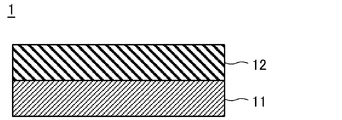
- FIG. 1 is a cross-sectional view showing an example of a laminate of the present invention.
- FIG. 1 is a cross-sectional view showing an example of a laminate 1 of the present invention.
- the laminate 1 has an acrylic elastomer layer 11 and a fluorine elastomer layer 12, and the acrylic elastomer layer 11 and the fluorine elastomer layer 12 are Laminated and glued.
- the acrylic elastomer layer 11 and the fluoroelastomer layer 12 may be simply bonded, but cross-linking adhesion in which the elastomers are cross-linked at the interface is more desirable. For example, if these layers are vulcanized in a superposed state to obtain a vulcanized product, a stronger laminate 1 can be obtained.
- the vulcanization method is not particularly limited, and usual vulcanization methods such as press vulcanization, steam vulcanization, and electron beam vulcanization can be employed.
- either or both of the acrylic elastomer layer 11 and the fluorine elastomer layer 12 can be subjected to a surface treatment.
- a strong treatment can be achieved without such a surface treatment.
- Vulcanization adhesion can be achieved.
- the number of the acrylic elastomer layer 11 and the fluorine elastomer layer 12 is not particularly limited, and the laminate 1 may be configured by laminating one or two or more acrylic elastomer layers 11 and one or two or more fluorine elastomer layers 12. .
- the acrylic elastomer layers 11 and the fluorine elastomer layers 12 can be alternately laminated. It is also possible to have a structure in which layers other than the acrylic elastomer layer 11 and the fluorine elastomer layer 12, for example, reinforcing fibers are stacked. The reinforcing fibers are brought into close contact with either one or both of the acrylic elastomer layer 11 and the fluorine elastomer layer 12.
- the acrylic elastomer layer 11 is obtained by molding an acrylic elastomer composition containing an acrylic elastomer as a main component and an onium salt into a layer (film shape).
- the fluorine elastomer layer 12 is mainly composed of a fluorine elastomer and is a polyol. It is obtained by molding a fluoroelastomer composition to which a crosslinking agent has been added into a layer (film).
- the main component is a component having a content of 30% by mass or more of the whole, that is, the acrylic elastomer composition contains 30% by mass or more of the acrylic elastomer, and the fluorine elastomer composition contains 30% by mass or more of the fluoroelastomer. contains. Below, each composition is demonstrated in detail.
- the acrylic elastomer used in the present invention is obtained by copolymerizing (meth) acrylic acid alkyl ester as a main component and a crosslinkable monomer containing an epoxy group. If necessary, a copolymer of (meth) acrylic acid alkyl ester with a crosslinkable monomer other than vinyl acetate or epoxy group, ethylene, or the like may be used.
- the crosslinkable monomer is a monomer having a functional group that forms a crosslinkable site (crosslinking point).
- (Meth) acrylic acid alkyl ester is a skeleton of acrylic elastomer, and the basic properties such as normal physical properties, cold resistance and oil resistance of the resulting acrylic elastomer composition can be adjusted by selecting the type It is.
- (meth) acrylic acid alkyl ester is synonymous with (meth) acrylate, and is a concept including both methacrylic acid alkyl ester (methacrylate) and acrylic acid alkyl ester (acrylate).
- the (meth) acrylic acid alkyl ester is not particularly limited.
- acrylic acid alkyl esters such as n-decyl (meth) acrylate, n-dodecyl (meth) acrylate, and n-octadecyl (meth) acrylate.
- 2-methoxyethyl acrylate, 2-ethoxyethyl acrylate, 2- (n-propoxy) ethyl acrylate, 2- (n-butoxy) ethyl acrylate, 3-methoxypropyl acrylate, 3-ethoxypropyl acrylate, 2- (n -Alkoxyalkyl esters of acrylic acid such as -propoxy) propyl acrylate and 2- (n-butoxy) propyl acrylate can also be used, and these may be used alone or in combination of two or more.
- the cold resistance and oil resistance of the resulting acrylic elastomer composition and its vulcanizate can be adjusted by adjusting the blending amount of these unsaturated monomers.
- cold resistance can be improved by increasing the copolymerization ratio of n-butyl acrylate
- oil resistance can be improved by increasing the copolymerization ratio of ethyl acrylate.
- the crosslinkable monomer is used to adjust the hardness and elongation characteristics of the resulting acrylic elastomer by promoting intermolecular crosslinking by copolymerizing with an alkyl (meth) acrylate as necessary.
- the crosslinkable monomer one containing an epoxy group is essential, and other crosslinkable monomer, for example, one having an active chlorine group, a carboxyl group or the like can be used as necessary.
- what has both an epoxy group and other functional groups (carboxyl group etc.) can also be used.
- crosslinkable monomers are not particularly limited, and examples of the crosslinkable monomer containing an epoxy group include glycidyl acrylate, glycidyl methacrylate, allyl glycidyl ether, and methallyl glycidyl ether.
- examples of other crosslinking monomer include those having an active chlorine group such as 2-chloroethyl vinyl ether, 2-chloroethyl acrylate, vinyl benzyl chloride, vinyl chloroacetate, allyl chloroacetate, acrylic acid, methacrylic acid, and the like.
- carboxyl group such as acid, crotonic acid, 2-pentenoic acid, maleic acid, fumaric acid, itaconic acid, maleic acid monoalkyl ester, fumaric acid monoalkyl ester and cinnamic acid.
- the amount of these crosslinkable monomers added is preferably 0.5 to 10 parts by weight, more preferably 1 to 5 parts by weight, and particularly preferably 1 to 4 parts by weight in 100 parts by weight of the acrylic elastomer. desirable.
- the addition amount of the crosslinkable monomer is less than 0.5 parts by mass, the effect of crosslinking the acrylic elastomer composition is small, and the strength of the obtained vulcanizate is insufficient.
- the addition amount of the crosslinkable monomer exceeds 10 parts by mass, the obtained vulcanizate is cured and loses rubber elasticity.
- the addition amount of the crosslinkable monomer means the addition amount of the crosslinkable monomer containing an epoxy group when only those containing an epoxy group are used as the crosslinkable monomer, and the epoxy group is contained as the crosslinkable monomer. In the case of using both of the monomer and other crosslinkable monomers, it is the total amount thereof.
- Vinyl acetate is used to maintain mechanical properties such as elongation of the acrylic elastomer by crosslinking between the molecules when the acrylic elastomer is thermally aged, and can be obtained by adjusting the blending amount thereof. It is possible to adjust the intermolecular crosslinking of the acrylic elastomer.
- the main chain of acrylic elastomer is cut by the influence of heat, ultraviolet rays, etc., and mechanical properties such as tensile strength and elongation at break are drastically lowered. Therefore, vinyl acetate, which is likely to cause a crosslinking reaction, is copolymerized with the main chain of the acrylic elastomer, and when the main chain of the acrylic elastomer is cut, the vinyl acetate becomes a cross-linking site and the cross-linked molecules are cross-linked again. Can be made.
- the copolymerization amount is preferably 20 parts by mass or less in 100 parts by mass of the acrylic elastomer. If the copolymerization amount of vinyl acetate is within this range, it is possible to suppress the deterioration of the mechanical properties while maintaining the heat aging resistance of the acrylic elastomer.
- the acrylic elastomer may be copolymerized with a (meth) acrylic acid alkyl ester, a crosslinkable monomer, or another monomer copolymerizable with vinyl acetate within a range not impairing the object of the present invention.
- examples of other copolymerizable monomers include, but are not limited to, alkyl vinyl ketones such as methyl vinyl ketone, vinyl and allyl ethers such as vinyl ethyl ether and allyl methyl ether, styrene, and ⁇ -methyl styrene.
- Vinyl aromatic compounds such as chlorostyrene, vinyl toluene, vinyl naphthalene, vinyl nitriles such as acrylonitrile, methacrylonitrile, acrylamide, propylene, butadiene, isoprene, pentadiene, vinyl chloride, vinylidene chloride, vinyl fluoride, vinylidene fluoride, There are ethylenically unsaturated compounds such as ethylene and vinyl propionate.
- the proportion is preferably 50 parts by mass or less in 100 parts by mass of the acrylic elastomer.
- the acrylic elastomer can be obtained by copolymerizing the above monomers by a known method such as emulsion polymerization, suspension polymerization, solution polymerization, bulk polymerization and the like.
- the acrylic elastomer composition contains the above acrylic elastomer and an onium salt.
- the onium salt is not particularly limited, and examples thereof include organic ammonium salts and organic phosphonium salts.
- the organic ammonium salt used in the present invention is not particularly limited, but is tetra-n-butylammonium chloride, trimethylphenylammonium chloride, trimethylstearylammonium chloride, trimethyllaurylammonium chloride, trimethylcetylammonium chloride, dimethyldistearylammonium.
- the organic phosphonium salt used in the present invention is not particularly limited, but tetra-n-butylphosphonium chloride, tetra-n-butylphosphonium bromide, methyltriphenylphosphonium bromide, ethyltriphenylphosphonium bromide, butyltriphenylphosphonium bromide, Hexyltriphenylphosphonium bromide, benzyltriphenylphosphonium bromide, tetraphenylphosphonium chloride, tetraphenylphosphonium bromide, 4-butoxybenzyltriphenylphosphonium bromide, allyltributylphosphonium chloride, 2-propynyltriphenylphosphonium bromide, methoxypropyltributylphosphonium chloride, etc. Is mentioned.
- the addition amount of the onium salt is preferably 1 to 10 parts by mass with respect to 100 parts by mass of the acrylic elastomer in consideration of sufficient adhesive strength, processability, flexibility and the like. If the addition amount of the onium salt is less than 1 part by mass, the adhesive strength of the laminate is insufficient and peeling occurs. In order to obtain a more suitable vulcanization adhesion effect, the addition amount of the onium salt is more preferably 2 to 10 parts by mass with respect to 100 parts by mass of the acrylic elastomer, and it is necessary to make the addition amount 2 parts by mass or more. A sufficient adhesive effect can be obtained.
- the addition method of the onium salt is not particularly limited, but in order to obtain strong vulcanization adhesion between the acrylic elastomer layer 11 and the fluorine elastomer layer 12 without performing a special surface treatment, these layers are used.
- an onium salt is preferably added to the acrylic elastomer composition by kneading the acrylic elastomer and various compounding agents.
- the acrylic elastomer composition can be obtained by kneading an acrylic elastomer, an onium salt and, if necessary, other compounding agents such as a crosslinking accelerator and a filler using a commonly used rubber kneading apparatus.
- a rubber kneading apparatus a roll, a kneader, a Banbury mixer, an internal mixer, a twin screw extruder, or the like can be used.
- the fluoroelastomer used in the present invention is not particularly limited as long as it has a fluorine atom in the elastomer.
- the fluoroelastomer used in the present invention is not particularly limited, but for example, those capable of polyol crosslinking are used.
- the fluorine elastomer composition used in the present invention is obtained by blending a polyol crosslinking agent with the fluorine elastomer. Moreover, a crosslinking accelerator can be used with a polyol crosslinking agent.
- the polyol cross-linking agent and the cross-linking accelerator are used for cross-linking the fluoroelastomer.
- crosslinking refers to crosslinking the same or different polymer chains of a fluoroelastomer with a polyol crosslinking agent. By crosslinking in this way, the fluoroelastomer has improved tensile strength and good elasticity. It will have.
- the cross-linked fluoroelastomer formed by cross-linking with a polyol cross-linking agent has a carbon-oxygen bond at the cross-linking point, has a small compression set, and is excellent in moldability. Is preferred.
- a polyol crosslinking agent in the present invention a polyol compound generally known for fluorine elastomers can be used.
- a polyhydroxy compound, particularly a polyhydroxy aromatic compound is preferable because of its excellent heat resistance. Used for.
- polyhydroxy aromatic compound is not particularly limited, and examples thereof include resorcin, hydroquinone, catechol, 2,2-bis (4-hydroxyphenyl) propane, 2,2-bis (4-hydroxyphenyl) perfluoropropane, 1,7-dihydroxynaphthalene, 2,7-dihydroxynaphthalene, 1,6-dihydroxynaphthalene, 4,4′-dihydroxydiphenyl, 4,4′-dihydroxystilbene, 2,6-dihydroxyanthracene, 2,2-bis ( 4-hydroxyphenyl) butane, 4,4-bis (4-hydroxyphenyl) valeric acid, 2,2-bis (4-hydroxyphenyl) tetrafluorodichloropropane, 4,4′-dihydroxydiphenylsulfone, 4,4 ′ -Dihydroxydiphenyl ketone, tri (4-hydride Kishifeniru) methane, 3,3 ', 5,5'-tetrachloro bisphenol A, 3,
- a crosslinked hydroxyelastomer is preferably a polyhydroxy compound from the viewpoint of low compression set and excellent moldability, and more preferably a polyhydroxy aromatic compound from the viewpoint of excellent heat resistance.
- Bis (4-hydroxyphenyl) perfluoropropane is more preferred.
- the addition amount of the polyol crosslinking agent is preferably 0.2 to 10 parts by mass, more preferably 0.5 to 3 parts by mass, and further preferably 1 to 2.5 parts by mass with respect to 100 parts by mass of the fluoroelastomer.
- the addition amount of the crosslinking agent is less than 0.2 parts by mass, the effect of crosslinking the composition is small, and the strength of the obtained vulcanizate is insufficient. If added over 10 parts by mass, the resulting vulcanizate is cured and loses rubber elasticity.
- crosslinking accelerator in combination with a polyol crosslinking agent.
- the crosslinking reaction can be promoted by promoting the formation of an intramolecular double bond in the dehydrofluorination reaction of the fluorine elastomer main chain.
- an onium compound is generally used as the crosslinking accelerator for polyol-based crosslinking.
- the onium compound is not particularly limited, and examples thereof include ammonium compounds such as quaternary ammonium salts, phosphonium compounds such as quaternary phosphonium salts, oxonium compounds, sulfonium compounds, cyclic amines, and monofunctional amine compounds. Of these, onium salts such as quaternary ammonium salts and quaternary phosphonium salts are preferred.
- the kind of onium salt as the crosslinking accelerator is not particularly limited, and for example, the same kind as that of the acrylic elastomer composition can be used.
- the method of adding the onium salt is not particularly limited, but achieves strong vulcanization adhesion by a method of adding the fluorine elastomer and the acrylic elastomer layer, for example, at the time of kneading the fluorine elastomer and various compounding agents. be able to.
- the addition amount of the crosslinking accelerator is preferably 0.1 to 2.0 parts by mass, more preferably 0.1 to 1.5 parts by mass, and 0.1 to 0.7 parts by mass with respect to 100 parts by mass of the fluoroelastomer. Part is more preferable. If the addition amount of the crosslinking accelerator is less than 0.1 parts by mass, the desired effect of promoting the crosslinking rate cannot be obtained, and if it exceeds 2.0 parts by mass, the crosslinking rate becomes too fast. Previous initial vulcanization) and molding defects are likely to occur.
- fluorine elastomers such as carbon black, reinforcing agents, softeners, anti-aging agents, vulcanizing agents, vulcanization accelerators, fillers, processing aids, plasticizers, colorants
- Various additives such as stabilizers, adhesion assistants, acid acceptors, mold release agents, conductivity imparting agents, thermal conductivity imparting agents, surface non-adhesives, flexibility imparting agents, heat resistance improvers, flame retardants, etc.
- One or more crosslinking agents and crosslinking accelerators other than the polyol crosslinking agent may be blended.
- the fluoroelastomer composition is obtained by kneading a fluorine elastomer, a polyol cross-linking agent and, if necessary, other compounding agents such as a cross-linking accelerator and a filler using a generally used rubber kneading apparatus.
- a rubber kneading apparatus a roll, a kneader, a Banbury mixer, an internal mixer, a twin screw extruder, or the like can be used.
- the acrylic elastomer A had a copolymer composition of 1.3 parts by mass of glycidyl methacrylate monomer unit, 50 parts by mass of ethyl acrylate monomer unit, and 50 parts by mass of n-butyl acrylate monomer unit.
- the glycidyl methacrylate monomer was quantified by dissolving a raw rubber copolymer (before vulcanization adhesion) in chloroform and titrating with a perchloric acid acetic acid solution. Other monomer unit components were quantified by nuclear magnetic resonance spectroscopy.
- Acrylic Elastomer B under the same conditions as Acrylic Elastomer A except that the monomer component, which is the raw material for the acrylic elastomer, was changed to 2.2 kg vinyl acetate, 8.8 kg n-butyl acrylate, and 0.17 kg glycidyl methacrylate. Got.
- the acrylic elastomer B had a copolymer composition of 20 parts by mass of vinyl acetate monomer units, 80 parts by mass of n-butyl acrylate monomer units, and 1.5 parts by mass of glycidyl methacrylate monomer units.
- the same method as the said acrylic elastomer A was employ
- acrylic elastomer C comprises 1.3 parts by mass of glycidyl methacrylate monomer unit, 50 parts by mass of ethyl acrylate monomer unit, 47 parts by mass of n-butyl acrylate monomer unit, and 3 parts by mass of ethylene monomer unit. It was a copolymer composition.
- acrylic elastomer D was obtained under the same conditions as the acrylic elastomer A, except that the monomer component as the raw material for the acrylic elastomer was changed to 5.5 kg of ethyl acrylate and 5.5 kg of n-butyl acrylate.
- the acrylic elastomer D had a copolymer composition of 50 parts by mass of ethyl acrylate monomer units and 50 parts by mass of n-butyl acrylate monomer units.
- a fluorine elastomer composition was prepared with the composition (mass ratio) shown in Table 1 below, and the fluorine elastomer composition (unvulcanized) was molded to a thickness of 2.5 mm to prepare a fluorine elastomer layer.
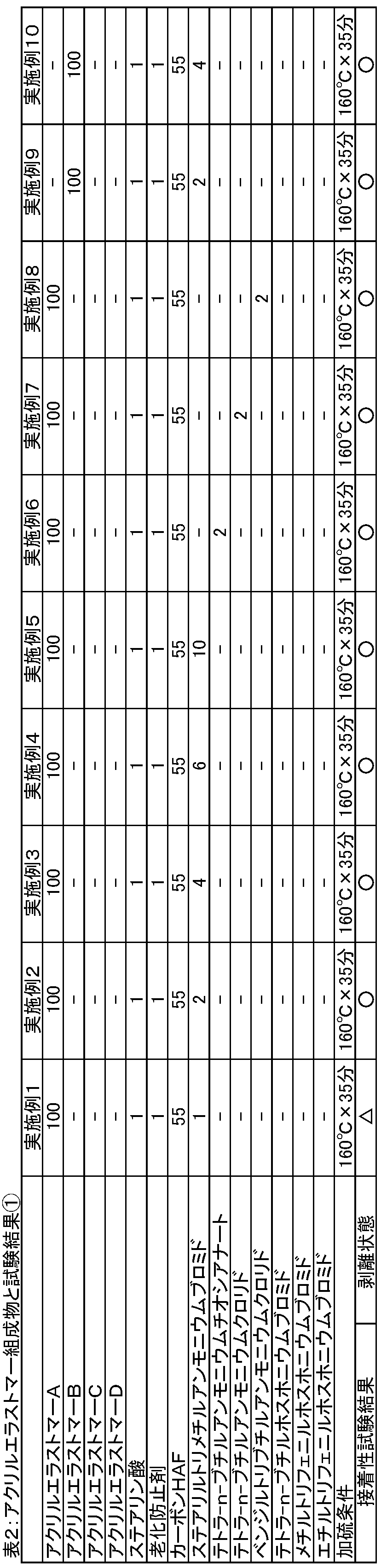
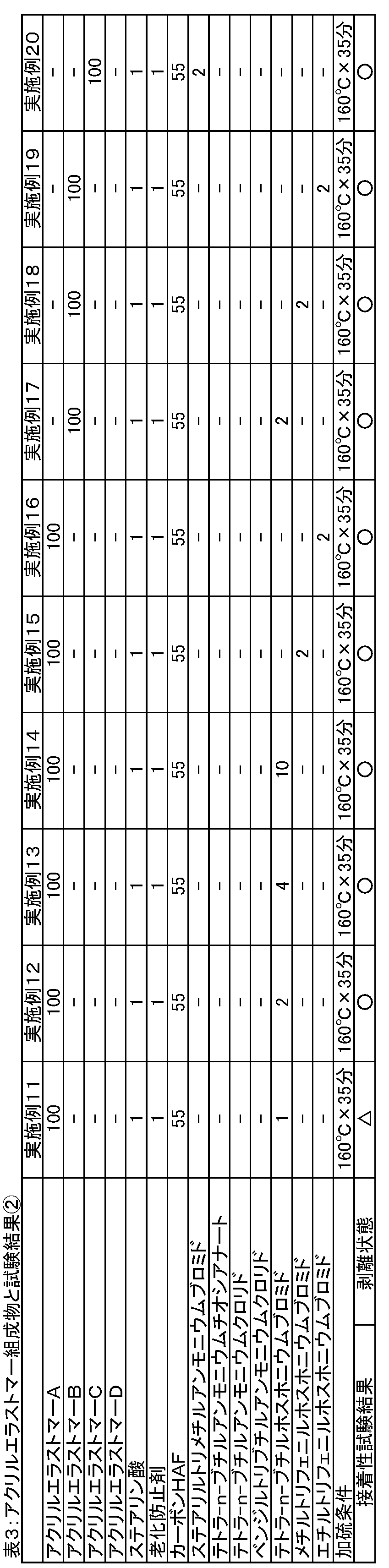
- Acrylic elastomer compositions of Examples 1 to 20 and Comparative Examples 1 to 7 were prepared by kneading the acrylic elastomers A to D and other materials using the 8-inch open rolls with the blending (mass ratio) shown in Tables 2 to 4 below. Got. These acrylic elastomer compositions (unvulcanized) are molded to a thickness of 2.5 mm to prepare an acrylic elastomer layer, which is adhered to the fluoroelastomer layer and heated at 160 ° C. for 35 minutes with a steam heating type hot press. The laminated body vulcanizate was obtained by processing.
- the compounding reagents used in Tables 1 to 4 above are as follows.
- -Fluoroelastomer Daiel G558 (manufactured by Daikin Industries, Ltd., containing a polyol cross-linking agent in the product)
- Magnesium oxide Kyowa Mag 150 (manufactured by Kyowa Chemical Industry Co., Ltd.)
- Calcium hydroxide Special reagent grade (manufactured by Wako Pure Chemical Industries, Ltd.)
- Anti-aging agent NOCRACK CD (manufactured by Ouchi Shinsei Chemical Co., Ltd.)
- Stearic acid LUNAC S-90 (manufactured by Kao Corporation)
- Stearyltrimethylammonium bromide Special reagent grade (manufactured by Kao
- peeling strength was evaluated on condition of the following. (1) Peel strength Peel strength was measured by performing a T peel test on each test piece using a tensile tester at a peel rate of 50 mm / min, and measuring the adhesive strength. Moreover, the peeling mode was observed and evaluated according to the following criteria.
- the laminate of the present invention has high vulcanization adhesion between the fluoroelastomer layer and the acrylic elastomer layer and has strong adhesive strength without any special surface treatment.
- any onium salt of organic ammonium salt and organic phosphonium salt is suitable for the present invention.
- Comparative Examples 6 and 7 have low adhesive strength despite the acrylic elastomer composition containing an onium salt.
- epoxy groups (glycidyl groups) are included in the chemical structure of the acrylic elastomer. ) Must be contained.
- the laminate of the present invention provides a composition having excellent interlayer adhesion, and the laminate and its vulcanizate can be suitably used as hose parts, seal parts, and vibration-proof rubber parts.
Landscapes
- Engineering & Computer Science (AREA)
- Mechanical Engineering (AREA)
- Laminated Bodies (AREA)
- Compositions Of Macromolecular Compounds (AREA)
- Epoxy Resins (AREA)
- Manufacture Of Macromolecular Shaped Articles (AREA)
Abstract
Description
オニウム塩が、有機アンモニウム塩及び/又は有機ホスホニウム塩であることが好ましい。
また、本発明はアクリルエラストマー層とフッ素エラストマー層の積層体を加硫して得られる加硫物を提供するものである。
本発明に用いるアクリルエラストマーは、(メタ)アクリル酸アルキルエステルを主成分とし、これにエポキシ基を含有する架橋席モノマーを共重合させたものである。必要に応じて、(メタ)アクリル酸アルキルエステルに、酢酸ビニル、エポキシ基以外の架橋席モノマーやエチレンなどを共重合させたものを用いてもよい。なお、架橋席モノマーとは、架橋席(架橋点)を形成する官能基を有する単量体(モノマー)のことである。
本発明に用いられるフッ素エラストマーは、エラストマー中にフッ素原子を有するものであれば特に限定するものでなく、例えば、テトラフルオロエチレン-エチレン共重合体、テトラフルオロエチレン-プロピレン共重合体、クロロトリフルオロエチレン-エチレン共重合体、ポリビニリデンフロライド、ポリビニルフロライド、ビニリデンフロライド-ヘキサフルオロプロピレン共重合体、テトラフルオロエチレン-ビニリデンフロライド-ヘキサフルオロプロピレン共重合体、テトラフルオロエチレン-ビニリデンフロライド-パーフルオロアルキルビニルエーテル共重合体、テトラフルオロエチレン-ビニリデンフロライド-プロピレン共重合体等がある。
<アクリルエラストマーAの製造>
内容積40リットルの反応容器に、部分ケン化ポリビニルアルコール4質量%水溶液17kg、酢酸ナトリウム22gを投入し、攪拌機であらかじめよく混合し、均一懸濁液を作製した。槽内上部の空気を窒素で置換した後、攪拌を続行し、槽内を55℃に保持した後、注入口より単量体成分(エチルアクリレート5.5kg、n-ブチルアクリレート5.5kg、グリシジルメタクリレート0.15kg)と、t-ブチルヒドロペルオキシド0.5質量%水溶液2kgを別々に投入して重合を開始させた。反応中槽内温度は55℃に保ち、6時間で反応を終了させ、重合液を得た。
アクリルエラストマーの原料である単量体成分の配合を、酢酸ビニル2.2kg、n-ブチルアクリレート8.8kg、グリシジルメタクリレート0.17kgに変えた以外は、上記アクリルエラストマーAと同じ条件でアクリルエラストマーBを得た。
内容積40リットルの反応容器に、部分ケン化ポリビニルアルコール4質量%水溶液17kg、酢酸ナトリウム22gを投入し、攪拌機であらかじめよく混合し、均一懸濁液を作製した。槽内上部の空気を窒素で置換した後、エチレンを槽内上部に圧入し、圧力を35kg/cm2に調整した。攪拌を続行し、槽内を55℃に保持した後、注入口より単量体成分(エチルアクリレート5.5kg、n-ブチルアクリレート5.5kg、グリシジルメタクリレート0.15kg)と、t-ブチルヒドロペルオキシド0.5質量%水溶液2kgを別々に投入して重合を開始させた。反応中槽内温度は55℃に保ち、6時間で反応を終了させ、重合液を得た。
アクリルエラストマーの原料である単量体成分の配合を、エチルアクリレート5.5kg、n-ブチルアクリレート5.5kgに変えた以外は、上記アクリルエラストマーAと同じ条件でアクリルエラストマーDを得た。このアクリルエラストマーDはエチルアクリレート単量体単位50質量部と、n-ブチルアクリレート単量体単位50質量部の共重合体組成であった。
下記表1の配合(質量比)でフッ素エラストマー組成物を作成し、該フッ素エラストマー組成物(未加硫)を厚さ2.5mmに成形してフッ素エラストマー層を作成した。

・フッ素エラストマー:ダイエルG558(ダイキン工業株式会社製,ポリオール架橋剤を製品中に含有する)
・酸化マグネシウム:キョーワマグ150(協和化学工業株式会社製)
・水酸化カルシウム:試薬特級(和光純薬工業株式会社製)
・カーボンSRF:旭#50(旭カーボン株式会社製)
・カーボンHAF:シースト#3(東海カーボン株式会社製)
・老化防止剤:ノクラックCD(大内新興化学工業株式会社製)
・ステアリン酸:ルナックS-90(花王株式会社製)
・ステアリルトリメチルアンモニウムブロミド:試薬特級(和光純薬工業株式会社製)
・テトラ-n-ブチルアンモニウムチオシアナート:試薬特級(和光純薬工業株式会社製)
・テトラ-n-ブチルアンモニウムクロリド:試薬特級(和光純薬工業株式会社製)
・ベンジルトリブチルアンモニウムクロリド:試薬特級(和光純薬工業株式会社製)
・テトラ-n-ブチルホスホニウムブロミド:試薬特級(和光純薬工業株式会社製)
・メチルトリフェニルホスホニウムブロミド:試薬特級(和光純薬工業株式会社製)
・エチルトリフェニルホスホニウムブロミド:試薬特級(和光純薬工業株式会社製)
(1)剥離強度
剥離強度は、引張り試験機を用い、50mm/分の剥離速度で各試験片のT剥離試験を行い、接着強度を測定した。また、剥離モードを観察し、以下の基準で評価した。
○・・・材料破壊した。
△・・・一部材料破壊した。
×・・・界面剥離した。
評価結果を上記表2~4に記載した。
11 アクリルエラストマー層
12 フッ素エラストマー層
Claims (3)
- エポキシ基を含むアクリルエラストマー100質量部に対し、オニウム塩が1質量部以上添加されたアクリルエラストマー組成物からなるアクリルエラストマー層と、
ポリオール架橋剤を含むフッ素エラストマー組成物からなるフッ素エラストマー層とが接着されて形成された積層体。 - 前記オニウム塩は、有機アンモニウム塩と、有機ホスホニウム塩のいずれか一方又は両方からなる請求項1記載の積層体。
- 請求項1又は請求項2のいずれか1項記載の積層体を加硫して得られる加硫物。
Priority Applications (8)
| Application Number | Priority Date | Filing Date | Title |
|---|---|---|---|
| KR1020137000450A KR101858275B1 (ko) | 2010-06-09 | 2011-02-28 | 적층체 및 그의 가황물 |
| ES11792194.0T ES2694242T3 (es) | 2010-06-09 | 2011-02-28 | Cuerpo laminado y vulcanizado |
| CA2801156A CA2801156C (en) | 2010-06-09 | 2011-02-28 | Laminate and vulcanized product thereof |
| JP2012519290A JP5711734B2 (ja) | 2010-06-09 | 2011-02-28 | 積層体及びその加硫物 |
| BR112012030332-5A BR112012030332B1 (pt) | 2010-06-09 | 2011-02-28 | laminado |
| CN2011800270414A CN102917872A (zh) | 2010-06-09 | 2011-02-28 | 层叠体及其硫化物 |
| EP11792194.0A EP2581223B1 (en) | 2010-06-09 | 2011-02-28 | Laminated body and vulcanizate therefor |
| US13/702,247 US9227380B2 (en) | 2010-06-09 | 2011-02-28 | Laminated body and vulcanizate therefor |
Applications Claiming Priority (2)
| Application Number | Priority Date | Filing Date | Title |
|---|---|---|---|
| JP2010132347 | 2010-06-09 | ||
| JP2010-132347 | 2010-06-09 |
Publications (1)
| Publication Number | Publication Date |
|---|---|
| WO2011155236A1 true WO2011155236A1 (ja) | 2011-12-15 |
Family
ID=45097851
Family Applications (1)
| Application Number | Title | Priority Date | Filing Date |
|---|---|---|---|
| PCT/JP2011/054470 Ceased WO2011155236A1 (ja) | 2010-06-09 | 2011-02-28 | 積層体及びその加硫物 |
Country Status (10)
| Country | Link |
|---|---|
| US (1) | US9227380B2 (ja) |
| EP (1) | EP2581223B1 (ja) |
| JP (1) | JP5711734B2 (ja) |
| KR (1) | KR101858275B1 (ja) |
| CN (1) | CN102917872A (ja) |
| BR (1) | BR112012030332B1 (ja) |
| CA (1) | CA2801156C (ja) |
| ES (1) | ES2694242T3 (ja) |
| TW (1) | TWI516369B (ja) |
| WO (1) | WO2011155236A1 (ja) |
Cited By (2)
| Publication number | Priority date | Publication date | Assignee | Title |
|---|---|---|---|---|
| JP2015003487A (ja) * | 2013-06-24 | 2015-01-08 | 日本ゼオン株式会社 | ゴム積層体 |
| WO2016009990A1 (ja) * | 2014-07-18 | 2016-01-21 | 日本ゼオン株式会社 | 積層体 |
Families Citing this family (2)
| Publication number | Priority date | Publication date | Assignee | Title |
|---|---|---|---|---|
| JP5788751B2 (ja) * | 2011-09-26 | 2015-10-07 | 電気化学工業株式会社 | 積層体、架橋物及び成形部材 |
| DE102018111968A1 (de) * | 2018-05-18 | 2019-11-21 | Veritas Ag | Fluidleitung zum leiten eines fluids |
Citations (7)
| Publication number | Priority date | Publication date | Assignee | Title |
|---|---|---|---|---|
| JPH01320153A (ja) * | 1988-06-23 | 1989-12-26 | Nippon Zeon Co Ltd | ゴム積層体の製造方法 |
| JPH0367637A (ja) | 1989-08-08 | 1991-03-22 | Nippon Valqua Ind Ltd | フッ素樹脂とゴムとの接着方法 |
| JPH0679828A (ja) * | 1992-09-02 | 1994-03-22 | Japan Synthetic Rubber Co Ltd | ゴム積層体 |
| JP2002059486A (ja) | 2000-08-17 | 2002-02-26 | Asahi Glass Co Ltd | フッ素樹脂フィルムと未加硫ゴムとの加硫接着方法 |
| WO2006035892A1 (ja) * | 2004-09-29 | 2006-04-06 | Zeon Corporation | ゴム積層体 |
| JP2009234216A (ja) | 2008-03-28 | 2009-10-15 | Tokai Rubber Ind Ltd | 燃料ホースの製法 |
| JP2010042669A (ja) | 2008-07-16 | 2010-02-25 | Daikin Ind Ltd | フッ素ゴム積層体およびその製造方法 |
Family Cites Families (9)
| Publication number | Priority date | Publication date | Assignee | Title |
|---|---|---|---|---|
| JPS61169243A (ja) * | 1985-01-22 | 1986-07-30 | 東海ゴム工業株式会社 | ゴム積層体 |
| JP3039698B2 (ja) * | 1991-03-12 | 2000-05-08 | ジェイエスアール株式会社 | ゴム積層体 |
| WO1993020143A1 (fr) * | 1992-04-03 | 1993-10-14 | Asahi Kasei Kogyo Kabushiki Kaisha | Composition d'elastomere fluore vulcanisable |
| US6096428A (en) * | 1998-04-09 | 2000-08-01 | 3M Innovative Properties Company | Multi-layer compositions comprising a fluoropolymer |
| JP3815201B2 (ja) | 2000-10-19 | 2006-08-30 | 東海ゴム工業株式会社 | ゴム組成物及び耐熱ホース |
| FR2856404B1 (fr) | 2003-06-06 | 2008-08-08 | Atofina | Procede de greffage de polymere fluore et structures multicouches comprenant ce polymere greffe |
| CN101448895B (zh) * | 2006-05-19 | 2012-06-20 | 大金工业株式会社 | 含氟弹性体组合物和由该组合物构成的成型品 |
| WO2008139967A1 (ja) * | 2007-05-07 | 2008-11-20 | Daikin Industries, Ltd. | フッ素ゴム層および非フッ素ゴム層からなる積層体およびその製造方法 |
| KR101640610B1 (ko) * | 2008-02-05 | 2016-07-18 | 덴카 주식회사 | 아크릴 고무 |
-
2011
- 2011-02-28 JP JP2012519290A patent/JP5711734B2/ja active Active
- 2011-02-28 WO PCT/JP2011/054470 patent/WO2011155236A1/ja not_active Ceased
- 2011-02-28 ES ES11792194.0T patent/ES2694242T3/es active Active
- 2011-02-28 EP EP11792194.0A patent/EP2581223B1/en active Active
- 2011-02-28 CN CN2011800270414A patent/CN102917872A/zh active Pending
- 2011-02-28 KR KR1020137000450A patent/KR101858275B1/ko not_active Expired - Fee Related
- 2011-02-28 US US13/702,247 patent/US9227380B2/en active Active
- 2011-02-28 CA CA2801156A patent/CA2801156C/en active Active
- 2011-02-28 BR BR112012030332-5A patent/BR112012030332B1/pt not_active IP Right Cessation
- 2011-03-04 TW TW100107418A patent/TWI516369B/zh not_active IP Right Cessation
Patent Citations (7)
| Publication number | Priority date | Publication date | Assignee | Title |
|---|---|---|---|---|
| JPH01320153A (ja) * | 1988-06-23 | 1989-12-26 | Nippon Zeon Co Ltd | ゴム積層体の製造方法 |
| JPH0367637A (ja) | 1989-08-08 | 1991-03-22 | Nippon Valqua Ind Ltd | フッ素樹脂とゴムとの接着方法 |
| JPH0679828A (ja) * | 1992-09-02 | 1994-03-22 | Japan Synthetic Rubber Co Ltd | ゴム積層体 |
| JP2002059486A (ja) | 2000-08-17 | 2002-02-26 | Asahi Glass Co Ltd | フッ素樹脂フィルムと未加硫ゴムとの加硫接着方法 |
| WO2006035892A1 (ja) * | 2004-09-29 | 2006-04-06 | Zeon Corporation | ゴム積層体 |
| JP2009234216A (ja) | 2008-03-28 | 2009-10-15 | Tokai Rubber Ind Ltd | 燃料ホースの製法 |
| JP2010042669A (ja) | 2008-07-16 | 2010-02-25 | Daikin Ind Ltd | フッ素ゴム積層体およびその製造方法 |
Cited By (3)
| Publication number | Priority date | Publication date | Assignee | Title |
|---|---|---|---|---|
| JP2015003487A (ja) * | 2013-06-24 | 2015-01-08 | 日本ゼオン株式会社 | ゴム積層体 |
| WO2016009990A1 (ja) * | 2014-07-18 | 2016-01-21 | 日本ゼオン株式会社 | 積層体 |
| JPWO2016009990A1 (ja) * | 2014-07-18 | 2017-04-27 | 日本ゼオン株式会社 | 積層体 |
Also Published As
| Publication number | Publication date |
|---|---|
| JP5711734B2 (ja) | 2015-05-07 |
| BR112012030332A2 (pt) | 2016-08-09 |
| US9227380B2 (en) | 2016-01-05 |
| EP2581223A4 (en) | 2014-09-03 |
| TWI516369B (zh) | 2016-01-11 |
| KR101858275B1 (ko) | 2018-05-15 |
| ES2694242T3 (es) | 2018-12-19 |
| US20130095328A1 (en) | 2013-04-18 |
| CA2801156A1 (en) | 2011-12-15 |
| EP2581223B1 (en) | 2018-09-05 |
| TW201144064A (en) | 2011-12-16 |
| JPWO2011155236A1 (ja) | 2013-08-01 |
| BR112012030332B1 (pt) | 2020-10-13 |
| KR20140002592A (ko) | 2014-01-08 |
| EP2581223A1 (en) | 2013-04-17 |
| CA2801156C (en) | 2018-06-05 |
| CN102917872A (zh) | 2013-02-06 |
Similar Documents
| Publication | Publication Date | Title |
|---|---|---|
| JP5788751B2 (ja) | 積層体、架橋物及び成形部材 | |
| JP5907276B2 (ja) | フッ素ゴム組成物 | |
| JP6212641B2 (ja) | 積層体 | |
| CN101115799B (zh) | 交联性组合物及含有该组合物的叠层体 | |
| JP6267652B2 (ja) | アクリル系エラストマー、アクリル系エラストマー組成物、積層体、架橋物及び成形部材 | |
| JP5711734B2 (ja) | 積層体及びその加硫物 | |
| KR20150084020A (ko) | 고무 적층체 | |
| JP6398799B2 (ja) | ゴム積層体およびホース | |
| JP6293503B2 (ja) | アクリルエラストマー、アクリルエラストマー組成物および積層体 | |
| JP6992801B2 (ja) | ゴム積層体 | |
| WO2007111334A1 (ja) | 含フッ素エラストマー組成物、フッ素樹脂組成物および該組成物から形成される成形品 | |
| JP5870816B2 (ja) | 積層体および積層体の製造方法 |
Legal Events
| Date | Code | Title | Description |
|---|---|---|---|
| WWE | Wipo information: entry into national phase |
Ref document number: 201180027041.4 Country of ref document: CN |
|
| 121 | Ep: the epo has been informed by wipo that ep was designated in this application |
Ref document number: 11792194 Country of ref document: EP Kind code of ref document: A1 |
|
| WWE | Wipo information: entry into national phase |
Ref document number: 2012519290 Country of ref document: JP |
|
| ENP | Entry into the national phase |
Ref document number: 2801156 Country of ref document: CA |
|
| WWE | Wipo information: entry into national phase |
Ref document number: 10577/DELNP/2012 Country of ref document: IN |
|
| WWE | Wipo information: entry into national phase |
Ref document number: 1201006364 Country of ref document: TH |
|
| NENP | Non-entry into the national phase |
Ref country code: DE |
|
| WWE | Wipo information: entry into national phase |
Ref document number: 13702247 Country of ref document: US |
|
| WWE | Wipo information: entry into national phase |
Ref document number: 2011792194 Country of ref document: EP |
|
| ENP | Entry into the national phase |
Ref document number: 20137000450 Country of ref document: KR Kind code of ref document: A |
|
| REG | Reference to national code |
Ref country code: BR Ref legal event code: B01A Ref document number: 112012030332 Country of ref document: BR |
|
| ENP | Entry into the national phase |
Ref document number: 112012030332 Country of ref document: BR Kind code of ref document: A2 Effective date: 20121128 |