WO2011155362A1 - ガラス繊維 - Google Patents
ガラス繊維 Download PDFInfo
- Publication number
- WO2011155362A1 WO2011155362A1 PCT/JP2011/062397 JP2011062397W WO2011155362A1 WO 2011155362 A1 WO2011155362 A1 WO 2011155362A1 JP 2011062397 W JP2011062397 W JP 2011062397W WO 2011155362 A1 WO2011155362 A1 WO 2011155362A1
- Authority
- WO
- WIPO (PCT)
- Prior art keywords
- content
- glass fiber
- weight
- composition
- glass
- Prior art date
- Legal status (The legal status is an assumption and is not a legal conclusion. Google has not performed a legal analysis and makes no representation as to the accuracy of the status listed.)
- Ceased
Links
Images
Classifications
-
- C—CHEMISTRY; METALLURGY
- C03—GLASS; MINERAL OR SLAG WOOL
- C03C—CHEMICAL COMPOSITION OF GLASSES, GLAZES OR VITREOUS ENAMELS; SURFACE TREATMENT OF GLASS; SURFACE TREATMENT OF FIBRES OR FILAMENTS MADE FROM GLASS, MINERALS OR SLAGS; JOINING GLASS TO GLASS OR OTHER MATERIALS
- C03C13/00—Fibre or filament compositions
-
- C—CHEMISTRY; METALLURGY
- C03—GLASS; MINERAL OR SLAG WOOL
- C03C—CHEMICAL COMPOSITION OF GLASSES, GLAZES OR VITREOUS ENAMELS; SURFACE TREATMENT OF GLASS; SURFACE TREATMENT OF FIBRES OR FILAMENTS MADE FROM GLASS, MINERALS OR SLAGS; JOINING GLASS TO GLASS OR OTHER MATERIALS
- C03C13/00—Fibre or filament compositions
- C03C13/006—Glass-ceramics fibres
-
- C—CHEMISTRY; METALLURGY
- C03—GLASS; MINERAL OR SLAG WOOL
- C03B—MANUFACTURE, SHAPING, OR SUPPLEMENTARY PROCESSES
- C03B37/00—Manufacture or treatment of flakes, fibres, or filaments from softened glass, minerals, or slags
-
- C—CHEMISTRY; METALLURGY
- C03—GLASS; MINERAL OR SLAG WOOL
- C03C—CHEMICAL COMPOSITION OF GLASSES, GLAZES OR VITREOUS ENAMELS; SURFACE TREATMENT OF GLASS; SURFACE TREATMENT OF FIBRES OR FILAMENTS MADE FROM GLASS, MINERALS OR SLAGS; JOINING GLASS TO GLASS OR OTHER MATERIALS
- C03C10/00—Devitrified glass ceramics, i.e. glass ceramics having a crystalline phase dispersed in a glassy phase and constituting at least 50% by weight of the total composition
- C03C10/0036—Devitrified glass ceramics, i.e. glass ceramics having a crystalline phase dispersed in a glassy phase and constituting at least 50% by weight of the total composition containing SiO2, Al2O3 and a divalent metal oxide as main constituents
- C03C10/0045—Devitrified glass ceramics, i.e. glass ceramics having a crystalline phase dispersed in a glassy phase and constituting at least 50% by weight of the total composition containing SiO2, Al2O3 and a divalent metal oxide as main constituents containing SiO2, Al2O3 and MgO as main constituents
-
- C—CHEMISTRY; METALLURGY
- C03—GLASS; MINERAL OR SLAG WOOL
- C03C—CHEMICAL COMPOSITION OF GLASSES, GLAZES OR VITREOUS ENAMELS; SURFACE TREATMENT OF GLASS; SURFACE TREATMENT OF FIBRES OR FILAMENTS MADE FROM GLASS, MINERALS OR SLAGS; JOINING GLASS TO GLASS OR OTHER MATERIALS
- C03C13/00—Fibre or filament compositions
- C03C13/04—Fibre optics, e.g. core and clad fibre compositions
-
- C—CHEMISTRY; METALLURGY
- C03—GLASS; MINERAL OR SLAG WOOL
- C03C—CHEMICAL COMPOSITION OF GLASSES, GLAZES OR VITREOUS ENAMELS; SURFACE TREATMENT OF GLASS; SURFACE TREATMENT OF FIBRES OR FILAMENTS MADE FROM GLASS, MINERALS OR SLAGS; JOINING GLASS TO GLASS OR OTHER MATERIALS
- C03C13/00—Fibre or filament compositions
- C03C13/06—Mineral fibres, e.g. slag wool, mineral wool, rock wool
-
- C—CHEMISTRY; METALLURGY
- C03—GLASS; MINERAL OR SLAG WOOL
- C03C—CHEMICAL COMPOSITION OF GLASSES, GLAZES OR VITREOUS ENAMELS; SURFACE TREATMENT OF GLASS; SURFACE TREATMENT OF FIBRES OR FILAMENTS MADE FROM GLASS, MINERALS OR SLAGS; JOINING GLASS TO GLASS OR OTHER MATERIALS
- C03C3/00—Glass compositions
- C03C3/04—Glass compositions containing silica
- C03C3/076—Glass compositions containing silica with 40% to 90% silica, by weight
- C03C3/083—Glass compositions containing silica with 40% to 90% silica, by weight containing aluminium oxide or an iron compound
- C03C3/085—Glass compositions containing silica with 40% to 90% silica, by weight containing aluminium oxide or an iron compound containing an oxide of a divalent metal
- C03C3/087—Glass compositions containing silica with 40% to 90% silica, by weight containing aluminium oxide or an iron compound containing an oxide of a divalent metal containing calcium oxide, e.g. common sheet or container glass
-
- C—CHEMISTRY; METALLURGY
- C03—GLASS; MINERAL OR SLAG WOOL
- C03C—CHEMICAL COMPOSITION OF GLASSES, GLAZES OR VITREOUS ENAMELS; SURFACE TREATMENT OF GLASS; SURFACE TREATMENT OF FIBRES OR FILAMENTS MADE FROM GLASS, MINERALS OR SLAGS; JOINING GLASS TO GLASS OR OTHER MATERIALS
- C03C2213/00—Glass fibres or filaments
Definitions
- the present invention relates to glass fiber, particularly high elasticity glass fiber.
- glass made of a glass composition of SiO 2 , Al 2 O 3, and MgO is known as a glass for glass fibers having excellent strength and elastic modulus.
- the 1000 poise temperature refers to the temperature at which the glass melt viscosity becomes 1000 poise
- the liquidus temperature refers to the temperature at which crystal precipitation occurs first when the temperature of the molten glass is lowered.
- glass fiber can be efficiently manufactured when the glass is spun at a melt viscosity of about 1000 poise, and therefore, spinning is performed at a temperature range between 1000 poise temperature and liquidus temperature (working temperature). Range) is usually done.
- S glass has a narrow working temperature range, and melted glass is easily crystallized (devitrified) even under the influence of a slight decrease in temperature. For this reason, in order to perform stable spinning, it was necessary to precisely control the spinning conditions in the glass fiber manufacturing process.
- Patent Document 1 discloses a glass composition that can be easily made into a fiber as the liquidus temperature decreases.
- Patent Document 2 there is a large difference between a temperature corresponding to a viscosity of about 1000 poise temperature (fibrosis temperature) and the highest temperature (liquidus line) at which equilibrium exists between the liquid glass and its primary crystal phase.
- a glass composition is disclosed.
- the glass composition of the above document has a somewhat wide working temperature range, but may have a high 1000 poise temperature and liquidus temperature, and can produce glass fibers. It was not always easy. Moreover, there also existed a tendency for the elasticity modulus of the glass fiber obtained to be inadequate.
- the present invention has been made in view of the problems of the prior art, and an object thereof is to provide a glass fiber that is easy to manufacture and has a sufficient elastic modulus.
- the glass fiber of the present invention has a SiO 2 content of 57.0 to 63.0% by weight and an Al 2 O 3 content of 19.0 to 23.3% based on the total weight. 0 wt%, MgO content 10.0-15.0 wt%, CaO content 4.0-11.0 wt%, and SiO 2 , Al 2 O 3 , MgO and CaO It has a composition having a total content of 99.5% by weight or more. By having such a composition, the 1000 poise temperature and the liquidus temperature can be lowered, so that the production from the glass composition is easy. In addition, it has a sufficient elastic modulus.
- the total content of the SiO 2 content and the Al 2 O 3 content is preferably 77.0 to 85.0% by weight.
- the total content is 85.0% by weight or less, the 1000 poise temperature and the liquidus temperature can be lowered, and thus the production from the glass composition is easy.
- the total content is 77.0% by weight or more, the devitrification phenomenon in which crystals are precipitated in the glass hardly occurs, so that spinning becomes easy during the production.
- the composition of the glass fiber is preferably such that the content of SiO 2 / the content of Al 2 O 3 is 2.7 to 3.2 by weight. With such a range, the glass fiber has a wide working temperature range at the time of production, and has a sufficient elastic modulus.
- the composition of the glass fiber is preferably such that the total content of MgO content and CaO content is 16.0% by weight or more.
- the glass fiber is easily melted because the viscosity of the molten glass is lowered in addition to the glass composition that is a raw material having a low 1000 poise temperature and a low liquidus temperature, Manufacture from a glass composition becomes easier.
- the composition of the glass fiber is preferably such that the MgO content / CaO content is 0.8 to 2.0 by weight.
- the weight ratio is 2.0 or less, the liquidus temperature decreases, so that the working temperature range during production can be widened.
- the weight ratio is 0.8 or more, the glass fiber has a sufficient elastic modulus.
- the three components of glass fiber, SiO 2 , MgO, and CaO are (a) SiO 2 content / (SiO 2 content + MgO content + CaO content) ⁇ 100, (b) MgO content / (SiO 2 content + MgO content + CaO content) ⁇ 100, and (c) CaO content / (SiO 2 content + MgO content + CaO content)
- the present inventors suppress the devitrification rate by using the cordierite crystal or the mixed crystal of cordierite and anorthite as the first crystal formed during the devitrification of the glass (devitrification initial phase). I found out that I can do it.
- the devitrification initial phase is a cordierite crystal or a mixed crystal of cordierite and anorthite by satisfying the conditions of the above three-component phase diagram. Become. Therefore, a glass fiber having such a composition can be easily produced without causing devitrification even when the working temperature range during the production cannot be sufficiently expanded, and has a sufficient elastic modulus. It will have.
- the present invention by having a specific composition, it is possible to provide a glass fiber that is easy to manufacture and has a sufficient elastic modulus.
- the composition of the glass fiber of this embodiment is a basic composition containing SiO 2 , Al 2 O 3 , MgO and CaO, and the content of each component is in the following range. The content is based on the total weight of the glass fiber composition.
- SiO 2 57.0 to 63.0% by weight
- Al 2 O 3 19.0 to 23.0% by weight
- MgO 10.0 to 15.0% by weight
- CaO 4.0 to 11.0% by weight
- the working temperature range during production from the glass composition can be sufficiently widened, and it can have an elastic modulus equivalent to that of S glass.
- the 1000 poise temperature can be set to 1385 ° C. or lower (typically 1350 ° C. or lower), and a sufficient working temperature range (typically 40 ° C. or higher) is secured while being about 95 GPa or higher ( A glass fiber having a high elastic modulus (typically 97 to 98 GPa) can be obtained efficiently.
- the content of SiO 2 is 57.0% by weight or more based on the total weight of the glass fiber composition, the mechanical strength of the glass fiber can be improved and it is chemically stable.
- the 1000 poise temperature and the liquidus temperature are lowered, so that the production of glass fibers is easy.
- the content of SiO 2 is preferably 57.5 to 62.0% by weight based on the total weight of the glass fiber composition, and 58.0 to More preferably, it is 61.0% by weight.
- the elastic modulus can be increased.
- the liquidus temperature is lowered, so that the working temperature range can be expanded.
- the content of Al 2 O 3 is preferably 19.5 to 22.0% by weight, more preferably 20.0 to 21.0% by weight, based on the total weight of the glass fiber composition.
- the elastic modulus of the glass fiber is increased.
- the liquidus temperature is lowered, so that the working temperature range can be expanded.
- the MgO content is preferably 11.0 to 14.0% by weight, more preferably 11.5 to 13.0% by weight, based on the total weight of the glass fiber composition.
- the content of CaO is 4.0 to 11.0% by weight based on the total weight of the glass fiber composition
- the liquidus temperature of a glass composition may become high when content of CaO becomes 11.0 weight% or more, content of CaO is 5.5 on the basis of the total weight of a composition of glass fiber. It is preferably ⁇ 10.5% by weight, more preferably 7.0 to 10.0% by weight.
- the total content of SiO 2 , Al 2 O 3 , MgO and CaO is less than 99.5% by weight based on the total weight of the glass fiber composition, the content of other impurity components is relative Therefore, it becomes impossible to secure the working temperature range during the production of the glass fiber and the elastic modulus of the obtained glass fiber. Therefore, the total content is preferably 99.7% by weight or more, more preferably 99.8% by weight or more based on the total weight of the glass fiber composition.
- the total content (A + B) of the content of SiO 2 (assumed as A) and the content of Al 2 O 3 (assumed as B) is 77.0 to 85.0 wt%. It is preferably 78.0 to 82.0% by weight.
- a + B 85.0% by weight or less, the melting temperature of the glass can be sufficiently lowered, and spinning becomes easy.
- a + B is 77.0% by weight or more, the devitrification phenomenon in which crystals are precipitated in the glass is less likely to occur, so that spinning becomes easy during the production of the glass fiber.
- a + B is 81.0 weight% or less.
- a + B is preferably 80.0 wt% or lower.
- the composition of the glass fiber is preferably such that the content of SiO 2 / the content of Al 2 O 3 (A / B) is 2.7 to 3.2 by weight ratio. 1 is more preferable.
- a / B is 3.2 or less, a glass fiber having a high elastic modulus can be obtained. Further, when the weight ratio is 2.7 or more, the liquidus temperature can be lowered and the devitrification phenomenon can be suppressed.
- the composition of the glass fiber is such that the total content (C + D) of the MgO content (C) and the CaO content (D) is preferably 16.0% by weight or more, and C + D is 16 In the case of 0.0% by weight or more, in addition to being able to lower the 1000 poise temperature and the liquidus temperature, the glass composition can be easily melted and the viscosity can be lowered, so that the production of glass fibers is facilitated. it can.
- (C + D) is more preferably 18.0% by weight or more.
- the composition of the glass fiber is such that the MgO content / CaO content (C / D) is preferably 0.8 to 2.0, and 1.0 to 1.8 by weight. Is more preferable.
- C / D is 2.0 or less, the liquidus temperature is lowered, so that the working temperature range can be expanded. For example, the working temperature range can be secured at 40 ° C. or higher.
- the elastic modulus of the glass fiber obtained can be improved as C / D is 0.8 or more.
- the rate of devitrification of the glass containing SiO 2 , Al 2 O 3 , MgO and CaO depends on the type of devitrification initial phase. Affected. That is, when the devitrification initial phase is a cordierite crystal or a mixed crystal of cordierite and anorthite, the crystal is less likely to precipitate at the liquidus temperature than in the case of other crystals. For this reason, when the molten glass having this composition is spun, the occurrence of troubles such as cutting during the production of the glass fiber can be suppressed, and stable spinning can be performed.
- the glass fiber of the present embodiment has three components of SiO 2 , MgO, and CaO in the constituents of the glass fiber: (a) SiO 2 content / (SiO 2 content + MgO Content + CaO content) ⁇ 100, (b) MgO content / (SiO 2 content + MgO content + CaO content) ⁇ 100, (c) CaO content / (SiO 2 content)
- (a) SiO 2 content / (SiO 2 content + MgO Content + CaO content) ⁇ 100
- MgO content / (SiO 2 content + MgO content + CaO content) ⁇ 100
- the glass fiber glass composition having such a composition has a devitrification initial phase of cordierite crystals. Or, since it becomes a mixed crystal of cordierite and anorthite, it is further advantageous for the production of glass fiber.
- the devitrification initial phase is a cordierite crystal or a mixed crystal of cordierite and anorthite in the three-component phase diagram of SiO 2 , MgO, and CaO. It may not be.
- the content of Al 2 O 3 is preferably 19.5% by weight or more based on the total weight.
- the glass fiber of the present embodiment is prepared by adjusting the content of SiO 2 , MgO, CaO and Al 2 O 3 to the above conditions, and the devitrification initial phase is cordierite crystal, or a mixture of cordierite and anorthite. More preferably, the composition becomes a crystal.
- the composition in which the devitrification initial phase is cordierite crystal or a mixed crystal of cordierite and anorthite will be described below.
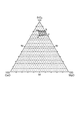
- FIG. 1 is a composition diagram showing the composition of three components of glass fiber SiO 2 , MgO and CaO. Point X in FIG.
- the composition in which the devitrification initial phase is cordierite crystal or a mixed crystal of cordierite and anorthite satisfies the condition of being in the range of a rectangle surrounded by points X, Y, Z and W.
- the above points X, Y, Z, weight percent of each component in the W is shown as the content when a total of three components SiO 2, MgO and CaO in the glass fibers is 100 wt%.
- the composition of the glass fiber includes at least Al 2 O 3 as a component other than SiO 2 , MgO, and CaO, the content of each component shown in FIG. 1 is different from the actual content.
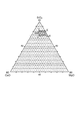
- FIG. 2 is a composition diagram showing the composition of the three components SiO 2 , MgO and CaO when Al 2 O 3 is 20.0 wt% based on the total weight.
- the composition of the glass fiber is based on the total weight of the glass fiber composition, the content of Al 2 O 3 is 20.0% by weight, and the content of SiO 2 is 56.8 to 64.
- Points X, Y, Z, 8 wt%, MgO content 6.4 to 23.2 wt% and CaO content 0.0 to 11.2 wt% , W and V satisfy the condition that is within the region enclosed.
- the region of the composition of the three components in the composition diagram is changed according to the content of Al 2 O 3.
- the composition of the glass fiber of the present embodiment basically includes SiO 2 , MgO, CaO, and Al 2 O 3 and has the above-described characteristic composition.
- the glass fiber is included in the raw material of each component. It may further contain other components, for example, inevitably mixed. Examples of other components include alkali metal oxides such as Na 2 O, Fe 2 O 3 , Na 2 O, TiO 2 , ZrO 2 , MoO 2 , and Cr 2 O 3 . These other components may be contained in a total amount of less than 0.5% by weight, preferably less than 0.3% by weight, and more preferably less than 0.2% by weight, based on the total weight. .
- the glass fiber of this embodiment is 0.4 in total of Fe 2 O 3 and an alkali metal oxide for fine adjustment of the glass composition for achieving both improvement in mechanical strength and spinnability. It may be contained in an amount of not more than wt%, preferably not less than 0.01 wt% and less than 0.3 wt%. In this case, the content of Fe 2 O 3 is preferably 0.01% by weight or more and less than 0.3% by weight, and more preferably 0.03% by weight or more and less than 0.2% by weight.
- the glass fiber can be produced from a glass composition.
- the glass fiber may be any of a glass fiber monofilament, a glass fiber strand composed of a plurality of glass fiber monofilaments, and a glass fiber yarn obtained by twisting the glass fiber strand.
- the fiber diameter of the glass fiber monofilament can be 3 to 30 ⁇ m, for example, and the glass fiber strand can be obtained by bundling the monofilament, for example, 50 to 8000.
- the glass fiber yarn can be produced by applying a twist of, for example, 13 times / 25 mm or less to the glass fiber strand.
- Glass fiber may be provided as a wound body wound about 10 to 200 km around a core made of paper or plastic, or provided as glass fiber (glass fiber chopped strand, etc.) cut to about 1 inch. May be. Moreover, you may provide as a glass fiber fabric, a knitted fabric, a nonwoven fabric, a mat, a braid, roving, powder etc. using the glass fiber of this embodiment. Moreover, although the glass fiber of this embodiment can also be used independently, you may use it combining 2 or more types of well-known commercially available glass fiber, carbon fiber, aramid fiber, ceramic fiber, etc.
- the glass composition is usually fiberized by drawing the molten glass composition from hundreds to thousands of platinum nozzles at a high speed to obtain glass fibers.
- the cross-sectional shape of the glass fiber according to the present embodiment is not limited to a normal circular shape, but may be an elliptical, oval, mayu-shaped flat cross-sectional fiber, or a deformed cross-sectional fiber such as a star, a quadrangle, or a triangle. .
- the glass fiber when it is a flat cross-section fiber or an irregular cross-section fiber, it needs to be spun at a relatively high viscosity. For this reason, if the glass devitrification initial phase is a cordierite crystal or a mixed crystal of cordierite and anorside, crystals of molten glass are precipitated even at high viscosity, that is, at low temperatures. It is difficult and can manufacture glass fiber stably.
- the following conditions (1) to (2) are preferably satisfied in order to be easy to produce and have a sufficient elastic modulus. Furthermore, in order to spin glass fiber more stably, it is preferable that the following condition (3) is satisfied.
- the content of SiO 2 is 57.0 to 63.0% by weight, and the content of Al 2 O 3 is 19.0 to 23.0% by weight. Yes, the MgO content is 10.0 to 15.0% by weight, and the CaO content is 4.0 to 11.0% by weight.
- the total content of SiO 2, Al 2 O 3 , MgO and CaO is 99.5% by weight or more.
- SiO 2, MgO and CaO are: (a) SiO 2 content / (SiO 2 content + MgO content + CaO content) ⁇ 100, (b) MgO content / ( Coordinates ((a), content of SiO 2 + content of MgO + content of CaO) ⁇ 100, (c) content of CaO / (content of SiO 2 + content of MgO + content of CaO) ⁇ 100
- the converted fiber diameter is preferably 3 to 30 ⁇ m, more preferably 5 to 20 ⁇ m.
- the flatness is preferably 2 to 8, and more preferably 3 to 7.
- the converted fiber diameter refers to the diameter of a circular cross-section fiber having the same fiber cross-sectional area
- the flatness refers to the long side of this rectangle when assuming a rectangle with the smallest area circumscribing the glass fiber cross-section. The ratio of the short side (long side / short side).
- the glass fiber obtained by the method mentioned above can be applied to various uses. For example, it can be applied to glass fibers for FRP and FRTP used for industrial materials and automotive parts materials, and glass fiber reinforcing materials for laminates for printed wiring boards, which are electronic materials.
- a glass fiber composite material can be manufactured by using a reinforcing material (matrix resin) for the glass fiber of this embodiment.
- the manufacturing method of a glass fiber composite material changes with matrix resins to be used.
- a glass fiber composite material can be produced by a technique such as a stampable sheet molding method, an injection molding method, or an infusion method.
- the thermoplastic resin include polyethylene resin, polypropylene resin, polystyrene resin, acrylonitrile / butadiene / styrene (ABS) resin, methacrylic resin, vinyl chloride resin, polyamide resin, polyacetal resin, polyethylene terephthalate (PET) resin, polybutylene.
- PBT Terephthalate
- PPS polyphenylene sulfide
- PEEK polyether ether ketone
- LCP liquid crystal polymer
- fluororesin polyetherimide
- PES polyarylate
- PAI polyamideimide
- thermosetting resin such as an unsaturated polyester resin, a vinyl ester resin, an epoxy resin, a melamine resin, or a phenol resin
- a hand lay-up method, a spray-up method, Manufacturing methods such as a resin transfer molding (RTM) method, a sheet molding compound (SMS) method, a bulk molding compound (BMC) method, a pultrusion method, a filament winding method, and an infusion method can be employed.
- cement, mortar, concrete, asphalt, metal, carbon, ceramics, natural rubber, synthetic rubber and the like can be used as a reinforcing material in addition to the matrix resin.
- Glass fiber composite material using glass fiber can be used as a material for various applications as follows. For example, it can be used for aircraft base materials, interior materials, anti-vibration materials, etc. in aircraft engine applications, and in vehicle-related applications, it is used for vibration damping reinforcements, bumpers, engine undercovers, fenders, roofing materials, bodies, spoilers, Can be used for muffler filters, dash panels, radiators, timing belts, etc. It can also be used for motor boats, yachts, fishing boats, etc.
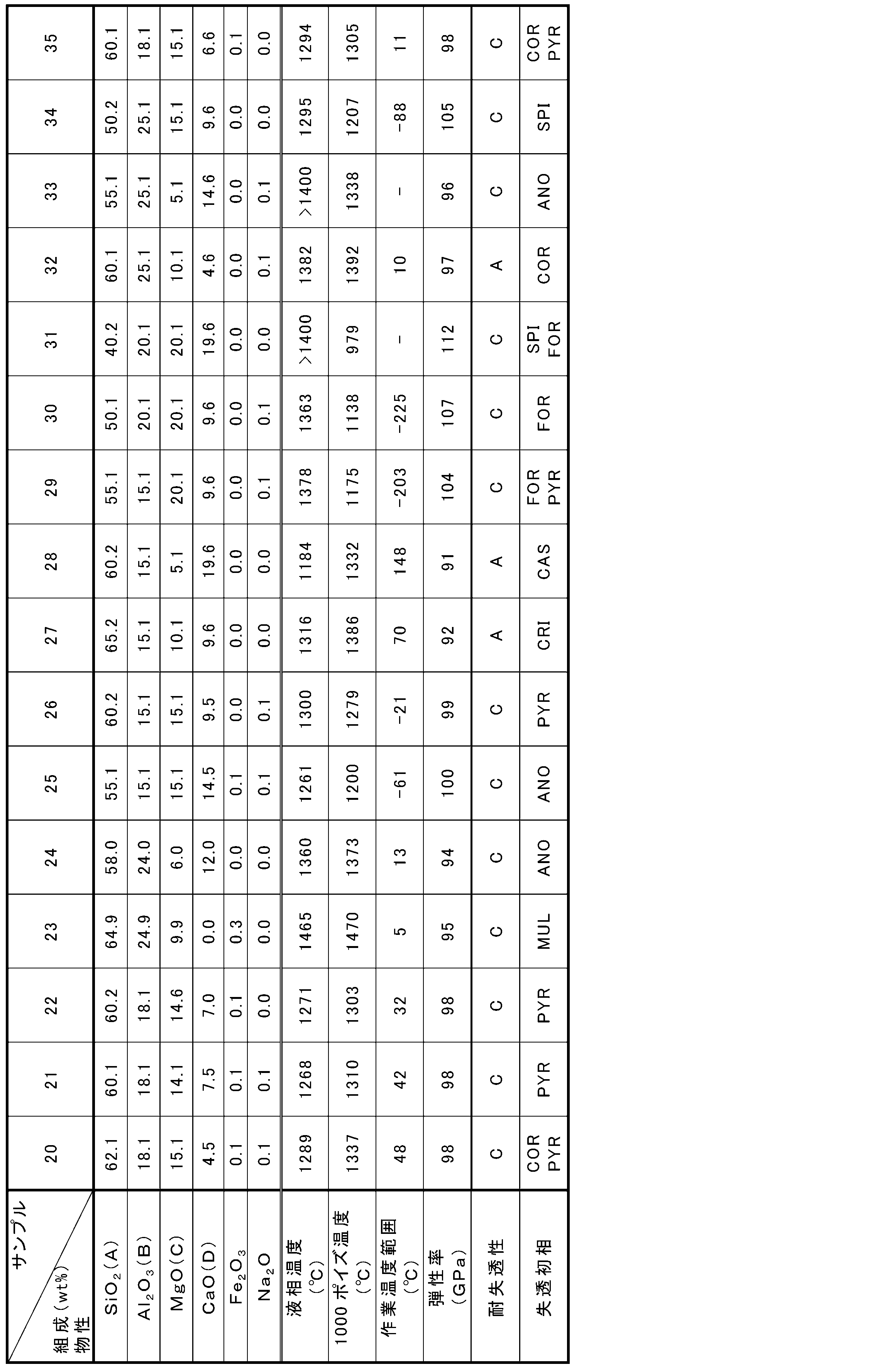
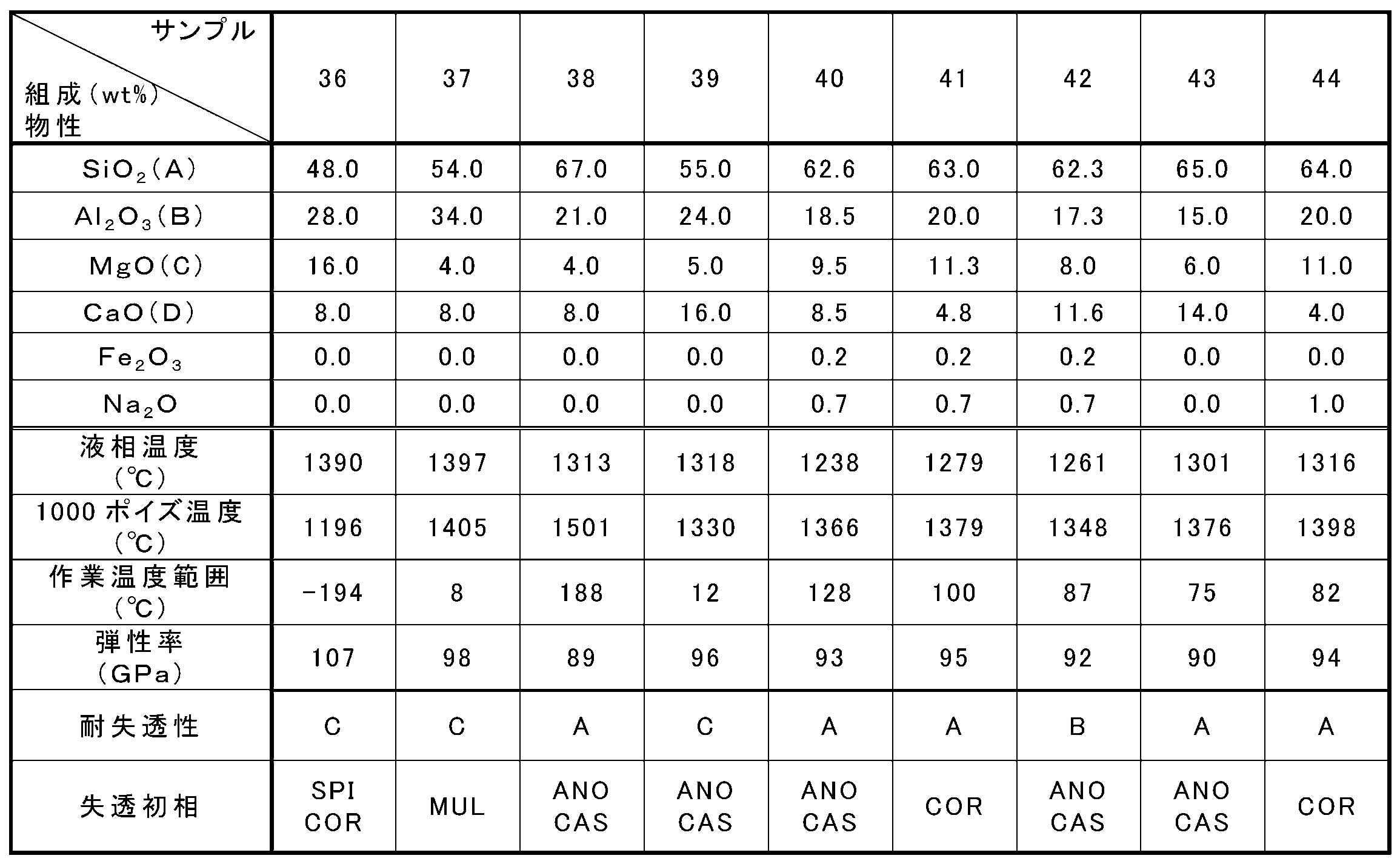
- Glass raw materials are prepared so as to have the compositions shown in Tables 1, 2 and 3, and glass having a basic composition of SiO 2 (A), Al 2 O 3 (B), MgO (C) and CaO (D).
- the composition was melt-spun to obtain glass fibers having a fiber diameter of 13 ⁇ m.
- the obtained glass fiber had a composition equivalent to the glass composition which is a raw material. Then, for each glass fiber, 1000 poise temperature, liquid phase temperature and working temperature range at the time of production are obtained, devitrification resistance is evaluated, crystals of the devitrification initial phase are analyzed, and finally obtained. The elastic modulus of the obtained glass fiber was measured.
- Crystal seed of devitrification initial phase Using a sample whose liquidus temperature was measured, the precipitated crystal initial phase was pulverized and analyzed with an X-ray diffractometer to identify the crystal seed.
- the crystal types of the devitrification initial phase in Tables 1 to 3 are as described below. In the table, when two or more crystal types are shown, it is confirmed that both crystal types are mixed.
- Samples 1 to 19 shown in Table 1 correspond to examples, and samples 20 to 44 shown in Tables 2 and 3 correspond to comparative examples. Further, samples 36 to 39 in Table 3 correspond to the glass compositions of Examples 2 to 5 disclosed in Japanese Patent Publication No. 62-001337. Samples 40 to 44 in Table 3 correspond to the glass compositions of Examples 1, 4, 7, 14, and 15 disclosed in JP-T-2009-514773, respectively.
- molten glass having the composition of Examples 5 and 9 was spun to obtain flat cross-section glass fibers having an equivalent fiber diameter of 15 ⁇ m and an oblong cross-section of 4 in flatness. As a result, it was confirmed that both samples were excellent in spinning workability.
- Samples 1 to 19 as examples have a wide working temperature range while lowering both the 1000 poise temperature and the liquidus temperature as compared with Samples 20 to 44 as comparative examples. It was confirmed that a high elastic modulus can be obtained.
Landscapes
- Chemical & Material Sciences (AREA)
- Engineering & Computer Science (AREA)
- Life Sciences & Earth Sciences (AREA)
- Geochemistry & Mineralogy (AREA)
- Organic Chemistry (AREA)
- Materials Engineering (AREA)
- Chemical Kinetics & Catalysis (AREA)
- General Chemical & Material Sciences (AREA)
- Ceramic Engineering (AREA)
- General Life Sciences & Earth Sciences (AREA)
- Crystallography & Structural Chemistry (AREA)
- Dispersion Chemistry (AREA)
- Manufacturing & Machinery (AREA)
- Physics & Mathematics (AREA)
- Optics & Photonics (AREA)
- Glass Compositions (AREA)
Abstract
Description
(1)SiO2:57.0~63.0重量%
(2)Al2O3:19.0~23.0重量%
(3)MgO:10.0~15.0重量%
(4)CaO:4.0~11.0重量%
(5)上記(1)~(4)の合計:99.5重量%以上
(1)ガラス繊維の組成の全重量を基準として、SiO2の含有量が57.0~63.0重量%であり、Al2O3の含有量が19.0~23.0重量%であり、MgOの含有量が10.0~15.0重量%であり、CaOの含有量が4.0~11.0重量%であること。
(2)SiO2、Al2O3、MgO及びCaOの含有量の合計が99.5重量%以上であること。
(3)SiO2、MgO及びCaOの3成分が、(a)SiO2の含有量/(SiO2の含有量+MgOの含有量+CaOの含有量)×100、(b)MgOの含有量/(SiO2の含有量+MgOの含有量+CaOの含有量)×100、(c)CaOの含有量/(SiO2の含有量+MgOの含有量+CaOの含有量)×100とした座標((a)、(b)、(c))で表される3成分相図において、((a)=81.0、(b)=19.0、(c)=0.0)、((a)=71.0、(b)=29.0、(c)=0.0)、((a)=71.0、(b)=15.0、(c)=14.0)、及び((a)=81.0、(b)=8.0、(c)=11.0)の座標点で囲まれた範囲内となる条件を満たす組成を有すること。
表1、2及び3に示す組成となるようにガラス原料を調合し、SiO2(A)、Al2O3(B)、MgO(C)及びCaO(D)を基本組成とする組成のガラス組成物を溶融紡糸して、繊維径13μmのガラス繊維を得た。なお、得られたガラス繊維は、原料であるガラス組成物と同等の組成を有するものであった。そして、各ガラス繊維について、製造の際の1000ポイズ温度、液相温度及び作業温度範囲をそれぞれ求めるとともに、耐失透性を評価し、失透初相の結晶を分析し、また最終的に得られたガラス繊維の弾性率を測定した。得られた結果を組成とともに表1、2及び3に示す。これらの特性は、下記の評価方法により求めた。
(1)1000ポイズ温度:白金ルツボ中で溶融したそれぞれのガラス組成のガラスを回転式B型粘度計を用いて、ガラスの溶融温度を変化させながら連続的に粘度を測定し、粘度が1000ポイズのときに対応する温度を1000ポイズ温度とした。粘度の測定は、JIS Z8803-1991に準じて測定した。
(2)液相温度:それぞれのガラス組成のガラス粉砕物を、白金ボート中に入れて、1000℃から1500℃の温度勾配を設けた管状電気炉で加熱した。結晶が析出しだした温度を液相温度とした。
(3)作業温度範囲:(1000ポイズ温度)-(液相温度)から算出した。
(4)弾性率:弾性率は超音波法にて測定した。ガラスバルク中に伝わる超音波(縦波音速、横波音速)を測定し、ガラスの比重、縦波音速、横波音速の値から弾性率を算出した。
(5)耐失透性の評価:それぞれのガラス組成物を1000ポイズ温度以上で溶融した後、液相温度より150℃±50℃低い温度で6時間放置した。次いで、このガラス組成物の表面及び内部に発現した結晶の様子を観察し、3段階で評価した。Aは結晶が析出していない。Bは表面の一部に結晶が析出している。Cは表面及び内部に結晶が析出していることを示す。
(6)失透初相の結晶種:液相温度を測定した試料を使用し、析出した結晶初相部を粉砕しX線回折装置で分析して結晶種を同定した。なお、表1~3の失透初相の結晶種は、下記の記載による。表中、2種類以上の結晶種が示されている場合は、両方の結晶種が混在していることが確認されたことを示している。
COR:コーディエライト(Cordierite)
ANO:アノーサイト(Anorthite)
PYR:ピロキセン(Pyroxene)
MUL:ムライト(Mullite)
TRI:トリジマイト(Tridymite)
SPI:スピネル(Spinel)
FOR:フォルステライト(Forsterite)
CRI:クリストバライト(Cristobalite)
CAS:CAS(Calcium・Alminium・Silicate)

Claims (7)
- 全重量を基準として、
SiO2の含有量が57.0~63.0重量%、Al2O3の含有量が19.0~23.0重量%、MgOの含有量が10.0~15.0重量%、CaOの含有量が4.0~11.0重量%であり、且つ、SiO2、Al2O3、MgO及びCaOの合計含有量が99.5重量%以上である組成を有することを特徴とするガラス繊維。 - SiO2の含有量とAl2O3の含有量との合計含有量が、77.0~85.0重量%である組成を有する請求項1記載のガラス繊維。
- SiO2の含有量/Al2O3の含有量が、重量比で2.7~3.2である組成を有する請求項1又は2記載のガラス繊維。
- MgOの含有量とCaOの含有量との合計含有量が、16.0重量%以上である組成を有する請求項1~3のいずれか一項に記載のガラス繊維。
- MgOの含有量/CaOの含有量が、重量比で0.8~2.0である組成を有する請求項1~4のいずれか一項に記載のガラス繊維。
- SiO2、MgO、及びCaOの3成分が、
(a)SiO2の含有量/(SiO2の含有量+MgOの含有量+CaOの含有量)×100、(b)MgOの含有量/(SiO2の含有量+MgOの含有量+CaOの含有量)×100、及び(c)CaOの含有量/(SiO2の含有量+MgOの含有量+CaOの含有量)×100、とした座標((a)、(b)、(c))で表される3成分相図において、
((a)=81.0、(b)=19.0、(c)=0.0)、
((a)=71.0、(b)=29.0、(c)=0.0)、
((a)=71.0、(b)=15.0、(c)=14.0)、及び
((a)=81.0、(b)=8.0、(c)=11.0)
の座標点で囲まれた範囲内となる条件を満たす組成を有する請求項1~5のいずれか一項に記載のガラス繊維。 - 前記組成を有するガラスの失透初相は、コーディエライト結晶、又は、コーディエライトとアノーサイトの混合結晶である請求項1~6のいずれか一項に記載のガラス繊維。
Priority Applications (7)
| Application Number | Priority Date | Filing Date | Title |
|---|---|---|---|
| CN201180028428.1A CN102939272B (zh) | 2010-06-08 | 2011-05-30 | 玻璃纤维 |
| JP2012519341A JP5152437B2 (ja) | 2010-06-08 | 2011-05-30 | ガラス繊維 |
| EP11792319.3A EP2581350B1 (en) | 2010-06-08 | 2011-05-30 | Glass fiber |
| KR1020127034382A KR101293941B1 (ko) | 2010-06-08 | 2011-05-30 | 유리 섬유 |
| US13/702,770 US8841222B2 (en) | 2010-06-08 | 2011-05-30 | Glass fiber |
| HK13108796.4A HK1181375B (en) | 2010-06-08 | 2011-05-30 | Glass fiber |
| US14/466,310 US9227870B2 (en) | 2010-06-08 | 2014-08-22 | Glass fiber |
Applications Claiming Priority (2)
| Application Number | Priority Date | Filing Date | Title |
|---|---|---|---|
| JP2010-131185 | 2010-06-08 | ||
| JP2010131185 | 2010-06-08 |
Related Child Applications (2)
| Application Number | Title | Priority Date | Filing Date |
|---|---|---|---|
| US13/702,770 A-371-Of-International US8841222B2 (en) | 2010-06-08 | 2011-05-30 | Glass fiber |
| US14/466,310 Continuation US9227870B2 (en) | 2010-06-08 | 2014-08-22 | Glass fiber |
Publications (1)
| Publication Number | Publication Date |
|---|---|
| WO2011155362A1 true WO2011155362A1 (ja) | 2011-12-15 |
Family
ID=45097970
Family Applications (1)
| Application Number | Title | Priority Date | Filing Date |
|---|---|---|---|
| PCT/JP2011/062397 Ceased WO2011155362A1 (ja) | 2010-06-08 | 2011-05-30 | ガラス繊維 |
Country Status (8)
| Country | Link |
|---|---|
| US (2) | US8841222B2 (ja) |
| EP (1) | EP2581350B1 (ja) |
| JP (1) | JP5152437B2 (ja) |
| KR (1) | KR101293941B1 (ja) |
| CN (1) | CN102939272B (ja) |
| MY (1) | MY159312A (ja) |
| TW (1) | TWI417263B (ja) |
| WO (1) | WO2011155362A1 (ja) |
Cited By (19)
| Publication number | Priority date | Publication date | Assignee | Title |
|---|---|---|---|---|
| CN102976619A (zh) * | 2012-11-15 | 2013-03-20 | 安徽工程大学 | 一种用于汽车保险杠的玻璃纤维 |
| CN103086605A (zh) * | 2013-02-19 | 2013-05-08 | 重庆国际复合材料有限公司 | 一种玻璃纤维 |
| JP2014043577A (ja) * | 2012-08-28 | 2014-03-13 | Ems-Patent Ag | ポリアミド成形コンパウンドおよびその利用 |
| JP2014519459A (ja) * | 2010-12-22 | 2014-08-14 | エージーワイ ホールディング コーポレイション | 高強度ガラスの組成物および繊維 |
| US20140343211A1 (en) * | 2011-12-06 | 2014-11-20 | Nitto Boseki Co., Ltd. | Glass fibers having non-circular cross sections, and fiber-reinforced resin compact using same |
| US20140364554A1 (en) * | 2011-12-06 | 2014-12-11 | Nitto Boseki Co., Ltd. | Long-fiber-reinforced thermoplastic resin preform and fiber-reinforced resin compact using same |
| CN104321288A (zh) * | 2012-04-18 | 2015-01-28 | 3B玻璃纤维公司 | 玻璃纤维组合物及由其增强的复合材料 |
| JP2015514601A (ja) * | 2012-02-20 | 2015-05-21 | ケーシーシー コーポレーション | 耐衝撃性及び不燃性に優れた真空断熱パネル用封止部材 |
| KR20160016912A (ko) * | 2013-06-05 | 2016-02-15 | 솔베이 스페셜티 폴리머즈 유에스에이, 엘.엘.씨. | 휴대 전자 기기를 위한 충전된 폴리머 조성물 |
| WO2016203676A1 (ja) | 2015-08-21 | 2016-12-22 | 日東紡績株式会社 | ガラス繊維用ガラス組成物 |
| KR101748496B1 (ko) | 2015-11-09 | 2017-06-19 | 주식회사 케이씨씨 | 회장석을 이용한 장섬유 유리 제조용 뱃지 조성물 |
| WO2017171101A1 (ja) | 2016-12-26 | 2017-10-05 | 日東紡績株式会社 | ガラス繊維強化樹脂成形品 |
| KR20180042215A (ko) | 2015-08-21 | 2018-04-25 | 니토 보세키 가부시기가이샤 | 유리 섬유의 제조방법 |
| JP6343112B1 (ja) * | 2017-06-29 | 2018-06-13 | 日本板硝子株式会社 | ガラス組成物及びこれを用いたガラス製品 |
| JP2021506712A (ja) * | 2017-12-19 | 2021-02-22 | オーシーヴィー インテレクチュアル キャピタル リミテッド ライアビリティ カンパニー | 高性能繊維ガラス組成物 |
| JP2023053401A (ja) * | 2016-12-28 | 2023-04-12 | 日本電気硝子株式会社 | ガラス繊維用組成物及びガラス繊維、ガラス繊維を含有するガラス繊維含有複合材料、並びにガラス繊維の製造方法 |
| WO2023100990A1 (ja) * | 2021-12-02 | 2023-06-08 | 日本板硝子株式会社 | ガラス繊維 |
| JP2025513118A (ja) * | 2023-03-29 | 2025-04-24 | ジュシ グループ カンパニー リミテッド | 低密度で高性能なガラス繊維組成物、及びそのガラス繊維と複合材料 |
| WO2025154568A1 (ja) * | 2024-01-16 | 2025-07-24 | 日東紡績株式会社 | ガラス繊維およびガラス繊維強化樹脂成形品 |
Families Citing this family (16)
| Publication number | Priority date | Publication date | Assignee | Title |
|---|---|---|---|---|
| MY159312A (en) * | 2010-06-08 | 2016-12-30 | Nitto Boseki Co Ltd | Glass fiber |
| JP6554269B2 (ja) * | 2014-07-08 | 2019-07-31 | ニチアス株式会社 | 生体溶解性無機繊維の製造方法 |
| PL3218317T3 (pl) | 2014-11-13 | 2019-03-29 | Gerresheimer Glas Gmbh | Filtr cząstek urządzenia do wytwarzania szkła, jednostka tłoka, głowica dmuchu, wspornik głowicy dmuchu i urządzenie do wytwarzania szkła, przystosowane lub zawierające filtr |
| MX390313B (es) * | 2015-01-20 | 2025-03-20 | Jushi Group Co Ltd | Una composicion de fibra de vidrio, fibra de vidrio y material compuesto de la misma. |
| CN107216042B (zh) * | 2017-06-05 | 2020-09-08 | 重庆国际复合材料股份有限公司 | 一种高模量玻璃纤维组合物以及玻璃纤维 |
| GB2563271A (en) * | 2017-06-08 | 2018-12-12 | Short Brothers Plc | Aircraft ice protection system and method |
| CN113874567B (zh) * | 2019-08-27 | 2022-08-16 | 日东纺绩株式会社 | 玻璃布、预浸料以及玻璃纤维强化树脂成型品 |
| CN113060938A (zh) | 2020-01-02 | 2021-07-02 | Ocv智识资本有限责任公司 | 玻璃组合物、玻璃纤维和形成方法及增强的复合制品 |
| KR102780160B1 (ko) | 2020-08-26 | 2025-03-12 | 주식회사 케이씨씨 | 세라믹 섬유 조성물 및 이로부터 제조된 세라믹 섬유 |
| KR102531394B1 (ko) * | 2020-10-06 | 2023-05-12 | 주식회사 나인테크 | 포커스 링 |
| JP7623583B2 (ja) * | 2021-04-01 | 2025-01-29 | 日東紡績株式会社 | 建築膜材料用無機繊維織物及び建築膜材料 |
| KR102555654B1 (ko) * | 2021-10-20 | 2023-07-13 | 한국세라믹기술원 | 하이브리드 섬유강화 복합재, 이의 제조방법 및 이를 포함하는 모빌리티 부품 |
| US20230133178A1 (en) * | 2021-10-28 | 2023-05-04 | Electric Glass Fiber America, LLC | Glass Compositions, Fiberizable Glass Compositions, and Glass Fibers Made Therefrom |
| JP2023082636A (ja) * | 2021-12-02 | 2023-06-14 | 日本板硝子株式会社 | ガラス繊維 |
| WO2024148228A1 (en) | 2023-01-06 | 2024-07-11 | Owens Corning Intellectual Capital, Llc | Lithium-free high modulus fiberglass composition |
| KR20250172151A (ko) | 2024-05-31 | 2025-12-09 | 주식회사 케이씨씨 | 세라믹 섬유 조성물 및 이로부터 제조된 세라믹 섬유 |
Citations (4)
| Publication number | Priority date | Publication date | Assignee | Title |
|---|---|---|---|---|
| JPS621337B2 (ja) | 1981-10-13 | 1987-01-13 | Asahi Glass Co Ltd | |
| JP2002220256A (ja) * | 2001-01-22 | 2002-08-09 | Asahi Glass Co Ltd | 無鉛ガラス、電子回路基板用組成物および電子回路基板 |
| JP2009514773A (ja) | 2005-11-04 | 2009-04-09 | オーシーヴィー インテレクチュアル キャピタル リミテッド ライアビリティ カンパニー | 高性能ガラスのための組成物、高性能ガラス繊維及びその製品 |
| JP2009514772A (ja) * | 2005-11-04 | 2009-04-09 | オーシーヴィー インテレクチュアル キャピタル リミテッド ライアビリティ カンパニー | 耐火物を被覆した溶融装置における高性能ガラス繊維の製造方法及びそれにより製造される繊維 |
Family Cites Families (17)
| Publication number | Priority date | Publication date | Assignee | Title |
|---|---|---|---|---|
| LU48911A1 (ja) * | 1965-06-25 | 1966-12-28 | ||
| JPS621337A (ja) | 1985-06-27 | 1987-01-07 | Meidensha Electric Mfg Co Ltd | デイジタル保護継電装置のデ−タ収集方法 |
| EP0832046B1 (en) | 1995-06-06 | 2000-04-05 | Owens Corning | Boron-free glass fibers |
| US5962354A (en) * | 1996-01-16 | 1999-10-05 | Fyles; Kenneth M. | Compositions for high temperature fiberisation |
| FR2768144B1 (fr) | 1997-09-10 | 1999-10-01 | Vetrotex France Sa | Fils de verre aptes a renforcer des matieres organiques et/ou inorganiques |
| RU2245477C1 (ru) * | 2004-01-27 | 2005-01-27 | Институт проблем химической физики РАН (ИПХФ РАН) | Стекловолокнистый армирующий тканый наполнитель стеклополимерных композиционных материалов |
| JP2008255002A (ja) | 2007-03-15 | 2008-10-23 | Nippon Electric Glass Co Ltd | ガラス繊維用ガラス組成物、ガラス繊維、ガラス繊維の製造方法及び複合材 |
| CN101580344B (zh) * | 2009-06-29 | 2012-10-17 | 巨石集团有限公司 | 一种高强度玻璃纤维组合物 |
| CN101597140B (zh) * | 2009-07-02 | 2011-01-05 | 重庆国际复合材料有限公司 | 一种高强度高模量玻璃纤维 |
| CA2769401C (en) * | 2009-08-04 | 2018-06-12 | Ocv Intellectual Capital, Llc | Improved modulus, lithium free glass |
| CN101691278A (zh) * | 2009-10-16 | 2010-04-07 | 巨石集团有限公司 | 能作为先进复合材料增强基材的玻璃纤维 |
| EP2354104A1 (en) * | 2010-02-05 | 2011-08-10 | 3B | Glass fibre composition and composite material reinforced therewith |
| EP2354106A1 (en) * | 2010-02-05 | 2011-08-10 | 3B | Glass fibre composition and composite material reinforced therewith |
| EP2354105A1 (en) * | 2010-02-05 | 2011-08-10 | 3B | Glass fibre composition and composite material reinforced therewith |
| EP2380857A1 (en) * | 2010-04-22 | 2011-10-26 | Rockwool International A/S | Friction material comprising chopped continuous mineral fibres |
| MY159312A (en) * | 2010-06-08 | 2016-12-30 | Nitto Boseki Co Ltd | Glass fiber |
| US9783454B2 (en) * | 2010-12-22 | 2017-10-10 | Agy Holding Corp. | High strength glass composition and fibers |
-
2011
- 2011-05-30 MY MYPI2012005320A patent/MY159312A/en unknown
- 2011-05-30 JP JP2012519341A patent/JP5152437B2/ja active Active
- 2011-05-30 KR KR1020127034382A patent/KR101293941B1/ko active Active
- 2011-05-30 EP EP11792319.3A patent/EP2581350B1/en active Active
- 2011-05-30 US US13/702,770 patent/US8841222B2/en active Active
- 2011-05-30 CN CN201180028428.1A patent/CN102939272B/zh active Active
- 2011-05-30 WO PCT/JP2011/062397 patent/WO2011155362A1/ja not_active Ceased
- 2011-06-07 TW TW100119822A patent/TWI417263B/zh active
-
2014
- 2014-08-22 US US14/466,310 patent/US9227870B2/en active Active
Patent Citations (4)
| Publication number | Priority date | Publication date | Assignee | Title |
|---|---|---|---|---|
| JPS621337B2 (ja) | 1981-10-13 | 1987-01-13 | Asahi Glass Co Ltd | |
| JP2002220256A (ja) * | 2001-01-22 | 2002-08-09 | Asahi Glass Co Ltd | 無鉛ガラス、電子回路基板用組成物および電子回路基板 |
| JP2009514773A (ja) | 2005-11-04 | 2009-04-09 | オーシーヴィー インテレクチュアル キャピタル リミテッド ライアビリティ カンパニー | 高性能ガラスのための組成物、高性能ガラス繊維及びその製品 |
| JP2009514772A (ja) * | 2005-11-04 | 2009-04-09 | オーシーヴィー インテレクチュアル キャピタル リミテッド ライアビリティ カンパニー | 耐火物を被覆した溶融装置における高性能ガラス繊維の製造方法及びそれにより製造される繊維 |
Non-Patent Citations (1)
| Title |
|---|
| See also references of EP2581350A4 * |
Cited By (39)
| Publication number | Priority date | Publication date | Assignee | Title |
|---|---|---|---|---|
| JP2014519459A (ja) * | 2010-12-22 | 2014-08-14 | エージーワイ ホールディング コーポレイション | 高強度ガラスの組成物および繊維 |
| US9416235B2 (en) * | 2011-12-06 | 2016-08-16 | Nitto Boseki Co., Ltd. | Long-fiber-reinforced thermoplastic resin preform and fiber-reinforced resin compact using same |
| US20140343211A1 (en) * | 2011-12-06 | 2014-11-20 | Nitto Boseki Co., Ltd. | Glass fibers having non-circular cross sections, and fiber-reinforced resin compact using same |
| US20140364554A1 (en) * | 2011-12-06 | 2014-12-11 | Nitto Boseki Co., Ltd. | Long-fiber-reinforced thermoplastic resin preform and fiber-reinforced resin compact using same |
| US9242892B2 (en) * | 2011-12-06 | 2016-01-26 | Nitto Boseki Co., Ltd. | Glass fibers having non-circular cross sections, and fiber-reinforced resin compact using same |
| JP2015514601A (ja) * | 2012-02-20 | 2015-05-21 | ケーシーシー コーポレーション | 耐衝撃性及び不燃性に優れた真空断熱パネル用封止部材 |
| CN104321288A (zh) * | 2012-04-18 | 2015-01-28 | 3B玻璃纤维公司 | 玻璃纤维组合物及由其增强的复合材料 |
| US20150133284A1 (en) * | 2012-04-18 | 2015-05-14 | 3B-Fibreglass Sprl | Glass fibre composition and composite material reinforced therewith |
| US9499432B2 (en) * | 2012-04-18 | 2016-11-22 | 3B-Fibreglass Sprl | Glass fibre composition and composite material reinforced therewith |
| JP2014043577A (ja) * | 2012-08-28 | 2014-03-13 | Ems-Patent Ag | ポリアミド成形コンパウンドおよびその利用 |
| CN102976619A (zh) * | 2012-11-15 | 2013-03-20 | 安徽工程大学 | 一种用于汽车保险杠的玻璃纤维 |
| CN103086605A (zh) * | 2013-02-19 | 2013-05-08 | 重庆国际复合材料有限公司 | 一种玻璃纤维 |
| KR102256940B1 (ko) | 2013-06-05 | 2021-05-28 | 솔베이 스페셜티 폴리머즈 유에스에이, 엘.엘.씨. | 휴대 전자 기기를 위한 충전된 폴리머 조성물 |
| JP2016521777A (ja) * | 2013-06-05 | 2016-07-25 | ソルベイ スペシャルティ ポリマーズ ユーエスエー, エルエルシー | 携帯電子デバイス用の充填材入りポリマー組成物 |
| US20160122510A1 (en) * | 2013-06-05 | 2016-05-05 | Solvay Specialty Polymers Usa, Llc | Filled polymer compositions for mobile electronic devices |
| KR20160016912A (ko) * | 2013-06-05 | 2016-02-15 | 솔베이 스페셜티 폴리머즈 유에스에이, 엘.엘.씨. | 휴대 전자 기기를 위한 충전된 폴리머 조성물 |
| WO2016203676A1 (ja) | 2015-08-21 | 2016-12-22 | 日東紡績株式会社 | ガラス繊維用ガラス組成物 |
| KR20170033814A (ko) | 2015-08-21 | 2017-03-27 | 니토 보세키 가부시기가이샤 | 유리섬유용 유리 조성물 |
| US11040908B2 (en) | 2015-08-21 | 2021-06-22 | Nitto Boseki Co., Ltd. | Glass fiber production method |
| US9878942B2 (en) | 2015-08-21 | 2018-01-30 | Nitto Boseki Co., Ltd. | Glass composition for glass fiber |
| KR20180042215A (ko) | 2015-08-21 | 2018-04-25 | 니토 보세키 가부시기가이샤 | 유리 섬유의 제조방법 |
| KR101748496B1 (ko) | 2015-11-09 | 2017-06-19 | 주식회사 케이씨씨 | 회장석을 이용한 장섬유 유리 제조용 뱃지 조성물 |
| KR20190097091A (ko) | 2016-12-26 | 2019-08-20 | 니토 보세키 가부시기가이샤 | 유리 섬유 강화 수지 성형품 |
| WO2017171101A1 (ja) | 2016-12-26 | 2017-10-05 | 日東紡績株式会社 | ガラス繊維強化樹脂成形品 |
| US11059946B2 (en) | 2016-12-26 | 2021-07-13 | Nitto Boseki Co., Ltd. | Glass fiber-reinforced resin molded article |
| JP2023053401A (ja) * | 2016-12-28 | 2023-04-12 | 日本電気硝子株式会社 | ガラス繊維用組成物及びガラス繊維、ガラス繊維を含有するガラス繊維含有複合材料、並びにガラス繊維の製造方法 |
| JP7440828B2 (ja) | 2016-12-28 | 2024-02-29 | 日本電気硝子株式会社 | ガラス繊維用組成物及びガラス繊維、ガラス繊維を含有するガラス繊維含有複合材料、並びにガラス繊維の製造方法 |
| EP4276079A3 (en) * | 2017-06-29 | 2024-01-10 | Nippon Sheet Glass Co., Ltd. | Glass composition and glass product using same |
| JP2019011244A (ja) * | 2017-06-29 | 2019-01-24 | 日本板硝子株式会社 | ガラス組成物及びこれを用いたガラス製品 |
| WO2019003464A1 (ja) * | 2017-06-29 | 2019-01-03 | 日本板硝子株式会社 | ガラス組成物及びこれを用いたガラス製品 |
| JP2019011234A (ja) * | 2017-06-29 | 2019-01-24 | 日本板硝子株式会社 | ガラス組成物及びこれを用いたガラス製品 |
| JP6343112B1 (ja) * | 2017-06-29 | 2018-06-13 | 日本板硝子株式会社 | ガラス組成物及びこれを用いたガラス製品 |
| US11760684B2 (en) | 2017-06-29 | 2023-09-19 | Nippon Sheet Glass Company, Limited | Glass composition and glass product using same |
| JP7448741B2 (ja) | 2017-12-19 | 2024-03-13 | オウェンス コーニング インテレクチュアル キャピタル リミテッド ライアビリティ カンパニー | 高性能繊維ガラス組成物 |
| JP2021506712A (ja) * | 2017-12-19 | 2021-02-22 | オーシーヴィー インテレクチュアル キャピタル リミテッド ライアビリティ カンパニー | 高性能繊維ガラス組成物 |
| WO2023100990A1 (ja) * | 2021-12-02 | 2023-06-08 | 日本板硝子株式会社 | ガラス繊維 |
| JP2025513118A (ja) * | 2023-03-29 | 2025-04-24 | ジュシ グループ カンパニー リミテッド | 低密度で高性能なガラス繊維組成物、及びそのガラス繊維と複合材料 |
| JP7799695B2 (ja) | 2023-03-29 | 2026-01-15 | ジュシ グループ カンパニー リミテッド | 低密度で高性能なガラス繊維組成物、及びそのガラス繊維と複合材料 |
| WO2025154568A1 (ja) * | 2024-01-16 | 2025-07-24 | 日東紡績株式会社 | ガラス繊維およびガラス繊維強化樹脂成形品 |
Also Published As
| Publication number | Publication date |
|---|---|
| MY159312A (en) | 2016-12-30 |
| CN102939272B (zh) | 2015-11-25 |
| KR20130044246A (ko) | 2013-05-02 |
| CN102939272A (zh) | 2013-02-20 |
| EP2581350A1 (en) | 2013-04-17 |
| US8841222B2 (en) | 2014-09-23 |
| EP2581350B1 (en) | 2017-01-11 |
| JPWO2011155362A1 (ja) | 2013-08-01 |
| US9227870B2 (en) | 2016-01-05 |
| TW201210969A (en) | 2012-03-16 |
| US20150011374A1 (en) | 2015-01-08 |
| EP2581350A4 (en) | 2015-04-08 |
| KR101293941B1 (ko) | 2013-08-08 |
| US20130210602A1 (en) | 2013-08-15 |
| HK1181375A1 (zh) | 2013-11-08 |
| TWI417263B (zh) | 2013-12-01 |
| JP5152437B2 (ja) | 2013-02-27 |
Similar Documents
| Publication | Publication Date | Title |
|---|---|---|
| JP5152437B2 (ja) | ガラス繊維 | |
| JP7440828B2 (ja) | ガラス繊維用組成物及びガラス繊維、ガラス繊維を含有するガラス繊維含有複合材料、並びにガラス繊維の製造方法 | |
| US12473226B2 (en) | High performance fiberglass composition | |
| WO2021256217A1 (ja) | ガラス繊維用組成物 | |
| JP5442181B2 (ja) | ガラス繊維組成物、ガラス繊維及びガラス繊維含有複合材料 | |
| EP4361112A2 (en) | High performance fiberglass composition with improved elastic modulus | |
| WO2012052841A1 (en) | Glass composition for producing high strength and high modulus fibers | |
| CN121969584A (zh) | 玻璃纤维用组合物 | |
| HK1181375B (en) | Glass fiber | |
| WO2025121226A1 (ja) | ガラス繊維用組成物 | |
| JP2025092390A (ja) | ガラス繊維用組成物 | |
| JP2025077986A (ja) | ガラス繊維用組成物 | |
| BR112020012526B1 (pt) | Composição de vidro, fibra de vidro e método de formar a referida fibra e produto compósito reforçado |
Legal Events
| Date | Code | Title | Description |
|---|---|---|---|
| WWE | Wipo information: entry into national phase |
Ref document number: 201180028428.1 Country of ref document: CN |
|
| 121 | Ep: the epo has been informed by wipo that ep was designated in this application |
Ref document number: 11792319 Country of ref document: EP Kind code of ref document: A1 |
|
| WWE | Wipo information: entry into national phase |
Ref document number: 2012519341 Country of ref document: JP |
|
| NENP | Non-entry into the national phase |
Ref country code: DE |
|
| ENP | Entry into the national phase |
Ref document number: 20127034382 Country of ref document: KR Kind code of ref document: A |
|
| REEP | Request for entry into the european phase |
Ref document number: 2011792319 Country of ref document: EP |
|
| WWE | Wipo information: entry into national phase |
Ref document number: 2011792319 Country of ref document: EP |
|
| WWE | Wipo information: entry into national phase |
Ref document number: 13702770 Country of ref document: US |