WO2012008410A1 - 歯磨組成物 - Google Patents
歯磨組成物 Download PDFInfo
- Publication number
- WO2012008410A1 WO2012008410A1 PCT/JP2011/065789 JP2011065789W WO2012008410A1 WO 2012008410 A1 WO2012008410 A1 WO 2012008410A1 JP 2011065789 W JP2011065789 W JP 2011065789W WO 2012008410 A1 WO2012008410 A1 WO 2012008410A1
- Authority
- WO
- WIPO (PCT)
- Prior art keywords
- mass
- dentifrice composition
- component
- composition according
- erythritol
- Prior art date
- Legal status (The legal status is an assumption and is not a legal conclusion. Google has not performed a legal analysis and makes no representation as to the accuracy of the status listed.)
- Ceased
Links
Images
Classifications
-
- A—HUMAN NECESSITIES
- A61—MEDICAL OR VETERINARY SCIENCE; HYGIENE
- A61K—PREPARATIONS FOR MEDICAL, DENTAL OR TOILETRY PURPOSES
- A61K8/00—Cosmetics or similar toiletry preparations
- A61K8/18—Cosmetics or similar toiletry preparations characterised by the composition
- A61K8/30—Cosmetics or similar toiletry preparations characterised by the composition containing organic compounds
- A61K8/33—Cosmetics or similar toiletry preparations characterised by the composition containing organic compounds containing oxygen
- A61K8/34—Alcohols
- A61K8/345—Alcohols containing more than one hydroxy group
-
- A—HUMAN NECESSITIES
- A61—MEDICAL OR VETERINARY SCIENCE; HYGIENE
- A61K—PREPARATIONS FOR MEDICAL, DENTAL OR TOILETRY PURPOSES
- A61K8/00—Cosmetics or similar toiletry preparations
- A61K8/18—Cosmetics or similar toiletry preparations characterised by the composition
- A61K8/30—Cosmetics or similar toiletry preparations characterised by the composition containing organic compounds
- A61K8/40—Cosmetics or similar toiletry preparations characterised by the composition containing organic compounds containing nitrogen
- A61K8/44—Aminocarboxylic acids or derivatives thereof, e.g. aminocarboxylic acids containing sulfur; Salts; Esters or N-acylated derivatives thereof
-
- A—HUMAN NECESSITIES
- A61—MEDICAL OR VETERINARY SCIENCE; HYGIENE
- A61Q—SPECIFIC USE OF COSMETICS OR SIMILAR TOILETRY PREPARATIONS
- A61Q11/00—Preparations for care of the teeth, of the oral cavity or of dentures; Dentifrices, e.g. toothpastes; Mouth rinses
Definitions
- the present invention relates to a dentifrice composition.
- erythritol an amino acid, etc. are known as an active ingredient which removes a biofilm (patent document 1).
- erythritol a dentifrice in which erythritol is mixed in a large amount of 30 to 60% by mass and the erythritol is present in the form of particles in the dentifrice has been proposed from the viewpoint of sufficiently obtaining a refreshing sensation due to heat absorption during dissolution. (Patent Document 2).
- N-acylamino acids are used in combination with cationic fungicides, triclosan, and biguanide fungicides to promote the adsorptivity of the fungicides to the tooth surface or suppress the deactivation of the fungicides.
- cationic fungicides triclosan
- biguanide fungicides to promote the adsorptivity of the fungicides to the tooth surface or suppress the deactivation of the fungicides.
- Patent Documents 3 to 5 There are known techniques for suppressing the formation of dental plaque.
- Patent Document 6 discloses N-long chain acylamino acids or salts thereof to supplement the foaming properties of polyoxyethylene stearyl alcohol ether. To improve the foamability of the toothpaste.
- the present invention includes the following components (A), (B) and (C): (A) Erythritol 10 to 65% by mass, (B) N-acyl acidic amino acid or a salt thereof 0.05 to 0.55% by mass, (C) Water 10-25% by mass A dentifrice composition containing 20 to 400 and having a mass ratio (A / B) of component (A) to component (B) of 20 to 400 and substantially not containing sodium chloride.
- the present invention also provides the use of the dentifrice composition for removing intraoral biofilms.
- the present invention also provides an intraoral biofilm removal method in which the dentifrice composition is applied to the oral cavity. Furthermore, this invention provides use of the said dentifrice composition for manufacture of the biofilm removal agent in an oral cavity.
- Human oral biofilms are composed of a plurality of oral bacterial coaggregates and extracellular polysaccharides, and it is not always easy to remove the once formed oral biofilm. As described in Patent Documents 3 to 5, it is effective in preventing the deactivation of the bactericidal agent and promoting the adsorption of the bactericidal agent to the teeth in order to prevent the formation of the biofilm.
- a bactericidal agent applied to the oral cavity does not sufficiently act on oral bacteria and it is difficult to remove the biofilm.
- erythritol is known to have a biofilm removal effect, but it is required to further enhance the effect. Then, the subject of this invention is obtaining the dentifrice composition which improves the biofilm removal effect which contains erythritol and has already been formed.
- the present inventor has significantly improved the biofilm removal effect by containing N-acyl amino acid in a specific ratio with erythritol among N-acylamino acids. I found out.
- the dentifrice composition of the present invention contains erythritol, and the removal effect of the biofilm in the oral cavity by erythritol is remarkably improved.
- Preferred embodiments of the present invention are as follows.
- a dentifrice composition containing a component (A) and a component (B) having a mass ratio (A / B) of 20 to 400 and substantially not containing sodium chloride.
- the dentifrice composition of the present invention contains 10 to 65% by mass of erythritol (component (A)).
- the content of (A) erythritol is more preferably 10 to 55% by mass, and more preferably 10 to 50% by mass in the dentifrice composition from the viewpoint of obtaining a biofilm removing effect and a refreshing feeling.
- the (A) erythritol of the present invention preferably contains particulate erythritol from the viewpoint of maintaining a refreshing feeling due to heat of dissolution, and more preferably has an average particle diameter of erythritol of 350 ⁇ m or less. From the viewpoint of obtaining a good refreshing feeling, the average particle diameter of erythritol is preferably 250 ⁇ m or less, and more preferably 200 ⁇ m or less.
- the content of particulate erythritol is preferably 10 to 55% by mass, more preferably 10 to 45% by mass, and further preferably 10 to 40% by mass.
- the erythritol particle size is measured as follows.
- Sieve JIS standard sieve ⁇ 75mm Opening: From the upper stage, a receiver is provided under a sieve having openings of 500 ⁇ m, 355 ⁇ m, 250 ⁇ m, 180 ⁇ m, 125 ⁇ m, 90 ⁇ m and 45 ⁇ m, respectively.
- Shaker Micro type electromagnetic vibrator M-2 type (Tsutsui Rikenki Co., Ltd.) Method: Place 15 g of sample on 500 ⁇ m sieve and classify with electromagnetic vibrator for 5 minutes. The sieving rate (cumulative amount) is plotted on regular established paper, and the value corresponding to 50% is taken as the average particle diameter.
- Such a particle diameter can be adjusted by pulverizing crystalline erythritol.
- a roller mill, a hammer mill, a high-speed pulverizer, a pulverizer, or the like can be used.
- crystalline erythritol commercially available products such as Nikken Kasei Co., Ltd., Mitsubishi Chemical Foods Co., Ltd., Cargill Co., etc. are available.
- the dentifrice composition of the present invention further contains an N-acyl acidic amino acid or a salt thereof (component (B)).
- the acyl group constituting the N-acyl acidic amino acid preferably has 8 to 16 carbon atoms, and the acyl group is one or more selected from a myristoyl group and a lauroyl group. Is preferred.
- the acidic amino acid constituting the N-acyl acidic amino acid include glutamic acid and aspartic acid, and glutamic acid is preferable.
- N-acyl acidic amino acid salts include sodium salts, potassium salts, magnesium salts, and the like, with sodium salts being preferred.
- the content of the (B) N-acyl acidic amino acid or a salt thereof in the dentifrice composition of the present invention is 0.05 to 0.55 mass% from the balance of defoaming treatment and foam quality during the production of the dentifrice composition. Thus, it is preferably 0.1 to 0.5% by mass, and more preferably 0.1 to 0.4% by mass.
- the mass ratio (A / B) of the content of (A) erythritol and the content of (B) N-acyl acidic amino acid in the dentifrice composition is the balance of biofilm removal effect, defoaming property and foam quality.
- 20 to 400 preferably 20 to 300, and more preferably 20 to 250.
- the dentifrice composition of the present invention further contains water (component (C)).
- component (C) Water is not only purified water and ion exchange water to be blended, but also water in the dentifrice composition including water contained in each component, such as water contained in sorbitol liquid.
- the content of water is (A) partly dissolved in erythritol, but is contained in particulate form (including powder).
- the dentifrice composition It is 10 to 25% by mass, preferably 10 to 20% by mass.
- the mass ratio (A / C) of (A) erythritol content and (C) water content is preferably 0.7 to 6, more preferably 0.8 to 5, and still more preferably 0.9 to 4. .
- the dentifrice composition of the present invention has a solubility of (A) erythritol of 33% at 20 ° C. by adjusting the content of water (C) to 10 to 25% by mass, so that it dissolves in water (A1) erythritol Is 6.6 to 16.5% by mass.
- the mass ratio (A1 / B) of the dissolved erythritol (A1) to (B) N-acyl acidic amino acid is preferably 15 to 300, more preferably 20 to 150, and still more preferably 20 to 110.
- the water content of the dentifrice composition can be calculated from the blended moisture content and the moisture content in the blended components, but can be measured, for example, with a Karl Fischer moisture meter.
- a Karl Fischer moisture meter for example, a trace moisture measuring device (Hiranuma Sangyo) can be used. In this apparatus, 5 g of the dentifrice composition can be taken and suspended in 25 g of anhydrous methanol, and 0.02 g of this suspension can be collected to measure the amount of water.
- substantially not containing sodium chloride means that the content of sodium chloride in the dentifrice composition is 0.1% by mass or less, and the content is 0.05% by mass or less. Preferably, it is 0.01% by mass or less, and more preferably 0.
- the dentifrice composition of the present invention preferably further contains (D) an alkyl sulfate ester salt.
- the alkyl sulfate ester salt is preferably lauryl sulfate or myristyl sulfate from the viewpoint of foamability, and the salt is preferably a sodium salt.
- the content of the (D) alkyl sulfate salt in the dentifrice composition is preferably from 0.1 to 2% by mass, more preferably from 0.25 to 1.75% by mass, and particularly preferably from 0.5 to 1.5% by mass. preferable.
- the mass ratio (D / B) of (D) alkyl sulfate ester salt to (B) N-acyl acidic amino acid in the dentifrice composition is 0. It is preferably 2 to 20, more preferably 1 to 15, and still more preferably 2 to 15.
- the dentifrice composition of the present invention can contain (A) a sugar alcohol other than erythritol.
- the sugar alcohol include sorbitol, xylitol, maltitol, mannitol, and paratinite.
- the content of the sorbitol liquid (70% aqueous solution) and maltitol liquid (70% aqueous solution) in the dentifrice composition is preferably 50% by mass or less, Furthermore, 40 mass% or less is preferable, and especially 35 mass% or less is preferable. That is, the content of sorbitol and / or maltitol in the dentifrice composition is preferably 0 to 35% by mass, more preferably 10 to 28% by mass, and even more preferably 10 to 24.5% by mass.
- the dentifrice composition of the present invention can contain a wetting agent.
- the wetting agent include polyethylene glycol, propylene glycol, dipropylene glycol, and glycerin
- the dentifrice composition can contain 0 to 15% by mass.
- the content of glycerin in the dentifrice composition is preferably 0 to 8% by mass, more preferably 1 to 6% by mass from the viewpoint of defoaming properties.
- the dentifrice composition of the present invention preferably further contains a binder.
- binder sodium alginate, sodium carboxymethylcellulose, carrageenan, xanthan gum, sodium polyacrylate, hydroxyethylcellulose, hydroxypropylcellulose, pectin, tragacanth gum, gum arabic, guar gum, karaya gum, locust bean gum, gellan gum, tamarind gum, psyllium
- One or more selected from the group consisting of seed gum, polyvinyl alcohol, sodium chondroitin sulfate, methoxyethylene maleic anhydride copolymer, and the like can be used.
- carboxymethylcellulose sodium, carrageenan, and xanthan gum are preferable, and carrageenan and carboxymethylcellulose sodium are particularly preferable.
- the content of the binder in the dentifrice composition is preferably 0.1 to 3% by mass, and more preferably 0.1 to 2% by mass. A range of 0.6 to 3% by mass or 0.5 to 2.5% by mass is also preferable.
- the dentifrice composition of the present invention preferably further uses a thickening silica together with the above binder.
- the thickening silica is silica having an oil absorption of 200 to 400 mL / 100 g.
- the amount of oil absorption indicates the amount of oil that can be supported by silica, and the measurement method is specified by the method according to JIS K5101-13-1 and the amount of oil absorbed in the boiled sea bream.
- the content of the thickening silica is preferably 0.5 to 10% by mass in the dentifrice composition.
- the dentifrice composition of the present invention can appropriately contain abrasives, sweeteners, fragrances, pH adjusters, pigments, medicinal ingredients and the like in addition to the above components.
- abrasive silica As abrasives, abrasive silica, dicalcium phosphate dihydrate and anhydride, calcium pyrophosphate, calcium carbonate, alumina, aluminum hydroxide, magnesium acetate, dibasic magnesium phosphate, magnesium acetate, tribasic magnesium phosphate , Zeolite, synthetic resin-based abrasive and the like.
- the abrasive silica is one having an oil absorption of 50 to 150 mL / 100 g.
- Sweetening agents include saccharin sodium, aspartame, thaumatin, acesulfame potassium, stevioside, stevia extract, paramethoxycinnamic aldehyde, neohesperidyl dihydrochalcone, perilartin, sucralose and the like.
- fragrance As a fragrance, l-menthol, carvone, anethole, eugenol, limonene, peppermint oil, spearmint oil, ocimen, n-amyl alcohol, citronellol, ⁇ -terpineol, methyl salicylate, methyl acetate, citronole acetate, cineol, linalool, Examples include ethyl linalool, crocodile, thymol, lemon oil, orange oil, sage oil, rosemary oil, cinnamon oil, pimento oil, perilla oil, clove oil, and eucalyptus oil.
- Examples of medicinal ingredients include bactericides, anti-inflammatory agents, blood circulation promoters, fluoride ion supply compounds, and the like.
- examples of the bactericides include chlorhexidine salts, quaternary ammonium compounds such as cetylpyridinium chloride and benzethonium chloride, isopropylmethylphenol, triclosan, and trichlorocarbanilide.
- Fluorine ion supply compounds include sodium fluoride, potassium fluoride, ammonium fluoride, lithium fluoride, monofluorophosphate (eg, sodium monofluorophosphate, potassium monofluorophosphate, ammonium monofluorophosphate, etc.)
- monofluorophosphate eg, sodium monofluorophosphate, potassium monofluorophosphate, ammonium monofluorophosphate, etc.
- Organic fluorides such as inorganic fluorides and amine fluorides may be mentioned, among which sodium fluoride, sodium monofluorophosphate and tin fluoride are preferable.
- the pH is preferably 5 to 9, more preferably 6 to 8, from the viewpoint of the stability of the N-acyl acidic amino acid.
- the pH of the toothpaste composition of the present invention can be measured using a pH electrode after adjusting to a 10% by mass aqueous solution by adding distilled water.
- the toothpaste composition of the present invention is preferably a toothpaste composition, and it is desirable that erythritol is dispersed in a particulate form (including powder form) with a specific particle diameter from the viewpoint of obtaining a sufficient refreshing feeling.
- erythritol is preferably charged in the form of powder in the final production process.
- purified water, a wetting agent, a binder, a preservative, a sweetener, a medicinal ingredient, and the like are mixed according to certain production conditions, and the binder is sufficiently swollen. Add the thickening silica, N-acyl acidic amino acid, other surfactant and fragrance as necessary, mix, and finally add the particulate erythritol and defoaming to produce the toothpaste composition of the present invention. it can.
- the saliva secreted by chewing paraffin wax is collected from a healthy man without oral disease, and the oral mucosa and the like peeled off at the time of saliva collection are removed by centrifugation, and this is converted into a glass base dish (IWAKI ⁇ 27 mm). Dispensing at a rate of 2 mL / dish and allowing it to stand at 4 ° C. for a whole day and night allowed human saliva to be adsorbed to the glass base dish.
- the cultured bacteria S. mutans, A. viscosus, S. Gordonii
- each of the bacteria was inoculated with 1 mL, and the bacterial mixture mixed with 50 mL of the culture solution was attached to saliva at a rate of 2 mL / dish. It was added to the glass base dish and cultured for 24 hours to form a biofilm.
- the culture solution used was added with 0.5% yeast (Yeast Extract, manufactured by Difco), 1.0% glucose, and 2.0% sucrose.
- Biofilm removal test 1 mL of the composition described in Table 1 (Test Examples 1 to 5 and Comparative Examples 1 to 10) was dropped on the biofilm prepared in (1) at room temperature (20 ° C). Sonicate for 30 seconds. The sonication of the removal test was performed with an ultrasonic cleaning machine AW5800 (manufactured by Citizen), which was designed with an ultrasonic frequency of 42 KHz in order to obtain a level similar to that of human gargle. After the treatment, the peeled biofilm amount (A) and the remaining biofilm amount (B) were measured by the phenol sulfuric acid method. The remaining biofilm was recovered by peeling off the biofilm by adding 1 mL of 2N sodium hydroxide and neutralizing by adding 1 mL of 2N hydrochloric acid.
- the peeled biofilm was collected by adding 1 mL of purified water together with 1 mL of the composition.
- the amount of these recovered biofilms was measured by the phenol sulfuric acid method.
- 20 ⁇ L of the recovered biofilm is dispensed into a 96-well microplate reader, 20 ⁇ L of 5% (W / V) phenol aqueous solution is added, and 100 ⁇ L of 98% concentrated sulfuric acid is added and mixed. Absorbance at 490 nm was measured.
- the calibration curve used the absorbance of 0.0078 to 0.125% glucose solution to quantify the amount of biofilm.
- the biofilm removal rate was determined as biofilm amount (A) / (biofilm amount (A) + biofilm amount (B)).
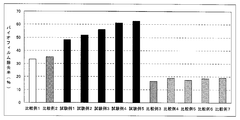
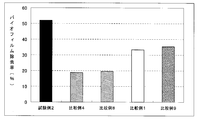
- the results of the test are shown in Table 1 and FIGS.
- the compositions shown in Table 1 were mixed with erythritol having an average particle size of 200 ⁇ m and completely dissolved, and then a biofilm removal test was conducted.
- Comparative Examples 3 to 7 containing only N-myristoyl glutamate sodium have a low biofilm removal rate regardless of the content of sodium N-myristoyl glutamate, but erythritol and N- Test Examples 1 to 5 containing a mass ratio of 20 to 400 with sodium myristoyl glutamate include Comparative Example 1 containing only erythritol, and Comparative Example 2 with a mass ratio of erythritol and sodium N-myristoyl glutamate of 500. A higher biofilm removal effect was obtained. Further, as shown in Table 1 and FIGS.
- Comparative Example 8 containing sorbitol and sodium N-myristoyl glutamate had a biofilm removal rate comparable to Comparative Example 4 containing only N-myristoyl glutamate. Thus, even if an N-acyl acidic amino acid is contained with sorbitol, the biofilm removal effect is not improved. Further, Comparative Example 9 containing N-acyl neutral fatty acid N-coconut oil fatty acid acylglycine sodium has the same biofilm removal rate as Comparative Example 1 containing only erythritol, and is N-acyl neutral. Even when amino acids were used in combination with erythritol, the effect of improving the biofilm removal rate was not recognized. Comparative Example 10 was a dentifrice composition containing sodium chloride, and the biofilm removal effect was reduced.
- a toothbrush (Pyuora regular size (Kao Co., Ltd.)) was 1.5 cm in length and brushed for 1 minute. Evaluation of the defoaming property was performed by stirring the composition shown in Table 2 at a rotation speed of 8 rpm and a vacuum pressure of 0.09 mPa for 10 minutes, and measuring the specific gravity (specific gravity 1). Next, stirring was carried out for 15 minutes at a rotational speed of 8 rpm and a vacuum pressure of 0.096 mPa, the specific gravity (specific gravity 2) was measured, the defoaming property was evaluated based on the ratio of specific gravity 2 / specific gravity 1, the specific gravity decreased, and the specific gravity ratio was reduced to 0.
- stirring mixer a universal mixing stirrer NDM / NDMV manufactured by DALTON Co., Ltd. was used.
- Examples 1 to 4 which are dentifrice compositions of the present invention have finer foam, better foam and better defoamability than Comparative Example 11 which does not contain sodium N-myristoyl glutamate. Good results were obtained.
- Comparative Example 13 containing 0.7% by mass of sodium N-myristoyl glutamate and Comparative Example 12 containing less erythritol than N-myristoyl glutamate had 0 defoaming properties (specific gravity 2 / specific gravity 1) of 0. It was .95, and it was difficult to remove bubbles.
- Comparative Example 14 having a content of erythritol / content of sodium N-myristoyl glutamate of 500 had poor foam and had a problem in usability.
- the comparative example 15 containing sodium chloride had bad foam fineness and foam, and had a problem in usability.
- the prescription of the dentifrice composition of the present invention is shown below.
- the dentifrice composition of Example 5 had fine foam and good foam retention.
Landscapes
- Health & Medical Sciences (AREA)
- Life Sciences & Earth Sciences (AREA)
- Animal Behavior & Ethology (AREA)
- General Health & Medical Sciences (AREA)
- Public Health (AREA)
- Veterinary Medicine (AREA)
- Birds (AREA)
- Epidemiology (AREA)
- Emergency Medicine (AREA)
- Oral & Maxillofacial Surgery (AREA)
- Cosmetics (AREA)
Abstract
エリスリトールを含有し、エリスリトールによる口腔内のバイオフィルムの除去効果を向上する歯磨組成物を提供すること。 次の成分(A)、(B)及び(C): (A)エリスリトール 10~65質量%、 (B)N-アシル酸性アミノ酸 0.05~0.55質量%、 (C)水 10~25質量% を含有し、成分(A)と成分(B)との質量比(A/B)が20~400であって、塩化ナトリウムが実質的に配合されていない歯磨組成物。
Description
本発明は、歯磨組成物に関する。
う蝕、歯周病、口臭等の口腔疾患を予防するには、口腔内バイオフィルムの形成を阻害したり、口腔内にすでに形成されたバイオフィルムを除去することが重要である。従来、バイオフィルムを除去する有効成分として、エリスリトール、アミノ酸等が知られている(特許文献1)。このエリスリトールについては、溶解時の吸熱による清涼感を充分に得る観点から、エリスリトールを30~60質量%と多く配合し、歯磨剤中にエリスリトールを粒子状で存在させた歯磨剤が提案されている(特許文献2)。
一方、N-アシルアミノ酸については、これをカチオン性殺菌剤、トリクロサン、ビグアニド系殺菌剤と併用することで、殺菌剤の歯牙表面への吸着性を促進し、あるいは殺菌剤の失活を抑制することにより歯垢の形成を抑制する技術が知られている(特許文献3~5)。また、N-アシルアミノ酸は、発泡性を向上させる効果を有することが知られており、特許文献6にはポリオキシエチレンステアリルアルコールエーテルの発泡性を補うためにN-長鎖アシルアミノ酸又はその塩を配合し、練歯磨の発泡性を良好にすることが記載されている。
本発明は、次の成分(A)、(B)及び(C):
(A)エリスリトール 10~65質量%、
(B)N-アシル酸性アミノ酸又はその塩 0.05~0.55質量%、
(C)水 10~25質量%
を含有し、成分(A)と成分(B)との質量比(A/B)が20~400であって、塩化ナトリウムが実質的に配合されていない歯磨組成物を提供するものである。
また、本発明は、前記歯磨組成物の、口腔内バイオフィルムを除去するための使用を提供するものである。
また、本発明は、前記歯磨組成物を口腔内に適用する口腔内バイオフィルム除去方法を提供するものである。
さらに本発明は、口腔内のバイオフィルム除去剤製造のための、前記の歯磨組成物の使用を提供するものである。
(A)エリスリトール 10~65質量%、
(B)N-アシル酸性アミノ酸又はその塩 0.05~0.55質量%、
(C)水 10~25質量%
を含有し、成分(A)と成分(B)との質量比(A/B)が20~400であって、塩化ナトリウムが実質的に配合されていない歯磨組成物を提供するものである。
また、本発明は、前記歯磨組成物の、口腔内バイオフィルムを除去するための使用を提供するものである。
また、本発明は、前記歯磨組成物を口腔内に適用する口腔内バイオフィルム除去方法を提供するものである。
さらに本発明は、口腔内のバイオフィルム除去剤製造のための、前記の歯磨組成物の使用を提供するものである。
ヒトの口腔内バイオフィルムは、複数の口腔内細菌体の共凝集体と菌体外多糖とからなるものであり、一旦形成した口腔内バイオフィルムを除去することは必ずしも容易ではない。特許文献3~5のように殺菌剤の失活を防止したり、殺菌剤の歯牙への吸着を促進することは、バイオフィルムの形成を予防する上では有効であるが、一旦形成したバイオフィルムにおいては、口腔内に適用する程度の殺菌剤では、口腔内細菌に充分作用せず、バイオフィルムを除去することは困難である。
一方、エリスリトールはバイオフィルム除去効果が知られているが、さらにその効果を高めることが求められている。
そこで、本発明の課題は、エリスリトールを含有し、さらに既に形成されているバイオフィルム除去効果を向上させる歯磨組成物を得ることにある。
一方、エリスリトールはバイオフィルム除去効果が知られているが、さらにその効果を高めることが求められている。
そこで、本発明の課題は、エリスリトールを含有し、さらに既に形成されているバイオフィルム除去効果を向上させる歯磨組成物を得ることにある。
本発明者は、エリスリトールによるバイオフィルム除去効果を向上させる成分を探索したところ、N-アシルアミノ酸のうちN-アシル酸性アミノ酸をエリスリトールと特定比率で含有させることによって、バイオフィルム除去効果が顕著に向上することを見出した。
本発明の歯磨組成物は、エリスリトールを含有し、エリスリトールによる口腔内のバイオフィルムの除去効果が顕著に向上する。
本発明の好ましい実施態様は以下の通りである。
[1]次の成分(A)、(B)及び(C):
(A)エリスリトール 10~65質量%、
(B)N-アシル酸性アミノ酸又はその塩 0.05~0.55質量%、
(C)水 10~25質量%
を含有し、成分(A)と成分(B)との質量比(A/B)が20~400であって、塩化ナトリウムが実質的に配合されていない歯磨組成物。
[2]成分(A)と成分(C)との質量比(A/C)が0.7~6である[1]に記載の歯磨組成物。
[3](B)N-アシル酸性アミノ酸を構成する酸性アミノ酸がグルタミン酸である[1]又は[2]に記載の歯磨組成物。
[4](B)N-アシル酸性アミノ酸を構成するアシル基の炭素数が6~18である[1]~[3]のいずれかに記載の歯磨組成物。
[5]さらに(D)アルキル硫酸エステル塩を0.1~2.0質量%含有し、成分(D)と成分(B)との質量比(D/B)が、0.2~20である[1]~[4]のいずれかに記載の歯磨組成物。
[6](A)平均粒子径350μm以下の粒子状のエリスリトールを10~55質量%含有する[1]~[5]のいずれかに記載の歯磨組成物。
[7]成分(A)と成分(B)との質量比(A/B)が20~250である[1]~[6]のいずれかに記載の歯磨組成物。
[8]成分(A)と成分(C)との質量比(A/C)が0.9~4である[1]~[7]のいずれかに記載の歯磨組成物。
[9]成分(D)と成分(B)との質量比(D/B)が2~15である[1]~[8]のいずれかに記載の歯磨組成物。
[10](C)水の含有量が10~20質量%である[1]~[9]いずれかに記載の歯磨組成物。
[11]ソルビトール及び/又はマルチトールの含有量が0~35質量%であり、好ましくは10~24.5質量%である[1]~[10]のいずれかに記載の歯磨組成物。
[12]グリセリンの含有量が0~8質量%であり、好ましくは1~6質量%である[1]~[11]のいずれかに記載の歯磨組成物。
[13]粘結剤を0.1~2質量%含有する[1]~[12]のいずれかに記載の歯磨組成物。
[14][1]~[13]のいずれかに記載の歯磨組成物の、口腔内のバイオフィルムを除去するための使用。
[14][1]~[13]のいずれかに記載の歯磨組成物を口腔内に適用する口腔内のバイオフィルム除去方法。
[15]口腔内のバイオフィルム除去剤製造のための、[1]~[13]のいずれかに記載の歯磨組成物の使用。
[1]次の成分(A)、(B)及び(C):
(A)エリスリトール 10~65質量%、
(B)N-アシル酸性アミノ酸又はその塩 0.05~0.55質量%、
(C)水 10~25質量%
を含有し、成分(A)と成分(B)との質量比(A/B)が20~400であって、塩化ナトリウムが実質的に配合されていない歯磨組成物。
[2]成分(A)と成分(C)との質量比(A/C)が0.7~6である[1]に記載の歯磨組成物。
[3](B)N-アシル酸性アミノ酸を構成する酸性アミノ酸がグルタミン酸である[1]又は[2]に記載の歯磨組成物。
[4](B)N-アシル酸性アミノ酸を構成するアシル基の炭素数が6~18である[1]~[3]のいずれかに記載の歯磨組成物。
[5]さらに(D)アルキル硫酸エステル塩を0.1~2.0質量%含有し、成分(D)と成分(B)との質量比(D/B)が、0.2~20である[1]~[4]のいずれかに記載の歯磨組成物。
[6](A)平均粒子径350μm以下の粒子状のエリスリトールを10~55質量%含有する[1]~[5]のいずれかに記載の歯磨組成物。
[7]成分(A)と成分(B)との質量比(A/B)が20~250である[1]~[6]のいずれかに記載の歯磨組成物。
[8]成分(A)と成分(C)との質量比(A/C)が0.9~4である[1]~[7]のいずれかに記載の歯磨組成物。
[9]成分(D)と成分(B)との質量比(D/B)が2~15である[1]~[8]のいずれかに記載の歯磨組成物。
[10](C)水の含有量が10~20質量%である[1]~[9]いずれかに記載の歯磨組成物。
[11]ソルビトール及び/又はマルチトールの含有量が0~35質量%であり、好ましくは10~24.5質量%である[1]~[10]のいずれかに記載の歯磨組成物。
[12]グリセリンの含有量が0~8質量%であり、好ましくは1~6質量%である[1]~[11]のいずれかに記載の歯磨組成物。
[13]粘結剤を0.1~2質量%含有する[1]~[12]のいずれかに記載の歯磨組成物。
[14][1]~[13]のいずれかに記載の歯磨組成物の、口腔内のバイオフィルムを除去するための使用。
[14][1]~[13]のいずれかに記載の歯磨組成物を口腔内に適用する口腔内のバイオフィルム除去方法。
[15]口腔内のバイオフィルム除去剤製造のための、[1]~[13]のいずれかに記載の歯磨組成物の使用。
以下、本発明の構成について説明する。
本発明の歯磨組成物は、エリスリトール(成分(A))を10~65質量%含有する。(A)エリスリトールの含有量は、バイオフィルム除去効果を得る点、及び清涼感を得る点から、歯磨組成物中10~55質量%がより好ましく、さらに10~50質量%が好ましい。
本発明の(A)エリスリトールは、溶解熱による清涼感を持続する観点から粒子状のエリスリトールを含有することが好ましく、エリスリトールの平均粒子径は350μm以下であるものがより好ましい。良好な清涼感を得る点からエリスリトールの平均粒子径は250μm以下であるものが好ましく、さらに200μm以下であるものが好ましい。本発明の歯磨組成物は粒子状のエリスリトールの含有量は、10~55質量%が好ましく、10~45質量%がより好ましく、さらに10~40質量%が好ましい。
なお、エリスリトールの粒子径は以下のように測定される。
篩:JIS標準篩 φ75mm
目開き:上段より、それぞれ500μm、355μm、250μm、180μm、125μm、90μm及び45μmの目開きを有する篩の下に受器を有する。
振盪機:ミクロ型電磁振動機M-2型(筒井理化学器機(株))
方法:試料15gを500μm篩上に載せ、電磁振動機にて5分間分級する。篩下率(積算量)を正規確立紙にプロットし、50%に対応する値を平均粒子径とする。
このような粒子径は、結晶状のエリスリトールを粉砕して調整することができる。エリスリトールの粉砕には、ローラミル、ハンマーミル、高速度粉砕機、パルベライザーなどを使用することができる。結晶状のエリスリトールは、市販品としては、日研化成(株)、三菱化学フーズ(株)、カーギル社等のものが入手可能である。
篩:JIS標準篩 φ75mm
目開き:上段より、それぞれ500μm、355μm、250μm、180μm、125μm、90μm及び45μmの目開きを有する篩の下に受器を有する。
振盪機:ミクロ型電磁振動機M-2型(筒井理化学器機(株))
方法:試料15gを500μm篩上に載せ、電磁振動機にて5分間分級する。篩下率(積算量)を正規確立紙にプロットし、50%に対応する値を平均粒子径とする。
このような粒子径は、結晶状のエリスリトールを粉砕して調整することができる。エリスリトールの粉砕には、ローラミル、ハンマーミル、高速度粉砕機、パルベライザーなどを使用することができる。結晶状のエリスリトールは、市販品としては、日研化成(株)、三菱化学フーズ(株)、カーギル社等のものが入手可能である。
本発明の歯磨組成物は、さらにN-アシル酸性アミノ酸又はその塩(成分(B))を含有する。発泡性、泡質の点から、N-アシル酸性アミノ酸を構成するアシル基の炭素数は8~16が好ましく、さらにアシル基がミリストイル基及びラウロイル基から選ばれる1種又は2種以上であることが好ましい。N-アシル酸性アミノ酸を構成する酸性アミノ酸としては、グルタミン酸、アスパラギン酸が挙げられ、グルタミン酸が好ましい。また、N-アシル酸性アミノ酸の塩としては、ナトリウム塩、カリウム塩、マグネシウム塩等が挙げられ、ナトリウム塩が好ましい。
本発明の歯磨組成物における(B)N-アシル酸性アミノ酸又はその塩の含有量は、歯磨組成物の製造時における脱泡処理と、泡質のバランスから0.05~0.55質量%であって、好ましくは0.1~0.5質量%、さらに好ましくは0.1~0.4質量%である。また、歯磨組成物中の(A)エリスリトールの含有量と(B)N-アシル酸性アミノ酸の含有量との質量比(A/B)は、バイオフィルム除去効果及び脱泡性、泡質のバランスから20~400が好ましく、20~300がより好ましく、20~250がさらに好ましい。
本発明の歯磨組成物は、さらに水(成分(C))を含有する。(C)水は、配合される精製水、イオン交換水だけでなく、例えばソルビトール液に含まれる水分等の、各成分中に含まれる水を含めた歯磨組成物中の水分である。水の含有量は、(A)エリスリトールを一部溶解するが粒子状(粉状を含む)で含有され、使用時にエリスリトールの溶解による清涼感を得る観点と安定性の点から、歯磨組成物中10~25質量%であって、好ましくは10~20質量%である。(A)エリスリトールの含有量と(C)水の含有量との質量比(A/C)は0.7~6が好ましく、0.8~5がより好ましく、0.9~4がさらに好ましい。
本発明の歯磨組成物は、(C)水の含有量を10~25質量%にすることによって、20℃における(A)エリスリトールの溶解度33%であることから、水に溶解する(A1)エリスリトールは6.6~16.5質量%になる。この溶解状態のエリスリトール(A1)と(B)N-アシル酸性アミノ酸の質量比(A1/B)は、15~300が好ましく、20~150がより好ましく、20~110がさらに好ましい。
なお、歯磨組成物の水分量は、配合した水分量及び配合した成分中の水分量から計算によって算出することもできるが、例えばカールフィッシャー水分計で測定することができる。カールフィッシャー水分計としては、例えば、微量水分測定装置(平沼産業)を用いることができる。この装置では、歯磨組成物を5gとり、無水メタノール25gに懸濁させ、この懸濁液0.02gを分取して水分量を測定することができる。
本発明の歯磨組成物には、前記成分(A)~(C)によるバイオフィルム除去効果を低下させない点から、塩化ナトリウムが実質的に配合されていないことが好ましい。ここで、塩化ナトリウムを実質的に配合しないとは、歯磨組成物中の塩化ナトリウムの含有量が0.1質量%以下であることを意味し、さらにその含有量が0.05質量%以下であることが好ましく、0.01質量%以下であることがより好ましく、0であるのがさらに好ましい。
本発明の歯磨組成物は、さらに(D)アルキル硫酸エステル塩を含有することが好ましい。アルキル硫酸エステル塩は、発泡性の点からラウリル硫酸塩、ミリスチル硫酸塩が好ましく、その塩としてはナトリウム塩が好ましい。歯磨組成物における(D)アルキル硫酸エステル塩の含有量は、0.1~2質量%が好ましく、さらに0.25~1.75質量%が好ましく、特に0.5~1.5質量%が好ましい。また、発泡性や泡質と脱泡性の両立の点から、歯磨組成物中の(D)アルキル硫酸エステル塩と(B)N-アシル酸性アミノ酸との質量比(D/B)は0.2~20であるのが好ましく、1~15であるのがより好ましく、2~15であるのがさらに好ましい。
本発明の歯磨組成物は、(A)エリスリトール以外の糖アルコールを含有することができる。糖アルコールとしては、例えば、ソルビトール、キシリトール、マルチトール、マンニトール、パラチニットが挙げられる。脱泡性の点からソルビトール及び/又はマルチトールを含有する場合には、歯磨組成物におけるソルビトール液(70%水溶液)、マルチトール液(70%水溶液)の含有量は50質量%以下が好ましく、さらに40質量%以下が好ましく、特に35質量%以下が好ましい。即ち、歯磨組成物におけるソルビトール及び/又はマルチトールの含有量は、0~35質量%が好ましく、10~28質量%がより好ましく、10~24.5質量%がさらに好ましい。
本発明の歯磨組成物には、湿潤剤を含有することができる。湿潤剤としては、例えばポリエチレングリコール、プロピレングリコール、ジプロピレングリコール、グリセリンが挙げられ、歯磨組成物中に0~15質量%含有することができる。歯磨組成物におけるグリセリンの含有量は、脱泡性の点から0~8質量%が好ましく、さらに1~6質量%が好ましい。
本発明の歯磨組成物は、さらに粘結剤を含有することが好ましい。粘結剤としては、アルギン酸ナトリウム、カルボキシメチルセルロースナトリウム、カラギーナン、キサンタンガム、ポリアクリル酸ナトリウム、ヒドロキシエチルセルロース、ヒドロキシプロピルセルロース、ペクチン、トラガントガム、アラビアガム、グアーガム、カラヤガム、ローカストビーンガム、ジェランガム、タマリンドガム、サイリウムシードガム、ポリビニルアルコール、コンドロイチン硫酸ナトリウム及びメトキシエチレン無水マレイン酸共重合体等からなる群より選ばれる1種又は2種以上を用いることができる。このうち、カルボキシメチルセルロースナトリウム、カラギーナン、キサンタンガムが好ましく、特に、カラギーナン、カルボキシメチルセルロースナトリウムが好ましい。また、保形性や糸引き性、及び使用感の面から2種以上、さらには3種以上を使用することが好ましい。歯磨組成物における粘結剤の含有量は、0.1~3質量%が好ましく、0.1~2質量%がより好ましい。また、0.6~3質量%や0.5~2.5質量%の範囲も好ましい。
本発明の歯磨組成物は上記粘結剤とともに、さらに増粘性シリカを併用することが好ましい。増粘性シリカとは、吸油量が200~400mL/100gのシリカである。ここで、吸油量とは、シリカが担持できる油量を示したものであり、測定方法はJIS K5101-13-2に準ずる方法により、吸収される煮あまに油の量により特定する。増粘性シリカの含有量は、歯磨組成物中0.5~10質量%が好ましい。
本発明の歯磨組成物は、前記成分の他、研磨剤、甘味剤、香料、pH調整剤、色素、薬効成分等を適宜含有させることができる。
研磨剤としては、研磨性シリカ、第2リン酸カルシウム・2水和物及び無水物、ピロリン酸カルシウム、炭酸カルシウム、アルミナ、水酸化アルミニウム、酢酸マグネシウム、第2リン酸マグネシウム、酢酸マグネシウム、第3リン酸マグネシウム、ゼオライト、合成樹脂系研磨剤等が挙げられる。ここで、研磨性シリカは、吸油量が50~150mL/100gのものをいう。
甘味剤としては、サッカリンナトリウム、アスパルテーム、ソーマチン、アセスルファムカリウム、ステビオサイド、ステビアエキス、パラメトキシシンナミックアルデヒド、ネオヘスペリジルジヒドロカルコン、ペリラルチン、スクラロース等が挙げられる。
香料としては、l-メントール、カルボン、アネトール、オイゲノール、リモネン、ペパーミント油、スペアミント油、オシメン、n-アミルアルコール、シトロネロール、α-テルピネオール、サリチル酸メチル、メチルアセテート、シトロネオールアセテート、シネオール、リナロール、エチルリナロール、ワニリン、チモール、レモン油、オレンジ油、セージ油、ローズマリー油、桂皮油、ピメント油、シソ油、丁子油、ユーカリ油等が挙げられる。
薬効成分としては、殺菌剤、抗炎症剤、血行促進剤、フッ素イオン供給化合物等が挙げられる。殺菌剤としては、クロルヘキシジン塩類、塩化セチルピリジニウム、塩化ベンゼトニウム等の第四級アンモニウム化合物、イソプロピルメチルフェノール、トリクロサン、トリクロロカルバニリドが挙げられる。フッ素イオン供給化合物としては、フッ化ナトリウム、フッ化カリウム、フッ化アンモニウム、フッ化リチウム、モノフルオロホスフェート(例えば、モノフルオロリン酸ナトリウム、モノフルオロリン酸カリウム、モノフルオロリン酸アンモニウム等)等の無機性フッ化物、アミンフッ化物等の有機性フッ化物が挙げられ、その中でもフッ化ナトリウム、モノフルオロリン酸ナトリウム、フッ化スズが好ましい。
本発明の歯磨組成物は、N-アシル酸性アミノ酸の安定性の点からpHは5~9が好ましく、さらに6~8が好ましい。ここで、本発明の歯磨き組成物のpHは、蒸留水を加えて10質量%水溶液に調整した後、pH電極を用いて測定することができる。
本発明の歯磨組成物は、練り歯磨組成物が好ましく、十分な清涼感を得る観点から、エリスリトールが特定の粒子径の粒子状(粉状を含む)で分散しているのが望ましい。そのためには、エリスリトールは製造の最終工程に、粉体状のままで投入することが好ましい。このような製造方法を用いることで、歯磨き組成物中に粒子状で存在させることが可能となる。具体的には、例えば、精製水、湿潤剤、粘結剤、保存料、甘味剤及び薬効成分等を、一定の製造条件に従って混合し、粘結剤を十分に膨潤させ、さらに、研磨剤、増粘性シリカ、N-アシル酸性アミノ酸、必要に応じて他の界面活性剤、及び香料を加えて混合し、最後に粒子状のエリスリトールを加えて脱泡混合し、本発明の歯磨き組成物を製造できる。
以下、実施例及び試験例により本発明をより具体的に説明するが、本発明はこれらの例示に限定されるものではない。なお、以下の表に示された処方は、説明のない限り各成分の含有量は質量%を意味する。
(1)バイオフィルムの作成
S.mutans ATCC25175株、A.viscosus ATCC43146株、S.gordonii ATCC10558株の各々の細菌をSCD培地(Soybean-Casein DigestBroth、日本製薬株式会社製)に0.5% Yeast Extract(Difco社製)を添加した培養液(SCD-YE培地)50mLに1白金耳を接種し、温度37℃、嫌気的条件(N280%、CO220%)で対数増殖期まで培養した。
口腔疾患の無い健常な男性より、パラフィンワックスを咀嚼させて分泌された唾液を採取し、遠心分離によって、唾液採取時に剥離した口腔内粘膜等を除去し、これをglass base dish(IWAKI φ27mm)に2mL/dishの割合で分注し、4℃で一昼夜静置することで glass base dishにヒトの唾液を吸着させた。
上記培養した細菌(S.mutans、A.viscosus、S.Gordonii)を分光光度計(BioSpec-mini 島津製作所製)により10mmの光路長で600nmのO.D.が0.7になるように培養液(SCD-YE培地)で調整し、各々の細菌を1mLを接種し、培養液50mLと混合した細菌混合液を2mL/dishの割合で唾液を付着させたglass base dishに添加し、24時間培養してバイオフィルムを形成させた。ここで、培養液は酵母0.5%(Yeast Extract、Difco社製)、Glucose 1.0%、Sucrose 2.0%を添加したものを用いた。
S.mutans ATCC25175株、A.viscosus ATCC43146株、S.gordonii ATCC10558株の各々の細菌をSCD培地(Soybean-Casein DigestBroth、日本製薬株式会社製)に0.5% Yeast Extract(Difco社製)を添加した培養液(SCD-YE培地)50mLに1白金耳を接種し、温度37℃、嫌気的条件(N280%、CO220%)で対数増殖期まで培養した。
口腔疾患の無い健常な男性より、パラフィンワックスを咀嚼させて分泌された唾液を採取し、遠心分離によって、唾液採取時に剥離した口腔内粘膜等を除去し、これをglass base dish(IWAKI φ27mm)に2mL/dishの割合で分注し、4℃で一昼夜静置することで glass base dishにヒトの唾液を吸着させた。
上記培養した細菌(S.mutans、A.viscosus、S.Gordonii)を分光光度計(BioSpec-mini 島津製作所製)により10mmの光路長で600nmのO.D.が0.7になるように培養液(SCD-YE培地)で調整し、各々の細菌を1mLを接種し、培養液50mLと混合した細菌混合液を2mL/dishの割合で唾液を付着させたglass base dishに添加し、24時間培養してバイオフィルムを形成させた。ここで、培養液は酵母0.5%(Yeast Extract、Difco社製)、Glucose 1.0%、Sucrose 2.0%を添加したものを用いた。
(2)バイオフィルム除去試験
(1)で作成したバイオフィルムに対して、表1に記載の組成物(試験例1~5、比較例1~10)を1mL滴下し、室温(20℃)で30秒間の超音波処理をした。除去試験の超音波処理はヒトの含嗽に類似したレベルにするため超音波周波数が42KHzで設計されている超音波洗浄機AW5800(シチズン製)により行った。処理後、剥がれたバイオフィルム量(A)と、残ったバイオフィルム量(B)をフェノール硫酸法によって測定した。残ったバイオフィルムは、2N水酸化ナトリウム1mLを添加することによってバイオフィルムを剥がし、さらに2N塩酸1mLを添加して中和して回収した。剥がれたバイオフィルムは1mLの組成物とともに1mLの精製水を加えて回収した。これらの回収したバイオフィルムの量をフェノール硫酸法によって測定した。フェノール硫酸法は、回収したバイオフィルム20μLを96wellマイクロプレートリーダーに分注し、さらに5%(W/V)フェノール水溶液20μLを加え、98%濃硫酸100μLを添加して混合し、マイクロプレートレコーダーで490nmの吸光度を測定した。検量線は、0.0078~0.125%のグルコース液の吸光度を用い、バイオフィルムの量を定量した。バイオフィルム除去率は、バイオフィルム量(A)/(バイオフィルム量(A)+バイオフィルム量(B))として求めた。試験の結果を表1及び図1、2に示す。なお、表1記載の組成物は、平均粒子径200μmのエリスリトールを配合し、完全に溶解させてからバイオフィルム除去試験を行った。
(1)で作成したバイオフィルムに対して、表1に記載の組成物(試験例1~5、比較例1~10)を1mL滴下し、室温(20℃)で30秒間の超音波処理をした。除去試験の超音波処理はヒトの含嗽に類似したレベルにするため超音波周波数が42KHzで設計されている超音波洗浄機AW5800(シチズン製)により行った。処理後、剥がれたバイオフィルム量(A)と、残ったバイオフィルム量(B)をフェノール硫酸法によって測定した。残ったバイオフィルムは、2N水酸化ナトリウム1mLを添加することによってバイオフィルムを剥がし、さらに2N塩酸1mLを添加して中和して回収した。剥がれたバイオフィルムは1mLの組成物とともに1mLの精製水を加えて回収した。これらの回収したバイオフィルムの量をフェノール硫酸法によって測定した。フェノール硫酸法は、回収したバイオフィルム20μLを96wellマイクロプレートリーダーに分注し、さらに5%(W/V)フェノール水溶液20μLを加え、98%濃硫酸100μLを添加して混合し、マイクロプレートレコーダーで490nmの吸光度を測定した。検量線は、0.0078~0.125%のグルコース液の吸光度を用い、バイオフィルムの量を定量した。バイオフィルム除去率は、バイオフィルム量(A)/(バイオフィルム量(A)+バイオフィルム量(B))として求めた。試験の結果を表1及び図1、2に示す。なお、表1記載の組成物は、平均粒子径200μmのエリスリトールを配合し、完全に溶解させてからバイオフィルム除去試験を行った。

表1及び図1、2に示すように、N-ミリストイルグルタミン酸ナトリウムのみを含有する比較例3~7はN-ミリストイルグルタミン酸ナトリウムの含有量によらずバイオフィルム除去率は低いが、エリスリトールとN-ミリストイルグルタミン酸ナトリウムとの質量比が20~400の間で含有する試験例1~5は、エリスリトールのみを含有する比較例1、エリスリトールとN-ミリストイルグルタミン酸ナトリウムとの質量比が500の比較例2と比べて高いバイオフィルム除去効果が得られた。また、表1及び図1、2に示すように、ソルビトールとN-ミリストイルグルタミン酸ナトリウムとを含有する比較例8は、N-ミリストイルグルタミン酸ナトリウムのみを含有する比較例4と同程度のバイオフィルム除去率であり、N-アシル酸性アミノ酸をソルビトールと含有してもバイオフィルム除去効果は向上しない。さらに、N-アシル中性アミノ酸であるN-ヤシ油脂肪酸アシルグリシンナトリウムを含有する比較例9は、エリスリトールのみを含有する比較例1と同程度のバイオフィルム除去率であり、N-アシル中性アミノ酸はエリスリトールと併用してもバイオフィルム除去率を向上する効果は認められなかった。比較例10は、塩化ナトリウムを配合した歯磨組成物であり、バイオフィルム除去効果が低下した。
(3)泡質、脱泡性
表2に示す歯磨組成物を製造し、歯磨組成物を使用した場合の泡質、歯磨組成物の各成分を混合した際の脱泡性を評価した。なお、歯磨組成物のpHは6.5~7.5に調整した。
泡質の評価は、歯磨組成物の3名の使用により評価を行い、比較例11を基準に、泡のきめの細かさが比較例11よりも細かい場合を1、同じ場合を0、粗い場合を-1とし、泡もちが比較例11よりも良い場合を1、同じ場合を0、悪い場合を-1とし、3名の協議により評価を決めた。歯磨組成物の使用は、歯ブラシ(ピュオーラ レギュラーサイズ(花王(株)))に1.5cmとり1分間歯磨きを行った。
脱泡性の評価は、表2の組成物を回転数8rpm、真空圧0.09mPa、10分間攪拌し、比重(比重1)を測定する。次に回転数8rpm、真空圧0.096mPa、15分間攪拌し比重(比重2)を測定し、比重2/比重1の比率によって脱泡性を評価し、比重が減少し比重の比率が0.98以下の場合は×、比重の比率が1.00~0.98の場合は○とした。ここで、攪拌混合機は、DALTON(株)製の万能混合攪拌機NDM/NDMVを用いた。
表2に示す歯磨組成物を製造し、歯磨組成物を使用した場合の泡質、歯磨組成物の各成分を混合した際の脱泡性を評価した。なお、歯磨組成物のpHは6.5~7.5に調整した。
泡質の評価は、歯磨組成物の3名の使用により評価を行い、比較例11を基準に、泡のきめの細かさが比較例11よりも細かい場合を1、同じ場合を0、粗い場合を-1とし、泡もちが比較例11よりも良い場合を1、同じ場合を0、悪い場合を-1とし、3名の協議により評価を決めた。歯磨組成物の使用は、歯ブラシ(ピュオーラ レギュラーサイズ(花王(株)))に1.5cmとり1分間歯磨きを行った。
脱泡性の評価は、表2の組成物を回転数8rpm、真空圧0.09mPa、10分間攪拌し、比重(比重1)を測定する。次に回転数8rpm、真空圧0.096mPa、15分間攪拌し比重(比重2)を測定し、比重2/比重1の比率によって脱泡性を評価し、比重が減少し比重の比率が0.98以下の場合は×、比重の比率が1.00~0.98の場合は○とした。ここで、攪拌混合機は、DALTON(株)製の万能混合攪拌機NDM/NDMVを用いた。
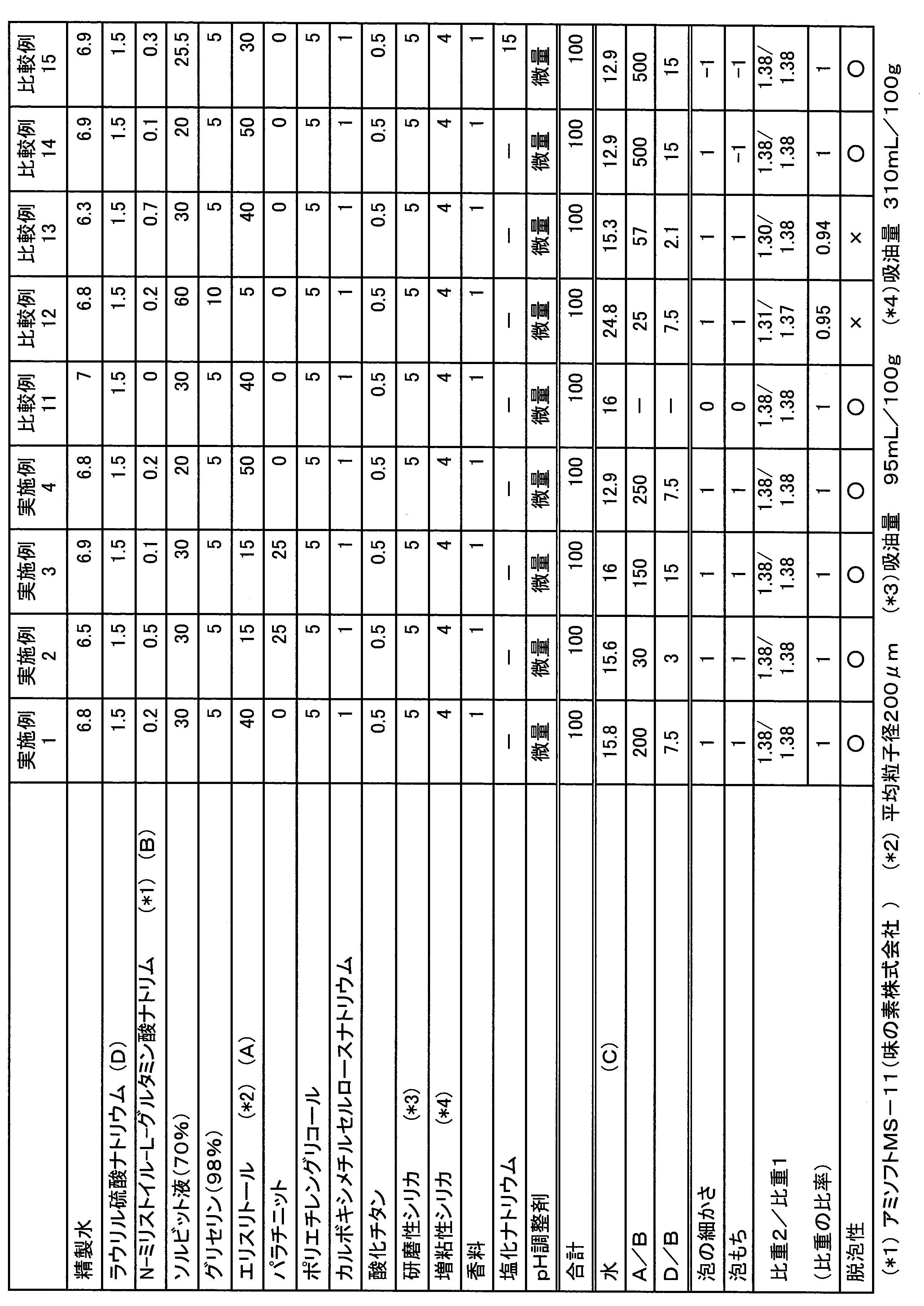
表2に示すように、本発明の歯磨組成物である実施例1~4は、N-ミリストイルグルタミン酸ナトリウムを含有しない比較例11に比べて泡が細かく、泡もちも良く、しかも脱泡性も良好な結果が得られた。一方、N-ミリストイルグルタミン酸ナトリウムを0.7質量%含有する比較例13、エリスリトールの含有量がN-ミリストイルグルタミン酸ナトリウムに比べて少ない比較例12は、脱泡性(比重2/比重1)が0.95であり脱泡しにくい結果が得られた。さらに(エリスリトールの含有量/N-ミリストイルグルタミン酸ナトリウムの含有量)が500である比較例14は、泡もちが悪く、使用感に課題があった。また、塩化ナトリウムを含有する比較例15は、泡の細かさ及び泡もちが悪く、使用感に課題があった。
本発明の歯磨組成物の処方を以下に示す。実施例5の歯磨組成物は泡が細かく、泡もちが良好であった。
実施例5
エリスリトール(*1) 45.0
ソルビトール液(70%) 25.0
N-ラウロイル-L-グルタミン酸ナトリウム 0.2
ラウリル硫酸ナトリウム 1.0
グリセリン(98%) 4.0
研磨性シリカ(*2) 8.0
増粘性シリカ(*3) 7.0
カルボキシメチルセルロースナトリウム 0.5
キサンタンガム 0.05
カラギーナン 0.1
サッカリンナトリウム 0.04
酸化チタン 0.5
フッ化ナトリウム 0.2
香料 0.1
精製水 8.31
合計 100.0(質量%)
(*1)平均粒子径200μm
(*2)吸油量 95mL/100g
(*3)吸油量 310mL/100g
エリスリトール(*1) 45.0
ソルビトール液(70%) 25.0
N-ラウロイル-L-グルタミン酸ナトリウム 0.2
ラウリル硫酸ナトリウム 1.0
グリセリン(98%) 4.0
研磨性シリカ(*2) 8.0
増粘性シリカ(*3) 7.0
カルボキシメチルセルロースナトリウム 0.5
キサンタンガム 0.05
カラギーナン 0.1
サッカリンナトリウム 0.04
酸化チタン 0.5
フッ化ナトリウム 0.2
香料 0.1
精製水 8.31
合計 100.0(質量%)
(*1)平均粒子径200μm
(*2)吸油量 95mL/100g
(*3)吸油量 310mL/100g
Claims (15)
- 次の成分(A)、(B)及び(C):
(A)エリスリトール 10~65質量%、
(B)N-アシル酸性アミノ酸又はその塩 0.05~0.55質量%、
(C)水 10~25質量%
を含有し、成分(A)と成分(B)との質量比(A/B)が20~400であって、塩化ナトリウムが実質的に配合されていない歯磨組成物。 - 成分(A)と成分(C)との質量比(A/C)が0.7~6である請求項1に記載の歯磨組成物。
- (B)N-アシル酸性アミノ酸を構成する酸性アミノ酸がグルタミン酸である請求項1又は2に記載の歯磨組成物。
- (B)N-アシル酸性アミノ酸を構成するアシル基の炭素数が6~18である請求項1~3のいずれか1項に記載の歯磨組成物。
- さらに(D)アルキル硫酸エステル塩を0.1~2.0質量%含有し、成分(D)と成分(B)との質量比(D/B)が、0.2~20である請求項1~4のいずれか1項に記載の歯磨組成物。
- (A)平均粒子径350μm以下の粒子状のエリスリトールを10~55質量%含有する請求項1~5のいずれか1項に記載の歯磨組成物。
- 成分(A)と成分(B)との質量比(A/B)が20~250である請求項1~6のいずれか1項に記載の歯磨組成物。
- 成分(A)と成分(C)との質量比(A/C)が0.9~4である請求項1~7のいずれか1項に記載の歯磨組成物。
- 成分(D)と成分(B)との質量比(D/B)が2~15である請求項1~8のいずれか1項に記載の歯磨組成物。
- (C)水の含有量が10~20質量%である請求項1~9のいずれか1項に記載の歯磨組成物。
- ソルビトール及び/又はマルチトールの含有量が0~35質量%である請求項1~10のいずれか1項に記載の歯磨組成物。
- グリセリンの含有量が0~8質量%である請求項1~11のいずれか1項に記載の歯磨組成物。
- 請求項1~12のいずれか1項に記載の歯磨組成物の、口腔内のバイオフィルムを除去するための使用。
- 請求項1~12のいずれか1項に記載の歯磨組成物を口腔内に適用する口腔内のバイオフィルム除去方法。
- 口腔内のバイオフィルム除去剤製造のための、請求項1~12のいずれか1項に記載の歯磨組成物の使用。
Priority Applications (2)
| Application Number | Priority Date | Filing Date | Title |
|---|---|---|---|
| CN201180032557.8A CN102970969B (zh) | 2010-07-12 | 2011-07-11 | 洁牙组合物 |
| EP11806740.4A EP2594255B1 (en) | 2010-07-12 | 2011-07-11 | Dentifrice composition |
Applications Claiming Priority (2)
| Application Number | Priority Date | Filing Date | Title |
|---|---|---|---|
| JP2010157524 | 2010-07-12 | ||
| JP2010-157524 | 2010-07-12 |
Publications (1)
| Publication Number | Publication Date |
|---|---|
| WO2012008410A1 true WO2012008410A1 (ja) | 2012-01-19 |
Family
ID=45469408
Family Applications (1)
| Application Number | Title | Priority Date | Filing Date |
|---|---|---|---|
| PCT/JP2011/065789 Ceased WO2012008410A1 (ja) | 2010-07-12 | 2011-07-11 | 歯磨組成物 |
Country Status (4)
| Country | Link |
|---|---|
| EP (1) | EP2594255B1 (ja) |
| JP (1) | JP5846787B2 (ja) |
| CN (1) | CN102970969B (ja) |
| WO (1) | WO2012008410A1 (ja) |
Cited By (2)
| Publication number | Priority date | Publication date | Assignee | Title |
|---|---|---|---|---|
| CN104363886A (zh) * | 2012-06-08 | 2015-02-18 | 花王株式会社 | 口腔用组合物 |
| JP2023017313A (ja) * | 2021-07-26 | 2023-02-07 | 花王株式会社 | 口腔用組成物 |
Families Citing this family (8)
| Publication number | Priority date | Publication date | Assignee | Title |
|---|---|---|---|---|
| JP6072438B2 (ja) * | 2012-06-08 | 2017-02-01 | 花王株式会社 | 歯磨組成物 |
| JP6155022B2 (ja) * | 2012-12-26 | 2017-06-28 | 花王株式会社 | 口腔用組成物 |
| MY192189A (en) * | 2016-05-30 | 2022-08-05 | Lion Corp | Composition for use in oral cavity |
| CN106236640A (zh) * | 2016-08-24 | 2016-12-21 | 马南行 | 一种天然洁牙摩丝泡沫组合物及其制备方法 |
| JP7337610B2 (ja) * | 2018-12-04 | 2023-09-04 | 花王株式会社 | 口腔用組成物 |
| WO2020174914A1 (ja) * | 2019-02-28 | 2020-09-03 | 花王株式会社 | 口腔用組成物 |
| US12257346B2 (en) * | 2020-05-08 | 2025-03-25 | Fertin Pharma A/S | Oral powder mixture with small sized particles |
| JP2023154964A (ja) * | 2022-04-08 | 2023-10-20 | アスパック企業株式会社 | 歯面沈着物除去剤 |
Citations (9)
| Publication number | Priority date | Publication date | Assignee | Title |
|---|---|---|---|---|
| JPS5391147A (en) | 1977-01-19 | 1978-08-10 | Sunstar Inc | Tooth paste composition |
| JPH021402A (ja) | 1988-03-18 | 1990-01-05 | Sunstar Inc | 歯磨組成物 |
| JPH02282317A (ja) | 1989-04-24 | 1990-11-19 | Sunstar Inc | 歯磨組成物 |
| JPH0436231A (ja) | 1990-05-29 | 1992-02-06 | Sunstar Inc | 口腔用組成物 |
| JPH10306018A (ja) * | 1997-05-08 | 1998-11-17 | Lion Corp | 口腔用酵素の作用性向上剤 |
| JP2005029484A (ja) | 2003-07-09 | 2005-02-03 | Kao Corp | 口腔用組成物 |
| JP2005281306A (ja) | 2004-03-05 | 2005-10-13 | Kao Corp | 歯磨き組成物 |
| JP2006176463A (ja) * | 2004-12-24 | 2006-07-06 | Asahi Kasei Chemicals Corp | 口腔用組成物 |
| JP2008013528A (ja) * | 2006-07-10 | 2008-01-24 | Kao Corp | 歯磨き組成物 |
Family Cites Families (5)
| Publication number | Priority date | Publication date | Assignee | Title |
|---|---|---|---|---|
| EP0364928B1 (en) * | 1988-10-20 | 1994-04-06 | Ajinomoto Co., Inc. | Paste-like dentifrice composition |
| JPH10182389A (ja) * | 1996-12-27 | 1998-07-07 | Lion Corp | 歯磨組成物 |
| JP3752053B2 (ja) * | 1997-04-18 | 2006-03-08 | 花王株式会社 | 塩化ナトリウム含有歯磨組成物 |
| JP4658744B2 (ja) * | 2005-09-05 | 2011-03-23 | 花王株式会社 | 歯磨き組成物 |
| JP4952940B2 (ja) * | 2007-12-14 | 2012-06-13 | ライオン株式会社 | 液体口腔用組成物 |
-
2011
- 2011-07-11 CN CN201180032557.8A patent/CN102970969B/zh active Active
- 2011-07-11 JP JP2011152665A patent/JP5846787B2/ja active Active
- 2011-07-11 EP EP11806740.4A patent/EP2594255B1/en active Active
- 2011-07-11 WO PCT/JP2011/065789 patent/WO2012008410A1/ja not_active Ceased
Patent Citations (9)
| Publication number | Priority date | Publication date | Assignee | Title |
|---|---|---|---|---|
| JPS5391147A (en) | 1977-01-19 | 1978-08-10 | Sunstar Inc | Tooth paste composition |
| JPH021402A (ja) | 1988-03-18 | 1990-01-05 | Sunstar Inc | 歯磨組成物 |
| JPH02282317A (ja) | 1989-04-24 | 1990-11-19 | Sunstar Inc | 歯磨組成物 |
| JPH0436231A (ja) | 1990-05-29 | 1992-02-06 | Sunstar Inc | 口腔用組成物 |
| JPH10306018A (ja) * | 1997-05-08 | 1998-11-17 | Lion Corp | 口腔用酵素の作用性向上剤 |
| JP2005029484A (ja) | 2003-07-09 | 2005-02-03 | Kao Corp | 口腔用組成物 |
| JP2005281306A (ja) | 2004-03-05 | 2005-10-13 | Kao Corp | 歯磨き組成物 |
| JP2006176463A (ja) * | 2004-12-24 | 2006-07-06 | Asahi Kasei Chemicals Corp | 口腔用組成物 |
| JP2008013528A (ja) * | 2006-07-10 | 2008-01-24 | Kao Corp | 歯磨き組成物 |
Cited By (5)
| Publication number | Priority date | Publication date | Assignee | Title |
|---|---|---|---|---|
| CN104363886A (zh) * | 2012-06-08 | 2015-02-18 | 花王株式会社 | 口腔用组合物 |
| CN104363886B (zh) * | 2012-06-08 | 2017-04-26 | 花王株式会社 | 口腔用组合物 |
| RU2663700C2 (ru) * | 2012-06-08 | 2018-08-08 | Као Корпорейшн | Состав для ухода за полостью рта |
| JP2023017313A (ja) * | 2021-07-26 | 2023-02-07 | 花王株式会社 | 口腔用組成物 |
| JP7549566B2 (ja) | 2021-07-26 | 2024-09-11 | 花王株式会社 | 口腔用組成物 |
Also Published As
| Publication number | Publication date |
|---|---|
| EP2594255A4 (en) | 2015-10-28 |
| JP5846787B2 (ja) | 2016-01-20 |
| CN102970969A (zh) | 2013-03-13 |
| JP2012036172A (ja) | 2012-02-23 |
| EP2594255A1 (en) | 2013-05-22 |
| EP2594255B1 (en) | 2019-05-08 |
| CN102970969B (zh) | 2015-03-11 |
Similar Documents
| Publication | Publication Date | Title |
|---|---|---|
| JP5846787B2 (ja) | 歯磨組成物 | |
| KR20160031997A (ko) | 구강 바이오필름 제거제 및 구강용 조성물 | |
| JP5202895B2 (ja) | 歯磨き組成物 | |
| JP2003104858A (ja) | 口腔用組成物 | |
| US8287842B2 (en) | Toothpaste composition | |
| JP4806597B2 (ja) | 歯磨き組成物 | |
| JP2011190201A (ja) | 歯磨き組成物 | |
| JP6673348B2 (ja) | 口腔用組成物 | |
| JP2016222582A (ja) | 口腔用組成物 | |
| CN102600046B (zh) | 牙膏组合物 | |
| JP4641231B2 (ja) | 歯磨き組成物 | |
| JP4719537B2 (ja) | 歯磨き組成物 | |
| JP4849980B2 (ja) | 歯磨き組成物 | |
| WO2022102628A1 (ja) | 口腔用組成物 | |
| JP4658744B2 (ja) | 歯磨き組成物 | |
| JP4658745B2 (ja) | 歯磨き組成物 | |
| WO2022145167A1 (ja) | 口腔用組成物 | |
| JP2004300120A (ja) | 口腔用組成物 | |
| JP5818334B2 (ja) | 歯磨き組成物 | |
| JP4658747B2 (ja) | 歯磨き組成物 | |
| JP2007070261A (ja) | 歯磨き組成物 | |
| JP2013129603A (ja) | 練り歯磨組成物 | |
| KR20180103686A (ko) | 치마제 조성물 | |
| JP4658746B2 (ja) | 歯磨き組成物 | |
| JP6897676B2 (ja) | 口腔用組成物 |
Legal Events
| Date | Code | Title | Description |
|---|---|---|---|
| WWE | Wipo information: entry into national phase |
Ref document number: 201180032557.8 Country of ref document: CN |
|
| 121 | Ep: the epo has been informed by wipo that ep was designated in this application |
Ref document number: 11806740 Country of ref document: EP Kind code of ref document: A1 |
|
| REEP | Request for entry into the european phase |
Ref document number: 2011806740 Country of ref document: EP |
|
| WWE | Wipo information: entry into national phase |
Ref document number: 2011806740 Country of ref document: EP |
|
| NENP | Non-entry into the national phase |
Ref country code: DE |